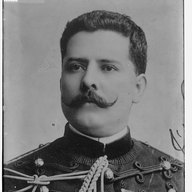
At a glanceKnown key applied · partial (82% of cipher tokens valued, not the word count)
- The letters
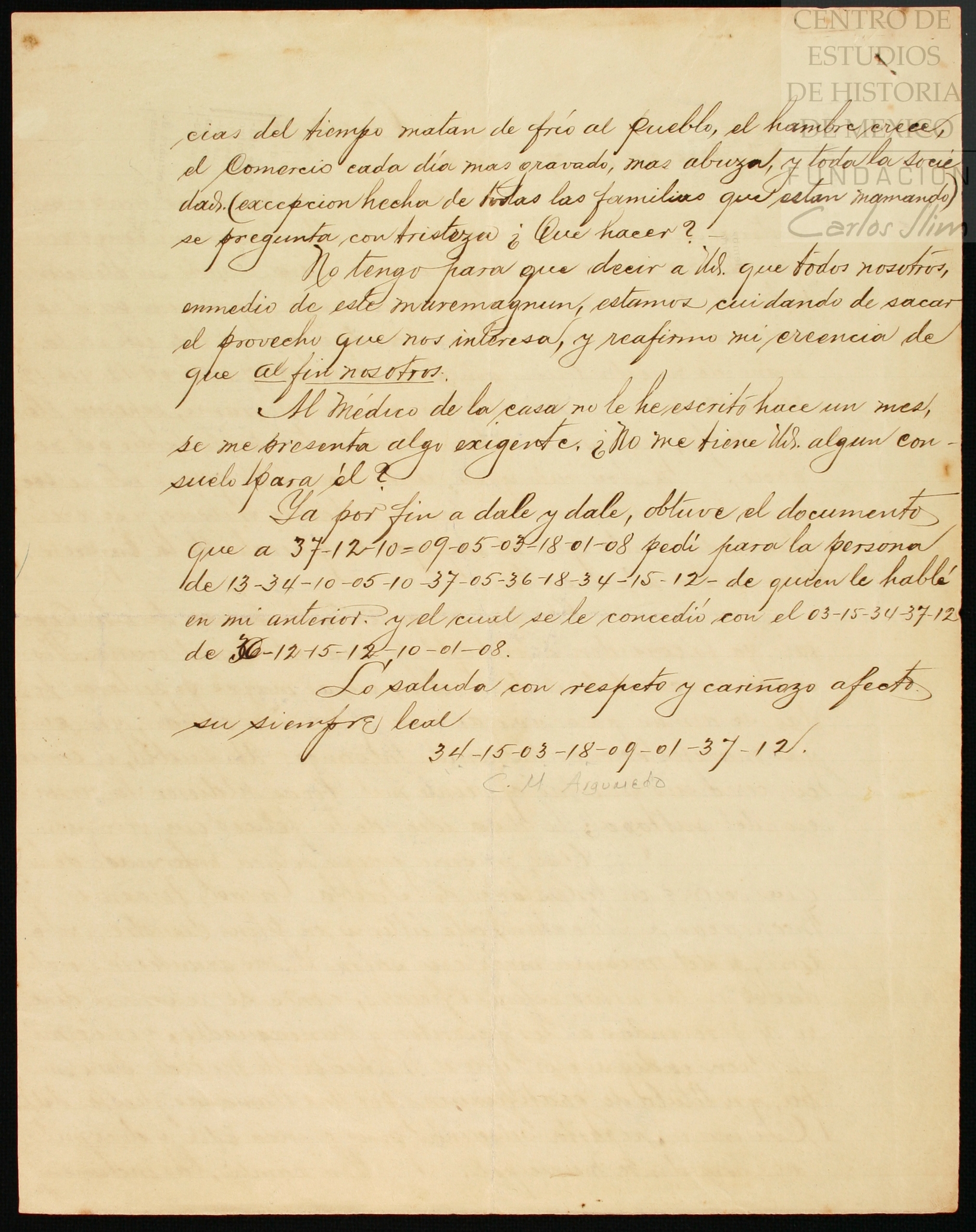
- Cristóbal Mateo Argumedo, who signs “Don Mateo” and “Argumedo” in cipher, to General Félix Díaz, from Mexico City, 5 October 1921 (typed) and 20 October 1921 (handwritten in ink). Clear Spanish, with names and key words in number pairs.
- Where
- CEHM-Carso (Centro de Estudios de Historia de México, Fundación Carlos Slim), Fondo DCXXI, Archivo de Félix Díaz, DCXXI.3.244.1 and DCXXI.3.250.2, two folios each. No DECODE record found.
- The cipher
- One two-digit number for each letter of the 27-letter Spanish alphabet: E = 01 … Z = 23 (Ñ = 11), then A = 34, B = 35, C = 36, D = 37.
- How it was deciphered
- With Roberto Narváez’s published table (2015), applied unchanged. On the ten runs whose clear he printed, it gives 88 of 89 letters. The 25 runs he did not print were then deciphered and read in their sentences.
- What it says
- A Michoacán landowner, through his son, offers his whole hacienda and a guerrilla of 80 to 100 armed men; the son asks for a nombramiento to win over the peons of Panindícuaro. On 20 October the document is granted “con el grado de coronel”.
- Still open
- Seven words of the new runs carry a writer’s slip of one code, an overstrike, or a letter of uncertain sense; each is taken from the sense. Whether Narváez’s 2019 book prints these runs could not be checked.
- Credit
- Contributed by Brice Dudout, with AI agents, in pull request #962. Key, system and the clear of ten runs: Narváez (2015). The CEHM-Carso viewer path came from Andrew Beling’s pull request #941.
01 The two letters
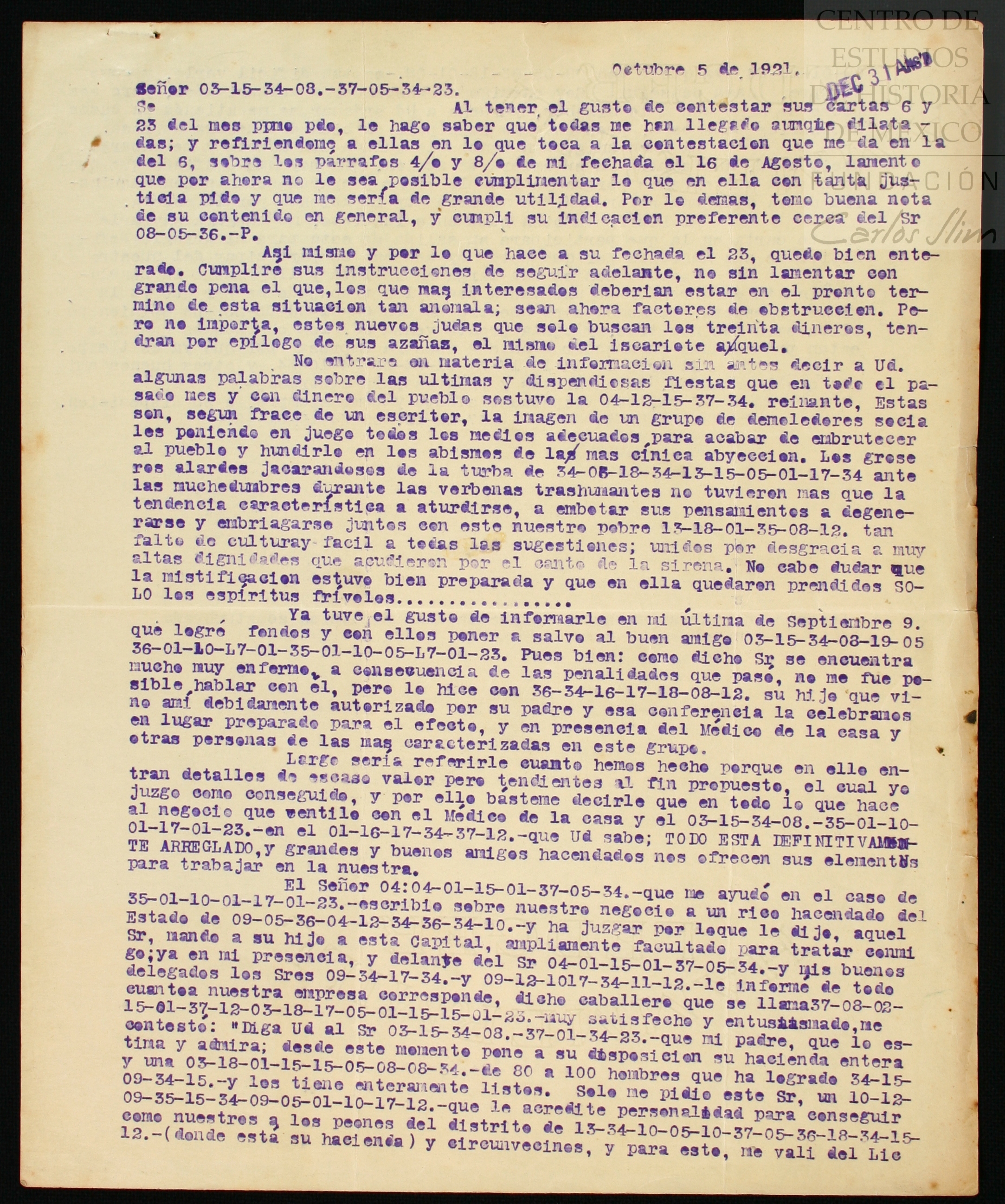
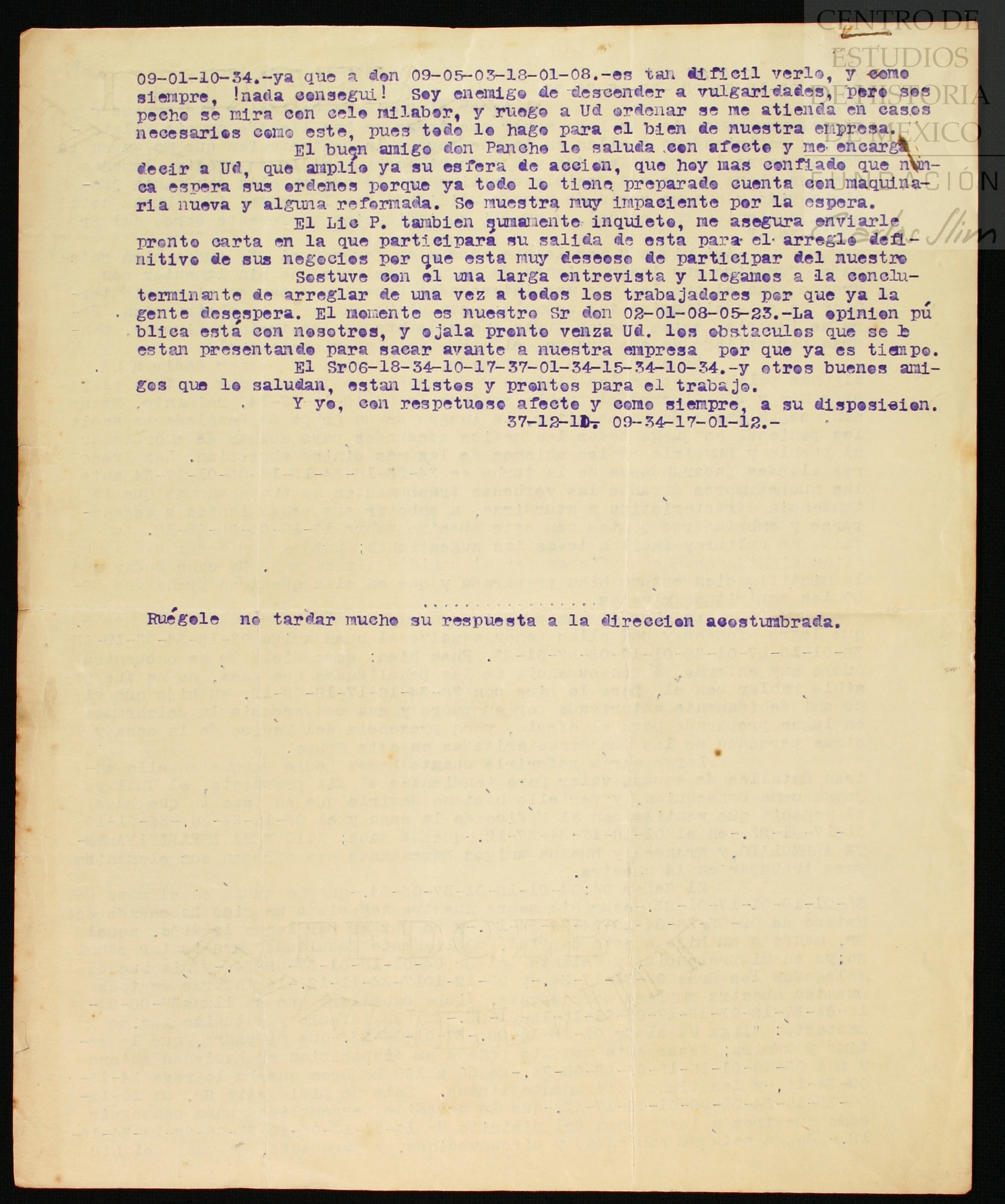
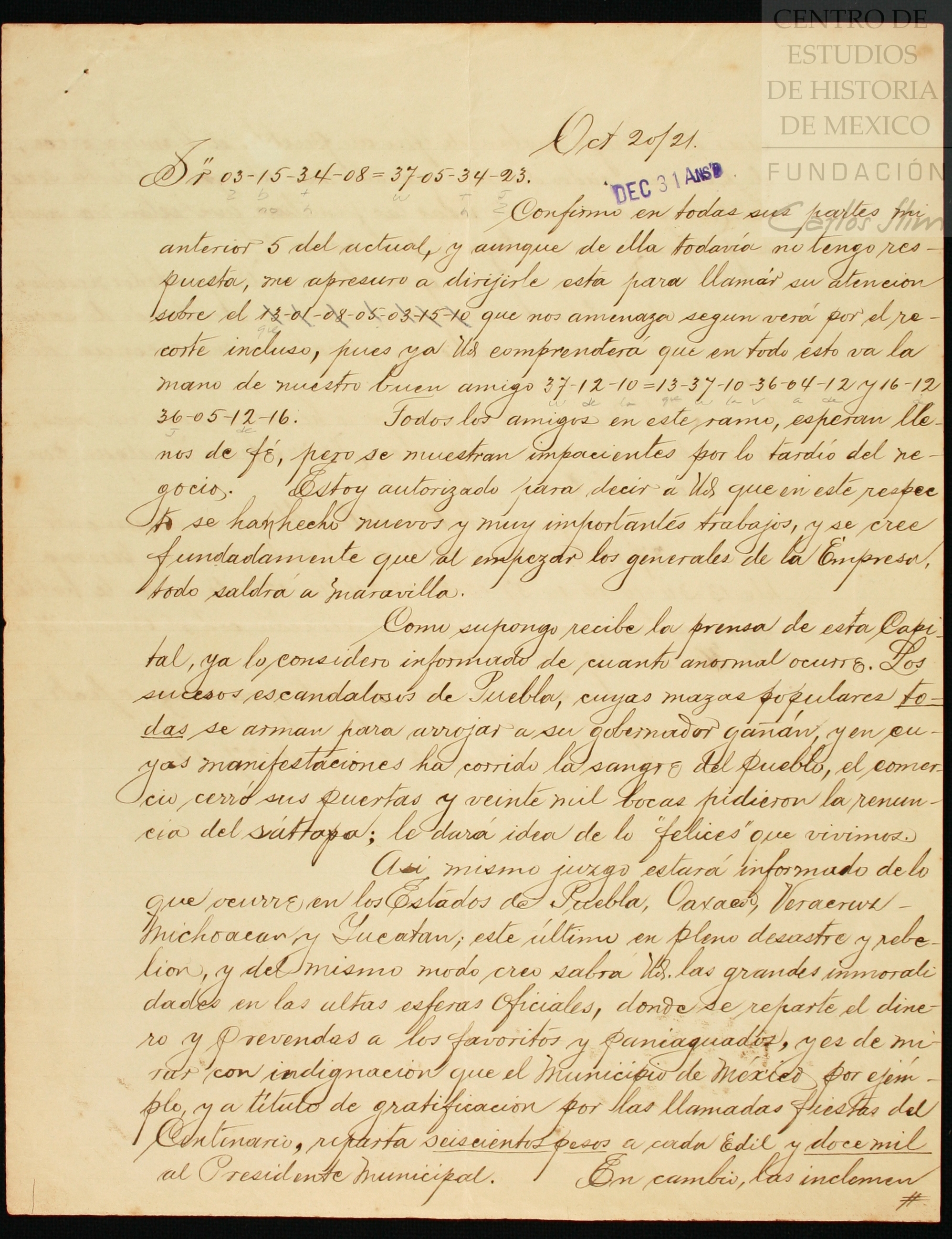
Both letters are in the Archivo de Félix Díaz at CEHM-Carso. The first, DCXXI.3.244.1, is typed on two folios, dated “Octubre 5 de 1921”, addressed in cipher to “Señor Gral. Díaz”, signed in cipher “Don Mateo”, and carries a received stamp “DEC 31 ANS’D”. The second, DCXXI.3.250.2, is dated “Oct 20/21” and signed “Argumedo” in cipher. Narváez describes it as typed, but the images show a pen hand in ink. Pencil letters above some groups of its first folio, and a pencil “C. M. Argumedo” under the signature, are in a later hand of unknown date; they are not used here.
“Don Mateo” is Cristóbal Mateo Argumedo, as Narváez identifies him. The letters are in clear Spanish, with names and a few key words in two-digit pairs: 26 runs in the first letter, 9 in the second.
The images are on the CEHM-Carso public viewer (links under Sources). The CEHM site says “Todos los Derechos Reservados” and publishes no terms of use, so no image is reproduced here; the strip at the top is typed from the transcription.
02 The table
Each letter of the Spanish alphabet, Ñ included, has one two-digit number. The table starts at E: E = 01, F = 02, G = 03 and so on to N = 10, Ñ = 11, O = 12 … Z = 23. A, B, C and D come last, as 34, 35, 36 and 37. The numbers 24 to 33 do not occur in these two letters. The writer divides the runs into words with “.-”, “.” or “:” in the first letter and “=” in the second; in A06, A16 and A25 the words run together.
Narváez broke the system and printed the table (Documenta & Instrumenta 13, 2015, p. 122), with the clear of ten runs. He wrote that the table reads the rest, but cut the first letter with “[…]” and gave the four runs of the second letter’s second folio in cipher only. The table is used by no other target in this repository: the felicista letters of Duhart (a swap of five letter pairs) and Sánchez (Narváez’s key 313) are in other systems, with their own pages, duhart1921 and sanchez1922.
03 How it was deciphered
- The four page images were fetched from the CEHM-Carso viewer, and all 35 runs were transcribed by an AI model. The transcription and the key were frozen by SHA-256 before any decoding. The hashed working files are kept by the contributor and are not in the repository.
- Control: the ten runs whose clear Narváez prints were decoded with his table. 88 of 89 letters agree. The one miss is the writer’s: PELIGRO is enciphered 13-01-08-05-03-15-10, ending in N, and Narváez corrects it silently. No null-key test was run, since the key is a printed one applied unchanged, not built from these letters.
- The 25 runs Narváez did not print were decoded with the same table and read in their clear sentences. Every departure from the key’s output is marked in the reading.
- Key replay: the table applied to the two transcriptions reproduces the reading with every difference marked. Of 49 cipher words as the transcription divides them, 41 come out exactly and 8 are marked emendations; one overstruck pair has no value.
- The integration review of the pull request, by an AI agent for the maintainers, reproduced both decryptions with its own decoder, recounted the words, compared the runs with the images (A01 to A26 and B05 to B09) and read both letters as Spanish sentences: grade B. No person has checked the transcription or the reading.
04 The reading
The runs, in bold, in their sentences. Braces mark a word the signs do not give as written: {x/y}, the signs give x and the reading is y. The full readings, translations and transcriptions are under Full texts.
5 October 1921
Argumedo first mocks the festivities that “la horda reinante” held with the people’s money, and “la turba de A{?/G}ua Prieta”. Then the business:
El Señor {H.} Heredia, que me ayudó en el caso de Ben{e/i}tez, escribió sobre nuestro negocio a un rico hacendado del Estado de Michoacán […] dicho caballero, que se llama {D/A}lfredo Gutiérrez, muy satisfecho y entusiasmado, me contestó: «Diga Ud al Sr Gral. D{e/i}az que mi padre […] pone a su disposición su hacienda entera y una guerrilla de 80 a 100 hombres que ha logrado armar y los tiene enteramente listos.» Sólo me pidió este Sr un nombramiento que le acredite personalidad para conseguir como nuestros a los peones del distrito de Panindícuaro (donde está su hacienda) y circunvecinos.
Mr H. Heredia, who helped me in the Benítez affair, wrote about our business to a rich landowner of the State of Michoacán […] that gentleman, whose name is Alfredo Gutiérrez, very satisfied and enthusiastic, answered me: “Tell General Díaz that my father […] puts at his disposal his whole hacienda and a guerrilla band of 80 to 100 men that he has managed to arm and keeps entirely ready.” This gentleman asked me only for an appointment giving him standing to win over to our side the peons of the district of Panindícuaro (where his hacienda is) and the neighbouring ones.
The letter also names, in cipher, General Vicente Benítez, whom Argumedo had put in safety with funds he raised, and his son Cástulo (both printed by Narváez); Argumedo’s delegates Mata and Montaño; Lic. Mena, through whom he tried for the appointment “ya que a don Miguel es tan difícil verlo”; and Juan T. de Arana. It ends “El momento es nuestro, Sr don Féli{z/x}”.
20 October 1921
The second letter warns of the danger, the work of “nuestro buen amigo Don P{d/a}ncho y socios” (runs printed by Narváez), and then answers the first:
Ya por fin, a dale y dale, obtuve el documento que a Don Miguel pedí para la persona de Panindícuaro de quien le hablé en mi anterior, y el cual se le concedió con el grado de coronel.
At last, by dint of insisting, I obtained the document that I asked of Don Miguel for the person from Panindícuaro of whom I spoke to you in my last, and which was granted to him with the rank of colonel.
Agua Prieta stands for the Sonoran group of Obregón and Calles, after the Plan of Agua Prieta of April 1920, and “la horda reinante” for Obregón’s government; Panindícuaro is a municipality of Michoacán. These identifications are the contributor’s notes. “Don Miguel” and Lic. Mena are not identified.
05 Counts and what is open
Words are counted over the cipher words only, and a word counts as read when the key gives it as written. Slips are counted as holes: the table is Narváez’s reconstruction, not a surviving key of the period, so the one-digit rule does not apply.
- 5 October (DCXXI.3.244.1): 38 cipher words, 31 read as the key gives them, 7 marked (0.816): partial, under the 95% bar. Its 21 new runs: 27 words, 20 read.
- 20 October (DCXXI.3.250.2): 12 cipher words, 10 read, 2 holes, both in Narváez’s control runs (PELIGR{N/O}, P{D/A}NCHO): 0.833. It counts as read under the short-text floor (fewer than 40 cipher words, at most 2 holes). Its 4 new runs: 5 words, 5 read.
- Both letters: 41 of 50 cipher words (0.82), under the 95% bar, so the extent is partial. The 25 new runs: 25 of 32 words. Counted this way, AGUA PRIETA is two words and the “H.” before Heredia is a hole; the key replay above counts AGUA PRIETA as one cipher word and the H as exact, hence its 41 of 49.
The seven marked words of the new runs:
- A{?/G}ua Prieta (A04): the second pair is a 0 with 6 and 3 typed one over the other. 03 gives Agua Prieta; 06, the figure Narváez read, gives no word.
- Ben{e/i}tez twice (A08, A11) and D{e/i}az (A17): 01 (E) written for 05 (I). At A11 the review looked at the page at full size: the 01 is on the page, the writer’s slip.
- {D/A}lfredo (A16): 37 (D) for 34 (A), the same slip as Narváez’s “Pdncho”, which the first letter writes “Pancho” in clear.
- Féli{z/x} (A24): 23 (Z) for 21 (X), or the writer’s spelling.
- {H.} before Heredia (A10): typed “04:”; it may be an initial or a repeated keystroke.
No other copy of either letter was found, so nothing can turn these words into words the key gives as written. The Amaya letter of the same fondo (DCXXI.3.242.1, Havana, 27 September 1921), the one other felicista letter noted with two-digit numbers, was looked at on 25 November 2026: its pairs run to 79, 86, 90, 96 and 97, outside this table, so it is another system.
Narváez 2019. His book Criptografía diplomática, política y militar en México (1813–1926) (SRE, 2019) could not be opened or searched: Google Books has no preview and no search inside for it. A review in Historia Mexicana says its chapters were published before, 2007 to 2015, and modified for the book. Whether its pages on Argumedo print more than the 2015 article is not known. If they print these runs, the method for them becomes “read from existing decipherment”.
Full texts
The transcription and the decryption of every document on this page, so that the reading can be used and checked. Short files are shown here; all are in the repository.
Argumedo to Félix Díaz, 5 Oct 1921: 26 cipher runs read in part
A Michoacán landowner's son, Alfredo Gutiérrez, offers his father's hacienda and a guerrilla of 80-100 armed men and asks for a nombramiento to win over the peons of Panindícuaro; agents Gral. Benítez, Heredia, Mata, Montaño, Lic. Mena, Lic. P., Don Miguel; Obregón's government called the 'reigning horde' and the 'Agua Prieta mob'.
Builds coherent sentences, but under the read bar of 95% of words read as sense (82% here); the holes are marked in the reading.
Transcription
transcription_DCXXI.3.244.1.txt
# DCXXI.3.244.1, Cristóbal Mateo Argumedo ("Don Mateo") to Gen. Félix Díaz, Mexico City, 5 October 1921. Typed, 2 ff.
# CEHM-Carso viewer images DCXXI.3.244.1.0001-0002.jpg (see NOTES.md). Transcribed by an AI model (Claude) from the
# full pages and crops, 25 Nov 2026, and frozen by SHA-256 before any decoding (working file TRANSCRIPTION.tsv,
# SHA-256 f269968305a2660895e7dc544d964ae0b979010c8eaa16fb890c24803b6c7a48; this file is the same groups laid out in English).
# Columns: id, folio, role, groups. "|" = word division. The writer marks it with ".-" (A01, A08, A17), "." (A26) or
# ":" (A10); in A06, A16 and A25 the words run together and the division is ours. role "control" = a run whose clear
# Narváez prints (2015, pp. 120-122); "new" = a run whose clear he does not print.
# Notes on the image:
#  A02: followed by ".-P." in clear (the letter P, not a code); f. 2 has "El Lic P." in clear.
#  A04: 2nd pair: 0, then 6 and 3 typed one over the other ("0?" here; Narváez prints 06).
#  A06: the 10 and both 17 are typed "L0", "L7" (L for 1).
#  A10: typed "04:04-01-..." (a colon after the first 04).
#  A15: "1017" typed without the hyphen.
#  A26: the 10 is overstruck.
# id	folio	role	groups
A01	1	new	03-15-34-08|37-05-34-23
A02	1	new	08-05-36
A03	1	new	04-12-15-37-34
A04	1	new	34-0?-18-34-13-15-05-01-17-34
A05	1	control	13-18-01-35-08-12
A06	1	control	03-15-34-08|19-05-36-01-10-17-01|35-01-10-05-17-01-23
A07	1	control	36-34-16-17-18-08-12
A08	1	new	03-15-34-08|35-01-10-01-17-01-23
A09	1	new	01-16-17-34-37-12
A10	1	new	04|04-01-15-01-37-05-34
A11	1	new	35-01-10-01-17-01-23
A12	1	new	09-05-36-04-12-34-36-34-10
A13	1	new	04-01-15-01-37-05-34
A14	1	new	09-34-17-34
A15	1	new	09-12-10-17-34-11-12
A16	1	new	37-08-02-15-01-37-12|03-18-17-05-01-15-15-01-23
A17	1	new	03-15-34-08|37-01-34-23
A18	1	new	03-18-01-15-15-05-08-08-34
A19	1	new	34-15-09-34-15
A20	1	new	10-12-09-35-15-34-09-05-01-10-17-12
A21	1	new	13-34-10-05-10-37-05-36-18-34-15-12
A22	2	new	09-01-10-34
A23	2	new	09-05-03-18-01-08
A24	2	new	02-01-08-05-23
A25	2	control	06-18-34-10|17|37-01|34-15-34-10-34
A26	2	control	37-12-10|09-34-17-01-12
Decryption
# Mechanical decryption of transcription_DCXXI.3.244.1.txt with key.tsv (no edit; "|" = word division as transcribed)
# id	folio	role	decryption
A01	1	new	GRAL|DIAZ
A02	1	new	LIC
A03	1	new	HORDA
A04	1	new	A<0?>UAPRIETA
A05	1	control	PUEBLO
A06	1	control	GRAL|VICENTE|BENITEZ
A07	1	control	CASTULO
A08	1	new	GRAL|BENETEZ
A09	1	new	ESTADO
A10	1	new	H|HEREDIA
A11	1	new	BENETEZ
A12	1	new	MICHOACAN
A13	1	new	HEREDIA
A14	1	new	MATA
A15	1	new	MONTAÑO
A16	1	new	DLFREDO|GUTIERREZ
A17	1	new	GRAL|DEAZ
A18	1	new	GUERRILLA
A19	1	new	ARMAR
A20	1	new	NOMBRAMIENTO
A21	1	new	PANINDICUARO
A22	2	new	MENA
A23	2	new	MIGUEL
A24	2	new	FELIZ
A25	2	control	JUAN|T|DE|ARANA
A26	2	control	DON|MATEO
Reading
# Reading of DCXXI.3.244.1 (Argumedo to Félix Díaz, 5 October 1921)

<!-- measure: cipher_markup=** -->

Reading by an AI model (Claude, claude-opus-5-5) for Brice Dudout, 25 Nov 2026. No person has checked it yet.
Key: `key.tsv` (Narváez 2015, p. 122, applied unchanged). Mechanical decryption: `decryption_DCXXI.3.244.1.txt`.
Runs marked "control" were read by Narváez, who prints their clear (2015, pp. 120-122); the others he did not print
(he cuts this letter with "[...]"), and they are the new part of this target.

Marks: `{x/y}` the signs give x, read y (an encipherer slip of one code, or an overstruck pair); `{x}` the key gives x
but its sense is uncertain. Every marked word is counted as a hole on the read bar. Word division in the runs is the
writer's except in A06, A16 and A25 (see the transcription). Accents are added in the sentences (the typist used
almost none); they are not departures.

## Marked runs

```marked
A01: GRAL DIAZ
A02: LIC
A03: HORDA
A04: A{?/G}UA PRIETA
A05: PUEBLO
A06: GRAL VICENTE BENITEZ
A07: CASTULO
A08: GRAL BEN{E/I}TEZ
A09: ESTADO
A10: {H} HEREDIA
A11: BEN{E/I}TEZ
A12: MICHOACAN
A13: HEREDIA
A14: MATA
A15: MONTAÑO
A16: {D/A}LFREDO GUTIERREZ
A17: GRAL D{E/I}AZ
A18: GUERRILLA
A19: ARMAR
A20: NOMBRAMIENTO
A21: PANINDICUARO
A22: MENA
A23: MIGUEL
A24: FELI{Z/X}
A25: JUAN T DE ARANA
A26: DON MATEO
```

Slips: three times 01 (E) for 05 (I) (A08, A11, A17), once 37 (D) for 34 (A) (A16; the same slip as Narváez's
"Pdncho" in DCXXI.3.250.2, which f. 2 of this letter writes "Pancho" in clear), once 23 (Z) for 21 (X) (A24, or the
writer's spelling "Feliz"). A04: the second pair is a 0 over which 6 and 3 are typed one on the other; 03 (G) gives
AGUA PRIETA, 06 (J, Narváez's reading of the figure) gives no word. A10: "04:" before HEREDIA decodes H; it may be an
initial or a repeated keystroke.

## The runs in their sentences

Cipher runs in bold, clear text as typed with accents added.

1. f. 1, address: "Señor **Gral. Díaz**."
2. f. 1: "Por lo demás, tomo buena nota de su contenido en general, y cumplí su indicación preferente cerca del Sr
   **Lic.** P."
3. f. 1: "No entraré en materia de información sin antes decir a Ud. algunas palabras sobre las últimas y
   dispendiosas fiestas que en todo el pasado mes y con dinero del pueblo sostuvo la **horda** reinante."
4. f. 1: "Los groseros alardes jacarandosos de la turba de **A{?/G}ua Prieta** ante las muchedumbres durante las
   verbenas trashumantes no tuvieron más que la tendencia característica a aturdirse, a embotar sus pensamientos, a
   degenerarse y embriagarse juntos con este nuestro pobre **pueblo** tan falto de cultura y fácil a todas las
   sugestiones."
5. f. 1: "Ya tuve el gusto de informarle en mi última de septiembre 9 que logré fondos y con ellos poner a salvo al
   buen amigo **Gral. Vicente Benítez**. Pues bien: como dicho Sr se encuentra mucho muy enfermo, a consecuencia de
   las penalidades que pasó, no me fue posible hablar con él, pero lo hice con **Cástulo**, su hijo, que vino a mí
   debidamente autorizado por su padre."
6. f. 1: "Y por ello básteme decirle que en todo lo que hace al negocio que ventilé con el Médico de la casa y el
   **Gral. Ben{e/i}tez** en el **Estado** que Ud sabe, TODO ESTÁ DEFINITIVAMENTE ARREGLADO, y grandes y buenos amigos
   hacendados nos ofrecen sus elementos para trabajar en la nuestra."
7. f. 1: "El Señor **{H.} Heredia**, que me ayudó en el caso de **Ben{e/i}tez**, escribió sobre nuestro negocio a un
   rico hacendado del Estado de **Michoacán**, y a juzgar por lo que le dijo, aquel Sr mandó a su hijo a esta
   Capital, ampliamente facultado para tratar conmigo."
8. f. 1: "Ya en mi presencia, y delante del Sr **Heredia** y mis buenos delegados los Sres **Mata** y **Montaño**,
   le informé de todo cuanto a nuestra empresa corresponde; dicho caballero, que se llama **{D/A}lfredo
   Gutiérrez**, muy satisfecho y entusiasmado, me contestó: «Diga Ud al Sr **Gral. D{e/i}az** que mi padre, que lo
   estima y admira, desde este momento pone a su disposición su hacienda entera y una **guerrilla** de 80 a 100
   hombres que ha logrado **armar** y los tiene enteramente listos.»"
9. f. 1: "Sólo me pidió este Sr un **nombramiento** que le acredite personalidad para conseguir como nuestros a los
   peones del distrito de **Panindícuaro** (donde está su hacienda) y circunvecinos."
10. f. 1-2: "Y para esto me valí del Lic **Mena**, ya que a don **Miguel** es tan difícil verlo, y como siempre,
    ¡nada conseguí!"
11. f. 2: "El momento es nuestro, Sr don **Féli{z/x}**."
12. f. 2: "El Sr **Juan T. de Arana** y otros buenos amigos que le saludan están listos y prontos para el trabajo."
13. f. 2, signature: "Y yo, con respetuoso afecto y como siempre, a su disposición. **Don Mateo**."

## Notes

- Identifications are by the names as written. "Don Mateo" is Cristóbal Mateo Argumedo (Narváez 2015). Agua Prieta:
  the Sonoran group of Obregón and Calles, after the Plan of Agua Prieta (April 1920); "la horda reinante" is
  Obregón's government. Panindícuaro is a municipality of Michoacán. "Don Miguel" and "Lic. Mena" are not
  identified further here.
- Counts (cipher words of this letter): 38 cipher words, 31 read as the key gives them, 7 marked (AGUA, BENÍTEZ
  twice, H., ALFREDO, DÍAZ in A17, FÉLIX): read share 31/38 = 0.816. The new runs alone: 27 words, 20 read, 7 marked.
  No word is supplied and no run is left unread.
Translation
# Translation of DCXXI.3.244.1 (Argumedo to Félix Díaz, 5 October 1921)

English translation of the sentences in `reading_DCXXI.3.244.1.md`, by an AI model (Claude), 25 Nov 2026. Deciphered
runs in bold; marked words as in the reading.

1. Address: "Mr **Gen. Díaz**."
2. "For the rest, I take good note of its contents in general, and I carried out your special instruction with Mr
   **Lic.** P."
3. "I will not go into the news without first saying a few words to you about the last, costly festivities that the
   reigning **horde** held all last month with the people's money."
4. "The coarse, swaggering displays of the **A{?/G}ua Prieta** mob before the crowds during the roving fairs had no
   other aim than the characteristic one of dazing themselves, dulling their thoughts, degenerating and getting drunk
   together with this poor **people** of ours, so lacking in culture and so open to every suggestion."
5. "I already had the pleasure of telling you in my last of 9 September that I raised funds and with them put our good
   friend **Gen. Vicente Benítez** in safety. Well then: as that gentleman is very ill indeed, as a result of the
   hardships he went through, I could not speak with him, but I did so with **Cástulo**, his son, who came to me duly
   authorised by his father."
6. "And so let it be enough to tell you that in all that concerns the business I discussed with the House Doctor and
   **Gen. Ben{e/i}tez** in the **State** you know of, EVERYTHING IS DEFINITELY ARRANGED, and great and good landowner
   friends offer us their resources to work for ours."
7. "Mr **{H.} Heredia**, who helped me in the **Ben{e/i}tez** affair, wrote about our business to a rich landowner of
   the State of **Michoacán**, and judging by what he told him, that gentleman sent his son to this Capital, with full
   powers to deal with me."
8. "In my presence, and before Mr **Heredia** and my good delegates Messrs **Mata** and **Montaño**, I told him all
   that concerns our enterprise; that gentleman, whose name is **{D/A}lfredo Gutiérrez**, very satisfied and
   enthusiastic, answered me: 'Tell Mr **Gen. D{e/i}az** that my father, who esteems and admires him, from this moment
   puts at his disposal his whole hacienda and a **guerrilla band** of 80 to 100 men that he has managed to **arm**
   and keeps entirely ready.'"
9. "This gentleman asked me only for an **appointment** (nombramiento) giving him standing to win over to our side the
   peons of the district of **Panindícuaro** (where his hacienda is) and the neighbouring ones."
10. "And for this I made use of Lic. **Mena**, since don **Miguel** is so hard to see, and as always, I got nothing!"
11. "The moment is ours, don **Féli{z/x}**."
12. "Mr **Juan T. de Arana** and other good friends who send you their greetings are ready and prompt for the work."
13. Signature: "And I, with respectful affection and as always, at your disposal. **Don Mateo**."
Argumedo to Félix Díaz, 20 Oct 1921: 9 cipher runs
The danger threatening the felicistas is laid at the door of 'Don Pancho and partners'; the document asked of Don Miguel for the man from Panindícuaro was granted with the rank of colonel.
Transcription
transcription_DCXXI.3.250.2.txt
# DCXXI.3.250.2, Cristóbal Mateo Argumedo to Gen. Félix Díaz, Mexico City, 20 October 1921. Handwritten in ink, 2 ff.
# (Narváez 2015 describes it as typed; the images show a pen hand.)
# CEHM-Carso viewer images DCXXI.3.250.2.0001-0002.jpg (see NOTES.md). Transcribed by an AI model (Claude), 25 Nov 2026,
# frozen with the same file as DCXXI.3.244.1 (SHA-256 f269968305a2660895e7dc544d964ae0b979010c8eaa16fb890c24803b6c7a48).
# Columns: id, folio, role, groups. "|" = word division, marked by the writer with "=" (B01, B03, B05).
# role "control" = a run whose clear Narváez prints (2015, pp. 120-122); "new" = printed by him in cipher only (B05-B08).
# Notes on the image:
#  B02: the last pair is 10 (Narváez prints the clear "peligro").
#  B08: the first pair, 36, is rewritten over another figure.
#  f. 1 carries small pencil letters above some groups and f. 2 a pencil "C. M. Argumedo" under the cipher signature,
#  in a later hand of unknown date; not used for the reading.
# id	folio	role	groups
B01	1	control	03-15-34-08|37-05-34-23
B02	1	control	13-01-08-05-03-15-10
B03	1	control	37-12-10|13-37-10-36-04-12
B04	1	control	16-12-36-05-12-16
B05	2	new	37-12-10|09-05-03-18-01-08
B06	2	new	13-34-10-05-10-37-05-36-18-34-15-12
B07	2	new	03-15-34-37-12
B08	2	new	36-12-15-12-10-01-08
B09	2	control	34-15-03-18-09-01-37-12
Decryption
# Mechanical decryption of transcription_DCXXI.3.250.2.txt with key.tsv (no edit; "|" = word division as transcribed)
# id	folio	role	decryption
B01	1	control	GRAL|DIAZ
B02	1	control	PELIGRN
B03	1	control	DON|PDNCHO
B04	1	control	SOCIOS
B05	2	new	DON|MIGUEL
B06	2	new	PANINDICUARO
B07	2	new	GRADO
B08	2	new	CORONEL
B09	2	control	ARGUMEDO
Reading
# Reading of DCXXI.3.250.2 (Argumedo to Félix Díaz, 20 October 1921)

<!-- measure: cipher_markup=** -->

Reading by an AI model (Claude, claude-opus-5-5) for Brice Dudout, 25 Nov 2026. No person has checked it yet.
Key: `key.tsv` (Narváez 2015, p. 122, applied unchanged). Mechanical decryption: `decryption_DCXXI.3.250.2.txt`.
Narváez prints the clear of the f. 1 runs and the signature (controls) and the four f. 2 runs B05-B08 in cipher only;
B05-B08 are the new part. The letter is handwritten in ink (Narváez calls it typed).

Marks: `{x/y}` the signs give x, read y (a slip of one code by the writer). Marked words count as holes. Accents are
added in the sentences; they are not departures.

## Marked runs

```marked
B01: GRAL DIAZ
B02: PELIGR{N/O}
B03: DON P{D/A}NCHO
B04: SOCIOS
B05: DON MIGUEL
B06: PANINDICUARO
B07: GRADO
B08: CORONEL
B09: ARGUMEDO
```

B02 ends in 10 (N) where the sense wants 12 (O); Narváez prints "peligro" without comment. B03 is printed "Pdncho"
by Narváez; the letter of 5 October has "don Pancho" in clear.

## The runs in their sentences

Cipher runs in bold, clear text as written with accents added.

1. f. 1, address: "Sr **Gral. Díaz**."
2. f. 1: "Confirmo en todas sus partes mi anterior 5 del actual, y aunque de ella todavía no tengo respuesta, me
   apresuro a dirigirle ésta para llamar su atención sobre el **peligr{n/o}** que nos amenaza según verá por el
   recorte incluso, pues ya Ud comprenderá que en todo esto va la mano de nuestro buen amigo **Don P{d/a}ncho** y
   **socios**."
3. f. 2: "Ya por fin, a dale y dale, obtuve el documento que a **Don Miguel** pedí para la persona de
   **Panindícuaro** de quien le hablé en mi anterior, y el cual se le concedió con el **grado** de **coronel**."
4. f. 2, signature: "Lo saluda con respeto y cariñoso afecto su siempre leal **Argumedo**."

## Notes

- Sentence 3 answers the letter of 5 October (DCXXI.3.244.1): the *nombramiento* asked there for the son of the
  Michoacán landowner (Alfredo Gutiérrez, district of Panindícuaro), through Lic. Mena because "Don Miguel" was hard
  to see, was granted by Don Miguel with the rank of colonel.
- Counts (cipher words of this letter): 12 cipher words, 10 read as the key gives them, 2 marked (PELIGRO, PANCHO,
  both in Narváez's control runs): read share 10/12 = 0.833; under the README short-text floor (fewer than 40 cipher
  words, at most 2 holes) the letter counts as read. The new runs B05-B08: 5 words, 5 read.
Translation
# Translation of DCXXI.3.250.2 (Argumedo to Félix Díaz, 20 October 1921)

English translation of the sentences in `reading_DCXXI.3.250.2.md`, by an AI model (Claude), 25 Nov 2026. Deciphered
runs in bold; marked words as in the reading.

1. Address: "Mr **Gen. Díaz**."
2. "I confirm in all its parts my previous letter of the 5th of this month, and although I still have no answer to it,
   I hasten to send you this one to call your attention to the **dange{n/r}** that threatens us, as you will see from
   the enclosed cutting, for you will understand that in all this is the hand of our good friend **Don P{d/a}ncho**
   and **partners**."
3. "At last, by dint of insisting, I obtained the document that I asked of **Don Miguel** for the person from
   **Panindícuaro** of whom I spoke to you in my last, and which was granted to him with the **rank** of
   **colonel**."
4. Signature: "With respect and fond affection, your ever loyal **Argumedo**."
Key: key.tsv
06 Sources
- CEHM-Carso, Fondo DCXXI (Archivo de Félix Díaz), DCXXI.3.244.1, images 0001 and 0002; DCXXI.3.250.2, images 0001 and 0002 (public viewer, no sign-in).
- Roberto Narváez, “Sobre algunos criptosistemas mexicanos de principios del siglo XX”, Documenta & Instrumenta 13 (2015), pp. 107–132, at pp. 117–122 (open access): the system, the table (p. 122) and the clear of the ten control runs.
- Roberto Narváez, Criptografía diplomática, política y militar en México (1813–1926) (Mexico: SRE, 2019): not seen for these letters. Review by G. Martínez Carmona, Historia Mexicana 72.2, pp. 963–966 (SciELO).
- Pull request #962 (Brice Dudout, with AI agents): transcriptions, decryptions, readings and translations in the repository folder.
Working files: targets/argumedo1921/ (NOTES.md, key.tsv, the transcriptions, decryptions, readings, translations and the control file).
Cite this page
Brice Dudout and Daniel Bourdeau, “Argumedo to Félix Díaz, 5 and 20 October 1921”, Cyphersolver, posted 25 November 2026, repository commit 17bf7e8764, https://cyphersolver.com/argumedo1921.html.