
At a glanceCiphertext-only break · partial (89% of the cipher)
- The letter
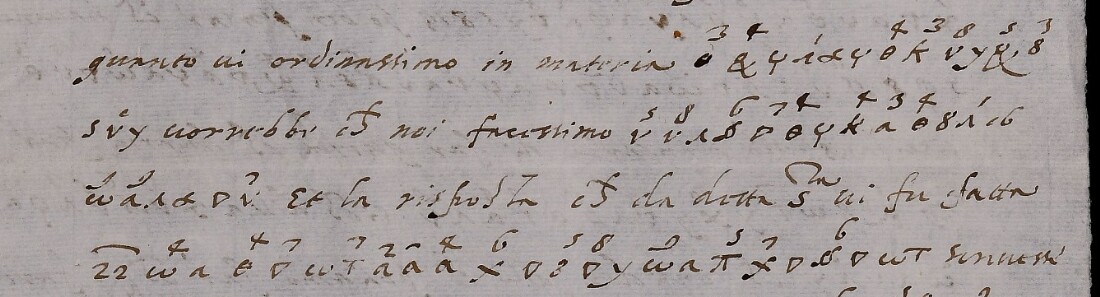
- Ercole II d’Este, duke of Ferrara, to his secretary Claudio Ariosto, Ferrara, 23 April 1559, with a postscript. The letter is in clear Italian, and the passages about the countess, her husband and their affairs are set in cipher.
- Where
- Biblioteca Estense Universitaria, Modena, Autografoteca Campori, Lettera E, Este (d’), Ercole II d’Este, duca di Ferrara, cc. 39–41 (IIIF manifest 8d50f9af-95d8-405e-a3a4-f66933e69af1). Catalogue 2159 here, from WAINUT’s sweep of the Estense collection. No DECODE record, no entry at Cryptiana, no edition found.
- The cipher
- Consonant signs of Greek and Latin shape, each followed by a small raised digit that gives the vowel: 2 o, 3 i, 4 e, 5 a, 6 a, 7 e, 8 i, 9 o, 1 u. A raised ring doubles the consonant, a dot is a null, & is qu, and a few code numbers under a bar stand for words. About 1,830 signs and raised marks in 77 cipher lines.
- How it was deciphered
- Brice Dudout froze a protocol and the transcription with SHA-256 hashes, held out 22.1% of the signs, learned the key by annealing on the rest and measured it once: 0.605 of the held-out letters fall in Italian words of five letters or more, against 0.155 for the best of 200 shuffled keys. The keys of four neighbouring Este ciphers do not fit.
- What it says
- A countess asks the duke to pay her debts out of arrears of censi (rents). He refuses those that fell due during her husband’s rebellion, “a causa della sua ribellione non s’ha da haver nulla”, and offers to pay the future ones to her rather than to him. The peace of 1559 will lessen the husband’s credit.
- Still open
- 39 of 402 cipher words are unresolved, mostly in five stretches where both blind transcriptions read the same unreadable shapes; the code numbers 22, 24 and 25–27; and who the countess, her husband and the count are.
- Credit
- Brice Dudout (Europe chiffrée), working with Claude Opus 5.5 agents: the blind transcription, the key, its validation and the reading. WAINUT found the letter in the Estense collection (catalogue lead 2159, PR #242). Merged here in pull request #277.
01 The letter
The duke is Ercole II d’Este of Ferrara (1508–1559), and the letter is headed Hercules Dux Ferrarie. It is written to Claudio Ariosto, his secretary, on 23 April 1559, with a postscript on cc. 40–41. The duke’s clear sentences give the frame; the cipher is set into them where the matter is delicate. A countess has claimed arrears of rents from the duke and wants them used for her debts. The duke tells Ariosto what to say to her, and asks him about two other matters.
Runs of cipher stand on cc. 39r, 39v, 40r, 40v and 41r. No decipherment is kept with them. The leaf belongs to the Autografoteca Campori, a collection of autograph letters, and the Estense records it only as “Lettera cifrata” with its postscript. Ercole II’s letter of 28 May 1559 (Lettera E, cc. 50–51) is in a different cipher with its own target (targets/ercole1559, not yet written up), and a letter of 15 July 1559 in Ariosto’s own hand has a sign that is not in this one; this key does not read it.
02 The cipher
Every group is a sign and, mostly, a small digit written above it. The sign is a consonant and the digit is the vowel that follows it, so one sign with its digit makes a syllable. The signs look Greek or Latin (alpha, omega, lambda, theta, kappa, upsilon, sigma, pi, tau, chi, phi), a few figures are used as signs (8 and 1 for l, 3 for a), and most vowels have two digits.
| part | what it stands for | examples |
|---|---|---|
| consonant signs | one consonant | alpha = n, omega = c, lambda = s, theta = d, kappa = b, upsilon = t, sigma = r, pi = m, tau = h, chi = p, phi = g, the double loop = f |
| raised digits | the vowel that follows | 2 and 9 = o, 3 and 8 = i, 4 and 7 = e, 5 and 6 = a, 1 = u |
| raised ring | doubles the consonant | upsilon with a ring = tt |
| dot | null | — |
| ampersand | qu | & with 4 = que |
| numbers under a bar | words | 23 = Sua Maestà Catolica (Philip II); 22, 24 and 25–27 not resolved |
From targets/ariosto1559/key.tsv (Brice Dudout, CC BY 4.0), reading values. The vowel follows its sign and the letters are run together without word division, so the reader must cut the words.
The key is not that of Ercole II’s letter of 28 May 1559 (targets/ercole1559), nor Francesco d’Este 1546, Bresegno 1548 or Alfonso II 1576. Each was applied once to the training lines before any learning and none reads this letter.
03 The key and its test
Protocol. Brice Dudout froze the protocol, the measuring script and a blind transcription (shapes only, no values) with SHA-256 hashes before any key work. A held-out set H was fixed by line references and excluded in code from learning: lines 40v:08–14, 40vB and 41r, 405 of the 1,832 signs (22.1%).
Learning. The key was learned by annealing with a character five-gram Italian model on the other lines only, with the raised digits constrained to vowels. Before the measurement two hand rules were added and recorded: a dot is a null and & is qu; then the raised ring doubles the preceding consonant. The key was frozen.
One measurement. The score M5 is the share of decoded letters covered by Italian words of five letters or more. On H it was 0.605. The best of 200 keys made by permuting the key’s values scored 0.155, the median 0.038, a gap of 0.451. The thresholds fixed in advance (0.60, and 0.30 above the best control) were met. There is no contemporary decipherment, so there is no character score.
A change after the test. The measured key read the double loop as n. Reading by sense showed it is f (satisfare, far, prefata, fosse, favore, figliolo, Farnesi, and some ten more places). That change is outside the test, which held with the wrong value, and it is the only difference between the measured key and the reading key. Two blind transcriptions by AI agents agree on 87.7% of tokens; on the nine places where the word depends on the difference Brice Dudout answered a pre-registered shape sheet of thumbnails with no values shown: all six double-loop places are that sign, all three of the qoppa-like sign likewise.
A test that failed. The frozen key, unchanged, was applied once to WAINUT’s transcription of Ariosto’s letter of 15 July 1559 (M5 0.189, best control 0.294) and once to a copy made from the image (0.271 against 0.204). It does not read it; that letter is another table, and nothing is claimed for it. Catalogue 2160, Ercole II to Claudio of 8 January 1547 (cc. 16–17), is also in another table, and no key was frozen for it.
04 The reading
Words written in cipher only, counted by script: of 402, 262 are certain, 95 probable, 6 restored from the sense and 39 unresolved. Certain and probable together give 357 words, 88.8%; with the restored words, 90.3%. The 95% bar is not reached. One of the certain words, satisfare (39r:05), begins with a sign read as t in both passes; it is kept certain as pre-registered and flagged. The cipher words construe as Italian sentences inside the clear letter, with gaps; one AI reader graded it B (coherent but raw), and no human palaeographer has checked the transcription or the reading.
Et perché ci scrivete che detta […] la contessa, doppo d’essersi doluta de’ infiniti mali portamenti usateli dal suo consorte, né solo verso lei ma anco del figliolo […]
And because you write to us that the said […] the countess, after complaining of her husband’s countless ill-treatments of her, and not of her alone but of their son […]
[…] a causa della sua ribellione non s’ha da haver nulla; si ché no accade che facia fondamento su li censi passati in pagar […] i debiti, ma si trovi maniera su li futuri
[…] because of her husband’s rebellion nothing is to be had; so she need not build on the past rents to pay the debts, but let a way be found on the future ones
- The countess’s debts. She wants the duke to have her debts paid out of her husband’s goods, and asks that they be paid from the arrears of the censi, not the future rents. The duke says he does not know which she means; he owes her no censo, only to restore what is hers. He had asked that the rents be held back so they could be disposed of as she wished, but if they were to pay her debts, after her husband had so many false complaints made against him at the court of Philip II, there is no appearance of honesty in it.
- The rebellion. She may think he owes the rents that fell due during her husband’s rebellion; Ariosto is to undeceive her, because of the rebellion nothing is owed. A way may be found on the future rents, which he would pay far more willingly for her than for her husband.
- The husband. She fears she must soon go to law against him, as she would have done before but for her honour and the harm to their son; the duke did not dissuade her. With this peace, in which he will be less needed, her husband will also have less favour if the suit begins. A favourite of his, Iacomo, is to have 4,000 ducats; the duke asks whether it is true. The count, her son-in-law, is to intercede, but the countess hopes little from it.
- Other news. The duke wants word of the rivalry between […] and Don Cesare, the marquis, and what will be done in their academies; and asks Ariosto to see whether a friend would act as of himself, since he has no commission from his masters, with a closing remark about the Farnese.
The peace is presumably Cateau-Cambrésis (April 1559). The countess, her husband and the count are not identified. “Don Cesare” may be Cesare Gonzaga, count of Guastalla, and the unresolved dastalla of 41r:01 may be Guastalla; “il marchese” may be the marquis of Pescara. These are hypotheses, not counted and not checked.
05 What remains uncertain
- 39 unresolved words in 39r:07–08, 39r:19–21, 40r:12–16, 40v:02–04 and 40v:12–13. They read the same in both blind passes, so a third reading at full resolution by a human reader, or a clear minute, is needed.
- Code numbers. 22, 24 and the pair 25–27 occur once each, with no context that fixes them; 23 is restored as Sua Maestà Catolica from the sense at both places.
- Six restored words, not counted in the 88.8%: ella (39r:05), apparenza (39v:06), lei (40r:03), causa (40v:02), non (40v:03), certo (40v:05).
- The transcription is by AI agents only. No human palaeographer has checked it. Where the two passes differ and the reading depends on it, nine places were settled by the shape sheet.
- The people. The Archivio di Stato di Modena (Cancelleria, Ambasciatori; Ariosto’s 1559 correspondence), where a clear minute could exist, was not searched. No edition or study of this letter was found in five web searches, DECODE or Cryptiana.
Full texts
The transcription and the decryption of every document on this page, so that the reading can be used and checked. Short files are shown here; all are in the repository.
cc. 39-41 (39r, 39v, postscript 40r-41r): cipher runs in a clear letter read in part
A countess claims arrears of censi owed by the duke; he refuses those due at the time of her husband's rebellion and offers to pay the future ones to her rather than to the husband, who had false complaints made against him at Philip II's court; she thinks of suing her husband; a favourite, Iacomo, is to have 4,000 ducats; the peace lessens the husband's credit.
Builds coherent sentences, but under the read bar of 95% of words read as sense (89% here); the holes are marked in the reading.
Transcription
# ariosto1559 - Ercole II d'Este to Claudio Ariosto, 23 Apr 1559, Biblioteca Estense Universitaria, Autografoteca Campori,
# Lettera E, Este (d'), Ercole II, cc. 39-41. Cipher lines only, one line per manuscript line: <page:line> TAB <tokens>.
# Read blind (shapes only, no values) by one AI agent (Claude Opus 5.5), 4 Nov 2026; frozen by SHA-256 before any key work
# (measured copy: SHA-256 3bb9b845c4611b0e6a7505a95b6e62f5c88030dd9c65e3fbb057589baaac58cf).
# This is the READING copy: the measured copy with the 9 signs settled by the blind shape sheet of 5 Nov 2026 (below).
# Token names: a=alpha w=omega l=lambda q=theta k=kappa u=upsilon/nu s=sigma z=Latin s j=long s x=chi p=pi t=tau e=epsilon
#   d=delta D=double loop f=phi y=gamma/y Q=qoppa-like (U+03E5 shape) g=g i=iota B=square &=ampersand +=cross; digits in the line
#   are signs; . = dot. Raised marks: ^digit (vowel), ^0 = ring, ^- = bar, ^+ = cross, ^w ^v ^a ^e = small raised letters.
#   ? after a token = doubtful. =word = neighbouring clear word (spelling approximate, not used by the key). {nn} = code number
#   under a bar (cuts the chain). H, the held-out set of the single measurement = 40v:08-14, 40vB: and 41r: (22.1% of tokens).
# Changes from the measured copy (blind shape sheet, pre-registered, answered by Brice Dudout):
#   39r:05 token 10: d -> D (word 'satisfare')
#   39r:09 token 15: d -> D (word 'far')
#   39r:09 token 23: d -> D (word 'satisfar')
#   39r:14 token 28: d -> D (word 'far')
#   39r:14 token 31: d -> D (word 'far')
#   39r:17 token 8: d -> D (word 'satisfarla')
#   39r:09 token 33: Q -> Q (word 'soi')
#   39r:10 token 32: Q -> Q (word 'delli')
#   39v:01 token 9: Q -> Q (word 'restituissimo')
39r:04	=quanto =ai =ordinassimo =in =materia q ^3 & ^4 Q i ^1 a e Q q ^4 k ^3 u ^8 y & ^5 8 ^3
39r:05	z u ^0? y =vorrebbe =che =noi =facessimo u ^5 u ^8 . l D ^6 s ^7 q ^4 Q k ^4 a ^3 q ^4 8 l ^1 e
39r:06	w ^1? a ^9 . l a? s u? ^7 . =Et =la =risposta =che =da =detta =Sta =vi =fu =fatta
39r:07	{22} w ^4 a e ^4 s ^7 w t ^7 a ^2 a ^- a ^4 x ^6 s 3 ^5 s ^8 y w ^9 a p ^5 x ^7 s d ^6 s w t =simulmente
39r:08	y l ^7 y l ^5 . x ^7 a e ^2 w t ^7 a ^2 a 8 ^5 w ^9 p x ^8 y w ^7 s ^8 y l ^4 j a ^2 a x ^6 s 8 ^5 l ^0 i j w ^9 8
39r:09	l ^1 a w ^9 a l ^2 s u ^7 . =Et =che =io? w ^8? =priega y D ^6 s l ^5 u ^8 l D ^6 s q ^4 u ^0 Q l ^2 Q
39r:10	q ^4 k ^3 u ^8 a ^2 a q ^4 8 ^0 Q w ^7 a l ^3 y u ^4 a ^3 s ^7 p ^6 q ^4 8 ^0 Q x ^6 l ^0 y u ^8 =In =risposta
39r:11	=di =che =volemo =che =parlando =che =SS =li =diciate =che =per =il =detto d ^0
39r:12	=che =havemo =di =compiacerla =noi =li =facessimo q ^3 t ^7 & ^4 8 ^0 e w t ^7
39r:13	w ^8 x ^6 s ^7 u ^5 w t ^7 i Q l ^0 y x ^9 u ^7 l ^0 j d ^6 s ^7 x ^7 u & u ^0 j a ^3 s =lintento =suo
39r:14	=senza =che =giustamente Q 8 . l ^1 e w ^9 a l ^7? l s u ^7 t ^6 w ^4 l ^0 j x ^9 u u ^w ^9 D ^6 s D ^6 s
39r:15	& ^4 s ^7 8 ^5 q ^3 a ^2 Q x s ^7 l ^0 e l ^1 y p ^v ^6 w ^6 u ^9 8 ^3 w ^6 p ^6 w t ^7 x ^9 Q w t ^7 y 8 ^4 Q
39r:16	x ^6 s =di =no =farlo =per =la =causa =sudetta =che =pure =che =ci =faccia
39r:17	=saper =et =ci =mostri =qualche =altra =via q ^3 l ^6 u ^8 . l D ^6 s 8 ^5 =ci
39r:18	=faremo =conoscer =il =desiderio =che =e =in =noi w t z 8 ^0 y t ^6 k ^0 Q
39r:19	y 8 Q a x z a i ^7 l ^1 e? =Ma =che =quanto {25} {27} 1 3 8 ^0 Q w ^4 a l ^3 x ^6 l ^0 y u ^8
39r:20	=che =no =sappiamo q ^3 & ^5 Q w ^4 a l ^3 z 8 ^0 y Q a u ^7 l a q ^5 =atto =che =detto
39r:21	l ^1 & w ^4 a l ^2 i? u ^7 a ^2 a t q ^6 t u ^4 s q ^5 a ^2 Q w ^7 a l ^2 y 8 w ^w a ^2 l ^4 a ^2 a q ^5 t w t ^7
39v:01	8 ^3 s ^7 l u ^8 u ^w Q l ^0 Q p ^9 Q 8 l ^1 e =Et =per =detta =causa =vi =scrivessimo =a =di
39v:02	=passati =che =facessimo s ^8 u ^2 a ^3 s ^7 q ^4 u ^0 Q w ^7 a . l ^3 x ^7 s x ^9 u ^7 s a ^4 q ^5 l x ^9 s ^0 j
39v:03	l ^4 w ^7 a t ^2 Q z u ^2 8 ^4 s q ^5 8 ^4 Q q ^4 8 ^0 Q & ^5 8 ^3 =quando =si =volesse =far =satisfare
39v:04	x ^7 s a ^2 Q q ^4 k ^3 u ^8 q ^3 l ^1 y l ^3 f a ^2 s ^8 y z 8 1 3 =po =ben =pensare =che =havendo
39v:05	z f 8 ^3 D u ^6 e ^0 D s ^6 w ^9 a u s ^9 q ^3 a ^2 Q u ^6 l u ^7 D 8 ^6? . l ^4 & ^4 s ^7 8 ^4 Q a w ^9 s u ^7 q ^3
39v:06	{23} & ^5 8 w t ^7 y x ^0 y t ^7 l B ^6 q t ^9 a ^4 l u ^9 =siche =dita =a x s ^7 D ^6 u ^5 l ^3 f a ^2 s ^6
39v:07	w ^9 a u ^7 l ^0 y =che =considerato =quello =che =potiamo =fare =che =lo =faremo
39v:08	=piu =che =volentieri =per =satisfattion =di =SS {23} 1 3 8 y & s ^5 8 ^4 e ^a j 8
39v:09	D f 8 ^3 u a 8 ^2 =desideramo
40r:01	=Et =per =ci =scrivete =che =detta =cura =che 8 ^5 w ^9 a u ^7 l ^0 y j ^+ =doppo q z l ^0 s u l ^3
40r:02	q ^2 8 ^1 u ^6 q =infiniti p ^6 8 ^3 & ^9 s u ^6 p ^7 a . u ^8 s l ^5 u ^7 8 ^3 q ^5 8 l ^1 e w ^9 a . l ^2 s u ^7 =ne =solo
40r:03	e ^4 s l ^2 . 8 ^2 . Q ^0 p y ^6 a w ^6 q 8 ^4 D ^7 f 8 ^3 u a 8 ^2 =et =tutti =loro =vi =ha =detto =che
40r:04	=in =effetto q ^1 k ^3 u ^6 q z l ^0 z s . l ^9 s s ^6 u ^6 e ^4 a ^3 . s . x s ^7 l ^9? u y 8 ^3 u ^7 l ^4 w ^9 =come
40r:05	=harria =fatto =prima =si =lhonor =suo {24} R Q z q ^5 a ^0 d w t ^7 u ^7 p ^7
40r:06	a ^4 t ^6 u ^? l ^0 z y l ^4 f u Q s ^7 y 8 D ^8 f 8 ^3 a 8 ^2 =no =li =havemo q ^3 l ^1 y l ^5
40r:08	=li =mostriate =che + ^9 s ^6 l ^1 8 a w ^0 y l ^3 d a ^4 q ^3 & ^4 i u ^6 x ^6 w ^7 a ^4 8 ^0 y & ^5 8 ^4
40r:09	=uscitans t ^6 s ^0 y p ^7 a ^2 k ^3 i ^2 f a ^2 q ^3 8 ^1 Q =che =no =ha =havuto =per =il
40r:10	=passato =Egli =sara =per =haver =parimente p ^7 a ^2 D ^6 u ^2 s ^7 =in =caso
40r:11	w t ^7 D ^9 l ^0 z . x s ^8 a w ^8 x y ^8 u ^6 8 ^5 8 ^3 u ^7 =ha =loro =et w t ^7 z 8 ^0 y l ^3 . x ^9 l s ^8 y
40r:12	u ^5 8 ^4 s ^7 w ^9 a g ^tro? d w ^0 y l a ^3 d l ^4 q ^4 8 D ^62 a . s w t ^7 =potria y l + ^7 u ^0 y s
40r:13	q ^6 8 =dove Q 8 & ^5 8 ^4 l ^3 p ^9 . l u s ^6 q ^3 l ^3 k d ^1 a ^5 u ^2 8 ^2 a u ^6 u ^4 s l ^2 8 ^4 Q
40r:15	=Et =perche =udiamo d ^w ^3 l g a ^2 s ^6
40r:16	=stare =tanto =in =ricercarmi =che a ^2 Q D ^6 w ^7 l ^0 Q p ^9 l ^5 D l D ^6 s d i l ^2 Q
40r:17	q ^4 k ^3 u ^8 =con =dir =che =lo =facessimo =fare q ^4 8 ^0 Q w ^4 a l ^3 x ^6 l ^0 y u ^8
40r:19	=ci =imaginiamo =che =Ella =forse =creda w t ^7 8 ^3 w ^4 a l ^3 l w ^9 s l ^3
40r:20	=al =tempo q ^4 8 ^0 y s ^8 k ^4 q ^0 Q d a ^4 q ^4 8 . l ^1 e w ^9 a l ^9 l s u ^7 =doveremo
40r:22	=la =disinganniate =con =dirle w ^9 p ^7 q ^5 u Q ^2 l ^4 a B ^6 p ^2 l u s ^6 s
40v:01	t ^6 u ^4 s a ^4 w ^9 p ^9 Q l ^0 Q d a ^4 q ^5 a ^2 Q =che =havete =quello =che z l w ^9 s l ^e? l ^3 a ^2 y 8
40v:02	u ^7 p x ^9 e ^4 8 ^0 y s ^7 l u ^8 i ^w u ^8 l ^4 a ^2 a z i l ^1 d p ^5 =no y w ^6 s l ^5 q ^4 8 ^0 y l ^1 y
40v:03	s ^8 k ^4 8 ^0 Q d a ^4 =per? =che =Egli a ^2 l t ^6 q t ^6 u ^4 s a ^1 8 ^0 y =siche =no =accade
40v:04	=che =facia =fondamento l ^1 8 ^3 j ^2 . w ^4 a l ^3 x ^6 l ^0 y u ^8 Q a x ^6 q ^5 s d i l ^2 a q ^4 k ^3 u ^8
40v:05	=ma =si =trovi =maniera l ^1 8 ^3 D ^4 u ^w s ^8 =mostrando =voi z l ^0 z s w ^4 t
40v:06	u ^9 w t ^7 8 ^3 x ^6 f ^0 s ^7 p ^9 =molto =piu =volentieri y l u ^5 l ^8 d ^6 u ^0 Q d a ^4 l i ^1 w t ^7
40v:07	q ^4 8 . l ^1 e w ^9 a . l ^2 s u ^7 . =Et =in =soma =fate =ogni =cosa =per =che s ^7 l u ^7 w ^6 x ^6
40v:08	w ^7 =che =noi =no =havemo q ^5 x ^6 f ^5 s ^7 8 ^3 l ^1 q ^4 u ^0 Q w ^7 a l ^3 =accio =che =no
40v:09	=habbia =a s ^7 l u s ^6 p ^6 8 w ^9 a u ^7 a u ^6 q ^5 a ^2 Q D ^w s q ^3 x s ^9 x ^9 l ^3 u ^9 w ^9 a u s ^9
40v:10	8 t ^9 a ^4 l u ^9 . =Avisateci =se =e =pur =vero =che & ^4 8 D u ^62 s ^8 u ^9
40v:11	Q y w ^9 p ^9 =del w ^9 a l ^2 s u ^7 q ^3 8 ^4 Q =sia =per =haver =li =4000 =D =che
40v:12	=ha l w s ^8 u ^0 d 8 t ^6 s ^7 t ^8 Q =Et =quello =che =porta =detta =contessa
40v:13	=che =voglia =intender =scrivendo q ^5 8 ^0 y w ^9 s u ^7 q ^4 u ^0 d t ^7 s ^7 s ^8
40v:14	y =che =li =cose q ^5 x s ^7 D ^6 u ^9 l i ^1 d w ^9 a l ^2 s u ^9 =passaranno =benissimo
40vB:01	=Et =circa =al =buono =ufficio =che =dici =di =fal Q 8 w ^9 a u ^7 l ^1 d f ^4 a ^4 s ^8
40vB:02	w ^9 8 l d w ^9 a l ^2 s u ^7 R w t ^7 z 8 ^0 y =lo =vuole =per =che =parla p ^9 8 u ^9
40vB:03	x ^6 s l ^1 y q ^4 t ^7 =si =ben =detta =contessa a ^4 l x ^7 s ^6 x ^9 w ^9 =no =ci =accade
40vB:04	=dir =altro =si =no =che =voi a ^2 a a ^4 x ^6 s 8 ^3 y u ^7 x ^w a u ^9 w ^9 a d ^0 w ^9 a u ^7
40vB:06	=in =altra =maniera q ^4 8 ^0 y z p ^w 8 ^5 u ^8 d a ^4 D s ^6 Q z z z? q ^2 w ^? l ^5 s ^7 R
40vB:07	Q 8 p ^6 s w t ^7 l ^4 =avisateci =quello =che =dimanno
40vB:08	=Et =parimente =cio =che =si =fara =nelle 8 ^2 s ^9 y w ^6 q ^4 p ^8 z .
41r:01	=Quanto y 8 1 3 q ^5 u ^8 y ^0 q ^3 f q ^5 l u ^6 8 ^0 y =haviamo =che =vediate
41r:02	=si =lamico =vuo =mo =volesse =far s d Q ^0 w ^8 d y 8 w ^10? a ^2 w ^9
41r:03	p ^7 q ^5 l ^4 x ^9 Q w t ^7 a ^2 a a ^4 u ^8 z l ^4 =comissioni q ^6 l ^2 Q l ^3 f? a ^2 s ^8
41r:04	=da =quali =scrivete =havervi =detto =che =no =ha =havuto =risposta =alcuna =si =ben =vi =speramo x ^9 w ^9 D s l ^w d ^0 d ^7 s
41r:05	8 ^5 u ^3 y q ^4 D ^6 s a ^4 l ^3 . =ut =in =litteris
Decryption
# ariosto1559 - mechanical decryption of transcription.txt with key.tsv (reading key: the measured key with the double loop D = f),
# line by line, no correction. [word] = clear word of the letter (not decoded); {nn} = code number, not resolved here.
# ? = sign with no value. The raised ring (^0) doubles the preceding consonant; dots are nulls.
39r:04	[quanto] [ai] [ordinassimo] [in] [materia] diqueisunoidebitiaquali
39r:05	etta [vorrebbe] [che] [noi] [facessimo] tatisfaredeibenidelsuo
39r:06	cunosnrte [Et] [la] [risposta] [che] [da] [detta] [Sta] [vi] [fu] [fatta]
39r:07	{22} cenoerechenoneneparaariaconmaperoarch [simulmente]
39r:08	aseasapenoochenonlacompiaceriaseenonparlasssecol
39r:09	sunconsorte [Et] [che] [io?] ci [priega] afarsatisfardettisoi
39r:10	debitinondellicensiateniremadellipassati [In] [risposta]
39r:11	[di] [che] [volemo] [che] [parlando] [che] [SS] [li] [diciate] [che] [per] [il] [detto] oo
39r:12	[che] [havemo] [di] [compiacerla] [noi] [li] [facessimo] dihequelloche
39r:13	ciparetachesissapotesseoarepetquttenir [lintento] [suo]
39r:14	[senza] [che] [giustamente] ilsuoconsesrtehacessepottuofarfar
39r:15	quereladinoipressosuamacatolicamachepoichealei
39r:16	par [di] [no] [farlo] [per] [la] [causa] [sudetta] [che] [pure] [che] [ci] [faccia]
39r:17	[saper] [et] [ci] [mostri] [qualche] [altra] [via] disatisfarla [ci]
39r:18	[faremo] [conoscer] [il] [desiderio] [che] [e] [in] [noi] chellahabbi
39r:19	alinpensesuo [Ma] [che] [quanto] {25} {27} lallicensipassati
39r:20	[che] [no] [sappiamo] diquaicensiellaintesnda [atto] [che] [detto]
39r:21	suqucensostenonhdahterdanoicensoalcunosenondahche
39v:01	lirestituissimoilsuo [Et] [per] [detta] [causa] [vi] [scrivessimo] [a] [di]
39v:02	[passati] [che] [facessimo] ritoniredetticensiperpoternedasporre
39v:03	secenhoietolerdaleidelliquali [quando] [si] [volesse] [far] [satisfare]
39v:04	pernoidebitidisuasignoriaella [po] [ben] [pensare] [che] [havendo]
39v:05	egliftaoofracontrodinoitasteflasequereleincortedi
39v:06	{23} qualcheappaheseadhonesto [siche] [dita] [a] prefatasignora
39v:07	contessa [che] [considerato] [quello] [che] [potiamo] [fare] [che] [lo] [faremo]
39v:08	[piu] [che] [volentieri] [per] [satisfattion] [di] [SS] {23} lalaquraleomel
39v:09	fglitnlo [desideramo]
40r:01	[Et] [per] [ci] [scrivete] [che] [detta] [cura] [che] lacontessaet [doppo] dessrtsi
40r:02	dolutad [infiniti] maliquortamentirsatelidalsuoconsorte [ne] [solo]
40r:03	oersoloiimaancadlefeglitnlo [et] [tutti] [loro] [vi] [ha] [detto] [che]
40r:04	[in] [effetto] dubitadessersorrataoenirpresotaliteseco [come]
40r:05	[harria] [fatto] [prima] [si] [lhonor] [suo] {24} siedannocheteme
40r:06	nehatesseasegtirealfiglinlo [no] [li] [havemo] disuasa
40r:08	[li] [mostriate] [che] porasulnccasionediquestapacenellaquale
40r:09	[uscitans] harramenobisognodilui [che] [no] [ha] [havuto] [per] [il]
40r:10	[passato] [Egli] [sara] [per] [haver] [parimente] menofatore [in] [caso]
40r:11	chefosseprincipaitalalite [ha] [loro] [et] cheellasiposria
40r:12	talereconofoccasniosedelfonrche [potria] aspettar
40r:13	dal [dove] ilqualesimostradisibounatolontatersolei
40r:15	[Et] [perche] [udiamo] ouisonora
40r:16	[stare] [tanto] [in] [ricercarmi] [che] noifacessimosafsfarossoi
40r:17	debiti [con] [dir] [che] [lo] [facessimo] [fare] dellicensipassati
40r:19	[ci] [imaginiamo] [che] [Ella] [forse] [creda] chelicensiscorsi
40r:20	[al] [tempo] dellaribeddionedelsuoconsosrte [doveremo]
40r:22	[la] [disinganniate] [con] [dirle] comedatioseneamostrar
40v:01	haternecomoissionedanoi [che] [havete] [quello] [che] escorsosinoal
40v:02	tempooellarestisutisenonessuoma [no] acarsadellasua
40v:03	ribellione [per?] [che] [Egli] noshadhaternulla [siche] [no] [accade]
40v:04	[che] [facia] [fondamento] sulieocensipassatiinpadarossondebiti
40v:05	[ma] [si] [trovi] [maniera] sulifeturi [mostrando] [voi] esserceh
40v:06	tochelipaggremo [molto] [piu] [volentieri] astasioattionessuche
40v:07	delsuoconsorte [Et] [in] [soma] [fate] [ogni] [cosa] [per] [che] restecapa
40v:08	ce [che] [noi] [no] [havemo] dapagarelisudetticensi [accio] [che] [no]
40v:09	[habbia] [a] restramalcontentadanoifurdipropositocontro
40v:10	lhonesto [Avisateci] [se] [e] [pur] [vero] [che] quelftorito
40v:11	iacomo [del] consortedilei [sia] [per] [haver] [li] [4000] [D] [che]
40v:12	[ha] scrittolharehii [Et] [quello] [che] [porta] [detta] [contessa]
40v:13	[che] [voglia] [intender] [scrivendo] dallacortedettohereri
40v:14	a [che] [li] [cose] daprefatossuoconsorto [passaranno] [benissimo]
40vB:01	[Et] [circa] [al] [buono] [ufficio] [che] [dici] [di] [fal] ilcontesuogeneri
40vB:02	colsoconsortescheella [lo] [vuole] [per] [che] [parla] molto
40vB:03	parsuadehe [si] [ben] [detta] [contessa] nesperapoco [no] [ci] [accade]
40vB:04	[dir] [altro] [si] [no] [che] [voi] nonneparliatepuntoconooconte
40vB:06	[in] [altra] [maniera] dellaemulationefraieeedocesares
40vB:07	ilmarchese [avisateci] [quello] [che] [dimanno]
40vB:08	[Et] [parimente] [cio] [che] [si] [fara] [nelle] loroacademie
41r:01	[Quanto] alladatiaadigdastalla [haviamo] [che] [vediate]
41r:02	[si] [lamico] [vuo] [mo] [volesse] [far] roiicioalc?noco
41r:03	medasepoichenonnetiese [comissioni] dasoisignori
41r:04	[da] [quali] [scrivete] [havervi] [detto] [che] [no] [ha] [havuto] [risposta] [alcuna] [si] [ben] [vi] [speramo] pocofrsuoooer
41r:05	latiadefarnesi [ut] [in] [litteris]
Reading
# ariosto1559 - reading of Ercole II d'Este to Claudio Ariosto, 23 April 1559 (cc. 39-41)

Read in part (5 Nov 2026). Words in cipher only, counted by script: **402 words: 262 certain, 95 probable, 6 restored, 39 unresolved**, so 357 = **88.8% without the restored words** (90.3% with them). Under 95%: read in part.

Conventions of the word list below (one line per cipher line; only the words written in cipher):

- a bare word is **certain**: given as it stands by the reading key on the first or the second blind transcription, clear sense;
- `word~` is **probable**: a choice between the two passes, a systematic shape correction (upsilon t/v, omega c/v), an abbreviation, or a raised-letter value;
- `word!` is **restored**: a letter changed against both passes, justified by the sense (not counted in the 88.8%);
- `[?xxx]` is **unresolved** (the decoded letters are shown);
- a word cut at a line end (`capa-` / `ce`) is counted once;
- a `1` stuck to a code number ({25}{27}1, {23}1) is taken as part of the code and not counted.

Restored: ella (39r:05), apparenza (39v:06), lei (40r:03), causa (40v:02), non (40v:03), certo (40v:05). One of the certain words, *satisfare* (39r:05), begins with the sign read *t* in both passes; it is kept certain as pre-registered for the shape sheet, and is flagged here (261 certain on a cautious count).

## Cipher words, line by line

```
39r:04   di quei suoi~ debiti a quali
39r:05   ella! satisfare dei beni del suo
39r:06   consorte~
39r:07   [?ceno] [?ere] che non [?ene] [?paraaria] con [?ma] per~ far~
39r:08   [?chasea] sapendo~ che non la compiaceria se non parlasse~ col
39r:09   suo~ consorte ci a far satisfar detti soi
39r:10   debiti non delli censi a venire~ ma delli passati
39r:11   [?oo]
39r:12   dire~ quello che
39r:13   ci pareva~ che s'essa~ potesse fare~ per~ ottenir~
39r:14   il suo consorte havesse~ potuto~ far far
39r:15   querela di noi presso Sua Maestà~ Catolica ma che poiche a lei
39r:16   par
39r:17   di satisfarla
39r:18   ch'ella habbi
39r:19   [?alinpense] suo alli censi passati
39r:20   di quai censi ella intenda~
39r:21   [?suqu] censo [?ste] non ha~ da haver~ da noi censo alcuno se non [?dah] che
39v:01   li restituissimo il suo
39v:02   ritenire~ detti censi per poterne disporre~
39v:03   secondo~ [?al] voler~ da lei delli quali
39v:04   per noi debiti di Sua Signoria ella
39v:05   egli fatto~ far~ contro di noi tante~ false~ querele in corte di
39v:06   qualche apparenza! d'honesto~ prefata~ signora
39v:07   contessa
39v:08   alla~ quale~ [?omel]
39v:09   figliolo~
40r:01   la contessa et d'essersi~
40r:02   doluta de~ mali portamenti~ usateli~ dal suo consorte
40r:03   verso~ lei! ma anco~ del~ figliolo~
40r:04   dubita d'esser [?sorrata] a~ venir~ presto~ a lite seco
40r:05   [?sie] danno che teme
40r:06   ne havesse~ a seguire~ al figliolo~ dissuasa~
40r:08   hora~ su~ l'occasione~ di questa pace nella quale
40r:09   harra meno bisogno di lui
40r:10   meno favore~
40r:11   che fosse~ principiata~ la lite ch'ella si poria~
40r:12   valere~ con l'occasione~ [?delfonr] che aspettar
40r:13   dal il quale si mostra di si buona~ volontà~ verso~ lei
40r:15   [?oui] [?sonora]
40r:16   noi facessimo~ [?safsfa] [?rosso] i
40r:17   debiti delli censi passati
40r:19   che li censi scorsi
40r:20   della ribellione~ del suo consorte~
40r:22   come [?datio] se ne a mostrar
40v:01   haverne~ commissione~ da noi è scorso sino al
40v:02   tempo [?o] ella [?restisuti] se non è~ suo ma a causa! della sua
40v:03   ribellione non! s'ha~ da~ haver~ nulla
40v:04   su li [?eo] censi passati in pagar~ [?osso] i debiti
40v:05   su li futuri~ esser~ certo!
40v:06   che li pagaremo~ a satisfattione~ sua~ che
40v:07   del suo consorte resti~ capa-
40v:08   ce da pagare li sudetti censi   (H)
40v:09   restar~ malcontenta da noi fuor~ di proposito contro   (H)
40v:10   l'honesto quel favorito~   (H)
40v:11   iacomo~ consorte di lei   (H)
40v:12   scritto [?lharehii]   (H)
40v:13   dalla corte detto [?hereria]   (H)
40v:14   da~ prefato~ suo consorte~   (H)
40vB:01  il conte suo~ genero~   (H)
40vB:02  col suo~ consorte [?s] ch'ella molto   (H)
40vB:03  persuadere~ ne spera poco   (H)
40vB:04  non ne parliate punto con [?oo] conte   (H)
40vB:06  della emulatione fra~ [?iee] e~ don~ Cesare [?s]   (H)
40vB:07  il marchese   (H)
40vB:08  loro academie   (H)
41r:01   alla [?datia] [?adig] [?dastalla]   (H)
41r:02   [?roii] cio~ alcuno~ co-   (H)
41r:03   me da se poiche non ne tiene~ da soi signori   (H)
41r:04   poco [?fr] [?suoooer]   (H)
41r:05   [?lati] [?a] de~ Farnesi~   (H)
```

## The letter, normalised (Italian)

Cipher words set back among the clear words of the letter; 16th-century spelling kept, punctuation and apostrophes added. `[…]` = unresolved; `{nn}` = code number not resolved; `[word]` in square brackets = a word supplied for the sense, not counted. {23} is restored as *Sua Maestà Catolica* (Philip II) at both places (see NOTES.md).

**39r.** … quanto a i[l che] ordinassimo in materia di quei suoi debiti, a' quali ella vorrebbe che noi facessimo satisfare dei beni
del suo consorte. Et la risposta che da detta S.tà vi fu fatta {22} […] che non […] con […] per far […], sapendo che non la
compiaceria se non parlasse col suo consorte. Et che io ci priega a far satisfar detti soi debiti, non delli censi a venire, ma delli
passati. In risposta di che volemo che, parlando con S. S., li diciate che, per il detto […] che havemo di compiacerla, noi li
facessimo dire quello che ci pareva, che s'essa potesse fare per ottenir l'intento suo senza che giustamente il suo consorte
havesse potuto far far querela di noi presso Sua Maestà Catolica ; ma che, poiché a lei par di no farlo per la causa sudetta, che
pure ci faccia saper et ci mostri qualche altra via di satisfarla : ci faremo conoscer il desiderio che è in noi ch'ella habbi […]
suo. Ma che, quanto {25}{27} alli censi passati, che no sappiamo di quai censi ella intenda, atto che detto […] censo […] non ha da
haver da noi censo alcuno, se non […] che li restituissimo il suo.
**39v.** Et per detta causa vi scrivessimo a dì passati che facessimo ritenire detti censi per poterne disporre secondo [il] voler
da lei, delli quali, quando si volesse far satisfare per noi debiti di Sua Signoria, ella po ben pensare che, havendo egli fatto far
contro di noi tante false querele in corte di {23}, [non vi è] qualche apparenza d'honesto ; siché dite alla prefata signora
contessa che, considerato quello che potiamo fare, che lo faremo più che volentieri per satisfattion di S. S. {23}, alla quale […]
figliolo desideramo.
**40r (Post.).** Et perché ci scrivete che detta […] la contessa, doppo d'essersi doluta de' infiniti mali portamenti usateli dal suo
consorte, né solo verso lei ma anco del figliolo, et tutti loro, vi ha detto che in effetto dubita d'esser […] a venir presto a lite
seco, come harria fatto prima, se l'honor suo {24} […] [e il] danno che teme ne havesse a seguire al figliolo [non l'avessero
trattenuta] : no li havemo dissuasa ; li mostriate che hora, su l'occasione di questa pace, nella quale [il Re] harrà meno bisogno di
lui che no ha havuto per il passato, egli sarà per haver parimente meno favore in caso che fosse principiata la lite ; […] ch'ella si
poria valere con l'occasione […] che potria aspettar dal […], il quale si mostra di sì buona volontà verso lei. Et perché udiamo […]
stare tanto in ricercarmi che noi facessimo […] i debiti, con dir che lo facessimo fare delli censi passati, ci imaginiamo che Ella
forse creda che li censi scorsi al tempo della ribellione del suo consorte doveremo [pagarli] : la disinganniate con dirle come […]
se ne ha a mostrar haverne commissione da noi, **40v.** che havete quello che è scorso sino al tempo […] ella […], se non è suo, ma a
causa della sua ribellione non s'ha da haver nulla ; siché no accade che facia fondamento su li censi passati in pagar […] i debiti,
ma si trovi maniera su li futuri, mostrando voi esser certo che li pagaremo molto più volentieri a satisfattione sua che del suo
consorte. Et in soma fate ogni cosa perché resti capace che noi no havemo da pagare li sudetti censi, acciò che no habbia a restar
malcontenta da noi fuor di proposito, contro l'honesto. Avisateci se è pur vero che quel favorito Iacomo del consorte di lei sia per
haver li 4000 D. che ha scritto […], et quello che porta detta contessa che voglia intender scrivendo dalla corte, detto […] dal
prefato suo consorte, che li cose passaranno benissimo. Et circa al buono ufficio che dici di fa[re] il conte suo genero col suo
consorte, […] ch'ella lo vuole perché parla molto [per] persuadere[lo], si ben detta contessa ne spera poco, no ci accade dir altro
si no che voi non ne parliate punto con […] conte in altra maniera. Della emulatione fra […] e don Cesare […] il marchese
avisateci quello che dimanno, et parimente ciò che si farà nelle loro academie.
**41r.** Quanto alla […], haviamo [caro] che vediate si l'amico […] volesse far […] ciò alcuno come da sé, poiché non ne tiene
comissioni da soi signori, da' quali scrivete havervi detto che no ha havuto risposta alcuna, si ben vi speramo poco […] de' Farnesi,
ut in litteris.
Translation
# ariosto1559 - English translation (working translation of reading.md)

Read in part: 88.8% of the cipher words without restorations. `[…]` = unresolved; `{nn}` = code number not resolved. The censi are annual rents (here owed by the duke to the countess's family).

As to what we ordered about her debts, which she would like us to have paid out of her husband's goods: the answer His Holiness gave
you {22} […], knowing she would not be satisfied unless she spoke with her husband. She asks us to have those debts paid, not the
future rents (censi) but the arrears. Tell her that, wishing to please her, we had her told what we thought: that she could act to
get what she wanted without her husband being able, with justice, to complain of us to His Catholic Majesty; since she will not, let
her show us another way to satisfy her. As for past censi, we do not know which she means: she is owed no census by us, only that we
restore what is hers. We wrote the other day that the censi should be held back so that they could be disposed of as she wished; if
they were to pay Her Ladyship's debts, she can well see that, after he had so many false complaints made against us at the court of
{23}, there is no appearance of honesty in it. (Postscript) She complained of her husband's countless ill-treatments of her and of their
son, and fears she must soon go to law against him, as she would have done before but for her honour {24} and the harm to her son: we
did not dissuade her. Show her that with this peace, in which he will be less needed, he will also have less favour if the suit begins.
She perhaps thinks we owe her the censi that fell due during her husband's rebellion: undeceive her; because of the rebellion nothing is
owed. Let her not build on the past censi to pay the debts; let a way be found on the future ones, which we will pay far more willingly
for her than for her husband. Tell us whether it is true that Iacomo, her husband's favourite, is to have the 4,000 ducats he wrote of.
As to the good office of the count her son-in-law with her husband, the countess hopes little from it: do not speak of it to the count
otherwise. Tell us about the rivalry between […] and Don Cesare […] the marquis, and what will be done in their academies. As to […],
see whether the friend would do anything as of himself, since he has no commission from his masters […] of the Farnese.
Key: key.tsv
06 Sources
- Biblioteca Estense Universitaria, Modena, Autografoteca Campori, Lettera E, Este (d’), Ercole II d’Este, duca di Ferrara, cc. 39–41: IIIF manifest and record in the Estense Digital Library. The images are CC BY-NC-SA.
- Brice Dudout (Europe chiffrée), with Claude Opus 5.5 agents: transcription, key, validation and reading, merged as pull request #277. The key is CC BY 4.0.
- WAINUT (
lccompany): the sweep of the Estense collection that found this letter (PR #242), and the public transcription of Ariosto’s letter of 15 July 1559 used for the external test.
Files in the repository: targets/ariosto1559/ (NOTES.md, transcription, decryption, key, validation, reading, translation, profile).