
At a glanceKnown key applied · partial (91% of the cipher)
- The letter
- William H. Crawford, US minister to France, to James Monroe, Secretary of State, Paris, 5 November 1814, headed “(Despatch No 33-2) Private”, in Crawford’s own hand. About a third of it is in code: 292 groups in 39 lines, with clear words written among them.
- Where
- US National Archives, RG 59, Despatches from US Ministers to France vol. 15, microfilm M34 roll 18, frames 0063R–0067L; the code is on 0064R, 0065R and 0066L. No decipherment is on the film.
- The cipher
- A State Department code of about 1,600 numbers for words and syllables, printed by Ralph E. Weber as WE025 (1355 = the, 1397 = of), with small marks on the groups for -s, -ed, dropped and doubled letters.
- How it was deciphered
- Weber’s table, transcribed and frozen for Poinsett’s letters in the same code, applied as our machine-read copy (16 of its 156 rows used here were repaired by hand; it was not compared with the book row by row). Two blind transcriptions agree on 291 of 292 groups; the reading passes a shuffle test written down before the run. 223 of the 246 words of the coded passages (90.7%) give the key’s output, under the 95% bar.
- What it says
- Crawford’s belief that the French government will “sacrifice every thing for the friendship of England”, a conspiracy reported around Savary, and three parties ready if there is a struggle. It is his report, not established fact.
- Still open
- Nine groups supplied from the sense where the number as written gives another word, letters and words supplied where no group gives them, and any decipherment made at the time, which was not found.
- Credit
- Code table: Ralph E. Weber, United States Diplomatic Codes and Ciphers, 1775–1938 (1979). Found, transcribed and read by AI agents working for Andrew Beling, who set the task and the rules; reading review by Brice Dudout, assisted by an AI model.
01 The letter
Crawford wrote two letters to Monroe on 5 November 1814. The official Despatch No. 33 begins on frame 0061R and is in clear. This private one follows it on 0063R. Its clear opening is about the American letter of marque Decatur; the first groups come in the middle of a sentence on 0064R and runs, between clear passages, to 0066L. Two groups Crawford struck through are left out.
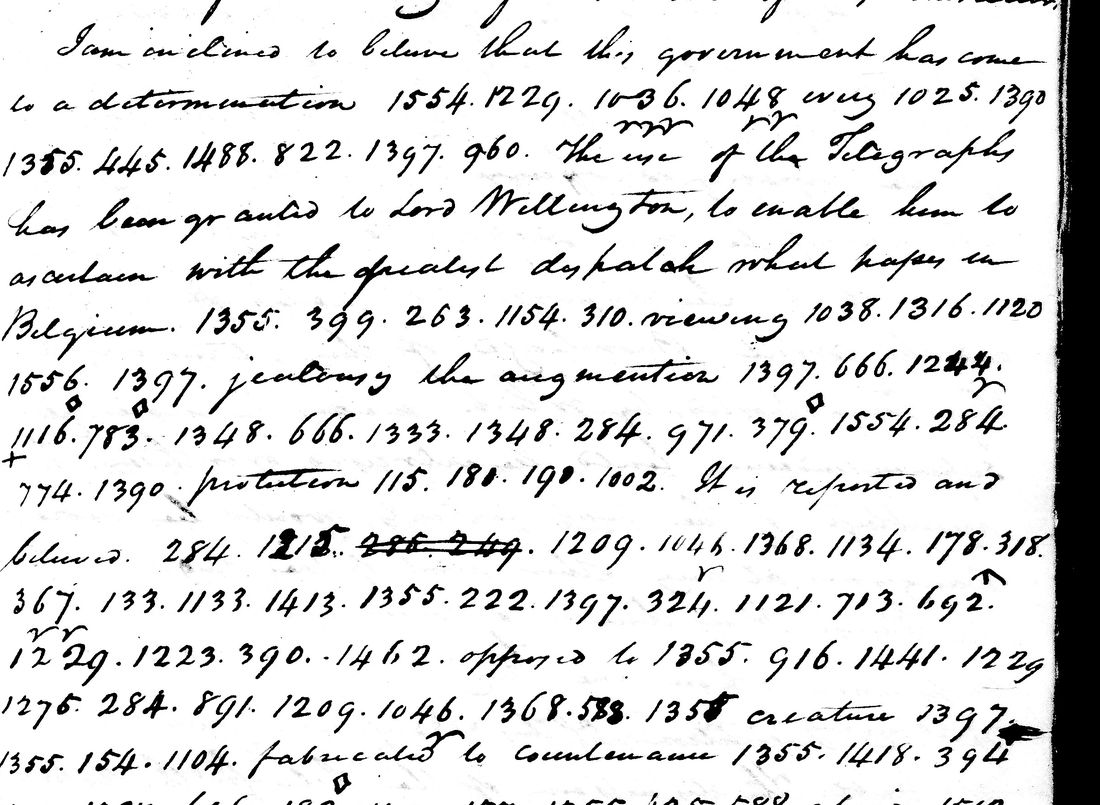
What the code says, in Crawford’s words (bracketed words are supplied, see What remains open): “I am inclined to believe that this government has come to a determination to sacrifice every thing for the friendship of England.” The King, “so far from viewing with an eye of jealousy the augmentation of British troops [and] others in British pay” in Belgium, looks to that force for protection against his own people. A conspiracy is reported, with Savary at its head; those opposed to the government [say] it is “the creature of the police”, fabricated to justify the arrest of about thirty persons the court is afraid of.
On 0065R things are “approaching [a] crisis which must be decis[ive] of the fate [of] the King and right[s] of the nation”; the rights of the nation will most probably be lost without [a] struggle, but many believe “that the royal famil[y] will again be expelled”. On 0066L he sets out the sides: the army would be for recalling the Emperor; the part of the new nobility opposed to the army for the King of Rom[e] with [a] regen[c]y, or for the Duke of Orleans; the genuine republicans would join either of the la[s]t spec[ified] projects.
These are Crawford’s report of what was believed and said in Paris. None of it is checked here against other sources.
02 The code and its marks
The groups are in the code Weber prints in full as WE025 (pp. 443–454). It is the code of Poinsett’s letters from Chile, and Weber notes that Crawford used it in 1814. The 156 rows of the table for the numbers in this letter are in key/we025_crawford1814.tsv, cut from the transcription of Weber’s table that was frozen by checksum for the Poinsett work before this letter was decoded. The table was not changed for this letter; it is our machine-read copy of Weber’s page, of which 140 rows read as printed and 16 were repaired by hand (including 812, 780 and 791, which sit under unsettled or supplied readings), and it was not compared with the book row by row. What the repairs were checked against is not recorded in the sources.
Crawford marks many groups, and the diamond, caret and cross follow the directions Weber prints after the table (p. 454): a diamond above a group adds -s; a caret makes -ed; a cross under a figure doubles a letter. The strokes under a group are read here as dropping that many final letters; Weber’s notes say only that the tick withdraws the corresponding letter, and the clerk’s “expulsion” for one letter supports the reading (1036 crisis with three strokes is “cri”, 1046 spire with one is “spir”, in con-spir-acy); the cross cases are 1115 al is “all” in rec-all-ing, 372 gle is “ggle” in stru-ggle; u and v are interchangeable, so dis-cou-er-ed is “discovered”. The marks were first read from their use, and the printed directions were seen on 15 November 2026, after the reading was made.
03 How it was deciphered
- A scan of the text layer of the National Archives catalogue’s France despatches flagged frames 0064–0066 of roll 18 as runs of code with no decipherment between the lines; the frames were fetched at full size.
- Two AI readers transcribed the 292 groups from the images, neither seeing the other’s work. They agree on 291 of the numbers (they also differed on the owner of six marks between lines and on two struck-through groups); the one difference (307 or 317) was settled on the image as 307 (ge-nu-in-e).
- WE025 was applied unchanged with
decode.py: 283 of the 292 groups have a table value that the reading uses, with Crawford’s marks applied; the other nine are supplied from the sense and bracketed. Letters and words are also supplied at the places listed under What remains open, so by words the share is lower (the replay counts 281 groups exact; the difference from 283 was not traced). Counted by words, with the key replay (replay.py), 223 of the 246 words of the coded passages give the key’s output (90.7%), under the 95% bar, so the extent is partial (see What remains open). - A shuffle test written down before the run: the decode scores −0.909 on a letter-trigram model, against a mean of −1.191 and a best of −1.067 for 200 tables made by shuffling WE025’s elements (z = 5.7; the shuffle test ignores the marks and was not rerun after the diamond over 1025 was added). A first run had a parsing bug and was repaired and rerun once; both outputs are kept. The project’s refit test (
docs/_validate.py) is underdetermined on so short a text: a key fitted to shuffled text scores as well. - The reading was graded A by B. Dudout, assisted by an AI model, as complete and coherent English (a grade of the English, made on 15 November, before the changes of 16 November); the model compared lines 64R01, 64R02, 64R05 and 64R06 with the image and found them to agree group for group. Weber’s table itself was not re-checked against the book in that review. All the transcription and reading work was done by AI agents; no person has checked the whole transcription against the images (the maintainer’s review of the pull request did catch the diamond over 1025 on frame 0065).
04 A check from September 1814
After the reading was made, two earlier private letters of Crawford’s were found on the same roll with short coded passages that a State Department clerk deciphered between the lines. Their 81 groups were set against the tables. On frames 0031R–0032L (26 September 1814 as read, WE025), 66 of 68 give the clerk’s word: one miss was an error in the project’s transcription of Weber’s table (1181 is “pl” in the book, not “Pi”; 1181 is not in the 5 November letter), the other a blotted figure. On frame 0025R (mid-September, in the older code WE028), all 13 agree. The clerk reads the hooked tail under a group as a withdrawn last letter and the diamond as -s, as the printed directions say, and with the printed directions that let “troops”, first supplied from the sense, be read from the code (the cross under 1116 is not attested by the clerk). He also copied a one-number slip of Crawford’s literally, the kind of slip supposed for some of the supplied groups. This check came after the fact and had no pass mark set in advance.
05 What remains open
Nine groups are supplied from the sense, where the number as written gives another word:
- 1512, four times, written where “a” is needed: the table has 1512 = our, 1215 = a (the same digits in another order). Not settled.
- 1276 (fish) read as y in “sa-y”: 1275 = y; the notes say the image shows 1276, and the transcription marks one digit as doubtful.
- 556 (late) read as e in “Rom[e]”: 1556 = e, the first digit left out.
- 361 (run) read as [these]: 561 = these.
- 1474 (cy) read as [any]: 1472 = any.
- 812 (june) with one stroke, read as “decis[ive]”: not settled.
Other places where the reading goes beyond the table as written, all marked in crawford1814_reading.md: [be brought by] supplied on 0066L, where Crawford’s sentence lacks a verb; 556 with one stroke read as la[s]t (lat[ter] is possible); 791 speci read as spec[ified] (the bracket also takes in the i the group gives); 413 ma read as ma[de]; 780 right read as right[s]; and the cross under the first figure of 1116 read as doubling the first letter, which the printed direction does not cover. A few letters were also mended in the reading where no mark is written, and are now marked there: 1046 spire without its stroke in [conspiracy] on 64R12; 739 mean as mean[s]; re-ult as re[s]ult; fam-ili as famil[y]; 578, which the table copy gives as “eney”, as the end of regen[c]y; and two words with no group under them, [and] in “troops [and] others” (0064R) and [of] in “the fate [of] the King” (0065R). “Very”, written in clear before 1025 thing, is read as “every” and left unmarked, as clear words are.
The extent is counted by words. The groups run on without word division, so the words are those of the reading that the groups carry. The key replay gives 225 of 241 as the key’s output (93.4%), with every difference marked. Every other word counts as a hole: the nine supplied groups, right[s], ma[de], la[s]t, spec[ified], and the mended cipher words above. The replay takes Rom[e] and [conspiracy] for the key’s output, though a letter is supplied or left out in each, and does not count the five words the reading supplies where no group stands, [be brought by] (three words), [and] and [of]; all seven are counted here as holes. That gives 223 of 246 words, 90.7%, under the 95% bar: the extent is partial. The small diamond over 1025 on 0065R (“Things”), missed in both transcriptions, was added after the maintainer’s review pointed to it.
No decipherment of the time and no printing of the coded passages was found: none on the film (frames 0059–0070), nor in Founders Online, American State Papers, the 1902 calendar of Monroe’s papers at the Library of Congress, Mooney (1974), Willson (1928), Shipp (1909), Tomokiyo’s Cryptiana, or phrase searches of HathiTrust and Google Books. Not seen: the clerk’s clear fair copy (only its last page, 0067R, is on the roll), the Crawford papers at the Library of Congress, the Monroe papers at the New York Public Library, and Green’s Life of William Harris Crawford (1965).
06 The setting
Crawford, minister to France from 1813, wrote to Madison on 1 November 1814 that the Decatur had lain fifty days below Nantes without leave to enter while British vessels came in, and that he meant to keep away from the court. In the clear part of his private letter of 21 October (frame 0060L) he had already expected “another civil commotion” in France within six months. The coded part of this letter gives his private reading of the restored monarchy’s weakness.
Full texts
The transcription and the decryption of every document on this page, so that the reading can be used and checked. Short files are shown here; all are in the repository.
Crawford to Monroe, Paris, 5 Nov 1814 (Despatch No. 33-2, Private), M34 roll 18 frames 0064R-0066L read in part
Crawford reports to Monroe, in code, his belief that the French government has resolved to sacrifice everything for England's friendship and that the King looks to British troops in Belgium for protection against his own people; a reported conspiracy headed by Savary, which opponents call a police fabrication to justify about thirty arrests; a coming crisis for the King, with many expecting the royal family to be expelled again; and three parties if there is a struggle: the army for the Emperor, part of the new nobility for the King of Rome with a regency or for the Duke of Orleans, and the republicans with either of the last two.
Builds coherent sentences, but under the read bar of 95% of words read as sense (91% here); the holes are marked in the reading.
Transcription
crawford1814_transcription.txt
# William H. Crawford to James Monroe, Paris, 5 Nov 1814, "(Despatch No 33-2) Private". NARA RG 59, Despatches from
# US Ministers to France vol. 15, microfilm M34 roll 18 (naId 188673229), frames 0063R (heading) to 0067L (signature);
# the code is on 0064R, 0065R and 0066L, e.g. https://catalog.archives.gov/medialz/dc-metro/rg-059/603720/M34/M34-018/M34-018-0064.jpg
# Crawford's own hand. Only the lines that carry code groups are given; the clear lines between them are in the reading.
# The first column is the line: frame, leaf (L/R) and line number on that leaf (clear lines are counted).
# Two blind transcriptions from the images (see NOTES.md section 4): they agree on 291 of 292 groups; the one difference
# (66L13, 307 against 317) was settled on the image as 307.
# Marks written by Crawford (meaning inferred from use, as in ../poinsett1813/beling):
#   ' = small diamond or circle above the group (plural -s); ^ = caret over the group (-ed);
#   _r, _rr, _rrr = one, two or three r-like strokes under the group (drop that many final letters);
#   + = small cross under a figure of the group (a doubled letter); _y = a larger hooked, y-like tail under the last
#   figure (the last letter withdrawn, as the single _r stroke; see NOTES.md section 7).
# These are the marks of the code's own directions, which Weber prints after the table (p. 454).
# "words" = written in clear among the groups. ? after a group = a digit doubtful. 292 groups.
# Struck through by Crawford after 64R09 1215 and left out here: two groups, 288 249 (the first reader saw 285 249).
64R01: "to a determination" 1554 1229 1036_rrr 1048_rr "very" 1025 1390
64R02: 1355 445 1488 822 1397 960 ". The use of the Telegraphs"
64R05: "Belgium." 1355 399 263 1154 310 "viewing" 1038 1316 1120
64R06: 1556 1397 "jealousy the augmentation" 1397 666 1244_y
64R07: 1116'+ 783' 1348 666 1333 1348 284 971 379' 1554 284
64R08: 774 1390 "protection" 115 180 190 1002 ". It is reported and"
64R09: "believed." 284 1215 1209 1046_r 1368 1134 178 318
64R10: 367_rr 133 1133 1413 1355 222 1397 324 1121 713 692^
64R11: 1229 1223 390 1462 "opposed to" 1355 916 1441 1229
64R12: 1276? 284 891 1209 1046 1368 588 1355 "creature" 1397
64R13: 1355 154 1104 "fabricated to countenance" 1355 1418 394
64R14: 1397 1337 606 183' 1397 157 1355 425 588 "afraid" 1512
64R15: 815 261 "prevails to day that the discussions at Vienna"
65R01: "His grace made a precipitate retreat." 1025' 770
65R02: "approaching" 1512 1036 324 "must" 285 1360 588 812_r
65R03: 1397 1355 392 1556 1355 399 522 780 1397 1355 856
65R04: "It is impossible to form a correct opinion." 1397 1355
65R05: 1228 1359 1397 891 73_rr 372+ ". It is indeed most probable"
65R06: 284 1355 780' 1397 1355 856 1524 285 720^ 950
65R07: 1512 73_rr 372+ ". This however is not the common opi-"
65R09: "order of things." 724 564 1511 545 284 1355 1384
65R10: 1275 1115 328 887_rr 1524 241 285 "expelled," 1394 933
65R11: 1397 456' "appear" 1554 713 1472 "distinct" 205 1397
65R12: 1355 739 194 324 1236 588 1554 285 "effected."
66L01: 1355 526 687 285 1390 1562 1115+ 317 1355 65 1355
66L02: 1237 509 374 1182' 1524 1038 "difficulty" 284 95 1554
66L03: "consent" 1554 891 ". The great mass of" 1355 499 1232
66L04: 687 285 "compelled." 1554 1126 1549 1175 1483 1472
66L05: "struggle." 588 413 1462 738 1545 1236 1524 216 655
66L06: 121' ". I have already stated" 1355 870' 1397 1355
66L07: 526 80 1397 1355 1531 1172 887 1188 437 285
66L08: "opposed" 1554 1355 205' 1397 1355 526 1524 285
66L09: 1390 1355 399 1397 1098 556 1038 1512 1327 578
66L10: 1273 1121 1524 285 1348 965 1397 "elevating" 1355
66L11: 1504 431 1397 1273 711 1555 1554 1355 1300 1166
66L12: 1355 1067 "difficulty" 1524 285 1554 "reconcile." 361
66L13: 655 "different" 121' 1355 254 307 1348 1556 1228
66L14: 1285 1182' 1524 723_r 1348 1008 1397 1355 556_r 791
66L15: "projects," 1483 1474 1392 610 39 285 613 "."
Decryption
# Crawford to Monroe, Paris, 5 Nov 1814 (No. 33-2, Private): group-by-group decryption with WE025
# (key/we025_crawford1814.tsv), line by line against crawford1814_transcription.txt. Output of: python decode.py
# number=element as Weber prints it; >letters = what the encoder's mark makes of it; /guess = the reading supplies
# a word against or beyond the table (see crawford1814_reading.md); "words" = written in clear.
64R01  "to a determination"  1554=to  1229=sa  1036_rrr=crisis>cri  1048_rr=ficent>fice  "very"  1025=thing  1390=for
64R02  1355=the  445=fri  1488=end  822=ship  1397=of  960=england  ". The use of the Telegraphs"
64R05  "Belgium."  1355=the  399=king  263=so  1154=far  310=from  "viewing"  1038=with  1316=an  1120=ey
64R06  1556=e  1397=of  "jealousy the augmentation"  1397=of  666=british  1244_y=tre>tr
64R07  1116'+=op>oops  783'=other>others  1348=in  666=british  1333=pay  1348=in  284=that  971=country  379'=look>looks  1554=to  284=that
64R08  774=force  1390=for  "protection"  115=against  180=his  190=own  1002=people  ". It is reported and"
64R09  "believed."  284=that  1215=a  1209=con  1046_r=spire>spir  1368=acy  1134=has  178=been  318=dis
64R10  367_rr=could>cou  133=er  1133=ed  1413=at  1355=the  222=head  1397=of  324=which  1121=they  713=have  692^=place>placed
64R11  1229=sa  1223=va  390=ry  1462=those  "opposed to"  1355=the  916=govern  1441=ment  1229=sa
64R12  1276?=fish/guess  284=that  891=this  1209=con  1046=spire  1368=acy  588=is  1355=the  "creature"  1397=of
64R13  1355=the  154=poli  1104=ce  "fabricated to countenance"  1355=the  1418=ar  394=rest
64R14  1397=of  1337=about  606=thirty  183'=person>persons  1397=of  157=whom  1355=the  425=court  588=is  "afraid"  1512=our/guess
64R15  815=report  261=also  "prevails to day that the discussions at Vienna"
65R01  "His grace made a precipitate retreat."  1025'=thing>things  770=are
65R02  "approaching"  1512=our/guess  1036=crisis  324=which  "must"  285=be  1360=dec  588=is  812_r=june/guess
65R03  1397=of  1355=the  392=fat  1556=e  1355=the  399=king  522=and  780=right  1397=of  1355=the  856=nation
65R04  "It is impossible to form a correct opinion."  1397=of  1355=the
65R05  1228=re  1359=ult  1397=of  891=this  73_rr=struct>stru  372+=gle>ggle  ". It is indeed most probable"
65R06  284=that  1355=the  780'=right>rights  1397=of  1355=the  856=nation  1524=will  285=be  720^=lose>lost  950=without
65R07  1512=our/guess  73_rr=struct>stru  372+=gle>ggle  ". This however is not the common opi-"
65R09  "order of things."  724=many  564=bel  1511=ie  545=ve  284=that  1355=the  1384=ro
65R10  1275=y  1115=al  328=fam  887_rr=ility>ili  1524=will  241=again  285=be  "expelled,"  1394=but  933=none
65R11  1397=of  456'=them  "appear"  1554=to  713=have  1472=any  "distinct"  205=view  1397=of
65R12  1355=the  739=mean  194=by  324=which  1236=it  588=is  1554=to  285=be  "effected."
66L01  1355=the  526=army  687=would  285=be  1390=for  1562=rec  1115+=al>all  317=ing  1355=the  65=emperor  1355=the
66L02  1237=rep  509=u. V  374=bli  1182'=can>cans  1524=will  1038=with  "difficulty"  284=that  95=circumstance  1554=to
66L03  "consent"  1554=to  891=this  ". The great mass of"  1355=the  499=sen  1232=ate
66L04  687=would  285=be  "compelled."  1554=to  1126=emi  1549=gra  1175=te  1483=if  1472=any
66L05  "struggle."  588=is  413=ma  1462=those  738=who  1545=make  1236=it  1524=will  216=form  655=three
66L06  121'=party>parties  ". I have already stated"  1355=the  870'=design>designs  1397=of  1355=the
66L07  526=army  80=such  1397=of  1355=the  1531=new  1172=nob  887=ility  1188=as  437=may  285=be
66L08  "opposed"  1554=to  1355=the  205'=view>views  1397=of  1355=the  526=army  1524=will  285=be
66L09  1390=for  1355=the  399=king  1397=of  1098=rom  556=late/guess  1038=with  1512=our/guess  1327=reg  578=eney
66L10  1273=or  1121=they  1524=will  285=be  1348=in  965=favor  1397=of  "elevating"  1355=the
66L11  1504=du  431=ke  1397=of  1273=or  711=lea  1555=ns  1554=to  1355=the  1300=thro  1166=ne
66L12  1355=the  1067=great  "difficulty"  1524=will  285=be  1554=to  "reconcile."  361=run/guess
66L13  655=three  "different"  121'=party>parties  1355=the  254=ge  307=nu  1348=in  1556=e  1228=re
66L14  1285=publi  1182'=can>cans  1524=will  723_r=united>unite  1348=in  1008=either  1397=of  1355=the  556_r=late>lat  791=speci
66L15  "projects,"  1483=if  1474=cy/guess  1392=ef  610=fort  39=should  285=be  613=made  "."
Reading
# Crawford to Monroe, Paris, 5 Nov 1814, "(Despatch No 33-2) Private": the coded passages as sentences
# English, so no translation. NARA M34 roll 18, frames 0063R-0067L; code on 0064R, 0065R and 0066L. Line labels as in
# crawford1814_transcription.txt. This is Crawford's report to the Secretary of State of what he believed and what was
# said in Paris; the conspiracy, the parties and their plans are his account, not established fact.
# Marks: [word] = a word supplied where the group as written gives another table value or none (each listed in
# NOTES.md section 3); decis[ive] = letters supplied inside a word; [conspiracy] = a word whose group gives a letter
# the reading leaves out. Words written in clear among the groups are part of
# the text and not marked; [...] = clear text not given here (the Decatur affair, the Duke de Brancas at the barracks).

## 0064R (after the clear account of the Decatur affair on 0063R-0064L)

I am inclined to believe that this government has come to a determination to sacrifice every thing for the
friendship of England. The use of the Telegraphs has been granted to Lord Wellington, to enable him to ascertain with
the greatest dispatch what passes in Belgium. The King, so far from viewing with an eye of jealousy the augmentation
of British troops [and] others in British pay in that country, looks to that force for protection against his own
people. It is reported and believed that a conspiracy has been discovered, at the head of which they have placed
Savary. Those opposed to the government [say] that this [conspiracy] is the creature of the police, fabricated to
countenance the arrest of about thirty persons, of whom the court is afraid. [A] report also prevails to day that the
discussions at Vienna have assumed a hostile tone [...]

## 0065R (after the clear account of the war minister's orders and the Duke de Brancas at the barracks)

[...] His grace made a precipitate retreat. Things are approaching [a] crisis which must be decis[ive] of the fate [of]
the King and right[s] of the nation. It is impossible to form a correct opinion of the re[s]ult of this struggle. It is
indeed most probable that the rights of the nation will be lost without [a] struggle. This however is not the common
opinion, among many of the best friends of the new order of things. Many believe that the royal famil[y] will again be
expelled, but none of them appear to have any distinct view of the mean[s] by which it is to be effected.

## 0066L

The army would be for recalling the Emperor. The republicans will with difficulty [be brought by] that circumstance to
consent to this. The great mass of the senate would be compelled to emigrate if any struggle is ma[de]. Those who make
it will form three parties. I have already stated the designs of the army. Such of the new nobility as may be opposed
to the views of the army will be for the King of Rom[e] with [a] regen[c]y, or they will be in favor of elevating the
Duke of Orleans to the throne. The great difficulty will be to reconcile [these] three different parties. The genuine
republicans will unite in either of the la[s]t spec[ified] projects, if [any] effort should be made.
07 Sources
- US National Archives, RG 59, Despatches from US Ministers to France vol. 15, microfilm M34 roll 18, “Sept. 10–Dec. 30, 1814” (naId 188673229): frame 0064, frame 0065, frame 0066.
- Ralph E. Weber, United States Diplomatic Codes and Ciphers, 1775–1938 (1979), pp. 443–454: the code table WE025 and its directions.
- Crawford to Madison, 1 November 1814: Founders Online.
- The same code on this site: Poinsett to Monroe from Santiago, 1813.


Transcription, group-by-group decryption, the reading, the cut of the WE025 table with its checksum, the blind comparison, the shuffle test and the September 1814 pairs: targets/crawford1814/.
Cite this page
Andrew Beling and Daniel Bourdeau, “Crawford to Monroe, Paris, 5 November 1814: a private letter in code”, Cyphersolver, posted 16 November 2026, updated 18 November 2026, https://cyphersolver.com/crawford1814.html.