At a glanceKnown key applied · partial (94% of the cipher)
- The document
- One opening (two pages) of a register of land rents and debts kept 1533–1557 in the Ewsum family archive. The left page carries a key, a note in clear Dutch and 23 lines of cipher; the right page carries 6 lines, a block of three lines set off by a stroke, a line between colons and a clear Latin caption. Not dated: the text names only “decima Ivly”.
- Where
- Groninger Archieven, 696 Familie van Ewsum, inv. nr. 595 (old order 136II), scan 193, photographed again as scan 1. Catalogue entry 2533. Not on DECODE; no reading or edition found.
- The cipher
- Simple substitution with the words kept apart: one sign for each of 22 letters (no j, u, x or z; v serves for u) and a null sign that the writer’s clear note says may be set in a word or at its end.
- How it was deciphered
- With the writer’s own alphabet from the head of the page, applied unchanged. 116 of the 119 words decrypt, with no change to any sign, to words of the Low Saxon of the Ommelanden; the other three have a letter added or a sign under a blot. The writer also struck four groups out under ink, which are not read. The rest of the register has no other cipher.
- What it says
- A letter: the soldiers’ pay came yesterday, send the account and receipt, see how to get it over safely. A note signed Hendricus: the truce with the cities of the Sticht is extended by a month, but one Jorien Schenck will not keep it. An address to Hackfort and Meynert van Ham, colonel(s). Not recipes.
- Still open
- Two words with a sign under a blot; four groups the writer struck out under ink; the sense of two phrases; who wrote it, to whom, and when. The date and the names are the contributor’s inference and were not checked here. No reader of Middle Low German has judged the translation.
- Credit
- Transcription, reading and translation by AI agents of WAINUT, a Dutch AI company (pull request #505); the key is the writer’s own. The project re-ran the checks and counted the share strictly. No human palaeographer checked the signs.
01 The document
The register is a book of land rents and debts of Johan van Ewsum, 1533–1557, and the archive inventory describes it as holding notes on debts and notes “in geheimschrift”. Of its 199 scans, one opening is in cipher; it is photographed twice, as scan 193 and as scan 1 (two different photographs). The sweep that listed it paged all 199 scans at contact-sheet size and found no other cipher.
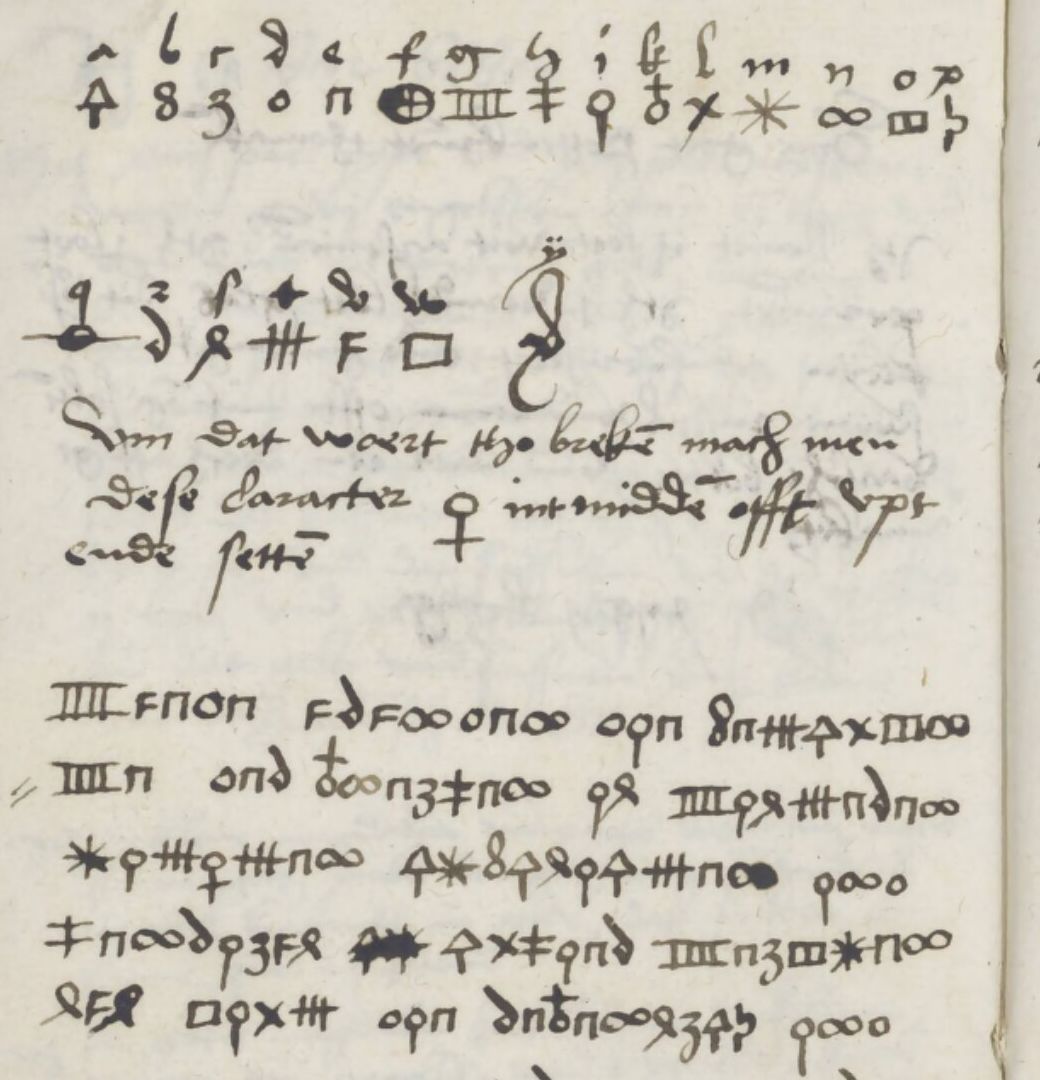
The note under the key, in clear Dutch, reads Vm dat woert tho breke mach men dese caracter [the venus sign] int midde offt vpt ende sette: to break up the word one may set this sign in the middle or at the end. It occurs nine times in the text and is dropped. The writer marks a word carried over to the next line with //.
The page gives a few names. The contributor identified them from context, which the text itself does not give: “Hacfort” as probably Berend van Hackfort, who held the house of Wedde from 1530; “Meynert van Ham” as the Guelders commander in the Ommelanden in 1536; “Iorien Schenck” as probably Georg Schenck van Toutenburg. On those identifications the opening falls in the Guelders years of Groningen, probably 1533–1536, and the slug of this page, 1535, stands in for that range. This range was not checked here against Meinert van Ham’s dated career or the dated truces with the Sticht cities. (This background is not from the sources and was not checked here.)
02 The cipher
The key lines give 22 letter signs: a b c d e f g h i k l m n o p on the first line and q r s t v w y on the second. There is no j, u, x or z; v serves for u, and w once for u in terstwnt. The signs are the contributor’s shape names in the files (SIGN_CONVENTIONS.md), written before any value was applied. All 23 entries (22 letters and the null) were taken from the key lines and the note; none was set from the cipher text. Four groups (L04, L11, L17, R10) are struck out by the writer under ink blots.
Because the key stands on the page, nothing here was recovered. The work was to transcribe the signs and apply the key.
03 The reading
Two passes transcribed the cipher, one on each photograph, and differed in four places, settled on scan 193 at 3x: two struck groups, one blotted final sign and one group of the last word of L18. The writer repeats the clause ind raitslagen woe gy die veylich averkrigen (L08–L09 and L10–L11); the two copies were transcribed separately and give the same 35 signs. Spelling is the writer’s (v for u, y for ij); only capitals and punctuation are added.
A. A letter (L01–L20).
Gvede vrvnden, die betalonge der knech[t]en is gisteren mitten ambasiate[n] ind Hendricvs alhier gecomen. Svs wilt die rekenscap ind qvitancie dair van terstwnt die averscicken, ind raitslagen woe gy die veylich averkrigen… Hier syn vmbtrent twyntich knechten die mitten oversten vyt gewest ind sich verechtert hebben; die mvchtmen mede dair toe gebrvicken, dat vm Wedde decima Ivly die ambasiat en nyet van der betalonge syen werden ontbaden.
Good friends, the pay of the soldiers arrived here yesterday with the envoys and Hendricus. So please send over the account and the receipt at once, and consider how you may get it over safely. Here there are about twenty soldiers who have been out with the colonels and have fallen behind [?]; one could use them for it as well, so that at Wedde, on the tenth of July, the envoy and those not [included] in the payment may be summoned [?].
B. A note to the Drost (L21–R06).
Heer Drost, id bestant is tvsschen mynen genedigen heren ind den Stichschen steden eyn maent verlengt, dan Iorien Schenck will tselve nyet volgen. Dairom wilt vairlick syn aver ’t platte lant to reysen. Hendricvs.
Lord Drost, the truce between my gracious lords and the cities of the Sticht has been extended by one month, but Jorien Schenck will not keep to it. Therefore it will be dangerous to travel over the open country. Hendricus.
C. An address (R07–R09), set off by a vertical stroke: Aen Hacfort ind Meynert van Ham, averste, “to Hackfort and Meynert van Ham, colonel(s)”.
D. A formula (R10), under a rule, between colons: ergo : tergo : be[…]lo, followed by the clear Latin caption ad perforandum caput gallinae (“for piercing the head of a hen”). It looks like a charm or a trick formula and is not part of the letter. The catalogue had guessed recipes from this caption; the text is a letter and a note.
Whether A, B and C are one letter with its address, or two pieces for different people, is open; they are kept together because they share one opening and one key.
The count. The cipher has 119 words, not counting the colons and dashes. 116 decrypt as the signs give them. One carries a marked repair: the signs of knechen lack the t that knechten has in L13, so a letter is added. Two have a sign under a blot: the last letter of ambasiate[n] (L03), which is guessed from the sense, and one sign of be[…]lo (R10). By this site’s rule those three do not count as read, which leaves 116 of 119, 97.5%. The writer also struck four groups out under ink (L04, L11, L17, R10); the shapes under the ink could not be read as signs, and the site counts every token of the document, so the four are counted as holes. That gives 116 of 123, 94.3%, under the 95% needed, so the text is read in part, not read. The contributor’s own figure was 120 of 123 (97.6%); it left the struck groups out and counted three colons and two dashes as words, which the project’s review corrected.
What the test shows. The key is the writer’s, so this is not a held-out test of a recovered key. The statement that the key was frozen before the first decryption is the contributor’s record (one commit, no outside timestamp). The evidence that the signs were transcribed well is that 116 of 119 words come out as words of the period language with no sign changed, and that the repeated clause gives the same signs twice.
04 What remains uncertain
- Two blotted signs (L03, R10): the last letter of ambasiate[n] is guessed (the singular ambasiat is in L18) and one sign of be[…]lo is unread. The original might show more.
- Struck groups in L04, L11, L17 and R10 are deleted under ink; the shapes under the ink are not legible as signs, so they are not read and count as holes in the 94.3%. Only the original could show whether more survives.
- Sense. sich verechtert hebben (L14–L15) is rendered “have fallen behind” with a question mark, and the syntax of L17–L20 is doubtful; the English supplies more than the words carry. A reader of Middle Low German should judge both.
- Who and when. Hendricus signs note B; whether the opening is Johan van Ewsum’s copy of letters received, drafts or an exercise is not settled, and the “Heer Drost” is not identified. The date and the three names above are the contributor’s inference. The one-month truce and the 10 July were not matched to a dated event.
- The transcription was made by AI agents from the archive’s images (2653 by 3000 and 2225 by 3000 pixels, the sizes the server returns). At integration the 22 key signs and the first 15 words of L01–L05 (about 45 signs) were compared with scan 1 and agree; the rest of the page was not checked sign by sign. The Dutch word lists of the project’s reading checker do not cover 16th-century Low Saxon, so its score (0.57) says nothing about this reading.
- Rutgers’ 1899 inventory of the Ewsum archive was not opened.
Full texts
The transcription and the decryption of every document on this page, so that the reading can be used and checked. Short files are shown here; all are in the repository.
Cipher opening, scan 193: letter, note, address and formula read in part
A letter to 'good friends': the soldiers' pay came yesterday with the envoys and Hendricus; send the account and receipt at once and see how to get it over safely; about twenty soldiers who were out with the colonels could be used for it, so that at Wedde on 10 July the envoy and those not covered by the payment are summoned. A note to 'Heer Drost', signed Hendricus: the truce between 'my gracious lords' and the cities of the Sticht is extended by a month, but Jorien Schenck (probably Georg Schenck van Toutenburg) will not keep it, so travel over the open country will be dangerous. Address: to Hackfort and Meinert van Ham, colonel(s). Under a rule a formula 'ergo : tergo : be[...]lo' with the clear Latin caption 'ad perforandum caput gallinae'.
Builds coherent sentences, but under the read bar of 95% of words read as sense (94% here); the holes are marked in the reading.
Transcription
# Reconciled transcription, Groninger Archieven 696 inv. 595, cipher opening (scan 193 = scan 1). Codes: SIGN_CONVENTIONS.md
# Pass 1 (scan 193) and pass 2 (scan 1) differed in 4 places, settled on scan 193 at 3x: L04 and L11 struck groups (inked over; shape under the blot taken as hash / knot, not read), L12 last sign (a blotted double cross H, not a star), L18 last word (one lying eight before the big hook: NYPT, the same group as R03).
# L = left page under the key and the clear note; R = right page.
# Left page (after the key lines and the clear note)
L01 EFPoP FDFNoPN oqP 8PTAxBN/
L02 //EP oPD KNP3HPN qR EqRTPDPN
L03 *qTVTPN A*8ARqATP? qNo
L04 HPNoDq3FR [del:T?] AxHqPD EP3B*PN
L05 RFR SqxT oqP DPKPNR3Ab qNo
L06 Q FqTAN3qP oAqD FAN TPD/
L07 //RTSNT oqP AFPDR3q3KPN qNo
L08 DAqTRxAEPN SBP EY oqP
L09 FPYxq3H AFPDKDqEPN qNo DAqT/
L10 //RxAEPN SBP EY oqP FPYxq3H
L11 AFPDKDqEPN *BqEPT HqPD [del:R?]
L12 RYN F*8TDPNT TSYNTq3H
L13 KNP3HTPNV oqP *qTTPN AFPDR/
L14 //TPN FYT EPSPRT qNo Rq3H
L15 FPDP3HTPDT HPV88PN oqP *F3HT
L16 *PN *PoP oAqD TBP EP8DFq3/
L17 //KPN oAT [del:?] F* SPoVoP oP3q*A
L18 qFxYV oqP A*8ARVqAT PN NYPT
L19 FAN oPD 8PTAxBNEP RYPN
L20 SPDoPN BNT8AoPN
L21 HPPD oDBRT qo 8PRTANT qR TFR/
L22 //R3HPN *YNPN EPNPoqEPN HPD/
L23 //PN qNo oPN RTq3HR3HPN RTP/
# Right page
R01 //oPN PYN *APNT FPDxPNET
R02 oAN qBDqPN R3HPN3K SqxVx
R03 TRPxFP NYPT FBxEPN oAqD/
R04 //B* SqxT FAqDxq3K RYN AFP/
R05 //DT bxATVTP xANT TB DPY/
R06 //RPN, HPNoDq3FR -
R07 APN HA3XBDT qNo
R08 *PYNPDT FANV HA*
R09 AFPDRTP
# below a rule
R10 : PDEB : [sup:TPDEB] [del:T?] : 8P?xB -
Decryption
L01: gvede vrvnden die betalon=
L02: ge der knechen is gisteren
L03: mitten ambasiate? ind
L04: hendricvs <struck> alhier gecomen
L05: svs wilt die rekenscap ind
L06: q vitancie dair van ter=
L07: stwnt die averscicken ind
L08: raitslagen woe gy die
L09: veylich averkrigen ind rait=
L10: slagen woe gy die veylich
L11: averkrigen moiget hier <struck>
L12: syn vmbtrent twyntich
L13: knechten die mitten avers=
L14: ten vyt gewest ind sich
L15: verechtert hebben die mvcht
L16: men mede dair toe gebrvic=
L17: ken dat <struck> vm wedde decima
L18: ivly die ambasiat en nyet
L19: van der betalonge syen
L20: werden ontbaden
L21: heer drost id bestant is tvs=
L22: schen mynen genedigen her=
L23: en ind den stichschen ste=
R01: den eyn maent verlengt
R02: dan iorien schenck will
R03: tselve nyet volgen dair=
R04: om wilt vairlick syn ave=
R05: rt platte lant to rey=
R06: sen, hendricvs -
R07: aen hacfort ind
R08: meynert van ham
R09: averste
R10: : ergo : tergo <struck> : be?lo -
Reading
# Reading of the cipher opening in Johan van Ewsum's register (Groninger Archieven 696 inv. 595, scan 193 = scan 1)

Status: **read in part** (116 of 119 words read; 116 of 123 = 94.3% with the four struck groups counted as holes; see NOTES.md). Language: Low Saxon / eastern Middle Dutch of the
Groningen Ommelanden. Spelling is kept as the signs give it (`v` for `u`, `w` for `u` in *stwnt*, `y` for `ij`); only
capitals and punctuation are added.

Key: the writer's own alphabet at the head of the left page (`key_frozen.tsv`). Mechanical decryption:
`decryption_ewsum.txt`. Nine venus signs (the word-breaker named in the clear note under the key) are dropped by the
key, as the note says.

## Marked text (line by line against the signs)

Marks: `{x/y}` the signs give x, read y; `{+a}` letter added; `[?guess=signs]` guess where a sign is blotted;
`[...]` hole; `<struck>` a group the writer struck out (not read); `-` at a line end: the word runs on (the writer's
own `//`).

```marked
L01: Gvede vrvnden, die betalon-
L02: ge der knech{+t}en is gisteren
L03: mitten [?ambasiaten=ambasiate?] ind
L04: Hendricvs <struck> alhier gecomen.
L05: Svs wilt die rekenscap ind
L06: qvitancie dair van ter-
L07: stwnt die averscicken, ind
L08: raitslagen woe gy die
L09: veylich averkrigen; ind rait-
L10: slagen woe gy die veylich
L11: averkrigen moiget. Hier <struck>
L12: syn vmbtrent twyntich
L13: knechten die mitten avers-
L14: ten vyt gewest ind sich
L15: verechtert hebben; die mvcht-
L16: men mede dair toe gebrvic-
L17: ken, dat <struck> vm Wedde decima
L18: Ivly die ambasiat en nyet
L19: van der betalonge syen
L20: werden ontbaden.
L21: Heer Drost, id bestant is tvs-
L22: schen mynen genedigen her-
L23: en ind den Stichschen ste-
R01: den eyn maent verlengt,
R02: dan Iorien Schenck will
R03: tselve nyet volgen. Dair-
R04: om wilt vairlick syn ave-
R05: r 't platte lant to rey-
R06: sen. Hendricvs -
R07: Aen Hacfort ind
R08: Meynert van Ham
R09: averste
R10: : ergo : tergo <struck> : be[...]lo -
```

## The text as sentences (normalised word division, same holes)

**A. Letter (L01-L20).** Gvede vrvnden, die betalonge der knech{+t}en is gisteren mitten ambasiate[n] ind Hendricvs
alhier gecomen. Svs wilt die rekenscap ind qvitancie dair van terstwnt die averscicken, ind raitslagen woe gy die
veylich averkrigen; ind raitslagen woe gy die veylich averkrigen moiget. Hier syn vmbtrent twyntich knechten die mitten
oversten vyt gewest ind sich verechtert hebben; die mvchtmen mede dair toe gebrvicken, dat vm Wedde decima Ivly die
ambasiat en nyet van der betalonge syen werden ontbaden.

**B. Note (L21-R06).** Heer Drost, id bestant is tvsschen mynen genedigen heren ind den Stichschen steden eyn maent
verlengt, dan Iorien Schenck will tselve nyet volgen. Dairom wilt vairlick syn aver 't platte lant to reysen.
Hendricvs.

**C. Address (R07-R09), set off by a vertical stroke.** Aen Hacfort ind Meynert van Ham, averste.

**D. Formula under a rule (R10), followed by the clear Latin caption "ad perforandum caput gallinae".** Ergo : tergo
(written above a struck group) : be[...]lo.

## Notes on single words

- L01-L02 *betalon-/ge*: the word runs over the line (the `//` at the head of L02); *betalonge* again in L19.
- L02 *knechen*: the signs lack the `t` that *knechten* has in L13; marked as an added letter.
- L03: the last sign of *ambasiate-* is under an ink blot; *ambasiaten* (plural) is a guess from the sense; L18 has
  the singular *ambasiat*.
- L06 *q vitancie*: the writer leaves a gap after the `q` sign; one word, *qvitancie* (receipt).
- L08-L11: the clause *ind raitslagen woe gy die veylich averkrigen* is written twice, the second time with *moiget*;
  the repetition is in the signs and is kept.
- L17 *Wedde*: read as the place name (the house of Wedde in Westerwolde); *vm Wedde* = "at / around Wedde".
- L17-L18 *decima Ivly*: Latin date, 10 July.
- R04-R05 *ave-/r 't*: the signs give *avert*, read *aver 't* ("over the").
- R10 *be[...]lo*: one sign under a blot. The group above the struck word reads *tergo*.
Translation
# Translation of the cipher opening in Johan van Ewsum's register (Groninger Archieven 696 inv. 595)

English, from `reading_ewsum.md`, with the same holes. Square brackets: `[...]` hole; `[n]` letter supplied by a
guess under a blot; `[word]` added for English sense. A question mark in brackets marks a doubtful rendering, not a
doubtful sign.

**A. Letter (L01-L20).** Good friends, the pay of the soldiers arrived here yesterday with the envoy[s] and Hendricus.
So please send over the account and the receipt for it at once, and consider how you may get it over safely; and
consider how you may get it over safely. Here there are about twenty soldiers who have been out with the colonels and
have fallen behind [?: *sich verechtert hebben*, perhaps "have been left short" or "have been harmed"]; one could use
them for it as well, so that at Wedde, on the tenth of July, the envoy and those who are not [included] in the
payment may be summoned [?: the syntax of L17-L20 is doubtful; this English supplies more than the words carry].

**B. Note (L21-R06).** Lord Drost, the truce between my gracious lords and the cities of the Sticht has been extended
by one month, but Jorien [probably Georg] Schenck will not keep to it. Therefore it will be dangerous to travel over the open
country. Hendricus.

**C. Address (R07-R09).** To Hackfort and Meynert van Ham, colonel(s).

**D. Formula (R10).** Ergo : tergo : be[...]lo. (Followed in clear Latin by "ad perforandum caput gallinae", "for
piercing the head of a hen".)
Key: key.tsv, key_frozen.tsv
05 Sources
- Groninger Archieven, 696 Familie van Ewsum, inv. nr. 595, scans 193 and 1, on archieven.nl.
- Catalogue entry 2533 (the 11 November 2026 sweep of Dutch archives, all 199 scans paged), now removed from the catalogue.
- Transcription, key, reading, translation and scripts by AI agents of WAINUT, a Dutch AI company (pull request #505), in
targets/ewsum1535. - Prior art searched: DECODE (no Ewsum record), Cryptiana, Perton 2017, Kluyver 1900, and web searches on 12 November 2026: nothing on this item.
The notes, the key, the transcription, the reading and the scripts are in targets/ewsum1535.
Cite this page
WAINUT and Daniel Bourdeau, “A letter and a note in Johan van Ewsum’s register, probably 1533–1536”, Cyphersolver, posted 13 November 2026, https://cyphersolver.com/ewsum1535.html.