At a glanceKnown key applied · complete
- The letter
- A cipher letter of 18 lines between a clear heading (“Wolgeborner Freyherr … vielgeehrter Herr Orator”) and the clear date “Wien den .27. Octobris A° 629”, subscribed in clear “N. Röm. Kays. Mayt. Hoffkriegs Presidendt vnd Räthe”. It is a letter from the Imperial War Council in Vienna to Johann Ludwig von Kuefstein, the imperial orator, presumably the received original or a file copy kept in his papers.
- Where
- Budapest, ELTE University Library, Manuscripts, G. 4 Fol. Tom. V, p. 1461 (Lang 2015, C.Kuf.16); ledger entry 2236, which listed it as a despatch of Kuefstein from Constantinople to Ferdinand III. Only the plate in Donath 1964 was seen, a halftone print; the manuscript itself was not found digitised.
- The cipher
- Each letter has a graphic sign, the vowels two each (o has three in Donath’s table), with word spaces and the writer’s commas kept; the writer spells v with the u sign, and one sign stands where no letter is wanted, mostly between doubled letters, and is read as a null.
- How it was read
- With the alphabet of Kuefstein’s cipher that Regina Donath printed in 1964 (p. 58), mapped to the shapes on the plate and frozen before decoding, with two nulls and the k shape fixed from the plate, so not applied wholly unchanged. It decodes her three glossed specimens at 373 of 377 signs (98.9%), a test that comes from the same author and volume as the key.
- What it says
- The sender (probably the Emperor, the subject being the open opening group) has learned from Kuefstein’s letter that he was received at Buda by some 3,000 Turks, and wants exact word on what troops they were, whether they came from Buda or from other Turkish places and borders, and whether they have dispersed.
- Still open
- The opening code group before “unser allergnaedigister Herr” (two holes, probably a code for the Emperor), a two-sign group before “herrn”, and one doubtful word (“man”); the manuscript was not seen.
- Credit
- Transcription, application of the key, reading and translation by WAINUT (GitHub LcCompany, pull request #469), with AI language-model agents viewing the plate; the alphabet and the plate are Regina Donath’s (1964). No human palaeographer has checked the text.
01 The letter and the correction
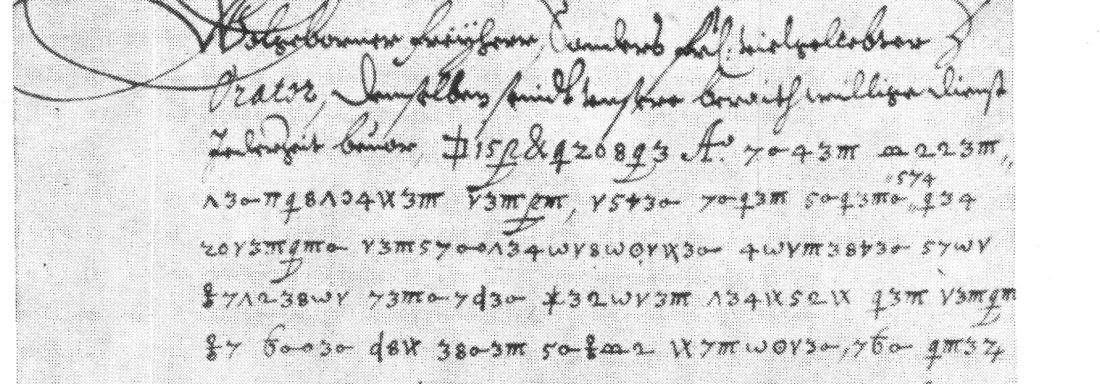
The ledger listed p. 1461 as a despatch of Kuefstein from Constantinople to Ferdinand III. The page says otherwise: the clear heading addresses a “Wolgeborner Freyherr … vielgeehrter Herr Orator” (Kuefstein, the orator), the clear dating line is “Wien den .27. Octobris A° 629”, and the clear subscription is that of the Hoffkriegs Presidendt vnd Räthe, the president and councillors of the War Council. So it is a letter from the Hofkriegsrat in Vienna to Kuefstein, written in his cipher. The emperor in 1629 was Ferdinand II, not Ferdinand III. The clear words were read from a halftone plate and are uncertain in detail; the direction of the letter is not.
The cipher part has 18 lines and 102 words (602 signs, 32 distinct, counted without word gaps and punctuation).
02 The key and its test
Donath’s article prints a full letter alphabet of Kuefstein’s cipher (p. 58), which she rebuilt from the glossed drafts in the same volume; the catalogue and Lang 2015 say only fragments were printed. It was mapped sign by sign to the shapes on the plate and frozen before the first decryption, together with two nulls fixed from the plate (the q-shaped sign with the crossed, curled tail, and a flourish before one initial w). One token was renamed after the first run because the script read it as a comment; no value changed. The record of the order of events is the contributor’s (one commit).
The test used Donath’s three glossed specimens (Tom. V pp. 615, 1069 and 755), copied in the same shapes: the frozen key gives her gloss letter for 373 of 377 signs (98.9%; 615: 69 of 70, 1069: 165 of 167, 755: 139 of 140). The four misses are single signs and look like slips in the drafts or the print. This tests the mapping of her printed types to the plate shapes and the consistency of her key, not an independent key, because the table and the glosses come from one author and volume. It does not cover three values fixed on the plate itself: the null sign, the flourish and the dotted circle read as k (Donath prints a looped, p-like sign for k); those rest on where they stand, and the words they sit in read as German.
The integration decoded the final transcription again with a separate decoder written from the key file; the decryption is identical, line by line.
03 The reading
[1] [2], unser allergenädigister Herr, haben unter andern aus des [3]Herrn herauf geschickten Schreiben auch zugleich vernommen, welcher Gestalt der Herr zu Ofen mit einer Anzahl Türken, von dreitausend [?Mann] stark, empfangen worden. Wann sie dann zu dessen mehrer Wissenschaft eigentliche Information gnädigst begehren, was selbiges nur Volk, ob alles von Ofen oder von andern türkischen Orten und Grenzen dorthin zusammen kommen, ob es sich auch zerteilt oder noch beieinander befinde. Also dem Herrn solches zu schreiben gnädigst anbefohlen, der darüber in einem und andern derselben gründliche Nachricht zu erteilen wissen würde. Uns benebens göttlicher Protection befehlend. Wien den 27. Oktober Anno 1629.
The text above is in modern spelling; the writer’s own spelling (“genedigister”, “Turckhen”, “taussent”, “volckh”) is in the full texts below. In English: [the Emperor?], our most gracious lord, has learned among other things from the Lord’s letter sent up here how the Lord was received at Ofen [Buda] by a number of Turks, three thousand [men?] strong; so, to know more of it, they graciously desire exact information on what sort of people these were, whether all came together there from Ofen or from other Turkish places and borders, and whether they have dispersed or are still together; so it has been graciously ordered to write this to the Lord, who will know how to give thorough report on it; commending ourselves to divine protection.
Count of the 102 words: 98 verbatim from the signs, none with a repair or from a gloss, 1 guess and 3 holes. That is 98 of 102, 96.1%, over the 95% bar. The guess is “von drey taussent [?man] starckh”: the signs give “dan”, which makes little sense, and “three thousand men strong” is the idiom; the first sign may be d (m) rather than q (d), which the halftone does not settle, so the word is not counted as read. The holes are the opening group, which does not decrypt with the letter key and, from the syntax (third person plural verb, “unser allergnädigister Herr”), probably stands for the Emperor, and a two-sign group before “herrn” whose sense (“des Herrn”, the addressee) is clear. All of them are in the first sentence. Donath also prints code signs for “Eure Maiestät”, “Eure Kaiserliche Maiestät” and “Sultan” from other letters; the notes treat the opening group, which does not decrypt with the letter key, as probably such a code group for the Emperor; this is a guess and is not counted as read.
04 What remains uncertain
- The opening code group ([1] [2]) and the two-sign group [3] before “herrn”: a code list for this cipher, if the volume holds one, would settle them.
- The image is a 1964 halftone plate; the manuscript was not seen. The clear heading and subscription, and the single doubtful signs (the first sign of “dan” in line 6, the last sign of “drey” in line 5, a p-shaped h in line 17, the two signs before “herrn” in line 3), need ELTE’s original or a better image.
- The held-out test is not independent of Donath’s work, and does not cover the three values fixed on the plate.
- No human palaeographer has checked the text; an independent AI reader checked four lines sign by sign on the plate and agreed with the state read (grade B).
- Prior art: Donath reproduces the page as a plate and prints the alphabet but deciphers only other letters; Lang 2015 (p. 259) marks p. 1461 and the key as undeciphered; the catalogue vetting of 4 November 2026 found no DECODE record and nothing by Lasry; one web search found no decipherment (Szabádos 2024 on Kuefstein’s courier network does not cite p. 1461; Brandl and Szabádos 2024 was seen in search results only).
Full texts
The transcription and the decryption of every document on this page, so that the reading can be used and checked. Short files are shown here; all are in the repository.
p. 1461, Hofkriegsrat to Kuefstein, Vienna, 27 Oct 1629
The sender (probably the Emperor, the subject being the open opening group) has learned from Kuefstein's letter how he was received at Ofen (Buda) by some 3,000 Turks; the War Council asks, apparently on the Emperor's order (the subject is the open opening group), Kuefstein to report what troops these were, whether they came from Ofen or from other Turkish places and borders, and whether they have dispersed or are still together.
Transcription
# ELTE University Library, Budapest, Kezirattar, G. 4 Fol. Tom. V, p. 1461 (Lang C.Kuf.16)
# Image: plate in Donath 1964, Magyar Konyvszemle 80/1, p. 57 (EPA article PDF, page index 10).
# Reconciled from pass1 and pass2; each disagreement settled on the 3x crop named below.
# Tokens per SIGN_CONVENTIONS.md; ' / ' = word gap. Clear text is given in comments only.
# clear: "Wolgeborner Freyherr, ... vielgeehrter Herr Orator, Demselben seind ... berait willige dienst zuvor bevor,"
L01: dg 1 5 f & q 2 6 8 gx 3 / A° . / 7 o- 4 3 m / oo 2 2 3 m ,
L02: ^ 3 o- pi q 8 ^ c 4 x 3 m / Y 3 m gx m , / Y 5 + 3 o- / 7 o- q 3 m / 5 o- q 3 m o- / [574] / q 3 4
L03: 2 o Y 3 m gx m o- / Y 3 m 5 7 oo-o ^ 3 4 w Y 8 w o Y x 3 o- / 4 w Y m 3 8 + 3 o- / 5 7 w Y
L04: z 7 ^ 2 3 8 w Y / 7 3 m o- 7 d 3 o- / dg 3 2 w Y 3 m / ^ 3 4 x 5 2 x / q 3 m / Y 3 m gx m
L05: z 7 / 6 oo-o 3 o- / d 8 x / 3 8 o- 3 m / 5 o- z oo 2 / x 7 m w o Y 3 o- , / 7 6 o- / q m 3 y
L06: x 5 7 4 gx 4 3 o- x / q oo o- / 4 x oo m w o Y , / pi d +o oo-o 5 o- ^ 3 o- / dg 6 m q 3 o- .
L07: & dg 5 o- / 4 8 pi / q 5 o- / z 7 / q 3 4 gx 4 3 o- / d 3 Y m 3 m / dg 8 4 gx 4 3 o- x ,
L08: 4 w Y 5 oo-o x / oo 8 ^ 3 o- x 2 8 w Y pi / 8 o- gx oo-o 6 m d 5 x 8 6 o- / ^ q 4 x / + 3
L09: ^ 3 Y m o- , / dg 5 4 / 4 3 2 + 8 ^ 3 4 / o- 7 m / III 6 2 w o Y / 6 + / 5 2 2 3 4 / 7 6 o-
L10: 6 oo-o 3 o- , / 6 q 3 m / 7 6 o- / oo o- q 3 m o- / x 7 m w o Y 8 4 w Y 3 o- / 6 m x Y 3 o-
L11: 7 o- q / ^ m 5 o- z 3 o- / q 6 m x Y 3 o- / z 7 4 5 d gx d 3 o- / o Y 6 d 3 o- , / 6 + / 3 4
L12: 4 8 w Y / oo 7 w Y / z 3 m x Y 3 8 2 x , / 6 q 3 m / 5 o- gx o- 6 w Y / + 3 8 pi 8 o- 5 o- q x
L13: + 3 oo-o 8 o- q 3 . / oo 2 4 6 / q pi d / Y 3 m gx m o- / 4 6 2 w Y 3 4 / z 7 4 w Y m 3 8 ,
L14: + pi o- / ^ q 4 x / oo o- + 3 7 6 Y 2 3 o- , / q 3 m / q 5 m 7 + 3 m / 8 o- / pi 8 o- 3 d
L15: 7 o- q / 5 o- q 3 m o- / q 3 m 6 4 3 2 + 3 o- / ^ m 7 o- q x 2 8 w Y 3 / o- 5 w Y
L16: m 8 w Y x 7 o- ^ / z 7 3 m x Y 3 8 2 3 o- / dg 8 4 gx 4 3 o- / dg 7 m q 3 x . / 7 o- 4
L17: + 3 o- 3 + 3 o- 4 / ^ 6 x gx x 2 8 w Y 3 m / +o m 6 x 3 w x 8 6 o- / + 3 7 3 2 w Y 3 o- x .
L18: dg 8 3 o- gx / q 3 o- gx .
# clear after L18: ".27. Octobris A° 629."  Signature block (clear): "Dienstbeflissene / N. Röm. Kays. Mayt. Hoffkriegs Presidendt vnd Räthe" (read from the plate, uncertain in detail).
#
# [574] = three signs written small above the line in L02 with an insertion mark; placed where the mark points.
# Disagreements settled (pass1 -> final, crop):
#  L01 w2 s3 q -> 4 (S2_13); L01 code group s10 q -> gx (Z_L01)
#  L03 w1 s2 6 -> o; w2 "7 o- o-" -> "7 oo-o" (S2_11); w2 s17 6 -> o (S2_12)
#  L04 w2 s6 q -> d (S2_21)
#  L05 w2 "o- o-" -> "oo-o" (S2_21); w6 s5 6 -> o (S2_22); w8 s4 z -> y (S2_23)
#  L06 w1 "dg z 4" -> "4 gx 4" (S2_21); w3 s6 6 -> o (both passes read 6; settled on Z_k.png, dotted circle)
#  L07 w5 s1 4 -> q (S2_32)
#  L08 w2 s2 q? -> 8 (S2_31); w3 gx added after "8 o-" (S2_32); w3 s7 5? -> 5; w4 s2 gx -> q (S2_33)
#  L09 w5 "w 3? 6 Y" -> "w o Y" (S2_32)
#  L11 w4 "d d?" -> "d gx d" (S2_42)
#  L12 w5 s3 q -> gx (S2_42); w6 s1 dg (pass1) -> + (pass2, S2_43: small cross with loop, not the barred dagger)
#  L14 w2 s2 gx -> q (S2_51)
#  L16 w5 s3 q -> 4 (S2_63)
#  L18 last signs of w1 and w2 q? -> gx (S2_61)
# Open shape doubts: L03 w1 "2 o" (two signs at the start of a word; neither fits the letter table well);
#  L05 w8 last sign y (could be z); L17 w4 sign 7 is p-shaped (kept Y); L01 code group "# 1 5 f & q 2 6 8 gx 3 A°".
#  L06 w2 s1 q: blind review (12 Nov 2026, 4x zoom) sees the stem rise well above the bowl as well as below it, so it
#  may be d; kept as q here, and the word is marked doubtful in the reading ("dan", perhaps "man").
Decryption
L01: w[1]a[f]dloie [A°]. unser aller,
L02: genedigister herr, haben under andern aus des
L03: lkherrn heraufgeschickhten schreiben auch
L04: zugleich uernumen welcher gestalt der herr
L05: zu ofen mit einer anzal turckhen, uon drey
L06: taussent dan starckh, empfangen worden.
L07: wan sie dan zu dessen mehrer wissent,
L08: schaft aigentliche information gdst be
L09: gehrn, was selbiges nur uolckh ob alles uon
L10: ofen, oder uon andern turckhischen orthen
L11: und granzen dorthen zusammen khomen, ob es
L12: sich auch zertheilt, oder annoch beieinandt
L13: befinde. also dem herrn solches zuschrei,
L14: ben gdst anbeuohlen, der daruber in einem
L15: und andern deroselben grundtliche nach
L16: richtung zuertheilen wissen wurdet. uns
L17: benebens gottlicher protection beuelchent.
L18: wien den.
Reading
# Reading: ELTE G. 4 Fol. Tom. V p. 1461 (Vienna, 27 Oct 1629)

German, in the writer's spelling as the signs give it (no umlauts in the cipher; u/v one sign). Capitals and the
punctuation between words are editorial except where the writer put commas and points in clear. `[1]`, `[2]`, `[3]` are
sign groups that do not decrypt with the letter key and are left as holes; `[?man]` is a doubtful word (see the
notes). Clear text in the original is in plain type
in brackets `( )` outside the line labels.

(Clear heading: "Wolgeborner Freyherr, ... vielgeehrter Herr Orator, Demselben seind [unsere] ... berait willige dienst
zuvor bevor,")

## Line by line (cipher lines of the plate)

L01: [1] [2]. unser aller-
L02: genedigister Herr, haben under andern aus des
L03: [3]herrn herauf geschickhten schreiben auch
L04: zugleich vernumen, welcher gestalt der Herr
L05: zu Ofen mit einer anzal Turckhen, von drey
L06: taussent [?man] starckh, empfangen worden.
L07: Wan sie dan zu dessen mehrer wissent-
L08: schaft aigentliche information gdst be-
L09: gehrn, was selbiges nur volckh, ob alles von
L10: Ofen, oder von andern turckhischen orthen
L11: und granzen dorthen zusammen khomen, ob es
L12: sich auch zertheilt, oder annoch beieinandt
L13: befinde. Also dem Herrn solches zuschrei-
L14: ben gdst anbevohlen, der daruber in einem
L15: und andern deroselben grundtliche nach-
L16: richtung zuertheilen wissen wurdet. Uns
L17: benebens gottlicher protection bevelchent.
L18: Wien den

(Clear: ".27. Octobris A° 629." Below, in clear: "Dienstbeflissene / N. Röm. Kays. Mayt. Hoffkriegs
Presidendt vnd Räthe".)

## Running text

[1] [2]. unser allergenedigister Herr, haben under andern aus des [3]herrn herauf geschickhten schreiben auch zugleich
vernumen, welcher gestalt der Herr zu Ofen mit einer anzal Turckhen, von drey taussent [?man] starckh, empfangen worden.
Wan sie dan zu dessen mehrer wissentschaft aigentliche information gdst begehrn, was selbiges nur volckh, ob alles von
Ofen, oder von andern turckhischen orthen und granzen dorthen zusammen khomen, ob es sich auch zertheilt, oder annoch
beieinandt befinde. Also dem Herrn solches zuschreiben gdst anbevohlen, der daruber in einem und andern deroselben
grundtliche nachrichtung zuertheilen wissen wurdet. Uns benebens gottlicher protection bevelchent. Wien den 27.
Octobris Anno 629.

## Running text, spelling normalised (editorial)

The same text with modern spelling and umlauts restored, word for word; nothing added except the expanded "gnädigst".

[1] [2], unser allergnädigster Herr, haben unter andern aus des [3]Herrn herauf geschickten Schreiben auch zugleich
vernommen, welcher Gestalt der Herr zu Ofen mit einer Anzahl Türken, von dreitausend [?Mann] stark, empfangen worden.
Wann sie dann zu dessen mehrer Wissenschaft eigentliche Information gnädigst begehren, was selbiges nur Volk, ob alles
von Ofen oder von andern türkischen Orten und Grenzen dorthin zusammen kommen, ob es sich auch zerteilt oder noch
beieinander befinde. Also dem Herrn solches zu schreiben gnädigst anbefohlen, der darüber in einem und andern derselben
gründliche Nachricht zu erteilen wissen würde. Uns benebens göttlicher Protection befehlend. Wien den 27. Oktober
Anno 1629.

## Notes on the reading

- `[1] [2]`: the group before "unser allergenedigister Herr" (signs `dg 1 5 f & q 2 6 8 gx 3` and `A°`) does not decrypt
  with the letter key (mechanically "w?a?dloie" and an A with superscript o). From the syntax (third person, plural
  verb "haben", "unser allergnedigister Herr") it stands for the Emperor, most likely a code group for "Ihre Kays.
  Mayt."; this is a guess and is not counted as read.
- `[3]`: two signs (`2 o`, mechanically "lk") before "herrn"; the sense is "des Herrn" (the addressee). Unresolved.
- `gdst` is the usual abbreviation of "gnädigst"; the writer puts a curved abbreviation stroke over it in L14.
- The sign `gx` (q-shape with crossed and curled tail) stands only where no letter is wanted: between doubled letters
  (her-r, des-sen, wis-sen, zusam-men, an-noch, got-tlicher, taus-sent) and twice at a word end or start
  (in-formation, Wien, den). It is read as a null.
- `zuertheilen wissen wurdet` = "zu ertheilen wissen würdet".
- `[?man]` (L06, signs `q oo o-`): the key gives "dan" ("von drey taussent dan starckh"), which makes little sense; the
  idiom is "von drey taussent man starckh" (three thousand men strong). The blind review saw, at 4x zoom, that the
  stem of the first sign rises well above the bowl as well as running below it, so the sign may be `d` (= m), not `q`
  (= d). The 1964 halftone does not settle it. The transcription keeps `q`, and the word is counted as a guess, not as
  read.
Translation
# Translation: ELTE G. 4 Fol. Tom. V p. 1461 (Vienna, 27 October 1629)

English, following the German reading line by line in sense. `[1] [2]` and `[3]` are the same holes as in the reading.
Words in clear in the original are given in round brackets.

(Well-born Baron, ... much honoured Lord Orator, our ready and willing service to you first of all.)

[1] [2], our most gracious lord, have among other things also learned from [3] the Lord's letter sent up here how the
Lord was received at Ofen [Buda] by a number of Turks, three thousand [?men] strong. Since they [His Majesty, in the
honorific plural] then, for better knowledge of this, most graciously desire exact information on what sort of troops
these were, whether they all came together there from Ofen or from other Turkish places and borders, and whether they
have since dispersed or are still together: so [they have] most graciously ordered that this be written to the Lord,
who will know how to give thorough report on it, on the one point and the other. Commending ourselves meanwhile to
divine protection. Vienna, the 27th of October, in the year [1]629.

(Signed in clear: your obliging servants, the President and Councillors of the Imperial War Council [Hofkriegsrat] of
His Roman Imperial Majesty.)

Note: `[1] [2]` stands for the subject of "have ... learned"; by the syntax it is the Emperor ("Ihre Kays. Mayt.", His
Imperial Majesty), but the signs are not decrypted. `[3]` stands before "the Lord's" (des Herrn), i.e. Kuefstein, the
addressee.

`[?men]` follows the doubtful word of the reading (`[?man]`): the signs give "dan" ("then"), which does not fit;
"three thousand men strong" is the idiom, and the first sign may be the m-sign rather than the d-sign.
Key: key_frozen.tsv, key.tsv
05 Sources
- Budapest, ELTE Egyetemi Könyvtár, Kézirattár, G. 4 Fol. Tom. V, p. 1461 (Lang 2015, C.Kuf.16); the manuscript was not seen.
- Donath Regina, “A diplomáciai titkosírás XVII. századi használatához”, Magyar Könyvszemle 80 (1964) no. 1, pp. 55–62: plate p. 57, alphabet p. 58, specimens pp. 60–62 (EPA PDF).
- Lang, Titkosírás a kora újkori Magyarországon (MTA doctoral thesis, 2015), repertory p. 259.
- WAINUT (LcCompany), pull request #469.
The transcriptions, key, scripts, reading and notes are in targets/hofkriegsrat1629.
Cite this page
WAINUT, “The Imperial War Council writes to Kuefstein in cipher, Vienna, 27 October 1629”, Cyphersolver, posted 12 November 2026, https://cyphersolver.com/hofkriegsrat1629.html.