
At a glanceKey from adjacent plaintext · partial (99% of the cipher)
- The letters
- William Lee, US consul at Bordeaux, to James Monroe, Secretary of State, from Paris, 1, 2 and 6 February 1813. English, with words and phrases in numerals: 123 coded stretches, 2,663 numerals.
- Where
- US National Archives, RG 59, Despatches from US Consuls in Bordeaux, microfilm T164 roll 3, frames 0099–0110 (NAID 211586337). Not on DECODE.
- The cipher
- A Vigenère-type cipher written in numerals 1–25 over a 25-letter alphabet, keyword WINCHESTER, the key started again at W for each coded stretch. Lee made many enciphering mistakes.
- How the key was found
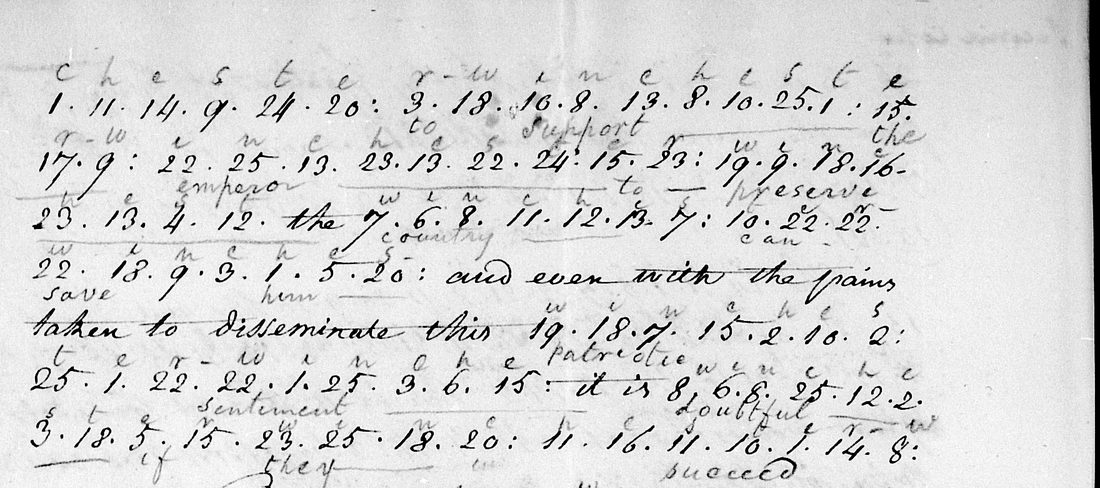
- The clerk who deciphered the letters in 1813 pencilled the keyword letters above the numerals of 6 February. The alphabet, the numeral rule and Lee’s kinds of slip were worked out against his pencilled words, then applied to every stretch with shuffled-numeral controls.
- What it says
- France after the retreat from Russia, the fate of Barlow’s treaty, and Lee’s quarrel with the consul Warden. In the part with no decipherment on this copy: “terms of peace … offered to England if she will abandon Russia”.
- Credit
- Cipher identified, transcribed and deciphered by Andrew Beling with AI agents (pull request #397). The keyword and the partial decipherments are the State Department clerk’s of 1813. The project re-derived the decryption and compared part of the numerals with the frames.
- Still open
- Six numerals at the end of one stretch do not give words; a number of the new passages rest on a supposed slip of Lee’s, and four are given only as proposals; “Mr de Bassagne” is not identified. Most of the numerals have had one reader only.
01 The letters
William Lee (1772–1840), US consul at Bordeaux, had acted for some months as secretary to Joel Barlow, the American minister to France. Barlow died in Poland on 26 December 1812, on his way back from Vilna. Lee came to Paris, and with Barlow’s nephew Thomas Barlow and his widow Ruth disputed the charge of the legation, its papers and its cipher with David Bailie Warden, the consul at Paris. The three letters were written from the legation in those weeks.
They are not in a State Department code. On 18 February 1813 Lee wrote to Warden: “I use my own Cipher and not that of the Government, in corresponding with the Secretary of State” (certified copy, NARA T1 roll 4, frames 0347–0348).
| Date | Frames | In cipher | Decipherment of 1813 | In print |
|---|---|---|---|---|
| 1 February, “private” | 0099–0102, docket 0103 | 8 stretches, 110 numerals | none on the film (frames 0095–0115) | not in The Papers of James Monroe 6 (cited in a note) |
| 2 February, “Copy of Dispatch C” | 0106–0107 | 41 stretches, 1,097 numerals | separate sheets, frames 0104–0105, with gaps marked | Papers of James Monroe 6:366–367, from the clerk’s copy |
| 6 February, “Second Copy” | 0108–0110 | 74 stretches, 1,456 numerals | pencilled between the lines of pages 1–3 only, to the 42nd stretch | not found in print |
02 The cipher
Lee enciphers single words and phrases inside a clear letter. Each coded stretch is a run of numerals from 1 to 25 separated by dots, sometimes with a colon after a word. The alphabet has 25 letters, I and J counting as one. The keyword is WINCHESTER. A numeral n under a key letter stands for the letter n − 1 places after that key letter in the alphabet: under W, 1 is w, 2 is x, 5 is a; under I, 1 is i and 2 is k. The key starts again at W at the beginning of every stretch.
So after “The events in the north are highly” Lee wrote 8 1 6 17 10 1 1 25 5 22 11, which under W I N C H E S T E R W gives distressing.
That is the rule. Lee broke it often. Of the 123 stretches, 25 give sense only if the key position changes inside the stretch or does not start again at W: he leaves a letter out while the key moves on, uses a key letter twice, or carries the key on from the stretch before. Single wrong figures are frequent too. In the readings below, a letter supplied for one of his wrong figures is in square brackets: 60 letters are supplied and 2 dropped in the letter of 6 February, 53 and 1 in that of 2 February, none in that of 1 February.
The wrong figures are not spread evenly. The contributor’s script errors.py finds, for each stretch, the cheapest set of mistakes that turns the reading into the figures Lee wrote. Of the single wrong figures, 27 fall under the key letter W, 8.7% of the 310 figures enciphered with it, against 0.4–2.4% under I, N, H, E, S and R. Most fall where the keyword comes round to W again. Five times there Lee wrote the letter’s plain place in the alphabet (E as 5, B as 2), as if he had not applied the key. These accounts fit the numerals; they do not prove what Lee did.
The key and the tableau are in key.md.
03 6 February: France after Russia
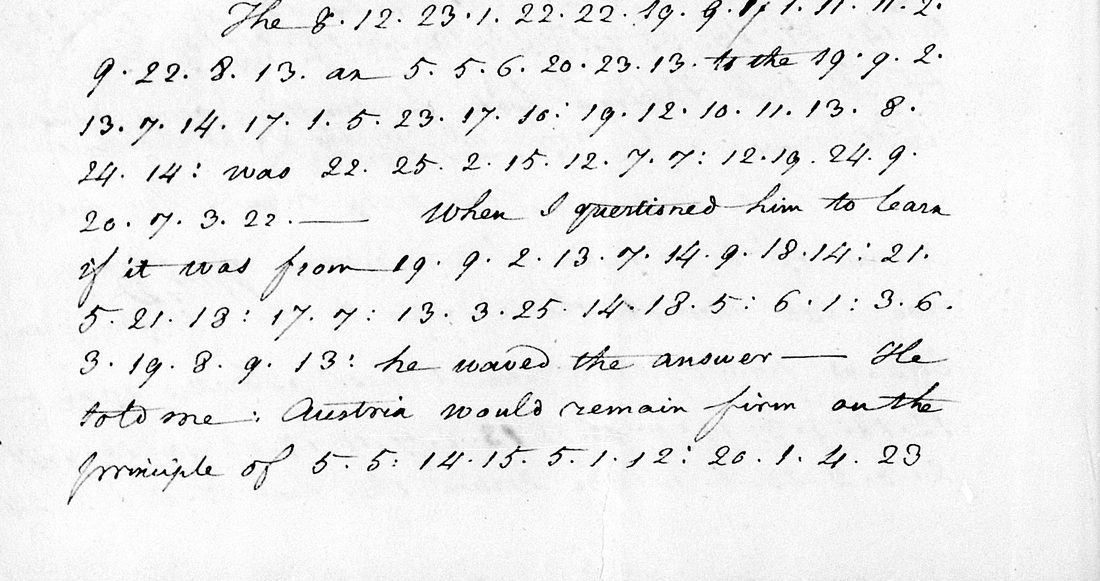
The clerk pencilled a decipherment on the first three pages and stopped in the 42nd stretch (“depression of the nation”), of which he made out only the beginning. Before that he had given up in several places and written “(an error here)” at one. The remaining 32 stretches, 603 numerals, have no pencil on this copy. The letter is headed “Second Copy”; no other copy was looked for, so a decipherment made on another copy cannot be excluded. None was found on the film or in print.
Under the key, 27 of those 32 stretches give English with the key simply started at W; in the other five the key position changes inside the stretch or runs on from the stretch before. In the passages below the words Lee wrote in cipher are in italics, and brackets mark letters supplied for his wrong figures.
… a conscription of three hundred and fifty thousand men has been called for, and recourse has been had to forced donations of men and money … By this means a considerable army will soon be collected but it is the last effort of the nation.
The Concordat recently concluded with the Pope would have made at any other moment a good impression, but at this time i[t] is not thought of, while the [d]isco[nte]nts in some of the departments are magnifi[e]d and the exhausted stat[e] of the fina[n]ces lead to a dread of an emprunt forcé.
Terms of peace it is said have been offered to England if she will abandon Russia — A Mr de Bassagne(?) has been sent to London with proposals to that effect.
He told me: Austria would remain firm on the principle of an armed neutrality, negotiating as mediatrix. But if not, successful in thes[e] negoti[a]tio[n]s She would then join Napoleon, with one hundred thousand men — Perhaps to be indemnified at the expense of Poland.
With this force it is thought Napoleon will retrieve the losses occasioned by the severity of the climate in Russia and still be master of Europe — on this r[e]sts th[e] hopes of his court — his crown and [h]is fame.
In the part the clerk did work on, the cipher corrects him in a few places. Where he wrote “lost(?) his cause” of the King of Prussia, the numerals give left his capital fearing the app[r]oach of the Russian[s]. Where he wrote “(an error here)”, Lee had dropped a letter and gone on with the key one place ahead: the Viceroy has [hi]s headquarters at Posen.
The opening sentence is a proposal. The clerk pencilled “purpose of commerce” and stopped. If Lee used the key letter T twice and misplaced two dots between figures (and with four single wrong figures, bracketed), the sentence is: “For the pur[p]oses of [c]ommerc[e] I established with C. D. S. S. L and C. W. a [c]ipher, a copy of which I have taken means to put in your hands.” If that is right, WINCHESTER was a cipher Lee had set up for his own trade. The three sets of initials are not identified, and nothing found ties the word WINCHESTER to Lee.
04 2 February: Barlow’s treaty
The clerk deciphered most of this letter on separate sheets, and The Papers of James Monroe prints his text with his remarks (“here there is some error”, “here follows a sentence which from some error must remain in obscurity”). Seven passages are in neither the clerk’s copy nor the edition:
- the Emperor would sanction the whole treaty except that part relatin[g] to indem[n]i[t]ies;
- had Mr Barlow lived he would not only have indem[ni]ties through (a proposal; the clerk: “here there is some error”);
- thei[r] game now is to spin out the [ne]goti[a]tion[s] still farther (the sentence the clerk marked as obscure);
- that unfortunate and injudicious letter of his to Latro[b]e;
- Mr [B]arlow’s correspondence with the Dukes of Bassano and Dalberg (the clerk: “Mr Barlow’s [an error]”);
- the death of the Minister proves favorab[l]e [?to] their policy (the clerk: “favorable news [to france]”; the word before “their policy” is not clean);
- the minister’s last correspondence with the Duke of Bassano (the clerk: “communication”).
The letter reports, from Ruth Barlow and the Duke of Dalberg, that France would not grant the indemnities the United States asked for and would offer commercial advantages instead.
05 1 February: against Warden
No decipherment of this private letter was found on the film. Its eight coded passages are short and give, with no letter supplied: the Irish Brigade; the Marshal Serrurier; Barlow’s letter to Latrobe; toasts to the success of Clinton and to Emmet; and Warden’s claim that the United Irishmen in the United States form a distinct party, their influence so great that the President dares not offend. The last word rests on two numerals taken as 10 and not 16; Andrew Beling compared them on frame 0101 with Lee’s other 10s and 16s and confirmed 10.
Both letters speak of Barlow’s “unfortunate” and “injudicious” letter to Latrobe, and in both the name is in cipher, which is a check of one on the other.
06 Method and checks
The frames were located on 20 October 2026 from the source note of the 2 February letter in The Papers of James Monroe. The keyword is not a discovery of this work: it is in the clerk’s pencil. The earliest note of it in the contributor’s files is of 6 November 2026, when the 25-letter alphabet and the numeral rule reproduced two of the clerk’s pencilled words, distressing and misfortune. How the keyword was first noticed is not recorded.
The numerals were transcribed from the frame images by AI agents run by Andrew Beling. Each letter was transcribed and decoded before the clerk’s text was compared, with one stated limit: pages 1–3 of 6 February were transcribed with his pencil in view. Each stretch was decoded twice, with the key started at W and with a decoder that chooses the changes of key position by a letter 4-gram model, at a fixed cost per change set before the first run. Each stretch was also decoded 200 times with its numerals shuffled: 104 of the 123 stretches beat all 200 shuffles. Those that do not are short (5–15 numerals) or are the weak places listed in the next section. The decoder needs a corpus that is not in the repository and is not included; decode.py re-derives every line of the decryption files from the transcriptions and the stated key positions.
A second agent, without the contributor’s files, transcribed the last 32 stretches of 6 February again from the frames. It skipped one line of 14 numerals; of the 589 it did transcribe, 588 are identical. The one difference is the ninth numeral of the “Duke Dalberg” stretch, a thick re-inked 1 that the second reader took for 17 (or 11, or a blotted 1).
On integration, 11 November 2026, the project wrote a separate decoder from the rule and confirmed that the 603 numerals give the English above; fetched frames 0108–0110 and compared about 300 numerals with the transcription at full resolution, including the line the second reader skipped, with no disagreement; and saw the clerk’s pencil stop at the 42nd stretch. The contributor’s statement that nobody deciphered the last part at the time was narrowed to what the film shows, because the letter is a second copy.
The measure: of 528 cipher words in the three readings, 425 have no supplied, dropped, guessed or unreadable letter (0.805). The letters of 2 and 6 February are classed as deciphered in part for that reason, since the project counts every word with a repaired letter as a hole. If only guessed or unreadable words are counted as holes, the share over the three letters is 0.987.
Searches for earlier work, 10–11 November 2026: Weber’s United States Diplomatic Codes and Ciphers and Masked Dispatches, Cryptiana, this repository and the web have nothing on Lee’s cipher or the keyword. Mary Lee Mann’s selection of Lee’s diary and letters (1958), searched in full, does not print the February 1813 letters or mention a cipher. The letters of 1 and 6 February are not found in print, which is not proof that they are unpublished.
07 What remains open
- Unreadable: the last six numerals of the stretch after “These addresses may” (6 February), 2 3 4 23 6 1. They give “but on” only if 2 and 3 are one numeral 23, and the page has a dot between them.
- Passages resting on a supposed slip: the readings mark these with § (in 2 February the indemnities clause, the “game” sentence, “injudicious letter”, the Bassano and Dalberg passage and three others; in 6 February eleven stretches; in 1 February “offend”). Where the supposed slip yields a long clean run of English they are firm; four are given only as proposals.
- Proposals (uncertain): “of an armed neutrality” in the Austrian paragraph of 6 February, where the numerals give OFALARMERKEUTRATITY, four letters off; “I established … a cipher, a copy” in the opening of 6 February and “indemnities through” in 2 February, each of which needs Lee’s dots between figures to be mistakes.
- Guessed from the sense: the word “to” before “their policy” in 2 February.
- “A Mr de Bassagne”: thirteen letters, exact if the key runs on from the stretch before, but too short to clear all the shuffled controls, and the man is not identified.
- Checking: the numerals of 1 February, 2 February and the first 42 stretches of 6 February have one reader each, apart from the stretches compared on the frames at integration. No palaeographer has checked the numerals.
- The other copy: the letter is headed “Second Copy”; no other copy was looked for.
Full texts
The transcription and the decryption of every document on this page, so that the reading can be used and checked. Short files are shown here; all are in the repository.
Lee to Monroe, Paris, 1 Feb 1813 (private), T164 roll 3 frames 0099-0102, docket 0103
Lee attacks Warden's assumption of charge of the legation after Barlow's death: in cipher, the intrigues of the Irish Brigade and Marshal Sérurier on Warden's behalf, his use of Barlow's letter to Latrobe, toasts to the success of Clinton and Emmet, and his claim that the United Irishmen form a party so strong in the United States that the President dares not offend them.
Transcription
# lee1813: William Lee to James Monroe, Hotel of the Legation, Paris, 1 February 1813 ("private"), NARA RG 59, Despatches from US Consuls in Bordeaux, microfilm T164 roll 3, frames 0099-0102 (coded stretches on 0099-0101).
# No contemporary decipherment of this letter was found on the film (frames 0095-0115).
# Every coded stretch in order. For each: the clear words before it (a line without #), then the numerals exactly as
# transcribed (one line), then # lines with frame, count, doubtful numerals and notes from the transcriber.
# Numerals run 1-25. Marks kept where they were recorded: ":" a word mark or colon in Lee's hand, "|" a line or page end.
# "doubtful a:b/c" = numeral at position a read b, could be c. Struck-out numerals are excluded and noted.
# Clear text is Lee's, as on the page; "/" marks a paragraph or page break.
# Transcribed 10 Nov 2026 from full-resolution strips (8 stretches, 110 numerals). The letter is otherwise in clear (7 pages);
# only the clear text next to each coded stretch is given, read on frames 0099-0101 on 10 Nov 2026; the whole letter, read on
# frames 0099-0103, is in reading_1813-02-01.md.

But Sir, all usages, all right has been done away by the intrigues of the
13 9 22 : 16 1 : 23 25 16 3 10 8 22
# F1-A  frame 0099  12 numerals

[after "and others on whom they have an immediate influence to favor the views of their champion, ..." and two pages in clear:] ... to the injury of the Government of the U States, and the prejudice of those legally authorised to exercise them by getting, it is said, the
16 18 5 16 1 22 19 : | 25 1 1 21 12 5 7 23 13
# F1-B  frame 0100/0101  16 numerals
#   note: crosses page turn (7 numerals on 0100 right, 9 on 0101 left); followed by "(who is a perfect old woman ...) to persuade the Duke of Bassano"

[after "(who is a perfect old woman, and in no other case would have any influence whatever) to persuade the Duke of Bassano" and more clear text:] ... He has taken infinite pains to injure the Minister by representing that unfortunate & injudicious letter to
15 18 7 15 7 23 13
# F1-C  frame 0101  7 numerals

in the worst colors, and what is more, he and his friends have been drinking all winter toasts to the
22 12 16 1 23 14 1 21 2 12 | 15 1 1 17 7 9
# F1-D  frame 0101  16 numerals

and their friend
9 4 25 3 12
# F1-E  frame 0101  5 numerals

He represents that the
24 5 22 17 23 25 17 24 5 2 12 4 18 11
# F1-F  frame 0101  14 numerals

in the U States form
5 21 22 16 12 5 21 10 15 24 5 9 7 22
# F1-G  frame 0101  14 numerals

that their influence is so great
23 25 18 13 10 1 1 16 25 14 | 17 11 8 18 5 : 3 11 9 22 1 10 15 10 22 1 2
# F1-H  frame 0101  26 numerals
#   doubtful: 21:10/16 23:10/16
#   note: numerals 21 and 23 have a small round second digit with a tick; first read at strip scale as 16, at 2x zoom closer to 10 (the clear 16 in the line above has a tall looped 6)

Sentiments unbecoming him as an officer of our Government, particularly one who has so recently sought an asylum among us. [the letter continues in clear]

# total: 8 stretches, 110 numerals
Decryption
# lee1813: decryption of William Lee to James Monroe, Hotel of the Legation, Paris, 1 February 1813 ("private"), NARA RG 59, Despatches from US Consuls in Bordeaux, microfilm T164 roll 3, frames 0099-0102 (coded stretches on 0099-0101).
# Key: keyword WINCHESTER over the 25-letter alphabet ABCDEFGHIKLMNOPQRSTUVWXYZ (I/J one letter); see key.md.
#   plaintext letter = alphabet[(numeral - 1 + index(keyword[(i + offset) mod 10])) mod 25], i = 0-based position in the stretch.
# Per stretch: the numerals; "baseline" = key restarted at W for the stretch, no slip (offset 0 throughout);
# "decoder" = the offset path chosen by the phase-slip decoder (letter 4-gram model, 9.0 nats per offset change),
# with z = (score - mean of 200 shuffled-numeral controls) / sd, and whether it beats all 200 controls. The z belongs to
# the decoder's own path, whichever text is used. "used" = the path the reading rests on (baseline, decoder, or a
# hand-chosen path, stated), with the key letter under each numeral and the mechanical text, UNREPAIRED.
# "read as" = the words of reading_*.md for this stretch; [x] = letter supplied where the cipher gives a wrong letter
# or none, <x> = letter Lee enciphered in excess, dropped. Runs are "first-last:offset", positions 1-based.

F1-A  frame 0099  12 numerals  z 4.5  beats all controls: True  decoder slips: 0
  numerals  13 9 22 16 1 23 25 16 3 10 8 22
  baseline  IRISHBRIGADE
  decoder   IRISHBRIGADE   [1-12:0]
  used      baseline [1-12:0]
  key       WINCHESTERWI
  mech      IRISHBRIGADE
  read as   Irish Brigade

F1-B  frame 0100/0101  16 numerals  z 3.4  beats all controls: True  decoder slips: 0
  numerals  16 18 5 16 1 22 19 25 1 1 21 12 5 7 23 13
  baseline  MARSHALSERRURIER
  decoder   MARSHALSERRURIER   [1-16:0]
  used      baseline [1-16:0]
  key       WINCHESTERWINCHE
  mech      MARSHALSERRURIER
  read as   Marshal Serrurier

F1-C  frame 0101  7 numerals  z 0.5  beats all controls: False  decoder slips: 1
  numerals  15 18 7 15 7 23 13
  baseline  LATROBE
  decoder   RZLGIER   [1-4:3 5-7:9]
  used      baseline [1-7:0]
  key       WINCHES
  mech      LATROBE
  read as   Latrobe

F1-D  frame 0101  16 numerals  z 6.0  beats all controls: True  decoder slips: 0
  numerals  22 12 16 1 23 14 1 21 2 12 15 1 1 17 7 9
  baseline  SUCCESSOFCLINTON
  decoder   SUCCESSOFCLINTON   [1-16:0]
  used      baseline [1-16:0]
  key       WINCHESTERWINCHE
  mech      SUCCESSOFCLINTON
  read as   success of Clinton

F1-E  frame 0101  5 numerals  z 0.0  beats all controls: False  decoder slips: 0
  numerals  9 4 25 3 12
  baseline  EMMET
  decoder   LLDUE   [1-5:3]
  used      baseline [1-5:0]
  key       WINCH
  mech      EMMET
  read as   Emmet

F1-F  frame 0101  14 numerals  z 6.0  beats all controls: True  decoder slips: 0
  numerals  24 5 22 17 23 25 17 24 5 2 12 4 18 11
  baseline  UNITEDIRISHMEN
  decoder   UNITEDIRISHMEN   [1-14:0]
  used      baseline [1-14:0]
  key       WINCHESTERWINC
  mech      UNITEDIRISHMEN
  read as   United Irishmen

F1-G  frame 0101  14 numerals  z 5.2  beats all controls: True  decoder slips: 0
  numerals  5 21 22 16 12 5 21 10 15 24 5 9 7 22
  baseline  ADISTINCTPARTY
  decoder   ADISTINCTPARTY   [1-14:0]
  used      baseline [1-14:0]
  key       WINCHESTERWINC
  mech      ADISTINCTPARTY
  read as   a distinct party

F1-H  frame 0101  26 numerals  z 6.8  beats all controls: True  decoder slips: 1
  numerals  23 25 18 13 10 1 1 16 25 14 17 11 8 18 5 3 11 9 22 1 10 15 10 22 1 2
  baseline  THEPRESIDENTUUMGCBARFXWYHF
  decoder   THEPRESIDENTDARESNOTOFFEND   [1-12:0 13-26:8]
  used      decoder [1-12:0 13-26:8]
  key       WINCHESTERWIWINCHESTERWINC
  mech      THEPRESIDENTDARESNOTOFFEND
  read as   the President dares not offend
  note      the key restarts at W after PRESIDENT; OFFEND rests on numerals 21 and 23 read 10 (as 16: UFMEND)

# letters supplied in the reading (wrong or missing in the cipher): 0; letters dropped as excess: 0 (counted outside [?...] proposals).
Reading
# William Lee to James Monroe, Paris, 1 February 1813 (private): reading

### NARA RG 59, Despatches from US Consuls in Bordeaux, T164 roll 3, frames 0099-0102, docket on 0103. Cipher: 8 passages, 110 numerals. Files: transcription_1813-02-01.txt, decryption_1813-02-01.txt, key.md. No decipherment of 1813 known; not printed.

The letter is in Lee's hand, dated from the Hotel of the Legation in Paris and marked private. It runs to seven
pages, nearly all in clear, with eight short passages in his cipher. No decipherment by the State Department clerk
was found on the film. The whole letter is given here, with the docket. It
is not the letter of the same date, wholly in clear, in which Lee regrets that he has not the cipher.

## Marks

Lee's clear text is plain. Words he wrote in cipher are in italics. Bold italics mark cipher that the clerk who read
these letters at the State Department did not read. A dagger † after a passage means the clerk failed or left a gap
there. The sign ≠ means his wording differs from what the cipher gives. A double dagger ‡ means he never came to it.
The sign § means that our reading rests on a slip we suppose Lee made with his key, or on a doubtful division of
the figures: it is a proposal. A letter in square brackets inside a word is one that Lee's figures give wrongly or
leave out, and we supply it. A letter in angle brackets is one he wrote in excess, and we drop it. A word in square
brackets after a question mark is supplied or guessed from the sense. Three dots in square brackets mark figures
not read. A question mark in round brackets marks a name or word we read but doubt. The figures and the letters
they give, without any repair, are in the decryption file, passage by passage. The stops and capitals of the
passages in cipher are ours.

#### Examples: misfo[r]tunes (a letter supplied), o<f>f (a letter dropped), [?to] (a word guessed), [...] (figures not read), Bassagne(?) (a doubtful name). Notes on each passage: NOTES.md section 12.

## Reading

private.

Hotel of the Legation Paris
February 1st 1813.

Sir

I have my consular affairs to attend to, which give me(?) Some occupation, my Commercial affairs which are of
some Moment to me, the private affairs of my deceased friend to arrange, as no one else is acquainted with them,
and the affairs of the Legation to put in Some order. I shall therefore run you this letter off àla hate, mixing
private affairs with public ones, leaving you to select such as shall appear interesting to the President,
calculating on your indulgence and the friendship you have always honored me with on which be assured no one could
set a higher value.

I Shall begin with Mr Warden. This Gentleman has assumed the title of Consul General I am told, at the Exterior
Relations, by virtue of a Commission which he received as such from Genl Armstrong. This was necessary to his
purpose, in order to take the precedence of myself and other Consuls whose Commissions are older than his, and who
according to the usages of this Government, had an antecedent right to him to take charge of our affairs — But
Sir, all usages, all right has been done away by the intrigues of the *Irish Brigade* and others on whom they have
an immediate influence to favor the views of their champion, who by established rules can have no political or
Diplomatic Character, while a Secretary of Legation, acting Secretary of Legation, private Secretary, or in short
any one attached to the Legation is present.

In Stating this to the Duke of Bassano, he shugged his Shoulders and Said: Que voulez vous? "there was no one
present, and we were forced to Consent that Mr Warden Should a[c]t," But, Sir, the absence of the Secretaries was
not the Motive for the Duke's charging Mr Warden with the Communications to be made to & from this Government. He
knows that gentleman is totally unacquainted with the special & current affairs of the Legation, and that sometime
would be necessary for him to get installed — The darling object therefore of procrastination could be better
answered through him, than through those who are acquainted with every Stage of the Negotiation, and who though
they could not to meddle with the special business of the Minister, might nevertheless, viewing the urgency of the
case, press this Government to make such Communications to you on the Subject as might embarrass them. This is my
firm belief, I may be wrong, but the Correspondence of Mr Warden, the last dispatches of the late Minister, and
what Mr Serurier may state to you, will enable you to judge if I am correct or not in this opinion.

The measures which Mr Warden has adopted to gratify his ambition, the imperious manner with which he has treated
those respectable americans, who have Conversed with him on this Subject, his refusing to sign the address
presented to Mrs Barlow and to wear, with all the americans, Mourning on this mournful occasion, when he ought to
have reverenced his own Government by respecting the office if not the man, together with the irritating letter he
has had the impudence to write to the poor disconsolate widow, has drawn upon him the Severe animadversions of all
the Americans here who love their Country & respect the memory of the Deceased.

The Moment the Consul for Paris heard of the death of the Minister, he Should have presented himself at this Hotel,
and have put the Seals of the Consulate on the Cabinet of the deceased until the Secretary of Legation Should
arrive to take charge of the publick papers, and Mrs(?) Barlow or the legal heir Should be in a situation to take
charge of the private ones. This was the extent of his powers, and this Mrs Barlow says she would not have refused
him permission to do; her own security and peace of mind demanded it.

Instead of pursuing this line of conduct, which alone could have placed during the confusion of the family, the
papers of the Legation in perfect security, he assumes instantly functions which do not belong to him, to the
injury of the Government of the U States, and the prejudice of those legally authorised to exercise them by
getting, it is said, the *Marshal Serrurier* (who is a perfect old woman, and in no other case would have any
influence whatever) to persuade the Duke of Bassano, on the 16th January, the very day after he heard of the death
of the Minister, to acknowledge him "as the only proper organ of our Government at Paris, to supply the vacancy
left by the death of the Minister." He then demands of Mrs Barlow the Seals, Cipher & papers of the Legation, and
asks "by what authority she opens & mutilates the dispatches of our Government," threatening at the same time to
take Care," that in future no dispatches Shall fall into her hands to prevent the Secrets of the Government being
known to improper persons." — This you must acknowledge, Sir is very singular language for the Consul of the U
States to use on this occasion, towards those who have reason to suppose, they enjoy the Confidence of the
President.

Will you have us Sir, transport the papers and affairs of the Legation from a privileged house and lodge them in a
house that is not privileged? will you have us place the Correspondence of the late Minister in the hands of
Strangers? (and in this instance Strangers to our Country) for neither Mr Warden or his Secretary have been long
enough in the U States to have been regularly and legally — Naturalized — Shall we take it from those with whom it
has been deposited, who enjoyed the Confidence of the deceased & deposit it with those who did not enjoy his
Confidence, and who ought not to be charged with his secrets; with one who enjoys no Consideration and who, though
at the head of our Commerce in this Country, [?is] as totally ignorant of its interests as he is of the mere forms
of his office. The Secretary of Legation if he consented such an Arrangement ought never again to shew his face in
his Country.

I cannot Sir, sufficiently Caution you against the recommendations which this man's friends will send you from
this Country in his favor, and will induce his friends in ours to address you. This sort of testimony is so easily
procured by those who are Strangers to delicacy that they ought to have no weight. He has taken infinite pains to
injure the Minister by representing that unfortunate & injudicious letter to *Latrobe* in the worst colors, and what
is more, he and his friends have been drinking all winter toasts to the *success of Clinton* and their friend
*Emmet*. He represents that the *United Irishmen* in the U States form *a distinct party*, that their influence is
so great *the President dares not offend*§. Sentiments unbecoming him as an officer of our Government, particularly
one who has so recently sought an asylum among us.

In my letter of the 30th ulto. I mentioned Mr Thos Barlow having announced himself to the Duke of Bassano as
Secretary of Legation, by Stating to him he held a Commission as such from the President, and by calling to his
recollection his uncle's letter on the subject, and his having presented him to His Excellency in that quality at
Wilna.

To this letter we have not as yet received an answer; but Mr Petry called this morning to say that Mr Barlow's
application to the Duke had come too late, Mr Warden having been chosen for the purposes therein mentioned. He
observed that had Mr Barlow signified his wishes on his first arrival from Wilna he would have been received and
accredited. Mr Barlow, (who is not deficient in intellect and prudence) very properly answered, that the reason he
did not immediately on his return, take charge of the affairs of the Legation, was his finding Mr Warden had been
designated by the Duke for that purpose; that if Mr Warden's having been named by the Duke was the only reason for
not accrediting him at this moment, the same reason existed on the 19th January, the day of his arrival as that
Gentleman had publicly notified his acceptation by the Minister of foreign affairs on the 15th of January.

We know from this visit of Mr Petry what it is to be the answer of the Duke; when it arrives, we shall answer it
calmly & respectfully, and here the business must rest until we hear from you. —

As this letter has been spun to a greater length than I intended, and as I have not time to Condense it, I propose
touching on other matters in a Separate one.

If I have been too severe against Mr Warden in this, you must attribute it to my zeal for the public Service and
for the memory of the "best man I ever knew and the dearest friend I ever had."

I have Sir, with the highest respect & attachment, the honor to remain

Your devoted
humble Servant
Wm Lee

[foot of p. 1] Honble James Monroe, Secy of State

[docket, 0103] Mr Lee (private) Feby. 1. 1813. respecting Mr Warden. [pencil:] Mr Lee 21 Feb(?) 1813

## Summary

Lee, in Paris after the death of Joel Barlow, writes privately to Monroe against David Bailie Warden, the consul at
Paris, who has taken charge of American affairs. In cipher he names the Irish Brigade and Marshal Serrurier as the
means by which Warden got himself recognised. Warden has blackened Barlow's letter to Latrobe, drunk toasts to the
success of Clinton and to Emmet, and claims that the United Irishmen form a distinct party in the United States, so
strong that the President dares not offend them.
Lee to Monroe, Paris, 2 Feb 1813 ('Copy of Dispatch C'), T164 roll 3 frames 0106-0107 read in part
Barlow's treaty is to go before Napoleon, who would sanction it except for the indemnities the United States demands; France will spin out the negotiations and offer commercial advantages instead; Lee cites Barlow's correspondence with the Dukes of Bassano and Dalberg and cannot send a copy of the treaty.
Builds coherent sentences, but under the read bar of 95% of words read as sense (90% here); the holes are marked in the reading.
Transcription
# lee1813: William Lee to James Monroe, Paris, 2 February 1813 ("Copy of Dispatch C"), NARA RG 59, T164 roll 3, frames 0106-0107; the 1813 State Department clerk's decipherment is on frames 0104-0105.
# Printed from the clerk's decipherment, with his brackets, in The Papers of James Monroe vol. 6 (MONR-01-06-02-0283).
# Every coded stretch in order. For each: the clear words before it (a line without #), then the numerals exactly as
# transcribed (one line), then # lines with frame, count, doubtful numerals and notes from the transcriber.
# Numerals run 1-25. Marks kept where they were recorded: ":" a word mark or colon in Lee's hand, "|" a line or page end.
# "doubtful a:b/c" = numeral at position a read b, could be c. Struck-out numerals are excluded and noted.
# Clear text is Lee's, as on the page; "/" marks a paragraph or page break.
# Transcribed 6 Nov 2026 (first pass, 41 stretches, 1,098 numerals) with one source correction (Y numeral 37 = 4, not 21);
# re-read at zoom on 11 Nov 2026: J numeral 17 = 4 (was 14), Z numeral 5 = 19 (was 14), AN numeral 7 = 17 (was 7), N "9231"
# = 9 23 1 (was 9 2 3 1), giving 1,097 numerals;
# the clear words were checked on frames 0106-0107 on 10 Nov 2026 (the working file had "Mr B." for "Mrs B." and "him"/"he"
# for "her"/"she" in B, E and G; corrected here; that check changed no numeral). No Lee word marks were recorded for this letter.

Sir. I have just learnt from Mrs B. that
16 9 3 3 12 13 7
# A  frame 0106  7 numerals

called yesterday & told her
23 25 14 17 12 4 13 1 13 14 5 11 12
# B  frame 0106  13 numerals
#   note: first digit on second line looks 4; review

was to be
15 18 22 2 20 1 14 21 13 14 23 25 18 3 5 11 13 24 10 1
# C  frame 0106  20 numerals

this morning
1 25 2 6 19 25 21 21 15 8 5 11 6 3 23 9 17 1 22 22 8 11 21 24 12 4 13 1 4 23 24 24 21 17 12 4 13 4 4 23 15 22 2 4 2 15 5 21 16 20 8 5 18 16 19 9 11 1 5 23 17 9 21 18 21 21 1 23 1 15 17 5 11 3 24 10 15 25 12 7 10 23 1 1 3 12 10 17 20 25 14 16 6 22 18 2 1 1
# D  frame 0106  98 numerals
#   note: struck group after 23 1 excluded; a beside 21 may be mark; 25 overwritten

He asked her if she thought
13 5 17 3 5 9 17 1 5 15 22 14 2 18 4 25 10 12 5 22 22 1 6 17 23 25 22 20 23 8 24 10 14 16 2 9 3 15 22 3
# E  frame 0106  40 numerals

case there would be some
8 1 19 4 2 24 3 18 15 8 13 5 16 12 5 5 21 14 15 23 5 5 14 15 10 22 21 14 1 21 9 5 7
# F  frame 0106  33 numerals

She answered that it was always the
18 7 22 11 2 10 21 21 10 17 8 9 21 18 11 23 9 20 25 23 25 14 17 15 5 5 2 15 10 4 23 22 11 22 1 20 20 5 3 13 22 6 17 1 1 23 7 1 2 13 21 18 11 12 18 22 10 7 13 17 6 7 16 19 9 11 1 5 23 17 11 21 3 12 13 13 8 15 8 23 25 18 25 13 6 13 11 22 20 6 22 5 5
# G  frame 0106  93 numerals
#   note: struck 2 after 25 omitted; struck 8 after 23 omitted; retain ambiguous repeated 5 pending source review (deletion trial rejected)

with whom I conversed on this Subject last evening told me that the great difficulty existing in the
16 1 1 2 7 2 2 15 1 14 16 7 18 15 7 13 5 8 3 12 22 22 22 11 22 1 22 20 5 3 13 22 6
# H  frame 0106  33 numerals
#   note: struck 14 after 8 omitted

He stated that
10 9 14 11 21 1 5 8 14 23 18 11 1 12 15 5 21 8 14 18 23 12 14 17 2 10 21
# I  frame 0106  27 numerals
#   note: 15 overwritten

to subscribe to them. / My own opinion is that had Mr Barlow lived he would not only have
16 9 13 9 4 17 12 5 13 25 : 15 17 21 6 18 25 4
# J  frame 0106  17 numerals
#   note: re-read at zoom 11 Nov 2026: the last group is a single 4 followed by a comma (was 14); a colon after the tenth group, as Lee marks some word ends; numeral 6 is written 17, which the reading takes as 1 and 7 run together (see decryption)

but would have been able on his arrival at Paris to have made
5 3 25 12 11 15 9 20 20 3 20 22 14 17 17 18 17 1 4 15 21 18 1 1 23
# K  frame 0106  25 numerals

— (page 2 begins)
2 15 1 18 24 14 10 23 9 22 4 5 2 23 6 6 13 2 9 22 2 15 3 12 22 13 25 10 2 16 10 3 13 6 1 16 12 5 19 18 2 10 21 11 21 3 10
# L  frame 0107  47 numerals
#   note: excluded struck second 24 after first five groups; possible struck 4 remains

— If they
22 12 12 1 23 1 12
# M  frame 0107  7 numerals

in the
9 24 19 12 10 15 1 1 4 14 17 18 7 7 7 9 17 25 9 23 1 4 14 8 2 9 15 15 17 9 16 10 7 4 7 2 24 20 3 18 21 22 1 12 22 2 12 15 14 21 4 6 17 7 20 22 2
# N  frame 0107  57 numerals
#   doubtful: 20:23/2.3 (written "9231" with no dots, re-read at zoom 11 Nov 2026; first transcribed 2 3 1, now 23 1, which gives "now")
#   note: excluded struck 2 after first 9 15

— If on the other hand
23 25 18 22 22 10 21 24 15 2 24 20 16 23 25
# O  frame 0107  15 numerals

you will have it
13 5 12 12 13 13 23 21 18 14 21 8 2 12 20 15 9 16 9 18 24 10 7 7 21 1
# P  frame 0107  26 numerals

— Thus you will observe that the death of the Minister
19 9 2 19 23 14 14 8 17 23 21 18 15 3 16 1 5 22 1 4 14 13 9 3 12 4 5 11 6
# Q  frame 0107  29 numerals

indeed I doubt if they
21 22 20 15 23 15 2 18 22 3 9 13 18 12 12
# R  frame 0107  15 numerals

in any
19 6 22 11 12 10 14 3 5 14 1
# S  frame 0107  11 numerals

Such has been the impression made here but that
24 5 19 12 10 15 3 2 22 3 9
# T  frame 0107  11 numerals

and
13 5 22 18 22 5 11 16 10 4 22 24 3 12 15 13 24
# U  frame 0107  17 numerals

of
12 1 6 17 7 7 9 1 13 23 2 22
# V  frame 0107  12 numerals

/ The
21 22 19 18 11 22 19
# W  frame 0107  7 numerals

now to
5 21 25 7 12 15 16 12 11 1 9 5 16 7 8 7 13 21 2 18 7 21 18 10 6 5 2 6
# X  frame 0107  28 numerals

appears very extraordinary when I have every reason to believe from
16 9 6 24 10 7 22 4 14 11 21 13 1 9 10 3 12 6 25 13 20 24 14 1 1 7 6 12 4 13 11 16 19 9 10 2 4 20 22 1 25 22 22 18 18 1 2 22 22 19 9 1 1 11
# Y  frame 0107  54 numerals
#   note: ; group37 corrected21→4 by source crop lee_Y_37.jpg; group3 remains6

together with his
8 22 16 9 19 13 9 1 5 23 17 10
# Z  frame 0107  12 numerals
#   note: numeral 5 re-read on frame 0107 on 11 Nov 2026 as 19 (first transcription 14)

and
7 6 5 15 23 14 23 21 9 13 9 5 16 3 15 5 2 15 8 14
# AA  frame 0107  20 numerals

on this Subject, that it was a
19 6 22 11 12 23 18 7 8 8 21 22 18 11 15 13 11 23 14 22 14 18 3 6 15 16 12 8
# AB  frame 0107  28 numerals

and had it not been so he never would have undertaken that unfortunate journey to Wilna — / It is said they intend to offer you
7 6 25 10 23 13 11 16 22 20 5 21 9 24 6 15 9 14 1 2
# AC  frame 0107  20 numerals

which they
7 6 1 16 2 25 13 24 22 2 9 8 8 7 14 22 19 12 9 3 23 6 22 11 22 1 20 20 5 3 13 22 6
# AD  frame 0107  33 numerals
#   note: overwritten group after first 8 read 8

but the
13 5 6 17 19 23 17 18 5 3 3 6 19 24 4 7 1 2 24 17 5 9 5 24 6 3 13 19 1 22 23 10
# AE  frame 0107  32 numerals

in the present
8 1 6 17 10 22 13 1 1 13 22 11 14 17 23 10 14 12 16 1 18 7 18
# AF  frame 0107  23 numerals

and during our
7 6 1 17 23 14 2 4 5 3 12 24 5 3 19 15 10 24 6 3 5 1 1
# AG  frame 0107  23 numerals

will not perhaps be
22 18 7 7 11 2 9 10 15 23 24 16 7 12 12 4 13 22 13 14 22 1 17 3 6 15
# AH  frame 0107  26 numerals

It is possible that their adhering so strictly
23 6 7 6 23 7 17 10 1 22 7 22 6 22 11 5 13 18 5 2
# AI  frame 0107  20 numerals
#   note: excluded extra strokes between 11 and 5

with a view to
13 5 17 18 21 1 7 21 16 3 18 18 16 1 23 25 13 1 16 3 12 22 6 1 19 13 25 8 9 16 9 4 18 11 12 14
# AJ  frame 0107  36 numerals

by thus proving that you can
12 18 9 3 6 10 11 21 8 21 9 9 16 3
# AK  frame 0107  14 numerals

here without great
22 18 16 15 2 2 17 10 1 2
# AL  frame 0107  10 numerals

/ I am not permitted for reasons which I have made known to you in a private letter to send you
5 20 2 13 17 10 14 14 14 23 9 18 24 12 20
# AM  frame 0107  15 numerals

nor of
23 25 18 10 2 9 17 25 15 14 21 10 24 24 11 15 7 6 5 15 23 14 23 21 9 13 9 5 16 3
# AN  frame 0107  30 numerals
#   note: numeral 7 re-read on frame 0107 on 11 Nov 2026 as 17 (first transcription 7)

with the
8 12 23 3 7 2 10 8 14 2 5 5 2
# AO  frame 0107  13 numerals

/ I am Sir with the highest respect your obedient humble Servant / Wm Lee

# total: 41 stretches, 1097 numerals
Decipherment of the time: MONR-01-06-02-0283
Decryption: decryption_1813-02-02.txt
Reading
# William Lee to James Monroe, Paris, 2 February 1813 (Copy of Dispatch C): reading

### NARA RG 59, Despatches from US Consuls in Bordeaux, T164 roll 3, frames 0106-0107; the clerk's decipherment of 1813 on frames 0104-0105. Cipher: 41 passages, 1,097 numerals. Files: transcription_1813-02-02.txt, decryption_1813-02-02.txt, key.md. Printed from the clerk's copy in The Papers of James Monroe, vol. 6, MONR-01-06-02-0283.

The letter was deciphered at the State Department in 1813 on separate sheets, and the printed edition gives that
copy with the clerk's notes of error. Our reading is made from the figures, not from his copy. It agrees with him
wherever he read a passage, except where marked, and it reads seven passages that he could not.

## Marks

Lee's clear text is plain. Words he wrote in cipher are in italics. Bold italics mark cipher that the clerk who read
these letters at the State Department did not read. A dagger † after a passage means the clerk failed or left a gap
there. The sign ≠ means his wording differs from what the cipher gives. A double dagger ‡ means he never came to it.
The sign § means that our reading rests on a slip we suppose Lee made with his key, or on a doubtful division of
the figures: it is a proposal. A letter in square brackets inside a word is one that Lee's figures give wrongly or
leave out, and we supply it. A letter in angle brackets is one he wrote in excess, and we drop it. A word in square
brackets after a question mark is supplied or guessed from the sense. Three dots in square brackets mark figures
not read. A question mark in round brackets marks a name or word we read but doubt. The figures and the letters
they give, without any repair, are in the decryption file, passage by passage. The stops and capitals of the
passages in cipher are ours.

#### Examples: misfo[r]tunes (a letter supplied), o<f>f (a letter dropped), [?to] (a word guessed), [...] (figures not read), Bassagne(?) (a doubtful name). Notes on each passage: NOTES.md section 12.

## Reading

Copy of Dispatch C.

Paris Feby 2.d 1813.

Sir.

I have just learnt from Mrs B. that *Mr Petry* called yesterday & told her *that the Treaty* was to be *laid before
the Emperor* this morning, *who had not y[e]t seen it, and that he thought the whole of it would [b]e sanctioned*
***except that part relatin[g] to indem[n]i[t]ies***†§. He asked her if she thought *indemniti[e]s would be insisted
on by us, as in [t]hat* case there would be some *difficulty in coming to an arrangement*. She answered that it was
always the *opinion o[f] [he]r husband that wi<i>thout [i]ndemnities the P[r]esident wo[u]ld not sanction the
Treaty. The [D]uke Dalberg* with whom I conversed on this Subject last evening told me that the great difficulty
existing in the *mind of the Emperor wa[s] [th]e inde[m]nities*. He stated that *France was [n]ot now in a
situation* to Subscribe to them.

My own opinion is that had Mr Barlow lived he would not only have ***indem[ni]ties through***†§ but would have been able on his
arrival at Paris to have made *almost any T[r]eaty with France* — ***thei[r] game now is to spin out the
[ne]goti[a]tion[s] still farther***†§ — If they *su[c]ceed* in the *e[f]forts the nation is now making, they will
try to dictate terms to you* — If on the other hand *they do n[o]t succe[e]d*, you will have it *in your power [t]o
obtain justice* — Thus you will observe that the death of the Minister *proves favorab[l]e* ***[?to] their
policy***≠§; indeed I doubt if they *regret t[h]at eve[n]t* in any *point of view*. Such has been the impression
made here but that *unfortu[n]ate* and *injudicious* ***letter***†§ of ***his to Latro[b]e***†.

The *refusal* now to *admit the pr[i]nciple of i[n]demnity*≠ appears very extraordinary when I have every reason to
believe from *Mr [B]arlow’s* ***correspondence with the Dukes of Bassano and Dalberg***†§ together with his
*declarations* and *correspondence with me* on this Subject, that it was a *point [fu]lly [a]djusted be[t]ween
them*, and had it not been so he never would have undertaken that unfortunate journey to Wilna —

It is said they intend to offer you *commercial advantages* — which they *consider as equivalent to indemnities*,
but the *instability of all such arrangements* in the present *distra[c]ted state of Europe* and during our
*contest with Great Br[i]tain* will not perhaps be *satisfacto[r]y to the President*. It is possible that their
adhering so strictly *to the licence sys[t]e[m] is* with a view to *induce you to accede t[o] thes[e]
arrangements*≠, by thus proving that you can *have no commerce* here without great *sacrifices*.

I am not permitted for reasons which I have made known to you in a private letter to send you *a copy of [th]e
Treaty*, nor of *the ministers last* ***correspondence***≠§ with the *Duke of Bassano*.

I am Sir with the highest
respect. your obedient humble
Servant.

Wm Lee

[foot of p. 1] Honorable James Monroe, Secretary of State.

## Summary

Lee reports, from Ruth Barlow and from the Duke of Dalberg, that the treaty Joel Barlow had negotiated was to be laid
before Napoleon. The Emperor would sanction it, except the part on the indemnities the United States asked for, which
France is in no situation to grant. Lee expects the French to spin out the negotiations, and thinks Barlow's death
suits them. He finds the refusal of indemnities strange, since Barlow's correspondence with the Dukes of Bassano and
Dalberg had settled the point. France will offer commercial advantages instead. He cannot send a copy of the treaty,
nor of the minister's last correspondence with Bassano.
Lee to the Secretary of State, Paris, 6 Feb 1813 ('Second Copy'), T164 roll 3 frames 0108-0110 read in part
France after the Russian disaster: the Grand Army destroyed, discontent, conscription and forced donations as the last effort of the nation, Austria's armed neutrality and possible mediation, Prussia's king fleeing the Russians, terms of peace offered to England if she abandons Russia, and Napoleon's hopes resting on the coming campaign. The last 32 stretches carry no decipherment on this copy, and none was found.
Builds coherent sentences, but under the read bar of 95% of words read as sense (93% here); the holes are marked in the reading.
Transcription
# lee1813: William Lee to the Secretary of State (James Monroe), Hotel of the Legation, Paris, 6 February 1813 ("Second Copy"), NARA RG 59, T164 roll 3, frames 0108-0110.
# The clerk pencilled keyword letters and plaintext between the lines of pages 1-3 (to F6-42); pages 3 (lower), 4 and 5 carry no pencil.
# Every coded stretch in order. For each: the clear words before it (a line without #), then the numerals exactly as
# transcribed (one line), then # lines with frame, count, doubtful numerals and notes from the transcriber.
# Numerals run 1-25. Marks kept where they were recorded: ":" a word mark or colon in Lee's hand, "|" a line or page end.
# "doubtful a:b/c" = numeral at position a read b, could be c. Struck-out numerals are excluded and noted.
# Clear text is Lee's, as on the page; "/" marks a paragraph or page break.
# Transcribed 10 Nov 2026 from full-resolution strips (74 stretches, 1,456 numerals). F6-01 to F6-42 were read with the
# clerk's pencil in view (not blind to it); F6-43 to F6-74 carry no pencil. F6-43 to F6-74 were read a second time,
# independently, by another agent: see NOTES.md (588 of the 589 numerals it read agree; it skipped one line of 14).
# The clear text after F6-45, F6-46 and F6-72 and the closing paragraph were read on frames 0109-0110 on 10 Nov 2026.

For the
19 12 5 24 7 14 : 13 25 : 10 15 17 6 | 25 10 23 13 11 2 16 1 2 23 18 15 9 2 14 16 1 2 25
# F6-01  frame 0108  31 numerals
#   doubtful: 11:17/7 29-30:1.2/12
#   note: zoom: numeral 4 is clearly 24 and numeral 11 looks 17 (short 1); the last three are written 1.2.25 with a dot after the 1 (read as 1, 2, 25; if the dot is stray, 12, 25); followed by clear "with C. D. S. S. L and C. W."

with C. D. S. S. L and C. W.
5 : 1 22 13 11 25 8 24 23 | 19 16 :
# F6-02  frame 0108  11 numerals
#   doubtful: 5:11/1.1
#   note: zoom: numeral 5 is written 11 with no dot between the strokes; if it is two numerals 1, 1 the stretch has 12 numerals

of which I have taken means to put
13 5 : 12 12 13 13 | 16 8 9 13
# F6-03  frame 0108  10 numerals
#   note: followed by a clear letter "S."

The events in the north are highly
8 1 6 17 10 | 1 1 25 5 22 11
# F6-04  frame 0108  11 numerals

I have not seen of late any English papers, but it is scarcely possible for them to
9 15 | 14 5 25 1 25 8 15 14 : 25 25 18 : 10 2 14 14 21 12 3 | 24 5 18 16 : 7 2 : 2 15 1 16 21 18 1 2 19 13 20 6 :
# F6-05  frame 0108  38 numerals

It has been
23 6 7 24 4 7 7 : 11 1 2 23 9 2 22 23 25 :
# F6-06  frame 0108  16 numerals

The best
18 23 19 7 21 1 25 25 :
# F6-07  frame 0108  8 numerals
#   note: followed by clear "have either been"

have either been
23 18 23 3 6 : 10 25 : 15 22 5 9 : 21 22 3 22 : 10 14 | 13 23 8
# F6-08  frame 0108  20 numerals
#   note: followed by clear "the"

the
22 22 9 3 10 5 2 6 : 10 : 15 10 11 21 | 3 : 21 7 17 19 22 3 9 :
# F6-09  frame 0108  21 numerals

(dash; new sentence)
25 22 16 12 10 25 6 :
# F6-10  frame 0108  7 numerals
#   note: followed by clear "does not furnish"

does not furnish
7 5 : 14 1 21 10 3 20 15 : 23 10 10 | 8 1 1 : 22 12 16 14 10 22 11 5 1 7 16 1 : 10 22 21 | 19 18 22 5 6 :
# F6-11  frame 0108  35 numerals
#   doubtful: 14:1/10
#   note: numeral 14 is a 1 followed by a solid ink blob where a 0 would stand; first pass read 10 (blotted); at zoom the blob is a filled-in cancellation unlike Lee's legible overwrites, so read 1 with the second digit struck; the alternative 10 gives M for C

The effects of this
16 1 6 4 7 13 2 2 9 14 :
# F6-12  frame 0108  10 numerals

upon the
17 18 7 7 7 9 : 17 25 : 9 23 25 : 11 2 | 25 23 : 25 13 25 24 1 9 19 18 2 :
# F6-13  frame 0108  24 numerals

a general
8 1 6 1 7 9 2 12 9 3 : 19 9 18 19 19 5 19 25 :
# F6-14  frame 0108  18 numerals
#   doubtful: 12:9/6
#   note: numeral 12 overwritten; first pass read 6, at zoom a small 9 over an earlier stroke; 6 gives O for R

which
23 25 5 3 19 15 13 20 14 : 22 25 18 : 2 | 23 14 2 24 16 22 23 1 2 11 :
# F6-15  frame 0108  23 numerals
#   note: the 22 in line 2 overwritten

of the
11 6 9 3 10 | 9 20 12 9 3 :
# F6-16  frame 0108  10 numerals
#   note: the 10 overwritten

Nothing but the general impression among the leading characters, that it is
18 22 16 | 1 11 14 9 24 20 : 3 18 : 16 8 13 8 10 25 1 : 15 | 17 9 : 22 25 13 23 13 22 24 : 15 23 : 19 9 18 16 | 23 13 4 12
# F6-17  frame 0108/0109  38 numerals
#   doubtful: 12:16/10
#   note: zoom: numeral 1 is clearly 18, numeral 4 clearly 1, numeral 12 has the tall looped 6 (16);crosses page turn after 3 numerals; followed by clear "the"

the
7 6 8 11 12 13 7 : 10 22 22 | 22 18 9 3 1 5 20 :
# F6-18  frame 0109  17 numerals

and even with the pains taken to disseminate this
19 18 7 15 2 10 2 : | 25 1 22 22 1 25 3 6 15 :
# F6-19  frame 0109  16 numerals

it is
8 6 8 25 12 2 | 3 18 5 : 15 23 25 18 20 : 11 16 11 10 1 14 8 :
# F6-20  frame 0109  21 numerals
#   note: numeral 18 corrected at zoom from first-pass 16 to 10 (round closed second digit beside the looped 6 of numeral 16); numeral 14 (20) confirmed at zoom

Austria, who it is
7 6 1 16 2 25 13 | 24 1 13 : 13 10 : 24 3 11 14 : 13 5 4 16 24 10 | 7 3 22 : 15 16 8 9 : 10 17 16 2 4 12 4 13 | 20 22 3 15 6 1 16 : 7 9 : 2 15 1 7 6 1 17 2 9 | 13 20 15 : 18 23 : 1 6 : 4 23 22 25 12 25 :
# F6-21  frame 0109  68 numerals
#   doubtful: 20:16/10
#   note: zoom: numeral 20 has the looped 6 (16); the 3 in line 3 overwritten; followed by clear "will"

will
19 9 : 2 4 2 15 : 22 13 15 17 13 10 : 6 17 19 15 | 13 : 12 2 3 12 1 1 5 11 15 22 : 25 15 1 13 2 | 18 : 2 22 1 11 16 14 18 25 22 : 15 7 7 18 :
# F6-22  frame 0109  46 numerals

The
5 9 16 6 : 22 16 18 12 24 17 5 9 23 3 11
# F6-23  frame 0109  15 numerals
#   doubtful: 4:6/8

and
12 1 6 : 13 19 13 2 6
# F6-24  frame 0109  8 numerals
#   note: followed by clear "wish it"

wish it - The
3 18 5 | 15 17 : 10 14 1 : 4 14 : 19 9 22 11 21 1 : 1 4 22 | 1 23 17 18 11 20 16 3 24 3
# F6-25  frame 0109  29 numerals
#   note: the 11 in line 2 blotted

The Emperor from his attachment to his daughter is in favor
18 | 23 : 14 9 : 19 13 20 12 13 : 19 22 8 17 10 22 | 2 16 15 8
# F6-26  frame 0109  19 numerals
#   doubtful: 4:9/7
#   note: zoom confirms 14, 9, 19, 13, 20, 12, 13, 19, 22, 8, 17, 10, 22, 2, 16, 15, 8; a stray mark before the 9; last 22 of line 2 overwritten

and through him it is said
17 22 4 | 12 12 5 9 1 5 23 1 10 19 12 10 22 15 11 9 | 14 21 18 24 : 11 23 22 11 12 : 22 1 9 6 3 3 10 | 22 2 15 9 16
# F6-27  frame 0109  40 numerals
#   note: all numerals confirmed at zoom

The Prussian Monarch has
15 22 19 17 | 1 5 1 : 10 22 24 13 11 14 9 : 24 1 9 24 5 22 11
# F6-28  frame 0109  21 numerals
#   doubtful: 16:1/7
#   note: numeral 16 is a 1 with a small cross-blot;followed by clear "the"

the
5 7 3 13 7 22 11 15 : 10 15 : 23 25 18 : 15 13 14 1 16 | 22 22 18
# F6-29  frame 0109  21 numerals

His dominions are
9 6 25 13 4 1 2 12 | 7 8 : 9 15 21 24 13 14 2 12
# F6-30  frame 0109  18 numerals

and
19 6 24 24 6 | 25
# F6-31  frame 0109  6 numerals
#   note: crosses from page 2 to page 3

is in a
8 1 6 17 10 22 11 1 1 13 : 22 11 14 17 23
# F6-32  frame 0109  15 numerals
#   doubtful: 5:10/16
#   note: numeral 5: second digit level with the 1, small top hook; read 10, could be 16

from the part they have taken, having
15 6 6 17 19 | 7 19 : 10 10 22 10 1 17 3 6 24 13 16 9 : 22 5 7 2 9 23 | 10 21
# F6-33  frame 0109  27 numerals

The
14 1 1 5 7 2 21 8 11 20 9 10
# F6-34  frame 0109  12 numerals

has quit
23 25 18 | 15 23 8 21 8 15 23 16 11 : 21 3 : 25 13 9 20 25 : 10 21 | 4 12
# F6-35  frame 0109  23 numerals
#   doubtful: 11:16/10
#   note: numeral 11 smudged; read 16, could be 10

in
8 1 6 5 13 14 2
# F6-36  frame 0109  7 numerals

having it is said committed great errors, and the
25 : 1 16 3 10 10 17 : 15 22 2
# F6-37  frame 0109  10 numerals
#   note: followed by clear "taken"

taken
23 25 18 : 1 7 8 20 8 9 13 :
# F6-38  frame 0109  10 numerals

and has we are told at this moment
12 6 6 23 22 12 23 16 10 21 11 18 | 15 11 : 22 2 : 22 10 2 9 5 :
# F6-39  frame 0109  21 numerals

Reports say that the Russians
12 18 9 3 23 9 2 12 13 14 3 19 18 15 4 7 21
# F6-40  frame 0109  17 numerals

In the midst of these
8 1 6 24 11 15 13 24 14
# F6-41  frame 0109  9 numerals

and of the
11 9 18 24 12 : 25 13 22 13 14 22 10 1 2 | 11 7 2 2 15 1 22 5 11 22 12 6
# F6-42  frame 0109  26 numerals
#   doubtful: 2:9? 12:10/16
#   note: numeral 2 partly hidden by pencil; numeral 12 read 10 at strip scale, at zoom the second digit has a short ascender and could be 16

a conscription of three hundred and fifty thousand men has been called for, and
21 22 16 12 13 13 1 12
# F6-43  frame 0109  8 numerals

has been had
23 6 19 12 10 24 | 13 11 : 25 23 17 18 7 7 7 9 1 :
# F6-44  frame 0109  17 numerals

of
16 22 1 24 6 25 20 | 21 9 14 3
# F6-45  frame 0109  11 numerals

By this means a considerable army will soon be collected
6 12 7 7 12 5 1 1 4 14 15 18 6 17 : 23 | 2 14 21 13 3 : 18 23 7 6 23 : 9 9 1 5 23 17
# F6-46  frame 0109  31 numerals

These addresses may -
12 18 9 3 : 19 9 13 13 2 7 11 14 25 10 10 9 11 | 2 3 4 23 6 1
# F6-47  frame 0109  23 numerals
#   doubtful: 18-19:2.3/23
#   note: line 2 begins 2. 3. with a clear dot between (two numerals); a struck-out group (12 or 13) after numeral 6 excluded; numeral 8 (13) heavily overwritten

The nation they have
17 6 1 3 24 | 10 25 : 1 4 14 19 22 2 13 4 1 : 18 20 10 6
# F6-48  frame 0109/0110  20 numerals
#   note: crosses page turn after 5 numerals

How they have
6 22 18 11 : 8 13 22 11 16 12 9 21 :
# F6-49  frame 0110  12 numerals

The Concordat recently concluded with the Pope
1 6 8 9 22 : 4 9 3 1 21 5 21 18 24 12 : 22 21 6 | 10 3 12 22 5 : 10 7 8 13 20 15
# F6-50  frame 0110  29 numerals
#   note: followed by clear "a good impression,"

a good impression,
6 12 7 24 12 15 16 16 14 3 13 4 18 7 5 1 20 10 3 : | 23 25 2 18 25 4 2 : 21 2 6 12 1 24 3 :
# F6-51  frame 0110  33 numerals
#   note: line 1 much corrected: numerals 4,5,6,8,9,10,11,18 overwritten; a struck-out group (12 or 22) after numeral 14 excluded; numeral 16 (1) is an insertion above the line with caret after the 5

The
10 1 | 6 1 7 9 3 22 : 1 1 16 7 8 13 : 21 2 3 12 22 17 | 3 8 22 25 1 8 14 17 11 6 :
# F6-52  frame 0110  30 numerals
#   note: followed by clear "are"

are
16 18 20 11 2 2 | 17 3 25 :
# F6-53  frame 0110  9 numerals

and the
9 15 21 24 13 14 2 12 25 : 2 | 23 18 7 1 : 7 2 2 15 1 : 15 13 5 14 6 21 1 1
# F6-54  frame 0110  27 numerals
#   note: followed by clear "lead to a"

lead to a
8 9 18 24 22
# F6-55  frame 0110  5 numerals

of an
9 4 3 15 13 9 2 | 13 10 1 7 22
# F6-56  frame 0110  12 numerals

These, Sir, perhaps you will say, are the
8 18 5 8 : 11 4 9 11 1 2 :
# F6-57  frame 0110  10 numerals

of the
19 1 16 17 8 13 | 13
# F6-58  frame 0110  7 numerals

yet I do not see how I can
11 1 9 3 2 15 25 | 12 7 18 9 23 :
# F6-59  frame 0110  12 numerals

(new paragraph)
23 22 5 10 11 10 14 22 1 10 7 22
# F6-60  frame 0110  12 numerals
#   note: "11 10" is written above the line over "10 14" (insertion); placed here after numeral 4; followed by clear "it is said have been"

it is said have been
18 23 19 3 10 1 12 1 10 14 17 24 | 24 24 6 25 17 13 14 17 9 14 22 9 4 : 22 10 8 | 9 13 18 5 : 5 18 11 14 17 8
# F6-61  frame 0110  38 numerals
#   note: numeral 13 (24) stands in the left margin before line 2 (added); a small cross between numerals 8 and 9

(dash)
22 21 21 21 | 18 25 19 14 1 8 3 22 9
# F6-62  frame 0110  13 numerals
#   note: followed by clear "has been"

has been
22 22 1 17 | 12 10 : 19 21 9 13 18 5
# F6-63  frame 0110  12 numerals
#   note: followed by clear "with"

with
19 9 2 13 7 14 | 9 18 14 :
# F6-64  frame 0110  9 numerals
#   note: followed by clear "to that effect."

The
8 12 23 1 22 22 19 9 1 1 11 11 2 | 9 22 8 13
# F6-65  frame 0110  17 numerals
#   doubtful: 8:9? 9:1/struck
#   note: numeral 8 overwritten; numeral 9 is a thick 1 with a long diagonal tail running below the line; first pass took it as struck out and excluded it; at zoom it is a re-inked 1 with a pen drag, not scribbled over like the struck groups in F6-47 and F6-51, so it is kept; without it the stretch has 16 numerals

an
5 5 6 20 23 13
# F6-66  frame 0110  6 numerals
#   note: followed by clear "to the"

to the
19 9 2 | 13 7 14 17 1 5 23 17 10 : 19 12 10 11 13 8 | 24 14 :
# F6-67  frame 0110  20 numerals
#   note: followed by clear "was"

was
22 25 2 15 12 7 7 : 12 19 24 9 | 20 7 3 22
# F6-68  frame 0110  15 numerals

When I questioned him to learn if it was from
19 9 2 13 7 14 9 18 14 : 21 | 5 21 13 : 17 7 : 13 3 25 14 18 5 : 6 1 : 3 6 | 3 19 8 9 13 :
# F6-69  frame 0110  30 numerals
#   note: followed by clear "he waved the answer"

He told me: Austria would remain firm on the principle of
5 5 : 14 15 5 1 12 : 20 1 4 23 | 9 14 9 2 15 7 : 20 1 16 18 11 22 24 12 5 21 | 14 : 22 2 : 16 22 17 7 19 15 25 16 19
# F6-70  frame 0110  39 numerals
#   doubtful: 24:24/21
#   note: crosses from page 4 to page 5 after 11 numerals

But if not,
22 12 16 1 23 14 1 13 16 20 : 13 5 7 6 23 | 14 12 : 20 1 16 18 11 22 18 12 5 22 21 14
# F6-71  frame 0110  29 numerals
#   note: followed by clear "She would then join Napoleon, with one hundred thousand men"

Perhaps to be indemnified.
5 11 7 6 | 23 : 1 6 22 1 22 22 22 : 2 4 8 10 19 8 9 13 :
# F6-72  frame 0110  20 numerals

and still be master of Europe -
18 5 7 : 6 2 14 25 3 14 3 | 22 : 11 21 1 1 10 23 12 14 : 23 10 25 22 16 21 | 10 3 24 15 :
# F6-73  frame 0110  29 numerals
#   note: numerals of line 1 confirmed at zoom (the first is 18 with a heavy 8)

(dash)
17 13 10 16 15 7 18 21 8 9 | 13 : 11 1 6 4 19 8 13
# F6-74  frame 0110  18 numerals
#   note: last coded stretch; followed by the closing "I am Sir, with great respect"

/ I am Sir, with great respect Your very humble Servant / Wm Lee

# total: 74 stretches, 1456 numerals
Decryption: decryption_1813-02-06.txt
Reading
# William Lee to the Secretary of State (James Monroe), Paris, 6 February 1813 (Second Copy): reading

### NARA RG 59, Despatches from US Consuls in Bordeaux, T164 roll 3, frames 0108-0110. Cipher: 74 passages, 1,456 numerals. Files: transcription_1813-02-06.txt, decryption_1813-02-06.txt, key.md. Not printed.

No full decipherment of the letter was found. The clerk at the State Department wrote the letters of the key over
the figures and his reading under them in pencil on the first three pages, and stopped on the third. The last
thirty-two passages carry no decipherment on this copy (it is headed "Second Copy"; no other copy was looked for).

## Marks

Lee's clear text is plain. Words he wrote in cipher are in italics. Bold italics mark cipher that the clerk who read
these letters at the State Department did not read. A dagger † after a passage means the clerk failed or left a gap
there. The sign ≠ means his wording differs from what the cipher gives. A double dagger ‡ means he never came to it.
The sign § means that our reading rests on a slip we suppose Lee made with his key, or on a doubtful division of
the figures: it is a proposal. A letter in square brackets inside a word is one that Lee's figures give wrongly or
leave out, and we supply it. A letter in angle brackets is one he wrote in excess, and we drop it. A word in square
brackets after a question mark is supplied or guessed from the sense. Three dots in square brackets mark figures
not read. A question mark in round brackets marks a name or word we read but doubt. The figures and the letters
they give, without any repair, are in the decryption file, passage by passage. The stops and capitals of the
passages in cipher are ours.

#### Examples: misfo[r]tunes (a letter supplied), o<f>f (a letter dropped), [?to] (a word guessed), [...] (figures not read), Bassagne(?) (a doubtful name). Notes on each passage: NOTES.md section 12.

## Reading

Second Copy

Hotel of the Legation Paris<br>
Feby 6th. 1813.

Sir,

For the *pur[p]oses of [c]ommerc[e]* ***I established***†§ with C. D. S. S. L and C. W. ***a [c]ipher, a copy***†§ of which I have taken means to put *in your hand*s.

The events in the north are highly *distressing*. — I have not seen of late any English papers, but it is scarcely
possible for them to *exaggerate [t]he misfo[r]tunes of the grand army*. — It has been *totally destroyed*. The best
*officers* have either been *taken or have died off by* the *severity o<f>f the climate*. — *History* does not
furnish ***[a]n account of such a disastr<c>ous campaign***†.

The effects of this *misfortune* upon the *nation is no[t] to be descr[i]bed* — a General *discontent prevails*
which *threatens [t]he destru[c]tion* of the *Government*. — Nothing but the general impression among the leading
characters, that it is *[n]ec[e]ssary to [s]upport the Emperor to preserve* the *country can save him*, and even with
the pains taken to disseminate this *patriot sen[t]iment*≠ it is *doubtful if the[y] succeed*.

Austria, who it is *considered is less exh[a]usted than any of the nat[i]ons on the continent,* ***it is feared***†§
will *profit of this state [o]f things to strike [a] decisive b[l]ow*. The *Arch Duke Char[l]es* and *his party* wish
it — The *[p]ar[t]y of the Prince Swartzenb[o]urg*. The Emperor from his attachment to his daughter is in favor
***[?of an armed neutrality]***†§ and through him it is said *ne[g]otiatio[n]s* ***for a g[e]neral [p]eace are operat[i]ng***†.

The Prussian Monarch has *left his capital fearing*≠ the ***app[r]oach of the Russian[s]***†. His dominions are
*[c]ompletely exhauste[d]* and *Poland* is in a *distracted state* from the part they have taken, having *lost all
confidence in Napoleon*.

The *King of Naples* has quit *the remna[n]t o[f] the grand army* in *disgust* having it is said committed great
errors, and the *Vicero[y] has* taken *the command* and has we are told at this moment ***[hi]s headquarters at
Posen***†§. Reports say that the Russians *have entere[d] Berl[i]n*.

In the midst of these *disasters* and of the *great* ***depression of the nation***†§ a conscription of three
hundred and fifty thousand men has been called for, and ***recourse***‡ has been had ***to forced donations***‡ of
***men and money***‡ — Fifty thousand horse are to be raised by each town furnishing its quota, in proportion to its
population and wealth, thus Paris furnishes five hundred Lyons one hundred & twenty Bordeaux Eighty and so on.

By this means a considerable army will soon be collected ***but it is the last effort of the nation***‡ — We must
therefore look for something very decisive in the course of the Summer months.

The papers I have sent you will give you the account of the formation of the Regency, and furnish you with most of
the addresses to the throne from different parts of the Empire These addresses may ***have an eff[e]ct abroad [?but
on]***‡§ The nation they have ***none, for the people know***‡ How they have ***been produced***‡. The Concordat
recently concluded with the Pope ***would have made at any other moment***‡ a good impression, ***but at this time
i[t] is not thought of, while***‡§ The ***[d]isco[nte]nts in some of the departments***‡§ are ***magnifi[e]d***‡ and
the ***exhausted stat[e] of the fina[n]ces***‡ lead to a ***dread***‡ of an ***emprunt forcé***‡.

These, Sir, perhaps you will say, are the ***dark shades***‡ of the ***pict[u]re***‡ yet I do not see how I can
***give it relief***‡.

***Terms of peace***‡ it is said have been ***offered to England if she will abandon Russia***‡ — ***A Mr de
Bassagne(?)***‡§ has been ***sent to London***‡ with ***proposals***‡ to that effect.

The ***Duk[e] Dalberg told me***‡ an ***answer***‡ to the ***propositions for peace***‡ was ***shortly expected***‡ —
When I questioned him to learn if it was from ***proposals mad[e] to Russia o[r] England***‡ he waved the answer — He
told me: Austria would remain firm on the principle of ***an armed neutrality, negotiating as mediatrix***‡. But if
not, ***successful in thes[e] negoti[a]tio[n]s***‡ She would then join Napoleon, with one hundred thousand men —
Perhaps to be indemnified ***at the expense of Poland***‡.

Part of the new levies are to be distributed about in the Garrisons, and military positions and the veterans are to
be drawn from thence, thus one hundred & twenty thousand old troops will be joined to part of the new ones, which
when added to the remnant of the Grand army, will make it is said an army of Five hundred thousand men, added to
which all the immense ordinance, prepared for the Marine, and all the Engineers with the marine soldiers, and
Cannoniers of that Department have it is reported, been ordered to march to the North.

With this force it is thought Napoleon will retrieve the losses occasioned by the severity of the climate in Russia
and still be master of Europe — ***on this r[e]sts th[e] hopes of his court***‡ — ***his crown and [h]is fame***‡§.

I am Sir, with great respect<br>
Your very humble Servant<br>
Wm Lee

The Secretary of State

Docket (frame 0111, left: the outer leaf, in another hand): Mr Lee / Feby 6 Paris / political events.

## Summary

Lee reports the ruin of the Grand Army in Russia and its effect on France. There is general discontent; a new
conscription of three hundred and fifty thousand men has been called, with forced gifts of men and money, which he
calls the last effort of the nation. The addresses to the throne impress no one at home, the departments are restless,
and people dread a forced loan. Austria is less exhausted than the other powers and may strike; her Emperor favours an
armed neutrality and talks of peace. The King of Prussia has left his capital as the Russians come on, the King of
Naples has quit the army, and the Viceroy commands at Posen. Terms of peace are said to have been offered to England
if she will abandon Russia. Dalberg tells Lee that Austria will stay neutral and offer to mediate, or else join
Napoleon with a hundred thousand men in return for a share of Poland. On the coming campaign rest the hopes of his
court, his crown and his fame.
08 Sources
- US National Archives, RG 59, Despatches from US Consuls in Bordeaux, France, 1783–1906, microfilm T164 roll 3, NAID 211586337: frames 0099–0103 (1 February), 0104–0105 (the clerk’s decipherment of 2 February), 0106–0107 (2 February), 0108, 0109, 0110 (6 February). Public domain.
- The Papers of James Monroe, vol. 6, ed. Daniel Preston and Robert Karachuk (University of Virginia Press, Rotunda digital edition), “From William Lee, Paris Feby 2d 1813”, MONR-01-06-02-0283, pp. 366–367: the clerk’s decipherment of the 2 February letter. Cited, not copied.
- Lee to Warden, 18 February 1813, certified copy, NARA T1 roll 4, frames 0347–0348.
- Mary Lee Mann (ed.), A Yankee Jeffersonian (1958), at HathiTrust (uc1.b4437374): searched, nothing on the cipher.
- Transcription, key, decryption, readings and error accounts: Andrew Beling with AI agents, pull request #397, 11 November 2026. His folder also holds a viewer that shows each frame beside its reading.


Transcriptions, key, decryptions, readings and notes: targets/lee1813/.
Cite this page
Andrew Beling and Daniel Bourdeau, “William Lee to James Monroe, Paris, February 1813: the WINCHESTER cipher”, Cyphersolver, posted 11 November 2026, https://cyphersolver.com/lee1813.html.