At a glanceKey from adjacent plaintext · partial (66% of cipher tokens valued, not the word count)
- The letters
- De Neufville’s drafts of April–May 1779, with code numbers written over his French, and letters from Paris of February 1779 to November 1781 signed “Baudouin” and later “Dunoyer”, addressed to “Monsieur Van Temmel” at de Neufville’s house, with code groups inside clear French.
- Where
- US National Archives, RG 360, Papers of the Continental Congress, microfilm M332 roll 4, file unit 464816476 (“Letters from William Lee to John de Neufville and Son”, 808 images), pp. 487–609. Not on DECODE.
- The cipher
- Numbers from 1 to about 550, one number for a letter, syllable, common word or name, with several numbers for common units (re = 30, 229, 310; que = 22, 23, 278). Neither of the two tables mentioned in the letters survives as a table.
- How it was deciphered
- The code was rebuilt from de Neufville’s drafts, where he wrote the numbers over his own words, and from his glosses on Baudouin’s letters. Keys built from some drafts predicted the others: 139 of 146 covered groups, 64 of 65 and 64 of 66, against shuffled keys that reach at most 15.
- What it says
- Paris news for the Pensionary of Amsterdam, and in January 1780 a warning that a loan nobody will put money into “ne peut que faire beaucoup de tort au crédit du [369/349]”.
- Still open
- Numbers 3, 58, 227, 369/349, 507, 501 and 162, 30 where the word wants g, four likely nulls, and two unglossed lines of p. 527. None is glossed anywhere in the file.
- Credit
- Andrew Beling, with AI agents (13–15 November 2026): the images found, the code rebuilt and tested, the leaf evidence for “Dunoyer” = Baudouin, and the bare passages decoded. Readings reviewed by Brice Dudout (assisted by Claude). The identification of the correspondent is the 19th-century index-maker’s.
01 The file
The papers of Jean de Neufville & fils, bound in the Department of State and now among the Papers of the Continental Congress, hold a private correspondence in a numeric code between de Neufville in Amsterdam and a correspondent in Paris:
- De Neufville’s drafts, April–May 1779 (pp. 591–609), headed “Mad. d’Arras” or “Chaumont”: plain French with code numbers written over the syllables, and one enciphered fair draft (pp. 604–606) of the letter of 19 April 1779 whose plain text is on p. 599. About 1,100 numbers.
- Letters from Paris (pp. 487–590), signed “Baudouin” and later “Dunoyer”. De Neufville wrote the French over many of the groups (about 380 numbers), but not over all: about 90 numbers on pp. 491–492, 527 and 573 stand bare.
Who the correspondent is. The volume’s own index (p. 3, a 19th-century hand) lists him as “Du Noyer, Bowdoin or Mad. D. Arras”. The letters of 23 February and 7 March 1779 are signed “Baudouin”; the second ends “à l’avenir je signeray un des noms que je prends dans le petit chiffre cy joint”, and from 30 March the letters in the same hand are signed “Dunoyer”. The Papers of Benjamin Franklin call Baudouin Sartine’s secretary. That “Dunoyer” is Baudouin rests on the file alone: the index, the signatures, the announced change of name and a hand judged the same by eye (by an AI model, not a person).
Two tables. On 7 March 1779 Baudouin wrote that he was making a “chiffre” and meanwhile sent a “petit chiffre” of cover names; on 30 March he acknowledged “le chiffre” that had come with de Neufville’s letter. The numeric code of the drafts is probably the one de Neufville sent; who composed it is not shown.
02 Rebuilding the code
De Neufville enciphered his letters from his plain drafts and wrote the numbers over the words, so each draft is a set of number–syllable pairs. His glosses on Baudouin’s letters give more pairs. The key was built in rounds by majority vote over these pairs and tested each time on drafts it had not seen:
| Test | Key | Result | 200 shuffled keys |
|---|---|---|---|
| T1: the fair draft pp. 604–605 from drafts pp. 600–603 and 609 | K1, 139 numbers | 139 of 146 covered groups as in the plain draft p. 599 | mean 1.8, max 15 |
| T2: ten p. 599 pairs held out | K1 + other p. 599 pairs | 8 of 10 | mean 0.21, max 3 |
| T3: the draft of 6 May 1779 (p. 608) held out | K2, 170 numbers | 64 of 65 covered groups | mean 0.6, max 7 |
| T4: the glossed letter of 10 April 1779 (pp. 529–531) held out | K4, 205 numbers | 64 of 66 covered groups | mean 0.6, max 6 |
The misses are de Neufville’s own variants or word forms. All three first tests were rerun at the integration of 14 November 2026 with the same results, and the key files rebuilt byte for byte. Two limits: each test script builds its key from a pair file and scores it in the same run, so the files cannot show that a key was frozen before its test; and T2 is weak, because its held-out numbers all occur among the training pairs. The statistical validation of the key passes (z 9.1 against random keys).
Names are among the code’s entries: 5 and 106 Le Ray de Chaumont, 529 Vergennes, 328 the Minister of Marine, 444, 511 and 213 the Pensionary of Amsterdam, 508 the Stadholder, 500 Mr York, 417 La Vauguyon, 464 the States General, 103 the Amsterdammers.
03 The bare passages
Three passages carry numbers that nobody glossed. In the readings, [n] is a hole and {x} a unit set by the word, not the key. The count is strict: an open number or a unit set against the key is a hole.
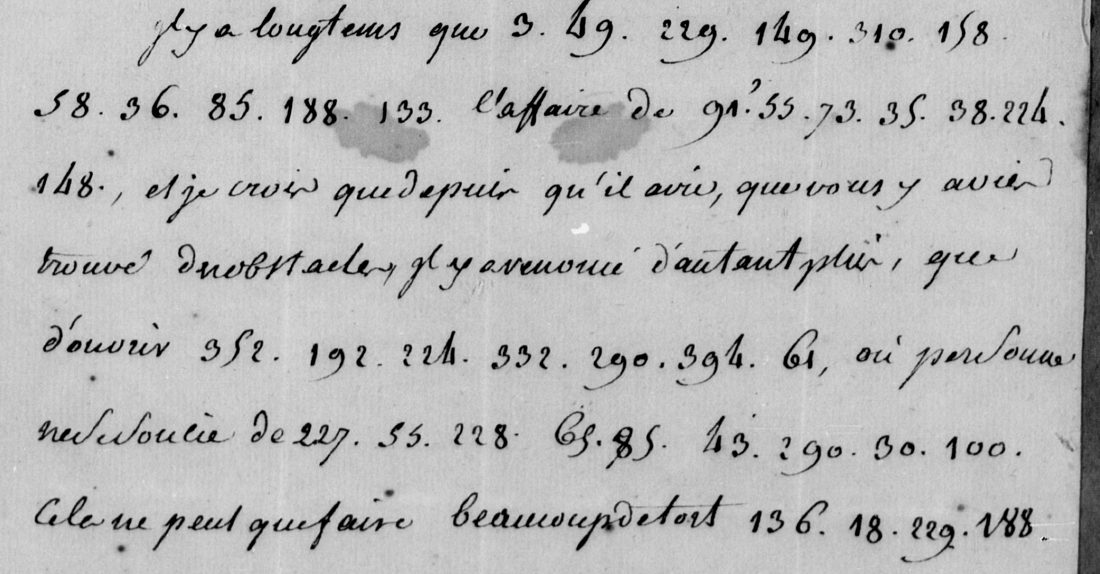
24 January 1780 (p. 573). 13 of 18 coded words. “Il est certain que le patriarche et la bande joyeuse feront tous leurs efforts pour faire avaler la dernière pilule, mais il est tout aussi certain que cela couvrira les États Généraux d’opprobre et de ridicule. Il y a longtemps que [3] a retiré aux [58]rands l’affaire de l’emprunt … d’ouvrir un emprunt où personne ne se soucie de [227]er son ar{g}ent, cela ne peut que faire beaucoup de tort au crédit du [369/349].” He advises de Neufville to speak to “M. du Fresne”, whom de Neufville glosses elsewhere as Chaumont. That the loan is the American loan is inference; “Grands” for [58]rands and “Congrès” for [369/349] are guesses from context and are not counted.
18 January 1780 (p. 491). 10 of 16 coded words: on the Stadholder, and on V. Vort, who boasts at court “de son savoir-faire et de ses succès, qu’il ne doit qu’à Monsieur le Pensionnaire des Amsterdammois”. 507 and 501 are open; 405, 387, 390 and 447 are probably nulls (each occurs in de Neufville’s fair draft only where his own plain draft has nothing), which is not proved.
Its second page (p. 492). 2 of 4 coded words: “On a déjà proposé plusieurs fois à ma tante d’acheter son vaisseau” (143 = vaisseau, from a faint gloss on p. 534), and “du tripotage au sujet de ce [162] entre V. Vort et {G}rand”.
Two lines of 9 April 1779 (p. 527) decode to syllables (one names Vergennes) but do not read.
Together: 25 of 38 coded words in the three read passages. “Ma tante”, “le saint homme”, “V. Vort”, “le patriarche” and “l’ami du cœur” are covers written in clear and are not identified.
04 What remains uncertain
- Open numbers: 3 (a person), 58 (an initial), 227 (“plac-”, “hasard-” or “risqu-”), 369 or 349 (the middle digit is this hand’s 6 or its looped 4), 507, 501, 162, and 30 where “argent” and “Grand” want g but the drafts give “re”. Every glossed letter in the file was transcribed and every open number retried; none is glossed with a value that fits.
- Likely nulls: 405, 387, 390, 447.
- No deciphered copy of the bare passages is in the file (all 808 images paged). Baudouin’s office copies or de Neufville’s sent letters may survive in the Archives nationales, Marine series B4 and B7, which were not seen.
- “Dunoyer” = Baudouin needs a person to compare the hand with Baudouin’s signed notes to Franklin (American Philosophical Society) or his office papers.
All image readings were made by AI agents; no person has checked them against the manuscripts.
Full texts
The transcription and the decryption of every document on this page, so that the reading can be used and checked. Short files are shown here; all are in the repository.
B573, Dunoyer (Baudouin) to de Neufville, 24 January 1780 read in part
The patriarch and the merry band will make [them] swallow the last pill, to the shame of the States General; [3] long ago took 'the loan business' away from the [?]rands and gave it up; a loan nobody will put money into can only harm the credit of [369/349]; speak to 'M. du Fresne' (Chaumont). That the loan is the American loan is inference.
Builds coherent sentences, but under the read bar of 95% of words read as sense (72% here); the holes are marked in the reading.
Transcription
# B573: Dunoyer [= Baudouin] to "Van Temmel" [= Jean de Neufville], [Paris], 24 January 1780. M332 roll 4, NARA file unit 464816476, image p.573 (frame 0428, fol. 178).
# Bare code groups; the rest of the letter is in clear. Pass 1 top-down, pass 2 bottom-up: agree. Last number: 369 or 349 (the middle digit could be this hand's 6 or its looped 4; pass 1 read 369, pass 2 349, the second agent 369). It is a hole either way.
A 427 464
B 3 49 229 149 310 158 58 36 85 188 133
C 91 55 73 35 38 224 148
D 352 192 224 332 290 394 61
E 227 55 228 65 85 43 290 30 100
F 136 18 229 188 141 53 369/349
Decryption
# 224 is m/n (key/corrections_post_test.tsv): n in C, m in D.
# Decode with the frozen key key/key_full_r3.json (sha256 9c1eaa33...). [nn] = number not in the key.
A: les ÉTATS-GÉNÉRAUX
B: [3] à re ti re aux [58] ra n d s
C: l' e m p u n t
D: une e n p r une t
E: [227] e r so n a r re ent
F: au c re d it du [369 or 349]
Reading
# Reading. Clear text of the letter as written, with the code groups in place. [3], [58], [227], [369/349] are holes.
# {braces}: one unit settled by the word, not by the key (30 = "g" in "argent", against "re" in de Neufville's drafts).
Je reçois, Monsieur, l'honneur de la vôtre du 17. Il est certain que le patriarche et la bande joyeuse feront tous leurs efforts pour faire avaler la dernière pilule, mais il est tout aussi certain que cela couvrira les États Généraux d'opprobre et de ridicule.
Il y a longtemps que [3] a retiré aux [58]rands l'affaire de l'emprunt, et je crois que depuis qu'il a vu que vous y aviez trouvé des obstacles, il y a renoncé, d'autant plus que d'ouvrir un emprunt où personne ne se soucie de [227]er son ar{g}ent, cela ne peut que faire beaucoup de tort au crédit du [369/349].
Mais si vous voyez actuellement jour à faire la chose avec plus de succès, je vous conseille d'en parler à M. du Fresne, qui fera ce qu'il faut vis-à-vis |de l'auteur|.
J'ai l'honneur d'être de tout mon cœur.
Translation
# English. Holes kept; candidates in the notes, not in the text.
I have the honour of yours of the 17th, Sir. It is certain that the patriarch and the merry band will do all they can to make [them] swallow the last pill, but it is just as certain that this will cover the States General with shame and ridicule.
It is a long time since [3] took the loan business away from the [58]rands, and I believe that since he saw you had met obstacles there he has given it up, all the more because to open a loan in which nobody cares to [227] his money can only do great harm to the credit of the [369/349].
But if you now see a way to do the thing with more success, I advise you to speak of it to Mr du Fresne, who will do what is needed with |the author|.
I have the honour to be, with all my heart.
B491, Dunoyer (Baudouin) to de Neufville, 18 January 1780 read in part
On the Stadholder and the 'merry band'; V. Vort parades his intimacy with Leerding and boasts at court of successes he owes to the Pensionary of Amsterdam.
Builds coherent sentences, but under the read bar of 95% of words read as sense (62% here); the holes are marked in the reading.
Transcription
# B491: Dunoyer [= Baudouin] to "Van Temmel" [= de Neufville], "Ce 18 Jer" [January 1780]. Image p.491 (frame 0363, fol. 151).
# Pass 1 top-down; pass 2 from the last group backward (14 Nov 2026). They differ in one number: group C second number is 204 (pass 2), not 206 (pass 1); 204 adopted after a 1.0x crop.
A 508 507 501 405 387 390 447 508
B 43 92 47 248 228
C 409 204 213 83 103
Decryption
# Decode with key/key_full_r3.json. [nn] = number not in the key.
A: STADHOUDER [507] [501] [405] [387] [390] [447] STADHOUDER
B: a la co u r
C: MONSIEUR le PENSIONNAIRE de AMSTERDAMMOIS
Reading
# Reading. [nn] holes. 405, 387, 390, 447 are probably nulls (see NOTES: each occurs elsewhere only where de Neufville's cipher has a number with no counterpart in his own plain draft).
J'ai reçu avant-hier seulement, mon cher Monsieur, la lettre que vous m'avez fait l'honneur de m'écrire le 31 du mois dernier. Je pense absolument comme M. Leerding sur le compte du Stadhouder [507] [501] [405 387 390 447] Stadhouder, et je suis persuadé que l'ami du cœur est toujours l'âme de toute cette bande joyeuse.
Ce qui me fâche dans tout cela, c'est l'indiscrétion que V. Vort a d'afficher son intimité avec le respectable M. Leerding, et il se pare à la cour de son savoir-faire et de ses succès, qu'il ne doit qu'à Monsieur le Pensionnaire des Amsterdammois.
D'ailleurs ces liaisons fournissent des prétextes à l'ami du cœur, et je suis convaincu que les affaires de notre associé en eussent bien mieux été, si cette intimité fût toujours restée secrète. Mais avec une espèce et un petit sot vain comme V. Vort, on devait s'attendre qu'il sacrifierait le bien de la chose à sa vanité.
Translation
I received only the day before yesterday, my dear Sir, the letter you did me the honour to write on the 31st of last month. I think exactly as Mr Leerding does about the Stadholder [507] [501] [...] Stadholder, and I am persuaded that the "friend of the heart" is still the soul of this whole merry band.
What vexes me in all this is the indiscretion of V. Vort in parading his intimacy with the respectable Mr Leerding; and he prides himself at court on his skill and his successes, which he owes only to Monsieur the Pensionary of the Amsterdammers.
Besides, these connections give the "friend of the heart" pretexts, and I am convinced that our partner's business would have gone much better if this intimacy had always stayed secret. But with a fellow, a vain little fool like V. Vort, one had to expect that he would sacrifice the good of the thing to his vanity.
B492, same letter, second page read in part
Offers to buy 'my aunt's' ship ('son vaisseau', 143) wait on 'the holy man'; jobbery over this [162] between V. Vort and [G]rand.
Builds coherent sentences, but under the read bar of 95% of words read as sense (50% here); the holes are marked in the reading.
Transcription
# B492: same letter, second page. Image p.492 (frame 0364a). Two passes agree.
A 143
B 118 162
C 30 36 85 188
Decryption
# Decode with key/key_full_r4.json (round 4, 14 Nov 2026; sha256 146207b0...). 143 = vaisseau from de Neufville's gloss on p.534.
A: vaisseau
B: ce [162]
C: re ra n d
Reading
# Reading. {g}: 30 read "g" as in B573 E ("argent"), where the word forces it; de Neufville's draft gives 30 = "re", so it is a hole. [162] hole. 143 = vaisseau (gloss on p.534, follow-up of 14 Nov 2026).
On a déjà proposé plusieurs fois à ma tante d'acheter son vaisseau, mais comme elle ne veut rien décider à ce sujet que de concert avec le saint homme, et que les acquéreurs ne veulent avoir rien à démêler avec ce plat personnage, la chose en est toujours demeurée là.
D'ailleurs il y a certainement du tripotage au sujet de ce [162] entre V. Vort et {G}rand. J'ai l'honneur d'être de tout mon cœur, mon cher Monsieur, et sans cérémonie.
Translation
It has already been proposed several times to my aunt that she buy her ship, but as she will decide nothing in the matter except in concert with the holy man, and the buyers will have nothing to do with that dull character, the thing has always stayed where it was.
Besides, there is certainly some jobbery over this [162] between V. Vort and {G}rand. I have the honour to be with all my heart, my dear Sir, and without ceremony.
B527, two unglossed lines of Dunoyer's letter of 9 April 1779 decoded, not read
Decoded to syllables (one names Vergennes); not read.
A mechanical decode with holes in most sentences: shown so that the transcription and the key can be checked and improved, not as a reading.
Transcription
# B527: two unglossed lines in Dunoyer's letter of 9 April 1779 (pp.526-527, fol. 160), whose other code groups carry de Neufville's interlined glosses. Image p.527 (frame 0389a). 507 at the head of each line is struck through by the writer.
L1 [507] 327 441 19 54 60 133
L2 [507] 529 400 207 316 19 42 63 60 147
Decryption
# Decode with key/key_full_r3.json. Decoded, not read: the syllables do not make a sentence.
L1: [327] [441] ca do s s  (followed in clear by "sucre brut et blanc, caffé &c.")
L2: VERGENNES [400] fi su ca in in s ta  (followed in clear by "au surplus")
Key: key_entries.tsv
05 Sources
- US National Archives, RG 360, Papers of the Continental Congress, M332 roll 4, National Archives Catalog file unit 464816476, “Letters from William Lee to John de Neufville and Son” (808 images; frames 0363, 0364a, 0389a, 0428 for the bare passages).
- The Papers of Benjamin Franklin 28:353–354 nn. 8–9 (the letter of 23 February 1779 cited as “a cryptic note from Baudouin to an unknown recipient”; Baudouin as Sartine’s secretary) and 29:5–7 n. 4, via Founders Online.
- The Papers of Thomas Jefferson 24:664–667 (Jefferson’s report of 26 November 1792 on de Neufville’s petition).
- Nothing was found that prints the letters’ text, their content or the code (Founders Online, HathiTrust full text, Cryptiana).
Transcriptions, pair files, frozen keys, tests and readings: targets/neufville1779/.
Cite this page
Andrew Beling and Daniel Bourdeau, “Baudouin and Jean de Neufville, Paris–Amsterdam, 1779–1780”, Cyphersolver, posted 24 November 2026, updated 25 November 2026, repository commit 17bf7e8764, https://cyphersolver.com/neufville1779.html.