At a glanceCiphertext-only break · partial (68% of the cipher)
- The letter
- One page, 19 lines, to Christian IV of Denmark (“Gnädigster König”), dated “den 20 Iulii anno currentis” with no year and signed “Quem novit” (“whom you know”) in place of a name. About 100 cipher words stand among clear German.
- Where
- Copenhagen, Rigsarkivet, TKUA, Speciel del, Nederlandene B.41, Arkivalieronline unit 261377, image 443 (right page). It lies in the folder of Johann Schultetus’s reports from The Hague, 1628–29 (catalogue entry no. 2541, which stays in the catalogue), but is not in his hand. Not on DECODE.
- The cipher
- A simple substitution, word by word: 23 letter-like signs for 21 letters (s and k each have two signs; i stands for i, u and v); one sign, seen once, has no value. Three code numbers (117 twice, 118) stand for names or places.
- How it was deciphered
- By Malcolm McBratney with AI agents, from the ciphertext of the letter itself, with the crib “Gnädigster König” and word patterns. Three separate transcriptions, two of them blind; a unit counts as read when each sign takes the value that at least two of the three readers give.
- What it says
- H. has waited into a third week for a galley; the Signoria has assigned a large one and he leaves today. He has borrowed another 3,000 thalers and asks the King to pay them.
- Still open
- The g/q signs, which the readers dispute and which need a person at full size; two smaller sign classes; the codes 117 and 118; the writer and the year (1627 or 1628), not proved.
- Credit
- Malcolm McBratney, working with AI agents (issue #450, pull request #483): the key, the three transcriptions and the reading. The leaf was found on 12 November 2026 in a sweep of the Rigsarkivet folder by the AI sessions he directed.
01 The letter
The leaf is the right-hand page of image 443. It has 19 lines in one hand: clear German with the cipher words written in among it, then the date and the signature. The writer calls the addressee “Gnädigster König”; the leaf lies in Rigsarkivet’s volume of papers from the Netherlands, in the folder of Johann Schultetus’s reports from The Hague (catalogue 2541), between papers of September 1628 and Schultetus’s letter written after 24 July 1628. Three code numbers appear: 117 twice and 118 once, and the number 3000 and the date 20 are written in figures.
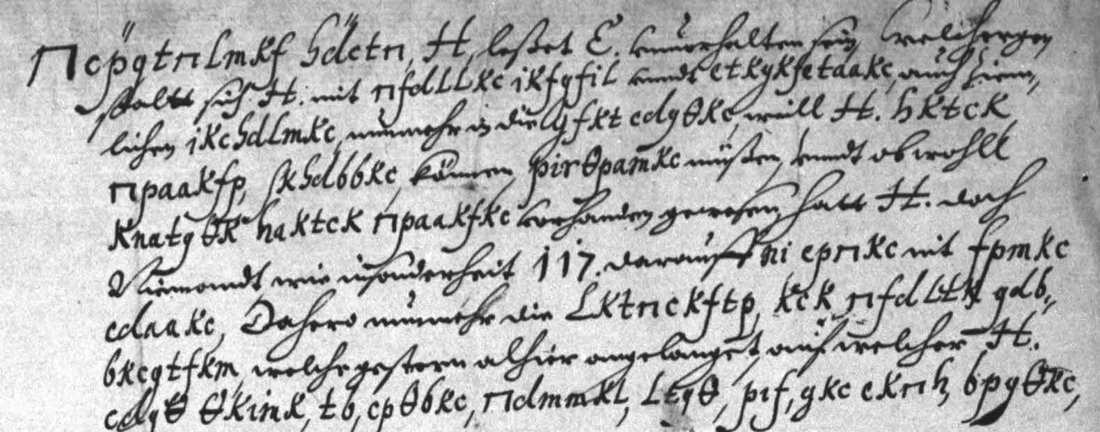
PcpqtPlmkf SdctP = Gnädigster König; the clear text continues “H. lasset E. unverhalten sein”. The number 117 stands in line 6. Image: Rigsarkivet (Copenhagen), TKUA Nederlandene B.41, unit 261377, image 443 (right page), via Arkivalieronline.Who wrote it is proposed, not proved. One article (Bohemiae Occidentalis Historica 2/2019, read here only through a summariser) puts Christian Wilhelm of Brandenburg, Administrator of Magdeburg, at Venice in early July 1627 on his way to lead Danish forces in Silesia; a three-week wait for a galley on 20 July would fit, and the letter would then be of 1627 (old style). That was not tested against any dated source, and the filing order points to 1628 instead. The year stays open, and so does the writer. “Venice” for the code 118 rests on the same guess (the Signoria and the galleys point there).
The same folder holds a second cipher that this page does not treat. Image 447 (right page) is a chancery decipherment sheet headed “Scultetus 17 Novemb:” for the number code of Schultetus’s letter of 17 November 1628 on the left page, so that code has a chancery decipherment; it is a different cipher, not the one of this letter (catalogue 2541 was corrected on both counts).
02 The cipher and its key
Each cipher word is a run of signs for the letters of one German word, and the signs look like letters of the Latin alphabet or Greek-like shapes (a pi, a theta, an omega-like sign, a long s). In the contributor’s labelling, which this page follows, 24 sign labels occur in 557 sign tokens; 23 have a value and stand for 21 plain letters. The key is only partly alphabetical: the plain letters l m n o are the signs a b c d, and the rest shows no order. The full table with shapes and counts is key.tsv; some of it:
| Sign (label) | P | c | p | q | t | k | H | f | m | L, l | S, h | i |
|---|---|---|---|---|---|---|---|---|---|---|---|---|
| Plain letter | g | n | a | d | i | e | h | r | t | s | k | u, v |
The key was found by hand, from the ciphertext of this letter and a crib. The clear German continues “… lasset E. unverhalten sein”, so the first two cipher words, which stand at the head of a letter to a king, were taken to be Gnädigster König; the rest followed from word patterns. No solver was used. The contributor discloses that the letter values took shape while his first reader transcribed, so “frozen before decoding” means before any scripted decode, not before any guess.
The German fit confirms the key; it is not a blind test of it. The key was fitted to this letter by hand, so the lines 11–19 “held-out” figure the contributor first gave (63 of 68 units) is not held out, and he says so. What the fit does show is that three independent transcriptions of the signs, made by separate sessions, all decode to German under the fixed key.
03 The reading
A reader decoded the letter into German sentences and translated them; the full German and English are in the Full texts below. H. tells the King that he has now waited into a third week, to his vexation and at considerable cost, because he could get no galley; small galleys were there, but nobody, “wie insonderheit [117]”, would advise him to risk them. The Signoria has therefore assigned a large one, which arrived yesterday, and he will set out on it today “im Nahmen Gottes”. Because of the delay and other necessary outlays he has borrowed another 3,000 thalers, hopes that E. (Your Majesty) will be content and have them paid, and will gladly let them be deducted later. [117] has so far resolved nothing on H.’s proposal, but he hopes W. will declare themselves better. Dated [118], 20 July of the current year; signed “Quem novit”. The letters H., E. and W. are written in clear as abbreviations; who they stand for is not established here.
The reading has holes in many sentences: 33 of the 103 cipher units are marked in place. The text reads as connected German whose sense can be followed, but it is not a clean reading, and the repository’s sentence check scores it marginal (20 of 43 sentences clean).
04 How it was counted
The unit is the cipher word, in reader 1’s division (103 units). A unit counts as read only if the decode, with every sign taking the value that at least two of the three readers give, is a German word as written. Letters supplied from the sense, a reader’s emendation, a sign on which the readers do not agree, and the code numbers all count as not read.
| Count | Units | Share |
|---|---|---|
| Read (S), majority of three readers | 70 of 103 | 67.96% |
| Not read: a code number, or a decode that is not a form any reader judged a word (E; 3 codes among the 21) | 21 | |
| Not read: a sign without agreement or without a value (N) | 12 | |
| Read (S) if all three readers must agree on every sign | 47 of 103 | 45.63% |
The 33 units not read are: 13 that involve the g/q class of signs (the contributor’s g sign, plain c, which the readers split between g and q; a unit with another doubtful sign as well is counted here), 7 emendations by the first reader, 4 on the pi/Z/n class, 3 on c/e, the 3 code numbers, and 3 single other signs (heute, um[b], ann[o]).
Three readers made three transcriptions. By the contributor’s own labels they score, under the fixed key: reader 1, who built the key while transcribing, 93 of 103 (90.29%); reader 2, blind, 62 of 104 (59.62%); reader 3, blind, 49 of 110 (44.55%). That first figure was the one filed on the issue; the contributor has withdrawn it as the headline because it was one reader’s count and the two blind readers did not reproduce it. The rule of the majority count was written down and frozen before it was decoded, and was decoded once. The order of events (the two blind transcriptions frozen at 09:49:43 and 11:22:40 UTC, the adjudicated text frozen at 13:17:09 and decoded at 13:17:19 UTC, all on 12 November 2026) is by the contributor’s record: only reader 1’s folder carries an external time stamp (RFC 3161, 02:25:10 GMT), and that was checked at integration for what it covers (the certificate chain was not verified).
Sign agreement between the readers: reader 2 with reader 1 on 511 of 565 signs (90.44%), reader 3 with reader 1 on 497 of 564 (88.12%), reader 3 with reader 2 on 484 of 564 (85.82%); in reader 1’s frame, at least two of three agree on 544 of 557 signs (97.67%).
Checks: the contributor’s German 4-gram control finds none of 5,000 shuffled keys (two seeds) as good for any of the four readings. At integration an own control with a word list built from the repository’s German corpora found 60 of the 100 cipher words in the list for the true key against 6 for the best of 3,000 shuffled keys, and an independent decoder from the key file and the first transcription gave the same German. With only 557 sign tokens and 23 values there is little room to overfit. The repository’s own validation (docs/_validate.py) was not run on this letter.
At integration the right page of image 443 was fetched from the archive (4473 × 3436 px) and looked at in the project’s integration check: it is the letter signed “Quem novit”, with 117, 118, 3000 and 20 as transcribed, and lines 9–17 were compared at crop level only (layout and sign repertoire agree). No person has compared the transcriptions sign by sign with the image.
05 What remains open
- The g and q signs. At the resolution available, the tail of the contributor’s g (plain c) and q (plain d) cannot be told apart by eye: g before theta (in sich, noch, nichts) and q (in das, den, damit) look alike. The distribution supports two signs (g stands before theta 14 times and q never; the two word-initial c, commendiret and currentis, are g), but this needs a person looking at the image at full size. 13 units depend on it (two of them with another doubtful sign as well).
- The pi/Z/n and c/e sign classes (4 and 3 units), and the one n-form sign with no value.
- The codes 117 (twice) and 118: no value, three tokens, no other leaf in this code known. 118 is the place of writing.
- The writer and the year (1627 or 1628); who H., E. (the King) and W. are.
- The clear German was transcribed by one reader only.
- Prior art is thin: no reading was found in the printed sources and catalogues the contributor checked (Danske Magazin, Kong Christian IV’s egenhændige Breve, Danske Samlinger, Historisk Tidsskrift, the Swedish Handlingar, DECODE, Cryptiana, archive.org full text), but an anonymous letter cannot be searched by name, so “not printed” cannot be proved. Christian Wilhelm’s 1627 correspondence and Venetian state papers were not checked.
Full texts
The transcription and the decryption of every document on this page, so that the reading can be used and checked. Short files are shown here; all are in the repository.
'Quem novit' to Christian IV, [118], 20 July [1627 or 1628] read in part
The writer (H.) tells the King he has waited at [118] into a third week for a galley, at cost and to his vexation; small galleys were there but nobody, [117] least of all, would advise risking them; the Signoria has now assigned a large one, which came yesterday, and he leaves today. He has borrowed another 3,000 thalers and asks the King to have them paid, to be deducted later. [117] has resolved nothing on his proposal, but he hopes W. will declare themselves better. Context: the Signoria and the galleys point to Venice (not proved), in the Thirty Years' War (1627 or 1628); the writer is not identified.
Builds coherent sentences, but under the read bar of 95% of words read as sense (68% here); the holes are marked in the reading.
Transcription
# Rigsarkivet TKUA Nederlandene B.41, unit 261377, image 443 right page: cipher letter signed "Quem novit", dated 118, 20 [Julii] anno currentis
# Symbols by shape: P=pi-like sign, H=theta, Z=omega/w-like sign, s=long-s sign, S=tall S/K-like sign, L=tall l, l=small l, q=closed bowl with tail, g=g with curled tail. <...>=clear German in the original. One line per manuscript line.
01 PcpqtPlmkf SdctP <H. lasset E. unverhalten sein welcherge->
02 <stalt sich H. mit> PfdLLkc ikfqfil <undt> etkqkfetaakc <auch ziem->
03 <lichen> ikcSdlmkc <nunmehr in die> qfkt edgHkc <will H.> hktck
04 Ppaakfp skSdbbkc <können> pirHpamkc <müssen undt obwohl>
05 kmatgHk haktck Ppaakfkc <vorhanden gewesen hatt H. doch>
06 <Niemandt wie insonderheit> 117 <darauf> Zi epPkc <nit> fpmkc
07 edaakc <Dahero nunmehr ein> LktPckftp kck PfdLLk gdb-
08 bkcqtfkm <welche gestern alhier angelangt auf welcher H.>
09 cdgH Hkimk tb cpHbkc Pdmmkl LtgH pif qkc ekPh bpgHkc
10 eta
11 LdcLmkc Hpm <H.> ekPkc qkLLkc qpl kf LdapcP pirHpamkc
12 edfqkc pigH ibs pcqkfkf cdmHekcqtPkc pilPpskc Hpaskf
13 paHtkf cdgH ktc 3000 mHpakf pirckHbkc biLLkc ikfHdrrkm
14 <E.> ekfqk qpbtm Zi rftqkc Lktc icqm kl pilZpHakc apLLkc eta
15 LtgH LdagHkl tcl hichmtPk Ppf Pkfck pshifZkc apLLkc
16 LdcLmkc Hpm LtgH stl qpmd 117 cdgH ctgHml ir <H.> pc-
17 sftcPkc fkLdaitfkm Hps pskf Pimk Lokfpcnm qpl LtgH <W.>
18 edHa kmepl skLLkf kfhakfkc bdgHmkc qpmib 118 qkc 20
19 tiatt pccd giffkcmil
<Quem novit>
Transcription
# b129 blind transcription, f443 right page (Rigsarkivet image id 48900927). Cipher words only, in order; plaintext German and numerals omitted.
# Labels: P=capital Pi; N=small pi/n-form (incl. 'n' in Knatg, ni); 0=theta; z=yogh/3-form; s=long-s; b=6-form; o=small round o (single occurrence, doubtful);
# others look like the Latin minuscule named (c p g t l m k f d e y i a h r x u). l includes capital-L forms. #H #E #W = code/nomenclator tokens (not letters).
# Doubts marked [..] in DOUBTS below, not inline.
L01 PcpgtNlmkf zdcletN #H #E
L02 #H Nfdllkc ikfyfil etkykfetaakc
L03 ikczdlmkc lyfkt cdy0kc #H hktck
L04 Ppaakfp skzdlbbkc pir0pamkc
L05 kNatg0k haktck Ppaakfkc #H
L06 Ni eNkc fpmkc
L07 cdaakc lktNckftp kck Nfdllk gdb
L08 bkcgtfkm #H
L09 cdy0 0kiNk tb cp0bkc Pdmmkl ltg0 pif gkc ekNz bpy0kc
L10 cta
L11 ldclmkc 0pm #H ekNkc gkllkc gpl kf ldapcN pir0pamkc
L12 cclfgkc pig0ibf pcgkfkf cd0m0ekcgtNkc pilNpskc 0paskf
L13 pa0tkf cdy0 ktc m0pakf pirck0bkc billkc ikf0drrkm
L14 #E ekfyk ypbtm Ni rftgkc lktc icym kl pilNp0akc apllkc cta
L15 ltg0 lclag0xl tcl hichmtNk Npf Nkfck pshifakc apllkc
L16 ldclmkc 0pm ltg0 stl gpmd cdy0 ctg0ml ir #H pc
L17 sftcNkc fkldaitfkm 0ps pskf Pimk lokfpcNm gpl ltg0 #W
L18 cd0a kmepl skllkf kfhaxfkc bdy0mkc ypmib gkc
L19 tiatt pccu gifftkmul
# DOUBTS
# D1 L02 Nfdllkc / L07 Nfdllk: d followed by two L-forms (could be d+3 L in L02).
# D2 L11 ldclmkc: 'dc' read by analogy with clear L16; could be c,l,c.
# D3 L12 cd0m0ekcgtNkc: '0m0' has a long stroke through it (strike-out or flourish from line above).
# D4 y vs g: g = closed q-like bowl, y = open curved tail; L13 cdy0 and L09 bpy0kc least sure.
# D5 L15 lclag0xl: 'cl' may be d.
# D6 L17 0ps: last sign s or f (crossed by flourish).
# D7 L17 lokfpcNm: 'o' unique round sign; may be a or d without stem.
# D8 L18 ypmib: 'i' crossed by descender.
# D9 L19 tiatt: final t crossed; gifftkmul: k blotted; u unique.
# D10 P vs N may be capital/minuscule of one sign; kept apart blind.
Transcription
# b137 reader-3 blind transcription, Quem novit f443 right. One line per MS line; cipher word units separated by space; plaintext in [brackets]; '?' after uncertain sign.
# labels: see SIGNCHART.md
L01: PcpqtPLmkf Z?dctP H [lassen E. ...plain]
L02: [sollen sich] H [mit] Pfd?LLkc ikfq?fiL [kundt] etkykf?etaakc [vnns ...]
L03: [leisen] ikcZdLmkc [nunmehr is dir] lyfkt cdgOkc [will] H hktck
L04: Ppaakfp? SkZd?bbkc [konnen] pirOpamkc [mussen und obhohlt]
L05: knatq OR haktck Ppaakfkc [...gewesen] [solte] H [doch]
L06: [dennoch kommendt mir nunmehr 117. darauf] H ni? epPkc [mit] fpmkc
L07: cd?aakc [daher nunmehr ein] LktPckftp kck PfdLtH? qdb
L08: bkcqtfkm [welches gestern alhier angelangt, auf welches] H.
L09: cdy?O OkinL? tb cpObkc Pd?mmkL LtqO pif gkc ekPZ bpq?Okc
L10: eta
L11: LdcLmkc Opm H. ekPkc qkLLkc qplkf LdapcP pirOpamkc
L12: ccl?fqkc piqOibf pcqkfkf cd?lOmOekcytPkc piln?pSkc OpaSkf
L13: paOtkf e?dgO ktc [3000.] mOpakf pirckObkc bi?LLkc ikfOdrrkm
L14: E? ekfqk ypbtm ni rftgkc Lktc icym kL pilnpOakc apL?Lkc eta
L15: LtqO Lcl?aqOkL tcL? hichmtnk rip?f nkfck pShifakc apLLkc
L16: LdcLmkc Opm LtqO StL? qpmd [117.] cdqO ctqOmL ir H pc
L17: Sftç?n?kc fRLd?aitfkm OpS pSkf Pimk Zokfpcnm qpl LtqO [W.]
L18: edOa kmepl SkLLkf kfhaxfkc bdyOmkc q?pmib [118.] g?kc [20.]
L19: tiatt pccu giff?kcmuL
Transcription
# line	reader1 unit	majority (>=2 of 3 readers)	unanimous (all 3)   KEY_B labels, L->l and h->S merged; ? = no agreement
01	PcpqtPlmkf	PcpqtPlmkf	PcpqtPlmkf
01	SdctP	SdctP	?dctP
02	PfdLLkc	Pfdllkc	Pfdllkc
02	ikfqfil	ikfqfil	ikfqfil
02	etkqkfetaakc	etkqkfetaakc	etk?kfetaakc
03	ikcSdlmkc	ikcSdlmkc	ikc?dlmkc
03	qfkt	qfkt	?fkt
03	edgHkc	cdgHkc	?d?Hkc
03	hktck	Sktck	Sktck
04	Ppaakfp	Ppaakfp	Ppaakfp
04	skSdbbkc	skSdbbkc	sk?dbbkc
04	pirHpamkc	pirHpamkc	pirHpamkc
05	kmatgHk	k?atqHk	k?at?H?
05	haktck	Saktck	Saktck
05	Ppaakfkc	Ppaakfkc	Ppaakfkc
06	117	117	117
06	Zi	?i	?i
06	epPkc	epPkc	e?Pkc
06	fpmkc	fpmkc	fpmkc
07	edaakc	cdaakc	?daakc
07	LktPckftp	lktPckftp	lktPckftp
07	kck	kck	kck
07	PfdLLk	Pfdllk	Pfdl??
07	gdb-bkcqtfkm	qdbbkcqtfkm	?dbbkcqtfkm
09	cdgH	cd?H	cd?H
09	Hkimk	Hki?k	Hki??
09	tb	tb	tb
09	cpHbkc	cpHbkc	cpHbkc
09	Pdmmkl	Pdmmkl	Pdmmkl
09	LtgH	ltqH	lt?H
09	pif	pif	pif
09	qkc	qkc	?kc
09	ekPh	ekPS	ekP?
09	bpgHkc	bpqHkc	bp?Hkc
10	eta	eta	?ta
11	LdcLmkc	ldclmkc	ldclmkc
11	Hpm	Hpm	Hpm
11	ekPkc	ekPkc	ekPkc
11	qkLLkc	qkllkc	qkllkc
11	qpl	qpl	qpl
11	kf	kf	kf
11	LdapcP	ldapcP	ldapcP
11	pirHpamkc	pirHpamkc	pirHpamkc
12	edfqkc	??fqkc	??fqkc
12	pigH	piqH	pi?H
12	ibs	ibf	ib?
12	pcqkfkf	pcqkfkf	pcqkfkf
12	cdmHekcqtPkc	cdmHekcqtPkc	cdmHekc?tPkc
12	pilPpskc	pilPpskc	pil?pskc
12	Hpaskf	Hpaskf	Hpaskf
13	paHtkf	paHtkf	paHtkf
13	cdgH	cdgH	?d?H
13	ktc	ktc	ktc
13	mHpakf	mHpakf	mHpakf
13	pirckHbkc	pirckHbkc	pirckHbkc
13	biLLkc	billkc	billkc
13	ikfHdrrkm	ikfHdrrkm	ikfHdrrkm
14	ekfqk	ekfqk	ekfqk
14	qpbtm	qpbtm	?pbtm
14	Zi	?i	?i
14	rftqkc	rftqkc	rft?kc
14	Lktc	lktc	lktc
14	icqm	icqm	ic?m
14	kl	kl	kl
14	pilZpHakc	pil?pHakc	pil?pHakc
14	apLLkc	apllkc	apllkc
14	eta	eta	?ta
15	LtgH	ltqH	lt?H
15	LdagHkl	l?aqHkl	l?a?Hkl
15	tcl	tcl	tcl
15	hichmtPk	SicSmtPk	SicSmt?k
15	Ppf	Ppf	?pf
15	Pkfck	Pkfck	?kfck
15	pshifZkc	psSifakc	psSif?kc
15	apLLkc	apllkc	apllkc
16	LdcLmkc	ldclmkc	ldclmkc
16	Hpm	Hpm	Hpm
16	LtgH	ltqH	lt?H
16	stl	stl	stl
16	qpmd	qpmd	qpmd
16	117	117	117
16	cdgH	cdqH	cd?H
16	ctgHml	ctqHml	ct?Hml
16	ir	ir	ir
16	pc-sftcPkc	pcsftcPkc	pcsft??kc
17	fkLdaitfkm	fkldaitfkm	f?ldaitfkm
17	Hps	Hps	Hps
17	pskf	pskf	pskf
17	Pimk	Pimk	Pimk
17	Lokfpcnm	lokfpc?m	?okfpc?m
17	qpl	qpl	qpl
17	LtgH	ltqH	lt?H
18	edHa	edHa	?dHa
18	kmepl	kmepl	kmepl
18	skLLkf	skllkf	skllkf
18	kfhakfkc	kfSakfkc	kfSa?fkc
18	bdgHmkc	bd?Hmkc	bd?Hmkc
18	qpmib	qpmib	qpmib
18	118	118	118
18	qkc	qkc	?kc
19	tiatt	tiatt	tiatt
19	pccd	pcc?	pcc?
19	giffkcmil	giffkcm?l	?iffk?m?l
Decryption
# Decode of transcriptions/adjudicated.tsv with key_B.txt, run once; labels by transcriptions/adjudication_rule.md
# line	reader1 unit	majority	decode	label	unanimous	decode	label
01	PcpqtPlmkf	PcpqtPlmkf	gnadigster	S	PcpqtPlmkf	gnadigster	S
01	SdctP	SdctP	konig	S	?dctP	?onig	N
02	PfdLLkc	Pfdllkc	grossen	S	Pfdllkc	grossen	S
02	ikfqfil	ikfqfil	uerdrus	S	ikfqfil	uerdrus	S
02	etkqkfetaakc	etkqkfetaakc	wiederwillen	S	etk?kfetaakc	wie?erwillen	N
03	ikcSdlmkc	ikcSdlmkc	uenkosten	E	ikc?dlmkc	uen?osten	N
03	qfkt	qfkt	drei	S	?fkt	?rei	N
03	edgHkc	cdgHkc	nochen	E	?d?Hkc	?o?hen	N
03	hktck	Sktck	keine	S	Sktck	keine	S
04	Ppaakfp	Ppaakfp	gallera	S	Ppaakfp	gallera	S
04	skSdbbkc	skSdbbkc	bekommen	S	sk?dbbkc	be?ommen	N
04	pirHpamkc	pirHpamkc	aufhalten	S	pirHpamkc	aufhalten	S
05	kmatgHk	k?atqHk	e?lidhe	N	k?at?H?	e?li?h?	N
05	haktck	Saktck	kleine	S	Saktck	kleine	S
05	Ppaakfkc	Ppaakfkc	galleren	S	Ppaakfkc	galleren	S
06	117	117	117	E	117	117	E
06	Zi	?i	?u	N	?i	?u	N
06	epPkc	epPkc	wagen	S	e?Pkc	w?gen	N
06	fpmkc	fpmkc	raten	S	fpmkc	raten	S
07	edaakc	cdaakc	nollen	E	?daakc	?ollen	N
07	LktPckftp	lktPckftp	seigneria	E	lktPckftp	seigneria	E
07	kck	kck	ene	E	kck	ene	E
07	PfdLLk	Pfdllk	grosse	S	Pfdl??	gros??	N
07	gdb-bkcqtfkm	qdbbkcqtfkm	dommendiret	E	?dbbkcqtfkm	?ommendiret	N
09	cdgH	cd?H	no?h	N	cd?H	no?h	N
09	Hkimk	Hki?k	heu?e	N	Hki??	heu??	N
09	tb	tb	im	S	tb	im	S
09	cpHbkc	cpHbkc	nahmen	S	cpHbkc	nahmen	S
09	Pdmmkl	Pdmmkl	gottes	S	Pdmmkl	gottes	S
09	LtgH	ltqH	sidh	E	lt?H	si?h	N
09	pif	pif	aur	E	pif	aur	E
09	qkc	qkc	den	S	?kc	?en	N
09	ekPh	ekPS	wegk	S	ekP?	weg?	N
09	bpgHkc	bpqHkc	madhen	E	bp?Hkc	ma?hen	N
10	eta	eta	wil	S	?ta	?il	N
11	LdcLmkc	ldclmkc	sonsten	S	ldclmkc	sonsten	S
11	Hpm	Hpm	hat	S	Hpm	hat	S
11	ekPkc	ekPkc	wegen	S	ekPkc	wegen	S
11	qkLLkc	qkllkc	dessen	S	qkllkc	dessen	S
11	qpl	qpl	das	S	qpl	das	S
11	kf	kf	er	S	kf	er	S
11	LdapcP	ldapcP	solang	S	ldapcP	solang	S
11	pirHpamkc	pirHpamkc	aufhalten	S	pirHpamkc	aufhalten	S
12	edfqkc	??fqkc	??rden	N	??fqkc	??rden	N
12	pigH	piqH	audh	E	pi?H	au?h	N
12	ibs	ibf	umr	E	ib?	um?	N
12	pcqkfkf	pcqkfkf	anderer	S	pcqkfkf	anderer	S
12	cdmHekcqtPkc	cdmHekcqtPkc	nothwendigen	S	cdmHekc?tPkc	nothwen?igen	N
12	pilPpskc	pilPpskc	ausgaben	S	pil?pskc	aus?aben	N
12	Hpaskf	Hpaskf	halber	S	Hpaskf	halber	S
13	paHtkf	paHtkf	alhier	S	paHtkf	alhier	S
13	cdgH	cdgH	noch	S	?d?H	?o?h	N
13	ktc	ktc	ein	S	ktc	ein	S
13	mHpakf	mHpakf	thaler	S	mHpakf	thaler	S
13	pirckHbkc	pirckHbkc	aufnehmen	S	pirckHbkc	aufnehmen	S
13	biLLkc	billkc	mussen	S	billkc	mussen	S
13	ikfHdrrkm	ikfHdrrkm	uerhoffet	S	ikfHdrrkm	uerhoffet	S
14	ekfqk	ekfqk	werde	S	ekfqk	werde	S
14	qpbtm	qpbtm	damit	S	?pbtm	?amit	N
14	Zi	?i	?u	N	?i	?u	N
14	rftqkc	rftqkc	friden	S	rft?kc	fri?en	N
14	Lktc	lktc	sein	S	lktc	sein	S
14	icqm	icqm	undt	S	ic?m	un?t	N
14	kl	kl	es	S	kl	es	S
14	pilZpHakc	pil?pHakc	aus?ahlen	N	pil?pHakc	aus?ahlen	N
14	apLLkc	apllkc	lassen	S	apllkc	lassen	S
14	eta	eta	wil	S	?ta	?il	N
15	LtgH	ltqH	sidh	E	lt?H	si?h	N
15	LdagHkl	l?aqHkl	s?ldhes	N	l?a?Hkl	s?l?hes	N
15	tcl	tcl	ins	S	tcl	ins	S
15	hichmtPk	SicSmtPk	kunktige	E	SicSmt?k	kunkti?e	N
15	Ppf	Ppf	gar	S	?pf	?ar	N
15	Pkfck	Pkfck	gerne	S	?kfck	?erne	N
15	pshifZkc	psSifakc	abkurlen	E	psSif?kc	abkur?en	N
15	apLLkc	apllkc	lassen	S	apllkc	lassen	S
16	LdcLmkc	ldclmkc	sonsten	S	ldclmkc	sonsten	S
16	Hpm	Hpm	hat	S	Hpm	hat	S
16	LtgH	ltqH	sidh	E	lt?H	si?h	N
16	stl	stl	bis	S	stl	bis	S
16	qpmd	qpmd	dato	S	qpmd	dato	S
16	117	117	117	E	117	117	E
16	cdgH	cdqH	nodh	E	cd?H	no?h	N
16	ctgHml	ctqHml	nidhts	E	ct?Hml	ni?hts	N
16	ir	ir	uf	S	ir	uf	S
16	pc-sftcPkc	pcsftcPkc	anbringen	S	pcsft??kc	anbri??en	N
17	fkLdaitfkm	fkldaitfkm	resoluiret	S	f?ldaitfkm	r?soluiret	N
17	Hps	Hps	hab	S	Hps	hab	S
17	pskf	pskf	aber	S	pskf	aber	S
17	Pimk	Pimk	gute	S	Pimk	gute	S
17	Lokfpcnm	lokfpc?m	speran?t	N	?okfpc?m	?peran?t	N
17	qpl	qpl	das	S	qpl	das	S
17	LtgH	ltqH	sidh	E	lt?H	si?h	N
18	edHa	edHa	wohl	S	?dHa	?ohl	N
18	kmepl	kmepl	etwas	S	kmepl	etwas	S
18	skLLkf	skllkf	besser	S	skllkf	besser	S
18	kfhakfkc	kfSakfkc	erkleren	S	kfSa?fkc	erkl?ren	N
18	bdgHmkc	bd?Hmkc	mo?hten	N	bd?Hmkc	mo?hten	N
18	qpmib	qpmib	datum	S	qpmib	datum	S
18	118	118	118	E	118	118	E
18	qkc	qkc	den	S	?kc	?en	N
19	tiatt	tiatt	iulii	S	tiatt	iulii	S
19	pccd	pcc?	ann?	N	pcc?	ann?	N
19	giffkcmil	giffkcm?l	current?s	N	?iffk?m?l	?urre?t?s	N
Reading
# "Quem novit" to Christian IV, 20 July [1627 or 1628], Rigsarkivet TKUA Nederlandene B.41, unit 261377, image 443 (right page): reading

Conventions: text between asterisks is from cipher, the rest is in clear (clear text read by reader 1 only). [117] = a code
number with no value. A letter in brackets inside a word = a sign on which fewer than two of the three readers agree, or
whose agreed value does not make the word; the letter is supplied from the sense and the unit is counted NOT read.
[?word] = reader 1's emendation of a one-sign slip (counted not read). Every hole is listed in `holes.md`.
Basis: `decryptions/adjudicated.txt` (majority of three readers per sign, decoded once with `key_B.txt`), 70 of 103
cipher units read as written. Word division, capitals, umlauts and punctuation are editorial.

## Reading

*Gnädigster König*, H. lasset E. unverhalten sein, welchergestalt sich H. mit *grossen Verdrus* undt *Wiederwillen*, auch
ziemlichen *[?Unkosten]*, nunmehr in die *drei [w]ochen*, will H. *keine Gallera bekommen* können, *aufhalten* müssen,
undt obwohl *e[t]li[c]he kleine Galleren* vorhanden gewesen, hatt H. doch Niemandt, wie insonderheit [117], darauf
*[z]u wagen* nit *raten [w]ollen*. Dahero nunmehr ein *[?Signoria] [?eine] grosse [c]ommendiret*, welche gestern alhier
angelangt, auf welcher H. *no[c]h heu[t]e im Nahmen Gottes si[c]h [?auf] den Wegk ma[c]hen wil.*

*Sonsten hat* H. *wegen dessen, das er solang aufhalten [wo]rden, au[c]h um[b] anderer nothwendigen Ausgaben halber
alhier noch ein* 3000 *Thaler aufnehmen müssen, verhoffet* E. *werde damit [z]u friden sein undt es aus[z]ahlen lassen,
wil si[c]h s[o]l[c]hes ins [?künftige] gar gerne abkur[z]en lassen.*

*Sonsten hat si[c]h bis dato* [117] *no[c]h ni[c]hts uf* H. *anbringen resoluiret, hab aber gute [?Speranz], das si[c]h*
W. *wohl etwas besser erkleren mö[c]hten. Datum* [118] *den* 20 *Iulii ann[o] [?currentis].*

Quem novit [flourish]

## Holes in this reading (33 of 103 cipher units; full table in holes.md)

- 13 units turn only on the g/q sign class (reader 1's g = c, the readers split it between g and q): e[t]li[c]he,
  [c]ommendiret, no[c]h (twice), si[c]h (four times), ma[c]hen, au[c]h, s[o]l[c]hes, ni[c]hts, mö[c]hten. Two of them
  carry a second disputed sign (e[t]li[c]he, s[o]l[c]hes).
- 7 are reader 1's own one-sign emendations: [?Unkosten], [?Signoria], [?eine], [?auf], [?künftige], [?Speranz], [?currentis].
- 4 turn on the pi/Z/n class: [z]u (twice), aus[z]ahlen, abkur[z]en.
- 3 on c/e: [w]ochen, [w]ollen, [wo]rden.
- 3 code numbers: [117] (twice), [118].
- 3 single other signs: heu[t]e, um[b], ann[o].
Translation
# "Quem novit" to Christian IV, 20 July [1627 or 1628]: English

Same holes as the reading, in the same places. Text between asterisks is from cipher. A bracketed word or letter is
supplied from the sense, not read; [117], [118] are code numbers with no value. Spelling normalised.

## Translation

*Most gracious King*, H. lets Y(our Majesty) know how H., to his *great vexation* and *displeasure*, and at considerable
*[?cost]*, has now had to *wait* into the *third [week]*, because H. could get *no galley*; and although *[some] small
galleys* were on hand, nobody, [117] in particular, would *advise* H. *[to] risk* himself on them. So the *[?Signoria]*
has now assigned *[?a] large one*, which arrived here yesterday, and on it H. *will [make] his way [this very day] in God's name.*

*Further, because he was held up so long, [and] [for] other necessary outlays, H. has had to borrow another* 3,000
*thalers here; he hopes* Y(our Majesty) *will be [content] with that and have it paid, and will gladly let [it] be
[deducted] in [?future].*

*For the rest, [117] has so far resolved [nothing] on* H.'s *proposal, but I have good [?hope] that* W. *[may] yet declare
themselves somewhat better. Dated at* [118], *20 July of the current [year].*

"Whom you know." [in place of a signature]

## Notes

- "H.", "E." and "W." are written in clear as abbreviations. E. is the addressee, addressed as king (Christian IV). H. is
  the traveller; 118 is the place of writing; "Signoria" and the galleys point to Venice. None of this is proved.
- Writer: PROPOSED, NOT PROVED. One article (Bohemiae Occidentalis Historica 2/2019, read through a summariser only)
  has Christian Wilhelm of Brandenburg, Administrator of Magdeburg, reaching Venice in early July 1627 on his way to lead
  Danish forces in Silesia. A three-week wait for a galley on 20 July fits that journey, so the letter may be of 20 July
  1627 (Old Style) and "H." may be the Administrator. Not tested against any dated source.
- Year: the leaf lies between papers of September 1628 (image 442) and Schultetus's letter after 24 July 1628 (image 444);
  the filing order suggests 1628, the identity lead 1627. Not settled.
Key: key.tsv
06 Sources
- Image: Rigsarkivet, TKUA, Nederlandene B.41, unit 261377, image 443 (
api.rigsarkivet.dk/ao/v1/images/48900927, 4473 × 3436), Arkivalieronline epid 19852699; image 447 (48900931) for the chancery sheet of Schultetus’s code. - Contributor’s issue #450 and pull request #483 (Malcolm McBratney, working with AI agents).
- Writer lead: Bohemiae Occidentalis Historica 2/2019, as reported by a summariser; the article itself was not opened here.
Files: targets/quemnovit1627/.
Cite this page
Malcolm McBratney and Daniel Bourdeau, ““Quem novit” to Christian IV, 20 July [1627 or 1628]”, Cyphersolver, posted 12 November 2026, https://cyphersolver.com/quemnovit1627.html.