At a glanceNot solved · text not obtained
- The document
- A leaf (f. 154r) described in the notes as a guard-leaf insert, with a 16-line Latin poem that appears to concern a tyrant and war, headed “Carmina edita per” and one enciphered word of nine letters. The rest of the leaf is Italian verse, which I read as partly Petrarch.
- Where
- Milan, Biblioteca Ambrosiana, A 118 inf., unit 1, n. 6, f. 154r; catalogued as “Carme cifrato”, digitised by the Ambrosiana digital library.
- The cipher
- Probably a vowel shift (unconfirmed): each vowel written as the next letter of the alphabet. Only the heading is enciphered, not the poem.
- How it was tried
- The shift was inferred from the nine letters and undone by hand, along with a plain Caesar shift of one. Nine letters cannot confirm it.
- Why it resists
- Undone, the word reads ?-e-n-o-e-i-?-e-o, which is no Latin or Italian name. Its first and seventh glyphs are ambiguous at the 1513-pixel image size.
- Prior work
- A 1989 Macerata article transcribed the heading and a second cipher group in the corner and called both undeciphered (snippet only).
- Still open
- The word itself, and who wrote the poem. Other manuscripts of the poem, or a sharper image of the heading, might help.
01 The leaf
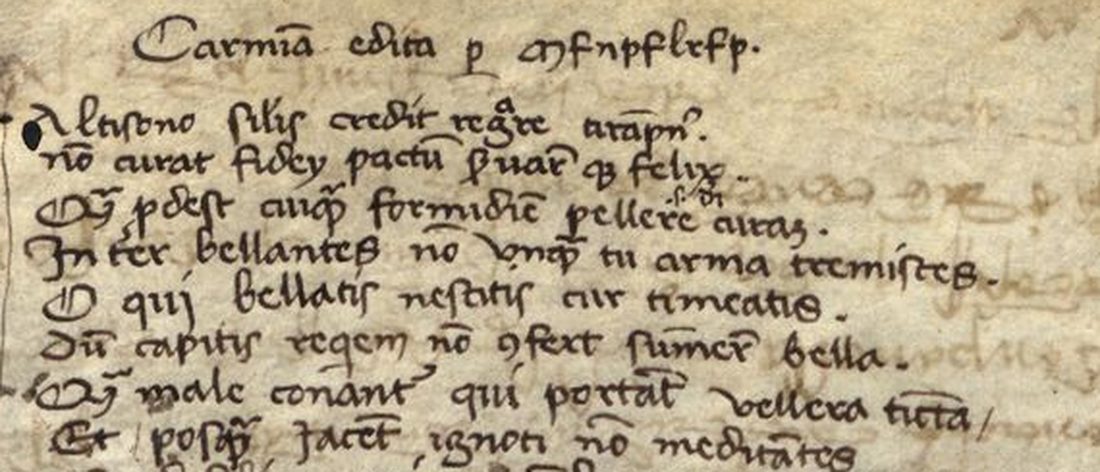
The framed poem begins “Altisono similis credit regnare tirampnus” (the catalogue’s spelling). The lines seem to concern a tyrant who trusts others and is deceived, and war with plague, famine and slaughter; the transcription is uncertain. It is plain Latin in a rapid cursive with many abbreviations; a transcription with abbreviations expanded is in poem.txt. Below it and in the right column are Italian verses, in a second hand; one column is headed “Petracca” and its verses read as Petrarch’s Pace non trovo and Benedetto sia ’l giorno, which I did not check against an edition. The catalogue’s “Carme cifrato” therefore describes the heading alone.
02 The cipher
The heading word is mfnpflrfp. It has no a, i or u, and f, p, l stand where e, o and i would. Each of these is the letter after a vowel in the alphabet, so a vowel shift fits: a→b, e→f, i→l (j and k skipped), o→p, u→x (v and w skipped), consonants unchanged. Only e, o and i are attested in the word; a→b and u→x are assumed. Nine letters cannot test this statistically; it rests on that pattern alone, and the catalogue says only “carme cifrato”.
03 What was tried
Undone, the word reads ?-e-n-o-e-i-?-e-o, with the seventh glyph read as r or as x (x being u). Neither reading is a Latin or Italian word or name. A plain Caesar shift of one gives “lemoekqeo”, also no word. The first glyph is a ligature the catalogue reads as m, and in this hand m, n, u and i are minim letters that are easily confused, so the nine letters themselves are not secure. The leaf has been edited before: an article in Annali della Facoltà di Lettere e Filosofia (Università di Macerata), vols 22–23 (1989), p. 872, transcribes the heading “Carmina edita per” and the poem’s first line, notes “another group of cryptographic letters, not deciphered” (a second group stands in the top-right corner of the leaf, three glyphs, too faint to read here), and then prints the Italian ballad Da poi che te pur piace darmi morte as its no. III. So the cipher was recorded and left unread by those editors; I saw only the search snippet, not the article, whose title and author I do not have. Web searches on the incipit and on lines of the poem found no edition and no attribution of the Latin poem, and the OPAC record lists none. Walther’s Initia carminum and Mirabile were not consulted.
04 What would finish it
- The 1989 Macerata article itself, to see how it describes the leaf and what it says of the two cipher groups.
- A witness of the same poem in another manuscript, which would give an author or title to compare with the heading.
- A sharper image of the heading than the 1513-pixel one served by the digital library.
05 Sources
- Biblioteca Ambrosiana OPAC, A 118 inf., unit 1, n. 6, and the codex record A 118 inf.
- Ambrosiana digital library, A 118 inf., canvas 319 (f. 154r).
- Annali della Facoltà di Lettere e Filosofia, Università di Macerata, vols 22–23 (Padua: Antenore, 1989), p. 872 and p. 887 (Google Books snippets: qA8vAAAAYAAJ); the ballad is also printed in La Fornarina (1882), p. 147.
Notes and transcriptions: targets/ambrosiana118/ in the repository.
Cite this page
Daniel Bourdeau, “Ciphered heading over a Latin poem, Ambrosiana A 118 inf. f. 154r”, Cyphersolver, posted 9 November 2026, https://cyphersolver.com/ambrosiana118.html.