
At a glanceKey from adjacent plaintext · partial (78% of cipher tokens valued, not the word count)
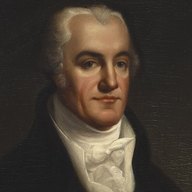
- The letters
- Joel Barlow, US minister to France, to James Monroe, Secretary of State, Paris, 25 September 1812, with 64 code numbers in one paragraph; and the copies sent to Monroe of Barlow’s note of 25 October 1812 to the Duke of Bassano, the French foreign minister, with 46 numbers in one copy and 47 in the other. No decipherment of either is on the film.
- Where
- US National Archives, RG 59, Despatches from US Ministers to France vol. 13, microfilm M34 roll 16, frames 0232–0233, 0240–0241 and 0246–0247. Not on DECODE and not in the catalogue.
- The cipher
- A code of words and syllables written as numbers from 7 to 1700 among clear words (1700 = the, 631 = of). No key sheet of it is known.
- How it was deciphered
- 623 numbers were rebuilt from ten other letters in the same code that were deciphered at the time, and applied to the two passages. The key is not validated by a held-out test; the statistical check is underdetermined (section 05).
- What it says
- That indemnities for past spoliations are at last under discussion in Paris, and, to Bassano, that the President would see in a rejection “nothing but a [?determined] refusal of justice on the part of his Imperial Majesty”.
- Still open
- 13 of the 60 coded words: eight completed from the sense, one number unread (the day of a note of June) and four words with a letter supplied. No person has read the numbers against the images.
- Credit
- Key, transcriptions and readings by Andrew Beling, with AI agents (pull request 878). The values are those written by the decipherers of 1811–1813. Validation, reading review and the checks of 24 Nov 2026 by AI agents for the maintainers.
01 The letters
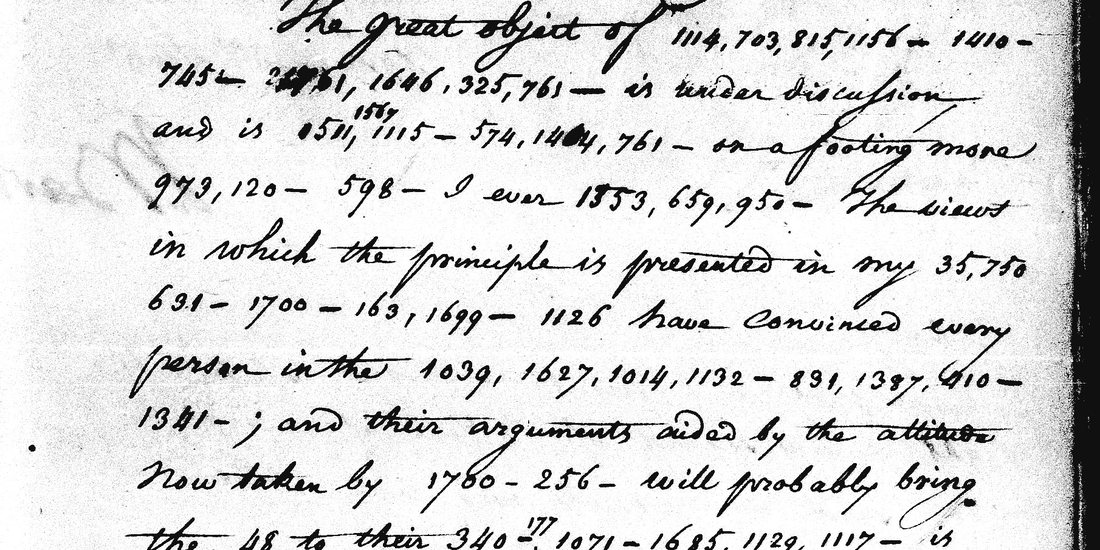
The first is Barlow’s despatch to the Secretary of State of 25 September 1812, a secretary’s fair copy signed by Barlow. It acknowledges Monroe’s letters and reports on the negotiation with France. Only its middle paragraph is in code. In that paragraph a comma joins the numbers of one word and a dash separates words.
The second is Barlow’s note of 25 October 1812 to the Duke of Bassano, in two copies that were enclosed to Monroe (copy A on frames 0240–0241, copy B on 0246–0247). They stand in the volume beside copies of Bassano’s French letter of 11 October 1812 from Wilna, which the note answers. Two sentences of the note are partly in code in both copies. The contributor takes it, as an inference, that this was done for the copies sent home and that the note Bassano received was in clear.
All 296 frames of the roll were surveyed and neither passage has a decipherment there. A print check of 21 Nov 2026 found neither in print: the despatch of 25 September is not printed in American State Papers, Foreign Relations vol. 3, Wait’s State Papers (1819), Todd’s Life and Letters of Joel Barlow (1886) or The Papers of James Monroe vol. 6, and the note to Bassano is printed only as an extract that stops at “the convention of indemnities”, before the coded sentences. Four later books were covered by phrase searches only, so a paraphrase in them is not excluded.
02 What they say
Words written in code are in italics. [?word] is a word in which one number has no value from a decipherer of the time (or, for [?the], is miswritten) and which is completed from the sense: a proposal. [163] is a number with no value. Letters in curly brackets are supplied.
To Monroe, 25 September 1812. “The great object of [?indemnities] for past {+s}poliations is under discussion and is [?making] [?progress] on a footing more favorable than I ever {+exp}ected. The views in which the principle is presented in my note of the [163]th June have convinced every person in the imperial confidence here; and their arguments aided by the attitude now taken by [?the] United States will probably bring the Emperor to their opinion. His decision is expected in a few days, and my hopes in a result acceptable, if not satisfactory, are now stronger than they have been. The Treaty will suffer no difficulty when once the mod{+e} of [?indemnity] is agreed upon.”
To Bassano, 25 October 1812. “And if the present project (whose execution would really cost [?little] or nothing to the imperial treasury and by which it would immediately gain great sums and secure a permanent and increasing gain) should be rejected, the President can see in it nothing but a [?determined] refusal of justice on the part of his Imperial Majesty, which must greatly embarrass the Government in its operations in [?regard] to England as wel{+l} as France.”
The indemnities are the American claims for ships and cargoes seized by France. In the note Barlow accepts Bassano’s invitation to Wilna to finish the negotiation, says that the treaty of commerce and the convention of indemnities are ready, and puts the sharpest words in code. Irving Brant (1958) describes from the French archives the proposal behind the first coded clause: reparation was to be raised by French licences to eighty American merchant vessels, which is why its execution “would really cost little or nothing” to the treasury. Barlow died on the road back from Wilna on 26 December 1812 and nothing was signed (so the contributor’s reading notes; not checked here).
The reading of the note follows copy A for the clear text. The coded words follow copy B in three places where copy A is short: copy A has no “of” before “justice”, spells “justice” with a number that has no value, and writes “Imperial” before “Majesty” without its third syllable. “Treasury” follows copy A, which alone has its third syllable.
03 The code and the key
The code writes words and syllables as numbers from 7 to 1700 among clear words. Common words have their own number (the 1700, of 631, and 513, to 494, in 1114). Other words are spelt from syllables: in/dem/ni/ti/es, re/fu/sal, ma/i/est/y. I and J are one letter, and so are U and V. Several syllables have more than one number. Barlow used it, Monroe and Madison used it in writing to him, and his nephew Thomas Barlow used it after his death.
No code book or key sheet of it is known. The key here, key.tsv, holds 644 numbers: 623 with a value, and 21 seen only inside a word that could not be divided. Every value is one that a decipherer of 1811–1813 wrote, or that follows from a word he wrote. Each carries a grade that says how it is known:
| Grade | How the value is known | Numbers |
|---|---|---|
| P | the decipherer wrote this value above this number alone (the four letters outside the despatch volume) | 386 |
| C | the State Department clerk’s writing between the lines of the despatches; where he wrote one word over several numbers, the division is the contributor’s | 123 |
| D | aligned with the separate decipherment of the despatch of 29 September 1811; the division of each word is the contributor’s | 59 |
| W | what is left of a deciphered word when its known neighbours are taken away | 41 |
| L | doubtful occurrences only (poor film, a blot, a number the second readers did not confirm) | 14 |
The ten letters behind the key:
- Barlow to Monroe, Paris, 29 September 1811 (roll 16 frame 11), with a separate decipherment by the State Department on frames 15–16.
- Barlow’s despatches 19 and 20 of 20 and 25 October 1812 (frames 242 and 244), his letter from Wilna of 23 November 1812 (frames 249–250), Thomas Barlow’s letter of 10 February 1813 (frames 291–293) and a letter of his of 1813 marked “Duplicate” (frame 295), each with a clerk’s decipherment between the lines.
- Monroe to Barlow, 23 April 1812 (the last page, from a sale photograph) and 16 June 1812 (Library of Congress, Monroe Papers); Madison to Barlow, 11 August 1812, and Barlow to Madison, 26 September 1812 (Library of Congress, Madison Papers), each deciphered between the lines at the time, the last by Madison.
It is not the code that John Quincy Adams used at St Petersburg, in which the is 1385 and of is 1576, nor Armstrong’s code of 1804–1810, in which the is 972.
04 How it was deciphered
- The despatch volume (19 Oct 2026). All 296 frames of the roll were surveyed. Barlow’s despatch of 29 September 1811 (503 numbers, nothing written over them) has a separate decipherment four frames on, and the two were aligned word for word. Five later despatches have a clerk’s decipherment between the lines. Together they gave 436 numbers, which gave a value to 78% of the numbers of the three passages without a decipherment.
- Four letters outside the volume (20 Oct 2026). The letters of Monroe, Madison and Barlow listed above, each deciphered between the lines, brought the table to 655 numbers.
- A second reading of every source (21 Nov 2026). Each source was transcribed again by two AI readers who were given only the images. The pass marks were written down first: each reader to agree with the first transcription on at least 95% of the numbers, and at least 98% to be matched by one reader or the other. Of 3,297 numbers compared, 56 had been misread and were corrected, and 22 doubtful occurrences were set aside. Nine of the fourteen texts compared (the key letters and the three passages here) missed a mark. The table after correction has 644 numbers (
key.tsv): the 623 with a value and the 21 seen only inside a word. The nine numbers of the two passages that have no value occur in none of the key letters. - Transcription and decryption. The two letters were transcribed in full. The code numbers were transcribed four times by AI readers; all four agree on 56 of the 64 numbers of the September letter, and every difference is listed in the notes with what the frame shows. The decryption files give each number with the value of the key and nothing repaired: 59 of 64 numbers have a value in the September letter, 42 of 46 in copy A of the note and 44 of 47 in copy B.
- The readings. Each letter was written out whole as sentences. Counted over the coded words only, a word counting when the key alone gives all of it, 25 of 34 words are given in the September letter (0.735) and 22 of 26 in the note (0.846): 47 of 60 together (0.783), under the bar of 95%, so the extent is partial.
- Reviews. An AI agent of the contributor that had made none of the readings read all 157 code numbers from the frames before opening the folder and agreed on 153. For the maintainers, an AI agent read both readings as sentences against the unedited decryptions on 24 Nov 2026 and graded both B: coherent English, with holes in key words. No person has read the numbers or the readings against the images.
05 How far the key is checked
The key is not validated by a held-out test. All ten deciphered letters went into the table, so there is no letter in this code, deciphered at the time, on which the finished key was tried afterwards.
The project’s statistical validation (24 Nov 2026) gave the verdict underdetermined. It took the 110 numbers of the September letter and of copy A of the note, of which 101 have a value in the key (68 different numbers, 251 letters). On a letter model of English the reading scores −2.064 per letter, and random keys of the same structure score −2.859 on average (best −2.603). But a key fitted freely to the shuffled text scores −1.901 (best −1.879), better than the reading, and so does the same fitting run on the real text (−1.827). Underdetermined means here that the reading is far better than a random key would give, yet on a text this short, in which most numbers occur once or twice, a freely fitted key does better still, so this test can neither confirm nor contradict the key.
What supports the key is where its values come from, the decipherers of the time, and the second reading of every source. That second reading checks that the numbers were transcribed as the images show them, though nine of the fourteen texts still missed a pass mark (section 04). It does not show that a value is right. 290 of the 623 values rest on a single occurrence, on one decipherer’s word. In the two readings these words lean on such a value: confidence (831), imperial (1014), justice in copy B (1017) and spoliations (1646); the full stop after “opinion” (177) is known from the alignment of 1811 only.
The surviving State Department sheet (24 Nov 2026). 584 of the 623 values are entries of the State Department code sheet that survives at the National Archives (M97 roll 13, the code of Anthony Morris’s despatches), and short runs stand in the same order: 133 ti, 137 tin, 138 tion here are 560, 564, 565 there. No number has the same value in the two codes, nor in the other American tables held in the repository. So this code was numbered over a word list of the same family, and the place of a number in that list can be compared. A test of the nine open numbers by their place was planned before it was run, and it did not reach its marks: with each of the 571 valued numbers that match one entry of the sheet left out in turn, only 47 could be predicted by the rule, where the plan asked for 100, and 43 of them were right, where it asked for 95%. No value is taken from it. What the order suggests for each open number is given under the next heading, as a remark only.
06 What remains open
Thirteen of the 60 coded words are counted as holes: seven completed from the sense because a number has no value, [?the], the unread day in June, and four words with a letter supplied. The eight proposals are inferred from the sense (grade I in the project’s scale) and none is counted.
Each “by its place” sentence below is a remark only. The test by position failed its control (section 05) and made no prediction for eight of the nine numbers; for the ninth, 531, its one interpolated value is not the word the sense needs. Where the neighbours below and above point to different entries of the sheet, both are given.
- indemnities, indemnity (1114 703 815 1156 and 1114 703 815): in, dem and es are in the key; 815 is not. The proposal is nity. Monroe’s letter of 16 June 1812 spells the word another way, in/dem/ni/ty/es. By its place 815 may fall on nity, counting from 812 (ning) below: the sheet runs ning, ninth, nish, nity, nk, and 814 and 816 are found in “Spanish” and “think”. Counting from the neighbour above, 818 (no), it would fall on fix.
- making progress (1511 1567 1115 and 574 1404 761): 1567, written above the line, and 1404, whose third digit is blotted, have no value. The proposals are k and gres. By its place 1404 would be gre counting from 1405 (great) above, which gives the same word, and ged counting from 1403 (ge) below.
- the [163]th June: 163 has no value and none is proposed. In his private letter to Madison of the next day Barlow refers twice to a note of June with the same pair 939 1126, which Madison deciphered once as “11th June” and once as “fifth June”. The Madison edition identifies the note of the fifth as his letter of 5 June 1812 to the Duke of Dalberg, and says that no note of 11 June has been found. By the order of the word list (a remark only) 939 falls among the words in fi-, so the despatch may mean the note of 5 June. Nothing gives 163 a value.
- [?the] United States: the number is written like 1780, and the is 1700. It is a whole word, so no neighbour can confirm the digit.
- little (624) in “cost little or nothing”: no value. By its place 624 stands between like and live, where the sheet has ling and little.
- determined (706 1059 1427 950): er, min and ed are in the key; 706 is not. The proposal is det. By its place 706 comes directly after den, where the sheet has dent, dep and other entries before det, so the proposal is in doubt on that side. No other word was found for it, and both copies have 706.
- regard (1114 841, then 531 in copy A and 537 in copy B): neither number has a value. One of the two copies has miscopied the number, and the contributor’s notes leave open which. By its place 537 may fall on ard counting from 538 (are) above, or on arch counting from 535 (ar) below. For 531 the rule gives one value, aph, which is not ard. The test failed its control, so this does not settle which copy is wrong.
- justice is counted as deciphered, from copy B (i/u/st/ice). In copy A it is written with 103, which has no value and stands where the word needs ti. By the sheet’s order 103 would be dist (from 102 below) or dom (from 105 above), not ti; 133 is ti in the key, so 103 may be a slip for 133.
- {+s}poliations, {+exp}ected, mod{+e}: one number in each is blotted or miswritten on the film (the group after 745; 1353 written like 1553; 750) and is taken from the word. The key was rebuilt and is not a surviving key of the time, so the project’s rule for a one-digit slip does not apply, and each word is a hole.
- wel{+l}: the key gives “wel” for 896 and the second l is supplied.
The nine numbers without a value (815, 1567, 1404, 163, 624, 706, 103, 531 and 537) occur nowhere in the ten key letters. On 24 Nov 2026 the fifteen Madison and Barlow letters of 1811–1812 on Founders Online were searched for the editors’ notes of code: two have it, both already used. Tomokiyo’s Cryptiana article on the State Department code names this code (THE=1700, key not found) and gives no table. Material that could add occurrences or test the readings exists but is not online: Eustis to Barlow of 25 September 1812 (Clements Library, catalogue 770); the note as Bassano received it, presumably in clear, which would test the reading of the second letter (archives of the French foreign ministry, Correspondance politique, États-Unis, vol. 69, cited by Brant); and the Princeton copy of Monroe to Barlow of 16 June 1812 and the French decipherment of Barlow’s letter of 26 September 1812 (vol. 68). Those two are copies of letters already in the key, which contain none of the nine numbers, so they could only check its values.
Not checked: no person has compared a number or a reading with the images; the clear text was transcribed once; Weber’s printed code tables, other than the sheet and rows held in the repository, were not tested against this key; the four later books of the print check were not read page by page.
Full texts
The transcription and the decryption of every document on this page, so that the reading can be used and checked. Short files are shown here; all are in the repository.
Barlow to Monroe, Paris, 25 Sep 1812, M34 roll 16 frames 0232R-0233 read in part
Barlow reports that indemnities for past spoliations are at last under discussion on a footing more favorable than he expected, that his note of June has convinced everyone in the imperial confidence, that the Emperor's decision is expected in a few days, and that the treaty will meet no difficulty once the mode of indemnity is agreed.
Builds coherent sentences, but under the read bar of 95% of words read as sense (74% here); the holes are marked in the reading.
Transcription
# barlow1812: Joel Barlow to James Monroe, Paris, 25 September 1812. NARA RG 59, Despatches from US Ministers to France, vol. 13,
# microfilm M34 roll 16, frame 0232 (right page) and frame 0233: https://catalog.archives.gov/medialz/dc-metro/rg-059/603720/M34/M34-016/M34-016-0232.jpg
# The whole letter, line by line (label: frame, page L/R, line). A secretary's fair copy signed by Barlow; 64 code numbers in
# lines 232R11-24 and 23301, written in among the clear words. NO decipherment on the film (all 296 frames of the roll, 2 to 297, surveyed).
# In the code passages a comma joins the numbers of one word and a dash separates words (the writer's own convention).
# ^n^ = written above the line; n? = a digit is doubtful (listed below); ^x^ after a clear word = superscript letters.
# Numbers: four AI readings (October 2026; two blind readers and a full-text transcriber on 21 Nov 2026). All agree on 56 of 64.
# The eight where a reading differs, with what the frame shows:
#   232R12 761?   the first group after 745 is blotted and overwritten (readers: 2461, 261, 2?61); only its last digit, 1, is clear; 761 fits "s".
#   232R13 1511   first digit blotted (one reader 0511).
#   232R13 1404   third digit blotted (readers 1404, 1444, 1424).
#   232R14 1353?  the second digit is formed like the 5 beside it (three of four readers, and a fifth, read 1553); 1353 659 950 is exp/ect/ed on frame 295.
#   232R17 831    the middle digit has a closed top (three readers 891), as this copyist's 3 has between two digits (frame 250: 631, 933).
#   232R19 1700?  written like 1780 (five of six readers); "the United States" is 1700 256; frame 11 has another 1700 written like 1766.
#   23301  750?   blotted (readers 750 or 150; October took it for a struck 1700).
#   23301  1114   one reader 1119.
# 232R25-26 is the address at the foot of the first page. 23314-18 is a postscript marked "(Copy)" in another hand.
# Clear text read once, by an AI transcriber, 21 Nov 2026; not checked by a person.
# A star after the label (232R11*) marks a line that carries code numbers; figures on unstarred lines are ordinary dates and counts.

232R01: Paris 25^th^ Sept^r^ 1812.
232R02: Sir
232R03: I have lately received your letters of the
232R04: 3^d^ & 14^th^ July, & still more lately the one
232R05: of the 23^d^ April. But those of the 21^st^
232R06: March & the 6^th^ May, alluded to in some
232R07: of these, I have not received. This is
232R08: to be regretted, as it seems they were
232R09: charged with documents relating to subjects
232R10: on which I have had nothing official.
232R11*: The great object of 1114,703,815,1156— 1410—
232R12*: 745— 761?, 1646,325,761— is under discussion
232R13*: and is 1511?,^1567^ 1115— 574,1404?,761— on a footing more
232R14*: 973,120— 598— I ever 1353?,659,950— The views
232R15*: in which the principle is presented in my 35,750
232R16*: 631— 1700— 163,1699— 1126 have convinced every
232R17*: person in the 1039,1627,1014,1132— 831,1387,410—
232R18*: 1341— ; and their arguments aided by the attitude
232R19*: now taken by 1700?— 256— will probably bring
232R20*: the 48 to their 340—^177^. 1071— 1685,1129,1117— is
232R21*: expected in a few days, and my 1075,761—1114—
232R22*: 1220— 1322,216— acceptable, if not satisfactory,
232R23*: are now 287,735,1059— 598 they have been
232R24*: The 1265,152— will suffer no difficulty
232R25: [H?]on^ble^ James Monroe
232R26: Sec^y^ of State
23301*: when once the 1217,750?— 631— 1114,703,815— is agreed
23302: upon. The observations contained in your
23303: letter of the 23^d^ April will be attended to,
23304: and your ideas probably all adopted.
23305: The particular cases recommended in
23306: your several letters have been most of them
23307: taken care of before, and none of them shall
23308: be neglected.
23309: I have the honor to be
23310: Sir
23311: With great respect
23312: Your obed^t^ Serv^t^
23313: J. Bar[low] [signature cut off at the frame edge]
23314: (Copy)
23315: I have given to different American ships the
23316: eight commissions of letters of marque
23317: you sent me & could very well place as
23318: many more if I had them.
Decryption
# barlow1812: group-by-group decryption of transcription_1812-09-25.txt with key.tsv, line by line. Output of: python decode.py --write
# number=value/grade. Grades (key.md): P, C, D, W = values written or implied by decipherers of 1811-1813; L = doubtful occurrence only;
# ? after the slash = OUR proposal from the sense (proposals.tsv), not in the key; number=? = no value at all.
# "words" = written in clear in the manuscript; ^ = written above the line; ~...~ = struck out. Only lines that carry numbers are listed.
232R11  "The_great_object_of"  1114=in/P  703=dem/P  815=nity/?  1156=es/P  1410=for/P
232R12  745=past/P  761=s/P (digit doubtful)  1646=poli/W  325=ation/P  761=s/P  "—_is_under_discussion"
232R13  "and_is"  1511=ma/C (digit doubtful)  ^1567=k/?  1115=ing/P  574=pro/P  1404=gres/? (digit doubtful)  761=s/P  "—_on_a_footing_more"
232R14  973=favor/P  120=able/W  598=than/P  "—_I_ever"  1353=exp/P (digit doubtful)  659=ect/P  950=ed/P  "—_The_views"
232R15  "in_which_the_principle_is_presented_in_my"  35=not/P  750=e/P
232R16  631=of/P  1700=the/P  163=?  1699=th/C  1126=June/P  "have_convinced_every"
232R17  "person_in_the"  1039=im/P  1627=per/C  1014=ia/D  1132=l/P  831=confide/D  1387=n/P  410=ce/P
232R18  1341=here/P  "—_;_and_their_arguments_aided_by_the_attitude"
232R19  "now_taken_by"  1700=the/P (digit doubtful)  256=United States/P  "—_will_probably_bring"
232R20  "the"  48=Emperor/P  "to_their"  340=opinion/P  ^177=./D  1071=his/P  1685=dec/P  1129=is/P  1117=ion/P  "—_is"
232R21  "expected_in_a_few_days,_and_my"  1075=hope/P  761=s/P  1114=in/P
232R22  1220=a/P  1322=res/P  216=ult/P  "—_acceptable,_if_not_satisfactory"
232R23  "are_now"  287=str/P  735=ong/P  1059=er/P  598=than/P  "they_have_been"
232R24  "The"  1265=treat/P  152=y/P  "—_will_suffer_no_difficulty"
23301   "when_once_the"  1217=mod/W  750=e/P (digit doubtful)  631=of/P  1114=in/P  703=dem/P  815=nity/?  "—_is_agreed"
Reading
# Joel Barlow to James Monroe, Paris, 25 September 1812: reading

### NARA RG 59, Despatches from US Ministers to France, vol. 13, microfilm M34 roll 16, frame 0232 (right page) and frame 0233. Code: 64 numbers in one paragraph. Files: transcription_1812-09-25.txt, decryption_1812-09-25.txt, key.tsv. No decipherment on the film; not found in print (print check of 21 Nov 2026, NOTES.md section 8).

A short letter in a secretary's hand, signed by Barlow, the American minister in Paris, to the Secretary of State.
It acknowledges Monroe's letters and reports on the negotiation with France. Only the middle paragraph is in code:
there Barlow says that indemnities for past spoliations (the American claims for ships and cargoes seized by
France) are at last under discussion, that the men about the Emperor have been won over, and that the treaty will
follow once the form of the indemnity is settled. Barlow left Paris for Wilna a month later to conclude it and
died on the road back, on 26 December 1812; nothing was signed.

The whole letter is given. It is English, so there is no translation.

## Marks

Barlow's clear text is plain. Words written in code are in italics. A word in square brackets after a question
mark is one where a code number has no value in any decipherment of the time and we supply it from the sense
(proposals.tsv): it is a proposal. A bare number in square brackets is a code number with no value at all.
Letters in curly brackets with a plus sign are given by a number that is blotted or miswritten on the film and
that we read from the word: {+s}poliations (the group is blotted), {+exp}ected (written like 1553), mod{+e}
(blotted). *[?the]* before United States stands for a number written like 1780 where "the" is 1700: a whole word
cannot be confirmed by its neighbours, so it is marked as a proposal. Stops
and capitals inside the coded words are ours, except the full stop after "opinion", which is in the code (177).
The numbers and the value each one gives, without any repair, are in the decryption file, line by line.

#### Examples: *[?indemnities]* (in/dem/[815]/es: 815 has no value in the key), *[163]th* (163 unread), *{+exp}ected* (a miswritten number).

## Reading

Paris 25th September 1812.

Sir,

I have lately received your letters of the 3d and 14th July, and still more lately the one of the 23d April. But
those of the 21st March and the 6th May, alluded to in some of these, I have not received. This is to be
regretted, as it seems they were charged with documents relating to subjects on which I have had nothing
official.

The great object of *[?indemnities] for past {+s}poliations* is under discussion and is *[?making] [?progress]* on a
footing more *favorable than* I ever *{+exp}ected.* The views in which the principle is presented in my *note of the
[163]th June* have convinced every person in the *imperial confidence here*; and their arguments aided by the
attitude now taken by *[?the] United States* will probably bring the *Emperor* to their *opinion. His decision* is
expected in a few days, and my *hopes in a result* acceptable, if not satisfactory, are now *stronger than* they
have been. The *Treaty* will suffer no difficulty when once the *mod{+e} of [?indemnity]* is agreed upon. The
observations contained in your letter of the 23d April will be attended to, and your ideas probably all adopted.

The particular cases recommended in your several letters have been most of them taken care of before, and none
of them shall be neglected.

I have the honor to be, Sir, with great respect, your obedient servant

J. Barlow

Honorable James Monroe, Secretary of State

(Copy) I have given to different American ships the eight commissions of letters of marque you sent me, and
could very well place as many more if I had them.

Notes on each coded word, with its numbers: NOTES.md, section 6.
Barlow to the Duke of Bassano, Paris, 25 Oct 1812 (copy A, M34 roll 16 frames 0240-0241; copy B frames 0246-0247) read in part
Accepting Bassano's invitation to Wilna, Barlow warns that if the project (the treaty of commerce and the convention of indemnities), whose execution would cost the imperial treasury little or nothing, is rejected, the President can see in it nothing but a determined refusal of justice on the part of his Imperial Majesty, which must embarrass the American government in its operations in regard to England as well as France.
Builds coherent sentences, but under the read bar of 95% of words read as sense (85% here); the holes are marked in the reading.
Transcription
transcription_1812-10-25_A.txt
# barlow1812: Joel Barlow to the Duke of Bassano, Paris, 25 October 1812: COPY A of the copy enclosed to Monroe. NARA RG 59,
# Despatches from US Ministers to France, vol. 13, microfilm M34 roll 16, frame 0240 (left page, lower half, and right page) and
# frame 0241: https://catalog.archives.gov/medialz/dc-metro/rg-059/603720/M34/M34-016/M34-016-0240.jpg
# The whole letter, line by line (label: frame, page L/R, line). The upper half of 0240 left is a copy of Bassano's French letter
# to Barlow, Wilna, 11 October 1812. 46 code numbers in lines 240R28-30 and 24102-06. NO decipherment on the film.
# Barlow enciphered parts of his own note before sending the copy home; the note Bassano received was presumably in clear.
# n? = a digit is doubtful. Numbers: four AI readings (October 2026; two blind readers and a full-text transcriber, 21 Nov 2026).
# Where a reading differs, with what the frame shows:
#   24103 1357   readers 1357, 1367, 1387; 788 1357 861 is re/fu/sal in Madison to Barlow, 11 Aug 1812; copy B has 1357.
#   24103 103    one reader 123.            24103 744   one reader 714.
#   24104 1132?  written like 1192 (two readers); copy B has a clear 1132.   24104 1157?  blotted (readers 1157, 1167, 1187); copy B has 1157.
#   24106 531    COPY B HAS 537 here; both are clear in their own copy.
#   24106 314?   written like 714 (three readers); copy B has a clear 314 in the same place.
#   24106 54?    a 5 and a blotted digit (readers 54, 56, 58); copy B has a clear 54.
#   24106 896    written 89 with a raised 6 and a small sign beneath it, in both copies.
# Differences from copy B in the numbers: A has 1470 (line 240R30) where B has none; A omits 1014 in line 24104;
# A 1536 1471 103 410 against B 631 1536 1650 284 1017 (line 24103). See transcription_1812-10-25_B.txt.
# Clear text read once, by an AI transcriber, 21 Nov 2026; not checked by a person.
# A star after the label (232R11*) marks a line that carries code numbers; figures on unstarred lines are ordinary dates and counts.

240L01: Paris 25^th^ October 1812.
240L02: Sir In Consequence of the two last ^Letter^ letters you
240L03: did me the honor to write me on the 11^th^ of this
240L04: Month, I accept your invitation and leave Paris
240L05: to morrow for Wilna, where I hope to arrive in
240L06: 15 or 18 days from this date. My Secretary of
240L07: Legation & one Servant will compose all my Suite.
240L08: I mention this to answer to your extreme goodness
240R01: in asking the question & your kind offer of finding
240R02: me a convenient lodging. I hope the trouble you
240R03: will give yourself in this will be as little as possible
240R04: The Negociation on which you have done me
240R05: the honor to invite me at Wilna is so completely
240R06: prepared in all its parts between the Duke of
240R07: Dalberg & myself and, as I understand, sent on to
240R08: you for your approbation about the 18^th^ of the present
240R09: Month, that I am persuaded, if it could have
240R10: arrived before the date of your letter, the necessity
240R11: of this meeting would not have existed, as I am
240R12: confident that His Majesty would have found the
240R13: project reasonable and acceptable in all its parts
240R14: & would have ordered that Minister to conclude
240R15: & sign both the Treaty of Commerce and the
240R16: Convention of indemnities.)
240R17: From a private letter of the President of the
240R18: United States communicated by me to the Duke of
240R19: Dalberg, the principal points of which he has
240R20: doubtless imparted to Your Excellency and from
240R21: other circumstances well known to you, you will
240R22: perceive the urgent necessity of all possible dispatch
240R23: in this business, as well for the interest of France
240R24: as for that of my country.
240R25: I have been extremely mortified & my Govern-
240R26: -ment greatly surprised that it has not been
240R27: finished long ago. And if the present project
240R28*: (whose execution would really cost 624— 23—
240R29*: 408. 1115 494 1700 1039 1627 1014 1132 1171
240R30*: 314 1470 152 & by which it would immediately
240R31: gain great sums & secure a permanent &
24101: increasing gain) should be rejected, The President
24102*: can see in it nothing but a 706 1059 1427 950
24103*: 788 1357 861 1536 1471 103 410 733 1700 744
24104*: 631 1071 1039 1627 1132? 1511 1536 1157? 152. which
24105: must greatly embarrass the Government in its
24106*: Operations 1114 841 531 494 28 314 896 314? · 54?
24107: I cannot press this subject too seriously on
24108: Your Excellency's attention, and I beg you would have
24109: the goodness to prepare the business before my
24110: arrival that it may be concluded with as much
24111: expedition as its extreme urgency demands
24112: I write this in such haste as leaves me no
24113: time to measure my expressions or to multiply
24114: the arguments that naturally grow out of the
24115: Subject. I beg Your Excellency to perceive in
24116: it an additional proof of my honest Zeal to
24117: promote the harmony & best interests of the
24118: two Countries
24119: Receive &c signd J. Barlow
24120: H. E. The Duke of Bassano
24121: Minister of foreign relations &c
Decryption
# barlow1812: group-by-group decryption of transcription_1812-10-25_A.txt with key.tsv, line by line. Output of: python decode.py --write
# number=value/grade. Grades (key.md): P, C, D, W = values written or implied by decipherers of 1811-1813; L = doubtful occurrence only;
# ? after the slash = OUR proposal from the sense (proposals.tsv), not in the key; number=? = no value at all.
# "words" = written in clear in the manuscript; ^ = written above the line; ~...~ = struck out. Only lines that carry numbers are listed.
240R28  "(whose_execution_would_really_cost"  624=little/?  23=or/P
240R29  408=noth/W  1115=ing/P  494=to/P  1700=the/P  1039=im/P  1627=per/C  1014=ia/D  1132=l/P  1171=tre/C
240R30  314=as/P  1470=ur/P  152=y/P  "&_by_which_it_would_immediately"
24102   "can_see_in_it_nothing_but_a"  706=det/?  1059=er/P  1427=min/P  950=ed/P
24103   788=re/P  1357=fu/P  861=sal/P  1536=I/P  1471=us/P  103=ti/?  410=ce/P  733=on/P  1700=the/P  744=part/P
24104   631=of/P  1071=his/P  1039=im/P  1627=per/C  1132=l/P (digit doubtful)  1511=ma/C  1536=I/P  1157=est/P (digit doubtful)  152=y/P  "._which"
24106   "Operations"  1114=in/P  841=reg/P  531=ard/?  494=to/P  28=England/P  314=as/P  896=wel/C  314=as/P (digit doubtful)  54=France/P (digit doubtful)
Reading
# Joel Barlow to the Duke of Bassano, Paris, 25 October 1812: reading

### NARA RG 59, Despatches from US Ministers to France, vol. 13, microfilm M34 roll 16: copy A on frames 0240-0241, copy B on frames 0246-0247 (both enclosed to Monroe). Code: 46 numbers in copy A, 47 in copy B, in two sentences. Files: transcription_1812-10-25_A.txt, transcription_1812-10-25_B.txt, collation_copyB.md, decryption_1812-10-25_A.txt, decryption_1812-10-25_B.txt, key.tsv. No decipherment on the film; an extract without the coded sentences is printed in American State Papers, Foreign Relations 3:604.

Barlow's last note to the French foreign minister before he set out for Wilna, where the Duke of Bassano had
invited him to finish the negotiation. He accepts, says the treaty of commerce and the convention of indemnities
are ready, and warns that the President will take a rejection as a refusal of justice. The note Bassano received
was presumably in clear. In the two copies sent home the sharpest words are in code: that the project would cost the imperial treasury little or nothing, and that the President could see in a rejection
nothing but a determined refusal of justice by the Emperor, which would embarrass the American government in its
dealings with England as well as France. Barlow died on the road back from Wilna on 26 December 1812.

The clear text is copy A, in full; copy B differs from it in about 24 small places (collation_copyB.md). The
coded words follow copy B in three places where copy A is short: copy A has no "of" before "justice", spells
"justice" with a number that has no value, and writes "Imperial" before "Majesty" without its third
syllable (im/per/l). "Treasury" follows copy A, which alone has its third syllable (copy B writes tre/as/y). In
"regard" the last syllable is one number in copy A and a different one in copy B, and neither has a value. Each
case is set out in NOTES.md, section 6. It is English, so there is no translation.

## Marks

The clear text is plain. Words written in code are in italics. A word in square brackets after a question mark is
one where a code number has no value in any decipherment of the time and we supply it from the sense
(proposals.tsv): it is a proposal. In wel{+l} the key gives "wel" and we add the second l. Stops and capitals inside the coded words are ours. The numbers and the value
each one gives, without any repair, are in the decryption files, line by line.

#### Example: *[?determined]* ([706]/er/min/ed: 706 has no value in the key).

## Reading

Paris 25th October 1812.

Sir,

In consequence of the two last letters you did me the honor to write me on the 11th of this month, I accept your
invitation and leave Paris tomorrow for Wilna, where I hope to arrive in 15 or 18 days from this date. My
Secretary of Legation and one servant will compose all my suite. I mention this to answer to your extreme goodness
in asking the question and your kind offer of finding me a convenient lodging. I hope the trouble you will give
yourself in this will be as little as possible.

The negotiation on which you have done me the honor to invite me at Wilna is so completely prepared in all its
parts between the Duke of Dalberg and myself and, as I understand, sent on to you for your approbation about the
18th of the present month, that I am persuaded, if it could have arrived before the date of your letter, the
necessity of this meeting would not have existed, as I am confident that His Majesty would have found the project
reasonable and acceptable in all its parts and would have ordered that Minister to conclude and sign both the
Treaty of Commerce and the Convention of Indemnities.

From a private letter of the President of the United States communicated by me to the Duke of Dalberg, the
principal points of which he has doubtless imparted to Your Excellency, and from other circumstances well known to
you, you will perceive the urgent necessity of all possible dispatch in this business, as well for the interest of
France as for that of my country.

I have been extremely mortified and my Government greatly surprised that it has not been finished long ago. And
if the present project (whose execution would really cost *[?little] or nothing to the imperial treasury* and by
which it would immediately gain great sums and secure a permanent and increasing gain) should be rejected, the
President can see in it nothing but a *[?determined] refusal of justice on the part of his Imperial Majesty,*
which must greatly embarrass the Government in its operations *in [?regard] to England as wel{+l} as France.*

I cannot press this subject too seriously on Your Excellency's attention, and I beg you would have the goodness
to prepare the business before my arrival that it may be concluded with as much expedition as its extreme urgency
demands.

I write this in such haste as leaves me no time to measure my expressions or to multiply the arguments that
naturally grow out of the subject. I beg Your Excellency to perceive in it an additional proof of my honest zeal
to promote the harmony and best interests of the two countries.

Receive etc. (signed) J. Barlow

His Excellency the Duke of Bassano, Minister of Foreign Relations etc.

Notes on each coded word, with its numbers: NOTES.md, section 6.
Key: key.tsv
07 Sources
- US National Archives, RG 59, Despatches from US Ministers to France vol. 13, microfilm M34 roll 16: frame 0232, 0233, 0240, 0241, 0246, 0247; the key letters on frames 11, 15–16, 242, 244, 249–250 and 291–295.
- Library of Congress, Monroe Papers, series 4 (Monroe to Barlow, 16 June 1812) and Madison Papers, series 1 (Madison to Barlow, 11 August 1812; Barlow to Madison, 26 September 1812). Sotheby’s sale N08864 (2012), lot 39: Monroe to Barlow, 23 April 1812, last page.
- The Papers of James Madison, Presidential Series 5:354–57: Barlow to Madison, 26 September 1812, with Madison’s decipherment and the identification of the note of 5 June (Founders Online). The Papers of James Monroe 6:200–201. Manning, Diplomatic Correspondence of the United States concerning the Independence of the Latin-American Nations, 2:1372–73.
- The printed extract of the note to Bassano: American State Papers, Foreign Relations 3:604; Wait’s State Papers (1819) 9:218–19; Todd, Life and Letters of Joel Barlow (1886), pp. 270–71.
- Irving Brant, “Joel Barlow, Madison’s Stubborn Minister”, William and Mary Quarterly 15 (1958), pp. 446–48. Ralph E. Weber, United States Diplomatic Codes and Ciphers, 1775–1938 (1979), p. 187, which gives one decoded sentence of Thomas Barlow’s letter of 10 February 1813.
- The State Department code sheet, US National Archives M97 roll 13 frames 1056–1057, in Andrew Beling’s transcription made for Morris’s despatches.
- S. Tomokiyo, “State Department Code: 1797–1866”, Cryptiana.
- Paris after Barlow’s death, on this site: William Lee to Monroe, February 1813, in a cipher of Lee’s own.


Key with its evidence, transcriptions, decryptions, readings, the second-reading record, the validation and the test against the sheet: targets/barlow1812/.
Cite this page
Andrew Beling and Daniel Bourdeau, “Barlow to Monroe and to Bassano, autumn 1812: two passages in the Paris legation code”, Cyphersolver, posted 24 November 2026, updated 25 November 2026, repository commit 17bf7e8764, https://cyphersolver.com/barlow1812.html.