At a glanceKnown key applied · partial (56% of the cipher)
- The documents
- Despatches of Maffeo da Treviglio, Ludovico Sforza’s man at Buda from summer 1489. Two had no decipherment: Buda, 22 November 1489 (four pages) and Buda, 12 January 1490.
- Where
- Milan state archive, Carteggio Sforzesco, Ungheria 642 and 650; Vestigia 2831 (1489) and DECODE R1098 (“Partially decrypted”, 1490).
- The cipher
- A monoalphabetic sign cipher with nomenclator signs, reconstructed by Judit W. Somogyi (2016), who printed the key only as two-digit numbers with no sign shapes.
- How it was read
- Her numbers follow first appearance in the letter of 2 April 1490, which survives with its clear copy (Vestigia 267/268). Matching the two restores the signs; about twenty more came from the decipherment itself.
- What it says
- In January 1490 the king has left for Vienna and the ambassadors follow on the 15th. The November 1489 letter covers the peace with the Emperor, the Diet, the Corvinus marriage and a warning that intercepted cipher letters have been deciphered.
- Still open
- Four signs are unvalued; page 3 of the 1489 letter is read only in patches (about a third of its words); lines 5, 6 and 9 of the 1490 letter and three nomenclator shapes are unconfirmed.
- Credit
- The key reconstruction is Judit W. Somogyi’s (Verbum 17, 2016). The 1489 letter is the oldest cipher text this project has deciphered; the previous oldest was of 1497.
01 The documents
Five letters of Maffeo survive with both a ciphered original and a contemporary clear copy; Somogyi used them to build her key. Two others have no decipherment beside them; those are the ones deciphered here. One of them, R1098, turned out to have its contemporary extract printed in 1878.
| Item | Date, place | Form | Status before |
|---|---|---|---|
| Vestigia 267 / 268 · Sforzesco 642, aprile nos. 6 and 6bis | 2 April 1490, Vienna | cipher + clear copy (“Extractus litterarum in ziffra Maphei Trivilensis”) | the pair Somogyi used; the crib for this work |
| Vestigia 276/277, 249/256, 213/214, 200/201 | April–September 1490 | cipher + clear copy | Somogyi's other four pairs |
| Vestigia 2831 · Sforzesco 650, 1489 no. 8 | 22 November 1489, Buda | four pages; pp. 1–3 and the first two lines of p. 4 in cipher, the rest clear | only its first two lines published deciphered (Somogyi, as a specimen) |
| DECODE R1098 · Sforzesco 642/1, 4 | 12 January 1490, Buda | p. 1 clear, then ten lines of cipher; p. 2 clear | “Partially decrypted” in DECODE; its contemporary decipherment is printed in Nagy and Nyáry, MDE IV (1878) no. 91, found on 9 October 2026 |
Three further DECODE records from these boxes were checked and set aside: R1155 (Paolo Lanterio to Maffeo, 14 September 1492) has a seven-page contemporary clear copy in the same archive, catalogued as Vestigia 2240; R1147 (the abbot of Forlì, 18 November 1491) has its clear “Extractus Cifare Abatis Forliviensis”, printed in Dóra Labancz's edition of the 1491 letters; and R1152 (2 April 1492) is a clear draft. R1146 and R1158 are in two other ciphers.
02 Turning Somogyi's numbers back into signs
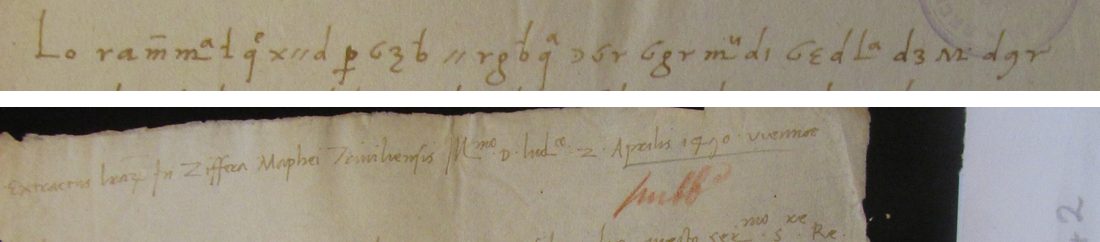
Somogyi's appendix prints the key as a table of numbers: a = 11, 29, 39; m = 12; b = 13; and so on through five nulls, three word signs (et, in, che), five doubled-letter signs, thirty-two syllable signs and six nomenclator entries (“il vescovo varadino”, “S. V.”, “ser.mo Re de Hungaria”, “madonna Bianca”, “zo. Corvino”, “la sua Maestà”). She also prints the first two lines of the 1489 letter twice, once as numbers and once deciphered. She prints no image of a sign, and her numbers are her own labels for the fifteenth-century signs.
The order of her numbers gives the link. Her numbers 11, 12, 13, 14, 15, 16 stand for a, m, b, sa, to, re, which is “ambasatore”, the first word of the letter of 2 April 1490. 17, 18, 19 are d, e, l (“del”), 20 to 23 t, u, r, co (“turco”). The numbering simply follows that letter word by word, so the ciphered original supplies the shapes in the same order. From there the clear copy carries the alignment to the end of the letter and fixes about forty signs.
The rest came from the two letters without a decipherment, each fixed by a word that could be nothing else: the long 7-shaped stroke is f (“Fedrico”, “fosse”, “satisfare”); an n with a crossed 4 is ss (“essere”, “potesse”); x with a tick is do (“quando”, “havendo”); a with a colon is gli (“meglio”); a looped b joined to o is st (“stato”, “questo”); d with a colon is fi (“figliolo”, “iustificare”); an n with a long crossbar is tt (“littere”); and a capital with a mark stands for the correspondent’s title (the original key gives a# = “Vostra Dominatio”; it had been taken for “Ex.tia Vostra”). Numerals are written as figures, not enciphered: “ali 8 del presente”, “ali 15”, “in 20 o 25 di”. Latin words sometimes stand in the clear inside the cipher (“etiam apud”, “Sed hoc non fallet divinam sapientiam”).
The original key. On 23 October 2026 the key itself was found among the Sforza chancery’s keys: Sforzesco cart. 1597 no. 111, DECODE R5411, undated and unattributed there, headed “Cum Mapheo Triviliensi”. It has the alphabet (torn at the upper right, from T to &), doubles, nulls, syllables and a nomenclator of 22 entries (transcribed in key_R5411.md). It confirms Somogyi’s reconstruction where both exist and names the word signs: M+ is Regina (read “la sua Maestà” before), a# Vostra Dominatio, o+ Imperatore, M̄ Zuan Corvino, Q. Duca de Milano, Ra madonna Bianca, + Vescovo Varadino; x̄ is ma and ƀ fa. Words of the September reading that the signs do not carry were withdrawn. A second sheet headed “Cum Mafeo Triviliensi” (R5407) is a different alphabet.
03 Buda, 12 January 1490: the king rides to Vienna
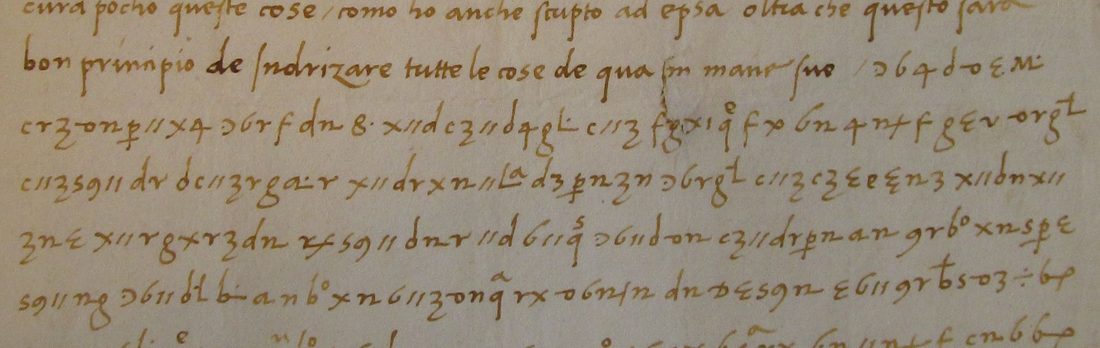
The letter's clear first page is about church appointments; the cipher begins where the news turns delicate.
Questo Ser.mo Re partite de qua ali 8 del presente per andare ad Vienna, non ta[nto] per che la speranza de la dieta lo tiri, quanto per proprio desiderio de andarli; et che sia el vero, questi prelati mi hano dicto che in questo camino divertira ad tutti li lochi ove ha facto [...] edificare, che sono molti, et non si condura ad Vienna piu [...] presto che in 20 o 25 di. Lo legato et li altri oratori hano, et io con loro havemo, deliberato partire ali 15 de questo, et siamo rimasti dreto, perche Sua Maiesta mi fece dire che andassimo recta via ad Vienna, perche lei voleva andare spassando. Non sono piu [...].
“This Most Serene King left here on the 8th of this month to go to Vienna, not so much because the hope of the Diet draws him as from his own wish to go there; and in proof, these prelates have told me that on this journey he will turn aside to all the places where he has had building done, which are many, and will not reach Vienna sooner than in 20 or 25 days. The legate and the other ambassadors have, and I with them have, decided to leave on the 15th of this month, and we have stayed behind because His Majesty had me told that we should go straight to Vienna, since he wished to travel at leisure.”
Lines 5–10 were re-read on 23 October 2026 from native crops of the DECODE image with the original key, and the result was set against the contemporary decipherment printed by Nagy and Nyáry in 1878 (MDE IV no. 91, pp. 161–162, “Extractus Ziffri Maphei Triviliensis. 12. Januarii 1490”): the re-read signs agree with it at each place (“tutti li lochi ove ha facto edificare”, “siamo”, “andassimo”, “spassando”); “mi” and “perche” in the last lines are taken from the print. The September reading’s guess “Tulln” was wrong. The letter also confirms the decipherment from inside: its own second page says in clear words that “lo legato et li altri oratori et io siamo insieme deliberato partire alli 15 de questo … andare per la via ad Vienna”. The cipher says the same thing in the same order, and the word “Vienna” is spelled with the same signs in lines 2, 6 and 10.
04 Buda, 22 November 1489: peace, the Diet, and two marriages
Four pages. Somogyi printed the first two lines as a specimen; no contemporary decipherment, copy or edition of the rest was found. Matthias Corvinus had six months to live, his war with Frederick III was in suspense, and two marriages were in play for his illegitimate son John Corvinus: Bianca Maria Sforza, Ludovico's niece, and a daughter of don Federico of Aragon, Naples's candidate. Queen Beatrice of Aragon opposed the succession of her stepson.
Every cipher line of page 1, page 2 lines 1–17 and page 4 was re-read sign by sign from per-row crops of the Vestigia plates and decoded with the original key (23 October 2026); page 2 has 31 lines, and its first line had never been transcribed. The unread groups were then put through the shared Italian model over every alternative symbol value, and five more words were adopted where every letter is carried. Spelling is as decoded; […] marks unread groups, [?word] a word only partly carried by the signs. The opening of page 1:
La Ex.tia vra intende ad quali termine la pratica de pace, et per consequente questa dieta. Questo Ser.mo Re de Hungaria e tenero del honore suo, como ho scripto altre volte; non e dubio che […] desidera la pace, ma non tanto pero ch'el voglia recevere una […] […] de la […] sua. Non […] ne […] e[x]presamente de andare ad la dieta, ben che ancora in Imperatore non veda [?fondamente] de pace, perche non se gli potesse imputare che per lui fosse rotta la pratica. Gli pare anche duro andarli per non fare niente et riceverne scorno; et pero desiderana havere littere da Imperatore che lo […] andare affirmando li essere ben disposto a la pace, et con questo si [?contenta] andarli, anchora che fosse certo che niuna conclusione ne ne dovesse riuscire, perche gli pare […] potersi sempre ben iustificare et satisfare al honore suo.
“Your Excellency understands at what point the peace negotiation stands, and consequently this Diet. This Most Serene King of Hungary is jealous of his honour, as I have written at other times; there is no doubt that […] desires peace, but not so much that he will accept a […] of his […]. … It also seems hard to him to go there to obtain nothing and receive scorn; and so he wants letters from the Emperor … affirming that he is well disposed to peace, and with this he is [?content] to go, even if he were sure that no conclusion would come of it.”
The page goes on to the new Neapolitan ambassador, who has again proposed the daughter of don Federico, and to the Queen, who says freely that the Milan match was made in spite of her. Page 2 opens with the rumour that Zuan Corvino would marry don Federico’s daughter:
et respondendoli colui parerli imposibile, essendo cocto quello de Milano, solenemente replico essere vero, dicendo ch'el parentato de Milano era gia […]. Sono ancora stati de cortesani li quali, havendo inteso de la deliberatione che era facta, che [?messere] Francisco andisse ad Napoli, gli hano dicto: voi andarete ad disfare quello che haveti cocto.
“…and when that man answered that it seemed impossible to him, the Milan match being cooked, he solemnly replied that it was true, saying that the Milan marriage was already […]. There have also been courtiers who, having heard of the decision that had been made, that [?messer] Francesco should go to Naples, told him: ‘You will go and undo what you have cooked.’” Maffeo warns that the Queen will try everything to turn the King from his purpose, “et in questo non cedera a la isacia[b]ile ira de Iunone”. The two cipher lines of page 4 end: “Sed hoc non fallet divinam sapientiam de la Vostra Dominatio.”
Page 2 lines 18–31 and page 3: decoded, not read. They were re-read sign by sign from the plates with the original key (b25, 23 October 2026), re-cropped at full resolution for page 3 and segmented with the shared Italian model; the partial text (v2831_p2p3_r2l_reading.md) touches on intercepted cipher letters, Francesco’s mission to Naples, the Turk and the Bishop of Várad. An independent second reader then transcribed eight lines blind from the plates: 93.3% of the signs agree, but 9 of 92 words of the reading (9.8%) are not carried by the signs after each disputed sign was re-checked. At that rate across the unsampled lines these pages fall below the bar, so they are shown for checking and not counted. The next step is to bracket those words and check every word of the two pages against the signs the same way.
05 The clear postscript: an ambassador's expenses
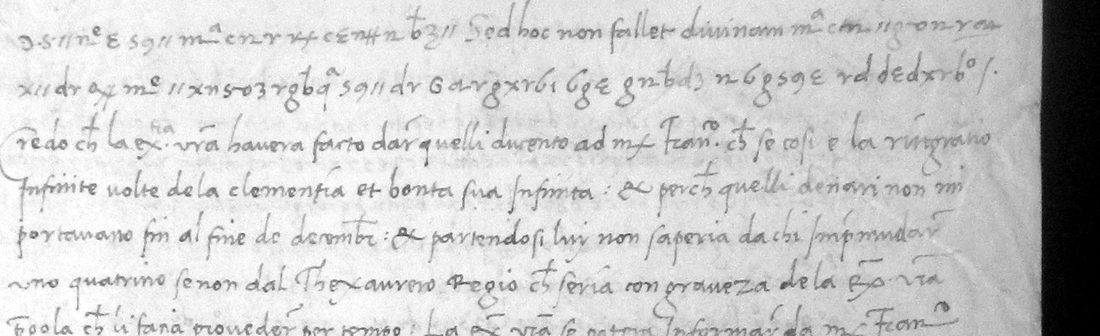
Nothing on this page is secret, and it was never enciphered. It is also the only part of the letter that is about Maffeo himself.
Credo che la Ex.tia V.ra havera facto dar quelli ducento ad m. Fran.co; che, se cosi e, la ringratio infinite volte de la clementia et bonta sua infinita. Et perche quelli denari non mi portavano fin al fine de decembre, et partendosi lui non saperia da chi imprum[ut]are uno quatrino se non dal Thexaurero Regio, che seria con graveza de la persona vostra propria … Se de questa spesa non gli ne faria honor, sonno contento che non me ne proveda; io gli posso affirmar etiam cum iuramento che, doppoi che sonno qua, ultra quello ho havuto et tolto in nome del Ill.mo S. V.ro, ho speso di mei piu de centocinquanta ducati tra mi, veste et cavalli … che la provisione che me e ordinata non mi basta, dovendo tener questo loco secundo la dignita sua. Et perche in questa novita facta de Cancelleri forse poteria esser dome[n]ticato, La supplico ordini ad chi li par che provedi sia compreso in el numero de li altri Can[cellieri] et in lassignatione facta ad la Cancellaria. A V.ra Ex. de continuo me recomando. Bude xxij Novembris 1489. E[iusdem] Ill.me D[ominationis] V[ostre] servus, Magister Trivilien[sis].
“Since I have been here, beyond what I have had in Your Lordship's name, I have spent more than a hundred and fifty ducats of my own on myself, clothes and horses … the allowance assigned me is not enough to keep this post according to its dignity. And because in this recent reshuffle of the chancery clerks I might be forgotten, I beg you to order whoever you think fit to see that I am counted among the other chancellors.” The phrase “et in lassignatione facta ad la Cancellaria” is the explicit by which the archive catalogues the letter.
06 Method
The images are the Vestigia plates (3240×4320, no login needed: the record page at vestigia.hu/documents/<id> carries the whole record as JSON, and the originals are served from /media/<file id>/<file name>) and, for R1098, the DECODE scans of the same negatives.
The working loop was: connected-component segmentation of each page into glyph boxes, line assignment by the peaks of the horizontal ink projection, merging of the two-stroke signs and of superscripts with the letter below them; then numbered strips, one line at a time, transcribed into values by hand against a sheet of sign exemplars cut from the letters themselves; then the values segmented into Italian, and any place where the Italian failed sent back to the image. The 2 April pair was aligned by dynamic programming against its clear copy to seed the key. Several rounds were needed: the first pass on the 1489 letter produced letter strings, the second, working from contrast-stretched crops of whole lines rather than from boxes, produced sentences.
Two practical notes for anyone continuing. The automatic line segmentation misassigns glyphs in the lower half of pages 2 and 3 of the 1489 letter, where the lines converge; transcribe those from the plate with per-row crops. And the stacked line crops drift from line 18 onward on page 3, which cost one pass its accuracy.
07 What remains uncertain
- Letter groups of the 1489 letter that decode letter for letter but give no word, between secure words: page 1 lines 3, 4, 8, 11, 12, 17, 19–22, 25–29; page 2 lines 15, 16, 19–21, 25, 28–31; page 3 lines 2, 3, 5–8, 15, 18, 21, 22, 27, 29, 31; page 4 line 2. Four passes and a model segmentation over every alternative symbol value left them; they need the values in the torn columns of R5411.
- Signs in the torn columns of R5411 (x, y, z, &, part of t), the r-ring on page 3 line 15, and the o-form, read t in most words but b by the key.
- Page 3 line 15: one or two signs under an ink blot; page 1 lines 21–29: the last words of each line under a stain at the right edge (re-checked at three times on 23 October 2026; the Vestigia plate is the only image).
- Page 2 lines 18–31 and page 3: decoded, not read (section 04).
- The letter of 12 January 1490: the two signs after “ove ha facto” (the key’s o+ is Imperatore) have no word in the printed decipherment and stay open, and the cipher’s last words, “non sono piu lon[…]”, are not in the printed extract.
Full texts
The transcription and the decryption of every document on this page, so that the reading can be used and checked. Short files are shown here; all are in the repository.
Vestigia 2831, Buda 22 Nov 1489: p. 1, p. 2 ll. 1-17 and the two cipher lines of p. 4 (p. 2 has 31 lines) read in part
Maffeo da Treviglio to Ludovico Sforza: King Matthias will not go to the Diet without letters from the Emperor that let him come away justified; the new Neapolitan ambassador is to reconcile the Queen with the King and has raised again the match of John Corvinus with don Federico's daughter, which the King takes as made in spite of the Milanese marriage; courtiers tell messer Francesco he goes to Naples 'to undo what you have cooked'; Maffeo advises that the Queen will spare no effort to turn the King and will not yield 'to the insatiable wrath of Juno'.
Builds coherent sentences, but under the read bar of 95% of words read as sense (90% here); the holes are marked in the reading.
Transcription
# Vestigia 2831 p. 1: sign-by-sign re-read with the original key R5411 (r2e, 23 Oct 2026)

Plate `C:\Users\dbour\cypher\targets\buda1489\img\v2831_p1r.jpg` (Vestigia original 3240x4320, rotated); per-row
crops at 1.7x and 2.4-3.5x (`research/reading_audit/r2e_crop.py rows 1 820 2860 730 3280`, `r2e_z.py`; crops in the
session scratchpad only). Key `../key_R5411.md`; notation as in `v2831p2_r2e.md`. The page has 29 cipher lines after
the clear address "La Ex.tia vra"; the line count of the 1989 passes is right for this page. Lines 1-2 are printed
by Somogyi (2016) with their numbers, which match.

## Per line

**L01-L02** checked on the crops against `v2831p1_a_v.txt` and Somogyi's numbers; unchanged: "intende ad quali
termine la pratica de pace et per consequente questa dieta. Questo Ser.mo Re de Hungaria e tenero del honore suo, como
ho scripto altre volte". Holes 0.

**L03** `g ε v | // | x 6 o n ε | s 9 // | d r 6 3 | x // m^o x // q^a | d r | c r b̶· | x̄ | g ε v | p̸ r g L | c // q^s | s 9 // | d | 6 ε 8 d n r | q^o s // 6 4 q^e | 6 g r`
→ "non e dubio che […] desidera la pace, ma non tanto pero ch'el voglia recevere una". `x̄` (x with a bar above) is the
key's Ma: "ma non tanto" (the 1989 pass had "et"). `d r 6 3` (l-a-u-o) where "lui" is expected is not read. q^o = re
(as L23, R1098). Look-alike 0. Holes 1.

**L04** `a n g o n | x̄ 3 n p̸ 4 8 d n 3 b^e | x // d r | 4 g o n x̄ c n 3 b^e | d s r | g ε v | 6 ε g r | b^e | q̥ q^e | 4 [x] c ʒ // m^a a // g L: | x //`
→ "[…] […] de la […] sua non […] ne […] e[x]presamente de". `x̄ 3 n p̸ 4 8 d n 3 b^e` and `4 g o n x̄ c n 3 b^e`
(two -ione words built round x̄) are not read; the sign after e in "expresamente" is not in the key (the X column is
torn): x by sense, counted. Look-alike 0. Holes 6.

**L05** `r v x 1 q^e | r x | d f | x n 4 o r | o // g | s 9 4 | r g b q^a | n g | o+ | v ε g | 6 // x r | d' v x r a // g L: | x // | c r b̶· | c // ʒ s 9 4`
→ "andare ad la dieta, ben che ancora in lo Imperatore non veda [?fondamente] de pace, perche". `o // g` = b-e-n (o = b
by the key) "ben che"; `o+` (o with a cross below) is the key's Imperator, here and in L08 (the 1989 "♀"); "in lo
Imperatore" supplies no article: the figures give "in Imperatore". `d' v x r a // g L:` = fo(d with a tail, the key's
Fo)-n-d-a-mente: "fondamente" is not a known word, counted. Look-alike 0. Holes 1.

**L06** `g ε g | m^e | 8 d n | c ε o // n# 4 | n a c 6 p̸ r q^e | s 9 // | c // ʒ | d 6 n | 7 ε n# 4 | q^s n# r | d r | c ʒ r p̸ n b̶ | 8 d n`
→ "non se gli potesse imputare che per lui fosse rotta la pratica. Gli". `q^s n# r`: the double is drawn like n# (ss)
but rotta wants n̶ (tt): look-alike, counted (2 letters). Look-alike 2. Holes 0.

**L07** `c r q^e | r g s 9 // | x 6 q^s | r g x 1 ʒ d n | c // ʒ | v ε g | ƀ q^e | v n // g L: | r̸ | ʒ n s 4 6 4 ʒ b^e | d s ε ʒ b^o | r̸ | c // q^s`
→ "pare anche duro andarli per non fare niente et riceverne scorno, et pero". `ƀ q^e` = fare (the 1989 pass had
"ca[va]re"). Look-alike 0. Holes 0.

**L08** `x // m^o x 4 q^a g r | 9 r 6 4 ʒ 4 | d n n̶ 4 q^e | x r | o+ | s 9 // | d 3 | g s 4 ʒ b̶ n# s b^o | r g x 1 q^e | r ƒ n ʒ a r g x ε`
→ "desiderana havere littere da Imperatore che lo […] andare affirmando". "desiderana" is what the figures give (the
writer's form or desidera + na; kept). `d n n̶ 4 q^e` = l-i-tt-e-re; `ƒ` (n with a tail) = ff, the key's double.
`g s 4 ʒ b̶ n# s b^o` (n-c-e-r-ca-ss-c-no) not read. Look-alike 0. Holes 1.

**L09** `d n | ÷ | // n# 4 q^e | o 4 8 | x n δ c ε d-o 3 | r | d r | c r s // | x̸ | s ε v | ɔ s // d-o 3 | m^o | s ε v p̸ // Lᵉ g r | f v x r ʒ d n`
→ "li essere […] disposto a la pace, et con questo si [?contenta] andarli". `o 4 8` (b/t-e-g) not read; the L with a
superscript e in "contenta" is not in the key (L. = te): counted. Look-alike 0. Holes 2.

**L10** `r g s 9 ε q^a | s 9 // | 7 ε n# 4 | s // ʒ o ε | s 9 4 | g n 6 b^a | s ε g s d s n ε b^e | b^e | b^e | x ε 6 // n# 4 | ʒ n 6 d s n q^e`
→ "anchora che fosse certo che niuna conclusione ne ne dovesse riuscire". Look-alike 0. Holes 0.

**L11** `c // ʒ s 9 // | 8 d n | c r q^e | 8 r s ε g // c d // d n n 1 // q^e | c ε o // ʒ m^o | d // a c ʒ // | o 4 g | n 6 d-o n d: b̶ q^e | r̸ | w | b̵`
→ "perche gli pare […] potersi sempre ben iustificare et". The long group (g-a-c-o-n-e-p-l-e-l-i-i-a-e-re) is not
read; `o 4 g` = ben (o = b); the b with a tail at the line end is a key null. Look-alike 0. Holes 1.

**L12** `m^a o n d 7 r q^e | r d | 9 ε b^o q^e | d s ε | b p̸ | w | n ε // n q ε n a | s 9 // | ɔ s // d-o 3 | b^o 6 ε | r a o d n r p̸ ε q^e | x // | =`
→ "satisfare al honore suo. […] che questo novo ambasiatore de". `b p̸ w n ε // n q ε n a` (co-t-[null]-i-o-e-i-e-o-i-m)
is not read (the 1989 "etiam" is not on the figures). Look-alike 0. Holes 2.

**L13** `b^a c ε d n | n g // d | o ʒ r s o r q^e | d r | ʒ 4 s ε g s [stain] n r p̸ n ε b^e | x // d r | M+ | s ε d | M: | c // ʒ | x n δ c ε`
→ "Napoli […] tractare la reconciliatione de la Regina col Ser.mo Re per dispo-". M+ = Regina; the next sign is the
M with a dot and an under-stroke, written as on L17 and L24 (M: = Ser.mo Re); the 1989 pass had "la [Maesta] con lo
[Imperatore]". `n g // d` (i-n-e-l) not read. Look-alike 0. Holes 1.

**L14** `g // ʒ d r | f | d 1 | 6 ε 8 d n r | b a 3 | d 6 n | x n b̶· | x // d r | 6 | ÷ | c // ʒ | o // b^e d: o n 3 | x // d | d: d n ε d 3 | =`
→ "-nerla a la voglia, como lui dice, de la […], per benefitio del filiolo". "benefitio" is the writer's form (o = b,
then o = t). The single 6 after "de la" is not read (a nomenclator?). Look-alike 0. Holes 1.

**L15** `9 r o n r | 6 g r | r d o ʒ r | 6 ε d o r | p̸ // g o r L: | x̸ | b̶ x o 3 | a // g o n ε b^e | x // d r | d: d n ε d r | x // | x ε g | ÷`
→ "habia una altra volta tentate et [?facto] mentione de la filiola de don". "filiola" is the writer's form (d: = fi,
d n ε d r = l-i-o-l-a). The group read facto is `b̶ x o 3` (ca-d-t-o): the key's Fa is the b crossed at the top, this b
is crossed low (ca); counted as a hole. o = b in habia (key value), o = t in volta, tentate, mentione. Look-alike 0. Holes 1.

**L16** `7 // x ʒ n b | r̸ | 8 d n | b^e | 9 ε | ɔ s // d-o n | s ε v n // s p̸ 6 q^e | c ʒ n xo | d // | c r ʒ ε d 4 | s 9 // | 9 r | x n s p̸ 3`
→ "Fedrico, et gli ne ho questi coniecture: prima le parole che ha dicto". `c ʒ n xo` = p-r-i-ma (xo = Ma, the key);
"Fedrico" is the writer's form (no e between d and r, against "Federico" p. 2 L02). The 1989 pass had "quelle coniecture
pri[ma?] [de]"; the figures give questi and prima. Look-alike 0. Holes 0.

**L17** `r d | M: | s 9 // | n v 4 g | r d o r q^e | // d | d: d n 3 | d ε | 6 ε 8 d n r | v | 9 r 6 // q^e | ʒ n δ c // s o ε | r d | 9 ε b^o q^e | x // d r`
→ "al Ser.mo Re che […] a stare el filio lo voglia havere rispecto al honore de la". `n v 4 g` (i-n-e-n) not read;
`d o r q^e` = s-t-a-re with the o-form for t; `d: d n 3` = fi-l-i-o ("filio", the writer's form, cf. filiola); the v
before havere is a stray stroke (null?). Look-alike 0. Holes 1.

**L18** `÷ | w | M+ | c r q^e | σ | v ε g | n a c ε ʒ o r q^e | r d o ʒ ε | s 9 r | ɔ s // d-o 3 | c // q^s | s 9 // | x n s 4 g x' | // c d r | ÷`
→ "Regina. Pare mi non importare altro ch'a questo, pero che dicendo […]". M+ = Regina by the key (the 1989 pass had
"[la sua Maesta]"); σ = mi; `n a c ε ʒ o r q^e` = importare (o = t); `x n s 4 g x'` = dicendo (x' = do). The last group
`// c d r` (e-p-l/s-a) before the null is not read. Look-alike 0. Holes 1.

**L19** `d n o // q^a a // g L: | ɔ s // d-o r | f n p̸ n bˣ ε r | 4 n# 4 ʒ // | 7 r s p̸ r | n g | d s ε | x n δ c // s o ε | g ε v | σ | c r q^e`
→ "liberamente questa [?affinita] essere facta in suo dispecto, non mi pare". `f n p̸ n bˣ ε r` is the word the 1989
pass read "aff[init]a": a-?-i-t-i-ni-o-a; the sense (the Corvinus match) wants affinita, the figures do not give it:
counted as a hole. Look-alike 0. Holes 1.

**L20** `6 // x 4 ʒ d n | r | a // a: ε | c // ʒ | // d | ɔ s r d 4 | 7 n c d r | x // o n r | p̸ 4 g // q^e | s 9 // d | d n r | m^a p̸ n δ ƀ s p̸ ε`
→ "vederli a meglio per el quale […] debia tenere ch'el sia [?satisfacto]". `7 n c d r` (f-i-p-l-a) not read; "debia"
with o = b. The last word: sa-t-i-s-fa-c-t-o with ƀ = fa, but the fifth and seventh signs are faint at the stained
edge (counted). Look-alike 0. Holes 2.

**L21** `r d | 9 ε v 3 q^e | d s ε | d-o r g x' | ɔ s // d-o r | f n p̸ n bˣ p̸ r | m^e | 8 n r | g ε g | 6 ε d 4 n# 4 b^o | s 9 // | b ʒ n […]`
→ "al honore suo, stando questa [?affinita], se gia non volesseno che co[…]". The same word as L19 (counted again);
the end of the line is under the stain at the right edge (illegible). Look-alike 0. Holes 2.

**L22** `s 9 // | 4 | n a c ε δ n o n d // | ẋ n a c // g q̥ b r | ÷ | g ε v | b: c n p̸ x 6 ε d | = | x r a# | d r | d o ʒ ʒ b̶ […]`
→ "che e imposibile […] non […] da Vostra Dominatio la […]". `ẋ n a c // g q̥ b r` (d-i-m-p-e-n-ri-co-a?) and
`b: c n p̸ x 6 ε d` (ca-p-i-t-d-u-o-l) not read; the end is stained. Look-alike 0. Holes 4.

**L23** `g r 6 // g x' | d ε | M: | ƀ s o ε | x n q^o | r x | xo d // q^e | 7 ʒ r g s n d b | s 9 // | 6 ε d 4 | s r 1 g x r n# 4 | r | b^a c ε […]`
→ "havendo lo Ser.mo Re facto dire ad [?messere] Francisco che vole [?ch'andasse] a Na[poli]". ƀ = fa (facto);
q^o = re ("dire"; the key has q^e for re, the o-superscript form recurs, R1098 too); `s r 1 g x r n# 4` =
c-a-a-n-d-a-ss-e (counted); the last word is under the stain after b^a c ε (= Napo…; "a Napoli" as p. 2 L06 and L09).
Look-alike 1 (g for h). Holes 3.

**L24** `ɔ s // d-o n | c ʒ // d r p̸ n | s 9 // | c ε b r | x̄ | b^o | x 1 | M+ | m^u b^o | ꝏ | n g ε o ʒ r p̸ n | s ε n 5 q | x r | xo x n d | x̄ | d s d // g n […]`
→ "questi prelati che […] […] no da Regina sono intrati […] […]". `c ε b r` (p-o-co-a) not read; `x̄` before b^o
is x with a bar above (the key's Ma); `ꝏ` (wavy sign) a null; `n g ε o ʒ r p̸ n` = in-o-trati, read "intrati" with ε
as a stray (counted); the right half fades into the stain. Look-alike 0. Holes 6.

**L25** `ε b^o | x̸ | g r b^o | x s o n o r p̸ 3 | g ε v | s 9 // | d 3 | M: | g r 6 // n# 4 | o 1 p̸ r L | c ʒ ε e 3 d n L | x̄ | s 9 r […]`
→ "[…]no, et hano dubitato non che lo Ser.mo Re havesse […] proposito, et che […]". `x s o n o r p̸ 3` = d-u-b-i-t-a-t-o
(o = b, then o = t); `o 1 p̸ r L` (t/b-a-t-a-to) not read; the line end under the stain. Look-alike 2 (g for h, twice). Holes 3.

**L26** `d // n# 4 | ε r d s // q^a | d r | M+ | a ε v d-o ʒ r g x 3 | x // | a r g x 1 ʒ d 3 | c // ʒ | ƀ q^e | // d | o ʒ r s o r p̸ ε | x // | s 6 […]`
→ "[…]lesse […] la Regina, monstrando de mandarlo per fare el tractato de su[…]". `ε r d s // q^a` (o-a-l-u-e-ra) not read;
"tractato" with the o-form for t twice. Look-alike 0. Holes 3.

**L27** `d r | d: d n 3 d r | x // | x ε g | 7 // x 4 q̥ b | s 9 // | 8 d n | d // g r | x n d c n r s n 6 o 3 | x r | a· 6 ʒ o // | ɔ s r g x'`
→ "la filiola de don Federico, che gli […] dispiaciuto da [?morte] quando". `d // g r` (l-e-n-a) not read; `a· 6 ʒ o //`
= m-u-r-t-e (the 1989 "a· = m" value; 6 for o): counted. Look-alike 0. Holes 2.

**L28** `7 ε n# 4 | d-o r p̸ 3 | 6 n q^s r | r c ʒ // n# ε | 6 g b^o | 8 // g o n d 9 ε a 3 | b^a c ε d n o r b^o | s 9 // 4 | s ε g`
→ "fosse stato […] apresso uno gentilhomo napolitano che e con". `6 n q^s r` (u-i-ro-a) not read; gentilhomo with o = t.
Look-alike 0. Holes 1.

**L29** `d 3 | x n s o 3 | r a o r d n r p̸ ε q^e | g r | […] ε | r x | x n q^e | r x | c // ʒ m^u b^a | s 9 // | xo d 3 | g r | d s a m p̸ […]`
→ "lo dicto ambasiatore ha […] ad dire ad persona che […] ha […]". The group after "ha" is blotted (the 1989 "havuto"
is not on the figures); `xo d 3` (ma-l-o) and `d s a m p̸` at the stained end not read; the sentence goes on with
"referto" at p. 2 L01. Look-alike 1. Holes 4.
Transcription
# Vestigia 2831 p. 2, lines 1-17: sign-by-sign re-read with the original key R5411 (r2e, 23 Oct 2026)

Plate `C:\Users\dbour\cypher\targets\buda1489\img\v2831_p2r.jpg` (Vestigia original 3240x4320, rotated -1.7 deg);
per-row crops at 1.7x and 2.4-3.2x (`research/reading_audit/r2e_crop.py`, `r2e_z.py`; crops in the session scratchpad
only). Key: `../key_R5411.md`. Notation as in `v2831p2_b25.md`: `//` e (two short strokes); `x` d; `d` l (looped) or s
(straight); `δ` s; `s` c or u; `ε`, `3` o; `ʒ` r; `n` i; `g`, `v` n; `8` g; `9` h; `r`, `1` (dotted stroke), `f` a;
`7` f; `c`, `e` (round) p; `ɔ` q; `a` m; `6` u/v; `p̸` t; `o` (o-form) b or t; `4` e; `L:` te, `L` to; `b^a` na,
`b^o` no, `b^e` ne, `bˣ` ni, `b^t` (b with a stroke through the stem top) co, `ƀ` (b crossed at the top) fa, `b̶` ca,
`b̶·` ce; `m^a` sa, `m^e` se, `m^o` si, `m^u` so; `q^a` ra, `q^e` re, `q^s` ro, `q̥` (q with a foot) ri; plain `q` e;
`x'` do; `d:` fi; `a:` gli; `n#` ss; `n^e` ll; `nⁱ` mm; `nᵒ` pp; `d-o` st; `σ` mi; `x̸` et; `r̸` (stroked r) et; `xo`
ma; `M:` Ser.mo Re, `M+` Regina, `M̄` Zuan Corvino, `a#` Vostra Dominatio; `÷`, `w`, `=` nulls. `[hole]` = a hole in
the leaf (black on the plate).

**Line count corrected again.** The page has **31** lines. Line 1 (`ʒ // 7 4 ʒ o ε ...`, the line with the
nomenclator sign M̄ = Zuan Corvino) was never transcribed: the 18-19 Sept passes started at "de don Federico", which
is line 2, and b25 counted from there. Old L1-L16 (`v2831p2_read.md`) = L2-L17 here; b25's L17-L30
(`v2831p2_b25.md`) = L18-L31 here.

## Per line

**L01** (new) `ʒ // 7 4 ʒ o ε̇ | s 9 // | ɔ s // d-o 3 | M̄ | m^e | g r ʒ // | r̸ | s 9 // | m^e | ƀ ʒ n r | d 3 | c r ʒ // g o r p̸ ε | x // | d r | m n n d n ε d r`
→ "referto, che questo Zuan Corvino se […], et che se faria lo parentato de la [?filiola]". `ʒ // 7 4 ʒ o ε` =
r-e-f-e-r-[o=t]-o (the dot over the ε is a speck); M̄ (M with an overbar) is the key's "Ill.mus D. Jo. Corvinus";
`ƀ` = fa, as b25 found ("fa con arte"), so "se faria"; `c r ʒ // g o r p̸ ε` = parentato (o = t). `g r ʒ //` after
"se" (n-a-r-e) not read. The last group `m n n d n ε d r` = f(m)-i-?-l-i-o-l-a: the third sign is an n with a tail
into the d; "filiola" (the writer's spelling, p. 1 L15) has no letter there. Look-alike 0. Holes 2.

**L02** (old L01) `x // x ε v | 7 // x 4 q̥ b | r̸ | s 9 // | d 3 | r a o r d n r p̸ ε q^e | d 3 | x ε 6 4 6 r | a r g x r q^e | r x | b^a c ε d n | d s n | c // ʒ | ɔ s // d L`
→ "de don Federico, et che lo ambasiatore lo doveva mandare ad Napoli lui per questo". The fifth sign of Federico is
the q with a foot (the key's Ri); the sign before "che" is the stroked r (et), not "a". `r a o r d n r` = a-m-b-a-s-i-a
(o = b, straight d = s). Look-alike 0. Holes 0.

**L03** (old L02) `r̸ | ʒ // δ c ε g x 4 v x ε d n | b d s n | c r ʒ // ʒ d n | n a c ε δ n o n d q | // n# 4 g x 3 | b^t s o 3 | ɔ s // n^e 3 | x // | σ d r b^o`
→ "et respondendoli colui parerli imposibile, essendo cocto quello de Milano". `b^t` = co; plain q = e at the end of
"imposibile" (b25: plain q = e at every occurrence); σ = mi (Milano, twice on this page). Look-alike 1 (the s of
imposibile is an n-like stroke). Holes 0.

**L04** (old L03) `m^u d // g // a q̄ g L: | ʒ // c d n b | // n# 4 ʒ 4 | 6 // q^s | x n s 4 g x ε | s 9 // d | c r ʒ // g o r L | x // | σ d r b^o | // q^a | 8 n r | // q^s d 6 m^u`
→ "solenemente replico essere vero, dicendo ch'el parentato de Milano era gia […]". The bar over `a q` in
solenemente is an abbreviation stroke; q = e. `c r ʒ // g o r L` = parentato (L = to; cf. "parentato" L01). The last
group `// q^s d 6 m^u` (e-ro-l-u-so) is not read. Look-alike 0. Holes 1.

**L05** (old L04) `m^u b^o | r g s ε q^a | d-o r p̸ n | x // | s ε ʒ o // m^a bˣ | d n | ɔ s r d n | g r s // g x' | n g o // m^u | x // d r | x // d n o // q^a o n ε b^e`
→ "sono ancora stati de cortesani li quali, havendo inteso de la deliberatione". `bˣ` (b with a small x above) = ni
(the key's Ni) in "cortesani". The first sign of "havendo" is written like g (h by the key is 9 or L; counted).
Look-alike 1. Holes 0.

**L06** (old L05) `s 9 // | 4 q^a | 7 r s o r | s 9 // | xo d // q^e | 7 ʒ r g s n d b | r g x n n# 4 | r x | b^a c ε d n | 8 d n | g r b^o | x n s p̸ 3 | 6 ε n | r g x r q^e L.`
→ "che era facta, che [?messere] Francisco andisse ad Napoli, gli hano dicto: voi andarete". `xo` (x with a small
o-stroke) is the key's Ma; "ma-s-e-re" is no word and messere the only fit (sense, counted as a hole). "andisse" is
the writer's form (n = i). "hano" with the g-form for h. Look-alike 1. Holes 1.

**L07** (old L06) `r x | x n d 7 r q^e | ɔ s // n^e ε | s 9 // | 9 r 6 // o n | b^t s o ε | // g o n a: | r g s ε q^a | s 9 // | d 3 | c ʒ // b^o a n b^a p̸ ε | r a o 1 d n r p̸ ε q^e`
→ "ad disfare quello che haveti cocto. […] ancora che lo prenominato ambasiatore". `// g o n a:` (e-n-t-i-gli) is not
"etiam" by the figures; kept as a hole. The fourth sign of ambasiatore is the dotted stroke (1 = a). Look-alike 0. Holes 1.

**L08** (old L07) `m^e | d n r | x ε d 6 o 3 | n g | b^o a // | x // d ʒ // | d s ε | x // d r | a# | c // q^s | s 9 // | ɔ s r g x' | d 3 | M: | x n n# 4 | r x | xo d // q^e | ÷`
→ "se sia doluto in nome del re suo de la Vostra Dominatio, pero che quando lo Ser.mo Re disse ad [?messere]". The
sign after "de la" is an a with a double-crossed tail = a# (Vostra Dominatio by the key; the 1989 pass had "Ex.tia
Vostra"). `x n n# 4` = d-i-ss-e "disse" (not "dicesse"). Look-alike 0. Holes 1.

**L09** (old L08) `7 ʒ r g s n d b | x // d r g x 1 q^e | r x | b^a c ε d n | 8 d n | d s o n | 6 v d 4 | s 9 // | 6 ε d 4 | s r ʒ // | s ε v s n d n r n# 4 | d 3 | ʒ 4`
→ "Francisco de l'andare ad Napoli, gli […] […] che vole […] conciliasse lo re". `x // d r g x 1 q^e` = de l'andare
(1 = a; the 1989 pass read n). `d s o n 6 v d 4` (s/l-u/c-b/t-i-u-n-l-e) and `s r ʒ //` (c/u-a-r-e) not read.
Look-alike 0. Holes 3.

**L10** (old L09) `7 // ʒ x n v r g x' | s ε g | d r | a# | n ε | d n | 8 g n d: b | d n o // q^a a // g L: | r | d r | a# | ɔ s // n^e ε | d // g o 3 | r̸ | d n g 8 // g n ε`
→ "Ferdinando con la Vostra Dominatio. Io li [si]gnifico liberamente a la Vostra Dominatio quello sento, et
l'ingenio". "gnifico" has no sign for si (8 g n d: b = g-n-i-fi-co); supplied and counted. a# twice. Look-alike 0. Holes 1.

**L11** (old L10) `a n 3 | x̸ | c ε ʒ 8 // | r x | c ε o // q^e | x // | s n ε b^t q^e | n 6 x n p̸ n ε | d r | a# | s 9 // 4 | d r c n // g o n n# xo | b^e | c n 8 d n r q^e`
→ "mio et porge, ad potere de […] iuditio la Vostra Dominatio, che e sapientissma, ne pigliare". The x after "mio" is
struck through (x̸ = et). `n n# xo` = i-ss-ma: "sapientissma" is what the figures give (xo = ma), kept as written.
`s n ε b^t q^e` (c/u-i-o-co-re) not read. Look-alike 0. Holes 1.

**L12** (old L11) `ɔ s // n^e r | c r ʒ o // | s 9 // | 8 d n | c r q f | c 6 ʒ | s 9 // | g r o n r | ɔ s // d-o 3 | c // ʒ | s ε g d-o r g L: | s 9 // | d r | M+ | 8 d n | ÷`
→ "quella parte che gli [?parera], pur che habia questo per constante, che la Regina gli". M+ (M with a cross-tail) is the
key's Regina (the 1989 pass had "la sua Maesta"). `c r q f` = p-a-e-a with plain q = e; "parera" wants r: one hole.
"habia" with the g-form for h (look-alike). Look-alike 1. Holes 1.

**L13** (old L12) `6 ε 8 d n r | ɔ s // n^e 3 | x ε d s 4 | x̸ | n a a ε ʒ o n [hole] o n b^e | s 9 // | m^o | c ε n# n | 6 ε d // q^e | r x | b̶ c n o r d // | ÷ | 6 ƒ`
→ "voglia quello dolce et […], che si possi volere ad capitale […]". A hole in the leaf (black square on the plate)
takes one or two signs out of `n a a ε ʒ o n [ ] o n b^e` (i-m-m-o-r-t-i-?-t-i-ne). `b̶ c n o r d //` = ca-p-i-t-a-l-e.
Look-alike 0. Holes 2.

**L14** (old L13) `n g n o b̶ | r̸ | s 9 // | g ε v | g r o n r | ʒ // d-o r q^e | c // ʒ | d // n | r x | ƀ q^e | ε a g // | c ʒ ε 6 r | m^e | c ε n# n | r 6 // ʒ o // q^e`
→ "[…] et che non habia restare per lei ad fare omne prova se possi avertere". `ƀ q^e` = fa-re (b crossed at the
top, the key's Fa). The opening group (with `6 ƒ` from L13: u-a-i-n-i-t-ca) is not read. Look-alike 1 (g for h in
habia). Holes 1.

**L15** (old L14) `// d | M: | x r | c ʒ ε e 3 d n o 3 | r g s 9 ε q^a | s 9 // | 6 // x [hole] n# 4 | d r | 6 n nⁱ a ε o n d // | s n b | s 9 // | 6 n m^a g //`
→ "el Ser.mo Re da proposito, anchora che [?vedesse] la […] […] che […]". The leaf hole takes one sign of
`6 // x [ ] n# 4`. `c ʒ ε e 3 d n o 3` = proposito (round e = p, straight d = s, o = t). `6 n nⁱ a ε o n d //`
(u-i-mm-m-o-b-i-l-e), `s n b` and `6 n m^a g //` not read. Look-alike 0. Holes 4.

**L16** (old L15) `r̸ | n g | ɔ s // d-o 3 | v ε g | s // x 4 q^a | r d | 1 n m^a s n r [hole] n d q | n q^a | ÷ | x // n 6 g ε g // | x b^o a // g | x̸ | 3 6 n p̸ | ÷`
→ "et in questo non cedera a la isacia[b]ile ira de Iunone, […] et […]". `1 n m^a s n r [ ] n d q` = a-i-sa-c-i-a-[ ]-i-l-e:
the writer wrote "isaciabile" (no n); the b is lost in the leaf hole. "ira de Iunone" (n q^a; x // n 6 g ε g //) echoes
Virgil's "saevae memorem Iunonis ob iram" (Aen. I.4), said of the Queen. `x b^o a // g` (d-no-m-e-n) and `3 6 n p̸`
(o-u-i-t) not read. Look-alike 0. Holes 3.

**L17** (old L16) *(clear: etiam apud)* `n d-o 3 d | b^e | // d | c r p̸ ʒ // | 4 | c // ʒ | a r g b̶· q^e | x // | n g | d // ʒ 6 n q^e | r x | d r | nᵒ // o n p̸ ε | d s ε | m^e`
→ "etiam apud istos, ne el patre, e per mancare de inservire ad lappetito suo se". `nᵒ` = pp (the key's double):
`d r nᵒ // o n p̸ ε` = l-a-pp-e-t-i-t-o, "lappetito" (l'appetito). `b̶·` (dotted) is the key's ce; the word wants ca
(look-alike, counted). The last sign is m^e (se), the 1989 pass had m^o. Look-alike 1. Holes 0.

Lines 18-31: `v2831p2_b25.md` (its L17-L30), with the third pass below.

## Third pass on b25's lines (r2e)

- **L29** (b25 L28) `7 ʒ r g s // d b^t | ƀ q^a | ʒ // c d n b̶· q^e | // d | xo …`: the first group is not "f-r-a-n-o-e" but
  F-r-a-n-c-e-s-co (b with the stroke through the stem top = co, as "Francesco" L09), then `ƀ q^a` = fa-ra: **"Francesco
  fara replicare el ma[…]"**. The end of L28 (b25 L27) `c // ʒ | xo d // q^e` = "per ma-s-e-re", the same group as L06/L08
  before "Francisco": **"per [?messere] Francesco"** (messere by sense, counted as a hole).
- **L20** (b25 L19) `d x n a 3 g d-o 3 ʒ r // g o n x̄ q^e | m^o | c ε δ | d 9 ε b^o q^e`: the long group still does not
  segment (d-i-m-o-n-st-o-r-a-e-n-t-i-ma-re); kept […].
- **L25** (b25 L24): checked; b25's "Quanto ad l'animo de questo Ser.mo Re ad[…] et pare" holds; nothing added.
Transcription
# Vestigia 2831 p. 4, the two cipher lines: re-read with the original key R5411 (r2e, 23 Oct 2026)

Plate `img/v2831_p4r.jpg` (main checkout), lines at y = 1088 and 1180, crops at 2x in the session scratchpad.
Notation as in `v2831p2_r2e.md`. Lines 3-17 of the page are in the clear (`v2831p4_read.md`).

**L01** `ɔ s // n^e ε | s 9 // | m^a c n r | r̸ | c ε n# n | ƀ ʒ // | (clear) Sed hoc non fallet divinam | m^a c n // g o n r a`
→ "quello che sapia et possi fare. Sed hoc non fallet divinam sapientiam". `ƀ ʒ //` = fa-r-e (b crossed at the top,
the key's Fa; the 1989 pass had "co[r]e"). The last word goes back into cipher: sa-p-i-e-n-t-i-a-m. Look-alike 0. Holes 0.

**L02** `x // d r | a# | m^e | // x n s o 3 | r g b q^a | s 9 // | d r | 6 a r g x r b̶ n | 6 g ε | g n b d 3 | n 6 g s 9 ε | r d | d ε d x r b^o | /`
→ "de la Vostra Dominatio. Se e dicto ancora che la […] uno […] […] al Soldano". The second sign is a with a crossed
tail (a#, Vostra Dominatio by the key; the 1989 pass read "ma"): "divinam sapientiam de la Vostra Dominatio".
`6 a r g x r b̶ n` (u-m-a-n-d-a-ca-i), `g n b d 3` (n-i-co-l-o) and `n 6 g s 9 ε` (i-u-n-c-h-o) are not read.
Look-alike 0. Holes 3.
Transcription
page	line	old_label_or_reading	new_label_or_reading	basis
p2	L01	(not transcribed)	ʒ // 7 4 ʒ o ε ... M̄ ... ƀ ʒ n r ... = referto, che questo Zuan Corvino se [...], et che se faria lo parentato de la [?filiola]	plate; page has 31 lines
p1	L03	x-bar = et	x̄ = ma (ma non tanto)	R5411 Ma
p1	L05	♀ (unknown)	o+ = Imperatore	R5411 nomenclator
p1	L05	t[?]en	o // g = ben	R5411 o = b
p1	L07	ca[va]re	ƀ q^e = fare	R5411 Fa
p1	L08	♀	o+ = Imperatore	R5411 nomenclator
p1	L08	n-p (affirmando)	ƒ = ff	R5411 doubles
p1	L12	e[?]tia[m?]	b p̸ w n ε // n q ε n a (unread)	figures do not give etiam
p1	L13	M ‡ = [Maesta]; M-underlined = [Imperatore]	M+ = Regina; M: = Ser.mo Re	R5411 nomenclator; shape as L17/L24
p1	L16	quelle coniecture pri[ma?] [de]	questi coniecture prima (c ʒ n xo)	xo = Ma
p1	L18	[la sua Maesta]	M+ = Regina	R5411
p1	L23	x-bar d // q^e (messere)	xo d // q^e = [?messere]	xo = Ma; sense
p1	L29	havuto	blotted group, unread	figures
p2	L02	a (before che)	r̸ = et	plate
p2	L05	b^t (cortesan[i])	bˣ = ni	R5411 Ni
p2	L07	etiam	// g o n a: unread	figures do not give etiam
p2	L08	a+ = Ex.tia Vostra	a# = Vostra Dominatio	R5411; double-crossed tail
p2	L08	dicesse	x n n# 4 = disse	figures
p2	L09	n (andare)	1 = a	R5411 a
p2	L10	a+ (twice)	a# = Vostra Dominatio	R5411
p2	L11	n+ x~ (sapientiss[ima])	n# xo = sapientissma	xo = Ma
p2	L12	M+ = la sua Maesta	M+ = Regina	R5411
p2	L14	b-str q^e = care/fare?	ƀ q^e = fare	R5411 Fa
p2	L17	n^o (unlisted), m^o	nᵒ = pp (lappetito); m^e = se	R5411 doubles; plate
p4	L01	b-crossed 3/z // = co[r]e	ƀ ʒ // = fare	R5411 Fa
p4	L02	a-f = ma	a# = Vostra Dominatio	R5411; crossed tail
p2	L29	7 ʒ r g ε // (unread)	7 ʒ r g s // d b^t ƀ q^a = Francesco fara	plate; b25 L28
Transcription
# Vestigia 2831 p.1 (Buda 22 Nov 1489) - reading pass 2 from unboxed crops

L01: [La Ex.tia vra, clear] intende ad quali termine la pratica de pace et per consequente
 signs: n v o // g x // | r x | c(=q) s(=u) r d n | o // z a n b^t // | d r | c z r k b: | x // | c r b.: | x-bar | c // z | b g ... (consequente)
L02: questa dieta questo [Ser.mo Re de Hungaria] e tenero del honore suo como ho scripto altre volte
 signs: ) s // d o r | x n // o r | c s // d o 3 | M: | // | o // b^e q^s | x // d | 9 e b^o q^e | d s e | b a 3 | 9 3 | d s z n c p 3 | r d o z // | 6 e d L:
L03: non e dubio che lui non desidera la pace et non tanto pero che l[a?] voglia receve[re] (= ricevere) una   (q^o = re, as in L10 'riuscire'; 8 = g in 'voglia', as L14; the first d before voglia unexplained, la/l'?)
 signs: g e v | // | x 6 o n e | s 9 // | d r 6 | ... | x // m^o x // q^a | d i | c r b: | x-bar | g e v | p r g t | c // q^s | s 9 // | d 6 e 8 d n r | q^o s // 6 4 q^i | 6 g r ...
L04: min[?] [x-bar?] [o?]itensione[?] de la [in]tentione[?] sua non [vona?] ne tre[?] e[x?]presamente de...   ("expresamente" secure from c z // m^a a // g L:; the 9-like sign after 4 unknown, = x/s?)
 signs: a n g o[-bar?] n x-bar | 3 n p 4 8 d n 3 b^e | x // d r | 4 g o n x-bar p n 3 b^e | d s r | g e v | 6 e g r | b^e p-str q^e | 4 ?9-with-tail c-overlined z // m^a a // g L: | x //
L05: andare ad la dieta [t]en[?] che ancora in t[?] non veda [?]mente de pace perche
 signs: r v x i q^e | r x | d f | x n 4 o r | o // g | s 9 4 | r g b q^a | n g | 8 o-crossed[t?] v e g | 6 // x r | d' c/p v x r a // g L: | x // | c r b: | c // z s 9 4
L06: non se gli potesse imputare che per lui fosse ro[ss?]a[?] (rotta?) la pratica gli...   ("n+crossed-4" = ss, fixed by L09 essere / L10 fosse; 7 = f; 8 before d n = g in "gli")
 signs: g e g | m^e | 8 d n | c e o // [n ‡] 4 | n a c 6 p r q^e | s 9 // | c // z | d 6 n | 7 e [n ‡] 4 | q^s [n ‡] r | d i c z r p n b: | 8 d n
L07: pare anche duro andar[?]li per non ca[va?]re niente et riceverne scorno et pero
 signs: c r q^e | r g s 9 // | x 6 q^s | r g x n[r?] z d n | c // z | v e g | b-stroked q^e | v n // g L: | x-bar | z n s 4 6 4 z b^e | d s e z b^o | x-bar | c // q^s
L08: desidera[na?] havere l[i..te]re[?] da [♀?] che lo n[?]cer[ce?][?]cno[?] andare affirmando[?] ...   (secure: desidera, havere, che, andare; "a i t i r m a n d o" read as affirmando with n-p = ff[?]; ♀ = o-with-cross, also in L05 "in ♀ non" - perhaps "questo"/special sign)
 signs: x // m^o x 4 q^a g r | 9 r 6 4 z 4 | d n n 1 4 q^e | x r ♀ | s 9 // | d 3 | g s 4 z b: [n ‡] s b^o | r g x i q^e | r n p n z a r g x e -
L09: li essere[?] ten[?] disposto a la pace et con questo si conte[n]ta[?] andarli ...   ("n+crossed-4" = ss here in "essere"; so also L06 potesse / [f]osse; "ten" = o-bar 4 8, maybe "tan[to]")
 signs: d n | ÷ | // [n ‡] 4 q^e (a z between n and ‡?) | o - 4 8 | x n d c e d o 3 | r | d i c r s // | x-bar | s e v | ) s // d o 3 | m^o | s e v p-str // L e[?] g r | f v x r z d n
L10: anchora che fosse certo che niuna conclusione ne ne dovesse riuscire   (q^o = re, confirmed here in "riuscire" -> L03 "receve[re]"; 7 = f in "fosse"; n+crossed-4 = ss)
 signs: r g s 9 e q^a | s 9 // | 7 e [n ‡] 4 | s // z o e | s 9 4 | g n 6 b^a | s e g s d s d n e b^e | b^e | b^e | x e 6 // [n ‡] 4 | z n 6 d s n q^o
L11: perche gli pare [na con e ple se li..re?] potersi sempre [ten?] iustificare et ...   (secure: perche gli pare, potersi sempre, iustificare [d-with-colon = fi?], et; middle group unread)
 signs: c // z s 9 // | 8 d n | c r q^e | 8 r s e g // c d // d // d n n 1 // q^e | c e o // z m^o | d // a c z // | o 4 g | n 6 d o n d: b: q^e | x-bar | w(null) | b...
L12: satisfare ad honore suo [co t io?] e[?]tia[m?] che questo novo ambasiatore de ...   (7 = f in satisfare; "ambasiatore" from r a o d n r p-str e q^e with o-bar standing where b is expected [?])
 signs: m^a o n d 7 r q^e | r x | 9 e b^o q^e | d s e | b p-str w n e // a o n r | s 9 // | ) s // d o 3 | b^o 6 e | r a o d n r p-str e q^e | x // -
L13: Napoli [ines?] tractare la reconciliatione de la [M-sign, Maesta?] con l[a?] [underlined-M sign, Imperatore?] per [disco...]
 signs: b^a c e(dotted) d n | n g // d | o z r s o r q^e | d r | z 4 s e g s [blot] n r p-str n e b^e | x // d r | M ‡ | s e d - | M-underlined | c // z | x n d s e 8 ...   (b^a = na as in L10 "niuna"; "tractare" secure)
L14: [dispo]nerla a la voglia como lui dice de la [6?] per [to-e-ne-fi-ti-r?, beneficio?] de s[uo?] figliolo[?]   (L13 end + L14 start: x n d c e 8 // z d r = "disponerla" if the L13 "s" is c=p; 8 = g in "voglia" (as L03); d with colon read fi (as L11 iustificare): d: d n e d 3 = fi-l-i-o-l-o)
 signs: g // z d r | f | d i | 6 e 8 d n r | b a 3 | d 6 n | x n b: | x // d r | 6 ÷ | c // z | o 3 // b^e d: o n z | x // d | d: d n e d 3 ÷
L15: habia[?] una altra volta tentate et [b-stroked x o 3: facto?] mentione de la figliola de don ...   (the "o" in 9 r o n r stands for b, as in L12 "ambasiatore" [?]; line ends x // x e g ÷ = "de don" + null)
 signs: 9 r o n r | 6 g r | f d o z r | 6 e d o r | p-str // g o r L: | x-bar | b-stroked x o 3 | a // g o n e b^e | x // d r | d: d n e d r | x // | x e g | ÷
Transcription
# Vestigia 2831 p.1 (Buda 22 Nov 1489) - reading pass 3, lines 16-29, from stacked unboxed crops

L16: Fedrico et gline ho [facte?] quelle coniecture pri[?] le parole che ha dicto   ("coniecture" secure: s e v n // s p-str 6 q^e = c-o-n-i-e-c-t-u-re; b^t here = co in Fedrico; "quelle" = ) s // d o // with o-bar standing for the second l [?]; c z n x-bar before "le parole" unread: pri+et? = "pri[ma]"/"p(er) i(n)de"?)
 signs: 7 // x z n b^t | x-bar | 8 d n b^e | 9 e | ) . s . // d o // | s e v n // s p-str 6 q^e | c z n x-bar | d // | c r z e d 4 | s 9 // | 9 r | x n s p-str 3
L17: al Ser.mo Re che [i-n/v-e-n-a stare e l/s l/s te l/s i r l/s o ?] voglia havere rispecto al honore de la   (secure: al, M: = Ser.mo Re, che, voglia = 6 e 8 d n r, havere = [v?] 9 r 6 // q^e, rispecto = z n d c // s o e, al, honore = 9 e b^o q^e, de la; the middle group n v 4(crossed) g r d o r q^e // d d L: d n z d e unread - "...a stare" likely; the v before havere unexplained, null or "voglian")
 signs: r d | M: | s 9 // | n - v 4(crossed) g r d o r q^e | // d d L: | d n z d e | 6 e 8 d n r | v 9 r 6 // q^e | z n d c // s o e | r d | 9 e b^o q^e | x // d r
L18: [la sua Maesta, M+] pare [σ = li/gli?] non importare altro ch'a questo, pero che dice [n a' e p l a ?]   (secure: pare = c r q^o, non = v e g [pointed v = n], importare = n a c e z o r q^e, altro = r d o z e, pero = c // q^s, che, dice = x n s 4; "questo" = ) s // d o 3; the sign σ after pare recurs in L19 "non σ pare" - a pronoun, li/gli/ce?; line-end g r' // c d r ÷ unread)
 signs: ÷ w | M+ | c r q^o | σ | v e g | n a c e z o r q^e | r d o z e | s 9 r | ) s // d o 3 | c // q^s | s 9 // | x n s 4 | g r' | // c d r | ÷
L19: liberamente questa [a-ffi-n-ta ?] essere facta in suo dispecto, [et?] non [σ] pare   (secure: liberamente = d n o // q^a a // g L: with o-bar standing for b (as ambasiatore/habia), essere = 4 n‡ // q^e, facta = 7 r s o r, in = n g, suo = d s e, dispecto = x n d c n s o e (second n for e [?]), non = g e v, pare = c r q^e; the word after questa f n p n b^t o r unread - a-ff-i-n-t-a / a-ff-i-co-t-a?)
 signs: d n o // q^a | a // g L: | ) s // d o r | f n p n b^t o r | 4 n‡ // q^e | 7 r s o r | n g | d s e | x n d c n s o e | g e v | σ | c r q^e
L20: vederli meglio per el quale [7 n c d r ?] debia tenere ch'el sia satisfacto   (secure: vederli = 6 // x 4 z d n, meglio = a // a: e (NEW a-with-colon = gli), per = c // z, el = // d, quale = ) s r d 4, debia = x // o n r (o for b again), tenere = p-str 4 o // q^e (plain o = n here?), che, el sia = d d n r, satisfacto = m^a p-str n b 7 f s o 3 (b = s); the word 7 n c d r after "quale" unread: f-i-p-s-a?)
 signs: 6 // x 4 z d n | a // a: e | c // z | // d | ) s r d 4 | 7 n c d r | x // o n r | p-str 4 o // q^e | s 9 // | d | d n r | m^a p-str n b 7 f s o 3
L21: al honore suo, stand[o?] questa affin[it]a[?] se gia non volesseno che [co r e ... r m ?, smudged]   (secure: al honore suo = r d 9 e v 3 q^e d s e, questa = ) s // d o r, se = m^e, gia = 8 n r, non = g e g, volesseno = 6 e d 4 n‡4 b^o (Lombard 3rd pl.), che; "stand[o]" = d-o r g x' (d-o = st as in questa; x' unexplained, = do?); f n p n b^t p-str r = same word as L19 with p-str for o-bar: a-ff-i-n(i?)-t-a, read "affinita" given the marriage talk of L15 [?]; line end after che: b(stroked?) z // + ink blot + r m, unread)
 signs: r d | 9 e v 3 q^e | d s e | d-o r g x' | ) s // d o r | f n p n b^t p-str r | m^e | 8 n r | g e g | 6 e d 4 n‡4 b^o | s 9 // | b z // [blot] r m
L22: [...]che e imposibile [ẋ-i-m-p-e-g-u-m ?] non ca[pit?] [d u o l ?] = [d a ss ?] [l a s t r ?] ...   (secure: imposibile = n a c e d n o n d // with o standing for b again (cf. liberamente, debia); che e = c 9 // 4; non = 8 e v; second half very uncertain and the right end under a stain)
 signs: c 9 // 4 | n a c e d n o n d // | ẋ n a c // 8 6 a | ÷ | 8 e v | b-stroked c n p-str | x 6 e d | = | x r ‡ | d r d o z | [stain: b-stroked ...]
L23: havendolo el Ser.mo Re [b^t s o e: cocto/dicto?] dire ad [x-bar] sere (messere?) Francesco che vole [c'a?]ndasse a ta[...]   (secure: havendo = 9 r 6 // g x' - confirms x' = do (L21 "stando"); lo = d e; M: = Ser.mo Re; dire = x n q^o; ad = r x; Francesco = 7 z r g s // d b (d = s, b = co); che vole = s 9 // 6 e d 4; ...ndasse = s r n g x r n‡4 with the first two signs unclear; line ends r L^a c e + stain)
 signs: 9 r 6 // g x' | d e | M: | b^t s o e | x n q^o | r x | x-bar | d // q^e | 7 z r g s // d b | s 9 // | 6 e d 4 | s r n g x r n‡4 | r | L^a c e [stain]
L24: [...] questi prelati che [c e b^t r: poco a?] et no[n] li [M+ = la sua Maesta] sono intrati [s 8: con?] la et del [x-accent ...] [d s d c n ? n ?]   (secure: questi = ) s // d o n, prelati = c z // d r p-str n, che, sono = m^u b^o, intrati = n g o z r p-str n, la, et; the double-loop sign between sono and intrati taken as a null like w; line end under a stain)
 signs: ) s // d o n | c z // d r p-str n | s 9 // | c e b^t r | x-bar | b^o | d n | M+ | m^u b^o | w(null?) | n g o z r p-str n | s 8 | d r | x-bar | x // d | x-accent | d s d c n ? n
L25: [..]ono [x+] hanno dubitato non che lo Ser.mo Re havesse [o n p-str r L: ?itato] proposito[?] et che [...]   (secure: hanno = 9 r b^o, dubitato = x s o n o r p-str 3 (s = u, first o = b, second o = t), non = g e v, che, lo, M: = Ser.mo Re, havesse = 9 r 6 // n‡4; proposit[o] = c z e e(round=p) 3 d n L with L = to? [?]; o n p-str r L unread; right end under stain)
 signs: e b^o | x+ | 9 r b^o | x s o n o r p-str 3 | g e v | s 9 // | d 3 | M: | 9 r 6 // n‡4 | o n p-str r L | c z e e 3 d n L | x-bar | s 9 [//] [stain]
L26: [..]lesse [e r d s // q^a: pa-l/s-c/u-e-ra ?] la sua Maesta monstrando de [mand?]arlo[?] per [b^t q^e] el tractato de su[..]   (secure: la = d r, M+ = la sua Maesta, monstrando = a e v d o z r 8 x 3 (8/looped g = n here), per = c // z, el tractato = // d o z r s o r p-str 3; x // a r 8 x n z d 3 = de-m-a-n-d-i-r-l/s-o unresolved (demandarlo?); b^t q^e unresolved; right end under stain)
 signs: d // n‡4 | e(round) r d s // q^a | d r | M+ | a e v d o z r 8 x 3 | x // a r 8 x n z d 3 | c // z | b^t q^e | // d | o z r s o r p-str 3 | x s [stain]
L27: la figliola de don Fede[ri]co che gli [d // g r: e n'a?] dispiaciuto da morte quando   (secure: la figliola = d r d: d n 3 d r (d: = fi), de don = x // x e g, Fede[ri]co = 7 // x 4 g b (b = co; 4 g written where "ri" is expected), che gli = s 9 // 8 d n, dispiaciuto = x n d c n r s n 6 o 3, da = x r, morte = a e z o // (a with a dot = m), quando = ) s r g x' (x' = do, third time); d // g r unread (sena/l'ena?))
 signs: d r | d: d n 3 d r | x // | x e g | 7 // x 4 g b | s 9 // | 8 d n | d // g r | x n d c n r s n 6 o 3 | x r | a: e z o // | ) s r g x'
L28: fosse stato [6 n q^s: u-i-ro ?] apresso uno gentilhomo napolitano che e con   (secure: fosse = 7 e n‡4, stato = b-o r p-str 3 (the looped-b + o joined = st, as in L21 "stando"), apresso = r c z // n‡ e, uno = 6 g b^o, gentilhomo = 8 // g o n d 9 e a 3, napolitano = b^a c e d n o r b^o (b^a = na, o = t), che e = s 9 // 4, con = s e g; 6 n q^s unread)
 signs: 7 e n‡4 | b-o r p-str 3 | 6 n q^s | r c z // n‡ e | 6 g b^o | 8 // g o n d 9 e a 3 | b^a c e d n o r b^o | s 9 // | 4 | s e g
L29: lo dicto ambasiatore ha havuto ad dire ad persona che [et?] lo ha [d s a n p-str e: su-m-i-t-o ?] ...   (secure: lo = d 3, dicto = x n s o 3, ambasiatore = r a o r d n r p-str e q^o (o for b, as L12), havuto = [L] r 6 o e after 9 r "ha" (the L unexplained), ad dire ad = r x x n q^o r x, persona = c // z m^u b^a, che = s 9 //, lo ha = d 3 9 r; last word at the page edge unread, sentence continues on p.2)
 signs: d 3 | x n s o 3 | r a o r d n r p-str e q^o | 9 r | L r 6 o e | r x | x n q^o | r x | c // z m^u b^a | s 9 // | x-bar | d 3 | 9 r | d s a n p-str e
Transcription
# Vestigia 2831 p.2 (Buda 22 Nov 1489) - reading from stacked unboxed crops, lines 1-16

L01: de don Fede[ri]co, a che lo ambasiatore lo doveva mandare ad Napoli lui per questi[?]   (secure: de don = x // x e v, Fede[ri]co = 7 // x 4 g b as p.1 L27, ambasiatore = r a o r d n r p-str e q^e (o for b again), doveva = x e 6 4 6 r, mandare = a r g x r q^e, ad Napoli = r x b^a c e d n; "lui" = d s n; line ends ) s // d L = quest[i/e], L plain = ti?)
 signs: x // x e v | 7 // x 4 g b | r s 9 // | d 3 | r a o r d n r p-str e q^e | d 3 | x e 6 4 6 r | a r g x r q^e | r x | b^a c e d n | d s n | c // z | ) s // d L
L02: et respondendoli colui parerli imposibile essendo [b s o 3: cocto?] quest[o?] de Milano   (respondendoli = z // d c e g x 4 v x e d n with pointed v = n; colui = b d s n; parerli = c r z // z d n; imposibile = n a c e n n o n d q with the o for b again and an n where s is expected [?]; essendo = // n+4 g x 3; "questo" written ) s // n^e 3 [?]; NEW sigma = mi: Milano = sigma d r b^o, which also gives p.1 L19 "non mi pare" and L18 "pare mi")
 signs: x-bar | z // d c e g x 4 v x e d n | b d s n | c r z // z d n | n a c e n n o n d q | // n+4 g x 3 | b s o 3 | ) s // n^e 3 | x // | sigma d r b^o
L03: solenemente replico essere vero, dicendo che l[a] parentat[a] de Milano era gia [// q^s d 6 m^u: e-ro-lu-so, "resoluto"/"concluso"?]   (solenemente = m^u d // g // a-bar 4 g L: (barred a = mm/nn?); replico = z // c d n b; essere = // n+4 z 4 (3/z written for r); vero = 6 // q^s; dicendo = x n s 4 g x e; parentata = d c r z // g o r L (L plain = ta, as p.1 table); de Milano = x // sigma d r b^o (sigma = mi, 2nd time); era gia = // q^a 8 n r)
 signs: m^u d // g // a-bar 4 g L: | z // c d n b | // n+4 3 4 | 6 // q^s | x n s 4 g x e | s 9 // | d c r z // g o r L | x // | sigma d r b^o | // q^a | 8 n r | // q^s d 6 m^u
L04: sono ancora stati de cortesan[i] li quali havendo inteso de la deliberatione   (sono = m^u b^o; ancora = r g s e q^a; stati = d-o r p-str n (d+o = st, as "stando"/"stato"); cortesan[i] = s e z o // m^a b^t (b^t = n); quali = ) s r d n; havendo = 9? r s // g x' (first sign looks like g but must be 9; s = u; x' = do, 4th time); inteso = n g o // m^u; deliberatione = x // d n o // q^a o n e b^e (o for b again, then o = t))
 signs: m^u b^o | r g s e q^a | d-o r p-str n | x // | s e z o // m^a b^t | d n | ) s r d n | g(9?) r s // g x' | n g o // m^u | x // d r | x // d n o // q^a o n e b^e
L05: che era facta, che [et/mes]sere Francisco and[a]sse ad Napoli, gli hanno dicto: voi andarete[?]   (era = 4 q^a; facta = 7 r s o r (as p.1 L19); "x-bar d // q^e" = sere as p.1 L23, the x-bar here perhaps "mes-"; Francisco = 7 z r g s n d b (d = s, b = co); andisse = r g x n n+4 (n where a is expected); ad Napoli = r x b^a c e d n; gli = 8 d n; hanno = 9 r b^o; dicto = x n s p-str 3; voi = 6 e n; andarete = r g x r q^e L (superscript read e, L = te?) [?])
 signs: s 9 // | 4 q^a | 7 r s o r | s 9 // | x-bar | d // q^e | 7 z r g s n d b | r g x n n+4 | r x | b^a c e d n | 8 d n | 9 r b^o | x n s p-str 3 | 6 e n | r g x r q^e L
L06: ad disfare quello che haveti cocto, [etiam?] ancora che lo prenominato ambasiatore   (disfare = x n d 7 r q^e; NEW n^e = ll: quello = c(crescent q) s // n^e e, and so L02 ") s // n^e 3" = quello, not questo; haveti = 9 r 6 // o n; cocto = b^t s o e (b^t = co), the same word as L02 "b s o 3" -> L02 "essendo cocto quello de Milano"; "// g o n a:" read etiam [?]; ancora = r g s e q^a; prenominato = c z // b^o a n b^a p-str e; ambasiatore = r a o n d n r p-str e q^e (o for b))
 signs: r x | x n d 7 r q^e | c s // n^e e | s 9 // | 9 r 6 // o n | b^t s o e | // g o n a: | r g s e q^a | s 9 // | d 3 | c z // b^o a n b^a p-str e | r a o n d n r p-str e q^e
L07: se sia doluto in nome del re suo de la [a+ = Ex.tia Vostra], pero che quando lo Ser.mo Re dicesse ad [x-bar]sere (messere)   (se = m^e; sia = d n r (straight d = s); doluto = x e d 6 o 3; in nome = n g b^o a // (b^o = no, a = m); del re suo = x // d z // d s e; pero = c // q^s; quando = ) s r g x' (x' = do again); lo = d 3; dicesse = x n n+4 with 4 for e [?]; "x-bar d // q^e" = messere again, so the x-bar before sere seems to stand for mes- [?]; the crossed-a sign (a+) = (la) Ex.tia Vostra, see L09; line ends with null ÷)
 signs: m^e | d n r | x e d 6 o 3 | n g | b^o a // | x // d z // | d s e | x // d r | a+ | c // q^s | s 9 // | ) s r g x' | d 3 | M: | x n n+4 | r x | x-bar d // q^e | ÷
L08: Francesco de l'andare ad Napoli, gli [d s o n 6 v d 4: ?] che vole [s r z //: care?] conciliasse lo re   (Francesco = 7 z r g s // d b; de l'andare = x // d r g x n q^e with n where a is expected, as L05 "andisse" [?]; ad Napoli = r x b^a c e d n; gli = 8 d n; che vole = s 9 // 6 e d 4; conciliasse = s e v s n d n r n+4 (pointed v = n); lo re = d 3 z 4 (continues "Ferdinando" on L09); the group after gli unread - "d s o n" perhaps s-u-b-i with o for b, and 6 v d 4 perhaps "vole" again with v for o [?])
 signs: 7 z r g s // d b | x // d r g x n q^e | r x | b^a c e d n | 8 d n | d s o n | 6 v d 4 | s 9 // | 6 e d 4 | s r z // | s e v s n d n r n+4 | d 3 z 4
L09: Ferdinando con la [a+ = Ex.tia V.]. Io li [si]gnifico liberamente a la [a+ = Ex.tia V.] quello sento et l'ingenio   (Ferdinando = 7 // z x n v r g x' (v = n, x' = do); con la = s e g d r; NEW a+ (a with crossed-4 tail) = Ex.tia Vostra: "conciliasse lo re Ferdinando con la Ex.tia V.", "significo liberamente a la Ex.tia V.", and L07 "doluto in nome del re suo de la Ex.tia V."; "io li [si]gnifico" = n e d n 8 g n d: b (d: = fi, b = co; the "si" is missing or folded into 8 [?]); liberamente = d n o // q^a a // g L: (o for b, as p.1 L19); quello = ) s // n^e e (n^e = ll); sento = d // g o 3; et = r-stroked; l'ingenio = d n g 8 // g n e)
 signs: 7 // z x n v r g x' | s e g | d r | a+ | n e | d n | 8 g n d: b | d n o // q^a a // g L: | r | d r | a+ | ) s // n^e e | d // g o 3 | r-stroked | d n g 8 // g n e
L10: mio et porge, ad potere de [s n e b^t q^e: ?] iuditio la [a+ = Ex.tia V.], che e [s]apientiss[ima], ne pigliare[a?]   (mio = a n 3; et = x-bar; porge = c e z 8 //; ad potere = r x c e o // q^e; iuditio = n 6 x n p-str n e; la Ex.tia V. = d r a+ (4th time); che e = s 9 // 4; sapientiss[ima] = d r c n // g o n n+ x~ (straight d = s; the x with tilde read as the -ima abbreviation [?]); ne = b^e; pigliare = c n 8 d n r q (superscript not visible, perhaps pigliara); the group s n e b^t q^e before iuditio unread)
 signs: a n 3 | x-bar | c e z 8 // | r x | c e o // q^e | x // | s n e b^t q^e | n 6 x n p-str n e | d r | a+ | s 9 // | 4 | d r c n // g o n n+ x~ | b^e | c n 8 d n r q
L11: quella parte che gli parera, pur che [g r o n r: n-a-t-i-a, "notia"/"tenga"?] questo per constante, che la [M+ = la sua Maesta] gli   (quella = ) s // n^e r (n^e = ll); parte = c r z o //; parera = c r q f (f = a); pur che = c 6 z s 9 //; questo = ) s // b-o 3 (looped-b + o = st); per constante = c // z s e g d o r g L:; la = d r; M+ = la sua Maesta; gli = 8 d n; ÷ null)
 signs: ) s // n^e r | c r z o // | s 9 // | 8 d n | c r q f | c 6 z | s 9 // | g r o n r | ) s // b-o 3 | c // z | s e g d o r g L: | s 9 // | d r | M+ | 8 d n | ÷
L12: [gli] voglia quello dolce[?] et [n a a e z o + blotted sign + o // b^e: ?] che si possi volere ad capitale[?] [6 f...]   (voglia = 6 e 8 d n r; quello = ) s // n^e 3; "x e d s 4" read dolce (s = c, 4 = e) [?]; r-stroked = et; che si possi = s 9 // m^o c e n+ n (n+ = ss); volere = 6 e d // q^e; ad = r x; "b: c n o r d //" read capitale (b: = ca) [?]; the stretch between et and che is under the archive stamp/redaction and unread; line ends 6 f, the start of a word finished on L13)
 signs: 6 e 8 d n r | ) s // n^e 3 | x e d s 4 | r-stroked | n a a e z o | [blot] | o // b^e | s 9 // | m^o | c e n+ n | 6 e d // q^e | r x | b: c n o r d // | ÷ | 6 f
L13: [...6 f n g n o b-str: ?] et che non habia restare[?] per le[i] ad [b-str q^e: care/fare?] omne prova se possi avertere   (KEY: "9 r o n r" = habia, the same group as p.1 L15 - so L11's "g r o n r" is habia too: "pur che habia questo per constante"; restare = z // d-o r q^e (d+o = st); per = c // z; ad = r x; omne = e a g // (a = m); prova = c z e 6 r; se = m^e; possi = c e n+ n; avertere = r 6 // z o // q^e (o = t); the opening group, which finishes the word begun at the end of L12, is unread)
 signs: n g n o b-str | r-stroked | s 9 // | g e v | 9 r o n r | z // d-o r q^e | c // z | d // n | r x | b-str q^e | e a g // | c z e 6 r | m^e | c e n+ n | r 6 // z o // q^e
L14: [// a: ?] [M: = Ser.mo Re] da proposito, anchora che [6 // n x (blot) n+4: venisse/vedesse?] la [6 n n a e o-bar n d //: ...mobile?] [c n b] che [6 n m^a 8 n e: ?]   (secure: M: = Ser.mo Re de Hungaria; da = x r; proposito = c z e e(round e = p) e d n o-bar 3 (straight d = s, o-bar = t); anchora = r g s 9 e q^a; che = s 9 //; la = d r; the long group read ...a-m-o-b-i-l-e with o-bar = b [?]; "c n b" = p-i-co; the line end 6 n m^a 8 n e unread; a blot sits in the middle of the second group)
 signs: // a | M: | x r | c z e e e d n o-bar 3 | z? | r g s 9 e q^a | s 9 // | 6 // n x [blot] n+4 | d r | 6 n n a e o-bar n d // | c n b | s 9 // | 6 n m^a | 8 n e
L15: et in questo non cedera a la insaciabile[?] ira[?] de Iunone[?] [x b^o a // 8: (de/et) nome(n)?] et [3 6 n p-str: o-u-i-t ?]   (secure: et in = r-stroked n g; questo = ) . s // d o-bar 3 (straight d = s, o-bar = t); non = v e g with pointed v = n and epsilon = o; cedera = s // x 4 q^a (s = c, q^a = ra); then r d [i] n m^a s n r [blot] n d q = a-l-(a)-i-sa-c-i-a-[b]-i-l-e, read "a la insaciabile" with the ink blot hiding the b (o-bar/m-macron) - the same -cia- run as "dispiaciuto" p.1 L27; n q^a = i-ra; ÷ null; x // n 6 g e g // = d-e-i-u-n-o-n-e, read "de Iunone" (Juno, i.e. the Queen? cf. Aen. I.4 "saevae memorem Iunonis ob iram") or "de [l']unione"; the last stretch x b^o a // 8 | x-bar | 3 6 n p-str = d/et-no-m-e-g/n | et | o-u-i-t is unresolved, "nome(n)" is secure in the middle (b^o a // = nome, as "in nome" L07); line ends ÷ null)
 signs: r-stroked | n g | ) . s // d o-bar 3 | v e g | s // x 4 q^a | r d i n m^a s n r [blot] n d q | n q^a | ÷ | x // n 6 g e g // | x | b^o a // 8 | x-bar | 3 6 n p-str | ÷
L16: [clear: "etiam apud"] istos[?], ne el patre et per mancare[?] de in servire ad la [a]petito[?] suo si[...]   (the first two words are written in the clear, in Latin: "etiam apud"; then n d o-bar e d = i-?-t-o-? with both d's ambiguous (looped l / straight s): read "istos" (Latin, after apud) rather than "il tol"; b^e = ne; // d = el; c r p-str z // = p-a-t-r-e "patre"; 4 = e; c // z = per; a r g b-str. q^e = m-a-n-ca/ce-re "mancare" (the b-stroke carries a dot, i.e. ce 84, but the word wants ca); x // = de; n g = in; d // z 6 n q^e = s-e-r-u-i-re "servire" (straight d = s, 6 = u), so "de in servire"; r x = ad; d r = la; then an UNLISTED sign n^o (cursive n with a superscript o) before // o-bar n p-str e = e-t-i-t-o, giving "l'(a)petito suo" if n^o = p; d s e = suo (straight d = s, s = u, epsilon = o); the line ends m^o = si/se, the first sign of a word finished on L17)
 signs: [etiam apud in clear] | n d o-bar e d | b^e | // d | c r p-str z // | 4 | c // z | a r g b-str. q^e | x // | n g | d // z 6 n q^e | r x | d r | n^o | // o-bar n p-str e | d s e | m^o
Transcription
# Vestigia 2831 p.4 (Buda 22 Nov 1489) - last page, reading from stacked unboxed crops, lines 1-17

L01: quello che sapia et possi co[r]e[?] (ca-r-e / co-r-e; sense wants "fare"). Sed hoc non fallet divinam sapientiam
 signs: ) . s // n^e e-eps | s 9 // | m^a c n r | r-stroked (et) | c e-eps n+ n | b-crossed 3/z // | [CLEAR LATIN: Sed hoc non fallet divinam] | m^a c n // g o-bar n r a
   (quello = ) . s // n^e eps, n^e = ll, epsilon = o; che = s 9 //; sapia = m^a c n r; et = the r-stroked ligature; possi = c eps n+ n;
    then the tall crossed-b sign + r + e: the SAME sign reads "co" in L02 "ancora", so "core"/"care" - the sense wants "fare", unresolved [?];
    the clear Latin "Sed hoc non fallet divinam" is written in the plain hand, then the last word goes back into cipher:
    m^a c n // g o-bar n r a = sa-p-i-e-n-t-i-a-m "sapientiam", matching the accusative "divinam" - so the sentence is
    "Sed hoc non fallet divinam sapientiam", the compliment to Ludovico that closes the ciphered part.)

L02: de la. Ma[?] se e dicto ancora che la co-m-u-n-d-a-co-a[?] ... non[?] i colo[?] (colui?) iuncho[?] al Soldano /
 signs: x // d r | a-f (ma? or the et-ligature) | m^e | // x n s o-bar 3 | r g b-crossed q^a | s 9 // | d r | 6/b a v g x r b-crossed i | 8 e-eps g | n b-crossed d 3 | n 6 g s 9 e-eps | r d | d e-eps d x r b^o | / (line-end flourish/null)
   (SECURE: "x // d r" = de la; m^e = se; "// x n s o-bar 3" = e dicto (x n s o-bar 3 = dicto, exactly as p.1 L29);
    "r g b q^a" = a-n-co-ra ANCORA - this fixes the tall crossed-b sign as "co"; "s 9 // d r" = che la;
    "n 6 g s 9 e" = i-u-n-c-h-o "iuncho" (= iuncto/giunto?); "r d" = al; "d e-eps d x r b^o" = s-o-l-d-a-no SOLDANO.
    So the ciphered part ends "... che la ... al Soldano" - the Sultan.
    UNREAD: the long group after "che la" = co/u-m-n/u-n-d-a-co-a (looks like "comanda-", but no Italian word fits the tail);
    and "8 e g | n b d 3" = n-o-n + i-co-l-o, perhaps "non ... colui". The a-f sign at the start is either the et-ligature
    or a(m)+f(a) = "ma"; "ma se e dicto ancora" reads better than "et se e dicto ancora".)

--- the cipher ENDS at the end of L02; L03-L17 are written in the clear (Italian, then the Latin date and subscription) ---

L03: Credo ch(e) la Ex.tia V.ra havera facto dar quelli ducento ad m.[esser] Fran.co, ch(e) se cosi e la ringratio
 signs: [clear]
L04: infinite volte de la clementia et bonta sua infinita: et perch(e) quelli denari non mi
 signs: [clear]
L05: portavano fin al fine de decembre: et partendosi lui non saperia da chi imprumudar[e][?]
 signs: [clear] (last word written with a macron, "ſmpr-mudar" = imprumudare, Lombard for "prendere a prestito")
L06: uno quatrino se non dal Thexaurero Regio, ch(e) seria con graveza de la p[er]so[na][?] v[ost]ra
 signs: [clear] (the word before "v-ra" is abbreviated, read p(er)so(na); "Thexaurero Regio" = the royal treasurer)
L07: p[ro]p[ri]a[?] ch(e) li sara proveder per tempo. La Ex.tia V.ra se potera informar da m.[esser] Fran.co
 signs: [clear] (the first word is written with a pro-loop and a macron; propria / parola both possible)
L08: et anch(e) da Erasmo como sto qua: se de questa spesa non gli ne fario[?] (faria?) honor, sonno
 signs: [clear]
L09: contento ch(e) non me ne proveda; so[?] (io?) gli posso affirmar etiam cu[m] iuramento ch(e) doppoi ch(e)
 signs: [clear]
L10: sonno qua, ultra quello ho havuto et tolto in nome del Ill.mo S.[ignore] V.ro, ho speso di mei
 signs: [clear]
L11: piu de centocinquanta ducati tra mi, veste et cavalli, et tra[?] ch(e) la provisione ch(e) m(e) e
 signs: [clear] (the word before "ch la provisione" is written "tra"; sense "et tra(tti)" / "and besides")
L12: ordinata non mi basta, dovendo tener[e] questo loro[?] (loco = "this post"?) secundo la dignita sua: et perch(e)
 signs: [clear]
L13: in questa novita facta de Cancelleri forse poteria esser domenticato (= dimenticato): La supplico ordini
 signs: [clear] (an ink blot sits over "pot-" of "poteria")
L14: ad chi li par ch(e) provedi, sia compreso in el numero de li altri Can.[cellieri] et in lassignatione
 signs: [clear]
L15: facta ad la Cancellaria. A[?] V.ra Ex.[cellentia] de continuo me recomando. Bude xxij
 signs: [clear] (this is the archive-description explicit "in lassignatione facta ad la cancellaria", L14-L15)
L16: Novembris 1489 /
 signs: [clear] (rest of the line blank; the round ARCHIVIO stamp sits below it)
L17: [subscription, in a Latin formula] E.[iusdem] Ill.mo (Ill.me) D.[ominationis] V.[ostre] ~ ser[vus] Magister Trivilien[sis]
 signs: [clear] (the signature of Maffeo da Treviglio, "Magister Trivilien(sis)"; a long flourish runs between "V." and "servus")

Above L01, in a different (much later, archival) hand, a short note: "[S]crip[t]o verificare"[?].

WHERE THE CIPHER STOPS: the ciphered text runs to the end of L02 and no further. The last ciphered
words are "... al Soldano", followed by the line-end flourish. L03 ("Credo che la Ex.tia Vostra
havera facto dar quelli ducento ad m. Francesco ...") down to the date and signature is all in the
clear, and it is a private postscript about the writer's own money: his 200 ducats, the 150+ ducats
of his own he has spent at Buda, and the plea to be included among the other Chancellery clerks
"in lassignatione facta ad la Cancellaria" - the explicit given in the archive description (L14-L15).
Inside the cipher, L01 has a whole clear Latin clause ("Sed hoc non fallet divinam ...") with only
the last word, "sapientiam", put back into cipher.
Decryption
# Vestigia 2831 — Maffeo da Treviglio to Ludovico Sforza, Buda 22 November 1489 (ASMi Sforzesco 650, 1489 no. 8)

Four pages, all cipher after the clear address "La Ex.tia vra" (explicit in clear "…in lassignatione facta ad la
cancellaria"). No contemporary decipherment is known (Somogyi 2016: "reperibile solo nella forma cifrata"); she
printed lines 1–2 only. Images: Vestigia originals (3240×4320), `img/v2831_*_orig.jpg`, rotated −1.7°.

## Page 1, lines 1–15 (raw-crop reading, `trans/v2831p1_read2.md`; [?] = uncertain)

1. intende ad quali termine la pratica de pace et per consequente   *(= Somogyi)*
2. questa dieta. Questo Ser.mo Re de Hungaria e tenero del honore suo, como ho scripto altre volte;   *(= Somogyi)*
3. non e dubio che lui non desidera la pace, et non tanto pero che l[a] voglia receve[re] una
4. [?] [in]tentione[?] de la [in]tentione sua non […] ne tre[?] expresamente de
5. andare ad la dieta […] che ancora in […] non veda […]mente de pace, perche
6. non se gli potesse imputare che per lui fosse rotta la pratica. Gli
7. pare anche duro andarli per non cavare niente et riceverne scorno; et pero
8. desidera havere l[ette]re da […] che lo […] andare affirmando[?]
9. li essere [tanto] disposto a la pace, et con questo si contenta andarli,
10. anchora che fosse certo che niuna conclusione ne ne dovesse riuscire,
11. perche gli pare […] potersi sempre […] iustificare et
12. satisfare ad honore suo. […] etiam che questo novo ambasiatore de
13. Napoli [ha] tractare la reconciliatione de la [Maesta] con lo [Imperatore] per
14. [dispo]nerla a la voglia, como lui dice, de la […] per [beneficio] de suo figliolo;
15. habia una altra volta tentate et facto mentione de la figliola de don […]

**Sense:** the King (Matthias Corvinus) wants peace, but not so much that he will accept terms to his dishonour;
he will not go to the Diet unless the peace is assured, lest he be blamed for breaking the negotiation, and it seems
hard to go and come away with nothing but scorn; so he wants letters from […] affirming that [the Emperor] is
disposed to peace, and with that he is content to go even if no conclusion comes of it, since he can always
justify himself. The new Neapolitan ambassador is to negotiate the reconciliation of [the Queen?] with the
Emperor, to bend it to [the King's?] wish for the benefit of his son (John Corvinus), and has again raised the
match with the daughter of don […].

New sign values from this page: 7 = f, n + crossed 4 = ss, q^o = re, b^a = na, d: = fi, 8 = g in "gli/voglia".

## Page 1, lines 16–29 (`trans/v2831p1_read3.md`)

16. Fedrico, et gli ne ho facte quelle coniecture pri[ma?] [de] le parole che ha dicto
17. al Ser.mo Re, che […] a stare […] voglia havere rispecto al honore de la
18. [la sua Maesta]; pare [gli] non importare altro ch'a questo, pero che dice […]
19. liberamente questa aff[init]a essere facta in suo dispecto, [et] non [gli] pare
20. vederli meglio per el quale […] debia tenere ch'el sia satisfacto
21. al honore suo, stando questa affinita, se gia non volesseno che […]
22. […] che e imposibile […] non ca[pit…] […]
23. havendolo el Ser.mo Re [dicto?] dire ad messer Francesco che vole [ch'a]ndasse a ta[…]
24. […] questi prelati che [poco?] et non li [la sua Maesta] sono intrati con la et del […]
25. […] hanno dubitato non che lo Ser.mo Re havesse […] proposito et che […]
26. […]lesse […] la sua Maesta monstrando de [mand]arlo per […] el tractato de su[…]
27. la figliola de don Federico, che gli e dispiaciuto da morte quando
28. fosse stato […] apresso uno gentilhomo napolitano che e con
29. lo dicto ambasiatore; ha havuto ad dire ad persona che lo ha […]   (continues on p. 2)

**Sense of ll. 16–29:** Maffeo has drawn his conjectures from what the Emperor Frederick said. The King must
have regard to the Queen's honour; he says freely that this match [of John Corvinus] was made to spite her, and
he must hold that his honour is satisfied, unless they wanted […]. The King had messer Francesco told to go …;
the prelates suspected the King had some plan […] the Queen, showing the treaty of […]. The daughter of don
Federico [of Aragon], who was mortally displeased when [the match] was […] with a Neapolitan gentleman who is
with the said ambassador; he has had it said to someone that […].

New signs: x' = do ("stando", "havendo", "quando"); a: = gli ("meglio"); a· = m ("morte"); looped b + o = st;
o-bar stands for b in several words ("liberamente", "debia", "imposibile", "ambasiatore").


## Page 2, lines 1–16 (`trans/v2831p2_read.md`; the page has 32 lines, 17–32 not yet read)

1. …de don Federico, a che lo ambasiatore lo doveva mandare ad Napoli lui per questi[?]
2. et, respondendoli colui parerli imposibile essendo [cocto?] questo de Milano,
3. solenemente replico essere vero, dicendo che la parentata de Milano era gia [conclusa?]
4. Sono ancora stati de cortesani li quali, havendo inteso de la deliberatione
5. che era facta, che messere Francisco and[a]sse ad Napoli, gli hanno dicto: "Voi andarete
6. ad disfare quello che haveti cocto!" Etiam ancora che lo prenominato ambasiatore
7. se sia doluto in nome del re suo de la Ex.tia Vostra, pero che, quando lo Ser.mo Re dicesse ad messere
8. Francesco de l'andare ad Napoli, gli […] che vole […] conciliasse lo re
9. Ferdinando con la Ex.tia Vostra. Io li significo liberamente a la Ex.tia Vostra quello sento, et l'ingenio
10. mio et porge, ad potere de […] iuditio la Ex.tia Vostra, che e sapientissima, ne pigliare[a]
11. quella parte che gli parera, pur che […] questo per constante: che la sua Maesta gli
12. voglia quello dolce[?] et […] che si possi volere ad capitale[?] […]
13. […] et che non habia restare per lei ad [fare?] omne prova se possi avertere
14. […] lo Ser.mo Re da proposito, anchora che [venisse?] la […] che […]
15. et in questo non cedera a la insaciabile ira de Iunone[?] […] et […]
16. *(clear Latin)* "etiam apud" istos[?], ne el patre, et per mancare de inservire ad lo apetito suo si […]

**Sense:** the Neapolitan ambassador was to be sent to Naples; told that was impossible since the Milan match
was already cooked, he solemnly insisted the Milanese marriage alliance was already concluded. Courtiers,
hearing that messer Francesco was to go to Naples, told him "you are going to undo what you have cooked".
The ambassador has complained in his king's name of Ludovico Sforza. Maffeo writes plainly what he feels and
leaves the judgement to Ludovico, "who is most wise": the Queen wants […], and no effort should be spared to
turn the King from his purpose; in this he will not yield "to the insatiable wrath of Juno" (Beatrice).

**New signs:** a+ (a with a cross) = Ex.tia Vostra; n^e = ll ("quello", "quella"); a word or two of clear Latin
appears inside the cipher (l. 16 "etiam apud").

## Page 2, lines 17–32 (`trans/v2831p2_read2.md`, `_read3.md`)

17. …per la experientia del passato se po iudicare del futuro. Le littere in
18. cifra che forono intercepte, le quale duplicate sono state scoperte
19. a[n]cora qua, hanno indicato l'animo suo, et le dimonstra[tioni?] … l'honore
20. de lo […] et de la […] quando mi […] in quella contentione con el ca[…]
21. …se po pensare che l[…]cesse quanto se ne trovasse securo, et pero forse non se ne…
22. no[n] i[n]coveniente usare de quelle rotte, se co[me] usa lui […] per che
23. omne volta che […] si sonno del adiuto de quello stato, se co[n]…
24. de insolente, intolerabile. B. C. S. […] de questo se ad et pare
25. […] essera […] per che […]sone lo vole et…
26. …volte, che, overo, non e da prestare fede
27. …questo de novo per to[l]ire[?] […]
28. …ad […] che […] de re […] [re/ex]plicare
29/30. …in questa et o[p]era […] *(clear Latin)* "…nget Fidem"
31/32. …qua gli ne […] dare […] sopra la dote.

## Page 3 (`trans/v2831p3_read.md`, `v2831p3b_read.md`, `_read2.md`)

1. …quando si parera, se dica qualche parola ad la sua Maesta, che pare…
4. … Francisco ad l'andare ad Napoli, e proceduto dal[la] sua Maesta…
7. questo si comp[…] per […] ambasiatore dicto…
8. dal signore suo, de reconciliar[e] lo re con la sua Maesta, intendendo […] per
10. l'andar[e] ad Napoli, mando per […] et gli disse che andasse con…
11. animo, per che […] veduto, et che non […] et che…
12. fructo de l'andar sua, et […] Francisco non gli ha proposto…
13. el electo de […] gli […]; lui dice pero che lo mi[…]
14. ha […] da excusatione sua, etiam con […]tione…
15. […] habia dicto de volerlo mandare piu
16. presto per tentarlo che per deliberatione, et cosi se ne restara […]
17. …ro, et dice ancora che ad […] non havera ad dimorare piu che octo di, o dece al piu, et
18. che vole affretare el camino per trovarsi presto con la […] a la quale
19. gli pare essere stato […] che havera ca[ro] ad […] dice essere i[n]
20. …intendere al […] la singulare observantia de questo Ser.mo Re verso la […] et
21. sua, con prome[ssa] […] conveniente ad questo effecto, per disponer[e] la
22. et […] in la, et te[…] del Turco, f[…] il Turco, dopoi in parlare in ca[p]o
23. del re Ferdinando galiardamente, et co[n] tale modest[i]a che convi[e]ne a li
24. […] d'animo, de […] da se […] […]tione in […] lo, de le
25. […] che li sono date apresso el […] lo li
26. volendo la Santita sua per […] di la, in voce […] sua […]
27. ca[sa] qua […] pare che questo Ser.mo Re de li ogni[…] darli […]
28. ad d[i] altri che […] ad […] discretione che […] possi essere

## Page 4: two cipher lines, then clear text (`trans/v2831p4_read.md`)

1. …quello che sapia et possi [fare]. *(clear Latin)* Sed hoc non fallet divinam sapientiam
2. de la. Ma se e dicto ancora che la [comandata?] … non […] iuncho[?] **al Soldano**.

Then, **in the clear**, a private postscript in Maffeo's own voice:

> Credo che la Ex.tia V.ra havera facto dar quelli ducento ad m. Fran.co; che, se cosi e, la ringratio infinite
> volte de la clementia et bonta sua infinita. Et perche quelli denari non mi portavano fin al fine de decembre,
> et partendosi lui non saperia da chi imprum[ut]are uno quatrino se non dal Thexaurero Regio, che seria con
> graveza de la persona vostra propria, che li sara proveder per tempo. La Ex.tia V.ra se potera informar da m.
> Fran.co et anche da Erasmo como sto qua. Se de questa spesa non gli ne faria honor, sonno contento che non me
> ne proveda; io gli posso affirmar etiam cum iuramento che, doppoi che sonno qua, ultra quello ho havuto et
> tolto in nome del Ill.mo S. V.ro, ho speso di mei piu de centocinquanta ducati tra mi, veste et cavalli, et
> tra[?] che la provisione che me e ordinata non mi basta, dovendo tener questo loco secundo la dignita sua.
> Et perche in questa novita facta de Cancelleri forse poteria esser dome[n]ticato, La supplico ordini ad chi li
> par che provedi sia compreso in el numero de li altri Can[cellieri] et in lassignatione facta ad la Cancellaria.
> A V.ra Ex. de continuo me recomando. **Bude xxij Novembris 1489.**
> E[iusdem] Ill.me D[ominationis] V[ostre] servus, **Magister Trivilien[sis]**.

## Status of the reading

Pages 1 and 2 are read almost throughout; page 3 is read in its first half and in patches after line 19 (the ink
is lighter and the plate's resolution runs out); page 4's two cipher lines are read and its clear part is fully
transcribed. Signs still unidentified: the recurring pair q^s + x̄ (three times on p. 3, twice right after "ad",
in a slot that wants a place name — probably a nomenclator entry), the "♀" sign, a capital-E sign, a wavy null,
and a few groups noted line by line in the `trans/` files.

**Caution for future passes:** the line segmentation in `seg/v2831p2_glyphs.json` and `p3_glyphs.json` assigns
some glyphs to the wrong row in the lower half of each page, and the stacked crops drift from line 18 onward.
Read from the plates `img/v2831_p2r.jpg` / `v2831_p3r.jpg` with per-row crops instead.
Reading
# Vestigia 2831, Buda 22 Nov 1489: p. 1, p. 2 ll. 1-17 and the p. 4 cipher lines — reading with the original key (r2e, 23 Oct 2026)

Rests on: per-row crops of the Vestigia plates `img/v2831_p1r.jpg`, `v2831_p2r.jpg`, `v2831_p4r.jpg` (main checkout,
git-ignored; the same negative as DECODE), sign strings and per-line decodes in `trans/v2831p1_r2e.md`,
`trans/v2831p2_r2e.md`, `trans/v2831p4_r2e.md`, decoded with **the original key "Cum Mapheo Triviliensi"** (ASMi
Sforzesco cart. 1597 no. 111, DECODE R5411; `key_R5411.md`), with Somogyi's values where the key's leaf is torn and
plain q = e. Lines 1-2 of p. 1 agree with Somogyi (2016), who printed them with their numbers. No contemporary
decipherment, copy or edition exists (`v2831_p2p3_reread_log.md` step 1). Spelling as decoded, never modernised
(filiola, Fedrico, andisse, benefitio, sapientissma, isacia[b]ile). Holes: `[?word]` partly carried by the figures,
`[…]` unread, `[word]` supplied. Page 2 has 31 lines: its line 1 had never been transcribed. Page 2 ll. 18-31 and
page 3: `v2831_p2p3_r2l_reading.md`. Sentence breaks are mine.
Fourth pass (r2l, 23 Oct 2026; `v2831_r2l_reread_log.md`): the unread letter groups segmented with the shared lang/ model
it-cinquecento over the alternative sign values; five groups now read as words carried letter for letter: ben (p. 1 l. 9),
in el (l. 13), epsa (l. 18), poco amano (l. 24), subiunse (p. 2 l. 9).

## Reading

*Page 1.* La Ex.tia vra intende ad quali termine la pratica de pace, et per consequente questa dieta. Questo Ser.mo Re de Hungaria e tenero del honore suo, como ho scripto altre volte; non e dubio che […] desidera la pace, ma non tanto pero ch'el voglia recevere una […] […] de la […] sua. Non […] ne […] e[x]presamente de andare ad la dieta, ben che ancora in Imperatore non veda [?fondamente] de pace, perche non se gli potesse imputare che per lui fosse rotta la pratica. Gli pare anche duro andarli per non fare niente et riceverne scorno; et pero desiderana havere littere da Imperatore che lo […] andare affirmando li essere ben disposto a la pace, et con questo si [?contenta] andarli, anchora che fosse certo che niuna conclusione ne ne dovesse riuscire, perche gli pare […] potersi sempre ben iustificare et satisfare al honore suo. […] che questo novo ambasiatore de Napoli in el tractare la reconciliatione de la Regina col Ser.mo Re per disponerla a la voglia, como lui dice, de la […], per benefitio del filiolo. Habia una altra volta tentate et [?facto] mentione de la filiola de don Fedrico, et gli ne ho questi coniecture: prima le parole che ha dicto al Ser.mo Re che […] a stare el filio lo voglia havere rispecto al honore de la Regina. Pare mi non importare altro ch'a questo, pero che dicendo epsa liberamente questa [?affinita] essere facta in suo dispecto, non mi pare vederli a meglio per el quale […] debia tenere ch'el sia [?satisfacto] al honore suo, stando questa [?affinita], se gia non volesseno che […]. […] che e imposibile […] non […] da Vostra Dominatio la […]. Havendo lo Ser.mo Re facto dire ad [?messere] Francisco che vole [?ch'andasse] a Na[poli], questi prelati che poco amano da Regina sono intrati […] […] […] […]no, et hano dubitato non che lo Ser.mo Re havesse […] proposito, et che […] […]lesse […] la Regina, monstrando de mandarlo per fare el tractato de […] la filiola de don Federico, che gli […] dispiaciuto da [?morte], quando fosse stato […] apresso uno gentilhomo napolitano che e con lo dicto ambasiatore. Ha […] ad dire ad persona che […] ha […]

*Page 2, ll. 1-17.* referto, che questo Zuan Corvino se […], et che se faria lo parentato de la [?filiola] de don Federico, et che lo ambasiatore lo doveva mandare ad Napoli lui per questo; et respondendoli colui parerli imposibile, essendo cocto quello de Milano, solenemente replico essere vero, dicendo ch'el parentato de Milano era gia […]. Sono ancora stati de cortesani li quali, havendo inteso de la deliberatione che era facta, che [?messere] Francisco andisse ad Napoli, gli hano dicto: voi andarete ad disfare quello che haveti cocto. […] ancora che lo prenominato ambasiatore se sia doluto in nome del re suo de la Vostra Dominatio, pero che quando lo Ser.mo Re disse ad [?messere] Francisco de l'andare ad Napoli, gli subiunse che vole […] conciliasse lo re Ferdinando con la Vostra Dominatio. Io li [si]gnifico liberamente a la Vostra Dominatio quello sento, et l'ingenio mio et porge, ad potere de […] iuditio la Vostra Dominatio, che e sapientissma, ne pigliare quella parte che gli [?parera], pur che habia questo per constante, che la Regina gli voglia quello dolce et […], che si possi volere ad capitale, […] et che non habia restare per lei ad fare omne prova se possi avertere el Ser.mo Re da proposito, anchora che [?vedesse] la […] […] che […]; et in questo non cedera a la isacia[b]ile ira de Iunone, […] et […], etiam apud istos, ne el patre, e per mancare de inservire ad lappetito suo se …

*Page 4, the cipher lines.* … quello che sapia et possi fare. Sed hoc non fallet divinam sapientiam de la Vostra Dominatio. Se e dicto ancora che la […] uno […] […] al Soldano.
Translation
# Vestigia 2831, Buda 22 Nov 1489: p. 1, p. 2 ll. 1-17, p. 4 cipher lines — English (r2e, 23 Oct 2026)

Translation of `v2831_r2e_reading.md`, same holes: `[…]` unread, `[?word]` partly carried, `[word]` supplied.

## Translation

*Page 1.* Your Excellency understands at what point the peace negotiation stands, and consequently this Diet. This
Most Serene King of Hungary is jealous of his honour, as I have written at other times; there is no doubt that […]
desires peace, but not so much that he will accept a […] […] of his […]. He will not […] nor […] expressly to go to the
Diet, since even in the Emperor he does not see a [?foundation] for peace, so that it could not be imputed to him that
the negotiation was broken off by him. It also seems hard to him to go there to obtain nothing and receive scorn; and
so he wants letters from the Emperor which […] him to go, affirming that he is well disposed to peace, and with this he
is [?content] to go, even if he were sure that no conclusion would come of it, because it seems to him […] he can always
justify himself and satisfy his honour. […] that this new ambassador of Naples, in negotiating the reconciliation of the
Queen with the Most Serene King, to dispose her to the will, as he says, of the […], for the benefit of the son. He has
once again tried and [?made] mention of the daughter of don Federico, and I have these conjectures of it: first the
words he said to the Most Serene King, that […] the son should have regard to the honour of the Queen. It seems to me
it matters to nothing but this, because she saying freely that this [?match] was made in spite of him, it does not
seem to me he sees anything better by which […] he should hold himself [?satisfied] in his honour, this [?match]
standing, unless they wanted […]. […] that it is impossible […] not […] from Your Lordship the […]. The Most Serene King
having had [?messer] Francesco told that he wants him [?to go] to Na[ples], these prelates who love the Queen little have
entered […] […] and have suspected that the Most Serene King had […] purpose, and that […] the Queen, making a show of
sending him to make the treaty of […] the daughter of don Federico, which displeased him [?to death], when it had been
[…] with a Neapolitan gentleman who is with the said ambassador. He has […] to say to a person who […] has […]

*Page 2, ll. 1-17.* reported, that this Zuan Corvino […], and that the marriage would be made with the [?daughter] of
don Federico, and that the ambassador was to send him to Naples for this; and when that man answered that it seemed
impossible to him, the Milan match being cooked, he solemnly replied that it was true, saying that the Milan marriage
was already […]. There have also been courtiers who, having heard of the decision that had been made, that [?messer]
Francesco should go to Naples, told him: "You will go and undo what you have cooked." […] also that the aforenamed
ambassador has complained in the name of his king of Your Lordship, because when the Most Serene King told [?messer]
Francesco about going to Naples, [he] added that he wants […] to reconcile King Ferdinand with Your Lordship. I tell Your
Lordship freely what I feel, and my wit offers it, so that Your Lordship, who is most wise, may with […] judgement take
the part that will [?seem] good to him, provided he holds this as certain: that the Queen wants it sweet and […],
so that one can want it […] capital, […] and that she will not hold back from making every attempt to turn the Most
Serene King from the purpose, even if he [?saw] the […] […] that […]; and in this she will not yield to the insatiable
wrath of Juno, […] and […], even among these, nor the father, and to fail to serve his appetite …

*Page 4, the cipher lines.* … what he knows and can do. But this will not deceive the divine wisdom of Your Lordship.
It is said also that the […] one […] […] to the Sultan.
Vestigia 2831, Buda 22 Nov 1489: p. 2 ll. 18-31 and p. 3 (p. 2 has 31 lines, p. 3 31) decoded, not read
A mechanical decode with holes in most sentences: shown so that the transcription and the key can be checked and improved, not as a reading.
Transcription
# Vestigia 2831 p. 2 (Buda 22 Nov 1489), lines 17-30: per-row re-reading from the plate (b25, 23 Oct 2026)

Re-read sign by sign from `C:\Users\dbour\cypher\targets\buda1489\img\v2831_p2r.jpg` (3240x4320) with per-row crops
(`research/reading_audit/b25_buda_strips.py`, `b25_crop.py`; row finder `b25_buda_rows.py`; crops in the session
scratchpad only). Starting points: `key.md`, `v2831p2_read2.md`, `_read3.md`; every sign checked on the crops.

**Line count corrected.** The page has **30** lines, not 32. Counting from L16 (clear "etiam apud") and L23 (clear
"omne volta che"), the clear Latin "...nget Fidem" stands on **L29** and "sopra la dote" closes **L30**. The lines rise
to the left and fall to the right by about 50 px across the page, so the earlier stacked crops mixed two lines from
about L25 on: the earlier "L26" and "L27" are both parts of L26 here, and the earlier L25-L32 strings are
re-segmented below.

Conventions: `//` e; `x̄`/`ꭗ` (x with bar, x struck through) et; `n#` n + crossed 4 = ss; `n̶` n with long bar; `d`
looped = l, straight d = s; `d-o` st; `ε`, `3` o; `ʒ` (tailed 3/z) r; `b̶` ca, `b̶·` ca/ce (dotted); `ρ` o-shaped sign with
a straight descender (new, = n, see below). `{x}` = a glyph read as its look-alike; `[?word]` partly carried, `[word]`
supplied, `[…]` unread, `[ɑ·]`, `[δ+]`, `[B.]` unidentified nomenclator signs.

## Per line

**L17** `c // ʒ | d r | // {g} c 4 {ꞡ} 4 {8} o n r | x // d | c r n# r p̸ ε | m^e | c ε | n 6 x n b̶· q^e | x // d | 7 6 o s q^s | d // | d n n̶ // q^e | n g ÷`
→ per la e-[x]-p-e-[ri]-e-[n]-t-i-a del pa-ss-a-t-o se po i-u-d-i-ca-re del f-u-t-u-ro le li-tt-e-re in.
"per la [?experientia] del passato se po iudicare del futuro. Le littere in". Look-alike letters: 3 (open g read x,
squared g read ri, both by sense only; closed 8 read n). Holes 1.

**L18** `s n 7 ʒ r | s 9 // | 7 ε q^s b^o | n g o // ʒ s // c o 4 | d // | ɔ s r d 4 | x 6 c d n b̶· L: | m^u b^o | d-o r p̸ // | d s ε c // ʒ L: | w b̶·`
→ "cifra che forono intercepte, le quale duplicate sono state scoperte [b̶·]". s = c (cifra, intercepte, scoperte) and
s = u (quale): the sign is used for both, as on p. 1. The final dotted b̶· (after the null w) is not read. Look-alike 0. Holes 1.

**L19** `r ρ b q^a | ɔ 6 r | {9}r b^o | n g x n b̶· p̸ ε | d r g n a 3 | d s ε | x̄ | d // | d x n a 3 g d-o ʒ r // q o n | x̄ q^e | m^o | c ε δ | d {9} ε b^o q^e`
→ "ancora qua hanno indicato l'animo suo et le dimonstra[…] et [?re] si po[…] l'honore". `ρ` = n (ancora). After
"dimonstra" the signs `// q o n` do not give the ending (dimonstratione/-anti do not fit); `δ` after "po" unread.
Look-alike 2 (the h of hanno and of honore are written like g). Holes 3.

**L20** `x // d 3 | ɑ· | x̄ | x // d r | a+ | {3} n p̸ ʒ ε 6 r g x ε m^o | n g | ɔ s // n^e r | s ε g o // g o n ε b^e | s ε g | // d | δ+ | s 9 // | m^o`
→ "de lo [ɑ·] et de la Ex.tia Vostra, ritrovandosi in quella contentione con el [δ+], che se". **Correction**: the
sign read "a^o + crossed descender ... oito" is a+ (= Ex.tia Vostra, as on p. 2 ll. 7, 9, 10) followed by
r-i-t-r-o-v-a-n-d-o-si; the first sign is a round 3 standing for the tailed ʒ (r). `ɑ·` (a looped a with a dot) and
`δ+` (a d-form with a cross above) are word signs not in the key. Look-alike 1. Holes 2 (nomenclators).

**L21** `c ε | c // g m^a q^e | s 9 // | d b̶ s // n# 4 | ɔ s r g {z·} | m^e b^e | p̸ ʒ ε 6 r n# 4 | d // s 6 q^s | ꭗ | c // q^s | 7 ε ʒ m^e | 8 ε g | d // {q} r | ÷ w`
→ "po pensare che l[…]cesse [?quanto] se ne trovasse securo, et pero forse non se [?ha]". `d b̶ s // n# 4` gives
l-ca-c-e-ss-e, no word; `z·` read to by sense; `q` read h by sense (plain q elsewhere = e). Look-alike 2. Holes 3.

**L22** `= | b ρ | n g b 6 // g n // g L: | 6 d r q^e | x // | ɔ s // n^e 4 | r ʒ o· // | m^o b | s 9 // | 6 m^a | d s n | s ε ρ | r d o ʒ n | c // ʒ s 9 //`
→ "[?con] inconveniente usare de quelle arte, [?se co] che usa lui con altri, perche". **Corrections**: "rotte" is
`r ʒ o //` = arte; the line ends "con altri, perche" (`s ε ρ` = con with ρ = n; `r d o ʒ n` = a-l-t-r-i;
`c // ʒ s 9 //`), not "co[...]". The first word `b ρ` (co-n) may be "non" with the superscript lost; sense doubtful.
Look-alike 0. Holes 2.

**L23** *(clear: omne volta che)* `8 ε v | {g} r ε n f | m: | m^u 8 ε | x // d | r x n 6 o ε | x // | ɔ s // n^e ε | d-o r o 3 | m^e 6 q^a`
→ "omne volta che non habia [?bisogno] del adiuto de quello stato, se […]ra". **Corrections**: `g r ε n f` = h-a-[b]-i-a
(ε for b, as o for b in "habia" p. 1 L15, p. 2 L13; the h written like g); `m: m^u 8 ε` = [bi]-so-g-no, with `m:` = bi
by sense only (one occurrence); `r x n 6 o ε` = adiuto (not "ad [d]icto"). `m^e 6 q^a` at the line end: se + u/v + ra,
not read. Look-alike 1. Holes 2.

**L24** `x // n g m^u d // g L: | n g o ε d // q^a o n d // | ÷ | B· C· S· | r 6 L | r x | d n 8 n a ε | x // ɔ s // d-o 3 | M: | r x | ꭗ | c r q^e`
→ "de insolente, intolerabile. [B.] [C.] [S.] [?auta] ad […] de questo Ser.mo Re ad[…] et pare". **Correction**: the sign
read "se" before "ad et pare" is `M:` (Ser.mo Re). B. C. S. are three dotted capitals (nomenclator; madonna Bianca,
zo. Corvino and S.V. are the candidates, none confirmed). `d n 8 n a ε` (l/s-i-g-i-m-o) not read. Look-alike 0. Holes 6.

**L25** `s 9 // | 9 r o n r | 4 n# // q^e | n n̶ 6 o r o n | d // | c // ʒ s 9 // | ꭗ | ε a g // | q^a m^u b^e | d 3 | 6 ε d 4 | ꭗ | c d r | 6 d r f n ρ n ʒ`
→ "che habia essere […] le, perche et omne rasone lo vole, et […] […]". New: "omne rasone lo vole" (`ε a g //` omne as p. 2
L13; `q^a m^u b^e` ra-so-ne). Look-alike 0. Holes 3.

**L26** `x̄ | o· 3 | o r g L: | 6 ε d o // | m^o | s ε g d-o r g o // a // g L: | s 9 // | ε 6 // q^s | g ε v | 4 | x r | c ʒ // d-o r q^e | 7 // x 4`
→ "et […] tante volte se constantemente, che overo non e da prestare fede". New: constantemente, overo, e da prestare
fede (the earlier passes had these signs split over "L26" and "L27"). `o· 3` (a blot on the o) not read. Look-alike 0. Holes 1.

**L27** `r x | 9 ε a 3 | x // d | a 6 g x ε | 3 | 6 // q^s | m^o | 9 r | p̸ x | s ʒ // x // q^e | ɔ s // d-o 3 | ꭗ | x // b^o 6 3 | c // ʒ | xo d // q^e | ÷ w`
→ "ad homo del mundo, o vero si ha [?da] credere questo, et de novo per […]lere". `p̸ x` read "da" by sense (p̸ is t
elsewhere); `xo` (x joined to a small o) recurs in L28 twice and is not read. Look-alike 0. Holes 2.

**L28** `7 ʒ r g ε // | d b̶ b q^a | ʒ // c d n b̶· q^e | // d | xo | x // d e· | r x | d r | a+ | s 9 // | d s 4 | ʒ n d c ε v x // q^e | r x | xo | d n x n | ⌐`
→ "[…] […] replicare el […] del[…] ad la Ex.tia Vostra, che […] rispondere ad […] […]". Secure: replicare, ad la Ex.tia
Vostra, che, rispondere. `7 ʒ r g ε //` (f-r-a-n-o-e) and `d b̶ b q^a` not read. Look-alike 0. Holes 6.

**L29** `c r n# r o n | n g | ɔ s // d-o r | x̄ | o // g r | ꭗ | ẋ | (clear) …nget Fidem | 6 d o ʒ r | a n d // | x 6 b̶ o n | (s 9 // struck) | 8 d n`
→ "passati in questa et […] et […] *…nget Fidem* ultra mile ducati [che, struck through] gli". New: "ultra mile ducati".
The clear Latin begins with a sign like a reversed a before "nget"; `ẋ` before it not read. Look-alike 0. Holes 3.

**L30** `9 r | x // b^o s ε | b̶ s o n | x r q^e | ɔ 6 r | 8 d n | b^e | 9 r n n# n | 8 v r o n | r d o ʒ n | a n d q | m^u c ʒ r | d r | x ε L:`
→ "ha de novo […] dare qua, gli ne […]ssi […] altri mile sopra la dote." New: "de novo", "dare qua", "altri mile" (plain
q = e, as in the key's R1098 value); `b̶ s o n`, `9 r n n# n` (h-a-i-ss-i) and `8 v r o n` not read. Look-alike 0. Holes 3.

## Pass 2 with the original key R5411 (23 Oct 2026)

The Milan chancery's key "Cum Mapheo Triviliensi" (ASMi Sforzesco cart. 1597 no. 111, DECODE R5411; transcription
`../key_R5411.md`) was checked against its image (crops k_alpha, k_syl1/2, k_nom1/2, k_dup) for every sign used below,
and the plate re-cropped at 4-7x where the key separates shapes the first pass had merged.

Key values used here, all read on the key image: Dux Mediolani = Q. (a Q-like a with a dot); V.ra Dominatio = a#
(a with a double-crossed tail), Sua Dominatio = a+; Papa = a bowl with a crossed stem and a dot; Bi = m:; Fa = b with a
cross through the stem, Fe = d crossed; Ri = q with a foot stroke; Ma = x with a small o-stroke (xo); h = L or 9;
a = r, 1 (dotted i-stroke), f; n = the looped g-form or v; B is a null; To = plain L, Te = L with a dot/tick.

Per line:
- **L19** unchanged in sense. The sign after "dimonstra" + e is a q with a foot stroke (= Ri in the key):
  d-i-m-o-n-st-r-a-e-ri-t-i, no word; stays [...].
- **L20** `ɑ·` is the key's **Q.** = Ill.mo Duca de Milano (shape matches); the sign read a+ has a double-crossed tail
  (6x crop) = **a#** = Vostra Dominatio, not Ex.tia Vostra; `δ+` is a bowl with a crossed stem = **Papa**. Look-alike:
  the key's Fe (d crossed) is the near shape; Papa chosen because "con el fe..." gives no word (counted, 4 letters).
  New: "de lo Ill.mo Duca de Milano et de la Vostra Dominatio, ritrovandosi in quella contentione con el Papa, che se".
- **L21** `d ƀ s // n# 4` = l-**fa**-c-e-ss-e = "l facesse" (b with a cross through the stem = Fa; ca would give no
  word). The sign after "quan" is an L-form with a tick (te/ti/to in the key's L syllables); kept [?quanto] (2 letters on
  a look-alike).
- **L22** "arte": the third sign is the o-form the key gives as b ("arbe" is no word); read t as before. See the o-form
  note below.
- **L23** `m:` = **Bi** in the key: "bisogno" is now carried (was sense only).
- **L24** B. is a **null** in the key. `C· s· r v L` = q-u-a-n-**to** (C = q, s = u as in quale/questo, v = n, plain
  L = To): **"Quanto"**. `d 1 ȣ n a ε` = l-**a**-n-i-m-o (the dotted i-stroke is the key's a): **"ad l'animo"**. New:
  "Quanto ad l'animo de questo Ser.mo Re, ad[...] et pare". (First pass: "[B.] [C.] [S.] [?auta] ad [...]".)
- **L27** `xo` = **Ma** in the key: "per ma-l-e-re" (`xo d // q^e`), no word; stays [...].
- **L28** `a‡` = **a#** (Vostra Dominatio); `đ s 4` = **fe**-c-e = **"fece"**: "che fece rispondere ad ma[...]". `xo` =
  ma twice (`el ma[...]`, `ad ma[...]`), the rest of both words not read. New: "replicare el ma[...] del[...] ad la
  Vostra Dominatio, che fece rispondere ad ma[...]".
- **L29** "ducati" = d-u-ca-**t**-i with the o-form for t again.
- L17, L18, L25, L26, L30: no change from the key (L17 "experientia": the squared form matches the key's Ri; x still
  by sense).

**The o-form.** The key lists o and o with a tail stroke under **b**; its T column is torn away after the first signs. In
these lines the o-form stands for t in intercepte (L18, twice), state (L18), contentione (L20, twice), arte (L22),
constantemente (L26, twice), ducati (L29), and for b in habia (L25; also p. 1 L15, p. 2 L13). A b-only value does not
hold across these occurrences, so it is not adopted: the o-form is read t where b gives no word and b where t gives no
word. The torn T column probably held an o-form (cf. Somogyi's 58 = t); open for review. Letters read t against the
key's b in these lines: 9 (not in the look-alike count; listed separately).

## Reading

per la [?experientia] del passato se po iudicare del futuro. Le littere in cifra che forono intercepte, le quale duplicate sono state scoperte […] ancora qua, hanno indicato l'animo suo, et le dimonstra[…] et [?re] si po[…] l'honore de lo Ill.mo Duca de Milano et de la Vostra Dominatio, ritrovandosi in quella contentione con el Papa, che se po pensare che l facesse [?quanto] se ne trovasse securo; et pero forse non se [?ha] [?con] inconveniente usare de quelle arte, [?se co] che usa lui con altri, perche omne volta che non habia bisogno del adiuto de quello stato, se […]ra de insolente, intolerabile. Quanto ad l'animo de questo Ser.mo Re, ad[…] et pare che habia essere […] le, perche et omne rasone lo vole, et […] […] et […] tante volte se constantemente, che o vero non e da prestare fede ad homo del mundo, o vero si ha [?da] credere questo, et de novo per […]. […] […] replicare el ma[…] del[…] ad la Vostra Dominatio, che fece rispondere ad ma[…] […] passati in questa et […] et […] *…nget Fidem*; ultra mile ducati gli ha de novo […] dare qua, gli ne […]ssi […] altri mile sopra la dote.

## English

…for by the [?experience] of the past one can judge the future. The letters in cipher that were intercepted, which have also been discovered here in duplicate, have shown his mind, and the demonstra[…] […] can […] the honour of the Most Illustrious Duke of Milan and of Your Lordship, he finding himself in that contention with the Pope, so that one can think he would do it [?as far as] he found himself secure in it; and so perhaps it would not be [?an] inconvenience to use those arts [?as] he uses with others, because whenever he has no need of the help of that state he […] insolent, intolerable. As for the mind of this Most Serene King, […] and it seems that he must be […] them, because every reason wants it, and […] […] and […] so many times and so constantly that either no faith is to be given to any man in the world, or this must be believed; and anew for […]. […] […] to reply the ma[…] of […] to Your Lordship, who had answer made to ma[…] […] past in this and […] and […] *…[breaks?] faith*; over a thousand ducats he has again […] to give here, […] another thousand over the dowry.

## Counts

- Pass 1 (first key): 14 lines, 38 marked holes, 10 letters on a look-alike alternate.
- **Pass 2 (R5411)**: 14 lines, 202 tokens in the reading, 28 marked holes; look-alike letters 15 (L17 3, L19 2,
  L20 5 = the round 3 for r + Papa against Fe, L21 4, L23 1); plus 9 letters where the o-form is read t against the
  key's b (above).
- Sentence state: L17-L27 build sentences with scattered holes; L28-L30 are fragments around secure words
  (replicare, che fece rispondere, ultra mile ducati, sopra la dote).

## Sign values (proposed, with every occurrence checked here)

- `ρ` (o-shaped sign with a straight descender) = **n**: L19 r-ρ-co-ra "ancora"; L22 co-ρ "con" (twice: before
  "inconveniente" and "con altri"). Three occurrences on p. 2, all fit; pp. 1, 3, 4 not searched for it.
- `m:` = **bi**: L23 "[bi]sogno" only. Sense only, flag for review.
- open g-form = x and squared g-form = ri: L17 "experientia" only (the earlier pass's proposal). Sense only.
- plain `q` (round bowl, straight stem) = e: L30 a-n-d-q "mile" (with L29 a-n-d-// "mile"); fits the key's R1098 value.
  Not adopted in L21 `d // q r`, where e gives no word.
- `ꭗ` (x struck through) = et: L24, L25 (twice), L27; the same value as x̄.
- `3` for r (look-alike of ʒ): L20 "ritrovando" only; not a new value, a slip or a look-alike.
- Word signs not in the key: `ɑ·` (L20 "de lo [ɑ·] et de la Ex.tia Vostra"), `δ+` (L20 "con el [δ+]"), `B· C· S·` (L24),
  `xo` (L27, L28 twice).

## What stays open

L19 the ending of "dimonstra[…]" and `δ`; L20 the two word signs; L21 l-ca-cesse; L23 the line-end word; L24 B. C. S.
and `d n 8 n a ε`; L25 `n n̶ 6 o r o n`, `c d r`, `6 d r f n ρ n ʒ`; L26 `o· 3`; L27-L28 `xo`; L28 the opening words;
L29 `o // g r`, `ẋ` and the first letters of the clear Latin; L30 three words. Blocker: not-attempted beyond this pass for
the letter groups (they are legible; their values are not known: no-key-material for the word signs ɑ·, δ+, B. C. S., xo,
which are not in Somogyi's table and occur once or twice).
Transcription: v2831p3_b25.md
Transcription
# Vestigia 2831 p. 2, lines 1-17: sign-by-sign re-read with the original key R5411 (r2e, 23 Oct 2026)

Plate `C:\Users\dbour\cypher\targets\buda1489\img\v2831_p2r.jpg` (Vestigia original 3240x4320, rotated -1.7 deg);
per-row crops at 1.7x and 2.4-3.2x (`research/reading_audit/r2e_crop.py`, `r2e_z.py`; crops in the session scratchpad
only). Key: `../key_R5411.md`. Notation as in `v2831p2_b25.md`: `//` e (two short strokes); `x` d; `d` l (looped) or s
(straight); `δ` s; `s` c or u; `ε`, `3` o; `ʒ` r; `n` i; `g`, `v` n; `8` g; `9` h; `r`, `1` (dotted stroke), `f` a;
`7` f; `c`, `e` (round) p; `ɔ` q; `a` m; `6` u/v; `p̸` t; `o` (o-form) b or t; `4` e; `L:` te, `L` to; `b^a` na,
`b^o` no, `b^e` ne, `bˣ` ni, `b^t` (b with a stroke through the stem top) co, `ƀ` (b crossed at the top) fa, `b̶` ca,
`b̶·` ce; `m^a` sa, `m^e` se, `m^o` si, `m^u` so; `q^a` ra, `q^e` re, `q^s` ro, `q̥` (q with a foot) ri; plain `q` e;
`x'` do; `d:` fi; `a:` gli; `n#` ss; `n^e` ll; `nⁱ` mm; `nᵒ` pp; `d-o` st; `σ` mi; `x̸` et; `r̸` (stroked r) et; `xo`
ma; `M:` Ser.mo Re, `M+` Regina, `M̄` Zuan Corvino, `a#` Vostra Dominatio; `÷`, `w`, `=` nulls. `[hole]` = a hole in
the leaf (black on the plate).

**Line count corrected again.** The page has **31** lines. Line 1 (`ʒ // 7 4 ʒ o ε ...`, the line with the
nomenclator sign M̄ = Zuan Corvino) was never transcribed: the 18-19 Sept passes started at "de don Federico", which
is line 2, and b25 counted from there. Old L1-L16 (`v2831p2_read.md`) = L2-L17 here; b25's L17-L30
(`v2831p2_b25.md`) = L18-L31 here.

## Per line

**L01** (new) `ʒ // 7 4 ʒ o ε̇ | s 9 // | ɔ s // d-o 3 | M̄ | m^e | g r ʒ // | r̸ | s 9 // | m^e | ƀ ʒ n r | d 3 | c r ʒ // g o r p̸ ε | x // | d r | m n n d n ε d r`
→ "referto, che questo Zuan Corvino se […], et che se faria lo parentato de la [?filiola]". `ʒ // 7 4 ʒ o ε` =
r-e-f-e-r-[o=t]-o (the dot over the ε is a speck); M̄ (M with an overbar) is the key's "Ill.mus D. Jo. Corvinus";
`ƀ` = fa, as b25 found ("fa con arte"), so "se faria"; `c r ʒ // g o r p̸ ε` = parentato (o = t). `g r ʒ //` after
"se" (n-a-r-e) not read. The last group `m n n d n ε d r` = f(m)-i-?-l-i-o-l-a: the third sign is an n with a tail
into the d; "filiola" (the writer's spelling, p. 1 L15) has no letter there. Look-alike 0. Holes 2.

**L02** (old L01) `x // x ε v | 7 // x 4 q̥ b | r̸ | s 9 // | d 3 | r a o r d n r p̸ ε q^e | d 3 | x ε 6 4 6 r | a r g x r q^e | r x | b^a c ε d n | d s n | c // ʒ | ɔ s // d L`
→ "de don Federico, et che lo ambasiatore lo doveva mandare ad Napoli lui per questo". The fifth sign of Federico is
the q with a foot (the key's Ri); the sign before "che" is the stroked r (et), not "a". `r a o r d n r` = a-m-b-a-s-i-a
(o = b, straight d = s). Look-alike 0. Holes 0.

**L03** (old L02) `r̸ | ʒ // δ c ε g x 4 v x ε d n | b d s n | c r ʒ // ʒ d n | n a c ε δ n o n d q | // n# 4 g x 3 | b^t s o 3 | ɔ s // n^e 3 | x // | σ d r b^o`
→ "et respondendoli colui parerli imposibile, essendo cocto quello de Milano". `b^t` = co; plain q = e at the end of
"imposibile" (b25: plain q = e at every occurrence); σ = mi (Milano, twice on this page). Look-alike 1 (the s of
imposibile is an n-like stroke). Holes 0.

**L04** (old L03) `m^u d // g // a q̄ g L: | ʒ // c d n b | // n# 4 ʒ 4 | 6 // q^s | x n s 4 g x ε | s 9 // d | c r ʒ // g o r L | x // | σ d r b^o | // q^a | 8 n r | // q^s d 6 m^u`
→ "solenemente replico essere vero, dicendo ch'el parentato de Milano era gia […]". The bar over `a q` in
solenemente is an abbreviation stroke; q = e. `c r ʒ // g o r L` = parentato (L = to; cf. "parentato" L01). The last
group `// q^s d 6 m^u` (e-ro-l-u-so) is not read. Look-alike 0. Holes 1.

**L05** (old L04) `m^u b^o | r g s ε q^a | d-o r p̸ n | x // | s ε ʒ o // m^a bˣ | d n | ɔ s r d n | g r s // g x' | n g o // m^u | x // d r | x // d n o // q^a o n ε b^e`
→ "sono ancora stati de cortesani li quali, havendo inteso de la deliberatione". `bˣ` (b with a small x above) = ni
(the key's Ni) in "cortesani". The first sign of "havendo" is written like g (h by the key is 9 or L; counted).
Look-alike 1. Holes 0.

**L06** (old L05) `s 9 // | 4 q^a | 7 r s o r | s 9 // | xo d // q^e | 7 ʒ r g s n d b | r g x n n# 4 | r x | b^a c ε d n | 8 d n | g r b^o | x n s p̸ 3 | 6 ε n | r g x r q^e L.`
→ "che era facta, che [?messere] Francisco andisse ad Napoli, gli hano dicto: voi andarete". `xo` (x with a small
o-stroke) is the key's Ma; "ma-s-e-re" is no word and messere the only fit (sense, counted as a hole). "andisse" is
the writer's form (n = i). "hano" with the g-form for h. Look-alike 1. Holes 1.

**L07** (old L06) `r x | x n d 7 r q^e | ɔ s // n^e ε | s 9 // | 9 r 6 // o n | b^t s o ε | // g o n a: | r g s ε q^a | s 9 // | d 3 | c ʒ // b^o a n b^a p̸ ε | r a o 1 d n r p̸ ε q^e`
→ "ad disfare quello che haveti cocto. […] ancora che lo prenominato ambasiatore". `// g o n a:` (e-n-t-i-gli) is not
"etiam" by the figures; kept as a hole. The fourth sign of ambasiatore is the dotted stroke (1 = a). Look-alike 0. Holes 1.

**L08** (old L07) `m^e | d n r | x ε d 6 o 3 | n g | b^o a // | x // d ʒ // | d s ε | x // d r | a# | c // q^s | s 9 // | ɔ s r g x' | d 3 | M: | x n n# 4 | r x | xo d // q^e | ÷`
→ "se sia doluto in nome del re suo de la Vostra Dominatio, pero che quando lo Ser.mo Re disse ad [?messere]". The
sign after "de la" is an a with a double-crossed tail = a# (Vostra Dominatio by the key; the 1989 pass had "Ex.tia
Vostra"). `x n n# 4` = d-i-ss-e "disse" (not "dicesse"). Look-alike 0. Holes 1.

**L09** (old L08) `7 ʒ r g s n d b | x // d r g x 1 q^e | r x | b^a c ε d n | 8 d n | d s o n | 6 v d 4 | s 9 // | 6 ε d 4 | s r ʒ // | s ε v s n d n r n# 4 | d 3 | ʒ 4`
→ "Francisco de l'andare ad Napoli, gli […] […] che vole […] conciliasse lo re". `x // d r g x 1 q^e` = de l'andare
(1 = a; the 1989 pass read n). `d s o n 6 v d 4` (s/l-u/c-b/t-i-u-n-l-e) and `s r ʒ //` (c/u-a-r-e) not read.
Look-alike 0. Holes 3.

**L10** (old L09) `7 // ʒ x n v r g x' | s ε g | d r | a# | n ε | d n | 8 g n d: b | d n o // q^a a // g L: | r | d r | a# | ɔ s // n^e ε | d // g o 3 | r̸ | d n g 8 // g n ε`
→ "Ferdinando con la Vostra Dominatio. Io li [si]gnifico liberamente a la Vostra Dominatio quello sento, et
l'ingenio". "gnifico" has no sign for si (8 g n d: b = g-n-i-fi-co); supplied and counted. a# twice. Look-alike 0. Holes 1.

**L11** (old L10) `a n 3 | x̸ | c ε ʒ 8 // | r x | c ε o // q^e | x // | s n ε b^t q^e | n 6 x n p̸ n ε | d r | a# | s 9 // 4 | d r c n // g o n n# xo | b^e | c n 8 d n r q^e`
→ "mio et porge, ad potere de […] iuditio la Vostra Dominatio, che e sapientissma, ne pigliare". The x after "mio" is
struck through (x̸ = et). `n n# xo` = i-ss-ma: "sapientissma" is what the figures give (xo = ma), kept as written.
`s n ε b^t q^e` (c/u-i-o-co-re) not read. Look-alike 0. Holes 1.

**L12** (old L11) `ɔ s // n^e r | c r ʒ o // | s 9 // | 8 d n | c r q f | c 6 ʒ | s 9 // | g r o n r | ɔ s // d-o 3 | c // ʒ | s ε g d-o r g L: | s 9 // | d r | M+ | 8 d n | ÷`
→ "quella parte che gli [?parera], pur che habia questo per constante, che la Regina gli". M+ (M with a cross-tail) is the
key's Regina (the 1989 pass had "la sua Maesta"). `c r q f` = p-a-e-a with plain q = e; "parera" wants r: one hole.
"habia" with the g-form for h (look-alike). Look-alike 1. Holes 1.

**L13** (old L12) `6 ε 8 d n r | ɔ s // n^e 3 | x ε d s 4 | x̸ | n a a ε ʒ o n [hole] o n b^e | s 9 // | m^o | c ε n# n | 6 ε d // q^e | r x | b̶ c n o r d // | ÷ | 6 ƒ`
→ "voglia quello dolce et […], che si possi volere ad capitale […]". A hole in the leaf (black square on the plate)
takes one or two signs out of `n a a ε ʒ o n [ ] o n b^e` (i-m-m-o-r-t-i-?-t-i-ne). `b̶ c n o r d //` = ca-p-i-t-a-l-e.
Look-alike 0. Holes 2.

**L14** (old L13) `n g n o b̶ | r̸ | s 9 // | g ε v | g r o n r | ʒ // d-o r q^e | c // ʒ | d // n | r x | ƀ q^e | ε a g // | c ʒ ε 6 r | m^e | c ε n# n | r 6 // ʒ o // q^e`
→ "[…] et che non habia restare per lei ad fare omne prova se possi avertere". `ƀ q^e` = fa-re (b crossed at the
top, the key's Fa). The opening group (with `6 ƒ` from L13: u-a-i-n-i-t-ca) is not read. Look-alike 1 (g for h in
habia). Holes 1.

**L15** (old L14) `// d | M: | x r | c ʒ ε e 3 d n o 3 | r g s 9 ε q^a | s 9 // | 6 // x [hole] n# 4 | d r | 6 n nⁱ a ε o n d // | s n b | s 9 // | 6 n m^a g //`
→ "el Ser.mo Re da proposito, anchora che [?vedesse] la […] […] che […]". The leaf hole takes one sign of
`6 // x [ ] n# 4`. `c ʒ ε e 3 d n o 3` = proposito (round e = p, straight d = s, o = t). `6 n nⁱ a ε o n d //`
(u-i-mm-m-o-b-i-l-e), `s n b` and `6 n m^a g //` not read. Look-alike 0. Holes 4.

**L16** (old L15) `r̸ | n g | ɔ s // d-o 3 | v ε g | s // x 4 q^a | r d | 1 n m^a s n r [hole] n d q | n q^a | ÷ | x // n 6 g ε g // | x b^o a // g | x̸ | 3 6 n p̸ | ÷`
→ "et in questo non cedera a la isacia[b]ile ira de Iunone, […] et […]". `1 n m^a s n r [ ] n d q` = a-i-sa-c-i-a-[ ]-i-l-e:
the writer wrote "isaciabile" (no n); the b is lost in the leaf hole. "ira de Iunone" (n q^a; x // n 6 g ε g //) echoes
Virgil's "saevae memorem Iunonis ob iram" (Aen. I.4), said of the Queen. `x b^o a // g` (d-no-m-e-n) and `3 6 n p̸`
(o-u-i-t) not read. Look-alike 0. Holes 3.

**L17** (old L16) *(clear: etiam apud)* `n d-o 3 d | b^e | // d | c r p̸ ʒ // | 4 | c // ʒ | a r g b̶· q^e | x // | n g | d // ʒ 6 n q^e | r x | d r | nᵒ // o n p̸ ε | d s ε | m^e`
→ "etiam apud istos, ne el patre, e per mancare de inservire ad lappetito suo se". `nᵒ` = pp (the key's double):
`d r nᵒ // o n p̸ ε` = l-a-pp-e-t-i-t-o, "lappetito" (l'appetito). `b̶·` (dotted) is the key's ce; the word wants ca
(look-alike, counted). The last sign is m^e (se), the 1989 pass had m^o. Look-alike 1. Holes 0.

Lines 18-31: `v2831p2_b25.md` (its L17-L30), with the third pass below.

## Third pass on b25's lines (r2e)

- **L29** (b25 L28) `7 ʒ r g s // d b^t | ƀ q^a | ʒ // c d n b̶· q^e | // d | xo …`: the first group is not "f-r-a-n-o-e" but
  F-r-a-n-c-e-s-co (b with the stroke through the stem top = co, as "Francesco" L09), then `ƀ q^a` = fa-ra: **"Francesco
  fara replicare el ma[…]"**. The end of L28 (b25 L27) `c // ʒ | xo d // q^e` = "per ma-s-e-re", the same group as L06/L08
  before "Francisco": **"per [?messere] Francesco"** (messere by sense, counted as a hole).
- **L20** (b25 L19) `d x n a 3 g d-o 3 ʒ r // g o n x̄ q^e | m^o | c ε δ | d 9 ε b^o q^e`: the long group still does not
  segment (d-i-m-o-n-st-o-r-a-e-n-t-i-ma-re); kept […].
- **L25** (b25 L24): checked; b25's "Quanto ad l'animo de questo Ser.mo Re ad[…] et pare" holds; nothing added.
Transcription
page	line	before (b25 string)	after (r2l, full-resolution crop)	reads	checked
3	03	ε s 9 n r r c // z o-bar n	ε s 9 n n̶ r c // ʒ o-bar n	ochi [?aperti] (n̶ left over)	crop 3x
3	03	d n g 6 n p̸ E b s o-bar 3	d n g 6 n p̸ ε ƀ s o-bar 3	l'invito facto	crop 1.6x
3	05	c s r v L	ɔ· s r v L	quanto (the dotted reversed c is the key's q)	crop 3x
3	08-09	c // z - | a r x // q^e	c // ʒ ∸ | m-with-ꝑ-tail r x // q^e	per-su-a-de-re = persuadere	crop 3x
3	11	d // g r o // g	unchanged	le [?ha] ben (g for h, as hanno/honore p. 2)	segmenter
3	13	d // b^e b^e	unchanged	se ne, ne	segmenter
3	14	d 4 z r d E b^e	unchanged	le rasone	segmenter
3	19	b̶ q^e	ƀ q^e	fare	crop 1.1x
3	20	b̶ z // ... r d | b̶ |	ƀ ʒ // ... r d | Papa sign	fare ... al Papa (word sign; Fa is the near shape)	crop 1.25x
3	23	[s/8] E v 6 n 8 q | r | r d n //	8 ε v 6 // 8 q̄ r | r d n //	non [?venga] a alie-	crop 3x
3	24	[b^a q^e] [x 8 n r a 3]	b^a q^e | d r g n a 3	-nare l'animo (alienare l'animo)	crop 2.2x
3	24	o-bar // z 3 o-bar n E | n g n 6 d o-bar n d: b̶ 3 //	o-bar // ʒ o-bar n ε | n 8 | n 6 d o-bar n d: b̶ ʒ //	tertio, in iustificare (b25 counted one ʒ twice)	crop 3x
3	25	b̶ d 6 a v ñ //	unchanged	calumnie	segmenter
3	25	b̶ E n c // z 4 v x E d n | … | d n | x // a r 8 x n z	Papa sign | ε n p̸ // ʒ 4 v x ε d n | x // a r g x 1 ʒ d 3	el Papa, offerendoli de mandarlo li (no gap; the n is the dotted 1 = a)	crop 2.2x
3	26	7 … z 7 r z d n c n 6	7 r ʒ d n c n 6	far li piu (b25 doubled the first signs)	crop 1.5x
3	26	n 8 | 6 E s 4 | v p̸ n r	n g v ε s 4 v p̸ n r	innocentia	crop 1.3x
3	27	b̶ m^a	b m^a	cosa (plain b = co)	crop 1.25x
3	27	a o-bar n n+4 4 | r n 4	a ρ n# 4 | r n̶ 4	not read	crop 3.2x
3	27	n 8 r 8 L:	unchanged	inante	segmenter
3	29	x d//8 o-bar 3 | a r 6 // q^o	x | d // 8 o-bar 3 | ꭓ r 6 // q^o	[…] sento d'avere (looped x = d; the lone x unread)	crop 2.6x
3	30	… o r d o-bar n	∸ o r d o-bar n	basti (∸ null)	crop 1.25x
3	30	b̶ z q	ƀ ʒ q	fare	crop 1.25x
3	31	b̶ z //	ƀ ʒ //	fare	crop 1.25x
2	31	9 r n n# n 8 v r o n	9 r 1 n# n 8 v r o n	ha assignati (dotted 1 = a; sense, not re-cropped: counted look-alike)	segmenter
2	29	xo d n x n	unchanged	ma[…] li di passati	segmenter
2	23	b ρ	unchanged	con (ρ = n, as ancora, con altri)	segmenter
1	09	o 4 8	unchanged	ben	segmenter
1	13	n g // d	unchanged	in el	segmenter
1	18	// c d r	unchanged	epsa	segmenter
1	24	c ε b r x̄ b^o	unchanged	poco amano	segmenter
2	09	d s o n 6 v d 4	unchanged	subiunse	segmenter
Transcription
# Vestigia 2831 p.3 (Buda 22 Nov 1489) - reading from stacked unboxed crops, lines 1-14

L01: da esserli dati[?] quando si parera[?], se dica[?] qualche parola ad la sua Maesta, che pare[?]   (secure: quando = ) s r g x' (x' = do); parola = c r z e d r (p-a-r-o-l-a); ad = f x (f = a, as p.1 L09 "andarli"); la = d r; M+ = la sua Maesta; che = s 9 //; the opening "// n+4 4 3" read e-ss-e-r with 3 for r, as p.2 L03 "essere"; "x r o n" read dati (o = t) [?]; m^o = si, m^e = se; "x n b" read dica/dice [?])
 signs: x r | // n+4 4 3 | d n | x r o n | ) s r g x' | m^o | c r q q^a | m^e | x n b. | ) s r d | s 9 // | c r z e | d r | f x | d r | M+ | s 9 // | c r q

L02: in contrario[?] forse lo [b-str = fa?] [s e v r 8- o //: ?] per non essere se [b-str e r 8 //: ?] [x n r s e 3 | c n m e s: ?]   (secure: per = c // 3 (3 = r, as "parola" L01); non = 8 e v (8 = n, e = o, v = n); essere = // n+4 4 q^e; forse = 7 e 3 m^e (f-o-r-se); the opening n 8 s e v o 3 r g n e read "in contra(r)io" with the 8th sign, a q-shaped g, standing where r is wanted [?]; line ends under the archive stamp)
 signs: n 8 | s e v o 3 r g n e | 7 e 3 | m^e | d 3 | b-str | s e v r | 8- | o // | c // 3 | 8 e v | // n+4 4 | q^e | m^e | b-str | e r 8 // | x n r | s e 3 | c n m e s | [stamp]

L03: a[?] per [o-bar d n 3 n 8: ?] [q v r 3: ?] la [n^e] o[?] stare[?] pero con li [r s g n n r: ?] [c // 3 o n: ?] li[?] [8 6 n 7 e b s e 3 r x: ?]   (secure: per = c // 3; "d o r q^o" read stare, d+o = st as p.1 L21 "stando"; pero = c // q^s; "s e 8" = con (8 = n); "d n" = li; the rest of the line resists - the stretch after "per" and the long run from the middle to the end are unread)
 signs: r | c // 3 | o-bar d n 3 n 8 | q v r 3 | d r | n^e | e | d-o r q^o | c // q^s | s e 8 | d n | r s g n n r | c // 3 o n | d n | 8 6 n 7 e | b s e 3 r x

L04: [x d n q^e: ?] Francisco ad l'andare ad Napoli, e[?] proceduto[?] dal[?] la sua Maesta [3 x x r d 3 3 r o e o b n r o e q: ?]   (secure: Francisco = 7 3 r 8 s n d s e (f-r-a-n-c-i-s-c-o, 3 = r, 8 = n); ad = x r / r x; l'andare = d r 8 x n q^e, the same spelling as p.2 L08 "de l'andare"; Napoli = b^a c e d n (b^a = na), M+ = la sua Maesta; "// c 3 r s // x 6 o 3" read "e proceduto" if 3 = r and the E-form = o [?]; the run after M+ is unread)
 signs: x d n q^e | 7 3 r 8 s n d s e | x r | d r 8 x n q^e | r x | b^a c e d n | // c 3 r s // | x 6 o 3 | x r d: | M+ | 3 x | x r | d 3 | 3 r o e o | b n r o e q

L05: [r n: ?] fine[?] per [e s r v L: ?] si [c E b 8 v E b s n q^a: ?] de [t 3 d n t q^e o-bar r: ?] [8 L. b.: ?] [3 // r q: ?] et forse [c 3 e r n n: ?]   (secure: per = c // 3; m^o = si; de = x //; et = r-stroked; forse = 7 e 3 m^e, the same group as L02; "7 n b^e" read fine (b^e = ne); the two long middle runs are unread)
 signs: r n | 7 n b^e | c // 3 | e s r v L | m^o | c E b 8 v | E b | s n q^a | x // | t 3 d n | t q^e | o-bar r | 8 | L. | b. | 3 // r q | x-bar | 7 e 3 m^e | c 3 e r n n

L06: da lo[?] [7 // n n^u: ?] ...ando che lo volta[?] [n+4 4 r: ?] ad se[?] dopoi[?] [s 8 n //: ?] non [d 8 r b^o: ?] [E o 6 o 3 b 3 b r c r: ?]   (secure: che = s 9 //; lo = d 3; volta = 6 E d o-bar r (o-bar = t); ad = r x; se = m^e; non = 8 E v; "r 8 x'" = -ando (x' = do, as "quando"); "x E c 3 n" read dopoi [?])
 signs: x r | d 3 // | 7 // n n^u | r 8 x' | s 9 // | d 3 | 6 E d o-bar r | n+4 4 r | r x | m^e | x E c 3 n | s 8 n // | 8 E v | d 8 r b^o | E o 6 o 3 | b 3 b r c r

L07: questo si [s E a c z E: compro/compre-?] [o r E: ?] per [8 r 6 // 8 q // // E x s: ?] [c d E r E:] ...basiatore (ambasiatore) dicto [3 r E n 3 o r: ?] ...   (secure: questo = ) s // d o-bar 3; per = c // 3; "r p-str E q^e" = -atore, the ending of "ambasiatore" as p.1 L12/L29, with "o r d n r" = -basia- before it; dicto = x n s o-bar 3)
 signs: ) s // d o-bar 3 | m^o | s E a c 3 E | o r E | c // 3 | 8 r 6 // | 8 q // // E x s | c d E r | E o r d n r p-str E q^e | x n s o-bar 3 | 3 r E n 3 | o r | s E //

L08: dal signore[?] suo de reconciliar[?] lo [re?] con la sua Maesta, [in]tendo[?] si [r d r n n v 6 // d // 3 d n: ?] per   (secure: suo = d s E; de = x //; con = s E v; la = d r; M+ = la sua Maesta; per = c // 3; "m^o 8 v E q^e" read si-g-n-o-re "signore"; "3 4 s E v s n d n r 3" read "reconciliar(e)", cf. p.2 L08 "conciliasse lo re Ferdinando")
 signs: x r d | m^o 8 v E q^e | d s E | x // | 3 4 s E v s n d n r 3 | d 3 | s E v | d r | M+ | // 8 o-bar // // 8 x E | m^o | r d r n | n v 6 // d // 3 d n | c // 3 | -

L09: [a: ?] ad [x // q^a: ?] che [d o-bar n r: stia?] molto [r x p-str E: ?] da la [6 3: ?] dopoi che prove[?] [m^o 8 q: ?] essere [x // d n e //: ?] [q L^a: ?]   (secure: ad = r x; che = s 9 //; molto = a E d o-bar 3 (a = m, o-bar = t); da = x r; la = d r; dopoi = x E c 3 n, the same group as L06; essere = // n+4 4 q^e; "c 3 6 //" read prove/pruove [?])
 signs: a | r x | x // q^a | s 9 // | d o-bar n r | a E d o-bar 3 | r x | p-str E | x r | d r | 6 3 | x E c 3 n | s 9 // | c 3 6 // | m^o 8 q | // n+4 4 q^e | x // d n e // | q L^a

L10: l'andar[?] [v E r d s r: ?] ad Napoli, mando[?] per [c d 3: ?] et gli disse che andisse con [o E 8: ?]   (secure: ad = f x (f = a); Napoli = b^a c E d n; per = c // 3; et = x-bar; gli = 8 d n; disse = x n n+4 4; che = s 9 //; andisse = r 8 x' n n+4 4, the same spelling as p.2 L05; "a r v x'" read mando (a = m, x' = do))
 signs: d r v x r | v E r d s r | f x | b^a c E d n | a r v x' | c // 3 | c d 3 | x-bar | 8 d n | x n n+4 4 | s 9 // | r 8 x' n n+4 4 | s E 8 | o E 8

L11: animo per che [d // 8 r 3 // 8: ?] veduto et che non [E r n n+4 8 r: ?] ro[?] et che [b r 8 q d n r 8 r d n 8 o: ?]   (secure: animo = r v n a 3 (a = m); per = c // 3; che = s 9 //; veduto = 6 4 x 6 o-bar 3; et = x-bar; non = 8 E v; q^s = ro)
 signs: r v n a 3 | c // 3 | s 9 // | d // 8 r | 3 // 8 | 6 4 x 6 o-bar 3 | x-bar | s 9 // | 8 E v | E r n n+4 8 r | q^s | x-bar | s 9 // | b r 8 q d n r 8 r | d n 8 o

L12: fructo[?] de l'andar[?] sua, et [d // 3 4: ?] Francisco non gli ha[?] [c E d s p-str 3: proposto?] [s 3 // x 4 q^e: procedere/concedere?] et ha[?]   (secure: de = x //; sua = d s r; et = x-bar; Francisco = 7 3 r 8 s n d b, as L04; non = v E v; gli = 8 d n; "7 3 6 s o-bar 3" read fructo (s = c, o-bar = t); "9 r" read ha; line ends with the null divides)
 signs: 7 3 6 s o-bar 3 | x // | d r v x n f r | d s r | x-bar | x-bar | d // 3 4 | 7 3 r 8 s n d b | v E v | 8 d n | 9 r | c E d. s p-str 3 | s 3 // x 4 q^e | x-bar | 9 r | ÷

L13: el electo[?] de [4 8 s 6 m^a: ?] [3 d // b^e b^e: ?] gli [// d-o r L x n n 8 n s n d q b r 3: ?] lui dice pero che lo mi[?]   (secure: el = // d; de = x //; gli = 8 d n; lui = d s n; dice = x n b. (b. = ce); pero = c // q^s; che = s 9 //; lo = d 3; the long run before "lui" is unread, "d-o" in it is the st-ligature)
 signs: // d 4 s o-bar 3 | x // | 4 8 s 6 m^a | 3 d // b^e | b^e | 8 d n | // d-o r L | x n n 8 | n s n d q | b r 3 | d s n | x n b. | c // q^s | s 9 // | d 3 | a n

L14: ha [n x r n n+4 E: ?] da excusatione[?] sua etiam con [r n 8 E 8 3 x: ?]tione [x n x q 3 r x E b^e s 9: ?]   (secure: ha = 9 r; da = x r; sua = d s r; etiam = // o-bar n r a (a = m, o-bar = t), cf. p.2 L06; con = s E v; the "-tione" ending = o-bar n E b^e twice in this line; "// 8 s 6 m^a o-bar n E b^e" read excusatione [?], the same group as L13's "4 8 s 6 m^a")
 signs: 9 r | n x | r n n+4 | E | x r | // 8 s 6 m^a o-bar n E b. | d s r | // o-bar n r a | s E v | r n 8 E 8 3 | x-bar | o-bar n E b^e | x n | x q | 3 r x | E b^e | s 9

## Notes on method and on signs

- `seg/v2831p3_glyphs.json` already holds per-glyph boxes for all 28 lines of p.3 (src `img/v2831_p3r.jpg`,
  offset [900,870]). Cropping the page by those boxes and drawing the box index over a 5x strip is far more
  legible than the stacked `img/crops/stack2831p3_L*.png` thirds, and it gives a stable numbering to argue about.
- Shape pairs that cost the most time here (see GLYPHS_1/2.png): "z angular" (= r) and "3 rounded" (= o) are
  both 3-like - only the top stroke tells them apart; the epsilon (= o) and the loop-c (= p) are likewise close;
  "8" (= g/n), "9" (= h) and the "g" with a descender loop are three different signs. Where the reading above
  uses 3 for r it says so.
- Values confirmed again on this page: x' = do ("quando"), d+o = st, o-bar = t, a = m, f = a, b^a = na,
  b^e = ne, b. = ce, n+4 = ss, 8 d n = gli, s 9 // = che, c // 3 (or c // z) = per, c // q^s = pero,
  // n+4 4 q^e = essere, r 8 x' = -ando, r p-str E q^e = -atore.
- New or newly useful groups from p.3: 7 E 3 m^e = "forse" (L02, L05); x E c 3 n = "dopoi" (L06, L09);
  m^o 8 v E q^e = "signore" (L08); 6 E d o-bar r = "volta" (L06); 6 4 x 6 o-bar 3 = "veduto" (L11);
  a E d o-bar 3 = "molto" (L09); r v n a 3 = "animo" (L11); 7 3 6 s o-bar 3 = "fructo" (L12);
  o-bar n E b^e = the "-tione" ending (L14, twice).
- Content: the page keeps to the Neapolitan business of p.2 - "messer Francisco" and his going to Naples
  (L04, L10, L12), "reconciliar(e) ... con la sua Maesta" (L08), "qualche parola ad la sua Maesta" (L01),
  an "ambasiatore dicto" (L07) and, at the end, an "excusatione" (L13-L14).
Transcription
# Vestigia 2831 p.3 (Buda 22 Nov 1489) - lines 15-28, from stacked unboxed crops

L15: [...]sia[?] [i]usse ita[?] che [c-o-a-n^o-l-re-re ?] che [.] habia dicto de volerlo ma[n]?ire[?] piu presto ("piu presto" runs into L16)   (secure: che = s 9 //, habia = 9 r o n r (as p.1 L15 / p.2 L13), dicto = x n s o-bar 3, de = x //, volerlo = 6 e d // z d 3, piu = c n 6; a blot hides one sign before habia; the word after the first "che" (c e r n^o 1 q^e q^e) and the word after "volerlo" (a z 8 7 n q^e, read from the page image: m-a-n-?-i-re) unread)
 signs: d n r n. | 6 n‡ 4 | n p-str r | ÷ | s 9 // | c e r n^o | 1 | q^e | q^e | s 9 // | [blot] | r-with-o-below (♀?) | 6 | 9 r o n r | x n s o-bar 3 | x // | 6 e d // z | d 3 | a z 8 7 n q^e | c n 6 | w

L16: presto per tentarlo che per deliberatione et cosi[?] se ne restara[?] [b^e e r n‡ ...?]   (L15 ended "piu", so "piu presto"; presto = c z // d o-bar 3 (d+o-bar = st); per = c // z; tentarlo = o-bar // g o-bar r z d 3; che = s 9 //; deliberatione = x // d n e 4 q^a o-bar n e b^e (epsilon standing for b, as in p.1 "liberamente"); r-stroked = et; restara = z // d o-bar r q^a; the closing group b^e e r n‡ + one sign unread)
 signs: c z // d o-bar 3 | c // z | o-bar // g o-bar r z d 3 | s 9 // | c // z | x // d n e 4 q^a [.] o-bar n e b^e | r-stroked | b m^o | m^e b^e | z // d o-bar r q^a | b^e | e r n‡ | [1?]

L17: [...]ro et dice [r̸ b^a a ?] che ad [q^s x̄ ?] non havera ad dimorare piu che octo di [x n 3 x // b̶· r d c n b x̸ ?]   (secure: dice = x n s //, che = s 9 //, ad = r x, non = v e g (pointed v = n, epsilon = o), havera = 9 r 6 // / q^a (with a single slash before q^a, null or r), dimorare = x n a 3 q^a q^e, piu = c n 6, octo = e s o-bar 3 (Latin numeral "eight"), di = x n; the line-end group and the two groups marked [?] unread; "q^s x̄" (ro + et) occurs twice, at the line start and before "non")
 signs: q^s | x̄ | x n s // | r̸ | b^a | a | s 9 // | r x | q^s x̄ | v e g | 9 r 6 // / q^a | r x | x n a 3 q^a q^e | c n 6 | s 9 // | e s o-bar 3 | x n | 3 | x // | b̶· | r | d | c n b | x̸

L18: che vole affretare el camino per trovarsi presto [c e 4 d z 4 | d n 8 q̈ z | d z 3 s z d // ?]   (NOTE: the stacked crops for L18 and later lines start a few signs to the right of the true line start; read from the page image. secure: che = s 9 //, vole = 6 e d //, affretare = r [n-p̸ = ff] z // o-bar r q^e (the n+p-stroke ligature = ff, as p.1 L08 "affirmando"), el camino = 4 d b̶ a n b^o (b̶ = ca, a = m), per = c // z, trovarsi = o-bar z e 6 r z m^o, presto = c z // d o-bar 3; the last three groups unread)
 signs: s 9 // | 6 e d // | r n-p̸ z // o-bar r q^e | 4 d b̶ a n b^o | c // z | o-bar z e 6 r z m^o | c z // d o-bar 3 | c e 4 | d z 4 | d n 8 q̈ z | d z 3 s z d //

L19: gli pare essere stato m[i]le[?] [r a n‡ m^o ?] o ce ll r[?] che [3 z 6 // n r ?] [b̶^a 6 z z ...] re ad [q^s x̄] dice essere [io?]   (secure: gli = 8 d n, pare = c r q^e, essere = // n‡ 4 q^e, stato = d-o r p̸ 3, che = s 9 //, ad = r x, dice = x n s 4, essere = 4 n‡ // q^e; the middle third is faint and largely unread; "q^s x̄" after "ad" recurs from L17)
 signs: 8 d n | c r q^e | // n‡ 4 q^e | d-o r p̸ 3 | a n d 4 | r a n‡ | m^o | 3 . s . // | n^e | z | s 9 // | 3 z 6 // | n r | b̶^a | 6 z z | ... | q^e | r x | q^s x̄ | x n s 4 | 4 n‡ // q^e | n e

L20: [?]re intendere al [?] la [d ñ 8 6 d r q^e ?] [e e d // z 3 ?] [6 z e a v z ?] de [n r d s // ?] [d z ?] [M: = Ser.mo Re de Hungaria] [6 v z m^u ?] dr[?] [b z e o-bar v L: ?]   (secure: intendere = n v o-bar // 8 x 4 q^e (pointed v = n, 8 = n, o-bar = t) - a new full word; de = x //; M: = Ser.mo Re de Hungaria; L: = te, so the last word ends "-nte"; the rest of the line resists)
 signs: b̶(crossed b) z // | n v o-bar // 8 x 4 q^e | r d | b̶(crossed) | d r | d ñ 8 6 d r q^e | e e d // z 3 | 6 z e a v z | x // | n r d s // | d - z | M: | 6 v z m^u | x z | b z e o-bar v | L:

L21: sua con [c z z e a // r r ?] [c d n n‡ m^o p̸ ?] conveniente ad questo [r n 8 // s a- ?] effecto per di [d s e c q^a z ?] la   (secure: sua = d s r (straight d = s, s = u), conveniente = s e v 6 // 8 n 4 v L: (con + veniente, L: = te), ad = r x, questo = ) s // d o-bar 3, effecto = 4 n-p̸ // s o-bar 3 (again the n+p-stroke = ff ligature), per = c // z, di = x n, la = d r)
 signs: d s . r | s e v | c z z e a // | r r | c d n n‡ | m^o | p̸ | s e v | 6 // 8 n 4 v L: | r x | ) s // d o-bar 3 | r n 8 // s a- | 4 n-p̸ // s o-bar 3 | c // z | x n | d s e c q^a z | d r

L22: et [d n 3 ?] [n v ?] la et [o-bar // 8 r ?] de [c e 3 b ?] [7 3 z e // n^e ?] [e x n d e 6 z b ?] de con[?] in [s z 3 ?] dire in [b 6 // q^e ?]   (secure: x̸ / x̄ = et, la = d r, de = x //, in = n 8, dire = x n q^e; most of this line resists - it is faint and the word divisions are unclear)
 signs: x̸ | d n 3 | n v | d r | x̄ | o-bar // 8 r | x // | d c e 6 3 b | 7 3 z e // n^e | e x n d e 6 z b | x e s e v | n 8 | s z 3 | x n q^e | n 8 | b̶ 6 // q^e

L23: del re Ferdinando[?] [e 8 z d n ?] [z z x r z r ?] [// 8 d n ?] et con [o-bar z d // ?] [r e x // ?] [e o-bar n z s ?] [x' v z ?] che [c e v 6 v c q^a z ?] [x d n // ?]   (secure: del re = x // d z // (as p.2 L07), then 7 // z x n v ... = Ferdinando (as p.2 L09) though the tail of the name is unclear; x̸ = et; con = s e v; che = s 9 //)
 signs: x // d z // | 7 // z x n v z e x | e 8 z d n | z z x r | z r | // 8 d n | x̸ | s e v | o-bar z d // | r e x // | e o-bar n z s | x' | v z | s 9 // | c e v | 6 v c q^a | z | x d n //

L24: [b^a q^e ?] [x z 8 n r 3 ?] de [d c e v e v x ?] [s // x r ?] se [6 v e // 3 e z ?] [3 o-bar v e v 8 v ?] [n 6 x o-bar v x· ?] [b̶· z // ?] lo [+] de [//] [null]   (secure only: de = x //, se = m^e, lo = d 3, b̶· = ce; the line is faint and largely unread; "n 6 x o-bar n x·" may be "iuditio" as p.2 L10)
 signs: b^a q^e | x z 8 n r 3 | x // | d c e v e v x | s // | x r | m^e | ÷ | 6 v e // 3 e z | 3 o-bar v e v 8 v | n 6 x o-bar v x· | b̶· z // | d 3 | + | x // | d // | ÷

L25: [b̶· x b^a 6 r v ñ // ?] [null] che [8 d n ?] sono da te[?] [z 4 z // n r 4 e ?] el[?] [b-o e v ?] [e v p̸ // z q 6 v x e d n ?] de [r z 8 x n 3 ?] lo li [null] [b c ?]   (secure: che = s 9 //, sono = m^u b^o, da = x r, L: = te, de = x //, lo = d 3, li = d n; the line is faint and mostly unread)
 signs: b̶· | x b^a 6 r v ñ // | w | s 9 // | 8 d n | m^u b^o | x r | L: | z 4 z // n r 4 e | 4 d | b-o | e v | e v p̸ // z q 6 v x e d n | x // | r z 8 x n 3 | d 3 | d n | ÷ | b c

L26: volendo[?] la [x z v o-bar v L^a ?] sua[?] [// n z 7 z z ?] [x n s n 6 ?] [s 9 v z q^a ?] di la in [voce?] [v p̸ v ?] et sua [x z 3 d z r d q ?]   (secure: volendo = 6 e d 4 v x e, la = d r, di = x n, in = n 8, et = r-stroked, sua = d s . r; "6 e s 4" read voce [?]; the rest unread)
 signs: 6 e d 4 v x e | d r | x z v o-bar v L^a | d s z | // n z | 7 z z | x n s n 6 | s 9 v z q^a | x n | d r | n 8 | 6 e s 4 | v p̸ v | r̸ | d s . r | x z 3 d z r d q

L27: [b̶ m^a = casa? ] [) s z q^e z ?] [r e v n‡ 4 ?] [z v 4 ?] [c p̸ z o-bar z ?] [c z z // ?] che questo [M: = Ser.mo Re de Hungaria] [x n d n 3 n 8 ?] [r z 8 ?] [x z 3 ?] lo [n 8 z 8 L: ?]   (secure: che = s 9 //, questo = ) s // d o-bar 3, M: = Ser.mo Re de Hungaria, lo = d 3, L: = te)
 signs: b̶ m^a | ) s z q^e z | r e v n‡ 4 | z v 4 | c p̸ z o-bar z | c z z // | s 9 // | ) s // d o-bar 3 | M: | x n d n 3 n 8 | r z 8 | x z 3 | d 3 | n 8 z 8 L:

L28: ad [x n z r d o-bar z n ?] [s 9 6 6 4 ?] ne [q^a b^o ?] ad [p̸ // q^e ?] [x z ?] [R^a ?] [s // z ?] [6 z 8 o-bar 3 ?] [x s z o-bar v e ?] che[?] [s 3 ?] [v n‡ v ?] [4 v n‡ 4 q^e = ...essere?]   (secure: ad = r x, b^e = ne; the last group ends -ss-e-re, i.e. "essere"; the line is faint and mostly unread)
 signs: r x | x n z r d o-bar z n | s 9 6 6 4 | b^e | q^a b^o | r x | p̸ // q^e | x z | R^a | s // z | 6 z 8 o-bar 3 | x s z o-bar v e | s 9 v | s 3 | v n‡ v | 4 v n‡ 4 q^e

## Notes on method and on the crops
- The stacked crops img/crops/stack2831p3_L*.png are NOT all aligned to the line start: from L18 on
  they begin several signs to the right of the true beginning of the line, and their vertical placement
  drifts. Lines 18-28 above were read from the page image img/v2831_3.jpg directly. Useful mapping for
  that page (3072x4096): the centre of line n sits at y = 700 + 2.5*(60 + (n-1)*26.5625), and the text
  runs from x = 985 to about x = 2650, sloping down ~25 px from left to right.
- New / confirmed sign values found in this stretch:
  - n followed by p-with-stroke (the "n-p" ligature) = ff: "affretare" (L18), "effecto" (L21).
    This confirms the guess made at p.1 L08 ("affirmando").
  - 8 (the looped-g form) = n as well as g: "intendere" (L20) has 8 = n; "8 d n" = gli elsewhere.
  - the angular "3-with-a-tail" is z = r, distinct from the rounded 3 = o: "trovarsi" (L18),
    "presto" (L16, L18).
  - d/looped-b + o-bar = st, confirmed again: presto, questo, stato, restara.
  - L: = te, L^a = ta, b̶ = ca, b̶· = ce, b^a = na, b^o = no, b^e = ne, m^u = so, m^o = si/se,
    q^a = ra, q^e = re, q^s = ro, x̄ / x̸ / r̸ = et, ÷ w - = nulls.
  - "q^s x̄" (ro + et) occurs three times (L17 twice, L19), twice straight after "ad" - it looks like a
    fixed group or a nomenclator rather than plain ro+et.
  - "c n b" (p-i-co) recurs (L17 here, p.2 L14) and is still unexplained.
Transcription: v2831p3b_read2.md
Decryption
# Vestigia 2831 — Maffeo da Treviglio to Ludovico Sforza, Buda 22 November 1489 (ASMi Sforzesco 650, 1489 no. 8)

Four pages, all cipher after the clear address "La Ex.tia vra" (explicit in clear "…in lassignatione facta ad la
cancellaria"). No contemporary decipherment is known (Somogyi 2016: "reperibile solo nella forma cifrata"); she
printed lines 1–2 only. Images: Vestigia originals (3240×4320), `img/v2831_*_orig.jpg`, rotated −1.7°.

## Page 1, lines 1–15 (raw-crop reading, `trans/v2831p1_read2.md`; [?] = uncertain)

1. intende ad quali termine la pratica de pace et per consequente   *(= Somogyi)*
2. questa dieta. Questo Ser.mo Re de Hungaria e tenero del honore suo, como ho scripto altre volte;   *(= Somogyi)*
3. non e dubio che lui non desidera la pace, et non tanto pero che l[a] voglia receve[re] una
4. [?] [in]tentione[?] de la [in]tentione sua non […] ne tre[?] expresamente de
5. andare ad la dieta […] che ancora in […] non veda […]mente de pace, perche
6. non se gli potesse imputare che per lui fosse rotta la pratica. Gli
7. pare anche duro andarli per non cavare niente et riceverne scorno; et pero
8. desidera havere l[ette]re da […] che lo […] andare affirmando[?]
9. li essere [tanto] disposto a la pace, et con questo si contenta andarli,
10. anchora che fosse certo che niuna conclusione ne ne dovesse riuscire,
11. perche gli pare […] potersi sempre […] iustificare et
12. satisfare ad honore suo. […] etiam che questo novo ambasiatore de
13. Napoli [ha] tractare la reconciliatione de la [Maesta] con lo [Imperatore] per
14. [dispo]nerla a la voglia, como lui dice, de la […] per [beneficio] de suo figliolo;
15. habia una altra volta tentate et facto mentione de la figliola de don […]

**Sense:** the King (Matthias Corvinus) wants peace, but not so much that he will accept terms to his dishonour;
he will not go to the Diet unless the peace is assured, lest he be blamed for breaking the negotiation, and it seems
hard to go and come away with nothing but scorn; so he wants letters from […] affirming that [the Emperor] is
disposed to peace, and with that he is content to go even if no conclusion comes of it, since he can always
justify himself. The new Neapolitan ambassador is to negotiate the reconciliation of [the Queen?] with the
Emperor, to bend it to [the King's?] wish for the benefit of his son (John Corvinus), and has again raised the
match with the daughter of don […].

New sign values from this page: 7 = f, n + crossed 4 = ss, q^o = re, b^a = na, d: = fi, 8 = g in "gli/voglia".

## Page 1, lines 16–29 (`trans/v2831p1_read3.md`)

16. Fedrico, et gli ne ho facte quelle coniecture pri[ma?] [de] le parole che ha dicto
17. al Ser.mo Re, che […] a stare […] voglia havere rispecto al honore de la
18. [la sua Maesta]; pare [gli] non importare altro ch'a questo, pero che dice […]
19. liberamente questa aff[init]a essere facta in suo dispecto, [et] non [gli] pare
20. vederli meglio per el quale […] debia tenere ch'el sia satisfacto
21. al honore suo, stando questa affinita, se gia non volesseno che […]
22. […] che e imposibile […] non ca[pit…] […]
23. havendolo el Ser.mo Re [dicto?] dire ad messer Francesco che vole [ch'a]ndasse a ta[…]
24. […] questi prelati che [poco?] et non li [la sua Maesta] sono intrati con la et del […]
25. […] hanno dubitato non che lo Ser.mo Re havesse […] proposito et che […]
26. […]lesse […] la sua Maesta monstrando de [mand]arlo per […] el tractato de su[…]
27. la figliola de don Federico, che gli e dispiaciuto da morte quando
28. fosse stato […] apresso uno gentilhomo napolitano che e con
29. lo dicto ambasiatore; ha havuto ad dire ad persona che lo ha […]   (continues on p. 2)

**Sense of ll. 16–29:** Maffeo has drawn his conjectures from what the Emperor Frederick said. The King must
have regard to the Queen's honour; he says freely that this match [of John Corvinus] was made to spite her, and
he must hold that his honour is satisfied, unless they wanted […]. The King had messer Francesco told to go …;
the prelates suspected the King had some plan […] the Queen, showing the treaty of […]. The daughter of don
Federico [of Aragon], who was mortally displeased when [the match] was […] with a Neapolitan gentleman who is
with the said ambassador; he has had it said to someone that […].

New signs: x' = do ("stando", "havendo", "quando"); a: = gli ("meglio"); a· = m ("morte"); looped b + o = st;
o-bar stands for b in several words ("liberamente", "debia", "imposibile", "ambasiatore").


## Page 2, lines 1–16 (`trans/v2831p2_read.md`; the page has 32 lines, 17–32 not yet read)

1. …de don Federico, a che lo ambasiatore lo doveva mandare ad Napoli lui per questi[?]
2. et, respondendoli colui parerli imposibile essendo [cocto?] questo de Milano,
3. solenemente replico essere vero, dicendo che la parentata de Milano era gia [conclusa?]
4. Sono ancora stati de cortesani li quali, havendo inteso de la deliberatione
5. che era facta, che messere Francisco and[a]sse ad Napoli, gli hanno dicto: "Voi andarete
6. ad disfare quello che haveti cocto!" Etiam ancora che lo prenominato ambasiatore
7. se sia doluto in nome del re suo de la Ex.tia Vostra, pero che, quando lo Ser.mo Re dicesse ad messere
8. Francesco de l'andare ad Napoli, gli […] che vole […] conciliasse lo re
9. Ferdinando con la Ex.tia Vostra. Io li significo liberamente a la Ex.tia Vostra quello sento, et l'ingenio
10. mio et porge, ad potere de […] iuditio la Ex.tia Vostra, che e sapientissima, ne pigliare[a]
11. quella parte che gli parera, pur che […] questo per constante: che la sua Maesta gli
12. voglia quello dolce[?] et […] che si possi volere ad capitale[?] […]
13. […] et che non habia restare per lei ad [fare?] omne prova se possi avertere
14. […] lo Ser.mo Re da proposito, anchora che [venisse?] la […] che […]
15. et in questo non cedera a la insaciabile ira de Iunone[?] […] et […]
16. *(clear Latin)* "etiam apud" istos[?], ne el patre, et per mancare de inservire ad lo apetito suo si […]

**Sense:** the Neapolitan ambassador was to be sent to Naples; told that was impossible since the Milan match
was already cooked, he solemnly insisted the Milanese marriage alliance was already concluded. Courtiers,
hearing that messer Francesco was to go to Naples, told him "you are going to undo what you have cooked".
The ambassador has complained in his king's name of Ludovico Sforza. Maffeo writes plainly what he feels and
leaves the judgement to Ludovico, "who is most wise": the Queen wants […], and no effort should be spared to
turn the King from his purpose; in this he will not yield "to the insatiable wrath of Juno" (Beatrice).

**New signs:** a+ (a with a cross) = Ex.tia Vostra; n^e = ll ("quello", "quella"); a word or two of clear Latin
appears inside the cipher (l. 16 "etiam apud").

## Page 2, lines 17–32 (`trans/v2831p2_read2.md`, `_read3.md`)

17. …per la experientia del passato se po iudicare del futuro. Le littere in
18. cifra che forono intercepte, le quale duplicate sono state scoperte
19. a[n]cora qua, hanno indicato l'animo suo, et le dimonstra[tioni?] … l'honore
20. de lo […] et de la […] quando mi […] in quella contentione con el ca[…]
21. …se po pensare che l[…]cesse quanto se ne trovasse securo, et pero forse non se ne…
22. no[n] i[n]coveniente usare de quelle rotte, se co[me] usa lui […] per che
23. omne volta che […] si sonno del adiuto de quello stato, se co[n]…
24. de insolente, intolerabile. B. C. S. […] de questo se ad et pare
25. […] essera […] per che […]sone lo vole et…
26. …volte, che, overo, non e da prestare fede
27. …questo de novo per to[l]ire[?] […]
28. …ad […] che […] de re […] [re/ex]plicare
29/30. …in questa et o[p]era […] *(clear Latin)* "…nget Fidem"
31/32. …qua gli ne […] dare […] sopra la dote.

## Page 3 (`trans/v2831p3_read.md`, `v2831p3b_read.md`, `_read2.md`)

1. …quando si parera, se dica qualche parola ad la sua Maesta, che pare…
4. … Francisco ad l'andare ad Napoli, e proceduto dal[la] sua Maesta…
7. questo si comp[…] per […] ambasiatore dicto…
8. dal signore suo, de reconciliar[e] lo re con la sua Maesta, intendendo […] per
10. l'andar[e] ad Napoli, mando per […] et gli disse che andasse con…
11. animo, per che […] veduto, et che non […] et che…
12. fructo de l'andar sua, et […] Francisco non gli ha proposto…
13. el electo de […] gli […]; lui dice pero che lo mi[…]
14. ha […] da excusatione sua, etiam con […]tione…
15. […] habia dicto de volerlo mandare piu
16. presto per tentarlo che per deliberatione, et cosi se ne restara […]
17. …ro, et dice ancora che ad […] non havera ad dimorare piu che octo di, o dece al piu, et
18. che vole affretare el camino per trovarsi presto con la […] a la quale
19. gli pare essere stato […] che havera ca[ro] ad […] dice essere i[n]
20. …intendere al […] la singulare observantia de questo Ser.mo Re verso la […] et
21. sua, con prome[ssa] […] conveniente ad questo effecto, per disponer[e] la
22. et […] in la, et te[…] del Turco, f[…] il Turco, dopoi in parlare in ca[p]o
23. del re Ferdinando galiardamente, et co[n] tale modest[i]a che convi[e]ne a li
24. […] d'animo, de […] da se […] […]tione in […] lo, de le
25. […] che li sono date apresso el […] lo li
26. volendo la Santita sua per […] di la, in voce […] sua […]
27. ca[sa] qua […] pare che questo Ser.mo Re de li ogni[…] darli […]
28. ad d[i] altri che […] ad […] discretione che […] possi essere

## Page 4: two cipher lines, then clear text (`trans/v2831p4_read.md`)

1. …quello che sapia et possi [fare]. *(clear Latin)* Sed hoc non fallet divinam sapientiam
2. de la. Ma se e dicto ancora che la [comandata?] … non […] iuncho[?] **al Soldano**.

Then, **in the clear**, a private postscript in Maffeo's own voice:

> Credo che la Ex.tia V.ra havera facto dar quelli ducento ad m. Fran.co; che, se cosi e, la ringratio infinite
> volte de la clementia et bonta sua infinita. Et perche quelli denari non mi portavano fin al fine de decembre,
> et partendosi lui non saperia da chi imprum[ut]are uno quatrino se non dal Thexaurero Regio, che seria con
> graveza de la persona vostra propria, che li sara proveder per tempo. La Ex.tia V.ra se potera informar da m.
> Fran.co et anche da Erasmo como sto qua. Se de questa spesa non gli ne faria honor, sonno contento che non me
> ne proveda; io gli posso affirmar etiam cum iuramento che, doppoi che sonno qua, ultra quello ho havuto et
> tolto in nome del Ill.mo S. V.ro, ho speso di mei piu de centocinquanta ducati tra mi, veste et cavalli, et
> tra[?] che la provisione che me e ordinata non mi basta, dovendo tener questo loco secundo la dignita sua.
> Et perche in questa novita facta de Cancelleri forse poteria esser dome[n]ticato, La supplico ordini ad chi li
> par che provedi sia compreso in el numero de li altri Can[cellieri] et in lassignatione facta ad la Cancellaria.
> A V.ra Ex. de continuo me recomando. **Bude xxij Novembris 1489.**
> E[iusdem] Ill.me D[ominationis] V[ostre] servus, **Magister Trivilien[sis]**.

## Status of the reading

Pages 1 and 2 are read almost throughout; page 3 is read in its first half and in patches after line 19 (the ink
is lighter and the plate's resolution runs out); page 4's two cipher lines are read and its clear part is fully
transcribed. Signs still unidentified: the recurring pair q^s + x̄ (three times on p. 3, twice right after "ad",
in a slot that wants a place name — probably a nomenclator entry), the "♀" sign, a capital-E sign, a wavy null,
and a few groups noted line by line in the `trans/` files.

**Caution for future passes:** the line segmentation in `seg/v2831p2_glyphs.json` and `p3_glyphs.json` assigns
some glyphs to the wrong row in the lower half of each page, and the stacked crops drift from line 18 onward.
Read from the plates `img/v2831_p2r.jpg` / `v2831_p3r.jpg` with per-row crops instead.
Reading
# Vestigia 2831, Buda 22 Nov 1489: p. 2 ll. 18-31 and p. 3 — partial reading, fourth pass (r2l, 23 Oct 2026)

Rests on: the b25 sign strings (`trans/v2831p2_b25.md`, `trans/v2831p3_b25.md`, second pass with the original key
"Cum Mapheo Triviliensi", ASMi Sforzesco cart. 1597 no. 111, DECODE R5411, `key_R5411.md`), the r2e third pass on p. 2
(`trans/v2831p2_r2e.md`), and the r2l fourth pass: every unread letter group run through the shared lang/ Italian model
`it-cinquecento` as a segmenter with the alternative values of the multi-valued signs enumerated
(`research/reading_audit/r2l_seg.py`, `r2l_signs.py`, groups `r2l_buda_raw.txt`), and p. 3 re-cropped from the
full-resolution plate (`img/v2831_p3r.jpg`, 3240x4320, the Vestigia original; crops in the session scratchpad only)
where a group was in doubt. Corrections `trans/v2831_r2l_corrections.tsv`; log `v2831_r2l_reread_log.md`. Spelling as
decoded, never modernised (intendire, isaciabile, galiardamente). Holes: `[?word]` partly carried, `[…]` unread,
`[word]` / `[mes]sere` supplied. Page 2 numbered as in r2e (31 lines). Sentence breaks are mine. Scored 0.636 explicit-hole
(v2_score.py), look-alike letters 1.8% by the brief's definition: read, grade B (log section 3).

## Reading

*Page 2, ll. 18-31.* per la [?experientia] del passato se po iudicare del futuro. Le littere in cifra che forono intercepte, le quale duplicate sono state scoperte […] ancora qua, hanno indicato l'animo suo, et le dimonstra[…] et [?re] si po[…] l'honore de lo Ill.mo Duca de Milano et de la Vostra Dominatio, ritrovandosi in quella contentione con el Papa, che se po pensare che l facesse [?quanto] se ne trovasse securo; et pero forse non se [?ha] con inconveniente usare de quelle arte, [?se co] che usa lui con altri, perche omne volta che non habia bisogno del adiuto de quello stato, se […]ra de insolente, intolerabile. Quanto ad l'animo de questo Ser.mo Re, ad[…] et pare che habia essere […] le, perche et omne rasone lo vole, et […] […] et […] tante volte se constantemente, che o vero non e da prestare fede ad homo del mundo, o vero si ha [?da] credere questo, et de novo per [?messere] Francesco fara replicare el ma[…] del[…] ad la Vostra Dominatio, che fece rispondere ad ma[…] li di passati in questa et […] et […] *…nget Fidem*; ultra mile ducati gli ha de novo […] dare qua, gli ne ha assignati altri mile sopra la dote.

*Page 3.* Da esser li dati, quando si [?parera], se dice qual che parola ad la Regina, che pare in [?contrario]; forse lo fa con arte, per non essere se […] dia [?cortise] […] et per […] la, io staro pero con li ochi [?aperti]. L'invito facto ad [mes]sere Francesco de l'andare ad Napoli e proceduto da la Regina et da lo ambasiatore, ad fine per quanto si po cognoscere de […]tante […] et forse promisse dal re [?Ferrando], che lo voltasse ad se. Dopoi che non […] potuto corumpe[…] questo, si comproba per havera [?lo] ambasiatore dicto [?apirtamente] hanno […] dal signore suo de reconciliar lo con la Regina, entendo si […] volerli persuadere che […] molto ad […] da la […]. Dopoi che parve che essere deliberata l'andata sua ad Napoli, mando per epso et gli disse che andisse con bon animo, per che le [?ha] ben veduto, et che non [?passira] Roma, et che [?cominciana] sentire fructo de l'andata sua; ma [mes]sere Francesco non gli ha [?posuto] credere, et ha el electo de [?excusar] se ne, ne gli e sta[?te] difficile […]. Lui dice pero che lo Ser.mo Re ha admisso la excusatione sua, etiam con affirmatione de le rasone che […] [?uss]ita, che [?po apparere] che […] habia dicto de volerlo mandare piu presto per tentarlo che per deliberatione, et cosi se ne restara, ne [?passira] Roma. Dice ancora che ad Roma non havera ad dimorare piu che octo di o dece al piu, et che vole affretare el camino per trovarsi presto con la Vostra Dominatio […], la quale gli pare essere stato […] quello che havera fare ad Roma. Dice essere [?in] fare intendere al Papa la singulare observantia de questo Ser.mo Re verso la [?Santita] et sua, con prome[…] […] et conveniente ad questo effecto, per disponer la et […] in la, ma tena del Turco, fratello dil Turco. Dopoi in parlare in favore del re Ferdinando galiardamente, et con tale modestia che non [?venga] a alienare l'animo del pontifice da se. Tertio, in iustificare lo Vescovo Varadino de le calumnie che li sono date apresso el Papa, offerendoli de mandarlo li, [?con] volendo la Santita sua per far li piu chiara de la innocentia sua; la quale cosa quando […] […] […] pare che questo Ser.mo Re de li [?ten] mandar lo inante ad li altri che veneranno ad […] la madonna Bianca per tanto spatio che possi essere ritornato li ad tempo. […] non […] sento d'avere tante ingenio che […] basti l'animo fare iuditio de [?quello] si voglia la dieta che vole fare questo Ser.mo Re con el Turco […] per volere dare intendire al […]

## Counts

- Fourth pass (r2l) changes: 31 words newly carried by the figures (list in the log), 21 holes closed, 2 opened
  ([?ha] for the h written as g, [?aperti] for one sign left over).
- Look-alike letters: p. 2 ll. 18-31 15 (b25) + 1 (assignati, dotted 1 read a where n was transcribed); p. 3 59 (b25) - 2
  (cosa: plain b = co, not b̶; iustificare: the tail of ʒ seen on the crop) + 5 (le [?ha] 1, al Papa L20 2 against Fa,
  [?venga] 2 on the q-with-bar) = 62 by b25's broad count (every shape choice), 4.3%; by the brief's definition (the
  other member of a look-alike pair read instead of the figure's own value) 33 of about 1,800 letters, 1.8% (log
  section 3).
Translation
# Vestigia 2831, 22 Nov 1489: p. 2 ll. 18-31 and p. 3 — English (r2l, 23 Oct 2026)

Translation of `v2831_p2p3_r2l_reading.md`, same holes: `[…]` unread, `[?word]` partly carried, `[word]` supplied.

## Translation

*Page 2, ll. 18-31.* …for by the [?experience] of the past one can judge the future. The letters in cipher that were intercepted, which have also been discovered here in duplicate, have shown his mind, and the demonstra[…] […] can […] the honour of the Most Illustrious Duke of Milan and of Your Lordship, he finding himself in that contention with the Pope, so that one can think he would do it [?as far as] he found himself secure in it; and so perhaps it would not be [?an] inconvenience to use those arts [?as] he uses with others, because whenever he has no need of the help of that state he […] insolent, intolerable. As for the mind of this Most Serene King, […] and it seems that he must be […] them, because every reason wants it, and […] […] and […] so many times and so constantly that either no faith is to be given to any man in the world, or this must be believed; and anew through [?messer] Francesco he will have the ma[…] of […] repeated to Your Lordship, which he had answered to ma[…] in the past days in this and […] and […] *…[breaks?] faith*; beyond a thousand ducats he has again […] to give here, he has assigned him another thousand over the dowry.

*Page 3.* To be given them when it seems [fit?], let some word be said to the Queen, which seems to the [contrary?]; perhaps he does it with art, so as not to be […] […] and for […] it, I shall stay, however, with my eyes [?open]. The invitation made to messer Francesco to go to Naples proceeded from the Queen and from the ambassador, with the aim, as far as one can know, of […] […], and perhaps King [?Ferrante] promised to turn him to his side. After [he] could not corrupt […], this is confirmed by what the said ambassador will have [?openly] said […] from his lord, to reconcile him with the Queen; I understand […] wanting to persuade them that […] much to […] from the […]. After it seemed decided that he should go to Naples, he sent for him and told him to go with good heart, because he has seen them well, and that he would not [?pass by] Rome, and that they [?would begin] to feel the fruit of his going; but messer Francesco could not believe him, and has chosen to excuse himself from it, nor was it difficult for him […]. He says however that the King has accepted his excuse, even with affirmation of the reasons that […], that [?it may appear] that […] said he wanted to send him more to sound him than by decision, and so it will rest; nor will he [?pass by] Rome. He says further that at Rome he will not have to stay more than eight days, or ten at most, and that he wants to hasten his journey to be soon with Your Lordship […], who he thinks has been […] what he will have to do at Rome. He says he is [?about] making known to the Pope the singular devotion of this King towards [?His Holiness] and his, with a promise […] and fitting for this purpose, to dispose her and […] there, but holds with the Turk, the Turk's brother [Djem]. Then in speaking boldly in favour of King Ferrante, and with such modesty that he does not [?come] to alienate the Pontiff's mind from himself. Third, in justifying the Bishop of Várad of the calumnies made against him before the Pope, offering to send him there, His Holiness wanting to make his innocence clearer to him; which thing when […] it seems that this King […] to send him ahead of the others who will come to […] the lady Bianca, for so long a time that he could have returned there in time. […] not […] I feel I have so much wit that […] I have the courage to judge what the Diet wants, which this King wants to do with the Turk […] to want to make known to the […]
DECODE R1098, Buda 12 Jan 1490
Maffeo to Ludovico Sforza: the King left on the 8th for Vienna, less drawn by hope of the Diet than by his own wish to go; the legate, the other ambassadors and Maffeo have decided to leave on the 15th. Ten cipher lines after a clear passage; short groups in ll. 5, 6 and 9 unread.
Transcription
L1: [clear: ...in mane suo] questo [Ser.mo Re]
L2: partite de qua ali 8 del presente per andare ad Vienna norta[?7-sign]
L3: per che la speranza de la dieta lo tiri quanto(ta?) per proprio deside-
L4: -o[?]i de andarli et che sia el vero questi prelati mi hano dicto
L5: che in questa camino divertira ad tu[nn?]i si l[?]o chio vena to(?) cto [?6-bar-p]
L6: e d b [?7] c [?b.] re che sono molti et g r [?] n si c r g du[ra?] a d u i e i [?+] a piu [?6-bar-p]
L7: po(?)el tu che in otto [?] di lo le e t o [?] li a l t r i r ra t o n a no [?][?]
L8: i o c r n l o ro n a u e z d i l i te ra t o partire ali 15 de quel t r a [?] i p
L9: o i m a l t i d o i t r p i o che ug g e [?7] e c r d i re che a g d [?nn] i z o e c t a u i a
L10: [?] e nn a d l e i [?] u o l c a a g d re s p a [?nn] g d o n o g m m [faded tail, boxes 44-61 illegible]
Transcription: r1098p1_v.csv
Decryption
# DECODE R1098 — Maffeo da Treviglio to Ludovico Sforza, Buda 12 January 1490 (ASMi Sforzesco 642/1, 4)

Two pages. Page 1: clear text (the bishop Stephano Crispo, the sees of Bosnia, Sirmio and Vesprimio, Cardinal
Ascanio's recommendation to Rome) ending "…questo faro bon principio de indrizare tutte le cose de qua in mane
sue", then ten lines of cipher (≈ 470 signs). Page 2: seven clear lines ("Lo legato et li altri oratori et io siamo
insieme deliberato partire alli 15 de questo et siamo rimasti d'acordo … andare per la via ad Vienna …").
Read 18 September 2026 with Somogyi's key pinned to glyphs (`key.md`); transcription `trans/r1098p1_v.csv`.
Bracketed = uncertain; […] = unread.

**Cipher, page 1, lines 1–10** (second pass by eye on contrast-stretched raw crops `img/crops/rawR1098_L*.png`,
18 Sep 2026, evening):

1. Questo Ser.mo Re
2. partite de qua ali 8 del presente per andare ad Vienna, non ta[nto]
3. per che la speranza de la dieta lo tiri, quanto per proprio desiderio
4. de andarli; et che sia el vero, questi prelati mi hano dicto
5. che in questo camino divertira ad Tu[ln?]a […] che io ve ha s[crip]to […]
6. e di […]care, che sono molti, et non si conduc[ono] ad Vienna a piu […]
7. […] che in 20 o 25 di. Lo legato et li altri oratori hano,
8. et io con loro havemo, deliberato partire ali 15 de questo, et co[si …]
9. rimasti dreto, perche […] dire che and[aremo per la] recta via
10. ad Vienna […] secondo […] non sono piu […]

**English sense:** This Most Serene King left here on the 8th of this month to go to Vienna, not so much because
the hope of the Diet draws him as from his own wish to go there; and in proof, these prelates have told me that
on this journey he will turn aside to Tu[lln] … which are many, and they will not get to Vienna for … 20 or 25
days. The legate and the other ambassadors, and I with them, have decided to leave on the 15th of this month,
having stayed behind because … by the direct road to Vienna …

**How the reading is checked:** the clear second page of the same letter says, independently, "Lo legato et li
altri oratori et io siamo insieme deliberato partire alli 15 de questo … andare per la via ad Vienna"; the cipher
repeats it (ll. 7–10). "Vienna" is spelled with the same signs in ll. 2, 6 and 10. Numerals are written as
figures (8, 15, 20, 25).

**Signs still open:** the "7"-shaped stroke (ll. 2, 6, 9), the barred 6 + p group (ll. 5, 6; probably a
nomenclator word), q with superscript o, the dotted x (l. 10), "n+" = nn (Vienna).
Reading
# DECODE R1098 - Maffeo da Treviglio to Ludovico Sforza, Buda 12 January 1490: reading of the ten cipher lines (v3)

Rests on: the 18 Sept 2026 reading (`r1098_reading.md`, lines 1-4 and 7-8 unchanged) and a re-read on 23 Oct 2026 of
lines 5-10 from native crops of IMG_R1098_I5648_P1 with the original key "Cum Mapheo Triviliensi" (ASMi Sforzesco
cart. 1597 no. 111, DECODE R5411, `key_R5411.md`), found by the b25 re-read and not available on 18 Sept. Sign
corrections: `trans/r1098p1_v3_corrections.tsv`. The clear p. 2 of the same letter says independently that the legate,
the other ambassadors and Maffeo decided to leave on the 15th by the road to Vienna (ll. 7-10 repeat it). New values
used, all from R5411: n with a long crossbar = tt ("tutti"), ɒ = l ("lochi"), ƀ = fa ("facto"), 7 =
f ("edificare"), ʒ = r and δ = s ("presto"), n# = ss ("andassimo", "spassando"), ꝛ = e ("fece"). Holes: [?word]
partly carried, [word] supplied, [...] unread signs.

Checked against the contemporary decipherment printed by Nagy & Nyáry, MDE IV (1878) no. 91, pp. 161-162 ("Extractus
Ziffri Maphei Triviliensis. 12. Januarii 1490"; main-checkout `mde4_no91.txt` and NOTES, print search of 9 Oct 2026,
which quotes it for the lines this re-read changes): l. 5 "divertira a tutti li luoghi ove ha fatta edificare"; l. 8
"siamo"; l. 9 "Sua Maiesta mi fece" and "andassimo"; l. 10 "perche Lei voleva andar spassando". The sign re-read agrees
with each of these. Where the print fills a gap the reading follows it and says so: l. 9 G (б, the nomenclator's Sua
Maiestas) = Sua Maiesta, "mi" from the print; l. 10 ẋ = perche from the print (no key value), "voleva" (the figures give
vole-c-a). The two signs after "ove ha facto" (÷ and an o+ form; the key's o+ is Imperatore) have no word in the print
and stay [...]. The cipher's last words, "non sono piu lon[...]", are not in the printed extract.

## Reading

Questo Ser.mo Re partite de qua ali 8 del presente per andare ad Vienna, non ta[nto] per che la speranza de la dieta
lo tiri, quanto per proprio desiderio de andarli; et che sia el vero, questi prelati mi hano dicto che in questo
camino divertira ad tutti li lochi ove ha facto [...] edificare, che sono molti, et non si condura ad Vienna piu [...]
presto che in 20 o 25 di. Lo legato et li altri oratori hano, et io con loro havemo, deliberato partire ali
15 de questo, et siamo rimasti dreto, perche Sua Maiesta mi fece dire che andassimo recta via ad Vienna, perche lei
voleva andare spassando. Non sono piu [...].

## English

This Most Serene King left here on the 8th of this month to go to Vienna, not so much because the hope of the Diet
draws him as from his own wish to go there; and in proof, these prelates have told me that on this journey he will
turn aside to all the places where he has had building done, which are many, and will not reach Vienna sooner than in
20 or 25 days. The legate and the other ambassadors have, and I with them have, decided to leave on the 15th of this
month, and we have stayed behind because His Majesty had me told that we should go straight to Vienna, since he wished
to travel at leisure. They are no more [...].
Translation
# DECODE R1098 - Maffeo da Treviglio to Ludovico Sforza, Buda 12 January 1490: reading of the ten cipher lines (v3)

Rests on: the 18 Sept 2026 reading (`r1098_reading.md`, lines 1-4 and 7-8 unchanged) and a re-read on 23 Oct 2026 of
lines 5-10 from native crops of IMG_R1098_I5648_P1 with the original key "Cum Mapheo Triviliensi" (ASMi Sforzesco
cart. 1597 no. 111, DECODE R5411, `key_R5411.md`), found by the b25 re-read and not available on 18 Sept. Sign
corrections: `trans/r1098p1_v3_corrections.tsv`. The clear p. 2 of the same letter says independently that the legate,
the other ambassadors and Maffeo decided to leave on the 15th by the road to Vienna (ll. 7-10 repeat it). New values
used, all from R5411: n with a long crossbar = tt ("tutti"), ɒ = l ("lochi"), ƀ = fa ("facto"), 7 =
f ("edificare"), ʒ = r and δ = s ("presto"), n# = ss ("andassimo", "spassando"), ꝛ = e ("fece"). Holes: [?word]
partly carried, [word] supplied, [...] unread signs.

Checked against the contemporary decipherment printed by Nagy & Nyáry, MDE IV (1878) no. 91, pp. 161-162 ("Extractus
Ziffri Maphei Triviliensis. 12. Januarii 1490"; main-checkout `mde4_no91.txt` and NOTES, print search of 9 Oct 2026,
which quotes it for the lines this re-read changes): l. 5 "divertira a tutti li luoghi ove ha fatta edificare"; l. 8
"siamo"; l. 9 "Sua Maiesta mi fece" and "andassimo"; l. 10 "perche Lei voleva andar spassando". The sign re-read agrees
with each of these. Where the print fills a gap the reading follows it and says so: l. 9 G (б, the nomenclator's Sua
Maiestas) = Sua Maiesta, "mi" from the print; l. 10 ẋ = perche from the print (no key value), "voleva" (the figures give
vole-c-a). The two signs after "ove ha facto" (÷ and an o+ form; the key's o+ is Imperatore) have no word in the print
and stay [...]. The cipher's last words, "non sono piu lon[...]", are not in the printed extract.

## Reading

Questo Ser.mo Re partite de qua ali 8 del presente per andare ad Vienna, non ta[nto] per che la speranza de la dieta
lo tiri, quanto per proprio desiderio de andarli; et che sia el vero, questi prelati mi hano dicto che in questo
camino divertira ad tutti li lochi ove ha facto [...] edificare, che sono molti, et non si condura ad Vienna piu [...]
presto che in 20 o 25 di. Lo legato et li altri oratori hano, et io con loro havemo, deliberato partire ali
15 de questo, et siamo rimasti dreto, perche Sua Maiesta mi fece dire che andassimo recta via ad Vienna, perche lei
voleva andare spassando. Non sono piu [...].

## English

This Most Serene King left here on the 8th of this month to go to Vienna, not so much because the hope of the Diet
draws him as from his own wish to go there; and in proof, these prelates have told me that on this journey he will
turn aside to all the places where he has had building done, which are many, and will not reach Vienna sooner than in
20 or 25 days. The legate and the other ambassadors have, and I with them have, decided to leave on the 15th of this
month, and we have stayed behind because His Majesty had me told that we should go straight to Vienna, since he wished
to travel at leisure. They are no more [...].
Vestigia 267, Vienna 2 Apr 1490 (calibration letter)
Calibration pair: the cipher letter of 2 Apr 1490 with its contemporary clear extract (Vestigia 268): the Turkish ambassador is still at court and treats, among other things, of a prolongation of the peace.
Transcription: v267.csv
Decryption
# Clear texts available for alignment

## Vestigia 268 = clear extract of 267 (Maffeo → Ludovico, Vienna 2 Apr 1490)
Heading: "Extractus litterarum in ziffra Maphei Trivilensis Ill.mo D. Lud.co, 2 Aprilis 1490, Vienne"
Lo Ambassatore del Turco e anchora qua; una sola volta questo Ser.mo S. Re l'ha alduto. Li prelati et alcuni
baroni sono stati seco; dopoi molte volte, et per quanto posso intendere, ultra le altre cose tracta anchora
seco de prorogatione pacis. Quello potero intendere piu ultra lo significaro alla S. V., la quale voglio che sia
certa che da me non manchera investigare.
(cipher 267: "Lo" in clear, then 7.5 lines of cipher, then clear "a la Ex.tia vra me recomando. Vienne secundo Aprilis 1490")

## Somogyi 2016, lines 1-2 of Vestigia 2831 (Maffeo → Ludovico, Buda 22 Nov 1489): see somogyi_key.json

## Vestigia 603 / Labancz 2013 no. 45 = clear extract of DECODE R1147 (abbot of Forlì, Pécsvárad 18 Nov 1491)
"Extractus Cifare Abatis Forliviensis": text printed in Labancz, Lettere su e dall'Ungheria 1491, no. 45 (labancz_1491.txt lines 3722-3765).

## Vestigia 2240 = contemporary copy (7 pp) of DECODE R1155 / Vestigia 2239 (Lanterio → Maffeo, Buda 14 Sep 1492), incipit "De la cifera non volio dare…" — to be checked whether it is the decipherment.
Decryption
ambassatore del turco e anchora qua una sola volta questo sermo s re lha alduto li prelati et alcuni baroni sono stati seco dopoi molte volte et per quanto posso intendere ultra le altre cose tracta anchora seco de prorogatione pacis quello potero intendere piu ultra lo significaro alla s v la quale voglio che sia certa che da me non manchera investigare
Reading
# Vestigia 267, Maffeo Trivilense to Ludovico Sforza, Vienna, 2 Apr 1490: reading

Written 23 Oct 2026 (Claude Opus 5.5, translation wave v9). The letter opens with the clear word "Lo", then 7.5
lines of cipher, then the clear close "a la Ex.tia vra me recomando. Vienne secundo Aprilis 1490" (`plaintexts.md`,
`trans/v267.csv`). The cipher is read here from its **contemporary clear extract**, Vestigia 268 ("Extractus
litterarum in ziffra Maphei Trivilensis Ill.mo D. Lud.co, 2 Aprilis 1490, Vienne", ASMi Sforzesco cart. 642), in that
extract's spelling (`plaintexts.md`; unpunctuated in `plain267.txt`). The extract was checked against the cipher:
`python decode.py key.json trans/v267.csv` carries it sign for sign (NOTES 18 Sep: "267 decodes almost verbatim"),
with the cipher's own spellings *ancora* for the extract's *anchora* (l. 4) and *olduto* for *alduto* (l. 2). The
extract leaves out "Lo", which is clear in the letter and is kept here. Abbreviations as written (Ser.mo S. Re,
S. V., Ex.tia vra). Sentence breaks and punctuation are the extract's.

## Reading

Lo Ambassatore del Turco e anchora qua; una sola volta questo Ser.mo S. Re l'ha alduto. Li prelati et alcuni baroni
sono stati seco; dopoi molte volte, et per quanto posso intendere, ultra le altre cose tracta anchora seco de
prorogatione pacis. Quello potero intendere piu ultra lo significaro alla S. V., la quale voglio che sia certa che
da me non manchera investigare. A la Ex.tia vra me recomando. Vienne, secundo Aprilis 1490.
Translation
# Vestigia 267, Maffeo Trivilense to Ludovico Sforza, Vienna, 2 Apr 1490: English translation

Translated from `V267_reading.md` (Claude Opus 5.5, 23 Oct 2026): the clear opening and close of the letter and the
cipher as given by its contemporary clear extract (Vestigia 268), which the key decode of the cipher confirms.

## Translation

The Turk's ambassador is still here; this Most Serene Lord King has heard him only once. The prelates and some
barons have been with him many times since, and as far as I can understand, among other things he is also treating
with him of a prolongation of the peace. What more I can learn I shall report to Your Lordship, who I wish to be
certain that I shall not fail to investigate. I commend myself to Your Excellency. Vienna, 2 April 1490.
08 Sources
- Judit W. Somogyi, “Caratteristiche strutturali di cifrari monoalfabetici italiani nei secoli XIV e XV”, Verbum 17 (2016), 195–217, §3.3 and Allegato 4 (the reconstructed key, in numeric transcription): epa.oszk.hu ↗
- Vestigia database, Pázmány Péter Catholic University (Italian sources for Hungarian history): record 2831 (the 1489 letter), 267 and 268 (the 2 April 1490 pair), 2239 and 2240 (Lanterio 1492 with its clear copy): vestigia.hu/documents/2831 ↗
- DECODE database, record R1098 (ASMi Sforzesco 642/1, 4): de-crypt.org ↗
- Dóra Labancz, Lettere su e dall'Ungheria: 1491 (Pázmány Péter Catholic University), which prints the clear “Extractus Cifare Abatis Forliviensis” of 18 November 1491, the decipherment of DECODE R1147.
- Lucia Maria Negri, Lettere dall'Ungheria di Maffeo di Treviglio: la fine del regno di Mattia Corvino (tesi di laurea, Università Cattolica del Sacro Cuore, Milan, 2007), which edits the letters to 6 September 1490. Not consulted; it may print the 12 January 1490 letter's clear pages.
- Original key “Cum Mapheo Triviliensi”, Archivio di Stato di Milano, Sforzesco cart. 1597 no. 111, DECODE R5411 ↗.
- Béla Nagy and Albert Nyáry (eds.), Magyar diplomacziai emlékek Mátyás király korából IV (Budapest 1878), no. 91, pp. 161–162: the contemporary decipherment of the letter of 12 January 1490.
- Péter E. Kovács, “Corvin János házassága és a magyar diplomácia”, Századok 137 (2003), 958–971, for the marriage politics the 1489 letter is about.
Transcriptions, the key with its sign exemplars, the segmentation and decoding scripts, and the line-by-line decipherment files are in targets/buda1489/ in the repository. The archive images themselves are not redistributed here.