At a glanceExisting decipherment · partial (100% of the cipher)
- The letter
- An anonymous letter of 28 October 1586 from a Catholic of the Angoumois to a League leader, probably the duke of Guise.
- Where
- BnF Clairambault 357, ff. 167r–168r (Gallica btv1b9001053r, canvases 331–333). The letter is not solid cipher; the writer drops into clear for a word or phrase.
- The cipher
- A homophonic cipher of two-digit figures.
- How it was read
- Not recovered here. Folio 168 is a secretary-hand clear text of f. 167r down to a cross mark; from the cross to the end of the verso the decipherer wrote the plaintext between the lines. Tomokiyo’s partial key agrees with the interlinear words wherever tested.
- What it says
- Fumé, vice-admiral of Guyenne and “tres confident du Roy de Navarre”, has several times proposed a reconciliation between Navarre and the addressee. The letter also covers Catherine de Médicis’s negotiation, what the Queen of England could procure, and Villeroy writing about Mayenne.
- Still open
- The transcription has uncertain words, and the verso glosses were transcribed only in part.
- Credit
- Satoshi Tomokiyo published part of the key and noted that two thirds of the first page was undeciphered.
01 Three pages, two layers
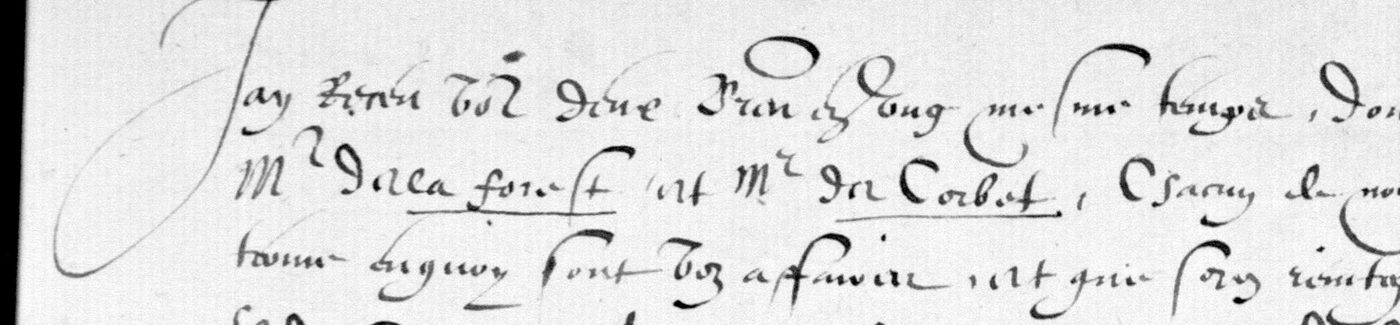
Clairambault 357 is volume XLVII of the Bossuet-era collection of documents on Henri III’s reign (1583–1587). On Gallica it is btv1b9001053r. Folio 167r is canvas 331, the verso with the date and the sender’s signs is canvas 332, and folio 168r is canvas 333. The letter is not solid cipher. The writer drops into clear for a word or a phrase, and in clear he names Bordeaux and writes “tres fasché du bon terme en quoy sont voz affaires”.

02 The interlinear decipherment, and the key check
About thirty lines down f. 167r, a ✝ in the left margin marks the point where f. 168 stops. From there the decipherer worked between the lines. Checking the glosses against Tomokiyo’s table is a direct test of both:

| Figures | Interlinear gloss | Tomokiyo’s key gives |
|---|---|---|
| 74 24 34 28 29 72 | Guienne | g u i e n e |
| 26 43 28 82 | tres | t r e s |
| 18 37 19 35 34 25 28 19 26 | confident | c o n f i d e n t |
| 25 24 # | du Roy de Navarre | d u + a nomenclator sign |
| 35 24 64 87 | Fumé | f u m + 87, which is therefore e |
| 92 81 | et que | et que |
Above the cross, the key’s reading of the figures matches f. 168 in the runs tested. For example, 25 28 88 22 20 24 26 88 72 82 70 14 | 18 28 gives de r · autres pla|ce, where f. 168 has et autres places qui vous ont esté distraictes. The check adds a few things to the published table. 87 is e and 71 is a. 22, the commonest group, reads as a null in every word checked. 66 is a null, and so are the dotted groups 45.31.73.65.21. The double-barred # is the King of Navarre, glossed three times. D is England, and && is Mayenne, as Tomokiyo had it.
03 What the letter says
From f. 168, with uncertain words marked [?] and passages not transcribed …:
Jay receu voz deux lettres en ung mesme temps, dont jay faict communication a Mr de la Forest et Mr de Corbet. … Indisposé d'une maladye qui ma travaillé pres de deux moys, qui a empesché vous escrire. … comme le voyage et negotiation qu'il entreprenoit [?] estoit contraire a celle de l'an passé, seroit trouvé estrange non seullement de ses amys, catholiques de France, mais des princes estrangers. Sur quoy il apportoit tout ce qu'il pouvoit de raisons. … qui luy promettoit l'asseurance [?] de ne desirer faire la paix qu'a condition qu'il n'y auroit que la Religion catholique en France … que chascun avoit faict son affaire, et l'avoit on laissé seul abandonné. … Je croy que faisant des stances [?] et autres places qui vous ont esté distraictes vous les pourrez avoir ou du moings faire congnoistre que vous n'y quictez rien.
From the interlinear decipherment of the rest, transcribed line by line at full resolution on 23 October 2026 with the writer’s clear stretches between the cipher lines, and the few unglossed groups decoded with the key:
Je vous diray que j'ay esté pressé, et la seule bonne volonté d'un que vous congnoissez s'y a mis de pratique, au moyen de reputation, qui s'appelle Fumée, vizadmiral de Guyenne, tres confident du Roy de Navarre, bien qu'il soit catholique et loyal a moy, a donné le retour de deça pour quelque negotiation … Il m'a plusieurs foys proposé cette reconciliation, qu'il dict luy estre aussy aysé et facille comme je la luy fais difficille et malaisée …
J'ay envoyé a Rendan les lettres pour la Royne de Navarre, et croy qu'elle les aura bien tost. [J'ay] receu hier une lettre de Villeroy, qui me manda que pour contenter Monsieur du Mayne … neantmoings on se servira de ceste occasion a conclure la paix, et si l'on donne quelque advantage aux Huguenotz, l'on se fondera [sur la] rupture de ceste armée, qui nous viendra passer sur le ventre et achever de ruiner ce pauvre pays.
“He has several times proposed this reconciliation to me, which he says is as easy and simple for him as I make it hard and awkward for him”: Fumée, on behalf of the King of Navarre, offers to carry the business through, with ships for an embarkation under cover of another voyage; the writer finds it “as thin as it is of little foundation”, like the Queen Mother sending the late Admiral to Florida. On the verso, Villeroy writes that the occasion will be used to conclude the peace, and if the Huguenots gain by it, the breaking up of the army “will come and pass over our bellies and finish ruining this poor country”.
The writer is a Catholic nobleman of the Angoumois or Saintonge. He mentions the abbey of La Couronne near Angoulême, Mrs de la Forest and de Corbet, and Bordeaux. He writes during the autumn of 1586, while Catherine de Médicis was negotiating with Henri of Navarre (the interviews of Saint-Brice took place that December). The addressee is set against Navarre as head of the other religious party, and Mayenne is named in the third person, so the addressee is most likely Henri, duke of Guise. The identification is inferred; the letter does not name him.
04 What remains uncertain
- F. 168 is a fast secretary hand, and several phrases are transcribed only tentatively. Examples are the words after Charry, the passage on the abbot of La Couronne, and the last sentence. That sentence seems to pair protecteur with the Catholics, the reverse of what is expected, and needs the matching cipher words decoded.
- Only sample runs above the cross were decrypted with the key and compared with f. 168. All of them agreed, but the page has not been checked word by word.
- The interlinear part, transcribed in full on 23 October 2026: a few doubtful words (son [?edit], [?des lettres]), one cut gloss, and a few unglossed figure strings (under “ne pourroit procurer”, in the line “si porte bien”, and the last line before the date) whose strokes run together at full resolution. The interlinear part builds coherent sentences but reads at 94.2%, under the 95% bar; the clear text of f. 168 reads at 95.5%.
- The sender’s signs at the foot of f. 167v (8 X X 8) are neither glossed nor in Tomokiyo’s table, and Fumée is not identified beyond his office.
Full texts
The transcription and the decryption of every document on this page, so that the reading can be used and checked. Short files are shown here; all are in the repository.
ff. 167-168, 28 Oct 1586: f. 168r, the contemporary clear copy of f. 167r ll. 1-30 (to the cross mark)
A Catholic nobleman of the Angoumois or Saintonge writes on 28 October 1586, probably to Henri, duc de Guise: he has been ill for two months, reports Catherine de Médicis's negotiation with Navarre, says Navarre's Catholic confidant Fumé, vice-admiral of Guyenne, has repeatedly proposed a reconciliation between Navarre and the addressee, and mentions the Queen of England and Villeroy's letter about satisfying Mayenne.
Transcription
# PARTIAL. No full transcription of the cipher on ff. 167r-v exists in the repository: only sample runs were
# decoded against the glosses (profile documents[0].transcription.notes). The runs below are copied verbatim from
# NOTES.md (section "System"), each with the gloss it carries on the manuscript. Images: Gallica btv1b9001053r,
# canvases 331-332.

74 24 34 28 29 72            = Guienne
26 43 28 82                  = tres
18 37 19 35 34 25 28 19 26   = confident
25 24 #                      = du Roy de Navarre
35 24 64 87                  = Fumé
92 81                        = et que
25 28                        = de
…25 28 88 22 20 24 26 88 72 82 70 14 | 18 28 …   = de[s] autres pla|ce[s]  (f. 168: "et autres places")
C 66 35 24 64 87             = C [null] Fumé
45.31.73.65.21               = dotted group at the opening of the letter and again before D, outside the text stream
88 28 18 19 25 14 19 …       = f. 167v, before "Villeroy" [Ω]
Decryption
<!-- Copied verbatim from NOTES.md, section 'Text' (22 Oct 2026): the contemporary clear copy (f. 168r) and interlinear decipherment (f. 167r-v), transcribed from the images. -->

## Text

Transcribed from the images. Abbreviations are expanded silently, and [?] marks an uncertain reading. f. 168 is a
continuous clear text. The glossed part is given as the glosses read, and figures without a gloss are marked (…).

### f. 168r (= f. 167r, ll. 1-30 in cipher)

> Jay receu voz deux lettres en ung mesme temps, dont jay faict communication a M^r de la Forest et M^r de Corbet.
> Charry … estant tres fasché du bon terme en quoy sont voz affaires, et que serez rentré dedans au plustost [?].
> Indisposé d'une maladye qui ma travaillé pres de deux moys, qui a empesché vous escrire. Pendant ce temps la
> qui fut la cause que le commis a l'abbé de la Couronne [labbé written above a struck word], par le moyen se
> debvroit entendre … de M^r de Nemours [?], et remettre vingt [?] de leurs troupes [?] qui prendroit a moy
> advis, plustost par vous le mariage effectué, auquel je montroit bien avoir regret, … ne m'en retint pas de luy
> dire, comme le voyage et negotiation qu'il entreprenoit [?] estoit contraire a celle de l'an passé, seroit trouvé
> estrange non seullement de ses amys, catholiques de France, mais des princes estrangers. Sur quoy il apportoit
> tout ce qu'il pouvoit de raisons. La meilleure et plus apparente [?] estoit … de la Royne mere, dont il bailloit
> appuy a qui il vouloit, qui luy promettoit l'asseurance [?] de ne desirer faire la paix qu'a condition qu'il n'y
> auroit que la Religion catholique en France, et passa oultre, que s'il eust esté aux termes qu'il avoit
> designez avec vous, il n'eust entreprins le voyage, que chascun avoit faict son affaire, et l'avoit on laissé seul
> abandonné. Le bruit que ces jours icy [?] avoit couru par tout que voulliez venir est bien jusques a moy. …
> [au]mosnier [corrected "aon" over a struck word] cest [?] qui venoit en ce pays, … compagnye et … ressentira
> [?] richement … que me donn[e] … a pense … tout ce bruict que vous recommandiez … pour ne me sembler a propos
> de le f[aire]. Cependant ne pressé ne comprise [?] que sont les seulles causes qui vous y doivent precipiter. Je
> croy que faisant des stances [?] et autres places qui vous ont esté distraictes vous les pourrez avoir ou du
> moings faire congnoistre que vous n'y quictez rien. La poursuite ne les travaux [?] de la brouillerie du Roy de
> Navarre et de vous, que je tiens tres difficile pour la qualité que chascun de vous a prinse, luy de [protecteur?]
> … Catholiques … Huguenotz … qui passe avant. ✝

The last sentence is uncertain. The image seems to show "luy de protecteur les Catholiques … les Huguenotz", but the
word before "les Catholiques" may not be "protecteur", and the words between are not read. The sense expected is that
Navarre protects the Huguenots and the addressee the Catholics. It needs the matching cipher words decoded.

### f. 167r from the ✝ (interlinear decipherment)

> ✝ Je vous diray que j'ay esté pressé, et la seule bonne volonté d'un que vous congnoissez s'y a mis de
> pratique, au moyen de reputation, qui s'appelle [✝ C] **Fumé, visadmiral de Guienne, tres confident du Roy de
> Navarre**, bien qu'il soit catholique et loyal a moy. [Il] a donné le retour de deça pour quelque negotiation, car
> je sçay comment de ce voyage a [R = Navarre/Nérac?] et a [✝o] … Il est bien adverty. Il m'a plusieurs foys
> **proposé cette reconciliation**, qu'il dict luy estre aussy aysé et facille comme je la luy fais difficille et
> malaisée, et en … c'est bien si avant que … si vous y voullez entendre … aux … moy … ce … Il m'a quasy prié de
> la part du **Roy de Navarre** [#] la bonne proposée [?] et que [92 81] Il se trouvera [?] … mesme … la guerre
> … sy [D =] **Angleterre** … moyen a la bonne fin [?] … par ce seul moyen se faisoit … asseurance que **la Royne
> [D] d'Angleterre ne pourroit procurer** … des [⊖] … de la court …

### f. 167v (interlinear decipherment, glossed throughout)

> **Fumé**, si luy voulliez [?] commettre cette charge, … d'autre … [ai]sance [?] qu'il … voyage. Il vous
> fournira d'autant … pour Cambaronne [?] … avant [✝] envoyant … la Royne mere, le filz … admiral, a la
> Coride [?] … mais c'est pour vous a vostre service … Monsieur … Jay envoyé a [88 28 18 19 25 14 19 …]
> **Villeroy** [Ω] qui me manda que pour contenter **Monsieur du Mayne** [&&] a l'instance, prieres et requestes
> … a faict son estat a premier de sa … comme aussy se retirent les … que Il n'y a de toutes choses et mesme
> … Il ne pouvoit faire … conclure la paix et si l'on donne quelque advantage aux Huguenotz [⊖?] … l'on se
> fonde …

The verso glosses are faint in places, and this pass did not read them word by word. The words above are the ones read
with confidence.
Reading
<!-- Reading of Clairambault 357 f. 168r (Claude Opus 5.5, 23 Oct 2026): the contemporary clear copy of f. 167r ll. 1-30 (the cipher up to the cross mark), as transcribed in texts/f167_decryption.md (from NOTES.md, "Text"), with the quotation marks and line breaks removed; nothing else changed. Abbreviations expanded silently there; [?] = uncertain reading, … = not read, [x] letters supplied. The last sentence is uncertain (see the note in f167_decryption.md). The continuation from the cross is entry 1 (texts/f167_interlinear_reading.md). -->

# Clairambault 357 f. 168r, 28 Oct 1586: the clear copy of f. 167r up to the cross

## Reading

Jay receu voz deux lettres en ung mesme temps, dont jay faict communication a M^r de la Forest et M^r de Corbet.
Charry … estant tres fasché du bon terme en quoy sont voz affaires, et que serez rentré dedans au plustost [?].
Indisposé d'une maladye qui ma travaillé pres de deux moys, qui a empesché vous escrire. Pendant ce temps la qui fut la
cause que le commis a l'abbé de la Couronne, par le moyen se debvroit entendre … de M^r de Nemours [?], et remettre
vingt [?] de leurs troupes [?] qui prendroit a moy advis, plustost par vous le mariage effectué, auquel je montroit bien
avoir regret, … ne m'en retint pas de luy dire, comme le voyage et negotiation qu'il entreprenoit [?] estoit contraire a
celle de l'an passé, seroit trouvé estrange non seullement de ses amys, catholiques de France, mais des princes
estrangers. Sur quoy il apportoit tout ce qu'il pouvoit de raisons. La meilleure et plus apparente [?] estoit … de la
Royne mere, dont il bailloit appuy a qui il vouloit, qui luy promettoit l'asseurance [?] de ne desirer faire la paix
qu'a condition qu'il n'y auroit que la Religion catholique en France, et passa oultre, que s'il eust esté aux termes
qu'il avoit designez avec vous, il n'eust entreprins le voyage, que chascun avoit faict son affaire, et l'avoit on
laissé seul abandonné. Le bruit que ces jours icy [?] avoit couru par tout que voulliez venir est bien jusques a moy. …
[au]mosnier cest [?] qui venoit en ce pays, … compagnye et … ressentira [?] richement … que me donn[e] … a pense … tout
ce bruict que vous recommandiez … pour ne me sembler a propos de le f[aire]. Cependant ne pressé ne comprise [?] que sont
les seulles causes qui vous y doivent precipiter. Je croy que faisant des stances [?] et autres places qui vous ont esté
distraictes vous les pourrez avoir ou du moings faire congnoistre que vous n'y quictez rien. La poursuite ne les travaux
[?] de la brouillerie du Roy de Navarre et de vous, que je tiens tres difficile pour la qualité que chascun de vous a
prinse, luy de [protecteur?] … Catholiques … Huguenotz … qui passe avant. ✝
Translation
<!-- English translation of texts/f168_reading.md (Claude Opus 5.5, 23 Oct 2026), with the same holes: [?] uncertain word (the English carries the word followed by [?]), … not read. Where holes break the syntax the translation stays close to the words. -->

# Clairambault 357 f. 168r, 28 Oct 1586: the clear copy of f. 167r up to the cross, English translation

I have received your two letters at the same time, which I have communicated to Monsieur de la Forest and Monsieur de
Corbet. Charry … being very vexed at the good state in which your affairs are, and that you will have got back in as
soon as possible [?]. Unwell with an illness that has troubled me for nearly two months, which has prevented my writing
to you. During that time, which was the reason that the clerk to the Abbot of La Couronne, by the means [by which] he was
to come to an understanding … of Monsieur de Nemours [?], and to hand over twenty [?] of their troops [?], who would take
advice from me, rather through you the marriage carried out, at which I showed much regret, … did not keep me from
telling him that the journey and negotiation he was undertaking [?], being contrary to that of last year, would be found
strange not only by his friends, the Catholics of France, but by foreign princes. Whereupon he brought all the reasons
he could. The best and most plausible [?] was … of the Queen Mother, from whom he gave support to whom he pleased, who
promised him the assurance [?] that she wished to make peace only on condition that there should be only the Catholic
religion in France; and he went further: that if he had been on the terms he had arranged with you, he would not have
undertaken the journey; that everyone had done his own business, and he had been left alone, abandoned. The rumour that
ran everywhere these last days [?] that you wished to come has indeed reached me. … the almoner, this [?], who was coming
to this country, … company and … will feel [?] richly … that gives me … thought … all this rumour that you recommended …
as it did not seem to me proper to do it. Meanwhile neither pressed nor included [?], which are the only causes that
should hasten you to it. I believe that by making stances [?] and other places that have been taken from you, you will
be able to have them, or at least make it known that you give up nothing there. The pursuit nor the labours [?] of the
quarrel between the King of Navarre and you, which I hold very difficult because of the character each of you has
taken, he of [protector?] … Catholics … Huguenots … which comes first. ✝
ff. 167-168, 28 Oct 1586: f. 167r from the cross mark and f. 167v, interlinear decipherment and the clear stretches between the cipher lines read in part
The rest of the letter: Fumée, vice-admiral of Guyenne and Navarre's Catholic confidant, has repeatedly proposed a reconciliation with Navarre and would bring it to a good end; by it the war could be opened in England, and Fumée would supply ships for the embarkation under cover of another voyage; the writer compares the plan with Coligny's Florida venture; letters for the Queen of Navarre sent through Randan; Villeroy writes about satisfying Mayenne, the withdrawal of the reiters and Swiss, and a peace with the Huguenots that would ruin the country.
Builds coherent sentences, but under the read bar of 95% of words read as sense (94% here); the holes are marked in the reading.
Transcription
f167_interlinear_transcription.txt
# Clairambault 357 f. 167r from the cross mark, and f. 167v (Gallica btv1b9001053r canvases 331-332), read 23 Oct 2026 (b26).
# One block per manuscript line. CLEAR = the writer's clear text; GLOSS = the decipherer's interlinear words over the
# figures; FIG = the figure groups as read (digits are uncertain where the strokes run together; the reading follows the
# gloss where one exists); DEC = b26_clair_dec.py output where a group has no gloss or the gloss was checked.

## f. 167r (after ✝)
CLEAR  141926 | ✝ Je vous diray que j'ay esté pressé et la seule bonne volonté d'un que vous congnoissez s'y a mis de pratique au moyen de reputation qui s'appelle ✝C
FIG    66 35 24 64 87 63 34 27 14 25 64 67 88 14 70 25 28 / 74 24 34 28 29 72 22 26 43 28 27 18 37 19 35 34 25 28 19 26 25 24 #
GLOSS  Fumée | Vizadmiral | de | Guyenne | tres confident | du Roy de Navarre (#)
DEC    fume uisadmiral de guiene . tres confident du [#]
CLEAR  bien qu'il soit catholique et loyal a / moy a donné le retour de deça pour quelque negotiation car je sçay comment de ce voyage a R et a ✝o et —
GLOSS  R = Nerac ; ✝o = la court
CLEAR  Il est bien adverty Il m'a plusieurs foys
FIG    68 43 23 40 37 27 72 77 72 18 28 28 27 72 26 28 43 72 18 37 19 18 34 13 34 20 26 / 67 37 19
GLOSS  proposé cette reconciliation
CLEAR  qu'il dict luy estre aussy aysé et facille comme je la luy fais difficille et malaisée et en / est bien sy avant depuis dix jours qu'il m'a quasy prié de la part du # la bonne propose[?] (# glossed Roy de Na[varre])
FIG    92 81    GLOSS et que
FIG    27 98 78 98 63 37 24 13 34 28 41 28 19 26 72 19 25 88 28 | 83 27 72 40 43 37 64 28 18 26 37 34 26 64 28 19 28
GLOSS  si vous y voulliez entendre | Il se promectoit mene[r]
DEC    si VOUS y uoulliez entendre IL se promectoit mene
FIG    43 14 24 28 18 64 37 98 27 28 19 28 12 37 18 72 20 16 37 29 28 17 34 19
GLOSS  avec moy se negoce a bonne fin
DEC    r auec moi se negoce abonefin
CLEAR  et par ce seul moyen se faisoit / ouverture de
FIG    70 14 12 24 28 87 9? 7 22 28 19 D          GLOSS la guerre | sy | angleterre
CLEAR  avec promesse / [et] asseurance que
FIG    70 14 88 37 73 41 19 28   GLOSS la Royne
FIG    45 31 73 D 19 28 27 77 72 88 37 34 18 26 27 72 81 83 72 24 88 24 28 25 28 88 ⊖ 25 72 25 66 15 90 ✝o
GLOSS  (la Royne struck) d'angleterre | ne pourroit procurer | des Huguenotz (⊖) | de la court (✝o)
CLEAR  et que luy —

## f. 167v
FIG    35 24 64 87 27 98 70 24 98 63 37 24 13 34 28 41 18 37 42 42 28 18 26 88 28 18 28 27 72 26 28 18 86 14 43 12 28 ...
GLOSS  Fumée | si | luy | voulliez | commettre | cette | charge | soubz[?]
FIG    18 37 24 13 28 24 88 25 20 24 26 43 28 63 37 98 14 12 28 83 78 17 37 24 88 19 34 43 37 34 26 25 14 24 26 70 26 14 19 26
GLOSS  couleur | d'autre | voyage | Il vous | fourniroit | d'autant
DEC    couleur dautre uoiage IL VOUS fourniroit dautltant
FIG    26? 34 36 28 20 24 70 77 85 24 43 34 70   GLOSS vaisseaux | qu'il
CLEAR  seroit necessaire pour
FIG    51 20 19 16 14 43 85 24 28 64 28 19 26    GLOSS l'embarquement      DEC lanbarquement
CLEAR  Je ne me suis / de bonne [heure?] avance[?] de ses choses pour les trouver aussy maigres que peu de fondement et m'est
CLEAR  quant [sign glossed: la Royne mere] envoyant
FIG    45 91 99 70 28 35 72 24 14 25 64 34 88 20 70 20 70 20 35 70 37 88 34 25 28
GLOSS  le feu | admiral | a la Floride      DEC .<91><99> lefeu admiral alaflor ide
CLEAR  mais c'est pour vous [bou…] / juger que vous fondant d'une part l'on en faict autant d'ailleurs C✝
FIG    20 63 37 41 27 72 88 43 24 43 34 26 28 24 43   GLOSS a voz servit[eu]rs (?)
CLEAR  J'ay envoyé a
FIG    88 28 19 25 14 19 70 28 88 27 70 28 47 47 88 28 27 40 37 72 44 43 [sign]
GLOSS  Rendan | les lettres | pour | la Royne de Na[varre] (sign)
CLEAR  et croy qu'elle les aura bien tost / receu hier une lettre de Ω (glossed Villeroy) qui me manda que pour contenter && (glossed Monsieur du Mayne) a l'instance prieres et requestes qu- /
CLEAR  a faicte son [edit?] a premier de son [retour?] comme aussy se retirent les reistres et Suisses et la reste /
CLEAR  car [moy?] je croy qu'en deffault qu'il y a de toutes choses et mesmes d'hommes il ne pourroit faire au-
FIG    42 28 14 19 26 64 37 34 19 12 82 37 19 27 72 82 77 28 72 84 43 24 43 34 88 20 25 28 18 28 27 72 26 28 37 73 22 20 27 34 37 19 14 18 / 70 24 88 28 70 14 40 20 34 77
GLOSS  neantmoings | on se servira | de cette occasion | a conclure | la paix
DEC    meantmoings on se.. ruri ra de ceste o d . asion a c / lure lapaix
CLEAR  et si l'on donne quelque advantage
FIG    14 24 70 77 99 91 95 ⊖     GLOSS aux Huguenotz
CLEAR  l'on se fonder[a] / rupture de ceste armée qui nous viendra passer sur le ventre et achever de ruiner ce pauvre pays.
FIG    94 27 98 40 37 88 26 28 16 34 28 19 67 28 82 72 24 43 34 82 26 37 77 72 26 88 28 82 77 24 43 24 43 34 26 28 24 88
GLOSS  si porte | bien | (other words faint)
DEC    <94> si porte bien ie s(e)uis (u)ostre s..uriteur
CLEAR  Je / envoye des
FIG    45 31 73 70 28 47 88 28 88 25 72 44 37 24 44 3 25 28 43 37 24 36 28
GLOSS  (cut) de M^r de la Forest
CLEAR  Du 28me octobre 1586        [signs] 8 X X 8
Decryption
# Clairambault 357 f. 167r (from the cross mark) and f. 167v, 28 Oct 1586: reading

Rests on: the contemporary interlinear decipherment written over the figure groups (the decipherer's glosses), the
writer's own clear stretches between the cipher lines, and, where a group has no gloss or the gloss is cut, the figures
decoded with Tomokiyo's table as extended in `key.md` (`research/reading_audit/b26_clair_dec.py`). Read on the
full-resolution Gallica images (btv1b9001053r canvases 331-332, `img/` in the main checkout) on 23 Oct 2026; glosses
and clear text transcribed line by line in `f167_interlinear_transcription.txt`. Spelling as written; abbreviations
expanded; apostrophes and punctuation editorial.

Marks: `[?word]` partly carried (a doubtful gloss or clear word, or a decode the gloss does not confirm), `[word]`
supplied, `[…]` unread. Nomenclator signs are given by their glosses (✝C before Fumée has none and is left out).

## Reading

Je vous diray que j'ay esté pressé, et la seule bonne volonté d'un que vous congnoissez s'y a mis de pratique, au
moyen de reputation, qui s'appelle Fumée, vizadmiral de Guyenne, tres confident du Roy de Navarre, bien qu'il soit
catholique et loyal a moy, a donné le retour de deça pour quelque negotiation, car je sçay comment de ce voyage a
Nerac et a la court, et il est bien adverty. Il m'a plusieurs foys proposé cette reconciliation, qu'il dict luy
estre aussy aysé et facille comme je la luy fais difficille et malaisée, et en est bien sy avant depuis dix jours
qu'il m'a quasy prié de la part du Roy de Navarre la bonne [?proposer], et que si vous y voulliez entendre, il se
promectoit mener avec moy se negoce a bonne fin, et par ce seul moyen se faisoit ouverture de la guerre [?sy] en
Angleterre, avec promesse et asseurance que la Royne d'Angleterre ne pourroit procurer des Huguenotz de la court, et
que luy Fumée, si luy voulliez commettre cette charge soubz couleur d'autre voyage, il vous fourniroit d'autant [de] vaisseaulx
qu'il seroit necessaire pour l'embarquement. Je ne me suis de bonne [?heure] [?avancé] de ces choses pour les trouver
aussy maigres que peu de fondement, et m'est [advis] quant la Royne mere envoyant le feu admiral a la Floride; mais
c'est pour vous […] juger que, vous fondant d'une part, l'on en faict autant d'ailleurs, [?a voz serviteurs].

J'ay envoyé a Rendan les lettres pour la Royne de Navarre, et croy qu'elle les aura bien tost. [J'ay] receu hier une
lettre de Villeroy, qui me manda que pour contenter Monsieur du Mayne, a l'instance, prieres et requestes qu'il a
faicte, son [?edit] a premier de son [?retour], comme aussy se retirent les reistres et Suisses et la reste. Car
[?moy] je croy qu'en deffault qu'il y a de toutes choses, et mesmes d'hommes, il ne pourroit faire au[…];
neantmoings on se servira de ceste occasion a conclure la paix, et si l'on donne quelque advantage aux Huguenotz,
l'on se fondera [sur la] rupture de ceste armée, qui nous viendra passer sur le ventre et achever de ruiner ce pauvre
pays. [Il] si porte bien, [?je suis vostre serviteur]. Je [vous] envoye [?des lettres] de M^r de la Forest.

Du 28^me octobre 1586.

## Notes

- The recto ends "et que luy" and the verso opens "Fumée, si luy voulliez": one sentence across the page.
- Glosses that correct earlier fragment readings: "Cambaronne" is "l'embarquement" (51 20 19 16 14 43 85 24 28 64 28
  19 26); "Coride" is "a la Floride" (20 70 20 35 70 37 88 34 25 28), with "le feu admiral" (Coligny) before it;
  "Saisonne" is "vaisseaulx"; the sign before "envoyant" is glossed "la Royne mere"; ✝o is glossed "la court" and R
  "Nerac"; the sign after "pour" in "les lettres pour …" is glossed "la Royne de Navarre"; ⊖ is glossed "Huguenotz"
  twice. 73 = d is confirmed ("45 31 73 D" glossed "d'Angleterre").
- "ne pourroit procurer" is the gloss; the figures under it read "ne s…roict" (sauroict?) and were not settled.
- The figure line at the end (45 31 73 70 28 47 88 28 …) is glossed only in part ("de M^r de la Forest"); the decode
  gives "lettre … de … rousse", so "[?des lettres]" is bracketed.
Reading
# Clairambault 357 f. 167r (from the cross mark) and f. 167v, 28 Oct 1586: reading

Rests on: the contemporary interlinear decipherment written over the figure groups (the decipherer's glosses), the
writer's own clear stretches between the cipher lines, and, where a group has no gloss or the gloss is cut, the figures
decoded with Tomokiyo's table as extended in `key.md` (`research/reading_audit/b26_clair_dec.py`). Read on the
full-resolution Gallica images (btv1b9001053r canvases 331-332, `img/` in the main checkout) on 23 Oct 2026; glosses
and clear text transcribed line by line in `f167_interlinear_transcription.txt`. Spelling as written; abbreviations
expanded; apostrophes and punctuation editorial.

Marks: `[?word]` partly carried (a doubtful gloss or clear word, or a decode the gloss does not confirm), `[word]`
supplied, `[…]` unread. Nomenclator signs are given by their glosses (✝C before Fumée has none and is left out).

## Reading

Je vous diray que j'ay esté pressé, et la seule bonne volonté d'un que vous congnoissez s'y a mis de pratique, au
moyen de reputation, qui s'appelle Fumée, vizadmiral de Guyenne, tres confident du Roy de Navarre, bien qu'il soit
catholique et loyal a moy, a donné le retour de deça pour quelque negotiation, car je sçay comment de ce voyage a
Nerac et a la court, et il est bien adverty. Il m'a plusieurs foys proposé cette reconciliation, qu'il dict luy
estre aussy aysé et facille comme je la luy fais difficille et malaisée, et en est bien sy avant depuis dix jours
qu'il m'a quasy prié de la part du Roy de Navarre la bonne [?proposer], et que si vous y voulliez entendre, il se
promectoit mener avec moy se negoce a bonne fin, et par ce seul moyen se faisoit ouverture de la guerre [?sy] en
Angleterre, avec promesse et asseurance que la Royne d'Angleterre ne pourroit procurer des Huguenotz de la court, et
que luy Fumée, si luy voulliez commettre cette charge soubz couleur d'autre voyage, il vous fourniroit d'autant [de] vaisseaulx
qu'il seroit necessaire pour l'embarquement. Je ne me suis de bonne [?heure] [?avancé] de ces choses pour les trouver
aussy maigres que peu de fondement, et m'est [advis] quant la Royne mere envoyant le feu admiral a la Floride; mais
c'est pour vous […] juger que, vous fondant d'une part, l'on en faict autant d'ailleurs, [?a voz serviteurs].

J'ay envoyé a Rendan les lettres pour la Royne de Navarre, et croy qu'elle les aura bien tost. [J'ay] receu hier une
lettre de Villeroy, qui me manda que pour contenter Monsieur du Mayne, a l'instance, prieres et requestes qu'il a
faicte, son [?edit] a premier de son [?retour], comme aussy se retirent les reistres et Suisses et la reste. Car
[?moy] je croy qu'en deffault qu'il y a de toutes choses, et mesmes d'hommes, il ne pourroit faire au[…];
neantmoings on se servira de ceste occasion a conclure la paix, et si l'on donne quelque advantage aux Huguenotz,
l'on se fondera [sur la] rupture de ceste armée, qui nous viendra passer sur le ventre et achever de ruiner ce pauvre
pays. [Il] si porte bien, [?je suis vostre serviteur]. Je [vous] envoye [?des lettres] de M^r de la Forest.

Du 28^me octobre 1586.

## Notes

- The recto ends "et que luy" and the verso opens "Fumée, si luy voulliez": one sentence across the page.
- Glosses that correct earlier fragment readings: "Cambaronne" is "l'embarquement" (51 20 19 16 14 43 85 24 28 64 28
  19 26); "Coride" is "a la Floride" (20 70 20 35 70 37 88 34 25 28), with "le feu admiral" (Coligny) before it;
  "Saisonne" is "vaisseaulx"; the sign before "envoyant" is glossed "la Royne mere"; ✝o is glossed "la court" and R
  "Nerac"; the sign after "pour" in "les lettres pour …" is glossed "la Royne de Navarre"; ⊖ is glossed "Huguenotz"
  twice. 73 = d is confirmed ("45 31 73 D" glossed "d'Angleterre").
- "ne pourroit procurer" is the gloss; the figures under it read "ne s…roict" (sauroict?) and were not settled.
- The figure line at the end (45 31 73 70 28 47 88 28 …) is glossed only in part ("de M^r de la Forest"); the decode
  gives "lettre … de … rousse", so "[?des lettres]" is bracketed.
Translation
# Clairambault 357 f. 167r (from the cross mark) and f. 167v, 28 Oct 1586: English

Translation of `f167_interlinear_reading.md`, with the same holes: `[?word]` doubtful, `[word]` supplied, `[…]` unread.
Names modernised here only.

## Translation

I will tell you that I have been pressed, and the sole goodwill of a man you know has set things in motion, by means of
his reputation: his name is Fumée, vice-admiral of Guyenne, a close confidant of the King of Navarre, although he is
a Catholic and loyal to me. He has made the return journey here for some negotiation, for I know how [things went] on
this journey to Nérac and to the court, and he is well informed. He has several times proposed this reconciliation to
me, which he says is as easy and simple for him as I make it hard and awkward for him; and he has gone so far these
ten days that he has all but begged me, on behalf of the King of Navarre, to [?propose] it in good part, and that if
you would agree to it, he promised himself to bring this business to a good end with me; and by this one means an
opening would be made for the war [?if] in England, with a promise and assurance that the Queen of England could not
obtain [help] from the Huguenots at court; and that he, Fumée, if you would entrust him with this charge under cover
of another journey, would supply you with as many ships as would be needed for the embarkation.

I have not [?early] [?pressed on] with these matters, finding them as thin as they are of little foundation, and it
seems [to me] like when the Queen Mother sent the late Admiral to Florida; but it is for you […] to judge whether,
relying on one side, the same is done from elsewhere, [?to your servants].

I have sent to Randan the letters for the Queen of Navarre, and I believe she will have them soon. [I] received
yesterday a letter from Villeroy, who wrote to me that, to satisfy Monsieur de Mayenne at his urging, prayers and
requests, [the King] has made his [?edict] at the first [?return], as the reiters and Swiss and the rest are also
withdrawing. For I [?myself] believe that, for want of everything, and even of men, he could not do […]; nevertheless
this occasion will be used to conclude the peace, and if some advantage is given to the Huguenots, they will rely
[on the] breaking up of this army, which will come and pass over our bellies and finish ruining this poor country.
[He] is well, [?I am your servant]. I send [you] [?letters] from M. de la Forest.

28 October 1586.
Key: key.md
05 Sources
- BnF, Clairambault 357, ff. 167–168: Gallica btv1b9001053r, views 331–333.
- S. Tomokiyo, “Anonymous Figure Cipher (1586)”, in “French Ciphers during the Reigns of Charles IX and Henry III”, cryptiana, with the reconstructed table.
The notes, the transcription and the crop tools are in the repository (targets/clair357/). Page images are not committed.