

At a glanceKnown key applied · complete
- The mémoires
- Armand de Bourbon, prince de Conti, generalissimo of the Paris Fronde, Paris, 26 and 27 March 1649, probably to the marquis de Noirmoutier, his envoy with Archduke Leopold Wilhelm.
- Where
- Bibliothèque nationale de France, Français 3854 nos. 41–42, ff. 113r–v and 115r (Gallica btv1b52520094g). Catalogue item 26.
- The cipher
- Lower-case letters for letters, mixed with clear words. Three letters have two signs each; five signs stand for two to four letters each. No nomenclator.
- How it was deciphered
- George Lasry deciphered both and printed the key and the text (HistoCrypt 2023). Here the three pages were transcribed afresh from the images and decrypted with his key, choosing among the readings of each polyphonic sign with a French language model.
- What it says
- The talks at court are about to break on Normandy and Mazarin; Noirmoutier is to conclude nothing before the last word, but be ready.
- Still open
- Three illegible signs; “Tenerande” unidentified; “dix” or “six mil hommes”.
- Credit
- George Lasry (the solution and the key, 2023).
Until 14 October 2026 this page also carried no. 43, Conti’s mémoire for Laigue of 5 March 1649. It is in a numeric code of letters and syllables, a different cipher, with its own page.
01 The documents
BnF Français 3854 (Gallica btv1b52520094g) is a recueil of Fronde papers from the prince de Conti’s side, January to April 1649. It holds his instructions to his envoys, the marquis de Noirmoutier and Geoffroy de Laigue, the Archduke’s Spanish answers, and three pieces in cipher. Omont describes these two as follows:
- No. 41 (f. 113r–v): “Mémoire, avec chiffre, du prince de Conti. A Paris, ce 26 mars 1649”.
- No. 42 (f. 115r): the same, “ce 27 mars 1649”, signed Armand de Bourbon.
The catalogue assumed that no. 43, which has a contemporary decipherment, would be the crib for these two. It is not: nos. 41 and 42 are written in lower-case letters mixed with clear words, no. 43 in numbers. Measured on the fresh transcription, the two mémoires hold 1,692 cipher signs; all but three illegible ones have a value under Lasry’s key.
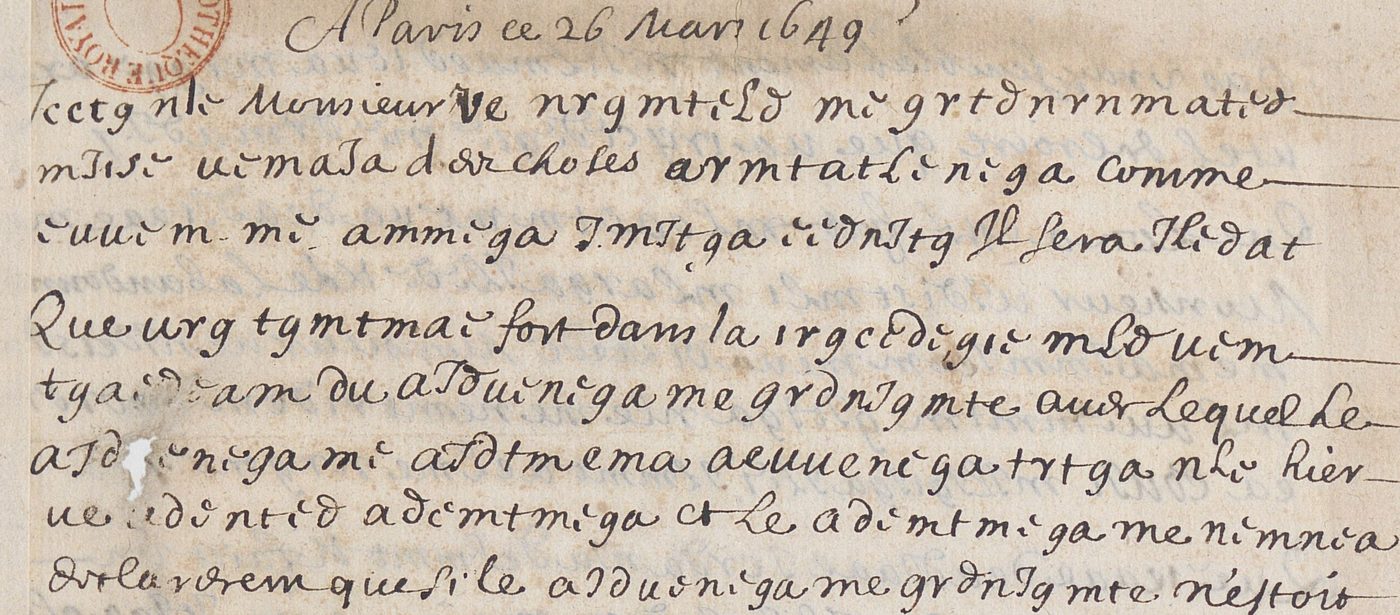
02 Nos. 41 and 42: Lasry’s decipherment, and three corrections
Prior art. A web search before any work found George Lasry, “Armand de Bourbon’s Poly-Homophonic Cipher – 1649”, HistoCrypt 2023. Lasry deciphered both letters, printed their text with a translation, and described the system.
- How it works. Each plaintext letter is written as a cipher letter. A, L and R each have two symbols (homophones). Five symbols each stand for two to four letters (polyphony): a = t/p/a/b, e = e/g, i = c/z, m = s/d/x, n = m/q.
- The key. There is no nomenclator. The key’s second row spells J’aime c’est un grand mal, a Boesset air of 1642.
- The catalogue entry. His paper cites the volume as “fr. 3584”, a typo, which is why the catalogue did not match it.
Decrypted again here. All three pages were transcribed symbol by symbol from the full-resolution images. Because five symbols are polyphonic, decryption means choosing a letter for each of them: a search over the possible letters, scored with a French quadgram model and then a period word list, made the choice. The text agrees with Lasry’s throughout, apart from the three points below.
Corrections to Lasry’s text of nos. 41 and 42
- f. 113r: dans lequel temps les choses ne pouvant pas. The cipher has
ge= NE, which the printed text drops. - No. 42: ordonne à ses députez de se joindre à ceux de son Altesse le prince de Conti pour insister à demander l’éloignement du cardinal Mazarin. The words are in the cipher (
arldtgmtmaed) and in Lasry’s own figure, but not in his clean text. - f. 113v: Bretaigne is enciphered with the L symbol in second place, a slip of the encipherer’s.
“Monsieur de Tenerande”, with whom Longueville is to treat, decrypts the same under the key; the person is unidentified. “Dix” or “six mil hommes” cannot be settled, because one symbol serves both d and s.
Depuis la lettre que je vous escrivi hier j’ay cru vous debvoir advertir qu’on a donné aujourd’huy arrest au parlement qui ordonne à ses députez de se joindre à ceux de son Altesse le prince de Conti pour insister à demander l’éloignement du cardinal Mazarin. On ne doute plus après cela de la rupture … Ne concluez rien pourtant que vous n’ayez le dernier advis, mais si elle arrive, mettez-vous en estat d’en faciliter les suittes. No. 42, 27 March 1649
03 What remains uncertain
- No. 41: Tenerande is unidentified, and “dix” or “six mil hommes” is open.
- Three signs are illegible in the fresh transcription (1,689 of 1,692 have a value).
- The addressee is Noirmoutier only probably (Lasry): the mémoire names him in the third person.
Full texts
The transcription and the decryption of every document on this page, so that the reading can be used and checked. Short files are shown here; all are in the repository.
Nos. 41-42, 26 and 27 March 1649, ff. 113r-v, 115r
Conti, a leader of the Fronde, reports on the Saint-Germain conference to (probably) Noirmoutier: the insistence on the interests of the Parlement de Normandie, to which the Parlement de Paris is closely joined; the first president and président de Mesmes declaring a rupture if Normandy were not satisfied; and the demand for the Cardinal's exclusion. Written after the Peace of Rueil and days before the Peace of Saint-Germain. READING.md is the decipherment made here from a fresh transcription (raw decoder output decoded.txt); George Lasry's own full text and translation are §4 of his HistoCrypt 2023 paper (lasry2023.pdf), with three small differences listed in READING.md.
Transcription
# My transcription of BnF fr. 3854 nos. 41-42 from the Gallica full-res images (canvases 237, 238, 241).
# Cipher signs: J (capital-J sign) a c d(round d) e g i(short stroke; in this hand often = e) l(looped l) m n o r s(long s) t u v
# [..] = clear text in the ms. '?' = sign illegible. One line per ms line.
== f113r (no. 41, 26 March 1649)
Jcctg nle [Monsieur Le] nrgmtild mie grtdnrnmatid
mJsie ue maJa [des choses] armtatliniga [comme]
euuem mie aJmmiga J mitga iiedJtg [il sera] Jlidat
[Que] urg tgmtmai [fort dans la] irgcidigie mld uim
tgaidiam [du] aJduiniga me grdnJgmte [avec lequel le]
aJduiniga mie aJdtm ema aeuueniga trtga nle [hier]
ue adeniid adeimtmiga [et le] adeimtmiga me nimniia
[declarerent que si le] aJduiniga me grdnJgmte [n'estoit]
irgaiga vrg drnadrta [les interests] ml mta aJduiniga
mrga edJgam [ce qui faict] idrtde vJ dlaalde
nle urg tgmtmaedJ [fort encore] mld ue emiulmtrg
ml iJdmtgJuuem mealaei [de Messieurs] vem egiedJlm
[en ayant] el rdmde emadem
[Que l'on] menJgme igird armtatliniga [et sans]
nlrg eg altmme diuJmisid [que Monsieur]
meurgeliltuue adJtaaidJ [avec Monsieur] me
aegidJgme
[Que sur] iem Jdatiuem [on attend] u?dlaalde [de la]
[quelle on parleroit] aum armtatliniga mt mrg
Juaemme [n'agiroit pas avec quelque] meaegmJgie
nle ledtaJauiniga ui aJduiniga J atig JiirdmiiuJ
aride [mais avec] rdmde armtatc me ge irgatglid
[pas la] irgcidigie Jadem nlJadi trldm imaedei
[qui est le] aenam nle mrta ml ddid vJ
adrurgeJatrg [et que les] mealaei meg diltegmdrga
[dans lequel] aenam uem isrmem ge arlJga
== f113v
[pas vraysemblablement] mJlumaed ieuJ mrgge arld
utel [et croire que] uJ irgcidigie mie drmadJ
[Que l'on a este fort] mldadtm me uJ deadJtaae me
[Monsieur] uJdistmli ml argaJlidt [et de l'abandonnement]
me aJmmJeem me uJ dtltede [Monsieur] ue nJdeismu
ml auimmtm gJtJga nle me nemtridem crdiem
ea eouJi mJlJgiJga Jleie mt aelme nrgme
[Que] ieaae deadJaae J crdJ nJu delmmt [et faict un]
[fort] edJga ardJ Jli JccJtdem [mais que n'y] JtJga glu
mJgied me deadegmde ug aJmmJie mld uJ dtltede
[cela redonneroit] isJuelD Jlm JccJdem eJ deneaadrta
[tout en] argemaJa [ce que l'on attend] Jamrueneiga [de son]
Juaemme tnaed
[Que] mtnJgisie rlulgmt [on ne manquera] me lrlm
mrgged Jmltm me uJ medgtede dim mrlulatrg mim isrmem
[qu'on espere telle qu'on la peut desirer y ayant] ailme
ulnttide JuJiirnrmmiget [mais qu'au cas] nltume ctma
ie ge meda artga mJgm cJtde arlm uem eccrdma arld
atded [les assurances] miuJatm eegedJue
[Les] adrltgiem mrga eg ieaemaJa [Monsieur]
me urgelcltuue Jmtm ntu srnnem [que] asrlurlme
[a donne] uJddema [que] ardmeJlm ?? uJue mrgged
[Que la] adrlegie [est en] Jdnem Jleiue artarlue
aedtelelm me nledit me vtnrmtg ea [quantite] me vtelm
[on] aveaJtege [x] eaue aelaue me adtm [mieux intentionne]
[que jamais]
== f115r (no. 42, 27 March 1649)
mealtm vJveaade nlete lrlm emidtltsted [j'ay cru vous]
[debvoir] Jmledatd nlrg Jmrgge Jltrldmsla JddemaJl
aJduenega nlt rdmrgge [a ses] mealaeimemetrtgmde
Jielmmemr gJuaemmeveadtgiemeirgat arldtgmtmaed
JmenJgmed veurtegenegamliJdmtgJunJiJdtg [on ne]
[doute plus] JademieuJmeuadlaalde [vous scavez assez]
nleuuemnemldemtutJJadeJmdeuJmemmlm
geirgiuleidteg arldaJJa [que vous] geJJtemuemedgted
Jmltm [mais si] euueJddtleneaaeilrlmegemaJameg
cJitutaeduemmltaaem [Armand de Bourbon]
Decryption
# Reading of BnF fr. 3854 nos. 41–42 (Conti, 26 and 27 March 1649)

This text was deciphered from my own transcription of the Gallica images (`transcription.txt`). It was decoded with
Lasry's key by quadgram beam search plus word-level rescoring (`decode2.py`, raw output in `decoded.txt`). I then
normalized it by hand where the machine reading shows a polyphone choice or a slip of my transcription.

- Cipher runs are in *italics*; the rest is clear text in the manuscript.
- ⟨ ⟩ marks an enciphering slip in the original.

## No. 41, f. 113r–v — "A Paris ce 26 Mars 1649"

*Affin que* Monsieur Le *Monsieur de Noirmo⟨u⟩stier sache l'estat* des choses *positivement* comme
*elles se passent à S[ain]t Germain*, il sera *averti* que *l'on insiste* fort dans la *conférence sur les intérêts*
du *parlement de Normandie* avec lequel le *parlement de Paris est tellement joint. Que* hier *le premier président*
et le *président de Mesmes* déclarèrent que si le *parlement de Normandie* n'estoit *content l'on romproit.*
Les intérêts *du dit parlement sont grants*, ce qui faict *croire la rupture.*

*Que l'on insistera* fort encore *sur l'exclusion du Cardinal, les députez* de Messieurs *les généraux* en ayant
*eu ordre exprès.* Que l'on *demande encor positivement* et sans *qu'on en puisse relascher* que Monsieur
*de Longueville traittera* avec Monsieur *de Tenerande* [cipher `a ẽ g ı ∂ J g m e`, person unidentified].

Que sur *ces articles* on attend *la rupture*, de laquelle on parleroit *pl[u]s positivement si son Altesse*
n'agissoit pas avec quelque *dépendance. Que véritablement le parlement a bien accordé la t⟨r⟩êve*, mais avec
*ordre positif de ne continuer* pas la *conférence après quatre jours expirez*, qui est le *temps que doit durer la
prolongation*, et que les *députez s'en reviendront*; dans lequel *temps les choses ne pouvant* pas
vraysemblablement *s'ajuster, cela donne pour lieu* et croire que *la conférence se rompra.*

Que l'on a esté fort *surpris de la retraitte de* Monsieur *l'archiduc du Pont-à-Vert* et de l'abandonnement
*des passages de la rivière*, Monsieur *le mareschal du Plessis n'ayant que de médiocres forces, et Erlac
s'avançant avec si peu de monde.* Que *cette retraitte a fort mal réussi* et faict un fort *grand tort aux affaires*,
mais que n'y *ayant nul danger de reprendre un passage sur la rivière*, cela redonneroit *chaleur aux affaires et
remettroit* tout en *bon estat*, ce que l'on attend *absolument* de son *Altesse Impér[iale].*

Que *dimanche ou lundi* on ne manquera *de vous donner advis de la dernière résolution des choses*, qu'on espère
telle qu'on la peut désirer, y ayant *peu de lumière à l'accommodement*; mais qu'au cas *qu'il se fist, ce ne sera
point sans faire tous les efforts pour tirer* les assurances *de la paix générale.*

Les *provinces sont en cet estat*: Monsieur *de Longueville a dix* [or *six*: `m` = s/d/x] *mil hommes.*
Que *Thoulouse* a donné *l'arrest.* Que *Bordeaux va le donner.* Que la *Provence* est en *armes avec le Poitou,
le Périgueux, de Quercy, de Limosin, et* quantité *de lieux en B⟨l⟩etaigne, et le peuple se* [*pris*?] mieux
intentionné que jamais.

## No. 42, f. 115r — "A Paris ce 27 Mars 1649"

*Depuis la lettre que je vous escrivi hier* j'ay cru vous debvoir *advertir qu'on a donné aujourd'hui arrest au
parlement qui ordonne* à ses *députez de se joindre à ceux de son Altesse le prince de Conti pour insister à
demander l'éloignement du cardinal Mazarin.* On ne doute plus *après cela de la rupture.* Vous scavez assez
*quelles mesures il y a à prendre là-dessus. Ne concluez rien pourtant* que vous *n'ayez le dernier advis*, mais si
*elle arrive, mettez-vous en estat d'en faciliter les suittes.* Armand de Bourbon.

## Differences from Lasry 2023 (§4)

1. **f. 113r, last line: *ne pouvant pas*.** The manuscript has `ge` = NE before `arlJga` *pouvant*. Lasry prints
   "pouvant pas".
2. **f. 113r: *pl[u]s positivement*.** The `aum` just before it is cipher (P‑L‑S), not the clear word "au". This agrees
   with Lasry's reading and gives the reason for it.
3. **No. 42: *pour insister à demander*.** Lasry has "à demander". The manuscript enciphers `arldtgmtmaed` =
   POVRINSISTER before it, and his own Figure 8 shows these letters, but his clean text leaves them out.
4. **f. 113v: *Bretaigne*** is enciphered with the L-sign `v` in the second place (B⟨l⟩etaigne), an enciphering
   slip. Lasry prints B[r]etaigne.
5. **The name after "Monsieur de" is read the same way as Lasry: TENERANDE.** Here the short-stroke sign `ı` is the
   E sign, as it is throughout f. 113. I briefly wrote "TENCRANDE" from reading `ı` as Lasry's C sign; that is
   withdrawn. The person is still unidentified.
6. **Still open, as in Lasry:**
   - *dix/six mil hommes*: `Jmtm`, where `m` = s/d/x.
   - *se pris*: `me adtm`.
Decryption
== f113r (no. 41, 26 March 1649)
AFFIN QUE monsieur le MONSIEUR SEE NOIR MO MS TIER
SAH CE LE STAT des choses POSITI UEMENT comme
ELLES SEE PASSENT A DE INT CE GRAIN il sera AUERTI
que LON INSISTE fort dans la CONFERENCE SUR LES
INTERETS du PARLEMENT DE NORMANDIE avec lequel le
PARLEMENT SEE PARIS EST TELLEMENT IOINT QUE hier
LE PRE MGER TREZ DISENT et le TREZ DISENT DE MESME ET
declarerent que si le PARLEMENT DE NORMANDIE n'estoit
CONTENT LON ROM TROIT les interests DU DIT PARLEMENT
SONT GRAN AD ce qui faict CROIRE LA RUPTURE
QUE LON INSISTER A fort encore SUR LE EXCLUSION
DU CARDINAL LES DEPUTEZ de messieurs LES EN GERAUD
en ayant EU ORDRE EXPRES
que l'on DEMANDE ENCOR POSITI UEMENT et sans
QU ON EN PUISSE RELASCHER que monsieur
DE LONGUEUILLE TRAITTER A avec monsieur DE
A EN GRANDE
que sur CES ARTICLES on attend L? RUPTURE de la
quelle on parleroit A LS POSITI UEMENT SI SON
ALTESSE n'agiroit pas avec quelque DE PENDANCE
QUE UERITABLEMENT LE PARLEMENT A BIEN ACCORDEE LA
A OERE mais avec ORDRE POSITIF DE NE CONTINUER
pas la CONFERENCE APRES QUATRE IOURS ESPEREE
qui est le TEMPS QUE SOIT DU RR ER LA
PROLONGATION et que les DEPUTEZ SEN REUIENDRONT
dans lequel TEMPS LES CHOSES NE POU ANT

== f113v
pas vraysemblablement SAULX PER CELA DONNE POUR
LIEU et croire que LA CONFERENCE SEE ROS TRA
que l'on a este fort SURPRIS DE LA RE TRAITTE DE
monsieur LARCHIDUC DU PONT A UERI et de l'abandonnement
DE PASSAGES DE LA RIUIERE monsieur LE MARECH SL
DU PLESSIS NA IANT QUE DE MEDIOCRES FORCES
ET ER LAC DAUAN CANT AUE CE SI PEU DE MON DE
que CETTE REPR APPE A FORA MAL REUSSI et faict un
fort ERANT POR A AUE AFFAIRES mais que n'y AIANT NUL
DANGER DE REPRENDRE LN PASSAGE SUR LA RIUIERE
cela redonneroit CHALEUR AUX AFF A RES EA RE METTROIT
tout en BON ESTAT ce que l'on attend A A DO LE ME EN A de son
ALTESSE IMPER
que DIMANCHE E OU LUNDI on ne manquera DE UOUS
DONNER ADUIS DE LA DERNIERE RES SOU LUTION DES CHOSES
qu'on espere telle qu'on la peut desirer y ayant PEU DE
LUM IIERE AL ACCOM OS DE NEI mais qu'au cas QU IL DE FIST
CE NE SERA POINT DANS FAIRE TOUS LES EFF ORD A POUR
TIRER les assurances DE LATIS GENERALE
les PROUINCES SONT EN CE TESTAT monsieur
DE LO NEUFUILLE A DIS MIL HOMMES que THOULOUSE
a donne LA RR EST que BORDEAUX ?? LA LE DONNER
que la PROUENCE est en ARMES AUEC LE POITOU LE
PERIGUEUX DE QUERCI DE LIMOSIN ET quantite DE LIEUX
on A LE TAIGNE x ET LE PEUPLE DE PRIS mieux intentionne
que jamais

== f115r (no. 42, 27 March 1649)
DEPUIS LA LETTRE QUE IE UOUS EXE RIUI HIER j'ay cru vous
debvoir ADUERTIR QU ON A DONNE AUIOURD HUT ARREST AU
PARLEMENT QUI ORDONNE a ses DEPUTEZ DE DE IOINDRE
A CEUX DE DO NAL TESSE LE PRINCE DE CONTI POUR INSISTER
A DEMANDER LE LOIGNEMENT DU CARDINAL MAZARIN on ne
doute plus APRES CELA DE LA RUPTURE vous scavez assez
QUELLES MESURE DILI A A PRE ADRE LA DESSUS
NE CONCLU ECRI EN POUR A A A A que vous NE A A IESLE DERNIER
ADUIS mais si ELLE ARRIUE METTEZ UOUS EN ESTATS EN
FACILITER LES SUIPPES armand de bourbon
Decryption: lasry2023.pdf
Translation
<!-- English translation of READING.md (Claude Opus 5.5, 23 Oct 2026): nos. 41 and 42 of BnF fr. 3854, the clear text and the cipher runs (italics in READING.md, not marked here) as one text; the enciphering slips are translated as the intended word; the unidentified name and the doubtful figure are kept as READING.md gives them. -->

# Conti's letters, BnF fr. 3854 nos. 41-42 (Paris, 26 and 27 March 1649): English translation

## No. 41, f. 113r-v, Paris, 26 March 1649

So that Monsieur [Le] Monsieur de Noirmoutier may know the state of things positively, as they are going at Saint-
Germain, he will be informed that in the conference they are insisting strongly on the interests of the Parlement of
Normandy, with which the Parlement of Paris is so closely joined. That yesterday the First President and President de
Mesmes declared that if the Parlement of Normandy were not satisfied, they would break off. The interests of the said
Parlement are great, which makes one believe in a rupture.

That they will also insist strongly on the exclusion of the Cardinal, the deputies of the generals having had express
orders to do so. That they also demand positively, and without any possibility of yielding on it, that Monsieur de
Longueville shall negotiate with Monsieur de Tenerande [person unidentified].

That on these articles a rupture is expected, of which one would speak more positively if His Highness did not act with
some dependence. That the Parlement has indeed granted the truce, but with positive orders not to continue the
conference after the four days have expired, which is the time the prolongation is to last, and that the deputies will
come back; and since within that time things cannot probably be settled, this gives grounds to believe that the
conference will break off.

That people were much surprised at the withdrawal of the Archduke from Pont-à-Vert and the abandonment of the river
crossings, Monsieur the Marshal du Plessis having only middling forces, and Erlach advancing with so few men. That this
withdrawal has turned out very badly and done very great harm to affairs; but that, there being no danger in retaking a
crossing on the river, this would give warmth to affairs again and put everything back in good order, which is
absolutely expected of His Imperial Highness.

That on Sunday or Monday we shall not fail to give you word of the final resolution of things, which we hope will be such
as can be wished, there being little light on an accommodation; but that, in case one were made, it will not be without
making every effort to draw from it assurances of the general peace.

The provinces are in this state: Monsieur de Longueville has ten [or six] thousand men. That Toulouse has issued the
decree. That Bordeaux is going to issue it. That Provence is in arms, with Poitou, Périgord, Quercy, Limousin, and many
places in Brittany, and the people [?] better disposed than ever.

## No. 42, f. 115r, Paris, 27 March 1649

Since the letter I wrote you yesterday, I thought I should inform you that today a decree was issued in the Parlement
ordering its deputies to join those of His Highness the Prince of Conti in insisting on demanding the removal of
Cardinal Mazarin. After that no one doubts the rupture any more. You know well enough what measures are to be taken on
that. Conclude nothing, however, until you have the last word; but if it comes, put yourself in a position to facilitate
what follows from it. Armand de Bourbon.
04 Sources
- BnF Français 3854, nos. 41–42, ff. 113–115. Gallica btv1b52520094g, canvases 237–241; description in BnF Archives et manuscrits.
- George Lasry, “Armand de Bourbon’s Poly-Homophonic Cipher – 1649”, Proceedings of HistoCrypt 2023, Linköping Electronic Conference Proceedings. ecp.ep.liu.se.
- Code and data:
targets/conti1649/.- Nos. 41–42: transcription (
transcription.txt), decoder (decode2.py) and reading (READING.md). - No. 43 (a different code) moved to
targets/laigue1649/.
- Nos. 41–42: transcription (