
At a glanceExisting decipherment · complete
- The letter
- Despatch no. 25 of 13 February 1626 from Louis XIII and his secretary Herbault to Philippe de Béthune, ambassador in Rome.
- Where
- BnF Français 3669, one of some thirty letters of 1625–26. The catalogue marks no. 25 “avec chiffre” but not with a decipherment.
- The cipher
- The same cipher as no. 26, with the plaintext written between the lines by a contemporary decipherer.
- How it was read
- No. 26 is the same despatch, so no. 25 has had a decipherment three folios away since 1626. The text was transcribed from it; no cryptanalysis was needed.
- What it says
- The papal Legate’s mission and the troops for the Valtelline; why the crown had just made peace with the Huguenots; the prince of Piedmont in Paris trying to drag France into war with Spain.
01 The series and the missing decipherment
Français 3669 is a recueil of originals: the King and Herbault writing to Béthune in Rome through the autumn and winter of 1625–26, most pieces catalogued “avec chiffre et déchiffrement” because the embassy’s clerk wrote the plaintext of each ciphered passage onto the sheet as he deciphered it. One piece breaks the pattern. The volume is digitised from a black-and-white microfilm of double-page openings; canvas equals folio plus five, fixed on the foliation of ff. 70 and 73.
| Piece | Letter | Leaves | Cipher |
|---|---|---|---|
| 24 | Herbault → Béthune, 6 February 1626 | ff. 67–68 | none noted |
| 25 | Herbault → Béthune, 13 February 1626 | ff. 69–71 | cipher, no decipherment |
| 26 | the same letter, 13 February 1626 | ff. 72–74 | cipher with interlinear decipherment |
| 27 | Louis XIII → Béthune | f. 75– | cipher and decipherment |
Both copies are made up for sending, each with its own address leaf, wax seal and docket. Both open on the same words under the same marginal note, “Le roy fera responce”. And their clear text runs word for word: the same paragraphs on Rambouillet’s delayed departure for Spain, the promotion of cardinals and Marquemont’s hat, the courier sent on the 6th through the Venetian ambassador Contarini, the peace with the Huguenots, the prince of Piedmont’s arrival, down to the King’s sore toe, “quelque douleur à cause d’ung ongle qui luy entre dans la chair”, which kept him in bed and delayed Herbault’s report.
02 Why the identification is safe
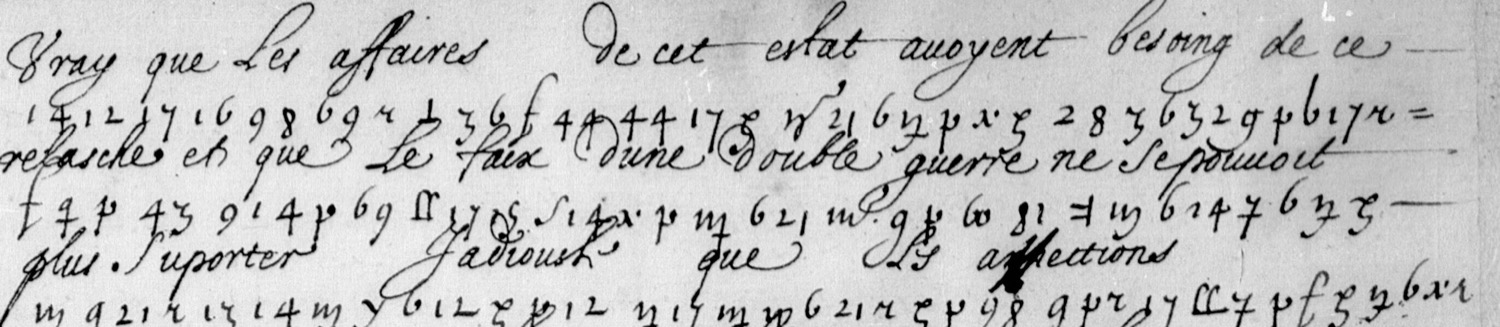
Three things show that no. 26 is a copy of the same despatch as no. 25.
- The clear text is identical, paragraph by paragraph, including incidental matter no second letter would repeat verbatim: the memoir of Cardinal Bevilacqua for Horatio Giraldi, the naturalisation letters obtained through Cardinal de la Valette, the sore toe.
- The cipher runs fall at the same points, after the same clear words: “en laquelle il aura laissé”, “dont nous esperons estre bientost esclaircis”, “au nom de ce prétendu comte de”, “besoing de ce”, “Vous scaurez maintenant que”, “Toutes ces propositions”, “il nous faut continuer ceste mesme routte jusques”.
- The groups match where checked. No. 25’s first run opens
to 92 … 17 … 43and no. 26’s opensto 92 g 17 … 43 …; the third run ends… 68 93 …in both, with the same short group after it. The two clerks’ hands differ enough that individual figures look different at this resolution, so the claim is limited to the runs corresponding; group-for-group identity is not claimed.
The cipher itself is a nomenclator of one- to three-character groups mixing Arabic figures with letter-forms. The opening run, to 92 g 17 ẓ 43 x cu 4 7 ẓ p x 3 3 6 x, stands for
“le Pape pour l’acheminement de ces troupes in la Valt(eline)”: about eighteen groups for some forty-eight letters, so most groups carry a syllable or a whole word. The table is not
reconstructed here because the decipherment makes it unnecessary, and roughly thirty further glossed letters of 1625–26 in the same cipher sit in the same volume for anyone who wants it.
03 What the letter says
Herbault writes to the ambassador in Rome on the eve of the Treaty of Monzón. The ciphered passages concern the Valtelline, the Huguenot peace, the Dutch ships and Savoy.
The Valtelline. Herbault waits on news of the papal Legate’s departure for Spain and of the last resolution in which he will have left “le Pape pour l’acheminement de ces troupes in la Valt(eline)”, an affair which deserves “l’envoy d’un courrier exprez”, and above all “principallement sy le Pape entroit dans la partialité”, the fear that Urban VIII would cease to mediate and take a side.
Why the crown had just made peace with its Protestants. The peace “s’affermit de jour en jour” and is welcome even to those “qui ont tousjours le plus hautement conseillé le chastiment et la guerre contre les huguenots”, because, in cipher, “les affaires de cet estat avoyent besoing de ce relasche, et que le faix d’une double guerre ne se pouvoit plus supporter”, while “les affections de noz voysins qui font profession de ceste religion pretendue refformée estoyent grandement alterés”. In plain terms, France made peace at home because it could not afford two wars, and because the Protestant powers abroad were turning.
The ships. Béthune has already been told of “la conduitte des Anglois envers nous, et comme une partye des vaisseaux hollandois s’estoyent retirez”. Now he is to know that the Huguenot admiral (Soubise, identified from context) “a suivy depuis sept ou huict jours avec le reste de sa flotte; la route des premiers par l’ordre des estatz et sans permission de Sa Ma(jes)té ny de Mons(ieu)r l’Admiral, et dans la conioncture de la conclusion de la paix”. The Dutch squadron lent to the King against La Rochelle had sailed home on its own States’ orders, while the peace was being concluded.
And Savoy’s push for war. The prince of Piedmont reached Paris on Monday the 9th, surprising Longueville and the maréchal de Créquy who were to have met him, and saluted the King out hunting in the warren at Saint-Germain. Once the King is back he will begin to treat, and all his propositions “tendent à engager le Roy à la guerre avec l’Espagne, (et que) la Seig(neu)rie de Venize contribue comme faict l’Angleterre et Holande”. Herbault replies that Sa Majesté “escoutera tout ce qu’il luy sera representé, et scaura bien prendre la resolution convenable au bien de ses affaires”. Six weeks later the King did so, settling with Spain separately at Monzón and leaving Venice and Savoy out of it.
A closing practical passage, also part-ciphered, weighs keeping the ordinary courier route against going by the Grisons, rejected for “d’autres longueurs et incommoditez, outre la despense”.
04 What remains
- The key is not tabulated. It would need the groups aligned to the glossed words, which the decipherer’s placement only loosely indicates, and the volume’s thirty other glossed letters would do it better.
- Two proper names are transcribed only from the gloss and are uncertain in the palaeography: the “S(ieu)r de Santriny” who made a proposition to Béthune, and the “prétendu comte de Montembelans” in whose name it was made.
- “L’admiral Soubise” is an identification from context (a Huguenot admiral with a fleet in February 1626); it is not a confident transcription of the gloss.
- Whether this letter or the series is in print was not checked.
Unvalidated. Checked: the folio-to-canvas mapping on two foliated leaves, the piece list against the leaves, the word-for-word identity of the two copies’ clear text, the correspondence of the cipher runs and the matching of groups at two places, and the transcription of every glossed passage quoted. Not checked: a group-by-group identity of the two ciphertexts, the key table, any printed edition. The text is the contemporary decipherment, transcribed; it was not decrypted independently.
Full texts
The transcription and the decryption of every document on this page, so that the reading can be used and checked. Short files are shown here; all are in the repository.
fr. 3669 no. 25 (deciphered from its twin no. 26), 13 Feb 1626
Raymond Phélypeaux d'Herbault, secretary of state, to Philippe de Béthune, ambassador at Rome, Paris 13 February 1626, on the eve of the Treaty of Monzón: the ciphered passages concern the Pope and the troops for the Valtelline, why the peace with the Huguenots was needed (the burden of a double war) and the withdrawal of the Dutch ships and the Huguenot fleet, and the prince of Piedmont's propositions pushing the King into war with Spain with Venice contributing.
Decryption
# Phelipeaux d'Herbault to Philippe de Béthune, Paris, 13 February 1626

BnF Français 3669 **no. 25** (ff. 69–71), the letter the catalogue lists as "avec chiffre" with no
decipherment, read from its twin **no. 26** (ff. 72–74), which is the same letter with the ciphered
passages deciphered between the lines by a contemporary hand.

`[chiffre: …]` marks a passage that stands in cipher in the original; the words inside are the
contemporary decipherment written above or below the cipher line in no. 26. `⟨?⟩` marks a reading I am
unsure of. Spelling is the clerk's, lightly normalised (accents, apostrophes); abbreviations expanded in
square brackets.

## Reading

**Monsieur,**

[in the margin: *Le roy fera responce aux*] principaux poincts de vos dernières depesches. Sa Majesté attend
de vos nouvelles sur le partement de mons[ieu]r le Legat pour aller en Espagne, et sur la dernière
resolution en laquelle il aura laissé **[chiffre: le Pape pour l'acheminement de ces troupes in la
Valt(eline)]**, dont nous esperons estre bientost esclaircis, **[chiffre: puisque cette affaire merite bien
l'envoy d'un courrier exprez]** … **[chiffre: principallement sy le Pape entroit dans la partialité]**.

Le roy revint hier de S[ain]t Germain en Laie, où il a aussi esté quelques jours. Sa santé est bonne, Dieu
mercy, à ung pied près, où il a senti quelque douleur à cause d'ung ongle qui luy entre dans la chair.
Ceste incommodité l'obligea hier de garder le lict; ce que j'ay peu depuis son retour a esté de luy
rapporter les principaux poincts de vos depesches. Pour les choses particulieres, elles ont esté remises,
ce qui m'empesche de satisfaire au memoire de mons[ieu]r le card[in]al Bevilacqua en faveur du S[ieu]r
Horatio Giraldi, pour ce gentilhomme de la maison de Languilara. Il a obtenu, y a desjà quelque temps, les
lettres de naturalité qu'il a desirées par l'entremise de mons[ieu]r le cardinal de la Valette. Quant à la
proposition qui vous a esté faite par le S[ieu]r **[chiffre: de Santriny ⟨?⟩]** au nom de ce prétendu comte
de **[chiffre: Montembelans ⟨?⟩]**, j'auray de vous et feray responce par une autre lettre particuliere
avant que l'ordinaire parte.

Mons[ieu]r le marquis de Rambouillet n'est point party pour l'Espagne, et l'estime qu'il tardera encores
quelques jours. L'on aura esgard que les Espagnols ne puissent prendre aucun advantage de l'office de
compliment dont il est chargé, et qu'il ne s'y passe aucune chose au préjudice de la dignité du roy.

L'advis de la promotion des cardinaux a esté bien receu par deçà, et en particulier le choix de mons[ieu]r
le cardinal de Marquemont. Sa Ma[jes]té faict response à la lettre qu'elle a receu de luy sur ce sujet, et
luy tesmoigne le consentement qu'elle a à son eslection. Vous accompagnerez, s'il vous plaist, ceste
demonstration des offices accoustumez et convenables au subject. Quant aux autres cardinaux, l'on remettra
à leur escrire lorsqu'ils auront donné part au roy de leur nouvelle dignité, et que nous aurons receu une
relation de tous, du poids et du merite de leurs personnes.

Je vous escriviz le 6[e] de ce mois soubs l'addresse de mons[ieu]r Marini, par un courrier exprès que
l'amb[assadeu]r Contarini depeschoit à Venise, et vous donnay les nouvelles de la conclusion de la paix
avec ceux de la religion prétendue refformée. Je vous envoye un dup[lica]t[a] de ceste depesche, avec le
double de l'acte qui les oblige. Ceste resolution s'affermit de jour en jour; elle est dans la probation
publique, mesme de ceux qui ont tousjours le plus hautement conseillé le chastiment et la guerre contre les
huguenots.

Il est vray que les affaires de cet estat avoyent besoing de ce **[chiffre: relasche, et que le faix d'une
double guerre ne se pouvoit plus supporter. J'advoue que les affections de noz voysins qui font profession
de ceste religion pretendue refformée estoyent grandement alterés]**.

Vous aurez veu ce que je vous ay cy devant escrit de la **[chiffre: conduitte des Anglois envers nous, et
comme une partye des vaisseaux hollandois s'estoyent retirez]**. Vous scaurez maintenant que **[chiffre:
l'admiral Soubise ⟨?⟩ a suivy depuis sept ou huict jours avec le reste de sa flotte; la route des premiers
par l'ordre des estatz et sans permission de Sa Ma[jes]té ny de Mons[ieu]r l'Admiral, et dans la
conioncture de la conclusion de la paix]**. Je doute mesmes, sy la guerre eust continué, sy les Anglois et
les autres **[chiffre: …]**.

Mons[ieu]r le prince de Piedmont arriva en ceste ville lundy dernier, [le] IX[e] de ce mois, aiant surpris
mons[ieu]r de Longueville et mons[ieu]r le mar[esch]al de Créquy, qui estoient destinez pour aller à sa
rencontre. Le lendemain il fut saluer le roy, estant à la chasse dans la garenne [de] S[ain]t Germain.
Maintenant que Sa Ma[jes]té est de retour, il commencera à traiter des affaires. Toutes ces propositions
**[chiffre: tendent à engager le Roy à la guerre avec l'Espagne, (et que) la Seig[neu]rie de Venize
contribue comme faict l'Angleterre et Holande]**. Mais Sa Ma[jes]té **[chiffre: escoutera tout ce qu'il luy
sera representé, et scaura bien prendre la resolution convenable au bien de ses affaires]**.

Je recognois la peine que vous et moy recevons du retardement de noz ordinaires, le dernier porteur de
v[ost]re despesche du 26[e] du mois passé n'estant arrivé que depuis deux jours. L'on considere aussi que,
de changer l'antienne voie et prendre celle des Grisons, il s'y trouveroit d'autres longueurs et
incommoditez, outre la despense. C'est pourquoy **[chiffre: à ce que]** il nous faut continuer ceste mesme
routte jusques **[chiffre: (les) affaires soyent plus avant declarées]**, et nous serons **[chiffre: …
plustost de courriers extraordinaires … (quand les) affaires le requerent]**.

Je vous baise les humbles les mains, et vous supplie me croire tousjours,

Monsieur, vostre humble et très [obéissant] serviteur,
**Phelippeaux**

Paris, ce XIII[e] febv[rie]r 1626

---

## The cipher

A nomenclator of one- to three-character groups mixing Arabic figures with letter-forms — for example the
first run reads `to 92 g 17 ᴢ 43 x cu 4 7 ᴢ ᵈ p x ᴣ ᴣ 6 ᵷ x` for "le Pape pour l'acheminement de ces troupes
in la Valt(eline)", about 18 groups for some 48 letters, so most groups stand for syllables or whole words.
Both copies carry the same runs at the same points in the text: no. 25's first run likewise opens `to 92 …
17 … 43 …` and its third run ends `… 68 93 …`, exactly as no. 26's does. That correspondence, together with
the word-for-word identity of the two copies' clear text, is what licenses reading no. 25 from no. 26.

Deriving the key group by group would need the groups aligned to the glossed words, which the decipherer's
placement only loosely indicates; that is left undone. It is not needed for the reading, and the volume
holds some thirty further letters of 1625–26 in the same cipher, nearly all with decipherments, for anyone
who wants the table.
Reading
# Phelipeaux d'Herbault to Philippe de Béthune, Paris, 13 February 1626

BnF Français 3669 **no. 25** (ff. 69–71), the letter the catalogue lists as "avec chiffre" with no
decipherment, read from its twin **no. 26** (ff. 72–74), which is the same letter with the ciphered
passages deciphered between the lines by a contemporary hand.

`[chiffre: …]` marks a passage that stands in cipher in the original; the words inside are the
contemporary decipherment written above or below the cipher line in no. 26. `⟨?⟩` marks a reading I am
unsure of. Spelling is the clerk's, lightly normalised (accents, apostrophes); abbreviations expanded in
square brackets.

## Reading

**Monsieur,**

[in the margin: *Le roy fera responce aux*] principaux poincts de vos dernières depesches. Sa Majesté attend
de vos nouvelles sur le partement de mons[ieu]r le Legat pour aller en Espagne, et sur la dernière
resolution en laquelle il aura laissé **[chiffre: le Pape pour l'acheminement de ces troupes in la
Valt(eline)]**, dont nous esperons estre bientost esclaircis, **[chiffre: puisque cette affaire merite bien
l'envoy d'un courrier exprez]** … **[chiffre: principallement sy le Pape entroit dans la partialité]**.

Le roy revint hier de S[ain]t Germain en Laie, où il a aussi esté quelques jours. Sa santé est bonne, Dieu
mercy, à ung pied près, où il a senti quelque douleur à cause d'ung ongle qui luy entre dans la chair.
Ceste incommodité l'obligea hier de garder le lict; ce que j'ay peu depuis son retour a esté de luy
rapporter les principaux poincts de vos depesches. Pour les choses particulieres, elles ont esté remises,
ce qui m'empesche de satisfaire au memoire de mons[ieu]r le card[in]al Bevilacqua en faveur du S[ieu]r
Horatio Giraldi, pour ce gentilhomme de la maison de Languilara. Il a obtenu, y a desjà quelque temps, les
lettres de naturalité qu'il a desirées par l'entremise de mons[ieu]r le cardinal de la Valette. Quant à la
proposition qui vous a esté faite par le S[ieu]r **[chiffre: de Santriny ⟨?⟩]** au nom de ce prétendu comte
de **[chiffre: Montembelans ⟨?⟩]**, j'auray de vous et feray responce par une autre lettre particuliere
avant que l'ordinaire parte.

Mons[ieu]r le marquis de Rambouillet n'est point party pour l'Espagne, et l'estime qu'il tardera encores
quelques jours. L'on aura esgard que les Espagnols ne puissent prendre aucun advantage de l'office de
compliment dont il est chargé, et qu'il ne s'y passe aucune chose au préjudice de la dignité du roy.

L'advis de la promotion des cardinaux a esté bien receu par deçà, et en particulier le choix de mons[ieu]r
le cardinal de Marquemont. Sa Ma[jes]té faict response à la lettre qu'elle a receu de luy sur ce sujet, et
luy tesmoigne le consentement qu'elle a à son eslection. Vous accompagnerez, s'il vous plaist, ceste
demonstration des offices accoustumez et convenables au subject. Quant aux autres cardinaux, l'on remettra
à leur escrire lorsqu'ils auront donné part au roy de leur nouvelle dignité, et que nous aurons receu une
relation de tous, du poids et du merite de leurs personnes.

Je vous escriviz le 6[e] de ce mois soubs l'addresse de mons[ieu]r Marini, par un courrier exprès que
l'amb[assadeu]r Contarini depeschoit à Venise, et vous donnay les nouvelles de la conclusion de la paix
avec ceux de la religion prétendue refformée. Je vous envoye un dup[lica]t[a] de ceste depesche, avec le
double de l'acte qui les oblige. Ceste resolution s'affermit de jour en jour; elle est dans la probation
publique, mesme de ceux qui ont tousjours le plus hautement conseillé le chastiment et la guerre contre les
huguenots.

Il est vray que les affaires de cet estat avoyent besoing de ce **[chiffre: relasche, et que le faix d'une
double guerre ne se pouvoit plus supporter. J'advoue que les affections de noz voysins qui font profession
de ceste religion pretendue refformée estoyent grandement alterés]**.

Vous aurez veu ce que je vous ay cy devant escrit de la **[chiffre: conduitte des Anglois envers nous, et
comme une partye des vaisseaux hollandois s'estoyent retirez]**. Vous scaurez maintenant que **[chiffre:
l'admiral Soubise ⟨?⟩ a suivy depuis sept ou huict jours avec le reste de sa flotte; la route des premiers
par l'ordre des estatz et sans permission de Sa Ma[jes]té ny de Mons[ieu]r l'Admiral, et dans la
conioncture de la conclusion de la paix]**. Je doute mesmes, sy la guerre eust continué, sy les Anglois et
les autres **[chiffre: …]**.

Mons[ieu]r le prince de Piedmont arriva en ceste ville lundy dernier, [le] IX[e] de ce mois, aiant surpris
mons[ieu]r de Longueville et mons[ieu]r le mar[esch]al de Créquy, qui estoient destinez pour aller à sa
rencontre. Le lendemain il fut saluer le roy, estant à la chasse dans la garenne [de] S[ain]t Germain.
Maintenant que Sa Ma[jes]té est de retour, il commencera à traiter des affaires. Toutes ces propositions
**[chiffre: tendent à engager le Roy à la guerre avec l'Espagne, (et que) la Seig[neu]rie de Venize
contribue comme faict l'Angleterre et Holande]**. Mais Sa Ma[jes]té **[chiffre: escoutera tout ce qu'il luy
sera representé, et scaura bien prendre la resolution convenable au bien de ses affaires]**.

Je recognois la peine que vous et moy recevons du retardement de noz ordinaires, le dernier porteur de
v[ost]re despesche du 26[e] du mois passé n'estant arrivé que depuis deux jours. L'on considere aussi que,
de changer l'antienne voie et prendre celle des Grisons, il s'y trouveroit d'autres longueurs et
incommoditez, outre la despense. C'est pourquoy **[chiffre: à ce que]** il nous faut continuer ceste mesme
routte jusques **[chiffre: (les) affaires soyent plus avant declarées]**, et nous serons **[chiffre: …
plustost de courriers extraordinaires … (quand les) affaires le requerent]**.

Je vous baise les humbles les mains, et vous supplie me croire tousjours,

Monsieur, vostre humble et très [obéissant] serviteur,
**Phelippeaux**

Paris, ce XIII[e] febv[rie]r 1626

---

## The cipher

A nomenclator of one- to three-character groups mixing Arabic figures with letter-forms — for example the
first run reads `to 92 g 17 ᴢ 43 x cu 4 7 ᴢ ᵈ p x ᴣ ᴣ 6 ᵷ x` for "le Pape pour l'acheminement de ces troupes
in la Valt(eline)", about 18 groups for some 48 letters, so most groups stand for syllables or whole words.
Both copies carry the same runs at the same points in the text: no. 25's first run likewise opens `to 92 …
17 … 43 …` and its third run ends `… 68 93 …`, exactly as no. 26's does. That correspondence, together with
the word-for-word identity of the two copies' clear text, is what licenses reading no. 25 from no. 26.

Deriving the key group by group would need the groups aligned to the glossed words, which the decipherer's
placement only loosely indicates; that is left undone. It is not needed for the reading, and the volume
holds some thirty further letters of 1625–26 in the same cipher, nearly all with decipherments, for anyone
who wants the table.
Translation
# Phelipeaux d'Herbault to Philippe de Béthune, Paris, 13 February 1626: English translation

Translation (Claude Opus 5.5, 23 Oct 2026) of the reading in `ct/letter_13feb1626.md`: BnF Français 3669 no. 25,
read from its twin no. 26, the same letter with the ciphered passages deciphered between the lines by a contemporary
hand. Passages that stand in cipher in the original are marked **[cipher: …]**, as in the reading; `⟨?⟩` marks a
doubtful reading, `…` an undeciphered or omitted stretch, `(word)` a word the decipherer supplies.

## Translation

**Monsieur,**

[in the margin: *The King will reply to the*] principal points of your last despatches. His Majesty awaits news from
you on the departure of Monsieur the Legate to go to Spain, and on the last resolution in which he will have left
**[cipher: the Pope as to the sending of these troops into the Valt(elline)]**, of which we hope soon to be
enlightened, **[cipher: since this affair well deserves the sending of an express courier]** … **[cipher: principally
if the Pope were to take sides]**.

The King came back yesterday from Saint-Germain-en-Laye, where he has also been some days. His health is good, thank
God, except for one foot, where he has felt some pain because of a nail growing into the flesh. This inconvenience
obliged him yesterday to keep to his bed; what I have been able to do since his return has been to report to him the
principal points of your despatches. Private matters have been put off, which prevents me from satisfying the
memorandum of Monsieur the Cardinal Bevilacqua in favour of the Sieur Horatio Giraldi, for that gentleman of the
house of Anguillara. He obtained some time ago the letters of naturalisation he desired, through the mediation of
Monsieur the Cardinal de La Valette. As for the proposal made to you by the Sieur **[cipher: de Santriny ⟨?⟩]** in the
name of that so-called count of **[cipher: Montembelans ⟨?⟩]**, I shall have [word] from you and shall reply by
another particular letter before the ordinary post leaves.

Monsieur the Marquis de Rambouillet has not left for Spain, and I think he will still delay some days. Care will be
taken that the Spaniards cannot take any advantage of the office of compliment with which he is charged, and that
nothing passes there to the prejudice of the King's dignity.

The news of the promotion of cardinals has been well received here, and in particular the choice of Monsieur the
Cardinal de Marquemont. His Majesty is replying to the letter he received from him on this subject, and testifies to
him the consent he gives to his election. You will accompany this demonstration, if you please, with the customary
offices fitting to the occasion. As for the other cardinals, writing to them will be deferred until they have
informed the King of their new dignity, and until we have received an account of them all, of the weight and merit
of their persons.

I wrote to you on the 6th of this month under cover to Monsieur Marini, by an express courier whom Ambassador
Contarini was sending to Venice, and gave you the news of the conclusion of the peace with those of the so-called
reformed religion. I send you a duplicate of that despatch, with the copy of the act that binds them. This
resolution grows firmer from day to day; it has public approval, even from those who have always most loudly advised
chastisement and war against the Huguenots.

It is true that the affairs of this state needed this **[cipher: respite, and that the burden of a double war could
no longer be borne. I admit that the affections of our neighbours who profess this so-called reformed religion were
greatly altered]**.

You will have seen what I wrote to you before of the **[cipher: conduct of the English towards us, and how a part of
the Dutch ships had withdrawn]**. You will now know that **[cipher: the admiral Soubise ⟨?⟩ has followed, seven or eight
days since, with the rest of his fleet; the route of the first [ships] by order of the States, and without leave of
His Majesty or of Monsieur the Admiral, and at the juncture of the conclusion of the peace]**. I even doubt, if the war
had continued, whether the English and the others **[cipher: …]**.

Monsieur the Prince of Piedmont arrived in this city last Monday, the 9th of this month, having surprised Monsieur de
Longueville and Monsieur the Marshal de Créquy, who were appointed to go to meet him. The next day he went to greet the
King, who was hunting in the warren of Saint-Germain. Now that His Majesty has returned, he will begin to treat of
affairs. All these proposals **[cipher: tend to engage the King in war with Spain, (and that) the Signoria of Venice
contribute as England and Holland do]**. But His Majesty **[cipher: will listen to all that is put to him, and will
know well how to take the resolution fitting to the good of his affairs]**.

I recognise the trouble that you and I suffer from the delay of our ordinary posts, the last bearer of your despatch
of the 26th of last month having arrived only two days ago. It is also considered that, if we changed the old route
and took that of the Grisons, other delays and inconveniences would be found there, besides the expense. That is why
**[cipher: so that]** we must continue this same route until **[cipher: (the) affairs are further declared]**, and we
shall be **[cipher: … rather by extraordinary couriers … (when the) affairs require it]**.

I kiss your hands humbly, and beg you to believe me always,

Monsieur, your humble and very [obedient] servant,
**Phelippeaux**

Paris, this 13th of February 1626