
At a glanceKey from adjacent plaintext · complete
- The letters
- Guy de Saint-Gelais, sieur de Lanssac, sent to Warsaw for the 1573 election of Henri d’Anjou as king of Poland, to Charles IX (26 April), to Anjou and to Catherine de Médicis (24 April), and to the King and Anjou again on 1 and 9 May.
- Where
- Bibliothèque nationale de France, Français 4735: f. 124 (no. 51), ff. 154–157 (nos. 60–61), ff. 160, 164, 174, on the Gallica microfilm btv1b9060724s. Not on DECODE.
- The cipher
- A homophonic cipher of graphic signs, two or three per common letter, with a dozen signs for syllables and words (et, car, pour, Allemagne, l’Empereur, me/nous).
- How it was deciphered
- The key was recovered from the Court decipherer’s marginal glosses, cut by the gutter on the microfilm, and from a solver run with those values fixed, checked against shuffled and blind controls. It corrects S. Tomokiyo’s published table, whose first row is shifted by one letter. On 2 and 3 October 2026 the key was extended by about fifteen signs on ff. 154 and 156, and checked sign by sign against Tomokiyo’s current table, which supplied st, il, nous, par and a second t; ff. 160, 164 and 174 were then transcribed again at full scale.
- What it says
- On 26 April, the dangers French travellers met in Germany. On 24 April, the Lithuanian lords’ promise of their vote, the Sultan’s recommendation made “avec ruse”, borrowed money, and to Catherine that by Monday she would be mere des deux plus grans roys du monde. In May, Polish venality and the powers ranged against the election.
- Measured
- Signs giving sense, per letter: f. 124 96/100 (96%); to Anjou, ff. 154r–v, 660/677 (97.5%); to Catherine, ff. 156r–v, 921/961 (95.8%); f. 160 91/91; f. 164 203/207 (98.1%); f. 174 123/123. The four letters of 9 May on ff. 182–189 turned out to be in clear.
- Still open
- 65 signs in all: line ends lost in the gutter of the microfilm or under the decipherer’s overwriting (Gallica has no other image of the volume), a few single signs, and one word sign on f. 164 that is in no key. Four signs of f. 124’s first passage carry a query.
01 The documents
BnF fr. 4735 is the second of the volumes of “pièces originales et de copies concernant l’histoire de France, 1569–1588” and, from no. 5 to no. 80, the Court’s file of the Polish election embassy: Monluc’s letters from Konin and Warsaw, the Polish memoranda on St Bartholomew, the King’s replies, and the letters of Lanssac and Gilles de Noailles from Warsaw and Płock in April and May 1573. The catalogue marks “avec chiffre et déchiffrement” against Lanssac’s letters of 24 April (nos. 60–61), 1 May (63, 65) and 9 May (70), and “avec chiffre” alone against no. 51 of 26 April. Gallica has the whole volume as a microfilm scan (btv1b9060724s, 614 unlabelled canvases); the folio of no. 51 is 124, canvas 242, not the 126 the catalogue entry here first gave.
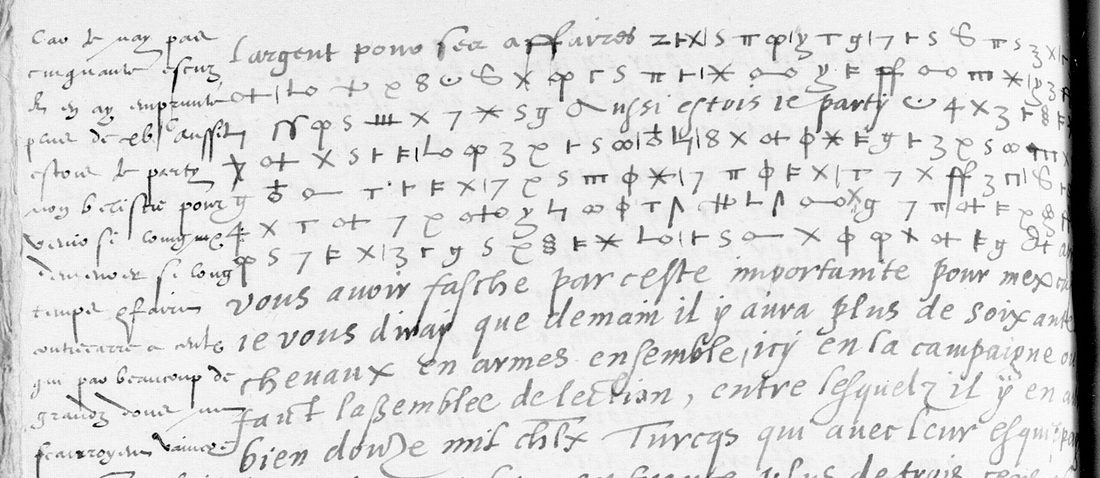
What the catalogue calls the siblings’ decipherments is this same marginal gloss, line by line beside the cipher, on ff. 154, 154v, 156 and 157. The microfilm keeps only the last centimetre or two of each gloss line, but on f. 154v the first line of cipher stands beside “Car je n’ay pas cinquante escuz”, and the cipher line is exactly long enough for it.
02 The cipher
- Homophonic letters. Separate graphic signs (crosses, bars, figures, letter-like forms) written continuously, with points, commas and short bars as word separators. Common letters have two or three signs: e ✕ ✱ Γ Δ, a ⊤ π H, r ϕ ⊨, s 9 Lo IIII, i ⊢ ϙ, n ſ o-o, u/v o+ ff o+o, m 8 ᥙ, l 3 ⊥, o ꞔ L, t ʓ ттт, p y N, d ‡, c 7 ⋔, g ∞, f o-, h +, qu ꞗ.
- Syllable and word signs. et ♁, nt ꝸ, st 8 with a dot, de ᒐ, ou ᛏ, ns Λ, car Z, pour †, and Allemagne as a Z with a lower curl. Over the 741 signs transcribed from f. 124 and the first blocks of ff. 154 and 156, the merged frequencies are French: e-signs 17.6 %, then r, a, s, n, u, t, o.
- Tomokiyo’s table. His “Lansac’s Cipher” (cryptiana, French Ciphers during the Reigns of Charles IX and Henry III) has the right signs but its first row is
displaced by one letter from m onward (his ſ m, L n, б p, ⊨ q, 9 r, ʓ s, o+ t read n, o, qu, r, s, t, u), his Γ = i is e, his ‡ = h is d, and the
“pour” cross is the letter h in one of its two shapes. The corrected table with the evidence for each sign is
targets/lanssac/key.tsv.
03 The key, and how it was found
- The glossed crib. f. 154v line 1, Z ⊢✕ | ſπϙ | y⊤9 | 7⊢ſꞗπſʓ✕, beside “Car je n’ay pas cinquante escuz”, gives car ie nai pas cinquante and fixes eleven signs at once, including car = Z, qu = ꞗ and the shift in Tomokiyo’s row.
- Passage two by hand against its gloss “moins esté retenu … ou oultre”: † ⊥ ✕ · 8 ꞔ ⊢ o-o 9 · ✱ 8̣ Γ · ϕ ✕ ʓ ✱ ſ o+ = pour le moins esté retenu, then ᛏ Γ ᥙ y ✕ 9 7 + ✱ · ᒐ = ou empesché de, y π 9 Lo ✕ ϕ ꞔ ff 3 ттт ⊨ Γ = passer oultre, ᥙ · π ꟿ Lo = mais. Each new sign was checked in the siblings before it was kept.
- Simulated annealing over the whole transcription (French 5-gram model, symbol to letter or short code, the crib letters held fixed). The free signs come out the same across seeds and give words in the siblings that the cribs never touched and the glosses confirm: les dangiers, causé, l’autre, beaucoup, grant seigniur, du monde, changement, sur la teste, recommandé, doubte ou vous mettre.
- Decoding of f. 124: each sign was given its candidate values and the best-scoring sequence under the same model was kept. Passage one comes out as despuis les dangiers qu’encontrent en Allemagne les françois qui passent et vostre ser…, matching the three marginal fragments “…es dangier”, “…d’Allemagne”, “qui passent”.
- Controls. The key with the crib letters fixed scores −2193 to −2198 on the real sign order and −2924 to −3009 on three shufflings of the same signs. A blind run with nothing fixed reaches a higher score (−2033) but recovers only 6 of the 21 crib letters: on a transcription this noisy the language model alone does not find the key; the cribs and the glosses do, and the model then fills the rest consistently.
04 Decipherment
Cipher passages in brackets; sixteenth-century spelling kept; ? marks an uncertain sign, braces a run not deciphered
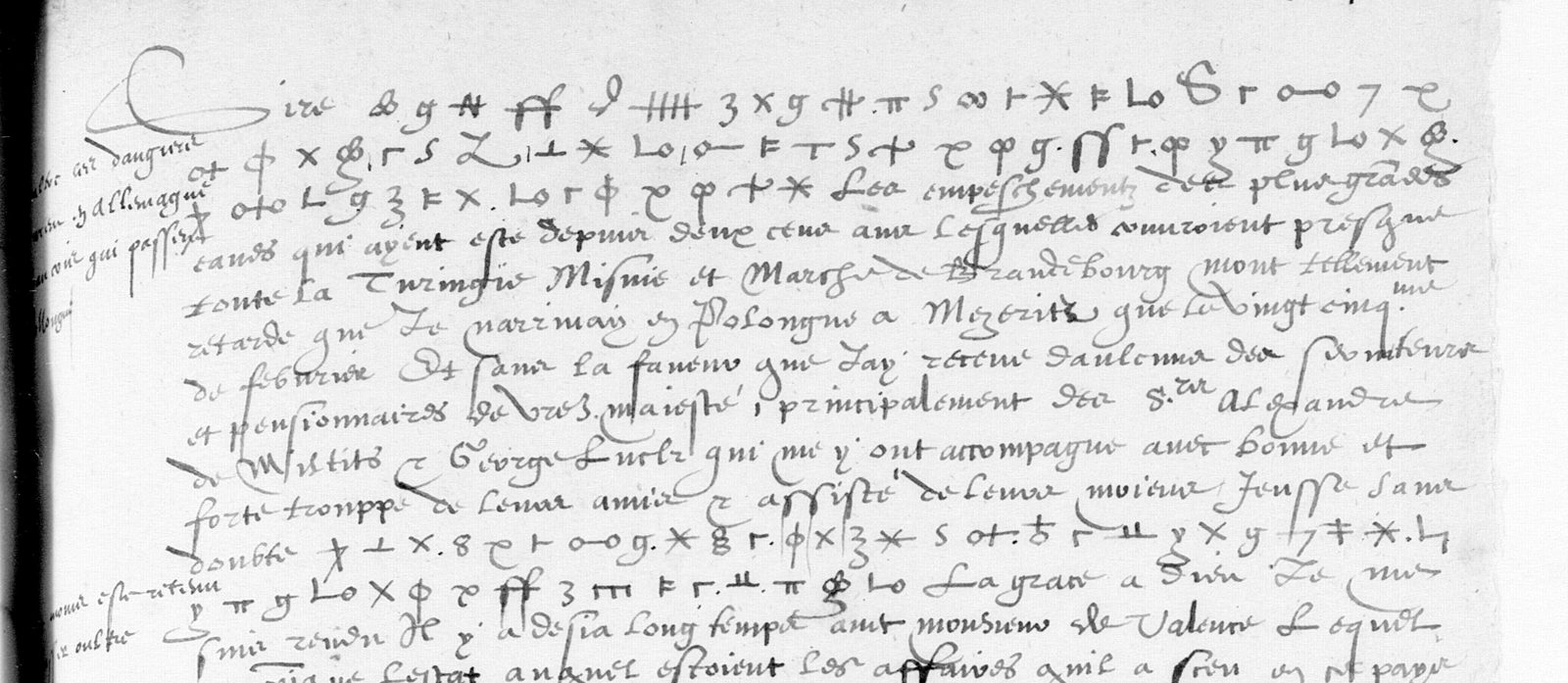
Lanssac to Charles IX, Warsaw, 26 April 1573. Sire, [despuis? les dangiers qu’encontrent en Allemagne les françois qui passent, et vostre ser{o r h e}] Les empeschementz et les plus grandes causes qui ayent esté depuis deux {ans} … toute la Turinge, Misnie et Marche de Brandebourg m’ont tellement retardé que je n’arrivay en Polongne à Mezeritz que le vingt-cinquiesme de febvrier. Et sans la faveur que j’ay receue d’aulcuns des serviteurs et pensionnaires de vostre Majesté, principalement des Sieurs Alexandre de Militiz et George Luelz(?), qui me y ont accompagné avec bonne et forte troupe de leurs amis et assisté de leurs moyens, j’eusse sans doubte [pour le moins esté retenu ou empesché de passer oultre. Mais], la grace à Dieu, je me suis rendu il y a desjà long temps avec Monsieur de Valence, lequel m’a enseigné l’estat auquel estoient les affaires qu’il a bien et dignement commencées et continuées jusques icy, et dont j’ay faict ung recueil ensemble de ce que j’ay peu juger, lequel j’envoye à vostre Majesté. Et ne sçachant à présent rien digne d’escrire oultre le contenu audict recueil, sinon que j’ay receu la lettre qu’il a pleu à vostre Majesté m’escrire du xxiii(?) de febvrier, en obéissant à laquelle je me fauldray(?) à me comporter de sorte que j’espère que le bien de vostre service et les affaires qui sont à promouvoir par deçà en demeureront advancez. Je priray le Créateur vous donner, Sire, en très parfaicte santé très contente et longue vie. De Warsauvia, le xxvie d’avril 1573.
English translation
Sire, [since the dangers that the French who pass through meet in Germany, and your ser{vice?}…] The hindrances, and the greatest causes there have been these two {years} … all through Thuringia, Meissen and the Mark of Brandenburg, delayed me so much that I did not reach Poland, at Mezeritz, until the twenty-fifth of February. And without the favour I received from some of your Majesty’s servants and pensioners, chiefly the Sieurs Alexander von Miltitz and Georg Luelz(?), who accompanied me there with a good strong troop of their friends and helped me with their means, I should without doubt [at the least have been detained or prevented from passing on. But], thank God, I joined Monsieur de Valence a good while ago, who has told me the state in which the affairs stood that he has so well and worthily begun and carried on until now, and of which I have made a summary, together with what I have been able to judge, which I send to your Majesty. And knowing nothing at present worth writing beyond what that summary contains, except that I have received the letter your Majesty was pleased to write me on the 23rd(?) of February, in obedience to which I shall not fail to conduct myself so that I hope your service and the affairs to be advanced here will profit by it, I pray the Creator to give you, Sire, in most perfect health a most contented and long life. From Warsaw, the 26th of April 1573.
The Miltitz were Saxon nobles in French pay; Mezeritz (Międzyrzecz) is the first Polish town on the road from Frankfurt an der Oder to Poznań. The “dangers” are the hostility to Frenchmen in Protestant Germany after St Bartholomew’s Day, which is why this passage is in cipher and the itinerary is not. Lanssac reached Monluc at Warsaw in time for the election Diet, which had opened on 5 April; Anjou was elected on 11 May. The recueil he announces is no. 52 in the volume, “Estat des affaires de Pollongne selon que le Sr de Lanssac y a peu aprendre”, in clear.
05 The election letters, deciphered with the same key
The catalogue credits Lanssac’s letters of 24 April, 1 May and 9 May with a “déchiffrement”. It is the Court decipherer’s note in the outer margin, and the microfilm keeps
only the last word or two of each of its lines; the cipher passages themselves cannot be recovered from the scan. With the key they decipher in full, but for one word sign. The first pass (17 September) left runs open; on 3 October 2026 the three letters were transcribed again from the full-size scans, with the sign groups aligned to the words (ct_f160.txt, ct_f164.txt, ct_f174.txt, and read_f160_f174.md). It found that the first cipher line of f. 164 had been skipped, read the four open runs of f. 164, and showed the open run of f. 174 to be a misdivision. Measured: f. 160 91 of 91 signs, f. 164 203 of 207 (98.1%), f. 174 123 of 123. Braces mark what is not deciphered.
To Charles IX, Warsaw, 1 May 1573 (f. 160). … que pour en envoyer devant selon que les occasions des affaires premièrement surviennent. [Car je veoy que ceste nation est autant vénale et sujette à se laisser gaigner par argent comme sont les Alemans, leurs voisins.] Ce jourd’huy ilz mettent en délibération s’ilz doibvent prendre pour Roy ung Piaste ou ung prince estrangier, mais on sçait bien quelle en doibt estre la résolution.
To the duc d’Anjou, Warsaw, 1 May 1573 (f. 164). … c’est de latin et d’argent, et à bonne quantité, car il y aura de quoy l’employer [en toutes sortes pour venir à vostre desir]. … les traverses de nos contraires qui n’y espargnent rien pour nous empescher, [car si jusques cy {word sign} a despendu trente mil escus en ceste negotiation, l’Empereur en y a despendu plus de trois cens mil, et n’y faict toutefois riens qui vaille pour soy; mais seulement il l[e] trouble vostre desseing, faisant le pis qu’il peult contre vous.] Encores ne veulx-je faillir, Monseigneur, de vous ramentevoir … que vous fassiez donner ordre que les navires soient prestz pour l’embarquement.
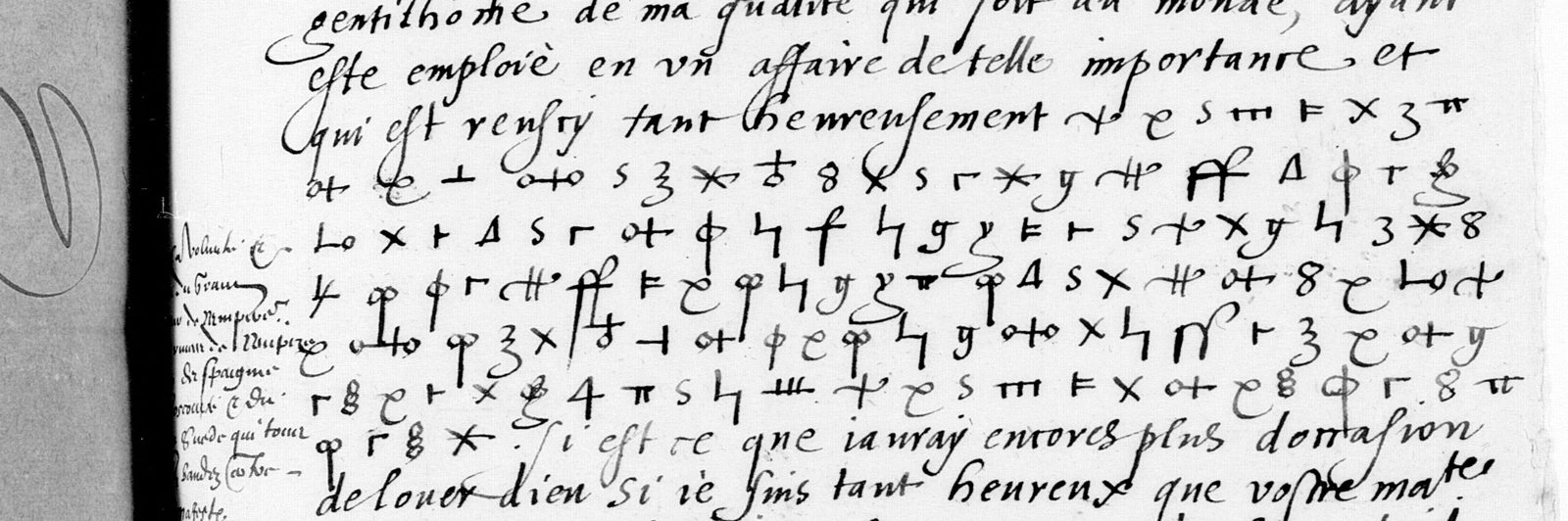
To Charles IX, Płock, 9 May 1573 (f. 174). … ayant esté employé en un affaire de telle importance et qui est reüssy tant heureusement [contre la volunté et menées du Grant Seigneur, de l’Empereur, des princes de l’Empire, du Roy d’Espaigne, du Moscovite et du Roy de Suède, qui tous estoient bandez contre vostre Majesté]. Si est-ce que j’auray encores plus d’occasion de louer Dieu si je suis tant heureux que vostre Majesté me juge digne d’estre employé en ce second …
English
1 May, to the King. For I see that this nation is as venal and as ready to let itself be won by money as are the Germans, their neighbours. — 1 May, to Anjou. … in every way, to come to what you desire. … For if until now {word sign} has spent thirty thousand écus in this negotiation, the Emperor has spent more than three hundred thousand in it, and yet does nothing in it worth anything for himself; he only troubles your design, doing the worst he can against you. — 9 May, to the King. … an affair of such weight, which has succeeded so happily against the will and the intrigues of the Grand Seigneur, of the Emperor, of the princes of the Empire, of the King of Spain, of the Muscovite and of the King of Sweden, who were all leagued against your Majesty.
The 9 May list is the field of the 1573 election as the French embassy saw it: Archduke Ernest for the Emperor and Spain, Ivan IV, John III of Sweden, and a Habsburg-leaning party among the German princes. The “Grand Seigneur” (the Sultan) is the surprise, since the Porte was generally reckoned to favour the French candidate; every sign of the group now deciphers, with one irregularity forced by the gloss (Γ, elsewhere e, stands for the a of Grant). On f. 164 the Habsburg outlay of 300,000 is set against 30,000 écus spent by a party written with a single word sign that is in no key and whose gloss the gutter has taken: the King’s side, or a Polish faction. New values from these leaves (4 = b, three strokes = z as well as t, the tailed 4 = p, Λ = ns, the hooked C = qu, the 6-like sign = o, Δ = g, the o with cross below = et) are listed in the notes; the last makes f. 124’s “retenu ou empesché” rather “retenu et empesché”.
06 The letters of 24 April to Anjou and to Catherine (ff. 154, 156)
Lanssac’s two long letters of 24 April 1573 (nos. 60 and 61) carry the most cipher in the file: 37 lines on f. 154 to the duc d’Anjou and two blocks on f. 156, with most of the verso, to Catherine de Médicis. Both have the decipherer’s running text in the margin. On the rectos it is in the inner margin and the microfilm keeps only its line ends; on the versos it is in the outer margin and survives nearly whole. On 2 October 2026 all four cipher pages were transcribed again from the full-size scans, with the sign groups aligned to the words so that each group could be scored as deciphered or not, and the key was applied and extended. On 3 October every open group was cut out at twice the scale and read again against Tomokiyo’s current table; both letters are now over 95%.
| Page | Letter | Signs deciphered |
|---|---|---|
| f. 154r | to Anjou, Warsaw, 24 April | 439 of 454 (96.7%) |
| f. 154v | the same letter | 221 of 223 (99.1%) |
| Letter to Anjou | 660 of 677 (97.5%) | |
| f. 156r | to Catherine, Warsaw, 24 April | 307 of 316 (97.2%) |
| f. 156v | the same letter | 614 of 645 (95.2%) |
| Letter to Catherine | 921 of 961 (95.8%) | |
| Four pages | 1,581 of 1,638 (96.5%) | |
The counts are of cipher signs that give sense in the reading, measured with measure.py over the word-aligned transcriptions. A first pass over f. 156v at reduced scale gave 67.2%; the second, line by line at full scale (88.2%), found 130 signs the first had merged or skipped and drops the nine the writer struck through; the third, at twice the scale on every open group, gave 95.2%. f. 154v rose from 92.0% to 99.1% the same way: one “sign” of the first pass was not a sign, and the line past the end of the gloss reads le[s] nostre si inferieur. As a control, the raw decode of each page with no hand choices scores −1.93 to −2.49 per character on a French letter model of c. 1600, against −4.4 to −4.7 for the same signs shuffled.
To Anjou (f. 154)
[clear: … Depuis la conclusion desquelz] {…} j’ay aprins deux choses, l’une qui me donne gaing de cause, l’autre qui me trouble beaucoup. La premiere est que j’ay esté au devant des Lituans, les chefz desquelz m’ont promis ne donner leur voeu à aultre que à vous, [clear: qui sera de telle importance que] avec la bonne part que nous avons au royaume sans doubte ou vous mettre ceste grant couronne sur la teste, si la recommandation du Grant Seigneur, laquelle il a faicte de vous comme j’estime avec ruse par le vaivode qui(?) de la Valaquie, qui est(?) {5 signs} ameine quelque inespéré changement, qui est le second poinct qui me donne une traverse, de laquelle avec l’aide {4 signs} de Dieu nous esperons neaumoins sortir.
[f. 154v] Car je n’ay pas cinquante e[sc]us, combien que j’en ay emprunté plus de quinze cens. [clear: Aussi estois je party] bien belistre pour venir si loing et demeurer si longtemps et faire contrecarre à celuy qui [par] beaucoup de grans dons ne sçauront vaincre le[s] nostre, si inferieur {2} … Et espere que dans peu de jours tous ceulx-là avec beaucoup d’autres seront vos subjectz.
The Lithuanian lords have promised Anjou their vote, which with his party in the kingdom makes the crown certain, unless the Sultan’s recommendation of him, made (Lanssac thinks) with guile through the voivode of Wallachia, brings some unexpected change. Lanssac has not fifty écus left and has borrowed more than fifteen hundred; within days, he expects, the electors will all be Anjou’s subjects. Every surviving fragment of the recto gloss agrees with the decipherment (“…causé l’autre”, “…doubte ou vous”, “…sur la teste”, “…grand seigneur”, “…par le Vaynode de”), and the verso gloss gives the first block word for word.
To Catherine de Médicis (f. 156)
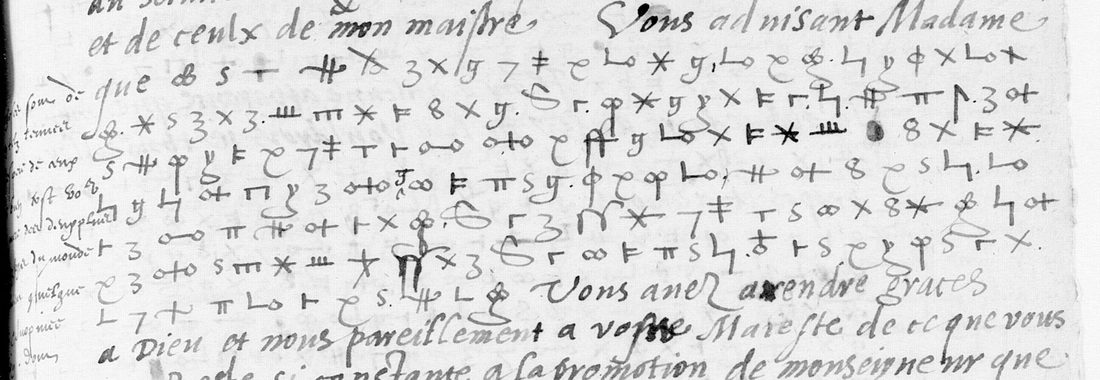
[clear: Vous advisant, Madame, que] {5 signs} les choses sont de present en telz termes que j’espere dedans lundi prochain vous serez mere des deux plus grans roys du monde, s’il n’advient quelque changement de voluntez pour quelque grande {1} inopinée occasion … il me semble que ce ne sera pas mal faict {2} vostre Majesté envoyast quelqu’ung {1} vers le roy de Dennemarc, non pour luy demander passage … mais bien pour luy faire entendre que les Imperiaulx, nos ennemis en ce faict …
[f. 156v] Mais de crainte que l’Empereur {[cepen]dant} il n’y soit prevenu, et que l[e] {…} roy de Dennemarc [clear: ayant obtemperé à sa volunté, ne] nous donnast beaucoup d’affaires de ce costé-là, à cause d’estroit qui n’a pas demie lieue de {la(rge)}, {1} des fortz situez des deux costez de par terre. … de mectre à la mercy de ceulx {1} qui … Mais se monstrent estre ennemis jurez de {1} France, et specialement de Monseigneur, et lesquelz [so]nt extremement marrys s’il fault qu’il se voient enclos de deux si puissantz roys comme ilz seront. … {6} ces seigneurs demanderont qu’il ameine quatre mil gascons … recueilliez le plus d’argent querez(?) ensem{ble af}in que … ambassadeurs porter la couronne à {Monseigneur, et y ar}riveront vers luy, vous ne soiez lors empeschée d’en trouver. Ca[r] … aussi à commencer à faire estat que {[le]urs} navires seront propres à l’embarquement, et de faire mettre en ordre les galleres pour pouvoir servir. … {de ceste nation … servi}teurs, il n’y en a que quatre con[tr]e nous, et que toute la noblesse crie pour avoir ung roy, et nommement veule[nt Monseigneur].
By Monday next, Lanssac tells the Queen Mother, she will be “mother of the two greatest kings in the world” unless some sudden change of minds intervenes. He advises sending someone to the King of Denmark, not to ask passage but to tell him what the Imperialists are doing, because he fears the Emperor will forestall them and that Denmark, bending to the Emperor’s will, could make trouble at the Sound, less than half a league wide and fortified on both sides. Going by land would put Anjou at the mercy of the German princes, who “show themselves sworn enemies of France, and especially of Monseigneur”, and are “extremely sorry” to find themselves shut in between two such powerful kings; the road by Italy and Dalmatia is too long and costly. The Polish lords will ask him to bring four thousand Gascons; Catherine should gather all the money she can, so that she is not then hard put to find it when the embassy comes to bring the crown, and should reckon on the ships and have the galleys made ready. Of the Polish lords only four are against them, and the whole nobility cries out for a king, and namely for Anjou. Here the cipher corrects the decipherer, who wrote “si monsieur estoit ennemy d’icy de la France”: with the stacked 8 as st and the clover sign as -nt, the signs read se monstrent estre ennemis jurez, and the enemies are the German princes, not Monsieur. Anjou was elected on 11 May. The end of the letter, f. 157r, is in clear, with a postscript on the Diet (forty thousand horse, the great tent, the Emperor’s ambassadors).
The new signs
About fifteen signs were added to the key on these pages: a pronoun sign for me and nous (“qui me donne”, “que nous avons”, “ne nous donnast”), a barred N for il and a looped barred N for est, word signs for bien and par, the clover sign for -ment/-nt, a footed Π for t, further signs for qu and x, Tomokiyo’s u sign (confirmed), and 4 = b confirmed on eleven words. On 3 October the key was compared sign by sign with Tomokiyo’s current table: his st (stacked 8), il, nous, par, q and t agree and were adopted, and an f sign proposed on 2 October was withdrawn (it is the st). The barred-N forms are now told apart on every page: the plain barred N is il throughout, the looped form on f. 124 stays p in despuis, and the “N = a” of f. 160 was a misread tall T. The hand writes mectre, ameine, neaumoins, nommé. The full list is in key.tsv.
The letters of 9 May are in clear
The catalogue and the earlier notes here expected Lanssac’s four other letters of 9 May from Płock (ff. 182–189: to Anjou, now king-elect, to Catherine, to the secretary of state Pierre Brulart, and to his father Louis de Saint-Gelais) to be in the same key with a marginal decipherment. The images show all four written wholly in clear, with addresses on ff. 183v, 185v, 187v and 189v: the election, Balagny carrying the news, and requests for favour and for the costs Lanssac had borne. The cipher letter of that day is the one to Charles IX, f. 174, in section 05.
07 What remains uncertain
- Despuis rests on two signs read once each (ꝛ as de, the looped barred N as p, rechecked on the image on 3 October: read il, as the plain barred N is elsewhere, the word gives no French); the gloss fragment “…es dangier” is compatible with “…uis les dangiers” but the gutter takes the start of the line.
- François: the signs give fran-c-o-r-s; the seventh sign must be the i sign ϙ, which this hand writes close to the r sign ϕ, or the word is another. Qui rests on the gloss; the cipher has ꟿ Γ, and ꟿ reads i in mais.
- Et vostre ser is followed by four signs that read o r h e under the key; service with one misread sign is the likely word and is left in braces.
- Two forms of the et sign (et and nt) and of the cross (h and pour) are told apart by context, not by shape, in the present transcription.
- The election letters of section 05: f. 164’s word sign before a despendu trente mil escus is in no key, Tomokiyo’s included, and the gloss beside it is cut (no key material); a stray c between pour and venir and the two signs of l[e] in il l[e] trouble, which give li, are single signs no value fits. On f. 174 two irregularities are forced by the gloss: Γ for the a of Grant, and Moscovite written without its second o. Tomokiyo’s “f. 331” is not a Lanssac item in the BnF notice.
- On ff. 154–156 (section 06), 57 of 1,638 signs are not deciphered: 6 + 9 on f. 154r (after “desquelz”, before “ameine”, after “l’aide”), 2 at the end of f. 154v l. 7, 9 single signs at the line ends of f. 156r, and 31 in 12 groups on f. 156v (the start of cependant, de la[rge], the six-sign group after J’estime que, à [Monseigneur], the de ceste nation … serviteurs run, and single signs). Each lies at the gutter of the microfilm or under the decipherer’s overwriting, where the gloss paraphrases (“ne nous surprenne” for the cipher’s “n’y soit prevenu”) and so does not fix the signs. Every group was cut out at twice the scale and retried with the extended key and Tomokiyo’s table on 3 October. Gallica holds only this one microfilm of fr. 4735; a colour scan or the manuscript would be needed to go further.
- Doubtful words on ff. 154–156 (grade M): ou for on on f. 154r (the script-z sign), qui and qui est after vaivode, querez on f. 156v.
08 Method
- Folio located on the unlabelled microfilm from thumbnails of the pencil foliation (canvas ≈ 1.76 × folio); full-size pages fetched one at a time through the IIIF image API.
- Blocks deskewed by maximising the contrast of the row-ink profile and cut into one strip per line for transcription; 741 signs typed as glyph labels, with separators dropped.
- Crib letters fixed from the glossed line of f. 154v and from passage two of f. 124 against its own gloss.
- Simulated annealing of the remaining signs on a French 5-gram model with the crib letters fixed; blind and shuffled-order controls run on the same data.
- Decoding of the five f. 124 lines from a set of candidate values per sign; decipherments checked against the marginal fragments and the clear text.
- Ff. 154 and 156 (2 October 2026): each block deskewed and cut into line strips from the full-size scans, the signs transcribed in word groups aligned to the plaintext, the key applied and extended from context and the glosses, every unread group retried, and the share of signs giving sense measured per page; the raw decode scored against shuffled signs as a control.
- Third pass (3 October 2026): every open group of ff. 154–156 cut out at twice the scale and read again; the key compared sign by sign with Tomokiyo’s current table; ff. 160, 164 and 174 transcribed again at full scale with word-aligned groups; the share of signs giving sense measured per letter (
measure.py --letters); controls rerun (−1.94 to −2.49 per character against −3.8 to −4.7 shuffled).
Full texts
The transcription and the decryption of every document on this page, so that the reading can be used and checked. Short files are shown here; all are in the repository.
f. 124, to Charles IX, Warsaw, 26 April 1573 (no. 51)
Lanssac tells Charles IX that the obstacles in Thuringia, Meissen and the Mark of Brandenburg delayed him so that he reached Poland (Mezeritz) only on 25 February, and that without the escort of the King's pensioners Alexander von Miltitz and George Luelz he would at the least have been detained; the ciphered passages hide the dangers Frenchmen met in Germany. The rest, in clear, refers to his recueil on Polish affairs.
Transcription
# f. 124 (canvas 242) cipher passages, own transcription 17 Sept 2026 from the 4417-px Gallica image.
# Token labels are provisional glyph names, not readings. '|' = line break, '.' and ',' = marks in the MS.
# Passage 1 (lines 1-4, after "Sire")
L1: s3 g N ff d IIII 3 x | x g N pi longs 8inf Ti ast Fq Lo B r oo 7 c
L2: et phi x B , r s Z , T ast Lo , of Fq | Fq T s cross c phi g . ff r . phi y pi g Lo x B .
L3: et T g 3 Fq x . Lo r phi c phi cross - | ast
# clear: Les empeschementz et les plus grandes causes qui ayent este depuis deux ans lesquelles ...
# Passage 2 (lines 9-10, after "doubte")
L9: cross T x . 8 c Ti oo g . ast 8 r . Ti phi x 3 ast s ot . ocross r Tl y x g Ti 7 cross ast . Lh
L10: y pi g Lo x phi c ff 3 IIII Fq r . Tl - | pi B Lo
# clear: La grace a Dieu ...
Decryption
BnF fr. 4735 f. 124 — Guy de Saint-Gelais de Lanssac to Charles IX, Warsaw, 26 April 1573.
Cipher passages in [brackets] read 17 Sept 2026 with the key in key.tsv; ? marks an uncertain sign; {..} unread.
Spelling as in the manuscript; abbreviations expanded in ( ).

Sire, [despuis? les dangiers qu'encontrent en Allemagne les françois qui passent, et vostre ser{o r h e}]
Les empeschementz et les plus grandes causes qui ayent esté depuis deux {ans?} {...} toute la Turinge,
Misnie et Marche de Brandebourg m'ont tellement retardé que je n'arrivay en Polongne à Mezeritz que le
vingt-cinq(iesm)e de febvrier. Et sans la faveur que j'ay receue d'aulcuns des serviteurs et pensionnaires de
vostre Majesté, principalement des S(ieu)rs Alexandre de Militiz et George Luelz(?), qui me y ont accompagné
avec bonne et forte troupe de leurs amis et assisté de leurs moyens, j'eusse sans doubte [pour le moins esté
retenu ou empesché de passer oultre. Mais], la grace à Dieu, je me suis rendu il y a desjà long temps avec
Monsieur de Valence, lequel m'a (en)seigné l'estat auquel estoient les affaires qu'il a bien et dignement
commencées et continuées jusques icy, et dont j'ay faict ung recueil ensemble de ce que j'ay peu juger, lequel
j'envoye à vostre Majesté. Et ne sçachant à présent rien digne d'escrire oultre le contenu audict recueil, sinon
que j'ay receu la lettre qu'il a pleu à vostre Majesté m'escrire du xxiii(?) de febvrier, en obéissant à laquelle
je me fauldray(?) à me comporter de sorte que j'espère que le bien de vostre service et les affaires qui sont à
promouvoir par deçà en demeureront advancez. Je priray le Créateur vous donner, Sire, en très parfaicte santé
très contente et longue vie. De Warsauvia, le xxvi(e) d'avril 1573.

Token-by-token, passage 1 (ll. 1-3):
  2 g N ff q9 IIII | 3 X g | hh pi s oo i X F Lo | B G nn 7 c et phi X sm | G s | Zc | ol X Lo | of F T s cross c phi g | qq G | phi? Y pi g Lo X sm | et u2 L g 3h F X | Lo G phi | c phi h ast
  de s p u i s | l e s | d a n g i e r s | qu e n c o nt r e nt | e n | Allemagne | l e s | f r a n c o r(i?) s | qui | (r?) p a s s e nt | et v o s t r e | s e r | o r h e
Passage 2 (ll. 9-10):
  pour ol X | 8 c i nn g | ast st G | phi X 3h ast s ot | de4 G ll Y X g 7 h ast | 4h | Y pi g Lo X phi | c ff 3 sh F G | ll pi qq Lo
  pour l e | m o i n s | e st e | r e t e n u | ou e m p e s c h e | de | p a s s e r | o u l t r e | m a i s
Marginal glosses (decipherer's hand, cut by the gutter): "…es dangier", "…d'Allemagne", "…qui passent", "moins esté retenu", "…ou oultre".
Translation
# BnF fr. 4735 f. 124: Guy de Saint-Gelais de Lanssac to Charles IX, Warsaw, 26 April 1573: English translation

Translation (Claude Opus 5.5, 23 Oct 2026) of the reading at the head of `reading.txt`: the clear letter with its two
cipher passages (in [brackets] there, here in ⟨ ⟩), read with key.tsv and agreeing with the decipherer's marginal
glosses. Same marks: `?` an uncertain sign or word, `{..}` unread, `{o r h e}` letters that make no word yet.

## Translation

Sire, ⟨since [?] the dangers which the French who pass through Germany meet with, and your ser{o r h e}⟩. The
hindrances, and the greatest causes there have been for two {?years} {...} all Thuringia, Meissen and the Mark of
Brandenburg, delayed me so much that I arrived in Poland at Mezeritz only on the twenty-fifth of February. And
without the favour I received from some of Your Majesty's servants and pensioners, principally the Sieurs Alexander
von Miltitz and George [?Luelz], who accompanied me there with a good and strong troop of their friends and assisted
me with their means, I would doubtless ⟨at the least have been detained or prevented from passing further. But⟩,
thanks be to God, I joined Monsieur de Valence a long time ago now, who taught me the state of the affairs which he
has well and worthily begun and continued until now, and of which I have made a summary together with what I have been
able to judge, which I send to Your Majesty. And knowing nothing at present worth writing beyond the contents of the
said summary, except that I have received the letter which it pleased Your Majesty to write me of the [?23rd] of
February, in obedience to which I shall [?endeavour] to conduct myself so that I hope the good of your service and the
affairs to be promoted here will remain advanced by it, I shall pray the Creator to give you, Sire, in very perfect
health, a very contented and long life. From Warsaw, the 26th of April 1573.
ff. 154r-v, to the duc d'Anjou, Warsaw, 24 April 1573 (no. 60)
On the eve of the Polish election, Lanssac reports to Anjou that the Lithuanian chiefs have promised their vote to him, which with the party already won should put the crown on his head, unless the Grand Seigneur's recommendation of him, made with ruse through the voivode of Wallachia, brings some unexpected change.
Transcription
# BnF fr. 4735 no. 60, f. 154r (Gallica btv1b9060724s canvas 294): Lanssac to the duc d'Anjou, Warsaw, 24 April 1573.
# Session 3 (2 Oct 2026) re-transcription from img/c294.jpg (deskewed: img/s154_deskew.png, 19 lines).
# Format: "@Lnn" then a token line and a "=" reading line with the same number of '|' groups.
#   Token labels as in key.tsv (new labels added this session are listed there). Groups follow plaintext words, not the
#   manuscript separators. Reading: {..} = unread group (counted as unread), ? after a word = uncertain value, [..] = sign
#   read but not in the key value (context value), '-' joins a word across lines.
# Clear text before: "... Depuis la conclusion desquelz"  (block begins at the end of the clear line)
# Gloss (inner margin, gutter-cut; only line ends survive): "...que nous | ...causé l'autre | ...[me tr]ouble beaucoup |
#   ...est que j'ay | ...de Lithuanie(?) | ...[ch]efz desquelz nous | ...prendre que donner | ...Roy a aucuns qui |
#   ...qui sera de | ...importance | ...bonne part | ...[royau]me au Roy(?) | ...doubte ou vous | ...est grande |
#   ...sur la teste | ...recommandé(e) | ...grand seigneur | ...[q]u'il a faicte | ...l'estime | ...par le Vaynode de |
#   ...qui nous | ...[?]nament"
@L01
de4 g ff
= {et su-}
@L02
X i sm | i T q9 | pi Y F blot s g | hh ast ot Mx | 7 h c g X Lo | ol | u2
= {-e i nt} | j'ay | aprins | deux | choses | l' | u-
@L03
s ast | B i | Gf | hh c 5 nn X | oo T i s D | 4h | 7 T ot Lo G | 3 | T ff sh
= -ne | qui | me | donne | gaing | de | cause | l' | aut-
@L04
phi X | Ng i | Gf | 3 F c ff 4 3 X | 4 G pi ot 7 L ff Y | 3 T | Y phi ast 8
= -re | qui | me | trouble | beaucoup | la | prem-
@L05
i X F ast | G st | B X | q9 pi i | G st X | pi ot | 4h u2 T sm | 4h g | 3 q9 sh ot H ns
= -iere | est | que | j'ay | esté | au | devant | des | Lituans
@L06
3 G g | 7 h X of Mx | 4h g B X 3 sh | Gf c sm | Y F L 8 G g | s X | hh c nn
= les | chefz | desquelz | m'ont | promis | ne | don-
@L07
5 s X phi | ol ast ot F | ot c G u2 | pi | T ot 3 sh F X | B blot G | pi | ot c
= -ner | leur | voeu | à | aultre | que | à | vo-
@L08
u2 g
= -us
# clear: "qui sera de telle importance que"
@L08b
pi ff G 7 | 3 T | 4 L
= avec | la | bo-
@L09
nn s X | qq sh | B G | Gf | pi ff c ns | T ot | F c q9 T ff 8 X | g T ns
= -nne | part | que | nous | avons | au | royaume | sans
@L10
hh c ot 4 3 X | c 5 | ot c ff g | 8 G 3 sh F G | 7 X st ast | oo phi pi sm
= doubte | ou | vous | mettre | ceste | grant
@L11
Z c u2 F L nn s X | g ot phi | 3 T | sh X st G | g q9 | 3 pi | F G 7 c ll sm8 T
= couronne | sur | la | teste | si | la | recommanda-
@L12
s cross pi 3 q9 c s | hh ot | oo phi pi nn sh | g X i oo s G ot F | 3 pi B X ol
= -ndation | du | grant | seigneur | laquel-
@L13
3 G | N | T | of pi q9 7 3 X | 4h | ot c ot u2 g | 7 c 8 ll X | q9 G st i 8 ast | pi
= -le | [il] | a | faicte | de | vous | comme | j'estime | a-
@L14
ff X 7 | F ot g ast | qq | 3 G | ot pi q9 u2 c 4h | B ff i de4~ | 4h
= -vec | ruse | par | le | vaivode | qui? | de
@L14b
3 T | u2 H 3 T B q9 X | Mu i G X st | qq sh i X s | T sm8 G q9 nn ast
= la | Valaquie | qui est? | {qq sh i X s} | ameine
# session 3 pass 2 (final retry with the extended key, full-scale check): Gf = nous before 'avons' and before 'esperons'
# (gloss '...qui nous'); B ff i = qui after 'vaivode' (the de4 after it is struck); Mu i G X st = qui est (doubled e);
# T sm8 G q9 nn ast = ameine. x1 is the half-lost first sign of l. 19, the e of Dieu.
# the first two groups of L14b are the end of L14 and the start of L15 in the manuscript (Valaquie runs across)
@L15
cd X 3 Ng X | q9 s G g Y X F ast | 7 h pi s oo X 8 G sm | B i | X st | 3 ast | g G 7 c s hh
= quelque | inespéré | changement | qui | est | le | second
@L17
Y c q9 nn 7 sh | B i | Gf | hh c nn s X | ot nn ast | sh F pi ff X phi g G
= poinct | qui | me | donne | une | traverse
@L18
4h | 3 pi B G ol 3 X | pi ot G 7 | 3 pi q9 4h | de4 ff mm sm | 4h | hh q9
= de | laquelle | avec | l'aide | {de4 ff mm sm} | de | Di-
@L19
x1 ot | Gf | X g Y ast F c ns | s X T u2 8 c q9 s g | Lo c phi 3 i F
= -[e]u | nous | esperons | neaumoins | sortir
# clear after: "Je seray aussi vous supplier tres humblement Monseigneur vouloir recommander le Sr de Balagny ..."
Transcription
# BnF fr. 4735 no. 60, f. 154v (canvas 297): Lanssac to Anjou, 24 April 1573, continued. Session 3 transcription.
# Format as ct_f154.txt. The right ends of the cipher lines run into the gutter on the microfilm; signs lost there are
# not counted (marked ~ in the reading). The decipherment is in the OUTER (left) margin of the verso and survives in full:
# Gloss, block 1: "Car je n'ay pas | cinquante escuz | et y ay emprunté | plus de xvᶜ aussy | estoit le party |
#   [bien] belistre pour | venir si loing | demeurer si long | temps et faire | contrecarre a celuy | qui par beaucoup de |
#   grandz dons ne | sçauroyt vaincre | les ... du frere(?)"
# Gloss, block 2: "Je espere que dans | peu de jours tous | ceulx la avec beaucoup | d'aultres seront voz [subjectz]"
# Clear before: "Monseigneur, ... ne pourroit faire sans l'argent pour ses affaires"
@A
Z i X | s pi q9 | Y T g | 7 i s B pi s 3 X | G
= car je | n'ay | pas | cinquante | e[scus]
# ~ gutter: es[cus]
@B
ot Lo | cross c 8 obul | B X | q9 G s | pi i | ast nn Y F ff nn sh ast | Y 3
= -us | combien | que | j'en | ay | emprunté | pl-
# ~ gutter: [us]
@C
4h | Ng q9 s sh X | 7 ast s g
= de | quinze | cens
# clear: "Aussi estois je party"
@C2
obul | 4 X 3 i st F
= bien | belistr-
# ~ gutter: [e]
@D
pour | ot X s i F | Lo q9 3 c i s oo | de4 | 4h 8 X ot phi ast F | g i 3 c s oo sh X
= pour | venir | si loing | et | demeurer | si longte-
# ~ gutter: [mps]
@E
g | de4 | of T i F X | 7 c s sh phi ast | 7 pi phi F X | T | 7 X ff 3 Pi2 | B i
= [longtemp]s | et | faire | contre- | -carre | à | celuy | qui
# ~ gutter: [par] (gloss "qui par beaucoup")
@F
4 X T ot 7 c u2 Y | 4h | oo phi T ns | hh L ns | nn X | g 7 pi ot F c sm
= beaucoup | de | grans | dons | ne | sçauront
# ~ gutter: [va]
@G
# pass 3 (3 Oct, full-scale re-read): the gloss ends at "vaincre"; the cipher continues "le[s] nostre si inferieur"
# (the nostre: the French candidate); x2 = G (e of escus, rest in the gutter), x3 was not a sign, x4 = g (s of longtemps)
q9 s 7 F X | 3 G g s c st F ast | Lo i | i s of X phi q9 ast ot F | Co sm
= -incre | le[s] nostre | si | inferieur | {Co sm}
# clear: "... vous avoir fasché par ceste importunité pour m'excuser ... valdroient bien en France plus de trois cens escus la piece"
@H
et | X g Y G F ast | B X | hh pi ns | Y X ot | 4h | q9
= et | espere | que | dans | peu | de | j-
# ~ gutter: [our]
@I
g | sh c ot Lo | 7 X ff 3 Pi2 | 3 pi | T ot X 7 | 4 X pi u2
= -s | tous | ceulx | là | avec | beau-
# ~ gutter: [coup]
@J
hh pi u2 sh F X g | Lo ast F c sm | ot L g | Lo ot 4 i X 7 sh
= d'autres | seront | vos | subjectz
# clear: "Monseigneur, apres vous avoir baisé tres humblement les mains ... De Varsovie le xxiiije jour d'avril 1573"
Decryption
# f. 154r-v — Lanssac to the duc d'Anjou, Warsaw, 24 April 1573 (BnF fr. 4735 no. 60)

Gallica btv1b9060724s canvases 294 (f. 154r), 297 (f. 154v). Session 3, 2 Oct 2026. Transcription: ct_f154.txt (recto),
ct_f154v.txt (verso). Measured with `python measure.py ct_f154.txt` (measure.log).

**Status: read** (README read bar: over 95 %, every open piece blocked by the gutter). Recto 439 of 454 cipher tokens
read as sense (96.7 %); verso 221 of 223 (99.1 %, pass 3, 3 Oct 2026); the letter 660 of 677 (97.5 %). Key: key.tsv (session 1 key plus the session 3 rows). Control (control3.py): the raw first-value
decode scores -2.25 / -2.20 per char under `fr-1600-letters` (no spaces) against -4.4 to -4.7 for the same tokens shuffled.

Check against the contemporary decipherment: the recto gloss is in the inner margin and the gutter leaves only line
ends; every surviving fragment agrees with the reading ("…causé l'autre", "…[me tr]ouble beaucoup", "…est que j'ay",
"…[ch]efz desquelz nous", "…prendre que donner", "…doubte ou vous", "…sur la teste", "…recommandé", "…grand seigneur",
"…[q]u'il a faicte", "…l'estime", "…par le Vaynode de"). The verso gloss is in the outer margin and survives whole; it
reads the first cipher block word for word as below.

## Reading (cipher in italics; {…} unread)

Clear: *… Depuis la conclusion desquelz* — cipher:

> {*et su-e i nt*} j'ay aprins deux choses, l'une qui me donne gaing de cause, l'autre qui me trouble beaucoup. La
> premiere est que j'ay esté au devant des Lituans, les chefz desquelz m'ont promis ne donner leur voeu à aultre que à
> vous, [clear: *qui sera de telle importance que*] avec la bonne part que nous avons au royaume sans doubte ou[1] vous
> mettre ceste grant couronne sur la teste, si la recommandation du Grant Seigneur, laquelle il a faicte de vous comme
> j'estime avec ruse par le vaivode qui(?) de la Valaquie, qui est(?) {5 signs} ameine quelque inespéré changement, qui est
> le second poinct qui me donne une traverse, de laquelle avec l'aide {4 signs} de Dieu nous esperons neaumoins sortir.

[1] *ou* = *on* (the script-z sign 5, here as in *donne*). Sense: the Lithuanian lords have promised their vote to Anjou,
which with the party he has in the kingdom would make the crown certain — unless the Sultan's recommendation of Anjou,
made (Lanssac thinks) with guile through the voivode of Wallachia, brings some unexpected change; that is the second
point, a setback from which, with God's help, they hope to come out.

f. 154v, first block (clear before: *… ne pourroit faire sans l'argent*):

> Car je n'ay pas cinquante e[sc]us, combien que j'en ay emprunté plus de quinze cens. [clear: *Aussi estois je party*]
> bien belistre pour venir si loing et demeurer si longtemps et faire contrecarre à celuy qui [par] beaucoup de grans
> dons ne sçauront vaincre le[s] nostre, si inferieur {2 signs, gutter}.

Gloss: "Car je n'ay pas cinquante escuz et y ay emprunté plus de xvᶜ. Aussy estoit le party bien belistre pour venir si
loing demeurer si longtemps et faire contrecarre a celuy qui par beaucoup de grandz dons ne sçauroyt vaincre …".

Second block (clear before: *… plus de trois cens escus la piece*):

> Et espere que dans peu de jours tous ceulx-là avec beaucoup d'autres seront vos subjectz.

Gloss: "Je espere que dans peu de jours tous ceulx la avec beaucoup d'aultres seront voz [subjectz]".

## Unread groups and why

| place | signs | state |
|---|---|---|
| r l. 1-2 | de4 g ff X i sm | opening words after "desquelz"; gloss line cut to "…que nous" |
| r l. 15 | qq sh i X s | before "ameine"; gloss end "…nament" does not reach it |
| r l. 18 | de4 ff mm sm | after "l'aide"; no word under the key |
| v l. 7 | Co sm | two signs after "inferieur", half in the gutter |

Pass 2 retry (2 Oct 2026, extended key, full-scale check): Gf = *nous* before *avons* and before *esperons*; B ff i =
*qui* after *vaivode* (the sign after it is struck); Mu i G X st = *qui est*; T sm8 G q9 nn ast = *ameine*; the half-lost
first sign of l. 19 is the *e* of *Dieu*. Pass 3 (3 Oct) on f. 154v: the gloss ends at "vaincre"; the cipher goes on "le[s] nostre si inferieur" (stacked 8 =
*st*, Tomokiyo); the line-end signs of ll. 1 and 5 are the *e* of *escus* and the *s* of *longtemps*; one pass-1 token was
not a sign.

All gaps are on the microfilm gutter or in the faint lines of the recto gloss; nothing in the volume gives another
copy (see NOTES, Remaining gaps).
Translation
# ff. 154r-v: Lanssac to the duc d'Anjou, Warsaw, 24 April 1573 (BnF fr. 4735 no. 60): English translation

Translation (Claude Opus 5.5, 23 Oct 2026) of the reading in `read_f154.md` (section "Reading"): the cipher blocks,
with the clear words round them in italics or [clear: …]. Same holes: `{…}` and `{n signs}` unread, `[x]` letters
supplied, `(?)` doubtful.

## Translation

Clear: *… Since the conclusion of which* — cipher:

> {*et su-e i nt*} I have learned two things, one which gives me my case, the other which troubles me much. The first
> is that I went to meet the Lithuanians, whose chiefs have promised me to give their vote to no one else but you,
> [clear: *which will be of such importance that*] with the good party we have in the kingdom there is no doubt one
> will put this great crown on your head, unless the Grand Seigneur's recommendation, which he has made of you, as I
> think with guile, through the voivode who(?) of Wallachia, who is(?) {5 signs}, brings some unexpected change; which
> is the second point, which gives me a setback, from which, with the help {4 signs} of God, we nevertheless hope to
> come out.

f. 154v, first block (clear before: *… could not do without money*):

> For I have not fifty é[c]us, although I have borrowed more than fifteen hundred of them. [clear: *Also I had set
> out*] a very beggarly party to come so far and stay so long and stand up against him who [with] many great gifts
> will not be able to overcome our[s], so inferior {2 signs, gutter}.

Second block (clear before: *… more than three hundred écus apiece*):

> And I hope that within a few days all those, with many others, will be your subjects.
ff. 156-157, to Catherine de Médicis, Warsaw, 24 April 1573 (no. 61)
Lanssac tells Catherine that matters stand so that by next Monday she should be mother of the two greatest kings in the world, barring a change of minds, and fears that the Emperor might surprise them and that the King of Denmark, bending to his will, might give them much trouble on that side because of the strait, not half a league wide. The end of the letter (f. 157r) is in clear.
Transcription
# BnF fr. 4735 no. 61, f. 156r (canvas 300): Lanssac to Catherine de Médicis, Warsaw, 24 April 1573. Session 3 transcription.
# Format as ct_f154.txt. Gloss in the inner margin, gutter-cut; line ends:
#   block A: "...[cho]ses sont de | ...[te]lz termes | ...[es]pere dedans | ...[prochai]n vous serez | ...[me]re des deux plus |
#             ...[roy]s du monde | ...[n] quelque"
#   blocks B-C: "...[pu]blique(?) a ne | ...mal faict | ...[Ma]jesté envoyast | ...vers le Roy de | ...[Danne]march non pour luy |
#             demander passage | ...[con]sidere(?) | ...Imperiaulx"
# Clear before block A: "... et de ceulx de mon maistre. Vous advisant, Madame, que"
@A1
sm s cross hh de4 | 3 X g | 7 h c Lo ast g | Lo c sm | 4h Y phi X Lo ast
= {sm s cross hh de4} | les | choses | sont | de prese-
# de4 here is struck through in the manuscript (a deleted sign)
@A2
sm | ast s | 3 X 3 sh | sh ast F 8 X g | B G | q9 ast g Y X F G | 4h hh pi ns | 3 ot
= -nt | en | telz | termes | que | j'espere | dedans | lu-
@A3
s hh q9 | Y F c 7 h T i nn | u2 c ff g | Lo X F ast sh | blot 8 X F ast
= -ndi | prochain | vous | serez | mere
@A4
4h N | 4h ot sq | Y 3 u2 g | oo F pi s | phi c q9 Lo | hh ot | 8 c s 4h | Lo
= des | deux | plus | grans | roys | du | monde | s'
@A5
i 3 | nn pi hh ot i X sm | B G 3 | Ng ast | 7 h T s oo X 8 ast sm | 4h ot
= il | n'advient | quel | que | changement | de v-
@A6
c 3 u2 s sh ast sh | pour | Ng X 3 B G | oo F pi s 4h | h | i s c Y q9 s G X
= -oluntez | pour | quelque | grande | {h} | inopinée
@A7
L 7 cross pi Lo i c s | hh L sm
= occasion | dont
# clear: "Vous avez a rendre graces a Dieu ... afin qu'il n'empeschast le passage de son destroit en mer si Monseigneur estoit esleu"
@B1
N | 8 X | g ast 8 4 ol X
= il | me | semble
@B2
B ast | 7 X | s ast | Lo G F pi | Y T Lo | 8 pi 3 | of pi i 7 sh | ff G
= que | ce | ne | sera | pas | mal | faict | {ff G}
@B3
ot c st F X | 8 T q9 ast st G | X s u2 c q9 pi st | Ng X 3 B
= vostre | Majesté | envoyast | quelqu-
@B4
2 s oo | x5 | u2 X F g | 3 G | F c q9 | 4h | hh X s nn ast 8 T F 7 | s c nn
= [u]ng | {x5} | vers | le | roy | de | Dennemarc | non
@B5
pour | 3 ot q9 | 4h 8 pi s 4h phi | Y T g Lo pi oo X | ot ast ff | B G
= pour | luy | demander | passage | veu | que
# clear: "la chose n'est encores reduite a son effect. Mais bien"
@C1
pour | 3 ot q9
= pour | luy
@C2
of T q9 F X | ast s 3 G s hh phi X | Ng ast | 3 G g | i 8 Y X F ast pi ot 3 Pi2
= faire | entendre | que | les | imperiaulx
@C3
nn c Lo | X s nn G 8 q9 Lo | ast s | 7 X | of H q9 7 3
= nos | ennemis | en | ce | faict
# clear: "n'ont sceu objecter autre difficulté pour empescher la promotion de Monseigneur, sinon qu'ilz disent ..."
Transcription
# BnF fr. 4735 no. 61, f. 156v (canvas 301): Lanssac to Catherine de Médicis, Warsaw, 24 April 1573, continued.
# Session 3, PASS 2 (2 Oct 2026): re-transcribed line by line at full scale from img/v156a_deskew.png and
# img/v156b_deskew.png (crops img/F_v156a_*.png, F_v156b_*.png). Pass 1 (reduced scale) is kept as ct_f156v_pass1.txt.
# Format as ct_f154.txt. Signs struck through by the writer are written with a trailing ~ in the label (e.g. "Lox~")
# and are left out of the count (measure.py skips labels ending in ~). Signs lost in the gutter are not counted.
# The contemporary decipherment is in the outer (left) margin and survives nearly whole, a few lines behind the cipher:
#   "Mais de crainte que | l'Empereur cependant | ne nous surprenne et | que le Roy de Dannemarch | ayant obtemperé a sa |
#   volunté ne nous | donnast beaucoup d'aff[aires] | de ce costé la a cause | du destroit qui n'a | pas demie lieue de |
#   large et deux fortz | situez des deux costez | de venir par terre | Il n'y a aucune apparence | que monseigneur le doibve |
#   faire aussi ne luy | vouldrois je conseiller | de se mettre a la mercy | de ceulx qui par tous | avec propos et actions |
#   si monsieur estoit | ennemy(?) d'icy de la | France et specialement de | monseigneur ... | sont extremement marrys |
#   s'il fault qu'il[z] | se voyent enclos de deux | si puissans roix ... | ...lez seront. Que mons. | seigneur vienne par l'Italie |
#   et la Dalmace. Oultre | la difficulté longueur [du chemin] | la despense y seroit | trop grande. Car | j'estime que ces
#   seigneurs | demanderont qu'il | amaine iiii mil gascons | dont vous avez ouy parler | Il ne me reste plus | a vous ...
#   sinon | que vous recueilliez le | plus d'argent que vous | pourrez ensemble afin | que quant ces seigneurs de | deça
#   envoyeront ambassad. | pour porter la couronne | a Monseigneur et y arriveront | ... vous ne soyez | lors empesché d'y
#   trouver ... | sera hors de propos aussi de [commander] a ses estatz que leurs navires seront propres a l'embarquement
#   et mettre en ordre les galleres pour pouvoir servir. J'en ose parler avec telle asseurance d'autant que [de ceste]
#   nation il n'y a que quatre [serviteurs?] ... et que toute la noblesse crie pour avoir ung roy ..."
# Clear before L01: "... on pourroit bien faire apres avoir esté advertys de la conclusion de ces estatz"
@L01
8 cross g lf | hh X | Lox~ phi~ X~ | 7 F pi i s g | B ast
= mais(gloss) | de | | crainte | que
# 8 has "mais" written above it with a caret by the decipherer; the four-sign group recurs at L10 in the same place
# (before "si monsieur estoit"), so it is read as one word sign group; signs struck by the writer after "de" not counted
@L02
of | hh pi sm | Nb | s i | Lo c i 3h | Y F X ot ast nn u2 | sm | Mu X 3h
= l'Empereur | {hh pi sm} | il | n'y | soit | prevenu | et | que l[e]
# gloss "l'Empereur cependant ne nous surprenne et que": pass 3 at 2x: the group is d-a-nt (the tall stroke over pi is
# the gloss's descender) followed by the barred N "il" (Tomokiyo's il); "[cepen]dant" is not written in full, left unread
@L03
7 3h | F Co q9 | 4h | hh X nn s ast ll pi F 7
= {7 3h} | roy | de | Dennemarc
# "le" expected before "roy"; the line end of L02 and start of L03 run into the gutter and the three signs give no word
# clear: "ayant obtemperé a sa volunté ne"
@L04
Gf | hh c s nn T st | 4 X pi ot 7 c u2 Y | hh T
= nous(gloss) | donnast | beaucoup | d'a-
# Gf is "me" on ff. 154/156r; here the gloss has "nous" in "ne nous donnast"
@L05
pi i F X g | 4h | 7 ast | 7 Co st ast | 3 pi | T | cross T H ot Lo X | hh Ne
= -ffaires | de | ce | costé | là | à | cause | d'est-
# cross T H ... = c a a u s e with the a doubled at the turn; Ne (barred N with a loop) = est (new, C)
@L06
phi c q9 3h | B blot i nn | pi Y T g | 4h 8 i X | 3 q9 ast ot X | 4h | Mx 3h
= -roit | qui n' | a pas | demie | lieue | de | {Mx 3h}
# "de large" in the gloss: the two signs after "de" do not give "large" (the line ends in the gutter)
@L07
cross | 4h g | of c F 3h sh | g i 3h ot X sh | 4h g | 4h ot Mx | 7 c st X sh | 4h
= {cross} | des | fortz | situez | des | deux | costez | de
@L08
qq phi Co | 3h X F phi ast
= par? | terre
# qq (8-like with strokes) is "par" on f. 160; the second and third signs are its flourish or "ar"; read with the gloss
# clear: "Il n'y a aulcune apparence que monseigneur le doibve faire, aussi ne luy vouldrois je conseiller"
@L09
4h | ll X 7 3h F X | T 3 pi | 8 X F 7 q9 | 4h | cross X ot 3 Mx | Mu | B i
= de | mectre | à la | mercy | de | ceulx | {Mu} | qui
# clear: "par tous ... propos et actions"
@L10
8 cross g lf | Lo G | 8 c s st F X clov | ast~ st F X | ast nn
= mais | se | monstrent | [e]stre | en-
# pass 3 (3 Oct): the sign read "B/f" in pass 2 is the stacked 8 (Tomokiyo's st); with it the line reads
# "se monstrent estre en[ne]mis jurez" (clov, the clover sign, = -ment/-nt, as in "special-ement" at L12); the writer struck
# the e of "estre". The decipherer's "si monsieur estoit" misread "se monstrent estre". Pass 2's "mon frere" is withdrawn.
@L11
8 i g | q9 ot F X sh | 4h | ol~ i | of F pi nn 7 X | de4~ | g q9 X 7 i pi 3
= -nemis | jurez | de | {i} | France | | special-
# pass 3: "-nemis jurez" (q9 = j); the gloss "ennemy d'icy de la France" agrees; {i} after the struck l is unread
@L12
X~ clov | 4h | 8 c s | sm Lo X i oo nn ast ot F | de4 | 3 X g 6 ot ast 3 sh
= -ement | de | mon | seigneur | et | lesquelz
@L13
B | X Mx 3h F ast 8 G ll X B | 8 T phi F i Y | Lo q9 3 | of pi ot 3 3h | 6 q9 3
= [so]nt | extremement | marrys | s'il | fault | qu'il
@L14
g X | ot c i X B | ast nn 7 3 c g | 4h | hh X ot Mx | Lo blot | i Y u2 i
= se | voient | enclos | de | deux | si | puiss-
@L15
T s 3h sh | F c q9 g | 7 c 8 ll X | Nb sh | g X F c sm
= -antz | roys | comme | ilz | seront
# clear: "Que monseigneur vienst par l'Italie et la Dalmace, oultre la difficulté et longueur du chemin la despence y seroit
#   trop grande. J'estime que"
@L16
de4 q9 g cross m B | 7 ast g | Lo ast q9 oo nn X ot F g | 4h 8
= {de4 q9 g cross m B} | ces | seigneurs | dem-
@L17
4h F c sm | 6 i 3 | pi 8 X q9 s G | 6 T 3h F X | 8 i 3 | oo pi Lo
= -anderont | qu'il | ameine | quatre | mil | gas-
# 4h F c sm = de r o nt, with "an" lost in the gutter at the end of L16
# clear: "[gas]cons dont vous avez ouy parler. Il ne me reste plus a vous supplier tres humblement, Madame, sinon que vous"
@L19
F de4~ cross~ B~ X 7 ast ot i | q9 X sh | 3 ast Y ol ot g | hh pi F oo X sm | 6 G ast~ F G sh | X s g ast 8
= recuei- | -liez | le plus | d'argent | querez? | ensem-
# struck signs after F are a correction by the writer; "ll" of "recueilliez" lost in the gutter
@L21
Pb cross nn | 6 G
= {Pb cross nn} | que
# gloss "ensemble afin que"; the three signs are not "ble afin"
# clear: "Quant les seigneurs de deça"
@L22
pi 8 4 T | T 4h ot F g | X~ | Y c phi 3h X F | 3 T | 7 c ot F L nn s X | pi | sh
= ambas- | -sadeurs | | porter | la | couronne | à | {sh}
# "pour" is not written before "porter"; pi sh = "a" + the three-stroke sign, gloss "a Monseigneur" (not counted as read)
@L23
phi i ot X F c sm | Mu X F g | 3 u2 q9 | ot c Mu g | nn X g c i
= -riveront | vers | luy | vous | ne soi-
# gloss "et y arriveront"; the start of the word is in the gutter
@L24
c phi g | X 8 Y ast g 7 h X | G | hh ast s 3h F c u2 Mx~ X F | cross T
= [l]ors | empesché | -e | d'en trouver | ca[r]
# pass 3: G = e gives the feminine "empeschée" (the letter is to Catherine); cross T = ca[r] (gloss "Car ilz halteront")
# clear: "Ilz halteront sa venue par deça le plus qu'ilz pourront pour beaucoup de raisons. Il ne sera hors de propos"
@L25
pi ot g i | T | c 8 ll X s 7 G phi | pi of T i F X | ast st pi Mt | 6 X | 3h sh | s pi
= aussi | à | commencer | à faire | estat | que | {3h sh} | na-
@L26
F X g | Lo X F c sm | Y F c Y F X g | X 3 | ast 8 4 pi F Gq X 8 ast
= -vires | seront | propres | à l'? | embarqueme-
@L27
de4 | 4h | of pi i F X | 8 G 3h sh phi X | ast s | c F hh phi G | 3 X g | oo pi 3h
= et | de | faire | mettre | en | ordre | les | gal-
@L28
X g | X~ Y c ot u2 c i phi | g X F ot i phi
= -eres | pouvoir | servir
# clear: "J'en ose parler avec telle asseurance, Madame, d'aultant que"
@L29
4h c | 7 3h T B X Lo i
= {4h c} | {7 3h T B X Lo i}
# gloss "d'autant que de ceste nation"; the 7 signs begin c-t-a and do not give "ceste nation" under the key
@L30
sh ast ot F g | blot Nb s | q9 X s pi | B ast | Mu G sh F X | 7 c s
= -teurs | il n' | y en a | que | quatre? | con-
# Mu G sh F X: Mu = qu (here), G = a?, sh = t: "quatre" with the gloss; marked ? (G = a not met elsewhere)
@L31
ast | Gf | de4 6 X 3h c ot sh ast | 3h G | s c 4 3 X g Lo G | 7 F q9 X
= [-tr]e | nous | et que toute | la | noblesse | crie
@L32
u2 c i F | ot s oo | F c i | de4 | s c 8 ll X 8 G sm | ot X u2 3 G
= [pour a]voir | ung | roy | et | nommement | veule[nt]
@L33
nn X pi u2 8 c i s g
= neaumoins
# clear: "toutes choses sont en la main de Dieu" (continues on f. 157r)
Transcription
# BnF fr. 4735 no. 61, f. 156v (canvas 301): Lanssac to Catherine de Médicis, Warsaw, 24 April 1573, continued.
# Session 3 (2 Oct 2026), FIRST PASS from img/c301.jpg (deskewed v156a, v156b) at 0.5-0.8 scale. Format as ct_f154.txt.
# Cipher runs alternate with clear text across the page; the right ends of lines run into the gutter (lost signs not counted).
# The contemporary decipherment is in the LEFT (outer) margin and survives almost in full on this verso. It is written as a
# running text of the whole passage (clear words included), a few lines behind the cipher it explains:
#   "Mais de crainte que | l'Empereur cependant | ne vous surprenne et | que le Roy de Dannemarch | ayant obtemperé a sa
#   volunté | volunté. Mais nous(?) | donnast beaucoup d'affaires | de ce costé la a cause | du destroit qui n'a [pas] |
#   demie lieue de large et bien fortz | situez des deux costez de | venir par terre | Il n'y a aucune apparence |
#   monseigneur en doibve | ... aussi ne luy | vouldrois je conseiller | de se mettre a la mercy | de ceulx qui par terre |
#   avec propos et actions | si monsieur estoit | ...(e)nnemy(?) d'icy de la | France et special(ement) des(?) |
#   monseigneur passe(?) qu'ilz | sont extremement marrys | S'il fault qu'il | se voyent enclos de deux | si puissans roix(?) |
#   ...lez seront. Quant mons. | seigneur viendra par l'Italie | et la Dalmace. Oultre | la difficulté longueur du chemin |
#   la despense y seroit | trop grande. Car | ...ces seigneurs | demanderont qu'il | [amaine?] ... quatre mil gascons |
#   dont vous avez ouy parler | Il ne me reste plus a | vous supplier tres humblement | que vous recueilliez(?) |
#   plus d'argent que vous | pourrez assembler afin | que quant ces seigneurs de | deça envoyeront ambassad(eurs) |
#   pour porter la couronne | a Monseigneur ilz arriveront | vers luy(?) ... | ...bien empesché d'y trouver | ...sera hors de
#   propos aussi de [demander, struck] armer(?) | a ses estatz que leurs navires seront propres ... | mettre en ordre les
#   galleres pour pouvoir servir. J'en ose parler avec telle asseurance d'autant que ... | ...nation il n'y a que quatre
#   ... | ...ville(?) en Monseigneur ..."
# Clear before L01: "... necessairement venir en ce royaulme, c'est chose que tousjours on pourroit bien faire apres avoir esté
#   advertys de la conclusion de ces estatz"
@L01
8 cross g lf | hh X | Lox phi X | 7 F pi i 5 g | B ast
= mais(gloss) | de | {Lox phi X} | crainte | que
# 8 has "mais" written over it by the decipherer; Lox is struck through; g read t/e here (context of the gloss)
@L02
vo | hh llp Cq Nb 5 i Lo | c i 3h Y F X ot ast nn u2 st | M X 3
= l'Empereur | {hh llp Cq Nb 5 i Lo} | {c i 3h Y F X ot ast nn u2 st} | {M X 3}
@L03
7 3h | F Co q9 | 4h | hh X nn 5 ast ll pi F 7
= {7 3h} | roy | de | Dennemarc
# clear: "ayant obtemperé a l'emp[ereur] ... sa volunté, ne"
@L04
Gf | hh c 5 nn T st | 4 X pi ot 7 c u2 Y | hh T
= me | donnast | beaucoup | d'a-
@L05
pi i F X g | 4h | 7 ast | 7 Co st ast 3h | 3 pi | T | cross H ot Lo X | hh M
= -ffaires | de | ce | costé | là | à | cause | {hh M}
@L06
phi c q9 3h | B blot i nn | pi Y T g | 4h 8 i X | 3 q9 ast ot X | 4h | 3 pi
= -roit | qui n' | a pas | demie | lieue | de | la-
@L07
cross | 4h g | of c F 3h sh | g i 3h ot X sh | 4h g | 4h ot M | 7 c st X sh | 4h
= {cross} | {4h g} | fortz | situez | des | deux | costez | de
@L08
phi q9 Co | 3h X F phi ast
= {phi q9 Co} | terre
# clear: "Il n'y a aulcune apparence que monseigneur le doibve faire, aussi ne luy vouldrois je conseiller."
@L09
4h | ll X 7 3h 4h X | T | 3 pi | 8 X F 7 q9 | 4h | cross X ot 3 Pi2 | st i
= de | {ll X 7 3h 4h X} | à | la | mercy | de | ceulx | {st i}
# clear: "par tous ... propos et actions"
@L10
8 cross g lf | Lo Gf | 8 c 5 8 F X g X 8 F X ast
= mais(gloss) | si | {8 c 5 8 F X g X 8 F X ast}
@L11
8 i g phi ot F X ll | 4h ol i of F pi nn 7 X | 3h | g Y X 7 i pi 3
= {8 i g phi ot F X ll} | de la France | et | special-
@L12
X 8 | 4h | 8 L 5 | Lo X i oo nn ast ot F | 4h 3 X g | 6 ot ast 3 ll
= -ement | de | mon- | -seigneur | {4h 3 X g} | {6 ot ast 3 ll}
@L13
6 | X M 3h F ast 8 L ll X g | 8 T phi F i Y | Lo q9 3 of pi ot 3 3h | 6 q9 3
= {6} | extremement | marrys | s'il fault | qu'il
@L14
g X | ot c i X oo | ast nn 7 3 c g | 4h | hh X ot M | Lo q9 | i Y ot nn ot Y
= se | voient | enclos | de | deux | si | {i Y ot nn ot Y}
@L15
T 5 3h ll | F c q9 g | 7 c 8 ll X | Nb | ll g X F c g
= {T 5 3h ll} | roys | comme | il | {ll g X F c g}
# clear: "Que monseigneur vienst par l'Italie et la Dalmace, oultre la difficulté et longueur du chemin la despence y seroit
#   trop grande. J'estime que"
@L16
de4 q9 g cross m Co | 7 ast g Lo ast q9 oo nn X ot F g | 4h 8
= {de4 q9 g cross m Co} | ces seigneurs | {4h 8}
@L17
4h F c Co | 6 i 3 | pi 8 X q9 5 of | 6 T 3h F X | 8 i 3 | oo pi Lo
= {4h F c Co} | qu'il | {pi 8 X q9 5 of} | quatre | mil | gas-
@L18
c g
= -cons
# clear: "dont vous avez ouy parler. Il ne me reste plus a vous supplier tres humblement, Madame, sinon que vous"
@L19
F de4x cross qq X 7 ast ot
= {F de4x cross qq X 7 ast ot}
@L20
q9 X ll 3h ast | Y ol ot g | hh pi F cross oo X Co | 6 Gf M F Gf ll | X 5 g ast 8
= {q9 X ll 3h ast} | plus | d'argent | {6 Gf M F Gf ll} | ensem-
@L21
Pb qq i vo c Lo
= {Pb qq i vo c Lo}
# clear: "Quant les seigneurs de deça"
@L22
pi 8 4 T Y | T i 4h ot F | pour | oo c 3h X F | 3 T | 7 c ot F L nn 5 X | pi sh
= ambas- | -sadeur | pour | porter | la | couronne | {pi sh}
@L23
u2 Co i F | ot s oo | F Co i | 4h | s Co 8 ll X | 8 Gf st ot X u2 3 Gf
= voir | ung | roy | de | nomme | {8 Gf st ot X u2 3 Gf}
# L23-L24 re-read at full scale (img/gc3.png, gc4.png); the first pass had them as "vers luy vous ne soyez ... empesché", which was the gloss, not the signs
@L24
nn X pi u2 8 Co cross s g
= neaumoins?
# clear: "Ilz halteront sa venue par deça le plus qu'ilz pourront pour beaucoup de raisons. Il ne sera hors de propos"
@L25
pi ot g i | 7 c 8 ll X 5 7 G phi | pi oo T G F X | G 8 pi ll | 6 X 3 ll 5 pi
= aussi | commencer | {pi oo T G F X} | {G 8 pi ll} | {6 X 3 ll 5 pi}
@L26
X g | Lo X F Co oo | Y q9 Co Y F X g | X 3 | ast 8 4 pi F Gf X 8
= {X g} | seront | propres | {X 3} | {ast 8 4 pi F Gf X 8}
# the remaining cipher lines of v156b (lines at y 1990-2170) and the clear close follow on f. 157r; not transcribed this pass
Decryption
# ff. 156-157 — Lanssac to Catherine de Médicis, Warsaw, 24 April 1573 (BnF fr. 4735 no. 61)

Gallica btv1b9060724s canvases 300 (f. 156r), 301 (f. 156v), 302 (f. 157r, clear only). Session 3, 2 Oct 2026.
Transcription: ct_f156.txt (recto), ct_f156v.txt (verso, pass 2 at full scale; pass 1 in ct_f156v_pass1.txt). Measured
with measure.py (measure.log).

**Status: read** (README read bar). Recto 307 of 316 tokens read as sense (97.2 %); verso 614 of 645 (95.2 %, pass 3
of 3 Oct 2026; pass 2 88.2 %, pass 1 67.2 %). The letter: 921 of 961 (95.8 %). f. 157r is clear (the end of the letter: "… la main de Dieu. Lequel je
supplie, Madame, vous donner en parfaite santé tres contente vie. De Varsovia le xxiiij jour d'avril 1573", and a
postscript in clear about the Diet: forty thousand horse, the great tent, the Emperor's ambassadors). Control
(control3.py): raw decode -1.93 (recto) and -2.49 (verso, pass 3) per char against -4.4 to -4.7 shuffled.

## Recto (f. 156r)

Clear before: *Vous advisant, Madame, que* — cipher:

> {5 signs, one struck through} les choses sont de present en telz termes que j'espere dedans lundi prochain vous serez
> mere des deux plus grans roys du monde, s'il n'advient quelque changement de voluntez pour quelque grande {1}
> inopinée occasion, dont [clear: *Vous avez à rendre graces à Dieu …*]

Gloss ends: "…[cho]ses sont de", "…[te]lz termes", "…[es]pere dedans", "…[prochai]n vous serez", "…[me]re des deux plus",
"…[roy]s du monde", "…n quelque". All agree.

Second block (after the clear sentence on the Danish straits):

> il me semble que ce ne sera pas mal faict {2} vostre Majesté envoyast quelqu'ung {1} vers le roy de Dennemarc, non
> pour luy demander passage, veu que [clear: *la chose n'est encores reduite à son effect. Mais bien*] pour luy faire
> entendre que les Imperiaulx, nos ennemis en ce faict …

Gloss ends: "…mal faict", "…[Ma]jesté envoyast", "…vers le Roy de", "…[Danne]march non pour luy", "demander passage",
"…Imperiaulx". All agree.

## Verso (f. 156v), pass 3

The decipherment on the verso is in the outer margin and survives nearly whole as a running text a few lines behind the
cipher; it was used as the crib and as the check. Pass 2 re-read all 33 cipher lines at full scale; pass 3 re-read every
open group at 2x against Tomokiyo's current table. Reading (cipher in plain type, [clear] in brackets, {…} unread):

> [… on pourroit bien faire après avoir esté advertys de la conclusion de ces estatz.] Mais de crainte que l'Empereur
> {[cepen]dant} il n'y soit prevenu, et que l[e] {…} roy de Dennemarc [ayant obtemperé à sa volunté, ne] nous donnast
> beaucoup d'affaires de ce costé-là, à cause d'estroit qui n'a pas demie lieue de {la(rge)}, {1} des fortz situez des
> deux costez de par terre. [Il n'y a aulcune apparence que monseigneur le doibve faire, aussi ne luy vouldrois je
> conseiller] de mectre à la mercy de ceulx {1} qui [par tous … propos et actions.] Mais se monstrent estre ennemis
> jurez de {1} France, et specialement de Monseigneur, et lesquelz [so]nt extremement marrys s'il fault qu'il se voient
> enclos de deux si puissantz roys comme ilz seront. [Que monseigneur vienst par l'Italie et la Dalmace, oultre la
> difficulté et longueur du chemin la despence y seroit trop grande. J'estime que] {6} ces seigneurs demanderont qu'il
> ameine quatre mil gascons [dont vous avez ouy parler. Il ne me reste plus à vous supplier tres humblement, Madame,
> sinon que vous] recueilliez le plus d'argent querez(?) ensem{ble af}in que [quant les seigneurs de deça]
> ambassadeurs porter la couronne à {Monseigneur, et y ar}riveront vers luy, vous ne soiez lors empeschée d'en
> trouver. Ca[r] [ilz halteront sa venue par deça le plus qu'ilz pourront pour beaucoup de raisons. Il ne sera hors de
> propos] aussi à commencer à faire estat que {[le]urs} navires seront propres à l'embarquement, et de faire mettre en
> ordre les galleres pour pouvoir servir. [J'en ose parler avec telle asseurance, Madame, d'aultant que] {de ceste
> nation … servi}teurs, il n'y en a que quatre con[tr]e nous, et que toute la noblesse crie pour avoir ung roy, et
> nommement veule[nt Monseigneur]. Neaumoins [toutes choses sont en la main de Dieu …]

Where pass 3 departs from the decipherer: he wrote "si monsieur estoit ennemy d'icy de la France"; the cipher, with the
stacked 8 as *st* (Tomokiyo) and the clover as *-nt*, reads "se monstrent estre ennemis jurez de … France" — the German
princes, not Monsieur. Pass 2's "mon frere" (from a supposed *f* value) is withdrawn.

Sense: Lanssac fears that the Emperor will forestall them and that the King of Denmark, bending to the Emperor's will,
could make trouble at the Sound, less than half a league wide and fortified on both sides; going by land would put
Anjou at the mercy of the German princes, who show themselves sworn enemies of France and of Anjou and are extremely
sorry to see themselves shut in between two such powerful kings; the road by Italy and Dalmatia is too long and costly;
the Polish lords will ask him to bring 4,000 Gascons; Catherine should gather all the money she can so that when the
embassy comes to bring the crown she is not then embarrassed to find it, should reckon on the ships being fit for
embarking and have the galleys made ready. Of the Polish lords only four are against them; the whole nobility cries
out for a king, and namely wants Anjou.

## Unread groups and why

f. 156r: the 5-sign opening group (one sign struck through by the writer, the rest give *nt n c d ou*), one sign before
*inopinée*, the 2-sign group *ff G* before *vostre Majesté* (gloss "…mal faict" ends the line), one sign after
*quelqu'ung* (x5, a figure like "S" with bar: *homme*?).
f. 156v: 31 tokens in 12 groups (listed in ct_f156v.txt with a note on each), all retried at 2x in pass 3. They sit at
line ends against the gutter or under the decipherer's overwriting, where the gloss paraphrases. Blocker: illegible
(one microfilm digitisation only; NOTES, Remaining gaps).
Translation
# ff. 156-157: Lanssac to Catherine de Médicis, Warsaw, 24 April 1573 (BnF fr. 4735 no. 61): English translation

Translation (Claude Opus 5.5, 23 Oct 2026) of the readings in `read_f156.md` (recto blocks and verso, pass 3), with
the clear words round them ([clear: …] or in brackets, as there). Same holes: `{…}`, `{n}` unread, `[x]` supplied,
`(?)` doubtful. f. 157r is clear and ends: "… the hand of God, whom I beseech, Madame, to give you in perfect health a
very contented life. From Warsaw, the 24th day of April 1573."

## Recto (f. 156r)

Clear before: *Advising you, Madame, that* — cipher:

> {5 signs, one struck through} things are at present on such terms that I hope by next Monday you will be mother of
> the two greatest kings in the world, unless some change of wills comes about through some great {1} unexpected
> occasion, for which [clear: *You have to give thanks to God …*]

Second block (after the clear sentence on the Danish straits):

> it seems to me that it would not be ill done {2} [if] Your Majesty sent someone {1} to the King of Denmark, not to
> ask him for passage, seeing that [clear: *the thing is not yet brought to its effect. But rather*] to make him
> understand that the Imperialists, our enemies in this matter …

## Verso (f. 156v), pass 3

> [… one could well do after having been informed of the conclusion of these estates.] But for fear that the Emperor
> {[mean]while} should forestall it, and that th[e] {…} King of Denmark, [having complied with his will, should] give
> us much trouble on that side, because of the strait, which is not half a league {wide}, {1} of the forts situated on
> both sides by land. [There is no likelihood that Monseigneur ought to do it, nor would I advise him] to put himself
> at the mercy of those {1} who [by all … words and actions.] But [they] show themselves to be sworn enemies of {1}
> France, and especially of Monseigneur, and who [a]re extremely sorry if they must see themselves shut in between two
> such powerful kings as they will be. [That Monseigneur should come by Italy and Dalmatia: besides the difficulty and
> length of the road, the expense would be too great. I think that] {6} these lords will ask that he bring four
> thousand Gascons [of whom you have heard speak. It only remains for me to beg you very humbly, Madame, that you]
> gather together as much money as you seek(?), so th{at} [when the lords of these parts], ambassadors, [come] to
> carry the crown to {Monseigneur, and ar}rive with him, you may not then be hindered in finding it. Fo[r] [they will
> hasten his coming here as much as they can, for many reasons. It will not be out of place] also to begin to reckon
> that {th}eir ships will be fit for embarking, and to have the galleys put in order to be able to serve. [I dare speak
> of it with such assurance, Madame, inasmuch as] {of this nation … serv}ants, there are only four against us, and the
> whole nobility cries out to have a king, and namely wan[ts Monseigneur]. Nevertheless [all things are in the hand of
> God …]
ff. 160, 164, 174, to Charles IX and Anjou, 1 and 9 May 1573 (nos. 63, 65, 70)
f. 160: the Polish nation is as venal as its German neighbours. f. 164: the Emperor has spent more than 300,000 écus in the negotiation against 30,000 on the other side and achieves nothing but to trouble Anjou's design. f. 174 (Płock, 9 May), announcing the election: it succeeded against the will of the Grand Seigneur, the Emperor, the princes of the Empire, the King of Spain, the Muscovite and the King of Sweden.
Transcription
# BnF fr. 4735 no. 63, f. 160r (canvas 307): Lanssac to Charles IX, Warsaw, 1 May 1573. Session 3 pass 3 (3 Oct 2026),
# word-aligned from img/c307.jpg (deskewed img/s160_deskew.png); supersedes the session-2 f160_tokens.txt.
# Gloss (gutter-cut): "…qui reste / …autant / …liberté à(?) / …gaigner / …comme son(t) / …[voi]sins"
# Clear before: "... selon que les occasions des affaires premierement surviennent."
@L01
Z | q9 X | ffx G c i
= car | je | veoy
@L02
ffq ast | 7 G st X | s T 3h q9 c nn | ast st | T u2 sh pi sm | ot X s pi 3 ast
= que | ceste | nation | est | autant | venale
# ffq = barred ff with a loop, qu (one occurrence, C); T in "autant" was misread as a barred N in session 2
@L03
et | Lo ot q9 ast 3h sh X | H | g G | 3 pi q9 g Lo X F | D pi i oo s G phi | pq | H F
= et | sujette | à | se | laisser | gaigner | par | ar-
# pq = looped 9, Tomokiyo's "par"
@L04
D G sm | 7 c ll 8 X | g c sm | 3 ast g | H ol X 8 T ns | 3 ast ot F g | u2 c q9 Lo i ns
= -gent | comme | sont | les | Alemans | leurs | voisins
# clear: "Ce jourd'huy ilz mettent en deliberation s'ilz doibvent prendre pour Roy ung Piaste ou ung prince estrangier ..."
Transcription
# BnF fr. 4735 no. 65, f. 164r (canvas 313): Lanssac to the duc d'Anjou, Warsaw, 1 May 1573. Session 3 pass 3 (3 Oct 2026),
# word-aligned re-transcription at full scale from img/c313.jpg (deskewed img/s164_deskew.png). Format as ct_f154.txt.
# Replaces the session-2 first pass f164_tokens.txt, which had skipped the first cipher line and merged several signs.
# Gloss: inner margin, gutter-cut ("…négotiation" survives); used only as a check.
# Clear before: "... c'est de latin et d'argent, et a bonne quantité, car il y aura de quoy l'employer"
@L01
X s | 3h c ot sh G g | Lo c F 3h X g | Xp | c | u2 ast s q9 phi | pi
= en | toutes | sortes | pour | {c} | venir | à
# Xp = the slanted cross, Tomokiyo's "pour"; the c between "pour" and "venir" gives no word ("pour o-venir"): left unread
@L02
ot c st F X | 4h g i phi
= vostre | desir
# clear: "A quoy nous ne fauldrons, de tousjours, comme nous avons faict, de faire fidellement et diligemment nostre debvoir,
#   mesmes a remonstrer les traverses de nos contraires qui n'y espargnent rien pour nous empescher"
@L03
Z | g i | q9 ot g 6 X Lo
= car | si | jusques
@L04
7 q9 | Mc | pi | 4h g Y X s hh ff | 3h F X s sh ast | 8 i 3 | X g 7 u2 Lo | ast s
= cy | {Mc} | a | despendu | trente | mil | escus | en
# Mc = large M with a hooked c-stroke before it, a word sign (the subject who spent 30,000 écus: the King or Anjou's side);
# not in the key and not glossed; left unread
@L05
7 X st G | nn ast D c cross q9 pi 3h q9 c s | Ef | X s | q9 | pi | 4h g Y ast s hh ff
= ceste | negotiation | l'Empereur | en | y | a | despendu
# Ef = tall dagger with loop, the word sign l'Empereur (gloss f. 174 "de l'Empereur" beside it)
@L06
Y 3 ot g | 4h | 3h F c i g | 7 X ns | 8 q9 3 | et | s q9 | of pi i 7 3h | sh c ot
= plus | de | trois | cens | mil | et | n'y | faict | tou-
@L07
3h X of hhx c i g | F q9 X s | 6 q9 | ot pi i 3 ol X | Xp | Lo c q9 | 8
= -tefois | riens | qui | vaille | pour | soy | m-
# hhx = the double cross with slanted bars, here o in "toutefois" (one occurrence, C)
@L08
T i g | Lo ast ot 3 ast ll G sm | i 3 | 3 q9 | 3h F c u2 4 3 X | ot c st
= -ais | seulement | il | {3 q9} | trouble | vost-
# "il le trouble" is the sense; the second sign is the i/j sign, giving "li"; left unread
@L09
phi X | 4h g ast q9 s D | of H i g pi sm | 3 X | Y i g | 6 q9 3 | Y X ot 3 sh
= -re | desseing | faisant | le | pis | qu'il | peult
@L10
7 c s 3h F X | ot c ff g
= contre | vous
# clear: "Encores ne veulx je faillir, Monseigneur, de vous ramentevoir ..."
Transcription
# BnF fr. 4735 no. 70, f. 174r (canvas 329): Lanssac to Charles IX, Plock, 9 May 1573. Session 3 pass 3 (3 Oct 2026),
# word-aligned from img/c329.jpg (deskewed img/s174_deskew.png); supersedes the session-2 f174_tokens.txt.
# Gloss (left margin, partly cut): "…la volunté et / …du Grand / …eur, de l'Empereur / …[prince]s de l'Empire /
#   …de Spaigne / …secours et du / …Suède, qui tout / …bandez contr[e] / …Majesté"
# Clear before: "... et qui est reussy tant heureusement"
@L01
cross c s sh F X | 3 pi
= contre | la
@L02
ot Co ol u2 s 3h ast | et | 8 X s G ast g | hh ff | D phi G sm
= volunté | et | menees | du | Grant
# "Grant": G read a here (gloss "du Grand"); elsewhere G = e
@L03
Lo X i D s G ot phi | 4h | Ef | 4h g | Y F i s cross X g | 4h | 3 ast 8
= Seigneur | de | l'Empereur | des | princes | de | l'Em-
@L04
P q9 phi G | hh ff F c q9 | 4h g Y pi q9 D s X | hh ot | 8 c Lo 7
= -pire | du roy | d'Espaigne | du | Mosc-
@L05
u2 q9 3h X | et | dT ot | phi c q9 | 4h | g u2 X 4h | Ng i | 3h Co ot g
= -ovite | et | du | roy | de | Suede | qui | tous
# dT = Tomokiyo's row-1 d (a T with the bar to the left); the o of Moscovite is not written
@L06
G st c i X sm | 4 pi s 4h sh | cross c s sh F X | ot c st phi G | 8 pi
= estoient | bandez | contre | vostre | Ma-
@L07
q9 G st ast
= -jesté
# clear: "Si est ce que j'auray encores plus d'occasion de louer Dieu ..."
Decryption
# ff. 160, 164, 174 — Lanssac's letters of 1 and 9 May 1573 (BnF fr. 4735 nos. 63, 65, 70)

Session 3, pass 3 (3 Oct 2026): word-aligned re-transcriptions from the full-size scans (ct_f160.txt, ct_f164.txt,
ct_f174.txt), decoded with key.tsv and Tomokiyo's current table, measured with `python measure.py --letters`
(measure.log). They supersede the session-2 first passes (f160/f164/f174_tokens.txt, reading_siblings.txt).

| letter | read as sense | open |
|---|---|---|
| f. 160, to Charles IX, Warsaw, 1 May (canvas 307) | 91 / 91 = 100 % | — |
| f. 164, to Anjou, Warsaw, 1 May (canvas 313) | 203 / 207 = 98.1 % | word sign Mc; one stray *c*; *l?* in "il l[e] trouble" |
| f. 174, to Charles IX, Płock, 9 May (canvas 329) | 123 / 123 = 100 % | — |

Control (control3.py): raw first-value decode −2.26 / −2.11 / −1.94 per char against −3.8 to −4.3 shuffled.

## f. 160

> [… selon que les occasions des affaires premierement surviennent.] Car je veoy que ceste nation est autant venale et
> sujette à se laisser gaigner par argent comme sont les Alemans, leurs voisins. [Ce jourd'huy ilz mettent en
> deliberation s'ilz doibvent prendre pour Roy ung Piaste ou ung prince estrangier …]

Session 2 had *et?* and *par* by context; the o-with-cross is Tomokiyo's *et*, the looped 9 his *par*; the first sign of
*autant* is the tall T, not a barred N.

## f. 164

> [… car il y aura de quoy l'employer] en toutes sortes pour {c} venir à vostre desir. [A quoy nous ne fauldrons … de
> remonstrer les traverses de nos contraires qui n'y espargnent rien pour nous empescher,] car si jusques cy {Mc} a
> despendu trente mil escus en ceste negotiation, l'Empereur en y a despendu plus de trois cens mil, et n'y faict
> toutefois riens qui vaille pour soy; mais seulement il l[e] trouble vostre desseing, faisant le pis qu'il peult contre
> vous. [Encores ne veulx je faillir, Monseigneur, de vous ramentevoir …]

Session 2 had skipped the first cipher line and left four runs unread; pass 3 reads them: *en toutes sortes pour venir
à vostre desir*, *car si jusques cy … a despendu trente mil escus*, *et n'y faict toutefois riens qui vaille pour soy;
mais seulement*, *vostre desseing*. {Mc} is a word sign (the party that spent 30,000 écus, against the Emperor's
300,000: the King's side, or a Polish faction) with no key entry and the gloss cut by the gutter.

## f. 174

> [… en un affaire de telle importance et qui est reussy tant heureusement] contre la volunté et menees du Grant
> Seigneur, de l'Empereur, des princes de l'Empire, du Roy d'Espaigne, du Moscovite et du Roy de Suede, qui tous
> estoient bandez contre vostre Majesté. [Si est ce que j'auray encores plus d'occasion de louer Dieu …]

The session-2 run {st T ot} after *Moscovite* was a misdivision; every sign now reads. Two irregularities, both forced
by the gloss: Γ (elsewhere *e*) stands for *a* in *Grant*, and *Moscovite* is written without its second *o*.
Translation
# ff. 160, 164, 174: Lanssac's letters of 1 and 9 May 1573 (BnF fr. 4735 nos. 63, 65, 70): English translation

Translation (Claude Opus 5.5, 23 Oct 2026) of the readings in `read_f160_f174.md`: the cipher passages (plain) with
the clear words round them in [brackets]. Same holes: `{c}` a stray sign, `{Mc}` a word sign with no key entry (the
party that spent 30,000 écus), `l[e]` a letter in doubt.

## f. 160, to Charles IX, Warsaw, 1 May

> [… according as the occasions of affairs first arise.] For I see that this nation is as venal and as liable to let
> itself be won by money as are the Germans, their neighbours. [Today they are putting to deliberation whether they
> ought to take for King a Piast or a foreign prince …]

## f. 164, to Anjou, Warsaw, 1 May

> [… for there will be the means to employ it] in all sorts of ways {c} to come to your desire. [In which we shall not
> fail … to point out the obstacles of our opponents, who spare nothing there to hinder us,] for if up to now {Mc} has
> spent thirty thousand écus in this negotiation, the Emperor has spent more than three hundred thousand in it, and yet
> does nothing worth anything there for himself; but only he troubles your design, doing the worst he can against you.
> [Again I will not fail, Monseigneur, to remind you …]

## f. 174, to Charles IX, Płock, 9 May

> [… in an affair of such importance, and which has succeeded so happily] against the will and the intrigues of the
> Grand Seigneur, of the Emperor, of the princes of the Empire, of the King of Spain, of the Muscovite and of the King
> of Sweden, who were all banded against Your Majesty. [Yet I shall have still more occasion to praise God …]
Key: key.tsv
09 Sources
- BnF, Français 4735, ff. 124, 126–127, 154–157 (canvases 294–303), 160, 164, 174 and 182–189 (canvases 341–353): Gallica btv1b9060724s; notice BnF Archives et manuscrits.
- S. Tomokiyo, “French Ciphers during the Reigns of Charles IX and Henry III”, section “Ciphers of Monluc and Lansac, Sent to Poland (1573)” (cryptiana), with the table henryiii_Lansac.png.
- E.-H.-V. de Noailles, Henri de Valois et la Pologne en 1572, 3 vols (Paris, 1867), vol. III for the printed embassy correspondence (Internet Archive); the 26 April letter is not in it.
Transcription, key, reading, solver, controls and the fetch and strip scripts are in the repository (targets/lanssac/). Page images are not committed.