
At a glanceKnown key applied · complete
- The letter
- Ferdinand I, at Augsburg, to Giovanni Maria (Johann) Malvezzi, his resident envoy at the Porte, 23 January 1548, answering four of Malvezzi’s letters. Eight pages of Latin, mostly clear, with five ciphered runs on pages 1 and 4–7.
- Where
- Budapest, Hadtörténelmi Levéltár (Military History Archive), 1548/3; DECODE R366, “partially decrypted”.
- The cipher
- One letter to one or more graphic signs (planetary and alchemical signs, Greek and re-valued Latin letters), numbers for doubled letters, a short syllable nomenclator for the principals, and whole Latin words as nulls.
- How it was deciphered
- The key is on DECODE at the same shelfmark (R367, with a second copy R386). The ciphered runs were transcribed sign by sign and, on 5 October 2026, every open stretch re-read from the full-resolution images, adding five variant sign forms of this hand.
- What it says
- The French are working to break the Habsburg–Ottoman peace because they dare not attack Charles V with their own forces; the envoy’s 4,300 ducats come out with the secretary Justus de Argento, with a 3,000-ducat credit from a banker; what to answer Rüstem Pasha about troops on the border; and the captives.
- Measured
- 509 of 514 plaintext words of the cipher read as Latin sense (99.0%); 500 (97.3%) without the nine words where the writer’s slip is corrected. Letters shuffled inside each word score 3.7%.
- Still open
- The banker’s surname after Gulielmo (the signs give Semaslia), a two-sign group before nominatione, and two lone v signs, probably the clerk’s uel.
01 The letter and the key
R366 is Ferdinand’s own letter, eight pages, opening Egregie fidelis dilecte. Accepimus quaternas literas tuas and closing Datum in nostra et Imperii Ciuitate Augusta Die XXIIJ Mensis Januarij Anno Domini MDXLVIIJ, signed Ferdinand with the countersignature and the address to Joanni Marie Malvetio in Constantinopoli. The ciphered runs fall on pages 1, 4, 5, 6 and 7, always in the middle of a clear sentence, so the Latin of the cleartext is a continuous check on the decryption.
The key did not have to be reconstructed. Searching the DECODE records around R366 turned up three siblings at or near the same shelfmark: R367, “Rex Ferdinandus I. ad Malvezium, a° 1548” (Military History Archive 1548/3, 1), four pages giving Tabella I and Tabella II: the letter alphabet with its homophones, the numbers for doubled letters, and two lists of code syllables; R386 (National Széchényi Library, Quart. Lat. 2254. 15), a sheet headed Chiffre Johann Malvezzi’s carrying the same alphabet with the nulls written out; and R368, a short further ciphered slip at the same shelfmark, marked ad 2, which is not a decipherment of this letter. R367 and R386 are later archival reconstructions of the table; they fit the letter exactly.
02 The system
A monoalphabetic cipher with homophones, written in graphic signs: alchemical and planetary signs (♀, ♁, ⊙, ☉), Greek letters (λ, π, α, Π), and Latin letters used with other values: a is s, c is b, e is r, f is m, k is e, M is a, P is n, T is p, v is f. Two or three signs serve each common letter. Doubled letters are numbers: 3 = cc, 4 = dd, 5 = ff, 6 = gg, 7 = ll, 8 = mm, 12 = tt, 13 = ss, 14 = rr, 15 = pp, 16 = nn, with 50 = bellum and 51 = pax.
The nulls include whole Latin-looking words dropped into the cipher (etiam, idcirco, atque, cum, Porro, Dar, Der, Dec, spo, spu) and loose letters (b, d, n, z, π). A ciphered passage therefore seems to have Latin words scattered through it, and those are the parts that mean nothing. The same words also occur as genuine words elsewhere in the cipher, spelt out in signs.
A short nomenclator of syllables covers the principals: ki = Rustanus (Rüstem Pasha), ka/ke = Passa, le = the Emperor Charles V, Bi = the king of France, Ab = the French, Nas/Ras/ye = the Sultan, Nis = Junus Bey, Sis = Ibrahim Pasha, Ros = the Persians, Vb = the king of Poland, zes = Queen Isabella, zis = John Sigismund, zos = Frater George (Martinuzzi), zi = Hungary, Cad = Constantinople, Eb = the envoy, Mis = Justus de Argento.
The practical difficulty is the hand. One family of signs (a small circle on a stem, alone, with a second circle, or with a cross) does duty for u, for e/ae, and for t, and the strokes that separate them are often lost. Every such sign has to be settled from the Latin, which is why the decryption below is continuous in some places and broken in others.
03 The French at the Porte
The longest political passage is on page 4, running out of a clear sentence about the peace and back into one. In cipher:
… Galli tam multipliciter et dolose hanc pacem subuertere conantibus, qui sane id non ob aliam causam faciunt quam ut, ex quo Rex Galliae et sui similes sacram Caesaream et catholicam regiam maiestatem, fratrem et dominum nostrum charissimum, uiribus suis lacessere non audent, imperatoris Turcorum sumptibus sese contra maiestatem suam Caesaream, quae sibi ab illis praeter aequum et honestum adimi nihil patitur, ulciscantur. Sed magnitudo eius atque etiam ipse Rustanus Passa dubitare — [clear:] minime debent de syncera fide et animo et Maiestatis suae Caesareae et nostro erga hanc pacem.
In English. The French are working in many ways, and deceitfully, to overturn this peace; and they do it for no other reason than this: since the king of France and his like dare not attack the Emperor, Ferdinand’s dearest brother, with their own forces, they want it done at the Sultan’s charges. But the Sultan and Rüstem Pasha themselves must not doubt the sincerity of the Emperor’s good faith, and of Ferdinand’s, towards this peace.
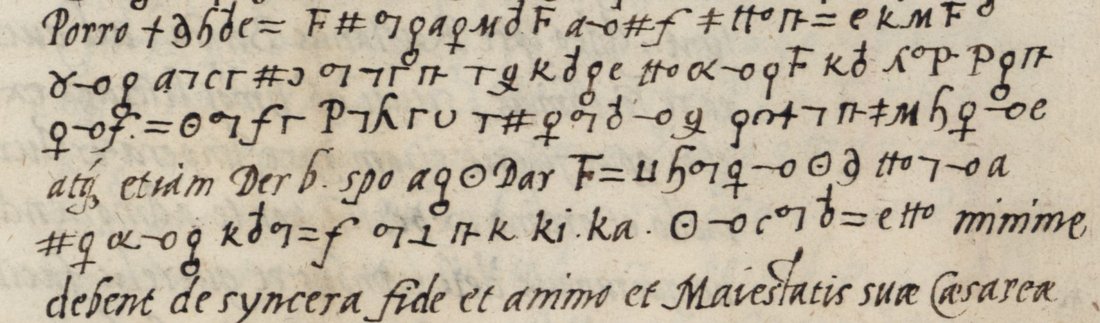
This is why the passage is in cipher. The cleartext on either side is the ordinary matter of the truce of 1547: raids across the Hungarian border, robbers who have lived by plunder through long years of war, complaints carried to Rüstem Pasha. The accusation against the French envoy’s party at Istanbul, and the admission of how much the Habsburgs need the Sultan to believe them, are the parts the courier must not be able to read.
04 The envoy’s money
The second half of the cipher, from the foot of page 4 through pages 5 and 6, is Malvezzi’s pay and how it will reach Constantinople. It is the most continuous stretch in the letter.
Quo uero ad intertentionem, tibi per proximas literas nostras significauimus nos decreuisse ut tibi pro tua ordinaria intertentione et pro reliquis extraordinariis sumptibus, quos pauci momenti esse posse nobis ostensum est, mille quingenti ducati annuatim numerentur, exceptis sumptibus qui in mittendis tabellariis propriis faciendi erunt, de quibus tibi solutionem seorsim curaturi sumus. Mandabimusque Justo de Argento, secretario nostro, qui cum pecuniis propediem se in uiam dabit, ut a te computum de receptis et expositis accipiat. Per eundem quoque Justum tibi summam illam duorum millium et octingentorum ducatorum, quos te isthic non solum pro tuo intertenendo et sustento, sed in aliis etiam negotiis nostris expositos debere nobis scripsisti, necnon mille et quingentos ducatos pro tua intertentione ad futurum unum annum, a prima die mensis Martii nunc uenturi computandum, transmittemus: ita quod ab ipso Justo summam quattuor millium et trecentorum ducatorum simul accipies. Praeterea scribimus Gulielmo S[…], sicuti et Argento, litterarum huiusmodi exemplo uidebis, ut in casu aliquo ingruentis necessitatis (de qua nos tam tempestiue admonere non ualeres) tibi ad requisitionem tuam, in una uel pluribus uicibus, usque ad tria milia ducatorum nomine nostro, mediante aliquo honesto et conuenienti interesse, de quanto tu et Justus cum eo conuenire debebitis, mutuo dare non recuset, et securus esse debeat se, ad exhibitionem chirographi tui et nominatione nostra, solutione Venetiis, indubitanter habiturum et accept[at]urum esse. Volumus autem et requirimus, pro tua erga nos fide, et eam pecuniam, sicuti te hactenus omnino fecisse et posthac facturum esse non ambigimus, non nisi in necessariis usus … exponas atque impendas. Magistrum horologiorum inueniendum curabimus, ita ut secretarius noster cum pecuniis isthuc uenturus eum secum adducat.
In English. As to his upkeep: the last letter said 1,500 ducats a year, covering his ordinary maintenance and the lesser extraordinary expenses, other charges excepted. Couriers he must send express will be paid for separately. Ferdinand’s secretary Justus de Argento is setting out shortly with money and will take from Malvezzi an account of what he has received and spent. By him Ferdinand sends the 2,800 ducats Malvezzi wrote that he had laid out there, not only on his own keep but on other business of the King’s, and 1,500 ducats for the coming year reckoned from 1 March next: 4,300 ducats to be received at once. Beyond that, Ferdinand is writing to a banker, Gulielmo S[…], with copies to Malvezzi and to Argento, to lend him on request, in one or more instalments, up to 3,000 ducats in the King’s name should a sudden need arise of which the court cannot be warned in time, at an honest and reasonable rate of interest to be agreed between Malvezzi, Justus and the lender, the lender to be secure of repayment at Venice against Malvezzi’s signed note in the King’s name. Ferdinand trusts his fidelity and charges him to spend it only on real need. An agent is to be found and brought out by the secretary with the money.
05 The other passages
Page 1, decrypted in part. It follows the clear sentence saying that some of Malvezzi’s reports were written to Ferdinand’s secretaries, and turns on what was said in conversation with Rüstem Pasha: sermone … [ki ke = Rustanus Passa] … tecum habitos … odium propter tractatum nobiscum … pacis constituendae autor, nunc uero conseruandae promotor [et] defensor sibi conciliarit … praeterea quid … responderis — running back into the clear et quid pro eiusdem pacis conseruatione faciendum censeas. Rüstem is the man who made the peace and now protects it, and who has drawn hostility on himself for dealing with the Habsburgs; Ferdinand wants to know what Malvezzi answered him.
On 5 October 2026 every stretch the first pass had left open was re-read from the full-resolution images: the first ten cipher lines of page 1, the foot of page 6 and all of page 7. They are now deciphered straight through.
Page 1 in full: sermones [Rustani Passae] tecum habitos, quod uidelicet ingens odium propter tractatum nobiscum initae pacis, tanquam illius pacis constituendae autor, nunc uero conseruandae promotor et defensor, sibi conciliarit, et praeterea quid tu ad quaeuis eiusdem [Rustani Passae] obiecta, quaesita et interrogata responderis.
Page 6, foot: the money is to be spent only on real need; a clockmaster is to be found and brought out by the secretary; and if Rüstem asks about Ferdinand’s troops on the border, Malvezzi is to say: nos in eisdem confiniis non alias gentes quam quae sunt necessariae pro eorundem tuitione tum ad coercendos [v] compescendos latrones et uiolatores pacis, tum etiam ad conseruandam et manutenendam obedientiam a subditis nostris nobis debitam [v] non aliam ob causam (only the troops needed to defend the border, to restrain robbers and breakers of the peace, and to keep the obedience owed by his subjects).
Page 7, the captives: de captiuis quos iussu [Imperatoris Turcorum] liberatos esse scribis, si necesse fuerit respondebis nobis id auditu gratissimum fuisse, nos uelle etiam uicissim libenter curare ut sicubi magnitudinis suae subditos captos fuisse intellexerimus et de quo apud nos conquestum fuerit, eos liberari et dimitti faciamus, atque adeo nihil omittamus quod ad mutuam seruandae pacis sinceritatem pertinet — before the clear close, Et haec sunt quae in praesentiarum ad literas tuas respondenda duximus. Ferdinand will free the Sultan’s subjects held on his side in return.
06 What remains
- Measured.
measure_sense.pycounts a plaintext word as read only when every sign matches the key and the word is a Latin form whose nine-word window scores as Latin under the sharedlamodel: page 1 41/41, page 4 114/114, page 5 156/158, page 6 134/136, page 7 64/65, 509/514 (99.0%). The 21 September figure of 83% was a count of marks over the first pass, which had left out page 1 lines 1–8. - Open. The banker’s surname after Gulielmo on page 5 (every sign reads, giving Semaslia, but the man is not identified); a two-sign group before nominatione on page 6 that fits no key value as written; and a lone v sign twice (coercendos v compescendos, debitam v non aliam), which is f in the key and probably the clerk’s mark for uel, not counted as read.
- Grades. The continuous passages are H (certain): they run as Latin joining onto the clear text on both sides; the sums (2,800, 1,500, 4,300, 3,000 ducats) are spelt out in words and agree. C (probable): nine words where the context forces a writer’s slip to be corrected (pacr for pacis, Turcrum, uiciscantur for ulciscantur, ordinaria, comutum, factorum for facturum, expona, manutenea, faciam for faciamus).
- Not checked against the edition. Malvezzi’s correspondence of 1548–1552 is printed in Austro-Turcica 1541–1552 (Munich 1995), which is not freely available online and was not consulted. Since Ferdinand’s chancery kept its registry copies in clear, the content of this letter is probably in print there. This page adds a decipherment of this manuscript and the identification of its key among the DECODE records.
- Images. The archive’s images may not be published without its permission, so no facsimile is reproduced on this page.
Full texts
The transcription and the decryption of every document on this page, so that the reading can be used and checked. Short files are shown here; all are in the repository.
R366, Augsburg, 23 Jan 1548, ciphered passages pp. 1, 4-7
Ferdinand I writes to his envoy at the Porte, Johann Malvezzi, in reply to four of his letters; the clear text is the routine complaint about border raids, and the cipher carries the delicate matters. Rüstem Pasha has drawn great hatred on himself as author and defender of the Habsburg-Ottoman peace; the French are working to wreck that peace because, not daring to attack Charles V with their own forces, they want the Sultan's resources turned against him; and Malvezzi is to receive 1,500 ducats a year and 4,300 ducats at once through the secretary Justus de Argento.
Transcription
# Reader A: p1 (from 'praeterea quid'), p4, p7

p1 l3 | ... α-o o7 ⊙ = quid; ♀ o- M ϙ̊ ♉ | ϙ ϙ̊ o- o7 a | ϙ7ρaϙ̊Kϙ̊F | ki ke | quid tu ae[?] que[?] u[?]is [?]i[?]se[?]e[?]m Rustanus Passa
p1 l4 | °P ɔ o7 Π #o + ∂ M | ♉ -o ϙ a 7 ♀ = | cum(null) | ϙ ♀ | o7 λ ∂ K ι 4 | ‡? Π # ∂ = | [?]obis eco[?]a quaesita [null] et[?] [...] [...]
p1 l5 | e ʛ a ⊥ °P P ⊙ K ʛ o7 Π | responderis (then clear: et quid pro eiusdem pacis conseruatione faciendum censeas)
p4 l1 | π b atq (nulls) o- ծ °P c a ʛ ϙ = ♀ -o e Ᵽ Π | idcirco(null) Ab | ∂ # F | f o- ⌣ | u[?]t obseruaturo[s?] Galli tam mul-
p4 l2 | ♀7T∩Γ+o7 ծ ʛ e / #o♀ / ʛ∂∩ᵽΠK / λ#h+ / ⊥M+ϙF / d π(nulls) | -tipliciter et dolose hanc pacem
p4 l3 | Πϙɔ-oKe♀ϙʛ#o / +∂h=P♀o7c-oa / ♉-oΓ / ΠMPϙΓʛ / P∂h | subuertere conantibus, qui sane id non
p4 l4 | ᵽɔ / =∩o7#f / ‡Mϙa#F / v=+Γo-hծ / z π spu(nulls) / α-o=F -oծ | ob aliam causam faciunt quam ut
p4 l5 | Kʛ(x-like 9) / ♉ϙ∂ / Bi / ϙծ / aα-o7 / ΠΓfo7∪#oa / Π#+ʛMf / ‡ϙa= | ex quo Rex Galliae et sui similes sacram Cae-
p4 l6 | eK#F / #o♀ / ‡=ծʌ∂∪o7+Mf / ʛK∐7=F / f#o7ʛaϙMծʛf | -saream et catholicam regiam maiestatem
p4 l7 | cum(null) ^e=♀ʛ#oF / Kծ / ⊙ᵽf7h-oF / Pᵽaծeα-f / +λ=ʛo7 ι3 Γ | fratrem et dominum nostrum charissi-
p4 l8 | F-of / ϙo7ʛΓco-a / Π-o7Π / ⌣#+ϙ ι3 Ke#o / P∂h=-o⊙Khծ | -mum uiribus suis lacessere non audent
p4 l9 | o7f⊥ϙ̊e#♀ᵽʛΓΠ / d z(nulls) / ♉?-oʛ+eϙF / a-oF T♀Γcϙ Π / aϙΠK | imperatoris Turc[o]rum sumptibus sese[?]
p4 l10 | Porro(null) +∂hծe= / F#o7ϙa♀MծF / a-o#f / ‡#oΠ=eKMF | contra maiestatem suam caesaream
p4 l11 | ♉-oϙ / a7cΓ / #ɔo77ΓΠ / TʛKծϙe#oα-oϙF / Kծ / ʌ°PPϙΠ | quae sibi ab illis praeter aequum et hones-
p4 l12 | ϙ-o♀ / =⊙o7fΓ / P7λΓ∪ / T#♀o7ծ-oʛ / ϙo7+7Π‡Mh♀-oe | -tum adimi nihil patitur, ul[?]ciscantur[?] (first glyphs uncertain)
p4 l13 | atq etiam Der b spo (nulls) / aϙ⊙ / Dar(null) / F=∐ho7♀-o⊙∂ / #o7-oa | sed magnitudo eius
p4 l14 | #♀α-oϙ / Kծo7=f / o7⊥ΠK / ki ka / ⊙-oco7ծ=e#o + clear 'minime debent...' | atque etiam ipse Rustanus Passa dubitare [minime debent de syncera fide ...]
p4 l16 | Dar etiam π z (nulls) / α-o∂ / -oϙ̊ʛ°P | quo uero
p4 l17 | b(null) #⊙ / o7h♀Keծ(π null)ϙ̊P♀Γᵽh-KF / ♀Γc7 / Tϙ̊ʛ / ⊥e∂9o7f=Π | ad intertentionem tibi per proximas
p4 l18 | ∪o7ծ#oe#a / P°PΠ♁MΠ / ao7∐h7ʌΓ+M-oo7Fo-Π / P∂a | literas nostras significauimus, nos
p4 l19 | ʛ#o‡eϙ̊α-7ι3K / α-♀ / ծΓc7 / Te°P / ♀α-# / ∂e⊙Γh=∐7#ΓP | decreuisse ut tibi pro tua ordinaria[?] in-
p4 l20 | ♀Keϙ̊∏ϙ̊ z(null) hծΓᵽPK / #oծ / Te∂ʛϙ̊∪o7ծ-oo7a / Kʛϙʛ= | -tertentione et pro reliquis extra-
p4 l21 | ᵽe⊙o7P#ʛΓ7a / Πo-Fծ7c-oΠ / αϙ°Pa / T#ϙ+o7F∂ | -ordinariis sumptibus, quos pauci mo-
p4 l22 | fKhծ7 / Kι3ϙ / ⊥ᵽι3K / P∂ɔΓΠ / ∂a♀ϙPa-of / ϙ̊Π♀ / ծΓc7 | -menti esse posse nobis ostensum est, tibi
p4 l23 | F z d(nulls) Γ7ϙ / n π (nulls) / α-oΓh∐KPծΓ / ⊙-o+=ϙo7 / #16ϙ#ծΓf | mille quingenti ducati annuatim
p4 l24 | Po-fKʛϙ̊hծ-oe / #oʛ‡K⊥♀o7a / Πϙʃ Tծ Γɔ-oa / αϙΓʃΓh | numerentur, exceptis sumptibus qu[?]i[...] (continues on p5)
p7 l1 | ⊙o7ծΓa / P∂Π♀eΓa / P°Pɔo7Π / ʛK+o7ծ=f / v P∂h | [..]ditis[?] nostris nobis [?]ecitam[?] [?] non
p7 l2 | #∪o7=f / ∂c / ‡M-oΠ=F / z spo(nulls) / ⊥e Kծϙʛ#o= / ʛK | aliam ob causam praeterea de
p7 l3 | +#⊥♀o7o-Γa / α-o∂Π / o7-oo7ι3o- / Nas / b d(nulls) / ∩Γ+KM | captiuis quos iussu Imperatoris Turcorum lice[?]-
p7 l4 | ծᵽΠ / ϙι3K / a♀eo7+ΓΠ / ao7 / hK+ϙι3#o / vα-#oeo7♀ | -[n]t[i]os[?] esse astrictos[?], si necesse fuerit
p7 l5 | ʛϙaծ∂ᵽ⊙K+o7a / Pᵽ+o7Π / o7⊙= / o-ϙʛϙ-o / ∐e#ϙo7ι3Γ | [...] (uncertain: re?st?-o-d?-ecis; nocis[?]; ida; ...; gratissi[mum?])
p7 l6 | f°F / ʌα-o7ι3K / Pᵽa / -oϙ7K / #oϙo7#F / α-o7ι3ϙf / ... | [...] fuisse[?] nos [...] quisse[?] [...] (not read)
p7 l7 | vo7c#oh⊙Kʛ / ‡-oe=ʛϙ / α-ծ / ao7‡α-co7 / F#∐Po7 | [...] curare[?] [...] magni (not read)
p7 l8 | ծo-♀o7PΓa / ΠϙK / Πϙc⊙o7ծ∂a / +#⊥ծᵽa / vo-o7ι3K | [...] suae subditos captos fuisse
p7 l9 | o7P♀K7ʛ∂#oeΓfo-a / ∇ / ⊙Kʛ∂=Tϙծ Pᵽa / ‡∂h | intellexerimus et de[...]a[?]ptos[?] con-
p7 l10 | α-oKa#ʛϙ=f / vo-ϙeծ / K∂a / ϙ∪o7+KFʛo7 / ∇ / ⊙o7 | [...] fuerit eos [...] et di-
p7 l11 | FΓ ι z 7 / v#+o7=f / #ծα-oK / =ʛϙ∂ / Po7ʌΓ∩ / ∂Fo7ι z# | [...] faciam[?] atque ad[?] nihil omnia[?]
p7 l12 | fo-a / ♉ϙ∂ / ⊙#ʛ / F∂♀-o#f / aKeo-=h⊙#o / T#+o7a | [...] quo ad mutuam[?] seruandae pacis
p7 l13 | Πo7h‡ϙʛo7♀Fծ(?)Kf / ⊥Ke♀ΓPϙծ | sinceritatem pertinet. (clear: Et haec sunt ...)

## Continuous text

p1: ... praeterea quid tu ad quae[?] [...] Rustanus Passa [..]obis [...] quaesita [...] responderis (et quid pro eiusdem pacis conseruatione faciendum censeas ...)

p4 A: [...] obseruaturo[s?]. Galli tam multipliciter et dolose hanc pacem subuertere conantibus, qui sane id non ob aliam causam faciunt quam ut, ex quo Rex Galliae et sui similes sacram Caesaream et catholicam regiam maiestatem, fratrem et dominum nostrum charissimum, uiribus suis lacessere non audent, imperatoris Turcorum sumptibus sese[?] contra maiestatem suam Caesaream [armare?]; quae sibi ab illis praeter aequum et honestum adimi nihil patitur [ul?ciscantur?]. Sed magnitudo eius atque etiam ipse Rustanus Passa dubitare minime debent de syncera fide ...

p4 B: Quo uero ad intertentionem [tuam], tibi per proximas literas nostras significauimus nos decreuisse ut tibi pro tua ordinaria intertentione et pro reliquis extraordinariis sumptibus, quos pauci momenti esse posse nobis ostensum est, tibi mille quingenti ducati annuatim numerentur, exceptis sumptibus qu[ibus?] ... (continues p5)

p7 (partial): ... non aliam ob causam. Praeterea de captiuis quos iussu Imperatoris Turcorum [...] esse astrictos[?], si necesse fuerit, [...] subditos captos fuisse intellexerimus et [...] quo ad mutuam[?] seruandae pacis sinceritatem pertinet.

English: p4 A: the French are trying so many ways, deceitfully, to wreck the peace only because, not daring to attack Charles V (the Emperor, Ferdinand's brother) with their own forces, they want to turn the Sultan's resources against him; Charles lets nothing be taken from him beyond what is fair; but the Sultan and Rüstem Pasha must not doubt the sincerity of Charles's and Ferdinand's goodwill toward this peace. p4 B: as to Malvezzi's salary, Ferdinand has decided to pay him 1,500 ducats a year for ordinary upkeep and the minor extraordinary expenses, other expenses excepted. p7: about captives taken on the Sultan's orders / subjects captured, and what concerns keeping the peace sincerely (partly unread).
Transcription
# read_B: pages 5-6 (agent B)
p5 l1 | F7 ♁♀ K P⊙Γ Π / ♁=cK7#eΓ7Π / ⊥ʛ∂TeΓo7a / ^#+7Π°P⊙7 (Π° = e) | mittendis tabellariis propriis faciendi
p5 l2 | Z(null) Ke ϙ b-hook ♁ / 8ϙ / ♉ϙΓɔ-oΠ / ♁Γc o7 / n(null) a°P⌣o-♁Γ ʛPKF / ΠΠ°∂ea7f | erunt de quibus tibi solutionem seorsim
p5 l3 | ‡ϙʛ#♁o-eΓ / Πϙfo-a / [π spu n Dar b nulls] / F#P⊙=cΓf-oa αϙK | curaturi sumus mandabimusque
p5 l4 | Mis. / Π d(null) ϙ‡e♀=ʛΓ8 / P°PΠ♁ʛ8 / ♉-oo7 / ‡ϙF / ⊥Π°+o-PΓ7Π | Justo de Argento secret[a]rio nostro, qui cum pecuniis
p5 l5 | Tʛ8⊥Kϙ̊ΓKf / ΠΠ° o7 b-hook -oΓMF / 8=c7♁ / o-♀ #♁K ‡∂f ϙ♁ϙf | propediem se in uiam dabit, ut a te comp[u]tum [?]
p5 l6 | ⊙K eΠ°+ϙ⊥♀7Π / K♁ / Π°⊗ ⊥∂a7♀Γ / #3ΓT7=♀ / [etiam d cum nulls] | de receptis et expositi[s] accipiat
p5 l7 | ⊥ϙʛ / Kϙb-hook⊙Π°f / ♉ϙ∂α-oϙ / Mis. Z(null) / ♁Γɔ Γ / Π-o8#F (8=mm) / o77#f / 8-o°P | per eundem quoque Justum tibi summam illam du-
p5 l8 | e-oF / fo777ϙF / K♀ / b(null) / ∂+♁Γb-hookΠKP♀8eϙF / 8πo-‡=♀∂ʛF / αϙ∂a | -orum millium et octingentorum ducator[u]m quos
p5 l9 | ♁Π°ΓΠ♀λo7‡ / P°Pb-hook / Π8⌣-of / ⊥e∂ ♀8 / ΓP♀Ke♁ϙb-hookϙP⊙∂ / K♀ | te isthic non solum pro t[uo?] intertenendo et
p5 l10 | Πϙa♁ϙP♀8 / aK⊙ / Γb-hook / =⌣Γ7Π / K♁Γ#f / d Z(null) / PΠ°ш∂♀Γ7Π / b-hook∂ | sustento sed in aliis etiam negotiis no-
p5 l11 | Π♀eΓa / ϙ9⊥°Pao7♁8Π / ⊙KcΠ°eϙ / P∂ɔo7Π / a‡eo7⊥Π7a♁7 / PK+ | -stris ex[?]posit[u?]s debere nobis scripsisti nec-
p5 l12 | b-hook8P / FΓ7Π° / Δ / αϙΓPшϙb-hook♁°Pa / ⊙o-‡#♁∂a / ⊥ʛ8 / ♁-o= ΓP | -non mille et quingentos ducatos pro tua in-
p5 l13 | ♀Ke♁Π°b-hook♀7°Pb-hookϙ / =8 / v-o[∂]♁o-eϙF / ϙP-of / M16o-F / #⊥er | -tertentione ad futurum unum annum apr-
p5 l14 | f=8o7K / Q-sign(mensis?) / F#e♀Γo7 / P-ob-hook+ / ϙΠ°b-hook♁-oeϙ / +∂f⊥ϙ♁=P⊙o-F | -ima die [mensis] Martii nunc uentur[i] computandum
p5 l15 | ♀eMPΠfo7 1Z(=12) KFo-a / o7♁= / αϙ8⊙ / #ɔ / ΓTa∂ / Mis. / [n π nulls] / aϙ8Mf | transmittemus, ita quod ab ipso Justo summam
p5 l16 | αo-=12-o°Pʛ / Fo77ΓϙF / [d Z nulls] / ∇ / ♁eKɔϙP♀∂e∂-oF / 8-o+#π | quattuor millium et trecentorum ducat-
p5 l17 | ♁∂ʛo-f / aΓF-o⌢ / M3o7⊥ΓKΠ / [Porro spu etiam nulls] / ⊥eϙ̊♀KʛΠ°# | -orum simul accipies. Praeterea
p5 l18 | a+eΓco7f-oΠ / ш-o [Z d nulls] ⌣o7K⌢F∂ / Πϙf=Π⌣Γ# / Πo7+ϙ♁Γ | scribimus Gulielmo S[..]aslia [?name] sicuti
p5 l19 | K♁ / =ʛΓϙP♀ϙ8 / ⌣o7♀♀e#ʛo-F / λ-oΓo-Π / F∂8Γ / K∂ϙF⊥⌣8 | et Argent[e]o [?], litterarum huiusmodi exemplo
p5 l20 | -oo7⊙Kco7Π / -o♁ΓP+MΠo- / #⌢Γα-oK / o7Pшeϙb-hook♁Γa | uidebis, ut in casu aliqu[o?] ingruentis
p5 l21 | Pϙ+Π°13Γ♀#♁Γa / ⊙K / αϙ= / P∂a / ♀=F / ♁Π°fTKaϙΓo-K | necessitatis (de qua nos tam tempestiue
p5 l22 | Mϙ̊F°PPϙeΠ° / P8b-hook-o=⌣KeΠ°a / ♀Γɔo7 / #ϙ̊ʛKαϙΓao7♁Γ | admonere non ualeres) tibi ad requisiti-
p5 l23 | °Pb-hookϙF / ♀-o#f / o7b-hook / ϙP# / -oK⌢ / T⌢-oϙʛΓcϙa / -oΓ+o7co-Π | -onem tuam in una uel pluribus uicibus
p5 l24 | -oaαo-K#⊙ / ♁ʛo7= / FΓ7Γ# / ⊙-o+=♀∂eo-f / P∂F7b-hookK | usque ad tria milia ducatorum nomine
p5 l25 | P°PΠ♁ʛ8 / FK⊙7=b-hook♁Π° / =⌣Γ♉-o∂ / λ8PPΠ°Π♀ϙP / Δ | nostro, mediante aliquo hon[n]esto [?ending] et
p5 l26 | +°PP-oKPo7ϙb-hook♁Γ / 7P♁KeΠ°13ϙ / ϙ̊Π° α-o8P♁-o / ∇ / Mis | conuenienti interesse, de qua[n]to [?] tu et Justus
p5 l27 | Z(null) ‡ϙf / ϙ̊∂ / +8Po-ϙ̊b-hook7eK / ⊙Π°cKɔΓ♁ΓΠ / F-o♀-o∂ | cum eo conuenire debebitis, mutuo
p5 l28-30 | (blank; page 5 ends at l27; strips q5_09, q5_10 empty) |
p6 l1 | ⊙=eK / P°Pb-hookʛK+-oaΠ°♁ / Δ / Πϙ+o-eϙa / ϙ̊13K | dare non recuset et securus esse
p6 l2 | 8Π°cK=♀ / aϙ̊ =8 K∂λo7cΓ♁7∂ṖKF / ‡λo7e8шʛ# | debeat se ad exhibitionem chirogra-
p6 l3 | Tλo7 / ♁-oΓ / Π°8 / Pϙϙ7P#♀Γ∂b-hookϙ / P∂aϙ̊e# / a∂⌣ϙ̊♁7 | -phi tui e[d?] nominatione [?] nostra soluti-
p6 l4 | °Pb-hookK / -oKPϙ̊♀Γo7a / o7b-hook8-oco7♁=b-hookϙKeλ#co7♀o- | -one Venetiis, indubitanter habitu-
p6 l5 | e-of / Δ / =3ϙ̊T♁ϙʛo-F / K13ϙ̊ / [Idcirco etiam Der nulls] | -rum et accept[..]um [?] esse.
p6 l6 | [spo b nulls] -o∂⌣o-Fϙa / #-o♀Kf / ∇ / ϙϙ̊ / eKαϙΓʛo7fϙa / Te∂ | Volumus autem et ut requirimus pro
p6 l7 | ♀ϙM / KeШ# / b-hook∂a / v(=f)7ϙ̊K / ϙ♁ / ϙ̊#f / π(null) ϙ̊‡o-Po7MF / aΓ+o-♀7 | tua erga nos fide et eam [?] pecuniam, sicuti
p6 l8 | ♁K / λ#+♁ϙ̊b-hooko-a / °Pfb-hooko7Pϙ̊ / vΠ°+Γ13K / ϙ̊♁ / T∂aϙλ=‡ | te hactenus omnino fecisse, et posthac
p6 l9 | ^M+♁∂e-oF / K13ϙ̊ / P∂b-hook / #fcΓΠo7Fo-a / P8b-hook / Po7ΠΓ | factorum [facturum] esse non ambigimus, non nisi
p6 l10 | Γb-hook / Pϙ̊+K13#eo78Π / o-a-oΠ / -oK⌣ / -o♀7Π7 / α-oΓ⊙ | in necessariis usus uel utilis[?] quid
p6 l11 | =3o7ϙ̊Keϙ̊♀ / Γb-hook / ♉-o∂ / ♀Γco7#b-hook♀Π°αϙMf / P°PΠ / Te∂⊥ | accideret in quo tibi antequam nos prop-
p6 l12 | ♁Kʛ / ⌢ϙ̊‡o7 / ϙ̊ΓΠ♁Mb-hook♀Γ=F / #⊙fϙ̊PϙeK / T°P13ϙ̊a | -ter loci distantiam admonere posses
p6 l13 | ⊥e∂ / #⌣7α-o= / o-♁o7⌣Γ / Δ / 8T∂eϙ̊o-b-hookM / ʛK / Tϙ | pro aliqua utili et oportuna re, pe-
p6 l14 | ‡ϙb-hooko7= / ∂⊥o-a / ϙ̊13K♀ / ϙ̊∂T8b-hook= [?] / #ϙαϙK / o7F⊥Kb-hook⊙#a | -cunia opus esset, [e..p.na ?] aeque impendas
p6 l15 | [Atq b nulls] / F#шo7aϙ̊eo-f / λϙ̊eP⌣ϙ̊ΠΓ [?] / 8ʛo-F / o7b-hook-oKPΓ | magistrum [h?..?..] [..]orum inueni-
p6 l16 | KPϙ̊-of / Kϙ̊e#co7fϙa / Γ♀# / o-♁ / Πϙ̊‡ʛΠ°♀=eo7∂Π | -endum [c]urabimus, ita ut secretari[u]s
p6 l17 | P∂a♀Π°e / +-of / ⊥K‡-ob-hooko7ΓΠ / o7Π♀λo-‡ / -oΠ°P♁ϙeϙa | noster cum pecuniis isthuc uenturus
p6 l18 | ϙ̊-of [?] / ΠK+o-F / M4-o+#♁ / [Z porro b π nulls] / ao7λϙ̊e | eum [?] secum adducat. Si h[..]
p6 l19 | ϙ̊#13K / ki(=Rustanus) / ♁K / Γb-hook♁K14ʛϙ̊=e♀ / ⊙KΠшb-hook∂ | [?]asse Rustanus te interrogaret, designo [?]
p6 l20 | Pϙ̊aϙ̊eΓΠ [nostris] / ΠP♀°PPvΓb-hook [?] / Γb-hookΓΠ#⊙ [?] / o7шKb-hook♀o7♉λ [?] / ⊙Kʛϙ̊ | nostris [.significan..?] ad [ingen..?] de re
p6 l21 | T°P♁Keo7a / P∂a / Γb-hook / KΓ#шϙ̊KF [eiusdem?] / ‡ϙ̊b-hookv7PΓo7Π / P∂b-hook | poteris nos in eiusdem [?] confiniis non
p6 l22 | #⌢Γ=a / ЦKb-hookλϙ̊ϙ̊Π [?] / α-o#F / ∂#F / ♉ϙ̊K / a-oɔλϙ̊ [?] / Pϙ̊♀Π°13#eΓϙ̊ | alias [?] quam [..] que [sub?] necessari[o]
p6 l23 | ⊥eϙ̊Π°°Pʛϙ̊o- / λϙ̊ʛKF / ϙ̊o- / o7ʛ♁°PP / Pϙ̊ϙ̊o-f / #ϙ̊♀ϙ̊K‡ϙ̊b-hook | [...] (not resolved; letters read but no Latin sense yet)
p6 l24 | ⊙°PPΠ / ∇ / ‡ϙ̊FTΠ°♀KPϙ̊a / ♁#ϙ̊eϙ̊λKa [?] / Δ / -o∂ʛϙ̊ | [don..?] et competentes [.....] et [....]
p6 l25 | o7M♁ϙ̊eϙ̊a [?] / T#+o7Π / ♀o-F / ♀o7=f / #⊙ / ‡ϙ̊λ#Kʛϙ̊o-#b-hook | [...] pacis tum etiam ad [....]
p6 l26 | ⊙=f / ∇ / F#b-hook-o⊙KPϙM / ϙ̊cK⊙o7шb-hookϙ̊Γ=f / #a-o∂c | [...] et manu [.....] dignita[te]m [?] (last line of p6)

## Continuous Latin (pages 5-6, agent B)

p5: ... mittendis tabellariis propriis faciendi erunt, de quibus tibi solutionem seorsim curaturi sumus.
Mandabimusque Justo de Argento, secretario nostro, qui cum pecuniis propediem se in uiam dabit, ut a te
comp[u]tum de receptis et expositis accipiat. Per eundem quoque Justum tibi summam illam duorum millium
et octingentorum ducatorum, quos te isthic non solum pro tuo intertenendo et sustento, sed in aliis etiam
negotiis nostris expositos [nobis] debere scripsisti, necnon mille et quingentos ducatos pro tua
intertentione ad futurum unum annum, a prima die [mensis] Martii nunc uenturi computandum, transmittemus:
ita quod ab ipso Justo summam quattuor millium et trecentorum ducatorum simul accipies.
Praeterea scribimus Gulielmo S[..]aslia[?], sicuti et Argento, litterarum huiusmodi exemplo uidebis, ut in
casu aliquo ingruentis necessitatis (de qua nos tam tempestiue admonere non ualeres) tibi ad requisitionem
tuam, in una uel pluribus uicibus, usque ad tria milia ducatorum nomine nostro, mediante aliquo honesto et
conuenienti interesse — de quanto tu et Justus cum eo conuenire debebitis — mutuo

p6: dare non recuset, et securus esse debeat se, ad exhibitionem chirographi tui [et?] nomina[tio]ne nostra,
solutione Venetiis indubitanter habiturum et accept[at]urum esse. Volumus autem et requirimus, pro tua erga
nos fide (et eam pecuniam, sicuti te hactenus omnino fecisse et posthac facturum esse non ambigimus), non
nisi in necessariis usus uel utilis quid accideret, in quo tibi, antequam nos propter loci distantiam
admonere posses, pro aliqua utili et oportuna re pecunia opus esset, [eam] aeque impendas.
[Atque] magistrum [...]orum inueniendum curabimus, ita ut secretarius noster cum pecuniis isthuc uenturus
eum secum adducat. Si h[...]asse Rustanus te interrogaret, [designa?] nostris [...] de re poteris. Nos in
eiusdem confiniis non alias [...] quam [...] necessari[o] ... [three lines only partly resolved] ... pacis,
tum etiam ad [...] et manu [...] dignita[te]m ...

## English summary (pages 5-6)

Money and accounts for Malvezzi in Constantinople. Ferdinand will pay separately for the couriers Malvezzi
has to send on his own. He is sending his secretary Justus de Argento (Just von Silber), who is shortly to
set out with the cash, and who is to take from Malvezzi an account of receipts and expenditure. By the same
Justus he sends the 2,800 ducats Malvezzi wrote he had laid out there, not only for his own maintenance but
also on other business of the King's, and a further 1,500 ducats for his upkeep for the coming year,
reckoned from 1 March next: in all 4,300 ducats to be received from Justus at once.
Besides that, Ferdinand is writing to a banker (Gulielmo S...; Malvezzi will see a copy of the letter, as
will Argento) so that in any sudden emergency, of which Malvezzi could not warn the court in time given the
distance, the banker will lend him, at his request, in one or more instalments, up to 3,000 ducats in the
King's name, at an honest and reasonable rate of interest to be agreed between Malvezzi, Justus and the
banker; the loan is to be repaid without fail at Venice against Malvezzi's bond, in the King's name.
Ferdinand trusts his fidelity and enjoins him to spend this money only for real need or advantage, on any
useful and timely matter that arises before the court can be consulted. A master/agent is to be found and
brought out by the secretary with the money. The rest (last four lines) touches Rüstem Pasha's possible
questioning of Malvezzi, the border/confines, the peace negotiations, and is only partly resolved.
Decryption
# malvezzi1548 (DECODE R366): full plaintext of the ciphered passages, nulls removed, one page per block.
# Re-transcribed 5 Oct 2026 from the full-resolution images (img/p1.png, p4-p7.png) against key R367/R386.
# Token marks, used by measure_sense.py:
#   word      read, every sign matches the key
#   {word}    read after correcting a writer's slip that the context forces (see NOTES, Second pass)
#   <word>    nomenclator code word (R367 Tabella I/II), rendered in its grammatical form
#   [x]       not read; x is what the signs give
# Clear text between the cipher runs is not included.

p1 | sermones <Rustani> <Passae> tecum habitos quod uidelicet ingens odium propter tractatum nobiscum initae {pacis} tanquam illius pacis constituendae autor nunc uero conseruandae promotor et defensor sibi conciliarit et praeterea quid tu ad quaeuis eiusdem <Rustani> <Passae> obiecta quaesita et interrogata responderis

p4 | ut obseruaturos <Galli> tam multipliciter et dolose hanc pacem subuertere conantibus qui sane id non ob aliam causam faciunt quam ut ex quo <Rex> <Galliae> et sui similes sacram Caesaream et catholicam regiam maiestatem fratrem et dominum nostrum charissimum uiribus suis lacessere non audent imperatoris {Turcorum} sumptibus sese contra maiestatem suam Caesaream quae sibi ab illis praeter aequum et honestum adimi nihil patitur {ulciscantur} sed magnitudo eius atque etiam ipse <Rustanus> <Passa> dubitare
p4 | quo uero ad intertentionem tibi per proximas literas nostras significauimus nos decreuisse ut tibi pro tua {ordinaria} intertentione et pro reliquis extraordinariis sumptibus quos pauci momenti esse posse nobis ostensum est tibi mille quingenti ducati annuatim numerentur exceptis sumptibus qui in

p5 | mittendis tabellariis propriis faciendi erunt de quibus tibi solutionem seorsim curaturi sumus mandabimusque <Justo> <de> <Argento> secretario nostro qui cum pecuniis propediem se in uiam dabit ut a te {computum} de receptis et expositis accipiat per eundem quoque <Justum> tibi summam illam duorum millium et octingentorum ducatorum quos te isthic non solum pro tuo intertenendo et sustento sed in aliis etiam negotiis nostris expositos debere nobis scripsisti necnon mille et quingentos ducatos pro tua intertentione ad futurum unum annum a prima die <mensis> Martii nunc uenturi computandum transmittemus ita quod ab ipso <Justo> summam quattuor millium et trecentorum ducatorum simul accipies praeterea scribimus Gulielmo [Semaslia] sicuti et Argento litterarum huiusmodi exemplo uidebis ut in casu aliquo ingruentis necessitatis de qua nos tam tempestiue admonere non ualeres tibi ad requisitionem tuam in una uel pluribus uicibus usque ad tria milia ducatorum nomine nostro mediante aliquo honesto et conuenienti interesse de quanto tu et <Justus> cum eo conuenire debebitis mutuo

p6 | dare non recuset et securus esse debeat se ad exhibitionem chirographi tui [em] nominatione nostra solutione Venetiis indubitanter habiturum et accepturum esse uolumus autem et requirimus pro tua erga nos fide et eam pecuniam sicuti te hactenus omnino fecisse et posthac {facturum} esse non ambigimus non nisi in necessariis usus uel utilis quid accideret in quo tibi antequam nos propter loci distantiam admonere posses pro aliqua utili et oportuna re pecunia opus esset {exponas} atque impendas magistrum horologiorum inueniendum curabimus ita ut secretarius noster cum pecuniis isthuc uenturus eum secum adducat si fortasse <Rustanus> te interrogaret de gentibus nostris in confiniis ad id respondere poteris nos in eisdem confiniis non alias gentes quam quae sunt necessariae pro eorundem tuitione tum ad coercendos [v] compescendos latrones et uiolatores pacis tum etiam ad conseruandam et {manutenendam} obedientiam a

p7 | subditis nostris nobis debitam [v] non aliam ob causam praeterea de captiuis quos iussu <Imperatoris> <Turcorum> liberatos esse scribis si necesse fuerit respondebis nobis id auditu gratissimum fuisse nos uelle etiam uicissim libenter curare ut sicubi magnitudinis suae subditos captos fuisse intellexerimus et de quo apud nos conquestum fuerit eos liberari et dimitti {faciamus} atque adeo nihil omittamus quod ad mutuam seruandae pacis sinceritatem pertinet
Reading
# DECODE R366: Ferdinand I to Johann Malvezzi, Augsburg, 23 January 1548, the ciphered passages: reading

Running text of `reading_full.txt` (re-transcribed 5 Oct 2026 against key R367/R386, nulls removed), written out
23 Oct 2026 (translation wave v7): only capitals and punctuation are added, and the file's marks are carried over:
nomenclator code words (<word> there) are given plain, with capitals; `{word}` a word read after correcting a writer's
slip the context forces; `[?Semaslia]` and `[?]` signs not read (the file's [x]). **The cipher passages only**: the
clear text between them (the routine complaint about border raids) is not transcribed, so each page's passages start
and end where the cipher does. Latin, the writer's spelling (u for v).

## Reading

*p. 1.* … sermones Rustani Passae tecum habitos, quod uidelicet ingens odium propter tractatum nobiscum initae {pacis},
tanquam illius pacis constituendae autor, nunc uero conseruandae promotor et defensor, sibi conciliarit; et praeterea
quid tu ad quaeuis eiusdem Rustani Passae obiecta, quaesita et interrogata responderis …

*p. 4.* … ut obseruaturos Galli, tam multipliciter et dolose hanc pacem subuertere conantibus; qui sane id non ob aliam
causam faciunt quam ut, ex quo Rex Galliae et sui similes sacram Caesaream et catholicam regiam maiestatem, fratrem et
dominum nostrum charissimum, uiribus suis lacessere non audent, imperatoris {Turcorum} sumptibus sese contra
maiestatem suam Caesaream, quae sibi ab illis praeter aequum et honestum adimi nihil patitur, {ulciscantur}; sed
magnitudo eius atque etiam ipse Rustanus Passa dubitare …

… Quo uero ad intertentionem, tibi per proximas literas nostras significauimus nos decreuisse ut tibi pro tua
{ordinaria} intertentione et pro reliquis extraordinariis sumptibus, quos pauci momenti esse posse nobis ostensum est,
tibi mille quingenti ducati annuatim numerentur, exceptis sumptibus qui in

*p. 5.* mittendis tabellariis propriis faciendi erunt, de quibus tibi solutionem seorsim curaturi sumus; mandabimusque
Justo de Argento, secretario nostro, qui cum pecuniis propediem se in uiam dabit, ut a te {computum} de receptis et
expositis accipiat. Per eundem quoque Justum tibi summam illam duorum millium et octingentorum ducatorum, quos te
isthic non solum pro tuo intertenendo et sustento sed in aliis etiam negotiis nostris expositos debere nobis scripsisti,
necnon mille et quingentos ducatos pro tua intertentione ad futurum unum annum, a prima die mensis Martii nunc
uenturi computandum, transmittemus, ita quod ab ipso Justo summam quattuor millium et trecentorum ducatorum simul
accipies. Praeterea scribimus Gulielmo [?Semaslia], sicuti et Argento litterarum huiusmodi exemplo uidebis, ut in casu
aliquo ingruentis necessitatis, de qua nos tam tempestiue admonere non ualeres, tibi ad requisitionem tuam in una uel
pluribus uicibus usque ad tria milia ducatorum nomine nostro, mediante aliquo honesto et conuenienti interesse, de
quanto tu et Justus cum eo conuenire debebitis, mutuo

*p. 6.* dare non recuset, et securus esse debeat se ad exhibitionem chirographi tui [?] nominatione nostra solutione
Venetiis indubitanter habiturum et accepturum esse. Volumus autem et requirimus pro tua erga nos fide, et eam
pecuniam, sicuti te hactenus omnino fecisse et posthac {facturum} esse non ambigimus, non nisi in necessariis usus, uel
utilis quid accideret in quo tibi, antequam nos propter loci distantiam admonere posses, pro aliqua utili et oportuna
re pecunia opus esset, {exponas} atque impendas. Magistrum horologiorum inueniendum curabimus, ita ut secretarius
noster cum pecuniis isthuc uenturus eum secum adducat. Si fortasse Rustanus te interrogaret de gentibus nostris in
confiniis, ad id respondere poteris nos in eisdem confiniis non alias gentes [habere] quam quae sunt necessariae pro
eorundem tuitione, tum ad coercendos [?] compescendos latrones et uiolatores pacis, tum etiam ad conseruandam et
{manutenendam} obedientiam a

*p. 7.* subditis nostris nobis debitam, [?] non aliam ob causam. Praeterea de captiuis quos iussu Imperatoris Turcorum
liberatos esse scribis, si necesse fuerit, respondebis nobis id auditu gratissimum fuisse, nos uelle etiam uicissim
libenter curare ut, sicubi magnitudinis suae subditos captos fuisse intellexerimus et de quo apud nos conquestum
fuerit, eos liberari et dimitti {faciamus}, atque adeo nihil omittamus quod ad mutuam seruandae pacis sinceritatem
pertinet.
Translation
# DECODE R366: Ferdinand I to Johann Malvezzi, Augsburg, 23 January 1548, the ciphered passages: English translation

Translation (Claude Opus 5.5, 23 Oct 2026) of `R366_reading.md`, the cipher passages only (key R367/R386); the clear
text between them is not transcribed in the repository. Same marks: `{word}` a word read after correcting a writer's
slip, `[?Semaslia]` and `[?]` unread signs, `[word]` a word supplied. Code words are translated as plain words. Latin.

## Translation

*p. 1.* … the talks Rüstem Pasha held with you, namely that, on account of the treaty of peace begun with us, he has
drawn great hatred on himself, as the author of the making of that peace and now the promoter and defender of its
preservation; and moreover what you answered to whatever objections, questions and enquiries of the same Rüstem Pasha
…

*p. 4.* … that [they] will observe [it], the French trying so manifoldly and deceitfully to overturn this peace; who
indeed do this for no other reason than that, since the King of France and his like do not dare to provoke with their
own forces the sacred Imperial and Catholic royal Majesty, our dearest brother and lord, they may {avenge} themselves at
the expense of the Emperor of the {Turks} against His Imperial Majesty, who suffers nothing to be taken from him by
them beyond what is fair and honourable; but His Greatness and also Rüstem Pasha himself to doubt …

… As for your allowance, we informed you by our last letters that we had decided that one thousand five hundred
ducats a year should be paid to you for your {ordinary} allowance and for your other extraordinary expenses, which we
have been shown can be of little moment, apart from the expenses which will have to be incurred in

*p. 5.* sending your own couriers, for which we shall see to your payment separately; and we shall order Justus de
Argento, our secretary, who will set out shortly with the money, to take your {account} of receipts and expenditure.
By the same Justus we shall also send you that sum of two thousand eight hundred ducats which you wrote to us you are
owed for what you laid out there, not only for your maintenance and support but also in other business of ours, as
well as one thousand five hundred ducats for your allowance for one year to come, to be reckoned from the first day
of the month of March now coming; so that you will receive from Justus himself the sum of four thousand three hundred
ducats at once. Moreover, we are writing to Guglielmo [?Semaslia], as also to Argento, as you will see from the copy
of such letters, that in any case of pressing need, of which you could not warn us in good time, he should not
refuse to lend you, at your request, on one or more occasions, up to three thousand ducats in our name, at some
honest and fitting interest, on the amount of which you and Justus will have to agree with him,

*p. 6.* and that he may be secure that, on presentation of your note of hand [?] in our name, he will without doubt
have and receive payment at Venice. But we wish and require, by your fidelity towards us, that you spend and lay out
this money also, as we do not doubt you have done entirely until now and will do hereafter, only on necessary uses,
or if something useful should occur in which, before you could warn us because of the distance, you needed money for
some useful and timely matter. We shall see to it that a master clockmaker is found, so that our secretary, who is to
come there with the money, may bring him with him. If perhaps Rüstem should question you about our troops on the
borders, you will be able to answer that we [have] no other troops on those borders than are necessary for their
protection, both to restrain [?] curb robbers and violators of the peace, and also to preserve and {maintain} the
obedience due to us from

*p. 7.* our subjects, [?] for no other reason. Furthermore, concerning the captives whom you write were freed at the
command of the Emperor of the Turks, you will answer, if necessary, that this was most welcome for us to hear, and that
we in turn will also gladly see to it that, wherever we learn that subjects of His Greatness have been captured, and
complaint is made of it to us, we {have} them freed and released, and indeed that we omit nothing that pertains to the
mutual sincerity of keeping the peace.
07 Sources
- DECODE (de-crypt.org) record R366, MILITARIA_ARCH_1548_3, Budapest, Hadtörténelmi Levéltár 1548/3, eight pages, Latin, status “partially decrypted”. Images require a login and are not in the public domain.
- Keys: DECODE R367 (MILITARIA_ARCH_1548_3_1, four pages, Tabella I and II, transcription by NM, October 2020) and R386 (NSZL Quart. Lat. 2254. 15, Chiffre Johann Malvezzi’s). DECODE R368 (MILITARIA_ARCH_1548_3_ad2) is a further ciphered slip at the same shelfmark.
- Austro-Turcica 1541–1552. Diplomatische Akten des habsburgischen Gesandtschaftsverkehrs mit der Hohen Pforte im Zeitalter Süleymans des Prächtigen, ed. Srećko M. Džaja with Günter Weiß, prepared by Karl Nehring and Ernst D. Petritsch (Südosteuropäische Arbeiten 95, Munich 1995): the edition of Malvezzi’s correspondence.
- No decipherment of this manuscript was found on the web (searches, September 2026).
Notes, the key as used, and the line-by-line readings: targets/malvezzi1548/.