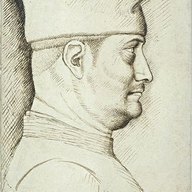
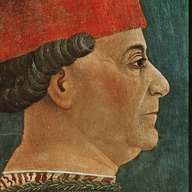
At a glanceRead in part · 15,033 of 16,637 cipher signs
- The letters
- Twenty parchment slips wholly in cipher from Duke Filippo Maria Visconti to Count Francesco Sforza, 1 November 1446 to 23 March 1447. Nineteen were reached; four letters were sent twice, enciphered afresh each time.
- Where
- Bibliothèque nationale de France, italien 1583 (six slips, imaged on DECODE as R7902–R7915) and italien 1584 (fourteen slips, on Gallica): the Sforza archive taken to France in 1499–1500.
- The cipher
- Homophonic substitution with up to six signs a letter, a sign for every vowel-and-consonant syllable, word signs, name signs and nulls.
- How it was deciphered
- With eighteenth-century copies of the Duke's key in the Milan State Archives (Carteggio Sforzesco cart. 1597 no. 23, and Potenze Sovrane cart. 1592), on DECODE as R5323 and R1857 with no link to these letters. Checked against two translations of the time: 96.9% and 96.5% of the signs agree.
- What it says
- The old duke courts the condottiere he had fought a year before: Cremona under Venetian attack, Asti promised to the Dauphin for French help, Cosimo de' Medici, the new pope, and again and again a plea to come.
- Credit
- Sixteen of the nineteen slips were deciphered before: the Duke's own chancery or Sforza's filed a decipherment or a later copy next to every slip in italien 1584, and a nineteenth-century copyist deciphered two of the 1446 slips into italien 1597. Three slips of December and November 1446 have no clear text that could be reached and are deciphered here. What is new is the key's identification.
- Still open
- Parts of 12 December and the cramped verso of 1 November, from low-resolution images of an undigitised volume; scattered words elsewhere; one slip (f. 145) and one translation (f. 131) not reached.
One more slip of the Duke's, of 23 January 1447, is in his second key and has its own page. The cipher letters his envoys Marcolino Barbavara and Pietro da Pusterla sent Sforza in the same months, in another key, are on their page.
01 The slips
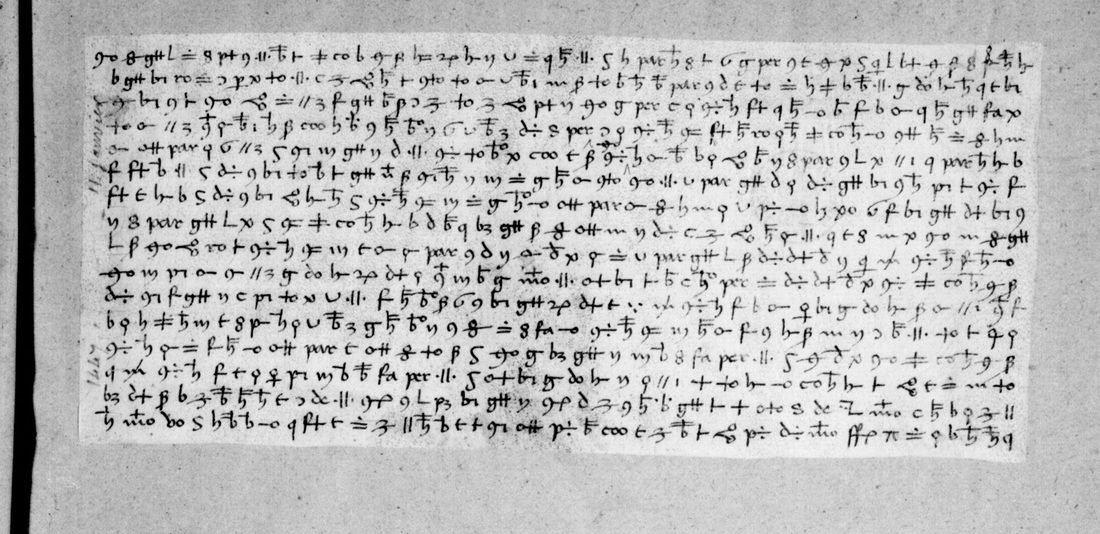
In the winter of 1446–47 Filippo Maria Visconti, last of his line, was losing his war with Venice. Cremona, the dowry town of his daughter Bianca Maria, was threatened, and the man who could save it was her husband Francesco Sforza, whom the Duke had fought the year before. The Duke wrote to him, often several times a week, on small parchment slips wholly in cipher. Sforza kept them, and his archive came to Paris with Louis XII's conquest of Milan. Mazzatinti's inventory of 1883 marks twenty-one of them “In cifre: membran.”.
| Slip | Date and place | Read | Clear text |
|---|---|---|---|
| ital. 1583 f. 110 | 1 Nov 1446, Milan | 89.1% | 19th-c. copy, ital. 1597 f. 123 (made by deciphering the slip) |
| ital. 1583 f. 130 | 25 Nov 1446, Milan | 88.2% | translation f. 131 (not digitised) |
| ital. 1583 f. 136 | 29 Nov 1446, Milan | 95.7% | 19th-c. copy, ital. 1597 f. 154 (made by deciphering the slip) |
| ital. 1583 f. 154 | 12 Dec 1446, Milan | 80.4% | none known |
| ital. 1583 f. 158 | 31 Dec 1446, Cusago | 89.4% | none known |
| ital. 1584 f. 5 | 10 Jan 1447, Abbiategrasso | 98.1% | decipherment f. 6 (1447); later copy f. 7 |
| ital. 1584 f. 8 | 11 Jan 1447, Abbiategrasso | 98.6% | decipherment f. 9 (1447); later copy f. 10 |
| ital. 1584 f. 24 | 5 Feb 1447, Milan | 95.2% | decipherment f. 25 (1447); later copy f. 26 |
| ital. 1584 f. 23 | the same, re-sent 24 Feb | 96.8% | decipherment f. 25; later copy f. 26 |
| ital. 1584 f. 30 | 9 Feb 1447, Milan | 95.5% | later copy f. 29 |
| ital. 1584 f. 31 | the same, re-sent 24 Feb | 96.6% | later copy f. 29 |
| ital. 1584 f. 36 | 12 Feb 1447, Milan | 98.4% | decipherment f. 38 (1447); later copy f. 35 |
| ital. 1584 f. 37 | the same, re-sent 25 Feb | 98.8% | decipherment f. 38; later copy f. 35 |
| ital. 1584 f. 64 | 6 Mar 1447, Milan | 96.9% | later copy f. 63 |
| ital. 1584 f. 65 | the same, sent again that day | 98.9% | later copy f. 63 |
| ital. 1584 f. 72 | 7 Mar 1447, Milan | 86.1% | later copy f. 73 |
| ital. 1584 f. 83 | 11 Mar 1447, Milan | 91.2% (sample) | decipherment f. 84 (1447); later copy ff. 82, 85 |
| ital. 1584 f. 94 | 18 Mar 1447, Milan | 94.9% (sample) | decipherment f. 95 (1447); later copy f. 92 |
| ital. 1584 f. 102 | 23 Mar 1447, Milan (duplicate) | 94.2% | decipherment f. 103 (1447); later copy f. 101 |
The table counts signs that are not nulls. Each slip ends with the date in words, the Duke's full title in cipher (“Filipus Maria Anglus Dux Mediolani et cetera, Papie Anglerieque comes ac Ianue dominus”), a run of nulls and a stretch of padding that runs through the alphabet. Four letters went twice: the second encipherment uses other homophones and adds “duplicata die” with the day of re-sending.
02 The key
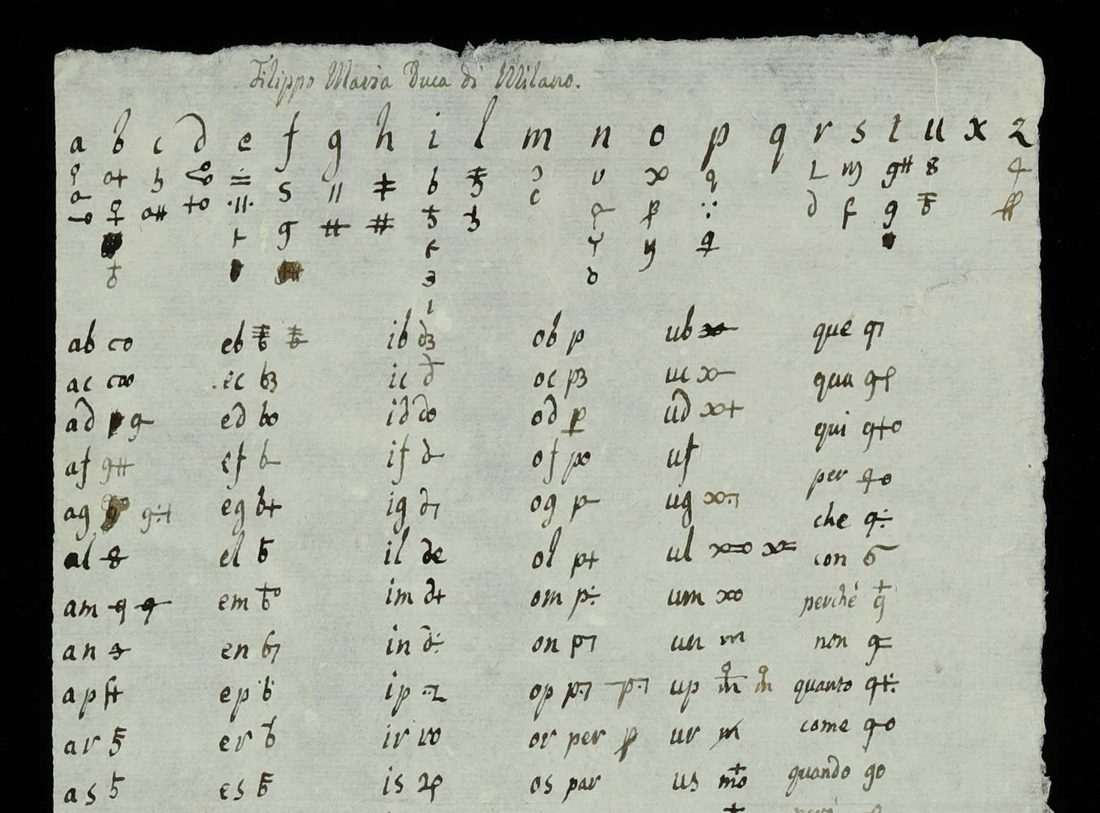
The Visconti chancery's cipher books are lost. Copies of fifteenth-century keys made in the Milan archive are kept in Carteggio Sforzesco cart. 1597 and are on DECODE as anonymous key records dated “1450–1555”. Two are headed with the Duke's name. No. 23 fits the slips at once: on f. 8 the first nine signs give come al t r e v ol t e, the opening of the translation filed beneath it.
Letters have two to six homophones (e is ÷, ·‖·, ⊢ or a blot); every vowel-and-consonant pair has its own sign (ab, ac … uz); che, per, come, quando, non, perché and six other words have signs; and names have looped signs: the Duke of Milan, the Pope, the Venetians, the Duke of Ferrara, the King of Aragon (Re de Ragona), Rome, the men-at-arms, the Conte d'Urbino. Use on the slips identified three of the copy's blank labels: Á is Cosimo de' Medici, a looped sign with two crosses is the Marquis of Mantua, and a looped sign the copy gives for the Duke stands for “Dux Mediolani” in his title. Two traps: the syllable sign written par is os and per is or, while the word per has a sign of its own. The full table, with what was added from the slips, is in targets/visconti1446/key.md and the workers' notes in texts/key_additions_*.md.
03 The check
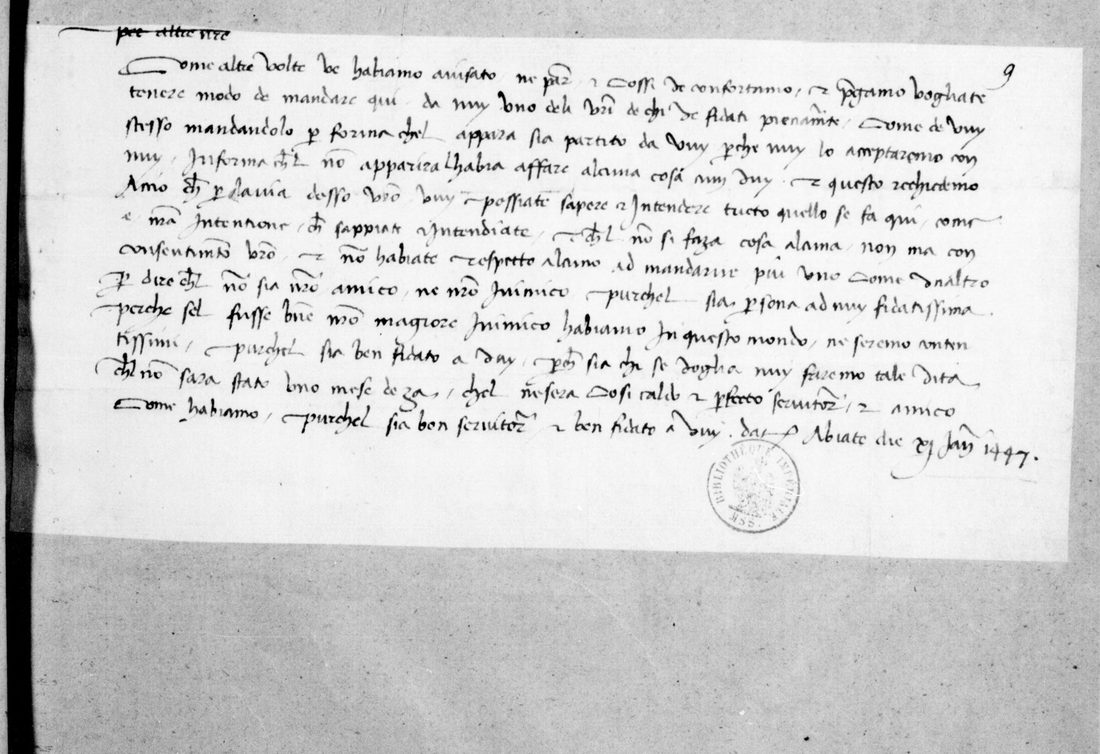
Eight of the eleven letters in italien 1584 have the chancery's decipherment of the time on the next leaf, and every one has a later fair copy as well. f. 8 deciphered with the key agrees with its translation f. 9 on 571 of 589 compared signs (96.9%), f. 5 with f. 6 on 602 of 624 (96.5%). Nearly every difference is the translator smoothing the cipher's Lombard spelling (tenire, mazore, se fara) or a word he dropped.
The later copies are in one regular italic hand, headed “Altra simile” where they cover a duplicate; the same hand copied Barbavara's letters in this volume. The f. 29 copy follows the wording of the duplicate f. 31, not of f. 30, so whoever made it deciphered the slips themselves. For ff. 30/31, 36/37 and 64/65 the copies were in view while the slips were deciphered; for ff. 83 and 94 samples were deciphered first and then matched the copies at 99.2% and 98.5%.
A correction. The first version of this page said ff. 23/24, 72 and 102 had no clear text. They do: f. 25 and f. 103 are the decipherments of the time (f. 103 had been taken for a parallel letter), f. 73 is a later copy. A second session working the same slips found them, and found nineteenth-century copies of the 1446 slips ff. 110 and 136 in italien 1597. The readings of ff. 23/24, 72 and 102 had been made without those texts, so they are a fair test of the key alone: they agree with the clear texts on 83–88% of words when spelling variants are counted (64–73% exactly). The misses are mostly verbs read in the wrong tense or person and a few clauses rebuilt wrongly around unread signs (ve mandaremo for vi mandassemo, intentione for affectione, tenire l'estato for tegnire celato).
The copies of ff. 110 and 136 were made by deciphering the slips, not from the originals. The f. 110 copy writes gi where the cipher has the group read vuy, and leaves a blank, marked “V+”, at both places where the slip has the one name sign the key leaves unlabelled. The cipher and copy part in a few places, and the cipher's value is kept in the text: Panaro where the copy has Tanaro, le cose vostre where it has nostre.
04 The letters deciphered here
Three slips of late 1446 have no clear text that could be reached: no copy in italien 1597 or 1598, and the translation of f. 130 (f. 131) is in italien 1583, which is not digitised. They are given in the cipher's own Italian, with gaps marked [..].
31 December 1446 (ital. 1583 f. 158)
Illustris gener et fili noster carissime. Perché vui sapiate che [..] in le cose nostre dezà, ve[?] aviso che, come le [gente d'arme] nostre furono rote, mandasemo Thomase da [Roma] in Franza come[?] domandare soccorso; el quale, esendo prima[?] andato dal duca de Savoia, non havise [se] non parole. Dapoi, vedendo [..], che l'andase dal Dalfino, et lo trovò benisimo disposito de darne bono et groso [s]occorso. [..] sapevamo che se gli [..] no dificultate alcuna [..] come despecto[?] [..], gli facevemo proferire che, dandone el dicto soccorso, gli daresemo Ast in le mane soe; et così cred[i]to[?] che 'l dicto Thomase concludeva a nostro nome in quela forma. Ulterius ve avisamo come li Francesi cercano [..] havere [..], et siamo quasi certi che, stando le cose come le stano, [..] gli capitarà in le mane. [..]ve confortamo et pregamo che ne vogliati avisare del parere vostro circa che è dicto. Data Cusaghi die ultimo Decembris. Filipus Maria Anglus Dux Mediolani et cetera, Papie Anglerieque Comes ac Ianue Dominus.
In English. When our men-at-arms were routed we sent Thomase to France to ask for help. He went first to the Duke of Savoy and had nothing but words, then to the Dauphin, whom he found most willing to give good and large help. We had it offered that we would put Asti in the Dauphin's hands, and believe Thomase concluded on that in our name. We ask your opinion.
25 November and 12 December 1446 (ital. 1583 ff. 130, 154)
25 November (88% of signs read): Sforza's brief of 14 November came by Perino da Cotignola; Cosimo de' Medici has always been well disposed, but the men of this world look only to the present; the Duke begs Sforza to come at once, to dispose of the men-at-arms and of the Duke's own person, and to say whether he will stay in the Marche or come to Lombardy. 12 December (80%): Donino has come from Sforza; Pietro da Pusterla and Antonio da Trezzo are to go to him secretly; the Duke awaits answers from the Pope and King Alfonso, begs Sforza to conclude at once and in secret, and wants letters to pass secretly through Cotignola.
1 November 1446 (ital. 1583 f. 110), with its copy
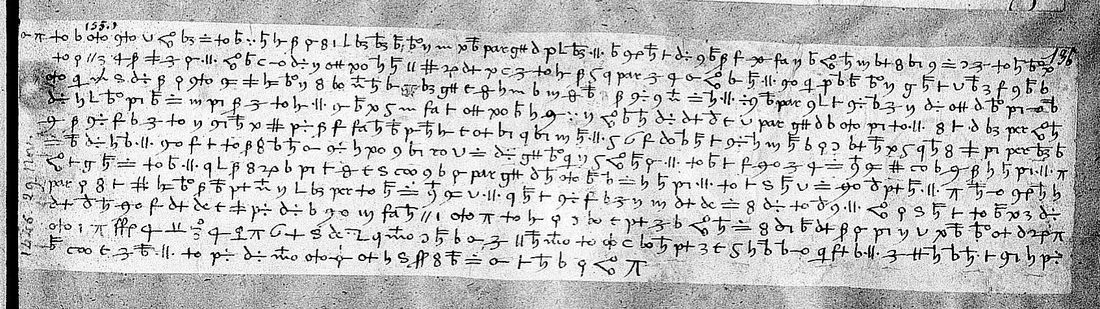
The longest slip, read against its copy: 96.5% of the recto's signs and 69.6% of the cramped verso. After the rout of his army the Duke drops his grudge. Sforza has said many times he would never join him out of necessity; now his kind letter has changed the Duke's mind: “havemo deliberato non esere cosi pertinaci et obstinati come siti vui”. He will never act against Sforza's state, will pay his provision if Venice stops it, and will give him horse and foot at his own cost for any enterprise except against the Church and the King of Aragon. Dealings are to go through men beyond the Panaro, not through the Duke's own servants, who had made each suspect the other. He asks for a quick conclusion.
The texts of all nineteen slips, the decipherments and the copies are in the full texts below and in targets/visconti1446/texts/.
05 Method
- ital. 1584 and the copy volume ital. 1597 were fetched full size from Gallica's IIIF image service (canvas numbers in the table); Gallica's own viewer refuses scripts. ital. 1583 is not digitised (the BnF record gives only a microfilm), so its slips were taken from the DECODE images, about 1,700 pixels wide and binarized.
- Two sessions worked the slips in parallel and were merged: f. 110 and f. 136 are the other session's transcriptions, aligned sign by sign with their 1597 copies; ff. 130, 154 and 158 are this session's. A language-model decoder for the sign families the scans merge was tried on f. 136, where the copy fixes every value, and got 56% of the ambiguous signs right, so it was not used.
- Each slip was deskewed and cut into strips along its own baselines, transcribed sign by sign and deciphered with the key by worker agents, one or two slips each, and checked by the main session. A second pass re-cut bent lines and re-read every doubtful sign.
- The duplicated letters were deciphered side by side: two encipherments of one text fix each other's homophones.
- Read shares are measured from the token files: signs given a value over signs that are not nulls.
06 Still open
- f. 154 (12 December 1446): parts of fourteen lines; and the verso of f. 110, whose signs run together on the binarized image (its copy gives the sense). A colour scan of italien 1583 is needed.
- ff. 130, 158: scattered stretches that give values but no words.
- f. 72: two name signs whose labels the key copy leaves blank (< and est); the later copy f. 73 leaves < blank too.
- ital. 1583 f. 145 (1 December 1446) is not on DECODE and the volume is not digitised; its nineteenth-century copy is in italien 1597 (canvas 160). The translation f. 131 of f. 130 is in the same undigitised volume.
Full texts
The transcription and the decryption of every document on this page, so that the reading can be used and checked. Short files are shown here; all are in the repository.
f. 110, Milan, 1 Nov 1446 read in part
After the rout of his army the Duke gives up his grudge: Sforza’s kind brief has changed his mind, he will never act against Sforza’s state, offers to pay his provision if Venice stops it and to send horse at his own cost, except against the Church and the King of Aragon, and asks for a quick conclusion.
Builds coherent sentences, but under the read bar of 95% of words read as sense; the holes are marked in the reading.
Transcription
# BnF italien 1583 f. 110 -- Filippo Maria Visconti to Francesco Sforza, Milan 1 Nov 1446 (cipher slip)

DECODE R7902, images I35645 P1 (recto, 41 cipher lines) and P2 (verso: 17 cipher lines at the top, the rest
show-through of the recto). Key R5323 (the same key is also on DECODE R1857 image 17, see `../key.md`).

**Transcription in use: `f110_transcription.tsv`**, pass 2 of the parallel session of 28-29 Oct 2026 (see
`../peer/WORKLOG.md`), one row per sign: folio (110 recto, 110v verso), line, position, key value (`i#2` = value i,
second homophone; capitals = word signs; NULL; ? unread) and a note with the sign's shape and its alignment with
the 19th-century copy in BnF ital. 1597 f. 123r-v (`f110_copy1597.md`). Each line was cropped at native
resolution and enlarged 3.5-8x. `import_peer.py` turns it into this folder's `f110_tokens.tsv` and
`f110_signs.txt` (signs are written as their key labels, so the distinct count is a count of key homophones).

**The 1597 copy is a decipherment of this slip, made before this project**, not an independent clear text: it writes
*gi* where the cipher has the group II + 3 (read *vuy*), *za* for the z sign + a, and leaves a blank marked "V+" at
both places of the name sign the key leaves blank. The transcription was aligned with it, so f. 110 counts as read
from an existing decipherment. Where the cipher and the copy differ the cipher's value is kept (`f110_alignment.md`).

Counts (`import_peer.py`): 2712 tokens, 23 nulls, 292 unread, 89.1% of non-null tokens read; recto 96.5%, verso
69.6% (the verso is cramped and its signs run together on the binarized DECODE image).

This folder's own pass (worker G, 29 Oct, without the copy) read 32% and is kept as `f110_passG.md`,
`f110_passG_reading.md`, `f110_passG_tokens.tsv`.
Decryption
# BnF italien 1583 f. 110 -- Filippo Maria Visconti to Francesco Sforza, Milan 1 Nov 1446 (cipher slip): reading

I[?]ustris gener et fili noster carisime. Molte et molte volte n[?]e haveti avisati che mai non condescenderesti ad esere con ui per necesitate et per modo che poresemo dire che per necesitate ve havesemo hav[?] [..] non per volonta vostra bona; che mai non fu nostra opinione, perche come fusti stato piu [?][?]orte et piu possente, siando stato una medesma cosa con nui, tanto meglo havia m[?][?][?] al stato nostro et a nui. Et n[?]are che la fortuna ve sia stata molto propicia et favorev[?]e et habia ben proveduto a questo, perche mai per[?]clo alcuno [?][?]ia oc[?]orso el tempo passato non ve siti voluto mutare de opinione, et adeso poteriti dire che facend[?][?]o, cioe venendo ad esere una medesma cosa con nui, lo fariti per volonta vostra, non per necesita. Certificandove che dapoi la rota seguita a le gente nostre in za sempre siamo perseverati in opinione de volere piutosto patire che li Venetiani haveseno el stato nostro integramente che vui ne havesti pur uno mico solo; et in questa [?]opinione siamo sempre perseverati finche havemo recevuto questo vost[?] breve d[?][?]icato che [?]ne hav[?][?]rto dato a quatro del presente, el quale ben inteso, considerando quanto [?]to humanamente ve siti mosto a scrivenne, che non ne pare l'havesti possuto fare con piu h humanitate se ve fusemo padre o figlolo o la piu cara cosa habiati in questo mondo, ne ha tuto faco[?] mutare de opinione, per modo che havemo deliberato non esere [c]osi pertinaci et obstinati come siti vui, perche non volemo p[?]cto dire che non habiamo necesitate de vui, anci dicemo che ne havemo tanto bisogno et tanta necesitate quanta dire se [p]otese, et crediamo non la poresemo havere maiore come habiamo; siche subvenendone v[?]i [?]esso tanto piu ve saremo obligati quanto lo fariti, siand[?] nui in lo maiore bisogno che [?][?]otese venire in questo mondo. Onde ve avisamo che siamo contenti ben intenderse con gi, et havemo deliberato non fare mai contra gi nel stato vostro, nele cose vostre, et quanto per respecto ala specialitate vostra, cioe ala persona, ala conpagnia et al stato vostr[?], fare tuto quelo che saperiti et voriti domandare. El simile dicemo deli [∿ð+]. Del facto deli Venetiani siamo etiandio contenti farne quelo vorit[?] et ve piacera, con questo che non habiano del nostro cosa alcuna oltra quelo che tenevano inance la rota deli nostri. Recordandove che nui intendemo eserve bon padre et haverve per bon figlolo, et volemo et intendemo da questa hora inanc[?] che ne posati sempre inganare al vostro modo, perche fazati come voriti sempre crederemo l[?] fazati per bene et a bon fine et bonamente et non malamente. Ben ve confortamo et pregamo che da qui inance in tute le cose haveriti a praticare con nui voglati praticarle o per le mane de vostri fidati che siano de la dal Panaro et non haciano alcuna dependentia de za, o per deli nostri che havemo fidati. Recordandove che la prin[?]ale casone de tuti li debati seguiti fino a qui tra gi et nui e stata lo haver [?] facto praticare le cose vostre per le mane deli nostri che ne erano suspecti, li quali sono stati casone de farne havere suspecto ancora gi. Avisandove apreso che se per questo vostro intenderve con nui o per quele altre casone voglia [?][?]i l Venetiani ve toleseno la pr[?]visione vostra che ve dano, nui siamo contenti [?]ve que[?][?] provisione medesma che ve dano li [∿ð+], acioche ve [p]osati sustenere gi el stato [?]et [?]te vostre. [?]Apreso ve avisamo che oltra quelo e dicto d[?] [?]ra nui siamo contenti ai[?]arve et favorirve de [?]avali tre [?]il[?][?] et tanti mil[?]e a nostre sp[?][?]

[f. 110v] l i quali perseverarano con gi fin[..] [..] [?][?]presa che voglati piglare [?][?][?] contra sancta chiesa [?][?][?] con[?]ra quale terre che tene immed[?]ate [..] chhesa, [?]contra l[?][?] quale mai non faresemo per condictione [?] del mondo, non intendendo mi[?]a [?]quele che [?][?]s[?] oi vicarii feudatarib o su[?] recomendati, m[?]olaente quele che la chiesa pr[?][?]ie et imed[?]ate tene, come ed[?]to. Avisandove apdeso che non d[..] de volere esere a defesa de la chiesa ne ad offesa vostra per la [?][?][?][?]h[?]esa, anci [..] che non saremo per defesa [?] es[?]a chies[?]a ne ad offesa vostra per la [?][?]hiesa. [?]Recordando[?]e apreso che da qui [..] nui faremo [..] [?]le contra la maiesta del re de rag[?][?]ona per quelo ch'el tene in el reame. [..] pectei: l'uno per nostro honore, l'altro acioche non havendo [?][?][?][?]os[?] [?][?] mai non venese [?]e orechie de [?]a m[?]t[?]o[?][?] [?] havesemo consen[..] reame. M[?][?][?] [?][?]erto che de [?][?]to [?]vi faremo sempre quelo [..]itilo per certo et per fermo. [?]Ben ve dicemo che [..] possiamo stare in [..] et [..] presto venire a le conclusione, perche s'el [?][?] dic[?]f[?][?][?] l[?]ose for[..] [?][?]iano tal forma che poi se[?]en volest[..] p[?][?]ti proveder[..] [..] die primo novem[?]ris [?][?]. [..] d[?][?]ed[?]ol[?][?] e[?] [..]e[?][?]omes ac [?]ue dom[?][?][?]

---

Conventions: letters in square brackets are letters the cipher does not write, supplied from the context ([c]osi,
[p]otese, [p]osati); [?] one unread sign, [..] an unread run of several signs (on the verso up to 16 signs; the
verso runs are signs I could not segment on the binarized DECODE image, not signs missing from the key). [∿ð+] is
the name sign left blank in the P17 key (the 1597 copy leaves it blank too). *gi* is the cipher's group II + 3,
read *vuy* (you) in the working key; it is kept as written, as the copy also writes it. Consonantal u is printed v;
nulls are dropped; word division and punctuation are editorial. The recto reads 96.5% of its non-null signs, the
verso 69.6%.

Where the cipher and the 1597 copy (`f110_copy1597.md`, itself a decipherment of this slip) differ: cipher *molto
propicia* (copy *meglo*), *facto* (*faito*), *fazati* (*fagiti*), *mane* (*mani*), *Panaro* (*Tanaro*), *haciano*
(*habiano*, probably a misread sign), *le cose vostre* and *che ne erano* (copy *nostre*, *ve erano*), *tanti* (copy
*fanti*, doubtful sign), *quale* (v. 2, copy *quele*), *apdeso* (v. 5, copy *apreso*). Where the cipher has [?] or
[..] the copy has, among others: *havuto et* (r. 2-3), *forte*, *duplicato*, *haviti scripto*, *ne potesse*, *se
sia li venetiani*, *darve quela*, *le gente*, *de sopra*, *ajutarve*, *cavali tre milia et fanti mille a nostre
spese* (r. 41-v. 1), *fino a guerra finita in ogni impresa ... excepto contra sancta chiesa zoe contra quele terre
che tene immediate sancta chiesa* (v. 1-2), *dicemo miga* (v. 5), *siati certo* (v. 6), *inance in queste pratiche
... mentione similmente de non fare contra* (v. 8-9), *et questo faremo per dui respecti* (v. 9), *questa cosa
efecto ... a le orechie de la majesta soa che havesemo consentito fare contro si in el reame, ma siati certo che de
questo nui faremo sempre quello ve piacera et questo tenitilo* (v. 10-13), *nui non ... pendente et che voglati*
(v. 13-14), *se diferisse le cose forse piglariano* (v. 14-15), *non poteristi provedergli. Data Mediolani* (v.
15-16), *etc. Filippus Maria Anglus dux Mediolani etc. Papie Anglerieque comes ac Janue dominus* (v. 16-17).
Translation
# BnF ital. 1583 f. 110r-v (DECODE R7902): English translation. Filippo Maria Visconti to Francesco Sforza, 1 November [1446]

Translated from `f110_text.md` (the cipher reading). Gaps in the cipher are kept as [...]; words in square brackets
are supplied from the context. The recto reads almost in full; the verso is cramped and about a third of its signs
are unread, so its sentences are broken. [name] is the name sign left blank in the duke's key.

Illustrious son-in-law and our dearest son. Many and many times you have told us that you would never bring yourself
to be with us out of necessity, in such a way that we could say we had had [you] out of necessity [...] and not by
your own good will.

That was never our view: for the stronger and more powerful you had been, being one and the same thing with us, so
much the better it would have [...] for our state and for us.

And it seems to us that fortune has been very favourable and kind to you and has provided well for this, because no
danger that [has] arisen in the past has made you willing to change your mind; and now you can say that in doing so,
that is, in coming to be one and the same thing with us, you will do it of your own will and not out of necessity.

We assure you that since the rout that befell our troops, we have always persisted in the view that we would rather
suffer the Venetians to have our whole state than that you should have even one crumb of it; and in this view we
persisted until we received this brief of yours, [the duplicate?] of the one you wrote dated the fourth of this
month.

Having understood it well, and considering how kindly you have been moved to write to us, so that it does not seem to
us you could have done it with more kindness if we were your father or your son or the dearest thing you have in this
world, it has made us change our mind entirely; so that we have resolved not to be as stubborn and obstinate as you
are, for we do not wish to say at all that we have no need of you. On the contrary, we say that we have as much need
and necessity of it as could be said, and we believe we could not have a greater one than we have.

So that if you come to our aid [now], we shall be all the more obliged to you for doing it, since we are in the
greatest need that could come about in this world.

We therefore tell you that we are content to come to a good understanding with you, and we have resolved never to act
against you, in your state or in your affairs; and as regards your own particular interests, that is, your person,
your company and your state, to do all that you will know how and wish to ask. We say the same of the [name].

In the matter of the Venetians we are also content to do as you wish and as you please, provided that they keep
nothing of ours beyond what they held before the rout of our troops.

We remind you that we mean to be a good father to you and to have you as a good son, and we wish and intend that from
this hour on you may always deceive us in your own way; for whatever you do, we shall always believe you do it for
good and to a good end, and in good faith and not in bad.

We earnestly urge and beg you that from now on, in all the matters you will have to treat with us, you treat them
either through the hands of your own trusted men who are from beyond the Panaro and have no dependence on this side,
or through those of our men whom we trust.

We remind you that the chief cause of all the quarrels there have been until now between you and us has been our
having had your affairs handled through the hands of our men who were suspect to us, and who have been the cause of
making us suspicious of you as well.

We further tell you that if, because of this understanding of yours with us or for any other cause whatever, the
Venetians should take away from you the pay they give you, we are content [to give] you the same pay that the [name]
give you, so that you may maintain your state [and your men].

We further tell you that beyond what is said [...] we are content to help and support you with three [...] horse
and [tanti] [a thousand?] at our own [...]

[f. 110v] which will remain with you [...] [en]terprise you may wish to undertake [...] against Holy Church [...]
against those lands that [the Church] holds directly [...], against [...] which we would never do on any condition in
the world; not meaning at all those that [...] its vicars, feudatories or protected lords, but only those that the
Church holds [as its own] and directly, as said.

We tell you further that we do not [...] to wish to be in defence of the Church, nor to your harm on behalf of the
[Ch]urch; rather [...] that we shall be neither in defence of the said Church nor to your harm on behalf of the
[Ch]urch.

Reminding [you] further that from now [...] we shall make [...] against the majesty of the King of Aragon for what he
holds in the kingdom. [...] reasons(?): the one for our honour, the other so that, not having [...] it should never
come to the ears of [...] that we had consented [...] the kingdom. [...] that of this [...] we shall always do what
[...]; and take it for certain and firm.

We tell you plainly that [...] we can stand in [...], and [...] come quickly to a conclusion, because if [...]
things might(?) [...] take such a form that afterwards, even if you wished [...], provide [...].

[...] on the first day of November [...].

[...] of [Milan?] [...] [C]ount [...] of Genoa, lord [...].

---

Note: the English translates only what the cipher gives. The verso gaps can be filled from the 1597 copy (see the
note at the end of `f110_text.md`); that is not done here. *tanti* (r. 41) may be a misread *fanti* (foot).
f. 130, Milan, 25 Nov 1446 read in part
Sforza's brief of 14 November came by Perino da Cotignola; Cosimo de' Medici has always been well disposed; the Duke begs Sforza to come at once and dispose of the men-at-arms and of his own person, and to say whether he will stay in the Marche or come to Lombardy. The contemporary translation f. 131 exists but was not reached.
Builds coherent sentences, but under the read bar of 95% of words read as sense; the holes are marked in the reading.
Transcription
# BnF italien 1583 f. 130 -- Filippo Maria Visconti to Francesco Sforza, Milan 25 Nov 1446 (cipher slip)

DECODE R7904, image I35649 (`img/decode/R7904_IMG_R7904_I35649_P.png`, 1800 px); I35650 is the verso (docket).
Key **R5323**. 19 cipher lines. **No clear text available**: the contemporary translation f. 131 is not on DECODE.
Blind decipherment, checked by sense only.

Worker D (29 Oct) read the date, year and intitulatio (L18-19) and left the body raw. Worker F (29 Oct) re-transcribed
L1-L17 from fresh line strips (deskew +1.0 deg, 2.6x, then 3.2-4x zooms; scratch, not kept): D's raw rows had dropped
the left-margin signs of several lines (L3 begins "ƀ̄ 9 ρ oto q ɣh ...", not "9 ∂÷ par ..."), so the rows below replace
them. Working notes: `f130_work.txt`; slip habits in `key_additions_F.md`.

Sign names as key.md and `key_additions_A-D.md`. Here **ρ** is the sigma-with-tail sign (the key's "o with tail" for
n; on this slip also a, o, and ot in "Cotignola"); it is easily confused with ♀ (a/b). **ꝯ°** is the key's d (a
"<" loop with a small circle), as in "de novo", "dicemo", "recordandove". [?] uncertain, [..] unread, {null} key null.

## Verso docket (I35650)

Top of the docket cut by the mount: "[..] Mediolani die vigesimo quinto novembris mille quadri[n]gentesimo [..]"
(a later hand). It agrees with the date enciphered at L18.

## Line by line

L1 `+o=d | π={null} | ft=ap | β=o | 3=i | oto={null} | g÷=che | ‡=h | ƀ̿=av | b°=em | y=o | f=s | ∴=p | c∞=ac | b=i | ħ-=at | x=o | ƀ=el | o+=b | L=r | ƀ3=ev | ÷=e | 8̶=al | ∂ı=ig | ħ-=at | β=o | ꝯ°=d | ro=ir | bʒ=ec | gtt=t | ħ̄=i | 8=v | y=o | 8̶=al | ɔ=m | g÷=ag | υ=n | ∂=if | ∂̇=ic | x=o | c=m | ƀ̿=es | ƀ=er | ʂ=f | bo=ed | ƀ=er | ∂̇=ic | β=o | 5=et | #=h | oto={null} | ħ==av | ƀ°=em | y=o | L=r | b3=ec | ƀ3=ev | ẋ=ut | x=o | ƀ=el | ƀ̿=v | par=os | ?=[..] | p=b | L=r | bʒ=ev | ÷=e`
= Dapoi che havemo spaciato el breve aligato directivo al Magnifico Meser Federico, et havemo recevuto el vost[ro] breve

L2 `ꝯ=d | ħ-=at | β=o | -o=a | gꝓ=qua | 9=t | per=or | +o=d | b3=ic | ·‖·=e | ꝯ=d | ƀ=el | q=p | ∂=r | ƀ̿=es | bı=en | gtt=t | ⊢=e | g÷=che | ρ=n | ÷=e | ‡=h | ρ=a | q=p | per=or | gtt=t | ħ-=at | β=o | ∴=p | ƀ=er | ħ=i | ∂÷=n | y=o | +o=d | -o=a | ħ=c | ρ=ot | ∂ı=ig | υ=n | p+=ol | -o=a | ƀ=el | g'=qua | ħ=l | ÷=e | ρ=n | ·‖·=e | ƀ̿=es | 9=t | ħ-=at | y=o | ɔ=m | p+=ol | gtt=t | ρ=o | L=r | ħ-=at | x=o | ʃ=et | c∞=ac | ħ=c`
= dato a quatordice del presente, che ne ha portato Perino da Cotignola, el quale n'è stato molto [g]rato et acc-

L3 `ƀ̄=ep | 9=t | ρ=o | oto={null} | q=p | ɣh=ur | 8=v | ·‖·=e | ħ==av | 2p=is | 9̶=am | y=o | g÷=che | ħ̄=l | ħ̄=i[?] | g=f | c∞=ac | 9=t | ∂÷=n | par=os | 9=t | L=r | ⊢=e | ɱ=s | pr=on | y=o | ∂÷=in | gtt=t | b̄o=er[?] | ɔ=m | ∂÷=in | b=i | g÷=che | ∂=[..] | ÷=[..] | g÷=che | +o=d | bı=en | y=o | q=p | L=r | x=o | ƀ=v | 2p=is | ħ=i | pr=on | ·‖·=e | ƀ̄=et | b-=ef | ʂ=f | bʒ=ec | 9=t | ⊢=e | 5=et | g==[..] | ʃ=[..] | go=[..] | ʒ̶=[..] | q=[..] | ·‖·=[..]`
= -epto. Pur ve avisamo che li[?] fact nostre sono in termini che [..] che deno provisione et effecte, et [..]

L4 `L=[..] | H=[..] | 6=con | S=f | per=or | gtt=t | b=i | 5=[..] | ħ=[..] | par=[..] | ƀ=[..] | ƀ̿=[..] | ÷=[..] | 6=con | S=f | per=or | 9=t | ħ=i | 9̶=am | β=o | 5=et | f=s | gtt=t | ∂=r | bı=en | q-=z | ƀ°=em | y=o | g÷=che | 8=v | ρ-=og | ħ̄=li | ħ-=at | ⊢=e | g=f | ħ̄=ar | ÷=e | oto={null} | π={null} | 5=et | ẋ=perché | ‖3=VUY | ρ-=n | ƀ=es | ħ=c | L=r | b=i | ƀ̿=v | fa=it | ħ=i | ꝯ°=d | b=el | co=ab | pr=on | σ-=a | +o=d | 2p=is`
= [..] conforti[..] [..]. Confortiamo et strenzemo che vogliate fare. Et perché vui ne scriviti de la bona dis-

L5 `q=p | par=os | fa=it | ⊢=i | pr=on | ·‖·=e | g÷=che | ‡=h | -o=a | ·Á·=Cosimo | ɯ={null} | ꝯ°=d | ∂̇=ic | ƀ°=em | x=o | g÷=che | ρ-=n | ƀ̿=u | b=i | g-=[..] | β=o | o##=c | ƀ=er | gtt=t | ħ=i | g÷=che | ħ=l[?] | co=ab | ⊢=e | σ-=a | ƀ̄=[..] | f̊=s | ƀ°=em | q=p | L=r | ⊢=e | #=h | c∞=ab[?] | b=i | ρ=a | ‡=h | ħ==av | ẋ=ut | -o=a | o+=b | pr=on | ρ=a | ffp={null} | ɔ=m | -o=a | go=come | ‖ı=VUY | g=[..]`
= -positione che ha [Cosimo], dicemo che nui [..]o certi che l'abea[?] [..] sempre habia havuta bona. Ma come vui [..]

L6 `?=[..] | ɱ̊o=us[?] | 9=t | b=i | c=m | ħ°=[..] | per=or | ÷=e | 5=[..] | q=[..] | ⊢=[..] | 8=[..] | ꝗ=p | par=os | f̊=s | bı=en | 9=t | ·‖·=e | gtt=t | ʒ̶=an | 9=t | β=o | ɔ=m | b+=eg | ħ̄=l | per=or | ⊢=e | ħ=l | ‡=h | ħ==av | ƀ=er | ħ=i | -o=a | ẋ=perché | ‖=g | ħ=l | ⊢=i | ∴=[..] | ħ=[..] | ƀ=[..] | ƀ=[..] | b=[..] | σ-=[..] | ƀ̿=[..] | ƀ=[..] | ÷=[..] | q=p | ħ=i | 8=u | f=s | bʒ=ec | ɣh=ur | y=o | ꝯ=d | ƀ=el | ρ=a | ɱ=s | 8̶=al | ƀ̿=v | ħ-=at`
= [..]us ti m[..]ore[?] e [..] possente, tanto meglore l'haveria, perché gli [..] più securo de la salvat-

L7 `b=i | pr=on | ·‖·=e | ꝯ°=d | ⊢=e | f=s | ϵ=e[?] | m=s | y=o | ƀ̿=v | x=o | 5=et | +o=d | ÷=e | ‖3=VUY | 5=et | 9ı=che | π={null} | f=s | gtt=t | ꝑ=a[?] | ∂=r | ƀ°=em | β=o | ẋ=perché | ħ̄=l | b=i | #=h | p÷=om | ∂÷=in | ħ=i | +o=d | ⊢=e | 9ı=que | f=s | gtt=t | p÷=om | pr=on | +o=d | β=o | f=s | pr=on | y=o | ‡=h | ρ-=og | b=i | ꝯ°=d | ħ̄=[..] | +o=d | ÷=e | ħ=c | par=os`
= -ione de se so[v]o[?] et de vui, et che staremo[?]; perché li homini de questo mondo sono hogi d[..] de cos-

L8 `⊢=e | ꞡ=[..] | c∞=[..] | gtt=[..] | σ-=[..] | υ=n | ħ-=at | ɣh=ur | ρ=a | 9÷=che | ‖=g | ƀ̄=u | ħ=i | +o=d | ʒ̶=an | β=o | m=s | p+=ol | 9̶=am | bı=en | 9=t | ·‖·=e | 8̶=al | q=p | L=r | ƀ̿=es | bı=en | 9=t | ⊢=e | ƀ̄=et | 9==non | #=h | ʒ̶=an | x=o | L=r | ƀ̿=es | ꝗ=p | bʒ=ec | 9=t | β=o | ρ=a | gr=vo | ħ=i | y=o | m=s | b=i | -o=a | ħ==av | bı=en | ro=ir | ÷=e | 5=et | -9=[..] | 8=v`
= -e [..] natura, che guidano solamente al presente et non hano respecto a voi, o sia avenire. Et [..] v-

L9 `·‖·=e | q=p | ∂=r | b+=eg | 9̶=am | y=o | g÷=che | ‖3=VUY | ƀ̿=v | ρ-=og | ħ̄=li | ħ-=at | b=i | ꝗ=p | ∂̇=r | ƀ̿=es | y=t[?] | 2p=is | ∂+=im | x=o | 8=v | bı=en | ro=ir | ⊢=e | ꝯ°=d | ÷=e | q=[..] | -o=[..] | ẋ=[..] | ρ=[..] | 8=[..] | ı=[..] | f=[..] | !=[..] | ƀ=[..] | ƀ=[..] | ∂ʒ=[..] | ƀ=[..] | 9̶=[..] | x=[..] | g÷=che | ƀ=[..] | +o=[..] | ƀ=[..] | ρ=[..] | ∂=[..] | p=[..] | σ-=[..] | 5=et | ꝯ°=d | ƀ=el | ÷=e | ÷9=gente d'arme | b=[..] | +o=[..] | oto={null}`
= -e pregamo che vui vogliati prestisimo[?] venire de [..] che [..] et de le [gente d'arme] [..]

L10 `ƀ̊=[..] | m̊=[..] | y=[..] | ħ-=[..] | y=[..] | 5=et | ꝯ°=d | ƀ=el | -o=a | gꝓ=per | f=s | pr=on | σ-=a | υ=n | par=os | gtt=t | L=r | -o=a | ρ-=n | ƀ̇=ep | par=os | ħ-=at | b=i | +o=d | 2p=is | q=p | pr=on | ƀ=er | ÷=e | 8̶=al | ƀ̿=v | par=os | 9=t | L=r | p÷=om | ꝗ=od | β=o | π={null} | ƀ̄=et | 9ρ=qua | υ=n | ꝯ°=d | y=o | ƀ̿=el[?] | +o=d | ∂̇=ic | gtt=t | x=o | ·Á·=Cosimo | π={null} | 8=v | ɯ={null}`
= [..] et de la persona nostra ne posati disponere al vostro modo; et quando el[?] dicto [Cosimo] v-

L11 `bo=ed | ρ-=a | gı=que | f=s | gtt=t | β=o | +o=d | ƀ3=ev | fa=it | b=i | ƀ̿=es | ƀ=er | ÷=e | o##=c | ƀ=er | 9=t | y=o | g÷=che | ʒ̶=an | ħ=c | per=or | 9̶=am | b+=eg | ħ=l | x=o | f=s | ·‖·=e | +o=d | 2p=is | q=p | pr=on | ƀ=er | ρ=a | π={null} | ɱ=s | ⊢=i | g÷=che | ꝯ°=d | ÷=e | υ=n | x=o | 8=v | β=o | ƀ̿=v | ƀ̇=ep | ∂=r | b+=eg | 9̶=am | β=o | 8=v | ρ-=og | ħ̄=li | ħ-=at | b=i`
= -eda questo, deviti esere certo che ancora meglo se disponerà, sì che de novo ve pregamo vogliati

L12 `8=[..] | ħ̿=[..] | ·‖·=e | ∴=p | ∂=r | ƀ̿=es | 9=t | β=o | go=come | bo=ed | ∂=ic | gtt=t | y=o | π={null} | oto={null} | L=r | b3=ec | per=or | +o=d | ʒ̶=an | ꝯ°=d | β=o | 8=v | ·‖·=e | g÷=che | f=s | ⊢=e | ‖ı=VUY | ƀ̿=v | ∂÷=in[?] | ħ=i | ƀ=r[?] | fa=it | ħ=i | +o=d | ƀ=el | ρ=a | 5=et | gꝓ=per | ꝯ°=[..] | b=[..] | fa=[..] | ⊢=[..] | +o=d | 8+=ez | ρ=a | oto={null} | ‖3=VUY | go=come | +o=d | ƀ=ev | fa=it | b=i`
= [..]e presto, come è dicto. Recordandove che se vui viniriti[?] de là et per [..] dezà, vui, come deviti,

L13 `▪=[..] | ‡=[..] | o+=b | bı=en | gꝓ=per | +o=[..] | ƀ=[..] | 9=[..] | ħ=[..] | ρ-=og | ρ-=n | ϵ=i | ħ=c | par=os | σ-=a | ꝯ°=d | ƀ=el | ρ=a | ƀ̄=[..] | 8=[..] | ∂÷=[..] | o##=c | ƀ=er | 9=t | b=i | +o=d | 8+=ez | ρ=a | ‖3=VUY | 8=[..] | ∂÷=[..] | ħ-=at | b=i | fa=[..] | ħ=[..] | 5=et | +o=d | ƀ=el | -o=a | ƀ̄=et | ꝯ°=d | 8+=ez | σ-=a | f=s | ϵ=i | g÷=che | π={null} | ƀ̿=v | ρ-=og | ħ̄=li | ħ-=at | ∂e=[..] | b=[..]`
= [..] ben per [..] ogni cosa de là [..]certi dezà vui [..]ati [..], et de là et dezà, sì che vogliat[i] [..]

L14 `ħ̄=[..] | ɱ̊o=[..] | β=[..] | q=p | bı=en | ɱ=s | b=i | y=o | ƀ̄=et | q=p | ħ̄=ar | bı=en | +o=d | x=o | 8=v | ⊢=e | g÷=che | 8=v | ÷=e | ꝯ°=d | ∂=ic | 9̶=am | β=o | b=i | ƀ̿=[..] | ƀ=er | y=o | 8=v | ρ-=og | ħ̄=li | ħ-=at | ħ=i | g=f | ħ̄=ar | ·‖·=e | go=come | +o=d | ∂=ic | ƀ°=em | x=o | oto={null} | m=s | ƀ̊=el | 9==non | 8=v | ƀ'=ep | ħ̄=ar | ·‖·=e | g÷=che | ꝯ°=d | ∂=ic | 9̶=am | β=o | b=i | ƀ̿=[..]`
= [..] pensio[..], et parendove che ve dicamo i[..]ero, vogliati fare come dicemo; s'el non ve pare che dicamo i[..]

L15 `?=[..] | ħ-=[..] | ħ=[..] | go=come | 8=v | ƀ'=ep | ħ̄=ar | ro=ir | σ-=a | π={null} | ɔ=m | co=ab | bı=en | ƀ̄=v[?] | ƀ'=ep | L=r | b+=eg | 9̶=am | y=o | υ=n | ·‖·=e | ħ==av | 2p=is | ħ-=at | ⊢=e | g÷=che | +o=d | ƀ=el | ∂ʒ=ib | b=er | ħ-=at | b=i | pr=on | ⊢=e | ∴=p | ⊢=i | ∂ı=g | ħ̄=li | ħ̄=ar | fa=et[?] | ħ=i | x=o | +o=d | ÷=e | ħ-=at | bı=en | ꝯ°=d | b=er | ·‖·=e | +o=d | ƀ=el | -o=a`
= [..] come ve parirà. Ma ben ve pregamo ne avisate che deliberatione pigliareti, o de atendere de là,

L16 `+o=d | ⊢=e | ƀ̿=v | bı=en | ro=ir | ·‖·=e | +o=d | 8+=ez | ρ=a | c∞=ac | b=i | y=o | g÷=che | ʒ̶=an | ħ=c | per=or | σ-=a | υ=n | 8=u | 3=i | q=p | par=os | ħ̄=i | 9̶=am | x=o | q=p | ∂ı=ig | ħ̄=li | ħ̄=ar | ÷=e | q=p | ħ̄=ar | 9=t | fa=it | β=o | ⊢=e[?] | S=f | c∞=ac | gtt=t | ∂÷=n | par=os | 9=t | L=r | b=i | 5=et | g÷=che | f=[..] | q̶=[..] | y=[..] | ħ̄=[..] | ρ=[..]`
= de venire dezà, aciò che ancora nui posiamo pigliare partito e[?] facti nostri, et che [..]

L17 `y=[..] | gto=[..] | ʒ̶=[..] | 9̶=[..] | -o=[..] | 8=v | par=os | 9=t | ∂=r | σ-=a | 9==non | ƀ̿=v | b+=eg | ρ-=n | 9̶=am | y=o | σ-=a | go=come[?] | ∂=[..] | p+=ol | ħ̄=[..] | ⊢=e | ŋo=[..] | ‡=h | ħ==av | ƀ°=em | β=o | g=f | c∞=ac | 9=t | y=o | f=[..] | q̶=[..] | ;=[..] | m=[..] | gto=[..] | ʒ̶=[..] | 9̶=[..] | -o=[..] | +o=d | 8̶=al | gtt=t | L=r | ħ=i | oto={null} | π={null} | ffp={null}`
= [..] vostra non vegnamo a, come[?] [..]ol[..]e, [..] havemo facto [..] d'altri.

L18 `ꝯ=d | ħ-=at | ρ=a | ɔ=m | bo=ed | b=i | p+=ol | ʒ̶=an | ħ=i | +o=d | ⊢=i | ⊢=e | 8=v | ∂ı=ig | ƀ=es | ∂+=im | β=o | gto=qui | ρ-=n | 9=t | y=o | υ=n | x=o | 8=v | ƀ°=em | ρ=b | L=r | ro=is | c=m | ∂e=il | ÷=e | 9ρ=qua | 9=t | L=r | p3=oc | bı=en | gtt=t | β=o | ŋo=qua | ∂=r | ʒ̶=an | 9=t | ρ=a | f=s | ·‖·=e | 3=i | π={null} | oto={null} | S=f | ∂e=il | ꝶ=ip | ɱ̊o=us | ɔ=m | ħ̄=ar`
= Data Mediolani die vigesimo quinto Novembris mile quatrocento quarantasei. Filipus Mar-

L19 `♀=ia[?] | ʒ̶=an | ‖=g | ħ=l | ɱ̊o=us | +o=d | ϕ=ux | ɔ=m | bo=ed | ħ=i | p+=ol | ʒ̶=an | ϵ=i | 5=et | ħ=c | ƀ=et | ƀ=er | -o=a | q=p | ft=ap | b=i | ⊢=e | ʒ̶=an | tt=g | ħ=l | ƀ=er | b=i | ÷=e | 9ı=que | o##=c | p÷=om | ƀ̿=es | c∞=ac | ħ=i | ʒ̶=an | 8=u | ·‖·=e | ꝯ°=d | ÷=om[?] | ∂÷=in | ɱ̊o=us`
= -ia Anglus Dux Mediolani et cetera, Papie Anglerieque Comes ac Ianue Dominus. (The leaf is cut below this line;
a few signs, probably padding, are lost.)

## Plaintext (word division and punctuation mine)

Dapoi che havemo spaciato el breve aligato directivo al Magnifico Meser Federico, et havemo recevuto el vost[ro]
breve dato a quatordice del presente, che ne ha portato Perino da Cotignola, el quale n'è stato molto [g]rato et
accepto. Pur ve avisamo che li[?] fact[..] nostre sono in termini che [..] che deno provisione et effecte, et [..]
[..] conforti[..] [..]. Confortiamo et strenzemo che vogliate fare. Et perché vui ne scriviti de la bona
dispositione che ha [Cosimo], dicemo che nui [..]o certi che l'abea[?] [..] sempre habia havuta bona. Ma come vui
[..]us ti m[..]ore[?] e [..] possente, tanto meglore l'haveria, perché gli [..] più securo de la salvatione de se
so[v]o[?] et de vui, et che staremo[?]; perché li homini de questo mondo sono hogi d[..] de cose [..] natura, che
guidano solamente al presente et non hano respecto a voi, o sia avenire. Et [..] ve pregamo che vui vogliati
prestisimo[?] venire de [..] che [..] et de le [gente d'arme] [..] et de la persona nostra ne posati disponere al
vostro modo; et quando el[?] dicto [Cosimo] veda questo, deviti esere certo che ancora meglo se disponerà, sì che
de novo ve pregamo vogliati [..]e presto, come è dicto. Recordandove che se vui viniriti[?] de là et per [..] dezà,
vui, come deviti, [..] ben per [..] ogni cosa de là [..]certi dezà vui [..]ati [..], et de là et dezà, sì che
vogliat[i] [..] pensio[..], et parendove che ve dicamo i[..]ero, vogliati fare come dicemo; s'el non ve pare che
dicamo i[..] [..] come ve parirà. Ma ben ve pregamo ne avisate che deliberatione pigliareti, o de atendere de là,
de venire dezà, aciò che ancora nui posiamo pigliare partito e[?] facti nostri, et che [..] vostra non vegnamo a,
come[?] [..], [..] havemo facto [..] d'altri. Data Mediolani die vigesimo quinto Novembris mile quatrocento
quarantasei. Filipus Maria Anglus Dux Mediolani et cetera, Papie Anglerieque Comes ac Ianue Dominus.

## Summary

The Duke writes that he has dispatched the enclosed brief addressed to the Magnificent Messer Federico (probably
Federico da Montefeltro, Count of Urbino) and has received Sforza's brief of 14 November, brought by Perino da
Cotignola, which pleased him greatly. He warns that his affairs are at a point that calls for provision and action,
and presses Sforza to act. To Sforza's report of Cosimo de' Medici's good disposition he answers that he is sure
Cosimo has always been well disposed; men of this world look only to the present and not to the future. He begs
Sforza to come very quickly ("prestisimo venire"): Sforza may dispose of the men-at-arms and of the Duke's own
person as he likes, and when Cosimo sees this he will be better disposed still. He sets out the choice between
staying "over there" (de là) and coming "over here" (dezà) and asks to be told at once which Sforza decides, "o de
atendere de là, de venire dezà", so that the Duke can make his own decisions. The letter is the Duke's call to
Sforza to leave the Marche and come over to Lombardy, four days before f. 136 (29 Nov), which reports Zohane del
Maino sent with full powers.

## Read share

From `f130_tokens.tsv` (`python texts/mk_tokens.py 130`): 1032 tokens, 25 nulls, 119 unread, 17 uncertain.
Non-null tokens given a value: 888/1007 = 88.2%. Measured on words instead, about 80% of the body reads as sense. Several stretches whose single signs carry values still give no word
(L3 end, L4 start, L6 middle, L9 middle, L13, L17); they are [..] in the plaintext.
Decryption
# BnF italien 1583 f. 130 -- Filippo Maria Visconti to Francesco Sforza, Milan 25 Nov 1446 (cipher slip): reading

Dapoi che havemo spaciato el breve aligato directivo al Magnifico Meser Federico, et havemo recevuto el vost[ro]
breve dato a quatordice del presente, che ne ha portato Perino da Cotignola, el quale n'è stato molto [g]rato et
accepto. Pur ve avisamo che li[?] fact[..] nostre sono in termini che [..] che deno provisione et effecte, et [..]
[..] conforti[..] [..]. Confortiamo et strenzemo che vogliate fare. Et perché vui ne scriviti de la bona
dispositione che ha [Cosimo], dicemo che nui [..]o certi che l'abea[?] [..] sempre habia havuta bona. Ma come vui
[..]us ti m[..]ore[?] e [..] possente, tanto meglore l'haveria, perché gli [..] più securo de la salvatione de se
so[v]o[?] et de vui, et che staremo[?]; perché li homini de questo mondo sono hogi d[..] de cose [..] natura, che
guidano solamente al presente et non hano respecto a voi, o sia avenire. Et [..] ve pregamo che vui vogliati
prestisimo[?] venire de [..] che [..] et de le [gente d'arme] [..] et de la persona nostra ne posati disponere al
vostro modo; et quando el[?] dicto [Cosimo] veda questo, deviti esere certo che ancora meglo se disponerà, sì che
de novo ve pregamo vogliati [..]e presto, come è dicto. Recordandove che se vui viniriti[?] de là et per [..] dezà,
vui, come deviti, [..] ben per [..] ogni cosa de là [..]certi dezà vui [..]ati [..], et de là et dezà, sì che
vogliat[i] [..] pensio[..], et parendove che ve dicamo i[..]ero, vogliati fare come dicemo; s'el non ve pare che
dicamo i[..] [..] come ve parirà. Ma ben ve pregamo ne avisate che deliberatione pigliareti, o de atendere de là,
de venire dezà, aciò che ancora nui posiamo pigliare partito e[?] facti nostri, et che [..] vostra non vegnamo a,
come[?] [..], [..] havemo facto [..] d'altri. Data Mediolani die vigesimo quinto Novembris mile quatrocento
quarantasei. Filipus Maria Anglus Dux Mediolani et cetera, Papie Anglerieque Comes ac Ianue Dominus.
Translation
# BnF italien 1583 f. 130 -- Filippo Maria Visconti to Francesco Sforza, Milan 25 Nov 1446 (cipher slip): English

The Duke writes that he has dispatched the enclosed brief addressed to the Magnificent Messer Federico (probably
Federico da Montefeltro, Count of Urbino) and has received Sforza's brief of 14 November, brought by Perino da
Cotignola, which pleased him greatly. He warns that his affairs are at a point that calls for provision and action,
and presses Sforza to act. To Sforza's report of Cosimo de' Medici's good disposition he answers that he is sure
Cosimo has always been well disposed; men of this world look only to the present and not to the future. He begs
Sforza to come very quickly ("prestisimo venire"): Sforza may dispose of the men-at-arms and of the Duke's own
person as he likes, and when Cosimo sees this he will be better disposed still. He sets out the choice between
staying "over there" (de là) and coming "over here" (dezà) and asks to be told at once which Sforza decides, "o de
atendere de là, de venire dezà", so that the Duke can make his own decisions. The letter is the Duke's call to
Sforza to leave the Marche and come over to Lombardy, four days before f. 136 (29 Nov), which reports Zohane del
Maino sent with full powers.
f. 136, Milan, 29 Nov 1446
The Duke sent Giovanni del Maino to Sforza with full powers the day after his letter of the 15th, but Sforza's men-at-arms in Cremona and the Cremonese have gone over to the enemy camp; it is more honourable to win than to sit in winter quarters.
Transcription
# BnF italien 1583 f. 136 -- Filippo Maria Visconti to Francesco Sforza, Milan 29 Nov 1446 (cipher slip)

DECODE R7907, one image. Key R5323 (also DECODE R1857 image 17).

**Transcription in use: `f136_transcription.tsv`**, the parallel session's pass of 29 Oct 2026 (see
`../peer/WORKLOG.md`): one row per sign with its key value and a note on its shape and its alignment with the
19th-century copy in BnF ital. 1597 f. 154, canvas 157 ("(55.) 1446 29 Novembre", `f136_copy1597.md`). The copy is
a decipherment made before this project, so f. 136 counts as read from an existing decipherment.
`import_peer.py` makes `f136_tokens.tsv`, `f136_signs.txt` and `f136_reading.md` from it.

Counts (`import_peer.py`): 562 tokens, 25 nulls and filler, 23 unread, 95.7% of non-null tokens read.

This folder's own pass (worker A, 28-29 Oct, made before the copy was known) is kept as `f136_passA.md`,
`f136_passA_reading.md`, `f136_passA_tokens.tsv`; it read 91.5% by sense, but only 68% of its words match the copy
(script over the two texts), so the pass with the copy replaces it.
Decryption
# BnF italien 1583 f. 136 -- Filippo Maria Visconti to Francesco Sforza, Milan 29 Nov 1446 (cipher slip): reading

A di quindece del pasato nui recevesemo uno vostro breve, el quale inteso, subito el di seguente mandasemo da vuy Zohanne del Maino cum larghisimo mandato et posanza de fare come poteresemo fare n[?] stesi, pur fino a qui non havemo veduti ef[?]ecti alcuni, salv[?]o che tute le gente d'arme vostre che erano in Cremona et in Cremonese sono andate adeso et unite cum el campo d[?] [?] inimici nostri. Onde ve recordiamo, che siando quelo homo siti, voglati ben pensare et considerare che'l saria meglo et piu honorevele vincere come se doveria, che cum tenirne in tempo et darne de le speranze, perche non habiamo casone [?] de fare dele provisioni a li facti nostri, [?]s[?]e casone de farne pericolare. La qual c[?]osa ve havemo voluto recordare, perche non ne pare che siano simile vindicte da fare de soi inimici per simili homini como siti vuy. Data Mediolani die vigesimo nono novembris.

[..] Filippus Maria Anglus Dux Mediolani etcetera, Papie Anglerieque comes ac Ianue dominus. [..]

---

Conventions: [?] one unread sign (the body has nine: 2/47 in *n[ui]*, 3/18 blot in *effecti*, 3/28 faint sign in
*salvo*, 4/30-31 *[e] [li]*, 7/1, 7/26 and 7/28 in *[e]s[er]e*, 8/1 in *cosa*); [..] the filler signs before the
title and the tail after *dominus*. Nulls are dropped; word division and punctuation are editorial. II + 3 is read
*vuy* (*da vuy*, *siti vuy*) as on ff. 5/8. In l. 8 the cipher writes the signs for "per" where *-os-* of *cosa* is
needed (probably a misread sign). The body and title read 514 of 523 non-null signs (98.3%).

Where the cipher and the 1597 copy (`f136_copy1597.md`, a decipherment of this slip) differ: the copy has *ad gi
Zohanne* (cipher *da* + II 3 = *da vuy*), *siti gi* (cipher II 3 = *vuy*), and adds the year *1446*, which is not in
the cipher. Where the cipher has [?] the copy reads *nui*, *effecti*, *salvo*, *de li*, *esere*, *cosa*.
Translation
# BnF ital. 1583 f. 136 (DECODE R7907): English translation. Filippo Maria Visconti to Francesco Sforza, Milan, 29 November [1446]

Translated from `f136_text.md` (the cipher reading). The single unread signs all fall inside words whose sense is
clear; the words they complete are given in square brackets.

On the fifteenth of last month we received a brief of yours; having understood it, immediately on the following day
we sent to you Zohanne (Giovanni) del Maino, with the widest mandate and power to do whatever we ourselves could have
done.

Yet up to now we have seen no effects at all, except that all your men-at-arms who were in Cremona and in the
Cremonese have now gone off and joined the camp of our enemies.

We therefore remind you, being the man you are, to think well and consider that it would be better and more
honourable to win as one ought, than to keep us waiting and feed us hopes; since we then have no reason to make
provision for our own affairs, [this would be] the cause of putting them in danger.

This we have wished to remind you of, because it does not seem to us that such revenge on one's own enemies is a
thing for men such as you.

Given at Milan on the twenty-ninth day of November.

Philippus Maria Anglus, Duke of Milan etc., Count of Pavia and Angera and Lord of Genoa.
f. 154, Milan, 12 Dec 1446 read in part
Donino has come from Sforza; the Duke is sending Pietro da Pusterla and Antonio da Trezzo to him secretly, awaits answers from the Pope and King Alfonso, and begs Sforza to conclude at once and in secret; letters are to go secretly through Cotignola.
Builds coherent sentences, but under the read bar of 95% of words read as sense; the holes are marked in the reading.
Transcription: f154.md
Decryption
# BnF italien 1583 f. 154 -- Filippo Maria Visconti to Francesco Sforza, Milan 12 Dec 1446 (cipher slip): reading

Novamente è zonto qui Donino da P[..]mago[?], el quale havemo conferito et ben inteso tuto quelo ve n[..]ha [dicto]
da parte vostra; o[?] che responderò[?] che ne havemo scripto opportunamente a Pedro da Pusterla et Antonio da
Trezo, che se transferiano da vui secretamente, et vedrano alcune cose come nostra parte, et poi quale de loro più ve
piacerà [..] dal [..] dal [Re de Ragona], et gli d[..]ata come nostra parte. Tuto quelo vui li cometeriti, et faza
integramente [..] loro, come vui gli haveriti imposto[?] el comandato; et così [..] comprendere come quelo [..]
[..]ripto Pedro da Pusterla più [..] vegna [..] trovarse co' el [<] et co' el [Re de Ragona?] [..] con loro,
secondo l'inpositione. Gli [..] facto se a vui [..] che quelo è facto [..] nostro satisfaza [..] che st[..] haver[..]
facto de mandare uno deli nostri da vui [..] transferirsi dal [..] dal [Re de Ragona], et [..] da mandare dal [Re de
Ragona] bene qui [..] piace; se ve parire che gli havemo a mandare altri o [..] altramente, voglat[i] [..] subito
avisare; [..] che faremo quelo et come ve parirà et piacerà; et [..] Donino de [..] dev[..]pectare de venire [..]
[..] sia havuta resposta dal [Papa] et dal [Re de Ragona] e dal [Duca di Ferrara?] de quelo vorano fare, diremo
così, che, confidiando ben in [..] che termini stano li facti nostri, et quegli sia non solamente bisogno ma più che
necesario prestisima provisione; et confidiando [..] nelle che [..] sia da fare [..] pensio[..] quelo sia d[..]e tra
vui et avisoli senza che [..] altri gli [..] alcuno, et che [..] de haver[e] la negativa da lor[o] [..] che [..]
condescenderano, et tuto quelo [..] haverà sia d'avanzo; che [..] non cesaremo [..] de continuare et solicitare [..]
che ve parirà, come indurli ancora loro; et, come dicto, sino[?] certi gli condescenderano. Pur [..] penserò che vui
[..] sino soli a che sto, si che ve confortiamo et pregamo che vui voglati deliberare de venire ali effecti et [..]
conclusione senza alcuna [..] de tempo; et s'el [..] che la cosa stere secreta fino se havere havuta la resposta da
loro, [..] contenti se ne faza come [..]; et così che voglati vedere se che lo ve havemo mandato [..] et scripto fino
a qui; ve pare satisfaza a che lo se [..]; et così se habi[..] più oltra, e più una cosa che un'altra [..]. Havemo
deliberato metterve in le mane [..] et la [..] nostra, che [..]osati fare [..] ve disponere al vostro modo, come [..]
come [..] altre nostre ve[..] come [..] [..]gente el dicto Donino, et le cose meglio s[..] [..] et continuare. Ne pare
che tegnati modo de mandar[..] da [..] del [..] vostri [..] fidati ch[..] mostra [..] da [..] partirse altramente senza
licentia, e vegna qui da nui, et lo retegnaremo qui; et [..] che [..] appetiti intendere tuto che cose farà ordinando
[..] a Cotignola, che tute le lettere [..] [che] vo mandate da le parte de pa[..] andarle a vui s[..]ito, ve se
oportate; et così quele vui voriti mandare de pace [..] a Cotignola [..] ordine che siano die[..] [..] de le nostri
stia [..] haveremo [..] de mandare secretamente [..] Cotignola; et così [..] haveriti de mandare da vui a Cotignola
senza suspecto alcuno. Et questo ordine ne[?] pare se habia a t[..] [..] che tuto quelo se farà qui ve sia noto, et
man[..]to; et oltra de questo che l[..] [..] cosa alcuna, noma co' vostro sentimento ne se f[..]a, noma quelo vui
voriti. Et così ve confortiamo et pregamo mand[ar]li da nui che lo vostro, come è dicto, [..] vui rechediti che mandino
uno del nostri [..] secretamente apreso a vui; e dicemo che lo faremo volontera, ma volemo che vui nominati chi più
[..] vero mandaremo; et [..] guardati e pensati che [..] mandino alcuno fino vui haveriti rechesto in specialitate chi
più ve piace: [..] non deliberamo mandarvelo a[l]tramente[?]. Data Mediolani die duodecimo Decembris. Filipus Maria
Anglus [Dux Mediolani] et cetera, Papie Anglerieque Comes ac Ianue Dominus.
Translation
# BnF italien 1583 f. 154 -- Filippo Maria Visconti to Francesco Sforza, Milan 12 Dec 1446 (cipher slip): English

This is still a partial reading. Donino ("da P[..]mago[?]"; spelled `ꝯ° pı ∂÷ β/x` three times: L1, L12, L29) has
newly arrived at Milan from Sforza. The Duke has heard and understood all he said on Sforza's behalf. In reply he has
written to **Pietro (Pedro) da Pusterla** and **Antonio da Trezzo**, who are to go to Sforza secretly and show him
certain things for the Duke. Sforza may then use whichever of them he prefers, and they will carry out whatever he
commits to them. Pusterla is to meet someone under the blank-label sign `<` and probably the King's man. Men are to
be sent to and from **King Alfonso** ([Re de Ragona]), and the Duke will act "as you think fit". If Sforza thinks
others should be sent, he is to say so at once.

The Duke is waiting for the answers of the **Pope** (Eugene IV), the King and probably the **Duke of Ferrara**. He
trusts they will condescend, and whatever they give will be "d'avanzo" (extra). He will keep pressing them. His
affairs need not only help but the very quickest provision. He therefore begs Sforza to resolve to come to the effect
and to a conclusion without loss of time, keeping the matter secret until the others answer. He has resolved to put
[..] into Sforza's hands, to be disposed of "al vostro modo".

On the verso Sforza is not to leave without licence but to come to Milan, where the Duke will keep him. Letters are to
go secretly and "senza suspecto alcuno" through **Cotignola** (named four times). Sforza is to be told of everything
done at Milan, and nothing is to be done except by his wish ("noma quelo vui voriti"). Sforza is to name the man he
wants: the Duke will gladly send one of his own men to him secretly, and will send no one until Sforza has asked for
the man he prefers. Dated Milan, 12 December 1446, with the full ducal title.

Context: in December 1446 Sforza was in the Marche, short of money and courted by both the Duke and Venice. The
ducal army had been routed at Casalmaggiore in September, and the Venetians held the Cremonese and the Ghiara d'Adda.
The letter belongs to the run of appeals for Sforza to come north (ff. 130, 136, 158). Cosimo de' Medici, the
Dauphin, Asti and Giovanni del Maino are not named in what is read.
f. 158, Cusago, 31 Dec 1446 read in part
After the rout of his men-at-arms the Duke sent Thomase to France for help: nothing but words from the Duke of Savoy, but the Dauphin is willing, and Asti has been offered to him in return; the Duke asks Sforza's opinion.
Builds coherent sentences, but under the read bar of 95% of words read as sense; the holes are marked in the reading.
Transcription
# BnF italien 1583 f. 158 -- Filippo Maria Visconti to Francesco Sforza, Cusago 31 Dec 1446 (cipher slip)

DECODE R7915, image I35670 (`img/decode/R7915_IMG_R7915_I35670_P.png`, 1938 px). Key **R5323**. 12 cipher lines
(worker D counted 13 with the marginal note; the left margin carries a later vertical note "1446 31 dicembre" [?] and
the end of L1 a pencil "4758"). **No clear text of this slip is known: independent decipherment, checked by sense
only.** Worker F, 29 Oct 2026: transcribed and deciphered from line zooms at 3-3.6x (deskew +0.5 deg, line centres
y = 319 354 387 420 457 492 529 564 600 637 673 710 in the rotated image; scratch, not kept). Notes in
`f130_work.txt` style are in `f158_work.txt`; slip habits in `key_additions_F.md`.

Sign names as key.md and `key_additions_A-D.md`; ρ = sigma with tail (as on f. 130). [?] uncertain, [..] unread,
{null} key null.

## Line by line

L1 `ꝺ÷=il | ħ̄=l | ɱ̊o=us | gtt=t | L=r | ꝗ=is | ‖=g | bı=en | ƀ=er | 5=et | ≙=f | ∂e=il | b=i | σ-=n | par=os | 9=t | ƀ=er | ħ=c | ħ̄=ar | 2p=is | ∂+=im | ÷=e | +={null} | ẋ=perché | ‖3=VUY | f=s | ft=ap | ħ=i | ħ-=at | ⊢=e | g#÷=che | ♀-=[..] | ‖ı=[..] | x∞=[..] | o##=[..] | ꝗ=[..] | ⊢=[..] | ∂÷=in | ħ=l | ÷=e | o##=c | par=os | bı=en | par=os | gtt=t | L=r | ·‖·=e | ꝯ°=d | 8+=ez | ♀=a | ƀ̄=v[?] | ⊢=e | ħ==av | 2p=is`
= Illustris gener et fili noster carissime. Perché vui sapiate che [..] in le cose nostre dezà, ve[?] avis-

L2 `β=o | g÷=che | go=come | ħ=l | ÷=e | ÷9=gente d'arme | ♀-=n | par=os | gtt=t | ∂=r | ·‖·=e | S=f | ✗=ur | pı=on | y=o | L=r | ꝑ=ot | ⊢=e | ɔ=m | ʒ̶=an | +o=d | ħ=as | ƀ°=em | x=o | 9=t | ‡=h | p÷=om | ħ̄=as | ÷=e | ꝯ°=d | -o=a | N=Roma | ∂÷=in | g=f | ∂=r | ʒ̶=an | ꝗ=z | -o=a | go=come[?] | +o=d | p÷=om | ʒ̶=an | ꝯ°=d | ħ̄=ar | ·‖·=e | ħ̊=s | p3=oc | ħ=c`
= -o che, come le [gente d'arme] nostre furono rote, mandasemo Thomase da [Roma] in Franza come[?] domandare socc-

L3 `per=or | ɱ=s | β=o | ƀ̄=el | gꝓ=qua | ħ̄=l | ÷=e | ƀ̿=es | bı=en | ꝯ°=d | y=o | q=p | ∂=r | ∂+=im | q=a[?] | ʒ̶=an | +o=d | ħ-=at | y=o | ꝯ°=d | 8̶=al | +o=d | x-=uc | ♀=a | ꝯ°=d | ·‖·=e | ɱ=s | ħ==av | ꭓ=o | 3=i | ρ=a | g==non | ‡=h | ƀ̿=av | b=i | f=s | ⊢=e | g==non | ∴=p | ħ̄=ar | p+=ol | ÷=e | +={null} | +o=d | ft=ap | β=o | ı=i | 8=v | bo=ed | bı=en | +o=d | y=o | gr=[..] | ɱ=[..]`
= -orso, el quale, esendo prima[?] andato dal duca de Savoia, non havise [se] non parole. Dapoi, vedendo [..]

L4 `9=[..] | β=[..] | per=[..] | ꝛo=[..] | ∂÷=[..] | ħ=[..] | ƀ̊=[..] | y=[..] | g÷=che | ħ=l | ʒ̶=an | +o=d | ħ=as | ÷=e | ꝯ°=d | 8̶=al | +o=d | 8̶=al | ʂ=f | ∂÷=in | x=o | 5=et | ħ=l | β=o | gtt=t | L=r | y=o | ƀ̿=v | x=o | o+=b | bı=en | 2p=is | ∂+=im | β=o | ꝯ°=d | 2p=is | q=p | par=os | fa=it | y=o | +o=d | bo=ed | 5̿=ar | υ=n | ·‖·=e | ♀̶=b | pı=on | x=o`
= [..], che l'andase dal Dalfino, et lo trovò benisimo disposito de darne bono

L5 `ʂ=et | tt=g | ∂=r | par=os | β=o | b-=s[?] | p3=oc | ħ=c | per=or | f=s | y=o | ƀ̿=[..] | ħ̊=[..] | ɱ=s | ft=ap | b3=ev | 9̶=am | x=o | g÷=che | f=s | ⊢=e | ‖=g | ħ̄=l | ħ=i | b-=[..] | ρ=[..] | ꝯ°=[..] | ∂=[..] | ƀ=[..] | bı=[..] | 9=[..] | ⊢=[..] | σ-=n | β=o | +o=d | ∂=if | ∂̶=ic | x∞o=ul | gtt=t | ħ-=at | ÷=e | 8̶=al | o##=c | m=un | σ-=a | ɱ=[..] | ħ̄=[..] | ⊢=[..]`
= et groso [s]occorso. [..] sapevamo che se gli [..] no dificultate alcuna [..]

L6 `♀=[..] | go=come | ꝯ=d | ƀ̄=es[?] | ꝗ=p | b3=ec | gtt=t | β=o | +o=[..] | ħ=[..] | gtt=[..] | tt=g | ħ̄=l | b=i | g=f | c∞=ac | ƀ̄=ev | ƀ°=em | y=o | q4=pr | po=of | ƀ=er | ꝛo=ir | ·‖·=e | g÷=che | ꝯ°=d | ʒ̶=an | +o=d | pı=on | ⊢=e | ƀ̄=el | +o=d | ∂̶=ic | 9=t | x=o | ɱ=s | p3=oc | ħ=c | per=or | f=s | β=o | tt=g | ħ̄=l | ı=i | ꝯ°=d | 5̿=ar | ƀ̿=es | ı=[..]`
= [..] come despecto[?] [..], gli facevemo proferire che, dandone el dicto soccorso, gli dares[emo]

L7 `y=o | ħ̄=as | 9=t | ∂÷=in | ħ̄=l | ÷=e | ɔ=m | ʒ̶=an | ·‖·=e | ɱ=s | x=o | ⊢=e | 5=et | o##=c | par=os | ħ̄=i | ħ=c | L=r | bo=ed | ⊢=i[?] | 9=t | β=o | g÷=che | ħ̄=l | ꝯ°=d | ∂=ic | gtt=t | x=o | 9=t | ‡=h | p÷=om | ħ̄=as | ⊢=e | 6=con | o##=c | ħ=l | x+=ud | ƀ=ev[?] | σ-=a | ♀=a | ♀=n | par=os | 9=t | ∂=r | β=o | υ=n | p÷=om | ⊢=e`
= -o Ast in le mane soe; et così cred[i]to[?] che 'l dicto Thomase concludeva a nostro nome

L8 `∂÷=in | g÷ı=que | ħ=l | -o=a | S=f | per=or | ɔ=m | -o=a | oto={null} | x∞o=ul | gtt=t | ƀ=er | ħ̄=i | ɱ̊o=us | 8=v | ÷=e | ħ==av | 2p=is | ꝗ=am | y=o | go=come | ħ̄=l | b=i | g=f | ∂=r | ʒ̶=an | ħ=c | ƀ=es | ħ̄=i | o##=c | ƀ=er | ħ=c | ʒ̶=an | y=o | o##=[..] | x∞o=[..] | p=[..] | υ=[..] | ⊢=[..] | ƀ̄=[..] | b=[..] | σ-=[..] | +o=[..] | ·‖·=[..] | ‡=h | ħ==av`
= in quela forma. Ulterius ve avisamo come li Francesi cercano [..] hav-

L9 `ƀ=er | ⊢=e | -q=[..] | bı=[..] | x=[..] | σ-=[..] | 5=et | f=s | ⊢=i | 9̶=am | β=o | gꝓ=qua | ɱ=s | b=i | ħ=c | ƀ=er | 9=t | ħ=i | g÷=che | ɱ=s | gtt=t | ʒ̶=an | ꝯ°=d | y=o | ħ=l | ÷=e | o##=c | par=os | ·‖·=e | go=come | ħ̄=l | ⊢=e | f=s | 9=t | ʒ̶=an | x=o | ħ-=[..] | σ-=[..] | ‖=g | ħ̄=l | b=i | o##=c | ft=ap | fa=it | ħ̄=ar | ♀=a | ∂÷=in | ħ=l | ·‖·=e`
= -ere [..], et siamo quasi certi che, stando le cose come le stano, [..] gli capitarà in le

L10 `c=m | ʒ̶=an | ⊢=e | +={null} | ρ-=[..] | 8=v | ·‖·=e | 6=con | S=f | per=or | gtt=t | ρ-=am | β=o | 5=et | q=p | L=r | b+=eg | ρ-=am | y=o | g÷=che | ♀-=n | ⊢=e | ƀ̿=v | p-=og | ħ̄=l | ħ-=at | b=i | ħ==av | 2p=is | ħ̄=ar | ÷=e | ꝯ°=d | ƀ=el | q=p | ħ̄=ar | ƀ=er | ·‖·=e | 8=v | par=os | gtt=t | ∂=r | x=o | ħ=c | ꝛo=ir | o##=c | -o=a`
= mane. [..]ve confortamo et pregamo che ne vogliati avisare del parere vostro circa

L11 `g÷=che | ÷=e | +o=d | ∂̶=ic | 9=t | x=o | oto={null} | ꝯ°=d | ħ-=at | -o=a | ħ̊=c | ɱ̊o=us | g÷ı=ag | ‡=h | ħ=i | +o=d | ⊢=i | ·‖·=e | x∞o=ul | 9=t | ∂+=im | x=o | +o=d | b3=ec | ƀ°=em | o+=b | L=r | 2p=is | π={null} | ı={null} | oto={null} | ꝗ={null} | ffp={null} | 3°={null} | 4={null} | +={null} | ɯ={null} | ⌐={null?} | ʒ̊={null?} | ʂ=f | ∂e=il | ·z=ip | ɱ̊o=us | ɔ=m | ħ̄=ar`
= che è dicto. Data Cusaghi die ultimo Decembris. {nulls} Filipus Mar-

L12 `b=i | ρ=a | ʒ̶=an | ‖=g | ħ̄=l | ɱ̊o=us | ꝯ°=d | ϕ=ux | c=m | bo=ed | ħ=i | p+=ol | ʒ̶=an | ⊢=i | 5=et | ħ=c | ƀ=et | ƀ=er | ♀=a | q=p | ft=ap | b=i | ÷=e | ʒ̶=an | ‖=g | ħ=l | ƀ=er | ƀ̄=i | ·‖·=e | gı=que | ħ=c | p÷=om | ƀ̿=es | c∞=ac | ʒ̶=ian | 8=u | ⊢=e | ꝯ°=d | p÷=om | ∂÷=in | ɱ̊o=us | then padding: ⊼ o+ ħ +o ÷ ⊢ ♀ ‖ +`
= -ia Anglus Dux Mediolani et cetera, Papie Anglerieque Comes ac Ianue Dominus. {padding: an alphabet run a b c d e e
? g, as on ff. 31, 37, 64}

## Plaintext (word division and punctuation mine)

Illustris gener et fili noster carissime. Perché vui sapiate che [..] in le cose nostre dezà, ve[?] aviso che, come
le [gente d'arme] nostre furono rote, mandasemo Thomase da [Roma] in Franza come[?] domandare soccorso; el quale,
esendo prima[?] andato dal duca de Savoia, non havise [se] non parole. Dapoi, vedendo [..], che l'andase dal Dalfino,
et lo trovò benisimo disposito de darne bono et groso [s]occorso. [..] sapevamo che se gli [..] no dificultate
alcuna [..] come despecto[?] [..], gli facevemo proferire che, dandone el dicto soccorso, gli daresemo Ast in le
mane soe; et così cred[i]to[?] che 'l dicto Thomase concludeva a nostro nome in quela forma. Ulterius ve avisamo
come li Francesi cercano [..] havere [..], et siamo quasi certi che, stando le cose come le stano, [..] gli capitarà
in le mane. [..]ve confortamo et pregamo che ne vogliati avisare del parere vostro circa che è dicto. Data Cusaghi
die ultimo Decembris. Filipus Maria Anglus Dux Mediolani et cetera, Papie Anglerieque Comes ac Ianue Dominus.

## Summary

The Duke tells Sforza how his affairs stand. When the ducal men-at-arms were routed ("furono rote": the defeat at
Casalmaggiore, 28 Sept 1446), he sent one Thomase (Tommaso; "da [Roma]", the name sign N) to France to ask for help.
Thomase first went to the Duke of Savoy and got nothing but words; then he went to the Dauphin (Louis, the future
Louis XI), whom he found very well disposed to give good and large help. The Duke had it offered that, in return for
that help, he would put **Asti** ("Ast") in the Dauphin's hands, and he believes Thomase concluded on those terms in
his name. He adds that the French are trying to get [..] and he is almost certain that, as things stand, it will
fall into their hands; he asks Sforza to send his opinion on all this. Cusago, 31 December 1446.

"Thomase da [Roma]" may be the ducal envoy Tommaso (Morroni) da Rieti; the cipher has the name sign N (= Roma in the
key copy), so the reading "da Roma" is kept and the identification left open.

## Read share

From `f158_tokens.tsv` (`python texts/mk_tokens.py 158`): 584 tokens, 16 nulls, 60 unread (9 of them the padding
after "Dominus"), 7 uncertain. Non-null tokens given a value: 508/568 = 89.4%; letter text without the padding
508/559 = 90.9%.
Unread stretches: L1 after "che", L4 start, L5 middle-end, L6 start, L8 end, L9 start and before "gli".
Decryption
# BnF italien 1583 f. 158 -- Filippo Maria Visconti to Francesco Sforza, Cusago 31 Dec 1446 (cipher slip): reading

Illustris gener et fili noster carissime. Perché vui sapiate che [..] in le cose nostre dezà, ve[?] aviso che, come
le [gente d'arme] nostre furono rote, mandasemo Thomase da [Roma] in Franza come[?] domandare soccorso; el quale,
esendo prima[?] andato dal duca de Savoia, non havise [se] non parole. Dapoi, vedendo [..], che l'andase dal Dalfino,
et lo trovò benisimo disposito de darne bono et groso [s]occorso. [..] sapevamo che se gli [..] no dificultate
alcuna [..] come despecto[?] [..], gli facevemo proferire che, dandone el dicto soccorso, gli daresemo Ast in le
mane soe; et così cred[i]to[?] che 'l dicto Thomase concludeva a nostro nome in quela forma. Ulterius ve avisamo
come li Francesi cercano [..] havere [..], et siamo quasi certi che, stando le cose come le stano, [..] gli capitarà
in le mane. [..]ve confortamo et pregamo che ne vogliati avisare del parere vostro circa che è dicto. Data Cusaghi
die ultimo Decembris. Filipus Maria Anglus Dux Mediolani et cetera, Papie Anglerieque Comes ac Ianue Dominus.
Translation
# BnF italien 1583 f. 158 -- Filippo Maria Visconti to Francesco Sforza, Cusago 31 Dec 1446 (cipher slip): English

The Duke tells Sforza how his affairs stand. When the ducal men-at-arms were routed ("furono rote": the defeat at
Casalmaggiore, 28 Sept 1446), he sent one Thomase (Tommaso; "da [Roma]", the name sign N) to France to ask for help.
Thomase first went to the Duke of Savoy and got nothing but words; then he went to the Dauphin (Louis, the future
Louis XI), whom he found very well disposed to give good and large help. The Duke had it offered that, in return for
that help, he would put **Asti** ("Ast") in the Dauphin's hands, and he believes Thomase concluded on those terms in
his name. He adds that the French are trying to get [..] and he is almost certain that, as things stand, it will
fall into their hands; he asks Sforza to send his opinion on all this. Cusago, 31 December 1446.

"Thomase da [Roma]" may be the ducal envoy Tommaso (Morroni) da Rieti; the cipher has the name sign N (= Roma in the
key copy), so the reading "da Roma" is kept and the identification left open.
f. 5, Abbiategrasso, 10 Jan 1447
Reply to Sforza's letters and Pietro da Pusterla's: the Duke has worked to keep the Marquis of Mantua from Venice; if Rolando Pallavicino comes to terms with Venice he only does his duty; the Duke will follow Sforza's advice.
Transcription
# BnF italien 1584 f. 5: cipher slip, Filippo Maria Visconti to Francesco Sforza, Abbiategrasso 10 Jan 1447

Canvas 9 (middle piece of the mount; above it a clear letter, below it the translation f. 6, `f5_clear.md`), ark
btv1b100373864. Transcribed 28 Oct 2026 from `img/c9_slip2.jpg` deskewed 0.95 deg (`tools_A/tiles2.py`, tiles in
`img/t5/`), against key R5323 and the translation. 15 cipher lines. Same conventions as `f8.md`; name signs:
MARCHESE_DI_MANTOVA = looped δ with tt (ꝺ##; the key copy has looped δtt with a blank label), VENEZIANI = looped δ7
(key: Veneziani), DUX_MEDIOLANI = looped δ∞ (key: Duca di Milano).

## Per line

### L1

signs: ꝗo=per | 8=v | par=os | g=t | L=r | ÷=e | 5̿=l | b̄=et | b̄=er | ·‖·=e | S=e(et) | ꝯ=d | ⊢=e | ∵=p | bo=ed | ꝯ=r | β=o | +o=d | σ-=a | q=p | ɱ̊o=us | gtt=t | ƀ=er | 5̿=l | ♀=a | ꝯ=d | b-=at | ÷=e | 8̶=al | q̲=p | L=r | ∂+=im | y=o | ꝯ=d | ƀ=el | ∵=p | ꝯ=r | Ɛ=es | bı=en | gtt=t | ·‖·=e | ‡=h | b̶==av | b°=em | ꭓ=o | ∂÷=in | gtt=t | Ɛ=es | β=o | q'=que | 5̿=l | y=o | υ=n | ı=[..] | ⊢=e | ʃ=s

raw: `pervostreletereedepedrodapusterladatealprimodelpresentehavemointesoquelon[..]es`

plain: Per vostre letere, e de Pedro da Pusterla, date al primo del presente, havemo inteso quelo n[..]e s-

### L2

signs: ħ=c | ꝯ=r | b=i | ƀ=v | fa=it | 5̄=i | S=e(et) | q⁝=quanto | ʒ=t[?] | ꝯ=r | σ-=a | ‖3=VUY | S=e(et) | 5̿=l | ꭓ=o | ꝯ=d | ∂=ic | g=t | β=o | q=p | bo=ed | ꝯ=r | y=o | ·‖·=e | ɱ=s | gtt=t | b-=at | ꭓ=o | g÷+=ag | fa=it | b-=at | β=o | S=e(et) | 6̶=con | o##=c | 5̿=l | ɱ̊o=us | y=o | σ-=a | q÷=che | ꝗ==non | g=f | c∞=ac | ϵ=i | -q=am | ꭓ=o | 8̶=al | g=t | ꝯ=r | σ-=a

raw: `crivitiequantotraVUYelodictopedroestatoagitatoeconclusoachenonfaciamoaltra`

plain: -criviti e quanto tra VUY e lo dicto Pedro e stato agitato e concluso; a che non faciamo altra

### L3

signs: L=r | Ɛ=es | q=p | par=os | gtt=t | -o=a | ꞡ̊=perché | ‡=h | b̶==av | b°=em | β=o | ꝯ=r | Ɛ=es | q=p | par=os | gtt=t | y=o | 8̶=al | ꝯ=d | ∂̄=ic | gtt=t | ꭓ=o | q̲=p | bo=ed | L=r | β=o | q⁝=quanto | o+=b | 2p=is | p-=og | σ-=n | ♀=a | +={null} | ♁=b | bı=en | 8=v | ⊢=e | L=r | ∂÷=in | #=g | ꝯ=r | b-=at | ϵ=i | -q=am | β=o | +o=d | p+=ol

raw: `respostaperchéhavemorespostoaldictopedroquantobisognabenveringratiamodol`

plain: resposta, perché havemo resposto al dicto Pedro quanto bisogna. {null} Ben ve ringratiamo dol-

### L4

signs: ħ=c | b°=em | bı=en | g=t | ·‖·=e | +o=d | ⊢=e | q⁝=quanto | υ=n | ÷=e | ɱ=s | ħ=c | ꝯ=r | b=i | ƀ=v | fa=it | 5̄=i | ħ=c | par=os | ϵ=i | ‡=h | ꝓo=um[?] | ʒ̶=an | -q=am | bı=en | gtt=t | ·‖·=e | S=e(et) | ꝯ=d | b=el[?] | 5̄=i | b̶==av | 2p=is | ϵ=i | ♀-=n | ⊢=e | ‡=h | b̶==av | fa=it | b=i | +o=d | b-=at | y=o | +={null} | ὺ=[..]

raw: `cementedequantonescriviticosihumanamenteedeliavisinehavitidato[..]`

plain: -cemente de quanto ne scriviti cosi humanamente, e deli avisi ne haviti dato, {null} [..](con-f-, one sign)

### L5

signs: per=or | gtt=t | ʒ̶=an | +o=d | ꭓ=o | ƀ=v | ÷=e | S=e(et) | q=p | ꝯ=r | b+=eg | ʒ̶=an | ꝯ=d | β=o | ƀ=v | ·‖·=e | 8=v | p-=og | 5̿=l | b-=at | b=i | ꝗo=per | ʃ=s | bʒ=ev | ƀ=er | 5̄=ar | ⊢=e | S=e(et) | g=f | 5̄=ar | ÷=e | Ɛ=el | ʃ=s | ∂+=im | ∂e=il | ·‖·=e | ꝗo=per | 5̿=l | σ-=a | ƀ=v | bı=en | ro=ir | ⊢=e | +={null} | π={null} | S=e(et) | ꞡ̊=perché | ‖=VUY[?]

raw: `ortandoveepregandovevoglatiperseverareefareelsimileperlavenireeperchéVUY`

plain: -ortandove e pregandove voglati perseverare e fare el simile per l'avenire. {null}{null} E perché VUY

### L6

signs: +o=d | ∂=ic | fa=it | b=i | ꝯ=d | ƀ̿=eb | 5̄=i | -q=am | β=o | S=f | 5̄=ar | ÷=e | g=t | ẋ=ut | ɣ=o | ꞡ̊=perché | ƀ=el | ꝺ##=MARCHESE_DI_MANTOVA | ꝗ==non | q=p | ∂ı=ig | 5̄=l | -o=a | ħ=l | ♀=a | 8=v | ϵ=i | -o=a | +o=d | ƀ=el | b=i | ꝺ7=VENEZIANI | ƀ̄=et[?] | ħ=c | ʂ=et | b=er[?] | σ-=a | ƀ=v | ·‖·=e | b̶==av | 2p=is | -q=am | β=o | q÷=che | ♀-=n | b=el[?] | ƀ=v | ƀ=er

raw: `dicitidebiamofaretutoperchéelMARCHESE_DI_MANTOVAnonpiglalaviadeliVENEZIANIetceteraveavisamochenelver`

plain: diciti debiamo fare tuto, perché el MARCHESE DI MANTOVA non pigla la via deli VENEZIANI etcetera. Ve avisamo che nel ver-

### L7

signs: β=o | ♀-=n | 8=u | ʒ=i | ##=g | 5̿=l | b=i | ‡=h | co=ab | 5̄=i | -q=am | y=o | S=f | c∞=ac | gtt=t | ꭓ=o | ꝗo=per | ħ=l | β=o | q=p | 5̄=as | b-=at | y=o | gtt=t | ẋ=ut | ꭓ=o | q'=que | 5̿=l | β=o | ‡=h | b̶==av | b°=em | y=o | ʃ=s | ft=ap | ẋ=ut | ꭓ=o | S=e(et) | q=p | par=os | ẋ=ut | β=o | S=e(et) | ħ=c | par=os | ʒ=i[?]

raw: `onuiglihabiamofactoperlopasatotutoquelohavemosaputoeposutoecosi`

plain: -o nui gli habiamo facto per lo pasato tuto quelo havemo saputo e posuto, e cosi

### L8

signs: ‖=g | 5̿=l | ϵ=i | S=f | 5̿=ar | b°=em | y=o | ʒ̶=an | o##=c | per=or | σ-=a | -q=ad[?] | Ɛ=es | y=o | p-=n[?] | ·‖·=e | ##=g | 5̿=l | b=i | ɔ=m | ʒ̶=an | ħ=c | 5̄=ar | b°=em | ꭓ=o | ∂÷=in | o##=c | par=os | ♀=a | 8̶=al | ħ=c | ɱ=un | σ-=a | S=e(et) | +o=d | ÷=e | q'=que | ʃ=s | gtt=t | β=o | 8=v | bı=en | ·‖·=e | g=f

raw: `glifaremoancoraadesoneglimancaremoincosaalcunaedequestovenef`

plain: gli faremo ancora adeso, ne[?] gli mancaremo in cosa alcuna, e de questo vene f-

### L9

signs: c∞=ac | ϵ=i | -q=am | β=o | o+=b | bı=en | o##=c | ƀ̄=er | g=t | y=o | S=e(et) | ɱ=s | bʒ=ec | ɱ̸=ur | ꭓ=o | oto={null} | 8̶=al | ft=ap | 5̄=ar | g=t | ·‖·=e | ꝯ=d | ⊢=e | L=r | p+=ol | ʒ̶=an | +o=d | β=o | q=p | 8̶=al | b̶==av | ∂=ic | ∂÷=in | y=o | S=et | ħ=c | ƀ=et | ƀ=er | σ-=a | π={null} | +o=d | ∂=ic | b°=em | ꭓ=o

raw: `aciamobencertoesecuroalapartederolandopalavicinoetceteradicemo`

plain: -aciamo ben certo e securo. {null} Ala parte de Rolando Palavicino etcetera {null} dicemo

### L10

signs: q÷=che | ɱ=s | ƀ=el | ʃ=s | ÷=e | c∞=ac | ħ=c | per=or | ꝯ=d | 5̄=ar | ♀=a | 6̶=con | ꝺ7=VENEZIANI | ƀ=el | g=f | 5̄=ar | -o=a | q'=que | 5̿=l | β=o | Ɛ=el | +o=d | y=o | 8=v | ƀ=er | -o=a | 5̿=[..](perché?) | ħ=l | ŧ=u | ʒ=i | ‖=e | ʃ=s | g=t | b-=at | ꭓ=o | q'=que | 5̿=l | β=o | q÷=che | ♀-=n | ⊢=e | ‡=h | σ-=a | ∂÷=in

raw: `cheselseaccordaraconVENEZIANIelfaraqueloeldovera[..]luiestatoquelochenehain`

plain: che sel se acordara con VENEZIANI, el fara quelo el dovera, [..](perché?) lui e stato quelo che ne ha in-

### L11

signs: x-=uc | gtt=t | ꭓ=o | -o=a | g=f | 5̄=ar | ÷=e | 6̶=con | gtt=t | ꝯ=r | σ-=a | ħ=c | L=r | b°=em | pı=on | ♀=a | q'=que | 5̿=l | β=o | ‡=h | co=ab | ϵ=i | -q=am | y=o | S=f | c∞=ac | gtt=t | ꭓ=o | ʃ=s | b=i | q÷=che | ɱ=s | ⊢=e | -q=ad[?] | Ɛ=es | β=o | ƀ=el | g=f | 5̄=ar | σ-=a | q'=que | ʃ=s | gtt=t | y=o

raw: `uctoafarecontracremonaquelohabiamofactosicheseadesoelfaraquesto`

plain: -(d)ucto a fare contra Cremona quelo habiamo facto. Siche se adeso el fara questo,

### L12

signs: Ɛ=el | g=f | 5̄=ar | ♀=a | Ɛ=el | +o=d | Ɛ̿=eb | fa=it | β=o | ɱ=s | 8=u | y=o | S=e(et) | ♀-=n | ÷=e | gtt=t | L=r | c∞=ac | g=t | 5̄=ar | ♀=a | go=come | c=m | ħ=er[?] | fa=it | -q=am | ꭓ=o | c=m | ♀=a | ʃ=s | b+=eg | 8=u | ʒ̶=an | ꝯ=d | β=o | ƀ=el | q=p | 5̄=ar | ƀ̄=er | ·‖·=e | S=e(et) | 6̶=con | ʃ=s | b+=eg | 5̿=l | y=o | δ=v[?]

raw: `elfaraeldebitosuoenetractaracomemeritamomaseguandoelparereeconseglov`

plain: el fara el debito suo, e ne tractara come meritamo. Ma seguando el parere e conseglo v[?]-

### L13

signs: par=os | gtt=t | ꝯ=r | ꭓ=o | ƀ=v | bo=ed | ƀ̄=er | b°=em | β=o | ꝯ=d | ⊢=e | q=p | ꝯ=r | ꭓ=o | ƀ=v | bo=ed | ƀ=er | ÷=e | 8̶=al | g=t | ẋ=ut | β=o | ɔ=m | b+=eg | 5̿=l | y=o | q÷=che | q̲=p | ꝑ=ot | ƀ=er | b°=em | ꭓ=o | π={null} | +o=d | b-=at | -o=a | co=ab | 5̄=i | b-=at | ·‖·=e | ꝯ=d | b=i | ⊢=e

raw: `ostrovederemodeprovederealtutomeglochepoteremodataabiatedie`

plain: -ostro, vederemo de provedere al tuto meglo che poteremo. {null} Data Abiate die

### L14

signs: bʒ=ec | ∂+=im | y=o | 5̄=i | ʒ̶=an | 8=u | 5̿=ar | ϵ=i | b=i | ɔ=m | ∂e=il | 5̄=l | ÷=e | g'=qua | g=t | ꝯ=r | p3=oc | bı=en | gtt=t | β=o | g'=qua | L=r | ʒ̶=an | g=t | 5̄=as | ḃ=et | gtt=t | ·‖·=e | π={null} | 8=f[?] | ∂e=il | ꝶ=ip | ɱ̊o=us | ɔ=m | 5̄=ar | -o=a | ʒ̶=an | ‖=g | 5̿=l | ɱ̊o=us | ꝺa=DUX_MEDIOLANI

raw: `ecimoianuariimillequatrocentoquarantasettefilipusmaraanglusDUX_MEDIOLANI`

plain: (d)ecimo ianuarii mile quatrocento quarantasette. {null} Filipus Mar(i)a Anglus DUX MEDIOLANI

### L15

signs: S=et | ħ=c | ƀ=et | ƀ=er | -o=a | q=p | ft=ap | ϵ=i | ⊢=e | ʒ̶=an | ‖=g | 5̿=l | ƀ=er | ϵ=i | ⊢=e | q'=que | ħ=c | p÷=om | Ɛ=es | c∞=ac | 5̄=i | ʒ̶=an | 8=u | ·‖·=e | +o=d | p÷=om | ∂÷=in | ɱ̊o=us | +={null} | ϕ={null} | ÷=[..] | σ-=[..] | b=[..] | 5̄=[..] | ·‖·=[..] | ϵ=[..] | β=[..] | ꭓ=[..] | 8=[..] | ƀ=[..] | π={null}

raw: `etceterapapieangleriequecomesacianuedominus[..][..][..][..][..][..][..][..][..][..]`

plain: etcetera, Papie Anglerieque comes ac Ianue dominus. {null}{null} [..] (ten signs unread) {null}

## Continuous plaintext

Per vostre letere, e de Pedro da Pusterla, date al primo del presente, havemo inteso quelo ne scriviti e quanto tra vui
e lo dicto Pedro e stato agitato e concluso; a che non faciamo altra resposta, perché havemo resposto al dicto Pedro
quanto bisogna. Ben ve ringratiamo dolcemente de quanto ne scriviti cosi humanamente, e deli avisi ne haviti dato,
[conf]ortandove e pregandove voglati perseverare e fare el simile per l'avenire. E perché vui diciti debiamo fare tuto
perché el Marchese di Mantova non pigla la via deli Veneziani etcetera, ve avisamo che nel vero nui gli habiamo facto
per lo pasato tuto quelo havemo saputo e posuto, e cosi gli faremo ancora adeso, ne gli mancaremo in cosa alcuna, e de
questo vene faciamo ben certo e securo. Ala parte de Rolando Palavicino etcetera, dicemo che sel se acordara con
Veneziani, el fara quelo el dovera, [perché] lui e stato quelo che ne ha inducto a fare contra Cremona quelo habiamo
facto. Siche se adeso el fara questo, el fara el debito suo, e ne tractara come meritamo. Ma seguando el parere e
conseglo vostro, vederemo de provedere al tuto meglo che poteremo. Data Abiate die decimo ianuarii mile quatrocento
quarantasette. Filipus Maria Anglus, Dux Mediolani etcetera, Papie Anglerieque comes ac Ianue dominus. [ten signs
unread]

## English summary

We have your letters and Piero da Pusterla's of the 1st, about what was discussed and agreed between you and him; we
have answered Piero directly. We thank you for your news and ask you to keep it up. Since you say we must do everything
to keep the Marquis of Mantua from going over to Venice: we have done all we could and will go on doing so. As for
Rolando Pallavicino: if he comes to terms with Venice he will be doing his duty to them, since he is the one who led us
to act against Cremona; we will follow your advice and provide as best we can. Abbiategrasso, 10 January 1447, with
the Duke's full title in cipher.

## Comparison with the translation f. 6

Compared: ll. 1-13 and l. 14 up to "quarantasette" (the date in words counted as agreeing with "die x January 1447");
the ciphered signature and title (end of l. 14, l. 15) has no counterpart in the translation. Nulls excluded.

| line | compared tokens | unread | disagree | match | disagreements |
|---|---|---|---|---|---|
| L1 | 56 | 1 | 6 | 49/56 | "letere" (4 tokens) not translated, translation adds "due"; bo=ed "Pedro" vs "Piero"; σ-=a "da" vs "de"; ı in "ne" unread |
| L2 | 50 | 0 | 0 | 50/50 | ʒ for t in "tra" [?] |
| L3 | 46 | 0 | 1 | 45/46 | ∂÷=in "ringratiamo" vs "rengratiamo" |
| L4 | 44 | 1 | 3 | 40/44 | "haviti dato" vs "havete dati" (fa=it, b=i, y=o); ꝓo=um [?]; last sign (con-f-) unread |
| L5 | 46 | 0 | 2 | 44/46 | b=i "voglati"; ꞡ̊=perché vs "per" ("E perché vui diciti" vs "Et per vuy dicti") |
| L6 | 48 | 0 | 2 | 46/48 | fa=it "diciti" vs "dicti"; -o=a "pigla" vs "pigli" |
| L7 | 46 | 0 | 0 | 46/46 | single consonants pasato, posuto |
| L8 | 44 | 0 | 0 | 44/44 | -q=ad in "adeso" [?]; p-=n [?] |
| L9 | 42 | 0 | 0 | 42/42 | "etcetera" spelled out (S ħ ƀ ƀ σ-) for "etc." |
| L10 | 44 | 1 | 2 | 41/44 | "acordara" vs "accordato" (5̄=ar, ♀=a); sign before "lui" unread (translation "perche") |
| L11 | 44 | 0 | 0 | 44/44 | "in(d)ucto": no d token |
| L12 | 47 | 0 | 3 | 44/47 | "seguando" vs "vegnando" (ʃ=s, 8=u); b+=eg "conseglo" vs "consiglio" |
| L13 | 42 | 0 | 0 | 42/42 | |
| L14 | 25 | 0 | 0 | 25/25 | "(d)ecimo": d not written after "die" |
| total | 624 | 3 | 19 | 602/624 = 96.5% | |

All 688 tokens: 664 read, 11 nulls, 13 unread (3 in the text, 10 after the title) = 96.5% (98.1% of the 677 non-null
tokens). No key value had to be corrected; disagreements are spelling/wording differences between the cipher clerk and
the translator, plus the word "letere" the translator dropped.
Decryption
# BnF italien 1584 f. 5: cipher slip, Filippo Maria Visconti to Francesco Sforza, Abbiategrasso 10 Jan 1447: reading

Per vostre letere, e de Pedro da Pusterla, date al primo del presente, havemo inteso quelo ne scriviti e quanto tra vui
e lo dicto Pedro e stato agitato e concluso; a che non faciamo altra resposta, perché havemo resposto al dicto Pedro
quanto bisogna. Ben ve ringratiamo dolcemente de quanto ne scriviti cosi humanamente, e deli avisi ne haviti dato,
[conf]ortandove e pregandove voglati perseverare e fare el simile per l'avenire. E perché vui diciti debiamo fare tuto
perché el Marchese di Mantova non pigla la via deli Veneziani etcetera, ve avisamo che nel vero nui gli habiamo facto
per lo pasato tuto quelo havemo saputo e posuto, e cosi gli faremo ancora adeso, ne gli mancaremo in cosa alcuna, e de
questo vene faciamo ben certo e securo. Ala parte de Rolando Palavicino etcetera, dicemo che sel se acordara con
Veneziani, el fara quelo el dovera, [perché] lui e stato quelo che ne ha inducto a fare contra Cremona quelo habiamo
facto. Siche se adeso el fara questo, el fara el debito suo, e ne tractara come meritamo. Ma seguando el parere e
conseglo vostro, vederemo de provedere al tuto meglo che poteremo. Data Abiate die decimo ianuarii mile quatrocento
quarantasette. Filipus Maria Anglus, Dux Mediolani etcetera, Papie Anglerieque comes ac Ianue dominus. [ten signs
unread]
Translation
# BnF italien 1584 f. 5: cipher slip, Filippo Maria Visconti to Francesco Sforza, Abbiategrasso 10 Jan 1447: English

We have your letters and Piero da Pusterla's of the 1st, about what was discussed and agreed between you and him; we
have answered Piero directly. We thank you for your news and ask you to keep it up. Since you say we must do everything
to keep the Marquis of Mantua from going over to Venice: we have done all we could and will go on doing so. As for
Rolando Pallavicino: if he comes to terms with Venice he will be doing his duty to them, since he is the one who led us
to act against Cremona; we will follow your advice and provide as best we can. Abbiategrasso, 10 January 1447, with
the Duke's full title in cipher.
f. 8, Abbiategrasso, 11 Jan 1447
The Duke asks Sforza to send one of his most trusted men, seemingly as if he had left Sforza's service, through whom Sforza will know everything done at court, since nothing is to be done without his consent; even the Duke's worst enemy will do.
Transcription
# BnF italien 1584 f. 8: cipher slip, Filippo Maria Visconti to Francesco Sforza, Abbiategrasso 11 Jan 1447

Canvas 11 (upper mount), ark btv1b100373864; translation f. 9 on the same mount (`f8_clear.md`). Transcribed 28 Oct
2026 from `img/c11_slip.jpg` deskewed +0.43 deg (`tools_A/tiles.py`, tiles in `img/t8/`), checked sign by sign
against key R5323 (`key.md`) and the translation. 16 cipher lines.

Conventions: `sign=value`; sign names as in key.md, with: ʂ = the slip's S with a descending hook (used only for the
conjunction e/et; distinct from S = f); 5̄ = 5 with a single top bar (ar or i, by context); 5̿ = 5 with a double top bar
(l, also er); ħ = barred h (c); ‖3 / ‖1 = a two-stroke code group for "vui/vuy" (not in the key copy), written VUY.
[?] uncertain, [..] unread, {null} key null. DUX_MEDIOLANI = the name sign looped δ∞ ("Duca di Milano"), here ꝺo.

## Per line

### L1

signs: go=come | 8̶=al | gtt=t | L=r | ÷=e | 8=v | p+=ol | g=t | ·‖·=e | ƀ=v | ⊢=e | ‡=h | co=ab | b=i | -q=am | β=o | b̶==av | 2p=is | b-=at | y=o | υ=n | ÷=e | q=p | 5̄=ar | ·‖·=e | ʂ=e(et) | ħ=c | par=os | 5+=i | 8=v | ⊢=e | 6̶=con | ꞡ=f | per=or | g=t | ϵ=i | -q=am | ꝓ=o[?] | ʂ=e(et) | q̲=p | L=r | b+=eg | -q=am | β=o | 8=v | β̊=og[?] | 5̿=l | b-=at

raw: `comealtrevoltevehabiamoavisatonepareecosiveconfortiamoepregamovoglat`

plain: Come altre volte ve habiamo avisato ne pare, e cosi ve confortiamo e pregamo vogl(i)at-

### L2

signs: b=i | gtt=t | bı=en | ro=er[?ir] | ÷=e | ɔ=m | ꝑ=od | ꭓ=o | +o=d | ·‖·=e | c=m | ≠=an | ꝯ=d | 5̄=ar | ⊢=e | gto=qui | +o=d | σ=a | υ=n | ƀ=u | 1=i | ɱ=un | β=o | +o=d | b=el[?] | 5̄=i | ƀ=v | par=os | g=t | ꝯ=r | ϵ=i | +o=d | ÷=e | ħ=c | ‡=h | b=i | ƀ=v | ·‖·=e | ꞡ=f | ꝯo=id | b-=at | 5̄=i | q=p | ϵ=i | bı=en

raw: `iteneremododemandarequidanuiunodelivostridechivefidatipien`

plain: -i tenire modo de mandare qui da nui uno de li[?] vostri de chi ve fidati pien-

### L3

signs: ꝭ=[..] | -q=am | bı=en | g=t | ⊢=e | go=come | ꝯ=d | ÷=e | ‖3=VUY | ʃ=s | gtt=t | Ɛ=es | β=o | ɔ=m | ≠=an | +o=d | ʒ̶=an | ꝯ=d | p+=ol | y=o | ꝗo=per | ꞡ=f | per=or | c=m | ♀=a | q÷=che | 5̿=l | ft=ap | q=p | 5̄=ar | -o=a | ƀ=[..] | ʃ=s | b=i | σ=a | q=p | 5̄=ar | gtt=t | fa=it | ꭓ=o

raw: `[..]amentecomedeVUYstesomandandoloperformachelappara[..]siapartito`

plain: [..] -amente. Come de VUY steso mandandolo per forma chel appara [..] sia partito

### L4

signs: +o=d | σ=a | ‖3=VUY | ꞡ̊=perché | ơ=n | ƀ=u | 1=i | 5̿=l | β=o | c∞=ac | ħ=c | b'=ep | g=t | 5̄=ar | ƀ°=em | y=o | 6̶=con | υ=n | ƀ=u | ʒ=i | ∂÷=in | S=f | per=or | ɔ=m | ♀=a | q÷=che | 5̿=l | ꝗ==non | ft=ap | 5̄=ar | ro=ir | ♀=a | 5̿=l | ‡=h | co=ab | 5̄=i | -o=a | gtt=af | 5̄=ar | ÷=e | 8̶=al | ħ=c | ɱ=un

raw: `daVUYperchénuiloacceptaremoconnuiinformachelnonapariralhabiaafarealcun`

plain: da VUY, perché nui lo acceptaremo con nui. Informa chel non aparira l'habia afare alcun-

### L5

signs: σ-=a | o##=c | par=os | ♀=a | 6̶=con | ‖3=VUY | ʂ=e(et) | q'=que | ɱ=s | gtt=t | y=o | ꝯ=r | ·‖·=e | q÷=che | +o=d | b°=em | ꭓ=o | c∞=ac | ϵ=i | β=o | q÷=che | ꝗo=per[sup] | 5̿=l | σ-=a | ƀ̿=v | b=i | ♀=a | ꝯ=d | Ɛ=es | y=o | 8=v | par=os | g=t | L=r | ꭓ=o | ‖1=VUY | q=p | par=os | 5̄=s[?] | b-=at | b=i

raw: `acosaconVUYequestorechedemoaciocheperlaviadesovostroVUYpossati`

plain: -a cosa con VUY; e questo rechedemo acio che [per] la via d'eso vostro VUY posiati[?]

### L6

signs: ʃ=s | ft=ap | ƀ=er | ‖=e | ʂ=e(et) | ∂÷=in | g=t | bı=en | +o=d | ƀ=er | ⊢=e | gtt=t | ẋ=ut | β=o | q'=que | 5̿=l | y=o | ɱ=s | ÷=e | g=f | 5̄=ar | σ-=a | gto=qui | go=come | ·‖·=e | υ=n | par=os | gtt=t | ꝯ=r | ♀=a | ∂÷=in | gtt=t | bı=en | g=t | 5̄=i | pı=on | ⊢=e | q÷=che | ʃ=s

raw: `sapereeintenderetutoquelosefaraquicomeenostraintentioneches`

plain: sapere e intendere tuto quelo se fara qui, come e nostra intentione che s-

### L7

signs: ft=ap | ϵ=i | b-=at | b=i | ʂ=e(et) | ∂÷=in | g=t | bı=en | ꝯ=d | b-=at | 5̄=i | ʂ=e(et) | q÷=che | 5̿=l | ꝗ==non | ɱ=s | ÷=e | g=f | 5°=az | -o=a | o##=c | par=os | σ-=a | 8̶=al | ħ=c | ɱ=un | ♀=a | υ=n | p÷=om | -o=a | ħ=c | ꝑo=on[?] | 6̶=con | ʃ=s | bı=en | gtt=t | ∂+=im | bı=en | g=t

raw: `apiatieintendatiechelnonsefazacosaalcunanomaconconsentiment`

plain: -apiati e intendiati, e chel non se faza cosa alcuna noma con[?] consentiment-

### L8

signs: y=o | 8=v | par=os | gtt=t | L=r | ꭓ=o | ʂ=e(et) | ꝗ==non | ‡=h | co=ab | 5̄=i | b-=at | b=i | ꝯ=r | Ɛ=es | q=p | bʒ=et | gtt=t | β=o | 8̶=al | o##=c | ɱ=un | y=o | ∂÷=in[ad?] | c=m | ʒ̶=an | ꝯ=d | 5̄=ar | ♀-=n | ·‖·=e | q=p | ϵ=i | 8=u | ɱ=un | ꝑ=o | go=come | ɱ=un | 8̶=al | gtt=t

raw: `ovostroenonhabiatirespettoalcunoinmandarnepiuunocomeunalt`

plain: -o vostro, e non habiati respetto alcuno in[?] mandarne piu uno come un alt-

### L9

signs: L=r | β=o | ꝗo=per | ꝯ=d | ro=ir | ⊢=e | q÷=che | 5̿=l | ꝗ==non | ɱ=s | ϵ=i | σ-=a | ♀-=n | par=os | g=t | ꝯ=r | y=o | σ-=a | δ̄=ic[m | ꭓ=o | ♀-=n | ÷=e | υ=n | par=os | gtt=t | L=r | β=o | ∂÷=in | ∂+=im | δ̄=ic | y=o | q̲=p | ɱ̸=ur | q÷=che | 5̿=l | ʃ=s | 5̄=i | -o=a

raw: `roperdirechelnonsianostroaic[monenostroinimicopurchelsia`

plain: -ro per dire chel non sia nostro a(m)ico ne nostro inimico, purchel sia

### L10

signs: ꝗo=per | ɱ=s | pı=on | σ-=a | σ-=a | ‖3=VUY | ꞡ=f | ꝯo=id | b-=at | 2p=is | ∂+=im | ♀=a | ꞡ̊=perché | ɱ=s | ƀ=el | g=f | ɱ̊o=us | ·‖·=e | o+=b | bı=en | ⊢=e | Ɛ=el[?] | c=m | 5°=az | per=or | ÷=e | ∂÷=in | ∂+=im | δ̄=ic | ꭓ=o | q÷=che | ‡=h | co=ab | 5̄=i | -q=am | β=o

raw: `personaaVUYfidatisimaperchéselfusebeneelmazoreinimicochehabiamo`

plain: persona a a[?] VUY fidatissima, perché sel fuse bene el[?] mazore inimico che habiamo

### L11

signs: ∂÷=in | q'=que | ʃ=s | gtt=t | y=o | c=m | pı=on | +o=d | ꭓ=o | υ=n | ·‖·=e | ʃ=s | 5̿=er[?] | ƀ°=em | β=o | 6̶=con | g=t | bı=en | gtt=t | 2p=is | ∂+=im | ϵ=i | ⁘=p | ɱ̸=ur | q÷=che | 5̿=l | ʃ=s | b=i | σ-=a | ♀=b | bı=en | ꞡ=f | ꝯo=id | b-=at | β=o | σ-=a | ‖ı=VUY | 4̊=[..](poi?) | ʃ=s

raw: `inquestomondoneseremocontentisimipurchelsiabenfidatoaVUY[..]s`

plain: in questo mondo, ne seremo contentissimi, purchel sia ben fidato a VUY. [..] s-

### L12

signs: b=i | ♀=a | ħ=c | ‡=h | 5̄=i | ɱ=s | ϵ=i | 8=v | p-=og | 5̄=l[i | ♀=a | υ=n | ƀ=u | ʒ=i | g=f | 5̄=ar | ƀ°=em | y=o | g=t | 8̶=al | ÷=e | 8=v | fa=it | -o=a | q÷=che | 5̿=l | ꝗ==non | ɱ=s | 5̄=ar | -o=a | ʃ=s | g=t | b-=at | β=o | ɱ=un | y=o | ɔ=m | Ɛ=es | ·‖·=e | +o=d | ⊢=e | 4=z | ♀=a

raw: `iachisivogl[ianuifaremotalevitachelnonsarastatounomesedeza`

plain: -ia chi si vogl(i)a, nui faremo tale vita chel non sara stato uno mese de za

### L13

signs: q÷=che | 5̿=l | ♀-=n | ÷=e | ʃ=s | 5̿=er[?] | -o=a | o##=c | par=os | ϵ=i | o##=c | 8̶=al | +o=d | β=o | ʂ=e(et) | ꝗo=per | g=f | bʒ=et | gtt=t | y=o | ɱ=s | ƀ̄=er | 8=v | fa=it | per=or | ·‖·=e | ʂ=e(et) | -q=am | δ̄=ic | ꭓ=o | go=come | ‡=h | co=ab | 5̄=i | -q=am | β=o

raw: `chelneseracosicaldoeperfettoservitoreeamicocomehabiamo`

plain: chel ne sera cosi caldo e perfetto servitore e amico come habiamo,

### L14

signs: q=p | ɱ̸=ur | q÷=che | 5̿=l | ʃ=s | ϵ=i | ♀=a | ♀=b | pı=en[?] | ɱ=s | ƀ̄=er | ƀ̿=v | fa=it | per=or | ·‖·=e | ʂ=e(et) | o+=b | bı=en | ꞡ=f | ꝯo=id | b-=at | y=o | ♀=a | ‖ı=VUY | +={null} | +o=d | b-=at | -o=a | co=ab | 5̄=i | b-=at | ⊢=e | ꝯ=d | ϵ=i | ÷=e | ɱ=un | +o=d

raw: `purchelsiabenservitoreebenfidatoaVUYdataabiatedieund`

plain: purchel sia ben servitore e ben fidato a VUY. {null} Dat. Abiate die und-

### L15

signs: bʒ=ec | ∂+=im | β=o | b=i | ʒ̶=an | ƀ̿=u | 5̿=ar | 5̄=i | ϵ=i | ɔ=m | ∂e=il | ·‖·=e | g'=qua | g=t | L=r | p3=oc | bı=en | gtt=t | y=o | g'=qua | ꝯ=r | ʒ̶=an | g=t | 5̇=as | ḃ=et[?] | gtt=t | ⊢=e | +={null} | oto={null} | S=f | ꝯe=il | ꝶ=ip | ɱ̊o=us | c=m | 5̿=ar | b=i | ♀=a | ʒ̶=an | ‖=g

raw: `ecimoianuariimilequatrocentoquarantasettefilipusmariaang`

plain: -ecimo ianuarii mile quatrocento quarantasette. {null}{null} Filipus Maria Ang-

### L16

signs: ħ=l | ɱ̊o=us | ꝺo=DUX_MEDIOLANI | S=et | ħ=c | ƀ=et | ƀ=er | -o=a | q=p | ft=ap | ϵ=i | ÷=e | ʒ̶=an | ‖=g | 5̿=l | ƀ=er | ϵ=i | ⊢=e | q'=que | o##=c | p÷=om | ƀ=es | c∞=ac | ϵ=i | ʒ=an | ƀ=u | ⊢=e | ꝯ=d | p÷=om | ∂÷=in | ɱ̊o=us | ffp={null} | π={null} | ÷=[..] | ♀=[..] | b=[..] | ħ=[..] | ŧ̶=[..] | q=[..]

raw: `lusDUX_MEDIOLANIetceterapapieangleriequecomesacianuedominus[..][..][..][..][..][..]`

plain: -lus DUX MEDIOLANI etcetera, Papie Anglerieque comes ac Ianue dominus. {null}{null} [..] (six signs unread: ÷ ♀ b ħ ŧ̶ q)

## Continuous plaintext (Lombard spellings of the cipher kept)

Come altre volte ve habiamo avisato, ne pare, e cosi ve confortiamo e pregamo, vogl(i)ati tenire modo de mandare qui da
nui uno de li vostri de chi ve fidati pienamente, come de vui steso, mandandolo per forma chel appara sia partito da
vui, perché nui lo acceptaremo con nui. Informa chel non aparira l'habia afare alcuna cosa con vui. E questo rechedemo
acio che per la via d'eso vostro vui posiati sapere e intendere tuto quelo se fara qui, come e nostra intentione
che sapiati e intendiati, e chel non se faza cosa alcuna noma con consentimento vostro. E non habiati respetto alcuno
in mandarne piu uno come un altro, per dire chel non sia nostro amico ne nostro inimico, purchel sia persona a vui
fidatissima; perché sel fuse bene el mazore inimico che habiamo in questo mondo, ne seremo contentissimi, purchel sia
ben fidato a vui. [Poi?] sia chi si voglia, nui faremo tale vita, chel non sara stato uno mese de za, chel ne sera
cosi caldo e perfetto servitore e amico come habiamo, purchel sia ben servitore e ben fidato a vui. Dat. Abiate die
undecimo ianuarii mile quatrocento quarantasette. Filipus Maria Anglus, Dux Mediolani etcetera, Papie Anglerieque comes
ac Ianue dominus. [six signs unread]

## English summary

As we have advised before, we think it right, and urge and ask you, to arrange to send us one of your fully trusted
men, ostensibly as if he had left you (on his own account): we will take him on, and he is to make it appear he has no
business with you. Through him you will learn everything done here, since it is our intention that nothing be done
without your consent. Do not hesitate over whom to send, friend or enemy of ours, even our greatest enemy, provided
he is fully trusted by you; whoever he is, we will treat him so that within a month he will be as warm a servant and
friend as we have. Abbiategrasso, 11 January 1447. Signed in cipher with the full title: Filippo Maria Anglus, Duke of
Milan etc., Count of Pavia and Angera and Lord of Genoa.

## Comparison with the translation f. 9

Counted over cipher tokens that carry text (nulls excluded; the date of ll. 14-15, spelled out in the cipher, counted as
agreeing with "die xj Jan. 1447"; the ciphered signature and title of ll. 15-16 has no counterpart in the translation
and is left out of the match count). A token "matches" when its value is the corresponding piece
of the translation; spelling-only variants (single/double consonant, Lombard z for gi, -ati for -ate) are listed but the
consonant/vowel tokens that differ are counted as disagreements.

| line | text tokens | unread | disagree | match | disagreements |
|---|---|---|---|---|---|
| L1 | 48 | 0 | 0 | 48/48 | cipher omits i in "vogl(i)ati" (no token lost); ꝓ used for o |
| L2 | 45 | 0 | 2 | 43/45 | b=i "voglati" vs "vogliate" (-ati); ro=ir "tenire" vs "tenere"; b=el in "deli" uncertain |
| L3 | 40 | 2 | 0 | 38/40 | first sign unread (end of "pien-amente" or a null); ƀ after "appara" unread; "steso" single s |
| L4 | 43 | 0 | 0 | 43/43 | "non" for "no"; "aparira", "afare" single consonants |
| L5 | 41 | 0 | 1 | 40/41 | b=i "posiati" vs "possiate"; 5̄=s[?] there; "per" inserted above the line with a caret in the cipher too |
| L6 | 39 | 0 | 1 | 38/39 | 5̄=ar "se fara" vs "se fa"; ẋ = ut ("tuto", the key's "n with cross above") |
| L7 | 39 | 0 | 2 | 37/39 | b=i "sapiati", 5̄=i "intendiati" (-ati); "ħ ꝑo" read c+on [?] |
| L8 | 39 | 0 | 2 | 37/39 | b=i "habiati"; ∂÷=in "in mandarne" vs "ad mandarne" (sign clearly in) |
| L9 | 38 | 0 | 0 | 38/38 | "a(m)ico": no m token in the cipher |
| L10 | 36 | 0 | 5 | 31/36 | "a a VUY" vs "ad nuy" (extra σ-; vui vs nuy: translator's error, sense requires vui); Ɛ=el "el mazore" vs "nostro magiore" (2: el, az); q÷ "che habiamo" extra |
| L11 | 39 | 1 | 0 | 38/39 | sign before "sia" (4 with cross, like z) unread; translation "Poi" |
| L12 | 43 | 0 | 2 | 41/43 | "chi si voglia" vs "che se voglia" (i, i); "vogl(i)a" i omitted |
| L13 | 36 | 0 | 0 | 36/36 | "perfetto" |
| L14 | 36 | 0 | 0 | 36/36 | + before "Dat." is the key null |
| L15 | 27 | 0 | 0 | 27/27 | date in words (counted up to "quarantasette"); then + and oto (key nulls) and the title, not in the translation |
| total | 589 | 3 | 15 | 571/589 = 96.9% | |

Of the 589 compared tokens 586 are read (99.5%). All 641 tokens: 627 read, 5 nulls, 9 unread (3 in the text, 6 after the
title) = 97.8% read (98.6% of the 636 non-null tokens).
No disagreement is a key error: the values all come from R5323, except the homograph cases (5̄, 5̿, ♀/♀-) and the
signs listed in `key_additions_A.md`. The disagreements are the translator normalising the Lombard of the cipher
(-ati, tenire, mazore, fara, chi si) plus the "ad nuy" slip.
Decryption
# BnF italien 1584 f. 8: cipher slip, Filippo Maria Visconti to Francesco Sforza, Abbiategrasso 11 Jan 1447: reading

Come altre volte ve habiamo avisato, ne pare, e cosi ve confortiamo e pregamo, vogl(i)ati tenire modo de mandare qui da
nui uno de li vostri de chi ve fidati pienamente, come de vui steso, mandandolo per forma chel appara sia partito da
vui, perché nui lo acceptaremo con nui. Informa chel non aparira l'habia afare alcuna cosa con vui. E questo rechedemo
acio che per la via d'eso vostro vui posiati sapere e intendere tuto quelo se fara qui, come e nostra intentione
che sapiati e intendiati, e chel non se faza cosa alcuna noma con consentimento vostro. E non habiati respetto alcuno
in mandarne piu uno come un altro, per dire chel non sia nostro amico ne nostro inimico, purchel sia persona a vui
fidatissima; perché sel fuse bene el mazore inimico che habiamo in questo mondo, ne seremo contentissimi, purchel sia
ben fidato a vui. [Poi?] sia chi si voglia, nui faremo tale vita, chel non sara stato uno mese de za, chel ne sera
cosi caldo e perfetto servitore e amico come habiamo, purchel sia ben servitore e ben fidato a vui. Dat. Abiate die
undecimo ianuarii mile quatrocento quarantasette. Filipus Maria Anglus, Dux Mediolani etcetera, Papie Anglerieque comes
ac Ianue dominus. [six signs unread]
Translation
# BnF italien 1584 f. 8: cipher slip, Filippo Maria Visconti to Francesco Sforza, Abbiategrasso 11 Jan 1447: English

As we have advised before, we think it right, and urge and ask you, to arrange to send us one of your fully trusted
men, ostensibly as if he had left you (on his own account): we will take him on, and he is to make it appear he has no
business with you. Through him you will learn everything done here, since it is our intention that nothing be done
without your consent. Do not hesitate over whom to send, friend or enemy of ours, even our greatest enemy, provided
he is fully trusted by you; whoever he is, we will treat him so that within a month he will be as warm a servant and
friend as we have. Abbiategrasso, 11 January 1447. Signed in cipher with the full title: Filippo Maria Anglus, Duke of
Milan etc., Count of Pavia and Angera and Lord of Genoa.
f. 24, Milan, 5 Feb 1447
Answer to Sforza's brief brought by Fra Benedetto da Valenza: the report from Cremona of a proclamation sparing Cremona is untrue and malicious; the Duke approves Sforza's writing to Cremona; on Foschino's request through Pietro Visconti at Pizzighettone.
Transcription
# BnF italien 1584 f. 24: cipher slip, Filippo Maria Visconti to Francesco Sforza, Milan 5 Feb 1447 (duplicate of f. 23)

Canvas 24, lower of two slips (ark btv1b100373864); crop `img/c24_s24.jpg`, deskewed -0.25 deg, tiles `img/t24/` and
single-line zooms `img/hl/f24_L*.jpg`. Key **R5323** (first line `‡ ƀ̄ b -go ʃ L b- ÷ ...` = "Heri per frate", R5323
homophones). 21 lines. Transcribed 29 Oct 2026 (worker C) side by side with f. 23 (`f23.md`): same letter, enciphered a
second time with different homophones; each slip's own signs are given. Conventions as `f8.md`. Generated with
`tools_A/mkmd.py texts/f24_work.txt texts/f24_plain.txt`.

## Per line

### L1

signs: ‡=h | ƀ̄=er | b=i | -go=per | ʃ=f | L=r | b-=at | ÷=e | o+=b | bı=en | bo=ed | ꝺ=et[?] | gtt=t | β=o | ꝯ=d | ♀=a | 8=v | 8̶=al | bı=en | ♀=z | σ-=a | ∂=r | bʒ=ec | bʒ=ev | ƀ̄=es | b°=em | y=o | ɱ=un | ꭓ=o | ƀ=v | par=os | g=t | L=r | β=o | ♀=b | ꝯ=r | bʒ=ev | ·‖·=e | +o=d | b-=at | y=o | ♀=a | 8=v | ∂÷=in | gtt=t | fa=it | ꝺ=r[?] | ꝺo=d[?] | ƀ̄=el[?] | ⁘=p | 5̄=as[?] | y=o

raw: `heriperfratebenedettodavalenzarecevesemounovostrobrevedatoavintitrdelpaso`

plain: Heri per frate Benedetto da Valenza recevesemo uno vostro breve dato a vint[i]tr[e][?] del[?] pas[..]o,

### L2

signs: L=r | Ɛ=es | q=p | pı=on | ʃ=s | 5̶=i | ƀ̿=v | β=o | σ-=a | gı=que | 5̿=l | ϵ=i | υ=n | par=os | gtt=t | ꝯ=r | b=i | o+=b | L=r | bʒ=ev | ħ̶=i | 8=v | ƀ°=em | ʒ̶=an | +o=d | 5̄=ar | b°=em | y=o | -go=per | 5̄=l | ꭓ=o | ꝺ=d | ꝺ̃=ic | 9=t | y=o | g=f | L=r | b-=at | ⊢=e | o+=b | bı=en | bo=ed | ꝺ̄=et[?] | gtt=t | y=o | ♀={null?} | ƀ̄=el | o+=b

raw: `responsivoaquelinostribrevivemandaremoperlodictofratebenedettoelb`

plain: responsivo a queli nostri brevi ve mandaremo per lo dicto frate Benedetto. {null?} El b-

### L3

signs: bı=en | ÷=e | ∂÷=in | 9=t | ƀ̿=es | β=a[?] | 5̿=l | c∞=ac | pı=on | gtt=t | ∂÷=in | bı=en | 9=t | b=i | σ-=a | +o=d | ƀ̄=el | ꝯ=d | ∂=ic | gtt=t | y=o | ♀=[..] | ꝗ=v[?] | par=os | g=t | ꝯ=r | ꭓ=o | o+=b | L=r | bʒ=ev | ·‖·=e | 8=v | ƀ̄=er | 5̄=es[?] | ⁘=p | pı=on | +o=d | b°=em | β=o | ∂÷=in | q=p | p3=oc | ‡=h | ⊢=e | q=p | 5̄=ar

raw: `eneintesalacontinentiadeldicto[..]vostrobreveverespondemoinpochepar`

plain: -ene intes[a] la continentia del dicto [..] vostro breve, ve respondemo in poche par-

### L4

signs: p+=ol | ·‖·=e | q÷=che | ɱ=s | b=i | -q=am | y=o | q==non | ʃ=s | p+=ol | -q=am | bı=en | 9=t | bʒ=ec | ħ̄=er | gtt=t | b=i | ɔ=m | σ-=a | ħ=c | ƀ̄=er | gtt=t | 2p=is | ∂+=im | 5̶=i | ꝯ=d | ⊢=e | 9=t | ẋ=ut | ꭓ=o | g'=que | 5̶=l | β=o | υ=n | ÷=e | ɱ=s | o##=c | L=r | ⊢=e | 8=v | fa=it | b=i | ħ=c | par=os

raw: `olechesiamononsolamentecertimacertisimidetutoquelonescreviticos`

plain: -ole che siamo non solamente certi ma certisimi de tuto quelo ne screviti cos-

### L5

signs: 5̄=i | +o=d | ƀ̇=e | o+=b | pı=on | y=o | ʒ̶=an | ∂+=im | ꭓ=o | ƀ̄=v | par=os | g=t | L=r | β=o | ʂ=e(et) | ꝯ=d | ƀ̄=el | +o=d | 5̄=es | ꝯo=id | ƀ̄=er | b=i | y=o | q÷=che | ‡=h | b̶==av | fa=it | 5̄=i | ꝯ=d | ⊢=e | g=f | 5̄=ar | υ=n | ·‖·=e | o##=c | par=os | ♀=a | ‖=g | L=r | b-=at | σ-=a | go=come | +o=d

raw: `idebonoanimovostroedeldesideriochehavitidefarnecosagratacomed`

plain: -i de bono animo vostro e del desiderio che haviti de farne cosa grata come d-

### L6

signs: ⊢=e | gtt=t | ẋ=ut | ÷=e | 5̿=l | ·‖·=e | 8̶=al | 9=t | ꝯ=r | ⊢=e | ħ=c | par=os | ·‖·=e | ʂ=e(et) | ħ=c | ro=ir | o##=c | ‡=h | -o=a | g'=que | ɱ=s | 9=t | y=o | q==non | σ-=n | ƀ=e | 5̿=ar[p?] | ÷=e | υ=n | bʒ=ec | ƀ̄=es | 5̄=ar | b=i | ꭓ=o | g'=que | 9=t | bı=en | ꝺ=d | b=i | σ-=a | ⊢=e | ⁘=p | 5̄=i | ƀ̿=u | ꝑ+=ol | 9=t

raw: `etutelealtrecoseecirchaquestononnearenecesarioquetendiaepiuolt`

plain: -e tute le altre cose. E circha questo non ne [p]are necessario que tendia[?] e piu olt-

### L7

signs: ꝯ=r | -o=a | 5̄=[..] | ##=f | per=or | c=m | σ-=a | ⊢=[..] | ħ̄=[..] | ♀=[..] | b=[..] | +o=d | ꝺ=[..] | bʒ=ec | fa=it | ħ=i | ##=h | b==av | ħ̄=er | ·‖·=e | 6̶=com | q=p | L=r | ƀ̄=es | ꭓ=o | ħ=l | ʒ̶=an | ∂+=im | β=o | b=i | ħ=n | gtt=t | bʒ=en | gtt=t | ⊢=i | pı=on | ·‖·=e | ꞡ=n[?] | par=os | g=t | L=r | q=a[?] | q÷=che | ‡=h | b==av | b°=em

raw: `ra[..]forma[..][..][..][..]d[..]ecitihaverecompresolanimointentionenostrachehavem`

plain: -ra [..]forma [..4..] d[..]eciti havere compreso l'animo intentione nostra, che hav-em

### L8

signs: β=o | 8=v | ƀ̄=er | ꞡ=s | y=o | ‖5̄=VUY | ƀ̿=e(et) | ꞩ=perché | ∂÷=in | 5̄=l | ꭓ=o | +o=d | ꝺ=ic | gtt=t | y=o | 8=v | par=os | g=t | L=r | ꭓ=o | ♀=b | ꝯ=r | ·‖·=e | ƀ̄=v | ⊢=e | ‖+=VUY | υ=n | ƀ-=ef | 5̄=ac[?] | fa=it | 5̄=i | c=m | bı=en | gtt=t | b=i | pı=on | ÷=e | ꝯ=d | ƀ̄=el | b==av | 2p=is | y=o | ##=h | b==av | fa=it | ħ=i

raw: `oversoVUYeperchéinlodictovostrobreveVUYnefacitimentionedelavisohaviti`

plain: -o verso VUY. E perché in lo dicto vostro breve VUY ne faciti mentione del aviso haviti

### L9

signs: ‡=h | b==av | ẋ=ut | ꭓ=o | +o=d | ♀=a | ħ=c | L=r | b°=em | pı=on | σ-=a | ♀=c[?] | ϵ=i | β=o | ·‖·=e | q÷=che | ♀-=n | 8=u | b=i | ‡=h | b==av | b°=em | y=o | S=f | c∞=ac | 9=t | y=o | g=f | 5̿=ar | ⊢=e | ɱ=un | ♀=a | ħ=c | ∂=r | ꝯo=id | -o=a | q÷=che | ꝗ==non | ʃ=f | b=ar[?] | -o=a | po=of | Ɛ̿=es | ꭓ=a[?]

raw: `havutodacremonacioechenuihavemofactofareunacridachenonfaraofesa`

plain: havuto da Cremona, cioe che nui havemo facto fare una crida che[l] non f[ar]a ofes-a

### L10

signs: o##=c | L=r | b°=em | pı=on | σ-=a | 6=n | Ɛ=e[?] | 5̄=l[?] | ꝺ=[..] | b°=em | pı=on | Ɛ=es | ÷=e | ɯ={null} | ‖=e | -o=[..] | ꝺ=dic[?] | b°=em | ꝑ=o | q÷=che | 5̄=l | q==non | ·‖·=e | ƀ=v | ƀ̄=er | y=o | υ=n | ÷=e | ʃ=s | p+=ol | -q=am | bı=en | gtt=t | ⊢=e | q==non | 5̿=l | ‡=h | b==av | b°=em | ꝑ=o | g=f | c∞=ac

raw: `cremonanel[..]emonesee[..]dicemochelnoneveronesolamentenonlhavemofac`

plain: Cremona n[e] l[o] [..]emonese, {null} e [..] dicemo chel non e vero, ne solamente non l'havemo fac-

### L11

signs: gtt=t | 5̄=[..] | ÷=e | ɔ=m | σ-=a | q==non | ⁘=p | ꝗ=ur | υ=n | bʒ=e[?] | b+=v[?] | ♀=en[?] | ẋ=ut | ꭓ=o | q=p | bı=en | ɱ=s | ƀ̄=er | β=o | +o=d | ⊢=e | 8=f[?] | 5̿=ar | 5̄=l | y=o | g'=[..] | 5̄=[..] | q-=co[?] | υ=n | par=os | o##=c | ƀ°=em | ꭓ=o | 5̄=c[?] | ‡=h | b=i | 5̄=ar | ꭓ=am[?] | bı=en | gtt=t | ÷=e | q÷=che | 5̄=l

raw: `t[..]emanonpurnevenutopenserodefarlo[..][..]conoscemochiaramentechel`

plain: -t[..]e, ma non pur n'e venuto pensero de farlo, [..2..] conoscemo chiaramente chel

### L12

signs: ʃ=s | 5̄=i | ħ={null?} | σ-=a | ɱ=s | gtt=t | b-=at | β=o | c=m | 8̶=al | g=f | c∞=ac | gtt=t | y=o | 5=a[?] | ɔ=m | ƀ̄=et | ƀ=er | ⊢=e | ʃ=s | ɱ̊o=us | q=p | bʒ=ec | 9=t | y=o | q-=a[?] | ħ=l | b=i | ∂÷=in | ∂+=im | ꝺ=ic | ħ̄=i | υ=n | par=os | g=t | L=r | ⊢=i | ꝯ=d | ÷=e | q÷=che | 5̄=l | ꭓ=o | q÷=che | ʃ=s | ·‖·=e | ʃ=s

raw: `siastatomalfactoameteresuspectoaliinimicinostridechelocheses`

plain: sia {null?} stato mal facto a[?] mettere suspecto a li inimici nostri. De che lo che se s-

### L13

signs: b=i | -q=am | β=o | ∂÷=in | ꝶ=z[?] | b+=eg | υ=n | b-=at | ⊢=i | 5̄=et | ʃ=s | ·‖·=e | -go=[..] | g=f | per=or | o##=[..] | b=[..] | 9=[..] | y=o | +o=d | ⊢=e | 9=t | b+=e[?] | ♀=n[?] | ro=ir | ÷=e | 5̄=l | ƀ̄=es[?] | b-=at | β=o | q=a | gtt=t | ẋ=ut | -o=a | q=n[?] | par=os | g=t | ꝯ=r | σ-=a | q=p | par=os | ʒ̶=an

raw: `iamoinzegnatietse[..]for[..][..][..]odetenirelesatoatutanostraposan`

plain: -iamo inzegnati[?] et se [..] for[..3..]o de tenire l'estato a tuta nostra posan-

### L14

signs: 4=z | ♀=a | 5=[..] | ∵=[..] | 5̿=[..] | υ=[..] | ·‖·=[..] | 5=[..] | ɔ=m | p+=ol | gtt=t | 8̶=[..] | ħ=l | b==au | +o=d | b=i | ♀=am[?] | y=o | ƀ̄=el | q=p | 5̿=ar | 9=t | fa=it | ꭓ=o | q÷=che | ‡=h | b==av | fa=it | b=i | ∵=p | L=r | Ɛ=es | β=o | +o=d | ÷=e | ɱ=s | ħ=c | ꝯ=r | ħ=i | 8=v | ƀ̄=er | ⊢=e | g-=a[?] | ħ=c | ꝯ=r | b°=em

raw: `za[..][..][..][..][..][..]molt[..]laudiamoelpartitochehavitipresodescrivereacrem`

plain: -za [..5..] molto [..]laudiamo el partito che haviti preso de scrivere a Crem-

### L15

signs: pı=on | ♀=a | q÷=che | po=of | bı=en | ꝯ=d | ʒ̶=an | β=o | ħ=l | ⊢=i | υ=n | par=os | g=t | gtt=t | L=r | ħ=i | go=come | ʃ=s | o##=c | ꝯ=r | ⊢=e | 8=v | fa=it | b=i | o+=b | bı=en | ·‖·=e | 8=v | ƀ=er | y=o | q÷=che | ‡=h | b==av | bı=en | ꝯ=d | pı=on | ÷=e | ɱ=s | ħ=c | ꝯ=r | ꝶ=ip

raw: `onacheofendanolinosttricomescrevitibeneverochehavendonescrip`

plain: -ona che ofendano li nostri, come screviti. Ben e vero che havendone scrip-

### L16

signs: 9=t | ꭓ=o | ∵=p | bo=ed | L=r | y=o | ƀ̄=v | ƀ̄=is | 6=con | gtt=t | ÷=e | υ=n | par=os | g=t | ꝯ=r | β=o | o##=c | p÷=om | 2p=is | 5̄=ar | b=i | y=o | ∂÷=in | ⁘=p | ʃ=iz | 5̄=i | ‖=g | 8=u | fa=it | pı=on | ·‖·=e | +o=d | ⊢=e | g=[..] | ħ=[..] | ɱ̃=[..] | ⊢=[..] | ʃ=s | g=[..] | 8=[..] | b=[..] | 6=[..] | ꝯo=[..] | ꭓ=o

raw: `topedroviscontenostrocomisarioinpiziguitonede[..][..][..][..]s[..][..][..][..][..]o`

plain: -to Pedro Visconte nostro comissario in Piziguitone de [..] s[..]o

### L17

signs: gtt=t | b-=[..] | q÷=che | ##=g | 5̄=l | ħ=i | ‡=h | b==av | bʒ=ev | σ-=a | L=r | ꝯ=e[?] | #=ch | Ɛ=es | y=t[?] | β=o | ʃ=f | par=os | 5̄=c | ‡=h | ∂÷=in | y=o | ♀=a | 8=[..] | b=i | ‖=g | 5̄=l | b-=i[?] | ꝯ=r | Ɛ=es | q=p | pı=on | +o=d | Ɛ=es | b°=em | y=o | q÷=che | ħ̄=er[?] | σ-=a[?] | 8+=v[?] | ꞩ=amo[?] | 6=con | gtt=t | bı=en | g=t

raw: `t[..]cheglihavevarechestofoschinoa[..]iglirespondesemocheeravamocontent`

plain: t[..] che gli haveva rechesto Foschino a [..]i gli respondesemo che [..] content-

### L18

signs: 5̄=i | ##=g | ħ=l | b=i | g=f | c∞=ac | Ɛ=es | ·‖·=e | ɔ=m | ♀=a | ɱ=s | bʒ=ec | L=r | ƀ=et | b=[..] | ♀=[..] | -go=per | c=m | ꝑ=od | β=o | q÷=che | q==non | ⁘=p | 5̄=ar | Ɛ=es | ÷=e | υ=n | Ɛ=u[?] | ⊢=i | ♀=n | ⊢=e | ɱ=s | ft=ap | Ɛ=es | b°=em | y=o | o##=c | par=os | σ-=a | 8̶=al | ħ=c | ‡={null?} | ɱ=un | -o=a

raw: `iglifacesemasecret[..][..]permodochenonparesenuinesapesemocosaalcuna`

plain: -i gli facese, ma secret[..] per modo che non paresse nui ne sapesemo cosa alcuna,

### L19

signs: ɔ=m | σ-=a | q÷=che | ##=h | ꝏ=ab[?] | b=i | ∵=am[?] | ꭓ=o | g=f | c∞=ac | gtt=t | po=f[?] | 5̄=ar | ÷=e | ħ=l | ·‖·=e | ꝯ=dic[?] | 9=t | ⊢=e | o##=c | ꝯ=r | ꝺo=id | ÷=e | υ=n | ·‖·=e | 8̶=al | ʃ=[..] | gtt=t | L=r | ♀=a | bı=en | 9=t | ⊢=e | q==non | ⁘=e[?] | 8=v | ƀ̄=er | β=o | go=come | ÷=e

raw: `machehabiamofactfareledictecrideneal[..]traentenoneverocomee`

plain: ma che habiamo[?] facto fare le dicte[?] cride ne altra(m)ente: non e vero come e

### L20

signs: +o=d | ꝯ=ic | gtt=t | ẋ=o[?] | ꝯ=d | b-=at | q=[..] | ꝏ=[..] | C=[..] | ꝏ=[..] | ꝯ=[..] | ∂+=[..] | p+=ol | ʒ̶=an | ⊢=i | +o=d | 5̄=i | ⊢=e | gto=qui | ♀=n | gtt=t | ꞡ=o | g=f | ƀ̄=eb | ꝯ=r | 8=u | 5̿=ar | 5̄=i | ♀=i[?] | π={null} | !={null?} | ffp={null} | 4={null?} | +={null} | π={null} | ♀={null} | 4={null?} | 3°={null} | -o={null?} | >={null?} | oto={null} | +o={null?}

raw: `dictodat[..][..][..][..][..][..]olanidiequintofebruarii`

plain: dicto. Dat[a] [Medi]olani die quinto februarii. {nulls}

### L21

signs: ϕ={null} | ɔ=m | bo=ed | b=i | p+=ol | ʒ̶=an | b=i | 5={null:pad} | ʒ={null:pad} | ƀ={null:pad} | b={null:pad} | σ-={null:pad} | ‡={null:pad} | ʒ̶={null:pad} | g={null:pad} | 5̄={null:pad} | ·‖·={null:pad} | ꝯo={null:pad} | g={null:pad} | o##={null:pad} | ꝺʒ={null:pad} | fa={null:pad} | σ-={null:pad} | ♀={null:pad} | σ÷={null:pad} | #={null:pad} | b={null:pad} | 5̄={null:pad} | ɔ={null:pad} | υ={null:pad} | β={null:pad} | 6={null:pad} | gtt={null:pad} | 4={null:pad} | 4={null:pad} | 9={null:pad} | π={null} | ʒ=[..] | π={null}

raw: `mediolani[..]`

plain: {null} Mediolani {padding, 28 signs: alphabet run} {nulls}


## Continuous plaintext

The text is that of f. 23 (see `f23.md`, continuous plaintext), which it confirms line by line through the date;
f. 24 readings that fill f. 23 gaps: "de bono animo vostro", "cosa grata", "che havemo verso vui", "in lo dicto",
"faciti mentione", "farlo", "conoscemo chiaramente", "suspecto a li inimici", "laudiamo el partito", "Pedro Visconte
nostro comissario", "contenti gli facese", "Data [Medi]olani die quinto februarii". Letters dropped in f. 24: che[l],
f[ar]a, n[e] l[o] [Cr]emonese, [p]are, altra(m)ente.

## English summary

Yesterday Fra Benedetto da Valenza brought your brief (dated the 2x of last month) answering the briefs we sent by him.
We answer briefly that we are not only sure but most sure of everything you write about your good will and your wish to
please us, in this as in all else; we think you have understood our mind and intention towards you. You mention a report
from Cremona that we had a proclamation (crida) made that no harm be done to Cremona and the Cremonese: this is not true;
we not only did not have it made, it never entered our mind to do it; we know clearly it was done maliciously to put
suspicion into our enemies ... we strive to hold the state with all our power. We much approve [?] the course you have
taken of writing to Cremona that they should attack our men, as you write. It is true that when Pietro Visconti, our
commissary at Pizzighettone [?], wrote to us about what Foschino [Attendolo] had asked of him, we answered that we were
content that he should do it, but secretly, so that it should not appear that we knew anything; but that we had the
proclamations made, or anything else, is not true, as said. Milan, 5 February [1447]. Then (f. 23 only) a dated
'duplicata' note [?] and the Duke's title in cipher; f. 24 ends with a different, unread group after the date.

## Worker E pass (29 Oct 2026): gaps re-examined against f. 23

Changes (old -> new): L1 "vint[..] d[..]" -> "vint[i]tr[e][?] del" (fa = it, ꝺ = r, ꝺo = d [?]); L2 "brevi [..2..]
mandaremo" -> "brevi ve mandaremo" (`8 ƀ°` = v-em); L11 "ma non [..2..] n'e" -> "ma non pur n'e" (`⁘ ꝗ υ`); L13 "[..8..]"
-> "inzegnati[?] et se" (`ꝶ b+ υ b- ⊢ 5̄ ʃ ·‖·`); L16 "Pizighitone[?]" -> "Piziguitone" (`⁘ ʃ 5̄ ‖ 8 fa pı ·‖·`, as on
f. 65); L19 "habia [..] facto" -> "habiamo[?] facto", "le [..] cride" -> "le dicte[?] cride" (`ꝯ 9 ⊢`; f. 23 "le cride
predicte"); L20 the five unread signs among the nulls (`! 4 4 -o > +o`) -> {null?}; **L21 the 28-sign group after
"Mediolani" -> padding** ({null:pad}): it runs through the alphabet and ends h i l m n o .. t z z (`# b 5̄ ɔ υ β 6 gtt 4
4`), the device of ff. 31, 37, 64 (see `closing_groups.md`). f. 24 has no duplicate note and no title: it is the
original of 5 Feb; f. 23 is the duplicate of 24 Feb (f. 23 L15 "duplicata die vigesimo quarto eiusdem").

Not resolved: the passages listed in `f23.md` (L7 "forma [..4..]", L10 "e [..]", L11 "[..2..] conoscemo", L13
"for[..3..]o", L14 "molto [..]laudiamo", L16-17 "de [..] s[..]o t[..]", "a [..]i", L18 "secret[..]").

## Counts

929 tokens: 836 read (49 of them [?]), 49 nulls (20 nulls + 29 padding/filler), 44 unread = 95.0% of non-null tokens read.
Before worker E: 818 read, 14 nulls, 97 unread = 89.4%. Counting the 28 padding signs as unread instead: 836/909 = 92.0%.
Decryption
# BnF italien 1584 f. 24: cipher slip, Filippo Maria Visconti to Francesco Sforza, Milan 5 Feb 1447 (duplicate of f. 23): reading

The text is that of f. 23 (see `f23.md`, continuous plaintext), which it confirms line by line through the date;
f. 24 readings that fill f. 23 gaps: "de bono animo vostro", "cosa grata", "che havemo verso vui", "in lo dicto",
"faciti mentione", "farlo", "conoscemo chiaramente", "suspecto a li inimici", "laudiamo el partito", "Pedro Visconte
nostro comissario", "contenti gli facese", "Data [Medi]olani die quinto februarii". Letters dropped in f. 24: che[l],
f[ar]a, n[e] l[o] [Cr]emonese, [p]are, altra(m)ente.
Translation
# BnF italien 1584 f. 24: cipher slip, Filippo Maria Visconti to Francesco Sforza, Milan 5 Feb 1447 (duplicate of f. 23): English

Yesterday Fra Benedetto da Valenza brought your brief (dated the 2x of last month) answering the briefs we sent by him.
We answer briefly that we are not only sure but most sure of everything you write about your good will and your wish to
please us, in this as in all else; we think you have understood our mind and intention towards you. You mention a report
from Cremona that we had a proclamation (crida) made that no harm be done to Cremona and the Cremonese: this is not true;
we not only did not have it made, it never entered our mind to do it; we know clearly it was done maliciously to put
suspicion into our enemies ... we strive to hold the state with all our power. We much approve [?] the course you have
taken of writing to Cremona that they should attack our men, as you write. It is true that when Pietro Visconti, our
commissary at Pizzighettone [?], wrote to us about what Foschino [Attendolo] had asked of him, we answered that we were
content that he should do it, but secretly, so that it should not appear that we knew anything; but that we had the
proclamations made, or anything else, is not true, as said. Milan, 5 February [1447]. Then (f. 23 only) a dated
'duplicata' note [?] and the Duke's title in cipher; f. 24 ends with a different, unread group after the date.
f. 23, Milan, 5 Feb 1447, duplicate of 24 Feb
The same letter as f. 24, enciphered afresh with other homophones and re-sent on 24 February ("duplicata die vigesimo quarto eiusdem").
Transcription: f23.md
Decryption
# BnF italien 1584 f. 23: cipher slip, Filippo Maria Visconti to Francesco Sforza, Milan 5 Feb 1447: reading

Heri per frate Benedeto da Valenza recevesemo uno vostro breve dato a vintitre[?] del pasato, responsivo a queli nostri
brevi ve mandaremo per lo dicto frate Benedeto. El bene intesa la continentia del dicto vostro breve, ve respondemo in
poche parole che siamo non solamente certi ma certisimi de tuto quelo ne scriviti cosi de vostro bono animo e del
desiderio che haviti de farne cosa grata come de tute le altre cose. E circa questo non ne pare necessario que tendia[?]
e piu oltra forma[..] deciti havere compreso l'animo [e] intentione nostra, che havemo verso vui. E perché in lo dicto
vostro breve vui ne faciti mentione del aviso haviti havuto da Cremona, cioe che nui havemo facto fare una crida chel
non fara ofesa [a] Cremona ne lo Cremonese etcetera, dicemo che questo non e vero, ne solamente non l'havemo facta fare,
ma non pur n'e venuto pensero de farlo, [..] conoscemo chiaramente chel sia stato mal facto a[?] mettere suspecto ali
inimici nostri. De che lo che se siamo inzegnati et se [..]forzamo de tenire l'estato a tuta nostra posanza. [..] molto lau-
damo[?] el partito che haviti preso de scrivere a Cremona che ofendano li nostri, come scriviti. Ben e vero che havendone
scripto Pedro Visconte nostro comissario in Piziguitone de [..] che gli haveva rechesto Foschino, [a lui] gli
respondesemo che [eravamo?] contenti gli facese, ma secret[amente], per modo chel non paresse nui ne sapesemo cosa
alcuna; ma che habiamo[?] facto fare le cride predicte ne altramente, non e vero, come e dicto. Data Mediolani die quinto
februarii. Duplicata die vigesimo quarto eiusdem. Filipus Maria Anglus Dux Mediolani etcetera, Papie Anglerieque comes ac Ianue
dominus.
Translation
# BnF italien 1584 f. 23: cipher slip, Filippo Maria Visconti to Francesco Sforza, Milan 5 Feb 1447: English

Yesterday Fra Benedetto da Valenza brought your brief (dated the 23rd [?] of last month) answering the briefs we sent by him.
We answer briefly that we are not only sure but most sure of everything you write about your good will and your wish to
please us, in this as in all else; we think you have understood our mind and intention towards you. You mention a report
from Cremona that we had a proclamation (crida) made that no harm be done to Cremona and the Cremonese: this is not true;
we not only did not have it made, it never entered our mind to do it; we know clearly it was done maliciously to put
suspicion into our enemies ... we strive to hold the state with all our power. We much approve [?] the course you have
taken of writing to Cremona that they should attack our men, as you write. It is true that when Pietro Visconti, our
commissary at Pizzighettone [?], wrote to us about what Foschino [Attendolo] had asked of him, we answered that we were
content that he should do it, but secretly, so that it should not appear that we knew anything; but that we had the
proclamations made, or anything else, is not true, as said. Milan, 5 February [1447]. Then (f. 23 only) a dated
'duplicata' note [?] and the Duke's title in cipher; f. 24 ends with a different, unread group after the date.
f. 30, Milan, 9 Feb 1447
Ser Battista, chancellor of the castellan of Castel Sant'Angelo, has come to Sforza for the Cardinal Camerlengo; the Duke is delighted and urges Sforza to deal with men trusted by the "Signori", since the Camerlengo can do everything with the Pope.
Transcription
# BnF italien 1584 f. 30 -- Filippo Maria Visconti to Francesco Sforza, Milan 9 Feb 1447 (cipher slip)

Canvas 30, upper slip. Key R5323 (`key.md`). Read sign by sign with the tiles `img/t30_*.jpg`; checked afterwards
against the later clear text on f. 29 (`texts/clear_ff29_35_63.md`). Note: the clear text was found before the
decipherment started, so this reading is NOT independent of it; it is a sign-by-sign verification of f. 29.

Sign names: as key.md. Slip shapes that differ from the copy: c = h with a hook at the foot (copy ħ); l = barred 5
with flourish, on the slip an h-like sign with a top bar; i also = plain barred 5 (no flourish); el = b with a short
bar at the top; v/u = b with double bar (ƀ̿) or 8; er = b with a bar over the bowl (b̄); et = 5/ʒ-like sign.

## Line by line

L1 `‡=h | ƀ=av | b°=em | β=o | ∂÷=in | g=t | Ɇ=es | y=o | !={null?} | q÷=che | ŧ=l | ÷=e | 8=v | b7=en | ut-sign(±)=ut | ꭓ=o | ꝯ=d | ♀=a | ‖=g | 1=i | ɱ=un | β=o | ʃ=s | b̄=er | ♀=b | ft=ap | g##=t | 2p=is | g=t | -o=a | ħ=c | ≠=an | o##=c | ƀ=el | b̄=er[?] | y=o | +o=d | ƀ=el | ħ=c | 5=as | g=t | ƀ=el | ≠=an | ꭓ=o | ꝯ=d | ·‖·=e | ɱ°=s`
= Havemo inteso che l'e venuto da gi uno Ser Baptista cancelero del Castelano de S-

L2 `≠=an | ħ=c | g=t | β=o | ≠=an | ‖=g | ƀ=el | y=o | ꝗo=per | ⁘=p | barred-5=ar | g##=t | ⊢=e | ꝯ=d | ·‖·=e | ɔ=m | p-hook=on | ʃ=s | ∂-hook=ig | υ=n | per=or | ·‖·=e | ƀ=el | ħ=c | ꝗ-=am | b̄=er | ŧ=l | b7=en | tt=g | ꭓ=o | ꝗo=per | ƀ̿=v | p+=ol | b̄=er | ʃ=s | ⊢=e | o+=b | b7=en | ∂÷=in | g##=t | b7=en`
= -ancto Angelo per parte de Monsignore el Camerlengo per volerse ben inten-

L3 `+o=d | b̄=er | ÷=e | 6=con | ‖=g | 3=i | 5=et | ħ=c | ƀ=et[?] | b̄=er | -o=a | ꝯ=d | ƀ=el | -o=a | g'=qua | ŧ=l | o##=c | par=os | ♀=a | ‡=h | b̶==av | b°=em | y=o | #=h | b̶==av | ut-sign=ut | ꭓ=o | ʃ=s | ∂÷=in | ‖=g | x==ul | barred-5=ar | ·‖·=e | q=p | barred-5=i | c∞=ac | b̄=er | ⊢=e | 5=et | 6=con | g=t`
= -dere con gi et cetera de la qual cosa havemo havuto singulare piacere et cont-

L4 `b7=en | g##=t | ꝗ-=am | b7=en | g=t | y=o | g##=t | ≠=an | g=t | ꭓ=o | q-dots=quanto | ꝯ=d | ꝛo=ir | ·‖·=e | ʃ=s | ⊢=e | q=p | par=os | -o=a | +={null} | p-hook=on | +o=d | ÷=e | 8=v | ·‖·=e | 6=con | S=f | per=or | g##=t | ꝗ-=am | y=o | q÷=che | ƀ̿=v | ⊢=e | 8=v | p-=og`
= -entamento tanto quanto dire se posa onde ve confortamo che ve vog-

L5 `ŧ=l | barred-5=i | b-tail=at | 6-hook=i | +o=d | 2p=is | ⁘=p | p-hook=on | b̄=er | ÷=e | ꝯ=d | ·‖·=e | o+=b | b7=en | ∂÷=in | g=t | b7=en | +o=d | b̄=er | 8=v | ⊢=e | 6=con | q'=que | ŧ=l | b=i | ħ=c | ‡=h | barred-5=i | ɱ=s | p-hook=on | ꭓ=o | c∞=ac | b'=ep | g##=t | 6-hook=i | ‖=g | L=r | b-tail=at | b=i`
= -liati disponere de ben intenderve con queli chi sono accepti grati

L6 `5=et[?] (smudged by the archivist's marginal date) | g=f | ∂o=id | b-tail=at | barred-5=i | barred-8=al | 6-hook=i | ɱ=s | ∂-hook=ig | o-tail=n | per=or | b=i | barred-3=et | barred-q=non | 8=v | p+=ol | b̄=er | ƀ̿=v | ·‖·=e | ♀=a | barred-5=i | ut-sign=ut | barred-5=ar | ⊢=e | ɱ=s | g=t | ∂=r | b7=en | 4=z | b̄=er | ÷=e | υ=n | ·‖·=e | ∂÷=in | g##=t | b7=en | +o=d | b̄=er`
= et fidati a li Signori et non volerve aiutare strenzere ne intender-

L7 `8=v | ⊢=e | 6=con | q'=que | ŧ=l | b=i | q÷=che | barred-q=non | ʃ=s | p-hook=on | β=o | tt=g | ∂=r | b-tail=at | barred-5=i | υ=n | ÷=e | g=f | ∂o=id | b-tail=at | 6-hook=i | barred-8=al | b=i | ɱ=s | ∂-hook=ig | o-tail=n | per=or | barred-5=i | oto={null} | L=r | b3=ec | per=or | ꝯ=d | ≠=an | +o=d | y=o | 8=v | ÷=e`
= -ve con queli che non sono grati ne fidati a li Signori recordandove

L8 `q÷=che | +o=d | ∂=ic | b°=em | y=o | q'=que | ʃ=s | g##=t | ꭓ=o | ꝗo=per | q÷=che | Ɇ=es | β=o | ħ=c | ꝗ-=am | b̄=er | ŧ=l | b7=en | ‖=g | y=o | go=come | ꝯ=d | b3=ev | fa=it | b=i | ʃ=s | ft=ap | b̄=er | ·‖·=e | ⊢=e | q'=que | ŧ=l | ꭓ=o | q÷=che | ⁘=p | β=o | ƀ=el | g=t`
= che dicemo questo perche eso Camerlengo come deviti sapere e quelo che po el t-

L9 `ut-sign=ut | y=o | 6=con | ƀ=el | looped-δo=Papa | +={null} | ꝯ=d | b-tail=at | -o=a | ɔ=m | bo=ed | barred-5=i | p+=ol | ≠=an | 6-hook=i | +o=d | b=i | ÷=e | υ=n | p-hook=on | ꭓ=o | g=f | b̄-flourish=eb | L=r | 8=u | barred-5=ar | barred-5=i | 6-hook=i | +={null} | 1={null} | oto={null} | ϕ={null} | π={null} | ffp={null} | ϕ={null} | 3°={null} | ♀={null} | ‖={null} | 7={null}`
= -uto con el Papa. Data Mediolani die nono Februarii {nulls}

L10 `y-like=f[?] | ∂e=il | +={null} | ·z=ip | ɱ+=us | c=m | barred-5=ar | b=i | ♀=a | ≠=an | ‖=g | barred-5=l[?] | ɱ+=us | looped-δ∞=Dux Mediolani | 5=et | ħ=c | ƀ=et[?] | b̄=er | ♀=a | q=p | ft=ap | b=i | ·‖·=e | ≠=an | tt=g | barred-5=l[?] | b̄=er | 6-hook=i | ⊢=e | q'=que | o##=c | p÷=om | Ɇ=es | c∞=ac | b=i | ≠=an | 8=u | ÷=e`
= Filipus Maria Anglus Dux Mediolani et cetera Papie Anglerieque Comes ac Ianue

L11 `+o=d | p÷=om | ∂÷=in | ɱ+=us | ϕ={null} | then 18 signs with no sense, read as padding: o+ ħ o## ꝯ ♀ -o ÷ b ·‖· barred-5 ⊢ 6-hook β ꭓ 8 y ƀ̿ co | π={null}`
= Dominus. {padding}

## Plaintext (word division mine)

Havemo inteso che l'è venuto da gi uno Ser Baptista cancelero del Castelano de Sancto Angelo per parte de Monsignore
el Camerlengo per volerse ben intendere con gi et cetera, de la qual cosa havemo havuto singulare piacere et
contentamento tanto quanto dire se posa, onde ve confortamo che ve vogliati disponere de ben intenderve con queli chi
sono accepti, grati et fidati a li Signori, et non volerve aiutare, strenzere, né intenderve con queli che non sono
grati né fidati a li Signori, recordandove che dicemo questo perché eso Camerlengo, come deviti sapere, è quelo che pò
el tuto con el Papa. Data Mediolani die nono Februarii. Filipus Maria Anglus Dux Mediolani et cetera, Papie
Anglerieque Comes ac Ianue Dominus.

## Summary

The Duke has heard that Ser Battista, chancellor of the castellan of Castel Sant'Angelo, has come to Sforza on behalf
of the Cardinal Camerlengo (Ludovico Trevisan) wishing to reach an understanding with him; the Duke is delighted and
urges Sforza to come to terms with those who are trusted by the "Signori" and not to help or bind himself to those who
are not, since the Camerlengo can do everything with the Pope (Eugenius IV, d. 23 Feb 1447).

## Comparison with the later clear text f. 29

**f. 29 was made from the duplicate f. 31, not from f. 30** (see `texts/f31.md`). All 13 sentences of f. 29 are on the slip in the same order; the date and full intitulatio are enciphered too.
Differences (slip vs f. 29): "el Camerlengo" vs "lo Cardinale Camerlengo" (no Cardinale sign on the slip; the c of
Camerlengo is present); "che non sono grati" vs "chi non sono grati"; "quelo che pò" vs "quelo chi può"; "con el Papa" vs
"cum el Papa"; "da gi" agrees (f. 29 reads "da gi", not "da qui"). The
slip ends with filler after "Dominus" and null runs after "Februarii". f. 29 adds "1447" and the duplicate date, which
are not enciphered.

## Read share

From `f30_tokens.tsv` (`python texts/mk_tokens.py 30`): 419 tokens, 18 nulls, 18 unread (the filler
after "Dominus"), 7 read with [?]. Non-null tokens read: 383/401 = 95.5%. The 1, ‖, 7 after "Februarii" are
nulls: f. 31 has the same null run (π oto 1 ffp ϕ + 3° ♀ oto π ‖ 7). The 18 filler signs run roughly in alphabet
order (b c c d a a e i e i e i o o u o v ab), like the padding of ff. 31, 37, 64; all of
the letter text proper is read.
Decryption
# BnF italien 1584 f. 30 -- Filippo Maria Visconti to Francesco Sforza, Milan 9 Feb 1447 (cipher slip): reading

Havemo inteso che l'è venuto da gi uno Ser Baptista cancelero del Castelano de Sancto Angelo per parte de Monsignore
el Camerlengo per volerse ben intendere con gi et cetera, de la qual cosa havemo havuto singulare piacere et
contentamento tanto quanto dire se posa, onde ve confortamo che ve vogliati disponere de ben intenderve con queli chi
sono accepti, grati et fidati a li Signori, et non volerve aiutare, strenzere, né intenderve con queli che non sono
grati né fidati a li Signori, recordandove che dicemo questo perché eso Camerlengo, come deviti sapere, è quelo che pò
el tuto con el Papa. Data Mediolani die nono Februarii. Filipus Maria Anglus Dux Mediolani et cetera, Papie
Anglerieque Comes ac Ianue Dominus.
Translation
# BnF italien 1584 f. 30 -- Filippo Maria Visconti to Francesco Sforza, Milan 9 Feb 1447 (cipher slip): English

The Duke has heard that Ser Battista, chancellor of the castellan of Castel Sant'Angelo, has come to Sforza on behalf
of the Cardinal Camerlengo (Ludovico Trevisan) wishing to reach an understanding with him; the Duke is delighted and
urges Sforza to come to terms with those who are trusted by the "Signori" and not to help or bind himself to those who
are not, since the Camerlengo can do everything with the Pope (Eugenius IV, d. 23 Feb 1447).
f. 31, Milan, 9 Feb 1447, duplicate of 24 Feb
The duplicate of f. 30, re-sent on 24 February.
Transcription
# BnF italien 1584 f. 31 -- Filippo Maria Visconti to Francesco Sforza: duplicate (24 Feb 1447) of the letter of 9 Feb (f. 30)

Canvas 30, middle slip. Key R5323 (`key.md`), slip shapes as in `texts/key_additions_B.md`. Tiles `img/b31_*.jpg`
(`texts/mk_tiles.py 31`). Read sign by sign with the later clear text f. 29 (`texts/f29_clear.md`) and the original
f. 30 (`texts/f30.md`) known: a verification, not an independent decipherment.

## Line by line

L1 `‡=h | b̶==av | b°=em | β=o | ∂÷=in | g##=t | Ɇ=es | y=o | q÷=che | ŧ=l | ÷=e | 8=v | b7=en | ut-sign=ut | ꭓ=o | ꝯ=d | ♀=a | ‖=g | 1=i | ɱ=un | β=o | ʃ=s | b̄=er | o+=b | ft=ap | g=t | 2p=is | g##=t | -o=a | ħ=c | ≠=an | o##=c | ƀ=el | b̄=er | y=o | +o=d | ƀ=el | o##=c | barred-5=as[?] | g##=t | ƀ=el | ≠=an | ꭓ=o | ꝯ=d | ·‖·=e | ɱ=s | ≠=an | ħ=c`
= Havemo inteso che l'e venuto da gi uno Ser Baptista cancelero del Castelano de Sanc-

L2 `g=t | y=o | ≠=an | ‖=g | ƀ=el | ꭓ=o | ꝗo=per | q=p | barred-5=ar | g=t | ⊢=e | ꝯ=d | ÷=e | ɔ=m | p-hook=on | ʃ=s | ∂-hook=ig | υ=n | per=or | ·‖·=e | ŧ=l | β=o | ħ=c | barred-5=ar | ꝯ=d | ∂÷=in | barred-8=al | ⊢=e | o##=c | ꝗ-=am | b̄=er | ŧ=l | b7=en | tt=g | y=o | ꝗo=per | 8=v | p+=ol | b̄=er | ɱ=s | ÷=e | o+=b | b7=en | ∂÷=in | g##=t | b7=en`
= -to Angelo per parte de Monsignore lo Cardinale Camerlengo per volerse ben inten-

L3 `ꝯ=d | b̄=er | ÷=e | 6=con | ‖=g | 3=i | 5=et | ħ=c | ƀ=et[?] | b̄=er | -o=a | +o=d | ƀ=el | -o=a | g'=qua | ŧ=l | o##=c | par=os | -o=a | ‡=h | b̶==av | b°=em | β=o | #=h | b̶==av | ut-sign=ut | y=o | ɱ=s | ∂÷=in | ‖=g | x==ul | barred-5=ar | ·‖·=e | q=p | b=i | c∞=ac | b̄=er | ⊢=e | 5=et | 6=con | g##=t | b7=en | g=t | ꝗ-=am | b7=en`
= -dere con gi et cetera de la qual cosa havemo havuto singulare piacere et contentamen-

L4 `g##=t | y=o | g=t | ≠=an | g##=t | ꭓ=o | g'=qua | υ=n | g=t | β=o | ꝯ=d | ꝛo=ir | ÷=e | ʃ=s | ·‖·=e | barred-q=p | par=os | ♀=a | π={null} | p-hook=on | ꝯ=d | ⊢=e | 8=v | ÷=e | 6=con | g=f | per=or | g##=t | ꝗ-=am | y=o | q÷=che | b̶̶=v | ·‖·=e | 8=v | p-=og | ŧ=l | b-tail=at | barred-5=i | ꝯ=d | 2p=is | q=p`
= -to tanto quanto dire se posa onde ve confortamo che ve voglati disp-

L5 `p-hook=on | b̄=er | ⊢=e | ꝯ=d | ÷=e | o+=b | b7=en | ∂÷=in | g##=t | b7=en | ꝯ=d | b̄=er | ƀ̿=v | ·‖·=e | 6=con | q'=que | ŧ=l | b=i | ħ=c | ‡=h | barred-5=i | ʃ=s | p-hook=on | y=o | c∞=ac | o##=c | b'=ep | g=t | 6-hook=i | ‖=g | L=r | b-tail=at | b=i | 5=et | g=f | ∂o=id | b-tail=at | barred-5=i | barred-8=al | 6-hook=i | ɱ=s | ∂-hook=ig`
= -onere de ben intenderve con queli chi sono accepti grati et fidati a li Sig-

L6 `o-tail=n | per=or | b=i | 5=et | barred-q=non | 8=v | p+=ol | b̄=er | ƀ̿=v | ÷=e | -o=a | barred-5=i | ut-sign=ut | barred-5=ar | ·‖·=e | ʃ=s | g=t | ∂=r | b7=en | q-stroke=z | b̄=er | ⊢=e | υ=n | ÷=e | ∂÷=in | g##=t | b7=en | +o=d | b̄=er | ƀ̿=v | ·‖·=e | 6=con | q'=que | ŧ=l | 6-hook=i | ħ=c | ‡=h | b=i | barred-q=non | ʃ=s | p-hook=on | y=o | ‖=g`
= -nori et non volerve aiutare strenzere ne intenderve con queli chi non sono g-

L7 `∂=r | b-tail=at | b=i | υ=n | ÷=e | g=f | ∂o=id | b-tail=at | barred-5=i | barred-8=al | 6-hook=i | ɱ=s | ∂-hook=ig | o-tail=n | per=or | b=i | π={null} | L=r | b3=ec | per=or | ꝯ=d | ≠=an | +o=d | y=o | 8=v | ·‖·=e | q÷=che | ꝯ=d | ∂-barred=ic | b°=em | ꭓ=o | q'=que | ʃ=s | g=t | β=o | q-cross=perché | Ɇ=es | y=o | ħ=c | ꝗ-=am | b̄=er | ŧ=l | b7=en`
= -rati ne fidati a li Signori recordandove che dicemo questo perche eso Camerlen-

L8 `tt=g | y=o | go=come | ꝯ=d | b3=ev | fa=it | 6-hook=i | ɱ=s | ft=ap | b̄=er | ·‖·=e | ⊢=e | q'=que | ŧ=l | y=o | o##=c | ‡=h | barred-5=i | q=p | 8=u | ꭓ=o | ƀ=el | g=t | ut-sign=ut | β=o | o##=c | x∞=um | ƀ=el | looped-δo=Papa | π={null} | +o=d | b-tail=at | -o=a | ɔ=m | bo=ed | 6-hook=i | p+=ol | ≠=an | b=i | ꝯ=d | b=i | ⊢=e`
= -go come deviti sapere e quelo chi puo el tuto cum el Papa. Data Mediolani die

L9 `υ=n | p-hook=on | y=o | g=f | b̄-flourish=eb | L=r | 8=u | barred-5=ar | barred-5=i | 6-hook=i | π={null} | oto={null} | 1={null} | ffp={null} | ϕ={null} | +={null} | 3°={null} | ♀={null} | oto={null} | π={null} | ‖={null} | 7={null} | +o=d | ɱ-♀=up | ŧ=l | ∂=ic | b-tail=at | -o=a | +o=d | b=i | ⊢=e | ƀ̿=v | b1=ig[?] | Ɇ=es | ∂+=im | β=o | g'=qua | L=r | g=t | y=o | ⊢=e | barred-5=i`
= nono Februarii {nulls} duplicata die vigesimo quarto ei-

L10 `ɱ+=us | ꝯ=d | b°=em | g=f | ∂e=il | ·z=ip | ɱ+=us | c=m | barred-5=ar | barred-5=i | -o=a | ≠=an | ‖=g | ŧ=l | ɱ+=us | looped-δ∞=Dux Mediolani | 5=et | ħ=c | ƀ̿=et[?] | b̄=er | -o=a | q=p | ft=ap | 6-hook=i | ÷=e | ≠=an | tt=g | barred-5=l[?] | b̄=er | b=i | ·‖·=e | q'=que | o##=c | p÷=om | Ɇ=es | c∞=ac | b=i | ≠=an | 8=u`
= -usdem. Filipus Maria Anglus Dux Mediolani et cetera Papie Anglerieque Comes ac Ianu-

L11 `⊢=e | +o=d | p÷=om | ∂÷=in | ɱ+=us | π={null} | ϕ={null} | then 15 signs of alphabet padding (a b c e d g f g h i m i m n a ...): -o o+ ħ ÷ ꝯ tt S ‖ ‡ barred-5 c barred-5 ɔ υ ♀ | q={null} | π={null}`
= -e Dominus. {alphabet padding}

## Plaintext (word division mine)

Havemo inteso che l'è venuto da gi uno Ser Baptista cancelero del Castelano de Sancto Angelo per parte de Monsignore
lo Cardinale Camerlengo per volerse ben intendere con gi et cetera, de la qual cosa havemo havuto singulare piacere et
contentamento tanto quanto dire se posa, onde ve confortamo che ve voglati disponere de ben intenderve con queli chi
sono accepti, grati et fidati a li Signori, et non volerve aiutare, strenzere, né intenderve con queli chi non sono
grati né fidati a li Signori, recordandove che dicemo questo perché eso Camerlengo, come deviti sapere, è quelo chi può
el tuto cum el Papa. Data Mediolani die nono Februarii, duplicata die vigesimo quarto eiusdem. Filipus Maria Anglus Dux
Mediolani et cetera, Papie Anglerieque Comes ac Ianue Dominus.

## Summary

Duplicate, sent 24 Feb 1447, of the letter of 9 Feb (f. 30): Ser Battista, chancellor of the castellan of Castel
Sant'Angelo, has come to Sforza for the Cardinal Camerlengo; the Duke is delighted and urges Sforza to side with those
trusted by the Signori, since the Camerlengo can do everything with the Pope.

## Comparison with the later clear text f. 29

f. 31, not f. 30, is the text f. 29 was made from: it has "lo Cardinale Camerlengo", "chi non sono", "quelo chi può",
"cum el Papa", "voglati" and the duplicate date "duplicata die vigesimo quarto eiusdem" in cipher, all as in f. 29 and
all different on f. 30. Differences from f. 29: the slip spells "accepti" with an extra c (ac-c-ep-t-i), and has no
year 1447. f. 29's "Data ... die nono Februarii 1447, duplicata die vigesimo quarto ejusdem" otherwise matches word for
word.

## Comparison with the original f. 30

Same text. f. 31 adds "Cardinale" (f. 30 "el Camerlengo"), has "chi" for f. 30's "che" twice, "può"/"pò", "cum"/"con",
"voglati"/"vogliati", "perché" as one sign (q with cross) where f. 30 writes per + che, "quanto" spelled qua-n-t-o where
f. 30 uses the quanto sign, and the duplicate date. Both end with the full intitulatio and an alphabet-order padding
run; both have the same null run (π oto 1 ffp ϕ + 3° ♀ oto π ‖ 7) after "Februarii", which shows that the three
signs left unread on f. 30 L9 (1, ‖, 7) are nulls too.

## Read share

From `f31_tokens.tsv` (`python texts/mk_tokens.py 31`): 11 cipher lines, 455 tokens, 19 nulls, 15 unread (the
alphabet padding after "Dominus"), 5 read with [?]. Non-null tokens read: 421/436 = 96.6%; the letter, date,
duplicate date and intitulatio are read in full.
Decryption
# BnF italien 1584 f. 31 -- Filippo Maria Visconti to Francesco Sforza: duplicate (24 Feb 1447) of the letter of 9 Feb (f. 30): reading

Havemo inteso che l'è venuto da gi uno Ser Baptista cancelero del Castelano de Sancto Angelo per parte de Monsignore
lo Cardinale Camerlengo per volerse ben intendere con gi et cetera, de la qual cosa havemo havuto singulare piacere et
contentamento tanto quanto dire se posa, onde ve confortamo che ve voglati disponere de ben intenderve con queli chi
sono accepti, grati et fidati a li Signori, et non volerve aiutare, strenzere, né intenderve con queli chi non sono
grati né fidati a li Signori, recordandove che dicemo questo perché eso Camerlengo, come deviti sapere, è quelo chi può
el tuto cum el Papa. Data Mediolani die nono Februarii, duplicata die vigesimo quarto eiusdem. Filipus Maria Anglus Dux
Mediolani et cetera, Papie Anglerieque Comes ac Ianue Dominus.
Translation
# BnF italien 1584 f. 31 -- Filippo Maria Visconti to Francesco Sforza: duplicate (24 Feb 1447) of the letter of 9 Feb (f. 30): English

Duplicate, sent 24 Feb 1447, of the letter of 9 Feb (f. 30): Ser Battista, chancellor of the castellan of Castel
Sant'Angelo, has come to Sforza for the Cardinal Camerlengo; the Duke is delighted and urges Sforza to side with those
trusted by the Signori, since the Camerlengo can do everything with the Pope.
f. 36, Milan, 12 Feb 1447
Asti is to be given to the Dauphin; Rolando Pallavicino; the missions of Gasparo degli Ubaldini and Giovanni del Maino; Cosimo de' Medici to urge Sforza to an agreement; a rumour that Sforza has renewed his pact with Venice hampers the raising of money.
Transcription: f36.md
Decryption
# BnF italien 1584 f. 36 -- Filippo Maria Visconti to Francesco Sforza, Milan 12 Feb 1447 (cipher slip): reading

Heri recevesemo dui vostri brevi dati a dui del presente, et queli ben intesi dicemo. A la parte de Ast, che
cognoscemo diciti el vero, zoè che quando non lo dasesemo al Dalfino saria casone de farlo sdegnare verso nui, et per
questo se deliberamo darglilo, ma seguiremo molto ben li vostri savii ricordi et consegli. Circa la parte de Rolando
Palavicino nui vederemo et se inzegnaremo de provederli et assecurarsene come meglo poteremo. A la parte onde
scriviti che gi non haveti puncto facto impositione a Gasparo de li Ubaldini, né a Zohanne del Maino, né ad alcun
altro de mandare qui Meser Angelo da Urbino o Christoforo da la Masa et cetera, dicemo che li dicti Gasparo et Zohanne
non ne hano miga dicto per parte vostra, né del [Conte d'Urbino], né eso [Conte d'Urbino] non ne ha miga scripto cosa
alcuna de mandare qui esi Misere Angelo et Cristoforo, né più uno come un altro, ma siando loro Gasparo et Zohane a
parlare insiema con nui, dicendogli nui, come è lo vero, che voresemo volontera el fusse qui uno de li vostri chi
solicitase el facto del dinaro, et non sapiando loro dirne per parte vostra alcuno, cadesemo in questo parlare tra
nui chel saria bono o lo dicto Mesere Angelo o esso Christoforo, per che, siandogli alcuno de li vostri, daria più
suspecto che non fariano loro né alcun altri de queli del dicto [Conte d'Urbino], li quali poteriano mostrare non esere
punco qui per questa casone, ma esergli per fare li facti de Otaviano de li Ubaldini; ma per vostra parte né deso
[Conte d'Urbino], come è dicto, non ne hano dicto cosa alcuna circa questo, ma de scrivere al [Duca de Ferrara] che
inducese [Cosimo] a confortarve al esere d'acordo con nui, è ben vero che ne fu dicto quanto ve scrivesemo. Apreso ve
avisamo chel s'è facto qui voce publica che siti refirmato con [Veneziani], la qual cosa perturba et impedise
grandemente el retrare del dinaro, et tanto lo impedisse che male el pensaresti. Niente di meno non se perde però
tempo alcuno, né se perderà a fare quelo è da fare, et se farà tuto integramente. Data Mediolani die duodecimo
Februarii. Filipus Maria Anglus [Dux Mediolani] et cetera, Papie Anglerieque Comes ac Ianue Dominus.

(Square brackets = name signs: Ɛ, looped δ÷, Á, looped δ7, looped δ∞.)
Translation
# BnF italien 1584 f. 36 -- Filippo Maria Visconti to Francesco Sforza, Milan 12 Feb 1447 (cipher slip): English

The Duke acknowledges two briefs of 2 Feb. On Asti: he agrees that refusing it to the Dauphin would anger him, so he
has decided to hand it over, but will follow Sforza's advice. He will try to secure Rolando Pallavicino. He explains
that neither Gasparo degli Ubaldini nor Zohane del Maino nor the Count of Urbino (Federico) ever asked, on Sforza's
behalf, for Angelo da Urbino or Cristoforo da la Massa to be sent. The idea came up in his own talk with Gasparo and
Zohane, when he said he wanted one of Sforza's men in Milan to press the money business. Angelo or Cristoforo seemed
suitable because one of Sforza's own men would raise more suspicion, while Federico's men could pretend to be there
on Ottaviano degli Ubaldini's affairs. It is true that it was suggested he write to the Duke of Ferrara to get Cosimo
de' Medici to urge Sforza to come to terms with him. Finally, the rumour in Milan that Sforza has renewed his condotta
with the Venetians badly hampers raising the money, but no time is being lost.
f. 37, Milan, 12 Feb 1447, duplicate of 25 Feb
The duplicate of f. 36, re-sent on 25 February.
Transcription: f37.md
Decryption
# BnF italien 1584 f. 37 -- Filippo Maria Visconti to Francesco Sforza, duplicate (25 Feb 1447) of the letter of 12 Feb 1447 (cipher slip): reading

Heri rec[ev]esemo dui vostri brevi dati a dui del presente, et queli [ben intesi, added interlinear] dicemo. A la parte
de Ast, che co[gnos?]cemo diciti el vero, cioè che quando non lo dasesemo al Delfino saria casone de farlo sdegnare
verso nui, et per questo se deliberamo darglilo, ma seguiremo molto ben li vostri savii recordi et consegli. Circa la
parte de Rolando Palavicino nui vederemo et se inzegnaremo de provedergli et assecurarsene come meglo poteremo. A la
parte onde scriviti che gi non haveti puncto facto impositione a Gaspar de li Ubaldini, né a Zohane del Maino, né ad
alcun altro de mandare qui Mesere Angelo da Urbino, o Christoforo da Masa et cetera, dicemo che li dicti Gasparo et
Zohane non ne hano miga dicto per parte vostra, né del [Conte d'Urbino], né eso [Conte d'Urbino] non ne ha miga
scripto alcuna cosa de mandare qui essi Missere Angelo et Christoforo, né più uno come un altro, ma siando loro Gasparo
et Zohane a parlare insieme con nui, dicendogli nui, come è lo vero, che voresemo volontera el fuse qui uno de li
vostri chi solicitase el facto del dinaro, et non sapiando loro dirne per parte vostra alcuno, cadesemo in questo
parlare tra nui chel saria bono o lo dicto Mesere Angelo o eso [C]hristoforo, perché siandogli alcuno de li vostri
daria più suspecto che non fariano loro, né alcun altr[e?] de queli del dicto [Conte d'Urbino], li quali poteriano
mostrare non esere puncto qui per questa casone, ma esergli per fare li facti de Otaviano de li Ubaldini; ma per parte
vostra né deso Mesere Federico non ne hano dicto cosa alcuna circa questo, ma descrivere al [Duca de Ferrara] che
inducesse [Cosimo de' Medici] a confortarve al esere d'acordo con nui, è ben vero che ne fu dicto quanto ve scripsemo.
Apreso ve avisamo chel s'è facto qui voce publica che siti refirmato con [Veneziani], la qual cosa perturba et
impedisse grandemente el retrare del dinaro, et tanto lo impedise che male el pensaresti. Niente dimeno non se perde
però tempo alcuno, né se perderà a fare quelo è da fare, et se farà tuto integramente. Data Mediolani die duod[ec]imo
Februarii {nulls}, duplica[ta] die vigesimo quinto eiusdem. Filipus [Maria?] An[g]lus [Dux Mediolani] et cetera, Papie
Anglerieque Comes ac Ianue Dominus. {padding: an alphabet run a b c d e f g h i l l m n}

(Square brackets after a name = name sign: Ɛ, looped δ÷, Á, looped δ7, looped δ∞.)
Translation
# BnF italien 1584 f. 37 -- Filippo Maria Visconti to Francesco Sforza, duplicate (25 Feb 1447) of the letter of 12 Feb 1447 (cipher slip): English

Duplicate, sent 25 Feb 1447, of the Duke's letter of 12 Feb. He has received two briefs of Sforza of 2 Feb. On Asti:
Sforza is right that refusing it to the Dauphin would offend him, so the Duke has decided to give it, but will follow
Sforza's advice. On Rolando Pallavicino he will try to provide and secure himself. Sforza says he never charged Gasparo
degli Ubaldini or Zohane del Maino to send Messer Angelo da Urbino or Cristoforo da la Massa to Milan: the Duke answers
that neither they nor the Conte d'Urbino said so; the idea came up in conversation, when the Duke said he would like
one of Sforza's men in Milan to press the money matter, and Angelo or Cristoforo seemed suitable because one of
Sforza's own men would arouse more suspicion than men of the Conte d'Urbino, who could appear to be there on Ottaviano
degli Ubaldini's business. Messer Federico (in the original: the Conte d'Urbino) said nothing of it either; what was
said was that the Duke should write to the Duke of Ferrara to have Cosimo de' Medici urge Sforza to come to terms with
him. There is a public rumour in Milan that Sforza has renewed his contract with the Venetians, which badly hinders the
raising of money, though the work goes on.
f. 64, Milan, 6 Mar 1447
Venetian troops have crossed the Oglio into the Cremonese to take Cremona; the Duke has sent Carlo Gonzaga, Alberto Pio and Conte Carlo with their men and the river fleet, and ordered Pietro Visconti at Pizzighettone to help save the town.
Transcription
# BnF italien 1584 f. 64 -- Filippo Maria Visconti to Francesco Sforza, Milan 6 Mar 1447 (cipher slip)

Canvas 62, upper slip (x 3920-6960, y 850-2200 of `img/c62.jpg`; 17 cipher lines, skewed: the top line drops about
100 px from left to right, the bottom line about 80 px). Key R5323 (`key.md`), slip shapes as calibrated on ff. 30, 36,
37 (`texts/key_additions_B.md`). Read sign by sign with deskewed line strips (`img/z64_L*` made from the line peaks,
deleted afterwards) and zooms; checked against the later clear text on f. 63 (`texts/clear_ff29_35_63.md`). As for
ff. 30 and 36, the clear text was known before the decipherment started, so this reading is NOT independent of it:
it is a sign-by-sign verification. f. 65 (lower slip, the duplicate of the same day) is read separately.

Sign names: as key.md, f30.md and f36.md.

## Line by line

L1 `ʃ=s | b=i | ꝗ-=am | β=o | ɱ=s | g##=t | b-tail=at | barred-5=i | b̶==av | 2p=is | b-tail=at | 1-hook=i | ꝯ=d | -o=a | S=f | par=os | o##=c | ÷=e | y=o | 5=et | +o=d | q=a[?] | 6=con | g=t | ϕo=uz | ꭓ=o | 5=et | dotted-ı=r[?] | b3=ec | ‡=h | b̄-E=es | g=t | b=i | q÷=che | ‖=g | ŧ=l | barred-5=i | 8=v | p-=og | ŧ=l | ꝗ-=am | y=o | ꝯ=d | barred-5=ar | ÷=e | g=f | b̶==av | per=or`
= Siamo stati avisati da Fosceo et da Contuzo et rechesti che gli voglamo dare favor-

L2 `·‖·=e | ꝗo=per | +o=d | crossed-xo=ub | barred-5=i | β=o | q÷=che | #=h | ≠=an | ꭓ=o | +o=d | ƀ=el | b+=eg | b7=en | g##=t | ⊢=e | ꝯ=d | ÷=e | ŧ=l | barred-5=i | ∂÷=in | ∂+=im | 2-like=ic[?] | b=i | ŧ=l | ·‖·=e | g'=qua | ŧ=l | ⊢=e | ɱ=s | p-hook=on | ꭓ=o | g-barred=ad | ɱ=un | b-tail=at | ·‖·=e | 5=et | ⁘=p | 5=as | b-tail=at | ÷=e`
= -e per dubio che hano de le gente de li inimici le quale sono adunate et pasate

L3 `+o=d | ⊢=e | 4=z | ♀=a | ꝯ=d | -o=a | p-=og | ŧ=l | barred-5=i | β=o | ∂÷=in | ħ=c | ∂=r | b°=em | p-hook=on | b̄-E=es | ·‖·=e | 5=et | ∂÷=in | g##=t | b7=en | +o=d | ≠=an | y=o | ≠=an | ꝯ=d | barred-5=ar | ·‖·=e | g-barred=ad | o##=c | ∂=r | b°=em | p-hook=on | -o=a | ꝗo=per | y=o[?] (t expected; the shape is y = o, not the closed 9 = t of L1) | per=or | L=r | ÷=e | q'=que | ħ-hook=l[?] | ŧ=l | b-tail=at | b̄=er`
= de za da Oglio in Cremonese et intendano andare ad Cremona per [t]orre quella ter-

L4 `L=r | -o=a | 5=et | q'=que | ɱ=s | g##=t | ꭓ=o | ɔ=m | bo=ed | b̄-E=es | b°=em | ꭓ=o | #=h | b̶==av | b°=em | β=o | ɱ=s | b7=en | g##=t | fa=it | y=o | +o=d | -o=a | c=m | p+=ol | g=t | b=i | 5=et | ꝯ=d | 1-hook=i | ƀ̿=v | b̄=er | ʃ=s | barred-5=i | barred-8=al | g##=t | ∂=r | barred-5=i | ŧ=l | p3=oc | ‡=h | b=i | ꝗo=per`
= -ra et questo medesemo havemo sentito da molti et diversi altri lochi per

L5 `ħ-hook=l | -o=a | g'=qua | ŧ=l | ⊢=e | o##=c | par=os | -o=a | #=h | b̶==av | b°=em | β=o | ɱ=s | crossed-xo=ub | fa=it | y=o | c=m | ≠=an | ꝯ=d | b-tail=at | ꭓ=o | ∂÷=in | q'=que | ħ-hook=l | ŧ=l | ·‖·=e | q=p | barred-5=ar | g##=t | ÷=e | slashed-oo={null} | ɔ=m | b̄-E=es | b̄=er | ⊢=e | o##=c | barred-5=ar | ħ-hook=l | ꭓ=o | c=m`
= la quale cosa havemo subito mandato in quelle parte {null} Mesere Carlo M-

L6 `b̄-E=es | b̄=er | ·‖·=e | barred-8=al | ♀=b | b̄=er | g##=t | ꭓ=o | ꝯ=d | b=i | -·-=p[?] (two dashes with a dot below, read as a worn ⁘) | b=i | 1-hook=i | ƀ=el | ħ=c | p-hook=on | g=t | ÷=e | o##=c | barred-5=ar | ħ-hook=l | y=o | 6=con | ŧ=l | b+=eg | b7=en | g=t | ·‖·=e | ħ-hook=l | per=or | β=o | #=h | b̶==av | b°=em | p+=ol | b=i | 5=et | barred-5=i | -q=am[?] | c=m | ≠=an | ꝯ=d | b-tail=at`
= -esere Alberto di Pii el Conte Carlo con le gente loro havemoli etiam mandat-

L7 `ꭓ=o | ɔ=m | b̄-E=es | b̄=er | ·‖·=e | o+=b | b=i | barred-3=ax | y=o | ꝯ=d | ⊢=e | 5°=az | barred-5=ar | b-bar-left=et | ꭓ=o | /={null?} (a slanting stroke) | 6=con | ŧ=l | barred-5=ar | c=m | b-tail=at | -o=a | ꝗo=per | -o=a | g'=qua | 5=et | ‡=h | b̶==av | b°=em | ꭓ=o | o##=c | p÷=om | 2p=is | β=o | g-barred=ad | barred-q=p | b-bar-left=et | ∂=r | y=o | ƀ̿=v | b̄-E=es | 6=con | g##=t | ·‖·=e | ħ=c`
= -o Mesere Biaxo de Azareto con l'armata per aqua et havemo comiso ad Petro Vesconte c-

L8 `‡=h | 1-hook=i | ·‖·=e | g-barred=ad | q=p | ʃ-hook=iz | b=i | tt=g | 8=u | fa=it | p-hook=on | ·‖·=e | 5=et | g-barred=ad | barred-ff=z | per=or | 4=z | β=o | ꝯ=d | ·‖·=e | ≠=an | p-hook=on | ÷=e | ƀ=el | g'=qua | ħ-hook=l | ·‖·=e | ÷=e | g-barred=ad | υ=n | p÷=om | ⊢=e | o-tail=n | par=os | g##=t | L=r | ꭓ=o | /={null?} | 6=con | ŧ=l`
= -hi è ad Piziguitone et ad Zorzo de Anone el quale è ad nome nostro con l-

L9 `+={null} | ꝯ=d | ∂=ic | g##=t | ·‖·=e | ÷9=gente d'arme | q÷=che | g-barred=ad | p-=og | o-tail=n | b=i | ∂=r | b3=ec | #=h | b̄-E=es | g=t | -o=a | +o=d | ⊢=e | q'=que | ħ-hook=l | barred-5=i | 8=v | par=os | g=t | ∂=r | 1-hook=i | ƀ̿=v | g-barred=ad | ≠=an | β=o | ∂÷=in | ŧ=l | per=or | -o=a | b=i | ut-sign(±)=ut | ꭓ=o | 5=et | g=f`
= [e] dicte [gente d'arme] che ad ogni rechesta de queli vostri vadano in lor aiuto et f-

L10 `b̶==av | per=or | ·‖·=e | 5=et (written above the line with a caret) | ꝗo=per | ɱ=s | barred-8=al | 8=v | barred-5=ar | 8=v (written above the line with a caret) | ·‖·=e | q'=que | ŧ=l | b-tail=at | b̄=er | L=r | ♀=a | g=f | 5°=az | ≠=an | β=o | g##=t | ut-sign(±)=ut | ꭓ=o | q'=que | ħ-hook=l | y=o | b-bar-left=et | go=come | ɱ=s | barred-5=ar | -o=a | o+=b | 2p=is | p-=og | υ=n | y=o | 5=et | go=come | S=f | barred-5=ar | barred-5=i | ≠=an | y=o`
= -avore et per salvarve quela terra fazano tuto quelo et come sarà bisogno et come fariano

L11 `ꝗo=per | ŧ=l | -o=a | ꝗo=per | ɱ=s | p-hook=on | -o=a | o-tail=n | par=os | g##=t | ∂=r | -o=a | barred-q=p | ∂=r | p-hook=op | L=r | 1-hook=i | ♀=a | 5=et | ħ=c | par=os | b=i | g-barred=ad | blot=og[?] (an ink blot over the sign) | o-tail=n | b=i | υ=n | par=os | g##=t | L=r | ft=ap | par=os | ≠=an | 4=z | ♀=a | ʃ=s | ∂÷=in | barred-ff=z`
= per la persona nostra propria et così ad ogni nostra posanza s'inz-

L12 `b+=eg | υ=n | barred-5=ar | b°=em | β=o | /={null?} | 5=et | ꝗo=per | g=f | per=or | barred-ff=z | barred-5=ar | b°=em | ꭓ=o | /={null?} | ꝯ=d | ·‖·=e | +o=d | barred-5=ar | tt=g | barred-3=l | b=i | p-=og | o-tail=n | barred-5=i | ɱ=s | crossed-xo=ub | ɱ=s | ∂o=id | barred-5=i | ꭓ=o | 5=et | ɱ=s | p3=oc | per=or | ɱ=s | β=o | q-cross-above=perché | 8=v | ÷=e | ħ-hook=l | ft=ap`
= -egnaremo et perforzaremo de dargli ogni subsidio et socorso perché ve la p-

L13 `par=os | ≠=an | ꭓ=o | ɱ=s | barred-8=al | 8=v | barred-5=ar | ·‖·=e | g-barred=ad (g with two bars) | q÷=che | ƀ̿=v | ·‖·=e | υ=n | ÷=e | #=h | b̶==av | b°=em | ꭓ=o | ƀ̿=v | p+=ol | ut-sign(±)=ut | y=o | b̶==av | 2p=is | barred-5=ar | ·‖·=e | q-cross-above=perché | ʃ=s | ft=ap | b=i | b-tail=at | b=i | ƀ=el | g##=t | dot-wave=ut[?] (a dot and a wavy dash, not the ± of L9/L10) | ꭓ=o | ∂÷=in | q÷=che`
= -osano salvare ad che ve ne havemo voluto avisare perché sapiati el tuto in che

L14 `faint-g=t[?] (small, faint) | b-bar-left=er | ɔ=m | ∂÷=in | b=i | ɱ=s | g##=t | ≠=an | y=o | ħ-hook=l | ∂-=if | c∞=ac | g=t | b=i | ƀ̿=v | par=os | g##=t | ∂=r | 1-hook=i | +o=d | ·‖·=e | o##=c | ∂=r | b°=em | p-hook=on | ♀=a | b̶==av | 2p=is | ≠=an | +o=d | β=o | 8=v | ÷=e | q÷=che | ʃ=s | ⊢=e | o-tail=n | b-=ef | ut-sign(±)=us`
= termini stano li facti vostri de Cremona Avisandove che se ne fus-

L15 `b°=em | y=o | ɱ=s | g##=t | b-tail=at | b=i | b̶==av | 2p=is | b-tail=at | barred-5=i | g-barred=ad | o+=b | p-hook=on | -o=a | ‡=h | per=or | ♀=a | #=h | b̶==av | b-bar-left=er | b̄-E=es | b°=em | ꭓ=o | o+=b | b7=en | q=p | ∂=r | β=o | 8=v | bo=ed | ut-sign(±)=ut | ꭓ=o | ꝗo=per | ɔ=m | barred-p=od | ꭓ=o | q÷=che | barred-q=non | ʃ=s | p+=ol`
= -emo stati avisati ad bona hora haveresemo ben proveduto per modo che non sol-

L16 `ꝗ-=am | b7=en | g##=t | ·‖·=e | barred-q=non | ʃ=s | ÷=e | ɱ=s | barred-5=ar | b=i | ≠=an | β=o | c=m | b-bar-left=et | ut-sign(±)=ut | barred-5=i | g-barred=ad | q'=que | ɱ=s | g=t | β=o | c=m | -o=a | barred-q=non | ⁘=p (dash and dots) | -+-=ur[?] (a cross with side dashes; not in the key) | g-barred=ad[?] (tilted) | barred-q=p | b7=en | ɱ=s | barred-5=ar | ħ-hook=l | y=o | ꝯ=d | b-tail=at | ♀=a | ɔ=m | bo=ed | b=i | p+=ol | ≠=an | barred-5=i | +o=d`
= -amente non se sariano metuti ad questo ma non pur ad pensarlo. Data Mediolani d-

L17 `1-hook=i | ⊢=e | ʃ=s | gf=ex | g##=t | ꭓ=o | ɔ=m | barred-5=ar | o##=c | b=i | 1-hook=i | looped-δ∞=Dux Mediolani | 5=et | ħ=c | b-bar-left=et | b̄=er | -o=a | π={null} | then 22 signs with no sense, read as padding (an alphabet run in key order, a b c d e f f g h i l ? l m o ? p ? r ? ? z): ♀ o+ o## ꝯ ·‖· g S ‖ # b ŧ ⊢ ŧ+ ɔ β o ⁘ 4 ∂ 3 ⸸ ffo`
= -ie sexto Marcii. [Dux Mediolani] et cetera. {padding}

## Plaintext (word division mine)

Siamo stati avisati da Fosceo et da Contuzo, et rechesti che gli voglamo dare favore, per dubio che hano de le gente
de li inimici, le quale sono adunate et pasate de za da Oglio in Cremonese, et intendano andare ad Cremona per [t]orre
quella terra, et questo medesemo havemo sentito da molti et diversi altri lochi, per la quale cosa havemo subito
mandato in quelle parte Mesere Carlo, Mesere Alberto di Pii, el Conte Carlo con le gente loro; havemoli etiam
mandato Mesere Biaxo de Azareto con l'armata per aqua, et havemo comiso ad Petro Vesconte chi è ad Piziguitone, et ad
Zorzo de Anone el quale è ad nome nostro con l[e] dicte [gente d'arme], che ad ogni rechesta de queli vostri vadano
in lor aiuto et favore, et per salvarve quela terra fazano tuto quelo et come sarà bisogno, et come fariano per la
persona nostra propria, et così ad ogni nostra posanza s'inzegnaremo et perforzaremo de dargli ogni subsidio et
socorso, perché ve la posano salvare, ad che ve ne havemo voluto avisare, perché sapiati el tuto in che termini stano
li facti vostri de Cremona. Avisandove che se ne fusemo stati avisati ad bona hora haveresemo ben proveduto per modo
che non solamente non se sariano metuti ad questo, ma non pur ad pensarlo. Data Mediolani die sexto Marcii.
[Dux Mediolani] et cetera.

(Square brackets: [t] = a letter the slip miswrites, [e] = a letter the slip omits; [gente d'arme] = the name sign ÷9,
[Dux Mediolani] = looped δ∞.)

## Summary

The Duke has been told by Fosceo and Contuzo, who ask for his help, that the enemy's troops (the Venetians') have
gathered and crossed the Oglio into the Cremonese and mean to march on Cremona to take the city; many other places
report the same. He has at once sent Messer Carlo (Gonzaga), Messer Alberto Pio and Count Carlo with their men, and
Messer Biagio d'Assereto with the fleet by water, and has ordered Pietro Visconti at Pizzighettone and Giorgio
d'Annone, who holds the troops in his name, to go to the aid of Sforza's people at their first request and do all
they would do for the Duke himself to save Cremona; he will spare no effort to help. Had he been warned in time, he
would have arranged things so that the enemy would not even have thought of it.

## Comparison with the later clear text f. 63

All of f. 63 is on the slip, in the same order, with the date and a short intitulatio ("Dux Mediolani et cetera", as
f. 63; not the full title of ff. 30/36), followed by a padding run. Differences (slip vs f. 63):

1. L1 first informant: the slip spells **F-os-c-e-o = "Fosceo"** (S par o## ÷ y), where f. 63 has "Fesino" (or
   "Tescino"). The later hand probably misread its own draft; the slip's form is not Fesino.
2. L1 second informant: the slip spells **Con-t-uz-o = "Contuzo"** (6 g ϕo ꭓ), agreeing with f. 63's "Contuzo".
3. L3 "per [t]orre": the slip has y (= o) where t is expected ("per oorre"); a cipher-clerk's slip. f. 63 "per torre".
4. L5 a null (slashed oo) between "parte" and "Mesere Carlo".
5. L8 "Piziguitone" (b tt 8 fa = i g u it: 8 = u) vs f. 63 "Pizighitone".
6. L8-9 "con l[e] dicte": the e of "le" is missing (a + null stands at the start of L9) vs f. 63 "con le dicte".
7. L9 "gente d'arme" is the name sign ÷9 (Soldati / Gente d'arme), the only time; "le gente" (L2) and "le gente loro"
   (L6) are spelled out.
8. L13 "el tuto in che termini": no "et" on the slip vs f. 63 "el tuto, et in che termini".
9. L17 "Marcii" (o## = c) vs f. 63 "Martii".
10. L10 two scribal insertions above the line with a caret: "et" (5) in "favore [et] per", and v in "salvar[v]e".
11. L6 "el Conte Carlo" (ƀ = el) = f. 63 "e'l Conte Carlo"; L16 "Data Mediolani die sexto" agrees; the duplicate note
    of f. 63 ("Altra simile ... duplicata die eodem") is not enciphered.
12. Agreements worth noting: Oglio, Cremonese, Cremona (twice), Mesere Carlo, Mesere Alberto di Pii, Conte Carlo,
    Mesere Biaxo de Azareto, Petro Vesconte, Zorzo de Anone are all spelled out sign by sign as f. 63 writes them;
    "quella terra" (L3) and "quela terra" (L10) differ on the slip as on f. 63; "perché" twice with the key's
    perché sign.

## Read share

From `f64_tokens.tsv` (`python texts/mk_tokens.py 64`): 17 lines, 708 tokens, 7 nulls (one π, one slashed oo, one +,
four slanting strokes read as separators/nulls), 22 unread (the padding run after "et cetera"), 12 read with [?].
Non-null tokens read: 679/701 = 96.9%; all of the letter text proper is read.
Decryption
# BnF italien 1584 f. 64 -- Filippo Maria Visconti to Francesco Sforza, Milan 6 Mar 1447 (cipher slip): reading

Siamo stati avisati da Fosceo et da Contuzo, et rechesti che gli voglamo dare favore, per dubio che hano de le gente
de li inimici, le quale sono adunate et pasate de za da Oglio in Cremonese, et intendano andare ad Cremona per [t]orre
quella terra, et questo medesemo havemo sentito da molti et diversi altri lochi, per la quale cosa havemo subito
mandato in quelle parte Mesere Carlo, Mesere Alberto di Pii, el Conte Carlo con le gente loro; havemoli etiam
mandato Mesere Biaxo de Azareto con l'armata per aqua, et havemo comiso ad Petro Vesconte chi è ad Piziguitone, et ad
Zorzo de Anone el quale è ad nome nostro con l[e] dicte [gente d'arme], che ad ogni rechesta de queli vostri vadano
in lor aiuto et favore, et per salvarve quela terra fazano tuto quelo et come sarà bisogno, et come fariano per la
persona nostra propria, et così ad ogni nostra posanza s'inzegnaremo et perforzaremo de dargli ogni subsidio et
socorso, perché ve la posano salvare, ad che ve ne havemo voluto avisare, perché sapiati el tuto in che termini stano
li facti vostri de Cremona. Avisandove che se ne fusemo stati avisati ad bona hora haveresemo ben proveduto per modo
che non solamente non se sariano metuti ad questo, ma non pur ad pensarlo. Data Mediolani die sexto Marcii.
[Dux Mediolani] et cetera.

(Square brackets: [t] = a letter the slip miswrites, [e] = a letter the slip omits; [gente d'arme] = the name sign ÷9,
[Dux Mediolani] = looped δ∞.)
Translation
# BnF italien 1584 f. 64 -- Filippo Maria Visconti to Francesco Sforza, Milan 6 Mar 1447 (cipher slip): English

The Duke has been told by Fosceo and Contuzo, who ask for his help, that the enemy's troops (the Venetians') have
gathered and crossed the Oglio into the Cremonese and mean to march on Cremona to take the city; many other places
report the same. He has at once sent Messer Carlo (Gonzaga), Messer Alberto Pio and Count Carlo with their men, and
Messer Biagio d'Assereto with the fleet by water, and has ordered Pietro Visconti at Pizzighettone and Giorgio
d'Annone, who holds the troops in his name, to go to the aid of Sforza's people at their first request and do all
they would do for the Duke himself to save Cremona; he will spare no effort to help. Had he been warned in time, he
would have arranged things so that the enemy would not even have thought of it.
f. 65, Milan, 6 Mar 1447, duplicate of the same day
The duplicate of f. 64, sent the same day.
Transcription
# BnF italien 1584 f. 65 -- Filippo Maria Visconti to Francesco Sforza, duplicate (6 Mar 1447) of the letter of 6 Mar 1447 (cipher slip)

Canvas 62, lower slip (about x 4020-6620, y 2620-4240 of `img/c62.jpg`). Key R5323 (`key.md`) with the slip shapes of
ff. 30, 36, 37 (`texts/key_additions_B.md`). Read sign by sign from 2x line strips (three overlapping pieces per line)
and 2.6-4x zooms of `img/c62.jpg`; checked against the later clear text on f. 63 (`texts/clear_ff29_35_63.md`). The
clear text was known before the decipherment started, so this reading is NOT independent of it: it is a sign-by-sign
verification of f. 63 against the duplicate.

Sign names: as key.md / f30.md / f37.md. Slip shapes: c = h with a hook at the foot (ħ); l = h-like sign with a top
bar or flourish (ŧ); i = plain barred 5 or b or 6-hook; el = b with a short top bar (ƀ); er = b with a bar over the
bowl (b̄); es = b with an E-like top bar (E-barred-b); v/u = 8 or ƀ̿; et = 5/ʒ-like sign (5); at = b-tail; s = ɱ (on
this slip a y/ɣ-like sign with a tail, "ɱ") or ʃ.

## Line by line

L1 `ʃ=s | b=i | ɣ-barred=am | β=o (faint) | ɱ=s | g##=t | ɜ-barred=at[?] | 6-hook=i | b̶==av | 2p=is | b-tail=at | 1=i[?] | ꝯ=d | -o=a | S=f (lying S, like a flat 8) | par=os | o##=c | ∂÷=in | y=o | 5=et | +o=d | ♀=a | 6=con | g=t | ϕo=uz (circle with stroke and dots) | ꭓ=o | 5=et | L=r | b3=ec | ‡=h | E-barred-b=es | g=t | b=i | q÷=che | ‖=g | ŧ=l | 6-hook=i | 8=v | p-=og | ŧ=l | ɣ-barred=am`
= Siamo stati avisati da Foscino [f. 63 Fesino] et da Contuzo, et rechesti che gli voglam-

L2 `y=o | ꝯ=d | barred-5=ar | ÷=e | g=f | b̶==av | per=or | ÷=e | ꝗo=per | +o=d | crossed-xo=ub | barred-5=i | β=o | q÷=che | #=h | barred-3=an | ꭓ=o | +o=d | ƀ=el | b+=eg | b7=en | g##=t | ⊢=e | ꝯ=d | ÷=e | ŧ=l | barred-5=i | ∂÷=in | ∂+=im | ∂-barred=ic | b=i | ŧ=l | ·‖·=e | g'=qua | ŧ=l | ⊢=e`
= -o dare favore per dubio che hano de le gente de li inimici, le quale

L3 `ɱ=s | p-hook=on | ꭓ=o | g-barred=ad | ɱ=un | b-tail=at | ·‖·=e | 5=et | ⁘=p | barred-5=as[?] | b-tail=at | ÷=e | +o=d | ⊢=e | 4=z | ♀=a | ꝯ=d | -o=a | p-=og | ŧ=l | 6-hook=i | β=o | ∂÷=in | ħ=c | ∂=r | b°=em | p-hook=on | E-barred-b=es | ·‖·=e | 5=et | ∂÷=in | g##=t | b7=en | +o=d | barred-3=an | y=o`
= sono adunate et pasate de za da Oglio in Cremonese, et intendano

L4 `barred-3=an | ꝯ=d | barred-5=ar | ·‖·=e | g-barred=ad | o##=c | ∂=r | b°=em | p-hook=on | -o=a | ꝗo=per | g=t | per=or | b̄=r[?] | ÷=e | q'=que | ħ=l | ŧ=l | b-tail=at | b̄=er | L=r | -o=a | 5=et | q'=que | ɱ=s | g##=t | ꭓ=o | ɔ=m | bo=ed | E-barred-b=es | b°=em | ꭓ=o | #=h | b̶==av | b°=em | β=o | ɱ=s`
= andare ad Cremona per torre quella terra et questo medesemo havemo s-

L5 `b7=en | g##=t | fa=it | y=o | +o=d | -o=a | c=m | p+=ol | g=t | b=i | 5=et | ꝯ=d | +=i[?] | ƀ̿=v | b̄=er | ʃ=s | 6-hook=i | barred-8=al | g##=t | ∂=r | barred-5=i | ŧ=l | p3=oc | #=h | b=i | ꝗo=per | ŧ=l | -o=a | g'=qua | ŧ=l | ⊢=e | o##=c | par=os | -o=a | #=h | b̶==av`
= -entito da molti et diversi altri lochi, per la quale cosa hav-

L6 `b°=em | β=o | ɱ=s | ꝑ=ub[?] | fa=it | y=o | c=m | barred-3=an | ꝯ=d | b-tail=at | ꭓ=o | ∂÷=in | q'=que | ŧ=l | ŧ=l | ·‖·=e | q=p | barred-5=ar | g##=t | ÷=e | x-dotted={null?} | ɔ=m | E-barred-b=es | ƀ=er | ⊢=e | o##=c | barred-5=ar | ŧ=l | ꭓ=o | c=m | E-barred-b=es | ƀ=er | ·‖·=e | barred-8=al | ♀=b | b̄=er | g##=t | ꭓ=o | ꝯ=d`
= -emo subito mandato in quelle parte Mesere Carlo, Mesere Alberto d-

L7 `b=i | ⁘=p | b=i | +=i[?] | ƀ=el[?] | ħ=c | p-hook=on | g=t | ÷=e | o##=c | barred-5=ar | ŧ=l | y=o | 6=con | ŧ=l | b+=eg | b7=en | g=t | ·‖·=e | ŧ=l | per=or | β=o | #=h | b̶==av | b°=em | p+=ol | b=i | 5=et | barred-5=i | ꝗ-=am | c=m | barred-3=an | ꝯ=d | b-tail=at | ꭓ=o | ɔ=m | E-barred-b=es | ƀ=er | ·‖·=e`
= -i Pii, e'l Conte Carlo con le gente loro, havemoli etiam mandato Mesere

L8 `o+=b (smudged at the left edge) | b=i | barred-3=ax | y=o | ꝯ=d | ⊢=e | 5°=az | barred-5=ar | ƀ=et | ꭓ=o | 6=con | ŧ=l | barred-5=ar | c=m | b-tail=at | -o=a | ꝗo=per | ♀=a | g'=qua | 5=et | #=h | b̶==av | b°=em | β=o | o##=c | p÷=om | 2p=is | ꭓ=o | g-barred=ad | ⁘=p | ƀ=et | L=r | ꭓ=o | ƀ̿=v | E-barred-b=es | 6=con | g=t`
= Biaxo de Azareto con l'armata per aqua, et havemo comiso ad Petro Vescont-

L9 `·‖·=e (the archivist's margin note "1447 6 Mars" runs over the line start; no sign seen lost) | ħ=c | #=h | b=i | ÷=e | g-barred=ad | q=p | ʃ-hook=iz | b=i | tt=g (written close to the b) | 8=u | fa=it | p-hook=on | ·‖·=e | 5=et | g-barred=ad | barred-ff=z | per=or | 4=z | β=o | ꝯ=d | ·‖·=e | barred-3=an | p-hook=on | y=o[?] | ƀ=el | g'=qua | ŧ=l | ·‖·=e | ÷=e | g-barred=ad | ɣ=n | p÷=om`
= -e chi è ad Piziguitone et ad Zorzo de Anono [f. 63 Anone] el quale è ad nom-

L10 `⊢=e | υ=n | par=os | g##=t | ∂=r | β=o | 6=con | ŧ=l | ·‖·=e | ꝯ=d | ∂-barred=ic | g##=t | ÷=e | ÷9=Gente d'arme | q÷=che | g-barred=ad | p-=og | υ=n | b=i | ∂=r | ∂-barred=ic | #=h | E-barred-b=es | g=t | -o=a | ꝯ=d | ·‖·=e | q'=que | ŧ=l | 6-hook=i | 8=v | par=os | g=t | ∂=r`
= -e nostro con le dicte [Gente d'arme], che ad ogni richesta de queli vostr-

L11 `barred-5=i[?] | ƀ̿=v | g-barred=ad | barred-3=an | y=o | ∂÷=in | ŧ=l | per=or | y=o | -o=a | 6-hook=i | ±=ut | ꭓ=o | 5=et | g=f | b̶==av (half under a paper repair) | per=or | ·‖·=e | 5=et | ꝗo=per | ɱ=s | barred-8=al | 8=v | barred-5=ar | 8=v | ·‖·=e | q'=que | ŧ=l | ŧ=l | b-tail=at | b̄=er | L=r | -o=a | g=f | 5°=az | barred-3=an`
= -i vadano in loro aiuto et favore, et per salvarve quella terra fazan-

L12 `y=o[?] (in the fold at the left edge) | g=t[?] | ±=ut | ꭓ=o | q'=que | ŧ=l | ŧ=l[?] | y=o | 5=et | go=come | ʃ=s | barred-5=ar | ♀=a | o+=b | 2p=is | p-=og | o-tail=n | y=o | 5=et | go=come | S=f | barred-5=ar | b=i | barred-3=an | β=o | ꝗo=per | ŧ=l | -o=a | ꝗo=per | ʃ=s | p-hook=on | ♀=a | υ=n | par=os | g=t`
= -o tuto quello et come sarà bisogno, et come fariano per la persona nost-

L13 `∂=r | -o=a | q=p | L=r | p-hook=op | ∂=r | b=i | -o=a | 5=et | o##=c | par=os | 3=i | g-barred=ad | p-=og | υ=n | +=i[?] | ɣ=n | par=os | g##=t | ∂=r | ft=ap | par=os | barred-3=an | 4=z | -o=a | ɱ=s | ·‖·=e | ∂÷=in | barred-ff=z | b+=eg`
= -ra propria, et così ad ogni nostra posanza se inzeg-

L14 `υ=n | ƀ=er | b°=em | ꭓ=o | 5=et | ꝗo=per | g=f | per=or | 4=z | barred-5=ar | b°=em | y=o | +o=d | ·‖·=e | ꝯ=d | barred-5=ar | ‖=g | ŧ=l | 6-hook=i | p-=og | ɣ=n | barred-5=i | ɱ=s | crossed-xo=ub | ʃ=s | ∂o=id | b=i | β=o | 5=et | ɱ=s | p3=oc | per=or | ɱ=s`
= -neremo et perforzaremo de dargli ogni subsidio et socors-

L15 `β=o | q-cross=perché | ƀ̿=v | ·‖·=e | barred-3=l | ft=ap | par=os | barred-3=an | y=o | ɱ=s | barred-8=al | 8=v | barred-5=ar | ÷=e | g-barred=ad | q÷=che | 8=v | ·‖·=e | o-tail=n | ⊢=e | #=h | b̶==av | b°=em | y=o | ƀ̿=v | p+=ol | ±=ut | ꭓ=o | b̶==av | 2p=is | barred-5=ar | ·‖·=e`
= -o, perché ve la posano salvare, ad che ve ne havemo voluto avisare,

L16 `q-cross=perché | ɱ=s | ft=ap | b=i | b-tail=at | 6-hook=i | ƀ=el | g=t | ±=ut | ꭓ=o | 5=et | ∂÷=in | q÷=che | g##=t | ƀ=er | ɔ=m | ∂÷=in | b=i | ɱ=s | g##=t | barred-3=an | ꭓ=o | ŧ=l | ∂-=if | c∞=ac | g=t | +=i[?] | ƀ̿=v | par=os | g##=t | L=r | b=i | ꝯ=d`
= perché sapiati el tuto et in che termini stano li facti vostri d-

L17 `÷=e | o##=c | ∂=r | b°=em | p-hook=on | ♀=a | b̶==av | 2p=is | barred-3=an | ꝯ=d | β=o | ƀ̿=v | ·‖·=e | q÷=che | ɱ=s | ÷=e | υ=n | ⊢=e | g=f | ÷-cross-o=us | b°=em | ꭓ=o | ɱ=s | g##=t | b-tail=at | b=i | b̶==av | 2p=is | b-tail=at | b=i | g-barred=ad`
= -e Cremona. Avisandove che se ne fusemo stati avisati ad

L18 `o+=b | p-hook=on | -o=a | #=h | per=or | -o=a | ‡=h | b̶==av | b̄=er | E-barred-b=es | b°=em | y=o | o+=b | b7=en | ⁘=p | ∂=r | y=o | ƀ̿=v | bo=ed | ±=ut | ꭓ=o | ꝗo=per | c=m | barred-p=od | y=o | q÷=che | ꝗ=non | ʃ=s | p+=ol | ꝗ-=am | b7=en`
= bona hora haveresemo ben proveduto per modo che non solamen-

L19 `g##=t | ·‖·=e | ꝗ=non | ʃ=s | ⊢=e | ɱ=s | barred-5=ar | b=i | barred-3=an | β=o | c=m | ƀ=et | ±=ut | 6-hook=i | g-barred=ad | q'=que | ɱ=s | g##=t | β=o | ɔ=m | -o=a | ꝗ=non | q-crossed=p[?] | ɣh=ur | o-small={null?} | g-barred=ad[?] | ⁘=p | b7=en | ʃ=s | barred-5=ar | ŧ=l | y=o | c=m | bo=ed | b=i | p+=ol | barred-3=an | 6-hook=i`
= -te non se sariano metuti ad questo, ma non pur ad pensarlo. Mediolani

L20 `ɱ=s | gf=ex[?] | Q-like g=t[?] | β=o | ɔ=m | barred-5=ar | o##=c | b=i | +=i | 5=et | ꝯ=d | ɱ-♀-above=up | ŧ=l | ∂=ic | b-tail=at | -o=a | +o=d | b=i | ÷=e | ·‖·=e | barred-p=od | b°=em | looped-δ∞=Dux Mediolani | 5=et | ħ=c | ƀ=et | -o=a[?] | then 8 signs with no sense, read as padding: ♀-cross E-barred-b ŧ S 2p b-tail b ɣ | π={null}`
= sexto Marcii et duplicata die eodem. Dux Mediolani et cet[er]a. {padding}

## Plaintext (word division mine)

Siamo stati avisati da Foscino et da Contuzo, et rechesti che gli voglamo dare favore per dubio che hano de le gente de
li inimici, le quale sono adunate et pasate de za da Oglio in Cremonese, et intendano andare ad Cremona per torre
quella terra; et questo medesemo havemo sentito da molti et diversi altri lochi, per la quale cosa havemo subito
mandato in quelle parte Mesere Carlo, Mesere Alberto di Pii, e'l Conte Carlo con le gente loro; havemoli etiam mandato
Mesere Biaxo de Azareto con l'armata per aqua, et havemo comiso ad Petro Vesconte chi è ad Piziguitone, et ad Zorzo de
Anono [sic], el quale è ad nome nostro con le dicte [Gente d'arme], che ad ogni richesta de queli vostri vadano in loro
aiuto et favore, et per salvarve quella terra fazano tuto quello et come sarà bisogno, et come fariano per la persona
nostra propria; et così ad ogni nostra posanza se inzegneremo et perforzaremo de dargli ogni subsidio et socorso,
perché ve la posano salvare. Ad che ve ne havemo voluto avisare, perché sapiati el tuto et in che termini stano li
facti vostri de Cremona. Avisandove che se ne fusemo stati avisati ad bona hora haveresemo ben proveduto per modo che
non solamente non se sariano metuti ad questo, ma non pur ad pensarlo. Mediolani sexto Marcii, et duplicata die eodem.
Dux Mediolani et cet[er]a.

## Summary

The Duke tells Sforza that Foscino and Contuzo have warned him and asked for help: the enemy (Venetian) troops have
gathered and crossed the Oglio into the Cremonese and mean to take Cremona. He has sent Carlo [Gonzaga], Alberto Pio and
Count Carlo with their men, Biagio d'Assereto with the river fleet, and ordered Pietro Visconti at Pizzighettone and
Giorgio d'Annone, with the men-at-arms, to go to the aid of Sforza's people whenever asked and to do all they would do
for the Duke himself; he will give every help so that the city is saved, and regrets he was not warned in time, when he
could have prevented the attempt altogether. Duplicate of the letter of 6 March 1447 (f. 64), sent the same day.

## Comparison with the later clear text f. 63

All of f. 63 is on the slip, in the same order. Differences (slip vs f. 63):

1. L1 first informant: the slip spells **F-os-c-in-o = "Foscino"** (S par o## ∂÷ y) where f. 63 has "Fesino" (read also
   "Tescino"). f. 64 spells the same name "Fosceo" (S par o## ÷ y): the two slips agree on F-os-c-, differ in the end.
2. L1 second informant: **Con-t-uz-o = "Contuzo"** (6 g ϕo ꭓ), as f. 63 and f. 64.
3. L4 "per torre": t | or | b̄ | e; the b̄ (normally er) is read r [?]: the slip may have "torere". f. 63 "torre".
4. L6 a null (x with a stroke and a dot) between "parte" and "Mesere Carlo" (f. 64 has a null at the same place).
5. L9 **"Piziguitone"** (b tt 8 fa = i g u it) vs f. 63 "Pizighitone" (f. 64 the same as f. 65).
6. L9 **"Anono"**: y (= o) where e is expected ("de Anon[o]") vs f. 63 "Anone". Read y = o [?]; f. 64 has "Anone".
7. L10 "gente d'arme" is the name sign ÷9 (Soldati / Gente d'arme); "le gente" (L2) and "le gente loro" (L7) spelled out.
8. L10 "richesta" (∂-barred = ic) vs f. 63 "rechesta".
9. L11 "in loro aiuto" vs "in lor ajuto".
10. L11 "quella terra" vs "quela terra" (L4 "quella terra" agrees); L12 "quello" (second l [?]) vs "quelo".
11. L13-14 "se inzegneremo" (separate s-e; ƀ = er in -neremo) vs "s'inzegnaremo".
12. L16 "el tuto et in che termini" agrees with f. 63 (f. 64 omits "et").
13. Date: **no "Data" and no "die"**: the slip has "pensarlo. Mediolani sexto Marcii, et duplicata die eodem. Dux
    Mediolani et cet[er]a." That is word for word f. 63's "Altra simile -- Mediolani sexto Martii, et duplicata die
    eodem": the duplicate note of f. 63 comes from this slip. "Marcii" (o## = c) vs "Martii". The er of "cetera" is not
    seen. f. 63's "Data Mediolani die sexto Martii" is the f. 64 date.
14. After "et cetera": 8 signs that give no sense (not an obvious alphabet run) and a π null. No "1447" on the slip.

## Comparison with the original f. 64 (texts/f64.md)

Same letter, same order, same spellings of the other names (Oglio, Cremonese, Cremona, Mesere Carlo, Mesere Alberto di
Pii, Conte Carlo, Mesere Biaxo de Azareto, Petro Vesconte, Piziguitone, Zorzo), the ÷9 sign at the same place, the
perché sign twice, the null before Mesere Carlo, "Marcii" in both. Differences (f. 65 vs f. 64):

- "Foscino" (S par o## ∂÷ y) vs "Fosceo" (S par o## ÷ y).
- "per torre" t-or-?-e vs "per [t]orre" (f. 64 y for t).
- "Anono" vs "Anone"; "con le dicte" vs "con l[e] dicte".
- "richesta" vs "rechesta"; "loro aiuto" vs "lor aiuto"; "quella terra" (L11) vs "quela terra"; "quello" vs "quelo";
  "se inzegneremo" vs "s'inzegnaremo".
- "el tuto et in che" vs "el tuto in che" (f. 64 drops et).
- f. 64 has "et" and v inserted above the line ("favore [et] per", "salvar[v]e"); f. 65 has both in the line.
- Date: f. 65 "Mediolani sexto Marcii, et duplicata die eodem" vs f. 64 "Data Mediolani die sexto Marcii".
- Padding: f. 65 8 signs, f. 64 a 22-sign alphabet run in key order. f. 65 has 20 lines, f. 64 17.

## Read share

From `f65_tokens.tsv` (`python texts/mk_tokens.py 65`): 20 lines, 703 tokens, 3 nulls, 8 unread (the padding after
"et cetera"), 20 read with [?]. Non-null tokens read: 692/700 = 98.9%. All of the letter text is read; open points:
the sign read r in "torre" (L4), y = o in "Anono" (L9), the p and the small o of "pur" (L19), t in "sexto" (L20), the
missing er of "cetera", and single small "+" read i (L5, L7, L13, L16).
Decryption
# BnF italien 1584 f. 65 -- Filippo Maria Visconti to Francesco Sforza, duplicate (6 Mar 1447) of the letter of 6 Mar 1447 (cipher slip): reading

Siamo stati avisati da Foscino et da Contuzo, et rechesti che gli voglamo dare favore per dubio che hano de le gente de
li inimici, le quale sono adunate et pasate de za da Oglio in Cremonese, et intendano andare ad Cremona per torre
quella terra; et questo medesemo havemo sentito da molti et diversi altri lochi, per la quale cosa havemo subito
mandato in quelle parte Mesere Carlo, Mesere Alberto di Pii, e'l Conte Carlo con le gente loro; havemoli etiam mandato
Mesere Biaxo de Azareto con l'armata per aqua, et havemo comiso ad Petro Vesconte chi è ad Piziguitone, et ad Zorzo de
Anono [sic], el quale è ad nome nostro con le dicte [Gente d'arme], che ad ogni richesta de queli vostri vadano in loro
aiuto et favore, et per salvarve quella terra fazano tuto quello et come sarà bisogno, et come fariano per la persona
nostra propria; et così ad ogni nostra posanza se inzegneremo et perforzaremo de dargli ogni subsidio et socorso,
perché ve la posano salvare. Ad che ve ne havemo voluto avisare, perché sapiati el tuto et in che termini stano li
facti vostri de Cremona. Avisandove che se ne fusemo stati avisati ad bona hora haveresemo ben proveduto per modo che
non solamente non se sariano metuti ad questo, ma non pur ad pensarlo. Mediolani sexto Marcii, et duplicata die eodem.
Dux Mediolani et cet[er]a.
Translation
# BnF italien 1584 f. 65 -- Filippo Maria Visconti to Francesco Sforza, duplicate (6 Mar 1447) of the letter of 6 Mar 1447 (cipher slip): English

The Duke tells Sforza that Foscino and Contuzo have warned him and asked for help: the enemy (Venetian) troops have
gathered and crossed the Oglio into the Cremonese and mean to take Cremona. He has sent Carlo [Gonzaga], Alberto Pio and
Count Carlo with their men, Biagio d'Assereto with the river fleet, and ordered Pietro Visconti at Pizzighettone and
Giorgio d'Annone, with the men-at-arms, to go to the aid of Sforza's people whenever asked and to do all they would do
for the Duke himself; he will give every help so that the city is saved, and regrets he was not warned in time, when he
could have prevented the attempt altogether. Duplicate of the letter of 6 March 1447 (f. 64), sent the same day.
f. 72, Milan, 7 Mar 1447 read in part
Answer to four briefs of Sforza and a letter of Marcolino Barbavara: on binding himself to the Church and the King of Aragon Sforza should do as seems best and tell Marcolino; Pietro da Pusterla has gone to Ferrara; a request brought by Angelo Simonetta.
Builds coherent sentences, but under the read bar of 95% of words read as sense; the holes are marked in the reading.
Transcription
# BnF italien 1584 f. 72: cipher slip, Filippo Maria Visconti to Francesco Sforza, Milan 7 Mar 1447

Status: **read in part, independent decipherment (no clear text exists).** Worker E, 29 Oct 2026, from the line zooms
alone; no translation, clear copy or parallel letter was available or used.

Canvas 69, the **right-hand** slip with the pencil folio "72" (the left page, f. 71, is Pietro da Pusterla's letter
from Ferrara in another system). Crop `img/c69_s72.jpg` (c69 (3780,200)-(7380,1450)), deskewed +3.0 deg =
`img/t72/f72_desk.jpg`, single-line zooms `img/hl/f72_L01a-L14c.jpg` (`tools_A/halves.py`); the end of L14 slopes out of
the crop and was read from `img/c69.jpg` (`img/t72/tail1.jpg`, `tail2.jpg`). Head "1447 7 Mars" in the archivist's hand.
14 lines. Key R5323. The slip's left edge is pale: the first sign of L1 is cut and the first 2-6 signs of L10-L14 are
faint (read from an autocontrast crop, `img/t72/left.jpg`). Generated with `tools_A/mkmd.py texts/f72_work.txt
texts/f72_plain.txt texts/f72_tokens.tsv`.

Anchors that fix the reading (each spelled out sign by sign, no name signs): **Marcolino Barbavara** (L2 c ħ̄ o## p+ ∂÷
ꭓ | o+ ħ̄ ♀ ♀ 8 ħ̄ -o), "el dicto Marcolino" (L8), **Petro da Pusterla** sent **a Ferrara** (L9 q ƀ̄ ∂ β | ꝯo -o | ∴ ꭓ̶
gtt ƀ ʒ σ-; S lying flat for F), **Angelo Simonetta vostro secretario** (L11 ʒ̶ ‖ ƀ̄ β ɱ ∂+ pı ƀ σ-), "habiamo scripto"
twice (L10, ‡ co b ꝗ β ɱ o## ∂ ·z gtt y), "a Roma" spelled (g- ∂ p÷ σ-), "obligarve" twice (L4, L5 p ħ ∂ı ħ̄ 8 ⊢), "a la
chiesa" (L5), "sforzaremo satisfare a la rechiesta vostra" (L12), "respondemo che ve ne compiacemo" (L13), and the date
"Dato Mediolani septimo Marcii [Dux Mediolani] et cetera" (L14).

## Per line

### L1

signs: σ-=[..] | gtt=t | L=r | β=o | 8=v | par=os | 9=t | ∂=r | b=i | o+=b | ∂=r | bʒ=ev | ħ=i | ꝯo=d | b-=at | y=o | ħ=l | ɱ=un | ꭓ=o | ɣ̄=ad | -o+=d[?] | bʒ=ec | ÷=e | p3=oc | gtt=t | y=o | ϛ=et | ŧ=l | ⊢=e | 8̶=al | 9=t | ∂=r | b=i | q̄=a[?] | ƀ̄=v | ∂÷=in | gtt=t | ⊢=e | ɱ=un | ꭓ=o | +o=d | ƀ=el | ∴=p | ħ=as | ħ-=at | ꭓ=o | ħ=e[?] | o##=c | par=os | b=i | go=come | ꝯo=[..] | 8=[..] | ħ̄=[..] | o+=[..]

raw: `[..]trovostribrevidatolunoaddeceoctoetlealtriavinteunodelpasatoecosicome[..][..][..][..]`

plain: [..]tro vostri brevi, dato l'uno ad dec[e] octo et le altri a[?] vinteuno del pasato, e[?] cosi come [..]

### L2

signs: ·‖·=[..] | 8=[..] | ħ=[..] | υ=[..] | ⊢=[..] | ‡=h | σ-=a | ʃ=s | ħ=c | ∂=r | ·z=ip | gtt=t | y=o | +o=d | ♀=a | ∴=p[?] | ƀ̄=[..] | ħ̄=[..] | β=o[?] | c=m | ħ̄=ar | o##=c | p+=ol | ∂÷=in | ꭓ=o | o+=b | ħ̄=ar | ♀=b | ♀=a | 8=v | ħ̄=ar | -o=a | ‡=h | b==av | b°=em | ꭓ=o | ∂÷=in | gtt=t | ƀ̄=es | y=o | ħ=[..] | ħ̄=[..] | ∂=[..] | ħ̿=[..] | pı=[..] | ꝗ̇=[..] | bı=[..] | 9=[..] | b=[..] | ‖=g[?] | ʒ=l[?] | ⊢=e[?] | ‡=h | b==av

raw: `[..][..][..][..][..]hascriptodap[..][..]omarcolinobarbavarahavemointeso[..][..][..][..][..][..][..][..][..]glehav`

plain: [..] ha scripto da p[..]o[?] Marcolino Barbavara. Havemo inteso [..] g[l]e[?] hav-

### L3

signs: ŧ=[..] | 8=[..] | c∞=[..] | 9=[..] | b=[..] | ϛ=et | ħ=c | par=os | ⊢=e | ħ=c | b={null?} | ft=ap | ħ̄=it[?] | ƀ=ol[?] | b=i | ϛ=et | ∂=r | bʒ=ic | per=or | ꝯo=d | ⊢=e | 8=v | par=os | 9=t | ∂=r | b=i | ϛ=et | ∂=r | ƀ̄=es | q=p | pı=on | ꝯo=d | bı=en | +o=d | y=o | g-=a | g-ı=que | ħ=l | ·‖·=e | q̶=p | ħ̄=ar | 9=t | ⊢=e | ∂=r | bʒ=ec | ‡=h | bo=ed | bı=en | ꝑ=o | ∂=r | ƀ=e | ∴=p | par=os | 9=t

raw: `[..][..][..][..][..]etcosecapitolietricordevostrietrespondendoaqueleparterechedenorepost`

plain: [..] et cose, c[..]ap[it][ol]i[?] et ricorde vostri, et respondendo a quele parte rechedeno, repost[a]

### L4

signs: ꝯo=d | ʒ̶=ic | b°=em | y=o | g-=a | ŧ=l | ft=ap | ħ̄=ar | gtt=t | ·‖·=e | ꝯo=d | ÷=e | p=ob | ħ=l | ∂ı=ig | ħ̄=ar | 8=v | ⊢=e | 8̶=al | q=p | ft=ap | σ-=a | ħ=et | 8̶=al | ꝺ÷=RE_DE_RAGONA[?] | ꝛo={null?} | g÷=che | υ=n | 8=u | b=i | ɱ=s | ⊢=e | ꝗ=[..] | y=[..] | b=[..] | y=[..] | bı=[..] | gtt=[..] | b=[..] | q=p | ∂ı=ig | ŧ=l | ħ-=at | b=i | g-ʃ=[..] | ħ=[..] | ·‖·=[..] | ∴=p | ħ̄=ar | gtt=t | ⊢=e

raw: `dicemoalapartedeobligarvealpapaetalRE_DE_RAGONAchenuise[..][..][..][..][..][..][..]piglati[..][..][..]parte`

plain: dicemo: a la parte de obligarve al Papa et al [Re de Ragona?] {null?} che nui se [..] pigliati [..] parte

### L5

signs: ÷=e | ∴=p | ħ̄=ar | ro=ir | ♀=a | β=[..] | ꝯo=d | ·‖·=e | p=ob | ħ=l | ∂ı=ig | ħ̄=ar | 8=v | ÷=e | g-=a | ŧ=l | σ-=a | o##=c | ‡=h | b=i | ƀ̄=es | ♀=a | ħ=et | 8̶=al | ꝺ÷=RE_DE_RAGONA[?] | ∂÷=in | gı=que | ħ=l | σ-=a | g=f | per=or | c=m | ♀=a | ƀ̄=v | ·‖·=e | q̶=p | ħ̄=ar | ro=ir | -o=a | go=come | gı=que | ħ̄=l | β=o | 9=t | b°=em | q=p | y=o | g÷=che | ʃ=s | pı=on

raw: `eparira[..]deobligarvealachiesaetalRE_DE_RAGONAinquelaformavepariracomequelotempocheson`

plain: e parira[..] de obligarve a la chiesa et al [Re de Ragona?] in quela forma ve parira, come quelo tempo che son

### L6

signs: b=[..] | gtt=t | bı=en | 9=t | b=i | 6=con | 9=t | ∂=r | ∂ʒ=[..] | 8=[..] | ro=ir | ·‖·=e | g-=a | ŧ=l | ħ=as | ∴=p | ƀ̄=es | ♀=a | ƀ=v | par=os | gtt=t | L=r | σ-=a | y=o | 8=v | ƀ=er | ꭓ=o | g÷=che | ɱ=s | p+=ol | ꝗ=am | bı=en | gtt=t | ·‖·=e | ∂=[..] | p÷=[..] | g÷ı=[..] | υ=[..] | ħ-=[..] | b=[..] | ꝑ=ob | ħ̄=l | ∂ı=ig | ħ-=at | β=o | g-=a | ♀=a | 8=v | ƀ=er | go=come

raw: `[..]tenticontr[..][..]irealaspesavostraoverochesolamente[..][..][..][..][..][..]obligatoaavercome`

plain: [..]tenti, contr[..]ire a laspesa [la spesa] vostra overo che solamente [..] obligato a aver come

### L7

signs: ꝑ=[..] | ⊢=[..] | π={null} | ϛ=[..] | ♀=[..] | 8=[..] | ı=[..] | q=p | ∂=r | p÷=om | ƀ=et | b=i | ƀ̄=[..] | y=o | g-=a | ŧ=l | per=or | ꭓ=o | ꝗo=per | 8=v | ƀ̄=u[?] | b=i | g÷=che | g==non | ħ=l | ħ̄=i | po=of | bı=en | ꝯo=d | ħ̄=er | fa=it | b=i | ϛ=et | ꝯo=d | ·‖·=e | gı=que | ħ̄=l | β=o | ∴=p | ħ̄=ar | gtt=t | fa=it | y=o | q̶=p | ∂ı=ig | ʒ=l | ħ=ar[?] | fa=it | b=i | gtt=[..]

raw: `[..][..][..][..][..][..]prometi[..]oaloropervuichenonliofenderitietdequelopartitopiglariti[..]`

plain: [..] {null} [..] promet[..]o a loro. Per vui[?] che non li ofenderiti et de quelo partito pigl[ar]iti[?] [..]

### L8

signs: b-=[..] | ⊢=[..] | ʃ=s | ꭓ-=ub | fa=it | ꭓ=o | b==av | 2p=is | ħ̄=ar | ·‖·=e | ƀ̄=el | ꝯo=d | ∂-=ic | gtt=t | y=o | ɔ=m | ħ̄=ar | o##=c | p+=ol | ∂÷=in | y=o | ꝗ̈=quanto[?] | ♀=a[?] | 8=v[?] | b=i[?] | ‖=g | ʒ=l | b=i | ‡=h | b==av | b°=em | β=o | b=[..] | c=m | 2p=is | ꭓ=o | g÷=che | ħ̄=[..] | g=f | ħ̄°=az | σ-=a | ħ=et | ʃ=s | b+=eg | 8=u | ♀=a | gı=que | ħ=l | y=o | ∴=p | ħ̄=ar | 9=t | fa=it

raw: `[..][..]subitoavisareeldictomarcolinoquantoaviglihavemo[..]misoche[..]fazaetseguaquelopartit`

plain: [..] subito avisare el dicto Marcolino quanto a vi[?] gli havemo [..]miso, che [..] faza et segua quelo partit-

### L9

signs: ‡=[..] | ƀ̄=[..] | ħ̄=[..] | b==av | 2p=is | ħ̄=ar | fa=it | b=i | ffp={null} | go=come | ʒ=l | b=i | g-=f[?] | c∞=ac | gtt=t | ⊢=e | ꝯo=d | ƀ̄=el | ꝺ+÷=DUCA_DI_FERRARA[?] | ϛ=et | +o=d | ƀ̄=el | <=[..] | ‡=h | b==av | b°=em | β=o | c=m | ʒ̶=an | ꝯo=d | b-=at | y=o | g-=a | S=f | ƀ=er | ∂=r | ħ̄=ar | σ-=a | q=p | ƀ̄=et | ∂=r | β=o | ꝯo=d | -o=a | ∴=p | ꭓ̶=us | gtt=t | ƀ=er | ʒ=l | σ-=a

raw: `[..][..][..]avisariticomelifactedelDUCA_DI_FERRARAetdel[..]havemomandatoaferrarapetrodapusterla`

plain: [..] avisariti {null} come li facte[?] del [Duca di Ferrara?] et del [name sign <]. Havemo mandato a Ferrara Petro da Pusterla

### L10

signs: ꝗo=per | 8̶=al | gtt=t | L=r | ·‖·=e | υ=n | par=os | 9=t | ∂=r | ÷=e | ħ̄=l | ƀ=et | ƀ=t[?] | ⊢={null?} | ƀ̄=er | ÷=e | ‡=h | co=ab | b=i | ꝗ=am | β=o | ɱ=s | o##=c | ∂=r | ·z=ip | gtt=t | y=o | ϛ=et | ħ=c | par=os | b=i | ‡=h | co=ab | b=i | ꝗ=am | β=o | ɱ=s | o##=c | ∂=r | ·z=ip | gtt=t | y=o | g-=a | ∂=r | p÷=om | σ-=a | ϛ=et | 8̶=al | ꝺ÷=RE_DE_RAGONA[?]

raw: `peraltrenostreletterehabiamoscriptoetcosihabiamoscriptoaromaetalRE_DE_RAGONA`

plain: per altre nostre lettere. Habiamo scripto, et cosi habiamo scripto a Roma et al [Re de Ragona?]

### L11

signs: g==non[?] | ɏo=[..] | ꝯo=d[?] | ƀ=[..] | ·‖·=e[?] | ħ=[..] | ħ̄=[..] | est=S_MALATESTI[?] | υ=[..] | ⊢=[..] | ∂=r | p=ob | ƀ=er | gtt=t | β=o | ɯ={null} | ꝯo=d | ·‖·=e | ʒ̶=an | ‖=g | ƀ̄=el | β=o | ɱ=s | ∂+=im | pı=on | ƀ=et | σ-=a | 8=v | par=os | gtt=t | ∂=r | y=o | ɱ=s | bʒ=ec | L=r | ƀ=et | ħ̄=ar | b=i | ꭓ=o | ‡=h | b==av | b°=em | β=o | ∂÷=in | gtt=t | ƀ̄=es | ꭓ=o | gı=que

raw: `non[..]d[..]e[..][..]S_MALATESTI[..][..]robertodeangelosimonetavostrosecretariohavemointesoque`

plain: non[?] [..] de[?] [..] [S. Malatesti?] [..] Roberto {null} de Angelo Simonetta vostro secretario havemo inteso que[..]

### L12

signs: q÷=che | ÷={null?} | ɱ=s | o##=c | ∂=r | b=i | 8=v | fa=it | b=i | ϛ=et | ʃ=s | ·‖·=e | ɱ=s | g=f | per=or | q̶=z | ħ̄=ar | b°=em | y=o | ʃ=s | ħ-=at | 2p=is | S=f | ħ̄=ar | ·‖·=e | g-=a | ħ̄=l | ħ̄=ar | bʒ=ec | ‡=h | b=i | ƀ̄=es | gtt=t | ♀=a | 8=v | par=os | gtt=t | ∂=r | σ-=a | ꝗ̃=[..] | ꝯo=d | ·‖·=e | ⊢=i | c∞=ac | p÷=om | ∂÷=in | β=o | g=[..]

raw: `chescrivitietsesforzaremosatisfarealarechiestavostra[..]deiacomino[..]`

plain: che {null?} scriviti, et se sforzaremo satisfare a la rechiesta vostra [..] de Iacomino [..]

### L13

signs: ÷=[..] | o+=[..] | ƀ̄=[..] | σ-=[..] | ꝯ=[..] | ·‖·=[..] | ∂=r | ƀ̄=es | q=p | pı=on | ꝯo=d | b°=em | y=o | g÷=che | ƀ̄=v | ·‖·=e | υ=n | ⊢=e | 6=con | ∴=p | b=i | c∞=ac | ƀ={null?} | ƀ°=em | y=o | 8=v | p+=ol | pı=on | gtt=t | b=i | ♀=[..] | ϛ=et | g==non | ʃ=s | p+=ol | ꝗ=am | bı=en | gtt=t | ·‖·=e | ꝯo=d | ⊢=e | ŧ=l | ƀ̄=[..] | b=[..] | ɔ=[..] | c-=[..] | ꝯo=d | ·‖·=e | q-=[..]

raw: `[..][..][..][..][..][..]respondemocheveneconpiacemovolonti[..]etnonsolamentedel[..][..][..][..]de[..]`

plain: [..] respondemo che ve ne compiacemo {null?} volonti[..] et non solamente de l[..] de [..]

### L14

signs: q=[..] | L=r | σ-=a | o##=c | par=os | ♀=a | 8=[..] | p-=[..] | ħ̄=[..] | ħ-=[..] | ħ̄=[..] | ꝯo=d | -o=a | ♀=[..] | 8=v | b=i | ꝯo=d | ħ-=at | ꝑ=o | c=m | bo=ed | ⊢=i | p+=ol | ʒ̶=an | b=i | ʃ=s | ƀ̄=ep | gtt=t | ∂+=im | β=o | ɔ=m | ħ̄=ar | o##=c | b=i | ħ̄=i | ꝺ∞=DUX_MEDIOLANI | ϛ=et | ħ=c | ƀ̄=et | ƀ̄=er | σ-=a | ÷=[..] | β=[..] | b=[..] | +={null} | ħ̄=[..] | β=[..] | ꭓ=[..] | y=[..] | ♀=[..] | π={null} | ff=[..]

raw: `[..]racosa[..][..][..][..][..]da[..]vidatomediolaniseptimomarciiDUX_MEDIOLANIetcetera[..][..][..][..][..][..][..][..][..]`

plain: [..]ra cosa [..] da [..] vi. Dato Mediolani septimo Marcii. [DUX MEDIOLANI] et cetera. [closing group, padding]


## Continuous plaintext (Lombard spellings kept; [..] unread, [?] uncertain)

[Qua?]tro vostri brevi, dato l'uno ad dece octo et le altri a vinteuno del pasato, e cosi come [..] ha scripto da
p[..]o[?] Marcolino Barbavara. Havemo inteso [..] [..] et cose, capitoli[?] et ricorde vostri, et respondendo a quele
parte rechedeno reposta, dicemo: a la parte de obligarve al Papa et al [Re de Ragona?] che nui se [..] pigliati [..]
parte e parira[..] de obligarve a la chiesa et al [Re de Ragona?] in quela forma ve parira, come quelo tempo che son
[con]tenti, contr[..]ire a la spesa vostra overo che solamente [..] obligato a aver, come [..] promet[..]o a loro. Per
vui[?] che non li ofenderiti, et de quelo partito pigliariti[?] [..] subito avisare el dicto Marcolino, quanto a vi[?]
gli havemo [..]miso, che [..] faza et segua quelo partito. [..] avisariti come li facte[?] del [Duca di Ferrara?] et
del [name sign <]. Havemo mandato a Ferrara Petro da Pusterla per altre nostre lettere. Habiamo scripto, et cosi
habiamo scripto a Roma et al [Re de Ragona?] [..] Roberto. De Angelo Simonetta vostro secretario havemo inteso que[lo]
che scriviti, et se sforzaremo satisfare a la rechiesta vostra [..] de Iacomino [..]. [..] respondemo che ve ne
compiacemo volonti[era] et non solamente de l[..] de [..] [..]ra cosa [..] da [..]vi. Dato Mediolani septimo Marcii.
[Dux Mediolani] et cetera. [closing group of padding signs]

## English summary (gist)

The Duke acknowledges four [?] briefs of Sforza's, one dated the 18th and the others the 21st of last month, and what
Marcolino Barbavara has written. On the points Sforza asks to be answered: as to his binding himself to the Pope (i.e.
the Church) and to the King of Aragon [?], Sforza should do so in whatever form seems best to him, at his own expense,
or only as far as he is obliged; for his part, provided he does not harm them, Sforza should at once tell Marcolino
which course he takes, so that Marcolino may follow it, and report on the affairs of [Ferrara?] and of another
(unlabelled name sign). The Duke has sent Pietro da Pusterla to Ferrara with other letters and has written to Rome and
to the King [?]. He has heard from Sforza's secretary Angelo Simonetta what Sforza writes and will try to satisfy his
request concerning one Iacomino; he is glad to do so. Milan, 7 March [1447].

Context: Pope Eugene IV had died on 23 Feb 1447 and Nicholas V was elected on 6 Mar; Barbavara was the Duke's envoy and
Pusterla was writing to the Duke from Ferrara on the same day (f. 71). The reading of the δ÷ name sign as Re de Ragona
(as on f. 102) rather than Duca di Ferrara (the copy gives both labels to near-identical shapes) is not settled; in L9
the sign is drawn ꝺ+÷, beside "a Ferrara", and is read Duca di Ferrara [?].

## Open points

- L1-L3: the stretch "come [ꝯo 8 ħ̄ o+ | ·‖· 8 ħ υ ⊢]" (perhaps damaged at the left edge), the surname-like group before
  Marcolino (∴ ƀ̄ ħ̄ β, "da P..o"), and the clause "ħ ħ̄ ∂ ħ̿ pı ꝗ̇ bı 9 b ‖ ʒ ⊢ ‡ b= | ŧ 8 c∞ 9 b" after "havemo inteso"
  (c-i-r-c-on-?-ent-i...?) are unread.
- L4 "che nui se [ꝗ y b y bı gtt b] pigliati [g-ʃ ħ ·‖·] parte": the verb is not read.
- L6 "contr[∂ʒ 8]ire" and "solamente [∂ p÷ g÷ı υ ħ- b]" (Romagna...?), L7 opening.
- L11 opening (non[?] ... the 'est' name sign, which the key labels S. Malatesti, and "Roberto"): construction unclear.
- L12-L13 "[ꝗ̃] de Iacomino [g | ÷ o+ ƀ̄ σ- ꝯ ·‖·]" and L13-L14 "de l[..] ... [..]ra cosa": unread.
- Closing group after "et cetera": ÷ β b + ħ̄ β ꭓ y ♀ π ff, padding (see `closing_groups.md`), left as [..] here.

## Counts

713 tokens: 605 read (26 of them [?]), 10 nulls, 98 unread = 86.1% of non-null tokens read (mkmd). The share overstates the sense read: about 40 of the 'read' tokens carry a letter value inside a word not yet identified (L2-L4, L6, L13-L14). Leaving out the 10 padding signs of the closing group, 98-10 = 88 text tokens are unread.
Decryption
# BnF italien 1584 f. 72: cipher slip, Filippo Maria Visconti to Francesco Sforza, Milan 7 Mar 1447: reading

[Qua?]tro vostri brevi, dato l'uno ad dece octo et le altri a vinteuno del pasato, e cosi come [..] ha scripto da
p[..]o[?] Marcolino Barbavara. Havemo inteso [..] [..] et cose, capitoli[?] et ricorde vostri, et respondendo a quele
parte rechedeno reposta, dicemo: a la parte de obligarve al Papa et al [Re de Ragona?] che nui se [..] pigliati [..]
parte e parira[..] de obligarve a la chiesa et al [Re de Ragona?] in quela forma ve parira, come quelo tempo che son
[con]tenti, contr[..]ire a la spesa vostra overo che solamente [..] obligato a aver, come [..] promet[..]o a loro. Per
vui[?] che non li ofenderiti, et de quelo partito pigliariti[?] [..] subito avisare el dicto Marcolino, quanto a vi[?]
gli havemo [..]miso, che [..] faza et segua quelo partito. [..] avisariti come li facte[?] del [Duca di Ferrara?] et
del [name sign <]. Havemo mandato a Ferrara Petro da Pusterla per altre nostre lettere. Habiamo scripto, et cosi
habiamo scripto a Roma et al [Re de Ragona?] [..] Roberto. De Angelo Simonetta vostro secretario havemo inteso que[lo]
che scriviti, et se sforzaremo satisfare a la rechiesta vostra [..] de Iacomino [..]. [..] respondemo che ve ne
compiacemo volonti[era] et non solamente de l[..] de [..] [..]ra cosa [..] da [..]vi. Dato Mediolani septimo Marcii.
[Dux Mediolani] et cetera. [closing group of padding signs]
Translation
# BnF italien 1584 f. 72: cipher slip, Filippo Maria Visconti to Francesco Sforza, Milan 7 Mar 1447: English

The Duke acknowledges four [?] briefs of Sforza's, one dated the 18th and the others the 21st of last month, and what
Marcolino Barbavara has written. On the points Sforza asks to be answered: as to his binding himself to the Pope (i.e.
the Church) and to the King of Aragon [?], Sforza should do so in whatever form seems best to him, at his own expense,
or only as far as he is obliged; for his part, provided he does not harm them, Sforza should at once tell Marcolino
which course he takes, so that Marcolino may follow it, and report on the affairs of [Ferrara?] and of another
(unlabelled name sign). The Duke has sent Pietro da Pusterla to Ferrara with other letters and has written to Rome and
to the King [?]. He has heard from Sforza's secretary Angelo Simonetta what Sforza writes and will try to satisfy his
request concerning one Iacomino; he is glad to do so. Milan, 7 March [1447].

Context: Pope Eugene IV had died on 23 Feb 1447 and Nicholas V was elected on 6 Mar; Barbavara was the Duke's envoy and
Pusterla was writing to the Duke from Ferrara on the same day (f. 71). The reading of the δ÷ name sign as Re de Ragona
(as on f. 102) rather than Duca di Ferrara (the copy gives both labels to near-identical shapes) is not settled; in L9
the sign is drawn ꝺ+÷, beside "a Ferrara", and is read Duca di Ferrara [?].
f. 83, Milan, 11 Mar 1447
The Dauphin and Asti through Tommaso da Bologna; Rome and the Cardinal Camerlengo; Padua or Verona offered to the Duke of Ferrara; the Malatesta condotte; the Count of Urbino's planned raid; discontent in Milan with the agreement.
Transcription
# BnF italien 1584 f. 83: cipher slip, Filippo Maria Visconti to Francesco Sforza, Milan 11 Mar 1447 (SAMPLE LINES)

Status: **sample transcription only** (lines 1-3, first half of 20, 36-37: 274 of roughly 2,700 signs). The slip is the
largest of the set: 37 long lines written across the leaf (canvas 80, right page, rotated 90 deg on the mount). Image
`img/c80.jpg` cropped (4500,480)-(7380,4560), rotated 270 deg, deskewed +1.1 deg = `img/s83_desk.jpg`; line zooms
`img/hl/f83_L01a-L37d.jpg` (`tools_A/halves.py`, peaks listed in `f83_work.txt`). Key **R5323** (line 1 `ꝗo ‖ ...
‡ b= b° y ꝯ bʒ bʒ ẋ ꭓ` = "Per G... havemo recevuto"). Conventions as `f8.md`. Worker C, 29 Oct 2026.

Each sample line was deciphered sign by sign from the key before being set against the clear text `f83_clear.md`
(the neat later copy on ff. 82r-82v, 85r). The remaining 31 lines were not transcribed (time); every part looked at
follows the clear text word for word, so the work left is mechanical alignment, not decipherment.

## Per line (sample)

### L1

signs: ꝗo=per | ‖=g | ħ=a[?] | ∵=sp[?] | 5̄=ar | L=r | β=o | +o=d | ÷=e | ħ=l | b=i | σ-=u[?] | ꝗ=b[?] | ꝯ=ald[?] | ∂÷=in | ħ=i | ‡=h | b==av | b°=em | y=o | ꝯ=r | bʒ=ec | bʒ=ev | ẋ=ut | ꭓ=o | ɱ=un | β=o | 8=v | par=os | gtt=t | L=r | y=o | o+=b | ꝯ=r | bʒ=ev | ·‖·=e | /={null?} | +o=d | b-=at | ꝑ=o | 8̶=al | ꝑ==ul | 9=t | ∂+=im | β=o | ꝯ=d | ƀ=el | q=p | 5̄=as | b-=at | y=o | c=et[?] | gı=que | ħ=l | ꭓ=o | ♀=b | bı=en | ∂÷=in

raw: `pergasparrodeliubaldinihavemorecevutounovostrobrevedatoalultimodelpasatoetquelobenin`

plain: Per G[asp]arro de li U[bald]ini havemo recevuto uno vostro breve / dato al ultimo del pasato, et[?] quelo ben in-

### L2

signs: ƀ̇=te[?] | ⊢=e | L=r | Ɛ=es | q=p | pı=on | +o=d | b°=em | y=o | π={null} | ƀ̄=et | q=p | L=r | ∂+=im | -q=am | bı=en | gtt=t | ÷=e | 8̶=al | ft=ap | 5̿=ar | gtt=t | ·‖·=e | +o=d | ƀ̄=el | ꝯ=d | 8̶=al | g=f | ∂÷=in | ꭓ=o | 5=et | ħ=c | ƀ=et | ƀ=er | σ-=a | oto={null} | q÷=che | υ=n | bʒ=ui[?] | g=s[?] | ⊢=e | ∂÷=in | gtt=t | bı=en | +o=d | b°=em | β=o | pı=op | q=t[?] | ∂+=im | -q=am | bı=en | gtt=t | ·=[..] | —=[..] | ʒ=[..]

raw: `teerespondemoetprimamentealapartedeldalfinoetceterachenuiseintendemooptimament[..][..][..]`

plain: -te[?] respondemo. {null} Et primamente ala parte del Dalfino etcetera: {null} che nui se[?] intendemo optimament(e) [..3..]

### L3

signs: 5=et | ‡=h | b==av | b°=em | y=o | o+=b | pı=on | q=a | ∂÷=in | gtt=t | ƀ̄=el | ∂ı=ig | bı=en | 9=t | ⊢=i | -o=a | ∂÷=in | ɱ=s | b=i | b°=em | σ-=a | 5=et | -go=per | gı=que | ħ=l | y=o | ##=h | b==av | b°=em | β=o | ‡=h | b==av | ẋ=ut | y=o | ꝯ=d | σ-=a | gtt=t | ‡=h | p÷=om | 5̄=as | ⊢=e | +o=d | ♀=a | o+=b | p+=ol | ꝑ=o | ♀=g[?] | -o=na[?] | ƀ̄=el | σ-=[..] | ħ=[..] | ÷=[..]

raw: `ethavemobonainteligentiainsiemaetperquelohavemohavutodathomasedabolognael[..][..][..]`

plain: et havemo bona inteligentia insiema, et per quelo havemo havuto da Thomase da Bolo[gna][?] el [..3..]

### L20

signs: ƀ̄=v | per=or | fa=it | ⊢=i | π={null} | 8̶=al | ft=ap | 5̿=ar | gtt=t | ·‖·=e | +o=d | 5̄=e[?] | 5̄=li[?] | ʃ=s | ∂ı=ig | υ=n | per=or | ⊢=i | ɔ=m | 8̶=al | b-=at | ƀ̄=es | 9=t | b=i | go=come | -go=per | 8̶=al

raw: `voritialapartedelisignorimalatesticomeperal`

plain: (vo)riti. {null} Ala parte de li Signori Malatesti, come per al(tre) ...

### L36

signs: b-=[..] | +o=d | b=i | ÷=e | ɱ=un | ꝯ=d | bʒ=ec | ∂+=im | y=o | ɔ=m | 5̄=ar | gtt=t | ##=[..] | b=i | 5̄=i | π={null} | ı=[..] | ffp={null} | +={null} | q=[..] | oto={null} | π={null} | q=[..] | >=[..] | g=f | ∂e=il | ꝶ=ip | L={null?} | ɱ̊o=us | ɔ=m | 5̄=ar | ⊢=i | σ-=a | ʒ̶=an | ##=g | 5̄=l | ɱ̊o=us | ꝺo=DUX_MEDIOLANI | ʃ=et | ħ=c | ƀ=et | ƀ=er | σ-=a | q=p | ft=ap | b=i | ÷=e | ʒ̶=an | ‖=g | 5̄=l | ƀ̄=er

raw: `[..]dieundecimomart[..]ii[..][..][..][..]filipusmariaanglusDUX_MEDIOLANIetceterapapieangler`

plain: [..] die undecimo mar[..]ii {nulls and fillers} Filip[L]us Maria Anglus DUX MEDIOLANI etcetera, Papie Angler-

### L37

signs: b=i | ·‖·=e | g'=que | ħ=c | p÷=om | ƀ̄=es | c∞=ac | b=i | ʒ̶=an | 8=u | ⊢=e | ꝯ=d | p÷=om | ∂÷=in | ɱ̊o=us | π={null} | oto={null} | ϕ={null} | b=[..] | 5̄=[..] | σ-=[..] | ÷=[..] | β=[..] | ϵ=[..] | ꭓ=[..] | ·‖·=[..] | ⊢=[..] | ♀=[..] | -o=[..] | π={null}

raw: `iequecomesacianuedominus[..][..][..][..][..][..][..][..][..][..][..]`

plain: -ie que comes ac Ianue dominus. {nulls} [..11 signs unread: the closing group] {null}


## Comparison with the clear copy (`f83_clear.md`)

| cipher line | clear text (ff. 82r-85r) | result |
|---|---|---|
| L1 | Per Gasparro de li Ubaldini havemo recevuto uno vostro breve dato al ultimo del pasato, et quelo ben in- | all words present, same order; "Gasparro" and "Ubaldini" spelled with signs not in the key (ħ ∵, σ- ꝗ ꝯ), read only by the clear text |
| L2 | -teso ve respondemo. Et primamente a la parte del Dalfino et cetera: che nui se intendemo optimamente con si | same, except the cipher has `ƀ̇ ⊢` where the copy has "-teso ve" (one or two words fewer in the cipher, or ƀ̇ a group sign); end of line (con si) faded |
| L3 | et havemo bona inteligentia insiema, et per quelo havemo havuto da Thomase da Bologna, el quale | same; "Bologna" partly read |
| L20 (half) | ...voriti. A la parte de li Signori Malatesti, come per altre | same |
| L36-37 | Datum Mediolani die undecimo Martii 1447. Filipus Maria Anglus Dux Mediolani et cetera, Papie Anglerieque Comes ac Ianue Dominus. | same words; **the cipher has no year** (die undecimo martii, then nulls), the copy adds "1447"; the cipher's closing group of 11 signs after the title is not in the copy |

Of the 237 read tokens in the sample, all agree with the clear text except the L2 `ƀ̇ ⊢` against "teso ve" (counted as 2
disagreements): **235/237 = 99.2%**. The 23 unread tokens are the faded end of L2-L3, one sign in the date and the
closing group. **Conclusion: the neat copy is the text of f. 83** (same wording and order, including Lombard spellings
of the cipher such as "insiema", "Thomase", "recevuto"), with the year supplied by the copyist and the closing group
left out. The hand is the 18th-c.-style italic of ff. 29, 35, 63 (worker B), not contemporary: no abbreviation,
modern accents and punctuation, Latin "Datum". It is therefore a prior decipherment (or a copy of one) made long after
1447, presumably from a key of the R5323 family.

## English summary (from the clear copy, confirmed in the sample)

By Gasparro degli Ubaldini we received your brief of the last of last month. On the Dauphin: we understand each other
perfectly; Tommaso da Bologna, our man, should have concluded and sealed with him on the first of this month; we wrote
that he should conclude if he had not, telling him we will give the Dauphin Asti; we have his promise not to be
attacked by him, and he is bound to help us with a good number of horse and foot (how many and for how long we do not
yet know). We approve your sending to the Cardinal Camerlengo and to the man from Capua; tell us what you want done at
the court of Rome and we will do it as for ourselves. On offering Padua or Verona to the Duke of Ferrara: as written
before, that is your business; offer what you think fit and we will confirm it; Pietro da Pusterla has gone to Ferrara
with that commission and to press the business of the lord of Faenza [later gloss]. On the Malatesta lords: we have
offered Malatesta his present condotta and Sigismondo 1,600 horse, and can do no more except through the Church. We
keep our agreement secret and will not fail over the money. We thank you for Ser Angelo's warning of the Count of
Urbino's planned raid towards Milan; as for watchfulness in Milan and the other cities, we do what we can, but some
here are unhappy with our agreement and we can hardly guard against friends and enemies: advise us what to do, for we
will follow your counsel. Milan, 11 March [1447].

## Counts

Sample: 274 tokens, 237 read (14 of them [?]), 14 nulls, 23 unread (91.2% of non-null tokens). Whole slip: about 8%
transcribed.
Decryption
# BnF italien 1584 ff. 82r, 82v, 85r (foliation as pencilled): later clear text of the cipher slip f. 83, Milan 11 Mar 1447

Transcribed 29 Oct 2026 (worker C) from canvases 79 right page (f. 82r, numbered "82"), 80 left page (its verso) and 82
right page (numbered "85"), ark btv1b100373864. One neat italic hand, the same as the 18th-c.-style clear texts of
ff. 29, 35 and 63 found by worker B (`clear_ff29_35_63.md`): no abbreviations, accents on "perché", "è", "più", "sì",
colons at line-end word breaks (":"), Latin date line "Datum Mediolani". Head in a later archivist's hand: "1447. 11 Mars".
In the margin of f. 82v, l. 4, a later pencil gloss over "S." reads "di Faenz(a)" ("el facto del S. di Faenza").
Line breaks of the clear pages kept as `/`; word-break colons dropped. Spellings as written.

## f. 82r (canvas 79, right page)

Per Gasparro de li Ubaldini havemo recevuto uno vostro breve dato / al ultimo del pasato, et quelo ben inteso ve
respondemo. / Et primamente a la parte del Dalfino et cetera: che nui / se intendemo optimamente con si, et havemo bona
inteli- / gentia insiema, et per quelo havemo havuto da Thoma- / se da Bologna, el quale è per nui, da si el debe havere
/ concluso et sigilato con si a calende del mese presente, / perché 'l ne ha scripto, che senza expectare altra res- /
posta da nui el concluderia el dicto dì con si, et nui ni- / entedimeno gli havemo scripto subito, chel concluda, se /
ancora el non havese concluso, avisandone che nui gli da- / simo Ast, et havemo promesa et secureza da lui de non /
recevere offesa alcuna da si, anci el è obligato aiutarne / et proverirne de una bona somma de soldati da cavalo et /
da pede, la quale non sapemo specificamente quanto la se / sia, né per quanto tempo, perché ancora non era concluso /
come è dicto, ma ne expectamo la chiareza, et quela ha- / vuta subito ve ne avisaremo. A la parte del havere /
mandato dal Cardinale Camerlengo, et da quelo da Capua, / et cetera, ne piace, et molto bene commendiamo et ringra- /
tiamo, et parene non havesti potuto fare meglio, et se / ve pare o piace, che nui in corte da Roma faciamo / più una
cosa che un'altra per gi, voglatine subito avi- / sare, perché la faremo volentera et de bona vogla co- / me per nui
stesi, et più volentera che per nui stesi. A / la parte del offerire al Duca di Ferara Padua o Verona / dicemo, come
per altre nostre ve habiamo scripto, che / queste volemo et intendemo sia vostro carico, et che / gli offerati, o
faciati offerire quelo et come ve parirà,

## f. 82v (canvas 80, left page)

et piacere, perché de quelo che fariti remaneremo contenti, / et lo confirmaremo, et così ha in comissione Pedro de
Pusterla / da nui, el quale havemo mandato a Ferrara per solicitare et / strenzere el facto del S. [gloss: di Faenza]
in quela forma che gi vo- / riti, perché gli havemo commeso, che de questo el se ne / intenda con gi, et faga quelo et
come voriti. A la parte de / li Signori Malatesti, come per altre nostre ve habiamo scri- / pto, nui gli habiamo facto
et faciamo quelo havemo posu- / to, et posemo, avisandove che havemo proferto al Signore / Malatesta quela conducta chel
ha havuta fino a qui con / nui, et al Signore Sigismondo mille seicento cavali, come per / altre nostre ve havemo
scripto, sì che a questo non sapiamo / come altramente provedere, salvo che se inzegnaremo et / perforzaremo provederli
per la via de Sancta Chiesa. Del te- / nire secreto l'acordo vostro con nui ve avisamo, che nui / dal canto nostro
l'havemo facto et lo faremo più ne sarà / posibile, et così circa el retrare del dinaro non mancaremo / in cosa alcuna,
né se gli perde tempo. A la parte del aviso / ve ha dato Ser Angelo de la cavalcata era ordinata che facese / el Conte
d'Urbino verso Milano, ve ne ringratiamo quanto più / savemo et posemo, et così similmente el dicto Ser Angelo, ma / gi
haveti potuto cognoscere se l'hano voluta fare verso Mi- / lano o altrove, et perché ne scriviti che voglamo havere bona
/ advertentia in Milano et in le altre nostre citade, et in li / Capitanei et cetera, ve respondemo che nui l'havevemo
in / Milano meglore potevemo, ma ben ve recordiamo, come al- / tre volte ve habiamo avisato, che con nui sono de queli
che / sono malcontenti del acordo facto tra gi et nui, et nui male / se potemo guardare et deffendere da amici et
inimici, sì

## f. 85r (canvas 82, right page)

che ve pregamo ne voglati conseglare ad lo ve pare che ha- / biamo a fare, perché se perforzaremo fare secondo li
conseglii / vostri. / Datum Mediolani die undecimo Martii 1447. / Filipus Maria Anglus Dux Mediolani et cetera, Papie,
An- / glerieque Comes ac Ianue Dominus.

(Readings to check at full resolution: "proverirne" (f. 82r l. 14), "Pusterla", "S. di Faenza" gloss, "meglore".)
Translation
# BnF italien 1584 f. 83: cipher slip, Filippo Maria Visconti to Francesco Sforza, Milan 11 Mar 1447 (SAMPLE LINES): English

By Gasparro degli Ubaldini we received your brief of the last of last month. On the Dauphin: we understand each other
perfectly; Tommaso da Bologna, our man, should have concluded and sealed with him on the first of this month; we wrote
that he should conclude if he had not, telling him we will give the Dauphin Asti; we have his promise not to be
attacked by him, and he is bound to help us with a good number of horse and foot (how many and for how long we do not
yet know). We approve your sending to the Cardinal Camerlengo and to the man from Capua; tell us what you want done at
the court of Rome and we will do it as for ourselves. On offering Padua or Verona to the Duke of Ferrara: as written
before, that is your business; offer what you think fit and we will confirm it; Pietro da Pusterla has gone to Ferrara
with that commission and to press the business of the lord of Faenza [later gloss]. On the Malatesta lords: we have
offered Malatesta his present condotta and Sigismondo 1,600 horse, and can do no more except through the Church. We
keep our agreement secret and will not fail over the money. We thank you for Ser Angelo's warning of the Count of
Urbino's planned raid towards Milan; as for watchfulness in Milan and the other cities, we do what we can, but some
here are unhappy with our agreement and we can hardly guard against friends and enemies: advise us what to do, for we
will follow your counsel. Milan, 11 March [1447].
f. 94, Milan, 18 Mar 1447
The Duke is glad Sforza sent Messer Nicola Maffeo; praises his letters to the College of Cardinals and the governor of the March and the truce with the Malatesta; asks how he should write from now on.
Transcription
# BnF italien 1584 f. 94: cipher slip, Filippo Maria Visconti to Francesco Sforza, Milan 18 Mar 1447 (SAMPLE LINES)

Status: **sample transcription** (ll. 1-3, end of 19, 20-21: 223 of about 1,250 signs). Canvas 91, slip at upper right
(pencil "94"); region fetched by IIIF (`.../f91/4480,200,2960,1760/max/0/default.jpg`) = `img/c91_s94.jpg`, deskewed
+0.2 deg = `img/s94_desk.jpg`, line zooms `img/hl/f94_L01a-L21c.jpg`. 21 lines. Key **R5323** (l. 1 `+o σ- q β ı q÷`
= "Dapoiché", `‡ b= b° β ꝯ bʒ bʒ ẋ β` = "havemo recevuto"). Conventions as `f8.md`. Worker C, 29 Oct 2026. Deciphered
from the key first, then set against the clear copy `f94_clear.md` (Mazzatinti's f. 92, "copia moderna").

## Per line (sample)

### L1

signs: oto={null} | +o=d | σ-=a | q=p | β=o | ı=i | q÷=ché | ‖=g | ħ=a[?] | ∵=sp[?] | 5̄=ar | L=r | y=o | ꝯ=d | ƀ̄=el | b=i | ꭓ=ub | 8=al | +o=d | ∂÷=in | ħ=i | ÷=e | q=z | pı=on | gtt=t | ꭓ=o | gto=qui | π={null} | ‡=h | b==av | b°=em | β=o | ꝯ=r | bʒ=ec | bʒ=ev | ẋ=ut | β=o | ɱ=un | y=o | 8=v | par=os | g=t | ꝯ=r | ꭓ=o | o+=b | L=r | bʒ=ev

raw: `dapoichégasparrodeliubaldiniezontoquihavemorecevutounovostrobrev`

plain: {null} Dapoiché G[asp]arro de li Ubaldini e zonto qui {null} havemo recevuto uno vostro brev-

### L2

signs: ·‖·=e | -go=per | ħ=l | β=o | g'=qua | 5̄=l | ⊢=e | υ=n | ÷=e | ʃ=s | ħ=c | ꝯ=r | ⊢=i | ƀ̄=v | fa=it | b=i | gtt=t | L=r | ♀=a | 5̄=l | ·‖·=e | 8̶=al | g=t | L=r | ⊢=e | o##=c | par=os | ÷=e | ꝯ=d | ⊢=e | ɔ=m | ƀ̄=es | ƀ̄=er | ·‖·=e | υ=n | ꝺ=ic | p+=ol | -o=a | c=m | ħ̊=aff[?] | ÷=e | β=o | q÷=che | ɔ=m | ʒ̶=an | ꝯ=d

raw: `eperloqualenescrivititralealtrecosedemeserenicolamaffeochemand`

plain: -e per lo quale ne scriviti tra le altre cose de Messere Nicola Ma[ff]eo che mand-

### L3

signs: 5̄=as | fa=it | ⊢=i | gto=qui | +o=d | σ-=a | ♀=n | ƀ̄=u | ʒ=i | π={null} | pı=on | ꝯ=d | ·‖·=e | ꝯ=r | Ɛ=es | q=p | pı=on | +o=d | bı=en | ꝯ=d | y=o | 8=v | ⊢=e | +o=d | ꝺ=ic | b°=em | ꭓ=o | q÷=che | ħ=l | ♀=n | ÷=e | q=p | b=i | c∞=ac | ·‖·=e | ‖=g | ꝯ=r | ʒ̶=an | +o=d | b°=em | bı=en

raw: `asitiquidanuionderespondendovedicemochelnepiacegrandemen`

plain: -asiti qui da nui. {null} Onde respondendo ve dicemo chel ne piace grandemen(te) ...

### L19

signs: ⊢=i | ÷=e | +o=d | bʒ=ec | ∂+=im | ꭓ=o | p3=oc | 9=t | b==av | β=o | ɔ=m | ħ=ar | gtt=t | ⊢=i

raw: `iedecimooctavomarti`

plain: ... [di]e decimo octavo marti-

### L20

signs: b=i | ɔ=m | ꝺe=il | 5̄=l[?] | ÷=e | g'=qua | ꝑ={null?} | g=t | L=r | p3=oc | bı=en | gtt=t | y=o | g'=qua | ꝑ={null?} | ꝯ=r | ʒ̶=an | gtt=t | 5̄=as | 9=t | ·‖·=e | g=f | ∂e=il | ꝶ=ip | L={null?} | ɱ̊o=us | c=m | 5̄=ar | ⊢=i | σ-=a | ʒ̶=an | ‖=g | 5̄=l | ɱ̊o=us | ꝺo=DUX_MEDIOLANI | ʃ=et | ħ=c | ƀ=et | ƀ=er | σ-=a | q=p

raw: `imillequatrocentoquarantastefilipusmariaanglusDUX_MEDIOLANIetceterap`

plain: -i mile quatrocento quarantasete. Filip[L]us Maria Anglus DUX MEDIOLANI etcetera, P-

### L21

signs: ft=ap | ħ̄=i | ÷=e | ʒ̶=an | ##=g | ħ=l | ƀ̄=er | ⊢=i | ·‖·=e | g'=que | ħ=c | p÷=om | ƀ̄=es | c∞=ac | ⊢=i | ʒ̶=an | 8=u | ⊢=e | ꝯ=d | p÷=om | ∂÷=in | ɱ̊o=us | π={null} | σ-=[..] | ÷=[..] | ⊢=[..] | ħ=[..] | o+=[..] | ħ=[..] | ħ=[..] | ꝑ=[..] | L=[..] | q-=[..] | ♀=[..]

raw: `apieangleriequecomesacianuedominus[..][..][..][..][..][..][..][..][..][..][..]`

plain: -apie Anglerieque comes ac Ianue dominus. {null} [closing group, 11 signs unread]


## Comparison with the clear copy (`f94_clear.md`)

| cipher | clear copy | agreement |
|---|---|---|
| L1 Dapoiché G[asp]arro de li Ubaldini e zonto **qui** havemo recevuto uno vostro brev- | Dapoiché Gasparro de li Ubaldini è zonto havemo recevuto uno vostro breve | all but `gto` = "qui", which the copy omits |
| L2 -e per lo quale ne scriviti tra le altre cose de Messere Nicola **Ma[ff]eo** che mand- | per lo quale ne scriviti tra le altre cose de Mesere Nicola **Mageo**, che mandasti | same, except the copy's "Mageo" where the cipher has `c ħ̊ ÷ β` (m-?-e-o; ħ̊ not "g", most likely "ff": Maffeo) |
| L3 -asiti qui da nui. Onde respondendo ve dicemo chel ne piace grandemen- | mandasti qui da nui, onde respondendo ve dicemo chel ne piace grandemente | same; cipher "mandasiti" (`5̄ fa ⊢` as-it-i) against "mandasti" |
| L19-21 ...die decimo octavo marti-i mile quatrocento quarantasete. Filip[L]us Maria Anglus Dux Mediolani etcetera, Papie Anglerieque comes ac Ianue dominus. + closing group | Data Mediolani die decimo octavo Martii, mille quatrocento quarantasette. Filipus Maria Anglus Dux Mediolani et cetera, Papie Anglerieque Comes ac Ianue Dominus. | same words, year in words in both (the copy follows the cipher here: compare f. 83, where the cipher has no year and the copy adds "1447" in figures); spelling mile/mille, quarantasete/-sette; closing group not in the copy |

Of the 205 read tokens of the sample, 202 agree with the clear text; the 3 disagreements are `gto` (qui, omitted by the
copy), `ħ̊` (ff/g in Maffeo/Mageo) and `fa` (mandasiti/mandasti): **202/205 = 98.5%**. Single/double consonant variants
(mile/mille, contentisimi) are not counted.

**Conclusion: the neat copy (f. 92 in Mazzatinti, "copia moderna: manca l'originale") is the text of f. 94**: the
"missing original" is the cipher slip two leaves on, of which the copy is a decipherment. The copy is not
contemporary: same 18th-c.-style italic as ff. 29, 35, 63, 82 (no abbreviations, modern accents, punctuation and
capitals). Its one name slip ("Mageo" for the cipher's Maffeo) and the dropped "qui" show it was made from the
cipher (or from a working decipherment), not from a clear original.

## English summary (from the clear copy, confirmed in the sample)

Now that Gasparro degli Ubaldini has arrived we have your brief about Messer Nicola Maffeo [copy: Mageo], whom you sent
here. We are very glad and content you sent him; of all those outside your household no one's coming could please us
more, for we have always known him as a worthy man devoted to you, wanting nothing but that you and we be one. We
commend your conduct in writing to the College of Cardinals and the governor of the March, in stopping hostilities and
making the truce with the Malatesta lords: you have acted most prudently, we thank you and ask you to persevere. No
time is lost over raising the money. Tell us how we should write to you from now on: by simple briefs as before, or
with superscriptions, subscriptions and seals, and we will do as you say. Milan, 18 March 1447.

## Counts

Sample: 223 tokens, 205 read (4 [?]), 7 nulls, 11 unread (the closing group) = 94.9% of non-null tokens; about 18% of the
slip transcribed.
Decryption
# BnF italien 1584 f. 92 (Mazzatinti; pencilled "93" on the leaf): later clear text of the cipher slip f. 94, Milan 18 Mar 1447

Mazzatinti: "Lettera del Duca (Milano 18 marzo). Copia moderna: manca l'originale". Transcribed 29 Oct 2026 (worker C)
from canvas 90 (ark btv1b100373864), right-hand leaf, pencil folio "93" (Mazzatinti's count is one lower here). The
text fills the right column of the recto; the date and title stand as a separate block lower left on the same opening
(canvas 90, x 2250-2950, y 1350-1700 at half resolution); the verso (canvas 91 left page) is blank, showing only
show-through. Same neat italic hand as `f83_clear.md` and worker B's ff. 29, 35, 63. Head in the archivist's hand:
"1447. 18 Mars". Line breaks kept as `/`; word-break colons dropped.

Dapoiché Gasparro de li Ubaldini è zonto havemo recevuto uno / vostro breve, per lo quale ne scriviti tra le altre cose
/ de Mesere Nicola Mageo, che mandasti qui da nui, / onde respondendo ve dicemo chel ne piace grandem- / ente, et siamo
contentisimi lo mandati, et da que- / li chi fuseno de casa vostra in fora ne piace più / la venuta soa, che del alcun
altro, perché nui l'ha- / vemo sempre cognosuto valente homo et molto / affectionato a gi, et come affectionato chel era
non / desiderare altro, nomà che gi et nui fuseno una me- / desma cosa insieme. De li modi haveti servato così / in
scrivere al Colegio de li Cardinali et al Governato- / re de la Marcha, come in havere levato le offese / et havere
facto la treugua con li S.ri Malatesti / ve commendiamo grandemente, et parene ve siati / diportato prudentisimamente et
bene, de che ve / ringratiamo quanto più savemo et posemo, et pre- / gameve voglati perseverare così per l'avenire. /
Circa lo retrare li denari non se perde tempo, et / se farà cum effecto quanto bisogna, come per altre / nostre ve
habiamo scripto. Apreso ve pregamo ne / avisati, quando da qui inance ne accaderà a scri- / verve, in che forma ve
debiamo fare scrivere, o / per brevi simplici come havemo facto per lo pasato, / overo con li soprascripti et
sotoscripti et sigillati, / perché secondo ne scriveriti nui faremo exequire.

Data Mediolani die decimo octavo Martii, mille / quatrocento quarantasette. / Filipus Maria Anglus Dux Mediolani et
cetera, / Papie Anglerieque Comes ac Ianue Dominus.

(To check at full resolution: "Mageo" (Maffeo?), "fuseno" in l. 10 (read "fuemo"/"fusemo"?), "lo mandati".)
Translation
# BnF italien 1584 f. 94: cipher slip, Filippo Maria Visconti to Francesco Sforza, Milan 18 Mar 1447 (SAMPLE LINES): English

Now that Gasparro degli Ubaldini has arrived we have your brief about Messer Nicola Maffeo [copy: Mageo], whom you sent
here. We are very glad and content you sent him; of all those outside your household no one's coming could please us
more, for we have always known him as a worthy man devoted to you, wanting nothing but that you and we be one. We
commend your conduct in writing to the College of Cardinals and the governor of the March, in stopping hostilities and
making the truce with the Malatesta lords: you have acted most prudently, we thank you and ask you to persevere. No
time is lost over raising the money. Tell us how we should write to you from now on: by simple briefs as before, or
with superscriptions, subscriptions and seals, and we will do as you say. Milan, 18 March 1447.
f. 102, Milan, 23 Mar 1447 (duplicate) read in part
The new pope, Nicholas V, will not do what he ought; Sforza should come to an understanding with the King of Aragon and act before the pope sets his feet more firmly.
Builds coherent sentences, but under the read bar of 95% of words read as sense; the holes are marked in the reading.
Transcription
# BnF italien 1584 f. 102: cipher slip, Filippo Maria Visconti to Francesco Sforza, Milan 23 Mar 1447

Canvas 98, upper slip of the right-hand mount (pencil "102"); IIIF region `.../f98/4050,980,3550,800/max/0/default.jpg`
= `img/c98_s102.jpg`, deskewed +1.7 deg = `img/s102_desk.jpg`, line zooms `img/hl/f102_L01a-L08c.jpg`. 7 lines and one
sign. Key **R5323** (l. 1 `o## 5̿ 2p ∂+ ·‖·` = "carissime", `∂÷ gtt bı +o b° β` = "intendemo"; the name signs looped δo
= Papa and looped δ÷ = Re de Ragona of the R5323 copy). Conventions as `f8.md`. Worker C, 29 Oct 2026; deciphered from
the key, then compared with the clear letter f. 103 below it (`f102_clear.md`). No ducal title at the end: the slip
closes with the date and a second dated group.

## Per line

### L1

signs: ##=illust[?] | L=r | 2p=is | ꝗ=f | ∂e=il | b=i | υ=n | par=os | 9=t | ƀ=er | o##=c | 5̿=ar | 2p=is | ∂+=im | ·‖·=e | ꞡ̊=perché[?] | ♀=n | 8=u | ħ=i | ∂÷=in | gtt=t | bı=en | +o=d | b°=em | β=o | ∵=p | ɱ̸=ur | ƀ̄=el | υ=n | ꭓ=o | 8=v | y=o | ꝺo=PAPA | q==non | ∂÷=in | ħ=c | 5̿=l | ∂÷=in | 5̿=ar | ʃ=s | ÷=e | g=ad | ƀ̄=v | p+=ol | ƀ=er | ⊢=e | g=f | 5̄=ar | ·‖·=e | gı=que[?]

raw: `illustrisfilinostercarisimeperchénuiintendemopurelnovoPAPAnoninclinarseadvolerefareque`

plain: Illustris[?] fili noster carissime. Perché[?] nui intendemo pur el novo PAPA non inclinarse ad volere fare que-

### L2

signs: ·‖·=e[?] | +o=d | ƀ̄=eb | ‡=e[?] | ꝯ=d | ꝯ=ic | b°=em | y=o | q÷=che | q-=a | υ=n | 8=u | b=i | q=p | 5̄=ar | ·‖·=e | ƀ=et | o##=c | par=os | ⊢=i | 8=v | ·‖·=e | ħ=c | pı=on | ʃ=f | per=or | gtt=t | b=i | ♀=am[?] | y=o | ƀ̄=et | ∵=p | L=r | b+=eg | ꝗ=am[?] | ꭓ=o | 8=v | ÷=e | ƀ̄=v | p-=og | ħ=l | ħ-=at | ⊢=e | ∂÷=in | gtt=t | bı=en | ꝯ=d

raw: `edebedicemocheanuipareetcosiveconfortiamoetpregamovevoglateintend`

plain: [e][?] debe, dicemo che a nui pare, et cosi ve confortiamo et pregamo ve voglate intend-

### L3

signs: ƀ=ere[?] | ꝺ÷=RE_DE_RAGONA | 8=al | ♀=qu[?] | ꝑ=a[?] | ħ=l | ÷=e | ‡=h | b==av | b°=em | y=o | ɱ=s | ħ=c | ꝯ=r | ꝑ==ip | 9=t | ꭓ=o | ƀ=el | ɱ=s | ∂+=im | ꝺe=il | ·‖·=e | b=e[?] | g'=qua | ʃ={null?} | υ=n | ꝯo=d[?] | y=o | 8=v | bo=ed | ƀ=er | fa=it | b=i | ƀ=es | ɱ=s | y=o | ∵=p | ft=ap | σ-=a | q==non | 8=v | p+=ol | ƀ=er | ·‖·=e | S=f | 5̿=ar | ÷=e | g'=que | ħ=l

raw: `ereRE_DE_RAGONAalqualehavemoscriptoelsimileequandovederitiessopapanonvolerefarequel`

plain: -ere RE DE RAGONA al[qu]a[?]le havemo scripto el simile, e quando vedereti esso papa non volere fare quel

### L4

signs: ꝯ=d | ƀ̿=eb | ·‖·=e | ꝯ=che[?] | +o=d | ƀ̄=es | ∂o=id | ƀ=er | ♀=a | ƀ̄=es | ɱ=s | ꭓ=o | ꝺ÷=RE_DE_RAGONA | ƀ=et | ‖ı=VUY | ∂÷=in | gtt=t | bı=en | ꝯ=d | ʒ̶=an | +o=d | y=o | 8=v | ÷=e | 5̄=l | q-=am | σ-=a | b=i | ƀ̄=es | y=t[?] | b-=at | ⊢=e | g=s | ꭓ=o | σ-=a | ħ=et | ƀ=v | 8=u | ʒ=i | ∂÷=in | g=s[?] | b=i | ƀ°=em | ‖=e | 8=v | ÷=e | 5̄=as

raw: `debechedesideraessoRE_DE_RAGONAetVUYintendandovelamaiestatesoaetvuiinsiemeveas`

plain: debe, [che] desidera esso RE et VUY, intendandove la Maiest[?]ate soa et vui insieme ve as-

### L5

signs: 5̄=[..] | gtt=t | 8̶=al | c=m | bı=en | gtt=t | ·‖·=e | ꝯ=d | ⊢=e | ħ=l | ∂-=if | c∞=ac | g=t | b=i | ɱ=s | y=o | ʒ=i | ħ=et | ∵=p | ꝯ=r | y=o | 8=v | bo=ed | b=i | b-=at | ħ=i | ħ=e[?] | S=f | c∞=ac | ⊢=i | b-=at | b=i | 6=con | b-=ef | bʒ=ec | g=t | ꭓ=o | ∂÷=in | ʒ̶=an | o##=c | b=i | y÷=che[?] | ƀ̄=es | ꭓ=o | ∵=p | ft=ap

raw: `[..]talmentedelifactisoietprovediatiefaciaticonefectoinancicheesopap`

plain: [..]talmente de li [f]acti soi et provediati e faciati con effecto inanci che esso pap-

### L6

signs: co=ab | b=i | ♀=a | q=p | 5̄=i | 8=u | S=f | ro=ir | ɔ=m | b-=at | y=o | ħ=l | q=p | bo=ed | ħ=i | ꝗo=per | ɔ=m | ꝑ=od | y=o | ƀ=et | -go=per | c=m | σ-=a | ∂÷=n[?] | b=er[?] | ♀=a | q÷=che | ɱ=s | ƀ̄=e | bı=en | ·‖·=[..] | ħ=[..] | 5̄=[..] | ʒ̶=[..] | o##=[..] | g‖=[..] | fa=[..] | ♀=[..] | f=[..] | 8=[..] | -o=[..] | b=[..] | p+=[..] | ƀ=[..] | ÷=[..] | ɱ=[..]

raw: `abiapiufirmatolpedipermodoetpermaneracheseen[..][..][..][..][..][..][..][..][..][..][..][..][..][..][..][..]`

plain: -abia piu firmato l[i] pedi, per modo et per manera che se ben [..16..]

### L7

signs: gtt=t | ꝯ=r | 5̄=ar | ⊢=e | q==non | 4=p | par=os | -o=a | ꝯ=d | ‡=at[?] | ꝏ=a[?] | ɔ=m | bo=ed | b=i | p+=ol | ʒ̶=an | ⊢=i | 8=v | ∂ı=ig | ƀ̄=es | ∂+=im | ꭓ=o | gtt=t | b=er[?] | o##=t[?] | ⊢=i | ꭓ=o | c=m | 5̄=ar | ħ=t[?] | b=i | ħ̄=et[?] | ꝯo=d | ẋ=up | ŧ=l | ∂=ic | ħ-=at | ꝏ=a[?] | 8=v | ∂ı=ig | ƀ̄=es | ∂+=im | β=o | 2p=[..]

raw: `trarenonposadatamediolanivigesimotertiomartietduplicatavigesimo[..]`

plain: -trare non posa. Data Mediolani vigesimo tertio marti(i), et[?] duplicata [..] vigesimo [..]

### L8

signs: bo=[..]

raw: `[..]`

plain: [..]


## Comparison with f. 103 (`f102_clear.md`)

The cipher and f. 103 carry the same message clause by clause, in the same order, but f. 103 is **not** a
decipherment of f. 102 word for word: it is the formal clear letter of the same day (Latin address, chancery
abbreviations, "Datum die xxiij Martii 1447"), and the cipher is a shorter Lombard version:

| clause | f. 102 (cipher) | f. 103 (clear) |
|---|---|---|
| address | Illustris[?] fili noster carissime | Illustris fili noster carissime |
| the pope | pur **el novo Papa** (name sign ꝺo) non inclinarse ad volere fare que[l] debe | pur **la S.tà de N. S. el papa** non inclinarse ad volere fare quello se debe |
| advice | dicemo che **a nui pare** et cosi ve confortiamo et pregamo ve voglate intendere **[con] Re de Ragona** (name sign ꝺ÷) | dicemo che **ad noy par** et cossi ve confortiamo et pregamo ve vogliate intendere **cum la M.tà del Re de Ragona** |
| | al[qua]le havemo scripto el simile, e quando **vedereti** esso papa non volere fare quel debe, [che] desidera esso Re et vui | alquale havemo scripto el simile, et quando **vedati** esso papa non volere fare quello chel debe, et che desidera esso Re et vuy |
| | intendandove la Maiest[?]ate soa et vui insieme ve as[..] talmente de li facti soi et provediati e faciati con effecto | intendendove la M.tà sua et voy insieme ve assecurarete talmente dele facti suoy, et provediati et fazati con effecto |
| | **inanci** che esso papa habia piu **firmato** li pedi, per modo et per manera che se ben [esso papa volesse sinis]trare non posa | che **anzi** che esso papa habia piu **firmati** li pedi, per modo et per manera che se ben esso papa volesse sinistrar non possa |
| date | Data Mediolani vigesimo tertio martii, then "et duplicata [..] vigesimo [..]" (duplicate note, worker E) | Datum die xxiij Martij 1447 |

Token match: of the 279 read cipher tokens, about 262 have their counterpart in f. 103 at the same place; the
differences are wording, not reading errors: "el novo" (5 tokens, against "la S.tà de N. S."), name signs for "la M.tà
del Re", "vedereti/vedati", "inanci/anzi", "firmato/firmati", "Mediolani" (6 tokens) and the second date (not in
f. 103). **Match about 94% (262/279)**, against a clear text that is a parallel letter, not a copy. The struck "pe-"
before "pedi" in f. 103 and the "13" for xxiii in the archivist's heading are slips of the clear letter.

**Conclusion**: f. 103 is a contemporary (1447) clear letter of the same day and content, probably the chancery's fair
version or a covering letter, written by a secretary from the same minute as the cipher; it is the clear text of
f. 102 in substance but not a decipherment. The cipher's "el novo Papa" dates the letter after the election of
Nicholas V (6 Mar 1447); the clear version names him with his title.

## English summary

Most dear son: since we understand that the new Pope is not inclined to do what he should, we advise and urge you to
come to an understanding with the King of Aragon, to whom we have written the same; and when you see that the Pope will
not do what he should and what the King and you desire, you and His Majesty together should make sure of his affairs
and act effectively before the Pope has set his feet more firmly, so that even if he wished to do harm he could not.
Milan, 23 March [1447].

## Worker E pass (29 Oct 2026): gaps re-examined, f. 103 used as a guide to sense only

Each gap re-read at the hl zooms; a value was accepted only when the slip's signs give it with the key or with values
established on other slips, f. 103 serving to say which word to look for. Changes (old -> new):

1. L2 start "[..] debe" -> "[e][?] debe": the edge sign is ·‖· (cut); "que e debe" / "que debe" (f. 103 "quello se debe").
2. L2 "ve [..]l[i]at[i] intend-" -> "ve voglate intend-": `ƀ̄ p- ħ ħ- ⊢` = v-og-l-at-e (p- = og, the key's og; the old
   list had ħ ħ ⊢, the second is ħ- = at). Lombard "voglate" (f. 103 "vogliate"; f. 31 has "voglati").
3. L3 "al[..]le" -> "al[qu]a[?]le": `8̶ ♀ ꝑ ħ ÷`; ♀ = qu and ꝑ = a only from f. 103 "alquale" [?].
4. **L4 the 15-sign gap** -> "la Maiest[?]ate soa et vui": `5̄ q- σ- b ƀ̄ y b- ⊢ g ꭓ σ- ħ ƀ 8 ʒ` = l-am-a i-es-[t]-at-e
   s-o-a et v-u-i; q- = am (barred q), g = s (long s), ħ = et, ʒ = i (the key's i = 3). y for t is the one misfit [?].
   Same words as f. 103 "la M.tà sua et voy", in Lombard "soa", "vui".
5. L5 "soi[..] provediati" -> "soi et provediati" (ħ = et, the unbarred-5 et); "de li [f]acti": the sign is ∂- = if
   ("l-if-ac-t-i", as B's "li facti" on f. 64); "faciati [con] effecto" -> "con effecto": a faint small 6 = con.
6. L6 "-a [..] piu" -> "-abia piu": `co b ♀` = ab-i-a; with L5's `∴ ft` the run is p-ap-ab-i-a, "papa (h)abia" with
   the a shared across the word boundary (cf. B, "syllable signs run across word boundaries").
7. L6 the old list had the barred 5 twice at the junction of zooms b and c (tile overlap): one token removed (331 -> 330).
8. L7 "[..7..] vigesimo [..]" -> "et[?] duplicata [..] vigesimo [..]": `ħ̄ ꝯo ẋ ŧ ∂ ħ- ꝏ` = [et] d-up-l-ic-at-a, the
   duplicate note as on f. 23 (f. 23 "duplicata die vigesimo quarto eiusdem"); the day after "vigesimo" (`2p` | L8 `bo`)
   is unread. So f. 102 is a duplicate, re-sent on the 2x of March, with f. 103 the clear letter of the original day.

**Where the cipher's wording differs from f. 103** (beyond the table above): "ve voglate intendere Re de Ragona" has no
"cum la M.tà del" (name sign only); "ve as[ħ̄] talmente" has one sign where f. 103 has "assecurarete" (the cipher seems
to abbreviate or drop the verb: unread, not forced); the end of L6 has 16 signs (`·‖· ħ ħ̄ ʒ̶ o## g‖ fa ♀ f 8 -o b p+ ƀ
÷ ɱ`, then L7 "trare") where f. 103 has "esso papa volesse sinistrar": no papa name sign and no spelled "papa" (∴ ft σ-)
in it, so the cipher's clause is worded differently (it ends -s-trare; "volese" may sit in `8 -o b p+ ƀ ÷`) and is left
unread; f. 103 has no duplicate note.

Still unread: L5 "as-[ħ̄]", the L6 15-sign clause, L7-8 the day of the duplicate.

## Counts

330 tokens: 310 read (26 [?]), 1 null, 19 unread = 94.2% of non-null tokens (worker E).
Before worker E: 331 tokens, 279 read, 1 null, 51 unread = 84.5%. Unread: L5 one sign ("as-[..]"), L6 the 16-sign clause before "-trare" the day of the duplicate (L7-8, 2 tokens).
Decryption
# BnF italien 1584 f. 102: cipher slip, Filippo Maria Visconti to Francesco Sforza, Milan 23 Mar 1447: reading

Illustris[?] fili noster carissime. Perché[?] nui intendemo pur el novo PAPA non inclinarse ad volere fare que[e][?] debe, dicemo che a nui pare, et cosi ve confortiamo et pregamo ve voglate intendere RE DE RAGONA al[qu]a[?]le havemo scripto el simile, e quando vedereti esso papa non volere fare quel debe, [che] desidera esso RE et VUY, intendandove la Maiest[?]ate soa et vui insieme ve as[..]talmente de li [f]acti soi et provediati e faciati con effecto inanci che esso papa abia piu firmato l[i] pedi, per modo et per manera che se ben [..16 signs..]-trare non posa. Data Mediolani vigesimo tertio marti(i), et[?] duplicata [..] vigesimo [..] [..]
Translation
# BnF italien 1584 f. 102: cipher slip, Filippo Maria Visconti to Francesco Sforza, Milan 23 Mar 1447: English

Most dear son: since we understand that the new Pope is not inclined to do what he should, we advise and urge you to
come to an understanding with the King of Aragon, to whom we have written the same; and when you see that the Pope will
not do what he should and what the King and you desire, you and His Majesty together should make sure of his affairs
and act effectively before the Pope has set his feet more firmly, so that even if he wished to do harm he could not.
Milan, 23 March [1447].
Key: key.md
07 Sources
- Bibliothèque nationale de France, italien 1584, on Gallica; italien 1583 ff. 110–158 on DECODE, R7902, R7904, R7907, R7914, R7915.
- Key: Milan, Archivio di Stato, Carteggio Visconteo-Sforzesco cart. 1597 no. 23, DECODE R5323.
- G. Mazzatinti, “Inventario delle carte dell'archivio sforzesco contenute nei codici italiani 1583–1593 della Biblioteca nazionale di Parigi”, Archivio storico lombardo 10 (1883).
- No edition or earlier decipherment of these slips or of the key was found (web search, October 2026). L. Cerioni, La diplomazia sforzesca nella seconda metà del Quattrocento e i suoi cifrari segreti (1970), covers the Sforza keys after 1450.
Working files: targets/visconti1446/ (per-slip transcriptions, readings and comparisons, the key, the workers' key notes).