At a glanceKey from adjacent plaintext · partial (62% of the cipher)
- The letter
- One page in Italian to “Ecc.mo Sig.re”, taken to be Ottavio Piccolomini (by the archive and the catalogue; the letter names no one). Five lines mix plain script with runs of two-figure groups; the close “Di V.E. Devotissimo Servidore” is in plain script, the signature is in cipher, and there is a cipher date line at the foot. It is signed in cipher and dated at Giessen, probably in February 1646 (the month is a guess from the sibling letters).
- Where
- State Regional Archive Zamrsk (SOA Zámrsk), Rodinný archiv Piccolominů (Náchod), inv. no. 24854 (microfilm label “31/2”), photographed from a microfilm-reader screen in the appendix of Vlnas 2017. Catalogue entry 2355; not on DECODE.
- The cipher
- A substitution in two-figure groups, one letter per group, with a few homophones in the 40–80 range, a bar over a group to double the letter, and two code groups on the sibling letters (gente, S.A.). It is not the table of any of the project’s other Piccolomini letters.
- How it was read
- The key was built from 20 glossed words of the sibling inv. 24852 (131 groups), frozen, and tested on 11 glossed words of inv. 24853: all 72 groups that had a value gave the gloss letter. The frozen key was applied unchanged to the bare letter.
- What it says
- “Tonight I [?left] Giessen and I come with a good resolution … I hope to see Your Excellency soon”: he was delayed by the high waters and by the difficulty of settling the business.
- Still open
- Of 24 cipher words, 15 read verbatim with glossed values; six rest on groups no gloss attests (given the letter the sense needs), three are holes. The date line, one verb and the identity of the writer are open; the photographs are soft.
- Credit
- Transcription, key and reading by WAINUT (a Dutch AI company) with AI language-model agents; no human palaeographer checked the signs. The contributor counted the cipher words strictly, and the project repeated the checks.
01 The letter
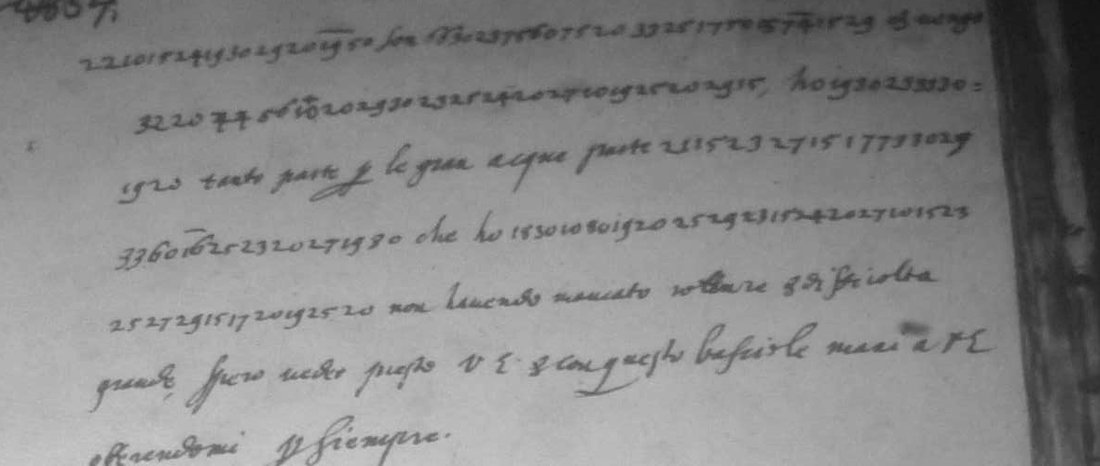
The page is one frame of a microfilm of the Piccolomini family archive, photographed from a reader screen and printed in the appendix of Václav Vlnas’s bachelor thesis on the computer analysis of the family’s cipher correspondence (Hradec Králové 2017), which lists it as not deciphered. A figure is about nine pixels high, and many are at the edge of legibility. About five lines carry cipher runs; the courtesy close is in plain script, the signature is in cipher and a line of cipher stands at the foot. There is no gloss.
Two sibling letters of the same writer (inv. 24852, dated in plain script “alli cinque del febraro 1646”, and inv. 24853, with “a 9 di febraro” at its foot) carry the same cipher signature and a contemporary interlinear decipherment over their cipher runs. They are the key and the test of this page; they are glossed, so they are not read here as targets, and their glosses are not transcribed in full. The notes of the project cite Vlnas’s catalogue for the family archive; the writer is not identified (see below).
02 The key
The cipher writes one letter per two-figure group, in continuous runs inside plain Italian, with no word division. The main alphabet, from the glosses of 24852: a 30, b 31, c 32, d 33, e 15, f 16, g 17, h 18, i 25, l 27, m 28, n 29, o 20, p 21, r 23, s 24, t 19, u or v 10, z 14. Ten more rows from the glosses of 24853 (q 22; homophones 40 a, 44 n, 46 f, 52 c, 63 l, 64 m, 74 s; code groups 77 gente and 88 S.A.) were added after the held-out test and before the bare letter was decrypted mechanically. A bar over a group doubles the letter (24^ = ss, as in “Gissen”). The writer sometimes writes one letter where two are due, without a bar.
The key was built from 20 glossed words of 24852 (131 groups), frozen, and then tested; that order rests on the contributor’s record (file times, one commit). Its values are not those of the tables of the Piccolomini letters of c. 1646 or the Spanish officer’s letter, which have their own pages, nor of the Claudia de’ Medici letters (notes only, no page): different ciphers (the one coincidence is the number 15 = e, shared with the Spanish officer’s table).
03 The test
Eleven glossed words of inv. 24853, copied from separate crops after the key was frozen, were decrypted with it. Seventy-two groups have a value in the frozen key and all 72 give the gloss letter; seven groups (the homophones 40, 44, 46, 52, 63, 74) have none in it, so six of the eleven words come out letter for letter and five carry such a group. It is a small test, the gloss was visible on the crops while the signs were copied, and the freezing before it is by the contributor’s record.
The project’s statistical check on the reading of the bare letter calls the result weak: −2.082 per letter in an Italian model, against −4.386 for 200 random keys (4.9 standard deviations, just under the 5 needed), on only 109 read tokens. The key does not rest on this check: it comes from the contemporary glosses.
04 The reading
Questa notte son [?partito] di Giessen et vengo con buona risolutione. Ho tardato tanto, parte per le gran acque, parte per le gran difficoltà che ho havuto in resolver il negotio, non havendo mancato usare [?ogni] [?fatica], quando spero vedere presto V.E. … Devotissimo Servidore Blaufeldt. A […] di [?febraro] in Giessen.
In English: “Tonight I [?left] Giessen, and I come with a good resolution. I have been so late, partly because of the high waters, partly because of the great difficulties I had in settling the business, not having failed to make [?every] [?effort], while I hope to see Your Excellency soon … Your Excellency’s most devoted servant, Blaufeldt.” Square brackets with a question mark are guesses; the plain words “ogni fatica” are themselves doubtful on the photograph (a blind reader saw perhaps “[d]ifficolta”).
Counted by the README rule: the letter has 24 cipher words and no code group. Fifteen read verbatim from the signs with letter values that glosses attest, which is 62.5%. Six more carry a marked repair: the groups 50, 60, 70, 73, 80 and 86 are attested by no gloss, so the letter the sense needs (e, i, i, r, u, b) is put in; one of those words also has a 23 (r) where difficoltà needs c. Three are holes: the verb of the first line ([?partito], of which only a, r and the final o are settled on the photograph), the day and the month of the date line. The six repairs may be further homophones of the 40–80 range or misreadings of a soft photograph (86 for 31 = b, 80 for 10 = u); the image does not settle which. The cipher words build coherent sentences with the plain Italian, and the blind reader agreed with the state read in part and graded the reading B, but at 62.5% of the cipher words it is far under the 95% bar, so the extent is partial. The project’s sentence checker gives 0.571 (4 of 7 sentences clean) on the running text.
The signature. The nine groups 31 27 30 10 16 15 27 33 19 are identical on 24852_1, 24853_2 and 24854 and give Blaufeldt with glossed values only (b from buona, f from fiand(ra), the rest from many words). No gloss spells the name, and on 24853_2 the signature is preceded by a 17 under a cross that is not explained. Searches for a Blaufeld(t) at Giessen, in Hessen-Darmstadt service or near Piccolomini in 1646 found nothing, so the person is not identified; the name could be a cover name. As glossed on the siblings, the context is the Hessian war of early 1646 (the loss of Marburg, the siege of a place glossed “…nietstein”, negotiations with “S.A.” and “S.C.”, Melander, Saxony and Lüneburg, Cassel), and the writer was at Giessen, which belonged to Hessen-Darmstadt. (This background is not from the sources of this page and was not checked here.)
05 What remains uncertain
- Line 1, the group after “nott-” (50, read e): not glossed, the same on both passes, not settled by a blind reader; an e homophone or a misread figure (illegible).
- [?partito] (line 1): seven groups, of which the second, third and last (a r … o) are settled; the verb is a guess counted as a hole (illegible).
- The groups 60, 70, 73, 80, 86 (with 50): no gloss on the siblings attests them; the sense supplies their values (too short a text to settle them).
- difficoltà (line 4): the fifth group reads 23 (r) on both passes and to the blind reader where c is needed, a slip of the writer or a misread figure; the last group is 30 (a) in the transcription and 80 to the blind reader. At the integration the image was seen again: the end of this word is not settled by it either.
- The date line: the first group is under an ink blot, the groups after “feb” are not settled; “febraro” is a guess from the sibling letter.
- Ten key rows from 24853 were added after the held-out test, so the test does not cover them; three of them (22, 44, 74) occur on this letter.
- The writer: the signature reads Blaufeldt but no one by that name is found; no human has checked any sign. The transcription was compared with the photograph by a blind AI reader (68 of 123 groups: 63 agree, 1 differs and 4 unsettled), and again at the integration on about 45 groups of the first five lines (all agree except the end of difficoltà and one 86/56 look-alike). The date line and the foot were not compared again. A clean scan from SOA Zamrsk (not ordered) would settle most of the holes.
Full texts
The transcription and the decryption of every document on this page, so that the reading can be used and checked. Short files are shown here; all are in the repository.
inv. 24854, Giessen, [February?] 1646 read in part
The writer reports that he [?left] Giessen that night (the verb is a guess over unsettled signs) with a good resolution; he was delayed by high waters and by the difficulty of settling the business, and hopes to see the addressee (Piccolomini, by the archive) soon. Signed in cipher: Blaufeldt.
Builds coherent sentences, but under the read bar of 95% of words read as sense (62% here); the holes are marked in the reading.
Transcription
# 24854, reconciled transcription (tokens as in SIGN_CONVENTIONS.md). Source image: Vlnas 2017, appendix zip
# P_lohy_A_a_B.zip (theses.cz/id/p3p2kb), frame 24854.jpg (rotated copy 24854_rot.jpg; deskewed -2.4 deg in work/).
# Written by shape after pass 1 and pass 2 and before the key was applied to this frame. Disagreements settled on the
# image (crops work/z1*, z2*, f1-f3, 3x to 4x):
#  L1 run 2: the first group is under a bar and its first figure is not settled (1, 2 or a bar stroke): '?'. Groups
#     4-6 (pass 1: 76 80 77; pass 2: 37 66 07 / 68 07 77) are not settled: '?'. The 2nd-3rd groups 30 23 agree.
#  L1 run 2: before the last group pass 1 read 19, pass 2 15; at 4x the figure has the flat top of a 5 -> 15.
#     The bar is over 74 (both passes).
#  L2: the third group is two crossed figures; compared with the crossed 44 of 24853 (crop c53_44) it is 44, not 77.
#     A short bar lies over it; it is not copied as a doubling bar because it may be the cross-strokes.
#  L2: pass 1 copied "23 25 24 20" twice; at 4x the run has it once (pass 2).
#  L3: last run, 7th group: pass 1 77, pass 2 73; at 3x the first figure is a 7 -> 73. Pass 1's "33 10 29" ending
#     was a misdivision: the run ends 73 30 29 (pass 2).
#  L4: first run, last group: pass 1 80, pass 2 30; doubtful -> 30?. Second run: pass 1 "30 10 10 80", pass 2
#     "30 10 80"; at 3x only one 10 -> 30 10 80.
#  L5: plain script "ogni fatica" is not certain (blind review, 12 Nov 2026: at 6x the last word may be
#     "[d]ifficolta" and the word before it is unclear): marked [?ogni] [?fatica].
#  FOOT: the first group is under an ink blot ('?'); groups 6-8 are not settled ('?').
L1: 22 10 15 24 19 30 29 20 19^ 50 | <son> | ? 30 23 ? ? ? 20 | 33 25 | 17 70 15 74^ 15 29 | <et uengo>
L2: 32 20 44 86 10 20 29 30 23 25 24 20 27 10 19 25 20 29 15 | <, ho> | 19 30 23 33 30 =
L3: 19 20 | <tanto parte per le gran acque parte> | 21 15 23 27 15 17 73 30 29
L4: 33 60 16^ 25 23 20 27 19 30? | <che ho> | 18 30 10 80 19 20 25 29 23 15 24 20 27 10 15 23
L5: 25 27 29 15 17 20 19 25 20 | <non havendo mancato usare [?ogni] [?fatica]>
L6: <quando spero vedere presto V.E. et con questo bacio le mani a V.E. offerendomi per sempre. Di V.E. Devotissimo Servidore>
L7: 31 27 30 10 16 15 27 33 19
L8: <A> ? 33 25 16 15 31 ? ? ? 23 33 20 25 29 17 25 15 24^ 15 29
Decryption
L1: questanott[?50] <son> ?ar???o di g[?70]essen <et uengo>
L2: con[?86]uonarisolutione <, ho> tarda=
L3: to <tanto parte per le gran acque parte> perleg[?73]an
L4: d[?60]ffirolt(a) <che ho> hau[?80]toinresoluer
L5: ilnegotio <non havendo mancato usare [?ogni] [?fatica]>
L6: <quando spero vedere presto V.E. et con questo bacio le mani a V.E. offerendomi per sempre. Di V.E. Devotissimo Servidore>
L7: blaufeldt
L8: <A> ?difeb???rdoingiessen
Reading
# Reading of inv. 24854 (writer signing in cipher "Blaufeldt" to Ottavio Piccolomini, [February?] 1646)

Status: **read in part**. The letter is short: about five lines of mixed cipher and plain Italian, the courtesy close
in plain script, the cipher signature, and a cipher date line at the foot. Counts are printed by
`scripts/reading.py check` (see NOTES.md).

Image: Vlnas 2017, appendix zip P_lohy_A_a_B.zip (theses.cz/id/p3p2kb), frame 24854.jpg (photograph of a
microfilm-reader screen). Key: `key_frozen.tsv`. Mechanical decryption: `decryption_24854.txt`.

## Marked text (line by line against the signs)

Marks: `{x/y}` the signs give x, read y (here x is mostly an unglossed group `[?NN]`, given the value the sense
needs); `{?x}` doubtful sign shape; `[?guess=signs]` guess over signs not settled on the image (counted as a hole).
Plain script in `<...>`.

```marked
L1: questa nott{[?50]/e} <son> [?partito=?ar???o] di G{[?70]/i}essen <et uengo>
L2: con {[?86]/b}uona risolutione <, ho> tarda-
L3: to <tanto parte per le gran acque parte> per le g{[?73]/r}an
L4: d{[?60]/i}ffi{r/c}olt{?a} <che ho> hav{[?80]/u}to in resolver
L5: il negotio <non havendo mancato usare [?ogni] [?fatica]>
L6: <quando spero vedere presto V.E. et con questo bacio le mani a V.E. offerendomi per sempre. Di V.E. Devotissimo Servidore>
L7: Blaufeldt
L8: <A> [?giorno=?] di [?febraro=feb???rdo] in Giessen
```

Notes on the marks:
- L1 `nott{[?50]/e}`: the group after the barred 19 (tt) reads 50 on both passes; 50 is not glossed on the sibling
  letters. "notte" needs e; 50 may be an e homophone (the table has homophones in the 40-80 range, see key.tsv) or
  a code group (for instance "io") with the e left out. Both are open.
- L1 `[?partito=?ar???o]`: seven groups; only the 2nd, 3rd and last (a r ... o) are settled on the image. "partito"
  (left) fits the count and the sense with "di Giessen"; it is a guess, counted as a hole.
- L1 `G{[?70]/i}essen`: 70 is unglossed; i is what the name needs. The bar over 74 (s) doubles it (ss). The same
  name, spelt with 24^ (ss), is glossed "Gissen" on 24852_1 and ends the date line L8 here with known groups.
- L2 `{[?86]/b}uona`: 86 is unglossed (or a misread 31 = b on a weak photograph); "buona risolutione" is the
  phrase of 24852 ("con buona risolutione"). The third group of L2 is the crossed 44 (n), as on 24853.
- L3 `g{[?73]/r}an`: 73 is unglossed (or a misread 23 = r).
- L4 `d{[?60]/i}ffi{r/c}olt{?a}`: 60 is unglossed (i needed); 16 under a bar = ff; the 5th group reads 23 (r) where
  "difficolta" needs c (32 or the homophone 52): a misreading of the photograph or a slip of the writer; the last
  group is doubtful between 30 and 80.
- L4 `hav{[?80]/u}to`: 80 is unglossed (u needed; 10 = u stands before it).
- L4-L5 "resolver il negotio": the signs give "resoluer" + "ilnegotio"; no letter is added.
- L5 plain script `[?ogni] [?fatica]`: not certain on the photograph. The blind reviewer (12 Nov 2026) saw the last
  word at 6x as more like "[d]ifficolta" than "fatica" and could not settle the word before it; the sense is close
  either way. These are plain words, not cipher words, and do not enter the word count.
- L8: the first group is under an ink blot (a day number or a word); the groups after "feb" are not settled; the
  line ends "in Giessen" in known groups. "febraro" is a guess from the sibling 24852 ("alli cinque del febraro
  1646").

## Running text (Italian, normalised spelling; holes kept)

Questa notte son [?partito] di Giessen et vengo con buona risolutione. Ho tardato tanto, parte per le gran acque,
parte per le gran difficoltà che ho havuto in resolver il negotio, non havendo mancato usare [?ogni] [?fatica], quando
spero vedere presto V.E.; et con questo bacio le mani a V.E., offerendomi per sempre.
Di V.E. Devotissimo Servidore Blaufeldt.
A [...] di [?febraro] in Giessen.
Translation
# Translation of inv. 24854 (English, with the same holes as reading_24854.md)

Tonight I [?left] Giessen, and I come with a good resolution. I have been so late, partly because of the high waters,
partly because of the great difficulties I had in settling the business, not having failed to make [?every] [?effort], while I hope to
see Your Excellency soon; and with this I kiss Your Excellency's hands, offering myself for ever.
Your Excellency's most devoted servant, Blaufeldt.
At [...] of [?February], in Giessen.

Words in square brackets with "?" are guesses; "[...]" is a hole. "Giessen", "buona", "difficoltà", "havuto" and
"notte" each rest on one unglossed group given the value the sense needs (see the marks in reading_24854.md).
"[?every] [?effort]" renders the plain words "[?ogni] [?fatica]", which are not certain on the photograph (perhaps
"[d]ifficolta", "difficulty").
Key: key_frozen.tsv
06 Sources
- SOA Zámrsk, Rodinný archiv Piccolominů (Náchod), inv. č. 24854 and the glossed siblings 24852 and 24853, via the photographs in the appendix zip P_lohy_A_a_B.zip of V. Vlnas, Počítačová analýza šifrované korespondence rodu Piccolomini, bachelor thesis, Univerzita Hradec Králové 2017 (theses.cz/id/p3p2kb), where the frame is listed as B20 of appendix B and not deciphered.
- Catalogue entry 2355 and the sweep notes of
research/sweep_2026-11_czech_chrome. Three web searches of 12 Nov 2026 for the name found no edition, decipherment or person. - Transcription, key, readings and scripts by WAINUT (pull request #507), in
targets/blaufeldt1646.
The key, the transcriptions, the readings and the checks are in targets/blaufeldt1646.
Cite this page
WAINUT and Daniel Bourdeau, “A writer who signs in cipher, to Ottavio Piccolomini, Giessen, [February?] 1646”, Cyphersolver, posted 13 November 2026, https://cyphersolver.com/blaufeldt1646.html.