At a glanceKnown key applied · none (key obtained, text not read)
- The letter
- Galeotto Fibindacci da Ricasoli, Florence’s envoy at Urbino, to the Dieci di Balía, after the defeat at Zagonara; undated, with siblings of February 1425.
- Where
- Archivio di Stato di Firenze, Dieci di Balía, Responsive 2 no. 171; DECODE R3754, listed as “Non-decrypted”.
- The cipher
- An alphabet with two or three signs per letter, eighteen nulls and thirty word signs, plus six clear cover words.
- How it was read
- Gabbrielli’s 1863 key (printed by Meister, 1902) was applied and extended from the siblings’ glosses, adding six certain and fourteen probable letter values.
- What it says
- The Count of Urbino calls his wife “after all a woman, and suspicious”; her relatives and the citizens were to bind themselves to his wishes in secret.
- Still open
- Two signs before SOSPETOSA have no value and some words of the fast clear hand are uncertain.
- Credit
- Pietro Domenico Gabbrielli (key, 1863); Aloys Meister (printed 1902); George Lasry suggested the sibling method.
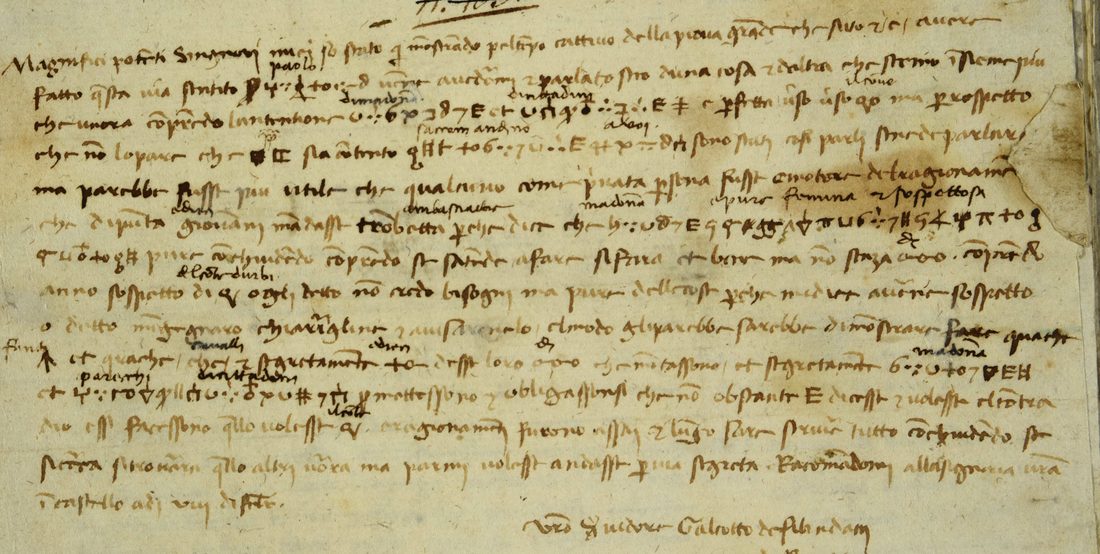
01 The letter, the key and the siblings
The letter opens “Magnifici potenti Signori miei” and is signed “Vostro servidore Galeotto de Fibindacci”. Its foot, never transcribed before 23 October 2026, reads “[?In] Castello, a dì viij di settembre”, with no year; the dating to early 1425 below rests on the siblings and is not confirmed by it. Its siblings in the same hand, filza 3 nos. 91 and 92, are dated at Urbino on 17 and 28 February, in the Florentine year 1424, that is 1425. Guasti’s edition of the Commissioni di Rinaldo degli Albizzi shows the Dieci sending Galeotto to the Count of Urbino in September 1423, and prints a later clear letter of his from Urbino of 28 August 1425. “Madonna” is the Countess, Caterina Colonna, niece of Pope Martin V, who married Guidantonio in 1424 and reached Urbino on 4 March 1424.
The key is page 1 of Gabbrielli’s volume Chiavi delle cifre delle lettere ai Dieci di Balía dal 1424 al 1530, compiled in 1863–64. The volume is on the Ilardi microfilm at Yale, reel 58, and Meister printed page 1 in Die Anfänge der modernen diplomatischen Geheimschrift (1902), p. 50. It is headed “Cifra di Galeotto Fibindacci da Ricasoli, carteggio dei X di Balía, an. 1424”. It gives an alphabet with two or three signs for most letters, eighteen nulls, and a nomenclator of thirty word signs such as Conte d’Urbino, Duca di Milano, Malatesta, fanti and mille. It also lists six cover words written in clear: Giovanni for the Dieci, Andrea for Galeotto, trombetta for an ambassador, che for horse, con for war and tagliato for loss.
Gabbrielli marked the letters he worked from in the margin: filza 1 nos. 163 and 165, filza 2 no. 72 and filza 3 nos. 21, 91 and 92. His interlinear glosses on no. 171 cover a dozen words: paolo, di madona, cintadini, il conte, sarrem andino, a laog., ambasciatore, puro femina e sospettosa, el conte d’Urbino, cavalli, parenti and madonna. Several of these sit over runs far longer than the gloss, and two of them are misreadings.
02 The three unread runs
Each run was cut from the deskewed scan at four to five times magnification and transcribed sign by sign. The signs were then matched against Gabbrielli’s table and his gloss. Capitals are the decoded text.
“Madonna è pure femina e sospetosa”

The clear text runs: “… che […] Giovanni [i Dieci] mandasse trombetta [ambasciatore], perché dice che”. Thirty signs follow. MADONNA is seven signs, all in Gabbrielli’s table. PURE is P, U, R, E from his table with a feathered null after the P. FEMINA is six signs, all his. E is his. Two signs follow that have no value (section 05). SOSPETOSA is nine signs. The two O signs in it stand exactly five places apart, as the two O’s of s-o-spet-o-sa do, and that fixes the alignment. Gabbrielli glossed the whole phrase but never tabulated the signs in it. The sentence reads: “because he [the Count] says that Madonna is, after all, a woman, and suspicious”.
“Parenti e citadini”

The run has seven signs and then eight. Gabbrielli’s values give P, A, R, E, I, T and D; the others are values recovered from the sibling glosses (9 = N, ɣ = A) or fixed by position (two light strokes = T, ᴗ = C, # = I). The two words are PARENTI and CITADINI, one letter per sign. The sentence reads: “et segretamente MADONNA et PARENTI [e] CITADINI promettessono e obligassensi che, non obstante [ELLA?] dicesse e volesse el [?contrario], essi farebbono quello volesse [IL CONTE]”. In English: Madonna’s relatives and the citizens should secretly promise and bind themselves that, whatever she might say or want to the contrary, they would do what the Count wished.
“Acomandino a lo…”
Gabbrielli glossed this run sarrem andino and the next word a laog. The first sign is on his own list of nulls. The next ten are A C O M A N D I N O by his table and by the value +o = O, which the siblings confirm. The last three are A L O, and the clear text continues. The 18 September reading took the last sign for I (“a lui”); at three times magnification it is Gabbrielli’s O. The clause is “Ma prosetto che no lo pare che [IL PAPA?] sia [?atento], S'ACOMANDINO A LO[…]” (re-read on 23 October 2026), “that it does not seem to him that the Pope is attentive; that they commend themselves to […]”.
03 The letter
This is a working text, re-read on 23 October 2026 on crops that follow the slope of the lines (they fall about 3% to the right, which had split the old strips): texts/no171_reading.md, with an English translation. The clear hand is fast; [?word] marks a doubtful word, […] an unread place. Cipher is given in capitals and word signs in brackets.
Magnifici potenti Signori miei. Io so stato qui [?mostrado] pel tempo cattivo della piena grande che fu […] avere fatto questa mia. Sentito, PAVOLO venne a vedermi e parlato [?seco] d'una cosa e dell'altra, che stemo insieme più che un'ora, scoprendo l'intentione DI MADONN[A] et CINTADINI e [?persone] […] [IL CONTE]. Ma prosetto che no lo pare che [IL PAPA?] sia [?atento], S'ACOMANDINO A LO[…]; sono stati così parechi [?strani] parlari.
Ma parebbe fusse più utile che qualunche [?come] [?privata] persona fusse a motivare de' ragionamenti, che […] Giovanni [i Dieci] mandasse trombetta [ambasciatore], perché dice che MADONNA [è] PURE FEMINA E […] SOSPETOSA, pure [?vedendosi] coperto, se sapere a fare. [?Sperra] et bene, ma non sta [?ancora] coperto. Et anno sospetto di questo [CONTE D'URBINO]; detto non credo bisogni, ma pure delle cose perché [?ne dee] avere sospetto.
O detto molto [?grave], [?chiarigliene] e [?ancho] [?strignerlo]. El modo gli parebbe: farebbe dimostrare fare [?quanti] [FANTI] et quarche che [cavalli], e segretamente [DIECI] dessi loro opera che [?metassono]; et segretamente MADONNA et PARENTI [e] CITADINI promettessono e obligassensi che, non obstante [ELLA?] dicesse e volesse el [?contrario], essi farebbono quello volesse [IL CONTE]. E ragionamenti furono assai e lungo. […] [?scriverò] tutto conchiudendo se [?sarà] [?secondo] quello altri [?nostra], ma parmi volesse andasse più segreta. Racomandomi alla Signoria vostra. [?In] Castello, a dì viij di settembre.
Vostro servidore Galeotto de Fibindacci da Ricasoli.
Galeotto, held up by the weather of a great flood, reports an hour’s talk with Paolo, who came to see him, about the intentions of the Countess and the citizens; it does not seem that the Pope is attentive, and some party is to commend itself to someone. He thinks it more useful that someone open the talks as a private person than that the Dieci send an ambassador, because the Count distrusts his wife: “Madonna is after all a woman, and […] suspicious”. Foot and horse are to be engaged quietly, with the Dieci giving them work. Her relatives and the citizens are to bind themselves, in secret, to follow the Count whatever she says. He ends that the business should be kept more secret.
04 The key corrected and extended
Was a fuller key already available? No. Gabbrielli’s volume has a second key for a Fibindacci in 1424 (key no. 2, “Karolus commissarius”), but it belongs to another sender and gives other values to the shared shapes (+o = B, 6 = S, ∧ = H), which the glossed words here contradict. His keys nos. 3 and 4 are Latin syllabic nomenclators. Meister and Somogyi reproduce key no. 1 only. DECODE holds Gabbrielli’s volume as key records R5687–R5698 (the 1424 frames are R5687–R5690); none is linked to R3754–R3757 and none goes beyond key no. 1.
What the siblings add. Gabbrielli glossed most cipher runs of nos. 21, 91 and 92, but tabulated only some of the signs under them. Forty glossed runs were transcribed sign by sign and matched letter for letter with the gloss: la novella della rotta, andarono, tante e tali, non contenterà mai, venuta a Imola, Modigliana twice, d’Oriuolo, promettere, Filippo, mandato, salvo condotto, venne and the word signs for Malatesta, the Duke, Galeotto, Pandolfo, Carlo, the Count, the Dieci and fiorini. Eleven runs could not be matched (faint gloss, blots). The result, with the evidence for each value, is the file key_extended.md.
- Six new letter values are certain, each spelled out under a gloss: ɣ = A, a 5-shape with a cross-stroke = M, 9 = N (Gabbrielli has B), +o = O, a π with a hooked leg = O, and an open 4 with a long bar = T.
- Fourteen more are probable, among them three signs with two values (ᴗ = D and C, # = L and I, π = F and S), each resting on one letter so far.
- Nulls. q is a null, as Gabbrielli has it; ɣ is a variant A, not a null; a heavy filled triangle is a null (in andaro▼no and madon▼na). His null “o+” (circle then cross) is a different sign from +o (cross then circle), which is O.
- Nomenclator. A three-stroke sign is pace; β, Gabbrielli’s con, also enciphers the syllable con inside a word (SALVOβDOTTO).
- Corrections to the tabulation of 18 September. Rereading the film at full size shows that ▽ is under E in Gabbrielli’s table, and that the cross over a small circle (T), the 8 with a ring below (S) and the ⊓ with a stem (I) are his own signs, not new ones.
| Sign | Value | Where it holds | Grade |
|---|---|---|---|
| ɣ | A | no. 171 citadini; no. 91 mandato (glossed) | H |
| +o | O | no. 171 five times; no. 21 andarono, non, Oriuolo; no. 92 condotto | H |
| 9 | N | no. 171 parenti; no. 21 ne andarono, non | H |
| open 4 with long bar | T | no. 21 promettere; no. 92 condotto; no. 91 partendo | H |
| 5-shape with cross-stroke | M | no. 91 mandato | H |
| π with hooked leg | O | no. 21 Modigliana twice | H |
| two light strokes | T | no. 171 parenti only | M |
| # | I | no. 171 citadini only; L in no. 21 la novella | M |
| ᴗ as C | C | no. 171 cintadini, citadini; the same shape is D elsewhere | M |
| π as S | S | no. 171 sospetosa only; Gabbrielli and FEMINA give F | M |
| ʓ | S | no. 171 sospetosa only; close to a Gabbrielli null | M |
| heavy filled triangle | null | no. 21 twice; no. 171 twice | M |
Effect on no. 171. All 99 cipher tokens were transcribed again from three-times crops and deciphered with the extended key (token list cipher171.tsv). 72 values come from Gabbrielli’s table, 16 from the recovered values, 5 are nomenclator entries and 4 rest on context. The changes are small: the name is spelled PAVOLO; the Count’s word sign stands three times; the Dieci’s word sign stands on line 11; “a lui” becomes A LO…; the heavy pair on line 4 is a null and one word sign.
05 What remains uncertain
- The word sign before “sia” (a box with a bar, after a heavy null) is not in Gabbrielli’s nomenclator. He wrote over it a small p with a looped flourish, the usual abbreviation for Papa. The Countess is the Pope’s niece, so “the Pope” fits. Grade I.
- One single word sign, before “dicesse”, is given the value ella from context alone. Grade I.
- Two signs before SOSPETOSA, after the E, have no value: an open 4 with a long bar (T in the siblings) and ψ (P by the key). “e t[ro]p[o] sospetosa” would fit, but one occurrence with no gloss cannot fix it. The word sospetosa is not affected.
- PAVOLO is deciphered cleanly; who he is stays open. He may be messer Paolo da Capranica, whom a Florentine cover list of 1424 calls “Capra”.
- The clear text: about a dozen words of the opening (lines 1–4), of “O detto …” (line 9) and of the close (lines 12–13) stay doubtful after the re-read of 23 October 2026: the mercantile cursive is fast and faded at the resolution of the DECODE image. Six cipher letters rest on look-alike readings.
- The date: the foot gives “a dì viij di settembre” and a doubtful “[?In] Castello”, but no year.
- The key is still partial. B, H and Q have no values beyond Gabbrielli’s, eleven sibling runs are not aligned, and about fifteen glossed runs of no. 92 are not yet transcribed. The three siblings have not been deciphered end to end. The extended table is queued for DECODE as a key derived from Gabbrielli’s (R5687–R5690), with its grades.
Full texts
The transcription and the decryption of every document on this page, so that the reading can be used and checked. Short files are shown here; all are in the repository.
Responsive 2 no. 171 (DECODE R3754) decoded, not read
Galeotto Fibindacci da Ricasoli, Florence's envoy at Urbino, reports to the Signoria (dated under the text 'a dì viij di settembre', year not written: 1423 or 1424, when he was sent to the Count over Faenza; the siblings of Feb 1424/25 are a later stay) on talks about the Countess ("Madonna", Caterina Colonna): he advises that the Dieci send an ambassador, because the Count says Madonna is after all a woman, and suspicious, and proposes that her relatives and the citizens secretly bind themselves whatever she might say.
A mechanical decode with holes in most sentences: shown so that the transcription and the key can be checked and improved, not as a reading.
Transcription
# no. 171 (DECODE R3754): every cipher token, one per row, in text order. 24 Sept 2026.
# run = line of the letter + run letter; sign = name in key_extended.md; value = letter, word, "null" or "?" (no value);
# src = G (Gabbrielli's 1863 table as printed), N (value recovered 24 Sept from sibling glosses, key_extended.md),
#       X (nomenclator entry, Gabbrielli's list or recovered), C (context only);
# grade = H (gloss over this run or the value is fixed by a sibling gloss), M (probable), I (inferred from context).
run	sign	value	src	grade	note
L2a	Ᵽ	P	G	H	gloss "paolo"
L2a	4	null	C	I	plain 4 without bar; no letter wanted between P and A
L2a	∵	A	G	H
L2a	♀	V	G	H	PAVOLO, the old spelling of Paolo
L2a	+o	O	N	H
L2a	÷	L	G	H
L2a	8	O	G	M	8 without strokes; Gabbrielli's O is ∂ (8 with tail)
L3a	ᴗ	D	G	H	gloss "di madona"
L3a	·:'	I	G	H
L3a	6	M	G	H
L3a	℘	A	G	H
L3a	⊐	D	G	H
L3a	∂	O	G	H
L3a	7	N	G	H
L3a	E	N	G	H	final A not written
L3b	ᴗ	C	N	M	gloss "cintadini"; same shape is D in L3a
L3b	⊓̍	I	G	H	Gabbrielli second I sign; also I in no. 92 MINGARDO, no. 21 MODIGLANA
L3b	ϙ	N	N	M	9 with straight tail; Gabbrielli B; the gloss spells cintadini
L3b	ô	T	G	H
L3b	∵	A	G	H
L3b	⊐	D	G	H
L3b	·:'	I	G	H
L3b	E	N	G	H
L3b	‡	I	G	H
L3c	ɣρ	il Conte [d'Urbino]	X	H	gloss "il conte"; Gabbrielli's ov
L4a	■	null	N	M	heavy filled sign, the null ▼ of nos. 21 and 171 L11b
L4a	⊡	il Papa	C	I	box with a bar; Gabbrielli's mark ṗp̄ over it; not in his nomenclator
L4b	q	null	G	H	Gabbrielli's null q
L4b	Ħ	A	G	H	gloss "…andino"
L4b	⊢	C	G	H
L4b	+o	O	N	H
L4b	6	M	G	H
L4b	∵	A	G	H
L4b	7	N	G	H
L4b	ᴗ	D	G	H
L4b	·:'	I	G	H
L4b	E	N	G	H
L4b	q‡	O	G	H	Gabbrielli's O "4 with bar"
L4c	℘	A	G	M	gloss "a laog."
L4c	÷	L	G	M
L4c	∂	O	G	M	A LO[RO]? clear text follows
L7a	ɧ	M	G	H	gloss "madonna"
L7a	∵	A	G	H
L7a	ᴗ	D	G	H
L7a	∂	O	G	H
L7a	7	N	G	H
L7a	E	N	G	H
L7a	℘	A	G	H
L7b	♀	P	G	H	gloss "puro"
L7b	ϡ	null	C	M	feathered sign; no letter wanted between P and U
L7b	99	U	G	H
L7b	∧	R	G	H
L7b	▽	E	G	H	Gabbrielli lists ▽ under E; confirmed by no. 21 LA NOVELLA and no. 92 VENNE (glossed)
L7c	π	F	G	H	gloss "femina"
L7c	⊔	E	G	H
L7c	6	M	G	H
L7c	·:'	I	G	H
L7c	7	N	G	H
L7c	Ħ	A	G	H
L7d	ς	E	G	H	gloss "e"
L7e	⊀	?	-	-	open 4 with long bar (T in nos. 21, 92); T P? unread
L7e	ψ	?	-	-	P by the key; "e t[ro]p[o] sospetosa"? unread
L7f	π	S	N	M	gloss "sospettosa"; π is F two words earlier
L7f	+o	O	N	H
L7f	8̊	S	G	H	Gabbrielli S (8 with a ring below); S in no. 92 SALVO (glossed)
L7f	♀	P	G	H
L7f	⊔	E	G	H
L7f	ô	T	G	H
L7f	+o	O	N	H
L7f	ʓ	S	N	M	3 with a loop; close to Gabbrielli's null "ʒ over 6"
L7f	Ħ	A	G	H
L9a	oɣ	Conte d'Urbino	X	H	gloss "el conte d'Urbino"
L11a	↑	fanti	X	H	Gabbrielli's nomenclator
L11b	+o–	Dieci	X	H	gloss "dieci"; Gabbrielli's +o
L11c	6	M	G	H	gloss "madonna"
L11c	∵	A	G	H
L11c	ᴗ	D	G	H
L11c	+o	O	N	H
L11c	7	N	G	H
L11c	▼	null	N	M	heavy filled triangle; null in no. 21 ANDARO▼NO and DELLA ROTTA
L11c	E	N	G	H
L11c	Ħ	A	G	H
L12a	Ч	P	G	H	gloss "parenti"; ψ written as a 4 with a hook
L12a	∵	A	G	H
L12a	Γ°	R	G	H
L12a	▽	E	G	H	Gabbrielli lists ▽ under E; confirmed by no. 21 LA NOVELLA and no. 92 VENNE (glossed)
L12a	9	N	N	H	N in no. 21 NE ANDARONO and NON CONTENTERÀ
L12a	ll	T	N	M	two light strokes; T by position only
L12a	⊓	I	G	H
L12b	ᴗ	C	N	M	gloss "cintadini"
L12b	·:'	I	G	H
L12b	ô	T	G	H
L12b	ɤ	A	N	H	A in no. 91 MANDATO (glossed); Gabbrielli filed it as a null
L12b	ᴗ	D	G	H
L12b	#	I	N	M	# is L in no. 21 LA NOVELLA (glossed); I here by position
L12b	7	N	G	H
L12b	⊓	I	G	H
L12c	E	ella	C	I	single sign before "dicesse"; subject pronoun from context
L13a	ɣ	il Conte	X	H	gloss "il conte"
Transcription
# ASF, Dieci di Balìa, Responsive 2 no. 171 (old no. 168) — DECODE R3754 — working transcription

Glosses (contemporary or early hand) sit ABOVE the cipher group they explain. Signs in [ ]; {gloss}.
Plain hand is a fast Italian mercantile cursive; readings marked ? are uncertain.

1. Magnifici potenti Signori miei, io sono stato q(ui?) mostrato per lungo rattivo? della piena grazia che suo v..s amore?
2. fatto questa mia sentito [P 4 ·: ξ t o ·: — 8] {paolo} non ne? averano? e parlato però di una cosa e dell'altra che sterino insieme più
3. che uvera? coprido? lantechore? [v ·:· 6 p ↄ 8 7 E] {dimandato} et [u ξ g ·: ¬ ·: E ≠] {cintadini} ≠ c pfsttn? usto uso qo {il conte} ma prossetto?
4. che non lo pare? che — [■ Œ] {(gloss illegible)} sia [a ·:tro?] [g H t t o 6 ·: 7 u ·· E 4 + x ·: — 8] {sarrem? andino / a laog? (a Lucha?)} ch(e) sono stati così parch(i)? strade parlare,
5. ma parebbe fusst? più utile che qualunque com(m)e? ·: piena? p(er)s(on)a fusse emotivare? de tragionamen(to)
6. che disputa Giovanni madasst? [t r o b e t t a?] {ambasciatore} p(er)che dice che [h ·: v 8 7 E g g x g g λ ∇ π u 6 ·:· 7 H 5 λ ψ π t o g] {madonna … femina e sospettosa?}
7. [q u ō t o g H] {(el conte d'Urbino? — gloss "elcōte durbi." sits above line 8)} piue? coprido? se sapere afare sipuca? et bene ma no staza c·oo. cosi però
8. anno sospetto di [g o r g] detto no creo? bisogny ma piue delle cose piche? medne? avere sospetto
9. o detto un gran? [chi rgilene?] e universalo? el modo el parebbe farebbe dimostrare fare guache?
10. fine ∧ et guache {cavalli} chel e segretamente [t o] cresse? loro opro? che notasseno et segretamente [6 ·: v 4 o 7 ▽ E H] {madonna}
11. et [4 ·: r o ▽ g ll d u ·: 6 p u # 7 ξ] {parenti / cintadini} p(ro)mettessero e obligassensi che no obstante [E] dicesse e volesse el (?) contra
12. dico esse? sarssone? quello volesse [E?] {(gloss)} e ragionamenti furono assai e lungo; fare secure? tutto (co)ntradido? se
13. sarà secondamente quello alt(r)o? nova? ma parmi volesse andasse più segreta. Racomandomi alla Signoria vostra
14. Vostro servidore Galeotto de Filandani? da Rimini?

## Sibling letters: glossed cipher runs, sign by sign (24 Sept 2026)

Transcribed from the deskewed pages `strips/dsk21.png`, `dsk91.png`, `dsk92.png` (main checkout, git-ignored; same
pixel size as the DECODE images) in crops at 2-4x (`strips/X21_*.png`, `X91_*.png`, `X92_*.png`, `W<no>_<y>_<col>.png`).
Coordinates are x, y on the deskewed page. Sign names as in `key_extended.md`; {gloss} is Gabbrielli's interlinear
word; the alignment row gives the letter each sign stands for. Runs marked *unaligned* were transcribed but the gloss
could not be matched sign for sign.

### no. 21 (Responsive 3 no. 21, DECODE R3755)
| # | where | gloss | signs | alignment |
|---|---|---|---|---|
| 21-2 | y350 x1790-2900 | {la novella della rotta} | # Ħ E ∂ 99 ▽ ÷ + ℘ · ᴗ ▽ ‡ ∵ ∧ q‡ ▼ ⊀ ⱡ | L A · N O V E L L A · D E L? A · R O [▼ null] T T (final A not written) |
| 21-3 | y800 x480-1100 | {guerra col duca che} | β M ff | [con = guerra] [Duca] [che] (clear "e ruy" before) |
| 21-4 | y890 x470-1100 | {andarono} | 9 ς h ∵ 7 ᴗ Ħ ∧ q‡ ▼ E +o | N E [h null?] A N D A R O [▼ null] N O |
| 21-5 | y870 x1650-2350 | {tante e tali} | ⱡ ℘ 7 ⋉ ▽ · et · ⱡ ∵ ÷ | T A N T E · et · T A L(I) |
| 21-6 | y850 x2420-3460 | {chi 'l duca non contenterà mai} | ff M 9 3 ɣ +o 7 Ƭ ς 7 ⋉ Ꜧ ∧ ∵ 6 Ħ ·:' | [che] [Duca] N O · C O N T E N T E R A · M A I |
| 21-7 | y620 x3380-3700 | {pace}, {dieci} | ſſſ · +o– | [pace] · [Dieci] |
| 21-8 | y1190 x690-1500 | {della gente d'arme venuta a Imola} | oTo =̈ ς 7 99 ⱡ ɣ? ℘ ɦ 6 q‡ ÷ ℘ | [gente d'arme] V E N U T A · A I M O L A |
| 21-9 | y1170 x2950-3150 | {Faenza} | ⊥̇ 8 | [città] [Faenza] |
| 21-10 | y1410 x790-1310 | {modiglana} | ɧ ʒπ ᴗ ·:' ═ ÷ 7 Ħ | M O D I G L N A (A after L not written) |
| 21-11 | y1310 x880-1000 | {castello} | ·+· | [castello] |
| 21-12 | y1840 x420-800 | {d'Oriuolo} | ᴗ q‡ ∧ ⊓ =̈ +o ÷ q‡ | D O R I U O L O |
| 21-13 | y1950 x420-560 | {dieci} | +o– | [Dieci] |
| 21-14 | y2040 x600-1150 | (gloss faint) | ψ ⊓' ς ⋉ ∵ ⊐ Ħ ψ̄ ! ∵ | *unaligned* (P I E T A D A …?) |
| 21-15 | y1960 x2750-3300 | {modiglana} | 6 ʒπ ᴗ ⊓̍ ═ ‡‡ Ħ 7 ∵ | M O D I G L A N A |
| 21-16 | y1990 x2300 | {galeotto} | o7 | [Galeotto] |
| 21-17 | y1950 x1300; y4000 x2550, 2980 | {il duca} | M | [Duca] ×3 |
| 21-18 | y1630 x3070-3300 | {fiorini} | ooo | [fiorini] |
| 21-19 | y2170 x1150-1720 | {permettere} | ψ ∧ q‡ 6 ς ⊀ 8̇ ς ∧ ▽ | P R O M E T T E R E (the cipher has PRO-, the gloss PER-) |
| 21-20 | y3060 x3200-3700 | {Filippo} | o— !: ‡‡ ╪ 4 8̇ | F I L I P P (final O not written; 4 and 8̇ as P are doubtful) |
| 21-21 | y3320 x1580-1800 | {C. K. e Pan.} | 4o · e · oto | [Carlo] e [Pandolfo] |
| 21-22 | y3500 x2860 | {il s. K} | 4o | [(signor) Carlo] |
| 21-23 | y2940 x2270; y2950 x3300 | {malatesta} | ∃ | [Malatesta] ×2 |
| 21-24 | y3740 x3600 | {lo s. p} | oto | [(signor) Pandolfo] |
| 21-26 | y4130 x2780 | {il conte} | ɣo | [Conte d'Urbino] |
| 21-28 | y3960 x2860-3500 | {…amme…ino} (faint) | 99ħ ⊐ ∵ E Ħ 6 ς ∧ +o 7 8 | *unaligned* |
| 21-1 | y210 x2270-3070 | (gloss faint) | ſ ∵ ᴗ ∵ 4o =̈ ς ÷ # ∂ ⚲ ⊔ ∧ ψ ⊓ ▽ | *unaligned* |

### no. 91 (Responsive 3 no. 91 [DECODE name Responsive_3_096], DECODE R3756)
| # | where | gloss | signs | alignment |
|---|---|---|---|---|
| 91-1 | y420 x3060-3560 | (none over it) | ψ ∵ ∧ ⊀ ς 7 ᴗ [blot] q‡ | P A R T E N D O (context "partendo") |
| 91-1b | y400 x3560-3700 | {Car. al d.} | 4o ÷̈ ∵ E ⊢ ∩ | [Carlo] + *unaligned* |
| 91-2 | y500 x3240-3620 | {mandato} | ʃ ɤ 7 ᴗ ∵ ô q‡ | M A N D A T O |
| 91-3 | y700 x250-700 | {carlo} (margin), {dali…} | ∴– ‡‡ 6 +o ∵ ‡‡ ⊽ · di · 8̊ ₰ | *unaligned* |
| 91-4 | y740 x1900; y870 x2150 | {malatesta} | ∃ | [Malatesta] |
| 91-5 | y770 x2540 | {Gal[eotto]} | o7 | [Galeotto] |
| 91-6 | y2160 x1000-1200 | {fattori}? (faint) | ∴ ⊀ ∂ q‡ ∧ q ∧ ʓ · di · ∃ | *unaligned* (T O O R … di Malatesta) |
| 91-7 | y2590 x1600-3400 | {del duca}, {guerra}, {per bisogno}, {pel borgo}? | ∴ 6 9 8̊ π ⊽ Γ o [blot] ‖̇ ∵ · ɣ ∂ ψ ʒπ ⊢ ∵ q‡ … ɣ ‡‡ ✱ ᴗ q‡ ∧ ∂ | *unaligned*; partly blotted |

### no. 92 (Responsive 3 no. 92 [DECODE name Responsive_3_097], DECODE R3757)
| # | where | gloss | signs | alignment |
|---|---|---|---|---|
| 92-1 | y2440 x1150-1850 | {salvo condotto} | 8̊ ∵ ‡‡ 99 q‡ · β · [blot] +o ⊀ ρ ô q‡ | S A L V O · [con] · D? O T T O |
| 92-2 | y2350 x3400-3740 | {Mingardo} | 6 ⊓̍ 7 ⁝ ∵ ψ̈ ∴– ∂ | M I N G A … O (name) |
| 92-3 | y2510 x280-700 | {Mingardo} | ' 6 ⊓̍ 7 ⁝ # ⊢ !: ∂ | M I N G … O |
| 92-4 | y500 x480-960 | {hieri venne, il conte} | ‖ ⊓ ψ̈ 8 ∵ =̈ ς ∧ ÷' ♀ ▽ 7 E ∵ ɣ | … E R I · V E N N [∵ E?] · [il Conte]; the first six signs are not aligned |
| 92-5 | y520 x2280-2700 | {pungione}? | ᴗ ÷̇ ▽̇ 7 ς o– … | *unaligned* |
| 92-6 | y560 x2600-3050 | {il conte} | ≠ ∵ ⊓̍ +o E ς ooo | *unaligned*; ooo = [fiorini] |

Not transcribed this session: the rest of no. 92 (lines y690-y2300 and y2600-end hold about fifteen more glossed runs:
*da Forlì, a Milano, chi non sia in lui, la Marca, Romagna, fanti, ambasciatore, a Faenza, Mingardo …*) and the
unglossed runs of nos. 21 and 91. They are the next source of pairs.
Decryption
# ASF Dieci di Balìa, Responsive 2 no. 171 (DECODE R3754): final decipherment

Copied verbatim from `READING.md`, section "Re-decipherment with the extended key (24 Sept 2026; supersedes the cipher parts above)", which supersedes the earlier working readings in that file. The key is Gabbrielli's 1863 table extended from the glossed siblings (`key_extended.md`); the token list is `cipher171.tsv`.

## Re-decipherment with the extended key (24 Sept 2026; supersedes the cipher parts above)

Every cipher token of no. 171 was re-transcribed from 3x crops of the deskewed page (`strips/Y171_*.png`, main
checkout) and deciphered with `key_extended.md`. The token list with value, key source and grade is
`cipher171.tsv`; `python targets/florence1429/measure171.py` counts it.

**Measured:** 99 cipher tokens (letters, nulls and word signs; a nomenclator sign counts as one token). 97 have a
value (98.0%); 94 (94.9%) at grade H or M. Two tokens have no value (⊀ ψ in run L7e). By source: 72 values from
Gabbrielli's 1863 table as printed, 16 from signs whose value was recovered from the sibling glosses, 5 nomenclator
entries, 4 from context only (the null 4 in PAVOLO, ⊡ = il Papa?, the word sign E = ella?, the null ϡ).

| run | signs | decipherment | change from 18 Sept |
|---|---|---|---|
| L2a | Ᵽ 4 ∵ ♀ +o ÷ 8 | PAVOLO (Paolo), 4 a null | ♀ = V; "∵ — 8" is ÷ (L) + 8 (O), not nulls |
| L3a | ᴗ ·:' 6 ℘ ⊐ ∂ 7 E | DI MADONN(A) | none |
| L3b | ᴗ ⊓̍ ϙ ô ∵ ⊐ ·:' E ‡ | CINTADINI (Gabbrielli's spelling in the gloss) | ϙ = N, ⊓̍ = I (Gabbrielli's second I) |
| L3c | ɣρ | [il Conte d'Urbino] (Gabbrielli's ov; gloss "il conte") | the sign read "≠" is ɣρ, the word sign |
| L4a | ■ ⊡ | [null] [il Papa?] | ■ is the null ▼ of nos. 21 and 171 L11c, so one word sign, not two |
| L4b | q Ħ ⊢ +o 6 ∵ 7 ᴗ ·:' E q‡ | [null] ACOMANDINO | none |
| L4c | ℘ ÷ ∂ | A LO (then clear text) | the last sign is ∂ (O), not ⊓; "a lui" withdrawn |
| L7a | ɧ ∵ ᴗ ∂ 7 E ℘ | MADONNA | none |
| L7b | ♀ ϡ 99 ∧ ▽ | PURE, ϡ a null | the group read "∯" is 99 (U), Gabbrielli's sign |
| L7c | π ⊔ 6 ·:' 7 Ħ | FEMINA | none |
| L7d | ς | E | none |
| L7e | ⊀ ψ | ? ? | ⊀ is the open 4 (T in nos. 21, 91, 92), not Gabbrielli's O; unread |
| L7f | π +o 8̊ ♀ ⊔ ô +o ʓ Ħ | SOSPETOSA | 8̊ and ô are Gabbrielli's S and T; π = S and ʓ = S remain single-letter values |
| L9a | oɣ | [Conte d'Urbino] | none |
| L11a | ↑ | [fanti] | none |
| L11b | +o– | [Dieci] (gloss "dieci") | read as a word sign, not as the start of a run |
| L11c | 6 ∵ ᴗ +o 7 ▼ E Ħ | MADON[▼]NA | ▼ is a null |
| L12a | Ч ∵ Γ° ▽ 9 ll ⊓ | PARENTI | ▽ is Gabbrielli's E; 9 = N now shown in no. 21 |
| L12b | ᴗ ·:' ô ɤ ᴗ # 7 ⊓ | CITADINI | # = I here; # is L in no. 21 |
| L12c | E | [ella?] | none |
| L13a | ɣ | [il Conte] (gloss "il conte") | read as the Conte word sign |

### Continuous reading of no. 171 (clear text as re-transcribed 18 Sept; decipherment in CAPITALS; word signs in [ ])

Magnifici potenti Signori miei, io sono stato qui mostrato per lettera … di questa … fatto questa mia, sentito
PAVOLO, … non n'averavamo e parlato però di una cosa et dell'altra, che sterino insieme più … DI MADONN[A] et
CINTADINI e [il Conte] … ma prosetto(?) che non li pare che [il Papa?] si[a] …, ACOMANDINO A LO…; sono stati così
parecchi … parlare, ma parebbe fusse più utile che qualunque commissione portata persona fusse et motivare de'
ragionamenti, che disputa Giovanni [= i Dieci] mandasse trombetta [= ambasciatore], perché dice che MADONNA [è]
PURE FEMINA E [? ?] SOSPETOSA, pure vedrendosi(?) coperto, se sapesse a fare, sapere et bene; ma non staza così
coperto. Anno sospetto di questo [Conte d'Urbino], detto non credo bisogni, ma pure delle cose … avere sospetto;
o detto … el modo che li parebbe, farebbe dimostrare fare … [fanti] et guache(?); che [= cavalli] e segretamente
[Dieci] dessi loro opera che metassono, et segretamente MADONNA et PARENTI [e] CITADINI promettessono e
obligassensi che, non obstante [ella?] dicesse e volesse el contrario, dico essi farebbono quello volesse
[il Conte]. E ragionamenti furono assai e lunghi … ma parmi volesse andasse più segreta. Racomandomi alla Signoria
vostra. Vostro servidore Galeotto de Fibindacci [da Ricasoli].

What the extended key changed in the sense: "Paolo" is spelled PAVOLO; the Count appears three times as his word sign
(lines 3, 9, 13); the Dieci are named as the ones to engage the men secretly (line 11); the pair on line 4 is one
word sign after a null. Still open: ⊀ ψ before SOSPETOSA (two signs), and the values resting on context (⊡, E).
The clear text of lines 1-3, 8-10 and 13-14 is a first-pass palaeographic reading and has not been re-checked.
Decryption: READING.md
Reading
# ASF Dieci di Balìa, Responsive 2 no. 171 (DECODE R3754): Galeotto de Fibindacci da Ricasoli to the Signoria, 8 Sept [1424]: reading

Rests on: the clear text re-read on the DECODE image IMG_R3754_I23011_P.jpg (5512 x 3674, the record's only file; no
attachment, no comment) from slope-following line crops on 23 Oct 2026, and the cipher runs as deciphered on 24 Sept
2026 with Gabbrielli's 1863 key extended from the glossed siblings (`../cipher171.tsv`, `../key_extended.md`).
Deciphered words are in CAPITALS; Gabbrielli's interlinear glosses (paolo, di madona, cintadini, il conte,
sarrem andino, a lugo, dieci, ambasciatore, madona, pure femina e sospettosa, el conte d'urbino, fanti, cavalli,
parenti, cintadini, madona, il conte) agree with them except where `../NOTES.md` says. Cover-words in clear are
glossed in brackets as Gabbrielli's table gives them (Giovanni = i Dieci, trombetta = ambasciatore, che = cavalli).
The writer's spelling is kept (sapere for saprebbe, stemo, parechi, obligassensi, racomandomi); abbreviations are
expanded without brackets where the expansion is certain (q- = qui/questo, p- = per/pro, ꝯ- = con). Holes: `[?word]`
partly carried by the image, `[…]` unread, `[word]` supplied by the sense.

## Reading

Magnifici potenti Signori miei. Io so stato qui [?mostrado] pel tempo cattivo della piena grande che fu […] avere
fatto questa mia. Sentito, PAVOLO venne a vedermi e parlato [?seco] d'una cosa e dell'altra, che stemo insieme più
che un'ora, scoprendo l'intentione DI MADONN[A] et CINTADINI e [?persone] […] [IL CONTE]. Ma prosetto che no lo
pare che [IL PAPA?] sia [?atento], S'ACOMANDINO A LO[…]; sono stati così parechi [?strani] parlari.

Ma parebbe fusse più utile che qualunche [?come] [?privata] persona fusse a motivare de' ragionamenti, che […]
Giovanni [i Dieci] mandasse trombetta [ambasciatore], perché dice che MADONNA [è] PURE FEMINA E […] SOSPETOSA,
pure [?vedendosi] coperto, se sapere a fare. [?Sperra] et bene, ma non sta [?ancora] coperto. Et anno sospetto di
questo [CONTE D'URBINO]; detto non credo bisogni, ma pure delle cose perché [?ne dee] avere sospetto.

O detto molto [?grave], [?chiarigliene] e [?ancho] [?strignerlo]. El modo gli parebbe: farebbe dimostrare fare
[?quanti] [FANTI] et quarche che [cavalli], e segretamente [DIECI] dessi loro opera che [?metassono]; et
segretamente MADONNA et PARENTI [e] CITADINI promettessono e obligassensi che, non obstante [ELLA?] dicesse e
volesse el [?contrario], essi farebbono quello volesse [IL CONTE]. E ragionamenti furono assai e lungo. […] [?scriverò] tutto
conchiudendo se [?sarà] [?secondo] quello altri [?nostra], ma parmi volesse andasse più segreta. Racomandomi alla Signoria vostra. [?In]
Castello, a dì viij di settembre.

Vostro servidore Galeotto de Fibindacci da Ricasoli.
Translation
# ASF Dieci di Balìa, Responsive 2 no. 171 (DECODE R3754): English (partial)

Translation of `no171_reading.md`, with the same holes. Deciphered words in CAPITALS. A partial reading: the opening
and the passage after "I have said" do not yet build sentences.

## Translation

Magnificent and powerful my Lords. I have been here [?held] by the bad weather of the great flood that there was […]
to have written this letter. Having heard [this?], PAOLO came to see me and talked [?with me] of one thing and
another, so that we were together more than an hour, uncovering the intention OF MADONNA and the CITIZENS and
[?persons] […] [THE COUNT]. But [?] that it does not seem to him that [THE POPE?] is [?attentive]; THAT THEY COMMEND
THEMSELVES TO […]; there have been a good many [?strange] speeches.

But it would seem more useful that someone, [?as] a [?private] person, should be the one to open the talks, than
that […] Giovanni [the Dieci] should send a trumpeter [an ambassador], because he says that MADONNA [is] AFTER ALL A
WOMAN AND […] SUSPICIOUS, though [?seeing herself] covered, if she knew how to act. [?] and well, but she is not
[?yet] covered. And they are suspicious of this [COUNT OF URBINO]; said, I do not believe it is needed, but still of
the things for which [?he must] be suspicious.

I have said very [?gravely], [?making it clear to him] and [?also] [?pressing him]. The way that would seem good to
him: he would make a show of raising [?some] [INFANTRY] and some horse, and secretly [the DIECI] should give them
work so that they [?]; and secretly MADONNA and the KIN [and] CITIZENS should promise and bind themselves that,
whatever [SHE?] might say and want to the [?contrary], they would do what [THE COUNT] wanted. And the talks were
many and long. […] [?I will write] everything, concluding whether it [?will be] [?according to] that other
[?of ours], but it seems to me he wanted it to go more secretly. I commend myself to your Lordship. [?At] Castello,
the 8th day of September.

Your servant Galeotto de Fibindacci da Ricasoli.
Key: key_extended.md
06 Sources
- Archivio di Stato di Firenze, Dieci di Balía, Responsive 2 no. 171: DECODE R3754. Siblings: Responsive 3 nos. 21, 91, 92 (R3755, R3756, R3757); Responsive 2 no. 72 (R3753). Uploaded by Mark Knowles, 2022; login required.
- P. D. Gabbrielli, Chiavi delle cifre delle lettere ai Dieci di Balía dal 1424 al 1530, vol. 1 (1863–64), ASF; Ilardi microfilm collection reel 58, Yale Dataverse doi:10.60600/YU/XKVOWE, page 1.
- A. Meister, Die Anfänge der modernen diplomatischen Geheimschrift (Paderborn 1902), pp. 43–50, “Cifra di Galiotto Fibindacci da Ricasoli 1424”: ULB Münster. Reprinted as “Fi2” in J. W. Somogyi, Verbum 2016/1–2, pp. 195–217.
- C. Guasti (ed.), Commissioni di Rinaldo degli Albizzi per il Comune di Firenze (1867–73), vol. 1 pp. 402, 487, 492; vol. 2 pp. 215 n. 1, 385–386.
- “Montefeltro, Guidantonio”, Dizionario Biografico degli Italiani (Treccani), for Caterina Colonna.
Sign-by-sign alignments, the working transcription, the sibling runs, the extended key and the token list are in the repository (targets/florence1429/). Page images are not committed; the crops on this page are for study.