
At a glanceKnown key applied · complete
- The letters
- Four ciphered letters to Anne de Montmorency, 1529–1537, by three French diplomats in Italy: Langeac (Venice, 14 January 1529), Gramont (Rome, 11 October 1529 and 21 July 1530) and Mâcon (Rome, 11 April 1537).
- Where
- BnF fr. 3083, fr. 3071 and fr. 3091 (Gallica); the catalogue grouped them asking whether they share a cipher.
- The cipher
- They do not: each has its own monoalphabetic key with two to seven homophones for common letters, doubled-letter signs, nulls and a few person codes; Mâcon’s code signs are numerals.
- How it was read
- A new transcription of about 9,000 signs from the Gallica scans, decrypted with the keys Lasry reconstructed in 2023 and Tomokiyo published as images.
- What it says
- Gramont 1529 reports Clement VII’s dread of a general council and his plan to grant one and stall it; Mâcon reports Paul III offering the Farnese marriage and threatening to declare for the Emperor.
- Still open
- Gramont 1530 and Mâcon are not complete; Mâcon’s clear text was transcribed loosely.
- Credit
- George Lasry reconstructed the four keys and deciphered the letters in 2023 without publishing them; Satoshi Tomokiyo published the key tables.
01 The letter and its key
The letter is BnF fr. 3091 no. 23, ff. 45r–47v, in the volume of Raince’s papers (Gallica btv1b9060253s, filmed as two-page openings, views 49–52). It came to the project as one of four letters to Montmorency grouped as catalogue item 6, which guessed “four letters by three hands, probably three keys”. Matching each against Tomokiyo’s pages on the ciphers of François I showed four keys, one per letter. Since 14 October 2026 each key has its own page: Langeac at Venice in 1529 (Avranches’ cipher 1), Gramont again in 1530 (Gramont’s cipher, 1530) and the cardinal de Mâcon in 1537, now with his other letters in Mascon’s cipher. Each is a different cipher, with its own page.
This letter’s key is Lasry’s “Gramont’s cipher (1529)”, built from the siblings fr. 3040 f. 16 and Clairambault 330 f. 53 and dated 5 November 2023. It is a monoalphabetic substitution with two to seven homophones for the common letters, signs for doubled letters, a handful of nulls, and a few code signs for persons. Tomokiyo notes that the published image carries no plaintext, and none of the letter is transcribed or printed elsewhere that we could find.
02 Gramont, Rome, 11 October 1529: the Pope on the way to Bologna
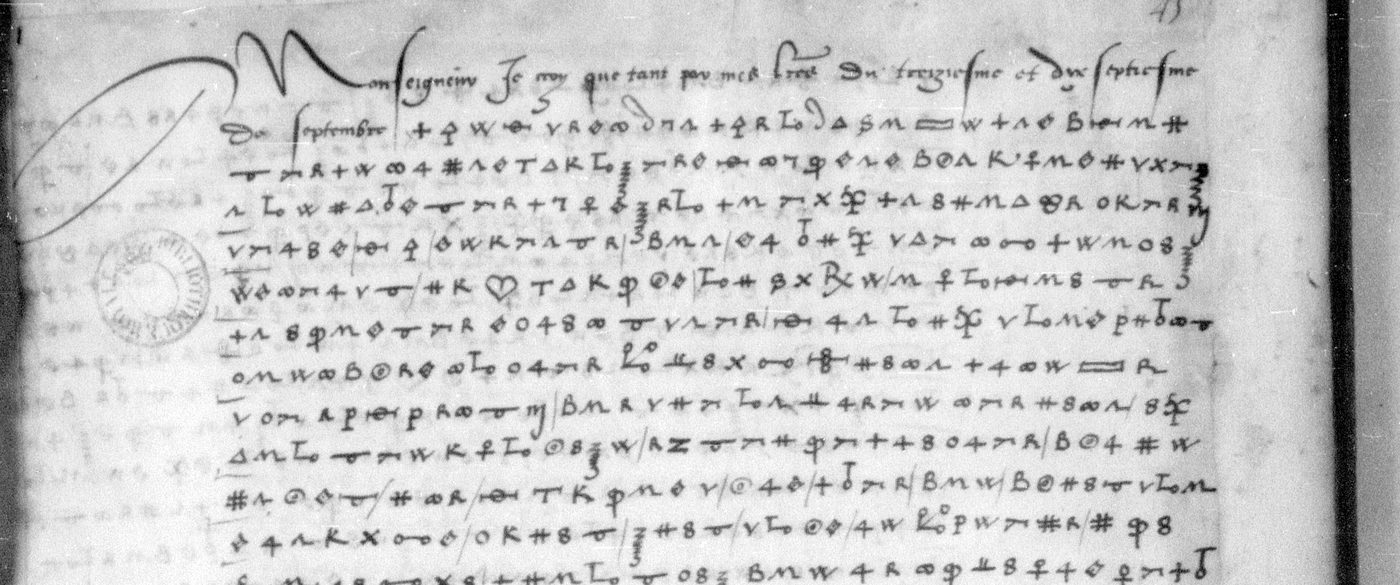
The letter runs to 171 lines across ff. 45r–47v, closing A Romme le xime jour d’octobre over the signature G. de Gramont e. de Tarbe. The year is 1529. The Pope has just left Rome (Clement VII set out for Bologna on 7 October 1529), and Gramont leaves “demain” to join him at Perugia. The letter opens with the bull of the four décimes on the French clergy, raised for the princes’ ransom under the peace of Cambrai, and the prince of Orange is before Florence. In outline, modernised (the full decipherment, page by page, is in the repository):
- The council. Whatever the Emperor says or does only deepens the Pope’s distrust of that side. What won him to the King was the King’s message about the concile general, “lequel il craignoit sur toutes les choses de ce monde, combien qu’il monstrast … qu’il en ait grande envie”. Pressed, he confessed that he knew the council was being pushed to ruin him, and that he meant to grant it and then “s’arrester sur aucunes particularitez pour le differer, et que le delai lui succedast en rupture”.
- Into the King’s arms. He would “du tout se jecter entre ses bras et se fier en luy seul”. Because the times do not allow open trust, the King and his ministers may say publicly, whenever it helps, that they have little reason to trust the Pope, so long as the goodwill underneath stays whole. “Avec bonnes parolles vous aurez de luy ce que vous voudrez”. His one aim is to get the Emperor out of Italy.
- Feigning illness for the Admiral. The Emperor is bound “par ses chappitres”, the treaty of Barcelona, to bring the allies to full restitution or make war on them. Gramont has told Philippe Chabot, the Admiral, then on his embassy to Italy, to come as far forward as he can. The Pope offers to slow his journey, or to “faire le malade” in whatever town he is in, to wait for him. On 10 October he told Gramont he had already begun.
- Soothsayers and a dream. The Pope, though he should not believe “tout plein de gens qui se meslent de deviner”, greatly fears what they say of him. Several have foretold that he will be deposed or will die within the year, and that it will come “du costé dudict” [the Emperor]. The night before he left Rome he had a dream, which Gramont encloses, “lequel l’a mis en merveilleusement grande fantasie”, because he dreamed it at the kind of hour at which earlier dreams of his had come true. He told it to one man only, and Gramont asks that only the King, Madame and those they choose should know of it.
- Florence. The prince of Orange wanted to deal with [the Florentines]: restore [the Medici] to the state of Florence “comme il souloit”, in return for Pisa and Livorno being put in [the Emperor’s] hands. That is “chose grandement contraire” to what the Emperor had agreed with the Pope.
Gramont’s letter adds detail to the French side of the weeks before the congress of Bologna. The council, Florence and the Venetian and Ferrarese restitutions all serve as bargaining counters in it, and the Pope keeps a private line to France through the ambassador. The enclosed dream is not in the volume.
03 Method
No cryptanalysis was needed: the work was transcription and decryption. The key table was checked on the first full line (d r R + W C 4 # L ● T Δ K Lo ʒ r R ● decodes to tredecime v & avltre v). Each glyph was then given a one-character ASCII alias and a script turned the alias strings back into letters, so that every decryption can be checked against the transcription and re-run. The five pages were transcribed separately and in parallel, each by a model instance working from the same brief, key and crops, and then joined. The joins fall mid-sentence and agree. Points the transcribers found that the table does not give:
- In Gramont’s hand the loose ǂǂ for a and the compact # for m cannot be told apart, so # is taken as a or m by context. A is the more frequent.
- A triangle or ring on a stem over a foot bar looks like ♀ (o) but is a null, Lasry’s “4 with a flag”. It occurs about twenty times. Taken as o, it produces doepesche.
- The heart, which Lasry lists only as a person sign, is always the King (“escript au ♡ et à vous”). Three large signs outside the table stand where the Emperor, the Florentines and the Pope or the Medici are expected. Those identifications come from context and are marked as such.
04 What remains uncertain
- Twelve unidentified signs among the 4,002 and single letters on each page (listed in the transcriptions), a phrase on f. 45r (fier ni a nui) and one on f. 45v (en voi[e]), and the first word of f. 47v l. 7. The transcribers graded each page 90–95 % secure.
- The identity of four code signs, which is inferred from context.
- Prior art not yet seen: B. Wirtz-Daviau’s edition of the Admiral Chabot’s 1529 embassy to Italy, which may quote Gramont’s letters from a contemporary decipherment.
Full texts
The transcription and the decryption of every document on this page, so that the reading can be used and checked. Short files are shown here; all are in the repository.
BnF fr. 3091 no. 23, ff. 45r-47v, Rome, 11 Oct [1529]
Gramont writes to Montmorency as Clement VII sets out for Bologna (October 1529): he vouches for the Pope's secret alignment with France; Clement dreads the general council and plans to grant it in principle and then stall it, offers to feign illness on the road to wait for the Admiral Chabot, fears soothsayers who foretell his deposition or death "du costé de" the Emperor, and had a dream before leaving Rome (enclosed). Orange is dealing to restore the Medici in Florence against Pisa and Livorno going to the Emperor.
Transcription
+fW~vRsC)7L+fRl)ABn=W+Lsb~nH
drR+WC4#LsTAkltrRs~C7gsLsbeLkqnsHvXrt
LlW#AJsdrR+7qstRl+nrXY+L8HnAURokrRy
vr48s~f|sWkrLdR|bnL|s4JHYv|ArCi+Wno8t
WsCr4vd|Hk&TAkqes|lHBXNW|nql~n8dR)
+L8gnsdrR|so48CdvLrR|~4LlHYvlnsFHJCd
onWCbeRsClo4rRcG8XiSH8CL+4CW=R
vorRF~FRCdy|bnRvHrlLG4RrWCrRH8CL|8Y
AnldrWkqle8tW|RzdrHgr+48o4rR|be4#W
#Lesd|HCR|~Tkgnsv|e4s|+JrR|bnW|beH8dvln
s4LkXis|okH8d|tH8d|vles4W|cFWr#R|#g8
qP48iX8|+Hnldo8t|bnW4RCgG8q4s|qr+J
8oJrW#R8dTHClA4r|beLlAvlnsGrH8+L
W8kiLbeR|8gnsdrW|4iCt|sH48Cd|vLrRHYt
Lst+L~+Rf#XkrRr|W8nrHY|RA#4dJR|Tn
8iq8|HeRCbnRslW&~TbeWlbeLBqNW
vHrg=R84+L#X8sdrHt4q8|be4l|vnJSW|
okXir+L~?CWlHlnYCrq4sdk8W|+4F
F4+o8CL|bnilAcsCRnW|dR=L#R8tbeil
8LvWeld|sWvRrsnH+Rr|beR+HkltrRC7gsL
bnR|#Al|T~48ckW84R8t|lnY|veiSR8d|H+
kR8ir|+WCLCXsdWlA|f|BJW8|bnR|4l#q8drR
beLlRtqedsXJt|HncdroirW|fTvqerl
LFA4rW|FJLr|8i|H8nY+AkCn8WC7gsWCRbnL
lL&#Wc#A8+|H|leY+JrW+n|cs4=WGL8Rr
Hl|~lWbnRl4lCrH4G8gid|snr|tged|Rs
lLsC7XsW~s+LCL#q8+W|cB4R8be4l#g8sd
osd|T#q8strWHn8GC7osCk8|be4lW8HYd
Gro8+RW8n4R|TbnJl~flLvXerC7HSWf~
TAkc#o8CR#L8d|THno8t|be4l#WvrRsdost
W8d4RrL|FqYil#R8|kgels4d|BJW8FHJrW
HCrq4rR|Aklto8d|flR|dgnt|+WBHdeT#Ws
rH4sg8s|XnYWs4lFndctrAi8Cd|sR+WClorRr
Transcription
T c F W S R r | b n 4 l | C g G 8 X 4 S q J t | d r W s B 4 R 8 b n R C W b e
R | l g 8 v q k r C 7 H S g i d | l W + J C t | c s 4 l W R s d g 4 t
v X k r l W | r n J 8 W r | T b e 4 l W s d g i t | + R s l i B W r R
W 8 l H C X r + o 8 d | R 8 k g Y | t X k d W s F g i s ~ | f s A U R s t L r
s n r o e C k 8 R s | v H r t 4 C n l H r 4 d W y | v g e r l R + 4 F ~ f
F W r R r | T b e W l R + L l o Y | l e Y s n C f C R + H s d | W 8 r g
n v d k r R | ~ T b e W v k 4 s | b n L 4 W l o S R e r g 4 s + W
l H B g N R k X l n 8 d R + e & | T + L l A # 4 d J R b e J l
l n Y v X r t q 4 d | i l s | s W k g e l X J t + n d g e t 4 W C d
L r | W 8 d r R s L s B r H s | T s W F 4 R r W 8 l e Y s W n l ~
T v X e r C R b e W l R d L # v s | 8 W v g r d R + L # R C d r L
+ 4 F i + H 8 C R | ~ 4 l W s d | c t W 8 d | # A J s b n R l H k g
l n 8 d R | + W # R e r L t g n s 4 X n r s | W 8 d 4 R r L | b n W
d g e t W s T b e H 8 t R s F g 4 s b e 4 l s W r A B R s X 4 8 G
T F W r H o s g 8 | v r X F 4 d | l W + i C t s 4 W n r | d H 8 t
v H r l e Y b k W | v H r | s W s # 4 8 i s d r R s | + Y W T F H C R
+ 4 r W | H k g i r v R e + q C | ~ C H s i X 8 + L s W F 4 W r R 8
l e Y T b e 4 l | v r g C W + R | 7 A r + 4 # W 8 d | g n l d r R
c # L 4 l e W U H R s d r W | H F o Y r R C H r 4 l k R g 4
t b k W l H c v l R z i g 8 + R s G W 8 s H b n J l g 8 A
H F ~ f F H 4 r R | v g r d R C W l A | T v l n s G r H 8 + R
C 7 g s W | f k X n s ~ s C H n R y b e R 4 W n g k R s H Y s g
n e W 8 t | W s C r 4 v d | b k W | W H n R C b n L s B X N W s v H r
f = W s | k X n s H e r R y + W l n Y C W b e R k g n s
n g e l + r W y | ~ T 8 R C r H 4 G 8 R y | v g 4 8 d b e 4 l
R 8 n e W 4 = R F H 4 r R H n C e 8 F g 8 + W # R 8 t | 8 Y v r g F
F 4 d | A k W C b n R s l R + 4 C t | ! C H r 4 l 8 L d H s C 7 R
s 4 8 g 8 l W 8 R 8 k X J R r + R l i t H = 4 R | b e R l b n L
C 7 g s W | b k L | l e Y | + g 4 B e R | H + k W 8 4 r | ~ T C r g J R y
b e L # X 8 s 4 R n r l A + # i r o l | 8 A n r H v o s G r H 8 + R
A F ~ F o 4 r W | k R e l H + 4 s v X s 4 d i g 8 | W 8 b n g Y 4 W
l H Y | # Y s + W l R F H 4 r L c s W 8 d 4 r | C R b e W v g n
U q 4 d | W s d r R | F H J C d R 8 F A e R n r + e & v X n r
l W s H = 4 W y | ~ T c F R + L r W y | ~ T c B 4 W 8 b n R v g n r
Transcription
L01|l n Y W s d r R ! g B l 4 G W v H r s R s ? C 7 A P i t r R s
L02|o C R b e L k q n s ~ f s C A n W y | T b k 4 l F n s d | c s d
L03|r H 4 8 C t | v X n r g B s W r e R r | + ? L k l z | + R F o 4 r W
L04|k R 8 4 r ) l L s + i C d s H = J R y | A W 8 d 4 R r L r W s t J
L05|d n t 4 g 8 | X n H k l d r W # R 8 d | l L e r F H 4 r R l A
L06|G n W U R 4 l F H C R B g N L # i 8 L | A k c # o 8 C R # L 8
L07|d | s 4 k i R 8 + r H ) 4 l o C W b n R | 4 L n g n s + i C t y
L08|+ L b n X Y 4 H Y A + n W r d J # X 8 + i C d s 4 R n r
L09|l H + # 4 r o l | H F F i 8 b e R | + W l g 8 G n R # H 4 8 | J l
L10|r W G H r + R | A c + n 4 r R | s o | C 7 H r G W | T b n 4 l 8 R
L11|l H 4 S W + R e L 8 4 r | s J | H k o 8 d | b n 4 l | v g e U H
L12|A k W C b k R s l L + 4 C d | ! H n z o n l d r R s | C 7 g s R
L13|s v H 8 C o 8 t d r X n k W r + i F J C n l d R W 8 C R s t
L14|R C 4 ? T + A k o 8 d H G W l e Y H Y W s C r 4 v d b e R
L15|s 4 l d r g n k X i t B q 8 b n R 8 g e s d r R + 4 C d
L16|s H J 8 C t v R r W # H + ? A 8 C A s | X k | + R l H Y H s d
L17|s X 8 C 7 W # 4 8 q n B 4 W 8 b n R + n d g e t 4 l F R 4 s d
L18|l W # A = o + R W 8 b n R l b e L k 4 = R 4 l R s t q J d
L19|v r R s d H t g n d F H 4 r R T H 4 A c # o 8 C W H C L
L20|v l H 4 8 + r R | H F F 4 8 | b n R | s 4 l | L s d g J d | B R s g J 8
L21|G | l H C 7 X s W | 8 L s R # B l H s d | s 4 s X e B + o 4 8 R
L22|J l | F H i C d | t g n d | l W v X S 4 B l R | d H 8 t | + W v H r g = R
L23|b e L | v o r s W | # 4 8 i s d r R s | c B J R 8 | b n 4 l y | s q J R 8 d
L24|W 8 | v W n | + W | 8 g # B r R | W 8 | b n 4 | J l | s R F 4 W | v g n r | # R
L25|W 8 d r R t L 8 J r | # W v r 4 H 8 d | l R k X e l g 4 r | d R 8 4 r
L26|L 8 | l H B g N L | G r A C R | + n | & | ~ ? ~ | T s 4 | J W k R g 4 H
L27|4 s | b n W | l L + i C d | s J W e r | R k s d | H t r ? 4 C d R r
L28|b n R l b e L | C 7 g s L | H k R C b n R s | l e Y | X e | 4 l Y | v W n
L29|s d | H k g 4 r | v r g F F i d | X n | + X e # A G W | v g n r
L30|l n 8 G | X e | v X e r | l H n l d r R | L 4 R # L | t J R 8 + r g J s
L31|s k r | # L s | G H r + R s | # o 4 s | k g Y o 8 d | b n J l | 8 L | + R # o 8
L32|+ W | H k C n 8 L | C 7 g s W | T | b n R | l L + J C d | s 4 W k r | 8 H | o k
L33|C e 8 L | b e W r R = L | H + L # W s l W r | H k W C b n R s | l e Y
Transcription
T b e W + R d q n t R s C 7 X s W s b n R 4 L l e Y + R # o 8 + R
+ R v H r l L + i C d s J W n r s X 4 d b e i l 8 J H Y d
| A k C n 8 v r q F 4 t T b n R H k C e 8 R F X 4 s J l Y H Y d
+ q n # o G W 4 l # R 8 c v l o 4 s d ~ f 4 l F o n l t
b n W 4 R k q e s + Y W b n 4 l Y k H + L B q 8 v J R +
X k H e l d r W # R 8 t C R s L r q J d l L v l n s G r H
8 d s X t b n R 4 L k W 4 y q 8 C b n R s k W e b n 4 l
+ X N W r q 4 d H t q n d R 7 W n r R s A 8 s W s v R r o 8
C R + W r 4 W 8 H k X 4 r ~ f T c B 4 W 8 b n 4 l s q J t
v H P W T b n i l 8 R + X 4 B k W H + 4 q e s d W r
F q Y c # W C r X Y 8 L F H 4 C d H n + 4 r W + R t X n d
v l H 4 8 + L G W 8 s b e i s W # W s l R 8 t + L + W n J 8 R r
s 4 k q e s v n i s 4 W H S R n r R r b n R b e o 8 d
4 l y + 4 W 8 b n R l b e L C 7 q s W + L l e Y ~ s 4
C W s d # o l i l f l R C r H 4 8 d G r H 8 + R # L 8 t
T W 8 Y o v l n s i R e r s b n 4 q 8 d + i C t b n 4 l
+ q 4 B d W s t r R + W P X s W q n b e 4 l + X 4 B t
# X n r i r W 8 l H N W L v r q C 7 o 4 8 L T b n R l L
d q n d l e Y + X 4 B t k W 8 4 r + n C q s d W + R
+ 4 C d ? T C r q Y W y b n 4 l Y H k 8 R # L r n R 4
= L e s W F H 8 t o s 4 R ~ T v q n r l e Y t W 8 J r
+ o n H 8 d o G W ~ f l H 8 n 4 C d o e o 8 d b n 4 l
v H r t 4 s d + R C W s d R k 4 = R i l F R 4 s t k 8 G
s q 8 G W b e R 4 L k X e s W 8 n q Y R l R b n L l ~ l H
# Y s W 8 # W r k R 4 = R e s L # R 8 t G r H 8 + R J o 8 d o s 4 R
+ A n l d H 8 t b e 4 l + i C d b n i l ~ l W s X 8
G W H R 8 7 W e r R b n 4 l H s q 8 G R + o n l d r R s
F g i s v l e s 4 W k r s C 7 q s W s b n W l k Y s q 8 t
H k W 8 e R s T 8 R s L s d + W C l A r R + n + i C d s q 8 G
W H k R C b n R s G r H 8 + L + 4 F J + W 8 C R + L 8 R 8 + 4 r W
H k C e 8 R C 7 X s W b n R H n 8 G 7 X M W s R n l ~ f
A C W s d R C H k s W 4 R e q k s s n P l 4 R b e i l
Transcription
8 L s g i d v n B l 4 W T b n R e X n s c t W 8 d 4 W y b n R
l W & # A + o # W T C R n l z b n 4 l R e r v l H 4 r H l W
s H J C 7 W 8 d s W e l R # L 8 d ~ f 4 W v A r d J r o Y + R
# A i 8 v X e r # L 8 H = W r o v R r q e s W l H q e 4 W
l L + X J B s d r q k e R r T W 8 C 7 R # J 8 J W v o 8 C W H k
q i r 8 q n k W = L s + # q 8 + ~ i C d s 4 W e r l o # 4 r H l
4 H Y F o i C d n X y r R c # W 8 + H d 4 X 8 s H 8 X e s d r R
+ J C d s H i 8 C t v W r R T l e Y H Y # q 8 d r R k q y
l W E r R s v X e r C R b n W = R s L s t q i R 8 d B q N
L s H C L s F 4 8 s T C r X Y W y b n J l W s H R k o k S 4
G r H 8 d c d R 8 t R # L 8 d b e 4 l W n t W 8 s H k 4 W
+ L C 7 q s W ~ T 8 L d 4 R 8 + r H b e W H k q e s ~ s 4
8 W l n Y F H i C d R s F o J r W R 8 d i W r R # L 8 d t X e
d C R b n W s L r H l W s R r n J C R + e & c + e J C d R
T H n G # R 8 d H t 4 X 8 + W s R s H F f F o 4 r R s T H W s
d L H k S 4 G r A 8 + W # L 8 d s A d 4 s F H i C t + L C W
b e W 4 L l e Y A Y + i C d + R v H r l L + 4 C d s J R n r
v H r l W c # R 8 + R # L 8 d b e 4 l f l e Y A v l W e
# W 8 F H 4 r R v A r s R s + L U R 8 J R r L s l W E r R s f ~
k q n s 8 R k X e s W s B H 7 4 r R y s 4 l k q e s v l o J s
d s 4 + Y C Y H b n W l b e R d L # v s 8 H k R y v l n s
s X n k W 8 d + L # [~ R s f] 8 X k e W = R s C H r l W C 7 R # J 8
R 8 s W r H C A e s W 4 q 4 8 C d b e W + R + X N W r H ?
A + k 4 s + W d q e t H # q 8 + i C d s J R e r l H + # J r H
l b n i l W k q e s F R r H W 8 d R 8 + r L f 4 H Y W e t R
A + n L r d J c # R 8 t l L v r 4 8 C L + q r H 8 G W s k q e
l X i t # q Y W N L r A k W C b e L s l L s ? + R r L # W C t
r W l R ! H l W s d H + L F l q r W 8 C L c # R 4 l s X n l
X i d T b n i l y B A 4 = o S W 8 d v J s W f l i H q r
8 L ~ T H r W d J X W 8 t r R l L s # o 4 8 s + R ? b e i
W s d C 7 q s W G r A 8 + W # R 8 d c d r H 4 r W A C L
b n R l L + 4 C d ? A C H P J d k l W A n R C b e R s l L !
Transcription
T C r q Y b n 4 l ~ l A s C W e C A r H r s X 4 r J l
# W F 4 s d R 8 t L 8 + r W c # R 8 d 4 l A k X i t c # A 8 C L
+ L F H J r R + n # o = A + W A E W 8 + H 8 d 8 X n k R = L s
+ L # q 8 s 4 R n r l H # Y r A l T b e W s 4 o k v A r d R
# W 8 d + L C R s t L k 4 = W i l W s d q J d W 8 B q N L
k X l e 8 d R J l R s t q 4 + d H C L s t W 7 W n r R ~ W 8
# r C 7 4 R B q N L n q l k 8 t W f l )
Decryption
# BnF fr. 3091 no. 23, ff. 45r-47v — Gabriel de Gramont, bishop of Tarbes, Rome, to Montmorency, 11 October [1529]

Gallica btv1b9060253s, canvases 49-52 (two-page openings). After the opening clear words the letter is wholly
in cipher: 33 + 34 + 33 + 32 + 32 + 7 = 171 lines, about 7,000 signs. Key: "Gramont's cipher (1529)",
reconstructed by George Lasry in 2023 from fr. 3040 f. 16 (table `img/BnF_fr3040_f16.png`, Tomokiyo's
GL.htm). Nobody had published a decipherment. Each page was transcribed glyph by glyph into ASCII aliases
(`AGENT_BRIEF.md`, `decode.py`) and decoded. Per-page line tables, doubts and glyph notes are in
`f45r_transcription.md` … `f47v_transcription.md`. The alias lines are in `work_*/`, which is not tracked.
Confidence runs from about 90 to 95 % per page. Every line gives French, and no line is illegible.

## Year

No year on the leaf, but 1529 is certain from the content. The Pope has just left Rome ("la nuit avant qu'il
partît de cette ville"): Clement VII left for the Bologna meeting with Charles V on 7 October 1529. Gramont
follows him the next day to Perugia. The bull of the four décimes on the French clergy (for the princes' ransom
under the peace of Cambrai) went to France in autumn 1529. The prince of Orange is before Florence, where the
siege began in October 1529. The obligations "par ses chapitres" are the treaty of Barcelona (June 1529).

## Key notes from the reading (all five transcribers agree)

* `#` is **A as often as M**: the loose ǂǂ (A) and the compact # (M) are not distinct in this hand. Context decides.
* The ♀-like "triangle or ring on a stem over a foot bar" is a **null** (Lasry's "4 with a flag"), in about 20
  places. It is distinct from the true ♀ (O).
* The dotted ring ◉ is the V "eye". CON also serves for COM (comme, combien, complexion). ρ-o-ρ = FF.
* R (E) and K (V) are easily confused. The 4 of I is sometimes a plain cross, like the + of D.
* Code signs not in Lasry's table: the heart (person sign) is **the King** every time ("escript au ♡ et à
  vous", "le ♡ me commanda"). A cross with a spiral or loop head (Lasry's second "unknown") and a large barred
  ƒ-like sign stand where **the Emperor** is expected ("du costé dudict —", "fondement avec ledict —"). f. 47r
  has three more: ⊞, probably the Florentines; ▯ (Lasry's "pencil"), the Pope or the Medici; and a large looped
  ♀, the Emperor. These identifications come from context and are not readings.

## Prior art still to check

Wirtz-Daviau's edition of Chabot's 1529 embassy may print or summarise Gramont's letters of the same weeks,
perhaps from a deciphered copy. It has not been seen. No decipherment of this letter is known from Tomokiyo,
Lasry, DECODE or the BnF catalogue.

## Reading

Modernised spelling and punctuation. Cipher throughout, apart from the clear opening and close. Code signs are
in brackets.

**f. 45r.** Monseigneur, je voy que tant par mes lettres du treziesme et du septiesme de septembre [que par la] depesche de la
bulle des quatre decimes et aultres choses que vous aporte le maistre d'hostel du roi de Navarre, aurez prins
seureté que, si j'ai par ci devant escript au [Roy] et à vous la bonne volunté de nostre sainct pere, je l'ai plus
faict avecques claire congnoissance d'icelle par effectz que par legiere creance ni aultre volunté extraordinaire
qui me meust à ce. Et vous puis dire que, quant plus je vois avant, tant plus je conferme mon oppinion, d'aultant
que je cognois ordinairement et à clair que la plus grande envie que nostre [d]ict sainct pere ait est de demourer en
vraie amitié et union avecques le [Roy], et que quelque bonne parolle ni demonstration qu'il puisse avoir de
[l'Empereur (?)], cela lui croist une diffidance qu'il a conceue, tellement qu'il ne peult se persuader que d'aultre
chose que mal et inconvenient lui puissent advenir de ce costé-là, bien qu'il montre que le tout soit au contraire.
Et pour le faire fier, n'i a nui (?) d'aucune chose [comme] ce que le [Roy] me commanda lui dire du concile general,
lequel il craignoit sur toutes les choses de ce monde, combien qu'il monstrast et monstre à ung chascun qu'il en
ait grande envie et qu'il le pourchasse. Et au commancement, et avant qu'il me prestast entiere foi, il m'en
voulsist bien faire acroire aultant. Le tout debatu et mes raisons ouïes, il fut contrainct se declarer [... f. 45v]

**f. 45v.** [... le pape ... de] confesser qu'il connoissoit très bien que ce que l'on pourchassoit, ledit concile, étoit pour le ruiner ; et qu'il étoit délibéré, en l'accordant en voi[e?], toutefois s'arrêter sur aucunes particularités pour le différer, et que le délai lui succédât en rupture. Et que, puisque je l'assurois de la bonne volonté du [Roi] et de l'amitié qu'il lui portoit, il se vouloit du tout jeter entre ses bras et se fier en lui seul. Et pource que le temps ne porte de mettre défiance, il est content (mais que la volonté demeure toujours entière) que toutes et quantes fois qu'il sera besoin, et [que cela] fera à son profit, ledit sieur, tant par lui que par ses ministres, die et fasse dire avoir peu d'occasion de se fier en lui, et qu'il procède hardiment outre comme il verra être à faire ; car il voit que la complexion des gens à qui l'on a affaire porte cela et plus grande chose. Vous savez, que je vous ai souvent écrit, qu'avec bonnes paroles vous aurez de lui ce que vous voudrez ; et ne craignez point qu'il en veuille faire aucun fondement ni profit avec ledit [signe : l'Empereur ?], car il ne tâche sinon l'en envoyer de l'Italie, quelque chose qui lui doive advenir. Et croyez que Monsieur l'Amiral n'aura pas grande affaire, vu la disposition en quoi je l'ai mis, de le faire consentir ce qui pourroit être fait en faveur du [Roi] pour les alliés et confédérés. Et combien que pour [... f. 46r]

**f. 46r.** [... f. 45v] ... [à] lui être [!] obligé par ses chapitres, à ce que vous savez, et qu'il fût contraint, pour observer d'eux (?),
de faire venir lesdits alliés à entière restitution ou autrement leur faire la guerre. Il fait bonne mine au commencement,
[pour voir] s'il viendra; il a ce que je vous dis. De quoi j'ai averti mondit sieur l'amiral, afin que de longue main il regarde
à conduire sa charge et qu'il ne laisse de venir si avant qu'il pourra avec ledit [!] aux autres choses, pensant trouver
difficulté en celle-ci. Et davantage je lui ai écrit que, s'il trouvait bon, ce que notre dit saint père m'a dit (?), au cas où il
retardât son chemin, ou bien que du tout il fît le malade en quelque ville [où] il était, [il est] prêt à tout faire; et il a
déjà commencé à se plaindre, afin que, s'il était besoin, la chose ne semblât si soudaine. Il fait tout le possible, tant de
parole que par ses ministres, combien qu'ils soient en petit nombre, en qui il se fie, pour m'entretenir, me priant de le
vouloir tenir en la bonne grâce du [♡ = the King?] [sign]. Et si je voyais que ledit sieur eût à traiter quelque chose avec lui
où il pût y avoir profit ou dommage pour l'un ou pour l'autre, je me tiendrais sur mes gardes; mais voyant qu'il ne demande
aucune chose et que ledit sieur n'a aucune querelle à démêler avec lui [... f. 46v]

**f. 46v.** [... de 46r] et que de toutes choses que je lui demande de par ledit sieur, soit qu'il n'y ait aucun
profit et qu'aucunefois il y ait dommage, il m'en complaît. Il faut que je vous dise qu'il y va de bon pied;
ou autrement ce serait le plus grand sot que je vis oncques, vu qu'il donnerait à toute heure sans espérance
de rien avoir. Et combien qu'il soit pape, et qu'il ne doive ajouter foi (comme je crois qu'il ne fait) au
dire de tout plein de gens qui se mêlent de deviner, si vous puis-je assurer que, quand ils disent quelque
chose de lui, si c'est mal, il le craint grandement. Et il y en a plusieurs qui ont dit qu'il doit être déposé,
ou qu'il doit mourir en l'année prochaine, et que le tout lui doit venir du côté dudit [sign: l'Empereur?].
Et croyez qu'il y a une merveilleuse fantaisie; et pour lui en tenir davantage, la nuit avant qu'il partît de
cette ville il fit un songe, que je vous envoie, lequel l'a mis en merveilleusement grande fantaisie,
d'autant qu'il dit qu'il le songea en [même] heure qu'il a songé d'autres fois plusieurs choses qui lui
sont advenues. Et il ne s'est déclaré dudit songe qu'avec grande défiance, de n'en dire aucune chose
qu'à un homme seul. À cette cause je vous supplie qu'il [... f. 47r]

**f. 47r.** [... que la chose] ne soit publiée, et que vous contentiez que le Roi, Madame et ceux qu'il leur plaira le sachent seulement. Je partirai demain pour m'en aller à Pérouse, là où je le dois trouver, et en chemin je pense avoir nouvelles dudit sieur l'amiral. J'ai fait vos recommandations à notre dit Saint-Père, et lui ai montré vos lettres, parce qu'elles étaient bonnes à ces fins; et croyez qu'il en a eu aussi grand contentement qu'il eut en sa vie de chose, et ne tiendra qu'à vous si vous ne lui faites faire entièrement tout ce qui sera le service du Roi, la conduite et l'augmentation de ses affaires. Et il a été aussi grandement satisfait de ce que je lui ai dit de la part dudit sieur [l'amiral] par le commandement qu'il lui a plu m'en faire par ses dernières lettres. Ne vous ébahissez pas, s'il vous plaît, si d'ici à quelque temps vous n'avez plus souvent de mes nouvelles, car le chemin en sera cause, joint qu'il faut donner avis de tout audit sieur l'amiral, qui vous le fera entendre. J'ai été averti que le prince d'Orange voulait s'entremettre avec les [⊞ = Florentins?] pour remettre le [▯ = Pape / les Médicis?] à l'état de Florence comme il soulait [être], et qu'ils baillassent Pise et Livourne et [les remissent?] entre les mains de [Ꝭ = l'Empereur?], ce qui est chose grandement contraire à ce que ledit [Ꝭ] a capitulé avec le [▯].

**f. 47v.** Et je crois qu'il l'a su, car hier soir il me fit entendre comment il avait commencé à faire le malade en attendant des nouvelles de monsieur l'amiral, et que si, au départ de cette ville, il était en bonne volonté, il était à cette heure en [?] bonne volonté.
**Clear close.** Monseigneur, je me recommande bien humblement à vostre bonne grace, et prie Dieu vous donner
[en bonne] santé longue vie. A Romme le xi^me jour d'octobre. Vostre humble serviteur, G. de Gramont, e[vesque] de Tarbe.

## Summary (English)

Gramont writes as Clement VII sets out for Bologna. He vouches for the Pope's goodwill toward France. What won
the Pope over was the King's line on a **general council**. Clement dreads a council above all things while
pretending to want one, and he admitted to Gramont that it was being pushed to ruin him. His plan was to grant it
in principle and then stall over particulars until the delay ended in a breakdown. He "throws himself into the
King's arms". He even allows the King and his ministers to say openly that they cannot trust him, if that helps
them with the Emperor, so long as the goodwill underneath stays whole. His one aim is to get the Emperor out of
Italy. The Emperor is bound by his treaty articles to force the allies (Venice, Ferrara) to restore what they hold
or else make war on them. The Pope is ready to delay on the road, or feign illness, to wait for the **Admiral**
(Philippe Chabot de Brion, whose embassy to Italy in 1529 is edited by B. Wirtz-Daviau, *Le voyage et l'ambassade de l'Amiral Chabot de Brion en Italie, 1529*) and to fall in with whatever the Admiral proposes for
France's allies. By 10 October he had already begun "faire du mallade". Two pages give the Pope's fear of
astrologers and soothsayers, who foretold that he would be deposed or die within the year, "du costé de"
[the Emperor]. They also report a **dream** he had the night before leaving Rome, which Gramont encloses and asks
be shown only to the King, Madame (Louise of Savoy) and whom they choose. Last comes intelligence that the
**prince of Orange** was negotiating to restore [the Medici] in Florence on condition that Pisa and Livorno be put
in [the Emperor's] hands, "chose grandement contraire" to what the Emperor had agreed with the Pope at Barcelona.

The letter fills out the French side of the weeks before the Bologna congress. It shows the council, Florence
and the Venetian/Ferrarese restitutions being used as bargaining counters, and a Pope whose private line to
France ran through Gramont.
Translation
# BnF fr. 3091 no. 23, ff. 45r-47v: Gabriel de Gramont, bishop of Tarbes, Rome, to Montmorency, 11 October [1529]: English translation

Translation (Claude Opus 5.5, 23 Oct 2026) of the reading in `fr3091_no23_gramont.md` (section "Reading"), the
decryption with Lasry's reconstructed key of the cipher, which fills the whole letter apart from the clear opening
and close. Same holes and marks: `[...]` unread or a page join, `(?)` and `[word?]` doubtful (here `[?word]`),
`[!]` a sign that does not fit, code signs in brackets with their probable meaning, `[word]` a word supplied.

## Translation

**f. 45r.** Monseigneur, I see that, both by my letters of the thirteenth and of the seventh of September [and by
the] despatch of the bull of the four tenths and other things which the King of Navarre's maître d'hôtel brings you,
you will have been made sure that, if I have heretofore written to the [King] and to you of the good will of Our Holy
Father, I have done it more with clear knowledge of it by deeds than by light belief or any other extraordinary
wish that moved me to it. And I can tell you that, the further I go, the more I confirm my opinion, inasmuch as I
see ordinarily and clearly that the greatest wish our said Holy Father has is to remain in true friendship and union
with the [King]; and that whatever good word or show he may have from [?the Emperor], this only increases in him a
distrust he has conceived, so that he cannot persuade himself that anything but harm and mischief can come to him
from that side, although he shows that it is all the contrary. And to make him trust, nothing [?served] in any thing
[like] what the [King] commanded me to tell him of the general council, which he feared above all things in this
world, although he showed and shows to everyone that he greatly wishes it and is pursuing it. And at the beginning,
before he gave me entire faith, he would have liked to make me believe as much. The whole being debated and my
reasons heard, he was forced to declare himself [... f. 45v]

**f. 45v.** [... the Pope ... to] confess that he knew very well that what was being pursued, the said council, was
to ruin him; and that he had resolved, while granting it in [?principle], nevertheless to stop on some particulars to
put it off, and that the delay should end for him in a breakdown. And that, since I assured him of the [King]'s good
will and of the friendship he bore him, he wished to throw himself entirely into his arms and trust in him alone.
And because the time does not allow showing distrust, he is content (provided that the goodwill always remains
whole) that, as often as there is need, and [that it] will be to his profit, the said lord [the King], both himself
and through his ministers, should say and have it said that he has little reason to trust him, and that he should
proceed boldly onward as he sees fit to do; for he sees that the temper of the people one has to deal with requires
that and a greater thing. You know, as I have often written to you, that with good words you will have from him what
you wish; and do not fear that he will want to make any foundation or profit of it with the said [sign: ?the
Emperor], for he aims at nothing but to send him out of Italy, whatever may befall him. And believe that Monsieur the
Admiral will not have much to do, given the disposition in which I have put him, to make him consent to what might be
done in favour of the [King] for the allies and confederates. And although for [... f. 46r]

**f. 46r.** [... f. 45v] ... [to] be [!] bound by his articles, as you know, and that he were forced, to keep them
[?], to make the said allies come to full restitution or else make war on them. He puts a good face on it at the
beginning [to see] whether he will come; he has what I tell you. Of which I have advised my said lord the Admiral, so
that he may look well ahead to conducting his charge, and that he not fail to come as far as he can with the said
[!] in the other matters, thinking to find difficulty in this one. And moreover I have written to him that, if he
found it good, what our said Holy Father has told me [?], in case he delayed his journey, or else wholly played the
sick man in some town [where] he was, [he is] ready to do everything; and he has already begun to complain, so that,
if there were need, the thing should not seem so sudden. He does everything possible, both by word and through his
ministers, few as they are, in whom he trusts, to keep in with me, begging me to keep him in the good grace of the
[♡ = ?the King] [sign]. And if I saw that the said lord had to negotiate something with him in which there could be
profit or damage for the one or the other, I would keep on my guard; but seeing that he asks for nothing, and that
the said lord has no quarrel to settle with him [... f. 46v]

**f. 46v.** [... from 46r] and that in all things I ask of him on the said lord's behalf, whether there be no profit
in them and sometimes there be damage, he gratifies me in them. I must tell you that he goes about it in good faith;
or otherwise he would be the greatest fool I ever saw, seeing that he would give at every hour without hope of
having anything. And although he is pope, and ought not to give credit (as I believe he does not) to the sayings of
a great many people who meddle with divining, yet I can assure you that, when they say something of him, if it is
ill, he fears it greatly. And there are several who have said that he must be deposed, or must die in the coming
year, and that the whole must come to him from the side of the said [sign: ?the Emperor]. And believe that he has a
wondrous fancy about it; and to keep him in it all the more, the night before he left this city he had a dream,
which I send you, which has put him into a wondrously great fancy, inasmuch as he says that he dreamed it at the
[same] hour at which at other times he has dreamed several things that have befallen him. And he has not spoken of
the said dream except with great mistrust, telling nothing of it except to one man alone. For this cause I beg you
that it [... f. 47r]

**f. 47r.** [... that the thing] be not published, and that you be content that the King, Madame and those whom it
pleases them should alone know it. I shall leave tomorrow to go to Perugia, where I am to find him, and on the way I
expect to have news of the said lord the Admiral. I have made your commendations to our said Holy Father, and showed
him your letters, because they were good for these ends; and believe that he had as great contentment from them as
he ever had from anything in his life, and it will only be up to you if you do not have him do entirely all that will
be for the King's service, the conduct and the furtherance of his affairs. And he was also greatly satisfied with
what I told him on behalf of the said lord [the Admiral], by the command he was pleased to give me of it in his last
letters. Do not be astonished, if you please, if for some time from now you do not have news of me more often, for
the road will be the cause of it, besides which all must be advised to the said lord the Admiral, who will let you
know it. I have been informed that the Prince of Orange wished to act as go-between with the [⊞ = ?the Florentines] to
restore the [▯ = ?the Pope / the Medici] to the state of Florence as he used [to be], and that they should hand over
Pisa and Livorno and [?put them] into the hands of [Ꝭ = ?the Emperor], which is a thing greatly contrary to what the
said [Ꝭ] has agreed by treaty with the [▯].

**f. 47v.** And I believe he has learned of it, for yesterday evening he let me know how he had begun to play the
sick man while waiting for news of Monsieur the Admiral, and that if, at his departure from this city, he was in good
will, he was at this hour in [?] good will.

**Clear close.** Monseigneur, I commend myself very humbly to your good grace, and pray God to give you [in good]
health a long life. At Rome, the 11th day of October. Your humble servant, G. de Gramont, b[ishop] of Tarbes.
Key: BnF_fr3040_f16.png, decode.py, key.md

05 Sources
- BnF, Français 3091, ff. 45–47: Gallica btv1b9060253s, views 49–52.
- G. Lasry, key table “Gramont’s cipher (1529)” (5 November 2023), published on S. Tomokiyo’s cryptiana: “George Lasry’s codebreaking”, with “French Ciphers during the Reign of Francis I”.
- B. Wirtz-Daviau (ed.), Le voyage et l’ambassade de l’Amiral Chabot de Brion en Italie, 1529 (not seen).
Line-by-line transcriptions with the alias strings, the decipherment, the brief given to the transcribers, and the decoder are in the repository
(targets/gramont1529/). Page images are not committed.