
At a glanceCiphertext-only break · partial (87% of the cipher)
- The letter
- Claude de La Guiche, bishop of Mirepoix, to Montmorency, Rome, 22 November 1551, with about thirteen lines of cipher inside clear text; no decipherment exists.
- Where
- BnF fr. 3138 no. 22, f. 60v–61r (Gallica
btv1b90601662). The page also checks two letters of Noailles (1558) and Seure (1558) in the same volumes. - The cipher
- 406 symbols, 22 distinct, one for each letter of the period’s 22-letter alphabet.
- How it was read
- Simulated annealing over permutations, scored against a model of French despatches 1530–1600, recovered the key.
- What it says
- Dom Diego has had a Sienese imprisoned; the Sienese envoy has left Rome with him; the Count of Santa Fiora is “mal satisfaict” and might return to the King’s service.
- Still open
- One name and the two struck-through opening lines. Noailles’ letter already has the court’s decipherment in the margin; Seure’s six letters (about 2,000 symbols) are left as their own target.
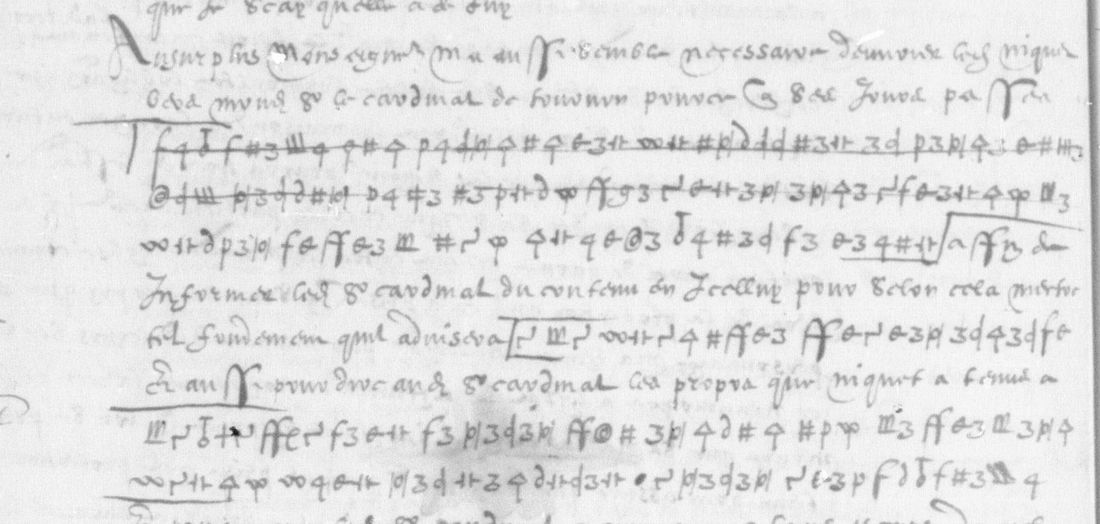
01 The letter
La Guiche → the duc de Montmorency, Rome, 22 November 1551, fr. 3138 no. 22, f. 60v–61r. The clear text is about cardinals and the Pope’s intentions during the Parma war. It is interrupted by cipher runs, 431 symbols in all (406 in the first transcription, the rest added on 30 September 2026). There is no decipherment on the leaf, in the margin or on the following leaf. Catalogue item 10 also listed letters of 1558 by Noailles (Venice) and Seure (Lisbon); this page was split from them on 14 October 2026 because each uses a different cipher, and each has its own page (Noailles 1558, Seure 1558).
02 La Guiche: the decipherment
The reading in the letter’s spelling (texts/laguiche1551_reading.md). The deciphered passages are in italics and the clear words of the letter in roman; [?word] marks an uncertain reading, […] symbols or words not deciphered, [::] the open code symbol. The two lines the writer struck through are deciphered only in fragments, so the letter counts as partial.
[Struck through by the writer:] […] Die[…] […]constituer prisonnier en ceste [?ville] […] un [?Senois] […] croy q[…] […] adverty le
[L2] procès duquel i'ay trouvé moien de veoir, affin de informer led. Sr cardinal du contenu en icelluy, pour selon cela mettre tel fondement qu'il advisera, à la pratique qu'aves entendu. Et aussi pour dire aud. Sr cardinal les propos que [?Mignet] a tenus à l'ambassadeur de Senes qui estoit icy, lequel est party pour s'en retorner à Senes avecq [Dom Diego] […]. Et pour ce que ledict Sr cardinal a commancé à vous escripre de ceste affaire, je m'en remettray à ce qu'il vous en escripra. J'entendz que le conte Saincte Fiore est mal satisfaict de [::], et que facilement se reduiroi[t] au service du ro[y] […] de la Seance […] le servi[ce] […]. Car ledict personnage qui estoit icy tractant avec moy l'affaire du sieur Barnabe Adorne […] la responce qu'a[…] […] vous informer du service que le roy pourroit avoir du dict sieur Barnabe, et aussi des conditions qu'il demanderoit.
“Dom Diego” is Diego Hurtado de Mendoza, Charles V’s ambassador in Rome and the power behind Siena until the Sienese rising of July 1552. The count of Santa Fiora is Sforza Sforza (1520–1575), a grandson of Paul III, who had gone back into Charles V’s service after that pope’s death. The letter shows La Guiche sounding him out for the French side eight months before Siena turned to France. “Barnabe Adorne” is presumably a Genoese of the Adorno family; he is not identified further.
Filled 30 September 2026. The run after “qu’il advisera” (24 symbols, missed by the first transcription) gives a la pratique qu’aves entendu with the key unchanged (grade H for the key, C for the reading). The plain cross without a bar is a symbol of its own, b: it gives l’ambassadeur and, twice, Barnabe, where the barred cross is r in the same word and in Adorne (grade M: a value found on three words). The pair ff+c is ss in both places it occurs (ambassadeur, aussi; M). In “du service” the image has the barred p (s) where the first transcription had the double-barred #. After “mal satisfaict de” stands a single four-dot symbol (::), a code for a person that occurs nowhere else; “l’Empereur” is a conjecture from context (grade I): “se reduiroit au service du roy” says the count was serving someone else, and in 1551 he was in the Emperor’s service (the Pope, whose general he had been, is the alternative). The clear words were transcribed from the image (Gallica view 65).
03 Method
The cipher was transcribed symbol by symbol from full-resolution crops of each line (guiche_ct.txt). The counts pointed to a simple substitution: 22 distinct symbols, one of them at 16%, the rate of French e. An annealer that allowed several symbols per letter converged on a degenerate i/x solution. A permutation annealer with swap moves, scored with a French 5-gram model without word spaces (fr-1530-despatches), produced le conte sainctefiore est mal satisfaict on its best restart. Four symbols were then fixed from context (qu, p, y, v), and the rest re-annealed. Key: 3=e, t=r, #=i, θ=u, the stemmed 4=t, barred p=s, hook=a, f=d, d=n, open 4=o, curled d=o, p=c, Ⅲ=l, ff=qu, overbarred d=m, φ=y, the circle=v, hooked q=f, ∞=p; added 30 September 2026: the plain cross=b, ff followed by c=ss, and one four-dot code symbol (::).
04 What remains uncertain
- La Guiche: the four-dot code symbol (::) after « mal satisfaict de », read by conjecture as « l’Empereur » (grade I); one rare symbol (5, in the struck lines) unassigned; the name read as « Barnabe Adorne » since 30 September 2026 (the plain cross is b, the barred cross r); the struck-through first two lines deciphered only in fragments; the Ⅲ symbol is l everywhere but gives g in « Diego ». Key grade C; the text is grade M where marked. Corrected 30 September 2026: « l’am[bass]adeur de Senes » replaces « de ceux de Sienes », which the symbols do not give; with the key the four symbols in brackets give r a q and an unassigned one, and bass was first inferred from context (grade I); on the second pass the symbols were read as b and ss (plain cross and ff+c), so the word now stands without brackets (grade M). « Mal satisfaict de » is followed by a four-dot symbol (::), now in the transcription; see above.
Full texts
The transcription and the decryption of every document on this page, so that the reading can be used and checked. Short files are shown here; all are in the repository.
La Guiche to Montmorency, Rome, 22 Nov 1551 (BnF fr. 3138 no. 22, f. 60v) read in part
Claude de la Guiche, in Rome, reports to Montmorency that the Sienese envoy has left Rome with Dom Diego (Diego Hurtado de Mendoza, imperial ambassador and master of Siena) and that the Count of Santa Fiora is discontented and would readily come over to the king's service on conditions; the winter of the Parma war, months before the Sienese rising of July 1552. The first two struck-through lines read only in part.
Builds coherent sentences, but under the read bar of 95% of words read as sense (89% here); the holes are marked in the reading.
Transcription
# BnF fr. 3138 no. 22, f. 60v (Gallica btv1b90601662 view 65). La Guiche, Rome, 22 Nov 1551.
# Sign codes: f F(ff) 3 # W(III) Q(4 with stem) 4(open 4) g(hooked q) p B(barred p) d o(curled d) D(d with overbar)
# e(theta) t(+ with bar) 8(infinity) r(hook) P(phi) A(circled) X(double-barred #) c 5
# 30 Sept 2026: + (plain cross, no bar; was merged with t) = b; : (four-dot sign ::, once, L5) = a code sign, open;
# L2x = the 24-sign run after the clear 'qu'il advisera', missing from the first pass; L10 X->B in 'service' (image)
L0 f Q D f # 3 W Q Q # Q p Q d B Q # Q e 3 t 8 t # B o d d # 3 t 3 d p 3 B Q e # W 3
L1 A d W B 3 d o # B D 4 # 3 # 5 p t o P F g 3 r e t 3 B 3 B Q 3 r f e 3 t Q P W 3
L2 8 t o p 3 B f e F e 3 W # r P Q t 4 e A 3 D 4 # 3 d f 3 e 3 4 # t
L2x r W r 8 t r Q # F e 3 F e r e 3 B 3 d Q 3 d f e
L3 W r D + r F c r f 3 e t f 3 B 3 d 3 B F A # 3 B Q o # Q # p P W 3 F e 3 W 3 B Q
L4 8 r t Q P 8 4 e t B 3 d t 3 Q o t d 3 t r B 3 d 3 B r e 3 p F o D f # 3 W 4
L5 W 3 p 4 d Q 3 B r # d p Q 3 g # 4 t 3 B Q D r W B r Q # B g r # p Q f 3 : 3 Q
L6 F e 3 g r p # X 3 D 3 d Q B 3 t 3 f e # t o # 4 r e B 3 t A # p 3 f e t 4 8
L7 W 3 B 3 t e #
L8 r e 3 p D 4 P W r g r # t 3
L9 f e B # 3 e t + r t d r + 3 r f 4 t d 3
L10 A 4 e B # d p o t D 3 t f e B 3 t g # p 3 F e 3 W 3
L11 t 4 P 8 4 e t t o # Q r e 4 # t f e f # f # p Q B # 3 e t + r t d r + 3 3 Q
L12 r e F c # f 3 B p 4 d f # Q # 4 d B F A # W f 3 D r d f 3 t 4 # Q
Decryption
L0 dtmdielttitctnstituerprisonnierencestuile
L1 vnlsenoismoiei?croyqfeauresesteaduertyle
L2 procesduqueliaytrouvemoiendeueoir
L2x alapratiquequauesentendu
L3 lambassadeurdesenesqviestoiticylequelest
L4 partypoursenretornerasenesauecqomdielo
L5 lecontesainctefiorestmalsatisfaictde[::]et
L6 quefacigementsereduiroioauservicedurop
L7 leserui
L8 auecmoylafaire
L9 dusieurbarnabeadorne
L10 vousincormerduserficequele
L11 roypourroitauoirdudidictsieurbarnabeet
L12 aussidesconditionsqvildemanderoit
# 30 Sept 2026: + = b (L3, L9, L11); F c = ss (L3, L12); ':' (the four-dot sign, L5) left as [::]; L10 'incormer'/'serfice'
# are look-alike slips of the f and v signs in the first pass: read 'informer du service'.
Decryption
# La Guiche to Montmorency, Rome, 22 Nov 1551: normalised reading with the clear words around it, copied verbatim from NOTES.md (section 1). The decryption line by line is reading_raw.txt.

- Reading (`reading_raw.txt`, then the text below with the clear words around it). Normalised, [?] = unsure:

  > [struck: Dom Diego (a faict) constituer prisonnier en ce(ste ville) … un Siennois … croy que … est au dit …]
  > le procès duquel j'ay trouvé moien de veoir, *affin de informer led. Sr cardinal du contenu en icelluy pour
  > selon cela mettre tel fondement qu'il advisera* : … l'am[bass]adeur de Senes qui estoit icy, lequel est party
  > pour s'en retorner a Senes avec Dom Diego. … Le conte [de] Sainte Fiore est mal satisfaict de […], et que
  > facilement se reduiroit au service du roy … *[clear: de la Seance]* … le service … *Car ledict personnage qui
  > estoit icy tractant* avec moy la faire du sieur +arna+e a dorne[?] *la responce qu'a…* … vous informer du …
  > que le roy pourroit avoir du dict sieur +arna+e et aux [?] … des conditions qu'il demanderoit.
Reading
# La Guiche to Montmorency, Rome, 22 Nov 1551 (BnF fr. 3138 no. 22, f. 60v): reading

Running text of the decryption line by line in `reading_raw.txt` (key `texts/key.md`), with the clear words round
the cipher runs as NOTES.md gives them (30 Sept 2026, item 6, and section 1), written out 23 Oct 2026 (translation
wave v7). Only word division, capitals and punctuation are added, with the slips NOTES settles (incormer/serfice read
informer/service; the plain cross is b; F c = ss). The cipher is in ⟨ ⟩; clear text is plain. `[…]` = clear words not
transcribed in the repository, or unread signs; `[::]` = the four-dot code sign, not deciphered (conjecture
"l'Empereur"); `[?word]` = doubtful; `wor[d]` = a letter the decryption lacks. The two struck-through first cipher
lines (L0-L1) read only in fragments and are given apart.

## Reading

*Struck through by the writer (L0-L1):* ⟨[…] Die[…] […]constituer prisonnier en ceste [?ville] […] un [?Senois] […]
croy q[…] […] adverty le⟩

⟨[L2] procès duquel i'ay trouvé moien de veoir⟩, affin de informer led. Sr cardinal du contenu en icelluy, pour selon
cela mettre tel fondement qu'il advisera, ⟨à la pratique qu'aves entendu.⟩ Et aussi pour dire aud. Sr cardinal les
propos que [?Mignet] a tenus à ⟨l'ambassadeur de Senes qui estoit icy, lequel est party pour s'en retorner à Senes
avecq [Dom Diego] […]⟩. Et pour ce que ledict Sr cardinal a commancé à vous escripre de ceste affaire, je m'en
remettray à ce qu'il vous en escripra. J'entendz que ⟨le conte Saincte Fiore est mal satisfaict de [::], et que
facilement se reduiroi[t] au service du ro[y]⟩ […] de la Seance […] ⟨le servi[ce]⟩ […]. Car ledict personnage qui
estoit icy tractant ⟨avec moy l'affaire du sieur Barnabe Adorne⟩ […] la responce qu'a[…] […] ⟨vous informer du
service que le roy pourroit avoir du dict sieur Barnabe, et aussi des conditions qu'il demanderoit.⟩
Translation
# La Guiche to Montmorency, Rome, 22 Nov 1551 (BnF fr. 3138 no. 22, f. 60v): English translation

Translation (Claude Opus 5.5, 23 Oct 2026) of `texts/laguiche1551_reading.md`: the deciphered cipher runs (in ⟨ ⟩;
key recovered ciphertext-only) with the clear words round them as far as the repository has them. Same holes: `[…]`
clear words not transcribed or unread signs, `[::]` the undeciphered four-dot code sign, `[?word]` doubtful.

## Translation

*Struck through by the writer:* ⟨[…] Die[go] […] to put in prison in this [?town] […] a [?Sienese] […] believe
th[at] […] informed the⟩

⟨trial, which I have found means to see⟩, in order to inform the said Lord Cardinal of its contents, so that on that
basis he may lay such foundation as he shall think fit, ⟨in the negotiation you have heard of.⟩ And also to tell the
said Lord Cardinal the remarks which [?Mignet] made to ⟨the ambassador of Siena who was here, who has left to return
to Siena with [Dom Diego] […]⟩. And since the said Lord Cardinal has begun to write to you of this affair, I shall
refer to what he will write to you of it. I hear that ⟨the Count of Santa Fiora is ill satisfied with [::], and that
he would easily come over to the King's service⟩ […] of the Seance […] ⟨the service⟩ […]. For the said person who was
here negotiating ⟨with me the business of the Lord Barnabé Adorno⟩ […] the answer that […] […] ⟨inform you of the
service the King could have from the said Lord Barnabé, and also of the conditions he would ask.⟩
Key: key.md
05 Sources
- BnF français 3138, Gallica btv1b90601662, view 65 (La Guiche); view 70 has Morvilliers’ 1549 letter with its decipherment.
Transcription, solver scripts and notes: targets/guiche1551/.