
At a glanceKnown key applied · complete
- The letters
- Four despatches of Cornelis Haga, first resident Dutch ambassador at the Ottoman court (1 February, 31 March, 24 April and 4 May 1620), on Hungary, Transylvania and the Spanish truce.
- Where
- Nationaal Archief, The Hague, States General inv. no. 6894; DECODE R2113 and R2115, catalogued as ciphered with signs said to be zodiacal and alchemistic.
- The cipher
- A simple substitution whose signs are ordinary Latin letter shapes, with a numeric nomenclator of 116 entries in parentheses.
- How it was read
- The key sits in the same file and is on DECODE as R2118; it fits at once. The scans are bound out of order (R2115 runs p.3, p.2, p.4, p.1).
- What it says
- Haga urges the Hungarian Estates to elect and crown a new king and warns that nothing said in the Emperor’s ambassador’s name is to be believed.
- Still open
- One code and a handful of short cipher words.
01 The records and the key
Inventory number 6894 of the archive of the States General holds Haga’s ciphered despatches from Constantinople. DECODE catalogues four items from it: R2113 (1 February 1620, 3 pp.), R2114 (11 May 1620, 6 pp., marked Decrypted), R2115 (4 May 1620, 4 pp.) and, as a key record, R2118, dated 1620 with the note that the date is fictitious and that the key was probably handed to Haga when he left The Hague. R2113 and R2115 were the catalogue target; R2114 was left alone, being marked Decrypted already.
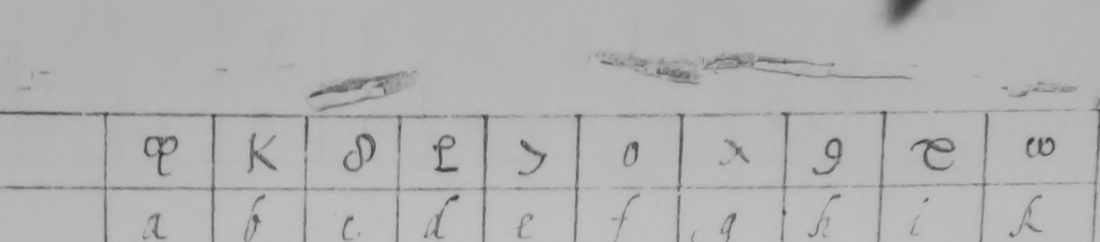
The key is two sheets. The first carries the alphabet table and the first part of the nomenclator, the second continues the numbered list to 116. The alphabet is a simple substitution in which the cipher signs are themselves letter shapes, so the ciphered words look like an odd Latin hand:

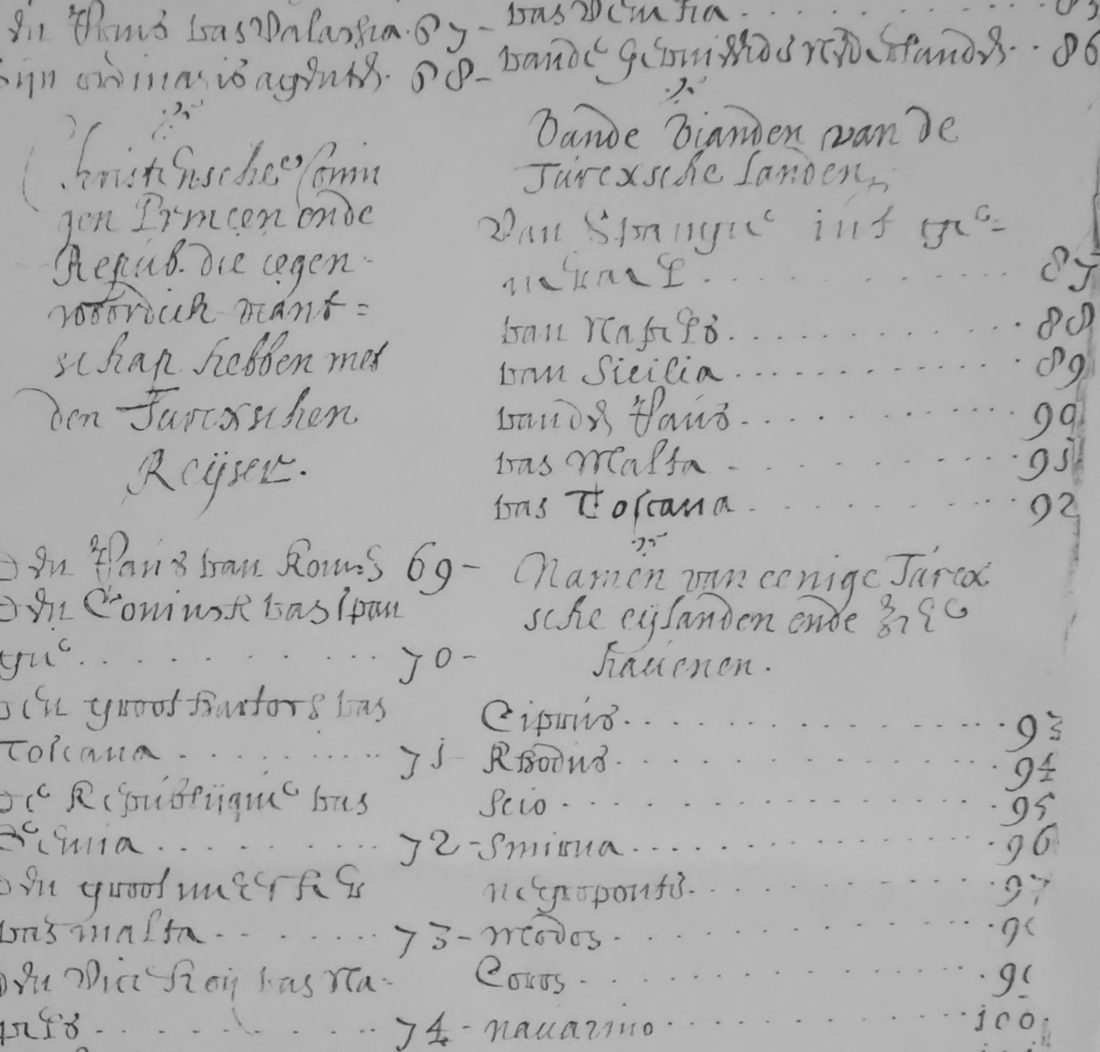
The nomenclator numbers the Sultan and his officers (1 Sultan Osman, 2 Sultan Mustafa his uncle, 3 the Vizier Azem, 4 the Capitan Bassa, 7 the Mufti, 10 the Janitsaraga), then the provincial Bassas and Beys, the cities of the empire, the Christian and Mahometan princes with their ambassadors, the fleets, and the islands and havens of both sides (93 Cyprus to 116 “de Golff”).
02 Four letters, bound out of order
Neither record is one letter, and neither is in order.
- R2113. Page 1 is the clear close of the despatch of 1 February 1620 and carries no cipher at all. Pages 3 and 2, in that order, are a different letter: page 3 breaks off in mid-sentence and page 2 takes it up, ending “In Constant. den xxxj martij 1620”. The opening page of that 31 March letter is not among the scans.
- R2115. The order is p.3 (which opens the letter of 24 April), p.4 (whose top ends it, “In Constantinopoli den xxiiij Aprilis 1620”, and whose foot begins the next), p.2, then p.1, dated “den [?vij] Meij 1620” (DECODE: 4 May; corrected on the full re-read of 23 October 2026, which also found that p.4 comes before p.2). So the record holds two despatches, of 24 April and [7?] May.
03 31 March 1620: Transylvania, Bohemia, and the Spanish truce
The ciphered spans of the March letter run inside clear Dutch. On Transylvania, Haga reports that the Porte will let the resignation be made in favour of “sijn hoocheijts broeder”, and that the province must stay in good correspondence with Hungary so that it does not fall into the hands of Homonnai “ofte anderen {dependenten van t huijs van Oostenrijck}”. Then his own advice:
Ick oordeel dat het {bij de turcken} meerder reputatie ende estime soude geven {dat de Ongaren regem Bohemiae mede erweelden, ende met} (62) in stricte alliantie verbonden bleven.
Hungary and Bohemia united under one head, the Elector Palatine, would, he writes, let Transylvania deal with the Turks on better terms in the treaties that must follow; a legation from Hungary, Bohemia and the incorporated provinces would be welcome at the Porte. The second half of the letter turns to Spain. A Polish envoy has refused to have his lodging prepared in the usual way, which Haga calls a {bravade}; and
(44) {ende} (45) {arbeiden bij} (4) om tyt te winnen, dat hy provisie {een suspensie van wapenen tusschen de turcken}, ende de {coninckrijcken van Napels} ende {Sicilia} gepractiseert mocht worden … (3) (4) {ende} (7) {vragen mijn} curieuselijck ende ernstelijck {off} (50) geresolveert sijn {de treffves met} (70) {te verlengen}, {vrede} te maecken, ofte {de wapenen} wederom {aen te nemen}, twelck men {hier seer gaerne} soude sien, {om Spangie van weder} zyde te mogen {infesteren}.
That is the Grand Vizier, the Capitan Bassa and the Mufti asking the Dutch ambassador, in the last year of the Twelve Years’ Truce, whether the Republic means to renew it, and saying plainly that the Porte would rather it were broken, so that Spain could be attacked from both sides at once.
04 24 April and May 1620: elect a new king
The April despatch reports the arrival of the envoys of the confederated Bohemian and Hungarian lands, sent from the Easter diet of Pressburg with its resolutions and with the intention of sending a formal legation and making a perpetual peace with the Sultan. They were received without delay, by the Grand Vizier and then by the Sultan, and at that audience the ambassador of the Hungarian Estates (kept back until then, the letter says, by the persuasion of the ambassador of the German Emperor) was admitted with them. The Porte answered that the ambassadors would be welcome and that it was resolved to treat and make friendship with the crown of Hungary, Bohemia and the confederated lands.
R2115 was transcribed in full from the four DECODE photographs on 23 October 2026 and every one of its 43 cipher spans decoded sign by sign with the key (R2115_reading.md, with English; code words given as the key’s words, [?word] a doubtful word). The reading audit of 22 October had classed it decoded, not read, when only parts were transcribed. The advice:
Daer is niet noodiger, als winninge van tijt, ende dat de Ungarische Stenden op het alderdesperaetste tot de electie ende croeninge van een nieu coninck procederen, daer naer [?hier] seer wert verlangt.
Dat alreede aen [den Bassa van Buda] ordre gegeven is, met haer goede correspondentie te houden, ende, is noodich, te assisteren, sonder andere last van hier te becomen.
Dat aen contrarie uijtstrooijinge, die van wegen [des Duytschen Keijsers Ambassadeur] souden mogen geschieden, geen geloof geven, [den opperste Vizir] ende [den Mufti] vermanen [den Prins van Transilvania], dat, sonder langer te wachten, de crone van Ungarie soude aennemen
“Nothing is more necessary than to gain time, and that the Hungarian Estates proceed in all urgency to the election and crowning of a new king, which is much longed for here.” Orders have gone to the Bassa of Buda to keep correspondence with them and help them; nothing put about in the name of the German Emperor’s ambassador is to be believed; and the Grand Vizier and the Mufti exhort the Prince of Transylvania to take the crown of Hungary without waiting longer. Haga also reports that the letter of Bethlen Gábor to the Sultan, printed at Cologne by the Emperor to make the Prince odious, was never written. The closing pages are clear: the Polish ambassador has at last had his licence, the Khan of Tartary is said to have marched into Poland in person, and Ottoman preparations go on but will be slow, since neither Sultan nor Vizier goes in person.
05 Method
The DECODE JSON API gave the metadata for the whole run of records at inventory number 6894, which is how R2118 was found to be the key of the series and R2114 to be marked Decrypted. The fifteen page images were fetched with the account’s session cookie. They are photographed sideways, so every page was rotated and cut into strips of three lines before transcription. The alphabet table was transcribed from the key and tested on the first cipher words of R2113 p.2, which gave arbeiden, tusschen, suspensie and de turcken at once; the two letters were then deciphered in two parallel passes. The key’s cell for m lies outside the photographed sheet, so that letter was recovered from the text: the 4-shaped sign, confirmed by becomen, met, mijn, vermogen, teenemael and geconformeert. The nomenclator values were taken from the key and then checked against the sense of the letters, which confirms (19) Buda, (62) Transylvania, (70) Spain, (3) the Vizier Azem, (4) the Capitan Bassa, (7) the Mufti, (58) the States General and (43) the Emperor’s ambassador.
06 What remains uncertain
- Code (50). On the key, 50 is the French king’s ordinary ambassador, which does not fit “de treffves met (70) te verlengen”. Either the numbering of that column is off by a row or two as the sheet is photographed, or the code is used loosely for the Dutch side. Unresolved (I).
- Codes 37–45. Their column is cut off at the edge of the photograph of the key’s first sheet, so the headings are legible but the numbers are inferred from the order of the list. That makes (44) and (45), in the March letter, conjectural (M).
- Short cipher words. ℓ7tδℓ7d7t (R2113 p.2, line 13) decrypts literally to denvderen, perhaps meant for hinderen; a scatter of short words in both letters is marked with a query in the reading files (C or M); in R2115, 13 letters rest on a look-alike alternate.
- Codes (15) and (46) in R2115 are open; there is no key material for them.
- The clear Dutch of R2113 was summarised, not transcribed word for word; R2115 was transcribed in full on 23 October 2026.
- R2114 (11 May 1620, six pages) was not deciphered again here: DECODE marks it Decrypted, though the record carries no plaintext file.
Full texts
The transcription and the decryption of every document on this page, so that the reading can be used and checked. Short files are shown here; all are in the repository.
R2113 pp. 3+2, Haga to the States General, Constantinople, 31 Mar 1620 (p. 1 is the clear close of 1 Feb 1620)
Cornelis Haga, Dutch ambassador at Constantinople, reports that the Porte would let Transylvania be resigned to Bethlen Gábor's brother, that Transylvania must keep good correspondence with Hungary, and that the Turks would think better of the Hungarians if they too elected a king of Bohemia; the Grand Vizier, Capitan Bassa and Mufti press him on whether the States mean to extend the truce with Spain, make peace or take up arms again. No sign-level transcription of the cipher spans exists; the reading gives them deciphered in braces, and the images are on the DECODE record.
Transcription: 2113
Decryption
# DECODE R2113: Haga, Constantinople, reading

Cipher spans are in {braces}. Codes are written [n]. ? marks an uncertain letter or word. The clear text is a quick reading, not a careful transcription.

## Important: the three images are two letters

- **P1** is all clear text. It is the end of a letter dated *In Constantinople den 1en? februarij 1620* and signed by Haga. It has no cipher.
- **P3 then P2** are a different letter, and P3 comes first. P2 ends with *In Constant. den xxxj martij 1620*, so it is dated **31 March 1620**. P3 ends in mid-sentence ("... niet bijstaen") and P2 begins "dese stadt gearriveert". Both pages are ciphered. Page P3's first page (or pages) is not in the scans.

## P1 (clear, 1 Feb 1620)
In outline: the Tatars/Turks and a tribute or war with Poland ("tot betalinge van een iaerlix tribuyt, of de selve ... in openbaren oorloge met dese machtige monarchia te vallen"); talks with the Emperor's ambassador over important fortresses in Hungary. The Turks promise help to Bethlen, Prince of Transylvania, and to Hungary. The ambassador of the Hungarian Estates had no audience with His Imperial Majesty's [the Sultan's] representatives, "mainly because no one has any advantage from the Turks". Closing formula, then signature.

## P3 (the earlier page of the March letter)
1. ende meeninge van [1] verclaert heeft, ende daerbeneffens
2. [...] dat ons wel te vrede sal sijn {de resignatie op}
3. {sijn hoocheijts broeder} te laten geschieden.
4. het is in alles manieren nodich dat de selvige provincie
5. {met ?ngarie (first sign p-like; read Ungarie/Hongarie) ende haere} gevoechde(?) ... in
6. goede correspondentie blyven, op dat in handen {van}
7. {Hommenai(?)}, ofte anderen {dependenten van t huijs}
8. {van Oostenrijck} niet comme te vervallen, daerop
9. int geheel hier te doen is, {na mijn vermogen sal}
10. {helpen letten}.
11. Ick oordeel dat het {bij de turcken} meerder reputatie
12. ende estime soude geven {dat de Ongaren regem}
13. {Bohemiae mede erweelden, ende met} [62]
14. in stricte alliantie verbonden bleven. {sijn hoocheijt}
15. door eenige andere middelen contenterende ende recompense-
16. rende voor de groote diensten, ende {secoursen aende}
17. {croone} gedaen. Sulcx soude strecken tot versterckinge
18. {vanden staet van transilvanie} niet alleen ...
19. alle buijtenlantsche machten, maer oock de contramijnen
20. {die aen dese porta} nimmermeer iegens de selvige
21. {princen cesseren}. Bovendien {de croone van}
22. {Ongarie cum Bohemica geunieert onder}
23. {een} ouwt(?) ende treffelijcke voorsichtige hooft (a?.. {is}
24. {vande cheur} paltz) sal inde nieuwe tractaten {die}
25. {met de turcken} nootwendich sullen moeten geschieden,
26. op en andere maniere {met reputacie toegen(?)} ----
27. {procederen als} [62] die voor ons {int?ersaet?} (interest?)
28. {van} [1] geinterpreteert wort, sal konnen doen.
29. Ons verlangt hier seer naer de Legatie die ons verstaet (clear)
30. dat van wegen Hungaria, Bohemia ende de geincorporeerde
31. provincien bij dese Porta geestimeert wort ... niet
32. anders bemerken, als dat de selvige aengenaem sal wesen.
33. Den nuntius ofte Commissaris van Polen in mijn voorgaende
34. gementioneert is ad pontum parmum (?) niet bijstaen

## P2 (the later page of the March letter, dated 31 March 1620)
1. dese stadt gearriveert, maer dy desgelijcx versocht synde om syn
2. logys naer ouder gewoonte te doen prepareren, heeft hy
3. geweygert, seggende dat het onnodich is hier te comen,
4. met de Poolen wyder te tracteren, off sulcx eenich is, dan
5. alles geschiet tot ons {bravade}, sullen uwe hoog. mog.
6. door de naeste advysen (wil Godt) verstaen. [44] {ende}
7. [45] {arbeiden bij} [4] om tyt te winnen, dat hy provi-
8. sie {een suspensie van wapenen tusschen}
9. {de turcken}, ende de {coninckrijcken van Napels}
10. ende {Sicilia} ?o? gepractiseert mocht worden. maer
11. verhope {dat dese ende andere haere aenslaegen}
12. op haere {disseinen tegens de christenen te}
13. {volbrengen}, sulcx {alomme(?) sal denvderen(?) (hinderen?)}, daer
14. daerinne {geen gehoor sullen becomen}, gelijck
15. ick {seer goede hope} daertoe hebbe, dat sulcx
16. {hier} op geenderley maniere {geaccordeert sal}
17. {werden} [3] [4] {ende} [7] {vragen mijn} (s)wa(e)r(?)
18. curieuselijck ende ernstelijck {off} [50] geresolveert
19. sijn {de treffves met} [70] {te verlengen} {vrede}
20. te maecken, ofte {de wapenen} wederom {aen te}
21. {nemen}, twelck men {hier(?) seer gaerne} soude sien,
22. {om Spangie van weder} zyde te mogen {infesteren}.
23. Hier mede etc.
24. In Constant. den xxxj martij 1620. / Uwe Hoog. Mog. / oitmoedige dienaer [signature]

## Summary (modern English)
**1 Feb 1620 (P1):** Haga reports that the Turks are pressing Poland: Poland must either pay a yearly tribute or go to open war with the Ottoman state. He also reports talks with the Emperor's ambassador about Hungarian fortresses, Turkish promises of help to Bethlen Gábor of Transylvania and to Hungary, and the Hungarian Estates' envoy. Nobody gets any real advantage from the Turks.

**31 March 1620 (P3 then P2):**
- On Transylvania and Bohemia, Haga reports:
  - the Porte would accept the resignation of Transylvania in favour of "his Highness's brother", meaning Bethlen's brother;
  - that province must stay in good correspondence with Hungary, so that it does not fall to Homonnai or other dependants of the House of Austria. Haga will watch this as far as he can.
- In his view, the Turks would respect the anti-Habsburg side more if:
  - the Hungarians also elected the King of Bohemia and stayed in strict alliance with [62];
  - Bethlen were compensated by other means for his great services and help to the crown.
  - This would strengthen Transylvania against all foreign powers and against the counter-mines at the Porte.
- If Hungary and Bohemia were united under one wise head (the Elector Palatine), [62] could deal with the Turks in the coming treaties with more standing.
- A legation from Hungary, Bohemia and the incorporated provinces would be welcome at the Porte.
- A Polish envoy arrived but refused to have his lodging prepared in the customary way, which Haga calls a show of bravado against the Dutch side.
- [44] and [45] are working with [4] to gain time and to arrange a suspension of arms between the Turks and the kingdoms of Naples and Sicily. Haga hopes these and other Spanish designs against the Christians will get no hearing. He believes they will not be granted.
- [3] [4] and [7] ask him earnestly whether [50] has decided to extend the truce with [70] (the Twelve Years' Truce with Spain, due to end in 1621), to make peace, or to take up arms again. The Porte would gladly see the last, so as to attack Spain from both sides.

## Codes used
[1] (twice, P3), [3], [4] (twice), [7], [44], [45], [50], [62] (twice), [70].

## Signs that did not fit the key
- **m = 4.** Confirmed by becomen (K78ϯ4 7t), met (47ʃ), mijn (4ɛɛt), vermogen, regem, cum. The "4" inside parentheses is a code.
- **p** is written as a u-like sign, sometimes with a leading ɛ-like stroke (as in suspensie, wapenen, Napels); it is not i+p.
- **f** was doubled in "treffves" (ʃd7ooδ72).
- **Hungary is spelled two ways.** "Ongaren/Ongarie" uses ϯ. P3 line 5 opens with a u/p-like sign ("?ngarie"), which may be a slip.
- **ℓ7tδℓ7d7t** (P2 line 13) is unresolved: read literally it gives "denvderen", perhaps meant for "hinderen".
- **ɛo** (P2 line 10) is unresolved.
- **ϯɛ7d** ("hier"?) in P2 line 21 is uncertain.
Translation
# DECODE R2113: Cornelis Haga, Constantinople, to the States General: English translation

Translation (Claude Opus 5.5, 23 Oct 2026) of `R2113_reading.md`. The record holds two letters. P1 is the clear close
of a letter of 1 February 1620; the reading gives it only in outline (it is not transcribed), so only that outline is
translated here. P3 and then P2 are the letter of 31 March 1620, whose first page is not in the scans; it is translated
in full, as running text, from the line-numbered reading. Words in ⟨ ⟩ were in cipher (braces in the reading). Same
holes: `[n]` a code number not identified, `[?word]` an uncertain word (the reading's ? or (?)), `[...]` and `...`
unread. Dutch.

## P1 (clear close of the letter of 1 February 1620; outline only)

The Tatars/Turks and a tribute or war with Poland ("to the payment of a yearly tribute, or to fall into open war with
this mighty monarchy"); talks with the Emperor's ambassador over important fortresses in Hungary. The Turks promise
help to Bethlen, Prince of Transylvania, and to Hungary. The ambassador of the Hungarian Estates had no audience with
His Imperial Majesty's [the Sultan's] representatives, "mainly because no one has any advantage from the Turks".
Closing formula, then signature.

## P3 (the earlier page of the letter of 31 March 1620)

... and intention of [1] has declared, and besides that [...] that we shall be well content ⟨to let the resignation
to his Highness's brother⟩ take place. It is in all ways necessary that the same province ⟨with Hungary and its⟩
[?joined] ... remain in good correspondence, so that it does not come to fall into the hands ⟨of Homonnai⟩, or other
⟨dependants of the House of Austria⟩, on which the whole business here turns; ⟨I shall help to watch, as far as I am
able⟩.

I judge that it would give more reputation and esteem ⟨among the Turks⟩ ⟨that the Hungarians also elected the King of
Bohemia, and⟩ remained bound in strict alliance ⟨with⟩ [62], ⟨his Highness⟩ being contented and recompensed by some
other means for the great services and ⟨help done to the crown⟩. Such would serve to strengthen ⟨the state of
Transylvania⟩ not only ... all foreign powers, but also the counter-mines ⟨which at this Porte⟩ never ⟨cease⟩
against the same ⟨princes⟩. Moreover, ⟨the crown of Hungary united with the Bohemian under one⟩ [?old] and excellent,
prudent head (a?.. ⟨is of the Elector⟩ Palatine) will, in the new treaties ⟨which⟩ will necessarily have to be made
⟨with the Turks⟩, be able to ⟨proceed⟩ in another way ⟨with reputation [?toward them]⟩ ---- ⟨than⟩ [62] can do, who for
us is interpreted ⟨[?in the interest] of⟩ [1].

We here long greatly for the Legation which, we understand, is esteemed at this Porte on behalf of Hungary, Bohemia
and the incorporated provinces ... not perceive otherwise than that it will be agreeable. The nuncio or commissary of
Poland, mentioned in my previous letter, [?ad pontum parmum] not assist

## P2 (the later page, dated 31 March 1620)

has arrived in this city; but, being likewise asked to have his lodging prepared according to the old custom, he
refused, saying that it is unnecessary to come here to treat further with the Poles. Whether such is anything other
than that everything is done ⟨as a bravado⟩ against us, Your High Mightinesses will (God willing) understand by the
next advices. [44] ⟨and⟩ [45] ⟨are working with⟩ [4] to gain time, so that he provisionally ⟨a suspension of arms
between the Turks⟩ and the ⟨kingdoms of Naples⟩ and ⟨Sicily⟩ [?...] might be negotiated. But I hope ⟨that these and
their other attempts⟩ to ⟨accomplish their designs against the Christians⟩ will ⟨[?everywhere] [?hinder]⟩ such, there
⟨they will get no hearing⟩ in it, as I have ⟨very good hope⟩ of it, that such will in no manner ⟨be granted⟩ ⟨here⟩.
[3] [4] ⟨and⟩ [7] ⟨ask me⟩ [?gravely] curiously and earnestly ⟨whether⟩ [50] have resolved ⟨to extend the truce with⟩
[70], to make ⟨peace⟩, or ⟨to take up⟩ ⟨arms⟩ again, which one ⟨[?here] would very gladly⟩ see, ⟨so as to be able to
attack Spain from the other⟩ side. Herewith etc.

At Constantinople, the 31st of March 1620. Your High Mightinesses' humble servant [signature]
R2115, Haga to the States General, Constantinople, 24 Apr and [4-7] May 1620 (two letters; images in the order P3, P4, P2, P1)
Two letters. 24 April: Bohemian and Hungarian commissioners from the Pressburg Easter diet received by the Grand Vizier and the Sultan; in cipher, nothing is more necessary than gaining time and that the Hungarian Estates elect and crown a new king; the letter of Bethlen Gábor printed at Cologne to make him odious is a forgery; Naples too exhausted to help the Emperor. May: Haga has turned the Grand Vizier and the chief lords in favour of the King of Bohemia and of Transylvania; the Porte's letters promise perpetual peace; order given to the Bassa of Buda to assist; the Vizier and Mufti urge Bethlen to accept the crown of Hungary; the honour belongs to the States General alone; the chiaus to the Emperor's ambassador is delayed, 'om het spel in Duijtslant ende Ungaria met sodanigen bulleman te verderven'; Polish ambassador, Cossacks, Tatar invasion of Poland expected.
Transcription: 2115
Decryption
# DECODE R2115 — Cornelis Haga, Constantinople, to the States General: letters of 24 April and [4-7] May 1620 (reading)

Rests on: the four DECODE photographs of NA 1.01.02 inv. 6894 (R2115 I15012-I15015, main checkout
`targets/haga1620/decode/`, git-ignored), read line by line from native-resolution crops (23 Oct 2026,
`research/reading_audit/b28_strips.py`, `b28_crop.py`); the cipher spans decoded sign by sign with the key on DECODE
R2118 (`KEY_ALPHABET.md`, m = the 4-shaped sign) and listed in `R2115_cipher_spans.tsv`; nomenclator codes given as the
key's words (`KEY_NOMENCLATOR.md`). No contemporary decipherment, attachment or comment is on the record, and the
letters are not known in print. Clerk's spelling kept; u/v and i/j as written where legible.

**Page order.** The images are bound out of order. P3 opens the letter of 24 April (marginal note "... 7 Mey"),
P4 top ends it ("In Constantinopoli den xxiiij Aprilis 1620"); P4 bottom opens the next letter, which runs on to P2
("... den Vizir, Mufti, | Choggia ende Janitsaraga ...") and P1 ("... die men daer mede voor- | heeft ..."), dated on
P1 "den [?vij] Meij 1620" (DECODE: 4 May). The order is P3, P4, P2, P1 (NOTES had P3, P2, P4, P1).

Marks: `[?word]` partly carried, `[…]` unread, `[15]` an unidentified code; `[words]` = the key's word for a code
(code 43's number is inferred from the key's order, the column being cut by the photograph). No word is supplied.

## Reading

### P3 — letter of 24 April 1620

Hooge, Mogende ende Genadige Heeren.

Op den [?xvj] deses sijn hier gearriveert twee Bohemische ende Ungarische [?Commissen], afgevaerdicht op den Paesschen Landdach van Presburch, van wegen de geconfedereerde landen, brieven ende rapporten brengende van al het gunt op dito Landdach getracteert ende besloten is geworden, onder anderen, dat voorgenomen hebben een authentijcke Legatie aen dese Porta te senden ende een eewige vrede met Sijne Keijs: Mat: te maecken.

Soo aengenaem [?tselvige] is geweest, heeft [?gejouisseert] [?haere] vorstelicke receptie ende spoedige introductie soo bij den oppersten Vizir, als Sijne Mat., bij de welcken niet alleen dito [?Commissen], maer oock den Ambassadeur vande Stenden van Ungaria (wien men door persuasie vanden Ambassadeur vanden Duijtschen Keijser tot noch toe opgehouden heeft) op [?…] publijcque audientie gehadt, ende sullen apparentelijck in alle diligentie wederom afgevaerdicht werden met volcomen contentement, ende antwoort, dat d'Ambassadeurs, die herwaerts gedestineert sijn, aengenaem ende wellecom sullen wesen, ende dat men geresolveert is met de Crone van Ungaria, Bohemia, ende de geconfedereerde landen te tracteren, ende vrundtschap te maecken.

Daer is niet noodiger, als winninge van tijt, ende dat de Ungarische Stenden op het alderdesperaetste tot de electie ende croeninge van een nieu coninck procederen, daer naer [?hier] seer wert verlangt.

Mijn is vanden Agent van Transilvania vertoont [?seeckere] copie van een brieff, die den Prins Bethlem Gabor aenden Turckschen Keijser geschreven soude hebben, die den Duijtschen Keijser tot Ceulen drucken, ende door gansch Christenheijt heeft doen verstroijen, [?om] [den Prins van Transilvania] alomme odieus te maecken.

Ick hebbe mij [?best] seeckerlijck daer van geinformeert, ende met waerheijt bevonden, dat sodanigen brieff noijt aenden Turckschen Keijser geschreven, noch het swaert, scepter ende vane daerinne gementioneert aenden Prins Bethlem Gabor voor ofte nae de Ungarische commotien van hier gesonden sijn [?geweest], waer van ick dienstich heb geacht, dat UHo: Mo: ende andere Princen ende Stenden (die inde conservatie vande geunieerde landen [?geinteresseert] sijn) kennisse hebben.

### P4 (top) — end of the letter of 24 April

Door rapport van geloofwaerdige ende politijcque persoonen, die onlancx door het Coninckrijck van Napels gepasseert sijn, ende op de publijcque saecken [?goet] acht hebben, bericht, dat de landen door de groote belastinge van wegen de continuele toerustinge, die den Vice Roij [?eenige] [?jaren] herwaerts jegens de Repub. van Venetia gedaen heeft, soo seer uijtgeput ende geruineert sijn, dat van daer swaerlijck eenige assistentie voor den Duijtschen Keijser te wege sal connen gebracht werden.

Den Ambass. van Polen blijft alnoch binnen, sonder te vertrecken, apparentelijck ordre van sijnen Coninck verwachtende. [?Hier mede].

In Constantinopoli den xxiiij Aprilis 1620.

### P4 (bottom), P2 — the letter of May 1620

Hooge Mogende ende Genadige Heeren.

Ick bevinde dat de practijcquen vande Imperialen, om tusschen Spangie ende dese landen vrede te maecken, op dat den Coninck alle sijne machten te water ende te lande jegens de Evangelische Princen int Rijck, onse Geunieerde Nederlanden, ende de Repub. van Venetia onbecommert soude mogen gebruijcken, geen voortganck sullen hebben, daer toe ick sodanige devoiren ende informatien alomme gedaen heb, dat den [?Oppersten] Vizir (die te voren [des Duytschen Keijsers Ambassadeur] scheen te willen favoriseren) ende alle de voornaemste [?heeren] aen dese Porta teenemael tot faveur regis Bohemiae, van [den Prins van Transilvania] ende [46] gedisponeert heb, in vougen dat den Ambassadeur van Ungaria ende de Contreijen inden voorgaenden gementioneert in groote diligentie op primo deses afgevaerdicht sijn geweest, met haer volcomen contentement ende brieven vanden Grooten Heer, den Vizir, Mufti, Choggia, ende Janitsaraga, als oock hoochgedachte Coninck, Rijck ende Stenden, insonderheijt, dat haere Ambassadeurs, die sijluijden voorgenomen hebben aen dese Porta te senden, seer aengenaem ende willecom sullen wesen, dat men geresolveert is met sijne Mat: van Bohemen, ende den geenen die de Stenden van Ungaria voor haren Coninck sullen [?erwelen], ende haere geconfedereerde landen een eewige ende vaste vrede te maecken, bekennende, dat sonder [?verlies] van tijt d'Ambassadeurs tot dien [?eijnde] geexpedieert mogen werden, dat so lange de vrundtschap met dese Porta sullen maintineren, voor geenige vianden te vreesen hebben.

Dat alreede aen [den Bassa van Buda] ordre gegeven is, met haer goede correspondentie te houden, ende, is noodich, te assisteren, sonder andere last van hier te becomen.

Dat aen contrarie uijtstrooijinge, die van wegen [des Duytschen Keijsers Ambassadeur] souden mogen geschieden, geen geloof geven, [den opperste Vizir] ende [den Mufti] vermanen [den Prins van Transilvania], dat, sonder langer te wachten, de crone van Ungarie soude aennemen, dewijle het sijn Exc. op mijn versocht, dat soude willen daer toe arbeiden, dat met [des Duytschen Keijsers Ambassadeur] geen vrede gemackt werde.

De eere van dese resolutie coempt [de Hoog Mog. Heeren Staten Generael] alleen toe.

[?Met] dito Ambassadeur van Ungarie is een Chiaus aen den Prins Bethlem Gabor ende de Stenden gesonden, om de selvige oock mondelinge vande voorgenoemde resolutie ende Sijne Keijs: Mats goede genegentheijt te verseeckeren, ende d'Ambassadeurs herwaerts [?te geleijden] wederom t'accompagneren.

Ten contrarie wert de besendinge vanden siaus ende [15] aen [des Duytschen Keijsers Ambassadeur] te doen, van tijt tot tijt gediffereert, alhoewel groote diligentie doen om gerespondeert te werden, maer verhoepe, dat de [?selvige] door onse devoiren teenemael sal nablijven, hebbende [den opperste Vizir] wel geinformeert vande practicken die men daer mede voorheeft, om het spel in Duijtslant ende Ungaria met sodanigen bulleman te verderven, contrarie de meeninge vanden Turckschen Keijser, ende Sijn Exc.

### P1 — close of the May letter

Den Ambassadeur van Polen heeft eyntelijck licentie geobtineert, om hier te coemen, ende gehoort te werden, hebbende sijn eerste logijs bij den Ambassadeur vanden Keijser genomen, maer alsoo de Cosacken op nieuws groote schade doen, werden de gemoederen mede als voren verbittert, ende men verwacht eerlange tijdinge, dat den Coninck van Tartaria in persoon met al sijn macht opgetrocken ende in Polen gevallen sal sijn.

De preparatien van oorloge werden dagelijcx continuerende, alhoewel Sijn Mat: noch den Vizir dese somer persoonlijck niet sullen gaen, gelijck voorgenomen hebben het toecoemende jaer te doen.

De preparatien te water werden al ordinario gedaen.

Hier mede, Hooge, Mogende, ende Genadige Heeren, bidde ick den Almogenden UWe Ho: Mo: voorspoedige ende geluckige regeeringe meer ende meer te zegenen, mij onderdanichst bevelende in UWe Ho: Mo: genadige protectie.

In Constant. den [?vij] Meij 1620.

UWe Ho: Mo: onderdanichste getrouwe dienaer.

## Notes

- Cipher spans and look-alikes: `R2115_cipher_spans.tsv` (43 spans, 599 cipher letters decoded). Letters resting on a
  look-alike alternate: 13 (winninge nn, ende n, aennemen nn, op p, siaus s, last l, alomme l, bulleman ll, om o,
  vougen u — the l/s and n/t sign pairs and one p).
- Codes: [3] Vizier Azem "dat is de opperste Vizier", [7] Mufti, [19] Bassa van Buda, [58] the States General,
  [62] the Prince of Transylvania (all as in R2113); [43] "den Duytschen Keijser sijn extraordinaris Ambassadeur"
  (number inferred). [15]: the key reads "Bassa van Babilonia", which does not fit "de besendinge vanden siaus ende
  [15] aen [43]"; [46] "... van een ander lande noch procederende" is a heading fragment on the key. Both left open.
- "siaus" is the cipher's spelling of the chiaus named in clear just above; "bulleman" (bogeyman) and "vougen"
  (voegen: "in vougen dat", so that) are carried letter for letter.
- A leaf may be missing between P3 and P4 or the 24 April letter runs straight on: P3 ends "sijn [?geweest]," and
  P4 begins "waer van ick dienstich heb geacht"; the reading takes them as continuous.
Translation
# DECODE R2115 — Cornelis Haga to the States General, Constantinople, 24 April and [4-7] May 1620 (English)

Translation of `R2115_reading.md`, same holes. Words that were in cipher are not marked here; see
`R2115_cipher_spans.tsv`. `[?word]` partly carried, `[…]` unread, `[15]`, `[46]` unidentified codes.

## Translation

### Letter of 24 April 1620

High and Mighty, Gracious Lords.

On the [?16th] of this month two Bohemian and Hungarian [?commissioners] arrived here, sent from the Easter diet at
Pressburg on behalf of the confederated lands, bringing letters and reports of all that was treated and decided at that
diet, among other things that they intend to send a formal embassy to this Porte and to make a perpetual peace with
His Imperial Majesty [the Sultan].

[?This] was so welcome that they [?enjoyed] a princely reception and quick introduction both to the Grand Vizier and to
His Majesty, by whom not only these [?commissioners] but also the ambassador of the Estates of Hungary (whom the
persuasion of the German Emperor's ambassador had kept back until now) had public audience on [?…]; and they will
apparently be sent back in all diligence with full satisfaction and the answer that the ambassadors who are destined
here will be welcome, and that the Porte is resolved to treat and make friendship with the Crown of Hungary, Bohemia
and the confederated lands.

Nothing is more necessary than to gain time, and that the Hungarian Estates proceed in all urgency to the election and
crowning of a new king, which is much longed for [?here].

The agent of Transylvania showed me a [?certain] copy of a letter which Prince Bethlen Gábor is supposed to have written
to the Turkish Emperor, which the German Emperor had printed at Cologne and spread throughout Christendom [?in order]
to make [the Prince of Transylvania] odious everywhere.

I have informed myself of it with certainty and found in truth that no such letter was ever written to the Turkish
Emperor, nor were the sword, sceptre and banner mentioned in it sent from here to Prince Bethlen Gábor, before or after
the Hungarian troubles; which I thought it useful that Your High Mightinesses and the other princes and estates (who
have an interest in the preservation of the united lands) should know.

By report of trustworthy and politic persons who lately passed through the Kingdom of Naples and pay [?good] attention
to public affairs, [I am] told that the lands are so exhausted and ruined by the heavy burdens of the continual armament
which the Viceroy has made against the Republic of Venice these [?some] [?years], that hardly any help for the German
Emperor can be raised there.

The Polish ambassador still stays inside, without leaving, apparently awaiting orders from his king. [?Herewith].

Constantinople, 24 April 1620.

### Letter of May 1620

High and Mighty, Gracious Lords.

I find that the practices of the Imperialists to make peace between Spain and these lands [the United Provinces], so
that the King might use all his forces by water and land unhindered against the Evangelical princes in the Empire, our
United Netherlands and the Republic of Venice, will make no headway; to which end I have made such efforts and given
such information everywhere that I have entirely disposed the [?Grand] Vizier (who before seemed to want to favour [the
German Emperor's ambassador]) and all the [?chief lords] at this Porte in favour of the King of Bohemia, of [the Prince
of Transylvania] and of [46], so that the ambassador of Hungary and the envoys mentioned in my last were dispatched in
great haste on the first of this month, with their full satisfaction and letters from the Grand Signior, the Vizier,
the Mufti, the Kahya and the Agha of the Janissaries to the said King, Kingdom and Estates, in particular that their
ambassadors, whom they intend to send to this Porte, will be very welcome and agreeable; that the Porte is resolved to
make a perpetual and firm peace with His Majesty of Bohemia, with him whom the Estates of Hungary shall [?elect] as
their king, and with their confederated lands; acknowledging that the ambassadors may be dispatched to that [?end]
without [?loss] of time, and that as long as they keep friendship with this Porte they need fear no enemies.

That order has already been given to [the Pasha of Buda] to keep good correspondence with them and, if needed, to assist
them without receiving any further charge from here.

That no credence is to be given to contrary rumours which might be spread on behalf of [the German Emperor's
ambassador]; [the Grand Vizier] and [the Mufti] urge [the Prince of Transylvania] to accept the crown of Hungary without
waiting longer, since His Excellency, at my request, [said] he would work for it, that no peace be made with [the German
Emperor's ambassador].

The honour of this resolution belongs to [Their High Mightinesses the States General] alone.

[?With] the said ambassador of Hungary a chiaus has been sent to Prince Bethlen Gábor and the Estates to assure them by
word of mouth of the aforesaid resolution and of His Imperial Majesty's good inclination, and [?to conduct] the
ambassadors here and accompany them back.

On the other hand, the dispatch of the chiaus and of [15] to [the German Emperor's ambassador] is put off from time to
time, although they use great diligence to get an answer; but I hope that through our efforts it will come to nothing
altogether, having well informed [the Grand Vizier] of the practices intended by it, to spoil the game in Germany and
Hungary with such a bogeyman, against the intention of the Turkish Emperor and of His Excellency.

The Polish ambassador has at last obtained licence to come here and be heard, having taken his first lodging with the
Emperor's ambassador; but as the Cossacks again do great damage, tempers are embittered as before, and news is expected
shortly that the King of Tartary has marched in person with all his power and fallen upon Poland.

The preparations for war continue daily, although neither His Majesty nor the Vizier will go in person this summer, as
they intend to do next year.

The preparations at sea are made as usual.

Herewith, High and Mighty, Gracious Lords, I pray the Almighty to bless Your High Mightinesses' prosperous and happy
government more and more, commending myself most humbly to Your High Mightinesses' gracious protection.

Constantinople, [?7] May 1620.

Your High Mightinesses' most humble, faithful servant.
Key: KEY_ALPHABET.md, KEY_NOMENCLATOR.md
07 Sources
- Nationaal Archief, The Hague, 1.01.02 (Staten-Generaal), inv. nr. 6894. Images and metadata via DECODE, R2113, R2115, R2114, and the key R2118. Records created by their DECODE contributor in 2021.
- The decipherments, and the alphabet and nomenclator as transcribed here:
targets/haga1620/R2113_reading.md,targets/haga1620/R2115_reading.md,targets/haga1620/KEY_ALPHABET.md,targets/haga1620/KEY_NOMENCLATOR.md.
Working files, the decipherments and the profile are in targets/haga1620/ in the repository. Page images are not committed; the crops above are from the DECODE scans.