
At a glanceExisting decipherment · complete
- The letters
- Three letters from Henrietta Maria’s household at St Germain to Charles I: 1, 22 and 29 September 1645. Two are signed with the number 120.
- Where
- The National Archives, Kew, SP 106/10 ff. 213–215, 230–232 and 233–234; DECODE R785, R790 and R923. They were part of catalogue item 59, which grouped six letters in four different keys.
- The cipher
- One- and two-digit numbers for letters, up to five for a vowel, and three-digit numbers for names and words. The numbers are separated by colons.
- How it was deciphered
- George Lasry reconstructed the key and deciphered the letters on DECODE in October 2020. His plaintext is the text. Applied here group by group to the transcriptions, his key reproduces it on every line that can be compared; on 22 October 2026 the three letters were written out from that decode in the figures’ spelling, compared with his plaintext, and translated.
- What it says
- The queen’s recovery and money for the King. Sir Kenelm Digby at Rome finds no papal money without the repeal of the penal laws. The Duke of Lorraine offers only “little remote hopes”.
- Still open
- About 30 three-digit nomenclator numbers (40 occurrences) still without a value, of the 58 Lasry left in brackets, and a few low figures with no value in the key.
- Other keys
- The other three letters of catalogue item 59 are in different ciphers and have their own pages: R787 (SP106-2), R924 (SP106-8) and R929 (SP106-5).
01 The letters and the key
This page used to cover all six letters of catalogue item 59. George Lasry reconstructed four keys for the SP 106/10 run, one for each period of the correspondence. On 14 October 2026 the entry was split so that each page presents one key. The three letters below are in his “TNA SP 106” key; the others are a different cipher each, with their own pages (R787, R924, R929).
| Record | Folios | Date and content (Lasry) | Groups |
|---|---|---|---|
| R785 | 213–215 | St Germain, 1 Sept 1645: “the Queen is perfectly recovered”; half the money already given; a letter from the Duke of Orléans; Ned Progers arrived. Signed 120. | 1882 |
| R790 | 230–232 | St Germain, 22 Sept 1645: Sir Kenelm Digby at Rome, no papal money except on terms: repeal of the penal laws against Catholics and toleration in England | 769 |
| R923 | 233–234 | St Germains, 29 Sept 1645: the Duke of Lorraine’s “little remote hopes”; the writer fears a battle for a relief and wants the advantage of winter. Signed 120. | 722 |
The key is a numerical homophonic alphabet of one- and two-digit values, with up to five signs for E, I and U, and a nomenclator of three-digit numbers: 124 England (Lasry’s query), 126 the King, 127 the Queen, 157 the Prince of Wales, 279 and. Lasry’s file dates the key to September 1645 and says it has no nulls. The same key, in his files, also covers the sibling records R752 (ff. 207–210, the Queen’s own French letter of 15 September), R754 (ff. 211–212) and R788 (ff. 218, 220–221).
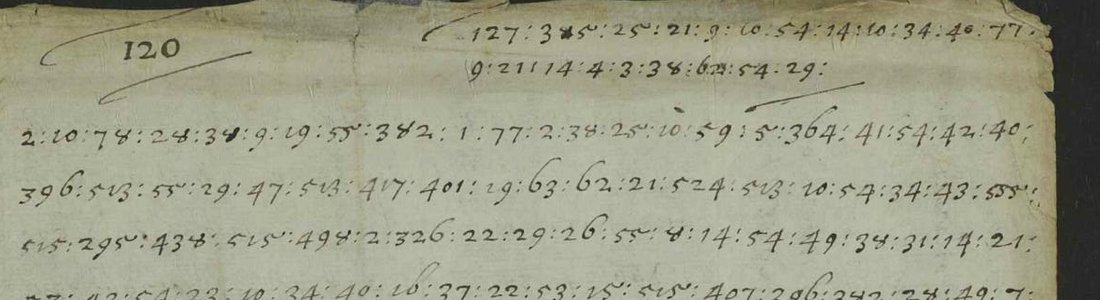
498:2:326 in line 3 is Lasry’s “<498>S <326>”). Lasry’s decipherment begins St Germain 1 Sept. I have very little to add to my last … Image: The National Archives, SP 106/10 f. 213r, via DECODE R785.02 The three letters
George Lasry’s plaintexts, on the DECODE records since 2020, are the decipherment of these letters. On 22 October 2026 each letter was decoded again with his key from the DECODE transcription, compared with his plaintext line by line, and written out in the figures’ own spelling (texts/R785_reading.md and the others, with modern English). Two key values were corrected (292 = by, 435 = next), 126 in R923 was read as 127 (the Queen), and 31 nomenclator numbers were given values from the alphabetical bands of the codebook (texts/hm1645_codes.tsv), shown in {braces}; [?word] is a doubtful word and a bracketed number an open code. R785 is signed “A Cowley”. In R923 the figures give “some forrain [?succour]”, checked on the image, where Lasry read “Lorrain support”. The openings of the three letters:
I have very little to add to my last more than to tell you the {business} of the {ship}s [?doth] advance excellently, half the money being already givenn, and the [?remainder] will be got. A lettre also from the Duke of Orleans, writ as wee could have wished, is in the Queen's hands to return tomorrow (R785)
I have received this week a large {dispatch} from {Sir} K Digby. The substance is that [?there] is no hope of money from thence but upon new termes proposed by [the] [?Pope] to {Sir} K D: a total takeing away of al the penall lawes (R790)
and again the Duke of Lorrain puts us in some little remote hopes, but that ought not to be built upon yet. {Do} I beleive some forrain [?succour] is so like to be had that I already apprelend the comeing togethere of our forces for the releef of [85], least that draw on a battail (R923)
03 The check made here
Lasry’s interlinear file pairs each line of Sofia Pettersson’s transcription with his plaintext. His key was applied group by group to the cipher lines, without his plaintext, and the result was compared with his plaintext line by line:
| Letter | Groups | Given a value by the key | Compared | Agree |
|---|---|---|---|---|
| R785 | 1882 | 1718 (91.3%) | 1520 | 1520 |
| R790 | 769 | 693 (90.1%) | 585 | 585 |
| R923 | 722 | 658 (91.1%) | 607 | 607 |
| Total | 3373 | 3069 (91.0%) | 2712 | 2712 |
On 17 lines his plaintext line has a different number of words from the cipher line, so the columns shift and those lines are not compared. On all the others the key gives exactly his text. The replay in section 02 is drawn from this run: the first 120 groups of R785.
04 What stays open
- Of the 58 three-digit nomenclator numbers Lasry left in brackets, 31 were given values on 22 October 2026 from the codebook’s alphabetical bands and the context (for example {business}, {ship}, {dispatch}, {Sir}); about 30 stay open (120, 148, 208, 212, 228, 234, 237, 257, 300, 334, 344, 348, 350, 353, 424, 469, 486, 488, 489, 500, 507, 522, 525, 529, 535, 541, 543, 545, and the two-figure 85, a place, and 60).
- Eleven one- and two-digit figures (205 occurrences; 78 and 77 most often) that have no value in the key. Lasry writes them as “_”. They fall between words (“ST _ GERMAIN”), so they look like word dividers or nulls, although his key file says there are no nulls. This is not settled here.
- Who “120” is: a writer at St Germain, probably of the queen’s secretariat. R785 is signed “A Cowley”, and its f. 215 is a second letter in the same key.
- Measured on the words of the readings, R785 reads at 95.5%; R790 (93.0%) and R923 (93.8%) build coherent sentences but stay under the 95% bar, mostly for the open codes above.
- Tomokiyo’s list of ciphers with no known decipherment still carries these letters.
Full texts
The transcription and the decryption of every document on this page, so that the reading can be used and checked. Short files are shown here; all are in the repository.
R785, St Germain, 1 Sept 1645 (ff. 213-215)
A letter from Henrietta Maria's household at St Germain to Charles I, 1 September 1645, signed '120', reporting that the Queen is perfectly recovered; in English, in the 'TNA SP 106' cipher whose key and plaintext George Lasry reconstructed (DECODE, 2020).
Transcription: 785
Decryption: 785
Reading
<!-- Reading of R785 built 22 Oct 2026 by Claude Opus 5.5 (REREAD_BRIEF, batch b14). It rests on Sofia Pettersson's digit transcription (DECODE DOC_R785_D1809, and the cipher lines of George Lasry's interlinear file D3060) decoded group by group with Lasry's reconstructed key "TNA SP 106" (D3059, 23 Oct 2020), with two key corrections made here that hold in every occurrence (292 = by, not "because"; 435 = next, not "of") and nomenclator values proposed here from the codebook's alphabetical bands and context (texts/hm1645_codes.tsv). Lasry's plaintext (D3061) was compared line by line. Spelling as the figures give it, one-figure slips of the writer or the transcription included (they are listed in texts/hm1645_corrections.tsv); u/v and i/j, one letter each in the key, are written by sense. The same text in modern spelling, holes kept, is the _en.md file. {word} = a code value that holds in two or more contexts; [?word] = a code value from one context; [word] = supplied, carried by no figure; [nnn] = an unidentified code; the one- and two-digit figures with no value (77, 78, 16 ...) stand between words and are not shown. -->

# R785, ff. 213-215: from St Germain, 1 Sept [1645]

Header: the figures begin with a separate line, "The Queen is perfectly recovered". Image 1 (f. 213) and its left
margin, then image 2, are one letter signed "A Cowley"; image 3 (f. 215) is a second letter in the same key and
hand, beginning in mid-sentence and signed "much entirely yours" (its first leaf is not on the record).

## Reading

The Queen is pertectly recovered.

St Germain, [1] Sept.

I have very little to add to my last more than to tell you the {business} of the {ship}s [?doth] advance excellently,
half the money being already givenn, and the [?remainder] will be got. A lettre also from the Duke of Orleans, writ
as wee could have wished, is in the Queen's hands to return tomorrow; so that on our partys all is performed that was
demanded. I hope they will not fail in [?what] [is] promised on [522]s.

Ned Prodgers is arrived, by [541] I have receiveds of yours; I have also intertained him at large. I {do} not
{who}ly excuse you, though you seem to have some reason for your discharge in the {business} of [228], for you ought
not to be lyable to provocation, so necessary is both the effect and example of your agreeing.

I hear [148] is angry with me for a lettre I wroto to you [541] hee was concerned. I shall wonder both how hee could
be so if he saw it, and how he could see it; but I hear this from otheres, and from him [488] no[ne] but the
exprsssions, the [k]indnes that in truth hee owes me. So that I beleive this is rather the practise of {those} that
will give him occation to be displeased than the verity of the {business}.

The Duke of Boullion, being at {Rome}, hath made a proposition to Sr K Digby of raising and transporting into
{England} for the King his [500] 1500 horsemen and [500] dragooners at his own charge, without expectation of
reimbursment until the end of the war; and hath desired a gentleman might be sent from the King to mget him at Cullen,
with intention to treaty and deal with him. Ue hath dewanded many things to be donn for him hear by the Queen, which
are too hong and not materialll you should know. The Queen hath resolved to return D Wyat to prepare his opinion
{concern}ing this {business}. Hee intends to give your {lord}{ship} a larger acount by the next. I remain for
[?ever] your {lord}{ship} much obedient servant, A Cowley.

[Image 3, f. 215:] ... him to deal with him. I am of opinihn this money layd out upon {foot} well armed, and {foot}
raysed [541] they will fall out to be men that had served before, will not only be of greater use in {England} but be
transported with fewer difficulties; but of this wee should advise. I observe it to you that you fail not to return
me your opinion of it as soon as [535], xhether horsemen or {foot} will be much usefull now in {England}. I look upon
this as a very hopefull thing. By degrees I am embarked in a longer lettre than I thought of, and yet I have not donn.

From the Queen I must tell you {she} is not yet of opinion the treaty y of the marriage with [208, Prince of Orange?]
shall be made [?public]. Anothere thing this day is grown if [of] expectation more than formerly, that is a speedy
[507] with [237], a thing that ought to awaken us in {England}. It looks severall ways upon us. It is true that [543]
wee [348] falling if [into] the {rebel}s hands, more is so like as that to deliver us; and in that regard, in the
present exigencies, the [507] ought to be wished. But as it is a remedy to this great evill, so it might become as
great a on by unbusying the hands that our present disorders might enable to {master} us. But of this more by the
next ocation.

There is a patent to be prepared for a baronet for {master} Wright; you have the {particular}s from W Crofts, {who}
will loose [500] if it be longer delayed. That must sone, sone way or other, be donn without returning the money for
it, for thats not to be had; use your invention in it, and without excuse, for I will have none in this
{particular}. Pray {dispatch} it and it return it by the [344] [334]. I thank you heartily for your care of Campsfeild
and desire your to chntinue it; he deserves it of you by his just acknowlsdgments. If your sent the lettre from [212]
to you to clear your [488] of that foolish scandall, I can not choos but take it unkindly. I am much entirely yours.

## Notes

- Lasry's plaintext reads 292 as "because" and 435 as "of"; every occurrence needs "by" (here by the Queen, by the
  next, by degrees, by unbusying, by his just acknowledgments) and "next" (by the next ocation; until next week in
  R923). Both changes are in the key decode above.
- "if [into]": the figures give 384 (if); 383 is into. Not checked on the image. "anothere thing ... is grown if
  expectation": the same group, where "of" is meant.
- "sone, sone way or other": soon, some way or other.
- "your" for "you" twice at the end (desire your, if your sent): as the figures give it.
Translation
<!-- Modern English of texts/R785_reading.md (22 Oct 2026, Claude Opus 5.5, batch b14): the same text in modern spelling and wording, holes kept: [nnn] = unidentified code; [?word] = code value from one context; [word] = supplied. -->

# R785, ff. 213-215: St Germain, 1 September [1645], in modern English

The Queen is perfectly recovered.

St Germain, [1] September.

I have very little to add to my last, except to tell you that the business of the ships is going forward excellently:
half the money has already been given, and the [?remainder] will be found. A letter from the Duke of Orléans, written
just as we could have wished, is also in the Queen's hands, to be returned tomorrow; so on our side everything that was
asked has been done. I hope they will not fail in [?what] [was] promised on [522]'s [part].

Ned Progers has arrived, by [541] I have received [letters] of yours; I have also talked with him at length. I do not
wholly excuse you, though you seem to have some reason for your discharge in the business of [228]: you ought not to be
open to provocation, so necessary are both the effect and the example of your agreeing.

I hear [148] is angry with me over a letter I wrote to you [541] he was concerned. I shall wonder both how he could be
angry if he saw it and how he came to see it; but I hear this from others, and from him [488] nothing but the
expressions of the kindness that in truth he owes me. So I believe this is rather the doing of those who want to give
him occasion to be displeased than the truth of the matter.

The Duke of Bouillon, being at Rome, has made a proposal to Sir Kenelm Digby to raise and ship into England for the King
his [500] 1,500 horse and [500] dragoons, at his own expense, without expecting repayment until the end of the war; and
he has asked that a gentleman be sent from the King to meet him at Cologne, with powers to treat and deal with him. He
has asked for many things to be done for him here by the Queen, which are too long and not important enough for you to
need to know. The Queen has decided to send Dudley Wyatt back to give his opinion on this business. He intends to give
your Lordship a fuller account by the next post. I remain for [?ever] your Lordship's most obedient servant, A. Cowley.

[Second letter, f. 215, beginning in mid-sentence:] ... him, to deal with him. I am of the opinion that this money,
laid out on well-armed foot, and foot raised [541] they will turn out to be men who had served before, will not only be
of greater use in England but can be shipped over with fewer difficulties; but we should take advice on this. I put it
to you not to fail to send me your opinion as soon as [535], whether horse or foot will be of more use in England now. I
see this as a very hopeful thing. Little by little I have embarked on a longer letter than I intended, and I have still
not finished.

From the Queen I must tell you that she is not yet of the opinion that the marriage treaty with [the Prince of Orange?]
should be made [?public]. Another thing has today become more expected than before: a speedy [507] with [237], a thing
that ought to wake us up in England. It bears on us in several ways. It is true that [543] we [348] falling into
the rebels' hands, [nothing] is so likely as that to deliver us, and in that respect, in the present emergency, the [507]
is to be wished for. But as it is a remedy for this great evil, it might become as great a one, by freeing the hands
that our present disorders might enable to master us. But more of this by the next occasion.

A patent is to be prepared for a baronetcy for Master Wright; you have the particulars from W. Crofts, who will lose
[500] if it is delayed any longer. It must soon, one way or another, be done without returning the money for it, for
that is not to be had: use your ingenuity on it, and no excuses, for I will accept none in this matter. Please dispatch
it and return it by the [344] [334]. I thank you heartily for your care of Campsfield and ask you to continue it; he
deserves it of you by his due acknowledgments. If you sent the letter from [212] to you to clear your [488] of that
foolish scandal, I cannot help taking it unkindly. I am entirely yours.
R790, St Germain, 22 Sept 1645 (ff. 230-232) read in part
A letter from Henrietta Maria's household at St Germain to Charles I, 22 September 1645, on the penal laws and Sir Kenelm Digby at Rome; in English, in Lasry's 'TNA SP 106' key.
Builds coherent sentences, but under the read bar of 95% of words read as sense (93% here); the holes are marked in the reading.
Transcription: 790
Decryption: 790
Reading
<!-- Reading of R790 built 22 Oct 2026 by Claude Opus 5.5 (REREAD_BRIEF, batch b14). It rests on Sofia Pettersson's digit transcription (DECODE DOC_R790_D1815, and the cipher lines of George Lasry's interlinear file D3065) decoded group by group with Lasry's reconstructed key "TNA SP 106" (D3067), with the two key corrections made here (292 = by; 435 = next) and nomenclator values proposed from the codebook's alphabetical bands and context (texts/hm1645_codes.tsv). Lasry's plaintext (D3066) was compared line by line. Spelling as the figures give it, one-figure slips of the writer or the transcription included (they are listed in texts/hm1645_corrections.tsv); u/v and i/j, one letter each in the key, are written by sense. The same text in modern spelling, holes kept, is the _en.md file. {word} = a code value that holds in two or more contexts; [?word] = from one context; [word] = supplied; [nnn] = unidentified code. -->

# R790, ff. 230-232: from St Germain, [22] Sept [1645]

Header: one letter, unsigned, with a passage in the left margin; Lasry dates it to 1645 (the penal laws, Digby at
Rome).

## Reading

St Germain, [22] Sept.

I have written at larg to the King that I touched last week to you. Porter is arrived. In his lettre you desire an
answear to the point {concern}ing the [234]. The Queen bids me tell you, it being a {business} of church and bishhps,
that [she] will interpose no opinion in it; and besides, you do not clearly [486] whether you will have an absolute
promis made of [469] all [353]ment, or the hopes thereof rather swallowed by {them} then given {them}. In fine,
{she} leaves this {who}le {business} without any interposition of [?her] opinion to the King, and [525] {she} bids me
give you in answear.

I have received this week a large {dispatch} from {Sir} K Digby. The substance is that [?there] is no hope of money
from thence but upon new termes proposed by [the] [?Pope] to {Sir} K D: a total takeing away of al the penall lawes
against papists and toleration of {religion} settlud in {England}; that the peace of [?Ireland] be concluded to the
contentment of the Catholiks upon their termes. The [?See] of {Rome} will wed the King['s] quarrel and spend in it to
the last penny they can be {master}s of; and truly it will be little enough for a toleraton.

I have mame answear to {Sir} [350]d that I have written from orders for him in this {business} to the King, which he
must stay for byfore the Queen can give him any; that in the meanspame [545] takeing away of the pen[all] lawes, which
he might assure, and which is a thing upon which with ground anough ha might demand of the [?Pope] {those} small
summs that will content us. Now I have no mor [541] to [486], but rest in great [?haste] yours.

## Notes

- "byfore": the figures give 292 (by) + 341 (for) + e; Lasry's "because fore".
- "toleration of {religion}": 475, Lasry's own fill; it is also the French "alliance d'estat non pas de 475" in the
  22 Sept letter of ff. 218-221 (same key).
- "the [?Pope]" (221): a name number (the 2xx block holds names: 208 Prince of Orange, 229 Rome); the Pope is the
  reading the two contexts need ("new termes proposed by 221 to Sir K. D.", "demand of the 221 those small summs"),
  Digby being at Rome on the Queen's business in 1645.
Translation
<!-- Modern English of texts/R790_reading.md (22 Oct 2026, Claude Opus 5.5, batch b14): the same text in modern spelling and wording, holes kept: [nnn] = unidentified code; [?word] = code value from one context; [word] = supplied. -->

# R790, ff. 230-232: St Germain, [22] September [1645], in modern English

St Germain, [22] September.

I have written at length to the King on what I touched on to you last week. Porter has arrived. In his letter you ask
for an answer on the point concerning the [234]. The Queen bids me tell you that, this being a matter of church and
bishops, she will give no opinion on it; and besides, you do not say clearly [486] whether you want an absolute promise
made of [469] all [353]ment, or rather the hopes of it, swallowed by them rather than given to them. In short, she
leaves this whole business to the King without putting in any opinion of [?her] own, and [525] she bids me give you this
as her answer.

This week I received a long dispatch from Sir Kenelm Digby. The substance is that there is no hope of money from there
except on new terms proposed by [the] [?Pope] to Sir K. D.: the total removal of all the penal laws against Catholics
and a toleration of religion settled in England, and that the peace of [?Ireland] be concluded to the satisfaction of
the Catholics on their terms. [On those conditions] the [?See] of Rome will take up the King's quarrel and spend on it
to the last penny they can command; and truly it will be little enough for a toleration.

I have answered Sir [350] D. that I have written to the King for orders for him in this business, which he must wait for
before the Queen can give him any; that in the meantime [545] the removal of the penal laws, which he might promise, and
which is something on which he might, with good enough grounds, ask the [?Pope] for those small sums that would satisfy
us. Now I have no more [541] to [486], but remain, in great [?haste], yours.
R923, St Germains, 29 Sept 1645 (ff. 233-234) read in part
A letter from Henrietta Maria's household at St Germains to Charles I, 29 September 1645, signed '120', on the Duke of Lorraine's 'little remote hopes'; in English, in Lasry's 'TNA SP 106' key.
Builds coherent sentences, but under the read bar of 95% of words read as sense (94% here); the holes are marked in the reading.
Transcription: 923
Decryption: 923
Reading
<!-- Reading of R923 built 22 Oct 2026 by Claude Opus 5.5 (REREAD_BRIEF, batch b14). It rests on Sofia Pettersson's digit transcription (DECODE DOC_R923_D1816, and the cipher lines of George Lasry's interlinear file D3069) decoded group by group with Lasry's reconstructed key "TNA SP 106" (D3068), with the two key corrections made here (292 = by; 435 = next), two figures corrected on the image (texts/hm1645_corrections.tsv) and nomenclator values proposed from the codebook's alphabetical bands and context (texts/hm1645_codes.tsv). Lasry's plaintext (D3070) was compared line by line. Spelling as the figures give it, one-figure slips of the writer or the transcription included (they are listed in texts/hm1645_corrections.tsv); u/v and i/j, one letter each in the key, are written by sense. The same text in modern spelling, holes kept, is the _en.md file. {word} = a code value that holds in two or more contexts; [?word] = from one context; [word] = supplied; [nn] = unidentified code. -->

# R923, ff. 233-234: from St Germains, [29] Sept [1645]

Header: one letter and a postscript on the second leaf (image 2), which breaks off after "give him".

## Reading

St Germains, Sept [29].

[529] my {dispatch} of the last week to the King and to [120], there is more to add now. I write only to wrpte, and
to tell your [sic] the King will receive more from the Queen this [?post]; {she} had the meagrim today, which is a very
just eocuse. Our {design} for the [424] advances well, and again the Duke of Lorrain puts us in some little remote
hopes, but that ought not to be built upon yet. {Do} I beleive some forrain [?succour] is so like to be had that I
already apprelend the comeing togethere of our forces for the releef of [85], least that draw on a battail, which I
think ought as much to be avoyded as the releif of [85] endeavoured. The releif of the place will give us that which
wee only ought now to look for after so many disasters, the advantage of winter without any furthere ill effects of
{them}; and the baitail will take that from us if wee lost it. I am going to Fountainbleau in this instant and have
no time to tell you why until next week. I am entirely yours.

Pray return me word whether the [257] [300] had ever any order to cea[60] the person of [148], for Porter haih told us
hear, and to his father also, that it was {design}[ed] by {them} to be donne. If there were no [489] order nor no caws
for it, as I suppose there could be non[e], it wnll be necessary to take from him the jealowsies [of] his father upon
this ocation; on naeds give him [...]

## Notes

- "from the Queen this post": the transcription has 126 (the King); on the image the last figure is a 7 written over a
  6, i.e. 127, the Queen (Lasry: "the King (Queen?)").
- "to tell your": 554 (your) on the image, its 4 written over a 5 (555, you); the writer's correction, kept.
- "some forrain [?succour]": the figures are 341 (for) r a 382 (in) 497, i.e. "forrain" (foreign), checked on the
  image; Lasry read "Lorrain support". 497 sits in the S block of the codebook.
- [85]: a two-figure number with no value, twice, each time after "the releef of"; a place (perhaps Chester, whose
  relief was attempted in late September 1645), not identified.
- "cea[60]": 60 has no value in the key (seize?).
Translation
<!-- Modern English of texts/R923_reading.md (22 Oct 2026, Claude Opus 5.5, batch b14): the same text in modern spelling and wording, holes kept: [nn] = unidentified code; [?word] = code value from one context; [word] = supplied. -->

# R923, ff. 233-234: St Germains, [29] September [1645], in modern English

St Germains, September [29].

[529] my dispatch of last week to the King and to [120], there is more to add now. I write only for the sake of
writing, and to tell you that the King will hear more from the Queen by this [?post]; she had a migraine today, which
is a very fair excuse. Our design for the [424] is going well, and the Duke of Lorraine again gives us some small,
distant hopes, but nothing should be built on that yet. I do believe some foreign [?help] is so likely to be had that I
already fear our forces coming together for the relief of [85], lest that bring on a battle, which I think ought to be
avoided as much as the relief of [85] ought to be attempted. Relieving the place will give us what alone we ought now
to hope for after so many disasters: the advantage of the winter without any further ill effects of them; and the
battle will take that from us if we lost it. I am leaving for Fontainebleau this very moment and have no time to tell
you why until next week. I am entirely yours.

Please send me word whether the [257] [300] ever had any order to seize the person of [148], for Porter has told us
here, and his father too, that it was intended by them to be done. If there was no [489] order and no cause for it, as
I suppose there could be none, it will be necessary to free him from his father's suspicions on this occasion; [...]
needs give him [...]
05 Sources
- The National Archives, Kew, SP 106/10 ff. 213–234, via DECODE: R785, R790, R923 (images and files need a login).
- George Lasry, reconstructed key “TNA SP 106” (dated 1645-09), interlinear plaintexts of ff. 207–234 and dating notes, DECODE, 23 Oct 2020.
- Sofia Pettersson, manual transcriptions, DECODE, Aug–Sept 2019.
- Satoshi Tomokiyo, Unsolved historical ciphers (Henrietta Maria, 1645–46).
Notes, profile and the checking script in targets/hm1645/. The DECODE files are not redistributed.