At a glanceNot solved · text not obtained
- The telegrams
- One “Sehr dringend” telegram in five parts from the Supreme Command to the military attaché in Stockholm, signed Ludendorff, 26 July 1918. With it, five Berlin telegrams to the legation and consulate-general of 22 and 26 July.
- Where
- National Archives (US), RG 59, Decimal File 763.72, microfilm M367 rolls 141, 122 and 108. Catalogue item 656.
- The cipher
- Five-figure groups, flat in every column, with almost no repeats. The system is undetermined.
- How it was tried
- Tests for a reused additive at every offset, and every German code printed in Mendelsohn’s 1937 study of MI-8’s work. Nothing rises above chance.
- Still open
- All 328 groups. It needs the key, an MI-8 or Room 40 decode, or a clear copy.
01 The telegrams
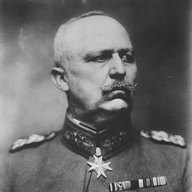
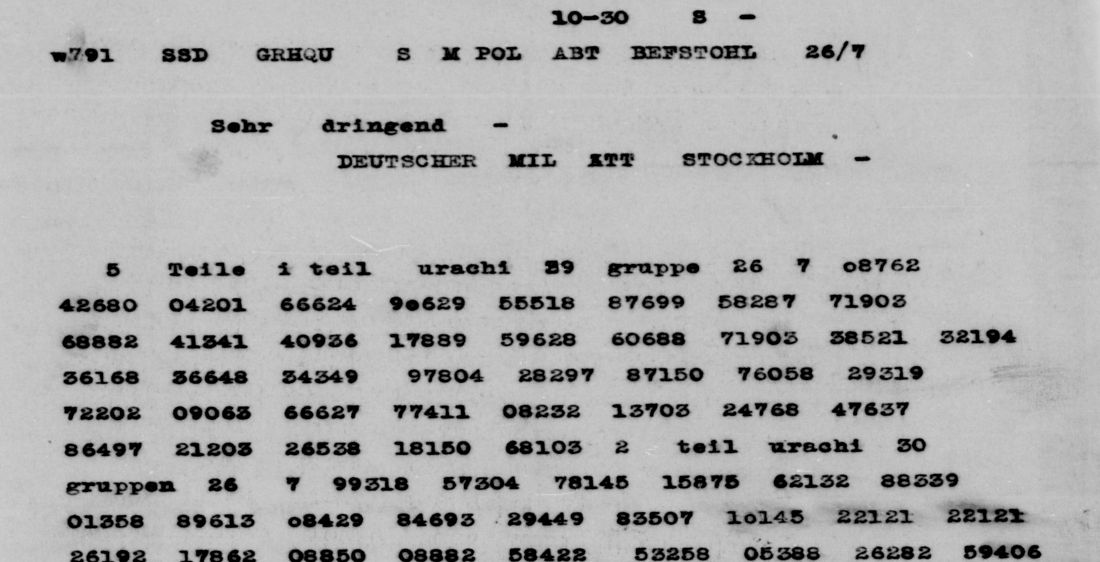
The American Legation in Stockholm reported on 8 October 1918 that among the German telegrams it had obtained was “number nine to German Military Attaché ... signed Ludendorff”. The copy is headed GRHQU, the Grosses Hauptquartier, and marked Sehr dringend.
| Telegram | From, to | Date | Groups | Opens |
|---|---|---|---|---|
| w791 | GrHQu to Military Attaché | 26 July | 170 | teil urachi … |
| w769 | Berlin to Legation | 26th, 11:40 | 45 | funfacht vanadopote |
| w716 | Berlin to Legation | 26th, 7:10 | 23 | funfneun cavesaltri |
| w592 | Berlin to Consulate-General | 26th, 10:30 | 23 | 2507 18 |
| w628 | Berlin to Legation | 22nd, 8:25 | 47 | Fuefsecho Ifesuijuni |
| w611 | Berlin to Legation | 22nd, 5:55 | 20 | hansa 22 juli |
The parts of the Ludendorff telegram declare 39, 30, 38, 31 and 33 groups. We count 39, 30, 37, 31 and 33: part 3 has struck groups on the frame, and one of them must be real. Funfacht, funfneun and fuefsecho look like the German numerals five-eight, five-nine and five-six, climbing with the date, so perhaps a running number for this channel [?]. The ten-letter words after them, and urachi in the Ludendorff telegram, stand where a key indicator would stand [?]. Telegram w611 has clear names among its groups: vera, lilly, hanna, lolo.
02 What the figures show
- They are flat. The index of coincidence per column is 1.01, 1.04, 1.02, 1.06, 1.01 for the Ludendorff telegram and 1.04, 1.03, 0.99, 0.97, 1.04 for the others, where 1.00 is uniform. The numeric codes from the same batches (their own page) reach 2.5 to 9.8 in the first column.
- There are almost no repeats. 71903 occurs twice in the Ludendorff telegram and 03515 twice in w628. Chance alone predicts about 0.5 pairs in 328 groups.
- No additive is reused. Digit coincidence at every offset, within and across the six telegrams, gives one result at |z| ≥ 3.5 in 1,575 tests, against 0.7 expected.
- The Ludendorff telegram has a figure bias (chi-squared 28.9 on 9 degrees, even digits ahead). The typeface confuses 3 and 8, which may be part of it.
This allows a code with a long additive or a purely numeric cipher and does not separate them. Nothing yet shows whether the Army’s telegram and the Foreign Office’s use one system. They are kept together only because they cannot be told apart.
03 What was tried
All six telegrams were tested against everything Mendelsohn prints from MI-8’s work: 13040, 5950, 26040, the 18470 family and the Verkehrsbuch. They were tested plain, with a constant additive from −999 to +999, and with slider no. 1 at all 1,000 settings. No setting rises above chance or gives sense. The study does not mention this traffic.
04 What would finish it
The key, or the clear text. The telegram ends “nr 34298 p roem 4”, which looks like a registry reference [?], a place to start in the Supreme Command’s files in the Bundesarchiv-Militärarchiv at Freiburg, though much of the Prussian army archive burned in 1945. The Politisches Archiv in Berlin may hold a copy, and MI-8’s files in RG 165 and RG 457 or Room 40’s in TNA HW 7 may hold a decode. None of these is online.
05 Sources
- National Archives (US), RG 59, M367: roll 141 frames 1257–1264, roll 122 frames 0156–0157, roll 108 (cable copies).
- C. J. Mendelsohn, Studies in German Diplomatic Codes Employed during the World War (War Department, 1937), Internet Archive.
Transcription, notes and profile: targets/ludendorff1918/.