At a glanceNot solved · text not obtained
- The telegrams
- Ten telegrams from the Foreign Office in Berlin to its legation in Stockholm, some signed by Hintze, Bussche and Stumm. The US Legation obtained copies and sent them to Washington, some by cable from Christiania.
- Where
- National Archives (US), RG 59, Decimal File 763.72, microfilm M367 rolls 141, 114, 122 and 108. Catalogue item 654.
- The cipher
- At least four separate numeric codes, told apart by range and by their first figures. None could be identified.
- What came out
- The heads use a separate numbering code. They give Nr. 923–925 for early July and an unbroken Nr. 1010–1015 for 26–27 July, and they move one batch to about 2 July.
- How it was tried
- Every German code printed in Mendelsohn’s 1937 study of MI-8’s work: plain, with additives, with the slider, and through his page tables. All at the chance level.
- Still open
- All 938 groups. It needs a code book, an MI-8 or Room 40 decode, or the clear drafts in Berlin.
01 The telegrams
In the autumn of 1918 the American Legation in Stockholm reported that it had got hold of “authentic German telegrams to German Legation”, with “dates uncertain”. It sent typed copies by despatch (nos. 1421, 1426 and 1475) and re-cabled most of them from Christiania. The cables were marked for Military Intelligence, whose code section was MI-8. Nothing filed with them gives a decode.
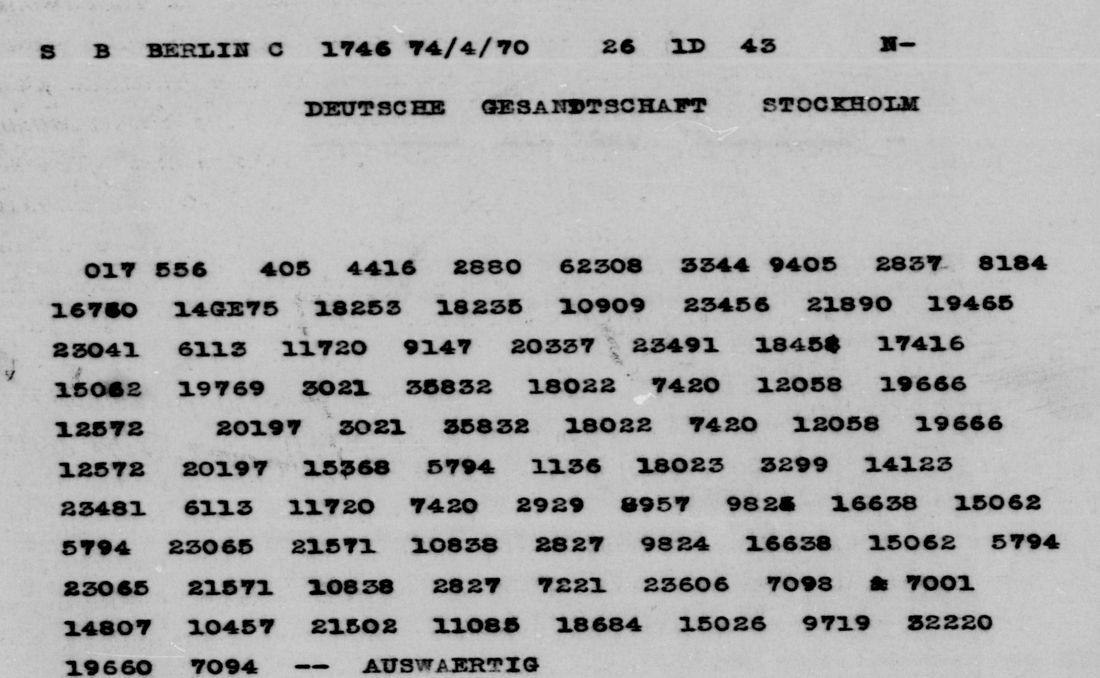
The telegraph headers state how many groups to expect, which makes a useful check. Six telegrams come out exact, and two more do once a run-together group is split and the typist’s two repeated lines are dropped. One, Nr. 1011, stops at 73 of its 120 groups in both American copies, so whoever supplied it was already short. The transcription is in the repository; 3, 5, 6 and 8 run together in this typeface, and doubtful groups are marked.
02 What the heads say
Charles Mendelsohn, who ran the work on German codes in MI-8, explains that the Foreign Office numbered and dated its telegrams from a small separate book, the Dreinummerheft, whichever code the body used. He prints only examples. Those are enough to rebuild how its numbers run, figure by figure. His page 29 shows numbers over 499 taking two groups, such as 692 169 for Nr. 9 + 33, that is 933.
| Head | Number | Sent | Signed | Body |
|---|---|---|---|---|
| 692 157 | 923 | 2nd, 1:30 | Auswaertig | B |
| 692 564 | 924 | 2nd, 2:00 | Auswaertig | B |
| 692 971 | 925 | 2nd, 6:30 | Stumm | A |
| 010 018 | 1010 | 27th, 1:07 | Hintze | A |
| 017 425 | 1011 | 26th, 10:43 | none | C |
| 017 732 | 1012 | 27th, 1:07 | Hintze | A |
| 017 149 | 1013 | 26th, 10:43 | Auswaertig | B |
| 017 556 | 1014 | 26th, 10:43 | Auswaertig | B |
| 017 963 | 1015 | 26th, 9:07 | Bussche | A |
Two things follow. The six telegrams of 26–27 July are consecutive, though they use three different codes, so whoever passed them on saw a continuous run of the legation’s traffic. And the first batch is not from 22–27 July as the catalogue assumed. Nr. 925 carries the group 961, which Mendelsohn gives as “Vom 2 Juli”, and all three telegrams are headed with the day 2. From Nr. 925 to Nr. 1010 in 24 days is about 3.5 telegrams a day, a believable rate. The tenth telegram, of 22 July, has its hundreds struck through: it ends in 88, and 988 would fit, but that is not certain.
03 Four numeric systems
Told apart by measurement only. These letters are ours and do not name code books.
| Telegrams | Groups | Shape | |
|---|---|---|---|
| A | 4 | 544 | Mostly four figures, some five with any leading figure; marked 1219 [?] |
| B | 4 | 179 | Up to about 24000, a few high groups; marked 4407, 4416, 4435 [?] |
| C | 1 | 73 | Up to 47603; 1963 and 1962 recur where a stop might fall [?] |
| D | 1 | 142 | Up to about 18200, with pages 133–134, 143 and 181 very dense |
Inside B, 9405 2837 opens three telegrams and 23456 21890 appears in three, so these are probably set phrases. These repeats are all there is to work from: too few to attack a code of tens of thousands of groups from the ciphertext alone.
04 What was tried
Mendelsohn’s study prints the Zimmermann telegram group by group, other messages in 13040 and its variants 5950 and 26040, about 1,500 groups of the 18470 family, and page tables for 12444, 1777 and 2310. Each system was tested against all of it:
- Plain. Exact matches run at the chance level. System D looked close, with 13049 and 13047 in the block 13040 reserves for its own code number and 18147, which is “entziffern” in the Zimmermann telegram, but 3 hits in 142 is what chance gives. A real 13040 text would be full of und, die and stop.
- A constant additive from −999 to +999, as in 26040. The best outliers come from repeated groups and give nonsense.
- Slider no. 1, rebuilt from his page 98 and reproducing his worked example, at all 1,000 settings. The best settings give nonsense.
- 18470 through his page tables into 12444, 1777 and 2310, against a shuffled-table control: chance. The OCR keeps only about 125 of the 300 pages cleanly, so this is a partial test.
- Bernstorff’s 1917 code (its own page), which looks like system A: chance.
Not tested: the codes 2500, 37000, 29000, 20000, 9700 and 5300 that Mendelsohn knew from the “Dutchman”, because the tables were never printed. Zeman’s 1958 collection has nothing from Berlin to Stockholm for these days.
05 What would finish it
The heads now say exactly what to ask for: Foreign Office telegrams to Stockholm Nr. 923–925 of 1–2 July and Nr. 1010–1015 of 26–27 July 1918, in the Politisches Archiv in Berlin. A clear draft of any of them is a crib for its code. The other routes are MI-8 worksheets in RG 165 and RG 457 at the National Archives and the Room 40 files in TNA HW 7, none of them online. The Ludendorff telegram and the five-figure legation telegrams from the same batches are a different matter, and have their own page.
06 Sources
- National Archives (US), RG 59, M367: roll 141 frames 1255–1266, roll 114 frames 0415–0418, roll 122 frames 0154–0155, roll 108 (cable copies).
- C. J. Mendelsohn, Studies in German Diplomatic Codes Employed during the World War (War Department, 1937), Internet Archive.
- Z. A. B. Zeman, Germany and the Revolution in Russia 1915–1918 (1958), Internet Archive.
Transcription, notes and profile: targets/stockholm1918/.