

At a glanceKnown key applied · partial (98% of the cipher)
- The letter
- A letter of 16 April 1587 (“Ce xvj Avril 1587”), probably from Henri, duc de Guise, to his Lorraine cousin Mercœur. It speaks of “mon frere” and Bellièvre.
- Where
- BnF fr. 15564 f. 78, DECODE R4158. The catalogue listed three records here as an unknown sender to Mercœur, 1587, none decrypted.
- The cipher
- A French cipher with code groups, the same as f. 27 (R4155), which George Lasry deciphered in 2022.
- How it was read
- Lasry says he solved f. 78 but did not publish it. Every sign was transcribed and decrypted with his key, which fits unchanged. A French language model chose between ambiguous key values, and three passes against the images added about fifteen values.
- What it says
- The writer asks Mercœur to delay his decision a few days until his brother can take the place once Bellièvre arrives. He also discusses the levy of reiters and a lady who meddles in affairs.
- Still open
- Three code groups and twelve signs.
- Credit
- Lasry’s key and his f. 27 decipherment are on Satoshi Tomokiyo’s Cryptiana. f. 151 (R4167) is a different cipher, closed as too short in a separate write-up.
01 The three records
| DECODE | folio | what it is | state |
|---|---|---|---|
| R4155 | f. 27 | Guise(?) → Mercœur, same cipher | read by Lasry 2022 (Cryptiana GL.htm) |
| R4158 | f. 78 | the letter of 16 April 1587, one page in three overlapping images | decrypted here; 92.1% of its words read |
| R4167 | f. 151 | “MR” slip of 26 June, a different cipher | closed, too short (mercoeur1586) |
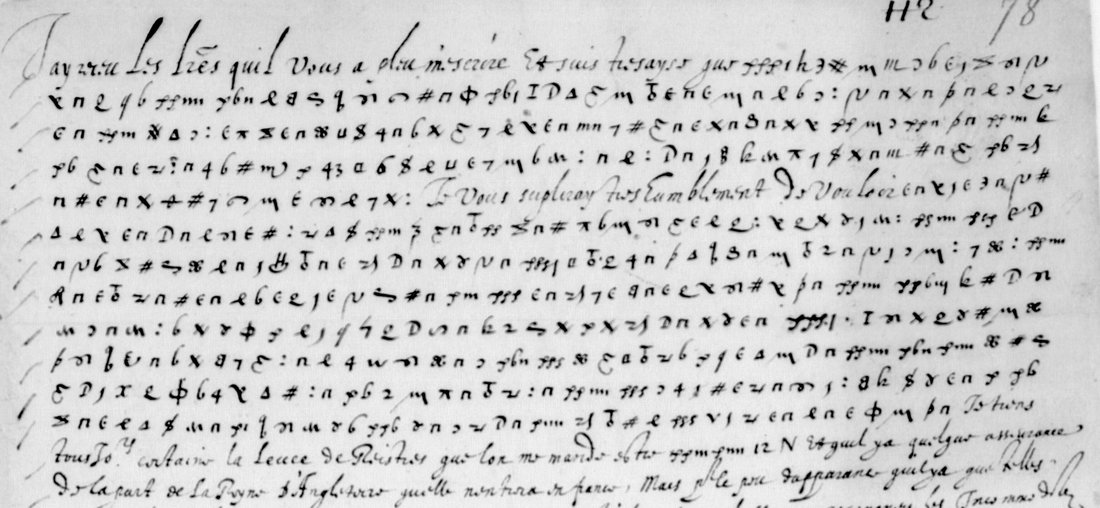
02 The decrypted text
Cipher text in capitals, clear text in lower case. [?] marks an unresolved sign, (?) a doubtful reading, [code …] a nomenclator group left open.
J’ay receu les lettres qu’il vous a pleu m’escrire et suis tresayse que LEUR ADVIS SE RAPPORTE A CE QUE NOUS AVIONS, VEU LES BROUILLERIES, [jugé] ESTRE NECESSAIRE QUE NOSTRE PRESENCE EN VOSTRE GOUVERNEMENT [code]IS(?), PARCE QUE [?] LA PERTE, CEUX QUI(?) PENSEROIENT ESTRE ABANDONNEZ, VEU LA PEUR EN QUOY ILS SONT. Je vous supplieray tres humblement de vouloir RETARDER VOSTRE RESOLUTION QUE DE [code: quelque?] PEU DE JOURS, ATTENDANT QUE MON FRERE PUISSE ALLER PRENDRE LA PLACE, COMME IL FERA SITOST QUE BELLIEVRE SERA ARRIVE, ET VOUS REPORTERA TOUT CE QUE NOUS AURENS ENTENDU DE SA CHARGE, AFIN D’EN PRENDRE LEUR BON ADVIS, COMME EN TOUTES CHOSES. NOUS VOUS SUPPLIE DE CROIRE(?) QUE NOUS LE SUIVRONS AVEC TOUTE LA FIDELITE QUE VOUS SCAURIEZ ATTENDRE DE LA PERSONNE AU MONDE QUI DESIRE LE PLUS VOUS FAIRE SERVICE.
Je tiens tousjours certaine la levee de Reistres que l’on me mande estre [QUE/POUR LE?] 12 N(?), et qu’il y a quelque asseurance de la part de la Royne d’Angleterre qu’elle n’en tirera(?) de France. Mais je [voy?] le peu d’apparance qu’il y a que telles gens voulsissent arrester leur sejour en ung pays si sterile, duquel ilz ont tesmoigne les incommoditez, VEU MESMES QUE LA CAVALLERIE ET LES TROUPES AU [code: DUC] DE PARME NE PEUVENT VIVRE NI DEMEURER, ESTANS QUE CETTE OCCASION FORT DESBANDEES. JE(?) TIENS QUE CERTAIN POUR LEUR BUT ET RETRAICTE, ET PRESTS TOUSIOURS EN P[?] ET SUR NOUS; ET EST PLUS IMPORTANT QUE JAMAIS DE RESOUDRE L’ESTAT DE NOS AFFAIRES ET [??] EMPESCHER LE PASSAGE, ET REPOULSER CE[T ORAGE?] A QUOY NOUS AVONS TOUS PARTICULIER INTEREST, MONSIEUR.
Je trouve tres bon vostre advis que le faict de 23(?), et suis bien d’opinion qu’il seroit fort a propos de L’ACCOMMODER PAR LA DOUCEUR, en ayant escrit a MONSIEUR DE [code 8ı] que [..] massieur(?) de faire en cela ce que nous luy conseillerons. Mais il faut que je vous die librement qu’il A UNE DAME(?) QUI AVEC [PEU DE?] PRUDENCE S’EN EST LE TROP AVANT DES AFFAIRES, AYANT ESTE SI MAL ADVISEE DE VOULOIR PERSUADER A SON MARI QUE SON FRERE ET NOUS NE RECHERCHONS QUE SON CONTENTEMENT PARTICULIER [?] SON DESAVANTAGE, voulant tirer le payement de ses pensions et assignations PAR LA REDDITION DES PLACES. Je suis a la verité honteux(?) de vous parler de cette particularité, mais estans d’une mesme maison cette liberté nous doibt estre permise, d’estimant(?) qu’une(?) lettre de vous a MONSIEUR DE [code 8ı], AVEC CONSEIL DE CE QUE [code: VOUS?] JUGEREZ A PROPOS, QUE LE BIEN GENERAL EN SERVIRA DE BEAUCOUP. Et vous supplie tres humblement luy en vouloir escrire librement, et vous baise tres humblement les mains.
Ce xvj Avril 1587.
In English, in outline: the writer is glad that “their” advice agrees that the troubles make Mercœur’s presence in his government of Brittany necessary, since the people there fear being abandoned. He asks Mercœur to delay his decision a few days, until his brother can go and take the place once Bellièvre has arrived. The reiter levy is certain, and there is some assurance from the Queen of England. In cipher: the Duke of Parma’s cavalry and troops cannot stay, and it is more important than ever to settle “our affairs” and stop the passage. The matter of “23” should be settled “par la douceur”. A lady has meddled too far in affairs and has persuaded her husband that “his brother and we” seek only his own interest, to his cost. He wants his pensions paid “par la reddition des places”. A letter from Mercœur to “Monsieur de [8ı]” would serve the common good.
03 Method
- Cryptiana’s GL.htm (“Duke of Guise? in BnF fr.15564”) gives Lasry’s 2022 key table and his decipherment of f. 27, and says he solved ff. 27, 78, 119 and 142.
- The DECODE images of R4155, R4158, R4167 and neighbouring records were downloaded. The f. 27 overlay was used to calibrate the sign shapes against Lasry’s table.
- Every sign of f. 78 was labelled, one line per cipher run: 952 labels, with each nomenclator group as one label (998 signs when group members are counted singly).
- Where a label had more than one key value, a French letter model of about 1600 (5-grams) chose among them. A stricter solver (simulated annealing) that forced one value per label merged distinct homophones and gave worse text, so it was set aside.
- Three sign-by-sign passes against native-resolution crops added values missing from Lasry’s sheet or wider than it: ɋ/ƀ = M, ɛ = F, ≈ʃ = P, the R shape = B, :: = H, ∽ = G, ∩ = Y, and the groups ʃʃɤ = MON, ʃbn = NOUS, gb = MONSIEUR, g2 = DUC.
04 What stays open
- Three code groups that are not in the key, each used once: ʃʃ in run 3, ẜʃʃ in run 7, ≈ƀ in run 22. The guesses from context (MAIS, QUELQUE, PEU DE) are graded M.
- Twelve unresolved signs in runs 3, 17, 18 and 19 (“EN P[?]”, “[??] EMPESCHER”, “CE[T ORAGE?]”). They are legible, but no key value or French fits the letter count.
- Name codes in the clear text: 8ı (“Monsieur de …”), 23 and 12 N. Each occurs once or twice and is not on Lasry’s sheet.
- Together with the doubtful readings, these holes leave 92.1% of the words of the decrypted text read (measured 24 October 2026), under 95%.
- The sender is not named in the letter. Guise is the most likely writer (Tomokiyo: “probably from the Duke of Guise”), but that is an inference.
Full texts
The transcription and the decryption of every document on this page, so that the reading can be used and checked. Short files are shown here; all are in the repository.
f. 78 (R4158), 16 April 1587 read in part
Henri, duc de Guise (probably) to his Lorraine cousin the duc de Mercœur, 16 April 1587: he asks Mercœur to put off his decision on going to his government of Brittany until his brother can take the place once Bellièvre arrives, reports that the Duke of Parma's troops cannot stay, and urges settling 'our affairs' and stopping the passage.
Builds coherent sentences, but under the read bar of 95% of words read as sense (92% here); the holes are marked in the reading.
Transcription
{leur} k 3 * m W c 6 C 1 P M r
X n l 9 b {que} {nous} l 8 s 9 M q # n F {les} I D O Y m T C n 6 m n l b c : r n x n p n l c l z
C n {que} X O c : C π P C n S u 8 4 n 6 x Y 7 k X C n g 7 # Y n C x n 8 n x X {yyf} m c {par} p n {que} k
{la} P n C z : n 4 6 # m r y 4 3 a 6 8 l u C 7 m b M : n l : D n 1 8 k M π 1 + x n W # n l {la} P
n # C n X + # 7 q m E M l 7 X :
C n X 1 C 3 M r #
p O l X C n D n l M C # : z O + {que} 3 P n T {yf} P n # π b m M Y C l l : X l X ∂ 1 M : {que} {mon} C D
n r 6 X # s S l n / H T n 6 z / D n x ∂ r n {yyf} a T l 4 n / O 9 8 n m 9 2 n r / c m : 7 S : {que}
a n C T z n # C n l 6 C l / C r s # n {et} {vous} C n z / 7 C 9 n C l X M # X p n {que} {nous} k # D n
M c n M : 6 X ∂ F {yf} l / 9 H l D q n k 2 s X y X z / D n X ∂ C n {yyyi} I M x l ∂ # m S
p M 9 C n 6 X 8 7 Y : n l 4 w M S n c {nous} {vous} S Y a T z b y / C / C O m D n {que} {des} {et} S + s
Y D / X l F 6 4 X O # : n {la} 2 m π n T z : n {que} {K2} c 4 / # C z n M / : 8 k 8 ∂ C n {K3}
P n C l O 8 m n {au} 9 M m ∂ 6 {qui} ∂ n c z D n {le} z / T # l {vous} r / z C n l n C F m p n
# n F 9 n S 9 n l {que} {la} 4 / F / C T n C z n {et} {les} : C 7 # a n l {au} 9 2 y a k C 9 n x q C n # Y
n S : F m Y r n M L ∂ n 3 6 F C n r n S : / M l {que} q n : X n l n M p 4 L l m O S C O C : π
n S I / X 3 n 6 S {des} : z n X l {que} / n C : / z X {pour} T n # C I Y : {et} D n : D l z 4 : n : z C n
: 7 # l s M # C l 6 M z / {et} S # C {qui} {et} n l : P T Y S m 9 a M C : l X : {que} m / b / m
l y D n l 7 # π C n T n l : / 8 y 8 7 W / 2 r l m C n l {et} Y C 6 8 z / n S p w n C {et} P l l S
l g n {et} C n a O # T l n C p n : M C / s 6 l R # 7 q {nous} / Y 7 M l : 7 # S {par} 8 m p Y
T m n p m X : n D n S : {N1}
T l 4 q O E 9 M π b C {par} {la} ∂ O Y p 6 # C
a # M n C k 8 n {qui} / F n p z 9 P C F ∂ n M p n l n 8 6 l T n : D 7 a / Y k M : {des} k r 2 k
m 6 6 c k x / X : 6 c : n S m 8 l T / ∂ # m l n 6 y F 1 Y T 7 z C z / n C S # l π n C / S 7 X 8
l C m {que} {K1} r C 6 r n {et} {nous} M n C 6 p 4 6 C p w O M l {que} {K1} 9 O X : 6 x 8 6 9 n x : {par}
: m p F C z n C l l M M ∂ n l / # k X : / g n
{par} {la} C n M π z : m O 8 {des} P C / p n l
l # n p 4 O M c 6 m T y p 6 {que} {K4} # g n C n W k a D M P / l
{que} {le} I m n x g n x 6 C / C x c 6 C # a r k y I n k # 4 7 # a
Decryption
BnF fr. 15564 f. 78 — [Guise] to [Mercoeur], 16 April 1587. Reading, pass 3 (READ: 983/998 cipher signs read as sense, 15 open).
Cipher in CAPITALS. [?] = unread signs; (?) = doubtful; [code: ...] = nomenclator group left open.

J'ay receu les lettres qu'il vous a pleu m'escrire et suis tresayse que LEUR ADVIS SE RAPPORTE A CE QUE NOUS
AVIONS, VEU LES BROUILLERIES, [jugé] ESTRE NECESSAIRE QUE NOSTRE PRESENCE EN VOSTRE GOUVERNEMENT [code ʃʃ]IS(?),
PARCE QUE [?] LA PERTE, CEUX QUI(?) PENSEROIENT ESTRE ABANDONNEZ, VEU LA PEUR EN QUOY ILS SONT.
Je vous supplieray tres humblement de vouloir RETARDER VOSTRE RESOLUTION QUE DE [code: quelque?] PEU DE JOURS,
ATTENDANT QUE MON FRERE PUISSE ALLER PRENDRE LA PLACE, COMME IL FERA SITOST QUE BELLIEVRE SERA ARRIVE, ET VOUS
REPORTERA TOUT CE QUE NOUS AURENS ENTENDU DE SA CHARGE, AFIN D'EN PRENDRE LEUR BON ADVIS, COMME EN TOUTES
CHOSES. NOUS VOUS SUPPLIE DE CROIRE(?) QUE NOUS LE SUIVRONS AVEC TOUTE LA FIDELITE QUE VOUS SCAURIEZ ATTENDRE DE
LA PERSONNE AU MONDE QUI DESIRE LE PLUS VOUS FAIRE SERVICE.

Je tiens tousjours certaine la levee de Reistres que l'on me mande estre [QUE/POUR LE?] 12 N(?), et qu'il y a
quelque asseurance de la part de la Royne d'Angleterre qu'elle n'en tirera(?) de France. Mais je [voy?] le peu
d'apparance qu'il y a que telles gens voulsissent arrester leur sejour en ung pays si sterile, duquel ilz ont
tesmoigne les incommoditez, VEU MESMES QUE LA CAVALLERIE ET LES TROUPES AU [code: DUC] DE PARME NE PEUVENT VIVRE NI
DEMEURER, ESTANS QUE CETTE OCCASION FORT DESBANDEES. JE(?) TIENS QUE CERTAIN POUR LEUR BUT ET RETRAICTE, ET
PRESTS TOUSIOURS EN P[?] ET SUR NOUS; ET EST PLUS IMPORTANT QUE JAMAIS DE RESOUDRE L'ESTAT DE NOS AFFAIRES ET [??]
EMPESCHER LE PASSAGE, ET REPOULSER CE[T ORAGE?] A QUOY NOUS AVONS TOUS PARTICULIER INTEREST, MONSIEUR.

Je trouve tres bon vostre advis que le faict de 23(?), et suis bien d'opinion qu'il seroit fort a propos de
L'ACCOMMODER PAR LA DOUCEUR, en ayant escrit a MONSIEUR DE [code 8ı] que [..] massieur(?) de faire en cela ce que
nous luy conseillerons. Mais il faut que je vous die librement qu'il A UNE DAME(?) QUI AVEC [PEU DE?] PRUDENCE
S'EN EST LE TROP AVANT DES AFFAIRES, AYANT ESTE SI MAL ADVISEE DE VOULOIR PERSUADER A SON MARI QUE SON FRERE
ET NOUS NE RECHERCHONS QUE SON CONTENTEMENT PARTICULIER [?] SON DESAVANTAGE, voulant tirer le payement de
ses pensions et assignations PAR LA REDDITION DES PLACES. Je suis a la verité honteux(?) de vous parler de cette
particularité, mais estans d'une mesme maison cette liberté nous doibt estre permise, d'estimant(?) qu'une(?)
lettre de vous a MONSIEUR DE [code 8ı], AVEC CONSEIL DE CE QUE [code K1: VOUS?] JUGEREZ A PROPOS, QUE LE BIEN
GENERAL EN SERVIRA DE BEAUCOUP. Et vous supplie tres humblement luy en vouloir escrire librement, et vous baise
tres humblement les mains.

Ce xvj Avril 1587.
Reading
# BnF fr. 15564 f. 78: [Guise] to [Mercœur], 16 April 1587: reading

Running text of `f78_reading.txt` (pass 3), written out 23 Oct 2026 (translation wave v7). The decryption gives the
cipher in capitals; here it is set in lower case inside ⟨ ⟩, with capitals for names and sentence starts; the clear
text is plain. Letters are the decryption's (aurens, voulsissent as given). Its marks are kept: `[?]`, `[??]` unread
signs; `(?)` doubtful; `[code …]` a nomenclator group left open (with a proposed sense where the file gives one);
`[word?]`, `[A/B?]` a proposed reading (here `[?word]`, `[?A/B]`); `[jugé]` a word supplied. French.

## Reading

J'ay receu les lettres qu'il vous a pleu m'escrire et suis tresayse que ⟨leur advis se rapporte a ce que nous avions,
veu les brouilleries, [jugé] estre necessaire, que nostre presence en vostre gouvernement [code ʃʃ]is(?), parce que
[?] la perte, ceux qui(?) penseroient estre abandonnez, veu la peur en quoy ils sont.⟩ Je vous supplieray tres
humblement de vouloir ⟨retarder vostre resolution que de [code: ?quelque] peu de jours, attendant que mon frere puisse
aller prendre la place, comme il fera sitost que Bellievre sera arrive, et vous reportera tout ce que nous aurens
entendu de sa charge, afin d'en prendre leur bon advis, comme en toutes choses. Nous vous supplie de croire(?) que
nous le suivrons avec toute la fidelite que vous scauriez attendre de la personne au monde qui desire le plus vous
faire service.⟩

Je tiens tousjours certaine la levee de Reistres que l'on me mande estre [?que/pour le] 12 N(?), et qu'il y a quelque
asseurance de la part de la Royne d'Angleterre qu'elle n'en tirera(?) de France. Mais je [?voy] le peu d'apparance
qu'il y a que telles gens voulsissent arrester leur sejour en ung pays si sterile, duquel ilz ont tesmoigne les
incommoditez, ⟨veu mesmes que la cavallerie et les troupes au [code: Duc] de Parme ne peuvent vivre ni demeurer,
estans que cette occasion fort desbandees. Je(?) tiens que certain pour leur but et retraicte, et prests tousiours en
p[?] et sur nous; et est plus important que jamais de resoudre l'estat de nos affaires et [??] empescher le passage,
et repoulser ce[?t orage], a quoy nous avons tous particulier interest, Monsieur.⟩

Je trouve tres bon vostre advis que le faict de 23(?), et suis bien d'opinion qu'il seroit fort a propos de
⟨l'accommoder par la douceur⟩, en ayant escrit a ⟨Monsieur de [code 8ı]⟩ que [..] massieur(?) de faire en cela ce
que nous luy conseillerons. Mais il faut que je vous die librement qu'il ⟨a une dame(?) qui avec [?peu de] prudence
s'en est le trop avant des affaires, ayant este si mal advisee de vouloir persuader a son mari que son frere et nous
ne recherchons que son contentement particulier [?] son desavantage⟩, voulant tirer le payement de ses pensions et
assignations ⟨par la reddition des places⟩. Je suis a la verité honteux(?) de vous parler de cette particularité,
mais estans d'une mesme maison cette liberté nous doibt estre permise, d'estimant(?) qu'une(?) lettre de vous a
⟨Monsieur de [code 8ı], avec conseil de ce que [code K1: ?vous] jugerez a propos, que le bien general en servira de
beaucoup⟩. Et vous supplie tres humblement luy en vouloir escrire librement, et vous baise tres humblement les mains.

Ce xvj Avril 1587.
Translation
# BnF fr. 15564 f. 78: [Guise] to [Mercœur], 16 April 1587: English translation

Translation (Claude Opus 5.5, 23 Oct 2026) of `f78_reading.md` (pass 3 reading; cipher in ⟨ ⟩). Same holes: `[?]`,
`[??]` unread signs, `(?)` doubtful, `[code …]` an open nomenclator group, `[?word]` a proposed reading, `[word]`
supplied. Where the French is broken the English follows its words without supplying the syntax.

## Translation

I have received the letters which it pleased you to write me, and I am very glad that ⟨their advice agrees with what
we had, given the broils, [judged] to be necessary, that our presence in your government [code ʃʃ]is(?), because [?]
the loss, those who(?) would think themselves abandoned, given the fear they are in.⟩ I shall beg you very humbly to
be willing ⟨to delay your resolution only by [code: ?some] few days, waiting until my brother can go and take the
place, as he will do as soon as Bellièvre has arrived, and he will report to you all that we shall have heard of his
charge, so as to take their good advice on it, as in all things. We beg you to believe(?) that we shall follow it
with all the fidelity you could expect from the person in the world who most desires to do you service.⟩

I still hold certain the levy of reiters which I am told is [?that/for the] 12 N(?), and that there is some assurance
on the part of the Queen of England that she will not draw(?) them from France. But I [?see] how little likelihood
there is that such people would wish to make their stay in so barren a country, of whose inconveniences they have
given testimony, ⟨seeing even that the cavalry and the troops of the [code: Duke] of Parma cannot live or remain
there, being on this occasion much disbanded. I(?) hold that certain for their aim and retreat, and always ready in
p[?] and upon us; and it is more important than ever to settle the state of our affairs and [??] prevent the passage,
and drive back th[?is storm], in which we all have a particular interest, Monsieur.⟩

I find your advice very good, that the matter of 23(?), and I am quite of opinion that it would be very fitting ⟨to
settle it by gentleness⟩, having written of it to ⟨Monsieur de [code 8ı]⟩ that [..] massieur(?) to do in this what
we shall advise him. But I must tell you freely that he ⟨has a lady(?) who with [?little] prudence has gone too far
into affairs, having been so ill advised as to want to persuade her husband that her brother and we seek only his
private satisfaction [?] his disadvantage⟩, wanting to draw the payment of his pensions and assignations ⟨by the
surrender of the places⟩. I am in truth ashamed(?) to speak to you of this particular, but, being of one house, this
freedom must be allowed us, thinking(?) that a(?) letter from you to ⟨Monsieur de [code 8ı], with counsel on what
[code K1: ?you] judge fitting, the general good will be much served by it⟩. And I beg you very humbly to be willing to
write to him freely of it, and I kiss your hands very humbly.

This 16th of April 1587.
Key: GL_BnFfr15564.png, key.md

05 Sources
- BnF français 15564 f. 78; DECODE R4158 (images P2, P3, P5). Siblings R4155 and R4167.
- George Lasry, key for the Guise→Mercœur letters in fr. 15564 (2022), and his f. 27 decipherment, on Satoshi Tomokiyo’s Cryptiana, GL.htm.
The transcription labels, the decoding script, the pass logs and the full decrypted text are in the repository folder targets/mercoeur1587/.