
At a glanceKnown key applied · none (key obtained, text not read)
- The letter
- Seven letters of the Duke of Nevers from the road to Rome, autumn 1593, to Revol and Pisany, while he sought absolution for the newly converted Henri IV from Clement VIII.
- Where
- BnF fr. 3985 and fr. 3986; the catalogue lists them as “avec chiffre” and treated them as one key with one passage deciphered.
- The cipher
- Two keys. The Pisany letters use the numerical cipher Tomokiyo catalogued as no. 46: a two-digit alphabet with homophones, barred and plain figures for words, double-dotted figures for names and the digit 1 as a null. The Revol letters use the symbol cipher no. 60.
- How it was read
- The key was transcribed from the full-resolution table and checked against the office’s own decipherment of a Gondi letter in the same key. It gives a value for every figure of both Pisany letters.
- What it says
- The 8 September letter is deciphered completely: the Pope is not to be contented and one should not go. The 14 October letter, after Possevino said at Poschiavo that Nevers would not be received, is read in long stretches.
- Still open
- The Revol letters: 27 August is in clear throughout, 9 October carries two and a half lines of symbols, and three were not reached on the image. They need the symbol key matched to the copyist’s hand.
01 The letters
The catalogue took seven ciphered copies of Nevers’s letters as one office’s key. They are in two: the five to Revol are in the Court’s symbol cipher no. 60 (their own page), the two to Pisany in no. 46, below.
| Item | Date and place | To | Where on the image | Cipher |
|---|---|---|---|---|
| fr. 3985 no. 116 | Nevers, 8 Sept 1593 | Pisany | f. 209 (canvas 419) | no. 46, decoded, not read |
| fr. 3986 no. 81 | “Ville” [Edolo], 14 Oct 1593 | Pisany | f. 168 (canvas 332) | no. 46, decoded, not read |
Both volumes are microfilm digitisations on Gallica with every canvas labelled NP; the folio is close to half the canvas number, and the 1400 px canvases do not resolve two-digit figures, so the pages were fetched at full IIIF resolution (about 4,900 px wide). Tomokiyo’s Henri IV article states the division of keys: Gondi and Nevers used the symbol cipher no. 60 with the King and Revol from July 1593, and the numerical no. 46 with Vivonne (Pisany). The catalogue entry had not taken that in.
02 The key
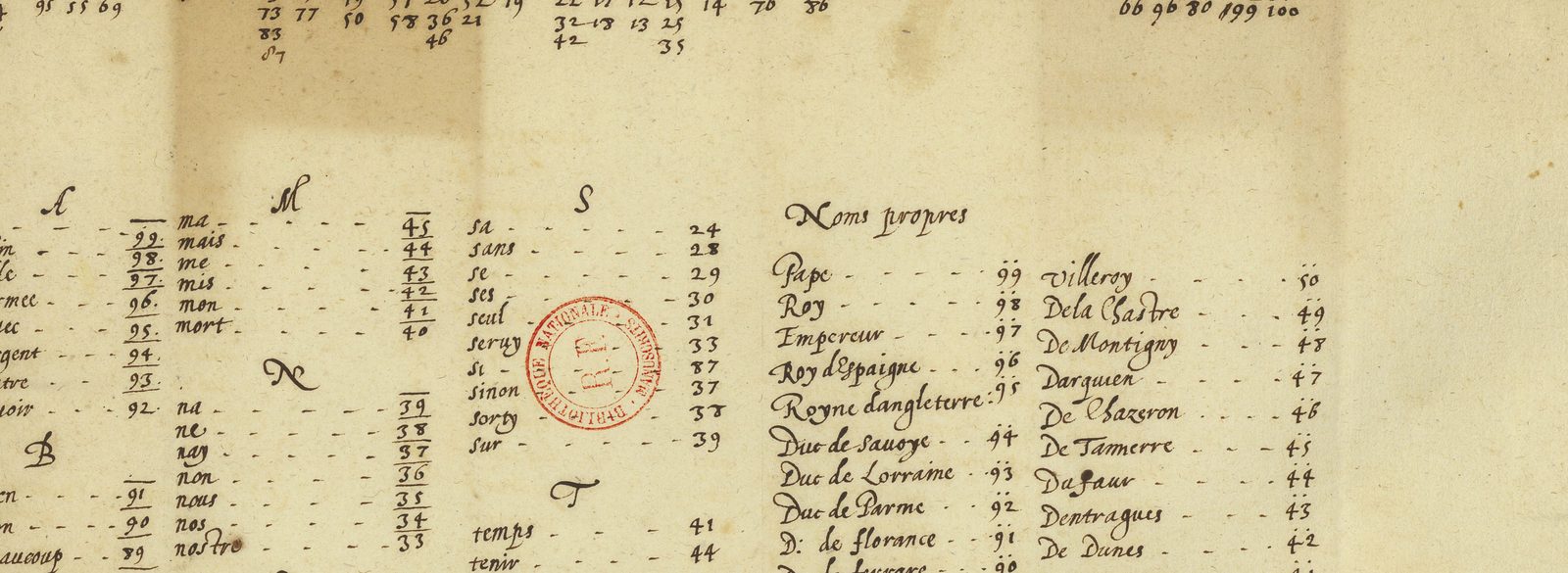
Tomokiyo’s published image of the key is 225 pixels wide; the Gallica image of the sheet is 7,677. The table has a barred series from 99 down to 2 for common words (80̄ de, 56̄ je, 51̄ luy, 53̄ la, 11̄ que, 9̄ quil, 38̄ ne, 73̄ est, 5̄ recherche), a plain series on the figures the alphabet leaves free (24 sa, 28 sans, 29 se, 87 si, 45 tout, 62 vous, and the provinces), and a double-dotted series of names (99 Pape, 98 Roy, 88 Duc de Nevers, 70 Cardinal Gondi, 89 Duc de Mantoue, 54 Revol, 34 De Pizany, 1 Ambassadeur). In the letters the digit 1, and once 0, is dropped inside a group as a null, the device the sister key no. 45 prescribes in words. The conventions were checked against a letter the office deciphered interlinearly in the same key, Girolamo Gondi to Pisany of 22 September 1593 (fr. 3986 ff. 64–65v): personne, rencontre, congregation, absoudre, sainct, siege, ladicte, Romme all come out figure for figure.
03 8 September 1593, fr. 3985 f. 209

Three passages, 122 figure groups, all in the key. Decoded, not read: passage 2 holds as a sentence, but passages 1 and 3 rest on figures the copyist wrote wrong. Passage 1’s figures were looked at again on the Gallica IIIF image on 23 October 2026 and are as transcribed, so these are slips in the copy, not in the transcription. The partial reading is texts/f209_reading.md.
- “Car j’estois sur ce mesme faict” l’on dissuadoit [Pape] de rechercher [Pape] luy don[n]es[t] l’absolutio[n]. The copy has the Pope’s sign twice; one of them is probably the King’s (98̈) in sense. Tomokiyo deciphered this passage with the figure 14 for 74 and the name as Beaulieu; the figures are 74 and, in the next passage, 54 Revol.
- “Car” [Duc de Nevers] alléguoit qu’il n’estoyt besoin qu’il a[l]la[s]t sans cela, parce qu’il ne feroit rien, then in clear “Je suys attendant des nouvelles de” [Revol] “à qui j’ay escript”. Nevers is named by his sign in his own letter; the 61 in allast is a slip for 65.
- “Je suys d’opinion que” l’on n’a [11] volonté d[14]e contanter le Pape, que l’on n’[y a]ille poynt, and in clear “Et suys bien ayse que soyez de mesme volonté”. Several figures in this passage are the copyist’s (11 where the u of volonté is expected, 14 inside de, 57 83 84 where y a i is expected).

04 14 October 1593, fr. 3986 f. 168
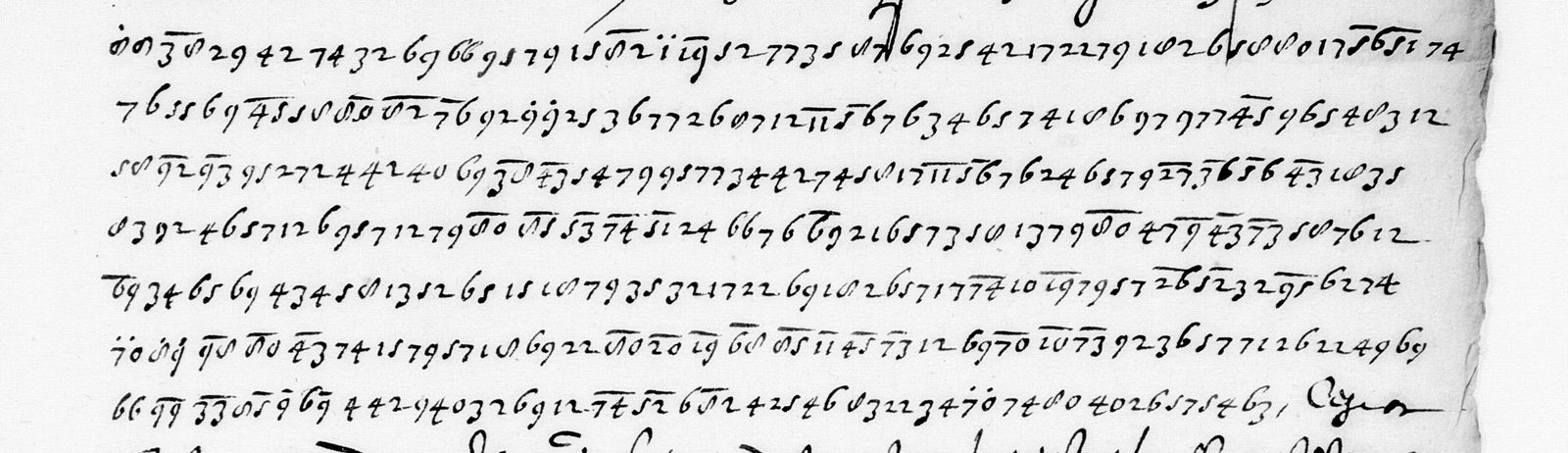
Seven full lines of figures, a short run and one more line: 269 groups, 268 in the key. No decipherment, original or edition of this letter is known. On 22 October 2026 the figures were re-read on the IIIF image (4,948 px): fourteen corrections, mostly bars set on the wrong figure in the first pass and groups wrongly divided (texts/f168_corrections.tsv). The reading (texts/f168_reading.md, English f168_en.md) now holds in about half its sentences:
[le Duc de Nevers] ne sera receu come [Ambassadeur] pour pluseurs resons.
Je luy ay demandé come [...] [le Pape] voloit que j’y alase; el[le] m’a dit n’avoir autre charge, ne me declarans que j’y alle ou non.
Ce qu’il faict tenir segret, et le [faire] savoir a [Cardinal Gondi] [...].
Lines 4, 5 and the last line keep holes where the copyist’s figures are corrupt (24 for a, 27̄ for 29̄, dropped figures), legible but wrong, so the letter stays decoded, not read. Tomokiyo’s fragment stopped at “Je luy ay demandé”. Only a second witness, Pisany’s original, which has not been located, could restore the corrupt groups.
05 The letters to Revol
Nevers’s letters of the same months to Louis de Revol, secretary of state, are in the Court’s symbol cipher no. 60, a different cipher, with its own page.
Full texts
The transcription and the decryption of every document on this page, so that the reading can be used and checked. Short files are shown here; all are in the repository.
Nevers to Pisany, 8 Sept 1593, BnF fr. 3985 f. 209 (copy) decoded, not read
During his embassy to Rome for Henri IV's absolution, Nevers writes to Pisany that people were dissuading the King from seeking the Pope's absolution, that he (Nevers) argued there was no need for him to go without it, and that if there is no will to satisfy the Pope one should not go at all.
A mechanical decode with holes in most sentences: shown so that the transcription and the key can be checked and improved, not as a reading.
Transcription
# BnF fr. 3985 f. 209 (Gallica btv1b90606498 canvas 419), Nevers to Pisany, Nevers, 8 Sept 1593, copy.
# Transcribed 17 Sept 2026 from the full-resolution IIIF image (4726 x 6530). Conventions: see decode46.py.
# Passage 1, lines 4-5, after "Car j'estois sur ce mesme faict"
50_ 54 73 17 25 74 55 1 46 83 12 99: 80_ 5_ 1 42 99: 51_ 76_ 79 18 53_ 90 17 36 77 25 12 83 29_
# Passage 2, lines 6-7, after "Car" ... before "de 54: a qui j'ay escript"
88: 97_ 40 36 76 13 9_ 38_ 73_ 46 76 12 90 69 17 46 73 58 9_ 34 61 74 13 28 85_ 53_ 26_ 29
11_ 63 77 38_ 71 69 42 83 12 32 63 79 58 [de] 54:
# Passage 3, lines 19-22, after "Je suys d'opinion que"
65 46 58 57 34 11 46 77 26 58 13 55 14 69 92 36 57 12 74 58 13 79 42 77 69 21
34 52 79 19 35 79 65 26 58 58 57 83 84 77 76 51 79 21 46 76 57 13 92 1
Decryption
# BnF fr. 3985 f. 209 (Gallica btv1b90606498 canvas 419), Nevers to Pisany, Nevers, 8 Sept 1593, copy.
# Transcribed 17 Sept 2026 from the full-resolution IIIF image (4726 x 6530). Conventions: see decode46.py.
# Passage 1, lines 4-5, after "Car j'estois sur ce mesme faict"
50_ 54 73 17 25 74 55 1 46 83 12 99: 80_ 5_ 1 42 99: 51_ 76_ 79 18 53_ 90 17 36 77 25 12 83 29_
    <lon>disuad<Franchecomte>oit<Pape><de><recherche><Franchecomte>r<Pape><luy><don>es<la>bsoluti<ou>
# Passage 2, lines 6-7, after "Car" ... before "de 54: a qui j'ay escript"
88: 97_ 40 36 76 13 9_ 38_ 73_ 46 76 12 90 69 17 46 73 58 9_ 34 61 74 13 28 85_ 53_ 26_ 29
    <Duc de Nevers><alle>goyt<quil><ne><est>oytbesoin<quil>a<vostre>at<sans><ce><la><par><se>
11_ 63 77 38_ 71 69 42 83 12 32 63 79 58 [de] 54:
    <que>il<ne>feritrien de <Revol>
# Passage 3, lines 19-22, after "Je suys d'opinion que"
65 46 58 57 34 11 46 77 26 58 13 55 14 69 92 36 57 12 74 58 13 79 42 77 69 21
    lonna<repris>olontdxecontanterlep
34 52 79 19 35 79 65 26 58 58 57 83 84 77 76 51 79 21 46 76 57 13 92 1
    ape qu uelonnni<Angleterre>ly<treve>epoyntc<Franchecomte>
# tokens 122, resolved 122
Decryption
# Copied verbatim from NOTES.md (22 Oct 2026), section on fr. 3985 f. 209: the three cipher passages with their readings. The line-by-line decode is decode_f209.txt.
## fr. 3985 f. 209, Nevers to Pisany, 8 September 1593 (`ct_3985_f209.txt`, `decode_f209.txt`)

One page, three passages in figures inside a clear letter. Transcribed from the full-resolution image, 122 tokens.

1. After "Car j'estois sur ce mesme faict": `50̄ 54 73 17 25 74 55 1 46 83 12 99̈ 80̄ 5̄ 1 42 99̈ 51̄ 76̄ 79 18 53̄ 90 17 36 77
   25 12 83 29` = **l'on dissuadoit [Pape] de rechercher [Pape] luy don[n]es[t] l'absolutio[n]**. Tomokiyo's reading of
   this passage (with 14 for 74 and "Beaulieu") is confirmed and corrected. One of the two 99̈ is probably a slip for
   98̈ Roy ("l'on dissuadoit le Roy de rechercher que le Pape luy donnast l'absolution"); the copy has 99̈ both times.
   Final 29 (se) stands where 26/36/46 + 57/58 (on) is expected.
2. After "Car": `88̈ 97̄ 40 36 76 13 9̄ 38̄ 73̄ 46 76 12 90 69 17 46 73 58 9̄ 34 61 74 13 28 85̄ 53̄ 26̄ 29 11̄ 63 77 38̄ 71 69 42
   83 12 32 63 79 58` + "de" `54̈` = **[Duc de Nevers] alléguoit qu'il n'estoyt besoin qu'il a[l]la[s]t sans cela, parce
   qu'il ne feroit rien … de [Revol]** (61 is a slip for 65 l; Tomokiyo read "atat" and "Beaulieu" for 54̈ = Revol).
   Nevers speaks of himself in the third person, or the copyist substituted the name sign for "je".
3. After "Je suys d'opinion que": `65 46 58 57 34 11 46 77 26 58 13 55 14 69 92 36 57 12 74 58 13 79 42 77 69 21 / 34 52
   79 19 35 79 65 26 58 58 57 83 84 77 65 1 79 21 46 76 57 13` = **l'on n'a [11] volonté d[14]e contanter le Pape, que l'on
   n'[y a]ille poynt**, followed in clear by "Et suys bien ayse que soyez de mesme volonté". 11 stands where u (15) is
   expected and 14 (x) inside "de"; 57 83 84 where y a i is expected. Sense: if there is no will to satisfy the Pope,
   do not go to Rome at all.
Nevers to Pisany, 14 Oct 1593, BnF fr. 3986 f. 168 (copy) decoded, not read
Written the day after Possevino's message at Poschiavo: the Duke of Nevers will not be received as ambassador for several reasons; Nevers reports what he was told and his intention to advance and do as he was written, with Cardinal Gondi and the Duke of Mantua named. Read in long stretches; several passages remain garbled by the copyist's figures.
A mechanical decode with holes in most sentences: shown so that the transcription and the key can be checked and improved, not as a reading.
Transcription
# BnF fr. 3986 f. 168 (Gallica btv1b9060631k canvas 332), Nevers to Pisany, 14 Oct 1593, copy.
# Transcription 17 Sept 2026 from the full-resolution IIIF image (4948 x 6958), 2.4-3.2x crops. Single 1 and 0 are
# written as separate tokens where they look like intercalated nulls. Doubtful figures: line 2 '81_ 27 69 29',
# '67 63 46 57 41 08'; line 3 '30_ 8_' (read as 'ne' + null), '67 62 46 51 79 27_ 3_ 6', '10 83 5'; line 4 '03',
# '71 27', '24 66'; line 5 '43 45 8 13', '71 77 4_ 10'; line 7 '6 81_', '03 22 34', '74 80 40 26 51 54 63 1'.
# line 1, after "... ce qu'il en dit et"
88: 38_ 29 42 74 32 69 66 9 1 5 79 15 82_ 1: 19_ 52 77 35 18 69 25 42 17 22 79 18 26 58 80 17 56_ 51_ 74
# line 2
76 55 69 45_ 58 80_ 81_ 27 69 29 99: 25 36 77 26 87 12 11_ 5_ 67 63 46 57 41 08 69 79 77 45_ 96 54 83 12
# line 3
58 92_ 93_ 95 27 24 42 40 69 30_ 8_ 43_ 54 79 95 77 34 42 74 58 17 11_ 5_ 67 62 46 51 79 27_ 3_ 6 56_ 43_ 10 83 5
# line 4
03 92 46 57 12 69 58 71 27 9_ 80_ 85_ 53_ 74_ 51_ 24 66 76 69 21 65 73 58 13 79 80_ 47_ 43_ 73_ 58 76 12
# line 5
69_ 34 65 69 43 45 8 13 52 65 15 8 79 35 32 17 22 69 18 26 58 71 77 4_ 10 19_ 79 57 26_ 5 12 32 9_ 5 62 74
# line 6
70: 89: 95_ 80_ 43_ 74 15 79 57 18 69 22 80_ 20_ 19_ 68_ 85_ 11_ 45_ 73_ 12 69 70_ 10_ 73_ 92 36 57 71 26 22 49 69
# line 7
66 99_ 33_ 85_ 9_ 69_ 44 29 40 32 69 12 74_ 52_ 6 81_ 24 25 46 03 22 34 70: 74 80 40 26 51 54 63 1
# short line after "fait aussi quil"
53_ 47_ 89_ [i ss 15 xxvj] 83 25 77 69 17
# last line
18 73_ 33_ 15 18 12 63 26 57 73_ 87_ 3_ 29 40 42 69 12 79 45 76 22 74 80 34 77
Transcription
# BnF fr. 3986 f. 168 (Gallica btv1b9060631k canvas 332), Nevers to Pisany, 14 Oct 1593, copy.
# Second pass 22 Oct 2026 (Claude Opus 5.5): re-read on the openapi.bnf.fr IIIF full image (4948 x 6958) at 1.4-2.2x,
# changes against ct_3986_f168.txt listed in texts/f168_corrections.tsv. Conventions as in decode46.py.
# line 1, after "... ce qu'il en dit et"
88: 38_ 29 42 74 32 69 66 9 1 5 79 15 82_ 1: 19_ 52 77 35 18 69 25 42 17 22 79 18 26 58 80 17 56_ 51_ 74
# line 2
76 55 69 45_ 58 80_ 82_ 7 69 2 99: 25 36 77 26 87 12 11_ 56_ 76 34 65 74 18 69 79 77 45_ 96 54 83 12
# line 3
58 92_ 93_ 95 27 24 42 40 69 38_ 43_ 54 79 95 77 34 42 74 58 17 11_ 56_ 76 24 65 79 27_ 36_ 56_ 43_ 18 35 83
# line 4
92 46 57 12 69 57 12 27 9 80_ 85_ 53_ 74_ 51_ 24 66 76 69_ 21 65 73 58 13 79 80_ 47_ 9_ 43_ 73_ 58 76 12
# line 5
69_ 34 65 69 43 45 8 13 52 65 15 18 79 35 32 17 22 69 18 26 57 17 74_ 10 19_ 79 57 26_ 52_ 32 9_ 5 62 74
# line 6
70: 89: 95_ 80_ 43_ 74 15 79 57 18 69 22 80_ 20_ 19_ 68_ 85_ 11_ 45_ 73_ 12 69 70_ 10_ 73_ 92 36 57 71 26 22 49 69
# line 7
66 99_ 33_ 85_ 9_ 69_ 44 29 40 32 69 12 74_ 52_ 6 82_ 24 25 46 83 22 34 70: 74 80 40 26 51 54 63 1
# short line after "fait aussi quil"
53_ 47_ 89_ [i ss 15 xxvj] 83 25 77 69 17
# last line
18 73_ 33_ 15_ 18 12 63 26 57 73_ 87_ 3_ 29 40 42 69 12 79 45 76 22 74 80 34 77
Transcription
line	first_pass	second_pass	decodes_as	basis
2	81_ 27 69 29	82_ 7 69 2	come [...]	second figure under the bar is the copyist 2 (as in 92); 7 69 2 unread
2	5_ 67 63 46 57 41 08 69	56_ 76 34 65 74 18 69	je y alase	bar over 5 runs on over 6; the stroke before the looped 8 is a 1, no 0
3	30_ 8_	38_	ne	one bar covers 3 and 8
3	5_ 67 62 46 51 79 27_ 3_ 6	56_ 76 24 65 79 27_ 36_	je y alle on non (ou non)	bars over 5-6 and over .3-6; 24 for a as in ch-24-rge
3-4	10 83 5 / 03	18 35 83	sui[s]	looped figure after 1 is 8; line 4 opens with 8 3 run on from line 3
4	58 71 27	57 12 27	content + 27	5 7 1 2 as in the first content
4	69 21	69_ 21	faict pl-	bar over 69
4	47_	47_ 9_	lettre qu il	bar covers 7 and 9 separately from 4
5	43 45 8 13 52 65 15 8 79	43 45 8 13 52 65 15 18 79	pluseurs	the 8 before 79 is the second figure of 18
5	58 71 77 4_	57 17 74_	ons et	bar over 74; 7 1 7 7 4 = 57 17 74
5	26_ 5 12 32 9_ 5	26_ 52_ 32 9_ 5	par le r (parler)	second bar over 5 2; no 1
7	6 81_ 24 25 46 03 22 34	68_ 24 25 46 83 22 34	faire sa-voir a	bar over 6 8 (faire); 83 not 03
9	15 18	15_ 18	propos s-	bar over 15
Decryption
# BnF fr. 3986 f. 168 (Gallica btv1b9060631k canvas 332), Nevers to Pisany, 14 Oct 1593, copy.
# Transcription 17 Sept 2026 from the full-resolution IIIF image (4948 x 6958), 2.4-3.2x crops. Single 1 and 0 are
# written as separate tokens where they look like intercalated nulls. Doubtful figures: line 2 '81_ 27 69 29',
# '67 63 46 57 41 08'; line 3 '30_ 8_' (read as 'ne' + null), '67 62 46 51 79 27_ 3_ 6', '10 83 5'; line 4 '03',
# '71 27', '24 66'; line 5 '43 45 8 13', '71 77 4_ 10'; line 7 '6 81_', '03 22 34', '74 80 40 26 51 54 63 1'.
# line 1, after "... ce qu'il en dit et"
88: 38_ 29 42 74 32 69 66 9 1 5 79 15 82_ 1: 19_ 52 77 35 18 69 25 42 17 22 79 18 26 58 80 17 56_ 51_ 74
    <Duc de Nevers><ne><se>rare·<Provence><Franchecomte><Nivernois>eu<come><Ambassadeur><pour>pluseursreson·s<je><luy>a
# line 2
76 55 69 45_ 58 80_ 81_ 27 69 29 99: 25 36 77 26 87 12 11_ 5_ 67 63 46 57 41 08 69 79 77 45_ 96 54 83 12
    yde<ma>n<de><dans>he<se><Pape>uoloit<que><recherche><volle>ion<temps><Daulphine>eel<ma>·dit
# line 3
58 92_ 93_ 95 27 24 42 40 69 30_ 8_ 43_ 54 79 95 77 34 42 74 58 17 11_ 5_ 67 62 46 51 79 27_ 3_ 6 56_ 43_ 10 83 5
    n<avoir><autre>ch<sa>rge<ordre><quand><me>declarans<que><recherche><volle><vous>o<treve>e<on><retour><Bourgongne><je><me><renvoie>i<Nivernois>
# line 4
03 92 46 57 12 69 58 71 27 9_ 80_ 85_ 53_ 74_ 51_ 24 66 76 69 21 65 73 58 13 79 80_ 47_ 43_ 73_ 58 76 12
    <Bourbonnois>contenfh<quil><de><ce><la><et><luy><sa>·yeplinte<de><lettre><me><est>nyt
# line 5
69_ 34 65 69 43 45 8 13 52 65 15 8 79 35 32 17 22 69 18 26 58 71 77 4_ 10 19_ 79 57 26_ 5 12 32 9_ 5 62 74
    <faict>ale{43}<tout><Daulphine>tplu<Daulphine>eursresonfl<repos><renvoie><pour>en<par><Nivernois>tr<quil><Nivernois><vous>a
# line 6
70: 89: 95_ 80_ 43_ 74 15 79 57 18 69 22 80_ 20_ 19_ 68_ 85_ 11_ 45_ 73_ 12 69 70_ 10_ 73_ 92 36 57 71 26 22 49 69
    <C. Gondi><Duc de Mantoue><avec><de><me>auenser<de><plus><pour><faire><ce><que><ma><est>te<escrit><qui><est>conforme
# line 7
66 99_ 33_ 85_ 9_ 69_ 44 29 40 32 69 12 74_ 52_ 6 81_ 24 25 46 03 22 34 70: 74 80 40 26 51 54 63 1
    ·<au><nostre><ce><quil><faict><tenir><se>gret<et><le><Bourgongne><dans><sa>uo<Bourbonnois>ra<C. Gondi>a·go<treve>di<Franchecomte>
# short line after "fait aussi quil"
53_ 47_ 89_ [i ss 15 xxvj] 83 25 77 69 17
    <la><lettre><beaucoup>{[i}{ss}u{xxvj]}iules
# last line
18 73_ 33_ 15 18 12 63 26 57 73_ 87_ 3_ 29 40 42 69 12 79 45 76 22 74 80 34 77
    s<est><nostre>ustion<est><bruit><retour><se>grete<tout>yra·al
# tokens 269, resolved 268
Decryption
<!-- Reading of the cipher of fr. 3986 f. 168, built 22 Oct 2026 by Claude Opus 5.5 from the second-pass transcription
ct_3986_f168_r2.txt (figures re-read on the openapi.bnf.fr IIIF image, 4948 px, at 1.4-2.2x; changes in
f168_corrections.tsv) decoded with key no. 46 (key46.txt, decode46.py). No contemporary decipherment, clear copy or
edition of this letter exists (see f168_reread_log.md). Every word is carried by its figures; [Name] = a name or word
sign of the key; [?word] = partly carried; [...] = unread; spelling as the decode gives it, apostrophes and
punctuation added. Clear words leading into the cipher are in ⟨ ⟩. -->

# Nevers to Pisany, 14 October 1593 (BnF fr. 3986 f. 168, copy): the cipher

⟨... ce qu'il en dit et⟩ [le Duc de Nevers] ne sera receu come [Ambassadeur] pour pluseurs resons.

Je luy ay demandé come [...] [le Pape] voloit que j'y alase; el[le] m'a dit n'avoir autre charge, ne me declarans
que j'y alle ou non.

Je me sui[s] content[é] [...] de cela, et luy ay faict plainte de [lettre] qu'il m'est [...].

[...] faict [?alleguant] pluseurs resons, et [...] pour en parler [...] vous a[...]

[le Cardinal Gondi] [le Duc de Mantoue] avec, de m'avancer de plus pour faire ce que m'a esté escrit, qui est
conforme au nostre.

Ce qu'il faict tenir segret, et le [faire] savoir a [Cardinal Gondi] [...].

⟨... fait aussi qu'il⟩ [la] [lettre] [beaucoup] [...]

[...] est nostre [...]stion; est bruit [...] segrete, tout yra [...].

## Notes, line by line

- Line 1: unchanged from the first pass (Tomokiyo's fragment, confirmed). 66 and the lone 9 1 5 are nulls; 32 69
  [66] 9 1 5 79 15 = re·ceu.
- Line 2: `76 55 69 45̄ 58 80̄` = y de ma n de (demandé). `82̄` = come (the first pass read 81̄ dans: the second figure
  is the copyist's 2, the same shape as in 92). `7 69 2` is unread (1/7 and 2/9 are close in this hand; no value set
  tried gives a word: "comment", "si le", "ce que" were tested). `11̄ 56̄ 76 34 65 74 18 69` = que je y alase (the
  first pass read `5_ 67 63 46 57 41 08`: the bar over 5 runs on over 6, and the ı before ϑ is a 1, not 1 0).
  `79 77 45̄ 96 54 83 12` = el ma [null] dit: "el[le] m'a dit", elle = Sa Sainteté.
- Line 3: `38̄` = ne (first pass `30_ 8_` = ordre quand: the bar covers 3 and 8). `95 27 24 42 40 69` = ch-a-rge: 24
  (plain series "sa") stands where a (34) is expected, here and in "j'y alle" (`76 24 65 79`); in line 7 it is "sa"
  proper. `27̄ 36̄` = on non: barred 27 is "on"; "ou non" (29̄) is meant, a 7/9 slip. `56̄ 43̄ 18 35 83` = je me sui[s]
  (first pass `10 83 5` + `03`).
- Line 4: `92 46 57 12 69 57 12` = content (first pass `58 71 27` for `57 12 27`); `27 9` after it unread (content[é]
  needs 79 or 69). `80̄ 85̄ 53̄ 74̄ 51̄ 24 66 76 69̄` = de ce la et luy a[y] faict (69 is barred: faict). `21 65 73 58 13 79` =
  pl[a]inte. `80̄ 47̄ 9̄ 43̄ 73̄` = de lettre qu'il me est; `58 76 12` (n y t) unread.
- Line 5: `69̄ 34 65 69` = faict ale-; `43 45 8 13` unread: "alleguant" (40 15 34 58 13) would need 3 for 0 and a
  missing figure, so it is marked [?alleguant]. `52 65 15 18 79 35 32 17` = pluseurs (the first pass's extra 8 was the
  crop overlap); `22 69 18 26 57 17` = resons; `74̄` = et. `10` (plain: renvoie) unread. `19̄ 79 57 26̄ 52̄ 32` = pour en
  par·le·r = parler (two barred word signs and r: the first pass read the bar over 5 as 5̄ recherche). `9̄ 5` unread;
  `62 74` = vous a.
- Line 6: unchanged: [Gondi] [Mantoue] avec de me avenser (avancer) de plus pour faire ce que m'a esté escrit qui est
  conforme.
- Line 7: `66 99̄ 33̄` = [null] au nostre. `85̄ 9̄ 69̄ 44 29 40 32 69 12` = ce qu'il faict tenir se-g-r-e-t. `74̄ 52̄ 68̄` =
  et le faire (the bar over 6 8; first pass `6 81_`), `24 25 46 83 22 34` = sa-u-o-i-r a: savoir a. `70̈` = Cardinal
  Gondi. `74 80 40 26 51 54 63 1` = a · g o [51] d i: "a Go[n]di"(?) with 51 for 57, left unread as a word.
- Short line: `53̄ 47̄ 89̄` = la lettre beaucoup; the rest is struck clear text ("i ss 15 xxvj") and `83 25 77 69 17`
  (i u l e s), unread.
- Last line: `18 73̄ 33̄` = s'est nostre; `15̄ 18 12 63 26 57` = propos + stion: "[que]stion" with 15̄ for 19 15 (qu)?
  Unread as a word. `73̄ 87̄ 3̄` = est bruit retour; `29 40 42 69 12 79` = se-grete; `45 76 22 74` = tout yra; `80 34 77`
  = [null] a l.
Decryption
<!-- English of f168_reading.md (22 Oct 2026, Claude Opus 5.5); same holes. -->

# Nevers to Pisany, 14 October 1593 (BnF fr. 3986 f. 168): the cipher in English

⟨... what he says of it, and⟩ that [the Duke of Nevers] will not be received as [Ambassador], for several reasons.

I asked him how [...] [the Pope] wished me to go there; he [His Holiness] told me he had no other charge, not
declaring to me whether I should go or not.

I was content [...] with that, and complained to him of the [letter] which is [...] to me.

[...] made [?alleging] several reasons, and [...] to speak of it [...] you have [...]

[Cardinal Gondi] [the Duke of Mantua] with [them?], to advance further in order to do what has been written to me,
which agrees with ours.

Which he keeps secret, and [will] make it known to [Cardinal Gondi] [...].

⟨... also makes him⟩ [the] [letter] [much] [...]

[...] is our [...]question; it is rumoured [...] secret, all will go [...].
06 Sources
- BnF, Département des Manuscrits, Français 3985 (Gallica ark:/12148/btv1b90606498) and Français 3986 (ark:/12148/btv1b9060631k), Mémoires de la Ligue; Français 3995 f. 86–87 (ark:/12148/btv1b525085665), key no. 46.
- S. Tomokiyo, Catalogue of Ciphers (Mainly Related to Duke of Nevers) in BnF fr. 3995, no. 46 and no. 60; French Ciphers during the Reign of Henry IV, on the Gondi–Nevers correspondence of 1593–94.
- Working files in
targets/nevers1593/: the key tablekey46.txt, the decoder, the two transcriptions, the segmentation scorer, and the notes; key no. 60 and the Revol letters are intargets/revol1593/.