At a glanceKnown key applied · partial (91% of the cipher)
- The letter
- Pelissier, the Catholic League’s agent in Spain, to Pierre Jeannin, councillor of the duc de Mayenne, Burgos, 13 September 1592; a long report, mostly in cipher.
- Where
- BnF français 3982, no. 22, ff. 46r–50r. It had only a few interlinear glosses by a contemporary decipherer.
- The cipher
- A homophonic alphabet with one to seven signs per letter, signs for et and doubled letters, six nulls, and code groups such as 315 (Henri IV).
- How it was read
- Satoshi Tomokiyo’s key, rebuilt from nos. 45 and 46, fits. It was calibrated on 1,764 signs of those letters aligned with their clear decipherment, then every page was decrypted again.
- What it says
- Philip grants Pelissier 500 ducats to wait for news. He argues for two armies at about 300,000 écus a month and warns that Mayenne’s authority is being undermined.
- Still open
- 94% of ciphered words give sense (93% of plaintext words, below the 95% bar). 256 gaps remain, with group 310 (probably Savoy), 441 (probably France) and the confessor’s name.
- Credit
- Satoshi Tomokiyo, for the key.
01 The letter
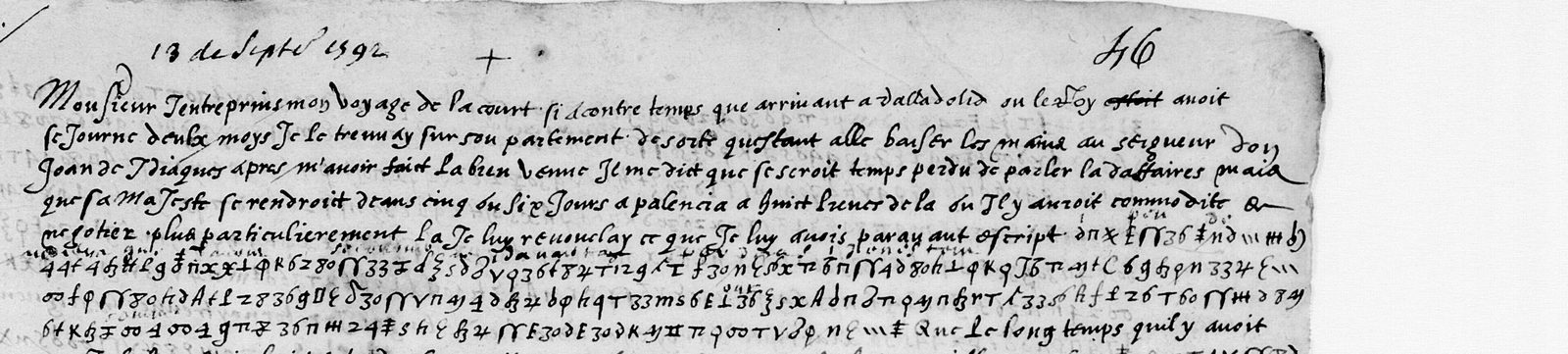
BnF fr. 3982 is one of the Mémoires de la Ligue volumes (fr. 3974–3995), which gather League correspondence, much of it ciphered, from the 1580s and 1590s. No. 22 runs from f. 46r to f. 50r with the address on f. 50v: nine close-written pages, about fifty lines each, dated “A Burgos le xiij septembre 1592”, signed “Vre bien humble et obeissant serviteur Pelissier”, and marked Tripta (the third copy sent). Clear French and cipher alternate within the same lines, and the cipher is written with a small repertory of letter-like signs, figures and marks.
02 The key
Tomokiyo’s League page reconstructs the cipher Pelissier used in nos. 45 and 46 (Madrid, 27 October 1592) from their clean decipherment on f. 115. It is a homophonic alphabet with one to seven signs per letter. Some signs are two-digit numbers (24, 26, 28, 30, 33, 36, 44, 56, 60, 80). There is a sign for et, signs for the doubled letters rr, ss and uu, and six nulls. His table is not reproduced here; it is on his page. No. 22 is six weeks older and on the same key, with two additions:
- Code group 315 is the Béarnais, Henri IV: “le [315] ayant incontinant tourné la teste et s’estant campé pres l’armée catholique”, “les forces d’Allemaigne … iointes au [315]”. It occurs on four of the nine pages.
- Code group 310 occurs once, on f. 50r: “ne correspondront pas a ce que pretend [310], et l’ambassadeur … a esté renvoyé sans aultre esclaircissement sur ses demandes”, next to a passage on the governor of Milan. A claimant with an ambassador at Philip’s court and a Milanese connection is most likely the Duke of Savoy, Philip’s son-in-law, who had his own pretensions in France; the Duke of Lorraine is the alternative. Context only.
- Code group 441 occurs once, on f. 49v: “non seulement en [441] mais en toutes aultres regions de la Chrestienté”, which asks for France. Context only.
The decipherer’s glosses check the key wherever they are legible. They agree on de, auisa, meschans, roy, les tirer, Noyon, a la main qu, n’auoit, en atendant, quar la bataille, mais le retour, de crainte, langaiges, Valentia, a gens matez des and (qu’ay)ant pleu a Dieu, among others. One gloss disagrees in an instructive way. Over “nos forces” the glosser wrote os a orc: he applied the table’s ϝ = a literally where the sense needs f. The hand that deciphered this letter in 1592 was working from the same table, and it slipped on the same sign.
Calibration. Tomokiyo’s table gives each sign a letter; it does not say how to tell apart signs that look alike on a fast page, and that is where the first decryption stalled. The two letters he built the key from were therefore aligned with their clear text on f. 115, sign by sign: 835 signs of no. 45 (f. 111r) and 929 of no. 46 (ff. 113r–v). That settles the look-alikes with known plaintext:
- 4: the plain closed 4 is n (and often m), never t; t is the 4 with a hooked lead-in off the crossbar, or with a curl. The first transcription had written both as 4, and a decode that let every sign take any letter wanted that 4 to be t 355 times.
- ⊤: flat-topped is a; with a hooked top and a descender, p; with a tail, s. The lone hooked τ is g.
- δ: with a straight ascender o; curling over into a long hook, c; with a big open loop over a closed bowl, r.
- 56: compact, y; with the long hooked 5 and the 6 set high, c. 8: plain, n; crossed at the waist, q.
- + is h and ∐ is l, never e; π is i, never s (the tailed ϖ is s); the barred ӿ is u and the large plain ✗ a null; 7 is b, or h.
The October letters and no. 22 were written by the same hand six weeks apart, and the page transcribers found a few further habits in no. 22 alone: an alpha-shaped sign and a barred 5 for g, a small box-shaped ∐ for e, the tall double long-s for rr, and a looped ℓ that stands for u or e by context. The whole guide, with exemplar crops of every form, is targets/pelissier1592/GLYPHS.md and cal/atlas/.

03 What it says
Deciphered words are quoted as written, with the letter’s spelling. The page summaries below are in English. The full text, page by page, with gaps marked, is in
targets/pelissier1592/READING.md.
- f. 46r. Pelissier reached Valladolid just as the court was leaving, and Don Juan de Idiáquez put business off to Palencia. In cipher, he says his credit is gone, “le credit m’est[oit] failly pour n’avoir satisfaict au payement des sommes qui m’ont esté prestées a Madrid”. He takes the King’s long silence for a refusal and asks leave to go home. He is told Philip has his own ministers in France. Philip’s answer to the rest is “yo lo creo”. Then comes the grant: “elle m’avoit ordonné cinq cens ducats, qui valent environ quatre cens cinquante escus, ou plus”, payable in Madrid, “ou je me pouvois retirer avec les ambassadeurs et aultres estans par deça de la part de princes estrangiers”, so that he can wait for news.
- f. 46v. At Burgos, Don Juan gives him a private hour. Pelissier’s theme is reputation, and his example is Parma’s army of 1592. While it flourished, “la plus part de la noblesse catholique qui suit ce party se retira chacun en sa maison” and towns began to treat. If it had wintered in France, the Béarnais would have been brought to “une ruine tres certaine”, and the Germans “n’eussent eu l’audace de sortir de leur pays pour l’assister”. Its return to the Low Countries undid everything: League towns afraid of being exposed if the enemy returned began their own dealings, and La Fère, Soissons and the places of Picardy, perhaps Corbie “pres d’Amiens” (a doubtful reading), were left in danger.
- ff. 47r–47v. The French “aymeroient mieux mourir touts l’un après l’aultre” than be forced, as the rising against “le dernier Roy” showed; mildness and benefits would win them to anything. The King asks whether Pelissier speaks on Mayenne’s orders. He has had no word since the armies faced each other at Caudebec. The Spanish answer is that no king had ever given such help, and any failure lay with those who received it. Pelissier’s reasons for putting off the Estates are taken for a trick. The minister recalls that Mayenne, in the time of the Cardinal de Bourbon, had pressed for everything else to be set aside for the Cardinal’s “deliurance”, and Pelissier is heard to say it would be “necessaire que l’on mist sus deux armées”. Yet the minister concedes that the League’s French would take it very badly if Spain delayed “la nomination d’un roy legitime pour l’opposer a l’heretique et tyran”. Of the Spanish ministers, Pelissier writes: “ilz ont les oreilles delicates”.
- f. 48r. He calls for a “troisiesme moyen”. This is the wrong time to hold the Estates: the people are exhausted, the clergy intimidated, and the nobility held only by its interests, and they would sooner accept “un accord qui creera un Roy pour l’opposer a celuy qui se pretend”. He foresees a war that may end only “par l’extermination de la race de l’un desditz deux Roys”. His remedy is the plan already put to Philip “de tenir deux armees en pied”. One army would drive the enemy from the Seine to the Loire. The other would take the Seine towns and free Paris and Rouen. He answers the cost, “pres de trois cens mil escus par mois”, by saying the effort need last only a few months. A war left to drag on would be “si sanglante” that, driven to despair, it would spare neither age nor sex: “ne pardonnant a aage ni sexe”.
- f. 48v. The army should be mostly French, “tant a pied qu’a cheval”, stiffened by “un corps de sept ou huit mil Alemans” and some Spaniards and Walloons “assistés de bons capitaines”. A victory would ruin the enemy. After a defeat, an army of Philip’s own nations “seroit preste pour recueillir les reliques de ceste deffaicte”. Piecemeal aid only ruins the provinces. And if Philip showed “quelque affection particuliere en la nomination du roy”, everyone would follow.
- f. 49r. The campaigns of 1591–92: Chartres, Noyon, the Prince of Ascoli’s relief, Caudebec, Henri’s daily offer of battle, and the retreat towards Château-Thierry. The clear text blames Parma for letting chances go by, which gave the enemy room to spread the rumour that Philip fights only to keep the French busy while he subdues his Low Countries rebels.
- f. 49v. What Frenchmen were saying: that Philip wanted France kept “en telle balance” so that he could take his share of a divided crown. Then the case for Navarre. God called him “comme par miracle a la succession”. He has lived “en perpetuelle peine et travail, pauvre et miserable”, and so he will want peace. If he turned on the Catholics, they would be “libres du serment de fidelite”. Such talk works on “gens matez des maux soufferts et plains de desespoir de mieux”. Philip alone can cure the malady, and would add to “Catholique” the names “tres chrestien” and “liberateur de la Chrestienté”.
- f. 50r. “Ilz vont minant l’authorité” of Mayenne: finances first, then command, then credit: “ilz luy diminuent le credit … l’abaisser le plus qu’ilz pourront. Dieu veulle que je me trompe”. Whatever [310] pretends to, its ambassador has been sent home without an answer, and Pelissier pleads for a union among the League so close that an offence to one would be felt by all. In clear, Pelissier stays “pour essayer de tirer une derniere resolution sur la partie de cinquante mil escutz”. A postscript describes a visitor sent to Palencia, whom the King received well enough to send him horses for his audiences.
04 How it was decrypted
- Transcription by sign. Each page was cut into third-width bands at 1.5× from the full-resolution Gallica scan. Every sign was written as a token (a name for its shape) and every clear passage in full. Seven parallel agents did ff. 47r–50r; ff. 46r–46v were done here and served as the worked example.
- Decoding with the key. Each token carries the letter the key gives it, plus alternatives where two signs look alike. A 4-gram language model of period French chooses among the alternatives and supplies the word breaks. No solver changed the key.
- Second pass. For every row that did not decode to French, the signs were transcribed again at 2.5× and genuine misreadings were corrected on every page. A change was made only when the sign was visibly different on the leaf, never just because French would then appear. Each page’s decryption file lists the glosses and whether they agree.
- Calibration and third pass. The key’s own source letters were aligned with their clear text (section 02), the look-alike families were split into separate tokens, and every row of all nine pages was transcribed again against the scans with them. Open words fell from 413 to 256 and doubtful ones from 278 to 158.
A failed approach. Twice, once per page and once over the whole letter, a solver (hill-climbing) adjusted the sign-to-letter map against the language model, starting from the key. Both times it drifted to a degenerate map in which every frequent sign is e, which a noisy transcription always rewards. The key was right. The errors were in the tokens, which had merged signs the key keeps apart:
- 56 with a flourish is c, and plain 56 is y.
- The plain δ is o, the δ with a long curling hook is c, and the closed-loop ∂ with a curled top is r.
- The flat-topped ⊤ is a, the hooked τ is p, and the small curled “Tz” is g.
- Among the barred I forms, the plain one is l, the bold-footed one is o, and the double-barred one is o as well (Ƒ).
- vv is et, and also ff.
- ϝ is a in the table and f in dozens of words.
The calibration in section 02 corrects this: most of these splits are now tokens in their own right, confirmed on known plaintext.
05 What remains open
- Re-measured 5 October 2026. A fourth pass (5 October 2026,
PASS4.md) re-cropped and re-read every gap on all nine pages: 256 → 183 gaps. Counting doubtful words as unread, 90.9% of plaintext words give sense; counting them, 95.3%. The 183 left are legible signs that do not decode under the key, blots and empty-sign gaps. The recurring name groups z 6 z, z 6 1, z 5 8 were tested at every occurrence; no single value is forced. - Re-measured 24 October 2026. On the written-out reading (
READING.md), with every marked gap and doubtful word as a hole, 92.2% of the words read: the letter builds coherent sentences, but under the 95% a complete reading needs. - 256 words open, marked
[?], against 3,734 decrypted inside the ciphered stretches (94 %), and 158 more decrypted but doubtful, marked(?). Every page’s decryption file lists its open rows with their tokens. They are single signs the eye cannot settle, a hole in f. 50r, and names. Nothing is supplied by conjecture. - Grades. The key is H (in print, and confirmed on 1,764 signs of known plaintext and by the glosses). The decryption of the firm stretches is H; the (?) words are C. 315 = the Béarnais is H (it recurs, and “appeler [315] comme par miracle a la succession” fixes it); 310 = Savoy and 441 = France are M, one occurrence each; Corbie and Amiens on f. 46v are I.
- Names. The Dominican confessor on f. 50r decrypts to c-o-r-n-e | n-t-(u/e) across a line break, “Cornente” or “Cornete” if a heavily inked 4 is cancelled; not identified. A “don …” beside the governor of Milan, the visitor of the postscript, and a place in the 1592 campaign (f. 49r) are open.
Full texts
The transcription and the decryption of every document on this page, so that the reading can be used and checked. Short files are shown here; all are in the repository.
Pelissier to Pierre Jeannin, Burgos, 13 Sept 1592, BnF fr. 3982 no. 22, ff. 46r-50r read in part
Pelissier, the League's (Mayenne's) agent at Philip II's court, writes to Jeannin, Mayenne's councillor: his credit has run out and he asks leave to return to France; Idiáquez puts business off, and the King grants him 500 ducats payable in Madrid; at Burgos he argues to Don Juan that Parma's army should have wintered in France, since its return to the Low Countries undid the League's gains. Read in part: deciphered stretches in braces, unrecovered words marked [?].
Builds coherent sentences, but under the read bar of 95% of words read as sense (92% here); the holes are marked in the reading.
Transcription: t46r.txt
Transcription
# f.46v (canvas 101)
# pass 2: C1 z6->26, o->Q (curled loop), q->g, 12->k (R/K glyph), final I->Lo (bold); C9/C10 barred 8 -> H (q: requis, quelle); C11 s->5; C13/C17/C34 '3 I s' is the code group 315 (clear in image); C21 8->Q x2 (endurer, porter), ?->5; C37 E->e3
# p3 (2026-09-18): split merged tokens against the image (z4/4_/4y, Q/dc/D/o, s6/56, Z8, #x, 6^, tt, fr, 12, Tp, q9); τ-shaped sign = 12 (g) throughout
C1: 3 I o 33 4 f T r t E z 4 k n D ... p t tt q o 30 4y 26 Q g J e3 r 33 II oo S A o 36 p X z4 E D 30 dz A q v t 30 I T Q II f 26 Q 33 # 8 k g 6 e3 E Lo
C2: s h S x d v o oo t r oo g I e3 Q s q 4 4 #o s F k q o r s6 S 80 tt A z 6 D 30 pi t L o g tt T z e3 m S 80 ... n D II t o. g HH 60 w Z8 L e3 z 6 z T X
C3: o pi h 12 r q 4 v h o pi h 12 r q 4 v h o 30 4y n S I D 80 r t 4y T Q v g 30 z 4_ e3 I o 4 q x pi dz Lo ph z4 6 12 r q 4 n D tt p t A II 80 g 4 T m e3 oo f 33
# p3: C3 the two τ-glyphs before "rq4" (grand) are 12 = g (as in 1τ), not z; o->Q (retarder)
C4: z # s S II D dz z 8 d t m g tt 80 e3 r Lo 6 S 8 z4 z 6 30 D k h t dz q A x s 4y H L g II e3 80 n S z 6 A h D tt q X J t 8 h pi Lo ph #x 8 4y Z oo p L 56 q
C5: 60 T 4 h 30 g 80 E o 4 v A 8 e3 33 f 36 Lo pi tt x n 4_ 6^ k x n 4_ 6^ k z 8 d 33 p Z dz S v D y X I ph t 4 4y q J g HH lam 3 I e3 30 E q r z4 #o A h II S
C6: oo z 4 pi tt 26 f J D ph I 4 t n 33 s6 4y g dz z4 30 e3 7 6^ S 8 x n A D r h 60 H d Lo s p t k T 36 o # ... pi z4 v 33 w g Q e3 ph X k H A S 80 q
# p3: C6 W->w (differe), "t 6" -> "7 6^" (bien)
C7: I T q pi s n D 6^ t p X 4 4 s6 s6
[[a larriuee du Roy en ce dict lieu de Burgos Je retornay treuuer le seigneur Don Joan lequel mayant donne vne heure particulliere]]
C8: 33 t X E # Lo dz q 56 #o z 6 o X r q Lo 8 g HH e3 8 z4 v S oo o s n #x pi tt dc z 4 d r
C9: k H 36 6^ p 8 D dz 4y r 33 t 4_ E II d tt 30 g Z8 X pi 80 #o e3 s d 8 X S tt 4y q h H L D p q dc F 4_ dz t Q X x h 33 o 4 v g II T Q e3 I 36 h f ... z4 pi F s p T
C10: Z8 36 S m D T E o r q ph 4 4y g w C z4 30 e3 oo S X Q x A oH D o. t HH pi tt h ph g 8 4y e3 s 30 #o S 80 I D dc z4 ? n t y d Lo 33 r z g 36 I oH H X pi
C11: Lo 4 4y II q w e3 dc h ph z 4 # 5 z4 33 S v D w 6 Lo o. t A pi 12 L J g 36 Q oo C z o X 30 ? x s e3 T d x f 4_ pi k w dc S 36 oH lam ...
# p4: C11 sign after vv has a round top (6 = d: 'et done'); hooked tau after pi = 12 (g); the dotted open-top δ before ꝏ = Q (r); '‡ 5' after affectio: null + 5 = n ('affection tiede')
[[qui entrem(ettoient) leur suport et appuy quauec ... presupposition en pouuoit dire auec verite]]
C12: #o ... z 8 X x T r II q y T ? z4 T pi m t
C13: n o o. II # x A E 30 g 80 v ph 36 Q 60 II q 26 r 6^ s dc pi E q p e3 6 ph w ph s6 X I h S Z8 A D 315 4y Q t f I ph h D 8 pi Lo s g dz z4 q y II 33 J ... e3 HH
# p4: C13 first word 'n δ o· [small box]' = d o n e (small box II = e); the sign after 36 is an open-top ∂ = Q (r): 'd'Ivry'. After [315]: ⊥y ∂ t f Ɨ φ h ∂ 8 π ⊥ 5 = 'treuuoit en son' (f = uu, I = o, pi = s)
# p3: C13 barred 8 before A D 315 = Z8 (que [315]); flourished 56 = s6
C14: S s h E r o z D v Lo 33 h # n t p g oo z 6 e3 80 dc 7 S 4 D 8 h z 8 X t 44 f T F r 4y g o Lo pi z4 z 5 8 II e3 A S p #x
[[ayant faict parauant demonstration du desir quil auoit dassister la cause Catholique et contre qui la deffendoient]]
[[sy opposeroit daultant plus vigoureusement quil verroit la necessite le requerir]]
C15: 56 D X oH z 8 X d pi #o dz Lo 4 z4 ph
# p3: C15 "I" is a ⊥ (Lo): "ceux qui sont i-"
C16: q I o A x n t pi x 12 ... r x 8 v g 36 Q w p f 30 e3 6 Lo A 3 h S 8 z4 n D k 33 r T 4 dz I o X r s6 t 80 4y g z 4 dc z f k pi Lo 8 v e3 p x z 6 o
# p4: C16 sign after A is a small x with a word-end slash; read as literal x (key: a) in 'ialoux'
C17: o tt E S r ph z4 D # q ... 315 C #o
[[sur ce doubte ne sosoient declarer apertement ou sa faueur]]
C18: oo II t 80 #x s6 x h + o p pi H A
C19: g tt ... n e3 k p o 30 tt r S dc I 12 4 D 36 Q t 8 4y II g A 30 dz q I X z4 v ... e3 dz z 6 S 4 n r D I Q ph s s6 33 E f II t HH g 8 h v e3 tt # q ph 6
# p3: C19 "recogneurent": the τ-glyph = 12 (g); δ with hook = dc
C20: S 80 w fr Lo r z D tt n t dz T 4_ x 33 4y e3 z 8 A S o I q J D X 30 T 4 dc t n g dz z4 r e3 f 33 dz 4y S v pi z D m t 80 q L z 4 ph h q x pi s6 z4
C21: r 4y dz o x II v 30 e3 z S A oH 6 D 4 56 X n t 8 v 36 Q g r d s tt 33 p T 4 r 8 pi r 12 S w ... E Lo 30 z4 D Q 26 q h ph t oo 4_ g 8 4y 5 z4
C22: q 8 h v 33 #o 8 h v 33 #o 8 s6 Lo 4_ HH I 6 pi 4y r tt z 8 A o s k o q 33 4 4y Z8 A q T Z 80 z 4 X w r 6^ 30 S 8 h 36 ? D h Lo t A dz g 4_ e3 s
C23: 4 lam pi X ? 80 Z8 d S k q p T rr ph A II n D 26 I
[[par le moyen de laquelle ilz en auoient este deliures]]
C24: C Z8 36 t #x
# p3: C24 barred 8 = Z8, final big ✗ = #x: reads "que"
C25: dc g tt h e3 f r HH II dz pi lam q9 I o r ph J T 4 4y S z 8 L ... D II t tt g o. e3 oo pi dz S tt h 33 4_ z 4 ph D 4 4y 80 t n g y A o 6^ r z o s h 33 #
C26: 8 X e3 30 S 4 X 44 I pi A k Z8 d D 80 T 36 t o 6 r II x r 33 lam s v g p f r 36 e3 S ...
[[engendra tel estonnement parmy eulx que]]
C27: C #o II q z 6 p A dz E T r lam z4 n D I f s o Xb p t J g s6 x z4 + o II ph H X e3 H L pi 80 X A 6^ h s6 S T T r 4y 44 lam
[[se retira chacun en sa maison pour de la veoir que deuiendroit ceste emeute et aulcuns des principaulx dIcelle auec quelques]]
C28: 36 ... 33 m #o D pi H X pi tt t 30 g 4y ph e3 #x o. S s 4y v D dc t s6 Lo dz 4y g p q 26 T r II x z Q f pi 4 ? h e3 dc F 4 HH S 8 s6 z 4 ph D s 4y T t
C29: 8 z4 r g 30 ... e3 s h Q f 33 # s6 h S q X D z X z 6 z E o A r tt t 30 T 4 12 g D x d e3 dc ph 36 lam s 6 z
[[toutes les prouinces se sentoient tellement fortifiees par la presance et reputation]]
C30: C n #o S z D tt #x z4 t q r HH II z 8 lam A g z + x 56 X 4 e3 v pi dc S m D k 80 t
C31: 6 33 dz E o tt Lo ph h f q x pi 30 g Z8 L e3 I H d S D w #o z 4 r t z 6 ... Lo 36 Q T 30 t 8 v r g T v A q s 4y f 12 e3 k d Q II e3 o. S 4_ 56 n D dz z 4 30
C32: 4y t Z8 36 g k pi e3 # ... m S D L tt h 44 x t 30 X 8 g v e3 q s k II T 44 I S m D t d k z4 ? z x A dz g 36 # 8 12 r t s n s6 7 x 4 5 e3 HH #o ...
C33: S 8 4y w h D m t 4_ g s z4 v pi k z 6 Lo tt e3 II S 80 q w x ph r D k H X t g oo E p Lo 44 q 8 4y I T tt x 33 dz o 8 ... 80 A pi L f s 4y e3 36
C34: h 6^ II S oo D 8 z4 315 S A tt 4y 80 o s h s6 X 4 t 12 30 q s n g v pi HH ph 8 d z4 6^ Lo 4 #x H 36 33 #o p e3 L tt g 4y x dc + S oo ph 8 D q A s t r
C35: X 6^ 4 g h 30 e3 tt s6 S r z4 T 33 #x s o II t 80 q m g 4_ T 8 v Z ... C #
[[en vn cours de victoire tel que celuy la neussent eu laudace de sortir de leur pays pour lassister comme Ilz ont faict depuis]]
C36: oo E I 36 dz pi lam t A r tt 26 o z4 g 4 h
C37: q 4y 8 z 8 L ph p Lo 4 h fr x 36 o 30 6^ k e3 6^ k e3 6^ S 12 D 4 tt w n f 8 5 e3 8 4y 80 g s q A J e3 4 4 r S ? ... D 8 A dz v t dc 30 q pi 8 4y g 6 e3 4 s6
C38: Lo A r 33 Q II pi 8 v ph 12 s T h 6^ z 4 #o 8 n S z 5 8 HH x pi dz #x I D r t 4y #o # Lo X Q n g z 6 I f d E q ph y T k q 6^ z4 s6 e3 J S 30 h F 36 z4 D
C39: 80 tt t dz z 6 r x 4y pi z H A g k dc z 4 HH oo e3 4 s6 II dz X S o 56 T lam 8 tt II z 4 s6 f 80 ph Lo s n D p x dc 30 q 6^ s z4 t I T J II w II g k z f
# p4: C39 the '?' after 'commenc' is the small box (II = e): 'commences'; then X S o 56 T lam 8 tt = 'veoyans'
C40: 4y 7 o p 33 Z8 A e3 dz s6 F 4_ HH S 8 dc t r D s h q E g Q # v Q e3 #o p S ... 8 T D 30 x s s6 t z 8 X 33 I Z8 T ? q g 4 4y e3 d n S C II D 36 r ... # C
C41: z 6 Q Lo dz E t 30 pi z4 g #o q 33 f H L e3 E II A k lam ph S X D tt fr x pi m 6^ 80 v D 56 d t 36 r w ... oo q 4 Z8 d g tt 6 e3 dc F A 30 x 12 S H 36
# p4: C41 the 4 in 'oo q 4 Z8' is plain (n): 'manques'; gloss over it reads 'manqu..'
# p3: C41 "..." at 3rd sign is a big 8-shaped Q (prosperite); small plain r = fr (failliz); "q" after z4 is g
C42: pi 33 4 f 5g 6^ 4 o ph D 8 z4 E T r I ? T q9 ... f 33 y p t J g # C s II x z 8 A S m D n t HH g X Q Lo pi e3 8 A II S dz s6 q 4y + Lo p ph H d D tt f e3 33
# p4: C42 head: π 33 4 f 5(barred, 5g) б 4 δ(straight ascender = o) φ ∂ 8 ꝗ = 'imaginoient'
# p3: C42 δ after "g X" is the curled Q (demeuroient)
C43: I Z 8 t k h z 4 ph g #x s z4 z 6 Lo A Q dz X y tt pi 80 4y e3 r II o 8 12 36 S HH D s h oo 4 56 v t oo 4 56 v t oo g d 30 e3 S 8 D k 4y T z4 H A t I q I g 3
# p3: C43 "z" after "o 8" is the τ-glyph 12 (longuement); first pi is ϖ = tt (subsister)
C44: h e3 lam dz S 4 pi A 5 D Lo ph 4y f A 6^ n g s z4 e3 tt 33 I S o. D oo 4 4 56 r t h o A 30 X 8 Lo pi z4 s g 36 z 4 A p x 8 tt n e3 HH S X 30 #o D r t oH E
C45: o dz g k q dc e3 z 6 S Q pi I s6 Lo HH oo D 4 dc t r g s 4y q fr X q 30 v e3 80 # E r q z4 q 8 X S k T A 8 T II d dz pi D 36 lam 8 tt L 6^ m t tt H A 33 T
# p3: C45 D->dc, 8->Q (ce peril); the looped ℓ with flat foot (was 7) is L = u (villes)
C46: X Lo pi g 4 z4 s6 q d dz e3 II x z 6 S r h D 6 t I f ph g 30 tt tt r e3 k D Lo #x S A dc 4 m g v e3 30 #o d S E r f X 3 D A pi m t oo 6^ g z o 30 y q e3 T X
C47: z 6 Q S tt n x 4_ 6^ D 80 g HH D p x y II e3 ... fr A dz z4 q v d S X 4 L n D I x q t r g tt o 33 J Lo 4 k II T A k II T f oo q A 4y r g tt o 33 J Lo 4
# p3: C47 "D" after z6 is Q (pres); small plain x, 4 with foot, б: "d'Amie(n)s"; looped ℓ = L (u) in "advenu"
# next row begins by repeating "k f oo q A 4y r" (line restart); dropped
C48: e3 tt E I x dc S dz v D Tp 33 s6 x 30 n pi t k ph I Z # 56 g A 80 h e3 k 4 S z 6 o L 30 X D d E T r 26 z II t Z8 36 g p dz L o
# p3: C48 δ with hook = dc (places), T with hooked top = Tp (Picardie); looped ℓ = L (pourueu)
Transcription
# f.47r (canvas 102). tokens space-separated. Clear-text passages given as [[...]]
# PASS 2 (glyph re-read at high zoom): rows changed C1 C2 C4 C5 C6 C8 C9 C10 C12 C13 C20 C25 C35 C36 (+ clear "contre laquelle").
#  - big-curl delta (key c column, 1st cell) written z (c): C4 recentement, C5 ceste, C6 'a c..', C9 beaucoup, C10, C12 couronne, C25 a la cause / scachans
#  - heavy-footed I (bold base) read as Lo (o): C5 s'estoit, C6 contre, C8 conformant/remporteroit/contentement, C9 beaucoup
#  - C2: struck delta = #o null; n->pi (qui); '3 6' -> 36 (deux).  C4: 'n D' -> Q (one glyph, dernier)
#  - C5 'o r' -> 'z e3' (ceste).  C6 z->F (barred), 6->6^.  C9 A->4 (enuers).  C13 r->fr (Francois).  C20 n->pi, 6->6^ (si ie le faisois)
#  - C25 q->g (affection, per gloss).  C35 n->pi (Maieste).  C36: 7 glyphs 'T s e3 n S 56 D' were missing at row start; A->4, n->pi (x2),
#    'r 6 s r 6' -> 'fr 6^' (fortifier)
# PASS 3 (split tokens per GLYPHS.md, every row re-read against img/c102.jpg; crops crops/p3_47r_*):
# p3: flourished 56 -> s6 (c) throughout (C2 C5 C6 C7 C8 C9 C10 C11 C12 C13 C14 C15 C16 C17 C18 C19 C20 C21 C22 C25 C27 C28 C29 C31 C33 C36);
#     plain 56 kept (y) where the 5 is compact (C21 moy, C31 j'ay, C34 aydes, C26 icy)
# p3: hooked-lead-in 4 -> z4 (t): C1 C3 C4 C29 (x3, 'satis-') C31 C32 C33 (perte, n't); curl-bar 4 -> 4y: C6 C8 C9 C10 C16 C18 C22 C26 C21
# p3: delta with right-hook ascender -> dc (c): C4 C5 C6 C9 C10 C12 C15 C16 C17 C22 C25 C29 C31 C32 (calumnies); o -> Q/D where big open loop (C1 C15 C16 C17 C34 C35)
# p3: plain large X -> #x (null): C8 (x3) C17 C31 C35; barred 8 -> Z8 (q): C10 C21 C24 C25 C27; q -> q9 (f): C8 C13 C14 C20 C25
# p3: other visible fixes: C8 'A'->4 (conformant); C9 'y'->7 (beaucoup), 'A'->4 (enuers); C15 'HH'->H (de quoy), '4 4'->44 (y) x2,
#     'D e3 Q' -> 'Q e3 dc' (rechercheroient); C16 o->dc (service), D->Q; C17 '+'->t, 'I'->Ib; C19 'S'->rr (interrompre), f->6^;
#     C21 X->x; C26 f->t; C27 6^->8 (#o z 8), r->fr; C28 n->pi x2 (i), I->Ib; C29 4->4_; C30 doubled 6 removed ('36 6' -> '36');
#     C32 6^->o (fondoient), I->Tp (peuples); C33 q->ph (qu'il), n->pi (veoir); C34 D->Q (par), 6^->6 (des), q->ph (Maiesté)
# p3: NOTE the looped l-glyph (l with loop and flat foot) is transcribed L on some rows and e3 on others; in context it reads e
#     (C5 esleue, C7 necessite, C21 eusse, C22 a ce qui, C33 veoir), see crops/p3_47r_C7y.jpg, p3_47r_C5y.jpg. Not changed.
# gloss "de" over tokens 'n g' (row C1, after 'A r t I')
C1: g dz q 80 + 8 T I r z4 6^ h 28 ... X S II D 4 q 4y A r t I n g + q r x 8 ? s6 Lo pi 80 q 4y Lo A dz ph z 4 d 30 tt e3 #o 80 z4 S n D 4 q 33 Q t E ?
C2: p L tt h z 4 dz 4y s6 g #o g 28 X pi dz e3 tt 4y D S H X 33 k v D 36 oH
[[de leur gre et bonne volunte que par force et violance contre laquelle Ilz se roidissent tellement quilz aymeroient mieux mourir touts luy apres laultre que se laisser vaincre par ceste maniere de traitement]]
C3: 6 Lo 4 z4 I S tt D k f HH E II g dz ... tt e3 80 h z 4 pi S 8 4y r D oo q Q 28
C4: A t k g 4 Tp p X dz ph e3 36 Q dz ... 80 ph S z I D tt w r t dc g 8 z4 e3 oo S 8 4y tt o A ? y Z II D Q t 12 4 g n X v e3 r 8 pi S Q 30 ... Lo
C5: A 4 s6 Lo s 4y r D lam II t Z 36 g p 26 ? z 4 L 30 dc e3 tt h S dz D A II t z 4 s6 x k 33 Lo 4 d 8 # 80 g tt h Lo pi h L tt p S x X D oo #o t F
# gloss over C6 tokens 1-4 'dz 33 o d': 'sion' (+ a following squiggle, 'y'/'n'?)
C6: dz 33 o d 4 4 v g ... tt q 4_ F r 4y w n e3 I S s dz D D II t tt E 30 g s6 33 Tp pi 4y e3 r T dc 7 6^ dz S z 8 X q q d tt h s6 Lo 4 4y r D II t X
C7: Q ... A z 4 p L s 4y g E q 30 lam C A L s6 S J pi 4y D oo # II q s T d + 36 Q
[[sestoit sabuser au contraire Il ny a chose]]
[[pour estrange que ce soit a quoy ilz ne se laissent conduire par doulceur amitie et bien faicts]]
C8: x # 28 36 24 #x 60 tt q HH T pi t k 4y ... S dz D z o 4 q9 Lo r 4 T ? 8 4y t m g e3 s 30 S oo 26 #x z 4 r 4y D Q Lo ph h p t s6 Lo 4 #x 4y g C 8 4y e3
C9: oo S s h z 8 A D m t E g L II 4y v e3 dz 33 r S 30 q 36 D s6 7 t x A dc Lo X E n + d o. g 36 Q w 30 e3 Tp d 4y f h pi d 4 S 4 L D r dz 4y
C10: z 4 X dz h t tt 8 q 4y 6^ Lo s dz x A tt Z8 36 g m e3 80 S m D q D r x dc z 4 T 8 Lo pi tt dz h 30 g A X t m S ... E D X p h s6 t lam C #
[[quelle voult qui pour cest occasion la respecteroient davantaige et pour veoir]]
# gloss over C11 tokens 6-10 "T X pi J x": "auisa" (avisa); over tokens 11-13 "q h S": "a t.." (partly illegible, "atr"?)
# second faint gloss "au.vra"(?) written below C11 at x~3580-3750, probably over C12 tokens "r A t f q x" near end of C12
C11: s6 C g dz 4y e3 T X pi J x q h S
C12: dc z 4 L r Lo o. D o y #o II 33 f II T I x J ph dz 24 f r z 4 d 3 Lo 4 p X s 6 tt g HH y p e3 30 q S m D ... 80 T s6 r A t f q x 8 4_ g D pi 4
C13: e3 ph 4 q9 6^ 8 lam 60 T II S s n r Lo ph h v D 80 fr 30 x s s6 Lo 33 dz # ...
[[pour leur auoir tesmoigne par (effort struck through) auoir oy la volunte conforme a son pouuoir]]
# ')' after first token T of C14 looks like a stray bracket/pen stroke, omitted
# gloss over C14 tokens 'HH D tt z + q s' (after 'n S 80'): 'meschans'(?) ; gloss 'roy' over 'r o 56' (o written as delta with a dot)
# the barred z in C14 (z with crossbar, Tomokiyo's c) transcribed as z
C14: T II q o 36 pi e3 w s6 Lo s q9 X ... dz pi o 8 n S 80 HH D tt z + q s 80 S 4 r o 56 z 4 T 8 Lo
# p4: C15 end "d ph f tt" -> "d ph t tt": the cross before the last sign is x-height, no descender (small t = e, not tall f = a); "leurs vies [a] son service" (a omitted); the faint gloss under it ("piu"/"vie"?) fits
C15: ph J x s dc t v g H X Lo 44 pi I Z Q e3 dc 7 S r s6 + D Q Lo 33 t 4 4y # II g tt Lo z q dz ph Lo 8 k n e3 HH E II Lo 44 S 30 p D ... x r dz d ph t tt
# faint gloss 'piu?'/'plu?' over C16 tokens 'I d A' near line end (and a faint '..y' over 'D ? X')
C16: Lo 8 80 g r 36 pi dc e3 oo I S 80 oo Lo 60 D 8 dz v t Q g tt h ph 4y X e3 30 s6 S H d D m t q A r Lo pi 4y 1 9 + 36 D 4 x 56 D ? X 56 I d A 30
# gloss 'Les tir.r' (les tirer?) over C17 tokens 1-8 'p g dz 4y 33 r e3 30'
# gloss 'so?n(i)eroit' over C17 tokens 'dz z 4 D s g 30 Lo pi 4y' ; gloss 'Dun' over 'v X 8' ; faint 'tr.o' further right
C17: p g dz 4y 33 r e3 30 n S #o HH ph tt D Q t k w #x z 6 Ib A r s6 Lo 4 dc p X 80 pi Lo 8 dz z 4 D s g 30 Lo pi 4y v X 8 h 6 T E 7 II z ... d
# gloss 'les aduer..' (les adversaires?) over C18 tokens 'I ? t tt q v A' at line end; tokens '#o pi D 56' underlined in MS
# p4: C18 "pi t o ?" -> "pi t dz ?": the sign after t is delta+3 (dz, s), followed by an ink blot (?); the ring-on-stem before oo has an open 9-descender (q9, e at word end). With f = g (cands alt): "glorie?se et immortelle"
C18: 33 r e3 s n D Lo ph h 80 q HH S oo z 4 ph r D f I o 30 ... pi t dz ? dz q9 oo 33 4_ HH z 4 r 4y e3 m S q A oH 80 #o pi D s6 I ? t tt q v A
# gloss over C19 tokens 2-17 (approx. '6 r ph I e3 tt 56 z 4 L h T 4y Lo A h 56'): faint 'iri? f. s?ronus [blot] tous' (partly illegible)
# gloss over C19 tokens 'q 4 T T pi f D dz' .. 'tt HH pi 8 4y t S Lo oo': 'gaig(e)ss aus m?tinez / ..kres m?z..' (faint, uncertain)
C19: g s 6 r ph I e3 tt s6 z 4 L h T 4y Lo A h s6 S lam I q 4 T T pi 6^ D dz T 4 tt HH pi 8 4y t rr Lo oo E r g w 4 e3 v ph s6 4y H X S lam #
[[auant que me respondre Il me vouloit faire quelques Interrogats sur ce subiect luy ayant satisfaict Il me declareroit son Intention sur ce que Je luy auois discouru]]
# ')' after 'ph r' in C20: bracket-like stroke, transcribed as ?
C20: n q dz C s6 T A Lo ph r ? tt pi ph t II g q9 x ... 6^ dz
# small faint glosses over C21 middle ('..- ψ' over 'S' after the '...', and 'aua.. m' further right) - illegible
C21: z 4 33 tt E q r s6 d 4 oo x 8 n e3 HH S 8 4y Z8 A D ph t s g A J L v ... S z 6 z I X 6 D oo Lo 56 4_ t tt HH g oo tt 33 6^ x v ph d A dz z4 6^ pi tt q
# p4: C21 last sign q (ring on long stem) read f (cands alt) + C22 z 4 56 = "foy": "si j'adioustis foy a ce qui"
C22: z 4 56 # q dc L H X 33 4 4 S dz 4y Lo n h s6 I 8 4y D 4 d
[[Je luy repliquay luy auoir desia dict que Je nauois aucun aduis de Monseigneur depuis que les armees estoient proches lune de laultre aupres de Caudebec]]
[[que Je lauois aduerty lors de ce quil me mandoit et mesmement du Jugement quil faisoit]]
C23: + X dz 4 #o r
# gloss over C24 (starting at line start): '?missaire que Lon ... au(x) sa sun d.ne' (commissaire? faint); gloss 'que n.. l gu.. s..' over C24 tokens near 'z 8 A e3 8 X S I H' ; small gloss 'M a' under C24 near 'E t 30'
C24: g q e3 o S 3 x n o D Z8 A f ... p Lo s HH ph dz 4y tt X 80 n g d oH # q 30 oo II tt 4 x q k z 8 A e3 8 X S I H d D dz E t 30 80 z 4 o q f g dz v e3
# gloss 'fo.. a ffect'(?) over C25 middle ('t X r g Lo D 4 x w'); faint glosses above C25 end
C25: 8 Lo x p 33 4 S x 6 + 6 o. t X r q9 Lo D 4 x w g s6 A ph Lo o. e3 tt T II f dc x 36 dz S w HH D k f oo pi 80 tt s6 q dc 7 T 4 dz Z8 36 t q g dz
# faint glosses over C26: '1451'(?) over first tokens 'pi tt C ph'; 'Ca n ..rs.. on ga'(?) over middle; 'le suite(?) .. de .b. u o(y)u'(?) over 'E d ph tt D 4 k II f 80' ; all mostly illegible
# C26 token '?' after 'I A HH' is a beta/ß-like glyph (3 with a stem), not in TOKENS
C26: A pi tt C ph z X 56 T p f q lam 8 4y x 33 ... 8 e3 o X dz S ... E d ph tt D 4 k II t 80 I A HH ? 30 g oo e3 lam n S tt v D 4 6 dz HH q X x s C
[[rendoient soigneux de maduertir de ce quilz recognoissent de la disposition des (peuples struck through) peuble(s) et artifices des ennemys et de ce qui dient au surplus de leur cognoissance afin de mayder selon les occurrances que voyant plusieurs doubte(s) se rendre concurrans en mesme opinion en diuers endroicts Jauois estime estre du debuoir de ma charge et necessaire pour lacquit de ma conscience de luy representer a la verite sans rien desguiser afin que sa Maieste en estant comme Je le desirois]]
# gloss '..quelle(?) .. s inconvenient(s)' faintly over C27 middle-to-end (approx. tokens 'S ... I D dz 33 # 8 56 z 4 X 4 6^ t s n g 8')
# second glyph after 'ph' at C27 start: small 'l'/'!' stroke, read as ?
C27: # ph ? ... II A 60 E p D X tt h 6^ r n Lo o. t D X H X ph II fr 36 k h z 6 Lo d 30 e3 g A q s6 e3 #o z 8 X S ... I D dz 33 # 8 s6 z 4 X 4 6^ t s n g 8 tt Z8 36 e3 ph T
# gloss over C28 end: '.. a que Janvon(?) po..' faint, over 'S 4 q 8 X D ph x 36 r I 6^ tt z 6'
C28: e3 Lo 6 k E Lo dz S 4 D lam 36 pi 8 J t s 4y q g w e3 s6 h tt v H II x 60 q s 4 33 lam s 80 pi 8 tt 4y S 4 q 8 4y S 4 q 8 X D ph x 36 r Ib 6^ tt z 6 t A k X
# margin note left of C28/C29 (x~900): 'suiv(?) ..' faint; gloss 'qu'(?) over C29 tokens 'd n'
# ')' after 'q 4 6^' in C29: bracket-like stroke, omitted
C29: 8 dc g z 6^ d n q 4_ 6^ 8 ph e3 tt e3 HH S 4 h D tt h 6^ n 4y A t dc g J x ph r e3 X dz n E Lo X 30 ... 4 # 56 S 80 z4 D D dz q z4 33 tt q z4 33 tt q f ph s6
# p4: C30 the two 'n' signs (after 4y and after Lo) are flat-topped box-pi, same shape as pi in C21/C22, not the cursive n (=d) of C1; -> pi. Gives 'n'arrivoit' (S = rr).
C30: 4y pi I t 8 T S 6^ lam 36 Lo pi h q e3 p 4 r g z + d dz e3 z 8 # X S lam I 6^ 4 X 8 D n t 80 n r g D z 4 ph 4 33 e3 A J S q X HH z 4 6^ 8 dz 56 D tt h t k q
C31: 4y ph 80 q T s6 z4 n 6^ s n g 4 e3 HH ... S dz 4y r D I d # II n g t 4 dc e3 H X S ph x 56 v D 36 X # 36 t 33 q #x Lo n dz 30 g HH T D H Lo e3 II S tt k A s6
C32: z D dz E x J t 80 p g k H d e3 I Z II S 30 D o. t oo n tt q Lo 8 v o ph g 4 z4 II e3 X 30 dz dc x p d oo 8 33 S 80 # w I D tt E t 36 Tp II g tt p x
# C33: 'I 18' - an I followed by a small '1' and 8 (serif of I? or separate '1'); transcribed 'I 8'
C33: z 6 e3 r z4 S 6 D k t 80 E g 30 T 4 s6 e3 dz z 8 A ph I 8 z 4 # ... 8 z4 S E D n t ... tt g A e3 Lo pi r o S II D X t k v g p e3 d 30 tt 4 33 dz S
C34: r D k T x Q I t tt x 56 n g k 6 e3 80 q HH T ph S tt h D w
[[fortifie chacun point des raisons qui salleguent ou de celles qui se font par conJecture et Imagination que Je scauois assez]]
C35: tt ... #x 7 e3 tt q oo q pi #o S k 4y D 4 x r ph lam t 8 g dz E T Q
# faint gloss '..s.o.i.s'(?) between C35 and C36 over C36 tokens '30 II q 56 r Lo n 6^'
C36: T s e3 n S s6 D z 8 C X t m g T e3 E 8 dz S 4 D s6 t J q pi 3 g ... I 6^ A D q z 4 r h 33 fr 6^ e3 30 II q 56 r Lo pi 6^ ph tt z 8 X D m t s g X
[[diminuoit cette affection mais qua mesme que le mal croissoit aussy falloit Il vser de remedes plus puissans que ceulx qui sont dans les prouinces et ont loeil ouuert a obseruer ce qui y passe et (cons struck through) conuersent auec toute sorte de gens cognoissent plus particullierement ce qui est bon ou mal quautres qui ne]]
Transcription: t47v.txt
Transcription: t48r.txt
Transcription
# f.48v (canvas 105). tokens space-separated. Clear-text passages given as [[...]]
# p3: C1 pour: o->Q (open curled ascender); part: 4->z4 (hooked lead-in); francois: z->dc (big hooked delta); lesquelz: o->D
C1: q II t o. g oo 60 E Lo X Q I T 26 p d dz E f r z4 n e3 q 30 T 8 dc Lo 33 k I S 80 Z A D II Z tt t 4y r g t e3 30 Lo 6^ S s h 3 Lo 4 tt w D s T 30 T
# p3: C2 tant: 4->z4; cheval/forces: 56->s6 (flourished); diminution: +->Lo; forces: v->fr (small plain r)
C2: 8 n 4 o HH y r f z4 q s 4y T E 33 g v 28 A q s6 7 e3 X x II f I T 6 pi HH ph 8 d h 33 Lo s n S 80 fr o r s6 D pi v # + 315 k
[[pourueu quilz]]
[[fussent payez quoy pourroit Joindre a bule(?)]]
# p3: C3 corps: z->dc; sept: F->E (square E), 4->z4; H->+ (compact +); plain light x before mil -> #x; Alemans: ph->q (ring on stem)
C3: 36 #o 8 dc Lo r 26 dz n t tt g E z4 o A + ? A X pi s D 4y #x HH pi I f m e3 oo q 4 v Z
# p3: C4 estoit: o->6 (rounded-top 6); a propos: dropped a doubled Lo (image r o E Lo dz); quelque: Z->Z8 (barred 8); nombre: o->Q
C4: w dz ph e3 S tt h Lo 6 4y 33 d 12 D T 26 r o E Lo dz H X t p Z8 A g Z lam z 4 HH 3 Q e3 n S tt Lo x pi 12 s Lo ... II Z oo 36 f I z 4 lam s k q J ph tt
# p3: C5 capitaines/commandement/la c..: z->dc (big hooked delta); avec: X->x (small plain x), 56->s6 (flourished)
C5: 4y D k n t 3 Lo 4 80 dc T E 33 h f ph 4 g tt x A e3 s6 dc z 4 oo 4_ x 8 n S HH D s 4y lam q z t II X lam 56 H A pi g 8 q X r z 4 ph h I f dc e3 n
C6: S k t n
[[refuser de venir. autres mains quand Il en verroit loccasion si dieu fauorisoit tant quon]]
[[Emportant la victoire ce seroit un rabaissement si grand pour lennemy que sa ruine ne tarderoit gueres]]
[[aduenir par ce que de nulle part Il ne pourroit de long temps recepuoir nouuelles forces et ceste]]
[[defaueur luy arriuant en saison que chascun commence a se lasser de la guerre a cause des miseres]]
[[qui sen sont ensuiuies on verroit en brief un grand changement]]
# p3: C7 disgrace: 56->s6
C7: lam ... dz 33 x 36 J 44 # E q 30 n pi tt 12 r T #o s6 I g
# C8 begins with a repeat of the C7 tail '56 I g' (line restart); transcribed once, in C7
# p3: C8 contraire/composee: 56->s6; contraire: D->Q (8-shaped top); resteroit: 8->Q8 (8-shape, reads r), 4->z4; the box-shaped II in larmee/composee reads e (see crops/p3_48v_box_II.jpg)
C8: s6 Lo 4 4y 30 T ph Q e3 lam f v X S 8 Lo 6^ 4y I q 30 HH II z 8 d 33 r D tt h t Q8 o pi z4 n g y z 4 L 4y s6 Lo oo T o dz II v e3 tt 4 T h 33 Lo 8 k 80
# p3: C9 subjectes/recueillir: z->dc; dite/seroit/subjectes: 4->z4; majeste: o->6^ (flat-bar 6); seroit/recueillir: D,o->Q; removed a doubled 'e3 33' (image: X 33 m 6^ 30)
C9: X 3 pi S dc z4 D pi q k x 6 ph z4 t 4_ f 6^ g tt 4y e3 # dz S ... Q Lo ph z4 E 30 D tt 4y t T z 4 d r Q g dc X 33 m 6^ 30 I e3 80 r S lam p pi H A D k # n
# p3: C10 ceste: 56->s6; deffaicte: q->q9 (open-descender 9); avec: z->dc. The S before dz at row end is a bold tall long-s joined to a two-legged pi-shape (crops/p3_48v_z10.jpg), not the usual S; arr[e]ster expected
C10: t s6 g tt 4y e3 v S q9 x ph z h D ph q L t dc p g dz 28 d e3 m S k o 8 n D oo t X r g 30 z 4 6 h q J E tt 26 A 33 J T 4 4y E o X r t S dz
# p3: C11 arrester/audit/..lte: 4->z4 (hooked lead-in); ter: o->Q; cours/victoire: 56->s6
C11: z4 D Q I t s6 z 4 d 30 k v g ... II T A pi X s6 4y Lo ph r e3 q d n 33 z4 S o. D HH 60 28 36 t lam dz q o X I z4 D g II e3 tt v pi 4y ... S k n D A oH
# glosses above next row (C12): '.iu' (or 'in') over 'g 4'; 'n' over '# lam'; 'vd'(?) over '4 56'; 'ri'(?) over 'oo 4 4'
# p3: C12 veult/estendre: 4->z4; secours: z->dc. The '56' after '# lam 4' is written like '5o' (crops/p3_48v_z12.jpg); glosses over this stretch are small 'n', 'v', 'd'
C12: q r 4_ II dz g m e3 d S 36 p z4 #o z o s 4y pi 4 X D r II t 80 dz g dc Lo A 30 k 28 X e3 m S n o o. t g 4 # lam 4 56 X oo 4 4 6 w I e3 tt S dz z4
# p3: C13 encores/incommoder: 56->s6; encores: +->Lo (bar on baseline); autres/d'autant: 4->z4; provinces: D->Q, z->dc. A reads n in en[c]ores and d'autant (twice here)
C13: D s n r t g A s6 H Lo 30 e3 tt S 8 x A z4 r D tt r D tt E Q Lo A pi 4 dc t k 80 g dz 4y v x X z4 q lam A h E p d tt 33 lam 8 s6 Lo 4_ HH 24 n e3 30
# p3: C14 porter: D->Q; tant: 4->z4; despence: z->dc (A again = n); considerer: 56->s6
# p4: C14 considerer: the sign after s6 is a baseline-bar ⊥ (Lo = o), not T; no "a" before considerer. The plain unbarred 8 before A = q as in C19 "8 d g" = que (crops/p4_48v_C14*.jpg)
C14: #o 315 4_ x ph dz k pi S m D 4 t A Lo X II z 4 6^ h E o r 4y g Q h q 8 z4 n e3 v S dz T D A dc t II f q Lo pi tt 8 A ph I p 36 # II g tt h s6 Lo A dz 33 v
C15: e3 30 S r X z 8 X D E Lo A r
[[le bien general des affaires Il est cependant que]]
# p3: C16 secours: 56->s6; cessent: A = n
C16: dz #o ... t k 80 g s6 ... Lo X 30 tt z e3 J S A h
# p3: C17 lesquelz: 8->Z8 (barred 8 = q; the final barred sign stays Z = z); regardant: z->12 (small hooked T = g); ce: 56->s6
C17: C II D tt Z8 d t I Z 30 g 12 q r n T 4 h q s6 C H d pi X ...
[[sest passe apportant peu dadvancement pour le so[blot]ire(?) dIceulx(?) et plustost causent la ruine]]
# p3: C18 dites/soulagement: 4->z4; provinces: 56->s6. The 'oo' in soulagement is an alpha-shaped sign (crops/p3_48v_alpha_g.jpg) standing for g, not the m/et infinity sign
C18: n S lam dz v 33 z4 D tt #o E r Lo X ph 8 s6 t 80 H A g p ... e3 A r dz Lo X I T oo S HH D 4 z4
# gloss over tokens 2-7 of next row (56 t X 8 d g): small letters 'r.n.u.i.b(?)us' (uncertain)
# p3: C19 forces: z->dc; estant: 4->z4
# p4: C19 start: the third sign is a compact + (h), the fourth a light plain x (a): 8 56 + x = n'y ha; 8 d g = que with an unbarred 8 (crops/p4_48v_C19.jpg)
C19: 8 56 + x 8 d g II e3 80 q Lo r dc S tt D k 4y q 8 z4 n t 7 33 II g tt w H d x dz 44 X
[[egales de part et daultre elles]]
[[nentreprennent rien de grand se contentant de prendre quelques petites villes de peu dImportance]]
[[dont lennemy se rend puis apres maistre a son tour ou en attaque daultres a mesme temps desquelles]]
[[Il se prenant(?) estant a croyre quil seruiroit plus a leur repos]]
# gloss over 'S #o r o dz o X I' (tokens 6-13 of C20): small letters 'd..e.r.s.o.u.l.d' (partly illegible)
# p3: C20 resouldre: first delta is the small open e-form (D); tenir: 4->z4
C20: X lam n # e3 tt S #o r D dz o X I v 30 t q z4 g 8 pi 30
# gloss over 'o. S tt x' (tokens 4-7 of C21): 'isar'(?)
# p3: C21 big hooked delta before HH -> dc; lesditz: 4->z4 (barred-8 z of -ditz kept as Z)
C21: n e3 A o. S tt x dc HH p k D 4 dz t oo y II g HH z 4 pi e3 o. T s 4y z 8 A Lo 4 4 II S 80 v ph z4 Z D o. t 4_ 33 dz A A pi r z 4 X 8 4y I q 12 A
# glosses above C22: 'ausi(?) ..s a comme(?)' over 'q 8 dz II D 80 T r Lo X'; '..arie.'(?) over 'x 56 Lo H r ph'; 'e.' over end
# p3: C22 guerre: S->rr (single tall long-s); provinces/d'acquerir: 56->s6; contraincts: z->dc, D->Q, o->6^ (flat-bar 6); ..rir: o->Q; row end is 'x dc z H D 19 p t' (was 'x o z H D 19 E'; crops/p3_48v_z22.jpg)
# p4: C22 end: the delta after x has the big open upper loop curling back left (Q = r), not the right hook; q II S x Q = a leur (?) with x as u (crops/p4_48v_C22z.jpg)
C22: g rr e3 n S ... q 8 dz II D 80 T r Lo X 33 lam s s6 t 80 tt g 30 Lo ph e3 8 4y # dc z 4 lam 8 h Q T 6^ 4 dz n x s6 Lo H r ph Q q II S x Q z H D 19 p t
# glosses above C23: 'ucouiaut'(?) over '36 g z 4 II q'; '..sse que' over '4 h 26 # r e3 J S'; 'commun..intrins(?)' over 'X # D 56 Lo HH oo X g 4 S 8 4y'; 'de .. pri.. leco..le'(?) over 'n o. D t 4 o f g I e3'
# p3: C23 commencent: 56->s6; ..leroit: o->Q, 4->z4. The '+' in esper(ances) is a small cross, context e (cf. t)
C23: 36 g z 4 II q ... 4 h 26 # r e3 J S r H X # D s6 Lo HH oo X g 4 S 8 4y ... x pi s dz 60 n o. D t 4 o f g I e3 Q z 4 ph z4 II S dz D tt E C + 30
# gloss over C24 tokens ~6-17 ('4 e3 r Lo 6 h o A y lam II 33'): 'n.re..uit  q?ublie' (reading uncertain; perhaps '..receuoit ..oublie')
# p3: C24 esperances: 56->s6; ..eroit: 6->6^ (flat bar); miseres: plain x->#x, D->Q; passees: 'Lo ph' is a T (top bar) then an ink blot (?); releveroit: 4->z4; courages: z->dc, z->12 (small hooked T)
C24: T s s6 g k 4 e3 r Lo 6^ h o A y lam II 33 S 30 p D dz # 4_ #x pi k t Q g 80 T ? q J II tt w e3 80 p S X D r Lo 33 z4 II t tt dc Lo A 30 x 12 g h
# p3: C25 catholiques: 56->s6, barred 8 -> Z8 (q); 7 = h here
C25: ... n e3 dz s6 q 4y 7 o I 6 Z8 d S tt f #
[[prendre des resolutions formes et solides tendentes a un establissement]]
[[certain]]
# p3: C26 ruine: plain x->#x; confusion: z->dc, r->fr (small plain r); leurs: T->tt (hooked pi); contraires: D->Q, o->6^; lors: D->Q
C26: z 6 Lo ... A 30 D x oH T II f r d 33 #x 4 t w dc Lo 8 fr 36 dz pi o s v g I e3 X r tt z Lo 4 4y Q q 6^ r S 80 w dz 33 II z 4 Q tt k T n
# p3: C27 dite/declaroit: 4->z4; majeste: o->6^; declaroit: 56->s6; particuliere: 's lam' is one flourished s6 (c), D->Q
C27: ph z4 D HH q 6^ t 80 ? 4y g v e3 s6 p x r Lo ph z4 H A S I z 8 X D X q w t z h 33 Lo 4 E q r h pi s6 A II ph g Q e3 S ... 8 p x 4 lam z 4 HH ph 8 T h pi Lo
C28: s v A r Lo 56 #
[[Il ne falloit doubter que chascun ne saccordat a luy complaire et obeir les uns guides(?)]]
[[dune pure franche et liberale volonte les aultres meus des obligations grandes quilz luy auoient]]
# p3: C29 puissant: F->J (ss), final 24->z4 (z joined to 4); secours/respects: 56->s6; secours: pi->tt (hooked); ceux: z->dc; quelques: Z->Z8; respects: big open-loop delta ->Q, 4->z4
C29: #o v A 4 dz 33 26 X pi J x 4 z4 ... k D s6 24 d r tt oo dc t 36 oH 8 I q lam E o A 30 28 X g I Z8 d e3 80 Q S tt E D s6 z4 Z dz 44 r t 8 n 30
# p3: C30 difficiles: 6->6^, 56->s6; seroient: serifed I read as Ib (o), 4->z4; par la: D->Q; the two big-curled deltas -> dc (crainte); crainte: 24->z4; ..rce: D->Q, 56->s6
C30: Lo pi 8 g s 4y v 6^ w 33 s6 pi I e3 k 56 dz S ... r Ib ph D 4 z4 26 Lo 30 h t dz T q Q II T dc II T dc r x pi 4 z4 g v e3 p T 4_ Lo Q s6 S H 33 q X J 56
# p3: C31 contraindroit: 56->s6, the two plain light x -> #x, D->Q, q->ph (the sign after T is a phi)
C31: y pi D s II t tt 60 # s6 z 4 #x 8 4y Q T ph 4 v 30 Lo 33 4y #x w
[[lors les raisons qui se peuuent alleguer]]
# p3: C32 utilite/..ent: 4->z4; presence: 56->s6; roy: 's 6' is one compact 56 (y); big hooked delta after 'prend' -> dc
C32: # 6 g II X z4 33 I ph h e3 ... z 8 d x T o r 4y S II D 4 Lo HH oo ... E 30 # S dz D 4 s6 t v X 8 r Lo 56 t s II g tt h q 4y D 26 r e3 s n dc 24 pi S 8 z4 Lo p x z D q X X
# p3: C33 cueurs: first delta is the big hooked c-form (dc); chacun: 56->s6
C33: dc L t 36 r dz v A 8 s6 + q z d s E o X 30 #
[[lesperance que les uns auroient quapres son establissement Il]]
[[recognoistroit leurs seruices et les aultres destre releuez des opressions quilz auroient souffert]]
[[que lune des plus Importantes obseruations que peult faire]]
# gloss over 's q e3 r h D' (C34): small letters '..rt.esm'(?)
# p3: C34 grand: T->12 (small hooked T = g)
C34: ... 36 # 4 12 30 x 6^ n lam HH Lo s q e3 r h D tt oo
# gloss over first tokens of C35 'y I g e3 tt 4y': 'ble. est'(?) = 'ble est'
# p3: C35 m-eurs: D->Q (open loop); conditions: 56->s6, 4->z4; affections: D->dc, 4->z4. The delta right after 'est' is also big-curled but its value is unclear
C35: y I g e3 tt 4y D S q X oH 4 D d Q k s6 Lo 8 v ph z4 33 o s dz w q w # t dc z4 pi z 4 x 8 tt T A dz 8 X g m e3 k 80 o 4 h 8 II tt s Lo d f
# p3: C36 subjectes: barred X is b (Xb), 56->s6, 4->z4; plain x before 'et' -> #x
C36: pi S tt oo D dz II t L II 80 p g k 4 T h pi Lo s tt H 36 ph II A 4 4 k Lo 8 4y dz d Xb pi r s6 z4 S 80 #x w #
[[celles desquelles Il se veult]]
[[seruir et scauoir discerner la differance qui est en chascune dIcelles affin que]]
# p3: C37 regissan[t]: small hooked T -> 12 (g); the second, crossed-stroke x -> #x
C37: II e3 ... tt r S 12 lam pi J x #x 8
# p3: C38 avec: big hooked delta -> dc; cognoistra: 56->s6, small hooked T -> 12 (g), barred Z = o here, 6->6^
C38: 4 q x D dc z t z 8 ... d ph II s6 Lo 12 4 Z 6^ dz 4y 30 T
[[les rendre plus flexibles et leur estre plus tolerable]]
C39: ph p ... dz #
# gloss 'estam'(?) i.e. 'estant' over '#o S tt 4y T 4 h' (C39); small mark over 'n g'
# p3: C40 prudence: big hooked delta -> dc
C40: T 26 o 4 m t n g x e3 X oH #o S tt 4y T 4 h y pi D s E II d dz C f 33 tt t H 36 g E q r tt T 26 30 L v e3 4 dc S 33 I dz D z o HH oo ... x 8 n
# p3: C41 flourished 56->s6 (co..mples, changer); changer: small hooked T -> 12 (g); 7 = h here
# p4: C41: only one sign (a tall-ascender delta = o) between pi and s; the extra n was a misread (crops/p4_48v_C41b.jpg). The first glyph after t is an ink blot over one sign
C41: t ? T II z 4 60 g tt e3 80 s6 Z Z 4 26 I S k pi o s dz A A D n t E g s tt e3 r s6 7 q 4 12 S 30 h T 8 4y v D HH ph m pi # t 30 dz v H o oo 4_
Transcription: t49r.txt
Transcription
# f.49v (canvas 107). tokens space-separated. Clear-text passages given as [[...]]
# pass 2: C6/C8/C46 n->pi (flat-topped pi, gives entreprinses, dite, maieste); C10/C18/C21/C50 bold barred I->Lo (tousiours, debuoient, en son, considerer); C35/C43 double-barred I->F (desespoir, religion); C20 t->L (loop l); C29 r->fr and C42 2nd r->fr (small r = f: faisant, force); C42 t->L; C49 "4 4"->44 (celuy); C37 "? s"->315 (code group, clear in image)
# p3 (2026-09-18): split merged tokens against the image (z4/4_, Q/dc/o, s6/56, Z8, #x, Xb, 6^, fr, rr, 12 for τ, Tp, q9, Hh)
[[quil prenne dauantage sur laultre comme que les ennemys]]
C1: #o 80 D E t 30 + d x I g s z4 n e3 k s6 q HH X S tt t
# gloss over tokens 17-21 (k 56 q HH X) approx: 'ragnia' (?)
[[voulans que toutes choses demeurent en telle balance que tous venans a]]
# row 2: after "a" four underlined small letters "f c v X" (clear 'sçu'?/cipher?) not transcribed as cipher
C2: C v #x S Xb #o pi p 33 z4 ... D r t 12 x I g oo e3
# p4: "\ δ ʒ̂ + τ": the δ is the small open curl D (e), ʒ̂ = r (cf. C12 "faire", C31 "pr|este"): "debiliter egalement"
# p3: C2 row starts "C v #x S Xb" (reversed-c null, v=d, null ✗, S=e, cross-with-tail Xb=b: "debilit-"); τ = 12 (g: "egalement")
C3: 8 4y S T m D ... n 33 80 Tp o dz t v g X oH T tt f A z 4 p d 4 h e3 o 36 x L HH I 6^ 8 k # 6 pi J ph 26 S 4y D m t 4_ g 8 z4 s6 e3 tt h S
# p4: "z 6" is the joined 26 = p: "dissipe(r)"; "o 36 x L HH I 6^ 8 k" = "ou au moins" (bold I = o)
# ")" after oH in row 3 (a bracket/separator stroke), omitted
C4: z o 36 r Lo o. D z 8 A t X g 4 q 8 z4 f tt L ... C
# gloss between rows 3/4, above row-4 tokens ~'8 4 f tt': '+at:' ('tat'?)
[[separer entre plusieurs en prenant par mesme moyen sa part aux]]
[[endroicts quil luy seront plus commodes]]
C5: S m D #o t E t r v g z4 o A h e3 Lo oH s6 x dz pi Lo 4 q n S ph q I Z A 80 33 3 D 6 t #
[[sa grandeur passer laquelle seule a pour trauerser]]
C6: 80 #x g tt e3 8 z4 r S z 6 o pi s k D dz w T o A f Lo 33 h q x 6^ 30 t II g HH e3
C7: tt oo S T 80 D dz ... k X z s6 t J g d D r tt k #o m S n D t oo t X 30 o 6^ z4 g 8 k I A e3 s 4y 33 S 30 #o
# row 7: "d D r" after J g — middle glyph is an open backward-c (ɔ) without loop, read as D (?)
[[confortent cette opinion par ce exemple de ce qui cest passe]]
C8: n ph dz q s tt t # H A D dz q v pi h t HH f 6^ g 80 4y e3 T 44 x 8 z4 S tt h D 26 p A
C9: dz 33 t X r tt q9 Lo pi k ... 33 # 4 v o 30 HH II n g II e3 80 4y q z4 v S tt t w x 33 r D k w n t tt # t
# row 9: "II" after HH is a double bar with crossbars (could be a second HH)
[[remedes necessaires y estre appliques par son dit pourtant dauantage]]
C10: #o g 80 s6 H q L q II x 60 q 8 z4 # h o A dz 33 Lo X 30 tt s6 z z4 t 8 4y ph A 36
C11: e3 n S v pi dz E z 4 tt D 30 II q dc Ib ... 4 v A pi h t 6 ph s6 g X oH f t
# p3: C11 δ with hook = dc, bold-footed I = Ib (o): "la conduite d'iceux"
[[vne longueur qui ne promet point de fin concluans quil fault infailliblement croyre que]]
C12: X pi e3 k # fr o D z S 80 e3 4 D Xb q dz 4y t 8 z4 ... I o A 30 q #o x 33 r g v ph X e3 s h
# p3: C12 small plain r = fr (forces), ɤ = Xb (sabatent), τ-less 4 with hook = z4
# row 12: first glyph is a bold x with a blot (possibly null #x); ink blot at row end
C13: T tt S z z4 d H A D m t 8 g f I L pi e3 Q Lo 33 4y n S 36 D + pi r II q v ph z4 t 441 ph o 36 56 r ... n g E I A tt v e3 D S z 6 I 80 # ... H
# p4: the 4 after φ has the hooked lead-in (z4 = t): "la dite"; "4 4 1" underlined = code group 441, as in C44; "de repos" with D = r, I = o (doubtful)
# row 13: "4 t 44 ?" is underlined in the MS; "?" = single vertical stroke after 44
# faint gloss below row 12 / above row-13 tokens ~'36 D + pi r II': reads '12 la d' or 'i2 ad' (illegible)
[[Et monstrant questans entre pareillement Catholiques et aussy desireux de la conseruation de la]]
[[religion que entre qui se sont vnis et liges soubs pretexte de la maintenir voudroient aussi pou(r)]]
[[souffrir la diminution dIcelle non que leuersion (&?) pour y auoir semblable Interest]]
C14: oo f 33 #x tt 28 X q 56 T
C15: 8 z4 #o E II D A ... q v ph t d T E Tp g I e3 r 315 s6 Lo HH 4_ S z 6 T 30 oo pi r q z p D f II x dz X s6 dc t J pi o 4 n g z e3 80 z4 S v 33 12 4 pi
# p3: C15 "? 56" is the code group 315 followed by s6: "appeler [315] (comme par miracle)"; τ = 12 (dignite)
# row 17: "?" after r = '3' followed by u-like strokes (33? 36?). "56 Lo HH 4_ S" is enclosed in round brackets ( ).
# gloss above row 17 starting in left margin over tokens 1-8 (8 4 #o E II D A ...): 'rant pienna dion' (? reading uncertain)
# second gloss above row 17 over tokens ~ 'd T E T g I': 'a ?? r la' (blotted, illegible)
C16: 4y D A t #x ... H #o 36 g
[[tant daultres le precedoient en Icelle qui par raison]]
C17: #x 8 + 4y X r e3 m S p t D s n t Xb d
C18: Lo 33 g 4 h e3 oH s6 I A 30 S X I x pi J ... q 8 4y # #o
[[des enfans il le fault recognoir(e)]]
C19: H X o 56 z 8 d 33 II dz X o pi z4 7 D r t 4y
C20: ph H L g w e3 dz E #o S 30 D 8 Z8 36 ph p I A 60 h Lo L s6 + t r q II t dc #x e3 36 Q oo I d 44 q ... S r T I q 12 30 T s6 D n t II g Q e3 A 8 33
# p3: C20 "L 56 4 + r" -> "s6 + t r": "toucher(a) le coeur"; τ = 12 (grace)
# row 20: "8 Z" = 8 followed by a z with a cross stroke
C21: r q L f pi 30 t 8 v S I D ? g HH 6^ dz D w H 36 x s v 33 p 6 t HH g A r e3 Q Lo pi 4y S s dz Lo 8 z 4 E 6^ s pi o A tt t s 80 II q A Lo #x L p Lo 33 30
# row 21: "?" after "S I D" is a small dotted i-like stroke
C22: s6 H q A tt D z H A t t #
# row 22: "z" here is a flat-topped 3-shaped glyph (Ʒ)
[[estant la cause de laquelle Il sagit celle du mesme dieu Il est a croyre quil ne la]]
[[abandonnera et les Catholiques]]
C23: t ... n g 26 x r z4 56 oo v q A II h r e3 S X tt 4y t 8 k n q dc Z 30 v II D E o X rr Lo 4 h z4 t m
# p4: "z 6" = 26 = p ("party"); joined ∞ = et: "de party et daultre estans"
# p3: C23 "o x f" -> "X rr" (tall ʃ with curled foot): "pourront"
C24: g oo e3 s 4y Xb D 33 n S 30 E q r I D 4y Q T 33 s6 h D H X pi t ...
# p4: sign after "brider" is square E (p), not t; δ after 4y has the open upper loop (Q = r): "par le traicte"
[[se fera auec luy quil ne sera en son pouuoir dy rien]]
[[Jmmonde estant principalement seul]]
C25: # x 30 q 4 v e3 dc S dz z4 D tt t s6 h g e3 8 4y Lo A z4 S 19 F 44 x X HH o w H d 33 f 56 T 8
# row 25: 2nd glyph is an alpha-like loop (read x, doubtful). "19 F" = small ʒ with a c-like hat + Ɪ with bars (read 19 F from gloss toutefoys; doubtful)
# gloss between rows 24/25 (below 'quil ne sera en son pouuoir dy rien', above row-25 tokens ~'8 4y Lo A 4 S r I 44 x X HH o w H d 33 f'): '(e)t toutefoys aulcun(?) ... ce(?) qui a ... langu..(?)'
C26: h # A t dz s6 36 v g tt k q pi e3 x 8 #x S J D ... e3 t s ?
# row 26: last glyph before 'perpetuelle' is ink-blotted
# gloss under 'estant principalement' (above row-26 tokens ~'A t dz 56 36 v g tt'): 'en des(?) saluun(?)' faint
[[perpetuelle peine et trauail pauure et miserable desirera tant le repos estant comme il est]]
C27: 6 g 80 t 33 q tt X r II e3 30 S h o d d Q v D dz Lo 8 q x 12 t z 8 A 33 p 4 g 80 e3 tt 4y X v ph S 30 T Z A
# row 27: "o d d o": second d bold with hooked ascender (maybe 6^); last o has a curl above
C28: q II D s6 z 4 t ... 8 dz t Q X g r E Lo 36 30 I L 60 oo #x
[[ses subiectz et quand Il luy prendroit enuye den disposer (circled word: aucunement?)]]
[[oy. auroit plus gangne]]
C29: dz 36 Q p L C L 44 e3 8 fr x ph tt q # 4 z4 I f z 6 T 6^ oH z 8 X S A 4 t #o II 36 dz pi # S L r tt Xb x z4 q ph m D
# p3: C29 δ with big loop = Q, looped ℓ = L: "sur luy en faisant la paix"
# row 29: "r" after D is a small r-shaped glyph (v?)
[[& parce qualors Indubitablement toutz]]
C30: #x II t 80 s6 t x h 7 o I 6^ 28 A g tt dz X 4 pi r Lo 33 e3 8 4y ... dc Ib s h Q S p d 44 C #
[[et auec Iuste raison se tiendroient]]
C31: II ph Xb r D k n A dz #o t Q HH g s 4y v e3 q 33 n S y # pi h D X Z 36 6^ p Z II A 56 q X 30 Lo 33 t s 4y E r
# row 31: a ")" stroke after the first "y", omitted
C32: g tt z4 e3 H d ph I Z n pi S 8 h T L J 60 Z A D II q dz X 6^ h t v 36 7 8 g p D 4 12 d e3 I g A S f D ... s Lo 4 dz t X II g HH e3 8 z4 s X q q9 S 30 oo
# p4: the 8 after I is crossed by a long diagonal stroke (barred Z, z): "quilz dient"; C31 ends "E r" = "pr" so no word is missing after "preste"
# row 32: "I 8": a short stroke between I and 8 omitted; "S f": second long-s has dots above; the 2nd q of "q q" has a small r-like mark below
# gloss between rows 31/32 (below row-31 tokens ~'X Z 36', above row-32 'S f D ...'): ': mon fix(?)' faint
C33: pi r f II x Q D I ph 12 Lo 8 HH f 33 k X #o
# p3: C33 τ = 12: "la religion"
[[partant dImpietes qui se commettent ausquelles la pluspart sabandonnent]]
[[par lImpunite dIcelles latheisme se va coulant et prenant pied peu a peu Quenchores que telles raisons]]
[[se puissent refuter et confondre par daultres plus pregnants et suffisants si est ce questant]]
C34: n pi s6 h t
# gloss over row-34 tokens (n pi 56 h t): 'dutre' or 'dictre' (?)
C35: dz #o q 12 g 4 k HH x h e3 tt # v S 80 4_ x A oH ... dz o X w e3 D r 4y 8 w E II T ph 4 k n g v e3 80 #x S dz z 6 F 33 r 6 D ... oo pi t X oH # ...
# row 35 (MS row 36): after "t D" the scribe wrote "X w" and struck it through (omitted); ")" before final "..." omitted
# gloss above row-35 tokens ~'q tt g 4 k HH x h e3 tt #': 'agensuiatus dis' (? faint)
C36: X
[[qui aprehendent plus vifuement la menace de la ruine presante pour entre eux et les leur par la continuation]]
[[de la guerre que celle qui leur pourroit causer]]
C37: ... p C g tt h x Xb # II 33 J e3 HH #o S 8 4y n D 315 E I A dz Q t s6 #x p II ph
# row 37: first "?" is an ink blot with a cross-like correction written above; second "?" = '3' + stroke (30/33/36?)
C38: II 8 r g dc z 4 6^ E d e3 8 4 q x s6 33 II S 4_ D #x 8 h t
# p3: C38 4 with foot (was A) = 4_: "facilement"
# row 38 (MS row 39): "8" after II is an 8 with a bar/slash (8 or Z?)
[[telles Impressions lesquelles conformes a leurs Inclinations et]]
[[procedant de]]
C39: # 26 t #o D 80 z 4 o. g t dz H X pi tt o 8 z4 E q 30 e3 8 k q oo pi 8 k q oo pi 80 Lo L n 36 4 6^ s dz v A s S HH D tt oo t 8 x
# p3: C39 F -> E (p): "parens"
# gloss over row-39 tokens ~'36 A 6^ s' (near end): '..ums' / 'uiens' (faint)
C40: o 4y 33 Lo 4 ... #
[[nais et nourris soubz mesmes loix monstrans auoir les mesmes Interestz et portee.]]
[[pareilz regrets de lInjure du temps]]
C41: ph II g tt 4y t dc 30 # q pi s n r e3 H X Lo 4 dz 44 I q 6^ J S T m D Q z 8 d z 4 #x 56 H 36 t
C42: p g k E r pi s o e3 tt z q z4 Hh z 4 II 33 Z A S k # 60 ... D D T A tt 8 4 n g 4y Lo X h e3 II S A r fr I Q s6 D z 8 X L Lo E o A Q z 6 r g X e3 8 pi 30
C43: dc S tt 4y D s6 Lo 4 dc p d dz pi o s ... k ph 26 t r + 33 A v pi z ph x Xb II g tt I f 30 e3 p 6^ 12 33 F 56 C q h 7 z 4 I pi 8 X S 4 o 8 dz D L HH g s 4y
# p3: C43 X with tail = Xb (preiudiciable); τ = 12 (religion)
C44: e3 4 #x 441 oo x pi tt S s ... #
# p3: C44 "44 ?" read as the three-digit code group 441 (after a null ✗); "en [441] mais en toutes aultres regions" - 441 probably = France
# row 44: "?" = a '1'-like stroke with small flag (not in TOKENS; perhaps a quick Lo)
[[toutes aultres regions de la Chrestiente bon quon(?) ceste particularite]]
C45: #o D m t
C46: tt #o g r z4 n e3 #x q p tt s o S w z I 4 h Z o D 12 z 4 ph tt z 8 L 33 II E I A 80 4y q dz T HH x pi g tt h e3 r S s6 Lo 12 4 d pi J x 8 z4 Z8 A D
# p4: the 4 has the hooked lead-in and ʒ̂ = r: "(elle) sert de"
# p3: C46 τ = 12 (recognoissant), barred 8 = Z8 (que)
# row 46: "Z o" = z/3 with a crossbar followed by o (possibly '30' with a stroke)
# gloss over row-46 tokens 'd pi J x 8 4 8 A' (near end): 'di(?) ... gnifier' (='de signifier'?)
C47: m t g 80 4y dz e3 X p S t z 8 A pi E D d I h v o o. t r f X g Q ph tt o 4 q o e3 tt 4y ... S HH T p x n ph D f z 6 Q t k 6 pi X H 36 e3 I S m D
# p4: "6 π ✗" under the gloss "di": d i u; read "apres Di[e]u" (e omitted, writer's slip; doubtful)
# gloss over row-47 tokens ~'g o ph tt o 4 q' : '..uy son a(r)o' (faint, illegible)
C48: #x 36 II E o X 30 t f 8 d 4 S x s6 h ph Lo 8 dz 33 26 p f pi 8 D n t E ph ? g h e3 q v 6^ o A tt 4y S r T A 8 z 4 HH ... H X D m t z 6 I Q z4
# row 48: first X is bold (null #x?); "II" = small box glyph; "dz" after x has a heavy stroke through it (struck out?); first "?" = '1'-like stroke; second "?" = ink blot
# gloss over row-48 tokens ~'36 II E o X 30 t f 8 d A S x': '..uu yyuu(?)  p  uune  action' (faint) -- perhaps '... une action'
C49: g # n e3 dc T 4y Hh o II pi H X S 4 Lo s dz D L p t oo g 8 z4 s6 e3 II d 44 v S z4 30 D dz dc Q t tt 4y ph g 4 oo x 33 k n e3 p 33 7 S r q z4 D X
# p3: C49 δ with hook = dc (catholique, chrestien), Hh = h, 7 -> z4 (tres)
# gloss over row-49 tokens 'k n e3 p' : 'coniunct' / 'conioinct' (?)
C50: 30 v # t II q z 8 r g 80 h pi e3 8 4y S s6 Lo s tt 33 v D Q t 30 H A g x pi 8 dz 60 z 8 A e3 m S t q h r D f t 7 o 4 f e3 D II z 4 r ... n 30
# row 50: the 8 in "z 8" is bold/blotted; gloss over row-50 tokens ~'t q h' : '(a)..tre' (faint)
Transcription
# f.50r (canvas 108). NB '18' = a '1'-like upright stroke followed by 8 (not in TOKENS; maybe Lo+8). NB '56' on this page is mostly the s6-with-flourish form, which reads c in context (key col. c, 3rd glyph): 'commencé', 'comme', 'commandemens', 'cheuaux'. Also some '+' may be the small cross-e t. Z here = a bold 8 with a bar/box (gloss 'z' written over it in C16). tokens space-separated. Clear-text passages given as [[...]]
# PASS 2 (glyph re-check at ~2.5x): fixed C2 ph->q (l'authorite), C3 S->56 twice (finances, commandement: flourished s6),
#   C6 '4 4'->44 (parmy), C14 4y->y (ambassadeur; y-with-bar = b) and '30 Lo'->310 (code group), C17 II->H (puisque/sque),
#   C36 '56 4 g'->'56 7 g' (despesche; the glyph is a barred 7 = h).
# PASS 2 key notes: plain unflourished 56 reads y (C31 'moyens', C2 'celuy'), the flourished s6 reads c; plain flat-topped T reads p
#   in C2 'peu a peu', C36 'Palentia' (gloss agrees), C41 'particulieres', but g in C27 'conge', C29 'dauantage', C39 'logis', a in C9/C17.
# row 1: after "h g" a run is struck through by the scribe (approx: 8 o. x T 4 4y r q 6^ z o L tt 4 4y dz pi x o A T), omitted
# p3: C1 '18' is a separate Lo then 8; toutes: 4->z4 (hooked); contraires/considerez/comme: 56->s6; F in contraires is the bold Lo; comme p(eu): the small cross before 26 is t (e), not +
C1: h g pi Lo 8 dz z4 # o A h g 80 s6 Lo 4 4y r q 6^ 30 e3 tt w dz pi x o A tt s6 Lo 4 k pi n S r D tt s6 Lo oo 4 t 26
# p3: C2 minant: plain x after 33 -> #x; ayant: 4->z4; premierement: small cross is t (e), D->Q, looped L = e. The II in 'de c.. luy' is the small box form
C2: g X x T e3 A pi I Z x o 4 4y HH 33 #x 8 T 4 h I q L 4y 7 o r pi h S n D z 6^ z II X 56 x 60 q 4 z4 E r t HH pi g Q L oo S s 4y z 4 dz h D I q v ph tt
# p3: C3 position: 4->z4; finances: q->q9, 56->s6, small cross = t (e); commandement: 56->s6; the II in 'armes' is the small box = e
C3: E D dz ph z4 pi Lo 4_ n D tt q9 6^ 8 q s s6 t tt II e3 s6 Lo oo HH x s n S ... 4_ D s 4y x L oH T r 4_ II k w H A S E q r T h ph H A D k oo X I 4y 30 t 80 L o 44
# p3: C4 credit: first delta -> Q; the two small crosses (after z 6, and in leur) are t (e), not +
C4: g dz pi I Z II A 60 n pi HH ph 4 X e3 8 h I S v z Q D v 33 h 4y T 4 h X 6^ II 18 z 6 t f g s 4y A L 36 dz 6^ Lo 4 e3 r S tt H X D p t A r pi 4 h g 8 4y ph Lo 8
# p3: C5 est: 4_ ->z4 (hooked); le plus/trompe: small crosses = t (e); pourront: T->Lo (bold baseline bar), f->rr (thin tall long-s); light x before 'dieu' -> #x; trompe: second D->Q
C5: e3 80 z4 n S I q y x pi J D r II t E p X dz z 8 A pi I Z z 6 Lo d rr z 4 # 8 4y #x n pi D X 36 t L m g z 8 36 L ... ph S HH D h Q z 4 oo E t w 4 g
# p3: C6 scay: 56->s6; auroit/parmy: D->Q; seurte: small cross = t (e), 4->z4
# p4: C6 'q 33 # s dz' after 'a leurs' = f i _ n s 'fins' (q = f); the [?] before it had no signs
C6: dz s6 q 60 tt z 33 p ph 8 z 6 q r A L 4 Lo ph S s 4y T II D A r tt q 33 # s dz k pi I 44 x L Q Lo pi h # C E p A dz v t tt g X r z4 e3 E q Q oo 44 S X
# row 7 begins by repeating "r 4 L E q D oo 4 4 S X" from the end of row 6; transcribed once
# p3: C7 ..iennes: small cross = t (e); a l'endroit: the sign after q is the reversed-c null C, D->Q, 4->z4; qui: barred 8 -> Z8; last 56 is flourished -> s6
C7: oH z 8 d q m D L r dz pi t 8 g k 4y q C II e3 8 v Q Lo ph z4 n S z 6 z dz ... D X p Z8 A ph I 18 L Z t s 4y v q9 s6 Q tt 4y L q9
# p4: C7 tail seen as v 9 s6 Q Tr 4y looped-L 9: 'de c[e]ste f' (Q written for e: slip), last 9 = f of facon; 'g k 4y' before 'a l'endroit' = (9) e s t
# p3: C8 certain: delta->dc, small cross = t (e); satisfaction: q->q9, 56->s6; co(mmence): big hooked delta -> dc; first 56 also flourished -> s6
# p4: C8 the '...' is three light null strokes; 'x s6 z+4 # 8' = acon (f from C7) -> facon; then 'S tt h q s 4y' = estant
C8: x s6 z 4 # 8 S tt h q s 4y y 6^ D 4 dc t r 4y x pi 4 28 X g 26 3 q E e3 d n S dz x 4y pi tt q9 q s6 4y ph o 4 v D X oH oo H A q 8 4y T 30 6 Lo 8 dc 24
# p3: C9 commence/traicte/avec/comme: flourished 56 -> s6 (4 places); the plain 's 6' after 'p A' is kept
C9: HH 4_ t s s6 g n L 4y r x q s6 4y S 30 q X D s6 p A s 6 s6 Lo oo 4_ t n g A q II e3 4y T HH q pi tt h r S
# gloss over C9 tokens "e3 4y T HH q pi tt": 'etamai(s)' (faint, first letter unsure)
[[dom Il a la pulce en loreille et ne dict pas ce quil en pense Je lay recogneu]]
# p3: C10 Jacobin/confesseur/Cor..: flourished 56 -> s6; F in confesseur is the bold Lo (o). Name = s6 Lo r 4 E | 4 z4 L (crops/p3_50r_name1.jpg, name2.jpg)
C10: n A 4 ph x s6 Lo 3 pi 8 tt Lo 4 s6 Lo s q D J t X 30 # 8 ... z 4 HH oo g s6 Lo r 4 E
# p3: C11 (name, cont.): first 4 is heavily inked (possibly corrected), second 4 has the hooked lead-in (z4 = t), last sign is a looped l (L), not e3
C11: 4 z4 L
[[& lequel est a la suite de ceste court pour ses affaires quoy quilz ayent supply]]
# p3: C12 the 5-shaped sign before 7 is the g-form confirmed by the 'langaiges' gloss (C32), token 12; gloss 'dauanta.. cho' over this run
C12: # m v x X r q 4 ... 12 7 S
# gloss over C12 "v x X r q 4 ... s 7": 'dauanta(ge)? ... cho' (faint)
# gloss over C12 region above "tt 4y n D": 'dau(o)?'; over "n g dz 4 4 m e3": 'lestat(z)?' (faint); over "S D L": 'que'?
# p3: C13 (paper holes after 'A t' and after 'z4'): 4 after dz has the hooked lead-in -> z4
C13: tt 4y n D A t ? n g dz z4 4 m e3 ? X S D L
[[les (estatz struck) ne correspondront pas a ce que pretend]]
# pass2: C14 starts with a bold null x then a three-figure group '310' (thin 1 between 3 and 0, not 30+Lo); probably a code group (a name) like 315
# p3: C14 ambassadeur: last-but-one delta has the curled top -> Q (r)
C14: X 310 w II q oo y T J f n D X Q 6
# p3: C15 first sign is the small cross t (e)
C15: t 30 A ... L
[[a este renvoye sans aultre esclaircissement sur ses demandes lesquelles Je ne scay que par conjecture]]
# p3: C16 gouverneur: first sign is the small hooked T (12 = g), f = uu, looped L = e, D->Q; light x after 'au' -> #x; 'lam' after the s6 is another small hooked T (12); ambassadeur: 4y is the barred y (b), the two small crosses are t (e); pres..: D->Q
# p4: C16 start 'q X' = au (au gouverneur); the '...' is three null strokes
C16: q X #x # 12 o f g r 4 L X Q C n S oo pi II T 4 w n o 8 q Lo Z D E q v X s6 12 q 4 x # q HH y T J t 6 t d 30 E Q g tt z 60 X ...
# gloss over C16 "q Lo Z D": 'aoze' (z written over the bold boxed-8 glyph -> Z); over "E q v X 56 lam q": 'podamgua'? (faint)
[[lequel vous cognoisses dont Il ne se sent contente ayant envoye la despeche qui luy a este donnee et attend commandement de ce quil aura a faire sur Jcelle a Madrid]]
# p3: C17 traictement: 4->z4, 56->s6, small cross = t (e)
C17: z 6 X n ... dz H L e3 II S z4 r T pi s6 4y D HH t 4 h g tt h dz pi e3 F q I z 6 T
# p3: C18 partout: final 4 hooked -> z4
C18: r 4y z 4 A z4
[[que lun ne doibt estre Jaloux des aultres]]
# p3: C19 a tall delta (o) stands between n and o. (missed before); advance: 56->s6, small cross = t (e)
C19: E q ... D n o o. S k ... HH Lo 4 4 tt ph 6^ 3 oo x v X q 4 s6 t 6 g 4y f 8 h H A e3
# p3: C20 dire qu'ilz se: plain x -> #x, q is a phi (ph), first barred 8 = Z8 (q), a thin I (l) was missed before the second barred sign (Z = z); recognoistre: Q D z o 12 8 (the '6 z' were a tall delta and a small hooked T = g); small cross = t (e)
C20: n S #x v ph 30 D Z8 A pi I Z dz t n g y 36 r Lo pi L 4 4y oo pi S A oH Q D z o 12 8 Lo pi dz 4y r t w ... #
[[que le plus sage en fist la premiere ouverture affin que chascun relaschant quelque chose de ses affections particulieres]]
C21: pi L # ... 8 q 4 4y
# p3: C22 issent/partout: 4->z4; conneust: 'D I #' are a big hooked delta (dc), the bold baseline bar (Lo) and a 5-shaped n (s); que l'offence de l'un: v->D (e), small cross = t, 56->s6, the sign after II is a looped L (u), not e3
C22: 3 ph J e3 8 z4 S 4 A s D X 8 pi o 4 tt ph k h g H X e3 II o 4 dc Lo s 8 S A dz 4y E q r ... h z 4 d z4 H X D II Lo w t 4 s6 g n e3 II L s # ?
[[ressentir egalement des aultres qui seroit le vray moyen]]
# p3: C23 changer: 56->s6, small hooked T -> 12 (g); les: small cross = t (e); resolut(ions): D->Q, 4->z4; the small box II before 'Lo 8 80' reads i here
C23: 6 L S s6 + q 4 12 D r II t tt Q g dz o II A z4 ... II Lo 8 80 H X e3 p Lo 4
# gloss with insertion arrow (pointing down from the "q" of C23) between C23 and C24: '(.)sait'
# p3: C24 par deca: D->Q (big curled delta), 56->s6; qu'on: first barred 8 = Z8 (q); usast: second barred sign kept Z (= s here)
C24: x E r ph 4 dz S tt E q Q n D s6 x oo v q ph D t Z8 X Lo 4 36 Z x tt 4y n g 26 p d 80 v e3 30 S tt T D z 4y
[[que loy ne faict ce que loy ma promis de commodite a Madrid]]
# p3: C25 first sign is the lam-type null (not L); attendre: small cross = t (e), D->Q; commandemens: 56->s6
C25: lam E o A # r x h t 4 v Q g ... II e3 tt s6 Lo oo 4 x 8 n S HH D 4 tt v t z 6 z 4 x C ph tt z 8 L
# gloss over C25 "v t z 6 z 4 x C ph tt": 'd p? o a i s u' (faint; 's' over the tt)
# p3: C26 au credit: 56->s6, 4->z4; no '+' stands between z4 and oo (removed); the last sign before 'Je' is the lam-type null
C26: g 33 f 4 4 h r E f S A o f D q L s6 30 t v pi z4 oo z 8 X g ... lam
# gloss over C26 start (from the margin): 'u de a u fra..'? ; over "D q L 56": 'u u u e'? (faint, illegible)
# C26 last token "L" (small l-loop) stands just before clear "Je"; could be a clear-text abbreviation (et?) rather than cipher
[[Je mopiniastre en ceste court pour essayer de tirer une derniere resolution sur la partie de Cinqte mil escutz dont les seigneurs don Joan et don Martin de Idiaquez me donnent tousiours esperance Je vous ay mande par ma precedente que Je my estois acheminer pour]]
# p3: C27 prendre: D->Q, the L is the lam-type null; conge: small hooked T -> 12 (g); afin: q->q9; de m'en: small cross = t (e); retourner: D->Q, 4->z4, second plain x -> #x; comme: 56->s6
C27: T Q lam e3 4 v r S # 56 Lo 4 12 D n A r Lo 56 x q9 ph 4 v t HH g 8 Q ... e3 z4 o X 30 #x s S r s6 C Lo oo 4 D ph Lo tt 4y ph HH Lo pi
# p3: C28 faire: q->q9; ayant: second 4 hooked -> z4
C28: tt I g q9 x ph r e3 x 56 q 4 z4 E r 6^ 8 dz z 6 30 D S q X dz n D HH x v t oo q 4 n g X ...
[[le long temps que lon auoit tarde sans me respondre mais puis que lon ma donne]]
# p3: C29 moyen: light plain x -> #x; davantage: 4->z4 (hooked), small hooked T -> 12 (g)
C29: oo d #x 60 e3 4 n S dz D pi o X 30 # 4 t r 6 q X g 8 z4 x 12 e3 33 f h S s n r T A 4 D
# faint gloss over C29 "6 q X g 8": 'aucune'? (very small, uncertain)
# p3: C30 flourished 56 -> s6 (start and 'ce'); tout/temps: 4->z4; le mois: small cross = t (e); the S before the blot is a single tall long-s (rr); 'et si [ded]ans ce temps' — the blot hides a sign
C30: 8 s6 7 o D z4 Lo A 4y II t HH z 4 ph 80 E r Lo 36 H o pi A p q A o II X 8 4y g v E z 6 z w II x A z 4 tt h rr ? oo dz pi n D x 8 tt s6 t z4 g ... oo
# p3: C31 pourveu: small cross = t (e); moyens: the sign after 'g' is a tall A (= n), not 4; after the heart-shaped blot and in prendray: big curled deltas -> Q
C31: E dz II q pi p 8 e3 HH S tt h z 6 C z 4 d r A D X n t HH o 56 g A k pi e3 ? Q S E 30 D 4 v Q T 60 oo q T r + 4_ pi g D e3 30 S tt o A ... h ph Lo 4 # 8
# (C31: "?" = large ink blot / heart-shaped blot after "pi e3")
# p3: C32 plus: plain light x -> #x; small crosses (2) = t (e); big curled delta before 'q HH' -> Q; langaiges: the second '12' is the 5-shaped g the gloss confirms, followed by the looped 9 (g = e), not q
C32: 56 T 4 4 q s 4y E I #x dz n z 4 r v t 33 g h o A r 4 e3 Q q HH t 8 n pi S 30 A D X II t tt p x 4 12 q pi 12 g tt X C H d ph HH o s 4y e3 tt h S h D 4 L dz w
# gloss over C32 "p x 4 12 q pi 12 q (tt)": 'langaige(s)'. The two tokens written 12 here are a small T with a curl (like the Tz form) and a 5-like glyph with a bar; the gloss gives g for both.
# other faint glosses above C32: over "v + 33 g h o A": '..tam.. mb a'?; over "D q HH t": 'quan..'?; over "8 n pi S 30": '..tzm..'? (illegible)
# p3: C33 ayant: 4->z4, small cross = t (e); a script H stands before 'A 4 x' (missed before); plaintes: the sign after pi is a tall A (= n), not 4; entendues: small cross = t (e)
C33: x 44 q 8 z4 t 80 4y g H A 4 x ... pi D e3 HH S dz E I x pi A 4y D k 80 T s tt H X t m g dz x 60 e3 4 4 S 80 h D # t 4 4y g s n X e3 tt oo dz pi o
# faint gloss over C33 "g A 4 x ... pi D e3": 'anaizimes'? (illegible)
# p3: C34 the sign read r before S is a 3 (ss/b) and S is a single tall long-s (rr); 56->s6 (flourished); suffisant: 4->z4; tesmoignage: '24' twice is z+4 (o) and a small hooked T + 4 (g n); the 5-shaped sign is g here as in 'langaiges' (C32), token 12; plain light x -> #x; last 4 hooked -> z4
C34: oo o ph tt dz q 4 dz 3 rr s6 o E X o pi D A D z4 30 t k 80 g D T dz A w pi k q s 4y h # e3 tt HH z 4 ph 12 4 x 12 S H A D 36 Lo #x 30 X HH 60 z4
# faint gloss over C34 "k 80 g": 'iura'/'sura'?
C35: + A g dz ph 8 A h 6^ II e3
[[Je vous baise bien humblement les mains et prie dieu quil vous conserve en sante tres heureuse et longue vye a Burgos le xiij septembre 1592]]
# ---- postscript (below the date line and the library stamp, above the signature) ----
# p3: C36 despesche / a ce que: flourished 56 -> s6; entends: 4->z4 (hooked)
C36: m # y q tt 4y Lo 4 x e3 tt h S n D E t dz s6 7 g ... q T f II # e3 8 4y ph q x s6 S C H X D pi t 8 z4 g s n dz q z 4 D h f tt o
# gloss over C36 "f II # e3 8 4y ph q x": 'al(.)entia a' (Valentia?)
# p3: C37 contentement / couvert: 'o F' are a big hooked delta (dc) and the barred Z, which reads o here (both words); contentement/couvert/final: 4->z4; the second 56 of 'conctor' is flourished (s6)
C37: 8 dc Z 4 h e3 s z4 S HH D 8 4y ph II dz t 80 4y h g 8 A dc Z f ... e3 r z4 v S HH C z 4 # 56 o 4 s6 4 Lo 30 ? H X pi p HH x 33 z4 f v
# p3: C38 avoue: small cross = t (e); the delta after T has the big curled top -> Q; T = p here as in 'Palentia' (C36): '[?] p r l e au roy' = parlé au Roy (?)
C38: A Lo L t q 36 o pi r # ? T Q p g x X 30 Lo 60
[[mais la bonne chere quoy luy a faict et lhonneur quil a receu Jusques a luy enuoyer et]]
# p3: C39 chevaux: 56->s6 (flourished), 7 = h; logis: the T is the alpha-shaped sign (= g, as 'soulagement' on f.48v), token 12; small cross in 'de' = t (e)
C39: n S tt s6 7 D A q L oH v 36 II Lo 12 ph dz n t 6 f 4 q o x 8 X
[[quand Il alloit parler a luy me faict penser quil a]]
# p3: C40 traicte: first 4 hooked -> z4, 56->s6 (flourished); aultres: the x has a bar (X), 4->z4; que: barred 8 = Z8; les: small cross = t (e)
C40: z4 r x pi ... s6 h e3 q A X z4 D S tt T w f C ph D D tt Z8 A t II # g dz 80 6 e3 4 k
# next row restarts with "T 28 A t II # g dz 80 6 e3 4 k" (repeat of the end of C40), transcribed once.
# gloss over that repeated run: 'que l.. ss..' over "28 A t II # g dz"; 'en sa part' over "e3 4 k T q r h" (so the bold z8 glyph = 28 = q here)
# p3: C41 particulieres: flourished 56 -> s6; T = p (gloss 'en sa part')
C41: T q r h ph s6 D 36 I 33 S D tt C ... L
[[vous le cognoisses mieulx que moy et pourrez conJecturer ce qui est de la verite]]
[[(left margin) Tripta (= triplicata)]]
[[Vre bien humble et obeissant serviteur Pelissier]]
Decryption: READING.md
Translation: READING_en.md
06 Sources
- BnF Français 3982, Gallica ark
btv1b9060543f: no. 22 at views 100–108; nos. 45 and 46 at views 230 and 234–235, with their decipherment on f. 115 at views 238–239. - S. Tomokiyo, “A List of Cipher Materials in Mémoires de la Ligue” (
league.htm), cryptiana.web.fc2.com: the entry for fr. 3982 no. 22 (“Nine pages long. Mostly in cipher, only partially deciphered.”) and the key reconstructed from ff. 111 and 50. - No published decipherment of no. 22 was found (web search, 18 September 2026).