
At a glanceExisting decipherment · complete
- The letter
- Charles de Poupet, sieur de La Chaulx, to Charles V, Vitoria, 28 May 1522, in French; he was sent to the newly elected Pope Adrian VI in Spain.
- Where
- Biblioteca Nacional de España, via DECODE R1187 (18 pages): item 39/1 is the letter, 39/2 a contemporary decipherment. DECODE gives the language and date wrongly.
- The cipher
- A homophonic substitution in cursive signs and digits, no word division, five passages (A–E); e takes three different signs.
- How it was read
- From the 1522 decipherment in 39/2. Its first line fits the first cipher line sign for sign (combien que je). The key was not rebuilt.
- What it says
- La Chaulx would stake his soul that the Pope loves the Emperor most. Adrian waits for carracks and Naples galleys, will take 4,000 men, and will not sail before July.
- Still open
- A full transcription of 39/2, sections C–E, and the sign-to-letter key. Whether Gachard (1859) printed the letter was not checked.
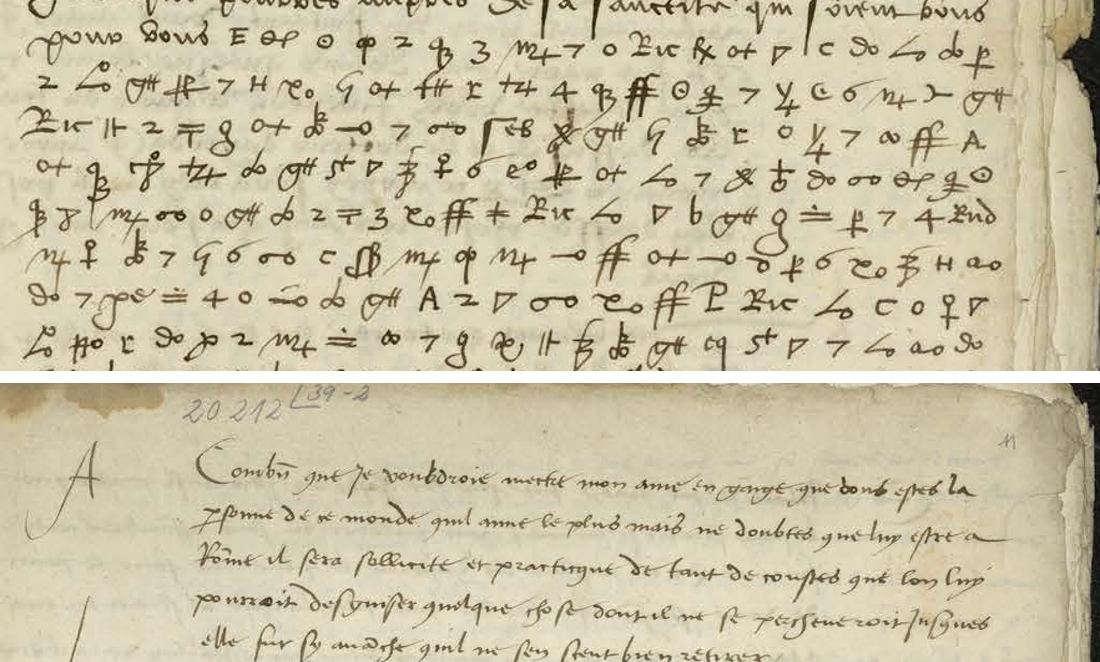
01 The record
- 39/1 (DECODE images 1–8): the original, in French, signed Lachaulx. The five cipher passages are A (end of f. 3v), b (f. 5r to 5v, a full page), C (f. 6r), D (f. 7v to 8r) and E (f. 9r). Some signs carry interlinear glosses, for example “que sont quatre mille hommes” on f. 6r. The address and endorsement read “A l’empereur” and “1522, de Victoria, de la Chaulx”.
- 39/2 (images 9–11): the decipherment, in the same A–E order.
DECODE records the language as Spanish and gives 1 January 1522, the first day of its 1522 date range. Both are wrong.
02 The cipher and the check
The cipher is a substitution in cursive signs and digits, with no word division. Passage A opens E o+ o φ 2 ꝑ 3 m4 7 o ꝝ ꝭ o+ ▷ c ɗo ʆ ɗ ꝑ…. Against the decipherment that is c-o-m-b-i-e-n q-u-e j-e v-o-u-l-d-r-o-i-e. Every word gets one sign per letter, and e is written with three different signs (ꝑ, o, ꝭ). The key was not rebuilt. That would mean transcribing some 1,500 signs from 1024-pixel scans for a text that was deciphered in 1522.
03 The 1522 decipherment
Transcribed from 39/2. Grade M (moderate): transcribed from the scan, abbreviations expanded. Doubtful words are in brackets.
A. Combien que je vouldroie mectre mon ame en gaige que vous estes la personne de ce monde quil ayme le plus, mais ne doubtez que luy estre a Rome il sera sollicite et practique de tant de costez que lon luy pourroit [desmouvoir] quelque chose dont il ne se [retireroit]…
b. Sire, entant que touche le partement du pape… le lieu de Barcelone ou il entendoit assembler son armee, la peste sest mise de sorte quil fauldra quil aille a Tarragone ou a Cartagena… Il actend davoir deux caracques qui sont en ung havre vers Landelousye… et ma dit que sy voz galleres de Naples venoient, il est du tout delibere avec icelles et les nefz de dela soy [embarquer] et passer… mais il le fault tenir secret… Je suis tousjours de loppinion que vous ay escript quil ne partira de tout le mois de juing… le nombre de gens quil a entreprins de mener, que sont quatre mille hommes… il fait courre le bruit quil emmenera vingt mille…
In passage A, La Chaulx would stake his soul that the Pope loves the Emperor above anyone. He warns that at Rome Adrian will be pressed from so many sides that he may commit himself to something he cannot undo. Passage b is about the Pope’s sailing. Plague at Barcelona moves the muster to Tarragona or Cartagena. Adrian is waiting for two carracks in an Andalusian port and for the galleys of Naples, and La Chaulx does not expect him to leave before July. He will take 4,000 men and let it be rumoured that he takes 20,000. Adrian in fact sailed from Tarragona in August. Passages C–E, on money and the Cortes, the Infanta Catherine and Portugal, and the news from France, England and the Swiss, are given in 39/2 and summarised in the notes.
04 What remains open
- A full transcription of 39/2, sections C–E. This is transcription, not decipherment.
- The key: signs to letters, from an alignment of the whole of passage A or b.
- Whether Gachard printed the letter in Correspondance de Charles-Quint et d’Adrien VI (Brussels, 1859) from another copy. This was not checked.
Full texts
The transcription and the decryption of every document on this page, so that the reading can be used and checked. Short files are shown here; all are in the repository.
R1187, BNE MSS/20212/39/1-2, Vitoria, 28 May 1522 (contemporary decipherment 39/2, sections A and b)
Charles de Poupet de La Chaulx, Charles V's envoy to Pope Adrian VI, writes in French from Vitoria: however much Adrian loves the Emperor, once in Rome he will be worked on from every side; the Pope's departure is delayed by plague at Barcelona and Seville and waits on the galleys of Naples. Further passages concern money and the Cortes, Madame Catherine and the King of Portugal, and news from France, the Swiss and England. Deciphered at the time; the decipherment is bound in as 39/2.
Decryption
# R1187: the contemporary decipherment (BNE MSS/20212/39/2), sections A and b

Transcribed from DECODE image 9 (right page). Grade M: diplomatic reading of a 1024-px scan, abbreviations
expanded, doubtful words in [brackets].

**A.** Combien que je vouldroie mectre mon ame en gaige que vous estes la personne de ce monde quil ayme le
plus, mais ne doubtez que luy estre a Rome il sera sollicite et practique de tant de costez que lon luy
pourroit [desmouvoir] quelque chose dont il ne se [retireroit] jusques [a] ce quil ne sen scauroit bien retirer.

**b.** Sire, entant que touche le partement du pape, la [maniere] y est tousjours telle que par cy avant en
autres mes lettres je vous ay escript, et si a encores de puis eu [peu] nouvelles que sont que quinze ou seize
navires qui estoient au [rade] de Sevilles, et se attendoit [...] toutes enchargees de peste, parquoy il ne
sen pourra ayder, aussi le lieu de Barcelone ou il entendoit assembler son armee, la peste sest mise de sorte
quil fauldra quil aille a Tarragone ou a Cartagena [...] encorres a mon partement de luy du tout resolu le
quel des lieux il prendroit pour assembler sadicte armee. Il actend davoir deux caracques qui sont en ung havre
vers Landelousye dont jay oublie le nom, et ma dit sur que sy voz galleres de Naples venoient, il est du tout
delibere avec icelles et les nefz de dela soy [embarquer] et passer, et crois de vray que si lesdites galeres
de Naples arrivent il le fera aussy, mais il le fault tenir secret. Au regart des nefz de dela, lon ma
certiffie que en dedans la fin de ce mois elles seront toutes prestes quant le pape les vouldra avoir. Je suis
tousjours de loppinion que vous ay escript quil ne partira de tout le mois de juing, ne croie je [...] celluy de
juillet, se ce nestoit que voz galeres de Naples arrivassent tost; mais je [croy] quil sen alla[st] comme
dessus. Et dit que pour ce le nombre de gens quil a entreprins de mener, que sont quatre mille hommes, [ne]
lesse de venir apres luy, ce que ne pourroit mener davantage; mais aussy, comme le vous ay escript, il fait
courre le bruit quil emmenera vingt mille, et le fault ainsy dire sur les bailles. Je ne vois point que, si
vous ne faites que vous ne veyez le pape avant quil parte, car sans doubte ce sera le [...] de tant [...].

Sections C, D and E (images 10-11): not transcribed here; content summarised in NOTES.md.
Translation
<!-- English translation of reading.md (Claude Opus 5.5, 23 Oct 2026): sections A and b of the contemporary decipherment of R1187 (BNE MSS/20212/39/2), as transcribed there; doubtful words kept in [brackets], gaps as [...]. Sections C, D and E are not transcribed in the repository and are not translated. -->

# R1187, Poupet de La Chaulx to Charles V [1522]: the contemporary decipherment, sections A and b, English translation

**A.** Although I would stake my soul that you are the person in this world whom he loves most, yet do not doubt that,
once he is in Rome, he will be solicited and worked upon from so many sides that he could be [moved away] from
something from which he would not [withdraw] until he could no longer well withdraw from it.

**b.** Sire, as concerns the Pope's departure, the [manner] of it is still such as I have written to you before in
other letters of mine; and since then there has also been [little] news, except that fifteen or sixteen ships which
were in the [roads] of Seville, and were expected [...], are all infected with plague, so that he will not be able to
make use of them. Also, at Barcelona, the place where he meant to assemble his fleet, the plague has set in so that
he will have to go to Tarragona or to Cartagena [...] still, at my departure from him, entirely resolved which of the
places he would take to assemble his said fleet. He is waiting to have two carracks which are in a harbour towards
Andalusia whose name I have forgotten; and he told me for certain that if your galleys of Naples came, he is fully
determined to [embark] with them and the ships from over there, and to cross; and I truly believe that if the said
galleys of Naples arrive he will also do so, but it must be kept secret. As regards the ships from over there, I
have been assured that by the end of this month they will all be ready whenever the Pope wishes to have them. I am
still of the opinion I wrote to you, that he will not leave in the whole month of June, nor do I believe [...] that
of July, unless your galleys of Naples arrived soon; but I [believe] that he would go as above. And he says that,
because of this, the number of men he has undertaken to take, which is four thousand men, does [not] fail to come
after him, since he could not take more; but also, as I have written to you, he is spreading the rumour that he will
take twenty thousand, and it must be said so on the [?bailles]. I do not see any way, if you do not arrange to see
the Pope before he leaves, for without doubt it will be the [...] of so much [...].
05 Sources
- DECODE record R1187: images behind login, Biblioteca Nacional de España, not public domain.
- L.-P. Gachard (ed.), Correspondance de Charles-Quint et d’Adrien VI, Brussels, 1859: the mission’s context.
Notes, the transcription and the profile are in targets/poupet1522/.