
At a glanceKnown key applied · partial (76% of the cipher)
- The letters
- Twenty-nine ciphertexts of Alonso Sánchez, imperial ambassador at Venice, to Charles V, 1522, in the Real Academia de la Historia (Salazar 9/23–9/26); nine are by Lope Hurtado de Mendoza.
- Where
- DECODE R9593–R9657, recorded as Non-decrypted; almost every record has a contemporary decipherment bound with it.
- The cipher
- A substitution alphabet with a nomenclature of about 177 three-letter codes (consonant–vowel–consonant) that sort into alphabetical order of their plaintext.
- How it was read
- With Satoshi Tomokiyo’s key, published 6 September 2025; no cryptanalysis was needed. Here it was applied to R9653 and R9635, outside his coverage.
- What was added
- The catalogue entry corrected in three ways; the ordering rule, which fills the numeral run and was confirmed in the text (
cef= xxvi,cif= xxvii). - Still open
- Twenty-seven records need transcription; the Lope Hurtado letters use a third, related cipher, not yet reconstructed.
01What was already published, and when
Satoshi Tomokiyo, Correspondence in Cipher of Imperial Ambassadors Alonso Sanchez and Juan Manuel (1522), posted on Cryptiana on 6 September 2025 and enlarged on 9 September, reconstructs the key. He worked from the contemporary decipherment attached to DECODE R9605, and describes how he began: browsing R9613 he noticed that vog and xig were frequent and so likely common monosyllables, and that a q with a double bar was often affixed to a code and might be the plural -s; he was then stuck on the handwriting of the decipherment. Turning to R9605 he saw vog veg near the end, two codes close together in an alphabetical listing and both frequent, and matched them to en el in the plaintext. After that, as he puts it, there was no real difficulty.
The article gives the substitution alphabet as a hand-drawn table, the nomenclature, and the deciphered first lines of R9593–R9632, plus the whole of R9621 and the last paragraph of R9623. It also reconstructs the parallel cipher of Juan Manuel, imperial ambassador at Rome (DECODE R9499–R9529), which is built to the same design with different values.
For the prior-solution record: a published key and partial decipherment existed a year before this work, it was found before the attempt, and everything below uses it. Bergenroth’s Calendar (1866) also abstracts fourteen of these letters from the contemporary decipherings; that was found after R9635 had been deciphered in part.
02What the catalogue entry got wrong
The entry read “RAH, Signatura 9/24 (29 items)”, 1522–23, and justified its importance by the negotiation that brought Venice out of the French alliance and ended in the treaty of July 1523. The fifty-five DECODE record pages R9603–R9657, tabulated, contradict all three parts.
- The shelfmark. The run is spread over Salazar 9/23, 9/24, 9/25 and 9/26. R9603–R9618 are in 9/24, R9619–R9632 in 9/25, R9633–R9657 in 9/26, and Tomokiyo’s list reaches back into 9/23.
- The dates. Every record carries a 1522 date, the last of them November 1522. Nothing in this group reaches 1523, so the treaty of July 1523 is outside it. The letters belong to the year of La Bicocca, the loss of Genoa and the fall of Rhodes; the Venetian realignment came the year after.
- The authorship. Nine records are by Lope Hurtado de Mendoza, not Sánchez: R9634, R9644, R9645, R9646, R9648, R9649, R9650, R9652, R9656.
A further correction matters more. DECODE marks almost every record in the group Inline Cleartext: Yes, meaning a contemporary decipherment is bound with the ciphertext, and the Calendar of State Papers Spain, vol. 2, calendars many of these same letters with the note “Autograph in cipher. Contemporary deciphering”. These letters were deciphered at the time. What they lack is an edition. DECODE’s Non-decrypted means that no decipherment is entered in the database; the catalogue entry took it to mean that none exists.
03The cipher, and the rule that orders it
The system is the 1496 Ferdinand-and-Isabella type: a homophonic substitution alphabet, three nulls that letters open with, a q with a double bar for the plural -s, and a nomenclator of three-letter codes for common words, names and places. Word division is kept. The vocabulary is large for the date.
Tomokiyo’s table, set out as data, shows that the codes follow a pattern. They are consonant–vowel–consonant over
- first position, sixteen consonants
z y x v t s r p n m l h g f d c b, running backwards through the alphabet as the plaintext runs forwards; - middle, the five vowels
a e i o u; - third position, nine consonants
b c d f g h l m n.
That is 720 slots, of which about 177 were recovered. Sorting by (first consonant, third consonant, vowel) puts the plaintext in alphabetical order: zid zod zud | zef zif | zog zug | zel | zem zom | zen zun gives a(h)un, ahun, al, allende, algun, alla, alli, antes, aqui, aquell, arma, assi. The alphabetisation is the clerk’s own and is loose at the edges (allende before algun, cosa before concorda), so what the rule gives for an unassigned code is a range, not a point. Where the plaintext is a numeral series, the range collapses to a value.
04The numeral series, predicted and then confirmed
Tomokiyo has cob xviii, cub xix, cad xx through cud xxiv, and caf xxv, and leaves the rest of the block blank, with a query on cud and an uncertain “[xxviii?]” in his reading of R9598. The ordering rule fills the run:
| code | cab | ceb | cib | cob | cub | cad | ced | cid | cod | cud | caf | cef | cif | cof | cuf |
|---|---|---|---|---|---|---|---|---|---|---|---|---|---|---|---|
| value | xv | xvi | xvii | xviii | xix | xx | xxi | xxii | xxiii | xxiv | xxv | xxvi | xxvii | xxviii | xxix |
The two in bold were predicted before they were seen, and then met in the foot paragraph of R9653 in a context that can only be a pair of dates (next section). That in turn resolves the uncertain “[xxviii?]” of R9598 as cof. The predicted values are carried in key_codes.tsv flagged as this project’s, separately from Tomokiyo’s.
05R9653: the fall of Rhodes, in clear, with a ciphered postscript
R9653 is Sánchez to Charles V, Venice, 20 November 1522, Salazar 9/26 f. 299–301. It is beyond the end of Tomokiyo’s list and is not calendared in CSP Spain 2. Folio 299r is a mixed leaf: six lines of cipher at the head, some thirty lines in clear, two lines of cipher at the foot, then the signature.
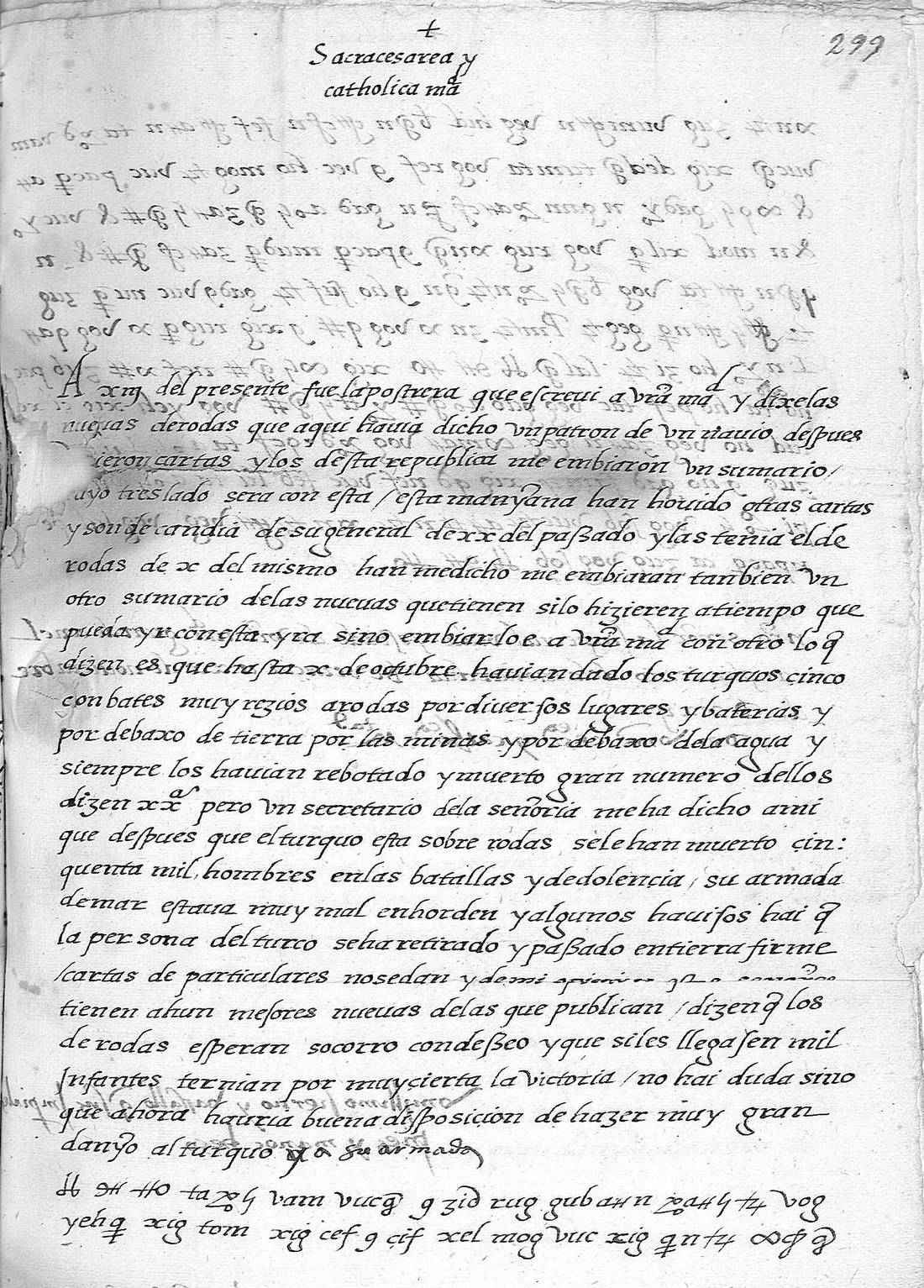
The clear middle, transcribed from the image:
A xiij del presente fue la postrera que escreui a v[uest]ra m[agesta]d y dixe las nueuas de Rodas que aqui hauia dicho vn patron de vn nauio; despues [vinie]ron cartas y los d’esta republica me embiaron vn sumario, cuyo traslado sera con esta. Esta manyana han houido otras cartas y son de Candia de su general de xx del passado, y las tenia el de Rodas de x del mismo. … Lo que dizen es que hasta x de octubre hauian dado los turquos cinco conbates muy rezios a Rodas por diuersos lugares, y baterias, y por debaxo de tierra por las minas y por debaxo de la agua, y siempre los hauian rebotado y muerto gran numero dellos — dizen xx mil. Pero vn secretario de la Señoria me ha dicho a mi que despues que el turquo esta sobre Rodas se le han muerto cinquenta mil hombres en las batallas y de dolencia; su armada de mar estaua muy mal en horden, y algunos hauisos hai que la persona del turquo se ha retirado y passado en tierra firme. … Dizen que los de Rodas esperan socorro con desseo, y que si les llegasen mil infantes ternian por muy cierta la victoria. No hai duda sino que ahora hauria buena disposicion de hazer muy gran daño al turquo y a su armada.
Rhodes capitulated a month after this was written, on 22 December 1522.
The cipher, 23 October 2026. The images were reopened: f. 299v carries more cipher, and the cipher of the foot of f. 299r and of f. 299v was deciphered sign by sign with Tomokiyo’s key (R9653_reading.md, R9653_cipher.txt). The first paragraph builds a sentence (“[?Este] embaxador y ahun la señoria tienen cartas de Francia de xxvi y xxvii del passado de [?Sangerman]”), but the second, on f. 299v ll. 7–12 (Adorno, the protonotary, Juan Manuel), does not: its code groups xug, zi, tac, lud, qef, sob, ca and nu are absent from Tomokiyo’s table and met once here. No decipherment of R9653 is bound or imaged, so it stays decoded, not read. Its second copy (f. 300v) is seen only as bleed-through, and R9654, of the same date, has no images on DECODE.

The second line runs yeh+plural xig tom xig cef y cif xel mog vuc xig …: “cartas de Francia de xxvi y xxvii del passado de …”: letters out of France of 26 and 27 October, the month in which Francis I’s position in Lombardy collapsed. It is this pair of dates that confirms cef and cif. The first line gives ta es, vam embaxa(dor), vuc+plural, zid a(h)un, rug la, gub señor, vog en, around spelled-out letters not yet settled.
A small corroboration from the other end of the group: Lope Hurtado’s letter of 9 November (R9648) opens in clear “La carta de V. M[agestad] recebi de xxvj de octubre”, the same post that Sánchez reports reaching Venice.
06R9635: a full page of cipher, deciphered in part
R9635 is Sánchez to Charles V, Venice, 16 September 1522, Salazar 9/26 f. 20–22, calendared in CSP Spain vol. 2 p. 482 and also beyond Tomokiyo’s list. Folio 20r is the best ciphertext page in the group: about twenty-five lines of cipher, whole-page, in a clean well-spaced hand, with a contemporary decipherment written between the lines in lighter ink. The decipherment covers only patches, so most lines have to be decrypted with the key.
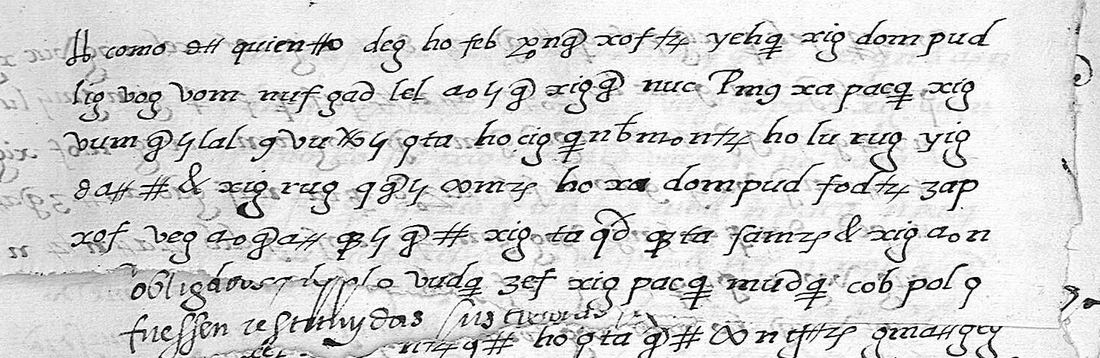
| cipher | reading |
|---|---|
xof+s yeh+s xig dom pud | das cartas de vuestra magestad |
pac+s xig vum gɣ lal | los de esta republica |
xel gub rac | del señor infante |
vud+s zef xig pac+s mud+s cob pol9 | ducados allende de los otros xviii mil |
ped xig cab pol9 vud+s | mas de xv mil ducados |
faf+s pac+s … pol9 vud+s pic xig vom | todos los … mil ducados luego de esto |
| interlinear gloss | obligados … fuessen restituydas sus bienes |
The subject is money and reprisals: the sums owed by the Signoria under the capitulation (eighteen thousand ducats outstanding from a previous year, more than fifteen thousand in another reckoning) and, in the glossed lines, goods seized that were to be restored to their owners. That is the same business as the sequestrations of imperial vassals’ goods at Venice which fill R9638 (11 October 1522) entirely in clear, and the same reckoning of xx mil ducados allende de xviii mil that Tomokiyo deciphered in the last paragraph of R9623.
Two points of notation, which the page settles: pol9 is pol (mi) followed by the letter sign for l, giving mil; that sign is easily taken for a g in this hand; and gɣ lal is the spelled letters r-e followed by lal (publica), giving republica, the word these despatches turn on.
This page also attests cab = xv, in mas de xv mil ducados, the third of the numerals predicted from the ordering rule, after cef and cif in R9653. None of the seven is contradicted.
The decipherment of the time, found 23 October 2026. Besides the interlinear patches, the DECODE record holds a full contemporary decipherment of the letter: a clear court-hand copy on f. 22r (image P3, right page). The reading now follows it, checked against the cipher of ff. 20r–20v with the key (R9635_reading.md, English R9635_en.md). A tear across f. 22r ll. 9–11 was filled from the cipher of f. 20r ll. 11–14, read sign by sign (hec = quiera, vac = dicha, gta = l + es, which settles the token that had resisted). It opens:
Visto que [?ya] tanto tardavan cartas de vuestra magestad, pues en esto no se puede perder nada, fuy con los desta republica y dixeles que ya sabian que por la capitulacion de la tregua que con vuestra magestad tienen assentada, el primero deste mes havian de pagar otros xx mil ducados, allende de los otros xviij mil que deven del otro año; que les rogava quisiessen pagarlos y cumplir con lo que son obligados.
Four words of the decipherment stay uncertain in the cramped hand ([?bastar], [?tenido], [?Menorami], [?Lucerna]). The decipherment makes hec quiera where f. 20r had suggested Inglaterra above.
Three more letters, 23 October 2026
- R9613, Venice, 18 June 1522 (Salazar 9/24 ff. 203–207): read from its contemporary decipherment, a clear copy on ff. 206r–207v of the same DECODE record, never opened before (
R9613_reading.md); its first sentence checked word for word against the cipher of f. 203r (hug= recebi). “Recebi la carta de vuestra magestad del postrero del passado, y fuy con los desta republica …”: Charles V is well disposed to peace with Venice on honest and reasonable terms. CSP Spain 2 no. 429 abstracts the same letter. - R9641 (with its duplicate R9642), Venice, 27 October 1522 (Salazar 9/26 ff. 173–188): read from its contemporary decipherment on ff. 187r–188r, filed on DECODE under R9642 as “Sánchez?” (
R9641_reading.md); checked against the cipher of ff. 173r and 174r (“de todo esto tengo dado aviso al duque de Sessa”; new valuevad= duque). The Venetians are content with the Pope’s answer to their complaint about the imperial army’s quarters in the Ghiara d’Adda. - R9593, Venice, 5 March 1522 (Salazar 9/23 f. 27): read sign by sign with the key on the two DECODE images (
R9593_reading.md): letters of Don Juan Manuel and Geronimo Adorno sent on, the lansquenets’ passage of Val Camonica, the French taking Caravaggio, the Swiss at Monza. Two values adopted (gim= suyos,fef= toda), but about twenty groups stay open and the end of f. 27r and lines of f. 27v do not build: decoded, not read. CSP Spain 2 does not calendar it; the next letter, R9594 (15 March), is CSP no. 396, which Bergenroth abstracted from a contemporary decipherment while calling the cipher “not extant”.
07The letter alphabet, and a misidentified sign
Tomokiyo gives the substitution alphabet only as a hand-drawn table. Measured off the table at high zoom, it has about thirty signs over twenty-two letters (a b c d e f g h i l m n o p q r s t u x y z), most of them with two or three homophones: a = n, ʒf; d = ∞, 3, ɸ; g = bold ∞, L; n = ᶻ, ℞₄; and so on.
Two results follow. The “q with a double bar” is the letter s, and there is no separate plural marker. The plural ending is the letter s written after a code group, so Tomokiyo’s guess that it “may well be the plural ending -s” is right, for a different reason. And r is a different sign, a q with a loop, easily confused with it in this hand.
The map is carried in alpha.py and checks out on spelled runs taken from R9635 f. 20r: nx#gn = ahora, ttn#n = nada.
At this stage it did not yet give the spelled runs continuously, for the following reason. Tomokiyo transliterates the code groups with latin labels drawn from a set that includes v, which is not one of the twenty-two plaintext letters; the code labels and the alphabet therefore do not share one transliteration, and every sign has to be matched to both by eye. At the resolution DECODE serves, telling apart the homophone pairs Ɋ (r) and ǂ (s), 9 (l) and Ɋ (r), ∞ (d) and bold ∞ (g) is a judgement call at each occurrence, and getting it wrong silently produces plausible-looking Spanish that is not what the page says. So the runs are left marked rather than filled in.
The remedy is in the glosses: collate the patchy interlinear decipherment on R9635 f. 20r word by word against the signs beneath it, which fixes each homophone in this scribe’s hand; the unglossed lines and the rest of the group then follow. That is edition work against a published key, not cryptanalysis.
08R9605: the cipher aligned with the clerk’s decipherment
R9605 (9/24 f. 39–44, 7 May 1522) is the record from which Tomokiyo recovered the key, and its images show why: the cipher and the clerk’s full contemporary decipherment sit on facing leaves. Aligned at the end of the letter, where the clear reads Plegue a Dios no lo yerre en el camino. De Venecia a vij de mayo 1522:
| cipher | plaintext | how |
|---|---|---|
nuf | no | code |
pac | lo | code |
ɡɣβ4q4 | yerre | spelled |
vog veg | en el | code — Tomokiyo’s own way in, met here in situ |
zn·β·aɤ + nuf | cami + no = camino | spelled, then a code group used for the last syllable |
Two results follow that the key alone could not give. Code groups stand for syllables as well as whole words: nuf is no the adverb in one place and the final syllable of cami-no in the next, so a decryption that treats every group as a word will divide the text wrongly. And the lookalike signs are distinct: camino needs β = m, ahora (nx#Ɋn, R9635 f. 20r) needs Ɋ = r, and the bold ∞ is g. All three are a “g”-shape at the resolution DECODE serves, and they are the single largest source of error in the spelled runs.
Continuing the same passage against the clear “la venida del visorey con todas las postas, que despacho y escrivo” gives three more results. xel def = del visorey and ded+xof = veni+da = venida, verbatim. The spelled run for escrivo is seven signs for seven letters, fixing z = c, ɡ = r, aɤ = i, m = v, # = o with the known plaintext above them. And va = despacho, not “desponho”: Tomokiyo’s table gives a word that is not Spanish, where the clear reads que despacho y escrivo with ho = que and va in that slot. It also explains his puzzled “me desponho x-e-r-o-n que” in R9623. A correction to the published key.
One check came out inconclusive and is recorded as such. The clear at “que fue a …” stands over the group cud, which Tomokiyo gives as “xxiv?”; had the clear read xxv, the whole c-block series would shift by one and the values predicted here would be wrong. It does not settle the question: the date is written over a correction and reads as something like xxv y xxvij, two dates rather than one, so it cannot be matched to a single group. cab, cef and cif do not depend on it: each was confirmed in its own context, independently of where the run starts.
The same alignment runs from the very first word of the letter. Clear (f. 42): “Ya dixe a V. Mag. que el embaxador de Hungria fue respondido de los desta republica con buenas palabras…”; cipher (f. 39r ll. 1–2): cig = ya; vu·o·ɣ = di+x+e = dixe; dom pud ho veg = vuestra magestad que el; vam vuc·ɡ = embaxa+do+r = embaxador; n·℞·∞ ɡ·aɤ = Hun-gria, spelled across the line break; sa = fue; ɡ·ɣ·q·ao·#·& vu vuc = r-e-s-p-o-n + di + do = respondido; xig vum ɡ·ɣ lal = desta republica; xa yuc·n+s = con buenas.
None of this is conjecture: the clerk’s plaintext corresponds to every group on the facing leaf. It fixes the sign table against a known plaintext instead of by eye: n=a, ɣ=e, ɡ=r, aɤ=i, o=x, #=o, q=s, ao=p, &=n, m=v, z=c, β=m, and the q-with-double-bar = s. (q=s here against Tomokiyo’s alphabet column q=t: two similar glyphs, and the pair to watch next.)
Applied to R9635, which has only patchy glosses, the table alone does not decrypt it, which corrects the diagnosis above. On R9635 f. 20r the first line is ‖ como ‖ quien ‖ deg ho feb ʒnɡ xof+s yeh+s xig dom pud. The tail is secure (das cartas de vuestra magestad), and the null padding matches R9605 exactly. But deg, feb and ʒnɡ resolve to nothing: none is in the nomenclator, and the last spells y-a-r, which is not a word. Sense wants recebi in that slot, whose code is hug, unlike anything written there.
So the obstacle lies in the step before the sign table: turning the cursive shapes into labels. R9605’s hand and R9635’s differ enough that a shape read confidently as d in one is something else in the other, and a wrong label yields a code group that either does not exist or exists with the wrong value. The alignment has to be done on the image, glyph against the clerk’s word above it, building a reference set of each sign as this scribe forms it, instead of transcribing to labels first and resolving afterwards. That is slower and more reliable.
R9605 and R9613 are therefore not counted as results here: the Emperor’s clerk deciphered them in 1522, on the facing leaves. Transcribing that clear text gives a continuous plaintext of those letters, which is an edition of a 1522 decipherment. The records with no contemporary decipherment have no such facing plaintext.
The next step is to align the whole of R9605’s cipher against its decipherment, several hundred signs of known plaintext, to fix each homophone in this scribe’s hand, and then carry it to the unglossed pages.
09Transcription: how the page is written
The failure reported above came from a wrong assumption about how the page is written; correcting it made the page decipherable. Everything here is written in ordinary latin-looking cursive. The two systems are told apart by shape-length and context: three-letter latin trigrams are nomenclator codes (xig, vog, dom, pud, lig, nuc), looked up in Tomokiyo’s table; single letters and short runs between them are the substitution alphabet, where the letterform and the value differ: n=a, y=e, g=r, o/✗=x, #=o, ao=p, m=u/v, z=c, β=m, 9=l, q-with-double-bar = s. Three nulls open each paragraph, padded with the clear words como and quien.
Verified on R9605 f. 39r l. 1 against the clerk’s plaintext on the facing leaf: cig vu·o·y n dom pud ho veg = “Ya dixe a vuestra magestad que el”, with vu(di)+o(x)+y(e) = dixe.
With that, the page can be deciphered. R9635 f. 20r ll. 2–3 give continuous text:
lig vog vom nuf gad lelao-y-g-xig-gnuc…xa pac+sxig vumg-y-lal
= “pues en esto no se puede perder nada … con los de esta republica”
Two things in that sentence are new. lel = puede, a code Tomokiyo did not recover: it falls between lal publica and lol pudi, and the sense fixes it. And perder is written p-e-r + xig (de) + r: a code group used inside a word for a syllable, the same pattern R9605 showed with cami + nuf(no) = camino.
Line 9 gives an independent check: nul (obliga) + vuc (do) + s = obligados, the word the 1522 decipherer wrote in the gloss above that stretch. Key, alphabet and gloss agree without being fitted to each other.
Further down the page: pef pac ho zel xig a-h-o | r-a = me lo que antes de ahora; yig (capitula) + c-i-o-n = capitulacion; and ho hob hec ho pac+s = que quien Inglaterra que los, with hec = Inglaterra; the English ambassador at Venice is a running subject of these months.
Lower on the page: vom+s cad pol-9 xig a-h-o-r-a = estos xx mil de ahora; ao-# xig g pac suf-z-e-r lu-ho = poderlo hazer, porque; and rug+s lul ta = las quales. The last examples show the converse of the stem-plus-ending pattern, codes run together to make one word: lu(por)+ho(que) = porque, lul(qual)+ta(es) = quales, suf(ha)+z-e-r = hazer.
The page closes with darian todos los …, no pude …, si no se … en …, and then opens a fresh paragraph with the same three nulls and pac+s xig vum r-e-lal = los de esta republica. One code there, cag, is unassigned in Tomokiyo’s table and sits at the end of the numeral run immediately before cig (ya); cag = xxx is the natural continuation and suits the sense, but it is one slot past where the run is attested and is left probable, not certain.
Line 5 gives xof veg + p-r-i-m-e-r-o + xig ta = da el primero de es[te], which fixes β = m on this page independently of camino in R9605; and at high zoom the ending of capitulacion is the curly second form of c that Tomokiyo draws as a backwards 3, so that word is settled rather than inferred.
Every line of f. 20r now has at least a partial decipherment. Continuous or substantial: ll. 2–6, 9, 10, 11, 13, 15, 17, 18, 20, 22, 23, 25, with the passages at ll. 7 and 14; partial, with runs still unresolved: ll. 1, 8, 12, 16, 19, 21, 24. The subject, the sums, the parties and the drift of the argument are deciphered throughout the page, while a scatter of spelled runs inside partially deciphered lines stays open. It is not a word-perfect diplomatic edition and is not offered as one. (The crops were cut by dividing the written area into twenty-five equal bands, so the line numbers are approximate; each decipherment is tied to its own words.) The remaining runs need the same transcription work and no cryptanalysis; they are left untranscribed rather than filled in by inference. One token resists: gta, a dozen occurrences, cannot be a code (its middle position is not a vowel) and is most likely g (y) + ta (es), but that does not sit well everywhere and is left unresolved. The edition is in targets/sanchez1522/edition/.
Folio 21 is two further full pages of cipher, denser than f. 20r, with the decipherer’s gloss obligados … fuessen restituydas sus tierras continuing across it. One paragraph on the right-hand leaf, marked A in the margin, is written entirely in the clear, and it names the English ambassador:
M[icer] Ricardo Paceo, embax[ad]or de Inglaterra, me ha dado el incluso memorial y rogado que escriva a v[uest]ra m[agesta]d suplicandole por las cartas que dize para el Papa y para don Joan. Sup[li]co a v[uest]ra m[agesta]d muy humilmente, con primero las mande enbiar, pues es persona que merece toda buena obra de v[uest]ra m[agesta]d, por ser muy servidor suyo y aficionado &c.
Richard Pace, Henry VIII’s envoy at Venice, has given Sánchez an enclosed memorial and asked him to press the Emperor for the letters he wants for the Pope and for don Juan, that is Juan Manuel, the imperial ambassador at Rome, whose own 1522 cipher Tomokiyo reconstructed in the same article. Sánchez seconds the request warmly. This fixes the identification behind hec = Inglaterra met on f. 20r, and it is the same Pace who opens R9631 in Tomokiyo’s list. The two leaves of f. 21 are not yet transcribed line by line.
10Lope Hurtado de Mendoza writes in a third cipher
The nine Lope Hurtado records bound in the same volumes look at first like more of the same: the same period, the same recipient, cipher mixed with clear inside the sentence, code groups of the same shape. They are not in Sánchez’s cipher.
The test is the third position. Sánchez’s codes end strictly in b c d f g h l m n. Folio 260v of R9648 gives tep, tap, and groups ending in z, finals that Sánchez’s key does not contain. Juan Manuel’s Rome cipher, by contrast, does use p r s t z as finals (jap papa, jir, jus, boz, qat). So Lope Hurtado’s key is a third member of the family.
Whether it is Juan Manuel’s own key is not settled here. None of the groups legible on that leaf (ton, tep, tap, xul, xild, zar, xurzun) has a value in Tomokiyo’s Juan Manuel table either, but that table is itself a partial recovery, so their absence decides nothing. Several of these records carry contemporary decipherments, so the key is recoverable by the same route Tomokiyo took; they need a separate target.
11What is open, and how reliable the decipherment is
- 48 records not attempted. The other Sánchez records of Salazar 9/23–9/26 (R9594 onward in date order; R9626/R9627 and R9628/R9629 are duplicates, and R9625 and R9638 are mostly clear) have not been worked. Most have a contemporary decipherment bound or imaged with them, as R9613, R9635 and R9641 did, so the work is to find it, transcribe it and check it against the published key. The target stays in progress until they are done.
- R9653: decoded, not read; the second paragraph of its cipher (f. 299v ll. 7–12) and single groups of the first, on code groups absent from the published key; its second copy (f. 300v) and R9654 need the originals.
- R9593: decoded, not read; the end of f. 27r (ll. 26–33), f. 27v ll. 11–13 and about twenty open code groups.
- Uncertain words of the decipherments: four in R9635, three in R9613, two in R9641, in fast or cramped hands at DECODE’s resolution.
- Lope Hurtado’s key is unreconstructed.
- Grades. The resolved run of R9653’s foot paragraph is graded C: certain on the code groups, which are unambiguous against the published key and make continuous sense. The remainder of that paragraph and the whole head paragraph are I, incomplete. The clear middle is a transcription of ordinary Spanish secretary hand and carries no cipher grade; two words in it are conjectural and marked with brackets above.
cofxxviii,cufxxix,cabxv,cebxvi,cibxvii are predicted, not observed, and are flagged as such in the key file.
Full texts
The transcription and the decryption of every document on this page, so that the reading can be used and checked. Short files are shown here; all are in the repository.
R9635, Venice, 16 Sept 1522 (RAH Salazar 9/26 ff. 20-22)
Alonso Sánchez, imperial ambassador at Venice, to Charles V: the money owed by Venice under the treaty ('mas de xv mil ducados', 'allende de los otros xviii mil'), restitution of goods, 'los de esta republica' (calendared by Bergenroth, CSP Spain 2 no. 476). Edited against Tomokiyo's published key; only ll. 1-3, 6, 7, 14, 22 of f. 20r and the opening of f. 21 are given, cipher groups and reading side by side.
Transcription
# Edition: R9635 f. 20r — Sánchez to Charles V, Venice, 16 September 1522

RAH Salazar 9/26 f. 20. Edition against Tomokiyo's published key (Cryptiana, 6 Sept 2025), with the
sign values calibrated on R9605's cipher and its 1522 decipherment (`../calibration_r9605.md`).
**This is edition work against a published key, not cryptanalysis.**

## Method, corrected

The earlier failure in this folder came from a wrong model of the writing. The page is not written in
exotic symbols: **everything is written in ordinary latin-looking cursive**, and the two systems are
told apart by shape-length and context —

- **three-letter latin trigrams are nomenclator codes** (`xig`, `vog`, `dom`, `pud`, `lig`, `nuc` …),
  read straight off Tomokiyo's table;
- **single letters and short runs between them are the substitution alphabet**, where the letterform
  and the plaintext value differ: `n`=a, `y`=e, `g`=r, `o`/`✗`=x, `#`=o, `ao`=p, `m`=u/v, `z`=c,
  `β`=m, `q`-with-double-bar = s, `9`=l;
- the three nulls `ℋ`, `℈#`, `ℍO` open each paragraph, padded with the meaningless clear words
  *como* and *quien*.

Confirmed on R9605 f. 39r l. 1, where the clerk's plaintext stands on the facing leaf:
`cig vu·o·y n dom pud ho veg` = **"Ya dixe a vuestra magestad que el"**, with `vu`(di)+`o`(x)+`y`(e)
= *dixe*.

## Lines read continuously

Codes in `code`, spelled letters hyphenated, *italic* = written in the clear on the page.

**l. 1** ‖ *como* ‖ *quien* ‖ `deg` `ho` `feb` `ʒong` `xof`+s `yeh`+s `xig` `dom` `pud`

> … que … **das cartas de vuestra magestad**

`deg`, `feb` and `ʒong` are codes Tomokiyo never recovered; bracketed, `deg` falls in the d-block
between *visorey de Napoles* and *vimes*, `feb` in the f-block between *tene* and *tanta*.

**ll. 2–3** `lig` `vog` `vom` `nuf` `gad` `lel` ao-y-g-`xig`-g `nuc` `Pmg` `xa` `pac`+s `xig` `vum`
g-y-`lal`

> **pues en esto no se puede perder nada … con los de esta republica**

- **`lel` = *puede*** — a new code value. It brackets in the l-block between `lal` *publica* and
  `lol` *pudi*, and the sense fixes it.
- *perder* is written p-e-r + `xig` (*de*) + r — a code group used mid-word for a syllable, the
  pattern R9605 showed with *cami*+`nuf`(*no*) = *camino*.

**l. 3** … `g` `vu`-✗-`y` … `ho` `cig`

> … y **dixe** … que **ya** …

`vu`-✗-`y` = *dixe* again, here with `✗` for x where R9605 used `o`: homophones of the same letter.

**l. 6** (the decipherer glosses *obligados* above this stretch)
`vud`+s `zef` `xig` `pac`+s `mud`+s `cob` pol-9

> **ducados allende de los otros xviii mil**

**l. 7** carries the gloss *fuessen restituydas sus bienes*.

**l. 14** `ped` `xig` `cab` pol-9 `vud`+s

> **mas de xv mil ducados**

**l. 22** `pac`+s `xig` `vum` g-y-`lal`

> **los de esta republica**

Also on the page: `yig` = *capitula* (l. 3), `gub` = *señor*, `xel def` = *del visorey*,
`faf`+s `pac`+s = *todos los*, `nef` = *ni*, `geg` = *si*, `nuf` = *no*.

**l. 4** … `ho` `xa` `dom` `pud` `fod`+s `zap`

> … que con **vuestra magestad** …

**l. 6 (right)** … `zef` `xig` `pac`+s `mud`+s `cob` pol-9 — *allende de los otros xviii mil*, the
reading already given, here confirmed on the right-hand half of the line.

**l. 9** `nul` `vuc`+s `gta` ao-#-& `vu`-y `g`-#

> **obligados** …

`nul` (*obliga*) + `vuc` (*do*) + s = **obligados** — and *obligados* is precisely the word the 1522
decipherer wrote in the gloss above this stretch. Key, alphabet and gloss agree independently. It is
the third instance on this page of a code group carrying a word-stem with the ending spelled or coded
after it.

**l. 10** g-n `ho` `gta` `sa` `Lo` `vog` `hag` `xof` …

> … que … **fue** … **en** …

with `Lo` = the letter t, one of the two forms Tomokiyo's table gives for it.

**l. 9 (right)** … `pef` `pac` `ho` `zel` `xig` n-x-# | g-n …

> … **me lo que antes de ahora** …

*ahora* is spelled a-h-o across the line break and finished r-a on the next — the same word that first
showed the sign `g` = r.

**l. 11** … `voc` `yig` z-aɥ-#-& | `gɣ` ao-g-aɥ …

> … **capitulacion** …

`yig` (*capitula*) + c-i-o-n. A fourth instance of the stem-plus-ending pattern.

**l. 13** … g-#-& `ho` `hob` `hec` `ho` `pac`+s

> … -ron **que quien Inglaterra que los** …

`hec` = *Inglaterra*. The English ambassador at Venice is the running subject of these months —
R9621, which Tomokiyo prints entire, turns on the Signoria's wish for his arrival.

**l. 17** `vom`+s `cad` pol-9 `xig` n-x-#-g-n

> **estos xx mil de ahora**

**l. 18** ao-# `xig` g `pac` `suf`-A-ɣ-g `lu`-`ho`

> **poderlo hazer, porque** …

Two nice compounds: `suf` (*ha*) + z-e-r = **hazer**, and `lu` (*por*) + `ho` (*que*) = **porque** —
two codes run together to make one word, the mirror of the stem-plus-ending pattern.

**l. 19** `vud`+s … `gam` … `mod`

> **ducados** … su … **os** …

**l. 20** … `rug`+s `lul` `ta` …

> … **las quales** …

`lul` (*qual*) + `ta` (*es*) — codes run together again.

**l. 21** `xof` n+s g-#-# `ho` `vog` `hag` `vog` …

> … que **en** … **en** …

**l. 22** ∞-n-g-aɥ-n+s `faf`+s `pac`+s `cag` …

> **darian todos los** …

`cag` is unassigned in Tomokiyo's table. It sits in the c-block at C3=g, immediately before `cig`
(*ya*) — that is, at the end of the numeral run and the start of the *y*- words. Given `caf` = xxv and
`cuf` = xxix, **`cag` = xxx** is the natural continuation and suits the sense (sums in thousands of
ducats run through this whole page), but it is one slot past where the run is attested and is left as
probable, not certain.

**l. 23** `nuf` ao-m `xig` g-n-z-n-g `pac`+s …

> **no pude** de … **los** …

**l. 24** … `geg` `nuf` `gad` `gta` `hag` `vog` …

> … **si no se** … **en** …

**l. 25** ‖ ‖ ‖ `pac`+s `xig` `vum` g-y-`lal` …

> **los de esta republica** …

The page ends by opening a fresh paragraph with the same three nulls and the phrase these despatches
turn on.

**l. 5** `xof` `veg` ao-g-aɥ-β-y-g-# `xig` `ta` …

> **da el primero de es**[te] …

*primero* spelled p-r-i-m-e-r-o. This is what fixes `β` = **m** on this page independently of
*camino* in R9605.

**l. 11, at high zoom** — the ending of *capitulacion* is ∂-aɥ-#-&, where `∂` is the curly second
form of **c** that Tomokiyo draws as `Ә` in his alphabet. So `yig` + c-i-o-n = *capitulacion* is
settled, not inferred.

**l. 15** `cob` pol-9 `vud`+s ao-g-aɥ-β-y-g …

> **xviii mil ducados primer**[o] …

*primero* again, spelled the same way, in the same money context as l. 6.

**l. 13** … `dom` `pud` `sam` …

> … **vuestra magestad** …

**l. 16** `hag` `xof`+s `rug`+s `voc` …

> … **das las** …

## A caveat on the line numbers

The crops were cut by dividing the written area into twenty-five equal bands, so the line numbers
above are approximate and may be out by one where the scribe's spacing drifts. The *readings* do not
depend on them — each is anchored to its own words — but anyone collating this against the manuscript
should locate the phrases, not the numbers.

### A recurring token still open

`gta` occurs a dozen times on this page and is not in the nomenclator; it cannot be a code, since its
middle position is not a vowel. It is most likely `g` (the conjunction *y*) followed by the two-letter
code `ta` (*es*), giving *y es*, but that does not sit well in every occurrence and it is left
unresolved rather than forced.

## What the letter is about

The sums owed by the Signoria under the capitulation — eighteen thousand ducats outstanding from a
previous year, more than fifteen thousand in another reckoning — and the restitution of goods seized
from imperial vassals, which the decipherer glossed *fuessen restituydas sus bienes*. The same
business fills R9638 (11 October 1522) entirely in clear, and is the reckoning Tomokiyo read in the
last paragraph of R9623.

## Coverage

Every line of f. 20r now has a reading of some kind. Continuous or substantial: ll. 2–6, 9, 10, 11,
13, 15, 17, 18, 20, 22, 23, 25 and the passages at ll. 7, 14. Partial, with runs still unresolved:
ll. 1, 8, 12, 16, 19, 21, 24.

The page is **read throughout in substance** — subject, sums, parties and the drift of the argument —
while a scatter of spelled runs inside partially-read lines stays open. It is not a word-perfect
diplomatic edition and is not offered as one.

The remaining lines are the same work, line by line, at the same zoom: nothing in them is
cryptanalytically novel, and the method above applies unchanged. They are left untranscribed rather
than filled in by inference.

## New to the key from this page

| code | value | how |
|---|---|---|
| `lel` | **puede** | bracketed between `lal` *publica* and `lol` *pudi*, fixed by sense in "no se puede perder nada" |
| — | *(pattern)* | codes run together to make one word: `lu`+`ho` = **porque**, `lul`+`ta` = **quales**, `suf`+z-e-r = **hazer** |
| `cab` | **xv** | attested in "mas de xv mil ducados" (predicted earlier from the ordering rule) |
| `cag` | **xxx** *(probable)* | sits at the end of the numeral run, immediately before `cig` *ya*; suits "todos los … mil" but is one slot past the attested run |
Transcription
# Edition: R9635 f. 21 — Sánchez to Charles V, Venice, 16 September 1522

RAH Salazar 9/26 f. 21 (DECODE image `IMG_R9635_I45364_P2.jpg`). Edition against Tomokiyo's
published key; method and sign values as in `r9635_f20r.md` and `../calibration_r9605.md`.

## Shape of the opening

Both leaves are **full pages of cipher**, denser than f. 20r — roughly thirty lines each. Two things
interrupt the cipher on the right-hand leaf:

1. the decipherer's gloss **obligados … fuessen restituydas sus tierras** written between the lines
   near the head — the same gloss that runs across f. 20r, so the restitution business continues here;
2. a **paragraph written entirely in the clear**, marked in the margin with an `A`, about the English
   ambassador.

## The clear paragraph on Richard Pace

Read from the image (abbreviations expanded in brackets):

> M[icer] Ricardo Paceo, embax[ad]or de Inglaterra, me ha dado el incluso memorial y rogado que
> escriva a v[uest]ra m[agesta]d suplicandole por las cartas que dize para el Papa y para don Joan.
> Sup[li]co a v[uest]ra m[agesta]d muy humilmente, con primero las mande enbiar, pues es persona que
> merece toda buena obra de v[uest]ra m[agesta]d, por ser muy servidor suyo y aficionado &c.

**Richard Pace**, Henry VIII's envoy at Venice, has given Sánchez an enclosed memorial and asked him
to write to the Emperor on his behalf — pressing for the letters Pace wants for the Pope and for
**don Juan** (Juan Manuel, the imperial ambassador at Rome, whose own 1522 cipher Tomokiyo
reconstructed in the same article). Sánchez seconds the request warmly.

This fixes the identification behind the code `hec` = *Inglaterra* met on f. 20r, and it is the same
Pace who opens R9631 in Tomokiyo's list ("Mi-c-e-r [R]-i-c-a-r-do p-a-c-e-o embaxa-do-r del
se-r-e-ni-ss-i-[m]-o"). The English ambassador's arrival and doings are the thread running through
the Venetian despatches of these months; R9621, the one letter Tomokiyo prints entire, turns on the
Signoria's wish for him.

## Cipher on the leaf: what is legible at this pass

Codes read off without difficulty in the opening lines of the right-hand leaf include `xig` (*de*),
`nuf` (*no*), `zem` (*aqui*), `dal` (*un*), `vog` (*en*), `xel` (*del*), `ho` (*que*), `vum`
(*esta*), g-y-`lal` (*republica*), `gad` (*se*), `vuc` (*do*), `pac`+s (*los*), `ped` (*mas*),
`vam vuc`+g (*embaxador*), `gam` (*su*), `gub` (*señor*), `hac`/`hed` (*rey*), `mef` (*paz*),
`fob` (*tambien*), `sef` (*guarda*), `mod` (*os*), `yeh`+q (*cartas*), `dom pud` (*vuestra
magestad*), `A`-words and the nulls opening each paragraph.

**The two leaves are not yet transcribed line by line.** What is established here is their structure,
the continuation of the restitution matter, and the clear Pace paragraph in full.

## First two lines of the right-hand leaf

`xig`+s ʒ-o-y `dod` `nuf` `zem` `dal` β `vog` Lo n-aɥ-y-g-# `xel` g-n & aɥ-n
`ho` `xig` n-g-b-m `nef` ʒ-o `vec`+s `ho` … `pac` … `xig` `vum` …

> … **vi no aqui un** … **del** … / **que de** … **ni** … **dize** … **lo** … **de esta**
> [republica] …

The hand on f. 21 is smaller and more cursive than f. 20r and the spelled runs between the codes do
not yet resolve cleanly. The codes read without difficulty; the letters need the same picture-book
treatment given to f. 20r, on this scribe's forms. Recorded as fragments rather than smoothed into a
sentence.

## Open

Line-by-line transcription of both leaves of f. 21, and of f. 22 (`IMG_R9635_I45364_P3.jpg`).
Nothing here is cryptanalytically novel; it is time at the images.
Decryption
# R9635: contemporary decipherment, RAH Salazar 9/26 f. 22r (DECODE IMG_R9635_I45364_P3.jpg, right page), court hand.
# Transcribed 23 Oct 2026 (b23) line by line from 1.8-2.6x crops. Abbreviations kept as written (v. mad., vra. ma.);
# "/" are the decipherer's own strokes (they fall where the cipher pages carry interlinear glosses); [...] = tear;
# [?x] uncertain reading.
01 Visto que [?y]. tanto tardavan cartas de v. mad. pues en esto no se
02 puede perder nada fuy con los desta republica y dixeles que ya
03 sabian que por la capitulacion de la tregua que con v. mad. tiene
04 assentada el primero deste mes havian de pagar otros xx [?mil]
05 ducados allende de los otros xviij [?mil] que deven del otro año
06 que les rogava quisiessen pagar los y cumplir con lo que son
07 obligados / respondieron me lo que antes de agora que les
08 fuessen restituydas sus tierras segun esta assentado en la dicha
09 [...]am [...][...]es que las tierras estavan en poder
10 [...] quien quiera [?q] los
11 [...] vra. ma. havia prometido restituyrlas / dixeles
12 que les [?dema] [?bastar] tener los xviij mil ducados primeros
13 hasta que fuessen restituydas las dichas tierras y que
14 pagassen estos xx mil de agora / replicaron me no poder
15 lo hazer porque ellos havian pagado y pagavan cada año
16 mas de seys mil ducados a sus subditos por las dichas
17 tierras las quales valian mas de xv mil ducados
18 cada año que en restituyendo las ellos pagarian todos los
19 xx mil ducados luego de esto no pude sacar los ny creo
20 jamas los pagaran sino se les restituyen las dichas tierras
21 Los desta republica han [?tenido] estos dias cartas de me
22 norami de xxviij del passado de [?lureina] y escrive que
23 tenian todos los suyos que por agora yrian a servir en
24 Francia a la parte de picardia / y que por todo este mes
25 no se podria mas campear en aquella parte y vernan a
26 la empresa de Italia / tambien tienen estos cartas de su
27 Embaxador que esta en Francia de xxvj del passado dize
28 que el Rey de Francia yva de Bles a Paris y de alli a
29 Picardia / Por dos vias me han certificado esto
Decryption
# R9635: Alonso Sánchez to Charles V, Venice, 16 September 1522 (RAH Salazar 9/26 ff. 20-22), reading

Re-read 23 Oct 2026 (Claude Opus 5.5, REREAD_BRIEF batch b23); log in `R9635_reread_log.md`. **Rests on the contemporary
decipherment of the letter, a clear copy in a court hand on f. 22r** (DECODE image `IMG_R9635_I45364_P3.jpg`, right
page; f. 21v, the left page of the same image, is the address leaf with the docket "Venecia a xvi de setiembre"
written upside down). It had not been noticed: the earlier work in this folder (`read_r9635.md`,
`edition/r9635_f20r.md`) knew only the patchy interlinear glosses on the cipher pages. The decipherment was checked
against the cipher figures of ff. 20r, 20v and 21r with Tomokiyo's key wherever the earlier edition or this pass had read
them (see Notes); every check agrees except `hec` (below).

Conventions: plain = carried by the decipherment (and, where noted, the figures); `[?word]` partly legible;
`[word]` supplied. The tear across f. 22r ll. 9-11 is filled from the cipher of f. 20r ll. 11-14, read sign by sign on
23 Oct 2026 (r2i): *capitulacion. Repliqueles … del señor infante, y respondieron que … tuviese* (Notes). Spelling as written; *v. mad.* and *vra. ma.* expanded to
*vuestra magestad*.

## Reading

Visto que [?ya] tanto tardavan cartas de vuestra magestad, pues en esto no se puede perder nada, fuy con los desta
republica y dixeles que ya sabian que por la capitulacion de la tregua que con vuestra magestad tienen assentada, el
primero deste mes havian de pagar otros xx mil ducados, allende de los otros xviij mil que deven del otro año; que
les rogava quisiessen pagarlos y cumplir con lo que son obligados. Respondieronme lo que antes de agora, que les
fuessen restituydas sus tierras segun esta assentado en la dicha capitulacion. Repliqueles que las tierras estavan en
poder del señor infante, y respondieron que quien quiera que los tuviese, vuestra magestad havia prometido
restituyrlas. Dixeles que les [?…] [?bastar] tener los
xviij mil ducados primeros hasta que fuessen restituydas las dichas tierras, y que pagassen estos xx mil de agora.
Replicaronme no poderlo hazer, porque ellos havian pagado y pagavan cada año mas de seys mil ducados a sus subditos
por las dichas tierras, las quales valian mas de xv mil ducados cada año; que en restituyendolas ellos pagarian todos
los xx mil ducados luego. De esto no pude sacarlos, ni creo jamas los pagaran si no se les restituyen las dichas
tierras.

Los desta republica han [?tenido] estos dias cartas de [?Menorami] de xxviij del passado de [?Lucerna], y escrive que
tenian todos los suyos que por agora yrian a servir en Francia a la parte de Picardia, y que por todo este mes no se
podria mas campear en aquella parte y vernan a la empresa de Italia. Tambien tienen estos cartas de su embaxador que
esta en Francia de xxvj del passado; dize que el rey de Francia yva de Bles a Paris y de alli a Picardia. Por dos vias
me han certificado esto.

## Notes

- **The decipherment against the figures.** Places where the cipher was read sign by sign (here or in
  `edition/r9635_f20r.md`) and the decipherment stands in the same order: *visto que … tanto* (`deg` `ho` `feb`, the
  last two unassigned in Tomokiyo, now *visto*, *tanto* by slot and this text); *cartas de vuestra magestad*; *pues en
  esto no se puede perder nada* (`lig vog vom nuf gad lel` p-e-r-`xig`-r `nuc`); *con los de esta republica*; *dixe(les)
  … que ya* (`vu`-x-e … `ho cig`); *capitulacion* (`yig`+c-i-o-n); *el primero deste mes* (`veg` p-r-i-m-e-r-o `xig ta`);
  *obligados* (`nul vuc`+s, under the 1522 gloss *obligados*); *allende de los otros xviii mil* (`zef xig pac`+s `mud`+s
  `cob pol`-l); *xviii mil ducados primeros*; *mas de xv mil ducados* (`ped xig cab pol`-l `vud`+s); *estos xx mil de
  agora* (`vom`+s `cad pol`-l `xig` a-h-o-r-a); *poderlo hazer, porque* (p-o `xig` r `pac` `suf`-z-e-r `lu`-`ho`); *las
  quales*; *todos los*; *no pude* (`nuf` p-u `xig`); *si no se*; on f. 20v *los suyos … en Francia la parte de*
  (`gim` = *suyos*: Tomokiyo's "suquos?") and *tambien … embaxador que esta en Francia … el rey de Francia … de alli …
  por dos … me*.
- **Disagreements.** The earlier edition's *darian todos los* (f. 20r l. 22) is *pagarian todos los* here (the first
  sign was taken for `∞` d); `hec` = *Inglaterra* (f. 20r l. 13, "que quien Inglaterra que los") does not stand in the
  decipherment, whose text there is *en poder […] quien quiera q los*: r2i reads `hec` *quiera* (below). *ahora* of the
  cipher (a-h-o-r-a) is *agora* in the decipherment; the reading follows the decipherment's word, the figures give *ahora*.
- **The tear (r2i, 23 Oct 2026).** f. 22r ll. 9-11 lose about ten words. The passage stands in cipher on f. 20r ll.
  11-14 (DECODE image P1, right page), read sign by sign at 2.5x (`R9635_reread_log.md`, r2i): `vog rug vac yig`
  ∂-a#-#-& = *en la dicha capitulacion*; g-4-ao-g-a# `ho` g-`ta` = r-e-p-l-i + *que* + l + *es* = *repliqueles*;
  `ho` g-`ta` `ho rug`+s qa#4fng `vum`+v-a-n `vog` ao-#-`xig`-g = *que les que las tierras estavan en poder*; `xel gub
  rac` g g-`ta` ao-#-& `vu` 4-g-#-& `ho hob hec ho pac`+s = *del señor infante y respondieron que quien quiera que
  los*; ✗ₒ-m-g#-a#-4-Lo-∂ `dom pud` = *tuviese vuestra magestad*. The decipherment's surviving words (*…es que las
  tierras estavan en poder … quien quiera q los … vra. ma. havia prometido*) stand in the same order, so the gap is
  carried by the figures. Two key values follow: `hec` = **quiera** (h-block between `hob` quien and `hed` rey) and
  `vac` = **dicha** (v-block, before `vec` dize, `vic` dicho); and `gta`, the "recurring token" of the edition, is
  the l-sign + `ta` (es) = *les* (also *que les fue[ssen]*, l. 10). The earlier "-ron que quien Inglaterra que los"
  was this passage misread.
- *[?Menorami]* is written *me|norami* across a line break: a correspondent of the Signoria, not identified.
  *[?Lucerna]* reads *delureina* (one stroke short of *Lucerna*); the Swiss levies for Picardy fit it.
Decryption
# Edition: R9635 f. 20r — Sánchez to Charles V, Venice, 16 September 1522

RAH Salazar 9/26 f. 20. Edition against Tomokiyo's published key (Cryptiana, 6 Sept 2025), with the
sign values calibrated on R9605's cipher and its 1522 decipherment (`../calibration_r9605.md`).
**This is edition work against a published key, not cryptanalysis.**

## Method, corrected

The earlier failure in this folder came from a wrong model of the writing. The page is not written in
exotic symbols: **everything is written in ordinary latin-looking cursive**, and the two systems are
told apart by shape-length and context —

- **three-letter latin trigrams are nomenclator codes** (`xig`, `vog`, `dom`, `pud`, `lig`, `nuc` …),
  read straight off Tomokiyo's table;
- **single letters and short runs between them are the substitution alphabet**, where the letterform
  and the plaintext value differ: `n`=a, `y`=e, `g`=r, `o`/`✗`=x, `#`=o, `ao`=p, `m`=u/v, `z`=c,
  `β`=m, `q`-with-double-bar = s, `9`=l;
- the three nulls `ℋ`, `℈#`, `ℍO` open each paragraph, padded with the meaningless clear words
  *como* and *quien*.

Confirmed on R9605 f. 39r l. 1, where the clerk's plaintext stands on the facing leaf:
`cig vu·o·y n dom pud ho veg` = **"Ya dixe a vuestra magestad que el"**, with `vu`(di)+`o`(x)+`y`(e)
= *dixe*.

## Lines read continuously

Codes in `code`, spelled letters hyphenated, *italic* = written in the clear on the page.

**l. 1** ‖ *como* ‖ *quien* ‖ `deg` `ho` `feb` `ʒong` `xof`+s `yeh`+s `xig` `dom` `pud`

> … que … **das cartas de vuestra magestad**

`deg`, `feb` and `ʒong` are codes Tomokiyo never recovered; bracketed, `deg` falls in the d-block
between *visorey de Napoles* and *vimes*, `feb` in the f-block between *tene* and *tanta*.

**ll. 2–3** `lig` `vog` `vom` `nuf` `gad` `lel` ao-y-g-`xig`-g `nuc` `Pmg` `xa` `pac`+s `xig` `vum`
g-y-`lal`

> **pues en esto no se puede perder nada … con los de esta republica**

- **`lel` = *puede*** — a new code value. It brackets in the l-block between `lal` *publica* and
  `lol` *pudi*, and the sense fixes it.
- *perder* is written p-e-r + `xig` (*de*) + r — a code group used mid-word for a syllable, the
  pattern R9605 showed with *cami*+`nuf`(*no*) = *camino*.

**l. 3** … `g` `vu`-✗-`y` … `ho` `cig`

> … y **dixe** … que **ya** …

`vu`-✗-`y` = *dixe* again, here with `✗` for x where R9605 used `o`: homophones of the same letter.

**l. 6** (the decipherer glosses *obligados* above this stretch)
`vud`+s `zef` `xig` `pac`+s `mud`+s `cob` pol-9

> **ducados allende de los otros xviii mil**

**l. 7** carries the gloss *fuessen restituydas sus bienes*.

**l. 14** `ped` `xig` `cab` pol-9 `vud`+s

> **mas de xv mil ducados**

**l. 22** `pac`+s `xig` `vum` g-y-`lal`

> **los de esta republica**

Also on the page: `yig` = *capitula* (l. 3), `gub` = *señor*, `xel def` = *del visorey*,
`faf`+s `pac`+s = *todos los*, `nef` = *ni*, `geg` = *si*, `nuf` = *no*.

**l. 4** … `ho` `xa` `dom` `pud` `fod`+s `zap`

> … que con **vuestra magestad** …

**l. 6 (right)** … `zef` `xig` `pac`+s `mud`+s `cob` pol-9 — *allende de los otros xviii mil*, the
reading already given, here confirmed on the right-hand half of the line.

**l. 9** `nul` `vuc`+s `gta` ao-#-& `vu`-y `g`-#

> **obligados** …

`nul` (*obliga*) + `vuc` (*do*) + s = **obligados** — and *obligados* is precisely the word the 1522
decipherer wrote in the gloss above this stretch. Key, alphabet and gloss agree independently. It is
the third instance on this page of a code group carrying a word-stem with the ending spelled or coded
after it.

**l. 10** g-n `ho` `gta` `sa` `Lo` `vog` `hag` `xof` …

> … que … **fue** … **en** …

with `Lo` = the letter t, one of the two forms Tomokiyo's table gives for it.

**l. 9 (right)** … `pef` `pac` `ho` `zel` `xig` n-x-# | g-n …

> … **me lo que antes de ahora** …

*ahora* is spelled a-h-o across the line break and finished r-a on the next — the same word that first
showed the sign `g` = r.

**l. 11** … `voc` `yig` z-aɥ-#-& | `gɣ` ao-g-aɥ …

> … **capitulacion** …

`yig` (*capitula*) + c-i-o-n. A fourth instance of the stem-plus-ending pattern.

**l. 13** … g-#-& `ho` `hob` `hec` `ho` `pac`+s

> … -ron **que quien Inglaterra que los** …

`hec` = *Inglaterra*. The English ambassador at Venice is the running subject of these months —
R9621, which Tomokiyo prints entire, turns on the Signoria's wish for his arrival.

**l. 17** `vom`+s `cad` pol-9 `xig` n-x-#-g-n

> **estos xx mil de ahora**

**l. 18** ao-# `xig` g `pac` `suf`-A-ɣ-g `lu`-`ho`

> **poderlo hazer, porque** …

Two nice compounds: `suf` (*ha*) + z-e-r = **hazer**, and `lu` (*por*) + `ho` (*que*) = **porque** —
two codes run together to make one word, the mirror of the stem-plus-ending pattern.

**l. 19** `vud`+s … `gam` … `mod`

> **ducados** … su … **os** …

**l. 20** … `rug`+s `lul` `ta` …

> … **las quales** …

`lul` (*qual*) + `ta` (*es*) — codes run together again.

**l. 21** `xof` n+s g-#-# `ho` `vog` `hag` `vog` …

> … que **en** … **en** …

**l. 22** ∞-n-g-aɥ-n+s `faf`+s `pac`+s `cag` …

> **darian todos los** …

`cag` is unassigned in Tomokiyo's table. It sits in the c-block at C3=g, immediately before `cig`
(*ya*) — that is, at the end of the numeral run and the start of the *y*- words. Given `caf` = xxv and
`cuf` = xxix, **`cag` = xxx** is the natural continuation and suits the sense (sums in thousands of
ducats run through this whole page), but it is one slot past where the run is attested and is left as
probable, not certain.

**l. 23** `nuf` ao-m `xig` g-n-z-n-g `pac`+s …

> **no pude** de … **los** …

**l. 24** … `geg` `nuf` `gad` `gta` `hag` `vog` …

> … **si no se** … **en** …

**l. 25** ‖ ‖ ‖ `pac`+s `xig` `vum` g-y-`lal` …

> **los de esta republica** …

The page ends by opening a fresh paragraph with the same three nulls and the phrase these despatches
turn on.

**l. 5** `xof` `veg` ao-g-aɥ-β-y-g-# `xig` `ta` …

> **da el primero de es**[te] …

*primero* spelled p-r-i-m-e-r-o. This is what fixes `β` = **m** on this page independently of
*camino* in R9605.

**l. 11, at high zoom** — the ending of *capitulacion* is ∂-aɥ-#-&, where `∂` is the curly second
form of **c** that Tomokiyo draws as `Ә` in his alphabet. So `yig` + c-i-o-n = *capitulacion* is
settled, not inferred.

**l. 15** `cob` pol-9 `vud`+s ao-g-aɥ-β-y-g …

> **xviii mil ducados primer**[o] …

*primero* again, spelled the same way, in the same money context as l. 6.

**l. 13** … `dom` `pud` `sam` …

> … **vuestra magestad** …

**l. 16** `hag` `xof`+s `rug`+s `voc` …

> … **das las** …

## A caveat on the line numbers

The crops were cut by dividing the written area into twenty-five equal bands, so the line numbers
above are approximate and may be out by one where the scribe's spacing drifts. The *readings* do not
depend on them — each is anchored to its own words — but anyone collating this against the manuscript
should locate the phrases, not the numbers.

### A recurring token still open

`gta` occurs a dozen times on this page and is not in the nomenclator; it cannot be a code, since its
middle position is not a vowel. It is most likely `g` (the conjunction *y*) followed by the two-letter
code `ta` (*es*), giving *y es*, but that does not sit well in every occurrence and it is left
unresolved rather than forced.

## What the letter is about

The sums owed by the Signoria under the capitulation — eighteen thousand ducats outstanding from a
previous year, more than fifteen thousand in another reckoning — and the restitution of goods seized
from imperial vassals, which the decipherer glossed *fuessen restituydas sus bienes*. The same
business fills R9638 (11 October 1522) entirely in clear, and is the reckoning Tomokiyo read in the
last paragraph of R9623.

## Coverage

Every line of f. 20r now has a reading of some kind. Continuous or substantial: ll. 2–6, 9, 10, 11,
13, 15, 17, 18, 20, 22, 23, 25 and the passages at ll. 7, 14. Partial, with runs still unresolved:
ll. 1, 8, 12, 16, 19, 21, 24.

The page is **read throughout in substance** — subject, sums, parties and the drift of the argument —
while a scatter of spelled runs inside partially-read lines stays open. It is not a word-perfect
diplomatic edition and is not offered as one.

The remaining lines are the same work, line by line, at the same zoom: nothing in them is
cryptanalytically novel, and the method above applies unchanged. They are left untranscribed rather
than filled in by inference.

## New to the key from this page

| code | value | how |
|---|---|---|
| `lel` | **puede** | bracketed between `lal` *publica* and `lol` *pudi*, fixed by sense in "no se puede perder nada" |
| — | *(pattern)* | codes run together to make one word: `lu`+`ho` = **porque**, `lul`+`ta` = **quales**, `suf`+z-e-r = **hazer** |
| `cab` | **xv** | attested in "mas de xv mil ducados" (predicted earlier from the ordering rule) |
| `cag` | **xxx** *(probable)* | sits at the end of the numeral run, immediately before `cig` *ya*; suits "todos los … mil" but is one slot past the attested run |
Decryption
# Edition: R9635 f. 21 — Sánchez to Charles V, Venice, 16 September 1522

RAH Salazar 9/26 f. 21 (DECODE image `IMG_R9635_I45364_P2.jpg`). Edition against Tomokiyo's
published key; method and sign values as in `r9635_f20r.md` and `../calibration_r9605.md`.

## Shape of the opening

Both leaves are **full pages of cipher**, denser than f. 20r — roughly thirty lines each. Two things
interrupt the cipher on the right-hand leaf:

1. the decipherer's gloss **obligados … fuessen restituydas sus tierras** written between the lines
   near the head — the same gloss that runs across f. 20r, so the restitution business continues here;
2. a **paragraph written entirely in the clear**, marked in the margin with an `A`, about the English
   ambassador.

## The clear paragraph on Richard Pace

Read from the image (abbreviations expanded in brackets):

> M[icer] Ricardo Paceo, embax[ad]or de Inglaterra, me ha dado el incluso memorial y rogado que
> escriva a v[uest]ra m[agesta]d suplicandole por las cartas que dize para el Papa y para don Joan.
> Sup[li]co a v[uest]ra m[agesta]d muy humilmente, con primero las mande enbiar, pues es persona que
> merece toda buena obra de v[uest]ra m[agesta]d, por ser muy servidor suyo y aficionado &c.

**Richard Pace**, Henry VIII's envoy at Venice, has given Sánchez an enclosed memorial and asked him
to write to the Emperor on his behalf — pressing for the letters Pace wants for the Pope and for
**don Juan** (Juan Manuel, the imperial ambassador at Rome, whose own 1522 cipher Tomokiyo
reconstructed in the same article). Sánchez seconds the request warmly.

This fixes the identification behind the code `hec` = *Inglaterra* met on f. 20r, and it is the same
Pace who opens R9631 in Tomokiyo's list ("Mi-c-e-r [R]-i-c-a-r-do p-a-c-e-o embaxa-do-r del
se-r-e-ni-ss-i-[m]-o"). The English ambassador's arrival and doings are the thread running through
the Venetian despatches of these months; R9621, the one letter Tomokiyo prints entire, turns on the
Signoria's wish for him.

## Cipher on the leaf: what is legible at this pass

Codes read off without difficulty in the opening lines of the right-hand leaf include `xig` (*de*),
`nuf` (*no*), `zem` (*aqui*), `dal` (*un*), `vog` (*en*), `xel` (*del*), `ho` (*que*), `vum`
(*esta*), g-y-`lal` (*republica*), `gad` (*se*), `vuc` (*do*), `pac`+s (*los*), `ped` (*mas*),
`vam vuc`+g (*embaxador*), `gam` (*su*), `gub` (*señor*), `hac`/`hed` (*rey*), `mef` (*paz*),
`fob` (*tambien*), `sef` (*guarda*), `mod` (*os*), `yeh`+q (*cartas*), `dom pud` (*vuestra
magestad*), `A`-words and the nulls opening each paragraph.

**The two leaves are not yet transcribed line by line.** What is established here is their structure,
the continuation of the restitution matter, and the clear Pace paragraph in full.

## First two lines of the right-hand leaf

`xig`+s ʒ-o-y `dod` `nuf` `zem` `dal` β `vog` Lo n-aɥ-y-g-# `xel` g-n & aɥ-n
`ho` `xig` n-g-b-m `nef` ʒ-o `vec`+s `ho` … `pac` … `xig` `vum` …

> … **vi no aqui un** … **del** … / **que de** … **ni** … **dize** … **lo** … **de esta**
> [republica] …

The hand on f. 21 is smaller and more cursive than f. 20r and the spelled runs between the codes do
not yet resolve cleanly. The codes read without difficulty; the letters need the same picture-book
treatment given to f. 20r, on this scribe's forms. Recorded as fragments rather than smoothed into a
sentence.

## Open

Line-by-line transcription of both leaves of f. 21, and of f. 22 (`IMG_R9635_I45364_P3.jpg`).
Nothing here is cryptanalytically novel; it is time at the images.
Reading
# R9635: Alonso Sánchez to Charles V, Venice, 16 September 1522 (RAH Salazar 9/26 ff. 20-22), reading

Re-read 23 Oct 2026 (Claude Opus 5.5, REREAD_BRIEF batch b23); log in `R9635_reread_log.md`. **Rests on the contemporary
decipherment of the letter, a clear copy in a court hand on f. 22r** (DECODE image `IMG_R9635_I45364_P3.jpg`, right
page; f. 21v, the left page of the same image, is the address leaf with the docket "Venecia a xvi de setiembre"
written upside down). It had not been noticed: the earlier work in this folder (`read_r9635.md`,
`edition/r9635_f20r.md`) knew only the patchy interlinear glosses on the cipher pages. The decipherment was checked
against the cipher figures of ff. 20r, 20v and 21r with Tomokiyo's key wherever the earlier edition or this pass had read
them (see Notes); every check agrees except `hec` (below).

Conventions: plain = carried by the decipherment (and, where noted, the figures); `[?word]` partly legible;
`[word]` supplied. The tear across f. 22r ll. 9-11 is filled from the cipher of f. 20r ll. 11-14, read sign by sign on
23 Oct 2026 (r2i): *capitulacion. Repliqueles … del señor infante, y respondieron que … tuviese* (Notes). Spelling as written; *v. mad.* and *vra. ma.* expanded to
*vuestra magestad*.

## Reading

Visto que [?ya] tanto tardavan cartas de vuestra magestad, pues en esto no se puede perder nada, fuy con los desta
republica y dixeles que ya sabian que por la capitulacion de la tregua que con vuestra magestad tienen assentada, el
primero deste mes havian de pagar otros xx mil ducados, allende de los otros xviij mil que deven del otro año; que
les rogava quisiessen pagarlos y cumplir con lo que son obligados. Respondieronme lo que antes de agora, que les
fuessen restituydas sus tierras segun esta assentado en la dicha capitulacion. Repliqueles que las tierras estavan en
poder del señor infante, y respondieron que quien quiera que los tuviese, vuestra magestad havia prometido
restituyrlas. Dixeles que les [?…] [?bastar] tener los
xviij mil ducados primeros hasta que fuessen restituydas las dichas tierras, y que pagassen estos xx mil de agora.
Replicaronme no poderlo hazer, porque ellos havian pagado y pagavan cada año mas de seys mil ducados a sus subditos
por las dichas tierras, las quales valian mas de xv mil ducados cada año; que en restituyendolas ellos pagarian todos
los xx mil ducados luego. De esto no pude sacarlos, ni creo jamas los pagaran si no se les restituyen las dichas
tierras.

Los desta republica han [?tenido] estos dias cartas de [?Menorami] de xxviij del passado de [?Lucerna], y escrive que
tenian todos los suyos que por agora yrian a servir en Francia a la parte de Picardia, y que por todo este mes no se
podria mas campear en aquella parte y vernan a la empresa de Italia. Tambien tienen estos cartas de su embaxador que
esta en Francia de xxvj del passado; dize que el rey de Francia yva de Bles a Paris y de alli a Picardia. Por dos vias
me han certificado esto.

## Notes

- **The decipherment against the figures.** Places where the cipher was read sign by sign (here or in
  `edition/r9635_f20r.md`) and the decipherment stands in the same order: *visto que … tanto* (`deg` `ho` `feb`, the
  last two unassigned in Tomokiyo, now *visto*, *tanto* by slot and this text); *cartas de vuestra magestad*; *pues en
  esto no se puede perder nada* (`lig vog vom nuf gad lel` p-e-r-`xig`-r `nuc`); *con los de esta republica*; *dixe(les)
  … que ya* (`vu`-x-e … `ho cig`); *capitulacion* (`yig`+c-i-o-n); *el primero deste mes* (`veg` p-r-i-m-e-r-o `xig ta`);
  *obligados* (`nul vuc`+s, under the 1522 gloss *obligados*); *allende de los otros xviii mil* (`zef xig pac`+s `mud`+s
  `cob pol`-l); *xviii mil ducados primeros*; *mas de xv mil ducados* (`ped xig cab pol`-l `vud`+s); *estos xx mil de
  agora* (`vom`+s `cad pol`-l `xig` a-h-o-r-a); *poderlo hazer, porque* (p-o `xig` r `pac` `suf`-z-e-r `lu`-`ho`); *las
  quales*; *todos los*; *no pude* (`nuf` p-u `xig`); *si no se*; on f. 20v *los suyos … en Francia la parte de*
  (`gim` = *suyos*: Tomokiyo's "suquos?") and *tambien … embaxador que esta en Francia … el rey de Francia … de alli …
  por dos … me*.
- **Disagreements.** The earlier edition's *darian todos los* (f. 20r l. 22) is *pagarian todos los* here (the first
  sign was taken for `∞` d); `hec` = *Inglaterra* (f. 20r l. 13, "que quien Inglaterra que los") does not stand in the
  decipherment, whose text there is *en poder […] quien quiera q los*: r2i reads `hec` *quiera* (below). *ahora* of the
  cipher (a-h-o-r-a) is *agora* in the decipherment; the reading follows the decipherment's word, the figures give *ahora*.
- **The tear (r2i, 23 Oct 2026).** f. 22r ll. 9-11 lose about ten words. The passage stands in cipher on f. 20r ll.
  11-14 (DECODE image P1, right page), read sign by sign at 2.5x (`R9635_reread_log.md`, r2i): `vog rug vac yig`
  ∂-a#-#-& = *en la dicha capitulacion*; g-4-ao-g-a# `ho` g-`ta` = r-e-p-l-i + *que* + l + *es* = *repliqueles*;
  `ho` g-`ta` `ho rug`+s qa#4fng `vum`+v-a-n `vog` ao-#-`xig`-g = *que les que las tierras estavan en poder*; `xel gub
  rac` g g-`ta` ao-#-& `vu` 4-g-#-& `ho hob hec ho pac`+s = *del señor infante y respondieron que quien quiera que
  los*; ✗ₒ-m-g#-a#-4-Lo-∂ `dom pud` = *tuviese vuestra magestad*. The decipherment's surviving words (*…es que las
  tierras estavan en poder … quien quiera q los … vra. ma. havia prometido*) stand in the same order, so the gap is
  carried by the figures. Two key values follow: `hec` = **quiera** (h-block between `hob` quien and `hed` rey) and
  `vac` = **dicha** (v-block, before `vec` dize, `vic` dicho); and `gta`, the "recurring token" of the edition, is
  the l-sign + `ta` (es) = *les* (also *que les fue[ssen]*, l. 10). The earlier "-ron que quien Inglaterra que los"
  was this passage misread.
- *[?Menorami]* is written *me|norami* across a line break: a correspondent of the Signoria, not identified.
  *[?Lucerna]* reads *delureina* (one stroke short of *Lucerna*); the Swiss levies for Picardy fit it.
Translation
# R9635: Alonso Sánchez to Charles V, Venice, 16 September 1522 — English

Translation of `R9635_reading.md` (the contemporary decipherment on f. 22r, checked against the cipher; the torn passage
from the cipher of f. 20r). Same holes.

Seeing that letters from Your Majesty were so long [?already] in coming, and since nothing can be lost by it, I went
to the lords of this Republic and told them that they knew well that by the capitulation of the truce which they have
concluded with Your Majesty they were to pay, on the first of this month, another 20,000 ducats, besides the other
18,000 that they owe from last year; and that I asked them to be pleased to pay them and fulfil what they are bound to.
They answered me what they had answered before: that their lands should be restored to them, as is agreed in the said
capitulation. I replied to them that the lands were in the power of the lord Infante, and they answered that, whoever
might hold them, Your Majesty had promised to restore them. I
told them that it [?should be enough for them] to hold back the first 18,000 ducats until the said lands were restored,
and that they should pay these 20,000 of now. They replied that they could not do it, because they had paid and were
paying every year more than six thousand ducats to their subjects for the said lands, which were worth more than
15,000 ducats a year; that on their being restored they would pay all the 20,000 ducats at once. I could not get them
off this, nor do I believe they will ever pay them unless the said lands are restored to them.

The lords of this Republic have [?had] these days letters from [?Menorami] of the 28th of last month from [?Lucerne],
and he writes that all their people [the Swiss] were holding that for now they would go to serve in France on the side
of Picardy, and that after this whole month no more campaigning could be done in that region, and they will come to
the enterprise of Italy. These lords also have letters from their ambassador in France of the 26th of last month; he
says that the King of France was going from Blois to Paris and from there to Picardy. This has been confirmed to me by
two ways.
R9653, Venice, 20 Nov 1522 (RAH Salazar 9/26 ff. 299-301) decoded, not read
Sánchez to Charles V: the clear middle gives the news of the siege of Rhodes from the Signoria's letters (fifty thousand Turks dead, the defenders hoping for relief); the two cipher lines at the foot are read with the published key; the six-line head paragraph is illegible at DECODE's resolution.
A mechanical decode with holes in most sentences: shown so that the transcription and the key can be checked and improved, not as a reading.
Transcription
# R9653 = Alonso Sánchez -> Charles V, Venice, 20 Nov 1522, RAH Salazar 9/26 ff. 299-300 (DECODE R9653).
# Transcribed 23 Oct 2026 (b23) from IMG_R9653_I45450_P1.jpg (f. 299r, foot: 2 cipher lines) and _P2.jpg (f. 299v,
# left page: 11 cipher lines, then the clear closing and signature). The "six-line head paragraph" of f. 299r noted on
# 20 Sept is the bleed-through (mirror image) of these f. 299v lines, not a separate text.
# (a) cipher, sign labels as alpha.py / the Tomokiyo table: codes in lower-case trigrams/digrams; spelled signs:
#   n a | 4 e | ∂ e (curly second form) | ꞔ e (looped, crossed: Tomokiyo's circled e form) | # o | ǂ#, g# u/v |
#   a4 i | & n | ẗ4 n | ∝ m (sideways-8, Tomokiyo's second m) | ꞵ rr? | ɡ r (bold looped g) | ⊥ r (only before -as/-a) |
#   8 r? (q-like 8, see note) | ∞ g (bold) | 3 d | q t | Lo s/t | Ꝁo s/t (zig-zag with o; Tomokiyo circles the
#   s and t forms together: they are look-alikes in this hand) | ♀ s (crossed q; also the plural) | ƀ b | P f |
#   m u | 9 l | ao p | g y (the conjunction, standalone) | ‖ the three nulls (Ꝉb ∂# #o).
# (b) reading: plain = carried; [?x] partly carried (a look-alike or a sense-only code value); […] unread.

==== f. 299r, foot (P1) ====
 1a ‖ ‖ ‖ ta Ꝁo 4 vam vuc ɡ g zid rug gub a4 n Ꝁo a4 4 ẗ4 vog
 1b es-[s/t]-e embaxa-do-r y aun la señor-i-a [t]-i-e-n-en
    -> "este [?esse] embaxador y aun la señoria tienen"
 2a yeh ♀ xig tom xig cef g cif xel mog vuc xig ♀ n ẗ4 ∞ ꞔ 8
 2b carta-s de francia de xxvi y xxvii del passa-do de s-a-n-g-e-[?r]
    -> "cartas de Francia de xxvi y xxvii del passado de Sanger-"

==== f. 299v (P2 left) ====
 1a ∝ n ẗ4 zug vum g# n veg hid ƀ ɡ n g# ♀ n fef g# a4 n ta Ꝁo ∂ vam
 1b m-a-n alli esta-v-a el rey de Francia [b-r-a-v-s-a] [?toda]-v-i-a es-[t]-e embaxa-
    -> "-man; alli estava el rey de Francia […]; todavia este embaxa-"
 2a vuc ɡ xig ded ɡ tum ta vog ref g vec ho mog ẗ4 vuc pac ♀ a4
 2b do-r de veni-r frances-es en [?Italia] y dize que passa-n-do lo-s i-
    -> "-dor de venir franceses en Italia, y dize que passando los i-"
 3a & ∞ 9 4 gad Ꝁo n gam Ꝁo a4 ꞔ ꞵ n gad ao 4 ɡ 3 a4 4 ɡ # & vuc Ꝁo
 3b n-g-l-e-se-[s] a su [t]-i-e-[?rr]-a se p-e-r-d-i-e-r-o-n do-[s]
    -> "-ngleses a su tierra se perdieron dos"
 4a & n mod xil ♀ vog rug xug g pac ♀ mud ♀ 3 a4 ꞔ ɡ # & n
 4b n-a-os dello-s en la [xug] y lo-s otro-s d-i-e-r-o-n a
    -> "naos dellos en la […], y los otros dieron a"
 5a q ɡ n g# ta vog ƀ ɡ 4 Ꝁo n ẗ4 g n g ho suf ẗ4 gad g vuc nu ♀ zug
 5b t-r-a-v-es en b-r-e-[t]-a-n-y-a y que ha-n se y-do [nu-s] alli
    -> "traves en Bretanya, y que han se ydo […] alli."
 6a ẗ4 g# 4 ǂ# n ♀ geg ẗ4 P m ẗ4 3 n ∝ vog q # g xig rug ♀ ∝ vog q a4
 6b n-u-e-v-a-s si-n f-u-n-d-a-m-en-t-o y de la-s m-en-t-i-
    -> "Nuevas sin fundamento y de las menti-"
 7a ⊥ n Ꝁo ho zi ẗ4 lal ɡ ‖ ‖ ‖ xig ∞ 4 ɡ # nef ∝ # zub pac
 7b [?r]-a-[s] que [zi] n publica-r ‖ de g-e-r-o-ni-m-o [?Adorno] lo
    -> "-ras que […] publica[…]. De Geronimo [?Adorno] lo"
 8a ho [gad, written above] ta ho pef tac veg gub ao ɡ # Ꝁo ẗ4 ɡ # vog yeh xig çi xe
 8b que [se] es que me [tac] el señor p-r-o-[t]-n-r-o en carta de [çi] [xe]
    -> "que [se] es, que me [tac] el señor [?protonotario] en carta de […]"
 9a lud ho veg 3 a4 n geg ∞ m a4 vog Ꝁo ∂ qef ta ao 4 ⊥ n ꝛ[stain]
 9b [lud] que el d-i-a si-g-u-i-en-[t]-e [qef] es-p-e-r-a-[…]
    -> "[…] que el dia siguiente [qef] espera[…]"
10a zug g ho gad ſ m m Ꝁo xig q ∂ nef vuc feb lu ta ao 4 g ɡ n
10b alli y que se [ſ-u-m-?] de-t-e-ni-do [feb=tanto, R9635 f. 22r decipherment] por es-p-e-[y]-r-a
    -> "alli, y que se […] detenido tanto por espe[…]ra"
11a pi Lo 4 vog sob vuc ẗ4 a4 # n ẗ4 ∝ n ẗ4 g# veg veg lul pe
11b llega-[s]-e en [sob] do-n I-o-a-n M-a-n-u-el el qual p-e
    -> "Llegase en [sob] don Ioan Manuel, el qual pe-"
12a n pac ♀ ca zug vog sob ‖ ‖ ‖
12b n lo-s [ca] alli en [sob]
    -> "-n los [ca] alli en [sob]."
Clear: "N[uest]ro señor la imperial vida y estado de v[uest]ra mag[esta]d guarde con el cumplimiento de la monarchia. De Venecia a xx de noviembre de DXXII. De v[uest]ra ma[gesta]d ces[are]a y catho[lica] humillimo siervo y vassallo que sus imperiales pies y manos beso. Alonso Sanchez."
Transcription
# R9653 — Alonso Sánchez to Charles V, Venice, 20 November 1522
RAH Salazar 9/26, f. 299–301. Images `img/IMG_R9653_I45450_P1.jpg`, `_P2.jpg`.
Not covered by Tomokiyo's article, which stops at R9632.

## Shape of the letter

f. 299r is a mixed letter: a **cipher paragraph of six lines at the head**, then some thirty lines
**in clear**, then a **cipher paragraph of two lines at the foot**, then the signature
"El Alonso Sanchez". The clear middle is the news of the siege and fall of Rhodes; the cipher carries
what could not be said openly.

## The clear middle (f. 299r), read from the image

> A xiij del presente fue la postrera que escreui a v[uest]ra m[agesta]d y dixe las nueuas de Rodas que
> aqui hauia dicho vn patron de vn nauio; despues [vinie]ron cartas y los d'esta republica me embiaron
> vn sumario, cuyo traslado sera con esta. Esta manyana han houido otras cartas y son de Candia de su
> general de xx del passado, y las tenia el de Rodas de x del mismo. Han me dicho me embiarian tambien
> vn otro sumario de las nueuas que tienen, si lo hizieren a tiempo que pueda yr con esta, yra; sino,
> embiarlo he a v[uest]ra m[agesta]d con otro. Lo que dizen es que hasta x de octubre hauian dado los
> turquos cinco conbates muy rezios a Rodas por diversos lugares, y baterias, y por debaxo de tierra
> por las minas y por debaxo de la agua, y siempre los hauian rebotado y muerto gran numero dellos —
> dizen xx mil. Pero vn secretario de la Señoria me ha dicho a mi que despues que el turquo esta sobre
> Rodas se le han muerto cinquenta mil hombres en las batallas y de dolencia; su armada de mar estaua
> muy mal en horden, y algunos hauisos hai que la persona del turquo se ha retirado y passado en tierra
> firme. Cartas de particulares no se dan, y de mi opinion [...] tienen ahun mejores nueuas de las que
> publican. Dizen que los de Rodas esperan socorro con desseo, y que si les llegasen mil infantes
> ternian por muy cierta la victoria. No hai duda sino que ahora hauria buena disposicion de hazer muy
> gran danyo al turquo y a su armada.

(Rhodes in fact capitulated a month later, 22 December 1522.)

## The foot cipher paragraph (f. 299r, last two lines)

Transcribed sign by sign, then resolved against Tomokiyo's key plus the numerals established here.
`‖` marks the three nulls the letters open with; `-s` is the plural sign (q with a double bar).

```
line 1  ‖ ‖ ‖  ta  [xo]y  vam  vuc-s  y  zid  rug  gub  a·u·n  [xo·a·u·y]  [tu]  vog
line 2  yeh-s  xig  tom  xig  cef  y  cif  xel  mog vuc  xig  [q·n·tu]  ...
```

Resolved:

- line 2 runs clean: **`yeh`+s `xig` `tom` `xig` `cef` y `cif` `xel` `mog`+`vuc` `xig` …**
  = "**cartas de Francia de xxvi y xxvii del passado de …**"
- line 1 gives `ta` es, `vam` embaxa(dor), `vuc`+s = "dos"/"-dos", `zid` a(h)un, `rug` la,
  `gub` señor, `vog` en, around letters still to be settled.

So the foot paragraph reports letters out of France of 26 and 27 October — the month in which
Francis I's position in Lombardy collapsed after La Bicocca and the loss of Genoa.

## New code values

`cef` = xxvi and `cif` = xxvii are **not in Tomokiyo's table**; they were predicted here by
interpolating the numeral run and then confirmed by the sense of line 2. That fixes the whole
`c`-block numeral series:

| code | cab | ceb | cib | cob | cub | cad | ced | cid | cod | cud | caf | cef | cif | cof | cuf |
|---|---|---|---|---|---|---|---|---|---|---|---|---|---|---|---|
| value | xv | xvi | xvii | xviii | xix | xx | xxi | xxii | xxiii | xxiv | xxv | **xxvi** | **xxvii** | xxviii | xxix |

Bold = established here; `cob cub cad cud caf` are Tomokiyo's, the rest follow from the ordering.
This resolves the uncertain "[xxviii?]" in his reading of R9598's opening as `cof`.

## Open

The head paragraph of six lines is faint (ink bleed from the facing leaf) and is not yet transcribed;
f. 300–301 not yet examined.
Decryption
# R9653 = Alonso Sánchez -> Charles V, Venice, 20 Nov 1522, RAH Salazar 9/26 ff. 299-300 (DECODE R9653).
# Transcribed 23 Oct 2026 (b23) from IMG_R9653_I45450_P1.jpg (f. 299r, foot: 2 cipher lines) and _P2.jpg (f. 299v,
# left page: 11 cipher lines, then the clear closing and signature). The "six-line head paragraph" of f. 299r noted on
# 20 Sept is the bleed-through (mirror image) of these f. 299v lines, not a separate text.
# (a) cipher, sign labels as alpha.py / the Tomokiyo table: codes in lower-case trigrams/digrams; spelled signs:
#   n a | 4 e | ∂ e (curly second form) | ꞔ e (looped, crossed: Tomokiyo's circled e form) | # o | ǂ#, g# u/v |
#   a4 i | & n | ẗ4 n | ∝ m (sideways-8, Tomokiyo's second m) | ꞵ rr? | ɡ r (bold looped g) | ⊥ r (only before -as/-a) |
#   8 r? (q-like 8, see note) | ∞ g (bold) | 3 d | q t | Lo s/t | Ꝁo s/t (zig-zag with o; Tomokiyo circles the
#   s and t forms together: they are look-alikes in this hand) | ♀ s (crossed q; also the plural) | ƀ b | P f |
#   m u | 9 l | ao p | g y (the conjunction, standalone) | ‖ the three nulls (Ꝉb ∂# #o).
# (b) reading: plain = carried; [?x] partly carried (a look-alike or a sense-only code value); […] unread.

==== f. 299r, foot (P1) ====
 1a ‖ ‖ ‖ ta Ꝁo 4 vam vuc ɡ g zid rug gub a4 n Ꝁo a4 4 ẗ4 vog
 1b es-[s/t]-e embaxa-do-r y aun la señor-i-a [t]-i-e-n-en
    -> "este [?esse] embaxador y aun la señoria tienen"
 2a yeh ♀ xig tom xig cef g cif xel mog vuc xig ♀ n ẗ4 ∞ ꞔ 8
 2b carta-s de francia de xxvi y xxvii del passa-do de s-a-n-g-e-[?r]
    -> "cartas de Francia de xxvi y xxvii del passado de Sanger-"

==== f. 299v (P2 left) ====
 1a ∝ n ẗ4 zug vum g# n veg hid ƀ ɡ n g# ♀ n fef g# a4 n ta Ꝁo ∂ vam
 1b m-a-n alli esta-v-a el rey de Francia [b-r-a-v-s-a] [?toda]-v-i-a es-[t]-e embaxa-
    -> "-man; alli estava el rey de Francia […]; todavia este embaxa-"
 2a vuc ɡ xig ded ɡ tum ta vog ref g vec ho mog ẗ4 vuc pac ♀ a4
 2b do-r de veni-r frances-es en [?Italia] y dize que passa-n-do lo-s i-
    -> "-dor de venir franceses en Italia, y dize que passando los i-"
 3a & ∞ 9 4 gad Ꝁo n gam Ꝁo a4 ꞔ ꞵ n gad ao 4 ɡ 3 a4 4 ɡ # & vuc Ꝁo
 3b n-g-l-e-se-[s] a su [t]-i-e-[?rr]-a se p-e-r-d-i-e-r-o-n do-[s]
    -> "-ngleses a su tierra se perdieron dos"
 4a & n mod xil ♀ vog rug xug g pac ♀ mud ♀ 3 a4 ꞔ ɡ # & n
 4b n-a-os dello-s en la [xug] y lo-s otro-s d-i-e-r-o-n a
    -> "naos dellos en la […], y los otros dieron a"
 5a q ɡ n g# ta vog ƀ ɡ 4 Ꝁo n ẗ4 g n g ho suf ẗ4 gad g vuc nu ♀ zug
 5b t-r-a-v-es en b-r-e-[t]-a-n-y-a y que ha-n se y-do [nu-s] alli
    -> "traves en Bretanya, y que han se ydo […] alli."
 6a ẗ4 g# 4 ǂ# n ♀ geg ẗ4 P m ẗ4 3 n ∝ vog q # g xig rug ♀ ∝ vog q a4
 6b n-u-e-v-a-s si-n f-u-n-d-a-m-en-t-o y de la-s m-en-t-i-
    -> "Nuevas sin fundamento y de las menti-"
 7a ⊥ n Ꝁo ho zi ẗ4 lal ɡ ‖ ‖ ‖ xig ∞ 4 ɡ # nef ∝ # zub pac
 7b [?r]-a-[s] que [zi] n publica-r ‖ de g-e-r-o-ni-m-o [?Adorno] lo
    -> "-ras que […] publica[…]. De Geronimo [?Adorno] lo"
 8a ho [gad, written above] ta ho pef tac veg gub ao ɡ # Ꝁo ẗ4 ɡ # vog yeh xig çi xe
 8b que [se] es que me [tac] el señor p-r-o-[t]-n-r-o en carta de [çi] [xe]
    -> "que [se] es, que me [tac] el señor [?protonotario] en carta de […]"
 9a lud ho veg 3 a4 n geg ∞ m a4 vog Ꝁo ∂ qef ta ao 4 ⊥ n ꝛ[stain]
 9b [lud] que el d-i-a si-g-u-i-en-[t]-e [qef] es-p-e-r-a-[…]
    -> "[…] que el dia siguiente [qef] espera[…]"
10a zug g ho gad ſ m m Ꝁo xig q ∂ nef vuc feb lu ta ao 4 g ɡ n
10b alli y que se [ſ-u-m-?] de-t-e-ni-do [feb=tanto, R9635 f. 22r decipherment] por es-p-e-[y]-r-a
    -> "alli, y que se […] detenido tanto por espe[…]ra"
11a pi Lo 4 vog sob vuc ẗ4 a4 # n ẗ4 ∝ n ẗ4 g# veg veg lul pe
11b llega-[s]-e en [sob] do-n I-o-a-n M-a-n-u-el el qual p-e
    -> "Llegase en [sob] don Ioan Manuel, el qual pe-"
12a n pac ♀ ca zug vog sob ‖ ‖ ‖
12b n lo-s [ca] alli en [sob]
    -> "-n los [ca] alli en [sob]."
Clear: "N[uest]ro señor la imperial vida y estado de v[uest]ra mag[esta]d guarde con el cumplimiento de la monarchia. De Venecia a xx de noviembre de DXXII. De v[uest]ra ma[gesta]d ces[are]a y catho[lica] humillimo siervo y vassallo que sus imperiales pies y manos beso. Alonso Sanchez."
Decryption
# R9653: Alonso Sánchez to Charles V, Venice, 20 November 1522 (RAH Salazar 9/26 ff. 299-300), reading

Re-read 23 Oct 2026 (Claude Opus 5.5, REREAD_BRIEF batch b23); log in `R9653_reread_log.md`, line-by-line cipher and
decode in `R9653_cipher.txt`. Rests on: the clear text of f. 299r-v read from the DECODE images (`read_r9653.md`), and
the two cipher passages (f. 299r foot, 2 lines; f. 299v, 11 lines, which is what the "six-line head paragraph" of
f. 299r really is: its mirror bleed-through) read sign by sign with Tomokiyo's 1522 key (`key_codes.tsv`, `alpha.py`)
and the values settled in this pass. No contemporary decipherment is bound with the letter (f. 300r is blank; f. 300v
carries a second cipher copy of the same letter, seen only as bleed-through; R9654, ff. 301-302, has no images on
DECODE). Not in CSP Spain 2.

Conventions: plain = carried by the clear text or by the figures; `[?word]` partly carried (a sense-only code value or a
spelled word that needs a look-alike sign); `[word]` supplied; `[…]` unread; `[…xug]` an open code group. Spelling as
written, abbreviations expanded only where the clear text abbreviates.

## Reading

Sacra cesarea y catholica magestad. A xiij del presente fue la postrera que escreui a vuestra magestad y dixe las
nueuas de Rodas que aqui hauia dicho vn patron de vn nauio; despues [vinie]ron cartas y los d'esta republica me
embiaron vn sumario, cuyo traslado sera con esta. Esta manyana han houido otras cartas y son de Candia de su general
de xx del passado, y las tenia el de Rodas de x del mismo. Han me dicho me embiarian tambien vn otro sumario de las
nueuas que tienen; si lo hizieren a tiempo que pueda yr con esta, yra; sino, embiarlo he a vuestra magestad con otro.
Lo que dizen es que hasta x de octubre hauian dado los turquos cinco conbates muy rezios a Rodas por diversos lugares,
y baterias, y por debaxo de tierra por las minas y por debaxo de la agua, y siempre los hauian rebotado y muerto gran
numero dellos; dizen xx mil. Pero vn secretario de la Señoria me ha dicho a mi que despues que el turquo esta sobre
Rodas se le han muerto cinquenta mil hombres en las batallas y de dolencia; su armada de mar estaua muy mal en horden,
y algunos hauisos hai que la persona del turquo se ha retirado y passado en tierra firme. Cartas de particulares no se
dan, y de mi opinion […] tienen ahun mejores nueuas de las que publican. Dizen que los de Rodas esperan socorro con
desseo, y que si les llegasen mil infantes ternian por muy cierta la victoria. No hai duda sino que ahora hauria buena
disposicion de hazer muy gran danyo al turquo y a su armada.

[?Este] embaxador y ahun la señoria tienen cartas de Francia de xxvi y xxvii del passado de [?Sangerman]; alli estava
el rey de Francia […]. [?Toda]via [?este] embaxador de venir franceses en [?Italia], y dize que passando los ingleses a
su [?tierra] se perdieron dos naos dellos en la […xug], y los otros dieron a traves en Bretanya, y que han se ydo […nu]
alli. Nuevas sin fundamento y de las mentiras que […zi] n publica[…].

De Geronimo [?Adorno] lo que se es, que me […tac] el señor [?protonotario] en carta de […] […lud] que el dia siguiente
[…qef] espera[…] alli, y que se […] detenido tanto por espe[…]ra. Llegase en […sob] don Ioan Manuel, el qual pen[…] los
[…ca] alli en […sob].

Nuestro señor la imperial vida y estado de vuestra magestad guarde con el cumplimiento de la monarchia. De Venecia a xx
de noviembre de DXXII. De vuestra magestad cesarea y catholica humillimo siervo y vassallo que sus imperiales pies y
manos beso. Alonso Sanchez.

## Notes

- **The cipher, sentence by sentence.** Foot of f. 299r: *este embaxador y ahun la señoria tienen cartas de Francia de
  xxvi y xxvii del passado* is carried group for group (`ta`+t+e, `vam vuc`+r, `zid`, `rug gub`+i+a, t+i+e+n+`vog`,
  `yeh`+s `xig tom xig cef` y `cif xel mog vuc`); *Sangerman* is spelled across the page turn (s-a-n-g-e-r / m-a-n; the
  sixth sign is an 8-shaped sign read r). f. 299v: *dize que passando los ingleses a su tierra se perdieron dos naos
  dellos … y los otros dieron a traves en Bretanya* and *don Ioan Manuel* (do+n I-o-a-n M-a-n-u+`veg`) are spelled
  sign by sign with codes used for syllables (`mog`+n+`vuc` passando, i-n-g-l-e+`gad`+s ingleses, `xig`+t-e+`nef`+`vuc`
  detenido, `geg`+g-u-i+`vog`+t-e siguiente), as R9605 showed.
- *Toda-via* = `fef` + v-i-a; `fef` is not in Tomokiyo's table and sits between `faf` todo and `fug` tres, so *toda* is
  the slot-and-sense value (flagged). `ref` = *Italia* the same way (between `rec` Inglaterra and `rof` justa?).
  `zub` = *Adorno* (first slot of the z-block, before `zid` a(h)un): Girolamo Adorno, who joined Sánchez at Venice that
  winter (CSP Spain 2 no. 515, "Adorno and Sánchez"); sense-only, flagged.
- *señor [?protonotario]*: spelled p-r-o-t-n-r-o, read as an abbreviation; who is meant is not settled.
- `feb` = *tanto* from R9635's contemporary decipherment (f. 22r, found in this batch), which holds here (*detenido tanto
  por espe[…]ra*).
- Open: `xug`, `zi`, `tac`, `lud`, `qef`, `sob`, `ca`, `nu`+s, the run b-r-a-v-s-a after *el rey de Francia*,
  the two signs at the right edge of f. 299v l. 8 (`çi xe`), the stain at the end of l. 9, the word after *de mi
  opinion* in the clear (ink bleed).
Reading
# R9653: Alonso Sánchez to Charles V, Venice, 20 November 1522 (RAH Salazar 9/26 ff. 299-300), reading

Re-read 23 Oct 2026 (Claude Opus 5.5, REREAD_BRIEF batch b23); log in `R9653_reread_log.md`, line-by-line cipher and
decode in `R9653_cipher.txt`. Rests on: the clear text of f. 299r-v read from the DECODE images (`read_r9653.md`), and
the two cipher passages (f. 299r foot, 2 lines; f. 299v, 11 lines, which is what the "six-line head paragraph" of
f. 299r really is: its mirror bleed-through) read sign by sign with Tomokiyo's 1522 key (`key_codes.tsv`, `alpha.py`)
and the values settled in this pass. No contemporary decipherment is bound with the letter (f. 300r is blank; f. 300v
carries a second cipher copy of the same letter, seen only as bleed-through; R9654, ff. 301-302, has no images on
DECODE). Not in CSP Spain 2.

Conventions: plain = carried by the clear text or by the figures; `[?word]` partly carried (a sense-only code value or a
spelled word that needs a look-alike sign); `[word]` supplied; `[…]` unread; `[…xug]` an open code group. Spelling as
written, abbreviations expanded only where the clear text abbreviates.

## Reading

Sacra cesarea y catholica magestad. A xiij del presente fue la postrera que escreui a vuestra magestad y dixe las
nueuas de Rodas que aqui hauia dicho vn patron de vn nauio; despues [vinie]ron cartas y los d'esta republica me
embiaron vn sumario, cuyo traslado sera con esta. Esta manyana han houido otras cartas y son de Candia de su general
de xx del passado, y las tenia el de Rodas de x del mismo. Han me dicho me embiarian tambien vn otro sumario de las
nueuas que tienen; si lo hizieren a tiempo que pueda yr con esta, yra; sino, embiarlo he a vuestra magestad con otro.
Lo que dizen es que hasta x de octubre hauian dado los turquos cinco conbates muy rezios a Rodas por diversos lugares,
y baterias, y por debaxo de tierra por las minas y por debaxo de la agua, y siempre los hauian rebotado y muerto gran
numero dellos; dizen xx mil. Pero vn secretario de la Señoria me ha dicho a mi que despues que el turquo esta sobre
Rodas se le han muerto cinquenta mil hombres en las batallas y de dolencia; su armada de mar estaua muy mal en horden,
y algunos hauisos hai que la persona del turquo se ha retirado y passado en tierra firme. Cartas de particulares no se
dan, y de mi opinion […] tienen ahun mejores nueuas de las que publican. Dizen que los de Rodas esperan socorro con
desseo, y que si les llegasen mil infantes ternian por muy cierta la victoria. No hai duda sino que ahora hauria buena
disposicion de hazer muy gran danyo al turquo y a su armada.

[?Este] embaxador y ahun la señoria tienen cartas de Francia de xxvi y xxvii del passado de [?Sangerman]; alli estava
el rey de Francia […]. [?Toda]via [?este] embaxador de venir franceses en [?Italia], y dize que passando los ingleses a
su [?tierra] se perdieron dos naos dellos en la […xug], y los otros dieron a traves en Bretanya, y que han se ydo […nu]
alli. Nuevas sin fundamento y de las mentiras que […zi] n publica[…].

De Geronimo [?Adorno] lo que se es, que me […tac] el señor [?protonotario] en carta de […] […lud] que el dia siguiente
[…qef] espera[…] alli, y que se […] detenido tanto por espe[…]ra. Llegase en […sob] don Ioan Manuel, el qual pen[…] los
[…ca] alli en […sob].

Nuestro señor la imperial vida y estado de vuestra magestad guarde con el cumplimiento de la monarchia. De Venecia a xx
de noviembre de DXXII. De vuestra magestad cesarea y catholica humillimo siervo y vassallo que sus imperiales pies y
manos beso. Alonso Sanchez.

## Notes

- **The cipher, sentence by sentence.** Foot of f. 299r: *este embaxador y ahun la señoria tienen cartas de Francia de
  xxvi y xxvii del passado* is carried group for group (`ta`+t+e, `vam vuc`+r, `zid`, `rug gub`+i+a, t+i+e+n+`vog`,
  `yeh`+s `xig tom xig cef` y `cif xel mog vuc`); *Sangerman* is spelled across the page turn (s-a-n-g-e-r / m-a-n; the
  sixth sign is an 8-shaped sign read r). f. 299v: *dize que passando los ingleses a su tierra se perdieron dos naos
  dellos … y los otros dieron a traves en Bretanya* and *don Ioan Manuel* (do+n I-o-a-n M-a-n-u+`veg`) are spelled
  sign by sign with codes used for syllables (`mog`+n+`vuc` passando, i-n-g-l-e+`gad`+s ingleses, `xig`+t-e+`nef`+`vuc`
  detenido, `geg`+g-u-i+`vog`+t-e siguiente), as R9605 showed.
- *Toda-via* = `fef` + v-i-a; `fef` is not in Tomokiyo's table and sits between `faf` todo and `fug` tres, so *toda* is
  the slot-and-sense value (flagged). `ref` = *Italia* the same way (between `rec` Inglaterra and `rof` justa?).
  `zub` = *Adorno* (first slot of the z-block, before `zid` a(h)un): Girolamo Adorno, who joined Sánchez at Venice that
  winter (CSP Spain 2 no. 515, "Adorno and Sánchez"); sense-only, flagged.
- *señor [?protonotario]*: spelled p-r-o-t-n-r-o, read as an abbreviation; who is meant is not settled.
- `feb` = *tanto* from R9635's contemporary decipherment (f. 22r, found in this batch), which holds here (*detenido tanto
  por espe[…]ra*).
- Open: `xug`, `zi`, `tac`, `lud`, `qef`, `sob`, `ca`, `nu`+s, the run b-r-a-v-s-a after *el rey de Francia*,
  the two signs at the right edge of f. 299v l. 8 (`çi xe`), the stain at the end of l. 9, the word after *de mi
  opinion* in the clear (ink bleed).
R9613, Venice, 18 June 1522 (RAH Salazar 9/24 ff. 203-207)
Sánchez to Charles V: his audience with the Signoria on the imperial reply to their peace paper (paper against paper; the Venetians complain the Emperor leaves the peace-and-league negotiation for a new truce, and that the Infante Ferdinand may enter the truce but not the peace); the Pregadi's debate on Cremona; French boasts and Lescun's news of 600 lances and 12,000 Gascons at Turin; the Turk not arming at sea, Rhodes holding out, Venice selling offices; the Viceroy of Naples at Mantua.
Transcription: none of the cipher. The cipher was not transcribed sign by sign; the text comes from the decipherment of the time on ff. 206-207.
Decipherment of the time
# R9613: contemporary decipherment (clear copy), RAH Salazar 9/24 ff. 206r-207v (DECODE R9613, IMG_R9613_I45203_P3 right
# page = f. 206r; IMG_R9613_I45209_P2 left = f. 206v, right = f. 207r; IMG_R9613_I45209_P1 left = f. 207v), secretary's
# cursive. Docket at head of f. 206r: "Al Rey. De alonso sanchez de xviij de junio". Transcribed 23 Oct 2026 (r2i) from
# 1.15x crops. Abbreviations expanded only for q-stroke = que; v. ma. kept; <x> struck by the writer; ^x^ interlined;
# [?x] uncertain reading.
f.206r
01 Recebi la carta de v. ma. del postrero del passado y fuy con los desta
02 republica dixeles que su embaxador havia assi platicado sobre la
03 paz y dado una escritura a la qual por parte de v. ma. fue respon
04 dido por otra escritura que ternian por cierto de todo les havia su embaxador
05 enbiado treslado que les hazia saber v. ma. estava bien dispuesta beniendo
06 ellos a honestas y razonables condiciones porque assi como v. ma.
07 es emperador y cabeça de la republica christiana assi desseava mas que otro
08 establir y poner paz en ella señaladamente en Italia y unir las fuer
09 ças della contra los infieles y turcos que yo estava bien instruydo de
10 toda la negociacion y de la voluntad de v. mad. en ella si querian pla
11 ticar conmigo todos o diputar algunas personas para ello que lo hi
12 ziessen o que viessen que les parecia si consultado entre ellos querian
13 responder sin platicar otramente conmigo sino hazerme saber lo que
14 acordarian respondieronme que a su embaxador fue dicho que hiziesse
15 una escritura como le parecia que se havia de assentar la paz y que esto
16 mostrava que parecia bien lo que dezia pues le mandava hazer escritura
17 que parece que por parte de v. mad. se sale de aquella negociacion primera
18 de paz y liga que ellos querian por mas vinculo y se entrava en
19 hazer tregua nueva y que de otra parte se escrive que en la paz no puede
20 prometer por el serenissimo señor Infante y que en la tregua dize
21 que su alteza tambien entrara tambien me dixeron que el cardenal
22 de Inglaterra havia dicho a sus embaxadores queria ver las dichas
23 escrituras y dezir su parecer yo replique que si consideravan bien todo
24 lo que por parte de v. mad. se havia respondido conocerian el buen
25 animo y voluntad de v. mad. y que debian bien considerar el
26 postrero capitulo que pide v. mad. al Rey de Inglaterra por conci
27 liador que ponderasse bien aquello que v. mad. pedia lo que ellos havian
28 de pedir y verian si havia gana de tener les lo que se assentava
29 esto dixe porque se que uno de los fundamentos que hazen es que no
30 havia de cumplirseles lo que se les prometeria y a lo del señor
f.206v
31 Infante dixe que v. mad. como havia de prometer lo que no estava
32 en su mano ni era suyo y tambien les dixe que yo [?nescia] v. mad. lo
33 dezia porque ya sabian lo que fue respondido a su embaxador quando
34 propuso el volverse una parte a otra como antes de la guerra
35 que aquellas condiciones v. mad. no las havia acceptado ni nesci
36 dad que era para las acceptar replicaron que no las havia v. mad. total
37 mente dessechado a lo que me dezian del salir v. mad. de la pri
38 mera negociacion les dixe que no recibiessen engaño que no se <salia> salia
39 della antes era entrar en ella con todo fundamento y dezir y qui
40 tar las causas que lo podian destorvar que si venian a las condiciones
41 en la escritura de v. mad. contenidas verian que no era desviarse nada
42 de la primera negociacion de la paz y que si ellos pedian liga para defension
43 que v. mad. pedia mas liga que fuesse para offension con la limitacion su
44 puesta que se ponia pero en caso que por ser cosas de mucha importancia y
45 qualidad les pareciesse que havia necessidad de mas tiempo para
46 assentarlas que v. mad. dezia en este medio se podia hazer una tregua
47 que esto de la tregua les mostrava la buena voluntad de v. mad. que no lo
48 pedia sino en caso que les pareciesse no poder assi assentar la dicha paz
49 que veniendo a las condiciones en la escritura contenidas v. mad. no
50 hablava en tregua sino en la paz y porque conoci que se espinaron
51 mucho que v. mad. offrecia que el señor Infante prometeria la tregua
52 y dize que no puede prometer la paz pareciendoles a ellos assi aun
53 no me lo dixeron que aquello era de paz assi un gran postigo abier
54 to para que en qualquier tiempo se les pudiesse dañar les
55 dixe que ellos podian venir a tales y tan honestas condiciones que
56 v. mad. procuraria que el señor Infante entrasse en la paz
57 quedaron que <entre> entre ellos consultarian y me respondi
58 rian hame sido certificado que en Pregay que pocos dias
f.207r
59 ha tovieron platicaron mucho lo que devian de hazer en entregada
60 que tuviessen Cremona y que uno dellos dixo que Dios havia siempre
61 ayudado a esta republica que assi quedaria algunos dias por passar
62 antes de entregarla que verian lo que seria que agora no estava en
63 su libertad que no podian ya bien hablar en lo que havia de hazer
64 hasta que lo estuviesse mostrando que entregarla [?ne]mora era fuera
65 de la obligacion de Francia que muchos dellos tiene esta opinion yo
66 tengo necessidad que no declararan ellos esto assi sino a mas no poder
67 y teniendo assentadas sus cosas con v. mad. De Francia
68 dizen tener cartas de tres con las braburas acostumbradas dixeles
69 su embaxador que el Rey de Francia le dixo que otras vezes Francia
70 a resistido al imperio a España y a Inglaterra y que junta con
71 esta señoria no solo resistiria mas los offenderia Mossen del
72 Escut de Carmona <de carmona> fue enbiado treslado de una carta
73 que tiene de vij deste de Turin que eran alli llegadas seiscientas lanças
74 y ^doze^ mil aventureros gascones y que havian [?sus pagos] e ya buelve
75 Andrea Gritti a escrevir les confortando los con Francia a lo
76 que siento el turco no arma por mar este año y estos lo dizen y
77 han licenciado las naos que tenia detenidas los de Rodas se de
78 fiende valientemente y con daño de los turcos pero estos conti
79 nuan todavia su armar por la mar de manera que se puede
80 comprehender no arman por el turco assi mismo me ha sydo referido
81 que arman por su reputacion y que su consul de Constantinoble les
82 ha escrito que no deve dexar de armar por reputacion pero yo
83 no creo que por esto arme que no son gente que gasten su dinero en el
84 ayre tambien entiendo que quieren de aqui adelante dar todos
85 sus officios por dineros y que lo han acordado que haziendo lo sacaran
86 mucho dinero en gran manera y suele ser el postrimero esfuerço
87 que ellos hazen quando tienen necessidad y estos señales no me
f.207v
88 contentan para querer tomar concierto con v. mad. antes entiendo
89 que algunos no pero gente del govierno dizen que podria ser que no se concer
90 tassen con v. mad. y otros dizen que no se puede concertar con v. mad.
91 El visorey de Napoles me escrivio de Mantua lo que passava el rector de
92 <mantua> Verona y Prospero le escrivio que era bien resolverse con estos
93 e yo avise a v. mad. no curare de dezirlo aqui assi me escrivio
94 que solicitasse a estos le respondiessen a lo que su rector dixo e yo ge les
95 dixe quantos dias ha y replicaronme que quando respondieran a
96 v. mad. que responderian al dicho visorrey pues todo era una cosa en
97 especial que el dicho se deternia cinco dias en Mantua y que luego se
98 partio en fin este venir de franceses los tiene assi en sospecha
99 y mientra que tengan aquella esperança no pueden dexallos sino
100 a mas no poder al señor Infante he escrito lo que v. mad. por la
101 suya de xxx me tiene mandado y continuamente escrevire
102 y servire a su alteza con la mesma diligencia que v. mad. mando
103 De Venecia a xviij de junio
Decryption
# R9613: Alonso Sánchez to Charles V, Venice, 18 June 1522 (RAH Salazar 9/24 ff. 203-207), reading

Read 23 Oct 2026 (Claude Opus 5.5, r2i). **Rests on the contemporary decipherment of the letter, a clear copy in a
secretary's cursive on ff. 206r-207v** of the same DECODE record (images `IMG_R9613_I45203_P3` right page,
`IMG_R9613_I45209_P2` both pages, `IMG_R9613_I45209_P1` left page), docketed *Al Rey. De alonso sanchez de xviij de
junio*; line transcription `R9613_decifrado_f206.txt`. The cipher is ff. 203r-205v. Checked against the figures at the
opening with Tomokiyo's key: f. 203r l. 1 *como* ‖ *quien* ‖ ‖ `hug rug yeh xig dom pud xel` ao-#-... `xel mog vuc`
g ... `xa pac`+s `xig vum` g-4-`lal` `vuo`+e ... `ho gam vam vuc`+g ... `gel rug mef` = *recebi la carta de vuestra
magestad del pos[trero] del passado y fu[y] con los desta republica; dixe[les] … que su embaxador … sobre la paz*: the
decipherment's first sentence word for word (and `hug` = *recebi*, which Tomokiyo had with a query, is confirmed). CSP
Spain 2 no. 429 (Bergenroth's English abstract, "18 June 1522, A.24 ff. 203-206") summarises the same letter.

Conventions: text carried by the decipherment; `[?word]` uncertain in the hand; struck words left out; spelling as
written; *v. ma.* / *v. mad.* expanded to *vuestra magestad*; punctuation supplied.

## Reading

Recebi la carta de vuestra magestad del postrero del passado, y fuy con los desta republica; dixeles que su embaxador
havia assi platicado sobre la paz y dado una escritura, a la qual por parte de vuestra magestad fue respondido por otra
escritura, que ternian por cierto de todo les havia su embaxador enbiado treslado; que les hazia saber vuestra
magestad estava bien dispuesta, beniendo ellos a honestas y razonables condiciones, porque assi como vuestra magestad
es emperador y cabeça de la republica christiana, assi desseava mas que otro establir y poner paz en ella,
señaladamente en Italia, y unir las fuerças della contra los infieles y turcos; que yo estava bien instruydo de toda la
negociacion y de la voluntad de vuestra magestad en ella; si querian platicar conmigo todos o diputar algunas personas
para ello, que lo hiziessen, o que viessen que les parecia; si consultado entre ellos querian responder sin platicar
otramente conmigo, sino hazerme saber lo que acordarian. Respondieronme que a su embaxador fue dicho que hiziesse una
escritura como le parecia que se havia de assentar la paz, y que esto mostrava que parecia bien lo que dezia, pues le
mandava hazer escritura; que parece que por parte de vuestra magestad se sale de aquella negociacion primera de paz y
liga que ellos querian por mas vinculo, y se entrava en hazer tregua nueva; y que de otra parte se escrive que en la
paz no puede prometer por el serenissimo señor Infante, y que en la tregua dize que su alteza tambien entrara.
Tambien me dixeron que el cardenal de Inglaterra havia dicho a sus embaxadores queria ver las dichas escrituras y
dezir su parecer. Yo repliqué que si consideravan bien todo lo que por parte de vuestra magestad se havia respondido,
conocerian el buen animo y voluntad de vuestra magestad, y que debian bien considerar el postrero capitulo, que pide
vuestra magestad al Rey de Inglaterra por conciliador; que ponderasse bien aquello, que vuestra magestad pedia lo que
ellos havian de pedir, y verian si havia gana de tenerles lo que se assentava. Esto dixe porque se que uno de los
fundamentos que hazen es que no havia de cumplirseles lo que se les prometeria.

Y a lo del señor Infante dixe que vuestra magestad como havia de prometer lo que no estava en su mano ni era suyo; y
tambien les dixe que yo [?nescia] vuestra magestad lo dezia, porque ya sabian lo que fue respondido a su embaxador
quando propuso el volverse una parte a otra como antes de la guerra: que aquellas condiciones vuestra magestad no las
havia acceptado, ni nescidad que era para las acceptar. Replicaron que no las havia vuestra magestad totalmente
dessechado. A lo que me dezian del salir vuestra magestad de la primera negociacion, les dixe que no recibiessen
engaño, que no se salia della, antes era entrar en ella con todo fundamento, y dezir y quitar las causas que lo podian
destorvar; que si venian a las condiciones en la escritura de vuestra magestad contenidas, verian que no era desviarse
nada de la primera negociacion de la paz; y que si ellos pedian liga para defension, que vuestra magestad pedia mas,
liga que fuesse para offension, con la limitacion supuesta que se ponia; pero en caso que, por ser cosas de mucha
importancia y qualidad, les pareciesse que havia necessidad de mas tiempo para assentarlas, que vuestra magestad dezia
en este medio se podia hazer una tregua; que esto de la tregua les mostrava la buena voluntad de vuestra magestad, que
no lo pedia sino en caso que les pareciesse no poder assi assentar la dicha paz; que veniendo a las condiciones en la
escritura contenidas, vuestra magestad no hablava en tregua sino en la paz. Y porque conoci que se espinaron mucho que
vuestra magestad offrecia que el señor Infante prometeria la tregua y dize que no puede prometer la paz, pareciendoles
a ellos assi, aun no me lo dixeron, que aquello era de paz assi un gran postigo abierto para que en qualquier tiempo se
les pudiesse dañar, les dixe que ellos podian venir a tales y tan honestas condiciones que vuestra magestad procuraria
que el señor Infante entrasse en la paz. Quedaron que entre ellos consultarian y me responderian.

Hame sido certificado que en Pregay, que pocos dias ha tovieron, platicaron mucho lo que devian de hazer en entregada
que tuviessen Cremona, y que uno dellos dixo que Dios havia siempre ayudado a esta republica, que assi quedaria algunos
dias por passar antes de entregarla, que verian lo que seria; que agora no estava en su libertad, que no podian ya bien
hablar en lo que havia de hazer hasta que lo estuviesse, mostrando que entregarla [?nemora] era fuera de la obligacion
de Francia; que muchos dellos tiene esta opinion. Yo tengo necessidad que no declararan ellos esto assi sino a mas no
poder, y teniendo assentadas sus cosas con vuestra magestad.

De Francia dizen tener cartas de tres, con las braburas acostumbradas. Dixeles su embaxador que el Rey de Francia le
dixo que otras vezes Francia a resistido al imperio, a España y a Inglaterra, y que junta con esta señoria no solo
resistiria, mas los offenderia. Mossen del Escut de Carmona fue enbiado treslado de una carta que tiene de vij deste de
Turin, que eran alli llegadas seiscientas lanças y doze mil aventureros gascones, y que havian [?sus pagos]; e ya buelve
Andrea Gritti a escrevirles confortandolos con Francia.

A lo que siento, el turco no arma por mar este año, y estos lo dizen, y han licenciado las naos que tenia detenidas.
Los de Rodas se defiende valientemente y con daño de los turcos. Pero estos continuan todavia su armar por la mar, de
manera que se puede comprehender no arman por el turco; assi mismo me ha sydo referido que arman por su reputacion, y
que su consul de Constantinoble les ha escrito que no deve dexar de armar por reputacion; pero yo no creo que por esto
arme, que no son gente que gasten su dinero en el ayre. Tambien entiendo que quieren de aqui adelante dar todos sus
officios por dineros, y que lo han acordado, que haziendolo sacaran mucho dinero en gran manera, y suele ser el
postrimero esfuerço que ellos hazen quando tienen necessidad; y estos señales no me contentan para querer tomar
concierto con vuestra magestad; antes entiendo que algunos no, pero gente del govierno, dizen que podria ser que no se
concertassen con vuestra magestad, y otros dizen que no se puede concertar con vuestra magestad.

El visorey de Napoles me escrivio de Mantua lo que passava; el rector de Verona y Prospero le escrivio que era bien
resolverse con estos, e yo avise a vuestra magestad; no curare de dezirlo aqui. Assi me escrivio que solicitasse a
estos le respondiessen a lo que su rector dixo, e yo ge les dixe quantos dias ha, y replicaronme que quando
respondieran a vuestra magestad, que responderian al dicho visorrey, pues todo era una cosa; en especial que el dicho
se deternia cinco dias en Mantua, y que luego se partio. En fin, este venir de franceses los tiene assi en sospecha, y
mientra que tengan aquella esperança no pueden dexallos sino a mas no poder. Al señor Infante he escrito lo que
vuestra magestad por la suya de xxx me tiene mandado, y continuamente escrevire y servire a su alteza con la mesma
diligencia que vuestra magestad mando. De Venecia a xviij de junio.

## Notes

- Uncertain in the hand: *[?nescia]* (f. 206v l. 32, a word before *v. mad.*, perhaps a slip for *necessitava*),
  *[?nemora]* (f. 207r l. 64, "entregarla nemora"; perhaps *Cremona* abbreviated), *[?sus pagos]* (l. 74). *Pregay* is
  the Venetian *Pregadi* (the Senate); *Mossen del Escut de Carmona* is written as read (Lescun, Thomas de Foix, the
  French commander at Cremona).
- The decipherment was read on DECODE's images (3528 px across the opening); the secretary's cursive is fast, so a
  word here and there may be misread; the sentences hold throughout. Only the opening was aligned with the figures.
Reading
# R9613: Alonso Sánchez to Charles V, Venice, 18 June 1522 (RAH Salazar 9/24 ff. 203-207), reading

Read 23 Oct 2026 (Claude Opus 5.5, r2i). **Rests on the contemporary decipherment of the letter, a clear copy in a
secretary's cursive on ff. 206r-207v** of the same DECODE record (images `IMG_R9613_I45203_P3` right page,
`IMG_R9613_I45209_P2` both pages, `IMG_R9613_I45209_P1` left page), docketed *Al Rey. De alonso sanchez de xviij de
junio*; line transcription `R9613_decifrado_f206.txt`. The cipher is ff. 203r-205v. Checked against the figures at the
opening with Tomokiyo's key: f. 203r l. 1 *como* ‖ *quien* ‖ ‖ `hug rug yeh xig dom pud xel` ao-#-... `xel mog vuc`
g ... `xa pac`+s `xig vum` g-4-`lal` `vuo`+e ... `ho gam vam vuc`+g ... `gel rug mef` = *recebi la carta de vuestra
magestad del pos[trero] del passado y fu[y] con los desta republica; dixe[les] … que su embaxador … sobre la paz*: the
decipherment's first sentence word for word (and `hug` = *recebi*, which Tomokiyo had with a query, is confirmed). CSP
Spain 2 no. 429 (Bergenroth's English abstract, "18 June 1522, A.24 ff. 203-206") summarises the same letter.

Conventions: text carried by the decipherment; `[?word]` uncertain in the hand; struck words left out; spelling as
written; *v. ma.* / *v. mad.* expanded to *vuestra magestad*; punctuation supplied.

## Reading

Recebi la carta de vuestra magestad del postrero del passado, y fuy con los desta republica; dixeles que su embaxador
havia assi platicado sobre la paz y dado una escritura, a la qual por parte de vuestra magestad fue respondido por otra
escritura, que ternian por cierto de todo les havia su embaxador enbiado treslado; que les hazia saber vuestra
magestad estava bien dispuesta, beniendo ellos a honestas y razonables condiciones, porque assi como vuestra magestad
es emperador y cabeça de la republica christiana, assi desseava mas que otro establir y poner paz en ella,
señaladamente en Italia, y unir las fuerças della contra los infieles y turcos; que yo estava bien instruydo de toda la
negociacion y de la voluntad de vuestra magestad en ella; si querian platicar conmigo todos o diputar algunas personas
para ello, que lo hiziessen, o que viessen que les parecia; si consultado entre ellos querian responder sin platicar
otramente conmigo, sino hazerme saber lo que acordarian. Respondieronme que a su embaxador fue dicho que hiziesse una
escritura como le parecia que se havia de assentar la paz, y que esto mostrava que parecia bien lo que dezia, pues le
mandava hazer escritura; que parece que por parte de vuestra magestad se sale de aquella negociacion primera de paz y
liga que ellos querian por mas vinculo, y se entrava en hazer tregua nueva; y que de otra parte se escrive que en la
paz no puede prometer por el serenissimo señor Infante, y que en la tregua dize que su alteza tambien entrara.
Tambien me dixeron que el cardenal de Inglaterra havia dicho a sus embaxadores queria ver las dichas escrituras y
dezir su parecer. Yo repliqué que si consideravan bien todo lo que por parte de vuestra magestad se havia respondido,
conocerian el buen animo y voluntad de vuestra magestad, y que debian bien considerar el postrero capitulo, que pide
vuestra magestad al Rey de Inglaterra por conciliador; que ponderasse bien aquello, que vuestra magestad pedia lo que
ellos havian de pedir, y verian si havia gana de tenerles lo que se assentava. Esto dixe porque se que uno de los
fundamentos que hazen es que no havia de cumplirseles lo que se les prometeria.

Y a lo del señor Infante dixe que vuestra magestad como havia de prometer lo que no estava en su mano ni era suyo; y
tambien les dixe que yo [?nescia] vuestra magestad lo dezia, porque ya sabian lo que fue respondido a su embaxador
quando propuso el volverse una parte a otra como antes de la guerra: que aquellas condiciones vuestra magestad no las
havia acceptado, ni nescidad que era para las acceptar. Replicaron que no las havia vuestra magestad totalmente
dessechado. A lo que me dezian del salir vuestra magestad de la primera negociacion, les dixe que no recibiessen
engaño, que no se salia della, antes era entrar en ella con todo fundamento, y dezir y quitar las causas que lo podian
destorvar; que si venian a las condiciones en la escritura de vuestra magestad contenidas, verian que no era desviarse
nada de la primera negociacion de la paz; y que si ellos pedian liga para defension, que vuestra magestad pedia mas,
liga que fuesse para offension, con la limitacion supuesta que se ponia; pero en caso que, por ser cosas de mucha
importancia y qualidad, les pareciesse que havia necessidad de mas tiempo para assentarlas, que vuestra magestad dezia
en este medio se podia hazer una tregua; que esto de la tregua les mostrava la buena voluntad de vuestra magestad, que
no lo pedia sino en caso que les pareciesse no poder assi assentar la dicha paz; que veniendo a las condiciones en la
escritura contenidas, vuestra magestad no hablava en tregua sino en la paz. Y porque conoci que se espinaron mucho que
vuestra magestad offrecia que el señor Infante prometeria la tregua y dize que no puede prometer la paz, pareciendoles
a ellos assi, aun no me lo dixeron, que aquello era de paz assi un gran postigo abierto para que en qualquier tiempo se
les pudiesse dañar, les dixe que ellos podian venir a tales y tan honestas condiciones que vuestra magestad procuraria
que el señor Infante entrasse en la paz. Quedaron que entre ellos consultarian y me responderian.

Hame sido certificado que en Pregay, que pocos dias ha tovieron, platicaron mucho lo que devian de hazer en entregada
que tuviessen Cremona, y que uno dellos dixo que Dios havia siempre ayudado a esta republica, que assi quedaria algunos
dias por passar antes de entregarla, que verian lo que seria; que agora no estava en su libertad, que no podian ya bien
hablar en lo que havia de hazer hasta que lo estuviesse, mostrando que entregarla [?nemora] era fuera de la obligacion
de Francia; que muchos dellos tiene esta opinion. Yo tengo necessidad que no declararan ellos esto assi sino a mas no
poder, y teniendo assentadas sus cosas con vuestra magestad.

De Francia dizen tener cartas de tres, con las braburas acostumbradas. Dixeles su embaxador que el Rey de Francia le
dixo que otras vezes Francia a resistido al imperio, a España y a Inglaterra, y que junta con esta señoria no solo
resistiria, mas los offenderia. Mossen del Escut de Carmona fue enbiado treslado de una carta que tiene de vij deste de
Turin, que eran alli llegadas seiscientas lanças y doze mil aventureros gascones, y que havian [?sus pagos]; e ya buelve
Andrea Gritti a escrevirles confortandolos con Francia.

A lo que siento, el turco no arma por mar este año, y estos lo dizen, y han licenciado las naos que tenia detenidas.
Los de Rodas se defiende valientemente y con daño de los turcos. Pero estos continuan todavia su armar por la mar, de
manera que se puede comprehender no arman por el turco; assi mismo me ha sydo referido que arman por su reputacion, y
que su consul de Constantinoble les ha escrito que no deve dexar de armar por reputacion; pero yo no creo que por esto
arme, que no son gente que gasten su dinero en el ayre. Tambien entiendo que quieren de aqui adelante dar todos sus
officios por dineros, y que lo han acordado, que haziendolo sacaran mucho dinero en gran manera, y suele ser el
postrimero esfuerço que ellos hazen quando tienen necessidad; y estos señales no me contentan para querer tomar
concierto con vuestra magestad; antes entiendo que algunos no, pero gente del govierno, dizen que podria ser que no se
concertassen con vuestra magestad, y otros dizen que no se puede concertar con vuestra magestad.

El visorey de Napoles me escrivio de Mantua lo que passava; el rector de Verona y Prospero le escrivio que era bien
resolverse con estos, e yo avise a vuestra magestad; no curare de dezirlo aqui. Assi me escrivio que solicitasse a
estos le respondiessen a lo que su rector dixo, e yo ge les dixe quantos dias ha, y replicaronme que quando
respondieran a vuestra magestad, que responderian al dicho visorrey, pues todo era una cosa; en especial que el dicho
se deternia cinco dias en Mantua, y que luego se partio. En fin, este venir de franceses los tiene assi en sospecha, y
mientra que tengan aquella esperança no pueden dexallos sino a mas no poder. Al señor Infante he escrito lo que
vuestra magestad por la suya de xxx me tiene mandado, y continuamente escrevire y servire a su alteza con la mesma
diligencia que vuestra magestad mando. De Venecia a xviij de junio.

## Notes

- Uncertain in the hand: *[?nescia]* (f. 206v l. 32, a word before *v. mad.*, perhaps a slip for *necessitava*),
  *[?nemora]* (f. 207r l. 64, "entregarla nemora"; perhaps *Cremona* abbreviated), *[?sus pagos]* (l. 74). *Pregay* is
  the Venetian *Pregadi* (the Senate); *Mossen del Escut de Carmona* is written as read (Lescun, Thomas de Foix, the
  French commander at Cremona).
- The decipherment was read on DECODE's images (3528 px across the opening); the secretary's cursive is fast, so a
  word here and there may be misread; the sentences hold throughout. Only the opening was aligned with the figures.
Translation
# R9613: Alonso Sánchez to Charles V, Venice, 18 June 1522 — English

Translation of `R9613_reading.md` (the contemporary decipherment, ff. 206r-207v). Same holes.

I received Your Majesty's letter of the last of last month and went to the lords of this Republic. I told them that
their ambassador had discussed the peace in this way and handed in a paper, to which a reply was given on Your
Majesty's behalf in another paper, of all of which they would certainly have had a copy from their ambassador; that I
informed them that Your Majesty was well disposed, provided they came to honest and reasonable conditions, because, as
Your Majesty is emperor and head of the Christian commonwealth, so you desired more than anyone to establish and set
peace in it, especially in Italy, and to unite its forces against the infidels and Turks; that I was well instructed in
the whole negotiation and in Your Majesty's will in it; if they wished to discuss it with me, all of them or by
deputing some persons for it, they should do so, or see what seemed good to them; or if, having consulted among
themselves, they wished to answer without discussing it otherwise with me, only to let me know what they would decide.
They answered that their ambassador had been told to draw up a paper on how he thought the peace should be settled, and
that this showed that what he said was approved, since he was ordered to draw up a paper; that it seems that on Your
Majesty's side one is leaving that first negotiation of peace and league, which they wanted as the stronger bond, and
entering on making a new truce; and that, on the other hand, it is written that in the peace you cannot promise for the
most serene lord Infante, while in the truce it says that His Highness would also enter. They also told me that the
Cardinal of England had told their ambassadors he wished to see the said papers and give his opinion. I replied that if
they considered well all that had been answered on Your Majesty's behalf they would recognise Your Majesty's good mind
and will, and that they should consider well the last article, in which Your Majesty asks the King of England to be
conciliator; that they should weigh well that Your Majesty was asking what they themselves ought to ask, and they would
see whether there was a wish to keep for them what was agreed. I said this because I know that one of their grounds is
that what was promised them would not be kept.

On the lord Infante's matter I said: how was Your Majesty to promise what was not in your hand nor yours? And I also
told them that I [?…] Your Majesty said it, because they already knew what was answered to their ambassador when he
proposed that each side return to the other as before the war: that Your Majesty had not accepted those conditions, nor
[?was there need] to accept them. They replied that Your Majesty had not rejected them altogether. To what they said
about Your Majesty leaving the first negotiation, I told them not to be deceived: you were not leaving it, rather this
was entering it on a sound footing, stating and removing the causes that could hinder it; that if they came to the
conditions contained in Your Majesty's paper they would see that it was no departure at all from the first negotiation
of the peace; and that if they asked for a league for defence, Your Majesty asked for more, a league for offence, with
the limitation laid down; but in case, these being matters of great weight and quality, they thought more time was
needed to settle them, Your Majesty said that a truce could be made meanwhile; that this of the truce showed them Your
Majesty's good will, since you asked for it only in case they thought the said peace could not be settled so; that,
coming to the conditions contained in the paper, Your Majesty spoke not of a truce but of the peace. And because I saw
that they were much stung that Your Majesty offered that the lord Infante would promise the truce and says he cannot
promise the peace, since it seemed to them, though they did not say so to me, that this left in the peace a great back
door open by which they could be harmed at any time, I told them they could come to such and so honest conditions that
Your Majesty would see to it that the lord Infante entered the peace. They left it that they would consult among
themselves and answer me.

I have been assured that in the Pregadi, which they held a few days ago, they discussed at length what they should do
about the surrender of Cremona, should it come, and that one of them said God had always helped this Republic, that
some days would thus pass before its surrender, and they would see what happened; that they were not now at liberty, so
they could not well speak of what had to be done until they were, showing that surrendering it [?…] was outside the
obligation to France; and many of them hold this opinion. I hold it needful that they should not declare this except
when they can do no other, and when they have their affairs settled with Your Majesty.

From France they say they have letters of three [days], with the usual boasting. Their ambassador was told by the King
of France that France has at other times resisted the Empire, Spain and England, and that joined with this Signoria it
would not only resist but attack them. Monsieur de Lescun at Cremona was sent a copy of a letter he has from Turin of
the 7th of this month, that six hundred lances and twelve thousand Gascon adventurers had arrived there, and that they
had [?their pay]; and Andrea Gritti is again writing to them, encouraging them towards France.

As far as I can tell, the Turk is not arming at sea this year, and these men say so, and they have released the ships
they had detained. Those of Rhodes defend themselves valiantly and with loss to the Turks. But these men still go on
with their arming at sea, so that one can understand they are not arming because of the Turk; I have also been told
they arm for their reputation, and that their consul at Constantinople has written to them that they must not leave off
arming, for reputation's sake; but I do not believe they arm for that, for they are not people to spend their money on
air. I also understand they mean from now on to sell all their offices for money, and have resolved on it, since by
doing so they will raise a great deal of money; and that is usually the last effort they make when they are in need. And
these signs do not please me as to their wishing to come to an agreement with Your Majesty; rather I understand that
some, not however people of the government, say that it could be they would not come to terms with Your Majesty, and
others say no agreement can be made with Your Majesty.

The Viceroy of Naples wrote to me from Mantua what was happening; the rector of Verona and Prospero [Colonna] wrote to
him that it was well to come to a resolution with these men, and I advised Your Majesty of it; I shall not trouble to
repeat it here. He also wrote asking me to press these men to answer him on what their rector said, and I told them so
some days ago, and they replied that when they answered Your Majesty they would answer the said Viceroy, since it was
all one thing; especially as the said [Viceroy] would stay five days in Mantua, and he left at once. In short, this
coming of the French keeps them in suspense, and while they have that hope they cannot leave them except when they can
do no other. I have written to the lord Infante what Your Majesty commands me by yours of the 30th, and I will
continually write to and serve His Highness with the same diligence that Your Majesty commanded. From Venice, 18 June.
R9641 (+ duplicate R9642), Venice, 27 Oct 1522 (RAH Salazar 9/26 ff. 173-188)
Sánchez to Charles V: the Signoria content with the Pope's answer on quartering imperial troops in the Gera d'Adda; the papal nuncio at Venice says the Pope could bring Venice round, but the hope of an Anglo-imperial settlement with France keeps them irresolute; postscript: Girolamo Adorno's letter and the Emperor's of 26 Sept announcing Adorno's coming with powers.
Transcription: none of the cipher. The cipher was not transcribed sign by sign; the text comes from the decipherment of the time on f. 187.
Decipherment of the time
# R9641/R9642: contemporary clear copy (decipherment), RAH Salazar 9/26 f. 187r-188r (DECODE R9642, IMG_R9642_I45397_P1
# right page = f. 187r, P2 left page = f. 188r), court hand. Docket at head: "Al Rey. De Alonso Sanchez de xxvij de octubre".
# Transcribed 23 Oct 2026 (r2i) from 1.25x crops. Abbreviations as written (v. mad., su sad.); <x> struck by the writer;
# [?x] uncertain reading.
f.187r
01 Yo he scrito al duque de sessa que los de esta Republica dizen estan
02 contentos de lo que el Papa respondio a su embaxador a la que
03 xa que dieron de aposentar se la gente del exercito de v. mad.
04 engerada dada maravillando me que <d> en cosa que toque a v.
05 mad. <ser poma> responda el Papa bien a estos y que esta manera
06 de respuesta es que el Papa haze a estos daño <...> para esta negocia
07 cion y que si con su santidad se puede acabar seria cosa que esto
08 viesse prevenido para siempre que hablando le sus enbaxadores
09 de estos sobre cosas que toquen a v. mad. responda de manera que
10 conozcan su santidad tiene no menos cuydado de las cosas de v.
11 mad. que de las suyas proprias y que llegando se ellos a v. mad. su sad.
12 mirara por ellos y haziendo lo contrario que lo miraran mal y no
13 como les conviene y sepa v. mad. este nuncio que aqui esta al
14 qual estos tienen credito porque es muy suyo como tengo scrito
15 dize que si el Papa quisiesse que estos se reduzirian a v. mad.
16 con dezir a sus enbaxadores lo que arriba digo y que conosciessen
17 en su sad. esta voluntad y que las buenas respuestas que el Papa les
18 da y la sperança de concertar a v. mad. y al Rey de Inglaterra
19 con el de Francia los haze estar irresolutos con v. mad. porque
20 haziendo se el dicho concierto como ellos lo tienen por cierto piens
21 san entraran en el con el medio de Francia sin haver se <ellos> de
22 dar con v. mad. ni dar le nada esto no me lo ha dicho a mi el nun
23 cio pero a lo dicho a persona cierta que me lo ha referido y tanbien
24 ha dicho que crehe estos dilataran quanto pudieren con buenas
25 palabras de conversacion [?] con v. mad. de todo esto tengo dado haviso
26 al duque de sessa
27 Teniendo escrita esta recebi ayer una carta de Jeronimo adorno
28 y [?vera] con esta el treslado juntamente con ella me enbio una carta
f.188r
29 de v. mad. de xxvj del passado por la qual me manda havi
30 sar de la venida del dicho Jeronimo adorno y que traehe poder pa
31 ra el y para mi y yo le scrivo con este mensajero <del estado> e infor
32 mo del estado en que esta la negociacion como me lo pide y llegado q
33 fuere con el ayuda de dios lo que en mi fuere procurare al servicio
34 de v. mad. como hasta aqui e echo
Decryption
# R9641 (with its duplicate R9642): Alonso Sánchez to Charles V, Venice, 27 October 1522 (RAH Salazar 9/26 ff. 173-174, duplicate ff. 184-186, clear copy ff. 187-188), reading

Read 23 Oct 2026 (Claude Opus 5.5, r2i). **Rests on the contemporary decipherment of the letter, a clear copy in a court
hand on ff. 187r-188r**, filed on DECODE under R9642 (images `IMG_R9642_I45397_P1`/`P2`) and docketed *Al Rey. De Alonso
Sanchez de xxvij de octubre*; transcription `R9641_decifrado_f187.txt`. The cipher stands twice: R9641 ff. 173r-174r (the
letter, ending *en Venecia a xxvij de octubre*) and R9642 ff. 185r-186r (the same text, *Somos a xxviij del dicho y es
treslado de otra enbiada por via de Genova; esta va por Roma*). Checked against the figures at the opening and the
end with Tomokiyo's key: f. 173r l. 1 `cem` … `zud vad xig` L-e-L-a … `ho pac xig vum` g-4-`lal` `vec`+n `vum`+n =
*yo … al duque de Sessa que los de esta republica dizen estan*; f. 174r l. 3-4 `xig faf vom fec xof vuc samg# zud vad
xig` L-e-L-a = *de todo esto tengo dado aviso al duque de Sessa*; the postscript *Teniendo escrito hasta aqui recebi ayer*
is written in clear on f. 174r and continues in cipher `dal yeh xig` ∞-4-ɡ-# … = *una carta de Jero[nimo] …*. New value:
`vad` = **duque** (both places; v-block). DECODE gives R9641/R9642 as "Sánchez?" and R9642 as "N/A": both are Sánchez,
and R9642 holds the decipherment. CSP Spain 2 no. 495? (Bergenroth, A.26 f. 187) is this letter.

Conventions: text carried by the decipherment; `[?word]` uncertain in the hand; struck words left out; spelling as
written, *v. mad.* expanded to *vuestra magestad*, *su sad.* to *su santidad*.

## Reading

Yo he scrito al duque de Sessa que los de esta Republica dizen estan contentos de lo que el Papa respondio a su
embaxador a la quexa que dieron de aposentar se la gente del exercito de vuestra magestad en Geradada,
maravillando me que en cosa que toque a vuestra magestad responda el Papa bien a estos, y que esta manera de respuesta
es que el Papa haze a estos daño para esta negociacion, y que si con su santidad se puede acabar seria cosa que esto
viesse prevenido para siempre: que hablando le sus enbaxadores de estos sobre cosas que toquen a vuestra magestad,
responda de manera que conozcan su santidad tiene no menos cuydado de las cosas de vuestra magestad que de las suyas
proprias, y que llegando se ellos a vuestra magestad su santidad mirara por ellos, y haziendo lo contrario que lo
miraran mal y no como les conviene. Y sepa vuestra magestad: este nuncio que aqui esta, al qual estos tienen credito
porque es muy suyo, como tengo scrito, dize que si el Papa quisiesse, que estos se reduzirian a vuestra magestad con
dezir a sus enbaxadores lo que arriba digo y que conosciessen en su santidad esta voluntad; y que las buenas respuestas
que el Papa les da y la sperança de concertar a vuestra magestad y al Rey de Inglaterra con el de Francia los haze estar
irresolutos con vuestra magestad, porque haziendo se el dicho concierto, como ellos lo tienen por cierto, piensan
entraran en el con el medio de Francia sin haver se de dar con vuestra magestad ni dar le nada. Esto no me lo ha dicho
a mi el nuncio, pero a lo dicho a persona cierta que me lo ha referido; y tanbien ha dicho que crehe estos dilataran
quanto pudieren con buenas palabras de [?conversacion] con vuestra magestad. De todo esto tengo dado haviso al duque de
Sessa.

Teniendo escrita esta, recebi ayer una carta de Jeronimo Adorno, y [?vera] con esta el treslado; juntamente con ella me
enbio una carta de vuestra magestad de xxvj del passado, por la qual me manda havisar de la venida del dicho Jeronimo
Adorno y que traehe poder para el y para mi; y yo le scrivo con este mensajero e informo del estado en que esta la
negociacion, como me lo pide; y llegado que fuere, con el ayuda de Dios, lo que en mi fuere procurare al servicio de
vuestra magestad, como hasta aqui e echo.

## Notes

- *Geradada* (l. 4, written *engeradada*): the Ghiara d'Adda (Gera d'Adda), the district on the Venetian-Milanese
  border where the imperial troops were to be quartered.
- *[?conversacion]* (l. 25) is written *conversaçõn* with a superscript, uncertain. *[?vera]* (l. 28): "y vera con esta
  el treslado", one word uncertain.
- The letter's cipher was not aligned word by word beyond the checks above; the reading follows the decipherment.
Reading
# R9641 (with its duplicate R9642): Alonso Sánchez to Charles V, Venice, 27 October 1522 (RAH Salazar 9/26 ff. 173-174, duplicate ff. 184-186, clear copy ff. 187-188), reading

Read 23 Oct 2026 (Claude Opus 5.5, r2i). **Rests on the contemporary decipherment of the letter, a clear copy in a court
hand on ff. 187r-188r**, filed on DECODE under R9642 (images `IMG_R9642_I45397_P1`/`P2`) and docketed *Al Rey. De Alonso
Sanchez de xxvij de octubre*; transcription `R9641_decifrado_f187.txt`. The cipher stands twice: R9641 ff. 173r-174r (the
letter, ending *en Venecia a xxvij de octubre*) and R9642 ff. 185r-186r (the same text, *Somos a xxviij del dicho y es
treslado de otra enbiada por via de Genova; esta va por Roma*). Checked against the figures at the opening and the
end with Tomokiyo's key: f. 173r l. 1 `cem` … `zud vad xig` L-e-L-a … `ho pac xig vum` g-4-`lal` `vec`+n `vum`+n =
*yo … al duque de Sessa que los de esta republica dizen estan*; f. 174r l. 3-4 `xig faf vom fec xof vuc samg# zud vad
xig` L-e-L-a = *de todo esto tengo dado aviso al duque de Sessa*; the postscript *Teniendo escrito hasta aqui recebi ayer*
is written in clear on f. 174r and continues in cipher `dal yeh xig` ∞-4-ɡ-# … = *una carta de Jero[nimo] …*. New value:
`vad` = **duque** (both places; v-block). DECODE gives R9641/R9642 as "Sánchez?" and R9642 as "N/A": both are Sánchez,
and R9642 holds the decipherment. CSP Spain 2 no. 495? (Bergenroth, A.26 f. 187) is this letter.

Conventions: text carried by the decipherment; `[?word]` uncertain in the hand; struck words left out; spelling as
written, *v. mad.* expanded to *vuestra magestad*, *su sad.* to *su santidad*.

## Reading

Yo he scrito al duque de Sessa que los de esta Republica dizen estan contentos de lo que el Papa respondio a su
embaxador a la quexa que dieron de aposentar se la gente del exercito de vuestra magestad en Geradada,
maravillando me que en cosa que toque a vuestra magestad responda el Papa bien a estos, y que esta manera de respuesta
es que el Papa haze a estos daño para esta negociacion, y que si con su santidad se puede acabar seria cosa que esto
viesse prevenido para siempre: que hablando le sus enbaxadores de estos sobre cosas que toquen a vuestra magestad,
responda de manera que conozcan su santidad tiene no menos cuydado de las cosas de vuestra magestad que de las suyas
proprias, y que llegando se ellos a vuestra magestad su santidad mirara por ellos, y haziendo lo contrario que lo
miraran mal y no como les conviene. Y sepa vuestra magestad: este nuncio que aqui esta, al qual estos tienen credito
porque es muy suyo, como tengo scrito, dize que si el Papa quisiesse, que estos se reduzirian a vuestra magestad con
dezir a sus enbaxadores lo que arriba digo y que conosciessen en su santidad esta voluntad; y que las buenas respuestas
que el Papa les da y la sperança de concertar a vuestra magestad y al Rey de Inglaterra con el de Francia los haze estar
irresolutos con vuestra magestad, porque haziendo se el dicho concierto, como ellos lo tienen por cierto, piensan
entraran en el con el medio de Francia sin haver se de dar con vuestra magestad ni dar le nada. Esto no me lo ha dicho
a mi el nuncio, pero a lo dicho a persona cierta que me lo ha referido; y tanbien ha dicho que crehe estos dilataran
quanto pudieren con buenas palabras de [?conversacion] con vuestra magestad. De todo esto tengo dado haviso al duque de
Sessa.

Teniendo escrita esta, recebi ayer una carta de Jeronimo Adorno, y [?vera] con esta el treslado; juntamente con ella me
enbio una carta de vuestra magestad de xxvj del passado, por la qual me manda havisar de la venida del dicho Jeronimo
Adorno y que traehe poder para el y para mi; y yo le scrivo con este mensajero e informo del estado en que esta la
negociacion, como me lo pide; y llegado que fuere, con el ayuda de Dios, lo que en mi fuere procurare al servicio de
vuestra magestad, como hasta aqui e echo.

## Notes

- *Geradada* (l. 4, written *engeradada*): the Ghiara d'Adda (Gera d'Adda), the district on the Venetian-Milanese
  border where the imperial troops were to be quartered.
- *[?conversacion]* (l. 25) is written *conversaçõn* with a superscript, uncertain. *[?vera]* (l. 28): "y vera con esta
  el treslado", one word uncertain.
- The letter's cipher was not aligned word by word beyond the checks above; the reading follows the decipherment.
Translation
# R9641 (R9642): Alonso Sánchez to Charles V, Venice, 27 October 1522 — English

Translation of `R9641_reading.md` (the contemporary decipherment, ff. 187r-188r). Same holes.

I have written to the Duke of Sessa that the lords of this Republic say they are content with what the Pope answered
their ambassador on the complaint they made about the quartering of Your Majesty's army in the Ghiara d'Adda; I marvel
that, in a matter touching Your Majesty, the Pope should answer these men favourably, and this manner of answer that
the Pope gives them is harmful to this negotiation. If it could be obtained from His Holiness, it would be well that
this were provided for once and for all: that when their ambassadors speak to him about matters touching Your Majesty,
he should answer so that they know His Holiness has no less care for Your Majesty's affairs than for his own, and that
if they draw close to Your Majesty His Holiness will look after them, and if they do the contrary he will look on it
with disfavour, not as suits them. And Your Majesty should know: this nuncio who is here, whom these men trust because
he is very much theirs, as I have written, says that if the Pope wished, these men would come round to Your Majesty,
by his saying to their ambassadors what I say above and their seeing this will in His Holiness; and that the good
answers the Pope gives them, and the hope of bringing Your Majesty and the King of England to an agreement with the King
of France, keep them irresolute with Your Majesty, because if that agreement is made, as they hold for certain, they
think they will enter it through France without having to come to terms with Your Majesty or give you anything. The
nuncio has not said this to me himself, but he said it to a reliable person who reported it to me; and he has also said
that he believes these men will delay as long as they can with fair words of [?conversation] with Your Majesty. Of all
this I have informed the Duke of Sessa.

Having written this, I received yesterday a letter from Girolamo Adorno, and [?Your Majesty will see] the copy with this;
together with it he sent me a letter of Your Majesty's of the 26th of last month, in which you command me to be informed
of the coming of the said Girolamo Adorno and that he brings powers for himself and for me; and I am writing to him by
this messenger and informing him of the state of the negotiation, as he asks me; and when he has arrived, with God's
help, I shall do what lies in me for Your Majesty's service, as I have done until now.
R9593, Venice, 5 March 1522 (RAH Salazar 9/23 ff. 27r-27v) decoded, not read
Sánchez to Charles V: letters of Don Juan Manuel and Geronimo Adorno sent on; his audience with the Signoria on the passage of the lansquenets through Val Camonica (he had not believed the reports until those conducting them wrote and signed them; Andrea Gritti's officer and the damage claimed); the French have taken Caravaggio, the Swiss at Monza said to be 16,000 and 4,000.
A mechanical decode with holes in most sentences: shown so that the transcription and the key can be checked and improved, not as a reading.
Transcription
# R9593 = Alonso Sánchez -> Charles V, Venice, 5 March 1522 (RAH Salazar 9/23 ff. 27r-27v; DECODE R9593, 2 images).
# Date: the clear subscription f. 27v l. 19 "en venecia a v de março de dxxij" (DECODE's 5 March confirmed).
# Transcribed sign by sign 23 Oct 2026 (r2o, Claude Opus 5.5) from IMG_R9593_I45129_P1.jpg (f. 27r, right page, 33 lines)
# and _P2.jpg (f. 27v, left page, 18 lines + clear date), line and block crops at 1.75-3.5x (scratchpad reread/r2o/R9593).
# Not calendared in CSP Spain 2 (no Salazar A. 23 f. 27 entry; checked on british-history.ac.uk pp386-412, r2o).
# No decipherment on the record (DECODE Inline Cleartext: No); Tomokiyo 2025 printed the first line only.
#
# Notation. Code groups as written (lower-case trigrams/digrams, key_codes.tsv; +s = the double-barred plural s after a
# code). Letter signs in the labels of R9653_cipher.txt and alpha.py:
#  n a | ꝫ a (3-with-tail; also read s or c in a few words, see LOOK) | b b/v | z c | h, 4 e | ∂ e | ꝗ∂ te/le
#  3, oo d | P f | ∞ g (bold) | x h | ai, mo i | ϙ l (q with hook) | 9 l | ꝑ m (crossed beta) | & n | N n (t4)
#  # o | ǂ o (crossed, = Tomokiyo's second o) | ao, tt p | ꝗ r (looped) | ⊥ r | q s (R9605) or t (R9653: look-alike)
#  Lo s/t (look-alike) | U u/v (g#) | m u/v | o x | X x | g y | A z | | null (Ꝉb, ∂#, #o) | =word written in clear
# '>' = the reading of the line; [..] unread; [?x] partly carried (sense or look-alike); [x] supplied.
# LOOK = letters resting on the other member of a look-alike pair (counted for the 3% limit).

27r.1  | =como | =quien | vum nuf z x h mog xof xig q # n z x h dal ꝫ ao # q Lo ꝫ
>  Esta noche passada de[?spache] un aposta
27r.2  mil dom pud xa yeh+s ho vuc & ai # n & pef vog b ai # xel ao ꝗ ai ꝑ h ϙ ao
>  para vuestra magestad con cartas que don Ioan me enbio del primer-
27r.3  xig ta Lo ꝫ xa xe ao ꝗ # ao ai # g vu A ∂ pef rug+s vog b ai h xa no vub
>  -o desta, con [xe] propio, y dize me las enbie con [no] [vub];
27r.4  g zun gad x ai A # | xa rug lud gad ꝗ n fug rug vuc xig dal ꝫ yeh xig
>  y assi se hizo. Con la [lud] sera [fug] la do[?] de una carta de
27r.5  ∞ h ꝗ # & ai ꝑ # n vuc ꝗ nuf vum ꝑ ꝫ & g n N ꝫ P U g xa pac+s xig vum
>  Geronimo Adorno. Esta mañana fuy con los desta
27r.6  ꝗ ∂ lal g vuo ∂ ϙ h q ho yib q n b ai ꝫ & pac ho ao # q Lo ꝗ ∂ ꝗ n pag ϙ h q
>  republica y dixeles que bien sabian lo que postreramente les
27r.7  sam ꝫ vic n z h ꝗ ϙ U n veg mig xig pac+s ril ho cem nuf sam ꝫ xid g oo
>  havia dicho a[?cerqua] el passe de los [?lansquenetes]; que yo no havia creyd-
27r.8  # pac ho pef x h ꝗ n vum vuc ta z ꝗ ai Lo # tt h ꝗ # ho ꝫ x ǂ ꝗ n z ǂ
>  -o lo que me hera esta-do escrito, pero que ahora co-
27r.9  ꝑ ∂ & z n m ꝫ xig xid ꝗ pac lu ho pef pac b # ϙ b mo n & ꝫ tub ꝗ g ꝫ
>  -mençava a de-creer lo, por que me lo bolbian a escrevir y a
27r.10 P ai ꝗ ꝑ n ꝗ pac+s ho fic & z n ꝗ ∞ # la dom pud xig xa oo U A ai ꝗ ꝫ
>  firmar los que tienen cargo [la] vuestra magestad de conduzir a
27r.11 pac+s vic+s ril g pef xig A ai n & ꝑ? ꝗ n N sam q n vuc+s ho da xa 3 U 9 4
>  los dichos [?lansquenetes]; y me dezian [..]ran [..] havisados que [da] con [dule-]
27r.12 ꝗ # xig vum gub ai n sam ꝫ g oo # n lif ꝗ pac g # b U ai n ꝗ veg
>  -ro de esta señoria havia ydo a [lif]-r lo y obviar el
27r.13 mig xig U n ϙ z ꝫ ꝑ # N ai z n ho cem pef ho X n U ꝫ g vuc ϙ ai ꝫ
>  passe de Valcamonica, que yo me quexava y dolia
27r.14 ni ho fu suf g n & paf vuc ho ∂ ⊥ n ne sag ꝫ xig pac ho xig mol+s
>  [ni] que [fu] hayan menda-do que era muy [sag]a de lo que de personas
27r.15 q n & q n b mo n+s xig U ai n & ho gad n z # ꝗ oo n Lo h & pac ho fib+s
>  tan sabias de-vian; que se acordasen lo que tantas
27r.16 U h A h+s pef suf & vic g ao # q Lo ꝗ ⊥ n pag z mo & z ǂ # ged vu
>  vezes me han dicho, y postreramente cinco o [?seis] di-
27r.17 n+s sam ꝫ vu x ꝗ # N pef ho hob pef pac tub ꝫ vum U n pid rid
>  -as havia: dixeronme que quien me lo escrevia estava mal [?informado]
27r.18 vuc ho ta dib 3 n oo ho n & 3 ꝗ ꝫ n ∞ ꝗ ai Lo mo sam ꝫ vil vuc dal #
>  -do, que es verdad que Andrea Griti havia enbiado un o-
27r.19 P ai z mo n ϙ ꝫ dib geg sam ꝫ & vag zif 3 n & g # la vuc & 3 h sam
>  -ficial a ver si havian echo algun danyo [la] donde havi-
27r.20 ꝫ N mog vuc pac+s ril g ho 3 # g ꝗ # & ho nuf sam ꝫ & vag 3 n & g #
>  -an passado los [?lansquenetes], y que [..]ron que no havian echo danyo
27r.21 nif g ho zun gad ꝗ ai n muf vuc zim # P ai z mo n ϙ xa rug sac
>  [nif]; y que assi se-ria partido [?aquel] oficial con la gente;
27r.22 ho ram g ho vom ꝗ ⊥ n z ai ꝫ h ꝗ ꝫ # ho tag g vum vuc nuf n z ǂ ꝫ
>  que [ram] y que esto era [..] que [tag] y esta-do no acos-
27r.23 q U & b ꝗ n xog ꝗ geg nuf pac ho ta vuo ꝗ ꝫ ꝗ ho geg ao # vu ꝫ
>  -tunbra dezir; si no lo que es, dix[e]ra que si podia
27r.24 tub ꝗ n dom pud vog gam & # N b ⊥ ꝗ xig veg ꝗ # ꝗ ho pac+s ril ao ꝫ
>  escrevir a vuestra magestad en su nonbre [..] que los [?lansquenetes] po-
27r.25 vu ꝫ N mog ꝗ gad ∞ U ꝗ ꝫ pag vuo ꝗ # & pef yon cem g U ai
>  -dian passar seguramente; dixeronme como yo [..]
27r.26 geg h Lo ꝫ g ho geg vuo ꝗ ꝫ ꝗ ho paf Lo ꝫ ꝗ & vog zom pp mig ꝫ
>  [..]; y que si dixera que [paf]-[..]n en [zom] [pp] [mig]-a
27r.27 g qai ꝗ ꝑ n ꝫ gam g n ꝑ xig U n ꝗ ꝫ ꝑ & mo z n ho xai A mo ∞
>  [..] su [..] de [..]n[..] que [..]
27r.28 Lo ꝫ & yuc fag pil g lif g ꝗ ϙ h & xig dug g faf pac nud lu gam+s
>  [..] buen [fag] [pil] y [lif] [..] de [dug] y todo lo [?necessario] por sus
27r.29 vog n pac+s ril xig dom pud vuo ꝗ # & pef ho pac sam z ꝫ vag
>  en a los [?lansquenetes] de vuestra magestad; dixeronme que lo havia[n] echo
27r.30 g ho vog pac ho xa gam x # & ꝗ n ao # vu ꝫ & gad ꝗ U ai ꝗ n dom
>  y que en lo que con su honra podian se servira vuestra
27r.31 pud ho pac suf A mo n & g x n ꝗ ai n & nuf nad vuc pef q n ꝫ 3 ai
>  magestad, que lo hazian y harian; no [nad] do me [..]
27r.32 X ai rug vu P ai z U ꝫ z ꝗ n z vog veg vic mig ꝫ ꝗ ꝫ ꝗ vu A ai ꝗ ꝫ vac
>  [..] la di-ficultad que [..] en el dicho passe [..] dezir [..] [?dicha]
27r.33 ho rug fic xig rug mog xof xig pac+s mud+s vuc+s U ϙ Lo ꝑ xof
>  que la tiene de la passada de los otros dos [..]
27v.1  yuc Lo ∂ q q mo ꝑ # & ai ǂ xig pac ho vec tt h ꝗ # xig vuc & xig cem
>  buen testimonio de lo que dize; pero de donde yo
27v.2  gam tt ꝫ ho sam ꝫ & vil vuc fef dod n pef n z U ꝫ ꝗ n ta z ai h ꝗ q #
>  su[p]e que havian enbiado, todavia me a[..]ra; es cierto
27v.3  g ho vom+s pol vog ꝗ ∂ & | xig suf xa ta ꝗ ∂ pog ꝑ ∂ & q n ∞ ∂ ꝗ #
>  y que estos mi[?en]ten. ‖ [xig suf] con este mesmo mensagero
27v.4  vuc+s sam+s # n ∞ ∂ ꝗ # & ai ꝑ # n oo # ꝗ & # g ꝗ ∂ vu ∞ # ho nuf
>  dos avisos a Geronimo Adorno, y le digo que no
27v.5  vog b n ꝗ ∞ n & ꝗ ∂ fef+s vum+s mug+s xig U h & xig g ꝗ gel geg
>  en [..] todas estas [mug]s de ven[..] sobre si,
27v.6  g n ao ∂ ꝗ z ai b ai oo # q xig pac nud | xig & U ꝑ m ꝫ q oo q
>  y apercibidos de lo [?necessario]. ‖ [..]
27v.7  ao ꝗ ꝫ ∞ U & ꝗ∂ fob g vu x ꝫ ꝗ # & pef ꝗ∂ & ai n & yeh+s xig n &
>  pregunte tambien, y dixeronme tenian cartas de An-
27v.8  3 ꝗ ꝫ n ∞ ꝗ ai Lo ai xig z n ꝗ ... vuc & xig ꝫ ꝗ n
>  -drea Griti de [..] don de [..]
27v.9  ꝑ n ꝗ z ꝑ n & ... xig vuc+s xig ta ꝗ∂ n rug+s cib
>  [..] de dos deste, a las xvii
27v.10 # ꝗ n+s ho sam ꝫ & tum h+s Lo # ꝑ n vuc z n ꝗ ꝫ U n ∞ ai # g rug
>  oras, que havian franceses tomado Caravagio y la
27v.11 tem ho pac+s mug+s rug xig X n ꝗ ǂ # & n ꝫ & vuc ꝫ muf vuc ho tt n ∞ #
>  [tem] que los [mug]s la de [..] partido; que [..]
27v.12 q ∂ ꝗ z X xa pac+s tum+s sam ꝫ & mog vuc n oo ꝫ ꝫ n ꝗ ai U ǂ ꝑ+s
>  [..] con los franceses havian passado [..]
27v.13 q n gad z n ∂ g U ǂ n N ꝫ n ꝗ ∂ ∞ ꝗ gad xa gim pac+s lul+s h ꝗ ∂ N vog
>  [..] se [..] con [suyos] los quales [..] en
27v.14 ꝑ # & A n ao ꝗ ꝫ ∞ U & q ꝗ ϙ h q xig rug ∞ U n & q ai ꝫ & oo xig pac+s
>  Monza. Pregunteles de la [?quantidad] de los
27v.15 gim vu ∂ ꝗ # & pef ho ꝗ ⊥ n N ceb pol+s q n oo ꝫ vuc+s g lom pol+s
>  suyos; dieronme que eran xvi mil [?soldados] y quatro mil
27v.16 n U h & q ꝫ U ꝗ ꝫ ꝗ # q | dal # pef suf vic vum ꝑ n & g n ꝫ n
>  [?aventureros]. ‖ Uno me ha dicho esta mañana
27v.17 ho n & 3 ꝗ Lo n ∞ ꝗ ai ꝫ ai vog b ai Lo n dal yag xig q n b ∂ q ꝫ ꝗ ∂ # q
>  que Andrea Griti enbia a un capitan de [..]
27v.18 mil q n b ∂ ꝗ veg nog xig pac+s vic+s gim g veg ao n z ꝗ ꝫ xel vic yag
>  para saber el [nog] de los dichos suyos y el [..] del dicho capitan
27v.19 ho ta do nuf g vum zem suf vic ho nuf q # & ped xig ca ꝫ ce pol+s
>  que es [do] no y esta aqui; ha dicho que no son mas de [ca] [ce] mil
27v.20 pac+s vic+s gim | =en venecia a v de março de dxxij
>  los dichos suyos. En Venecia a v de março de DXXII.
Decryption
# R9593: Alonso Sánchez to Charles V, Venice, 5 March 1522 (RAH Salazar 9/23 ff. 27r-27v), partial reading

Read 23 Oct 2026 (Claude Opus 5.5, r2o) **from the cipher alone, sign by sign with Tomokiyo's 2025 key** (`key_codes.tsv`)
on DECODE's two images (f. 27r right page of P1, f. 27v left page of P2). No decipherment is bound or imaged with the
record; the letter is not calendared in CSP Spain 2 (no Salazar A. 23 f. 27 entry); Tomokiyo printed its first line only
(*Esta noche … despache un aposta para vuestra magestad con …*), which this reading agrees with. Date from the clear
subscription, f. 27v: *en venecia a v de março de dxxij*. Line-by-line transcription and decode: `R9593_signs.txt`.

Conventions: words carried by the figures are plain; `[?word]` partly carried (sense, a look-alike, or a code value given
by its alphabetical slot only); `[word]` supplied; `[..]` unread; `[xyz]` a code group with no value; `‖` the nulls that
open a paragraph. Spelling as the figures give it.

## Reading

Esta noche passada de[?spache] un aposta para vuestra magestad con cartas que don Ioan me enbio del primero desta, con
[xe] propio, y dize me las enbie con [no] [vub]; y assi se hizo. Con la [lud] sera [fug] la [..] de una carta de Geronimo
Adorno.

Esta mañana fuy con los desta republica y dixeles que bien sabian lo que postreramente les havia dicho a[?cerqua] el
passe de los [?lansquenetes]; que yo no havia creydo lo que me hera estado escrito, pero que ahora començava a de creer
lo, por que me lo bolbian a escrevir y a firmar los que tienen cargo [la] vuestra magestad de conduzir a los dichos
[?lansquenetes]; y me dezian [..] havisados que [da] con [..] de esta señoria havia ydo a [lif]r lo y obviar el passe de
Valcamonica; que yo me quexava y dolia [ni] que [fu] hayan mendado, que era muy [sag]a de lo que de personas tan
sabias devian; que se acordasen lo que tantas vezes me han dicho.

Y postreramente cinco o [?seis] dias havia: dixeronme que quien me lo escrevia estava mal [?informado], que es verdad
que Andrea Griti havia enbiado un oficial a ver si havian echo algun danyo [la] donde havian passado los
[?lansquenetes], y que [..] que no havian echo danyo [nif]; y que assi seria partido [?aquel] oficial con la gente;
que [ram] y que esto era [..]; que [tag] y estado no acostunbra dezir; si no lo que es, dix[e]ra que si podia escrevir
a vuestra magestad en su nonbre [..] que los [?lansquenetes] podian passar seguramente. Dixeronme como yo [..]; y que si
dixera que [paf] [..] en [zom] [..]. [..] su [..] de [..] que [..] buen [fag] [pil] y [lif] [..] de [dug] y todo lo
[?necessario] por sus [..] a los [?lansquenetes] de vuestra magestad. Dixeronme que lo havia[n] echo, y que en lo que
con su honra podian se servira vuestra magestad, que lo hazian y harian. No [nad] do me [..] la dificultad que [..] en
el dicho passe [..] dezir [..] que la tiene de la passada de los otros dos [..] buen testimonio de lo que dize; pero de
donde yo supe que havian enbiado, todavia me [..]; es cierto, y que estos mienten.

‖ [..] con este mesmo mensagero dos avisos a Geronimo Adorno, y le digo que no [..] todas estas [mug]s de [..] sobre si, y
apercibidos de lo [?necessario].

‖ [..] Pregunte tambien, y dixeronme tenian cartas de Andrea Griti de [..] de dos deste, a las xvii oras, que havian
franceses tomado Caravagio y la [tem] que los [mug]s la de [..] partido; que [..] con los franceses havian passado [..]
se [..] con suyos, los quales [..] en Monza. Pregunteles de la [?quantidad] de los suyos; dieronme que eran xvi mil
[?soldados] y quatro mil [?aventureros].

‖ Uno me ha dicho esta mañana que Andrea Griti enbia a un capitan de [..] para saber el [nog] de los dichos suyos y el
[..] del dicho capitan, que es [do] no y esta aqui; ha dicho que no son mas de [ca] [ce] mil los dichos suyos.

En Venecia a v de março de DXXII.

## Notes

- **Look-alikes.** Letters resting on the other member of a pair, counted on the reading: Lo/ϙ/q read s or t or l by
  sense in *aposta*, *escrito*, *testimonio*, *Griti* (×2), *postreramente*, *aventureros*, *pregunteles* (about 14);
  ꝑ read m (*Valcamonica*, *Geronimo*, *mensagero*, *Monza*) against ǂ read o (*ahora*, *cinco o*, *testimonio*) (about
  9); ꝫ read a, but s in *acostunbra* and c in *apercibidos* (3): about 26 of some 1,050 letters, 2.5%.
- **Code values used beyond the published key** (all logged in `R9593_reread_log.md`): `gim` = *suyos* (adopted: R9635's
  decipherment, and here four times); `fef` = *toda* (adopted: *todavia* here and in R9653, *todas estas* here); `ril`
  = *lansquenetes* (five times here, alphabetical slot between `rug` la and `pac` lo; sense only, flagged).
- **Open groups:** `xe`, `no` (as a word), `vub`, `lud`, `fug`, `la` (twice: *cargo [la] vuestra magestad*, *[la] donde*),
  `lif`, `ni`, `fu`, `sag`, `nif`, `ram`, `tag`, `paf` (as menda-, *mandado*?), `zom`, `fag`, `pil`, `dug`, `nad`, `mug`
  (*palabla?* does not fit), `tem`, `nog`, `do` (not *venecia* here), `ca`, `ce`.
- The second half of f. 27r (ll. 26-33) and f. 27v ll. 11-13 do not build sentences: the run of open groups and
  uncertain signs is too dense.
Reading
# R9593: Alonso Sánchez to Charles V, Venice, 5 March 1522 (RAH Salazar 9/23 ff. 27r-27v), partial reading

Read 23 Oct 2026 (Claude Opus 5.5, r2o) **from the cipher alone, sign by sign with Tomokiyo's 2025 key** (`key_codes.tsv`)
on DECODE's two images (f. 27r right page of P1, f. 27v left page of P2). No decipherment is bound or imaged with the
record; the letter is not calendared in CSP Spain 2 (no Salazar A. 23 f. 27 entry); Tomokiyo printed its first line only
(*Esta noche … despache un aposta para vuestra magestad con …*), which this reading agrees with. Date from the clear
subscription, f. 27v: *en venecia a v de março de dxxij*. Line-by-line transcription and decode: `R9593_signs.txt`.

Conventions: words carried by the figures are plain; `[?word]` partly carried (sense, a look-alike, or a code value given
by its alphabetical slot only); `[word]` supplied; `[..]` unread; `[xyz]` a code group with no value; `‖` the nulls that
open a paragraph. Spelling as the figures give it.

## Reading

Esta noche passada de[?spache] un aposta para vuestra magestad con cartas que don Ioan me enbio del primero desta, con
[xe] propio, y dize me las enbie con [no] [vub]; y assi se hizo. Con la [lud] sera [fug] la [..] de una carta de Geronimo
Adorno.

Esta mañana fuy con los desta republica y dixeles que bien sabian lo que postreramente les havia dicho a[?cerqua] el
passe de los [?lansquenetes]; que yo no havia creydo lo que me hera estado escrito, pero que ahora començava a de creer
lo, por que me lo bolbian a escrevir y a firmar los que tienen cargo [la] vuestra magestad de conduzir a los dichos
[?lansquenetes]; y me dezian [..] havisados que [da] con [..] de esta señoria havia ydo a [lif]r lo y obviar el passe de
Valcamonica; que yo me quexava y dolia [ni] que [fu] hayan mendado, que era muy [sag]a de lo que de personas tan
sabias devian; que se acordasen lo que tantas vezes me han dicho.

Y postreramente cinco o [?seis] dias havia: dixeronme que quien me lo escrevia estava mal [?informado], que es verdad
que Andrea Griti havia enbiado un oficial a ver si havian echo algun danyo [la] donde havian passado los
[?lansquenetes], y que [..] que no havian echo danyo [nif]; y que assi seria partido [?aquel] oficial con la gente;
que [ram] y que esto era [..]; que [tag] y estado no acostunbra dezir; si no lo que es, dix[e]ra que si podia escrevir
a vuestra magestad en su nonbre [..] que los [?lansquenetes] podian passar seguramente. Dixeronme como yo [..]; y que si
dixera que [paf] [..] en [zom] [..]. [..] su [..] de [..] que [..] buen [fag] [pil] y [lif] [..] de [dug] y todo lo
[?necessario] por sus [..] a los [?lansquenetes] de vuestra magestad. Dixeronme que lo havia[n] echo, y que en lo que
con su honra podian se servira vuestra magestad, que lo hazian y harian. No [nad] do me [..] la dificultad que [..] en
el dicho passe [..] dezir [..] que la tiene de la passada de los otros dos [..] buen testimonio de lo que dize; pero de
donde yo supe que havian enbiado, todavia me [..]; es cierto, y que estos mienten.

‖ [..] con este mesmo mensagero dos avisos a Geronimo Adorno, y le digo que no [..] todas estas [mug]s de [..] sobre si, y
apercibidos de lo [?necessario].

‖ [..] Pregunte tambien, y dixeronme tenian cartas de Andrea Griti de [..] de dos deste, a las xvii oras, que havian
franceses tomado Caravagio y la [tem] que los [mug]s la de [..] partido; que [..] con los franceses havian passado [..]
se [..] con suyos, los quales [..] en Monza. Pregunteles de la [?quantidad] de los suyos; dieronme que eran xvi mil
[?soldados] y quatro mil [?aventureros].

‖ Uno me ha dicho esta mañana que Andrea Griti enbia a un capitan de [..] para saber el [nog] de los dichos suyos y el
[..] del dicho capitan, que es [do] no y esta aqui; ha dicho que no son mas de [ca] [ce] mil los dichos suyos.

En Venecia a v de março de DXXII.

## Notes

- **Look-alikes.** Letters resting on the other member of a pair, counted on the reading: Lo/ϙ/q read s or t or l by
  sense in *aposta*, *escrito*, *testimonio*, *Griti* (×2), *postreramente*, *aventureros*, *pregunteles* (about 14);
  ꝑ read m (*Valcamonica*, *Geronimo*, *mensagero*, *Monza*) against ǂ read o (*ahora*, *cinco o*, *testimonio*) (about
  9); ꝫ read a, but s in *acostunbra* and c in *apercibidos* (3): about 26 of some 1,050 letters, 2.5%.
- **Code values used beyond the published key** (all logged in `R9593_reread_log.md`): `gim` = *suyos* (adopted: R9635's
  decipherment, and here four times); `fef` = *toda* (adopted: *todavia* here and in R9653, *todas estas* here); `ril`
  = *lansquenetes* (five times here, alphabetical slot between `rug` la and `pac` lo; sense only, flagged).
- **Open groups:** `xe`, `no` (as a word), `vub`, `lud`, `fug`, `la` (twice: *cargo [la] vuestra magestad*, *[la] donde*),
  `lif`, `ni`, `fu`, `sag`, `nif`, `ram`, `tag`, `paf` (as menda-, *mandado*?), `zom`, `fag`, `pil`, `dug`, `nad`, `mug`
  (*palabla?* does not fit), `tem`, `nog`, `do` (not *venecia* here), `ca`, `ce`.
- The second half of f. 27r (ll. 26-33) and f. 27v ll. 11-13 do not build sentences: the run of open groups and
  uncertain signs is too dense.
Translation
# R9593: Alonso Sánchez to Charles V, Venice, 5 March 1522: English translation of the partial reading

Translation of `R9593_reading.md` (read from the cipher with Tomokiyo's key; no contemporary decipherment). Holes as in
the Spanish: `[..]` unread, `[?word]` uncertain, `[xyz]` a code group with no value.

## Translation

Last night I dispatched a courier to Your Majesty with letters that Don Juan [Manuel] sent me of the first of this
month, by [xe] his own messenger, and he tells me to send them on with [no] [vub]; and so it was done. With the [lud]
will be [fug] the [..] of a letter from Girolamo Adorno.

This morning I went to the lords of this republic and told them they well knew what I had last said to them about the
passage of the [?lansquenets]; that I had not believed what had been written to me, but that now I was beginning to
believe it, because those who have charge [la] Your Majesty of conducting the said [?lansquenets] wrote and signed it to
me again; and they told me [..] warned that [da] with [..] of this Signory had gone to [lif] it and block the pass of Val
Camonica; that I complained and grieved [ni] that [fu] they should have ordered it, that it was very [sag] from what was
owed by persons so wise; that they should remember what they have told me so many times.

And lastly, five or [?six] days ago: they told me that whoever wrote it to me was ill [?informed]; that it is true that
Andrea Gritti had sent an officer to see whether they had done any damage [la] where the [?lansquenets] had passed, and
that [..] that they had done no damage [nif]; and that thus [?that] officer would have left with the troops; that [ram]
and that this was [..]; that [tag] and the state is not accustomed to say [it]; if it were not so, it would have said
that it could write to Your Majesty in its name [..] that the [?lansquenets] could pass safely. They told me how I [..];
and that if it said that [paf] [..] in [zom] [..]. [..] its [..] of [..] that [..] good [fag] [pil] and [lif] [..] of
[dug] and all that is [?necessary] for its [..] to Your Majesty's [?lansquenets]. They told me they had done so, and
that in whatever they could with their honour Your Majesty would be served, and that they did and would do it. No [nad]
[..] me [..] the difficulty that [..] in the said pass [..] say [..] that it has from the passage of the other two [..]
good testimony of what it says; but from where I learned that they had sent, still [..] me; it is certain, and these
people are lying.

[..] by this same messenger two warnings to Girolamo Adorno, and I tell him not [..] all these [mug] of [..] on their
guard, and prepared with what is [?necessary].

[..] I asked also, and they told me they had letters from Andrea Gritti of [..] of the second of this month, at the
17th hour, that the French had taken Caravaggio and the [tem] that the [mug] the [..] departed; that [..] with the French
had passed [..] [..] with their men, who [..] in Monza. I asked them about the [?number] of their men; they told me they
were 16,000 [?soldiers] and 4,000 [?adventurers].

Someone told me this morning that Andrea Gritti is sending a captain of [..] to learn the [nog] of their said men and
the [..] of the said captain, who is [do] not and is here; he has said that their said men are no more than [ca] [ce]
thousand.

At Venice, 5 March 1522.
Key: key_codes.tsv, calibration_r9605.md
12Sources
- Biblioteca de la Real Academia de la Historia, Colección Salazar y Castro, Signatura 9/23, 9/24, 9/25, 9/26. Images consulted through DECODE under login; not reproduced beyond the crops above.
- DECODE, records R9593–R9657 (and R9499–R9529 for Juan Manuel). R9653, R9648, R9605.
- S. Tomokiyo, Correspondence in Cipher of Imperial Ambassadors Alonso Sanchez and Juan Manuel (1522), Cryptiana, 6 September 2025. The reconstruction of the key is his. Archived in the folder as
tomokiyo/. - Calendar of Letters, Despatches, and State Papers, Relating to the Negotiations Between England and Spain, vol. 2 (1866), nos. at pp. 382–485, which calendar many of these letters from the contemporary decipherings.
Working files, the DECODE metadata table, the key with its predicted entries, and the decipherment: targets/sanchez1522/.