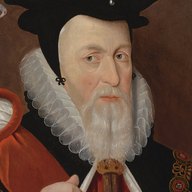

At a glanceKey from external plaintext · partial (23% of the cipher)
- The letter
- Burghley to Walsingham, 29 January 1573, copied in a fair-copy letter-book. It concerns the attempt by the Duke of Alençon’s agents to bring him to England on the understanding that Elizabeth might marry him.
- Where
- British Library, Harley MS 260 f. 419r–v; DECODE R8364, two pages. Printed by Digges (1655, p. 327) with the cipher left as signs.
- The cipher
- Homophonic letter cipher in two runs, plus boxed and numeral person codes: 26 cipher tokens, among them a six-sign place word and a nine-sign run.
- How it was read
- The six-sign word is read VALERY, the port of Saint-Valery-sur-Somme: the same word recurs in four letters of the winter, with the same first and third signs, and Walsingham’s file mentions a ship kept waiting there (grade M, probable).
- What it says
- From a Folger chronology summary: “Davison” is Maisonfleur, “Hall” the Queen, “Glasgow” and the boxed 9 the Duke. These are read from a summary, not a key (grade I).
- Still open
- The nine-sign run is unread and only H is known. Person codes 3 and II, and the exact values of tt and [9], rest on a summary. No key material is online.
- Credit
- Adam Wright pointed out the Folger summary on 1 October 2026.
01 The record
Harley MS 260 is a later fair copy of Walsingham’s Paris correspondence of 1570–73, one letter after another with their addresses, under running heads by month. Folio 419r opens with the end of Walsingham’s own letter of 6 February 1572 (old style), in which he asks to be relieved. Then comes the address “To the right honorable Mr Fraunces Walsingham Esq, the Queenes Maiesties Amba[ssador] in Fraunce”, and the letter beginning “Sir I have receaved yor lres of the xxth of this month with the tickett after yor accustomed manner contayning [9]”. The copy breaks off at the foot of f. 419v with a struck-out “finis”. Digges printed it from another copy, with the rest of the letter (Worcester’s dishonour off Boulogne, the French libel against Burghley, Walsingham’s letters of the 24th), under the running head “The Lord Burleigh to Fr. Walsingham”.
DECODE’s sender (“unknown”), recipient (“…”) and date (February 1572) come from the letter-book’s old-style year and the address line. The letter is Burghley’s, to Walsingham, and is dated 29 January 1573 by the Folger chronology (after Conyers Read), which also says he wrote “partly in cipher”.
02 The cipher in the letter
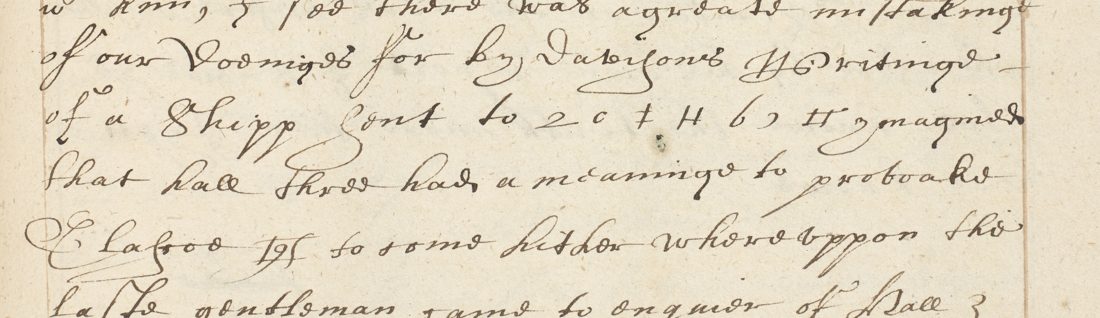
| Place | Harley 260 | Digges 1655 | What it is |
|---|---|---|---|
| “contayning …”, “sent from …”, “Glascoe …” ×2, “the ruyn of …” | [9] ×5 | |9|, |c| | a person code, read as Alençon from the Folger summary (grade I; section 04). Earlier read as a bare marker. |
| “Glascoe …”, “Hall …” ×2 | 3 (“three”) | ξ, 3, ȝ | unread; after Glascoe and Hall the summary has “the Queen” (section 04) |
| “yf … should soe doe” | 3 | ȝ | unread; here the summary has Alençon |
| “a Shipp sent to …” | 2 0 ‡ H 6 1 | 20 ǂ H Ꭾ ) | a place: VALERY |
| “… ymagined” | tt | ℵ | a person code, read as Alençon (sense, grade I) |
| “to enquire …” | ^ 4 d H m 11 11 I J | x. 7. D. H. m. 11. ⊏. 𝔗. ᘓ. | nine signs, unread |
| “that … had gotten such knowledge” | II | |—| | a person code, unread |

The names in clear are cover-names or real names of the affair of Alençon’s intended crossing, November 1572 to February 1573: Glasgow, Davison, Hall. Who they are is in section 04. Only the two runs are letter cipher.
03 The place name: VALERY
Digges printed the cipher of Walsingham’s correspondence in cipher type; the earlier attempt had taken it for figures. A search of all 457 page images of his volume, first by the OCR’s word confidence and then by two page-by-page scans, found about 45 ciphered passages in the letters of 1570–73. Four of them are the same word, in letters about the one ship:
| Letter | Context | Digges | Harley 260 |
|---|---|---|---|
| Burghley, Westminster, 11 Nov 1572 (p. 301) | “he hath required me to provide a passenger to attend at Harwich. Le the Port of …” | 2 0 ǂ 6 ɔ Δ | |
| Walsingham, Paris, Nov 1572 (p. 303) | “he desireth that the ship may stay at … 9 or 10 days” | 2 ɔ ǂ 6 r y | |
| Walsingham, Paris, 20 Jan 1573 (p. 313; R8363) | “a Gentleman of [9] departed hence to … with intention to imbarque there” | 2 ) ⌘ Ꭾ ) 4 | 2 1 ⌘ ε 9 4 |
| Burghley, early 1573 (p. 327; R8364) | “by Davisons writing of a ship sent to …” | 20 ǂ H Ꭾ ) | 2 0 ‡ H 6 1 |
Every copy has six signs. The first is always 2 and the third always the same crossed sign (ǂ, ⌘ and ‡ are the founts’ and the copyist’s versions of it). The other four places change from copy to copy. That is what a homophonic alphabet gives when one word is written several times. The place is a French port where a ship waits for passengers bound for England, with Harwich on the English side. The Nov 1572 letter has Walsingham ask that the ship may stay there nine or ten days. Cotton MS Vespasian F VI, the volume of Walsingham’s letters and drafts of 1572–73, holds at f. 197 “A French letter; earnestly desiring that a ship might be kept in waiting at St. Valery. Dec. 11”. VALERY has six letters, and Digges’s copy of the Walsingham letter even ends in a plain “r y”:
V = 2 · A = 0, ɔ, ), 1 · L = ǂ, ⌘, ‡ · E = 6, Ꭾ, H, ε · R = ɔ, ), r, Ꭾ, 9, 6 · Y = Δ, y, 4, ), 1
A few signs turn up under two letters (ɔ/) under A and R, 1 under A and Y). They are the places where Digges’s type and the letter-book copyist blur distinct manuscript signs, which the Digges and Harley copies of the same letters show. The reading does not depend on them. Dieppe, the other six-letter port, needs a different sign for each of its two Ps and two Es in every copy, and nothing in the sources points to it. Harwich, Dover, Calais and Dieppe are all written in clear elsewhere in these letters.
Grade M (probable). No source gives the alphabet; the length, the fixed signs, the “ry” and the St Valery ship in Walsingham’s file all point to this word. With it the passage runs:
I see there was a great mistaking of our doings, for by Davison’s writing of a ship sent to [St] Valery, [tt] imagined that Hall had a meaning to provoke Glasgow to come hither; whereupon this last gentleman came to enquire of Hall some assurance, if [3] should so do, to enquire […]. This you must think must needs appear very strange.
Read for sense, the sentence is about an invitation. The people in it are identified in the next section. The port is the one in the French letter of 11 December 1572 in Walsingham’s file, and in Walsingham’s letter of 20 January (R8363) a gentleman “departed hence to [St] Valery with intention to imbarque there”.
04 Who is who: the Folger summary
On 1 October 2026 Adam Wright wrote that the Folger Shakespeare Library’s Elizabethan Court Day by Day (the 1573 volume) summarises this letter under 29 January, partly in cipher, and cites Conyers Read, Lord Burghley and Queen Elizabeth (1960), pp. 94–95. The summary names the people where our copy has cover-names and codes. Set side by side, clause by clause, it gives:
| Harley 260 f. 419 | The summary says | So |
|---|---|---|
| “the partie … sent from [9]” | the party sent from Alençon | [9] = Alençon |
| “hee spake with Glascoe 3 and Davison with him” | he spoke with the Queen, and Maisonfleur with him | Davison = Maisonfleur; “Glascoe 3” stands where the summary has the Queen |
| “tt ymagined” | Alençon imagining | tt = Alençon |
| “Hall 3 had a meaninge to provoake Glascoe [9] to come hither” | the Queen had a meaning to provoke him to come hither | Hall = the Queen; “Glascoe [9]” = Alençon |
| “the laste gentleman came to enquier of Hall 3 some assurance yf 3 shoulde soe doe” | this last gentleman came to enquire of the Queen for some assurance, if Alençon should do so, that she would marry him | this last gentleman = La Mole; the lone 3 = Alençon |
| “to enquier ^ 4 d H m 11 11 I J” | (the marriage?) | the nine signs may carry the marriage; unread |
The people are the Duke of Alençon (François, the French king’s youngest brother), his agent Maisonfleur, who had a ship sent to bring him over, and the Sieur de la Mole, who was secretly at Whitehall on 23 January. The same chronology, under 22 January, says a ship sent for the Duke “waited in vain off the French coast for 23 days”. That is the 23 days of Burghley’s letter of 24 January (R8362), and the ship sent to St Valery of this one. The Archbishop of Glasgow is not in it: “Glasgow” is a cover-name, here for the Duke. An earlier version of this page, and of R8362, took it for James Beaton on the strength of the name alone.
What this does and does not give. These identifications are read from a modern summary, not from a key, so they are grade I. We do not know where Read had the plain text of the cipher. Two points do not fit one meaning: the digit 3 follows Glascoe and Hall where the summary has the Queen, but stands alone for the Duke, so it is left unread. And the clear name Glascoe is the Queen in one clause and the Duke in another, according to the digit that follows. The boxed 9 now looks like a code for the Duke rather than a bare marker: “the ticket concerning [9]” (R8363’s of 20 January), “sent from [9]”, “the ruin of [9]” and, in R8363, “a gentleman of [9]” all read well as Alençon. That is an inference from five contexts, not a proof.
05 What was tried for the rest
- The key. Hsuan-Ying Tu’s thesis on Walsingham’s intelligence (York, 2012) cites the key itself: TNA SP 106/2 f. 141A, “Sir Francis Walsingham Cipher, 1571”. She gives the Harley 260 letters of 1570–73, among them f. 399 (R8363), as examples of its use. DECODE has eight keys from SP 106/2 but not f. 141A. The nearest in date, SP 106/2 f. 50 (R343), names Moray, Cardinal Châtillon, Dover, Dieppe and Calais and belongs to Norris’s embassy of 1568–70. Its homophones give neither VALERY nor sense in the Digges runs. SP 106 is online only in the subscription State Papers Online.
- The sent letter. Cotton MS Vespasian F VI holds Burghley’s originals to Walsingham of 14 October 1572 (“with many cyphers”), 3 and 7 November 1572, and, at f. 245, a letter of 1572–3 from Somerset House that is probably this one. It also holds Walsingham’s drafts in clear of his letters of November 1572 to February 1573. The volume is catalogued “partly in cipher” and is not digitised.
- The Calendar. CSP Foreign vols. ix and x were searched for letters “partly in cipher, deciphered” that could be paired with Digges’s cipher. Walsingham to Smith of 10 August 1572 (no. 527) is deciphered, but Digges prints that letter without its cipher sentence. Burghley’s letters to Walsingham are not in SP 70, and this one is not calendared.
- The nine-sign run. Of its signs only H is known (= E, from the place name). Cribs such as passport, safe conduct, “the Queene”, “the Regent” and “Lord Seton” do not fit the shape. The Burghley–Walsingham runs of 1572–73 in Digges give only about 80 signs, loosely typeset, and too few overlap with this run to fix it.
06 What remains
- The nine-sign run “^ 4 d H m 11 11 I J” (f. 419v l. 2): no key material (the key and the original are not online; one sign known).
- Person codes 3 and II, and the exact value of tt and [9], which rest on a summary and not on a key. 3 is left unread because the summary does not give it one meaning. No key material.
- The boxed [9] ×5 (read as Alençon, grade I) and the 3 after Glasgow and Hall (unread).
Of 26 cipher tokens, the six of the place name have a value (23%, grade M). SP 106/2 f. 141A, or a photograph of Cotton Vespasian F VI ff. 172–247, would probably give the rest of this letter and of its siblings R8356, R8358 and R8361, together with the 45 passages in Digges.
Full texts
The transcription and the decryption of every document on this page, so that the reading can be used and checked. Short files are shown here; all are in the repository.
Harley MS 260 f. 419r-v, 29 Jan 1573
Walsingham's letter-book copy of Burghley's letter of 29 Jan 1573 to Walsingham, ambassador in France, about Alençon's agents (Maisonfleur as 'Davison', La Mole as 'the laste gentleman') and the ship sent to (St) Valery. The six-sign place name is read as VALERY; the boxed [9] as Alençon from the Folger/Conyers Read summary (via Adam Wright); the nine-sign run and the name codes 3, tt and II stay unread.
Transcription
# DECODE R8364, BL Harley MS 260 f. 419r-v (letter-book copy). Cipher tokens only, in order, with context.
# [9] = boxed 9 sign (cover-name marker); letter runs space-separated. Digges 1655 p. 327 prints the same letter from
# another copy; its rendering of each item is given after "D:".
f419r l.2  concerning [9]                         D: concerning |9|
f419r l.4  sent from [9]                          D: from |c|
f419r l.5  Glasgow 3                              D: Glasco. ξ.
f419r l.8  ship sent to  2 0 ‡ H 6 1              D: 20 ǂ H Ꮾ )        = VALERY (St Valery), see NOTES
f419r l.8  tt  (before "ymagined")                D: ℵ  (a separate code, subject of "imagining")
f419r l.9  Hall 3 (written "Hall three")          D: Hall 3.
f419r l.10 Glasgow [9]                            D: Glasco |9|
f419r l.11 Hall 3                                 D: Hall ȝ.
f419v l.1  if 3 should so do                      D: if ȝ. should so do
f419v l.2  to enquire  ^ 4 d H m 11 11 I J        D: x. 7. D. H. m. 11. ⊏. 𝔗. ᘓ.
f419v l.7  Glasgow [9]                            D: Glasco |9|
f419v l.7  that II had gotten                     D: that |—| had gotten
f419v l.9  ruin of [9]                            D: ruine of |c|
Transcription
# R8364 cipher tokens only, Harley 260 f. 419 copy, in reading order (see transcription.txt for context)
[9]
[9]
3
2 0 ‡ H 6 1
tt
3
[9]
3
3
^ 4 d H m 11 11 I J
[9]
II
[9]
Decryption
# R8364, BL Harley MS 260 f. 419r-v: Burghley to Walsingham, early 1573 (letter-book copy). Clear text transcribed
# from the DECODE images at page level (spelling as far as legible, contractions expanded only where obvious);
# cipher in <> with its reading. {Valery} = the six-sign place name, grade M. <...> = unread.
[f. 419r]
To the right honorable Mr Fraunces Walsingham Esq, the Queenes Maiesties Amba[ssador] in Fraunce
Sir I have receaved your letters of the xxth of this month with the tickett after your accustomed
manner contayning <[9]> and was on Frydaie laste with the partie one whome you made mention to be
sent from <[9] = Alencon, Folger/Read, grade I> hee spake with Glascoe <3> and Davison with him, I see there was a greate mistakinge
of our doinges for by Davisons writinge of a Shipp sent to <2 0 ‡ H 6 1 = {Valery}> <tt = Alencon, Folger/Read, I> ymagined
that Hall <3> had a meaninge to provoake Glascoe <[9]> to come hither whereuppon the
laste gentleman came to enquier of Hall <3>
[f. 419v]
some assurance yf <3 = [Alencon]? lone 3 only, I> shoulde soe doe to enquier <^ 4 d H m 11 11 I J> This you must
thinke muste neede appeare verie strange whereuppon before Davison I did declare
that all that was donne came of him with earnest and lamentable requests to have Glascoe
<[9]> preserved because hee said that <II> had gotten such knowledge as the same would
tende to the ruyn of <[9]> and soe the partie that now was sent is departed well certefied of the
truth, but not satisfied of his request.
It is good to deale warelie herein without knowledge herein for there is some cause to
mistruste that Davison and all his partners doe nothinge herein ordered as there canne
bee noe advantage taken I trust and soe allsoe you maie looke to your doeinges as I see
you are disposed by the occasion of the fond handlinge that you see I am much perplexed
with the dishonor donne to my lord of Worcester her Maiesties Amba[ssador] on the seas before Bullen
whereof by his owne report I knowe you shall knowe the truth more then I yet
doe knowe

# 1 Oct 2026 (Adam Wright): Davison = Maisonfleur; Hall = the Queen; Glascoe [9] = Alencon (cover-name, not the Archbishop of Glasgow); the laste gentleman = La Mole; letter of 29 Jan 1573 (Folger Elizabethan Court Day by Day 1573, after Read 1960 pp. 94-95). Grade I.
07 Sources
- British Library, Harley MS 260 f. 419r–v, via DECODE R8364 (images, login).
- Folger Shakespeare Library, Elizabethan Court Day by Day, 1573 (PDF), entries for 22, 23 and 29 January, citing C. Read, Lord Burghley and Queen Elizabeth (London 1960), pp. 94–95. Pointed out by Adam Wright, email of 1 October 2026.
- Dudley Digges, The Compleat Ambassador (London 1655), pp. 301, 303, 313, 327 (archive.org, images n316, n318, n328, n342).
- British Library, Cotton MS Vespasian F VI, catalogue record (searcharchives.bl.uk 040-001103461), after J. Planta, Catalogue of the Manuscripts in the Cottonian Library (1802), pp. 492–94.
- Hsuan-Ying Tu, The Pursuit of God’s Glory: Francis Walsingham’s Espionage in Elizabethan Politics, 1568–1588, PhD thesis, University of York, 2012 (White Rose eTheses 5680), ch. II nn. 98–100.
- The National Archives, SP 106/2, keys on DECODE R343 and R341–R354.
- Calendar of State Papers Foreign, Elizabeth, vols. ix–x (BHO).
Notes, transcription, the list of Digges’s cipher passages and the profile: targets/r8364/.