At a glanceCiphertext-only break · partial (78% of the cipher)
- The letters
- Two reports to the Signori of Siena from a Cristofano writing on the Milanese side of the war over Lucca. No. 6 is dated 19 February with no year. No. 24 has no date, and its signature is on the back.
- Where
- Archivio di Stato di Siena, Concistoro 2308, fasc. 2, nos. 6 and 24, photographed on DECODE as R4795 and R4812 (catalogued “1500–1599”, no transcription). The key is in fasc. 1 of the same busta, DECODE R4755.
- The cipher
- Homophonic substitution. There are 36 signs for 21 letters, four each for a, e, i, o and u. The key also has 7 nulls and 18 signs for whole words, five of which occur here (Lucca, Piccinino, Duca di Milano, Viniziani, Fiorentini). There is no word division.
- How it was deciphered
- George Lasry recovered the key from the ciphertext alone with the built-in cryptanalysis of CTTS, and refined it with Claude Opus 5.5 and GPT-6 Astra. The filed key sheet R4755 was found to match afterwards. Here, our own transcription of 24 September was decoded with that key. With the key read off the sheet by eye, it gives the same letters as his reading at 69% of positions. After fitting our sign labels, the figure is 88–91%.
- What it says
- Piccinino “cominciò a mandare quatrocento per fare aprire la via per andare a Lucca”. No. 24 reports that the marquis of Mantua and Taliano have come to terms with the Duke of Milan, and that the Emperor will not come.
- Still open
- About a quarter of no. 24 decrypts to letters that make no sense, probably from misread signs on a small photograph. The back of no. 24 is decoded here only in stretches. No. 24 is therefore decoded, not read: only no. 6 reads, about 29% of the cipher. On 23 October 2026 no. 24 and its neighbouring records (R4811, R4813) were fetched again: they carry no attachment, transcription or decipherment, and the images are the same small photographs (20–25 px a sign), so a sign-level re-check needs the original in the Archivio di Stato di Siena. The writer’s surname is unread.
- Credit
- Solution by George Lasry, with CTTS built-in cryptanalysis, refined by Claude Opus 5.5 and GPT-6 Astra, sent to Daniel Bourdeau on 14 October 2026 and restated in his report of 17 October 2026 on the Concistoro 2308 ciphers. The verification, the decoding of no. 24’s back, its signature and the dating check were done here.
01 The letters and the key
The two letters belong to fascicle 2, “Lettere in cifra”, of Concistoro 2308 in the Siena state archive. Our survey of the busta (siena1421) transcribed both on 24 September 2026. It found that they share one system, but no filed key fitted and every ciphertext-only solver failed on them. Each opens with a clear salutation, “Magnifici et potentes domini domini mei singularissimi”, and continues in cipher to the end.
- No. 6 (DECODE R4795): 15 lines, 1,051 signs in our transcription (1,007 in the solver’s count). It is dated 19 February and signed “Cristofano de Mont[…] si racomanda”.
- No. 24 (DECODE R4812): 38 lines on the text side, 2,638 signs in our transcription (2,559 in his). Eight more cipher lines run over onto the back, above the address “Magnifici et potenti signiori e … Capitano di popolo della citta di Siena”.
The key, R4755, is a single sheet in fascicle 1 headed “Cifra cum Christofano” followed by a surname that is hard to read. DECODE reads it “Ghinucci[?]”. The signature of no. 6, “Mont‹vccia›” in the solver’s reading, suggests something like Montucci instead. That is left as a question. Our own survey had listed this sheet on 24 September but never tried it on these two letters.
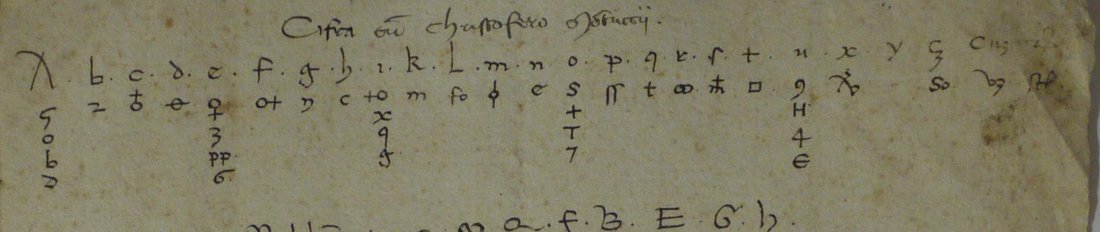
On the DECODE photograph the sheet gives 36 letter signs (k, h and x included, nothing for y), 7 nulls and 18 word signs. The word signs are Papa, Fiorentini, Viniziani, Duca di Milano, Nicholo Piccinino, Conte Francesco, Luccha, Pisa, Pistoia, Siena, Pontremoli, Parma, Pietrasanta, Genova, Bologna, Messer Thomaso, Cavagli and Fanti. This matches the solver’s description. His count of word signs that occur also holds: five of the 18. Our transcription had already marked the same point-framed signs as “probable name codes”.
02 No. 6: Piccinino opens the road to Lucca
This is the solver’s reading. Square brackets mark letters he supplied; ‹…› marks letters that decrypt but make no sense.
… e crede di certo lui s[t]a aconcio co’ Viniziani … [se] avete bis[o]gnio di gente d’arme, qua se n’ trovarebbe degli uomeni valenti, e ven[i]r{d}e a dì quatordici di questo Piccinino cominc[i]ò a mandare {eo} quatrocento per fare [e] [a]prire la via per andare a Lucca; e à mandato i tronbetti per le brigate, {v} che sieno q[u]i per questa semana; e se ’l tenpo sarà mai più buono, se partiranno per tucto questo mese. … E data a dì dicenove di Febrai[o]. Cristofano de Mont‹vccia› ‹·› si rac[o]manda. E il ea non s’achordarà col Duca di Milano, perché vuole troppe cose.
A man has settled his accounts with the Venetians and is thought to have taken service with them. Men-at-arms could be had for Siena. On the 14th Piccinino began sending four hundred men to open the road to Lucca, and trumpeters have gone to call up the companies. The chancellor of messer Antonio Petrucci has come back from Milan. A postscript says someone will not come to terms with the Duke of Milan “because he wants too many things”.
In this reading 62 of the 941 decrypted letters (6.6%) stand in ‹…›, scattered single words. Three of them come from one sign. The key writes z as a compound, an S with a small o attached (“So”), while a plain S is o; read as two signs, the z disappears. Restored, it gives “d’avere buona aduertenza” (good care), “per facti di Vincenzo da Camerino”, and “tornò da Milano senza avere fact[o] nula”: Petrucci’s chancellor came back from Milan without having done anything, where the reading above has him going “to Siena” (the last word needs the key’s 4 = u). All three places were checked on the photograph. With them no. 6 reads 896 of 939 decrypted letters as sense (95.4%). The revised reading is kept beside the submitted one in the repository.
03 No. 24: Mantua and Taliano go over to Milan
… e Lucca tiene de certo il {e}r[e] s’achordarà con lui … e q[u]i à man{n}dato uno ‹svvfai›‹iglioatire› a Lucca che no[n] t[i] besogniarà ‹lvinaoa› a sochorare Lucca … il marchese di Manto{·}[v]a è acordato col Duca di Milano … e certo si tiene lo ’npe[r]adore non ver{e}rà; e Lucca dice che Taliano [s]’è aconcio col Duca di Milano …
Ambassadors of Lucca, Camerino and the Florentines are present. The castles of the countryside have been ordered to bring in provisions. Lucca is confident that “the king” will come to terms with it and that no relief will be needed. Duke Albert, the King of Hungary and the Council of Basel are named. A company has stopped ninety miles away.
No. 24 is much harder to read than no. 6: 623 of its 2,286 decrypted letters (27.3%) stand in ‹…›, in runs of up to 24 letters. The photograph gives only 20–25 pixels per sign, half the resolution of no. 6. Our own transcription of this page flagged c/ĉ/e, a/□ and 0/θ as unsafe there, and the key separates exactly those signs.
The same correction, then a pass run by run against our transcription and the photograph, turns 23 of these gaps into words. Seven are settled on the image, among them “e grandi ghiacciate” (great frosts), “lo a Chamerino”, and three word signs the reading above had dropped (two Viniziani and a Duca di Milano, each framed by points). Three follow from the z and u of the key: “perché e’ or ’l tenpo si cominca a dirizare” (the weather begins to mend) and “senza fallo il marchese di Mantova è acordato col Duca di Milano”. Thirteen more are fixed by the sense around them, such as “uno suo famiglio a dire a Lucca” and “il ducha Alberto, duca d’Isterlic, che è a facto re d’Ongnaria”. No. 24 now reads 1,815 of 2,279 decrypted letters as sense (79.6%; 75.2% counting only the changes checked on the image). The longest runs still do not read: on the photograph their signs are as transcribed, or too small to tell apart.
The back, decoded here. The solver’s reading stops at the foot of the text side, but the letter runs on for eight lines on the back. Our first-pass transcription of those lines (637 signs), mapped onto the key, gives these stretches among unread runs:
- “… cose sono … segrete …”
- “… umilemente mi racoma[ndo] …”
- “… a la uostra … Signoria …”
- and at the end “… Signioria. Crist[ofa]no … si racoman[d]a”.
So no. 24 is not unsigned. It is by the same Cristofano as no. 6 (graded C, probable).
04 How the solution was checked
As the solver tells it, the key was first recovered by cryptanalysis from the ciphertext only. His PDF of 14 October put this to Claude with the help of Astra, and the find of the matching key sheet, among the 43 filed keys of fascicle 1, to Astra. His consolidated report of 17 October puts it as CTTS’s built-in cryptanalysis, refined by Claude Opus 5.5 and GPT-6 Astra, with the filed key R4755 found to match afterwards. His PDF gives the reading and the key, but not his sign-by-sign transcription. The test here therefore uses ours: made on 24 September by three transcribers working from the DECODE photographs, before any key was known, with its own names for the signs.
| Test | No. 6 | No. 24 |
|---|---|---|
| Our transcription, key read off the sheet by eye (31 sign labels, no fitting): same letter as his reading | 650/941 = 69.1% | 1,586/2,286 = 69.4% |
| Same, sign labels fitted by alignment, one value per label | 751/941 = 79.8% | 1,743/2,286 = 76.2% |
| Same, labels that our transcribers used for two key signs counted for both | 852/941 = 90.5% | 2,017/2,286 = 88.2% |
| Italian n-gram score of our decode, per letter (key by eye / fitted) | −3.53 / −3.06 | −3.62 / −3.34 |
| Shuffled-key control, mean of 20 (best) | −4.77 (−4.22) / −4.03 (−3.63) | −4.77 (−4.19) / −4.04 (−3.56) |
| His reading, same model | −2.42 | −2.69 |
The language model is the project’s Renaissance Italian model (it-cinquecento, order 5, without spaces). Where our decode and his reading differ, the cause is our transcription, not his key. Our label t covers three key signs: + (o), t (q) and an o+t ligature (f). Our c covers h and an e-like n. Our 0 sometimes stands for the i-sign “+o” with its cross unseen. Our d and u are one a-sign. The circle we called CIRC is both Lucca and Piccinino. No key value had to change. The doubled p p that our notes had flagged as a unit is the key’s fourth sign for e.
05 The date
The PDF dates both letters to about 1431–1432, during the war of Florence against Lucca (1429–1433). It reasons from Piccinino, from Sigismund in Italy (1431–1433), from the Council of Basel (1431) and from the marquis of Mantua. That fits no. 6. No. 24 fits a second campaign at least as well.
- Sigismund made Gianfrancesco Gonzaga marquis of Mantua in September 1433, after the peace of Ferrara had ended that war in April.
- Gonzaga left Venetian service for Filippo Maria Visconti in 1438, when Florence was again at war with Lucca.
- Albert of Austria became King of Hungary in December 1437; the revised reading of no. 24 has “il ducha Alberto, duca d’Isterlic, che è a facto re d’Ongnaria”, made king.
- No. 24 also has “a Fer[r]ara pe[r] lo presente”: the Council moved from Basel to Ferrara in January 1438. No. 24 therefore belongs to early 1438.
- Sigismund died the same month, and “the Emperor will not come” fits either period.
So the range here is c. 1431–1438. No. 6 falls in February 1431 or February 1437/38 (1430 or 1436/37 in Sienese style). This is graded M: it comes from the decrypted content, and the archive dates neither letter.
06 What remains uncertain
- No. 24, text side: 623 decrypted letters in ‹…›, in runs (‹carpelaelotecednelgnnpei›, ‹vannoafonatificas›, ‹eqnleodiaferraerapeo› …). The key is complete for every sign that occurs, so these are reading problems. They need a sharper image than DECODE’s, from the reading room in Siena.
- No. 6: 62 decrypted letters in ‹…›, in scattered single words.
- No. 24, back: only the closing formula and the forename decode. The rest of the 637-sign first pass is not yet sense, and the first sign of two lines is lost in the fold.
- The writer’s surname: Mont‹vccia› in no. 6 and a cursive surname on the key heading.
- Grades: the two quoted passages are H; no. 24’s signature is C; the date range is M. The solver’s editorial letters [x] and {x} are his.
Full texts
The transcription and the decryption of every document on this page, so that the reading can be used and checked. Short files are shown here; all are in the repository.
No. 6 (R4795), Cristofano to the Signori of Siena, 19 February [c. 1431-38]: George Lasry's reading, and this project's corrections
Cristofano de Mont[...] to the Signori of Siena, 19 February: Piccinino's men opening the road to Lucca, and Antonio Petrucci's chancellor back from Milan 'senza avere fact[o] nula'. reading_no06.txt is George Lasry's reading as submitted; reading_no06_rev.txt is this project's correction of it (z = So, 4 = u on the key sheet, 14 Oct 2026); decode_no06.txt is this project's own transcription decoded with the key. Lasry's sign transcription is not in the repository; the transcription linked is this project's blind one of 24 Sept.
Transcription
No. 6 (ASSi Concistoro 2308, fasc. 2) - DECODE R4795
Images: decode/img/IMG_R4795_I27934_P2.jpg = TEXT SIDE (landscape, 15 manuscript lines).
        decode/img/IMG_R4795_I27934_P1.jpg = verso: mirror show-through of the cipher, a wax/seal trace, and one
        line of docket/address in the middle, read "X(?) . g(?) . B . di Firenze(?)" (hand and reading uncertain;
        possibly the sender's initials "... B. di Firenze"). No cipher written on P1.
Transcriber: agent A, 24 Sept 2026, from the photograph (4x crops of 300-px strips per line, doubtful signs 5x;
        crops in crops/agentA/u6_LL_SS.jpg and w*.jpg).

WHAT IT IS
- Clear salutation on m.01: "Magnifici et potentes .d(omini). .d(omini). mei singularissimi doppo humile
  recomandatione" (Italian, 15th-century mercantesca-like hand), then cipher to the end of the letter.
- 14.5 lines of continuous cipher, no word division, no clear words inside, no date, no signature on the text side.
  The text ends on m.15 at about 3/4 of the line (last sign "6"); the rest of the page is blank.
- One scribal deletion (m.03): 4-5 signs struck through with a heavy stroke, then the text continues.
- No interlinear glosses anywhere.

SIGN LEGEND (68 names incl. marked variants; "?" in the text = uncertain reading of that sign)
 Letter-like signs
  a      compact a / "ɑ": closed bowl with a small tail at lower right (often before PAREN: "a PAREN" x5)
  b      tall straight ascender + round bowl at the foot (b)
  B      large B / ß-like: tall ascender, often curling back at the top, two stacked bowls
  c      plain c
  c^     c carrying a small raised c/hook at its upper right (ᶜc). Very frequent; treated as a distinct sign
  d      uncial d (∂): round bowl with a long ascender curving up and back to the LEFT
  d+     bowl with a short upright rising from it and a CROSS on top (đ / "o with + above"); includes the
         cases where the ascender itself is crossed. Very frequent (44)
  e      c with a middle bar (e)
  E      capital E, square or round (ɛ with bar); two shapes not separated
  g      g/ʒ-like: small closed bowl above a descender that curls back left (ȝ / ɡ)
  h      h whose right leg descends below the line and hooks left (ɦ/ɧ); also written as tall stem + ")"
  h_     h with the LEFT stem continuing far below the line (m.02, 2x)
  H      capital H (two uprights with a bar)
  l      plain tall upright (m.04, m.05; uncertain, may belong to a neighbour)
  m      plain m (3x only)
  m+     m with a cross standing above it. Very frequent (36)
  n      plain n (1x)
  p      p. Very often doubled "p p" (about 20 times)
  q      closed bowl with a straight vertical stem descending
  Q      large Q/Ω: loop open below with a tail sweeping to lower right
  S      large S (both ends hooked), bigger than 5 (4x)
  t      t / plus-like cross (+ with a small foot); standalone crosses on the line are counted as t
  T      capital T
  u      u / ʊ (open top)
  w      two joined u's (m.12, 1x)
  W      ω-like sign: open c joined to o/u ("ɷ", looks like "cu" or "co"); the most frequent sign (62)
  x      x (two crossing strokes)
  y      u-like head with a long descender on the right (ɥ / y)
 Digit-like signs
  0      small round o/0
  2      z-shaped 2 (ƻ)
  3      z-shaped 3 with descender (ʒ)
  4      Gothic 4: small bowl + stem with a bar to the right (ꝗ-like)
  5      ſ-like 5 with a flat or hooked top bar and a lower curve (ƽ)
  6      б-like 6, usually with a long top stroke to the right
  7      7 (bar + descending stem)
  8      8-like sign of two stacked loops (ɞ); 8? where it might be e/6
  9      closed bowl with a tail curving down-left
 Special signs
  A      stem descending below the line with an arch at the top that runs into a loop on the right (ʄ / ᴀ /
         "ƒɔ"). Earlier drafts called some of these F?; all merged here (42)
  F      ſ/F with a horizontal crossbar (distinct from A) (3x)
  BOX    closed square □ (43)
  CIRC   large circle with a central dot ⊙, often with a tail from the top (5x)
  THETA  closed oval with a horizontal bar through it (θ / ⊖), sometimes filled with ink. NB: the scribe often
         links neighbouring signs with a horizontal hairline, so some THETA may be o + connector
  EQO    oval with two short bars inside (⊜) (m.08, 1x)
  PHI    small bowl with a vertical stem running through it both above and below the line (φ / ψ / þ-like)
  THORN  stem through a bowl on the right (þ) (m.02, 1x; perhaps = PHI)
  VENUS  small o-head whose stem is crossed below the line (♀) (4x)
  YCROSS y/ɥ head whose descender is crossed below the line (24)
  ETA    n whose right leg descends long and curls left (η)
  SS     two tall long-s stems joined at the top (ʃʃ / ᴨ) (24)
  SP     as SS but the second stem carries a bowl (ſþ / ᴨp) (6)
  PAREN  tall ")"-shaped stroke from above the line to below it (5x, always after a)
  INT    very tall ſ / integral sign with hooked top (3x)
  RX     ℞-like sign: tall "(" stroke + R/2-shape with crossed leg (3x; m.14 RX? different form with a cross on top)
  XL     x with a loop at its upper left (m.06, 1x)
  RP     reversed-P sign: stem with bowl at top right and foot turned left (m.03, 1x)
  PCT    %-like sign: long stroke from upper left hooking down to lower left, crossing a small 6/b (m.07; the
         m.02 case is written "SL 6?")
  SL     the long hooked slash of PCT when read separately (m.02)
  LT     loop with a long tail down-left (m.01, 1x; with the preceding u possibly clear "ut")
  DOT    a point on the line (m.15, 1x)
  ??     an ink-blotted sign (m.05): filled circle with a stem below (THETA or VENUS?)
 Marks
  X+     sign X with a cross ABOVE it (m+, d+ as above; also 0+, 5+, 6+, x+, E+, THETA+, PHI+, y+ once each).
         Crosses standing between two lines were assigned to the sign below them.

CONVENTIONS: no word gaps exist in the cipher; signs are separated by single spaces only. Clear text in [ ].

TRANSCRIPTION (m. = manuscript line of P2)

m.01 [Magnifici et potentes .d. .d. mei singularissimi doppo humile recomandatione] u? LT? a PAREN SS VENUS a 2 4 0 ETA 3 7 B m+ d+ a u m+ h 6 m+ t u E t y 5 c^ BOX t INT 0 t H THETA p?
m.02 2 4 THORN T ETA c^ 5 t Q SS 3 c m 8? h_ d 0 e u b BOX p p a PAREN b a d VENUS F THETA x e E 7 9 t 5 4 t u? SL 6? T B 0+ e PHI 3 H 0 m+ 9 ETA c 3 t a x? E THETA d A 0 PHI t 0 a 5 c^ THETA 7 h_? d 6 b a? h e? T Q
m.03 m+ d+ W q d BOX 8? {struck through by the scribe: B? t+? h? y?} d 0 CIRC d+ e p p SS h 3 W THETA E u 0 m b 0 e? 5? u y c^ t a F d+ c 5 c d+ 3 A E h A x p p W b 6 THETA? t u SS q BOX W 7 A x e T THETA d RP 9 p p W
m.04 PHI t a PAREN n p m+ a 5 BOX 7 6+ T RX 6 m+ 0 A THETA W BOX 3 Q A YCROSS m+ H 6 W 5+ ETA x 7 c q 6 3 W YCROSS? m+ BOX 0 d 9 p p W 3 THETA H d+ b a x+ E BOX W y YCROSS? x A 9 d B u l t E
m.05 d A l? 0 A x THETA 5 c^ h c^ 6 0 A SS m W? 6 m+ YCROSS c^ BOX 3 A 5 PHI p p BOX b a PAREN YCROSS W 3 c^ THETA 7 A 9 BOX ??(ink blot: filled circle with stem below) E+ d+ BOX YCROSS A 3 m+ W p p 6 d+? T m+ 6 B 3 u d BOX t A y m+ SS VENUS W 5 4 5 0 b
m.06 THETA x t c 9 3 A h A 6 THETA 3 A d+ THETA c^ BOX 3 A H x ETA g p p d+ W YCROSS THETA 3 THETA+ x d+ YCROSS W BOX 7 A 4 t 0 m+ XL 5 u d+ 7 c^ d+ 5 t d+ 7 RX E x A SS 3 W d+ 6 p p THETA u 4 3 W YCROSS 2 H t
m.07 c 5 0 THETA 4 6 W BOX p p c^ S u d SP B 6 m+ YCROSS 5 9 3 BOX p p 2 y PCT S ETA c^ 9 7 THETA t 0 ETA YCROSS c^ a b THETA 5 W PHI 6 t y b m+ 3 c^ BOX W 8? E 5 W YCROSS 2 E 2 b THETA p p ETA A x 9 7 PHI g
m.08 c^ t 0 H d A p p c^ BOX y h SP 4 3 c^ 0 W THETA g u THETA y t 4 5 BOX T W THETA 7 x d+ h u THETA q t H YCROSS m+ BOX EQO CIRC d+ 7 PHI x e d+ t b PHI u c THETA d W p p 6 INT t 9 u BOX W t d+ YCROSS c^ BOX 7 B SS p p W
m.09 0 t 5 W 6 E 4 SS W g W 3 A u 9 x 5 SS YCROSS W d c THETA b W 6 0 c CIRC Q E p p 0 PHI 5 c^ THETA d BOX T h x BOX W 7 c^ 2 YCROSS a? B BOX 7 x SS 3 W A 6 2 W g ETA u BOX 3 y d+ c 6 m+
m.10 x p p c^ 7 t x SS 3 W t 4 6 m+ BOX 5 m+ YCROSS PHI u c^ 5 h 6 m+ 3 A BOX YCROSS c^ SS THETA m+ u W b PHI 5 g SS x y 2 H T e t m+ 3 SS u W BOX y W u c^ h c^ 7 SS YCROSS W BOX 4 d+ BOX 8?
m.11 t 4 6 m+ BOX 7 PHI 6 m+ p p SP t 0 A d+ c 0 e d+ 3 A 6 A x 3 W 6 E THETA y PHI g m+ ETA? {small tear/stain after this sign, probably no loss} W 6 d e BOX t c q 7 SS YCROSS BOX W 9 d+ g h BOX T W c^ THETA THETA a? PHI x A b c 7 a PAREN m+ 3 c^ S 0 5 0 H p p W
m.12 YCROSS 0 t d d+ BOX e 4 A b A b THETA 3 w W BOX d A t PHI 3 THETA 6 x A SS W d+ e 3 u t 4 5 d+ t c CIRC p p m+ d+ W x m+ E h m+ VENUS THETA y e E 7 9 T SS 3 W A THETA PHI t THETA T A x THETA 7 PHI u c^ THETA 5 q INT YCROSS W q
m.13 PHI+? 0 c THETA 5 PHI 7 6 x A d+ c 5 c^ d+ 3 A x 6 W p p d PHI g? A u c^ 7 SP CIRC H q m+ d+ W g 9 6 SS 3 W u t d d+ a g THETA x ETA y+ c d+ 6 c S u 7 Q THETA 5 d+ u PHI p p W x e t B YCROSS u PHI q g c^ SS e? m+
m.14 BOX 7 H 6 A T W d d+ t PHI b c THETA x SP THETA 5 BOX u 0 THETA g THETA q d+ YCROSS c e H ETA p THETA x u t 6 2 W 5 t 0 d d+ W E g m+ BOX 7 u t b c^ T h THETA p p PHI t c^ BOX E d+ F E d+ x d RX? m+ y
m.15 W u d+ PHI 5 c^ THETA d SP x A 6 u DOT c^ t c^ m+ 5 d+ c 7 W THETA d W u d+ t A PHI SS p p W d+ c^ 6 9 H 8? A 3 BOX W 7 SS h E SS 3 d+ T m+ 6   (end of text; the rest of the line is blank)

COUNTS (cipher tokens only; the clear salutation, the struck-out signs and notes excluded)
Total cipher tokens: 1058
  per line: m.01 37, m.02 81, m.03 68, m.04 68, m.05 74, m.06 73, m.07 73, m.08 78, m.09 71, m.10 68,
            m.11 78, m.12 80, m.13 81, m.14 73, m.15 55
Distinct sign names: 68 (54 base signs + 14 cross-marked / rare variants; ?-suffixes ignored)
  W 62, p 51, THETA 49, t 47, d+ 44, BOX 43, A 42, 3 39, 6 38, c^ 37, u 36, m+ 36, 5 34, x 33, 7 31, 0 30,
  d 26, PHI 25, SS 24, YCROSS 24, c 22, E 19, b 19, a 18, e 17, 9 16, 4 15, h 15, T 15, y 14, H 14, g 14,
  ETA 12, 2 10, q 10, B 8, SP 6, PAREN 5, Q 5, 8 5, CIRC 5, VENUS 4, S 4, INT 3, m 3, F 3, RX 3, h_ 2, l 2,
  LT 1, THORN 1, SL 1, 0+ 1, RP 1, n 1, 6+ 1, 5+ 1, x+ 1, ?? 1, E+ 1, THETA+ 1, XL 1, PCT 1, EQO 1, w 1,
  PHI+ 1, y+ 1, DOT 1

OBSERVATIONS
- Continuous writing, no word separators; signs are Latin minuscules, a few capitals (B E H T), digit shapes
  (0 2 3 4 5 6 7 8 9) and invented signs (BOX, CIRC, THETA, PHI, VENUS, YCROSS, SS, SP, A, RX, PAREN ...).
- Crosses are the main diacritic: a cross above m and above the d-bowl occurs 80 times ("m+", "d+"), and a
  cross through the descender of y (YCROSS, 24) or o (VENUS, 4). Plain m (3) and plain d (26) also occur, so the
  cross looks meaningful (a different sign, or a doubling/null marker). A few other signs carry a cross once.
- Frequent repeats: "p p" (~20x), "a PAREN" (5x, PAREN only ever after a), "SS 3" (6x), "W BOX", "BOX W".
- With ~54 base signs and W/p/THETA/t each at 4.5-6%, the system looks homophonic with nomenclator-type signs
  rather than simple substitution.
- Uncertainties to recheck first: W vs "c o"/"a u"; THETA vs o + connecting hairline; 8 vs 6/e; q vs 9 vs PHI;
  the A sign (merged from F?/A variants); the blotted sign in m.05; RX? in m.14.
Decryption
# Concistoro 2308 no. 6 (DECODE R4795): the outside reading, as submitted (bold text of the PDF "Siena, two ciphered letters to the Signori").
# Solution by George Lasry, with Claude and with the help of ChatGPT Astra; sent to Daniel Bourdeau on 14 Oct 2026.
# Conventions (theirs): [x] letter changed or added by the editor; {x} decrypted letter left out; <abc> rendered as ‹abc› =
# decrypted letters not understood; (...) a gloss; · a null/dot. Word signs printed as words.
# Copied verbatim from the PDF text layer, line breaks as in the PDF. Verified here against our own transcription: see NOTES.md.

No. 6
Magnifici et potentes domini domini mei singularissimi, doppo humili recomandatione. ‹b·› per Biageo
scr[i]se, sì quanto fu de bisognio. Pensolare ‹teaite› li nvovo a vi‹iao› come i signiori da la
Mirandola, e ànno scricto a{a} Lucca che p{g}erò da ‹kanaa·not› chancelliere e di Petrolino
da ‹rver›mo è stato co' Viniziani e saldate le sue ragioni; e{e} resta avere ducati tre[m]ilia da
qual q[u]ali danno al presente la metà, e rendoli t{m}[u]cte le sue{e} cose; e dato, la sperava
‹aa› di quelle del conte Luigi; e crede di certo lui s[t]a aconcio co' Viniziani, il perc[h]é è
d'avere buona ‹adiertenaa› a prese; [se] avete bis[o]gnio di gente d'arme, qua se n'
trovarebbe degli uomeni valenti, e ven[i]r{d}e a dì quatordici di questo Piccinino cominc[i]ò
a mandare {eo} quatrocento per fare [e] [a]prire la via per andare a Lucca; e à mandato i
tronbetti per le brigate, {v} che sieno q[u]i per questa semana; e se 'l tenpo sarà mai più
buono, se partiranno per tucto questo mese. Pe' q[u]al chancel{e}liere di misere Antonio
Petruci tornò da Milano [a] Sena ‹aaa›vere fact‹nilalado› e Bartalomeo, e i[l] perché f[u]i
{·}con Piccinino e scrisse di nvovo; per lo modo [s]i doma[n]da ieri manda. Mo' e il
chanceliere a Milano e Piccinino vi scrive per facti di Vincena{ao} da Camerino; è a mi
inposto, ve l'ora comandi. E data a dì dicenove di Febrai[o]. Cristofano de Mont‹vccia› ‹·› si
rac[o]manda. E il ea non s'achordarà col Duca di Milano, perché vuole troppe cose.
Decryption
# Concistoro 2308 no. 6 (DECODE R4795): the outside reading, as submitted (bold text of the PDF "Siena, two ciphered letters to the Signori").
# Solution by George Lasry, with Claude and with the help of ChatGPT Astra; sent to Daniel Bourdeau on 14 Oct 2026.
# Conventions (theirs): [x] letter changed or added by the editor; {x} decrypted letter left out; <abc> rendered as ‹abc› =
# decrypted letters not understood; (...) a gloss; · a null/dot. Word signs printed as words.
# REVISED 14 Oct 2026 (this repo): S+o compound = z (key 'So'), 4 = u (key); four passages changed, see NOTES. Original:
# Copied verbatim from the PDF text layer, line breaks as in the PDF. Verified here against our own transcription: see NOTES.md.

No. 6
Magnifici et potentes domini domini mei singularissimi, doppo humili recomandatione. ‹b·› per Biageo
scr[i]se, sì quanto fu de bisognio. Pensolare ‹teaite› li nvovo a vi‹iao› come i signiori da la
Mirandola, e ànno scricto a{a} Lucca che p{g}erò da ‹kanaa·not› chancelliere e di Petrolino
da ‹rver›mo è stato co' Viniziani e saldate le sue ragioni; e{e} resta avere ducati tre[m]ilia da
qual q[u]ali danno al presente la metà, e rendoli t{m}[u]cte le sue{e} cose; e dato, la sperava
‹aa› di quelle del conte Luigi; e crede di certo lui s[t]a aconcio co' Viniziani, il perc[h]é è
d'avere buona aduertenza a prese; [se] avete bis[o]gnio di gente d'arme, qua se n'
trovarebbe degli uomeni valenti, e ven[i]r{d}e a dì quatordici di questo Piccinino cominc[i]ò
a mandare {eo} quatrocento per fare [e] [a]prire la via per andare a Lucca; e à mandato i
tronbetti per le brigate, {v} che sieno q[u]i per questa semana; e se 'l tenpo sarà mai più
buono, se partiranno per tucto questo mese. Pe' q[u]al chancel{e}liere di misere Antonio
Petruci tornò da Milano senza avere fact[o] nula ‹lado› e Bartalomeo, e i[l] perché f[u]i
{·}con Piccinino e scrisse di nvovo; per lo modo [s]i doma[n]da ieri manda. Mo' e il
chanceliere a Milano e Piccinino vi scrive per facti di Vincenzo da Camerino; è a mi
inposto, ve l'ora comandi. E data a dì dicenove di Febrai[o]. Cristofano de Mont‹vccia› ‹·› si
rac[o]manda. E il ea non s'achordarà col Duca di Milano, perché vuole troppe cose.
Decryption
# Our transcription of no06 (targets/siena1431/project_attempt/no06_24all.tok) decoded with key R4755 as mapped
# onto our sign labels by verify.py. "." = label with no key value (nulls, rare or merged signs); capitals =
# word signs (L Lucca, P Piccinino, D Duca di Milano, V Viniziani, F Fiorentini). No word division.
a..pe.b.ageo.sc.as.es.a..iant..a.udeb.mogna..penso.aanaatee.a.ae.din.ou.a..a.eo.
.nmeuasugne..i.dalam.a.ando.aea..no.scriatoaaLcneep.erd.aasaanaain...cnancel..li
eeraed.apitrolinoda.ueerm...es.ato.o.esaldrte.lesuer.gionieerestaaueereduca...tr
ieilua.a...al.alidan.nealpsresentelameeta.erendolut.ctelesreeecose.eaat.lispera.
aaadi.nuel.ledelcdnteluig.eecrede.icertol..as.aaconca.co..ilperceeeda.erebu.naad
.erteenaaae.eseaueteebi.agnuod.agen.adarme.iasentro.areb.badeegliuom.n.aualeenti
.e.enard.adi..atordoic.adi.uest.Lcominc.amandareee..uatr.cento.peera.are..pr.rel
auiaperandareanL..eeamandato.itronbe..toiperlebr.gateicnesieeno.iper..estasemana
.eseltenpdsarama.piibuon.separtiran.nopert.cto..estomeseee.alcnanceleliere.dim.s
greant.niopetruc..torndd.milano.senaaaaueerea.actn.lalade.rtal.medeilprcnea..ac.
nLeescris..sedin.ouoperldm.dolidomandai.erimandamoeilcnanceliereeam.lanoeLuiscr.
uepera.ac..dig.ncenaao.dacameerin..eami.npnstouelorac.mandiedataad.dicennugedia.
ebra.aacr..stoa.ano.deem.nt.c..cia.siracmandaeilean.nsacnordarac.lmpeercneuuolet
rop..pecose
Translation
<!-- English translation of reading_no06_rev.txt (Claude Opus 5.5, 23 Oct 2026): George Lasry's reading of Concistoro 2308 no. 6 (R4795), as revised in this repository on 14 Oct 2026. Same marks: ‹abc› decrypted letters not understood (kept as written); [x] letters supplied by the editors; the {x} letters they left out are not rendered. Fifteenth-century Sienese Italian with broken syntax; the English follows it closely where it is unclear. -->

# Concistoro 2308 no. 6 (R4795), Cristofano to the Signori of Siena, 19 February [c. 1431-38]: English translation

Magnificent and powerful lords, my most singular lords, after humble commendation. ‹b·› [I] wrote by Biageo, as much as
was needed. Pensolare ‹teaite› the news to you ‹iao›, how the lords of Mirandola have also written to Lucca that, through
‹kanaa·not›, chancellor, and of Petrolino da ‹rver›mo, he has been with the Venetians and settled his accounts; and
there remains [for him] to have three thousand ducats, of which they give half at present, and they return to him all
his things; and, given [that], she hoped ‹aa› of those of Count Luigi; and he believes for certain that he is settled
with the Venetians, for which reason one must take good heed; [if] you have need of men-at-arms, some valiant men would
be found here. And on the fourteenth of this month Piccinino began to send four hundred to make and open the road to go
to Lucca; and he has sent the trumpeters round the companies, that they be here within this week; and if the weather is
ever good again, they will leave within this whole month. As for which, the chancellor of messer Antonio Petrucci came
back from Milan without having done anything ‹lado› and Bartalomeo, and the reason why I was with Piccinino, and he
wrote anew; in the way that was asked, yesterday he sends. Now the chancellor is at Milan, and Piccinino writes to you
there about the affairs of Vincenzo da Camerino; it is laid on me, now command it. And given on the nineteenth day of
February. Cristofano de Mont‹vccia› ‹·› commends himself. And the ea will not come to terms with the Duke of Milan,
because he wants too many things.
No. 24 (R4812), Cristofano to the Signori of Siena, [early 1438]: George Lasry's reading, and this project's revision and dorse decoded, not read
A letter from the same Cristofano, signed on its dorse: news of Lucca and Piccinino, the Venetians, the marquis of Mantua 'acordato col Duca di Milano', 'il ducha Alberto, duca d'Isterlic, che è a facto re d'Ongnaria' and the Council 'a Fer[r]ara', which put it in early 1438. reading_no24.txt is George Lasry's reading as submitted; reading_no24_rev.txt is this project's revision (72.7% to 79.6% understood), decode_no24_dorse.txt the dorse, which his reading does not cover.
A mechanical decode with holes in most sentences: shown so that the transcription and the key can be checked and improved, not as a reading.
Transcription
No. 24 (ASSi Concistoro 2308, fasc. 2; DECODE R4812) - P2 = TEXT SIDE, manuscript lines 1-20
Image: decode/img/IMG_R4812_I27978_P2.jpg (2248 x 4000; text block x ~100-2140, y ~1000-2960).
Transcriber: agent H, 24 Sept 2026. Crops in crops/agentH/: m.01-03 S<line>_<seg>.jpg / L<line>_<seg>.jpg; m.04-18
  W<line>_<k>.jpg (5 windows per line, each two stacked 6x halves of 215 px, 15 px overlap); z<line><x>.jpg = 6-10x
  zooms of every doubtful stretch (m.19-20 were read from z-zooms only). Helpers crops/agentH/crop.py, seg.py,
  win.py, zoom.py (zoom.py x0 y0 x1 y1 scale name).
NAMING: sign names follow the SIGN LEGEND of transcripts/no06.txt (same cipher). New names are listed below.
  Resolution note: this photograph gives only ~20-25 px per sign (no. 6 was photographed at ~2x that), so
  distinctions such as c / c^ / e, a / BOX, 0 / THETA are less secure than in no06; '?' marks them.

NEW OR MODIFIED SIGN NAMES (not in the no06 legend)
  I      short x-height minim (ı), standing alone before a round o ("I 0"), NOT joined as in W.  May be a
         reduced W ("ıɷ") or a separate sign; kept separate so it can be merged later.
  (W as used here: the ɷ/ω sign in all its forms: "cω", "ıω" (a short stroke joined to ω), and bare "ω".)
  COLON  two stacked points ":" inside the line (m.04, 1x); DOT = a single point (no06 legend).
  SSL    SS whose top bar runs on into a short third leg (m.09 line start, 1x); perhaps SS + a stroke.
  BIGX   large bold X standing between two points ". X ." (m.13, 1x); much bigger than x.
  RX+    the RX sign (R-like: stem, bowl at top right, diagonal leg) with a cross on top, written between two
         points (m.17 "DOT RX+? DOT", m.19 "DOT RX+ DOT", the m.19 one large and bold). Cf. no06 m.14 "RX?".
  B+     bold B with a cross at its upper left (m.19, 1x).
  A+     A with an upright crossed above its loop (m.11, 1x; could be F + a stray cross).
  Pointed signs: CIRC (m.18 "DOT CIRC DOT", m.20 "DOT CIRC DOT" and a final "DOT CIRC"), BIGX (m.13), RX+ (m.17, m.19) and one
         blotted sign (m.05 "DOT 6 DOT ??") stand between points; they look like set-off nomenclator or numeral
         groups rather than letters.
  Line-end filler: m.02 ends with a small ":" and "-" after the last sign (like a hyphen/filler); not counted.

CONVENTIONS: one manuscript line per text line; tokens separated by single spaces; clear text in [ ];
  '?' after a name = uncertain reading; '??' = illegible; {notes} are not tokens.

TRANSCRIPTION (m. = manuscript line of P2)

m.01 [Magnifici et potentes .d. .d. mei singularissimi ... humili(?) ... recomendatione premissa //] E SS 3? W 2 B W t d+ h d+ c 7 5 ?? {last sign at the torn right edge, only a ghost remains}
m.02 d+ c b d 6 q q m+ 0 g h A d H c m+ a BOX W INT 5 h m+ W ETA x 7 W q b t y 5 W BOX a t a PAREN VENUS W? a g e 0 t 7 W d 0 BOX T Q PHI 0 e q 0 t 3 m+ B E m+ a e d+ t c^? SS W 6 W 0 7 DOT PHI+? {m+ after the first h may carry a double-barred cross; "W?" = "ı o"}
m.03 m+ b W 3 THETA? t 0 m+ SS a? 6 E m+ BOX 7 Q THETA? x m+ T d+ a? e W 5 a PAREN W p p DOT CIRC 6 p p m+ q PHI g A 3 DOT CIRC DOT SS 6 W d+ e p p p 9? h 3 ETA c t THETA? d B? THETA? VENUS c^? W c 0 t 0 E 5 A e 9?
m.04 6 0 d W PHI INT? 3 VENUS BOX H d+ BOX g m+ x PHI 6 VENUS BOX a? h BOX 6 c t x e SS 7 PHI? BOX T a PAREN p p SS YCROSS? c 0 t e A B E A T SS t m+ h 6 m+ 0 9 YCROSS THETA? 6 W 3 A q y e YCROSS W h W 6 B? 3 COLON t ?? {last sign blotted at the torn edge}
m.05 BOX a W t PHI g A t? 5 d a PAREN E VENUS DOT 6 DOT ?? u E 8? PHI ETA? B A x W YCROSS BOX d+ a PAREN BOX? t B THETA 3 m+ y PHI 3 d+ BOX 6 x c SS 9? c^ BOX 7 E SS VENUS W H p p 6 a t u W 3 h VENUS d+ T PHI 0 c^? THETA 7 Q d A m+ 4 8? ?? {"??" after the second DOT = ink-blotted sign, filled circle with a stem below (cf. the blot in no06 m.05, also followed by E); "6" before it is a large spiral 6 whose top stroke runs into the blot; last sign at the torn edge: a stem with a cross}
m.06 c THETA g BOX t W p p E 5 THETA? x THETA t 0 a BOX ETA? B c^? THETA 9 3 6 THETA? YCROSS A SS b m+ 0 a T h d+ c 6 SS W THETA 9 YCROSS THETA? 3 m+ 6 a PAREN THETA? x 2 t W 5 THETA? 0 E m+ t? A e SS 6 W INT t 4 g c^ THETA? ETA d+ x THETA? {a sign may be lost at the torn right edge}
m.07 W 7 p p B d+ c 6 6 m+ VENUS H THETA A 3 m+ h B 6 SS 0? W BOX t W p p Q 5 A SS a? VENUS d 3 c BOX a PAREN c t E c^ SS 7 BOX W 6 2 p p h SS VENUS W A 3 PHI t A 6 BOX 6 c t 0 p p 4 x F ?? {F = tall s with a looped top and a crossbar; the last sign (small stem with bowl) is at the torn edge}
m.08 m+ 6 c DOT 7 a PAREN t ETA c^? g THETA Q 6 ETA? W d e THETA x INT ETA c t 0 0 d+ E h d+ q 5 BOX x 6 p p ETA A B d+ e b PHI t 0 c THETA h A g d+ t c H y 3 c^ u t 0 W 6 3 d m+ SS W 8? h SS p p c^ m+ T {the p after the second SS hangs from the SS top bar (SP?); the cross on its descender belongs to d+ of m.09; line ends at the torn edge}
m.09 SSL? d+ c x THETA? A YCROSS y y 6 INT m+ 5 d+ THETA? a d+ g d W 5 c^ E c t a PAREN SS VENUS W d+ c 3 B t W A BOX YCROSS c^ SS 7 E m+ x d+ T PHI ETA? c^ d+ 5 Q u? THETA g W x S u d W 6 SP SS VENUS W d+ c 3 m+ ?? {SSL = SS whose top bar continues into a short third leg (new, 1x, line start); line ends at the torn edge, a sign may be lost}
m.10 W BOX t E A d 9 T m+ BOX? c W? 5 a PAREN m+ y ETA c g 7 W x 6 INT p p THETA? t 0 m+ x THETA 6 W t m+ DOT 0 h THETA? x m+ VENUS a BOX g W 3 6 2? 7 9 6 A E h A p p a PAREN 3 SS p p W INT SS 7 BOX W ?? {the first p after the last-but-one SS hangs from the SS top bar (SP?); "2?" = small z-shaped sign with a caret above; last sign at the torn edge}
m.11 B 9 t a PAREN 6 0 W VENUS THETA? g t H d A+? e VENUS 6 0? e? m+ 0 d+ t 3 c W BOX 5 h 7 W q BOX p p c 9 E BOX t e 6 m+ h m+ BOX THETA 0 t d c^ BOX p p B g A t q 6 A p a PAREN d SS? W 3 m+ p? ?? {A+? = A with an upright crossed above its loop (or F + d+); SS? = two stems under an arch with a middle bar; last sign at the torn edge}
m.12 BOX 6 t PHI 5 e 0 7 B SS VENUS W d H x PAREN? 6 0 c W 3 E THETA q t 9 b c BOX 6? h m+ 7 6 g c 0 t T c 0 PHI 5 BOX 7 a PAREN SP t W? m+ t c 6? d e? 2? 0 m+ d+ x 5 THETA? T W q Q DOT 0 a CIRC E p p E m+ d+ g BOX? ?? {PAREN? after x = a long curved stroke from above the line (not after a); last sign faint at the torn edge}
m.13 THETA? x DOT BIGX DOT 6 3 t 0 A 4 6 m+ d+ 7 INT THETA? e W 9 g 3 BOX t h YCROSS d+ x u m+ Q d+ c H e t B d t 5 m 9 T SS e? BOX p p W y THETA g d+ E c^ THETA E W A 7 d 0 CIRC 6 THETA? 0 A F A 5 BOX a? ?? {BIGX = a large bold X standing between two points (". X ."), perhaps a pointed numeral; "m" after 5 is plain (no cross); last sign at the torn edge}
m.14 b p p d W BOX 3 h d+ t W m+ 7 c T 6 0 c^ 2 d m+ y b THETA? t c 0 x E THETA 5 c W PHI VENUS c 0 x c THETA a PAREN p p 0 t 5 c^ B a 7 t THETA u e? BOX t A 6 SS T m+ x 2 q A VENUS THETA g d+ 7 c^ THETA ?? {last sign faint at the torn edge}
m.15 A t 5 d+ c d PHI 6 W t W c^? THETA E b m+ B h m+ u a g THETA p p m+ 9 7 ETA d+ t c^ SS 5 ETA c x H THETA c W 2 6 W T u c^? THETA b W 3 e YCROSS A 5 PHI 0 W a PAREN d+ c d A VENUS W d+ c 3 6 SS y 9 I? DOT c W ?? {I? = a short hooked stroke after 9; line ends at the torn edge}
m.16 m+ 6? F m+ THETA SS 0 3 m+ 6 6 p p 7 ETA c^ t W 9 c^ 7 m+ x c ETA g b THETA x 0 t d c 0 p p ETA A 0 t d d+ BOX T m+ H THETA 6 SS q W 6 A e g THETA x d+ VENUS 5 A BOX 9 d+ BOX 7 H 7 A? {6? = bowl with a tall stem hooked left at the top (6 or d); last sign blotted at the torn edge}
m.17 q u c x c 0 3 CIRC h p p t YCROSS A B A x 0 a 2 b 5 m+ d+ q d THETA 7 W g THETA t 0 d+ u PHI YCROSS W x e 7 a t d c h c^? THETA d+ 7 c A x d+ 3 c^ PAREN? 6 9 5 DOT RX+? DOT p p SP? ETA 6 F SS 3 W ?? {c^? after h has a dot above it; PAREN? = ")" stroke after c^ (not after a); RX+? = R-like sign (stem, bowl at top right, diagonal leg) with a cross on top, standing between two points (cf. no06 m.14 "RX?"); line ends at the torn edge}
m.18 THETA 7? A 6 A Q? m+ SS u m+ 0 Q THETA x 0 t W d c d+ q p p m+ d+ 7 E SS 3 d+ x c t 6 THETA t W 0 t 5 c BOX x YCROSS m+ c g 5 BOX 6 d+ 3 W BOX a q d+ c p p DOT CIRC DOT H 9 7 A 6 ETA W b c e? {"Q?" = a loop open below with a tail, touching the cross of the RX+ of m.19 below it; CIRC stands between two points, as the RX? sign in m.17}
m.19 2 6 e 3 DOT RX+ DOT x THETA A q m+ 7 d+ T c BOX g c 9 t d A 9 c W PHI d+ c t 0 p p E 6 BOX B+ 9 d+ p p A YCROSS W d+ 5 ETA 9 7 c^ t W A x PHI T m+ BOX W t THETA? x? VENUS 2 a PAREN 2 5 {RX+ = large bold R-like sign (as RX) with a cross on top, between two points; B+ = bold B with a cross at its upper left; the line ends short of the torn edge (after 5 only blank/stained paper)}
m.20 x c 0 VENUS DOT CIRC DOT A t? g BOX 9 d+ a p p PHI 3 A p p d+ t c d+ 3 THETA+ 6 h YCROSS SS 3 W t H p ?? B A 6 SS T? m+ E m+ 0 d+ 7 a SS W 6 c THETA 5 W VENUS A 9 q H p p W 5 DOT CIRC {"??" = sign lost under a brown stain at x~1160-1200; T? hangs from the SS top bar; the last CIRC stands at the torn edge}

COUNTS (cipher tokens only; clear opening, notes and the m.02 line-end filler excluded; DOT/COLON counted as tokens)
Total tokens m.01-m.20: 1414 (14 of them '??')
  per line: m.01 15, m.02 77, m.03 74, m.04 74, m.05 80, m.06 74, m.07 72, m.08 76, m.09 72, m.10 73,
            m.11 72, m.12 80, m.13 73, m.14 74, m.15 78, m.16 69, m.17 73, m.18 73, m.19 68, m.20 67
Sign counts ('?' suffix ignored), 57 names:
  W 87, t 76, p 70, 6 67, c 62, m+ 61, THETA 60, d+ 57, 0 55, A 51, BOX 50, 3 40, a 40, x 40, 7 38, SS 37,
  5 34, d 30, E 27, g 27, e 26, c^ 26, h 25, 9 25, VENUS 23, PHI 21, DOT 21, B 20, q 19, ETA 19, PAREN 19,
  T 19, YCROSS 15, ?? 14, H 14, b 13, 2 12, u 12, y 10, Q 10, INT 8, CIRC 8, 4 4, F 4, 8 3, SP 3, RX+ 2,
  PHI+ 1, COLON 1, SSL 1, S 1, A+ 1, BIGX 1, m 1, I 1, B+ 1, THETA+ 1

OBSERVATIONS
- Same sign inventory as no. 6: every frequent sign of the no06 legend recurs (W, p, THETA, t, d+, BOX, A, 3, 6,
  m+, SS, YCROSS, PHI, VENUS, ETA, INT, CIRC, PAREN ...); only a handful of rare new forms (list above). The
  frequency profile is close to no06 (W first; t, p, 6, c, m+, THETA, d+ next).
- Crosses: m+ 61 against plain m 1; d+ 57 against plain d 30; VENUS 23 (more than no06's 4) and YCROSS 15.
  Crosses of one line often touch the line above/below; each was assigned to the sign it stands on.
- "a PAREN" recurs 17 times (PAREN 19x, after a except the two marked PAREN?). "p p" occurs 33 times (one "p p p").
- The right margin is torn/stained from about x 2000: most lines end with a '??' sign at the edge, so 0-2
  signs per line may be lost there (m.19 and m.20 end short of the damage).
- Main uncertainties: c / c^ / e (small hooks invisible at this resolution); a vs BOX; 0 vs THETA (hairline
  connectors); 9 vs q vs g; the SS + hanging p/T groups (SP?); the pointed signs.
Transcription
No. 24 (ASSi Concistoro 2308, fasc. 2, no. 24) - DECODE R4812 - TEXT SIDE P2, lines 21 to the end (part b)
Image: decode/img/IMG_R4812_I27978_P2.jpg (2248 x 4000, portrait).  Lines 1-20 are transcribed separately
       (transcripts/no24_p2a.txt, another transcriber); this file continues from line 21.
Transcriber: agent I, 24 Sept 2026, from the photograph.  Crops: crops/agentI/ (L<line>_<k>.png = 3x quarter
       segments, w<line>_<k>.png = 4x windows, z<line>_<x0>.png = 5x zooms; mk.py / z.py / w.py make them).

LINE COUNT AND JOIN
- Lines counted from the clear opening line "Magnifici et potentes ... Recomendatione premissa //" = line 1
  (left-margin y ~1065 px).  The text side has 38 manuscript lines in all (line centres ~50 px apart;
  line 38, the last, at y ~2960-2980, just above the cut lower edge of the sheet).
- My line 21 = left-margin y ~2090-2120.  It begins:  a PAREN p p m+ 7 a? T d+ t PHI 0 e THETA 5 BOX 3 B ...
  Line 21 centre: y ~2108 at x 200, ~2071 at x 1000, ~2050 at x 2000 (line 20 lies ~50 px above).
- Lines slope a few px and are wavy; each line was cropped along its own centre (profile peaks at x 450, 1050,
  1650, 1975).

NAMES: sign names are exactly those of the SIGN LEGEND in transcripts/no06.txt (a, b, B, c, c^, d, d+, e, E, g, h,
H, m, m+, p, q, Q, S, t, T, u, W, x, y, 0-9, A, F, BOX, CIRC, THETA, PHI, VENUS, YCROSS, ETA, SS, SP, PAREN, INT, RX,
DOT ...; "X+" = sign X with a cross above it).  New names are listed under NEW SIGNS below.
'?' after a token = uncertain reading; '??' = illegible; [ ] = clear text; { } = notes.

NEW SIGNS (not in the no. 6 legend)
  SPC    SP-type sign (two tall long-s stems joined by an arch) whose final bowl has a descender CROSSED below the
         line, i.e. SS/SP + a YCROSS-like tail in one stroke (m.33, 1x; crop z33spc.png).  Possibly a variant of SP.
  X+ variants new to this part (by the no. 6 convention, cross above the sign): A+ (m.27), PHI+ (m.36), 6+ (m.27).
  Hand notes: A is often written as a tall long-s hooked at the top with a small o-bowl at its foot ("ſo"); the
  scribe's A and F are close, F has a clear horizontal bar and a stem running down-left.  THETA is sometimes
  filled solid with ink.  Many signs are joined by horizontal hairlines (the no. 6 caveat about THETA applies).

TRANSCRIPTION (m. = manuscript line of P2, counted from the clear opening line)

m.21 a PAREN p p m+ 7 a? T d+ t PHI 0 e THETA 5 BOX 3 B BOX 9 d+ BOX a p p A p p d+ 5 a 0 F? h F A YCROSS THETA 3 A SS 5 6 m+ PHI SS 6 W SS 6 W BOX b W 6 A YCROSS E 3 d+ BOX t H 5 ETA A {line ends at the torn right edge, x ~2050}
m.22 6 VENUS t 4 3 m+ a q E b e 2 0 m+ d+ g 5 THETA THETA W x A H d+ c p p m+ F t u B A d c h e T d+ t e SS W 5 BOX YCROSS Q d m+ SS 3 d+ BOX b m+ t d+ p p W BOX q 6 LT SS 3 W b g e? {faint, at the torn edge}
m.23 W A 6 0 PAREN B m+ x d+ 7 c^ THETA t q A m+ H e h SP W A 5 W 3 A d+ u W SS 6? A b 6 A 7 a p p THETA 3 THETA e YCROSS A ETA c^ THETA SS 3 c t d t x THETA 5 BOX 7 h 0 2 y DOT 6 u DOT {two clear points near the torn edge: "y . 6 u ."}
m.24 p p d e THETA a BOX T PHI YCROSS CIRC BOX x 6 e 3 THETA g d+ 6 W BOX a y A DOT 6 W h m+ b d+ c t W THETA 5 W d E d+ 7 c A THETA x Q p p t t 0 b PHI 0 c^ THETA d BOX 7 B H c t m+ g a 0 t b y
m.25 x ETA A l? 0 T a PAREN 0 THETA y W VENUS b DOT CIRC DOT d+ c 6 e t XL? 2 5? m+ T ETA e q 0 W d E A H t 0 e 0 e 5 d m+ THETA d+ c 7 c 0 u W 3 CIRC a PAREN SS p p YCROSS? t E d+ c 3 A 9 x A 5 H 7
m.26 B? 6 6 m+ t d+ c 7 c W d h W VENUS A g ETA SS YCROSS W A 7 PHI INT p p x 9 a g d+ YCROSS h CIRC 6 F c 3 m+ YCROSS c^ S u b 0 t d A b B A THETA t u A E PHI 0 c W d+ c^ p p m+ 3 a PAREN THETA g PHI 5 c^ BOX t l? {last sign at the torn edge}
m.27 e b VENUS d d+ t W THETA 0 BOX 7 d+ T A+ F DOT PHI DOT E d+ c 6 x c^ 2 W YCROSS 9 p p BOX 3 c^ SS t d+ THETA m+ YCROSS h H a g A t 0 B SS YCROSS W A b m+ ETA 0 6+ h m+ t 0 ETA e x 7 c W q d Q 6
m.28 0 e THETA 3 THETA d a F c^ 7 THETA p p DOT x DOT SP t u A THETA H d+ c W d A 2 VENUS W BOX THETA E THETA E d+ a THETA g m+ a YCROSS W A y d+ E h d+ c 6 p p 0 t d d+ BOX t a PAREN W YCROSS THETA 7 c ETA c b W x 0 SP t DOT {SP here and at the start = arched long-s joined to a stem with a small loop on top, crossed by a hairline; the dot ends the line at the torn edge}
m.29 d+ t c d+ g A 0 9 7 h THETA t 0 2 W d? g A 0 3 d SS u a E m+ SS VENUS W b F p p PHI t A BOX t 0 0 y t 9 VENUS m+ BOX THETA SS a 3 m+ p p 6 x A H d e B c 7 b a t THETA c d BOX x 0 t q d+ 5 {the "d?" after W: small 8-like bowl entered by a long curved ascender from upper left}
m.30 Q SP t e A 6 A 7 THETA p 0 t VENUS W h F A? d 6 W 5 SS YCROSS A 8? SS a 7 XL? a 6 e BOX YCROSS m+ h m+ a b p p W 0 c^ 7 5 9 x c ETA d E THETA H YCROSS ETA c b A 3 p p THETA YCROSS ETA W 6 d+ ETA? {"7 XL?": a 7 whose stem is crossed by a stroke hooked at upper left - read as 7 + XL, possibly one sign; THETA before YCROSS is filled with ink; last sign at the torn edge}
m.31 c 0 2 W? a 3 Q SS p p W A 7 t e u A g? m+ T e t PHI THETA W BOX x t y 0 BOX 7 c 0 THETA t W t q B ETA YCROSS c^ BOX c 3 A H THETA PHI q c t W h 3 d+ 6 W BOX T m+ x BOX g YCROSS c^ 3 A 7 c^ SS p l? {"W?" at the start = u joined to a by a long hairline; the last sign is a plain upright at the torn edge}
m.32 5 c^? 7 c a 3? VENUS c t c^ 9 6 W 6 W b A DOT CIRC DOT a x d+ 3 d+ c 6 E BOX 5 A g u e T B p p b d+ t c^ d+ q THETA d+ 7 A DOT PHI l 9 SP? 9? PHI x m+ YCROSS W p p d c BOX 7 c q t SS VENUS BOX W 9 d+? 5 {PHI after "A DOT" is large, its stem ending in a foot/cross below the line; "SS VENUS" near the end = arch over two grey stems with a ♀ hanging on the right, possibly one sign (SP-like); "d+?" = smudged sign under a cross at the torn edge}
m.33 d THETA T t 9 0 5 DOT CIRC DOT H c THETA E m+ THETA 7 d+ 0 c d+ p p A x VENUS W 6 F 5 SS W 3 ETA c d W A 7 THETA SPC W b m+ p p a PAREN x A 0 t c^ 3 ETA A q 9 THETA A 7 B 0 t H m+ E m+ p p 6 m {SPC = new, see NEW SIGNS; "a PAREN" here the PAREN is a long bow from above the line to below it}
m.34 t u PHI u m+ h F n? t d+? T 9 3 THETA t 3 SS W q q 0 m+ a 5 e b 6 VENUS d+ 5 m+ x E m+ d+ a XL 0 p p YCROSS c^ 7 A SS 5 c 0 3 SS p p c^ 0? 7 c W d ?? 0 t b W 3 SS x q t 0 e h c u e 5 a? ?? {line starts further right than the others (x ~250); "??" after "W d" = an ink blot with strokes under a cross (d+ or x?); last sign faint at the torn edge}
m.35 PHI 5 t H 0 c THETA 7 d W b 0 ETA BOX 5 A 0 SS W t 0 PHI 0 E ETA W 5 BOX q b d+ p p c W d+ 0 c W 5 A d m+ x d+ T c e THETA b SS e F YCROSS c p p e 3 d+ BOX 7 THETA 5 u? THETA W b 6 0 YCROSS THETA x F 0 t c^ h? ?? {"SS e F": two grey long-s stems, a small e, then a big F whose stem runs down-left; the last two signs are faint at the torn edge}
m.36 THETA t 0 t 3? c e THETA g b 2 BOX d PHI q ETA A x 5 E THETA 3 d+ 3 DOT CIRC DOT d+ c p p A d d+ t c SS 5 ETA a t W 0 8 W q PHI 5 7 m? YCROSS 6 0 g 2 p p W c 5 W THETA x c 7 h PHI+ 3 e c u 0 5 d+ EQO? c? {"3?" at the start = hooked r-like top with a descender looping back left; "8" = tall two-loop sign with its ascender curling right; EQO? at the end = a blotted oval showing two white bars}
m.37 m+ 6 d? t 6 q c t b c a d m+ H T SS A t BOX p p W 6 F x A ETA 0 W 0 S? u 7 c 3 h W y BOX t W e 3 d d+ 0 m+ 5 A h SS YCROSS W m+ t A 3 d+ x BOX 5 W p p E A 0 m+ ?? {the blotted sign after "W 0" is a heavy 5/S; "A" here several times written as a tall long-s hooked at the top + a small o ("ſo"); the last sign is a small h/b fragment at the damaged edge}
m.38 6 e VENUS c y? BOX d 0 F 6 SS 3 W 4 t p p THETA VENUS W 3 t ETA p p A h E A THETA THETA 6 0 t b c a d Q VENUS 5 H x d 0 a u? c^? 6 F A 0 e 7 m+ BOX W 5 a PAREN m+ 3 ETA c^? x t W y d B? c? e? ?? {LAST LINE OF P2: the sheet is cut/torn just below it and at the lower right corner, so the last 2-3 signs are damaged; "a u?" = a, a short stroke, u (possibly w or W); "m+ 3" has a small extra stroke between m and 3}

(end of text: m.38 is the last line on P2; below it the sheet is cut away.  No clear words, date or signature
 in lines 21-38.  The letter continues on the dorse P1 - see transcripts/no24.txt, agent E.)

COUNTS (cipher tokens, lines 21-38; notes and '?' marks excluded; '??' counted as tokens)
Total: 1306 tokens in 18 lines (66-79 per line, mean 72.6)
  per line: m.21 66, m.22 70, m.23 67, m.24 71, m.25 72, m.26 76, m.27 70, m.28 75, m.29 75, m.30 69,
            m.31 74, m.32 75, m.33 72, m.34 77, m.35 79, m.36 76, m.37 69, m.38 73
Distinct names: 57
  W 74, t 71, p 70, 0 64, A 64, c 58, THETA 56, d+ 55, m+ 44, 3 42, 6 41, 5 39, BOX 39, a 36, 7 36, d 36, e 34,
  SS 31, x 31, b 30, YCROSS 26, ETA 22, c^ 22, h 21, E 20, PHI 18, q 18, u 17, DOT 17, H 16, g 16, F 15, VENUS 15,
  9 14, T 13, B 12, y 10, 2 9, PAREN 8, CIRC 7, Q 6, SP 5, ?? 5, l 4, XL 3, 4 2, S 2, 8 2, m 2, LT 1, INT 1, A+ 1,
  6+ 1, SPC 1, n 1, PHI+ 1, EQO 1

OBSERVATIONS
- Same sign inventory as no. 6: every token but SPC maps onto the no. 6 legend.  Top signs W, t, p, THETA, d+,
  A, m+, BOX, 3, 6 are also top in no. 6.  "p p" (~33 pairs) is as frequent as in no. 6; PAREN only after a
  (8x "a PAREN", 1x "0 PAREN" in m.23); plain m is rare (2) against m+ (44), as in no. 6.
- Dots: DOT is common here (17), almost always in the pattern "DOT X DOT" framing one sign:
  ". CIRC ." 4x (m.25, m.32, m.33, m.36), ". PHI ." (m.27),
  ". x ." (m.28), plus "b . CIRC ." (m.25) and "y . 6 u ." (m.23).  Dotted CIRC looks like a code group/name
  sign set off by points.
- Few 4s (2) compared with q (18): the Gothic 4 and q are close in this hand; some q may be 4.
- Right edge: lines 21-37 end at a torn/darkened right edge (x ~2050); the last sign of several lines is partly
  lost (marked ?/??).  Line 34 starts ~60 px further right than its neighbours (no loss).
- Uncertain classes to recheck first: W vs "c o"/"u a"; THETA vs o+hairline; A vs F; q vs 4 vs 9; l vs a stray
  upright of a neighbouring sign.
Transcription
No. 24 (DECODE R4812) -- transcription by agent E, 24 Sept 2026 (FIRST PASS, P1 only; see warnings)
=================================================================================================
Images: decode/img/IMG_R4812_I27978_P2.jpg = RECTO, THE LETTER ITSELF: one page, ~40 lines of dense continuous
          cipher (y ~1050-3000 px of 4000), pencil "24" in the left margin.  NOT transcribed here.
        decode/img/IMG_R4812_I27978_P1.jpg = DORSE: (a) 8 lines of the same cipher at the top of the sheet
          (y ~1110-1540), i.e. the letter runs over onto the back; (b) the address, written upside down
          relative to the cipher lines, lower on the sheet (y ~2400-2650).
        (The brief had P1 as the text side; it is the dorse.  P2 is the main text and still needs its own pass.)
Crops: crops/agentE/n24_L<line>_<k>.png (P1, 5x, contrast-stretched, 330-px windows, step 300);
       n24_addr2.png (address, rotated 180), n24P2_h1/h2.png (P2 heading), n24P2_bot.png, n24P2_mid.png.

CLEAR TEXT
  P2 line 1 (clear, before the cipher starts):
    "Magnifici et potentes d(omini) d(omini) mei singularissimi [...] humili (?) ... Recomendatione premissa //"
    ("[...]" = a word I could not read after "singularissimi"; "humili(s)?" uncertain).  The cipher begins
    right after the "//" on the same line.
  P1 address (upside down):
    "M(agnifi)ci et potenti signiori e / co(n)s(er)vatori (?) Capitano di po(polo) / della citta di Siena e suoi
     / magiorissimi (?) ..."   -> to the Signori and the Capitano del Popolo of Siena.  Line 2 "co(n)s(er)vatori"
     and line 4 are uncertain readings.
  No date or signature seen (P2 bottom lines are cipher to the edge).

SYSTEM AS SEEN (P1): continuous, no word division, no points (except "O . X X . O" in L07).  Latin-letter-like
and Greek-like signs, many with a cross ABOVE (over an ascender or an m) or BELOW (on a descender).
A cross written over a sign is taken as part of that sign.

SIGN LEGEND
-----------
  O     small o                              W     "ɷ": c-hook joined to an o (double bowl, "co"/"ω")
  C     small open c                         E     small e
  CE    capital E (three bars, x-height+)    SQ    small square box
  P     p                                    PL    p with a loop at the head of the stem ("ƥ") (1x)
  Q     q (bowl + straight descender)        G     g-like: bowl with descender curling left
  VEN   bowl whose descender is crossed by a bar ("♀"/crossed q) -- cross BELOW the line
  PHI   "φ": bowl crossed by a long vertical  PHX   φ whose descender also carries a crossbar
  Z3    "ʒ": z with a tail below the line    Z2    small z/2 sitting on the line
  S5    "ς/5": top stroke, bowl turned left  S     bold s / "ɵ": closed double loop lying on the line
  EIGHT figure 8 (1x, L01 start)             SEV   7 (short, on the line)
  X     x                                    T     small t / plain cross on the line
  TT    capital T                            H     capital H (two uprights, bar)
  HH    lowercase h, heavy (1x, L07)         HL    "ɦ/lh": tall stem + arch whose right leg descends in a long
                                                   curve to the left below the line
  B     b (straight ascender)                SIX   6 / б (curved ascender)
  SIXL  6 whose top continues as a long horizontal flourish over the next signs
  BB    tall B/ß: two stacked bowls, stem with a hooked head
  D     "δ": bowl with an ascender curling back to the left over it
  DX    δ whose ascender is crossed by a bar (cross ABOVE)
  M+    m with a cross above it ("m̄+")      ETA   "η": n whose right leg descends
  U     u                                    A     "ɑ" (round a, flat right side)
  AA    capital A (1x, L07)                  LAM   "ʌ" (1x)
  BR    tall ")" stroke from above the line to below it (follows "A"/"LAM": "ɑ)")
  FS    tall long-s "ſ" descending below the line
  FO    ſ with a small bowl attached at x-height ("ſo") -- ONE sign (never seen separated)
  FF    ſ with a crossbar ("f") (1x)         FB    capital F-like: tall stem with a long top bar (2x, L08)
  SS    "ǁ": two (occasionally three) tall parallel strokes, often fused with a following p ("ǁp")
  Y     y                                    R     small r (1x)
  TH    filled or barred circle ("Θ"/"●")
  I     short dotted stroke "ı" (1x, L07, uncertain)
Marks: '?' uncertain, '??' illegible.  Notes in {braces} are not text.

WARNING ON RELIABILITY: this hand is small, joined and crowded (crosses of one line touch the next).  The P1
lines were read in overlapping 5x crops, one pass only.  Segmentation of W/C/E/O runs ("ɷ", "cɷ", "eo"),
P runs (2 vs 3 p's) and the cross-carrying signs is the main uncertainty.  Treat as a draft for frequency
work; confirm before any key-fitting.

TRANSCRIPTION -- P1 (dorse), 8 lines
------------------------------------
L01 ?? EIGHT T H S5 HL X W O T Q E P P U O SQ B W SQ S BB M+ X O S5 ETA Y D B O SQ SEV LAM BR T CE P P FO HL FO E S5 Z2 X D O T B W P P SIXL VEN T Q U C A S M+ S5 W TT TH H X D D O SQ SEV CE M+ VEN ETA C   {first sign lost in the fold}
L02 G W T SS P FO Z3 DX SEV M+ SIX M+ TT C S W B SQ P P P? C SIX W VEN M+ Z3 ETA W SIX SQ P P PL SS W ETA PHX D? Z3 SQ SIX DX T PHI P P DX R O B E W? VEN SQ Z3 M+ G W VEN Z2 CE Z2 X SS P P S5 Z2 X TH SQ Z3
L03 ?? Q SIX C W SQ VEN C S5 O B CE O O T S5 DX SQ A Q SIXL W Z3 SS P P SQ W FO E S HL SS SIX C W TT DX C VEN T M+ Z3 E C A T O SQ SEV BB E D SS PHX W M+ S W O FO B? ETA C C Z3 D A W S X O T P P S Z3 CE DX C   {first sign at the fold}
L04 SIX SIXL FO H? Q A BR PHX B SIX DX T C DX T O SEV HL DX TT E X E Q SQ G O C A T W SS P X T SS C W SIX M+ SQ A S5 SQ A ETA FF B Z2 T O D ETA G Z3? TT BB O SS T W SQ S5 SQ W VEN HL S X T C ETA Z3 M+ SQ W D A BR FO G C W P P
L05 U C S X DX Q CE W T B SQ SEV FO G C W X SQ Z3 C VEN C W SIX HL C R A P SS FO ETA SS PHX W T Q Z3 M+ SQ A D SIXL M+ P P C E S DX C VEN M+ SIX A SS C W Z3 C H PHI X FO VEN PHI? Z3 C SQ P P CE PHI Y? W D DX SEV PHI U A S TT
L06 A BR B FO U CE T M+ SQ A W S5 D O ETA X W T G DX S5 FS M+ Q ETA A T U W X D BB FO B T Q O FO Z3 BB O CE FO SQ A? ETA? M+ SIX HL M+ S DX TT C M+ P P A W H X Q C G M+ U D SQ T W T VEN FO G
L07 DX Z3 HH AA P A D SQ O . X X . O S W X C DX ETA C T ETA VEN S T O O T P P Z2 C W S5 Q SEV BB PHI I? W FO HL FO SIX T H O SQ W T U T DX S5 Z3 C SQ SEV CE SQ A W VEN C C SQ D M+ SIX DX SQ P P SS T X FO M+ G C W Q G S SEV   {"O . X X . O": two points on the line, perhaps a numeral "xx"}
L08 W Z3 C W SIX FO FB S FB D H S M+ SQ W W U CE D D ETA T W A T Q DX S5 M+ G ETA C X SEV W Y B DX W X M+ SQ E S? O T D E Z2 SEV HL S P P PHI T C W SQ C VEN DX A BR DX X M+ ETA C W S5 DX TT PHI U C S D

COUNTS (P1)
-----------
637 tokens (78/73/80/85/83/74/86/78 per line; 2 illegible), 49 sign names, of which ~35 occur 4+ times.
  W 50, C 42, T 37, P 37, SQ 35, O 26, M+ 26, X 23, DX 23, A 22, D 21, S 20, FO 19, Z3 19, ETA 17, S5 15,
  VEN 15, SIX 15, Q 14, B 13, SS 13, SEV 12, G 12, E 11, CE 11, U 10, HL 9, TT 8, PHI 8, H 7, Z2 7, BB 6,
  BR 5, SIXL 4, PHX 4, Y 3, TH 2, R 2, FB 2, and 1 each EIGHT LAM PL FF FS HH AA I.
Observations: ~35-40 working signs in a continuous text -> more than a simple alphabet (homophones and/or
  nulls likely; the crossed variants DX/M+/VEN/PHX may be homophones of D/M/Q/PHI).  "P P" doubles are very
  frequent (16x), also "C W" (12x), "SS P" (6x), "SQ SEV CE"; "A BR" (ɑ + tall bracket) recurs 4x (BR 5x in all).

P2 (recto, ~40 lines) -- NOT TRANSCRIBED (out of the time budget of this pass; needs a dedicated pass).
Decryption
# Concistoro 2308 no. 24 (DECODE R4812): the outside reading, as submitted (bold text of the PDF "Siena, two ciphered letters to the Signori").
# Solution by George Lasry, with Claude and with the help of ChatGPT Astra; sent to Daniel Bourdeau on 14 Oct 2026.
# Conventions (theirs): [x] letter changed or added by the editor; {x} decrypted letter left out; <abc> rendered as ‹abc› =
# decrypted letters not understood; (...) a gloss; · a null/dot. Word signs printed as words.
# Copied verbatim from the PDF text layer, line breaks as in the PDF. Verified here against our own transcription: see NOTES.md.

No. 24
Magnifici et potentes domini domini mei singularissimi, humili et debita recomandatione premissa. Per
‹brocchoar› […] ‹chaaeiisai› la v[o]stra S[i]{a}gioria; qua[n]to ‹irt› informato ‹lnifesstt› con
‹prerdom› ‹·› sare' dispo{e}sto di soc[c]orare Lucca; e{e} simile Piccinino par che vegno da
‹adenanfaalag› ‹eaaaaie› e tucto si me{e}tte{noi} [i]n ponto ‹epinaqnl› lo posesa vedere
‹liierreae·oe› ‹tromel··aeraomiliaetc·oa› e' si mecte in punto per ve{e}nire e comando al
sv‹nditore› a dì vi[n]tinove {e}del pasato che provedese di ‹boba› da sol‹nparqiirdicid› ‹roe›
che e' se volese partire, al pre[s]ente non potrebe per le mol{e}te n[o]ie ‹vict› sonno ogni
d[ì] e grann ‹digniacciatie› e gl[i] ‹chamino› le convien fare ‹easprepensoo› pochi d[ì] ‹levi› e
s'aconciarà ‹bnog› perché ‹aorlteaposi› cominca a diria ‹aaree› perché srto la vostra
Signioria è disiderosa di se[n]tire e novelle e per ‹pottan··› ‹viaarece› qual ne ‹ecesacoerta›
oritenuto ones{s}to fante; ‹·›el quale al pres{·}‹·›e man[d]{a}ò per avi[s]are di quante so e
enformato; e q[u]a son anbasciadori a{a} Lucca ‹evscet› di Fiorentini, e{e} q[u]ali
‹escodrovaeto› e ciaschun fa suo potere di condurlo a Lucca ‹edtllataa› ‹aear›te, c[he] q[u]a
sono e anbas[c]iatori a a Cnamerinno (a Camerino), e ‹fanto›, q[u]anto l'è posibile, a e con

===== PAGE 6
‹nd·› ‹loachamenaqano› assai de' suoi conpagni ‹vonobero› andare a{e} la Marcha erche e'
più ‹·›nas a so paese, e{e} ognotuno ‹singea› di fare il facto suo; è pir el ne dice al tucto
vo‹ianire› Lucca, e q[u]elli a[m]b{a}asciadori di Camerino fanno con licen[t]ia ‹·epaga·›
par‹dolelbspasa› di Franciesco Pecino e di fanti; e s[i]ate certi che Lucca vuole gra{t}n bene
‹··› io li so continuo ‹alvrechie›; e tuc[t]e le ra[g]ioni li mostro […] debba ‹ire› Lucca ‹lve›
tucte me le concede; e per que‹·›a ‹lnpossa› conprendare ‹lvivera› Lucca e sono comandate
tucte le ‹caial·le› (castelle?) del paese per p[o]rtare le vectovagl[i]{o}e. [E] q[u]i è s[t]ati
an·basciadori luchesi ‹lanno› con ‹p·aateb› aspecta si certi ‹eipe·aane·› rle, sicondo il sue
parlare, e ‹carpelaelotecednelgnnpei› fidato ‹abiea› e andato me Lucca tiene de certo il
{e}r[e] s'achordarà con lui ‹·›; e q[u]i à man{n}dato uno ‹svvfai›‹iglioatire› a Lucca che
no[n] t[i] besogniarà ‹lvinaoa› a sochorare Lucca ‹pe·f›, che lui la vole, e sochorare ‹lii› per
lo m[…] ‹·eivrece› Lucca, e che se n'à a {a}fa[r]lo il marchese di Manto{·}[v]a è acordato col
Duca di Milano che in breve tenpo ‹cosevtilqa› per la ‹sgaeoa› S[i]{a}gnioria e· ‹andedatlo›
de i pr[o] il ducha Alberto ‹dvctdisterli› (duca d'Osterlich?) ‹·› che è a ‹qacto› re d'Ongnaria
pri conc[i]lio di Ba[s]ele, à ‹paos› per a e molti di questo paese, e il ‹vannoafonatificas›
‹eqnleodiaferraerapeo› pro‹·›ente (presente?) s qasta era no[n] ‹avinga› [a]dvegna e e de
grecg‹rbate› per lo ‹qnala› soto morti quatordici gent[e] nel [c]amin[o]; e certo si tiene lo
'npe[r]adore non ver{e}rà; e Lucca dice che Taliano [s]'è aconcio col Duca di Milano ‹·ge›
misere Antonio Petruc{e}i ‹ntdo› qua a Lucca uno suo canceliere a preg{n}arlo; operase il
fagli ‹vnoe› fusse ek ‹imas› sono ve·ne prima ‹stanaeecasiscroie› e no 'l pare per ora lo [f]are
‹piiinnanaai› ma qua ‹nroaraavtalprq› a ma gratia; cercarà la siconda [b]enedecto d'Andrea
‹erilioa› di q[u]i{n} novanta miglia; d[i]ce Lucca che la conpagno ra rimase, e de Bernardino
menarà con seco, e e' farà suo potere: il gar[z]{a}one ritorni a q[u]a ‹asalr› per solecitare la
s‹·›‹enenvtae› per vedere quello ne farà; e avi[s]ar[ò] nel[l]a vostra Segnioria ‹arr›
Decryption
# REVISED reading (14 Oct 2026, this project): George Lasry's reading with the runs resolved from our transcription,
# the key sheet R4755 and the DECODE image of R4812; the table of changes is in NOTES.md ("No. 24 revised").
# Concistoro 2308 no. 24 (DECODE R4812): the outside reading, as submitted (bold text of the PDF "Siena, two ciphered letters to the Signori").
# Solution by George Lasry, with Claude and with the help of ChatGPT Astra; sent to Daniel Bourdeau on 14 Oct 2026.
# Conventions (theirs): [x] letter changed or added by the editor; {x} decrypted letter left out; <abc> rendered as ‹abc› =
# decrypted letters not understood; (...) a gloss; · a null/dot. Word signs printed as words.
# Copied verbatim from the PDF text layer, line breaks as in the PDF. Verified here against our own transcription: see NOTES.md.

No. 24
Magnifici et potentes domini domini mei singularissimi, humili et debita recomandatione premissa. Per
‹brocchoar› […] ‹chaaeiisai› la v[o]stra S[i]{a}gioria; qua[n]to ‹irt› informato ‹lnifesstt› con
‹prerao› Duca di Milano sare' dispo{e}sto di soc[c]orare Lucca; e{e} simile Piccinino par che vegno da
‹adenanfaalag› ‹eaaaaie› e tucto si me{e}tte{noi} [i]n ponto ‹epinaqnl› lo posesa vedere
‹liierreae·oe› ‹tromel··aeraomiliaetc·oa› e' si mecte in punto per ve{e}nire e comando al
sv‹nditore› a dì vi[n]tinove {e}del pasato che provedese di ‹boba› da sol‹n› per quind{g}ci d ‹roe›
che e' se volese partire, al pre[s]ente non potrebe per le mol{e}te n[o]ie vi sonno ogni
d[ì] e grandi ghiacciatie e gl[i] chamino le convien fare ‹easpro› penso pochi d[ì] ‹levi› e
s'aconciarà ‹bnog› perché e or 'l tenpo si cominca a dirizare; perché srto la vostra
Signioria è disiderosa di se[n]tire e novelle e per ‹pottan··› ‹viaarece› qual ne ‹ecesacoerta›
oritenuto ones{s}to fante; ‹·›el quale al pres{·}‹·›e man[d]{a}ò per avi[s]are di quante so e
enformato; e q[u]a son anbasciadori a{a} Lucca e uscit[i] di Fiorentini, e{e} q[u]ali
‹escodrovaeto› e ciaschun fa suo potere di condurlo a Lucca ‹edtllataa› ‹aear›te, c[he] q[u]a
sono e anbas[c]iatori a a Cnamerinno (a Camerino), e fano, q[u]anto l'è posibile, a e con

===== PAGE 6
‹nd·› lo a Chamerino; assai de' suoi conpagni ‹vonobero› andare a{e} la Marcha erche e'
più ‹·›nas a so paese, e{e} ognotuno ‹singea› di fare il facto suo; è pir el ne dice al tucto
vo‹ianire› Lucca, e q[u]elli a[m]b{a}asciadori di Camerino fanno con licen[t]ia [de'] Viniziani ‹epaga·›
par‹dolelbspasa› di Franciesco Pecino e di fanti; e s[i]ate certi che Lucca vuole gra{t}n bene
[a'] Viniziani; io li so continuo a l'vrechie; e tuc[t]e le ra[g]ioni li mostro […] debba ‹ire› Lucca ‹lve›
tucte me le concede; e per que‹·›a le possa conprendare lui verà Lucca e sono comandate
tucte le ‹caial·le› (castelle?) del paese per p[o]rtare le vectovagl[i]{o}e. [E] q[u]i è s[t]ati
an·basciadori luchesi ‹lanno› con ‹p·aateb› aspecta si certi ‹eipe·aane·› rle, sicondo il sue
parlare, e ‹carpelaelotecednelgnnpei› fidato ‹abiea› e andato me Lucca tiene de certo il
{e}r[e] s'achordarà con lui ‹·›; e q[u]i à man{n}dato uno ‹svv›fa[m]iglio a dire a Lucca che
no[n] t[i] besogniarà ‹lvinaoa› a sochorare Lucca ‹pe·f›, che lui la vole, e sochorare ‹lii› per
lo m[…] ‹·eivrece› Lucca, e che senza {a}fal{a}[l]o il marchese di Manto{·}[v]a è acordato col
Duca di Milano che in breve tenpo ‹cosevtilqa› per la ‹sgaeoa› S[i]{a}gnioria e· ‹andedatlo›
de i pr[o] il ducha Alberto duc[a] d'Isterlic (duca d'Osterlich) ‹·› che è a facto re d'Ongnaria
pri conc[i]lio di Ba[s]ele, à ‹paos› per a e molti di questo paese, e il ‹vannoafonatificas›
‹eqnleodi› a Fer‹la›era pe[r] lo pro‹·›ente (presente?) s qasta era no[n] avinga [a]dvegna e e de
grecg‹rbate› per lo q‹n›ale soto morti quatordici gent[e] nel [c]amin[o]; e certo si tiene lo
'npe[r]adore non ver{e}rà; e Lucca dice che Taliano [s]'è aconcio col Duca di Milano ‹·ge›
misere Antonio Petruc{e}i ‹ntdo› qua a Lucca uno suo canceliere a preg{n}arlo; operase il
fagli ‹vnoe› fusse ek ‹imas› sono ve·ne prima ‹stanaeecasiscroie› e no 'l pare per ora lo [f]are
‹piiinnanaai› ma qua ‹nroaraavtalprq› a ma gratia; cercarà la siconda [b]enedecto d'Andrea
‹erilioa› di q[u]i{n} novanta miglia; d[i]ce Lucca che la conpagno ra rimase, e de Bernardino
menarà con seco, e e' farà suo potere: il gar{a}zone ritorni a casa ‹l› per solecitare la
s‹·›‹enenvtae› per vedere quello ne farà; e avi[s]ar[ò] nel[l]a vostra Segnioria ‹arr›
Decryption
# Our transcription of no24 (targets/siena1431/project_attempt/no06_24all.tok) decoded with key R4755 as mapped
# onto our sign labels by verify.py. "." = label with no key value (nulls, rare or merged signs); capitals =
# word signs (L Lucca, P Piccinino, D Duca di Milano, V Viniziani, F Fiorentini). No word division.
.perb.r.c.cnoacnaaeiisa..launs.tr.a.srgioria.iart...er..na.oraato.mania.es..s.nc
.npreraomsared.asp.e.sto.disoc.nra.reeLeeesim.leLpercneeeu.egn.da.denrna.a.alnue
aarm.eetuct.simeet..ten.inpomto.eepena.nl..lop.s.esauedereliiner.re.e.t.r.m.l.aa
..eea.omg.liretc.t..desimecteinpunto.perueee..are.ecomando.als.ond.t.ree.adid.a.
tg.ndueedelpasa.o.cneprduedese.dib.rada.s.lnper....ndgcidroee.cneeseudles..epart
.ree.alp.eaent.n..npotrebee.perlem.leten.aee.i.seno..gn.d.egrandi.gn.aac..ciatie
eegl.cnam.and.l.c.nuiena.areeaspro.peenso.cnidleiie.sacd.c.aran.n..percne..rlten
po.sicomgnca.ad.riaaareepercnesrt..lauostnra.sign.orie.eed.asider.sa.dise.t.reeb
ouel..lee.epeer.potr.u..eared..ua.neeansac.enrta.oriteenu.t.nes.stda.antee..l.ie
le.apresete.manao.peraui.eanre.di.uante.soe.na.onamato.e.rs.neanbasciadori.a.L.e
e.sc.tdi.ee.al.esco.dnru.et..ecias.cnun..a.asuopnteerid.c.nd.rloaaLedal.lat.aeea
rte.c.rsonoeanbasiad.nai.danrmenaind.eea.an..o.dant.leposibiled.condl.acnamer.rn
d.as..sa..deesuogc.npagniudnrberoandarenelamar.cnalercneepiu.nrse.sdpaeseeeeogn.
runosing.adia.anaeegla.actosudepireln.dicealtuctouolianinaeL.ee.el.lia.baasciado
r.d.acamerino..an.ndconlicen.eua.eeege.perdolel.spasa.dia.rancieesco.pecin.ed.ra
.antiesn.atecert.icneeLuuolegrannbene.idlisocont.nu.alunrmcn.aee.et.uceelercaguo
n.rlimostr.dieb.bainaeLl..tuc.eemeleec.nce.e.eper.ue.lepos.saco.prendareluiueera
L.eeso.oc.mandate.tuct.eeleeca.a...ledelpaesmperpertarele.ect.uaglee..es.i.anbas
c.addrilucnees..a.lan.noc.nprate.aspectas.ceertie.pera.nrlea..sicond.ilsun.erlar
elcarpelaelo.eedednelgndpen.a.idato.abieaeeand.tomeLtiened.cert.iler.sacn.rdara.
conldi.ee..aamandato.un.s..a.aiigl.ao.adireaLcnen..basogniara.lu.ananaasdcnonaar
eL.peee..cneluilauo.ees.cnonra.rel.gperlom.eeiu..ce.Le.nesenaaaa.ala.ld.al.manrc
neese.d.mant..naeac.rdatoco..m.cneinbreueetenp.cdse.u..l.a.perlasga..s.agnionria
.eandeda..nodeeie.alducnralbertd.d.c.d.s.erlic..cneeea.act..redongnariae.c.nc.la
uo.d.abra.laeapa..spera.eem.lt.aai.uestdp.eseeeiluan.noa..dnatia.ica.e.nlelodea.
er..laerapelop.o..entes.s.aeeranoauinga.duegnaleeedegrecgnabr.e.peerlo.nal.son.m
drti.iatonad.r.i.gentneludmin.r.ecertosit.enelonpe.anon.een.nuereralL.icecne.tal
.ano.eeac.ncidcolm.ueumisereeantoni.petrucaado.uaaLund.sdocanceeliere.apregnarlo
d.rasee.ila.negliudlo.a.us.seees.amas....coued.epriias.anaeecasi.sc..aeeenolpana
epeenaonraa.arepii.an.nana.ma.uandoaraagtalapr.ama.gratiaceenrcanralasiconndapn.
eneenectodaadraeaedi.a.n.d.a.ennd.abtamiglia.deceLcneelac.npag..raorimaoseea.bee
rnardino.mennaaac.nsea.ein.an.asuopl.teere.ilgaraaaone.rit.rneacasal.pers.lecita
ree.lasenenitaa.eper..eedere.geel..lddea.an.a.eauiaa.ane.lanostra.segni.ria.nn
Decryption
# No. 24 (DECODE R4812) dorse P1, 8 run-over lines, decoded here with key R4755 from our first-pass transcription
# (agent E, targets/siena1431/project_attempt/no24.txt). Not covered by the submitted reading. "." = no value; "pp"
# counted as one e. No word division. Readable stretches are marked in NOTES.md.
L01 .ooua.iraoineaatarto.siaagiaaato..ouel.lnabiaaoareeeoian.osaroduiaaatousegn
L02 irop.lecosesonorate.neresegrete.prgmaetecomec.aanretesirebubipeabidte
L03 .ienrtenaaauaaoact.ierepetrlno.penrocneosenn.oato.napmrsoralagnnea.roiaoeoeucn
L04 eelui..maeconcoao.coninitian.orp.iopnrest.at.g.aboaagieo.aportatre.oiongestra..linre
L05 anoiciuroatolinritenenre.n...plgpmroiest.aesennocnese.pnrenumilementeumiracoma.oo
L06 ..alauost.raaagiroica.sig.oaria.laoiale.ault.gse.soconse.ruiinisaatoroeli
L07 ce....ata.ii.aorincgnogeooaaoebnraio.m.rl.leouatroaocaentout.renntasectepoilsinriioo
L08 renrel.o.auostrrauaagor.oicasignioriacristnoaoanbo.oemonrtnec..cisgnracomanoa
Key: key_R4755.tsv
07 Sources
- Archivio di Stato di Siena, Concistoro 2308, fasc. 2, nos. 6 and 24: DECODE R4795 (
Concistoro_2308_49) and R4812 (Concistoro_2308_66). Key: fasc. 1, DECODE R4755 (Concistoro_2308_10). The images are not in the public domain; the crops here are credited to the archive. - George Lasry, “Siena, two ciphered letters to the Signori (Concistoro 2308, nos. 6 and 24)”, 7 pp., sent to Daniel Bourdeau on 14 October 2026 (with Claude and ChatGPT Astra). His reading is filed verbatim in the repository.
- George Lasry, The cipher documents of Concistoro 2308, fasc. 2 (Archivio di Stato di Siena), consolidated report, 17 October 2026, sent to Daniel Bourdeau: nos. 6? and 24, pp. 13–17 (same readings; dated there about 1431–1432). Filed verbatim as
targets/siena1431/lasry_report.md. - A. Meister, Die Anfänge der modernen diplomatischen Geheimschrift (Paderborn 1902), pp. 50–53: three Sienese keys of the 1430s with the same repertoire of signs and other values.
- J. W. Somogyi, “Caratteristiche strutturali di cifrari monoalfabetici italiani nei secoli XIV e XV”, Verbum 2016/1–2, pp. 195–217.
- Our survey of the busta: The cipher letters of the Concistoro of Siena.
Readings, key table, transcriptions and the verification scripts (verify.py, dorse24.py): targets/siena1431/.