

At a glanceExisting decipherment · complete
- The documents
- A group of twenty DECODE records (R9220–R9234, R9242–R9245, R9255): ciphered despatches of Throckmorton. All 54 image references were obtained; they are 39 distinct photographs, because adjacent records share leaves.
- Where
- DECODE records; four nearby key records add 17 photographs. R9262 is the archived “Third Cipher”.
- The cipher
- A nomenclator: homophonic letters, code symbols (marked initial letters) for words, names and places, symbols for word endings, and nulls.
- How it was read
- With R9262, a numbered extract on R9220 decrypts to the text printed in Forbes I, p.355; a shorter check on R9230 matches Forbes II, p.12. A concordance matches all twenty records to their printed counterparts, most by date and addressee. These are known-plaintext checks, as the printed texts were at hand.
- What it says
- The R9220 extract reads all be it i be revoked or the warr breake, from the 7 March 1559/60 despatch.
- Credit
- Tomokiyo had already identified the printed texts and surviving keys; this work confirms that route and corrects the target description.
- Still open
- 42 tokens were checked against the key; the twenty records were not decrypted in full.
01 A key test on the first leaf
R9220, f.110, begins in the middle of a letter. Its first complete numbered extract, (6), decrypts to:
all be it i be revoked or the warr breake
In modern English: “albeit I be recalled, or war break out.” Throckmorton is asking Cecil to obtain permission for Mr Jones to remain abroad and gain experience, even if the ambassador is recalled or war begins. Forbes prints the phrase in volume I (1740), p.355, within the 7 March 1559/60 despatch. The same leaf includes the 8 March continuation and the separate letter to the Queen of 9 March.
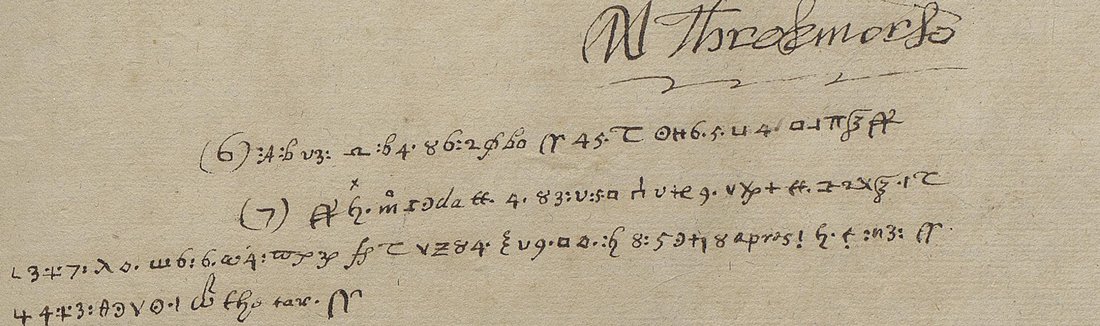
The 27 transcribed cipher tokens include two nulls. The alphabet on R9262 image P1 supplies the letters: dotted 4, 5 and 6 all represent r; plain 4 represents o; colon-marked 6 represents u/v. P3 gives the marked A for all and marked b for be. P4 gives the suffix -ed, and P9 gives the curved T for the/to. The check therefore covers the alphabet, the word symbols, the suffixes and the nulls together. The word before breake is warr, written with two different r homophones; it is not wars.
R9230, f.133, offers a second check at the opening of extract (1):
orleans or burges
These fifteen alphabet tokens agree with Forbes II (1741), p.12. CSP Foreign V, no.425, paragraph 11 summarizes the surrounding warning: the apparent preparations against Orleans or Bourges may conceal an attack on Rouen, Newhaven (Le Havre), and Dieppe. No.426 describes a separate decipher of the ciphered passages. The rest of that sentence has not been transcribed token by token here.
Both checks have grade H: values taken from the archived key. Spacing and capitalization are editorial. The printed texts were at hand during the check, so these are known-plaintext checks rather than blind decryptions. The token labels and values are preserved in control.json and control_9230.json, with a replay script. The script checks the substitution of those labels; the identification of each glyph rests on inspection of the images.
02 Four nearby key records
| Record | Leaf and contents | Use here |
|---|---|---|
| R9257 | f.172; Percy extracts above a separate alphabet and nomenclator | Not established as a Throckmorton key |
| R9260 | ff.177–178; a preceding fragment and Throckmorton's first/second keys | Earlier systems, not the key tested here |
| R9261 | f.179; heading “Sr Thomas Smith's Cipher” | A different alphabet, relevant to distinguishing Smith material |
| R9262 | ff.180–185; “Sr Nicholas Throckmorton's Third Cipher,” eleven photographs | Matches both sampled passages |
The third cipher is a nomenclator: homophonic letters, code symbols (marked initial letters) for words, names and places, symbols for word endings, and nulls. Dots distinguish values; these samples do not use two-digit superscripts. The key sheets in the volume are reconstructions, and their catalogue date does not show that they are the keys used at the time.
03 Record-to-edition concordance
Each row gives the printed counterpart; passages were checked against the cipher only where stated. CSP often abridges the full letters. Dates use January-start years: March 1559 becomes March 1560, and January 1562 becomes January 1563, without changing the day. R9234 remains 1 November 1563. Shared leaves must be separated at the letter headings before assigning their passages.
| DECODE | Folios | Date | To | Published source | Evidence and limits |
|---|---|---|---|---|---|
| R9220 | 110 | 7–8 March 1560 | Cecil | CSP 2, 837; Forbes I, pp.352–356; control on p.355 | Key control verified; shared leaf also contains R9221. |
| R9221 | 110 | 9 March 1560 | Queen | CSP 2, 844; Forbes I, p.356 | Date/addressee match; same image as R9220. |
| R9222 | 111–112 | 9 March 1560 | Cecil | CSP 2, 845; Forbes I, p.358 | Date/addressee match. |
| R9223 | 112–116 | 15 March 1560 | Queen | CSP 2, 859; Forbes I, p.360 | Date/addressee match. |
| R9224 | 116–118 | 15 March 1560 | Council | CSP 2, 860; Forbes I, p.369 | Date/addressee match. |
| R9225 | 118–120 | 21 March 1560 | Queen | CSP 2, footnote 1; Forbes I, p.376 | CSP prints this in a footnote because the State Paper Office original could not then be located. |
| R9226 | 120–122 | 21 March 1560 | Cecil | CSP 2, 882; Forbes I, p.384 | Date/addressee match. |
| R9227 | 122–123 | 21 March 1560 | Council | CSP 2, 881; Forbes I, p.382 | Date/addressee match. |
| R9228 | 123–129 | 24 September 1562 | Queen | CSP 5, 690; Forbes II, p.61 | Date/addressee match. |
| R9229 | 129–133 | 15 October 1562 | Queen | CSP 5, 848; Forbes II, p.111 | Date/addressee match. |
| R9230 | 133 | 5 August 1562 | Queen | CSP 5, 425; Forbes II, p.12 (sampled passage); CSP no.426 is the separate decipher | Orleans/Burges passage matched to CSP paragraph 11 and the corresponding Forbes letter. |
| R9231 | 134 | 9 September 1562 | Queen | CSP 5, 596; CSP V, no.596 | Date/addressee match. |
| R9232 | 134–135 | 9 September 1562 | Cecil | CSP 5, 597; CSP V, nos.597–600 (two same-day letters and copies) | Opening refers to dispatching Francisco on the ninth. No.597 is the principal candidate; keep no.599 for comparison. |
| R9233 | 135–136 | 30 October 1562 | Cecil | CSP 5, 935; Forbes II, p.156 | Date/addressee match. |
| R9234 | 136–138 | 1 November 1563 | Queen | CSP 6, 1356; CSP VI, no.1356 | Manuscript date agrees with 1563; do not change to 1562 just because preceding letters are earlier. |
| R9242 | 149–150 | 3 January 1563 | Queen | CSP 6, 12; Forbes II, p.251 | DECODE uses old-style 1562. |
| R9243 | 150–151 | 6 January 1563 | Queen | CSP 6, 35; Forbes II, p.270 | DECODE uses old-style 1562. |
| R9244 | 151–153 | 13 January 1563 | Queen | CSP 6, 83; Forbes II, p.275 | DECODE uses old-style 1562. |
| R9245 | 153–155 | 20 September 1563 | Cecil | CSP 6, 1233; CSP VI, no.1233 | Date/addressee match; CSP explicitly says cipher deciphered. |
| R9255 | 169–171 | 22 November 1562 (Throckmorton portion) | Queen | CSP 5, 1099; Forbes II, p.208; CSP no.1100 is the deciphered copy | Composite record: Smith, Throckmorton, Somer and Randolph. Throckmorton is on ff.169–170. The catalogue author Lomer is apparently Somer. Other writers require separate keys. |
R9232 is a provisional match to CSP V no.597: the opening mentions dispatching Francisco on the ninth. Nos.599–600 are other same-day Cecil material and remain comparison candidates. R9255 is composite: the Throckmorton portion matches 22 November 1562, CSP V nos.1099–1100, but the Smith, Somer and Randolph material requires separate identification and keys.
04 Prior work and the target description
Satoshi Tomokiyo's Elizabethan cipher study already identifies the Add MS 4136 ciphertexts as largely extracts, cites Forbes, reconstructs three Throckmorton ciphers, and records the archive keys in a November 2024 note. Neither the key nor the plaintext is new here. DECODE's status for these records means only that no decipherment is attached to the record; the plaintext has been in print since the 1740s.
The remark about meaningful two-digit superscripts comes from the neighbouring Serno Gilino/Bishop of Worcester entry on Tomokiyo's Unsolved Historical Ciphers page. It was misattributed to Throckmorton in the target description. Tomokiyo's two specifically unresolved cases are the marginal ciphertext on R2988 and John Wod's 1568 material on R2989. Both lie outside these twenty records and remain unresolved here.
05 What is established, and what is not
All 71 referenced image files passed JPEG signature checks and have SHA-256 hashes in the research inventory. The 54 target references contain 39 distinct images, including a byte-identical R9220/R9221 pair. Two short passages, totalling 42 tokens, were checked against the third cipher. Their published counterparts agree.
No token count or percentage is claimed for the whole corpus. Most record-to-edition matches have not been checked glyph by glyph. A diplomatic edition would require transcribing the 39 unique leaves, separating all letter boundaries and other writers, and aligning every numbered extract with the printed text. The result answers the target's premise that the key was unknown. It is not a complete edition of the twenty records.
Full texts
The transcription and the decryption of every document on this page, so that the reading can be used and checked. Short files are shown here; all are in the repository.
R9220, 7–8 March 1560, to Cecil
Throckmorton, ambassador in France, to Cecil, 7–8 March 1560; calendared as CSP 2, 837.
Transcription
A_left_two_dots b_left_two_dots i_vshape 3_colon i_low_arch b_left_two_dots 4_dot 8_plain 6_colon 2_plain k_phi bo_suffix NULL_arch 4_plain 5_dot T_curved circle_dot a_Hshape 6_dot 5_dot b_Ushape 4_dot e_square a_angle k_pi e_curly NULL_loop
Decryption
# R9220: the Calendar of State Papers, Foreign text

Copied verbatim from PUBLISHED_REFERENCE_TEXTS.md, 22 Oct 2026 (J. Stevenson, CSP Foreign, Elizabeth, 1863-1870, via British History Online). A calendar summary, not the full decipherment.

## R9220: 7–8 March 1560 → Cecil

[CSP 2, 837](https://www.british-history.ac.uk/cal-state-papers/foreign/vol2/pp426-444) — Key control verified; shared leaf also contains R9221.

837. Throckmorton to Cecil.
1. Notwithstanding their show of amity, the French go on
with their preparations by sea and land. The captains of
both are at Court, attending for despatch. Two of the
Almains are sent, one into the Palsgrave's country and the
other into Gueldres to levy men, and others are on their despatch on all sides. Some of the men pass through France to
Dieppe or Calais, and the rest upon the sea coast of Basse
Germany; yet he does not perceive they are assured of any
shipping but at the Countess of Emden's hand. He has told
the Ambassador of Spain of the levying in Gueldres, that he
may advertise the Governor of Flanders, and his brother to
stop their way. They cannot be ready and embarked before
May; if Cecil does which he may he will have the advantage.
The Marquis d'Elbœuf is stayed because he is not strong
enough, and when reinforced he goes forward with his charge.
2. He thinks that instructions should be sent to Lord
Montague, or the Ambassador in Spain, to move King Philip
that in case the French invade England he will declare
himself enemy to the French, according to the old treaty. It
may be said that the Queen takes the treaty to be inviolable.
The sooner the message is sent the better. Wishes the instructions to be sent three ways; by post through France,
by sea, and by Sir Thomas Gresham's means, who may deliver
his packet to M. d'Arras, by him to be sent to his brother
here and from him conveyed into Spain.
3. The French sent lately letters into Scotland by four
ways; by a courier in Killygrew's company, by Flanders,
by Calais, and through England, by Cornwall; which he fears
more for rebellion than for Scotland. One Wilson, a Scotchman, arrived here on the 4th inst. with letters from Scotland,
and passed through England unknown, and once he passed as
a scholar going to Louvain; whereat the writer marvels much.
Cecil should also beware of Italians there; for these men use
them for intelligence, and of late an Italian was sent over
hither by De la Cievre. Advises him to take good heed who
passes to and fro on the Borders and on the sea coast on this
side, for nothing can more serve France's turn than to have
intelligence from Scotland. Assures Cecil that no Scotchman
passes hence without his [the writer's] knowledge, but it is
to serve the French.
[Page 437]
4. The Duke of Guise and the Cardinal of Lorraine have
discovered a conspiracy wrought against themselves and their
authority, which they have bruited to be meant only for the
King. They are in such fear as to wear privy coats, and at
night are guarded with pistoliers and men at arms, and have
apprehended eight or nine and put them to torture. The
Lord Davy Hamilton, Suselis, and Stewart are removed from
Bois de Vincennes and brought, with some others, muffled
here. This Court is in great trouble and know not which
side to turn; and to colour the matter the more they bruit
that the King of Spain has advertised that this conspiracy is
meant against the King. The matter is presently hot and
like enough to become hotter, and if ever time offered to
do what the English have need to do, it is now. For the
Dowager has advertised them here (by Wilson) that if she be
reinforced by May she hopes to keep good, but, these things
proceeding to a garboil, they here shall have other matter to
look to. Therefore he says again, Chafe the iron while it is
hot.
5. John Ribaud and John Ross arrived here yesterday, and
to-day are despatched to the coast to put their ships in readiness with all speed. The Marquis and his wife are gone from
Dieppe to Fecamp. Throckmorton marvels at Wilson's passing (who is despatched back this 6 March) as he went by
post; by means of whose report of Lord Hume, the said Lord
being answered with delay in his suit, is better regarded than
he was like to be. Hereof the writer advertises Cecil expressly, as he doubts he shall not of a good time have the
like commodity.
6. Wilson said that he dares not land in Scotland for fear
of the Queen's ships, and therefore minds to go to Flanders
and land about Essex or Sussex, as a Fleming, or else at
Newcastle from Calais or Newhaven. He reported that Lord
Hume has an Englishman upon the Borders in England as his
servant, who is his spy, and by whose means Wilson shall be
conveyed into Scotland. Wishes the Duke of Norfolk to have
an eye to Wilson and other Scotchmen passing to and fro,
and also to learn who it is who serves Lord Hume.
7. In handling the matters with Scotland and in receiving
the hostages, the matter should be so used that the French
should have no cause to think England mistrusts them.
Assures him that what the Queen has already done has
gained such reputation and credit that she is more dreaded
and esteemed abroad than her sister was with all her great
marriage and alliance. He has written to the Lord Admiral
to appoint some man to remain at Dunkirk for conveying
letters over into England; for the circumstances thereof he
refers him to his Lordship's letter.—Amboise, 7 March 1559.
in the morning.
8. P.S.—Being ready to seal this letter he understands that
the fear of this commotion is so great that on the 6th inst. the
Duke of Guise, the Cardinal Lorraine, the Grand Prior, and
[Page 438]
all the Knights of the Order that were here watched all night
long in the Court, and the gates of the town were all shut
and kept. Advises that the Queen cause the Count Helvenstein
to write to the Duke of Cleves to prevent the Frenchmen
from levying men in his country.
9. Begs him to obtain permission for Jones to be abroad a
longer time, whereby he may serve the Queen. He means to
retire to Dole in Burgundy.
10. He has opened his packet to enclose in it a letter signifying that the Bishop of Valence is a man of great experience
and cunning practice, and will go beyond Cievre, of whose
complexion he is. Wishes in no wise he went to Scotland.
As they send no commission to go through with anything, it
is clear they trifle to win time, and they rather increase their
preparations for war. What will be the end of this conspiracy
God knows. Divers arquebusiers this morning came into this
town, and order is given that all prisoners detained within
the realm of France for religion shall be released.
11. Wishes that nothing were treated of with the French
touching the Scots, without the Scots being made privy
thereto, and that nothing were accorded without their consent. The Duke of Nemours and Count Mirandola with divers
others were yesterday sent abroad to make scout watch. Order
is given for the coming to Court of 400 men at arms. The
Admiral of France and D'Andelot are suspected to be parties
in the broil. Wilson will come thither with the Bishop of
Valence, whose name is Monluc.—Amboise, 8 March 1559.
Signed.
Orig., the greater portion in cipher, deciphered. Add.
Endd. Pp. 6.
March 8.R. O.
R9221, 9 March 1560, to Queen
Throckmorton, ambassador in France, to the Queen, 9 March 1560; calendared as CSP 2, 844.
Decryption
# R9221: the Calendar of State Papers, Foreign text

Copied verbatim from PUBLISHED_REFERENCE_TEXTS.md, 22 Oct 2026 (J. Stevenson, CSP Foreign, Elizabeth, 1863-1870, via British History Online). A calendar summary, not the full decipherment.

## R9221: 9 March 1560 → Queen

[CSP 2, 844](https://www.british-history.ac.uk/cal-state-papers/foreign/vol2/pp426-444) — Date/addressee match; same image as R9220.

844. Throckmorton to the Queen.
1. The 8th inst. he received her letters of the 17th of
February by Cavalcanti, whom he will advise how to behave
here. He thinks that the pension of 100l. which she has
bestowed upon Cavalcanti is well employed.
2. On 7th and 8th he wrote to her and sent her packets, one
by Dieppe and the other by Flanders. By that of the 8th
he advertised her of the coming of the Bishop of Valence from
this King, who said he should have his despatch about the
10th inst. But this morning the Bishop sent word to the
writer that he was commanded this day to depart before noon,
requesting letters to her and her officers at Dover, which
Throckmorton granted. He is of the Privy Council here, and
often employed in ambassades and other services of estate
and trust; he is well learned in divinity and other sciences.
3. On the 7th the Bishop came to him and declared that the
King had appointed him to declare some griefs to the Queen,
and trusted that there should be nothing omitted for the
establishing of a good peace. He also said that the Queen
Dowager of Scotland had so often written to this King for
her return to this realm and to be eased of those troubles,
that the King cannot refuse her request, and thinks that she
shall shortly come into France. Refers her to his letter to
Cecil for an account of this bearer, the Bishop.—Amboise,
9 March 1559. Signed.
Orig., with seal. Portions in cipher, deciphered. Add.
Endd. Pp. 3.
March 9.R. O. Forbes, 1. 358.
R9222, 9 March 1560, to Cecil
Throckmorton, ambassador in France, to Cecil, 9 March 1560; calendared as CSP 2, 845.
Decryption
# R9222: the Calendar of State Papers, Foreign text

Copied verbatim from PUBLISHED_REFERENCE_TEXTS.md, 22 Oct 2026 (J. Stevenson, CSP Foreign, Elizabeth, 1863-1870, via British History Online). A calendar summary, not the full decipherment.

## R9222: 9 March 1560 → Cecil

[CSP 2, 845](https://www.british-history.ac.uk/cal-state-papers/foreign/vol2/pp426-444) — Date/addressee match.

845. Throckmorton to Cecil.
1. Sent him on the 7th inst a packet by Dieppe and on the
8th another by Flanders, both of one tenor. Has therein
described the bearer. He is as cunning as Cievre, or beyond
him. Cecil may perceive that they protract the time, since
the person mentioned has no commission to go through with
anything.
2. Wilson, a Scotchman, has passed to and from Scotland
through England. He took shipping at Dover on 28th Feb.
and landed at Dieppe. Cecil should write to the captain
of the castle at Dover to take heed to these things. Wilson
intends to embark in Flanders and to descend into the North
parts of Scotland, or else at Newcastle, and so pass their
frontier. The French, for the sure conveyance of their packets,
have devised now to send their couriers by sea to Aberdeen,
Montrose, or Dundee, and so by the north parts. Wishes
the Duke of Châtellerault to be advertised hereof.
3. He has received by Guido Cavalcanti, on the 8th inst.,
a letter from the Queen. The hostages are at Calais, ready
to pass over. He has not accepted them, but said that he
would understand of them, and then allow or disallow; by
this Cecil may perceive that the French proceed without
order in this doing. The Marquis de Neile should not be
[Page 443]
released. By his absence his wife may do service in Bretaigne; his presence takes the same away. For all their
good countenances, they here make great preparations. Ribaud
and Ross are despatched to make ready all the ships they
can, both their own and all other strangers, except the King
of Spain's subjects. They cannot be ready before May. The
Marquis stays, because he is not strong enough. Advises
that instructions were sent to Lord Montague, or the Ambassador in Spain to have in remembrance the old treaty
between England and Spain, if the French invade the
former.
4. A conspiracy has been here revealed against the house
of Guise, which has much troubled them. It is somewhat
appeased, and the King goes abroad on hunting. The French
have sent to levy men in the Palsgrave's country and Guelderland. He has written to the Lord Admiral by his last
to appoint some discreet man to take a house at Dunkirk
for conveying letters over into England. The Queen by her
doings is more esteemed and dreaded than her sister was.
This bearer will sue the Queen to have the Dowager of
Scotland to pass through England. Throckmorton wishes
the handling of matters for hostages with Scotland to be
such as Scots may think they do not mistrust them. The
Bishop is come now upon his departure.—Amboise, 9 March
1559. Signed.
5. P. S.—The Bishop of Valence has instructions to desire
licence for the Dowager of Scotland, and such Frenchmen
as are in Scotland, to pass through England into France,
and also to desire the Earl of Arran and the Congregation
to permit them to depart quietly, giving them licence to live
to their conscience, so as they forget not their duty to their
Sovereign and old alliance with France. If the matter between
the French and English come to hostages, the personages meet
for that purpose are, the Dukes of Nemours and Longueville,
the Prince of Joinville, eldest son of the Duke of Guise, and
the Count d'Eu, eldest son to the Duke of Nevers; he means
that if hostages are to be demanded, then they shall be
these. The French make great preparations, and mean only
to bring the Queen asleep to win time; and ere their offers
be performed in deed, their ships and men of war will be
ready.—Amboise, 9 March 1559. Signed.
Orig. Portions in cipher, deciphered. Add. Endd.
Pp. 3.
March 9.R. O.
R9223, 15 March 1560, to Queen
Throckmorton, ambassador in France, to the Queen, 15 March 1560; calendared as CSP 2, 859.
Decryption
# R9223: the Calendar of State Papers, Foreign text

Copied verbatim from PUBLISHED_REFERENCE_TEXTS.md, 22 Oct 2026 (J. Stevenson, CSP Foreign, Elizabeth, 1863-1870, via British History Online). A calendar summary, not the full decipherment.

## R9223: 15 March 1560 → Queen

[CSP 2, 859](https://www.british-history.ac.uk/cal-state-papers/foreign/vol2/pp444-455) — Date/addressee match.

859. Throckmorton to the Queen.
1. On the 12th inst., her courier, Frances, arrived at
Amboise with the letters of herself and the Council of the
7th. According to her instructions he repaired on the 13th
to the Court; and after having dined with the Cardinal
(who was accompanied with the Chancellor, Olivier, the
Prince of Joinville, the Archbishop of Vienne (Marillac), the
Bishop of Orleans, and divers others of the long robe),
the Cardinal retired with him to his chamber, where he told
him that the King and he had received letters from their
Ambassador in England containing the effect of certain
articles proponed to him there, which Throckmorton would
more amply dilate to them.
2. Thereupon the writer declared he had done what he
could tending to peace between the Queen and the French
King; that the French Ambassador had made an appearance
of the good disposition of the King to accord all things
touching the Queen and the matters of Scotland, and that
she had commanded him to open to the King the means
that may confirm the same and establish perpetual peace
between them; which not being accorded, she could not be
persuaded that the amity could long endure without jealousy
and doubt, specially considering the late suspicions. The
writer said also that by letters received from the Queen he
understood that their Ambassador had travailed with the
[Page 449]
same to have all things friendly compounded, and for that
purpose had given occasion of devising certain articles, whereof the French Ambassador allowed part, rejected others
offered by the Queen, and misliked others, although without
these last the Queen saw no surety could follow.
3. Here the Cardinal said that Throckmorton had made
a fair proposition in words as though the Queen desired
peace, and yet by his doings it seemed as if she minded to
break. To which the writer made no answer, but continued
his tale; and said that among other things, their Ambassador had accorded that these innovations made by the King
here and the Queen his wife touching her arms and title,
should forthwith be reformed and cease for ever. Whereunto, said the Cardinal, he has gone besides his commission;
for he had no ground from them to proceed in this sort,
further than to say that it should be no hindrance to the
amity. "But no marvel" quoth he, "for he hath from the
beginning had such a disposition to bring things to quiet
as he, without respect to anything else, hath clean forgotten
himself."
4. The writer then declared the articles about the withdrawal of the French troops from Scotland and the sending
of a commission for that purpose.
5. The Cardinal desired to have these articles in writing.
Throckmorton answered that he had no commission for so
doing, but at length thought good (under protest) to draw
them out in such a form that they cannot take advantage
by any of them. A copy of which he sends.
6. Hereupon, being brought to the King, he delivered her
letters and then declared what he had proposed to the
Cardinal. Whereunto the King said nothing, but pressed
him to put the matter in writing. He answered with the
same protestations as he had made to the Cardinal, and
promised to put the same in articles.
7. From him he was conducted by M. de Randan, (brother
to the Conte Rochefaucault) to the Queen Mother, to whom
also he delivered her letters and commendations, who thanked
the Queen, and made the like request as the King and Cardinal. Whereunto Throckmorton agreed as before. The
Cardinal desired the writer to signify to the Queen a conspiracy wrought against him and the Duke, his brother,
which arose from Geneva. Throckmorton said that the Queen
would be sorry to hear of it, and would aid the King against
such meddlers. The Cardinal said that some of them had been
met, and on the 12th inst. eighteen men were apprehended
by M. de Sansar near Tours, every one of them carrying
behind him on horseback a bag full of pistoletts, shot, and
powder. This is all that passed between the King, the
Queen Mother, the Cardinal, and the writer.
8. The same evening he sent the Articles to the Cardinal,
praying him to return an answer likewise in writing to be
sent to the Queen. He said he would show them to the King,
[Page 450]
consider them, and then give answer; for which the writer
waited till the 13th, when, not hearing from him, he sent
again, alleging that the Queen's courier only stayed for his
answer, whom she would think long in returning. He answered that the King had seen them, but had not resolved
thereupon. Wherefore, weighing that on the 13th inst.,
about midnight, they despatched one to their Ambassador in
England without giving the writer knowledge, and that the
expedition of the Queen's affairs is of so great importance, he
has thought good to despatch this bearer, so that she may not
be abused by any indirect dealing, and also understand what
he does here, the better to proceed with the French King's
ministers on that side.
9. He has understood from the Spanish Ambassador that on
the 14th inst., there passed by this Court a courier from Spain
into Flanders, who carried letters to M. de Glaion, a man
of experience and of the Privy Council, to pass over into
England to the Queen; and that also another should be
appointed, whom he knew not, to come to this Court; both
to travail to compound matter between the Queen and the
French King. He perceived also that the Bishop of Limoges,
resident with the King of Spain for this King, sent a courier,
who arrived within four hours after the other, who makes
her proceedings other than they are, for his master's advantage. Hereupon, fearing lest the King of Spain, through
ignorance of her proceedings, might conceive otherwise than
well, the writer thought it not amiss to make the Spanish Ambassador privy to the Articles delivered by him to the French
King. He said plainly that she could desire no less; that she
had reason to demand a great deal more, that the French in
refusing to satisfy her in the same would seem unreasonable;
and he was sure his master, understanding this much, (whatever the French Ambassador might say,) would mislike their
proceeedings, and would be gladder and more esteem the
Queen if she do as she may do and make an end to her
advantage. He assured the writer that Glaion was a wise
man, and would consider as well as any man the necessity
of amity between England and the Low Country, and said
the other would not be here so soon but that his master
might be advertised of her proceedings; and asked for a copy
of the Articles to send the same to the King of Spain, who,
being instructed accordingly, would give less ear to the French
persuasions. To this Throckmorton consented; whereupon
the Ambassador told him he would despatch one into Spain
in post.
10. Guido Cavalcanti bears great affection to the Queen's
service, and follows the writer's advice in his proceedings. He
is in good grace with the Cardinal of Lorraine and the Duke
of Guise, who (Cavalcanti says) said they would sell lands,
goods, and all that ever they had rather than agree to the
Articles, and yet he knows if she stands in them they will
condescend thereunto. Their case is such now that they
[Page 451]
cannot choose; for they have nothing ready for the war and
are in doubtful terms at home. They have so many irons in
the fire, they cannot tell which way to turn them. Cavalcanti
also says, that the Queen's proceedings are so liked among the
strangers of this Court, that her realm has more estimation
than when it had Calais, so if the end succeed she shall during
her time be quiet and these men afraid to enter into war with
her. Here they will do nothing but trifle to win time and make
as much preparation as they may. He advises her not to let
the occasion slip, as in their present condition they will be glad
to make an honourable end with her and perhaps grant more
than is yet spoken of. As long as the house of Guise rules in
France these "pikes" will never be forgotten, but revenge
will be sought. He advises, for the prevention of malice hereafter from the French, that the King of Spain and the
Emperor be desired to make a treaty of continual peace
between her and the French King, with capitulation that whoever first breaks, the other two, with the aid of the Prince
injured, shall set upon the beginner of the war. In respect
of the state of Christendom, this will be well for the Emperor; and King Philip being occupied with his country
upon Barbary, will give good ear thereunto, especially since
the French will not attempt anything against the Low
Countries for fear of the Queen. He advisedly omitted to
make mention of the 3rd Article, (which is to have the
matter brought to communication,) because, before the coming
of her courier, he understood it was the only point the French
desired, and whereby they might have most colour to win time.
It is understood here, by a post from Scotland on the 11th
inst., that Leith is not guardable ten days, unless they have
present relief.
11. He advises her,—in case Cievre or M. de Valence desire
to have audience, and in their declaration to be made to her
of the proceedings here between the Cardinal and himself,
upon the arrival of the courier despatched on the 13th inst.
without his knowledge, do not give a resolute answer touching
the demands he has proponed to them, and that to her
satisfaction,—to answer them that she will stay treating with
them till she hears from him what answer he receives on this
side. He begs her in that case to order that neither Cievre
nor any other send any despatches into Scotland; and that
if she perceives they mind not to resolve upon answer to
the Articles ministered by him to them, to revoke him with
great speed and secresy, and then take her opportunity to
constrain them to come to better terms.
12. He is glad that Glaion repairs into England; she can
win him to be affectionate to her and her realm, for he is
a man worthy to be won and to be made of.
13. There is granted to the King here 600,000 francs only
for the rigging of ships and provision of victuals. John Ribaud
and Ross continue still upon the sea coasts for the preparation of ships. The garboil here is now very hot, which
[Page 452]
troubles them sore and will rather increase, and here is
already sending out of horsemen and pistoliers on all sides.
The Pope has granted the request of the Emperor for his
coronation; and Cardinal Morone shall go into Almaine for
that purpose; who is not thoroughly cleared of the causes
charged to him during his imprisonment. The Pope has
referred the matter of the Council to the Emperor. The
Cardinal of Guise has returned to this Court. The Cardinal
of Bellay, Dean of the College, is dead, and in his stead
Cardinal Tournon is like to be elected. The Pope demanded
licence of this King to bestow the Cardinal Bellay's benefices,
because he died at Rome. The enterprise of Tripoli is broken,
the revolt being pacified and quieted by Dracut Raiz; to
whom the Turk has sent a succour of thirty galleys to defend
the sea coast. So King Philip's enterprise failed, and his
men of war are constrained to retire.—Amboise, 15 March
1559. Signed.
14. P. S.—The Marshal of St. André was, the 15th inst., sent
forth with 300 horsemen to Tours for apprehending certain
companies there; and the Duke of Nemours and the Admiral
of France the same day were also sent forth with 200 others
for the empeaching of another company not far hence.
Orig. Large portions in cipher, deciphered. Add. Endd.
Pp. 13.
March 15.R. O. Forbes, 1. 369.
R9224, 15 March 1560, to Council
Throckmorton, ambassador in France, to the Council, 15 March 1560; calendared as CSP 2, 860.
Decryption
# R9224: the Calendar of State Papers, Foreign text

Copied verbatim from PUBLISHED_REFERENCE_TEXTS.md, 22 Oct 2026 (J. Stevenson, CSP Foreign, Elizabeth, 1863-1870, via British History Online). A calendar summary, not the full decipherment.

## R9224: 15 March 1560 → Council

[CSP 2, 860](https://www.british-history.ac.uk/cal-state-papers/foreign/vol2/pp444-455) — Date/addressee match.

860. Throckmorton to the Council.
On the 12th inst. he received their letters of the 7th inst.
by Francisco, the courier, and others from the Queen. He
recapitulates the information and advice contained in his
letter of the same date to the Queen. Recommends to them
M. de Glajeon, sent from the King of Spain, to be entertained
as appertains to such a personage.—Amboise, 15 March 1559,
at 8 p.m. Signed.
Orig. Portions in cipher, deciphered. Add. Endd.
Pp. 9.
March 15.R.O. Haynes, p. 262.
R9225, 21 March 1560, to Queen
Throckmorton, ambassador in France, to the Queen, 21 March 1560; calendared as CSP 2, footnote 1.
Decryption
# R9225: the Calendar of State Papers, Foreign text

Copied verbatim from PUBLISHED_REFERENCE_TEXTS.md, 22 Oct 2026 (J. Stevenson, CSP Foreign, Elizabeth, 1863-1870, via British History Online). A calendar summary, not the full decipherment.

## R9225: 21 March 1560 → Queen

[CSP 2, footnote 1](https://www.british-history.ac.uk/cal-state-papers/foreign/vol2/pp462-476) — CSP prints this in a footnote because the State Paper Office original could not then be located.

Throckmorton to the Queen.
1. The 16th inst. in the morning he despatched letters to her. The 14th inst.
there came to Tours a captain named Castelnovo, a Baron of Gascony, of
10,000 francs revenue, accompanied with five other captains named De Ronnay,
Garreau, Masere, Lavignac, and Ydron, all of them of very good skill in the
wars, with thirty others in their company, who were lodged in an inn of the
town named the Galley. The Count Sansar, a Knight of the Order, was sent
with a band of horsemen to Tours, to prevent any great assembly, and also to
take heed what men resorted to the town and where they lodged. Understanding
of the lodging of Castelnovo at the inn, he sent to have it for himself. Castelnovo refused to dislodge, and demanded of the Count whether he had a commission from the King, and if he had he would dislodge; but else not. The
matter of reasoning passed so long that he with his thirty men set upon the
Count and his fifty, and compelled him to retreat to get more force. In the
meantime Castelnovo and his men got themselves out of the town and repaired
to Noysay, three English miles from Amboise, where they were taken by the
Duke of Nemours and brought to the Court. They said they minded no hurt to
the King, and that they had another King whom they sought to serve and have
his law established.
2. On the 16th about fifty persons more were taken, for the most part artificers,
who were dismissed and pardoned, except four of the chiefest; to every one of
whom (for that they were spoiled), the King gave a crown apiece; and to one
who was hurt in the head five crowns. Hereupon a declaration of pardon was
made to all such as were up, if they would retire and disperse, except to such as
were preachers and came in armour towards the King; for it was said that there
were great numbers ready to assemble in four quarters of the realm which were
in small companies; by means whereof sometimes more and sometimes less
were taken by the King's scouts, the chief stayed, and the others set at liberty
and pardoned.
3. It was thought that this was but a popular commotion and not to be feared,
when, unlooked for, on the 17th a company of 150 horsemen well appointed
approached the Court gates and shot off their pistols at the church of the
Bonhommes. Whereupon great alarm continued; the drum was stricken; and
the horsemen, seeing they were too few to resist the King's horsemen, fled
away, leaving two behind, whose horses had been slain. This caused upon a
sudden a sharp determination to minister justice, and the two last taken were
hanged, and two others for company, and afterwards divers more were taken and
nine men hanged; all of whom died very assuredly and constantly for religion
in singing of psalms. Divers were drowned in sacks, and some appointed to
die on the wheel. M. de Sansar found twenty-five in a house together, and
because they would not come out, he set fire to it; whereupon they issued, and
one of them, seeing his fellows taken, returned back and burned himself. The
17th twenty-two of these rebels were drowned in sacks; and on the night of the
18th twenty-five more. Among these that are taken there are eighteen of the
bravest captains in France. As they are taken they are questioned and condemned to die.
4. News arrived of a worse matter. There is a stir of Gascons, who are ready
to repair hitherward; the like in Bretague and Normandy, where they have
assailed the Marquis d'Albœuf and his company, who is either hurt or slain.
Whereupon they here have consulted to fortify and intrench the castle.
5. The Queen may now see what advantage she has over the French, who are
so troubled that they know not where to levy any force. He has often called
upon them for answer to the Articles; it is easy to perceive they do nothing but
to win time. It will be to her advantage to have gained somewhat of the
French, before the King of Spain interposes himself in these matters, rather than
to come barely thereto, having done nothing; whereby he shall have less regard
to her than shall be for her honour and commodity. Begs her to have him
revoked, as he is in much danger of his life. The French practise the stealing
away their hostages in England, in going about to change them for others on
this side, whom he has not allowed, nor can allow, but the Vidâme of Amiens.
On the 18th inst. the Duke of Lorraine arrived here in post with thirty horse.
6. Having sent to the Cardinal this day to know the reply to the Articles, he
answered that the King had concluded thereupon and had determined to send
the same in writing to the Bishop of Valence with commission to proceed thereupon with her; and that the writer should not need to look for any other answer.
He thinks it a strange kind of dealing that he should tell them what he has to
say, and should receive no answer; if they meant plainly they would not use
this sort of proceeding. He does not believe that the Bishop has power to determine anything, but only to practise so as to win more time. He fears that
whatever the Bishop does they here will say he has passed his commission. He
trusts she and the Council will require to see his commission. They have said
that they know how to handle her, which makes them bolder to presume. Let
her beware that their wiles cause her not to forego her occasion to provide for
her honour and surety for ever.
7. On the 20th, La Renaudiere, surnamed La Forest, a captain among these
rebels, being before killed by such as went to take him, was hanged on a gibbet
before the Court gate. This day was proclaimed a general pardon for all men
in this conspiracy, with order to repair to their dwelling places not above three
or four in company; and if they assembled in greater company they should be
exempt from the pardon. Castelnovo confessed that he should have conducted
such as stirred in Berry; that Masieres should have led them of Gascony, and
Ranaudiere them of Provence; and that the cause of their haste was to kill the
Duke of Guise and the Cardinal of Lorraine; and then to have sent for the rest
of the conspirators to assist them. They are here in great fear and know not
what to do.
8. John Ribaud has prested and stayed sixteen hulks at the bay, the least of
500 and some 600 tons apiece, and is repaired to this Court to get money to put
the same in order. They mind to furnish forth in all seventy ships of war as
soon as they can get them. An Italian, named Attilio Trento, (who was with
her at Hatfield soon after her trouble, and about the time that King Philip departed out of England for Flanders,) bears her such affection as to offer her his
service for her better intelligence how things go on in this Court, whereunto he
has very good means. Throckmorton begs to know what pension she will
appoint him if she entertain him. He has already devised the means how he
shall serve.—Amboise, 21 March 1559. Signed.
Orig. Portions in cipher, deciphered.
2. Another copy is in the Duke's letter-book at Hatfield House.
3. A copy in MS., endorsed by Cecil, exists in the collection at Hatfield
House.
4. Cecil's original draft of this paper occurs in B.M. Cal. B. x. 81.
5. The Queen to Norfolk.
March 30.MS. Hatfield House. Haynes, p. 274.
The Bishop of Valence, who was sent hither about thirteen days past from
the French King, to treat of matters wherein she showed herself offended, and
therein for lack of authority, or such like, has proceeded to no purpose but
delay of time, is now desirous to repair into Scotland; alleging that he has commandment from his master to the Queen Dowager and Scots for an accord of
their griefs. The Queen has licensed him to do so, and has sent with him Henry
Killigrew to conduct him to the Duke, in order that he may be safely conducted
to the Queen.
Cecil's draft.
6. In this and the subsequent letters of Edwards' it has been considered unnecessary to preserve the terms under which he seeks to disguise his meaning.
7. A draft of this Proclamation, in English, the joint production of Cecil and
Petrie, is preserved at Hatfield House, and is employed as the basis of the
abstract given above. See also B. M. Harl. 293, 121 b., and 1244, 249, and
MS. Béthune (Paris), 8666, 43.
8. From this point the letter is written with a different ink.
9. The Council to Norfolk.
March 22.MS. Hatfield House. Haynes, p. 267.
1. For the purpose of inducing the Queen to suspend hostilities in Scotland,
the French King has sent hither M. Monluc, Bishop of Valence, whose excuses
for injuries done to her in assuming her arms and usurping her style and title
are vain and evil grounded; and they seek nothing else by their talk than to
gain time, which has been lost on their parts, and now with more speed must
be recovered.
2. The Queen is determined that the Duke shall proceed according to his
former instructions, and at the time appointed the Lord Grey shall enter
Scotland with the army, and with the aid of the Scotch expel such forces
of Frenchmen as are there, and such Scotchmen as take their part against
the liberty of their country. For speedy execution thereof, the Queen sends
by Lestrange the ratifications of such articles as were agreed upon by the
Duke and the Lord Lieutenant of Scotland, the same to be signified to them with
all speed, lest any doubt be conceived by them through slackness; and upon
receiving the hostages into his hands he is to deliver the ratifications to the
Lords of Scotland.
3. If after the entry any Frenchman would depart out of Scotland, the same is
to have safe conduct, and by some convenient means he shall notify to the French
and Scotchmen that such of them as will not continue in their obstinacy against
Scotland shall have safe conduct to pass safely from thence; but such Scottish
men as shall continue to oppugn the liberty of their country shall be handled with
all extremities and be counted as traitors.
Copy. Endd. by Cecil.
R9226, 21 March 1560, to Cecil
Throckmorton, ambassador in France, to Cecil, 21 March 1560; calendared as CSP 2, 882.
Decryption
# R9226: the Calendar of State Papers, Foreign text

Copied verbatim from PUBLISHED_REFERENCE_TEXTS.md, 22 Oct 2026 (J. Stevenson, CSP Foreign, Elizabeth, 1863-1870, via British History Online). A calendar summary, not the full decipherment.

## R9226: 21 March 1560 → Cecil

[CSP 2, 882](https://www.british-history.ac.uk/cal-state-papers/foreign/vol2/pp462-476) — Date/addressee match.

882. Throckmorton to Cecil.
1. He wrote last on the 15th inst. by Barnaby. Refers him
to his letter of same date to the Queen for information
since the 15th inst. Thinks good to advertise her of the
garboils here. Unless the French think that she dallies
with them, he knows not what they mean. Their present affairs
are great and many. They will accord with her demands,
but redeem the time till these garboils are overblown and
their affairs in better readiness. Whatever the Ambassador
promises, when they come to the execution they will be far
enough from it. She should compel them to agree to such
reason as she will require of them.
2. Cecil wrote in his last letters of the 7th, that the advance
of the Duke of Norfolk was deferred from the 25th to the 28th,
which makes the writer wish that there were no longer delay.
There are not many enemies in Scotland; they have not
many places, nor are these strong, nor can they have help from
hence. Since 1 Sept. the writer has still called to have this
matter to be followed. If they were then in ill case to withstand the Queen, they are now in a great deal worse and we in
far better order. Now is the opportunity; now may she
do what she will. Whereunto this stir will grow Godknows,
for he hears they begin to stir in a great many more places.
3. To hear often from hence is requisite, and 100l. (or indeed
500l.) should not be spared. If things grow to extremities
[Page 465]
here he knows not in what case he is like to be, and therefore
despatches this while he may. It were meet he were revoked,
for the Ambassador of Spain told him that the French
conceived he was a great party in these garboils.
4. Has received an answer from the Cardinal, for which he
refers Cecil to his [the writer's] letter to the Council. They
must stand stoutly with the Bishop of Valence, to whom
the matter is committed. John Combes is much offended
with the writer for having written about him to the Council;
it is strange how he should have any inkling thereof. Every
three or four days a post comes hither from the Ambassador
Sevre. Florence de Diaceto, misliking the offer made by the
Queen, has entered the service of the King of France with
his old pension, of which the arrears are confirmed to him.
He is shortly to be employed upon the affairs of England and
Scotland.
5. Has written to Lord Arundel in behalf of William and
Augustine Haward, of Sevenoaks, in Kent, two poor serving
men, who having committed a small robbery in Kent about
a year ago, came over into France, where they have wandered up and down since Hallontide [1 Nov.] last. Asks Cecil
to help them.—Amboise, 21 March 1559. Signed.
Orig. Portions in cipher, deciphered. Add. Endd. Pp. 9.
March 21.R. O.
R9227, 21 March 1560, to Council
Throckmorton, ambassador in France, to the Council, 21 March 1560; calendared as CSP 2, 881.
Decryption
# R9227: the Calendar of State Papers, Foreign text

Copied verbatim from PUBLISHED_REFERENCE_TEXTS.md, 22 Oct 2026 (J. Stevenson, CSP Foreign, Elizabeth, 1863-1870, via British History Online). A calendar summary, not the full decipherment.

## R9227: 21 March 1560 → Council

[CSP 2, 881](https://www.british-history.ac.uk/cal-state-papers/foreign/vol2/pp462-476) — Date/addressee match.

881. Throckmorton to the Council. (fn. 1)
1. Since the despatch of his last letters to the Queen, and
to them on the 15th inst. he has not slacked to ask an
answer to what he proposed to the King from the Queen,
[Page 463]
and delivered to the Cardinal of Lorraine. This morning the
20th he sent again to the Cardinal, who said the King had
concluded thereupon, and would send the same to the Bishop
of Valence, now in England, to proceed thereupon with the
Queen. Throckmorton asked whether he should have no
other answer, as he had trusted to have had the King's answer
in writing; whereunto the Cardinal answered that the King
minded to do as he said. He thinks this a cold kind of
dealing, that having put him off so long for an answer, now
to make it after this sort, and make him privy to no part of
it, nor send him word of it, but that he must thus wrest it
from them. What need is there for an Ambassador here,
when he receives no answer to his matter, as they have
used of late more than once? He thinks they do it but to
dally with the time rather than to go the right way. Thinks
that the Bishop shall have no commission to end these things,
but only power to talk and argue of the same with the Queen,
and, having heard her answer, will perhaps say he will write
to the King thereof, and so win more time.
2. In his last letters the writer said that when he told the
Cardinal of Lorraine that their Ambassador Sevre had agreed
to certain things, he answered that Sevre had forgotten himself and passed his commission; being told to talk of matters,
but conclude nothing. And seeing he behaved as though he
had authority, and yet had none, this writer thinks it will
[Page 464]
be the same with this Bishop. He hopes the Queen and
Council will require to see his commission, and if he has power
to end the same in deed and that out of hand, then he is
not to be refused an audience; and yet (in Throckmorton's
opinion) this should by no means hinder things abroad, for
that will make them the sooner come to reason. If he has
no such authority then he should be handled as he deserves;
wherein he will not take upon himself to advise their Lordships.
Having heard that these men say they know how to handle
the Queen and gain time, and have delayed till March what
she should have done in December, it makes him more earnest
to entreat the Council to beware of their wiles, to let them
win no more time, for this is their intent.
3. He sends off Francis, the courier, with the Cardina lof
Lorraine's answer and with what he has written to the
Queen. There was to-day granted a general pardon for all
of the late conspiracy, remitting all that is past, so that each
of them return to their habitation or country, not above
three or four in a company; or if more are found together,
or if they remain in any place, then they are exempt from the
pardon. And although things be now calmed and this business
is little spoken of, yet the Duke of Guise and Cardinal of
Lorraine live in great fear and know not whom to trust.—
Amboise, 21 March 1559. Signed.
Orig., with seal. Portions in cipher, deciphered. Add.
Endd. Pp. 5.
March 21.R. O. Forbes, 1. 384.
R9228, 24 September 1562, to Queen
Throckmorton, ambassador in France, to the Queen, 24 September 1562; calendared as CSP 5, 690.
Decryption
# R9228: the Calendar of State Papers, Foreign text

Copied verbatim from PUBLISHED_REFERENCE_TEXTS.md, 22 Oct 2026 (J. Stevenson, CSP Foreign, Elizabeth, 1863-1870, via British History Online). A calendar summary, not the full decipherment.

## R9228: 24 September 1562 → Queen

[CSP 5, 690](https://www.british-history.ac.uk/cal-state-papers/foreign/vol5/pp315-322) — Date/addressee match.

690. Throckmorton to the Queen.
1. Recapitulates the information contained in his letter to
the Queen, of Sept. 20. The Prince and Admiral have
asked him to request her to send them some money, and also
that her force may pass to this side with all speed. Has
informed Warwick by this bearer in what terms he is here,
and how things stand. The Prince of Condé hath desired
him that this schedule inclosed may be delivered to De La
Haye. Stopped this despatch until he heard how his servant
(sent the 20th inst.,) was used by the Queen Mother for his
passport, who was despatched from the King's camp on the
22nd inst. with a passport. On the same day the Queen
Mother returned one of his servants, accompanied by one
of the King's trumpets, by whom she sent him a letter, the
copy of which he sends herewith with his answer to her.
2. At present the King is at Gaillon, at a house of the
Cardinal of Bourbon, not far from Rouen; his camp marches
towards Rouen with all speed, meaning to surprise that town
before she can put any force in it, and prevent the descent of
her men at Newhaven and Dieppe, especially at Newhaven.
3. The Prince is informed by Count Rochefoucault that by
the end of this month he and Durasso will be well advanced
hitherwards with 8,000 foot and 1,000 horse. The Prince
is resolved to take the field (leaving a garrison in this
town), as soon as he is informed of the descent of her forces
and the repair of D'Andelot with the Almaines. If she aids
them now, they assure him they will never make an accord
with their adversaries but such as she allows.
3. The Prince and Admiral request her to send them two
or three skilful pioneers; he hopes she will not let her force
which may pass to this side be unprovided in that sort.
Has not heard from her since the 16th August.—Orleans,
24 Sept. 1562. Signed.
Orig. Nearly entirely in cipher. Add. Endd. Pp. 9.
Sept. 24.
R9229, 15 October 1562, to Queen
Throckmorton, ambassador in France, to the Queen, 15 October 1562; calendared as CSP 5, 848.
Decryption
# R9229: the Calendar of State Papers, Foreign text

Copied verbatim from PUBLISHED_REFERENCE_TEXTS.md, 22 Oct 2026 (J. Stevenson, CSP Foreign, Elizabeth, 1863-1870, via British History Online). A calendar summary, not the full decipherment.

## R9229: 15 October 1562 → Queen

[CSP 5, 848](https://www.british-history.ac.uk/cal-state-papers/foreign/vol5/pp358-373) — Date/addressee match.

848. Throckmorton to the Queen.
1. Wrote to her on 27th ult., enclosed to the Earl of Warwick, which is taken by those of the Papists' camp, which
he repeated in his of the 9th inst., sent by a Frenchman
named Captain Charmu. She will perceive by that, and by
the manner of his writing thereof, (fn. 3) with what difficulty he
now sends to her. Sends copies of his letters to the Queen
Mother and the King of Navarre. Middlemore (whom he had
sent) found the Court at Rouville, four leagues from Rouen;
they being on horseback to take their journey to the camp
before Rouen; where Middlemore repaired also. As soon as
he arrived, the Constable committed him to the guard of a
gentleman (so that he should confer with no man), and
shortly after he was brought to the King, the Queen Mother,
the Duke of Orleans, the King of Navarre, the Cardinal of
Ferrara, the Duke of Guise, the Constable, St. André, and
others.
2. The Queen Mother said to him no safe conduct could be
of greater assurance for Throckmorton than the quality of an
ambassador; and then made a long declaration of his ingratitude; he who had forgotten how he was bound to the King, her
husband, for his life, which was in jeopardy in the time of the
late Queen Mary, when he left England to come to France
for safety. The Duke of Guise added that he wished that he
[Throckmorton] were with those at Newhaven or Dieppe,
who should be visited as they deserved.
3. The Queen Mother refused him a safe conduct. Marshal
Brisac lately used the following words of him: That whatever it cost they must get him into their hands, and without
delay must cut off his head, he being the most dangerous instrument of his nation for them; and that they will find articles
enough to make his process. The Queen Mother has charged
M. De Sevre to practise with Smith, so as to discredit his
[Throckmorton's] doings. These are the causes why he does
not accompany Smith to the Court unless he have safe conduct;
so he remains at Orleans to attend her further order. Middle-
[Page 369]
more attends upon Smith to the Court. He cannot as yet
for her service disfurnish himself of John Barnaby, his
secretary.
4. Condé and the Admiral will not be able to leave this
town to put themselves in the field, either to fight with their
enemies or to succour Dieppe or Newhaven (for they take
Rouen to be lost), until the latter end of this month.
M. D'Andelot (partly by his sickness, and lack of money to
pay the Almain soldiers for their levying and first musters,)
has stayed his advance. He cannot be near this town or
Paris until about the 22nd inst. The Count De Rochefoucault
and M. Durasse have been retarded by M. De Monluc with a
force of Spaniards; so that they cannot be here before the
22nd inst. Thus the defending of Dieppe and Newhaven is
entirely in her hands.
5. The Duke of Etampes and M. De Martigues have
marched from Bretagne with 4,000 men to reinforce the
King. Condé and the Admiral desire the Queen to send
some of her ships upon the coast of Bretagne, there to make
incursions; thereby to stay Etampes in that country.
6. D'Andelot on the 4th inst. was at Salbourg, in Lorraine;
he will be at Châtillion on the Seine on the 20th inst.; and
from thence approach either towards Paris, or hither.
7. Mount St. Katharine being taken, those within Rouen
talked of surrendering the town upon conditions, "which
parliament lasted two or three days." Offers were proposed
by those of the King's camp, but they within the town
(taking courage at the arrival of four ensigns of Englishmen,)
refused all conditions. The battery was renewed furiously
in sundry places. Here they are desperate of Rouen, and yet
relieved by hope of the valiantness of the English. At
Dieppe there are 600 Englishmen arrived under Captain
Ormesby, which place if assaulted would require at least
4,000 men for the guard thereof. At Newhaven eighteen
sail had arrived with 1,500 Englishmen; which is a small
number for guarding that place; it requiring at least,
if besieged, 4,000 men. Of these numbers landed at Dieppe
and Newhaven there can be no convenient succours taken
for the relief of Rouen.
8. St. André has gone to intercept the coming of D'Andelot.
The house of Guise (with the advice of the Cardinal of
Ferrara and the Spanish Ambassador here,) have lately
despatched Villemort and La Croque, servants to the Queen
of Scotland. to pass through England, to make troubles,
to exasperate the Queen of Scotland and her papistical
Council to make some troubles upon the frontiers of England,
and to do what they can to deprive the Earl of Mar. Lethington, and all others who favour the Protestant religion, of
their authority about the said Queen. There are practices to
cause trouble in Ireland; the Bishop of Aquila is set on by
these men. The last despatch sent from the King's camp into
England was to will the French Ambassador there and the
[Page 370]
hostages to shift for themselves an I retire from thence with
all speed.
9. The messenger who carried his despatch of the 27th ult.
directed to her and the Earl of Warwick was put to death
in the King's camp, he being a Frenchman. The Cardinal of
Lorraine thinks at this Council at Trent to bring to pass a
marriage with the Queen of Scots, his niece, and Ferdinand,
the second son of the Emperor; and to conclude the league,
offensive and defensive, amongst the Papists. The Cardinal
will work what he can to transfer by resignation the empire
unto the said Ferdinand, to the disappointment of Maximilian,
King of Bohemia. At his leaving this Court for Trent he
made a long oration against Condé and his party for bringing
into this realm Englishmen.
10. He hopes she wills not name Brisac as the author
of his destruction, for thereby the party would be known
from whom he had the intelligence, he being the only person
to whom it was spoken. Sends herewith a cipher from the
Prince and the Admiral, which is sent to her so they may
hear from one another, of which they desire to be advertised
by M. De La Haye.
Orig. Draft. Considerable portions underlined, to be
expressed in cipher. Endd.: 15 Oct. 1562. By Sir T.
Smith's courier and Tho. Danzes. Pp. 8.
Oct. 15.
R9230, 5 August 1562, to Queen
Throckmorton, ambassador in France, to the Queen, 5 August 1562; calendared as CSP 5, 425.
Transcription
4_plain 6_dot l_crossloop e_square a_angle n_backloop 7_dot 2_plain 4_dot b_Ushape 6_colon 6_dot g_7shape 8_plain 8_dot
Decryption
# R9230: the Calendar of State Papers, Foreign text

Copied verbatim from PUBLISHED_REFERENCE_TEXTS.md, 22 Oct 2026 (J. Stevenson, CSP Foreign, Elizabeth, 1863-1870, via British History Online). A calendar summary, not the full decipherment.

## R9230: 5 August 1562 → Queen

[CSP 5, 425](https://www.british-history.ac.uk/cal-state-papers/foreign/vol5/pp197-215) — Orleans/Burges passage matched to CSP paragraph 11 and the corresponding Forbes letter.

425. Throckmorton to the Queen.
1. Received her letters of the 28th ult. on the 1st inst., by
Francisco. Mewtas had not then left, but his passport was
[Page 209]
granted on the 2nd inst.; whereupon he left Paris on the 3rd inst.,
intending to embark at Dieppe. The writer then demanded
audience, which was granted on the 3rd inst. about five
o'clock in the afternoon, at La Tuilerie, adjoining the Louvre,
the King's new palace in Paris.
2. Having presented the Queen's letters for his revocation,
the Queen Mother answered that many outrages had been
committed against him, but that the King had so provided
that they should be stopped.
3. He answered that the fury of these people comes upon
them by tides. After they had levelled their arquebuses at
his house, and the King sent M. De Randan about the same,
they remained peaceable for a time.
4. The Queen Mother said that seeing it was the
Queen's pleasure to revoke him, it was reasonable that they
should know also that M. De Vielleville and their Ambassador might safely return. In the meantime she desired him
to tarry in France, and not to think it strange. He answered
he was sure there would be no impeachment in England if
it was their wish to revoke their Ambassador, and that M.
De Vielleville would find all honour at the Queen's hands.
If M. De Foix should reside there as Ambassador, the Queen
had commanded him to say that he should be well treated.
5. The Queen Mother then made a long discourse of her
proceedings, and laid all the blame upon the Prince of Condé,
saying that they thought the Queen would rather have given
aid to the King.
6. He said the Queen could not satisfy all suspicious minds,
but the cause of his revocation well appeared to be for another
respect than to meddle in these matters. He then said he
had heard that the Prince desires nothing but that the edict of
January may take place, as was decreed by the King, herself,
the King of Navarre, the Council, and all the Courts of Parliament of France; and he asked her whether it had been
annulled by as great authority as it was made? The Queen
answered, she had done all she could, and it concerned her
most for her son's interest.
7. He then took his leave, and requested, since it was
their pleasure to stay him for a time, till they gave revocation for their Ambassador, that he might send a courier
to inform the Queen of his stay, and the cause thereof, which
was granted to him. He then took his leave of the King
of Navarre, who used the same speech for his revocation as
the Queen Mother had, and also concluded that he should
not depart until they were sure their Ambassador should
not be impeached. He then took his leave, and also the
same of Marshal Brisac. The Cardinal of Guise being there
at his entry, did not stay till the end of the conference.
8. If M. De Vielleville has passed into England, he hopes
the Queen will recommend to him that her Ambassador have
free passage homewards, and also that M. De Foix may pass
[Page 210]
no further than London until she hears from him that he is
licensed to depart towards Boulogne from Paris.
9. Paris has lent again 200,000 crowns to maintain this
war against the Prince, so now they have lent 400,000
crowns.
10. On the 3rd inst. the King and Queen Mother went
to Madrid, three leagues from Paris.
11. Notwithstanding the great show of besieging Orleans
or Bourges, the greatest force shall be applied against Rouen,
Newhaven, and Dieppe, places meet for the Queen to be
jealous of. Informed her in his last that Troyes was taken
to the Prince's use, which is not verified yet. There is a
great bruit that Chalons in Champagne is taken by the
Conte de Seningham to the Prince's use. He also mentioned
in his last that the Conte de Rochefocault was in Poitiers;
since then he has retired farther into the country of Saintonge, there to assemble forces for the succour of the Prince;
and since the Conte left Poictiers, the Conte De Villars accompanied by the Conte De Luyda and M. De Montpezat
(son-in-law of Conte De Villars) has taken the same, where
great cruelties have been used.
12. The great defeat so much spoken of between M. De
Monluc and M. De Durazze is now said to be of small consequence, for there was not thirty persons killed on both
sides.
13. The bruit is rife that the King of Spain sends forthwith 3,000 footmen and 2,000 horsemen and that the Papists
aid him by way of Bayonne and Bordeaux; 4,000 by Marseilles
from Milan, and 2,000 horsemen and 4,000 footmen from the
Low Countries. This report is a surmise of the Papists to
frighten the Protestant party.
14. On the other side the Almains, which M. D'Andelot
brings to aid the Prince, are not far from the frontiers of
France. The Almain Princes have proclaimed the troops
under the Conte Ringrave and Rocquendolf to be rebels, and
have confiscated their lands and goods.
15. Since his last, two regiments of lansknets have marched
through Paris. The Conte Ringrave (their colonel) dined
with him, and declared his willingness to do the Queen
service. He told him that she was informed of his worthiness by his acquaintances in England, such as the Lord
Admiral; and that his doings in this cause might confirm
the same. The Conte said, because the Queen took great
pleasure in good horses, and such as be a little "scarbillade,"
[high mettled], he had an ambling horse which he would
present to her.
16. Sends herewith the recusations of the Prince sent to
the Court of Parliament of Paris, to denounce the incompetency of those judges who accorded the sentence of his
condemnation, together with a memorial lately sent to him
from the Prince by one his secretaries to testify his doings
at the last conferences with the Queen Mother.
[Page 211]
17. On the 5th inst. Marshal Brisac, Governor of Paris,
advised him to change his lodging and take a house nearer
his own within the town, for his better surety, which was
recommended to him the day before by the King, the Queen
Mother, and the King of Navarre, because the people in the
quarter where he lodged were more inclined to evil doings
than those within the town. Whether this motion proceeded for his safety, or to remove him from the place where he
is, he knows not; but he thought it meet to inform the Queen
hereof.
18. Marshal St. André, since Poitiers was taken, has been
sent thither, and has scoured all Guienne and Gascony of the
Protestants remaining there, with the aid of some Spaniards
that should enter at Bayonne.
19. On the 4th inst. James Beaton, servant to the Queen
of Scots, and son of the late Cardinal Beaton, left Paris for
Boulogne or Calais, to embark, and pass through England
into Scotland. He has been despatched by the Cardinal of
Lorraine, and would not take his letters to the Queen, or to
any of the Council, or other officers for his passage. He is
very vain, and one of the worst affected to England of his
nation; and he carries with him as ill devices against her as
the Papists here can devise. The Earl of Mar, and others
about the Queen of Scots, could tell her what sort of man he
is. His errand hither was to christen in the Queen's (his
mistress's) name, Madame De Martigues' child; but he does
not return with so good an errand, but to procure that some
business may be done upon the frontier of Scotland against
England.—Paris, 5 August 1562. Signed.
Orig. Considerable portions in cipher. Add. Endd. by
Cecil. Pp. 11.
August 5.
R9231, 9 September 1562, to Queen
Throckmorton, ambassador in France, to the Queen, 9 September 1562; calendared as CSP 5, 596.
Decryption
# R9231: the Calendar of State Papers, Foreign text

Copied verbatim from PUBLISHED_REFERENCE_TEXTS.md, 22 Oct 2026 (J. Stevenson, CSP Foreign, Elizabeth, 1863-1870, via British History Online). A calendar summary, not the full decipherment.

## R9231: 9 September 1562 → Queen

[CSP 5, 596](https://www.british-history.ac.uk/cal-state-papers/foreign/vol5/pp275-293) — Date/addressee match.

596. Throckmorton to the Queen.
1. Before leaving Paris he informed Brisac, Governor of
Paris (who has the oversight of him), that he meant for surer
passage to Bourges to go by St. Mathurin, Montargis, and
Gien, a way not haunted with men of war. Brisac told him
he could not allow him to travel that way, saying those
towns were at the Prince of Condé's devotion; but that if
he will go by Chartres, Bonneval, Châteaudun, and Blois, he
[Brisac] would guarantee him to go safely.
2. He went the way Brisac prescribed, and passed safely
until the 1st inst.; he overtook the artillery beyond
Châteaudun, near La Ferté, in the Beauce. Had not been
long in the train when the avant couriers of the Catholic party
discovered their enemy of Orleans. To avoid disaster he sent
to the Admiral (who was chieftain of the Protestant party)
to ask for security for himself and his train; when at that
instant the Admiral charged on their enemies. He, chancing
to be in the fury of the charge, was taken and spoiled of all
he had; above 6,000 crowns of the sun; and had not M. De
Grmamont come to their succour, they must have been cut in
pieces.
3. The Admiral defeated their enemies, whereof 300 were
slain, and many wounded; they also took six cannons, and
forty-three carts loaded with powder, and some bullets. He
has lost the Queen's instructions, letters, ciphers, and all notes
and papers of consequence, so he is without means to accomplish her charge. This bearer, Francisco, accompanied
him, and can bear testimony of his losses.
4. The Admiral was accompanied by MM. De Grammont,
De Janlis, and De Fontenay (brother to De Rohan), and
800 or 900 horse. After the victory, not having the means
to carry away the ammunition and artillery, they burnt the
powder and destroyed the artillery. Then they marched to
Orleans, where they advised him to go with them for safety,
which he yielded to.
5. They arrived at Orleans about 2 o'clock a.m. next day.
He has lodged in the Admiral's house, where he has continued
since his arrival; and the Prince and he have often declared
that their chiefest trust, next to God, was in the Queen.
[Page 290]
6. The state of Orleans is thus, viz.: There are 1,200 horsemen in the town, and 5,000 footmen, beside the inhabitants.
They do not want victuals for six months. The Prince has
had nine or ten cannons and culverins made within the town,
and they will make seven or eight more. They have fortified
almost all the weak places with platforms, ravelines, and
parapets. The counterscarp is in a manner finished. They
have a good store of powder, but they had some misfortune
heretofore by fire. The plague is very rife here, and daily
diminishes their numbers. The Princess of Condé, her eldest
son, and Madame l'Admiral, are within the town.
7. Besides the victory named was another won on the same
day by M. Durasse against M. De Monluc, in Gascony, where
there was slain 800 horsemen and 1,000 footmen. On the
same day Bourges surrendered to the Queen Mother and the
King of Navarre, by M. De Yvoy, the manner of which
capitulation she will perceive by a memoir enclosed.
8. M. D'Andelot makes his musters in Lorraine on the
15th inst., of 4,000 horsemen and 6,000 footmen, upon the
charge of the Princes of Almaine, who will not take any
money of the Prince to pay their soldiers until the matter is
brought to some other point. They are satisfied to take
D'Andelot's promise and bill for the money by them disbursed.
9. The King dislodged from Bourges on the 6th inst., and
from thence his camp marched to St. Palais with the intention
to pass the country of Sologne, taking the way to Aubigny,
belonging to the Earl of Lennox's brother, and so pass the
River Loire at Gien. The Constable and the Duke of Guise
are resolved to convert the greatest part of their force against
Rouen and Newhaven; for they are informed that those
places are unmanned. Also they suspect that the Queen
will succour those places. They intend to impeach D'Andelot's coming with the Almains.
10. The Bishop of Orleans and M. D'Alluy (one of the four
principal secretaries) are despatched from the King's camp
into Piedmont, to make restitution of the holds there to the
Duke of Saxony. The regiment of Frenchmen in Bourges
since the rendition are secretly retired. They had promised to
serve against the Prince of Condé, but especially against the
Englishmen and Almaines. Of these soldiers 600 or 700 came
to this town to serve the Prince of Condé.
11. There is great practice made by the Queen Mother to
win MM. De Janlis and De Grammont from the Prince. The
two chieftains at the conflict, where he met with his misfortune, behaved valiantly.
12. Wrote a letter to Vielleville to inform the Queen Mother
of his disaster, and to know what he should do; the copy of
which, with Vielleville's answer, he sends herewith. They
sent a trumpet for him to Orleans, to conduct him to the
King, to whom he will depart as soon as he can. In the
meantime he sends Francisco, her courier, with this despatch.
[Page 291]
13. Sir Peter Mewtas "is departed to God's mercy at
Dieppe." The Papists not being strong enough to exterminate
the Protestants in this country by force, and understanding
the Queen's preparations on one side, and the coming of
Almaines on the other, again offer to the Prince of Condé the
observation of the edict of January.
14. He has recovered all the Queen's plate, her instructions
lately sent him to negotiate with the Queen Mother, her
cipher, with other papers, part of his apparel, some of his
horses, and 350 crowns.
15. After three years and six months service here, he hopes
she will deliver him of this charge by her speedy revocation.
He sends herewith a declaration, lately set forth by the Prince
of Condé, upon the judgment given against him and them for
rebellion.
16. It will appear very strange to the Queen Mother that
the Queen should send a minister to negotiate with her in
such matters, being unauthorized by her letters of credence.
—Orleans, 9 Sept. 1562. Signed.
Orig. Portions in cipher, deciphered. Pp. 9.
Sept. 9.
R9232, 9 September 1562, to Cecil
Throckmorton, ambassador in France, to Cecil, 9 September 1562; calendared as CSP 5, 597.
Decryption
# R9232: the Calendar of State Papers, Foreign text

Copied verbatim from PUBLISHED_REFERENCE_TEXTS.md, 22 Oct 2026 (J. Stevenson, CSP Foreign, Elizabeth, 1863-1870, via British History Online). A calendar summary, not the full decipherment.

## R9232: 9 September 1562 → Cecil

[CSP 5, 597](https://www.british-history.ac.uk/cal-state-papers/foreign/vol5/pp275-293) — Opening refers to dispatching Francisco on the ninth. No.597 is the principal candidate; keep no.599 for comparison.

597. Throckmorton to Cecil.
This day (9th inst.) he despatched Francisco, the courier, in
post, with advertisements of the surrendering of Bourges,
etc. They have offered to the Prince of Condé the observation
of the edict of January, which is but to trap the Admiral. It
will not be amiss for Cecil to tell M. De La Haye that the
Prince and his party should make no composition, unless
England is agreeable thereunto, the Queen being at such
charge. The writer has barely escaped with his life. Through
the Prince he has recovered part of what he lost. He does not
think his cipher fell into any man's hand, but it should be
changed, and another sent by Cecil's next despatch. It is
necessary for Cecil to have an eye to M. Nantouillet and his
doings, he being the most dangerous hostage that is in
England.—Orleans, 9 Sept. 1562. Signed.
Orig. Portions in cipher, deciphered. Add. Endd. by
Cecil's secretary. Pp. 3.
Sept. 9.
R9233, 30 October 1562, to Cecil
Throckmorton, ambassador in France, to Cecil, 30 October 1562; calendared as CSP 5, 935.
Decryption
# R9233: the Calendar of State Papers, Foreign text

Copied verbatim from PUBLISHED_REFERENCE_TEXTS.md, 22 Oct 2026 (J. Stevenson, CSP Foreign, Elizabeth, 1863-1870, via British History Online). A calendar summary, not the full decipherment.

## R9233: 30 October 1562 → Cecil

[CSP 5, 935](https://www.british-history.ac.uk/cal-state-papers/foreign/vol5/pp398-418) — Date/addressee match.

935. Throckmorton to Cecil.
1. Received his letter of the 11th inst. on the 19th inst.
and thereby perceives his infelicity since his doings are neither
grateful there nor here. Is sorry he has not been able to please
the Queen so much as others have done, but he can advow
what he has written to be true by greater authority than
M. De Foix. Amongst his surmises he informed the Queen
that he [the writer] was willingly taken by the Admiral at
Châteaudun.
2. MM. De Briquemault and De La Haye should be well
used and the matter so handled as they may advertise the
Prince and Admiral of the Queen's devotion to their cause.
Cannot leave here until Condé procures him either the King's
passport, or makes him an open passage.
3. Begs Cecil to send some preachers to Newhaven, Dieppe,
and Rouen, to retain the people in the fear of God, and has
written to Ormsby once or twice to remind him [Cecil]
thereof.
4. The recovery of Calais shall be as honourable as the loss
thereof was dishonourable. Hopes Cecil will not allow Dieppe
and Newhaven to be lost for lack of men, as Rouen is likely
to be.—Orleans, 30 Oct. 1562. Signed.
Orig. Add. Endd. Portions in cipher, deciphered.
Pp. 3.
Oct. 30.
R9234, 1 November 1563, to Queen
Throckmorton, ambassador in France, to the Queen, 1 November 1563; calendared as CSP 6, 1356.
Decryption
# R9234: the Calendar of State Papers, Foreign text

Copied verbatim from PUBLISHED_REFERENCE_TEXTS.md, 22 Oct 2026 (J. Stevenson, CSP Foreign, Elizabeth, 1863-1870, via British History Online). A calendar summary, not the full decipherment.

## R9234: 1 November 1563 → Queen

[CSP 6, 1356](https://www.british-history.ac.uk/cal-state-papers/foreign/vol6/pp578-593) — Manuscript date agrees with 1563; do not change to 1562 just because preceding letters are earlier.

1356. Throckmorton to the Quen.
1. Is straighter kept than before. The French have great
occasion to desire peace, for these reasons, viz.: The division
of religion may be named the first; the quarrel betwixt the
houses of Guise and Châtillion, the latter being now fortified
with the countenance of the Constable and his friends; the
quarrels for the insolence committed since the beginning of
these troubles; the Queen's desire to govern all, who therefore nourishes the pike betwixt these houses, thinking thereby
to retain her authority. To these may be added, the poverty
of the Crown; its small credit abroad and at home for not
paying its debts; the doubtful terms and hollow amity
betwixt Scotland and France; the few able men of appearance to make war by sea; the evil state of the King's navy;
the disadvantage which the realm receives by not trafficking
with England (whereby the French want yearly of four or
five millions of gold), and the great fear they have of the
marriage of the Queen of Scotland with the Prince of Spain.
But now they are not so desirous of peace as they were.
The reasons are that now they hope that this marriage shall
quail; they also feel no war at her hands by sea, nor such
impeachment of vent of their commodities as they mistrusted.
And seeing nothing to endanger them, they will not harken
to peace, unless it be to her disadvantage.
2. They quietly make their herring fishing and all their
weekly business without impeachment; and much of it upon
her coast. Their fish markets were never better furnished.
Their mackerel fishing and the fishing of the New Land fish
does not begin till next spring.
3. The Constable at his [Throckmorton's] first arrival on
this side did as much procure his arrest as any of the Council.
But since his last conference with him on the 1st ult., he has
[Page 580]
employed himself to have him enlarged. The Queen Mother
will not condescend thereto, her malice being increased towards
him by Secretary Aubespine and the French Ambassador there.
4. No man more desires to compound these matters to her
contentation than the Constable. Herewith she will receive
a letter which Cardinal Guise sent him, and one from him to
the Cardinal.
5. Smith (accompanied with De Mauvissiere) had permission
to come and speak with him, to whom he declared that
another than he should be in the commission with him
[Smith] to treat of the peace with the French, and that he
might be safely returned thither before his colleague comes
hither.
6. She has served herself by some on this side the sea, for
whose entertainment he asks that 300 or 400 crowns of the
sun be delivered without delay.
7. The voyage into Lorraine (where the Cardinal of the
same should have met with this King as Legate from the
Bishop of Rome,) is broken, as he hears, by the Constable.—
Castle of St. Germain-en-Laye, 1 Nov. 1563.
8. P.S.—Hears that the Cardinal of Lorraine is at Rome,
greatly honoured and much made of by the Bishop there.
Here is some bruit that Orleans, Montauban in Guienne, St.
Lo in Normandy, and certain other towns shall be further
dismantled; which gives some argument that the Queen
Mother does not mean best to the Prince of Condé, the
Admiral, and that party. The Cardinal of Châtillon and M.
D'Andelot are at Paris. The Admiral is at his own house,
and will come shortly to the Court. The King is at Villiers-
Cotterets. The Prince of Spain has been sick of tertian ague,
and is recovered. Signed.
Orig. Portions in cipher, deciphered. Add. Endd.
Pp. 6.
Nov. 1.
R9242, 3 January 1563, to Queen
Throckmorton, ambassador in France, to the Queen, 3 January 1563; calendared as CSP 6, 12.
Decryption
# R9242: the Calendar of State Papers, Foreign text

Copied verbatim from PUBLISHED_REFERENCE_TEXTS.md, 22 Oct 2026 (J. Stevenson, CSP Foreign, Elizabeth, 1863-1870, via British History Online). A calendar summary, not the full decipherment.

## R9242: 3 January 1563 → Queen

[CSP 6, 12](https://www.british-history.ac.uk/cal-state-papers/foreign/vol6/pp1-19) — DECODE uses old-style 1562.

12. Throckmorton to the Queen.
1. Perceives Smith has advertised her of the battle of the
19th ult., betwixt Dreux and Masieres. The writer being a
spectator of it, will signify what he saw and knows.
2. Both armies were determined, as it seemed by their
proceedings, to give battle; Condé being resolved to pass the
river Dare at Dreux, which the Constable and Duke were
resolved to impeach. Each party persisting in their opinions,
the battle began at noon, and continued till night. The
vanguard of the Prince's side (being conducted by the
Admiral and his brother), accompanied by the Marshal of
Hesse and five cornets of "reighters," defeated the Constable,
who was taken, being wounded with a pistol-shot on his
nether lip, but not dangerously; who was with speed taken
to Orleans. Having thus defeated the Constable, they
followed the enemy so broken. The vanguard, led by the
Duke of Guise, stood firm in a place of advantage. The Prince
charged the same, and was defeated, he being also taken by
M. D'Anville. Four cornets of reiters accompanying the
Prince were so " esbranled " with two or three shots of great
artillery, that they would not come to the fight.
3. The footmen of the Duke of Guise did their devoir well,
especially the Swiss; but those of the Prince, as well Frenchmen and Almains (both in the vanguard and the battle),
behaved very ill; and such as he [the Prince] had the leading
of, behaved much worse. Guise had twenty-two pieces of
artillery, and shot four volleys against their enemies. The
Prince's artillery was badly conducted, having four field
pieces, two cannon, and a culverin, and never shot a shot, nor
stood him in stead. D'Aumale was overthrown, and in danger
[Page 007]
of being taken, but was rescued by succours of his brother,
the Duke of Guise.
4. The Duke behaved himself like a great and valiant
captain, for the victory is to be ascribed to him only;
although being victors their damage is greater than those who
are defeated. He remained lord of the field; he won four
pieces of artillery; he encamped over the dead bodies; albeit
the Admiral went not far from thence that night. The Duke
caused view to be made of the dead bodies, his army had the
spoil of them; and caused divers to be buried. His army
won the ensigns of the Prince's footmen; which were offered
up with procession and great solemnity upon Christmas Day
at Dreux. Thus he was victor.
5. When it is remembered that the Constable, being chief
of the one army, and the Prince of the other, are both
prisoners; St. André slain, who is said to have had the
principal leading of the vanguard, and the Duke of Guise
the leading of the horsemen; the Duke of Nevers wounded,
as it is not likely he can escape (although it happened by
casualty); MM. De la Brosse and Givry slain; M. De Montbron, the Constable's son, and many other gentlemen slain and
sore hurt, and six or seven score gentlemen of quality being
prisoners; in counterpoise whereof, of men of quality only
Mons. D'Arpajon was slain on the Prince's side, MM. De
Mouy and De la Curée taken prisoners; the Prince not
having lost above seven score of his horsemen (as the Admiral
has sent Throckmorton word since the battle), the adversaries
having lost three hundred gentlemen;—he therefore thinks
the victory may be called doubtful, and not advantageous to
the Prince's adversaries; and he is sure it is of no advantage
to the French King and his country.
6. The Prince's Almain footmen did not strike stroke,
therefore they were defeated in running away. The Duke of
Guise took to mercy 2,000 of them, whereof he has sent into
Almain 1,500 of them (without weapons) with white rods in
their hands; who have made oath never to bear arms against
this King nor the said Duke. The other 500, being very
well armed, have taken oath to serve the King against her
[Elizabeth], and are sent with Bassompierre, the Rhinegrave's
Lieutenant (who has also with him the ten ensigns of
Almains, who were under his leading), into Normandy,
there to be employed against the English, where also is sent
to be the King's Lieutenant, M. De Vielleville, now Marshal of
France, having the state of St. André.
7. When the writer saw the Prince taken, he retired
himself with three of his servants, and Perucel, the Prince's
preacher (sometime the Queen's servant, by the name of
Francis De la Riviere), to Nogent-le-Roy; where the Duchess
of Bouillon with difficulty suffered him to enter the Castle.
She immediately advertised the Duke of Guise of his being
there, and that night order was given for a guard to watch
him in his lodging; which was coloured because the people
[Page 008]
should not commit any excess against him. In the said town
he remained under guard five days, in which time he spoke
twice with the Duchess, who treated him very well, and gave
him a dinner in her castle. She is a widow, and daughter to
the Duchess of Valentinois.
8. The 24th ult., he was sent with guard to the Duke of
Guise's camp. The Duke (who had almost dined before his
arrival) gave order that he should dine in his [the Duke's]
chamber, where he remained two hours after dinner before he
spoke with the Duke, who excused himself by the manifold
business now cast upon him through the misfortune to the
Constable and St. André. They were now, he said, without
a commander, until the King or Queen Mother appoints one;
during which time the army had appointed him for their
chief. He said he knew Throckmorton was at the battle, of
which he desired his opinion.
9. Throckmorton answered he was there at the beginning;
but when he saw every man prepared for fighting, he withdrew himself. The Duke asked whether he bore arms, and
how he was mounted. He said he was mounted upon a little
"hacquenay," and armed as he saw him then. The Duke
made great search to find out whether he wore armour or not.
Having spent an hour in discoursing of the battle, the Duke
told him he could not very well accommodate him [Throckmorton] with lodging in the camp; and so much the worse,
because he understood Throckmorton had lost his train and
baggage. Thereupon he called M. De Surdeval (Captain of
Belle Isle and Croissy in Brittany), to accompany him to the
castle of Mesieres, where he should lodge for that night. The
Duke desired him to dine the next day with him, when he
would talk more at large.
10. The 25th ult., being Christmas day, he went to the
camp about ten o'clock a.m., the Duke being at Dreux with
his captains at high Mass, to offer up the ensigns won at the
battle, and to make a general procession for their victory; so
it was twelve o'clock before he returned to his camp, at which
time the Duke of Etampes arrived from the King and Queen
Mother. He dined that day with the Dukes of Guise and
Etampes, who were accompanied by MM. De Sansac and De
Martigues, and Counts Charny and Brian, MM. D'Ossune
and De Biron. After dinner the Dukes retired to confer
together, and left him with the Knights of the Order.
Having spent an hour together they sent for him into the
Duke of Guise's bed-chamber; the Dukes with MM. De
Sansac and D'Ossune and himself being the only persons
there.
11. Guise said that Throckmorton had been some time at
Orleans in the company of these men whom they had defeated,
but who may still cause trouble to this realm; the rather if
they have the Queen's aid as she has done, at which the King
marvels. He being her minister here, and suspected of being
a great author of all these troubles, they had thought good
[Page 009]
to confer with him, and to know by what means he can help
them out of their trouble as he had done to get them in; and
further that they may know by him the Queen's intention,
and what she desires.
12. Answered, that since being at Orleans (which was
caused through the difficulty made to grant him a passport to
come thence), he has but little understood her determination;
because he could not send safely to her, nor she to him. By
his last advertisements from her, he perceives that she would
be contented this realm were in repose, and would more
readily put her helping hand thereto than some of the officers
and councillors of this realm. Being charged as an author
of these troubles, he said he would tell him frankly what he
heard, and what he judges; at which the Duke said it would
give them pleasure if he would deal with them frankly.
R9243, 6 January 1563, to Queen
Throckmorton, ambassador in France, to the Queen, 6 January 1563; calendared as CSP 6, 35.
Decryption
# R9243: the Calendar of State Papers, Foreign text

Copied verbatim from PUBLISHED_REFERENCE_TEXTS.md, 22 Oct 2026 (J. Stevenson, CSP Foreign, Elizabeth, 1863-1870, via British History Online). A calendar summary, not the full decipherment.

## R9243: 6 January 1563 → Queen

[CSP 6, 35](https://www.british-history.ac.uk/cal-state-papers/foreign/vol6/pp19-35) — DECODE uses old-style 1562.

35. Throckmorton to the Queen.
1. Informed her on the 3rd by Francisco, of the issue of the
battle, and the state he was in. On the 5th inst., the King
left Paris for Chartres, there to find the Queen. Neither of
them intend to return to Paris for a long time; for that
reason the Admiral and his force (about 6,000 horsemen, and
5,000 footmen) have passed the Loire, and gone towards
Lyons, intending to join the Baron Des Adrets, and also the
forces from Languedoc, sent by his brother the Cardinal
Châtillon and M. De Cursolles.
2. The treaty of peace is still in hand, wherein the Queen
Mother and the Constable employ themselves. The Admiral
is more firm now than he was before the battle, both in his
conditions and answers. Some judge the peace is more
forward than it appears, because the Chief President and
other councillors of the Parliament have gone to Chartres by
the Queen's commandment, to yield to such articles as
hitherto they and the Parisians have impugned. The Prince is
[Page 021]
guarded by D'Amville very straightly, and is at this dispatch
in a castle, within a league of Chartres.
3. Has advised Smith (notwithstanding the Queen Mother's
order) to repair to the Court, and take Mr. Somer with him,
who has not yet had audience.
4. Means to accompany Smith to Chartres, to know what
they intend to do with him. If he does not return shortly to
the Queen, hopes she [Elizabeth] will declare to the French
Ambassador there that she thinks it strange he [Throckmorton] cannot return according to her commandment, and
the like to Smith to use to the Queen Mother and Council
here.
5. It is necessary for her to have some one to reside
continually with the Admiral's force, of which she should be
truly informed, so as not to depend only upon advertisements
from her Ambassador here or upon such intelligences as she
may receive from the Admiral, who will use things to their
own advantage. Recommends Henry Middlemore.—St. Denis,
6 Jan. 1562. Signed.
Orig., with seal. Portions in cipher, deciphered. Add.
Endd. Pp. 3.
Jan. 6.Forbes, ii. 266.
R9244, 13 January 1563, to Queen
Throckmorton, ambassador in France, to the Queen, 13 January 1563; calendared as CSP 6, 83.
Decryption
# R9244: the Calendar of State Papers, Foreign text

Copied verbatim from PUBLISHED_REFERENCE_TEXTS.md, 22 Oct 2026 (J. Stevenson, CSP Foreign, Elizabeth, 1863-1870, via British History Online). A calendar summary, not the full decipherment.

## R9244: 13 January 1563 → Queen

[CSP 6, 83](https://www.british-history.ac.uk/cal-state-papers/foreign/vol6/pp35-55) — DECODE uses old-style 1562.

83. Throckmorton to the Queen.
1. On the 10th inst. Smith, Somers, and Throckmorton
arrived at Chartres. On the 11th inst. Smith and Somers had
audience, but he was not admitted. For satisfaction of the
Queen's demands they had good words, which is the only
payment made at the despatch hereof. Their resolute answer
was not given.
2. Both armies have passed the Loire at Beaugency, and at
present are in Berry, where it is thought they will fight
again. It is said the Baron des Adrets has accorded with
the Duke de Nemours in such manner as Dauphiné should be
surrendered to the said Duke. If there should be another
battle similar to the last, the noblesse of France will be
shrewdly wasted; for at the last there were 800 gentlemen
slain. Since his last letters the Duke of Nevers, MM.
D'Annebault and La Brosse's son have died of their hurts;
and he hears there are four or five hundred of good quality
besides. The Prince still remains prisoner, and has been kept
in a castle (a league from Chartres) for ten days. He is
looked to arrive at Chartres this day, but will remain under
guard. M. Damville, who had charge of him, repairs to the
[Page 040]
Duke of Guise's camp; also a number of new knights of the
Order, which were made on the 12th inst., numbering thirty-
three. Marshal Vielleville has gone to besiege Dieppe.
Marshal Brissac is sent as the King's Lieutenant into
Normandy, who will employ his force upon Tancarville, and
attempt some enterprise against Newhaven, or build forts
thereabouts to beat the Haven. It will not be good for the
Queen's purpose to suffer Dieppe to be taken, or for her men
at Newhaven to be idle. Howsoever the French satisfy her
by some public act to testify a meaning of peace, they do not
intend to keep it, but will not abstain from expelling her
men from Tancarville and Newhaven, if they can once come
to a point amongst themselves, either by accord or by victory.
She might more have made her advantage upon their decla-
ration of war, and have made war indeed.
3. This day the Queen Mother sent word she would speak
with him; but he does not expect his despatch until she
sees the issue of these matters. If the Duke of Guise prospers
he looks for no speedy despatch. The Constable remains at
Orleans, and his wife has liberty to go to him there. The
Duke of Guise is Governor of Champagne; the Prince of
Roche-sur-Yon is Governor of Dauphiné, and the Duke of
Nemours is Governor of Lionois. Languedoc is at the Prince
of Condé's devotion, so are Lyons and Lionois and a great
part of Dauphiné, if the Baron des Adrets has not revolted.
M. de Soubize keeps Lyons.
4. Sent the Queen a letter of the 7th inst., to be conveyed
to her by order of Montgomery. M. de Montbron is in
Valence, and keeps it. The Duke of Nemours is at Ville-
franche with his force. The Duke of Guise will in no wise
accord to peace until the Protestants are utterly exterminated.
The Queen Mother seems now to lean more to peace than she
did before, and to accept more reasonable conditions for the
matters of religion. It is said the Constable and the Prince
of Condé shall commune together. Hears there is some
practice to surprise one of the Isles of Jersey and Guernsey.
Advises her to give orders to those in command to look to
those places. Also that they are arming some ships upon the
coast of Bretagne; therefore her merchants are not to be over
hazardous.—Chartres, 13 January 1562. Signed.
Orig. Portions in cipher, deciphered. Add. Endd.
Pp. 4.
Jan. 13.
R9245, 20 September 1563, to Cecil
Throckmorton, ambassador in France, to Cecil, 20 September 1563; calendared as CSP 6, 1233.
Decryption
# R9245: the Calendar of State Papers, Foreign text

Copied verbatim from PUBLISHED_REFERENCE_TEXTS.md, 22 Oct 2026 (J. Stevenson, CSP Foreign, Elizabeth, 1863-1870, via British History Online). A calendar summary, not the full decipherment.

## R9245: 20 September 1563 → Cecil

[CSP 6, 1233](https://www.british-history.ac.uk/cal-state-papers/foreign/vol6/pp516-536) — Date/addressee match; CSP explicitly says cipher deciphered.

1233. Throckmorton to Cecil.
1. Smith has returned this month two of the writer's letters
addressed to Cecil. He might have sent them well enough
before his arrest. Perceives that at home they fear these men
more than they need. Hears that they suspect the French
will invade England. "God knoweth they be far from it,
and unable to do. They fear your sea war more than
you need do theirs. This King is able to make no ships
to the seas, otherwise than to provoke his subjects to arm
on their own adventures. Their poverty is such, the revenues
of the Crown so spoiled and wasted, their credit so diminished
as they be unable to make any attempt but within their
own realm. Their late war of Newhaven, if it had been to
be executed abroad, would have been but weak. Assuredly
those that put doubts into your heads of invasion do play
with you as folks do with children when they tell them of
Robin Goodfellow."
2. Is sorry they have discovered how greedy the English are
for peace, and how little provision he gives there to annoy
them.
3. The Papists of Paris will not deliver their arms, according
to the King's order. The Protestants of Lyons remain in the
same terms.
4. The discord betwixt the houses of Guise and Châtillion
is so great that the whole realm is divided thereabouts. As
many great personages are on the Admiral's side as on the
other. If Cecil means to set the writer at liberty he must
[Page 531]
not suffer Smith to negotiate anything without him, for by
that means he will serve the writer's credit of an Ambassador. But in no wise must he suffer the French Ambassador
there to have better treatment than he has here, and asks
him to believe no other advertisements but his. Cannot
allow that no other persons should have conduct to pass
to and fro but such as Smith has named of his own servants,
who are not the fittest men for such a time and such
messages. Barlow can run well and has discretion. Refers
to Smith the nomination of two of the four of his servants,
yet asks leave to nominate two others, viz., John Barnaby,
servant to Lord Robert, and John Rogers, his own servant.
5. Three marriages are taken here for concluded, wrought
by the Cardinal of Lorraine, viz., the French King with
the second daughter of the King of the Romans, the Prince
of Spain with his eldest daughter, and Charles of Austria
with the Queen of Scots.
6. The French Ambassadors at Rome and Trent are revoked,
and the French King means to protest against the Council.
The Queen Mother is sick and in danger. If she dies, the
Prince of Condé, the Constable, and the house of Chatillion
will rule all; here are likely to be great garboils, especially
if she dies. They are not to show themselves too greedy
of a peace, specially to Smith. The King of Spain makes
show to trouble the Queen of Navarre's country, and invade
Navarre; he is therefore about to crown Don Carlos, his
son, King of Navarre.
7. The Prince of Condé, accompanied with the Prince of
Pourçain and Conte Rochefoucault, is departed from the
Court and gone to his house in Picardy named Murette.
8. Since the 19th, when the premises were written, the Queen
Mother is past all danger, so all things are likely to go here
as before, all at her devotion. This day the house of Guise
repairs to the Court to Meulan, and the King means to keep
the feast of St. Michael at Poissy.
9. These folks are in some unkindness with the Duke ot
Savoy, because in his sickness he sent his son to the Castle
of Milan, whereby he means his house should run the fortune
of Spain. It is not the least good turn that England could
demand the death of Baron De Clere; for besides that he
was not the best affected to them, he was a shrewd seaman, and with half a dozen more was slain in a particular
quarrel at Caen.—Castle of St. Germain, 20 Sept. 1563.
Signed.
10. P.S.—Prays him to credit no advertisements touching
his usage but his own.
Orig. Endd. Portions in cipher, deciphered. The P.S.
in Throckmorton's hol. Pp. 2.
Sept. 20.
R9255, 22 November 1562 (Throckmorton portion), to Queen
Throckmorton, ambassador in France, to the Queen, 22 November 1562 (Throckmorton portion); calendared as CSP 5, 1099.
Decryption
# R9255: the Calendar of State Papers, Foreign text

Copied verbatim from PUBLISHED_REFERENCE_TEXTS.md, 22 Oct 2026 (J. Stevenson, CSP Foreign, Elizabeth, 1863-1870, via British History Online). A calendar summary, not the full decipherment.

## R9255: 22 November 1562 (Throckmorton portion) → Queen

[CSP 5, 1099](https://www.british-history.ac.uk/cal-state-papers/foreign/vol5/pp480-494) — Composite record: Smith, Throckmorton, Somer and Randolph. Throckmorton is on ff.169–170. The catalogue author Lomer is apparently Somer. Other writers require separate keys.

1099. Throckmorton to the Queen.
1. Hopes she will admonish Warwick at Newhaven to
take heed, for there are practices to introduce such numbers,
[Page 485]
under colour of religion, as may be able to expel her men.
Also to give order that the places meetest to be fortified by
the enemy near Newhaven be not surprised. Also that the
Earl recover all the places on both sides the Seine between
Newhaven and Rouen.
2. His letters of the 20th inst. remain in his hands for
want of means to send them. Condé being ready to batter
Corbeil, the Queen Mother sent her principal ecuyer (M. De
St. Mesme) with a letter to the Prince, informing him of the
death of the King his brother. St. Mesme had also credence
to tell the Prince that she was desirous to end these troubles,
and that the Prince should enjoy his due rank; also that the
King and she might come to the Prince, or the Prince come
to them; but she saw difficulties, the passages being guarded.
Her letter has impeached the battery against Corbeil. This
delay will be to the Prince's disadvantage. D'Andelot is sick
at Orleans.
3. Notwithstanding the Queen Mother's fair words she
was contented that, on the 20th inst., the Parliament of Paris
agreed to make the King (being but twelve years old) major,
and permit at the same time that the Duke of Guise, the
Constable, and the whole of Paris should make request unto
her to take the government of the King and of this realm
into her own hands; and in so doing, the Duke of Guise and
the Constable, with the aid of the town of Paris, would
stand with her in the same, and spend their lives therein.
The Duke D'Aumale, after the writing hereof, arrived at
Corbeil with more force and munition, and has the chief
command there.—Essone, 22 Nov. 1562. Signed.
Orig. Portions in cipher. Add. Endd. Pp. 3.
Nov. 22.
06 Sources
- British Library, Add MS 4136, via the DECODE records linked above. Manuscript photographs remain in the private research cache; only the credited crop of f. 110 is shown on this page.
- Patrick Forbes, A Full View of the Public Transactions in the Reign of Q. Elizabeth, I (1740), especially p.355; II (1741), especially p.12. Cached OCR is a finding aid, not a facsimile transcription.
- Calendar of State Papers, Foreign, Elizabeth, II, V and VI, British History Online; individual entries linked in the concordance.
- Satoshi Tomokiyo, English Ciphers during the Reign of Elizabeth I, Throckmorton sections, and Unsolved Historical Ciphers.
Research files, exact token labels, source inventory and published-text dossier: targets/throckmorton/.