George Lasry’s decipherment
George Lasry’s report on this item, as he sent it on 24 October 2026 (PDF), in its own order and wording. The decipherment, the translation and the reconstruction of the key are his, made with ChatGPT Astra 6 and Anthropic Opus 5.5. This project’s own checks follow under Verification.
Français 4687 — ff5v–7v
Contents: Italian family correspondence mentioning Milan, a stable master, Carlo, a brother, and an offer of scudi for a state. The letter remains partly unread.
4/4 pages transcribed in part; 2/4 pages deciphered in part
- Ciphertext-only:
- Yes
- Sender:
- Marguerite Paléologue (catalogue attribution for ff1 onward)
- Recipient:
- Louis de Gonzague, duke of Nevers (catalogue attribution)
- Year:
- 1562–1564 (catalogue group; individual dates unchecked)
- Key:
- 17 numerical code classes; some written forms remain uncertain.
- Ciphertext:
- f5v/f6r: 241 elements transcribed and deciphered. f6v/f7v: 356 base signs transcribed, none deciphered; code groups unresolved.
Excerpt and Translation
f6r, cipher rows 8–10
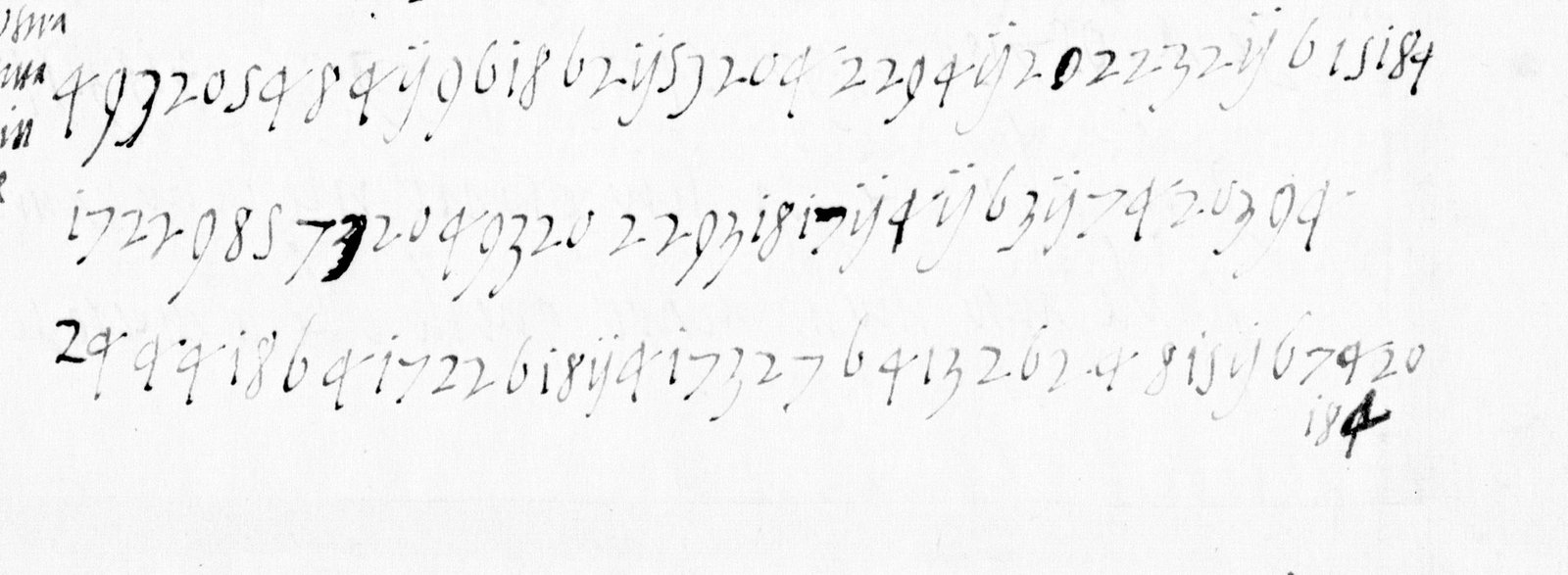
Excerpt
Averia dat volontier a cuatr cento mila scudi per aver cuel stato et pareva ? ascoltase ? parla
Translation
[He] would willingly have given four hundred thousand scudi to obtain that state, and it seemed ? would listen ? speaks.
Readable text
The full text, folio by folio, as in the report. Bold marks the passages deciphered from the cipher; the rest is the clear text of the letter. Question marks are the report’s: [?] or a bare ? for a sign or group left unread, a ? after a word for a doubtful reading.
Français 4687 — ff5v–7v
f5v
che sono [?] la libertà [?] delle nostre [?] et [?] molto [?]. Et per questo et per altri rispetti? [?] ne havete memoria? in parte et di nuovo ve [?] li altri [?]. Vi prego ancora di fare [?] per voi per qualche rispetto [?] DATO CUELO ? SCRIVE IL ? A SUO FRATEL ? RISOLTA DI FARLA et mi causa gran affetto et animo ? ? ? PATRONO ? CUEL ? ? VI LASA ? Il cardinale nostro fratello venirà ?
f6r
che [?] non ve tornerà più [?] quello [?] havere la [?] di [?] in [?]. Et [?] prima li piacesse? [?] tutti li [?] manco? a me? [?] ? A SUO FRATELO SOPRA ? A LA PRATICA ? ? DA FARE ? ET CUNTE CARLO ?
[?] però a me? ve ne rimetto? di [?] et ve [?] si [?]
A CUEST DI VENNE IL MAESTR DI STALA DA MILANO ET DISE A LA ? FRANSESCO ? AVEVA DITO ? AVERIA DAT VOLONTIER A CUATR CENTO MILA SCUDI PER AVER CUEL STATO ET PAREVA ? ASCOLTASE ? PARLA
quel Roma? che voi [?]
Sua Altezza? et tutta la [?] questa? per me? [?] di noi per [?] desiderava? [?]
f6v
se ve ne [?] di [?] che ve [?] di far ogni cosa per [?]
[?]
Dio faccia [?] la lega di [?]. Sono state pur assai [?] della [?]. [?] il nostro fratello dovrà? [?] a voi per havere? da voi? aviso? et a [?]. [?] di dare? la mia? [?] pure [?] per voi per [?] di qua ne è? [?]
[?]
Per [?] la Dio [?] questa non [?] a me? quello [?]
f7v
[?] voi? [?] et [?] per [?] a [?] grazia? a mantua? [?]
[?]
amorevoliss[ima] madre et [?] [?] [?] che le mie le poss[iate?] bruciare?
[?]
[?] la [?] mi sia più [?] per haver [?]
At a glanceCiphertext-only break · partial (97% of the cipher)
- The letter
- Marguerite Paléologue to Louis de Gonzague, duke of Nevers (both attributions from the catalogue), 1562–1564, in Italian.
- Where
- BnF Français 4687, ff. 5v–7v.
- The cipher
- A numerical code with 17 classes; some written forms remain uncertain.
- How it was read
- George Lasry’s report recovers the key from the ciphertext alone. This project checked one sample against the Gallica image and could not re-derive it, as the PDF has no key table.
- What it says
- Of f. 6r, rows 8–10: [he] would willingly have given four hundred thousand scudi to obtain that state.
- Still open
- Only 2 of 4 pages are deciphered, in part: f. 5v/6r (241 elements). On f. 6v/7v, 356 base signs are transcribed and none deciphered.
- Credit
- George Lasry, BnF cipher research, 10 October 2026.
01 Verification
Spot-check against the manuscript
This result is George Lasry’s. This project did not re-solve the cipher: it checked one sample against the Gallica image and recorded what it found.
- Batch A. Image checked: https://gallica.bnf.fr/ark:/12148/btv1b90075058/f8.item
- Folio matches the report: yes; cipher present: yes
- What we checked: f6r bottom 3 numeric rows on Gallica are exactly his crop (4 9 3 20 5 4 8 4 ... / 17 22 9 8 5 73 ... / 2 4 4 4 18 6 4 17 22 ...); no key table in the PDF, so "averia dat volontier a cuatr cento mila scudi" could not be re-derived
- Verdict: partly confirmed (method key recovered from ciphertext-only, extent partial). The check is a sample, not a re-solution.
- Notes: Mixed Italian clear+numeric letter. Margins of f6r carry contemporary interlinear-style glosses ("questo e quello ...", "Sera ... che segui"), i.e. partial adjacent plaintext he may not have used. Only 2/4 pages in part; attribution from catalogue.
Full texts
The transcription and the decryption of every document on this page, so that the reading can be used and checked. Short files are shown here; all are in the repository.
George Lasry's decipherment (report PDF, 24 Oct 2026) read in part
Italian family correspondence mentioning Milan, a stable master, Carlo, a brother, and an offer of scudi for a state. The letter remains partly unread.
Builds coherent sentences, but under the read bar of 95% of words read as sense (78% here); the holes are marked in the reading.
Decryption: in full above, in George Lasry’s decipherment (readable.md)
Reading: in full above, in George Lasry’s decipherment (readable.md)
Translation: in full above, in George Lasry’s decipherment (translation_excerpt.md)
02 Sources
- George Lasry, with ChatGPT Astra 6 and Anthropic Opus 5.5, BnF cipher research, 10 October 2026 (sent to Daniel Bourdeau on 13 October 2026 for publication here), p. 33; his other items are listed on his contributor card.
- The working folder:
targets/paleologue1562/(his entry as extracted from the report, our spot-check,profile.json).