At a glanceKey from adjacent plaintext · complete
- The letter
- Don García de Toledo, viceroy of Sicily, to Philip II, Messina, 16 July 1565, with news from besieged Malta; plus a short covering letter of the same day (no. 249).
- Where
- Archivo General de Simancas, Estado, legajo 1394, no. 247, on PARES: the duplicado, in clear Spanish with names, numbers and intelligence replaced by runs of two-digit figures. Nothing on the leaf says what they mean.
- The cipher
- A homophonic substitution: figures 12 to 43 run through the alphabet in order, three figures for each vowel and one for each consonant, with no nulls and no code words.
- How it was read
- Two runs beside clear words, seiscientos soldados and en tiera, gave eleven letters; the order of the table predicted the rest. No. 249 was deciphered on 2 October 2026 with the key unchanged: all 150 cipher tokens give sense.
- What it says
- The 600 soldiers Don Juan de Cardona landed entraron en el burgo a saluamento, and a second run of galleys turned back at La Valette’s fire signals. The rest is money and fortification.
- Still open
- A handful of words are doubtful in sense, none in their figures. The original despatch, which could carry a contemporary decipherment, has not been found.
01 The document
The Archivo General de Simancas, Estado, legajo 1394, no. 247, is catalogued on PARES as Duplicado de carta cifrada de García de Toledo, capitán general del Mar, a Felipe II, rey de España, 16 July 1565. It is two leaves: four pages of text (ff. 1r–2v) and an address leaf, sealed and inscribed En manos del señor Franco de Erasso, for the King’s secretary Francisco de Eraso. The first page is docketed Dupp.do in the upper left. A duplicate was a second copy sent by another route in case the first was lost, and this one is a clerk’s copy: it carries copying slips that the original presumably does not (quesido for querido, puddo for puedo, lonze for onze).
PARES serves the six images (four text pages and the address leaf twice) as plain JPEGs about 915 pixels wide. That is the largest size the viewer gives; asking for any zoom other than the default returns a smaller image. At that size the figures are legible when a line is cropped and enlarged two and a half to five times, which is how every figure here was transcribed.

The letter is written in running Spanish, and the figures stand in the line wherever a word was thought sensitive: the relief, the Grand Master, the galleys, the signals, sums of money, place names, the enemy. Figure runs are written without word breaks, so a run such as 3618243616241829 is one or several words run together.
02 The cipher
A homophonic substitution on two-digit figures, in which the values 12 to 43 are assigned to the letters in alphabetical order. The five vowels and u/v have three figures each, every consonant one:
| letter | figures | letter | figures | letter | figures |
|---|---|---|---|---|---|
| a | 12 13 14 | i | 24 25 26 | r | 35 |
| b | 15 | l | 27 | s | 36 |
| c | 16 | m | 28 | t | 37 |
| d | 17 | n | 29 | u / v | 38 39 40 |
| e | 18 19 20 | o | 30 31 32 | x | 41 |
| f | 21 | p | 33 | y | 42 |
| g | 22 | q | 34 | z | 43 |
| h | 23 |
The alphabet has no j, k or w, and u and v are one letter, as in the clear hand. The table uses exactly the thirty-two values from 12 to 43, and no figure outside that range occurs in the letter: no nulls, and no code groups for names or words. Names are spelt out letter by letter, Caragoca (Syracuse), Augusta, Cabo Bono, Argel, Maltta, Mecina, Mosiur de Lenni.
The homophones are not used evenly. Of the three a figures, 13 occurs about 140 times, 14 about 95 and 12 about 50; of the e figures, 19 is used twice as often as 18 and nearly four times as often as 20; of the o figures, 31 about a hundred times against 40 for 30 and 13 for 32. The clerk had favourites. The overall letter frequencies are ordinary Spanish: a and e first, then s, r and o.
Four features of the hand affect the decryption. ñ is written nn (sennales, Espanna, campanna). Double letters are sometimes written single (en tiera) and sometimes doubled where the word has one (spantaado, quinta[a]les). The duplicado has its own copying slips, listed above. And the confusable pairs in this hand are 17/19, 35/36, 35/38 (a long-tailed 3 against a dotted 8) and 13/14.
03 How the key was recovered
Two cribs from the clear text. The second line of f. 1r has los followed by the run 36 18 24 36 16 24 18 29 37 30 36 and, on the next line, 36 30 27 17 13 17 31 36. Eleven figures with the first repeated at the fourth and eleventh places, standing after an article, fit seiscientos, and the next run then reads soldados. A few words on, the run after don Juan de Cardona puso is 19 29 37 25 19 35 14, en tiera, “put ashore”, spelt with one r. Together these fix a c d e i l n o r s t, with two figures each for a, e, i and o.
The alphabetical order gives the rest. Set out by value, the recovered figures were in alphabetical order: 13 14 a, 16 c, 17 d, 18 19 e, 24 25 i, 27 l, 29 n, 30 31 o, 35 r, 36 s, 37 t. The remaining values could each be predicted from its position and then checked on a word: 21 f, 41 x, 42 y and 43 z were filled that way and confirmed on 18212118373136 effetos, 15124119271836 baxeles, 42151329 yban and 332712431935 plazer.
Transcribe, decode, correct. The whole letter was then transcribed digit for digit with the clear text around the runs, and decoded by script. Nonsense in the output points to a misread figure, almost always one of the confusable pairs above; every correction to the transcription was found that way.
The audit. All 1,930 figure groups fall inside 12–43; all thirty-two values occur; no run has an odd number of digits. An out-of-range value or an odd run would be the mark of a transcription error, and none is left.
04 The check
A key built from the clear text could in principle only reproduce what the clear text already implies. The check is a name the clear text does not contain. On f. 1v, after the Grand Master’s signal not to enter, the clear hand writes y ansi lo dize and then the run 2830362539 35 1719 271929 2925, which decodes to Mosiur de Lenni: Monsieur de Leinì, that is Andrea Provana di Leinì, the Savoyard commander whose galleys sailed in the relief squadron, and exactly the man who would report whether the signals were made. Nothing in the clear text points to him.

The rest of the ciphered matter is consistent in the same way: Don Juan de Cardona’s 600 soldiers, the pilot Don Juan Çanoguera, the Conde de Módica serving at his own cost, Gian Andrea Doria’s claim on the viceroy’s funds, and the fortification of Syracuse and Augusta.
05 The decipherment
Clear text roman, figures in italic; spelling of the leaf kept (nn = ñ, u/v as written); word division inside a figure run is editorial, since the cipher writes none; square brackets are editorial
f. 1r
Llevo tan ruyn nueua a V. Mag. el correo passado que no me ha parescido detener este para que en parte la mejore. Los seiscientos soldados que don Juan de Cardona puso en tiera fue Dios servido de guiallos tanbien que todos entraron en el burgo a saluamento.
Dizeme este que ha salido que fue tan grande la alegria del maestre, abracando la gente sin podello hablar, que lloraua de plazer; y tanbien dize que otro dia salio la misma gente a dar en los Turcos y que mataron mas de dozientos, aunque estas salidas en ningun caso queria que las hiziese, y por muchas letras se lo tengo scripto con mucho encarescimiento.
Del maestre no tengo carta, que estoy spantado [ms. spantaado] dello, pero no tengo por mala seña olvidarse de mi, aunque no creo que tardara a dos o tres dias a venir; y conforme a lo que scriuiere uere de proueer lo mas que por el se pudiere.
El estar sin galeras me destruye, porque se po-
f. 1v
-drian hazer algunos effetos en baxeles suyos que van y vienen, pero trayendo las que aca ay ocupadas en iuntar la gente no se puede proueer a todo. Si [u]iniessen las de Spanna me darian mucha ayuda.
Las galeras que yban a entrar por el puerto llegaron a quatro millas del, con muy buena orden y gran determinacion, y aquella noche, que sera lunes, vna hora antes que amaneciesse, viniendo el martes, entro a saluamento la uarqueta que yo hauia embiado para auisar al maestre de las sennales, con la qual tuuo auiso de lo que hauia de hazer; y tornando las galeras el martes en la noche a otras quatro millas del puerto, el maestre les hizo las sennales del fuego clarissimas para que no entrassen, y ansi lo dize Mosiur de Lenni y todos los demas; y dentro de la hora sennalada las continuo la segunda vez, y las galeras se tornaron a meter a la mar por no ser descubiertas, y han llegado aqui esta mannana.
El don Juan Çanoguera, que es el que las guiaua, lo hizo muy bien, y todos los demas. Y este no sabe que[r]ido [ms. quesido] el maestre aceptar estas galeras; aunque podria ser por parescelle la entrada muy dificultosa, no dexo de tenella por buena senal.
Dizen todos los nuestros que, en acabando de hazer el maestre las sennales, vieron y oyeron vna gran cantidad de arcabuzeria, y que juzgauan ellos que sera salua para mostrarnos que nuestra gente sera dentro.
Este ombre que es venido salio del burgo el mismo lunes a los diez y nueue, y no trae nueua de la uarqueta que entro, porque no sera aun llegada; la qual puso el que yo embie a do le mande, y de alli
f. 2r
hauia de yr a nado hasta el burgo, y ansi llego saluo, como a la clara se ve por las sennales; y la ciudad hizo el mismo fuego, que tanbien es indicio que llego el que por aquella parte embie con el duplicado.
Los tiempos son tales y las necessidades tan grandes, que aunque se tuuiesse mucho dinero no osaria deshazerme de vn rreal para pagar deudas; y aunque es justissimo lo que V. Mag. manda de Juan Andrea, se podra hazer poco con el, pero lo que se pudiera no se dexara de hazer como V. Mag. lo manda, que cierto yo desseo dalle toda satisfacion, y el solo sera en este tiempo el que de mi cobrara alguna quantidad.
Es necessario poner luego mano en comencar a fortificar, por todo lo que podria suceder, la fruente que Caragoca tiene en tierra firme, y en leuantar vn cavallero en la mar que corresponde —çierto es secanos donde podria ser assaltada. Tanbien es necessario comencar al fin de octubre la fortificacion de Augusta, por que la ocasion no mostrasse a los enemigos el segundo salto. Para estas casas es menester dinero, y en este reyno no ay si no infinitas deudas.
V. Mag. mande echar quenta de los ytalianos que se han de leuantar, y de los spannoles que se han de pagar, y del sueldo de las naues, que cada mes importa quarenta mil escudos sin dos mesadas que se les deuen; y vease tanbien el uizcocho que de nueuo es menester hazer, que aunque despues se desquente a las galeras su parte, todavia este dinero sale del que V. Mag. me ha embiado. Hanse comprado quinientos quintales de artilleria de peso
f. 2v
de Espanna, mucha xarcia y madera para las yaretas [jaretas]; y aunque esta xarcia y madera puede seruir para las galeras que se huuieren de hazer, y lo del metal es dinero que no se pierde, todavia cuesta buen pedaço. Tanbien se haze armamento para las ocho galeras que vienen de Espanna, y otros gastos de botas, barriles, murriones y coracinas que no se pueden escusar.
Y si se quenta esto, y se añade el sueldo de la ynfanteria, contando tanbien el gasto de [l]onze galeras que se arman de nueuo, vera V. Mag. que la prouision echa no basta para tantas casas, ni yo pu[e]do [ms. puddo] sustentar con ella los gastos que V. Mag. apunta en su carta, tanto mas si esto se fuesse nada alargando. Y los quarenta y ocho mil ducados que venieron para las galeras ya estaua comido la mitad, y otra buena parte se deue a la gente. Y considerado esto, suplico a V. Mag. mande proueer como mas se paresciere que conuiene a su seruicio, y en el gastallos se terna el miramiento que V. Mag. manda.
Dize este que ha salido que todos los turcos que estan en tierra, demas de los bastiones a do tienen sus baterias, estan todos circundados de trincheas siete, ocho y diez palmos altas, assi a la parte de los nuestros como a la parte de la campanna; y que quando el partio no hauia otros que no las tuuiessen si no mil y quinientos turcos que estauan al agua. Confirma que hauian perdido mucha gente, y que en el campo corrian dolencias de que morian.
Por essos auisos vera V. Mag. los nauios que hallo sobre Cabo Bono el baxel que yua con uino a la Goleta. Tengo por cierto que son los de Argel que se uienen a iuntar con la armada; y esto creo por no saber que de Maltta aya salido cantidad dellos, porque dize este que del armada no se hauia desmandado nauio ninguno quando el partio, ni tan poco lo escriue el gouernador de la ciudad, como vera V. Mag. por su carta original que yra con esta.
Cuya vida guarde Nuestro Señor por tan largos años como sus criados y vassallos desseamos y la christiandad ha menester. De Mecina, a XVJ. de Julio 1565.
Postscript (entirely in the clear)
Ya tengo scripto a V. Mag. por otras quan bien le sirue el conde de Modica, y a su costa; y hauiendole agora scripto el almirante su padre la muerte de la duquesa su madre, y llamandole que vaya a España, no obstante que esto le ymporte mucho, no ha querido hazello ni yrse deste reyno hasta ver el sucesso de las cosas de aca. Hame parescido muy justo auisar dello a V. Mag., para que tenga entendido su voluntad y el seruicio que haze en ello a V. Mag.
English
García writes from Messina on 16 July 1565, about two months into the siege and some days after the relief known as the Piccolo Soccorso reached the Borgo (Birgu) at the start of July. Everything below that is in italics in the Spanish was in figures.
- The relief got in. He had sent the King bad news by the last courier and writes now to soften it: the six hundred soldiers Don Juan de Cardona put ashore all entered the Borgo safely. A man just out of the Borgo says the Grand Master embraced them, unable to speak, and wept for joy; and that the next day the same men sortied against the Turks and killed more than two hundred, though García had written many times that there were to be no sorties. He has no letter from the Grand Master himself and expects one within two or three days.
- A second run turned back. The galleys meant to enter the harbour came within four miles of it, in good order. That night, an hour before dawn on Tuesday, the barqueta he had sent ahead to arrange the signals with the Grand Master got in. On Tuesday night the galleys came again to four miles off, and the Grand Master made the fire-signals, very clear, that they were not to enter, and repeated them within the appointed hour, as Monsieur de Leinì and all the others report. The galleys put back out to sea so as not to be seen, and reached Messina this morning. Çanoguera, who guided them, did it very well. Nobody knows why the Grand Master would not take the galleys in; perhaps the entry looked too hard, but García takes it for a good sign. As the signals ended the galleys heard a great volley of arquebus fire, which they judged a salute to show that the men were inside.
- The messengers. The man who left the Borgo that Monday has no news of the barqueta, which had not arrived when he left. The barqueta landed García’s messenger where it was ordered, and from there he was to swim to the Borgo; the signals show he arrived. La ciudad, Mdina, made the same fire, a sign that the man sent by that route with the duplicate had arrived too.
- Money. Even with money in hand he would not dare part with a real to pay debts. He will do what he can for Gian Andrea Doria, as ordered, and Doria will be the only one paid anything. He asks the King to reckon the Italians to be raised, the Spaniards to be paid, and the ships, which cost forty thousand escudos a month with two months’ pay already owed; biscuit to be baked; five hundred quintals of artillery by Spanish weight, cordage and timber for the jaretas; fitting out the eight galleys coming from Spain and eleven more being armed; casks, barrels, morions and cuirasses; and the infantry’s pay. The provision sent does not cover it: half the 48,000 ducados sent for the galleys is already spent and much of the rest is owed to the men. “Being without galleys ruins me.”
- Fortification. Work should begin at once on the landward front of Syracuse and on a cavalier facing the sea, where the ground would let it be stormed; and on the fortification of Augusta at the end of October, so that the occasion should not show the enemy “the second leap”. For this money is needed, and in this kingdom there is nothing but infinite debts.
- The besiegers. The man from the Borgo says all the Turks ashore, besides the bastions where they have their batteries, are ringed with trenches seven, eight and ten palms high, facing both the Christians and the open country; when he left, only fifteen hundred Turks at the water were without them. The Turks have lost many men, and sickness is killing men in their camp.
- At sea. The ships that a vessel carrying wine to La Goleta found off Cape Bon, García is sure, are the Algiers squadron coming to join the fleet. No ship had left the fleet at Malta when his man came away, and the governor of la ciudad says none either, as his original letter, sent with this one, will show.
- Postscript, in clear. The Conde de Módica serves well and at his own cost; summoned to Spain by his father the Admiral after his mother’s death, he will not leave Sicily until he sees how things end here.
The letter was written during the worst of the siege, while García was still gathering the force that landed on Malta as the Gran Soccorso on 7 September; the siege was raised days later. In July he had few galleys to spare, and this letter shows what they could do: put small parties into the Borgo by night and watch for the Grand Master’s fires.
06 The companion letter, no. 249
Estado leg. 1394 no. 249 (PARES record 3576586) is the duplicado of a one-page letter García wrote to the King the same day, 16 July 1565, docketed Dupp.do and addressed on its fourth image En manos del señor Fran.co de Erasso; images 2 and 3 are a blank verso and a blank leaf. The courier carrying no. 247 was already on board when La Valette’s latest letters reached Messina, and this is the note sent with them. It has 25 figure runs, 150 cipher tokens: 147 figures, two of a barred θ for ll, and one overlined M-like sign for r, neither of which occurs in no. 247. With no. 247’s table unchanged, all 150 tokens give sense; the word-divided decrypt scores −1.67 per character under the es-golden-age model, against −5.89 for the same letters shuffled.
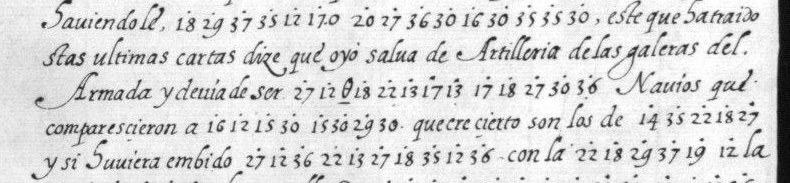
Clear text roman, figures in italic; word division and punctuation editorial
S. C. R. M.
Estando embarcado el correo con este despacho, he rescebido essas cartas del Maestre, las quales embio a V. M. para que pueda ver muy particularmente todo lo que scriue, que es harto mas apretado de lo que yo pense, sauiendole entrado el socorro. Este que ha traido estas ultimas cartas dize que oyo salua de artilleria de las galeras del Armada, y deuia de ser la llegada de los nauios que comparescieron a Cabo Bono, que creo cierto son los de Argel. Y si huuiera embiado las galeras con la gente a la Goleta, huuiera llegado a mal tienpo. [H]elas detenido hasta agora sperando respuesta del Maestre, porque si me scriuiera que hauia forma de ponelle mas gente por tierra, no quedara por falta dellas; pero el pide mas de la que yo agora le puedo dar, y ansi partiran las galeras mannana. N. S. guarde la vida de V. M. por tan largos años como sus criados desseamos y la Christiandad ha menester. De Micina, a 16 de Jullio 1565.
Criado y vasallo de V. M. que sus reales pies y manos besa, don Garcia de Toledo [autograph].
English. As the courier was embarking, García received fresh letters from the Grand Master and forwards them, so that the King can see how much worse things are than he had thought, even with the relief got in. The bearer heard an artillery salute from the galleys of the Turkish fleet, which must mark the arrival of the ships sighted off Cape Bon, surely the Algiers squadron. Had he sent the galleys with the troops to La Goletta they would have arrived at a bad moment. He has held them back waiting for La Valette’s answer: had the Grand Master written that there was a way to put more men in by land, the galleys would not have been lacking; but he asks for more men than García can now give him, so the galleys leave tomorrow.
The figures carry exactly the military matter: the relief, the Algerian arrival, the galleys and troops for La Goletta, the wait for La Valette’s reply, the reinforcement and the departure. It is the same news as no. 247 in a short covering note, and it reads with the same key: a second text, not used to build the key, that the key deciphers in full.
07 What remains uncertain
- yaretas (f. 2v, line 1): the figures are unambiguous, 42 12 35 20 37 14 36. It is taken as jaretas, the netting rigged over a galley’s deck; with the 41/42 confusion it could be xaretas, the same word.
- secanos (f. 2r): “çierto es secanos donde podria ser assaltada” is taken as shoals or dry ground that would let the sea-facing cavalier be stormed. The figures are certain; the sense is a guess.
- “salio del burgo el mismo lunes a los diez y nueue”: taken as the hour, not the day of the month, since 19 July is after the letter’s date.
- Which duplicate went by way of Mdina (f. 2r, el que por aquella parte embie con el duplicado) is not said; it is presumably a second copy of García’s own message to the Grand Master.
- No. 249: the last group of entrado is written
17·0, with a small mark between 7 and 0, and is taken as 17 30 (-do); PARES serves no image larger than about 970 × 1390 pixels, which does not resolve the mark, and any other reading turns the run odd. The overlined M-like sign (once, at the start of respuesta) is taken as r, and the barred θ (twice) ll; neither occurs in no. 247, and no key sheet or third letter in this key has been found to confirm them. - The originals of nos. 247 and 249, of which these are the duplicates, and the Mdina governor’s letter that went with them have not been found on PARES; a text search for the ciphered Toledo letters of 1565 returns only these two items. Estado leg. 1395 has not been searched. The original could carry a contemporary decipherment in the secretariat’s hand, and that would be the independent check on this decryption. Until it is found, the check is internal: the self-consistency of the table, the audit, and the names.
- No published text of the letter was found in web searches for the document and for editions of the Simancas Malta correspondence (18 September 2026). That is not the same as a search of the printed literature on the siege, and an edition may exist that the searches missed.
- The key table was rebuilt here from two cribs in the cleartext, not taken from a published source. The alphabetical key is easy to recover and the letter is on no list of open ciphers, so the key may have been known before, to Tomokiyo or from other material. The contribution is the transcription and decryption of this letter; no first break of the cipher is claimed.
Full texts
The transcription and the decryption of every document on this page, so that the reading can be used and checked. Short files are shown here; all are in the repository.
AGS Estado leg. 1394 no. 247, Messina, 16 July 1565
García de Toledo, viceroy of Sicily, tells Philip II of a second relief run to besieged Malta that failed: the galleys came within four miles of the harbour, but La Valette twice signalled that they should not enter, so they slipped back out to sea. He adds the state of the siege and blunt financial complaints: 'El estar sin galeras me destruye'.
Transcription
# AGS Estado leg. 1394 no. 247 - Garcia de Toledo to Philip II, 16 July 1565 (duplicado)
# Figure runs transcribed digit for digit from the PARES JPEGs; clear text as written (abbreviations expanded lightly).
# Page markers: == pN (PARES image N). Line breaks follow the manuscript.
== p1
Llevo tan 3538 4229 . 2938183812 a V. Mag. el correo passado que no me ha pa-
rescido detener este para que 1829 3312353718 la mejore. los 3618243616241829
373036 3630271713173136 que don Juan de Cardona puso 1929 3725193514 fue
dios servido 1719 2238261427273236 tanbien que todos 1929373513353129 1929
20271539352231 13 36142739122819293730. Dizeme este que ha salido
que fue tan grande la alegria del 28131936373519 141535131612291731 la gen-
te sin 33301719272732 hablar que 27273135133913 1718 332712431935 y
tanbien dize que otro dia salio la misma gente a dar en los Turcos y que 28133712353129
mas de dozientos aunque 1836371336 361327251713 36 en ningun 16133631 34
3819352513 que las 23254325193618 y por 283916231336 271937351236
se lo tengo 36163525333731 con mucho encarescimiento.
Del 28121936373520 no tengo 1613353712 que estoy 363312 2937131417 31 dello
pero no 3719292230 por 28132714 seña olvidarse de mi aunque no creo que tardara a
173036 30 37351936 17241336 a venir y conforme a lo que 36163525382619
3520 38193520 1718 33353039181935 lo mas 343918 por el se 3339172519
3519 . El estar sin 22132718351336 me 1718363735 404218 porque se po:
== p2
drian 2313431836 algunos 18212118373136 en 15124119271836 suyos que van y
vienen, pero trayendo 271336 que aca ay 3116393313171236 en 24392937 1335
la gente 2931 3619 puede 3335323918 35 13 37311730 , Si [38 struck] 1929251836 3618
29 271336 1719 363312292913 me darian 2838162313 14423917 13 .
Las galeras 343818 42151329 12 192937351336 333135 el puerto 2727182212
353029 13 34381437 3531 millas del con 284042 buena 32351720 29 y gran
1718371935 28262914 1625 3129 y aquella 29311623 19 que sera 274029 2036
vna 23313513 antes que 13 28142919162519363620 viniendo el 2813353719 36
2029373532 14 saluamento la 3913353440193713 que yo 23133925 14 em
biado para 12392536 1335 al 2812193637 3519 delas 361929291427 2036
con la qual tuuo 14402636 31 delo que hauia 1718 2312431935 y tornando 2713
36 221327193514 36 el 2813353719 36 en la noche a otras 3439143735 32
millas del 3340183537 30 . el 2813203637 3520 les hizo 271336 361929 2913
272036 del 2140192230 16271335253636262812 36 para que no 20293735 13[3]36 36:
1929 y ansi lo dize 2830362539 35 1719 271929 2925 y todos los de mas y dentro de
la 23303513 361929291227 1714 271336 continuo la 3619223929 1712 Vez
y las 221327193513 36 se 373135291335 3129 a meter a la 281235 por 2930 ser
17193616 401524193537 1436 y han 2727192214 1731 aqui esta 281229[29]14
2913 . El don Juan Çanoguera que es el que 271336 2238251440 13 lo 232643:
31 muy 15261829 y todos los de mas , y este no sabe 344019362617 31 el
2813193637 3519 aceptar 1836371336 22142719351436 aunque podria
ser por 33143518 36161927 2720 la 18293735 141714 muy 172521 26163927
373136 14 no dexo de tenella por buena 36 182914 27 . Dizen todos los 2939:
1836373530 36 que en acabando de hazer el 2814193637 3518 las 362029
29 1327 2036 Vieron y 3042183531 29 Vna 22351329 16132937241713
17 de Arcabuzeria y que juzgauan 1827273136 que sera 361327 4014 para 28 3136 373513 35 293036
que 293919363735 14 gente sera 17192937 3531 . Este ombre
que es venido 3614272531 171927 15403522 30 el mismo lunes a los diez y nueue y no
37351319 nueua de 2713 39143534391937 13 que 1829373531 porque no sera aun
272719221417 12 la qual puso el 344020 yo 1828152519 a do le mande , y de alli
== p3
hauia de yr 14 29131730 hasta 1927154035 2231 y ansi 272720 2231 361327
4030 como a la clara se ve por 271336 361929291327 1936 y la 1625391713 17 hizo
el 2825362831 213919 2231 que tanbien es 24291725162530 que 272719
2231 el que por aquella 3313353719 19281525 20 con el 174033272516 1317
31 /
los 3724182833 3136 son tales y las 291916203636251713172036 tan
grandes que aunque 3620 37383925193636 20 mucho dinero no 313613352514
1719362313431935 2819 de vn 353519 1327 para pagar 17183917 1436 , y aunque
es justissimo lo que V. Mag. manda de Juan Andrea se podra 231243 1835 33311630 con el
pero lo que se 33391725193513 no se 17194113 3513 de hazer como V. Mag. lo manda
que cierto yo desseo dalle toda satisfacion , y el solo sera en este tiempo el que 1719 2825
1631153513 3514 alguna quantidad /
Es necessario 3331291935 luego mano en 163128192916 1335 13 21313537252124
1614 35 por todo lo que 333217352514 36401618 1720 35 la 213539 1929 3720
que 16133514 22311612 tiene en 372418 3535 14 2125352818 y en 271940 1329
371335 vn cavallero 1829 2713 281435 que 163135351936 33312917 19 çierto es
36191614292930 36 donde 33301735 2514 ser 14363613 27 371317 12 , Tanbien
es necessario 163128192916 1335 al fin de 31163740 153519 2713 2131 3537 25
2124161416 25 3029 1719 144022393637 12 por que la 3116 1436 2531 29
no mostrasse 13 2731 36 1929 1828 2522 3136 el segundo salto , para esta s
casas es menester 172529 1935 32 y en 18363720 Reyno 2931 1442 si no
242921252924371336 172038171336 /
V. Mag. mande echar quenta de los 42371327251429 3136 que se han de 2718
3813293712 35 y de los 3633132929 30 271936 que se han de pagar y del sueldo
1719 271336 2914391936 344018 161317 14 281936 24 28 33 313537 14
34391335 1929 3712 2825 27 18 3616401732 36 sin dos 2818361317 1436
que se les deuen , y Vease tanbien el 3824 43163016 2331 que de nueuo es 2818
2919363718 35 hazer que aunque despues se desquente a las galeras su parte , toda
via este 17262918 3531 sale del que V. Mag. me ha embiado , Hanse compra:
do 3440242925 1929 37 3136 3440 252937 1327 1836 de artilleria de peso
== p4
1719 2036 3313 292914 mucha 41 12351625 14 42 2814 1718 3513 para las
42 123520371436 , y aunque esta 41 14351625 12 42 2812 1719 3514 puede
seruir para 271336 22132720351236 que se huuieren de hazer y lo del 281937
1427 1936 1725 2920 3531 que no se 33242035 1719 toda via cuesta buen peda:
ço , Tanbien se haze 1435 2812 2819 29 3731 para las 3116 2332 2214 2720
351336 que Vienen de 1836 3314292914 y otros gastos de 1532 371336 1514
353525271936 2839353525302918 36 42 16303514 16252914 36 que no se
pueden escusar y si se quenta esto y se añade el 3640192717 31 dela 42 29 2114 29
3719 3525 13 contando tanbien el gasto de 273129 4319 2213 271835 1236 que se 1335
2814 29 de nueuo . Vera V. Mag. que la prouision echa 2931 1513 3637 14 para
371429 371336 casas ni yo 33401717 31 36 3936371929 371435 con ella los 2212
36373136 que V. Mag. apunta en 3639 16143537 14 tanto mas 3625 1836 3731 se
fuesse nada 12 2713 35 2214291731 , y los 3439 143519 29 3714 42 3016 2331 2825
27 17 3816 1417 3036 que Venieron para las 2214 27203512 36 ya estaua 1631 2825
1730 2713 2824 371417 y otra buena parte 3619 171940 2014 a la gente y 163129
36241719 3514 1732 esto suplico a V. Mag. mande 3335304019 35 como mas se pa:
resciere que conuiene a su seruicio , y en el 2213 3637 14 27273136 se terna el miramien:
to que V. Mag. manda /
Dize este que ha 3614 2724 1730 que todos los 37393516 3036 que estan en 3724 193535 13
de mas de los 1514 3637 2431 2919 36 a do tienen sus 1514 3719 3524 1336 estan todos 1625
3516 38 2917 12 1730 36 de 3735 2429 1623 1814 36 siete ocho y diez 3313 2728 3136
14 2737 1336 assi a la parte de los 2940 1936 3735 3136 como a la 3313 3537 18 dela 1613 28
3314292912 y que quando el 3314 3537 2431 no hauia 3137 3531 36 que no las tuuiessen
si no 2825 2742 3439 2529 2419 29 3730 36 3740 3516 3136 que estauan 1327 14 22
3913 , confirma que 2313 40 2513 29 perdido 2839 1623 14 2219 2937 18 y que en
el 1613 2833 31 163035 3524 1229 1731 2719 2916 2513 36 de que 2831 3524 1229
/
Por essos 12 40 2436 3136 Vera V. Mag. 2731 36 2913 38 2531 36 que hallo sobre
1613 1531 1532 2931 el 1513 41 1927 que 4240 13 con 39 24 2931 a la 2230 2719
3713 , tengo por cierto que 3631 29 2732 36 1719 1435 2218 27 que se 3925 18 2919 29
a Juntar 1631 29 2713 1435 2814 1713 y esto creo por no saber que de 2813 2737 3713 aya
3613 2725 1731 cantidad 1719 27273136 porque 1724 43 20 este que 1719 27 1335 2812:
1712
== p5
no se hauia 1719362812291713 1731 29133824 31 ninguno quando 1927 331335
3725 31 , ni tan poco lo 183616352540 19 1827 22314019352912 173135 de la
16243817 1317 como Vera V. Mag. por su carta original que yra con esta , Cuya
Vida Guarde Nuestro señor por tan largos años como sus criados y Vassallos desseamos y
la christiandad ha menester , 1719 2819162529 12 a XVJ. de Julio. [1565] .
[postscript, all in the clear:]
ya tengo scripto a V. Mag. por otras quan bien le sirue el conde de Modica y a su
costa . y hauiendole agora scripto el almirante su padre la muerte de la duquesa
su madre y llamandole que Vaya a España , no obstante que esto le ymporte
mucho no ha querido hazello ni yrse deste Reyno hasta Ver el sucesso de las cosas
de aca . Hame parescido muy justo auisar dello a V. Mag. para que tenga enten:
dido su Voluntad y el seruicio que haze en ello a V. Mag. /
Decryption
# García de Toledo to Philip II, Messina, 16 July 1565 — deciphered

**AGS, Estado, leg. 1394, no. 247** — *"Duplicado de carta cifrada de García de Toledo, capitán general
del Mar, a Felipe II, rey de España"*, 16 July 1565. Six images on PARES (catalogue id 3576569, dbCode
27138924); ff. 1r–2v text, address leaf signed *En manos del señor Franco de Erasso* under the seal.

The letter is written in Spanish with every militarily sensitive word replaced by two-digit figures —
1,930 figure groups in all. *Words in italics below stand for figures in the manuscript*; roman text is
in the clear as the scribe wrote it. Spelling is the manuscript's own (*hauia*, *sennales* = señales,
*u*/*v* undifferentiated); word division inside a figure run is editorial, since the cipher writes none.
Square brackets are mine.

---

## f. 1r

Llevo tan *ruyn* *nueua* a V. Mag. el correo passado que no me ha parescido detener este para que *en
parte* la mejore. Los *seiscientos soldados* que don Juan de Cardona puso *en tiera* fue Dios servido
*de guiallos* tanbien que todos *entraron en el burgo a saluamento*.

Dizeme este que ha salido que fue tan grande la alegria del *maestre*, *abracando* la gente sin *podello*
hablar, que *lloraua de plazer*; y tanbien dize que otro dia salio la misma gente a dar en los Turcos y
que *mataron* mas de dozientos, aunque *estas salidas* en ningun *caso queria* que las *hiziese*, y por
*muchas letras* se lo tengo *scripto* con mucho encarescimiento.

Del *maestre* no tengo *carta*, que estoy *spantado* [ms. *spantaado*] dello, pero no *tengo* por *mala*
seña olvidarse de mi, aunque no creo que tardara a *dos o tres dias* a venir; y conforme a lo que
*scriuiere uere de proueer* lo mas *que* por el se *pudiere*.

El estar sin *galeras* me *destruye*, porque se po-

## f. 1v

-drian *hazer* algunos *effetos* en *baxeles* suyos que van y vienen, pero trayendo *las* que aca ay
*ocupadas* en *iuntar* la gente *no se* puede *proueer a todo*. Si *[u]iniessen las de Spanna* me darian
*mucha ayuda*.

Las galeras *que yban a entrar por* el puerto *llegaron a quatro* millas del, con *muy* buena *orden* y
gran *determinacion*, y aquella *noche*, que sera *lunes*, vna *hora* antes que *amaneciesse*, viniendo
el *martes*, *entro a* saluamento la *uarqueta* que yo *hauia* embiado para *auisar* al *maestre* de las
*sennales*, con la qual tuuo *auiso* de lo que hauia *de hazer*; y tornando *las galeras* el *martes* en
la noche a otras *quatro* millas del *puerto*, el *maestre* les hizo *las sennales* del *fuego*
*clarissimas* para que no *entrassen*, y ansi lo dize *Mosiur de Lenni* y todos los demas; y dentro de la
*hora sennalada las* continuo la *segunda* vez, y las *galeras* se *tornaron* a meter a la *mar* por *no*
ser *descubiertas*, y han *llegado* aqui esta *mannana*.

El don Juan Çanoguera, que es el que *las guiaua*, lo *hizo* muy *bien*, y todos los demas. Y este no
sabe *que[r]ido* [ms. *quesido*] el *maestre* aceptar *estas galeras*; aunque podria ser por *parescelle*
la *entrada* muy *dificultosa*, no dexo de tenella por buena *senal*.

Dizen todos los *nuestros* que, en acabando de hazer el *maestre* las *sennales*, vieron y *oyeron* vna
*gran cantidad* de arcabuzeria, y que juzgauan *ellos* que sera *salua* para *mostrarnos* que *nuestra*
gente sera *dentro*.

Este ombre que es venido *salio del burgo* el mismo lunes a los diez y nueue, y no *trae* nueua de *la
uarqueta* que *entro*, porque no sera aun *llegada*; la qual puso el *que* yo *embie* a do le mande, y de
alli

## f. 2r

hauia de yr *a nado* hasta *el burgo*, y ansi *llego saluo*, como a la clara se ve por *las sennales*; y
la *ciudad* hizo el *mismo fuego*, que tanbien es *indicio* que *llego* el que por aquella *parte embie*
con el *duplicado*.

Los *tiempos* son tales y las *necessidades* tan grandes, que aunque *se tuuiesse* mucho dinero no
*osaria deshazerme* de vn *rreal* para pagar *deudas*; y aunque es justissimo lo que V. Mag. manda de
Juan Andrea, se podra *hazer poco* con el, pero lo que se *pudiera* no se *dexara* de hazer como V. Mag.
lo manda, que cierto yo desseo dalle toda satisfacion, y el solo sera en este tiempo el que *de mi
cobrara* alguna quantidad.

Es necessario *poner* luego mano en *comencar a fortificar*, por todo lo que *podria suceder*, la
*fruente* que *Caragoca* tiene en *tierra firme*, y en *leuantar* vn cavallero *en la mar* que
*corresponde* —çierto es *secanos* donde *podria* ser *assaltada*. Tanbien es necessario *comencar* al
fin de *octubre la fortificacion de Augusta*, por que la *ocasion* no mostrasse *a los enemigos* el
segundo salto. Para estas casas es menester *dinero*, y en *este* reyno *no ay* si no *infinitas deudas*.

V. Mag. mande echar quenta de los *ytalianos* que se han de *leuantar*, y de los *spannoles* que se han
de pagar, y del sueldo *de las naues, que cada mes importa quarenta mil escudos* sin dos *mesadas* que se
les deuen; y vease tanbien el *uizcocho* que de nueuo es *menester* hazer, que aunque despues se
desquente a las galeras su parte, todavia este *dinero* sale del que V. Mag. me ha embiado. Hanse
comprado *quinientos quintales* de artilleria de peso

## f. 2v

*de Espanna*, mucha *xarcia y madera* para las *yaretas* [jaretas]; y aunque esta *xarcia y madera* puede
seruir para *las galeras* que se huuieren de hazer, y lo del *metal es dinero* que no se *pierde*,
todavia cuesta buen pedaço. Tanbien se haze *armamento* para las *ocho galeras* que vienen de *Espanna*,
y otros gastos de *botas, barriles, murriones y coracinas* que no se pueden escusar.

Y si se quenta esto, y se añade el *sueldo* de la *ynfanteria*, contando tanbien el gasto de *[l]onze
galeras* que se *arman* de nueuo, vera V. Mag. que la prouision echa *no basta* para *tantas* casas, ni
yo *pu[e]do* [ms. *puddo*] *sustentar* con ella los *gastos* que V. Mag. apunta en *su carta*, tanto mas
*si esto* se fuesse nada *alargando*. Y los *quarenta y ocho mil ducados* que venieron para las *galeras*
ya estaua *comido la mitad*, y otra buena parte *se deue a* la gente. Y *considerado* esto, suplico a V.
Mag. mande *proueer* como mas se paresciere que conuiene a su seruicio, y en el *gastallos* se terna el
miramiento que V. Mag. manda.

Dize este que ha *salido* que todos los *turcos* que estan en *tierra*, demas de los *bastiones* a do
tienen sus *baterias*, estan todos *circundados* de *trincheas* siete, ocho y diez *palmos altas*, assi a
la parte de los *nuestros* como a la *parte* de la *campanna*; y que quando el *partio* no hauia *otros*
que no las tuuiessen si no *mil y quinientos turcos* que estauan *al agua*. Confirma que *hauian*
perdido *mucha gente*, y que en el *campo corrian dolencias* de que *morian*.

Por essos *auisos* vera V. Mag. *los nauios* que hallo sobre *Cabo Bono* el *baxel* que *yua* con *uino*
a la *Goleta*. Tengo por cierto que *son los de Argel* que se *uienen a iuntar con la armada*; y esto
creo por no saber que de *Maltta* aya *salido* cantidad *dellos*, porque *dize* este que *del armada* no
se hauia *desmandado nauio* ninguno quando *el partio*, ni tan poco lo *escriue el gouernador* de la
*ciudad*, como vera V. Mag. por su carta original que yra con esta.

Cuya vida guarde Nuestro Señor por tan largos años como sus criados y vassallos desseamos y la
christiandad ha menester. *De Mecina*, a XVJ. de Julio 1565.

## Postscript (entirely in the clear)

Ya tengo scripto a V. Mag. por otras quan bien le sirue el conde de Modica, y a su costa; y hauiendole
agora scripto el almirante su padre la muerte de la duquesa su madre, y llamandole que vaya a España, no
obstante que esto le ymporte mucho, no ha querido hazello ni yrse deste reyno hasta ver el sucesso de las
cosas de aca. Hame parescido muy justo auisar dello a V. Mag., para que tenga entendido su voluntad y el
seruicio que haze en ello a V. Mag.

---

## What the letter says (English)

Written from Messina on 16 July 1565, about two months into the siege of Malta (begun 18 May) and about a week after the
*Piccolo Soccorso* reached Malta. Every proper name, number and item of intelligence is in cipher.

1. **The relief got in.** The 600 soldiers Don Juan de Cardona put ashore all entered Il Borgo safely.
   A man just out of the Borgo reports the Grand Master (La Valette) embraced the men and wept for joy,
   unable to speak; the garrison sortied next day and killed more than 200 Turks — sorties García had
   repeatedly written to forbid.
2. **A failed second run into the harbour.** The galleys came within four miles of the port, meaning to
   enter; the *barqueta* sent ahead to arrange fire-signals got in safely before dawn on Tuesday; but the
   Grand Master made the fire-signals unmistakably *not* to enter, repeated them within the appointed
   hour, and the galleys stood out to sea to avoid being spotted, reaching Messina that morning. Don Juan
   Çanoguera, who piloted them, "did it very well". The man the *barqueta* landed swam the last
   stretch to the Borgo, and the signals show he arrived; a second man, sent by the other side with a
   *duplicado* of García's message, evidently reached Mdina, which lit the same fire.
3. **Money and materiel.** Without galleys "me destruye". Forty thousand escudos a month for the ships,
   two months' pay owed, half of the 48,000 ducados already eaten; 500 quintals of artillery (by Spanish
   weight) bought, much cordage and timber for the netting, *botas, barriles, morriones y corazinas*; biscuit to be baked.
   He asks Philip II to count the Italians to be raised and the Spaniards to be paid, and says the
   provision does not suffice. Gian Andrea Doria will be paid what little can be managed.
4. **Fortification.** Begin at once on the landward front of Syracuse (*Çaragoça*) and a sea-facing
   cavalier where shoals would let it be assaulted; begin the fortification of Augusta at the end of
   October, so as not to show the enemy "the second jump". This kingdom has nothing but infinite debts.
5. **Order of battle inside Malta.** All the Turks ashore, besides their battery bastions, are ringed
   with trenches seven, eight and ten palms high, facing both the Christians and the open country; when
   the informant left, only 1,500 Turks were at the water. The besiegers have lost many men and sickness
   is running through their camp.
6. **At sea.** The ships found off Cape Bon by the wine ship bound for La Goleta are, he is sure, the
   Algiers squadron coming to join the armada — no ship had detached from the fleet at Malta when his
   informant left, nor does the governor of Mdina write of any.
7. **Postscript, in the clear.** The Conde de Modica serves at his own cost and, though his father the
   Admiral has written of his mother the Duchess's death and summoned him to Spain, he will not leave
   Sicily until he sees the outcome.
Decryption
### p1

Llevo tan *ruyn* . *nueua* a V. Mag. el correo passado que no me ha pa-
rescido detener este para que *enparte* la mejore. los *seiscien*
*tossoldados* que don Juan de Cardona puso *entiera* fue
dios servido *deguiallos* tanbien que todos *entraronen*
*elburgoasaluamento*. Dizeme este que ha salido
que fue tan grande la alegria del *maestreabracando* la gen-
te sin *podello* hablar que *llorauadeplazer* y
tanbien dize que otro dia salio la misma gente a dar en los Turcos y que *mataron*
mas de dozientos aunque *estassalidas* en ningun *casoq*
*ueria* que las *hiziese* y por *muchasletras*
se lo tengo *scripto* con mucho encarescimiento.
Del *maestre* no tengo *carta* que estoy *spantaado* dello
pero no *tengo* por *mala* seña olvidarse de mi aunque no creo que tardara a
*dosotresdias* a venir y conforme a lo que *scriuie*
*reueredeproueer* lo mas *que* por el se *pudie*
*re* . El estar sin *galeras* me *destruye* porque se po

### p2

drian *hazes* algunos *effetos* en *baxeles* suyos que van y
vienen, pero trayendo *las* que aca ay *ocupadas* en *iuntar*
la gente *nose* puede *proueratodo* , Si [*u* struck] *eniesse*
*nlasdespanna* me darian *muchaayuda* .
Las galeras *queybanaentraspor* el puerto *llega*
*ronaquatro* millas del con *muy* buena *orden* y gran
*determinacion* y aquella *noche* que sera *lunes*
vna *hora* antes que *amaneciesse* viniendo el *martes*
*entroa* saluamento la *uarqueta* que yo *hauia* em
biado para *auisar* al *maestre* delas *sennales*
con la qual tuuo *auiso* delo que hauia *dehazer* y tornando *la*
*sgaleras* el *martes* en la noche a otras *quatro*
millas del *puerto* . el *maestre* les hizo *lassenna*
*les* del *fuegoclarissimas* para que no *entra*[3]*ss*:
*en* y ansi lo dize *mosiurdelenni* y todos los de mas y dentro de
la *horasennaldalas* continuo la *segunda* Vez
y las *galeras* se *tornaron* a meter a la *mar* por *no* ser
*descubiertas* y han *llegado* aqui esta *man*[*n*]*a*
*na* . El don Juan Çanoguera que es el que *lasguiaua* lo *hiz*:
*o* muy *bien* y todos los de mas , y este no sabe *quesido* el
*maestre* aceptar *estasgaleras* aunque podria
ser por *parescelle* la *entrada* muy *dificul*
*tosa* no dexo de tenella por buena *senal* . Dizen todos los *nu*:
*estros* que en acabando de hazer el *maestre* las *sen*
*nales* Vieron y *oyeron* Vna *grancantida*
*d* de Arcabuzeria y que juzgauan *ellos* que sera *salua* para *mostrarnos*
que *nuestra* gente sera *dentro* . Este ombre
que es venido *saliodelburgo* el mismo lunes a los diez y nueue y no
*trae* nueua de *lauarqueta* que *entro* porque no sera aun
*llegada* la qual puso el *que* yo *embie* a do le mande , y de alli

### p3

hauia de yr *anado* hasta *elburgo* y ansi *llegosal*
*uo* como a la clara se ve por *lassennales* y la *ciudad* hizo
el *mismofuego* que tanbien es *indicio* que *lle*
*go* el que por aquella *parteembie* con el *duplicad*
*o* /
los *tiempos* son tales y las *necessidades* tan
grandes que aunque *setuuiesse* mucho dinero no *osaria*
*deshazerme* de vn *rreal* para pagar *deudas* , y aunque
es justissimo lo que V. Mag. manda de Juan Andrea se podra *hazerpoco* con el
pero lo que se *pudiera* no se *dexara* de hazer como V. Mag. lo manda
que cierto yo desseo dalle toda satisfacion , y el solo sera en este tiempo el que *demi*
*cobrara* alguna quantidad /
Es necessario *poner* luego mano en *comencarafortifi*
*car* por todo lo que *podriasuceder* la *fruente*
que *caragoca* tiene en *tierrafirme* y en *leuan*
*tar* vn cavallero *enlamar* que *corresponde* çierto es
*secannos* donde *podria* ser *assaltada* , Tanbien
es necessario *comencar* al fin de *octubrelaforti*
*ficaciondeaugusta* por que la *ocasion*
no mostrasse *alosenemigos* el segundo salto , para esta s
casas es menester *dinero* y en *este* Reyno *noay* si no
*infinitasdeudas* /
V. Mag. mande echar quenta de los *ytalianos* que se han de *le*
*uantar* y de los *spannoles* que se han de pagar y del sueldo
*delasnauesquecadamesimporta*
*quarentamilescudos* sin dos *mesadas*
que se les deuen , y Vease tanbien el *uizcocho* que de nueuo es *me*
*nester* hazer que aunque despues se desquente a las galeras su parte , toda
via este *dinero* sale del que V. Mag. me ha embiado , Hanse compra
do *quinientosquintales* de artilleria de peso

### p4

*deespanna* mucha *xarciaymadera* para las
*yaretas* , y aunque esta *xarciaymadera* puede
seruir para *lasgaleras* que se huuieren de hazer y lo del *met*
*alesdinero* que no se *pierde* toda via cuesta buen peda
ço , Tanbien se haze *armamento* para las *ochogale*
*ras* que Vienen de *espanna* y otros gastos de *botasba*
*rrilesmurrionesycoracinas* que no se
pueden escusar y si se quenta esto y se añade el *sueldo* dela *ynfan*
*teria* contando tanbien el gasto de *lonzegaleras* que se *ar*
*man* de nueuo . Vera V. Mag. que la prouision echa *nobasta* para
*tantas* casas ni yo *puddosustentar* con ella los *ga*
*stos* que V. Mag. apunta en *sucarta* tanto mas *siesto* se
fuesse nada *alargando* , y los *quarentayochomi*
*lducados* que Venieron para las *galeras* ya estaua *comi*
*dolamitad* y otra buena parte *sedeuea* a la gente y *con*
*siderado* esto suplico a V. Mag. mande *prouer* como mas se pa
resciere que conuiene a su seruicio , y en el *gastallos* se terna el miramien
to que V. Mag. manda /
Dize este que ha *salido* que todos los *turcos* que estan en *tierra*
de mas de los *bastiones* a do tienen sus *baterias* estan todos *ci*
*rcundados* de *trincheas* siete ocho y diez *palmos*
*altas* assi a la parte de los *nuestros* como a la *parte* dela *cam*
*panna* y que quando el *partio* no hauia *otros* que no las tuuiessen
si no *milyquinientosturcos* que estauan *alag*
*ua* , confirma que *hauian* perdido *muchagente* y que en
el *campocorriandolencias* de que *morian*
/
Por essos *auisos* Vera V. Mag. *losnauios* que hallo sobre
*cabobono* el *baxel* que *yua* con *uino* a la *gole*
*ta* , tengo por cierto que *sonlosdeargel* que se *uienen*
a Juntar *conlaarmada* y esto creo por no saber que de *maltta* aya
*salido* cantidad *dellos* porque *dize* este que *delarma*:
*da*

### p5

no se hauia *desmandadonauio* ninguno quando *elpar*
*tio* , ni tan poco lo *escriueelgouernador* de la
*ciudad* como Vera V. Mag. por su carta original que yra con esta , Cuya
Vida Guarde Nuestro señor por tan largos años como sus criados y Vassallos desseamos y
la christiandad ha menester , *demecina* a XVJ. de Julio. [*b?*] .
[postscript, all in the clear:]
ya tengo scripto a V. Mag. por otras quan bien le sirue el conde de Modica y a su
costa . y hauiendole agora scripto el almirante su padre la muerte de la duquesa
su madre y llamandole que Vaya a España , no obstante que esto le ymporte
mucho no ha querido hazello ni yrse deste Reyno hasta Ver el sucesso de las cosas
de aca . Hame parescido muy justo auisar dello a V. Mag. para que tenga enten
dido su Voluntad y el seruicio que haze en ello a V. Mag. /
Translation
<!-- English translation of reading.md (Claude Opus 5.5, 23 Oct 2026): AGS Estado leg. 1394 no. 247, García de Toledo to Philip II, Messina, 16 July 1565, deciphered with the key rebuilt here; words in *italics* stand for figures in the manuscript, roman is in clear, as in reading.md; the postscript is entirely in clear. Editorial brackets as there. -->

# AGS Estado leg. 1394 no. 247, García de Toledo to Philip II, Messina, 16 July 1565: English translation

## f. 1r

I brought Your Majesty such *bad news* by the last courier that it has not seemed right to me to hold this one back, so
that it may *partly* improve it. The *six hundred soldiers* that Don Juan de Cardona put *ashore*, God was pleased *to
guide them* so well that all *entered the Borgo safely*.

This man who has come out tells me that the *Grand Master's* joy was so great, *embracing* the men without *being able*
to speak, that *he wept for pleasure*; and he also says that the next day the same men went out to fall on the Turks and
*killed* more than two hundred, although *these sorties* I *wanted* him *by no means* to *make*, and I have *written* it
to him in *many letters* with great urgency.

From the *Grand Master* I have no *letter*, at which I am *astonished*, but I do not *take* it as a *bad* sign that he
forgets me, although I do not believe it will be *two or three days* before it comes; and according to what *he writes I
shall see to provide* whatever *can* be done for him.

Being without *galleys* *destroys* me, because some *effects* could be *achieved* against their *vessels* that come and
go; but with *those* that are here *occupied* in *gathering* the men, it is *not* possible *to provide for everything*. If
*those of Spain* came they would give me *much help*.

## f. 1v

The galleys *that were to enter by* the harbour *came within four* miles of it, in *very* good *order* and with great
*determination*; and that *night*, which will have been *Monday*, an *hour* before *dawn*, coming on *Tuesday*, the
*barqueta* that I *had* sent *to advise* the *Grand Master* of the *signals* *entered safely*, by which he had *word* of
what he *was to do*; and the *galleys* coming back on *Tuesday* night to within another *four* miles of the *harbour*,
the *Grand Master* made them *the* most *clear* *signals* by *fire* that they should not *enter* — and so says *Monsieur
de Lenni* and all the rest; and within the *appointed hour* he repeated *them* a *second* time, and the *galleys* *turned*
back out to *sea* so as *not* to be *discovered*, and have *arrived* here this *morning*.

Don Juan Çanoguera, who *was guiding them*, *did* it very *well*, and so did all the others. And this man does not know
*why* the *Grand Master* did not *want* to accept *these galleys*; although it might be because *the entry seemed* to him
very *difficult*, I do not fail to take it as a good *sign*.

All *our men* say that, as the *Grand Master* finished making the *signals*, they saw and *heard* a *great quantity* of
arquebus fire, and that *they* judged that it was a *salute* to *show us* that *our* men were *inside*.

This man who has come *left the Borgo* on the same Monday, the nineteenth, and *brings* no news of *the barqueta* that
*entered*, because it will not yet have *arrived*; which [barqueta] put *the man* I *sent* where I ordered him, and from
there

## f. 2r

he was to *swim* to *the Borgo*, and so he *arrived safe*, as is clearly seen from *the signals*; and the *city* made the
*same fire*, which is also an *indication* that the man I *sent* by that *side* with the *duplicate* *arrived*.

The *times* are such and the *needs* so great that even if *one had* much money I *would not dare to part* with a *real*
to pay *debts*; and although what Your Majesty orders concerning Juan Andrea is most just, little *can be done* with him,
but what *can* will not *fail* to be done as Your Majesty orders, for indeed I desire to give him every satisfaction, and
he alone will be the one at this time who *will collect from me* any quantity.

It is necessary to *set* hand at once *to begin to fortify*, against all that *could happen*, the *front* that *Syracuse*
has *on the mainland*, and to *raise* a cavalier *on the sea* side that *corresponds* — it is certainly *shoals* where it
*could* be *assaulted*. It is also necessary *to begin*, at the end of *October*, *the fortification of Augusta*, so that
the *occasion* should not show *the enemy* the second jump. For these things *money* is needed, and in *this* kingdom *there
is nothing* but *infinite debts*.

Let Your Majesty order a reckoning to be made of the *Italians* who are to be *raised*, and of the *Spaniards* who are to
be paid, and of the pay *of the ships, which every month comes to forty thousand escudos*, besides two *months' pay* owed
them; and let account be taken also of the *biscuit* that *must* be made anew, for although the galleys' share is later
deducted, still this *money* comes out of what Your Majesty has sent me. *Five hundred quintals* of artillery by the
weight

## f. 2v

*of Spain* have been bought, and much *cordage and timber* for the *netting*; and although this *cordage and timber* can
serve for *the galleys* that are to be built, and what is *metal is money* that is not *lost*, still it costs a good
deal. *Equipment* is also being made for the *eight galleys* that are coming from *Spain*, and other expenses for *casks,
barrels, morions and corselets* that cannot be avoided.

And if this is reckoned up, and the *pay* of the *infantry* is added, counting also the expense of the *eleven galleys*
that are being newly *armed*, Your Majesty will see that the provision made *is not enough* for *so many* things, nor *can*
I *sustain* with it the *expenses* that Your Majesty notes in *your letter*, all the more *if this* were drawn out at all.
And of the *forty-eight thousand ducats* that came for the *galleys*, *half* was already *eaten*, and another good part *is
owed to* the men. And *considering* this, I beg Your Majesty to order *provision* as shall seem best for your service; and
in *spending them* the care that Your Majesty orders will be taken.

This man who has *come out* says that all the *Turks* who are *ashore*, besides the *bastions* where they have their
*batteries*, are all *surrounded* by *trenches* seven, eight and ten *palms high*, both on the side of *our men* and on the
*side* of the *open country*; and that when *he left* there were no *others* without them except *one thousand five
hundred Turks* who were *at the water*. He confirms that they *had* lost *many men*, and that in the *camp sicknesses were
running* of which *they were dying*.

From those *reports* Your Majesty will see *the ships* that the *vessel* that *was going* with *wine* to the *Goleta*
found off *Cape Bon*. I hold it for certain that *they are those of Algiers*, who *are coming to join the armada*; and this
I believe because I do not know that any number *of them* has *left* *Malta*, for this man *says* that no *ship* had
*detached* *from the armada* when *he left*, nor does the *governor* of the *city* *write* it, as Your Majesty will see by
his original letter, which will go with this.

Whose life may Our Lord keep for as many years as his servants and vassals desire and Christendom needs. *From Messina*,
16 July 1565.

## Postscript (entirely in the clear)

I have already written to Your Majesty in other letters how well the Count of Modica serves you, and at his own cost;
and the Admiral his father having now written to him of the death of the Duchess his mother, and calling him to go to
Spain, although this matters much to him, he has not wanted to do it, nor to leave this kingdom until he sees the
outcome of things here. It has seemed to me very just to inform Your Majesty of it, so that you may understand his will
and the service he does Your Majesty in it.
AGS Estado leg. 1394 no. 249, Messina, 16 July 1565
A one-page companion letter of the same day in the same key: the relief has entered, ships from Cape Bon and Algiers, the galleys to La Goleta, the Grand Master's answer on putting more men in, and the galleys leaving the next day.
Transcription
# AGS Estado leg. 1394 no. 249 - Garcia de Toledo to Philip II, Messina 16 July 1565 (duplicado, one page)
# PARES record 3576586, dbCode 27138937; image 1 = text, 2 = blank verso (show-through), 3 blank, 4 address leaf.
# Figure runs digit for digit; clear text as written. θ = barred theta sign (ll); μ = the M-like sign before 18 36 33 38... (r).
== p1
Estando embarcado el Correo con este despacho he rescebido essas cartas
del Maestre las quales embio a V. M. para que pueda ver muy parti-
cularmente todo lo que scriue que es harto mas apretado de lo que yo pense
Sauiendole 18 29 37 35 12 17 30 20 27 36 30 16 30 35 35 30 , este que ha traido
estas ultimas cartas dize que oyo salua de Artilleria de las galeras del
Armada y deuia de ser 27 12 θ 18 22 13 17 13 17 18 27 30 36 Nauios que
comparescieron a 16 12 15 30 15 30 29 30 . que cre cierto son los de 14 35 22 18 27
y si huuiera embido 27 12 36 22 13 27 18 35 12 36 con la 22 18 29 37 19 12 la
22 30 27 19 37 12 huuiera llegado 12 28 13 27 37 24 18 29 33 30 19 27 12 36
de tenido hasta agora sperando μ 18 36 33 38 19 36 37 12 del 28 13 18 36
37 35 18 , porque si me scriuiera que hauia 21 30 35 28 12 de 33 30 29 18 θ 18
mas 22 18 29 37 20 33 30 35 tierra no quedara por 21 12 27 37 12 dellas pero
el 33 24 17 18 mas 17 19 27 12 que yo 12 22 30 35 14 le 33 38 18 17 30 dar y
ansi 33 12 35 37 24 35 12 29 las Galeras 28 12 29 12 29 14 / N. S.or
Guarde la Vida de V. M. por tan largos años como sus criados desseamos
y la Christiandad ha menester. de Micina a 16. de Jullio. 1565.
criado y vasallo de V. M. que sus reales pies y manos besa / don Garcia de Toledo  [autograph]
Transcription
# no. 249 cipher tokens only, one line per manuscript line, extracted from transcription_249.txt (theta = ll, mu = M-like sign)
18 29 37 35 12 17 30 20 27 36 30 16 30 35 35 30
27 12 θ 18 22 13 17 13 17 18 27 30 36
16 12 15 30 15 30 29 30 14 35 22 18 27
27 12 36 22 13 27 18 35 12 36 22 18 29 37 19 12
22 30 27 19 37 12 12 28 13 27 37 24 18 29 33 30 19 27 12 36
μ 18 36 33 38 19 36 37 12 28 13 18 36
37 35 18 21 30 35 28 12 33 30 29 18 θ 18
22 18 29 37 20 33 30 35 21 12 27 37 12
33 24 17 18 17 19 27 12 12 22 30 35 14 33 38 18 17 30
33 12 35 37 24 35 12 29 28 12 29 12 29 14
Decryption
# AGS Estado leg. 1394 no. 249: García de Toledo to Philip II, Messina, 16 July 1565 (duplicado)

PARES record 3576586 (dbCode 27138937), four images, fetched 2 Oct 2026 into `img/249_p1.jpg` … `249_p4.jpg`:
image 1 is the letter (one page), image 2 the blank verso (show-through only), image 3 a blank leaf, image 4 the
address leaf (*A la S. C. R. M. del Rey nuestro señor* · *En manos del señor Fran.co de Erasso*, sealed). Docketed
*Dupp.do* at top left. Written the same day as no. 247 and sent with it: the courier was already on board when
the Grand Master's latest letters reached Messina.

Read with the no. 247 key (figures 12–43 in alphabetical order, `key.json`) unchanged, plus two signs that occur
only here: a barred θ for *ll* (twice) and an M-like sign with an overline for *r* (once). The decoder is
`python decode.py transcription_249.txt`.

## Measurement

| | |
|---|---|
| cipher tokens | 150 (147 two-digit figures + 2 θ + 1 M-like sign) |
| runs | 25 runs, 32 words |
| tokens read as sense | **150 / 150 = 100 %**: every run divides into Spanish words or place names, no `?`, no odd run |
| language model | `es-golden-age`, word-divided decrypt **−1.67** per char (real text −1.1 to −1.8; the same letters shuffled −5.89); `lm.best_language` puts Spanish first |
| doubtful readings | one: the last group of *entrado* is written `17·0`, a small mark between 7 and 0; read 17 30 (*-do*). Read any other way the run turns odd. |

Script: the measurement was run from a scratch copy of the key and the word division below; the assertion that the
word division reproduces the decrypt letter for letter passed.

## Transcription

Figures digit for digit; clear text as written. The figures in `transcription_249.txt`.

```
Estando embarcado el Correo con este despacho he rescebido essas cartas
del Maestre las quales embio a V. M. para que pueda ver muy parti-
cularmente todo lo que scriue que es harto mas apretado de lo que yo pense
Sauiendole 18 29 37 35 12 17 30 20 27 36 30 16 30 35 35 30 , este que ha traido
estas ultimas cartas dize que oyo salua de Artilleria de las galeras del
Armada y deuia de ser 27 12 θ 18 22 13 17 13 17 18 27 30 36 Nauios que
comparescieron a 16 12 15 30 15 30 29 30 . que cre cierto son los de 14 35 22 18 27
y si huuiera embido 27 12 36 22 13 27 18 35 12 36 con la 22 18 29 37 19 12 la
22 30 27 19 37 12 huuiera llegado 12 28 13 27 37 24 18 29 33 30 19 27 12 36
de tenido hasta agora sperando M̄ 18 36 33 38 19 36 37 12 del 28 13 18 36
37 35 18 , porque si me scriuiera que hauia 21 30 35 28 12 de 33 30 29 18 θ 18
mas 22 18 29 37 20 33 30 35 tierra no quedara por 21 12 27 37 12 dellas pero
el 33 24 17 18 mas 17 19 27 12 que yo 12 22 30 35 14 le 33 38 18 17 30 dar y
ansi 33 12 35 37 24 35 12 29 las Galeras 28 12 29 12 29 14 / N. S.or
Guarde la Vida de V. M. por tan largos años como sus criados desseamos
y la Christiandad ha menester. de Micina a 16. de Jullio. 1565.
     [autograph] criado y vasallo de V. M. que sus reales pies y manos besa
                 don Garcia de Toledo
```

## Decipherment in context

Deciphered words in italics; editorial word division and punctuation.

> S. C. R. M.
>
> Estando embarcado el correo con este despacho, he rescebido essas cartas del Maestre, las quales embío a V. M.
> para que pueda ver muy particularmente todo lo que scrive, que es harto más apretado de lo que yo pensé,
> sabiéndole *entrado el socorro*. Este que ha traído estas últimas cartas dize que oyó salva de artillería de las
> galeras del Armada, y devía de ser *la llegada de los* navíos que comparescieron a *Cabo Bono*, que creo cierto
> son los de *Argel*. Y si huviera embiado *las galeras con la gente a la Goleta*, huviera llegado *a mal tiempo*.
> *(H)elas* detenido hasta agora esperando *respuesta del Maestre*, porque si me scriviera que havía *forma de ponelle
> más gente por* tierra, no quedara por *falta* dellas; pero él *pide más de la* que yo *agora le puedo* dar, y ansí
> *partirán* las galeras *mañana*. N. S. guarde la vida de V. M. por tan largos años como sus criados desseamos y la
> Christiandad ha menester. De Micina, a 16 de julio 1565.
>
> Criado y vassallo de V. M. que sus reales pies y manos besa, don García de Toledo.

Spelling as written in the figures: *tienpo* (n before p), *mañana* with a single n (28 12 29 12 29 14), *elas* for
*helas* ("I have kept them", h dropped). In `transcription_249.txt` the M-like sign is keyed as `μ` and the barred
theta as `θ`, so that `decode.py` can tell the sign from the clear *M.* of *V. M.*

## English summary

As the courier was already embarked with this despatch, García de Toledo received fresh letters from the Grand
Master, La Valette, and forwards them so that the king can see in detail how much worse the situation is than he
had thought, even knowing that the relief force (the *Piccolo Soccorso*) had got in. The bearer reports hearing an
artillery salute from the galleys of the Turkish fleet, which must have marked the arrival of the ships sighted off
Cape Bon, which Toledo is sure are the Algiers squadron. Had he sent the galleys with the troops to La Goletta they
would have arrived at a bad moment. He has held them back until now waiting for the Grand Master's answer: if La
Valette had written that there was a way to put more men into Malta overland, the galleys would not have been the
obstacle; but he asks for more men than Toledo can give him now, so the galleys will leave tomorrow.

The ciphered words are exactly the military content: the relief having entered, the Algerian arrival off Cape Bon,
the galleys and troops for La Goletta, the wait for La Valette's reply, the reinforcement question, and the
departure date. This is the same news as no. 247 (Cabo Bono, the Algiers squadron sighted by the wine ship bound for
La Goleta) in a short covering letter.

## Open groups

None unread. Points of doubt, each with what blocks settling it:

- `17·0` in *entrado*: read 17 30. The mark between 7 and 0 is a reduced 3 or a blot; only a higher-resolution image
  than PARES serves (~970×1390 px, zoom 10 is the maximum) would show which. The reading does not depend on it.
- The M-like sign with an overline (one occurrence, start of *respuesta*): read as *r*. It is not in the 12–43 table
  and occurs nowhere in no. 247, so a second example is needed to say whether it is a cipher sign for *r* or *re*
  (the latter would give *reespuesta*, so *r* is the better fit) or a clear capital R in this clerk's hand. Blocked
  on more material in the same key (Estado leg. 1395 siblings, not checked).
- The barred θ = *ll*: two occurrences, both certain from context (*la llegada*, *ponelle*); also absent from no. 247,
  which spells *ll* as 27 27. It is probably one of the extra signs of the full key sheet, which has not been found.
Translation
<!-- English translation of the "Decipherment in context" in read_249.md (Claude Opus 5.5, 23 Oct 2026): AGS Estado leg. 1394 no. 249, read with the no. 247 key; deciphered words in *italics*, the rest in clear. -->

# AGS Estado leg. 1394 no. 249, García de Toledo to Philip II, Messina, 16 July 1565 (duplicado): English translation

S. C. R. M.

The courier being already embarked with this despatch, I have received these letters of the Grand Master, which I send
to Your Majesty so that you can see in great detail all that he writes, which is much more pressed than I thought,
knowing *the relief had entered*. This man who has brought these last letters says that he heard an artillery salute
from the galleys of the Armada, and it must have been *the arrival of the* ships that appeared off *Cape Bon*, which I
believe for certain are those of *Algiers*. And if I had sent *the galleys with the men to La Goleta*, they would have
arrived *at a bad time*. *I have* held *them* until now, waiting for *the Grand Master's answer*, because if he had written
to me that there was *a way to put more men into it by* land, it would not have stayed for *want* of them; but he *asks for
more than* I *can now give him*, and so the galleys *will leave tomorrow*. May Our Lord keep Your Majesty's life for as
many years as your servants desire and Christendom needs. From Messina, 16 July 1565.

Your Majesty's servant and vassal, who kisses your royal feet and hands, don García de Toledo.
Key: key.json
08 Sources
- Archivo General de Simancas, Estado, leg. 1394, no. 247, Duplicado de carta cifrada de García de Toledo … a Felipe II, 16 July 1565: PARES, description 3576569, images 1–6.
- The same, leg. 1394, no. 249, the companion letter of 16 July 1565 (duplicado): PARES record 3576586, images 1–4.
- S. Tomokiyo, cryptiana, which marks the Malta cipher letters of 1565 as undeciphered. In Tomokiyo’s usage that means there is no interlinear decipherment or nearby deciphered copy. It does not mean unsolved; unsolved material from cryptiana is listed on its unsolved page (G. Lasry, personal communication, 21 September 2026). The key may therefore already be known from other material.
- Context: the Great Siege of Malta (18 May – September 1565), the Piccolo Soccorso of late June and early July and the Gran Soccorso of September, in the standard accounts of the siege.
The digit-for-digit transcription (transcription.txt), the key (key.json), the decode and render scripts, the raw and edited readings and the notes are in
the repository (targets/toledo1565/), with the six PARES images in targets/toledo1565/img/; no. 249 is in transcription_249.txt and read_249.md.