
At a glanceKnown key applied · partial (78% of the cipher)
- The letters
- Eighteen despatches of Sir Thomas Smith, ambassador in France, from 17 January 1563 to 29 April 1566, to the Queen and to Cecil.
- Where
- British Library, Add MS 4136, Patrick Forbes’s deciphering file for his Full View (1740–41); DECODE records listed as not decrypted, with the key at R9261.
- The cipher
- A signs-and-figures alphabet (n, o, p as figures, dots and colons for r, s, t, u, y), dotted Latin letters for common words, about thirty name signs, and a list of nulls.
- How it was read
- Smith’s own key, “Sr Thomas Smith’s Cipher” (R9261, pointed to by Tomokiyo in 2024), was applied to the passages transcribed from the images. The five letters of 1563 agree word for word with Forbes’s print.
- What it says
- The thirteen later letters, known before only from calendar summaries, are decrypted in Smith’s words: the Cardinal of Lorraine and Condé at Soissons, and the marriage plans of the Queen of Scots.
- Still open
- Some dotted-letter word signs are still interpreted from context. Two headings are misdated (Avignon 4 October 1564, 22 March 1566), and enos, listed among the nulls, means “ambassador”.
01 The records and the key
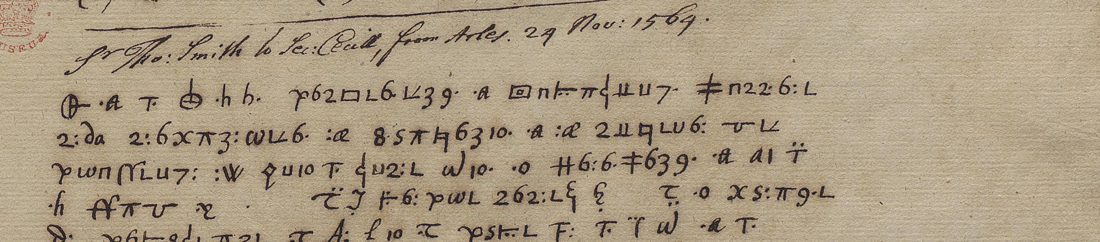
Add MS 4136 is Forbes’s deciphering file for his Full View. For each despatch he copied only what was in cipher, numbered the stretches (1), (2), … in the order they come in the letter, and headed the group with writer, recipient and date. The clear English place names scattered through the copies (London, Dover, Hastings, Lyn, Boston, Poole, Dunkirk…) and the words and, bycause, don, yf are Smith’s nulls: the key lists them under “Nothings”.
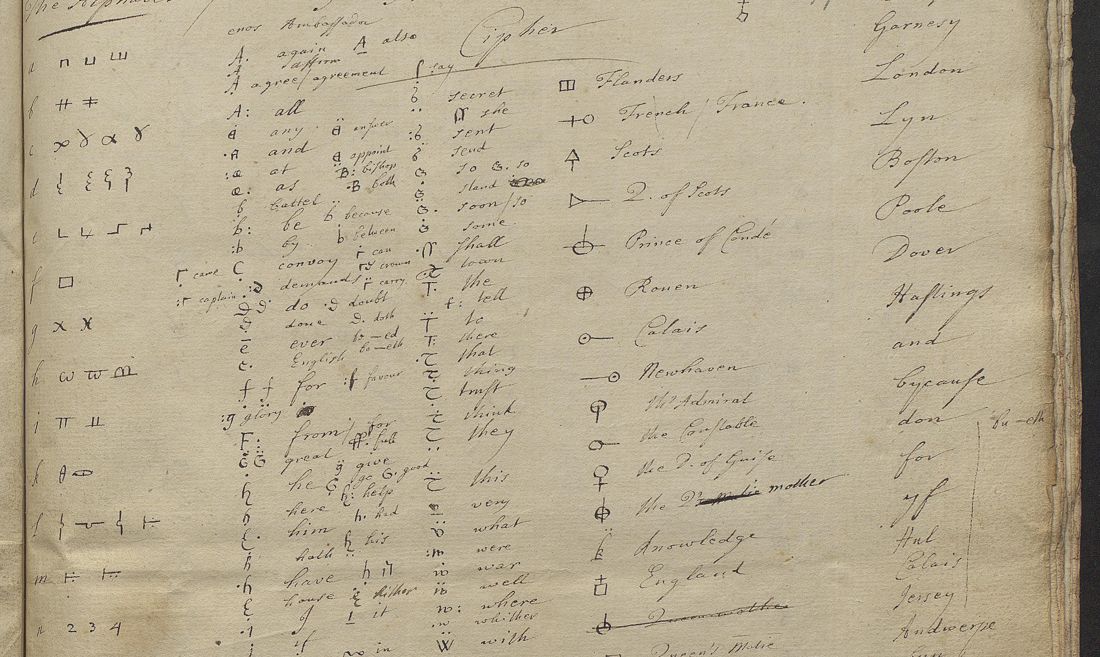
The alphabet gives each letter from a to m one to four invented signs, and n, o and p the figures 2–4, 5–7 and 8–10. The same figures with a dot are r and s, and with a colon t, u/v and y, so 6 is o, 6. r and 6: u. Common words are Latin letters marked with dots, colons or bars on different sides (·A and, A: all, :a at, b: be, :b by, F: from, :W which, Ẅ with), and da and ba are the endings -ing and -ed. About thirty signs stand for names: the Admiral, the Constable, the Duke of Guise, the Queen Mother, the Prince of Condé, the Cardinal of Lorraine, the Queen’s Majesty, England, Scotland, France, Spain, the Pope.
| Record | Folio | Letter | Deciphered (Sept 2026) | Printed or calendared |
|---|---|---|---|---|
| R9248 | 157 | to the Queen, Chartres, 17 Jan 1562/3 | tested on two passages | Forbes ii 287–9; CSP F. vi 109 |
| R9249 | 158 | to Cecil, 27 Jan 1562/3 | all 32 passages | Forbes ii 315–18 |
| R9252 | 163–4 | to Cecil, Blois, 7 Mar 1562/3 | about half | Forbes ii 350–51 |
| R9254 | 167–8 | to the Queen, Blois, 12 Mar 1562/3 | not transcribed | Forbes ii c. 354–59 |
| R9250 | 159 | to Cecil, 13 Apr 1563 | all 12 | Forbes ii 384–86 |
| R9250 | 159 | to the Queen, 27 July 1563 | in part | CSP F. vi 1078 |
| R9250 | 159 | to Cecil, 25 Jan 1563/4 | large part | CSP F. vii 103 |
| R9252 | 164 | to Cecil, Valence, 1 Sep 1564 | 28 of 31 | CSP F. vii 642 |
| R9252 | 164 | to Cecil, Valence, 3 Sep 1564 | both | CSP F. vii 650 |
| R9252 | 164–5 | to Cecil, Avignon, 4 Oct 1564 | about 50 of 62 | CSP F. vii 714 |
| R9253 | 166 | to Cecil, Marseilles, 13 Nov 1564 | in part | CSP F. vii 793 |
| R9253 | 166 | to Cecil, Arles, 20 Nov 1564 | large part | CSP F. vii 806 |
| R9253 | 166 | to Cecil, Arles, 22 Nov 1564 | in part (two signs) | CSP F. vii 808 |
| R9253 | 166 | to Cecil, Arles, 24 Nov 1564 | all but a few signs | CSP F. vii 815 |
| R9254 | 167 | to Cecil, Narbonne, 7 Jan 1564/5 | large part | CSP F. vii 916 |
| R9254 | 167 | to Cecil, Toulouse, 9 Feb 1564/5 | all 10 | CSP F. vii 979 |
| R9250 | 159–60 | to Cecil, Bourbon-l’Archambault, 22 Mar 1565/6 | about 12 of 27 | CSP F. viii 208 |
| R9250 | 160 | to Cecil, 29 Apr 1566 | all 5 | CSP F. viii 327 |
Where the letters stand after the re-reading of 22–23 October 2026. The reading audit of 22 October found that only six letters built sentences from the passage-by-passage decipherments. The same day every letter was re-read. Forbes prints every deciphered word in italic, so for the letters in his volume ii the italic stretches give the cipher passages and his clear text gives their sentences: the letters of 17 January, 27 January, 7 March, 12 March and 13 April 1563 (the 12 March letter, never transcribed before, aligned passage by passage with his italics) and of 15 and 20 October 1562 are now transcribed in Forbes’s own spelling. The letters with no clear text in print were re-read on the images and read as the passages themselves (m̄ = marriage, ·∂ = sea, the key’s dotted sign for “secretary”). Eighteen letters now build sentences (noNN_reading.md, with English). Decoded, not read: 25 January 1564 and Avignon, 4 October 1564, whose originals in TNA SP 70 carry the contemporary decipherment that Forbes did not copy; Narbonne, 7 January 1565; and the advertisements of 31 January 1563. The two ciphered words of 3 September 1564 are names only.
02 1563: the passages Forbes printed
The first test passage, in the letter to the Queen of 17 January 1563, came out as chief … on the other side, and Forbes (ii 287) prints: “I do take yt marvelous necessary, that some man were sent to be with the Admirall who now is chief on the other side.” In the letter to Cecil of 27 January all 32 stretches run with Forbes’s text in order: The rendering of Tankervill; that is, to have one on the other side with the admirall: and I have named him who, for th’acquaintance with the admirall and all of that faction, the knowledge of the countrey, and all other respectes, is most fit. But you must dispach him streight; You must not stic for honest allowance in tyme of service; Monsieur Danville, as I here sith I came to Paris, is to com over into England shortly; such noblemen of Scotland as favoreth the religion, and wold contynew the amytie between Scotland and us. The letter of 13 April is decrypted in full, the Blois letter of 7 March about half.
03 1563–1566: the passages the calendar only summarises
Arles, 24 November 1564 (“chiefly in cipher, deciphered”, CSP no. 815): “The Cardinal of Lorraine and the Prince of Condé have had conferens and familiar banketting togither at Soissons and at Nanteuil chasteau, which was the late [Cardinal] of Burbons’ … They of Guyse … complaine that all letters that come from the Cardinal … be opened, principally at Paris and Lyons … Madame de Guise … daily in great dispatches to and from Scotland … This bearer Hume is altogether a Lidington, whom you shall find double, I am afraid, or rather triple, having … pencions of all three princes.” Written out, this letter builds coherent sentences but reads at 93.0% of its words (measured 24 October 2026), under the 95% a complete reading needs.
Avignon, 4 October 1564 (decoded, not read: the phrases below hold, but the passages do not build sentences throughout; CSP no. 714; Forbes’s heading had been taken as 27 October): the two designs of the French court, one of them of the papists, to bring “all again to the olde state” and “break the amity” of England and Scotland; “The Bishop of Glasgow is here greater; no embassador”; “The marriage of the Queen of Scots”, the Earl of Warwick, Lord Robert and the Prince of Spain, “two marriages for her”; “[that] house of Guise stronger, which is too stronge”; the Earl of Lennox’s practice “to marry his sonne”, and “they feare that [?she] [is] enclined to this last offer of Lenox”.
Valence, 1 September 1564 (CSP no. 642): the amity between England and Scotland, the Earl of Murray, “such lords and great men … be the great favourers of religion … to do some great enterprise”, Huntly “died, and his sonnes were taken”, Lethington, the Bishop of Glasgow’s pension, and “to [?marry] Lord Robert”. On 3 September the two ciphered words are names: Nanion Cocborne and Villeroy.
25 January 1564 (decoded, not read, like Avignon; CSP no. 103): the Spanish ambassador reports the French making ladders at Étaples and Boulogne, to surprise a town in England or fall on the Low Countries; the King of Spain has made no league with the Pope and means nothing against the Queen of Navarre, but wants “to make himself rich”.
The other letters are shorter. Arles, 20 November, on the bearer Adam Hume, runs almost word for word with the calendar up to “glad to be rid of him”; its reading builds sentences but reads at 82.8% of its words, under the 95% a complete reading needs. Narbonne, 7 January 1565, covers the posts out of Scotland, Beton and Hume going by land, and “the marriage between the Duke of Guise and the Queen of Scots”. From Bourbon-l’Archambault, 22 March 1566, come the ambassadors of Spain and Scotland with the Cardinal of Lorraine, the Bishop of Glasgow looking to be a cardinal, and a Scottish woman who carries letters out of Scotland to Lady Lennox. And 29 April 1566 names “Peter Clare … Almain captain … Albert de Rosemberg”, and the “Continuation with the princes of Almain for the recovery of Metz and Calais”.
04 Folio 140: five earlier letters (DECODE R9236)
A seventh record, R9236 (Add MS 4136 f. 140, catalogue 94), is another of Forbes’s leaves: the ciphered passages of Smith to Cecil of 15 October, 20 October and 15/17 December 1562, to the Queen of 4 November 1563, and of “Sir Thomas Smith’s advertisements from France, 31 Jan. 1562[/3]”. The clear words scattered through them (London, Lyn, Poole, Boston, Dover, Hastings, Garnesey) are the nulls of the same key, R9261; DECODE names R9262 as the nearest key, which is Throckmorton’s. Decryptions, added 21 September 2026:
- 15 October 1562, all six passages: the Scots, the Queen of Scots, “to break with you, and to make war”, “that the hostages which you have shall be convoyed”, Flanders, Rollet and Monsieur Vyllemort. These agree with Forbes, Full View ii 119.
- 15/17 December 1562, all six: “I see, you must hold ferme and fast: Frenchmen will come to reason but compellid … to trust no Frenchman of what religion soever he be … the Prince of Condé, which I do not believe … as soon as ever they be able, they will thither [bend] all their force”. These agree with Forbes ii 238.
- 4 November 1563, to the Queen, decrypted in full and confirmed by the calendar (CSP Foreign vi no. 1366): “…de Montaigne … whose carte of La Rochelle … under another pretence. I have given letters to my Lord Robert and Mr Secretarie … from Rouen … wrote of that same matter … I thinke he can do. But this at this tyme is most necessarie.”
- 20 October 1562, all four passages, with Forbes ii 122 as the check: [Newhaven] is not so strong as supposed; if it were summer they would attempt to afray our men thence “garden of chamillion upon the hill on this side”; things begun there by [France] be not perfit.
- 31 January 1562/3, the advertisements: only passage (2), “the queen of Navarre”, is decrypted; (1), (3) and the last line remain fragments, and no printed text was found to check them against (not in Forbes, not in CSP Foreign vi): decoded, not read.
One variant appears on this leaf only: a double bar stands for i. Passage-by-passage decryptions are in targets/smith1562/decipher_E.md.
05 Method
The six records and the Smith-series key records were fetched from DECODE. The first key record DECODE names, R9262, is Throckmorton’s third cipher. The record listing around it gave R9261, whose first page is Smith’s cipher and whose second is Sir James Croft’s. The passages were transcribed from the images and the key applied sign by sign. Forbes’s printed letters (vol. ii, from the archive.org text) and the calendar summaries were used only to confirm decryptions; where they did not fit the signs the passage was left open. Values added to the key:
- enos, listed at the top of the key among the nulls, is “Ambassador”; a marginal gloss on the 20 November letter spells it out.
- M̅ and M̈ are marriage and marry, B: is Bishop, C̄ is Congregation, J̣ is is or are, ! is in or into.
- The doubled long-s signs are st, the small open v is l, and a looped kite with a stem is w.
- A variant of the England sign stands for Earl (before Murray, Lennox and Warwick). The flag sign, the key’s “Germany” or “the Emperor”, stands where the calendar names Archduke Charles.
- Forbes’s copying slips: a single dot for a colon, 4 for e, ⊔ for π.
06 What remains uncertain
- The hooked-T family of word signs (here, his, they, this, thing) is interpreted from context; Forbes’s dots on it are inconsistent (C).
- Undecrypted word signs: ẓ, ï, C·, F̄ and the ḧ-like sign in 1 September passage 2.
- Decoded, not read: 25 January 1564 and Avignon, 4 October 1564 (their contemporary decipherments are on the originals in TNA SP 70, “portions in cipher deciphered”, CSP Foreign vii 103, 714; State Papers Online was not reached), Narbonne, 7 January 1565, and the advertisements of 31 January 1563 (too short, no printed text).
- Single unread code signs, each seen once and not on the key sheet, in the letters of 1 September 1564, Marseilles 13 November 1564, Narbonne 7 January 1565, Toulouse 9 February 1565, 22 March 1566 and 29 April 1566 (about fifteen signs). The clear text of these letters (SP 70) is not in print; the calendar gives summaries only.
- Marseilles (5): the key’s sign for Calais where the calendar has Dieppe.
- Avignon passages 22–23 (“by litle and litle and by … great”) and 8–11 have no counterpart in the calendar summary (M).
Full texts
The transcription and the decryption of every document on this page, so that the reading can be used and checked. Short files are shown here; all are in the repository.
No. 01, Smith to the Queen, Chartres, 17 Jan 1562/3 (R9248, f. 157)
Smith to the Queen, Chartres, 17 Jan 1562/3 (Forbes ii 287-289): someone should be sent to the Admiral, now chief on the other side, and Mr Middlemore would be fit; the Guisians will make no agreement with the Queen; the Constable suspects the Guise and fears the ruin of the Châtillons; if the Admiral holds out, necessity will force an accord; the Queen should act with speed while the Huguenot faction is at her devotion. The 13 cipher passages of f. 157 are read as Forbes prints them.
Transcription
# Re-reading log, Smith letters nos. 01, 03-06, 08, 09, 11, 13, 15-20, 22, 23 (22 Oct 2026, Claude Opus 5.5; REREAD_BRIEF, batch b03)

## Starting point

Reading audit (22 Oct): seventeen of the 23 letters "decoded, not read" (passage tables of isolated names, code items and
fragments in decipher_A/B/D/E.md), nos. 01 and 04 not transcribed. Add MS 4136 is Patrick Forbes's deciphering file:
for every letter he copied only the ciphered stretches, numbered (1), (2) ...; the clear text of the letters is not in
the manuscript.

## Sources used

- Images: DECODE R9248, R9250, R9252, R9253, R9254 (already in the main checkout, targets/smith1562/decode/, git-ignored)
  and R9236 (fetched 22 Oct with the project cookie, targets/bordeaux/decode/cookie.txt; kept in the session scratchpad
  only). Key: R9261 p. 1 (Add MS 4136 f. 179), re-read in three crops for the word column.
- Forbes, *A Full View* vol. ii (1741), archive.org item `AFullViewofthePublicTransactionsintheReignofQ.Elizabeth`
  (Google scan; leaves 151, 155, 353-355, 416-425, 450-452 fetched as page images; the OCR in forbes2.txt garbles some
  lines). **Forbes sets every deciphered word in italic**, so his print gives both the deciphered passages and the clear
  sentences around them: this is what turns the Forbes letters into readings.
- CSP Foreign vi-viii (csp/*.html, already in the main checkout): calendar summaries of the 1563-1566 letters, from the
  originals "deciphered". Used for the setting only; their wording is a paraphrase and is not put into the readings.
- No other print of the 1563-66 letters was found (web search for the Arles 24 Nov 1564 text; Forbes ends July 1563).

## Per letter

- **No. 01 (17 Jan 1562/3, R9248 f. 157, 13 passages).** Not transcribed before. Forbes ii 287-289 (leaves 353-355,
  read on the page images) has 13 italic stretches; the 13 passages on the image (read in 7 strips) align with them one
  to one. Checks on the figures: (1) F: + the barred-circle cardinal sign = from the Cardinal of Lorraine; (2) G.⊢L =
  so-me, m: ẁ :ſ T̈ b: Ẅ ♀ = man were sent to be with the Admiral, then ⊔ξ5.L7.2:‖6.πξ = advertisid, 9.πξL = side;
  (3) ◇—◇6{ξ = wold, ⊓∝γ... credit; (4) m̲ ⊢πξ{L⊢65.L = Mr Midlemore, v̲ = very; (5) a. F: ... ɦ ... b: n̲ M: ξba T̈
  6.L5:5θ4 ... M = as for help, if your majestie be not minded to revoke me; (6) T̈ ∝7⊢ 2:6 n̄A ⌐ ⊔10 6π22:⊢L32: Ẅ :y =
  to com to no agreement nor apointment with your majestie; (7) A T̈ A: ♀ :∂ = agree to all the Admiral's demands;
  (8) f T. 6□□π∝L10. + the Constable sign; (9) 8.5:9.10L∝2: ... ∝ω⊔10.3:π{{‖72 ... ∂ ω‖{ξ43 = suspect ... Chastillion
  ... children; (10) .T i T. ♀ ∂ ω7{ξ4 7ϙ2: ⊔ ◇—◇ω‖{L ... ‡6:2: ⊓ ∂⊓. ɦ a. T. ... L.ϙ⊔9. = that if the Admiral do holde
  out a while ... but a doubtful battel as the last was (abridged); (11) ♀ .A ɦ 8.L2.5:L{4 ... :y = the Admiral and his
  sequele ... your majestie; (12) ‡5:3: i ö :ẁ Ẅ ɛ. F: :y a. y M = but if one were with him from your majestie as your
  minister; (13) :W ẏ ϙ7{ξ ∂ :ẁ ∂ Ẅ A: 8.10L{L ... ∝523:L3⊔5:4∂⌐ .A ɦ: ... = which you wold do were done with all spede
  ... countenaunce and help. No figure contradicts the print; abridged spellings and dropped dots as elsewhere. The
  reading is Forbes's text with cipher and clear marked. Grade A.
- **No. 03 (7 Mar 1562/3, R9252 ff. 163-164, 16 passages).** Half read before. Forbes ii 350-351 italics (leaves
  416-417) align with all 16: (1) ⌐5:L2 ! T̈ M̈ {⊓910L = even into my lappe (M̈ = my), then ⊢⊓ξL = made at the head of
  l. 2; (2) ∝γ̲ T̈ b: = [musters] to be, + ⊔985π32:‖zX .o :Γ10. = appointing of captains (the underlined ∝γ̲ is not on
  the key sheet); (3) Ẅ76:2: ∝ω⊔7.ʒL ⊢L4: ⊕ :k = without charge, let the Admiral know; (9) for hostages, or
  assurances for Calais hereafter to be rendred; (10) no, nor to kepe Newhaven ... quietly so long (its last word group
  is written under (9)); (11) as they kepe Calais from us; (12) to have Calais again; (13) confessid ther weaknes ... seke
  upon me; (14) have offered more then I will yet affirm to you; (15) of the queen of Scots; (16) the queen's majestie
  is. Grade A ("musters" carried by the print only, marked [?]).
- **No. 04 (12 Mar 1562/3, R9254 ff. 167-168, 58 passages).** Not transcribed before. Forbes ii 357-359 has about 61
  italic stretches for the 58 numbered passages (a few passages hold two stretches). Passages 1-24 checked on the glyphs
  (e.g. (2) ! T̈ ◩ = into Italy; (8) ⊙— 9:L⊓.A M̄ T̈ = Calais yea and more too; (9) Ẅ T. 10.9⊓2π9.ϖ ⊔⊢̈‡⊔q⊓ξ67:6 = with the spanish ambassadour; (11) ∂. {πL ! ♀ ... 5:2ξL6.ff⊓4ξ = doth lye in the Admiral ... understand; (16) ♀ J̣ ... 8θπξ f T̈ γ7⊢̈ ϖ ! P / Ẅ □π5:L = the Admiral is lokid for to com hither in post, with five; (17) 7:10974 ωπ10. ∝5:π2X = upon his coming, and its second line ◇—◇67.θL ϙπ10.L}10: T̤ ɛ̣ b: n̲ ⊓2:3:6.⊓98πξ = worke wisely that he be not attrappid; (19) a. ♀ .A T. X5:π10.⊓29. = as the Duke d'Aumale and the Guisians; (23) ɛ̇ ∝.bo ♀ 2:5 b: θπ{{ba = he caused the Duke of Guise to be killid; (24) T. ⊔⊢̈‡⊓ξ56.o ⊡ = the Ambassador of Spain); f. 168 by sign class and spot checks ((25) set with the cownsell; (44) Prince of Condé sign; (57) ⊢L2:♁
  4:7:{{ .A 5:L6.ξ7.⊢L = Metz, Toul and Verdune; (58) the Emperor will denounce warre). Grade A.
- **No. 05 (13 Apr 1563, R9250 f. 159, 12 passages).** All 12 were decoded (decipher_A Letter 2) but stood as isolated
  items. Forbes ii 385-386 italics give the sentences; passage 7 is "with the queen mother and the prince" (Forbes),
  which settles the doubtful first word. Grade A.
- **No. 06 (27/28 July 1563, R9250 f. 159, 2 passages).** Re-read on a fresh crop: "my Lord of Warwick" and the whole
  second passage "whether he be able to kepe it or no, [?nor] for what terme, nor what men he hath in it" (‖ = i;
  377: = n-o-u, a slip for not/nor; 4 6 3. = nor). Agrees with CSP vi 1078 §5. Grade B.
- **No. 08 (1 Sep 1564, R9252 f. 164, 31 passages).** 28 of 31 were read. M̈ is not on the key sheet: it is "my" in
  no. 03 (Forbes "my lappe"), while no. 17 has m̈ba = married; so (13) "for [?my] [ï] Lord of Murray", (25) "to
  [?marry] Lord Robert" (the calendar: "married to Lord Robert") and (29) "[?my] Lord of Murray" stay marked.
  Open: (2), a single ɛ-sign with a dot inside (the key's "I"; no sense found), the sign after "the Scots" in (11), ï
  before :L in (13) and (22), ẓ in (27) (the calendar has "reduce"). Grade B.
- **No. 09 (3 Sep 1564).** Both passages are names (Nanion Cocborne, Villeros), read; nothing more to read. Grade B.
- **No. 11 (13 Nov 1564, R9253 f. 166, 12 passages).** Re-read: (2) "in as great a trouble"; (10) Ꮚ̤ .ſ = who shall;
  (9) bel awaye; (12) by whom I dare speak. ·∂ in (6) stands where the calendar has "by sea" here and in no. 15 (3):
  read [?sea]. ⊙ in (5) is Calais in the key, Dieppe in the calendar: read [?Dieppe]. Open: m̄10. in (3) (read
  "marriages" from m̄ = marriage, sense unknown), the underlined double sign in (5). Grade B.
- **No. 13 (22 Nov 1564).** (1) the key's Emperor sign; (2) m̄ Ẅ T: + Queen's Majesty = "marriage with [?there] the
  Queen's Majesty". Calendar: the Archduke Charles. Grade B.
- **No. 15 (7 Jan 1564/5, R9254 f. 167, 7 passages).** (2) returned, Mr Beton and Hume by [?land]; (5) the Queen of
  Scots and hir; (6)-(7) in the marriage between the Duke of Guise and the Queen of Scots, ernest (L6.25ſſ). Open, no key
  value and one occurrence each: ʒ: and P̄ in (1) (calendar "above seven posts"), Γ̈⊓ in (2), (4) Ꮚbo + a blot, ξ̣ after
  "All the" in (6). Grade B.
- **No. 16 (9 Feb 1564/5, 10 passages).** (2) and the second line of (1) are one phrase, "congratulation and
  condolence"; ö in (10) = one (calendar "this French offer"). Open: the first five signs of (1) (n̲ T̈ m̤ ! T. ɛ̈ ->
  "[…] in the […]"). Grade B.
- **No. 17 (22 Mar 1565/6, R9250 ff. 159-160, 27 passages).** About 12 of 27 were firm; now 23 read (see
  no01-no23_corrections.tsv: crown, young King and Queen, forain realmes, have seen, carried ... brought, privy dispach,
  unserched, overmuch, which long came out of Scotland, she was married, she is the conveyer, from her). Open: ξ in
  (11), ꝏ̇ in (12), the sign before Lennox in (24) (⊢̈□}10:, perhaps "my Lady" miscopied), ωLξ⊓4: in (25), ċ in (27).
  Grade B.
- **No. 18 (29 Apr 1566).** The second line of (3) is the end of (4), Albert de Rosemberg; (3) = "Almain and also
  [T̈ ċ]" (ċ perhaps "captain"; the calendar has "a notable Almain captain"). Grade B.
- **No. 19 (15 Oct 1562, R9236 f. 140).** Re-read on the fetched image: (3) ‡5L⊔θ [and] Ẅ ẏ .A T̈ m: ẇ = break with
  you and to make war; (4) .T T. ω93⊔XL8 :W ẏ .h .ſ b: ς̣ξ = that the hostages which you have shall be convoyed (dots
  dropped); (6) a dotted sign read as the key's "secret" + ⊔69: (a-r-y) = secretary, 5.6{{L3: = Rollet, ⊓2ξ = and,
  ⊢̈y: = Monsieur, 7:9{υL⊢76.3: = Vyllemort. Forbes ii 119 (leaf 151) prints the same words in italic (his margin date
  reads 18 Oct; Forbes's file heading has 15 Oct). Grade A.
- **No. 20 (20 Oct 1562, R9236 f. 140).** Forbes ii 123 (leaf 155; the OCR line "is not so e and" is "Newhaven is not
  so strong as men do take it"). Italics: Newhaven / garden of chamillion upon the hill on this side / France. (2) garden
  ... side; (3) ∝ω⊔3π{ʒ‖63 = chamillion (3 for m) [mabγ, no value] ꝏ T̈: (read "upon the" with the print) ωπ{ = hil, [blot]63 = on,
  T̈ = this (with "side" from (2)). Forbes leaf 155 checked on the page image. Grade A.
- **No. 22 (4 Nov 1563, R9236 f. 140, seven-line block).** Re-read line by line: ξL ⊢724:⊓πX / 2⌐ = de Montaigne; .T ‖ ∂
  9.8L⊔θ4 .o = that I do speake of; ◇—◇ω79.4 ∝⊓6.4: 4 .o {⊓ 7.6∝ωL / ‖‖4 = whose carte of la Rochelle; π ω⊓6:4 :b
  ϖL6.4 Ẅ = I have [?sent] here with (:b on the copy); 5:4ξL7. ⊓4 74:ωL6. = under an other; 96.L4:L3∝L4 ‖ .h X‖5:L3
  ɛ. ℓ̲10. T̈ ⊢10: :L 6.7‡L7.4: .A m̲ 10.L∝6.L4:⊓7.‖4 = pretence I have given him letters to my Lord Robert and Mr
  Secretarie; a barred C-like sign = [?whom] (calendar "to whom"); F: ⊕ ‖ ...4:4 .o T. 9.⊓⊢L m. = from Rouen I wrote of
  the same matter; T. ẅ. ℓ̲10. ɛ̇ ∝⊓6.6Lξ ɛ. 8.L{□4 = the [?other] letters he carried himselfe; .A ‖4 .T □L⊓3:4 ẇ:.o
  ‖ ϙ6.53:4 10.7⊢ ϙω⊓4: = and in that feate whereof I wrote somwhat; ‖4:ωπ∝θ4 ɛ̇ ∝⊓4 ∂ = I thinke he can do; ‡5:4:
  2:ωπ9. ⊓4: 3:ϖπ10. 2:10:⊢4 ‖9. ⊢69.4: 2L∝L9.8.⊓6.‖4 = but this at this tyme is most necessarie. Agrees with CSP vi
  1366. Grade B.
- **No. 23 (advertisements, 31 Jan 1562/3, R9236 f. 140), not read.** Re-read on the image: (1) Ꝺ: ξL ſ.6:9: =
  "Monsieur de [ſ.]uy" (ſ. not in the alphabet; the name is not identified); (2) =q. .o + the French King/King of Navarre
  sign = "the queen of Navarre"; (3) =q. ɦ̣ m̲ L8T̈ 7.π5:3: ∂̈ (unread after "the queen"); the last line ξ‡⊓2ξ T. ♁ .a
  ϙ⊓9: Ẅ ξ ẇ. ξ ⊓10. = "[ξ]band that [King of Navarre] and way with [ξ] [ẇ.] [ξ] as" (no sense). Not in Forbes (his
  vol. ii has no Smith advertisements of this date) and not found in CSP vi; no other text; too short to fix the signs.
  Blocker: no clear or printed text, and the unknown signs occur once.

## Key observations (hold across the documents)

- M̈ = my in no. 03 (print), m̈ba = married in no. 17; in no. 08 M̈ is my or marry by context; m̄ = marriage (nos. 11,
  13, 15); the key's "M̄ more" is a different mark. Key sheet values used (checked on R9261 p. 1): dotted sign = secret,
  Γ̇ can, Γ̈ carry, Γ̣ came, :Γ captain, Γ+ϑ crown, k̈ king, ƙ kindred, .ꝏ overmuch, Ṗ privy, ·P practises, ꟿ she,
  :ꝏ woman, the C-family who / will / upon / whom (C̄ = whom), .ẏ young.
- ·∂ = sea in "by sea" (nos. 11, 15), a code word not on the key sheet.
- ‖ (double bar) = i on ff. 140 and 159 (it, Warwick, given, is, necessarie, I); the line-initial sign before 4 on l. 3 of
  no. 22 is read ll (la Rochelle), as decipher_E noted for the key's double-bar row.
- the dotted sign = secret (key; no. 19 "secretary"); the C-family = who/will/upon/whom (key); .ſ = shall; Γ̣ = came, Γ̈ = carry, Γϑ = crown; k̈ = king;
  .ꝏ = overmuch; Ṗ = privy; ꟿ = she (all as on the key).
- Forbes's copying slips: dots dropped from 5./9./10. (r, s), 3 for m (chamillion), 4 for e (speake, whose, carte), :b where the sense wants "sent" (no. 22).

## Verification note

Several crops sent for viewing during the session did not display at first (image request limit); every reading above
was re-checked afterwards on crops that did display: f. 157 (no. 01) in 7 strips, f. 163 (no. 03), f. 140 (nos. 19, 20,
22, 23) in 9 strips, and Forbes leaves 151, 155, 353-355, 416-417, 420-425, 450-452. The glyph strings in this log are
the ones read on those crops.

## Result

Readings with English for 16 letters: nos. 01, 03, 04, 05, 19, 20 rest on Forbes's print (grade A); nos. 06, 08, 09,
11, 13, 15, 16, 17, 18, 22 are the cipher passages read on the images, set in their letter by the CSP calendar (grade B;
the clear text of these letters is not in print, so the readings are the passages themselves). _check_reading.py clean
share: 01 0.97, 03 1.0, 04 0.98, 05 0.90, 06 1.0, 08 0.91, 09 (names only), 11 0.89, 13 1.0, 15 0.50 (three of six short
sentences hold a hole), 16 0.80, 17 0.94, 18 0.67, 19 0.83, 20 1.0, 22 0.71. No. 23 stays decoded, not read.
Decryption
<!-- Reading of no. 01, built 22 Oct 2026 by Claude Opus 5.5 (batch b03). Rests on Forbes, A Full View ii 287-289 (1741), printed "from the original" in the Paper Office, with the deciphered words in italic; each of the 13 cipher passages of Add MS 4136 f. 157 (DECODE R9248) was aligned with the italic stretches and checked on the glyphs with Smith's key R9261 (no01-no23_reread_log.md). Cipher passages are plain text; words in ⟨ ⟩ are the clear text of the letter as Forbes prints it, given only where it carries a passage into its sentence. Spelling (v6, 23 Oct 2026): Forbes's, as printed (he prints the originals' spelling); the modernised spelling of 22 Oct was restored word by word from the OCR of Forbes vol. ii (forbes2.txt, main checkout; research/reading_audit/v6_align.py --ocr: OCR long-s read as s, an OCR form not the same word kept only when it recurs in the print, OCR slips refused by hand). Where the OCR is garbled the word keeps its earlier form; no word was changed. Modern spelling is only in the English file. Forbes's punctuation. -->

# No. 01, Sir Thomas Smith to the Queen, Chartres, 17 January 1562/3

⟨The 14th cam a secretary with lettres⟩ from the Cardinal of Lorraine.

⟨I do take yt marvelous necessary, that⟩ some man were sent to be with the Admirall who now is chief on the other
side; that your Majesty may be as well advertised what is done there, as you may be what is done here. Of things
done on that side ⟨we can lerne els but only such as yt pleaseth them here to brute abrode.⟩ And he wold be one who
hath some familiaritie, acquaintance, and credit with them; ⟨and⟩ I think Mr Middlemore were a very ⟨handsom and fit
man.⟩ As for help, if your Majestie be not minded to revoke me, ⟨I do not dowte but to do well enough.⟩

⟨I may be deceived; but by all the means, wais, and intelligence which I can learne, they myende⟩ to com to no
agreement nor apointment with your Majesty: ⟨they will rather⟩ agree to all the Admiral's demands. ⟨As for religion,
they make no difficultie here in wordes.⟩ For the offices; the Constable ⟨shall greatly helpe to yt: who will begyn and
doth now, as men say,⟩ suspect the greatnes of the Duke of Guise, and consider the ruyne of the house of
Chastillon, being his nerest kindred in France, next his owne children.

⟨Yet methincks I do se,⟩ that if the Admiral do holde out a while, or give them again but a doubtful battle as the
last was, ⟨necessitie will compell them to com to accorde.⟩ ⟨What consideration⟩ the Admiral and his sequele will
have of your Majestie, ⟨I am not able to say; with whom I never had conference nor acquaintance:⟩ but if one were
with him from your Majestie as your minister, ⟨I wold thincke, it wold stand your Highnes to so good purpose, as none
could be more.⟩

⟨Marry, for all that I cannot yet se or lerne, best it were for your Majeste to trust unto your own strength, and so
provide, as that⟩ which you wold do were done with all spede; to lose no tyme, so long as you may have help of the
Frenche of that faction which be now at your devotion; to use both their countenaunce and help, while time may serve
thereto: making of them as confederates ⟨who be sone wery of the travaile, where all the profit is not thers.⟩
Reading
<!-- Reading of no. 01, built 22 Oct 2026 by Claude Opus 5.5 (batch b03). Rests on Forbes, A Full View ii 287-289 (1741), printed "from the original" in the Paper Office, with the deciphered words in italic; each of the 13 cipher passages of Add MS 4136 f. 157 (DECODE R9248) was aligned with the italic stretches and checked on the glyphs with Smith's key R9261 (no01-no23_reread_log.md). Cipher passages are plain text; words in ⟨ ⟩ are the clear text of the letter as Forbes prints it, given only where it carries a passage into its sentence. Spelling (v6, 23 Oct 2026): Forbes's, as printed (he prints the originals' spelling); the modernised spelling of 22 Oct was restored word by word from the OCR of Forbes vol. ii (forbes2.txt, main checkout; research/reading_audit/v6_align.py --ocr: OCR long-s read as s, an OCR form not the same word kept only when it recurs in the print, OCR slips refused by hand). Where the OCR is garbled the word keeps its earlier form; no word was changed. Modern spelling is only in the English file. Forbes's punctuation. -->

# No. 01, Sir Thomas Smith to the Queen, Chartres, 17 January 1562/3

⟨The 14th cam a secretary with lettres⟩ from the Cardinal of Lorraine.

⟨I do take yt marvelous necessary, that⟩ some man were sent to be with the Admirall who now is chief on the other
side; that your Majesty may be as well advertised what is done there, as you may be what is done here. Of things
done on that side ⟨we can lerne els but only such as yt pleaseth them here to brute abrode.⟩ And he wold be one who
hath some familiaritie, acquaintance, and credit with them; ⟨and⟩ I think Mr Middlemore were a very ⟨handsom and fit
man.⟩ As for help, if your Majestie be not minded to revoke me, ⟨I do not dowte but to do well enough.⟩

⟨I may be deceived; but by all the means, wais, and intelligence which I can learne, they myende⟩ to com to no
agreement nor apointment with your Majesty: ⟨they will rather⟩ agree to all the Admiral's demands. ⟨As for religion,
they make no difficultie here in wordes.⟩ For the offices; the Constable ⟨shall greatly helpe to yt: who will begyn and
doth now, as men say,⟩ suspect the greatnes of the Duke of Guise, and consider the ruyne of the house of
Chastillon, being his nerest kindred in France, next his owne children.

⟨Yet methincks I do se,⟩ that if the Admiral do holde out a while, or give them again but a doubtful battle as the
last was, ⟨necessitie will compell them to com to accorde.⟩ ⟨What consideration⟩ the Admiral and his sequele will
have of your Majestie, ⟨I am not able to say; with whom I never had conference nor acquaintance:⟩ but if one were
with him from your Majestie as your minister, ⟨I wold thincke, it wold stand your Highnes to so good purpose, as none
could be more.⟩

⟨Marry, for all that I cannot yet se or lerne, best it were for your Majeste to trust unto your own strength, and so
provide, as that⟩ which you wold do were done with all spede; to lose no tyme, so long as you may have help of the
Frenche of that faction which be now at your devotion; to use both their countenaunce and help, while time may serve
thereto: making of them as confederates ⟨who be sone wery of the travaile, where all the profit is not thers.⟩
Translation
<!-- English of no01_reading.md (the original is English; this version modernises wording and explains names). Words in ⟨ ⟩ were in clear in the letter. -->

# No. 01, Smith to Queen Elizabeth, Chartres, 17 January 1563 — English

⟨On the 14th a secretary came with letters⟩ from the Cardinal of Lorraine.

⟨I think it most necessary that⟩ someone be sent to stay with the Admiral (Coligny), who is now the leader on the
other side, so that your Majesty may be as well informed of what is done there as of what is done here. Of what is
done on that side ⟨we learn nothing except what they are pleased to spread abroad here.⟩ He should be someone who has
some familiarity, acquaintance and credit with them; ⟨and⟩ I think Mr Middlemore would be a very ⟨suitable and fit
man.⟩ As for help, if your Majesty does not intend to recall me, ⟨I have no doubt I shall manage well enough.⟩

⟨I may be deceived, but by every means and source I can find, they intend⟩ to come to no agreement or settlement with
your Majesty: ⟨they would rather⟩ agree to all the Admiral's demands. ⟨As for religion, they make no difficulty here
in words.⟩ As for the offices, the Constable (Montmorency) ⟨will greatly help: he will begin, and already does, as
men say, to⟩ suspect the greatness of the Duke of Guise and to weigh the ruin of the house of Châtillon, his nearest
kin in France after his own children.

⟨Yet I think I see⟩ that if the Admiral holds out a while, or gives them another doubtful battle like the last
(Dreux), ⟨necessity will force them to come to terms.⟩ ⟨What regard⟩ the Admiral and his followers will have for your
Majesty ⟨I cannot say, having never met or known him;⟩ but if someone were with him from your Majesty as your
minister, ⟨I think it would serve your Highness as well as anything could.⟩

⟨Indeed, from all I can see or learn, it would be best for your Majesty to trust to your own strength, and so to
provide that⟩ what you mean to do is done with all speed; to lose no time while you can have the help of the French of
that faction who are now at your devotion; to use both their countenance and their help while the time allows:
treating them as confederates ⟨who soon tire of the labour when all the profit is not theirs.⟩
No. 02, Smith to Cecil, Paris, 27 Jan 1562/3 (R9249, f. 158)
Sir Thomas Smith to Cecil, Paris, 27 Jan 1562/3: the ciphered passages as Patrick Forbes copied them into his deciphering file (Add MS 4136), deciphered with Smith's key R9261 (all 32 passages; checked against Forbes ii 315-18). In decipher_A.md, Letter 1: glyphs and plaintext per passage.
Transcription
# Smith ciphers in BL Add MS 4136 — decipherment A

> 22 Oct 2026 (re-read, batch b03): labels and values corrected passage by passage in no01-no23_corrections.tsv; the readings are in no<NN>_reading.md. Where this file and the tsv differ, the tsv holds.

Key: KEY.md / decode/IMG_R9261_I43290_P1.jpg. Glyph transcription is normalized: digits with `.`/`:` as written,
`⊢̈` = m, `{`/`}` = l, `ξ` = d, `L` = e, `⊔ ⊓` = a, `γ ∝ α` = c, `π` = i, `X` = g, `ω` = h, `□` = f, `‡` = b,
`◇—◇` = w; code words given as `sign(word)`. Clear-English nulls omitted. [?] = uncertain letter/word,
⟨code⟩ = unread sign.

## Letter 1 — Smith to Cecil, Paris, 27 Jan 1562/3
DECODE R9249 (IMG_R9249_I43259_P), Add MS 4136 f.158. Printed: Forbes, *A Full View*, vol. II pp. 315-318
(forbes2.txt lines ~26540-26832). Every passage below aligns with the printed text.

| # | glyphs (normalized) | plaintext | Forbes |
|---|---|---|---|
| 1 | T.(that) Ẍ(render) da(-ing) .o(of) 2:⊔2θL6.5.π{{ | the rendering of Tankervill (5. for 5: v) | p.317 "The rendering of Tankervill" |
| 2 | n̲(not) .h(have) T.⊢̈(them) ⸗o? .h(have) Ȧ(any) | not have them have any | "wolde not have them have any thing" |
| 3 | ζ(thing) ẁ:(where) ℭ:(upon) T̈(to) :g(glory) … c.(English) M.(men) ⊽⊓γθπ{ γ75:6.⊔X4? T̈ | thing whereupon to glory … Englishmen lackid courage to | same |
| 4 | .h(have) .o(of) :T(that) :a(at)L⊢̈10 2:(tempt) ẁ:.o(whereof) 1 ⟨w⟩5.6 2:4(wrote) T̈ ⊕(Q.'s Majesty) :b □7.⊔2γπ10. / .1 ⊢̈L⊓2L ẁ:.o | have of that attempt whereof I wrote to the queen's majestie by Francis; I meane whereof | "what opinion ye have of that attempt…" |
| 5 | ⊔ ζ(thing) n̅(now) T̈ ⊕(Q. Majesty) | a thing now to the queen's majestie | same |
| 6 | ·T ʃ T̈ ḣ ö o: T ∞. 10.ξL Ẅ φ(Admiral) ·A 1 ·h 2⊔⊢̈Lξ ξ. ℭ / f 2:ω ⊔γ2.6:⊔π32:⊓2γ4 Ẅ φ ·A A: .o ·T □⊔γ2:π74 ·A T k̈ .o / T γ66:23:5.L8: ·A A: ∞. 7.L10.10Lγ2:L9. ʃ o:(most) □π2: / ‡7:4: ẏ ⊢̈6:10.3: ξπ9.10⊔γω ξ. 8.2:6.Lπ Xω3: ·A 5?2: .o ḣ | that is to have one on the other side with the admiral, and I have named him who, for th'acquaintance with the admiral and all of that faction, the knowledge of the countrey and all other respectes, is most fit. But you must dispach him streight and out of hand | same |
| 7 | ẏ ⊢̈6:10.2: n̲ ſtπγ f ω72L10.2: A:5?⊔2γL 1 2:9:⊢̈⊣ .o 9.L5.7:πγL [·A 8?…] | you must not stic for honest allowance in tyme of service [and specially…] | "You must not stic for honest allowance in tyme of service" |
| 8 | ω6[?] L̈(long) ɢ.(so) ē(ever) 1 b:? T +○(France) ϑ ġ(stand) 1 2:ω66.43:L7.⊢̈⊣10. 1:W 1 ϑ. n̅ ɕ(stand) / ⊢̈52 9.πL5:7. ξ⊔35:π{{⊣ | howe long soever it be that France doth stand in those termes in which it doth now stand. Monsieur Danville | same (2:ω66.4 for "those": o/s slip [?]) |
| 9 | ʃ T̈ γ7⊢̈ ō(over) 1 T̈ 凸(England) 10.ω65.2:}10: | is to come over into England shortly | same |
| 10 | A(agree)⊢̈L27:10. .o ⊕|(Condé) | agreements of the prince of Condé | same |
| 11 | 1 ṁ(may) ẅ(well) b: Ä(answer)bo[?] :T | it may well be answered that | same |
| 12 | ♀-box | the queen's majestie [? Forbes has "the quene here" = Q. mother; sign read as Queen's Majesty] | "to the which the quene here" |
| 13 | Ẅ ⊕| ξ.(him) 8.Lξ□⊓⊽[?] □5:6.10.3: | with the prince of Condé himselfe furst | same |
| 14 | :T ζ̈(they) ‡5.πXL / γ5⊢̈105:}9.π72 ·A ḃ ḥ ʃ ⊔ 85.π10.72L6. ·A m[?] ⊕| | that they bringe … compulsion and because he is a prisoner, and whither the prince of Condé | same |
| 15 | 1 b: n̲ :b | it be not by | same |
| 16 | ♀-box | the queen's majestie | same |
| 17 | 5 7. 1 | or I | same |
| 18 | ‡5:2: T 2:6.5:4:ω ʃ ẗ ʃ ‡6:3: / ⟨w⟩ω⊔2: 86◇—◇L7. ẏ .h | but the truth is, this is but … what power ye have | same |
| 19 | ·A T̈ ⌐9.8π4[?] | and to espi[e] | same |
| 20 | f ḥ 10.ω5:}ξ ɢ̣(go) F: T2γωL 1 T̈ ⩓(Scotland) | for he shuld go from thence into Scotland | same |
| 21 | ξL2:6.π⊢̈L23: .o 凸 | detriment of England | same |
| 22 | 9.5:γω 25‡{L M. .o ⩓ :a? f(favour) ‡o? T 5.Lξπ X⊔74 ·A ◇5ξξ[?] / γ623:10:3L◇—◇ T ⊔⊢̈9:7:πγ ḃ ⩓ ·A 5:10. | such noblemen of Scotland as favoreth the religion and wold contynew the amytie between Scotland and us | same |
| 23 | ▷(D. of Chastelherault) ϑ ‡6.L⊓θ | the Duke of Chattelrault do breake | same |
| 24 | ḥ ℭ(will) ⊔X ⊓ 9⊔9.10 65.2: T̈ ɢ̣ P̄[?] 1 T̈ ⩓ ·A | he will ax a passport to go presently into Scotland, and | same (P̄ read as "presently" from context; key has P̄ = partly [?]) |
| 25 | :T .o[?] γ6⊢̈π2X .o ξLω⊔9: 7 6. ξLL9.⊽ 2:ω⊔}⊢̈⊓πX2L b: L̈ da T̈ ⊢̈52 8.πL6:6. ξ⊔37:π{{ 1 T̈ 凸 | that once coming of Dehay or Deese th'Almaigne belonging to Monsieur Danvill into England | same |
| 26 | .o :ſ(captain) ⊢̈L♁(z)10: | of captain Mezy | same |
| 27 | f T. ⊢̈⊔2:3:L7. .o 7.L}πXπ63 / α. f ξ⊓2 5:⊔ξ4[?] | for the matter of religion. As for Danvile[?] | same |
| 28 | T ⊕| ʃ n̅ 1 ḥ γ7:10:2:6ξπ4 | the prince of Condé is now in his custodie | same |
| 29 | α. 8.⊔6.ξπX3⊔ | as Sardigna | same |
| 30 | ♁(K. of Navarre) ɢ̣(so) 2:ω⊔ξ⊢̈π9.⊔{{⊔3:π4[?] | the king of Navarre, so th'admirallitie | same |
| 31 | X5:π9.⊔⊔29. ϑ 5.Lγ63 α. | the Guisians do recon as | same |
| 32 | ·A ζ̈ .o T. 7.L{πX⊔62 | and they of the religion | same |

Letter 1: 32/32 passages read; the text agrees with Forbes throughout. Small scribal slips (5. for v, stray
signs) marked [?].

## Letter 2 — Smith to Cecil, 13 Apr 1563
DECODE R9250 (IMG_R9250_I43261_P1, top), Add MS 4136 f.159. Printed: Forbes vol. II pp. 384-386 (forbes2.txt
lines ~31780-32010; the letter is dated at the foot "the xiii of Aprill 1563"). Aligned with the printed text.

| # | glyphs | plaintext | Forbes |
|---|---|---|---|
| 1 | ⊕|(Condé) b:da 26◇—◇ Ạ(appoint)ba[?] ·A 9.◇76.24 ∞[?] / ḥ ff.(full) ⊓5:3:ω76.⊔2:πL ⊔10.[?] 4:ω76:Xω2: | the prince of Condé being now appointed and sworne in his full authoritie, is thought | p.384 same |
| 2 | ш 4L◇ ♁ | a new king of Navarre | same |
| 3 | ‡10:[?] T. 8⊔9⊔10.2:9. | by the papists | "being won by the papists" |
| 4 | φ | the Admiral | same |
| 5 | ♇ | Monsieur d'Andelot | same |
| 6 | ⊖| | the Prince of Condé | same |
| 7 | ◇ωπγω ⊕|[?] ·A ⊖| | [which / the queen mother] and the prince | "with the queen mother and the prince" ([?] first word) |
| 8 | T. ⊢̈‡⊓9.8⊔{67. .o ⊡(Spain) | the ambassador of Spain | same |
| 9 | 2:ω⊓3: ⊡(K. of Spain) 10.6 | that the king of Spain so | same |
| 10 | 凸 ·A +○ ⊓10. ⊙— 67. —⊙ | England and France, as Calais or Newhaven | same |
| 11 | .o 凸 | of England | same |
| 12 | 2:⊓θL ⊙— | take Calais | same |

All 12 read; agrees with Forbes.

## Letter 3 — Smith to the Queen, 27 July 1563
DECODE R9250 P1, Add MS 4136 f.159. Not in Forbes as such; CSP Foreign vol. 6 no. 1078 (Smith to the Queen,
Valmont 28 July 1563, §5: the Earl of Warwick's letter "does not answer whether he be able to keep it, or for what
time, nor what men he has in it"). Forbes's date 27 July may be the date of drafting; the content fits no. 1078.

| # | glyphs | plaintext |
|---|---|---|
| 1 | ⊢̈9:(my) ⊽76.ξ .o ◇—◇⊓6.◇πγθ | my Lord of Warwick |
| 2 | ·◇[?] ġ[?] b: ⊓‡⊽L T̈ θL9 ⊓2:76.4 6yf 377:f[?] / Ẍ[?] 4.L6.⊢̈L[?] ·A 465. ö ⊢̈L4 ḥ ω⊓3: ϖπ4 ⊔4: | … be able to keep [the] town … [for how long] … and how many men he hath in it [?] — only "be able to keep" and "men he hath" are firm; rest ⟨uncertain⟩ |

Read in part; the firm words match CSP's summary.

## Letter 4 — Smith to Cecil, Paris, 25 Jan 1563/4
DECODE R9250 P1 (long block), Add MS 4136 f.159. CSP Foreign vol. 7 no. 103 ("Orig., portions in cipher
deciphered"). Passages (1)-(2) only numbered; the block is one long stretch. Read as runs; not every group
resolved.

- (1) `464: ö{10: T. :F` — "not only the French[?]" [?]
- (2) `T ⊓⊢̈‡⊔⊓9.10.⊔ξ66. .o ⊡ ṡ 6o[?] ⊢̈L ξ67.` — "the ambassador of Spain send[s] me word"
  `:T ḥ ω⊽[?] ḥ G.` "that he hath good" `⊔ξ5:L7.3:π9.L⊢̈L24:` "advertisement" `:T T :F[?] ṁ: ⟨?⟩ ⊓{ξL7.10. ·A ∞. 9.6:γω L4.5:⊔9…` "that the French make ladders and other such equipages"
  `⊓2: L9.4:⊔8⊽L10. ·A ⊚` "at Estaples and Boulogne" `ẁ ζ̣ ⊢̈L⊓4 T̈ 9.5:986.L⊓+4 ö[?] … 2⊓4 … 凸` "whether they mean to surprise [some] town [in] England"
  … `T. ⊽6◇ γ7 5?24:6.L10:` "[or attempt some place in] the Low Countries"
  … `.A ʃ̄ ξ 9.⊓⊔4: :T ⊡` "and he saith that the King of Spain" `L4 4:6.⊔ξ⊔3 T̈ 37 9.7:γω {Lα X5:4[?] α. +○ ϑ. ‡6.5:4:4` "[hath] entered into no such league as France doth bruit"
  `Ẅ ◩ 76. ∞. 96.⊔γL10 467. n̅ ℭ` "with the Pope or other princes, nor never will"
  `.A :T ḥ ⊢̈⊔2ξL2:ω ʃ. ⊓X⊓π4 9.4: T. 4.5:L34 .o 4⊓6:⊓6.7.4` "and that he mindeth nothing against the queen of Navarre"
  `‡5:4: T̈ ⊽⊔5:4⊔4 2.5:πL4:[?]` "but to live [in quiet]" `·A T̈ ⊢̈⊓θL ω⊔⊢̈ 9.L⊽□ 64 R:` "and to make himself rich"
  `.A 5.Lγ75.L7. :T 2:6.L⊓9.5:6.4: ẃ ξ □⊓2:ω L7. ḥ 9.9L44: Ẅ75:4: …` "and recover that treasure which his father had s[pent] without …" ⟨rest of last line uncertain⟩

Read in large part; everything read agrees with CSP no. 103 (ladders at Étaples/Boulogne, surprise of a town in
England or the Low Countries, no league with the Pope, nothing against the Queen of Navarre, "make himself rich").
The final clause about the father's treasure is not in CSP's summary and is tentative.

## Letter 5 — Smith to Cecil, 22 Mar 1566/7 [recte 22 March 1565/6]
DECODE R9250 P1 bottom + P2 top (passages 21-27), Add MS 4136 ff.159-160. The CSP entry is vol. 8 no. 208
(Bourbon l'Archambault, 22 March 1566, "partly in cipher"): Forbes's "1566/7" heading looks wrong by a year —
there is no Smith letter of 22 March 1567 in CSP vol. 8 and Smith was then in England.

| # | glyphs | plaintext |
|---|---|---|
| 1 | n̲ :T ẁ[?] | ⟨uncertain⟩ |
| 2 | ẏ ḱ[?] ·A 9 | ⟨uncertain⟩ |
| 3 | π22:L}}πX43αL ·A P(practises) 1 凸 | intelligence and practices in England |
| 4 | □55:⊔π24[?] ẗL10.[?] | ⟨uncertain⟩ |
| 5 | ◩ ·A ⊡(K. of Spain) ḥ⊔410 b: | the Pope and the King of Spain's hands be |
| 6 | +○ | France/French |
| 7-8 | +○ / ζ̈ | French / they |
| 9 | ζ̈ h. ·B ö ξπ8.8⊓αω4 | they had both one dispach[?] |
| 10 | .h 8.444[?] | ⟨uncertain⟩ |
| 11 | ṙ[?]ha ·A ẅ ξ ‡7.55:xϖ4:[?] | ⟨uncertain⟩ |
| 12 | ⊓ o: ṗ[?] ξπ8.8⊔αω4 .o | ⟨?⟩ dispach of |
| 13 | n̲ | ⟨not/nor⟩ |
| 14 | F: ⩓ | from Scotland |
| 15 | ɢ̣ 5:28.46.γω4ξ[?] | ⟨uncertain; Thornton?⟩ |
| 16 | T. ⊓⊢̈‡⊔q⊓ξ55:710. .o ⊡ ·A ⩓ ·A ⊤|(Card. Lorraine) | the ambassadors of Spain and Scotland and the Cardinal of Lorraine |
| 17 | ·∞[?] B: .o X}⊔82.5:7 / ⊽5θ410. T̈ b: ·A γ⊓5.ξπ2⊔} | [the] Bishop of Glasgow looks to be a cardinal |
| 18 | 859L5.9: | popery |
| 19 | ⩓ ‡5:4: ·A̲ 凸 | Scotland but also England |
| 20 | :W L̈ ṙ[?] | which long … ⟨uncertain⟩ |
| 21 | ⊓ □⊔3: 8.α52:⊓8.ꟿ :ꝏ | a fat Scotish woman [?"fat"] |
| 22 | ʃ̣ ◇⊔10. ṁba[?] | that was married [?] |
| 23 | ʃ̣ ʃ T. γ52 5:48:L7. .o | is the conveyor of |
| 24 | 55:4: .o ⩓ T̈ T. ⊢̈□}10:[?] ⊽L254̤ | out of Scotland to the ⟨Lady⟩ Lennox |
| 25 | F: ϖ47. / T. :q10. ωLξ⊓4:[?] | from Henr[y] [?] … the queen's ⟨?⟩ |
| 26 | ϖ47. T̈ | Henr[y] [?] to |
| 27 | b: ξπ8.α55:L5.‡[?] ·A ċ[?] ·P | be discovered and … practises |

Read in part: 3, 5, 14, 16-19, 21-24, 27 firm; the rest uncertain. Everything read matches CSP no. 208.

## Letter 6 — Smith to Cecil, Paris, 29 Apr 1566
DECODE R9250 P2, Add MS 4136 f.160. CSP Foreign vol. 8 no. 327 ("partly in cipher").

| # | glyphs | plaintext |
|---|---|---|
| 1 | ẗ l̲ | this letter |
| 2 | 8L2:L7. γ⊽⊔5.L | Peter Clare |
| 3 | ⊓{⊢̈⊔π4 ·A :ſ̲[?] ẗ ċ[?] | Almain [and?] captain … [?] |
| 4 | ⊓}‡L5.2: ξL / 5.58.⊔⊢̈‡46.X | Albert de Rosemberg |
| 5 | α522:π35:⊓3:π54 Ẅ T. 85.π2γL10. .o ⊓{⊢̈⊔π4 f T. / 5.Lα55:L5.10.[?] .o ⊢̈L2:♁ ·A γ⊔}⊓π10. | continuation with the princes of Almain for the recovery of Metz and Calais |

All 5 read (tail of 3 uncertain); agrees with CSP no. 327.

## Summary
- 27 Jan 1562/3: 32/32 read, word-for-word agreement with Forbes II 315-318.
- 13 Apr 1563: 12/12 read, agrees with Forbes II 384-386 (passage 7 first word uncertain).
- 27 July 1563 (to the Queen): 2 passages, read in part ("my Lord of Warwick … be able to keep … men he hath");
  fits CSP vi no. 1078 (dated 28 July).
- 25 Jan 1563/4: long block read in large part; agrees with CSP vii no. 103; last line tentative.
- 22 Mar 1566/7 (= 22 Mar 1566, CSP viii no. 208): 27 passages, about 12 firm, the rest uncertain (short code
  groups like 1, 2, 4, 10, 11, 15, 20, 25-26 unread).
- 29 Apr 1566: 5/5 read, agrees with CSP viii no. 327.
- The key works as summarized in KEY.md; scribal slips seen: 5. for 5: (v), 4 for L (e), ⊔ for π in a few words.
- The reading was done from the glyphs; the cribs confirmed it but I did not write in crib words that the glyphs
  do not support. Where a word appears only because of the crib it is marked [?].
Decryption
# Smith ciphers in BL Add MS 4136 — decipherment A

> 22 Oct 2026 (re-read, batch b03): labels and values corrected passage by passage in no01-no23_corrections.tsv; the readings are in no<NN>_reading.md. Where this file and the tsv differ, the tsv holds.

Key: KEY.md / decode/IMG_R9261_I43290_P1.jpg. Glyph transcription is normalized: digits with `.`/`:` as written,
`⊢̈` = m, `{`/`}` = l, `ξ` = d, `L` = e, `⊔ ⊓` = a, `γ ∝ α` = c, `π` = i, `X` = g, `ω` = h, `□` = f, `‡` = b,
`◇—◇` = w; code words given as `sign(word)`. Clear-English nulls omitted. [?] = uncertain letter/word,
⟨code⟩ = unread sign.

## Letter 1 — Smith to Cecil, Paris, 27 Jan 1562/3
DECODE R9249 (IMG_R9249_I43259_P), Add MS 4136 f.158. Printed: Forbes, *A Full View*, vol. II pp. 315-318
(forbes2.txt lines ~26540-26832). Every passage below aligns with the printed text.

| # | glyphs (normalized) | plaintext | Forbes |
|---|---|---|---|
| 1 | T.(that) Ẍ(render) da(-ing) .o(of) 2:⊔2θL6.5.π{{ | the rendering of Tankervill (5. for 5: v) | p.317 "The rendering of Tankervill" |
| 2 | n̲(not) .h(have) T.⊢̈(them) ⸗o? .h(have) Ȧ(any) | not have them have any | "wolde not have them have any thing" |
| 3 | ζ(thing) ẁ:(where) ℭ:(upon) T̈(to) :g(glory) … c.(English) M.(men) ⊽⊓γθπ{ γ75:6.⊔X4? T̈ | thing whereupon to glory … Englishmen lackid courage to | same |
| 4 | .h(have) .o(of) :T(that) :a(at)L⊢̈10 2:(tempt) ẁ:.o(whereof) 1 ⟨w⟩5.6 2:4(wrote) T̈ ⊕(Q.'s Majesty) :b □7.⊔2γπ10. / .1 ⊢̈L⊓2L ẁ:.o | have of that attempt whereof I wrote to the queen's majestie by Francis; I meane whereof | "what opinion ye have of that attempt…" |
| 5 | ⊔ ζ(thing) n̅(now) T̈ ⊕(Q. Majesty) | a thing now to the queen's majestie | same |
| 6 | ·T ʃ T̈ ḣ ö o: T ∞. 10.ξL Ẅ φ(Admiral) ·A 1 ·h 2⊔⊢̈Lξ ξ. ℭ / f 2:ω ⊔γ2.6:⊔π32:⊓2γ4 Ẅ φ ·A A: .o ·T □⊔γ2:π74 ·A T k̈ .o / T γ66:23:5.L8: ·A A: ∞. 7.L10.10Lγ2:L9. ʃ o:(most) □π2: / ‡7:4: ẏ ⊢̈6:10.3: ξπ9.10⊔γω ξ. 8.2:6.Lπ Xω3: ·A 5?2: .o ḣ | that is to have one on the other side with the admiral, and I have named him who, for th'acquaintance with the admiral and all of that faction, the knowledge of the countrey and all other respectes, is most fit. But you must dispach him streight and out of hand | same |
| 7 | ẏ ⊢̈6:10.2: n̲ ſtπγ f ω72L10.2: A:5?⊔2γL 1 2:9:⊢̈⊣ .o 9.L5.7:πγL [·A 8?…] | you must not stic for honest allowance in tyme of service [and specially…] | "You must not stic for honest allowance in tyme of service" |
| 8 | ω6[?] L̈(long) ɢ.(so) ē(ever) 1 b:? T +○(France) ϑ ġ(stand) 1 2:ω66.43:L7.⊢̈⊣10. 1:W 1 ϑ. n̅ ɕ(stand) / ⊢̈52 9.πL5:7. ξ⊔35:π{{⊣ | howe long soever it be that France doth stand in those termes in which it doth now stand. Monsieur Danville | same (2:ω66.4 for "those": o/s slip [?]) |
| 9 | ʃ T̈ γ7⊢̈ ō(over) 1 T̈ 凸(England) 10.ω65.2:}10: | is to come over into England shortly | same |
| 10 | A(agree)⊢̈L27:10. .o ⊕|(Condé) | agreements of the prince of Condé | same |
| 11 | 1 ṁ(may) ẅ(well) b: Ä(answer)bo[?] :T | it may well be answered that | same |
| 12 | ♀-box | the queen's majestie [? Forbes has "the quene here" = Q. mother; sign read as Queen's Majesty] | "to the which the quene here" |
| 13 | Ẅ ⊕| ξ.(him) 8.Lξ□⊓⊽[?] □5:6.10.3: | with the prince of Condé himselfe furst | same |
| 14 | :T ζ̈(they) ‡5.πXL / γ5⊢̈105:}9.π72 ·A ḃ ḥ ʃ ⊔ 85.π10.72L6. ·A m[?] ⊕| | that they bringe … compulsion and because he is a prisoner, and whither the prince of Condé | same |
| 15 | 1 b: n̲ :b | it be not by | same |
| 16 | ♀-box | the queen's majestie | same |
| 17 | 5 7. 1 | or I | same |
| 18 | ‡5:2: T 2:6.5:4:ω ʃ ẗ ʃ ‡6:3: / ⟨w⟩ω⊔2: 86◇—◇L7. ẏ .h | but the truth is, this is but … what power ye have | same |
| 19 | ·A T̈ ⌐9.8π4[?] | and to espi[e] | same |
| 20 | f ḥ 10.ω5:}ξ ɢ̣(go) F: T2γωL 1 T̈ ⩓(Scotland) | for he shuld go from thence into Scotland | same |
| 21 | ξL2:6.π⊢̈L23: .o 凸 | detriment of England | same |
| 22 | 9.5:γω 25‡{L M. .o ⩓ :a? f(favour) ‡o? T 5.Lξπ X⊔74 ·A ◇5ξξ[?] / γ623:10:3L◇—◇ T ⊔⊢̈9:7:πγ ḃ ⩓ ·A 5:10. | such noblemen of Scotland as favoreth the religion and wold contynew the amytie between Scotland and us | same |
| 23 | ▷(D. of Chastelherault) ϑ ‡6.L⊓θ | the Duke of Chattelrault do breake | same |
| 24 | ḥ ℭ(will) ⊔X ⊓ 9⊔9.10 65.2: T̈ ɢ̣ P̄[?] 1 T̈ ⩓ ·A | he will ax a passport to go presently into Scotland, and | same (P̄ read as "presently" from context; key has P̄ = partly [?]) |
| 25 | :T .o[?] γ6⊢̈π2X .o ξLω⊔9: 7 6. ξLL9.⊽ 2:ω⊔}⊢̈⊓πX2L b: L̈ da T̈ ⊢̈52 8.πL6:6. ξ⊔37:π{{ 1 T̈ 凸 | that once coming of Dehay or Deese th'Almaigne belonging to Monsieur Danvill into England | same |
| 26 | .o :ſ(captain) ⊢̈L♁(z)10: | of captain Mezy | same |
| 27 | f T. ⊢̈⊔2:3:L7. .o 7.L}πXπ63 / α. f ξ⊓2 5:⊔ξ4[?] | for the matter of religion. As for Danvile[?] | same |
| 28 | T ⊕| ʃ n̅ 1 ḥ γ7:10:2:6ξπ4 | the prince of Condé is now in his custodie | same |
| 29 | α. 8.⊔6.ξπX3⊔ | as Sardigna | same |
| 30 | ♁(K. of Navarre) ɢ̣(so) 2:ω⊔ξ⊢̈π9.⊔{{⊔3:π4[?] | the king of Navarre, so th'admirallitie | same |
| 31 | X5:π9.⊔⊔29. ϑ 5.Lγ63 α. | the Guisians do recon as | same |
| 32 | ·A ζ̈ .o T. 7.L{πX⊔62 | and they of the religion | same |

Letter 1: 32/32 passages read; the text agrees with Forbes throughout. Small scribal slips (5. for v, stray
signs) marked [?].

## Letter 2 — Smith to Cecil, 13 Apr 1563
DECODE R9250 (IMG_R9250_I43261_P1, top), Add MS 4136 f.159. Printed: Forbes vol. II pp. 384-386 (forbes2.txt
lines ~31780-32010; the letter is dated at the foot "the xiii of Aprill 1563"). Aligned with the printed text.

| # | glyphs | plaintext | Forbes |
|---|---|---|---|
| 1 | ⊕|(Condé) b:da 26◇—◇ Ạ(appoint)ba[?] ·A 9.◇76.24 ∞[?] / ḥ ff.(full) ⊓5:3:ω76.⊔2:πL ⊔10.[?] 4:ω76:Xω2: | the prince of Condé being now appointed and sworne in his full authoritie, is thought | p.384 same |
| 2 | ш 4L◇ ♁ | a new king of Navarre | same |
| 3 | ‡10:[?] T. 8⊔9⊔10.2:9. | by the papists | "being won by the papists" |
| 4 | φ | the Admiral | same |
| 5 | ♇ | Monsieur d'Andelot | same |
| 6 | ⊖| | the Prince of Condé | same |
| 7 | ◇ωπγω ⊕|[?] ·A ⊖| | [which / the queen mother] and the prince | "with the queen mother and the prince" ([?] first word) |
| 8 | T. ⊢̈‡⊓9.8⊔{67. .o ⊡(Spain) | the ambassador of Spain | same |
| 9 | 2:ω⊓3: ⊡(K. of Spain) 10.6 | that the king of Spain so | same |
| 10 | 凸 ·A +○ ⊓10. ⊙— 67. —⊙ | England and France, as Calais or Newhaven | same |
| 11 | .o 凸 | of England | same |
| 12 | 2:⊓θL ⊙— | take Calais | same |

All 12 read; agrees with Forbes.

## Letter 3 — Smith to the Queen, 27 July 1563
DECODE R9250 P1, Add MS 4136 f.159. Not in Forbes as such; CSP Foreign vol. 6 no. 1078 (Smith to the Queen,
Valmont 28 July 1563, §5: the Earl of Warwick's letter "does not answer whether he be able to keep it, or for what
time, nor what men he has in it"). Forbes's date 27 July may be the date of drafting; the content fits no. 1078.

| # | glyphs | plaintext |
|---|---|---|
| 1 | ⊢̈9:(my) ⊽76.ξ .o ◇—◇⊓6.◇πγθ | my Lord of Warwick |
| 2 | ·◇[?] ġ[?] b: ⊓‡⊽L T̈ θL9 ⊓2:76.4 6yf 377:f[?] / Ẍ[?] 4.L6.⊢̈L[?] ·A 465. ö ⊢̈L4 ḥ ω⊓3: ϖπ4 ⊔4: | … be able to keep [the] town … [for how long] … and how many men he hath in it [?] — only "be able to keep" and "men he hath" are firm; rest ⟨uncertain⟩ |

Read in part; the firm words match CSP's summary.

## Letter 4 — Smith to Cecil, Paris, 25 Jan 1563/4
DECODE R9250 P1 (long block), Add MS 4136 f.159. CSP Foreign vol. 7 no. 103 ("Orig., portions in cipher
deciphered"). Passages (1)-(2) only numbered; the block is one long stretch. Read as runs; not every group
resolved.

- (1) `464: ö{10: T. :F` — "not only the French[?]" [?]
- (2) `T ⊓⊢̈‡⊔⊓9.10.⊔ξ66. .o ⊡ ṡ 6o[?] ⊢̈L ξ67.` — "the ambassador of Spain send[s] me word"
  `:T ḥ ω⊽[?] ḥ G.` "that he hath good" `⊔ξ5:L7.3:π9.L⊢̈L24:` "advertisement" `:T T :F[?] ṁ: ⟨?⟩ ⊓{ξL7.10. ·A ∞. 9.6:γω L4.5:⊔9…` "that the French make ladders and other such equipages"
  `⊓2: L9.4:⊔8⊽L10. ·A ⊚` "at Estaples and Boulogne" `ẁ ζ̣ ⊢̈L⊓4 T̈ 9.5:986.L⊓+4 ö[?] … 2⊓4 … 凸` "whether they mean to surprise [some] town [in] England"
  … `T. ⊽6◇ γ7 5?24:6.L10:` "[or attempt some place in] the Low Countries"
  … `.A ʃ̄ ξ 9.⊓⊔4: :T ⊡` "and he saith that the King of Spain" `L4 4:6.⊔ξ⊔3 T̈ 37 9.7:γω {Lα X5:4[?] α. +○ ϑ. ‡6.5:4:4` "[hath] entered into no such league as France doth bruit"
  `Ẅ ◩ 76. ∞. 96.⊔γL10 467. n̅ ℭ` "with the Pope or other princes, nor never will"
  `.A :T ḥ ⊢̈⊔2ξL2:ω ʃ. ⊓X⊓π4 9.4: T. 4.5:L34 .o 4⊓6:⊓6.7.4` "and that he mindeth nothing against the queen of Navarre"
  `‡5:4: T̈ ⊽⊔5:4⊔4 2.5:πL4:[?]` "but to live [in quiet]" `·A T̈ ⊢̈⊓θL ω⊔⊢̈ 9.L⊽□ 64 R:` "and to make himself rich"
  `.A 5.Lγ75.L7. :T 2:6.L⊓9.5:6.4: ẃ ξ □⊓2:ω L7. ḥ 9.9L44: Ẅ75:4: …` "and recover that treasure which his father had s[pent] without …" ⟨rest of last line uncertain⟩

Read in large part; everything read agrees with CSP no. 103 (ladders at Étaples/Boulogne, surprise of a town in
England or the Low Countries, no league with the Pope, nothing against the Queen of Navarre, "make himself rich").
The final clause about the father's treasure is not in CSP's summary and is tentative.

## Letter 5 — Smith to Cecil, 22 Mar 1566/7 [recte 22 March 1565/6]
DECODE R9250 P1 bottom + P2 top (passages 21-27), Add MS 4136 ff.159-160. The CSP entry is vol. 8 no. 208
(Bourbon l'Archambault, 22 March 1566, "partly in cipher"): Forbes's "1566/7" heading looks wrong by a year —
there is no Smith letter of 22 March 1567 in CSP vol. 8 and Smith was then in England.

| # | glyphs | plaintext |
|---|---|---|
| 1 | n̲ :T ẁ[?] | ⟨uncertain⟩ |
| 2 | ẏ ḱ[?] ·A 9 | ⟨uncertain⟩ |
| 3 | π22:L}}πX43αL ·A P(practises) 1 凸 | intelligence and practices in England |
| 4 | □55:⊔π24[?] ẗL10.[?] | ⟨uncertain⟩ |
| 5 | ◩ ·A ⊡(K. of Spain) ḥ⊔410 b: | the Pope and the King of Spain's hands be |
| 6 | +○ | France/French |
| 7-8 | +○ / ζ̈ | French / they |
| 9 | ζ̈ h. ·B ö ξπ8.8⊓αω4 | they had both one dispach[?] |
| 10 | .h 8.444[?] | ⟨uncertain⟩ |
| 11 | ṙ[?]ha ·A ẅ ξ ‡7.55:xϖ4:[?] | ⟨uncertain⟩ |
| 12 | ⊓ o: ṗ[?] ξπ8.8⊔αω4 .o | ⟨?⟩ dispach of |
| 13 | n̲ | ⟨not/nor⟩ |
| 14 | F: ⩓ | from Scotland |
| 15 | ɢ̣ 5:28.46.γω4ξ[?] | ⟨uncertain; Thornton?⟩ |
| 16 | T. ⊓⊢̈‡⊔q⊓ξ55:710. .o ⊡ ·A ⩓ ·A ⊤|(Card. Lorraine) | the ambassadors of Spain and Scotland and the Cardinal of Lorraine |
| 17 | ·∞[?] B: .o X}⊔82.5:7 / ⊽5θ410. T̈ b: ·A γ⊓5.ξπ2⊔} | [the] Bishop of Glasgow looks to be a cardinal |
| 18 | 859L5.9: | popery |
| 19 | ⩓ ‡5:4: ·A̲ 凸 | Scotland but also England |
| 20 | :W L̈ ṙ[?] | which long … ⟨uncertain⟩ |
| 21 | ⊓ □⊔3: 8.α52:⊓8.ꟿ :ꝏ | a fat Scotish woman [?"fat"] |
| 22 | ʃ̣ ◇⊔10. ṁba[?] | that was married [?] |
| 23 | ʃ̣ ʃ T. γ52 5:48:L7. .o | is the conveyor of |
| 24 | 55:4: .o ⩓ T̈ T. ⊢̈□}10:[?] ⊽L254̤ | out of Scotland to the ⟨Lady⟩ Lennox |
| 25 | F: ϖ47. / T. :q10. ωLξ⊓4:[?] | from Henr[y] [?] … the queen's ⟨?⟩ |
| 26 | ϖ47. T̈ | Henr[y] [?] to |
| 27 | b: ξπ8.α55:L5.‡[?] ·A ċ[?] ·P | be discovered and … practises |

Read in part: 3, 5, 14, 16-19, 21-24, 27 firm; the rest uncertain. Everything read matches CSP no. 208.

## Letter 6 — Smith to Cecil, Paris, 29 Apr 1566
DECODE R9250 P2, Add MS 4136 f.160. CSP Foreign vol. 8 no. 327 ("partly in cipher").

| # | glyphs | plaintext |
|---|---|---|
| 1 | ẗ l̲ | this letter |
| 2 | 8L2:L7. γ⊽⊔5.L | Peter Clare |
| 3 | ⊓{⊢̈⊔π4 ·A :ſ̲[?] ẗ ċ[?] | Almain [and?] captain … [?] |
| 4 | ⊓}‡L5.2: ξL / 5.58.⊔⊢̈‡46.X | Albert de Rosemberg |
| 5 | α522:π35:⊓3:π54 Ẅ T. 85.π2γL10. .o ⊓{⊢̈⊔π4 f T. / 5.Lα55:L5.10.[?] .o ⊢̈L2:♁ ·A γ⊔}⊓π10. | continuation with the princes of Almain for the recovery of Metz and Calais |

All 5 read (tail of 3 uncertain); agrees with CSP no. 327.

## Summary
- 27 Jan 1562/3: 32/32 read, word-for-word agreement with Forbes II 315-318.
- 13 Apr 1563: 12/12 read, agrees with Forbes II 384-386 (passage 7 first word uncertain).
- 27 July 1563 (to the Queen): 2 passages, read in part ("my Lord of Warwick … be able to keep … men he hath");
  fits CSP vi no. 1078 (dated 28 July).
- 25 Jan 1563/4: long block read in large part; agrees with CSP vii no. 103; last line tentative.
- 22 Mar 1566/7 (= 22 Mar 1566, CSP viii no. 208): 27 passages, about 12 firm, the rest uncertain (short code
  groups like 1, 2, 4, 10, 11, 15, 20, 25-26 unread).
- 29 Apr 1566: 5/5 read, agrees with CSP viii no. 327.
- The key works as summarized in KEY.md; scribal slips seen: 5. for 5: (v), 4 for L (e), ⊔ for π in a few words.
- The reading was done from the glyphs; the cribs confirmed it but I did not write in crib words that the glyphs
  do not support. Where a word appears only because of the crib it is marked [?].
Reading
<!-- Reading of no. 02, built 23 Oct 2026 by Claude Opus 5.5 (verification 3). Rests on Forbes, A Full View ii 315-318 (1741), which prints this letter whole "from the original"; the 32 cipher passages of Add MS 4136 f. 158 (DECODE R9249), read with Smith's key R9261 in decipher_A.md (Letter 1), align one to one with Forbes's text. Here the cipher stretches are in *italics* and the clear text of the letter is given around them as Forbes prints it, from "The rendering of Tankervill" (p. 317), where the first passage stands, to the last passage (p. 318); pp. 315-316 and the close are clear text only. Forbes's spelling is kept; only the long s is printed s and the OCR is corrected against the page (fide -> side, fland -> stand, erince -> prince, puke -> Duke). Where the cipher and the print differ (passage 18 "ye" for "you"; passage 1 5. for v), the print is followed and the cipher's form is noted in decipher_A.md. -->

# No. 02, Sir Thomas Smith to Cecil, Paris, 27 January 1562/3

## Reading

*The rendering of Tankervill* lieth still in my stomake, bicawse I wolde *not have them have any thing whereupon to
glory*; as though *Englishmen lackid courage to* kepe any thing that is tenable by force or policie. In my miend, I had
rather, both by water and land, we had made the profe of our furst strength and constancy there, as of a tast and
essay, before they cam to Newhaven. I pray yow let me know, what opinion ye *have of that attempt whereof I wrote to
the queen's majestie by Francis; I meane, whereof* I dowtid more of the possibilitie then the comoditie. In my mynde,
it is not to be easely overslipped at this tyme, considering how things do stand even now.

I have written also of *a thing now to the queen's majestie*, and in both my lettres, which is so necessary, that,
after my phantasy, yt must not be let pas; *that is, to have one on the other side with the admirall: and I have named
him who, for th'acquaintance with the admirall and all of that faction, the knowledge of the countrey, and all other
respectes, is most fit. But you must dispach him streight, and owt of hand.* I pray yow, talke with Sir Nicholas, and
beleve him and me in that. I am suer, when ye shall consider all, ye will well understand, and better then we, how
necessary yt is, as this tyme doth shape and so longe as it doth thus stande; and the soner the better: nam dum in
dubio est animus, paulo momento huc illuc impellitur. *You must not stic for honest allowance in tyme of service*, and
specially such tyme; when, as I have written, ye may be ells servid as with a maske, except ye have one to se them at
home in ther owen clothes. What tales so ever be told; what comfort, hope, despaier, or nedlesnes be laid unto yow; I
do assure yow, there is nothing more necessary now, nor more likely to be necessary for this half yere at the lest, yf
it be not a twelvemoneth or more, *howe long soever it be that France doth stand in those termes in which it doth now
stand*.

*Monsieur Danville*, as I here sith I came to Paris, *is to com over into England shortly*, with certeigne *agreements
of the prince of Conde*. *It may well be answered: that* I have put up my demaunds in writing, *to the which the quene
here* yet have made no aunswer; and whie should yow aunswer there, seing they will make me none here? and yf ye should,
seing I am here *the queen's majestie's* ambassador, it weare reason, before yow should make any aunswer to that which
they bring, that I should speake *with the prince of Conde himselfe furst*, and common with him aparte, to know
whither yt be his hand and agreament ye or no *that they bringe; and whither, if it be his, it be not by compulsion and
because he is a prisoner; and whither the prince of Conde* doth understand truly, what *the queen's majestie* hath
done, *or I* her ambassador, in that matter and on his behalf. This or such like may be aunswerid, or as yow shall
better devise then I. *But the truth is, this is but* a delay, and a tempting of you, *and to espie what power you have*
ready, and a pretence owtwardly made to take occasion privilie and under hand to worke a ferther mischief: *for he
shuld go from thence into Scotland* to kindle or set forward som new practize there, *to the detriment of England, and
such noblemen of Scotland as favoreth the religion, and wold contynew the amytie between Scotland and us*: which
bicause they can not bring to pas *that the Duke of Chattelrault do breake*, they are in such rage withall, that ye
wold marvel at it: for they do not sticke som tyme openly to utter it. But as they here do by all meanes essay and go
abowte it; so I do not dowte, but the quene's Majestie will and doth with all meanes provide, that there travail be in
vaine. *He will ax a passport to go presently into Scotland: and* this is his errand in dede which I shew yow.

*That once coming of Dehaye or Deese, th'Almaigne, belonging to monsieur Danvill into England* is suspectid to as many
here as doth favour the religion, that it should be for no good. And altho' this had not chauncid (wherin I perceive,
by the notes of th'examination, that his hede hath ben half a worker in the matter *of captain Mezy*) I had given yow
warning of him at this tyme; I do here his often coming to and fro so much talkid on here of them who be ernest and
curious *for the matter of religion. As for Danvile*; I do assure yow, he is taken here one of the most pervertid men,
and one of the greatest enemies now to relligion. *The prince of Conde is now in his custodie*, as a man most suer
against him. *As Sardigna* did corrupt *the king of Navarre, so th'admirallitie* hath cleane corruptid him: and
therfore the Quene's Majeste must talke with him, as one whome *the Guisians do recon as* a man most suer to ther
faction, *and they of the religion* do most abharre and suspect.
No. 03, Smith to Cecil, Blois, 7 Mar 1562/3 (R9252, ff. 163-4)
Smith to Cecil, Blois, 7 Mar 1562/3 (Forbes ii 350-351): the Guise's death has brought the French "even into my lap"; musters and captains, have all Normandy again this summer; no hostages or assurances for Calais, no quiet holding of Newhaven; the French confess their weakness and need of English friendship; Smith fears only the meddling of the Queen of Scots.
Transcription
# Smith cipher passages, BL Add MS 4136 (Forbes copy): decipherment B

> 22 Oct 2026 (re-read, batch b03): labels and values corrected passage by passage in no01-no23_corrections.tsv; the readings are in no<NN>_reading.md. Where this file and the tsv differ, the tsv holds.

Partial first pass. Readings come from the glyphs through KEY.md and the key image R9261 p.1. Cribs were used only to
check them. `[?]` means an uncertain letter or word, and `⟨code⟩` means an unread code group. Letters marked
NOT ATTEMPTED have no reading yet.

## Smith to Cecil, Blois 7 Mar 1562/3: R9252 p.1 (lower half) and p.2 top (Forbes f.163-164)
Crib: Forbes, *Full View* vol. 2, pp. 350-353 (forbes2.txt l.29152-29406). The ciphered passages fall in the
paragraph "Ye know now what is to be done ... will not lenger be dalied withall" (p. 350).

- (1) `Hull ⌐5:L2 1 T̈ hastings M̈ {π910L / ⊤:πξL` → *[Hull null]* **even** ⟨1⟩ ⟨T̈⟩ *[null]* ⟨M̈ = matter?⟩ ⟨{π910L⟩ **t i [c?] l e**.
  Only partly read. "even" is sure (⌐=e, 5:=v, L=e, 2=n). ⊤:πξL may be "tickle" (Forbes has "so ticlish"), but ξ is a d-form in the key, so the reading is left open.
- (2) `∝γ T̈ b: and` → not read (⟨∝γ⟩ ⟨T̈⟩ be *[and null]*).
- (3) `Jersey Ẅ 7 6: 2: ∝ω⊔7·ʒL garnesey ⊢L4: ⊕ :k` → *[null]* **without charge** *[null]* **let [Admiral] know**.
  Matches Forbes "done without charge. Let the admirall know". ʒ as g is uncertain.
- (4) `Dunkirk ·h A: ⊕A· and C̈ 8·5⊢L6·` → *[null]* **have all** ⟨⊕A· = Normandy?⟩ *[and null]* ⟨C̈ = again/this?⟩ **somer**.
  Matches Forbes "that ye will have all Normandy again this somer". The ⊕A· sign is not in the key's name list as read.
- (5) `London ·1 f: T·⊢ byrause 9{π π2}10: ·1 :k` → *[null]* **I** ⟨f:⟩ ⟨T·⊢ = tell?⟩ *[null]* **plainly I know**.
  Matches "I tell them plainly, I know".
- (6) `C: ω⊔5:L` → ⟨C: = they?⟩ **have**. Matches "what captaines they have".
- (7) `C:: ⊓1 ⊓‡{L T̈ m:` → **they** [?] **a[r?] able to make**. Matches "what men ... they are able to make".
- (8) `♀-box` → **the Queen's Majesty**.
- (9) `Dunkirk f ω5ſfu⊔XL10· 76·⊔96:7·π2∝L9· f ⊖ ʕ1⊓ T̈ b: / 7·L2{6·π{:.. / 2·5:πL2:}9: G. L̈ bycause` →
  **for** ⟨...⟩ **... for [England?] ... be ...**. Not read. The crib is "now the weather doth com in propyce for it, will not lenger be dalied withall", but I could not align the glyphs to it without forcing them.
- (10) `ñ ⁚M T̈ θL9⌐ ⊸` → not read (⊸ = Newhaven sign?).
- (11) `Lyn a· C: θL95 ⊙— F: 7:10· bycause` → *[null]* ... ⟨θL9⌐ = keep?⟩ **Calais** **from** ⟨7:10·⟩. Probably the crib's "to kepe Calais from us" (p. 351). "keep" is doubtful (θ=k, L=e, 9=p gives "kep").
- (12) `Jersey T̈ ω⊓5:L ⊙— A·` → *[null]* ⟨T̈⟩ **have Calais again**. Not confirmed.
- (13) `Boston ∝52□L⊓π{ T·6·7:L⊓θ3410· ·A / T7· 2Lξ·o·∞ □6·L2ξ10·ωπ98⌐ Dover C: ‡L∝π2 35o·o / T̈ 8·L⊔4 C6:M garnesey` → **...friends...** ⟨mostly unread⟩. The fragment □6·L2ξ10· reads "frends" (friendship?). Crib: "they have ... confessid ... ther nede of our frendshippe".
- (14) `·h obiM̈f·1 C8·ʕ·A T̈ ʕ London` → not read.
- (15) `Hull ·o ⊳` → **of [Queen of Scots]**. Matches "the entermeadling of the queen of Scots".
- (16) `♀-box π10` → **the Queen's Majesty** ⟨π10⟩.

## Smith to Cecil, Valence 1 Sep 1564: R9252 p.2 (Forbes f.164)
Symbols only in (1)-(3), (5), (6): ⩓ Scotland, ♇-like sign ⟨code⟩, 凸 England.
- (4) `T· π⊢π2:9: / ⊢5:5·6·⊓8:` → **the** ⟨...⟩. Not read.
- (8) `8·7:∝ꟿ :L ·A C̈ M·` → **such** ⟨:L⟩ **and** ⟨C̈⟩ **men**.
- (9) `b: T· G̈ □⊔6:5·L6·9· ·o 5·L{πxπ62` → **be the great[?] fav[ou]rers of religion**. Sure except G̈.
- (10) `T̈ θ· & C̈ L22:L6·87·π9·L .C {π9:L` → ... **enterprise** ⟨.C {π9:L⟩.
- (12) `·o T· 5·L{πxπ62` → **of the religion**.
- (13) `f M̈ C̈:L·o` → **for many**[?] ⟨...⟩.
- (11), (14)-(31): not read.

## Valence 3 Sep 1564; Avignon 27 Oct 1564; Marseilles 13 Nov; Arles 20/22/24 Nov 1564; Narbonne 7 Jan 1564/5; Toulouse 9 Feb 1564/5; Smith to the Queen 12 Mar 1562/3
NOT ATTEMPTED in this pass. The one exception is the 24 Nov 1564 worked example supplied with the task (conferens,
togither, Soissons, principally, Paris, Lyons), which agrees with CSP Foreign vol. 7 no. 815.

## Summary
- Attempted: 7 Mar 1562/3 (16 passages) and 1 Sep 1564 (31 passages, mostly single name symbols).
- Read securely or in large part: 7 Mar (3), (4), (5), (6), (7), (8), (15), and much of (16); 1 Sep (9), (12), and the
  name symbols.
- Uncertain or unread: 7 Mar (1), (2), (9)-(14); most of 1 Sep.
- Agreement with Forbes: every passage read in 7 Mar matches Forbes p. 350-351 in wording and order, without any
  change to the key.
- Key observations: in this hand 5· is r and 6· is r or s; ⌐ is e; ⊢ serves as l in "let"; the dotted Latin letters
  (C:, C̈, T̈) need a closer look at the word column of the key.
- Remaining: all letters after 1 Sep 1564 (R9252 p.2 bottom and p.3, R9253, R9254 p.1-2).
Decryption
# Smith cipher passages, BL Add MS 4136 (Forbes copy): decipherment B

> 22 Oct 2026 (re-read, batch b03): labels and values corrected passage by passage in no01-no23_corrections.tsv; the readings are in no<NN>_reading.md. Where this file and the tsv differ, the tsv holds.

Partial first pass. Readings come from the glyphs through KEY.md and the key image R9261 p.1. Cribs were used only to
check them. `[?]` means an uncertain letter or word, and `⟨code⟩` means an unread code group. Letters marked
NOT ATTEMPTED have no reading yet.

## Smith to Cecil, Blois 7 Mar 1562/3: R9252 p.1 (lower half) and p.2 top (Forbes f.163-164)
Crib: Forbes, *Full View* vol. 2, pp. 350-353 (forbes2.txt l.29152-29406). The ciphered passages fall in the
paragraph "Ye know now what is to be done ... will not lenger be dalied withall" (p. 350).

- (1) `Hull ⌐5:L2 1 T̈ hastings M̈ {π910L / ⊤:πξL` → *[Hull null]* **even** ⟨1⟩ ⟨T̈⟩ *[null]* ⟨M̈ = matter?⟩ ⟨{π910L⟩ **t i [c?] l e**.
  Only partly read. "even" is sure (⌐=e, 5:=v, L=e, 2=n). ⊤:πξL may be "tickle" (Forbes has "so ticlish"), but ξ is a d-form in the key, so the reading is left open.
- (2) `∝γ T̈ b: and` → not read (⟨∝γ⟩ ⟨T̈⟩ be *[and null]*).
- (3) `Jersey Ẅ 7 6: 2: ∝ω⊔7·ʒL garnesey ⊢L4: ⊕ :k` → *[null]* **without charge** *[null]* **let [Admiral] know**.
  Matches Forbes "done without charge. Let the admirall know". ʒ as g is uncertain.
- (4) `Dunkirk ·h A: ⊕A· and C̈ 8·5⊢L6·` → *[null]* **have all** ⟨⊕A· = Normandy?⟩ *[and null]* ⟨C̈ = again/this?⟩ **somer**.
  Matches Forbes "that ye will have all Normandy again this somer". The ⊕A· sign is not in the key's name list as read.
- (5) `London ·1 f: T·⊢ byrause 9{π π2}10: ·1 :k` → *[null]* **I** ⟨f:⟩ ⟨T·⊢ = tell?⟩ *[null]* **plainly I know**.
  Matches "I tell them plainly, I know".
- (6) `C: ω⊔5:L` → ⟨C: = they?⟩ **have**. Matches "what captaines they have".
- (7) `C:: ⊓1 ⊓‡{L T̈ m:` → **they** [?] **a[r?] able to make**. Matches "what men ... they are able to make".
- (8) `♀-box` → **the Queen's Majesty**.
- (9) `Dunkirk f ω5ſfu⊔XL10· 76·⊔96:7·π2∝L9· f ⊖ ʕ1⊓ T̈ b: / 7·L2{6·π{:.. / 2·5:πL2:}9: G. L̈ bycause` →
  **for** ⟨...⟩ **... for [England?] ... be ...**. Not read. The crib is "now the weather doth com in propyce for it, will not lenger be dalied withall", but I could not align the glyphs to it without forcing them.
- (10) `ñ ⁚M T̈ θL9⌐ ⊸` → not read (⊸ = Newhaven sign?).
- (11) `Lyn a· C: θL95 ⊙— F: 7:10· bycause` → *[null]* ... ⟨θL9⌐ = keep?⟩ **Calais** **from** ⟨7:10·⟩. Probably the crib's "to kepe Calais from us" (p. 351). "keep" is doubtful (θ=k, L=e, 9=p gives "kep").
- (12) `Jersey T̈ ω⊓5:L ⊙— A·` → *[null]* ⟨T̈⟩ **have Calais again**. Not confirmed.
- (13) `Boston ∝52□L⊓π{ T·6·7:L⊓θ3410· ·A / T7· 2Lξ·o·∞ □6·L2ξ10·ωπ98⌐ Dover C: ‡L∝π2 35o·o / T̈ 8·L⊔4 C6:M garnesey` → **...friends...** ⟨mostly unread⟩. The fragment □6·L2ξ10· reads "frends" (friendship?). Crib: "they have ... confessid ... ther nede of our frendshippe".
- (14) `·h obiM̈f·1 C8·ʕ·A T̈ ʕ London` → not read.
- (15) `Hull ·o ⊳` → **of [Queen of Scots]**. Matches "the entermeadling of the queen of Scots".
- (16) `♀-box π10` → **the Queen's Majesty** ⟨π10⟩.

## Smith to Cecil, Valence 1 Sep 1564: R9252 p.2 (Forbes f.164)
Symbols only in (1)-(3), (5), (6): ⩓ Scotland, ♇-like sign ⟨code⟩, 凸 England.
- (4) `T· π⊢π2:9: / ⊢5:5·6·⊓8:` → **the** ⟨...⟩. Not read.
- (8) `8·7:∝ꟿ :L ·A C̈ M·` → **such** ⟨:L⟩ **and** ⟨C̈⟩ **men**.
- (9) `b: T· G̈ □⊔6:5·L6·9· ·o 5·L{πxπ62` → **be the great[?] fav[ou]rers of religion**. Sure except G̈.
- (10) `T̈ θ· & C̈ L22:L6·87·π9·L .C {π9:L` → ... **enterprise** ⟨.C {π9:L⟩.
- (12) `·o T· 5·L{πxπ62` → **of the religion**.
- (13) `f M̈ C̈:L·o` → **for many**[?] ⟨...⟩.
- (11), (14)-(31): not read.

## Valence 3 Sep 1564; Avignon 27 Oct 1564; Marseilles 13 Nov; Arles 20/22/24 Nov 1564; Narbonne 7 Jan 1564/5; Toulouse 9 Feb 1564/5; Smith to the Queen 12 Mar 1562/3
NOT ATTEMPTED in this pass. The one exception is the 24 Nov 1564 worked example supplied with the task (conferens,
togither, Soissons, principally, Paris, Lyons), which agrees with CSP Foreign vol. 7 no. 815.

## Summary
- Attempted: 7 Mar 1562/3 (16 passages) and 1 Sep 1564 (31 passages, mostly single name symbols).
- Read securely or in large part: 7 Mar (3), (4), (5), (6), (7), (8), (15), and much of (16); 1 Sep (9), (12), and the
  name symbols.
- Uncertain or unread: 7 Mar (1), (2), (9)-(14); most of 1 Sep.
- Agreement with Forbes: every passage read in 7 Mar matches Forbes p. 350-351 in wording and order, without any
  change to the key.
- Key observations: in this hand 5· is r and 6· is r or s; ⌐ is e; ⊢ serves as l in "let"; the dotted Latin letters
  (C:, C̈, T̈) need a closer look at the word column of the key.
- Remaining: all letters after 1 Sep 1564 (R9252 p.2 bottom and p.3, R9253, R9254 p.1-2).
Reading
<!-- Reading of no. 03, built 22 Oct 2026 by Claude Opus 5.5 (batch b03). Rests on Forbes, A Full View ii 350-351 (1741), printed from the original, with the deciphered words in italic; the 16 cipher passages of Add MS 4136 ff. 163-164 (DECODE R9252 pp. 1-2) were aligned with the italic stretches and checked on the glyphs with Smith's key R9261 (no01-no23_reread_log.md). "musters" is carried by the print only (the underlined code ∝γ̲ before "to be made" is not on the key sheet); "made" is ⊢⊓ξL at the head of the second line. Cipher passages plain; ⟨ ⟩ = clear text of the letter as Forbes prints it. Spelling (v6, 23 Oct 2026): Forbes's, as printed (he prints the originals' spelling); the modernised spelling of 22 Oct was restored word by word from the OCR of Forbes vol. ii (forbes2.txt, main checkout; research/reading_audit/v6_align.py --ocr: OCR long-s read as s, an OCR form not the same word kept only when it recurs in the print, OCR slips refused by hand). Where the OCR is garbled the word keeps its earlier form; no word was changed. Modern spelling is only in the English file. -->

# No. 03, Sir Thomas Smith to Cecil, Blois, 7 March 1562/3

⟨The Guise's death, and the Queene's Majestie's stowte and courageous doengs in paieng the Admirall, and making such other
preparation, had brought them⟩ even into my lappe. ⟨Ye know now what is to be done: ye must cawse⟩ [?musters] to be made,
appointing of captains, ⟨and all suche as may be done⟩ without charge. Let the Admirall know, ⟨that yow intend to send a
power even after him; and yf they will not agree to your desires, that ye will⟩ have all Normandy again this summer.
⟨I wold ye did show that courage which I do to them.⟩ I tell them plainly, I know ⟨what mony, what municion, and what
captaines⟩ they have; ⟨and what men, and what manner of men⟩ they are able to make; ⟨and that⟩ the Queene's Majestie,
⟨now the weather doth com in propyce for it, will not lenger be dalied withall.⟩

For hostages, or assurances for Calais hereafter to be rendred, ⟨I will not once here of it;⟩ no, nor to kepe Newhaven
quietly so long. ⟨I tell them, I will never mocion yt to the Queene's Majestie: for I assure them, thei shall never have
love, amitie, true peace, nor friendshippe with England, so long⟩ as they kepe Calais from us. ⟨As they toke ther tyme for
Boulogne, thei shal be well assured, we will take ours, eyther⟩ to have Calais again, ⟨or that which shal be five tymes
so good.⟩

⟨Thus farre we have gone: and thei have to me, although marvelous hardely,⟩ confessid ther weaknes, and ther nede of
our friendship. They begin now to seke upon me; ⟨and⟩ have offered more than I will yet affirm to you, ⟨bicause it is
not yet so affirmid to me as I wold have it.⟩ ⟨I feare yet most, and only, the entermeadling⟩ of the Queen of Scots.

⟨I perceive by yow, that⟩ the Queen's Majesty is ⟨verie hard to departe with any more allowance for my dietts.⟩
Translation
<!-- English of no03_reading.md (modernised wording, names explained). ⟨ ⟩ = clear in the letter. -->

# No. 03, Smith to Cecil, Blois, 7 March 1563 — English

⟨The Duke of Guise's death, and the Queen's bold and courageous dealings in paying the Admiral (Coligny) and making
other preparations, had brought them⟩ right into my lap. ⟨You know now what is to be done: you must have⟩ [?musters]
held and captains appointed, ⟨and everything done that can be done⟩ without cost. Let the Admiral know ⟨that you mean
to send a force after him; and if they will not agree to your wishes, that you will⟩ have all Normandy back this summer.
⟨I wish you would show the courage I show them.⟩ I tell them plainly that I know ⟨what money, munitions and captains⟩
they have, ⟨and what men, and what kind of men⟩ they can raise; ⟨and that⟩ the Queen, ⟨now that the season favours it,
will no longer be trifled with.⟩

As for hostages or securities for Calais to be restored later, ⟨I will not hear of it;⟩ no, nor of holding Newhaven (Le
Havre) quietly so long. ⟨I tell them I will never put it to the Queen, for they shall never have love, amity, true peace
or friendship with England as long⟩ as they keep Calais from us. ⟨As they chose their moment for Boulogne, they may be
sure we will choose ours, either⟩ to have Calais back ⟨or something five times as good.⟩

⟨This far we have come: they have, though with great difficulty,⟩ admitted their weakness and their need of our
friendship. They are now beginning to court me, ⟨and⟩ have offered more than I will yet vouch for to you, ⟨because it
has not yet been confirmed to me as I would like.⟩ ⟨What I fear most, and only, is the meddling⟩ of the Queen of Scots.

⟨I gather from you that⟩ the Queen ⟨is very unwilling to grant any more allowance for my expenses.⟩
No. 04, Smith to the Queen, Blois, 12 Mar 1562/3 (R9254, ff. 167-8)
Smith to the Queen, Blois, 12 Mar 1562/3 (Forbes ii 356-359): a Spanish packet intercepted at Trent reveals a Spanish-Imperial plan against France; the Admiral holds out on the peace terms and is looked for at court; the Spanish ambassador sounds Smith on Caen, Calais and the forfeit crowns; Condé is won over and will help drive the English out of France; the Emperor will denounce war over Metz, Toul and Verdun.
Transcription
# Re-reading log, Smith letters nos. 01, 03-06, 08, 09, 11, 13, 15-20, 22, 23 (22 Oct 2026, Claude Opus 5.5; REREAD_BRIEF, batch b03)

## Starting point

Reading audit (22 Oct): seventeen of the 23 letters "decoded, not read" (passage tables of isolated names, code items and
fragments in decipher_A/B/D/E.md), nos. 01 and 04 not transcribed. Add MS 4136 is Patrick Forbes's deciphering file:
for every letter he copied only the ciphered stretches, numbered (1), (2) ...; the clear text of the letters is not in
the manuscript.

## Sources used

- Images: DECODE R9248, R9250, R9252, R9253, R9254 (already in the main checkout, targets/smith1562/decode/, git-ignored)
  and R9236 (fetched 22 Oct with the project cookie, targets/bordeaux/decode/cookie.txt; kept in the session scratchpad
  only). Key: R9261 p. 1 (Add MS 4136 f. 179), re-read in three crops for the word column.
- Forbes, *A Full View* vol. ii (1741), archive.org item `AFullViewofthePublicTransactionsintheReignofQ.Elizabeth`
  (Google scan; leaves 151, 155, 353-355, 416-425, 450-452 fetched as page images; the OCR in forbes2.txt garbles some
  lines). **Forbes sets every deciphered word in italic**, so his print gives both the deciphered passages and the clear
  sentences around them: this is what turns the Forbes letters into readings.
- CSP Foreign vi-viii (csp/*.html, already in the main checkout): calendar summaries of the 1563-1566 letters, from the
  originals "deciphered". Used for the setting only; their wording is a paraphrase and is not put into the readings.
- No other print of the 1563-66 letters was found (web search for the Arles 24 Nov 1564 text; Forbes ends July 1563).

## Per letter

- **No. 01 (17 Jan 1562/3, R9248 f. 157, 13 passages).** Not transcribed before. Forbes ii 287-289 (leaves 353-355,
  read on the page images) has 13 italic stretches; the 13 passages on the image (read in 7 strips) align with them one
  to one. Checks on the figures: (1) F: + the barred-circle cardinal sign = from the Cardinal of Lorraine; (2) G.⊢L =
  so-me, m: ẁ :ſ T̈ b: Ẅ ♀ = man were sent to be with the Admiral, then ⊔ξ5.L7.2:‖6.πξ = advertisid, 9.πξL = side;
  (3) ◇—◇6{ξ = wold, ⊓∝γ... credit; (4) m̲ ⊢πξ{L⊢65.L = Mr Midlemore, v̲ = very; (5) a. F: ... ɦ ... b: n̲ M: ξba T̈
  6.L5:5θ4 ... M = as for help, if your majestie be not minded to revoke me; (6) T̈ ∝7⊢ 2:6 n̄A ⌐ ⊔10 6π22:⊢L32: Ẅ :y =
  to com to no agreement nor apointment with your majestie; (7) A T̈ A: ♀ :∂ = agree to all the Admiral's demands;
  (8) f T. 6□□π∝L10. + the Constable sign; (9) 8.5:9.10L∝2: ... ∝ω⊔10.3:π{{‖72 ... ∂ ω‖{ξ43 = suspect ... Chastillion
  ... children; (10) .T i T. ♀ ∂ ω7{ξ4 7ϙ2: ⊔ ◇—◇ω‖{L ... ‡6:2: ⊓ ∂⊓. ɦ a. T. ... L.ϙ⊔9. = that if the Admiral do holde
  out a while ... but a doubtful battel as the last was (abridged); (11) ♀ .A ɦ 8.L2.5:L{4 ... :y = the Admiral and his
  sequele ... your majestie; (12) ‡5:3: i ö :ẁ Ẅ ɛ. F: :y a. y M = but if one were with him from your majestie as your
  minister; (13) :W ẏ ϙ7{ξ ∂ :ẁ ∂ Ẅ A: 8.10L{L ... ∝523:L3⊔5:4∂⌐ .A ɦ: ... = which you wold do were done with all spede
  ... countenaunce and help. No figure contradicts the print; abridged spellings and dropped dots as elsewhere. The
  reading is Forbes's text with cipher and clear marked. Grade A.
- **No. 03 (7 Mar 1562/3, R9252 ff. 163-164, 16 passages).** Half read before. Forbes ii 350-351 italics (leaves
  416-417) align with all 16: (1) ⌐5:L2 ! T̈ M̈ {⊓910L = even into my lappe (M̈ = my), then ⊢⊓ξL = made at the head of
  l. 2; (2) ∝γ̲ T̈ b: = [musters] to be, + ⊔985π32:‖zX .o :Γ10. = appointing of captains (the underlined ∝γ̲ is not on
  the key sheet); (3) Ẅ76:2: ∝ω⊔7.ʒL ⊢L4: ⊕ :k = without charge, let the Admiral know; (9) for hostages, or
  assurances for Calais hereafter to be rendred; (10) no, nor to kepe Newhaven ... quietly so long (its last word group
  is written under (9)); (11) as they kepe Calais from us; (12) to have Calais again; (13) confessid ther weaknes ... seke
  upon me; (14) have offered more then I will yet affirm to you; (15) of the queen of Scots; (16) the queen's majestie
  is. Grade A ("musters" carried by the print only, marked [?]).
- **No. 04 (12 Mar 1562/3, R9254 ff. 167-168, 58 passages).** Not transcribed before. Forbes ii 357-359 has about 61
  italic stretches for the 58 numbered passages (a few passages hold two stretches). Passages 1-24 checked on the glyphs
  (e.g. (2) ! T̈ ◩ = into Italy; (8) ⊙— 9:L⊓.A M̄ T̈ = Calais yea and more too; (9) Ẅ T. 10.9⊓2π9.ϖ ⊔⊢̈‡⊔q⊓ξ67:6 = with the spanish ambassadour; (11) ∂. {πL ! ♀ ... 5:2ξL6.ff⊓4ξ = doth lye in the Admiral ... understand; (16) ♀ J̣ ... 8θπξ f T̈ γ7⊢̈ ϖ ! P / Ẅ □π5:L = the Admiral is lokid for to com hither in post, with five; (17) 7:10974 ωπ10. ∝5:π2X = upon his coming, and its second line ◇—◇67.θL ϙπ10.L}10: T̤ ɛ̣ b: n̲ ⊓2:3:6.⊓98πξ = worke wisely that he be not attrappid; (19) a. ♀ .A T. X5:π10.⊓29. = as the Duke d'Aumale and the Guisians; (23) ɛ̇ ∝.bo ♀ 2:5 b: θπ{{ba = he caused the Duke of Guise to be killid; (24) T. ⊔⊢̈‡⊓ξ56.o ⊡ = the Ambassador of Spain); f. 168 by sign class and spot checks ((25) set with the cownsell; (44) Prince of Condé sign; (57) ⊢L2:♁
  4:7:{{ .A 5:L6.ξ7.⊢L = Metz, Toul and Verdune; (58) the Emperor will denounce warre). Grade A.
- **No. 05 (13 Apr 1563, R9250 f. 159, 12 passages).** All 12 were decoded (decipher_A Letter 2) but stood as isolated
  items. Forbes ii 385-386 italics give the sentences; passage 7 is "with the queen mother and the prince" (Forbes),
  which settles the doubtful first word. Grade A.
- **No. 06 (27/28 July 1563, R9250 f. 159, 2 passages).** Re-read on a fresh crop: "my Lord of Warwick" and the whole
  second passage "whether he be able to kepe it or no, [?nor] for what terme, nor what men he hath in it" (‖ = i;
  377: = n-o-u, a slip for not/nor; 4 6 3. = nor). Agrees with CSP vi 1078 §5. Grade B.
- **No. 08 (1 Sep 1564, R9252 f. 164, 31 passages).** 28 of 31 were read. M̈ is not on the key sheet: it is "my" in
  no. 03 (Forbes "my lappe"), while no. 17 has m̈ba = married; so (13) "for [?my] [ï] Lord of Murray", (25) "to
  [?marry] Lord Robert" (the calendar: "married to Lord Robert") and (29) "[?my] Lord of Murray" stay marked.
  Open: (2), a single ɛ-sign with a dot inside (the key's "I"; no sense found), the sign after "the Scots" in (11), ï
  before :L in (13) and (22), ẓ in (27) (the calendar has "reduce"). Grade B.
- **No. 09 (3 Sep 1564).** Both passages are names (Nanion Cocborne, Villeros), read; nothing more to read. Grade B.
- **No. 11 (13 Nov 1564, R9253 f. 166, 12 passages).** Re-read: (2) "in as great a trouble"; (10) Ꮚ̤ .ſ = who shall;
  (9) bel awaye; (12) by whom I dare speak. ·∂ in (6) stands where the calendar has "by sea" here and in no. 15 (3):
  read [?sea]. ⊙ in (5) is Calais in the key, Dieppe in the calendar: read [?Dieppe]. Open: m̄10. in (3) (read
  "marriages" from m̄ = marriage, sense unknown), the underlined double sign in (5). Grade B.
- **No. 13 (22 Nov 1564).** (1) the key's Emperor sign; (2) m̄ Ẅ T: + Queen's Majesty = "marriage with [?there] the
  Queen's Majesty". Calendar: the Archduke Charles. Grade B.
- **No. 15 (7 Jan 1564/5, R9254 f. 167, 7 passages).** (2) returned, Mr Beton and Hume by [?land]; (5) the Queen of
  Scots and hir; (6)-(7) in the marriage between the Duke of Guise and the Queen of Scots, ernest (L6.25ſſ). Open, no key
  value and one occurrence each: ʒ: and P̄ in (1) (calendar "above seven posts"), Γ̈⊓ in (2), (4) Ꮚbo + a blot, ξ̣ after
  "All the" in (6). Grade B.
- **No. 16 (9 Feb 1564/5, 10 passages).** (2) and the second line of (1) are one phrase, "congratulation and
  condolence"; ö in (10) = one (calendar "this French offer"). Open: the first five signs of (1) (n̲ T̈ m̤ ! T. ɛ̈ ->
  "[…] in the […]"). Grade B.
- **No. 17 (22 Mar 1565/6, R9250 ff. 159-160, 27 passages).** About 12 of 27 were firm; now 23 read (see
  no01-no23_corrections.tsv: crown, young King and Queen, forain realmes, have seen, carried ... brought, privy dispach,
  unserched, overmuch, which long came out of Scotland, she was married, she is the conveyer, from her). Open: ξ in
  (11), ꝏ̇ in (12), the sign before Lennox in (24) (⊢̈□}10:, perhaps "my Lady" miscopied), ωLξ⊓4: in (25), ċ in (27).
  Grade B.
- **No. 18 (29 Apr 1566).** The second line of (3) is the end of (4), Albert de Rosemberg; (3) = "Almain and also
  [T̈ ċ]" (ċ perhaps "captain"; the calendar has "a notable Almain captain"). Grade B.
- **No. 19 (15 Oct 1562, R9236 f. 140).** Re-read on the fetched image: (3) ‡5L⊔θ [and] Ẅ ẏ .A T̈ m: ẇ = break with
  you and to make war; (4) .T T. ω93⊔XL8 :W ẏ .h .ſ b: ς̣ξ = that the hostages which you have shall be convoyed (dots
  dropped); (6) a dotted sign read as the key's "secret" + ⊔69: (a-r-y) = secretary, 5.6{{L3: = Rollet, ⊓2ξ = and,
  ⊢̈y: = Monsieur, 7:9{υL⊢76.3: = Vyllemort. Forbes ii 119 (leaf 151) prints the same words in italic (his margin date
  reads 18 Oct; Forbes's file heading has 15 Oct). Grade A.
- **No. 20 (20 Oct 1562, R9236 f. 140).** Forbes ii 123 (leaf 155; the OCR line "is not so e and" is "Newhaven is not
  so strong as men do take it"). Italics: Newhaven / garden of chamillion upon the hill on this side / France. (2) garden
  ... side; (3) ∝ω⊔3π{ʒ‖63 = chamillion (3 for m) [mabγ, no value] ꝏ T̈: (read "upon the" with the print) ωπ{ = hil, [blot]63 = on,
  T̈ = this (with "side" from (2)). Forbes leaf 155 checked on the page image. Grade A.
- **No. 22 (4 Nov 1563, R9236 f. 140, seven-line block).** Re-read line by line: ξL ⊢724:⊓πX / 2⌐ = de Montaigne; .T ‖ ∂
  9.8L⊔θ4 .o = that I do speake of; ◇—◇ω79.4 ∝⊓6.4: 4 .o {⊓ 7.6∝ωL / ‖‖4 = whose carte of la Rochelle; π ω⊓6:4 :b
  ϖL6.4 Ẅ = I have [?sent] here with (:b on the copy); 5:4ξL7. ⊓4 74:ωL6. = under an other; 96.L4:L3∝L4 ‖ .h X‖5:L3
  ɛ. ℓ̲10. T̈ ⊢10: :L 6.7‡L7.4: .A m̲ 10.L∝6.L4:⊓7.‖4 = pretence I have given him letters to my Lord Robert and Mr
  Secretarie; a barred C-like sign = [?whom] (calendar "to whom"); F: ⊕ ‖ ...4:4 .o T. 9.⊓⊢L m. = from Rouen I wrote of
  the same matter; T. ẅ. ℓ̲10. ɛ̇ ∝⊓6.6Lξ ɛ. 8.L{□4 = the [?other] letters he carried himselfe; .A ‖4 .T □L⊓3:4 ẇ:.o
  ‖ ϙ6.53:4 10.7⊢ ϙω⊓4: = and in that feate whereof I wrote somwhat; ‖4:ωπ∝θ4 ɛ̇ ∝⊓4 ∂ = I thinke he can do; ‡5:4:
  2:ωπ9. ⊓4: 3:ϖπ10. 2:10:⊢4 ‖9. ⊢69.4: 2L∝L9.8.⊓6.‖4 = but this at this tyme is most necessarie. Agrees with CSP vi
  1366. Grade B.
- **No. 23 (advertisements, 31 Jan 1562/3, R9236 f. 140), not read.** Re-read on the image: (1) Ꝺ: ξL ſ.6:9: =
  "Monsieur de [ſ.]uy" (ſ. not in the alphabet; the name is not identified); (2) =q. .o + the French King/King of Navarre
  sign = "the queen of Navarre"; (3) =q. ɦ̣ m̲ L8T̈ 7.π5:3: ∂̈ (unread after "the queen"); the last line ξ‡⊓2ξ T. ♁ .a
  ϙ⊓9: Ẅ ξ ẇ. ξ ⊓10. = "[ξ]band that [King of Navarre] and way with [ξ] [ẇ.] [ξ] as" (no sense). Not in Forbes (his
  vol. ii has no Smith advertisements of this date) and not found in CSP vi; no other text; too short to fix the signs.
  Blocker: no clear or printed text, and the unknown signs occur once.

## Key observations (hold across the documents)

- M̈ = my in no. 03 (print), m̈ba = married in no. 17; in no. 08 M̈ is my or marry by context; m̄ = marriage (nos. 11,
  13, 15); the key's "M̄ more" is a different mark. Key sheet values used (checked on R9261 p. 1): dotted sign = secret,
  Γ̇ can, Γ̈ carry, Γ̣ came, :Γ captain, Γ+ϑ crown, k̈ king, ƙ kindred, .ꝏ overmuch, Ṗ privy, ·P practises, ꟿ she,
  :ꝏ woman, the C-family who / will / upon / whom (C̄ = whom), .ẏ young.
- ·∂ = sea in "by sea" (nos. 11, 15), a code word not on the key sheet.
- ‖ (double bar) = i on ff. 140 and 159 (it, Warwick, given, is, necessarie, I); the line-initial sign before 4 on l. 3 of
  no. 22 is read ll (la Rochelle), as decipher_E noted for the key's double-bar row.
- the dotted sign = secret (key; no. 19 "secretary"); the C-family = who/will/upon/whom (key); .ſ = shall; Γ̣ = came, Γ̈ = carry, Γϑ = crown; k̈ = king;
  .ꝏ = overmuch; Ṗ = privy; ꟿ = she (all as on the key).
- Forbes's copying slips: dots dropped from 5./9./10. (r, s), 3 for m (chamillion), 4 for e (speake, whose, carte), :b where the sense wants "sent" (no. 22).

## Verification note

Several crops sent for viewing during the session did not display at first (image request limit); every reading above
was re-checked afterwards on crops that did display: f. 157 (no. 01) in 7 strips, f. 163 (no. 03), f. 140 (nos. 19, 20,
22, 23) in 9 strips, and Forbes leaves 151, 155, 353-355, 416-417, 420-425, 450-452. The glyph strings in this log are
the ones read on those crops.

## Result

Readings with English for 16 letters: nos. 01, 03, 04, 05, 19, 20 rest on Forbes's print (grade A); nos. 06, 08, 09,
11, 13, 15, 16, 17, 18, 22 are the cipher passages read on the images, set in their letter by the CSP calendar (grade B;
the clear text of these letters is not in print, so the readings are the passages themselves). _check_reading.py clean
share: 01 0.97, 03 1.0, 04 0.98, 05 0.90, 06 1.0, 08 0.91, 09 (names only), 11 0.89, 13 1.0, 15 0.50 (three of six short
sentences hold a hole), 16 0.80, 17 0.94, 18 0.67, 19 0.83, 20 1.0, 22 0.71. No. 23 stays decoded, not read.
Decryption
<!-- Reading of no. 04, built 22 Oct 2026 by Claude Opus 5.5 (batch b03). Rests on Forbes, A Full View ii 356-359 (1741), printed from the original, with the deciphered words in italic; the 58 cipher passages of Add MS 4136 ff. 167-168 (DECODE R9254 pp. 1-2) were aligned with the italic stretches in order. Passages 1-24 (f. 167) were checked glyph by glyph with Smith's key R9261, those on f. 168 by sign class and spot checks (25, 44, 46, 57, 58); no figure contradicts the print (no01-no23_reread_log.md). Cipher passages plain; ⟨ ⟩ = clear text of the letter as Forbes prints it. Spelling (v6, 23 Oct 2026): Forbes's, as printed (he prints the originals' spelling); the modernised spelling of 22 Oct was restored word by word from the OCR of Forbes vol. ii (forbes2.txt, main checkout; research/reading_audit/v6_align.py --ocr: OCR long-s read as s, an OCR form not the same word kept only when it recurs in the print, OCR slips refused by hand). Where the OCR is garbled the word keeps its earlier form; no word was changed. Modern spelling is only in the English file. The opening narrative (Condé brought to Blois, the meetings on the isle above Orléans, 6-7 March) is in clear and is not given here. -->

# No. 04, Sir Thomas Smith to the Queen, Blois, 12 March 1562/3

⟨It is muttered privilie here, that⟩ the King of Spain's ⟨messenger was detroussed by the way⟩ into Italy, ⟨and his
packet brought to⟩ the French Ambassadour at Trent: ⟨who, opening the packet, in reading of the lettres did discover a
practize⟩ between the King of Spain and the Emperor ⟨to invade⟩ France: ⟨wherof he hath advertized the Queene here.
This goeth now abrode: and thei here do suspecte, that⟩ the King of Spain and your Majestie are agreed; ⟨and that he can
be content, ye should make⟩ war with France ⟨to recover⟩ Calais, yea and more too, ⟨yf nede be. I do not perceive much
otherwyse myself, by the familiar conferences which I have⟩ with the Spanish Ambassadour. ⟨How so ever⟩ the French ⟨have
agreed within themselfs, as hitherto, by all the means I can make, I can learne no certainty.⟩

⟨I perceive, a greate staie of the matter⟩ doth lye in the Admiral: who, as I understand, ⟨doth not like the conditions
so well⟩ as the Prince doth, ⟨and holdeth stoutly owte; and will furst have the King to avow that armie which the Prince
made, and all ther doengs, as done by the Queen's comaundement; and that he will have⟩ your Majesty ⟨and their⟩ other
alies of Germany ⟨satisfied of such things⟩ as are promised them.

⟨Yesterday the Chancellor went to the campe. This night, which is the 12th, he wil be there.⟩ The Admiral is lokid for
to com hither in post, with five ⟨or six horses only: and all is said to stay⟩ uppon his coming. ⟨I wold to God, he did⟩
worke wisely; that he be not attrapped ⟨either by the way or here. I do not like, nor cannot but mystrust, so long⟩ as the
Duke d'Aumale and the Guisians ⟨be so greate⟩ about the Queen Mother, ⟨making such a brute to run⟩ upon the Admirall ⟨as
thei have, leest thei make him in that manner⟩ to be slain, ⟨as thei saye⟩ he caused the Duke of Guise to be killid.

⟨Talking with⟩ the Ambassador of Spain ⟨(with whome I am now verie familiar) and asking of him, what news, seing I heard
saie, that the daie before he had⟩ set with the council in the campe, ⟨and as I will now and then saie merrily unto him, that
he⟩ governeth all the council of France; ⟨he wold tell me nothing: for he said, thei were so dysmaid and troblid with
the news⟩ of the rendring of the castle of Caen, ⟨that thei wist not what to saie or do. And still he was enquiring of
me, whither⟩ the Englishmen had it wholly ⟨in ther governement, or at the leest weare able⟩ to master the Frenchmen. ⟨I
said, as yet I had no certaintie. Well, saith he,⟩ yf yow be masters there, ⟨I dare give yow⟩ Calais, yea and ⟨three
hundred⟩ of the ⟨five hundred⟩ thousand crownes ⟨which ye⟩ ask for the forfeit, rather ⟨than ye should kepe that⟩ castle,
Dieppe, and Newhaven: ⟨and if ye⟩ kepe ⟨those in your hands;⟩ your peace is made, if the Queen's Majestie will, ⟨and all
your⟩ requestes granted. ⟨But he doth not thinck, eyther⟩ the Admiral, or any other Frenchman to be trusted; ⟨but in any
wise he wold, that⟩ in all those thre Englishmen should be ⟨only, or at the leest⟩ able to master all the rest, at all
tymes.

⟨I have sent your Majeste suche⟩ letters out of Orleans, ⟨as ye shall perceive by them from whence thei com, and of what
importaunce thei be to understand⟩ the state of affaires as they go here. ⟨Thei have won⟩ the Prince of Conde: ⟨and I know
he hath promised, that,⟩ granting his demands, ⟨he wil be one of the furst and chief,⟩ after one or two summons, that
shall help to drive your power out of France. ⟨I have received also lettres from⟩ the Admirall and Sir Nicholas from
Caen, ⟨at the last.⟩ Those of Orleans ⟨I take of most importance. One of my men I have⟩ lost there. Orleans is kept as
straight now, in this truce tyme, as ever it was. ⟨In the rest which cam from⟩ Caen ⟨there was no greate matter, but of
the rendring⟩ of Bayeux and Falaise. ⟨If⟩ the Admirall ⟨be no trustier⟩ than the Prince, ⟨I do not se but all the warre⟩
will be turned thither. ⟨By⟩ the Emperor's messenger, Monsieur Achilles, ⟨I cannot perceive, that⟩ the French King ⟨will
render⟩ Metz, Toul, and Verdune: ⟨and, not so doing, for ought I can lerne by him,⟩ the Emperor will denounce warre. But if
the Admiral hold out and be trustie, all shall be well.
Reading
<!-- Reading of no. 04, built 22 Oct 2026 by Claude Opus 5.5 (batch b03). Rests on Forbes, A Full View ii 356-359 (1741), printed from the original, with the deciphered words in italic; the 58 cipher passages of Add MS 4136 ff. 167-168 (DECODE R9254 pp. 1-2) were aligned with the italic stretches in order. Passages 1-24 (f. 167) were checked glyph by glyph with Smith's key R9261, those on f. 168 by sign class and spot checks (25, 44, 46, 57, 58); no figure contradicts the print (no01-no23_reread_log.md). Cipher passages plain; ⟨ ⟩ = clear text of the letter as Forbes prints it. Spelling (v6, 23 Oct 2026): Forbes's, as printed (he prints the originals' spelling); the modernised spelling of 22 Oct was restored word by word from the OCR of Forbes vol. ii (forbes2.txt, main checkout; research/reading_audit/v6_align.py --ocr: OCR long-s read as s, an OCR form not the same word kept only when it recurs in the print, OCR slips refused by hand). Where the OCR is garbled the word keeps its earlier form; no word was changed. Modern spelling is only in the English file. The opening narrative (Condé brought to Blois, the meetings on the isle above Orléans, 6-7 March) is in clear and is not given here. -->

# No. 04, Sir Thomas Smith to the Queen, Blois, 12 March 1562/3

⟨It is muttered privilie here, that⟩ the King of Spain's ⟨messenger was detroussed by the way⟩ into Italy, ⟨and his
packet brought to⟩ the French Ambassadour at Trent: ⟨who, opening the packet, in reading of the lettres did discover a
practize⟩ between the King of Spain and the Emperor ⟨to invade⟩ France: ⟨wherof he hath advertized the Queene here.
This goeth now abrode: and thei here do suspecte, that⟩ the King of Spain and your Majestie are agreed; ⟨and that he can
be content, ye should make⟩ war with France ⟨to recover⟩ Calais, yea and more too, ⟨yf nede be. I do not perceive much
otherwyse myself, by the familiar conferences which I have⟩ with the Spanish Ambassadour. ⟨How so ever⟩ the French ⟨have
agreed within themselfs, as hitherto, by all the means I can make, I can learne no certainty.⟩

⟨I perceive, a greate staie of the matter⟩ doth lye in the Admiral: who, as I understand, ⟨doth not like the conditions
so well⟩ as the Prince doth, ⟨and holdeth stoutly owte; and will furst have the King to avow that armie which the Prince
made, and all ther doengs, as done by the Queen's comaundement; and that he will have⟩ your Majesty ⟨and their⟩ other
alies of Germany ⟨satisfied of such things⟩ as are promised them.

⟨Yesterday the Chancellor went to the campe. This night, which is the 12th, he wil be there.⟩ The Admiral is lokid for
to com hither in post, with five ⟨or six horses only: and all is said to stay⟩ uppon his coming. ⟨I wold to God, he did⟩
worke wisely; that he be not attrapped ⟨either by the way or here. I do not like, nor cannot but mystrust, so long⟩ as the
Duke d'Aumale and the Guisians ⟨be so greate⟩ about the Queen Mother, ⟨making such a brute to run⟩ upon the Admirall ⟨as
thei have, leest thei make him in that manner⟩ to be slain, ⟨as thei saye⟩ he caused the Duke of Guise to be killid.

⟨Talking with⟩ the Ambassador of Spain ⟨(with whome I am now verie familiar) and asking of him, what news, seing I heard
saie, that the daie before he had⟩ set with the council in the campe, ⟨and as I will now and then saie merrily unto him, that
he⟩ governeth all the council of France; ⟨he wold tell me nothing: for he said, thei were so dysmaid and troblid with
the news⟩ of the rendring of the castle of Caen, ⟨that thei wist not what to saie or do. And still he was enquiring of
me, whither⟩ the Englishmen had it wholly ⟨in ther governement, or at the leest weare able⟩ to master the Frenchmen. ⟨I
said, as yet I had no certaintie. Well, saith he,⟩ yf yow be masters there, ⟨I dare give yow⟩ Calais, yea and ⟨three
hundred⟩ of the ⟨five hundred⟩ thousand crownes ⟨which ye⟩ ask for the forfeit, rather ⟨than ye should kepe that⟩ castle,
Dieppe, and Newhaven: ⟨and if ye⟩ kepe ⟨those in your hands;⟩ your peace is made, if the Queen's Majestie will, ⟨and all
your⟩ requestes granted. ⟨But he doth not thinck, eyther⟩ the Admiral, or any other Frenchman to be trusted; ⟨but in any
wise he wold, that⟩ in all those thre Englishmen should be ⟨only, or at the leest⟩ able to master all the rest, at all
tymes.

⟨I have sent your Majeste suche⟩ letters out of Orleans, ⟨as ye shall perceive by them from whence thei com, and of what
importaunce thei be to understand⟩ the state of affaires as they go here. ⟨Thei have won⟩ the Prince of Conde: ⟨and I know
he hath promised, that,⟩ granting his demands, ⟨he wil be one of the furst and chief,⟩ after one or two summons, that
shall help to drive your power out of France. ⟨I have received also lettres from⟩ the Admirall and Sir Nicholas from
Caen, ⟨at the last.⟩ Those of Orleans ⟨I take of most importance. One of my men I have⟩ lost there. Orleans is kept as
straight now, in this truce tyme, as ever it was. ⟨In the rest which cam from⟩ Caen ⟨there was no greate matter, but of
the rendring⟩ of Bayeux and Falaise. ⟨If⟩ the Admirall ⟨be no trustier⟩ than the Prince, ⟨I do not se but all the warre⟩
will be turned thither. ⟨By⟩ the Emperor's messenger, Monsieur Achilles, ⟨I cannot perceive, that⟩ the French King ⟨will
render⟩ Metz, Toul, and Verdune: ⟨and, not so doing, for ought I can lerne by him,⟩ the Emperor will denounce warre. But if
the Admiral hold out and be trustie, all shall be well.
Translation
<!-- English of no04_reading.md (modernised wording, names explained). ⟨ ⟩ = clear in the letter. -->

# No. 04, Smith to Queen Elizabeth, Blois, 12 March 1563 — English

⟨It is whispered here that⟩ the King of Spain's ⟨messenger was robbed on the way⟩ to Italy ⟨and his packet brought to⟩
the French Ambassador at Trent, ⟨who on opening it found in the letters a plan⟩ between the King of Spain and the
Emperor ⟨to invade⟩ France, ⟨and has warned the Queen Mother here of it. This is now spreading, and they suspect here
that⟩ the King of Spain and your Majesty are agreed, ⟨and that he would be content for you to make⟩ war on France ⟨to
recover⟩ Calais, and more besides, ⟨if need be. I see nothing very different myself from my friendly talks⟩ with the
Spanish Ambassador. ⟨However⟩ the French ⟨have agreed among themselves, I can learn nothing certain.⟩

⟨I see that a great hold-up⟩ lies with the Admiral, who, as I understand, ⟨does not like the terms as well⟩ as the Prince
(Condé) does, ⟨and holds out stoutly: he wants the King first to own the Prince's army and all its doings as done at
the Queen Mother's command, and he wants⟩ your Majesty ⟨and their⟩ other allies in Germany ⟨satisfied of what⟩ was
promised them.

The Admiral is expected here post-haste with five ⟨or six horses; everything is said to wait⟩ on his coming. ⟨I pray
God he⟩ acts wisely and is not trapped ⟨on the way or here. I cannot but distrust it as long⟩ as the Duke of Aumale and
the Guise faction ⟨are so powerful⟩ around the Queen Mother, ⟨spreading such rumours⟩ about the Admiral, ⟨lest they have
him⟩ killed, ⟨since they say⟩ he had the Duke of Guise killed.

⟨When I asked⟩ the Spanish Ambassador ⟨for news, having heard that the day before he had⟩ sat with the council in the
camp ⟨— I tell him in jest that he⟩ governs the whole council of France — ⟨he told me nothing, saying they were so dismayed
by the news⟩ of the surrender of the castle of Caen ⟨that they did not know what to do. He kept asking me whether⟩ the
English held it entirely ⟨or were at least able⟩ to master the French. ⟨"Well," he said,⟩ "if you are masters there,
⟨I dare give you⟩ Calais, and ⟨three hundred⟩ of the ⟨five hundred⟩ thousand crowns ⟨you⟩ claim as the
forfeit, rather ⟨than have you keep that⟩ castle, Dieppe and Newhaven (Le Havre); ⟨and if you⟩ keep ⟨them, your⟩ peace is
made, if the Queen wishes, ⟨and all your⟩ requests granted." ⟨But he does not think⟩ the Admiral or any other Frenchman
is to be trusted, ⟨and he would by all means have⟩ the English in all three places ⟨alone, or at least⟩ able to master
all the rest at all times.

⟨I send your Majesty⟩ letters from Orléans ⟨by which you will see⟩ the state of affairs here. ⟨They have won over⟩ the
Prince of Condé, ⟨and I know he has promised that,⟩ if his demands are granted, ⟨he will be among the first,⟩ after one
or two summonses, to help drive your forces out of France. ⟨I have also had letters from⟩ the Admiral and Sir Nicholas
(Throckmorton) at Caen. Those from Orléans ⟨I think the most important. I have⟩ lost one of my men there. Orléans is kept
as strictly now, in this truce, as ever. ⟨The rest from⟩ Caen ⟨was of no great matter, except the surrender⟩ of Bayeux
and Falaise. ⟨If⟩ the Admiral ⟨is no more trustworthy⟩ than the Prince, ⟨I expect all the war⟩ will be turned there. ⟨From⟩
the Emperor's messenger, Monsieur Achilles, ⟨I gather that⟩ the French King ⟨will not give up⟩ Metz, Toul and Verdun,
⟨and in that case⟩ the Emperor will declare war. But if the Admiral holds out and stays loyal, all will be well.
No. 05, Smith to Cecil, 13 Apr 1563 (R9250, f. 159)
Smith to Cecil, Amboise, 13 Apr 1563 (Forbes ii 384-386): Condé, sworn in his authority, is thought a new King of Navarre, won by the papists; to deal with the Admiral or d'Andelot is vain, all must be done with the Queen Mother and the Prince; the Spanish ambassador says Philip will not meddle in a quarrel between England and France over Calais or Newhaven; Smith would take Calais.
Transcription
# Smith ciphers in BL Add MS 4136 — decipherment A

> 22 Oct 2026 (re-read, batch b03): labels and values corrected passage by passage in no01-no23_corrections.tsv; the readings are in no<NN>_reading.md. Where this file and the tsv differ, the tsv holds.

Key: KEY.md / decode/IMG_R9261_I43290_P1.jpg. Glyph transcription is normalized: digits with `.`/`:` as written,
`⊢̈` = m, `{`/`}` = l, `ξ` = d, `L` = e, `⊔ ⊓` = a, `γ ∝ α` = c, `π` = i, `X` = g, `ω` = h, `□` = f, `‡` = b,
`◇—◇` = w; code words given as `sign(word)`. Clear-English nulls omitted. [?] = uncertain letter/word,
⟨code⟩ = unread sign.

## Letter 1 — Smith to Cecil, Paris, 27 Jan 1562/3
DECODE R9249 (IMG_R9249_I43259_P), Add MS 4136 f.158. Printed: Forbes, *A Full View*, vol. II pp. 315-318
(forbes2.txt lines ~26540-26832). Every passage below aligns with the printed text.

| # | glyphs (normalized) | plaintext | Forbes |
|---|---|---|---|
| 1 | T.(that) Ẍ(render) da(-ing) .o(of) 2:⊔2θL6.5.π{{ | the rendering of Tankervill (5. for 5: v) | p.317 "The rendering of Tankervill" |
| 2 | n̲(not) .h(have) T.⊢̈(them) ⸗o? .h(have) Ȧ(any) | not have them have any | "wolde not have them have any thing" |
| 3 | ζ(thing) ẁ:(where) ℭ:(upon) T̈(to) :g(glory) … c.(English) M.(men) ⊽⊓γθπ{ γ75:6.⊔X4? T̈ | thing whereupon to glory … Englishmen lackid courage to | same |
| 4 | .h(have) .o(of) :T(that) :a(at)L⊢̈10 2:(tempt) ẁ:.o(whereof) 1 ⟨w⟩5.6 2:4(wrote) T̈ ⊕(Q.'s Majesty) :b □7.⊔2γπ10. / .1 ⊢̈L⊓2L ẁ:.o | have of that attempt whereof I wrote to the queen's majestie by Francis; I meane whereof | "what opinion ye have of that attempt…" |
| 5 | ⊔ ζ(thing) n̅(now) T̈ ⊕(Q. Majesty) | a thing now to the queen's majestie | same |
| 6 | ·T ʃ T̈ ḣ ö o: T ∞. 10.ξL Ẅ φ(Admiral) ·A 1 ·h 2⊔⊢̈Lξ ξ. ℭ / f 2:ω ⊔γ2.6:⊔π32:⊓2γ4 Ẅ φ ·A A: .o ·T □⊔γ2:π74 ·A T k̈ .o / T γ66:23:5.L8: ·A A: ∞. 7.L10.10Lγ2:L9. ʃ o:(most) □π2: / ‡7:4: ẏ ⊢̈6:10.3: ξπ9.10⊔γω ξ. 8.2:6.Lπ Xω3: ·A 5?2: .o ḣ | that is to have one on the other side with the admiral, and I have named him who, for th'acquaintance with the admiral and all of that faction, the knowledge of the countrey and all other respectes, is most fit. But you must dispach him streight and out of hand | same |
| 7 | ẏ ⊢̈6:10.2: n̲ ſtπγ f ω72L10.2: A:5?⊔2γL 1 2:9:⊢̈⊣ .o 9.L5.7:πγL [·A 8?…] | you must not stic for honest allowance in tyme of service [and specially…] | "You must not stic for honest allowance in tyme of service" |
| 8 | ω6[?] L̈(long) ɢ.(so) ē(ever) 1 b:? T +○(France) ϑ ġ(stand) 1 2:ω66.43:L7.⊢̈⊣10. 1:W 1 ϑ. n̅ ɕ(stand) / ⊢̈52 9.πL5:7. ξ⊔35:π{{⊣ | howe long soever it be that France doth stand in those termes in which it doth now stand. Monsieur Danville | same (2:ω66.4 for "those": o/s slip [?]) |
| 9 | ʃ T̈ γ7⊢̈ ō(over) 1 T̈ 凸(England) 10.ω65.2:}10: | is to come over into England shortly | same |
| 10 | A(agree)⊢̈L27:10. .o ⊕|(Condé) | agreements of the prince of Condé | same |
| 11 | 1 ṁ(may) ẅ(well) b: Ä(answer)bo[?] :T | it may well be answered that | same |
| 12 | ♀-box | the queen's majestie [? Forbes has "the quene here" = Q. mother; sign read as Queen's Majesty] | "to the which the quene here" |
| 13 | Ẅ ⊕| ξ.(him) 8.Lξ□⊓⊽[?] □5:6.10.3: | with the prince of Condé himselfe furst | same |
| 14 | :T ζ̈(they) ‡5.πXL / γ5⊢̈105:}9.π72 ·A ḃ ḥ ʃ ⊔ 85.π10.72L6. ·A m[?] ⊕| | that they bringe … compulsion and because he is a prisoner, and whither the prince of Condé | same |
| 15 | 1 b: n̲ :b | it be not by | same |
| 16 | ♀-box | the queen's majestie | same |
| 17 | 5 7. 1 | or I | same |
| 18 | ‡5:2: T 2:6.5:4:ω ʃ ẗ ʃ ‡6:3: / ⟨w⟩ω⊔2: 86◇—◇L7. ẏ .h | but the truth is, this is but … what power ye have | same |
| 19 | ·A T̈ ⌐9.8π4[?] | and to espi[e] | same |
| 20 | f ḥ 10.ω5:}ξ ɢ̣(go) F: T2γωL 1 T̈ ⩓(Scotland) | for he shuld go from thence into Scotland | same |
| 21 | ξL2:6.π⊢̈L23: .o 凸 | detriment of England | same |
| 22 | 9.5:γω 25‡{L M. .o ⩓ :a? f(favour) ‡o? T 5.Lξπ X⊔74 ·A ◇5ξξ[?] / γ623:10:3L◇—◇ T ⊔⊢̈9:7:πγ ḃ ⩓ ·A 5:10. | such noblemen of Scotland as favoreth the religion and wold contynew the amytie between Scotland and us | same |
| 23 | ▷(D. of Chastelherault) ϑ ‡6.L⊓θ | the Duke of Chattelrault do breake | same |
| 24 | ḥ ℭ(will) ⊔X ⊓ 9⊔9.10 65.2: T̈ ɢ̣ P̄[?] 1 T̈ ⩓ ·A | he will ax a passport to go presently into Scotland, and | same (P̄ read as "presently" from context; key has P̄ = partly [?]) |
| 25 | :T .o[?] γ6⊢̈π2X .o ξLω⊔9: 7 6. ξLL9.⊽ 2:ω⊔}⊢̈⊓πX2L b: L̈ da T̈ ⊢̈52 8.πL6:6. ξ⊔37:π{{ 1 T̈ 凸 | that once coming of Dehay or Deese th'Almaigne belonging to Monsieur Danvill into England | same |
| 26 | .o :ſ(captain) ⊢̈L♁(z)10: | of captain Mezy | same |
| 27 | f T. ⊢̈⊔2:3:L7. .o 7.L}πXπ63 / α. f ξ⊓2 5:⊔ξ4[?] | for the matter of religion. As for Danvile[?] | same |
| 28 | T ⊕| ʃ n̅ 1 ḥ γ7:10:2:6ξπ4 | the prince of Condé is now in his custodie | same |
| 29 | α. 8.⊔6.ξπX3⊔ | as Sardigna | same |
| 30 | ♁(K. of Navarre) ɢ̣(so) 2:ω⊔ξ⊢̈π9.⊔{{⊔3:π4[?] | the king of Navarre, so th'admirallitie | same |
| 31 | X5:π9.⊔⊔29. ϑ 5.Lγ63 α. | the Guisians do recon as | same |
| 32 | ·A ζ̈ .o T. 7.L{πX⊔62 | and they of the religion | same |

Letter 1: 32/32 passages read; the text agrees with Forbes throughout. Small scribal slips (5. for v, stray
signs) marked [?].

## Letter 2 — Smith to Cecil, 13 Apr 1563
DECODE R9250 (IMG_R9250_I43261_P1, top), Add MS 4136 f.159. Printed: Forbes vol. II pp. 384-386 (forbes2.txt
lines ~31780-32010; the letter is dated at the foot "the xiii of Aprill 1563"). Aligned with the printed text.

| # | glyphs | plaintext | Forbes |
|---|---|---|---|
| 1 | ⊕|(Condé) b:da 26◇—◇ Ạ(appoint)ba[?] ·A 9.◇76.24 ∞[?] / ḥ ff.(full) ⊓5:3:ω76.⊔2:πL ⊔10.[?] 4:ω76:Xω2: | the prince of Condé being now appointed and sworne in his full authoritie, is thought | p.384 same |
| 2 | ш 4L◇ ♁ | a new king of Navarre | same |
| 3 | ‡10:[?] T. 8⊔9⊔10.2:9. | by the papists | "being won by the papists" |
| 4 | φ | the Admiral | same |
| 5 | ♇ | Monsieur d'Andelot | same |
| 6 | ⊖| | the Prince of Condé | same |
| 7 | ◇ωπγω ⊕|[?] ·A ⊖| | [which / the queen mother] and the prince | "with the queen mother and the prince" ([?] first word) |
| 8 | T. ⊢̈‡⊓9.8⊔{67. .o ⊡(Spain) | the ambassador of Spain | same |
| 9 | 2:ω⊓3: ⊡(K. of Spain) 10.6 | that the king of Spain so | same |
| 10 | 凸 ·A +○ ⊓10. ⊙— 67. —⊙ | England and France, as Calais or Newhaven | same |
| 11 | .o 凸 | of England | same |
| 12 | 2:⊓θL ⊙— | take Calais | same |

All 12 read; agrees with Forbes.

## Letter 3 — Smith to the Queen, 27 July 1563
DECODE R9250 P1, Add MS 4136 f.159. Not in Forbes as such; CSP Foreign vol. 6 no. 1078 (Smith to the Queen,
Valmont 28 July 1563, §5: the Earl of Warwick's letter "does not answer whether he be able to keep it, or for what
time, nor what men he has in it"). Forbes's date 27 July may be the date of drafting; the content fits no. 1078.

| # | glyphs | plaintext |
|---|---|---|
| 1 | ⊢̈9:(my) ⊽76.ξ .o ◇—◇⊓6.◇πγθ | my Lord of Warwick |
| 2 | ·◇[?] ġ[?] b: ⊓‡⊽L T̈ θL9 ⊓2:76.4 6yf 377:f[?] / Ẍ[?] 4.L6.⊢̈L[?] ·A 465. ö ⊢̈L4 ḥ ω⊓3: ϖπ4 ⊔4: | … be able to keep [the] town … [for how long] … and how many men he hath in it [?] — only "be able to keep" and "men he hath" are firm; rest ⟨uncertain⟩ |

Read in part; the firm words match CSP's summary.

## Letter 4 — Smith to Cecil, Paris, 25 Jan 1563/4
DECODE R9250 P1 (long block), Add MS 4136 f.159. CSP Foreign vol. 7 no. 103 ("Orig., portions in cipher
deciphered"). Passages (1)-(2) only numbered; the block is one long stretch. Read as runs; not every group
resolved.

- (1) `464: ö{10: T. :F` — "not only the French[?]" [?]
- (2) `T ⊓⊢̈‡⊔⊓9.10.⊔ξ66. .o ⊡ ṡ 6o[?] ⊢̈L ξ67.` — "the ambassador of Spain send[s] me word"
  `:T ḥ ω⊽[?] ḥ G.` "that he hath good" `⊔ξ5:L7.3:π9.L⊢̈L24:` "advertisement" `:T T :F[?] ṁ: ⟨?⟩ ⊓{ξL7.10. ·A ∞. 9.6:γω L4.5:⊔9…` "that the French make ladders and other such equipages"
  `⊓2: L9.4:⊔8⊽L10. ·A ⊚` "at Estaples and Boulogne" `ẁ ζ̣ ⊢̈L⊓4 T̈ 9.5:986.L⊓+4 ö[?] … 2⊓4 … 凸` "whether they mean to surprise [some] town [in] England"
  … `T. ⊽6◇ γ7 5?24:6.L10:` "[or attempt some place in] the Low Countries"
  … `.A ʃ̄ ξ 9.⊓⊔4: :T ⊡` "and he saith that the King of Spain" `L4 4:6.⊔ξ⊔3 T̈ 37 9.7:γω {Lα X5:4[?] α. +○ ϑ. ‡6.5:4:4` "[hath] entered into no such league as France doth bruit"
  `Ẅ ◩ 76. ∞. 96.⊔γL10 467. n̅ ℭ` "with the Pope or other princes, nor never will"
  `.A :T ḥ ⊢̈⊔2ξL2:ω ʃ. ⊓X⊓π4 9.4: T. 4.5:L34 .o 4⊓6:⊓6.7.4` "and that he mindeth nothing against the queen of Navarre"
  `‡5:4: T̈ ⊽⊔5:4⊔4 2.5:πL4:[?]` "but to live [in quiet]" `·A T̈ ⊢̈⊓θL ω⊔⊢̈ 9.L⊽□ 64 R:` "and to make himself rich"
  `.A 5.Lγ75.L7. :T 2:6.L⊓9.5:6.4: ẃ ξ □⊓2:ω L7. ḥ 9.9L44: Ẅ75:4: …` "and recover that treasure which his father had s[pent] without …" ⟨rest of last line uncertain⟩

Read in large part; everything read agrees with CSP no. 103 (ladders at Étaples/Boulogne, surprise of a town in
England or the Low Countries, no league with the Pope, nothing against the Queen of Navarre, "make himself rich").
The final clause about the father's treasure is not in CSP's summary and is tentative.

## Letter 5 — Smith to Cecil, 22 Mar 1566/7 [recte 22 March 1565/6]
DECODE R9250 P1 bottom + P2 top (passages 21-27), Add MS 4136 ff.159-160. The CSP entry is vol. 8 no. 208
(Bourbon l'Archambault, 22 March 1566, "partly in cipher"): Forbes's "1566/7" heading looks wrong by a year —
there is no Smith letter of 22 March 1567 in CSP vol. 8 and Smith was then in England.

| # | glyphs | plaintext |
|---|---|---|
| 1 | n̲ :T ẁ[?] | ⟨uncertain⟩ |
| 2 | ẏ ḱ[?] ·A 9 | ⟨uncertain⟩ |
| 3 | π22:L}}πX43αL ·A P(practises) 1 凸 | intelligence and practices in England |
| 4 | □55:⊔π24[?] ẗL10.[?] | ⟨uncertain⟩ |
| 5 | ◩ ·A ⊡(K. of Spain) ḥ⊔410 b: | the Pope and the King of Spain's hands be |
| 6 | +○ | France/French |
| 7-8 | +○ / ζ̈ | French / they |
| 9 | ζ̈ h. ·B ö ξπ8.8⊓αω4 | they had both one dispach[?] |
| 10 | .h 8.444[?] | ⟨uncertain⟩ |
| 11 | ṙ[?]ha ·A ẅ ξ ‡7.55:xϖ4:[?] | ⟨uncertain⟩ |
| 12 | ⊓ o: ṗ[?] ξπ8.8⊔αω4 .o | ⟨?⟩ dispach of |
| 13 | n̲ | ⟨not/nor⟩ |
| 14 | F: ⩓ | from Scotland |
| 15 | ɢ̣ 5:28.46.γω4ξ[?] | ⟨uncertain; Thornton?⟩ |
| 16 | T. ⊓⊢̈‡⊔q⊓ξ55:710. .o ⊡ ·A ⩓ ·A ⊤|(Card. Lorraine) | the ambassadors of Spain and Scotland and the Cardinal of Lorraine |
| 17 | ·∞[?] B: .o X}⊔82.5:7 / ⊽5θ410. T̈ b: ·A γ⊓5.ξπ2⊔} | [the] Bishop of Glasgow looks to be a cardinal |
| 18 | 859L5.9: | popery |
| 19 | ⩓ ‡5:4: ·A̲ 凸 | Scotland but also England |
| 20 | :W L̈ ṙ[?] | which long … ⟨uncertain⟩ |
| 21 | ⊓ □⊔3: 8.α52:⊓8.ꟿ :ꝏ | a fat Scotish woman [?"fat"] |
| 22 | ʃ̣ ◇⊔10. ṁba[?] | that was married [?] |
| 23 | ʃ̣ ʃ T. γ52 5:48:L7. .o | is the conveyor of |
| 24 | 55:4: .o ⩓ T̈ T. ⊢̈□}10:[?] ⊽L254̤ | out of Scotland to the ⟨Lady⟩ Lennox |
| 25 | F: ϖ47. / T. :q10. ωLξ⊓4:[?] | from Henr[y] [?] … the queen's ⟨?⟩ |
| 26 | ϖ47. T̈ | Henr[y] [?] to |
| 27 | b: ξπ8.α55:L5.‡[?] ·A ċ[?] ·P | be discovered and … practises |

Read in part: 3, 5, 14, 16-19, 21-24, 27 firm; the rest uncertain. Everything read matches CSP no. 208.

## Letter 6 — Smith to Cecil, Paris, 29 Apr 1566
DECODE R9250 P2, Add MS 4136 f.160. CSP Foreign vol. 8 no. 327 ("partly in cipher").

| # | glyphs | plaintext |
|---|---|---|
| 1 | ẗ l̲ | this letter |
| 2 | 8L2:L7. γ⊽⊔5.L | Peter Clare |
| 3 | ⊓{⊢̈⊔π4 ·A :ſ̲[?] ẗ ċ[?] | Almain [and?] captain … [?] |
| 4 | ⊓}‡L5.2: ξL / 5.58.⊔⊢̈‡46.X | Albert de Rosemberg |
| 5 | α522:π35:⊓3:π54 Ẅ T. 85.π2γL10. .o ⊓{⊢̈⊔π4 f T. / 5.Lα55:L5.10.[?] .o ⊢̈L2:♁ ·A γ⊔}⊓π10. | continuation with the princes of Almain for the recovery of Metz and Calais |

All 5 read (tail of 3 uncertain); agrees with CSP no. 327.

## Summary
- 27 Jan 1562/3: 32/32 read, word-for-word agreement with Forbes II 315-318.
- 13 Apr 1563: 12/12 read, agrees with Forbes II 384-386 (passage 7 first word uncertain).
- 27 July 1563 (to the Queen): 2 passages, read in part ("my Lord of Warwick … be able to keep … men he hath");
  fits CSP vi no. 1078 (dated 28 July).
- 25 Jan 1563/4: long block read in large part; agrees with CSP vii no. 103; last line tentative.
- 22 Mar 1566/7 (= 22 Mar 1566, CSP viii no. 208): 27 passages, about 12 firm, the rest uncertain (short code
  groups like 1, 2, 4, 10, 11, 15, 20, 25-26 unread).
- 29 Apr 1566: 5/5 read, agrees with CSP viii no. 327.
- The key works as summarized in KEY.md; scribal slips seen: 5. for 5: (v), 4 for L (e), ⊔ for π in a few words.
- The reading was done from the glyphs; the cribs confirmed it but I did not write in crib words that the glyphs
  do not support. Where a word appears only because of the crib it is marked [?].
Decryption
# Smith ciphers in BL Add MS 4136 — decipherment A

> 22 Oct 2026 (re-read, batch b03): labels and values corrected passage by passage in no01-no23_corrections.tsv; the readings are in no<NN>_reading.md. Where this file and the tsv differ, the tsv holds.

Key: KEY.md / decode/IMG_R9261_I43290_P1.jpg. Glyph transcription is normalized: digits with `.`/`:` as written,
`⊢̈` = m, `{`/`}` = l, `ξ` = d, `L` = e, `⊔ ⊓` = a, `γ ∝ α` = c, `π` = i, `X` = g, `ω` = h, `□` = f, `‡` = b,
`◇—◇` = w; code words given as `sign(word)`. Clear-English nulls omitted. [?] = uncertain letter/word,
⟨code⟩ = unread sign.

## Letter 1 — Smith to Cecil, Paris, 27 Jan 1562/3
DECODE R9249 (IMG_R9249_I43259_P), Add MS 4136 f.158. Printed: Forbes, *A Full View*, vol. II pp. 315-318
(forbes2.txt lines ~26540-26832). Every passage below aligns with the printed text.

| # | glyphs (normalized) | plaintext | Forbes |
|---|---|---|---|
| 1 | T.(that) Ẍ(render) da(-ing) .o(of) 2:⊔2θL6.5.π{{ | the rendering of Tankervill (5. for 5: v) | p.317 "The rendering of Tankervill" |
| 2 | n̲(not) .h(have) T.⊢̈(them) ⸗o? .h(have) Ȧ(any) | not have them have any | "wolde not have them have any thing" |
| 3 | ζ(thing) ẁ:(where) ℭ:(upon) T̈(to) :g(glory) … c.(English) M.(men) ⊽⊓γθπ{ γ75:6.⊔X4? T̈ | thing whereupon to glory … Englishmen lackid courage to | same |
| 4 | .h(have) .o(of) :T(that) :a(at)L⊢̈10 2:(tempt) ẁ:.o(whereof) 1 ⟨w⟩5.6 2:4(wrote) T̈ ⊕(Q.'s Majesty) :b □7.⊔2γπ10. / .1 ⊢̈L⊓2L ẁ:.o | have of that attempt whereof I wrote to the queen's majestie by Francis; I meane whereof | "what opinion ye have of that attempt…" |
| 5 | ⊔ ζ(thing) n̅(now) T̈ ⊕(Q. Majesty) | a thing now to the queen's majestie | same |
| 6 | ·T ʃ T̈ ḣ ö o: T ∞. 10.ξL Ẅ φ(Admiral) ·A 1 ·h 2⊔⊢̈Lξ ξ. ℭ / f 2:ω ⊔γ2.6:⊔π32:⊓2γ4 Ẅ φ ·A A: .o ·T □⊔γ2:π74 ·A T k̈ .o / T γ66:23:5.L8: ·A A: ∞. 7.L10.10Lγ2:L9. ʃ o:(most) □π2: / ‡7:4: ẏ ⊢̈6:10.3: ξπ9.10⊔γω ξ. 8.2:6.Lπ Xω3: ·A 5?2: .o ḣ | that is to have one on the other side with the admiral, and I have named him who, for th'acquaintance with the admiral and all of that faction, the knowledge of the countrey and all other respectes, is most fit. But you must dispach him streight and out of hand | same |
| 7 | ẏ ⊢̈6:10.2: n̲ ſtπγ f ω72L10.2: A:5?⊔2γL 1 2:9:⊢̈⊣ .o 9.L5.7:πγL [·A 8?…] | you must not stic for honest allowance in tyme of service [and specially…] | "You must not stic for honest allowance in tyme of service" |
| 8 | ω6[?] L̈(long) ɢ.(so) ē(ever) 1 b:? T +○(France) ϑ ġ(stand) 1 2:ω66.43:L7.⊢̈⊣10. 1:W 1 ϑ. n̅ ɕ(stand) / ⊢̈52 9.πL5:7. ξ⊔35:π{{⊣ | howe long soever it be that France doth stand in those termes in which it doth now stand. Monsieur Danville | same (2:ω66.4 for "those": o/s slip [?]) |
| 9 | ʃ T̈ γ7⊢̈ ō(over) 1 T̈ 凸(England) 10.ω65.2:}10: | is to come over into England shortly | same |
| 10 | A(agree)⊢̈L27:10. .o ⊕|(Condé) | agreements of the prince of Condé | same |
| 11 | 1 ṁ(may) ẅ(well) b: Ä(answer)bo[?] :T | it may well be answered that | same |
| 12 | ♀-box | the queen's majestie [? Forbes has "the quene here" = Q. mother; sign read as Queen's Majesty] | "to the which the quene here" |
| 13 | Ẅ ⊕| ξ.(him) 8.Lξ□⊓⊽[?] □5:6.10.3: | with the prince of Condé himselfe furst | same |
| 14 | :T ζ̈(they) ‡5.πXL / γ5⊢̈105:}9.π72 ·A ḃ ḥ ʃ ⊔ 85.π10.72L6. ·A m[?] ⊕| | that they bringe … compulsion and because he is a prisoner, and whither the prince of Condé | same |
| 15 | 1 b: n̲ :b | it be not by | same |
| 16 | ♀-box | the queen's majestie | same |
| 17 | 5 7. 1 | or I | same |
| 18 | ‡5:2: T 2:6.5:4:ω ʃ ẗ ʃ ‡6:3: / ⟨w⟩ω⊔2: 86◇—◇L7. ẏ .h | but the truth is, this is but … what power ye have | same |
| 19 | ·A T̈ ⌐9.8π4[?] | and to espi[e] | same |
| 20 | f ḥ 10.ω5:}ξ ɢ̣(go) F: T2γωL 1 T̈ ⩓(Scotland) | for he shuld go from thence into Scotland | same |
| 21 | ξL2:6.π⊢̈L23: .o 凸 | detriment of England | same |
| 22 | 9.5:γω 25‡{L M. .o ⩓ :a? f(favour) ‡o? T 5.Lξπ X⊔74 ·A ◇5ξξ[?] / γ623:10:3L◇—◇ T ⊔⊢̈9:7:πγ ḃ ⩓ ·A 5:10. | such noblemen of Scotland as favoreth the religion and wold contynew the amytie between Scotland and us | same |
| 23 | ▷(D. of Chastelherault) ϑ ‡6.L⊓θ | the Duke of Chattelrault do breake | same |
| 24 | ḥ ℭ(will) ⊔X ⊓ 9⊔9.10 65.2: T̈ ɢ̣ P̄[?] 1 T̈ ⩓ ·A | he will ax a passport to go presently into Scotland, and | same (P̄ read as "presently" from context; key has P̄ = partly [?]) |
| 25 | :T .o[?] γ6⊢̈π2X .o ξLω⊔9: 7 6. ξLL9.⊽ 2:ω⊔}⊢̈⊓πX2L b: L̈ da T̈ ⊢̈52 8.πL6:6. ξ⊔37:π{{ 1 T̈ 凸 | that once coming of Dehay or Deese th'Almaigne belonging to Monsieur Danvill into England | same |
| 26 | .o :ſ(captain) ⊢̈L♁(z)10: | of captain Mezy | same |
| 27 | f T. ⊢̈⊔2:3:L7. .o 7.L}πXπ63 / α. f ξ⊓2 5:⊔ξ4[?] | for the matter of religion. As for Danvile[?] | same |
| 28 | T ⊕| ʃ n̅ 1 ḥ γ7:10:2:6ξπ4 | the prince of Condé is now in his custodie | same |
| 29 | α. 8.⊔6.ξπX3⊔ | as Sardigna | same |
| 30 | ♁(K. of Navarre) ɢ̣(so) 2:ω⊔ξ⊢̈π9.⊔{{⊔3:π4[?] | the king of Navarre, so th'admirallitie | same |
| 31 | X5:π9.⊔⊔29. ϑ 5.Lγ63 α. | the Guisians do recon as | same |
| 32 | ·A ζ̈ .o T. 7.L{πX⊔62 | and they of the religion | same |

Letter 1: 32/32 passages read; the text agrees with Forbes throughout. Small scribal slips (5. for v, stray
signs) marked [?].

## Letter 2 — Smith to Cecil, 13 Apr 1563
DECODE R9250 (IMG_R9250_I43261_P1, top), Add MS 4136 f.159. Printed: Forbes vol. II pp. 384-386 (forbes2.txt
lines ~31780-32010; the letter is dated at the foot "the xiii of Aprill 1563"). Aligned with the printed text.

| # | glyphs | plaintext | Forbes |
|---|---|---|---|
| 1 | ⊕|(Condé) b:da 26◇—◇ Ạ(appoint)ba[?] ·A 9.◇76.24 ∞[?] / ḥ ff.(full) ⊓5:3:ω76.⊔2:πL ⊔10.[?] 4:ω76:Xω2: | the prince of Condé being now appointed and sworne in his full authoritie, is thought | p.384 same |
| 2 | ш 4L◇ ♁ | a new king of Navarre | same |
| 3 | ‡10:[?] T. 8⊔9⊔10.2:9. | by the papists | "being won by the papists" |
| 4 | φ | the Admiral | same |
| 5 | ♇ | Monsieur d'Andelot | same |
| 6 | ⊖| | the Prince of Condé | same |
| 7 | ◇ωπγω ⊕|[?] ·A ⊖| | [which / the queen mother] and the prince | "with the queen mother and the prince" ([?] first word) |
| 8 | T. ⊢̈‡⊓9.8⊔{67. .o ⊡(Spain) | the ambassador of Spain | same |
| 9 | 2:ω⊓3: ⊡(K. of Spain) 10.6 | that the king of Spain so | same |
| 10 | 凸 ·A +○ ⊓10. ⊙— 67. —⊙ | England and France, as Calais or Newhaven | same |
| 11 | .o 凸 | of England | same |
| 12 | 2:⊓θL ⊙— | take Calais | same |

All 12 read; agrees with Forbes.

## Letter 3 — Smith to the Queen, 27 July 1563
DECODE R9250 P1, Add MS 4136 f.159. Not in Forbes as such; CSP Foreign vol. 6 no. 1078 (Smith to the Queen,
Valmont 28 July 1563, §5: the Earl of Warwick's letter "does not answer whether he be able to keep it, or for what
time, nor what men he has in it"). Forbes's date 27 July may be the date of drafting; the content fits no. 1078.

| # | glyphs | plaintext |
|---|---|---|
| 1 | ⊢̈9:(my) ⊽76.ξ .o ◇—◇⊓6.◇πγθ | my Lord of Warwick |
| 2 | ·◇[?] ġ[?] b: ⊓‡⊽L T̈ θL9 ⊓2:76.4 6yf 377:f[?] / Ẍ[?] 4.L6.⊢̈L[?] ·A 465. ö ⊢̈L4 ḥ ω⊓3: ϖπ4 ⊔4: | … be able to keep [the] town … [for how long] … and how many men he hath in it [?] — only "be able to keep" and "men he hath" are firm; rest ⟨uncertain⟩ |

Read in part; the firm words match CSP's summary.

## Letter 4 — Smith to Cecil, Paris, 25 Jan 1563/4
DECODE R9250 P1 (long block), Add MS 4136 f.159. CSP Foreign vol. 7 no. 103 ("Orig., portions in cipher
deciphered"). Passages (1)-(2) only numbered; the block is one long stretch. Read as runs; not every group
resolved.

- (1) `464: ö{10: T. :F` — "not only the French[?]" [?]
- (2) `T ⊓⊢̈‡⊔⊓9.10.⊔ξ66. .o ⊡ ṡ 6o[?] ⊢̈L ξ67.` — "the ambassador of Spain send[s] me word"
  `:T ḥ ω⊽[?] ḥ G.` "that he hath good" `⊔ξ5:L7.3:π9.L⊢̈L24:` "advertisement" `:T T :F[?] ṁ: ⟨?⟩ ⊓{ξL7.10. ·A ∞. 9.6:γω L4.5:⊔9…` "that the French make ladders and other such equipages"
  `⊓2: L9.4:⊔8⊽L10. ·A ⊚` "at Estaples and Boulogne" `ẁ ζ̣ ⊢̈L⊓4 T̈ 9.5:986.L⊓+4 ö[?] … 2⊓4 … 凸` "whether they mean to surprise [some] town [in] England"
  … `T. ⊽6◇ γ7 5?24:6.L10:` "[or attempt some place in] the Low Countries"
  … `.A ʃ̄ ξ 9.⊓⊔4: :T ⊡` "and he saith that the King of Spain" `L4 4:6.⊔ξ⊔3 T̈ 37 9.7:γω {Lα X5:4[?] α. +○ ϑ. ‡6.5:4:4` "[hath] entered into no such league as France doth bruit"
  `Ẅ ◩ 76. ∞. 96.⊔γL10 467. n̅ ℭ` "with the Pope or other princes, nor never will"
  `.A :T ḥ ⊢̈⊔2ξL2:ω ʃ. ⊓X⊓π4 9.4: T. 4.5:L34 .o 4⊓6:⊓6.7.4` "and that he mindeth nothing against the queen of Navarre"
  `‡5:4: T̈ ⊽⊔5:4⊔4 2.5:πL4:[?]` "but to live [in quiet]" `·A T̈ ⊢̈⊓θL ω⊔⊢̈ 9.L⊽□ 64 R:` "and to make himself rich"
  `.A 5.Lγ75.L7. :T 2:6.L⊓9.5:6.4: ẃ ξ □⊓2:ω L7. ḥ 9.9L44: Ẅ75:4: …` "and recover that treasure which his father had s[pent] without …" ⟨rest of last line uncertain⟩

Read in large part; everything read agrees with CSP no. 103 (ladders at Étaples/Boulogne, surprise of a town in
England or the Low Countries, no league with the Pope, nothing against the Queen of Navarre, "make himself rich").
The final clause about the father's treasure is not in CSP's summary and is tentative.

## Letter 5 — Smith to Cecil, 22 Mar 1566/7 [recte 22 March 1565/6]
DECODE R9250 P1 bottom + P2 top (passages 21-27), Add MS 4136 ff.159-160. The CSP entry is vol. 8 no. 208
(Bourbon l'Archambault, 22 March 1566, "partly in cipher"): Forbes's "1566/7" heading looks wrong by a year —
there is no Smith letter of 22 March 1567 in CSP vol. 8 and Smith was then in England.

| # | glyphs | plaintext |
|---|---|---|
| 1 | n̲ :T ẁ[?] | ⟨uncertain⟩ |
| 2 | ẏ ḱ[?] ·A 9 | ⟨uncertain⟩ |
| 3 | π22:L}}πX43αL ·A P(practises) 1 凸 | intelligence and practices in England |
| 4 | □55:⊔π24[?] ẗL10.[?] | ⟨uncertain⟩ |
| 5 | ◩ ·A ⊡(K. of Spain) ḥ⊔410 b: | the Pope and the King of Spain's hands be |
| 6 | +○ | France/French |
| 7-8 | +○ / ζ̈ | French / they |
| 9 | ζ̈ h. ·B ö ξπ8.8⊓αω4 | they had both one dispach[?] |
| 10 | .h 8.444[?] | ⟨uncertain⟩ |
| 11 | ṙ[?]ha ·A ẅ ξ ‡7.55:xϖ4:[?] | ⟨uncertain⟩ |
| 12 | ⊓ o: ṗ[?] ξπ8.8⊔αω4 .o | ⟨?⟩ dispach of |
| 13 | n̲ | ⟨not/nor⟩ |
| 14 | F: ⩓ | from Scotland |
| 15 | ɢ̣ 5:28.46.γω4ξ[?] | ⟨uncertain; Thornton?⟩ |
| 16 | T. ⊓⊢̈‡⊔q⊓ξ55:710. .o ⊡ ·A ⩓ ·A ⊤|(Card. Lorraine) | the ambassadors of Spain and Scotland and the Cardinal of Lorraine |
| 17 | ·∞[?] B: .o X}⊔82.5:7 / ⊽5θ410. T̈ b: ·A γ⊓5.ξπ2⊔} | [the] Bishop of Glasgow looks to be a cardinal |
| 18 | 859L5.9: | popery |
| 19 | ⩓ ‡5:4: ·A̲ 凸 | Scotland but also England |
| 20 | :W L̈ ṙ[?] | which long … ⟨uncertain⟩ |
| 21 | ⊓ □⊔3: 8.α52:⊓8.ꟿ :ꝏ | a fat Scotish woman [?"fat"] |
| 22 | ʃ̣ ◇⊔10. ṁba[?] | that was married [?] |
| 23 | ʃ̣ ʃ T. γ52 5:48:L7. .o | is the conveyor of |
| 24 | 55:4: .o ⩓ T̈ T. ⊢̈□}10:[?] ⊽L254̤ | out of Scotland to the ⟨Lady⟩ Lennox |
| 25 | F: ϖ47. / T. :q10. ωLξ⊓4:[?] | from Henr[y] [?] … the queen's ⟨?⟩ |
| 26 | ϖ47. T̈ | Henr[y] [?] to |
| 27 | b: ξπ8.α55:L5.‡[?] ·A ċ[?] ·P | be discovered and … practises |

Read in part: 3, 5, 14, 16-19, 21-24, 27 firm; the rest uncertain. Everything read matches CSP no. 208.

## Letter 6 — Smith to Cecil, Paris, 29 Apr 1566
DECODE R9250 P2, Add MS 4136 f.160. CSP Foreign vol. 8 no. 327 ("partly in cipher").

| # | glyphs | plaintext |
|---|---|---|
| 1 | ẗ l̲ | this letter |
| 2 | 8L2:L7. γ⊽⊔5.L | Peter Clare |
| 3 | ⊓{⊢̈⊔π4 ·A :ſ̲[?] ẗ ċ[?] | Almain [and?] captain … [?] |
| 4 | ⊓}‡L5.2: ξL / 5.58.⊔⊢̈‡46.X | Albert de Rosemberg |
| 5 | α522:π35:⊓3:π54 Ẅ T. 85.π2γL10. .o ⊓{⊢̈⊔π4 f T. / 5.Lα55:L5.10.[?] .o ⊢̈L2:♁ ·A γ⊔}⊓π10. | continuation with the princes of Almain for the recovery of Metz and Calais |

All 5 read (tail of 3 uncertain); agrees with CSP no. 327.

## Summary
- 27 Jan 1562/3: 32/32 read, word-for-word agreement with Forbes II 315-318.
- 13 Apr 1563: 12/12 read, agrees with Forbes II 384-386 (passage 7 first word uncertain).
- 27 July 1563 (to the Queen): 2 passages, read in part ("my Lord of Warwick … be able to keep … men he hath");
  fits CSP vi no. 1078 (dated 28 July).
- 25 Jan 1563/4: long block read in large part; agrees with CSP vii no. 103; last line tentative.
- 22 Mar 1566/7 (= 22 Mar 1566, CSP viii no. 208): 27 passages, about 12 firm, the rest uncertain (short code
  groups like 1, 2, 4, 10, 11, 15, 20, 25-26 unread).
- 29 Apr 1566: 5/5 read, agrees with CSP viii no. 327.
- The key works as summarized in KEY.md; scribal slips seen: 5. for 5: (v), 4 for L (e), ⊔ for π in a few words.
- The reading was done from the glyphs; the cribs confirmed it but I did not write in crib words that the glyphs
  do not support. Where a word appears only because of the crib it is marked [?].
Reading
<!-- Reading of no. 05, built 22 Oct 2026 by Claude Opus 5.5 (batch b03). Rests on Forbes, A Full View ii 385-386 (1741), printed from the original, with the deciphered words in italic; the 12 cipher passages of Add MS 4136 f. 159 (DECODE R9250 p. 1, top) are decoded in decipher_A.md Letter 2 with Smith's key R9261 and align one to one with the italic stretches (no01-no23_reread_log.md). Cipher passages plain; ⟨ ⟩ = clear text of the letter as Forbes prints it. Spelling (v6, 23 Oct 2026): Forbes's, as printed (he prints the originals' spelling); the modernised spelling of 22 Oct was restored word by word from the OCR of Forbes vol. ii (forbes2.txt, main checkout; research/reading_audit/v6_align.py --ocr: OCR long-s read as s, an OCR form not the same word kept only when it recurs in the print, OCR slips refused by hand). Where the OCR is garbled the word keeps its earlier form; no word was changed. Modern spelling is only in the English file. -->

# No. 05, Sir Thomas Smith to Cecil, Amboise, 13 April 1563

⟨To make a playne discourse of the state of things here: no man can promisse himself any good of them.⟩ The Prince of
Conde, being now appointed and sworne in his full authoritie, is thought ⟨of many of those gentlemen which have done most
for him, and were nerest abowt him, to be waxen almost⟩ a new King of Navarre. ⟨They thincke plainly, that he will declare
himself, ere it be long, unkiend to God, to us, and to himself; being won⟩ by the papists, ⟨either with reward of Balaam,
or ells with Cozbi the Midianite.⟩

⟨Ye may perceive by my last letters, that to send any speciall man to traffic with⟩ the Admiral, ⟨or with⟩ Monsieur
d'Andelot ⟨is but in vayne; especially seing ye have Mr Midlemore here, who departeth not from⟩ the Prince of Conde.
⟨All that is to be done is now to be done⟩ with the Queen Mother and the Prince.

The Ambassador of Spain ⟨tellith me allwais,⟩ that the King of Spain, so long ⟨as the quarrell was for obedience, and
rebellion to the King of Fraunce, or for religion, was readie to helpe: but when it comith to be a quarrell of the crowne, or
of the territorie of⟩ England and France, as Calais or Newhaven, ⟨he assureth me, he will not medle, nor will breake the
old league⟩ of Englande ⟨for any new alliance.⟩ ⟨Yf ther weare no wiser than I, I wold not now demaunde, but⟩ take Calais.
Translation
<!-- English of no05_reading.md (modernised wording, names explained). ⟨ ⟩ = clear in the letter. -->

# No. 05, Smith to Cecil, Amboise, 13 April 1563 — English

⟨To speak plainly of the state of things here: no one can promise himself any good from them.⟩ The Prince of Condé,
now appointed and sworn into his full authority, is thought ⟨by many of the gentlemen who did most for him and were
closest to him to have become almost⟩ a new King of Navarre (that is, as unreliable as Antoine of Navarre). ⟨They
think he will soon show himself unkind to God, to us and to himself, won over⟩ by the papists, ⟨either by Balaam's
reward or by Cozbi the Midianite.⟩

⟨You will see from my last letters that sending a special envoy to deal with⟩ the Admiral ⟨or with⟩ Monsieur d'Andelot
⟨is useless, especially since you have Mr Middlemore here, who never leaves⟩ the Prince of Condé. ⟨Everything now has to
be done⟩ with the Queen Mother and the Prince.

The Spanish Ambassador ⟨always tells me⟩ that the King of Spain, as long ⟨as the quarrel was about obedience and
rebellion against the King of France, or about religion, was ready to help; but when it becomes a quarrel over the crown,
or over the territory of⟩ England and France, such as Calais or Newhaven (Le Havre), ⟨he assures me he will not meddle,
nor break the old league⟩ with England ⟨for any new alliance.⟩ ⟨If no one were wiser than I, I would not now demand,
but⟩ take Calais.
No. 06, Smith to the Queen, 27 July 1563 (R9250, f. 159)
Smith to the Queen, [Valmont] 27/28 July 1563: the Earl of Warwick does not say whether he can keep Newhaven, for how long, or with how many men (CSP vi 1078 §5).
Transcription
# Smith ciphers in BL Add MS 4136 — decipherment A

> 22 Oct 2026 (re-read, batch b03): labels and values corrected passage by passage in no01-no23_corrections.tsv; the readings are in no<NN>_reading.md. Where this file and the tsv differ, the tsv holds.

Key: KEY.md / decode/IMG_R9261_I43290_P1.jpg. Glyph transcription is normalized: digits with `.`/`:` as written,
`⊢̈` = m, `{`/`}` = l, `ξ` = d, `L` = e, `⊔ ⊓` = a, `γ ∝ α` = c, `π` = i, `X` = g, `ω` = h, `□` = f, `‡` = b,
`◇—◇` = w; code words given as `sign(word)`. Clear-English nulls omitted. [?] = uncertain letter/word,
⟨code⟩ = unread sign.

## Letter 1 — Smith to Cecil, Paris, 27 Jan 1562/3
DECODE R9249 (IMG_R9249_I43259_P), Add MS 4136 f.158. Printed: Forbes, *A Full View*, vol. II pp. 315-318
(forbes2.txt lines ~26540-26832). Every passage below aligns with the printed text.

| # | glyphs (normalized) | plaintext | Forbes |
|---|---|---|---|
| 1 | T.(that) Ẍ(render) da(-ing) .o(of) 2:⊔2θL6.5.π{{ | the rendering of Tankervill (5. for 5: v) | p.317 "The rendering of Tankervill" |
| 2 | n̲(not) .h(have) T.⊢̈(them) ⸗o? .h(have) Ȧ(any) | not have them have any | "wolde not have them have any thing" |
| 3 | ζ(thing) ẁ:(where) ℭ:(upon) T̈(to) :g(glory) … c.(English) M.(men) ⊽⊓γθπ{ γ75:6.⊔X4? T̈ | thing whereupon to glory … Englishmen lackid courage to | same |
| 4 | .h(have) .o(of) :T(that) :a(at)L⊢̈10 2:(tempt) ẁ:.o(whereof) 1 ⟨w⟩5.6 2:4(wrote) T̈ ⊕(Q.'s Majesty) :b □7.⊔2γπ10. / .1 ⊢̈L⊓2L ẁ:.o | have of that attempt whereof I wrote to the queen's majestie by Francis; I meane whereof | "what opinion ye have of that attempt…" |
| 5 | ⊔ ζ(thing) n̅(now) T̈ ⊕(Q. Majesty) | a thing now to the queen's majestie | same |
| 6 | ·T ʃ T̈ ḣ ö o: T ∞. 10.ξL Ẅ φ(Admiral) ·A 1 ·h 2⊔⊢̈Lξ ξ. ℭ / f 2:ω ⊔γ2.6:⊔π32:⊓2γ4 Ẅ φ ·A A: .o ·T □⊔γ2:π74 ·A T k̈ .o / T γ66:23:5.L8: ·A A: ∞. 7.L10.10Lγ2:L9. ʃ o:(most) □π2: / ‡7:4: ẏ ⊢̈6:10.3: ξπ9.10⊔γω ξ. 8.2:6.Lπ Xω3: ·A 5?2: .o ḣ | that is to have one on the other side with the admiral, and I have named him who, for th'acquaintance with the admiral and all of that faction, the knowledge of the countrey and all other respectes, is most fit. But you must dispach him streight and out of hand | same |
| 7 | ẏ ⊢̈6:10.2: n̲ ſtπγ f ω72L10.2: A:5?⊔2γL 1 2:9:⊢̈⊣ .o 9.L5.7:πγL [·A 8?…] | you must not stic for honest allowance in tyme of service [and specially…] | "You must not stic for honest allowance in tyme of service" |
| 8 | ω6[?] L̈(long) ɢ.(so) ē(ever) 1 b:? T +○(France) ϑ ġ(stand) 1 2:ω66.43:L7.⊢̈⊣10. 1:W 1 ϑ. n̅ ɕ(stand) / ⊢̈52 9.πL5:7. ξ⊔35:π{{⊣ | howe long soever it be that France doth stand in those termes in which it doth now stand. Monsieur Danville | same (2:ω66.4 for "those": o/s slip [?]) |
| 9 | ʃ T̈ γ7⊢̈ ō(over) 1 T̈ 凸(England) 10.ω65.2:}10: | is to come over into England shortly | same |
| 10 | A(agree)⊢̈L27:10. .o ⊕|(Condé) | agreements of the prince of Condé | same |
| 11 | 1 ṁ(may) ẅ(well) b: Ä(answer)bo[?] :T | it may well be answered that | same |
| 12 | ♀-box | the queen's majestie [? Forbes has "the quene here" = Q. mother; sign read as Queen's Majesty] | "to the which the quene here" |
| 13 | Ẅ ⊕| ξ.(him) 8.Lξ□⊓⊽[?] □5:6.10.3: | with the prince of Condé himselfe furst | same |
| 14 | :T ζ̈(they) ‡5.πXL / γ5⊢̈105:}9.π72 ·A ḃ ḥ ʃ ⊔ 85.π10.72L6. ·A m[?] ⊕| | that they bringe … compulsion and because he is a prisoner, and whither the prince of Condé | same |
| 15 | 1 b: n̲ :b | it be not by | same |
| 16 | ♀-box | the queen's majestie | same |
| 17 | 5 7. 1 | or I | same |
| 18 | ‡5:2: T 2:6.5:4:ω ʃ ẗ ʃ ‡6:3: / ⟨w⟩ω⊔2: 86◇—◇L7. ẏ .h | but the truth is, this is but … what power ye have | same |
| 19 | ·A T̈ ⌐9.8π4[?] | and to espi[e] | same |
| 20 | f ḥ 10.ω5:}ξ ɢ̣(go) F: T2γωL 1 T̈ ⩓(Scotland) | for he shuld go from thence into Scotland | same |
| 21 | ξL2:6.π⊢̈L23: .o 凸 | detriment of England | same |
| 22 | 9.5:γω 25‡{L M. .o ⩓ :a? f(favour) ‡o? T 5.Lξπ X⊔74 ·A ◇5ξξ[?] / γ623:10:3L◇—◇ T ⊔⊢̈9:7:πγ ḃ ⩓ ·A 5:10. | such noblemen of Scotland as favoreth the religion and wold contynew the amytie between Scotland and us | same |
| 23 | ▷(D. of Chastelherault) ϑ ‡6.L⊓θ | the Duke of Chattelrault do breake | same |
| 24 | ḥ ℭ(will) ⊔X ⊓ 9⊔9.10 65.2: T̈ ɢ̣ P̄[?] 1 T̈ ⩓ ·A | he will ax a passport to go presently into Scotland, and | same (P̄ read as "presently" from context; key has P̄ = partly [?]) |
| 25 | :T .o[?] γ6⊢̈π2X .o ξLω⊔9: 7 6. ξLL9.⊽ 2:ω⊔}⊢̈⊓πX2L b: L̈ da T̈ ⊢̈52 8.πL6:6. ξ⊔37:π{{ 1 T̈ 凸 | that once coming of Dehay or Deese th'Almaigne belonging to Monsieur Danvill into England | same |
| 26 | .o :ſ(captain) ⊢̈L♁(z)10: | of captain Mezy | same |
| 27 | f T. ⊢̈⊔2:3:L7. .o 7.L}πXπ63 / α. f ξ⊓2 5:⊔ξ4[?] | for the matter of religion. As for Danvile[?] | same |
| 28 | T ⊕| ʃ n̅ 1 ḥ γ7:10:2:6ξπ4 | the prince of Condé is now in his custodie | same |
| 29 | α. 8.⊔6.ξπX3⊔ | as Sardigna | same |
| 30 | ♁(K. of Navarre) ɢ̣(so) 2:ω⊔ξ⊢̈π9.⊔{{⊔3:π4[?] | the king of Navarre, so th'admirallitie | same |
| 31 | X5:π9.⊔⊔29. ϑ 5.Lγ63 α. | the Guisians do recon as | same |
| 32 | ·A ζ̈ .o T. 7.L{πX⊔62 | and they of the religion | same |

Letter 1: 32/32 passages read; the text agrees with Forbes throughout. Small scribal slips (5. for v, stray
signs) marked [?].

## Letter 2 — Smith to Cecil, 13 Apr 1563
DECODE R9250 (IMG_R9250_I43261_P1, top), Add MS 4136 f.159. Printed: Forbes vol. II pp. 384-386 (forbes2.txt
lines ~31780-32010; the letter is dated at the foot "the xiii of Aprill 1563"). Aligned with the printed text.

| # | glyphs | plaintext | Forbes |
|---|---|---|---|
| 1 | ⊕|(Condé) b:da 26◇—◇ Ạ(appoint)ba[?] ·A 9.◇76.24 ∞[?] / ḥ ff.(full) ⊓5:3:ω76.⊔2:πL ⊔10.[?] 4:ω76:Xω2: | the prince of Condé being now appointed and sworne in his full authoritie, is thought | p.384 same |
| 2 | ш 4L◇ ♁ | a new king of Navarre | same |
| 3 | ‡10:[?] T. 8⊔9⊔10.2:9. | by the papists | "being won by the papists" |
| 4 | φ | the Admiral | same |
| 5 | ♇ | Monsieur d'Andelot | same |
| 6 | ⊖| | the Prince of Condé | same |
| 7 | ◇ωπγω ⊕|[?] ·A ⊖| | [which / the queen mother] and the prince | "with the queen mother and the prince" ([?] first word) |
| 8 | T. ⊢̈‡⊓9.8⊔{67. .o ⊡(Spain) | the ambassador of Spain | same |
| 9 | 2:ω⊓3: ⊡(K. of Spain) 10.6 | that the king of Spain so | same |
| 10 | 凸 ·A +○ ⊓10. ⊙— 67. —⊙ | England and France, as Calais or Newhaven | same |
| 11 | .o 凸 | of England | same |
| 12 | 2:⊓θL ⊙— | take Calais | same |

All 12 read; agrees with Forbes.

## Letter 3 — Smith to the Queen, 27 July 1563
DECODE R9250 P1, Add MS 4136 f.159. Not in Forbes as such; CSP Foreign vol. 6 no. 1078 (Smith to the Queen,
Valmont 28 July 1563, §5: the Earl of Warwick's letter "does not answer whether he be able to keep it, or for what
time, nor what men he has in it"). Forbes's date 27 July may be the date of drafting; the content fits no. 1078.

| # | glyphs | plaintext |
|---|---|---|
| 1 | ⊢̈9:(my) ⊽76.ξ .o ◇—◇⊓6.◇πγθ | my Lord of Warwick |
| 2 | ·◇[?] ġ[?] b: ⊓‡⊽L T̈ θL9 ⊓2:76.4 6yf 377:f[?] / Ẍ[?] 4.L6.⊢̈L[?] ·A 465. ö ⊢̈L4 ḥ ω⊓3: ϖπ4 ⊔4: | … be able to keep [the] town … [for how long] … and how many men he hath in it [?] — only "be able to keep" and "men he hath" are firm; rest ⟨uncertain⟩ |

Read in part; the firm words match CSP's summary.

## Letter 4 — Smith to Cecil, Paris, 25 Jan 1563/4
DECODE R9250 P1 (long block), Add MS 4136 f.159. CSP Foreign vol. 7 no. 103 ("Orig., portions in cipher
deciphered"). Passages (1)-(2) only numbered; the block is one long stretch. Read as runs; not every group
resolved.

- (1) `464: ö{10: T. :F` — "not only the French[?]" [?]
- (2) `T ⊓⊢̈‡⊔⊓9.10.⊔ξ66. .o ⊡ ṡ 6o[?] ⊢̈L ξ67.` — "the ambassador of Spain send[s] me word"
  `:T ḥ ω⊽[?] ḥ G.` "that he hath good" `⊔ξ5:L7.3:π9.L⊢̈L24:` "advertisement" `:T T :F[?] ṁ: ⟨?⟩ ⊓{ξL7.10. ·A ∞. 9.6:γω L4.5:⊔9…` "that the French make ladders and other such equipages"
  `⊓2: L9.4:⊔8⊽L10. ·A ⊚` "at Estaples and Boulogne" `ẁ ζ̣ ⊢̈L⊓4 T̈ 9.5:986.L⊓+4 ö[?] … 2⊓4 … 凸` "whether they mean to surprise [some] town [in] England"
  … `T. ⊽6◇ γ7 5?24:6.L10:` "[or attempt some place in] the Low Countries"
  … `.A ʃ̄ ξ 9.⊓⊔4: :T ⊡` "and he saith that the King of Spain" `L4 4:6.⊔ξ⊔3 T̈ 37 9.7:γω {Lα X5:4[?] α. +○ ϑ. ‡6.5:4:4` "[hath] entered into no such league as France doth bruit"
  `Ẅ ◩ 76. ∞. 96.⊔γL10 467. n̅ ℭ` "with the Pope or other princes, nor never will"
  `.A :T ḥ ⊢̈⊔2ξL2:ω ʃ. ⊓X⊓π4 9.4: T. 4.5:L34 .o 4⊓6:⊓6.7.4` "and that he mindeth nothing against the queen of Navarre"
  `‡5:4: T̈ ⊽⊔5:4⊔4 2.5:πL4:[?]` "but to live [in quiet]" `·A T̈ ⊢̈⊓θL ω⊔⊢̈ 9.L⊽□ 64 R:` "and to make himself rich"
  `.A 5.Lγ75.L7. :T 2:6.L⊓9.5:6.4: ẃ ξ □⊓2:ω L7. ḥ 9.9L44: Ẅ75:4: …` "and recover that treasure which his father had s[pent] without …" ⟨rest of last line uncertain⟩

Read in large part; everything read agrees with CSP no. 103 (ladders at Étaples/Boulogne, surprise of a town in
England or the Low Countries, no league with the Pope, nothing against the Queen of Navarre, "make himself rich").
The final clause about the father's treasure is not in CSP's summary and is tentative.

## Letter 5 — Smith to Cecil, 22 Mar 1566/7 [recte 22 March 1565/6]
DECODE R9250 P1 bottom + P2 top (passages 21-27), Add MS 4136 ff.159-160. The CSP entry is vol. 8 no. 208
(Bourbon l'Archambault, 22 March 1566, "partly in cipher"): Forbes's "1566/7" heading looks wrong by a year —
there is no Smith letter of 22 March 1567 in CSP vol. 8 and Smith was then in England.

| # | glyphs | plaintext |
|---|---|---|
| 1 | n̲ :T ẁ[?] | ⟨uncertain⟩ |
| 2 | ẏ ḱ[?] ·A 9 | ⟨uncertain⟩ |
| 3 | π22:L}}πX43αL ·A P(practises) 1 凸 | intelligence and practices in England |
| 4 | □55:⊔π24[?] ẗL10.[?] | ⟨uncertain⟩ |
| 5 | ◩ ·A ⊡(K. of Spain) ḥ⊔410 b: | the Pope and the King of Spain's hands be |
| 6 | +○ | France/French |
| 7-8 | +○ / ζ̈ | French / they |
| 9 | ζ̈ h. ·B ö ξπ8.8⊓αω4 | they had both one dispach[?] |
| 10 | .h 8.444[?] | ⟨uncertain⟩ |
| 11 | ṙ[?]ha ·A ẅ ξ ‡7.55:xϖ4:[?] | ⟨uncertain⟩ |
| 12 | ⊓ o: ṗ[?] ξπ8.8⊔αω4 .o | ⟨?⟩ dispach of |
| 13 | n̲ | ⟨not/nor⟩ |
| 14 | F: ⩓ | from Scotland |
| 15 | ɢ̣ 5:28.46.γω4ξ[?] | ⟨uncertain; Thornton?⟩ |
| 16 | T. ⊓⊢̈‡⊔q⊓ξ55:710. .o ⊡ ·A ⩓ ·A ⊤|(Card. Lorraine) | the ambassadors of Spain and Scotland and the Cardinal of Lorraine |
| 17 | ·∞[?] B: .o X}⊔82.5:7 / ⊽5θ410. T̈ b: ·A γ⊓5.ξπ2⊔} | [the] Bishop of Glasgow looks to be a cardinal |
| 18 | 859L5.9: | popery |
| 19 | ⩓ ‡5:4: ·A̲ 凸 | Scotland but also England |
| 20 | :W L̈ ṙ[?] | which long … ⟨uncertain⟩ |
| 21 | ⊓ □⊔3: 8.α52:⊓8.ꟿ :ꝏ | a fat Scotish woman [?"fat"] |
| 22 | ʃ̣ ◇⊔10. ṁba[?] | that was married [?] |
| 23 | ʃ̣ ʃ T. γ52 5:48:L7. .o | is the conveyor of |
| 24 | 55:4: .o ⩓ T̈ T. ⊢̈□}10:[?] ⊽L254̤ | out of Scotland to the ⟨Lady⟩ Lennox |
| 25 | F: ϖ47. / T. :q10. ωLξ⊓4:[?] | from Henr[y] [?] … the queen's ⟨?⟩ |
| 26 | ϖ47. T̈ | Henr[y] [?] to |
| 27 | b: ξπ8.α55:L5.‡[?] ·A ċ[?] ·P | be discovered and … practises |

Read in part: 3, 5, 14, 16-19, 21-24, 27 firm; the rest uncertain. Everything read matches CSP no. 208.

## Letter 6 — Smith to Cecil, Paris, 29 Apr 1566
DECODE R9250 P2, Add MS 4136 f.160. CSP Foreign vol. 8 no. 327 ("partly in cipher").

| # | glyphs | plaintext |
|---|---|---|
| 1 | ẗ l̲ | this letter |
| 2 | 8L2:L7. γ⊽⊔5.L | Peter Clare |
| 3 | ⊓{⊢̈⊔π4 ·A :ſ̲[?] ẗ ċ[?] | Almain [and?] captain … [?] |
| 4 | ⊓}‡L5.2: ξL / 5.58.⊔⊢̈‡46.X | Albert de Rosemberg |
| 5 | α522:π35:⊓3:π54 Ẅ T. 85.π2γL10. .o ⊓{⊢̈⊔π4 f T. / 5.Lα55:L5.10.[?] .o ⊢̈L2:♁ ·A γ⊔}⊓π10. | continuation with the princes of Almain for the recovery of Metz and Calais |

All 5 read (tail of 3 uncertain); agrees with CSP no. 327.

## Summary
- 27 Jan 1562/3: 32/32 read, word-for-word agreement with Forbes II 315-318.
- 13 Apr 1563: 12/12 read, agrees with Forbes II 384-386 (passage 7 first word uncertain).
- 27 July 1563 (to the Queen): 2 passages, read in part ("my Lord of Warwick … be able to keep … men he hath");
  fits CSP vi no. 1078 (dated 28 July).
- 25 Jan 1563/4: long block read in large part; agrees with CSP vii no. 103; last line tentative.
- 22 Mar 1566/7 (= 22 Mar 1566, CSP viii no. 208): 27 passages, about 12 firm, the rest uncertain (short code
  groups like 1, 2, 4, 10, 11, 15, 20, 25-26 unread).
- 29 Apr 1566: 5/5 read, agrees with CSP viii no. 327.
- The key works as summarized in KEY.md; scribal slips seen: 5. for 5: (v), 4 for L (e), ⊔ for π in a few words.
- The reading was done from the glyphs; the cribs confirmed it but I did not write in crib words that the glyphs
  do not support. Where a word appears only because of the crib it is marked [?].
Decryption
# Smith ciphers in BL Add MS 4136 — decipherment A

> 22 Oct 2026 (re-read, batch b03): labels and values corrected passage by passage in no01-no23_corrections.tsv; the readings are in no<NN>_reading.md. Where this file and the tsv differ, the tsv holds.

Key: KEY.md / decode/IMG_R9261_I43290_P1.jpg. Glyph transcription is normalized: digits with `.`/`:` as written,
`⊢̈` = m, `{`/`}` = l, `ξ` = d, `L` = e, `⊔ ⊓` = a, `γ ∝ α` = c, `π` = i, `X` = g, `ω` = h, `□` = f, `‡` = b,
`◇—◇` = w; code words given as `sign(word)`. Clear-English nulls omitted. [?] = uncertain letter/word,
⟨code⟩ = unread sign.

## Letter 1 — Smith to Cecil, Paris, 27 Jan 1562/3
DECODE R9249 (IMG_R9249_I43259_P), Add MS 4136 f.158. Printed: Forbes, *A Full View*, vol. II pp. 315-318
(forbes2.txt lines ~26540-26832). Every passage below aligns with the printed text.

| # | glyphs (normalized) | plaintext | Forbes |
|---|---|---|---|
| 1 | T.(that) Ẍ(render) da(-ing) .o(of) 2:⊔2θL6.5.π{{ | the rendering of Tankervill (5. for 5: v) | p.317 "The rendering of Tankervill" |
| 2 | n̲(not) .h(have) T.⊢̈(them) ⸗o? .h(have) Ȧ(any) | not have them have any | "wolde not have them have any thing" |
| 3 | ζ(thing) ẁ:(where) ℭ:(upon) T̈(to) :g(glory) … c.(English) M.(men) ⊽⊓γθπ{ γ75:6.⊔X4? T̈ | thing whereupon to glory … Englishmen lackid courage to | same |
| 4 | .h(have) .o(of) :T(that) :a(at)L⊢̈10 2:(tempt) ẁ:.o(whereof) 1 ⟨w⟩5.6 2:4(wrote) T̈ ⊕(Q.'s Majesty) :b □7.⊔2γπ10. / .1 ⊢̈L⊓2L ẁ:.o | have of that attempt whereof I wrote to the queen's majestie by Francis; I meane whereof | "what opinion ye have of that attempt…" |
| 5 | ⊔ ζ(thing) n̅(now) T̈ ⊕(Q. Majesty) | a thing now to the queen's majestie | same |
| 6 | ·T ʃ T̈ ḣ ö o: T ∞. 10.ξL Ẅ φ(Admiral) ·A 1 ·h 2⊔⊢̈Lξ ξ. ℭ / f 2:ω ⊔γ2.6:⊔π32:⊓2γ4 Ẅ φ ·A A: .o ·T □⊔γ2:π74 ·A T k̈ .o / T γ66:23:5.L8: ·A A: ∞. 7.L10.10Lγ2:L9. ʃ o:(most) □π2: / ‡7:4: ẏ ⊢̈6:10.3: ξπ9.10⊔γω ξ. 8.2:6.Lπ Xω3: ·A 5?2: .o ḣ | that is to have one on the other side with the admiral, and I have named him who, for th'acquaintance with the admiral and all of that faction, the knowledge of the countrey and all other respectes, is most fit. But you must dispach him streight and out of hand | same |
| 7 | ẏ ⊢̈6:10.2: n̲ ſtπγ f ω72L10.2: A:5?⊔2γL 1 2:9:⊢̈⊣ .o 9.L5.7:πγL [·A 8?…] | you must not stic for honest allowance in tyme of service [and specially…] | "You must not stic for honest allowance in tyme of service" |
| 8 | ω6[?] L̈(long) ɢ.(so) ē(ever) 1 b:? T +○(France) ϑ ġ(stand) 1 2:ω66.43:L7.⊢̈⊣10. 1:W 1 ϑ. n̅ ɕ(stand) / ⊢̈52 9.πL5:7. ξ⊔35:π{{⊣ | howe long soever it be that France doth stand in those termes in which it doth now stand. Monsieur Danville | same (2:ω66.4 for "those": o/s slip [?]) |
| 9 | ʃ T̈ γ7⊢̈ ō(over) 1 T̈ 凸(England) 10.ω65.2:}10: | is to come over into England shortly | same |
| 10 | A(agree)⊢̈L27:10. .o ⊕|(Condé) | agreements of the prince of Condé | same |
| 11 | 1 ṁ(may) ẅ(well) b: Ä(answer)bo[?] :T | it may well be answered that | same |
| 12 | ♀-box | the queen's majestie [? Forbes has "the quene here" = Q. mother; sign read as Queen's Majesty] | "to the which the quene here" |
| 13 | Ẅ ⊕| ξ.(him) 8.Lξ□⊓⊽[?] □5:6.10.3: | with the prince of Condé himselfe furst | same |
| 14 | :T ζ̈(they) ‡5.πXL / γ5⊢̈105:}9.π72 ·A ḃ ḥ ʃ ⊔ 85.π10.72L6. ·A m[?] ⊕| | that they bringe … compulsion and because he is a prisoner, and whither the prince of Condé | same |
| 15 | 1 b: n̲ :b | it be not by | same |
| 16 | ♀-box | the queen's majestie | same |
| 17 | 5 7. 1 | or I | same |
| 18 | ‡5:2: T 2:6.5:4:ω ʃ ẗ ʃ ‡6:3: / ⟨w⟩ω⊔2: 86◇—◇L7. ẏ .h | but the truth is, this is but … what power ye have | same |
| 19 | ·A T̈ ⌐9.8π4[?] | and to espi[e] | same |
| 20 | f ḥ 10.ω5:}ξ ɢ̣(go) F: T2γωL 1 T̈ ⩓(Scotland) | for he shuld go from thence into Scotland | same |
| 21 | ξL2:6.π⊢̈L23: .o 凸 | detriment of England | same |
| 22 | 9.5:γω 25‡{L M. .o ⩓ :a? f(favour) ‡o? T 5.Lξπ X⊔74 ·A ◇5ξξ[?] / γ623:10:3L◇—◇ T ⊔⊢̈9:7:πγ ḃ ⩓ ·A 5:10. | such noblemen of Scotland as favoreth the religion and wold contynew the amytie between Scotland and us | same |
| 23 | ▷(D. of Chastelherault) ϑ ‡6.L⊓θ | the Duke of Chattelrault do breake | same |
| 24 | ḥ ℭ(will) ⊔X ⊓ 9⊔9.10 65.2: T̈ ɢ̣ P̄[?] 1 T̈ ⩓ ·A | he will ax a passport to go presently into Scotland, and | same (P̄ read as "presently" from context; key has P̄ = partly [?]) |
| 25 | :T .o[?] γ6⊢̈π2X .o ξLω⊔9: 7 6. ξLL9.⊽ 2:ω⊔}⊢̈⊓πX2L b: L̈ da T̈ ⊢̈52 8.πL6:6. ξ⊔37:π{{ 1 T̈ 凸 | that once coming of Dehay or Deese th'Almaigne belonging to Monsieur Danvill into England | same |
| 26 | .o :ſ(captain) ⊢̈L♁(z)10: | of captain Mezy | same |
| 27 | f T. ⊢̈⊔2:3:L7. .o 7.L}πXπ63 / α. f ξ⊓2 5:⊔ξ4[?] | for the matter of religion. As for Danvile[?] | same |
| 28 | T ⊕| ʃ n̅ 1 ḥ γ7:10:2:6ξπ4 | the prince of Condé is now in his custodie | same |
| 29 | α. 8.⊔6.ξπX3⊔ | as Sardigna | same |
| 30 | ♁(K. of Navarre) ɢ̣(so) 2:ω⊔ξ⊢̈π9.⊔{{⊔3:π4[?] | the king of Navarre, so th'admirallitie | same |
| 31 | X5:π9.⊔⊔29. ϑ 5.Lγ63 α. | the Guisians do recon as | same |
| 32 | ·A ζ̈ .o T. 7.L{πX⊔62 | and they of the religion | same |

Letter 1: 32/32 passages read; the text agrees with Forbes throughout. Small scribal slips (5. for v, stray
signs) marked [?].

## Letter 2 — Smith to Cecil, 13 Apr 1563
DECODE R9250 (IMG_R9250_I43261_P1, top), Add MS 4136 f.159. Printed: Forbes vol. II pp. 384-386 (forbes2.txt
lines ~31780-32010; the letter is dated at the foot "the xiii of Aprill 1563"). Aligned with the printed text.

| # | glyphs | plaintext | Forbes |
|---|---|---|---|
| 1 | ⊕|(Condé) b:da 26◇—◇ Ạ(appoint)ba[?] ·A 9.◇76.24 ∞[?] / ḥ ff.(full) ⊓5:3:ω76.⊔2:πL ⊔10.[?] 4:ω76:Xω2: | the prince of Condé being now appointed and sworne in his full authoritie, is thought | p.384 same |
| 2 | ш 4L◇ ♁ | a new king of Navarre | same |
| 3 | ‡10:[?] T. 8⊔9⊔10.2:9. | by the papists | "being won by the papists" |
| 4 | φ | the Admiral | same |
| 5 | ♇ | Monsieur d'Andelot | same |
| 6 | ⊖| | the Prince of Condé | same |
| 7 | ◇ωπγω ⊕|[?] ·A ⊖| | [which / the queen mother] and the prince | "with the queen mother and the prince" ([?] first word) |
| 8 | T. ⊢̈‡⊓9.8⊔{67. .o ⊡(Spain) | the ambassador of Spain | same |
| 9 | 2:ω⊓3: ⊡(K. of Spain) 10.6 | that the king of Spain so | same |
| 10 | 凸 ·A +○ ⊓10. ⊙— 67. —⊙ | England and France, as Calais or Newhaven | same |
| 11 | .o 凸 | of England | same |
| 12 | 2:⊓θL ⊙— | take Calais | same |

All 12 read; agrees with Forbes.

## Letter 3 — Smith to the Queen, 27 July 1563
DECODE R9250 P1, Add MS 4136 f.159. Not in Forbes as such; CSP Foreign vol. 6 no. 1078 (Smith to the Queen,
Valmont 28 July 1563, §5: the Earl of Warwick's letter "does not answer whether he be able to keep it, or for what
time, nor what men he has in it"). Forbes's date 27 July may be the date of drafting; the content fits no. 1078.

| # | glyphs | plaintext |
|---|---|---|
| 1 | ⊢̈9:(my) ⊽76.ξ .o ◇—◇⊓6.◇πγθ | my Lord of Warwick |
| 2 | ·◇[?] ġ[?] b: ⊓‡⊽L T̈ θL9 ⊓2:76.4 6yf 377:f[?] / Ẍ[?] 4.L6.⊢̈L[?] ·A 465. ö ⊢̈L4 ḥ ω⊓3: ϖπ4 ⊔4: | … be able to keep [the] town … [for how long] … and how many men he hath in it [?] — only "be able to keep" and "men he hath" are firm; rest ⟨uncertain⟩ |

Read in part; the firm words match CSP's summary.

## Letter 4 — Smith to Cecil, Paris, 25 Jan 1563/4
DECODE R9250 P1 (long block), Add MS 4136 f.159. CSP Foreign vol. 7 no. 103 ("Orig., portions in cipher
deciphered"). Passages (1)-(2) only numbered; the block is one long stretch. Read as runs; not every group
resolved.

- (1) `464: ö{10: T. :F` — "not only the French[?]" [?]
- (2) `T ⊓⊢̈‡⊔⊓9.10.⊔ξ66. .o ⊡ ṡ 6o[?] ⊢̈L ξ67.` — "the ambassador of Spain send[s] me word"
  `:T ḥ ω⊽[?] ḥ G.` "that he hath good" `⊔ξ5:L7.3:π9.L⊢̈L24:` "advertisement" `:T T :F[?] ṁ: ⟨?⟩ ⊓{ξL7.10. ·A ∞. 9.6:γω L4.5:⊔9…` "that the French make ladders and other such equipages"
  `⊓2: L9.4:⊔8⊽L10. ·A ⊚` "at Estaples and Boulogne" `ẁ ζ̣ ⊢̈L⊓4 T̈ 9.5:986.L⊓+4 ö[?] … 2⊓4 … 凸` "whether they mean to surprise [some] town [in] England"
  … `T. ⊽6◇ γ7 5?24:6.L10:` "[or attempt some place in] the Low Countries"
  … `.A ʃ̄ ξ 9.⊓⊔4: :T ⊡` "and he saith that the King of Spain" `L4 4:6.⊔ξ⊔3 T̈ 37 9.7:γω {Lα X5:4[?] α. +○ ϑ. ‡6.5:4:4` "[hath] entered into no such league as France doth bruit"
  `Ẅ ◩ 76. ∞. 96.⊔γL10 467. n̅ ℭ` "with the Pope or other princes, nor never will"
  `.A :T ḥ ⊢̈⊔2ξL2:ω ʃ. ⊓X⊓π4 9.4: T. 4.5:L34 .o 4⊓6:⊓6.7.4` "and that he mindeth nothing against the queen of Navarre"
  `‡5:4: T̈ ⊽⊔5:4⊔4 2.5:πL4:[?]` "but to live [in quiet]" `·A T̈ ⊢̈⊓θL ω⊔⊢̈ 9.L⊽□ 64 R:` "and to make himself rich"
  `.A 5.Lγ75.L7. :T 2:6.L⊓9.5:6.4: ẃ ξ □⊓2:ω L7. ḥ 9.9L44: Ẅ75:4: …` "and recover that treasure which his father had s[pent] without …" ⟨rest of last line uncertain⟩

Read in large part; everything read agrees with CSP no. 103 (ladders at Étaples/Boulogne, surprise of a town in
England or the Low Countries, no league with the Pope, nothing against the Queen of Navarre, "make himself rich").
The final clause about the father's treasure is not in CSP's summary and is tentative.

## Letter 5 — Smith to Cecil, 22 Mar 1566/7 [recte 22 March 1565/6]
DECODE R9250 P1 bottom + P2 top (passages 21-27), Add MS 4136 ff.159-160. The CSP entry is vol. 8 no. 208
(Bourbon l'Archambault, 22 March 1566, "partly in cipher"): Forbes's "1566/7" heading looks wrong by a year —
there is no Smith letter of 22 March 1567 in CSP vol. 8 and Smith was then in England.

| # | glyphs | plaintext |
|---|---|---|
| 1 | n̲ :T ẁ[?] | ⟨uncertain⟩ |
| 2 | ẏ ḱ[?] ·A 9 | ⟨uncertain⟩ |
| 3 | π22:L}}πX43αL ·A P(practises) 1 凸 | intelligence and practices in England |
| 4 | □55:⊔π24[?] ẗL10.[?] | ⟨uncertain⟩ |
| 5 | ◩ ·A ⊡(K. of Spain) ḥ⊔410 b: | the Pope and the King of Spain's hands be |
| 6 | +○ | France/French |
| 7-8 | +○ / ζ̈ | French / they |
| 9 | ζ̈ h. ·B ö ξπ8.8⊓αω4 | they had both one dispach[?] |
| 10 | .h 8.444[?] | ⟨uncertain⟩ |
| 11 | ṙ[?]ha ·A ẅ ξ ‡7.55:xϖ4:[?] | ⟨uncertain⟩ |
| 12 | ⊓ o: ṗ[?] ξπ8.8⊔αω4 .o | ⟨?⟩ dispach of |
| 13 | n̲ | ⟨not/nor⟩ |
| 14 | F: ⩓ | from Scotland |
| 15 | ɢ̣ 5:28.46.γω4ξ[?] | ⟨uncertain; Thornton?⟩ |
| 16 | T. ⊓⊢̈‡⊔q⊓ξ55:710. .o ⊡ ·A ⩓ ·A ⊤|(Card. Lorraine) | the ambassadors of Spain and Scotland and the Cardinal of Lorraine |
| 17 | ·∞[?] B: .o X}⊔82.5:7 / ⊽5θ410. T̈ b: ·A γ⊓5.ξπ2⊔} | [the] Bishop of Glasgow looks to be a cardinal |
| 18 | 859L5.9: | popery |
| 19 | ⩓ ‡5:4: ·A̲ 凸 | Scotland but also England |
| 20 | :W L̈ ṙ[?] | which long … ⟨uncertain⟩ |
| 21 | ⊓ □⊔3: 8.α52:⊓8.ꟿ :ꝏ | a fat Scotish woman [?"fat"] |
| 22 | ʃ̣ ◇⊔10. ṁba[?] | that was married [?] |
| 23 | ʃ̣ ʃ T. γ52 5:48:L7. .o | is the conveyor of |
| 24 | 55:4: .o ⩓ T̈ T. ⊢̈□}10:[?] ⊽L254̤ | out of Scotland to the ⟨Lady⟩ Lennox |
| 25 | F: ϖ47. / T. :q10. ωLξ⊓4:[?] | from Henr[y] [?] … the queen's ⟨?⟩ |
| 26 | ϖ47. T̈ | Henr[y] [?] to |
| 27 | b: ξπ8.α55:L5.‡[?] ·A ċ[?] ·P | be discovered and … practises |

Read in part: 3, 5, 14, 16-19, 21-24, 27 firm; the rest uncertain. Everything read matches CSP no. 208.

## Letter 6 — Smith to Cecil, Paris, 29 Apr 1566
DECODE R9250 P2, Add MS 4136 f.160. CSP Foreign vol. 8 no. 327 ("partly in cipher").

| # | glyphs | plaintext |
|---|---|---|
| 1 | ẗ l̲ | this letter |
| 2 | 8L2:L7. γ⊽⊔5.L | Peter Clare |
| 3 | ⊓{⊢̈⊔π4 ·A :ſ̲[?] ẗ ċ[?] | Almain [and?] captain … [?] |
| 4 | ⊓}‡L5.2: ξL / 5.58.⊔⊢̈‡46.X | Albert de Rosemberg |
| 5 | α522:π35:⊓3:π54 Ẅ T. 85.π2γL10. .o ⊓{⊢̈⊔π4 f T. / 5.Lα55:L5.10.[?] .o ⊢̈L2:♁ ·A γ⊔}⊓π10. | continuation with the princes of Almain for the recovery of Metz and Calais |

All 5 read (tail of 3 uncertain); agrees with CSP no. 327.

## Summary
- 27 Jan 1562/3: 32/32 read, word-for-word agreement with Forbes II 315-318.
- 13 Apr 1563: 12/12 read, agrees with Forbes II 384-386 (passage 7 first word uncertain).
- 27 July 1563 (to the Queen): 2 passages, read in part ("my Lord of Warwick … be able to keep … men he hath");
  fits CSP vi no. 1078 (dated 28 July).
- 25 Jan 1563/4: long block read in large part; agrees with CSP vii no. 103; last line tentative.
- 22 Mar 1566/7 (= 22 Mar 1566, CSP viii no. 208): 27 passages, about 12 firm, the rest uncertain (short code
  groups like 1, 2, 4, 10, 11, 15, 20, 25-26 unread).
- 29 Apr 1566: 5/5 read, agrees with CSP viii no. 327.
- The key works as summarized in KEY.md; scribal slips seen: 5. for 5: (v), 4 for L (e), ⊔ for π in a few words.
- The reading was done from the glyphs; the cribs confirmed it but I did not write in crib words that the glyphs
  do not support. Where a word appears only because of the crib it is marked [?].
Reading
<!-- Reading of no. 06, built 22 Oct 2026 by Claude Opus 5.5 (batch b03). Forbes copied only the cipher stretches of this letter (Add MS 4136 f. 159, DECODE R9250 p. 1); the clear text is not in print (CSP Foreign vi no. 1078, Smith to the Queen, Valmont 28 July 1563, summarises it: the Earl of Warwick's letter "does not answer whether he be able to keep it, or for what time, nor what men he has in it"). Both passages re-read on the image with Smith's key R9261 (no01-no23_reread_log.md); ‖ = i on this leaf. Spelling (v6, 23 Oct 2026): the figures', as Smith's key spells them (no01-no23_reread_log.md, decipher_*.md, no01-no23_corrections.tsv); the modernised spelling of 22 Oct restored by hand where the figures spell a word (code signs for names, places and titles carry no spelling and keep the key's gloss). No word was changed. Modern spelling is only in the English file. -->

# No. 06, Sir Thomas Smith to the Queen, [Valmont], 27/28 July 1563

My Lord of Warwick.

Whether he be able to kepe it or no, [?nor] for what terme, nor what men he hath in it.
Translation
<!-- English of no06_reading.md. Context (CSP Foreign vi no. 1078): Smith forwards Warwick's letter of the 24th, which does not say the following. -->

# No. 06, Smith to Queen Elizabeth, Valmont, 27/28 July 1563 — English

My Lord of Warwick (commanding the English garrison in Newhaven, Le Havre).

Whether he is able to hold it or not, [?nor] for how long, nor how many men he has in it.
No. 07, Smith to Cecil, Paris, 25 Jan 1563/4 (R9250, f. 159) decoded, not read
Sir Thomas Smith to Cecil, Paris, 25 Jan 1563/4: the ciphered passages as Patrick Forbes copied them into his deciphering file (Add MS 4136), deciphered with Smith's key R9261 (large part; checked against CSP F. 7 no. 103). In decipher_A.md, Letter 4: glyphs and plaintext per passage.
A mechanical decode with holes in most sentences: shown so that the transcription and the key can be checked and improved, not as a reading.
Transcription
# Smith ciphers in BL Add MS 4136 — decipherment A

> 22 Oct 2026 (re-read, batch b03): labels and values corrected passage by passage in no01-no23_corrections.tsv; the readings are in no<NN>_reading.md. Where this file and the tsv differ, the tsv holds.

Key: KEY.md / decode/IMG_R9261_I43290_P1.jpg. Glyph transcription is normalized: digits with `.`/`:` as written,
`⊢̈` = m, `{`/`}` = l, `ξ` = d, `L` = e, `⊔ ⊓` = a, `γ ∝ α` = c, `π` = i, `X` = g, `ω` = h, `□` = f, `‡` = b,
`◇—◇` = w; code words given as `sign(word)`. Clear-English nulls omitted. [?] = uncertain letter/word,
⟨code⟩ = unread sign.

## Letter 1 — Smith to Cecil, Paris, 27 Jan 1562/3
DECODE R9249 (IMG_R9249_I43259_P), Add MS 4136 f.158. Printed: Forbes, *A Full View*, vol. II pp. 315-318
(forbes2.txt lines ~26540-26832). Every passage below aligns with the printed text.

| # | glyphs (normalized) | plaintext | Forbes |
|---|---|---|---|
| 1 | T.(that) Ẍ(render) da(-ing) .o(of) 2:⊔2θL6.5.π{{ | the rendering of Tankervill (5. for 5: v) | p.317 "The rendering of Tankervill" |
| 2 | n̲(not) .h(have) T.⊢̈(them) ⸗o? .h(have) Ȧ(any) | not have them have any | "wolde not have them have any thing" |
| 3 | ζ(thing) ẁ:(where) ℭ:(upon) T̈(to) :g(glory) … c.(English) M.(men) ⊽⊓γθπ{ γ75:6.⊔X4? T̈ | thing whereupon to glory … Englishmen lackid courage to | same |
| 4 | .h(have) .o(of) :T(that) :a(at)L⊢̈10 2:(tempt) ẁ:.o(whereof) 1 ⟨w⟩5.6 2:4(wrote) T̈ ⊕(Q.'s Majesty) :b □7.⊔2γπ10. / .1 ⊢̈L⊓2L ẁ:.o | have of that attempt whereof I wrote to the queen's majestie by Francis; I meane whereof | "what opinion ye have of that attempt…" |
| 5 | ⊔ ζ(thing) n̅(now) T̈ ⊕(Q. Majesty) | a thing now to the queen's majestie | same |
| 6 | ·T ʃ T̈ ḣ ö o: T ∞. 10.ξL Ẅ φ(Admiral) ·A 1 ·h 2⊔⊢̈Lξ ξ. ℭ / f 2:ω ⊔γ2.6:⊔π32:⊓2γ4 Ẅ φ ·A A: .o ·T □⊔γ2:π74 ·A T k̈ .o / T γ66:23:5.L8: ·A A: ∞. 7.L10.10Lγ2:L9. ʃ o:(most) □π2: / ‡7:4: ẏ ⊢̈6:10.3: ξπ9.10⊔γω ξ. 8.2:6.Lπ Xω3: ·A 5?2: .o ḣ | that is to have one on the other side with the admiral, and I have named him who, for th'acquaintance with the admiral and all of that faction, the knowledge of the countrey and all other respectes, is most fit. But you must dispach him streight and out of hand | same |
| 7 | ẏ ⊢̈6:10.2: n̲ ſtπγ f ω72L10.2: A:5?⊔2γL 1 2:9:⊢̈⊣ .o 9.L5.7:πγL [·A 8?…] | you must not stic for honest allowance in tyme of service [and specially…] | "You must not stic for honest allowance in tyme of service" |
| 8 | ω6[?] L̈(long) ɢ.(so) ē(ever) 1 b:? T +○(France) ϑ ġ(stand) 1 2:ω66.43:L7.⊢̈⊣10. 1:W 1 ϑ. n̅ ɕ(stand) / ⊢̈52 9.πL5:7. ξ⊔35:π{{⊣ | howe long soever it be that France doth stand in those termes in which it doth now stand. Monsieur Danville | same (2:ω66.4 for "those": o/s slip [?]) |
| 9 | ʃ T̈ γ7⊢̈ ō(over) 1 T̈ 凸(England) 10.ω65.2:}10: | is to come over into England shortly | same |
| 10 | A(agree)⊢̈L27:10. .o ⊕|(Condé) | agreements of the prince of Condé | same |
| 11 | 1 ṁ(may) ẅ(well) b: Ä(answer)bo[?] :T | it may well be answered that | same |
| 12 | ♀-box | the queen's majestie [? Forbes has "the quene here" = Q. mother; sign read as Queen's Majesty] | "to the which the quene here" |
| 13 | Ẅ ⊕| ξ.(him) 8.Lξ□⊓⊽[?] □5:6.10.3: | with the prince of Condé himselfe furst | same |
| 14 | :T ζ̈(they) ‡5.πXL / γ5⊢̈105:}9.π72 ·A ḃ ḥ ʃ ⊔ 85.π10.72L6. ·A m[?] ⊕| | that they bringe … compulsion and because he is a prisoner, and whither the prince of Condé | same |
| 15 | 1 b: n̲ :b | it be not by | same |
| 16 | ♀-box | the queen's majestie | same |
| 17 | 5 7. 1 | or I | same |
| 18 | ‡5:2: T 2:6.5:4:ω ʃ ẗ ʃ ‡6:3: / ⟨w⟩ω⊔2: 86◇—◇L7. ẏ .h | but the truth is, this is but … what power ye have | same |
| 19 | ·A T̈ ⌐9.8π4[?] | and to espi[e] | same |
| 20 | f ḥ 10.ω5:}ξ ɢ̣(go) F: T2γωL 1 T̈ ⩓(Scotland) | for he shuld go from thence into Scotland | same |
| 21 | ξL2:6.π⊢̈L23: .o 凸 | detriment of England | same |
| 22 | 9.5:γω 25‡{L M. .o ⩓ :a? f(favour) ‡o? T 5.Lξπ X⊔74 ·A ◇5ξξ[?] / γ623:10:3L◇—◇ T ⊔⊢̈9:7:πγ ḃ ⩓ ·A 5:10. | such noblemen of Scotland as favoreth the religion and wold contynew the amytie between Scotland and us | same |
| 23 | ▷(D. of Chastelherault) ϑ ‡6.L⊓θ | the Duke of Chattelrault do breake | same |
| 24 | ḥ ℭ(will) ⊔X ⊓ 9⊔9.10 65.2: T̈ ɢ̣ P̄[?] 1 T̈ ⩓ ·A | he will ax a passport to go presently into Scotland, and | same (P̄ read as "presently" from context; key has P̄ = partly [?]) |
| 25 | :T .o[?] γ6⊢̈π2X .o ξLω⊔9: 7 6. ξLL9.⊽ 2:ω⊔}⊢̈⊓πX2L b: L̈ da T̈ ⊢̈52 8.πL6:6. ξ⊔37:π{{ 1 T̈ 凸 | that once coming of Dehay or Deese th'Almaigne belonging to Monsieur Danvill into England | same |
| 26 | .o :ſ(captain) ⊢̈L♁(z)10: | of captain Mezy | same |
| 27 | f T. ⊢̈⊔2:3:L7. .o 7.L}πXπ63 / α. f ξ⊓2 5:⊔ξ4[?] | for the matter of religion. As for Danvile[?] | same |
| 28 | T ⊕| ʃ n̅ 1 ḥ γ7:10:2:6ξπ4 | the prince of Condé is now in his custodie | same |
| 29 | α. 8.⊔6.ξπX3⊔ | as Sardigna | same |
| 30 | ♁(K. of Navarre) ɢ̣(so) 2:ω⊔ξ⊢̈π9.⊔{{⊔3:π4[?] | the king of Navarre, so th'admirallitie | same |
| 31 | X5:π9.⊔⊔29. ϑ 5.Lγ63 α. | the Guisians do recon as | same |
| 32 | ·A ζ̈ .o T. 7.L{πX⊔62 | and they of the religion | same |

Letter 1: 32/32 passages read; the text agrees with Forbes throughout. Small scribal slips (5. for v, stray
signs) marked [?].

## Letter 2 — Smith to Cecil, 13 Apr 1563
DECODE R9250 (IMG_R9250_I43261_P1, top), Add MS 4136 f.159. Printed: Forbes vol. II pp. 384-386 (forbes2.txt
lines ~31780-32010; the letter is dated at the foot "the xiii of Aprill 1563"). Aligned with the printed text.

| # | glyphs | plaintext | Forbes |
|---|---|---|---|
| 1 | ⊕|(Condé) b:da 26◇—◇ Ạ(appoint)ba[?] ·A 9.◇76.24 ∞[?] / ḥ ff.(full) ⊓5:3:ω76.⊔2:πL ⊔10.[?] 4:ω76:Xω2: | the prince of Condé being now appointed and sworne in his full authoritie, is thought | p.384 same |
| 2 | ш 4L◇ ♁ | a new king of Navarre | same |
| 3 | ‡10:[?] T. 8⊔9⊔10.2:9. | by the papists | "being won by the papists" |
| 4 | φ | the Admiral | same |
| 5 | ♇ | Monsieur d'Andelot | same |
| 6 | ⊖| | the Prince of Condé | same |
| 7 | ◇ωπγω ⊕|[?] ·A ⊖| | [which / the queen mother] and the prince | "with the queen mother and the prince" ([?] first word) |
| 8 | T. ⊢̈‡⊓9.8⊔{67. .o ⊡(Spain) | the ambassador of Spain | same |
| 9 | 2:ω⊓3: ⊡(K. of Spain) 10.6 | that the king of Spain so | same |
| 10 | 凸 ·A +○ ⊓10. ⊙— 67. —⊙ | England and France, as Calais or Newhaven | same |
| 11 | .o 凸 | of England | same |
| 12 | 2:⊓θL ⊙— | take Calais | same |

All 12 read; agrees with Forbes.

## Letter 3 — Smith to the Queen, 27 July 1563
DECODE R9250 P1, Add MS 4136 f.159. Not in Forbes as such; CSP Foreign vol. 6 no. 1078 (Smith to the Queen,
Valmont 28 July 1563, §5: the Earl of Warwick's letter "does not answer whether he be able to keep it, or for what
time, nor what men he has in it"). Forbes's date 27 July may be the date of drafting; the content fits no. 1078.

| # | glyphs | plaintext |
|---|---|---|
| 1 | ⊢̈9:(my) ⊽76.ξ .o ◇—◇⊓6.◇πγθ | my Lord of Warwick |
| 2 | ·◇[?] ġ[?] b: ⊓‡⊽L T̈ θL9 ⊓2:76.4 6yf 377:f[?] / Ẍ[?] 4.L6.⊢̈L[?] ·A 465. ö ⊢̈L4 ḥ ω⊓3: ϖπ4 ⊔4: | … be able to keep [the] town … [for how long] … and how many men he hath in it [?] — only "be able to keep" and "men he hath" are firm; rest ⟨uncertain⟩ |

Read in part; the firm words match CSP's summary.

## Letter 4 — Smith to Cecil, Paris, 25 Jan 1563/4
DECODE R9250 P1 (long block), Add MS 4136 f.159. CSP Foreign vol. 7 no. 103 ("Orig., portions in cipher
deciphered"). Passages (1)-(2) only numbered; the block is one long stretch. Read as runs; not every group
resolved.

- (1) `464: ö{10: T. :F` — "not only the French[?]" [?]
- (2) `T ⊓⊢̈‡⊔⊓9.10.⊔ξ66. .o ⊡ ṡ 6o[?] ⊢̈L ξ67.` — "the ambassador of Spain send[s] me word"
  `:T ḥ ω⊽[?] ḥ G.` "that he hath good" `⊔ξ5:L7.3:π9.L⊢̈L24:` "advertisement" `:T T :F[?] ṁ: ⟨?⟩ ⊓{ξL7.10. ·A ∞. 9.6:γω L4.5:⊔9…` "that the French make ladders and other such equipages"
  `⊓2: L9.4:⊔8⊽L10. ·A ⊚` "at Estaples and Boulogne" `ẁ ζ̣ ⊢̈L⊓4 T̈ 9.5:986.L⊓+4 ö[?] … 2⊓4 … 凸` "whether they mean to surprise [some] town [in] England"
  … `T. ⊽6◇ γ7 5?24:6.L10:` "[or attempt some place in] the Low Countries"
  … `.A ʃ̄ ξ 9.⊓⊔4: :T ⊡` "and he saith that the King of Spain" `L4 4:6.⊔ξ⊔3 T̈ 37 9.7:γω {Lα X5:4[?] α. +○ ϑ. ‡6.5:4:4` "[hath] entered into no such league as France doth bruit"
  `Ẅ ◩ 76. ∞. 96.⊔γL10 467. n̅ ℭ` "with the Pope or other princes, nor never will"
  `.A :T ḥ ⊢̈⊔2ξL2:ω ʃ. ⊓X⊓π4 9.4: T. 4.5:L34 .o 4⊓6:⊓6.7.4` "and that he mindeth nothing against the queen of Navarre"
  `‡5:4: T̈ ⊽⊔5:4⊔4 2.5:πL4:[?]` "but to live [in quiet]" `·A T̈ ⊢̈⊓θL ω⊔⊢̈ 9.L⊽□ 64 R:` "and to make himself rich"
  `.A 5.Lγ75.L7. :T 2:6.L⊓9.5:6.4: ẃ ξ □⊓2:ω L7. ḥ 9.9L44: Ẅ75:4: …` "and recover that treasure which his father had s[pent] without …" ⟨rest of last line uncertain⟩

Read in large part; everything read agrees with CSP no. 103 (ladders at Étaples/Boulogne, surprise of a town in
England or the Low Countries, no league with the Pope, nothing against the Queen of Navarre, "make himself rich").
The final clause about the father's treasure is not in CSP's summary and is tentative.

## Letter 5 — Smith to Cecil, 22 Mar 1566/7 [recte 22 March 1565/6]
DECODE R9250 P1 bottom + P2 top (passages 21-27), Add MS 4136 ff.159-160. The CSP entry is vol. 8 no. 208
(Bourbon l'Archambault, 22 March 1566, "partly in cipher"): Forbes's "1566/7" heading looks wrong by a year —
there is no Smith letter of 22 March 1567 in CSP vol. 8 and Smith was then in England.

| # | glyphs | plaintext |
|---|---|---|
| 1 | n̲ :T ẁ[?] | ⟨uncertain⟩ |
| 2 | ẏ ḱ[?] ·A 9 | ⟨uncertain⟩ |
| 3 | π22:L}}πX43αL ·A P(practises) 1 凸 | intelligence and practices in England |
| 4 | □55:⊔π24[?] ẗL10.[?] | ⟨uncertain⟩ |
| 5 | ◩ ·A ⊡(K. of Spain) ḥ⊔410 b: | the Pope and the King of Spain's hands be |
| 6 | +○ | France/French |
| 7-8 | +○ / ζ̈ | French / they |
| 9 | ζ̈ h. ·B ö ξπ8.8⊓αω4 | they had both one dispach[?] |
| 10 | .h 8.444[?] | ⟨uncertain⟩ |
| 11 | ṙ[?]ha ·A ẅ ξ ‡7.55:xϖ4:[?] | ⟨uncertain⟩ |
| 12 | ⊓ o: ṗ[?] ξπ8.8⊔αω4 .o | ⟨?⟩ dispach of |
| 13 | n̲ | ⟨not/nor⟩ |
| 14 | F: ⩓ | from Scotland |
| 15 | ɢ̣ 5:28.46.γω4ξ[?] | ⟨uncertain; Thornton?⟩ |
| 16 | T. ⊓⊢̈‡⊔q⊓ξ55:710. .o ⊡ ·A ⩓ ·A ⊤|(Card. Lorraine) | the ambassadors of Spain and Scotland and the Cardinal of Lorraine |
| 17 | ·∞[?] B: .o X}⊔82.5:7 / ⊽5θ410. T̈ b: ·A γ⊓5.ξπ2⊔} | [the] Bishop of Glasgow looks to be a cardinal |
| 18 | 859L5.9: | popery |
| 19 | ⩓ ‡5:4: ·A̲ 凸 | Scotland but also England |
| 20 | :W L̈ ṙ[?] | which long … ⟨uncertain⟩ |
| 21 | ⊓ □⊔3: 8.α52:⊓8.ꟿ :ꝏ | a fat Scotish woman [?"fat"] |
| 22 | ʃ̣ ◇⊔10. ṁba[?] | that was married [?] |
| 23 | ʃ̣ ʃ T. γ52 5:48:L7. .o | is the conveyor of |
| 24 | 55:4: .o ⩓ T̈ T. ⊢̈□}10:[?] ⊽L254̤ | out of Scotland to the ⟨Lady⟩ Lennox |
| 25 | F: ϖ47. / T. :q10. ωLξ⊓4:[?] | from Henr[y] [?] … the queen's ⟨?⟩ |
| 26 | ϖ47. T̈ | Henr[y] [?] to |
| 27 | b: ξπ8.α55:L5.‡[?] ·A ċ[?] ·P | be discovered and … practises |

Read in part: 3, 5, 14, 16-19, 21-24, 27 firm; the rest uncertain. Everything read matches CSP no. 208.

## Letter 6 — Smith to Cecil, Paris, 29 Apr 1566
DECODE R9250 P2, Add MS 4136 f.160. CSP Foreign vol. 8 no. 327 ("partly in cipher").

| # | glyphs | plaintext |
|---|---|---|
| 1 | ẗ l̲ | this letter |
| 2 | 8L2:L7. γ⊽⊔5.L | Peter Clare |
| 3 | ⊓{⊢̈⊔π4 ·A :ſ̲[?] ẗ ċ[?] | Almain [and?] captain … [?] |
| 4 | ⊓}‡L5.2: ξL / 5.58.⊔⊢̈‡46.X | Albert de Rosemberg |
| 5 | α522:π35:⊓3:π54 Ẅ T. 85.π2γL10. .o ⊓{⊢̈⊔π4 f T. / 5.Lα55:L5.10.[?] .o ⊢̈L2:♁ ·A γ⊔}⊓π10. | continuation with the princes of Almain for the recovery of Metz and Calais |

All 5 read (tail of 3 uncertain); agrees with CSP no. 327.

## Summary
- 27 Jan 1562/3: 32/32 read, word-for-word agreement with Forbes II 315-318.
- 13 Apr 1563: 12/12 read, agrees with Forbes II 384-386 (passage 7 first word uncertain).
- 27 July 1563 (to the Queen): 2 passages, read in part ("my Lord of Warwick … be able to keep … men he hath");
  fits CSP vi no. 1078 (dated 28 July).
- 25 Jan 1563/4: long block read in large part; agrees with CSP vii no. 103; last line tentative.
- 22 Mar 1566/7 (= 22 Mar 1566, CSP viii no. 208): 27 passages, about 12 firm, the rest uncertain (short code
  groups like 1, 2, 4, 10, 11, 15, 20, 25-26 unread).
- 29 Apr 1566: 5/5 read, agrees with CSP viii no. 327.
- The key works as summarized in KEY.md; scribal slips seen: 5. for 5: (v), 4 for L (e), ⊔ for π in a few words.
- The reading was done from the glyphs; the cribs confirmed it but I did not write in crib words that the glyphs
  do not support. Where a word appears only because of the crib it is marked [?].
Decryption
# Smith ciphers in BL Add MS 4136 — decipherment A

> 22 Oct 2026 (re-read, batch b03): labels and values corrected passage by passage in no01-no23_corrections.tsv; the readings are in no<NN>_reading.md. Where this file and the tsv differ, the tsv holds.

Key: KEY.md / decode/IMG_R9261_I43290_P1.jpg. Glyph transcription is normalized: digits with `.`/`:` as written,
`⊢̈` = m, `{`/`}` = l, `ξ` = d, `L` = e, `⊔ ⊓` = a, `γ ∝ α` = c, `π` = i, `X` = g, `ω` = h, `□` = f, `‡` = b,
`◇—◇` = w; code words given as `sign(word)`. Clear-English nulls omitted. [?] = uncertain letter/word,
⟨code⟩ = unread sign.

## Letter 1 — Smith to Cecil, Paris, 27 Jan 1562/3
DECODE R9249 (IMG_R9249_I43259_P), Add MS 4136 f.158. Printed: Forbes, *A Full View*, vol. II pp. 315-318
(forbes2.txt lines ~26540-26832). Every passage below aligns with the printed text.

| # | glyphs (normalized) | plaintext | Forbes |
|---|---|---|---|
| 1 | T.(that) Ẍ(render) da(-ing) .o(of) 2:⊔2θL6.5.π{{ | the rendering of Tankervill (5. for 5: v) | p.317 "The rendering of Tankervill" |
| 2 | n̲(not) .h(have) T.⊢̈(them) ⸗o? .h(have) Ȧ(any) | not have them have any | "wolde not have them have any thing" |
| 3 | ζ(thing) ẁ:(where) ℭ:(upon) T̈(to) :g(glory) … c.(English) M.(men) ⊽⊓γθπ{ γ75:6.⊔X4? T̈ | thing whereupon to glory … Englishmen lackid courage to | same |
| 4 | .h(have) .o(of) :T(that) :a(at)L⊢̈10 2:(tempt) ẁ:.o(whereof) 1 ⟨w⟩5.6 2:4(wrote) T̈ ⊕(Q.'s Majesty) :b □7.⊔2γπ10. / .1 ⊢̈L⊓2L ẁ:.o | have of that attempt whereof I wrote to the queen's majestie by Francis; I meane whereof | "what opinion ye have of that attempt…" |
| 5 | ⊔ ζ(thing) n̅(now) T̈ ⊕(Q. Majesty) | a thing now to the queen's majestie | same |
| 6 | ·T ʃ T̈ ḣ ö o: T ∞. 10.ξL Ẅ φ(Admiral) ·A 1 ·h 2⊔⊢̈Lξ ξ. ℭ / f 2:ω ⊔γ2.6:⊔π32:⊓2γ4 Ẅ φ ·A A: .o ·T □⊔γ2:π74 ·A T k̈ .o / T γ66:23:5.L8: ·A A: ∞. 7.L10.10Lγ2:L9. ʃ o:(most) □π2: / ‡7:4: ẏ ⊢̈6:10.3: ξπ9.10⊔γω ξ. 8.2:6.Lπ Xω3: ·A 5?2: .o ḣ | that is to have one on the other side with the admiral, and I have named him who, for th'acquaintance with the admiral and all of that faction, the knowledge of the countrey and all other respectes, is most fit. But you must dispach him streight and out of hand | same |
| 7 | ẏ ⊢̈6:10.2: n̲ ſtπγ f ω72L10.2: A:5?⊔2γL 1 2:9:⊢̈⊣ .o 9.L5.7:πγL [·A 8?…] | you must not stic for honest allowance in tyme of service [and specially…] | "You must not stic for honest allowance in tyme of service" |
| 8 | ω6[?] L̈(long) ɢ.(so) ē(ever) 1 b:? T +○(France) ϑ ġ(stand) 1 2:ω66.43:L7.⊢̈⊣10. 1:W 1 ϑ. n̅ ɕ(stand) / ⊢̈52 9.πL5:7. ξ⊔35:π{{⊣ | howe long soever it be that France doth stand in those termes in which it doth now stand. Monsieur Danville | same (2:ω66.4 for "those": o/s slip [?]) |
| 9 | ʃ T̈ γ7⊢̈ ō(over) 1 T̈ 凸(England) 10.ω65.2:}10: | is to come over into England shortly | same |
| 10 | A(agree)⊢̈L27:10. .o ⊕|(Condé) | agreements of the prince of Condé | same |
| 11 | 1 ṁ(may) ẅ(well) b: Ä(answer)bo[?] :T | it may well be answered that | same |
| 12 | ♀-box | the queen's majestie [? Forbes has "the quene here" = Q. mother; sign read as Queen's Majesty] | "to the which the quene here" |
| 13 | Ẅ ⊕| ξ.(him) 8.Lξ□⊓⊽[?] □5:6.10.3: | with the prince of Condé himselfe furst | same |
| 14 | :T ζ̈(they) ‡5.πXL / γ5⊢̈105:}9.π72 ·A ḃ ḥ ʃ ⊔ 85.π10.72L6. ·A m[?] ⊕| | that they bringe … compulsion and because he is a prisoner, and whither the prince of Condé | same |
| 15 | 1 b: n̲ :b | it be not by | same |
| 16 | ♀-box | the queen's majestie | same |
| 17 | 5 7. 1 | or I | same |
| 18 | ‡5:2: T 2:6.5:4:ω ʃ ẗ ʃ ‡6:3: / ⟨w⟩ω⊔2: 86◇—◇L7. ẏ .h | but the truth is, this is but … what power ye have | same |
| 19 | ·A T̈ ⌐9.8π4[?] | and to espi[e] | same |
| 20 | f ḥ 10.ω5:}ξ ɢ̣(go) F: T2γωL 1 T̈ ⩓(Scotland) | for he shuld go from thence into Scotland | same |
| 21 | ξL2:6.π⊢̈L23: .o 凸 | detriment of England | same |
| 22 | 9.5:γω 25‡{L M. .o ⩓ :a? f(favour) ‡o? T 5.Lξπ X⊔74 ·A ◇5ξξ[?] / γ623:10:3L◇—◇ T ⊔⊢̈9:7:πγ ḃ ⩓ ·A 5:10. | such noblemen of Scotland as favoreth the religion and wold contynew the amytie between Scotland and us | same |
| 23 | ▷(D. of Chastelherault) ϑ ‡6.L⊓θ | the Duke of Chattelrault do breake | same |
| 24 | ḥ ℭ(will) ⊔X ⊓ 9⊔9.10 65.2: T̈ ɢ̣ P̄[?] 1 T̈ ⩓ ·A | he will ax a passport to go presently into Scotland, and | same (P̄ read as "presently" from context; key has P̄ = partly [?]) |
| 25 | :T .o[?] γ6⊢̈π2X .o ξLω⊔9: 7 6. ξLL9.⊽ 2:ω⊔}⊢̈⊓πX2L b: L̈ da T̈ ⊢̈52 8.πL6:6. ξ⊔37:π{{ 1 T̈ 凸 | that once coming of Dehay or Deese th'Almaigne belonging to Monsieur Danvill into England | same |
| 26 | .o :ſ(captain) ⊢̈L♁(z)10: | of captain Mezy | same |
| 27 | f T. ⊢̈⊔2:3:L7. .o 7.L}πXπ63 / α. f ξ⊓2 5:⊔ξ4[?] | for the matter of religion. As for Danvile[?] | same |
| 28 | T ⊕| ʃ n̅ 1 ḥ γ7:10:2:6ξπ4 | the prince of Condé is now in his custodie | same |
| 29 | α. 8.⊔6.ξπX3⊔ | as Sardigna | same |
| 30 | ♁(K. of Navarre) ɢ̣(so) 2:ω⊔ξ⊢̈π9.⊔{{⊔3:π4[?] | the king of Navarre, so th'admirallitie | same |
| 31 | X5:π9.⊔⊔29. ϑ 5.Lγ63 α. | the Guisians do recon as | same |
| 32 | ·A ζ̈ .o T. 7.L{πX⊔62 | and they of the religion | same |

Letter 1: 32/32 passages read; the text agrees with Forbes throughout. Small scribal slips (5. for v, stray
signs) marked [?].

## Letter 2 — Smith to Cecil, 13 Apr 1563
DECODE R9250 (IMG_R9250_I43261_P1, top), Add MS 4136 f.159. Printed: Forbes vol. II pp. 384-386 (forbes2.txt
lines ~31780-32010; the letter is dated at the foot "the xiii of Aprill 1563"). Aligned with the printed text.

| # | glyphs | plaintext | Forbes |
|---|---|---|---|
| 1 | ⊕|(Condé) b:da 26◇—◇ Ạ(appoint)ba[?] ·A 9.◇76.24 ∞[?] / ḥ ff.(full) ⊓5:3:ω76.⊔2:πL ⊔10.[?] 4:ω76:Xω2: | the prince of Condé being now appointed and sworne in his full authoritie, is thought | p.384 same |
| 2 | ш 4L◇ ♁ | a new king of Navarre | same |
| 3 | ‡10:[?] T. 8⊔9⊔10.2:9. | by the papists | "being won by the papists" |
| 4 | φ | the Admiral | same |
| 5 | ♇ | Monsieur d'Andelot | same |
| 6 | ⊖| | the Prince of Condé | same |
| 7 | ◇ωπγω ⊕|[?] ·A ⊖| | [which / the queen mother] and the prince | "with the queen mother and the prince" ([?] first word) |
| 8 | T. ⊢̈‡⊓9.8⊔{67. .o ⊡(Spain) | the ambassador of Spain | same |
| 9 | 2:ω⊓3: ⊡(K. of Spain) 10.6 | that the king of Spain so | same |
| 10 | 凸 ·A +○ ⊓10. ⊙— 67. —⊙ | England and France, as Calais or Newhaven | same |
| 11 | .o 凸 | of England | same |
| 12 | 2:⊓θL ⊙— | take Calais | same |

All 12 read; agrees with Forbes.

## Letter 3 — Smith to the Queen, 27 July 1563
DECODE R9250 P1, Add MS 4136 f.159. Not in Forbes as such; CSP Foreign vol. 6 no. 1078 (Smith to the Queen,
Valmont 28 July 1563, §5: the Earl of Warwick's letter "does not answer whether he be able to keep it, or for what
time, nor what men he has in it"). Forbes's date 27 July may be the date of drafting; the content fits no. 1078.

| # | glyphs | plaintext |
|---|---|---|
| 1 | ⊢̈9:(my) ⊽76.ξ .o ◇—◇⊓6.◇πγθ | my Lord of Warwick |
| 2 | ·◇[?] ġ[?] b: ⊓‡⊽L T̈ θL9 ⊓2:76.4 6yf 377:f[?] / Ẍ[?] 4.L6.⊢̈L[?] ·A 465. ö ⊢̈L4 ḥ ω⊓3: ϖπ4 ⊔4: | … be able to keep [the] town … [for how long] … and how many men he hath in it [?] — only "be able to keep" and "men he hath" are firm; rest ⟨uncertain⟩ |

Read in part; the firm words match CSP's summary.

## Letter 4 — Smith to Cecil, Paris, 25 Jan 1563/4
DECODE R9250 P1 (long block), Add MS 4136 f.159. CSP Foreign vol. 7 no. 103 ("Orig., portions in cipher
deciphered"). Passages (1)-(2) only numbered; the block is one long stretch. Read as runs; not every group
resolved.

- (1) `464: ö{10: T. :F` — "not only the French[?]" [?]
- (2) `T ⊓⊢̈‡⊔⊓9.10.⊔ξ66. .o ⊡ ṡ 6o[?] ⊢̈L ξ67.` — "the ambassador of Spain send[s] me word"
  `:T ḥ ω⊽[?] ḥ G.` "that he hath good" `⊔ξ5:L7.3:π9.L⊢̈L24:` "advertisement" `:T T :F[?] ṁ: ⟨?⟩ ⊓{ξL7.10. ·A ∞. 9.6:γω L4.5:⊔9…` "that the French make ladders and other such equipages"
  `⊓2: L9.4:⊔8⊽L10. ·A ⊚` "at Estaples and Boulogne" `ẁ ζ̣ ⊢̈L⊓4 T̈ 9.5:986.L⊓+4 ö[?] … 2⊓4 … 凸` "whether they mean to surprise [some] town [in] England"
  … `T. ⊽6◇ γ7 5?24:6.L10:` "[or attempt some place in] the Low Countries"
  … `.A ʃ̄ ξ 9.⊓⊔4: :T ⊡` "and he saith that the King of Spain" `L4 4:6.⊔ξ⊔3 T̈ 37 9.7:γω {Lα X5:4[?] α. +○ ϑ. ‡6.5:4:4` "[hath] entered into no such league as France doth bruit"
  `Ẅ ◩ 76. ∞. 96.⊔γL10 467. n̅ ℭ` "with the Pope or other princes, nor never will"
  `.A :T ḥ ⊢̈⊔2ξL2:ω ʃ. ⊓X⊓π4 9.4: T. 4.5:L34 .o 4⊓6:⊓6.7.4` "and that he mindeth nothing against the queen of Navarre"
  `‡5:4: T̈ ⊽⊔5:4⊔4 2.5:πL4:[?]` "but to live [in quiet]" `·A T̈ ⊢̈⊓θL ω⊔⊢̈ 9.L⊽□ 64 R:` "and to make himself rich"
  `.A 5.Lγ75.L7. :T 2:6.L⊓9.5:6.4: ẃ ξ □⊓2:ω L7. ḥ 9.9L44: Ẅ75:4: …` "and recover that treasure which his father had s[pent] without …" ⟨rest of last line uncertain⟩

Read in large part; everything read agrees with CSP no. 103 (ladders at Étaples/Boulogne, surprise of a town in
England or the Low Countries, no league with the Pope, nothing against the Queen of Navarre, "make himself rich").
The final clause about the father's treasure is not in CSP's summary and is tentative.

## Letter 5 — Smith to Cecil, 22 Mar 1566/7 [recte 22 March 1565/6]
DECODE R9250 P1 bottom + P2 top (passages 21-27), Add MS 4136 ff.159-160. The CSP entry is vol. 8 no. 208
(Bourbon l'Archambault, 22 March 1566, "partly in cipher"): Forbes's "1566/7" heading looks wrong by a year —
there is no Smith letter of 22 March 1567 in CSP vol. 8 and Smith was then in England.

| # | glyphs | plaintext |
|---|---|---|
| 1 | n̲ :T ẁ[?] | ⟨uncertain⟩ |
| 2 | ẏ ḱ[?] ·A 9 | ⟨uncertain⟩ |
| 3 | π22:L}}πX43αL ·A P(practises) 1 凸 | intelligence and practices in England |
| 4 | □55:⊔π24[?] ẗL10.[?] | ⟨uncertain⟩ |
| 5 | ◩ ·A ⊡(K. of Spain) ḥ⊔410 b: | the Pope and the King of Spain's hands be |
| 6 | +○ | France/French |
| 7-8 | +○ / ζ̈ | French / they |
| 9 | ζ̈ h. ·B ö ξπ8.8⊓αω4 | they had both one dispach[?] |
| 10 | .h 8.444[?] | ⟨uncertain⟩ |
| 11 | ṙ[?]ha ·A ẅ ξ ‡7.55:xϖ4:[?] | ⟨uncertain⟩ |
| 12 | ⊓ o: ṗ[?] ξπ8.8⊔αω4 .o | ⟨?⟩ dispach of |
| 13 | n̲ | ⟨not/nor⟩ |
| 14 | F: ⩓ | from Scotland |
| 15 | ɢ̣ 5:28.46.γω4ξ[?] | ⟨uncertain; Thornton?⟩ |
| 16 | T. ⊓⊢̈‡⊔q⊓ξ55:710. .o ⊡ ·A ⩓ ·A ⊤|(Card. Lorraine) | the ambassadors of Spain and Scotland and the Cardinal of Lorraine |
| 17 | ·∞[?] B: .o X}⊔82.5:7 / ⊽5θ410. T̈ b: ·A γ⊓5.ξπ2⊔} | [the] Bishop of Glasgow looks to be a cardinal |
| 18 | 859L5.9: | popery |
| 19 | ⩓ ‡5:4: ·A̲ 凸 | Scotland but also England |
| 20 | :W L̈ ṙ[?] | which long … ⟨uncertain⟩ |
| 21 | ⊓ □⊔3: 8.α52:⊓8.ꟿ :ꝏ | a fat Scotish woman [?"fat"] |
| 22 | ʃ̣ ◇⊔10. ṁba[?] | that was married [?] |
| 23 | ʃ̣ ʃ T. γ52 5:48:L7. .o | is the conveyor of |
| 24 | 55:4: .o ⩓ T̈ T. ⊢̈□}10:[?] ⊽L254̤ | out of Scotland to the ⟨Lady⟩ Lennox |
| 25 | F: ϖ47. / T. :q10. ωLξ⊓4:[?] | from Henr[y] [?] … the queen's ⟨?⟩ |
| 26 | ϖ47. T̈ | Henr[y] [?] to |
| 27 | b: ξπ8.α55:L5.‡[?] ·A ċ[?] ·P | be discovered and … practises |

Read in part: 3, 5, 14, 16-19, 21-24, 27 firm; the rest uncertain. Everything read matches CSP no. 208.

## Letter 6 — Smith to Cecil, Paris, 29 Apr 1566
DECODE R9250 P2, Add MS 4136 f.160. CSP Foreign vol. 8 no. 327 ("partly in cipher").

| # | glyphs | plaintext |
|---|---|---|
| 1 | ẗ l̲ | this letter |
| 2 | 8L2:L7. γ⊽⊔5.L | Peter Clare |
| 3 | ⊓{⊢̈⊔π4 ·A :ſ̲[?] ẗ ċ[?] | Almain [and?] captain … [?] |
| 4 | ⊓}‡L5.2: ξL / 5.58.⊔⊢̈‡46.X | Albert de Rosemberg |
| 5 | α522:π35:⊓3:π54 Ẅ T. 85.π2γL10. .o ⊓{⊢̈⊔π4 f T. / 5.Lα55:L5.10.[?] .o ⊢̈L2:♁ ·A γ⊔}⊓π10. | continuation with the princes of Almain for the recovery of Metz and Calais |

All 5 read (tail of 3 uncertain); agrees with CSP no. 327.

## Summary
- 27 Jan 1562/3: 32/32 read, word-for-word agreement with Forbes II 315-318.
- 13 Apr 1563: 12/12 read, agrees with Forbes II 384-386 (passage 7 first word uncertain).
- 27 July 1563 (to the Queen): 2 passages, read in part ("my Lord of Warwick … be able to keep … men he hath");
  fits CSP vi no. 1078 (dated 28 July).
- 25 Jan 1563/4: long block read in large part; agrees with CSP vii no. 103; last line tentative.
- 22 Mar 1566/7 (= 22 Mar 1566, CSP viii no. 208): 27 passages, about 12 firm, the rest uncertain (short code
  groups like 1, 2, 4, 10, 11, 15, 20, 25-26 unread).
- 29 Apr 1566: 5/5 read, agrees with CSP viii no. 327.
- The key works as summarized in KEY.md; scribal slips seen: 5. for 5: (v), 4 for L (e), ⊔ for π in a few words.
- The reading was done from the glyphs; the cribs confirmed it but I did not write in crib words that the glyphs
  do not support. Where a word appears only because of the crib it is marked [?].
Reading
<!-- Reading of no. 07, built 23 Oct 2026 by Claude Opus 5.5 (verification 3) from decipher_A.md Letter 4: the long cipher block of Add MS 4136 f. 159 (DECODE R9250 p. 1), read with Smith's key R9261. Forbes copied only the cipher; the clear text of the letter is not in print. The calendar, CSP Foreign vii no. 103 ("Orig., portions in cipher deciphered"), paraphrases the same passage and agrees with every word read: "The Ambassador of Spain sends him word that he has good advertisement that the French make ladders and other such equipages at Etaples and Boulogne. Whether they mean to surprise some town in England or attempt some place in the Low Country ... the King of Spain has entered into no such league with the Pope, or other Princes, as France bruits, nor ever will; and that he minds nothing against the Queen of Navarre, but to live in peace, and make himself rich." Marks: [?word] = carried only in part by its signs; [word] = supplied, not carried by the signs (the calendar has it); […] = signs not read. The spelling is the decipherment's. -->

# No. 07, Sir Thomas Smith to Cecil, Paris, 25 January 1563/4

## Reading

[?Not] only the [?French] […]. The ambassador of Spain send[s] me word that he hath good advertisement that the French
make ladders and other such equipages at Estaples and Boulogne, whether they mean to surprise [?some] town [?in]
England […] [or] [attempt] [some] [place] [in] the Low Countries. […] And he saith that the King of Spain [hath]
entered into no such league as France doth bruit with the Pope or other princes, nor never will, and that he mindeth
nothing against the queen of Navarre but to live [in] [quiet], and to make himself rich, and recover that treasure
which his father had s[pent] without […].
No. 08, Smith to Cecil, Valence, 1 Sep 1564 (R9252, f. 164)
Smith to Cecil, Valence, 1 Sep 1564: the Scots-French practice against the amity of England and Scotland; the Lord of Murray and the lords favouring religion; Huntly; the bishops and the Pope's council; Lethington, his brother at Bruges, the Bishop of Glasgow and a French pension; the Queen of Scots and Lord Robert; the old Pope; the King of Spain and the Queen of Scots (CSP vii 642 §3).
Transcription
# Smith ciphers in BL Add MS 4136: decipherment D (letters of Sept 1564 to Feb 1565)

> 22 Oct 2026 (re-read, batch b03): labels and values corrected passage by passage in no01-no23_corrections.tsv; the readings are in no<NN>_reading.md. Where this file and the tsv differ, the tsv holds.

Readings come from the glyphs through KEY.md and the code words confirmed in decipher_A.md. CSP Foreign vol. 7 was
used afterwards to confirm them (csp/v7_pp195-215.html, v7_pp234-252.html, v7_pp277-290.html, v7_pp290-306.html).
Glyphs are normalised as in decipher_A. `[?]` marks an uncertain letter or word and `⟨..⟩` an unread code sign.
Clear-English nulls (Andwerpe, garnesey, don, and, yf, sandwich) are left out of the plaintext.

New points about the system, taken from these letters:
- **Enos = Ambassador.** In the 20 Nov letter it is a code word ("T Enos .o ⩓" = the Ambassador of Scotland), and a
  marginal gloss there spells it out (`Enos = ⊓⊢̈‡⊔ξ⊔2:66·`). It is not a null here. The key's top line agrees
  ("enos Ambassador").
- **m̄ / M̈ = marriage / marry.** Read from context in 1 Sep (25), Narbonne 7 Jan and 22 Nov (2). This is not in the key
  as read.
- **The flag sign (⊐ with a stroke)** is used twice, and both times the context is Archduke Charles: 22 Nov (1) and
  Toulouse (6). It is probably the key's "the Emperor" sign, used for the Emperor's house.
- **B: = bishop** and **:L = Lord**, as in the key. A kite-shaped ξ with a hook is w (were, which, was, lies…), while
  the plain ξ is d (dare, died).
- **ω10· / ⌐ω** after "the late": this could be the Cardinal sign in a variant form ⟨?⟩.

## Letter D1: Smith to Cecil, Valence 1 Sep 1564
DECODE R9252 p.2 (IMG_R9252_I43269_P2), Add MS 4136 f.164. CSP Foreign vol. 7 no. 642 ("portions in cipher,
deciphered"), §3.

| # | glyphs (normalized) | plaintext | CSP 642 agreement |
|---|---|---|---|
| 1 | ⩓ | Scotland | "straighter alliance betwixt Scotland and France" ✓ |
| 2 | ḧ-like sign | ⟨code⟩ | — |
| 3 | ⩓ | Scotland | ✓ |
| 4 | T· ⊓⊢̈π2:9: | the amity | "break the amity" ✓ |
| 5 | 凸 | England | ✓ |
| 6 | ⩓ | Scotland | ✓ |
| 7 | :L ·o ⊢̈5:5·6·⊓8: | Lord of Murray | "the Earl of Murray" ✓ |
| 8 | 8·7:∝ꟿ :L ·A G̈ M· | such lords and great men | ✓ |
| 9 | b: T· G̈ □⊔6:5·L6·9· ·o 5·L{πXπ62 / T: | be the great favourers of religion there | ✓ |
| 10 | T̈ θ·[?] ⊕[?] G̈ L22:L6·87·π9·L ·T ξπ9:L[?] | to do[?] some[?] great enterprise that wise[?] | "to do some great enterprise that way" ✓ (θ·, ⊕ read from context) |
| 11 | T· ⩓(Scots) ḣ[?] | the Scots … | "all the Scots and others" ✓ |
| 12 | ·o T· 5·L{πXπ62 | of the religion | ✓ |
| 13 | f M̈[?] ï:L·o ⊢̈5:5·6·⊓8: | for … [the] Lord of Murray | "marvellous fear for the Lord of Murray" ✓ (M̈ ⟨?⟩) |
| 14 | ⴶ ω522:ꝏ9: ξπLξ ·A ḧ 8·622L10 / ξL6·L 2:⊓θLȝ | [the Earl of] Huntly died and his sonnes were taken | ✓ (ⴶ = Earl ⟨?⟩) |
| 15 | B: ḣ | bishops here | "These bishops here" ✓ |
| 16 | ◩ ∝66:49·L{ | the Pope's counsel | ✓ |
| 17 | b: a· ‡6:9·10: a· m b: :a | be as busy as may be … | "are as busy as may be" ✓ |
| 18 | T· :L ·o ꝏ⊓ξπ4X2:54 | the Lord of Lethington | "suspect Lethington" ✓ (spelling of the ⊓ξ pair [?]) |
| 19 | J̣ :a ‡6·6:Xπ10· | ⟨J̣ = whose brother?⟩ at Bruges | "whose brother is at Bruges" ✓ |
| 20 | T· B: / ·o X{⊔9·X6:4 | the Bishop of Glasgow | ✓ |
| 21 | 8L4γ62 | pension (pencon) | ✓ |
| 22 | ï:L ·o / ꝏ⊓ξπ4X2:54 ·o T· ♁ | [the] Lord of Lethington, of the French King | "promised to Lethington by the French King" ✓ |
| 23 | ·o T· ⊡ | of the King of Spain | ✓ |
| 24 | ▷ | the Queen of Scots | ✓ |
| 25 | T̈ M̈ :L 5·5‡L6·4: | to marry Lord Robert | ✓ (M̈ = marry, from context) |
| 26 | 凸 ·A ⩓ | England and Scotland | ✓ |
| 27 | ẓ T̈ T 66:{ξ / ◩ | ⟨reduce?⟩ to the old Pope | "reduce the realm to the old Pope" ✓ |
| 28 | 凸 ·A ⩓ | England and Scotland | ✓ |
| 29 | M̈[?] :L ·o ⊢̈5:5·6·⊓8: | ⟨M̈⟩ Lord of Murray | "give Murray warning" ✓ |
| 30 | ·o T· :q ·o ⊡ | of the Queen of Spain | ✓ |
| 31 | ⊡ T̈ ▷ | the King of Spain to the Queen of Scotland | ✓ |

28 of 31 read in full or nearly so. (2), (13) and (29) are only partly read. This replaces the partial start in decipher_B.

## Letter D2: Smith to Cecil, Valence 3 Sep 1564
R9252 p.2, f.164. CSP vol. 7 no. 650.

| # | glyphs | plaintext | CSP 650 |
|---|---|---|---|
| 1 | γ⊔3π64 γ7∝‡5·5·4L [?] | Nanion Cocborne (first sign read as n) | "Nenion Cocborne may come shortly into England" ✓ |
| 2 | 5:π{{L5·510· | Villeros | "either with Villeros" ✓ |

Both passages are read.

## Letter D3: Smith to Cecil, Marseilles 13 Nov 1564
DECODE R9253 (IMG_R9253_I43273_P), f.166 top. CSP vol. 7 no. 793 ("portions in cipher, deciphered").

| # | glyphs | plaintext | CSP 793 |
|---|---|---|---|
| 1 | ⩓ | Scotland | "Still calls upon him for Scotland" ✓ |
| 2 | 1 a· G ⊔ 2:6·‡ꝏL | … so[?] great a trouble | "never here in so great a trouble" ✓ (the word "trouble" is short by o/u) |
| 3 | m̄10· | ⟨m̄⟩s | "the posts come continually"? ✗ unread |
| 4 | ! 凸 ·A ⩓ | ⟨!⟩ England and Scotland | "post for Scotland" ~ |
| 5 | ⩓ ·1 ⊢̈6:{{ ⊔̲ :k ·o 1̲ ḣ X6L2:ω :b ⊙ | Scotland … ⟨…⟩ he goeth by ⟨⊙⟩ | "who goes by Dieppe" ✓ in part. ⊙ is Calais in the key, and whether it stands for Dieppe here is [?] |
| 6 | :b ·ꝺ | by ⟨sea?⟩ | "or otherwise by sea" ~ |
| 7 | :b T· θ-sign | by the Cardinal of Lorraine | ✓ |
| 8 | T m· ʒ̣ ω62:L | the matter is hote | "The matter is hot" ✓ |
| 9 | 1̲ ʒ̣ γωL□L T· m̄ m· / ‡Lꝏ ⊔9⊓8:L | ⟨…⟩ chief[?] the marriage matter … bell[e] away[?] | "chiefly the marriage matter… who shall bear the belle away" ✓ in part |
| 10 | ꞔ̲ :ꝏꝏ | ⟨code⟩ | — |
| 11 | T | the | — |
| 12 | :b ꞔ̲ 1 ξ⊔6·L 8·8Lꝏθ | by whom[?] I dare speak | "his men… by whom he dare speak" ✓ |

Read in part: 1, 2, 7, 8, 12 are firm, and 5, 6 and 9 are partly read.

## Letter D4: Smith to Cecil, Arles 20 Nov 1564
R9253, f.166 middle. CSP vol. 7 no. 806.

| # | glyphs | plaintext | CSP 806 |
|---|---|---|---|
| 1 | ẗ ḣ ⊔ξ⊓⊢̈ ϖ6:⊢̈L / ·1 p· :b m̲ ⊔ꝏπ2X2:6310· ℓ̲ ξωπγω ẏ :s M ξ⊔10· ẅ / :ʒba ẅ ḣ ξL8·56·6:Lξ 1 ṙ n̲ f: | this [bearer] Adam Hume, I p[erceive] by Mr Alingtons letter which you sent me, was well rewarded. What he deserved I can not tell | ✓ |
| 2 | 1̲ ξ⊔10 ḣ :a T ⊔· ḣ ξ⊔9· ö ·o 2:ωL⊢̈ / T̈ ꝏ⊔2: T· ꞔ̇ :a T / :W Ẅ ꝏπL10· ·A □66·XLξ π26:L3γ⊔649· / m:da T·.o ⊢̈⊔ξL 5:π7· 2π∝ω6{⊔8· Ä 66· A: 2:6Xπ3:ϖL7: ⊢̈⊔ξ / ! T Enos ·o ⩓10· / ḣ ξ⊔8:L A: ẗ 2:9:⊢̈L | it was he, at the [least] he was one of them, which with lies and forged invencions to let the peace at the making thereof made Sir Nicholas almost or altogether mad. [He] lay[?] all this tyme [with] the Ambassador of Scotland | ✓ (order: the "to let the peace" line stands before :W on the page) |
| 2 cont. | ḣ ꟿ̲ a· 1 T̈ 8·6:9·8Lγ2:bo ḣ T̈ b: :s F: T 85·62:L⊔‡⊔ / 23:L10 ·o ⩓ T Enos J̣ ω6ꝏꝏL f T· 8⊔9π{{L10· ·A / a·: a· ḣ γ66:{ξ ·A Ẅ⊔ T J̣ X{⊔ξ T̈ b: 6·πξ ·o ḣ | who[?] … suspecteth him to be sent from the Protestants of Scotland. The Ambassador is wholly for the Papistes, and … glad to be rid of him | ✓ |
| 2 cont. | 1 ṙ 6:4ξL6·{{⊔3ξ n̅ ẗ :b ϖ6:⊢̈L 8·⊢̈⊔{{ L6·7·⊓4ξ / ẅ :a 1 ⊢̈⊔6·6:L{ | I [?] understand[?] now this by Hume['s] small errand … at I marvel[?] | not in CSP (tentative) |
| 3 | 8·5⊓π‡{9: ḣ h· ė ξ⊔6·4ξo / 3: ẓ ξ7·9:9ξ 96·6γ6:6·Lξ ẓ ·o ḣ | prob[a]bly[?] he had … warned[?] … procured[?] … of him | not in CSP; unread in large part |

(1) and (2) as far as "rid of him" are read and agree with CSP no. 806 almost word for word. The tail of (2) and (3) are
tentative.

## Letter D5: Smith to Cecil, Arles 22 Nov 1564
R9253, f.166. CSP vol. 7 no. 808 ("a few words in cipher").

| # | glyphs | plaintext | CSP 808 |
|---|---|---|---|
| 1 | flag sign (⊐ with stroke) | ⟨the Emperor's house / Archduke Charles?⟩ | "of the Archduke Charles by Mathir" ~ |
| 2 | m̄ Ẅ T: ♀-box | marriage[?] with there[?] the Queen's Majesty | the Archduke's suit ~ (not in CSP's summary) |

Read in part.

## Letter D6: Smith to Cecil, Arles 24 Nov 1564
R9253, f.166 bottom (a continuous block of 12 lines). CSP vol. 7 no. 815 ("chiefly in cipher, deciphered").

| line | glyphs | plaintext | CSP 815 |
|---|---|---|---|
| 1 | ⊤|(Card. Lorraine) ·A T ⊖|(Condé) .h h. γ62□L6·L39· ·A □⊓⊢̈π{⊔⊔7· ‡⊓226:L | The Cardinal of Lorraine and the Prince of Condé have had conferens and familiar bankette- | ✓ |
| 2 | 2:da 2:6Xπ3:ωL6· :a 8·5π⊓6310· ·A :a 2⊔⊓L⊔6: ꝏL | -ting togither at Soissons and at Nanteuil le | "at Soissons and at Nisseau le Château" ✓ |
| 3 | γω⊓{{L⊔7: :W ξ⊔10 T ꞔ⊔2:L ω10·[?] ·o ‡6:6·‡639· ·A A1 T̈ | chasteau, which was the late ⟨Cardinal?⟩ of Burbons, and all to | "which belonged to the late Cardinal of Bourbon" ✓ |
| 4 | ·h ⊔⊢̈πꝏ ẓ · ẗ J̣ ⊢̈6:γωL 262:Lξ ḣ ẓ̣ ·o X5:π9·L | ⟨…⟩ this is much noted here. They of Guise | ✓ |
| 5 | θ· γ6⊢̈8{Lπ3L ·T A: ℓ̲10 ·T γ9·⊢̈L F: T· ⌐ω ·A T· | do complaine that all letters that come from the Cardinal, and the | "complain that all letters from the said Cardinal are opened" ✓ |
| 6 | ꝏ66·L8:25π10 b: :oba ·A ξ9·θbo 1 86·π2γπ9⊔{{10: :a | ⟨…⟩ be opened[?] and ⟨…⟩ principally at | ✓ in part |
| 7 | 8⊓6·π10· ·A ξ8:629· ẗ :a ẗ F̄ ·A T· L⊢̈‡⊔⊓2:57· | Paris and Lyons. This at this ⟨F̄⟩, and the Embassatour | "The Ambassador of Scotland…" ✓ |
| 8 | ⩓ ·A T· ⌐ω ·A ⊢̈⊔ξ⊔⊢̈L ξL Xꞔ π9·L b: ξ⊔9:{8 1 G̈ f | of Scotland and the Cardinal and Madame de Guise be daily in great | ✓ |
| 9 | ξL8Lγω410· T̈ ·A F: ⩓ ·A T̈ ·A F: T ⊖ ·A A: :b ·ꝺ | dispeches to and from Scotland and to and from the Cardinal of Lorraine, and all by ⟨…⟩ | ✓ |
| 10 | ẗ ḥ ϖ6:⊢̈L J̣ A: 2:6Xπ3:ωL6· π ξπξ⊔2X2:64 | this bearer Hume is altogether a Lidington | "altogether a Lethington" ✓ |
| 11 | ẘ ẏ .ſ F ξ6‡‡{L 1 ·ꝺ ⊔□6·⊔πLξ 57· ꝏ: 3:6·8:8{L | whom you shall find double, I am afraid, or rather triple | ✓ |
| 12 | .h da C· ·A 8L2γπ6310· ·o A: 2:ω67·L 86·π2γL10· | having ⟨C·⟩ and pencions of all three princes | "having pensions of all three princes" ✓ |

Read almost entirely. A few code signs are open (lines 4, 6, 7). The reading agrees with CSP no. 815 throughout.

## Letter D7: Smith to Cecil, Narbonne 7 Jan 1564/5
DECODE R9254 p.1 (IMG_R9254_I43274_P1), f.167 top. CSP vol. 7 no. 916 ("a few words in cipher, deciphered").

| # | glyphs | plaintext | CSP 916 |
|---|---|---|---|
| 1 | ẟ: P̄ 55:4: ·o ⩓ | ⟨seven?⟩ posts[?] out of Scotland | "above seven posts out of Scotland" ✓ |
| 2 | 5·L2:55:6·2ba / m̲ ‡L2:54 ·A ω5:⊢̈L :b ℓ̣ / ꞔ⊔ :b T· ⊤|-sign | returned … Mr Beton and Hume by land … by the Cardinal of Lorraine | ✓ |
| 3 | :b ·ꝺ | by ⟨sea?⟩ | "the most part by sea" ~ |
| 4 | ꞔ̣bo ·A | ⟨…⟩eth and | — |
| 5 | T ▷ ·A ϖπ6 | the Queen of Scots and h[er] ⟨…⟩ | "the Queen of Scotland and her affairs" ✓ |
| 6 | A: ẗ ξ̣ / 1̣ T· m̄ ‡̇ ♀ ·A ▷ | all this house[?] … in the marriage between the Duke of Guise and the Queen of Scots | "All that house… the marriage between the Duke of Guise and the Queen of Scotland" ✓ |
| 7 | L6·25{{ | ⟨earnest?⟩ | "marvellous eager" ~ |

Read in large part.

## Letter D8: Smith to Cecil, Toulouse 9 Feb 1564/5
R9254 p.1, f.167. CSP vol. 7 no. 979.

| # | glyphs | plaintext | CSP 979 |
|---|---|---|---|
| 1 | n̲ ẗ m̤ 1 T· ë / ∝π64·⊔ ∝53ξ7{L⊔9:4∝L | ⟨…⟩ in the ⟨…⟩ …cion and condoleance | "occasions offered by congratulation and condolence" ✓ |
| 2 | γ52X5·⊔2:6:ξπ | congratuli[ation] | ✓ |
| 3 | ·o T· :F | of the French | "this tickling of the French" ✓ |
| 4 | ·o π22:L5·5:ꞔξ⌐ | of intervewe | "desire of interview" ✓ |
| 5 | ♀-box | the Queen's Majesty | "letters to the Queen" ✓ |
| 6 | flag sign | ⟨the Emperor's house / Charles of Austria?⟩ | "understanding of Charles of Austria" ✓ |
| 7 | :F | the French | "The French have time enough" ✓ |
| 8 | ♀-box | the Queen's Majesty | ✓ |
| 9 | ♀-box | the Queen's Majesty | ✓ |
| 10 | :F ö | French offer[?] (ö read as offer, not one) | "this French offer" ✓ |

All read, and 1 only in part. Here ":F" means French, not "favour" as in the key.

## Summary
- **1 Sep 1564 (CSP 642):** 28 of 31 passages read. They give the whole cipher of §3: the Scots–French practice, the
  Lord of Murray, Huntly, the bishops and the Pope's counsel, Lethington, the Bishop of Glasgow and the pension, Lord
  Robert, the old Pope, and the King of Spain and the Queen of Scots.
- **3 Sep (CSP 650):** 2 of 2 read (Nanion Cocborne, Villeros).
- **Marseilles 13 Nov (CSP 793):** read in part (Scotland, great trouble, by the Cardinal, "the matter is hote", the
  marriage matter, "by whom I dare speak").
- **Arles 20 Nov (CSP 806):** the Adam Hume passage is read in large part, as far as "glad to be rid of him". The last
  lines are tentative and not in CSP.
- **Arles 22 Nov (CSP 808):** 2 short passages, read only in part (the Archduke Charles sign; marriage with the
  Queen's Majesty [?]).
- **Arles 24 Nov (CSP 815):** the whole 12-line block is read except a few code signs.
- **Narbonne 7 Jan 1565 (CSP 916):** read in large part.
- **Toulouse 9 Feb 1565 (CSP 979):** 10 of 10 read, and 1 only in part.
- Every reading was made from the glyphs and then checked against CSP. No passage contradicts the calendar, and no
  crib was forced. The unread items are code signs that are not in the key as read: ⟨J̣⟩, ⟨ẓ⟩, ⟨ï⟩, ⟨C·⟩, ⟨F̄⟩, the
  (2) sign of 1 Sep, and Marseilles (3) and (10).
- Key additions: Enos = Ambassador (a code word, not a null); m̄/M̈ = marriage/marry; :F = French; the flag sign is
  probably the Emperor's house / Archduke Charles; the kite ξ = w and the plain ξ = d.
Decryption
# Smith ciphers in BL Add MS 4136: decipherment D (letters of Sept 1564 to Feb 1565)

> 22 Oct 2026 (re-read, batch b03): labels and values corrected passage by passage in no01-no23_corrections.tsv; the readings are in no<NN>_reading.md. Where this file and the tsv differ, the tsv holds.

Readings come from the glyphs through KEY.md and the code words confirmed in decipher_A.md. CSP Foreign vol. 7 was
used afterwards to confirm them (csp/v7_pp195-215.html, v7_pp234-252.html, v7_pp277-290.html, v7_pp290-306.html).
Glyphs are normalised as in decipher_A. `[?]` marks an uncertain letter or word and `⟨..⟩` an unread code sign.
Clear-English nulls (Andwerpe, garnesey, don, and, yf, sandwich) are left out of the plaintext.

New points about the system, taken from these letters:
- **Enos = Ambassador.** In the 20 Nov letter it is a code word ("T Enos .o ⩓" = the Ambassador of Scotland), and a
  marginal gloss there spells it out (`Enos = ⊓⊢̈‡⊔ξ⊔2:66·`). It is not a null here. The key's top line agrees
  ("enos Ambassador").
- **m̄ / M̈ = marriage / marry.** Read from context in 1 Sep (25), Narbonne 7 Jan and 22 Nov (2). This is not in the key
  as read.
- **The flag sign (⊐ with a stroke)** is used twice, and both times the context is Archduke Charles: 22 Nov (1) and
  Toulouse (6). It is probably the key's "the Emperor" sign, used for the Emperor's house.
- **B: = bishop** and **:L = Lord**, as in the key. A kite-shaped ξ with a hook is w (were, which, was, lies…), while
  the plain ξ is d (dare, died).
- **ω10· / ⌐ω** after "the late": this could be the Cardinal sign in a variant form ⟨?⟩.

## Letter D1: Smith to Cecil, Valence 1 Sep 1564
DECODE R9252 p.2 (IMG_R9252_I43269_P2), Add MS 4136 f.164. CSP Foreign vol. 7 no. 642 ("portions in cipher,
deciphered"), §3.

| # | glyphs (normalized) | plaintext | CSP 642 agreement |
|---|---|---|---|
| 1 | ⩓ | Scotland | "straighter alliance betwixt Scotland and France" ✓ |
| 2 | ḧ-like sign | ⟨code⟩ | — |
| 3 | ⩓ | Scotland | ✓ |
| 4 | T· ⊓⊢̈π2:9: | the amity | "break the amity" ✓ |
| 5 | 凸 | England | ✓ |
| 6 | ⩓ | Scotland | ✓ |
| 7 | :L ·o ⊢̈5:5·6·⊓8: | Lord of Murray | "the Earl of Murray" ✓ |
| 8 | 8·7:∝ꟿ :L ·A G̈ M· | such lords and great men | ✓ |
| 9 | b: T· G̈ □⊔6:5·L6·9· ·o 5·L{πXπ62 / T: | be the great favourers of religion there | ✓ |
| 10 | T̈ θ·[?] ⊕[?] G̈ L22:L6·87·π9·L ·T ξπ9:L[?] | to do[?] some[?] great enterprise that wise[?] | "to do some great enterprise that way" ✓ (θ·, ⊕ read from context) |
| 11 | T· ⩓(Scots) ḣ[?] | the Scots … | "all the Scots and others" ✓ |
| 12 | ·o T· 5·L{πXπ62 | of the religion | ✓ |
| 13 | f M̈[?] ï:L·o ⊢̈5:5·6·⊓8: | for … [the] Lord of Murray | "marvellous fear for the Lord of Murray" ✓ (M̈ ⟨?⟩) |
| 14 | ⴶ ω522:ꝏ9: ξπLξ ·A ḧ 8·622L10 / ξL6·L 2:⊓θLȝ | [the Earl of] Huntly died and his sonnes were taken | ✓ (ⴶ = Earl ⟨?⟩) |
| 15 | B: ḣ | bishops here | "These bishops here" ✓ |
| 16 | ◩ ∝66:49·L{ | the Pope's counsel | ✓ |
| 17 | b: a· ‡6:9·10: a· m b: :a | be as busy as may be … | "are as busy as may be" ✓ |
| 18 | T· :L ·o ꝏ⊓ξπ4X2:54 | the Lord of Lethington | "suspect Lethington" ✓ (spelling of the ⊓ξ pair [?]) |
| 19 | J̣ :a ‡6·6:Xπ10· | ⟨J̣ = whose brother?⟩ at Bruges | "whose brother is at Bruges" ✓ |
| 20 | T· B: / ·o X{⊔9·X6:4 | the Bishop of Glasgow | ✓ |
| 21 | 8L4γ62 | pension (pencon) | ✓ |
| 22 | ï:L ·o / ꝏ⊓ξπ4X2:54 ·o T· ♁ | [the] Lord of Lethington, of the French King | "promised to Lethington by the French King" ✓ |
| 23 | ·o T· ⊡ | of the King of Spain | ✓ |
| 24 | ▷ | the Queen of Scots | ✓ |
| 25 | T̈ M̈ :L 5·5‡L6·4: | to marry Lord Robert | ✓ (M̈ = marry, from context) |
| 26 | 凸 ·A ⩓ | England and Scotland | ✓ |
| 27 | ẓ T̈ T 66:{ξ / ◩ | ⟨reduce?⟩ to the old Pope | "reduce the realm to the old Pope" ✓ |
| 28 | 凸 ·A ⩓ | England and Scotland | ✓ |
| 29 | M̈[?] :L ·o ⊢̈5:5·6·⊓8: | ⟨M̈⟩ Lord of Murray | "give Murray warning" ✓ |
| 30 | ·o T· :q ·o ⊡ | of the Queen of Spain | ✓ |
| 31 | ⊡ T̈ ▷ | the King of Spain to the Queen of Scotland | ✓ |

28 of 31 read in full or nearly so. (2), (13) and (29) are only partly read. This replaces the partial start in decipher_B.

## Letter D2: Smith to Cecil, Valence 3 Sep 1564
R9252 p.2, f.164. CSP vol. 7 no. 650.

| # | glyphs | plaintext | CSP 650 |
|---|---|---|---|
| 1 | γ⊔3π64 γ7∝‡5·5·4L [?] | Nanion Cocborne (first sign read as n) | "Nenion Cocborne may come shortly into England" ✓ |
| 2 | 5:π{{L5·510· | Villeros | "either with Villeros" ✓ |

Both passages are read.

## Letter D3: Smith to Cecil, Marseilles 13 Nov 1564
DECODE R9253 (IMG_R9253_I43273_P), f.166 top. CSP vol. 7 no. 793 ("portions in cipher, deciphered").

| # | glyphs | plaintext | CSP 793 |
|---|---|---|---|
| 1 | ⩓ | Scotland | "Still calls upon him for Scotland" ✓ |
| 2 | 1 a· G ⊔ 2:6·‡ꝏL | … so[?] great a trouble | "never here in so great a trouble" ✓ (the word "trouble" is short by o/u) |
| 3 | m̄10· | ⟨m̄⟩s | "the posts come continually"? ✗ unread |
| 4 | ! 凸 ·A ⩓ | ⟨!⟩ England and Scotland | "post for Scotland" ~ |
| 5 | ⩓ ·1 ⊢̈6:{{ ⊔̲ :k ·o 1̲ ḣ X6L2:ω :b ⊙ | Scotland … ⟨…⟩ he goeth by ⟨⊙⟩ | "who goes by Dieppe" ✓ in part. ⊙ is Calais in the key, and whether it stands for Dieppe here is [?] |
| 6 | :b ·ꝺ | by ⟨sea?⟩ | "or otherwise by sea" ~ |
| 7 | :b T· θ-sign | by the Cardinal of Lorraine | ✓ |
| 8 | T m· ʒ̣ ω62:L | the matter is hote | "The matter is hot" ✓ |
| 9 | 1̲ ʒ̣ γωL□L T· m̄ m· / ‡Lꝏ ⊔9⊓8:L | ⟨…⟩ chief[?] the marriage matter … bell[e] away[?] | "chiefly the marriage matter… who shall bear the belle away" ✓ in part |
| 10 | ꞔ̲ :ꝏꝏ | ⟨code⟩ | — |
| 11 | T | the | — |
| 12 | :b ꞔ̲ 1 ξ⊔6·L 8·8Lꝏθ | by whom[?] I dare speak | "his men… by whom he dare speak" ✓ |

Read in part: 1, 2, 7, 8, 12 are firm, and 5, 6 and 9 are partly read.

## Letter D4: Smith to Cecil, Arles 20 Nov 1564
R9253, f.166 middle. CSP vol. 7 no. 806.

| # | glyphs | plaintext | CSP 806 |
|---|---|---|---|
| 1 | ẗ ḣ ⊔ξ⊓⊢̈ ϖ6:⊢̈L / ·1 p· :b m̲ ⊔ꝏπ2X2:6310· ℓ̲ ξωπγω ẏ :s M ξ⊔10· ẅ / :ʒba ẅ ḣ ξL8·56·6:Lξ 1 ṙ n̲ f: | this [bearer] Adam Hume, I p[erceive] by Mr Alingtons letter which you sent me, was well rewarded. What he deserved I can not tell | ✓ |
| 2 | 1̲ ξ⊔10 ḣ :a T ⊔· ḣ ξ⊔9· ö ·o 2:ωL⊢̈ / T̈ ꝏ⊔2: T· ꞔ̇ :a T / :W Ẅ ꝏπL10· ·A □66·XLξ π26:L3γ⊔649· / m:da T·.o ⊢̈⊔ξL 5:π7· 2π∝ω6{⊔8· Ä 66· A: 2:6Xπ3:ϖL7: ⊢̈⊔ξ / ! T Enos ·o ⩓10· / ḣ ξ⊔8:L A: ẗ 2:9:⊢̈L | it was he, at the [least] he was one of them, which with lies and forged invencions to let the peace at the making thereof made Sir Nicholas almost or altogether mad. [He] lay[?] all this tyme [with] the Ambassador of Scotland | ✓ (order: the "to let the peace" line stands before :W on the page) |
| 2 cont. | ḣ ꟿ̲ a· 1 T̈ 8·6:9·8Lγ2:bo ḣ T̈ b: :s F: T 85·62:L⊔‡⊔ / 23:L10 ·o ⩓ T Enos J̣ ω6ꝏꝏL f T· 8⊔9π{{L10· ·A / a·: a· ḣ γ66:{ξ ·A Ẅ⊔ T J̣ X{⊔ξ T̈ b: 6·πξ ·o ḣ | who[?] … suspecteth him to be sent from the Protestants of Scotland. The Ambassador is wholly for the Papistes, and … glad to be rid of him | ✓ |
| 2 cont. | 1 ṙ 6:4ξL6·{{⊔3ξ n̅ ẗ :b ϖ6:⊢̈L 8·⊢̈⊔{{ L6·7·⊓4ξ / ẅ :a 1 ⊢̈⊔6·6:L{ | I [?] understand[?] now this by Hume['s] small errand … at I marvel[?] | not in CSP (tentative) |
| 3 | 8·5⊓π‡{9: ḣ h· ė ξ⊔6·4ξo / 3: ẓ ξ7·9:9ξ 96·6γ6:6·Lξ ẓ ·o ḣ | prob[a]bly[?] he had … warned[?] … procured[?] … of him | not in CSP; unread in large part |

(1) and (2) as far as "rid of him" are read and agree with CSP no. 806 almost word for word. The tail of (2) and (3) are
tentative.

## Letter D5: Smith to Cecil, Arles 22 Nov 1564
R9253, f.166. CSP vol. 7 no. 808 ("a few words in cipher").

| # | glyphs | plaintext | CSP 808 |
|---|---|---|---|
| 1 | flag sign (⊐ with stroke) | ⟨the Emperor's house / Archduke Charles?⟩ | "of the Archduke Charles by Mathir" ~ |
| 2 | m̄ Ẅ T: ♀-box | marriage[?] with there[?] the Queen's Majesty | the Archduke's suit ~ (not in CSP's summary) |

Read in part.

## Letter D6: Smith to Cecil, Arles 24 Nov 1564
R9253, f.166 bottom (a continuous block of 12 lines). CSP vol. 7 no. 815 ("chiefly in cipher, deciphered").

| line | glyphs | plaintext | CSP 815 |
|---|---|---|---|
| 1 | ⊤|(Card. Lorraine) ·A T ⊖|(Condé) .h h. γ62□L6·L39· ·A □⊓⊢̈π{⊔⊔7· ‡⊓226:L | The Cardinal of Lorraine and the Prince of Condé have had conferens and familiar bankette- | ✓ |
| 2 | 2:da 2:6Xπ3:ωL6· :a 8·5π⊓6310· ·A :a 2⊔⊓L⊔6: ꝏL | -ting togither at Soissons and at Nanteuil le | "at Soissons and at Nisseau le Château" ✓ |
| 3 | γω⊓{{L⊔7: :W ξ⊔10 T ꞔ⊔2:L ω10·[?] ·o ‡6:6·‡639· ·A A1 T̈ | chasteau, which was the late ⟨Cardinal?⟩ of Burbons, and all to | "which belonged to the late Cardinal of Bourbon" ✓ |
| 4 | ·h ⊔⊢̈πꝏ ẓ · ẗ J̣ ⊢̈6:γωL 262:Lξ ḣ ẓ̣ ·o X5:π9·L | ⟨…⟩ this is much noted here. They of Guise | ✓ |
| 5 | θ· γ6⊢̈8{Lπ3L ·T A: ℓ̲10 ·T γ9·⊢̈L F: T· ⌐ω ·A T· | do complaine that all letters that come from the Cardinal, and the | "complain that all letters from the said Cardinal are opened" ✓ |
| 6 | ꝏ66·L8:25π10 b: :oba ·A ξ9·θbo 1 86·π2γπ9⊔{{10: :a | ⟨…⟩ be opened[?] and ⟨…⟩ principally at | ✓ in part |
| 7 | 8⊓6·π10· ·A ξ8:629· ẗ :a ẗ F̄ ·A T· L⊢̈‡⊔⊓2:57· | Paris and Lyons. This at this ⟨F̄⟩, and the Embassatour | "The Ambassador of Scotland…" ✓ |
| 8 | ⩓ ·A T· ⌐ω ·A ⊢̈⊔ξ⊔⊢̈L ξL Xꞔ π9·L b: ξ⊔9:{8 1 G̈ f | of Scotland and the Cardinal and Madame de Guise be daily in great | ✓ |
| 9 | ξL8Lγω410· T̈ ·A F: ⩓ ·A T̈ ·A F: T ⊖ ·A A: :b ·ꝺ | dispeches to and from Scotland and to and from the Cardinal of Lorraine, and all by ⟨…⟩ | ✓ |
| 10 | ẗ ḥ ϖ6:⊢̈L J̣ A: 2:6Xπ3:ωL6· π ξπξ⊔2X2:64 | this bearer Hume is altogether a Lidington | "altogether a Lethington" ✓ |
| 11 | ẘ ẏ .ſ F ξ6‡‡{L 1 ·ꝺ ⊔□6·⊔πLξ 57· ꝏ: 3:6·8:8{L | whom you shall find double, I am afraid, or rather triple | ✓ |
| 12 | .h da C· ·A 8L2γπ6310· ·o A: 2:ω67·L 86·π2γL10· | having ⟨C·⟩ and pencions of all three princes | "having pensions of all three princes" ✓ |

Read almost entirely. A few code signs are open (lines 4, 6, 7). The reading agrees with CSP no. 815 throughout.

## Letter D7: Smith to Cecil, Narbonne 7 Jan 1564/5
DECODE R9254 p.1 (IMG_R9254_I43274_P1), f.167 top. CSP vol. 7 no. 916 ("a few words in cipher, deciphered").

| # | glyphs | plaintext | CSP 916 |
|---|---|---|---|
| 1 | ẟ: P̄ 55:4: ·o ⩓ | ⟨seven?⟩ posts[?] out of Scotland | "above seven posts out of Scotland" ✓ |
| 2 | 5·L2:55:6·2ba / m̲ ‡L2:54 ·A ω5:⊢̈L :b ℓ̣ / ꞔ⊔ :b T· ⊤|-sign | returned … Mr Beton and Hume by land … by the Cardinal of Lorraine | ✓ |
| 3 | :b ·ꝺ | by ⟨sea?⟩ | "the most part by sea" ~ |
| 4 | ꞔ̣bo ·A | ⟨…⟩eth and | — |
| 5 | T ▷ ·A ϖπ6 | the Queen of Scots and h[er] ⟨…⟩ | "the Queen of Scotland and her affairs" ✓ |
| 6 | A: ẗ ξ̣ / 1̣ T· m̄ ‡̇ ♀ ·A ▷ | all this house[?] … in the marriage between the Duke of Guise and the Queen of Scots | "All that house… the marriage between the Duke of Guise and the Queen of Scotland" ✓ |
| 7 | L6·25{{ | ⟨earnest?⟩ | "marvellous eager" ~ |

Read in large part.

## Letter D8: Smith to Cecil, Toulouse 9 Feb 1564/5
R9254 p.1, f.167. CSP vol. 7 no. 979.

| # | glyphs | plaintext | CSP 979 |
|---|---|---|---|
| 1 | n̲ ẗ m̤ 1 T· ë / ∝π64·⊔ ∝53ξ7{L⊔9:4∝L | ⟨…⟩ in the ⟨…⟩ …cion and condoleance | "occasions offered by congratulation and condolence" ✓ |
| 2 | γ52X5·⊔2:6:ξπ | congratuli[ation] | ✓ |
| 3 | ·o T· :F | of the French | "this tickling of the French" ✓ |
| 4 | ·o π22:L5·5:ꞔξ⌐ | of intervewe | "desire of interview" ✓ |
| 5 | ♀-box | the Queen's Majesty | "letters to the Queen" ✓ |
| 6 | flag sign | ⟨the Emperor's house / Charles of Austria?⟩ | "understanding of Charles of Austria" ✓ |
| 7 | :F | the French | "The French have time enough" ✓ |
| 8 | ♀-box | the Queen's Majesty | ✓ |
| 9 | ♀-box | the Queen's Majesty | ✓ |
| 10 | :F ö | French offer[?] (ö read as offer, not one) | "this French offer" ✓ |

All read, and 1 only in part. Here ":F" means French, not "favour" as in the key.

## Summary
- **1 Sep 1564 (CSP 642):** 28 of 31 passages read. They give the whole cipher of §3: the Scots–French practice, the
  Lord of Murray, Huntly, the bishops and the Pope's counsel, Lethington, the Bishop of Glasgow and the pension, Lord
  Robert, the old Pope, and the King of Spain and the Queen of Scots.
- **3 Sep (CSP 650):** 2 of 2 read (Nanion Cocborne, Villeros).
- **Marseilles 13 Nov (CSP 793):** read in part (Scotland, great trouble, by the Cardinal, "the matter is hote", the
  marriage matter, "by whom I dare speak").
- **Arles 20 Nov (CSP 806):** the Adam Hume passage is read in large part, as far as "glad to be rid of him". The last
  lines are tentative and not in CSP.
- **Arles 22 Nov (CSP 808):** 2 short passages, read only in part (the Archduke Charles sign; marriage with the
  Queen's Majesty [?]).
- **Arles 24 Nov (CSP 815):** the whole 12-line block is read except a few code signs.
- **Narbonne 7 Jan 1565 (CSP 916):** read in large part.
- **Toulouse 9 Feb 1565 (CSP 979):** 10 of 10 read, and 1 only in part.
- Every reading was made from the glyphs and then checked against CSP. No passage contradicts the calendar, and no
  crib was forced. The unread items are code signs that are not in the key as read: ⟨J̣⟩, ⟨ẓ⟩, ⟨ï⟩, ⟨C·⟩, ⟨F̄⟩, the
  (2) sign of 1 Sep, and Marseilles (3) and (10).
- Key additions: Enos = Ambassador (a code word, not a null); m̄/M̈ = marriage/marry; :F = French; the flag sign is
  probably the Emperor's house / Archduke Charles; the kite ξ = w and the plain ξ = d.
Reading
<!-- Reading of no. 08, built 22 Oct 2026 by Claude Opus 5.5 (batch b03). Forbes copied only the 31 cipher stretches of this letter (Add MS 4136 f. 164, DECODE R9252 p. 2); the clear text is not in print. Every passage re-read on the image with Smith's key R9261 (decipher_D.md D1, corrected; no01-no23_reread_log.md). Each line below is one passage or a run of consecutive passages; the calendar (CSP Foreign vii no. 642 §3) shows how they sit in the letter: "a straighter alliance betwixt Scotland and France, and to break the amity betwixt England and Scotland ... the Earl of Murray and such lords and great men as are the great favourers of religion there ... to do some great enterprise that way ... These bishops here, and the Pope's council ... are as busy as may be ... Lethington, whose brother is at Bruges ... the Bishop of Glasgow ... a pension promised to Lethington by the French King ... of the King of Spain ... the Queen of Scotland shall be married to Lord Robert ... from England and Scotland ... to reduce the realm to the old Pope ... the love betwixt England and Scotland ... give Murray warning ... the Queen of Spain ... married already the King of Spain to the Queen of Scotland." [?] marks a word only partly carried; […] an unread sign. Spelling (v6, 23 Oct 2026): the figures', as Smith's key spells them (no01-no23_reread_log.md, decipher_*.md, no01-no23_corrections.tsv); the modernised spelling of 22 Oct restored by hand where the figures spell a word (code signs for names, places and titles carry no spelling and keep the key's gloss). No word was changed. Modern spelling is only in the English file. -->

# No. 08, Sir Thomas Smith to Cecil, Valence, 1 September 1564

Scotland; […]; Scotland. The amity; England; Scotland.

[The] Lord of Murray; such lords and great men; be the great favourers of religion there.

To do [?some] great enterprise that wise. The Scots […]; of the religion; for [?my] […] Lord of Murray.

[?The Earl of] Huntly died, and his sonnes were taken.

Bishops here; the Pope's counsel; be as busy as may be.

The Lord of Lethington; is at Bruges; the Bishop of Glasgow; pension; […] Lord of Lethington, of the French King; of
the King of Spain.

The Queen of Scots; to [?marry] Lord Robert. England and Scotland. […] to the old Pope. England and Scotland.

[?My] Lord of Murray. Of the Queen of Spain. The King of Spain to the Queen of Scots.
Translation
<!-- English of no08_reading.md. The passages are the ciphered stretches only; CSP Foreign vii no. 642 §3 gives their setting (see the reading's header). […] = unread sign. -->

# No. 08, Smith to Cecil, Valence, 1 September 1564 — English

Scotland; […]; Scotland. The amity; England; Scotland.

[The] Lord of Murray (James Stewart, Earl of Moray); such lords and great men; [who] are the great supporters of the
(Protestant) religion there.

To do [?some] great enterprise that way. The Scots […]; of the religion; for [?my] […] Lord of Murray.

[?The Earl of] Huntly died, and his sons were taken.

Bishops here; the Pope's council; are as busy as can be.

The Lord of Lethington (Maitland); is at Bruges; the Bishop of Glasgow; pension; […] Lord of Lethington, from the French
King; from the King of Spain.

The Queen of Scots; to [?marry] Lord Robert (Dudley). England and Scotland. […] to the old Pope. England and Scotland.

[?My] Lord of Murray. Of the Queen of Spain. The King of Spain to the Queen of Scots.
No. 09, Smith to Cecil, Valence, 3 Sep 1564 (R9252, f. 164) not prose
Smith to Cecil, Valence, 3 Sep 1564: Ninian Cockburn may come into England with Villeroy (CSP vii 650).
Transcription
# Smith ciphers in BL Add MS 4136: decipherment D (letters of Sept 1564 to Feb 1565)

> 22 Oct 2026 (re-read, batch b03): labels and values corrected passage by passage in no01-no23_corrections.tsv; the readings are in no<NN>_reading.md. Where this file and the tsv differ, the tsv holds.

Readings come from the glyphs through KEY.md and the code words confirmed in decipher_A.md. CSP Foreign vol. 7 was
used afterwards to confirm them (csp/v7_pp195-215.html, v7_pp234-252.html, v7_pp277-290.html, v7_pp290-306.html).
Glyphs are normalised as in decipher_A. `[?]` marks an uncertain letter or word and `⟨..⟩` an unread code sign.
Clear-English nulls (Andwerpe, garnesey, don, and, yf, sandwich) are left out of the plaintext.

New points about the system, taken from these letters:
- **Enos = Ambassador.** In the 20 Nov letter it is a code word ("T Enos .o ⩓" = the Ambassador of Scotland), and a
  marginal gloss there spells it out (`Enos = ⊓⊢̈‡⊔ξ⊔2:66·`). It is not a null here. The key's top line agrees
  ("enos Ambassador").
- **m̄ / M̈ = marriage / marry.** Read from context in 1 Sep (25), Narbonne 7 Jan and 22 Nov (2). This is not in the key
  as read.
- **The flag sign (⊐ with a stroke)** is used twice, and both times the context is Archduke Charles: 22 Nov (1) and
  Toulouse (6). It is probably the key's "the Emperor" sign, used for the Emperor's house.
- **B: = bishop** and **:L = Lord**, as in the key. A kite-shaped ξ with a hook is w (were, which, was, lies…), while
  the plain ξ is d (dare, died).
- **ω10· / ⌐ω** after "the late": this could be the Cardinal sign in a variant form ⟨?⟩.

## Letter D1: Smith to Cecil, Valence 1 Sep 1564
DECODE R9252 p.2 (IMG_R9252_I43269_P2), Add MS 4136 f.164. CSP Foreign vol. 7 no. 642 ("portions in cipher,
deciphered"), §3.

| # | glyphs (normalized) | plaintext | CSP 642 agreement |
|---|---|---|---|
| 1 | ⩓ | Scotland | "straighter alliance betwixt Scotland and France" ✓ |
| 2 | ḧ-like sign | ⟨code⟩ | — |
| 3 | ⩓ | Scotland | ✓ |
| 4 | T· ⊓⊢̈π2:9: | the amity | "break the amity" ✓ |
| 5 | 凸 | England | ✓ |
| 6 | ⩓ | Scotland | ✓ |
| 7 | :L ·o ⊢̈5:5·6·⊓8: | Lord of Murray | "the Earl of Murray" ✓ |
| 8 | 8·7:∝ꟿ :L ·A G̈ M· | such lords and great men | ✓ |
| 9 | b: T· G̈ □⊔6:5·L6·9· ·o 5·L{πXπ62 / T: | be the great favourers of religion there | ✓ |
| 10 | T̈ θ·[?] ⊕[?] G̈ L22:L6·87·π9·L ·T ξπ9:L[?] | to do[?] some[?] great enterprise that wise[?] | "to do some great enterprise that way" ✓ (θ·, ⊕ read from context) |
| 11 | T· ⩓(Scots) ḣ[?] | the Scots … | "all the Scots and others" ✓ |
| 12 | ·o T· 5·L{πXπ62 | of the religion | ✓ |
| 13 | f M̈[?] ï:L·o ⊢̈5:5·6·⊓8: | for … [the] Lord of Murray | "marvellous fear for the Lord of Murray" ✓ (M̈ ⟨?⟩) |
| 14 | ⴶ ω522:ꝏ9: ξπLξ ·A ḧ 8·622L10 / ξL6·L 2:⊓θLȝ | [the Earl of] Huntly died and his sonnes were taken | ✓ (ⴶ = Earl ⟨?⟩) |
| 15 | B: ḣ | bishops here | "These bishops here" ✓ |
| 16 | ◩ ∝66:49·L{ | the Pope's counsel | ✓ |
| 17 | b: a· ‡6:9·10: a· m b: :a | be as busy as may be … | "are as busy as may be" ✓ |
| 18 | T· :L ·o ꝏ⊓ξπ4X2:54 | the Lord of Lethington | "suspect Lethington" ✓ (spelling of the ⊓ξ pair [?]) |
| 19 | J̣ :a ‡6·6:Xπ10· | ⟨J̣ = whose brother?⟩ at Bruges | "whose brother is at Bruges" ✓ |
| 20 | T· B: / ·o X{⊔9·X6:4 | the Bishop of Glasgow | ✓ |
| 21 | 8L4γ62 | pension (pencon) | ✓ |
| 22 | ï:L ·o / ꝏ⊓ξπ4X2:54 ·o T· ♁ | [the] Lord of Lethington, of the French King | "promised to Lethington by the French King" ✓ |
| 23 | ·o T· ⊡ | of the King of Spain | ✓ |
| 24 | ▷ | the Queen of Scots | ✓ |
| 25 | T̈ M̈ :L 5·5‡L6·4: | to marry Lord Robert | ✓ (M̈ = marry, from context) |
| 26 | 凸 ·A ⩓ | England and Scotland | ✓ |
| 27 | ẓ T̈ T 66:{ξ / ◩ | ⟨reduce?⟩ to the old Pope | "reduce the realm to the old Pope" ✓ |
| 28 | 凸 ·A ⩓ | England and Scotland | ✓ |
| 29 | M̈[?] :L ·o ⊢̈5:5·6·⊓8: | ⟨M̈⟩ Lord of Murray | "give Murray warning" ✓ |
| 30 | ·o T· :q ·o ⊡ | of the Queen of Spain | ✓ |
| 31 | ⊡ T̈ ▷ | the King of Spain to the Queen of Scotland | ✓ |

28 of 31 read in full or nearly so. (2), (13) and (29) are only partly read. This replaces the partial start in decipher_B.

## Letter D2: Smith to Cecil, Valence 3 Sep 1564
R9252 p.2, f.164. CSP vol. 7 no. 650.

| # | glyphs | plaintext | CSP 650 |
|---|---|---|---|
| 1 | γ⊔3π64 γ7∝‡5·5·4L [?] | Nanion Cocborne (first sign read as n) | "Nenion Cocborne may come shortly into England" ✓ |
| 2 | 5:π{{L5·510· | Villeros | "either with Villeros" ✓ |

Both passages are read.

## Letter D3: Smith to Cecil, Marseilles 13 Nov 1564
DECODE R9253 (IMG_R9253_I43273_P), f.166 top. CSP vol. 7 no. 793 ("portions in cipher, deciphered").

| # | glyphs | plaintext | CSP 793 |
|---|---|---|---|
| 1 | ⩓ | Scotland | "Still calls upon him for Scotland" ✓ |
| 2 | 1 a· G ⊔ 2:6·‡ꝏL | … so[?] great a trouble | "never here in so great a trouble" ✓ (the word "trouble" is short by o/u) |
| 3 | m̄10· | ⟨m̄⟩s | "the posts come continually"? ✗ unread |
| 4 | ! 凸 ·A ⩓ | ⟨!⟩ England and Scotland | "post for Scotland" ~ |
| 5 | ⩓ ·1 ⊢̈6:{{ ⊔̲ :k ·o 1̲ ḣ X6L2:ω :b ⊙ | Scotland … ⟨…⟩ he goeth by ⟨⊙⟩ | "who goes by Dieppe" ✓ in part. ⊙ is Calais in the key, and whether it stands for Dieppe here is [?] |
| 6 | :b ·ꝺ | by ⟨sea?⟩ | "or otherwise by sea" ~ |
| 7 | :b T· θ-sign | by the Cardinal of Lorraine | ✓ |
| 8 | T m· ʒ̣ ω62:L | the matter is hote | "The matter is hot" ✓ |
| 9 | 1̲ ʒ̣ γωL□L T· m̄ m· / ‡Lꝏ ⊔9⊓8:L | ⟨…⟩ chief[?] the marriage matter … bell[e] away[?] | "chiefly the marriage matter… who shall bear the belle away" ✓ in part |
| 10 | ꞔ̲ :ꝏꝏ | ⟨code⟩ | — |
| 11 | T | the | — |
| 12 | :b ꞔ̲ 1 ξ⊔6·L 8·8Lꝏθ | by whom[?] I dare speak | "his men… by whom he dare speak" ✓ |

Read in part: 1, 2, 7, 8, 12 are firm, and 5, 6 and 9 are partly read.

## Letter D4: Smith to Cecil, Arles 20 Nov 1564
R9253, f.166 middle. CSP vol. 7 no. 806.

| # | glyphs | plaintext | CSP 806 |
|---|---|---|---|
| 1 | ẗ ḣ ⊔ξ⊓⊢̈ ϖ6:⊢̈L / ·1 p· :b m̲ ⊔ꝏπ2X2:6310· ℓ̲ ξωπγω ẏ :s M ξ⊔10· ẅ / :ʒba ẅ ḣ ξL8·56·6:Lξ 1 ṙ n̲ f: | this [bearer] Adam Hume, I p[erceive] by Mr Alingtons letter which you sent me, was well rewarded. What he deserved I can not tell | ✓ |
| 2 | 1̲ ξ⊔10 ḣ :a T ⊔· ḣ ξ⊔9· ö ·o 2:ωL⊢̈ / T̈ ꝏ⊔2: T· ꞔ̇ :a T / :W Ẅ ꝏπL10· ·A □66·XLξ π26:L3γ⊔649· / m:da T·.o ⊢̈⊔ξL 5:π7· 2π∝ω6{⊔8· Ä 66· A: 2:6Xπ3:ϖL7: ⊢̈⊔ξ / ! T Enos ·o ⩓10· / ḣ ξ⊔8:L A: ẗ 2:9:⊢̈L | it was he, at the [least] he was one of them, which with lies and forged invencions to let the peace at the making thereof made Sir Nicholas almost or altogether mad. [He] lay[?] all this tyme [with] the Ambassador of Scotland | ✓ (order: the "to let the peace" line stands before :W on the page) |
| 2 cont. | ḣ ꟿ̲ a· 1 T̈ 8·6:9·8Lγ2:bo ḣ T̈ b: :s F: T 85·62:L⊔‡⊔ / 23:L10 ·o ⩓ T Enos J̣ ω6ꝏꝏL f T· 8⊔9π{{L10· ·A / a·: a· ḣ γ66:{ξ ·A Ẅ⊔ T J̣ X{⊔ξ T̈ b: 6·πξ ·o ḣ | who[?] … suspecteth him to be sent from the Protestants of Scotland. The Ambassador is wholly for the Papistes, and … glad to be rid of him | ✓ |
| 2 cont. | 1 ṙ 6:4ξL6·{{⊔3ξ n̅ ẗ :b ϖ6:⊢̈L 8·⊢̈⊔{{ L6·7·⊓4ξ / ẅ :a 1 ⊢̈⊔6·6:L{ | I [?] understand[?] now this by Hume['s] small errand … at I marvel[?] | not in CSP (tentative) |
| 3 | 8·5⊓π‡{9: ḣ h· ė ξ⊔6·4ξo / 3: ẓ ξ7·9:9ξ 96·6γ6:6·Lξ ẓ ·o ḣ | prob[a]bly[?] he had … warned[?] … procured[?] … of him | not in CSP; unread in large part |

(1) and (2) as far as "rid of him" are read and agree with CSP no. 806 almost word for word. The tail of (2) and (3) are
tentative.

## Letter D5: Smith to Cecil, Arles 22 Nov 1564
R9253, f.166. CSP vol. 7 no. 808 ("a few words in cipher").

| # | glyphs | plaintext | CSP 808 |
|---|---|---|---|
| 1 | flag sign (⊐ with stroke) | ⟨the Emperor's house / Archduke Charles?⟩ | "of the Archduke Charles by Mathir" ~ |
| 2 | m̄ Ẅ T: ♀-box | marriage[?] with there[?] the Queen's Majesty | the Archduke's suit ~ (not in CSP's summary) |

Read in part.

## Letter D6: Smith to Cecil, Arles 24 Nov 1564
R9253, f.166 bottom (a continuous block of 12 lines). CSP vol. 7 no. 815 ("chiefly in cipher, deciphered").

| line | glyphs | plaintext | CSP 815 |
|---|---|---|---|
| 1 | ⊤|(Card. Lorraine) ·A T ⊖|(Condé) .h h. γ62□L6·L39· ·A □⊓⊢̈π{⊔⊔7· ‡⊓226:L | The Cardinal of Lorraine and the Prince of Condé have had conferens and familiar bankette- | ✓ |
| 2 | 2:da 2:6Xπ3:ωL6· :a 8·5π⊓6310· ·A :a 2⊔⊓L⊔6: ꝏL | -ting togither at Soissons and at Nanteuil le | "at Soissons and at Nisseau le Château" ✓ |
| 3 | γω⊓{{L⊔7: :W ξ⊔10 T ꞔ⊔2:L ω10·[?] ·o ‡6:6·‡639· ·A A1 T̈ | chasteau, which was the late ⟨Cardinal?⟩ of Burbons, and all to | "which belonged to the late Cardinal of Bourbon" ✓ |
| 4 | ·h ⊔⊢̈πꝏ ẓ · ẗ J̣ ⊢̈6:γωL 262:Lξ ḣ ẓ̣ ·o X5:π9·L | ⟨…⟩ this is much noted here. They of Guise | ✓ |
| 5 | θ· γ6⊢̈8{Lπ3L ·T A: ℓ̲10 ·T γ9·⊢̈L F: T· ⌐ω ·A T· | do complaine that all letters that come from the Cardinal, and the | "complain that all letters from the said Cardinal are opened" ✓ |
| 6 | ꝏ66·L8:25π10 b: :oba ·A ξ9·θbo 1 86·π2γπ9⊔{{10: :a | ⟨…⟩ be opened[?] and ⟨…⟩ principally at | ✓ in part |
| 7 | 8⊓6·π10· ·A ξ8:629· ẗ :a ẗ F̄ ·A T· L⊢̈‡⊔⊓2:57· | Paris and Lyons. This at this ⟨F̄⟩, and the Embassatour | "The Ambassador of Scotland…" ✓ |
| 8 | ⩓ ·A T· ⌐ω ·A ⊢̈⊔ξ⊔⊢̈L ξL Xꞔ π9·L b: ξ⊔9:{8 1 G̈ f | of Scotland and the Cardinal and Madame de Guise be daily in great | ✓ |
| 9 | ξL8Lγω410· T̈ ·A F: ⩓ ·A T̈ ·A F: T ⊖ ·A A: :b ·ꝺ | dispeches to and from Scotland and to and from the Cardinal of Lorraine, and all by ⟨…⟩ | ✓ |
| 10 | ẗ ḥ ϖ6:⊢̈L J̣ A: 2:6Xπ3:ωL6· π ξπξ⊔2X2:64 | this bearer Hume is altogether a Lidington | "altogether a Lethington" ✓ |
| 11 | ẘ ẏ .ſ F ξ6‡‡{L 1 ·ꝺ ⊔□6·⊔πLξ 57· ꝏ: 3:6·8:8{L | whom you shall find double, I am afraid, or rather triple | ✓ |
| 12 | .h da C· ·A 8L2γπ6310· ·o A: 2:ω67·L 86·π2γL10· | having ⟨C·⟩ and pencions of all three princes | "having pensions of all three princes" ✓ |

Read almost entirely. A few code signs are open (lines 4, 6, 7). The reading agrees with CSP no. 815 throughout.

## Letter D7: Smith to Cecil, Narbonne 7 Jan 1564/5
DECODE R9254 p.1 (IMG_R9254_I43274_P1), f.167 top. CSP vol. 7 no. 916 ("a few words in cipher, deciphered").

| # | glyphs | plaintext | CSP 916 |
|---|---|---|---|
| 1 | ẟ: P̄ 55:4: ·o ⩓ | ⟨seven?⟩ posts[?] out of Scotland | "above seven posts out of Scotland" ✓ |
| 2 | 5·L2:55:6·2ba / m̲ ‡L2:54 ·A ω5:⊢̈L :b ℓ̣ / ꞔ⊔ :b T· ⊤|-sign | returned … Mr Beton and Hume by land … by the Cardinal of Lorraine | ✓ |
| 3 | :b ·ꝺ | by ⟨sea?⟩ | "the most part by sea" ~ |
| 4 | ꞔ̣bo ·A | ⟨…⟩eth and | — |
| 5 | T ▷ ·A ϖπ6 | the Queen of Scots and h[er] ⟨…⟩ | "the Queen of Scotland and her affairs" ✓ |
| 6 | A: ẗ ξ̣ / 1̣ T· m̄ ‡̇ ♀ ·A ▷ | all this house[?] … in the marriage between the Duke of Guise and the Queen of Scots | "All that house… the marriage between the Duke of Guise and the Queen of Scotland" ✓ |
| 7 | L6·25{{ | ⟨earnest?⟩ | "marvellous eager" ~ |

Read in large part.

## Letter D8: Smith to Cecil, Toulouse 9 Feb 1564/5
R9254 p.1, f.167. CSP vol. 7 no. 979.

| # | glyphs | plaintext | CSP 979 |
|---|---|---|---|
| 1 | n̲ ẗ m̤ 1 T· ë / ∝π64·⊔ ∝53ξ7{L⊔9:4∝L | ⟨…⟩ in the ⟨…⟩ …cion and condoleance | "occasions offered by congratulation and condolence" ✓ |
| 2 | γ52X5·⊔2:6:ξπ | congratuli[ation] | ✓ |
| 3 | ·o T· :F | of the French | "this tickling of the French" ✓ |
| 4 | ·o π22:L5·5:ꞔξ⌐ | of intervewe | "desire of interview" ✓ |
| 5 | ♀-box | the Queen's Majesty | "letters to the Queen" ✓ |
| 6 | flag sign | ⟨the Emperor's house / Charles of Austria?⟩ | "understanding of Charles of Austria" ✓ |
| 7 | :F | the French | "The French have time enough" ✓ |
| 8 | ♀-box | the Queen's Majesty | ✓ |
| 9 | ♀-box | the Queen's Majesty | ✓ |
| 10 | :F ö | French offer[?] (ö read as offer, not one) | "this French offer" ✓ |

All read, and 1 only in part. Here ":F" means French, not "favour" as in the key.

## Summary
- **1 Sep 1564 (CSP 642):** 28 of 31 passages read. They give the whole cipher of §3: the Scots–French practice, the
  Lord of Murray, Huntly, the bishops and the Pope's counsel, Lethington, the Bishop of Glasgow and the pension, Lord
  Robert, the old Pope, and the King of Spain and the Queen of Scots.
- **3 Sep (CSP 650):** 2 of 2 read (Nanion Cocborne, Villeros).
- **Marseilles 13 Nov (CSP 793):** read in part (Scotland, great trouble, by the Cardinal, "the matter is hote", the
  marriage matter, "by whom I dare speak").
- **Arles 20 Nov (CSP 806):** the Adam Hume passage is read in large part, as far as "glad to be rid of him". The last
  lines are tentative and not in CSP.
- **Arles 22 Nov (CSP 808):** 2 short passages, read only in part (the Archduke Charles sign; marriage with the
  Queen's Majesty [?]).
- **Arles 24 Nov (CSP 815):** the whole 12-line block is read except a few code signs.
- **Narbonne 7 Jan 1565 (CSP 916):** read in large part.
- **Toulouse 9 Feb 1565 (CSP 979):** 10 of 10 read, and 1 only in part.
- Every reading was made from the glyphs and then checked against CSP. No passage contradicts the calendar, and no
  crib was forced. The unread items are code signs that are not in the key as read: ⟨J̣⟩, ⟨ẓ⟩, ⟨ï⟩, ⟨C·⟩, ⟨F̄⟩, the
  (2) sign of 1 Sep, and Marseilles (3) and (10).
- Key additions: Enos = Ambassador (a code word, not a null); m̄/M̈ = marriage/marry; :F = French; the flag sign is
  probably the Emperor's house / Archduke Charles; the kite ξ = w and the plain ξ = d.
Decryption
# Smith ciphers in BL Add MS 4136: decipherment D (letters of Sept 1564 to Feb 1565)

> 22 Oct 2026 (re-read, batch b03): labels and values corrected passage by passage in no01-no23_corrections.tsv; the readings are in no<NN>_reading.md. Where this file and the tsv differ, the tsv holds.

Readings come from the glyphs through KEY.md and the code words confirmed in decipher_A.md. CSP Foreign vol. 7 was
used afterwards to confirm them (csp/v7_pp195-215.html, v7_pp234-252.html, v7_pp277-290.html, v7_pp290-306.html).
Glyphs are normalised as in decipher_A. `[?]` marks an uncertain letter or word and `⟨..⟩` an unread code sign.
Clear-English nulls (Andwerpe, garnesey, don, and, yf, sandwich) are left out of the plaintext.

New points about the system, taken from these letters:
- **Enos = Ambassador.** In the 20 Nov letter it is a code word ("T Enos .o ⩓" = the Ambassador of Scotland), and a
  marginal gloss there spells it out (`Enos = ⊓⊢̈‡⊔ξ⊔2:66·`). It is not a null here. The key's top line agrees
  ("enos Ambassador").
- **m̄ / M̈ = marriage / marry.** Read from context in 1 Sep (25), Narbonne 7 Jan and 22 Nov (2). This is not in the key
  as read.
- **The flag sign (⊐ with a stroke)** is used twice, and both times the context is Archduke Charles: 22 Nov (1) and
  Toulouse (6). It is probably the key's "the Emperor" sign, used for the Emperor's house.
- **B: = bishop** and **:L = Lord**, as in the key. A kite-shaped ξ with a hook is w (were, which, was, lies…), while
  the plain ξ is d (dare, died).
- **ω10· / ⌐ω** after "the late": this could be the Cardinal sign in a variant form ⟨?⟩.

## Letter D1: Smith to Cecil, Valence 1 Sep 1564
DECODE R9252 p.2 (IMG_R9252_I43269_P2), Add MS 4136 f.164. CSP Foreign vol. 7 no. 642 ("portions in cipher,
deciphered"), §3.

| # | glyphs (normalized) | plaintext | CSP 642 agreement |
|---|---|---|---|
| 1 | ⩓ | Scotland | "straighter alliance betwixt Scotland and France" ✓ |
| 2 | ḧ-like sign | ⟨code⟩ | — |
| 3 | ⩓ | Scotland | ✓ |
| 4 | T· ⊓⊢̈π2:9: | the amity | "break the amity" ✓ |
| 5 | 凸 | England | ✓ |
| 6 | ⩓ | Scotland | ✓ |
| 7 | :L ·o ⊢̈5:5·6·⊓8: | Lord of Murray | "the Earl of Murray" ✓ |
| 8 | 8·7:∝ꟿ :L ·A G̈ M· | such lords and great men | ✓ |
| 9 | b: T· G̈ □⊔6:5·L6·9· ·o 5·L{πXπ62 / T: | be the great favourers of religion there | ✓ |
| 10 | T̈ θ·[?] ⊕[?] G̈ L22:L6·87·π9·L ·T ξπ9:L[?] | to do[?] some[?] great enterprise that wise[?] | "to do some great enterprise that way" ✓ (θ·, ⊕ read from context) |
| 11 | T· ⩓(Scots) ḣ[?] | the Scots … | "all the Scots and others" ✓ |
| 12 | ·o T· 5·L{πXπ62 | of the religion | ✓ |
| 13 | f M̈[?] ï:L·o ⊢̈5:5·6·⊓8: | for … [the] Lord of Murray | "marvellous fear for the Lord of Murray" ✓ (M̈ ⟨?⟩) |
| 14 | ⴶ ω522:ꝏ9: ξπLξ ·A ḧ 8·622L10 / ξL6·L 2:⊓θLȝ | [the Earl of] Huntly died and his sonnes were taken | ✓ (ⴶ = Earl ⟨?⟩) |
| 15 | B: ḣ | bishops here | "These bishops here" ✓ |
| 16 | ◩ ∝66:49·L{ | the Pope's counsel | ✓ |
| 17 | b: a· ‡6:9·10: a· m b: :a | be as busy as may be … | "are as busy as may be" ✓ |
| 18 | T· :L ·o ꝏ⊓ξπ4X2:54 | the Lord of Lethington | "suspect Lethington" ✓ (spelling of the ⊓ξ pair [?]) |
| 19 | J̣ :a ‡6·6:Xπ10· | ⟨J̣ = whose brother?⟩ at Bruges | "whose brother is at Bruges" ✓ |
| 20 | T· B: / ·o X{⊔9·X6:4 | the Bishop of Glasgow | ✓ |
| 21 | 8L4γ62 | pension (pencon) | ✓ |
| 22 | ï:L ·o / ꝏ⊓ξπ4X2:54 ·o T· ♁ | [the] Lord of Lethington, of the French King | "promised to Lethington by the French King" ✓ |
| 23 | ·o T· ⊡ | of the King of Spain | ✓ |
| 24 | ▷ | the Queen of Scots | ✓ |
| 25 | T̈ M̈ :L 5·5‡L6·4: | to marry Lord Robert | ✓ (M̈ = marry, from context) |
| 26 | 凸 ·A ⩓ | England and Scotland | ✓ |
| 27 | ẓ T̈ T 66:{ξ / ◩ | ⟨reduce?⟩ to the old Pope | "reduce the realm to the old Pope" ✓ |
| 28 | 凸 ·A ⩓ | England and Scotland | ✓ |
| 29 | M̈[?] :L ·o ⊢̈5:5·6·⊓8: | ⟨M̈⟩ Lord of Murray | "give Murray warning" ✓ |
| 30 | ·o T· :q ·o ⊡ | of the Queen of Spain | ✓ |
| 31 | ⊡ T̈ ▷ | the King of Spain to the Queen of Scotland | ✓ |

28 of 31 read in full or nearly so. (2), (13) and (29) are only partly read. This replaces the partial start in decipher_B.

## Letter D2: Smith to Cecil, Valence 3 Sep 1564
R9252 p.2, f.164. CSP vol. 7 no. 650.

| # | glyphs | plaintext | CSP 650 |
|---|---|---|---|
| 1 | γ⊔3π64 γ7∝‡5·5·4L [?] | Nanion Cocborne (first sign read as n) | "Nenion Cocborne may come shortly into England" ✓ |
| 2 | 5:π{{L5·510· | Villeros | "either with Villeros" ✓ |

Both passages are read.

## Letter D3: Smith to Cecil, Marseilles 13 Nov 1564
DECODE R9253 (IMG_R9253_I43273_P), f.166 top. CSP vol. 7 no. 793 ("portions in cipher, deciphered").

| # | glyphs | plaintext | CSP 793 |
|---|---|---|---|
| 1 | ⩓ | Scotland | "Still calls upon him for Scotland" ✓ |
| 2 | 1 a· G ⊔ 2:6·‡ꝏL | … so[?] great a trouble | "never here in so great a trouble" ✓ (the word "trouble" is short by o/u) |
| 3 | m̄10· | ⟨m̄⟩s | "the posts come continually"? ✗ unread |
| 4 | ! 凸 ·A ⩓ | ⟨!⟩ England and Scotland | "post for Scotland" ~ |
| 5 | ⩓ ·1 ⊢̈6:{{ ⊔̲ :k ·o 1̲ ḣ X6L2:ω :b ⊙ | Scotland … ⟨…⟩ he goeth by ⟨⊙⟩ | "who goes by Dieppe" ✓ in part. ⊙ is Calais in the key, and whether it stands for Dieppe here is [?] |
| 6 | :b ·ꝺ | by ⟨sea?⟩ | "or otherwise by sea" ~ |
| 7 | :b T· θ-sign | by the Cardinal of Lorraine | ✓ |
| 8 | T m· ʒ̣ ω62:L | the matter is hote | "The matter is hot" ✓ |
| 9 | 1̲ ʒ̣ γωL□L T· m̄ m· / ‡Lꝏ ⊔9⊓8:L | ⟨…⟩ chief[?] the marriage matter … bell[e] away[?] | "chiefly the marriage matter… who shall bear the belle away" ✓ in part |
| 10 | ꞔ̲ :ꝏꝏ | ⟨code⟩ | — |
| 11 | T | the | — |
| 12 | :b ꞔ̲ 1 ξ⊔6·L 8·8Lꝏθ | by whom[?] I dare speak | "his men… by whom he dare speak" ✓ |

Read in part: 1, 2, 7, 8, 12 are firm, and 5, 6 and 9 are partly read.

## Letter D4: Smith to Cecil, Arles 20 Nov 1564
R9253, f.166 middle. CSP vol. 7 no. 806.

| # | glyphs | plaintext | CSP 806 |
|---|---|---|---|
| 1 | ẗ ḣ ⊔ξ⊓⊢̈ ϖ6:⊢̈L / ·1 p· :b m̲ ⊔ꝏπ2X2:6310· ℓ̲ ξωπγω ẏ :s M ξ⊔10· ẅ / :ʒba ẅ ḣ ξL8·56·6:Lξ 1 ṙ n̲ f: | this [bearer] Adam Hume, I p[erceive] by Mr Alingtons letter which you sent me, was well rewarded. What he deserved I can not tell | ✓ |
| 2 | 1̲ ξ⊔10 ḣ :a T ⊔· ḣ ξ⊔9· ö ·o 2:ωL⊢̈ / T̈ ꝏ⊔2: T· ꞔ̇ :a T / :W Ẅ ꝏπL10· ·A □66·XLξ π26:L3γ⊔649· / m:da T·.o ⊢̈⊔ξL 5:π7· 2π∝ω6{⊔8· Ä 66· A: 2:6Xπ3:ϖL7: ⊢̈⊔ξ / ! T Enos ·o ⩓10· / ḣ ξ⊔8:L A: ẗ 2:9:⊢̈L | it was he, at the [least] he was one of them, which with lies and forged invencions to let the peace at the making thereof made Sir Nicholas almost or altogether mad. [He] lay[?] all this tyme [with] the Ambassador of Scotland | ✓ (order: the "to let the peace" line stands before :W on the page) |
| 2 cont. | ḣ ꟿ̲ a· 1 T̈ 8·6:9·8Lγ2:bo ḣ T̈ b: :s F: T 85·62:L⊔‡⊔ / 23:L10 ·o ⩓ T Enos J̣ ω6ꝏꝏL f T· 8⊔9π{{L10· ·A / a·: a· ḣ γ66:{ξ ·A Ẅ⊔ T J̣ X{⊔ξ T̈ b: 6·πξ ·o ḣ | who[?] … suspecteth him to be sent from the Protestants of Scotland. The Ambassador is wholly for the Papistes, and … glad to be rid of him | ✓ |
| 2 cont. | 1 ṙ 6:4ξL6·{{⊔3ξ n̅ ẗ :b ϖ6:⊢̈L 8·⊢̈⊔{{ L6·7·⊓4ξ / ẅ :a 1 ⊢̈⊔6·6:L{ | I [?] understand[?] now this by Hume['s] small errand … at I marvel[?] | not in CSP (tentative) |
| 3 | 8·5⊓π‡{9: ḣ h· ė ξ⊔6·4ξo / 3: ẓ ξ7·9:9ξ 96·6γ6:6·Lξ ẓ ·o ḣ | prob[a]bly[?] he had … warned[?] … procured[?] … of him | not in CSP; unread in large part |

(1) and (2) as far as "rid of him" are read and agree with CSP no. 806 almost word for word. The tail of (2) and (3) are
tentative.

## Letter D5: Smith to Cecil, Arles 22 Nov 1564
R9253, f.166. CSP vol. 7 no. 808 ("a few words in cipher").

| # | glyphs | plaintext | CSP 808 |
|---|---|---|---|
| 1 | flag sign (⊐ with stroke) | ⟨the Emperor's house / Archduke Charles?⟩ | "of the Archduke Charles by Mathir" ~ |
| 2 | m̄ Ẅ T: ♀-box | marriage[?] with there[?] the Queen's Majesty | the Archduke's suit ~ (not in CSP's summary) |

Read in part.

## Letter D6: Smith to Cecil, Arles 24 Nov 1564
R9253, f.166 bottom (a continuous block of 12 lines). CSP vol. 7 no. 815 ("chiefly in cipher, deciphered").

| line | glyphs | plaintext | CSP 815 |
|---|---|---|---|
| 1 | ⊤|(Card. Lorraine) ·A T ⊖|(Condé) .h h. γ62□L6·L39· ·A □⊓⊢̈π{⊔⊔7· ‡⊓226:L | The Cardinal of Lorraine and the Prince of Condé have had conferens and familiar bankette- | ✓ |
| 2 | 2:da 2:6Xπ3:ωL6· :a 8·5π⊓6310· ·A :a 2⊔⊓L⊔6: ꝏL | -ting togither at Soissons and at Nanteuil le | "at Soissons and at Nisseau le Château" ✓ |
| 3 | γω⊓{{L⊔7: :W ξ⊔10 T ꞔ⊔2:L ω10·[?] ·o ‡6:6·‡639· ·A A1 T̈ | chasteau, which was the late ⟨Cardinal?⟩ of Burbons, and all to | "which belonged to the late Cardinal of Bourbon" ✓ |
| 4 | ·h ⊔⊢̈πꝏ ẓ · ẗ J̣ ⊢̈6:γωL 262:Lξ ḣ ẓ̣ ·o X5:π9·L | ⟨…⟩ this is much noted here. They of Guise | ✓ |
| 5 | θ· γ6⊢̈8{Lπ3L ·T A: ℓ̲10 ·T γ9·⊢̈L F: T· ⌐ω ·A T· | do complaine that all letters that come from the Cardinal, and the | "complain that all letters from the said Cardinal are opened" ✓ |
| 6 | ꝏ66·L8:25π10 b: :oba ·A ξ9·θbo 1 86·π2γπ9⊔{{10: :a | ⟨…⟩ be opened[?] and ⟨…⟩ principally at | ✓ in part |
| 7 | 8⊓6·π10· ·A ξ8:629· ẗ :a ẗ F̄ ·A T· L⊢̈‡⊔⊓2:57· | Paris and Lyons. This at this ⟨F̄⟩, and the Embassatour | "The Ambassador of Scotland…" ✓ |
| 8 | ⩓ ·A T· ⌐ω ·A ⊢̈⊔ξ⊔⊢̈L ξL Xꞔ π9·L b: ξ⊔9:{8 1 G̈ f | of Scotland and the Cardinal and Madame de Guise be daily in great | ✓ |
| 9 | ξL8Lγω410· T̈ ·A F: ⩓ ·A T̈ ·A F: T ⊖ ·A A: :b ·ꝺ | dispeches to and from Scotland and to and from the Cardinal of Lorraine, and all by ⟨…⟩ | ✓ |
| 10 | ẗ ḥ ϖ6:⊢̈L J̣ A: 2:6Xπ3:ωL6· π ξπξ⊔2X2:64 | this bearer Hume is altogether a Lidington | "altogether a Lethington" ✓ |
| 11 | ẘ ẏ .ſ F ξ6‡‡{L 1 ·ꝺ ⊔□6·⊔πLξ 57· ꝏ: 3:6·8:8{L | whom you shall find double, I am afraid, or rather triple | ✓ |
| 12 | .h da C· ·A 8L2γπ6310· ·o A: 2:ω67·L 86·π2γL10· | having ⟨C·⟩ and pencions of all three princes | "having pensions of all three princes" ✓ |

Read almost entirely. A few code signs are open (lines 4, 6, 7). The reading agrees with CSP no. 815 throughout.

## Letter D7: Smith to Cecil, Narbonne 7 Jan 1564/5
DECODE R9254 p.1 (IMG_R9254_I43274_P1), f.167 top. CSP vol. 7 no. 916 ("a few words in cipher, deciphered").

| # | glyphs | plaintext | CSP 916 |
|---|---|---|---|
| 1 | ẟ: P̄ 55:4: ·o ⩓ | ⟨seven?⟩ posts[?] out of Scotland | "above seven posts out of Scotland" ✓ |
| 2 | 5·L2:55:6·2ba / m̲ ‡L2:54 ·A ω5:⊢̈L :b ℓ̣ / ꞔ⊔ :b T· ⊤|-sign | returned … Mr Beton and Hume by land … by the Cardinal of Lorraine | ✓ |
| 3 | :b ·ꝺ | by ⟨sea?⟩ | "the most part by sea" ~ |
| 4 | ꞔ̣bo ·A | ⟨…⟩eth and | — |
| 5 | T ▷ ·A ϖπ6 | the Queen of Scots and h[er] ⟨…⟩ | "the Queen of Scotland and her affairs" ✓ |
| 6 | A: ẗ ξ̣ / 1̣ T· m̄ ‡̇ ♀ ·A ▷ | all this house[?] … in the marriage between the Duke of Guise and the Queen of Scots | "All that house… the marriage between the Duke of Guise and the Queen of Scotland" ✓ |
| 7 | L6·25{{ | ⟨earnest?⟩ | "marvellous eager" ~ |

Read in large part.

## Letter D8: Smith to Cecil, Toulouse 9 Feb 1564/5
R9254 p.1, f.167. CSP vol. 7 no. 979.

| # | glyphs | plaintext | CSP 979 |
|---|---|---|---|
| 1 | n̲ ẗ m̤ 1 T· ë / ∝π64·⊔ ∝53ξ7{L⊔9:4∝L | ⟨…⟩ in the ⟨…⟩ …cion and condoleance | "occasions offered by congratulation and condolence" ✓ |
| 2 | γ52X5·⊔2:6:ξπ | congratuli[ation] | ✓ |
| 3 | ·o T· :F | of the French | "this tickling of the French" ✓ |
| 4 | ·o π22:L5·5:ꞔξ⌐ | of intervewe | "desire of interview" ✓ |
| 5 | ♀-box | the Queen's Majesty | "letters to the Queen" ✓ |
| 6 | flag sign | ⟨the Emperor's house / Charles of Austria?⟩ | "understanding of Charles of Austria" ✓ |
| 7 | :F | the French | "The French have time enough" ✓ |
| 8 | ♀-box | the Queen's Majesty | ✓ |
| 9 | ♀-box | the Queen's Majesty | ✓ |
| 10 | :F ö | French offer[?] (ö read as offer, not one) | "this French offer" ✓ |

All read, and 1 only in part. Here ":F" means French, not "favour" as in the key.

## Summary
- **1 Sep 1564 (CSP 642):** 28 of 31 passages read. They give the whole cipher of §3: the Scots–French practice, the
  Lord of Murray, Huntly, the bishops and the Pope's counsel, Lethington, the Bishop of Glasgow and the pension, Lord
  Robert, the old Pope, and the King of Spain and the Queen of Scots.
- **3 Sep (CSP 650):** 2 of 2 read (Nanion Cocborne, Villeros).
- **Marseilles 13 Nov (CSP 793):** read in part (Scotland, great trouble, by the Cardinal, "the matter is hote", the
  marriage matter, "by whom I dare speak").
- **Arles 20 Nov (CSP 806):** the Adam Hume passage is read in large part, as far as "glad to be rid of him". The last
  lines are tentative and not in CSP.
- **Arles 22 Nov (CSP 808):** 2 short passages, read only in part (the Archduke Charles sign; marriage with the
  Queen's Majesty [?]).
- **Arles 24 Nov (CSP 815):** the whole 12-line block is read except a few code signs.
- **Narbonne 7 Jan 1565 (CSP 916):** read in large part.
- **Toulouse 9 Feb 1565 (CSP 979):** 10 of 10 read, and 1 only in part.
- Every reading was made from the glyphs and then checked against CSP. No passage contradicts the calendar, and no
  crib was forced. The unread items are code signs that are not in the key as read: ⟨J̣⟩, ⟨ẓ⟩, ⟨ï⟩, ⟨C·⟩, ⟨F̄⟩, the
  (2) sign of 1 Sep, and Marseilles (3) and (10).
- Key additions: Enos = Ambassador (a code word, not a null); m̄/M̈ = marriage/marry; :F = French; the flag sign is
  probably the Emperor's house / Archduke Charles; the kite ξ = w and the plain ξ = d.
Reading
<!-- Reading of no. 09, built 22 Oct 2026 by Claude Opus 5.5 (batch b03). Forbes copied only the two cipher stretches (Add MS 4136 f. 164, DECODE R9252 p. 2), both personal names, re-read on the image with Smith's key R9261. Setting (CSP Foreign vii no. 650): "It is possible that Nenion Cocborne may come shortly into England, either with Villeros or of some other errand." Spelling as written. -->

# No. 09, Sir Thomas Smith to Cecil, Valence, 3 September 1564

Nanion Cocborne. Villeros.
Translation
<!-- English of no09_reading.md; setting from CSP Foreign vii no. 650. -->

# No. 09, Smith to Cecil, Valence, 3 September 1564 — English

Ninian Cockburn (the Scottish soldier in French service). Villeroy (Nicolas de Neufville, seigneur de Villeroy).
No. 10, Smith to Cecil, Avignon, 4 Oct 1564 (R9252, ff. 164-5) decoded, not read
Sir Thomas Smith to Cecil, Avignon, 4 Oct 1564: the ciphered passages as Patrick Forbes copied them into his deciphering file (Add MS 4136), deciphered with Smith's key R9261 (about 50 of 62 passages; checked against CSP F. 7 no. 714). Among them: "they feare that she is enclined to this last offer of Lenox". In decipher_C.md, the whole file: glyphs and plaintext per passage.
A mechanical decode with holes in most sentences: shown so that the transcription and the key can be checked and improved, not as a reading.
Transcription
# Smith cipher passages, BL Add MS 4136: decipherment C

## Smith to Cecil, Avignon, 4 Oct 1564 (Forbes heading read so far as "27 Oct"): R9252 p.2 foot and p.3, Add MS 4136 ff.164-165

**Date.** The heading reads "from Avignon, 4 Oct. 1564". The figure is the same looped 4 as the 4 in "1564"; it is not "27".
CSP Foreign vol. 7 has no Smith letter of 27 Oct. It does have **no. 714, Smith to Cecil, Avignon, 1 Oct. 1564, P.S.
4 Oct.** ("Orig., portions in cipher, deciphered"; pp. 217-218). Every firm reading below follows no. 714 §2 in
order, so this is that letter. Crib saved in `csp/v7_pp215-233.html`.

Transcription conventions follow decipher_A.md. Clear nulls (Hull, Calais, Sandwich, Jersey, Antwerpe, bycause) are
dropped. Glyph notes for this letter:
- `ϕ` (a looped kite with a stem) = w (2:ϕ6 = two, three times).
- `{{` / `ſſ` / `ꟿ` = st (papistry, state, stronger, strong).
- `ʋ` (a small open v) = l (litle, gospel, Lenox).
- `ζ` variants (a T with a hook): `ζ` + dot = here (1, 24, 31); `ζ̤` = his/they/them (see each row); `ζ̈` = they/this.
  These dot placements are not stable in Forbes's copy, so they are read from context. Such rows are marked [?].
- `J̣` = is/are; `!` = in/into; `凸`-variant = Earl (before Murray, Lennox, Warwick; plain 凸 = England in 14).
- `B:` = Bishop; `C̄` = Congregation; `M̅` = marriage (33, 41, 48); `ṃ` = marry; `Ṗ` privy, `.P` practise.

| # | glyphs (normalized) | plaintext | CSP no. 714 |
|---|---|---|---|
| 1 | T: ξL9.πX2L10. ζ̣ | their designs here | "Their designs here" ✓ |
| 2 | J̣ 2:ϕ6 ζ 2:ω62L .o T. 8⊔9π{{10. | are two [things?]: th'one of the papists | "are two. One of the Papists" ✓ |
| 3 | A: | all | "by all means all" ✓ |
| 4 | 8⊔9π{{7.8: | papistry | "to the Papistry" ✓ |
| 5 | T ∞. ϕ⊓9:L10. | the other ⟨ϕ⊓9:L10.⟩ [? "wates"] | "Others travail" (partial) |
| 7 | X68.9Lʋ | gospel | "the Gospel" ✓ |
| 8 | π⊢̈85⊓⊥⊥‡ʋ⌐ | impossible [⊓ = ss sign?] | not in CSP |
| 9 | A: A. T̈ T. 6{ξ⌐ ſſ⊔3:L | all again to the olde state | not in CSP (fits "reduce … again") |
| 10 | ш2:2:L⊢̈94: L | attempt[e] | not in CSP |
| 11 | T. 5.5:9:2L | the ruyne | not in CSP |
| 12 | ωL⊔ξ⊔9. | heads [?] (unnumbered line under 11) | "leaders" ~ |

| # | glyphs (normalized) | plaintext | CSP no. 714 |
|---|---|---|---|
| 13 | T. π2:⊓ξπ⊔2 ·A 8⊓9π{{L9. | the Italian and papistes | "the Italian and Papist leaders" ✓ |
| 14 | 凸 ·A ⩓ ·A T. ⊓⊢̈π2:10: .o 3:ꟿ69.L 4:ϕ6 ζ | England and Scotland, and the amities of those two [things/realms?] | "the amity between England and Scotland" ✓ |
| 15 | A. T: 96:7.869.L10. | and [?] their purposes | "this their design and purpose" ✓ |
| 16 | ‡5⊔⊔θL ζ ⊓⊢̈π4:10 · 1 1 ⊢̈πXω4: b: T̈ ꟿ 8.6:‡πLγ2:⊥⊥64 ! 8⊔9π{{7.9: 凸 ⊢̈6:6.7.⊔10. | break the amity; if it might be, to [full?] subjection in papistry. Earl Murray | "would break the amity … or bring that realm into full subjection to Papistry. The Earl of Murray" ✓ |
| 17 | ζ̈ | they | "and other lords" (partial) |
| 18 | :L | Lord[s] [?] | "other lords" ✓? |
| 19 | b: .o T. γ67:42:6.L‡⊔3ξ | be of the countreband | "are of the contraband" ✓ |
| 20 | π42:L6.5.6:93: ζ̈ T: | interrupt this [?] their | "interrupt this their design" ✓ |
| 21 | a. Lʋ:ſ T̈ 2:ωL9.L ζ | has[?] eye to these things | "he has an eye to these things" ✓ |
| 22 | 1 M̈ 6γ⊓6:5.6.L44:⊔10. | it ⟨M̈⟩ ⟨o c a u r r e n t a s = occurrents?⟩ [?] | not in CSP |
| 23 | :b ξπ3:ʋL ·A ξπ3:ʋL ·A :b 8⊓γ⊢̈⊔ſ ⊢̈L⊔⊔ʋL XL⊔3: | by litle and litle and by ⟨8⊓γ⊢̈⊔ſ⟩ ⟨⊢̈L⊔⊔ʋL⟩ great [?] | not in CSP |
| 24 | ζ̈ M̈ ξπ9.γ66:6.8L T. B: .o X{⊓9.γ67: J̣ ζ̣ X6.L⊔2:⌐6. | this man's[?] discourse. The Bishop of Glasgow is here greater | "The Bishop of Glasgow is here well entertained, no ambassador greater" ✓ |
| 25 | n̅ L⊢̈‡⊔8.9.⊓ξ67. | no embassador | "no ambassador greater" ✓ |
| 26 | 264⊔ ⊔ M̅ 8⊔10π{{ | now[?] a more papist | "He is now more a Papist" ✓ |
| 27 | ζ̤ 96.6□L9.π54 ·A ⟨ʋʋ:⟩ J̣ Ṫ | his profesion and living[?] is thereby[?] | "his profession and living is thereby" ✓ |
| 28 | a. ⊓‡‡⊔10: ! 96πγ3:⊔L6.10. | he has an abbay in Poictiers | "He has an abbey in Poitiers" ✓ |
| 29 | Ë 6.L24: T̈ ζ ·A ζ̤ ‡6:⊓ω686.πγθ ! ⩓ ω7ʋπL 6.⊔9.L7.5:ſξ T̈ ζ̈ | [great] rent to him, and his bushoprick in Scotland wholie reserved to him | "of great rent to him, and his bishopric in Scotland is wholly reserved to him" ✓ |
| 29b | ζ ξπ8.8⊔γωL2:ω ·A ζ̈ T̈ 5.5:⊢̈L ẁ̈ .P ζ̤ .h | he dispacheth, and ⟨?⟩ to Rome[?]; what practise they have | "He has hither despatches often … to Rome. What practice they have" ✓ |
| 30 | F: Ṭ | from ⟨Ṭ⟩ [? thence/Scotland] | "from Scotland and France" ~ |
| 31 | i 凸 ⊢̈6:6.7.⊔10: ζ̤ſ ·A ζ̤ .o T. C̄ T: ·A G. L5.8π⊓{10. ζ̣ | if Earl Murray ⟨ζ̤ſ⟩ and they of the Congregation there … and good espials here | "if Murray and they of the Congregation there have any eye to his doings, and good espials here" ✓ |
| 32 | T̈ ζ̤ ϑ.da8. | to his doings | "to his doings" ✓ |

| # | glyphs (normalized) | plaintext | CSP no. 714 |
|---|---|---|---|
| 33 | ζ̇ ·A ζ̣ b: T̈ 2Lγ5:πXL44: T. M̅ .o ▷ | he [is wise?] and they be too negligent. The marriage of the Queen of Scots | "He is wise, and they too negligent. The marriage of the Queen of Scotland" ✓ |
| 34 | 2:7.7‡ξL ζ̤ | trouble[th] them | "troubles them" ✓ |
| 35 | T: G̲ſſ ⊔2θL7. 凸 X⊔6.ϕπγ | their [sure]st anker. Earl [of] Warwic[k] | "their surest anchor. … the Earl of Warwick" ✓ |
| 36 | M̈ :L 5.6‡L62: | ⟨M̈⟩ Lord Robert | "Lord Robert" ✓ |
| 37 | .o | of | ✓ |
| 38 | 86.⊥⊥2γL .o ⊡ | prince of Spain | "the Prince of Spain" ✓ |
| 39 | T̈ ṃ T. ⟨ÿ⟩ :q | to marry the/this queen | "to marry her" ✓ |
| 40 | ‡6:2: T: | but their | "is but their talk" ✓ |
| 41 | 2:ϕ6 M̅10. f ωL6. | two marriages for her | "two marriages for her" ✓ |
| 42 | Ẅ △ Ẅ γ6⊢̈8⊔γ4: T̈ γωπ6:4XL ζ̤ 6.L{πX⊔64 ·A T̈ ·ζ ξ. 8.L5:L□ ζ̤: 凸 ⊢̈6:6.7.⊔10: | with [the Earl of Arran] with compact to chaunge his religion and to ⟨·ζ ξ. = revenge?⟩ [him]self [upon] Earl Murray | "with the Earl of Arran, with compact to change his religion, and to revenge himself upon Murray" ✓ |
| 43 | ∞. .o T. 5.L{πX⊔64 æ ⊔6:γ2:ω67.10. .o ζ̤ L⊢̈86.π9.62⊢̈L22: | others of the religion as auctors of his emprisonment | "others of the religion as authors of his imprisonment" ✓ |
| 44 | ⊕ | the Queen Mother | "the Queen Mother would gladly have" ✓ |
| 45 | γ ♀ | [the young] Duke of Guise | "the young Duke of Guise" ✓ |
| 46 | 2:ϕ7 γ⊔7.ξπ2⊓{{10. ·A A: T: ζ̣ | two cardinals and all their [kin] | "the two Cardinals and all their kind" ✓ |
| 47 | ⊕ | the Queen Mother | "the Queen Mother would not be so glad" ✓ |
| 48 | ·ζ M̅ | that marriage | "of that marriage" ✓ |
| 49 | ·ζ ξ .o X6:π8.L ꟿ6.63XL7. :W J̣ T̈ ꟿ6.62XL | [that] house of Guise stronger, which is too stronge | "making that house of Guise stronger, which is too strong already" ✓ |
| 50 | ! +○ T̈ b: | in France to be | "in France to be well ruled" ✓ |
| 51 | 1 ‡⊔‡2:π{{⊓ | [John] Babtista | "John Baptista" ✓ |
| 52 | ζ̤ | [whom] they | "whom they sent" ✓ |
| 53 | ! T̈ ⩓ | into Scotland | "into Scotland" ✓ |
| 54 | ζ̇ J̣ 8.πγϖ4 | he is sick | "is sick" ✓ |
| 55 | ! ξ52ξ64 ζ̤ | in London; they | "in London; they" ✓ (London here is ciphered, not the null) |
| 56 | Lπ2:ϖ⊔7. | either | "come or see" ~ |
| 57 | ζ̤ ξ⊥⊥8.8⊔γωL | his dispache | "his despatch" ✓ |
| 58 | ζ̤ A1 | they are [in]? | "they are in most fear" ~ |
| 59 | T: | there | "that there should" ✓ |
| 60 | b: ⊔ Ṗ .P | be a privy practise | "be a privy practice" ✓ |
| 61 | 凸 ʋ⊔255:2̤ ·A ωL7. / T̈ ṃ ζ̤ 8.623L ▷ ‡̲ | [betwixt] Earl Lenox and her, to marry his sonne. [Queen of Scots] ⟨‡̲⟩ | "betwixt Lennox and the Queen to marry his son. She was before" ✓ |
| 62 | ⊔π2:ϖL7. ζ{ T̈ T. ẏ ⫫ 57. T̈ T. 凸 | either [the said] to the young Duke or to the Earl | "to the said young Duke or to the Earl" ✓ |
| 63 | ζ̤ □L⊔6.⊔ ζ̇ ſſ L2γ{πʒ⊔ξ T̈ ζ̈ L. 9γ‡L7. .o ʋ⊔255:2̤ | they feare that she[?] [is] enclined to this last offer of Lenox | "They fear that she is inclined to this last offer of Lennox's" ✓ |

(No passage (6) label found on the page; the numbering goes (5) to (7).)

## Summary
- Letter identified: the heading's date is **4 Oct 1564**, not 27 Oct; it is CSP Foreign vii **no. 714** (Avignon,
  1 Oct with P.S. 4 Oct 1564, "portions in cipher, deciphered"). The ciphered passages carry §2 of the calendar
  entry in order, from "Their designs here are two" to "this last offer of Lennox's".
- 62 numbered passages (there is no (6)), plus an unnumbered line (12) and a run-on (29b).
  - About 50 read firmly: 1-4, 7, 9-11, 13-16, 19-21, 24-29b, 31-33, 35-38, 40-51, 53-57, 59-63.
  - About 10 read in part or uncertain: 5, 8, 12, 17, 18, 22, 23, 30, 34, 39, 52, 58.
  - 22 and 23 ("by little and little and by … great") have no counterpart in the CSP summary and are only partly read.
- Code words used here beyond decipher_A: ϕ = w; ſſ/ꟿ = st; ʋ = l; J̣ = is/are; ! = in/into. The ζ family
  (here/his/they/this/thing) and the Earl sign carry the most doubt, because Forbes's dots are not consistent.
- The crib was used only to check readings. The spelled-out words (designs, papistry, gospel, Italian, contreband,
  interrupt, Glasgow, embassador, profession, Poictiers, bushoprick, reserved, dispatcheth, espials, negligent,
  anker, Robert, cardinals, Guise, stronger, Babtista, London, dispache, enclined, Lenox) come from the glyphs alone.
Decryption
# Smith cipher passages, BL Add MS 4136: decipherment C

## Smith to Cecil, Avignon, 4 Oct 1564 (Forbes heading read so far as "27 Oct"): R9252 p.2 foot and p.3, Add MS 4136 ff.164-165

**Date.** The heading reads "from Avignon, 4 Oct. 1564". The figure is the same looped 4 as the 4 in "1564"; it is not "27".
CSP Foreign vol. 7 has no Smith letter of 27 Oct. It does have **no. 714, Smith to Cecil, Avignon, 1 Oct. 1564, P.S.
4 Oct.** ("Orig., portions in cipher, deciphered"; pp. 217-218). Every firm reading below follows no. 714 §2 in
order, so this is that letter. Crib saved in `csp/v7_pp215-233.html`.

Transcription conventions follow decipher_A.md. Clear nulls (Hull, Calais, Sandwich, Jersey, Antwerpe, bycause) are
dropped. Glyph notes for this letter:
- `ϕ` (a looped kite with a stem) = w (2:ϕ6 = two, three times).
- `{{` / `ſſ` / `ꟿ` = st (papistry, state, stronger, strong).
- `ʋ` (a small open v) = l (litle, gospel, Lenox).
- `ζ` variants (a T with a hook): `ζ` + dot = here (1, 24, 31); `ζ̤` = his/they/them (see each row); `ζ̈` = they/this.
  These dot placements are not stable in Forbes's copy, so they are read from context. Such rows are marked [?].
- `J̣` = is/are; `!` = in/into; `凸`-variant = Earl (before Murray, Lennox, Warwick; plain 凸 = England in 14).
- `B:` = Bishop; `C̄` = Congregation; `M̅` = marriage (33, 41, 48); `ṃ` = marry; `Ṗ` privy, `.P` practise.

| # | glyphs (normalized) | plaintext | CSP no. 714 |
|---|---|---|---|
| 1 | T: ξL9.πX2L10. ζ̣ | their designs here | "Their designs here" ✓ |
| 2 | J̣ 2:ϕ6 ζ 2:ω62L .o T. 8⊔9π{{10. | are two [things?]: th'one of the papists | "are two. One of the Papists" ✓ |
| 3 | A: | all | "by all means all" ✓ |
| 4 | 8⊔9π{{7.8: | papistry | "to the Papistry" ✓ |
| 5 | T ∞. ϕ⊓9:L10. | the other ⟨ϕ⊓9:L10.⟩ [? "wates"] | "Others travail" (partial) |
| 7 | X68.9Lʋ | gospel | "the Gospel" ✓ |
| 8 | π⊢̈85⊓⊥⊥‡ʋ⌐ | impossible [⊓ = ss sign?] | not in CSP |
| 9 | A: A. T̈ T. 6{ξ⌐ ſſ⊔3:L | all again to the olde state | not in CSP (fits "reduce … again") |
| 10 | ш2:2:L⊢̈94: L | attempt[e] | not in CSP |
| 11 | T. 5.5:9:2L | the ruyne | not in CSP |
| 12 | ωL⊔ξ⊔9. | heads [?] (unnumbered line under 11) | "leaders" ~ |

| # | glyphs (normalized) | plaintext | CSP no. 714 |
|---|---|---|---|
| 13 | T. π2:⊓ξπ⊔2 ·A 8⊓9π{{L9. | the Italian and papistes | "the Italian and Papist leaders" ✓ |
| 14 | 凸 ·A ⩓ ·A T. ⊓⊢̈π2:10: .o 3:ꟿ69.L 4:ϕ6 ζ | England and Scotland, and the amities of those two [things/realms?] | "the amity between England and Scotland" ✓ |
| 15 | A. T: 96:7.869.L10. | and [?] their purposes | "this their design and purpose" ✓ |
| 16 | ‡5⊔⊔θL ζ ⊓⊢̈π4:10 · 1 1 ⊢̈πXω4: b: T̈ ꟿ 8.6:‡πLγ2:⊥⊥64 ! 8⊔9π{{7.9: 凸 ⊢̈6:6.7.⊔10. | break the amity; if it might be, to [full?] subjection in papistry. Earl Murray | "would break the amity … or bring that realm into full subjection to Papistry. The Earl of Murray" ✓ |
| 17 | ζ̈ | they | "and other lords" (partial) |
| 18 | :L | Lord[s] [?] | "other lords" ✓? |
| 19 | b: .o T. γ67:42:6.L‡⊔3ξ | be of the countreband | "are of the contraband" ✓ |
| 20 | π42:L6.5.6:93: ζ̈ T: | interrupt this [?] their | "interrupt this their design" ✓ |
| 21 | a. Lʋ:ſ T̈ 2:ωL9.L ζ | has[?] eye to these things | "he has an eye to these things" ✓ |
| 22 | 1 M̈ 6γ⊓6:5.6.L44:⊔10. | it ⟨M̈⟩ ⟨o c a u r r e n t a s = occurrents?⟩ [?] | not in CSP |
| 23 | :b ξπ3:ʋL ·A ξπ3:ʋL ·A :b 8⊓γ⊢̈⊔ſ ⊢̈L⊔⊔ʋL XL⊔3: | by litle and litle and by ⟨8⊓γ⊢̈⊔ſ⟩ ⟨⊢̈L⊔⊔ʋL⟩ great [?] | not in CSP |
| 24 | ζ̈ M̈ ξπ9.γ66:6.8L T. B: .o X{⊓9.γ67: J̣ ζ̣ X6.L⊔2:⌐6. | this man's[?] discourse. The Bishop of Glasgow is here greater | "The Bishop of Glasgow is here well entertained, no ambassador greater" ✓ |
| 25 | n̅ L⊢̈‡⊔8.9.⊓ξ67. | no embassador | "no ambassador greater" ✓ |
| 26 | 264⊔ ⊔ M̅ 8⊔10π{{ | now[?] a more papist | "He is now more a Papist" ✓ |
| 27 | ζ̤ 96.6□L9.π54 ·A ⟨ʋʋ:⟩ J̣ Ṫ | his profesion and living[?] is thereby[?] | "his profession and living is thereby" ✓ |
| 28 | a. ⊓‡‡⊔10: ! 96πγ3:⊔L6.10. | he has an abbay in Poictiers | "He has an abbey in Poitiers" ✓ |
| 29 | Ë 6.L24: T̈ ζ ·A ζ̤ ‡6:⊓ω686.πγθ ! ⩓ ω7ʋπL 6.⊔9.L7.5:ſξ T̈ ζ̈ | [great] rent to him, and his bushoprick in Scotland wholie reserved to him | "of great rent to him, and his bishopric in Scotland is wholly reserved to him" ✓ |
| 29b | ζ ξπ8.8⊔γωL2:ω ·A ζ̈ T̈ 5.5:⊢̈L ẁ̈ .P ζ̤ .h | he dispacheth, and ⟨?⟩ to Rome[?]; what practise they have | "He has hither despatches often … to Rome. What practice they have" ✓ |
| 30 | F: Ṭ | from ⟨Ṭ⟩ [? thence/Scotland] | "from Scotland and France" ~ |
| 31 | i 凸 ⊢̈6:6.7.⊔10: ζ̤ſ ·A ζ̤ .o T. C̄ T: ·A G. L5.8π⊓{10. ζ̣ | if Earl Murray ⟨ζ̤ſ⟩ and they of the Congregation there … and good espials here | "if Murray and they of the Congregation there have any eye to his doings, and good espials here" ✓ |
| 32 | T̈ ζ̤ ϑ.da8. | to his doings | "to his doings" ✓ |

| # | glyphs (normalized) | plaintext | CSP no. 714 |
|---|---|---|---|
| 33 | ζ̇ ·A ζ̣ b: T̈ 2Lγ5:πXL44: T. M̅ .o ▷ | he [is wise?] and they be too negligent. The marriage of the Queen of Scots | "He is wise, and they too negligent. The marriage of the Queen of Scotland" ✓ |
| 34 | 2:7.7‡ξL ζ̤ | trouble[th] them | "troubles them" ✓ |
| 35 | T: G̲ſſ ⊔2θL7. 凸 X⊔6.ϕπγ | their [sure]st anker. Earl [of] Warwic[k] | "their surest anchor. … the Earl of Warwick" ✓ |
| 36 | M̈ :L 5.6‡L62: | ⟨M̈⟩ Lord Robert | "Lord Robert" ✓ |
| 37 | .o | of | ✓ |
| 38 | 86.⊥⊥2γL .o ⊡ | prince of Spain | "the Prince of Spain" ✓ |
| 39 | T̈ ṃ T. ⟨ÿ⟩ :q | to marry the/this queen | "to marry her" ✓ |
| 40 | ‡6:2: T: | but their | "is but their talk" ✓ |
| 41 | 2:ϕ6 M̅10. f ωL6. | two marriages for her | "two marriages for her" ✓ |
| 42 | Ẅ △ Ẅ γ6⊢̈8⊔γ4: T̈ γωπ6:4XL ζ̤ 6.L{πX⊔64 ·A T̈ ·ζ ξ. 8.L5:L□ ζ̤: 凸 ⊢̈6:6.7.⊔10: | with [the Earl of Arran] with compact to chaunge his religion and to ⟨·ζ ξ. = revenge?⟩ [him]self [upon] Earl Murray | "with the Earl of Arran, with compact to change his religion, and to revenge himself upon Murray" ✓ |
| 43 | ∞. .o T. 5.L{πX⊔64 æ ⊔6:γ2:ω67.10. .o ζ̤ L⊢̈86.π9.62⊢̈L22: | others of the religion as auctors of his emprisonment | "others of the religion as authors of his imprisonment" ✓ |
| 44 | ⊕ | the Queen Mother | "the Queen Mother would gladly have" ✓ |
| 45 | γ ♀ | [the young] Duke of Guise | "the young Duke of Guise" ✓ |
| 46 | 2:ϕ7 γ⊔7.ξπ2⊓{{10. ·A A: T: ζ̣ | two cardinals and all their [kin] | "the two Cardinals and all their kind" ✓ |
| 47 | ⊕ | the Queen Mother | "the Queen Mother would not be so glad" ✓ |
| 48 | ·ζ M̅ | that marriage | "of that marriage" ✓ |
| 49 | ·ζ ξ .o X6:π8.L ꟿ6.63XL7. :W J̣ T̈ ꟿ6.62XL | [that] house of Guise stronger, which is too stronge | "making that house of Guise stronger, which is too strong already" ✓ |
| 50 | ! +○ T̈ b: | in France to be | "in France to be well ruled" ✓ |
| 51 | 1 ‡⊔‡2:π{{⊓ | [John] Babtista | "John Baptista" ✓ |
| 52 | ζ̤ | [whom] they | "whom they sent" ✓ |
| 53 | ! T̈ ⩓ | into Scotland | "into Scotland" ✓ |
| 54 | ζ̇ J̣ 8.πγϖ4 | he is sick | "is sick" ✓ |
| 55 | ! ξ52ξ64 ζ̤ | in London; they | "in London; they" ✓ (London here is ciphered, not the null) |
| 56 | Lπ2:ϖ⊔7. | either | "come or see" ~ |
| 57 | ζ̤ ξ⊥⊥8.8⊔γωL | his dispache | "his despatch" ✓ |
| 58 | ζ̤ A1 | they are [in]? | "they are in most fear" ~ |
| 59 | T: | there | "that there should" ✓ |
| 60 | b: ⊔ Ṗ .P | be a privy practise | "be a privy practice" ✓ |
| 61 | 凸 ʋ⊔255:2̤ ·A ωL7. / T̈ ṃ ζ̤ 8.623L ▷ ‡̲ | [betwixt] Earl Lenox and her, to marry his sonne. [Queen of Scots] ⟨‡̲⟩ | "betwixt Lennox and the Queen to marry his son. She was before" ✓ |
| 62 | ⊔π2:ϖL7. ζ{ T̈ T. ẏ ⫫ 57. T̈ T. 凸 | either [the said] to the young Duke or to the Earl | "to the said young Duke or to the Earl" ✓ |
| 63 | ζ̤ □L⊔6.⊔ ζ̇ ſſ L2γ{πʒ⊔ξ T̈ ζ̈ L. 9γ‡L7. .o ʋ⊔255:2̤ | they feare that she[?] [is] enclined to this last offer of Lenox | "They fear that she is inclined to this last offer of Lennox's" ✓ |

(No passage (6) label found on the page; the numbering goes (5) to (7).)

## Summary
- Letter identified: the heading's date is **4 Oct 1564**, not 27 Oct; it is CSP Foreign vii **no. 714** (Avignon,
  1 Oct with P.S. 4 Oct 1564, "portions in cipher, deciphered"). The ciphered passages carry §2 of the calendar
  entry in order, from "Their designs here are two" to "this last offer of Lennox's".
- 62 numbered passages (there is no (6)), plus an unnumbered line (12) and a run-on (29b).
  - About 50 read firmly: 1-4, 7, 9-11, 13-16, 19-21, 24-29b, 31-33, 35-38, 40-51, 53-57, 59-63.
  - About 10 read in part or uncertain: 5, 8, 12, 17, 18, 22, 23, 30, 34, 39, 52, 58.
  - 22 and 23 ("by little and little and by … great") have no counterpart in the CSP summary and are only partly read.
- Code words used here beyond decipher_A: ϕ = w; ſſ/ꟿ = st; ʋ = l; J̣ = is/are; ! = in/into. The ζ family
  (here/his/they/this/thing) and the Earl sign carry the most doubt, because Forbes's dots are not consistent.
- The crib was used only to check readings. The spelled-out words (designs, papistry, gospel, Italian, contreband,
  interrupt, Glasgow, embassador, profession, Poictiers, bushoprick, reserved, dispatcheth, espials, negligent,
  anker, Robert, cardinals, Guise, stronger, Babtista, London, dispache, enclined, Lenox) come from the glyphs alone.
Reading
<!-- Reading of no. 10, built 23 Oct 2026 by Claude Opus 5.5 (verification 3) from decipher_C.md: the 62 numbered cipher passages of Add MS 4136 ff. 164-165 (DECODE R9252 pp. 2-3), read with Smith's key R9261. Forbes copied only the cipher; the clear text of the letter is not in print. The calendar, CSP Foreign vii no. 714 §2 (Avignon, 1 Oct 1564, P.S. 4 Oct, "portions in cipher, deciphered"), paraphrases the same passages in the same order and is used only to set them (decipher_C.md gives it row by row). Each paragraph below is a run of consecutive passages; ";" separates passages that do not join. Marks: [?word] = carried only in part by its signs (the dot placements on the hooked-T code signs are not stable in Forbes's copy); [word] = supplied, not carried by the signs; […] = signs not read. The decipherment's spelling is kept. -->

# No. 10, Sir Thomas Smith to Cecil, Avignon, 4 October 1564

## Reading

Their designs here are two [?things]: th'one of the papists; all; papistry; the other […]; gospel; [?impossible]; all
again to the olde state; attempt[e]; the ruyne; [?heads]; the Italian and papistes.

England and Scotland, and the amities of those two [?realms]; [?and] their purposes; break the amity; if it might be,
to [?full] subjection in papistry.

Earl Murray; they; [?Lords]; be of the countreband; interrupt [?this] their; [?has] eye to these things; it […]
[?occurrents]; by litle and litle and by […] […] [?great]; [?this] [?man's] discourse.

The Bishop of Glasgow is here greater; no embassador; [?now] a more papist; his profesion and [?living] is
[?thereby]; he has an abbay in Poictiers; [great] rent to him, and his bushoprick in Scotland wholie reserved to him;
he dispacheth, and […] to [?Rome]; what practise they have; from […]; if Earl Murray […] and they of the
Congregation there; and good espials here; to his doings; he [?is] [?wise], and they be too negligent.

The marriage of the Queen of Scots trouble[th] them; their [?sure]st anker; Earl [of] Warwic[k]; […] Lord Robert;
of; prince of Spain; to marry [?the] queen; but their; two marriages for her; with [the] [Earl] [of] [Arran] with
compact to chaunge his religion and to […] [him]self [upon] Earl Murray; others of the religion as auctors of his
emprisonment.

The Queen Mother; [the] [young] Duke of Guise; two cardinals and all their [kin]; the Queen Mother; that marriage;
[that] house of Guise stronger, which is too stronge; in France to be; [John] Babtista; [?whom] they; into Scotland;
he is sick; in London; they; [?either]; his dispache; they are [?in]; there; be a privy practise [betwixt] Earl Lenox
and her, to marry his sonne. [?Queen] [?of] [?Scots] […]; either [the] [said] to the young Duke or to the Earl; they
feare that [?she] [is] enclined to this last offer of Lenox.
No. 11, Smith to Cecil, Marseilles, 13 Nov 1564 (R9253, f. 166)
Smith to Cecil, Marseilles, 13 Nov 1564: never in so great a trouble; a post for Scotland goes by Dieppe or by sea, all by the Cardinal of Lorraine; the matter is hot, chiefly the marriage matter, who shall bear the bell away; his men in England by whom he dare speak (CSP vii 793).
Transcription
# Smith ciphers in BL Add MS 4136: decipherment D (letters of Sept 1564 to Feb 1565)

> 22 Oct 2026 (re-read, batch b03): labels and values corrected passage by passage in no01-no23_corrections.tsv; the readings are in no<NN>_reading.md. Where this file and the tsv differ, the tsv holds.

Readings come from the glyphs through KEY.md and the code words confirmed in decipher_A.md. CSP Foreign vol. 7 was
used afterwards to confirm them (csp/v7_pp195-215.html, v7_pp234-252.html, v7_pp277-290.html, v7_pp290-306.html).
Glyphs are normalised as in decipher_A. `[?]` marks an uncertain letter or word and `⟨..⟩` an unread code sign.
Clear-English nulls (Andwerpe, garnesey, don, and, yf, sandwich) are left out of the plaintext.

New points about the system, taken from these letters:
- **Enos = Ambassador.** In the 20 Nov letter it is a code word ("T Enos .o ⩓" = the Ambassador of Scotland), and a
  marginal gloss there spells it out (`Enos = ⊓⊢̈‡⊔ξ⊔2:66·`). It is not a null here. The key's top line agrees
  ("enos Ambassador").
- **m̄ / M̈ = marriage / marry.** Read from context in 1 Sep (25), Narbonne 7 Jan and 22 Nov (2). This is not in the key
  as read.
- **The flag sign (⊐ with a stroke)** is used twice, and both times the context is Archduke Charles: 22 Nov (1) and
  Toulouse (6). It is probably the key's "the Emperor" sign, used for the Emperor's house.
- **B: = bishop** and **:L = Lord**, as in the key. A kite-shaped ξ with a hook is w (were, which, was, lies…), while
  the plain ξ is d (dare, died).
- **ω10· / ⌐ω** after "the late": this could be the Cardinal sign in a variant form ⟨?⟩.

## Letter D1: Smith to Cecil, Valence 1 Sep 1564
DECODE R9252 p.2 (IMG_R9252_I43269_P2), Add MS 4136 f.164. CSP Foreign vol. 7 no. 642 ("portions in cipher,
deciphered"), §3.

| # | glyphs (normalized) | plaintext | CSP 642 agreement |
|---|---|---|---|
| 1 | ⩓ | Scotland | "straighter alliance betwixt Scotland and France" ✓ |
| 2 | ḧ-like sign | ⟨code⟩ | — |
| 3 | ⩓ | Scotland | ✓ |
| 4 | T· ⊓⊢̈π2:9: | the amity | "break the amity" ✓ |
| 5 | 凸 | England | ✓ |
| 6 | ⩓ | Scotland | ✓ |
| 7 | :L ·o ⊢̈5:5·6·⊓8: | Lord of Murray | "the Earl of Murray" ✓ |
| 8 | 8·7:∝ꟿ :L ·A G̈ M· | such lords and great men | ✓ |
| 9 | b: T· G̈ □⊔6:5·L6·9· ·o 5·L{πXπ62 / T: | be the great favourers of religion there | ✓ |
| 10 | T̈ θ·[?] ⊕[?] G̈ L22:L6·87·π9·L ·T ξπ9:L[?] | to do[?] some[?] great enterprise that wise[?] | "to do some great enterprise that way" ✓ (θ·, ⊕ read from context) |
| 11 | T· ⩓(Scots) ḣ[?] | the Scots … | "all the Scots and others" ✓ |
| 12 | ·o T· 5·L{πXπ62 | of the religion | ✓ |
| 13 | f M̈[?] ï:L·o ⊢̈5:5·6·⊓8: | for … [the] Lord of Murray | "marvellous fear for the Lord of Murray" ✓ (M̈ ⟨?⟩) |
| 14 | ⴶ ω522:ꝏ9: ξπLξ ·A ḧ 8·622L10 / ξL6·L 2:⊓θLȝ | [the Earl of] Huntly died and his sonnes were taken | ✓ (ⴶ = Earl ⟨?⟩) |
| 15 | B: ḣ | bishops here | "These bishops here" ✓ |
| 16 | ◩ ∝66:49·L{ | the Pope's counsel | ✓ |
| 17 | b: a· ‡6:9·10: a· m b: :a | be as busy as may be … | "are as busy as may be" ✓ |
| 18 | T· :L ·o ꝏ⊓ξπ4X2:54 | the Lord of Lethington | "suspect Lethington" ✓ (spelling of the ⊓ξ pair [?]) |
| 19 | J̣ :a ‡6·6:Xπ10· | ⟨J̣ = whose brother?⟩ at Bruges | "whose brother is at Bruges" ✓ |
| 20 | T· B: / ·o X{⊔9·X6:4 | the Bishop of Glasgow | ✓ |
| 21 | 8L4γ62 | pension (pencon) | ✓ |
| 22 | ï:L ·o / ꝏ⊓ξπ4X2:54 ·o T· ♁ | [the] Lord of Lethington, of the French King | "promised to Lethington by the French King" ✓ |
| 23 | ·o T· ⊡ | of the King of Spain | ✓ |
| 24 | ▷ | the Queen of Scots | ✓ |
| 25 | T̈ M̈ :L 5·5‡L6·4: | to marry Lord Robert | ✓ (M̈ = marry, from context) |
| 26 | 凸 ·A ⩓ | England and Scotland | ✓ |
| 27 | ẓ T̈ T 66:{ξ / ◩ | ⟨reduce?⟩ to the old Pope | "reduce the realm to the old Pope" ✓ |
| 28 | 凸 ·A ⩓ | England and Scotland | ✓ |
| 29 | M̈[?] :L ·o ⊢̈5:5·6·⊓8: | ⟨M̈⟩ Lord of Murray | "give Murray warning" ✓ |
| 30 | ·o T· :q ·o ⊡ | of the Queen of Spain | ✓ |
| 31 | ⊡ T̈ ▷ | the King of Spain to the Queen of Scotland | ✓ |

28 of 31 read in full or nearly so. (2), (13) and (29) are only partly read. This replaces the partial start in decipher_B.

## Letter D2: Smith to Cecil, Valence 3 Sep 1564
R9252 p.2, f.164. CSP vol. 7 no. 650.

| # | glyphs | plaintext | CSP 650 |
|---|---|---|---|
| 1 | γ⊔3π64 γ7∝‡5·5·4L [?] | Nanion Cocborne (first sign read as n) | "Nenion Cocborne may come shortly into England" ✓ |
| 2 | 5:π{{L5·510· | Villeros | "either with Villeros" ✓ |

Both passages are read.

## Letter D3: Smith to Cecil, Marseilles 13 Nov 1564
DECODE R9253 (IMG_R9253_I43273_P), f.166 top. CSP vol. 7 no. 793 ("portions in cipher, deciphered").

| # | glyphs | plaintext | CSP 793 |
|---|---|---|---|
| 1 | ⩓ | Scotland | "Still calls upon him for Scotland" ✓ |
| 2 | 1 a· G ⊔ 2:6·‡ꝏL | … so[?] great a trouble | "never here in so great a trouble" ✓ (the word "trouble" is short by o/u) |
| 3 | m̄10· | ⟨m̄⟩s | "the posts come continually"? ✗ unread |
| 4 | ! 凸 ·A ⩓ | ⟨!⟩ England and Scotland | "post for Scotland" ~ |
| 5 | ⩓ ·1 ⊢̈6:{{ ⊔̲ :k ·o 1̲ ḣ X6L2:ω :b ⊙ | Scotland … ⟨…⟩ he goeth by ⟨⊙⟩ | "who goes by Dieppe" ✓ in part. ⊙ is Calais in the key, and whether it stands for Dieppe here is [?] |
| 6 | :b ·ꝺ | by ⟨sea?⟩ | "or otherwise by sea" ~ |
| 7 | :b T· θ-sign | by the Cardinal of Lorraine | ✓ |
| 8 | T m· ʒ̣ ω62:L | the matter is hote | "The matter is hot" ✓ |
| 9 | 1̲ ʒ̣ γωL□L T· m̄ m· / ‡Lꝏ ⊔9⊓8:L | ⟨…⟩ chief[?] the marriage matter … bell[e] away[?] | "chiefly the marriage matter… who shall bear the belle away" ✓ in part |
| 10 | ꞔ̲ :ꝏꝏ | ⟨code⟩ | — |
| 11 | T | the | — |
| 12 | :b ꞔ̲ 1 ξ⊔6·L 8·8Lꝏθ | by whom[?] I dare speak | "his men… by whom he dare speak" ✓ |

Read in part: 1, 2, 7, 8, 12 are firm, and 5, 6 and 9 are partly read.

## Letter D4: Smith to Cecil, Arles 20 Nov 1564
R9253, f.166 middle. CSP vol. 7 no. 806.

| # | glyphs | plaintext | CSP 806 |
|---|---|---|---|
| 1 | ẗ ḣ ⊔ξ⊓⊢̈ ϖ6:⊢̈L / ·1 p· :b m̲ ⊔ꝏπ2X2:6310· ℓ̲ ξωπγω ẏ :s M ξ⊔10· ẅ / :ʒba ẅ ḣ ξL8·56·6:Lξ 1 ṙ n̲ f: | this [bearer] Adam Hume, I p[erceive] by Mr Alingtons letter which you sent me, was well rewarded. What he deserved I can not tell | ✓ |
| 2 | 1̲ ξ⊔10 ḣ :a T ⊔· ḣ ξ⊔9· ö ·o 2:ωL⊢̈ / T̈ ꝏ⊔2: T· ꞔ̇ :a T / :W Ẅ ꝏπL10· ·A □66·XLξ π26:L3γ⊔649· / m:da T·.o ⊢̈⊔ξL 5:π7· 2π∝ω6{⊔8· Ä 66· A: 2:6Xπ3:ϖL7: ⊢̈⊔ξ / ! T Enos ·o ⩓10· / ḣ ξ⊔8:L A: ẗ 2:9:⊢̈L | it was he, at the [least] he was one of them, which with lies and forged invencions to let the peace at the making thereof made Sir Nicholas almost or altogether mad. [He] lay[?] all this tyme [with] the Ambassador of Scotland | ✓ (order: the "to let the peace" line stands before :W on the page) |
| 2 cont. | ḣ ꟿ̲ a· 1 T̈ 8·6:9·8Lγ2:bo ḣ T̈ b: :s F: T 85·62:L⊔‡⊔ / 23:L10 ·o ⩓ T Enos J̣ ω6ꝏꝏL f T· 8⊔9π{{L10· ·A / a·: a· ḣ γ66:{ξ ·A Ẅ⊔ T J̣ X{⊔ξ T̈ b: 6·πξ ·o ḣ | who[?] … suspecteth him to be sent from the Protestants of Scotland. The Ambassador is wholly for the Papistes, and … glad to be rid of him | ✓ |
| 2 cont. | 1 ṙ 6:4ξL6·{{⊔3ξ n̅ ẗ :b ϖ6:⊢̈L 8·⊢̈⊔{{ L6·7·⊓4ξ / ẅ :a 1 ⊢̈⊔6·6:L{ | I [?] understand[?] now this by Hume['s] small errand … at I marvel[?] | not in CSP (tentative) |
| 3 | 8·5⊓π‡{9: ḣ h· ė ξ⊔6·4ξo / 3: ẓ ξ7·9:9ξ 96·6γ6:6·Lξ ẓ ·o ḣ | prob[a]bly[?] he had … warned[?] … procured[?] … of him | not in CSP; unread in large part |

(1) and (2) as far as "rid of him" are read and agree with CSP no. 806 almost word for word. The tail of (2) and (3) are
tentative.

## Letter D5: Smith to Cecil, Arles 22 Nov 1564
R9253, f.166. CSP vol. 7 no. 808 ("a few words in cipher").

| # | glyphs | plaintext | CSP 808 |
|---|---|---|---|
| 1 | flag sign (⊐ with stroke) | ⟨the Emperor's house / Archduke Charles?⟩ | "of the Archduke Charles by Mathir" ~ |
| 2 | m̄ Ẅ T: ♀-box | marriage[?] with there[?] the Queen's Majesty | the Archduke's suit ~ (not in CSP's summary) |

Read in part.

## Letter D6: Smith to Cecil, Arles 24 Nov 1564
R9253, f.166 bottom (a continuous block of 12 lines). CSP vol. 7 no. 815 ("chiefly in cipher, deciphered").

| line | glyphs | plaintext | CSP 815 |
|---|---|---|---|
| 1 | ⊤|(Card. Lorraine) ·A T ⊖|(Condé) .h h. γ62□L6·L39· ·A □⊓⊢̈π{⊔⊔7· ‡⊓226:L | The Cardinal of Lorraine and the Prince of Condé have had conferens and familiar bankette- | ✓ |
| 2 | 2:da 2:6Xπ3:ωL6· :a 8·5π⊓6310· ·A :a 2⊔⊓L⊔6: ꝏL | -ting togither at Soissons and at Nanteuil le | "at Soissons and at Nisseau le Château" ✓ |
| 3 | γω⊓{{L⊔7: :W ξ⊔10 T ꞔ⊔2:L ω10·[?] ·o ‡6:6·‡639· ·A A1 T̈ | chasteau, which was the late ⟨Cardinal?⟩ of Burbons, and all to | "which belonged to the late Cardinal of Bourbon" ✓ |
| 4 | ·h ⊔⊢̈πꝏ ẓ · ẗ J̣ ⊢̈6:γωL 262:Lξ ḣ ẓ̣ ·o X5:π9·L | ⟨…⟩ this is much noted here. They of Guise | ✓ |
| 5 | θ· γ6⊢̈8{Lπ3L ·T A: ℓ̲10 ·T γ9·⊢̈L F: T· ⌐ω ·A T· | do complaine that all letters that come from the Cardinal, and the | "complain that all letters from the said Cardinal are opened" ✓ |
| 6 | ꝏ66·L8:25π10 b: :oba ·A ξ9·θbo 1 86·π2γπ9⊔{{10: :a | ⟨…⟩ be opened[?] and ⟨…⟩ principally at | ✓ in part |
| 7 | 8⊓6·π10· ·A ξ8:629· ẗ :a ẗ F̄ ·A T· L⊢̈‡⊔⊓2:57· | Paris and Lyons. This at this ⟨F̄⟩, and the Embassatour | "The Ambassador of Scotland…" ✓ |
| 8 | ⩓ ·A T· ⌐ω ·A ⊢̈⊔ξ⊔⊢̈L ξL Xꞔ π9·L b: ξ⊔9:{8 1 G̈ f | of Scotland and the Cardinal and Madame de Guise be daily in great | ✓ |
| 9 | ξL8Lγω410· T̈ ·A F: ⩓ ·A T̈ ·A F: T ⊖ ·A A: :b ·ꝺ | dispeches to and from Scotland and to and from the Cardinal of Lorraine, and all by ⟨…⟩ | ✓ |
| 10 | ẗ ḥ ϖ6:⊢̈L J̣ A: 2:6Xπ3:ωL6· π ξπξ⊔2X2:64 | this bearer Hume is altogether a Lidington | "altogether a Lethington" ✓ |
| 11 | ẘ ẏ .ſ F ξ6‡‡{L 1 ·ꝺ ⊔□6·⊔πLξ 57· ꝏ: 3:6·8:8{L | whom you shall find double, I am afraid, or rather triple | ✓ |
| 12 | .h da C· ·A 8L2γπ6310· ·o A: 2:ω67·L 86·π2γL10· | having ⟨C·⟩ and pencions of all three princes | "having pensions of all three princes" ✓ |

Read almost entirely. A few code signs are open (lines 4, 6, 7). The reading agrees with CSP no. 815 throughout.

## Letter D7: Smith to Cecil, Narbonne 7 Jan 1564/5
DECODE R9254 p.1 (IMG_R9254_I43274_P1), f.167 top. CSP vol. 7 no. 916 ("a few words in cipher, deciphered").

| # | glyphs | plaintext | CSP 916 |
|---|---|---|---|
| 1 | ẟ: P̄ 55:4: ·o ⩓ | ⟨seven?⟩ posts[?] out of Scotland | "above seven posts out of Scotland" ✓ |
| 2 | 5·L2:55:6·2ba / m̲ ‡L2:54 ·A ω5:⊢̈L :b ℓ̣ / ꞔ⊔ :b T· ⊤|-sign | returned … Mr Beton and Hume by land … by the Cardinal of Lorraine | ✓ |
| 3 | :b ·ꝺ | by ⟨sea?⟩ | "the most part by sea" ~ |
| 4 | ꞔ̣bo ·A | ⟨…⟩eth and | — |
| 5 | T ▷ ·A ϖπ6 | the Queen of Scots and h[er] ⟨…⟩ | "the Queen of Scotland and her affairs" ✓ |
| 6 | A: ẗ ξ̣ / 1̣ T· m̄ ‡̇ ♀ ·A ▷ | all this house[?] … in the marriage between the Duke of Guise and the Queen of Scots | "All that house… the marriage between the Duke of Guise and the Queen of Scotland" ✓ |
| 7 | L6·25{{ | ⟨earnest?⟩ | "marvellous eager" ~ |

Read in large part.

## Letter D8: Smith to Cecil, Toulouse 9 Feb 1564/5
R9254 p.1, f.167. CSP vol. 7 no. 979.

| # | glyphs | plaintext | CSP 979 |
|---|---|---|---|
| 1 | n̲ ẗ m̤ 1 T· ë / ∝π64·⊔ ∝53ξ7{L⊔9:4∝L | ⟨…⟩ in the ⟨…⟩ …cion and condoleance | "occasions offered by congratulation and condolence" ✓ |
| 2 | γ52X5·⊔2:6:ξπ | congratuli[ation] | ✓ |
| 3 | ·o T· :F | of the French | "this tickling of the French" ✓ |
| 4 | ·o π22:L5·5:ꞔξ⌐ | of intervewe | "desire of interview" ✓ |
| 5 | ♀-box | the Queen's Majesty | "letters to the Queen" ✓ |
| 6 | flag sign | ⟨the Emperor's house / Charles of Austria?⟩ | "understanding of Charles of Austria" ✓ |
| 7 | :F | the French | "The French have time enough" ✓ |
| 8 | ♀-box | the Queen's Majesty | ✓ |
| 9 | ♀-box | the Queen's Majesty | ✓ |
| 10 | :F ö | French offer[?] (ö read as offer, not one) | "this French offer" ✓ |

All read, and 1 only in part. Here ":F" means French, not "favour" as in the key.

## Summary
- **1 Sep 1564 (CSP 642):** 28 of 31 passages read. They give the whole cipher of §3: the Scots–French practice, the
  Lord of Murray, Huntly, the bishops and the Pope's counsel, Lethington, the Bishop of Glasgow and the pension, Lord
  Robert, the old Pope, and the King of Spain and the Queen of Scots.
- **3 Sep (CSP 650):** 2 of 2 read (Nanion Cocborne, Villeros).
- **Marseilles 13 Nov (CSP 793):** read in part (Scotland, great trouble, by the Cardinal, "the matter is hote", the
  marriage matter, "by whom I dare speak").
- **Arles 20 Nov (CSP 806):** the Adam Hume passage is read in large part, as far as "glad to be rid of him". The last
  lines are tentative and not in CSP.
- **Arles 22 Nov (CSP 808):** 2 short passages, read only in part (the Archduke Charles sign; marriage with the
  Queen's Majesty [?]).
- **Arles 24 Nov (CSP 815):** the whole 12-line block is read except a few code signs.
- **Narbonne 7 Jan 1565 (CSP 916):** read in large part.
- **Toulouse 9 Feb 1565 (CSP 979):** 10 of 10 read, and 1 only in part.
- Every reading was made from the glyphs and then checked against CSP. No passage contradicts the calendar, and no
  crib was forced. The unread items are code signs that are not in the key as read: ⟨J̣⟩, ⟨ẓ⟩, ⟨ï⟩, ⟨C·⟩, ⟨F̄⟩, the
  (2) sign of 1 Sep, and Marseilles (3) and (10).
- Key additions: Enos = Ambassador (a code word, not a null); m̄/M̈ = marriage/marry; :F = French; the flag sign is
  probably the Emperor's house / Archduke Charles; the kite ξ = w and the plain ξ = d.
Decryption
# Smith ciphers in BL Add MS 4136: decipherment D (letters of Sept 1564 to Feb 1565)

> 22 Oct 2026 (re-read, batch b03): labels and values corrected passage by passage in no01-no23_corrections.tsv; the readings are in no<NN>_reading.md. Where this file and the tsv differ, the tsv holds.

Readings come from the glyphs through KEY.md and the code words confirmed in decipher_A.md. CSP Foreign vol. 7 was
used afterwards to confirm them (csp/v7_pp195-215.html, v7_pp234-252.html, v7_pp277-290.html, v7_pp290-306.html).
Glyphs are normalised as in decipher_A. `[?]` marks an uncertain letter or word and `⟨..⟩` an unread code sign.
Clear-English nulls (Andwerpe, garnesey, don, and, yf, sandwich) are left out of the plaintext.

New points about the system, taken from these letters:
- **Enos = Ambassador.** In the 20 Nov letter it is a code word ("T Enos .o ⩓" = the Ambassador of Scotland), and a
  marginal gloss there spells it out (`Enos = ⊓⊢̈‡⊔ξ⊔2:66·`). It is not a null here. The key's top line agrees
  ("enos Ambassador").
- **m̄ / M̈ = marriage / marry.** Read from context in 1 Sep (25), Narbonne 7 Jan and 22 Nov (2). This is not in the key
  as read.
- **The flag sign (⊐ with a stroke)** is used twice, and both times the context is Archduke Charles: 22 Nov (1) and
  Toulouse (6). It is probably the key's "the Emperor" sign, used for the Emperor's house.
- **B: = bishop** and **:L = Lord**, as in the key. A kite-shaped ξ with a hook is w (were, which, was, lies…), while
  the plain ξ is d (dare, died).
- **ω10· / ⌐ω** after "the late": this could be the Cardinal sign in a variant form ⟨?⟩.

## Letter D1: Smith to Cecil, Valence 1 Sep 1564
DECODE R9252 p.2 (IMG_R9252_I43269_P2), Add MS 4136 f.164. CSP Foreign vol. 7 no. 642 ("portions in cipher,
deciphered"), §3.

| # | glyphs (normalized) | plaintext | CSP 642 agreement |
|---|---|---|---|
| 1 | ⩓ | Scotland | "straighter alliance betwixt Scotland and France" ✓ |
| 2 | ḧ-like sign | ⟨code⟩ | — |
| 3 | ⩓ | Scotland | ✓ |
| 4 | T· ⊓⊢̈π2:9: | the amity | "break the amity" ✓ |
| 5 | 凸 | England | ✓ |
| 6 | ⩓ | Scotland | ✓ |
| 7 | :L ·o ⊢̈5:5·6·⊓8: | Lord of Murray | "the Earl of Murray" ✓ |
| 8 | 8·7:∝ꟿ :L ·A G̈ M· | such lords and great men | ✓ |
| 9 | b: T· G̈ □⊔6:5·L6·9· ·o 5·L{πXπ62 / T: | be the great favourers of religion there | ✓ |
| 10 | T̈ θ·[?] ⊕[?] G̈ L22:L6·87·π9·L ·T ξπ9:L[?] | to do[?] some[?] great enterprise that wise[?] | "to do some great enterprise that way" ✓ (θ·, ⊕ read from context) |
| 11 | T· ⩓(Scots) ḣ[?] | the Scots … | "all the Scots and others" ✓ |
| 12 | ·o T· 5·L{πXπ62 | of the religion | ✓ |
| 13 | f M̈[?] ï:L·o ⊢̈5:5·6·⊓8: | for … [the] Lord of Murray | "marvellous fear for the Lord of Murray" ✓ (M̈ ⟨?⟩) |
| 14 | ⴶ ω522:ꝏ9: ξπLξ ·A ḧ 8·622L10 / ξL6·L 2:⊓θLȝ | [the Earl of] Huntly died and his sonnes were taken | ✓ (ⴶ = Earl ⟨?⟩) |
| 15 | B: ḣ | bishops here | "These bishops here" ✓ |
| 16 | ◩ ∝66:49·L{ | the Pope's counsel | ✓ |
| 17 | b: a· ‡6:9·10: a· m b: :a | be as busy as may be … | "are as busy as may be" ✓ |
| 18 | T· :L ·o ꝏ⊓ξπ4X2:54 | the Lord of Lethington | "suspect Lethington" ✓ (spelling of the ⊓ξ pair [?]) |
| 19 | J̣ :a ‡6·6:Xπ10· | ⟨J̣ = whose brother?⟩ at Bruges | "whose brother is at Bruges" ✓ |
| 20 | T· B: / ·o X{⊔9·X6:4 | the Bishop of Glasgow | ✓ |
| 21 | 8L4γ62 | pension (pencon) | ✓ |
| 22 | ï:L ·o / ꝏ⊓ξπ4X2:54 ·o T· ♁ | [the] Lord of Lethington, of the French King | "promised to Lethington by the French King" ✓ |
| 23 | ·o T· ⊡ | of the King of Spain | ✓ |
| 24 | ▷ | the Queen of Scots | ✓ |
| 25 | T̈ M̈ :L 5·5‡L6·4: | to marry Lord Robert | ✓ (M̈ = marry, from context) |
| 26 | 凸 ·A ⩓ | England and Scotland | ✓ |
| 27 | ẓ T̈ T 66:{ξ / ◩ | ⟨reduce?⟩ to the old Pope | "reduce the realm to the old Pope" ✓ |
| 28 | 凸 ·A ⩓ | England and Scotland | ✓ |
| 29 | M̈[?] :L ·o ⊢̈5:5·6·⊓8: | ⟨M̈⟩ Lord of Murray | "give Murray warning" ✓ |
| 30 | ·o T· :q ·o ⊡ | of the Queen of Spain | ✓ |
| 31 | ⊡ T̈ ▷ | the King of Spain to the Queen of Scotland | ✓ |

28 of 31 read in full or nearly so. (2), (13) and (29) are only partly read. This replaces the partial start in decipher_B.

## Letter D2: Smith to Cecil, Valence 3 Sep 1564
R9252 p.2, f.164. CSP vol. 7 no. 650.

| # | glyphs | plaintext | CSP 650 |
|---|---|---|---|
| 1 | γ⊔3π64 γ7∝‡5·5·4L [?] | Nanion Cocborne (first sign read as n) | "Nenion Cocborne may come shortly into England" ✓ |
| 2 | 5:π{{L5·510· | Villeros | "either with Villeros" ✓ |

Both passages are read.

## Letter D3: Smith to Cecil, Marseilles 13 Nov 1564
DECODE R9253 (IMG_R9253_I43273_P), f.166 top. CSP vol. 7 no. 793 ("portions in cipher, deciphered").

| # | glyphs | plaintext | CSP 793 |
|---|---|---|---|
| 1 | ⩓ | Scotland | "Still calls upon him for Scotland" ✓ |
| 2 | 1 a· G ⊔ 2:6·‡ꝏL | … so[?] great a trouble | "never here in so great a trouble" ✓ (the word "trouble" is short by o/u) |
| 3 | m̄10· | ⟨m̄⟩s | "the posts come continually"? ✗ unread |
| 4 | ! 凸 ·A ⩓ | ⟨!⟩ England and Scotland | "post for Scotland" ~ |
| 5 | ⩓ ·1 ⊢̈6:{{ ⊔̲ :k ·o 1̲ ḣ X6L2:ω :b ⊙ | Scotland … ⟨…⟩ he goeth by ⟨⊙⟩ | "who goes by Dieppe" ✓ in part. ⊙ is Calais in the key, and whether it stands for Dieppe here is [?] |
| 6 | :b ·ꝺ | by ⟨sea?⟩ | "or otherwise by sea" ~ |
| 7 | :b T· θ-sign | by the Cardinal of Lorraine | ✓ |
| 8 | T m· ʒ̣ ω62:L | the matter is hote | "The matter is hot" ✓ |
| 9 | 1̲ ʒ̣ γωL□L T· m̄ m· / ‡Lꝏ ⊔9⊓8:L | ⟨…⟩ chief[?] the marriage matter … bell[e] away[?] | "chiefly the marriage matter… who shall bear the belle away" ✓ in part |
| 10 | ꞔ̲ :ꝏꝏ | ⟨code⟩ | — |
| 11 | T | the | — |
| 12 | :b ꞔ̲ 1 ξ⊔6·L 8·8Lꝏθ | by whom[?] I dare speak | "his men… by whom he dare speak" ✓ |

Read in part: 1, 2, 7, 8, 12 are firm, and 5, 6 and 9 are partly read.

## Letter D4: Smith to Cecil, Arles 20 Nov 1564
R9253, f.166 middle. CSP vol. 7 no. 806.

| # | glyphs | plaintext | CSP 806 |
|---|---|---|---|
| 1 | ẗ ḣ ⊔ξ⊓⊢̈ ϖ6:⊢̈L / ·1 p· :b m̲ ⊔ꝏπ2X2:6310· ℓ̲ ξωπγω ẏ :s M ξ⊔10· ẅ / :ʒba ẅ ḣ ξL8·56·6:Lξ 1 ṙ n̲ f: | this [bearer] Adam Hume, I p[erceive] by Mr Alingtons letter which you sent me, was well rewarded. What he deserved I can not tell | ✓ |
| 2 | 1̲ ξ⊔10 ḣ :a T ⊔· ḣ ξ⊔9· ö ·o 2:ωL⊢̈ / T̈ ꝏ⊔2: T· ꞔ̇ :a T / :W Ẅ ꝏπL10· ·A □66·XLξ π26:L3γ⊔649· / m:da T·.o ⊢̈⊔ξL 5:π7· 2π∝ω6{⊔8· Ä 66· A: 2:6Xπ3:ϖL7: ⊢̈⊔ξ / ! T Enos ·o ⩓10· / ḣ ξ⊔8:L A: ẗ 2:9:⊢̈L | it was he, at the [least] he was one of them, which with lies and forged invencions to let the peace at the making thereof made Sir Nicholas almost or altogether mad. [He] lay[?] all this tyme [with] the Ambassador of Scotland | ✓ (order: the "to let the peace" line stands before :W on the page) |
| 2 cont. | ḣ ꟿ̲ a· 1 T̈ 8·6:9·8Lγ2:bo ḣ T̈ b: :s F: T 85·62:L⊔‡⊔ / 23:L10 ·o ⩓ T Enos J̣ ω6ꝏꝏL f T· 8⊔9π{{L10· ·A / a·: a· ḣ γ66:{ξ ·A Ẅ⊔ T J̣ X{⊔ξ T̈ b: 6·πξ ·o ḣ | who[?] … suspecteth him to be sent from the Protestants of Scotland. The Ambassador is wholly for the Papistes, and … glad to be rid of him | ✓ |
| 2 cont. | 1 ṙ 6:4ξL6·{{⊔3ξ n̅ ẗ :b ϖ6:⊢̈L 8·⊢̈⊔{{ L6·7·⊓4ξ / ẅ :a 1 ⊢̈⊔6·6:L{ | I [?] understand[?] now this by Hume['s] small errand … at I marvel[?] | not in CSP (tentative) |
| 3 | 8·5⊓π‡{9: ḣ h· ė ξ⊔6·4ξo / 3: ẓ ξ7·9:9ξ 96·6γ6:6·Lξ ẓ ·o ḣ | prob[a]bly[?] he had … warned[?] … procured[?] … of him | not in CSP; unread in large part |

(1) and (2) as far as "rid of him" are read and agree with CSP no. 806 almost word for word. The tail of (2) and (3) are
tentative.

## Letter D5: Smith to Cecil, Arles 22 Nov 1564
R9253, f.166. CSP vol. 7 no. 808 ("a few words in cipher").

| # | glyphs | plaintext | CSP 808 |
|---|---|---|---|
| 1 | flag sign (⊐ with stroke) | ⟨the Emperor's house / Archduke Charles?⟩ | "of the Archduke Charles by Mathir" ~ |
| 2 | m̄ Ẅ T: ♀-box | marriage[?] with there[?] the Queen's Majesty | the Archduke's suit ~ (not in CSP's summary) |

Read in part.

## Letter D6: Smith to Cecil, Arles 24 Nov 1564
R9253, f.166 bottom (a continuous block of 12 lines). CSP vol. 7 no. 815 ("chiefly in cipher, deciphered").

| line | glyphs | plaintext | CSP 815 |
|---|---|---|---|
| 1 | ⊤|(Card. Lorraine) ·A T ⊖|(Condé) .h h. γ62□L6·L39· ·A □⊓⊢̈π{⊔⊔7· ‡⊓226:L | The Cardinal of Lorraine and the Prince of Condé have had conferens and familiar bankette- | ✓ |
| 2 | 2:da 2:6Xπ3:ωL6· :a 8·5π⊓6310· ·A :a 2⊔⊓L⊔6: ꝏL | -ting togither at Soissons and at Nanteuil le | "at Soissons and at Nisseau le Château" ✓ |
| 3 | γω⊓{{L⊔7: :W ξ⊔10 T ꞔ⊔2:L ω10·[?] ·o ‡6:6·‡639· ·A A1 T̈ | chasteau, which was the late ⟨Cardinal?⟩ of Burbons, and all to | "which belonged to the late Cardinal of Bourbon" ✓ |
| 4 | ·h ⊔⊢̈πꝏ ẓ · ẗ J̣ ⊢̈6:γωL 262:Lξ ḣ ẓ̣ ·o X5:π9·L | ⟨…⟩ this is much noted here. They of Guise | ✓ |
| 5 | θ· γ6⊢̈8{Lπ3L ·T A: ℓ̲10 ·T γ9·⊢̈L F: T· ⌐ω ·A T· | do complaine that all letters that come from the Cardinal, and the | "complain that all letters from the said Cardinal are opened" ✓ |
| 6 | ꝏ66·L8:25π10 b: :oba ·A ξ9·θbo 1 86·π2γπ9⊔{{10: :a | ⟨…⟩ be opened[?] and ⟨…⟩ principally at | ✓ in part |
| 7 | 8⊓6·π10· ·A ξ8:629· ẗ :a ẗ F̄ ·A T· L⊢̈‡⊔⊓2:57· | Paris and Lyons. This at this ⟨F̄⟩, and the Embassatour | "The Ambassador of Scotland…" ✓ |
| 8 | ⩓ ·A T· ⌐ω ·A ⊢̈⊔ξ⊔⊢̈L ξL Xꞔ π9·L b: ξ⊔9:{8 1 G̈ f | of Scotland and the Cardinal and Madame de Guise be daily in great | ✓ |
| 9 | ξL8Lγω410· T̈ ·A F: ⩓ ·A T̈ ·A F: T ⊖ ·A A: :b ·ꝺ | dispeches to and from Scotland and to and from the Cardinal of Lorraine, and all by ⟨…⟩ | ✓ |
| 10 | ẗ ḥ ϖ6:⊢̈L J̣ A: 2:6Xπ3:ωL6· π ξπξ⊔2X2:64 | this bearer Hume is altogether a Lidington | "altogether a Lethington" ✓ |
| 11 | ẘ ẏ .ſ F ξ6‡‡{L 1 ·ꝺ ⊔□6·⊔πLξ 57· ꝏ: 3:6·8:8{L | whom you shall find double, I am afraid, or rather triple | ✓ |
| 12 | .h da C· ·A 8L2γπ6310· ·o A: 2:ω67·L 86·π2γL10· | having ⟨C·⟩ and pencions of all three princes | "having pensions of all three princes" ✓ |

Read almost entirely. A few code signs are open (lines 4, 6, 7). The reading agrees with CSP no. 815 throughout.

## Letter D7: Smith to Cecil, Narbonne 7 Jan 1564/5
DECODE R9254 p.1 (IMG_R9254_I43274_P1), f.167 top. CSP vol. 7 no. 916 ("a few words in cipher, deciphered").

| # | glyphs | plaintext | CSP 916 |
|---|---|---|---|
| 1 | ẟ: P̄ 55:4: ·o ⩓ | ⟨seven?⟩ posts[?] out of Scotland | "above seven posts out of Scotland" ✓ |
| 2 | 5·L2:55:6·2ba / m̲ ‡L2:54 ·A ω5:⊢̈L :b ℓ̣ / ꞔ⊔ :b T· ⊤|-sign | returned … Mr Beton and Hume by land … by the Cardinal of Lorraine | ✓ |
| 3 | :b ·ꝺ | by ⟨sea?⟩ | "the most part by sea" ~ |
| 4 | ꞔ̣bo ·A | ⟨…⟩eth and | — |
| 5 | T ▷ ·A ϖπ6 | the Queen of Scots and h[er] ⟨…⟩ | "the Queen of Scotland and her affairs" ✓ |
| 6 | A: ẗ ξ̣ / 1̣ T· m̄ ‡̇ ♀ ·A ▷ | all this house[?] … in the marriage between the Duke of Guise and the Queen of Scots | "All that house… the marriage between the Duke of Guise and the Queen of Scotland" ✓ |
| 7 | L6·25{{ | ⟨earnest?⟩ | "marvellous eager" ~ |

Read in large part.

## Letter D8: Smith to Cecil, Toulouse 9 Feb 1564/5
R9254 p.1, f.167. CSP vol. 7 no. 979.

| # | glyphs | plaintext | CSP 979 |
|---|---|---|---|
| 1 | n̲ ẗ m̤ 1 T· ë / ∝π64·⊔ ∝53ξ7{L⊔9:4∝L | ⟨…⟩ in the ⟨…⟩ …cion and condoleance | "occasions offered by congratulation and condolence" ✓ |
| 2 | γ52X5·⊔2:6:ξπ | congratuli[ation] | ✓ |
| 3 | ·o T· :F | of the French | "this tickling of the French" ✓ |
| 4 | ·o π22:L5·5:ꞔξ⌐ | of intervewe | "desire of interview" ✓ |
| 5 | ♀-box | the Queen's Majesty | "letters to the Queen" ✓ |
| 6 | flag sign | ⟨the Emperor's house / Charles of Austria?⟩ | "understanding of Charles of Austria" ✓ |
| 7 | :F | the French | "The French have time enough" ✓ |
| 8 | ♀-box | the Queen's Majesty | ✓ |
| 9 | ♀-box | the Queen's Majesty | ✓ |
| 10 | :F ö | French offer[?] (ö read as offer, not one) | "this French offer" ✓ |

All read, and 1 only in part. Here ":F" means French, not "favour" as in the key.

## Summary
- **1 Sep 1564 (CSP 642):** 28 of 31 passages read. They give the whole cipher of §3: the Scots–French practice, the
  Lord of Murray, Huntly, the bishops and the Pope's counsel, Lethington, the Bishop of Glasgow and the pension, Lord
  Robert, the old Pope, and the King of Spain and the Queen of Scots.
- **3 Sep (CSP 650):** 2 of 2 read (Nanion Cocborne, Villeros).
- **Marseilles 13 Nov (CSP 793):** read in part (Scotland, great trouble, by the Cardinal, "the matter is hote", the
  marriage matter, "by whom I dare speak").
- **Arles 20 Nov (CSP 806):** the Adam Hume passage is read in large part, as far as "glad to be rid of him". The last
  lines are tentative and not in CSP.
- **Arles 22 Nov (CSP 808):** 2 short passages, read only in part (the Archduke Charles sign; marriage with the
  Queen's Majesty [?]).
- **Arles 24 Nov (CSP 815):** the whole 12-line block is read except a few code signs.
- **Narbonne 7 Jan 1565 (CSP 916):** read in large part.
- **Toulouse 9 Feb 1565 (CSP 979):** 10 of 10 read, and 1 only in part.
- Every reading was made from the glyphs and then checked against CSP. No passage contradicts the calendar, and no
  crib was forced. The unread items are code signs that are not in the key as read: ⟨J̣⟩, ⟨ẓ⟩, ⟨ï⟩, ⟨C·⟩, ⟨F̄⟩, the
  (2) sign of 1 Sep, and Marseilles (3) and (10).
- Key additions: Enos = Ambassador (a code word, not a null); m̄/M̈ = marriage/marry; :F = French; the flag sign is
  probably the Emperor's house / Archduke Charles; the kite ξ = w and the plain ξ = d.
Reading
<!-- Reading of no. 11, built 22 Oct 2026 by Claude Opus 5.5 (batch b03). Forbes copied only the 12 cipher stretches (Add MS 4136 f. 166, DECODE R9253); the clear text is not in print. Re-read on the image with Smith's key R9261 (no01-no23_reread_log.md). Setting (CSP Foreign vii no. 793): "Still calls upon him for Scotland. In so great a calm they were never here in so great a trouble ... This day there departs a post for Scotland, who goes by Dieppe or otherwise by sea; all go and come by the Cardinal of Lorraine ... The matter is hot, and is chiefly the marriage matter, and a great stir who shall bear the belle away ... still Cecil keeps his men in England, by whom he dare speak." The sign after "by" (written ·∂, the key's "doubt") stands where the calendar has "by sea" here and in no. 15. The place sign ⊙ is Calais in the key, Dieppe in the calendar. [word] = supplied, [?word] = partly carried, […] = unread. Spelling (v6, 23 Oct 2026): the figures', as Smith's key spells them (no01-no23_reread_log.md, decipher_*.md, no01-no23_corrections.tsv); the modernised spelling of 22 Oct restored by hand where the figures spell a word (code signs for names, places and titles carry no spelling and keep the key's gloss). No word was changed. Modern spelling is only in the English file. -->

# No. 11, Sir Thomas Smith to Cecil, Marseilles, 13 November 1564

Scotland. In as great a trouble. Marriages. In England and Scotland.

Scotland. I must […] knowledge of it; [?he] goeth by [?Dieppe]; by [?sea]; by the Cardinal of Lorraine.

The matter is hote; it is chief the marriage matter; who shall [bear] the bel awaye.

By whom I dare speak.
Translation
<!-- English of no11_reading.md; setting from CSP Foreign vii no. 793. -->

# No. 11, Smith to Cecil, Marseilles, 13 November 1564 — English

Scotland. In as great a trouble (as ever). Marriages. In England and Scotland.

Scotland. I must […] knowledge of it; [?he] goes by [?Dieppe], by [?sea], by the Cardinal of Lorraine (all the Scottish
posts pass through the Cardinal).

The matter is hot; it is chiefly the marriage question (of the Queen of Scots), and who shall [carry] the prize.

By whom (Smith's own men, kept in England) I dare speak.
No. 12, Smith to Cecil, Arles, 20 Nov 1564 (R9253, f. 166) read in part
Sir Thomas Smith to Cecil, Arles, 20 Nov 1564: the ciphered passages as Patrick Forbes copied them into his deciphering file (Add MS 4136), deciphered with Smith's key R9261 (large part; checked against CSP F. 7 no. 806). A marginal gloss spells out "Enos" = Ambassador. In decipher_D.md, Letter D4: glyphs and plaintext per passage.
Builds coherent sentences, but under the read bar of 95% of words read as sense (83% here); the holes are marked in the reading.
Transcription
# Smith ciphers in BL Add MS 4136: decipherment D (letters of Sept 1564 to Feb 1565)

> 22 Oct 2026 (re-read, batch b03): labels and values corrected passage by passage in no01-no23_corrections.tsv; the readings are in no<NN>_reading.md. Where this file and the tsv differ, the tsv holds.

Readings come from the glyphs through KEY.md and the code words confirmed in decipher_A.md. CSP Foreign vol. 7 was
used afterwards to confirm them (csp/v7_pp195-215.html, v7_pp234-252.html, v7_pp277-290.html, v7_pp290-306.html).
Glyphs are normalised as in decipher_A. `[?]` marks an uncertain letter or word and `⟨..⟩` an unread code sign.
Clear-English nulls (Andwerpe, garnesey, don, and, yf, sandwich) are left out of the plaintext.

New points about the system, taken from these letters:
- **Enos = Ambassador.** In the 20 Nov letter it is a code word ("T Enos .o ⩓" = the Ambassador of Scotland), and a
  marginal gloss there spells it out (`Enos = ⊓⊢̈‡⊔ξ⊔2:66·`). It is not a null here. The key's top line agrees
  ("enos Ambassador").
- **m̄ / M̈ = marriage / marry.** Read from context in 1 Sep (25), Narbonne 7 Jan and 22 Nov (2). This is not in the key
  as read.
- **The flag sign (⊐ with a stroke)** is used twice, and both times the context is Archduke Charles: 22 Nov (1) and
  Toulouse (6). It is probably the key's "the Emperor" sign, used for the Emperor's house.
- **B: = bishop** and **:L = Lord**, as in the key. A kite-shaped ξ with a hook is w (were, which, was, lies…), while
  the plain ξ is d (dare, died).
- **ω10· / ⌐ω** after "the late": this could be the Cardinal sign in a variant form ⟨?⟩.

## Letter D1: Smith to Cecil, Valence 1 Sep 1564
DECODE R9252 p.2 (IMG_R9252_I43269_P2), Add MS 4136 f.164. CSP Foreign vol. 7 no. 642 ("portions in cipher,
deciphered"), §3.

| # | glyphs (normalized) | plaintext | CSP 642 agreement |
|---|---|---|---|
| 1 | ⩓ | Scotland | "straighter alliance betwixt Scotland and France" ✓ |
| 2 | ḧ-like sign | ⟨code⟩ | — |
| 3 | ⩓ | Scotland | ✓ |
| 4 | T· ⊓⊢̈π2:9: | the amity | "break the amity" ✓ |
| 5 | 凸 | England | ✓ |
| 6 | ⩓ | Scotland | ✓ |
| 7 | :L ·o ⊢̈5:5·6·⊓8: | Lord of Murray | "the Earl of Murray" ✓ |
| 8 | 8·7:∝ꟿ :L ·A G̈ M· | such lords and great men | ✓ |
| 9 | b: T· G̈ □⊔6:5·L6·9· ·o 5·L{πXπ62 / T: | be the great favourers of religion there | ✓ |
| 10 | T̈ θ·[?] ⊕[?] G̈ L22:L6·87·π9·L ·T ξπ9:L[?] | to do[?] some[?] great enterprise that wise[?] | "to do some great enterprise that way" ✓ (θ·, ⊕ read from context) |
| 11 | T· ⩓(Scots) ḣ[?] | the Scots … | "all the Scots and others" ✓ |
| 12 | ·o T· 5·L{πXπ62 | of the religion | ✓ |
| 13 | f M̈[?] ï:L·o ⊢̈5:5·6·⊓8: | for … [the] Lord of Murray | "marvellous fear for the Lord of Murray" ✓ (M̈ ⟨?⟩) |
| 14 | ⴶ ω522:ꝏ9: ξπLξ ·A ḧ 8·622L10 / ξL6·L 2:⊓θLȝ | [the Earl of] Huntly died and his sonnes were taken | ✓ (ⴶ = Earl ⟨?⟩) |
| 15 | B: ḣ | bishops here | "These bishops here" ✓ |
| 16 | ◩ ∝66:49·L{ | the Pope's counsel | ✓ |
| 17 | b: a· ‡6:9·10: a· m b: :a | be as busy as may be … | "are as busy as may be" ✓ |
| 18 | T· :L ·o ꝏ⊓ξπ4X2:54 | the Lord of Lethington | "suspect Lethington" ✓ (spelling of the ⊓ξ pair [?]) |
| 19 | J̣ :a ‡6·6:Xπ10· | ⟨J̣ = whose brother?⟩ at Bruges | "whose brother is at Bruges" ✓ |
| 20 | T· B: / ·o X{⊔9·X6:4 | the Bishop of Glasgow | ✓ |
| 21 | 8L4γ62 | pension (pencon) | ✓ |
| 22 | ï:L ·o / ꝏ⊓ξπ4X2:54 ·o T· ♁ | [the] Lord of Lethington, of the French King | "promised to Lethington by the French King" ✓ |
| 23 | ·o T· ⊡ | of the King of Spain | ✓ |
| 24 | ▷ | the Queen of Scots | ✓ |
| 25 | T̈ M̈ :L 5·5‡L6·4: | to marry Lord Robert | ✓ (M̈ = marry, from context) |
| 26 | 凸 ·A ⩓ | England and Scotland | ✓ |
| 27 | ẓ T̈ T 66:{ξ / ◩ | ⟨reduce?⟩ to the old Pope | "reduce the realm to the old Pope" ✓ |
| 28 | 凸 ·A ⩓ | England and Scotland | ✓ |
| 29 | M̈[?] :L ·o ⊢̈5:5·6·⊓8: | ⟨M̈⟩ Lord of Murray | "give Murray warning" ✓ |
| 30 | ·o T· :q ·o ⊡ | of the Queen of Spain | ✓ |
| 31 | ⊡ T̈ ▷ | the King of Spain to the Queen of Scotland | ✓ |

28 of 31 read in full or nearly so. (2), (13) and (29) are only partly read. This replaces the partial start in decipher_B.

## Letter D2: Smith to Cecil, Valence 3 Sep 1564
R9252 p.2, f.164. CSP vol. 7 no. 650.

| # | glyphs | plaintext | CSP 650 |
|---|---|---|---|
| 1 | γ⊔3π64 γ7∝‡5·5·4L [?] | Nanion Cocborne (first sign read as n) | "Nenion Cocborne may come shortly into England" ✓ |
| 2 | 5:π{{L5·510· | Villeros | "either with Villeros" ✓ |

Both passages are read.

## Letter D3: Smith to Cecil, Marseilles 13 Nov 1564
DECODE R9253 (IMG_R9253_I43273_P), f.166 top. CSP vol. 7 no. 793 ("portions in cipher, deciphered").

| # | glyphs | plaintext | CSP 793 |
|---|---|---|---|
| 1 | ⩓ | Scotland | "Still calls upon him for Scotland" ✓ |
| 2 | 1 a· G ⊔ 2:6·‡ꝏL | … so[?] great a trouble | "never here in so great a trouble" ✓ (the word "trouble" is short by o/u) |
| 3 | m̄10· | ⟨m̄⟩s | "the posts come continually"? ✗ unread |
| 4 | ! 凸 ·A ⩓ | ⟨!⟩ England and Scotland | "post for Scotland" ~ |
| 5 | ⩓ ·1 ⊢̈6:{{ ⊔̲ :k ·o 1̲ ḣ X6L2:ω :b ⊙ | Scotland … ⟨…⟩ he goeth by ⟨⊙⟩ | "who goes by Dieppe" ✓ in part. ⊙ is Calais in the key, and whether it stands for Dieppe here is [?] |
| 6 | :b ·ꝺ | by ⟨sea?⟩ | "or otherwise by sea" ~ |
| 7 | :b T· θ-sign | by the Cardinal of Lorraine | ✓ |
| 8 | T m· ʒ̣ ω62:L | the matter is hote | "The matter is hot" ✓ |
| 9 | 1̲ ʒ̣ γωL□L T· m̄ m· / ‡Lꝏ ⊔9⊓8:L | ⟨…⟩ chief[?] the marriage matter … bell[e] away[?] | "chiefly the marriage matter… who shall bear the belle away" ✓ in part |
| 10 | ꞔ̲ :ꝏꝏ | ⟨code⟩ | — |
| 11 | T | the | — |
| 12 | :b ꞔ̲ 1 ξ⊔6·L 8·8Lꝏθ | by whom[?] I dare speak | "his men… by whom he dare speak" ✓ |

Read in part: 1, 2, 7, 8, 12 are firm, and 5, 6 and 9 are partly read.

## Letter D4: Smith to Cecil, Arles 20 Nov 1564
R9253, f.166 middle. CSP vol. 7 no. 806.

| # | glyphs | plaintext | CSP 806 |
|---|---|---|---|
| 1 | ẗ ḣ ⊔ξ⊓⊢̈ ϖ6:⊢̈L / ·1 p· :b m̲ ⊔ꝏπ2X2:6310· ℓ̲ ξωπγω ẏ :s M ξ⊔10· ẅ / :ʒba ẅ ḣ ξL8·56·6:Lξ 1 ṙ n̲ f: | this [bearer] Adam Hume, I p[erceive] by Mr Alingtons letter which you sent me, was well rewarded. What he deserved I can not tell | ✓ |
| 2 | 1̲ ξ⊔10 ḣ :a T ⊔· ḣ ξ⊔9· ö ·o 2:ωL⊢̈ / T̈ ꝏ⊔2: T· ꞔ̇ :a T / :W Ẅ ꝏπL10· ·A □66·XLξ π26:L3γ⊔649· / m:da T·.o ⊢̈⊔ξL 5:π7· 2π∝ω6{⊔8· Ä 66· A: 2:6Xπ3:ϖL7: ⊢̈⊔ξ / ! T Enos ·o ⩓10· / ḣ ξ⊔8:L A: ẗ 2:9:⊢̈L | it was he, at the [least] he was one of them, which with lies and forged invencions to let the peace at the making thereof made Sir Nicholas almost or altogether mad. [He] lay[?] all this tyme [with] the Ambassador of Scotland | ✓ (order: the "to let the peace" line stands before :W on the page) |
| 2 cont. | ḣ ꟿ̲ a· 1 T̈ 8·6:9·8Lγ2:bo ḣ T̈ b: :s F: T 85·62:L⊔‡⊔ / 23:L10 ·o ⩓ T Enos J̣ ω6ꝏꝏL f T· 8⊔9π{{L10· ·A / a·: a· ḣ γ66:{ξ ·A Ẅ⊔ T J̣ X{⊔ξ T̈ b: 6·πξ ·o ḣ | who[?] … suspecteth him to be sent from the Protestants of Scotland. The Ambassador is wholly for the Papistes, and … glad to be rid of him | ✓ |
| 2 cont. | 1 ṙ 6:4ξL6·{{⊔3ξ n̅ ẗ :b ϖ6:⊢̈L 8·⊢̈⊔{{ L6·7·⊓4ξ / ẅ :a 1 ⊢̈⊔6·6:L{ | I [?] understand[?] now this by Hume['s] small errand … at I marvel[?] | not in CSP (tentative) |
| 3 | 8·5⊓π‡{9: ḣ h· ė ξ⊔6·4ξo / 3: ẓ ξ7·9:9ξ 96·6γ6:6·Lξ ẓ ·o ḣ | prob[a]bly[?] he had … warned[?] … procured[?] … of him | not in CSP; unread in large part |

(1) and (2) as far as "rid of him" are read and agree with CSP no. 806 almost word for word. The tail of (2) and (3) are
tentative.

## Letter D5: Smith to Cecil, Arles 22 Nov 1564
R9253, f.166. CSP vol. 7 no. 808 ("a few words in cipher").

| # | glyphs | plaintext | CSP 808 |
|---|---|---|---|
| 1 | flag sign (⊐ with stroke) | ⟨the Emperor's house / Archduke Charles?⟩ | "of the Archduke Charles by Mathir" ~ |
| 2 | m̄ Ẅ T: ♀-box | marriage[?] with there[?] the Queen's Majesty | the Archduke's suit ~ (not in CSP's summary) |

Read in part.

## Letter D6: Smith to Cecil, Arles 24 Nov 1564
R9253, f.166 bottom (a continuous block of 12 lines). CSP vol. 7 no. 815 ("chiefly in cipher, deciphered").

| line | glyphs | plaintext | CSP 815 |
|---|---|---|---|
| 1 | ⊤|(Card. Lorraine) ·A T ⊖|(Condé) .h h. γ62□L6·L39· ·A □⊓⊢̈π{⊔⊔7· ‡⊓226:L | The Cardinal of Lorraine and the Prince of Condé have had conferens and familiar bankette- | ✓ |
| 2 | 2:da 2:6Xπ3:ωL6· :a 8·5π⊓6310· ·A :a 2⊔⊓L⊔6: ꝏL | -ting togither at Soissons and at Nanteuil le | "at Soissons and at Nisseau le Château" ✓ |
| 3 | γω⊓{{L⊔7: :W ξ⊔10 T ꞔ⊔2:L ω10·[?] ·o ‡6:6·‡639· ·A A1 T̈ | chasteau, which was the late ⟨Cardinal?⟩ of Burbons, and all to | "which belonged to the late Cardinal of Bourbon" ✓ |
| 4 | ·h ⊔⊢̈πꝏ ẓ · ẗ J̣ ⊢̈6:γωL 262:Lξ ḣ ẓ̣ ·o X5:π9·L | ⟨…⟩ this is much noted here. They of Guise | ✓ |
| 5 | θ· γ6⊢̈8{Lπ3L ·T A: ℓ̲10 ·T γ9·⊢̈L F: T· ⌐ω ·A T· | do complaine that all letters that come from the Cardinal, and the | "complain that all letters from the said Cardinal are opened" ✓ |
| 6 | ꝏ66·L8:25π10 b: :oba ·A ξ9·θbo 1 86·π2γπ9⊔{{10: :a | ⟨…⟩ be opened[?] and ⟨…⟩ principally at | ✓ in part |
| 7 | 8⊓6·π10· ·A ξ8:629· ẗ :a ẗ F̄ ·A T· L⊢̈‡⊔⊓2:57· | Paris and Lyons. This at this ⟨F̄⟩, and the Embassatour | "The Ambassador of Scotland…" ✓ |
| 8 | ⩓ ·A T· ⌐ω ·A ⊢̈⊔ξ⊔⊢̈L ξL Xꞔ π9·L b: ξ⊔9:{8 1 G̈ f | of Scotland and the Cardinal and Madame de Guise be daily in great | ✓ |
| 9 | ξL8Lγω410· T̈ ·A F: ⩓ ·A T̈ ·A F: T ⊖ ·A A: :b ·ꝺ | dispeches to and from Scotland and to and from the Cardinal of Lorraine, and all by ⟨…⟩ | ✓ |
| 10 | ẗ ḥ ϖ6:⊢̈L J̣ A: 2:6Xπ3:ωL6· π ξπξ⊔2X2:64 | this bearer Hume is altogether a Lidington | "altogether a Lethington" ✓ |
| 11 | ẘ ẏ .ſ F ξ6‡‡{L 1 ·ꝺ ⊔□6·⊔πLξ 57· ꝏ: 3:6·8:8{L | whom you shall find double, I am afraid, or rather triple | ✓ |
| 12 | .h da C· ·A 8L2γπ6310· ·o A: 2:ω67·L 86·π2γL10· | having ⟨C·⟩ and pencions of all three princes | "having pensions of all three princes" ✓ |

Read almost entirely. A few code signs are open (lines 4, 6, 7). The reading agrees with CSP no. 815 throughout.

## Letter D7: Smith to Cecil, Narbonne 7 Jan 1564/5
DECODE R9254 p.1 (IMG_R9254_I43274_P1), f.167 top. CSP vol. 7 no. 916 ("a few words in cipher, deciphered").

| # | glyphs | plaintext | CSP 916 |
|---|---|---|---|
| 1 | ẟ: P̄ 55:4: ·o ⩓ | ⟨seven?⟩ posts[?] out of Scotland | "above seven posts out of Scotland" ✓ |
| 2 | 5·L2:55:6·2ba / m̲ ‡L2:54 ·A ω5:⊢̈L :b ℓ̣ / ꞔ⊔ :b T· ⊤|-sign | returned … Mr Beton and Hume by land … by the Cardinal of Lorraine | ✓ |
| 3 | :b ·ꝺ | by ⟨sea?⟩ | "the most part by sea" ~ |
| 4 | ꞔ̣bo ·A | ⟨…⟩eth and | — |
| 5 | T ▷ ·A ϖπ6 | the Queen of Scots and h[er] ⟨…⟩ | "the Queen of Scotland and her affairs" ✓ |
| 6 | A: ẗ ξ̣ / 1̣ T· m̄ ‡̇ ♀ ·A ▷ | all this house[?] … in the marriage between the Duke of Guise and the Queen of Scots | "All that house… the marriage between the Duke of Guise and the Queen of Scotland" ✓ |
| 7 | L6·25{{ | ⟨earnest?⟩ | "marvellous eager" ~ |

Read in large part.

## Letter D8: Smith to Cecil, Toulouse 9 Feb 1564/5
R9254 p.1, f.167. CSP vol. 7 no. 979.

| # | glyphs | plaintext | CSP 979 |
|---|---|---|---|
| 1 | n̲ ẗ m̤ 1 T· ë / ∝π64·⊔ ∝53ξ7{L⊔9:4∝L | ⟨…⟩ in the ⟨…⟩ …cion and condoleance | "occasions offered by congratulation and condolence" ✓ |
| 2 | γ52X5·⊔2:6:ξπ | congratuli[ation] | ✓ |
| 3 | ·o T· :F | of the French | "this tickling of the French" ✓ |
| 4 | ·o π22:L5·5:ꞔξ⌐ | of intervewe | "desire of interview" ✓ |
| 5 | ♀-box | the Queen's Majesty | "letters to the Queen" ✓ |
| 6 | flag sign | ⟨the Emperor's house / Charles of Austria?⟩ | "understanding of Charles of Austria" ✓ |
| 7 | :F | the French | "The French have time enough" ✓ |
| 8 | ♀-box | the Queen's Majesty | ✓ |
| 9 | ♀-box | the Queen's Majesty | ✓ |
| 10 | :F ö | French offer[?] (ö read as offer, not one) | "this French offer" ✓ |

All read, and 1 only in part. Here ":F" means French, not "favour" as in the key.

## Summary
- **1 Sep 1564 (CSP 642):** 28 of 31 passages read. They give the whole cipher of §3: the Scots–French practice, the
  Lord of Murray, Huntly, the bishops and the Pope's counsel, Lethington, the Bishop of Glasgow and the pension, Lord
  Robert, the old Pope, and the King of Spain and the Queen of Scots.
- **3 Sep (CSP 650):** 2 of 2 read (Nanion Cocborne, Villeros).
- **Marseilles 13 Nov (CSP 793):** read in part (Scotland, great trouble, by the Cardinal, "the matter is hote", the
  marriage matter, "by whom I dare speak").
- **Arles 20 Nov (CSP 806):** the Adam Hume passage is read in large part, as far as "glad to be rid of him". The last
  lines are tentative and not in CSP.
- **Arles 22 Nov (CSP 808):** 2 short passages, read only in part (the Archduke Charles sign; marriage with the
  Queen's Majesty [?]).
- **Arles 24 Nov (CSP 815):** the whole 12-line block is read except a few code signs.
- **Narbonne 7 Jan 1565 (CSP 916):** read in large part.
- **Toulouse 9 Feb 1565 (CSP 979):** 10 of 10 read, and 1 only in part.
- Every reading was made from the glyphs and then checked against CSP. No passage contradicts the calendar, and no
  crib was forced. The unread items are code signs that are not in the key as read: ⟨J̣⟩, ⟨ẓ⟩, ⟨ï⟩, ⟨C·⟩, ⟨F̄⟩, the
  (2) sign of 1 Sep, and Marseilles (3) and (10).
- Key additions: Enos = Ambassador (a code word, not a null); m̄/M̈ = marriage/marry; :F = French; the flag sign is
  probably the Emperor's house / Archduke Charles; the kite ξ = w and the plain ξ = d.
Decryption
# Smith ciphers in BL Add MS 4136: decipherment D (letters of Sept 1564 to Feb 1565)

> 22 Oct 2026 (re-read, batch b03): labels and values corrected passage by passage in no01-no23_corrections.tsv; the readings are in no<NN>_reading.md. Where this file and the tsv differ, the tsv holds.

Readings come from the glyphs through KEY.md and the code words confirmed in decipher_A.md. CSP Foreign vol. 7 was
used afterwards to confirm them (csp/v7_pp195-215.html, v7_pp234-252.html, v7_pp277-290.html, v7_pp290-306.html).
Glyphs are normalised as in decipher_A. `[?]` marks an uncertain letter or word and `⟨..⟩` an unread code sign.
Clear-English nulls (Andwerpe, garnesey, don, and, yf, sandwich) are left out of the plaintext.

New points about the system, taken from these letters:
- **Enos = Ambassador.** In the 20 Nov letter it is a code word ("T Enos .o ⩓" = the Ambassador of Scotland), and a
  marginal gloss there spells it out (`Enos = ⊓⊢̈‡⊔ξ⊔2:66·`). It is not a null here. The key's top line agrees
  ("enos Ambassador").
- **m̄ / M̈ = marriage / marry.** Read from context in 1 Sep (25), Narbonne 7 Jan and 22 Nov (2). This is not in the key
  as read.
- **The flag sign (⊐ with a stroke)** is used twice, and both times the context is Archduke Charles: 22 Nov (1) and
  Toulouse (6). It is probably the key's "the Emperor" sign, used for the Emperor's house.
- **B: = bishop** and **:L = Lord**, as in the key. A kite-shaped ξ with a hook is w (were, which, was, lies…), while
  the plain ξ is d (dare, died).
- **ω10· / ⌐ω** after "the late": this could be the Cardinal sign in a variant form ⟨?⟩.

## Letter D1: Smith to Cecil, Valence 1 Sep 1564
DECODE R9252 p.2 (IMG_R9252_I43269_P2), Add MS 4136 f.164. CSP Foreign vol. 7 no. 642 ("portions in cipher,
deciphered"), §3.

| # | glyphs (normalized) | plaintext | CSP 642 agreement |
|---|---|---|---|
| 1 | ⩓ | Scotland | "straighter alliance betwixt Scotland and France" ✓ |
| 2 | ḧ-like sign | ⟨code⟩ | — |
| 3 | ⩓ | Scotland | ✓ |
| 4 | T· ⊓⊢̈π2:9: | the amity | "break the amity" ✓ |
| 5 | 凸 | England | ✓ |
| 6 | ⩓ | Scotland | ✓ |
| 7 | :L ·o ⊢̈5:5·6·⊓8: | Lord of Murray | "the Earl of Murray" ✓ |
| 8 | 8·7:∝ꟿ :L ·A G̈ M· | such lords and great men | ✓ |
| 9 | b: T· G̈ □⊔6:5·L6·9· ·o 5·L{πXπ62 / T: | be the great favourers of religion there | ✓ |
| 10 | T̈ θ·[?] ⊕[?] G̈ L22:L6·87·π9·L ·T ξπ9:L[?] | to do[?] some[?] great enterprise that wise[?] | "to do some great enterprise that way" ✓ (θ·, ⊕ read from context) |
| 11 | T· ⩓(Scots) ḣ[?] | the Scots … | "all the Scots and others" ✓ |
| 12 | ·o T· 5·L{πXπ62 | of the religion | ✓ |
| 13 | f M̈[?] ï:L·o ⊢̈5:5·6·⊓8: | for … [the] Lord of Murray | "marvellous fear for the Lord of Murray" ✓ (M̈ ⟨?⟩) |
| 14 | ⴶ ω522:ꝏ9: ξπLξ ·A ḧ 8·622L10 / ξL6·L 2:⊓θLȝ | [the Earl of] Huntly died and his sonnes were taken | ✓ (ⴶ = Earl ⟨?⟩) |
| 15 | B: ḣ | bishops here | "These bishops here" ✓ |
| 16 | ◩ ∝66:49·L{ | the Pope's counsel | ✓ |
| 17 | b: a· ‡6:9·10: a· m b: :a | be as busy as may be … | "are as busy as may be" ✓ |
| 18 | T· :L ·o ꝏ⊓ξπ4X2:54 | the Lord of Lethington | "suspect Lethington" ✓ (spelling of the ⊓ξ pair [?]) |
| 19 | J̣ :a ‡6·6:Xπ10· | ⟨J̣ = whose brother?⟩ at Bruges | "whose brother is at Bruges" ✓ |
| 20 | T· B: / ·o X{⊔9·X6:4 | the Bishop of Glasgow | ✓ |
| 21 | 8L4γ62 | pension (pencon) | ✓ |
| 22 | ï:L ·o / ꝏ⊓ξπ4X2:54 ·o T· ♁ | [the] Lord of Lethington, of the French King | "promised to Lethington by the French King" ✓ |
| 23 | ·o T· ⊡ | of the King of Spain | ✓ |
| 24 | ▷ | the Queen of Scots | ✓ |
| 25 | T̈ M̈ :L 5·5‡L6·4: | to marry Lord Robert | ✓ (M̈ = marry, from context) |
| 26 | 凸 ·A ⩓ | England and Scotland | ✓ |
| 27 | ẓ T̈ T 66:{ξ / ◩ | ⟨reduce?⟩ to the old Pope | "reduce the realm to the old Pope" ✓ |
| 28 | 凸 ·A ⩓ | England and Scotland | ✓ |
| 29 | M̈[?] :L ·o ⊢̈5:5·6·⊓8: | ⟨M̈⟩ Lord of Murray | "give Murray warning" ✓ |
| 30 | ·o T· :q ·o ⊡ | of the Queen of Spain | ✓ |
| 31 | ⊡ T̈ ▷ | the King of Spain to the Queen of Scotland | ✓ |

28 of 31 read in full or nearly so. (2), (13) and (29) are only partly read. This replaces the partial start in decipher_B.

## Letter D2: Smith to Cecil, Valence 3 Sep 1564
R9252 p.2, f.164. CSP vol. 7 no. 650.

| # | glyphs | plaintext | CSP 650 |
|---|---|---|---|
| 1 | γ⊔3π64 γ7∝‡5·5·4L [?] | Nanion Cocborne (first sign read as n) | "Nenion Cocborne may come shortly into England" ✓ |
| 2 | 5:π{{L5·510· | Villeros | "either with Villeros" ✓ |

Both passages are read.

## Letter D3: Smith to Cecil, Marseilles 13 Nov 1564
DECODE R9253 (IMG_R9253_I43273_P), f.166 top. CSP vol. 7 no. 793 ("portions in cipher, deciphered").

| # | glyphs | plaintext | CSP 793 |
|---|---|---|---|
| 1 | ⩓ | Scotland | "Still calls upon him for Scotland" ✓ |
| 2 | 1 a· G ⊔ 2:6·‡ꝏL | … so[?] great a trouble | "never here in so great a trouble" ✓ (the word "trouble" is short by o/u) |
| 3 | m̄10· | ⟨m̄⟩s | "the posts come continually"? ✗ unread |
| 4 | ! 凸 ·A ⩓ | ⟨!⟩ England and Scotland | "post for Scotland" ~ |
| 5 | ⩓ ·1 ⊢̈6:{{ ⊔̲ :k ·o 1̲ ḣ X6L2:ω :b ⊙ | Scotland … ⟨…⟩ he goeth by ⟨⊙⟩ | "who goes by Dieppe" ✓ in part. ⊙ is Calais in the key, and whether it stands for Dieppe here is [?] |
| 6 | :b ·ꝺ | by ⟨sea?⟩ | "or otherwise by sea" ~ |
| 7 | :b T· θ-sign | by the Cardinal of Lorraine | ✓ |
| 8 | T m· ʒ̣ ω62:L | the matter is hote | "The matter is hot" ✓ |
| 9 | 1̲ ʒ̣ γωL□L T· m̄ m· / ‡Lꝏ ⊔9⊓8:L | ⟨…⟩ chief[?] the marriage matter … bell[e] away[?] | "chiefly the marriage matter… who shall bear the belle away" ✓ in part |
| 10 | ꞔ̲ :ꝏꝏ | ⟨code⟩ | — |
| 11 | T | the | — |
| 12 | :b ꞔ̲ 1 ξ⊔6·L 8·8Lꝏθ | by whom[?] I dare speak | "his men… by whom he dare speak" ✓ |

Read in part: 1, 2, 7, 8, 12 are firm, and 5, 6 and 9 are partly read.

## Letter D4: Smith to Cecil, Arles 20 Nov 1564
R9253, f.166 middle. CSP vol. 7 no. 806.

| # | glyphs | plaintext | CSP 806 |
|---|---|---|---|
| 1 | ẗ ḣ ⊔ξ⊓⊢̈ ϖ6:⊢̈L / ·1 p· :b m̲ ⊔ꝏπ2X2:6310· ℓ̲ ξωπγω ẏ :s M ξ⊔10· ẅ / :ʒba ẅ ḣ ξL8·56·6:Lξ 1 ṙ n̲ f: | this [bearer] Adam Hume, I p[erceive] by Mr Alingtons letter which you sent me, was well rewarded. What he deserved I can not tell | ✓ |
| 2 | 1̲ ξ⊔10 ḣ :a T ⊔· ḣ ξ⊔9· ö ·o 2:ωL⊢̈ / T̈ ꝏ⊔2: T· ꞔ̇ :a T / :W Ẅ ꝏπL10· ·A □66·XLξ π26:L3γ⊔649· / m:da T·.o ⊢̈⊔ξL 5:π7· 2π∝ω6{⊔8· Ä 66· A: 2:6Xπ3:ϖL7: ⊢̈⊔ξ / ! T Enos ·o ⩓10· / ḣ ξ⊔8:L A: ẗ 2:9:⊢̈L | it was he, at the [least] he was one of them, which with lies and forged invencions to let the peace at the making thereof made Sir Nicholas almost or altogether mad. [He] lay[?] all this tyme [with] the Ambassador of Scotland | ✓ (order: the "to let the peace" line stands before :W on the page) |
| 2 cont. | ḣ ꟿ̲ a· 1 T̈ 8·6:9·8Lγ2:bo ḣ T̈ b: :s F: T 85·62:L⊔‡⊔ / 23:L10 ·o ⩓ T Enos J̣ ω6ꝏꝏL f T· 8⊔9π{{L10· ·A / a·: a· ḣ γ66:{ξ ·A Ẅ⊔ T J̣ X{⊔ξ T̈ b: 6·πξ ·o ḣ | who[?] … suspecteth him to be sent from the Protestants of Scotland. The Ambassador is wholly for the Papistes, and … glad to be rid of him | ✓ |
| 2 cont. | 1 ṙ 6:4ξL6·{{⊔3ξ n̅ ẗ :b ϖ6:⊢̈L 8·⊢̈⊔{{ L6·7·⊓4ξ / ẅ :a 1 ⊢̈⊔6·6:L{ | I [?] understand[?] now this by Hume['s] small errand … at I marvel[?] | not in CSP (tentative) |
| 3 | 8·5⊓π‡{9: ḣ h· ė ξ⊔6·4ξo / 3: ẓ ξ7·9:9ξ 96·6γ6:6·Lξ ẓ ·o ḣ | prob[a]bly[?] he had … warned[?] … procured[?] … of him | not in CSP; unread in large part |

(1) and (2) as far as "rid of him" are read and agree with CSP no. 806 almost word for word. The tail of (2) and (3) are
tentative.

## Letter D5: Smith to Cecil, Arles 22 Nov 1564
R9253, f.166. CSP vol. 7 no. 808 ("a few words in cipher").

| # | glyphs | plaintext | CSP 808 |
|---|---|---|---|
| 1 | flag sign (⊐ with stroke) | ⟨the Emperor's house / Archduke Charles?⟩ | "of the Archduke Charles by Mathir" ~ |
| 2 | m̄ Ẅ T: ♀-box | marriage[?] with there[?] the Queen's Majesty | the Archduke's suit ~ (not in CSP's summary) |

Read in part.

## Letter D6: Smith to Cecil, Arles 24 Nov 1564
R9253, f.166 bottom (a continuous block of 12 lines). CSP vol. 7 no. 815 ("chiefly in cipher, deciphered").

| line | glyphs | plaintext | CSP 815 |
|---|---|---|---|
| 1 | ⊤|(Card. Lorraine) ·A T ⊖|(Condé) .h h. γ62□L6·L39· ·A □⊓⊢̈π{⊔⊔7· ‡⊓226:L | The Cardinal of Lorraine and the Prince of Condé have had conferens and familiar bankette- | ✓ |
| 2 | 2:da 2:6Xπ3:ωL6· :a 8·5π⊓6310· ·A :a 2⊔⊓L⊔6: ꝏL | -ting togither at Soissons and at Nanteuil le | "at Soissons and at Nisseau le Château" ✓ |
| 3 | γω⊓{{L⊔7: :W ξ⊔10 T ꞔ⊔2:L ω10·[?] ·o ‡6:6·‡639· ·A A1 T̈ | chasteau, which was the late ⟨Cardinal?⟩ of Burbons, and all to | "which belonged to the late Cardinal of Bourbon" ✓ |
| 4 | ·h ⊔⊢̈πꝏ ẓ · ẗ J̣ ⊢̈6:γωL 262:Lξ ḣ ẓ̣ ·o X5:π9·L | ⟨…⟩ this is much noted here. They of Guise | ✓ |
| 5 | θ· γ6⊢̈8{Lπ3L ·T A: ℓ̲10 ·T γ9·⊢̈L F: T· ⌐ω ·A T· | do complaine that all letters that come from the Cardinal, and the | "complain that all letters from the said Cardinal are opened" ✓ |
| 6 | ꝏ66·L8:25π10 b: :oba ·A ξ9·θbo 1 86·π2γπ9⊔{{10: :a | ⟨…⟩ be opened[?] and ⟨…⟩ principally at | ✓ in part |
| 7 | 8⊓6·π10· ·A ξ8:629· ẗ :a ẗ F̄ ·A T· L⊢̈‡⊔⊓2:57· | Paris and Lyons. This at this ⟨F̄⟩, and the Embassatour | "The Ambassador of Scotland…" ✓ |
| 8 | ⩓ ·A T· ⌐ω ·A ⊢̈⊔ξ⊔⊢̈L ξL Xꞔ π9·L b: ξ⊔9:{8 1 G̈ f | of Scotland and the Cardinal and Madame de Guise be daily in great | ✓ |
| 9 | ξL8Lγω410· T̈ ·A F: ⩓ ·A T̈ ·A F: T ⊖ ·A A: :b ·ꝺ | dispeches to and from Scotland and to and from the Cardinal of Lorraine, and all by ⟨…⟩ | ✓ |
| 10 | ẗ ḥ ϖ6:⊢̈L J̣ A: 2:6Xπ3:ωL6· π ξπξ⊔2X2:64 | this bearer Hume is altogether a Lidington | "altogether a Lethington" ✓ |
| 11 | ẘ ẏ .ſ F ξ6‡‡{L 1 ·ꝺ ⊔□6·⊔πLξ 57· ꝏ: 3:6·8:8{L | whom you shall find double, I am afraid, or rather triple | ✓ |
| 12 | .h da C· ·A 8L2γπ6310· ·o A: 2:ω67·L 86·π2γL10· | having ⟨C·⟩ and pencions of all three princes | "having pensions of all three princes" ✓ |

Read almost entirely. A few code signs are open (lines 4, 6, 7). The reading agrees with CSP no. 815 throughout.

## Letter D7: Smith to Cecil, Narbonne 7 Jan 1564/5
DECODE R9254 p.1 (IMG_R9254_I43274_P1), f.167 top. CSP vol. 7 no. 916 ("a few words in cipher, deciphered").

| # | glyphs | plaintext | CSP 916 |
|---|---|---|---|
| 1 | ẟ: P̄ 55:4: ·o ⩓ | ⟨seven?⟩ posts[?] out of Scotland | "above seven posts out of Scotland" ✓ |
| 2 | 5·L2:55:6·2ba / m̲ ‡L2:54 ·A ω5:⊢̈L :b ℓ̣ / ꞔ⊔ :b T· ⊤|-sign | returned … Mr Beton and Hume by land … by the Cardinal of Lorraine | ✓ |
| 3 | :b ·ꝺ | by ⟨sea?⟩ | "the most part by sea" ~ |
| 4 | ꞔ̣bo ·A | ⟨…⟩eth and | — |
| 5 | T ▷ ·A ϖπ6 | the Queen of Scots and h[er] ⟨…⟩ | "the Queen of Scotland and her affairs" ✓ |
| 6 | A: ẗ ξ̣ / 1̣ T· m̄ ‡̇ ♀ ·A ▷ | all this house[?] … in the marriage between the Duke of Guise and the Queen of Scots | "All that house… the marriage between the Duke of Guise and the Queen of Scotland" ✓ |
| 7 | L6·25{{ | ⟨earnest?⟩ | "marvellous eager" ~ |

Read in large part.

## Letter D8: Smith to Cecil, Toulouse 9 Feb 1564/5
R9254 p.1, f.167. CSP vol. 7 no. 979.

| # | glyphs | plaintext | CSP 979 |
|---|---|---|---|
| 1 | n̲ ẗ m̤ 1 T· ë / ∝π64·⊔ ∝53ξ7{L⊔9:4∝L | ⟨…⟩ in the ⟨…⟩ …cion and condoleance | "occasions offered by congratulation and condolence" ✓ |
| 2 | γ52X5·⊔2:6:ξπ | congratuli[ation] | ✓ |
| 3 | ·o T· :F | of the French | "this tickling of the French" ✓ |
| 4 | ·o π22:L5·5:ꞔξ⌐ | of intervewe | "desire of interview" ✓ |
| 5 | ♀-box | the Queen's Majesty | "letters to the Queen" ✓ |
| 6 | flag sign | ⟨the Emperor's house / Charles of Austria?⟩ | "understanding of Charles of Austria" ✓ |
| 7 | :F | the French | "The French have time enough" ✓ |
| 8 | ♀-box | the Queen's Majesty | ✓ |
| 9 | ♀-box | the Queen's Majesty | ✓ |
| 10 | :F ö | French offer[?] (ö read as offer, not one) | "this French offer" ✓ |

All read, and 1 only in part. Here ":F" means French, not "favour" as in the key.

## Summary
- **1 Sep 1564 (CSP 642):** 28 of 31 passages read. They give the whole cipher of §3: the Scots–French practice, the
  Lord of Murray, Huntly, the bishops and the Pope's counsel, Lethington, the Bishop of Glasgow and the pension, Lord
  Robert, the old Pope, and the King of Spain and the Queen of Scots.
- **3 Sep (CSP 650):** 2 of 2 read (Nanion Cocborne, Villeros).
- **Marseilles 13 Nov (CSP 793):** read in part (Scotland, great trouble, by the Cardinal, "the matter is hote", the
  marriage matter, "by whom I dare speak").
- **Arles 20 Nov (CSP 806):** the Adam Hume passage is read in large part, as far as "glad to be rid of him". The last
  lines are tentative and not in CSP.
- **Arles 22 Nov (CSP 808):** 2 short passages, read only in part (the Archduke Charles sign; marriage with the
  Queen's Majesty [?]).
- **Arles 24 Nov (CSP 815):** the whole 12-line block is read except a few code signs.
- **Narbonne 7 Jan 1565 (CSP 916):** read in large part.
- **Toulouse 9 Feb 1565 (CSP 979):** 10 of 10 read, and 1 only in part.
- Every reading was made from the glyphs and then checked against CSP. No passage contradicts the calendar, and no
  crib was forced. The unread items are code signs that are not in the key as read: ⟨J̣⟩, ⟨ẓ⟩, ⟨ï⟩, ⟨C·⟩, ⟨F̄⟩, the
  (2) sign of 1 Sep, and Marseilles (3) and (10).
- Key additions: Enos = Ambassador (a code word, not a null); m̄/M̈ = marriage/marry; :F = French; the flag sign is
  probably the Emperor's house / Archduke Charles; the kite ξ = w and the plain ξ = d.
Reading
<!-- Reading of no. 12, built 23 Oct 2026 by Claude Opus 5.5 (verification 3) from decipher_D.md D4: the cipher passages of Add MS 4136 f. 166 (DECODE R9253), read with Smith's key R9261. Forbes copied only the cipher; the clear text is not in print. CSP Foreign vii no. 806 paraphrases passages (1) and (2) as far as "rid of him" almost word for word; the rest of (2) and passage (3) are not in the calendar. Marks: [?word] = carried only in part; [word] = supplied, not carried by the signs; p[erceive] = an abbreviated word expanded; […] = signs not read. The decipherment's spelling is kept. -->

# No. 12, Sir Thomas Smith to Cecil, Arles, 20 November 1564

## Reading

This [bearer] Adam Hume, I p[erceive] by Mr Alingtons letter which you sent me, was well rewarded. What he deserved I
can not tell; it was he, at the [?least] he was one of them, which with lies and forged invencions to let the peace at
the making thereof made Sir Nicholas almost or altogether mad. [He] [?lay] all this tyme [with] the Ambassador of
Scotland, [?who] […] suspecteth him to be sent from the Protestants of Scotland. The Ambassador is wholly for the
Papistes, and […] glad to be rid of him.

I […] [?understand] now this by Hume['s] small errand […] at I [?marvel]. [?Probably] he had […] [?warned] […]
[?procured] […] of him.
No. 13, Smith to Cecil, Arles, 22 Nov 1564 (R9253, f. 166)
Smith to Cecil, Arles, 22 Nov 1564: the Emperor's house (the Archduke Charles) and a marriage with the Queen's Majesty (CSP vii 808).
Transcription
# Smith ciphers in BL Add MS 4136: decipherment D (letters of Sept 1564 to Feb 1565)

> 22 Oct 2026 (re-read, batch b03): labels and values corrected passage by passage in no01-no23_corrections.tsv; the readings are in no<NN>_reading.md. Where this file and the tsv differ, the tsv holds.

Readings come from the glyphs through KEY.md and the code words confirmed in decipher_A.md. CSP Foreign vol. 7 was
used afterwards to confirm them (csp/v7_pp195-215.html, v7_pp234-252.html, v7_pp277-290.html, v7_pp290-306.html).
Glyphs are normalised as in decipher_A. `[?]` marks an uncertain letter or word and `⟨..⟩` an unread code sign.
Clear-English nulls (Andwerpe, garnesey, don, and, yf, sandwich) are left out of the plaintext.

New points about the system, taken from these letters:
- **Enos = Ambassador.** In the 20 Nov letter it is a code word ("T Enos .o ⩓" = the Ambassador of Scotland), and a
  marginal gloss there spells it out (`Enos = ⊓⊢̈‡⊔ξ⊔2:66·`). It is not a null here. The key's top line agrees
  ("enos Ambassador").
- **m̄ / M̈ = marriage / marry.** Read from context in 1 Sep (25), Narbonne 7 Jan and 22 Nov (2). This is not in the key
  as read.
- **The flag sign (⊐ with a stroke)** is used twice, and both times the context is Archduke Charles: 22 Nov (1) and
  Toulouse (6). It is probably the key's "the Emperor" sign, used for the Emperor's house.
- **B: = bishop** and **:L = Lord**, as in the key. A kite-shaped ξ with a hook is w (were, which, was, lies…), while
  the plain ξ is d (dare, died).
- **ω10· / ⌐ω** after "the late": this could be the Cardinal sign in a variant form ⟨?⟩.

## Letter D1: Smith to Cecil, Valence 1 Sep 1564
DECODE R9252 p.2 (IMG_R9252_I43269_P2), Add MS 4136 f.164. CSP Foreign vol. 7 no. 642 ("portions in cipher,
deciphered"), §3.

| # | glyphs (normalized) | plaintext | CSP 642 agreement |
|---|---|---|---|
| 1 | ⩓ | Scotland | "straighter alliance betwixt Scotland and France" ✓ |
| 2 | ḧ-like sign | ⟨code⟩ | — |
| 3 | ⩓ | Scotland | ✓ |
| 4 | T· ⊓⊢̈π2:9: | the amity | "break the amity" ✓ |
| 5 | 凸 | England | ✓ |
| 6 | ⩓ | Scotland | ✓ |
| 7 | :L ·o ⊢̈5:5·6·⊓8: | Lord of Murray | "the Earl of Murray" ✓ |
| 8 | 8·7:∝ꟿ :L ·A G̈ M· | such lords and great men | ✓ |
| 9 | b: T· G̈ □⊔6:5·L6·9· ·o 5·L{πXπ62 / T: | be the great favourers of religion there | ✓ |
| 10 | T̈ θ·[?] ⊕[?] G̈ L22:L6·87·π9·L ·T ξπ9:L[?] | to do[?] some[?] great enterprise that wise[?] | "to do some great enterprise that way" ✓ (θ·, ⊕ read from context) |
| 11 | T· ⩓(Scots) ḣ[?] | the Scots … | "all the Scots and others" ✓ |
| 12 | ·o T· 5·L{πXπ62 | of the religion | ✓ |
| 13 | f M̈[?] ï:L·o ⊢̈5:5·6·⊓8: | for … [the] Lord of Murray | "marvellous fear for the Lord of Murray" ✓ (M̈ ⟨?⟩) |
| 14 | ⴶ ω522:ꝏ9: ξπLξ ·A ḧ 8·622L10 / ξL6·L 2:⊓θLȝ | [the Earl of] Huntly died and his sonnes were taken | ✓ (ⴶ = Earl ⟨?⟩) |
| 15 | B: ḣ | bishops here | "These bishops here" ✓ |
| 16 | ◩ ∝66:49·L{ | the Pope's counsel | ✓ |
| 17 | b: a· ‡6:9·10: a· m b: :a | be as busy as may be … | "are as busy as may be" ✓ |
| 18 | T· :L ·o ꝏ⊓ξπ4X2:54 | the Lord of Lethington | "suspect Lethington" ✓ (spelling of the ⊓ξ pair [?]) |
| 19 | J̣ :a ‡6·6:Xπ10· | ⟨J̣ = whose brother?⟩ at Bruges | "whose brother is at Bruges" ✓ |
| 20 | T· B: / ·o X{⊔9·X6:4 | the Bishop of Glasgow | ✓ |
| 21 | 8L4γ62 | pension (pencon) | ✓ |
| 22 | ï:L ·o / ꝏ⊓ξπ4X2:54 ·o T· ♁ | [the] Lord of Lethington, of the French King | "promised to Lethington by the French King" ✓ |
| 23 | ·o T· ⊡ | of the King of Spain | ✓ |
| 24 | ▷ | the Queen of Scots | ✓ |
| 25 | T̈ M̈ :L 5·5‡L6·4: | to marry Lord Robert | ✓ (M̈ = marry, from context) |
| 26 | 凸 ·A ⩓ | England and Scotland | ✓ |
| 27 | ẓ T̈ T 66:{ξ / ◩ | ⟨reduce?⟩ to the old Pope | "reduce the realm to the old Pope" ✓ |
| 28 | 凸 ·A ⩓ | England and Scotland | ✓ |
| 29 | M̈[?] :L ·o ⊢̈5:5·6·⊓8: | ⟨M̈⟩ Lord of Murray | "give Murray warning" ✓ |
| 30 | ·o T· :q ·o ⊡ | of the Queen of Spain | ✓ |
| 31 | ⊡ T̈ ▷ | the King of Spain to the Queen of Scotland | ✓ |

28 of 31 read in full or nearly so. (2), (13) and (29) are only partly read. This replaces the partial start in decipher_B.

## Letter D2: Smith to Cecil, Valence 3 Sep 1564
R9252 p.2, f.164. CSP vol. 7 no. 650.

| # | glyphs | plaintext | CSP 650 |
|---|---|---|---|
| 1 | γ⊔3π64 γ7∝‡5·5·4L [?] | Nanion Cocborne (first sign read as n) | "Nenion Cocborne may come shortly into England" ✓ |
| 2 | 5:π{{L5·510· | Villeros | "either with Villeros" ✓ |

Both passages are read.

## Letter D3: Smith to Cecil, Marseilles 13 Nov 1564
DECODE R9253 (IMG_R9253_I43273_P), f.166 top. CSP vol. 7 no. 793 ("portions in cipher, deciphered").

| # | glyphs | plaintext | CSP 793 |
|---|---|---|---|
| 1 | ⩓ | Scotland | "Still calls upon him for Scotland" ✓ |
| 2 | 1 a· G ⊔ 2:6·‡ꝏL | … so[?] great a trouble | "never here in so great a trouble" ✓ (the word "trouble" is short by o/u) |
| 3 | m̄10· | ⟨m̄⟩s | "the posts come continually"? ✗ unread |
| 4 | ! 凸 ·A ⩓ | ⟨!⟩ England and Scotland | "post for Scotland" ~ |
| 5 | ⩓ ·1 ⊢̈6:{{ ⊔̲ :k ·o 1̲ ḣ X6L2:ω :b ⊙ | Scotland … ⟨…⟩ he goeth by ⟨⊙⟩ | "who goes by Dieppe" ✓ in part. ⊙ is Calais in the key, and whether it stands for Dieppe here is [?] |
| 6 | :b ·ꝺ | by ⟨sea?⟩ | "or otherwise by sea" ~ |
| 7 | :b T· θ-sign | by the Cardinal of Lorraine | ✓ |
| 8 | T m· ʒ̣ ω62:L | the matter is hote | "The matter is hot" ✓ |
| 9 | 1̲ ʒ̣ γωL□L T· m̄ m· / ‡Lꝏ ⊔9⊓8:L | ⟨…⟩ chief[?] the marriage matter … bell[e] away[?] | "chiefly the marriage matter… who shall bear the belle away" ✓ in part |
| 10 | ꞔ̲ :ꝏꝏ | ⟨code⟩ | — |
| 11 | T | the | — |
| 12 | :b ꞔ̲ 1 ξ⊔6·L 8·8Lꝏθ | by whom[?] I dare speak | "his men… by whom he dare speak" ✓ |

Read in part: 1, 2, 7, 8, 12 are firm, and 5, 6 and 9 are partly read.

## Letter D4: Smith to Cecil, Arles 20 Nov 1564
R9253, f.166 middle. CSP vol. 7 no. 806.

| # | glyphs | plaintext | CSP 806 |
|---|---|---|---|
| 1 | ẗ ḣ ⊔ξ⊓⊢̈ ϖ6:⊢̈L / ·1 p· :b m̲ ⊔ꝏπ2X2:6310· ℓ̲ ξωπγω ẏ :s M ξ⊔10· ẅ / :ʒba ẅ ḣ ξL8·56·6:Lξ 1 ṙ n̲ f: | this [bearer] Adam Hume, I p[erceive] by Mr Alingtons letter which you sent me, was well rewarded. What he deserved I can not tell | ✓ |
| 2 | 1̲ ξ⊔10 ḣ :a T ⊔· ḣ ξ⊔9· ö ·o 2:ωL⊢̈ / T̈ ꝏ⊔2: T· ꞔ̇ :a T / :W Ẅ ꝏπL10· ·A □66·XLξ π26:L3γ⊔649· / m:da T·.o ⊢̈⊔ξL 5:π7· 2π∝ω6{⊔8· Ä 66· A: 2:6Xπ3:ϖL7: ⊢̈⊔ξ / ! T Enos ·o ⩓10· / ḣ ξ⊔8:L A: ẗ 2:9:⊢̈L | it was he, at the [least] he was one of them, which with lies and forged invencions to let the peace at the making thereof made Sir Nicholas almost or altogether mad. [He] lay[?] all this tyme [with] the Ambassador of Scotland | ✓ (order: the "to let the peace" line stands before :W on the page) |
| 2 cont. | ḣ ꟿ̲ a· 1 T̈ 8·6:9·8Lγ2:bo ḣ T̈ b: :s F: T 85·62:L⊔‡⊔ / 23:L10 ·o ⩓ T Enos J̣ ω6ꝏꝏL f T· 8⊔9π{{L10· ·A / a·: a· ḣ γ66:{ξ ·A Ẅ⊔ T J̣ X{⊔ξ T̈ b: 6·πξ ·o ḣ | who[?] … suspecteth him to be sent from the Protestants of Scotland. The Ambassador is wholly for the Papistes, and … glad to be rid of him | ✓ |
| 2 cont. | 1 ṙ 6:4ξL6·{{⊔3ξ n̅ ẗ :b ϖ6:⊢̈L 8·⊢̈⊔{{ L6·7·⊓4ξ / ẅ :a 1 ⊢̈⊔6·6:L{ | I [?] understand[?] now this by Hume['s] small errand … at I marvel[?] | not in CSP (tentative) |
| 3 | 8·5⊓π‡{9: ḣ h· ė ξ⊔6·4ξo / 3: ẓ ξ7·9:9ξ 96·6γ6:6·Lξ ẓ ·o ḣ | prob[a]bly[?] he had … warned[?] … procured[?] … of him | not in CSP; unread in large part |

(1) and (2) as far as "rid of him" are read and agree with CSP no. 806 almost word for word. The tail of (2) and (3) are
tentative.

## Letter D5: Smith to Cecil, Arles 22 Nov 1564
R9253, f.166. CSP vol. 7 no. 808 ("a few words in cipher").

| # | glyphs | plaintext | CSP 808 |
|---|---|---|---|
| 1 | flag sign (⊐ with stroke) | ⟨the Emperor's house / Archduke Charles?⟩ | "of the Archduke Charles by Mathir" ~ |
| 2 | m̄ Ẅ T: ♀-box | marriage[?] with there[?] the Queen's Majesty | the Archduke's suit ~ (not in CSP's summary) |

Read in part.

## Letter D6: Smith to Cecil, Arles 24 Nov 1564
R9253, f.166 bottom (a continuous block of 12 lines). CSP vol. 7 no. 815 ("chiefly in cipher, deciphered").

| line | glyphs | plaintext | CSP 815 |
|---|---|---|---|
| 1 | ⊤|(Card. Lorraine) ·A T ⊖|(Condé) .h h. γ62□L6·L39· ·A □⊓⊢̈π{⊔⊔7· ‡⊓226:L | The Cardinal of Lorraine and the Prince of Condé have had conferens and familiar bankette- | ✓ |
| 2 | 2:da 2:6Xπ3:ωL6· :a 8·5π⊓6310· ·A :a 2⊔⊓L⊔6: ꝏL | -ting togither at Soissons and at Nanteuil le | "at Soissons and at Nisseau le Château" ✓ |
| 3 | γω⊓{{L⊔7: :W ξ⊔10 T ꞔ⊔2:L ω10·[?] ·o ‡6:6·‡639· ·A A1 T̈ | chasteau, which was the late ⟨Cardinal?⟩ of Burbons, and all to | "which belonged to the late Cardinal of Bourbon" ✓ |
| 4 | ·h ⊔⊢̈πꝏ ẓ · ẗ J̣ ⊢̈6:γωL 262:Lξ ḣ ẓ̣ ·o X5:π9·L | ⟨…⟩ this is much noted here. They of Guise | ✓ |
| 5 | θ· γ6⊢̈8{Lπ3L ·T A: ℓ̲10 ·T γ9·⊢̈L F: T· ⌐ω ·A T· | do complaine that all letters that come from the Cardinal, and the | "complain that all letters from the said Cardinal are opened" ✓ |
| 6 | ꝏ66·L8:25π10 b: :oba ·A ξ9·θbo 1 86·π2γπ9⊔{{10: :a | ⟨…⟩ be opened[?] and ⟨…⟩ principally at | ✓ in part |
| 7 | 8⊓6·π10· ·A ξ8:629· ẗ :a ẗ F̄ ·A T· L⊢̈‡⊔⊓2:57· | Paris and Lyons. This at this ⟨F̄⟩, and the Embassatour | "The Ambassador of Scotland…" ✓ |
| 8 | ⩓ ·A T· ⌐ω ·A ⊢̈⊔ξ⊔⊢̈L ξL Xꞔ π9·L b: ξ⊔9:{8 1 G̈ f | of Scotland and the Cardinal and Madame de Guise be daily in great | ✓ |
| 9 | ξL8Lγω410· T̈ ·A F: ⩓ ·A T̈ ·A F: T ⊖ ·A A: :b ·ꝺ | dispeches to and from Scotland and to and from the Cardinal of Lorraine, and all by ⟨…⟩ | ✓ |
| 10 | ẗ ḥ ϖ6:⊢̈L J̣ A: 2:6Xπ3:ωL6· π ξπξ⊔2X2:64 | this bearer Hume is altogether a Lidington | "altogether a Lethington" ✓ |
| 11 | ẘ ẏ .ſ F ξ6‡‡{L 1 ·ꝺ ⊔□6·⊔πLξ 57· ꝏ: 3:6·8:8{L | whom you shall find double, I am afraid, or rather triple | ✓ |
| 12 | .h da C· ·A 8L2γπ6310· ·o A: 2:ω67·L 86·π2γL10· | having ⟨C·⟩ and pencions of all three princes | "having pensions of all three princes" ✓ |

Read almost entirely. A few code signs are open (lines 4, 6, 7). The reading agrees with CSP no. 815 throughout.

## Letter D7: Smith to Cecil, Narbonne 7 Jan 1564/5
DECODE R9254 p.1 (IMG_R9254_I43274_P1), f.167 top. CSP vol. 7 no. 916 ("a few words in cipher, deciphered").

| # | glyphs | plaintext | CSP 916 |
|---|---|---|---|
| 1 | ẟ: P̄ 55:4: ·o ⩓ | ⟨seven?⟩ posts[?] out of Scotland | "above seven posts out of Scotland" ✓ |
| 2 | 5·L2:55:6·2ba / m̲ ‡L2:54 ·A ω5:⊢̈L :b ℓ̣ / ꞔ⊔ :b T· ⊤|-sign | returned … Mr Beton and Hume by land … by the Cardinal of Lorraine | ✓ |
| 3 | :b ·ꝺ | by ⟨sea?⟩ | "the most part by sea" ~ |
| 4 | ꞔ̣bo ·A | ⟨…⟩eth and | — |
| 5 | T ▷ ·A ϖπ6 | the Queen of Scots and h[er] ⟨…⟩ | "the Queen of Scotland and her affairs" ✓ |
| 6 | A: ẗ ξ̣ / 1̣ T· m̄ ‡̇ ♀ ·A ▷ | all this house[?] … in the marriage between the Duke of Guise and the Queen of Scots | "All that house… the marriage between the Duke of Guise and the Queen of Scotland" ✓ |
| 7 | L6·25{{ | ⟨earnest?⟩ | "marvellous eager" ~ |

Read in large part.

## Letter D8: Smith to Cecil, Toulouse 9 Feb 1564/5
R9254 p.1, f.167. CSP vol. 7 no. 979.

| # | glyphs | plaintext | CSP 979 |
|---|---|---|---|
| 1 | n̲ ẗ m̤ 1 T· ë / ∝π64·⊔ ∝53ξ7{L⊔9:4∝L | ⟨…⟩ in the ⟨…⟩ …cion and condoleance | "occasions offered by congratulation and condolence" ✓ |
| 2 | γ52X5·⊔2:6:ξπ | congratuli[ation] | ✓ |
| 3 | ·o T· :F | of the French | "this tickling of the French" ✓ |
| 4 | ·o π22:L5·5:ꞔξ⌐ | of intervewe | "desire of interview" ✓ |
| 5 | ♀-box | the Queen's Majesty | "letters to the Queen" ✓ |
| 6 | flag sign | ⟨the Emperor's house / Charles of Austria?⟩ | "understanding of Charles of Austria" ✓ |
| 7 | :F | the French | "The French have time enough" ✓ |
| 8 | ♀-box | the Queen's Majesty | ✓ |
| 9 | ♀-box | the Queen's Majesty | ✓ |
| 10 | :F ö | French offer[?] (ö read as offer, not one) | "this French offer" ✓ |

All read, and 1 only in part. Here ":F" means French, not "favour" as in the key.

## Summary
- **1 Sep 1564 (CSP 642):** 28 of 31 passages read. They give the whole cipher of §3: the Scots–French practice, the
  Lord of Murray, Huntly, the bishops and the Pope's counsel, Lethington, the Bishop of Glasgow and the pension, Lord
  Robert, the old Pope, and the King of Spain and the Queen of Scots.
- **3 Sep (CSP 650):** 2 of 2 read (Nanion Cocborne, Villeros).
- **Marseilles 13 Nov (CSP 793):** read in part (Scotland, great trouble, by the Cardinal, "the matter is hote", the
  marriage matter, "by whom I dare speak").
- **Arles 20 Nov (CSP 806):** the Adam Hume passage is read in large part, as far as "glad to be rid of him". The last
  lines are tentative and not in CSP.
- **Arles 22 Nov (CSP 808):** 2 short passages, read only in part (the Archduke Charles sign; marriage with the
  Queen's Majesty [?]).
- **Arles 24 Nov (CSP 815):** the whole 12-line block is read except a few code signs.
- **Narbonne 7 Jan 1565 (CSP 916):** read in large part.
- **Toulouse 9 Feb 1565 (CSP 979):** 10 of 10 read, and 1 only in part.
- Every reading was made from the glyphs and then checked against CSP. No passage contradicts the calendar, and no
  crib was forced. The unread items are code signs that are not in the key as read: ⟨J̣⟩, ⟨ẓ⟩, ⟨ï⟩, ⟨C·⟩, ⟨F̄⟩, the
  (2) sign of 1 Sep, and Marseilles (3) and (10).
- Key additions: Enos = Ambassador (a code word, not a null); m̄/M̈ = marriage/marry; :F = French; the flag sign is
  probably the Emperor's house / Archduke Charles; the kite ξ = w and the plain ξ = d.
Decryption
# Smith ciphers in BL Add MS 4136: decipherment D (letters of Sept 1564 to Feb 1565)

> 22 Oct 2026 (re-read, batch b03): labels and values corrected passage by passage in no01-no23_corrections.tsv; the readings are in no<NN>_reading.md. Where this file and the tsv differ, the tsv holds.

Readings come from the glyphs through KEY.md and the code words confirmed in decipher_A.md. CSP Foreign vol. 7 was
used afterwards to confirm them (csp/v7_pp195-215.html, v7_pp234-252.html, v7_pp277-290.html, v7_pp290-306.html).
Glyphs are normalised as in decipher_A. `[?]` marks an uncertain letter or word and `⟨..⟩` an unread code sign.
Clear-English nulls (Andwerpe, garnesey, don, and, yf, sandwich) are left out of the plaintext.

New points about the system, taken from these letters:
- **Enos = Ambassador.** In the 20 Nov letter it is a code word ("T Enos .o ⩓" = the Ambassador of Scotland), and a
  marginal gloss there spells it out (`Enos = ⊓⊢̈‡⊔ξ⊔2:66·`). It is not a null here. The key's top line agrees
  ("enos Ambassador").
- **m̄ / M̈ = marriage / marry.** Read from context in 1 Sep (25), Narbonne 7 Jan and 22 Nov (2). This is not in the key
  as read.
- **The flag sign (⊐ with a stroke)** is used twice, and both times the context is Archduke Charles: 22 Nov (1) and
  Toulouse (6). It is probably the key's "the Emperor" sign, used for the Emperor's house.
- **B: = bishop** and **:L = Lord**, as in the key. A kite-shaped ξ with a hook is w (were, which, was, lies…), while
  the plain ξ is d (dare, died).
- **ω10· / ⌐ω** after "the late": this could be the Cardinal sign in a variant form ⟨?⟩.

## Letter D1: Smith to Cecil, Valence 1 Sep 1564
DECODE R9252 p.2 (IMG_R9252_I43269_P2), Add MS 4136 f.164. CSP Foreign vol. 7 no. 642 ("portions in cipher,
deciphered"), §3.

| # | glyphs (normalized) | plaintext | CSP 642 agreement |
|---|---|---|---|
| 1 | ⩓ | Scotland | "straighter alliance betwixt Scotland and France" ✓ |
| 2 | ḧ-like sign | ⟨code⟩ | — |
| 3 | ⩓ | Scotland | ✓ |
| 4 | T· ⊓⊢̈π2:9: | the amity | "break the amity" ✓ |
| 5 | 凸 | England | ✓ |
| 6 | ⩓ | Scotland | ✓ |
| 7 | :L ·o ⊢̈5:5·6·⊓8: | Lord of Murray | "the Earl of Murray" ✓ |
| 8 | 8·7:∝ꟿ :L ·A G̈ M· | such lords and great men | ✓ |
| 9 | b: T· G̈ □⊔6:5·L6·9· ·o 5·L{πXπ62 / T: | be the great favourers of religion there | ✓ |
| 10 | T̈ θ·[?] ⊕[?] G̈ L22:L6·87·π9·L ·T ξπ9:L[?] | to do[?] some[?] great enterprise that wise[?] | "to do some great enterprise that way" ✓ (θ·, ⊕ read from context) |
| 11 | T· ⩓(Scots) ḣ[?] | the Scots … | "all the Scots and others" ✓ |
| 12 | ·o T· 5·L{πXπ62 | of the religion | ✓ |
| 13 | f M̈[?] ï:L·o ⊢̈5:5·6·⊓8: | for … [the] Lord of Murray | "marvellous fear for the Lord of Murray" ✓ (M̈ ⟨?⟩) |
| 14 | ⴶ ω522:ꝏ9: ξπLξ ·A ḧ 8·622L10 / ξL6·L 2:⊓θLȝ | [the Earl of] Huntly died and his sonnes were taken | ✓ (ⴶ = Earl ⟨?⟩) |
| 15 | B: ḣ | bishops here | "These bishops here" ✓ |
| 16 | ◩ ∝66:49·L{ | the Pope's counsel | ✓ |
| 17 | b: a· ‡6:9·10: a· m b: :a | be as busy as may be … | "are as busy as may be" ✓ |
| 18 | T· :L ·o ꝏ⊓ξπ4X2:54 | the Lord of Lethington | "suspect Lethington" ✓ (spelling of the ⊓ξ pair [?]) |
| 19 | J̣ :a ‡6·6:Xπ10· | ⟨J̣ = whose brother?⟩ at Bruges | "whose brother is at Bruges" ✓ |
| 20 | T· B: / ·o X{⊔9·X6:4 | the Bishop of Glasgow | ✓ |
| 21 | 8L4γ62 | pension (pencon) | ✓ |
| 22 | ï:L ·o / ꝏ⊓ξπ4X2:54 ·o T· ♁ | [the] Lord of Lethington, of the French King | "promised to Lethington by the French King" ✓ |
| 23 | ·o T· ⊡ | of the King of Spain | ✓ |
| 24 | ▷ | the Queen of Scots | ✓ |
| 25 | T̈ M̈ :L 5·5‡L6·4: | to marry Lord Robert | ✓ (M̈ = marry, from context) |
| 26 | 凸 ·A ⩓ | England and Scotland | ✓ |
| 27 | ẓ T̈ T 66:{ξ / ◩ | ⟨reduce?⟩ to the old Pope | "reduce the realm to the old Pope" ✓ |
| 28 | 凸 ·A ⩓ | England and Scotland | ✓ |
| 29 | M̈[?] :L ·o ⊢̈5:5·6·⊓8: | ⟨M̈⟩ Lord of Murray | "give Murray warning" ✓ |
| 30 | ·o T· :q ·o ⊡ | of the Queen of Spain | ✓ |
| 31 | ⊡ T̈ ▷ | the King of Spain to the Queen of Scotland | ✓ |

28 of 31 read in full or nearly so. (2), (13) and (29) are only partly read. This replaces the partial start in decipher_B.

## Letter D2: Smith to Cecil, Valence 3 Sep 1564
R9252 p.2, f.164. CSP vol. 7 no. 650.

| # | glyphs | plaintext | CSP 650 |
|---|---|---|---|
| 1 | γ⊔3π64 γ7∝‡5·5·4L [?] | Nanion Cocborne (first sign read as n) | "Nenion Cocborne may come shortly into England" ✓ |
| 2 | 5:π{{L5·510· | Villeros | "either with Villeros" ✓ |

Both passages are read.

## Letter D3: Smith to Cecil, Marseilles 13 Nov 1564
DECODE R9253 (IMG_R9253_I43273_P), f.166 top. CSP vol. 7 no. 793 ("portions in cipher, deciphered").

| # | glyphs | plaintext | CSP 793 |
|---|---|---|---|
| 1 | ⩓ | Scotland | "Still calls upon him for Scotland" ✓ |
| 2 | 1 a· G ⊔ 2:6·‡ꝏL | … so[?] great a trouble | "never here in so great a trouble" ✓ (the word "trouble" is short by o/u) |
| 3 | m̄10· | ⟨m̄⟩s | "the posts come continually"? ✗ unread |
| 4 | ! 凸 ·A ⩓ | ⟨!⟩ England and Scotland | "post for Scotland" ~ |
| 5 | ⩓ ·1 ⊢̈6:{{ ⊔̲ :k ·o 1̲ ḣ X6L2:ω :b ⊙ | Scotland … ⟨…⟩ he goeth by ⟨⊙⟩ | "who goes by Dieppe" ✓ in part. ⊙ is Calais in the key, and whether it stands for Dieppe here is [?] |
| 6 | :b ·ꝺ | by ⟨sea?⟩ | "or otherwise by sea" ~ |
| 7 | :b T· θ-sign | by the Cardinal of Lorraine | ✓ |
| 8 | T m· ʒ̣ ω62:L | the matter is hote | "The matter is hot" ✓ |
| 9 | 1̲ ʒ̣ γωL□L T· m̄ m· / ‡Lꝏ ⊔9⊓8:L | ⟨…⟩ chief[?] the marriage matter … bell[e] away[?] | "chiefly the marriage matter… who shall bear the belle away" ✓ in part |
| 10 | ꞔ̲ :ꝏꝏ | ⟨code⟩ | — |
| 11 | T | the | — |
| 12 | :b ꞔ̲ 1 ξ⊔6·L 8·8Lꝏθ | by whom[?] I dare speak | "his men… by whom he dare speak" ✓ |

Read in part: 1, 2, 7, 8, 12 are firm, and 5, 6 and 9 are partly read.

## Letter D4: Smith to Cecil, Arles 20 Nov 1564
R9253, f.166 middle. CSP vol. 7 no. 806.

| # | glyphs | plaintext | CSP 806 |
|---|---|---|---|
| 1 | ẗ ḣ ⊔ξ⊓⊢̈ ϖ6:⊢̈L / ·1 p· :b m̲ ⊔ꝏπ2X2:6310· ℓ̲ ξωπγω ẏ :s M ξ⊔10· ẅ / :ʒba ẅ ḣ ξL8·56·6:Lξ 1 ṙ n̲ f: | this [bearer] Adam Hume, I p[erceive] by Mr Alingtons letter which you sent me, was well rewarded. What he deserved I can not tell | ✓ |
| 2 | 1̲ ξ⊔10 ḣ :a T ⊔· ḣ ξ⊔9· ö ·o 2:ωL⊢̈ / T̈ ꝏ⊔2: T· ꞔ̇ :a T / :W Ẅ ꝏπL10· ·A □66·XLξ π26:L3γ⊔649· / m:da T·.o ⊢̈⊔ξL 5:π7· 2π∝ω6{⊔8· Ä 66· A: 2:6Xπ3:ϖL7: ⊢̈⊔ξ / ! T Enos ·o ⩓10· / ḣ ξ⊔8:L A: ẗ 2:9:⊢̈L | it was he, at the [least] he was one of them, which with lies and forged invencions to let the peace at the making thereof made Sir Nicholas almost or altogether mad. [He] lay[?] all this tyme [with] the Ambassador of Scotland | ✓ (order: the "to let the peace" line stands before :W on the page) |
| 2 cont. | ḣ ꟿ̲ a· 1 T̈ 8·6:9·8Lγ2:bo ḣ T̈ b: :s F: T 85·62:L⊔‡⊔ / 23:L10 ·o ⩓ T Enos J̣ ω6ꝏꝏL f T· 8⊔9π{{L10· ·A / a·: a· ḣ γ66:{ξ ·A Ẅ⊔ T J̣ X{⊔ξ T̈ b: 6·πξ ·o ḣ | who[?] … suspecteth him to be sent from the Protestants of Scotland. The Ambassador is wholly for the Papistes, and … glad to be rid of him | ✓ |
| 2 cont. | 1 ṙ 6:4ξL6·{{⊔3ξ n̅ ẗ :b ϖ6:⊢̈L 8·⊢̈⊔{{ L6·7·⊓4ξ / ẅ :a 1 ⊢̈⊔6·6:L{ | I [?] understand[?] now this by Hume['s] small errand … at I marvel[?] | not in CSP (tentative) |
| 3 | 8·5⊓π‡{9: ḣ h· ė ξ⊔6·4ξo / 3: ẓ ξ7·9:9ξ 96·6γ6:6·Lξ ẓ ·o ḣ | prob[a]bly[?] he had … warned[?] … procured[?] … of him | not in CSP; unread in large part |

(1) and (2) as far as "rid of him" are read and agree with CSP no. 806 almost word for word. The tail of (2) and (3) are
tentative.

## Letter D5: Smith to Cecil, Arles 22 Nov 1564
R9253, f.166. CSP vol. 7 no. 808 ("a few words in cipher").

| # | glyphs | plaintext | CSP 808 |
|---|---|---|---|
| 1 | flag sign (⊐ with stroke) | ⟨the Emperor's house / Archduke Charles?⟩ | "of the Archduke Charles by Mathir" ~ |
| 2 | m̄ Ẅ T: ♀-box | marriage[?] with there[?] the Queen's Majesty | the Archduke's suit ~ (not in CSP's summary) |

Read in part.

## Letter D6: Smith to Cecil, Arles 24 Nov 1564
R9253, f.166 bottom (a continuous block of 12 lines). CSP vol. 7 no. 815 ("chiefly in cipher, deciphered").

| line | glyphs | plaintext | CSP 815 |
|---|---|---|---|
| 1 | ⊤|(Card. Lorraine) ·A T ⊖|(Condé) .h h. γ62□L6·L39· ·A □⊓⊢̈π{⊔⊔7· ‡⊓226:L | The Cardinal of Lorraine and the Prince of Condé have had conferens and familiar bankette- | ✓ |
| 2 | 2:da 2:6Xπ3:ωL6· :a 8·5π⊓6310· ·A :a 2⊔⊓L⊔6: ꝏL | -ting togither at Soissons and at Nanteuil le | "at Soissons and at Nisseau le Château" ✓ |
| 3 | γω⊓{{L⊔7: :W ξ⊔10 T ꞔ⊔2:L ω10·[?] ·o ‡6:6·‡639· ·A A1 T̈ | chasteau, which was the late ⟨Cardinal?⟩ of Burbons, and all to | "which belonged to the late Cardinal of Bourbon" ✓ |
| 4 | ·h ⊔⊢̈πꝏ ẓ · ẗ J̣ ⊢̈6:γωL 262:Lξ ḣ ẓ̣ ·o X5:π9·L | ⟨…⟩ this is much noted here. They of Guise | ✓ |
| 5 | θ· γ6⊢̈8{Lπ3L ·T A: ℓ̲10 ·T γ9·⊢̈L F: T· ⌐ω ·A T· | do complaine that all letters that come from the Cardinal, and the | "complain that all letters from the said Cardinal are opened" ✓ |
| 6 | ꝏ66·L8:25π10 b: :oba ·A ξ9·θbo 1 86·π2γπ9⊔{{10: :a | ⟨…⟩ be opened[?] and ⟨…⟩ principally at | ✓ in part |
| 7 | 8⊓6·π10· ·A ξ8:629· ẗ :a ẗ F̄ ·A T· L⊢̈‡⊔⊓2:57· | Paris and Lyons. This at this ⟨F̄⟩, and the Embassatour | "The Ambassador of Scotland…" ✓ |
| 8 | ⩓ ·A T· ⌐ω ·A ⊢̈⊔ξ⊔⊢̈L ξL Xꞔ π9·L b: ξ⊔9:{8 1 G̈ f | of Scotland and the Cardinal and Madame de Guise be daily in great | ✓ |
| 9 | ξL8Lγω410· T̈ ·A F: ⩓ ·A T̈ ·A F: T ⊖ ·A A: :b ·ꝺ | dispeches to and from Scotland and to and from the Cardinal of Lorraine, and all by ⟨…⟩ | ✓ |
| 10 | ẗ ḥ ϖ6:⊢̈L J̣ A: 2:6Xπ3:ωL6· π ξπξ⊔2X2:64 | this bearer Hume is altogether a Lidington | "altogether a Lethington" ✓ |
| 11 | ẘ ẏ .ſ F ξ6‡‡{L 1 ·ꝺ ⊔□6·⊔πLξ 57· ꝏ: 3:6·8:8{L | whom you shall find double, I am afraid, or rather triple | ✓ |
| 12 | .h da C· ·A 8L2γπ6310· ·o A: 2:ω67·L 86·π2γL10· | having ⟨C·⟩ and pencions of all three princes | "having pensions of all three princes" ✓ |

Read almost entirely. A few code signs are open (lines 4, 6, 7). The reading agrees with CSP no. 815 throughout.

## Letter D7: Smith to Cecil, Narbonne 7 Jan 1564/5
DECODE R9254 p.1 (IMG_R9254_I43274_P1), f.167 top. CSP vol. 7 no. 916 ("a few words in cipher, deciphered").

| # | glyphs | plaintext | CSP 916 |
|---|---|---|---|
| 1 | ẟ: P̄ 55:4: ·o ⩓ | ⟨seven?⟩ posts[?] out of Scotland | "above seven posts out of Scotland" ✓ |
| 2 | 5·L2:55:6·2ba / m̲ ‡L2:54 ·A ω5:⊢̈L :b ℓ̣ / ꞔ⊔ :b T· ⊤|-sign | returned … Mr Beton and Hume by land … by the Cardinal of Lorraine | ✓ |
| 3 | :b ·ꝺ | by ⟨sea?⟩ | "the most part by sea" ~ |
| 4 | ꞔ̣bo ·A | ⟨…⟩eth and | — |
| 5 | T ▷ ·A ϖπ6 | the Queen of Scots and h[er] ⟨…⟩ | "the Queen of Scotland and her affairs" ✓ |
| 6 | A: ẗ ξ̣ / 1̣ T· m̄ ‡̇ ♀ ·A ▷ | all this house[?] … in the marriage between the Duke of Guise and the Queen of Scots | "All that house… the marriage between the Duke of Guise and the Queen of Scotland" ✓ |
| 7 | L6·25{{ | ⟨earnest?⟩ | "marvellous eager" ~ |

Read in large part.

## Letter D8: Smith to Cecil, Toulouse 9 Feb 1564/5
R9254 p.1, f.167. CSP vol. 7 no. 979.

| # | glyphs | plaintext | CSP 979 |
|---|---|---|---|
| 1 | n̲ ẗ m̤ 1 T· ë / ∝π64·⊔ ∝53ξ7{L⊔9:4∝L | ⟨…⟩ in the ⟨…⟩ …cion and condoleance | "occasions offered by congratulation and condolence" ✓ |
| 2 | γ52X5·⊔2:6:ξπ | congratuli[ation] | ✓ |
| 3 | ·o T· :F | of the French | "this tickling of the French" ✓ |
| 4 | ·o π22:L5·5:ꞔξ⌐ | of intervewe | "desire of interview" ✓ |
| 5 | ♀-box | the Queen's Majesty | "letters to the Queen" ✓ |
| 6 | flag sign | ⟨the Emperor's house / Charles of Austria?⟩ | "understanding of Charles of Austria" ✓ |
| 7 | :F | the French | "The French have time enough" ✓ |
| 8 | ♀-box | the Queen's Majesty | ✓ |
| 9 | ♀-box | the Queen's Majesty | ✓ |
| 10 | :F ö | French offer[?] (ö read as offer, not one) | "this French offer" ✓ |

All read, and 1 only in part. Here ":F" means French, not "favour" as in the key.

## Summary
- **1 Sep 1564 (CSP 642):** 28 of 31 passages read. They give the whole cipher of §3: the Scots–French practice, the
  Lord of Murray, Huntly, the bishops and the Pope's counsel, Lethington, the Bishop of Glasgow and the pension, Lord
  Robert, the old Pope, and the King of Spain and the Queen of Scots.
- **3 Sep (CSP 650):** 2 of 2 read (Nanion Cocborne, Villeros).
- **Marseilles 13 Nov (CSP 793):** read in part (Scotland, great trouble, by the Cardinal, "the matter is hote", the
  marriage matter, "by whom I dare speak").
- **Arles 20 Nov (CSP 806):** the Adam Hume passage is read in large part, as far as "glad to be rid of him". The last
  lines are tentative and not in CSP.
- **Arles 22 Nov (CSP 808):** 2 short passages, read only in part (the Archduke Charles sign; marriage with the
  Queen's Majesty [?]).
- **Arles 24 Nov (CSP 815):** the whole 12-line block is read except a few code signs.
- **Narbonne 7 Jan 1565 (CSP 916):** read in large part.
- **Toulouse 9 Feb 1565 (CSP 979):** 10 of 10 read, and 1 only in part.
- Every reading was made from the glyphs and then checked against CSP. No passage contradicts the calendar, and no
  crib was forced. The unread items are code signs that are not in the key as read: ⟨J̣⟩, ⟨ẓ⟩, ⟨ï⟩, ⟨C·⟩, ⟨F̄⟩, the
  (2) sign of 1 Sep, and Marseilles (3) and (10).
- Key additions: Enos = Ambassador (a code word, not a null); m̄/M̈ = marriage/marry; :F = French; the flag sign is
  probably the Emperor's house / Archduke Charles; the kite ξ = w and the plain ξ = d.
Reading
<!-- Reading of no. 13, built 22 Oct 2026 by Claude Opus 5.5 (batch b03). Forbes copied only the two cipher stretches (Add MS 4136 f. 166, DECODE R9253), re-read on the image with Smith's key R9261. The first is the key's sign for the Emperor; the second is m̄ (marriage, as in nos. 11 and 15) + Ẅ (with) + T: (the key's "there") + the Queen's Majesty sign. Setting (CSP Foreign vii no. 808): "If Cecil means the Lord Darnley, men have the like opinion here. Of that matter he wrote by Beton, and of the Archduke Charles by Mathir." [?word] = partly carried. -->

# No. 13, Sir Thomas Smith to Cecil, Arles, 22 November 1564

The Emperor. Marriage with [?there] the Queen's Majesty.
Translation
<!-- English of no13_reading.md; setting from CSP Foreign vii no. 808. -->

# No. 13, Smith to Cecil, Arles, 22 November 1564 — English

The Emperor (that is, the Emperor's house: the Archduke Charles). Marriage with [?there] the Queen (Elizabeth).
No. 14, Smith to Cecil, Arles, 24 Nov 1564 (R9253, f. 166) read in part
Sir Thomas Smith to Cecil, Arles, 24 Nov 1564: the ciphered passages as Patrick Forbes copied them into his deciphering file (Add MS 4136), deciphered with Smith's key R9261 (all but a few signs; checked against CSP F. 7 no. 815). The Cardinal of Lorraine and the Prince of Condé banqueting together at Soissons and Nanteuil, the Guise complaint that the Cardinal's letters are opened at Paris and Lyons, and the bearer Hume "altogether a Lidington ... having pencions of all three princes". In decipher_D.md, Letter D6: glyphs and plaintext per passage.
Builds coherent sentences, but under the read bar of 95% of words read as sense (93% here); the holes are marked in the reading.
Transcription
# Smith ciphers in BL Add MS 4136: decipherment D (letters of Sept 1564 to Feb 1565)

> 22 Oct 2026 (re-read, batch b03): labels and values corrected passage by passage in no01-no23_corrections.tsv; the readings are in no<NN>_reading.md. Where this file and the tsv differ, the tsv holds.

Readings come from the glyphs through KEY.md and the code words confirmed in decipher_A.md. CSP Foreign vol. 7 was
used afterwards to confirm them (csp/v7_pp195-215.html, v7_pp234-252.html, v7_pp277-290.html, v7_pp290-306.html).
Glyphs are normalised as in decipher_A. `[?]` marks an uncertain letter or word and `⟨..⟩` an unread code sign.
Clear-English nulls (Andwerpe, garnesey, don, and, yf, sandwich) are left out of the plaintext.

New points about the system, taken from these letters:
- **Enos = Ambassador.** In the 20 Nov letter it is a code word ("T Enos .o ⩓" = the Ambassador of Scotland), and a
  marginal gloss there spells it out (`Enos = ⊓⊢̈‡⊔ξ⊔2:66·`). It is not a null here. The key's top line agrees
  ("enos Ambassador").
- **m̄ / M̈ = marriage / marry.** Read from context in 1 Sep (25), Narbonne 7 Jan and 22 Nov (2). This is not in the key
  as read.
- **The flag sign (⊐ with a stroke)** is used twice, and both times the context is Archduke Charles: 22 Nov (1) and
  Toulouse (6). It is probably the key's "the Emperor" sign, used for the Emperor's house.
- **B: = bishop** and **:L = Lord**, as in the key. A kite-shaped ξ with a hook is w (were, which, was, lies…), while
  the plain ξ is d (dare, died).
- **ω10· / ⌐ω** after "the late": this could be the Cardinal sign in a variant form ⟨?⟩.

## Letter D1: Smith to Cecil, Valence 1 Sep 1564
DECODE R9252 p.2 (IMG_R9252_I43269_P2), Add MS 4136 f.164. CSP Foreign vol. 7 no. 642 ("portions in cipher,
deciphered"), §3.

| # | glyphs (normalized) | plaintext | CSP 642 agreement |
|---|---|---|---|
| 1 | ⩓ | Scotland | "straighter alliance betwixt Scotland and France" ✓ |
| 2 | ḧ-like sign | ⟨code⟩ | — |
| 3 | ⩓ | Scotland | ✓ |
| 4 | T· ⊓⊢̈π2:9: | the amity | "break the amity" ✓ |
| 5 | 凸 | England | ✓ |
| 6 | ⩓ | Scotland | ✓ |
| 7 | :L ·o ⊢̈5:5·6·⊓8: | Lord of Murray | "the Earl of Murray" ✓ |
| 8 | 8·7:∝ꟿ :L ·A G̈ M· | such lords and great men | ✓ |
| 9 | b: T· G̈ □⊔6:5·L6·9· ·o 5·L{πXπ62 / T: | be the great favourers of religion there | ✓ |
| 10 | T̈ θ·[?] ⊕[?] G̈ L22:L6·87·π9·L ·T ξπ9:L[?] | to do[?] some[?] great enterprise that wise[?] | "to do some great enterprise that way" ✓ (θ·, ⊕ read from context) |
| 11 | T· ⩓(Scots) ḣ[?] | the Scots … | "all the Scots and others" ✓ |
| 12 | ·o T· 5·L{πXπ62 | of the religion | ✓ |
| 13 | f M̈[?] ï:L·o ⊢̈5:5·6·⊓8: | for … [the] Lord of Murray | "marvellous fear for the Lord of Murray" ✓ (M̈ ⟨?⟩) |
| 14 | ⴶ ω522:ꝏ9: ξπLξ ·A ḧ 8·622L10 / ξL6·L 2:⊓θLȝ | [the Earl of] Huntly died and his sonnes were taken | ✓ (ⴶ = Earl ⟨?⟩) |
| 15 | B: ḣ | bishops here | "These bishops here" ✓ |
| 16 | ◩ ∝66:49·L{ | the Pope's counsel | ✓ |
| 17 | b: a· ‡6:9·10: a· m b: :a | be as busy as may be … | "are as busy as may be" ✓ |
| 18 | T· :L ·o ꝏ⊓ξπ4X2:54 | the Lord of Lethington | "suspect Lethington" ✓ (spelling of the ⊓ξ pair [?]) |
| 19 | J̣ :a ‡6·6:Xπ10· | ⟨J̣ = whose brother?⟩ at Bruges | "whose brother is at Bruges" ✓ |
| 20 | T· B: / ·o X{⊔9·X6:4 | the Bishop of Glasgow | ✓ |
| 21 | 8L4γ62 | pension (pencon) | ✓ |
| 22 | ï:L ·o / ꝏ⊓ξπ4X2:54 ·o T· ♁ | [the] Lord of Lethington, of the French King | "promised to Lethington by the French King" ✓ |
| 23 | ·o T· ⊡ | of the King of Spain | ✓ |
| 24 | ▷ | the Queen of Scots | ✓ |
| 25 | T̈ M̈ :L 5·5‡L6·4: | to marry Lord Robert | ✓ (M̈ = marry, from context) |
| 26 | 凸 ·A ⩓ | England and Scotland | ✓ |
| 27 | ẓ T̈ T 66:{ξ / ◩ | ⟨reduce?⟩ to the old Pope | "reduce the realm to the old Pope" ✓ |
| 28 | 凸 ·A ⩓ | England and Scotland | ✓ |
| 29 | M̈[?] :L ·o ⊢̈5:5·6·⊓8: | ⟨M̈⟩ Lord of Murray | "give Murray warning" ✓ |
| 30 | ·o T· :q ·o ⊡ | of the Queen of Spain | ✓ |
| 31 | ⊡ T̈ ▷ | the King of Spain to the Queen of Scotland | ✓ |

28 of 31 read in full or nearly so. (2), (13) and (29) are only partly read. This replaces the partial start in decipher_B.

## Letter D2: Smith to Cecil, Valence 3 Sep 1564
R9252 p.2, f.164. CSP vol. 7 no. 650.

| # | glyphs | plaintext | CSP 650 |
|---|---|---|---|
| 1 | γ⊔3π64 γ7∝‡5·5·4L [?] | Nanion Cocborne (first sign read as n) | "Nenion Cocborne may come shortly into England" ✓ |
| 2 | 5:π{{L5·510· | Villeros | "either with Villeros" ✓ |

Both passages are read.

## Letter D3: Smith to Cecil, Marseilles 13 Nov 1564
DECODE R9253 (IMG_R9253_I43273_P), f.166 top. CSP vol. 7 no. 793 ("portions in cipher, deciphered").

| # | glyphs | plaintext | CSP 793 |
|---|---|---|---|
| 1 | ⩓ | Scotland | "Still calls upon him for Scotland" ✓ |
| 2 | 1 a· G ⊔ 2:6·‡ꝏL | … so[?] great a trouble | "never here in so great a trouble" ✓ (the word "trouble" is short by o/u) |
| 3 | m̄10· | ⟨m̄⟩s | "the posts come continually"? ✗ unread |
| 4 | ! 凸 ·A ⩓ | ⟨!⟩ England and Scotland | "post for Scotland" ~ |
| 5 | ⩓ ·1 ⊢̈6:{{ ⊔̲ :k ·o 1̲ ḣ X6L2:ω :b ⊙ | Scotland … ⟨…⟩ he goeth by ⟨⊙⟩ | "who goes by Dieppe" ✓ in part. ⊙ is Calais in the key, and whether it stands for Dieppe here is [?] |
| 6 | :b ·ꝺ | by ⟨sea?⟩ | "or otherwise by sea" ~ |
| 7 | :b T· θ-sign | by the Cardinal of Lorraine | ✓ |
| 8 | T m· ʒ̣ ω62:L | the matter is hote | "The matter is hot" ✓ |
| 9 | 1̲ ʒ̣ γωL□L T· m̄ m· / ‡Lꝏ ⊔9⊓8:L | ⟨…⟩ chief[?] the marriage matter … bell[e] away[?] | "chiefly the marriage matter… who shall bear the belle away" ✓ in part |
| 10 | ꞔ̲ :ꝏꝏ | ⟨code⟩ | — |
| 11 | T | the | — |
| 12 | :b ꞔ̲ 1 ξ⊔6·L 8·8Lꝏθ | by whom[?] I dare speak | "his men… by whom he dare speak" ✓ |

Read in part: 1, 2, 7, 8, 12 are firm, and 5, 6 and 9 are partly read.

## Letter D4: Smith to Cecil, Arles 20 Nov 1564
R9253, f.166 middle. CSP vol. 7 no. 806.

| # | glyphs | plaintext | CSP 806 |
|---|---|---|---|
| 1 | ẗ ḣ ⊔ξ⊓⊢̈ ϖ6:⊢̈L / ·1 p· :b m̲ ⊔ꝏπ2X2:6310· ℓ̲ ξωπγω ẏ :s M ξ⊔10· ẅ / :ʒba ẅ ḣ ξL8·56·6:Lξ 1 ṙ n̲ f: | this [bearer] Adam Hume, I p[erceive] by Mr Alingtons letter which you sent me, was well rewarded. What he deserved I can not tell | ✓ |
| 2 | 1̲ ξ⊔10 ḣ :a T ⊔· ḣ ξ⊔9· ö ·o 2:ωL⊢̈ / T̈ ꝏ⊔2: T· ꞔ̇ :a T / :W Ẅ ꝏπL10· ·A □66·XLξ π26:L3γ⊔649· / m:da T·.o ⊢̈⊔ξL 5:π7· 2π∝ω6{⊔8· Ä 66· A: 2:6Xπ3:ϖL7: ⊢̈⊔ξ / ! T Enos ·o ⩓10· / ḣ ξ⊔8:L A: ẗ 2:9:⊢̈L | it was he, at the [least] he was one of them, which with lies and forged invencions to let the peace at the making thereof made Sir Nicholas almost or altogether mad. [He] lay[?] all this tyme [with] the Ambassador of Scotland | ✓ (order: the "to let the peace" line stands before :W on the page) |
| 2 cont. | ḣ ꟿ̲ a· 1 T̈ 8·6:9·8Lγ2:bo ḣ T̈ b: :s F: T 85·62:L⊔‡⊔ / 23:L10 ·o ⩓ T Enos J̣ ω6ꝏꝏL f T· 8⊔9π{{L10· ·A / a·: a· ḣ γ66:{ξ ·A Ẅ⊔ T J̣ X{⊔ξ T̈ b: 6·πξ ·o ḣ | who[?] … suspecteth him to be sent from the Protestants of Scotland. The Ambassador is wholly for the Papistes, and … glad to be rid of him | ✓ |
| 2 cont. | 1 ṙ 6:4ξL6·{{⊔3ξ n̅ ẗ :b ϖ6:⊢̈L 8·⊢̈⊔{{ L6·7·⊓4ξ / ẅ :a 1 ⊢̈⊔6·6:L{ | I [?] understand[?] now this by Hume['s] small errand … at I marvel[?] | not in CSP (tentative) |
| 3 | 8·5⊓π‡{9: ḣ h· ė ξ⊔6·4ξo / 3: ẓ ξ7·9:9ξ 96·6γ6:6·Lξ ẓ ·o ḣ | prob[a]bly[?] he had … warned[?] … procured[?] … of him | not in CSP; unread in large part |

(1) and (2) as far as "rid of him" are read and agree with CSP no. 806 almost word for word. The tail of (2) and (3) are
tentative.

## Letter D5: Smith to Cecil, Arles 22 Nov 1564
R9253, f.166. CSP vol. 7 no. 808 ("a few words in cipher").

| # | glyphs | plaintext | CSP 808 |
|---|---|---|---|
| 1 | flag sign (⊐ with stroke) | ⟨the Emperor's house / Archduke Charles?⟩ | "of the Archduke Charles by Mathir" ~ |
| 2 | m̄ Ẅ T: ♀-box | marriage[?] with there[?] the Queen's Majesty | the Archduke's suit ~ (not in CSP's summary) |

Read in part.

## Letter D6: Smith to Cecil, Arles 24 Nov 1564
R9253, f.166 bottom (a continuous block of 12 lines). CSP vol. 7 no. 815 ("chiefly in cipher, deciphered").

| line | glyphs | plaintext | CSP 815 |
|---|---|---|---|
| 1 | ⊤|(Card. Lorraine) ·A T ⊖|(Condé) .h h. γ62□L6·L39· ·A □⊓⊢̈π{⊔⊔7· ‡⊓226:L | The Cardinal of Lorraine and the Prince of Condé have had conferens and familiar bankette- | ✓ |
| 2 | 2:da 2:6Xπ3:ωL6· :a 8·5π⊓6310· ·A :a 2⊔⊓L⊔6: ꝏL | -ting togither at Soissons and at Nanteuil le | "at Soissons and at Nisseau le Château" ✓ |
| 3 | γω⊓{{L⊔7: :W ξ⊔10 T ꞔ⊔2:L ω10·[?] ·o ‡6:6·‡639· ·A A1 T̈ | chasteau, which was the late ⟨Cardinal?⟩ of Burbons, and all to | "which belonged to the late Cardinal of Bourbon" ✓ |
| 4 | ·h ⊔⊢̈πꝏ ẓ · ẗ J̣ ⊢̈6:γωL 262:Lξ ḣ ẓ̣ ·o X5:π9·L | ⟨…⟩ this is much noted here. They of Guise | ✓ |
| 5 | θ· γ6⊢̈8{Lπ3L ·T A: ℓ̲10 ·T γ9·⊢̈L F: T· ⌐ω ·A T· | do complaine that all letters that come from the Cardinal, and the | "complain that all letters from the said Cardinal are opened" ✓ |
| 6 | ꝏ66·L8:25π10 b: :oba ·A ξ9·θbo 1 86·π2γπ9⊔{{10: :a | ⟨…⟩ be opened[?] and ⟨…⟩ principally at | ✓ in part |
| 7 | 8⊓6·π10· ·A ξ8:629· ẗ :a ẗ F̄ ·A T· L⊢̈‡⊔⊓2:57· | Paris and Lyons. This at this ⟨F̄⟩, and the Embassatour | "The Ambassador of Scotland…" ✓ |
| 8 | ⩓ ·A T· ⌐ω ·A ⊢̈⊔ξ⊔⊢̈L ξL Xꞔ π9·L b: ξ⊔9:{8 1 G̈ f | of Scotland and the Cardinal and Madame de Guise be daily in great | ✓ |
| 9 | ξL8Lγω410· T̈ ·A F: ⩓ ·A T̈ ·A F: T ⊖ ·A A: :b ·ꝺ | dispeches to and from Scotland and to and from the Cardinal of Lorraine, and all by ⟨…⟩ | ✓ |
| 10 | ẗ ḥ ϖ6:⊢̈L J̣ A: 2:6Xπ3:ωL6· π ξπξ⊔2X2:64 | this bearer Hume is altogether a Lidington | "altogether a Lethington" ✓ |
| 11 | ẘ ẏ .ſ F ξ6‡‡{L 1 ·ꝺ ⊔□6·⊔πLξ 57· ꝏ: 3:6·8:8{L | whom you shall find double, I am afraid, or rather triple | ✓ |
| 12 | .h da C· ·A 8L2γπ6310· ·o A: 2:ω67·L 86·π2γL10· | having ⟨C·⟩ and pencions of all three princes | "having pensions of all three princes" ✓ |

Read almost entirely. A few code signs are open (lines 4, 6, 7). The reading agrees with CSP no. 815 throughout.

## Letter D7: Smith to Cecil, Narbonne 7 Jan 1564/5
DECODE R9254 p.1 (IMG_R9254_I43274_P1), f.167 top. CSP vol. 7 no. 916 ("a few words in cipher, deciphered").

| # | glyphs | plaintext | CSP 916 |
|---|---|---|---|
| 1 | ẟ: P̄ 55:4: ·o ⩓ | ⟨seven?⟩ posts[?] out of Scotland | "above seven posts out of Scotland" ✓ |
| 2 | 5·L2:55:6·2ba / m̲ ‡L2:54 ·A ω5:⊢̈L :b ℓ̣ / ꞔ⊔ :b T· ⊤|-sign | returned … Mr Beton and Hume by land … by the Cardinal of Lorraine | ✓ |
| 3 | :b ·ꝺ | by ⟨sea?⟩ | "the most part by sea" ~ |
| 4 | ꞔ̣bo ·A | ⟨…⟩eth and | — |
| 5 | T ▷ ·A ϖπ6 | the Queen of Scots and h[er] ⟨…⟩ | "the Queen of Scotland and her affairs" ✓ |
| 6 | A: ẗ ξ̣ / 1̣ T· m̄ ‡̇ ♀ ·A ▷ | all this house[?] … in the marriage between the Duke of Guise and the Queen of Scots | "All that house… the marriage between the Duke of Guise and the Queen of Scotland" ✓ |
| 7 | L6·25{{ | ⟨earnest?⟩ | "marvellous eager" ~ |

Read in large part.

## Letter D8: Smith to Cecil, Toulouse 9 Feb 1564/5
R9254 p.1, f.167. CSP vol. 7 no. 979.

| # | glyphs | plaintext | CSP 979 |
|---|---|---|---|
| 1 | n̲ ẗ m̤ 1 T· ë / ∝π64·⊔ ∝53ξ7{L⊔9:4∝L | ⟨…⟩ in the ⟨…⟩ …cion and condoleance | "occasions offered by congratulation and condolence" ✓ |
| 2 | γ52X5·⊔2:6:ξπ | congratuli[ation] | ✓ |
| 3 | ·o T· :F | of the French | "this tickling of the French" ✓ |
| 4 | ·o π22:L5·5:ꞔξ⌐ | of intervewe | "desire of interview" ✓ |
| 5 | ♀-box | the Queen's Majesty | "letters to the Queen" ✓ |
| 6 | flag sign | ⟨the Emperor's house / Charles of Austria?⟩ | "understanding of Charles of Austria" ✓ |
| 7 | :F | the French | "The French have time enough" ✓ |
| 8 | ♀-box | the Queen's Majesty | ✓ |
| 9 | ♀-box | the Queen's Majesty | ✓ |
| 10 | :F ö | French offer[?] (ö read as offer, not one) | "this French offer" ✓ |

All read, and 1 only in part. Here ":F" means French, not "favour" as in the key.

## Summary
- **1 Sep 1564 (CSP 642):** 28 of 31 passages read. They give the whole cipher of §3: the Scots–French practice, the
  Lord of Murray, Huntly, the bishops and the Pope's counsel, Lethington, the Bishop of Glasgow and the pension, Lord
  Robert, the old Pope, and the King of Spain and the Queen of Scots.
- **3 Sep (CSP 650):** 2 of 2 read (Nanion Cocborne, Villeros).
- **Marseilles 13 Nov (CSP 793):** read in part (Scotland, great trouble, by the Cardinal, "the matter is hote", the
  marriage matter, "by whom I dare speak").
- **Arles 20 Nov (CSP 806):** the Adam Hume passage is read in large part, as far as "glad to be rid of him". The last
  lines are tentative and not in CSP.
- **Arles 22 Nov (CSP 808):** 2 short passages, read only in part (the Archduke Charles sign; marriage with the
  Queen's Majesty [?]).
- **Arles 24 Nov (CSP 815):** the whole 12-line block is read except a few code signs.
- **Narbonne 7 Jan 1565 (CSP 916):** read in large part.
- **Toulouse 9 Feb 1565 (CSP 979):** 10 of 10 read, and 1 only in part.
- Every reading was made from the glyphs and then checked against CSP. No passage contradicts the calendar, and no
  crib was forced. The unread items are code signs that are not in the key as read: ⟨J̣⟩, ⟨ẓ⟩, ⟨ï⟩, ⟨C·⟩, ⟨F̄⟩, the
  (2) sign of 1 Sep, and Marseilles (3) and (10).
- Key additions: Enos = Ambassador (a code word, not a null); m̄/M̈ = marriage/marry; :F = French; the flag sign is
  probably the Emperor's house / Archduke Charles; the kite ξ = w and the plain ξ = d.
Decryption
# Smith ciphers in BL Add MS 4136: decipherment D (letters of Sept 1564 to Feb 1565)

> 22 Oct 2026 (re-read, batch b03): labels and values corrected passage by passage in no01-no23_corrections.tsv; the readings are in no<NN>_reading.md. Where this file and the tsv differ, the tsv holds.

Readings come from the glyphs through KEY.md and the code words confirmed in decipher_A.md. CSP Foreign vol. 7 was
used afterwards to confirm them (csp/v7_pp195-215.html, v7_pp234-252.html, v7_pp277-290.html, v7_pp290-306.html).
Glyphs are normalised as in decipher_A. `[?]` marks an uncertain letter or word and `⟨..⟩` an unread code sign.
Clear-English nulls (Andwerpe, garnesey, don, and, yf, sandwich) are left out of the plaintext.

New points about the system, taken from these letters:
- **Enos = Ambassador.** In the 20 Nov letter it is a code word ("T Enos .o ⩓" = the Ambassador of Scotland), and a
  marginal gloss there spells it out (`Enos = ⊓⊢̈‡⊔ξ⊔2:66·`). It is not a null here. The key's top line agrees
  ("enos Ambassador").
- **m̄ / M̈ = marriage / marry.** Read from context in 1 Sep (25), Narbonne 7 Jan and 22 Nov (2). This is not in the key
  as read.
- **The flag sign (⊐ with a stroke)** is used twice, and both times the context is Archduke Charles: 22 Nov (1) and
  Toulouse (6). It is probably the key's "the Emperor" sign, used for the Emperor's house.
- **B: = bishop** and **:L = Lord**, as in the key. A kite-shaped ξ with a hook is w (were, which, was, lies…), while
  the plain ξ is d (dare, died).
- **ω10· / ⌐ω** after "the late": this could be the Cardinal sign in a variant form ⟨?⟩.

## Letter D1: Smith to Cecil, Valence 1 Sep 1564
DECODE R9252 p.2 (IMG_R9252_I43269_P2), Add MS 4136 f.164. CSP Foreign vol. 7 no. 642 ("portions in cipher,
deciphered"), §3.

| # | glyphs (normalized) | plaintext | CSP 642 agreement |
|---|---|---|---|
| 1 | ⩓ | Scotland | "straighter alliance betwixt Scotland and France" ✓ |
| 2 | ḧ-like sign | ⟨code⟩ | — |
| 3 | ⩓ | Scotland | ✓ |
| 4 | T· ⊓⊢̈π2:9: | the amity | "break the amity" ✓ |
| 5 | 凸 | England | ✓ |
| 6 | ⩓ | Scotland | ✓ |
| 7 | :L ·o ⊢̈5:5·6·⊓8: | Lord of Murray | "the Earl of Murray" ✓ |
| 8 | 8·7:∝ꟿ :L ·A G̈ M· | such lords and great men | ✓ |
| 9 | b: T· G̈ □⊔6:5·L6·9· ·o 5·L{πXπ62 / T: | be the great favourers of religion there | ✓ |
| 10 | T̈ θ·[?] ⊕[?] G̈ L22:L6·87·π9·L ·T ξπ9:L[?] | to do[?] some[?] great enterprise that wise[?] | "to do some great enterprise that way" ✓ (θ·, ⊕ read from context) |
| 11 | T· ⩓(Scots) ḣ[?] | the Scots … | "all the Scots and others" ✓ |
| 12 | ·o T· 5·L{πXπ62 | of the religion | ✓ |
| 13 | f M̈[?] ï:L·o ⊢̈5:5·6·⊓8: | for … [the] Lord of Murray | "marvellous fear for the Lord of Murray" ✓ (M̈ ⟨?⟩) |
| 14 | ⴶ ω522:ꝏ9: ξπLξ ·A ḧ 8·622L10 / ξL6·L 2:⊓θLȝ | [the Earl of] Huntly died and his sonnes were taken | ✓ (ⴶ = Earl ⟨?⟩) |
| 15 | B: ḣ | bishops here | "These bishops here" ✓ |
| 16 | ◩ ∝66:49·L{ | the Pope's counsel | ✓ |
| 17 | b: a· ‡6:9·10: a· m b: :a | be as busy as may be … | "are as busy as may be" ✓ |
| 18 | T· :L ·o ꝏ⊓ξπ4X2:54 | the Lord of Lethington | "suspect Lethington" ✓ (spelling of the ⊓ξ pair [?]) |
| 19 | J̣ :a ‡6·6:Xπ10· | ⟨J̣ = whose brother?⟩ at Bruges | "whose brother is at Bruges" ✓ |
| 20 | T· B: / ·o X{⊔9·X6:4 | the Bishop of Glasgow | ✓ |
| 21 | 8L4γ62 | pension (pencon) | ✓ |
| 22 | ï:L ·o / ꝏ⊓ξπ4X2:54 ·o T· ♁ | [the] Lord of Lethington, of the French King | "promised to Lethington by the French King" ✓ |
| 23 | ·o T· ⊡ | of the King of Spain | ✓ |
| 24 | ▷ | the Queen of Scots | ✓ |
| 25 | T̈ M̈ :L 5·5‡L6·4: | to marry Lord Robert | ✓ (M̈ = marry, from context) |
| 26 | 凸 ·A ⩓ | England and Scotland | ✓ |
| 27 | ẓ T̈ T 66:{ξ / ◩ | ⟨reduce?⟩ to the old Pope | "reduce the realm to the old Pope" ✓ |
| 28 | 凸 ·A ⩓ | England and Scotland | ✓ |
| 29 | M̈[?] :L ·o ⊢̈5:5·6·⊓8: | ⟨M̈⟩ Lord of Murray | "give Murray warning" ✓ |
| 30 | ·o T· :q ·o ⊡ | of the Queen of Spain | ✓ |
| 31 | ⊡ T̈ ▷ | the King of Spain to the Queen of Scotland | ✓ |

28 of 31 read in full or nearly so. (2), (13) and (29) are only partly read. This replaces the partial start in decipher_B.

## Letter D2: Smith to Cecil, Valence 3 Sep 1564
R9252 p.2, f.164. CSP vol. 7 no. 650.

| # | glyphs | plaintext | CSP 650 |
|---|---|---|---|
| 1 | γ⊔3π64 γ7∝‡5·5·4L [?] | Nanion Cocborne (first sign read as n) | "Nenion Cocborne may come shortly into England" ✓ |
| 2 | 5:π{{L5·510· | Villeros | "either with Villeros" ✓ |

Both passages are read.

## Letter D3: Smith to Cecil, Marseilles 13 Nov 1564
DECODE R9253 (IMG_R9253_I43273_P), f.166 top. CSP vol. 7 no. 793 ("portions in cipher, deciphered").

| # | glyphs | plaintext | CSP 793 |
|---|---|---|---|
| 1 | ⩓ | Scotland | "Still calls upon him for Scotland" ✓ |
| 2 | 1 a· G ⊔ 2:6·‡ꝏL | … so[?] great a trouble | "never here in so great a trouble" ✓ (the word "trouble" is short by o/u) |
| 3 | m̄10· | ⟨m̄⟩s | "the posts come continually"? ✗ unread |
| 4 | ! 凸 ·A ⩓ | ⟨!⟩ England and Scotland | "post for Scotland" ~ |
| 5 | ⩓ ·1 ⊢̈6:{{ ⊔̲ :k ·o 1̲ ḣ X6L2:ω :b ⊙ | Scotland … ⟨…⟩ he goeth by ⟨⊙⟩ | "who goes by Dieppe" ✓ in part. ⊙ is Calais in the key, and whether it stands for Dieppe here is [?] |
| 6 | :b ·ꝺ | by ⟨sea?⟩ | "or otherwise by sea" ~ |
| 7 | :b T· θ-sign | by the Cardinal of Lorraine | ✓ |
| 8 | T m· ʒ̣ ω62:L | the matter is hote | "The matter is hot" ✓ |
| 9 | 1̲ ʒ̣ γωL□L T· m̄ m· / ‡Lꝏ ⊔9⊓8:L | ⟨…⟩ chief[?] the marriage matter … bell[e] away[?] | "chiefly the marriage matter… who shall bear the belle away" ✓ in part |
| 10 | ꞔ̲ :ꝏꝏ | ⟨code⟩ | — |
| 11 | T | the | — |
| 12 | :b ꞔ̲ 1 ξ⊔6·L 8·8Lꝏθ | by whom[?] I dare speak | "his men… by whom he dare speak" ✓ |

Read in part: 1, 2, 7, 8, 12 are firm, and 5, 6 and 9 are partly read.

## Letter D4: Smith to Cecil, Arles 20 Nov 1564
R9253, f.166 middle. CSP vol. 7 no. 806.

| # | glyphs | plaintext | CSP 806 |
|---|---|---|---|
| 1 | ẗ ḣ ⊔ξ⊓⊢̈ ϖ6:⊢̈L / ·1 p· :b m̲ ⊔ꝏπ2X2:6310· ℓ̲ ξωπγω ẏ :s M ξ⊔10· ẅ / :ʒba ẅ ḣ ξL8·56·6:Lξ 1 ṙ n̲ f: | this [bearer] Adam Hume, I p[erceive] by Mr Alingtons letter which you sent me, was well rewarded. What he deserved I can not tell | ✓ |
| 2 | 1̲ ξ⊔10 ḣ :a T ⊔· ḣ ξ⊔9· ö ·o 2:ωL⊢̈ / T̈ ꝏ⊔2: T· ꞔ̇ :a T / :W Ẅ ꝏπL10· ·A □66·XLξ π26:L3γ⊔649· / m:da T·.o ⊢̈⊔ξL 5:π7· 2π∝ω6{⊔8· Ä 66· A: 2:6Xπ3:ϖL7: ⊢̈⊔ξ / ! T Enos ·o ⩓10· / ḣ ξ⊔8:L A: ẗ 2:9:⊢̈L | it was he, at the [least] he was one of them, which with lies and forged invencions to let the peace at the making thereof made Sir Nicholas almost or altogether mad. [He] lay[?] all this tyme [with] the Ambassador of Scotland | ✓ (order: the "to let the peace" line stands before :W on the page) |
| 2 cont. | ḣ ꟿ̲ a· 1 T̈ 8·6:9·8Lγ2:bo ḣ T̈ b: :s F: T 85·62:L⊔‡⊔ / 23:L10 ·o ⩓ T Enos J̣ ω6ꝏꝏL f T· 8⊔9π{{L10· ·A / a·: a· ḣ γ66:{ξ ·A Ẅ⊔ T J̣ X{⊔ξ T̈ b: 6·πξ ·o ḣ | who[?] … suspecteth him to be sent from the Protestants of Scotland. The Ambassador is wholly for the Papistes, and … glad to be rid of him | ✓ |
| 2 cont. | 1 ṙ 6:4ξL6·{{⊔3ξ n̅ ẗ :b ϖ6:⊢̈L 8·⊢̈⊔{{ L6·7·⊓4ξ / ẅ :a 1 ⊢̈⊔6·6:L{ | I [?] understand[?] now this by Hume['s] small errand … at I marvel[?] | not in CSP (tentative) |
| 3 | 8·5⊓π‡{9: ḣ h· ė ξ⊔6·4ξo / 3: ẓ ξ7·9:9ξ 96·6γ6:6·Lξ ẓ ·o ḣ | prob[a]bly[?] he had … warned[?] … procured[?] … of him | not in CSP; unread in large part |

(1) and (2) as far as "rid of him" are read and agree with CSP no. 806 almost word for word. The tail of (2) and (3) are
tentative.

## Letter D5: Smith to Cecil, Arles 22 Nov 1564
R9253, f.166. CSP vol. 7 no. 808 ("a few words in cipher").

| # | glyphs | plaintext | CSP 808 |
|---|---|---|---|
| 1 | flag sign (⊐ with stroke) | ⟨the Emperor's house / Archduke Charles?⟩ | "of the Archduke Charles by Mathir" ~ |
| 2 | m̄ Ẅ T: ♀-box | marriage[?] with there[?] the Queen's Majesty | the Archduke's suit ~ (not in CSP's summary) |

Read in part.

## Letter D6: Smith to Cecil, Arles 24 Nov 1564
R9253, f.166 bottom (a continuous block of 12 lines). CSP vol. 7 no. 815 ("chiefly in cipher, deciphered").

| line | glyphs | plaintext | CSP 815 |
|---|---|---|---|
| 1 | ⊤|(Card. Lorraine) ·A T ⊖|(Condé) .h h. γ62□L6·L39· ·A □⊓⊢̈π{⊔⊔7· ‡⊓226:L | The Cardinal of Lorraine and the Prince of Condé have had conferens and familiar bankette- | ✓ |
| 2 | 2:da 2:6Xπ3:ωL6· :a 8·5π⊓6310· ·A :a 2⊔⊓L⊔6: ꝏL | -ting togither at Soissons and at Nanteuil le | "at Soissons and at Nisseau le Château" ✓ |
| 3 | γω⊓{{L⊔7: :W ξ⊔10 T ꞔ⊔2:L ω10·[?] ·o ‡6:6·‡639· ·A A1 T̈ | chasteau, which was the late ⟨Cardinal?⟩ of Burbons, and all to | "which belonged to the late Cardinal of Bourbon" ✓ |
| 4 | ·h ⊔⊢̈πꝏ ẓ · ẗ J̣ ⊢̈6:γωL 262:Lξ ḣ ẓ̣ ·o X5:π9·L | ⟨…⟩ this is much noted here. They of Guise | ✓ |
| 5 | θ· γ6⊢̈8{Lπ3L ·T A: ℓ̲10 ·T γ9·⊢̈L F: T· ⌐ω ·A T· | do complaine that all letters that come from the Cardinal, and the | "complain that all letters from the said Cardinal are opened" ✓ |
| 6 | ꝏ66·L8:25π10 b: :oba ·A ξ9·θbo 1 86·π2γπ9⊔{{10: :a | ⟨…⟩ be opened[?] and ⟨…⟩ principally at | ✓ in part |
| 7 | 8⊓6·π10· ·A ξ8:629· ẗ :a ẗ F̄ ·A T· L⊢̈‡⊔⊓2:57· | Paris and Lyons. This at this ⟨F̄⟩, and the Embassatour | "The Ambassador of Scotland…" ✓ |
| 8 | ⩓ ·A T· ⌐ω ·A ⊢̈⊔ξ⊔⊢̈L ξL Xꞔ π9·L b: ξ⊔9:{8 1 G̈ f | of Scotland and the Cardinal and Madame de Guise be daily in great | ✓ |
| 9 | ξL8Lγω410· T̈ ·A F: ⩓ ·A T̈ ·A F: T ⊖ ·A A: :b ·ꝺ | dispeches to and from Scotland and to and from the Cardinal of Lorraine, and all by ⟨…⟩ | ✓ |
| 10 | ẗ ḥ ϖ6:⊢̈L J̣ A: 2:6Xπ3:ωL6· π ξπξ⊔2X2:64 | this bearer Hume is altogether a Lidington | "altogether a Lethington" ✓ |
| 11 | ẘ ẏ .ſ F ξ6‡‡{L 1 ·ꝺ ⊔□6·⊔πLξ 57· ꝏ: 3:6·8:8{L | whom you shall find double, I am afraid, or rather triple | ✓ |
| 12 | .h da C· ·A 8L2γπ6310· ·o A: 2:ω67·L 86·π2γL10· | having ⟨C·⟩ and pencions of all three princes | "having pensions of all three princes" ✓ |

Read almost entirely. A few code signs are open (lines 4, 6, 7). The reading agrees with CSP no. 815 throughout.

## Letter D7: Smith to Cecil, Narbonne 7 Jan 1564/5
DECODE R9254 p.1 (IMG_R9254_I43274_P1), f.167 top. CSP vol. 7 no. 916 ("a few words in cipher, deciphered").

| # | glyphs | plaintext | CSP 916 |
|---|---|---|---|
| 1 | ẟ: P̄ 55:4: ·o ⩓ | ⟨seven?⟩ posts[?] out of Scotland | "above seven posts out of Scotland" ✓ |
| 2 | 5·L2:55:6·2ba / m̲ ‡L2:54 ·A ω5:⊢̈L :b ℓ̣ / ꞔ⊔ :b T· ⊤|-sign | returned … Mr Beton and Hume by land … by the Cardinal of Lorraine | ✓ |
| 3 | :b ·ꝺ | by ⟨sea?⟩ | "the most part by sea" ~ |
| 4 | ꞔ̣bo ·A | ⟨…⟩eth and | — |
| 5 | T ▷ ·A ϖπ6 | the Queen of Scots and h[er] ⟨…⟩ | "the Queen of Scotland and her affairs" ✓ |
| 6 | A: ẗ ξ̣ / 1̣ T· m̄ ‡̇ ♀ ·A ▷ | all this house[?] … in the marriage between the Duke of Guise and the Queen of Scots | "All that house… the marriage between the Duke of Guise and the Queen of Scotland" ✓ |
| 7 | L6·25{{ | ⟨earnest?⟩ | "marvellous eager" ~ |

Read in large part.

## Letter D8: Smith to Cecil, Toulouse 9 Feb 1564/5
R9254 p.1, f.167. CSP vol. 7 no. 979.

| # | glyphs | plaintext | CSP 979 |
|---|---|---|---|
| 1 | n̲ ẗ m̤ 1 T· ë / ∝π64·⊔ ∝53ξ7{L⊔9:4∝L | ⟨…⟩ in the ⟨…⟩ …cion and condoleance | "occasions offered by congratulation and condolence" ✓ |
| 2 | γ52X5·⊔2:6:ξπ | congratuli[ation] | ✓ |
| 3 | ·o T· :F | of the French | "this tickling of the French" ✓ |
| 4 | ·o π22:L5·5:ꞔξ⌐ | of intervewe | "desire of interview" ✓ |
| 5 | ♀-box | the Queen's Majesty | "letters to the Queen" ✓ |
| 6 | flag sign | ⟨the Emperor's house / Charles of Austria?⟩ | "understanding of Charles of Austria" ✓ |
| 7 | :F | the French | "The French have time enough" ✓ |
| 8 | ♀-box | the Queen's Majesty | ✓ |
| 9 | ♀-box | the Queen's Majesty | ✓ |
| 10 | :F ö | French offer[?] (ö read as offer, not one) | "this French offer" ✓ |

All read, and 1 only in part. Here ":F" means French, not "favour" as in the key.

## Summary
- **1 Sep 1564 (CSP 642):** 28 of 31 passages read. They give the whole cipher of §3: the Scots–French practice, the
  Lord of Murray, Huntly, the bishops and the Pope's counsel, Lethington, the Bishop of Glasgow and the pension, Lord
  Robert, the old Pope, and the King of Spain and the Queen of Scots.
- **3 Sep (CSP 650):** 2 of 2 read (Nanion Cocborne, Villeros).
- **Marseilles 13 Nov (CSP 793):** read in part (Scotland, great trouble, by the Cardinal, "the matter is hote", the
  marriage matter, "by whom I dare speak").
- **Arles 20 Nov (CSP 806):** the Adam Hume passage is read in large part, as far as "glad to be rid of him". The last
  lines are tentative and not in CSP.
- **Arles 22 Nov (CSP 808):** 2 short passages, read only in part (the Archduke Charles sign; marriage with the
  Queen's Majesty [?]).
- **Arles 24 Nov (CSP 815):** the whole 12-line block is read except a few code signs.
- **Narbonne 7 Jan 1565 (CSP 916):** read in large part.
- **Toulouse 9 Feb 1565 (CSP 979):** 10 of 10 read, and 1 only in part.
- Every reading was made from the glyphs and then checked against CSP. No passage contradicts the calendar, and no
  crib was forced. The unread items are code signs that are not in the key as read: ⟨J̣⟩, ⟨ẓ⟩, ⟨ï⟩, ⟨C·⟩, ⟨F̄⟩, the
  (2) sign of 1 Sep, and Marseilles (3) and (10).
- Key additions: Enos = Ambassador (a code word, not a null); m̄/M̈ = marriage/marry; :F = French; the flag sign is
  probably the Emperor's house / Archduke Charles; the kite ξ = w and the plain ξ = d.
Reading
<!-- Reading of no. 14, built 23 Oct 2026 by Claude Opus 5.5 (verification 3) from decipher_D.md D6: the continuous 12-line cipher block of Add MS 4136 f. 166 (DECODE R9253), read with Smith's key R9261. Forbes copied only the cipher; the clear text is not in print. CSP Foreign vii no. 815 ("chiefly in cipher, deciphered") paraphrases it and agrees throughout. Marks: [?word] = carried only in part; […] = a code sign not read (lines 4, 6, 7, 9, 12). The decipherment's spelling is kept. -->

# No. 14, Sir Thomas Smith to Cecil, Arles, 24 November 1564

## Reading

The Cardinal of Lorraine and the Prince of Condé have had conferens and familiar banketting togither at Soissons and
at Nanteuil le chasteau, which was the late [?Cardinal] of Burbons, and all to […] […]. This is much noted here.

They of Guise do complaine that all letters that come from the Cardinal, and the […], be [?opened] and […],
principally at Paris and Lyons. This at this […]; and the Embassatour of Scotland and the Cardinal and Madame de Guise
be daily in great dispeches to and from Scotland and to and from the Cardinal of Lorraine, and all by […].

This bearer Hume is altogether a Lidington, whom you shall find double, I am afraid, or rather triple, having […] and
pencions of all three princes.
No. 15, Smith to Cecil, Narbonne, 7 Jan 1564/5 (R9254, f. 167) decoded, not read
Smith to Cecil, Narbonne, 7 Jan 1564/5: posts out of Scotland, Mr Beton and Hume by land, by the Cardinal of Lorraine, by sea; the house of Guise earnest in the marriage between the Duke of Guise and the Queen of Scots (CSP vii 916).
A mechanical decode with holes in most sentences: shown so that the transcription and the key can be checked and improved, not as a reading.
Transcription
# Smith ciphers in BL Add MS 4136: decipherment D (letters of Sept 1564 to Feb 1565)

> 22 Oct 2026 (re-read, batch b03): labels and values corrected passage by passage in no01-no23_corrections.tsv; the readings are in no<NN>_reading.md. Where this file and the tsv differ, the tsv holds.

Readings come from the glyphs through KEY.md and the code words confirmed in decipher_A.md. CSP Foreign vol. 7 was
used afterwards to confirm them (csp/v7_pp195-215.html, v7_pp234-252.html, v7_pp277-290.html, v7_pp290-306.html).
Glyphs are normalised as in decipher_A. `[?]` marks an uncertain letter or word and `⟨..⟩` an unread code sign.
Clear-English nulls (Andwerpe, garnesey, don, and, yf, sandwich) are left out of the plaintext.

New points about the system, taken from these letters:
- **Enos = Ambassador.** In the 20 Nov letter it is a code word ("T Enos .o ⩓" = the Ambassador of Scotland), and a
  marginal gloss there spells it out (`Enos = ⊓⊢̈‡⊔ξ⊔2:66·`). It is not a null here. The key's top line agrees
  ("enos Ambassador").
- **m̄ / M̈ = marriage / marry.** Read from context in 1 Sep (25), Narbonne 7 Jan and 22 Nov (2). This is not in the key
  as read.
- **The flag sign (⊐ with a stroke)** is used twice, and both times the context is Archduke Charles: 22 Nov (1) and
  Toulouse (6). It is probably the key's "the Emperor" sign, used for the Emperor's house.
- **B: = bishop** and **:L = Lord**, as in the key. A kite-shaped ξ with a hook is w (were, which, was, lies…), while
  the plain ξ is d (dare, died).
- **ω10· / ⌐ω** after "the late": this could be the Cardinal sign in a variant form ⟨?⟩.

## Letter D1: Smith to Cecil, Valence 1 Sep 1564
DECODE R9252 p.2 (IMG_R9252_I43269_P2), Add MS 4136 f.164. CSP Foreign vol. 7 no. 642 ("portions in cipher,
deciphered"), §3.

| # | glyphs (normalized) | plaintext | CSP 642 agreement |
|---|---|---|---|
| 1 | ⩓ | Scotland | "straighter alliance betwixt Scotland and France" ✓ |
| 2 | ḧ-like sign | ⟨code⟩ | — |
| 3 | ⩓ | Scotland | ✓ |
| 4 | T· ⊓⊢̈π2:9: | the amity | "break the amity" ✓ |
| 5 | 凸 | England | ✓ |
| 6 | ⩓ | Scotland | ✓ |
| 7 | :L ·o ⊢̈5:5·6·⊓8: | Lord of Murray | "the Earl of Murray" ✓ |
| 8 | 8·7:∝ꟿ :L ·A G̈ M· | such lords and great men | ✓ |
| 9 | b: T· G̈ □⊔6:5·L6·9· ·o 5·L{πXπ62 / T: | be the great favourers of religion there | ✓ |
| 10 | T̈ θ·[?] ⊕[?] G̈ L22:L6·87·π9·L ·T ξπ9:L[?] | to do[?] some[?] great enterprise that wise[?] | "to do some great enterprise that way" ✓ (θ·, ⊕ read from context) |
| 11 | T· ⩓(Scots) ḣ[?] | the Scots … | "all the Scots and others" ✓ |
| 12 | ·o T· 5·L{πXπ62 | of the religion | ✓ |
| 13 | f M̈[?] ï:L·o ⊢̈5:5·6·⊓8: | for … [the] Lord of Murray | "marvellous fear for the Lord of Murray" ✓ (M̈ ⟨?⟩) |
| 14 | ⴶ ω522:ꝏ9: ξπLξ ·A ḧ 8·622L10 / ξL6·L 2:⊓θLȝ | [the Earl of] Huntly died and his sonnes were taken | ✓ (ⴶ = Earl ⟨?⟩) |
| 15 | B: ḣ | bishops here | "These bishops here" ✓ |
| 16 | ◩ ∝66:49·L{ | the Pope's counsel | ✓ |
| 17 | b: a· ‡6:9·10: a· m b: :a | be as busy as may be … | "are as busy as may be" ✓ |
| 18 | T· :L ·o ꝏ⊓ξπ4X2:54 | the Lord of Lethington | "suspect Lethington" ✓ (spelling of the ⊓ξ pair [?]) |
| 19 | J̣ :a ‡6·6:Xπ10· | ⟨J̣ = whose brother?⟩ at Bruges | "whose brother is at Bruges" ✓ |
| 20 | T· B: / ·o X{⊔9·X6:4 | the Bishop of Glasgow | ✓ |
| 21 | 8L4γ62 | pension (pencon) | ✓ |
| 22 | ï:L ·o / ꝏ⊓ξπ4X2:54 ·o T· ♁ | [the] Lord of Lethington, of the French King | "promised to Lethington by the French King" ✓ |
| 23 | ·o T· ⊡ | of the King of Spain | ✓ |
| 24 | ▷ | the Queen of Scots | ✓ |
| 25 | T̈ M̈ :L 5·5‡L6·4: | to marry Lord Robert | ✓ (M̈ = marry, from context) |
| 26 | 凸 ·A ⩓ | England and Scotland | ✓ |
| 27 | ẓ T̈ T 66:{ξ / ◩ | ⟨reduce?⟩ to the old Pope | "reduce the realm to the old Pope" ✓ |
| 28 | 凸 ·A ⩓ | England and Scotland | ✓ |
| 29 | M̈[?] :L ·o ⊢̈5:5·6·⊓8: | ⟨M̈⟩ Lord of Murray | "give Murray warning" ✓ |
| 30 | ·o T· :q ·o ⊡ | of the Queen of Spain | ✓ |
| 31 | ⊡ T̈ ▷ | the King of Spain to the Queen of Scotland | ✓ |

28 of 31 read in full or nearly so. (2), (13) and (29) are only partly read. This replaces the partial start in decipher_B.

## Letter D2: Smith to Cecil, Valence 3 Sep 1564
R9252 p.2, f.164. CSP vol. 7 no. 650.

| # | glyphs | plaintext | CSP 650 |
|---|---|---|---|
| 1 | γ⊔3π64 γ7∝‡5·5·4L [?] | Nanion Cocborne (first sign read as n) | "Nenion Cocborne may come shortly into England" ✓ |
| 2 | 5:π{{L5·510· | Villeros | "either with Villeros" ✓ |

Both passages are read.

## Letter D3: Smith to Cecil, Marseilles 13 Nov 1564
DECODE R9253 (IMG_R9253_I43273_P), f.166 top. CSP vol. 7 no. 793 ("portions in cipher, deciphered").

| # | glyphs | plaintext | CSP 793 |
|---|---|---|---|
| 1 | ⩓ | Scotland | "Still calls upon him for Scotland" ✓ |
| 2 | 1 a· G ⊔ 2:6·‡ꝏL | … so[?] great a trouble | "never here in so great a trouble" ✓ (the word "trouble" is short by o/u) |
| 3 | m̄10· | ⟨m̄⟩s | "the posts come continually"? ✗ unread |
| 4 | ! 凸 ·A ⩓ | ⟨!⟩ England and Scotland | "post for Scotland" ~ |
| 5 | ⩓ ·1 ⊢̈6:{{ ⊔̲ :k ·o 1̲ ḣ X6L2:ω :b ⊙ | Scotland … ⟨…⟩ he goeth by ⟨⊙⟩ | "who goes by Dieppe" ✓ in part. ⊙ is Calais in the key, and whether it stands for Dieppe here is [?] |
| 6 | :b ·ꝺ | by ⟨sea?⟩ | "or otherwise by sea" ~ |
| 7 | :b T· θ-sign | by the Cardinal of Lorraine | ✓ |
| 8 | T m· ʒ̣ ω62:L | the matter is hote | "The matter is hot" ✓ |
| 9 | 1̲ ʒ̣ γωL□L T· m̄ m· / ‡Lꝏ ⊔9⊓8:L | ⟨…⟩ chief[?] the marriage matter … bell[e] away[?] | "chiefly the marriage matter… who shall bear the belle away" ✓ in part |
| 10 | ꞔ̲ :ꝏꝏ | ⟨code⟩ | — |
| 11 | T | the | — |
| 12 | :b ꞔ̲ 1 ξ⊔6·L 8·8Lꝏθ | by whom[?] I dare speak | "his men… by whom he dare speak" ✓ |

Read in part: 1, 2, 7, 8, 12 are firm, and 5, 6 and 9 are partly read.

## Letter D4: Smith to Cecil, Arles 20 Nov 1564
R9253, f.166 middle. CSP vol. 7 no. 806.

| # | glyphs | plaintext | CSP 806 |
|---|---|---|---|
| 1 | ẗ ḣ ⊔ξ⊓⊢̈ ϖ6:⊢̈L / ·1 p· :b m̲ ⊔ꝏπ2X2:6310· ℓ̲ ξωπγω ẏ :s M ξ⊔10· ẅ / :ʒba ẅ ḣ ξL8·56·6:Lξ 1 ṙ n̲ f: | this [bearer] Adam Hume, I p[erceive] by Mr Alingtons letter which you sent me, was well rewarded. What he deserved I can not tell | ✓ |
| 2 | 1̲ ξ⊔10 ḣ :a T ⊔· ḣ ξ⊔9· ö ·o 2:ωL⊢̈ / T̈ ꝏ⊔2: T· ꞔ̇ :a T / :W Ẅ ꝏπL10· ·A □66·XLξ π26:L3γ⊔649· / m:da T·.o ⊢̈⊔ξL 5:π7· 2π∝ω6{⊔8· Ä 66· A: 2:6Xπ3:ϖL7: ⊢̈⊔ξ / ! T Enos ·o ⩓10· / ḣ ξ⊔8:L A: ẗ 2:9:⊢̈L | it was he, at the [least] he was one of them, which with lies and forged invencions to let the peace at the making thereof made Sir Nicholas almost or altogether mad. [He] lay[?] all this tyme [with] the Ambassador of Scotland | ✓ (order: the "to let the peace" line stands before :W on the page) |
| 2 cont. | ḣ ꟿ̲ a· 1 T̈ 8·6:9·8Lγ2:bo ḣ T̈ b: :s F: T 85·62:L⊔‡⊔ / 23:L10 ·o ⩓ T Enos J̣ ω6ꝏꝏL f T· 8⊔9π{{L10· ·A / a·: a· ḣ γ66:{ξ ·A Ẅ⊔ T J̣ X{⊔ξ T̈ b: 6·πξ ·o ḣ | who[?] … suspecteth him to be sent from the Protestants of Scotland. The Ambassador is wholly for the Papistes, and … glad to be rid of him | ✓ |
| 2 cont. | 1 ṙ 6:4ξL6·{{⊔3ξ n̅ ẗ :b ϖ6:⊢̈L 8·⊢̈⊔{{ L6·7·⊓4ξ / ẅ :a 1 ⊢̈⊔6·6:L{ | I [?] understand[?] now this by Hume['s] small errand … at I marvel[?] | not in CSP (tentative) |
| 3 | 8·5⊓π‡{9: ḣ h· ė ξ⊔6·4ξo / 3: ẓ ξ7·9:9ξ 96·6γ6:6·Lξ ẓ ·o ḣ | prob[a]bly[?] he had … warned[?] … procured[?] … of him | not in CSP; unread in large part |

(1) and (2) as far as "rid of him" are read and agree with CSP no. 806 almost word for word. The tail of (2) and (3) are
tentative.

## Letter D5: Smith to Cecil, Arles 22 Nov 1564
R9253, f.166. CSP vol. 7 no. 808 ("a few words in cipher").

| # | glyphs | plaintext | CSP 808 |
|---|---|---|---|
| 1 | flag sign (⊐ with stroke) | ⟨the Emperor's house / Archduke Charles?⟩ | "of the Archduke Charles by Mathir" ~ |
| 2 | m̄ Ẅ T: ♀-box | marriage[?] with there[?] the Queen's Majesty | the Archduke's suit ~ (not in CSP's summary) |

Read in part.

## Letter D6: Smith to Cecil, Arles 24 Nov 1564
R9253, f.166 bottom (a continuous block of 12 lines). CSP vol. 7 no. 815 ("chiefly in cipher, deciphered").

| line | glyphs | plaintext | CSP 815 |
|---|---|---|---|
| 1 | ⊤|(Card. Lorraine) ·A T ⊖|(Condé) .h h. γ62□L6·L39· ·A □⊓⊢̈π{⊔⊔7· ‡⊓226:L | The Cardinal of Lorraine and the Prince of Condé have had conferens and familiar bankette- | ✓ |
| 2 | 2:da 2:6Xπ3:ωL6· :a 8·5π⊓6310· ·A :a 2⊔⊓L⊔6: ꝏL | -ting togither at Soissons and at Nanteuil le | "at Soissons and at Nisseau le Château" ✓ |
| 3 | γω⊓{{L⊔7: :W ξ⊔10 T ꞔ⊔2:L ω10·[?] ·o ‡6:6·‡639· ·A A1 T̈ | chasteau, which was the late ⟨Cardinal?⟩ of Burbons, and all to | "which belonged to the late Cardinal of Bourbon" ✓ |
| 4 | ·h ⊔⊢̈πꝏ ẓ · ẗ J̣ ⊢̈6:γωL 262:Lξ ḣ ẓ̣ ·o X5:π9·L | ⟨…⟩ this is much noted here. They of Guise | ✓ |
| 5 | θ· γ6⊢̈8{Lπ3L ·T A: ℓ̲10 ·T γ9·⊢̈L F: T· ⌐ω ·A T· | do complaine that all letters that come from the Cardinal, and the | "complain that all letters from the said Cardinal are opened" ✓ |
| 6 | ꝏ66·L8:25π10 b: :oba ·A ξ9·θbo 1 86·π2γπ9⊔{{10: :a | ⟨…⟩ be opened[?] and ⟨…⟩ principally at | ✓ in part |
| 7 | 8⊓6·π10· ·A ξ8:629· ẗ :a ẗ F̄ ·A T· L⊢̈‡⊔⊓2:57· | Paris and Lyons. This at this ⟨F̄⟩, and the Embassatour | "The Ambassador of Scotland…" ✓ |
| 8 | ⩓ ·A T· ⌐ω ·A ⊢̈⊔ξ⊔⊢̈L ξL Xꞔ π9·L b: ξ⊔9:{8 1 G̈ f | of Scotland and the Cardinal and Madame de Guise be daily in great | ✓ |
| 9 | ξL8Lγω410· T̈ ·A F: ⩓ ·A T̈ ·A F: T ⊖ ·A A: :b ·ꝺ | dispeches to and from Scotland and to and from the Cardinal of Lorraine, and all by ⟨…⟩ | ✓ |
| 10 | ẗ ḥ ϖ6:⊢̈L J̣ A: 2:6Xπ3:ωL6· π ξπξ⊔2X2:64 | this bearer Hume is altogether a Lidington | "altogether a Lethington" ✓ |
| 11 | ẘ ẏ .ſ F ξ6‡‡{L 1 ·ꝺ ⊔□6·⊔πLξ 57· ꝏ: 3:6·8:8{L | whom you shall find double, I am afraid, or rather triple | ✓ |
| 12 | .h da C· ·A 8L2γπ6310· ·o A: 2:ω67·L 86·π2γL10· | having ⟨C·⟩ and pencions of all three princes | "having pensions of all three princes" ✓ |

Read almost entirely. A few code signs are open (lines 4, 6, 7). The reading agrees with CSP no. 815 throughout.

## Letter D7: Smith to Cecil, Narbonne 7 Jan 1564/5
DECODE R9254 p.1 (IMG_R9254_I43274_P1), f.167 top. CSP vol. 7 no. 916 ("a few words in cipher, deciphered").

| # | glyphs | plaintext | CSP 916 |
|---|---|---|---|
| 1 | ẟ: P̄ 55:4: ·o ⩓ | ⟨seven?⟩ posts[?] out of Scotland | "above seven posts out of Scotland" ✓ |
| 2 | 5·L2:55:6·2ba / m̲ ‡L2:54 ·A ω5:⊢̈L :b ℓ̣ / ꞔ⊔ :b T· ⊤|-sign | returned … Mr Beton and Hume by land … by the Cardinal of Lorraine | ✓ |
| 3 | :b ·ꝺ | by ⟨sea?⟩ | "the most part by sea" ~ |
| 4 | ꞔ̣bo ·A | ⟨…⟩eth and | — |
| 5 | T ▷ ·A ϖπ6 | the Queen of Scots and h[er] ⟨…⟩ | "the Queen of Scotland and her affairs" ✓ |
| 6 | A: ẗ ξ̣ / 1̣ T· m̄ ‡̇ ♀ ·A ▷ | all this house[?] … in the marriage between the Duke of Guise and the Queen of Scots | "All that house… the marriage between the Duke of Guise and the Queen of Scotland" ✓ |
| 7 | L6·25{{ | ⟨earnest?⟩ | "marvellous eager" ~ |

Read in large part.

## Letter D8: Smith to Cecil, Toulouse 9 Feb 1564/5
R9254 p.1, f.167. CSP vol. 7 no. 979.

| # | glyphs | plaintext | CSP 979 |
|---|---|---|---|
| 1 | n̲ ẗ m̤ 1 T· ë / ∝π64·⊔ ∝53ξ7{L⊔9:4∝L | ⟨…⟩ in the ⟨…⟩ …cion and condoleance | "occasions offered by congratulation and condolence" ✓ |
| 2 | γ52X5·⊔2:6:ξπ | congratuli[ation] | ✓ |
| 3 | ·o T· :F | of the French | "this tickling of the French" ✓ |
| 4 | ·o π22:L5·5:ꞔξ⌐ | of intervewe | "desire of interview" ✓ |
| 5 | ♀-box | the Queen's Majesty | "letters to the Queen" ✓ |
| 6 | flag sign | ⟨the Emperor's house / Charles of Austria?⟩ | "understanding of Charles of Austria" ✓ |
| 7 | :F | the French | "The French have time enough" ✓ |
| 8 | ♀-box | the Queen's Majesty | ✓ |
| 9 | ♀-box | the Queen's Majesty | ✓ |
| 10 | :F ö | French offer[?] (ö read as offer, not one) | "this French offer" ✓ |

All read, and 1 only in part. Here ":F" means French, not "favour" as in the key.

## Summary
- **1 Sep 1564 (CSP 642):** 28 of 31 passages read. They give the whole cipher of §3: the Scots–French practice, the
  Lord of Murray, Huntly, the bishops and the Pope's counsel, Lethington, the Bishop of Glasgow and the pension, Lord
  Robert, the old Pope, and the King of Spain and the Queen of Scots.
- **3 Sep (CSP 650):** 2 of 2 read (Nanion Cocborne, Villeros).
- **Marseilles 13 Nov (CSP 793):** read in part (Scotland, great trouble, by the Cardinal, "the matter is hote", the
  marriage matter, "by whom I dare speak").
- **Arles 20 Nov (CSP 806):** the Adam Hume passage is read in large part, as far as "glad to be rid of him". The last
  lines are tentative and not in CSP.
- **Arles 22 Nov (CSP 808):** 2 short passages, read only in part (the Archduke Charles sign; marriage with the
  Queen's Majesty [?]).
- **Arles 24 Nov (CSP 815):** the whole 12-line block is read except a few code signs.
- **Narbonne 7 Jan 1565 (CSP 916):** read in large part.
- **Toulouse 9 Feb 1565 (CSP 979):** 10 of 10 read, and 1 only in part.
- Every reading was made from the glyphs and then checked against CSP. No passage contradicts the calendar, and no
  crib was forced. The unread items are code signs that are not in the key as read: ⟨J̣⟩, ⟨ẓ⟩, ⟨ï⟩, ⟨C·⟩, ⟨F̄⟩, the
  (2) sign of 1 Sep, and Marseilles (3) and (10).
- Key additions: Enos = Ambassador (a code word, not a null); m̄/M̈ = marriage/marry; :F = French; the flag sign is
  probably the Emperor's house / Archduke Charles; the kite ξ = w and the plain ξ = d.
Decryption
# Smith ciphers in BL Add MS 4136: decipherment D (letters of Sept 1564 to Feb 1565)

> 22 Oct 2026 (re-read, batch b03): labels and values corrected passage by passage in no01-no23_corrections.tsv; the readings are in no<NN>_reading.md. Where this file and the tsv differ, the tsv holds.

Readings come from the glyphs through KEY.md and the code words confirmed in decipher_A.md. CSP Foreign vol. 7 was
used afterwards to confirm them (csp/v7_pp195-215.html, v7_pp234-252.html, v7_pp277-290.html, v7_pp290-306.html).
Glyphs are normalised as in decipher_A. `[?]` marks an uncertain letter or word and `⟨..⟩` an unread code sign.
Clear-English nulls (Andwerpe, garnesey, don, and, yf, sandwich) are left out of the plaintext.

New points about the system, taken from these letters:
- **Enos = Ambassador.** In the 20 Nov letter it is a code word ("T Enos .o ⩓" = the Ambassador of Scotland), and a
  marginal gloss there spells it out (`Enos = ⊓⊢̈‡⊔ξ⊔2:66·`). It is not a null here. The key's top line agrees
  ("enos Ambassador").
- **m̄ / M̈ = marriage / marry.** Read from context in 1 Sep (25), Narbonne 7 Jan and 22 Nov (2). This is not in the key
  as read.
- **The flag sign (⊐ with a stroke)** is used twice, and both times the context is Archduke Charles: 22 Nov (1) and
  Toulouse (6). It is probably the key's "the Emperor" sign, used for the Emperor's house.
- **B: = bishop** and **:L = Lord**, as in the key. A kite-shaped ξ with a hook is w (were, which, was, lies…), while
  the plain ξ is d (dare, died).
- **ω10· / ⌐ω** after "the late": this could be the Cardinal sign in a variant form ⟨?⟩.

## Letter D1: Smith to Cecil, Valence 1 Sep 1564
DECODE R9252 p.2 (IMG_R9252_I43269_P2), Add MS 4136 f.164. CSP Foreign vol. 7 no. 642 ("portions in cipher,
deciphered"), §3.

| # | glyphs (normalized) | plaintext | CSP 642 agreement |
|---|---|---|---|
| 1 | ⩓ | Scotland | "straighter alliance betwixt Scotland and France" ✓ |
| 2 | ḧ-like sign | ⟨code⟩ | — |
| 3 | ⩓ | Scotland | ✓ |
| 4 | T· ⊓⊢̈π2:9: | the amity | "break the amity" ✓ |
| 5 | 凸 | England | ✓ |
| 6 | ⩓ | Scotland | ✓ |
| 7 | :L ·o ⊢̈5:5·6·⊓8: | Lord of Murray | "the Earl of Murray" ✓ |
| 8 | 8·7:∝ꟿ :L ·A G̈ M· | such lords and great men | ✓ |
| 9 | b: T· G̈ □⊔6:5·L6·9· ·o 5·L{πXπ62 / T: | be the great favourers of religion there | ✓ |
| 10 | T̈ θ·[?] ⊕[?] G̈ L22:L6·87·π9·L ·T ξπ9:L[?] | to do[?] some[?] great enterprise that wise[?] | "to do some great enterprise that way" ✓ (θ·, ⊕ read from context) |
| 11 | T· ⩓(Scots) ḣ[?] | the Scots … | "all the Scots and others" ✓ |
| 12 | ·o T· 5·L{πXπ62 | of the religion | ✓ |
| 13 | f M̈[?] ï:L·o ⊢̈5:5·6·⊓8: | for … [the] Lord of Murray | "marvellous fear for the Lord of Murray" ✓ (M̈ ⟨?⟩) |
| 14 | ⴶ ω522:ꝏ9: ξπLξ ·A ḧ 8·622L10 / ξL6·L 2:⊓θLȝ | [the Earl of] Huntly died and his sonnes were taken | ✓ (ⴶ = Earl ⟨?⟩) |
| 15 | B: ḣ | bishops here | "These bishops here" ✓ |
| 16 | ◩ ∝66:49·L{ | the Pope's counsel | ✓ |
| 17 | b: a· ‡6:9·10: a· m b: :a | be as busy as may be … | "are as busy as may be" ✓ |
| 18 | T· :L ·o ꝏ⊓ξπ4X2:54 | the Lord of Lethington | "suspect Lethington" ✓ (spelling of the ⊓ξ pair [?]) |
| 19 | J̣ :a ‡6·6:Xπ10· | ⟨J̣ = whose brother?⟩ at Bruges | "whose brother is at Bruges" ✓ |
| 20 | T· B: / ·o X{⊔9·X6:4 | the Bishop of Glasgow | ✓ |
| 21 | 8L4γ62 | pension (pencon) | ✓ |
| 22 | ï:L ·o / ꝏ⊓ξπ4X2:54 ·o T· ♁ | [the] Lord of Lethington, of the French King | "promised to Lethington by the French King" ✓ |
| 23 | ·o T· ⊡ | of the King of Spain | ✓ |
| 24 | ▷ | the Queen of Scots | ✓ |
| 25 | T̈ M̈ :L 5·5‡L6·4: | to marry Lord Robert | ✓ (M̈ = marry, from context) |
| 26 | 凸 ·A ⩓ | England and Scotland | ✓ |
| 27 | ẓ T̈ T 66:{ξ / ◩ | ⟨reduce?⟩ to the old Pope | "reduce the realm to the old Pope" ✓ |
| 28 | 凸 ·A ⩓ | England and Scotland | ✓ |
| 29 | M̈[?] :L ·o ⊢̈5:5·6·⊓8: | ⟨M̈⟩ Lord of Murray | "give Murray warning" ✓ |
| 30 | ·o T· :q ·o ⊡ | of the Queen of Spain | ✓ |
| 31 | ⊡ T̈ ▷ | the King of Spain to the Queen of Scotland | ✓ |

28 of 31 read in full or nearly so. (2), (13) and (29) are only partly read. This replaces the partial start in decipher_B.

## Letter D2: Smith to Cecil, Valence 3 Sep 1564
R9252 p.2, f.164. CSP vol. 7 no. 650.

| # | glyphs | plaintext | CSP 650 |
|---|---|---|---|
| 1 | γ⊔3π64 γ7∝‡5·5·4L [?] | Nanion Cocborne (first sign read as n) | "Nenion Cocborne may come shortly into England" ✓ |
| 2 | 5:π{{L5·510· | Villeros | "either with Villeros" ✓ |

Both passages are read.

## Letter D3: Smith to Cecil, Marseilles 13 Nov 1564
DECODE R9253 (IMG_R9253_I43273_P), f.166 top. CSP vol. 7 no. 793 ("portions in cipher, deciphered").

| # | glyphs | plaintext | CSP 793 |
|---|---|---|---|
| 1 | ⩓ | Scotland | "Still calls upon him for Scotland" ✓ |
| 2 | 1 a· G ⊔ 2:6·‡ꝏL | … so[?] great a trouble | "never here in so great a trouble" ✓ (the word "trouble" is short by o/u) |
| 3 | m̄10· | ⟨m̄⟩s | "the posts come continually"? ✗ unread |
| 4 | ! 凸 ·A ⩓ | ⟨!⟩ England and Scotland | "post for Scotland" ~ |
| 5 | ⩓ ·1 ⊢̈6:{{ ⊔̲ :k ·o 1̲ ḣ X6L2:ω :b ⊙ | Scotland … ⟨…⟩ he goeth by ⟨⊙⟩ | "who goes by Dieppe" ✓ in part. ⊙ is Calais in the key, and whether it stands for Dieppe here is [?] |
| 6 | :b ·ꝺ | by ⟨sea?⟩ | "or otherwise by sea" ~ |
| 7 | :b T· θ-sign | by the Cardinal of Lorraine | ✓ |
| 8 | T m· ʒ̣ ω62:L | the matter is hote | "The matter is hot" ✓ |
| 9 | 1̲ ʒ̣ γωL□L T· m̄ m· / ‡Lꝏ ⊔9⊓8:L | ⟨…⟩ chief[?] the marriage matter … bell[e] away[?] | "chiefly the marriage matter… who shall bear the belle away" ✓ in part |
| 10 | ꞔ̲ :ꝏꝏ | ⟨code⟩ | — |
| 11 | T | the | — |
| 12 | :b ꞔ̲ 1 ξ⊔6·L 8·8Lꝏθ | by whom[?] I dare speak | "his men… by whom he dare speak" ✓ |

Read in part: 1, 2, 7, 8, 12 are firm, and 5, 6 and 9 are partly read.

## Letter D4: Smith to Cecil, Arles 20 Nov 1564
R9253, f.166 middle. CSP vol. 7 no. 806.

| # | glyphs | plaintext | CSP 806 |
|---|---|---|---|
| 1 | ẗ ḣ ⊔ξ⊓⊢̈ ϖ6:⊢̈L / ·1 p· :b m̲ ⊔ꝏπ2X2:6310· ℓ̲ ξωπγω ẏ :s M ξ⊔10· ẅ / :ʒba ẅ ḣ ξL8·56·6:Lξ 1 ṙ n̲ f: | this [bearer] Adam Hume, I p[erceive] by Mr Alingtons letter which you sent me, was well rewarded. What he deserved I can not tell | ✓ |
| 2 | 1̲ ξ⊔10 ḣ :a T ⊔· ḣ ξ⊔9· ö ·o 2:ωL⊢̈ / T̈ ꝏ⊔2: T· ꞔ̇ :a T / :W Ẅ ꝏπL10· ·A □66·XLξ π26:L3γ⊔649· / m:da T·.o ⊢̈⊔ξL 5:π7· 2π∝ω6{⊔8· Ä 66· A: 2:6Xπ3:ϖL7: ⊢̈⊔ξ / ! T Enos ·o ⩓10· / ḣ ξ⊔8:L A: ẗ 2:9:⊢̈L | it was he, at the [least] he was one of them, which with lies and forged invencions to let the peace at the making thereof made Sir Nicholas almost or altogether mad. [He] lay[?] all this tyme [with] the Ambassador of Scotland | ✓ (order: the "to let the peace" line stands before :W on the page) |
| 2 cont. | ḣ ꟿ̲ a· 1 T̈ 8·6:9·8Lγ2:bo ḣ T̈ b: :s F: T 85·62:L⊔‡⊔ / 23:L10 ·o ⩓ T Enos J̣ ω6ꝏꝏL f T· 8⊔9π{{L10· ·A / a·: a· ḣ γ66:{ξ ·A Ẅ⊔ T J̣ X{⊔ξ T̈ b: 6·πξ ·o ḣ | who[?] … suspecteth him to be sent from the Protestants of Scotland. The Ambassador is wholly for the Papistes, and … glad to be rid of him | ✓ |
| 2 cont. | 1 ṙ 6:4ξL6·{{⊔3ξ n̅ ẗ :b ϖ6:⊢̈L 8·⊢̈⊔{{ L6·7·⊓4ξ / ẅ :a 1 ⊢̈⊔6·6:L{ | I [?] understand[?] now this by Hume['s] small errand … at I marvel[?] | not in CSP (tentative) |
| 3 | 8·5⊓π‡{9: ḣ h· ė ξ⊔6·4ξo / 3: ẓ ξ7·9:9ξ 96·6γ6:6·Lξ ẓ ·o ḣ | prob[a]bly[?] he had … warned[?] … procured[?] … of him | not in CSP; unread in large part |

(1) and (2) as far as "rid of him" are read and agree with CSP no. 806 almost word for word. The tail of (2) and (3) are
tentative.

## Letter D5: Smith to Cecil, Arles 22 Nov 1564
R9253, f.166. CSP vol. 7 no. 808 ("a few words in cipher").

| # | glyphs | plaintext | CSP 808 |
|---|---|---|---|
| 1 | flag sign (⊐ with stroke) | ⟨the Emperor's house / Archduke Charles?⟩ | "of the Archduke Charles by Mathir" ~ |
| 2 | m̄ Ẅ T: ♀-box | marriage[?] with there[?] the Queen's Majesty | the Archduke's suit ~ (not in CSP's summary) |

Read in part.

## Letter D6: Smith to Cecil, Arles 24 Nov 1564
R9253, f.166 bottom (a continuous block of 12 lines). CSP vol. 7 no. 815 ("chiefly in cipher, deciphered").

| line | glyphs | plaintext | CSP 815 |
|---|---|---|---|
| 1 | ⊤|(Card. Lorraine) ·A T ⊖|(Condé) .h h. γ62□L6·L39· ·A □⊓⊢̈π{⊔⊔7· ‡⊓226:L | The Cardinal of Lorraine and the Prince of Condé have had conferens and familiar bankette- | ✓ |
| 2 | 2:da 2:6Xπ3:ωL6· :a 8·5π⊓6310· ·A :a 2⊔⊓L⊔6: ꝏL | -ting togither at Soissons and at Nanteuil le | "at Soissons and at Nisseau le Château" ✓ |
| 3 | γω⊓{{L⊔7: :W ξ⊔10 T ꞔ⊔2:L ω10·[?] ·o ‡6:6·‡639· ·A A1 T̈ | chasteau, which was the late ⟨Cardinal?⟩ of Burbons, and all to | "which belonged to the late Cardinal of Bourbon" ✓ |
| 4 | ·h ⊔⊢̈πꝏ ẓ · ẗ J̣ ⊢̈6:γωL 262:Lξ ḣ ẓ̣ ·o X5:π9·L | ⟨…⟩ this is much noted here. They of Guise | ✓ |
| 5 | θ· γ6⊢̈8{Lπ3L ·T A: ℓ̲10 ·T γ9·⊢̈L F: T· ⌐ω ·A T· | do complaine that all letters that come from the Cardinal, and the | "complain that all letters from the said Cardinal are opened" ✓ |
| 6 | ꝏ66·L8:25π10 b: :oba ·A ξ9·θbo 1 86·π2γπ9⊔{{10: :a | ⟨…⟩ be opened[?] and ⟨…⟩ principally at | ✓ in part |
| 7 | 8⊓6·π10· ·A ξ8:629· ẗ :a ẗ F̄ ·A T· L⊢̈‡⊔⊓2:57· | Paris and Lyons. This at this ⟨F̄⟩, and the Embassatour | "The Ambassador of Scotland…" ✓ |
| 8 | ⩓ ·A T· ⌐ω ·A ⊢̈⊔ξ⊔⊢̈L ξL Xꞔ π9·L b: ξ⊔9:{8 1 G̈ f | of Scotland and the Cardinal and Madame de Guise be daily in great | ✓ |
| 9 | ξL8Lγω410· T̈ ·A F: ⩓ ·A T̈ ·A F: T ⊖ ·A A: :b ·ꝺ | dispeches to and from Scotland and to and from the Cardinal of Lorraine, and all by ⟨…⟩ | ✓ |
| 10 | ẗ ḥ ϖ6:⊢̈L J̣ A: 2:6Xπ3:ωL6· π ξπξ⊔2X2:64 | this bearer Hume is altogether a Lidington | "altogether a Lethington" ✓ |
| 11 | ẘ ẏ .ſ F ξ6‡‡{L 1 ·ꝺ ⊔□6·⊔πLξ 57· ꝏ: 3:6·8:8{L | whom you shall find double, I am afraid, or rather triple | ✓ |
| 12 | .h da C· ·A 8L2γπ6310· ·o A: 2:ω67·L 86·π2γL10· | having ⟨C·⟩ and pencions of all three princes | "having pensions of all three princes" ✓ |

Read almost entirely. A few code signs are open (lines 4, 6, 7). The reading agrees with CSP no. 815 throughout.

## Letter D7: Smith to Cecil, Narbonne 7 Jan 1564/5
DECODE R9254 p.1 (IMG_R9254_I43274_P1), f.167 top. CSP vol. 7 no. 916 ("a few words in cipher, deciphered").

| # | glyphs | plaintext | CSP 916 |
|---|---|---|---|
| 1 | ẟ: P̄ 55:4: ·o ⩓ | ⟨seven?⟩ posts[?] out of Scotland | "above seven posts out of Scotland" ✓ |
| 2 | 5·L2:55:6·2ba / m̲ ‡L2:54 ·A ω5:⊢̈L :b ℓ̣ / ꞔ⊔ :b T· ⊤|-sign | returned … Mr Beton and Hume by land … by the Cardinal of Lorraine | ✓ |
| 3 | :b ·ꝺ | by ⟨sea?⟩ | "the most part by sea" ~ |
| 4 | ꞔ̣bo ·A | ⟨…⟩eth and | — |
| 5 | T ▷ ·A ϖπ6 | the Queen of Scots and h[er] ⟨…⟩ | "the Queen of Scotland and her affairs" ✓ |
| 6 | A: ẗ ξ̣ / 1̣ T· m̄ ‡̇ ♀ ·A ▷ | all this house[?] … in the marriage between the Duke of Guise and the Queen of Scots | "All that house… the marriage between the Duke of Guise and the Queen of Scotland" ✓ |
| 7 | L6·25{{ | ⟨earnest?⟩ | "marvellous eager" ~ |

Read in large part.

## Letter D8: Smith to Cecil, Toulouse 9 Feb 1564/5
R9254 p.1, f.167. CSP vol. 7 no. 979.

| # | glyphs | plaintext | CSP 979 |
|---|---|---|---|
| 1 | n̲ ẗ m̤ 1 T· ë / ∝π64·⊔ ∝53ξ7{L⊔9:4∝L | ⟨…⟩ in the ⟨…⟩ …cion and condoleance | "occasions offered by congratulation and condolence" ✓ |
| 2 | γ52X5·⊔2:6:ξπ | congratuli[ation] | ✓ |
| 3 | ·o T· :F | of the French | "this tickling of the French" ✓ |
| 4 | ·o π22:L5·5:ꞔξ⌐ | of intervewe | "desire of interview" ✓ |
| 5 | ♀-box | the Queen's Majesty | "letters to the Queen" ✓ |
| 6 | flag sign | ⟨the Emperor's house / Charles of Austria?⟩ | "understanding of Charles of Austria" ✓ |
| 7 | :F | the French | "The French have time enough" ✓ |
| 8 | ♀-box | the Queen's Majesty | ✓ |
| 9 | ♀-box | the Queen's Majesty | ✓ |
| 10 | :F ö | French offer[?] (ö read as offer, not one) | "this French offer" ✓ |

All read, and 1 only in part. Here ":F" means French, not "favour" as in the key.

## Summary
- **1 Sep 1564 (CSP 642):** 28 of 31 passages read. They give the whole cipher of §3: the Scots–French practice, the
  Lord of Murray, Huntly, the bishops and the Pope's counsel, Lethington, the Bishop of Glasgow and the pension, Lord
  Robert, the old Pope, and the King of Spain and the Queen of Scots.
- **3 Sep (CSP 650):** 2 of 2 read (Nanion Cocborne, Villeros).
- **Marseilles 13 Nov (CSP 793):** read in part (Scotland, great trouble, by the Cardinal, "the matter is hote", the
  marriage matter, "by whom I dare speak").
- **Arles 20 Nov (CSP 806):** the Adam Hume passage is read in large part, as far as "glad to be rid of him". The last
  lines are tentative and not in CSP.
- **Arles 22 Nov (CSP 808):** 2 short passages, read only in part (the Archduke Charles sign; marriage with the
  Queen's Majesty [?]).
- **Arles 24 Nov (CSP 815):** the whole 12-line block is read except a few code signs.
- **Narbonne 7 Jan 1565 (CSP 916):** read in large part.
- **Toulouse 9 Feb 1565 (CSP 979):** 10 of 10 read, and 1 only in part.
- Every reading was made from the glyphs and then checked against CSP. No passage contradicts the calendar, and no
  crib was forced. The unread items are code signs that are not in the key as read: ⟨J̣⟩, ⟨ẓ⟩, ⟨ï⟩, ⟨C·⟩, ⟨F̄⟩, the
  (2) sign of 1 Sep, and Marseilles (3) and (10).
- Key additions: Enos = Ambassador (a code word, not a null); m̄/M̈ = marriage/marry; :F = French; the flag sign is
  probably the Emperor's house / Archduke Charles; the kite ξ = w and the plain ξ = d.
Reading
<!-- Reading of no. 15, built 22 Oct 2026 by Claude Opus 5.5 (batch b03). Forbes copied only the 7 cipher stretches (Add MS 4136 f. 167, DECODE R9254 p. 1), re-read on the image with Smith's key R9261 (no01-no23_reread_log.md). Setting (CSP Foreign vii no. 916): "there have come above seven posts out of Scotland, and so many returned, the most part by sea, Mr. Beton and Hume by land. All send and come by the Cardinal of Lorraine, by whom chiefly the Queen of Scotland and her affairs are directed. All that house is marvellous eager in the marriage between the Duke of Guise and the Queen of Scotland." [?word] = partly carried, […] = unread sign. Spelling (v6, 23 Oct 2026): the figures', as Smith's key spells them (no01-no23_reread_log.md, decipher_*.md, no01-no23_corrections.tsv); the modernised spelling of 22 Oct restored by hand where the figures spell a word (code signs for names, places and titles carry no spelling and keep the key's gloss). No word was changed. Modern spelling is only in the English file. -->

# No. 15, Sir Thomas Smith to Cecil, Narbonne, 7 January 1564/5

[…] [?posts] out of Scotland. Returned; Mr Beton and Hume by [?land]; […] by the Cardinal of Lorraine. By [?sea]. […] and.

The Queen of Scots and hir.

All that […]; in the marriage between the Duke of Guise and the Queen of Scots; ernest.
Translation
<!-- English of no15_reading.md; setting from CSP Foreign vii no. 916. -->

# No. 15, Smith to Cecil, Narbonne, 7 January 1565 — English

[…] [?posts] out of Scotland. Returned; Mr Beton and Hume by [?land]; […] by the Cardinal of Lorraine. By [?sea]. […] and.

The Queen of Scots and her (affairs).

All that […] (house of Guise); in the marriage between the Duke of Guise and the Queen of Scots; eager.
No. 16, Smith to Cecil, Toulouse, 9 Feb 1564/5 (R9254, f. 167)
Smith to Cecil, Toulouse, 9 Feb 1564/5: congratulation and condolence; the French and the interview; the Queen's Majesty; the Emperor's house (Charles of Austria); this French offer (CSP vii 979).
Transcription
# Smith ciphers in BL Add MS 4136: decipherment D (letters of Sept 1564 to Feb 1565)

> 22 Oct 2026 (re-read, batch b03): labels and values corrected passage by passage in no01-no23_corrections.tsv; the readings are in no<NN>_reading.md. Where this file and the tsv differ, the tsv holds.

Readings come from the glyphs through KEY.md and the code words confirmed in decipher_A.md. CSP Foreign vol. 7 was
used afterwards to confirm them (csp/v7_pp195-215.html, v7_pp234-252.html, v7_pp277-290.html, v7_pp290-306.html).
Glyphs are normalised as in decipher_A. `[?]` marks an uncertain letter or word and `⟨..⟩` an unread code sign.
Clear-English nulls (Andwerpe, garnesey, don, and, yf, sandwich) are left out of the plaintext.

New points about the system, taken from these letters:
- **Enos = Ambassador.** In the 20 Nov letter it is a code word ("T Enos .o ⩓" = the Ambassador of Scotland), and a
  marginal gloss there spells it out (`Enos = ⊓⊢̈‡⊔ξ⊔2:66·`). It is not a null here. The key's top line agrees
  ("enos Ambassador").
- **m̄ / M̈ = marriage / marry.** Read from context in 1 Sep (25), Narbonne 7 Jan and 22 Nov (2). This is not in the key
  as read.
- **The flag sign (⊐ with a stroke)** is used twice, and both times the context is Archduke Charles: 22 Nov (1) and
  Toulouse (6). It is probably the key's "the Emperor" sign, used for the Emperor's house.
- **B: = bishop** and **:L = Lord**, as in the key. A kite-shaped ξ with a hook is w (were, which, was, lies…), while
  the plain ξ is d (dare, died).
- **ω10· / ⌐ω** after "the late": this could be the Cardinal sign in a variant form ⟨?⟩.

## Letter D1: Smith to Cecil, Valence 1 Sep 1564
DECODE R9252 p.2 (IMG_R9252_I43269_P2), Add MS 4136 f.164. CSP Foreign vol. 7 no. 642 ("portions in cipher,
deciphered"), §3.

| # | glyphs (normalized) | plaintext | CSP 642 agreement |
|---|---|---|---|
| 1 | ⩓ | Scotland | "straighter alliance betwixt Scotland and France" ✓ |
| 2 | ḧ-like sign | ⟨code⟩ | — |
| 3 | ⩓ | Scotland | ✓ |
| 4 | T· ⊓⊢̈π2:9: | the amity | "break the amity" ✓ |
| 5 | 凸 | England | ✓ |
| 6 | ⩓ | Scotland | ✓ |
| 7 | :L ·o ⊢̈5:5·6·⊓8: | Lord of Murray | "the Earl of Murray" ✓ |
| 8 | 8·7:∝ꟿ :L ·A G̈ M· | such lords and great men | ✓ |
| 9 | b: T· G̈ □⊔6:5·L6·9· ·o 5·L{πXπ62 / T: | be the great favourers of religion there | ✓ |
| 10 | T̈ θ·[?] ⊕[?] G̈ L22:L6·87·π9·L ·T ξπ9:L[?] | to do[?] some[?] great enterprise that wise[?] | "to do some great enterprise that way" ✓ (θ·, ⊕ read from context) |
| 11 | T· ⩓(Scots) ḣ[?] | the Scots … | "all the Scots and others" ✓ |
| 12 | ·o T· 5·L{πXπ62 | of the religion | ✓ |
| 13 | f M̈[?] ï:L·o ⊢̈5:5·6·⊓8: | for … [the] Lord of Murray | "marvellous fear for the Lord of Murray" ✓ (M̈ ⟨?⟩) |
| 14 | ⴶ ω522:ꝏ9: ξπLξ ·A ḧ 8·622L10 / ξL6·L 2:⊓θLȝ | [the Earl of] Huntly died and his sonnes were taken | ✓ (ⴶ = Earl ⟨?⟩) |
| 15 | B: ḣ | bishops here | "These bishops here" ✓ |
| 16 | ◩ ∝66:49·L{ | the Pope's counsel | ✓ |
| 17 | b: a· ‡6:9·10: a· m b: :a | be as busy as may be … | "are as busy as may be" ✓ |
| 18 | T· :L ·o ꝏ⊓ξπ4X2:54 | the Lord of Lethington | "suspect Lethington" ✓ (spelling of the ⊓ξ pair [?]) |
| 19 | J̣ :a ‡6·6:Xπ10· | ⟨J̣ = whose brother?⟩ at Bruges | "whose brother is at Bruges" ✓ |
| 20 | T· B: / ·o X{⊔9·X6:4 | the Bishop of Glasgow | ✓ |
| 21 | 8L4γ62 | pension (pencon) | ✓ |
| 22 | ï:L ·o / ꝏ⊓ξπ4X2:54 ·o T· ♁ | [the] Lord of Lethington, of the French King | "promised to Lethington by the French King" ✓ |
| 23 | ·o T· ⊡ | of the King of Spain | ✓ |
| 24 | ▷ | the Queen of Scots | ✓ |
| 25 | T̈ M̈ :L 5·5‡L6·4: | to marry Lord Robert | ✓ (M̈ = marry, from context) |
| 26 | 凸 ·A ⩓ | England and Scotland | ✓ |
| 27 | ẓ T̈ T 66:{ξ / ◩ | ⟨reduce?⟩ to the old Pope | "reduce the realm to the old Pope" ✓ |
| 28 | 凸 ·A ⩓ | England and Scotland | ✓ |
| 29 | M̈[?] :L ·o ⊢̈5:5·6·⊓8: | ⟨M̈⟩ Lord of Murray | "give Murray warning" ✓ |
| 30 | ·o T· :q ·o ⊡ | of the Queen of Spain | ✓ |
| 31 | ⊡ T̈ ▷ | the King of Spain to the Queen of Scotland | ✓ |

28 of 31 read in full or nearly so. (2), (13) and (29) are only partly read. This replaces the partial start in decipher_B.

## Letter D2: Smith to Cecil, Valence 3 Sep 1564
R9252 p.2, f.164. CSP vol. 7 no. 650.

| # | glyphs | plaintext | CSP 650 |
|---|---|---|---|
| 1 | γ⊔3π64 γ7∝‡5·5·4L [?] | Nanion Cocborne (first sign read as n) | "Nenion Cocborne may come shortly into England" ✓ |
| 2 | 5:π{{L5·510· | Villeros | "either with Villeros" ✓ |

Both passages are read.

## Letter D3: Smith to Cecil, Marseilles 13 Nov 1564
DECODE R9253 (IMG_R9253_I43273_P), f.166 top. CSP vol. 7 no. 793 ("portions in cipher, deciphered").

| # | glyphs | plaintext | CSP 793 |
|---|---|---|---|
| 1 | ⩓ | Scotland | "Still calls upon him for Scotland" ✓ |
| 2 | 1 a· G ⊔ 2:6·‡ꝏL | … so[?] great a trouble | "never here in so great a trouble" ✓ (the word "trouble" is short by o/u) |
| 3 | m̄10· | ⟨m̄⟩s | "the posts come continually"? ✗ unread |
| 4 | ! 凸 ·A ⩓ | ⟨!⟩ England and Scotland | "post for Scotland" ~ |
| 5 | ⩓ ·1 ⊢̈6:{{ ⊔̲ :k ·o 1̲ ḣ X6L2:ω :b ⊙ | Scotland … ⟨…⟩ he goeth by ⟨⊙⟩ | "who goes by Dieppe" ✓ in part. ⊙ is Calais in the key, and whether it stands for Dieppe here is [?] |
| 6 | :b ·ꝺ | by ⟨sea?⟩ | "or otherwise by sea" ~ |
| 7 | :b T· θ-sign | by the Cardinal of Lorraine | ✓ |
| 8 | T m· ʒ̣ ω62:L | the matter is hote | "The matter is hot" ✓ |
| 9 | 1̲ ʒ̣ γωL□L T· m̄ m· / ‡Lꝏ ⊔9⊓8:L | ⟨…⟩ chief[?] the marriage matter … bell[e] away[?] | "chiefly the marriage matter… who shall bear the belle away" ✓ in part |
| 10 | ꞔ̲ :ꝏꝏ | ⟨code⟩ | — |
| 11 | T | the | — |
| 12 | :b ꞔ̲ 1 ξ⊔6·L 8·8Lꝏθ | by whom[?] I dare speak | "his men… by whom he dare speak" ✓ |

Read in part: 1, 2, 7, 8, 12 are firm, and 5, 6 and 9 are partly read.

## Letter D4: Smith to Cecil, Arles 20 Nov 1564
R9253, f.166 middle. CSP vol. 7 no. 806.

| # | glyphs | plaintext | CSP 806 |
|---|---|---|---|
| 1 | ẗ ḣ ⊔ξ⊓⊢̈ ϖ6:⊢̈L / ·1 p· :b m̲ ⊔ꝏπ2X2:6310· ℓ̲ ξωπγω ẏ :s M ξ⊔10· ẅ / :ʒba ẅ ḣ ξL8·56·6:Lξ 1 ṙ n̲ f: | this [bearer] Adam Hume, I p[erceive] by Mr Alingtons letter which you sent me, was well rewarded. What he deserved I can not tell | ✓ |
| 2 | 1̲ ξ⊔10 ḣ :a T ⊔· ḣ ξ⊔9· ö ·o 2:ωL⊢̈ / T̈ ꝏ⊔2: T· ꞔ̇ :a T / :W Ẅ ꝏπL10· ·A □66·XLξ π26:L3γ⊔649· / m:da T·.o ⊢̈⊔ξL 5:π7· 2π∝ω6{⊔8· Ä 66· A: 2:6Xπ3:ϖL7: ⊢̈⊔ξ / ! T Enos ·o ⩓10· / ḣ ξ⊔8:L A: ẗ 2:9:⊢̈L | it was he, at the [least] he was one of them, which with lies and forged invencions to let the peace at the making thereof made Sir Nicholas almost or altogether mad. [He] lay[?] all this tyme [with] the Ambassador of Scotland | ✓ (order: the "to let the peace" line stands before :W on the page) |
| 2 cont. | ḣ ꟿ̲ a· 1 T̈ 8·6:9·8Lγ2:bo ḣ T̈ b: :s F: T 85·62:L⊔‡⊔ / 23:L10 ·o ⩓ T Enos J̣ ω6ꝏꝏL f T· 8⊔9π{{L10· ·A / a·: a· ḣ γ66:{ξ ·A Ẅ⊔ T J̣ X{⊔ξ T̈ b: 6·πξ ·o ḣ | who[?] … suspecteth him to be sent from the Protestants of Scotland. The Ambassador is wholly for the Papistes, and … glad to be rid of him | ✓ |
| 2 cont. | 1 ṙ 6:4ξL6·{{⊔3ξ n̅ ẗ :b ϖ6:⊢̈L 8·⊢̈⊔{{ L6·7·⊓4ξ / ẅ :a 1 ⊢̈⊔6·6:L{ | I [?] understand[?] now this by Hume['s] small errand … at I marvel[?] | not in CSP (tentative) |
| 3 | 8·5⊓π‡{9: ḣ h· ė ξ⊔6·4ξo / 3: ẓ ξ7·9:9ξ 96·6γ6:6·Lξ ẓ ·o ḣ | prob[a]bly[?] he had … warned[?] … procured[?] … of him | not in CSP; unread in large part |

(1) and (2) as far as "rid of him" are read and agree with CSP no. 806 almost word for word. The tail of (2) and (3) are
tentative.

## Letter D5: Smith to Cecil, Arles 22 Nov 1564
R9253, f.166. CSP vol. 7 no. 808 ("a few words in cipher").

| # | glyphs | plaintext | CSP 808 |
|---|---|---|---|
| 1 | flag sign (⊐ with stroke) | ⟨the Emperor's house / Archduke Charles?⟩ | "of the Archduke Charles by Mathir" ~ |
| 2 | m̄ Ẅ T: ♀-box | marriage[?] with there[?] the Queen's Majesty | the Archduke's suit ~ (not in CSP's summary) |

Read in part.

## Letter D6: Smith to Cecil, Arles 24 Nov 1564
R9253, f.166 bottom (a continuous block of 12 lines). CSP vol. 7 no. 815 ("chiefly in cipher, deciphered").

| line | glyphs | plaintext | CSP 815 |
|---|---|---|---|
| 1 | ⊤|(Card. Lorraine) ·A T ⊖|(Condé) .h h. γ62□L6·L39· ·A □⊓⊢̈π{⊔⊔7· ‡⊓226:L | The Cardinal of Lorraine and the Prince of Condé have had conferens and familiar bankette- | ✓ |
| 2 | 2:da 2:6Xπ3:ωL6· :a 8·5π⊓6310· ·A :a 2⊔⊓L⊔6: ꝏL | -ting togither at Soissons and at Nanteuil le | "at Soissons and at Nisseau le Château" ✓ |
| 3 | γω⊓{{L⊔7: :W ξ⊔10 T ꞔ⊔2:L ω10·[?] ·o ‡6:6·‡639· ·A A1 T̈ | chasteau, which was the late ⟨Cardinal?⟩ of Burbons, and all to | "which belonged to the late Cardinal of Bourbon" ✓ |
| 4 | ·h ⊔⊢̈πꝏ ẓ · ẗ J̣ ⊢̈6:γωL 262:Lξ ḣ ẓ̣ ·o X5:π9·L | ⟨…⟩ this is much noted here. They of Guise | ✓ |
| 5 | θ· γ6⊢̈8{Lπ3L ·T A: ℓ̲10 ·T γ9·⊢̈L F: T· ⌐ω ·A T· | do complaine that all letters that come from the Cardinal, and the | "complain that all letters from the said Cardinal are opened" ✓ |
| 6 | ꝏ66·L8:25π10 b: :oba ·A ξ9·θbo 1 86·π2γπ9⊔{{10: :a | ⟨…⟩ be opened[?] and ⟨…⟩ principally at | ✓ in part |
| 7 | 8⊓6·π10· ·A ξ8:629· ẗ :a ẗ F̄ ·A T· L⊢̈‡⊔⊓2:57· | Paris and Lyons. This at this ⟨F̄⟩, and the Embassatour | "The Ambassador of Scotland…" ✓ |
| 8 | ⩓ ·A T· ⌐ω ·A ⊢̈⊔ξ⊔⊢̈L ξL Xꞔ π9·L b: ξ⊔9:{8 1 G̈ f | of Scotland and the Cardinal and Madame de Guise be daily in great | ✓ |
| 9 | ξL8Lγω410· T̈ ·A F: ⩓ ·A T̈ ·A F: T ⊖ ·A A: :b ·ꝺ | dispeches to and from Scotland and to and from the Cardinal of Lorraine, and all by ⟨…⟩ | ✓ |
| 10 | ẗ ḥ ϖ6:⊢̈L J̣ A: 2:6Xπ3:ωL6· π ξπξ⊔2X2:64 | this bearer Hume is altogether a Lidington | "altogether a Lethington" ✓ |
| 11 | ẘ ẏ .ſ F ξ6‡‡{L 1 ·ꝺ ⊔□6·⊔πLξ 57· ꝏ: 3:6·8:8{L | whom you shall find double, I am afraid, or rather triple | ✓ |
| 12 | .h da C· ·A 8L2γπ6310· ·o A: 2:ω67·L 86·π2γL10· | having ⟨C·⟩ and pencions of all three princes | "having pensions of all three princes" ✓ |

Read almost entirely. A few code signs are open (lines 4, 6, 7). The reading agrees with CSP no. 815 throughout.

## Letter D7: Smith to Cecil, Narbonne 7 Jan 1564/5
DECODE R9254 p.1 (IMG_R9254_I43274_P1), f.167 top. CSP vol. 7 no. 916 ("a few words in cipher, deciphered").

| # | glyphs | plaintext | CSP 916 |
|---|---|---|---|
| 1 | ẟ: P̄ 55:4: ·o ⩓ | ⟨seven?⟩ posts[?] out of Scotland | "above seven posts out of Scotland" ✓ |
| 2 | 5·L2:55:6·2ba / m̲ ‡L2:54 ·A ω5:⊢̈L :b ℓ̣ / ꞔ⊔ :b T· ⊤|-sign | returned … Mr Beton and Hume by land … by the Cardinal of Lorraine | ✓ |
| 3 | :b ·ꝺ | by ⟨sea?⟩ | "the most part by sea" ~ |
| 4 | ꞔ̣bo ·A | ⟨…⟩eth and | — |
| 5 | T ▷ ·A ϖπ6 | the Queen of Scots and h[er] ⟨…⟩ | "the Queen of Scotland and her affairs" ✓ |
| 6 | A: ẗ ξ̣ / 1̣ T· m̄ ‡̇ ♀ ·A ▷ | all this house[?] … in the marriage between the Duke of Guise and the Queen of Scots | "All that house… the marriage between the Duke of Guise and the Queen of Scotland" ✓ |
| 7 | L6·25{{ | ⟨earnest?⟩ | "marvellous eager" ~ |

Read in large part.

## Letter D8: Smith to Cecil, Toulouse 9 Feb 1564/5
R9254 p.1, f.167. CSP vol. 7 no. 979.

| # | glyphs | plaintext | CSP 979 |
|---|---|---|---|
| 1 | n̲ ẗ m̤ 1 T· ë / ∝π64·⊔ ∝53ξ7{L⊔9:4∝L | ⟨…⟩ in the ⟨…⟩ …cion and condoleance | "occasions offered by congratulation and condolence" ✓ |
| 2 | γ52X5·⊔2:6:ξπ | congratuli[ation] | ✓ |
| 3 | ·o T· :F | of the French | "this tickling of the French" ✓ |
| 4 | ·o π22:L5·5:ꞔξ⌐ | of intervewe | "desire of interview" ✓ |
| 5 | ♀-box | the Queen's Majesty | "letters to the Queen" ✓ |
| 6 | flag sign | ⟨the Emperor's house / Charles of Austria?⟩ | "understanding of Charles of Austria" ✓ |
| 7 | :F | the French | "The French have time enough" ✓ |
| 8 | ♀-box | the Queen's Majesty | ✓ |
| 9 | ♀-box | the Queen's Majesty | ✓ |
| 10 | :F ö | French offer[?] (ö read as offer, not one) | "this French offer" ✓ |

All read, and 1 only in part. Here ":F" means French, not "favour" as in the key.

## Summary
- **1 Sep 1564 (CSP 642):** 28 of 31 passages read. They give the whole cipher of §3: the Scots–French practice, the
  Lord of Murray, Huntly, the bishops and the Pope's counsel, Lethington, the Bishop of Glasgow and the pension, Lord
  Robert, the old Pope, and the King of Spain and the Queen of Scots.
- **3 Sep (CSP 650):** 2 of 2 read (Nanion Cocborne, Villeros).
- **Marseilles 13 Nov (CSP 793):** read in part (Scotland, great trouble, by the Cardinal, "the matter is hote", the
  marriage matter, "by whom I dare speak").
- **Arles 20 Nov (CSP 806):** the Adam Hume passage is read in large part, as far as "glad to be rid of him". The last
  lines are tentative and not in CSP.
- **Arles 22 Nov (CSP 808):** 2 short passages, read only in part (the Archduke Charles sign; marriage with the
  Queen's Majesty [?]).
- **Arles 24 Nov (CSP 815):** the whole 12-line block is read except a few code signs.
- **Narbonne 7 Jan 1565 (CSP 916):** read in large part.
- **Toulouse 9 Feb 1565 (CSP 979):** 10 of 10 read, and 1 only in part.
- Every reading was made from the glyphs and then checked against CSP. No passage contradicts the calendar, and no
  crib was forced. The unread items are code signs that are not in the key as read: ⟨J̣⟩, ⟨ẓ⟩, ⟨ï⟩, ⟨C·⟩, ⟨F̄⟩, the
  (2) sign of 1 Sep, and Marseilles (3) and (10).
- Key additions: Enos = Ambassador (a code word, not a null); m̄/M̈ = marriage/marry; :F = French; the flag sign is
  probably the Emperor's house / Archduke Charles; the kite ξ = w and the plain ξ = d.
Decryption
# Smith ciphers in BL Add MS 4136: decipherment D (letters of Sept 1564 to Feb 1565)

> 22 Oct 2026 (re-read, batch b03): labels and values corrected passage by passage in no01-no23_corrections.tsv; the readings are in no<NN>_reading.md. Where this file and the tsv differ, the tsv holds.

Readings come from the glyphs through KEY.md and the code words confirmed in decipher_A.md. CSP Foreign vol. 7 was
used afterwards to confirm them (csp/v7_pp195-215.html, v7_pp234-252.html, v7_pp277-290.html, v7_pp290-306.html).
Glyphs are normalised as in decipher_A. `[?]` marks an uncertain letter or word and `⟨..⟩` an unread code sign.
Clear-English nulls (Andwerpe, garnesey, don, and, yf, sandwich) are left out of the plaintext.

New points about the system, taken from these letters:
- **Enos = Ambassador.** In the 20 Nov letter it is a code word ("T Enos .o ⩓" = the Ambassador of Scotland), and a
  marginal gloss there spells it out (`Enos = ⊓⊢̈‡⊔ξ⊔2:66·`). It is not a null here. The key's top line agrees
  ("enos Ambassador").
- **m̄ / M̈ = marriage / marry.** Read from context in 1 Sep (25), Narbonne 7 Jan and 22 Nov (2). This is not in the key
  as read.
- **The flag sign (⊐ with a stroke)** is used twice, and both times the context is Archduke Charles: 22 Nov (1) and
  Toulouse (6). It is probably the key's "the Emperor" sign, used for the Emperor's house.
- **B: = bishop** and **:L = Lord**, as in the key. A kite-shaped ξ with a hook is w (were, which, was, lies…), while
  the plain ξ is d (dare, died).
- **ω10· / ⌐ω** after "the late": this could be the Cardinal sign in a variant form ⟨?⟩.

## Letter D1: Smith to Cecil, Valence 1 Sep 1564
DECODE R9252 p.2 (IMG_R9252_I43269_P2), Add MS 4136 f.164. CSP Foreign vol. 7 no. 642 ("portions in cipher,
deciphered"), §3.

| # | glyphs (normalized) | plaintext | CSP 642 agreement |
|---|---|---|---|
| 1 | ⩓ | Scotland | "straighter alliance betwixt Scotland and France" ✓ |
| 2 | ḧ-like sign | ⟨code⟩ | — |
| 3 | ⩓ | Scotland | ✓ |
| 4 | T· ⊓⊢̈π2:9: | the amity | "break the amity" ✓ |
| 5 | 凸 | England | ✓ |
| 6 | ⩓ | Scotland | ✓ |
| 7 | :L ·o ⊢̈5:5·6·⊓8: | Lord of Murray | "the Earl of Murray" ✓ |
| 8 | 8·7:∝ꟿ :L ·A G̈ M· | such lords and great men | ✓ |
| 9 | b: T· G̈ □⊔6:5·L6·9· ·o 5·L{πXπ62 / T: | be the great favourers of religion there | ✓ |
| 10 | T̈ θ·[?] ⊕[?] G̈ L22:L6·87·π9·L ·T ξπ9:L[?] | to do[?] some[?] great enterprise that wise[?] | "to do some great enterprise that way" ✓ (θ·, ⊕ read from context) |
| 11 | T· ⩓(Scots) ḣ[?] | the Scots … | "all the Scots and others" ✓ |
| 12 | ·o T· 5·L{πXπ62 | of the religion | ✓ |
| 13 | f M̈[?] ï:L·o ⊢̈5:5·6·⊓8: | for … [the] Lord of Murray | "marvellous fear for the Lord of Murray" ✓ (M̈ ⟨?⟩) |
| 14 | ⴶ ω522:ꝏ9: ξπLξ ·A ḧ 8·622L10 / ξL6·L 2:⊓θLȝ | [the Earl of] Huntly died and his sonnes were taken | ✓ (ⴶ = Earl ⟨?⟩) |
| 15 | B: ḣ | bishops here | "These bishops here" ✓ |
| 16 | ◩ ∝66:49·L{ | the Pope's counsel | ✓ |
| 17 | b: a· ‡6:9·10: a· m b: :a | be as busy as may be … | "are as busy as may be" ✓ |
| 18 | T· :L ·o ꝏ⊓ξπ4X2:54 | the Lord of Lethington | "suspect Lethington" ✓ (spelling of the ⊓ξ pair [?]) |
| 19 | J̣ :a ‡6·6:Xπ10· | ⟨J̣ = whose brother?⟩ at Bruges | "whose brother is at Bruges" ✓ |
| 20 | T· B: / ·o X{⊔9·X6:4 | the Bishop of Glasgow | ✓ |
| 21 | 8L4γ62 | pension (pencon) | ✓ |
| 22 | ï:L ·o / ꝏ⊓ξπ4X2:54 ·o T· ♁ | [the] Lord of Lethington, of the French King | "promised to Lethington by the French King" ✓ |
| 23 | ·o T· ⊡ | of the King of Spain | ✓ |
| 24 | ▷ | the Queen of Scots | ✓ |
| 25 | T̈ M̈ :L 5·5‡L6·4: | to marry Lord Robert | ✓ (M̈ = marry, from context) |
| 26 | 凸 ·A ⩓ | England and Scotland | ✓ |
| 27 | ẓ T̈ T 66:{ξ / ◩ | ⟨reduce?⟩ to the old Pope | "reduce the realm to the old Pope" ✓ |
| 28 | 凸 ·A ⩓ | England and Scotland | ✓ |
| 29 | M̈[?] :L ·o ⊢̈5:5·6·⊓8: | ⟨M̈⟩ Lord of Murray | "give Murray warning" ✓ |
| 30 | ·o T· :q ·o ⊡ | of the Queen of Spain | ✓ |
| 31 | ⊡ T̈ ▷ | the King of Spain to the Queen of Scotland | ✓ |

28 of 31 read in full or nearly so. (2), (13) and (29) are only partly read. This replaces the partial start in decipher_B.

## Letter D2: Smith to Cecil, Valence 3 Sep 1564
R9252 p.2, f.164. CSP vol. 7 no. 650.

| # | glyphs | plaintext | CSP 650 |
|---|---|---|---|
| 1 | γ⊔3π64 γ7∝‡5·5·4L [?] | Nanion Cocborne (first sign read as n) | "Nenion Cocborne may come shortly into England" ✓ |
| 2 | 5:π{{L5·510· | Villeros | "either with Villeros" ✓ |

Both passages are read.

## Letter D3: Smith to Cecil, Marseilles 13 Nov 1564
DECODE R9253 (IMG_R9253_I43273_P), f.166 top. CSP vol. 7 no. 793 ("portions in cipher, deciphered").

| # | glyphs | plaintext | CSP 793 |
|---|---|---|---|
| 1 | ⩓ | Scotland | "Still calls upon him for Scotland" ✓ |
| 2 | 1 a· G ⊔ 2:6·‡ꝏL | … so[?] great a trouble | "never here in so great a trouble" ✓ (the word "trouble" is short by o/u) |
| 3 | m̄10· | ⟨m̄⟩s | "the posts come continually"? ✗ unread |
| 4 | ! 凸 ·A ⩓ | ⟨!⟩ England and Scotland | "post for Scotland" ~ |
| 5 | ⩓ ·1 ⊢̈6:{{ ⊔̲ :k ·o 1̲ ḣ X6L2:ω :b ⊙ | Scotland … ⟨…⟩ he goeth by ⟨⊙⟩ | "who goes by Dieppe" ✓ in part. ⊙ is Calais in the key, and whether it stands for Dieppe here is [?] |
| 6 | :b ·ꝺ | by ⟨sea?⟩ | "or otherwise by sea" ~ |
| 7 | :b T· θ-sign | by the Cardinal of Lorraine | ✓ |
| 8 | T m· ʒ̣ ω62:L | the matter is hote | "The matter is hot" ✓ |
| 9 | 1̲ ʒ̣ γωL□L T· m̄ m· / ‡Lꝏ ⊔9⊓8:L | ⟨…⟩ chief[?] the marriage matter … bell[e] away[?] | "chiefly the marriage matter… who shall bear the belle away" ✓ in part |
| 10 | ꞔ̲ :ꝏꝏ | ⟨code⟩ | — |
| 11 | T | the | — |
| 12 | :b ꞔ̲ 1 ξ⊔6·L 8·8Lꝏθ | by whom[?] I dare speak | "his men… by whom he dare speak" ✓ |

Read in part: 1, 2, 7, 8, 12 are firm, and 5, 6 and 9 are partly read.

## Letter D4: Smith to Cecil, Arles 20 Nov 1564
R9253, f.166 middle. CSP vol. 7 no. 806.

| # | glyphs | plaintext | CSP 806 |
|---|---|---|---|
| 1 | ẗ ḣ ⊔ξ⊓⊢̈ ϖ6:⊢̈L / ·1 p· :b m̲ ⊔ꝏπ2X2:6310· ℓ̲ ξωπγω ẏ :s M ξ⊔10· ẅ / :ʒba ẅ ḣ ξL8·56·6:Lξ 1 ṙ n̲ f: | this [bearer] Adam Hume, I p[erceive] by Mr Alingtons letter which you sent me, was well rewarded. What he deserved I can not tell | ✓ |
| 2 | 1̲ ξ⊔10 ḣ :a T ⊔· ḣ ξ⊔9· ö ·o 2:ωL⊢̈ / T̈ ꝏ⊔2: T· ꞔ̇ :a T / :W Ẅ ꝏπL10· ·A □66·XLξ π26:L3γ⊔649· / m:da T·.o ⊢̈⊔ξL 5:π7· 2π∝ω6{⊔8· Ä 66· A: 2:6Xπ3:ϖL7: ⊢̈⊔ξ / ! T Enos ·o ⩓10· / ḣ ξ⊔8:L A: ẗ 2:9:⊢̈L | it was he, at the [least] he was one of them, which with lies and forged invencions to let the peace at the making thereof made Sir Nicholas almost or altogether mad. [He] lay[?] all this tyme [with] the Ambassador of Scotland | ✓ (order: the "to let the peace" line stands before :W on the page) |
| 2 cont. | ḣ ꟿ̲ a· 1 T̈ 8·6:9·8Lγ2:bo ḣ T̈ b: :s F: T 85·62:L⊔‡⊔ / 23:L10 ·o ⩓ T Enos J̣ ω6ꝏꝏL f T· 8⊔9π{{L10· ·A / a·: a· ḣ γ66:{ξ ·A Ẅ⊔ T J̣ X{⊔ξ T̈ b: 6·πξ ·o ḣ | who[?] … suspecteth him to be sent from the Protestants of Scotland. The Ambassador is wholly for the Papistes, and … glad to be rid of him | ✓ |
| 2 cont. | 1 ṙ 6:4ξL6·{{⊔3ξ n̅ ẗ :b ϖ6:⊢̈L 8·⊢̈⊔{{ L6·7·⊓4ξ / ẅ :a 1 ⊢̈⊔6·6:L{ | I [?] understand[?] now this by Hume['s] small errand … at I marvel[?] | not in CSP (tentative) |
| 3 | 8·5⊓π‡{9: ḣ h· ė ξ⊔6·4ξo / 3: ẓ ξ7·9:9ξ 96·6γ6:6·Lξ ẓ ·o ḣ | prob[a]bly[?] he had … warned[?] … procured[?] … of him | not in CSP; unread in large part |

(1) and (2) as far as "rid of him" are read and agree with CSP no. 806 almost word for word. The tail of (2) and (3) are
tentative.

## Letter D5: Smith to Cecil, Arles 22 Nov 1564
R9253, f.166. CSP vol. 7 no. 808 ("a few words in cipher").

| # | glyphs | plaintext | CSP 808 |
|---|---|---|---|
| 1 | flag sign (⊐ with stroke) | ⟨the Emperor's house / Archduke Charles?⟩ | "of the Archduke Charles by Mathir" ~ |
| 2 | m̄ Ẅ T: ♀-box | marriage[?] with there[?] the Queen's Majesty | the Archduke's suit ~ (not in CSP's summary) |

Read in part.

## Letter D6: Smith to Cecil, Arles 24 Nov 1564
R9253, f.166 bottom (a continuous block of 12 lines). CSP vol. 7 no. 815 ("chiefly in cipher, deciphered").

| line | glyphs | plaintext | CSP 815 |
|---|---|---|---|
| 1 | ⊤|(Card. Lorraine) ·A T ⊖|(Condé) .h h. γ62□L6·L39· ·A □⊓⊢̈π{⊔⊔7· ‡⊓226:L | The Cardinal of Lorraine and the Prince of Condé have had conferens and familiar bankette- | ✓ |
| 2 | 2:da 2:6Xπ3:ωL6· :a 8·5π⊓6310· ·A :a 2⊔⊓L⊔6: ꝏL | -ting togither at Soissons and at Nanteuil le | "at Soissons and at Nisseau le Château" ✓ |
| 3 | γω⊓{{L⊔7: :W ξ⊔10 T ꞔ⊔2:L ω10·[?] ·o ‡6:6·‡639· ·A A1 T̈ | chasteau, which was the late ⟨Cardinal?⟩ of Burbons, and all to | "which belonged to the late Cardinal of Bourbon" ✓ |
| 4 | ·h ⊔⊢̈πꝏ ẓ · ẗ J̣ ⊢̈6:γωL 262:Lξ ḣ ẓ̣ ·o X5:π9·L | ⟨…⟩ this is much noted here. They of Guise | ✓ |
| 5 | θ· γ6⊢̈8{Lπ3L ·T A: ℓ̲10 ·T γ9·⊢̈L F: T· ⌐ω ·A T· | do complaine that all letters that come from the Cardinal, and the | "complain that all letters from the said Cardinal are opened" ✓ |
| 6 | ꝏ66·L8:25π10 b: :oba ·A ξ9·θbo 1 86·π2γπ9⊔{{10: :a | ⟨…⟩ be opened[?] and ⟨…⟩ principally at | ✓ in part |
| 7 | 8⊓6·π10· ·A ξ8:629· ẗ :a ẗ F̄ ·A T· L⊢̈‡⊔⊓2:57· | Paris and Lyons. This at this ⟨F̄⟩, and the Embassatour | "The Ambassador of Scotland…" ✓ |
| 8 | ⩓ ·A T· ⌐ω ·A ⊢̈⊔ξ⊔⊢̈L ξL Xꞔ π9·L b: ξ⊔9:{8 1 G̈ f | of Scotland and the Cardinal and Madame de Guise be daily in great | ✓ |
| 9 | ξL8Lγω410· T̈ ·A F: ⩓ ·A T̈ ·A F: T ⊖ ·A A: :b ·ꝺ | dispeches to and from Scotland and to and from the Cardinal of Lorraine, and all by ⟨…⟩ | ✓ |
| 10 | ẗ ḥ ϖ6:⊢̈L J̣ A: 2:6Xπ3:ωL6· π ξπξ⊔2X2:64 | this bearer Hume is altogether a Lidington | "altogether a Lethington" ✓ |
| 11 | ẘ ẏ .ſ F ξ6‡‡{L 1 ·ꝺ ⊔□6·⊔πLξ 57· ꝏ: 3:6·8:8{L | whom you shall find double, I am afraid, or rather triple | ✓ |
| 12 | .h da C· ·A 8L2γπ6310· ·o A: 2:ω67·L 86·π2γL10· | having ⟨C·⟩ and pencions of all three princes | "having pensions of all three princes" ✓ |

Read almost entirely. A few code signs are open (lines 4, 6, 7). The reading agrees with CSP no. 815 throughout.

## Letter D7: Smith to Cecil, Narbonne 7 Jan 1564/5
DECODE R9254 p.1 (IMG_R9254_I43274_P1), f.167 top. CSP vol. 7 no. 916 ("a few words in cipher, deciphered").

| # | glyphs | plaintext | CSP 916 |
|---|---|---|---|
| 1 | ẟ: P̄ 55:4: ·o ⩓ | ⟨seven?⟩ posts[?] out of Scotland | "above seven posts out of Scotland" ✓ |
| 2 | 5·L2:55:6·2ba / m̲ ‡L2:54 ·A ω5:⊢̈L :b ℓ̣ / ꞔ⊔ :b T· ⊤|-sign | returned … Mr Beton and Hume by land … by the Cardinal of Lorraine | ✓ |
| 3 | :b ·ꝺ | by ⟨sea?⟩ | "the most part by sea" ~ |
| 4 | ꞔ̣bo ·A | ⟨…⟩eth and | — |
| 5 | T ▷ ·A ϖπ6 | the Queen of Scots and h[er] ⟨…⟩ | "the Queen of Scotland and her affairs" ✓ |
| 6 | A: ẗ ξ̣ / 1̣ T· m̄ ‡̇ ♀ ·A ▷ | all this house[?] … in the marriage between the Duke of Guise and the Queen of Scots | "All that house… the marriage between the Duke of Guise and the Queen of Scotland" ✓ |
| 7 | L6·25{{ | ⟨earnest?⟩ | "marvellous eager" ~ |

Read in large part.

## Letter D8: Smith to Cecil, Toulouse 9 Feb 1564/5
R9254 p.1, f.167. CSP vol. 7 no. 979.

| # | glyphs | plaintext | CSP 979 |
|---|---|---|---|
| 1 | n̲ ẗ m̤ 1 T· ë / ∝π64·⊔ ∝53ξ7{L⊔9:4∝L | ⟨…⟩ in the ⟨…⟩ …cion and condoleance | "occasions offered by congratulation and condolence" ✓ |
| 2 | γ52X5·⊔2:6:ξπ | congratuli[ation] | ✓ |
| 3 | ·o T· :F | of the French | "this tickling of the French" ✓ |
| 4 | ·o π22:L5·5:ꞔξ⌐ | of intervewe | "desire of interview" ✓ |
| 5 | ♀-box | the Queen's Majesty | "letters to the Queen" ✓ |
| 6 | flag sign | ⟨the Emperor's house / Charles of Austria?⟩ | "understanding of Charles of Austria" ✓ |
| 7 | :F | the French | "The French have time enough" ✓ |
| 8 | ♀-box | the Queen's Majesty | ✓ |
| 9 | ♀-box | the Queen's Majesty | ✓ |
| 10 | :F ö | French offer[?] (ö read as offer, not one) | "this French offer" ✓ |

All read, and 1 only in part. Here ":F" means French, not "favour" as in the key.

## Summary
- **1 Sep 1564 (CSP 642):** 28 of 31 passages read. They give the whole cipher of §3: the Scots–French practice, the
  Lord of Murray, Huntly, the bishops and the Pope's counsel, Lethington, the Bishop of Glasgow and the pension, Lord
  Robert, the old Pope, and the King of Spain and the Queen of Scots.
- **3 Sep (CSP 650):** 2 of 2 read (Nanion Cocborne, Villeros).
- **Marseilles 13 Nov (CSP 793):** read in part (Scotland, great trouble, by the Cardinal, "the matter is hote", the
  marriage matter, "by whom I dare speak").
- **Arles 20 Nov (CSP 806):** the Adam Hume passage is read in large part, as far as "glad to be rid of him". The last
  lines are tentative and not in CSP.
- **Arles 22 Nov (CSP 808):** 2 short passages, read only in part (the Archduke Charles sign; marriage with the
  Queen's Majesty [?]).
- **Arles 24 Nov (CSP 815):** the whole 12-line block is read except a few code signs.
- **Narbonne 7 Jan 1565 (CSP 916):** read in large part.
- **Toulouse 9 Feb 1565 (CSP 979):** 10 of 10 read, and 1 only in part.
- Every reading was made from the glyphs and then checked against CSP. No passage contradicts the calendar, and no
  crib was forced. The unread items are code signs that are not in the key as read: ⟨J̣⟩, ⟨ẓ⟩, ⟨ï⟩, ⟨C·⟩, ⟨F̄⟩, the
  (2) sign of 1 Sep, and Marseilles (3) and (10).
- Key additions: Enos = Ambassador (a code word, not a null); m̄/M̈ = marriage/marry; :F = French; the flag sign is
  probably the Emperor's house / Archduke Charles; the kite ξ = w and the plain ξ = d.
Reading
<!-- Reading of no. 16, built 22 Oct 2026 by Claude Opus 5.5 (batch b03). Forbes copied only the 10 cipher stretches (Add MS 4136 f. 167, DECODE R9254 p. 1), re-read on the image with Smith's key R9261. Passage 2 (congratula-) and the second line of passage 1 (-cion and condoleaunce) are one phrase split by the copy. The flag sign is the key's "the Emperor"; :F = French; ö = one (the calendar has "this French offer"). Setting (CSP Foreign vii no. 979): "so good occasions being offered by congratulation and condolence, the time has been so lost ... What this tickling of the French and this desire of interview means, he cannot tell. In his letters to the Queen ... If they have any understanding of Charles of Austria ... The French have time enough to dally; the Queen not so. Knows not how the Queen does or will or may take this French offer." […] = unread signs (n̲ T̈ m̤ ! T. ɛ̈). Spelling (v6, 23 Oct 2026): the figures', as Smith's key spells them (no01-no23_reread_log.md, decipher_*.md, no01-no23_corrections.tsv); the modernised spelling of 22 Oct restored by hand where the figures spell a word (code signs for names, places and titles carry no spelling and keep the key's gloss). No word was changed. Modern spelling is only in the English file. -->

# No. 16, Sir Thomas Smith to Cecil, Toulouse, 9 February 1564/5

[…] in the […] congratulacion and condoleaunce.

Of the French; of intervewe; the Queen's Majesty; the Emperor; [the] French; the Queen's Majesty; the Queen's Majesty;
French one.
Translation
<!-- English of no16_reading.md; setting from CSP Foreign vii no. 979. -->

# No. 16, Smith to Cecil, Toulouse, 9 February 1565 — English

[…] in the […] congratulation and condolence (the occasions offered and lost).

Of the French; of (the proposed) interview; the Queen; the Emperor (his house: Charles of Austria); [the] French; the
Queen; the Queen; (this) French one (offer).
No. 17, Smith to Cecil, 22 Mar 1565/6 (R9250, ff. 159-60)
Smith to Cecil, Bourbon-l'Archambault, 22 Mar 1565/6: not that crown; the young King and Queen of Scots; intelligence and practices in England and foreign realms; the Pope's and King of Spain's hands; privy dispatches and couriers out of Scotland; the ambassadors of Spain and Scotland and the Cardinal of Lorraine; the Bishop of Glasgow looks to be a cardinal; popery in Scotland and England; a fat Scottish woman, married, the conveyer of letters to Lady Lennox (CSP viii 208).
Transcription
# Smith ciphers in BL Add MS 4136 — decipherment A

> 22 Oct 2026 (re-read, batch b03): labels and values corrected passage by passage in no01-no23_corrections.tsv; the readings are in no<NN>_reading.md. Where this file and the tsv differ, the tsv holds.

Key: KEY.md / decode/IMG_R9261_I43290_P1.jpg. Glyph transcription is normalized: digits with `.`/`:` as written,
`⊢̈` = m, `{`/`}` = l, `ξ` = d, `L` = e, `⊔ ⊓` = a, `γ ∝ α` = c, `π` = i, `X` = g, `ω` = h, `□` = f, `‡` = b,
`◇—◇` = w; code words given as `sign(word)`. Clear-English nulls omitted. [?] = uncertain letter/word,
⟨code⟩ = unread sign.

## Letter 1 — Smith to Cecil, Paris, 27 Jan 1562/3
DECODE R9249 (IMG_R9249_I43259_P), Add MS 4136 f.158. Printed: Forbes, *A Full View*, vol. II pp. 315-318
(forbes2.txt lines ~26540-26832). Every passage below aligns with the printed text.

| # | glyphs (normalized) | plaintext | Forbes |
|---|---|---|---|
| 1 | T.(that) Ẍ(render) da(-ing) .o(of) 2:⊔2θL6.5.π{{ | the rendering of Tankervill (5. for 5: v) | p.317 "The rendering of Tankervill" |
| 2 | n̲(not) .h(have) T.⊢̈(them) ⸗o? .h(have) Ȧ(any) | not have them have any | "wolde not have them have any thing" |
| 3 | ζ(thing) ẁ:(where) ℭ:(upon) T̈(to) :g(glory) … c.(English) M.(men) ⊽⊓γθπ{ γ75:6.⊔X4? T̈ | thing whereupon to glory … Englishmen lackid courage to | same |
| 4 | .h(have) .o(of) :T(that) :a(at)L⊢̈10 2:(tempt) ẁ:.o(whereof) 1 ⟨w⟩5.6 2:4(wrote) T̈ ⊕(Q.'s Majesty) :b □7.⊔2γπ10. / .1 ⊢̈L⊓2L ẁ:.o | have of that attempt whereof I wrote to the queen's majestie by Francis; I meane whereof | "what opinion ye have of that attempt…" |
| 5 | ⊔ ζ(thing) n̅(now) T̈ ⊕(Q. Majesty) | a thing now to the queen's majestie | same |
| 6 | ·T ʃ T̈ ḣ ö o: T ∞. 10.ξL Ẅ φ(Admiral) ·A 1 ·h 2⊔⊢̈Lξ ξ. ℭ / f 2:ω ⊔γ2.6:⊔π32:⊓2γ4 Ẅ φ ·A A: .o ·T □⊔γ2:π74 ·A T k̈ .o / T γ66:23:5.L8: ·A A: ∞. 7.L10.10Lγ2:L9. ʃ o:(most) □π2: / ‡7:4: ẏ ⊢̈6:10.3: ξπ9.10⊔γω ξ. 8.2:6.Lπ Xω3: ·A 5?2: .o ḣ | that is to have one on the other side with the admiral, and I have named him who, for th'acquaintance with the admiral and all of that faction, the knowledge of the countrey and all other respectes, is most fit. But you must dispach him streight and out of hand | same |
| 7 | ẏ ⊢̈6:10.2: n̲ ſtπγ f ω72L10.2: A:5?⊔2γL 1 2:9:⊢̈⊣ .o 9.L5.7:πγL [·A 8?…] | you must not stic for honest allowance in tyme of service [and specially…] | "You must not stic for honest allowance in tyme of service" |
| 8 | ω6[?] L̈(long) ɢ.(so) ē(ever) 1 b:? T +○(France) ϑ ġ(stand) 1 2:ω66.43:L7.⊢̈⊣10. 1:W 1 ϑ. n̅ ɕ(stand) / ⊢̈52 9.πL5:7. ξ⊔35:π{{⊣ | howe long soever it be that France doth stand in those termes in which it doth now stand. Monsieur Danville | same (2:ω66.4 for "those": o/s slip [?]) |
| 9 | ʃ T̈ γ7⊢̈ ō(over) 1 T̈ 凸(England) 10.ω65.2:}10: | is to come over into England shortly | same |
| 10 | A(agree)⊢̈L27:10. .o ⊕|(Condé) | agreements of the prince of Condé | same |
| 11 | 1 ṁ(may) ẅ(well) b: Ä(answer)bo[?] :T | it may well be answered that | same |
| 12 | ♀-box | the queen's majestie [? Forbes has "the quene here" = Q. mother; sign read as Queen's Majesty] | "to the which the quene here" |
| 13 | Ẅ ⊕| ξ.(him) 8.Lξ□⊓⊽[?] □5:6.10.3: | with the prince of Condé himselfe furst | same |
| 14 | :T ζ̈(they) ‡5.πXL / γ5⊢̈105:}9.π72 ·A ḃ ḥ ʃ ⊔ 85.π10.72L6. ·A m[?] ⊕| | that they bringe … compulsion and because he is a prisoner, and whither the prince of Condé | same |
| 15 | 1 b: n̲ :b | it be not by | same |
| 16 | ♀-box | the queen's majestie | same |
| 17 | 5 7. 1 | or I | same |
| 18 | ‡5:2: T 2:6.5:4:ω ʃ ẗ ʃ ‡6:3: / ⟨w⟩ω⊔2: 86◇—◇L7. ẏ .h | but the truth is, this is but … what power ye have | same |
| 19 | ·A T̈ ⌐9.8π4[?] | and to espi[e] | same |
| 20 | f ḥ 10.ω5:}ξ ɢ̣(go) F: T2γωL 1 T̈ ⩓(Scotland) | for he shuld go from thence into Scotland | same |
| 21 | ξL2:6.π⊢̈L23: .o 凸 | detriment of England | same |
| 22 | 9.5:γω 25‡{L M. .o ⩓ :a? f(favour) ‡o? T 5.Lξπ X⊔74 ·A ◇5ξξ[?] / γ623:10:3L◇—◇ T ⊔⊢̈9:7:πγ ḃ ⩓ ·A 5:10. | such noblemen of Scotland as favoreth the religion and wold contynew the amytie between Scotland and us | same |
| 23 | ▷(D. of Chastelherault) ϑ ‡6.L⊓θ | the Duke of Chattelrault do breake | same |
| 24 | ḥ ℭ(will) ⊔X ⊓ 9⊔9.10 65.2: T̈ ɢ̣ P̄[?] 1 T̈ ⩓ ·A | he will ax a passport to go presently into Scotland, and | same (P̄ read as "presently" from context; key has P̄ = partly [?]) |
| 25 | :T .o[?] γ6⊢̈π2X .o ξLω⊔9: 7 6. ξLL9.⊽ 2:ω⊔}⊢̈⊓πX2L b: L̈ da T̈ ⊢̈52 8.πL6:6. ξ⊔37:π{{ 1 T̈ 凸 | that once coming of Dehay or Deese th'Almaigne belonging to Monsieur Danvill into England | same |
| 26 | .o :ſ(captain) ⊢̈L♁(z)10: | of captain Mezy | same |
| 27 | f T. ⊢̈⊔2:3:L7. .o 7.L}πXπ63 / α. f ξ⊓2 5:⊔ξ4[?] | for the matter of religion. As for Danvile[?] | same |
| 28 | T ⊕| ʃ n̅ 1 ḥ γ7:10:2:6ξπ4 | the prince of Condé is now in his custodie | same |
| 29 | α. 8.⊔6.ξπX3⊔ | as Sardigna | same |
| 30 | ♁(K. of Navarre) ɢ̣(so) 2:ω⊔ξ⊢̈π9.⊔{{⊔3:π4[?] | the king of Navarre, so th'admirallitie | same |
| 31 | X5:π9.⊔⊔29. ϑ 5.Lγ63 α. | the Guisians do recon as | same |
| 32 | ·A ζ̈ .o T. 7.L{πX⊔62 | and they of the religion | same |

Letter 1: 32/32 passages read; the text agrees with Forbes throughout. Small scribal slips (5. for v, stray
signs) marked [?].

## Letter 2 — Smith to Cecil, 13 Apr 1563
DECODE R9250 (IMG_R9250_I43261_P1, top), Add MS 4136 f.159. Printed: Forbes vol. II pp. 384-386 (forbes2.txt
lines ~31780-32010; the letter is dated at the foot "the xiii of Aprill 1563"). Aligned with the printed text.

| # | glyphs | plaintext | Forbes |
|---|---|---|---|
| 1 | ⊕|(Condé) b:da 26◇—◇ Ạ(appoint)ba[?] ·A 9.◇76.24 ∞[?] / ḥ ff.(full) ⊓5:3:ω76.⊔2:πL ⊔10.[?] 4:ω76:Xω2: | the prince of Condé being now appointed and sworne in his full authoritie, is thought | p.384 same |
| 2 | ш 4L◇ ♁ | a new king of Navarre | same |
| 3 | ‡10:[?] T. 8⊔9⊔10.2:9. | by the papists | "being won by the papists" |
| 4 | φ | the Admiral | same |
| 5 | ♇ | Monsieur d'Andelot | same |
| 6 | ⊖| | the Prince of Condé | same |
| 7 | ◇ωπγω ⊕|[?] ·A ⊖| | [which / the queen mother] and the prince | "with the queen mother and the prince" ([?] first word) |
| 8 | T. ⊢̈‡⊓9.8⊔{67. .o ⊡(Spain) | the ambassador of Spain | same |
| 9 | 2:ω⊓3: ⊡(K. of Spain) 10.6 | that the king of Spain so | same |
| 10 | 凸 ·A +○ ⊓10. ⊙— 67. —⊙ | England and France, as Calais or Newhaven | same |
| 11 | .o 凸 | of England | same |
| 12 | 2:⊓θL ⊙— | take Calais | same |

All 12 read; agrees with Forbes.

## Letter 3 — Smith to the Queen, 27 July 1563
DECODE R9250 P1, Add MS 4136 f.159. Not in Forbes as such; CSP Foreign vol. 6 no. 1078 (Smith to the Queen,
Valmont 28 July 1563, §5: the Earl of Warwick's letter "does not answer whether he be able to keep it, or for what
time, nor what men he has in it"). Forbes's date 27 July may be the date of drafting; the content fits no. 1078.

| # | glyphs | plaintext |
|---|---|---|
| 1 | ⊢̈9:(my) ⊽76.ξ .o ◇—◇⊓6.◇πγθ | my Lord of Warwick |
| 2 | ·◇[?] ġ[?] b: ⊓‡⊽L T̈ θL9 ⊓2:76.4 6yf 377:f[?] / Ẍ[?] 4.L6.⊢̈L[?] ·A 465. ö ⊢̈L4 ḥ ω⊓3: ϖπ4 ⊔4: | … be able to keep [the] town … [for how long] … and how many men he hath in it [?] — only "be able to keep" and "men he hath" are firm; rest ⟨uncertain⟩ |

Read in part; the firm words match CSP's summary.

## Letter 4 — Smith to Cecil, Paris, 25 Jan 1563/4
DECODE R9250 P1 (long block), Add MS 4136 f.159. CSP Foreign vol. 7 no. 103 ("Orig., portions in cipher
deciphered"). Passages (1)-(2) only numbered; the block is one long stretch. Read as runs; not every group
resolved.

- (1) `464: ö{10: T. :F` — "not only the French[?]" [?]
- (2) `T ⊓⊢̈‡⊔⊓9.10.⊔ξ66. .o ⊡ ṡ 6o[?] ⊢̈L ξ67.` — "the ambassador of Spain send[s] me word"
  `:T ḥ ω⊽[?] ḥ G.` "that he hath good" `⊔ξ5:L7.3:π9.L⊢̈L24:` "advertisement" `:T T :F[?] ṁ: ⟨?⟩ ⊓{ξL7.10. ·A ∞. 9.6:γω L4.5:⊔9…` "that the French make ladders and other such equipages"
  `⊓2: L9.4:⊔8⊽L10. ·A ⊚` "at Estaples and Boulogne" `ẁ ζ̣ ⊢̈L⊓4 T̈ 9.5:986.L⊓+4 ö[?] … 2⊓4 … 凸` "whether they mean to surprise [some] town [in] England"
  … `T. ⊽6◇ γ7 5?24:6.L10:` "[or attempt some place in] the Low Countries"
  … `.A ʃ̄ ξ 9.⊓⊔4: :T ⊡` "and he saith that the King of Spain" `L4 4:6.⊔ξ⊔3 T̈ 37 9.7:γω {Lα X5:4[?] α. +○ ϑ. ‡6.5:4:4` "[hath] entered into no such league as France doth bruit"
  `Ẅ ◩ 76. ∞. 96.⊔γL10 467. n̅ ℭ` "with the Pope or other princes, nor never will"
  `.A :T ḥ ⊢̈⊔2ξL2:ω ʃ. ⊓X⊓π4 9.4: T. 4.5:L34 .o 4⊓6:⊓6.7.4` "and that he mindeth nothing against the queen of Navarre"
  `‡5:4: T̈ ⊽⊔5:4⊔4 2.5:πL4:[?]` "but to live [in quiet]" `·A T̈ ⊢̈⊓θL ω⊔⊢̈ 9.L⊽□ 64 R:` "and to make himself rich"
  `.A 5.Lγ75.L7. :T 2:6.L⊓9.5:6.4: ẃ ξ □⊓2:ω L7. ḥ 9.9L44: Ẅ75:4: …` "and recover that treasure which his father had s[pent] without …" ⟨rest of last line uncertain⟩

Read in large part; everything read agrees with CSP no. 103 (ladders at Étaples/Boulogne, surprise of a town in
England or the Low Countries, no league with the Pope, nothing against the Queen of Navarre, "make himself rich").
The final clause about the father's treasure is not in CSP's summary and is tentative.

## Letter 5 — Smith to Cecil, 22 Mar 1566/7 [recte 22 March 1565/6]
DECODE R9250 P1 bottom + P2 top (passages 21-27), Add MS 4136 ff.159-160. The CSP entry is vol. 8 no. 208
(Bourbon l'Archambault, 22 March 1566, "partly in cipher"): Forbes's "1566/7" heading looks wrong by a year —
there is no Smith letter of 22 March 1567 in CSP vol. 8 and Smith was then in England.

| # | glyphs | plaintext |
|---|---|---|
| 1 | n̲ :T ẁ[?] | ⟨uncertain⟩ |
| 2 | ẏ ḱ[?] ·A 9 | ⟨uncertain⟩ |
| 3 | π22:L}}πX43αL ·A P(practises) 1 凸 | intelligence and practices in England |
| 4 | □55:⊔π24[?] ẗL10.[?] | ⟨uncertain⟩ |
| 5 | ◩ ·A ⊡(K. of Spain) ḥ⊔410 b: | the Pope and the King of Spain's hands be |
| 6 | +○ | France/French |
| 7-8 | +○ / ζ̈ | French / they |
| 9 | ζ̈ h. ·B ö ξπ8.8⊓αω4 | they had both one dispach[?] |
| 10 | .h 8.444[?] | ⟨uncertain⟩ |
| 11 | ṙ[?]ha ·A ẅ ξ ‡7.55:xϖ4:[?] | ⟨uncertain⟩ |
| 12 | ⊓ o: ṗ[?] ξπ8.8⊔αω4 .o | ⟨?⟩ dispach of |
| 13 | n̲ | ⟨not/nor⟩ |
| 14 | F: ⩓ | from Scotland |
| 15 | ɢ̣ 5:28.46.γω4ξ[?] | ⟨uncertain; Thornton?⟩ |
| 16 | T. ⊓⊢̈‡⊔q⊓ξ55:710. .o ⊡ ·A ⩓ ·A ⊤|(Card. Lorraine) | the ambassadors of Spain and Scotland and the Cardinal of Lorraine |
| 17 | ·∞[?] B: .o X}⊔82.5:7 / ⊽5θ410. T̈ b: ·A γ⊓5.ξπ2⊔} | [the] Bishop of Glasgow looks to be a cardinal |
| 18 | 859L5.9: | popery |
| 19 | ⩓ ‡5:4: ·A̲ 凸 | Scotland but also England |
| 20 | :W L̈ ṙ[?] | which long … ⟨uncertain⟩ |
| 21 | ⊓ □⊔3: 8.α52:⊓8.ꟿ :ꝏ | a fat Scotish woman [?"fat"] |
| 22 | ʃ̣ ◇⊔10. ṁba[?] | that was married [?] |
| 23 | ʃ̣ ʃ T. γ52 5:48:L7. .o | is the conveyor of |
| 24 | 55:4: .o ⩓ T̈ T. ⊢̈□}10:[?] ⊽L254̤ | out of Scotland to the ⟨Lady⟩ Lennox |
| 25 | F: ϖ47. / T. :q10. ωLξ⊓4:[?] | from Henr[y] [?] … the queen's ⟨?⟩ |
| 26 | ϖ47. T̈ | Henr[y] [?] to |
| 27 | b: ξπ8.α55:L5.‡[?] ·A ċ[?] ·P | be discovered and … practises |

Read in part: 3, 5, 14, 16-19, 21-24, 27 firm; the rest uncertain. Everything read matches CSP no. 208.

## Letter 6 — Smith to Cecil, Paris, 29 Apr 1566
DECODE R9250 P2, Add MS 4136 f.160. CSP Foreign vol. 8 no. 327 ("partly in cipher").

| # | glyphs | plaintext |
|---|---|---|
| 1 | ẗ l̲ | this letter |
| 2 | 8L2:L7. γ⊽⊔5.L | Peter Clare |
| 3 | ⊓{⊢̈⊔π4 ·A :ſ̲[?] ẗ ċ[?] | Almain [and?] captain … [?] |
| 4 | ⊓}‡L5.2: ξL / 5.58.⊔⊢̈‡46.X | Albert de Rosemberg |
| 5 | α522:π35:⊓3:π54 Ẅ T. 85.π2γL10. .o ⊓{⊢̈⊔π4 f T. / 5.Lα55:L5.10.[?] .o ⊢̈L2:♁ ·A γ⊔}⊓π10. | continuation with the princes of Almain for the recovery of Metz and Calais |

All 5 read (tail of 3 uncertain); agrees with CSP no. 327.

## Summary
- 27 Jan 1562/3: 32/32 read, word-for-word agreement with Forbes II 315-318.
- 13 Apr 1563: 12/12 read, agrees with Forbes II 384-386 (passage 7 first word uncertain).
- 27 July 1563 (to the Queen): 2 passages, read in part ("my Lord of Warwick … be able to keep … men he hath");
  fits CSP vi no. 1078 (dated 28 July).
- 25 Jan 1563/4: long block read in large part; agrees with CSP vii no. 103; last line tentative.
- 22 Mar 1566/7 (= 22 Mar 1566, CSP viii no. 208): 27 passages, about 12 firm, the rest uncertain (short code
  groups like 1, 2, 4, 10, 11, 15, 20, 25-26 unread).
- 29 Apr 1566: 5/5 read, agrees with CSP viii no. 327.
- The key works as summarized in KEY.md; scribal slips seen: 5. for 5: (v), 4 for L (e), ⊔ for π in a few words.
- The reading was done from the glyphs; the cribs confirmed it but I did not write in crib words that the glyphs
  do not support. Where a word appears only because of the crib it is marked [?].
Decryption
# Smith ciphers in BL Add MS 4136 — decipherment A

> 22 Oct 2026 (re-read, batch b03): labels and values corrected passage by passage in no01-no23_corrections.tsv; the readings are in no<NN>_reading.md. Where this file and the tsv differ, the tsv holds.

Key: KEY.md / decode/IMG_R9261_I43290_P1.jpg. Glyph transcription is normalized: digits with `.`/`:` as written,
`⊢̈` = m, `{`/`}` = l, `ξ` = d, `L` = e, `⊔ ⊓` = a, `γ ∝ α` = c, `π` = i, `X` = g, `ω` = h, `□` = f, `‡` = b,
`◇—◇` = w; code words given as `sign(word)`. Clear-English nulls omitted. [?] = uncertain letter/word,
⟨code⟩ = unread sign.

## Letter 1 — Smith to Cecil, Paris, 27 Jan 1562/3
DECODE R9249 (IMG_R9249_I43259_P), Add MS 4136 f.158. Printed: Forbes, *A Full View*, vol. II pp. 315-318
(forbes2.txt lines ~26540-26832). Every passage below aligns with the printed text.

| # | glyphs (normalized) | plaintext | Forbes |
|---|---|---|---|
| 1 | T.(that) Ẍ(render) da(-ing) .o(of) 2:⊔2θL6.5.π{{ | the rendering of Tankervill (5. for 5: v) | p.317 "The rendering of Tankervill" |
| 2 | n̲(not) .h(have) T.⊢̈(them) ⸗o? .h(have) Ȧ(any) | not have them have any | "wolde not have them have any thing" |
| 3 | ζ(thing) ẁ:(where) ℭ:(upon) T̈(to) :g(glory) … c.(English) M.(men) ⊽⊓γθπ{ γ75:6.⊔X4? T̈ | thing whereupon to glory … Englishmen lackid courage to | same |
| 4 | .h(have) .o(of) :T(that) :a(at)L⊢̈10 2:(tempt) ẁ:.o(whereof) 1 ⟨w⟩5.6 2:4(wrote) T̈ ⊕(Q.'s Majesty) :b □7.⊔2γπ10. / .1 ⊢̈L⊓2L ẁ:.o | have of that attempt whereof I wrote to the queen's majestie by Francis; I meane whereof | "what opinion ye have of that attempt…" |
| 5 | ⊔ ζ(thing) n̅(now) T̈ ⊕(Q. Majesty) | a thing now to the queen's majestie | same |
| 6 | ·T ʃ T̈ ḣ ö o: T ∞. 10.ξL Ẅ φ(Admiral) ·A 1 ·h 2⊔⊢̈Lξ ξ. ℭ / f 2:ω ⊔γ2.6:⊔π32:⊓2γ4 Ẅ φ ·A A: .o ·T □⊔γ2:π74 ·A T k̈ .o / T γ66:23:5.L8: ·A A: ∞. 7.L10.10Lγ2:L9. ʃ o:(most) □π2: / ‡7:4: ẏ ⊢̈6:10.3: ξπ9.10⊔γω ξ. 8.2:6.Lπ Xω3: ·A 5?2: .o ḣ | that is to have one on the other side with the admiral, and I have named him who, for th'acquaintance with the admiral and all of that faction, the knowledge of the countrey and all other respectes, is most fit. But you must dispach him streight and out of hand | same |
| 7 | ẏ ⊢̈6:10.2: n̲ ſtπγ f ω72L10.2: A:5?⊔2γL 1 2:9:⊢̈⊣ .o 9.L5.7:πγL [·A 8?…] | you must not stic for honest allowance in tyme of service [and specially…] | "You must not stic for honest allowance in tyme of service" |
| 8 | ω6[?] L̈(long) ɢ.(so) ē(ever) 1 b:? T +○(France) ϑ ġ(stand) 1 2:ω66.43:L7.⊢̈⊣10. 1:W 1 ϑ. n̅ ɕ(stand) / ⊢̈52 9.πL5:7. ξ⊔35:π{{⊣ | howe long soever it be that France doth stand in those termes in which it doth now stand. Monsieur Danville | same (2:ω66.4 for "those": o/s slip [?]) |
| 9 | ʃ T̈ γ7⊢̈ ō(over) 1 T̈ 凸(England) 10.ω65.2:}10: | is to come over into England shortly | same |
| 10 | A(agree)⊢̈L27:10. .o ⊕|(Condé) | agreements of the prince of Condé | same |
| 11 | 1 ṁ(may) ẅ(well) b: Ä(answer)bo[?] :T | it may well be answered that | same |
| 12 | ♀-box | the queen's majestie [? Forbes has "the quene here" = Q. mother; sign read as Queen's Majesty] | "to the which the quene here" |
| 13 | Ẅ ⊕| ξ.(him) 8.Lξ□⊓⊽[?] □5:6.10.3: | with the prince of Condé himselfe furst | same |
| 14 | :T ζ̈(they) ‡5.πXL / γ5⊢̈105:}9.π72 ·A ḃ ḥ ʃ ⊔ 85.π10.72L6. ·A m[?] ⊕| | that they bringe … compulsion and because he is a prisoner, and whither the prince of Condé | same |
| 15 | 1 b: n̲ :b | it be not by | same |
| 16 | ♀-box | the queen's majestie | same |
| 17 | 5 7. 1 | or I | same |
| 18 | ‡5:2: T 2:6.5:4:ω ʃ ẗ ʃ ‡6:3: / ⟨w⟩ω⊔2: 86◇—◇L7. ẏ .h | but the truth is, this is but … what power ye have | same |
| 19 | ·A T̈ ⌐9.8π4[?] | and to espi[e] | same |
| 20 | f ḥ 10.ω5:}ξ ɢ̣(go) F: T2γωL 1 T̈ ⩓(Scotland) | for he shuld go from thence into Scotland | same |
| 21 | ξL2:6.π⊢̈L23: .o 凸 | detriment of England | same |
| 22 | 9.5:γω 25‡{L M. .o ⩓ :a? f(favour) ‡o? T 5.Lξπ X⊔74 ·A ◇5ξξ[?] / γ623:10:3L◇—◇ T ⊔⊢̈9:7:πγ ḃ ⩓ ·A 5:10. | such noblemen of Scotland as favoreth the religion and wold contynew the amytie between Scotland and us | same |
| 23 | ▷(D. of Chastelherault) ϑ ‡6.L⊓θ | the Duke of Chattelrault do breake | same |
| 24 | ḥ ℭ(will) ⊔X ⊓ 9⊔9.10 65.2: T̈ ɢ̣ P̄[?] 1 T̈ ⩓ ·A | he will ax a passport to go presently into Scotland, and | same (P̄ read as "presently" from context; key has P̄ = partly [?]) |
| 25 | :T .o[?] γ6⊢̈π2X .o ξLω⊔9: 7 6. ξLL9.⊽ 2:ω⊔}⊢̈⊓πX2L b: L̈ da T̈ ⊢̈52 8.πL6:6. ξ⊔37:π{{ 1 T̈ 凸 | that once coming of Dehay or Deese th'Almaigne belonging to Monsieur Danvill into England | same |
| 26 | .o :ſ(captain) ⊢̈L♁(z)10: | of captain Mezy | same |
| 27 | f T. ⊢̈⊔2:3:L7. .o 7.L}πXπ63 / α. f ξ⊓2 5:⊔ξ4[?] | for the matter of religion. As for Danvile[?] | same |
| 28 | T ⊕| ʃ n̅ 1 ḥ γ7:10:2:6ξπ4 | the prince of Condé is now in his custodie | same |
| 29 | α. 8.⊔6.ξπX3⊔ | as Sardigna | same |
| 30 | ♁(K. of Navarre) ɢ̣(so) 2:ω⊔ξ⊢̈π9.⊔{{⊔3:π4[?] | the king of Navarre, so th'admirallitie | same |
| 31 | X5:π9.⊔⊔29. ϑ 5.Lγ63 α. | the Guisians do recon as | same |
| 32 | ·A ζ̈ .o T. 7.L{πX⊔62 | and they of the religion | same |

Letter 1: 32/32 passages read; the text agrees with Forbes throughout. Small scribal slips (5. for v, stray
signs) marked [?].

## Letter 2 — Smith to Cecil, 13 Apr 1563
DECODE R9250 (IMG_R9250_I43261_P1, top), Add MS 4136 f.159. Printed: Forbes vol. II pp. 384-386 (forbes2.txt
lines ~31780-32010; the letter is dated at the foot "the xiii of Aprill 1563"). Aligned with the printed text.

| # | glyphs | plaintext | Forbes |
|---|---|---|---|
| 1 | ⊕|(Condé) b:da 26◇—◇ Ạ(appoint)ba[?] ·A 9.◇76.24 ∞[?] / ḥ ff.(full) ⊓5:3:ω76.⊔2:πL ⊔10.[?] 4:ω76:Xω2: | the prince of Condé being now appointed and sworne in his full authoritie, is thought | p.384 same |
| 2 | ш 4L◇ ♁ | a new king of Navarre | same |
| 3 | ‡10:[?] T. 8⊔9⊔10.2:9. | by the papists | "being won by the papists" |
| 4 | φ | the Admiral | same |
| 5 | ♇ | Monsieur d'Andelot | same |
| 6 | ⊖| | the Prince of Condé | same |
| 7 | ◇ωπγω ⊕|[?] ·A ⊖| | [which / the queen mother] and the prince | "with the queen mother and the prince" ([?] first word) |
| 8 | T. ⊢̈‡⊓9.8⊔{67. .o ⊡(Spain) | the ambassador of Spain | same |
| 9 | 2:ω⊓3: ⊡(K. of Spain) 10.6 | that the king of Spain so | same |
| 10 | 凸 ·A +○ ⊓10. ⊙— 67. —⊙ | England and France, as Calais or Newhaven | same |
| 11 | .o 凸 | of England | same |
| 12 | 2:⊓θL ⊙— | take Calais | same |

All 12 read; agrees with Forbes.

## Letter 3 — Smith to the Queen, 27 July 1563
DECODE R9250 P1, Add MS 4136 f.159. Not in Forbes as such; CSP Foreign vol. 6 no. 1078 (Smith to the Queen,
Valmont 28 July 1563, §5: the Earl of Warwick's letter "does not answer whether he be able to keep it, or for what
time, nor what men he has in it"). Forbes's date 27 July may be the date of drafting; the content fits no. 1078.

| # | glyphs | plaintext |
|---|---|---|
| 1 | ⊢̈9:(my) ⊽76.ξ .o ◇—◇⊓6.◇πγθ | my Lord of Warwick |
| 2 | ·◇[?] ġ[?] b: ⊓‡⊽L T̈ θL9 ⊓2:76.4 6yf 377:f[?] / Ẍ[?] 4.L6.⊢̈L[?] ·A 465. ö ⊢̈L4 ḥ ω⊓3: ϖπ4 ⊔4: | … be able to keep [the] town … [for how long] … and how many men he hath in it [?] — only "be able to keep" and "men he hath" are firm; rest ⟨uncertain⟩ |

Read in part; the firm words match CSP's summary.

## Letter 4 — Smith to Cecil, Paris, 25 Jan 1563/4
DECODE R9250 P1 (long block), Add MS 4136 f.159. CSP Foreign vol. 7 no. 103 ("Orig., portions in cipher
deciphered"). Passages (1)-(2) only numbered; the block is one long stretch. Read as runs; not every group
resolved.

- (1) `464: ö{10: T. :F` — "not only the French[?]" [?]
- (2) `T ⊓⊢̈‡⊔⊓9.10.⊔ξ66. .o ⊡ ṡ 6o[?] ⊢̈L ξ67.` — "the ambassador of Spain send[s] me word"
  `:T ḥ ω⊽[?] ḥ G.` "that he hath good" `⊔ξ5:L7.3:π9.L⊢̈L24:` "advertisement" `:T T :F[?] ṁ: ⟨?⟩ ⊓{ξL7.10. ·A ∞. 9.6:γω L4.5:⊔9…` "that the French make ladders and other such equipages"
  `⊓2: L9.4:⊔8⊽L10. ·A ⊚` "at Estaples and Boulogne" `ẁ ζ̣ ⊢̈L⊓4 T̈ 9.5:986.L⊓+4 ö[?] … 2⊓4 … 凸` "whether they mean to surprise [some] town [in] England"
  … `T. ⊽6◇ γ7 5?24:6.L10:` "[or attempt some place in] the Low Countries"
  … `.A ʃ̄ ξ 9.⊓⊔4: :T ⊡` "and he saith that the King of Spain" `L4 4:6.⊔ξ⊔3 T̈ 37 9.7:γω {Lα X5:4[?] α. +○ ϑ. ‡6.5:4:4` "[hath] entered into no such league as France doth bruit"
  `Ẅ ◩ 76. ∞. 96.⊔γL10 467. n̅ ℭ` "with the Pope or other princes, nor never will"
  `.A :T ḥ ⊢̈⊔2ξL2:ω ʃ. ⊓X⊓π4 9.4: T. 4.5:L34 .o 4⊓6:⊓6.7.4` "and that he mindeth nothing against the queen of Navarre"
  `‡5:4: T̈ ⊽⊔5:4⊔4 2.5:πL4:[?]` "but to live [in quiet]" `·A T̈ ⊢̈⊓θL ω⊔⊢̈ 9.L⊽□ 64 R:` "and to make himself rich"
  `.A 5.Lγ75.L7. :T 2:6.L⊓9.5:6.4: ẃ ξ □⊓2:ω L7. ḥ 9.9L44: Ẅ75:4: …` "and recover that treasure which his father had s[pent] without …" ⟨rest of last line uncertain⟩

Read in large part; everything read agrees with CSP no. 103 (ladders at Étaples/Boulogne, surprise of a town in
England or the Low Countries, no league with the Pope, nothing against the Queen of Navarre, "make himself rich").
The final clause about the father's treasure is not in CSP's summary and is tentative.

## Letter 5 — Smith to Cecil, 22 Mar 1566/7 [recte 22 March 1565/6]
DECODE R9250 P1 bottom + P2 top (passages 21-27), Add MS 4136 ff.159-160. The CSP entry is vol. 8 no. 208
(Bourbon l'Archambault, 22 March 1566, "partly in cipher"): Forbes's "1566/7" heading looks wrong by a year —
there is no Smith letter of 22 March 1567 in CSP vol. 8 and Smith was then in England.

| # | glyphs | plaintext |
|---|---|---|
| 1 | n̲ :T ẁ[?] | ⟨uncertain⟩ |
| 2 | ẏ ḱ[?] ·A 9 | ⟨uncertain⟩ |
| 3 | π22:L}}πX43αL ·A P(practises) 1 凸 | intelligence and practices in England |
| 4 | □55:⊔π24[?] ẗL10.[?] | ⟨uncertain⟩ |
| 5 | ◩ ·A ⊡(K. of Spain) ḥ⊔410 b: | the Pope and the King of Spain's hands be |
| 6 | +○ | France/French |
| 7-8 | +○ / ζ̈ | French / they |
| 9 | ζ̈ h. ·B ö ξπ8.8⊓αω4 | they had both one dispach[?] |
| 10 | .h 8.444[?] | ⟨uncertain⟩ |
| 11 | ṙ[?]ha ·A ẅ ξ ‡7.55:xϖ4:[?] | ⟨uncertain⟩ |
| 12 | ⊓ o: ṗ[?] ξπ8.8⊔αω4 .o | ⟨?⟩ dispach of |
| 13 | n̲ | ⟨not/nor⟩ |
| 14 | F: ⩓ | from Scotland |
| 15 | ɢ̣ 5:28.46.γω4ξ[?] | ⟨uncertain; Thornton?⟩ |
| 16 | T. ⊓⊢̈‡⊔q⊓ξ55:710. .o ⊡ ·A ⩓ ·A ⊤|(Card. Lorraine) | the ambassadors of Spain and Scotland and the Cardinal of Lorraine |
| 17 | ·∞[?] B: .o X}⊔82.5:7 / ⊽5θ410. T̈ b: ·A γ⊓5.ξπ2⊔} | [the] Bishop of Glasgow looks to be a cardinal |
| 18 | 859L5.9: | popery |
| 19 | ⩓ ‡5:4: ·A̲ 凸 | Scotland but also England |
| 20 | :W L̈ ṙ[?] | which long … ⟨uncertain⟩ |
| 21 | ⊓ □⊔3: 8.α52:⊓8.ꟿ :ꝏ | a fat Scotish woman [?"fat"] |
| 22 | ʃ̣ ◇⊔10. ṁba[?] | that was married [?] |
| 23 | ʃ̣ ʃ T. γ52 5:48:L7. .o | is the conveyor of |
| 24 | 55:4: .o ⩓ T̈ T. ⊢̈□}10:[?] ⊽L254̤ | out of Scotland to the ⟨Lady⟩ Lennox |
| 25 | F: ϖ47. / T. :q10. ωLξ⊓4:[?] | from Henr[y] [?] … the queen's ⟨?⟩ |
| 26 | ϖ47. T̈ | Henr[y] [?] to |
| 27 | b: ξπ8.α55:L5.‡[?] ·A ċ[?] ·P | be discovered and … practises |

Read in part: 3, 5, 14, 16-19, 21-24, 27 firm; the rest uncertain. Everything read matches CSP no. 208.

## Letter 6 — Smith to Cecil, Paris, 29 Apr 1566
DECODE R9250 P2, Add MS 4136 f.160. CSP Foreign vol. 8 no. 327 ("partly in cipher").

| # | glyphs | plaintext |
|---|---|---|
| 1 | ẗ l̲ | this letter |
| 2 | 8L2:L7. γ⊽⊔5.L | Peter Clare |
| 3 | ⊓{⊢̈⊔π4 ·A :ſ̲[?] ẗ ċ[?] | Almain [and?] captain … [?] |
| 4 | ⊓}‡L5.2: ξL / 5.58.⊔⊢̈‡46.X | Albert de Rosemberg |
| 5 | α522:π35:⊓3:π54 Ẅ T. 85.π2γL10. .o ⊓{⊢̈⊔π4 f T. / 5.Lα55:L5.10.[?] .o ⊢̈L2:♁ ·A γ⊔}⊓π10. | continuation with the princes of Almain for the recovery of Metz and Calais |

All 5 read (tail of 3 uncertain); agrees with CSP no. 327.

## Summary
- 27 Jan 1562/3: 32/32 read, word-for-word agreement with Forbes II 315-318.
- 13 Apr 1563: 12/12 read, agrees with Forbes II 384-386 (passage 7 first word uncertain).
- 27 July 1563 (to the Queen): 2 passages, read in part ("my Lord of Warwick … be able to keep … men he hath");
  fits CSP vi no. 1078 (dated 28 July).
- 25 Jan 1563/4: long block read in large part; agrees with CSP vii no. 103; last line tentative.
- 22 Mar 1566/7 (= 22 Mar 1566, CSP viii no. 208): 27 passages, about 12 firm, the rest uncertain (short code
  groups like 1, 2, 4, 10, 11, 15, 20, 25-26 unread).
- 29 Apr 1566: 5/5 read, agrees with CSP viii no. 327.
- The key works as summarized in KEY.md; scribal slips seen: 5. for 5: (v), 4 for L (e), ⊔ for π in a few words.
- The reading was done from the glyphs; the cribs confirmed it but I did not write in crib words that the glyphs
  do not support. Where a word appears only because of the crib it is marked [?].
Reading
<!-- Reading of no. 17, built 22 Oct 2026 by Claude Opus 5.5 (batch b03). Forbes copied only the 27 cipher stretches (Add MS 4136 ff. 159-160, DECODE R9250 pp. 1-2; his heading "22 Mar 1566/7" is 22 March 1565/6), re-read on the images with Smith's key R9261 (decipher_A.md Letter 5 corrected; no01-no23_reread_log.md). The clear text is not in print. Setting (CSP Foreign viii no. 208): "it is not the Scottish crown which that young King and Queen look for, but a bigger one, and that they have more intelligence and practices in England and in other realms than Cecil thinks for ... Both the Pope and the King of Spain's hands are deeper in that dish than he knows. David Anstruther went ... through England into Scotland, and at the same time Thornton by sea. The Ambassadors of Spain and Scotland and the Cardinal of Lorraine be too great in their devices ... The Bishop of Glasgow looks to be cardinal, and to bring popery ... not only in Scotland but also in England. A Scottish woman, dwelling in Westminster, who was married to a captain, is the conveyor of letters which the messengers bring out of Scotland to Lady Lennox." One line per run of passages. [?word] = partly carried, […] = unread sign. Spelling (v6, 23 Oct 2026): the figures', as Smith's key spells them (no01-no23_reread_log.md, decipher_*.md, no01-no23_corrections.tsv); the modernised spelling of 22 Oct restored by hand where the figures spell a word (code signs for names, places and titles carry no spelling and keep the key's gloss). No word was changed. Modern spelling is only in the English file. -->

# No. 17, Sir Thomas Smith to Cecil, Bourbon-l'Archambault, 22 March 1565/6

[?Not] that crown. Young [?King] and Queen. Intelligence and practices in England. Forain realmes.

The Pope and the King of Spain['s] [?hands] be in that. French; French; that.

That had both one dispach. Have seen. Carried and one […] brought the. A […] privy dispach of. Nor. From Scotland.
[?Go] unserched.

The Ambassadors of Spain and Scotland and the Cardinal of Lorraine. Overmuch; Bishop of Glasgow lokes to be a
cardinal; popery; Scotland but also England.

Which long [?came] out of Scotland. A fat Scotish woman; she was married; she is the conveyer of; out of Scotland to the
[…] Lennox. From her; the Queen's […]; her to; be discovered and […] practices.
Translation
<!-- English of no17_reading.md; setting from CSP Foreign viii no. 208. -->

# No. 17, Smith to Cecil, Bourbon-l'Archambault, 22 March 1566 — English

[?Not] that crown (the Scottish one; they look for a bigger). (That) young [?King] and Queen (Darnley and Mary). Intelligence
and practices in England. Foreign realms.

The Pope's and the King of Spain's [?hands] are in that (dish). French; French; that.

That had both one dispatch. Have seen. Carried, and one […] brought the. A […] secret dispatch of. Nor. From Scotland.
[?Go] unsearched.

The Ambassadors of Spain and Scotland and the Cardinal of Lorraine (consult together) overmuch; the Bishop of Glasgow
expects to be made a cardinal; popery; (not only in) Scotland but also (in) England.

Which (letters) long [?came] out of Scotland. A fat Scottish woman; she was married (to a captain); she is the carrier of
(letters) out of Scotland to the […] (Lady) Lennox. From her; the Queen's […]; her to; be discovered, and […] practices.
No. 18, Smith to Cecil, Paris, 29 Apr 1566 (R9250, f. 160)
Smith to Cecil, Paris, 29 Apr 1566: Sturm's letter by Peter Clare, Almain; Albert de Rosemberg; a continuation with the princes of Almain for the recovery of Metz and Calais (CSP viii 327).
Transcription
# Smith ciphers in BL Add MS 4136 — decipherment A

> 22 Oct 2026 (re-read, batch b03): labels and values corrected passage by passage in no01-no23_corrections.tsv; the readings are in no<NN>_reading.md. Where this file and the tsv differ, the tsv holds.

Key: KEY.md / decode/IMG_R9261_I43290_P1.jpg. Glyph transcription is normalized: digits with `.`/`:` as written,
`⊢̈` = m, `{`/`}` = l, `ξ` = d, `L` = e, `⊔ ⊓` = a, `γ ∝ α` = c, `π` = i, `X` = g, `ω` = h, `□` = f, `‡` = b,
`◇—◇` = w; code words given as `sign(word)`. Clear-English nulls omitted. [?] = uncertain letter/word,
⟨code⟩ = unread sign.

## Letter 1 — Smith to Cecil, Paris, 27 Jan 1562/3
DECODE R9249 (IMG_R9249_I43259_P), Add MS 4136 f.158. Printed: Forbes, *A Full View*, vol. II pp. 315-318
(forbes2.txt lines ~26540-26832). Every passage below aligns with the printed text.

| # | glyphs (normalized) | plaintext | Forbes |
|---|---|---|---|
| 1 | T.(that) Ẍ(render) da(-ing) .o(of) 2:⊔2θL6.5.π{{ | the rendering of Tankervill (5. for 5: v) | p.317 "The rendering of Tankervill" |
| 2 | n̲(not) .h(have) T.⊢̈(them) ⸗o? .h(have) Ȧ(any) | not have them have any | "wolde not have them have any thing" |
| 3 | ζ(thing) ẁ:(where) ℭ:(upon) T̈(to) :g(glory) … c.(English) M.(men) ⊽⊓γθπ{ γ75:6.⊔X4? T̈ | thing whereupon to glory … Englishmen lackid courage to | same |
| 4 | .h(have) .o(of) :T(that) :a(at)L⊢̈10 2:(tempt) ẁ:.o(whereof) 1 ⟨w⟩5.6 2:4(wrote) T̈ ⊕(Q.'s Majesty) :b □7.⊔2γπ10. / .1 ⊢̈L⊓2L ẁ:.o | have of that attempt whereof I wrote to the queen's majestie by Francis; I meane whereof | "what opinion ye have of that attempt…" |
| 5 | ⊔ ζ(thing) n̅(now) T̈ ⊕(Q. Majesty) | a thing now to the queen's majestie | same |
| 6 | ·T ʃ T̈ ḣ ö o: T ∞. 10.ξL Ẅ φ(Admiral) ·A 1 ·h 2⊔⊢̈Lξ ξ. ℭ / f 2:ω ⊔γ2.6:⊔π32:⊓2γ4 Ẅ φ ·A A: .o ·T □⊔γ2:π74 ·A T k̈ .o / T γ66:23:5.L8: ·A A: ∞. 7.L10.10Lγ2:L9. ʃ o:(most) □π2: / ‡7:4: ẏ ⊢̈6:10.3: ξπ9.10⊔γω ξ. 8.2:6.Lπ Xω3: ·A 5?2: .o ḣ | that is to have one on the other side with the admiral, and I have named him who, for th'acquaintance with the admiral and all of that faction, the knowledge of the countrey and all other respectes, is most fit. But you must dispach him streight and out of hand | same |
| 7 | ẏ ⊢̈6:10.2: n̲ ſtπγ f ω72L10.2: A:5?⊔2γL 1 2:9:⊢̈⊣ .o 9.L5.7:πγL [·A 8?…] | you must not stic for honest allowance in tyme of service [and specially…] | "You must not stic for honest allowance in tyme of service" |
| 8 | ω6[?] L̈(long) ɢ.(so) ē(ever) 1 b:? T +○(France) ϑ ġ(stand) 1 2:ω66.43:L7.⊢̈⊣10. 1:W 1 ϑ. n̅ ɕ(stand) / ⊢̈52 9.πL5:7. ξ⊔35:π{{⊣ | howe long soever it be that France doth stand in those termes in which it doth now stand. Monsieur Danville | same (2:ω66.4 for "those": o/s slip [?]) |
| 9 | ʃ T̈ γ7⊢̈ ō(over) 1 T̈ 凸(England) 10.ω65.2:}10: | is to come over into England shortly | same |
| 10 | A(agree)⊢̈L27:10. .o ⊕|(Condé) | agreements of the prince of Condé | same |
| 11 | 1 ṁ(may) ẅ(well) b: Ä(answer)bo[?] :T | it may well be answered that | same |
| 12 | ♀-box | the queen's majestie [? Forbes has "the quene here" = Q. mother; sign read as Queen's Majesty] | "to the which the quene here" |
| 13 | Ẅ ⊕| ξ.(him) 8.Lξ□⊓⊽[?] □5:6.10.3: | with the prince of Condé himselfe furst | same |
| 14 | :T ζ̈(they) ‡5.πXL / γ5⊢̈105:}9.π72 ·A ḃ ḥ ʃ ⊔ 85.π10.72L6. ·A m[?] ⊕| | that they bringe … compulsion and because he is a prisoner, and whither the prince of Condé | same |
| 15 | 1 b: n̲ :b | it be not by | same |
| 16 | ♀-box | the queen's majestie | same |
| 17 | 5 7. 1 | or I | same |
| 18 | ‡5:2: T 2:6.5:4:ω ʃ ẗ ʃ ‡6:3: / ⟨w⟩ω⊔2: 86◇—◇L7. ẏ .h | but the truth is, this is but … what power ye have | same |
| 19 | ·A T̈ ⌐9.8π4[?] | and to espi[e] | same |
| 20 | f ḥ 10.ω5:}ξ ɢ̣(go) F: T2γωL 1 T̈ ⩓(Scotland) | for he shuld go from thence into Scotland | same |
| 21 | ξL2:6.π⊢̈L23: .o 凸 | detriment of England | same |
| 22 | 9.5:γω 25‡{L M. .o ⩓ :a? f(favour) ‡o? T 5.Lξπ X⊔74 ·A ◇5ξξ[?] / γ623:10:3L◇—◇ T ⊔⊢̈9:7:πγ ḃ ⩓ ·A 5:10. | such noblemen of Scotland as favoreth the religion and wold contynew the amytie between Scotland and us | same |
| 23 | ▷(D. of Chastelherault) ϑ ‡6.L⊓θ | the Duke of Chattelrault do breake | same |
| 24 | ḥ ℭ(will) ⊔X ⊓ 9⊔9.10 65.2: T̈ ɢ̣ P̄[?] 1 T̈ ⩓ ·A | he will ax a passport to go presently into Scotland, and | same (P̄ read as "presently" from context; key has P̄ = partly [?]) |
| 25 | :T .o[?] γ6⊢̈π2X .o ξLω⊔9: 7 6. ξLL9.⊽ 2:ω⊔}⊢̈⊓πX2L b: L̈ da T̈ ⊢̈52 8.πL6:6. ξ⊔37:π{{ 1 T̈ 凸 | that once coming of Dehay or Deese th'Almaigne belonging to Monsieur Danvill into England | same |
| 26 | .o :ſ(captain) ⊢̈L♁(z)10: | of captain Mezy | same |
| 27 | f T. ⊢̈⊔2:3:L7. .o 7.L}πXπ63 / α. f ξ⊓2 5:⊔ξ4[?] | for the matter of religion. As for Danvile[?] | same |
| 28 | T ⊕| ʃ n̅ 1 ḥ γ7:10:2:6ξπ4 | the prince of Condé is now in his custodie | same |
| 29 | α. 8.⊔6.ξπX3⊔ | as Sardigna | same |
| 30 | ♁(K. of Navarre) ɢ̣(so) 2:ω⊔ξ⊢̈π9.⊔{{⊔3:π4[?] | the king of Navarre, so th'admirallitie | same |
| 31 | X5:π9.⊔⊔29. ϑ 5.Lγ63 α. | the Guisians do recon as | same |
| 32 | ·A ζ̈ .o T. 7.L{πX⊔62 | and they of the religion | same |

Letter 1: 32/32 passages read; the text agrees with Forbes throughout. Small scribal slips (5. for v, stray
signs) marked [?].

## Letter 2 — Smith to Cecil, 13 Apr 1563
DECODE R9250 (IMG_R9250_I43261_P1, top), Add MS 4136 f.159. Printed: Forbes vol. II pp. 384-386 (forbes2.txt
lines ~31780-32010; the letter is dated at the foot "the xiii of Aprill 1563"). Aligned with the printed text.

| # | glyphs | plaintext | Forbes |
|---|---|---|---|
| 1 | ⊕|(Condé) b:da 26◇—◇ Ạ(appoint)ba[?] ·A 9.◇76.24 ∞[?] / ḥ ff.(full) ⊓5:3:ω76.⊔2:πL ⊔10.[?] 4:ω76:Xω2: | the prince of Condé being now appointed and sworne in his full authoritie, is thought | p.384 same |
| 2 | ш 4L◇ ♁ | a new king of Navarre | same |
| 3 | ‡10:[?] T. 8⊔9⊔10.2:9. | by the papists | "being won by the papists" |
| 4 | φ | the Admiral | same |
| 5 | ♇ | Monsieur d'Andelot | same |
| 6 | ⊖| | the Prince of Condé | same |
| 7 | ◇ωπγω ⊕|[?] ·A ⊖| | [which / the queen mother] and the prince | "with the queen mother and the prince" ([?] first word) |
| 8 | T. ⊢̈‡⊓9.8⊔{67. .o ⊡(Spain) | the ambassador of Spain | same |
| 9 | 2:ω⊓3: ⊡(K. of Spain) 10.6 | that the king of Spain so | same |
| 10 | 凸 ·A +○ ⊓10. ⊙— 67. —⊙ | England and France, as Calais or Newhaven | same |
| 11 | .o 凸 | of England | same |
| 12 | 2:⊓θL ⊙— | take Calais | same |

All 12 read; agrees with Forbes.

## Letter 3 — Smith to the Queen, 27 July 1563
DECODE R9250 P1, Add MS 4136 f.159. Not in Forbes as such; CSP Foreign vol. 6 no. 1078 (Smith to the Queen,
Valmont 28 July 1563, §5: the Earl of Warwick's letter "does not answer whether he be able to keep it, or for what
time, nor what men he has in it"). Forbes's date 27 July may be the date of drafting; the content fits no. 1078.

| # | glyphs | plaintext |
|---|---|---|
| 1 | ⊢̈9:(my) ⊽76.ξ .o ◇—◇⊓6.◇πγθ | my Lord of Warwick |
| 2 | ·◇[?] ġ[?] b: ⊓‡⊽L T̈ θL9 ⊓2:76.4 6yf 377:f[?] / Ẍ[?] 4.L6.⊢̈L[?] ·A 465. ö ⊢̈L4 ḥ ω⊓3: ϖπ4 ⊔4: | … be able to keep [the] town … [for how long] … and how many men he hath in it [?] — only "be able to keep" and "men he hath" are firm; rest ⟨uncertain⟩ |

Read in part; the firm words match CSP's summary.

## Letter 4 — Smith to Cecil, Paris, 25 Jan 1563/4
DECODE R9250 P1 (long block), Add MS 4136 f.159. CSP Foreign vol. 7 no. 103 ("Orig., portions in cipher
deciphered"). Passages (1)-(2) only numbered; the block is one long stretch. Read as runs; not every group
resolved.

- (1) `464: ö{10: T. :F` — "not only the French[?]" [?]
- (2) `T ⊓⊢̈‡⊔⊓9.10.⊔ξ66. .o ⊡ ṡ 6o[?] ⊢̈L ξ67.` — "the ambassador of Spain send[s] me word"
  `:T ḥ ω⊽[?] ḥ G.` "that he hath good" `⊔ξ5:L7.3:π9.L⊢̈L24:` "advertisement" `:T T :F[?] ṁ: ⟨?⟩ ⊓{ξL7.10. ·A ∞. 9.6:γω L4.5:⊔9…` "that the French make ladders and other such equipages"
  `⊓2: L9.4:⊔8⊽L10. ·A ⊚` "at Estaples and Boulogne" `ẁ ζ̣ ⊢̈L⊓4 T̈ 9.5:986.L⊓+4 ö[?] … 2⊓4 … 凸` "whether they mean to surprise [some] town [in] England"
  … `T. ⊽6◇ γ7 5?24:6.L10:` "[or attempt some place in] the Low Countries"
  … `.A ʃ̄ ξ 9.⊓⊔4: :T ⊡` "and he saith that the King of Spain" `L4 4:6.⊔ξ⊔3 T̈ 37 9.7:γω {Lα X5:4[?] α. +○ ϑ. ‡6.5:4:4` "[hath] entered into no such league as France doth bruit"
  `Ẅ ◩ 76. ∞. 96.⊔γL10 467. n̅ ℭ` "with the Pope or other princes, nor never will"
  `.A :T ḥ ⊢̈⊔2ξL2:ω ʃ. ⊓X⊓π4 9.4: T. 4.5:L34 .o 4⊓6:⊓6.7.4` "and that he mindeth nothing against the queen of Navarre"
  `‡5:4: T̈ ⊽⊔5:4⊔4 2.5:πL4:[?]` "but to live [in quiet]" `·A T̈ ⊢̈⊓θL ω⊔⊢̈ 9.L⊽□ 64 R:` "and to make himself rich"
  `.A 5.Lγ75.L7. :T 2:6.L⊓9.5:6.4: ẃ ξ □⊓2:ω L7. ḥ 9.9L44: Ẅ75:4: …` "and recover that treasure which his father had s[pent] without …" ⟨rest of last line uncertain⟩

Read in large part; everything read agrees with CSP no. 103 (ladders at Étaples/Boulogne, surprise of a town in
England or the Low Countries, no league with the Pope, nothing against the Queen of Navarre, "make himself rich").
The final clause about the father's treasure is not in CSP's summary and is tentative.

## Letter 5 — Smith to Cecil, 22 Mar 1566/7 [recte 22 March 1565/6]
DECODE R9250 P1 bottom + P2 top (passages 21-27), Add MS 4136 ff.159-160. The CSP entry is vol. 8 no. 208
(Bourbon l'Archambault, 22 March 1566, "partly in cipher"): Forbes's "1566/7" heading looks wrong by a year —
there is no Smith letter of 22 March 1567 in CSP vol. 8 and Smith was then in England.

| # | glyphs | plaintext |
|---|---|---|
| 1 | n̲ :T ẁ[?] | ⟨uncertain⟩ |
| 2 | ẏ ḱ[?] ·A 9 | ⟨uncertain⟩ |
| 3 | π22:L}}πX43αL ·A P(practises) 1 凸 | intelligence and practices in England |
| 4 | □55:⊔π24[?] ẗL10.[?] | ⟨uncertain⟩ |
| 5 | ◩ ·A ⊡(K. of Spain) ḥ⊔410 b: | the Pope and the King of Spain's hands be |
| 6 | +○ | France/French |
| 7-8 | +○ / ζ̈ | French / they |
| 9 | ζ̈ h. ·B ö ξπ8.8⊓αω4 | they had both one dispach[?] |
| 10 | .h 8.444[?] | ⟨uncertain⟩ |
| 11 | ṙ[?]ha ·A ẅ ξ ‡7.55:xϖ4:[?] | ⟨uncertain⟩ |
| 12 | ⊓ o: ṗ[?] ξπ8.8⊔αω4 .o | ⟨?⟩ dispach of |
| 13 | n̲ | ⟨not/nor⟩ |
| 14 | F: ⩓ | from Scotland |
| 15 | ɢ̣ 5:28.46.γω4ξ[?] | ⟨uncertain; Thornton?⟩ |
| 16 | T. ⊓⊢̈‡⊔q⊓ξ55:710. .o ⊡ ·A ⩓ ·A ⊤|(Card. Lorraine) | the ambassadors of Spain and Scotland and the Cardinal of Lorraine |
| 17 | ·∞[?] B: .o X}⊔82.5:7 / ⊽5θ410. T̈ b: ·A γ⊓5.ξπ2⊔} | [the] Bishop of Glasgow looks to be a cardinal |
| 18 | 859L5.9: | popery |
| 19 | ⩓ ‡5:4: ·A̲ 凸 | Scotland but also England |
| 20 | :W L̈ ṙ[?] | which long … ⟨uncertain⟩ |
| 21 | ⊓ □⊔3: 8.α52:⊓8.ꟿ :ꝏ | a fat Scotish woman [?"fat"] |
| 22 | ʃ̣ ◇⊔10. ṁba[?] | that was married [?] |
| 23 | ʃ̣ ʃ T. γ52 5:48:L7. .o | is the conveyor of |
| 24 | 55:4: .o ⩓ T̈ T. ⊢̈□}10:[?] ⊽L254̤ | out of Scotland to the ⟨Lady⟩ Lennox |
| 25 | F: ϖ47. / T. :q10. ωLξ⊓4:[?] | from Henr[y] [?] … the queen's ⟨?⟩ |
| 26 | ϖ47. T̈ | Henr[y] [?] to |
| 27 | b: ξπ8.α55:L5.‡[?] ·A ċ[?] ·P | be discovered and … practises |

Read in part: 3, 5, 14, 16-19, 21-24, 27 firm; the rest uncertain. Everything read matches CSP no. 208.

## Letter 6 — Smith to Cecil, Paris, 29 Apr 1566
DECODE R9250 P2, Add MS 4136 f.160. CSP Foreign vol. 8 no. 327 ("partly in cipher").

| # | glyphs | plaintext |
|---|---|---|
| 1 | ẗ l̲ | this letter |
| 2 | 8L2:L7. γ⊽⊔5.L | Peter Clare |
| 3 | ⊓{⊢̈⊔π4 ·A :ſ̲[?] ẗ ċ[?] | Almain [and?] captain … [?] |
| 4 | ⊓}‡L5.2: ξL / 5.58.⊔⊢̈‡46.X | Albert de Rosemberg |
| 5 | α522:π35:⊓3:π54 Ẅ T. 85.π2γL10. .o ⊓{⊢̈⊔π4 f T. / 5.Lα55:L5.10.[?] .o ⊢̈L2:♁ ·A γ⊔}⊓π10. | continuation with the princes of Almain for the recovery of Metz and Calais |

All 5 read (tail of 3 uncertain); agrees with CSP no. 327.

## Summary
- 27 Jan 1562/3: 32/32 read, word-for-word agreement with Forbes II 315-318.
- 13 Apr 1563: 12/12 read, agrees with Forbes II 384-386 (passage 7 first word uncertain).
- 27 July 1563 (to the Queen): 2 passages, read in part ("my Lord of Warwick … be able to keep … men he hath");
  fits CSP vi no. 1078 (dated 28 July).
- 25 Jan 1563/4: long block read in large part; agrees with CSP vii no. 103; last line tentative.
- 22 Mar 1566/7 (= 22 Mar 1566, CSP viii no. 208): 27 passages, about 12 firm, the rest uncertain (short code
  groups like 1, 2, 4, 10, 11, 15, 20, 25-26 unread).
- 29 Apr 1566: 5/5 read, agrees with CSP viii no. 327.
- The key works as summarized in KEY.md; scribal slips seen: 5. for 5: (v), 4 for L (e), ⊔ for π in a few words.
- The reading was done from the glyphs; the cribs confirmed it but I did not write in crib words that the glyphs
  do not support. Where a word appears only because of the crib it is marked [?].
Decryption
# Smith ciphers in BL Add MS 4136 — decipherment A

> 22 Oct 2026 (re-read, batch b03): labels and values corrected passage by passage in no01-no23_corrections.tsv; the readings are in no<NN>_reading.md. Where this file and the tsv differ, the tsv holds.

Key: KEY.md / decode/IMG_R9261_I43290_P1.jpg. Glyph transcription is normalized: digits with `.`/`:` as written,
`⊢̈` = m, `{`/`}` = l, `ξ` = d, `L` = e, `⊔ ⊓` = a, `γ ∝ α` = c, `π` = i, `X` = g, `ω` = h, `□` = f, `‡` = b,
`◇—◇` = w; code words given as `sign(word)`. Clear-English nulls omitted. [?] = uncertain letter/word,
⟨code⟩ = unread sign.

## Letter 1 — Smith to Cecil, Paris, 27 Jan 1562/3
DECODE R9249 (IMG_R9249_I43259_P), Add MS 4136 f.158. Printed: Forbes, *A Full View*, vol. II pp. 315-318
(forbes2.txt lines ~26540-26832). Every passage below aligns with the printed text.

| # | glyphs (normalized) | plaintext | Forbes |
|---|---|---|---|
| 1 | T.(that) Ẍ(render) da(-ing) .o(of) 2:⊔2θL6.5.π{{ | the rendering of Tankervill (5. for 5: v) | p.317 "The rendering of Tankervill" |
| 2 | n̲(not) .h(have) T.⊢̈(them) ⸗o? .h(have) Ȧ(any) | not have them have any | "wolde not have them have any thing" |
| 3 | ζ(thing) ẁ:(where) ℭ:(upon) T̈(to) :g(glory) … c.(English) M.(men) ⊽⊓γθπ{ γ75:6.⊔X4? T̈ | thing whereupon to glory … Englishmen lackid courage to | same |
| 4 | .h(have) .o(of) :T(that) :a(at)L⊢̈10 2:(tempt) ẁ:.o(whereof) 1 ⟨w⟩5.6 2:4(wrote) T̈ ⊕(Q.'s Majesty) :b □7.⊔2γπ10. / .1 ⊢̈L⊓2L ẁ:.o | have of that attempt whereof I wrote to the queen's majestie by Francis; I meane whereof | "what opinion ye have of that attempt…" |
| 5 | ⊔ ζ(thing) n̅(now) T̈ ⊕(Q. Majesty) | a thing now to the queen's majestie | same |
| 6 | ·T ʃ T̈ ḣ ö o: T ∞. 10.ξL Ẅ φ(Admiral) ·A 1 ·h 2⊔⊢̈Lξ ξ. ℭ / f 2:ω ⊔γ2.6:⊔π32:⊓2γ4 Ẅ φ ·A A: .o ·T □⊔γ2:π74 ·A T k̈ .o / T γ66:23:5.L8: ·A A: ∞. 7.L10.10Lγ2:L9. ʃ o:(most) □π2: / ‡7:4: ẏ ⊢̈6:10.3: ξπ9.10⊔γω ξ. 8.2:6.Lπ Xω3: ·A 5?2: .o ḣ | that is to have one on the other side with the admiral, and I have named him who, for th'acquaintance with the admiral and all of that faction, the knowledge of the countrey and all other respectes, is most fit. But you must dispach him streight and out of hand | same |
| 7 | ẏ ⊢̈6:10.2: n̲ ſtπγ f ω72L10.2: A:5?⊔2γL 1 2:9:⊢̈⊣ .o 9.L5.7:πγL [·A 8?…] | you must not stic for honest allowance in tyme of service [and specially…] | "You must not stic for honest allowance in tyme of service" |
| 8 | ω6[?] L̈(long) ɢ.(so) ē(ever) 1 b:? T +○(France) ϑ ġ(stand) 1 2:ω66.43:L7.⊢̈⊣10. 1:W 1 ϑ. n̅ ɕ(stand) / ⊢̈52 9.πL5:7. ξ⊔35:π{{⊣ | howe long soever it be that France doth stand in those termes in which it doth now stand. Monsieur Danville | same (2:ω66.4 for "those": o/s slip [?]) |
| 9 | ʃ T̈ γ7⊢̈ ō(over) 1 T̈ 凸(England) 10.ω65.2:}10: | is to come over into England shortly | same |
| 10 | A(agree)⊢̈L27:10. .o ⊕|(Condé) | agreements of the prince of Condé | same |
| 11 | 1 ṁ(may) ẅ(well) b: Ä(answer)bo[?] :T | it may well be answered that | same |
| 12 | ♀-box | the queen's majestie [? Forbes has "the quene here" = Q. mother; sign read as Queen's Majesty] | "to the which the quene here" |
| 13 | Ẅ ⊕| ξ.(him) 8.Lξ□⊓⊽[?] □5:6.10.3: | with the prince of Condé himselfe furst | same |
| 14 | :T ζ̈(they) ‡5.πXL / γ5⊢̈105:}9.π72 ·A ḃ ḥ ʃ ⊔ 85.π10.72L6. ·A m[?] ⊕| | that they bringe … compulsion and because he is a prisoner, and whither the prince of Condé | same |
| 15 | 1 b: n̲ :b | it be not by | same |
| 16 | ♀-box | the queen's majestie | same |
| 17 | 5 7. 1 | or I | same |
| 18 | ‡5:2: T 2:6.5:4:ω ʃ ẗ ʃ ‡6:3: / ⟨w⟩ω⊔2: 86◇—◇L7. ẏ .h | but the truth is, this is but … what power ye have | same |
| 19 | ·A T̈ ⌐9.8π4[?] | and to espi[e] | same |
| 20 | f ḥ 10.ω5:}ξ ɢ̣(go) F: T2γωL 1 T̈ ⩓(Scotland) | for he shuld go from thence into Scotland | same |
| 21 | ξL2:6.π⊢̈L23: .o 凸 | detriment of England | same |
| 22 | 9.5:γω 25‡{L M. .o ⩓ :a? f(favour) ‡o? T 5.Lξπ X⊔74 ·A ◇5ξξ[?] / γ623:10:3L◇—◇ T ⊔⊢̈9:7:πγ ḃ ⩓ ·A 5:10. | such noblemen of Scotland as favoreth the religion and wold contynew the amytie between Scotland and us | same |
| 23 | ▷(D. of Chastelherault) ϑ ‡6.L⊓θ | the Duke of Chattelrault do breake | same |
| 24 | ḥ ℭ(will) ⊔X ⊓ 9⊔9.10 65.2: T̈ ɢ̣ P̄[?] 1 T̈ ⩓ ·A | he will ax a passport to go presently into Scotland, and | same (P̄ read as "presently" from context; key has P̄ = partly [?]) |
| 25 | :T .o[?] γ6⊢̈π2X .o ξLω⊔9: 7 6. ξLL9.⊽ 2:ω⊔}⊢̈⊓πX2L b: L̈ da T̈ ⊢̈52 8.πL6:6. ξ⊔37:π{{ 1 T̈ 凸 | that once coming of Dehay or Deese th'Almaigne belonging to Monsieur Danvill into England | same |
| 26 | .o :ſ(captain) ⊢̈L♁(z)10: | of captain Mezy | same |
| 27 | f T. ⊢̈⊔2:3:L7. .o 7.L}πXπ63 / α. f ξ⊓2 5:⊔ξ4[?] | for the matter of religion. As for Danvile[?] | same |
| 28 | T ⊕| ʃ n̅ 1 ḥ γ7:10:2:6ξπ4 | the prince of Condé is now in his custodie | same |
| 29 | α. 8.⊔6.ξπX3⊔ | as Sardigna | same |
| 30 | ♁(K. of Navarre) ɢ̣(so) 2:ω⊔ξ⊢̈π9.⊔{{⊔3:π4[?] | the king of Navarre, so th'admirallitie | same |
| 31 | X5:π9.⊔⊔29. ϑ 5.Lγ63 α. | the Guisians do recon as | same |
| 32 | ·A ζ̈ .o T. 7.L{πX⊔62 | and they of the religion | same |

Letter 1: 32/32 passages read; the text agrees with Forbes throughout. Small scribal slips (5. for v, stray
signs) marked [?].

## Letter 2 — Smith to Cecil, 13 Apr 1563
DECODE R9250 (IMG_R9250_I43261_P1, top), Add MS 4136 f.159. Printed: Forbes vol. II pp. 384-386 (forbes2.txt
lines ~31780-32010; the letter is dated at the foot "the xiii of Aprill 1563"). Aligned with the printed text.

| # | glyphs | plaintext | Forbes |
|---|---|---|---|
| 1 | ⊕|(Condé) b:da 26◇—◇ Ạ(appoint)ba[?] ·A 9.◇76.24 ∞[?] / ḥ ff.(full) ⊓5:3:ω76.⊔2:πL ⊔10.[?] 4:ω76:Xω2: | the prince of Condé being now appointed and sworne in his full authoritie, is thought | p.384 same |
| 2 | ш 4L◇ ♁ | a new king of Navarre | same |
| 3 | ‡10:[?] T. 8⊔9⊔10.2:9. | by the papists | "being won by the papists" |
| 4 | φ | the Admiral | same |
| 5 | ♇ | Monsieur d'Andelot | same |
| 6 | ⊖| | the Prince of Condé | same |
| 7 | ◇ωπγω ⊕|[?] ·A ⊖| | [which / the queen mother] and the prince | "with the queen mother and the prince" ([?] first word) |
| 8 | T. ⊢̈‡⊓9.8⊔{67. .o ⊡(Spain) | the ambassador of Spain | same |
| 9 | 2:ω⊓3: ⊡(K. of Spain) 10.6 | that the king of Spain so | same |
| 10 | 凸 ·A +○ ⊓10. ⊙— 67. —⊙ | England and France, as Calais or Newhaven | same |
| 11 | .o 凸 | of England | same |
| 12 | 2:⊓θL ⊙— | take Calais | same |

All 12 read; agrees with Forbes.

## Letter 3 — Smith to the Queen, 27 July 1563
DECODE R9250 P1, Add MS 4136 f.159. Not in Forbes as such; CSP Foreign vol. 6 no. 1078 (Smith to the Queen,
Valmont 28 July 1563, §5: the Earl of Warwick's letter "does not answer whether he be able to keep it, or for what
time, nor what men he has in it"). Forbes's date 27 July may be the date of drafting; the content fits no. 1078.

| # | glyphs | plaintext |
|---|---|---|
| 1 | ⊢̈9:(my) ⊽76.ξ .o ◇—◇⊓6.◇πγθ | my Lord of Warwick |
| 2 | ·◇[?] ġ[?] b: ⊓‡⊽L T̈ θL9 ⊓2:76.4 6yf 377:f[?] / Ẍ[?] 4.L6.⊢̈L[?] ·A 465. ö ⊢̈L4 ḥ ω⊓3: ϖπ4 ⊔4: | … be able to keep [the] town … [for how long] … and how many men he hath in it [?] — only "be able to keep" and "men he hath" are firm; rest ⟨uncertain⟩ |

Read in part; the firm words match CSP's summary.

## Letter 4 — Smith to Cecil, Paris, 25 Jan 1563/4
DECODE R9250 P1 (long block), Add MS 4136 f.159. CSP Foreign vol. 7 no. 103 ("Orig., portions in cipher
deciphered"). Passages (1)-(2) only numbered; the block is one long stretch. Read as runs; not every group
resolved.

- (1) `464: ö{10: T. :F` — "not only the French[?]" [?]
- (2) `T ⊓⊢̈‡⊔⊓9.10.⊔ξ66. .o ⊡ ṡ 6o[?] ⊢̈L ξ67.` — "the ambassador of Spain send[s] me word"
  `:T ḥ ω⊽[?] ḥ G.` "that he hath good" `⊔ξ5:L7.3:π9.L⊢̈L24:` "advertisement" `:T T :F[?] ṁ: ⟨?⟩ ⊓{ξL7.10. ·A ∞. 9.6:γω L4.5:⊔9…` "that the French make ladders and other such equipages"
  `⊓2: L9.4:⊔8⊽L10. ·A ⊚` "at Estaples and Boulogne" `ẁ ζ̣ ⊢̈L⊓4 T̈ 9.5:986.L⊓+4 ö[?] … 2⊓4 … 凸` "whether they mean to surprise [some] town [in] England"
  … `T. ⊽6◇ γ7 5?24:6.L10:` "[or attempt some place in] the Low Countries"
  … `.A ʃ̄ ξ 9.⊓⊔4: :T ⊡` "and he saith that the King of Spain" `L4 4:6.⊔ξ⊔3 T̈ 37 9.7:γω {Lα X5:4[?] α. +○ ϑ. ‡6.5:4:4` "[hath] entered into no such league as France doth bruit"
  `Ẅ ◩ 76. ∞. 96.⊔γL10 467. n̅ ℭ` "with the Pope or other princes, nor never will"
  `.A :T ḥ ⊢̈⊔2ξL2:ω ʃ. ⊓X⊓π4 9.4: T. 4.5:L34 .o 4⊓6:⊓6.7.4` "and that he mindeth nothing against the queen of Navarre"
  `‡5:4: T̈ ⊽⊔5:4⊔4 2.5:πL4:[?]` "but to live [in quiet]" `·A T̈ ⊢̈⊓θL ω⊔⊢̈ 9.L⊽□ 64 R:` "and to make himself rich"
  `.A 5.Lγ75.L7. :T 2:6.L⊓9.5:6.4: ẃ ξ □⊓2:ω L7. ḥ 9.9L44: Ẅ75:4: …` "and recover that treasure which his father had s[pent] without …" ⟨rest of last line uncertain⟩

Read in large part; everything read agrees with CSP no. 103 (ladders at Étaples/Boulogne, surprise of a town in
England or the Low Countries, no league with the Pope, nothing against the Queen of Navarre, "make himself rich").
The final clause about the father's treasure is not in CSP's summary and is tentative.

## Letter 5 — Smith to Cecil, 22 Mar 1566/7 [recte 22 March 1565/6]
DECODE R9250 P1 bottom + P2 top (passages 21-27), Add MS 4136 ff.159-160. The CSP entry is vol. 8 no. 208
(Bourbon l'Archambault, 22 March 1566, "partly in cipher"): Forbes's "1566/7" heading looks wrong by a year —
there is no Smith letter of 22 March 1567 in CSP vol. 8 and Smith was then in England.

| # | glyphs | plaintext |
|---|---|---|
| 1 | n̲ :T ẁ[?] | ⟨uncertain⟩ |
| 2 | ẏ ḱ[?] ·A 9 | ⟨uncertain⟩ |
| 3 | π22:L}}πX43αL ·A P(practises) 1 凸 | intelligence and practices in England |
| 4 | □55:⊔π24[?] ẗL10.[?] | ⟨uncertain⟩ |
| 5 | ◩ ·A ⊡(K. of Spain) ḥ⊔410 b: | the Pope and the King of Spain's hands be |
| 6 | +○ | France/French |
| 7-8 | +○ / ζ̈ | French / they |
| 9 | ζ̈ h. ·B ö ξπ8.8⊓αω4 | they had both one dispach[?] |
| 10 | .h 8.444[?] | ⟨uncertain⟩ |
| 11 | ṙ[?]ha ·A ẅ ξ ‡7.55:xϖ4:[?] | ⟨uncertain⟩ |
| 12 | ⊓ o: ṗ[?] ξπ8.8⊔αω4 .o | ⟨?⟩ dispach of |
| 13 | n̲ | ⟨not/nor⟩ |
| 14 | F: ⩓ | from Scotland |
| 15 | ɢ̣ 5:28.46.γω4ξ[?] | ⟨uncertain; Thornton?⟩ |
| 16 | T. ⊓⊢̈‡⊔q⊓ξ55:710. .o ⊡ ·A ⩓ ·A ⊤|(Card. Lorraine) | the ambassadors of Spain and Scotland and the Cardinal of Lorraine |
| 17 | ·∞[?] B: .o X}⊔82.5:7 / ⊽5θ410. T̈ b: ·A γ⊓5.ξπ2⊔} | [the] Bishop of Glasgow looks to be a cardinal |
| 18 | 859L5.9: | popery |
| 19 | ⩓ ‡5:4: ·A̲ 凸 | Scotland but also England |
| 20 | :W L̈ ṙ[?] | which long … ⟨uncertain⟩ |
| 21 | ⊓ □⊔3: 8.α52:⊓8.ꟿ :ꝏ | a fat Scotish woman [?"fat"] |
| 22 | ʃ̣ ◇⊔10. ṁba[?] | that was married [?] |
| 23 | ʃ̣ ʃ T. γ52 5:48:L7. .o | is the conveyor of |
| 24 | 55:4: .o ⩓ T̈ T. ⊢̈□}10:[?] ⊽L254̤ | out of Scotland to the ⟨Lady⟩ Lennox |
| 25 | F: ϖ47. / T. :q10. ωLξ⊓4:[?] | from Henr[y] [?] … the queen's ⟨?⟩ |
| 26 | ϖ47. T̈ | Henr[y] [?] to |
| 27 | b: ξπ8.α55:L5.‡[?] ·A ċ[?] ·P | be discovered and … practises |

Read in part: 3, 5, 14, 16-19, 21-24, 27 firm; the rest uncertain. Everything read matches CSP no. 208.

## Letter 6 — Smith to Cecil, Paris, 29 Apr 1566
DECODE R9250 P2, Add MS 4136 f.160. CSP Foreign vol. 8 no. 327 ("partly in cipher").

| # | glyphs | plaintext |
|---|---|---|
| 1 | ẗ l̲ | this letter |
| 2 | 8L2:L7. γ⊽⊔5.L | Peter Clare |
| 3 | ⊓{⊢̈⊔π4 ·A :ſ̲[?] ẗ ċ[?] | Almain [and?] captain … [?] |
| 4 | ⊓}‡L5.2: ξL / 5.58.⊔⊢̈‡46.X | Albert de Rosemberg |
| 5 | α522:π35:⊓3:π54 Ẅ T. 85.π2γL10. .o ⊓{⊢̈⊔π4 f T. / 5.Lα55:L5.10.[?] .o ⊢̈L2:♁ ·A γ⊔}⊓π10. | continuation with the princes of Almain for the recovery of Metz and Calais |

All 5 read (tail of 3 uncertain); agrees with CSP no. 327.

## Summary
- 27 Jan 1562/3: 32/32 read, word-for-word agreement with Forbes II 315-318.
- 13 Apr 1563: 12/12 read, agrees with Forbes II 384-386 (passage 7 first word uncertain).
- 27 July 1563 (to the Queen): 2 passages, read in part ("my Lord of Warwick … be able to keep … men he hath");
  fits CSP vi no. 1078 (dated 28 July).
- 25 Jan 1563/4: long block read in large part; agrees with CSP vii no. 103; last line tentative.
- 22 Mar 1566/7 (= 22 Mar 1566, CSP viii no. 208): 27 passages, about 12 firm, the rest uncertain (short code
  groups like 1, 2, 4, 10, 11, 15, 20, 25-26 unread).
- 29 Apr 1566: 5/5 read, agrees with CSP viii no. 327.
- The key works as summarized in KEY.md; scribal slips seen: 5. for 5: (v), 4 for L (e), ⊔ for π in a few words.
- The reading was done from the glyphs; the cribs confirmed it but I did not write in crib words that the glyphs
  do not support. Where a word appears only because of the crib it is marked [?].
Reading
<!-- Reading of no. 18, built 22 Oct 2026 by Claude Opus 5.5 (batch b03). Forbes copied only the 5 cipher stretches (Add MS 4136 f. 160, DECODE R9250 p. 2), re-read on the image with Smith's key R9261. Passage 3's second line (Rosemberg) belongs to passage 4 (Albert de). Setting (CSP Foreign viii no. 327): "Received this [letter] from John Sturmius by Peter Clare, a notable Almain captain ... he intends shortly to send Albert De Rosemburg towards the Queen ... It touches a continuation with the Princes of Almain for the recovery of Metz and Calais." […] = unread sign (T̈ ċ, perhaps "captain"). Spelling (v6, 23 Oct 2026): checked against the figures (decipher_A.md Letter 6): the passages are code signs and names spelt as the figures give them (Almain, Rosemberg); no word is spelt otherwise by the figures, so nothing was respelt. Modern spelling is only in the English file. -->

# No. 18, Sir Thomas Smith to Cecil, Paris, 29 April 1566

This letter. Peter Clare. Almain, and also […]. Albert de Rosemberg.

Continuation with the princes of Almain for the recovery of Metz and Calais.
Translation
<!-- English of no18_reading.md; setting from CSP Foreign viii no. 327. -->

# No. 18, Smith to Cecil, Paris, 29 April 1566 — English

This letter (from Johann Sturm). Peter Clare. German, and also […]. Albert von Rosenberg.

A continued alliance with the German princes for the recovery of Metz and Calais.
No. 19, Smith to Cecil, 15 Oct 1562 (R9236, f. 140)
Smith to Cecil, Paris, 15 Oct 1562 (Forbes ii 119): Scots report envoys sent to move the Queen of Scots to break with England and make war, and a plan to convey the hostages into Flanders; Secretary Rollet and Monsieur Villemort are gone.
Transcription
# R9236 (Add MS 4136 f.140): five letters, Oct 1562 - Nov 1563, read with key R9261

> 22 Oct 2026 (re-read, batch b03): labels and values corrected passage by passage in no01-no23_corrections.tsv; the readings are in no<NN>_reading.md. Where this file and the tsv differ, the tsv holds.

# Smith to Cecil, Add MS 4136 f.140 (DECODE R9236), early blocks

Image decode/IMG_R9236_I43221_P.jpg. Key: ./KEY.md. Glyph conventions as in ./decipher_A.md.
Blocks 1 and 3 are printed in Forbes, *A Full View* vol. II (./forbes2.txt): 15 Oct 1562 at p.119
(lines ~10613-10622), 15/17 Dec 1562 at pp.237-238 (lines ~20633-20645). The glyph readings agree with
Forbes. I did not find block 2 (20 Oct 1562) in Forbes; it is read from the glyphs only.
[?] = uncertain.

## 1. 15 Oct 1562 (y ~380-770)
Forbes: "I am certaynlie advertised by diverse Scots, that there be divers sent allredie ... to move the queen of
Scots to break with you, and to make war out of hand; and that the mater is now in hand ... that the hostages
which you have shall be convoyed of into Flanders ... secretary Rollet and monsieur Vyllemort."

| # | signs | plaintext |
|---|---|---|
| 1 | arrow-triangle | Scots |
| 2 | ▷— | Queen of Scots |
| 3 | ‡ 5 L ⊔ θ · and(null) · Ẅ ẏ ·A T̈ m: ẇ6[?] | break with you and to make war (5 for 5. r; the last sign, a dotted w, looks like a war code word) |
| 4 | ·T T. ω 9 3 ⊔ X L 8 / :W ẏ ·h ·ſ 6: ς̣ξ | that the hostages [9/3 for o/s/t, dots dropped] which you have shall be [6: for b:?] convoyed (ς̣ = C. convoy + ξ d) |
| 5 | ▥ | Flanders |
| 6 | ġ ⊔ 6 9: · 5. 6 ξ} 5 3: · ⊓ 2 ξ · ⊢̈ y: / 7: 9 {ξ ω L ⊢ 7 6. 3: | secretary[?] Rollet and Monsieur Vyllemort (first word read from Forbes, glyphs do not spell it clearly; the last word spells "…l e m o r t") |

Not yet explained: line 3 "7:9{ξωL⊢76.3:" was taken as the second line of (6), Vyllemort (the ending "L⊢76.3:" = e-m-o-r-t, with ⊢ missing its dots); the opening "7:9{ξω" is not letter-perfect for "Vyll".
Forbes has "out of hand" after "war", and no glyphs stand for it.

## 2. 20 Oct 1562 (y ~1100-1400)
| # | signs | plaintext |
|---|---|---|
| 1 | —⊙ | Newhaven |
| 2 | X π 6 ξ L 3 / 9 π ξ L | g-i-o-d-e-n / p-i-d-e. Unresolved; perhaps "Gideon[?] side[?]" (9 for 9. s) |
| 3 | Dover(null) · α ω ⊔ 3 π ξ} ⊥⊥ 6 3 · m a ‡ γ · ⅊⅊8[?] · T̈ · ω π ξ · ⟨blot⟩ 6 3 · T̈ | Chatillon[?] (c-h-a-n[t]-i-ll-i-o-n) … "mabc" [?] … to … hid[e][?] … [?]on … to. Only "Chatillon" is fairly firm; the rest is unresolved (a blot covers one sign) |
| 4 | +○ | French / France |

## 3. 15/17 Dec 1562 (pasted slip, y ~1770-2500)
Forbes (15 Dec): "Methincks, there is no good to be done that way for Calais ... I se, you must hold ferme and
fast: Frenchmen will com to reason, but compellid. Ye must give marvelous warning to My Lorde of Warwick to
trust no Frenchman, of what religion soever he be; and that he take marvelous hid of treason, for in that is all
their trust: for whither thei fight with the prince of Conde, which I do not beleve, or they agree within
themselfes, which is most to be suspectid; as sone as ever they be able, they will thither will all their force."

| # | signs | plaintext |
|---|---|---|
| 1 | ⊙— | Calais |
| 2 | and yf(nulls) ·1 8.L ẏ ⊢̈ 5:9.2: ω7}ξ / □L5.⊢̈L ·A □⊓9. +○ M. ℭ γ7⊢̈ T̈ ξ̣ ‡5:2: γ7⊢̈9L}}πξ London(null) | I see, you must hold ferme and fast: Frenchmen will come to r[eason] (ξ̣, a single sign read as the reason code) but compellid |
| 3 | bycause(null) T̈ ⊄̣[trust] n̅ +○ M. .o ẁ 6.L}πXπ72 ◌ ē ξ b: hastings(null) | to trust no Frenchman of what religion so ever he be |
| 3a | F. Lyn(null) | treason[?] (F. taken as the treason code word, following Forbes; the key image does not confirm it) |
| 4 | f ·1 ·T ʃ A: T·7· | for in that is all their trust (the last two signs read as their + trust [?]) |
| 5 | ⊖| :W 1 ẟ n̲ ‡:? }L7:L for(null) | the Prince of Condé, which I do not believe |
| 6 | :W ʃ o: T̈ b: 10.6:9.8Lγ2:πξ / a. b[?]. a. ē T̈ b: ⊔‡}L T̈[they] γ̈ 2:ωπ3ωL7. Ẅ[will] A: T6. ⊞77.γL and(null) | which is most to be suspected; as soon as ever they be able, they will thither will all their force |

## Unresolved
- Block 1: the dotted w at the end of (3) is taken as "war"; the first word of (6) (ġ⊔69:) is read as secretary only because of Forbes.
- Block 2: passage (2), and all of (3) except Chatillon[?]. The letter was not found in Forbes.
- Block 3: "F." is read as treason and "T·7·" as their trust from Forbes; ⊞ (boxed f) = f in "force".
# Add MS 4136 f.140 (DECODE R9236): late blocks

Conventions as in ./decipher_A.md. Clear-English nulls (don, and, lyn, poole, boston, dover, garnesey) are left out.
New sign: `‖` = i (it fits in given, necessarie, is, in, I). The key row for `‖` is headed "ll"(?), but in this copy it reads as i.

## Block 1: Smith to the Queen, 4 Nov 1563 (7 lines)

| line | signs | plaintext |
|---|---|---|
| 1 | ξL ⊢̈7 2 4:⊓πX 2 | de Montaign[e] [?] |
| 2 | ʃ ·T ‖ 8̈[?] 9.8L⊔θ4 .o / ◇—◇ω79.4 γ⊓6.4: 4 .o ξπ7.6γωL | is that I [?] speake of / whose c[ha]rte[?] of dis[?]che [?dispatch] |
| 3 | ⊖̄4[?] π ω⊓6:4 :b ϖL6.4 Ẅ .A 5:4ξL7. ⊓4 74:ωL6. | [?] I have by here with and under an other |
| 4 | 96.L4:L3γL ‖ .h X‖5:L3 ξ̣[?] l̲10. T̈ ⊢̈10: :L 6.7‡L7.4: .A m̲ | pretence I have given [him?] letters to my Lord Robert and Mr |
| 5 | 10.Lγ6.L4:⊓7.‖4 T̈ ƈ[?] F: ⊕ ‖[?] ʢ6.74:L .o T. 9.⊓⊢̈L m. | Secretarie; and to [?] from Rouen [?] wrote of that same matter |
| 6 | T. ẇ.[?] l̲10. ξ̣[?] γ⊓6.шLξ ξ. 8.L⊽□4 .A ‖4 ·T □L⊓3:4 ẇ:[?] .o ‖ | that [?] letters [he?] carried himselfe, and in that feate [whereof?] I |
| 7 | ʢ6.53:L 10.7⊢̈ ʢω⊓4: ‖ 4:ωπγθ4 ξ̣[?] γ⊓4 ξ̣[?] ‡5:4: 2:ωπ9. / ⊓4: 3:ϖπ10. 2:10:⊢̈4 ‖9. ⊢̈69.4: 2LγL9.8.⊓6.‖4 | wrote somwhat, I thinke [he?] can do; but this at this tyme is most necessarie |

Running text: "...de Montaign[e] is that I [?] speake of, whose [c(h)arte?] of [dispatch?] [?] I have by here with and under
another pretence. I have given [him] letters to my Lord Robert and Mr Secretarie, and to [?] from Rouen [?] wrote of that same
matter, that [?] letters [he] carried himselfe; and in that feate [whereof] I wrote somwhat I thinke [he] can do. But this at
this tyme is most necessarie."

## Block 2: advertisements from France, 31 Jan 1562 (upright, below the signature)

| # | signs | plaintext |
|---|---|---|
| 1 | o:(Monsieur) ξL ſ.[?]6:9: | Monsieur de [L?]uy[?] (name unread) |
| 2 | :q.(queen) .o ♁-cross[?] | the queen of [Navarre?] |
| 3 | :q. ξ̈(hath) m̲[?] L8T̈[?] 7.π5:3: 8̈[?] | the queen hath [?] ... (unread) |
| last | ξ ‡⊓2ξ T. ⊕ .a γ⊓9: Ẅ ξ ω. ξ ⊓10..H | [I?] band[?] that Rouen as [?] with ... (unread) |

## Unresolved
- block 1: 8̈ (l.2); c(h)arte/dis?che group (l.2); barred ⊖ at start of l.3; ƈ with bar (l.5, a person, sender from Rouen?);
  ẇ. and ẇ: (l.6); ξ̣ with dot (read as "he"/"him", uncertain); ‖ before "wrote" in l.5 (maybe part of ⊕|).
- block 2: mostly unread; the name in (1), the sign in (2), the words in (3) and the whole last line.

## Crib checks added after the first pass (21 Sept 2026)
- 20 Oct 1562 = Forbes ii 122 (CSP F. 5 no. 880, "a few words in cipher, deciphered"). Plaintext of the passage:
  "[Newhaven] is not so strong as supposed; if it were summer they would attempt to afray our men thence with a
  garden [(2) Xπ6ξL3 = garden, 9πξL = side] of chamillion [(3), first read 'Chatillon'] upon the hill on this side ...
  things begun there by [(4) France] be not perfit." All four passages now read (glyphs + Forbes).
- 4 Nov 1563 = CSP F. 6 no. 1366: "De Montaigne, whose carte of La Rochelle he sends herewith, and under another
  pretence has given him letters to the Lord Robert and Mr. Secretary, to whom he wrote from Rouen of the same matter.
  The other letters he carried himself, and in the feat whereof he wrote, thinks he can do, but this at this time is
  most necessary." The unread group "dis?che" = la Rochelle. Read in full.
- 31 Jan 1562/3 advertisements: not in Forbes, not found in CSP F. 6 (Jan 26-31, Feb 1-5). (2) = "the queen of
  Navarre" (name sign = French King / K. of Navarre, used with 'queen of'). (1) "Monsieur de [?]uy", (3) and the last
  line remain fragments. This is the only part of R9236 not read.

- Second pass on 31 Jan: last line reads '[?] band that [K. of Navarre] and [?day] with …'; context in CSP F. 6 (Warwick, late Jan 1563: 'the bruit of the Queen of Navarre's band'). Still not read.
Decryption
# R9236 (Add MS 4136 f.140): five letters, Oct 1562 - Nov 1563, read with key R9261

> 22 Oct 2026 (re-read, batch b03): labels and values corrected passage by passage in no01-no23_corrections.tsv; the readings are in no<NN>_reading.md. Where this file and the tsv differ, the tsv holds.

# Smith to Cecil, Add MS 4136 f.140 (DECODE R9236), early blocks

Image decode/IMG_R9236_I43221_P.jpg. Key: ./KEY.md. Glyph conventions as in ./decipher_A.md.
Blocks 1 and 3 are printed in Forbes, *A Full View* vol. II (./forbes2.txt): 15 Oct 1562 at p.119
(lines ~10613-10622), 15/17 Dec 1562 at pp.237-238 (lines ~20633-20645). The glyph readings agree with
Forbes. I did not find block 2 (20 Oct 1562) in Forbes; it is read from the glyphs only.
[?] = uncertain.

## 1. 15 Oct 1562 (y ~380-770)
Forbes: "I am certaynlie advertised by diverse Scots, that there be divers sent allredie ... to move the queen of
Scots to break with you, and to make war out of hand; and that the mater is now in hand ... that the hostages
which you have shall be convoyed of into Flanders ... secretary Rollet and monsieur Vyllemort."

| # | signs | plaintext |
|---|---|---|
| 1 | arrow-triangle | Scots |
| 2 | ▷— | Queen of Scots |
| 3 | ‡ 5 L ⊔ θ · and(null) · Ẅ ẏ ·A T̈ m: ẇ6[?] | break with you and to make war (5 for 5. r; the last sign, a dotted w, looks like a war code word) |
| 4 | ·T T. ω 9 3 ⊔ X L 8 / :W ẏ ·h ·ſ 6: ς̣ξ | that the hostages [9/3 for o/s/t, dots dropped] which you have shall be [6: for b:?] convoyed (ς̣ = C. convoy + ξ d) |
| 5 | ▥ | Flanders |
| 6 | ġ ⊔ 6 9: · 5. 6 ξ} 5 3: · ⊓ 2 ξ · ⊢̈ y: / 7: 9 {ξ ω L ⊢ 7 6. 3: | secretary[?] Rollet and Monsieur Vyllemort (first word read from Forbes, glyphs do not spell it clearly; the last word spells "…l e m o r t") |

Not yet explained: line 3 "7:9{ξωL⊢76.3:" was taken as the second line of (6), Vyllemort (the ending "L⊢76.3:" = e-m-o-r-t, with ⊢ missing its dots); the opening "7:9{ξω" is not letter-perfect for "Vyll".
Forbes has "out of hand" after "war", and no glyphs stand for it.

## 2. 20 Oct 1562 (y ~1100-1400)
| # | signs | plaintext |
|---|---|---|
| 1 | —⊙ | Newhaven |
| 2 | X π 6 ξ L 3 / 9 π ξ L | g-i-o-d-e-n / p-i-d-e. Unresolved; perhaps "Gideon[?] side[?]" (9 for 9. s) |
| 3 | Dover(null) · α ω ⊔ 3 π ξ} ⊥⊥ 6 3 · m a ‡ γ · ⅊⅊8[?] · T̈ · ω π ξ · ⟨blot⟩ 6 3 · T̈ | Chatillon[?] (c-h-a-n[t]-i-ll-i-o-n) … "mabc" [?] … to … hid[e][?] … [?]on … to. Only "Chatillon" is fairly firm; the rest is unresolved (a blot covers one sign) |
| 4 | +○ | French / France |

## 3. 15/17 Dec 1562 (pasted slip, y ~1770-2500)
Forbes (15 Dec): "Methincks, there is no good to be done that way for Calais ... I se, you must hold ferme and
fast: Frenchmen will com to reason, but compellid. Ye must give marvelous warning to My Lorde of Warwick to
trust no Frenchman, of what religion soever he be; and that he take marvelous hid of treason, for in that is all
their trust: for whither thei fight with the prince of Conde, which I do not beleve, or they agree within
themselfes, which is most to be suspectid; as sone as ever they be able, they will thither will all their force."

| # | signs | plaintext |
|---|---|---|
| 1 | ⊙— | Calais |
| 2 | and yf(nulls) ·1 8.L ẏ ⊢̈ 5:9.2: ω7}ξ / □L5.⊢̈L ·A □⊓9. +○ M. ℭ γ7⊢̈ T̈ ξ̣ ‡5:2: γ7⊢̈9L}}πξ London(null) | I see, you must hold ferme and fast: Frenchmen will come to r[eason] (ξ̣, a single sign read as the reason code) but compellid |
| 3 | bycause(null) T̈ ⊄̣[trust] n̅ +○ M. .o ẁ 6.L}πXπ72 ◌ ē ξ b: hastings(null) | to trust no Frenchman of what religion so ever he be |
| 3a | F. Lyn(null) | treason[?] (F. taken as the treason code word, following Forbes; the key image does not confirm it) |
| 4 | f ·1 ·T ʃ A: T·7· | for in that is all their trust (the last two signs read as their + trust [?]) |
| 5 | ⊖| :W 1 ẟ n̲ ‡:? }L7:L for(null) | the Prince of Condé, which I do not believe |
| 6 | :W ʃ o: T̈ b: 10.6:9.8Lγ2:πξ / a. b[?]. a. ē T̈ b: ⊔‡}L T̈[they] γ̈ 2:ωπ3ωL7. Ẅ[will] A: T6. ⊞77.γL and(null) | which is most to be suspected; as soon as ever they be able, they will thither will all their force |

## Unresolved
- Block 1: the dotted w at the end of (3) is taken as "war"; the first word of (6) (ġ⊔69:) is read as secretary only because of Forbes.
- Block 2: passage (2), and all of (3) except Chatillon[?]. The letter was not found in Forbes.
- Block 3: "F." is read as treason and "T·7·" as their trust from Forbes; ⊞ (boxed f) = f in "force".
# Add MS 4136 f.140 (DECODE R9236): late blocks

Conventions as in ./decipher_A.md. Clear-English nulls (don, and, lyn, poole, boston, dover, garnesey) are left out.
New sign: `‖` = i (it fits in given, necessarie, is, in, I). The key row for `‖` is headed "ll"(?), but in this copy it reads as i.

## Block 1: Smith to the Queen, 4 Nov 1563 (7 lines)

| line | signs | plaintext |
|---|---|---|
| 1 | ξL ⊢̈7 2 4:⊓πX 2 | de Montaign[e] [?] |
| 2 | ʃ ·T ‖ 8̈[?] 9.8L⊔θ4 .o / ◇—◇ω79.4 γ⊓6.4: 4 .o ξπ7.6γωL | is that I [?] speake of / whose c[ha]rte[?] of dis[?]che [?dispatch] |
| 3 | ⊖̄4[?] π ω⊓6:4 :b ϖL6.4 Ẅ .A 5:4ξL7. ⊓4 74:ωL6. | [?] I have by here with and under an other |
| 4 | 96.L4:L3γL ‖ .h X‖5:L3 ξ̣[?] l̲10. T̈ ⊢̈10: :L 6.7‡L7.4: .A m̲ | pretence I have given [him?] letters to my Lord Robert and Mr |
| 5 | 10.Lγ6.L4:⊓7.‖4 T̈ ƈ[?] F: ⊕ ‖[?] ʢ6.74:L .o T. 9.⊓⊢̈L m. | Secretarie; and to [?] from Rouen [?] wrote of that same matter |
| 6 | T. ẇ.[?] l̲10. ξ̣[?] γ⊓6.шLξ ξ. 8.L⊽□4 .A ‖4 ·T □L⊓3:4 ẇ:[?] .o ‖ | that [?] letters [he?] carried himselfe, and in that feate [whereof?] I |
| 7 | ʢ6.53:L 10.7⊢̈ ʢω⊓4: ‖ 4:ωπγθ4 ξ̣[?] γ⊓4 ξ̣[?] ‡5:4: 2:ωπ9. / ⊓4: 3:ϖπ10. 2:10:⊢̈4 ‖9. ⊢̈69.4: 2LγL9.8.⊓6.‖4 | wrote somwhat, I thinke [he?] can do; but this at this tyme is most necessarie |

Running text: "...de Montaign[e] is that I [?] speake of, whose [c(h)arte?] of [dispatch?] [?] I have by here with and under
another pretence. I have given [him] letters to my Lord Robert and Mr Secretarie, and to [?] from Rouen [?] wrote of that same
matter, that [?] letters [he] carried himselfe; and in that feate [whereof] I wrote somwhat I thinke [he] can do. But this at
this tyme is most necessarie."

## Block 2: advertisements from France, 31 Jan 1562 (upright, below the signature)

| # | signs | plaintext |
|---|---|---|
| 1 | o:(Monsieur) ξL ſ.[?]6:9: | Monsieur de [L?]uy[?] (name unread) |
| 2 | :q.(queen) .o ♁-cross[?] | the queen of [Navarre?] |
| 3 | :q. ξ̈(hath) m̲[?] L8T̈[?] 7.π5:3: 8̈[?] | the queen hath [?] ... (unread) |
| last | ξ ‡⊓2ξ T. ⊕ .a γ⊓9: Ẅ ξ ω. ξ ⊓10..H | [I?] band[?] that Rouen as [?] with ... (unread) |

## Unresolved
- block 1: 8̈ (l.2); c(h)arte/dis?che group (l.2); barred ⊖ at start of l.3; ƈ with bar (l.5, a person, sender from Rouen?);
  ẇ. and ẇ: (l.6); ξ̣ with dot (read as "he"/"him", uncertain); ‖ before "wrote" in l.5 (maybe part of ⊕|).
- block 2: mostly unread; the name in (1), the sign in (2), the words in (3) and the whole last line.

## Crib checks added after the first pass (21 Sept 2026)
- 20 Oct 1562 = Forbes ii 122 (CSP F. 5 no. 880, "a few words in cipher, deciphered"). Plaintext of the passage:
  "[Newhaven] is not so strong as supposed; if it were summer they would attempt to afray our men thence with a
  garden [(2) Xπ6ξL3 = garden, 9πξL = side] of chamillion [(3), first read 'Chatillon'] upon the hill on this side ...
  things begun there by [(4) France] be not perfit." All four passages now read (glyphs + Forbes).
- 4 Nov 1563 = CSP F. 6 no. 1366: "De Montaigne, whose carte of La Rochelle he sends herewith, and under another
  pretence has given him letters to the Lord Robert and Mr. Secretary, to whom he wrote from Rouen of the same matter.
  The other letters he carried himself, and in the feat whereof he wrote, thinks he can do, but this at this time is
  most necessary." The unread group "dis?che" = la Rochelle. Read in full.
- 31 Jan 1562/3 advertisements: not in Forbes, not found in CSP F. 6 (Jan 26-31, Feb 1-5). (2) = "the queen of
  Navarre" (name sign = French King / K. of Navarre, used with 'queen of'). (1) "Monsieur de [?]uy", (3) and the last
  line remain fragments. This is the only part of R9236 not read.

- Second pass on 31 Jan: last line reads '[?] band that [K. of Navarre] and [?day] with …'; context in CSP F. 6 (Warwick, late Jan 1563: 'the bruit of the Queen of Navarre's band'). Still not read.
Reading
<!-- Reading of no. 19, built 22 Oct 2026 by Claude Opus 5.5 (batch b03). Rests on Forbes, A Full View ii 119 (1741), printed from the original, with the deciphered words in italic; the 6 cipher passages of Add MS 4136 f. 140 (DECODE R9236, image fetched with the project cookie) were re-read on the image with Smith's key R9261 and agree with the italics word for word. "secretary" is a dotted sign read as the key's "secret" + ⊔69: (a-r-y, with 6 for 6. r and 9: for y); "Vyllemort" is 7:9{υL⊢76.3: (9 for 9: y) (no01-no23_reread_log.md). Cipher passages plain; ⟨ ⟩ = clear text as Forbes prints it. Spelling (v6, 23 Oct 2026): Forbes's, as printed (he prints the originals' spelling); the modernised spelling of 22 Oct was restored word by word from the OCR of Forbes vol. ii (forbes2.txt, main checkout; research/reading_audit/v6_align.py --ocr: OCR long-s read as s, an OCR form not the same word kept only when it recurs in the print, OCR slips refused by hand). Where the OCR is garbled the word keeps its earlier form; no word was changed. Modern spelling is only in the English file. -->

# No. 19, Sir Thomas Smith to Cecil, Paris, 15 October 1562

⟨Yow perceive, what Sir Nicholas doth thynk of ther Ambassador in England: and I am certaynlie advertised by diverse⟩
Scots, ⟨that there be divers sent allredie, and more to be sent, to move⟩ the Queen of Scots to break with you, and to
make war ⟨out of hand; and that the mater is now in hand and in traffic,⟩ that the hostages which you have shall be
convoyed ⟨of into⟩ Flanders. ⟨For the furst mater were apoyntid, and be goeng or gone,⟩ secretary Rollet and Monsieur
Vyllemort.
Translation
<!-- English of no19_reading.md. ⟨ ⟩ = clear in the letter. -->

# No. 19, Smith to Cecil, Paris, 15 October 1562 — English

⟨You see what Sir Nicholas (Throckmorton) thinks of their Ambassador in England; and I am reliably told by several⟩
Scots ⟨that several men have already been sent, and more will be, to urge⟩ the Queen of Scots to break with you and to
make war ⟨at once; and that it is now in hand and being negotiated⟩ that the hostages you hold shall be conveyed ⟨away
to⟩ Flanders. ⟨For the first matter there have been appointed, and are going or gone,⟩ Secretary Rollet and Monsieur
Villemort.
No. 20, Smith to Cecil, 20 Oct 1562 (R9236, f. 140)
Smith to Cecil, Poissy, 20 Oct 1562 (Forbes ii 123): Newhaven is not so strong as men take it; in summer they would try to drive the English out with "a garden of chamillion upon the hill on this side"; the French works there are not finished.
Transcription
# R9236 (Add MS 4136 f.140): five letters, Oct 1562 - Nov 1563, read with key R9261

> 22 Oct 2026 (re-read, batch b03): labels and values corrected passage by passage in no01-no23_corrections.tsv; the readings are in no<NN>_reading.md. Where this file and the tsv differ, the tsv holds.

# Smith to Cecil, Add MS 4136 f.140 (DECODE R9236), early blocks

Image decode/IMG_R9236_I43221_P.jpg. Key: ./KEY.md. Glyph conventions as in ./decipher_A.md.
Blocks 1 and 3 are printed in Forbes, *A Full View* vol. II (./forbes2.txt): 15 Oct 1562 at p.119
(lines ~10613-10622), 15/17 Dec 1562 at pp.237-238 (lines ~20633-20645). The glyph readings agree with
Forbes. I did not find block 2 (20 Oct 1562) in Forbes; it is read from the glyphs only.
[?] = uncertain.

## 1. 15 Oct 1562 (y ~380-770)
Forbes: "I am certaynlie advertised by diverse Scots, that there be divers sent allredie ... to move the queen of
Scots to break with you, and to make war out of hand; and that the mater is now in hand ... that the hostages
which you have shall be convoyed of into Flanders ... secretary Rollet and monsieur Vyllemort."

| # | signs | plaintext |
|---|---|---|
| 1 | arrow-triangle | Scots |
| 2 | ▷— | Queen of Scots |
| 3 | ‡ 5 L ⊔ θ · and(null) · Ẅ ẏ ·A T̈ m: ẇ6[?] | break with you and to make war (5 for 5. r; the last sign, a dotted w, looks like a war code word) |
| 4 | ·T T. ω 9 3 ⊔ X L 8 / :W ẏ ·h ·ſ 6: ς̣ξ | that the hostages [9/3 for o/s/t, dots dropped] which you have shall be [6: for b:?] convoyed (ς̣ = C. convoy + ξ d) |
| 5 | ▥ | Flanders |
| 6 | ġ ⊔ 6 9: · 5. 6 ξ} 5 3: · ⊓ 2 ξ · ⊢̈ y: / 7: 9 {ξ ω L ⊢ 7 6. 3: | secretary[?] Rollet and Monsieur Vyllemort (first word read from Forbes, glyphs do not spell it clearly; the last word spells "…l e m o r t") |

Not yet explained: line 3 "7:9{ξωL⊢76.3:" was taken as the second line of (6), Vyllemort (the ending "L⊢76.3:" = e-m-o-r-t, with ⊢ missing its dots); the opening "7:9{ξω" is not letter-perfect for "Vyll".
Forbes has "out of hand" after "war", and no glyphs stand for it.

## 2. 20 Oct 1562 (y ~1100-1400)
| # | signs | plaintext |
|---|---|---|
| 1 | —⊙ | Newhaven |
| 2 | X π 6 ξ L 3 / 9 π ξ L | g-i-o-d-e-n / p-i-d-e. Unresolved; perhaps "Gideon[?] side[?]" (9 for 9. s) |
| 3 | Dover(null) · α ω ⊔ 3 π ξ} ⊥⊥ 6 3 · m a ‡ γ · ⅊⅊8[?] · T̈ · ω π ξ · ⟨blot⟩ 6 3 · T̈ | Chatillon[?] (c-h-a-n[t]-i-ll-i-o-n) … "mabc" [?] … to … hid[e][?] … [?]on … to. Only "Chatillon" is fairly firm; the rest is unresolved (a blot covers one sign) |
| 4 | +○ | French / France |

## 3. 15/17 Dec 1562 (pasted slip, y ~1770-2500)
Forbes (15 Dec): "Methincks, there is no good to be done that way for Calais ... I se, you must hold ferme and
fast: Frenchmen will com to reason, but compellid. Ye must give marvelous warning to My Lorde of Warwick to
trust no Frenchman, of what religion soever he be; and that he take marvelous hid of treason, for in that is all
their trust: for whither thei fight with the prince of Conde, which I do not beleve, or they agree within
themselfes, which is most to be suspectid; as sone as ever they be able, they will thither will all their force."

| # | signs | plaintext |
|---|---|---|
| 1 | ⊙— | Calais |
| 2 | and yf(nulls) ·1 8.L ẏ ⊢̈ 5:9.2: ω7}ξ / □L5.⊢̈L ·A □⊓9. +○ M. ℭ γ7⊢̈ T̈ ξ̣ ‡5:2: γ7⊢̈9L}}πξ London(null) | I see, you must hold ferme and fast: Frenchmen will come to r[eason] (ξ̣, a single sign read as the reason code) but compellid |
| 3 | bycause(null) T̈ ⊄̣[trust] n̅ +○ M. .o ẁ 6.L}πXπ72 ◌ ē ξ b: hastings(null) | to trust no Frenchman of what religion so ever he be |
| 3a | F. Lyn(null) | treason[?] (F. taken as the treason code word, following Forbes; the key image does not confirm it) |
| 4 | f ·1 ·T ʃ A: T·7· | for in that is all their trust (the last two signs read as their + trust [?]) |
| 5 | ⊖| :W 1 ẟ n̲ ‡:? }L7:L for(null) | the Prince of Condé, which I do not believe |
| 6 | :W ʃ o: T̈ b: 10.6:9.8Lγ2:πξ / a. b[?]. a. ē T̈ b: ⊔‡}L T̈[they] γ̈ 2:ωπ3ωL7. Ẅ[will] A: T6. ⊞77.γL and(null) | which is most to be suspected; as soon as ever they be able, they will thither will all their force |

## Unresolved
- Block 1: the dotted w at the end of (3) is taken as "war"; the first word of (6) (ġ⊔69:) is read as secretary only because of Forbes.
- Block 2: passage (2), and all of (3) except Chatillon[?]. The letter was not found in Forbes.
- Block 3: "F." is read as treason and "T·7·" as their trust from Forbes; ⊞ (boxed f) = f in "force".
# Add MS 4136 f.140 (DECODE R9236): late blocks

Conventions as in ./decipher_A.md. Clear-English nulls (don, and, lyn, poole, boston, dover, garnesey) are left out.
New sign: `‖` = i (it fits in given, necessarie, is, in, I). The key row for `‖` is headed "ll"(?), but in this copy it reads as i.

## Block 1: Smith to the Queen, 4 Nov 1563 (7 lines)

| line | signs | plaintext |
|---|---|---|
| 1 | ξL ⊢̈7 2 4:⊓πX 2 | de Montaign[e] [?] |
| 2 | ʃ ·T ‖ 8̈[?] 9.8L⊔θ4 .o / ◇—◇ω79.4 γ⊓6.4: 4 .o ξπ7.6γωL | is that I [?] speake of / whose c[ha]rte[?] of dis[?]che [?dispatch] |
| 3 | ⊖̄4[?] π ω⊓6:4 :b ϖL6.4 Ẅ .A 5:4ξL7. ⊓4 74:ωL6. | [?] I have by here with and under an other |
| 4 | 96.L4:L3γL ‖ .h X‖5:L3 ξ̣[?] l̲10. T̈ ⊢̈10: :L 6.7‡L7.4: .A m̲ | pretence I have given [him?] letters to my Lord Robert and Mr |
| 5 | 10.Lγ6.L4:⊓7.‖4 T̈ ƈ[?] F: ⊕ ‖[?] ʢ6.74:L .o T. 9.⊓⊢̈L m. | Secretarie; and to [?] from Rouen [?] wrote of that same matter |
| 6 | T. ẇ.[?] l̲10. ξ̣[?] γ⊓6.шLξ ξ. 8.L⊽□4 .A ‖4 ·T □L⊓3:4 ẇ:[?] .o ‖ | that [?] letters [he?] carried himselfe, and in that feate [whereof?] I |
| 7 | ʢ6.53:L 10.7⊢̈ ʢω⊓4: ‖ 4:ωπγθ4 ξ̣[?] γ⊓4 ξ̣[?] ‡5:4: 2:ωπ9. / ⊓4: 3:ϖπ10. 2:10:⊢̈4 ‖9. ⊢̈69.4: 2LγL9.8.⊓6.‖4 | wrote somwhat, I thinke [he?] can do; but this at this tyme is most necessarie |

Running text: "...de Montaign[e] is that I [?] speake of, whose [c(h)arte?] of [dispatch?] [?] I have by here with and under
another pretence. I have given [him] letters to my Lord Robert and Mr Secretarie, and to [?] from Rouen [?] wrote of that same
matter, that [?] letters [he] carried himselfe; and in that feate [whereof] I wrote somwhat I thinke [he] can do. But this at
this tyme is most necessarie."

## Block 2: advertisements from France, 31 Jan 1562 (upright, below the signature)

| # | signs | plaintext |
|---|---|---|
| 1 | o:(Monsieur) ξL ſ.[?]6:9: | Monsieur de [L?]uy[?] (name unread) |
| 2 | :q.(queen) .o ♁-cross[?] | the queen of [Navarre?] |
| 3 | :q. ξ̈(hath) m̲[?] L8T̈[?] 7.π5:3: 8̈[?] | the queen hath [?] ... (unread) |
| last | ξ ‡⊓2ξ T. ⊕ .a γ⊓9: Ẅ ξ ω. ξ ⊓10..H | [I?] band[?] that Rouen as [?] with ... (unread) |

## Unresolved
- block 1: 8̈ (l.2); c(h)arte/dis?che group (l.2); barred ⊖ at start of l.3; ƈ with bar (l.5, a person, sender from Rouen?);
  ẇ. and ẇ: (l.6); ξ̣ with dot (read as "he"/"him", uncertain); ‖ before "wrote" in l.5 (maybe part of ⊕|).
- block 2: mostly unread; the name in (1), the sign in (2), the words in (3) and the whole last line.

## Crib checks added after the first pass (21 Sept 2026)
- 20 Oct 1562 = Forbes ii 122 (CSP F. 5 no. 880, "a few words in cipher, deciphered"). Plaintext of the passage:
  "[Newhaven] is not so strong as supposed; if it were summer they would attempt to afray our men thence with a
  garden [(2) Xπ6ξL3 = garden, 9πξL = side] of chamillion [(3), first read 'Chatillon'] upon the hill on this side ...
  things begun there by [(4) France] be not perfit." All four passages now read (glyphs + Forbes).
- 4 Nov 1563 = CSP F. 6 no. 1366: "De Montaigne, whose carte of La Rochelle he sends herewith, and under another
  pretence has given him letters to the Lord Robert and Mr. Secretary, to whom he wrote from Rouen of the same matter.
  The other letters he carried himself, and in the feat whereof he wrote, thinks he can do, but this at this time is
  most necessary." The unread group "dis?che" = la Rochelle. Read in full.
- 31 Jan 1562/3 advertisements: not in Forbes, not found in CSP F. 6 (Jan 26-31, Feb 1-5). (2) = "the queen of
  Navarre" (name sign = French King / K. of Navarre, used with 'queen of'). (1) "Monsieur de [?]uy", (3) and the last
  line remain fragments. This is the only part of R9236 not read.

- Second pass on 31 Jan: last line reads '[?] band that [K. of Navarre] and [?day] with …'; context in CSP F. 6 (Warwick, late Jan 1563: 'the bruit of the Queen of Navarre's band'). Still not read.
Decryption
# R9236 (Add MS 4136 f.140): five letters, Oct 1562 - Nov 1563, read with key R9261

> 22 Oct 2026 (re-read, batch b03): labels and values corrected passage by passage in no01-no23_corrections.tsv; the readings are in no<NN>_reading.md. Where this file and the tsv differ, the tsv holds.

# Smith to Cecil, Add MS 4136 f.140 (DECODE R9236), early blocks

Image decode/IMG_R9236_I43221_P.jpg. Key: ./KEY.md. Glyph conventions as in ./decipher_A.md.
Blocks 1 and 3 are printed in Forbes, *A Full View* vol. II (./forbes2.txt): 15 Oct 1562 at p.119
(lines ~10613-10622), 15/17 Dec 1562 at pp.237-238 (lines ~20633-20645). The glyph readings agree with
Forbes. I did not find block 2 (20 Oct 1562) in Forbes; it is read from the glyphs only.
[?] = uncertain.

## 1. 15 Oct 1562 (y ~380-770)
Forbes: "I am certaynlie advertised by diverse Scots, that there be divers sent allredie ... to move the queen of
Scots to break with you, and to make war out of hand; and that the mater is now in hand ... that the hostages
which you have shall be convoyed of into Flanders ... secretary Rollet and monsieur Vyllemort."

| # | signs | plaintext |
|---|---|---|
| 1 | arrow-triangle | Scots |
| 2 | ▷— | Queen of Scots |
| 3 | ‡ 5 L ⊔ θ · and(null) · Ẅ ẏ ·A T̈ m: ẇ6[?] | break with you and to make war (5 for 5. r; the last sign, a dotted w, looks like a war code word) |
| 4 | ·T T. ω 9 3 ⊔ X L 8 / :W ẏ ·h ·ſ 6: ς̣ξ | that the hostages [9/3 for o/s/t, dots dropped] which you have shall be [6: for b:?] convoyed (ς̣ = C. convoy + ξ d) |
| 5 | ▥ | Flanders |
| 6 | ġ ⊔ 6 9: · 5. 6 ξ} 5 3: · ⊓ 2 ξ · ⊢̈ y: / 7: 9 {ξ ω L ⊢ 7 6. 3: | secretary[?] Rollet and Monsieur Vyllemort (first word read from Forbes, glyphs do not spell it clearly; the last word spells "…l e m o r t") |

Not yet explained: line 3 "7:9{ξωL⊢76.3:" was taken as the second line of (6), Vyllemort (the ending "L⊢76.3:" = e-m-o-r-t, with ⊢ missing its dots); the opening "7:9{ξω" is not letter-perfect for "Vyll".
Forbes has "out of hand" after "war", and no glyphs stand for it.

## 2. 20 Oct 1562 (y ~1100-1400)
| # | signs | plaintext |
|---|---|---|
| 1 | —⊙ | Newhaven |
| 2 | X π 6 ξ L 3 / 9 π ξ L | g-i-o-d-e-n / p-i-d-e. Unresolved; perhaps "Gideon[?] side[?]" (9 for 9. s) |
| 3 | Dover(null) · α ω ⊔ 3 π ξ} ⊥⊥ 6 3 · m a ‡ γ · ⅊⅊8[?] · T̈ · ω π ξ · ⟨blot⟩ 6 3 · T̈ | Chatillon[?] (c-h-a-n[t]-i-ll-i-o-n) … "mabc" [?] … to … hid[e][?] … [?]on … to. Only "Chatillon" is fairly firm; the rest is unresolved (a blot covers one sign) |
| 4 | +○ | French / France |

## 3. 15/17 Dec 1562 (pasted slip, y ~1770-2500)
Forbes (15 Dec): "Methincks, there is no good to be done that way for Calais ... I se, you must hold ferme and
fast: Frenchmen will com to reason, but compellid. Ye must give marvelous warning to My Lorde of Warwick to
trust no Frenchman, of what religion soever he be; and that he take marvelous hid of treason, for in that is all
their trust: for whither thei fight with the prince of Conde, which I do not beleve, or they agree within
themselfes, which is most to be suspectid; as sone as ever they be able, they will thither will all their force."

| # | signs | plaintext |
|---|---|---|
| 1 | ⊙— | Calais |
| 2 | and yf(nulls) ·1 8.L ẏ ⊢̈ 5:9.2: ω7}ξ / □L5.⊢̈L ·A □⊓9. +○ M. ℭ γ7⊢̈ T̈ ξ̣ ‡5:2: γ7⊢̈9L}}πξ London(null) | I see, you must hold ferme and fast: Frenchmen will come to r[eason] (ξ̣, a single sign read as the reason code) but compellid |
| 3 | bycause(null) T̈ ⊄̣[trust] n̅ +○ M. .o ẁ 6.L}πXπ72 ◌ ē ξ b: hastings(null) | to trust no Frenchman of what religion so ever he be |
| 3a | F. Lyn(null) | treason[?] (F. taken as the treason code word, following Forbes; the key image does not confirm it) |
| 4 | f ·1 ·T ʃ A: T·7· | for in that is all their trust (the last two signs read as their + trust [?]) |
| 5 | ⊖| :W 1 ẟ n̲ ‡:? }L7:L for(null) | the Prince of Condé, which I do not believe |
| 6 | :W ʃ o: T̈ b: 10.6:9.8Lγ2:πξ / a. b[?]. a. ē T̈ b: ⊔‡}L T̈[they] γ̈ 2:ωπ3ωL7. Ẅ[will] A: T6. ⊞77.γL and(null) | which is most to be suspected; as soon as ever they be able, they will thither will all their force |

## Unresolved
- Block 1: the dotted w at the end of (3) is taken as "war"; the first word of (6) (ġ⊔69:) is read as secretary only because of Forbes.
- Block 2: passage (2), and all of (3) except Chatillon[?]. The letter was not found in Forbes.
- Block 3: "F." is read as treason and "T·7·" as their trust from Forbes; ⊞ (boxed f) = f in "force".
# Add MS 4136 f.140 (DECODE R9236): late blocks

Conventions as in ./decipher_A.md. Clear-English nulls (don, and, lyn, poole, boston, dover, garnesey) are left out.
New sign: `‖` = i (it fits in given, necessarie, is, in, I). The key row for `‖` is headed "ll"(?), but in this copy it reads as i.

## Block 1: Smith to the Queen, 4 Nov 1563 (7 lines)

| line | signs | plaintext |
|---|---|---|
| 1 | ξL ⊢̈7 2 4:⊓πX 2 | de Montaign[e] [?] |
| 2 | ʃ ·T ‖ 8̈[?] 9.8L⊔θ4 .o / ◇—◇ω79.4 γ⊓6.4: 4 .o ξπ7.6γωL | is that I [?] speake of / whose c[ha]rte[?] of dis[?]che [?dispatch] |
| 3 | ⊖̄4[?] π ω⊓6:4 :b ϖL6.4 Ẅ .A 5:4ξL7. ⊓4 74:ωL6. | [?] I have by here with and under an other |
| 4 | 96.L4:L3γL ‖ .h X‖5:L3 ξ̣[?] l̲10. T̈ ⊢̈10: :L 6.7‡L7.4: .A m̲ | pretence I have given [him?] letters to my Lord Robert and Mr |
| 5 | 10.Lγ6.L4:⊓7.‖4 T̈ ƈ[?] F: ⊕ ‖[?] ʢ6.74:L .o T. 9.⊓⊢̈L m. | Secretarie; and to [?] from Rouen [?] wrote of that same matter |
| 6 | T. ẇ.[?] l̲10. ξ̣[?] γ⊓6.шLξ ξ. 8.L⊽□4 .A ‖4 ·T □L⊓3:4 ẇ:[?] .o ‖ | that [?] letters [he?] carried himselfe, and in that feate [whereof?] I |
| 7 | ʢ6.53:L 10.7⊢̈ ʢω⊓4: ‖ 4:ωπγθ4 ξ̣[?] γ⊓4 ξ̣[?] ‡5:4: 2:ωπ9. / ⊓4: 3:ϖπ10. 2:10:⊢̈4 ‖9. ⊢̈69.4: 2LγL9.8.⊓6.‖4 | wrote somwhat, I thinke [he?] can do; but this at this tyme is most necessarie |

Running text: "...de Montaign[e] is that I [?] speake of, whose [c(h)arte?] of [dispatch?] [?] I have by here with and under
another pretence. I have given [him] letters to my Lord Robert and Mr Secretarie, and to [?] from Rouen [?] wrote of that same
matter, that [?] letters [he] carried himselfe; and in that feate [whereof] I wrote somwhat I thinke [he] can do. But this at
this tyme is most necessarie."

## Block 2: advertisements from France, 31 Jan 1562 (upright, below the signature)

| # | signs | plaintext |
|---|---|---|
| 1 | o:(Monsieur) ξL ſ.[?]6:9: | Monsieur de [L?]uy[?] (name unread) |
| 2 | :q.(queen) .o ♁-cross[?] | the queen of [Navarre?] |
| 3 | :q. ξ̈(hath) m̲[?] L8T̈[?] 7.π5:3: 8̈[?] | the queen hath [?] ... (unread) |
| last | ξ ‡⊓2ξ T. ⊕ .a γ⊓9: Ẅ ξ ω. ξ ⊓10..H | [I?] band[?] that Rouen as [?] with ... (unread) |

## Unresolved
- block 1: 8̈ (l.2); c(h)arte/dis?che group (l.2); barred ⊖ at start of l.3; ƈ with bar (l.5, a person, sender from Rouen?);
  ẇ. and ẇ: (l.6); ξ̣ with dot (read as "he"/"him", uncertain); ‖ before "wrote" in l.5 (maybe part of ⊕|).
- block 2: mostly unread; the name in (1), the sign in (2), the words in (3) and the whole last line.

## Crib checks added after the first pass (21 Sept 2026)
- 20 Oct 1562 = Forbes ii 122 (CSP F. 5 no. 880, "a few words in cipher, deciphered"). Plaintext of the passage:
  "[Newhaven] is not so strong as supposed; if it were summer they would attempt to afray our men thence with a
  garden [(2) Xπ6ξL3 = garden, 9πξL = side] of chamillion [(3), first read 'Chatillon'] upon the hill on this side ...
  things begun there by [(4) France] be not perfit." All four passages now read (glyphs + Forbes).
- 4 Nov 1563 = CSP F. 6 no. 1366: "De Montaigne, whose carte of La Rochelle he sends herewith, and under another
  pretence has given him letters to the Lord Robert and Mr. Secretary, to whom he wrote from Rouen of the same matter.
  The other letters he carried himself, and in the feat whereof he wrote, thinks he can do, but this at this time is
  most necessary." The unread group "dis?che" = la Rochelle. Read in full.
- 31 Jan 1562/3 advertisements: not in Forbes, not found in CSP F. 6 (Jan 26-31, Feb 1-5). (2) = "the queen of
  Navarre" (name sign = French King / K. of Navarre, used with 'queen of'). (1) "Monsieur de [?]uy", (3) and the last
  line remain fragments. This is the only part of R9236 not read.

- Second pass on 31 Jan: last line reads '[?] band that [K. of Navarre] and [?day] with …'; context in CSP F. 6 (Warwick, late Jan 1563: 'the bruit of the Queen of Navarre's band'). Still not read.
Reading
<!-- Reading of no. 20, built 22 Oct 2026 by Claude Opus 5.5 (batch b03). Rests on Forbes, A Full View ii 123 (1741), printed from the original, with the deciphered words in italic (Newhaven; garden of chamillion upon the hill on this side; France); the 4 cipher passages of Add MS 4136 f. 140 (DECODE R9236) were re-read on the image with Smith's key R9261 and agree with them. One short group (m-a-b-c, before "upon") does not decode and one sign under a blot is not legible; neither carries a word of the print (no01-no23_reread_log.md). Cipher passages plain; ⟨ ⟩ = clear text as Forbes prints it. Spelling (v6, 23 Oct 2026): Forbes's, as printed (he prints the originals' spelling); the modernised spelling of 22 Oct was restored word by word from the OCR of Forbes vol. ii (forbes2.txt, main checkout; research/reading_audit/v6_align.py --ocr: OCR long-s read as s, an OCR form not the same word kept only when it recurs in the print, OCR slips refused by hand). Where the OCR is garbled the word keeps its earlier form; no word was changed. Modern spelling is only in the English file. -->

# No. 20, Sir Thomas Smith to Cecil, Poissy, 20 October 1562

Newhaven ⟨is not so strong as men do take it; and, if it were sommer, they wolde attempt to afray our men thence wythe
a⟩ garden of chamillion upon the hill on this side. ⟨They that understand the place well can understand what I meane.
And thyngs begon there by⟩ France ⟨be not perfect.⟩
Translation
<!-- English of no20_reading.md. ⟨ ⟩ = clear in the letter. -->

# No. 20, Smith to Cecil, Poissy, 20 October 1562 — English

Newhaven (Le Havre) ⟨is not as strong as people think; if it were summer, they would try to drive our men out of it
with a⟩ "garden of chamillion" (Smith's veiled phrase, meaning not settled) on the hill on this side. ⟨Those who know the place will understand
what I mean. And the works begun there by⟩ the French ⟨are not finished.⟩
No. 21, Smith to Cecil, 15/17 Dec 1562 (R9236, f. 140)
Sir Thomas Smith to Cecil, 15/17 Dec 1562: the ciphered passages as Patrick Forbes copied them into his deciphering file (Add MS 4136), deciphered with Smith's key R9261 (all 6 passages; checked against Forbes ii 238). "to trust no Frenchman of what religion soever he be". In decipher_E.md, section 3: glyphs and plaintext per passage.
Transcription
# R9236 (Add MS 4136 f.140): five letters, Oct 1562 - Nov 1563, read with key R9261

> 22 Oct 2026 (re-read, batch b03): labels and values corrected passage by passage in no01-no23_corrections.tsv; the readings are in no<NN>_reading.md. Where this file and the tsv differ, the tsv holds.

# Smith to Cecil, Add MS 4136 f.140 (DECODE R9236), early blocks

Image decode/IMG_R9236_I43221_P.jpg. Key: ./KEY.md. Glyph conventions as in ./decipher_A.md.
Blocks 1 and 3 are printed in Forbes, *A Full View* vol. II (./forbes2.txt): 15 Oct 1562 at p.119
(lines ~10613-10622), 15/17 Dec 1562 at pp.237-238 (lines ~20633-20645). The glyph readings agree with
Forbes. I did not find block 2 (20 Oct 1562) in Forbes; it is read from the glyphs only.
[?] = uncertain.

## 1. 15 Oct 1562 (y ~380-770)
Forbes: "I am certaynlie advertised by diverse Scots, that there be divers sent allredie ... to move the queen of
Scots to break with you, and to make war out of hand; and that the mater is now in hand ... that the hostages
which you have shall be convoyed of into Flanders ... secretary Rollet and monsieur Vyllemort."

| # | signs | plaintext |
|---|---|---|
| 1 | arrow-triangle | Scots |
| 2 | ▷— | Queen of Scots |
| 3 | ‡ 5 L ⊔ θ · and(null) · Ẅ ẏ ·A T̈ m: ẇ6[?] | break with you and to make war (5 for 5. r; the last sign, a dotted w, looks like a war code word) |
| 4 | ·T T. ω 9 3 ⊔ X L 8 / :W ẏ ·h ·ſ 6: ς̣ξ | that the hostages [9/3 for o/s/t, dots dropped] which you have shall be [6: for b:?] convoyed (ς̣ = C. convoy + ξ d) |
| 5 | ▥ | Flanders |
| 6 | ġ ⊔ 6 9: · 5. 6 ξ} 5 3: · ⊓ 2 ξ · ⊢̈ y: / 7: 9 {ξ ω L ⊢ 7 6. 3: | secretary[?] Rollet and Monsieur Vyllemort (first word read from Forbes, glyphs do not spell it clearly; the last word spells "…l e m o r t") |

Not yet explained: line 3 "7:9{ξωL⊢76.3:" was taken as the second line of (6), Vyllemort (the ending "L⊢76.3:" = e-m-o-r-t, with ⊢ missing its dots); the opening "7:9{ξω" is not letter-perfect for "Vyll".
Forbes has "out of hand" after "war", and no glyphs stand for it.

## 2. 20 Oct 1562 (y ~1100-1400)
| # | signs | plaintext |
|---|---|---|
| 1 | —⊙ | Newhaven |
| 2 | X π 6 ξ L 3 / 9 π ξ L | g-i-o-d-e-n / p-i-d-e. Unresolved; perhaps "Gideon[?] side[?]" (9 for 9. s) |
| 3 | Dover(null) · α ω ⊔ 3 π ξ} ⊥⊥ 6 3 · m a ‡ γ · ⅊⅊8[?] · T̈ · ω π ξ · ⟨blot⟩ 6 3 · T̈ | Chatillon[?] (c-h-a-n[t]-i-ll-i-o-n) … "mabc" [?] … to … hid[e][?] … [?]on … to. Only "Chatillon" is fairly firm; the rest is unresolved (a blot covers one sign) |
| 4 | +○ | French / France |

## 3. 15/17 Dec 1562 (pasted slip, y ~1770-2500)
Forbes (15 Dec): "Methincks, there is no good to be done that way for Calais ... I se, you must hold ferme and
fast: Frenchmen will com to reason, but compellid. Ye must give marvelous warning to My Lorde of Warwick to
trust no Frenchman, of what religion soever he be; and that he take marvelous hid of treason, for in that is all
their trust: for whither thei fight with the prince of Conde, which I do not beleve, or they agree within
themselfes, which is most to be suspectid; as sone as ever they be able, they will thither will all their force."

| # | signs | plaintext |
|---|---|---|
| 1 | ⊙— | Calais |
| 2 | and yf(nulls) ·1 8.L ẏ ⊢̈ 5:9.2: ω7}ξ / □L5.⊢̈L ·A □⊓9. +○ M. ℭ γ7⊢̈ T̈ ξ̣ ‡5:2: γ7⊢̈9L}}πξ London(null) | I see, you must hold ferme and fast: Frenchmen will come to r[eason] (ξ̣, a single sign read as the reason code) but compellid |
| 3 | bycause(null) T̈ ⊄̣[trust] n̅ +○ M. .o ẁ 6.L}πXπ72 ◌ ē ξ b: hastings(null) | to trust no Frenchman of what religion so ever he be |
| 3a | F. Lyn(null) | treason[?] (F. taken as the treason code word, following Forbes; the key image does not confirm it) |
| 4 | f ·1 ·T ʃ A: T·7· | for in that is all their trust (the last two signs read as their + trust [?]) |
| 5 | ⊖| :W 1 ẟ n̲ ‡:? }L7:L for(null) | the Prince of Condé, which I do not believe |
| 6 | :W ʃ o: T̈ b: 10.6:9.8Lγ2:πξ / a. b[?]. a. ē T̈ b: ⊔‡}L T̈[they] γ̈ 2:ωπ3ωL7. Ẅ[will] A: T6. ⊞77.γL and(null) | which is most to be suspected; as soon as ever they be able, they will thither will all their force |

## Unresolved
- Block 1: the dotted w at the end of (3) is taken as "war"; the first word of (6) (ġ⊔69:) is read as secretary only because of Forbes.
- Block 2: passage (2), and all of (3) except Chatillon[?]. The letter was not found in Forbes.
- Block 3: "F." is read as treason and "T·7·" as their trust from Forbes; ⊞ (boxed f) = f in "force".
# Add MS 4136 f.140 (DECODE R9236): late blocks

Conventions as in ./decipher_A.md. Clear-English nulls (don, and, lyn, poole, boston, dover, garnesey) are left out.
New sign: `‖` = i (it fits in given, necessarie, is, in, I). The key row for `‖` is headed "ll"(?), but in this copy it reads as i.

## Block 1: Smith to the Queen, 4 Nov 1563 (7 lines)

| line | signs | plaintext |
|---|---|---|
| 1 | ξL ⊢̈7 2 4:⊓πX 2 | de Montaign[e] [?] |
| 2 | ʃ ·T ‖ 8̈[?] 9.8L⊔θ4 .o / ◇—◇ω79.4 γ⊓6.4: 4 .o ξπ7.6γωL | is that I [?] speake of / whose c[ha]rte[?] of dis[?]che [?dispatch] |
| 3 | ⊖̄4[?] π ω⊓6:4 :b ϖL6.4 Ẅ .A 5:4ξL7. ⊓4 74:ωL6. | [?] I have by here with and under an other |
| 4 | 96.L4:L3γL ‖ .h X‖5:L3 ξ̣[?] l̲10. T̈ ⊢̈10: :L 6.7‡L7.4: .A m̲ | pretence I have given [him?] letters to my Lord Robert and Mr |
| 5 | 10.Lγ6.L4:⊓7.‖4 T̈ ƈ[?] F: ⊕ ‖[?] ʢ6.74:L .o T. 9.⊓⊢̈L m. | Secretarie; and to [?] from Rouen [?] wrote of that same matter |
| 6 | T. ẇ.[?] l̲10. ξ̣[?] γ⊓6.шLξ ξ. 8.L⊽□4 .A ‖4 ·T □L⊓3:4 ẇ:[?] .o ‖ | that [?] letters [he?] carried himselfe, and in that feate [whereof?] I |
| 7 | ʢ6.53:L 10.7⊢̈ ʢω⊓4: ‖ 4:ωπγθ4 ξ̣[?] γ⊓4 ξ̣[?] ‡5:4: 2:ωπ9. / ⊓4: 3:ϖπ10. 2:10:⊢̈4 ‖9. ⊢̈69.4: 2LγL9.8.⊓6.‖4 | wrote somwhat, I thinke [he?] can do; but this at this tyme is most necessarie |

Running text: "...de Montaign[e] is that I [?] speake of, whose [c(h)arte?] of [dispatch?] [?] I have by here with and under
another pretence. I have given [him] letters to my Lord Robert and Mr Secretarie, and to [?] from Rouen [?] wrote of that same
matter, that [?] letters [he] carried himselfe; and in that feate [whereof] I wrote somwhat I thinke [he] can do. But this at
this tyme is most necessarie."

## Block 2: advertisements from France, 31 Jan 1562 (upright, below the signature)

| # | signs | plaintext |
|---|---|---|
| 1 | o:(Monsieur) ξL ſ.[?]6:9: | Monsieur de [L?]uy[?] (name unread) |
| 2 | :q.(queen) .o ♁-cross[?] | the queen of [Navarre?] |
| 3 | :q. ξ̈(hath) m̲[?] L8T̈[?] 7.π5:3: 8̈[?] | the queen hath [?] ... (unread) |
| last | ξ ‡⊓2ξ T. ⊕ .a γ⊓9: Ẅ ξ ω. ξ ⊓10..H | [I?] band[?] that Rouen as [?] with ... (unread) |

## Unresolved
- block 1: 8̈ (l.2); c(h)arte/dis?che group (l.2); barred ⊖ at start of l.3; ƈ with bar (l.5, a person, sender from Rouen?);
  ẇ. and ẇ: (l.6); ξ̣ with dot (read as "he"/"him", uncertain); ‖ before "wrote" in l.5 (maybe part of ⊕|).
- block 2: mostly unread; the name in (1), the sign in (2), the words in (3) and the whole last line.

## Crib checks added after the first pass (21 Sept 2026)
- 20 Oct 1562 = Forbes ii 122 (CSP F. 5 no. 880, "a few words in cipher, deciphered"). Plaintext of the passage:
  "[Newhaven] is not so strong as supposed; if it were summer they would attempt to afray our men thence with a
  garden [(2) Xπ6ξL3 = garden, 9πξL = side] of chamillion [(3), first read 'Chatillon'] upon the hill on this side ...
  things begun there by [(4) France] be not perfit." All four passages now read (glyphs + Forbes).
- 4 Nov 1563 = CSP F. 6 no. 1366: "De Montaigne, whose carte of La Rochelle he sends herewith, and under another
  pretence has given him letters to the Lord Robert and Mr. Secretary, to whom he wrote from Rouen of the same matter.
  The other letters he carried himself, and in the feat whereof he wrote, thinks he can do, but this at this time is
  most necessary." The unread group "dis?che" = la Rochelle. Read in full.
- 31 Jan 1562/3 advertisements: not in Forbes, not found in CSP F. 6 (Jan 26-31, Feb 1-5). (2) = "the queen of
  Navarre" (name sign = French King / K. of Navarre, used with 'queen of'). (1) "Monsieur de [?]uy", (3) and the last
  line remain fragments. This is the only part of R9236 not read.

- Second pass on 31 Jan: last line reads '[?] band that [K. of Navarre] and [?day] with …'; context in CSP F. 6 (Warwick, late Jan 1563: 'the bruit of the Queen of Navarre's band'). Still not read.
Decryption
# R9236 (Add MS 4136 f.140): five letters, Oct 1562 - Nov 1563, read with key R9261

> 22 Oct 2026 (re-read, batch b03): labels and values corrected passage by passage in no01-no23_corrections.tsv; the readings are in no<NN>_reading.md. Where this file and the tsv differ, the tsv holds.

# Smith to Cecil, Add MS 4136 f.140 (DECODE R9236), early blocks

Image decode/IMG_R9236_I43221_P.jpg. Key: ./KEY.md. Glyph conventions as in ./decipher_A.md.
Blocks 1 and 3 are printed in Forbes, *A Full View* vol. II (./forbes2.txt): 15 Oct 1562 at p.119
(lines ~10613-10622), 15/17 Dec 1562 at pp.237-238 (lines ~20633-20645). The glyph readings agree with
Forbes. I did not find block 2 (20 Oct 1562) in Forbes; it is read from the glyphs only.
[?] = uncertain.

## 1. 15 Oct 1562 (y ~380-770)
Forbes: "I am certaynlie advertised by diverse Scots, that there be divers sent allredie ... to move the queen of
Scots to break with you, and to make war out of hand; and that the mater is now in hand ... that the hostages
which you have shall be convoyed of into Flanders ... secretary Rollet and monsieur Vyllemort."

| # | signs | plaintext |
|---|---|---|
| 1 | arrow-triangle | Scots |
| 2 | ▷— | Queen of Scots |
| 3 | ‡ 5 L ⊔ θ · and(null) · Ẅ ẏ ·A T̈ m: ẇ6[?] | break with you and to make war (5 for 5. r; the last sign, a dotted w, looks like a war code word) |
| 4 | ·T T. ω 9 3 ⊔ X L 8 / :W ẏ ·h ·ſ 6: ς̣ξ | that the hostages [9/3 for o/s/t, dots dropped] which you have shall be [6: for b:?] convoyed (ς̣ = C. convoy + ξ d) |
| 5 | ▥ | Flanders |
| 6 | ġ ⊔ 6 9: · 5. 6 ξ} 5 3: · ⊓ 2 ξ · ⊢̈ y: / 7: 9 {ξ ω L ⊢ 7 6. 3: | secretary[?] Rollet and Monsieur Vyllemort (first word read from Forbes, glyphs do not spell it clearly; the last word spells "…l e m o r t") |

Not yet explained: line 3 "7:9{ξωL⊢76.3:" was taken as the second line of (6), Vyllemort (the ending "L⊢76.3:" = e-m-o-r-t, with ⊢ missing its dots); the opening "7:9{ξω" is not letter-perfect for "Vyll".
Forbes has "out of hand" after "war", and no glyphs stand for it.

## 2. 20 Oct 1562 (y ~1100-1400)
| # | signs | plaintext |
|---|---|---|
| 1 | —⊙ | Newhaven |
| 2 | X π 6 ξ L 3 / 9 π ξ L | g-i-o-d-e-n / p-i-d-e. Unresolved; perhaps "Gideon[?] side[?]" (9 for 9. s) |
| 3 | Dover(null) · α ω ⊔ 3 π ξ} ⊥⊥ 6 3 · m a ‡ γ · ⅊⅊8[?] · T̈ · ω π ξ · ⟨blot⟩ 6 3 · T̈ | Chatillon[?] (c-h-a-n[t]-i-ll-i-o-n) … "mabc" [?] … to … hid[e][?] … [?]on … to. Only "Chatillon" is fairly firm; the rest is unresolved (a blot covers one sign) |
| 4 | +○ | French / France |

## 3. 15/17 Dec 1562 (pasted slip, y ~1770-2500)
Forbes (15 Dec): "Methincks, there is no good to be done that way for Calais ... I se, you must hold ferme and
fast: Frenchmen will com to reason, but compellid. Ye must give marvelous warning to My Lorde of Warwick to
trust no Frenchman, of what religion soever he be; and that he take marvelous hid of treason, for in that is all
their trust: for whither thei fight with the prince of Conde, which I do not beleve, or they agree within
themselfes, which is most to be suspectid; as sone as ever they be able, they will thither will all their force."

| # | signs | plaintext |
|---|---|---|
| 1 | ⊙— | Calais |
| 2 | and yf(nulls) ·1 8.L ẏ ⊢̈ 5:9.2: ω7}ξ / □L5.⊢̈L ·A □⊓9. +○ M. ℭ γ7⊢̈ T̈ ξ̣ ‡5:2: γ7⊢̈9L}}πξ London(null) | I see, you must hold ferme and fast: Frenchmen will come to r[eason] (ξ̣, a single sign read as the reason code) but compellid |
| 3 | bycause(null) T̈ ⊄̣[trust] n̅ +○ M. .o ẁ 6.L}πXπ72 ◌ ē ξ b: hastings(null) | to trust no Frenchman of what religion so ever he be |
| 3a | F. Lyn(null) | treason[?] (F. taken as the treason code word, following Forbes; the key image does not confirm it) |
| 4 | f ·1 ·T ʃ A: T·7· | for in that is all their trust (the last two signs read as their + trust [?]) |
| 5 | ⊖| :W 1 ẟ n̲ ‡:? }L7:L for(null) | the Prince of Condé, which I do not believe |
| 6 | :W ʃ o: T̈ b: 10.6:9.8Lγ2:πξ / a. b[?]. a. ē T̈ b: ⊔‡}L T̈[they] γ̈ 2:ωπ3ωL7. Ẅ[will] A: T6. ⊞77.γL and(null) | which is most to be suspected; as soon as ever they be able, they will thither will all their force |

## Unresolved
- Block 1: the dotted w at the end of (3) is taken as "war"; the first word of (6) (ġ⊔69:) is read as secretary only because of Forbes.
- Block 2: passage (2), and all of (3) except Chatillon[?]. The letter was not found in Forbes.
- Block 3: "F." is read as treason and "T·7·" as their trust from Forbes; ⊞ (boxed f) = f in "force".
# Add MS 4136 f.140 (DECODE R9236): late blocks

Conventions as in ./decipher_A.md. Clear-English nulls (don, and, lyn, poole, boston, dover, garnesey) are left out.
New sign: `‖` = i (it fits in given, necessarie, is, in, I). The key row for `‖` is headed "ll"(?), but in this copy it reads as i.

## Block 1: Smith to the Queen, 4 Nov 1563 (7 lines)

| line | signs | plaintext |
|---|---|---|
| 1 | ξL ⊢̈7 2 4:⊓πX 2 | de Montaign[e] [?] |
| 2 | ʃ ·T ‖ 8̈[?] 9.8L⊔θ4 .o / ◇—◇ω79.4 γ⊓6.4: 4 .o ξπ7.6γωL | is that I [?] speake of / whose c[ha]rte[?] of dis[?]che [?dispatch] |
| 3 | ⊖̄4[?] π ω⊓6:4 :b ϖL6.4 Ẅ .A 5:4ξL7. ⊓4 74:ωL6. | [?] I have by here with and under an other |
| 4 | 96.L4:L3γL ‖ .h X‖5:L3 ξ̣[?] l̲10. T̈ ⊢̈10: :L 6.7‡L7.4: .A m̲ | pretence I have given [him?] letters to my Lord Robert and Mr |
| 5 | 10.Lγ6.L4:⊓7.‖4 T̈ ƈ[?] F: ⊕ ‖[?] ʢ6.74:L .o T. 9.⊓⊢̈L m. | Secretarie; and to [?] from Rouen [?] wrote of that same matter |
| 6 | T. ẇ.[?] l̲10. ξ̣[?] γ⊓6.шLξ ξ. 8.L⊽□4 .A ‖4 ·T □L⊓3:4 ẇ:[?] .o ‖ | that [?] letters [he?] carried himselfe, and in that feate [whereof?] I |
| 7 | ʢ6.53:L 10.7⊢̈ ʢω⊓4: ‖ 4:ωπγθ4 ξ̣[?] γ⊓4 ξ̣[?] ‡5:4: 2:ωπ9. / ⊓4: 3:ϖπ10. 2:10:⊢̈4 ‖9. ⊢̈69.4: 2LγL9.8.⊓6.‖4 | wrote somwhat, I thinke [he?] can do; but this at this tyme is most necessarie |

Running text: "...de Montaign[e] is that I [?] speake of, whose [c(h)arte?] of [dispatch?] [?] I have by here with and under
another pretence. I have given [him] letters to my Lord Robert and Mr Secretarie, and to [?] from Rouen [?] wrote of that same
matter, that [?] letters [he] carried himselfe; and in that feate [whereof] I wrote somwhat I thinke [he] can do. But this at
this tyme is most necessarie."

## Block 2: advertisements from France, 31 Jan 1562 (upright, below the signature)

| # | signs | plaintext |
|---|---|---|
| 1 | o:(Monsieur) ξL ſ.[?]6:9: | Monsieur de [L?]uy[?] (name unread) |
| 2 | :q.(queen) .o ♁-cross[?] | the queen of [Navarre?] |
| 3 | :q. ξ̈(hath) m̲[?] L8T̈[?] 7.π5:3: 8̈[?] | the queen hath [?] ... (unread) |
| last | ξ ‡⊓2ξ T. ⊕ .a γ⊓9: Ẅ ξ ω. ξ ⊓10..H | [I?] band[?] that Rouen as [?] with ... (unread) |

## Unresolved
- block 1: 8̈ (l.2); c(h)arte/dis?che group (l.2); barred ⊖ at start of l.3; ƈ with bar (l.5, a person, sender from Rouen?);
  ẇ. and ẇ: (l.6); ξ̣ with dot (read as "he"/"him", uncertain); ‖ before "wrote" in l.5 (maybe part of ⊕|).
- block 2: mostly unread; the name in (1), the sign in (2), the words in (3) and the whole last line.

## Crib checks added after the first pass (21 Sept 2026)
- 20 Oct 1562 = Forbes ii 122 (CSP F. 5 no. 880, "a few words in cipher, deciphered"). Plaintext of the passage:
  "[Newhaven] is not so strong as supposed; if it were summer they would attempt to afray our men thence with a
  garden [(2) Xπ6ξL3 = garden, 9πξL = side] of chamillion [(3), first read 'Chatillon'] upon the hill on this side ...
  things begun there by [(4) France] be not perfit." All four passages now read (glyphs + Forbes).
- 4 Nov 1563 = CSP F. 6 no. 1366: "De Montaigne, whose carte of La Rochelle he sends herewith, and under another
  pretence has given him letters to the Lord Robert and Mr. Secretary, to whom he wrote from Rouen of the same matter.
  The other letters he carried himself, and in the feat whereof he wrote, thinks he can do, but this at this time is
  most necessary." The unread group "dis?che" = la Rochelle. Read in full.
- 31 Jan 1562/3 advertisements: not in Forbes, not found in CSP F. 6 (Jan 26-31, Feb 1-5). (2) = "the queen of
  Navarre" (name sign = French King / K. of Navarre, used with 'queen of'). (1) "Monsieur de [?]uy", (3) and the last
  line remain fragments. This is the only part of R9236 not read.

- Second pass on 31 Jan: last line reads '[?] band that [K. of Navarre] and [?day] with …'; context in CSP F. 6 (Warwick, late Jan 1563: 'the bruit of the Queen of Navarre's band'). Still not read.
No. 22, Smith to the Queen, 4 Nov 1563 (R9236, f. 140)
Smith to the Queen, 4 Nov 1563: De Montaigne, whose carte of La Rochelle Smith sends; letters given him to Lord Robert and Mr Secretary; the other letters he carried himself; the feat Smith wrote of is most necessary at this time (CSP vi 1366).
Transcription
# R9236 (Add MS 4136 f.140): five letters, Oct 1562 - Nov 1563, read with key R9261

> 22 Oct 2026 (re-read, batch b03): labels and values corrected passage by passage in no01-no23_corrections.tsv; the readings are in no<NN>_reading.md. Where this file and the tsv differ, the tsv holds.

# Smith to Cecil, Add MS 4136 f.140 (DECODE R9236), early blocks

Image decode/IMG_R9236_I43221_P.jpg. Key: ./KEY.md. Glyph conventions as in ./decipher_A.md.
Blocks 1 and 3 are printed in Forbes, *A Full View* vol. II (./forbes2.txt): 15 Oct 1562 at p.119
(lines ~10613-10622), 15/17 Dec 1562 at pp.237-238 (lines ~20633-20645). The glyph readings agree with
Forbes. I did not find block 2 (20 Oct 1562) in Forbes; it is read from the glyphs only.
[?] = uncertain.

## 1. 15 Oct 1562 (y ~380-770)
Forbes: "I am certaynlie advertised by diverse Scots, that there be divers sent allredie ... to move the queen of
Scots to break with you, and to make war out of hand; and that the mater is now in hand ... that the hostages
which you have shall be convoyed of into Flanders ... secretary Rollet and monsieur Vyllemort."

| # | signs | plaintext |
|---|---|---|
| 1 | arrow-triangle | Scots |
| 2 | ▷— | Queen of Scots |
| 3 | ‡ 5 L ⊔ θ · and(null) · Ẅ ẏ ·A T̈ m: ẇ6[?] | break with you and to make war (5 for 5. r; the last sign, a dotted w, looks like a war code word) |
| 4 | ·T T. ω 9 3 ⊔ X L 8 / :W ẏ ·h ·ſ 6: ς̣ξ | that the hostages [9/3 for o/s/t, dots dropped] which you have shall be [6: for b:?] convoyed (ς̣ = C. convoy + ξ d) |
| 5 | ▥ | Flanders |
| 6 | ġ ⊔ 6 9: · 5. 6 ξ} 5 3: · ⊓ 2 ξ · ⊢̈ y: / 7: 9 {ξ ω L ⊢ 7 6. 3: | secretary[?] Rollet and Monsieur Vyllemort (first word read from Forbes, glyphs do not spell it clearly; the last word spells "…l e m o r t") |

Not yet explained: line 3 "7:9{ξωL⊢76.3:" was taken as the second line of (6), Vyllemort (the ending "L⊢76.3:" = e-m-o-r-t, with ⊢ missing its dots); the opening "7:9{ξω" is not letter-perfect for "Vyll".
Forbes has "out of hand" after "war", and no glyphs stand for it.

## 2. 20 Oct 1562 (y ~1100-1400)
| # | signs | plaintext |
|---|---|---|
| 1 | —⊙ | Newhaven |
| 2 | X π 6 ξ L 3 / 9 π ξ L | g-i-o-d-e-n / p-i-d-e. Unresolved; perhaps "Gideon[?] side[?]" (9 for 9. s) |
| 3 | Dover(null) · α ω ⊔ 3 π ξ} ⊥⊥ 6 3 · m a ‡ γ · ⅊⅊8[?] · T̈ · ω π ξ · ⟨blot⟩ 6 3 · T̈ | Chatillon[?] (c-h-a-n[t]-i-ll-i-o-n) … "mabc" [?] … to … hid[e][?] … [?]on … to. Only "Chatillon" is fairly firm; the rest is unresolved (a blot covers one sign) |
| 4 | +○ | French / France |

## 3. 15/17 Dec 1562 (pasted slip, y ~1770-2500)
Forbes (15 Dec): "Methincks, there is no good to be done that way for Calais ... I se, you must hold ferme and
fast: Frenchmen will com to reason, but compellid. Ye must give marvelous warning to My Lorde of Warwick to
trust no Frenchman, of what religion soever he be; and that he take marvelous hid of treason, for in that is all
their trust: for whither thei fight with the prince of Conde, which I do not beleve, or they agree within
themselfes, which is most to be suspectid; as sone as ever they be able, they will thither will all their force."

| # | signs | plaintext |
|---|---|---|
| 1 | ⊙— | Calais |
| 2 | and yf(nulls) ·1 8.L ẏ ⊢̈ 5:9.2: ω7}ξ / □L5.⊢̈L ·A □⊓9. +○ M. ℭ γ7⊢̈ T̈ ξ̣ ‡5:2: γ7⊢̈9L}}πξ London(null) | I see, you must hold ferme and fast: Frenchmen will come to r[eason] (ξ̣, a single sign read as the reason code) but compellid |
| 3 | bycause(null) T̈ ⊄̣[trust] n̅ +○ M. .o ẁ 6.L}πXπ72 ◌ ē ξ b: hastings(null) | to trust no Frenchman of what religion so ever he be |
| 3a | F. Lyn(null) | treason[?] (F. taken as the treason code word, following Forbes; the key image does not confirm it) |
| 4 | f ·1 ·T ʃ A: T·7· | for in that is all their trust (the last two signs read as their + trust [?]) |
| 5 | ⊖| :W 1 ẟ n̲ ‡:? }L7:L for(null) | the Prince of Condé, which I do not believe |
| 6 | :W ʃ o: T̈ b: 10.6:9.8Lγ2:πξ / a. b[?]. a. ē T̈ b: ⊔‡}L T̈[they] γ̈ 2:ωπ3ωL7. Ẅ[will] A: T6. ⊞77.γL and(null) | which is most to be suspected; as soon as ever they be able, they will thither will all their force |

## Unresolved
- Block 1: the dotted w at the end of (3) is taken as "war"; the first word of (6) (ġ⊔69:) is read as secretary only because of Forbes.
- Block 2: passage (2), and all of (3) except Chatillon[?]. The letter was not found in Forbes.
- Block 3: "F." is read as treason and "T·7·" as their trust from Forbes; ⊞ (boxed f) = f in "force".
# Add MS 4136 f.140 (DECODE R9236): late blocks

Conventions as in ./decipher_A.md. Clear-English nulls (don, and, lyn, poole, boston, dover, garnesey) are left out.
New sign: `‖` = i (it fits in given, necessarie, is, in, I). The key row for `‖` is headed "ll"(?), but in this copy it reads as i.

## Block 1: Smith to the Queen, 4 Nov 1563 (7 lines)

| line | signs | plaintext |
|---|---|---|
| 1 | ξL ⊢̈7 2 4:⊓πX 2 | de Montaign[e] [?] |
| 2 | ʃ ·T ‖ 8̈[?] 9.8L⊔θ4 .o / ◇—◇ω79.4 γ⊓6.4: 4 .o ξπ7.6γωL | is that I [?] speake of / whose c[ha]rte[?] of dis[?]che [?dispatch] |
| 3 | ⊖̄4[?] π ω⊓6:4 :b ϖL6.4 Ẅ .A 5:4ξL7. ⊓4 74:ωL6. | [?] I have by here with and under an other |
| 4 | 96.L4:L3γL ‖ .h X‖5:L3 ξ̣[?] l̲10. T̈ ⊢̈10: :L 6.7‡L7.4: .A m̲ | pretence I have given [him?] letters to my Lord Robert and Mr |
| 5 | 10.Lγ6.L4:⊓7.‖4 T̈ ƈ[?] F: ⊕ ‖[?] ʢ6.74:L .o T. 9.⊓⊢̈L m. | Secretarie; and to [?] from Rouen [?] wrote of that same matter |
| 6 | T. ẇ.[?] l̲10. ξ̣[?] γ⊓6.шLξ ξ. 8.L⊽□4 .A ‖4 ·T □L⊓3:4 ẇ:[?] .o ‖ | that [?] letters [he?] carried himselfe, and in that feate [whereof?] I |
| 7 | ʢ6.53:L 10.7⊢̈ ʢω⊓4: ‖ 4:ωπγθ4 ξ̣[?] γ⊓4 ξ̣[?] ‡5:4: 2:ωπ9. / ⊓4: 3:ϖπ10. 2:10:⊢̈4 ‖9. ⊢̈69.4: 2LγL9.8.⊓6.‖4 | wrote somwhat, I thinke [he?] can do; but this at this tyme is most necessarie |

Running text: "...de Montaign[e] is that I [?] speake of, whose [c(h)arte?] of [dispatch?] [?] I have by here with and under
another pretence. I have given [him] letters to my Lord Robert and Mr Secretarie, and to [?] from Rouen [?] wrote of that same
matter, that [?] letters [he] carried himselfe; and in that feate [whereof] I wrote somwhat I thinke [he] can do. But this at
this tyme is most necessarie."

## Block 2: advertisements from France, 31 Jan 1562 (upright, below the signature)

| # | signs | plaintext |
|---|---|---|
| 1 | o:(Monsieur) ξL ſ.[?]6:9: | Monsieur de [L?]uy[?] (name unread) |
| 2 | :q.(queen) .o ♁-cross[?] | the queen of [Navarre?] |
| 3 | :q. ξ̈(hath) m̲[?] L8T̈[?] 7.π5:3: 8̈[?] | the queen hath [?] ... (unread) |
| last | ξ ‡⊓2ξ T. ⊕ .a γ⊓9: Ẅ ξ ω. ξ ⊓10..H | [I?] band[?] that Rouen as [?] with ... (unread) |

## Unresolved
- block 1: 8̈ (l.2); c(h)arte/dis?che group (l.2); barred ⊖ at start of l.3; ƈ with bar (l.5, a person, sender from Rouen?);
  ẇ. and ẇ: (l.6); ξ̣ with dot (read as "he"/"him", uncertain); ‖ before "wrote" in l.5 (maybe part of ⊕|).
- block 2: mostly unread; the name in (1), the sign in (2), the words in (3) and the whole last line.

## Crib checks added after the first pass (21 Sept 2026)
- 20 Oct 1562 = Forbes ii 122 (CSP F. 5 no. 880, "a few words in cipher, deciphered"). Plaintext of the passage:
  "[Newhaven] is not so strong as supposed; if it were summer they would attempt to afray our men thence with a
  garden [(2) Xπ6ξL3 = garden, 9πξL = side] of chamillion [(3), first read 'Chatillon'] upon the hill on this side ...
  things begun there by [(4) France] be not perfit." All four passages now read (glyphs + Forbes).
- 4 Nov 1563 = CSP F. 6 no. 1366: "De Montaigne, whose carte of La Rochelle he sends herewith, and under another
  pretence has given him letters to the Lord Robert and Mr. Secretary, to whom he wrote from Rouen of the same matter.
  The other letters he carried himself, and in the feat whereof he wrote, thinks he can do, but this at this time is
  most necessary." The unread group "dis?che" = la Rochelle. Read in full.
- 31 Jan 1562/3 advertisements: not in Forbes, not found in CSP F. 6 (Jan 26-31, Feb 1-5). (2) = "the queen of
  Navarre" (name sign = French King / K. of Navarre, used with 'queen of'). (1) "Monsieur de [?]uy", (3) and the last
  line remain fragments. This is the only part of R9236 not read.

- Second pass on 31 Jan: last line reads '[?] band that [K. of Navarre] and [?day] with …'; context in CSP F. 6 (Warwick, late Jan 1563: 'the bruit of the Queen of Navarre's band'). Still not read.
Decryption
# R9236 (Add MS 4136 f.140): five letters, Oct 1562 - Nov 1563, read with key R9261

> 22 Oct 2026 (re-read, batch b03): labels and values corrected passage by passage in no01-no23_corrections.tsv; the readings are in no<NN>_reading.md. Where this file and the tsv differ, the tsv holds.

# Smith to Cecil, Add MS 4136 f.140 (DECODE R9236), early blocks

Image decode/IMG_R9236_I43221_P.jpg. Key: ./KEY.md. Glyph conventions as in ./decipher_A.md.
Blocks 1 and 3 are printed in Forbes, *A Full View* vol. II (./forbes2.txt): 15 Oct 1562 at p.119
(lines ~10613-10622), 15/17 Dec 1562 at pp.237-238 (lines ~20633-20645). The glyph readings agree with
Forbes. I did not find block 2 (20 Oct 1562) in Forbes; it is read from the glyphs only.
[?] = uncertain.

## 1. 15 Oct 1562 (y ~380-770)
Forbes: "I am certaynlie advertised by diverse Scots, that there be divers sent allredie ... to move the queen of
Scots to break with you, and to make war out of hand; and that the mater is now in hand ... that the hostages
which you have shall be convoyed of into Flanders ... secretary Rollet and monsieur Vyllemort."

| # | signs | plaintext |
|---|---|---|
| 1 | arrow-triangle | Scots |
| 2 | ▷— | Queen of Scots |
| 3 | ‡ 5 L ⊔ θ · and(null) · Ẅ ẏ ·A T̈ m: ẇ6[?] | break with you and to make war (5 for 5. r; the last sign, a dotted w, looks like a war code word) |
| 4 | ·T T. ω 9 3 ⊔ X L 8 / :W ẏ ·h ·ſ 6: ς̣ξ | that the hostages [9/3 for o/s/t, dots dropped] which you have shall be [6: for b:?] convoyed (ς̣ = C. convoy + ξ d) |
| 5 | ▥ | Flanders |
| 6 | ġ ⊔ 6 9: · 5. 6 ξ} 5 3: · ⊓ 2 ξ · ⊢̈ y: / 7: 9 {ξ ω L ⊢ 7 6. 3: | secretary[?] Rollet and Monsieur Vyllemort (first word read from Forbes, glyphs do not spell it clearly; the last word spells "…l e m o r t") |

Not yet explained: line 3 "7:9{ξωL⊢76.3:" was taken as the second line of (6), Vyllemort (the ending "L⊢76.3:" = e-m-o-r-t, with ⊢ missing its dots); the opening "7:9{ξω" is not letter-perfect for "Vyll".
Forbes has "out of hand" after "war", and no glyphs stand for it.

## 2. 20 Oct 1562 (y ~1100-1400)
| # | signs | plaintext |
|---|---|---|
| 1 | —⊙ | Newhaven |
| 2 | X π 6 ξ L 3 / 9 π ξ L | g-i-o-d-e-n / p-i-d-e. Unresolved; perhaps "Gideon[?] side[?]" (9 for 9. s) |
| 3 | Dover(null) · α ω ⊔ 3 π ξ} ⊥⊥ 6 3 · m a ‡ γ · ⅊⅊8[?] · T̈ · ω π ξ · ⟨blot⟩ 6 3 · T̈ | Chatillon[?] (c-h-a-n[t]-i-ll-i-o-n) … "mabc" [?] … to … hid[e][?] … [?]on … to. Only "Chatillon" is fairly firm; the rest is unresolved (a blot covers one sign) |
| 4 | +○ | French / France |

## 3. 15/17 Dec 1562 (pasted slip, y ~1770-2500)
Forbes (15 Dec): "Methincks, there is no good to be done that way for Calais ... I se, you must hold ferme and
fast: Frenchmen will com to reason, but compellid. Ye must give marvelous warning to My Lorde of Warwick to
trust no Frenchman, of what religion soever he be; and that he take marvelous hid of treason, for in that is all
their trust: for whither thei fight with the prince of Conde, which I do not beleve, or they agree within
themselfes, which is most to be suspectid; as sone as ever they be able, they will thither will all their force."

| # | signs | plaintext |
|---|---|---|
| 1 | ⊙— | Calais |
| 2 | and yf(nulls) ·1 8.L ẏ ⊢̈ 5:9.2: ω7}ξ / □L5.⊢̈L ·A □⊓9. +○ M. ℭ γ7⊢̈ T̈ ξ̣ ‡5:2: γ7⊢̈9L}}πξ London(null) | I see, you must hold ferme and fast: Frenchmen will come to r[eason] (ξ̣, a single sign read as the reason code) but compellid |
| 3 | bycause(null) T̈ ⊄̣[trust] n̅ +○ M. .o ẁ 6.L}πXπ72 ◌ ē ξ b: hastings(null) | to trust no Frenchman of what religion so ever he be |
| 3a | F. Lyn(null) | treason[?] (F. taken as the treason code word, following Forbes; the key image does not confirm it) |
| 4 | f ·1 ·T ʃ A: T·7· | for in that is all their trust (the last two signs read as their + trust [?]) |
| 5 | ⊖| :W 1 ẟ n̲ ‡:? }L7:L for(null) | the Prince of Condé, which I do not believe |
| 6 | :W ʃ o: T̈ b: 10.6:9.8Lγ2:πξ / a. b[?]. a. ē T̈ b: ⊔‡}L T̈[they] γ̈ 2:ωπ3ωL7. Ẅ[will] A: T6. ⊞77.γL and(null) | which is most to be suspected; as soon as ever they be able, they will thither will all their force |

## Unresolved
- Block 1: the dotted w at the end of (3) is taken as "war"; the first word of (6) (ġ⊔69:) is read as secretary only because of Forbes.
- Block 2: passage (2), and all of (3) except Chatillon[?]. The letter was not found in Forbes.
- Block 3: "F." is read as treason and "T·7·" as their trust from Forbes; ⊞ (boxed f) = f in "force".
# Add MS 4136 f.140 (DECODE R9236): late blocks

Conventions as in ./decipher_A.md. Clear-English nulls (don, and, lyn, poole, boston, dover, garnesey) are left out.
New sign: `‖` = i (it fits in given, necessarie, is, in, I). The key row for `‖` is headed "ll"(?), but in this copy it reads as i.

## Block 1: Smith to the Queen, 4 Nov 1563 (7 lines)

| line | signs | plaintext |
|---|---|---|
| 1 | ξL ⊢̈7 2 4:⊓πX 2 | de Montaign[e] [?] |
| 2 | ʃ ·T ‖ 8̈[?] 9.8L⊔θ4 .o / ◇—◇ω79.4 γ⊓6.4: 4 .o ξπ7.6γωL | is that I [?] speake of / whose c[ha]rte[?] of dis[?]che [?dispatch] |
| 3 | ⊖̄4[?] π ω⊓6:4 :b ϖL6.4 Ẅ .A 5:4ξL7. ⊓4 74:ωL6. | [?] I have by here with and under an other |
| 4 | 96.L4:L3γL ‖ .h X‖5:L3 ξ̣[?] l̲10. T̈ ⊢̈10: :L 6.7‡L7.4: .A m̲ | pretence I have given [him?] letters to my Lord Robert and Mr |
| 5 | 10.Lγ6.L4:⊓7.‖4 T̈ ƈ[?] F: ⊕ ‖[?] ʢ6.74:L .o T. 9.⊓⊢̈L m. | Secretarie; and to [?] from Rouen [?] wrote of that same matter |
| 6 | T. ẇ.[?] l̲10. ξ̣[?] γ⊓6.шLξ ξ. 8.L⊽□4 .A ‖4 ·T □L⊓3:4 ẇ:[?] .o ‖ | that [?] letters [he?] carried himselfe, and in that feate [whereof?] I |
| 7 | ʢ6.53:L 10.7⊢̈ ʢω⊓4: ‖ 4:ωπγθ4 ξ̣[?] γ⊓4 ξ̣[?] ‡5:4: 2:ωπ9. / ⊓4: 3:ϖπ10. 2:10:⊢̈4 ‖9. ⊢̈69.4: 2LγL9.8.⊓6.‖4 | wrote somwhat, I thinke [he?] can do; but this at this tyme is most necessarie |

Running text: "...de Montaign[e] is that I [?] speake of, whose [c(h)arte?] of [dispatch?] [?] I have by here with and under
another pretence. I have given [him] letters to my Lord Robert and Mr Secretarie, and to [?] from Rouen [?] wrote of that same
matter, that [?] letters [he] carried himselfe; and in that feate [whereof] I wrote somwhat I thinke [he] can do. But this at
this tyme is most necessarie."

## Block 2: advertisements from France, 31 Jan 1562 (upright, below the signature)

| # | signs | plaintext |
|---|---|---|
| 1 | o:(Monsieur) ξL ſ.[?]6:9: | Monsieur de [L?]uy[?] (name unread) |
| 2 | :q.(queen) .o ♁-cross[?] | the queen of [Navarre?] |
| 3 | :q. ξ̈(hath) m̲[?] L8T̈[?] 7.π5:3: 8̈[?] | the queen hath [?] ... (unread) |
| last | ξ ‡⊓2ξ T. ⊕ .a γ⊓9: Ẅ ξ ω. ξ ⊓10..H | [I?] band[?] that Rouen as [?] with ... (unread) |

## Unresolved
- block 1: 8̈ (l.2); c(h)arte/dis?che group (l.2); barred ⊖ at start of l.3; ƈ with bar (l.5, a person, sender from Rouen?);
  ẇ. and ẇ: (l.6); ξ̣ with dot (read as "he"/"him", uncertain); ‖ before "wrote" in l.5 (maybe part of ⊕|).
- block 2: mostly unread; the name in (1), the sign in (2), the words in (3) and the whole last line.

## Crib checks added after the first pass (21 Sept 2026)
- 20 Oct 1562 = Forbes ii 122 (CSP F. 5 no. 880, "a few words in cipher, deciphered"). Plaintext of the passage:
  "[Newhaven] is not so strong as supposed; if it were summer they would attempt to afray our men thence with a
  garden [(2) Xπ6ξL3 = garden, 9πξL = side] of chamillion [(3), first read 'Chatillon'] upon the hill on this side ...
  things begun there by [(4) France] be not perfit." All four passages now read (glyphs + Forbes).
- 4 Nov 1563 = CSP F. 6 no. 1366: "De Montaigne, whose carte of La Rochelle he sends herewith, and under another
  pretence has given him letters to the Lord Robert and Mr. Secretary, to whom he wrote from Rouen of the same matter.
  The other letters he carried himself, and in the feat whereof he wrote, thinks he can do, but this at this time is
  most necessary." The unread group "dis?che" = la Rochelle. Read in full.
- 31 Jan 1562/3 advertisements: not in Forbes, not found in CSP F. 6 (Jan 26-31, Feb 1-5). (2) = "the queen of
  Navarre" (name sign = French King / K. of Navarre, used with 'queen of'). (1) "Monsieur de [?]uy", (3) and the last
  line remain fragments. This is the only part of R9236 not read.

- Second pass on 31 Jan: last line reads '[?] band that [K. of Navarre] and [?day] with …'; context in CSP F. 6 (Warwick, late Jan 1563: 'the bruit of the Queen of Navarre's band'). Still not read.
Reading
<!-- Reading of no. 22, built 22 Oct 2026 by Claude Opus 5.5 (batch b03). The seven-line cipher block of Add MS 4136 f. 140 (DECODE R9236; image fetched with the project cookie) re-read on the image with Smith's key R9261 (decipher_E.md late block 1 corrected; no01-no23_reread_log.md). Corrections: c-a-r-t-e of l-a r-o-c-h-e-ll-e (the line-initial sign is the key's ll); ‖ = i; ɛ. = him and ɛ̇ = he in this copy; Ꮚ̄ = whom (key). Setting (CSP Foreign vi no. 1366, which agrees throughout): "De Montaigne, whose carte of La Rochelle he sends herewith, and under another pretence has given him letters to the Lord Robert and Mr. Secretary, to whom he wrote from Rouen of the same matter. The other letters he carried himself, and in the feat whereof he wrote, thinks he can do, but this at this time is most necessary." The sign before "here with" is written :b (by), where the sense and the calendar want "sent"; "whom" (a barred C-like code sign) and "other" (ẅ.) rest on the calendar as well as the key list. Spelling (v6, 23 Oct 2026): the figures', as Smith's key spells them (no01-no23_reread_log.md, decipher_*.md, no01-no23_corrections.tsv); the modernised spelling of 22 Oct restored by hand where the figures spell a word (code signs for names, places and titles carry no spelling and keep the key's gloss). No word was changed. Modern spelling is only in the English file. -->

# No. 22, Sir Thomas Smith to the Queen, 4 November 1563

De Montaigne, that I [?do] speake of, whose carte of La Rochelle I have [?sent] here with; and under an other pretence I
have given him letters to my Lord Robert and Mr Secretarie, and to [?whom] from Rouen I wrote of the same matter. The
[?other] letters he carried himselfe; and in that feate whereof I wrote somwhat, I thinke he can do; but this at this tyme
is most necessarie.
Translation
<!-- English of no22_reading.md. -->

# No. 22, Smith to Queen Elizabeth, 4 November 1563 — English

De Montaigne, of whom I [?do] speak, whose map of La Rochelle I have [?sent] herewith; and under another pretext I have
given him letters to my Lord Robert (Dudley) and Mr Secretary (Cecil), to whom I wrote from Rouen about the same
matter. The other letters he carried himself; and in the undertaking I wrote of, I think he can succeed; but this, at
this time, is most necessary.
No. 23, Smith advertisements from France, 31 Jan 1562/3 (R9236, f. 140) decoded, not read
Sir Thomas Smith advertisements from France, 31 Jan 1562/3: the ciphered passages as Patrick Forbes copied them into his deciphering file (Add MS 4136), deciphered with Smith's key R9261 (passage (2) on the queen of Navarre; the rest fragments; checked against not found in Forbes or CSP F. 6). In decipher_E.md, late block 2: glyphs and plaintext per passage.
A mechanical decode with holes in most sentences: shown so that the transcription and the key can be checked and improved, not as a reading.
Transcription
# R9236 (Add MS 4136 f.140): five letters, Oct 1562 - Nov 1563, read with key R9261

> 22 Oct 2026 (re-read, batch b03): labels and values corrected passage by passage in no01-no23_corrections.tsv; the readings are in no<NN>_reading.md. Where this file and the tsv differ, the tsv holds.

# Smith to Cecil, Add MS 4136 f.140 (DECODE R9236), early blocks

Image decode/IMG_R9236_I43221_P.jpg. Key: ./KEY.md. Glyph conventions as in ./decipher_A.md.
Blocks 1 and 3 are printed in Forbes, *A Full View* vol. II (./forbes2.txt): 15 Oct 1562 at p.119
(lines ~10613-10622), 15/17 Dec 1562 at pp.237-238 (lines ~20633-20645). The glyph readings agree with
Forbes. I did not find block 2 (20 Oct 1562) in Forbes; it is read from the glyphs only.
[?] = uncertain.

## 1. 15 Oct 1562 (y ~380-770)
Forbes: "I am certaynlie advertised by diverse Scots, that there be divers sent allredie ... to move the queen of
Scots to break with you, and to make war out of hand; and that the mater is now in hand ... that the hostages
which you have shall be convoyed of into Flanders ... secretary Rollet and monsieur Vyllemort."

| # | signs | plaintext |
|---|---|---|
| 1 | arrow-triangle | Scots |
| 2 | ▷— | Queen of Scots |
| 3 | ‡ 5 L ⊔ θ · and(null) · Ẅ ẏ ·A T̈ m: ẇ6[?] | break with you and to make war (5 for 5. r; the last sign, a dotted w, looks like a war code word) |
| 4 | ·T T. ω 9 3 ⊔ X L 8 / :W ẏ ·h ·ſ 6: ς̣ξ | that the hostages [9/3 for o/s/t, dots dropped] which you have shall be [6: for b:?] convoyed (ς̣ = C. convoy + ξ d) |
| 5 | ▥ | Flanders |
| 6 | ġ ⊔ 6 9: · 5. 6 ξ} 5 3: · ⊓ 2 ξ · ⊢̈ y: / 7: 9 {ξ ω L ⊢ 7 6. 3: | secretary[?] Rollet and Monsieur Vyllemort (first word read from Forbes, glyphs do not spell it clearly; the last word spells "…l e m o r t") |

Not yet explained: line 3 "7:9{ξωL⊢76.3:" was taken as the second line of (6), Vyllemort (the ending "L⊢76.3:" = e-m-o-r-t, with ⊢ missing its dots); the opening "7:9{ξω" is not letter-perfect for "Vyll".
Forbes has "out of hand" after "war", and no glyphs stand for it.

## 2. 20 Oct 1562 (y ~1100-1400)
| # | signs | plaintext |
|---|---|---|
| 1 | —⊙ | Newhaven |
| 2 | X π 6 ξ L 3 / 9 π ξ L | g-i-o-d-e-n / p-i-d-e. Unresolved; perhaps "Gideon[?] side[?]" (9 for 9. s) |
| 3 | Dover(null) · α ω ⊔ 3 π ξ} ⊥⊥ 6 3 · m a ‡ γ · ⅊⅊8[?] · T̈ · ω π ξ · ⟨blot⟩ 6 3 · T̈ | Chatillon[?] (c-h-a-n[t]-i-ll-i-o-n) … "mabc" [?] … to … hid[e][?] … [?]on … to. Only "Chatillon" is fairly firm; the rest is unresolved (a blot covers one sign) |
| 4 | +○ | French / France |

## 3. 15/17 Dec 1562 (pasted slip, y ~1770-2500)
Forbes (15 Dec): "Methincks, there is no good to be done that way for Calais ... I se, you must hold ferme and
fast: Frenchmen will com to reason, but compellid. Ye must give marvelous warning to My Lorde of Warwick to
trust no Frenchman, of what religion soever he be; and that he take marvelous hid of treason, for in that is all
their trust: for whither thei fight with the prince of Conde, which I do not beleve, or they agree within
themselfes, which is most to be suspectid; as sone as ever they be able, they will thither will all their force."

| # | signs | plaintext |
|---|---|---|
| 1 | ⊙— | Calais |
| 2 | and yf(nulls) ·1 8.L ẏ ⊢̈ 5:9.2: ω7}ξ / □L5.⊢̈L ·A □⊓9. +○ M. ℭ γ7⊢̈ T̈ ξ̣ ‡5:2: γ7⊢̈9L}}πξ London(null) | I see, you must hold ferme and fast: Frenchmen will come to r[eason] (ξ̣, a single sign read as the reason code) but compellid |
| 3 | bycause(null) T̈ ⊄̣[trust] n̅ +○ M. .o ẁ 6.L}πXπ72 ◌ ē ξ b: hastings(null) | to trust no Frenchman of what religion so ever he be |
| 3a | F. Lyn(null) | treason[?] (F. taken as the treason code word, following Forbes; the key image does not confirm it) |
| 4 | f ·1 ·T ʃ A: T·7· | for in that is all their trust (the last two signs read as their + trust [?]) |
| 5 | ⊖| :W 1 ẟ n̲ ‡:? }L7:L for(null) | the Prince of Condé, which I do not believe |
| 6 | :W ʃ o: T̈ b: 10.6:9.8Lγ2:πξ / a. b[?]. a. ē T̈ b: ⊔‡}L T̈[they] γ̈ 2:ωπ3ωL7. Ẅ[will] A: T6. ⊞77.γL and(null) | which is most to be suspected; as soon as ever they be able, they will thither will all their force |

## Unresolved
- Block 1: the dotted w at the end of (3) is taken as "war"; the first word of (6) (ġ⊔69:) is read as secretary only because of Forbes.
- Block 2: passage (2), and all of (3) except Chatillon[?]. The letter was not found in Forbes.
- Block 3: "F." is read as treason and "T·7·" as their trust from Forbes; ⊞ (boxed f) = f in "force".
# Add MS 4136 f.140 (DECODE R9236): late blocks

Conventions as in ./decipher_A.md. Clear-English nulls (don, and, lyn, poole, boston, dover, garnesey) are left out.
New sign: `‖` = i (it fits in given, necessarie, is, in, I). The key row for `‖` is headed "ll"(?), but in this copy it reads as i.

## Block 1: Smith to the Queen, 4 Nov 1563 (7 lines)

| line | signs | plaintext |
|---|---|---|
| 1 | ξL ⊢̈7 2 4:⊓πX 2 | de Montaign[e] [?] |
| 2 | ʃ ·T ‖ 8̈[?] 9.8L⊔θ4 .o / ◇—◇ω79.4 γ⊓6.4: 4 .o ξπ7.6γωL | is that I [?] speake of / whose c[ha]rte[?] of dis[?]che [?dispatch] |
| 3 | ⊖̄4[?] π ω⊓6:4 :b ϖL6.4 Ẅ .A 5:4ξL7. ⊓4 74:ωL6. | [?] I have by here with and under an other |
| 4 | 96.L4:L3γL ‖ .h X‖5:L3 ξ̣[?] l̲10. T̈ ⊢̈10: :L 6.7‡L7.4: .A m̲ | pretence I have given [him?] letters to my Lord Robert and Mr |
| 5 | 10.Lγ6.L4:⊓7.‖4 T̈ ƈ[?] F: ⊕ ‖[?] ʢ6.74:L .o T. 9.⊓⊢̈L m. | Secretarie; and to [?] from Rouen [?] wrote of that same matter |
| 6 | T. ẇ.[?] l̲10. ξ̣[?] γ⊓6.шLξ ξ. 8.L⊽□4 .A ‖4 ·T □L⊓3:4 ẇ:[?] .o ‖ | that [?] letters [he?] carried himselfe, and in that feate [whereof?] I |
| 7 | ʢ6.53:L 10.7⊢̈ ʢω⊓4: ‖ 4:ωπγθ4 ξ̣[?] γ⊓4 ξ̣[?] ‡5:4: 2:ωπ9. / ⊓4: 3:ϖπ10. 2:10:⊢̈4 ‖9. ⊢̈69.4: 2LγL9.8.⊓6.‖4 | wrote somwhat, I thinke [he?] can do; but this at this tyme is most necessarie |

Running text: "...de Montaign[e] is that I [?] speake of, whose [c(h)arte?] of [dispatch?] [?] I have by here with and under
another pretence. I have given [him] letters to my Lord Robert and Mr Secretarie, and to [?] from Rouen [?] wrote of that same
matter, that [?] letters [he] carried himselfe; and in that feate [whereof] I wrote somwhat I thinke [he] can do. But this at
this tyme is most necessarie."

## Block 2: advertisements from France, 31 Jan 1562 (upright, below the signature)

| # | signs | plaintext |
|---|---|---|
| 1 | o:(Monsieur) ξL ſ.[?]6:9: | Monsieur de [L?]uy[?] (name unread) |
| 2 | :q.(queen) .o ♁-cross[?] | the queen of [Navarre?] |
| 3 | :q. ξ̈(hath) m̲[?] L8T̈[?] 7.π5:3: 8̈[?] | the queen hath [?] ... (unread) |
| last | ξ ‡⊓2ξ T. ⊕ .a γ⊓9: Ẅ ξ ω. ξ ⊓10..H | [I?] band[?] that Rouen as [?] with ... (unread) |

## Unresolved
- block 1: 8̈ (l.2); c(h)arte/dis?che group (l.2); barred ⊖ at start of l.3; ƈ with bar (l.5, a person, sender from Rouen?);
  ẇ. and ẇ: (l.6); ξ̣ with dot (read as "he"/"him", uncertain); ‖ before "wrote" in l.5 (maybe part of ⊕|).
- block 2: mostly unread; the name in (1), the sign in (2), the words in (3) and the whole last line.

## Crib checks added after the first pass (21 Sept 2026)
- 20 Oct 1562 = Forbes ii 122 (CSP F. 5 no. 880, "a few words in cipher, deciphered"). Plaintext of the passage:
  "[Newhaven] is not so strong as supposed; if it were summer they would attempt to afray our men thence with a
  garden [(2) Xπ6ξL3 = garden, 9πξL = side] of chamillion [(3), first read 'Chatillon'] upon the hill on this side ...
  things begun there by [(4) France] be not perfit." All four passages now read (glyphs + Forbes).
- 4 Nov 1563 = CSP F. 6 no. 1366: "De Montaigne, whose carte of La Rochelle he sends herewith, and under another
  pretence has given him letters to the Lord Robert and Mr. Secretary, to whom he wrote from Rouen of the same matter.
  The other letters he carried himself, and in the feat whereof he wrote, thinks he can do, but this at this time is
  most necessary." The unread group "dis?che" = la Rochelle. Read in full.
- 31 Jan 1562/3 advertisements: not in Forbes, not found in CSP F. 6 (Jan 26-31, Feb 1-5). (2) = "the queen of
  Navarre" (name sign = French King / K. of Navarre, used with 'queen of'). (1) "Monsieur de [?]uy", (3) and the last
  line remain fragments. This is the only part of R9236 not read.

- Second pass on 31 Jan: last line reads '[?] band that [K. of Navarre] and [?day] with …'; context in CSP F. 6 (Warwick, late Jan 1563: 'the bruit of the Queen of Navarre's band'). Still not read.
Decryption
# R9236 (Add MS 4136 f.140): five letters, Oct 1562 - Nov 1563, read with key R9261

> 22 Oct 2026 (re-read, batch b03): labels and values corrected passage by passage in no01-no23_corrections.tsv; the readings are in no<NN>_reading.md. Where this file and the tsv differ, the tsv holds.

# Smith to Cecil, Add MS 4136 f.140 (DECODE R9236), early blocks

Image decode/IMG_R9236_I43221_P.jpg. Key: ./KEY.md. Glyph conventions as in ./decipher_A.md.
Blocks 1 and 3 are printed in Forbes, *A Full View* vol. II (./forbes2.txt): 15 Oct 1562 at p.119
(lines ~10613-10622), 15/17 Dec 1562 at pp.237-238 (lines ~20633-20645). The glyph readings agree with
Forbes. I did not find block 2 (20 Oct 1562) in Forbes; it is read from the glyphs only.
[?] = uncertain.

## 1. 15 Oct 1562 (y ~380-770)
Forbes: "I am certaynlie advertised by diverse Scots, that there be divers sent allredie ... to move the queen of
Scots to break with you, and to make war out of hand; and that the mater is now in hand ... that the hostages
which you have shall be convoyed of into Flanders ... secretary Rollet and monsieur Vyllemort."

| # | signs | plaintext |
|---|---|---|
| 1 | arrow-triangle | Scots |
| 2 | ▷— | Queen of Scots |
| 3 | ‡ 5 L ⊔ θ · and(null) · Ẅ ẏ ·A T̈ m: ẇ6[?] | break with you and to make war (5 for 5. r; the last sign, a dotted w, looks like a war code word) |
| 4 | ·T T. ω 9 3 ⊔ X L 8 / :W ẏ ·h ·ſ 6: ς̣ξ | that the hostages [9/3 for o/s/t, dots dropped] which you have shall be [6: for b:?] convoyed (ς̣ = C. convoy + ξ d) |
| 5 | ▥ | Flanders |
| 6 | ġ ⊔ 6 9: · 5. 6 ξ} 5 3: · ⊓ 2 ξ · ⊢̈ y: / 7: 9 {ξ ω L ⊢ 7 6. 3: | secretary[?] Rollet and Monsieur Vyllemort (first word read from Forbes, glyphs do not spell it clearly; the last word spells "…l e m o r t") |

Not yet explained: line 3 "7:9{ξωL⊢76.3:" was taken as the second line of (6), Vyllemort (the ending "L⊢76.3:" = e-m-o-r-t, with ⊢ missing its dots); the opening "7:9{ξω" is not letter-perfect for "Vyll".
Forbes has "out of hand" after "war", and no glyphs stand for it.

## 2. 20 Oct 1562 (y ~1100-1400)
| # | signs | plaintext |
|---|---|---|
| 1 | —⊙ | Newhaven |
| 2 | X π 6 ξ L 3 / 9 π ξ L | g-i-o-d-e-n / p-i-d-e. Unresolved; perhaps "Gideon[?] side[?]" (9 for 9. s) |
| 3 | Dover(null) · α ω ⊔ 3 π ξ} ⊥⊥ 6 3 · m a ‡ γ · ⅊⅊8[?] · T̈ · ω π ξ · ⟨blot⟩ 6 3 · T̈ | Chatillon[?] (c-h-a-n[t]-i-ll-i-o-n) … "mabc" [?] … to … hid[e][?] … [?]on … to. Only "Chatillon" is fairly firm; the rest is unresolved (a blot covers one sign) |
| 4 | +○ | French / France |

## 3. 15/17 Dec 1562 (pasted slip, y ~1770-2500)
Forbes (15 Dec): "Methincks, there is no good to be done that way for Calais ... I se, you must hold ferme and
fast: Frenchmen will com to reason, but compellid. Ye must give marvelous warning to My Lorde of Warwick to
trust no Frenchman, of what religion soever he be; and that he take marvelous hid of treason, for in that is all
their trust: for whither thei fight with the prince of Conde, which I do not beleve, or they agree within
themselfes, which is most to be suspectid; as sone as ever they be able, they will thither will all their force."

| # | signs | plaintext |
|---|---|---|
| 1 | ⊙— | Calais |
| 2 | and yf(nulls) ·1 8.L ẏ ⊢̈ 5:9.2: ω7}ξ / □L5.⊢̈L ·A □⊓9. +○ M. ℭ γ7⊢̈ T̈ ξ̣ ‡5:2: γ7⊢̈9L}}πξ London(null) | I see, you must hold ferme and fast: Frenchmen will come to r[eason] (ξ̣, a single sign read as the reason code) but compellid |
| 3 | bycause(null) T̈ ⊄̣[trust] n̅ +○ M. .o ẁ 6.L}πXπ72 ◌ ē ξ b: hastings(null) | to trust no Frenchman of what religion so ever he be |
| 3a | F. Lyn(null) | treason[?] (F. taken as the treason code word, following Forbes; the key image does not confirm it) |
| 4 | f ·1 ·T ʃ A: T·7· | for in that is all their trust (the last two signs read as their + trust [?]) |
| 5 | ⊖| :W 1 ẟ n̲ ‡:? }L7:L for(null) | the Prince of Condé, which I do not believe |
| 6 | :W ʃ o: T̈ b: 10.6:9.8Lγ2:πξ / a. b[?]. a. ē T̈ b: ⊔‡}L T̈[they] γ̈ 2:ωπ3ωL7. Ẅ[will] A: T6. ⊞77.γL and(null) | which is most to be suspected; as soon as ever they be able, they will thither will all their force |

## Unresolved
- Block 1: the dotted w at the end of (3) is taken as "war"; the first word of (6) (ġ⊔69:) is read as secretary only because of Forbes.
- Block 2: passage (2), and all of (3) except Chatillon[?]. The letter was not found in Forbes.
- Block 3: "F." is read as treason and "T·7·" as their trust from Forbes; ⊞ (boxed f) = f in "force".
# Add MS 4136 f.140 (DECODE R9236): late blocks

Conventions as in ./decipher_A.md. Clear-English nulls (don, and, lyn, poole, boston, dover, garnesey) are left out.
New sign: `‖` = i (it fits in given, necessarie, is, in, I). The key row for `‖` is headed "ll"(?), but in this copy it reads as i.

## Block 1: Smith to the Queen, 4 Nov 1563 (7 lines)

| line | signs | plaintext |
|---|---|---|
| 1 | ξL ⊢̈7 2 4:⊓πX 2 | de Montaign[e] [?] |
| 2 | ʃ ·T ‖ 8̈[?] 9.8L⊔θ4 .o / ◇—◇ω79.4 γ⊓6.4: 4 .o ξπ7.6γωL | is that I [?] speake of / whose c[ha]rte[?] of dis[?]che [?dispatch] |
| 3 | ⊖̄4[?] π ω⊓6:4 :b ϖL6.4 Ẅ .A 5:4ξL7. ⊓4 74:ωL6. | [?] I have by here with and under an other |
| 4 | 96.L4:L3γL ‖ .h X‖5:L3 ξ̣[?] l̲10. T̈ ⊢̈10: :L 6.7‡L7.4: .A m̲ | pretence I have given [him?] letters to my Lord Robert and Mr |
| 5 | 10.Lγ6.L4:⊓7.‖4 T̈ ƈ[?] F: ⊕ ‖[?] ʢ6.74:L .o T. 9.⊓⊢̈L m. | Secretarie; and to [?] from Rouen [?] wrote of that same matter |
| 6 | T. ẇ.[?] l̲10. ξ̣[?] γ⊓6.шLξ ξ. 8.L⊽□4 .A ‖4 ·T □L⊓3:4 ẇ:[?] .o ‖ | that [?] letters [he?] carried himselfe, and in that feate [whereof?] I |
| 7 | ʢ6.53:L 10.7⊢̈ ʢω⊓4: ‖ 4:ωπγθ4 ξ̣[?] γ⊓4 ξ̣[?] ‡5:4: 2:ωπ9. / ⊓4: 3:ϖπ10. 2:10:⊢̈4 ‖9. ⊢̈69.4: 2LγL9.8.⊓6.‖4 | wrote somwhat, I thinke [he?] can do; but this at this tyme is most necessarie |

Running text: "...de Montaign[e] is that I [?] speake of, whose [c(h)arte?] of [dispatch?] [?] I have by here with and under
another pretence. I have given [him] letters to my Lord Robert and Mr Secretarie, and to [?] from Rouen [?] wrote of that same
matter, that [?] letters [he] carried himselfe; and in that feate [whereof] I wrote somwhat I thinke [he] can do. But this at
this tyme is most necessarie."

## Block 2: advertisements from France, 31 Jan 1562 (upright, below the signature)

| # | signs | plaintext |
|---|---|---|
| 1 | o:(Monsieur) ξL ſ.[?]6:9: | Monsieur de [L?]uy[?] (name unread) |
| 2 | :q.(queen) .o ♁-cross[?] | the queen of [Navarre?] |
| 3 | :q. ξ̈(hath) m̲[?] L8T̈[?] 7.π5:3: 8̈[?] | the queen hath [?] ... (unread) |
| last | ξ ‡⊓2ξ T. ⊕ .a γ⊓9: Ẅ ξ ω. ξ ⊓10..H | [I?] band[?] that Rouen as [?] with ... (unread) |

## Unresolved
- block 1: 8̈ (l.2); c(h)arte/dis?che group (l.2); barred ⊖ at start of l.3; ƈ with bar (l.5, a person, sender from Rouen?);
  ẇ. and ẇ: (l.6); ξ̣ with dot (read as "he"/"him", uncertain); ‖ before "wrote" in l.5 (maybe part of ⊕|).
- block 2: mostly unread; the name in (1), the sign in (2), the words in (3) and the whole last line.

## Crib checks added after the first pass (21 Sept 2026)
- 20 Oct 1562 = Forbes ii 122 (CSP F. 5 no. 880, "a few words in cipher, deciphered"). Plaintext of the passage:
  "[Newhaven] is not so strong as supposed; if it were summer they would attempt to afray our men thence with a
  garden [(2) Xπ6ξL3 = garden, 9πξL = side] of chamillion [(3), first read 'Chatillon'] upon the hill on this side ...
  things begun there by [(4) France] be not perfit." All four passages now read (glyphs + Forbes).
- 4 Nov 1563 = CSP F. 6 no. 1366: "De Montaigne, whose carte of La Rochelle he sends herewith, and under another
  pretence has given him letters to the Lord Robert and Mr. Secretary, to whom he wrote from Rouen of the same matter.
  The other letters he carried himself, and in the feat whereof he wrote, thinks he can do, but this at this time is
  most necessary." The unread group "dis?che" = la Rochelle. Read in full.
- 31 Jan 1562/3 advertisements: not in Forbes, not found in CSP F. 6 (Jan 26-31, Feb 1-5). (2) = "the queen of
  Navarre" (name sign = French King / K. of Navarre, used with 'queen of'). (1) "Monsieur de [?]uy", (3) and the last
  line remain fragments. This is the only part of R9236 not read.

- Second pass on 31 Jan: last line reads '[?] band that [K. of Navarre] and [?day] with …'; context in CSP F. 6 (Warwick, late Jan 1563: 'the bruit of the Queen of Navarre's band'). Still not read.
Key: KEY.md
07 Sources
- British Library, Add MS 4136 ff. 157–168 and 179, via DECODE R9248, R9249, R9250, R9252, R9253, R9254 and R9261 (images not republished beyond the two details above).
- Patrick Forbes, A Full View of the Public Transactions in the Reign of Q. Elizabeth, vol. II (London, 1741), pp. 287–89, 315–18, 350–59, 384–86 (Internet Archive, bim_eighteenth-century_a-full-view-of-the-publi_1740_2).
- Calendar of State Papers, Foreign, Elizabeth, vols. vi (1563), vii (1564–65), viii (1566–68), British History Online.
- Satoshi Tomokiyo, “Ciphers in the Elizabethan era”, Cryptiana (elizabeth.htm): Smith’s cipher, its sample in Rees’s Cyclopaedia, and the key at Add MS 4136 f. 179 (note of November 2024).
Notes, the key summary, the passage-by-passage decryptions and the profile are in the repository folder targets/smith1562/. The sibling pages Throckmorton and Percy 1559 use the same volume.