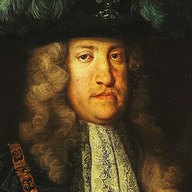
At a glanceKnown key applied · complete
- The letters
- Four letters from Emperor Charles VI to Count Leopold Viktorin Windischgätz, his envoy at The Hague, dated 3 February, 13 April and 24 July 1720 and 11 April 1722; two survive in autograph and copy.
- Where
- Windischgätz family archive, State Regional Archives in Plzeň; DECODE R5019–R5024, catalogued with no decipherment.
- The cipher
- Two keys on DECODE: R5017, a two-part nomenclator with a syllabary of 1–400 and words from 401, and R5018, a private key of letter numbers and signs with about 300 codes.
- How it was read
- Both keys were transcribed in full from the DECODE images and applied as they stand; every cipher passage gives German that fits the clear text around it.
- What it says
- Alberoni’s fall and the fear of a separate French peace with Philip V, the Spanish marriage, and the Dutch Barrier.
- Still open
- Two nomenclator cells in the first letter are uncertain, and the clear text of the later letters is summarised rather than edited.
- Credit
- Jakub Mírka described the letters and keys in 2012 but printed no decipherment.
01 The letter and its key
The letters are autograph notes that Charles VI sent through his Oberststallmeister, outside the Chancellery’s ordinary despatches. The family later copied them into a register (book 5 of inv. 5), numbering them No. 1 to No. 7. No. 1, of 3 February 1720, survives as the autograph (DECODE R5019) and the copy (R5020, pp. 401–404); its cipher is 26 passages, about 190 groups.
R5017 is headed Ziffer Schlüssel mit der geheimen Hof-Canzley. It is the deciphering half of a two-part nomenclator. The numbers 1–400 are a scrambled syllabary of letters, bigrams and a few trigrams (schli, stre, spra), plus nulls (errans), punctuation and the controls annulla praecedentia / sequentia. The numbers 401–977 are words and names in alphabetical order, from Aachen to zu: 458 Cadagan, 513 Duc d’Anjou, 657 Mr. Moroille, 749 D. Orleans, 814 Robethon, 819 Stanhop. In this letter the Emperor writes that “den Ziffer, so ihr mit mir zu brauchen” would follow: the private key R5018, used for the later letters, a different cipher with its own page.
02 No. 1, 3 February 1720: Alberoni, France and the peace terms
The letter is two-thirds clear German, written in Charles’s own phonetic hand. The cipher sits inside the sentences, as in “absonderlich 89 312 251 65 14 312 20 48 96 genau berichten” = den Pentenrider. The autograph and the copy agree group for group. The 26 passages, in order:
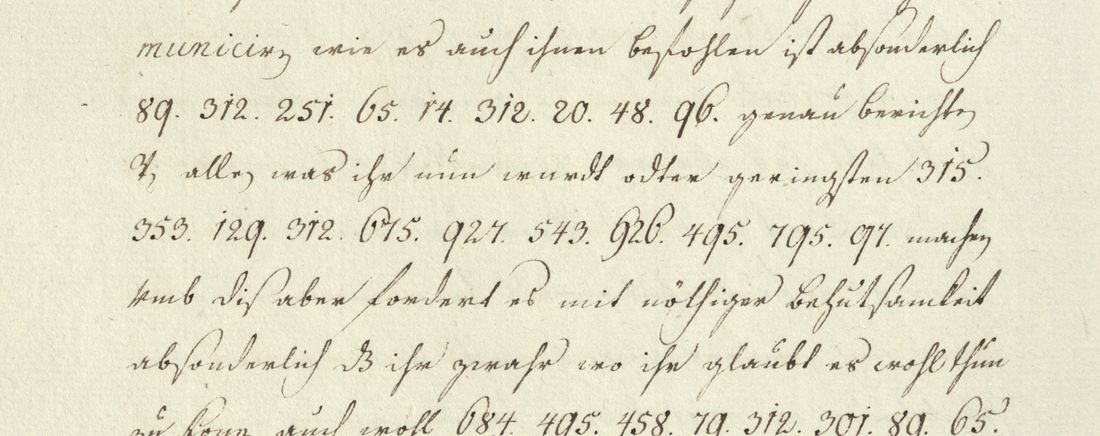
| Clear text before | Cipher reads | |
|---|---|---|
| A | absonderlich | den Pentenrider (genau berichten) |
| B | oder geringsten | Argwohn machen von Frankreich und dem Regenten |
| C | auch wohl | mit dem Cadagan confident eröffnet |
| D | aber auf keine weis | gegen dem Frankreich auch kein geringsten Argwohn |
| E | absonderlich | da nun der Alberoni aus Spannien abgeschafft |
| F | (bracket) | zu fürchten, dass Frankreich vielleicht suche mit Duc d’Anjou ein sonder Frieden zum Mr. Morville |
| G | auf seiner hut, doch | ohne einichen geringsten Argwohn |
| H | gut vernemen und vertrauen | mit dem Graf Daroqui [Tarouca] |
| I | finden wir ohne dem schon | von Portugal aus (sein gute Neigung) |
| J–L | … | sein König … der Allianz · publico kein mehreren darum · (als) seinen König in die Allianz (zu bringen) |
| M | auf das obige aber mich | Portugal denken |
| N | das wird nicht wohl | sein, [eh er] mesuren nimbt und Beytritt [446] ein von Spanien untertruckt |
| O | werdet ihr | Cadogan (auf all weis suchen beyzuhalten) |
| P | Unbilligkeit so wohl als schaden | aller Alliirten, ja Engelländer selbst |
| Q | man | in künfftigen Frieden |
| R | nur das geringste wider | die zwischen uns gemachte Tractat geändert würde |
| S | das under wegen | Sardinien dem Herzog von Lothringen (zu geben ist sehr ideal und nicht wohl thunlich) |
| T | endlich auch | wie der dem guten Glauben der Tractaten |
| U | das sonst | mir das Aequivalent von Montferrat |
| V–W | das in · den | künfftigen Frieden (dieses onus nicht auf mich fall) · dem Duc d’Anjou |
| X | oder dem so | gross zu [638] dem Nutzen |
| Y–Z | ob (wie wohl endlich zu glauben) | D. Orleans … denke mit dem Duc d’Anjou ein particular Frieden zu machen |
So the secret instructions are these. Keep Pentenriedter fully informed, confide in the British envoy Cadogan, and show France and the Regent no mistrust. Watch them all the same: now that Alberoni has fallen, France may look for a separate peace with Philip V (whom Vienna still called only “the Duc d’Anjou”) through Morville, the French minister at The Hague. Find out whether Orléans means to make one. Win over the Portuguese envoy and bring his king into the Alliance. On the peace terms, nothing in the Quadruple Alliance treaty is to change: Sardinia for Lorraine is impracticable, the Montferrat equivalent is owed, and the costs of the coming peace must not fall on the Emperor.
03 Method
The records were fetched from DECODE with the project’s logged-in cookie. The R5017 syllabary (1–400) was transcribed column by
column from the full-resolution scan. The nomenclator (401–999) was transcribed from tiled crops, with a
confidence mark on each cell. The ciphertext of No. 1 was taken from the copy, checked against the autograph, and decoded by a short
script (dec.py). Two slips in the key show up in use. Cell 31 is written “el”, but all three times it occurs it must mean
zu, which is cell 3. Cell 268 is written “em” and must be ein.
04 What remains uncertain
- No. 1, passage N: cell 446, whose key entry was transcribed as “Bischoff”, does not fit. The sense of the passage (measures and an accession obstructed by Spain) is C.
- No. 1, passage X: cell 638 is uncertain (“Kommen” or “Kammern” in the key). Graded C.
- No. 1, H: “Daroqui” as Count Tarouca, the Portuguese envoy, is M. The syllables are certain, and the next passage names Portugal.
- All other passages are H.
Full texts
The transcription and the decryption of every document on this page, so that the reading can be used and checked. Short files are shown here; all are in the repository.
No. 1, Vienna, 3 Feb 1720 (R5019 autograph, R5020 copy)
Charles VI to his envoy at The Hague, Count Windischgrätz: report everything to Pentenriedter, confide in Cadogan; with Alberoni expelled from Spain, France may seek a separate peace with 'the Duc d'Anjou' (Philip V) through Morville; bring the King of Portugal into the Alliance; giving Sardinia to the Duke of Lorraine is 'sehr ideal'; the Emperor insists on the equivalent for Montferrat.
Transcription
# Charles VI to L. V. Windischgrätz, Vienna 3 Feb 1720. Numbers from the register copy R5020 (book 5, pp. 401-404), checked against the autograph R5019. Key R5017.
# id | clear text before | numbers
A|ist absonderlich|89 312 251 65 14 312 20 48 96
B|oder geringsten|315 353 129 312 675 927 543 926 495 795 97
C|auch wohl|684 495 458 79 312 301 89 65 88 50 102 17 88
D|aber auf keine weis|574 495 543 401 634 91 280 65 353 7 312 315 353 129 65
E|absonderlich|283 706 494 154 21 351 45 403 854 60 91 57 356 88
F|(after the stroke)|31 76 388 14 312 496 543 911 112 388 191 684 513 515 859 545 970 657
G|auf seiner hut doch|732 268 25 388 312 91 280 65 7 68 318 353 129 65
H|gut vernemen und vertrauen|684 495 565 283 29 148
I|mit dem schon|927 768 403
J|das 50 verdrieß|849 631 685 494 413
K|und den|144 103 58 395 634 680 64 26 65 514
L|als seinen|631 279 40 191 413
M|aber mich|768 89 65 225 312
N|wird nicht wohl|849 191 46 112 26 65 45 162 105 926 446 339 88 449 515 927 854 917 257 393 88
O|werdet ihr|458
P|als scheinen|407 96 414 310 519 355 120 103 242
Q|man|279 636 68 545
R|das geringste wider|152 191 967 934 91 202 388 14 890 91 68 89 96 88 954
S|wegen|878 495 586 927 652
T|endlich auch|957 494 495 350 14 65 132 361 231 312 494 890
U|das sonst|685 496 417 927 178 65 140 267 88
V|das in|636 68 545
W|den|495 513
X|oder dem so|573 31 638 495 721
Y|(ob ... zu glauben)|749
Z|danken|684 495 513 515 761 545 31 675
Transcription
# Clear-text transcription of the 3 Feb 1720 letter (register copy R5020, book 5 pp. 401-404), draft.
# Charles VI's own spelling is kept where legible; [A]..[Z] mark the cipher passages in ct_1720-02-03.txt.
# Uncertain words carry (?).

Lieber Graf Windischgrätz. Euere schreiben die ihr mir in privato durch mein obristallmeister eingeschickt
habt, hab alle nach einander wohl empfangen, wie ihr durch ihn obristallmeister wie auch meine gnädige
zufriedenheit werdt vernommen haben; hab aber euch sonders annoch nichts geantwortet, weil theils nur in
narrativen bestanden, welches euch hab approbiren lassen, theils ihr durch die gewöhnliche Cantzley
rescripta werdt die erleuterung und befehl bekommen haben. Nun hab doch nicht unterlassen wollen euch
selbst diese Zeylen zu schreiben und euch mein zufriedenheit über euren eyfer und bis itzt sowohl zu
Hanover als in Haag geleistete aufführung zu bezeigen, wie auch das mir euere geheimb brief angenemb,
ihr auch mit selben continuiren [p.402] sollt, absonderlich wo was geheimeres oder wo ihr ein anstoss oder
anfrag über die cantzley rescripta oder sonst in wichtigen negocys es nötig finden soltet. Nun nur auf
einige principaliora zu antworten, schicke euch hiemit (so er noch fertig) oder mit negster gelegenheit den
Ziffer, so ihr mit mir zu brauchen, dieweil der (?) der Hof cantzley kont dienen. Werdt no 2do, wie ich nicht
zweifle, werdt ihr mit allen fleiss in guter verstandnuss mit meinen ministren in Frankreich und Engelland
stehen, alles ihr vor mein dienst in erfahrung bringt communiciren, wie es auch ihnen befohlen ist;
absonderlich [A] genau berichten, alles was ihr nur werdt oder geringsten [B] machen, die aber sondert es
mit nöthiger behutsamkeit, absonderlich das ihr gnädig (?) wo ihr glaubt es wohl thun zu können, auch wohl
[C], aber auf keine weis [D] bezeigt. Wegen der Tory hat sich nichts verificirt; was aber die ratificacion
der convention betrifft, glaub ich werden alle selb nun schon längst ausgewechselt sein und ihr sie also
mir durch sichere gelegenheit einschicken könnt. Das aber dessentwegen nicht gleichwohl (absonderlich [E] |
[p.403] [F] ist billich anzustehen, also auch nöthig wachtsamb auf seiner hut doch [G] zu sehen. Was die
holländische aversion betrifft, werdt ihr das weitere aus den gewöhnlichen rescripten vernemmen. Das gut
vernemen und vertrauen [H] ist auf allerweis zu loben; werdt ihr auch ferners so viel möglich continuiren und
cultiviren. Finden wir ohne dem schon [I] sein gute neigung, bedankt ihr ihm auch desswegen, ein gnädige
expression werdt machen können; könnt ihr auch sagen das 50 (?) verdriesst [J] und den [K] thun könnt als
seinen [L] zu bringen, auf welches auch sich auf allerweis zu verrichten wegen eigener schildung (?), aber
werdt weiters bedacht sein, dan es noch nicht de tempore; auf das obige aber mich [M]; das wird nicht wohl
[N] werden können. Die gern in Ziffer mir überschreibene wegnissten (?) seindt mir gar lieb und werdt ihr
also mit allen fleiss und aufmerksamkeit continuiren. Was die rest betrifft ist es zu erwarten und auf seiner
hut zu stehen, und werdt ihr [O] auf all weis suchen beyzuhalten, auch ihr bedeuten wie mich auf ihn und
[p.404] sein eyfer vor die gemein auch gantz verlasse, auch ihn danken und die unbilligkeit so wohl als
schaden [P] zu erkennen geben. Man [Q] nur das geringste wider [R] das under wegen [S] zu geben ist sehr
ideal und nicht wohl thunlich; endlich auch [T], also nicht wohl darauf zu denken, das sonst [U] höchst
beschwerlich ist, nicht ohne wan auch höchst billich auch dahin anzutragen, das in [V] dieses onus nicht auf
mich fall, sondern wo möglich die den [W] oder dem so [X] excindirt werde. Das übrig werdt ihr sonst
vernemen, und hab mir sonst nichts bey euch zu erinnern, als das ihr mit euren fleiss und application
continuirt, mir alle genau nachricht zu geben, absonderlich recht zu sehen ob (wie wohl endlich zu glauben)
[Y] denke [Z]; und das mit eurer aufführung annoch gnädigst wohl zufrieden bin, wie dan euer gnädigster herr
verbleibe.
Carl                                                            Wien den 3. febr. 1720.
Decryption
# No. 1, Vienna, 3 February 1720, in the first key (R5017): decryption

Autograph R5019 (SOA Plzeň, RA Windischgrätz, inv. 694, karton 5); register copy R5020 (inv. 5, book 5,
pp. 401–404). The numbers are taken from the copy and checked against the autograph. There are 26 cipher passages, A–Z.
Key R5017: numbers 1–400 stand for letters and bigrams (syllabary, key5017_syllabary.tsv) and 401–977 for words and
names (nomenclator, key5017_nomenclator.tsv). Run `python dec.py ct_1720-02-03.txt` for the mechanical output.
Below: the numbers, the key values, and the reading in context.

Notes on the key:
- **31.** The key gives 31 as "el". In all three places it occurs (F, X, Z) the sense needs "zu", which is syllabary no. 3. So
  "31" here is either a homophone for "zu" missing from the surviving key or a writing of 3. Both hands have it.
- **268.** The key reads "em". In G the sense needs "ein-" (*einichen*), so the key cell is probably "ein" or "ei".
- **283 da, 29 ro, 148 qui.** Together these give "Daroqui" in H. This is almost certainly the Portuguese envoy at The Hague, João Gomes da Silva,
  Count of Tarouca, in Charles's own spelling. The next passage (I) names Portugal.

| | clear text before | numbers | key values | reading |
|---|---|---|---|---|
| A | absonderlich | 89 312 251 65 14 312 20 48 96 | de n pe n te n ri de r | **den Pentenrider** (Pentenriedter, the Emperor's envoy in Paris/London) |
| B | oder geringsten | 315 353 129 312 675 927 543 926 495 795 97 | ar g wo n · machen · von · Frankreich · undt · dem · Regent · en | **Argwohn machen von Frankreich und dem Regenten** |
| C | auch wohl | 684 495 458 79 312 301 89 65 88 50 102 17 88 | mit · dem · Cadagan · cu n fi de n t er of ne t | **mit dem Cadogan confident eröffnet** |
| D | aber auf keine weis | 574 495 543 401 634 91 280 65 353 7 312 315 353 129 65 | gegen · dem · Frankreich · auch · kein · ge ri n g st n ar g wo n | **gegen dem Frankreich auch kein geringsten Argwohn** |
| E | absonderlich | 283 706 494 154 21 351 45 403 854 60 91 57 356 88 | da · nun · der · al be ro ni · aus · Spannien · ab ge sch af t | **da nun der Alberoni aus Spanien abgeschafft** |
| F | (bracket) | 31 76 388 14 312 496 543 911 112 388 191 684 513 515 859 545 970 657 | [zu] fi ch te n · das · Frankreich · vielleicht · su ch e · mit · Duc d'Anjou · ein · sonder · Frieden · zum · Mr. Morville | **zu fürchten, dass Frankreich vielleicht suche mit Duc d'Anjou ein Sonderfrieden durch Mr. Morville** |
| G | auf seiner hut, doch | 732 268 25 388 312 91 280 65 7 68 318 353 129 65 | ohne · em[ein] i ch n · ge ri n st en · ar g wo n | **ohne einichen geringsten Argwohn** |
| H | gut vernemen und vertrauen | 684 495 565 283 29 148 | mit · dem · Graf · da ro qui | **mit dem Graf Tarouca** |
| I | finden wir ohne dem schon | 927 768 403 | von · Portugal · aus | **von Portugal aus** (sein gute Neigung) |
| J | das … verdriesst | 849 631 685 494 413 | seyn · König · mir · der · Allianz | **sein König mir [mit] der Allianz** |
| K | und den | 144 103 58 395 634 680 64 26 65 514 | pu b li co · kein · mehr · re re n · darum | **publico kein mehreren darum** |
| L | als seinen | 631 279 40 191 413 | König · in di e · Allianz | **König in die Allianz** (zu bringen) |
| M | auf das obige aber mich | 768 89 65 225 312 | Portugal · de n ke n | **Portugal denken** |
| N | das wird nicht wohl | 849 191 46 112 26 65 45 162 105 926 446 339 88 449 515 927 854 917 257 393 88 | seyn · e me su re n ni m bt · undt · Bey tri t · [446] · ein · von · Spanien · unter · tru ct t | **sein, [eh er] mesuren nimbt und Beytritt … von Spanien unterdrückt** (446 read "Bischoff" in the key; sense unclear) |
| O | werdet ihr | 458 | Cadagan | **Cadogan** (auf all weis suchen beyzuhalten) |
| P | Unbilligkeit so wohl als schaden | 407 96 414 310 519 355 120 103 242 | alle · r · alliirten · ia · Engelländer · se l b st | **aller Alliirten, ja Engelländer selbst** |
| Q | man | 279 636 68 545 | in · künfft · en · Frieden | **in künfftigen Frieden** |
| R | nur das geringste wider | 152 191 967 934 91 202 388 14 890 91 68 89 96 88 954 | di e · zwischen · uns · ge ma ch te · Tractat · ge en de r t · würde | **die zwischen uns gemachte Tractat geändert würde** |
| S | das under wegen | 878 495 586 927 652 | Sardinien · dem · Herzog · von · Lothringen | **Sardinien dem Herzog von Lothringen** (zu geben ist sehr ideal) |
| T | endlich auch | 957 494 495 350 14 65 132 361 231 312 494 890 | wie · der · dem · qu te n · gl au be n · der · Tractat | **wie der dem guten Glauben der Tractaten** |
| U | das sonst | 685 496 417 927 178 65 140 267 88 | mir · das · aequivalent · von · mo n fe ra t | **mir das Aequivalent von Montferrat** |
| V | das in | 636 68 545 | künfft · en · Frieden | **künfftigen Frieden** (dieses onus nicht auf mich fall) |
| W | den | 495 513 | dem · Duc d'Anjou | **dem Duc d'Anjou** |
| X | oder dem so | 573 31 638 495 721 | gross · [zu] · [638] · dem · nutz | **gross zu … dem Nutzen** (638 unsure: Kommen/Kammern) |
| Y | ob (wie wohl endlich zu glauben) | 749 | D. Orleans | **der Duc d'Orléans** |
| Z | denke | 684 495 513 515 761 545 31 675 | mit · dem · Duc d'Anjou · ein · particular · Frieden · [zu] · machen | **mit dem Duc d'Anjou einen Particularfrieden zu machen** |

## What the letter says

Charles VI writes in his own hand to Windischgrätz, his envoy at The Hague, six weeks after Philip V dismissed
Alberoni (5 December 1719) and while Spain was preparing to accede to the Quadruple Alliance. The cipher carries the
substance of the letter:

- Windischgrätz is to report everything precisely to **Pentenriedter**. He should speak confidentially with
  **Cadogan**, the British envoy, and keep Cadogan on side "in every way". Towards **France and the Regent** he must show
  no suspicion at all.
- The Emperor's fear: now that **Alberoni has been expelled from Spain**, **France may seek a separate peace with the
  Duc d'Anjou** (Philip V, whom Vienna did not recognise as King of Spain) **through Morville**, the French envoy at The Hague.
  At the end of the letter Windischgrätz is asked to find out whether (as is after all to be believed) **Orléans intends to make a
  particular peace with d'Anjou**.
- **Portugal**: Count Tarouca's good disposition is to be cultivated, with the aim of bringing **his king into the
  Alliance**.
- **The peace terms**: the Emperor will not see **the treaty made between us altered** in the slightest. Giving
  **Sardinia to the Duke of Lorraine** is "very ideal and hardly feasible". He insists on **the equivalent for Montferrat**
  and wants the burden of the future peace not to fall on him. Any alteration would wrong **all the allies, even the English themselves**.
Reading
<!-- Reading of No. 1, Charles VI to Count Windischgrätz, Vienna, 3 February 1720 (Claude Opus 5.5, 23 Oct 2026): the whole letter, the clear text of clear_1720-02-03.txt (register copy R5020, draft transcription, Charles VI's spelling, (?) = uncertain clear word) with the 26 cipher passages A-Z of dec_R5017_letter.md put in their places, in ⟦ ⟧. The cipher passages are written with the key values' own letters (key R5017; "fichten", "Argwon", "erofnet", "Daroqui", "monferat" as the figures spell them), not the normalised forms of the table's reading column; [zu] = no. 31, which the key gives as "el" and the sense needs as "zu"; [?ein]ichn = no. 268 (key "em"); [446] and [638] = numbers whose key values give no sense here. -->

# No. 1, Charles VI to Count Windischgrätz, Vienna, 3 February 1720 (key R5017): reading

## Reading

Lieber Graf Windischgrätz. Euere schreiben die ihr mir in privato durch mein obristallmeister eingeschickt habt, hab alle nach einander wohl empfangen, wie ihr durch ihn obristallmeister wie auch meine gnädige zufriedenheit werdt vernommen haben; hab aber euch sonders annoch nichts geantwortet, weil theils nur in narrativen bestanden, welches euch hab approbiren lassen, theils ihr durch die gewöhnliche Cantzley rescripta werdt die erleuterung und befehl bekommen haben. Nun hab doch nicht unterlassen wollen euch selbst diese Zeylen zu schreiben und euch mein zufriedenheit über euren eyfer und bis itzt sowohl zu Hanover als in Haag geleistete aufführung zu bezeigen, wie auch das mir euere geheimb brief angenemb, ihr auch mit selben continuiren sollt, absonderlich wo was geheimeres oder wo ihr ein anstoss oder anfrag über die cantzley rescripta oder sonst in wichtigen negocys es nötig finden soltet. Nun nur auf einige principaliora zu antworten, schicke euch hiemit (so er noch fertig) oder mit negster gelegenheit den Ziffer, so ihr mit mir zu brauchen, dieweil der (?) der Hof cantzley kont dienen. Werdt no 2do, wie ich nicht zweifle, werdt ihr mit allen fleiss in guter verstandnuss mit meinen ministren in Frankreich und Engelland stehen, alles ihr vor mein dienst in erfahrung bringt communiciren, wie es auch ihnen befohlen ist; absonderlich ⟦den Pentenrider⟧ genau berichten, alles was ihr nur werdt oder geringsten ⟦Argwon machen von Frankreich undt dem Regenten⟧, die aber sondert es mit nöthiger behutsamkeit, absonderlich das ihr gnädig (?) wo ihr glaubt es wohl thun zu können, auch wohl ⟦mit dem Cadagan cunfident erofnet⟧, aber auf keine weis ⟦gegen dem Frankreich auch kein geringstn Argwon⟧ bezeigt. Wegen der Tory hat sich nichts verificirt; was aber die ratificacion der convention betrifft, glaub ich werden alle selb nun schon längst ausgewechselt sein und ihr sie also mir durch sichere gelegenheit einschicken könnt. Das aber dessentwegen nicht gleichwohl (absonderlich ⟦da nun der Alberoni aus Spannien abgeschaft⟧ ⟦[zu] fichten, das Frankreich vielleicht suche mit Duc d'Anjou ein sonder Frieden zum Mr. Morville⟧) ist billich anzustehen, also auch nöthig wachtsamb auf seiner hut doch ⟦ohne [?ein]ichn geringsten Argwon⟧ zu sehen. Was die holländische aversion betrifft, werdt ihr das weitere aus den gewöhnlichen rescripten vernemmen. Das gut vernemen und vertrauen ⟦mit dem Graf Daroqui⟧ ist auf allerweis zu loben; werdt ihr auch ferners so viel möglich continuiren und cultiviren. Finden wir ohne dem schon ⟦von Portugal aus⟧ sein gute neigung, bedankt ihr ihm auch desswegen, ein gnädige expression werdt machen können; könnt ihr auch sagen das 50 (?) verdriesst ⟦seyn König mir der Allianz⟧ und den ⟦publico kein mehreren darum⟧ thun könnt als seinen ⟦König in die Allianz⟧ zu bringen, auf welches auch sich auf allerweis zu verrichten wegen eigener schildung (?), aber werdt weiters bedacht sein, dan es noch nicht de tempore; auf das obige aber mich ⟦Portugal denken⟧; das wird nicht wohl ⟦seyn emesuren nimbt undt Beytritt [446] ein von Spanien untertructt⟧ werden können. Die gern in Ziffer mir überschreibene wegnissten (?) seindt mir gar lieb und werdt ihr also mit allen fleiss und aufmerksamkeit continuiren. Was die rest betrifft ist es zu erwarten und auf seiner hut zu stehen, und werdt ihr ⟦Cadagan⟧ auf all weis suchen beyzuhalten, auch ihr bedeuten wie mich auf ihn und sein eyfer vor die gemein auch gantz verlasse, auch ihn danken und die unbilligkeit so wohl als schaden ⟦aller alliirten, ia Engelländer selbst⟧ zu erkennen geben. Man ⟦in künfften Frieden⟧ nur das geringste wider ⟦die zwischen uns gemachte Tractat geendert würde⟧; das under wegen ⟦Sardinien dem Herzog von Lothringen⟧ zu geben ist sehr ideal und nicht wohl thunlich; endlich auch ⟦wie der dem quten glauben der Tractat⟧, also nicht wohl darauf zu denken, das sonst ⟦mir das aequivalent von monferat⟧ höchst beschwerlich ist, nicht ohne wan auch höchst billich auch dahin anzutragen, das in ⟦künfften Frieden⟧ dieses onus nicht auf mich fall, sondern wo möglich die den ⟦dem Duc d'Anjou⟧ oder dem so ⟦gross [zu] [638] dem nutz⟧ excindirt werde. Das übrig werdt ihr sonst vernemen, und hab mir sonst nichts bey euch zu erinnern, als das ihr mit euren fleiss und application continuirt, mir alle genau nachricht zu geben, absonderlich recht zu sehen ob (wie wohl endlich zu glauben) ⟦D. Orleans⟧ denke ⟦mit dem Duc d'Anjou ein particular Frieden [zu] machen⟧; und das mit eurer aufführung annoch gnädigst wohl zufrieden bin, wie dan euer gnädigster herr verbleibe.

Carl. Wien den 3. febr. 1720.
Translation
<!-- English translation of No1_reading.md (Claude Opus 5.5, 23 Oct 2026): Charles VI's autograph letter of 3 February 1720 to Count Windischgrätz, the clear text with the cipher passages (in ⟦ ⟧) deciphered with key R5017. Same marks: (?) uncertain clear word; [zu] the "zu" the sense needs for no. 31; [446], [638] numbers without sense here. Charles's German is elliptic; the English keeps its run-on sentences and renders the broken places closely rather than smoothing them. -->

# No. 1, Charles VI to Count Windischgrätz, Vienna, 3 February 1720: English translation

Dear Count Windischgrätz. Your letters, which you sent me privately through my Master of the Horse, I have all received
safely one after the other, as you will have learned through him, the Master of the Horse, as also my gracious
satisfaction; but I have not yet answered you particularly, because they consisted partly only of narratives, which I
have had approved for you, and partly you will have received the explanation and orders through the usual chancery
rescripts. Now I have nevertheless not wished to omit writing these lines to you myself, and to show you my satisfaction
with your zeal and with the conduct you have shown up to now both at Hanover and at The Hague, as also that your secret
letters are welcome to me, and that you are to continue with them, especially where there is something more secret, or
where you should find it necessary on some difficulty or query about the chancery rescripts, or otherwise in important
business. Now, to answer only some principal points: I send you herewith (if it is ready) or by the next opportunity the
cipher which you are to use with me, since the (?) of the Court Chancery could serve. Secondly, as I do not doubt, you
will with all diligence stay in good understanding with my ministers in France and England, and communicate to them all
you learn for my service, as they have also been ordered; especially report precisely to ⟦Pentenriedter⟧ everything that
you only will or the least ⟦suspicion make of France and the Regent⟧, which however set it apart with the necessary
caution; especially that you, graciously (?), where you believe you can well do it, also ⟦open yourself confidentially to
Cadogan⟧, but in no way show ⟦towards France the least suspicion either⟧. Concerning the Tories nothing has been
verified; but as for the ratification of the convention, I believe they will all long since have been exchanged, and you
can send them to me by a safe opportunity. That nevertheless on that account not (especially ⟦now that Alberoni has been
expelled from Spain⟧, ⟦[to] fear that France may perhaps seek a separate peace with the Duc d'Anjou through Monsieur
Morville⟧) is fit to be considered, and so it is also necessary to be watchful on one's guard, yet ⟦without the least
suspicion⟧ to look on. As for the Dutch aversion, you will learn the rest from the usual rescripts. The good understanding
and confidence ⟦with Count Tarouca⟧ is to be praised in every way; you will also continue and cultivate it further as far
as possible. We already find without that ⟦from Portugal⟧ his good inclination; thank him for it too; you will be able to
make a gracious expression; you can also say that 50 (?) it vexes ⟦his King me the Alliance⟧ and the ⟦publico no more
about it⟧ you could do than to bring his ⟦King into the Alliance⟧, on which also to proceed in every way because of his
own description (?), but you will be further mindful, for it is not yet the time; but on the above, ⟦think of Portugal⟧
for me; that will not well ⟦be, measures [?ere] it takes, and accession [446] one of Spain suppressed⟧ can be. The news (?)
gladly sent me in cipher are very dear to me, and so you will continue with all diligence and attention. As for the rest,
it is to be awaited and to be on one's guard; and you will seek in every way to keep ⟦Cadogan⟧ on side, and let him know
how I rely entirely on him and his zeal for the common cause, and thank him, and make known the injustice as well as the
harm ⟦to all the allies, yes, to the English themselves⟧, if one ⟦in the future peace⟧ in the least against ⟦the treaty
made between us should be altered⟧; that giving ⟦Sardinia to the Duke of Lorraine⟧ in the meantime is very ideal and not
well feasible; finally also ⟦as the [?] to the good faith of the treaty⟧, so it is not well to be thought of, that
otherwise ⟦the equivalent of Montferrat for me⟧ is most burdensome, not without, if also most just, to press for this
too, that in ⟦the future peace⟧ this burden should not fall on me, but, where possible, be cut off for the ⟦Duc d'Anjou⟧
or for him so ⟦great [to] [638] the benefit⟧. The rest you will learn otherwise, and I have nothing else to remind you of,
except that you continue with your diligence and application to give me all exact news, especially to see rightly
whether (as is after all to be believed) ⟦the Duc d'Orléans⟧ thinks ⟦of making a particular peace with the Duc
d'Anjou⟧; and that I am still most graciously well satisfied with your conduct, as I remain your most gracious lord.

Charles. Vienna, 3 February 1720.
Key: key5017_syllabary.tsv, key5017_nomenclator.tsv
05 Sources
- DECODE (de-crypt.org): R5017 (key); R5019, R5020 (the letter). Originals: Státní oblastní archiv v Plzni, pracoviště Klášter u Nepomuka, RA Windischgrätzů, inv. 694 karton 5, inv. 5 book 5, keys karton 164 inv. 1403 sign. 103.
- Jakub Mírka, “Raně novověká šifrovaná korespondence ve fondech šlechtických rodinných archivů Státního oblastního archivu v Plzni”, Západočeské archivy 2012, pp. 44–72, reprinted in Crypto-World 3–4/2013. He describes the change of key and the two keys (n. 40–41) but gives no plaintext.
The transcription of key R5017, the ciphertext and the reading are in the repository folder
targets/windischgraetz1720/.