
At a glanceNot solved · text not obtained
- The line
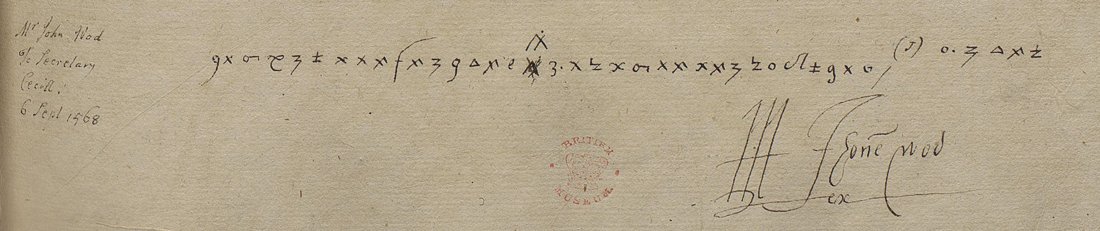
- John Wood, the Regent Moray’s agent, to William Cecil, Edinburgh, 6 September 1568: one line of cipher copied at the foot of a Throckmorton leaf, with a traced signature “M. Jhone Wod”.
- Where
- British Library, Add MS 4136 f. 33 (old f. 10), in the Forbes Papers; DECODE R2989 (catalogue item 97). Tomokiyo lists it as a cipher “yet unidentified”.
- The cipher
- 39 symbols, 16 kinds: saltires with hooks, long-tailed z, g, o with a bar, a triangle, a plus-minus sign. The same families as Moray’s cipher to Wood of July 1568.
- How it was tried
- Bain’s calendar prints one phrase of this letter as cipher; it was aligned against the line in every tested form. A solver was then run from 200 random starts to see whether the line determines a reading at all.
- Why it resists
- The phrase does not fit, and 92 mutually different “English” decryptions score better than real English text: the line is too short to fix a key.
- What would finish it
- The original letter at Hatfield (Cecil Papers vol. 1), which may show where the cipher sits and whether it was deciphered.
- Other ciphers
- The Throckmorton text on the same leaf is his Cipher 3, already deciphered by Tomokiyo. Throckmorton’s letter of 10 July 1559 on the previous leaf has its own page, and so has the margin code beside it.
01 The line
f. 33 (old 10) is Throckmorton to Cecil, 8 August 1559, deciphered by Tomokiyo (his Cipher 3; Forbes p. 195). At its foot is one line docketed in the left margin “Mr John Wod to Secretary Cecil, 6 Sept 1568” with a traced signature. Transcription (wood_line.txt):
g x ob r3 Z ± x x x2 f x2 Z g Δ x2 e XX 3 · x zl x ob x3 x2 x x2 Z zl o d ± g x ob / (J) o · Z Δ x2 zl
34 symbols on the main line and 5 after the marker (J), 16 kinds in all. The families (x with variants, z with variants, g, o, e, f) match Tomokiyo’s transcription of Moray to Wood, 13 July 1568; Wood was Moray’s agent in London that summer, so this is very likely a second sample of the same Scottish cipher. Tomokiyo’s labels could not be aligned symbol for symbol without his image, so the two texts were not pooled.
02 What was tried
The printed phrase. Bain, CSP Scotland II no. 804, prints the letter from the Hatfield original and marks one phrase as cipher: “and says he must neidis haif it be on meinis or uthir”. An exhaustive alignment, with each symbol a letter, a null or a string of up to four letters, forwards and reversed, with and without the (J) group and over every substring of eight letters or more, finds no consistent fit. The line opens and closes with the same three symbols, which the phrase cannot produce. Either the copy reproduces a different ciphered passage of the letter, or the original shows the words in a form the copy does not. HMC Salisbury I has no entry for the letter.
No unique solution. A solver (simulated annealing) fitted a one-letter-per-symbol key against quadgram statistics of Bain’s calendar from 200 random starts; 185 end above the median score of real 39-letter text, and 92 differ from each other in more than a third of their letters, all gibberish (nonunique.py). The line is undetermined by its own text; only the Hatfield original, with whatever decipherment it carries, can settle it.
03 What would finish it
The Hatfield original of 6 September 1568, for a true crib, and Tomokiyo’s image of Moray’s letter (Add MS 32091 f. 213), to merge the two samples under one labelling. Attempted, not solved.
04 Sources
- DECODE R2989 (image).
- S. Tomokiyo, Cryptiana, “Unsolved” and the Moray–Wood transcription.
- J. Bain, Calendar of State Papers relating to Scotland II (1900), no. 804; HMC, Calendar of the Manuscripts of the Marquis of Salisbury I (1883).
Transcription and scripts: targets/wod1568/ in the repository. Until 14 October 2026 this page also carried Throckmorton’s letter of 10 July 1559 and the margin code; they are in other ciphers and now have their own pages.