At a glanceNot solved · text not obtained
- The letter
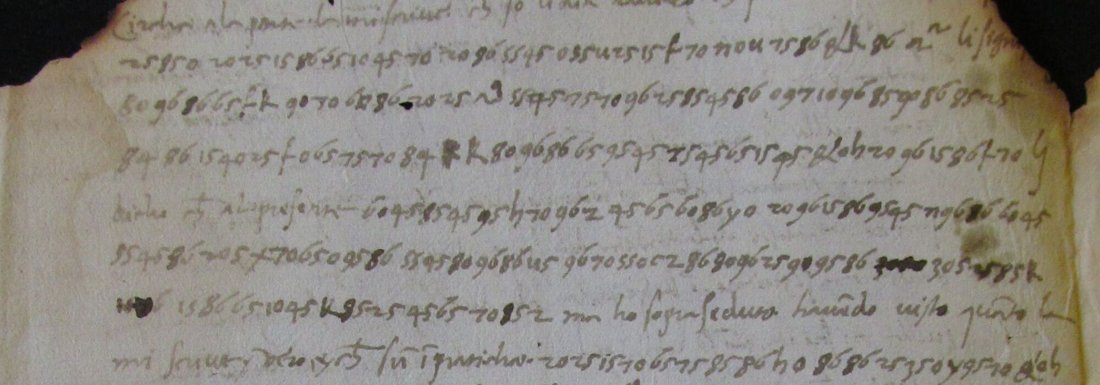
- Alfonso Cistarelli, Cardinal Ippolito I d’Este’s agent at Eger, to the Cardinal, 25 July 1520: four pages, the cipher on the second, clear text before and after it.
- Where
- Archivio di Stato di Modena, Ambasciatori, Ungheria b. 4, Cistarelli no. 3 (b. 4/26); DECODE R1137 (catalogue item 158), Vestigia 1904.
- The cipher
- Two-digit figures written without spaces, most ending in 5 or 0, with a few letter signs (f, k, u, y): 584 figure groups and 83 other signs, set inside clear Italian. Homophonic on the evidence of the search.
- How it was tried
- A ciphertext-only solver (simulated annealing on a sixteenth-century Italian model), checked against the same figures shuffled; cribs from Caprile’s letters of the same months, checked against control words.
- Why it resists
- The solver finds more language than in the shuffled control, but only phrases. Two readings of the same lines disagree on one group in seven, and no key or decipherment exists in the file, on DECODE or in print.
- The October letter
- Cistarelli no. 7 (Kraków, 14 Oct 1520, to Duke Alfonso I; Vestigia 1908), in the same figures. Only one line of its cipher is legible in the surviving photocopy, and it does not decode.
- What would finish it
- A better photograph from the archive, to settle the digits, then the search again.
- Other ciphers
- Giuliano Caprile’s letters in the same box are in other ciphers, each with its own page: his 1520–21 sign cipher and his 1519 two-tier cipher.
01 The letter
Cistarelli was the Cardinal’s agent at Eger, the Hungarian see Ippolito d’Este held; Vestigia has twenty of his records. Only no. 3, of 25 July 1520, carries cipher, and none has a decipherment, a clear copy or a gloss. Pages 1 and 3 are clear text and page 4 the address; the cipher is on page 2. DECODE’s “partially decrypted” reflects the clear passages.
02 The October letter
Brice Dudout pointed out a second letter in the same figures (28 October 2026): Cistarelli no. 7, 14 October 1520, Vestigia 1908, not on DECODE. Vestigia names Duke Alfonso I as the addressee and Kraków as the place, and the clear text agrees. It answers the Duke’s letter about “la grave infirmità e disperata salute” of the writer’s lord and reports his death: Cardinal Ippolito died on 3 September 1520. It goes on about the Queen, the King of Hungary, and the bishopric and castle of Eger. The groups are the same as in July: two digits ending in 0 or 5, mixed with the letter signs f, k, u, y, x, h, g and m.

Line 7 can be transcribed (34 tokens), and so can seven groups at the end of line 27. The roughly six lines of cipher below them are mostly lost in the dark bands of the old photocopy that the online image shows. With the July letter’s search key, line 7 decodes as “adlmodegmo?racentogseti?tipodtare”. A new search over both letters gives “…framento…portare”. These are fragments, not a reading. Brice Dudout has asked the archive for the original.
03 What was tried
- Ciphertext-only search. Simulated annealing on the 667 tokens settles part of a key (e = 0, 25; a = 86; o = 70; i = 45; t = 95; r = 85; s = 90; n = 65) and phrases such as “lettere per”, “presto”, “saria meglio”, “non se poteria” and “dua milla” (grade M). On the same tokens shuffled the score is lower (−3.05 against −2.69 per token), so there is language in it; but the output does not run into sentences.
- Known keys. Every key of the series, the archive and the decade available here is an alphabet of signs, not of figures (Caprile’s 1519 and 1520–21 keys, Bonzagni 1512–14, Sadoleto 1482, Maffeo 1489); DECODE has no Este key of 1490–1550. None could be applied.
- Cribs. Words from Caprile’s letters of the same months (custode, Agria, Alfonso, debito, Buda, episcopato) were placed at every consistent position and re-annealed, against six control words that should not occur. The cribs gain no more than the controls.
- The transcription. A second reading of four lines against the image disagrees with the first on 13 of 92 groups (8 or 9, 4 or 9, 0, 5 or 6, 80 or 86, and where a group starts). The digits are about 25 pixels high on a faded page, so the image itself does not settle them.
04 What would finish it
Better photographs of Cistarelli no. 3, and of the original of no. 7 rather than a photocopy, from the Archivio di Stato di Modena, then a fresh transcription and the search again. Whether noise is really what stops the solve is a judgement, not a proof. Attempted, not solved.
05 Sources
- Archivio di Stato di Modena, Archivio Segreto Estense, Cancelleria, Carteggio ambasciatori, Ungheria b. 4, Cistarelli no. 3. Images via DECODE R1137 (login) and Vestigia (vestigia.hu), items 1904 and 1908.
- ASMo inventory, Carteggio ambasciatori, Ungheria (PDF).
Transcription, solver runs and notes: targets/cistarelli1520/ in the repository. This entry was split on 14 October 2026 from the old Caprile and Cistarelli page (one key per entry).