At a glanceNot solved · text not obtained
- The letter
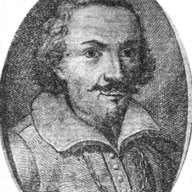
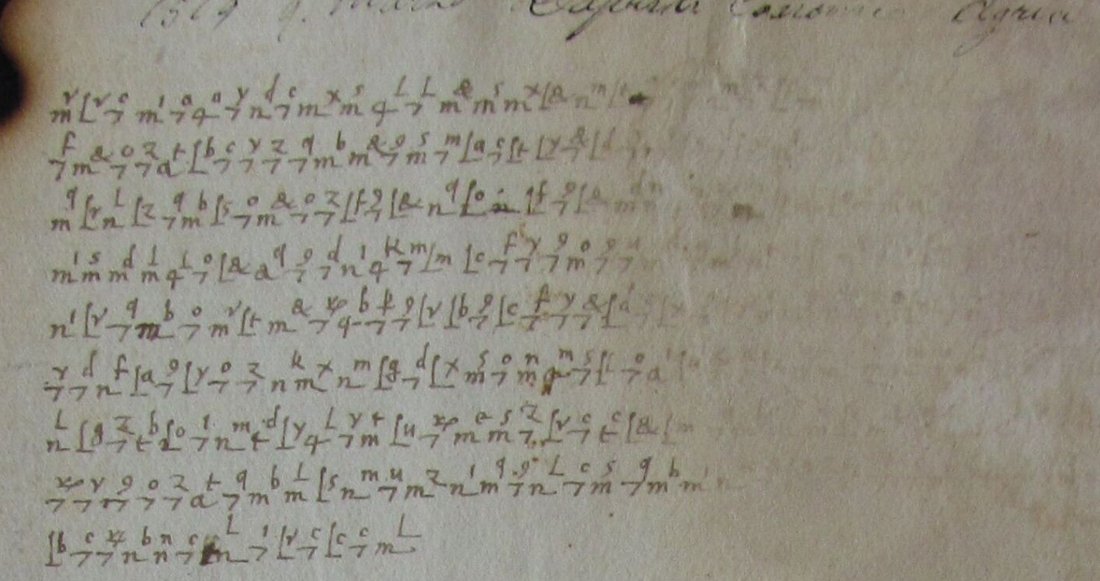
- Giuliano Caprile, canon of Eger and secretary of Cardinal Ippolito d’Este, to the ducal secretary Bonaventura Pistofilo, Eger, 9 March 1519: seven lines of cipher and a clear postscript.
- Where
- Archivio di Stato di Modena, Ambasciatori, Ungheria b. 4, Caprili 1519–20 no. 1; DECODE R1128 (catalogue item 157), Vestigia 1853.
- The cipher
- Two tiers: a small sign written over a base stroke (7, m, n, a, t, 4), and bracket-shaped signs that stand for whole words. 183 columns of 78 kinds, 39 of them code words.
- How it was tried
- Caprile’s other 1519 letters in the same cipher were deciphered in 1882. Two of them were paired with those decipherments to rebuild tables of values, and the tables were run on R1128 against random-key controls.
- Why it resists
- The two pairings disagree on how the cipher works (one letter per column, or a syllable per column), and only about nine letter values are secure. None of the tables gives Italian on R1128.
- What would finish it
- A careful transcription of another 1882-paired letter (R1132 against its copy 6b, R1131 against 5b) to fill the table and the code list. The key material exists; the work is not done.
- Other ciphers
- Caprile’s 1520–21 letters use a different cipher, with its own page, where most of them are deciphered; Alfonso Cistarelli’s numerical cipher of 1520 has its own page.
01 The letter and its siblings
| DECODE | ASMo b. 4 | Vestigia | Date | What was found |
|---|---|---|---|---|
| R1128 | 1519–20 no. 1 | 1853 | 9 Mar 1519 | Seven lines in the 1519 two-tier cipher, no decipherment. Not deciphered. |
| R1129–R1133 | nos. 3a–7a | 1855–1867 | Apr–May 1519 | Decipherments of 1882 filed as 3b/3c … 7b/7c. |
| R1134 | no. 8a | 1870 | 12 Jun 1519 | 8b, 8c, covering pp. 1–3. |
| R1135 | no. 10a | 1874 | 1519 | Interlinear gloss on the leaf and 10b. |
The ASMo inventory notes that the decipherments of almost all the 1519 despatches are missing and were made only in 1882; those are the “b” and “c” items filed after the originals. No. 1 (R1128) has none. Its clear part and Caprile’s next letter (“In un’altra mia ve mandai in zifra…”) say it concerned his own lawsuit at Rome (“le ragioni mie … l’adversario”). The other 1519 letters are copies of reports to the King of France on the imperial election.
02 The cipher
Each column is a small sign over a base stroke. Paired with its 1882 decipherment 7c, R1133 (1,327 columns, 16% illegible in a faded band) reads as one plaintext letter per column, with homophones: “oratore” = L/7 -/n u/7 x/7 c/7 m/n -/a, and c/7 = o, m/n = r, x/7 = t hold across the page. Bracket-L signs with an inner sign are code words: the run [d][s][&] recurs where the decipherment has “de vostra maesta”. A fifth of R1133’s columns are such codes.
R1130 paired with its decipherment 4c points the other way: the upper sign gives a consonant and the base a vowel (7 none, m e, n o), and the brackets are syllables; about twenty values predict 16 of 18 held-out columns, against 8 for a shuffled table. The two readings conflict, and neither is settled.
03 What was tried on R1128
- A language-model search (simulated annealing) over R1133, R1134 and R1128 with the nine secure values fixed gives only scattered words.
- The known tables (2 October 2026): the R1130/4c syllabary covers 32% of R1128’s columns and scores like a random key with the same values (−3.22 against −3.24 per character); the R1133/7c values cover 13%.
- A factorised syllabary (consonant from the upper sign, vowel from the base) trained on both pairings learns the base tier cleanly but not the upper; decoded with it, R1128 scores worse than the same tables permuted (−2.92 against −2.41).
Benedetto Fantini’s letters of 1517–18 from the same household use a cipher of the same family, and the 1519 values do not fit them either (Fantini 1517–18).
04 What would finish it
The key material is in the file: R1131 and R1132 (eight pages) have their 1882 decipherments 5b and 6b. A line-by-line transcription of one of them against its decipherment would fill the letter table and the code list, and then R1128 can be tried again. Until then R1128 is attempted, not solved.
A shorter route may exist. The Modena archivists reconstructed this key in the nineteenth century (ASMo, Cancelleria, Cifrario b. 8 fasc. 4), and Patrizia Cremonini printed its sheets, too small to transcribe sign by sign, in the Rivista di Studi Ungheresi XVI (2017), figs. 17.1–17.3. Michael Brackx found the reference (issue #121), and pointed out that some small upper signs in our transcription of R1128 may be attached to the wrong base (not yet checked here). A photograph of the archive’s sheets is the next step.
05 Sources
- Archivio di Stato di Modena, Archivio Segreto Estense, Cancelleria, Carteggio ambasciatori, Ungheria b. 4, Caprili 1519–20. Images via DECODE R1128–R1135 (login) and Vestigia (vestigia.hu), items 1853–1875.
- ASMo inventory, Carteggio ambasciatori, Ungheria (PDF), on the 1882 decipherments.
Transcriptions, tables, scripts and notes: targets/caprile1519/ in the repository. Until 14 October 2026 this page also carried Caprile’s 1520–21 letters and Cistarelli’s; they are in other ciphers and now have their own pages.