At a glanceNot solved · text not obtained
- The document
- Ciphered letters of Benedetto Fantini (catalogued as “Jantini”), Ferrara, 1517–18. Vestigia has the whole file, nos. 1–7 (1515–1518); only nos. 5 and 6 carry cipher.
- Where
- Two DECODE records catalogued “partially decrypted”, which reflects the clear passages. None of the seven items has a decipherment, clear copy or gloss.
- The cipher
- Same family as Giuliano Caprile’s 1519 letters from the household: a base stroke with a small sign above, plus bracket signs. Caprile’s letter of 1 May 1519 and its 1882 decipherment show it to be syllabic: small sign for the consonant, base for the vowel, brackets for whole syllables.
- How it was tried
- Fantini’s two cipher pages (1,370 columns) were run through a syllabary solver (simulated annealing). It recovers a control text of the same length and structure even with a tenth of its signs corrupted, but on Fantini produces no Italian, and Caprile’s values make the fit worse.
- Still open
- The text. It needs a key or decipherment from the Este chancery, or a paired letter in Fantini’s own key.
01 The documents
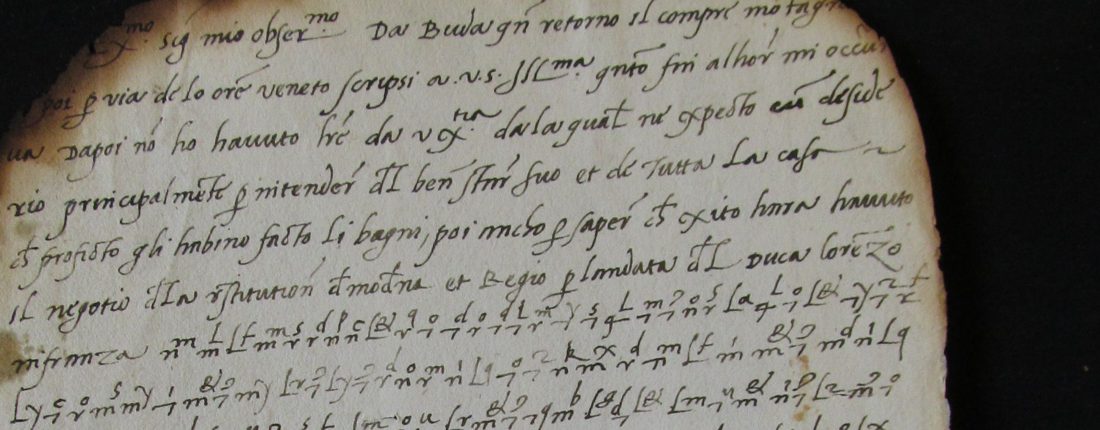
| DECODE | ASMo no. | Date, place | Cipher |
|---|---|---|---|
| R1126 | Fantini no. 5 (Vestigia 1849) | [spring 1518?], Buda. Vestigia and DECODE give “1517”, the file year | p. 1 after six clear lines (18 lines) and all of p. 2 (25 lines): 1,370 columns; pp. 3–6 clear |
| R1127 | Fantini no. 6 (Vestigia 1851) | 6 March 1518, Eger (“Agria”) | five short lines, about 46 columns, in a torn and faded leaf |
The letters are addressed to a lord styled “Vostra Signoria Illustrissima” and “Vostra Eccellenza”, most likely Duke Alfonso I. The clear opening of no. 5 asks for news of the restitution of Modena and Reggio and of Lorenzo de’ Medici’s journey to France. The clear pages 3–6 report the Hungarian diet and the governors appointed around the young Louis II. They continue the letter; they are not a decipherment. Fantini’s other letters (nos. 1–4 and 7, 1515–1518) are in clear.
02 The cipher
Each unit is a base stroke written on the line (shapes like 7, m, n, g, y, 4, t, a) with a small sign written above it (o, 2, 1, b, &, c, L, s, d, 9 …), or an L-shaped bracket enclosing a small sign. The transcription (t1126.txt) counts 1,370 columns: 167 distinct forms, 299 of them brackets (22%) with 22 different inner signs. The commonest columns are 2/7 (77), -/7 (63), o/7 (60), -/y (47), -/g (46) and &/m (44).
Caprile’s letters of 1519 use the same kind of script. His letter of 1 May 1519 (DECODE R1130) mixes clear sentences with short cipher runs, and the 1882 archivist’s decipherment (Vestigia 1860, “4c”) covers them. Aligned by hand, the runs decrypt as syllables. intertenere is seven columns, y/7 9/7 [y] c/7 [y] z/m [m]: i, n, te, r, te, ne, re. The same opening recurs in intertenerlo and in che termine. oratore is o [ra] [to] [re], twice. In that key base 7 carries no vowel, m gives e and n gives o. Tested on stretches not used to build it, the values placed 16 of 18 letters in the true text, against 8.1 on average for shuffled text.
03 What was tried
- Siblings, clear pages, print. All seven Fantini letters on Vestigia. Bonzagni’s letters of 1512–14, the other Este–Hungary cipher, use a different, simple alphabet. DECODE has no key record from Modena for 1490–1540, and nothing turned up in print.
- Caprile’s key. Three pairings with the 1882 decipherments. R1131 is water-stained, and its alignment was no better than shuffled controls. R1134’s supposed interlinear decipherment is a second letter in clear with cipher insertions. R1130 gave the syllabic structure and about twenty values.
- A syllabary annealer (
syl_anneal.py: consonant for each upper sign, vowel for each base, a syllable for each bracket, scored with a sixteenth-century Italian 5-gram model). On a control of 2,200 letters from sixteenth-century Italian, enciphered in the same structure with two homophones per consonant, it recovers the text almost word for word once three base values are fixed. It still does so with 10% of the signs corrupted. - On Fantini, eight restarts of 150,000 moves each, on the raw transcription and with the frequent pairs -/7 -/y and -/7 -/g merged as ligatures. The result is Italian-looking syllable salad that differs from restart to restart, scoring −2.37 per letter against −1.77 for the control’s true key. Seeding Caprile’s values drops the score from about −140 to −1,250.
The solver recovers the syllabic control at this length and noise, so the search itself is sound. A later check read Fantini’s roughly 290 brackets as word codes, as they are in Caprile’s letter R1133. A control of that shape recovers only 7% of its text, so a ciphertext-only attack cannot decipher this letter at any transcription quality. Fantini’s key is not Caprile’s.
04 What would finish it
- A key or decipherment in the Este chancery (ASMo, Cancelleria, Cifrari), or a letter to or from Fantini with its decipherment.
- A better image of R1126 from ASMo for the faint upper signs. Page 1 was transcribed twice (90% agreement) and page 2 three times, with an estimated error of 2–3%; the pairing of small signs to bases is sometimes doubtful.
- R1127 is too short and too damaged to attack on its own.
Full texts
The transcription and the decryption of every document on this page, so that the reading can be used and checked. Short files are shown here; all are in the repository.
R1126 pp. 1-2, ciphered passage (Buda, 1518), Brice Dudout
The Hungarian diet of 1518: eight lords appointed to govern for the young King, the Cardinal of Esztergom and the palatine keeping power, a one-ducat hearth tax refused by the counties, and Fantini opposing raids against the Turks.
Transcription
# R1126 pp. 1-2, transcription v2 (28 Oct 2026) = Daniel Bourdeau's adjudicated transcription (t1126_p1c + t1126_p2final, commit 017d0e461)
# with four shape corrections checked on Vestigia 1849 images 1-2: P2 L01 col 4 and P1 L16 col 1 bracket with a reversed c -> [ɔ] (distinct from the round o of the 9 other [o]);
# P1 L15 col 1 and P2 L07 col 1 bracket with a 9 under a looped ascender -> [b9] (distinct from the q/9 of the 5 other [9]). Targeted check only ([o], [9], [t]).
R1126 P1 L01: m/n L/m -/[f] m/m s/7 d/7 l/n c/n -/[&] 9/7 o/7 d/7 o/7 9/7 L/7 m/7 y/7 s/7 L/9 m/7 2/7 o/n s/7 -/[a] L/4 o/7 -/[&] y/7 z/7 f/x?
R1126 P1 L02: -/[y] c/7 o/7 -/m s/m? y/m 1/7 &/m 2/7 y/m -/[a] 2/7 -/[y] 2/7 d/7 o/n m/7 1/n -/[9] o/7 2/7 k/n x/m d/7 m/7 -/[f] 1/m &/m 2/7 d/m 1/n -/[9]
R1126 P1 L03: o/7 z/7 k/n x/m -/7 -/9 b/m -/[s] u/7 z/m s/n f/n -/[m]? o/7 u/1? -/[r] &/m 2/7 -/7 -/9 b/m -/[8] d/7 -/[&] -/[m] u/7? &/m 1/n l/7 -/[z] 2/m o/7
R1126 P1 L04: -/[c] -/[m] y/7 2/7 n/m -/[t] y/7 -/[&] n/m -/[z] m/n -/[t] c/7 ./m? n/n z/m 1/7 y/m L/m m/n s/7 -/[x] 1/a b/t -/m -/9 -/[a] L/9 o/7 -/[x]
R1126 P1 L05: -/7 -/9 b/m l/n -/[o] -/[x] 2/7 -/[&] &/m 2/7 -/[r] 1/n 2/7 -/7 -/9 l/m -/[r] 1/n -/[9] b/t -/[l] x/m d/n x/m d/7 -/[x] c/n m/m? L/7 9/7? u/n c/7 &/m
R1126 P1 L06: zf/7 c/7 #/m m/n x/m -/[z] zf/7 -/7 -/9 -/[&] -/[s] u/7 -/[&] -/[n] -/7 -/9 b/m a/m b/t L/9 s/7 -/[o] #/7 9/n b/n c/7 x/m -/[m] y/7 z/7 f/x?
R1126 P1 L07: 1/7 -/[m] u/7 -/[t]? &/m y/7 2/7 -/[8] d/7 -/[x] z/n zf/7 b/t 2/7 -/[2] m/n s/1? m/n -/[t] m/m -/[f] t/a h/n zf/7 s/7 l/n y/7 d/7 -/[c] -/[n] -/[2] o/7
R1126 P1 L08: m/m 1/7 l/n y/7 {-/[y]? &/7 -/[d] L/[#]? n/m} -/[r] k/n L/m -/[n] -/[r] &/7 8/a a/m b/t L/9 s/7 -/[o] o/7 d/7 -/[x] -/[m] o/7 L/m 1/n c/7 -/[y]
R1126 P1 L09: -/[a] c/7 -/[y] 2/7 o/n y/7 z/7 -/[y] &/7 -/[d] n/n t/m o/n -/7 -/9 b/m o/7 h/n o/7 d/7 k/n &/m y/m -/[&] b/4 o/7 L/4 s/7 L/m -/[x] c/7 -/[y]
R1126 P1 L10: -/[u] o/7 -/[b] c/7 s/7 8/7 -/[b] n/n -/[m] m/m 1/n -/[r] -/7 -/9 b/m o/7 8/9 L/7 z/n zf/7 s/7 x/m -/[x] zf/7 b/4 zf/7 k/4 s/7 -/[L] o/9 zf/7
R1126 P1 L11: -/[r] 2/7 L/t -/7 -/9 b/m -/[r] ^/m c/n o/7 L/7 r/7 s/7? 8/7 -/[b] -/7 -/9 -/[x] -/[m] m/m m/n s/7 -/[y] -/[r] 1/n 2/7 o/n -/7 -/9 b/m s/n 2/7 d/m -/[L]
R1126 P1 L12: -/[s] 3?/7 z?/7 -/9 -/7 -/9 -/[&] 1/7 1/m u/n y/7 t/7 &/m m/n n/m b/a s/m &/m 1/m? s/m x/#? {#/# #/#} -/[z] -/m -/9 h/a o/n -/7 -/9 b/m
R1126 P1 L13: -/[x] -/[m] zf/7 S/7? n/n y/m &/m 2/7 -/[r] -/[b] -/[L] -/[s] -/[b] c/7 -/7 -/9 b/m -/[r] -/[n] o/7 ^/a 2/7 d/7 -/[b] -/[a]? o/7 h/n L/7 d/7 k/n -/l? &/m
R1126 P1 L14: m/n n/m n/m -/7 -/9 -/[z] zf/7 -/7 -/9 -/[&] 1/7 h/n o/7 d/7 -/7 -/9 t/7 &/m d/t l/m 2/7 -/[z] s/7 -/[L] L/m u/n c/4 s/7 1/n -/m -/9 2/7 1/c?
R1126 P1 L15: -/[b9] c?/7 -/7 -/9 b/m 1/x d/7 s/a &/n 2/m zf/7 1/7 -/[s] u/7 &/m -/[m] -/[a] L/m -/[z] &/m -/7 -/9 b/m 2/n #/# b/n c/7 x/m &/m y/7 2/7
R1126 P1 L16: -/[ɔ] m/4 zf/7 -/[o] c/7 -/[d] -/[y] -/[m] -/n -/9 -/[m] o/7 -/[u] zf/7 t/m o/n &/m -/[r] k/n -/[L] c/7 c?/7 o/4 zf/7 -/7 -/9 b/m L/m
R1126 P1 L17: 1/n -/n -/9 a/t n/n o/7 y/7 x/m 2/7 -/[z] -/[b] #/7 -/7 -/9 b/m -/[t] 2/7 o/n n/m o/7 z/7 s/^ d/7 -/[y] L/4 s/7 -/[o] o/7 L/m 1/n c/7 -/[^]?
R1126 P1 L18: d/t -/[n] o/7 &/m -/n -/9 -/[m] o/7 -/[u] zf/7 t/m o/n 1/7 n/m zf/7 d/4 s/7 b/m o/7 n/m 1/7 s/m 2/m d/7 s/a m/7 f/x?
R1126 P2 L01: -/7 -/9 b/m -/[ɔ] m/4 y/7 -/[r] &/m d/7 -/[x] -/[2] -/[d] d/7 -/[2] -/[b] c/7 r/m c/4 y/7 zf/7 m/7 n/m n/7 -/9 -/[#]
R1126 P2 L02: 1/7 -/[t]? d/7 -/[x] o/4 zf/7 o/7 -/[c] f/n -/[2] k/7 L/m 8/n -/[L] &/m 2/7 -/[d] s/a o/7 &/m zf/7 9?/n u/n -/[m] -/7
R1126 P2 L03: p/n y/7 1/n r/m d/m L/{#} 9/n o/4 -/7 {1/7} k/n -/[s] o/7 -/[d] 1/n L/7 d/{#} 1/n -/[r] m/m a/t -/[n] o/7 -/m 1/a 2/7 m/n o/7
R1126 P2 L04: -/[x] -/7 -/9 b/m a/m o/4 zf/7 n/n -/7 -/9 -/[&] 1/x d/7 1/a &/n ^/m? zf/7 1/7 -/[a] L/m -/[2] &/m -/x? -/[r] s/7 -/[t] zf/7 c/7 n/n #/#?
R1126 P2 L05: -/7 -/9 b/m n/m -/[s] u/7 &/m -/[n] 1/7 -/[2] m/4 zf/7 y/7 2/7 -/[m] u/7 &/m y/7 &/7 -/[d] y/m f/4 s/7 -/[o] o/7 r?/m #/# -/m
R1126 P2 L06: 1/n 2/m f/7 x/m n/n f/n m/n f/7 &/m p/n f/n -/[&] -/[b] c/7 7/n? 1/n -/[b] s/7 9?/n y/m s/n 1/n h/7 zf/7 m/n z/7 -/[m] 1/7 -/[m] -/7
R1126 P2 L07: -/[b9] c/7 n/m -/[s] u/7 &/m -/[n] -/[r] s/7 d/m c/7 -/m -/9 y/7 s/7 f/t -/7 -/9 -/[x] L/m -/[L] -/[x] o/m -/[o] 1/7 m/n 2/n o/7 -/[t] &/m s/7?
R1126 P2 L08: y/m -/[s] d/7 -/7 -/9 y/7 o/7 1/n r/m 1/7 y/7 2/7 -/[d] b/t -/[o] -/[m] -/[s] t/m -/[m] m/n L/m -/m -/9 L/m m/n -/7 -/9 -/[x] -/n -/9 x/m d/n #/m?
R1126 P2 L09: -/[x] -/[2] h/n #/# zf/7 s/7 L/m &/m c/n n/m -/[x] &/m 2/7 d/t m/m &/m o/7 -/[r] 2/7 -/[2] -/[m] L/7 n/n -/7 -/9 -/[&] -/[a] x/n r/m 2/7 -/[&]
R1126 P2 L10: o/7 -/[t] y/7 1/m ^/n 1/m 2/m -/[&] b/4 o/7 1/7 -/[r] -/[t] &/m -/[L] p/n x/m -/[2] y/7 2/7? -/[s] s/7 x/m 1/7 ^/m o/4 zf/7 zf/7
R1126 P2 L11: x/m -/[&] -/7 -/9 b/m zf/7 u/7 2/m 1/n s/m -/[x] -/[&] -/m -/9 2/7? n/n -/[t] t/a &/m c/n n/m y/7 2/7? 8/n c/7 -/[&] o/7 2/7 t/a o/m
R1126 P2 L12: o/7 L/m r/n d/7 -/[x] m/n -/[9] 2/7? -/[&] f/m 1/n t/m 1/a b/t t/m o/n b/t n/n 1/n &/m -/7 -/9 b/m -/7 -/9 c/m o/7 -/m -/9 -/[t] &/m -/[^] n/n
R1126 P2 L13: c/m -/7 -/y m/n -/=? -/[8]? d/7 -/[2] -/[s] u/7 &/m #/#? -/[n] #/# -/[b] c/7 -/n -/9 c/7 u/7 n/m -/7 -/y 9/7 -/[y] 2/7? m/n -/[m] L/m 2/m t/m o/m -/[o]
R1126 P2 L14: -/n -/9 b/n 2/7 r/m 2/7? -/[y] -/[d] -/a -/9 -/[u] -/[s] -/[x] -/[m] -/[f]? 2/7 -/7 -/9 b/m &/m d/t 1/7 -/[b] -/[n] k/n o/m -/[t] t/n 1/n -/7 -/y 2/7? -/[8]? c/7? -/[#]
R1126 P2 L15: -/[m] u/7 &/m -/7 -/y 2/7 -/7 -/9 b/m n/n zf/7 &/m 2/7? d/t u/7 n/m o/7 a/r m/n 8/a -/[r] 2/7? -/[2] 9/n c/n -/[t] u/7 x/m -/[&] c/7 x/m -/[#]
R1126 P2 L16: c/n L/n 1/7 h/n o/7 d/7 k/n &/m ^/m o/7 1/n 2/7? p/n -/[m] -/[r] 1/n -/[2] m/4 s/7 m/m -/[u] s/7 -/n -/y 2/7? -/[y] L/n c/7 x/m -/[f] m/m -/7
R1126 P2 L17: r/m 2/7? -/[y] -/[r] m/n ^/4 o/7 &/m -/m -/9 2/7? L/n -/[m] 1/n 2/7? -/a -/9 {struck: -/y z/7? ; interlinear above: m/n?} -/[2] c/7 #/# -/7 -/9 c/m -/7 -/9 b/m a/7 -/[2] m/4 -/7 -/y -/[r]
R1126 P2 L18: 2/7? n/n L/4 -/7 -/y -/m -/9 d/7 -/[b] -/[9] -/[r] 2/7? L/t o/7 z/7 k/n 2/7? x/e? -/7 -/9 -/[&] o/r 1/m d/m n/n -/[u] o/7 -/[t] -/[8] d/7 -/[&] o/7 L/4 L/7?
R1126 P2 L19: -/7 -/y 2/7? -/7 -/y -/m -/y -/[l] m/m o/7 -/[2] m/4 #/# -/y -/7 -/y 2/7? L/m n/n s/7 -/[x] 1/7 -/7 -/y 2/7? -/[a] c/7 -/[2] k/n -/m l/[m]? o/7 h/n o/7 d/7 k/n -/m
R1126 P2 L20: -/[b] s/7 -/[r] -/[a] -/[m] 2/7? o/n s/m -/7 -/9 b/m -/[s] o/7 1/n -/n -/9 -/[b] -/[n] k/n o/m -/n -/9 t/m 2/7 -/[&] -/[r] 2/7? L/t -/7 -/9 b/m -/[c] 2/7? -/7 -/y?
R1126 P2 L21: -/m -/y -/[d] L/4 -/7 -/y u/7 f/7 o/7 1/n? u/7 x/m -/[m] -/[b] c/7 -/7 -/9 b/m -/[&] a/7? -/[y] -/n -/y 2/7? -/[y] -/[r] -/m -/9 2/7? L/n &/m -/[t] c/m?
R1126 P2 L22: -/7 -/9 b/m ^/m c/n &/m o/7 -/n -/9 -/[m] d/7 1/n k/4 s/7 -/[n] s/7 -/7 -/y z/7 -/7 -/9 b/m -/n -/9 -/[t] o/4 zf/7 -/[t] 2/7? o/n t/a c/t &/m -/n
R1126 P2 L23: s/m h/n -/n d/a 1/t c/n d/7? -/[2] o/7 2/7 s/a r/m 2/7? -/[2] &/m 2/7? 1/7 -/[t] 2/7? o/n L/m -/n -/9 b/4 h/n o/7 &/m -/[r] a/m L/n -/[#]?
R1126 P2 L24: b/n c/7 s/n c/7 t/m -/7 -/9 b/m n/m -/[2] c/7 -/7 -/9 c/m -/n -/9 -/[l] o/4 zf/7 -/[t] 2/7 -/7 -/9 b/m d/7 t/n c/7 o/t m/n -/n -/y 2/7? -/[y] -/[b] c/7 m/n
R1126 P2 L25: -/[r] -/=? 1/7 b/t 2/m -/[l] &/m o/7 m/m u/e? 2/7? -/[2] 8/7? -/[m] -/7 -/y 2/7? -/[y] &/7 -/[d] -/7 -/9 b/m n/m &/m n/a -/[s] -/[l] o/4 z/7?
Decryption
# R1126 pp. 1-2 decrypted with key_K3v2_reading.json, line by line (merged signs: '-/X -/9' -> X+9, '-/X -/y' -> X+y, '-/7 -/9' -> 9/7; ∅ = null; ‹x› = no value; … = illegible).
P1 L01 de la qua ∅ e s du bi to c a s a c a e i e ss e n do e pa ss a to i l ∅
P1 L02 te r a a mi ne et no n ne pa n te n s do e co sa a n cu na s e qua io no n ho co sa
P1 L03 a l cu na c he si g ni ∅ ca re a ues se no n c he que s to re g no co ‹l/7› ti ni a
P1 L04 pi re i n li so i to li ti de so r ∅ di ni et ne la de e ta pro ue a pa ss a ta
P1 L05 c he du ro ta n to no n se co n c lu se co sa ue ra na bo na s ta bi ∅ a c fu r no
P1 L06 o r … de na ti o c to si g to ri c he ha ue ss e ro … c ci r na re i l ∅
P1 L07 et re g so no i n que s ta gi o ue n ti de mae de so ∅ qua tro ci o e du i s pi ri ti a
P1 L08 ∅ et du i te m po … li se cu la ri se m ‹8/a› ha ue ss e ro a s ta re a la co r te
P1 L09 pa r te n do i l te m po di mo do c he a ci a s cu no ne to cc a ss e la ta r te
P1 L10 su a pe r e s pe di re ∅ co se c he a ‹8/9› a gi o e na ta o cc o r e ra ‹o/9› o
P1 L11 se n a c he se a bi a a d e s pe c ta re ∅ de e te se co n do c he ∅ n ho ra
P1 L12 si ‹3/7› l l c to et io fu i u no de li pri mi no io mi … … … ti a pri do c he
P1 L13 ta re o ‹S/7› di ne no n se pe ra si pe r c he se ri a ‹^/a› n s pe pa a ci a s cu ∅ no
P1 L14 de li li c ti o c to et ci a s c u no uo lu n ti e ra la fu t e co a n ‹1/c›
P1 L15 ∅ r c he ‹1/x› s tri go ni o et si g no re pa la ti no c he ‹2/n› … ci r na no i n
P1 L16 ‹[ɔ]› tt o ro r po te re a re a su o mo do no se cu ra r r n o c he la
P1 L17 co a ua di a i na n ti pe … c he so n do li a l ‹s/^› s te ss e ro a la co r te
P1 L18 uo ri a no a re a su o mo do et li o ‹d/4› e he a li et mi ni s tri e ∅
P2 L01 c he ‹[ɔ]› tt i se no s ta ti po s ti pe r me t i o e li i l …
P2 L02 et so s ta n o a pi ca ti ‹k/7› la ela ra no n po tri a no o c fu re ∅
P2 L03 du i co me ho ‹L/› … c n ∅ et cu si a po co a ‹d/› … co se ∅ ua ri a a pro n de a
P2 L04 ta c he ha n o di c to ‹1/x› s pro go a o et pa la ti no ‹-/x› se e so o r di …
P2 L05 c he li si g no ri et ti tt o i n re g no i m po ne ss e ro a me … a
P2 L06 co ni u na di ca de u no du ca to pe r ‹7/n› co pe e c ne ∅ co ‹h/7› o de l re et re ∅
P2 L07 ∅ r li si g no ri se e ho r a i e ‹f/t› c ta la ra ta lo ro et de ‹2/n› a so no e
P2 L08 ne si s c i a co me et i n po ue ro re si mo re de la a la de c ta a na bo …
P2 L09 ta ti ci … o e la no bi li ta no n uo ∅ no a se n ti re a di c to pa gan me n to
P2 L10 a so i io ‹^/n› io ni to cc a et se so no ra du na ti i n si e na et a n o o
P2 L11 na to c he o g ni co mi ta to a n di so tro no bi li i n ela r to a n tro lo
P2 L12 a la hau s ta de sa n to ia co mo pro ue mo do ue di co no c he c hi a a so no te di
P2 L13 hi i de ∅ que s ti si g no … ri … pe r a r g li i c te n de re la ni mo lo ro
P2 L14 a ci n me n te po ‹a+9› su si ta re qua n c he no uo et pe ri cu lo so fo co i n que r …
P2 L15 re g no i n c he di o no n uo g li a ‹a/r› de ‹8/a› se n ti c bi so g na to r na …
P2 L16 bi da et ci a s cu no a a co n du re se co ti tt e ∅ su e e n te da r na qua ∅ ∅
P2 L17 me n te se de ‹^/4› a no a n da re co n ‹a+9› … ti r … c hi c he s ti tt i se
P2 L18 n di ss i a s pe sa se n a a l cu n ‹x/e› c to ‹o/r› io ho di su a so que s to a ss a
P2 L19 i n i ∅ ra ∅ a ti tt … ‹-/y› i n la di e ta et i n pa r ti cu a ‹l/[m]› a ci a s cu a
P2 L20 pe e se pa re n do mi c he si a co a pe ri cu lo a mo n to se n a c he pi n i
P2 L21 ∅ po ss i g u a co g na re pe r c he to s te e n te se a n da no so hi
P2 L22 c he a bi no a a re s co r e ri e i l c he a so n o so n do tro ui no de
P2 L23 mi ci de ost ‹1/t› bi s ti a n tri me n ti no n et so n do la a cc ci a no se ha da …
P2 L24 ci r ∅ r mo c he li ti r c hi a ra n o so n c he s fo r uo de e n te pe r de
P2 L25 se ∅ et ue ni ra no a ∅ ‹u/e› n ti s re i n te m po c he li no stri si ra n l
Reading
# R1126 (Benedetto Fantini, Buda, [1518]), ciphered passage of pp. 1-2: reading

Reading by Brice Dudout, 28 Oct 2026, one reader. Plain word = sure (the key gives the word, period spelling allowed);
{x} = probable (one sign wrong or a rare cell; the word is certain from its form and from the period clear copy);
[x] = restored by sense (two or more signs wrong, restored from the period clear copy of pp. 3-4 and the context);
‹x› = unresolved (illegible signs or decryption unrelated; the clear-copy word is given for reference).
Words of the clear copy with no counterpart in the cipher are not counted; words of the cipher absent from the clear copy
(seculari, novo, molto, altrimenti, Santo Iacomo, dove, tocca) are counted.

## Text (cipher line by line)

P1 L01  de la {quale} {dubito} [assai] [assai] essendo passato il
P1 L02  [tempo] [termino] ne [che] non ne [sentendo] cosa {alcuna} {de} qua io non ho cosa
P1 L03  alcuna che {significare} a {V. S.} se non che questo regno {continua}
P1 L04  {pure} in li soi {soliti} desordini et ne la {dieta} [proxima] passata
P1 L05  che duro tanto non se concluse cosa {veruna} bona [stabile] furno
P1 L06  ordenati octo {signori} che havessero [gubernare] il {Re} {de} {Ungaria}
P1 L07  et {regno} in questa {gioventu} de {maesta} de [quali] quattro cioe doi {spirituali}
P1 L08  et doi [temporali] seculari {sempre} havessero a stare a la corte
P1 L09  partendo il tempo di modo che a ciascuno ne toccasse la {parte}
P1 L10  sua per espedire {le} cose che a {la} {giornata} {occorrevano}
P1 L11  {senza} che se habia ad espectare {la} {dieta} secondo che {fin} hora
P1 L12  si {e} [facto] et io fui uno de li primi [nominati] [ma] [credo] che
P1 L13  {tale} {ordine} non [seguira] perche seria [grandissima] {spesa} a ciascuno
P1 L14  de li {dicti} octo et ciascuno voluntiera la {fuge} [como] {anche}
P1 L15  ‹fece› ‹el› ‹cardinale› {de} Strigonio et signore palatino che [gubernano] {il}
P1 L16  {tutto} [per] potere {fare} a suo modo {non} se {curano} che la
P1 L17  {cosa} vadi {inanti} {perche} [quando] li {altri} stessero a la corte
P1 L18  voriano {fare} a suo modo et li [offhereali] et ministri {Re}
P2 L01  che {tutti} {sono} stati posti per {mezzo} {de} li ‹dicti› ‹doi› ‹signori›
P2 L02  et {stanno} a [piacere] ‹…› ‹…› non potriano [obedire]
P2 L03  doi come {hora} [fanno] et cussi a poco a {poco} se {levaria} {la} {grande}
P2 L04  [auctorita] che hanno {dicti} {de} [Strigonio] et palatino {si} {era} {ordinato}
P2 L05  che li signori et {tutto} {il} regno imponessero a ‹li› ‹loro› ‹subditi›
P2 L06  con una {dita} de uno ducato per {foco} {per} [benefhereo] del re et {regno}
P2 L07  [perche] li signori se hora ‹…› ‹…› la {vita} loro et de [quella] sono
P2 L08  [expessissimi] si [sa] come et {il} povero re si more de la ‹fame› ‹li› [comitati]
P2 L09  cioe la nobilita non {voleno} assentire a dicto pagamento
P2 L10  a soi ‹subditi› {tocca} et se sono radunati {insieme} et {hano} {ordinato}
P2 L11  che ogni comitato {mandi} [quattro] nobili in [mezzo] {altro} {loro}
P2 L12  a la [festa] di Santo Iacomo {proximo} dove dicono che {chiamarano} ‹pa…›
P2 L13  ‹…› questi signori per {fargli} {intendere} l'animo loro
P2 L14  [facilmente] {poria} {suscitare} {qualche} novo et periculoso foco in {questo}
P2 L15  regno {il} che dio non voglia ‹…› ‹…› {ci} bisogna {tornare}
P2 L16  {Buda} et ciascuno {ha} a condure seco {tutte} {le} sue {gente} {d'arme} {quale}
P2 L17  [unanimemente] se {debano} andare {contra} de {Turchi} che {tutti} {sera}
P2 L18  [grandissima] spesa {senza} alcun [fructo] io ho dissuaso questo assai
P2 L19  {in} [generale] a {tutti} in la dieta et in {particulare} a {ciascuno}
P2 L20  {per} si parendomi che sia {cosa} {periculosa} {molto} {senza} che [se] {ne}
P2 L21  possi [guadagnare] per [questo] {gente} se {mandano} [solo]
P2 L22  che habino a {fare} {scorrerie} il che [faranno] [quando] trovino {li}
P2 L23  {inimhere} [sprovisti] altrimenti non et [quando] la [fariano] se ha da
P2 L24  ‹temere› ‹per› [certo] che li {Turchi} {faranno} [qualche] {sforzo} de {gente} per [deffendersi]
P2 L25  et veniranno a {le} [frontiere] in tempo che li nostri si ‹…›

## Count (Daniel's rule: 95% of words read by sense)

| class | words | % |
|---|---:|---:|
| sure | 290 | 58.9 |
| probable {x} | 125 | 25.4 |
| restored by sense [x] | 54 | 11.0 |
| unresolved ‹…› | 23 | 4.7 |
| total | 492 | read by sense: 469 = 95.3% |

Every {x} and [x] is supported by the period clear copy at the same place (pp. 3-4 of the same letter); the specific
reason for each line (what the key gives, which cell is rare) is below (cipher strings as the key gives them).

## Notes per line (what the key gives)

- P1 L01: quale: m/m = ∅ (cell 'l' not learnt); dubito: d/7 read s; assai ×2: clé 'casa', 'caei' (79 initial)
- P1 L02: tempo/termino: 'te r a a mi'; che: 1/7 = et; sentendo: 'pantendo'; alcuna: n for l; de: 'se'
- P1 L03: significare: m/m = ∅ for 'fi'; V. S.: 'ues' (abbreviation); continua: l/7 has no value
- P1 L04: pure: 'pire'; soliti: 'toliti'; dieta: 'deeta'; proxima: 'proue a'
- P1 L05: veruna: 'verana'; stabile: ending lost (∅, 'a c')
- P1 L06: signori: 'sigtori' ([t]); gubernare: 'ccirnare'; Re de Ungaria: sign f/x at line end = nomenclator (cf. the 1882 note on Caprile: 'X^t = Re d'Hungheria'), 3 words
- P1 L07: regno: 'regsono'; gioventu: 'gioventi'; maesta: s/1 = 'mae' (abbreviation); quali: 'so ∅'; spirituali: ending at the start of L08
- P1 L08: temporali: 'tempo li'; sempre: 8/a has no value; 'seculari': cipher word absent from the clear copy
- P1 L09: parte: [x] read ta
- P1 L10: le: m/m; la: 8/9 has no value; giornata: 'gioenata'; occorrevano: o/9 has no value
- P1 L11: senza: 'sena'; la: m/m; dieta: 'deete'; end: ∅ + n
- P1 L12: e: 3/7 has no value; facto: 'llcto'; nominati: 'noiomitia'; ma, credo: 'pri do'
- P1 L13: tale: 'tare'; ordine: S/7 has no value; seguira: 'sepera'; grandissima: ^/a + n onlyement; spesa: 'spepa'
- P1 L14: dicti: 'licti'; fuge: 'fute'; como: 'co a'; anche: 1/c has no value
- P1 L15: fece el cardinale: 4 columns ([b9] c/7 79 b/m) not read; de: 1/x (2 occurrences 'de Strigonio'); gubernano: 2/n has no value; il: 'in'
- P1 L16: tutto: [ɔ] (single sign, corrected on the image); per: 'ror'; fare: n+9 = a; non: 'no'; curano: 'curarrno'
- P1 L17: cosa: n+9; inanti: 'ainanti'; perche: 'peche'; quando: [t] = so; altri: s/^ has no value
- P1 L18: fare: n+9; offhereali: 'o‹d/4›eheali'; Re: f/x final (nomenclator, 2nd occurrence)
- P2 L01: tutti: [ɔ]; sono: 'seno'; mezzo: 'metio'; de: 'e'; line end: -/9 + illegible bracket (#)
- P2 L02: stanno: 'sostano'; piacere: 'picati'; ‹k/7› la ela ra: not read (the clear copy is illegible at the same place); obedire: 'ocfure'
- P2 L03: hora: L/{#}; fanno: 'cn∅'; poco: d/{#}; levaria: '∅uaria'; la: 'a'; grande: 'pronde' (1/a)
- P2 L04: auctorita: 'a … ta' (fin L03); dicti: 'dicto'; de: 1/x; Strigonio: 'sprogao'; si: -/x has no value; era: [t] = so; ordinato: 'ordi' + L05
- P2 L05: tutto: 'titto' ([2]); il: 'in'; line end: r/m # -/m illegible
- P2 L06: dita: 'dica'; foco: 7/n has no value; per: 'pee'; benefhereo: 'cne∅co‹h/7›o'; regno: 're∅'
- P2 L07: perche: [b9] (single sign); ‹i e ‹f/t› c ta›: not read (clear copy illegible); vita: 'rata'; quella: 2/n has no value
- P2 L08: expessissimi: '…nesis'; sa: 'cia'; il: 'in'; fame, li: columns m+9 / 79 [x] not read; comitati: '…ta ti' (L09)
- P2 L09: voleno: ∅ (cell not learnt)
- P2 L10: subditi: 'io ‹^/n› io'; tocca: 4 signs, clear copy illegible at the same place; insieme: 'insiena'; hano: 'ano'; ordinato: 'o' + 'nato'
- P2 L11: mandi: 'andi'; quattro: [t] = so (here 'qua'); mezzo: 'elarto'; altro: 'antro' (the clear copy has an illegible word 'al‹…›'); loro: 'lo' + L12
- P2 L12: festa: 'hausta'; 'Santo Iacomo', 'dove': cipher words (clear copy illegible); proximo: 'proue mo'; chiamarano: m+9 / [t]; pa…: not read
- P2 L13: ‹hi i de›: not read; fargli: 'argli'; intendere: 'ictendere'
- P2 L14: facilmente: 'acinmente'; poria: a+9 has no value; suscitare: 'susitare'; qualche: 'quanche'; 'novo': cipher word (clear copy 'male'); questo: 'quer'
- P2 L15: il: 'in'; ‹a/r› de ‹8/a› senti: not read (clear copy illegible); ci: 'c'; tornare: 'torna' + L16
- P2 L16: Buda: 'bida'; ha: ^/m; tutte: 'titte'; le: m/m; gente: n+y; d'arme: 'darna'; quale: 'qua∅∅'
- P2 L17: unanimemente: 'mente' only; debano: ^/4 has no value; contra: a+9 + struck word; Turchi: 'tirchi'; tutti: 'stitti'; sera: 'se' + L18
- P2 L18: grandissima: 'ndissia'; senza: 'sena'; fructo: x/e has no value
- P2 L19: in: 7+y; generale: columns -/y -/[l] m/m; tutti: #; particulare: l/[m] has no value; ciascuno: 'ciascua'
- P2 L20: per: 'pee'; cosa: n+9; periculosa: 'periculoa'; molto: 'monto' (struck in the clear copy, present in the cipher); senza: 'sena'; se, ne: 'pi n i'
- P2 L21: guadagnare: 'guacognare'; questo: 'che tosto'; gente: n+y; mandano: 'andano'; solo: 'so hi'
- P2 L22: fare, scorrerie: n+9, 'scorerie'; faranno, quando: [t] = so; li: 'de'
- P2 L23: inimhere: 'mhere' (start in L22); sprovisti: 'ost‹1/t›bisti'; 'altrimenti': cipher word (clear copy 'al manco'); quando: [t]; fariano: 'acciano'
- P2 L24: temere per: 'cir∅r' not read; certo: 'mo'; Turchi: 'tirchi'; faranno: n+9; qualche: [t]; sforzo: 'sforuo'; gente: n+y; deffendersi: 'de' + 'se' (L25)
- P2 L25: le: ∅; frontiere: u/e has no value; end: 'ra n l' not read
Translation
# R1126 (Benedetto Fantini, Buda, [spring-summer 1518]), ciphered passage of pp. 1-2: English translation

Translation of the reading in `R1126_reading.md` (Brice Dudout, 28 Oct 2026). Words in [ ] are restored from the period clear
copy on pp. 3-4; (?) marks a doubtful phrase; … an unread stretch.

… of which I very much doubt, the term having passed without my hearing anything from there. I have nothing to report to
Your Lordship, except that this kingdom goes on in its usual disorders, and at the last diet, which lasted so long, nothing
good or stable was concluded. Eight lords were appointed to govern the King of Hungary and the kingdom during His Majesty's
youth; four of them, that is two spiritual and two secular, were always to stay at court, dividing the time so that each
should have his turn, to dispatch the business arising from day to day without waiting for the diet, as has been done until
now; and I was one of the first named. But I believe this order will not be kept, because it would be a very great expense
to each of the said eight, and each gladly avoids it, as did the Cardinal of Esztergom (Strigonio) and the lord palatine, who
govern everything so as to do as they please. They do not care that the matter goes forward, because if the others stayed at
court they would want to do as they please too; and the officials and ministers of the King, who have all been placed by
means of the said two lords and are at their pleasure, could no longer obey the said two as they do now, and so little by
little the great authority of the said [Cardinal] of Esztergom and of the palatine would be taken away.

It had been ordered that the lords and the whole kingdom should impose on their subjects a levy of one ducat per hearth for
the benefit of the King and kingdom, because the lords now … their life, and of it they are very sparing (?), as is known,
and the poor King is dying of hunger. The counties, that is the nobility, will not consent to this payment by their
subjects; they have gathered and decided that every county send four nobles, in the midst of another of theirs (?), for the
next feast of St James, where they say they will summon these lords to make them understand their mind. This could easily
stir up a new and dangerous fire in this kingdom, which God forbid.

… we must go back to Buda, and each must bring with him all his men-at-arms, who are unanimously to be sent against the
Turks, which will be a very great expense for all without any fruit. I have strongly dissuaded this, in general to all at
the diet and in particular to each one individually, as it seems to me a very dangerous thing, with nothing to be gained,
since these troops are sent only to make raids, which they will do when they find the enemy unprepared, otherwise not; and
when they did, one must fear for certain that the Turks would make some effort with troops to defend themselves, and would
come to the frontiers at a time when our men …
05 Sources
- DECODE R1126 (images P1–P6) and R1127 (P1–P4); images not public domain, used for study only.
- Vestigia, 1849 and 1851; Fantini’s whole file 1846–1852.
- Caprile’s 1519 letters and their 1882 decipherments: see the Caprile write-up.
Transcriptions, the annealer, the control and every run are in the repository folder targets/jantini1517/.