
At a glanceKey from adjacent plaintext · partial (4% of the cipher)
- The letters
- Nine records of Lope Hurtado de Mendoza, the imperial agent, to Charles V, September–November 1522: eight from Rome on Adrian VI, and one (R9634) from Genoa, 13 September 1522.
- Where
- Real Academia de la Historia, Colección Salazar y Castro 9/26 (A-26), DECODE R9634, R9644–R9646, R9648–R9650, R9652, R9656. Bound and catalogued with Alonso Sánchez’s Venice letters, but in a different key.
- The cipher
- Three-letter code groups for words and syllables, with a substitution alphabet for spelled words, inline with clear Spanish. Runs open with a mark (
Ꮒ) often followed by null groups. - How it was deciphered
- R9644 and R9650 carry the clerk’s full clear versions; aligning them with the cipher gave the code values. On 2 October 2026 the key was extended on R9634 itself (
ɋ= r, a pluralzafter codes, ducado, mar, gente, the nulls after the opener) and applied to the four letters with no usable clear. - What it says
- Adrian VI temporising between Charles V and Francis I, his capitulation with the duke of Ferrara, the fortress of Ostia; and from Genoa, Geronimo Adorno’s plan for the Emperor and Henry VIII to invade France through Provence, la tierra mas flaca que el tiene, at 70,000 ducats a month, in March.
- Measured
- Tokens read as sense (3 October 2026): R9634 872 of 1,191 (73.2%), R9645 368 of 489 (75.3%), R9646 97 of 121 (80%), R9649 89 of 89 (100%), R9656 177 of 225 (78.7%, re-transcribed from the image); the five together 1,603 of 2,115 (76%). Under 95%, so partial.
- Still open
- About 40 code groups that occur once in R9634 and nowhere else in 21 letters, and spelled words in all four partial letters whose signs cannot be told apart at DECODE’s resolution; a word-perfect text of the ciphered leaves of R9644, R9648 and R9650.
01They are not Sánchez's letters
These nine records sit in Salazar 9/26 among Alonso Sánchez's despatches from Venice, were catalogued with them, and look at first like more of the same: the same months, the same recipient, cipher mixed with clear inside the sentence, code groups of the same shape and the same three-letter build. The catalogue treated them as one target.
Two tests separate them. In Sánchez's nomenclator every code group ends in one of b c d f g h l m n; Hurtado's groups also end in p and z (tep, tap, groups ending -z), which Sánchez's key does not contain. And where the two keys use the same group they disagree: xul is despues in Sánchez and lo here, ho is que in Sánchez where this cipher uses ton. Same design, same chancery tradition, different key.
Nor is it Juan Manuel's, the third imperial cipher of 1522 Rome: none of the values fixed here appears in Tomokiyo's 173-code table for it. That table is itself a partial recovery, so this test supports a separate key without proving it, and it is recorded that way.
02Earlier work on these records
Satoshi Tomokiyo's Correspondence in Cipher of Imperial Ambassadors Alonso Sanchez and Juan Manuel (1522) (Cryptiana, 6 September 2025) reconstructs two of the three ciphers in this group of volumes. It does not mention Lope Hurtado, and his records (R9634, R9644–R9646, R9648–R9650, R9652, R9656) fall outside both of the ranges it lists. A web search found no decipherment. DECODE records seven of the nine as Non-decrypted, that is, with no decipherment attached.
03The crib was bound with the cipher
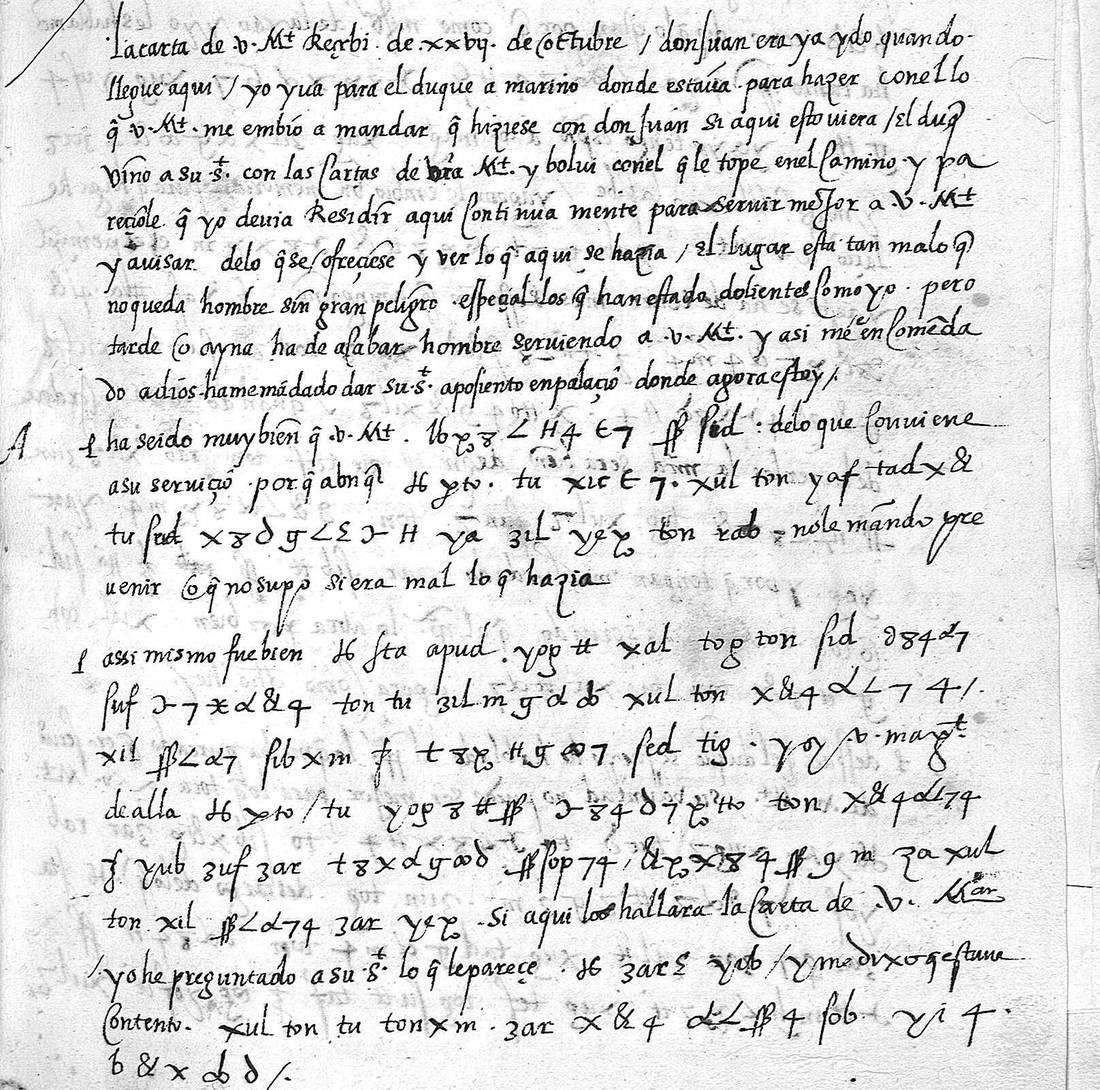
R9644 (ff. 237–243, 1 November 1522) holds the ciphered letter on ff. 237–239 and the clerk's own full clear version on ff. 241–242, headed Al Rey — De Lope Hurtado, de Roma, del primero de noviembre, written out in lettered sections with A, B, C standing in the margin of both. R9650 (ff. 269–272) has the same arrangement, its clear on f. 272. R9648 (9 November, with no decipherment on DECODE) is a duplicate of R9644, so one clear version covers two records.
04The first anchor
The clear at the foot of section A reads … porque esta tan escasso que nunca hombre lo fue mas; hasta que el arçobispo venga creo que sera mejor no apretallo mucho. On the cipher page the middle clause stands in the clear, bracketing the run: six tokens for six words, with no room for misalignment:
ton | tab | xud | xul | ɣm | xon |
|---|---|---|---|---|---|
| que | nunca | hombre | lo | fue | mas |
and tu = no from no apretallo mucho. From there the alignment extends: zun top at da por, ᵇʒ7 and teɡ at era and para, zil ɣub zed zar at con el arçobispo de Cosenza, ɣub taf at el papa, rab at v. ma.
05How the cipher is built
Three-letter code groups carry most of the text and are written as plain latin trigrams; spelled runs between them use a substitution alphabet. Three features matter for decryption, and none is described in the published account of the sibling ciphers:
- Homophones at code level.
taandtuboth mean no, and both occur in the same line. The alphabet has them too: the single spelled word perdida writes d with two different symbols. - Codes also stand for syllables.
xur+zun= na+da;ton+ℓ∞74= que+rian;zil+ a spelled ocia = conocia;nul+vuc+s = obligados.zunis da the whole word in da por, the second syllable of na·da, and the middle of que·da·rian. - Several codes can make one word.
lu+ho= porque,lul+ta= quales,ton+d+o = quedo.
A code group can therefore be part of a word, a whole word, or one of several groups forming a word. A decryption that treats each group as one word goes wrong in both directions.

xul ton tu ton·d·o zar d·o·n, lo que no quedo de don [Joan]. A code completed with two alphabet symbols, then a name spelled out. Image: Real Academia de la Historia, Colección Salazar y Castro 9/26 f. 237, via DECODE R9644.06Tests on letters the key was not built from
A key fitted to its own crib can reproduce the crib and nothing else. This one was tested on other records.
R9648, which has no decipherment on DECODE, gives nine tokens for nine words with nothing left over: ʋ ton ɣub taf tu ɣof ɣuc ton + spelled venga = «y que el papa no esta en que venga»; further down, la paz por los infieles y por la necessidad. Its spelled perdido decrypts letter by letter from six symbols fixed on the other record; the word was not searched for.
R9656 is the stronger test: a despatch of 23 November with no full clear version and no duplicate (a faded clear copy on f. 335r is legible only in half of each line). Applied without a crib, the key gives el papa for ɣub taf after the clear words las cartas traxo don Correo q vino con la valante.
Measured with a resolver that applies confirmed values only: 70% of tokens on R9648 f. 262, 62% on R9650 f. 270, 57% on R9645 f. 243, which has no crib of any kind. The figures do not change when the alphabet values are downgraded to probable (below), because almost all resolved tokens are code groups, the better-established half of the key. These were coverage figures for sample lines; the whole-letter readings of 2 October 2026 (sections 08 and 09) measure tokens read as sense instead.
07What the letters say
The content of four of the nine is complete: R9644 and R9650 from their clear versions, R9648 as R9644's duplicate, and R9652, which DECODE records as Partially decrypted though it carries no cipher at all. That leaf is written entirely in clear and signed Lope Hurtado.
R9644, 1 November. Charles V had written to warn Adrian VI directly; Hurtado approves, because if the Pope will not do his duty he should at least not be able to plead that he was not warned: no se disculpe despues con dezir que v. magestad no le mando prevenir. The Pope's voluntad is good and his obras satisfy nobody; he pleads the Turks and the Emperor's need, and is tan escasso que nunca hombre lo fue mas. Hurtado presses for the papal household to be paid before the other side buys them: si no los corrompiessen dandoles. The King of France asks a safe-conduct to send an ambassador and the Pope will not have him come.
R9650, November. The main news is that los franceses son determinados de venir en Italia, y enbian gran suma de dinero a Leon, brought by post from the archbishop of Bari, with Hieronymo Adorno's intercepted letters behind it. Adrian is urged to act sin dilatar mas, and takes it tan tibiamente que no se espera de todo bien.
R9652, November. A licenciado Bernardino, «gran bellaco», is in Rome; the Duke of Sessa wants him seized; the Pope will order it if the man is inside Rome, declines a night arrest when he is found lodging with his brother in the city (aqui no seria bien), and offers a formal suplicacion instead. It closes with las nuevas de Rodas que escrive el visorrey, the viceroy of Naples on the siege of Rhodes.
Sánchez's R9653 of 20 November carries the same Rhodes news from Venice, out of Candia and the Signoria. Rome and Venice reported the siege to the Emperor in the same fortnight, in two different ciphers, now bound in the same volume.
08Genoa, 13 September 1522: the Provence plan (R9634)
R9634 (ff. 14–16) was transcribed on 2 October 2026 from DECODE’s three openings; DECODE attaches no decipherment or transcription to it. It is not a Rome letter. The clear close on f. 16r is dated de Genoba xiij de setiembre 1522 and signed by Lope Hurtado; DECODE has the month but neither the day nor the place. There is no clear version in the record and none in print (Bergenroth’s Calendar of State Papers, Spain ii calendars no Hurtado letter of September 1522), so the reading rests on the key alone.
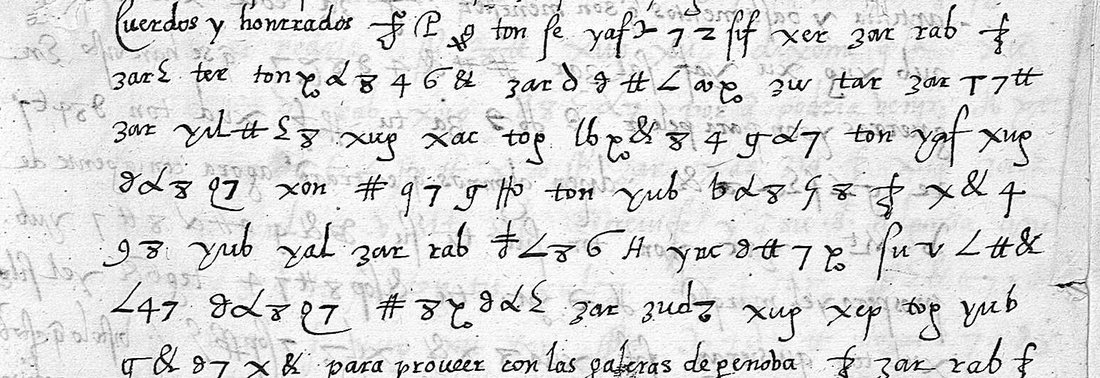
top + seven signs, ton yaf xug: por Proentia, que es la; line 4 opens tierra mas flaca que el tiene. The clear words in the last line are para proveer con las galeras de Genova. Image: Real Academia de la Historia, Colección Salazar y Castro 9/26 f. 14r, via DECODE R9634.Written four months after the imperial sack of Genoa (30 May 1522), the letter reports a plan that “sensible and honourable men” and Geronimo Adorno, the new imperial doge, put to Lope Hurtado. The Emperor and the King of England, queriendo destruir al Rey de Francia, should make war on him through Provence:
que es la tierra mas flaca que el tiene, y donde el exercito de V. Mt. puede entrar seguro, una tierra fertil … [para proveer con las galeras de Genova] … donde pueden entrar bien … los de la mar y los de la tierra
The French are muertos de miedo after the sack. Taking Provence and Lyon would let the allies tomarle lo otro que le queda y cercarle en Paris, which could not be done por Flandes ni por España. Asked what force it would need, Adorno said six hundred men-at-arms, light horse and soldiers, paid 70,000 ducats a month (lxx U yob z), if the Emperor and the King of England agreed on it; the troops already in the duchy of Milan would serve, and the Pope would be glad to see them go, por no los tener alojados en sus tierras. It must be kept secret, por que no toviesen aviso, and settled now for March: es cosa segura, de poca costa e provechosa. The clear close commends Adorno as tan buen servidor de V. Mt.
Charles V and Henry VIII did invade Provence in 1524, when Bourbon and Pescara laid siege to Marseille. This is an early form of that plan, put to the Emperor from Genoa in September 1522.
What the letter added to the key (key_1522_r9634.tsv): a new sign ɋ = r (tierra three times); z after a code as the plural s (xul z los, yob z ducados), which is not the 1524 standing-alone z = n; the codes yob ducado, xep mar, xu gente, zar∂ des-; and null groups after the run opener Ꮒ: ʃta confirmed in four letters, the others probable. The e/t confusion of the 1524 letters recurs: the closed 8 and the open-topped ϑ cannot be separated at DECODE’s resolution, so muertos, acordasen, faltasen and gastara are graded probable.
Measured from the line-by-line reading (r9634_reading.tsv): 842 of 1,191 tokens read as sense on the first pass, 846 after a retry against the values won on R9645 (71%), and 872 (73.2%) on 3 October 2026, when codes were pooled over all 21 Hurtado letters and spelled words were matched against a Spanish lexicon with every reading of their doubtful signs (vio, capitan, fue, vivo, tenia, ser, sostener, all probable). The key values 80% of the tokens as confirmed and 94% with probables; the gap is spelled words whose letters all have values but give no word, and about 45 code groups that occur once. A language check on the read text returns modern Spanish first.
09The other four letters without a usable crib
Earlier versions of this page listed R9634, R9645, R9646, R9649 and R9656 as having no clear version. That was out of date for two of them: R9649 carries its own clerk’s clear on f. 268, and R9656 a faded clear copy on f. 335r, legible only in the right half of each line. All four were re-read on 2 October 2026 with the extended key.
The reading audit of 22 October 2026 found that R9634, R9645, R9646 and R9656, though 61–80% of their tokens have a value, have holes, open codes or paraphrase in most cipher sentences: they are decoded, not read. The same day the four were re-read on crops of the DECODE images and written out as continuous partial readings with English (texts/R9634_reading.md and the others; label corrections in texts/<doc>_corrections.tsv: the crossed t-form is m, the 8-form stands for ϑ). R9645 f. 243r lines 1–12 gained the Ferrara capitulation (que abia tomado assiento con el duque de Ferrara) and R9656 f. 334v lo de [?Ostia], but none of the four reaches the bar (clean sentence shares 0.51–0.73), and all stay decoded, not read. The summaries below are gists of the partial readings.
- R9649, Rome, 9 November 1522 (89 of 89 tokens, 100%). Deciphered completely, and checked word for word against f. 268. Adrian VI asks Charles to tell him to keep good guard on the fortress of Ostia, which Cardinal Santa Cruz (Carvajal, as dean of the college) claims: en la fortaleza de Ostia, y que no la de a nadie, porque no querria darsela ni tener le quexoso. The licenciado Bernardino has landed from Barcelona and is hiding at his brother’s house in Rome. The groups
yω ʃtaafter the opener have no counterpart in the clear and are nulls. - R9646, [Rome, November 1522] (97 of 121, 80%). Adrian VI’s capitulation with the duke of Ferrara is signed and a copy is coming. Charles’s request (la decima, probable) meets papal caution: the Pope abia miedo que oviese de […]; the archbishop advises offering money al papa para sus necesidades … que creo que por dinero ….
- R9645, Rome, November 1522 (368 of 489, 75.3%). Re-transcribed in the R9634 notation. The glosses at the foot of f. 243v (Bernardino’s report from London: the King of England is agreed with the Scots, who have thrown out the duke of Albany; the French boast that the English and the Emperor’s troops did nothing) confirm
xu= gente and a null after the opener, and settleyib= duque. Unglossed f. 243r now reads as the terms of the Ferrara capitulation: the fief money of Pope Alexander, a hundred men-at-arms for the Church, no league save with the Pope and the Emperor, no harbouring of their enemies. - R9656, Rome, 23 November 1522 (177 of 225, 78.7%). Re-transcribed from the images in the R9634 notation on 3 October 2026 (it was 131 of 214, 61%, in the older notation): the old
ʒwas mostlyɣ̊= r, and the f. 334v run now reads in full against the faded copy, que esta muy sospechoso el papa que de alla se le haya mandado lo que ha fecho (zub= alla). The archbishop of Bari sent the Pope no certain news of the French coming; the Pope says that if the French come it will be to their harm; he is muy sospechoso that the Emperor ordered what Don Juan Manuel has done. Six spelled words of f. 334r (ll. 6, 9, 13–16) still fail: no reading of their signs is a Spanish word.
10What is open, and how complete the decipherment is
- Four letters are decoded, not read, measured as tokens with a sense-giving value: R9634 73.2%, R9645 75.3%, R9646 80%, R9656 78.7% (sections 08 and 09; R9649 is complete). What stays open in them: in R9634 about 40 code groups seen once (none recurs in the 21 Hurtado letters) (
ʃe,xer,zud,zac,ʃum,yat,zub,ʃof,xen,zer,yul…) andyelandɣ̊efour times each, with no crib and none in print; spelled words whose letters all have values but give no word (two of them probably place names), and the force numerals other than the 600 men-at-arms and the 70,000 ducats; in R9645tec(ze= el from four pooled contexts, probable),ʃenand the spelled words of the unglossed lines; in R9646 two spelled words and the codeszip,zob,ʃof; in R9656 six spelled words of f. 334r and the end of f. 334v l. 1. DECODE has no larger image than the one used, and the RAH Biblioteca Digital, which may hold better scans, sits behind a bot check that only a person in a browser can pass. Each spelled-word gap has one sign at the limit of the scan (8/ϑe/t,∂s/p/t,εl/g). Graded: the codes and the alphabet signs confirmed on the clear versions are H; values taken from a single R9634 context (yob,xep, the nulls other thanʃta) are I; words marked probable in the reading files are M. - The substitution alphabet is the limit. Nine symbols are fixed and cross-checked:
⋃=p,8=e,ʒ=r,x/6=d,L=i,7=a,4=n,m/ᶻ=o. Beyond these, transcriptions of the spelled words contradict each other at DECODE's image resolution. One contradiction proved to be a homophone missing from the key, and the others may resolve the same way; unassigned symbols are left blank. - Confidence is recorded for each value. The key file carries a
confidencecolumn; the resolver applies confirmed values only and shows probables in angle brackets. A check for pairs of codes with the same plaintext led to four retractions, kept in the file as commentedRETRACTEDlines, among them an early guess thatzarmeant Bari, when it means de. Nothing probable was used to derive anything else, so nothing downstream needed unwinding. - Corrections to DECODE. R9652's status should be not enciphered; DECODE has partially decrypted. R9634 is dated Genoa, 13 September 1522 on f. 16r; DECODE has the month only and files it with the Rome letters.
11What would complete it
The limit is image resolution. DECODE serves these leaves at 3440×2465 for a two-page opening, about 1700 px across a folio: enough for the Latin-letter trigrams, too little to separate two similar cursive symbols. That is the cause of the alphabet limit, and further crib work does not change it.
DECODE, checked with a logged-in session, has nothing better. The full-size file filesrv returns is that 3440×2465 opening; MASTER_, MS_, ORIG_ and .tif variants all come back as the server’s not-found placeholder, and the Image Manager answers “You do not have permission to access” to a viewer session, so its zoom view is unreachable too. The ceiling is DECODE’s stored derivative.
The volume belongs to the Colección Salazar y Castro, which the Real Academia de la Historia has been digitising at its own Biblioteca Digital. If Salazar 9/26 is there, those images will be far better than DECODE’s derivative copies, and recovering the substitution alphabet becomes routine. That would give an exact text of the ciphered leaves and should allow a full decipherment of the four letters now deciphered in part, and of the faded clear copy of R9656 on f. 335r.
It could not be done from here: bibliotecadigital.rah.es returns HTTP 403 to automated requests and puts a bot check in front of its search, in the same way DECODE’s image server needs a logged-in session. The search term is the old signature, Salazar y Castro, A-26, and the leaves wanted are ff. 14–16, 237–244, 252, 260–272 and 334–335.
Full texts
The transcription and the decryption of every document on this page, so that the reading can be used and checked. Short files are shown here; all are in the repository.
R9644, Rome, 1 Nov 1522 (ff. 237-243), with its duplicate R9648 (9 Nov, ff. 260-265)
Hurtado's running account of Adrian VI: the Pope's good will but unsatisfying deeds, his parsimony while he waits for the archbishop of Bari, the payment of the papal household before the other side buys it, the French King's request for a safe-conduct for an ambassador, and a leak of letters shown in copy in Castile. Read from the clerk's contemporary clear version (ff. 241-242); no full transcription of the ciphered leaves was made, only the passages aligned in NOTES.md.
Transcription: NOTES.md
Decryption
# R9644 — Lope Hurtado de Mendoza (Rome) to Charles V, 1 November 1522
RAH Salazar 9/26, ff. 237–243. DECODE R9644.
Cipher on ff. 237–239; **the contemporary clear version on ff. 241–242**, headed *Al Rey — De Lope
Hurtado, de Roma, del primero de noviembre*, written out in lettered sections **A**, **B**, **C**
keyed to the same letters in the margin of the cipher.

**R9648** (ff. 260–265, 9 Nov, DECODE *Non-decrypted*) is the duplicate of this despatch; its
ciphered leaves carry the same text, so this clear reads that record too.

**Read complete.** Transcribed from the image; abbreviations expanded in brackets.

---

**[A]** Ha sido muy bien que v. m[agesta]d prevenga a su S[antida]d de lo que conviene a su
servicio, porque aunque no haga lo que es obligado, no se disculpe despues con dezir que v.
m[agesta]d no le mando prevenir, porque no supo si era mal lo que hazia.

Assi mesmo fue bien escrivir largo, porque su S[antida]d tenia tanta passion que no conocia lo que
don Joan le havia servido, y me tenia su persona. Y si v. m[agesta]d de alla no escriviera, pensara
que don Joan y el **Cardenal de Medicis** havian ordenado [ara] lo que le havian de dezir, si aqui
los hallara la carta de v. m[agesta]d.

Yo he preguntado a su S[antida]d lo que le parece del duque, y me dixo que estava contento — lo que
no quedo de don Joan, segun dizen todos.

Es muy bien lo que v. m[agesta]d dize, que lo que hoviere de hazerse con los criados de su
S[antida]d primero los sepa; pero hasta que v. m[agesta]d les de lo que fuere servido, si algo se le
dixesse pensaria que era para no les dar nada, y diria que no queria que lo tomassen, y los criados
quedarian descontentos, como diz que lo estan; porque como **Mossiur de la Xao** y yo le hablamos ha
tanto tiempo, que ya tiene perdida la esperança.

Yo tengo escrito a v. m[agesta]d la condicion del, y Mossiur de la Xao la sabe; y agora le enbio un
memorial para que haga relacion a v. m[agesta]d. El **camarero Pedro** es el principal, y a este se
ha de tener mas respeto que a ninguno; y es sin comparacion, y buenos los otros, si no los
corrompiessen dandoles. Quando v. m[agesta]d acordare de hazerles la merced, sera bien dezir al
papa …

… que v. m[agesta]d les da aquello por los trabajos que tovieron en España, y porque tenga mas
cuydado de servir a su S[antida]d; yo lo que v. m[agesta]d sera servido, que el papa lo haura por
bien — lo que creo que no haria agora, como dicho he.

Despues que el duque se fue, yo he hablado al papa lo que me ha parecido que era servicio de v.
m[agesta]d. Su voluntad no puede ser mejor para lo que toca a v. m[agesta]d; las obras, ningun
servidor de v. m[agesta]d la esta satisfecho. Da por descargo de lo que dexa de fazer la obligacion
que tiene a procurar la paz, por ser papa, y por estar los infieles tan poderosos y su necessidad
tan grande; y que v. m[agesta]d no la tiene, para que el se muestre como es obligado — que si v.
al[teza] la tuviesse, no le faltaria por ninguna cosa. Y los que le tienen por frances veen si sus
officios y fortalezas y servicio de su casa lo haze con franceses o castellanos.

Su S[antida]d, a lo que yo pienso, espera lo que hara el arçobispo de Bari, y no gastar nada si ser
pudiesse, porque esta tan escasso que nunca hombre lo fue mas. Hasta que el arçobispo venga, creo
que sera mejor no apretallo mucho.

**[B]** Con el arçobispo de **Cosenza** trata de algunas cosas su S[antida]d, siendo presente el
otro, que sin el no hay nada; y con el, por lo de aqui, esta perdido, y creo que tarde lo sabra
ganar. El arçobispo esta mal contento; dize que si no fuesse porque no le arrogerian en ninguna
parte por yr de aqui, que seria ydo, porque vee en el papa algunas cosas que no le contentan; y pues
el no es parte, que no quiere que digan que [aun] sera mal a su S[antida]d. Y es buen servidor de v.
m[agesta]d, y le deve mandar servir.

**[C]** Entendido he de **Cisterer** que es buen servidor de v. m[agesta]d, y que puede servir, que
tiene la cifra; que su S[antida]d da señal de paz, y que el **Rey de Francia** pedia salvo conducto
por enbiar embaxador a su S[antida]d, y que el papa no esta en que venga.

Pregunte al papa que nueva tenia de Francia; dixome que el arçobispo le havia enbiado la carta de v.
m[agesta]d, y que esperava sobre lo de **Inglaterra**; que desseava mucho la paz, por los infieles y
por la necessidad de v. m[agesta]d, pues queda de la guerra honrrado y approvechado. Yo dixe a su
S[antida]d que v. m[agesta]d siempre la queria, y el **Rey de Inglaterra**, haziendo el Rey de
Francia lo justo.

He scrito al arçobispo de Bari que se deve venir, pues el papa lo ha dexado a su voluntad, y que
entretanto le sirva, poniendole alguna necessidad de alla. Su S[antida]d se concierte con v.
m[agesta]d y **Venecia** y suyos lo antes que pueda. Yo he scrito esto conforme a lo que v.
m[agesta]d me mandava. V. m[agesta]d me mande avisar si ha seydo lo bien, y lo que de aqui adelante
le scriva, que yo le tengo por buen servidor de v. m[agesta]d, y pienso que no errara lo que es
obligado. Tanbien halle una carta aqui, aunque es vieja, de vj de setembre: la enbio a v.
m[agesta]d. Oy despacha el papa posta con la respuesta del arçobispo para el.

Hable a su S[antida]d lo que v. m[agesta]d me scrivio del **principe don Enrique**. Dixo que de su
abuelo no sabe nada, y que el hombre no es buelto; el engaño a su S[antida]d. Fuera mejor haverle
prendido, que con su amo no puede haver buen assiento, por los inconvenientes que v. m[agesta]d
dize.

Assi mismo dixe a su S[antida]d de los del consejo; respondiome que del obispo no estava contento, y
que las cartas que a v. m[agesta]d escrivian a Flandes le havian mostrado en Castilla el traslado;
que no sabia mas, y que a todos queria bien.

---

## What it says

Rome, 1 November 1522. The imperial agent's running account of Adrian VI in the months before the
French came back into Italy:

- **managing the Pope.** Charles V had written directly to warn him; Hurtado approves, because if
  Adrian will not do his duty he should at least not be able to plead ignorance. The Pope's *voluntad*
  is good, his *obras* satisfy nobody.
- **the Pope's excuse and his parsimony.** He pleads his obligation to procure peace, the strength of
  the infidel, and the Emperor's need; he is *tan escasso que nunca hombre lo fue mas*, and waits to
  see what the archbishop of Bari will do before spending anything.
- **the household.** Hurtado presses for the Pope's servants to be paid — *el camarero Pedro es el
  principal* — before they are bought by the other side: *si no los corrompiessen dandoles*.
- **the peace track.** The Rey de Francia asks a safe-conduct to send an ambassador; the Pope will not
  have him come. Adrian wants peace for the sake of the Turks and the Emperor's need; Hurtado answers
  that the Emperor and the King of England always wanted it, *haziendo el Rey de Francia lo justo*.
  Su Santidad should come to terms with the Emperor and **Venecia** as soon as he can.
- **prince don Enrique**, the consejo, and a leak: letters written to the Emperor in Flanders had been
  shown in copy in Castile.

## Status of the cipher

The content is read in full from the clerk's clear. The ciphered leaves (ff. 237–239), and those of
the duplicate R9648, are read in part — the aligned passages are listed in `../NOTES.md`, and the key
built from them resolves about two thirds of the tokens on sight.
Translation
# R9644 (and its duplicate R9648): Lope Hurtado de Mendoza (Rome) to Charles V, 1 November 1522: English translation

Translation (Claude Opus 5.5, 23 Oct 2026) of the text in `read_r9644.md`: the contemporary clear version of the
despatch (RAH Salazar 9/26 ff. 241-242), written out in lettered sections A, B, C keyed to the cipher; the ciphered
leaves of R9644 and of the duplicate R9648 carry the same text. Same marks: `[x]` letters or a word expanded or
supplied by the transcriber, `…` a break between leaves. Spanish.

## Translation

**[A]** It has been very well that Your Majesty forewarns His Holiness of what is fitting for your service, because,
although he may not do what he is obliged to, he may not excuse himself afterwards by saying that Your Majesty did not
have him forewarned, so that he did not know whether what he was doing was wrong.

Likewise it was well to write at length, because His Holiness had such passion that he did not recognise what Don
Juan had served him, and [?] held his person against me. And if Your Majesty had not written from there, he would have
thought that Don Juan and the **Cardinal de' Medici** had arranged [now] what they were to tell him, if Your Majesty's
letter had found them here.

I have asked His Holiness what he thinks of the Duke, and he told me he was content, which he was not with Don Juan,
as everyone says.

What Your Majesty says is very well, that whatever is to be done with His Holiness's servants he should know of
first; but until Your Majesty gives them what you are pleased to, if anything were said to him he would think it was
so as not to give them anything, and would say he did not want them to take it, and the servants would remain
discontented, as they say they are; because, as **Monsieur de La Chaulx** and I spoke to him of it so long ago, they
have already lost hope.

I have written to Your Majesty of his character, and Monsieur de La Chaulx knows it; and now I send him a memorandum
so that he may make a report to Your Majesty. The **chamberlain Pedro** is the principal one, and more regard is to be
had for him than for any; and he is beyond comparison, and the others good, if they were not corrupted by being given
[gifts]. When Your Majesty decides to grant them the favour, it will be well to tell the Pope …

… that Your Majesty gives them that for the labours they had in Spain, and so that they may take more care to serve
His Holiness; I [think that], as Your Majesty will be pleased, the Pope will approve it, which I believe he would not
do now, as I have said.

Since the Duke left, I have spoken to the Pope of what seemed to me to be Your Majesty's service. His will could not
be better as regards what concerns Your Majesty; as for his deeds, no servant of Your Majesty is satisfied with them.
He gives as excuse for what he leaves undone the obligation he has to procure peace, being pope, and the infidels
being so powerful and his need so great; and [says] that Your Majesty has no [such need] that he should show himself
as he is obliged to; for if Your Highness had it, he would not fail you for anything. And those who take him for
French may see whether he fills his offices, his fortresses and the service of his house with Frenchmen or with
Castilians.

His Holiness, as I think, is waiting for what the Archbishop of Bari will do, and not to spend anything if it could
be helped, for he is so close-fisted that never was man more so. Until the Archbishop comes, I think it will be better
not to press him much.

**[B]** With the Archbishop of **Cosenza** His Holiness deals on some matters, the other being present, for without
him there is nothing; and with him, as regards things here, he is lost, and I think he will be slow to win him back.
The Archbishop is ill content; he says that, were it not that they would not take him in anywhere for leaving here, he
would be gone, because he sees in the Pope some things that do not please him; and since he has no part [in affairs],
he does not want it said that he is [even] ill with His Holiness. And he is a good servant of Your Majesty, and you
ought to order him to serve.

**[C]** I have learned from **Cisterer** that he is a good servant of Your Majesty, and that he can serve, that he has
the cipher; that His Holiness gives signs of peace, and that the **King of France** was asking for a safe-conduct to
send an ambassador to His Holiness, and that the Pope is not of a mind that he should come.

I asked the Pope what news he had from France; he told me that the Archbishop had sent him Your Majesty's letter, and
that he was waiting concerning the matter of **England**; that he greatly desired peace, because of the infidels and
because of Your Majesty's need, since you come out of the war honoured and with advantage. I told His Holiness that
Your Majesty always wanted it, and the **King of England** too, the King of France doing what is just.

I have written to the Archbishop of Bari that he ought to come, since the Pope has left it to his will, and that
meanwhile he should serve him, putting to him some need from there. Let His Holiness come to terms with Your Majesty
and **Venice** and his own as soon as he can. I have written this in accordance with what Your Majesty commanded me.
May Your Majesty have me informed whether it has been well [done], and what I am to write to him from now on; for I
hold him a good servant of Your Majesty, and I think he will not fail in what he is obliged to. I also found a letter
here, although it is old, of the 6th of September: I send it to Your Majesty. Today the Pope is despatching a post
with the answer to the Archbishop for him.

I spoke to His Holiness of what Your Majesty wrote me of **Prince Don Enrique**. He said that of his grandfather he
knows nothing, and that the man has not come back; he deceived His Holiness. It would have been better to have
arrested him, since with his master there can be no good settlement, because of the drawbacks Your Majesty mentions.

Likewise I spoke to His Holiness of those of the council; he answered me that he was not content with the bishop,
and that of the letters they were writing to Your Majesty in Flanders they had shown him the copy in Castile; that he
knew no more, and that he wished all of them well.
R9650, Rome, Nov 1522 (ff. 269-272)
The French are resolved to come into Italy and send a great sum of money to Lyon; Hieronymo Adorno has intercepted letters; the Pope, urged to act, answers lukewarmly and will not declare himself. Read from the clerk's clear version on f. 272; the ciphered leaves (ff. 269-271) are transcribed only in the passages aligned in NOTES.md.
Transcription: NOTES.md
Decryption
# R9650 — Lope Hurtado de Mendoza (Rome) to Charles V, November 1522
RAH Salazar 9/26, ff. 269–272. DECODE R9650.
Cipher on ff. 269–271; **the contemporary clear version on f. 272**, headed *Al Rey — De Lope
Hurtado de …*.

**Read complete.** The text below is the clerk's own clear version, transcribed from the image;
the ciphered leaves carry the same letter, and the passages checked against them agree
(`../NOTES.md`). Abbreviations expanded in brackets.

---

Ayer vino posta del arçobispo de Bari; scrivieme de [xxiij] a vn[o] del presente. Dize que antes de
seys dias enbiaria aqui uno suyo, con quien avisaria largo; dize que luego embiaria a v. m[agesta]d
otro. Por este respetto no enbio mi carta a v. m[agesta]d.

En substancia me dize que **los franceses son determinados de venir en Italia, y enbian gran suma de
dinero a Leon**, y que es menester que se entienda en la defensa, y que el papa haga lo que pudiere,
pues le va mas que a nadie.

Y he dicho a su S[antida]d que de **Hieronymo Adorno** me ha venido este aviso, de unas cartas que ha
tomado por amor de v. m[agesta]d; y por lo que deve, no se ponga en esto — que por servicio de Dios
y remedio de la yglesia y de su estado deve pensar lo que ha de hazer sin dilatar mas, porque
despues no havra tiempo.

Esto le dixe antes que viesse lo del arçobispo. Scrivieme que no pensasse que otra avisaria; tomalo
tan tibiamente que no se espera de todo bien. En todo me ha dicho que lo miraria, y que despues me
hablaria. Trabajare de saber lo que el arçobispo scrive, y vere la respuesta de su S[antida]d; y
luego avisare a v. m[agesta]d, que agora no puede ser, porque el duque me ha scrito que oy partira
la posta y que no la detenga. Yo le he avisado desto, y a **don Joan Manuel** y al **visorey de
Napoles**. Creo que el duque scrivira a v. m[agesta]d su parecer y lo que piensa hazer.

Yo he scrito al arçobispo conforme a lo que v. m[agesta]d me ha mandado, y me dize en su venida que
queria hazer la [paz] de conveniente el papa, si los franceses vienen; y el papa dissimula de no
fazerse parte, sino tener alla su mundo. Vea v. m[agesta]d si sera mejor que vaya otro que es el
arçobispo, si alla esta; siempre avisaria. Si aqui viene, tengo por cierto que ha de tener lugar
cabe el papa mejor que los otros, despues de enthenar, y apretaran a su S[antida]d …

---

## What it says

Rome, November 1522, in the weeks before the French re-entry into Italy. Hurtado reports:

- **the French are resolved to come into Italy and are sending a great sum of money to Lyon** — the
  intelligence came by post from the archbishop of Bari;
- **Hieronymo Adorno has intercepted letters** and passed the warning on, "por amor de v. magestad";
- the Pope is urged to act *sin dilatar mas* for the sake of the Church and his own state, and
  answers **tibiamente** — lukewarmly, promising only to think about it;
- the Duke [of Sessa] is despatching the post the same day, so a fuller report must wait;
- **don Joan Manuel** at Rome and the **visorey de Napoles** have been told;
- and the Pope *dissimula de no fazerse parte* — will not declare himself.

The lukewarm Pope is Adrian VI, six months into a pontificate spent trying not to choose between
Charles V and Francis I. Hurtado's *tomalo tan tibiamente que no se espera de todo bien* is a
serving ambassador's verdict on that policy, three weeks before the French came down.

## Status of the cipher

The letter's *content* is read in full, from the clerk's clear. The *ciphered* leaves (ff. 269–271)
are read in part: the sentences checked against the clear are listed in `../NOTES.md`, and the key
built from them resolves about two thirds of the tokens on sight. A word-perfect edition of the
ciphered text needs the substitution alphabet, which is still thin.
Translation
# R9650: Lope Hurtado de Mendoza (Rome) to Charles V, November 1522: English translation

Translation (Claude Opus 5.5, 23 Oct 2026) of the text in `read_r9650.md`: the clerk's contemporary clear version of
the letter (RAH Salazar 9/26 f. 272); the ciphered leaves carry the same letter. Same marks: `[x]` letters or a word
expanded or supplied by the transcriber, `…` the end of the leaf. Spanish.

## Translation

Yesterday a post came from the Archbishop of Bari; he writes to me from the [23rd] to the [1st] of this month. He says
that within six days he would send one of his men here, by whom he would give full news; he says he would then send
another to Your Majesty. For this reason I do not send my letter to Your Majesty.

In substance he tells me that **the French are resolved to come into Italy, and are sending a great sum of money to
Lyon**, and that it is necessary to see to the defence, and that the Pope should do what he can, since more is at
stake for him than for anyone.

And I have told His Holiness that this warning has come to me from **Hieronymo Adorno**, from some letters he has
taken out of love for Your Majesty; and, for what he owes, let him not set himself against this; for the service of
God and the remedy of the Church and of his state he ought to consider what he has to do without further delay,
because afterwards there will be no time.

This I told him before he saw the Archbishop's [letter]. He writes to me not to think that another would give
warning; he takes it so lukewarmly that not every good is to be hoped for. In all he has told me that he would look
into it, and would speak to me afterwards. I shall work to learn what the Archbishop writes, and shall see His
Holiness's answer; and I shall then inform Your Majesty, for now it cannot be, because the Duke has written to me that
the post leaves today and that I should not hold it back. I have informed him of this, and **Don Juan Manuel** and the
**Viceroy of Naples**. I believe the Duke will write to Your Majesty his opinion and what he thinks of doing.

I have written to the Archbishop in accordance with what Your Majesty has commanded me, and he tells me, on his
coming, that he wanted to make the [peace] fitting [for] the Pope, if the French come; and the Pope dissimulates so as
not to make himself a party, but to keep his world there. Let Your Majesty see whether it will be better that another
should go than the Archbishop, if he is there; he would always give warning. If he comes here, I hold it certain that
he must have a place near the Pope better than the others, after [?…], and they will press His Holiness …
R9652, Rome, Nov 1522 (ff. 295-296), wholly in clear
A letter entirely in clear: the licenciado Bernardino, a 'gran bellaco', has turned up in Rome and Adrian VI declines a night arrest in the city; the viceroy of Naples' news of the siege of Rhodes is forwarded in copy.
Transcription
# R9652 — Lope Hurtado de Mendoza (Rome) to Charles V, November 1522
RAH Salazar 9/26, ff. 295–296 (the leaf is foliated 293). DECODE R9652, *Partially decrypted*.

**This letter is written entirely in the clear.** There is no cipher on the leaf; what DECODE's
"partially decrypted" reflects is the faded show-through at the head of the page, not enciphered
text. Signed *Lope Hurtado*.

**Read complete**, transcribed from the image; abbreviations expanded in brackets.

---

A v. m[agesta]d escrevi a [x] del presente como el **licenciado Bernardino** era venido aqui. Luego
[fuy]se al duque, y hable a su S[antida]d, y me dixo que mandaria hazer justicia del, porque era
gran bellaco.

El duque bolvio luego aqui; sup[lic]o a su S[antida]d tovyese por bien que lo hiziese prender. El
p[apa] le respondio que si estava dentro de Roma mandaria hazer[lo], y si estava fuera, que el
hiziese lo que le pareciese. El duque ha sabido que esta en la cibdad, en casa de su hermano; ha
embiado a suplicar a su S[antida]d aya por bien que illi lo haga prender una noche. El p[apa] me ha
respondido que aqui no seria bien, pero que hechemos una suplicacion que su S[antida]d mandara hazer
justicia.

V. m[agesta]d escriva al duque lo que en esto se haga; y seria bien embiar una ynformacion de su
culpa, para proceder aca contra el como fuere possible, sacarle al p[apa], para que v. m[agesta]d
mande hazer justicia. Y pareceme que deveria avisar a v. m[agesta]d, pues que embie a mandar lo que
fuere su servicio. A la ora escrivo al duque la respuesta del p[apa], para que vea lo que se deve
hazer.

Soy ha avisado a su S[antida]d de **las nuevas de Rodas** que escrive el visorrey; embio con la
presente a v. m[agesta]d la copia de la carta del [visorrey] y de las nuevas.

---

## What it says

A criminal matter and a piece of news.

**The criminal matter.** A *licenciado Bernardino*, "gran bellaco", has turned up in Rome. Hurtado
and the Duke [of Sessa] want him arrested; the Pope will order it if the man is inside Rome but
leaves it to the Duke if he is outside, and when the Duke finds he is in the city, lodging with his
brother, and asks for a night arrest, Adrian VI declines — *aqui no seria bien* — and offers a
formal *suplicacion* instead. Hurtado asks the Emperor to send an information of the man's guilt so
the case can be pressed. It is a small, exact picture of what an imperial agent could and could not
get out of this Pope.

**The news.** *Las nuevas de Rodas que escrive el visorrey* — the viceroy of Naples' despatch on the
siege of Rhodes, forwarded to the Emperor in copy.

That last line ties this correspondence to the Venice side of the same archive: Alonso Sánchez's
R9653 of 20 November 1522 carries the Rhodes news from the other direction, out of Candia and the
Signoria (`../sanchez1522/read_r9653.md`). Rome and Venice were reporting the same disaster to the
Emperor in the same fortnight, in two different ciphers, bound now in the same volume.

## Status

Content read in full; no cipher to break on this leaf. DECODE's status should be *not enciphered*
rather than *partially decrypted*.
Decryption
# R9652 — Lope Hurtado de Mendoza (Rome) to Charles V, November 1522
RAH Salazar 9/26, ff. 295–296 (the leaf is foliated 293). DECODE R9652, *Partially decrypted*.

**This letter is written entirely in the clear.** There is no cipher on the leaf; what DECODE's
"partially decrypted" reflects is the faded show-through at the head of the page, not enciphered
text. Signed *Lope Hurtado*.

**Read complete**, transcribed from the image; abbreviations expanded in brackets.

---

A v. m[agesta]d escrevi a [x] del presente como el **licenciado Bernardino** era venido aqui. Luego
[fuy]se al duque, y hable a su S[antida]d, y me dixo que mandaria hazer justicia del, porque era
gran bellaco.

El duque bolvio luego aqui; sup[lic]o a su S[antida]d tovyese por bien que lo hiziese prender. El
p[apa] le respondio que si estava dentro de Roma mandaria hazer[lo], y si estava fuera, que el
hiziese lo que le pareciese. El duque ha sabido que esta en la cibdad, en casa de su hermano; ha
embiado a suplicar a su S[antida]d aya por bien que illi lo haga prender una noche. El p[apa] me ha
respondido que aqui no seria bien, pero que hechemos una suplicacion que su S[antida]d mandara hazer
justicia.

V. m[agesta]d escriva al duque lo que en esto se haga; y seria bien embiar una ynformacion de su
culpa, para proceder aca contra el como fuere possible, sacarle al p[apa], para que v. m[agesta]d
mande hazer justicia. Y pareceme que deveria avisar a v. m[agesta]d, pues que embie a mandar lo que
fuere su servicio. A la ora escrivo al duque la respuesta del p[apa], para que vea lo que se deve
hazer.

Soy ha avisado a su S[antida]d de **las nuevas de Rodas** que escrive el visorrey; embio con la
presente a v. m[agesta]d la copia de la carta del [visorrey] y de las nuevas.

---

## What it says

A criminal matter and a piece of news.

**The criminal matter.** A *licenciado Bernardino*, "gran bellaco", has turned up in Rome. Hurtado
and the Duke [of Sessa] want him arrested; the Pope will order it if the man is inside Rome but
leaves it to the Duke if he is outside, and when the Duke finds he is in the city, lodging with his
brother, and asks for a night arrest, Adrian VI declines — *aqui no seria bien* — and offers a
formal *suplicacion* instead. Hurtado asks the Emperor to send an information of the man's guilt so
the case can be pressed. It is a small, exact picture of what an imperial agent could and could not
get out of this Pope.

**The news.** *Las nuevas de Rodas que escrive el visorrey* — the viceroy of Naples' despatch on the
siege of Rhodes, forwarded to the Emperor in copy.

That last line ties this correspondence to the Venice side of the same archive: Alonso Sánchez's
R9653 of 20 November 1522 carries the Rhodes news from the other direction, out of Candia and the
Signoria (`../sanchez1522/read_r9653.md`). Rome and Venice were reporting the same disaster to the
Emperor in the same fortnight, in two different ciphers, bound now in the same volume.

## Status

Content read in full; no cipher to break on this leaf. DECODE's status should be *not enciphered*
rather than *partially decrypted*.
Translation
# R9652: Lope Hurtado de Mendoza (Rome) to Charles V, November 1522: English translation

Translation (Claude Opus 5.5, 23 Oct 2026) of the text in `read_r9652.md`. This letter is written entirely in the
clear (RAH Salazar 9/26 ff. 295-296); there is no cipher on the leaf. Same marks: `[x]` letters or a word expanded or
supplied by the transcriber. Spanish.

## Translation

I wrote to Your Majesty on the [x] of this month how the **licentiate Bernardino** had come here. Then I went to the
Duke, and spoke to His Holiness, and he told me he would order justice to be done on him, because he was a great
scoundrel.

The Duke came back here at once; he begged His Holiness to be pleased to let him have him arrested. The Pope answered
him that, if he was inside Rome, he would order it to be done, and if he was outside, that he should do as seemed good
to him. The Duke has learned that he is in the city, in his brother's house; he has sent to beg His Holiness to be
pleased that he may have him arrested there one night. The Pope has answered me that here it would not be well, but
that we should put in a petition that His Holiness order justice to be done.

Let Your Majesty write to the Duke what is to be done in this; and it would be well to send an information of his
guilt, so as to proceed against him here as far as possible, to get him out of the Pope['s hands], so that Your
Majesty may order justice to be done. And it seems to me that I ought to inform Your Majesty, so that you may send
orders for what may be for your service. At this hour I am writing the Pope's answer to the Duke, so that he may see
what ought to be done.

I have informed His Holiness of **the news of Rhodes** which the Viceroy writes; I send Your Majesty with the present
the copy of the [Viceroy's] letter and of the news.
R9634, Genoa, 13 Sept 1522 (ff. 14-16) decoded, not read
Four months after the imperial sack of Genoa, Hurtado reports a plan put to him by Geronimo Adorno: the Emperor and the King of England should make war on the King of France through Provence, his weakest land, with six hundred men-at-arms, light horse and soldiers at 70,000 ducats a month, settled now for March; an early form of the 1524 Provence invasion.
A mechanical decode with holes in most sentences: shown so that the transcription and the key can be checked and improved, not as a reading.
Transcription
# R9634, RAH Salazar 9/26 ff. 14-16 (A-26), Lope Hurtado de Mendoza to Charles V, Genoa 13 Sept 1522 - cipher transcription
# Images: IMG_R9634_I45360_P1 (f.14r right), P2 (f.14v left, f.15r right), P3 (f.15v left, f.16r right: clear end + signature).
# One line of the file = one manuscript line. [..] = clear words written in the line. Tokens separated as the scribe spaces
# them where the spacing is clear; letter signs separated by spaces. (?) = doubtful sign.
# Notation: 1524 sign names (../lopehurtado1523/key_1524.tsv) and the R9646/R9649 names (read_r9649.md):
#   ϑ  open-topped 8-like sign (t)        8  closed 8 (e)          Ho  H-with-o (a)       ß  sharp-s (a)
#   ɣ̊  ɣ with small o under (r)          ʇʇ double-crossed tt (r) ʇ single crossed t    ∠  angle (u/v)
#   δ  plain delta (s)  ∂  delta with loop to the left           &  et-sign (o)         α  alpha (i)
#   ʄ  NEW: long s crossed by a bar with a loop at the foot (stands between words; see read_r9634.md)
#   Ꮒ  the run-opening mark ("J6"/"Θ"-like)   ʃta  the group that follows it in R9646/R9649/R9656
#   ϯ  NEW: cross-like sign with hook   ɸ NEW: circle with descender ("φ" with closed head)   Ɛ epsilon with dots (l)
# --- f.14r (P1 right page), after the clear "... y algunos me han dicho hombres cuerdos y honrados"
14r01 [cuerdos y honrados] ʄ ⊃ ʇʇ & ton ʃe yaf ∂ 7 z ʃif xer zar rab ʄ
14r02 zarε ter ton ɣ̊ α 8 4 6 & zar ∂ ϑ ʇʇ ∠ α ɣ̊ zu tar zar ⊤ 7 ʇʇ
14r03 zar ɣ ɭ ʇʇ Ɛ 8 xug xac top ɭb ɣ̊ & 8 4 ϑ α 7 ton yaf xug
14r04 ∂ α 8 ɋ 7 xon # ϑ 7 ϑ Ho ton yub b α 8 ϑ 8 ʄ x & 4
14r05 ϑ 8 yub yal zar rab ʄ ∠ 8 6 H yuc ∂ ʇʇ 7 ɣ̊ ʃu v ∠ ʇʇ &
14r06 ∠ 4 7 ∂ α 8 ɋ 7 # 8 ɣ̊ ∂ α Ɛ zar zud z xug xep top yub
14r07 ϑ & ∂ 7 x & [para proveer con las galeras de genoba] ʄ zar rab ʄ
14r08 x & z 6 8 ɭb ∠ 8 x H ϑ yuc ∂ ʇʇ 7 ɣ̊ zef x & ∂ 8 xul z zar
14r09 xug xep ʄ xul z zar xuɡ̵ ∂ α 8 ɋ ß zu xu zarε ∂ 7 ʄ ∂
14r10 ton tab ɸ α & xug 4 ϑ 7 ʃal z xor 8 ʇʇ 8 & ∂ zar ϯ α 8 x &
14r11 [del saco de genoba y de las otras cosas que han hecho la gente de V. Mt.] ɭo
14r12 ʇʇ & 4 8 ʇʇ 8 ∂ zar xac ton ∂ 7 ɣ 8 ϑ ɣ α 4 ton xul z yuc
14r13 m & ɣ̊ ton 4 [a todos y que se pornan en presiones para ello si] Ꮒ ʃta [ayud-]
# --- f.14v (P2 left page)
14v01 yuc α ϯ ∠ 7 8 ʇʇ & ϯ 8 ∂ H ɕ ton tog zac ∂ & 4 ε 7 rab
14v02 yal tu ʃil ʃal ∂ ʇʇ & 8 ɣ ɣ̶ ω Ho ʄ ε 8 & 4 ʄ tif zarε
14v03 y & Ɛ ʇʇ α 4 7 ∆ ε m 8 xul xon zar x ɩ 4 ε ∠ 7 x & ton
14v04 ton ʃu ɣ̊ 7 ʃil ʇʇ zu tar xug z xig 8 ∂ y & ∂ 7 c ton ʃum 48
14v05 ʄ zar ∂ ϑ ʇʇ ∠ α ɣ̊ r 8 tog ton zar yof z tif ∂ [se puede dezir]
14v06 teg ʃad z ∂ 8 4 Ho ɣ̊ xug z ʇudd ʄ yub yat zar rab Ꮒ
14v07 ɣ̊ʇ ɡʇo zil xul ton ß yub xil [quitasen se sostenian para]
14v08 [engrandecerse] ʄ ʃil ʇʇ xil xul tod ton xil ton x ß yel
14v09 ɣ 8 ʇʇ b 7 ɣ̊ xil yuc ɭb 7 ɣ̊ α ∂ [y que lo que se haria] top zu
14v10 zil ʌʃ ʋ yob z tu ʃu 3 Ho ʇʇ 7 top yol ti top yeg zil
14v11 x & ∂ [millones] tog ton xul z xar z zub yof 4 [apercebidos del]
14v12 [artilleria y bastimentos que son menester] ʄ za to& xul ɣ̊ ? 4 H
14v13 zub xug xu yaf ʃal zar # ʇʇ & 4 ϑ 8 ɣ̊ 7 [que se han visto en]
14v14 [guerras y son para pelear] Ꮒ ʆ∂ za tu ʇʇʄ xud ton ϑ 8 4 ɣ̶
14v15 ɣ̊e ɣ ∠ f Ɛ α ɷ & [dizen algunos que entraran agora con la gente de V. Mt.]
14v16 yuc yon ton ʃub tu ʃu 8 & ɣ ʇʇ α 8 ʇʇ 7 yub
14v17 [prospero y el marques] Ꮒ ∂ yt tu & ʃop 8 ʇʇ 7 4 teg 6 & yel ʃ
14v18 xul ton [quisieran] ʃof xug 8 x & xil z 7 ʃop ß 9 [visto lo que]
14v19-20 [me dezian pareciome en estando bueno que era bien comunicarlo con Geronimo Adorno que es hombre sabio y cuerdo y servidor de V. Mt. a mi parecer tan(to?) / yo he visto; dixele lo que he dicho aqui a V. Mt. que que le parecia; dixome que no lo]
14v21 [toviesse] top xul y & ∂ xul z ton yif ß ʃop 7 4 yo [que juraba a]
14v22 [dios] ʃub yub xob zif yin ɸ α ∠ & tu x α ϯ 8 ɣ̊ 7 xig
14v23 top zar xac [y que pues V. Mt.] yof ∠ 7 zar ∂ 8 ʇʇ xug xu
14v24 x & ʄ yub ter zar zar∂ ϑ ʇʇ ∠ α ɣ̊ zu tor [y tenian]
14v25 [(y tenian) / f.15r: aparejo para ello]
# --- f.15r (P2 right page)
15r01 [aparejo para ello] ton ϑ 8 ʇʇ 4 α 7 4 yub ∂ 8 & ɣ̊ zil ∂ 8 α ʙ
15r02 zarε xor 4 x & [si dexasen de] ʃil ɣ̊ xil yif ton yof ∠ 7 yuc
15r03 ʃed ϯ 7 tu [preguntele] ton xu ʃu ɣ̊ & 7 ϯ 8 4 Ho ∂ 8 oo ɣ̊
15r04 [dixome que] ∂ 8 α c ɣ α 8 4 ϑ & ∂ xud z zar Ho ɣ̊ ϯ 7 ∂ ʄ
15r05 ɣ ϯ α ɷ 8 · 9 · ϑ 7 ʇʇ 7 ɷ & ∂ ε α ϯ 8 ɣ̊ m ∂ ʄ x b ʋ ∂ yt
15r06 ∂ & ε 9 7 x & c [y que para su paga serian menester] 9 7 x Ho
15r07 ϯ 8 ∂ · lxx U yob z ʄ ton ʇʇʇ ∠ ʇʇ 7 teg 8 ∂ α x 7 9 zar
15r08 ton rab ʄ yub ter ʃu ß ɣ & ʇʇ x 7 ∂ 8 ϑ zil ʃun 4 & ∂
15r09 ɣ ʃud · & · zar ⊤ 7 ɣ̊ yuc xug z 8 ʃ ∂ ∂ 7 ε 9 Ho ∂ [en el]
15r10 [ducado de milan] ɣ̊e yal zar yel ɷɩ U ∂ & ε 9 7 x m z
15r11 ʒ m̊ xud z x ∠ ɣ̊ ϯ 7 ∂ teg ton z α ∂ ɷ 8 ∂ H ɣ ϑ & ∂
15r12 ϑ ʇʇ & ß ton ʃud ti ʃun 4 & ∂ tu ∂ 7 ⊤ Ho ∂ 8 4 [presente]
15r13 [donde se podria] ß ∠ 8 ʇʇ xug xu [dixome que la] xu
15r14 9 7 ʇʇ ϯ 7 ∂ rab xug ∂ 8 ɣ α 7 [porque podria venir] Ꮒ yt
15r15 xul ʃ ∂ 8 ∂ 7 ε ∠ Ho ʇʇ x ɷ ß zar xas zɣ ʄ xug zarε
15r16 taf ʄ yul [si V. Mt. selo escriviese y que su S.t holgaria que]
15r17 ʃop 4 α 8 ∂ H 9 tog tu xul z ∂ 8 4 Ho ɣ̊ ß Ɛ & ε 7 x & ∂
15r18 [en sus tierras] ʄ xug xu ton ß 8 ∂ 7 ∂ 7 ʇʇ Ho zarε 7 4 ϑ 8
15r19 [los cavallos ligeros que] # 7 ε 8 7 ∂ 8 4 ton xen ʃu ß ∠ ʇʇ α 7 4
15r20 [lansquenetes y ytalianos] Ꮒ ʃta ʃu ∂ & x ʇʇ α 7 ɣ yɩ ɣ̊
15r21 teg ton x 7 ʇʇ ϑ xul z ton zε ß z ton ∂ 7 ɡ 7 ∂ 8 4
15r22 [añadiendoles el cumplimiento] ʄ ton ɭb & ʇʇ 4 α 7 xug ɣ Ho
15r23 ∂ 8 ɣ Ho ton zer zar m̊ ϯ 8 ∂ H c yac z ∂ & ∠ α 8 ∂ H ɣ
15r24 zil ton ɭb 7 ε Ho ɣ̊ ʃed ∂ ∠ 8 ε x m [y sobrados dineros] ɭb 8 ɣ̊ &
15r25 ton ʃub yif & ∠ α 8 ∂ H zar z 8 ʇʇ ton ß ʃop 7 zar ʃu ɣ̊
# --- f.15v (P3 left page)
15v01 xor 8 ʃab tog ton tu ϑ & ∠ α 8 ∂ 8 4 ß ʃop ∂ m teg ɣ 8 ∂ 7
15v02 ɣ̊ 7 ʇʇ ∂ 8 [y que desde agora se avia de concertar] teg yub ʇ 8 ∂
15v03 zar ϯ 7 ʇʇ ɣ & ʄ ton yaf ɣ̊e 7 ɣ & ∂ 7 ʃu ε ∠ ʇʇ 7 zar ll
15v04 ɭb & ɣ 7 f & ∂ 9 7 8 [provechosa y que le] ton ϯ 8 ɣ ʃub ʃu ∂ 8
15v05 x 8 3 8 ɋ Ho ɣ̊ [/] ton yuc ∂ α ɣ 7 ʇʇ x α 7 ti ʇʇʇ α 7 4 Ho
15v06 tu ʃi zil yub [recabdo] ʃq yub tor [alla porna de gente y de]
15v07 [guarda la fortaleza de los lugares] Ꮒ ʆ∂ ton yal ɭb ∠ 8 9 H
15v08 ʇʇ ß ∂ 8 7 ʇʇ teg yel ɣ̊ xil xer zun ɀ & ton xon ʃu
15v09 ε Ho ∂ 8 7 ʇʇ ß yuc 8 & ϯ 7 ɣ̊ ɣ̊e xin zar ∂ & z ton za
15v10 yuc ʃal yif [y que dela sobrada costa que alla V. Mt.] ʄ yub ter
15v11 ϑ α 8 4 H 4 zil xul z xob z yal z [podrian quitar hasta que]
15v12 yub car ʒa ɡ 7 4 Ho ∂ 8 zil ton ʃu z & ∂ ϑ 8 ɣ H ɣ̊
15v13 ton ʃu ʇʇ α 7 xor 8 ɭb ʇʇ 8 ∂ 9 8 & ∂ [pareceme que era razon de escrevir a V. Mt. esto que aqui he oydo, especial siendo de tan buen servidor de V. Mt. como es Geronimo Adorno ...]
# f.15v after section B and f.16r: clear only (Cesarino's illness, don Juan Manuel in Rome; "de Genoba xiij de setiembre 1522"; autograph signature).
Transcription
ʄ ⊃ ʇʇ & ton ʃe yaf ∂ 7 z ʃif xer zar rab ʄ
zarε ter ton ɣ̊ α 8 4 6 & zar ∂ ϑ ʇʇ ∠ α ɣ̊ zu tar zar ⊤ 7 ʇʇ
zar ɣ ɭ ʇʇ Ɛ 8 xug xac top ɭb ɣ̊ & 8 4 ϑ α 7 ton yaf xug
∂ α 8 ɋ 7 xon # ϑ 7 ϑ Ho ton yub b α 8 ϑ 8 ʄ x & 4
ϑ 8 yub yal zar rab ʄ ∠ 8 6 H yuc ∂ ʇʇ 7 ɣ̊ ʃu v ∠ ʇʇ &
∠ 4 7 ∂ α 8 ɋ 7 # 8 ɣ̊ ∂ α Ɛ zar zud z xug xep top yub
ϑ & ∂ 7 x & ʄ zar rab ʄ
x & z 6 8 ɭb ∠ 8 x H ϑ yuc ∂ ʇʇ 7 ɣ̊ zef x & ∂ 8 xul z zar
xug xep ʄ xul z zar xuɡ̵ ∂ α 8 ɋ ß zu xu zarε ∂ 7 ʄ ∂
ton tab ɸ α & xug 4 ϑ 7 ʃal z xor 8 ʇʇ 8 & ∂ zar ϯ α 8 x &
ɭo
ʇʇ & 4 8 ʇʇ 8 ∂ zar xac ton ∂ 7 ɣ 8 ϑ ɣ α 4 ton xul z yuc
m & ɣ̊ ton 4 Ꮒ ʃta
yuc α ϯ ∠ 7 8 ʇʇ & ϯ 8 ∂ H ɕ ton tog zac ∂ & 4 ε 7 rab
yal tu ʃil ʃal ∂ ʇʇ & 8 ɣ ɣ̶ ω Ho ʄ ε 8 & 4 ʄ tif zarε
y & Ɛ ʇʇ α 4 7 ∆ ε m 8 xul xon zar x ɩ 4 ε ∠ 7 x & ton
ton ʃu ɣ̊ 7 ʃil ʇʇ zu tar xug z xig 8 ∂ y & ∂ 7 c ton ʃum 48
ʄ zar ∂ ϑ ʇʇ ∠ α ɣ̊ r 8 tog ton zar yof z tif ∂
teg ʃad z ∂ 8 4 Ho ɣ̊ xug z ʇudd ʄ yub yat zar rab Ꮒ
ɣ̊ʇ ɡʇo zil xul ton ß yub xil
ʄ ʃil ʇʇ xil xul tod ton xil ton x ß yel
ɣ 8 ʇʇ b 7 ɣ̊ xil yuc ɭb 7 ɣ̊ α ∂ top zu
zil ʌʃ ʋ yob z tu ʃu 3 Ho ʇʇ 7 top yol ti top yeg zil
x & ∂ tog ton xul z xar z zub yof 4
ʄ za to& xul ɣ̊ ? 4 H
zub xug xu yaf ʃal zar # ʇʇ & 4 ϑ 8 ɣ̊ 7
Ꮒ ʆ∂ za tu ʇʇʄ xud ton ϑ 8 4 ɣ̶
ɣ̊e ɣ ∠ f Ɛ α ɷ &
yuc yon ton ʃub tu ʃu 8 & ɣ ʇʇ α 8 ʇʇ 7 yub
Ꮒ ∂ yt tu & ʃop 8 ʇʇ 7 4 teg 6 & yel ʃ
xul ton ʃof xug 8 x & xil z 7 ʃop ß 9
top xul y & ∂ xul z ton yif ß ʃop 7 4 yo
ʃub yub xob zif yin ɸ α ∠ & tu x α ϯ 8 ɣ̊ 7 xig
top zar xac yof ∠ 7 zar ∂ 8 ʇʇ xug xu
x & ʄ yub ter zar zar∂ ϑ ʇʇ ∠ α ɣ̊ zu tor
ton ϑ 8 ʇʇ 4 α 7 4 yub ∂ 8 & ɣ̊ zil ∂ 8 α ʙ
zarε xor 4 x & ʃil ɣ̊ xil yif ton yof ∠ 7 yuc
ʃed ϯ 7 tu ton xu ʃu ɣ̊ & 7 ϯ 8 4 Ho ∂ 8 oo ɣ̊
∂ 8 α c ɣ α 8 4 ϑ & ∂ xud z zar Ho ɣ̊ ϯ 7 ∂ ʄ
ɣ ϯ α ɷ 8 · 9 · ϑ 7 ʇʇ 7 ɷ & ∂ ε α ϯ 8 ɣ̊ m ∂ ʄ x b ʋ ∂ yt
∂ & ε 9 7 x & c 9 7 x Ho
ϯ 8 ∂ · lxx U yob z ʄ ton ʇʇʇ ∠ ʇʇ 7 teg 8 ∂ α x 7 9 zar
ton rab ʄ yub ter ʃu ß ɣ & ʇʇ x 7 ∂ 8 ϑ zil ʃun 4 & ∂
ɣ ʃud · & · zar ⊤ 7 ɣ̊ yuc xug z 8 ʃ ∂ ∂ 7 ε 9 Ho ∂
ɣ̊e yal zar yel ɷɩ U ∂ & ε 9 7 x m z
ʒ m̊ xud z x ∠ ɣ̊ ϯ 7 ∂ teg ton z α ∂ ɷ 8 ∂ H ɣ ϑ & ∂
ϑ ʇʇ & ß ton ʃud ti ʃun 4 & ∂ tu ∂ 7 ⊤ Ho ∂ 8 4
ß ∠ 8 ʇʇ xug xu xu
9 7 ʇʇ ϯ 7 ∂ rab xug ∂ 8 ɣ α 7 Ꮒ yt
xul ʃ ∂ 8 ∂ 7 ε ∠ Ho ʇʇ x ɷ ß zar xas zɣ ʄ xug zarε
taf ʄ yul
ʃop 4 α 8 ∂ H 9 tog tu xul z ∂ 8 4 Ho ɣ̊ ß Ɛ & ε 7 x & ∂
ʄ xug xu ton ß 8 ∂ 7 ∂ 7 ʇʇ Ho zarε 7 4 ϑ 8
# 7 ε 8 7 ∂ 8 4 ton xen ʃu ß ∠ ʇʇ α 7 4
Ꮒ ʃta ʃu ∂ & x ʇʇ α 7 ɣ yɩ ɣ̊
teg ton x 7 ʇʇ ϑ xul z ton zε ß z ton ∂ 7 ɡ 7 ∂ 8 4
ʄ ton ɭb & ʇʇ 4 α 7 xug ɣ Ho
∂ 8 ɣ Ho ton zer zar m̊ ϯ 8 ∂ H c yac z ∂ & ∠ α 8 ∂ H ɣ
zil ton ɭb 7 ε Ho ɣ̊ ʃed ∂ ∠ 8 ε x m ɭb 8 ɣ̊ &
ton ʃub yif & ∠ α 8 ∂ H zar z 8 ʇʇ ton ß ʃop 7 zar ʃu ɣ̊
xor 8 ʃab tog ton tu ϑ & ∠ α 8 ∂ 8 4 ß ʃop ∂ m teg ɣ 8 ∂ 7
ɣ̊ 7 ʇʇ ∂ 8 teg yub ʇ 8 ∂
zar ϯ 7 ʇʇ ɣ & ʄ ton yaf ɣ̊e 7 ɣ & ∂ 7 ʃu ε ∠ ʇʇ 7 zar ll
ɭb & ɣ 7 f & ∂ 9 7 8 ton ϯ 8 ɣ ʃub ʃu ∂ 8
x 8 3 8 ɋ Ho ɣ̊ ton yuc ∂ α ɣ 7 ʇʇ x α 7 ti ʇʇʇ α 7 4 Ho
tu ʃi zil yub ʃq yub tor
Ꮒ ʆ∂ ton yal ɭb ∠ 8 9 H
ʇʇ ß ∂ 8 7 ʇʇ teg yel ɣ̊ xil xer zun ɀ & ton xon ʃu
ε Ho ∂ 8 7 ʇʇ ß yuc 8 & ϯ 7 ɣ̊ ɣ̊e xin zar ∂ & z ton za
yuc ʃal yif ʄ yub ter
ϑ α 8 4 H 4 zil xul z xob z yal z
yub car ʒa ɡ 7 4 Ho ∂ 8 zil ton ʃu z & ∂ ϑ 8 ɣ H ɣ̊
ton ʃu ʇʇ α 7 xor 8 ɭb ʇʇ 8 ∂ 9 8 & ∂
Decryption
# R9634 — Lope Hurtado de Mendoza (Genoa) to Charles V, 13 September 1522

RAH Salazar 9/26 (A-26), ff. 14–16. DECODE R9634 (3 openings, `img/IMG_R9634_I45360_P1-3.jpg`), first worked
2026-10-02. Status: **read in part, 71% of cipher tokens read as sense (measured)**.

- **f. 14r** (P1 right): *S. C. C. Mt*, clear opening (the sack of Genoa, Lope's illness), then cipher from l. 14.
- **f. 14v, f. 15r** (P2): cipher with clear words between the runs, 24 + 25 lines.
- **f. 15v** (P3 left): 13 cipher lines, then clear (*pareceme que era razon de escrevir a V. Mt. esto que aqui he
  oydo, especial siendo de tan buen servidor de V. Mt. como es Geronimo Adorno ...*).
- **f. 16r** (P3 right): clear only — Cesarino's illness, don Juan Manuel in Rome; dated *de Genoba xiij de
  setiembre 1522*, autograph signature. DECODE has the month (9) but not the day or the place.
- **No clear version** of the cipher in the record, and none in print: Bergenroth CSP Spain ii calendars no
  Hurtado letter of Sept 1522 (searched 2026-09-21, NOTES "Escalation"). The reading below rests on the key alone.

Files: transcription `r9634_cipher.txt` (one line per manuscript line, 1191 cipher tokens), line-by-line reading
with unread counts `r9634_reading.tsv`, values specific to this hand `key_1522_r9634.tsv`, decoder
`python decode.py --letter r9634` (confirmed / probable coverage, unvalued tokens).

## What the letter says

Written from Genoa four months after the imperial sack of the city (30 May 1522), it reports a plan that
"honourable and sensible men" and Geronimo Adorno (the new imperial doge) put to Lope Hurtado: the Emperor and the
King of England, *queriendo destruir al Rey de Francia*, should make war on him through **Provence**,

> que es la tierra mas flaca que el tiene, y donde el exercito de V. Mt. puede entrar seguro, una tierra fertil
> ... [para proveer con las galeras de Genova] ... donde pueden entrar bien ... los de la mar y los de la tierra

The French are *muertos de miedo* after the sack. Taking Provence and Lyon (*y Leon y parte del ...*) would
cost the King of France the rest; *tomarle lo otro que le queda y cercarle en Paris* — something not to be done
*por Flandes ni por España*. Lope asked Adorno what force would be needed: **six hundred men-at-arms, [...] light
horse and [x thousand] soldiers, and for their pay 70,000 ducats a month** (*lxx U yob z*), if the Emperor and
the King of England agreed on it; the [lansquenets and Italians] in the duchy of Milan, *el exercito de [...]
soldados y mil hombres darmas*, would serve. Adorno added that the Pope would be glad to see the troops go on
*por no los tener alojados en sus tierras*, that the light horse should be paid and given their arrears, *con que
pagar su sueldo y sobrados dineros*; that it must be kept secret *por que no toviesen aviso*, and settled now for
**the month of March**; *es cosa segura, de poca costa e provechosa*; the King of France would only garrison the
fortresses, and with the great armies that the Emperor and the King of England keep at excessive cost the
whole could be paid for. The clear close commends Adorno as *tan buen servidor de V. Mt.*

This is an early form of the Provence invasion that Charles V and Henry VIII did launch in 1524 (Bourbon and
Pescara before Marseille), here proposed from Genoa in September 1522.

## Coverage (measured)

Token counts: `decode.py --letter r9634` counts 1191 tokens (it keeps the five `·` marks and a few
punctuation tokens); `python docs/_check_profile.py --measure r9634_tokens.txt` counts 1174 symbols. The shares
below use the 1191 count.

`r9634_reading.tsv` gives, for each manuscript line, the number of cipher tokens that are not part of a word read
with sense; totals computed against `r9634_cipher.txt`:

| page | tokens | read as sense | share |
|---|---|---|---|
| f. 14r | 227 | 167 | 74% |
| f. 14v | 325 | 204 | 63% |
| f. 15r | 435 | 336 | 77% |
| f. 15v | 204 | 135 | 66% |
| **total** | **1191** | **842** | **71%** |

Valued by the key (`decode.py --letter r9634`): 949/1191 confirmed (80%), 1119/1191 with probable values (94%). The
gap between 94% valued and 71% read is the spelled words whose letters all have values but which do not yet give
a word (`∂7ɣ8ϑɣα4`, `y&Ɛʇʇα47`, `xɩ4ε∠7x&` ...), plus about 45 code groups that occur once. A language check on
the read text (`lm.best_language`) returns es-modern first (-1.69/char, next ca-modern -2.04).

## Key findings

- **The 1524 alphabet holds for this 1522 hand** with the R9649/R9646 sign names: a (7, ß, Ho), e (8, H, oo), r
  (ʇʇ, ɣ̊), t (ϑ, b), u/v (∠), i (α), n (4), o (&), d (x, 9), s (c, ∂), c (ɣ, f), m (ϯ, ʇ), p (ɭb, ⊃), f (#).
- **New sign**: `ɋ` (looped rho-like) = **r** — *tierra* three times, *una tierra fertil* exact.
- **`z` after a code is the plural s**: `xul z` los, `xug z` las, `xud z` hombres, `yob z` ducados, `xob z yal z`
  *grandes exercitos* (15v11). This is not the 1524 standing-alone `z` = n.
- **Codes**: `yob` = **ducado** (`lxx U yob z` = 70,000 ducats, after *serian menester ... cada mes*); `xep` = mar
  (*los de la xep y los de la tierra*); `xu` = **gente** (*aver la xu; dixome que la xu darmas*, 15r13 — conflicts with
  the 1524 `xu` = ha- and the 1522 probable `xu` = hara); `zar∂` = des- (*destruir*); `ʃil` toma, `ʃal` esta,
  `ʃop` bi, `xud` hombre each re-confirmed in three or more contexts.
- **Null groups after the run opener `Ꮒ`**: `ʃta`, `ɡʇo` (with `ɣ̊ʇ`/`ʑto`), `ʆ∂`, `yt`, `yω`. The clerk's clear of
  R9649 (f. 268) has nothing for `Ꮒ yω ʃta`; in R9634 the sentence closes over `Ꮒ ʃta` (14r13), `Ꮒ ɣ̊ʇ ɡʇo` (14v07,
  *con lo que a el le quitasen*), `Ꮒ ʆ∂` (14v14, 15v07), `Ꮒ ∂ yt` (14v17); in R9646 `Ꮒ ʃta avia miedo` and `bien Ꮒ ʑto
  ɡto ofrecer`. `ʃta` is confirmed (four letters), the others probable.
- **The e/t confusion recurs**: in *muertos*, *acordasen*, *faltasen*, *gastara* the sign read 8 (e) stands in a t
  slot; the closed `8` and open-topped `ϑ` are not separated at DECODE's resolution (`read_r9649.md`). These words
  are marked ~ (probable) in the reading.

## Unread and why

- About 45 code groups seen once (`ʃe`, `xer`, `zud`, `zac`, `ʃum`, `ʇudd`, `yat`, `ʌʃ`, `zub`, `ʃof`, `zif yin`,
  `xen`, `zε`, `zer`, `ʃi`, `ʃq`, `xin`, `car ʒa`, `xas zɣ`, `yul` ...) and `yel` (4×), `ɣ̊e` (4×), `ʃun` (2×), `ʃud` (2×):
  no crib and no second context that forces a value. Left open.
- Spelled words whose letters have values but give no word: `ʇʇ&48ʇʇ8∂` and `∂7ɣ8ϑɣα4` (14r12), `y&Ɛʇʇα47`,
  `xɩ4ε∠7x&` (14v03, probably place names: *lo mas de ...*), `8&ɣʇʇα8ʇʇ7` (14v16), `zα∂ɷ8∂Hɣϑ&∂` (15r11),
  `x838ɋHoɣ̊` (15v05), `z&∂ϑ8ɣHɣ̊` (15v12). Each has one or two signs at the limit of the scan (8/ϑ, ∂ as s/p/t, ε as
  l/g). Blocker: illegible at DECODE's 1700 px per folio.
- Numerals in 15r05/15r09/15r10 (`·9·`, `x b U`, `ɷɩ U`): the force sizes other than 600 men-at-arms and 70,000
  ducats are not fixed.

## Retry, 2026-10-02 (after R9645 and R9656)

Every unread group was retried against the values won on R9645's glosses and the R9656 regrade. Two words gained:
`xug xu` = *la gente* (14v23; `xu` = gente is confirmed on R9645's gloss *la gente de v. mgd*) and `yɩ ɣ̊` = `yiL` + r =
*hazer* (15r20, probable; R9645 r16 *no puede yiL*). **846 / 1191 = 71%.** The rest (about 45 codes and the spelled words
listed above) occur once and recur in no sibling with a crib.

## 2026-10-03

**872 / 1191 = 73.2%** (from 71.0%). Gained: *sostener* (15v12), *tenia* (15r14), *ser* (15r25), *vio* (14r10), and 14v22 *si el gran ~capitan ~fue(ra) ~vivo* (zif, yin pooled; ɸα∠& by `wordmatch.py`). No better image (DECODE has none; RAH behind a bot check), no crib in Sanuto XXXIII or CSP ii; see NOTES "Push toward a full reading".
Decryption
ref	unread	reading
# Line-by-line reading of r9634_cipher.txt. "unread" = cipher tokens of the line that are NOT part of a word read with sense
# (codes or signs whose value is unknown, and the other tokens of a word that does not resolve). [..] = clear words; {..} = unread.
# ~word = probable reading (one sign in the word at odds with the key, usually the 8/ϑ e/t confusion noted in read_r9649.md).
14r01	2	[hombres cuerdos y honrados] y por que {ʃe} estan tan {xer} de V. Mt. y
14r02	4	del Rey de Inglaterra, que-riendo destruir al Rey de Francia, {de ⊤7ʇʇ}
14r03	6	{de ɣɭʇʇƐ8} la guerra por ~Proentia (Provence), que es la
14r04	0	tierra mas ~flaca que el tiene, y don-
14r05	0	-de el exercito de V. Mt. y{?} puede entrar seguro,
14r06	3	una tierra fertil {zud z} la {xep} por el
14r07	6	{ϑ&∂7x&} [para proveer con las galeras de Genova] y de V. Mt., y
14r08	4	donde pueden entrar bien {x&∂8} los de
14r09	7	la {xep} (mar?) y los de la tierra {zu xu zarε ∂7ʄ∂}
14r10	4	que nunca ~vio (ɸα&) {xug4ϑ7}, estan ~muertos de miedo
14r11	1	[del saco de Genova y de las otras cosas que han hecho la gente de V. Mt.] {ɭo}
14r12	15	{ʇʇ&48ʇʇ8∂} de guerra que {∂7ɣ8ϑɣα4} que los en-
14r13	5	{m&ɣ̊ ton 4} [a todos y que se pornan en presiones para ello si] (null Ꮒ ʃta) [ayud-]
14v01	14	{yuc αϯ∠7 8ʇʇ& ϯ8∂ ∂Hɕ} que por {zac} ponga V. Mt.
14v02	10	exercito no {ʃil ʃal ∂ʇʇ&8ɣɣ̶ωHo} y Leon (Lyon) y parte del
14v03	19	{y&Ɛʇʇα47 ∆εm8} lo mas de {xɩ4ε∠7x&} que
14v04	5	que sera tomar al Rey de Francia las {xig8∂} cosas que {ʃum 48}
14v05	0	y destruirse; por que de estas partes [se puede dezir]
14v06	9	para {ʃad z∂84Hoɣ̊} las {ʇudd} y el {yat} de V. Mt. (null)
14v07	0	(nulls ɣ̊ʇ ɡʇo) con lo que a el le [quitasen se sostenian para engrandecerse]
14v08	1	y tomarle lo otro que le queda {yel}
14v09	0	~cercarle en Paris [y que lo que se haria] por al
14v10	4	con {ʌʃ ʋ} ducados {z}? no se hara por Flandes ni por España con
14v11	3	dos [millones], por que los {xar z zub} estan [apercebidos del artilleria y bastimentos que son menester]
14v12	5	y aca {to& xul ɣ̊?4H}
14v13	1	{zub} la gente es esta de frontera [que se han visto en guerras y son para pelear]
14v14	1	(null Ꮒ ʆ∂) aca no {ʇʇʄ} hombre que tenga
14v15	8	{ɣ̊e ɣ∠fƐαɷ&} [dizen algunos que entraran agora con la gente de V. Mt.]
14v16	9	en Francia que si no se {8&ɣʇʇα8ʇʇ7} el [Prospero y el marques]
14v17	4	(null Ꮒ ∂ yt) no obieran para {6&} {yel ʃ}
14v18	5	lo que [quisieran] {ʃof} la {8x&} les avia {9} [visto lo que me dezian ...]
14v21	3	[toviesse] por lo {y&∂} los que esto avian dicho [que juraba a dios]
14v22	6	si el gran ~capitan (zif) ~fue(ra) (yin) ~vivo (ɸα∠&) no {xαϯ8ɣ̊7} Italia
14v23	4	por de guerra; [y que pues V. Mt.] estava {zar∂8ʇʇ} la gente (xu = gente, retry 2026-10-02 after the R9645 gloss)
14v24	2	{x&} y el Rey de Inglaterra de destruir al Rey de Francia [y tenian aparejo para ello]
15r01	8	que ternian el {∂8&ɣ̊} con {∂8αʙ}
15r02	0	del mundo; [si dexasen de] tomarle esto que estava en
15r03	0	su mano. [Preguntele] que gente seria menester; [dixome que]
15r04	0	seiscientos hombres de armas y
15r05	10	{ɣϯαɷ8 ·9·} ~cavallos ligeros y {x b} U {∂ yt}
15r06	0	soldados; [y que para su paga serian menester] ~cada
15r07	4	mes lxx U ducados, y que {ʇʇʇ∠ʇʇ7} para ~[nec]esidad de
15r08	4	que V. Mt. y el Rey de Inglaterra se ~acordasen con {ʃun4&∂}
15r09	17	y {ʃud · & ·} de {⊤7ɣ̊} en las {8ʃ∂∂7ε9Ho∂} [en el ducado de Milan]
15r10	4	{ɣ̊e} exercito de {yel ɷɩ U} soldados
15r11	11	y mil hombres darmas para que {zα∂ɷ8∂Hɣϑ&∂}
15r12	9	{ϑʇʇ&ß} que {ʃud} ni {ʃun4&∂} no pasasen [presente, donde se podria]
15r13	0	aver la gente; [dixome que la] gente
15r14	0	darmas [de] V. Mt. la ~tenia (∂8ɣα7, wordmatch) [porque podria venir] (null Ꮒ yt)
15r15	7	la {ʃ∂8∂7} guardia de {xas zɣ} y la del
15r16	1	papa y {yul} [si V. Mt. selo escriviese y que su S.d holgaria que]
15r17	0	viniesen, por no los tener alojados [en sus tierras]
15r18	2	y la gente que {ß8} pasara adelante, [los cavallos ligeros que]
15r19	1	~faltasen, que {xen} se avrian [lansquenetes y ytalianos]
15r20	0	(null Ꮒ ʃta) se podrian ~hazer (yɩ ɣ̊ = yiL + r; retry 2026-10-02, cf. R9645 r16 "no puede yiL")
15r21	3	para que dar e los que {zε ß z} que pagasen [añadiendoles el cumplimiento]
15r22	2	y que pornia la {ɣHo}
15r23	6	{∂8ɣHo} que {zer} de {m̊} meses ellos toviesen
15r24	0	con que pagar su sueldo [y sobrados dineros]. Pero
15r25	0	que si esto oviese de ~ser (z8ʇʇ), que avia de ser
15v01	7	{xor8 ʃab} por que no toviesen aviso, para {ɣ8∂7}
15v02	5	{ɣ̊7ʇʇ∂8} [y que desde agora se avia de concertar] para el mes
15v03	3	de março; y que es {ɣ̊e 7} cosa segura de {ll}
15v04	5	poca costa e [provechosa, y que le] que {ϯ8ɣ} si se {∂8}
15v05	12	{x838ɋHoɣ̊} / que en Picardia ni {ʇʇʇα74Ho}
15v06	2	no {ʃi} con el [recabdo] {ʃq} el Rey de Francia [alla porna de gente y de guarda la fortaleza de los lugares]
15v07	0	(null Ꮒ ʆ∂) que exercito puede
15v08	9	{ʇʇß∂87ʇʇ} para {yel ɣ̊} le {xer} daño que mas se
15v09	5	~gastara en tomar {ɣ̊e xin} de {∂&z} que aca
15v10	0	en esta esto; [y que de la sobrada costa que alla V. Mt.] y el Rey de Inglaterra
15v11	0	tienen con los grandes exercitos [podrian quitar hasta que]
15v12	2	el {car ʒa} ganase, con que se ~sostener (z&∂ϑ8ɣHɣ̊, wordmatch 2026-10-03)
15v13	10	que seria {xor8 ɭbʇʇ8∂98&∂} [pareceme que era razon de escrevir a V. Mt. ...]
Reading
# R9634 — Lope Hurtado to Charles V, Genoa, 13 September 1522 (RAH Salazar 9/26 ff. 14r-16r) — reading

Rests on: the clear text of f. 14r (opening, transcribed from IMG_R9634_I45360_P1 on 22 Oct 2026) and the clear words
between the cipher runs as transcribed in `../r9634_cipher.txt`; the cipher (1191 tokens) decoded with this hand's 1522
key (`key_1522_r9634.tsv`, `key_codes.tsv`) and the merged 1523-24 key, line by line as in `../r9634_reading.tsv`
(2-3 Oct), with a spot re-read of ff. 14r-14v on the image on 22 Oct 2026. No clear version, no duplicate, nothing in
CSP Spain ii or Sanuto XXXIII. The clear close on f. 16r (Cesarino's illness, don Juan Manuel; dated *de Genoba xiij de
setiembre 1522*) is summarised in `../read_r9634.md`, not transcribed here. Cipher in *italics*; `[?word]` partly
carried, `[word]` supplied, `[…]` unread. Re-read 22 Oct 2026, batch b13 (`R9634-R9656_reread_log.md`).

## Reading

S. C. Mat.

Despues que escrevi a vra Mat. de aqui, me mal no me ha dexado y hasta agora que estoy bueno, y me parto mañana si
plaze a Dios para Roma, donde esta Su Santidad. Lo que de alla me han dicho no escrivo a V. Mt., porque tengo por cierto
que don Juan Manuel despachara posta avisando a V. Mt. de las cosas de Su Sd. y de su servicio.

Señor, como he estado malo, han me venido mucha manera de personas a ver, hombres de guerra y otra suerte, y los de
aqui, aunque no lo son, saben todas las cosas del mundo, porque andan desde que nacen por el; y algunos me han dicho,
hombres cuerdos y honrados, *y por que […] estan tan […] de V. Mt. y del Rey de Inglaterra, que-riendo destruir al Rey
de Francia, […] […] la guerra por [?Proentia], que es la tierra mas [?flaca] que el tiene, y donde el exercito de V.
Mt. […] puede entrar seguro, una tierra fertil […] la […] por el […]* para proveer con las galeras de Genova *y de V. Mt.,
y donde pueden entrar bien […] los de la [?mar] y los de la tierra […] que nunca [?vio] […], estan [?muertos] de miedo*
del saco de Genova y de las otras cosas que han hecho la gente de V. Mt. *[…] de guerra que […] que los en[…] a todos* y
que se pornan en presiones para ello, si *[…] que por […] ponga V. Mt. exercito no […] y Leon y parte del […] lo mas de
[…] que sera tomar al Rey de Francia las […] cosas que […] y destruirse; por que de estas partes* se puede dezir *para
[…] las […] y el […] de V. Mt. con lo que a el le* quitasen se sostenian para engrandecerse, *y tomarle lo otro que le
queda […] [?cercarle] en Paris*; y que lo que se haria *por al[…] con […] ducados […] no se hara por Flandes ni por
España con dos* millones, *por que los […] estan* apercebidos del artilleria y bastimentos que son menester, *y aca […]
la gente es esta de frontera* que se han visto en guerras y son para pelear; *aca no […] hombre que tenga […]*. Dizen
algunos que entraran agora con la gente de V. Mt. *en Francia que si no se […] el* Prospero y el marques *no obieran
para […] […] lo que* quisieran *[…] la […] les avia […]*.

Visto lo que me dezian, pareciome, en estando bueno, que era bien comunicarlo con Geronimo Adorno, que es hombre sabio
y cuerdo y servidor de V. Mt. a mi parecer tan[to] [como] yo he visto; dixele lo que he dicho aqui a V. Mt., que que le
parecia; dixome que no lo toviesse *por lo […] los que esto avian dicho*, que juraba a Dios *si el gran [?capitan]
[?fuera] [?vivo] no […] Italia por de guerra*; y que pues V. Mt. *estava […] la gente […] y el Rey de Inglaterra de
destruir al Rey de Francia*, y tenian aparejo para ello, *que ternian el […] con […] del mundo* si dexasen de *tomarle
esto que estava en su mano.* Preguntele *que gente seria menester*; dixome que *seiscientos hombres de armas y […]
[?cavallos] ligeros y […] soldados*; y que para su paga serian menester *[?cada] mes lxx U ducados, y que […] para
[nec]esidad de que V. Mt. y el Rey de Inglaterra se [?acordasen] con […] y […] de […] en las […]* en el ducado de Milan
*[…] exercito de […] soldados y mil hombres darmas para que […] […] que […] ni […] no pasasen* presente, donde se podria
*aver la gente*; dixome que la *gente darmas de V. Mt. la [?tenia]*, porque podria venir *la […] guardia de […] y la del
papa y […]* si V. Mt. selo escriviese, y que Su Sd. holgaria que *viniesen, por no los tener alojados* en sus tierras;
*y la gente que […] pasara adelante;* los cavallos ligeros que *[?faltasen], que […] se avrian* lansquenetes y
ytalianos, *se podrian [?hazer] para que dar e los que […] que pagasen*, añadiendoles el cumplimiento, *y que pornia la
[…] […] que […] de […] meses ellos toviesen con que pagar su sueldo* y sobrados dineros. *Pero que si esto oviese de
[?ser], que avia de ser […] por que no toviesen aviso, para […] […]*; y que desde agora se avia de concertar *para el mes
de março; y que es […] cosa segura de […] poca costa e* provechosa, y que le *que […] si se […] […] que en Picardia ni
[…] no […] con el* recabdo *[…] el Rey de Francia* alla porna de gente y de guarda la fortaleza de los lugares, *que
exercito puede […] para […] le […] daño que mas se [?gastara] en tomar […] de […] que aca en esta esto*; y que de la
sobrada costa que alla V. Mt. *y el Rey de Inglaterra tienen con los grandes exercitos* podrian quitar hasta que *el
[…] ganase, con que se [?sostener], que seria […] […]*.

Pareceme que era razon de escrevir a V. Mt. esto que aqui he oydo, especial siendo de tan buen servidor de V. Mt. como
es Geronimo Adorno […]

## Alignment notes

The cipher words follow `../r9634_reading.tsv` line by line; `~` words there are `[?word]` here, `{..}` are `[…]`, and
the null groups after the run opener `Ꮒ` are left out. Corrections from the 22 Oct spot re-read: none that change a
word. Words not carried and therefore bracketed or left as holes: `xep` (14r06, 14r09: *mar*, probable) is *[?mar]* in
14r09 and a hole in 14r06; `zif yin` *[?capitan] [?fuera]* (codes pooled from other letters, one context each).
Translation
# R9634 — Lope Hurtado to Charles V, Genoa, 13 September 1522 — English

Translation of `R9634_reading.md`, with the same holes. Passages in cipher in the original are in *italics*.

S. C. Majesty,

Since I wrote to Your Majesty from here, illness has not left me until now, when I am well, and I leave tomorrow, God
willing, for Rome, where His Holiness is. What I have been told from there I do not write to Your Majesty, because I take
it for certain that Don Juan Manuel will send a post informing Your Majesty of the affairs of His Holiness and of your
service.

Sire, as I have been ill, many kinds of people have come to see me, men of war and others, and the people here, though
they are not, know everything in the world, because they go about in it from birth; and some have told me, sensible and
honourable men, *that because […] are so […] of Your Majesty and of the King of England, wishing to destroy the King of
France, […] […] the war through [?Provence], which is the weakest land he has, and where Your Majesty's army […] can
enter safely, a fertile land […] the […] by the […]* to supply with the galleys of Genoa *and of Your Majesty, and where
[…] those of the [?sea] and those of the land can well enter […] who never [?saw] […], they are [?dead] with fear* of the
sack of Genoa and of the other things Your Majesty's men have done; *[…] of war that […] that the […] everyone* and that
they will put themselves in pledges for it, if *[…] that by […] Your Majesty put an army, not […] and Lyon and part of
the […] most of […] which will be to take from the King of France the […] things that […] and destroy himself; because
from these parts* it can be said, *for […] the […] and the […] of Your Majesty with what* they took from him they
maintained themselves to grow great, *and to take from him the rest that remains to him […] [?besiege him] in Paris*;
and that what would be done *by […] with […] ducats […] will not be done through Flanders or through Spain with two*
millions, *because the […] are* provided with the artillery and supplies needed, *and here […] the people are border
people* who have seen war and are fit to fight; *here no […] man who has […]*. Some say they will now enter with Your
Majesty's men *into France, that if […] not […] the* Prospero and the Marquis *would not have had enough for […] […] what*
they wanted *[…] the […] had […] them*.

Having seen what they told me, it seemed to me, once I was well, that it was right to share it with Geronimo Adorno,
who is a wise and sensible man and a servant of Your Majesty, in my opinion as much as I have seen; I told him what I
have told Your Majesty here, and asked what he thought; he told me not to take it *for […] those who had said this*, for
he swore to God *that if the Great [?Captain] [?were] [?alive] he would not […] Italy for war*; and that since Your
Majesty *was […] the men […] and the King of England to destroy the King of France*, and they had the means for it, *they
would have the […] with […] of the world* if they failed *to take from him what was in their hand.* I asked him *what
force would be needed*; he told me *six hundred men-at-arms and […] light [?horse] and […] soldiers*; and that for their
pay *70,000 ducats a month would be needed, and that […] for need of the Emperor and the King of England to [?agree]
with […] and […] of […] in the […]* in the duchy of Milan *[…] army of […] soldiers and a thousand men-at-arms so that
[…] […] that […] nor […] should not cross* at present, where the men could be had; he told me that Your Majesty *had the
men-at-arms*, because the […] *guard of […] and the Pope's and […]* could come if Your Majesty wrote it to him, and that
His Holiness would be glad *that they came, so as not to have them quartered* in his lands; *and the men that […] would
go forward;* the light horse that *were [?lacking], that […] there would be* lansquenets and Italians, *could be [?raised]
so that […] those who […] should pay*, adding to them their arrears, *and that he would put the […] […] that […] of […]
months they would have the means to pay their wages* and money to spare. *But that if this were [?to be], it had to be
[…] so that they should have no warning, for […] […]*; and that from now it must be agreed *for the month of March; and
that it is […] a safe thing of […] little cost and* profitable; and that *[…] if […] […] that in Picardy nor […] not […]
with the* provision *[…] the King of France* will put men there and guard the fortresses of the towns, *what army can
[…] for […] him […] harm, that more would be [?spent] in taking […] of […] than here in this*; and that from the
excessive cost that Your Majesty *and the King of England have with the great armies* they could take until *the […]
should win, with which to [?maintain] themselves, which would be […] […]*.

It seemed to me right to write to Your Majesty what I have heard here, especially as it comes from so good a servant
of Your Majesty as Geronimo Adorno […]
R9646, Rome, [Nov 1522] (f. 252r) decoded, not read
Adrian VI has concluded his settlement with Alfonso d'Este, duke of Ferrara, and a copy of the capitulation is being sent; Charles's request meets papal caution, and the archbishop [of Bari] advises an offer of money for the Pope's needs.
A mechanical decode with holes in most sentences: shown so that the transcription and the key can be checked and improved, not as a reading.
Transcription
# R9646, RAH Salazar 9/26 f. 252r: the five cipher runs (sign lines only), copied verbatim on 22 Oct 2026 from read_r9646.md, where each sign line stands above its decode. Clear context in the run headings.

Run 1 (ll. 1–2) — *A tres del presente escrevi a v. Mt.* [cipher] *y ya vino la capitulacion firmada*
Ꮒ  zan   yub taf   8 ɣ̊ 7   zil ϙ 8 ʇʇ ϑ Ho x &     zil yub yib    zar # 8 ɣ̊ 7 ʇʇ Ho

Run 2 (l. 5) — *para que el duque de Sessa vea la forma que se ha de tener con el duque* [cipher]
zar # 8 ɣ̊ 7 ʇʇ ß

Run 3 (ll. 6–7) — *El duque me mando que yo hablase al papa* [cipher] *que v. Mt. pide; halle bueno a su Santidad*
yuc xul zar  Ɛ 7  zar  ω α t Ho

Run 4 (ll. 7–8) — *pero respondiome que* [cipher] *lo abia escrito a v. Mt. con Rodrigo Niño, que esperasemos lo que respondia*
Ꮒ  ʃta   ß ʃop 7   ʇ α 8 x &   ton  & α 8 ʃu   9 8   ʙ ∠ 8 9 & Ho   yuc  zip

Run 5 (ll. 11–15) — *El arçobispo me ha avisado que se hara bien v. Mt. responda luego al duque lo que manda, y si seria bien* [cipher] *de todo doy aviso al duque*
Ꮒ  ʑ to ɡto   & # ʇʇ 8 ɣc oo ɣ̊   zob  zu taf    teg  sed  tef 8 δ α x 7 9 H c
ton xug δ 8 ǝ t oo ʃof   ton  ɣc ʇʇ 8 &   ton top yeb    yuc ʇʇ Ho ʃel    ʙ ∠ 4 7   ɣ ? 8 δ Ho
Decryption
# R9646 — Lope Hurtado de Mendoza (Rome) to Charles V, [November 1522]

RAH Salazar 9/26, f. 252. DECODE R9646 (one opening).

- **Left page**: the verso of the previous item, only faint docket show-through; no cipher.
- **Right page (f. 252r)**: *S. C. Mat*, the letter, clear text with five cipher runs. The top four lines
  are show-through from f. 252v (mirror-written), not text of this page. The foot of the leaf continues
  in clear (*A ocho dias que llego aqui un correo que venia de Portugal... cartas de xbij del pasado de don
  Bernardino Pimentel... Theodorico ha perdido la cifra...*); the end of the letter, date and signature
  are on f. 252v, not imaged in this record.
- **Date**: none on the imaged page. It opens *A tres del presente escrevi a v. Mt.*, so it was written
  later in a month whose 3rd carried an earlier letter; it is filed between R9644 (1 Nov) and R9648/R9649
  (9 Nov), and its subject (Adrian VI's settlement with Ferrara, Rodrigo Niño) fits Nov 1522.
- **Not a duplicate** of R9644/R9648, R9650 or R9656: different content (Ferrara capitulation, the
  *décima*), and it cites a letter of the 3rd, which none of the cribbed ones is. No crib; read from the
  1524 key + 1522 codes + the R9649 values.

Notation: 1524 sign names; new names as in `read_r9649.md` (`Ꮒ` null, `ϑ` t, `δ` s, `ɣ̊` r, `ɣc` the looped
g-like c-sign, `ʙ` b). `ϙ` = a hooked sign standing for c in *concertado* (one slot).

## Runs

### Run 1 (ll. 1–2) — *A tres del presente escrevi a v. Mt.* [cipher] *y ya vino la capitulacion firmada*

```
Ꮒ  zan   yub taf   8 ɣ̊ 7   zil ϙ 8 ʇʇ ϑ Ho x &     zil yub yib    zar # 8 ɣ̊ 7 ʇʇ Ho
∅  como  el  papa  e r a   con c e r  t a  d o     con el  duque  de  f e r  a r  a
```
= *como el papa era concertado con el duque de Ferrara* (Ferrara spelled with one r both times).
`zan` = como: = 1524 `zam` (probable there); the slot needs *como/que*. `yib` = duque: the clear two
lines below repeats the phrase with *duque* in clear (*con el duque* + cipher *de Ferrara*).

### Run 2 (l. 5) — *para que el duque de Sessa vea la forma que se ha de tener con el duque* [cipher]

```
zar # 8 ɣ̊ 7 ʇʇ ß
de  f e r  a r  a
```
= *de Ferrara* — same spelling as run 1, with `ß` for the last a. Confirms `#` = f.

### Run 3 (ll. 6–7) — *El duque me mando que yo hablase al papa* [cipher] *que v. Mt. pide; halle bueno a su Santidad*

```
yuc xul zar  Ɛ 7  zar  ω α t Ho
en  lo  de   l a  de   ? i ? a
```
= *en lo de la d[e]…a que v. Mt. pide*. Probable reading **en lo de la decima** (the clerical tenth
Charles asked of Adrian VI): `zar` used as the syllable *de*, then *-cima* with `ω` = c and `t` = m,
both unconfirmed (1524 `ω` = i), so the word is probable only.

### Run 4 (ll. 7–8) — *pero respondiome que* [cipher] *lo abia escrito a v. Mt. con Rodrigo Niño, que esperasemos lo que respondia*

```
Ꮒ  ʃta   ß ʃop 7   ʇ α 8 x &   ton  & α 8 ʃu   9 8   ʙ ∠ 8 9 & Ho   yuc  zip
∅  null  a bi  a   m i e d o   que  o v i e se    d e   b u e d o a ?   en   ?
```
= *abia miedo que oviese de … en …*. Secure: *abia* (`ʃop` = bi, 1524), *miedo* (5 for 5, `ʇ` = m as in
R9649 *mata*), *que*, *oviese* (re-read 2026-10-02 at 1.5x: the second sign is `∠` = v, not `α`; `& ∠ α 8 ʃu` =
o-v-i-e-se). `Ꮒ ʃta` = opener + null (2026-10-02: `ʃta` has no counterpart in R9649's clear and sits after `Ꮒ` in
R9634 too; see `read_r9634.md`). Unread: the six-sign word `ʙ∠89&Ho` (letter values give *bued·oa*, no sense:
one sign misvalued), and the code `zip`.

### Run 5 (ll. 11–15) — *El arçobispo me ha avisado que se hara bien v. Mt. responda luego al duque lo que manda, y si seria bien* [cipher] *de todo doy aviso al duque*

```
Ꮒ  ʑ to ɡto   & # ʇʇ 8 ɣc oo ɣ̊   zob  zu taf    teg  sed  tef 8 δ α x 7 9 H c
∅  y ?  ?     o f r  e c  e  r    ?    al papa    para su   nec e s i d a d e s
ton xug δ 8 ǝ t oo ʃof   ton  ɣc ʇʇ 8 &   ton top yeb    yuc ʇʇ Ho ʃel    ʙ ∠ 4 7   ɣ ? 8 δ Ho
que la  s e ? ? e  ?     que  c  r  e o   que por dinero en  r  a  toda?  b u n a   c ? e s a
```
= *y si seria bien [nulls] ofrecer [algo?] al papa para sus necesidades, que la …, que creo que por dinero
en[t]ra[r]a toda …* . Secure: **ofrecer** (7 for 7), **al papa**, **para sus necesidades** (`tef` = nec-,
1524; 9 letters exact; `sed z` = sus with the plural `z` of R9634), **creo que por dinero**. `Ꮒ ʑ to ɡto` =
opener + nulls (the same `ɡto`/`ɡʇo` follows `Ꮒ` in R9634 14v07). Unread: `zob`, the word `δ8ǝtoo`, `ʃof`, the
close `ʙ∠47 ɣ?8δHo` (*toda bu[e]na …?*).

## Running reading

> A tres del presente escrevi a v. Mt. **como el papa era concertado con el duque de Ferrara**, y ya vino la
> capitulacion firmada, y el papa ha mandado que me den traslado della para embiar a v. Mt., y para que el
> duque de Sessa vea la forma que se ha de tener con el duque **de Ferrara**.
> El duque me mando que yo hablase al papa **en lo de la [decima?]** que v. Mt. pide; halle bueno a su
> Santidad, pero respondiome que **[…] abia miedo que oviese de […]**; lo abia escrito a v. Mt. con Rodrigo
> Niño, que esperasemos lo que respondia. Yo hable al datario y arçobispo y auditor de la camara, que son
> los que tratan destas cosas. El arçobispo me ha avisado que se hara bien; v. Mt. responda luego al duque
> lo que manda, y si seria bien **[…] ofrecer […] al papa para sus necesidades, que […], que creo que por
> dinero […]**; de todo doy aviso al duque.

Adrian VI has concluded his settlement with Alfonso d'Este, duke of Ferrara; a copy of the capitulation is
being sent. Charles's request (probably the ecclesiastical tenth) meets papal caution; the archbishop
[of Bari] advises an offer of money for the Pope's needs.

## Coverage

121 cipher tokens in five runs (counted from the transcription blocks above, 2026-10-02; the earlier figure of
118 was a miscount). Tokens with a value (confirmed or probable): about 100 / 121.

**Measured 2026-10-02, tokens read as sense: 97 / 121 = 80%.** Unread: run 4 `ʙ∠89&Ho` (6) + `zip` (1);
run 5 `zob` (1), `δ8ǝtoo` (5), `ʃof` (1), `ʙ∠47` (4), `ɣ?8δHo` (6). Run 3 *decima* is counted read but probable
(`ω` = c and `t` = m rest on this one word). Runs 1–2 in full.

## New values (evidence)

| sign | value | status | evidence |
|---|---|---|---|
| `#` | f | confirmed | *Ferrara* x2, *ofrecer* |
| `ɣ̊` | r | confirmed | *era*, *Ferrara* x2, *ofrecer* (+ R9649 *Bernardino*) |
| `ɣc` (looped g-form) | c | confirmed | *ofrecer*, *creo* (+ R9649 *Cruz*, *licenciado*) |
| `H` | e | confirmed | *necesidades* (+ R9649 *le*) |
| `ʇ` (single) | m | confirmed | *miedo* (+ R9649 *mata*) |
| `oo` | e | confirmed | *ofrecer* (third context) |
| `yib` | duque | probable | *con el duque de Ferrara*, parallel with the clear *con el duque* two lines on |
| `zan` | como | probable | *escrevi a v. Mt. como el papa era…*; = 1524 `zam` |
| `ϙ` | c | probable | *concertado* |
| `ʃop` | bi | re-confirmed | *abia* |
| `tef` | nec- | re-confirmed | *necesidades* (1524 value holds in 1522; 1522 `tef` = paz is a different slot) |

## Unread and why

`zip`, `zob`, `ʃof`, and three spelled words
(`ʙ∠89&Ho`, `δ8ǝtoo`, `ɣ?8δHo`) — no crib; the spelled words contain one sign each whose value is not
settled (`ʙ`, `ǝ`, `?`), and the codes occur once.

## 2026-10-03

No change (80%). `wordmatch.py` finds no Spanish word for `ʙ∠89&Ho`, `δ8ǝtoo`, `ʙ∠47`, `ɣ?8δHo` under any reading of their signs, so each holds a misread sign; `zip`, `zob`, `ʃof` occur in no other letter of the 21.
Reading
# R9646 — Lope Hurtado to Charles V, Rome, [November 1522] (RAH Salazar 9/26 f. 252r) — reading

Rests on: the clear text of f. 252r, checked on the DECODE image IMG_R9646_I45422_P (right page) and transcribed to the
foot of the leaf (the end of the letter is on f. 252v, not imaged); the five cipher runs decoded with the 1522 key of
this hand (`key_1522_r9634.tsv`, `key_codes.tsv`) and the merged 1523-24 key (`../lopehurtado1523/key_merged.tsv`),
re-read on crops of the image at 1-2.5x on 22 Oct 2026 (`R9646_corrections.tsv`). No contemporary decipherment, clear
copy or edition (CSP Spain ii has no Hurtado letter of Sept-Nov 1522). Cipher in *italics*; `[?word]` partly carried by
the figures, `[word]` supplied, `[…]` unread. Re-read 22 Oct 2026, batch b13 (`R9634-R9656_reread_log.md`).

## Reading

S. C. Mat.

A tres del presente escrevi a V. Mt. *como el papa era concertado con el duque de Ferrara*, y ya vino la capitulacion
firmada, y el papa ha mandado que me den traslado della para embiar a V. Mt., y para que el duque de Sessa vea la forma
que se ha de tener con el duque *de Ferrara*.

El duque me mando que yo hablase al papa *en lo de la [?decima]* que V. Mt. pide; halle bueno a Su Santidad, pero
respondiome que *abia miedo que oviese de […] en […]*; lo abia escrito a V. Mt. con Rodrigo Niño, que esperasemos lo
que respondia. Yo hable al datario y arçobispo y auditor de la camara, que son los que tratan destas cosas. El arçobispo
me ha avisado que se hara bien; V. Mt. responda luego al duque lo que manda, y si seria bien *ofrecer […] al papa para
sus necesidades, que la[s] […], que creo que por dinero [?hara] toda […]*; de todo doy aviso al duque.

Ha ocho dias que llego aqui un correo que venia de Portugal; paso por Valladolid; traxo al papa cartas de xbij del
pasado de don Bernardino Pimentel, y venian todas en cifra, y destas y de las que hasta aqui ha escrito a Su Sd despues
que partio de España no saben lo que dizen, porque Theodorico ha perdido la cifra. Alla ha em[…]

## Alignment notes (cipher words against the decode)

* Run 1 `Ꮒ zan yub taf 8ɣ̊7 zil ϙ8ʇʇϑHox& zil yub yib zar #8ɣ̊7ʇʇHo`: opener; *como* (zan, probable = 1524 zam), *el
  papa*, *era* (e-r-a), *concertado* (zil con + c-e-r-t-a-d-o), *con el duque* (yib), *de Ferrara*. Every word carried.
* Run 2 `zar #8ɣ̊7ʇʇß`: *de Ferrara*.
* Run 3 `yuc xul zar Ɛ7 zar ꝏαtHo`: *en lo de la* carried; *de-[?cima]*: zar as the syllable de, then four signs whose
  values (ꝏ = c, t = m) rest on this one word; bracketed.
* Run 4 `Ꮒ ʃta ß ʃop 7 ʇα8x& ton &∠α8ʃu 98 ð∠89&Ho yuc zip`: opener and null; *abia* (a-bi-a), *miedo* (m-i-e-d-o), *que*,
  *oviese* (o-v-i-e-se), *de* (d-e); `ð∠89&Ho` gives ?-v-e-d-o-a with the first sign (a looped δ-form, also in run 5)
  unvalued: no word; *en* (yuc); `zip` a code seen once.
* Run 5 `Ꮒ ʑto ɡto &#ʇʇ8ɣcooɣ̊ zob zu taf teg sed z tef8δαx79Hc ton xup δ8ǝtoo ʃof ton ɣcʇʇ8& ton top yeb xuc ʇʇHo ʃel
  ð∠47 ɣ?8δHo`: opener and nulls; *ofrecer* (7 for 7); `zob` unread (the sense wants *algo*; not supplied); *al papa*;
  *para sus necesidades* (teg, sed+z, tef nec- + e-s-i-d-a-d-e-s); *que*; *la* (xup, probable) with a following δ (s)
  read as the plural: *la[s]*; `8ǝtoo ʃof` unread; *que creo que por dinero*; `xuc ʇʇHo` = ha- (xu) r-a with an extra c:
  *[?hara]*; `ʃel` = toda (1524 probable); `ð∠47 ɣ?8δHo` unread (?-u-n-a, c-?-e-s-a).
* The top four lines of the page image are show-through or an underlying leaf, not text of this letter.
Translation
# R9646 — Lope Hurtado to Charles V, Rome, [November 1522] — English

Translation of `R9646_reading.md`, with the same holes. Passages in cipher in the original are in *italics*.

S. C. Majesty,

On the third of this month I wrote to Your Majesty *that the Pope had come to terms with the Duke of Ferrara*, and the
capitulation has now come signed; the Pope has ordered that I be given a copy of it to send to Your Majesty, and so that
the Duke of Sessa may see the form to be kept with the Duke *of Ferrara*.

The Duke ordered me to speak to the Pope *about the [?tenth]* that Your Majesty asks for; I found His Holiness well
disposed, but he answered me that *he was afraid that there might have to be […] in […]*; he had written of it to Your
Majesty by Rodrigo Niño, and we should wait for what you answered. I spoke to the Datary, the Archbishop and the Auditor
of the Chamber, who are the ones who deal with these matters. The Archbishop has advised me that it will be done; let
Your Majesty answer the Duke at once what you command, and whether it would be well *to offer […] to the Pope for his
needs, for the […], for I believe that for money he [?will do] all […]*; of everything I am informing the Duke.

Eight days ago a courier arrived here coming from Portugal; he passed through Valladolid; he brought the Pope letters of
the 17th of last month from Don Bernardino Pimentel, and they all came in cipher, and of these and of those he has
written to His Holiness up to now since he left Spain they do not know what they say, because Theodoric has lost the
cipher. There he has […]
R9649, Rome, 9 Nov 1522 (ff. 266-268)
Adrian VI asks Charles V to write urging him to garrison Ostia and give the fortress to no one, since Cardinal Santa Cruz (Carvajal) presses for it by seniority; the licenciado Bernardino has landed from Barcelona and hides at his brother's house. The cipher runs are deciphered and aligned with the contemporary clear version on f. 268.
Transcription
# R9649, RAH Salazar 9/26 f. 266r: the three cipher runs (sign lines only), copied verbatim on 22 Oct 2026 from read_r9649.md, where each sign line stands above its decode. Clear context in the run headings.

Run 1 (f. 266r ll. 1–2) — clear: *...de su parte como* [cipher] *.* [cross-reference ⑨]
Ꮒ   yub zuf      zar  ϭ 7 4 ϑ Ho   y ʇʇ ∠ ♀   xil  ʇ Ho ϑ ß   top  & δ b α 7

Run 2 (f. 266r ll. 5–8) — clear: *...que mandasse poner gran recabdo* [cipher]
Ꮒ yω ʃta   yuc xug yan        zar  & δ ϑ α ß   ʑ  ton tu xug zar ß  xur x α 8
top ton  tu tun      zun ʒ ʃu xug   ti   ϑ 8 4 oo ʇʇ   Ɛ H   ton ⅋ & δ m

Run 3 (f. 266r ll. 10–11) — clear: *En este punto he sabido* [cipher] *es venido aqui, embarcose en Barcelona...*
Ꮒ  ton yub  Ɛ ω ɣ oo ƀ α 7 x &     ʙ 8 ɣ̊ z ß ʇʇ 9 α 4 &
Decryption
# R9649 — Lope Hurtado de Mendoza (Rome) to Charles V, 9 November 1522

RAH Salazar 9/26, ff. 266–268. DECODE R9649 (3 openings).

- **f. 266r** — the letter: *S. C. Mat*, clear text with three cipher runs; dated *De Roma .ix. de noviembre*,
  signed (autograph) Lope Hurtado. Endorsed on the address leaf *Ala S. C. C. Mat Del emperador y Rey señor*.
- **f. 266v / 267** — show-through and the address; no further cipher.
- **f. 268r** — headed *Al Rey — De Lope hurtado de ix de noviembre*: **a contemporary clear version of the
  whole letter** (the clerk's decipherment). This is a crib for every cipher run.
- Not a duplicate of R9644/R9648 (1 Nov, long letter), R9650 or R9656: a separate short note of the same
  day as R9648's despatch. It carries its own crib, so it needed no outside alignment.

Notation: 1524 sign names (`targets/lopehurtado1523/key_1524.tsv`), 1522 codes (`key_codes.tsv`). New sign names
used here: `ϑ` = the open-topped 8-like sign that stands for t (distinct from the closed `8` = e; the two
look alike below 2x zoom), `δ` = the plain delta sign (s), `Ꮒ` = the looped mark that opens a run,
`ɣ̊` = ɣ with a small o under it, `ʙ` = the barred double-stroke b, `Ho`, `H`, `Ɛ` as they look.

## Cipher runs, transcription and decode

### Run 1 (f. 266r ll. 1–2) — clear: *...de su parte como* [cipher] *.* [cross-reference ⑨]

```
Ꮒ   yub zuf      zar  ϭ 7 4 ϑ Ho   y ʇʇ ∠ ♀   xil  ʇ Ho ϑ ß   top  & δ b α 7
∅   el  Cardenal de   s a n t a    c r u z    le   m a  t a   por  o s t i a
```
= *como el Cardenal de Santa Cruz le mata por Ostia* — exact count against f. 268 word for word.

### Run 2 (f. 266r ll. 5–8) — clear: *...que mandasse poner gran recabdo* [cipher]

```
Ꮒ yω ʃta   yuc xug yan        zar  & δ ϑ α ß   ʑ  ton tu xug zar ß  xur x α 8
?  ?  ?    en  la  fortaleza  de   o s t i a   y  que no la  de  a  na  d i e
top ton  tu tun      zun ʒ ʃu xug   ti   ϑ 8 4 oo ʇʇ   Ɛ H   ton ⅋ & δ m
por que  no querria  da  r se la    ni   t e n e  r    l e   que x o s o
```
= *[…] en la fortaleza de Ostia y que no la de a nadie, porque no querria darsela ni tener le quexoso.*
Every token after `Ꮒ yω ʃta` aligns one-to-one with f. 268. `yω ʃta` has no counterpart in the clear
version (the clerk writes *gran recaudo en la fortaleza*), so it is either nulls or a word the clerk
dropped; `ʃta` also opens a run on R9646 and R9656 (`∂6 ʃta`), which points to a filler.

### Run 3 (f. 266r ll. 10–11) — clear: *En este punto he sabido* [cipher] *es venido aqui, embarcose en Barcelona...*

```
Ꮒ  ton yub  Ɛ ω ɣ oo ƀ α 7 x &     ʙ 8 ɣ̊ z ß ʇʇ 9 α 4 &
∅  que el   l i c e  n(c) i a d o   b e r  n a r  d i n o
```
= *que el licenciado Bernardino* (f. 268: *el licen[cia]do Bernardino*). `Bernardino` is an exact
ten-for-ten slot. `licenciado` has nine signs for ten letters: either `ƀ` covers *nc* or the writer
spelled *licenado*/*licençiado* short.

## Running reading (the letter as enciphered)

> Su Beatitud me ha mandado que escriva a v. Mt. de su parte como **el Cardenal de Santa Cruz le mata
> por Ostia**, que como le ha menester por ser mas antiguo en el colegio, que querria que v. Mt.
> escriviesse a su Santidad que mandasse poner gran recabdo **en la fortaleza de Ostia, y que no la de a
> nadie, porque no querria darsela ni tener le quexoso.**
> En este punto he sabido **que el licenciado Bernardino** es venido aqui; embarcose en Barcelona a v. del
> passado. Dizenme que esta escondido en casa de un su hermano. Luego aviso al duque para ver lo que le
> parece. V. Mt. escriva lo que manda. Guarde nuestro señor y acreciente la muy real persona y estado de V. Mt.
> De Roma .ix. de noviembre [1522].

Adrian VI asks Charles V to write urging him to garrison Ostia and give the fortress to no one: Cardinal
Santa Cruz (Bernardino Carvajal, cardinal-bishop of Ostia as dean of the College) is pressing for it by
seniority, and the Pope wants neither to hand it over nor to offend him. The *licenciado Bernardino* who
landed from Barcelona and is hiding at his brother's house is left unidentified.

## Coverage

89 cipher tokens in three runs. **86 / 89 valued** (97%): all but `Ꮒ yω ʃta` in run 2; `Ꮒ` counted as
valued (a null, three contexts). Read in full from the letter's own clear version.

**Measured 2026-10-02: 89 / 89 tokens read as sense (100%).** `yω ʃta` are nulls after the opener `Ꮒ`: the same
groups follow `Ꮒ` in R9634 (`Ꮒ ʃta` 14r13, 15r20) and R9646 (`Ꮒ ʃta avia miedo`), always where the sentence closes
without them. Probable values inside the reading: `ti` ni, `ϭ` s, `♀` z, `⅋` x, `ƀ` n(c).

## New values (evidence)

| sign | value | status | evidence |
|---|---|---|---|
| `zuf` | cardenal | confirmed | exact slot *el Cardenal de Santa Cruz*, f. 268 |
| `yan` | fortaleza | confirmed | exact slot *en la fortaleza de Ostia* |
| `tun` | querria | confirmed | exact slot *porque no querria darsela* |
| `ti` | ni | probable | *darsela ni tener*; one slot |
| `Ꮒ` | null (run opener) | confirmed | three contexts where the clear has nothing: *como Ꮒ el Cardenal*, *sabido Ꮒ que el*, before run 2 |
| `&` | o | confirmed | Ostia x2, Bernardino, quexoso |
| `δ` | s | confirmed | Ostia x2, quexoso |
| `ϑ` | t | confirmed | Santa, mata, Ostia (run 2), tener; the 8-like sign, not `8` = e |
| `oo` | e | confirmed | tener, licenciado; also fits R9656 `∠α84oo` = *viene(n)* |
| `Ho` | a | confirmed | Santa, mata |
| `ϭ` | s | probable | Santa (one slot) |
| `y` (looped) | c | probable | Cruz, licenciado (same looped form?); CONFLICTS 1524 `y` = o, so a different glyph is likely |
| `♀` | z | probable | Cruz; 1524 `♀` = x, but the sign here may be a variant |
| `⅋` | x | probable | quexoso; probably the 1524 `♀` = x sign |
| `ʇ` (single) | m | probable | mata |
| `ʑ` | y | confirmed | the conjunction *y que no la de*; = 1524 `ʑφ` |
| `ʙ` | b | probable | Bernardino; cf. 1524 `ʇʇʇ` |
| `ɣ̊` | r | probable | Bernardino |
| `H` | e | probable | *le* (`Ɛ H`) |
| `ƀ` | n (or nc) | probable | licenciado |
| `∠` | u/v | confirmed | Cruz here + R9656 *venida* |

Re-confirmed 1524/1522 values: yub, zar, xil, top, yuc, xug, ton, tu, xur, zun, ʃu, 7, ß, 4, α, 8, x, 9, z, ʇʇ, Ɛ (l).

## Unread

None. `yω ʃta` in run 2 are nulls (see Coverage).
Translation
# R9649: Lope Hurtado de Mendoza (Rome) to Charles V, 9 November 1522: English translation

Translation (Claude Opus 5.5, 23 Oct 2026) of the "Running reading" in `read_r9649.md`: the letter as enciphered,
clear text with three cipher runs (in **bold**), read in full and checked word for word against the contemporary
clear version on f. 268r. No holes. Spanish.

## Translation

His Beatitude has commanded me to write to Your Majesty on his behalf that **the Cardinal of Santa Cruz is pressing
him to death over Ostia**, [claiming it] as he needs it, being the most senior in the College; [and] that he would
like Your Majesty to write to His Holiness that he should order a strong guard put **in the fortress of Ostia, and
not give it to anyone, because he would not want to give it to him, nor to have him aggrieved.**

At this moment I have learned **that the licentiate Bernardino** has come here; he embarked at Barcelona on the 5th
of last month. They tell me he is hidden in the house of a brother of his. I am informing the Duke at once, to see
what he thinks. Let Your Majesty write what you command. May Our Lord keep and increase Your Majesty's most royal
person and estate. From Rome, the 9th of November [1522].
R9645, Rome, Nov 1522 (ff. 243-244) decoded, not read
The terms of Adrian VI's capitulation with Alfonso d'Este, duke of Ferrara (the feudal dues, service to the Church, no confederation except with the Pope and the Emperor, no harbouring of disservants), then news of the duke's men and the Pope; f. 243r has no gloss and the reading rests on the key.
A mechanical decode with holes in most sentences: shown so that the transcription and the key can be checked and improved, not as a reading.
Transcription
# R9645, RAH Salazar 9/26 ff. 243-244 (A-26), Lope Hurtado to Charles V, Rome [Nov 1522] - cipher re-transcribed 2026-10-02
# in the R9634 notation (see r9634_cipher.txt header; key_1522_r9634.tsv). P1 right = f.243r, P2 left = f.243v, P2 right = f.244r (clear close).
# P1 left page (f.242v) is the end of R9644's "Claro" (La fortaleza de Ostia ya la havia quitado ...), not a crib for this letter.
# f.243v ll.13-21 carry the second hand's glosses (read_r9645.md); those lines are transcribed after the earlier pass, sign names converted.
# --- f.243r
r01 [despues que partio la posta me dixo su S.] Ꮒ ɣto ʃta ton ß ʃop 7 ϑ 8 ϑ 7
r02 xm zuc 8 4 ϑ m zil yiub yib zar m̶ 8 ɋ 7 ɣ̊ Ho ʄ ϑ ʇʇ 8 ∂
r03 zil x ω ɣ α ∂ 4 8 z zarε 7 ɣ Ho ⊃ α ϑ ∠ 9 ß ɣ ω ɣ 7 ɋ ⊃ ⊃ 8
r04 [los dineros] zarε # 8 ∠ x ∂ ton yub taf ß ε 8 ϑ 7 4 x ɣ̊ &
r05 xil ∂ & ε 8 m zil yub ɣ ß ∂ 7 xug yuc ϑ m zar ʃed z ω α 7
r06 yub yib [fuese obligado a servir a la yglesia con cient hombres de armas por medio año aviendolos menester]
r07 ʄ ton zil to ⊃ ɣ̊ ∂ z
r08 ɣ ω ɭb 8 ti ⊃ 8 4 & ɣ̊ α 7 ɭb & x α 8 ∂ oo zil # 8 x oo ɣ̊ 7 ʇʇ
r09 ʃu ʃub tu zil ʃed ʃe 8 zil rab ton tu ⊃ & x ω 8 ∂ oo yuc
r10 ʃed yof xm ϙ 8 ɣ & ε 8 ʇʇ to zar ʃib x & ɣ̊ ʃed z & ɣ̊ ti zar
r11 rab [nos ... su S. de las otras condiciones mañana dize que la]
r12 [han de traer firmados] zar yo yib [que embiara el traslado a V. Mt.]
r13 [su S. no le da mas de lo que agora posee ya / hame dicho] Ꮒ [a pena?] ʇʇ 9
r14 ton tu xi ɣ̊ 7 # ʇʇ Ho ε 9 7 ß rab ton x ω ϑ 7 4 xul ɣ ton
r15 ɲ ∠ ω ∂ α 8 ɣ̊ 8 4 ⊃ 8 ʇʇ & ton ton tu ∂ α 8 4 oo ze ϙ 8 ß 9
r16 ton ze tu ɭb ∠ 8 zar yiL [lo que querria]
r17 ʄ ∂ α 8 4 oo tec ton ze zuf zarε yub zar xug ϙ ϙ 7 4 [biene sobre]
# --- f.243v
v01 ʄ ϑ & ε 7 ʑ ton yub yib zil ɣ 7 ∠ 8 ϑ 8 ɋ Ho xu zar ∂ ⊃ 8 x α
v02 9 & [el capitan y alguna gente darmas y que los de V. Mt.] ϑ ʇʇ 7 ∂ 7 4
v03 xip ʃed z ʃen z [en los asientos y aunque vienen algunos sobre y] ʄ
v04 b δ ε 7 [con harta gente tienen pensamiento que es hecho por los servidores]
v05 ʄ Ꮒ zar rab tep yɩ ʇʇ xil 8 & ɣ̊ 9 8 zar ɣ̊ &
v06 tog ton xu ɡ ʇʇ Ho xul ton rab ɭb ω zar [yo he avisado al duque de Sessa]
v07 ʄ xod y z α xob x 8 ∂ α # ɣ̊ 8 ϑ α xug yuc
v08 8 & ∂ zu taf ʄ yuc xod yo ß ʃed ʃe ton tu ⊃ α 8 4 ʃu
v09 ton ɣ ʇʇ α 7 x & zar rab xu zar ∂ 8 4 oo ɣ̊ [tal atrevimiento]
v10 yof ʃed zaf xor zɣ ton ϑ & ∂ m zarε yub zar ϑ ω ε 7 ϙ [pareceme ... clear to l. 12]
v13 [assi mismo ha escrito Bernardino de (..) del passado de Londres] Ꮒ ɣto yi
v14 ton yub ter 8 ɋ 7 ɣ & 4 ɣ 8 ɣ̊ ϑ 7 x m ʙ & 9 xul z yaf ɣ m ʙ 8
v15 δ oo 7 ʃ ton ßß ʃop 7 4 xod ɣ # ß x & zu yib zar ß ε 8 7 4 ω Ho
v18 [Aca se favorecen mucho] zil yeɣ̊ ton
v19 xul z xuf 8 δ ʃ xup xu zar ɣ rab Ꮒ ɣto ʃta tu
v21 3 α T ω 8 ɣ̊ & 4 zƀo zun [y que se partieron] xip zil δ 8 4 6 8 δ
Decryption
# R9645 (Salazar A-26 ff. 243-244, Lope Hurtado to Charles V, Rome, Nov 1522): gloss pass

Status: partial, second pass (2026-09-21). IMG P1 right page = f.243r; IMG P2 left = f.243v, right = f.244r (clear close + signature).
Sign notation: 1524 (`targets/lopehurtado1523/key_1524.tsv`). `ʒ` = z-with-descender sign; `℔` = barred-b sign; `#` = crossed double stroke.
Token readings come from DECODE's 3440-px spread, where many alphabet signs are uncertain.

## What the glosses are (correction to the first pass)
- The letter mixes clear and cipher text. The clear sentences are in the writer's compact hand, and the cipher runs are inline or on lines of their own.
- f.243r has **no decipherment glosses** that could be confirmed. The faint words at the top of f.243r ("y aunq bienen algunos sobre y", "capitan y alguna gente", "de v. Mt") are **show-through of f.243v, mirrored**, not glosses. "lo q querria" and "biene sobre" at the foot of f.243r are in the writer's hand: clear text, not glosses.
- The real glosses are in a second, larger and looser hand, all at the foot of f.243v, written **above** the cipher they gloss.

| where | gloss | cipher glossed | alignment |
|---|---|---|---|
| v l.13 end | dize que el | `ƀʏro / yi.` (+ `ton yub` on the next line) | yi = dize (1524 ✓); ton yub = que el ✓ |
| v l.13-14 | Rey de Inglaterra era concertado con los escoceses y que havian | `ton yub ter 8ρ7 ʒ&4ʒ 8ɀ 87♀ m ƀ&ʒ xulʒ yaf ʒ mƀ8` | ter = Rey de Inglaterra ✓; 8ρ7 = era (8=e, ρ=r, 7=a, all ✓); `ʒ&4ʒ 8ɀ 87♀ m` = concertado (ʒ=c, &=o ✓, 4=n ✓, 8=e ✓; the tail not split); ƀ&ʒ = con?; xulʒ = los ✓; `yaf ʒ mƀ8` + `δoo7` = escoceses (yaf=es ✓, ʒ=c, m=o ✓, 8=e ✓) |
| v l.15 | hechado al duque de albania | `δoo7 ʃ ton ℔℔ʃop74 xod ʒ #℔ x& zu yub zar ℔ε87 / 4∞ƀo` | ʃ = y; ton = que ✓; ℔℔ʃop74 = havian (ʃop = bi ✓); `xod ʒ #℔ x&` = hechado (xod = he/fe ✓, ʒ = c, & = o); zu = al ✓; **yub = 'duque'?** (conflict); zar = de ✓; `℔ε87 4∞ƀo` = Albania, 7 signs for 7 letters (℔=a ✓, ε=l ✓, 8=b ✗, 7=a ✓, 4=n ✓, ∞=i, ƀo=a) |
| v l.18 end | con dezir que | `3ul yer . ton` | 3ul = con (1524 zil; probably the same group); yer = dezir (1524 ye = dizi-); ton = que ✓ |
| v l.19 | Los Ingleses y la gente de v. mgd | `xulʒ xuf8δ ʃ xup xu zar ʒ rab` | spaced over the tokens: xulʒ = los ✓; xuf8δ = Ingleses; ʃ = y; xup xu = la gente; zar = de ✓; rab = v. mgd ✓. This line may instead be clear text; the match is good either way |
| v margin | no | `tu` (end of l.19) | tu = no ✓ |
| v l.20 | hizieron | `3αT∞8ʒ&4` | 8 signs for h i z i e r o n: 3=h, α=i ✓, T=z, ∞=i, 8=e ✓, ʒ=r (✗ vs ʒ=c above), &=o ✓, 4=n ✓ |
| v l.20 | nada | `zƀo zun` | zun = da ✓; zƀo = na (1524 xur = na) |
| v l.20 | mal contentos | `xip 3ulδ84 68δ` | xip = mal ✓; 3ul = con; δ84 = ten; 68δ = tos? |

The glossed passage (foot of f.243v) reads:
> Asi mismo ha escrito Bernardino de [..] del passado de Londres, [ƀʏro] **dize que el Rey de Inglaterra era concertado con los escoceses y que havian hechado al duque de Albania**; y que esperava al Rey que era ydo a una romeria, que en veniendo le avia dicho el cardenal que lo despacharia. A la cuenta que hazen aca tardara [..] Bernardino. Del concierto de Escocia ha holgado mucho el papa, que ha seido cuchillo para los franceses. Aca se favorecen mucho **con dezir que los Ingleses y la gente de v. mgd** [ƀʏro ʃta] **no hizieron nada**, y que se partieron **mal contentos**.

`ƀʏro ʃta` occurs on f.243r l.1 and f.243v l.19, and R9656 has `∂6 ʃta`. "hasta agora" fits all three contexts but is not confirmed.

## f.243r line by line (no glosses on this page), 1524 decode
| l | transcription | decode |
|---|---|---|
| 1 | despues q partio la posta me dixo su S. `ƀʏro ʃta ton ℔ʃop7 8&t7` | [hasta agora?] que havia [..] |
| 2 | `xm zuc848m zul yiub yub zar m̶8ʒ7ʒ ƀo . f 8ʇʇ8δ` | [..] assi[..] con [..] el de [..] |
| 3 | `zul x∞ʒα δ 4 ʒ7ʒ zarε7 ʒ ƀo ∂α 8∠9 ƀƀ ʒ ∞ʒ ʃ ʒppe` | con [..] |
| 4 | [..] los dineros . `zarε #8∠x δ ton yub taf ƀε8T74 xʒ &` | del [..] que el papa [..] |
| 5 | `xul δ&ε8m zul yub ʒ#δ7 xug yuc 8m zar ʃed zoα7` | lo [..] con el [..] la en [..] de su [..] |
| 6 | `yub yib .` fuese obligado a servir a la yglesia con cient hombres de | el [..] + clear |
| 7 | armas por medio año aviendolos menester . `ʃ ton zul to ∂ʒδz` | y que con [..] |
| 8 | `ʒ∞ lb8 ti ∂84&ʒα7 ƀ&xα8δoo zul #8x∞ʒ7ʇʇ` | [..] con [..] |
| 9 | `ʃu . ʃubtu zul ʃed ʃe . 8 . zul rab . ton tu ∂8x∞8δoo yuc` | se si no con su [..] con v.mgd que no [..] en |
| 10 | `ʃed yof xm ʒ8ʒ&ε8ʇʇ to zar ʃib x&ʒ . ʃed z&ʒ ti zar` | su esta [..] de [..] su [..] de |
| 11 | `rab .` nos ... su S. de las otras condiciones mañana dize q la | v.mgd + clear |
| 12 | han de traer firmados `zar yo yub .` q embiara el traslado a v. Mt | de dicho el |
| 13 | su S. no le da mas de lo q agora posee ... hame dicho `ƀʏ` a pena `ʒro ʒ` | |
| 14 | `ton tu xiʒ7 #ƀε87 ƀ rab . ton x∞t74 xul ʒton` | que no [..] v.mgd que [..] lo [..] |
| 15 | `ʒ∠∞δ x8x ʒ74 ∂8ʇʇ& ton tu ∂α84oo ze ʒ8ƀ9` | [..] que no [..] |
| 16 | `ton ze tu lb∠8 zar yil .` lo q querria | que [..] no [..] de [..] |
| 17 | `ʃ ∂α84oo tec ton ze zuf zarε yub zar xugʒʒ74` biene sobre | [..] que [..] del el de [..] |

## f.243v upper half (no glosses)
| l | transcription | decode |
|---|---|---|
| 1 | `ʃt&ε7 . ʒ ton yub yub zul ʒ7∠8ʒʒ ƀo xu zar δ ∂8xα` | que el el con [..] ha- de |
| 2 | `9&` el capitan y alguna gente darmas y q los de v. Mt `8ʇʇ7δ74` | clear |
| 3 | `xip ʃedʒ ʃenʒ` / en los asientos y aunq vienen algunos sobre y `ʃ` | mal su[..] |
| 4 | `b δ ε7 .` con harta gente tienen pensamiento q es hecho por los | clear |
| 5 | servidores . `ʃ ƀ6 . zar rab . tep yul ʇʇ xul 8&ʒʒ 8 zar ʒ &` | de v.mgd, quiera [..] lo [..] de |
| 6 | `tog ton xuʒ#ʒ ƀo xul ton rab lbozar` / yo he avisado al | por que [..] lo que v.mgd [..] |
| 7 | duque de Sessa / `ʃ xod yz& xob x8δ . & #ʒ8 ʒα xug yuc` | [..] gran [..] la en |
| 8 | `8&δ zu taf . ʃ yuc xod yo . ƀƀ ʃed ʃe ton tu ∂α84ʃu` | al papa [..] en fe- dicho [..] su [..] que no [..] |
| 9 | `ton ʒ#α7 x& zar rab . xu zar ∂84ooʒ` tal atrevimiento | que [..] de v.mgd ha- de [..] |
| 10 | `yof ʃed zaf . xoʒ ton T&8 m zarε yub zar t∞ε7ʒ` por ese me | esta su Santidad [..] que [..] del el de [..] |
| 11-12 | q era de avisar a v. Mt porq es esta segunda nueva q ha venido ... creo lo abra escrito a v. Mt para q | clear |

## Coverage
f.243r and f.243v hold about 430 cipher tokens (letter signs counted singly, code groups as one).
The four glossed passages value 52 tokens. The 1524 key values about 150 more: the codes ton, yub, zar, rab, xul, taf, yuc, ʃed, tu, zul, yof, zaf, xip, zu, xob, tog, tep, yo, xug, xod and ʃop, and the letters 7, 8, 4, &, ε and m. That makes about 200 of 430, roughly 47%. The unglossed letter runs still do not form words, because the alphabet signs ʒ, ƀ, #, δ, ∂, ∞ and oo cannot be told apart reliably at this resolution.

## New values (from the glosses; appended to key_1522_from1524.tsv)
yi dize; ter Rey de Inglaterra; 3ul/zul con; yer dezir; xulʒ los; ℔℔ʃop74 havian; xod he-/fe-; zu al; zun da; zƀo na; xip mal; tu no; ʃ y; ʒ c; ∞ i; T z; δ t.

## Conflicts with the 1524 key
- `yub` is glossed 'duque' in "al duque de Albania" (`zu yub zar`), but 1524 has yub = el. Either the glossator supplied 'duque' or the 1522 group differs.
- `ʒ` = c in three words (concertado, escoceses, hechado) but r in 'hizieron'. 1524 has ʒ = p (probable). At least two signs are being read as `ʒ`.
- `8` = b in 'Albania' and o in 'tos', but 1524 has 8 = e. These are probably misread signs.
- `zƀo` = na, but 1524 has xur = na.
- `ʃ` is used as the conjunction y, but 1524 has y = ʑφ.

## What stays unread and why
f.243r has no glosses, and neither do the upper f.243v cipher runs. Their code groups decode, but the letter runs between them do not form words at this resolution. The top of f.243r, under the show-through, is illegible. A larger RAH image of ff. 243r-v is needed.

## Third pass, 2026-10-02: re-transcribed in the R9634 notation and regraded

Files: `r9645_cipher.txt` (all cipher lines of f. 243r and 243v; the glossed lines 13-21 converted from the second
pass), `r9645_reading.tsv` (line-by-line reading with unread counts), `python decode.py --letter r9645`.

**Measured: 358 of 489 tokens read as sense = 73%** (f. 243r 180/258, f. 243v 178/231). Valued by the key: 84%
confirmed, 98% with probable. The 2026-09-21 figures (57% confirmed coverage; about 47% read) are superseded.

What changed:
- **`ƀʏro ʃta` is the opener `Ꮒ` + nulls `ɣto ʃta`**, not *hasta agora*: the glossator writes nothing for it in two places
  (*dize que el* over `Ꮒ ɣto yi`; *la gente de v. mgd no* over `rab Ꮒ ɣto ʃta tu`).
- **The yub = 'duque' conflict is resolved**: the group in *al duque de Albania* is `yib` (duque), as in R9646.
- **f. 243r reads now** (no glosses there): *[despues que partio la posta me dixo su S.] que avia [..] assiento con el
  duque de Ferrara y tres condiciones de la capitula[cion]: [los dineros] del feudo que el papa Alexandro [..]; el duque
  [fuese obligado a servir a la yglesia con cient hombres de armas ...]; y que con [..] ni [..] pudiese confederarse
  si no con su Sd e con V. Mt.; que no pudiese en su estado recoger [..] deservidor[es] [..] ni de V. Mt.* — the terms of
  Adrian VI's capitulation with Alfonso d'Este, which R9646 announces as signed. Then *que ~quisieren, pero que no
  ~vienen [ze ..]*, *que [ze] no puede ~hazer*.
- **f. 243v upper**: *y que el duque con [..] gente despedido [el capitan ...] ~tratan mal sus [ʃen z] [en los asientos]*;
  *por que ~hara lo que V. Mt. pide*; *al papa ... a su Sd que no piense que criado de V. Mt. ha de tener [tal
  atrevimiento]; esta su Santidad [..] que todo ...*.
- Values: `m̶8ɋ7ɣ̊Ho` = Ferrara (m̶ f, ɋ r), `#8∠x∂` feudo, `zil #8xooɣ̊7ʇʇ` confederar, `ϙ8ɣ&ε8ʇʇ` recoger (ε = g),
  `ɣʇʇα7x&` criado, `⊃α84ʃu` piense, `xup xu` = la gente (xu = gente confirmed), `yeɣ̊` dezir, `ʃe` Santidad (probable),
  `ɲ` = q (probable), `yiL` = hazer (probable). In `key_1522_r9634.tsv`.

Still unread: `ze` (3x), `tec`, `xiɣ̊7 #ʇʇHoε97` (r14), `∂&ε8m`, `ɣß∂7`, `zωα7` (r05), `ɣωɭb8`, `⊃84&ɣ̊α7` (r08),
`ɣ7∠8ϑ8ɋHo` (v01), `xod yzα`, `x8∂ α#ɣ̊8ϑα` (v07), `ϑωε7ϙ` (v10), `ʃen` and the r17 tail. No crib for f. 243r or
upper f. 243v; codes seen once (no-key-material) and spelled words with one sign at the scan's limit (illegible).

## 2026-10-03

**368 / 489 = 75.3%** (from 73.2%). `ze` = el pooled from four contexts (R9645 r15-r17, 1524 R9683); r15 *no vienen el ~real*, r16 *que el no puede ~hazer*, r14 *que no ~hara*. See NOTES "Push toward a full reading".
Decryption
ref	unread	reading
# Line-by-line reading of r9645_cipher.txt (2026-10-02). unread = cipher tokens not in a word read with sense. {..} unread; ~ probable.
# v13-v21: read from the contemporary glosses (second hand, f.243v foot), as in read_r9645.md.
r01	4	(null Ꮒ ɣto ʃta) que avia {ϑ8ϑ7
r02	1	xm} assiento con el duque de Ferrara y tres
r03	8	condiciones de la capitula{ɣωɣ7ɋ⊃⊃8} (capitulacion?)
r04	0	[los dineros] del feudo que el papa ~Alexandro
r05	15	le {∂&ε8m} con el {ɣß∂7} la en{ϑm} de su {zωα7}
r06	0	el duque [fuese obligado a servir a la yglesia con cient hombres de armas por medio año aviendolos menester]
r07	5	y que con {to⊃ɣ̊∂z}
r08	11	{ɣωɭb8} ni {⊃84&ɣ̊α7} pudiese confederar-
r09	0	-se si no con su Sd e con V. Mt.; que no pudiese en
r10	5	su estado recoger {to} deservidor{es?} {ʃed z&ɣ̊} ni de
r11	0	V. Mt.
r12	0	del dicho duque [que embiara el traslado]
r13	2	(null Ꮒ) {ʇʇ 9}
r14	7	que no ~hara (xiɣ̊7) {#ʇʇHoε97} a V. Mt.; que ~dizian lo{ɣ} que
r15	0	~quisieren, pero que no ~vienen ~el (ze, pooled) ~real (ϙ8ß9, wordmatch)
r16	0	que ~el (ze) no puede ~hazer (yiL) [lo que querria]
r17	9	y ~vienen {tec} que ~el (ze) cardenal {zarε yub zar xugϙϙ74} [biene sobre]
v01	12	y {ϑ&ε7} y que el duque con {ɣ7∠8ϑ8ɋHo} gente despedi-
v02	0	-do [el capitan ...] ~tratan
v03	2	mal sus {ʃen z} [en los asientos ...] y
v04	4	{bδε7} [con harta gente ...]
v05	10	y (null Ꮒ) de V. Mt. quiera {yɩʇʇ} le {8&ɣ̊98 zar ɣ̊&}
v06	0	por que ~hara lo que V. Mt. pide
v07	13	y {xod yzα} gran {x8∂ α#ɣ̊8ϑα} la en
v08	6	{8&∂} al papa y en {xod yo ß} su Sd que no piense
v09	0	que criado de V. Mt. ha de tener [tal atrevimiento]
v10	7	esta su Santidad {xor zɣ} que todo del el de {ϑωε7ϙ}
v13	0	(null Ꮒ ɣto) dize
v14	0	que el Rey de Inglaterra era concertado con los esco-
v15	0	-ceses y que havian hechado al duque de Albania
v18	0	con dezir que
v19	0	los Ingleses y la gente de V. Mt. (null Ꮒ ɣto ʃta) no
v21	0	hizieron nada [y que se partieron] mal contentos
Reading
# R9645 — Lope Hurtado to Charles V, Rome, [November 1522] (RAH Salazar 9/26 ff. 243r-243v) — reading

Rests on: the clear text of ff. 243r-243v checked on the DECODE images IMG_R9645_I45419_P1 (right) and P2 (left); the
cipher as transcribed on 2 Oct (`../r9645_cipher.txt`) and re-read on crops at 1.4-2x on 22 Oct 2026
(`R9645_corrections.tsv`), decoded with this hand's 1522 key (`key_1522_r9634.tsv`, `key_codes.tsv`) and the merged
1523-24 key; the contemporary glosses in a second hand at the foot of f. 243v (ll. 13-21), which give that passage word
for word. No clear copy of the letter; not in CSP Spain ii. The end of the letter and the signature are on f. 244r (not
read here). Cipher in *italics*; `[?word]` partly carried, `[word]` supplied, `[…]` unread. Re-read 22 Oct 2026, batch
b13 (`R9634-R9656_reread_log.md`).

## Reading

Despues que partio la posta me dixo Su Sd. *que abia tomado assiento con el duque de Ferrara, y tres condiciones de la
capitula[cion] […]:* los dineros *del feudo que el papa Alexandro le [?solto] con el [?casamiento] de su [?fija]; el
duque* fuese obligado a servir a la yglesia con cient hombres de armas por medio año aviendolos menester; *y que con
[?ningun] [?principe] ni [?señoria] pudiese confederarse si no con Su Sd. e con V. Mt.; que no pudiese en su estado
recoger deservidor[es] […] ni de V. Mt.* Nos [?acordo] Su Sd. de las otras condiciones; mañana dize que las han de traer
firmados *del dicho duque*, que embiara el traslado a V. Mt. Su Sd. no le da mas de lo que agora posee ya.

Hame dicho *que no [?hara] […] a V. Mt.; que […] lo que [?quisieren], pero que no [?vienen] el [?real]; que el no
puede [?hazer]* lo que querria, *y [?vienen] […] que el […] del duque de […]* viene sobre […].

*Y […] y que el duque con […] gente despedido*, el capitan y alguna gente darmas, y que los de V. Mt. *[?tratan] mal
sus […]* en los asientos; y aunque vienen algunos sobre *y […]* con harta gente, tienen pensamiento que es hecho por los
servidores *de V. Mt. […] le […] de […] porque [?hara] lo que V. Mt. pide.* Yo he avisado al duque de Sessa, *y fecho
[?gran] […] […] la en[…] al papa; y he dicho a Su Sd. que no piense que criado de V. Mt. ha de tener* tal atrevimiento.
*Esta Su Santidad [?muy] […] que todo del duque de […].* Pareceme que era de avisar a V. Mt., porque es esta segunda
nueva que ha venido oy al papa, que la primera al duque la hize saber; creo lo abra escrito a V. Mt. para que embie a
mandar lo que mas sea su servicio.

Assi mismo ha escrito Bernardino de [?Aviño] del passado de Londres; *dize que el Rey de Inglaterra era concertado con
los escoceses y que havian hechado al duque de Albania*, y que esperava al Rey, que era ydo a una romeria, que en
veniendo le avia dicho el cardenal que lo despacharia. A la cuenta que hazen aca, tardara Bernardino. Del concierto de
Escocia ha holgado mucho el papa, que ha seido cuchillo para los franceses. Aca se favorecen mucho *con dezir que los
Ingleses y la gente de V. Mt. no hizieron nada*, y que se partieron *mal contentos*.

## Alignment notes (cipher words against the decode)

* r01-02 `Ꮒ ɣto ʃta ton ß ʃop 7 ϑ&t7 / xm zuc84ϑm zil yiub yib zar m̶8ɋ7ɣ̊Ho ʄ ϑʇʇ8∂`: opener, nulls; *que abia* (a-bi-a);
  `ϑ&t7 xm` = t-o-m-a d-o: *tomado* (the third sign is the t-form = m, as in R9646 *decima* and R9656 *tomaran*; the 2 Oct
  transcription had ϑ8ϑ7); *assiento* (zuc assi- + e-n-t-o); *con el duque de Ferrara*; *y tres*.
* r03 `zil xꝏɣα∂48z zarε7 ɣHo⊃αϑ∠9ß …`: *condiciones de la capitula-*; the rest of the line (`ɣꝏɣ7ɋ⊃⊃8`) unread.
* r04-05 `zarε #8∠x∂ ton yub taf ßε8ϑ74xɣ̊& / xil ∂&ε8m zil yub ɣß∂7 xug yuc ϑm zar ʃed zωα7`: *del feudo que el papa
  Alexandro*; `xil` *le*; `∂&ε8m` s-o-l-e-o with 8 the t-form: *[?solto]*; *con el*; `ɣß∂7` c-a-s-a + `xug yuc ϑm`
  (?-en-to): *[?casamiento]*, the middle group not explained; *de su*; `zωα7` ?-i-j-a: *[?fija]*. The sense (Alexander VI
  lowered Ferrara's census at Lucrezia Borgia's marriage to Alfonso d'Este, 1501) agrees, but it is context, so the
  three words stay bracketed.
* r06 `yub yib`: *el duque*.
* r07-08 `ʄ ton zil to ⊃ɣ̊∂z / ɣꝏɭb8 ti ⊃84&ɣ̊α7 ɭb&xα8∂oo zil #8xooɣ̊7ʇʇ`: *y que con*; `to ⊃ɣ̊∂z ɣꝏɭb8` = no(?) p-r-s /
  c-i-p-e: *[?ningun] [?principe]*; *ni*; `⊃84&ɣ̊α7` ?-e-n-o-r-i-a: *[?señoria]* (⊃ is p elsewhere); *pudiese
  confederar-se*.
* r09-11 `ʃu ʃub tu zil ʃed ʃe 8 zil rab ton tu ⊃&xω8∂oo yuc / ʃed yof xm ϙ8ɣ&ε8ʇʇ to zar ʃib x&ɣ̊ ʃed z&ɣ̊ ti zar rab`: *-se
  si no con su Sd. e con V. Mt.; que no pudiese en su estado recoger* (`to` a null or *no*, left out) *de-servi-dor*
  (zar de + ʃib + d-o-r) *[es]*; `ʃed z&ɣ̊` unread; *ni de V. Mt.*
* r12 `zar yo yib`: *del dicho duque*. r13 `Ꮒ ɣto ʃta ʇʇ9`: opener and nulls (the "a pena" of the first pass); `ʇʇ9`
  unread, left out.
* r14 `ton tu xiɣ̊7 #ʇʇHoε97 ß rab ton xωt74 xul ɣ ton`: *que no* *[?hara]* (xi + r-a); `#ʇʇHoε97` f-r-a-g-d-a unread;
  *a V. Mt.; que*; `xωt74` d-i-m-a-n unread; *lo* (+ɣ) *que*.
* r15-17: *[?quisieren]* (wordmatch, one sign unexplained), *pero* (⊃8ʇʇ&), *que no* `∂α84oo` (v/t-i-e-n-e-n:
  *[?vienen]*), *el* (ze, pooled) *[?real]* (ϙ8ß9); *que el no puede [?hazer]* (yiL); *y [?vienen]*, `tec` unread, *que
  el*, `zuf` unread, *del duque de* (zarε yib zar; transcribed yub), `xugϙϙ74` unread.
* v01 `ʄ t&ε7 ʑ ton yub yib zil ɣ7∠8ϑ9Ho xu zar ∂⊃8xα / 9&`: *y*, `t&ε7` (m-o-l-a) unread, *y que el duque con*,
  `ɣ7∠8ϑ9Ho` (c-a-v-e-t-d-a) unread, *gente* (xu) *despedido* (zar∂ des- + p-e-d-i-d-o).
* v02-04: `ϑʇʇ7∂74` t-r-a-s-a-n: *[?tratan]*; *mal sus* (xip ʃed z); `ʃen z` unread; `ʄ` *y*; `bδε7` unread.
* v05-06 `ʄ Ꮒ zar rab tep yɩʇʇ xil 8&ɣ̊98 zar ɣ̊& / tog ton xuɡʇʇHo xul ton rab ɭbωzar`: *de V. Mt.*; `tep yɩʇʇ` unread;
  *le*; `8&ɣ̊98` unread; *de*; `ɣ̊&` unread; *porque* *[?hara]* (xu ha- + r-a, the ɡ unexplained) *lo que V. Mt. pide*
  (ɭbω pi + zar de).
* v07-08 `ʄ xod ɣ3& xob x8∂ &#ɣ̊8ɣα xug yuc / 8&∂ zu taf ʄ yuc xod yo ß ʃed ʃe ton tu ⊃α84ʃu`: *y fecho* (xod fe- +
  c-h-o, as in R9656 v. B4; the 2 Oct transcription had yz&); `xob` *[?gran]* (R9650 probable); `x8∂ &#ɣ̊8ɣα` (d-e-s,
  o-f-r-e-c-i) unread; *la en-*`8&∂` unread; *al papa; y he dicho* (`yuc` left out) *a Su Sd. que no piense*.
* v09 `ton ɣʇʇα7x& zar rab xu zar ∂84ooɣ̊`: *que criado de V. Mt. ha de tener*.
* v10 `yof ʃed zaf xorz ton ϑ&∂m zarε yub zar ϑωε7ϙ`: *esta Su Santidad*; `xorz` (mu-) *[?muy]*; `ton` *que*;
  *todo*; *del duque de* (yub read as yib, as in r17); `ϑωε7ϙ` unread.
* v13-21: read from the glosses, every word also carried by the key (read_r9645.md).
Translation
# R9645 — Lope Hurtado to Charles V, Rome, [November 1522] — English

Translation of `R9645_reading.md`, with the same holes. Passages in cipher in the original are in *italics*.

After the post left, His Holiness told me *that he had reached a settlement with the Duke of Ferrara, and three
conditions of the capitulation […]:* the money *of the fief that Pope Alexander [?remitted] to him at the [?marriage] of
his [?daughter]; the Duke* to be bound to serve the Church with a hundred men-at-arms for half a year when it needs
them; *and that he may not confederate with [?any] [?prince] or [?lordship] except with His Holiness and with Your
Majesty; that he may not harbour in his state disservants […] nor of Your Majesty.* His Holiness [?reminded] us of the
other conditions; he says they are to bring them tomorrow signed *by the said Duke*, and he will send the copy to Your
Majesty. His Holiness gives him no more than what he now holds.

He has told me *that he will [?not do] […] to Your Majesty; that […] what they [?wish], but that the [?camp] does not
[?come]; that he cannot [?do]* what he would like, *and [?they come] […] that the […] of the Duke of […]* comes upon […].

*And […] and that the Duke, with […] men dismissed*, the captain and some men-at-arms, and that Your Majesty's men *[?treat]
their […] badly* in their quarters; and although some come upon *and […]* with plenty of men, they think it is done by
the servants *of Your Majesty […] him […] of […], because he [?will do] what Your Majesty asks.* I have informed the Duke
of Sessa, *and made [?great] […] […] to the Pope; and I have told His Holiness not to think that a servant of Your
Majesty would have* such daring. *His Holiness is [?very] […] that all of the Duke of […].* It seemed to me that Your
Majesty should be told, because this is the second news that has come to the Pope today, and the first I made known
to the Duke; I believe he will have written to Your Majesty, so that you may send orders as best serves you.

Likewise Bernardino de [?Aviño] has written from London of the [date] of last month; *he says that the King of England
had come to terms with the Scots and that they had thrown out the Duke of Albany*, and that he was waiting for the King,
who had gone on a pilgrimage, and that on his return the Cardinal had told him he would dispatch him. By the reckoning
made here, Bernardino will be late. The Pope has been much pleased with the agreement with Scotland, which has been a
knife for the French. Here they comfort themselves much *by saying that the English and Your Majesty's men did nothing*,
and that they left *discontented*.
R9656, Rome, Nov 1522 (ff. 334-335) decoded, not read
The archbishop of Bari wrote no certain news of the coming of the French; the Pope will not fail the Emperor and is content for peace, but is very suspicious that Don Juan [Manuel] was ordered from there to do what he has done. A faded contemporary clear copy on f. 335r supports part of the reading.
A mechanical decode with holes in most sentences: shown so that the transcription and the key can be checked and improved, not as a reading.
Transcription
# R9656, RAH Salazar 9/26 ff. 334-335, Lope Hurtado to Charles V, Rome 23 Nov 1522.
# Re-transcribed from the DECODE images (IMG_R9656_I45454_P1 = f.334r, P2 left = f.334v) on 2026-10-03 in the R9634 notation
# (r9634_cipher.txt header). The 2026-09-21 1524-notation token file is kept as r9656_cipher_1524notation.txt.
# Changes against it: ∂6 = the opener Ꮒ; the "ω" at the end of l.1 is a line-break hyphen, not a sign; ʒ (1524 p) here is ɣ̊ (r)
# in most places; l.9 run end not re-read (left as before).
l01 Ꮒ ʃta zar ε 7 ∠ 8
l02 ti zun zar ε & ∂ yun 8 z
l04 Ꮒ tu ɲ 4 ∠ α 8 ɣ̊ oo yub taf
l05 ɣ ʇʇ 8 oo ɣ̊ xug ∠ 8 4 α x 7 zar ε & ∂ yun 8 z
l06 ß yuc ɲ 4 ∠ & ɣ̊ ϑ ʃub ∠ α 8 4 oo ɡ ton xic ɣ̊ ß
l07 yub taf
l09 ∂ ɡ ∂ ∂ 8
l10 ʇ 8 xic yo
l12 Ꮒ ʃta ß ε
l13 ϑ 8 ɣ̊ 7 4 zu taf yof z teɡ ∂ ϑ ∠ 8 ɣ̊ oo top tef tu
l14 ɣ ɣ̊ 8 ϑ ton xul xic ϙ 8 zar xug 8 x & zar ⊃ 8 ɣ̊ x 8 ɣ̊
l15 zar ɣ̊ yub yof x m ʃub tu zar tu ϯ 7 ∂ ∂ ton yeb ∂
l16 ton ʃad z xug ɣ & ∂ 7 zarε xor z x ∂ ton xon ß ϑ 7
l17 30
l18 zarε & ton ϑ ʇʇ ∠ ⊤ α 8 ɣ̊ oo
v01 ʄ zan zil ʃu 8 & ϑ ß ɣ̊ Ho 4
vB1 Ꮒ ʃta xul zar ∂ ∂ 8 ∂ 7
vB3 ton yof xor z z & ∂ ⊃ 8 ɣ 3 & ∂ m yub taf ton zar
vB4 zub ʃu xil ß ʒ 7 ϯ 7 4 x Ho 9 & xul ton xic xod ɣ 3 &
Transcription
# R9656, RAH Salazar 9/26 ff. 334-335, Lope Hurtado to Charles V, Rome 23 Nov 1522. Token file built 2026-10-02 from the
# 1524-notation transcription of 2026-09-21 (read_r9656.md tables), not re-read from the image. ∂6 = the run opener (= Ꮒ).
# f.335r carries a very faded contemporary clear copy (d1-d19, B1-B4 in read_r9656.md), used as crib where legible.
l01 ∂6 ʃta zar ε 7 ∠ 8 ω
l02 ti zun zar ε & ∂ yun ʒ ∂
l04 ∂6 tu n 4 ∠ α 8 ʒ oo yub taf
l05 ɡ ʇʇ 8 oo ʒ xuɡ ∠ 8 4 α x 7 zar ε & ∂ yun ʒ ∂
l06 yuc n 4 ∠ α ʒ t ʃub ∠ α 8 4 oo ɡ ton xic ʒ ʃʃ
l07 yub taf
l09 ∂ ɡ ∂∂ ? 8
l10 ʇ 8 xic yo
l12 ∂6 ʃta ∂̶ ʃ
l13 θ 8 ʒ 7 4 zu taf yof ʇ teɡ ʇ ε ʒ oo top tef tu
l14 ɡ y ʒ 8 ton xul xic ɡ ʒ zar xuɡ ʒ 8 zar ʇ 8 ʒ x 8
l15 zar yub yof x m ʃub tu zar tu ʇ 7 ∂ ∂ ton yeb ∂
l16 ton ʃad z xuɡ ɡ ∂ ∂ 7 zar xor z x ∂6 ton xon ∂̶ 7
l17 30
l18 zarε ton ∂ 4 ∠ ⊤ ∠ 8 ʒ oo
v01 ʃ zan z ʇ ʃu 8 ⊃
vB1 ∂6 ʃta xul zar ∂ ∂ 8 ∂ 7
vB3 ton yof xor z 7 ∂ ∂ 8 ʇ 8 z 3 ∂ 8 m yub taf ton zar
vB4 zub ʃu xil ∂̶ 7 7 ⊤ 7 4 x ɡ 8 xul ton xic xod ɡ 3 8
Decryption
# R9656 (Salazar A-26 f. 334-334v, Lope Hurtado to Charles V, Rome 23 Nov 1522), re-read in 1524 notation

Status: partial, first pass (2026-09-21). IMG P1 = f.334r (right page); IMG P2 = f.334v (left) + f.335r (right).

## Key finding: a contemporary clear copy on f. 335r
f. 335r (the right page of IMG_R9656_I45454_P2) looks blank but is not. It carries a very faded contemporary
clear copy of the whole letter. With background subtraction (Gaussian blur of 20 px minus the image, then
autocontrast), the right half of each line can be read; the left half is lost. The copy follows f.334r line by
line and then section B of f.334v. The line endings that can be read (d = decipherment line):

- d1 `... [cierta?] de la venida de`  (f.334 l.1 `nueva ∂6 ʃta zar ε7 ∠8ω`)
- d2 `... [he podido en]tender todo era`
- d3 `... las cartas traxo un [correo]`
- d4 `... no [?] el papa. cerca la v[enida]`  (l.4-5 `∂6 tu n4∠α8ʒoo yub taf / ɡʇʇ8ooʒ xuɡ ∠84αx7`)
- d5 `... [?] a engañar? si vienen los ...`  (l.6 `ʃub ∠α84oo`)
- d6 `... que [..] esto estimasse a v. mt`
- d7 `... [q]ue alcança de la voluntad del papa`
- d8 `... el [secretario en] lo que pudiere. que`
- d9 `... ha dicho que [si vienen]`
- d10 `... [fran]ceses sera por mal dellos`
- d11 `... que el papa respondia [al duque]`
- d12 `... v. mad informara?`
- d13 `... por paz de ...`
- d14 `... [da]do sino de ...`
- d15 `... [?] estimaria, a ...`
- d16 `Venido el criado del arçobispo`
- d17 `... hasta que tuviere / y como agora`
- d18 `... a v. mad dizen que`
- d19 `... de que el papa esta muy contento`  (f.334v l.2, clear)
- B1 `... que torne a escrevir a v. mad sobre lo de[...]`
- B2 `... [me ha dicho] que escriva a v. mad largo. / lo de don [Juan]`
- B3 `... v. mad [satis]fazer que esta muy sospechoso el`
- B4 `[pa]pa que de alla se le haya mandado lo que ha fecho.`

This means R9656 is a cribbed letter, not an uncribbed one. A better image of f. 335r (from RAH, or under UV)
would give the whole plaintext. Only DECODE's image was used here.

## f. 334r, line by line
| l | transcription (cipher in 1524 notation) | decode |
|---|---|---|
| 1 | El arçobispo de Bari no escrevio al papa nueva `∂6 ʃta zar ε7 ∠8ω` | nueva [∂6 ʃta, 'cierta'? per d1] de la ve-ni- |
| 2 | `ti zun zar ε&∂ yun ʒ∂` ni a nadie sino a mi. a lo que he podido en- | -da de los franceses (d1 confirms "de la venida de") |
| 3 | tender todo era remetirse al suyo que ha de embiar. Las cartas traxo un | clear |
| 4 | correo que vino con la valante? `∂6 tu n4∠α8ʒoo yub taf /` | [?] no [n4∠α8ʒoo open] el papa |
| 5 | `ɡ ʇʇ8 oo ʒ xuɡ ∠84αx7 zar ε&∂ yun ʒ∂` / he pregun- | cerca (whole run, from d4) la venida de los franceses |
| 6 | tado a su Sd `yuc n4∠α ʒt ʃub ∠α84oo ɡ ton xic ʒ ʃʃ` | en [..] si vienen [?] que ha [?] su |
| 7 | `yub taf` por que lo que me respondiesse escriviesse a v. Mt. hame dicho | el papa |
| 8-9 | que a todo lo que alcança de la voluntad del papa no faltara a v. Mt y que el secretario en lo que pudiere, que v. Mt no tenga desto duda `∂ ɡ ∂∂ ... 8` | open |
| 10 | `ʇ8 xic yo` que ha dicho al papa que si vienen franceses sera por mal de- | [?] ha dicho |
| 11 | llos. Su Btd no puede faltar a v. Mt. / lo que el papa respondia al duque | clear |
| 12 | en este caso por su carta lo vera v. Mt / ninguna cosa `∂6 ʃta ∂̶ʃ` | open |
| 13 | `θ8ʒ74 zu taf yof ʇ teɡ ʇεʒ oo top tef tu` | [?] al papa esta [.] para [..] por paz no (d13 "por paz") |
| 14 | `ɡ yʒ8 ton xul xic ɡʒ zar xuɡ ʒ8 zar ʇ8ʒ x8` | [?] que lo ha [?] de la [?] de [?] |
| 15 | `zar yub yof x m ʃub tu zar tu ʇ7∂∂ ton yeb ∂ /` | de el esta[do] si no de no [?] que dinero[s] |
| 16 | `ton ʃad z xuɡ ɡ∂∂7 zar xorzx ∂6 ton xon ∂̶ 7` | que son la [?] de [?] que mas [?] |
| 17 | `30` / su Sd dize que es bravo? a v. Mt / venido el criado del arçobispo | `30` open |
| 18 | luego ... a v. Mt `zarε ton ∂4 ∠ ⊤ ∠8ʒ oo` | del que [..] v[..] ve[..] |

Sign identifications on lines 13-18 were made at DECODE resolution and are uncertain.

## f. 334v cipher runs
- l1 `ʃ zan zʇ ʃu 8 ... ⊃ ... /` then the clear "Despues que escrevi a v. Mt dizen que Roma esta muy mejor. De que el papa esta muy contento". Run open.
- B: "hame mandado que torne a escrevir a v. Mt sobre `∂6 ʃta xul zar ∂∂8∂7`" = (B1) "sobre lo de ..."; `xul zar` = lo de.
- "y su Sd me ha dicho que escriva a v. Mt largo. / Lo de don Juan mande v. Mt satisfazer" (clear)
- `ton yof xorz 7∂∂ 8 ʇ8 z 3 ∂8 m yub taf ton zar` = que esta [muy sospechoso] el papa que de [alla] (B3-B4). `xorz` + spelled run = "muy sospechoso" (probable).
- `zub ʃu xil ∂̶77 ⊤74x ... ɡ8 xul ton xic xod / ɡ 3 8` = [..] se le [haya mandado] lo que ha fe-cho (B4): `xod` = fe and `xic` = ha, each now with a second context.
- Section B ends with the clear "guarde nuestro señor ... De Roma xxiij de noviembre 1522".

## Running reading (f. 334)
"The archbishop of Bari did not write to the Pope [any certain] news of the coming of the French, nor to anyone but
me; as far as I have been able to understand, everything was to refer to the man he is to send. The letters came by
a courier ... the Pope did not [..]. About the coming of the French, I asked His Holiness [..]; if they come [..]. He
told me that in everything he knows of the Pope's will, he will not fail Your Majesty ... he has told the Pope that
if the French come it will be to their harm ... [per the copy:] ... for peace ... the Pope is very content ... he
told me to write to Your Majesty at length. About Don Juan, Your Majesty should give satisfaction, because the Pope
is very suspicious that he was ordered from there to do what he has done."

## Coverage
About 150 cipher tokens (groups and signs) were counted on f. 334r and 334v in this pass. About 70 of them have a
value from the 1524 or 1522 key or from the copy: **about 47%**. The f. 335 copy fixes five whole-word runs.

## New values (also in key_1522_from1524.tsv)
- `∠` = v: confirmed (d1 "de la venida"; l.6 "vienen", d5)
- `ɡʇʇ8ooʒ` = cerca (whole run): probable (its position against d4)
- `ε&∂` = los (`&` = o, `∂` = s): probable (l.2, l.5)
- `oo` = n in `∠α84oo` = vienen: probable
- `xod` = fe, `xic` = ha: upgraded to confirmed (1524 plus B4 "lo que ha fecho")

## Regrade, 2026-10-02

Token file `r9656_cipher.txt` built from the tables above (not re-read from the image), reading with unread
counts in `r9656_reading.tsv`. With the opener `∂6` (= `Ꮒ`) and `ʃta` taken as nulls (confirmed on R9645's glosses and
R9649's clear) and the R9634 values: **131 of 214 tokens read as sense = 61%** (was about 47% in this file, 42% in
NOTES on confirmed values only). Valued by the key: 67% confirmed, 93% with probable. The `∂6 ʃta` before *de la
venida*, at l. 12 and before *sobre lo de* on f. 334v are now read as nulls; the rest of l. 13-18 still fails on
spelled words in an uncertain notation. A re-transcription from the image in the R9634 notation, and a better image of
the faded copy on f. 335r, are the remaining moves.

## 2026-10-03

No change (61%). Its unread words return no lexicon match; the next move is a re-transcription from the image in the R9634 notation, and a better image of the f. 335r copy.

## Re-transcription, 2026-10-03

Re-transcribed f. 334r and the f. 334v runs from the images in the R9634 notation (`r9656_cipher.txt`; the old 1524-notation
file is `r9656_cipher_1524notation.txt`), reading in `r9656_reading.tsv`. **177 of 225 tokens read as sense = 78.7%**
(was 61.2%). Key coverage: 84% confirmed, 99% with probable.

What the new notation fixed: the old `ʒ` was mostly `ɣ̊` (r); the `ω` closing l. 1 is a line-break hyphen, so `∠8 / ti zun`
= ve-/ni-da; `∂6` is the opener `Ꮒ`. New readings: *no ~quiere el papa* (l. 4), *si vienen [..] que hara el papa* (l. 6),
*me ha dicho* (l. 10), *~cree que lo ha [..] de perder* (l. 14), *que son la cosa del mundo que mas [..]* (l. 16), *de lo
que ~truxiere* (l. 18), and on f. 334v, against the faded copy, *que esta muy sospechoso* (`z&∂⊃8ɣ3&∂m`, 10 for 10) *el
papa que de alla* (`zub`) *se le haya mandado* (`ϯ74xHo9&`, 7 for 7) *lo que ha fecho*.

Still unread: `ɲ4∠&ɣ̊ϑ` (l. 6), `∂ɡ∂∂8` (l. 9), `teɡ ∂ ϑ∠8ɣ̊oo` (l. 13), `ϙ8`, `8x&` (l. 14), `ϯ7∂∂` (l. 15), `ßϑ7`
(l. 16), `30`, the tail of v. l. 1 (`8&ϑßɣ̊Ho4`, after *con-se-*), `∂∂8∂7` (*sobre lo de ...*). No lexicon match for any.
Decryption
ref	unread	reading
# Reading of the 2026-10-03 re-transcription (R9634 notation). Crib where legible: the faded clear copy on f.335r (read_r9656.md). ~ probable.
l01	0	[El arçobispo de Bari no escrevio al papa nueva] (nulls Ꮒ ʃta) de la ve-
l02	0	-nida de los franceses [ni a nadie sino a mi]
l04	0	(null Ꮒ) no ~quiere (ɲ4∠α8ɣ̊oo) el papa
l05	0	cerca la venida de los franceses [he pregun-
l06	8	-tado] a en {ɲ4∠&ɣ̊ϑ} si vienen {ɡ} que hara
l07	0	el papa [porque lo que me respondiesse escriviesse a V. Mt. ...]
l09	5	[no tenga desto duda] {∂ɡ∂∂8}
l10	0	me ha dicho [que ha oydo al papa que si vienen franceses sera por mal dellos ...]
l12	0	[ninguna cosa] (nulls Ꮒ ʃta) ~alte-
l13	7	-ran (ßε ϑ8ɣ̊74, wordmatch) al papa estan {teɡ ∂ ϑ∠8ɣ̊oo} por paz no
l14	5	~cree (ɣɣ̊8ϑ) que lo ha {ϙ8} de la {8x&} de perder
l15	6	de{ɣ̊} el estado si no de no {ϯ7∂∂} que dinero{∂}
l16	3	que son la cosa del mundo que mas {ßϑ7}
l17	1	{30} [su S. dize que es vra Mt. / venido el criado del arçobispo luego avisare a V. Mt.]
l18	0	de lo que ~truxiere (ϑʇʇ∠⊤α8ɣ̊oo; ⊤ = x here)
v01	8	y como con-se{8&ϑßɣ̊Ho4} [Despues que escrevi a V. Mt. dizen que Roma esta muy mejor ...]
vB1	5	[hame mandado que torne a escrevir a V. Mt. sobre] (nulls Ꮒ ʃta) lo de {∂∂8∂7}
vB3	0	que esta muy sospechoso el papa que de
vB4	0	alla se le haya mandado lo que ha fecho
Reading
# R9656 — Lope Hurtado to Charles V, Rome, 22 November 1522 (RAH Salazar 9/26 ff. 334r-334v, faded copy f. 335r) — reading

Rests on: the clear text of ff. 334r-334v checked on the DECODE images IMG_R9656_I45454_P1 (right) and P2 (left); the
cipher runs as re-transcribed on 3 Oct (`../r9656_cipher.txt`) and re-read on crops at 2.5-3x on 22 Oct 2026
(`R9656_corrections.tsv`), decoded with this hand's 1522 key (`key_1522_r9634.tsv`, `key_codes.tsv`) and the merged
1523-24 key; the contemporary clear copy on f. 335r, faded, legible only in the right half of each line after background
subtraction (`research/reading_audit/b13_enhance.py`), used where it is legible (it carries "de la venida de",
"voluntad del papa", "el secretario en lo que pudiere", "[fran]ceses sera por mal dellos", "por paz", "que esta muy
sospechoso el papa que de alla se le haya mandado lo que ha fecho"). Not in CSP Spain ii. Cipher in *italics*;
`[?word]` partly carried, `[word]` supplied, `[…]` unread, `[30]` an unidentified code. Re-read 22 Oct 2026, batch b13
(`R9634-R9656_reread_log.md`).

## Reading

S. C. Mat.

El arçobispo de Bari no escrevio al papa nueva *de la venida de los franceses* ni a nadie sino a mi; a lo que he podido
entender, todo era remitirse al suyo que ha de embiar. Las cartas traxo un correo que vino con la valante; *no
[?quiere] el papa […] la venida de los franceses.* He preguntado *[?a su Sd.] en […] si vienen […] que hara el papa*,
porque lo que me respondiesse escriviesse a V. Mt.; hame dicho que a todo lo que alcança de la voluntad del papa no
faltara a V. Mt., y que el secretario en lo que pudiere, que V. Mt. no tenga desto duda. *[…] me ha dicho* que ha oydo
al papa que si vienen franceses sera por mal dellos. Su Btd no puede faltar a V. Mt.; lo que el papa respondio al
duque en este caso por su carta lo vera V. Mt. Ninguna cosa *[?alteran] al papa; estan […] […] por paz; no [?cree] que
lo ha […] de la […] de perder […] el estado si no de no [?mas] que dinero[s], que son la cosa del mundo que mas […]
[30].* Su Sd. dize que es [de] vra Mt. Venido el criado del arçobispo, luego avisare a V. Mt. *de lo que [?truxiere].*

*Y como [?assi] se [?tomaran].* Despues que escrevi a V. Mt., dizen que Roma esta muy mejor, de que el papa esta muy
contento. [?A Gaspar] Mollete catalan aya dado el papa las galeras; ha viij dias que murio. El duque le ha suplicado que
las de a [?Alcayca] o Figueroa; el papa me respondio que V. Mt. no conoce a estos, que por importunidad las quiere para
ellos. Sera bien que V. Mt. scriva a Su Sd. que las de a uno dellos; yo creo que hasta el verano no las proveera.

Hame mandado que torne a escrevir a V. Mt. sobre *lo de [?Ostia]*, y Su Sd. me ha dicho que escriva a V. Mt. largo.
Lo de don Juan mande V. Mt. satisfazer, *que esta muy sospechoso el papa que de alla se le haya mandado lo que ha
fecho.* Guarde Nuestro Señor y acreciente la muy real persona y estado de V. Mt. De Roma xxij de noviembre 1522.

## Alignment notes (cipher words against the decode)

* l1-2 `Ꮒ ʃta zar ε7 ∠8 / ti zun zar ε&∂ yun 8z`: opener and null; *de la ve-ni-da de los fran-ce-s* (copy d1 "de la
  venida de").
* l4 `Ꮒ tu ɲ4∠α8ɣ̊oo yub taf`: *no*, `ɲ4∠α8ɣ̊oo` q?-n-v-i-e-r-e: *[?quiere]* only with ɲ = q and two signs unexplained;
  *el papa*. l5 `ɣʇʇ8ooɣ̊ xug ∠84αx7 zar ε&∂ yun 8z`: the first word (c-r-e-e-r?) not read (the 21 Sept "cerca" rested on
  the copy's position only, which the enhanced copy does not show): *[…] la venida de los franceses*.
* l6 `ß yuc ɲ4∠&ɣ̊t ʃub ∠α84oo ɡ ton xic ɣ̊ß / yub taf`: `ß` read as `ʃʃ` su + Sd implied (*[?a su Sd.]*; one sign);
  *en*; `ɲ4∠&ɣ̊t` unread (the last sign is the t-form = m, not ϑ); *si vienen*; `ɡ` unread; *que ha-r-a el papa*.
* l9-10 `Ꮒ ɣαδ8 / ʇ8 xic yo`: opener; `ɣαδ8` (c-i-s-e) unread, a name or subject; *me ha dicho*.
* l12-13 `Ꮒ ʃta ßε / ϑ8ɣ̊74 zu taf yof z teɡ∂ ϯ∠8ɣ̊oo top tef tu`: *[?alteran]* (a-l / t-e-r-a-n, the l unsure); *al papa*;
  *estan* (yof+z); `teɡ∂` (para + s?) and `ϯ∠8ɣ̊oo` (m-u-e-r-e) unread; *por paz no* (copy "por paz").
* l14 `ɣɣ̊8ϑ ton xul xic ϙ8 zar xug 8x& zar ⊃8ɣ̊x8ɣ̊`: *[?cree]* (c-r-e-t), *que lo ha*, `ϙ8` unread, *de la*, `8x&`
  unread, *de perder*.
* l15 `zarɣ̊ yub yof xm ʃub tu zar tu ϯ7∂∂ ton yeb ∂`: `zarɣ̊` (de-r) unread; *el esta-do si no de no*; `ϯ7∂∂` m-a-s-s:
  *[?mas]*; *que dinero-[s]*.
* l16-17 `ton ʃad z xug ɣ&∂7 zarε xor zx∂ ton xon ßϑ7 / 30`: *que son la cosa del mundo que mas*; `ßϑ7` (a-t-a) unread;
  `30` an unidentified numeral code.
* l18 `zarε & ton ϑʇʇ∠⊤α8ɣ̊oo`: *de lo que* (zarε+& = del-o) *[?truxiere]* (⊤ = x rests on this word).
* v01 `ʄ zan zuc ʃu 8&tßɣ̊Ho4`: *y como*; `zuc` (1524 assi-, the 3 Oct transcription had zil) *[?assi]*; *se*;
  `8&tßɣ̊Ho4` = t-o-m-a-r-a-n with 8 read as the t-form ϑ and t = m (as in l6): *[?tomaran]*.
* vB1 `Ꮒ ʃta xul zar &δϑα7`: opener, null; *lo de*; `&δϑα7` = o-s-t-i-a with the third sign the ϑ-form (t), not 8 (e):
  *[?Ostia]*, the fortress R9649 (9 Nov) asks the Emperor to write about; the copy reads only "sobre lo de".
* vB3-4: *que esta muy sospechoso el papa que de alla se le haya mandado lo que ha fecho*, every word carried and the
  copy agreeing.
Translation
# R9656 — Lope Hurtado to Charles V, Rome, 22 November 1522 — English

Translation of `R9656_reading.md`, with the same holes. Passages in cipher in the original are in *italics*.

S. C. Majesty,

The Archbishop of Bari did not write the Pope news *of the coming of the French*, nor to anyone but me; as far as I have
been able to understand, everything was referred to the man of his whom he is to send. The letters were brought by a
courier who came with the [?valante]; *the Pope does not [?want] […] the coming of the French.* I have asked *[?His
Holiness] in […] if they come […] what the Pope will do*, so that I could write his answer to Your Majesty; he has told
me that in everything he can reach of the Pope's will he will not fail Your Majesty, nor will the Secretary in what he
can, and that Your Majesty should have no doubt of it. *[…] has told me* that he has heard the Pope say that if the
French come it will be to their harm. His Beatitude cannot fail Your Majesty; what the Pope answered the Duke in this
matter Your Majesty will see by his letter. Nothing *[?moves] the Pope; they are […] […] for peace; he does not [?believe]
that he has […] of the […] to lose […] the state, if not of no [?more] than money, which is the thing in the world that
most […] [30].* His Holiness says that he is Your Majesty's. When the Archbishop's servant has come, I shall at once
inform Your Majesty *of what he [?brings]*.

*And how [?so] they [?will take] it.* Since I wrote to Your Majesty, they say that Rome is much better, at which the Pope
is very content. The Pope [has given] the galleys to [?Gaspar] Mollete, a Catalan; he died eight days ago. The Duke has
begged him to give them to [?Alcayca] or Figueroa; the Pope answered me that Your Majesty does not know these men, and
that they want them for themselves by importunity. It would be well for Your Majesty to write to His Holiness to give
them to one of them; I believe he will not fill them before the summer.

He has ordered me to write again to Your Majesty *about the matter of [?Ostia]*, and His Holiness has told me to write to
Your Majesty at length. As to Don Juan, let Your Majesty give satisfaction, *for the Pope is very suspicious that he was
ordered from over there to do what he has done.* May Our Lord keep and increase Your Majesty's most royal person and
estate. From Rome, 22 November 1522.
Key: key_codes.tsv, key_1522_r9634.tsv, key_1522_from1524.tsv, key_1522_from1524_B.tsv
12Sources
- Biblioteca de la Real Academia de la Historia, Colección Salazar y Castro, Signatura 9/26. Images consulted through DECODE under login; not reproduced beyond the crops above.
- DECODE records R9644, R9648, R9650, R9652, R9656, R9634 (Genoa, 13 September 1522, ff. 14–16), R9645, R9646 and R9649 (its clear version on f. 268).
- G. A. Bergenroth, Calendar of State Papers, Spain, vol. ii (1866), searched in full text: Hurtado letters of 1522 calendared are nos. 416, 422, 454 and 455 only; none of the nine records here is in print.
- The 1524 alphabet and codes applied back to these letters: Lope Hurtado at Rome, 1523–24 (
targets/lopehurtado1523/key_merged.tsv). - S. Tomokiyo, Correspondence in Cipher of Imperial Ambassadors Alonso Sanchez and Juan Manuel (1522), Cryptiana, 6 September 2025: the sibling ciphers, against which this one was compared.
- The Venice side of the same archive: Alonso Sánchez at Venice, 1522.
Key, decipherments, the resolver and the working notes: targets/lopehurtado/.