At a glanceExisting decipherment · complete
- The letter
- Matthias, King of Hungary, 1482, partly in secret signs.
- Where
- Modena original; marked on DECODE as only partly decrypted.
- The cipher
- Invented signs for letters, two to four for common vowels, dots for doubled letters, three name signs (Venice, King Ferdinand, Matthias).
- How it was read
- The decipherment was already printed (Magyar diplomácziai emlékek III, 1877; Fraknói 1895, no. 131). Aligning it with the runs rebuilds most of the key.
- What was added
- Four corrections to the edition, including valent for “valoris (sic)”, gentibus for servants, and the closing sentence Speramus cito nos res nostras ita disposituros….
- Still open
- One run after faciet and the verb before it, and two name signs after regina.
01 The letter
Venice declared war on Ferrara in May 1482. Duke Ercole I d’Este was married to Eleonora of Aragon, daughter of King Ferdinand of Naples and sister of Beatrix, Queen of Hungary since 1476. Eleonora wrote to her sister and brother-in-law for help. Matthias answered from Pozsony (Pressburg, Bratislava) on the first of June. He was himself at war with the Emperor Frederick III, whose lands lay between Hungary and Italy.
The letter is one page of Latin in a chancery hand, with the address and a red seal on the verso. The courtesies and the reasoning are in clear. The numbers, the troops, the route, the names and the plan are in cipher, set into the clear lines as short runs. DECODE holds two images (I5815, I5816). The archive keeps the rights, and the images are not reproduced here.
02 The cipher
Each letter of the Latin is replaced by an invented sign. Many signs look like numerals or letters turned about (5, 4, 9, 2, 3, 7, 8, a reversed C, L, T and its inversion ⊥, Ŧ, Π, Λ, ⊏, ⊐, ∃, ∅), which makes the runs look like a string of figures at first sight. Vowels and the commonest consonants have two to four signs each. A doubled letter is one sign between dots, ·ıı· for tt in mittere and mitteremus. There are no word breaks inside a run, but the runs themselves are mostly single words or short phrases, spaced like the clear text.
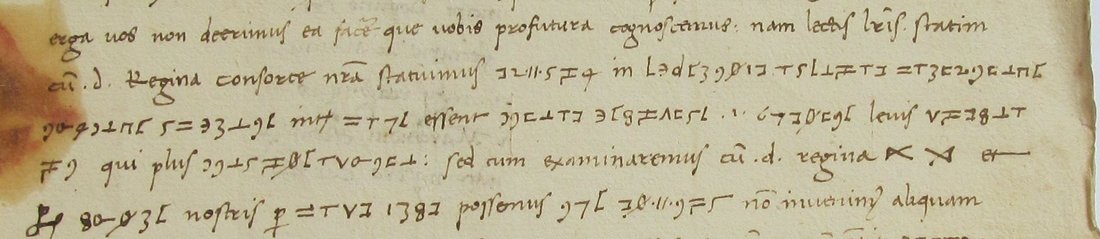
The working key below comes from lining up each run with the printed text and keeping only values that recur in at least two words:
| letter | signs | letter | signs |
|---|---|---|---|
| a | 8, V | n | ⊏, ϲ |
| b | d | o | 7, Π, Λ, + |
| c | Ͻ (reversed C) | p | ⊔ |
| d | 2, ᑐ | q | = |
| e | 5, 4, 9, ς | r | Ŧ |
| f | ϵ (once) | s | L, Γ, S |
| g | ᒪ (hooked L) | t | ⊥, + |
| h | 6 | u / v | ⊤, ∃ |
| i | 2, 3, ∅ | tt | ·ıı· |
| l | σ, ᒧ | ||
| m | ⊐, ᑐ | ||
Name signs: a looped ampersand for Veneti (and Venetorum), a crossed square for regi Ferdinando, and a q with a looped tail for Rex Hungarie, the King referring to himself. Some signs seem to serve two letters (+ for o, t and e; 2 for i and d). With about 330 signs of cipher in all, the sample is too short to tell whether these are true homophones shared between letters or two similar shapes that a transcription from the image cannot separate.
03 The decrypted text
Clear text in roman, the cipher runs in brackets, corrections to the printed text in bold. The first lines of the letter, all in clear, are as Fraknói prints them.
… statim cum domina regina consorte nostra statuimus [mittere] in [subsidium] [vestrum] [quingentos] [equites], inter [quos] essent [centum] [usarones], idest [homines] levis [armature], qui plus [ceteris] [valent]. Sed cum examinaremus cum domina regina ‹two signs› et [aliis] nostris, per [quam] [viam] possemus [eos] [mittere], non invenimus aliquam [tutam]. …
In crastinum hinc recedet [Mager] [Balas] [capitaneus] [noster] cum [pluribus] [gentibus], iturus in [Croatiam] versus [confinia] [Venetorum], ubi [plures] etiam [congregabit]; et quotienscunque inventa erit [tuta] [transeundi] [via], statim significet [Regi Hungarie] et illic faciet [?] [venient].
Speramus cito nos [res] [nostras] ita [disposituros], ut meliori postea modo [vos] [iuvare] possemus. [Rex Hungarie] [scripsit] [regi Ferdinando] quomodo possent [diverti] [Veneti] et [confundere] [eos] et cum paucis [pecuniis].
Dat. Posonii, primo Junii 1482.
“… at once, with our lady the queen, we decided to send five hundred horse to your aid, among them a hundred hussars, that is light horse, who are worth more than the rest. But when we considered with the queen and our other counsellors by what road we could send them, we found none safe. … Tomorrow our captain Balázs Magyar leaves here with a large force for Croatia, towards the Venetian border, where he will gather more; and whenever a safe way through is found, he is to tell the King of Hungary at once, and they will come there. We hope soon to have our own affairs so arranged that afterwards we can help you better. The King of Hungary has written to King Ferdinand how the Venetians might be drawn off and thrown into confusion, and at small cost.”
04 What the printed text got wrong
- “qui plus ceteris valoris (így)”. The run is v-a-l-e-n-t. The hussars are the ones “who are worth more than the others”. The editor printed a non-word and marked it sic.
- “cum pluribus servis”. The run is g-e-n-t-i-b-u-s, with the same hooked-L g as congregabit. Balázs leaves with troops, which suits a captain sent to gather more on the Venetian border.
- “Speramus nos eos nostris contra dispositiones ut meliori postea modo possemus (így)”. The edition skipped the clear word cito, took r-e-s for eos and n-o-s-t-r-a-s for nostris, turned d-i-s-p-o-s-i-t-u-r-o-s into “contra dispositiones”, and left out v-o-s i-u-v-a-r-e, the verb the sentence needs. Decrypted from the signs, the sentence is sound Latin: Speramus cito nos res nostras ita disposituros, ut meliori postea modo vos iuvare possemus.
- The “regest”. Fraknói ends the letter with the date and gives, as a regest written “at the end of the letter in a contemporary hand”, the words Rex Hungarie scripsit regi Ferdinando, quomodo possent diverti Veneti et confundere eos et cum paucis pecuniis. That is the letter’s own last sentence, in the same hand, before the date, with the three name signs and s-c-r-i-p-s-i-t, d-i-v-e-r-t-i, c-o-n-f-u-n-d-e-r-e, e-o-s and p-e-c-u-n-i-i-s in cipher. His words are right, but he placed the sentence outside the letter. The verso carries only the address and the seal, so if a separate decipherment exists it is on leaf 2a, which DECODE did not image.
05 What remains uncertain
- statim significet [Regi Hungarie] et illic faciet [?] [venient]. The printed text has convenire. The run after faciet is the looped-q name sign followed by v-e-n-i-e-n-t (grade C). The same sign may stand here for quod or for the syllable con-. The clear verb before the first q-sign looks more like sufficietur than significet on the image (grade M). The sense is not in doubt.
- Two name signs after cum domina regina are not in the printed text and are not deciphered (grade I).
- Signs that serve two letters (+, 2) and the single f are grade C. The rest of the key is grade H, confirmed on two or more words.
- The two lines Fraknói gives about the letter to King Ferdinand (“Scripsimus regi Ferdinando, ut rex ipse vel dux Ferrarie possent aliquem excogitare modum…”) were checked only where they are in cipher (modum, tuto, mitteremus). His “libenter mitteremus (így)” stands as printed: the run does spell m-i-tt-e-r-e-m-u-s.
Full texts
The transcription and the decryption of every document on this page, so that the reading can be used and checked. Short files are shown here; all are in the repository.
R1156, Pozsony, 1 June 1482
King Matthias Corvinus to Duke Ercole I of Ferrara, his brother-in-law, five weeks after Venice opened the War of Ferrara: he and Queen Beatrix had resolved to send 500 horse, among them 100 hussars, but found no safe road; his captain Balázs Magyar goes to Croatia towards the Venetian border to gather troops. Printed by Fraknói (1895, no. 131); re-read here from the glyphs, correcting four passages of the print.
Decryption
# R1156, Matthias Corvinus to Ercole I d'Este, Pozsony, 1 June 1482: the letter with its cipher runs read from the glyphs

Copied verbatim from NOTES.md, 22 Oct 2026. Cipher runs in [brackets]; bold = passages corrected against Fraknói 1895 no. 131.

## The cipher runs, read

Line by line, clear text in roman, cipher runs in [brackets] with the reading:

1. … statim cum domina regina consorte nostra statuimus [mittere] in [subsidium] [vestrum] [quingentos]
2. [equites] inter [quos] essent [centum] [usarones], idest [homines] levis [armatu-]
3. [-re], qui plus [ceteris] **[valent]**. Sed cum examinaremus cum domina regina ⟨2 signs⟩ et
4. [aliis] nostris per [quam] [viam] possemus [eos] [mittere], non invenimus aliquam [tutam] …
5. … Scripsimus … [modum] quo [tuto] modo possent. Libenter [mitteremus] …
6. In crastinum hinc recedet [Mager] [Balas] [capitaneus] [noster] cum **[pluribus] [gentibus]**, iturus in
   [Croatiam] versus [confinia] [⅋ = Venetorum], ubi [plures] etiam [congregabit]; et quotienscunque inventa erit
   [tuta] [transeundi] [via], statim significet(ur?) [ꝗ] et illic faciet [ꝗ] **[venient]**.
7. **Speramus cito nos [res] [nostras] ita [disposituros], ut meliori postea modo [vos] [iuvare] possemus.**
8. **[ꝗ = Rex Hungarie] [scripsit] [⊠ = regi Ferdinando] quo(modo) possent [diverti] [⅋ = Veneti] et [confundere]
   [eos] et cum paucis [pecuniis].** Dat. Posonii, p° Junii 1482.

Uncertain reading (copied verbatim from NOTES.md):

Uncertain: "illic faciet ꝗ venient". The printed text has "convenire". The glyphs read ꝗ + v-e-n-i-e-n-t, so ꝗ may
here stand for *quod* or *con-*. The clear verb before the first ꝗ looks like *sufficietur*, which the printed text
gives as *significet*. Neither point changes the sense: Balázs is to tell the king as soon as a safe road is found,
and the troops are to meet there.
Decryption
Fraknói Vilmos, Mátyás király levelei. Külügyi osztály II (Budapest 1895), no. 131, pp. 232-233: the printed text of the letter (from the Modena original), copied verbatim from the OCR in fraknoi_v2.txt (MEK 07105), 22 Oct 2026, with the OCR's one-word lines joined by spaces. OCR errors are left as they are.

131. 1482. június 1. Estei Hercules ferrarai Jierczegnelc. A velenczei köztársaság ellen segélyhadat ajánl. Mathias Dei gratia Hungarie, Bohemie etc. rex, illustrissimo principi, dominó Herculi Ferrarié ac Mutine duci etc. sálutem et prosperos ad vota successus. Ex litteris illustrissime domine ducisse, consortis vestre, sororis et cognate nostre carissime ^), intelleximus statum rerum vestrarum et apparaturii Venetorum contra vos, quod libenter non audivimus, quod serenissimus dominus rex noster et páter noster carissimus ^) et alii domini et confederati vestri sint vobis auxiliaturi, et quod iam de facto ceperint ; nos quoque jíro singulari benivolentia ei'ga vos non deerimus ea facere que vobis profutura cognoscemus. Nam lectis ^) Eleonóra ferrarai berezegné, Beatrix magyar királyné nvére. -) Ferdinánd nápolyi király. @@PAGE 308 1482. JÚNIUS 10. 233 litteris statim cum domina regina consorte nostra statuimus mittere in subsidium vestrum quingentos equites, inter quos essent centum usarones, idest liomines levis armature, qui plus ceteris valoris (így). Sed cum examinaremus cum domina regina et aliis nostris, per quam viam possemus, eos mittere, non invenimus aliquam tutam. ludicio nostro essent iidem transituri per lóca imperatoris, cum quo in presentia conflictamus; sed de hoc non multum curaremus, qualiter inveniremus modum transeundi tutum ; sed cum habeant transitum per terras Venetorum, veremur, quod nuUo modo transire possint. Scripsimus regi Ferdinando, ut rex ipse vei dux Ferrarié (igy) possent aliquem exco- gitare modum, quo tuto modo possent, libenter mittere- mus (igy). Non dubitamus, quod fideliter et bene servirent. In crastinum hinc récédet Mager Balas capitaneus noster cum pluribus servis, iturus in Croaciam versus confinia Venetorum, ubi plures etiam congregabit, et quotiescunque inventa érit tuta transeundi via, statim significet regi Hun- garie et illic faciet convenire. Speramus nos eos nostris contra dispositiones ut meliori postea modo possemus (így). Külczim : lUustrissimo principi, dominó Herculí Ferrarié ac Mutine duci, Regii Rodigiique comiti, marchioni Estensi etc, cognato nostro cariasimo. A levél végén egykorú kézzel irt regesta : Rex Hungarie scripsit ' regi Ferdinando, quomodo possent diverti Veneti et confundere eos et cum paucis pecuniis. Dátum Posonii, prima lunii 1482. (Eredetije, mely részben titkos jelekkel van írva, a modenai állami levéltárban. — Diplomatiai Emlékek. III. 14.)
Reading
# R1156, Matthias Corvinus to Ercole I d'Este, Pozsony, 1 June 1482: reading

The whole letter, written out 23 Oct 2026 (translation wave v7) from the two decryption files of the entry: the clear
text as printed by Fraknói 1895 no. 131 (`texts/R1156_fraknoi1895.txt`, from the Modena original; the Hungarian OCR's
stray accents on Latin vowels are dropped, its broken words joined and its letter misreadings set right:
apparaturii apparatum, ludicio Iudicio, nuUo nullo, vei vel, ei'ga erga, jíro pro; its notes and editorial "(így)" left out), and
the cipher runs as read here from the glyphs (`texts/R1156_decryption.md`), set in ⟨ ⟩, which correct the print in
four places (valent, pluribus gentibus, venient, the closing sentence). Code signs as there: `[⅋ = Venetorum]`,
`[ꝗ = Rex Hungarie]`, `[⊠ = regi Ferdinando]`; `[ꝗ]` where its value is uncertain (*quod* or *con-*); `[2 signs]`
unread. The last sentence (the regest) is in cipher on the letter; Fraknói prints it as a contemporary note at its
foot. Latin.

## Reading

Mathias Dei gratia Hungarie, Bohemie etc. rex, illustrissimo principi, domino Herculi Ferrarie ac Mutine duci etc.
salutem et prosperos ad vota successus. Ex litteris illustrissime domine ducisse, consortis vestre, sororis et cognate
nostre carissime, intelleximus statum rerum vestrarum et apparatum Venetorum contra vos, quod libenter non audivimus;
quod serenissimus dominus rex noster et pater noster carissimus et alii domini et confederati vestri sint vobis
auxiliaturi, et quod iam de facto ceperint; nos quoque pro singulari benivolentia erga vos non deerimus ea facere que
vobis profutura cognoscemus. Nam lectis litteris statim cum domina regina consorte nostra statuimus ⟨mittere in
subsidium vestrum quingentos equites, inter quos essent centum usarones, idest homines⟩ levis ⟨armature, qui plus
ceteris valent⟩. Sed cum examinaremus cum domina regina [2 signs] et ⟨aliis⟩ nostris per ⟨quam viam possemus eos
mittere⟩, non invenimus aliquam ⟨tutam⟩. Iudicio nostro essent iidem transituri per loca imperatoris, cum quo in
presentia conflictamus; sed de hoc non multum curaremus, qualiter inveniremus modum transeundi tutum; sed cum habeant
transitum per terras Venetorum, veremur quod nullo modo transire possint. Scripsimus regi Ferdinando, ut rex ipse vel
dux Ferrarie possent aliquem excogitare ⟨modum⟩ quo ⟨tuto⟩ modo possent; libenter ⟨mitteremus⟩. Non dubitamus quod
fideliter et bene servirent. In crastinum hinc recedet ⟨Mager Balas capitaneus noster⟩ cum ⟨pluribus gentibus⟩,
iturus in ⟨Croatiam⟩ versus ⟨confinia [⅋ = Venetorum]⟩, ubi ⟨plures⟩ etiam ⟨congregabit⟩; et quotienscunque inventa
erit ⟨tuta transeundi via⟩, statim significet [ꝗ] et illic faciet [ꝗ] ⟨venient⟩. Speramus cito nos ⟨res nostras ita
disposituros⟩, ut meliori postea modo ⟨vos iuvare⟩ possemus.

⟨[ꝗ = Rex Hungarie] scripsit [⊠ = regi Ferdinando]⟩ quomodo possent ⟨diverti [⅋ = Veneti] et confundere eos⟩ et cum
paucis pecuniis. Datum Posonii, primo Junii 1482.
Translation
# R1156, Matthias Corvinus to Ercole I d'Este, Pozsony, 1 June 1482: English translation

Translation (Claude Opus 5.5, 23 Oct 2026) of `texts/R1156_reading.md`: the clear letter (Fraknói's print) with the
cipher runs read from the glyphs in ⟨ ⟩. Same marks: `[2 signs]` unread, `[ꝗ]` a code sign of uncertain value (here
rendered by the sense of the sentence, kept), code words given in English. Latin.

## Translation

Matthias, by the grace of God King of Hungary, Bohemia etc., to the most illustrious prince, Lord Hercules, Duke of
Ferrara and Modena etc., greeting and success according to his wishes. From the letters of the most illustrious Lady
Duchess, your consort, our dearest sister and sister-in-law, we have learned the state of your affairs and the
preparations of the Venetians against you, which we did not hear gladly; [and] that the most serene lord, our king
and our dearest father, and your other lords and confederates are to help you, and that they have already in fact
begun; we too, out of our singular goodwill towards you, shall not fail to do those things which we know will be of
use to you. For, having read the letters, we at once resolved with the Lady Queen our consort ⟨to send to your aid
five hundred horse, among whom there would be a hundred hussars, that is, men⟩ of light ⟨armour, who are worth more
than the others⟩. But when we examined with the Lady Queen [2 signs] and ⟨others⟩ of ours by ⟨what road we could send
them⟩, we found none ⟨safe⟩. In our judgement they would have to pass through the lands of the Emperor, with whom we
are at present in conflict; but of this we would not care much, provided we found a safe way of passing; but since
they have their passage through the lands of the Venetians, we fear that they could in no way pass. We have written
to King Ferdinand that the King himself or the Duke of Ferrara might devise some ⟨way⟩ by which they could [come]
⟨safely⟩; we would gladly ⟨send them⟩. We do not doubt that they would serve faithfully and well. Tomorrow ⟨Magyar
Balázs, our captain⟩, will leave here with ⟨many troops⟩, to go into ⟨Croatia⟩ towards the ⟨borders of [the
Venetians]⟩, where he will also ⟨gather⟩ ⟨more⟩; and as soon as a ⟨safe road for passing⟩ is found, he is to make it
known at once [ꝗ], and will make [ꝗ] ⟨them come⟩ there. We hope soon to ⟨arrange our affairs so⟩ that afterwards we
may be able ⟨to help you⟩ in a better manner.

⟨[The King of Hungary] has written [to King Ferdinand]⟩ how ⟨[the Venetians] might be diverted and confounded⟩, and
with little money. Given at Pozsony, the first of June 1482.
Key: key.md
06 Sources
- Modena, Archivio di Stato, Cancelleria ducale, Carteggio principi esteri 1622, b. 1/3, nos. 2, 2a. Images: DECODE R1156 (login; images I5815 recto, I5816 verso).
- Fraknói Vilmos, Mátyás király levelei. Külügyi osztály, vol. II, 1480–1490 (Budapest: MTA, 1895), no. 131, pp. 232–233. MEK 07105.
- Nagy Iván and Nyáry Albert (eds.), Magyar diplomácziai emlékek Mátyás király korából, vol. III (Budapest, 1877), no. 14, the first printing, cited by Fraknói.
- Related letters of the same Ferrara–Hungary correspondence (Sadoleto 1482–83, Valentini 1486, Costabili 1489–93) are in ASMo, Ambasciatori, Ungheria, and on Vestigia.
Notes, the DECODE record and a text copy of the edition are in the repository folder targets/matthias1482/. The images stay out of the repository at the archive’s request.