
At a glanceKnown key applied · none (key obtained, text not read)
- The letters
- Four letters sent to Bernardin Bochetel, bishop of Rennes and Charles IX’s ambassador to the Emperor: Catherine de Médicis (31 July 1563), a 1564 order on precedence, Bourdin (December 1562), and a note to be deciphered by Rennes himself and burned.
- Where
- BnF français 3181 f. 55; Colbert 390 pp. 357–358 and p. 139; Colbert 392 p. 231. None had a contemporary decipherment; La Ferrière (1885) printed f. 55 with the thirteen cipher lines as an empty bracket.
- The cipher
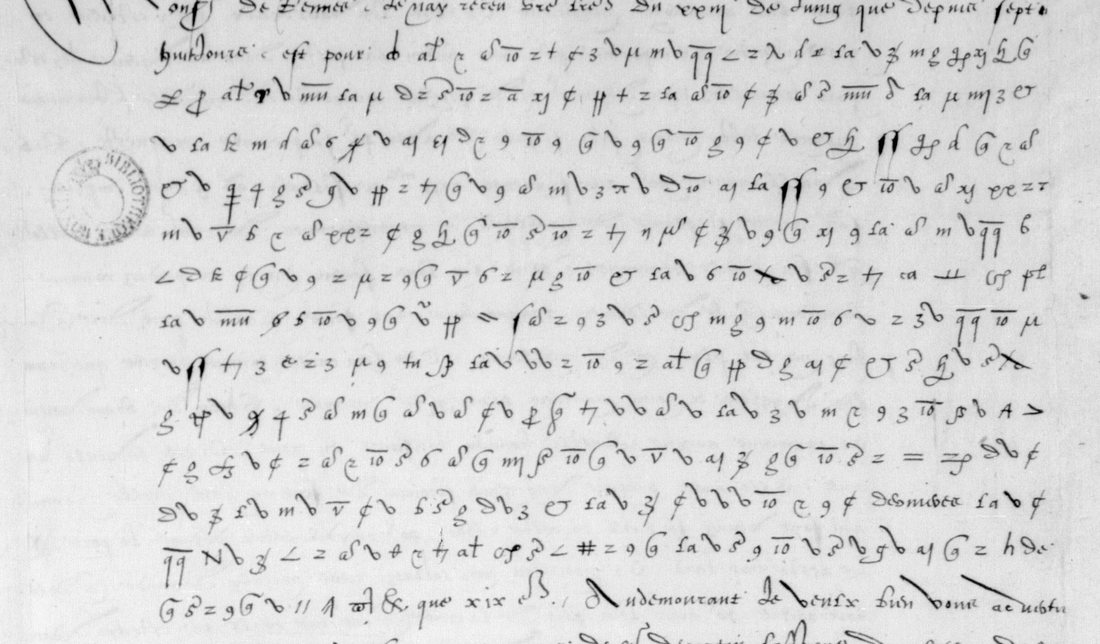
- The Bishop of Rennes’ cipher, reconstructed by S. Tomokiyo: homophonic, with about thirty word-signs and nulls that include clear-looking French words.
- How it was read
- The key was known; the work was transcription. Each secretary’s sign forms were fixed on glossed letters in the same hand, then a language model chose among candidate values. 79% of the 2,308 signs measure as sense, 15% probable.
- What it says
- f. 55 concerns the Council of Trent and the Habsburg marriage; the 1564 letter orders Rennes to drop the precedence quarrel; Bourdin reports the secret marriage overture was « known at once in Spain ».
- Still open
- Signs that occur in no glossed passage: about 9% of f. 55, 1% of pp. 357–358, 20% of p. 231 and 37% of the faint p. 139.
- Credit
- S. Tomokiyo reconstructed the cipher.
01The letter and its ciphered passage
Bochetel had written on 18 June. Catherine, at the camp before Le Havre while the English garrison embarked, replied on the last day of July. La Ferrière prints her text from this very folio (« Orig. Bibl. nat. fonds français, n° 3181, f° 55 r° et v° »), and it runs:
Monsieur de Rennes, je n’ay receu vostre lettre du xviiie de juing que depuis sept ou huit jours, c’est pour [ ]
— footnote: Partie chiffrée.Au demeurant, je veulx bien vous advertir que, après avoir essayé tous moyens de faire départir la royne d’Angleterre de la place du Havre-de-Grâce qu’elle avoit occupée durant ces troubles…
That bracket is the thirteen lines. Everything after it (the siege, the plague among the English, the artillery and ships left behind, the hope that the French and the English « n’auront plus que faire ensemble ») Catherine sent in clear.
02The cipher and its clear-word nulls
This is the Bishop of Rennes’ cipher, in use between 1561 and 1564 for the embassy to the Emperor. It is homophonic: two to eight invented signs for each letter, an overbar to tell close shapes apart, about thirty word-signs (que, vous, nous, vostre, qui, mais, par, la, le, lettre, bien, faire, faict, and signs of their own for l’Empereur and Roy de Boheme), and a set of nulls.
Besides meaningless squiggles, the key allows ordinary French words written out in clear as nulls: que, est, pour, plus, xix, vre, do, fo. They are scattered through the cipher so that a reader glancing at the page sees what looks like ordinary writing interrupted by symbols, and a codebreaker who takes them for cleartext is misled. On f. 55 the last line ends with a run of five of them before the clear text resumes.
03A crib from a glossed letter in the same hand
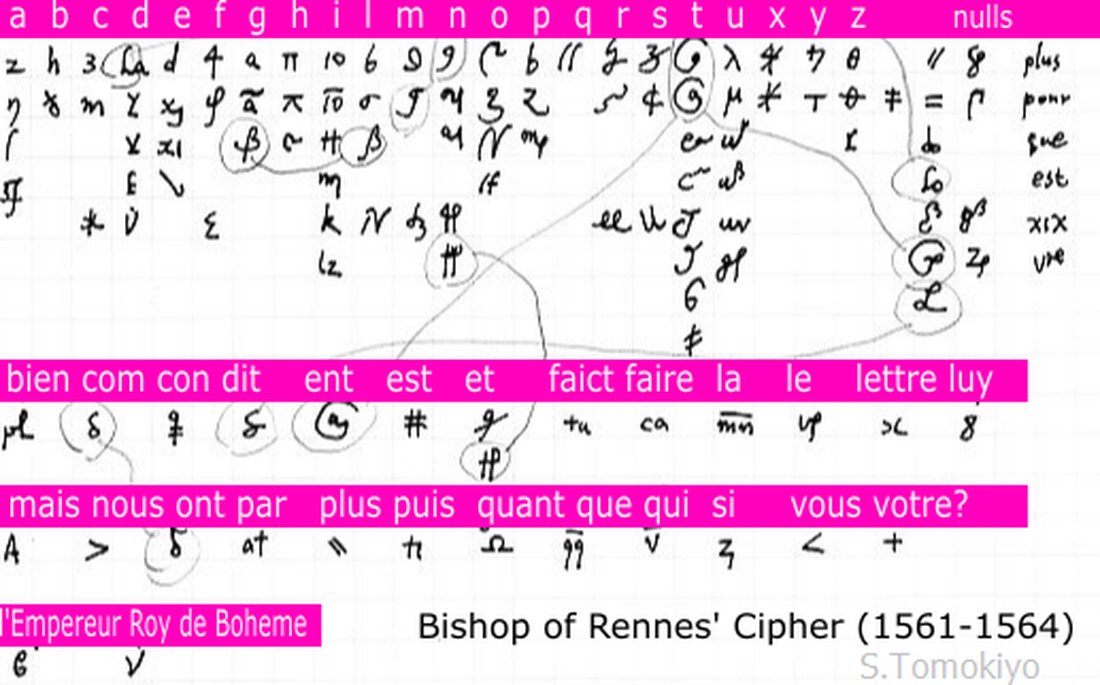
A key drawn as a table of shapes does not settle how a given scribe forms each sign. Several of this scribe’s forms are near-identical (the s-shapes that serve r and s, the c-shapes that serve o, h and t, the loops that serve e and l), and the table does not say which is which in his hand. This was settled by f. 57, the letter of 13 August 1563, thirty-eight views on in the same volume. Its ciphered passage carries a decipherment written down the left margin, phrase by phrase, line for line.
Aligning the margin with the cipher gives an exact crib. The first ciphered line of f. 57 glosses as que les princes, and the signs are q̄q̄ · l · e · s · p · r · i · n · c · e · s: seven signs for « princes », which fix p, r, i, n, c, e and s. The margin runs on: moien de se passer par Ferrare les enfans dudict Roy des Romains allans en Espaigne, pour eviter l’incomodité de la mer et le dangier que les temps aigres peult porter a ceste occasion… Every phrase of it is another handful of confirmed shapes.
04The decipherment of f. 55
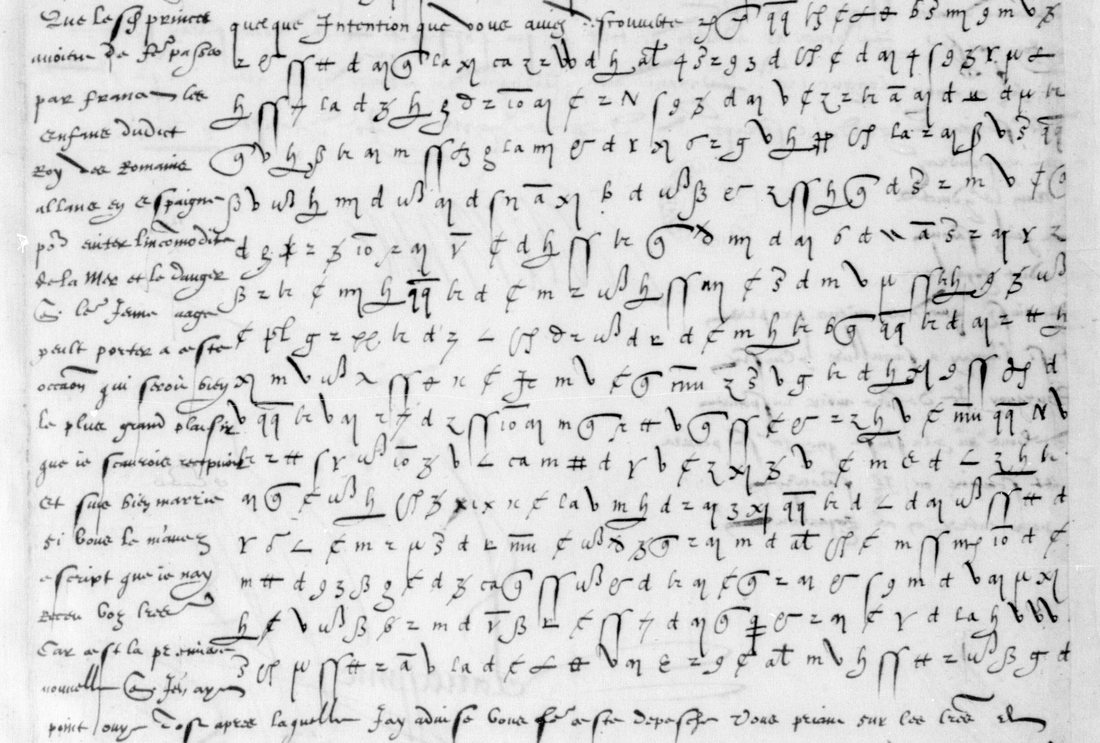
The first decryption, made from a single transcription and a direct table lookup, secured about three fifths of the passage. A second transcription from native-resolution crops, decrypted with a language model (section 09), and a full alignment of the margin decipherments of f. 57 and f. 58 (same scribe, same cipher) now put about 91% of the signs into French: some 80% secure and 11% probable. The glosses settled the looped d-like sign that had been taken as e, s or u: in all of its twenty-odd glossed occurrences it is e. They also gave ʃʃ = le, an underlined dagger = con, an underlined u = pour. One correction to the record: the f. 57 margin reads « par France », not « par Ferrare ».
[c’est pour] … vous avez descouvert. … vous par … la [matière] du mariage, et vostre advis sur la conduicte d’iceulx en … mon intention se trouve toute conforme, et ayt tenu ce chemin, dont … ce qui pourra sortir. J’ay aussi entendu ce que l[e …] vous mist en avant, qui l’avoit délibéré faire pour le bien de la Chrestienté et avancer le concile, à ce que je veoy chacun faict … par[t], et monstrer b[onne et] fructueuse … de ce concile. Mais nous sommes à voir l’utilité qui en sortira, mesmes ce qui se promect des sessions de Decembre, desquelz vous avez oy parler, vous estant dernierement à … Trante.
In English: … you have discovered … about the marriage, and your opinion on how to handle them … my intention is entirely in accord, and [I hope] he has kept to this course … what may come of it. I have also heard what [someone] put to you, who had resolved to do it for the good of Christendom and to advance the council, so that, as I see, everyone does his part and shows a good and fruitful [outcome] of this council. But we have yet to see what good will come of it, and what is promised from the December sessions, of which you have heard, having lately been at … Trent.

05Why it was in cipher
The subject is the Council of Trent and the marriage negotiation with the house of Austria: the two things Catherine had reason not to send in clear through the empire in the summer of 1563, and the two things she left out of the open part of the letter. The Havre had just fallen and Charles IX’s majority was about to be declared: those were things to be published. What went under the cipher was the ecclesiastical and dynastic bargaining the crown was conducting at Trent and Vienna at the same moment. The council closed on 4 December 1563, the « sessions de Decembre » of the last line.
06Colbert 390 pp. 357–358: leaving the precedence quarrel (1564)
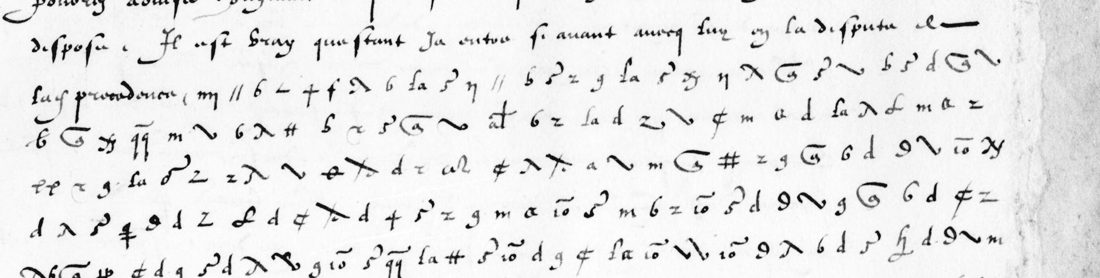
An undated letter to Rennes in Cinq cents Colbert 390, pp. 357–358 (views 180–181), signed by Catherine and countersigned by de l’Aubespine. The upper third of p. 357 is clear: the secretary Charron has arrived, and with him the Emperor’s reply on the dispute over la précédence. Fifteen lines of cipher follow, and ten more at the head of p. 358 before the clear « Le Sr de Lanssac n’est point encore arrivé ». Tomokiyo lists the page as having no contemporary decipherment, and La Ferrière does not print it. The printed letters on the same quarrel (27 June and 18 August 1564, the latter ordering Rennes to attend Ferdinand I’s obsequies and « n’y rien cedder ») place it in the late summer of 1564. About 99% of its 753 signs are decrypted (88% secure, 11% probable):
il fauldra prandre autre pretexte que celuy porté par la depesche du s[ieu]r Charon, dont vous avez beau subject, estant l’ennuieux, ce me plest de franchir clairement les a[utres] …, et s’en revenir, que de riens dissimuler, [re]mectant l’amendement de cela au temps et aux ocasions qui se pourront offrir cy après, et sans avoir [à] opérer l’effect de[s] deffiés, que ny autres d’en aucun maniement ny ouverte negociation de vostre part. Bien pourrez, ainsi que porte ma dernière depesche, laisser là quelque secretaire ou aucun des vostres, advisés soubz couleur d’aucuns voz affaires particuliers, de deniers qu’avez envoyé querir ou autres choses que vous attendez, qui puisse faire sçavoir toutes nouvelles de ce qui s’o[ffr]ira, principalement de ce qui se peult esperer de l’[ajour]nement de la diète et de ce qui se preparera à y decider, de quoy vous pourrez paraventure [avoir] toute lumière avant vostre dit partement; que je remects à vous de disposer, à propos, mouvement, avancement ou retardation d’iceluy ne face prejudice à la reputation du Roy ny à l’amitié que je desire estre conservée entre ces deux princes.
The order of 18 August is reversed. Rennes is to find another pretext than the one Charron carried and withdraw without conceding anything: no open negotiation, the remedy left to time. He is to leave a secretary or one of his own people at the imperial court under cover of private business (money he has sent for, things he is waiting on) to report all news, above all on the Diet; and the timing of his own departure is left to him, so long as neither haste nor delay harms the King’s reputation or the friendship between the two princes. Not decrypted: six signs on p. 358 before toute lumière ([avoir] is restored from the sense), and whether the Diet’s word is ajournement or gouvernement.
07Colbert 392 p. 231: Bourdin on the secret overture (December 1562)
A letter of about twenty-five cipher lines under the salutation « Monsieur », in Cinq cents Colbert 392, p. 231 (view 112). Its clear ending is on the next page (view 113): « De Paris le …e jour de decembre 1562 », signed by the secretary of state Jacques Bourdin. The letter Bourdin encloses is Catherine’s to Rennes of 15 December 1562 (La Ferrière I, 448–451), whose marriage paragraphs La Ferrière printed from the decipherment joined to it: the overture for one of the Emperor’s daughters made through the archbishop of Trier. The cipher is in a third secretary’s hand, with its own forms (a tailed 2 for p, a looped ʒ for r, + for f, a double dagger for et, ‖ for the word plus). About 85% is decrypted:
Monsieur, je vous envoye la lettre que [Madame] la Royne escript [à vous] sur le faict dont vous m’avez donné advis. Dernierement pour advise[r] que l’en ne luy parle de la secrete, qu’elle a en vous, en moindres paroles et termes que de luy dire, ne l’asseurer, qu’elle la trouve telle que de sa propre personne; de sorte que si le[dit] … Roy n’y est retenu en ce que l’on desire d’aultre occasion que celle-là, il n’y [a] plus … devera plus faire de difficulté. Au demeurant [je] vous advise que ce que je vous mande, que … sçavoit incontinant en Espaigne. Tous les pro… que [luy?] teniez secret … ne fut pas s[a]ns occasion, [et] nous eusmes advis que [s]a femme nous [a]voit [fait?] triumphe de la premiere ouverture que vous luy feistes de [ce] mariage. Je croy bien que de nous il y aura à peu changer d’advis [et] conseil, me semble, que … en donne assez, com[me] en grande occasion. Dieu veuille que toutes [choses] se conduise[nt] et succede[nt] au commun desir et contentement de [leurs] Majestés, et avec un tel et si ferme establissement d’amitié et alliance que … nous tous en ressentions, tant d’une part que d’aultre, le bien et l’utilité, à l’honneur de Dieu et [au] repos de la chrestienté.
The secret of the overture has leaked: what Rennes reports was « known at once in Spain », and « his wife » (most likely Maria, Queen of the Romans and Philip II’s sister) made a triumph of the first opening Rennes made of the marriage. Bourdin’s own clear continuation on p. 232 (« faire changer d’opinion ») echoes the cipher’s « changer d’advis et conseil ».
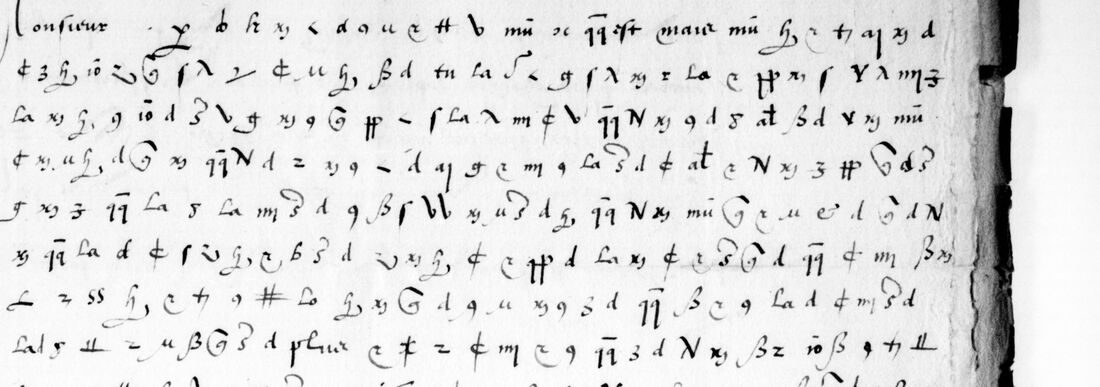
08Colbert 390 p. 139: « Deschiffrez vous mesmes »
Decoded, not read (reading audit, 22 October 2026): lines 1–7 build sentences, lines 8–14 are mostly unread runs and code words. A small sheet bound as p. 139 of Cinq cents Colbert 390 (view 70), fourteen faint lines of cipher under three clear-looking words, and beneath them a clear instruction: « Deschiffrez vous mesmes ceste cy et ne vous en fiez en clerc ny secretaire que vous ayez, et la mettez au feu si tost que vous l’aurez veue. » Tomokiyo noted that it uses nulls not only at the ends but between words and inside them. The facing p. 138, in the same secretary’s hand, carries a ciphered paragraph with its decipherment in the margin (« Et pource qu’il m’a semblé que je ne sçaurois trouver ung plus digne et suffisant personnage pour faire parler à mons[ieu]r mon [beau] frere du mariage… »), which gave this hand’s forms; other glossed pages in the volume (pp. 189/199, 221–231) added more. Two first attempts that let the language model choose nulls freely produced fluent nonsense and were discarded. A fresh transcription from contrast-enhanced crops gave about 37% secure and 28% probable decryption. The partial reading of 23 October 2026 (c390_p139_reading.md), in the secretary’s spelling, with [?word] for a word the signs carry only in part:
Que ie vous tienne pour trop aduise et affectione [?et] loyal [?seruiteur] du roy mon fils pour vous en dormir bien en chose qui est […] et en son seruice, [?ie] ne laisseray […] vous dire qu’il [?fault] bien que vous [ayez] les yeux [?ouuerts] pour obseruer come totes [?choses] passeront en ce [?voyaige] de mon cousin […] [?que les] […] ses actions, encores que ie n’en visse aucunement a doubter, afin [?de me] [?donner] aduis [?et] tout ce que vous congnoistre le meriter […] [?l’envoyez] […] beau frere [?se separe] de vostre […] […] bien.
The three [CODE] places are signs of the form ẟ with a small letter above it. The full decipherment of p. 117 on pp. 120–121 shows this form is a code word: ẟ with a raised a stands for Allemaigne, and on p. 347 ∂ with a raised l stands for Metz. The one before « ses actions » names a person Rennes is to watch (the Emperor fits), and the one after « des » is a plural. Neither occurs in any decipherment found, so both stay undecrypted.
Catherine (the « roy mon fils » fixes the writer) tells Rennes she holds him too wise and loyal a servant to need telling, but that he must keep his eyes open and watch the doings of « mon cousin » and send her everything he learns. The decrypted text does not name the cousin. The sheet sits among the copies of her 1562 letters to Condé that she sent to Rennes; the Cardinal of Lorraine, whom she calls « mon cousin » in the letters of 1563, is the other candidate. A control re-run with the values from the glossed pages withdrew four earlier decryptions of this sheet (among them passeront and fault) and added four.
Two re-readings, 23 October 2026. All 184 views of Colbert 390 were contact-sheeted: there is no clear copy or decipherment of this note. The volume does hold an unused key source, Catherine’s letter of 15 December 1562 (pp. 115–127), whose cipher (pp. 117–118, 125–126) has its cursive decipherment on pp. 119–121, printed by La Ferrière (I, 449–451). Pages 117–118 were transcribed sign by sign (949 signs) and aligned with the print: ∂ = m, ẟ = r, ā = g, ℒ = dict, ∂ with a raised a = Allemaigne, and a sign for le roy des Romains. With them fils is carried, and line 8 can be proposed as “passeront en ce [?voyaige] de mon cousin”, the Cardinal of Lorraine’s journey. But none of this sheet’s open signs and code words occurs in the 1562 letter, so lines 8–14 stay mostly unread and the note stays decoded, not read: the blocker is now that no key material for those signs is known.
09Method
Images by IIIF region request from Gallica at native resolution (8720 px for français 3181, about 6300–7600 px for the Colbert volumes); in français 3181 the folio number is the Gallica view plus nineteen. Each cipher line was transcribed glyph by glyph from crops at native or double resolution, with contrast enhancement for the faint p. 139. Every sign was then given its candidate values (usually one; two where the hand leaves a homophone ambiguous; a null option only for known null shapes), and for each line a French n-gram language model of sixteenth-century despatches chose the most probable combination of those candidates (targets/rennes1563/lattice.py, the shared lang/ model fr-1530-despatches). Letting the model choose among many nulls produced fluent nonsense on p. 139; with the candidates held narrow it cannot invent text.
The calibration also used every full decipherment found in Colbert 390 (p. 317 against p. 313, p. 117 against pp. 120–121, p. 189 against the slip on p. 199) and the margin-glossed letters of 1561 (pp. 49–69) and 1564 (pp. 339–349). The sister volumes Colbert 391, 394 and 395 contain no deciphered passage in this cipher. The key is Tomokiyo’s, but each of the four letters is in a different secretary’s hand, and the hands form the same signs differently. The values for each hand were fixed on letters in that hand carrying contemporary decipherments: f. 57 and f. 58 for f. 55; p. 138 and the glossed pages 189/199 and 221–231 of Colbert 390 for p. 139 and the Bourdin letter. The glossed pages 241–305 of Colbert 390 are in the hand of français 3181 f. 52, not of f. 55, and added little. La Ferrière’s two volumes were searched for parallels; none of the four passages is printed there.
10What remains uncertain
- Re-measured 5 October 2026. The earlier 87% was a hand estimate of secure and probable signs.
measure.pynow aligns each letter’s word-by-word reading to its tokens through their attested values and checks each word against a sixteenth-century French vocabulary: fr. 3181 f. 55 0.80, Colbert 390 p. 357 0.82, p. 358 0.76, Colbert 392 p. 231 0.83, Colbert 390 p. 139 0.70; all 0.79 sense, 0.15 probable, 0.06 unread. Re-reading the signs on fresh native crops moved p. 139 from 0.53 and p. 231 from 0.73. Every view of Colbert 391–396 and fr. 3180, 3182 was contact-sheeted: no further gloss or key. The open signs occur in no glossed passage of their hand. - f. 55, about 9% of the signs: the opening, two signs on line 2, one on line 3, the runs « 10 ᑲ ɗ xy ee z r » (line 4), « ß La ᑲ ᑲ z 10 9 z » (line 8) and « ‡ G̃ ꜧ ᑲ ᑲ ɗ ᑲ ᑲ » (line 9), one sign on line 11 and two before Trante. None of these signs appears in a glossed passage in this hand.
- Colbert 390 pp. 357–358, about 1%: six signs on p. 358 (line 4–5) and the head of [ajour/gouver]nement. Probable (grade C): estant l’ennuieux, ce me plest (p. 357 line 3–4), vostre part, s’offrira, diète.
- Colbert 392 p. 231, about 20%: short runs in lines 4, 5, 7, 8–9, 11–17 and 22, built on signs (W, ss, tt, πꝫ, t7, a sign read « maue ») that occur once or twice and in no glossed passage found. Madame, à vous and [s]a femme rest on context and the crib (grade C).
- Colbert 390 p. 139, about 37%: most of lines 3–4, 7, 8–10 and 12–14. Faint ink, heavy nulls, and eight signs (ẟ, ẟao, ẟar, ℛ, ℞, aʓ, Ꝫ, ſſʓ) that occur in no glossed passage. The probable readings (27%) each force one value (grade C).
The rest needs more text in the same hands with its decipherment beside it (another glossed letter from the secretary of f. 55, or from the secretary of p. 139), or the decipherments that were once joined to these letters. The key itself is not the limit.
Full texts
The transcription and the decryption of every document on this page, so that the reading can be used and checked. Short files are shown here; all are in the repository.
BnF fr. 3181 f. 55, Catherine de Médicis, 31 July 1563 decoded, not read
The thirteen ciphered lines of Catherine de Médicis's letter to the bishop of Rennes that La Ferrière printed as 'Partie chiffrée': the Council of Trent and the Habsburg marriage ('avancer le concile', 'pour le bien de la Chrestienté', the December sessions).
A mechanical decode with holes in most sentences: shown so that the transcription and the key can be checked and improved, not as a reading.
Transcription
do=- at=par rc=o|l|c dv=u|v 10=i z=a plus=y|vostre ct=s 3=c e=e mu=u m=c e=e qq=que lt=vous z=a lam=v e=e x=z La=d e=e s3=s m=c g=o gS=u|v xy=e H=r G=t
xp=? f4=f|- at=par rc=o|l|c eb=e mn=la La=d mu=u D=m z=a r5=r 10=i z=a at~=g xy=e ct=s|- tt=et|- plus=vostre z=a La=d dv=v 10=i ct=s s3=s dv=u r5=r mn=la del=con|- La=d mu=u m=i 3=c ct~=t
e=e La=d k=i m=c e=e dv=u 6=l x=x e=e an=n e2=-|n D=m rc=o 9=n 10=i 9=n G=t e=e 9=n G=t 10=i g=o 9=n ct=s|e e=e ct~=t H=r|b ss=q gS=u e=e G=t rc=o dv=u
ct~=t e=e dag=- 4=f g=o r5=r gd=?|t tt=et|- z=a y=y G=t e=e 9=n dv=u m=c e=e 3=c pi=h e=e D=m 10=i an=n La=d ss=q|con 9=n ct~=t 10=i e=e dv=u xy=e ee=r z=a r=?
m=c e=e Vb=qui b=p rc=o dv=u ee=r z=a ct=s g=o H=r G=t 10=i r5=r 10=i z=a y=y eta=a mu=u ct=s s3=s|si e=e 9=n G=t xy=e 9=n La=d dv=u m=c e=e qq=que 6=l
lt=vous D=m k=i ct=s G=t e=e 9=n z=a mu=v z=a 9=n G=t Vb=qui 6=l z=a mu=v g=o 10=i ct~=t La=d e=e e=e 6=l 10=i xb=b e=e r5=r z=a y=y ca=faire bar=? sc=lettre pl=bien
La=d e=e mn=la phi=? b=b|p 10=i e=e 9=n G=t ehat=ost|e tt=et|- eq=- S=a dv=v z=a 9=n 3=c e=e r5=? sc=? m=c g=o 9=n m=c 10=i 6=l e=e z=a 3=c e=e qq=que 10=i mu=u
e=e|s ss=q y=y 3=c amp=h z=a 3=c mu=u 9=n tu=faict ss2=l|s La=d e=e e=e z=a 10=i 9=n z=a at=par G=t tt=et|- D=m g=o an=n ct=s ct~=t r5=r H=r e=e r5=r xb=b
g=o f4=n|? e=e xi=e|et 4=f r5=r dv=u m=c G=t dv=u e=e dv=u ct=s e=e dag=? Gt=rt|t y=y e=e e=e dv=u e=e e=e La=d e=e 3=c e=e m=c rc=o 9=n 3=c 10=i ss2=l e=e A=mais gt=nous
ct=s o=o Zm=m e=e ct=s eq=- dv=v rc=o 10=i r5=r 6=l dv=u G=t m=i ss2=l 10=i G=t e=e Vb=qui e=e an=n s3=s g=o Gt=rt 10=i r5=r z=a eq=- Zp=- D=m e=e ct=s
D=m e=e s3=s f=?|m e=e m=c e=e Vb=qui ct=s e=e b=p r5=r g=o D=m e=e 3=c ct~=t La=d e=e s3=s ct=s e=e e=e e=e 10=i rc=o 9=n ct=s "decembre" La=d e=e ct=s
qq=que N=? e=e s3=s lt=vous z=a dv=v e=e th=z rc=o y=y at=par sc=lettre r5=s lt=vous sharp=est z=a 9=n G=t La=d e=e r5=r 9=n 10=i e=e r5=r e=e g=m|o e=e an=n G=t z=a h=? D=?
G=t r5=r z=a 9=n G=t e=e //=- A=- vre=- amp=- que=- xix=- ss2=-
Decryption
# fr. 3181 f.55, aligned to f55_v2.txt. {n} unread, ~{n}word probable (not counted). Clear "decembre" excluded.
par ou i'ay sceu ce que vous avez descouert
{1} ~{2}vous_par {2} ~{1}la du mariages et vostre advis sur la conduict|
|e d'iceulx en mon intention se troue tou|
|te conforme et ~{6}ayt_tenu ce chemin dont {7}
ce qui poura sortir i'ay aussi entendu ce que l|
|vous mist en avant qui l'avoit ~{10}deliberay faire pour le bien
de la ~{7}chrestiente et avancer le concile a ce que ~{2}ie
~{3}veoy chacun faict {8} part et ~{9}monstrer ~{1}b|
~{4}onne_et fructueuse {8} de ce concile mais nous
somes voir l'utilite qui en sortira mes|
|mesme ce qui se promect des ~{8}sessions des|
|queles vous avez oy parler vous estant dernierement a {2}
trante
Decryption
# fr. 3181 f. 55: second transcription pass (v2)

Source: Gallica btv1b9059845t f36, region x 4600–8720, y 600–2800 (full-res). Each line was cropped
in halves at native resolution. The first-pass crop `f55rot.png` covers only lines 1–10; lines 11–13 lie
below y 2058. Tokens with candidate sets are in `f55_v2.txt`. Decode with `PYTHONUTF8=1 python lattice.py f55_v2.txt`.

## Values changed or added since the first pass
- **ℌ = r** (not b). It gives *descouvert* (l.1) and *pourra sortir* (l.5).
- **ɼ (c with a curl) = o**. It gives *mon intention* (l.3), *pourra* (l.5) and *voir* (l.10).
- **ɗ (d with a loop) = u/v**. It gives *advis* and *sur* (l.2), *toute* (l.3–4) and *voir* (l.10).
- **ɕ (c-curl with a tail) = t**. It gives *conduict[e]* (l.2), *te* (l.4) and *monstr…* (l.8).
- **+ = y** in l.1 (*j'ay*). It is *vostre* in l.2 (*vostre advis*), the same double value as in c390 p.357.
- **ß = l**. It gives *concile* (l.9) and *l'utilité* (l.10).
- **G̃ = rt** in *sortira* (l.10).
- **ʮ = et** (probable) in l.2, l.4 and l.8. It may be a null.
- **✗ (crossed) = b** in *deli✗eray* (l.6).
- **ꜧ = y** in *ayt* (l.4) and *j'ay* (l.5).
- **The last cipher word is *Trante*** (Trente, for the Council): G 5ʼ z 9 G ᑲ.

## Line by line (letters; ? = unresolved sign; word division mine)
1. [do=null] par o u i a y s c e u c e *que* *vous* a v e z d e s c o u v e r t
2. ? ? *par* o? e *la* d u m a r i a g e s? *et* *vostre* a d v i s s u r *la* [con] d u i c t
3. e d i c e u l x e n (?) m o n i n t e n t i o n ¢? e t r? q u e t o u
4. t e (‡ null) f o r ? *et*? a y t t e n u c e c h e m i n d ? n t i e u e r a ?
5. c e *qui* p o u r r a s o r t i r i a y a u s s e n t e n d u c e *que* l
6. *vous* m i s t e n a v a n t *qui* l a v o i t d e e l i b e r a y *faire* ? *lettre* *bien*
7. d e *la* ? b/p i e n t (e/ost) *et*? [= null] a v a n c e ? ? c o n c i l e a c e *que* i u
8. ? q y c h a c u n *faict* l/s d e e a i n a *par* t *et* m o n s t r r e r b
9. o ? e e/et f r u c t u e u s e ? (r)t y e e u e e d e c e c o n c i l e *mais* *nous*
10. s o m e s [= null] v o i r l u t i l i t e *qui* e n s o (rt) i r a [= ⱬ nulls] m e s
11. m e s ? e c e *qui* s e p r o m e c t d e s s e (e e) i o n s **Decembre** (clear) d e s
12. *que* ? e s *vous* a v e z o y *par* *lettre* s *vous* *est* a n t d e r n i e r e ? e n t a ? ?
13. t r a n t e [nulls: // ʌ vre & que xix ß]

## Running text

> c'est pour … par où j'ay sceu ce que vous avez descouvert … par … la [matière] du mariage, [et]
> vostre advis sur la conduicte d'iceulx en mon intention, [et] se trouve toute … fort … [et qu'il]
> ayt tenu ce chemin, dont … ce qui pourra sortir. J'ay auss[i] entendu ce que l[e …]
> vous mist en avant, qui l'avoit … délibéray faire … lettre bien … de la … bientost [et]
> l'avance[ment du] concile, à ce que j[e] veoy[?] chacun faict … de … part, et monstrer
> b[onne et] fructueuse … de ce concile. Mais nous sommes [à] voir l'utilité qui en sortira,
> mesmes ce qui se promect des sessions [de] Decembre, desquelles vous avez oy par
> lettres, vous estant dernierement à … Trante.

**In English.** Catherine has learned what Rennes discovered and has his opinion on the marriage question
and on how to handle it, in line with her own intention. She hopes that whoever has taken this course will
keep to it, and that something will come of it. She has also heard what someone (name lost) put to Rennes.
The Council follows: she wants it advanced quickly, and wants everyone so far to do their part and to show
[good and] fruitful … of the Council. "But we are waiting to see the benefit that will come of it, and in
particular what is promised from the December sessions," of which Rennes has heard by letter, having lately
been … at Trent.

## Follow-up pass (sibling value tables applied)
- **ſſ = o** (p.139). In l.3, "¢ ᑲ ɕ ℌ ʃʃ gʃ ᑲ G ɼ ɗ" becomes s e t r o u(v) e t o u, i.e. *se trouve tou[te]*. This is probable (the ¢ = s and gʃ = v choices are forced).
- **ſſ = o** in l.4, "ſa ʃʃ 9 ɕ" becomes *dont*. The rest, "10 ᑲ ɗ xy ee z r", reads i e v e r a ?, which is not a word. *continuera* is dropped.
- **N = l** (c392). In l.11–12, "ſa ᑲ ¢ | qq N ᑲ ʒ" becomes des|que|les, i.e. *desquelles vous avez oy par lettres*. This is secure, and it closes the start of l.12.
- **ℊ = m** (c392). In l.12 it gives *dernierement* (secure).
- **l.8.** With µ = v and ᑲ read as e, "iu | ᑲ ʃʃ ꜧ" gives j v e o y, i.e. *je veoy* (one letter out of order). This is probable.
- **✗ = b/c.** *délibéray* is kept. At the end of l.8, ✗ = b still gives *b[onne]*; this is probable.
- The following were checked against the siblings with no gain:
  - ꝥ ꟗ (l.2)
  - gd (l.4)
  - ⊥ (l.6)
  - ɸ (l.7)
  - ß ſa ᑲ ᑲ z 10 9 z (l.8)
  - ‡ G̃ ꜧ … (l.9)
  - ɾ (l.11)
  - z h Ə (l.12)

  Single ‡ is not the double ‡‡ (n/et) of c392, so I left it unassigned.

## Security
There are about 470 cipher glyphs. After the follow-up pass: about 78% secure, about 9% probable (*et* = ʮ, *conduicte*, *se trouve toute*, *je veoy*,
*bonne et*, *sommes*, *mesmes*) and about 13% unread. Before v2, about 55% was secure.

## Still unread
- **l.1 start "par où j'ay"**: + = y is attested in c390, but "par où" before "sceu" is odd. It might instead be "par lui a vostre".
- **l.2, the first two signs (ꝥ ꟗ)**, and **ɼ ᑲ before *la***: these are unknown signs. They are perhaps "[et]" and "ce".
- **l.3, εʃ after *en*, and ¢ before *et*.** One extra sign each, perhaps nulls.
- **l.4**: *gd* after *fort* is unknown. After *dont*, the signs "10 ᑲ ɗ xy ee z r" (i e v e r a ?) do not make a word.
- **l.5, *aussi***: the *i* is missing, or ʒ = si.
- **l.6, "qui l'avoit t'… délibéray"**: the grammar is unclear. The sign ⊥ before *lettre* is unknown; it may be *une* or *la*.
- **l.7, ɸ before "bien/pien"**, and **"5ʼ ɕʃ" in avance[ment du]**: *ment du* is restored from the sense, not from the signs.
- **l.8 is the weakest line.** "…q y chacun" may be *jusques icy*, but that needs *e* = s. "l/s de e a i n a" is not read; it may be *son devoir* with misread signs. "monstrrer" has one r too many.
- **l.9, "? (r)t y e e v e e" before *de ce concile*.** Six *e*-homophones in a row suggest that some of these shapes are other letters (s?). *l'yssue* is a guess and is not used.
- **l.11, ɾ in "mes?e"**, and *sessions* has three e-signs in place of the double s. The same homophone confusion.
- **l.12, "z h Ə" before *Trante***: *à* plus two signs with no value. Perhaps *au [concile de]* abbreviated, or cancelled strokes.
- **General**: the ᑲ / d / ɗ family (e, s?, u/v) is not fully separated. Most of the remaining gaps are e/s ambiguities. Working through the sibling letters (Colbert 390 p. 139, 392 p. 231) should separate them.

## Crib pass (La Ferrière II, spring–summer 1563)
The letters to Rennes printed nearest in date are 30 Apr 1563 (LF II 85-88, Colbert 390 f.183), 17 May 1563 (LF II 36-38, fr. 3181 f.5x) and 13 July 1563 (LF II ~?, Gaillon).
LF II also mentions, in its notes, Lorraine to Rennes of 20 June ("efforts … pour obtenir la session du concile en juillet"), Birague of 30 June on the marriages, and Lansac from Trent, 8 July (the portraits of the King of the Romans' daughters). colbert390_glossed.md was not present when I checked.

The wording that bears on f.55 is:
- 17 May: "j'ay veu ce que me respondez des mariages … ce que mon cousin le cardinal de Lorraine en a proposé et traicté avec mondict frère l'Empereur". This supports *du mariage … vostre advis* (l.2).
- 17 May: "Il y a longtemps que nous n'avons que bien peu de choses du Concile … si cette longueur d'attente nous produisoit quelque bon fruict, dont je ne sçay que me promettre, encores que **chacun veoye** à l'oeil le besoing … d'une **bonne et** sérieuse reformation". This parallels l.8–10: *chacun … bonne et fructueuse … ce qui se promect*. It raises *b[onne et] fructueuse* to probable-strong. It also points to "veoy/veoye" in l.8 (*je veoy*, kept probable).
- 17 May: "Mandez-moy si mondict bon frère **continuera** en sa résolution d'aller en personne audict Concile". This makes "… continuera" a candidate again for l.4 ("ſa ʃʃ 9 ɕ 10 ᑲ ɗ xy ee z", read d o n t i e v e r a). The signs do not give c-o-n-t-i-n-u, so it stays unread. It is noted as the likely sense (the Emperor continuing on his course: "ayt tenu ce chemin … continuera").
- 30 Apr: "le rendre **fructueulx**". This supports l.9.
- 13 July: "suis bien de **vostre adviz**". This supports l.2.

Nothing in these letters touches the openings of l.1 or l.2, or the ⊥ and ɸ signs in l.6–7. Re-checked on the crops, no crib changes a sign value. The crib pass therefore upgrades confidence and does not add letters.

**Final figures:** about 78% secure, about 10% probable, about 12% unread. The 95% target is **not** reached. The remaining gaps need either a glossed sibling that exemplifies ꝥ ꟗ, gd, ⊥, ɸ, ‡ and G̃ as whole letters, or a copy of the decipherment (none is known; LF printed the passage as "Partie chiffrée"). Crib-guessing letters into those slots would be invention.

## Glossed-sibling pass (f. 57–58 aligned; see fr3181_glossed.md)
Sign values taken from the f. 57–58 margin decipherments, which are in the same hand as f. 55:
- **ʃʃ (the ɕʃ sign) = le.** Glossed three times. This corrects the earlier "sc = lettre" reading:
  - l.6 "ca ⊥ ʃʃ pl" becomes *faire ⊥ le bien* (secure).
  - l.7 "avance 5ʼ ʃʃ concile" becomes *avancer le concile* (secure; 5 = r is glossed in *prendray*, the same value as in *Trante*). This removes the old *avance[ment du]* guess.
  - l.12 "at ʃʃ ʒ" becomes *par-le-r*, i.e. *oy parler* (secure). "N ᑲ ɤ" with ɤ = z gives *desquelz*.
- **⊥ (l.6) = u̲ = pour**, the word sign glossed in *pour eviter*: *délibéray faire pour le bien* (probable, from a shape match).
- **ɸ (l.7):** "ɸ 5 10 ᑲ 9 G ᑲ̌" reads ɸ + r i e n t é. *le bien de la [Ch]rienté*, i.e. *Chrestienté* (the "xpienté" abbreviation, ɸ = chi), is probable. ɸ itself is not glossed. The following "# =" is *et* + null.
- **ꟗ (l.2) = ∠ = vous** (glossed in *si vous le*), probable. So l.2 opens "ꝥ vous par ɼ ᑲ la du mariage". ꝥ and ɼᑲ stay unread.
- **l.4: ‡ = con** (‡̲ glossed in *congnoistront* and *contentement*), and **gd = g ᑲ = m e** (small g = m is glossed 5 times). This gives *toute conforme*: "se trouve toute conforme, et ayt tenu ce chemin" (probable).
- **The d-family, settled.** d = e; La = d; ɗ/ɑS = u/v; ∂/ϑ = m; ᑲ = e in all ~20 glossed cases; the overlined ᑲ̄ = se. **No gloss supports ᑲ = s.** The ᑲ-runs in l.9 (‡ G̃ ꜧ ᑲ ᑲ ɑS ᑲ ᑲ) and l.11 (*sessions* with three ᑲ) therefore stay unread or suspect. They were not forced.
- **Unchanged and still unread:**
  - l.1 opening
  - ꝥ, ɼ ᑲ (l.2)
  - εʃ, ¢ (l.3)
  - "10 ᑲ ɗ xy ee z r" after *dont* (l.4)
  - ß La ᑲ ᑲ z 10 9 z (l.8), where ß could be l or g, both glossed
  - ‡ G̃ ꜧ … (l.9; *con…* is possible if the ‡ is the same sign, but no word fits)
  - ɾ (l.11)
  - h ϑ (l.12)
  - f.52 was not aligned: it is in a different hand and has no ᑲ.

### Running text (after this pass)
> … vous avez descouvert. [ꝥ] vous par … la [matière] du mariage, et vostre advis sur la conduicte d'iceulx en … mon
> intention se trouve toute conforme, et [qu'il] ayt tenu ce chemin, dont … ce qui pourra sortir. J'ay aussi entendu ce que
> l[e …] vous mist en avant, qui l'avoit délibéré faire pour le bien de la Chrestienté et avancer le concile, à ce que je veoy
> chacun faict … par[t], et monstrer b[onne et] fructueuse … de ce concile. Mais nous sommes à voir l'utilité qui en sortira,
> mesmes ce qui se promect des sessions de Decembre, desquelz vous avez oy parler, vous estant dernierement à … Trante.

**Figures (about 470 glyphs):** about 80% secure, about 11% probable, about 9% unread. The previous figures were 78%, 10% and 12%. The 95% mark is still not reached.

## Colbert 390 pass
The glossed pages of Colbert 390 (pp. 241–305, 313 and 199; pp. 221–231 excluded) are in the f.52 hand. Only h has a glossed value there: **h = b** (p. 241, "mon beau"). In l.12 "z h Ə Trante" that gives à b … Trante, which is not a word, so it stays unread. εʃ (l.3) and ɾ (l.11) may be Tomokiyo's nulls "eps3" and "r-hook". That is not glossed, so I have not counted them as read. No other residual sign was resolved. **The figures are unchanged: about 80% secure, 11% probable, 9% unread.**
500 Colbert 390 pp. 357-358, late summer 1564 decoded, not read
The precedence dispute at the imperial court after Ferdinand I's death (1564): another pretext must be found than the one in the sieur Charon's despatch, and a secretary or one of Rennes's people be left there under colour of private business.
A mechanical decode with holes in most sentences: shown so that the transcription and the key can be checked and improved, not as a reading.
Transcription
# 500 Colbert 390 p. 357, cipher after "... en la dispute de la precedence,"
# 5 Oct 2026 (native IIIF re-check, hi2/p357w.jpg): l.14 "9 la" and l.15 "Vb" were doubled at the half-line crop join; l.14 yy is the gamma-loop d (gam).
mJ=i|c|m sl 6 lbar=-|a|l dag=f|- S la=u|v 6 La 5=r|s eta sl b 5 z 9 La 5 xe eta la G 5 we b 5 d G la=u|v|e
6=l|t|x Gb=t xe qq m we 6 la sh=i b o 5 Gb we at 6 z La d Z=p we ct m al d La la sig=s|r|-|o m al z
ee o 9 La del=ont|com|- Z=p|vous z la we th tx=s|t|b|v d ry=y|r|- al2=-|l|h ct la tx a=g|i|j we m Gb sh z 9 Gb 6 d 9 we io xe
d la 5 dag=f|- D d Z=p|vous L=l|- d ct tx d 4 5 z 9 m al io 5 m 6 z io 5 d D we 9 Gb 6 d ct z
w=u|v|- Gb hh=q|ll|tt|- ct d 9 5 d la Rv=v 9 io 5 qq La sh 5 io d 9 ct La io vv=ss io D la 6 d 5 hb d D we m
Gb z 9 St=t|s|- 6 z D d 9 La we D e2=e|a 9 Gb La we m d 6 z eta la Gb d D b ct hh=q|ll|tt|- z la bs=x|b|-
o dag=f|c|- z ct wo=i|o|u o 9 ct Vb s5=s d b o la ee o 9 Gb o eps=f 5 io 5 m pl2=y|t z b 5 d ct hh=q|ll|tt|-
s5=s z 9 ct z la N=o|u io sh z La o b we 5 d 5 6 we dag=f|c|- Gb d La we 4 io xe ct qq 9 sh
z la Gb 5 d ct La we 9 z la m mu 9 D z 9 sh D we 9 Gb 9 sh gl=u|o|- we 5 Gb d 9 we at~=g
o m io z Gb io qo=o 9 La d ww=-|s|v at Gb pl pp=n|- 5 d thb=z|t Z=p|vous ry=y|r io yy=y|g ct io qq pp=n|- Gb d gg=g|- L=l|-
La d 5 9 io we 5 d La we b=p we ct m al d 6 z io vv=ss d 5 6 z qq 6 qq ct d m 5 d Gb
z io 5 d o la z la=u|v m al 9 La d ct pl2=y|t s5=s z La la io ct d s5=s o la tx thb=z|t m o la 6
d la 5 La z la m la 9 ct la o thb=z|t z eps=f z io 5 5 d s5=s at Gb io m la 6 io d 5 ct dag=f|c|- ++=-|d
La we gam d 9 io we 5 fx=f|s|t qq z z la d thb=z|t we 9 la o sh d qq 5 io 5 o la z mu Gb 5 d
ct m al o s5=s d ct qq Z=p|vous z hsh=i|- d 9 La d thb=z|t Vb bb=b|d la io vv=ss d ca ct m z la o io 5
Transcription
# 500 Colbert 390 p. 358 (view 181, left), continuation of p.357 "... qui puisse faire sçavoir"
Gb o lam Gb d dag=s|f|c 9 o xc=u|v|e ~=e|v Nd=l|ll d dag=s|f|c La d m ~=e Vb dag=s|f|c o E=c|d|f 5 io 5 o b 5 io 9 m io b z
z Nd=l d 9=m|n ~=e 9 Gb La ~=e m d Vb z d b ~=e lam 6 Gb d r=y|s b+=-|s|x 5 ~=e H=b|h La ~=e 6 d
9=g|n|d 4=f|o o lam 5 9 d 9=m|n ~=e 9 Gb La ~=e 6 z La sharp=est|i xc=u|e d x+=-|x|s d ff=a|o|- La d m ~=e Vb th=z|a|s d Z=p|vous 5 d
Z=p|vous z 5 d 5 z eta sharp=est|i|y La ~=e m io La d 5 "dequoyvouspourrezparaventure" sl lam=u|v|en 9 plus=vostre|y|-
Gb d 5 Gb o lam Gb d 6 lam 9 io 5 d z lam z 9 Gb plus=vostre £=dit at Gb d 9=m ~=e 9 Gb qq
io d 5 ~=e 9 xc=u|e d m Gb x=-|x|s z Z=p|vous La d dy=-|y io dag=s|f|c b o dag=s|f|c d 5 "aproposmouvemen"
Gb b=-|p|d z lam z 9 m d 9=m ~=e 9 Gb ff=o|a lam 5 d Gb z 5 La z Gb io o 9 La io m d 6 lam sharp=y|i
9 d 4 z m ~=e b 5 d io lam La z=-|a io m ~=e z 6 eta 5 d b lam Gb z Gb io o 9 La lam 5 o
sharp=y|i 9 sharp=y|i z 6 eta 9=m io Gb io d qq io ~=e La xc=e|u dag=s|f|c w=i|u 5 d sharp=est|i 5 d dd=con|en|- dag=s|f|c d 5 lam ff=e|a|o
Gb 5 d m ~=e dag=s|f|c La d lam 6=x b 5 io 9 m d dag=s|f|c
Decryption
# Colbert 390 p.357, aligned to c390_p357.txt line by line. {n} unread, ~{n}word probable (not counted).
il fauldra prandre autre prete|
|xte que celui porte par la depesche du s cha|
|ron dont vous avez beau subiect estant ~{6}lennuieux
~{12}ce_me_pleste franchir clairement les a|
{4} en revenir que ~{2}de riens dissimuler ~{5}remec|
|tant l'amendement de cela au temps et aux
ocasions qui se pouront ofrir cy apres et
sans ~{5}avoir adoperer ~{5}leffect_de defies que ni
autres d'en aucun maniment ni ~{5}ouverte neg|
|ociation de ~{1}vostre part bien pourrez {1} ainsi que ~{3}porte ~{2}ma
derniere depesche laisser la quelque secret|
|aire ou ~{5}aucun des vostres advise soubz coul|
|eur d'aucuns uoz ~{8}affaires particuliers {2}
de deniers ~{6}qu'avez envoye querir ou autre|
|s choses que vous ~{7}attendez qui ~{5}puisse faire scauoir
Decryption
# Colbert 390 p.358, aligned to c390_p358.txt. Clear words in the line (quoted tokens) are left out.
toutes novelles de ce qui ~{7}s'offrira principa|
|alement de ce qui ~{2}se peult ~{6}esperer de le
~{11}gouvernement de la ~{5}diete ~{2}et de ce qui se pre|
|parera a y decider {3}
{3} toute ~{6}lumiere avant vostre dit partement que
ie ~{7}remects a vous ~{10}de_disposer
|t avancement ou retardation d'iceluy
ne face prejudice a la reputation du ro|
|y ni a l'amitie que ie desire estre conserue
~{3}entre ces deux princes
Decryption
# 500 Colbert 390 p. 357 — Catherine de Médicis (?) to the bishop of Rennes, 1563

Gallica ark btv1b10033942k, view 180. Signed page; the upper third is clear (the
secretary Charron's arrival, the Emperor's reply on the **precedence** dispute), the
lower two thirds, fifteen lines, are in the Bishop of Rennes' cipher. Tomokiyo lists
p. 357 as "not deciphered"; there is no decipherment in the margin or on a separate sheet.

Glyph transcription: `c390_p357.txt` (one line per cipher line, tokens with candidate
values); `python lattice.py c390_p357.txt` decodes it under the fr-1530-despatches model.

## Values fixed in this hand
9=n · z, η, ſ=a · La=d · d, ꭓ, long tilde (∿)=e · 5ʼ=r (and s) · crossed 5=s · λ=u/v ·
b=p · 6=l · G (circled, barred)=t · ¢=s · m=c · α=h · 10=i · #=i · reversed 9 (ϑ)=m ·
c-curl=o · ee=r · θ=z · crossed t with dot=b (soubz, subject) · 4, ε=f · ℌ=b · small r=y ·
+ =vostre (des vostres) / y (cy) · ẽ-hook Rv=e · a-tilde=g · q-hook=o · q̄q̄=que ·
V̄=qui · at=par · <-like 2 (Z)=p and =vous · // and ⌐=nulls · ‡=f (fauldra) / c (ocasions).
One exception: 6 stands for x in *pretexte* (line 1–2).

## Letter stream (word division added)
1 il fauldra prandre autre prete
2 [x]te que celuy porte par la depesche du s[ieu]r Cha
3 ron, dont vous avez beau subject, estant le … e
4 ur … me pl… de franchir clairement les a
5 … et s'en revenir, que de riens dissimuler, [re]mec
6 tant l'amendement de cela au temps et aux
7 ocasions qui se pourront offrir cy apres, et
8 sans avoir adoperer l'effect de[s] deffiés que ny
9 autres d'en aucun maniement ny ouverte neg
10 ociation de … part; bien pourrez [·] ainsi que porte ma
11 dernière depesche, laisser là quelque secret
12 aire ou aucun des vostres, advisés soubz coul
13 eur d'aucuns voz affaires particuliers,
14 de deniers qu'avez envoyé querir ou autre
15 s choses que vous attendez, qui puisse faire sçavoir

## Running text

> [Il est vray qu'estant ja entré si avant avec luy en la dispute de la precedence,]
> il fauldra prandre autre pretexte que celuy porté par la depesche du s[ieu]r Charon,
> dont vous avez beau subject, estant le …, … de franchir clairement les a[utres] …, et s'en revenir
> que de riens dissimuler, [re]mectant l'amendement de cela au temps et aux ocasions qui
> se pourront offrir cy après, et sans avoir [à] operer l'effect de[s] deffiés, que ny
> autres d'en aucun maniement ny ouverte negociation de … part. Bien pourrez, ainsi que porte ma dernière
> depesche, laisser là quelque secretaire ou aucun des vostres, advisés soubz couleur
> d'aucuns voz affaires particuliers, de deniers qu'avez envoyé querir ou autres choses
> que vous attendez, qui puisse faire sçavoir …

**In English.** Having gone so far with the Emperor in the precedence dispute, Rennes must
now take some other pretext than the one carried by Charron's despatch, and withdraw
without pressing the point further, leaving any remedy to time and to occasions that
may arise later, and without any open negotiation. He is to leave behind a secretary or
one of his own people, on the pretext of his private affairs (money he has sent for, or
other things he is waiting on), who can keep the court informed.

## Secure / open
Lines 1–2 and 5–15 read continuously. Second pass (21 Sept): *beau subject, estant*
(small z = a, ɑɭ = u, # = est); line 10 *bien pourrez … ainsi que porte ma dernière
depesche* (⊥⊥ = pour, as in the p. 138 hand; small y = n; ßɜℒ = ma); the Z before *ainsi*
is unexplained (null or *vous*). Open: the word after *de* in line 10 (one sign, ᴗ)), and
the end of line 3 / start of line 4, "6 d 9 ∿ io ꭓ d λ ʒ ‡ ϑ d Z ℒ d ¢ ⊤̸ d" (le … eur …
me p-l-e-s-?-e de), about 16 signs. About 94% of the glyphs are in the running text.

## p.358 continuation

The cipher runs on for ten lines at the top of p. 358 (view 181, left page), with three
clear phrases set into it: *de quoy vous pourrez paraventure* (l. 4), *a propos mouvemen[t]*
(l. 6), and the clear text that follows from line 10 (*Le S^r de Lanssac n'est point encore
arrivé…*, dated 1564, signed Caterine / de l'Aubespine). Glyph transcription:
`c390_p358.txt`. Same key as p. 357. New or confirmed values: ꭓ/xc = u (nouvelles), 6 = x
again (*deux*), # = y (*iceluy*, *y decider*, *ny*), ſſ = o (*ou*), crossed b = t (*estre*),
ϑ = m (*alement*, *partement*), £ = dit, + = vostre, ‡‡ probably *con*.

| l. | letters (word division added) |
|---|---|
| 1 | toutes nouvelles de ce qui s'o[?]rira[?], principa |
| 2 | lement de ce qui a e[?] peult estre [H] de le |
| 3 | g[o]uvernement de la di[e]te et de ce qui se pre |
| 4 | parera a y decider, *de quoy vous pourrez paraventure* [λ 9 +] |
| 5 | [ter toute l-u-n-i-s-e] avant vostre dit partement, que |
| 6 | [i e s e n u e c t … d-isposer] *a propos mouvemen* |
| 7 | t, avancement ou retardation d'iceluy |
| 8 | ne face prejudice à la reputation du Ro |
| 9 | y ny à l'amitié que je desire estre [con]servée |
| 10 | [en]tre ces deux princes. — clear: Le S^r de Lanssac… |

**Running text (p. 357 end + p. 358).** … qui puisse faire sçavoir toutes nouvelles de ce qui
s'o[ffr]ira, principalement de ce qui, peult estre, [?] de le gouvernement de la diète et de
ce qui se preparera à y decider, de quoy vous pourrez paraventure […] avant vostre dit
partement, que […] disposer, à propos, [que le] mouvement, avancement ou retardation
d'iceluy ne face prejudice à la reputation du Roy ny à l'amitié que je desire estre
conservée entre ces deux princes.

**In English.** …[the man left behind] who can report all news of what may arise, above all
of what perhaps [is said] about the government of the Diet and what is being prepared for
decision there, of which you may perhaps [learn something] before your departure; [so that
you may] arrange it so that the moving, hastening or delaying of that departure does no
harm to the King's reputation nor to the friendship I wish kept between these two princes
[Charles IX and the Emperor].

**Share (275 cipher glyphs).** Secure ≈ 84% (ll. 1 first half, 3–4, 7–10, l. 5 end);
probable ≈ 6% (*s'offrira*, *peult estre*, *gouvernement*, *diète*, *conservée/entre*);
unread ≈ 10%: l. 2 "z d … H", l. 4 end "λ 9 +", l. 5 opening 12 signs
(G d 5 G c λ G d 6 λ 9 io 5 d), l. 6 opening 11 signs (io d 5 ∿ 9 ꭓ d m G ✗ z Z La d).

### Second pass on the open runs (2x, autocontrast)

- **p.358 l. 6 opening** `io d 5 ∿ 9 ꭓ d m G ✗ z Z La d ‡y io ‡ b c ‡ d 5` = **que je remect(s)
  à vous de disposer** (5∿9 = rem, ꭓ d = e with one null, m G = ct, ✗ null, z = à, Z = vous,
  La d = de, then d[i]sposer). Secure except the ꭓ/✗ nulls. The sentence: *que je remects à vous
  de disposer, à propos, [le] mouvement, avancement ou retardation d'iceluy* [= du partement].
- **p.358 l. 2** `ʒ d` = **se** (ʒ = s, as in *se pre|parera*); ℌ = **r** (colbert390_glossed,
  95 occurrences). So "de ce qui se peult e-s-p-[r]-e-r de le …": *de ce qui se peult espérer
  de l'…* (probable; 5 stands for the second e or is r).
- **p.358 l. 3 opening** `9 4 c λ 5 9 d 9 ∿ 9 G`: *[gouv/ajour]nement* is not settled; with the
  Diet in view, *l'ajournement de la diète* fits the sense best, but 9 4 at the head does not
  give a-j by the table. Kept probable-at-best.
- **p.358 l. 5**: `d 6 λ 9 io 5 d` = **de lumière** (λ = u, 9 = m, io 5 = ier, d = e): *…toute
  lumière avant vostre dit partement*. `G d 5 G c λ G` (end of what precedes) = "ter tout"; with
  l. 4's `λ 9 +` the phrase is "[λ 9 + ter] toute lumière" — probably "[avoir] toute lumière",
  but λ 9 + G d 5 (6 signs) is still unread.
- **p.357 l. 3–4** `6 d 9 ∿ io ꭓ d λ ʒ ‡ ϑ d Z ℒ d ¢ ⊤̸ d` with ꭓ = u, ‡ = c: *l'enn[u]ieus,
  ce me pl[e]ste* → **estant l'ennuieux, ce me plest de franchir clairement…** (probable: the
  reading needs ∿ = n and a doubled e/i spelling; "since it is tiresome, it pleases me that you
  cut it short plainly").
- **p.357 l. 10** the one sign `ᴗ)` before *part*: probable **vostre** (…ny ouverte negociation
  de vostre part); *ma* is the alternative.

**Revised p.358 running text.** … qui puisse faire sçavoir toutes nouvelles de ce qui
s'o[ffr]ira, principalement de ce qui se peult esperer de l'[ajour]nement de la diète et de ce
qui se preparera à y decider, de quoy vous pourrez paraventure [avoir] toute lumière avant
vostre dit partement; que je remects à vous de disposer, à propos, mouvement, avancement ou
retardation d'iceluy [de sorte qu'il] ne face prejudice à la reputation du Roy ny à l'amitié
que je desire estre conservée entre ces deux princes.

**Combined share, p.357 + p.358 (478 + 275 = 753 glyphs).** Secure ≈ 88%, probable ≈ 11%,
unread ≈ 1% (p.358 l. 4 end + l. 5 start `λ 9 + G d 5`, and the head `9 4` of l. 3).
500 Colbert 390 p. 139, 'Deschiffrez vous mesmes', 1562-63 decoded, not read
A secret note from Catherine: decipher it yourself, trust no clerk, burn it; she holds Rennes a loyal servant of the King her son and asks him to keep his eyes open to observe 'mon cousin' and his actions. The least-read of the four (about 70% strict sense).
A mechanical decode with holes in most sentences: shown so that the transcription and the key can be checked and improved, not as a reading.
Transcription
# Colbert 390 p.139, v3 fresh transcription (2026-09-21) from enhanced IIIF f70 x3500-6320 y900-2700.
# Token names: qq=q-bar-q  hk=h-with-k  do=d-loop(ꝺ)  b=b-shape(ƀ)  lt=<  eq==  sl=//  et=e-curl(eτ)  mJ=m+descender
# 9  a1=aı  x1=xy  TT=⊥⊥(underlined ii)  G=G-spiral  R=ℌ(h with swash tail)  ss=ſſ tall double  z  S=ſ long-s
# La  mu=µ  Lo  io=ıō  c=¢  sh=♯(crossed tt)  f=ẽ  3  C=c-hook  at=ā  B=ß  g=ℊ  eta=η  sig=σ  zs=ʒ(3-swash)
# lam=λ  k  zy=ẓ(y-loop / L-swash)  pi=π  Rx=℞  m  cg=ç  Vb=v̄  th=ϑ  yn=ÿ  ds=ẟ(δ)  s3=ʓ  ll=double-b  star=✗
# E=€  4  pl=pl  plus=+  md  Sao=ẟao  as=aʓ  RR=ℛ; clear-looking words in quotes-free form: pour que est en bien
# (clear) Envoyez que par
# pass 3 classes: zx=ʒ̶ crossed (s); zs=plain ʒ (s); s3=ʓ/ʒ̂ (r); Sr=ſʳ (null); gl=looped ℊ (f/v); x4=4-star (x); star=✗ (b); ll=ss; md=ce; zy=ẓ (null, z word-final); yn=ÿ (null); blot=ink blot
# v4 (5 Oct 2026): v3 re-checked against native IIIF crops (hi2/): l.3 the ℊ before ſʳ is looped (gl); l.7 end m x1 (ce);
# l.7 start ᵐ C Ꝫ x1 = c o m e (ᵐ = the m-like c, Ꝫ = d3 = m in the key);
# l.8 "€" before cousin is ℒ (null) and the next sign is the m-like c: ℒ m ſſ µ ¢ m aı = cousin; l.10 "€" in afin is Ɛ;
# l.9 end x1 not mJ; l.9 "dar" is a struck-out word (null); l.10 ℊ after aucune is looped (gl); l.11 La ¢ 9 ‡‡ d (the 9 was missed).
qq hk do b lt do eq et mJ d sl 9 do a1 x1 TT G R ss z do eq sl
S La mu Lo io c x1 sl sh z f b 3 sl et mJ C 9 d at eq Lo B g sh eta sl sig zx lam R sl lam k G x1
w s3 La sl mu R ss eq plus th C a1 4 io sig plus TT lt sl x1 9 eq yn ss s3 Lo gl S m s3 zy bien
en Rx m pi sl cg c x1 Vb est S mJ z sl s3 G k zy sl b sh d eta c C a1 zy zx Sr x1 R w io
Sr 3 d zy eq zs 9 sl x1 sig z zy mJ ll d R S T io b eta lt yn La k sl zy s3 b Vb B gl z lam sig et
pl qq zy sl lt sig x1 c sh b mu x4 zy Sr ss gl R G plus TT ss star sl Sr zx d s3 sl w b R zy
m C d3 x1 G sl C eq et x1 zy c 3 E zs zx Sr d zy c b eta ll sl zy x1 s3 ss a1 et d 9 m x1 sl
S lam ss eq sh z k B sl m x1 La d th C 9 zy m ss mu c mJ a1 sh qq N d zs sl c La s3 ds zy
eq dar zs x1 pour c eta m et k sl ss que 9 zs b a1 3 C R x1 c sl qq mJ sl d 9 x1 sl zy a1
RR w io ll d S lam m mu 9 x1 sl gl b a1 G S pour La C lam star G b sl s3 z E mJ a1 yn b g x1
La C 9 sh d sl Sr s3 S La lam mJ c yn d G C lam et md qq lt 3 ss 9 at a1 ss mJ zs G s3 x1 zy
Lo sig d th b s3 blot sl mJ G x1 R Sao S 9 B d a1 mu C plus b plus S sig as sl 9 zy La S b
x1 lam g zy star d eta mu 4 R b sl s3 x1 pour zs c b z z sl R zy eq d La b plus sl Sao
sl s3 eq k 9 zy m io sl s3 eta S B x1 bien
Decryption
# Colbert 390 p.139, aligned to c390_p139_v4.txt. {n} unread, ~{n}word probable (not counted).
que ie vous tienne pour trop
aduise et affectione {1} loyal ~{8}seruite|
|ur du roy mon ~{4}fils pour vous en dormir bien
en chose qui est {10} et en son serui|
|ce ~{3}ie ne laisseray {3} vous dire qu'il ~{5}fault
bien que vous les yeux ~{5}ouuerts pour obseruer
come totes ~{8}choses passeront en ce
{8} ce de mon cousin {1} ~{4}que_les {6}
ses actions encores que ie n'en
visse aucunement a doubter afin ~{4}de_me
~{8}donner aduis ~{2}et tout ce que vous congnoistre
le meriter {3} ~{8}l'envoyez {9}
{4} beau frere ~{11}se_separe de vostre {2}
{13} bien
Decryption: c390_p139_v3_reading.md
Decryption
# Colbert 390 p. 139, the "Deschiffrez vous mesmes" note (1562-63): partial reading

Rests on the transcription `c390_p139_v4.txt` decoded with the working key (`key.md`, Tomokiyo's table calibrated on
the glossed passages of fr. 3181 and Colbert 390), as aligned in `aligned/p139.txt` (passes 1-7, Sept-Oct 2026).
Written out in reading form on 23 Oct 2026 (batch b33) for the bar measure; nothing new is read. `[?word]` = probable
(one sign forced or missing), `[…]` = an unread run of signs (its length in signs in the aligned file). Not read: lines
8-14 are mostly unread runs. Log: `c390_p139_reread_log.md`.

r2j (23 Oct 2026): *fils* carried (plus = s, measured on the 15 Dec 1562 letter); l. 8 *[?voyaige]* proposed (ſ λ ſſ ♯ z k ß … x1 = [a]uoyaig[.]e with ß = g, Tomokiyo's beta; cf. "durant leur voyaige" of the Cardinal of Lorraine in the 15 Dec letter); see `c390_p139_reread_log.md` "r2j".

## Reading

Que ie vous tienne pour trop aduise et affectione [?et] loyal [?seruiteur] du roy mon fils pour vous en dormir bien en chose qui est […] et en son seruice, [?ie] ne laisseray […] vous dire qu'il [?fault] bien que vous [ayez] les yeux [?ouuerts] pour obseruer come totes [?choses] passeront en ce [?voyaige] de mon cousin […] [?que les] […] ses actions, encores que ie n'en visse aucunement a doubter, afin [?de me] [?donner] aduis [?et] tout ce que vous congnoistre le meriter […] [?l'envoyez] […] beau frere [?se separe] de vostre […] […] bien.
500 Colbert 392 p. 231, Bourdin, Dec 1562 decoded, not read
Bourdin encloses Catherine's letter of 15 Dec 1562 on the secret marriage overture; its leak to Spain ('sçavoit incontinant en Espaigne'), the triumph over 'la premiere ouverture ... de ce mariage', closing on friendship and alliance for the repose of Christendom.
A mechanical decode with holes in most sentences: shown so that the transcription and the key can be checked and improved, not as a reading.
Transcription
yh=j|- do=- k=i xy=e lt=vous d=e 9=n u=v|u c=o tt=y bs=e mn=la sc=lettre qq=que est=- maue=-|mais mn=la R=r c=o t7=y|t a1=n xy=e d=e
# 5 Oct 2026 native re-check (hi2/c392a.jpg): l.6 the sign in pro_re is the 6-shaped b = p (b6), not the backslash e. l.10 the sign before xy is ıō (i), not w: "ie vous advis". l.13 the sign in s_ns is the raised small z (= a), not a null stroke. l.14 likewise: ꝉ7 ² u C m G = y avoit. dʒ (d with a ʒ tail) = mm, token dz: l.14 fe-mm-e, l.20 co-mm-un (was Fj / R). l.22 the tall crossed sign in ali_nce is the ff-ligature a of the key (ffa); l.25 the raised small z before u is a (au repos).
cs=s 3=c R=r io=i z=a G=t S=a lam=u|v r2=p cs=s u=v|u R=r beta=l|g d=e tu=faict La=d S=a lt=vous g=m|et S=a lam=u|v xy=e x=e|z La=d c=o dd=nn|et x=e|z S=a Y=d lam=u|v m=i|c 3f=o|s
La=d xy=e R=r 9=n io=i d=e 5=r|s bs=e g=m|et xy=e 9=n G=t dd=nn|et tl=-|e S=a La=d lam=u|v m=i|c cs=s bs=e qq=que N=l xy=e 9=n d=e 8=luy at=par beta=l|g d=e Yv=d xy=e mn=la
cs=s xy=e u=v|u R=r d=e G=t xy=e qq=que N=l d=e z=a xy=e 9=n lt=vous d=e a1=n g=m|et c=o m=i|c 9=n La=d 5=r|s d=e cs=s at=par c=o N=l xy=e 3=c dd=nn|et G=t d=e 3=c
g=m|et xy=e 3f=o|s qq=que La=d 8=luy La=d m=i|c 5=r|s d=e 9=n beta=l|g S=a W=ss|b xy=e u=v|u 5=r|s d=e R=r qq=que N=l xy=e mn=la G=t c=o u=v|u eps=e|t d=e G=t d=e N=l
xy=e qq=que La=d d=e cs=s S=a r2=p R=r c=o b6=p 5=r|s d=e r2=p xy=e R=r cs=s c=o dd=nn|et d=e La=d xy=e cs=s c=o 5=r|s G=t d=e qq=que cs=s m=i|c beta=l|g xy=e
Ls=- z=a ss=q|p R=r c=o t7=y|t 9=n #=i|est Lo=- R=r xy=e G=t d=e 9=n u=v|u xy=e 9=n 5=r|s d=e qq=que beta=l|g c=o 9=n La=d d=e cs=s m=i|c 5=r|s d=e
La=d d=e g=m|et ll=-|n eq=- u=v|u beta=l|g G=t 5=r|s d=e plus=- c=o sx=b|c z=a cs=s m=i|c c=o 9=n qq=que 3=c d=e N=l xy=e beta=l|g z=a io=i beta=l|g 9=n t7=y|t ll=-|n
R=r z=a 9=n tt=y La=d b=e u=v|u xy=e 5=r|s z=a r2=p 6=l u=v|u cs=s ca=faire La=d d=e Lo=- V=s m=i|c E=c io=i 3=c u=v|u beta=l|g G=t d=e plus=-
z=a La=d xy=e g=m|et d=e u=v|u R=r z=a 9=n G=t io=i xy=e lt=vous z=a La=d u=v|u m=i|c cs=s qq=que 3=c d=e qq=que io=i d=e lt=vous g=m|et z=a 9=n La=d b=e
qq=que piz=puis|h 3f=o|s 3=c z=a lam=u|v c=o m=i|c G=t io=i 9=n del=com|dit|ont G=t m=i|c 9=n z=a a1=n eps=e|t xy=e 9=n xy=e cs=s r2=p z=a m=i|c a-=g|a a1=n xy=e eps=e|t
c=o u=v|u cs=s beta=l|g xy=e 3f=o|s r2=p 5=r|s c=o La=d b=e ff=a z=a qq=que eq=- x8=d|b G=t xy=e 9=n m=i|c xy=e z=a V=s d=e 3=c #=i|est b=e at=par
G=t a1=n xy=e +=f u=v|u G=t r2=p z=a 3f=o|s cs=s z2=a 9=n 3f=o|s c=o st=c z=a 3f=o|s m=i|c c=o 9=n fc=t|f 7=y xy=e u=v|u cs=s g=m|et d=e 3f=o|s S=a V=s
u=v|u io=i cs=s qq=que 3=c r2=p +=f d=e dz=mm xy=e t7=y|t z2=a u=v|u c=o m=i|c G=t eps=e|t 5=r|s m=i|c u=v|u g=m|et r2=p pi=h b=e La=d xy=e mn=la r2=p
5=r|s d=e g=m|et m=i|c d=e 5=r|s xy=e c=o Fj=u|r b=e R=r G=t u=v|u 5=r|s xy=e qq=que lt=vous 8=luy +=f xy=e m=i|c cs=s G=t d=e 3=c La=d xy=e r2=p g=m|et z=a
R=r m=i|c z=a t7=y|t a-=g|a xy=e io=i d=e 3=c 5=r|s c=o t7=y|t pl=bien qq=que La=d xy=e t7=y|t io=i beta=l|g x=e|z z=a u=v|u 5=r|s Sl=a|s r2=p xy=e u=v|u 3=c pi=h
z=a 9=n beta=l|g d=e R=r La=d z=a V=s u=v|u m=i|c cs=s 3=c c=o Fl=f|s d=e io=i beta=l|g g=m|et xy=e cs=s d=e g=m|et sx=b|c beta=l|g xy=e qq=que piz=puis|h sl=- xy=e 9=n
La=d c=o dd=nn|et d=e z=a W=ss|b xy=e x=e|z del=com|dit|ont c=o dd=nn|et xy=e 9=n beta=l|g 5=r|s z=a 9=n La=d xy=e c=o st=c z=a 3f=o|s io=i c=o 9=n La=d
m=i|c u=v|u lam=u|v xy=e m=i|c N=l xy=e qq=que G=t c=o u=v|u eps=e|t 3f=o|s d=e del=com|dit|ont La=d u=v|u m=i|c cs=s xy=e dd=nn|et cs=s u=v|u sx=b|c d=e La=d xy=e
z=a u=v|u 3=c c=o dz=mm u=v|u 9=n La=d xy=e 3f=o|s m=i|c 5=r|s dd=nn|et del=com|dit|ont G=t z=a 9=n eps=e|t xy=e g=m|et d=e 9=n G=t La=d d=e beta=l|g ss=q|p 3f=o|s
g=m|et z=a m=i|c #=i|est xy=e x=e|z dd=nn|et z=a u=v|u d=e 3=c u=v|u 9=n G=t xy=e beta=l|g dd=nn|et 3f=o|s m=i|c +=f xy=e 5=r|s g=m|et xy=e #=i|est z=a del=com|dit|ont beta=l|g
io=i W=ss|b xy=e g=m|et b=e 9=n G=t La=d z=a g=m|et m=i|c G=t io=i xy=e dd=nn|et z=a N=l m=i|c ffa=a 9=n 3=c d=e qq=que k=i est=- gt=nous G=t
c=o u=v|u 3f=o|s xy=e 9=n R=r d=e W=ss|b xy=e 9=n G=t m=i|c c=o 9=n 3f=o|s G=t z=a 9=n eps=e|t La=d u=v|u 9=n d=e at=par qq=que
Ls=- z=a u=v|u beta=l|g G=t R=r xy=e beta=l|g d=e pl=bien dd=nn|et 6=l u=v|u G=t m=i|c 6=l io=i G=t xy=e z=a 6=l pi=h c=o dd=nn|et xy=e u=v|u 5=r|s
La=d d=e La=d io=i xy=e u=v|u g=m|et z2=a u=v|u 5=r|s xy=e r2=p c=o eq=- La=d d=e beta=l|g z=a 3=c R=r #=i|est io=i xy=e 9=n G=t d=e cs=s
Decryption
# Colbert 392 p.231 (Bourdin), aligned to c392_p231n.txt. {n} unread, ~{n}word probable (not counted).
ie vous envoye la lettre que {1} la royne e|
|script {3} sur le faict ~{2}dont vous m'auez donne aduis
dernierement {2} aduise que ~{4}l'en_ne luy parle de la
seurete ~{3}qu'el {3} vous en moindres ~{5}paroles et ~{3}ter|
|mes que ~{2}de_luy dire ~{2}ne_l asseurer quele la toute tel|
|e que de sa propre personne de sorte que si le
{3} roy n'est retenu en ~{2}ce que l'on desire
~{10}d'aultre ocasion que cele la il n'y {1}
{4} deuera plus faire de difficulte
~{1}au demeurant ie vous aduis que ce que ie vous mande
que {1} scauoit incontinant en espaigne t|
|ous les pro {4} que {1} ~{6}teniez ~{5}secret {1}
{1} ne fut pas sans ocasion {2} eus mes ad|
|uis que ~{2}sa femme y auoit triumphe de la p|
|remiere ouerture que vous luy feiste {1} de {1} ma|
~{6}riage ie croy bien que {3} il ~{1}y aura peu ch|
|anger d'aduis ~{6}et_conseil me semble que {1} en
donne assez ~{5}comme_en grande ocasion d|
~{2}ieu ~{5}ueuille que tout se conduise et sucede
au commun desir et contantement de ~{3}leurs
maiestez ~{1}et auec un tel et si ferme esta ~{2}bl|
|issement d'amitie et aliance que {2} nous t|
|ous en ressentions tant d'une ~{1}par_t que
aultre le bien et l'utilite a l'honneur
de dieu et au ~{5}repos de la crestiente {1}
Decryption: c392_p231_reading.md
WAINUT, 27 Oct 2026: fr. 3181 f. 55, third pass (v3) decoded, not read
The thirteen cipher lines that La Ferrière printed blank: Catherine agrees with what Rennes has found out about the marriage[s] and with his advice on them; someone put forward to him a plan for the good of Christendom and to advance the Council of Trent; each party pursues its own design; the benefit of the Council and of the December sessions is still to be seen.
A mechanical decode with holes in most sentences: shown so that the transcription and the key can be checked and improved, not as a reading.
Transcription
# BnF fr. 3181 f. 55, cipher lines 1-13: repo f55_v2.txt with the third-pass edits as checked on the image
# (WAINUT, 27 Oct 2026; written by f55_v3.py --write). Token = sign=value[|other value]; value - = null,
# ? = unread. EE = the ligatured pair of e-signs, read ss [?]. See f55_v3_decryption.md.
do=- at=par rc=o|l|c dv=u|v 10=i z=a plus=y|vostre ct=s 3=c e=e mu=u m=c e=e qq=que lt=vous z=a lam=v e=e x=z La=d e=e s3=s m=c g=o gS=u|v xy=e H=r G=t
xp=- f4=f|- at=par rc=d eb=e mn=la La=d mu=u D=m z=a r5=r 10=i z=a at~=g xy=e ct=s|- tt=et|- plus=vostre z=a La=d dv=v 10=i ct=s s3=s dv=u r5=r mn=la del=con|- La=d mu=u m=i 3=c ct~=t
e=e La=d k=i m=c e=e dv=u 6=l x=x e=e an=n e2=-|n D=m rc=o 9=n 10=i 9=n G=t e=e 9=n G=t 10=i g=o 9=n ct=s|e e=e ct~=t H=r|b ss=q gS=u e=e G=t rc=o dv=u
ct~=t e=e dag=con 4=f g=o r5=r gd=me tt=et|- z=a y=y G=t e=e 9=n dv=u m=c e=e 3=c pi=h e=e D=m 10=i an=n La=d ss=q|con 9=n ct~=t 10=i e=e dv=u xy=e ee=r z=a r=y
m=c e=e Vb=qui b=p rc=o dv=u ee=r z=a ct=s g=o H=r G=t 10=i r5=r 10=i z=a y=y eta=a mu=u ct=s s3=s|si e=e 9=n G=t xy=e 9=n La=d dv=u m=c e=e qq=que 6=l
lt=vous D=m k=i ct=s G=t e=e 9=n z=a mu=v z=a 9=n G=t Vb=qui 6=l z=a mu=v g=o 10=i ct~=t La=d e=e e=e 6=l 10=i xb=b e=e r5=r z=a y=y ca=faire bar=? sc=lettre pl=bien
La=d e=e mn=la phi=chres b=- 10=i e=e 9=n G=t ehat=ost|e tt=et|- eq=- S=a dv=v z=a 9=n 3=c e=e r5=? sc=? m=c g=o 9=n m=c 10=i 6=l e=e z=a 3=c e=e qq=que 10=i mu=u
e=e|s ss=q y=y 3=c amp=h z=a 3=c mu=u 9=n tu=faict ss2=l|s La=d e=e EE=ss z=a 10=i 9=n z=a at=par G=t tt=et|- D=m g=o an=n ct=s ct~=t r5=r H=r e=e r5=r xb=b
g=o f4=n e=e xi=e|et 4=f r5=r dv=u m=c G=t dv=u e=e dv=u ct=s e=e dag=? Gt=rt|t y=y EE=ss dv=u e=e La=d e=e 3=c e=e m=c rc=o 9=n 3=c 10=i ss2=l e=e A=mais gt=nous
ct=s o=o Zm=m e=e ct=s eq=- dv=v rc=o 10=i r5=r 6=l dv=u G=t m=i ss2=l 10=i G=t e=e Vb=qui e=e an=n s3=s g=o Gt=rt 10=i r5=r z=a eq=- Zp=- D=m e=e ct=s
D=m e=e s3=s f=?|m e=e m=c e=e Vb=qui ct=s e=e b=p r5=r g=o D=m e=e 3=c ct~=t La=d e=e s3=s ct=s e=e EE=ss 10=i rc=o 9=n ct=s "decembre" La=d e=e ct=s
qq=que N=? e=e s3=s lt=vous z=a dv=v e=e th=z rc=o y=y at=par sc=lettre r5=s lt=vous sharp=est z=a 9=n G=t La=d e=e r5=r 9=n 10=i e=e r5=r e=e g=m|o e=e an=n G=t z=a h=? D=?
G=t r5=r z=a 9=n G=t e=e //=- A=- vre=- amp=- que=- xix=- ss2=-
Decryption
# BnF fr. 3181 f. 55, Catherine de Médicis to the bishop of Rennes, 31 July 1563: third pass, line by line

WAINUT, 27 Oct 2026. Base: the repo's transcription `../f55_v2.txt` and line-by-line reading `../aligned/f55.txt`.
Token list of this pass: `f55_v3.txt` (written by `python f55_v3.py --write`). Key: Tomokiyo's Bishop of Rennes'
cipher 1561-1564 (`../images/CharlesIX_Rennes.png`) with the per-hand values of `../f55_v2_reading.md`.
Image: Gallica ark btv1b9059845t, view 36; line n of the cipher block sits at y = 702 + 145(n-1) on the full-size
image, x 4550-8750. Lines 2, 4, 8, 9, 11, 12 and 13 were re-read on crops; lines 2, 4, 8, 9 and 11 were then checked a
second time, independently.

Notation: plain = secure (glossed in this hand or in Tomokiyo's key and fitting every occurrence); *italic* = word
sign; `[?]` after a letter or word = probable or model-proposed value; `{…}` = sign not read; `(null)` = null sign.

| l. | signs → letters | French |
|---|---|---|
| 1 | (do null) *par* o u j a y s c e u c e *que vous* a v e z d e s c o u v e r t | par où j'ay sceu ce que vous avez descouvert |
| 2 | (ℒ null) {ꝥ} *par* d[?] e *la* d u m a r i a g e s *et vostre* a d v i s s u r *la* *con* d u i c t | {…} par delà[?] du mariage[s] et vostre advis sur la conduict- |
| 3 | e d i c e u l x e n (εʃ null) m o n i n t e n t i o n s e t r o u v e t o u | -e d'iceulx en mon intention se trouve tou- |
| 4 | t e *con* f o r m e *et* a y t e n u c e c h e m i n d o n t j e v e r a y[?] | -te conforme, et ay tenu ce chemin, dont je ver[r]ay |
| 5 | c e *qui* p o u r r a s o r t i r j a y a u s s e n t e n d u c e *que* l | ce qui pourra sortir. J'ay auss[i] entendu ce que l{…} |
| 6 | *vous* m i s t e n a v a n t *qui* l a v o i t d e e l i b e r a y *faire* [?pour] *le*[?] *bien* | vous mist en avant, qui l'avoit deeliberay[?] faire pour le bien |
| 7 | d e *la* χ[?] p i e n t é *et* (= null) a v a n c e r *le*[?] c o n c i l e a c e *que* j | de la Chrestienté[?] et avancer le concile, à ce que j- |
| 8 | e o y c h a c u n *faict* {ß} d e [ᑲᑲ = ss?] a i n à *par* t *et* m o n s t r {ℌ} e r b[?] | -e veoy chacun faict {…} dessain[?] à part, et monstr{…}er b- |
| 9 | o n e {ꝗ = et?} f r u c t u e u s e (‡ null?) {ⓖ̃} y [ᑲᑲ = ss?] u e d e c e c o n c i l e *mais nous* | -one [et?] fructueuse {…} yssue[?] de ce concile. Mais nous |
| 10 | s o m e s (=) v o i r l u t i l i t e *qui* e n s o rt i r a (= ⱬ) m e s | sommes [à] voir l'utilité qui en sortira, mes- |
| 11 | m e s {ɾ} e c e *qui* s e p r o m e c t d e s s e [ᑲᑲ = ss?] i o n s **Decembre** (in clear) d e s | -mes{…}e ce qui se promect des sessions[?] [de] Decembre, des- |
| 12 | *que* l e z *vous* a v e z o y *par* [?le] r *vous est* a n t d e r n i e r e m e n t à {h ϑ} | -quelz vous avez oy parler[?], vous estant dernierement à {…} |
| 13 | t r a n t e (nulls: // ʌ vre & que xix ß) | Trante. |

## What changed from v2, and how sure each change is

| place | v2 | this pass | status after the second look |
|---|---|---|---|
| l. 2, first sign ℒ | unread | null (Tomokiyo's null column has a circled L-swash) | confirmed |
| l. 2, heavy sign after *par* | o / l / c | d, giving *par delà* | probable, not secure: the sign is blotted; Tomokiyo's b column also has a similar γ-like sign. Marked [?] |
| l. 4, *ay tenu* | *ayt tenu* | one circled G only, and it belongs to *tenu* | confirmed (v2's token list already had one G; the slip was in the aligned text) |
| l. 4, *je ver[r]ay* | *ie v e r a ?* | ee = r (Tomokiyo's r column); last sign y | ee = r confirmed. The last sign is a small τ/⊤-like form: Tomokiyo's y sign ⊤ or the r-like null ꞅ of his second null column. *je ver[r]ay* or *je vera* is French either way. (The first proposal said Tomokiyo's y column has an "r-small" sign; it does not: it holds only ⴻ and ⊤.) |
| l. 7, ɸ b | unread | χ-p, the *xpienté* abbreviation of *Chrestienté* | plausible; not re-checked on the image. Marked [?] |
| l. 8, *dessain* | d e e e a i n | d e [ᑲᑲ] a i n: one large ᑲ, then a ligatured pair | corrected on the second look (the first proposal counted a single ᑲ and read *desain*) |
| l. 8, last sign | b | struck through by the writer? | open: a heavy diagonal crosses a small looped sign; it may be a cancellation, or Tomokiyo's e sign ↘. v2's b kept with [?], because it gives *bone* with l. 9 |
| l. 9, opening ℊ ⱡ | o n (v2) | b o (first proposal) | v2 restored: in l. 8 *monstrer* the same two signs are o and n, so l. 8-9 read *b\|one [ꝗ = et?] fructueuse*, i.e. *bonne et fructueuse* |
| l. 9, *yssue* | y e e u e e | y [ᑲᑲ] u e: one ᑲ fewer than v2 | confirmed on the crop (ꜧ ᑲ ᑲ ɗ ᑲ La) |
| l. 11, *sessions* | s e e e i o n s | s e [ᑲᑲ] i o n s | confirmed on the crop (ʒ ¢ ᑲ ᑲ ᑲ 1̄0 ʗ 9 ¢) |
| ᑲᑲ = ss | - | proposed | plausible [?]: it stands in all three places where the French needs *ss* (dessain, yssue, sessions). No gloss in this hand confirms it; Tomokiyo's s column has an "ll"-like homophone (row 5) that may be this pair, but his small key image cannot settle it |

Not re-checked on the image in this pass: *pour le bien* (l. 6) and *oy parler* (l. 12). Both need the sign the repo
calls `sc` (v2 value *lettre*) to stand for *le*. Marked [?].

## Controls (`python f55_v3.py`, output in `f55_v3_output.txt`)

Share of letters covered by French words of 3 or more letters: v2 0.764; first proposal 0.788; this pass as checked
0.793. Letter values shuffled among the signs (200 runs): median 0.342, best 0.444. Token order shuffled within each
line (200 runs): median 0.436, best 0.502. The key gives French that no control run comes near. This tests the
decryption as a whole, not each disputed sign.
Reading
# BnF fr. 3181 f. 55, Catherine de Médicis to the bishop of Rennes, 31 July 1563 - reading of the cipher, third pass

# WAINUT, 27 Oct 2026. The thirteen cipher lines as sentences (from f55_v3_decryption.md), between the clear words
# printed by La Ferrière, Lettres de Catherine de Médicis II (1885), pp. 79-80, who left the cipher blank
# ("Partie chiffrée"). Clear text in the lines marked "clear". Holes: {…} = signs not read; word[?] or [?word] =
# probable or model-proposed value; [x] = letter or word supplied. Doubts on single signs: see the decryption file.

## Clear (La Ferrière): Monsieur de Rennes, je n'ay receu vostre lettre du xviii.e de juing que depuis sept ou huit jours, c'est pour

## Cipher, ll. 1-13

Par où j'ay sceu ce que vous avez descouvert {…} par delà[?] du mariage[s], et vostre advis sur la conduicte d'iceulx, en mon intention se trouve toute conforme; et ay tenu ce chemin, dont je ver[r]ay ce qui pourra sortir.

J'ay auss[i] entendu ce que l{…} vous mist en avant, qui l'avoit deeliberay[?] faire pour le[?] bien de la Chrestienté[?] et avancer le concile.

A ce que je veoy, chacun faict {…} dessain[?] à part; et monstr{…}er b[?]one [et?] fructueuse {…} yssue[?] de ce concile.

Mais nous sommes [à] voir l'utilité qui en sortira, mesmes{…}e ce qui se promect des sessions[?] [de] Decembre, desquelz vous avez oy parler[?], vous estant dernierement à {…} Trante.

## Clear (La Ferrière): Au demeurant, je veulx bien vous advertir que, après avoir essayé tous moyens de faire départir la royne d'Angleterre de la place du Havre-de-Grâce ...

## Still open in the cipher
## l. 2 {…}: a null, et (Tomokiyo's g-tail sign) or vous (v2's guess). l. 5-6 l{…}: the subject is lost (l'[on]? le
## [roy des Romains]?), there are no signs for either. l. 6: l'avoit délibéré written with -ay, or a new clause
## [je] délibéray faire. l. 8 {…} before dessain (son expected) and the extra sign inside monstr{…}er. l. 8 last sign:
## b or a cancellation. l. 9 {…} after fructueuse. l. 11 mesmes{…}e. l. 12 the two signs h ϑ before Trante (h = b by a
## gloss, ϑ = m): no word fits; perhaps a place abbreviation. ᑲᑲ = ss is unconfirmed by any gloss.
Translation
# BnF fr. 3181 f. 55, Catherine de Médicis to the bishop of Rennes, 31 July 1563 - English translation, third pass

# WAINUT, 27 Oct 2026, from f55_v3_reading.md. Holes as in the reading: {…} = signs not read; [?] = probable or
# model-proposed; [x] = supplied. The two clear framing sentences are translated from La Ferrière's print.

## Clear: Monsieur de Rennes, I received your letter of 18 June only seven or eight days ago; it is for

## Cipher, ll. 1-13

By which I learned what you discovered {…} over there[?] about the marriage[s], and your advice on how to conduct them, with which my intention is found to agree in full; and I have held to this course, and I shall see what may come of it.

I have also heard what {…} put forward to you, which he had resolved[?] to do for the good of Christendom[?] and to advance the Council.

As far as I can see, each one pursues {…} design[?] apart; and to show a good[?] [and?] fruitful {…} outcome[?] of this Council.

But we have yet to see what benefit will come of it, in particular{…} what is promised from the December sessions[?], which you heard talk[?] of when you were lately at {…} Trent.

## Clear: For the rest, I wish to let you know that, having tried every means to make the Queen of England give up the town of Le Havre ...
Key: key.md
11Sources
- BnF, français 3181, f. 55 (Catherine de Médicis to the bishop of Rennes, 31 July 1563), Gallica ark btv1b9059845t, view 36.
- BnF, français 3181, f. 57–58 (13 August 1563), the glossed sibling in the same hand, views 38–39; f. 52 (another hand), view 33.
- BnF, Cinq cents Colbert 390, view 70 (pp. 138–139), view 180 (p. 357); glossed pages at views 95/100, 111–116, 121.
- BnF, Cinq cents Colbert 392, views 112–113 (pp. 231–232).
- Hector de La Ferrière, Lettres de Catherine de Médicis, I (1880), pp. 448–451 (15 December 1562), and II (1885), pp. 79–81 (« Partie chiffrée »), 199–201, 216–217, Internet Archive.
- S. Tomokiyo, “French Ciphers during the Reigns of Charles IX and Henry III”, cryptiana.web.fc2.com: the reconstruction of the Bishop of Rennes’ cipher, and the list of these four items as undeciphered (no contemporary decipherment known).
Working files: targets/rennes1563/: the sign transcriptions (f55_v2.txt, c390_p357.txt, c392_p231n.txt, c390_p139_v3.txt), one decryption file per letter, the glossed-sibling tables (fr3181_glossed.md, colbert390_glossed.md), the crib notes (cribs.md) and the decoder. Page images are not committed.