

At a glanceKey recovered from external plaintext · partial (49% of the cipher)
- The letters
- Four letters from Sir Francis Walsingham to Edward Wotton, English ambassador in Scotland, 28 July to 10 September 1585. They are in clear English, with persons and countries as two-digit numbers.
- Where
- British Library, Add MS 32657, DECODE R4838, R4839, R4840 and R4844. The Unsolved Catalogue (item 82) listed them as “Non-decrypted”.
- The cipher
- A two-digit name code, plus about fourteen words (some 120 signs) in 10 September spelled in an alphabet of geometric signs.
- How it was read
- The Calendar of State Papers, Scotland, vol. 8 glosses the numbers: 19 Arran, 39 the Master of Gray, 40 the Justice Clerk, 24 Farnihurst, 20 Morton. Two letters are calendared there; the others are transcribed here.
- What it says
- Walsingham advises Wotton on Scottish politics, for example urging that the King do justice after the killing of Lord Russell on the Border.
- Still open
- The sign words have no key, and the decipherment written over each was blotted out. Numbers 13, 14, 23, 30 and 37 are unidentified.
- Credit
- Name-code glosses: Calendar of State Papers, Scotland, vol. 8 (ed. Boyd, 1914).
01 The documents
| DECODE | ff. | Date, place | In print | What is concealed |
|---|---|---|---|---|
| R4838 | 125–127 | 28 July 1585, Nonsuch | CSP Scot. viii no. 40 | name numbers only, and a slip (f. 126) with 13, 19, 37 |
| R4839 | 140–141 | 7 August 1585, the Court | CSP Scot. viii no. 65 | name numbers only |
| R4840 | 163–164 | 21 August 1585, the Court | not calendared | name numbers only |
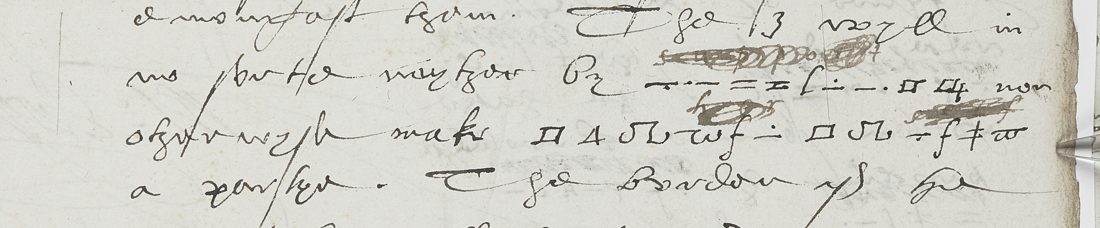
| R4844 | 194–195 | 10 September 1585, the Court | not calendared | name numbers and about fourteen sign words |
These are the letters Wotton received, kept with his papers; each is signed “Your assured friend, Fra. Walsingham”. DECODE’s “graphic signs” on R4838 refers to nothing more than the numbers. Only R4844 has signs.
02 The name code
The same numbers run through Wotton’s replies (R4841–R4843). Grades as in the repository’s conventions: H certain, C probable, M possible, I unidentified.
| No. | Reading | Grade | Ground |
|---|---|---|---|
| 10 | King James VI | H | “the King” in CSP no. 106 for Wotton’s 10; sense in every letter |
| 19 | James Stewart, Earl of Arran | H | CSP no. 41, Arran [“19”] |
| 20 | John, Lord Maxwell, styled Earl of Morton | H | CSP no. 106, “Morton” for 20 |
| 24 | Sir Thomas Kerr of Ferniehirst | H | CSP, Farnyhurst [“24”]; the 21 August letter presses for his imprisonment |
| 39 | Patrick, Master of Gray | H | CSP no. 41, the Master of Gray [“39”] |
| 40 | Sir Lewis Bellenden, Justice Clerk | H | CSP no. 41, Justice Clerk [“40”] |
| 11 | the French party | C | “the party of 11 increasing”; “devoted unto 11” |
| 36 | England, the Queen’s side | M | “10 wyll be carried awaye from 36”; “delivered towardes 36” |
| 27 | a councillor coupled with 40 (Secretary Maitland?) | M | “the practice of 27 and 40” |
| 28, 29 | the banished lords (Angus and Mar?) | M | “yf 28 and 29 woold come downe to the Borders to ioyne with 20” |
| 13, 14, 23, 30, 37 | unidentified | I | “13 is affected to 19”; “[23] is the principal dealer in [37] between 10 and the Jesuites” |
03 The letters
28 July 1585, Nonsuch (R4838; CSP no. 40)
Walsingham is sorry to hear of a move in Scotland to ask for an English duchy for the King: it would offend the Queen and breed jealousy against the league. Wotton should dissuade it through Gray. On the slip of f. 126: 13 is “affected to 19” and Wotton should deal warily with 13 in anything that concerns Arran.
7 August 1585, the Court (R4839; CSP no. 65)
After the killing of Lord Russell on the Border, the Russells’ friends are incensed against Farnihurst (24) and Arran (19). Wotton is to insist that the King do justice and not set Arran at liberty.
21 August 1585, the Court (R4840)
“39 dothe complayne in a late letter wrytten to his frende here … of the alteration of your countenaunce towardes him.” Gray offers to prove himself if 28 and 29 come down to the Borders to join with 20 (Maxwell); without that, he fears that “10 wyll be carried awaye from 36, the party of 11 increasing”. Walsingham trusts none of them: “The best is to deale warely with them all.” He advises Wotton to tell Gray of the suspicion without naming its author. The Queen wants Farnihurst (24) imprisoned. Wotton’s draft answer of 30 August is on the companion page.
The opening, re-read on the image for the quotation list (30 Sept 2026; bracketed words are grade M readings of hard places in the secretary hand): “Sir, 39 dothe complayne in a late letter wrytten to his frende here, whom you knowe, of the alteration of your countenaunce towardes him, with the [courage] to procure the practice of 27 and 40, which as he professeth dothe greatly [abuse] you, being altogether bent to [ruin] 11 course; and for himself he voweth to be altogether at 3 devotion, whereof he offereth to make a most manifest proofe” (spelling restored on the images on 23 October 2026). The earlier transcription had “overthrow 11”; the manuscript has a short word and course after the number (“11 course”, as in Wotton’s answer of 30 August: “I could never perceive cause to suspect them in the 11 course”). 3 here is Gray’s object of devotion, so the Queen or England (M); Wotton’s draft of 25 August has “divert him from 3” but also “convey him towards 3 … into France”, so the number is not settled. The glosses of 28, 29 and 36 could not be checked again against CSP Scotland viii on 30 September (the HathiTrust text view now sits behind a bot check and the Internet Archive copy is lending-only); they stay grade M.
10 September 1585, the Court (R4844)
Decoded, not read. The sign words and the open name codes fall in nearly every sentence of this letter, so it counts as decoded, not read (reading audit, 22 October 2026); the 21 August letter reads. Wotton’s letters of 1 September have bred “some better lykinge of the [signs] set downe by 39”. This is Gray’s plan to seize the King. The 28 and 29 “wyll be [signs]”; 13 “wyll in no sorte neyther be [signs] nor otherwyse make [signs] [signs] a partye”. Wotton is to confer with the King so as to be “[signs] at the [signs]”, but must “warde your [signs]” and avoid [signs]. In the postscript Walsingham sends on a letter and reports that [23] “is the principal dealer in [37] between 10 and the Jesuites”. The working transcriptions of both uncalendared letters (reading_R4840.txt, reading_R4844_r2.txt, with the gaps read on the images merged into the second on 22 October 2026) keep the secretary’s spelling, re-read on the DECODE images on 23 October.
04 The sign words
The sign words are a second cipher, unrelated to the name code, and are counted on their own: about 23 words, none read. The name code alone reads at 34 of its 46 occurrences.
About fourteen words, some 120 signs in all, are written in an alphabet of geometric and letter-like signs: squares, triangles, =, ≠, ÷, a crossed 4, ω, and borrowed letters f, d, c, k, R. They also carry dots and dashes that look like nulls. The same signs (square, triangle, ≠) open many words, which suggests homophones. Over every sign word Wotton, or his secretary, wrote the decipherment and later scribbled it out in loops. Nothing of it can be read on the scan.
No key was found. DECODE has no key record for Wotton or Walsingham’s Scottish correspondence, and Tomokiyo’s survey of Elizabethan ciphers has none for 1585 (his “Wotton” cipher is Nicholas Wotton’s of 1548). Wotton’s drafts in the same volume use the numbers but no signs, so they give no crib. A homophonic alphabet with nulls cannot be recovered from the ciphertext alone when it has only 120 signs. The words are copied as far as they can be in targets/walsingham1585/NOTES.md.
05 What remains open
- The fourteen sign words of 10 September (R4844), without a key. They would yield to Wotton’s cipher key or to any other letter in this alphabet with its decipherment, most likely among the sent despatches in TNA SP 52/37–38.
- Numbers 13, 14, 23, 30, 37, unidentified; 27, 28, 29, 36 possible only.
- The transcriptions of 21 August and 10 September are working texts with gaps, not editions.
Full texts
The transcription and the decryption of every document on this page, so that the reading can be used and checked. Short files are shown here; all are in the repository.
R4840, Add MS 32657 ff. 163-164, the Court, 21 Aug 1585
Walsingham warns Edward Wotton, ambassador to James VI, that the Master of Gray [39] complains of Wotton's coldness and offers proof of his devotion if the banished lords join Maxwell [20] on the Borders, lest the King be carried away from England while the French party grows; Walsingham advises dealing warily with them all. The letter is clear English with a two-digit name code; clear_gaps_pass2.md holds the 14 Oct 2026 gap readings and nine corrections not yet merged.
Transcription
Walsingham to Edward Wotton, the Court, 21 August 1585. BL Add MS 32657 ff. 163-164 (DECODE R4840).
Working transcription from the DECODE images; [..] = not read; {n = gloss} name code.
Spelling (v6, 23 Oct 2026): Walsingham's secretary's, re-read on the DECODE images (fetched again with the project cookie,
f. 163r in ten strips, f. 163v in six): dothe, complayne, wrytten, frende(s), knowe, countenaunce, towardes, proofe, yf,
woold, downe, ioyne, wyll, awaye, realme, beleve, iudge, therof, dyd, whylest, alwayes, deale, warely, yt, amysse,
acquaynted, proceadinge(s), iudgement, daye, straunger, knowne, easely, Fraunce, then (than), shoold, presse, hast, Coorte,
xxjth. Words whose letters are not certain on the scan in this hand keep the earlier (modern) form; no word was changed,
no hole filled. The marginal postscript is left as it was.
30 Sept 2026: ll. 4-9 of f. 163 re-read on the image; [word] = grade M reading of a hard place.

Sir, 39 {Master of Gray} dothe complayne in a late letter wrytten to his frende here, whom you knowe, of the
alteration of your countenaunce towardes him, with the [courage] to procure the practice of 27 and 40 {Justice Clerk},
which as he professeth dothe greatly [abuse] you, being altogether bent to [ruin] 11 {the French} course; and for
himself he voweth to be altogether at 3 {the Queen / England?} devotion, whereof he offereth to make a most manifest proofe, yf
28 and 29 {the banished lords?} woold come downe to the Borders to ioyne with 20 {Morton} and some other frendes
as he can procure, without the which he feareth that 10 {the King} wyll be carried awaye from 36 {England}, the
party of 11 increasing and growing greatly in that realme. This is the substance of his letters to his frende;
what to beleve or what to iudge therof I knowe not. I knowe that 40 dyd greatly [..] in his [..] whylest he was
here, and that 27 was alwayes [..] of late devoted unto 11. The best is to deale warely with them all, for they are
all [..] and all become [..]. And yet in my simple opinion yt were not amysse [..] you acquaynted 39 with the
[..] of such suspicion and to urge him to deale plainly with you; which manner of proceadinge, without naming of
any author of such suspicion, [..] in my iudgement [..], but I leave yt to your best iudgement.

This daye we are advertised that the straunger [..] is fully resolved to [..] that realme, but the party is not yet
knowne; but yt is easely [..] what end he shall be [..] specially the [..] proceadinges in Fraunce.

Touching your request made for the [..] of 24 {Farnihurst}, 10 {the King} desireth [..] may be delivered towardes
36 {England}. Yf yt be denied, then is yt manifest that 19 {Arran} is more esteemed then [..]. The Queen looketh
that you shoold greatly presse the imprisonment of 24, that the more [..] the daye of the [..] meeting [..] the King
shall assent thereunto. And so in hast I commit you to God. At the Coorte, the xxjth of August 1585.

[postscript] [..] we had news of the [..] of [..] which may breed some alteration in the whole
proceedings.

Your assured friend, Fra. Walsingham
Decryption
# Walsingham to Wotton 1585: gap readings from the DECODE images

Grades: H certain, C probable, M possible, illegible (reason). Spelling as written where it matters.

## R4840 (21 Aug 1585), f. 163r = IMG_R4840_I28147_P1.jpg

1. l.12 "40 did greatly [..] in his [..] whilst he was here" -> **wauer** (waver). H.
2. same line, "in his [..] whilst" -> **wordes** (words). H. ("whyles he was here")
3. l.13 "27 was always [..] of late devoted unto 11" -> **vntle** / untill (until): v-n-t-l-e, last letters at the paper edge. C.
   Sense: "27 was always, until of late, devoted unto 11".
4. l.14 "for they are all [..]" -> **borne**. H.
5. l.14 "and all become [..]" -> the transcription is wrong here: the line reads
   **"for they are all borne under one planett"**. "and all become" is not on the page; it is **vnder one**
   (H) + **planett** (C: p-l-?-net with a cross-stroke through the p/l).
   So gaps 4+5 together: "they are all borne under one planet."
6. l.14 "it were not amiss [..] you acquainted 39" -> the page has "amysse" + a small e-like stroke + "doe" + a
   z-shaped y (the same y as in "they" on the line above) + "you acquainted". Letters seen: **"doe y[e]"**? M.
   Not certain of the syntax; "doe" itself is clear (H for the letters d-o-e).
7. l.15 "with the [..] of such suspicion" -> **groundes** (grounds). H.
   (Interlinear insertion above "proceeding" at the line end, apparently "the auctour of" or similar; not a gap
   in the transcription, not checked further.)
8. l.16 "suspicion, [..] in my judgement" -> **can**. H.
9. l.16 "in my judgement [..], but I leave it" -> **bee no grevance** (be no grievance): "bee no" H at line end,
   "grevance" C at the start of the next line.
   Transcription correction: after it the page reads "**and yet doe I leave** yt to your best judgement"
   ("and" abbreviated, then "yet doe I"), not "but I leave it".

## R4840, f. 164r(v) = IMG_R4840_I28147_P2.jpg

10. l.18 "the stranger [..] is fully resolved" -> **K.** (King), written as an abbreviated capital K with a
    point. H. Transcription correction: "stranger" is **ffrenche** (French; secretary ff = F) - C.
    So: "the French K. is fully resolved".
11. l.18 "fully resolved to [..] that realm" -> **sende an Amb. into** ("to send an Amb[assador] into that
    realm"). "sende an" H; "Amb." C (looped capital, then -mb with a point of abbreviation); "into" H.
    Fits "but the party is not yet known".
12. l.19 "it is easily [..] what end" -> **gessed** (guessed), with **to** written above the line before "what".
    H. ("easyly gessed to what end")
13. l.19 "he shall be [..]" -> **sente** (sent). C.
    Transcription correction: the next word is not "specially" but **consideringe** (con- abbreviation, then
    -syderinge). C.
14. l.19 "the [..] proceedings in France" -> **p(re)sent** ("the present proceedinges in ffraunce"). C.
15. l.21 "your request made for the [..] of 24" -> **r..t..ng/-nt**: starts "re", ends in "-t" with a long
    stroke over it; read as **restraint** M (letters not all distinct; long overline from the line above).
16. l.21 "10 desireth [..] may be delivered" -> a short word after "desyreth", written **he**? M. The last
    word of the line is "may" (partly at the edge). Words are run together here.
17. l.22 "19 is more esteemed than [..]." -> "esteemed the(n) / her:" - the last word, after a long descender
    from the line above, looks like **her** (or hers) with a colon. M.
18. l.23 "that the more [..] the day of" -> **forwardinge** (forwarding), f-o-r-w-a-r-d-i-n-g with a long tail.
    C. The word the transcription reads "more" looks like "mely/rely" on the image; not re-read (doubtful).
19. l.23 "the day of the [..] meeting" -> an abbreviated word ending "...comm.." at the line end, probably
    **commissioners** M; the first part (r/w-o-t crossed + long s) is illegible (cramped, crossed by descenders
    from the line above).
20. l.23 "meeting [..] the King" -> **yf** (if). C. ("meetinge yf the K. shall assent therunto")

### Postscript (left margin of f. 164, below the text)
21. "[postscript] [..] we had news" -> **yesterday** (ʒesterdai). C.
22. "news of the [..] of [..]" -> **rendringe** (rendering, i.e. surrender). H.
23. "of [..] which may breed" -> **Antwarpe** (Antwerp). H. Antwerp surrendered to Parma on 17 Aug 1585.

R4840 note: the brief said 12 gaps per letter; the R4840 file actually has 23 [..] places (9 on f.163, 11 on
f.164, 3 in the postscript). All 23 are listed above.

## R4844 (10 Sep 1585), f. 194r = IMG_R4844_I28167_P1.jpg

1. l.6 "13 and 14 is only [..] therein" -> **vsed** (used). C (v, long s, e, d; the s is crossed by a
   descender).
2. l.7 "This day the [..] will be taken" -> **full resolu-|tion** ("the full resolu" at the line end, "tion"
   at the start of the next). "resolution" H, "full" C.
3. l.7 "will be taken [..] and if" -> a word **struck through** in the ink of the text, under the stroke
   "therin" (therein). C that it is deleted; the transcription should mark it as a deletion, not a gap.
4. l.7 "and if there [..] be as well" -> "and yf there" ends the line; the next line opens with a word
   **f/s-o-r-g?-e** (long s or f, o, r, a g-like letter, e) and then **"as well"**: word not identified
   (the same word-shape recurs at R4844 f.194r l.17 "so ... forge"). Illegible as a word (letters clear, word
   not identified); no "be" is written: the page reads "... as well".
5. l.7 "as well [..] as 39 content[ment]" -> **falle out to** ("as well falle out to 39 content|ment").
   "falle" C, "out" C, "to" C. Transcription correction: "as 39" should be **to 39**.
6. l.10 "The Border of the [..] will [..] 19" -> first gap **Marches** C ("The Border of the | Marches");
   second gap two words: a short word read **fight** M (ε-like f, long s/i, g, h, t) and **agaynst** M
   (looks v-ſſ-e-r-s; could also be another verb). Only "Marches" is C.
7. l.12 "(as I guess, deferred with [..])" -> a word p(x-shaped)-e-a-d-d + a long final stroke, before the
   closing bracket. Illegible as a word (letters clear but not resolved; perhaps abbreviated).
8. l.12 "proceeded wherein 13 [is] absent from [..]" -> **court** ("from court."). H.
   Transcription correction: "wherein 13 [is]" is **thorowe 13** (through 13 [being] absent) - C; no "is".
9. l.14 "letters by the [..] have [..]" -> after "by the" a w with a superscript (w^ch or w^t) M; then
   "ha." (have, abbreviated) H; then a short word "dyd"? and **stayed** C (long s, t, a, y, e, d, colon).
   So probably "by the w[ay] have [been] stayed" - only "stayed" C.
10. l.14 "I would not [..] of any" -> **here** (hear) C (h-e-r-e, run together).
11. l.15 "do well therefore to [..] him" -> **comforte** (comfort). H.
12. l.15 "until the [..] come" -> one word, w/v-e-ſſ-l-e-r-s (or -ers) at the line start, before "come".
    Illegible as a word (letters partly clear, word not identified). "come." H.
13. l.16 "I have not been [..] of [..]" -> **vnmindfull** (unmindful) H; "of" + **your** H + a word at the line
    end "ce-bord-" / "re-ward-" with a hyphen: M **rewarde**, letters not certain.
14. l.16 "but [..] would of us [..] of it" -> **her Ma(ies)tie** (her Majesty, "her m^a^lie" with superscripts)
    C; "would of us" then **haue a-|ssurance** (have assurance) C ("haue a" at the line end, "ssurance of
    yt" on the next line).
15. l.16 "I have not [..] that I shall so [..]" -> transcription correction: the page reads **"I hope
    notwithstanding that I shall so ..."** (hope H; notw^t standyng C). So "I have not [..]" = "I hope
    notwithstanding".
16. l.16 "I shall so [..] as you shall receive" -> four short words after "so": f/s-m, f/s-o-r-g?-e (the same
    word as gap 4), a looped d/ð, -ozd. Illegible (letters clear, words not resolved).
17. l.17 "direction to [..] to the King" -> **repaire** (repair) M-C: r-e-p(x-shaped)-a-i-r-e at the line end.
    C for "re-", M for the whole word.

## R4844 f. 194v = IMG_R4844_I28167_P2.jpg

18. l.17 "[..] to confer with him" -> after "to the K." a looped capital + point, then **withall** (w-t-h-a-ll,
    the h z-shaped). M: "& withall to confer wth him".
19. l.17 "the proceedings in [..]" -> **the commission** ("in the" at the line end with a struck word after
    it, "comission" at the start of the next line, con- abbreviation). C.
20. postscript l.24 "of the [..] father [..] knowledge" -> after the sign words the page has **y(t) he hathe**
    (that he hath) - "hathe" H, "yt he" C - so the transcription's "of the [..]" is "that he hath".
21. same, "father" -> reads **farther / further** (f/s-o?-t-h-e-r) C; then **[..]** before "knowledge": a word
    b/s + minims + d, crossed by a long descender from the line above. Read "bound/sound" M only; treat as
    illegible.
22. postscript l.26 "My letters out of 32 [..] I am advertised" -> nothing is written between "32" and "I am"
    on the line. The only extra word is a **struck-out interlinear word** under "letters" ("Comp..."?),
    blotted. No gap here: "My letters out of 32. I am advertised that 23 ...". ("out" C: o-u-t, could be "ont".)
    Also: above "37" there is a struck interlinear word ("Scot:"? blotted) not in the transcription.
23. postscript l.27 "I think the following [..] 19 [..]" -> "the followinge | wilbe" (**wilbe** C, w-l-b with a
    point), then a word p/x-e + a faded word under a stain ("...hm"), illegible (stain, crossed by a
    descender); after 19 **dyrectly** (directly) M (d-y-r-e-c-t-l-y, "ct" unclear).

## Transcription corrections found (both letters)
- R4840 f.163 l.14: "they are all [..] and all become [..]" is **"they are all borne under one planett"**.
- R4840 f.163 l.16: "but I leave it" is **"and yet doe I leave yt"**.
- R4840 f.164 l.18: "the stranger" is **"the ffrenche (French) K."**
- R4840 f.164 l.19: "specially the" is **"consideringe the"**.
- R4840 f.164 l.23: the word read "more" in "that the more [..]" looks like "mely/rely"; the next line starts
  "that the daye" (the transcription drops this "that"). Not resolved.
- R4844 l.7: "be as well [..] as 39" is **"as well falle out to 39"**; the [..] after "taken" is a deletion.
- R4844 l.12: "wherein 13 [is]" is **"thorowe 13"**.
- R4844 l.16: "I have not [..] that" is **"I hope notwithstanding that"**.
- R4844 postscript: "of the [..] father" is **"that he hath farther"**; "32 [..] I am" has no word in the gap.

## Count
R4840 (23 places): H/C 18 (1,2,3,4,5,7,8,9,10,11,12,13,14,18,20,21,22,23), M 4 (6,15,16,17),
  illegible 1 (19, first part of the word; its "comm-" ending is M).
R4844 (23 entries): H/C 14 (1,2,3,5,6 "Marches",8,10,11,13,14,15,19,20,22), M 4 (9,17,18,21),
  illegible 5 (4,7,12,16,23 first word). Within entries counted H/C, these parts are only M: 6 "fight
  agaynst", 13 "rewarde", 23 "dyrectly"; 21's second word is illegible.
Both letters: H/C 32, M 8, illegible 6 (46 entries).
Entries 15 and 22 (R4844) and the "they are all borne under one planett" line (R4840 4-5) correct the
transcription rather than fill a simple gap.
R4844, Add MS 32657 ff. 194-195, the Court, 10 Sep 1585 decoded, not read
Walsingham to Wotton on the articles set down by the Master of Gray, the banished lords and Arran, with about fourteen words in a separate sign alphabet that stay unread (Wotton's interlinear decipherment is blotted out); a postscript says a go-between [23] deals between the King and the Jesuits.
A mechanical decode with holes in most sentences: shown so that the transcription and the key can be checked and improved, not as a reading.
Transcription
Walsingham to Edward Wotton, the Court, 10 September 1585. BL Add MS 32657 ff. 194-195 (DECODE R4844).
Working transcription from the DECODE images; [..] = not read; {n = gloss} name code; <SIGNS: ...> = word in the
sign alphabet, unread (the interlinear decipherment above each is blotted out).

Sir, your letters of the first of September hath bred some better liking of the <SIGNS: □⊿=≠|–.⊥.f> set down by
39 {Master of Gray} than before. The meeting of 13 and 14 is only [..] therein, who do both allow of it. This day
the [..] will be taken [..] and if there [..] be as well [..] as 39 content[ment]. The 28 29 {banished lords?}
will be <SIGNS: ≠f–.÷≠f=> as also 30, who is of best <SIGNS: ßkIω#fll–> [to] content them. The 13 will in no sort
neither be <SIGNS: –.–==|÷–.□4> nor otherwise make <SIGNS: □4διωf÷ □δι÷f≠ω> a party. The Border of the
[..] will [..] 19 {Arran}.

The delay of Montfort (as I guess, deferred with [..]) proceeded wherein 13 [is] absent from [..].

I doubt greatly that 9 [?] last letters by the [..] have [..]; for that I would not [..] of any
<SIGNS: □54Rhl≠dll–. □o ζlm÷–d> these great disorders, 39 you shall do well therefore to [..] him until the
[..] come. I have not been [..] of [..] but [..] would of us [..] of it. I have not [..] that I shall so [..] as
you shall receive direction to [..] to the King. [..] to confer with him about the proceedings in [..] so as you
shall be <SIGNS: ⊿ϱ÷fll ⊿app⊿> at the <SIGNS: c–.–d#÷–>. But you must ward your <SIGNS: (a)–.÷cr lld⊿4ꝙ> at
<SIGNS: □⊿≠ ÷–.f÷≠gllω> & avoid <SIGNS: –k÷.÷–…bll>. And so in haste I commit you to God. At the Court the 10 of
Sept. 1585.

Your assured friend, Fra. Walsingham

[postscript] I send you a letter written from the <SIGNS: ≠l÷.of ÷ψ÷lm=≠l> of the [..] father [..] knowledge
touching <SIGNS: Rh÷f ψ÷dc–. =≠l–>, and therefore I doubt greatly that things are not carried with that
<SIGNS: ⊿4÷dψ–fcψτd> as were fit. My letters out of 32 [..] I am advertised that 23 is the principal dealer in 37
between 10 {the King} and the Jesuits. I think the following [..] 19 {Arran} [..].
Transcription
Walsingham to Edward Wotton, the Court, 10 September 1585. BL Add MS 32657 ff. 194-195 (DECODE R4844).
Second state, 22 Oct 2026 (Claude Opus 5.5, re-read batch mix1): reading_R4844.txt with the gap readings and
transcription corrections of clear_gaps_pass2.md (14 Oct 2026, read on the DECODE images) merged; grade M words in
[?word], illegible places [..]. {n = gloss} name code; [n] open name code; <SIGNS: ...> = word in the sign alphabet,
unread (the interlinear decipherment above each is blotted out). Spelling (v6, 23 Oct 2026): the secretary's, re-read on the
DECODE images (fetched again with the project cookie; f. 194r in eight strips, f. 194v in four): hathe bread, lykinge,
downe, then (than), therin, doe bothe allowe of yt, daye, wyll, yf, sorte, neyther, otherwyse, partye, delaye, gues,
proceaded, woold, here (hear), therfor, untill, ben unmindfull, proceadinges, commyssion, warde, avoyde, hast, commyt,
Coorte, x, frende, sende, wrytten, hathe, thinges, carryed, Jesuites, thinke. Words whose letters are not certain on the
scan keep the earlier (modern) form; no word was changed, no hole filled.

Sir, your letters of the first of September hathe bread some better lykinge of the <SIGNS: □⊿=≠|–.⊥.f> set downe by
39 {Master of Gray} then before. The meeting of [13] and [14] is only used therin, who doe bothe allowe of yt. This daye
the full resolution wyll be taken, and yf there [..] as well fall out to 39 {Master of Gray} contentment. The 28 29
{banished lords?} wyll be <SIGNS: ≠f–.÷≠f=> as also [30], who is of best <SIGNS: ßkIω#fll–> [to] content them. The
[13] wyll in no sorte neyther be <SIGNS: –.–==|÷–.□4> nor otherwyse make <SIGNS: □4διωf÷ □δι÷f≠ω> a partye. The Border
of the Marches wyll [?fight] [?against] 19 {Arran}.

The delaye of Montfort (as I gues, deferred with [..]) proceaded through [13] [being] absent from court.

I doubt greatly that 9 [?] last letters by the [?way] have [..] stayed; for that I woold not here of any
<SIGNS: □54Rhl≠dll–. □o ζlm÷–d> these great disorders. 39 {Master of Gray} you shall doe well therfor to comfort
him untill the [..] come. I have not ben unmindfull of your [?reward], but her Majesty woold of us have assurance of
yt. I hope notwithstanding that I shall so [..] as you shall receive direction to [?repair] to the King, [?and
withal] to confer with him about the proceadinges in the commyssion, so as you shall be <SIGNS: ⊿ϱ÷fll ⊿app⊿> at the
<SIGNS: c–.–d#÷–>. But you must warde your <SIGNS: (a)–.÷cr lld⊿4ꝙ> at <SIGNS: □⊿≠ ÷–.f÷≠gllω> & avoyde
<SIGNS: –k÷.÷–…bll>. And so in hast I commyt you to God. At the Coorte the x of Sept. 1585.

Your assured frende, Fra. Walsingham

[postscript] I sende you a letter wrytten from the <SIGNS: ≠l÷.of ÷ψ÷lm=≠l> that he hathe further [..] knowledge
touching <SIGNS: Rh÷f ψ÷dc–. =≠l–>, and therfor I doubt greatly that thinges are not carryed with that
<SIGNS: ⊿4÷dψ–fcψτd> as were fit. My letters out of [32]. I am advertised that [23] is the principal dealer in [37]
between 10 {the King} and the Jesuites. I thinke the following will be [..] [..] 19 {Arran} [?directly].
Transcription
# R4844 (10 Sep 1585, ff. 194-194v): the sign words, unread (copied verbatim from NOTES.md section 4, 22 Oct 2026)

Each sign word has one line above it, heavily blotted: Wotton's interlinear decipherment, struck out on purpose.
Nothing of it can be read on the scan. Sign words as far as they can be copied (dots and dashes kept; `ω` a looped
w, `⊿` a triangle, `4` a crossed four):

1. f.194 l.3 "of the **□⊿=≠|–.⊥.f** set down by 39 than before" (the articles of the league?)
2. l.10 "will be **≠f–.÷≠f=** … as also 30 who is of best **ßkIω#fll–** … continent them"
3. l.14 "neither be **–.–==|÷–.□4** nor otherwise make **□4διωf÷ □δι÷f≠ω** a partie"
4. l.24 "that I would not … of any **□54Rhl≠dll–. □o ζlm÷–d** these great disorders"
5. f.194v l.3 "so as you shall be **⊿ϱ÷fll ⊿app⊿** at the **c–.–d#÷–**"
6. l.5 "ward your **(a)–.÷cr lld⊿4ꝙ** at **□⊿≠ ÷–.f÷≠gllω** & avoyde **–k÷.÷–…bll**"
7. postscript "a letter … from the **≠l÷.of ÷ψ÷lm=≠l**", "touching **Rh÷f ψ÷dc–. =≠l–**", "not carried with
   that **⊿4÷dψ–fcψτd**".

The words are short, homophones are likely (`□`, `⊿` and `≠` recur at word starts), and dots and dashes look like
nulls. About 120 signs in all, with no crib and no other text under the same alphabet, which is too little to
break. It would move with Wotton's cipher key (not found), or a decipherment of another letter in this alphabet
in SP 52/38.
Decryption
Walsingham to Edward Wotton, the Court, 10 September 1585. BL Add MS 32657 ff. 194-195 (DECODE R4844).
Second state, 22 Oct 2026 (Claude Opus 5.5, re-read batch mix1): reading_R4844.txt with the gap readings and
transcription corrections of clear_gaps_pass2.md (14 Oct 2026, read on the DECODE images) merged; grade M words in
[?word], illegible places [..]. {n = gloss} name code; [n] open name code; <SIGNS: ...> = word in the sign alphabet,
unread (the interlinear decipherment above each is blotted out). Spelling (v6, 23 Oct 2026): the secretary's, re-read on the
DECODE images (fetched again with the project cookie; f. 194r in eight strips, f. 194v in four): hathe bread, lykinge,
downe, then (than), therin, doe bothe allowe of yt, daye, wyll, yf, sorte, neyther, otherwyse, partye, delaye, gues,
proceaded, woold, here (hear), therfor, untill, ben unmindfull, proceadinges, commyssion, warde, avoyde, hast, commyt,
Coorte, x, frende, sende, wrytten, hathe, thinges, carryed, Jesuites, thinke. Words whose letters are not certain on the
scan keep the earlier (modern) form; no word was changed, no hole filled.

Sir, your letters of the first of September hathe bread some better lykinge of the <SIGNS: □⊿=≠|–.⊥.f> set downe by
39 {Master of Gray} then before. The meeting of [13] and [14] is only used therin, who doe bothe allowe of yt. This daye
the full resolution wyll be taken, and yf there [..] as well fall out to 39 {Master of Gray} contentment. The 28 29
{banished lords?} wyll be <SIGNS: ≠f–.÷≠f=> as also [30], who is of best <SIGNS: ßkIω#fll–> [to] content them. The
[13] wyll in no sorte neyther be <SIGNS: –.–==|÷–.□4> nor otherwyse make <SIGNS: □4διωf÷ □δι÷f≠ω> a partye. The Border
of the Marches wyll [?fight] [?against] 19 {Arran}.

The delaye of Montfort (as I gues, deferred with [..]) proceaded through [13] [being] absent from court.

I doubt greatly that 9 [?] last letters by the [?way] have [..] stayed; for that I woold not here of any
<SIGNS: □54Rhl≠dll–. □o ζlm÷–d> these great disorders. 39 {Master of Gray} you shall doe well therfor to comfort
him untill the [..] come. I have not ben unmindfull of your [?reward], but her Majesty woold of us have assurance of
yt. I hope notwithstanding that I shall so [..] as you shall receive direction to [?repair] to the King, [?and
withal] to confer with him about the proceadinges in the commyssion, so as you shall be <SIGNS: ⊿ϱ÷fll ⊿app⊿> at the
<SIGNS: c–.–d#÷–>. But you must warde your <SIGNS: (a)–.÷cr lld⊿4ꝙ> at <SIGNS: □⊿≠ ÷–.f÷≠gllω> & avoyde
<SIGNS: –k÷.÷–…bll>. And so in hast I commyt you to God. At the Coorte the x of Sept. 1585.

Your assured frende, Fra. Walsingham

[postscript] I sende you a letter wrytten from the <SIGNS: ≠l÷.of ÷ψ÷lm=≠l> that he hathe further [..] knowledge
touching <SIGNS: Rh÷f ψ÷dc–. =≠l–>, and therfor I doubt greatly that thinges are not carryed with that
<SIGNS: ⊿4÷dψ–fcψτd> as were fit. My letters out of [32]. I am advertised that [23] is the principal dealer in [37]
between 10 {the King} and the Jesuites. I thinke the following will be [..] [..] 19 {Arran} [?directly].
Decryption
# Walsingham to Wotton 1585: gap readings from the DECODE images

Grades: H certain, C probable, M possible, illegible (reason). Spelling as written where it matters.

## R4840 (21 Aug 1585), f. 163r = IMG_R4840_I28147_P1.jpg

1. l.12 "40 did greatly [..] in his [..] whilst he was here" -> **wauer** (waver). H.
2. same line, "in his [..] whilst" -> **wordes** (words). H. ("whyles he was here")
3. l.13 "27 was always [..] of late devoted unto 11" -> **vntle** / untill (until): v-n-t-l-e, last letters at the paper edge. C.
   Sense: "27 was always, until of late, devoted unto 11".
4. l.14 "for they are all [..]" -> **borne**. H.
5. l.14 "and all become [..]" -> the transcription is wrong here: the line reads
   **"for they are all borne under one planett"**. "and all become" is not on the page; it is **vnder one**
   (H) + **planett** (C: p-l-?-net with a cross-stroke through the p/l).
   So gaps 4+5 together: "they are all borne under one planet."
6. l.14 "it were not amiss [..] you acquainted 39" -> the page has "amysse" + a small e-like stroke + "doe" + a
   z-shaped y (the same y as in "they" on the line above) + "you acquainted". Letters seen: **"doe y[e]"**? M.
   Not certain of the syntax; "doe" itself is clear (H for the letters d-o-e).
7. l.15 "with the [..] of such suspicion" -> **groundes** (grounds). H.
   (Interlinear insertion above "proceeding" at the line end, apparently "the auctour of" or similar; not a gap
   in the transcription, not checked further.)
8. l.16 "suspicion, [..] in my judgement" -> **can**. H.
9. l.16 "in my judgement [..], but I leave it" -> **bee no grevance** (be no grievance): "bee no" H at line end,
   "grevance" C at the start of the next line.
   Transcription correction: after it the page reads "**and yet doe I leave** yt to your best judgement"
   ("and" abbreviated, then "yet doe I"), not "but I leave it".

## R4840, f. 164r(v) = IMG_R4840_I28147_P2.jpg

10. l.18 "the stranger [..] is fully resolved" -> **K.** (King), written as an abbreviated capital K with a
    point. H. Transcription correction: "stranger" is **ffrenche** (French; secretary ff = F) - C.
    So: "the French K. is fully resolved".
11. l.18 "fully resolved to [..] that realm" -> **sende an Amb. into** ("to send an Amb[assador] into that
    realm"). "sende an" H; "Amb." C (looped capital, then -mb with a point of abbreviation); "into" H.
    Fits "but the party is not yet known".
12. l.19 "it is easily [..] what end" -> **gessed** (guessed), with **to** written above the line before "what".
    H. ("easyly gessed to what end")
13. l.19 "he shall be [..]" -> **sente** (sent). C.
    Transcription correction: the next word is not "specially" but **consideringe** (con- abbreviation, then
    -syderinge). C.
14. l.19 "the [..] proceedings in France" -> **p(re)sent** ("the present proceedinges in ffraunce"). C.
15. l.21 "your request made for the [..] of 24" -> **r..t..ng/-nt**: starts "re", ends in "-t" with a long
    stroke over it; read as **restraint** M (letters not all distinct; long overline from the line above).
16. l.21 "10 desireth [..] may be delivered" -> a short word after "desyreth", written **he**? M. The last
    word of the line is "may" (partly at the edge). Words are run together here.
17. l.22 "19 is more esteemed than [..]." -> "esteemed the(n) / her:" - the last word, after a long descender
    from the line above, looks like **her** (or hers) with a colon. M.
18. l.23 "that the more [..] the day of" -> **forwardinge** (forwarding), f-o-r-w-a-r-d-i-n-g with a long tail.
    C. The word the transcription reads "more" looks like "mely/rely" on the image; not re-read (doubtful).
19. l.23 "the day of the [..] meeting" -> an abbreviated word ending "...comm.." at the line end, probably
    **commissioners** M; the first part (r/w-o-t crossed + long s) is illegible (cramped, crossed by descenders
    from the line above).
20. l.23 "meeting [..] the King" -> **yf** (if). C. ("meetinge yf the K. shall assent therunto")

### Postscript (left margin of f. 164, below the text)
21. "[postscript] [..] we had news" -> **yesterday** (ʒesterdai). C.
22. "news of the [..] of [..]" -> **rendringe** (rendering, i.e. surrender). H.
23. "of [..] which may breed" -> **Antwarpe** (Antwerp). H. Antwerp surrendered to Parma on 17 Aug 1585.

R4840 note: the brief said 12 gaps per letter; the R4840 file actually has 23 [..] places (9 on f.163, 11 on
f.164, 3 in the postscript). All 23 are listed above.

## R4844 (10 Sep 1585), f. 194r = IMG_R4844_I28167_P1.jpg

1. l.6 "13 and 14 is only [..] therein" -> **vsed** (used). C (v, long s, e, d; the s is crossed by a
   descender).
2. l.7 "This day the [..] will be taken" -> **full resolu-|tion** ("the full resolu" at the line end, "tion"
   at the start of the next). "resolution" H, "full" C.
3. l.7 "will be taken [..] and if" -> a word **struck through** in the ink of the text, under the stroke
   "therin" (therein). C that it is deleted; the transcription should mark it as a deletion, not a gap.
4. l.7 "and if there [..] be as well" -> "and yf there" ends the line; the next line opens with a word
   **f/s-o-r-g?-e** (long s or f, o, r, a g-like letter, e) and then **"as well"**: word not identified
   (the same word-shape recurs at R4844 f.194r l.17 "so ... forge"). Illegible as a word (letters clear, word
   not identified); no "be" is written: the page reads "... as well".
5. l.7 "as well [..] as 39 content[ment]" -> **falle out to** ("as well falle out to 39 content|ment").
   "falle" C, "out" C, "to" C. Transcription correction: "as 39" should be **to 39**.
6. l.10 "The Border of the [..] will [..] 19" -> first gap **Marches** C ("The Border of the | Marches");
   second gap two words: a short word read **fight** M (ε-like f, long s/i, g, h, t) and **agaynst** M
   (looks v-ſſ-e-r-s; could also be another verb). Only "Marches" is C.
7. l.12 "(as I guess, deferred with [..])" -> a word p(x-shaped)-e-a-d-d + a long final stroke, before the
   closing bracket. Illegible as a word (letters clear but not resolved; perhaps abbreviated).
8. l.12 "proceeded wherein 13 [is] absent from [..]" -> **court** ("from court."). H.
   Transcription correction: "wherein 13 [is]" is **thorowe 13** (through 13 [being] absent) - C; no "is".
9. l.14 "letters by the [..] have [..]" -> after "by the" a w with a superscript (w^ch or w^t) M; then
   "ha." (have, abbreviated) H; then a short word "dyd"? and **stayed** C (long s, t, a, y, e, d, colon).
   So probably "by the w[ay] have [been] stayed" - only "stayed" C.
10. l.14 "I would not [..] of any" -> **here** (hear) C (h-e-r-e, run together).
11. l.15 "do well therefore to [..] him" -> **comforte** (comfort). H.
12. l.15 "until the [..] come" -> one word, w/v-e-ſſ-l-e-r-s (or -ers) at the line start, before "come".
    Illegible as a word (letters partly clear, word not identified). "come." H.
13. l.16 "I have not been [..] of [..]" -> **vnmindfull** (unmindful) H; "of" + **your** H + a word at the line
    end "ce-bord-" / "re-ward-" with a hyphen: M **rewarde**, letters not certain.
14. l.16 "but [..] would of us [..] of it" -> **her Ma(ies)tie** (her Majesty, "her m^a^lie" with superscripts)
    C; "would of us" then **haue a-|ssurance** (have assurance) C ("haue a" at the line end, "ssurance of
    yt" on the next line).
15. l.16 "I have not [..] that I shall so [..]" -> transcription correction: the page reads **"I hope
    notwithstanding that I shall so ..."** (hope H; notw^t standyng C). So "I have not [..]" = "I hope
    notwithstanding".
16. l.16 "I shall so [..] as you shall receive" -> four short words after "so": f/s-m, f/s-o-r-g?-e (the same
    word as gap 4), a looped d/ð, -ozd. Illegible (letters clear, words not resolved).
17. l.17 "direction to [..] to the King" -> **repaire** (repair) M-C: r-e-p(x-shaped)-a-i-r-e at the line end.
    C for "re-", M for the whole word.

## R4844 f. 194v = IMG_R4844_I28167_P2.jpg

18. l.17 "[..] to confer with him" -> after "to the K." a looped capital + point, then **withall** (w-t-h-a-ll,
    the h z-shaped). M: "& withall to confer wth him".
19. l.17 "the proceedings in [..]" -> **the commission** ("in the" at the line end with a struck word after
    it, "comission" at the start of the next line, con- abbreviation). C.
20. postscript l.24 "of the [..] father [..] knowledge" -> after the sign words the page has **y(t) he hathe**
    (that he hath) - "hathe" H, "yt he" C - so the transcription's "of the [..]" is "that he hath".
21. same, "father" -> reads **farther / further** (f/s-o?-t-h-e-r) C; then **[..]** before "knowledge": a word
    b/s + minims + d, crossed by a long descender from the line above. Read "bound/sound" M only; treat as
    illegible.
22. postscript l.26 "My letters out of 32 [..] I am advertised" -> nothing is written between "32" and "I am"
    on the line. The only extra word is a **struck-out interlinear word** under "letters" ("Comp..."?),
    blotted. No gap here: "My letters out of 32. I am advertised that 23 ...". ("out" C: o-u-t, could be "ont".)
    Also: above "37" there is a struck interlinear word ("Scot:"? blotted) not in the transcription.
23. postscript l.27 "I think the following [..] 19 [..]" -> "the followinge | wilbe" (**wilbe** C, w-l-b with a
    point), then a word p/x-e + a faded word under a stain ("...hm"), illegible (stain, crossed by a
    descender); after 19 **dyrectly** (directly) M (d-y-r-e-c-t-l-y, "ct" unclear).

## Transcription corrections found (both letters)
- R4840 f.163 l.14: "they are all [..] and all become [..]" is **"they are all borne under one planett"**.
- R4840 f.163 l.16: "but I leave it" is **"and yet doe I leave yt"**.
- R4840 f.164 l.18: "the stranger" is **"the ffrenche (French) K."**
- R4840 f.164 l.19: "specially the" is **"consideringe the"**.
- R4840 f.164 l.23: the word read "more" in "that the more [..]" looks like "mely/rely"; the next line starts
  "that the daye" (the transcription drops this "that"). Not resolved.
- R4844 l.7: "be as well [..] as 39" is **"as well falle out to 39"**; the [..] after "taken" is a deletion.
- R4844 l.12: "wherein 13 [is]" is **"thorowe 13"**.
- R4844 l.16: "I have not [..] that" is **"I hope notwithstanding that"**.
- R4844 postscript: "of the [..] father" is **"that he hath farther"**; "32 [..] I am" has no word in the gap.

## Count
R4840 (23 places): H/C 18 (1,2,3,4,5,7,8,9,10,11,12,13,14,18,20,21,22,23), M 4 (6,15,16,17),
  illegible 1 (19, first part of the word; its "comm-" ending is M).
R4844 (23 entries): H/C 14 (1,2,3,5,6 "Marches",8,10,11,13,14,15,19,20,22), M 4 (9,17,18,21),
  illegible 5 (4,7,12,16,23 first word). Within entries counted H/C, these parts are only M: 6 "fight
  agaynst", 13 "rewarde", 23 "dyrectly"; 21's second word is illegible.
Both letters: H/C 32, M 8, illegible 6 (46 entries).
Entries 15 and 22 (R4844) and the "they are all borne under one planett" line (R4840 4-5) correct the
transcription rather than fill a simple gap.
Key: key.md
06 Sources
- British Library, Add MS 32657. DECODE records R4838, R4839, R4840, R4844 (images behind login).
- Calendar of State Papers, Scotland, vol. 8 (1585–1586), ed. W. K. Boyd (Edinburgh, 1914), nos. 40, 41, 65, 106; read in the HathiTrust copy.
- S. Tomokiyo, “Ciphers during the Reign of Queen Elizabeth I”, Cryptiana.
Notes, transcriptions and profile in the repository folder targets/walsingham1585/. The page images are British Library copyright and are not in the repository.