

At a glanceKey from adjacent plaintext · complete
- The letters
- Three drafts by Edward Wotton, ambassador to Scotland, to Sir Francis Walsingham, 25 August to 1 September 1585, in clear English.
- Where
- British Library, Add MS 32657, ff. 167–176; DECODE R4841–R4843, listed as numerical ciphers with no decryption (catalogue item 81).
- The cipher
- There is no letter cipher: a small nomenclator of one- and two-digit numbers stands in place of names (“39. came to me yesterday”).
- How it was read
- No cipher had to be broken. The drafts were transcribed and eleven code numbers identified from context; the Calendar of State Papers, Scotland vol. 8 later confirmed 19 and 39, gave 40 as the Justice Clerk, and 24 as Ferniehirst, not Huntly.
- What it says
- The plot that ended in the fall of Arran at Stirling in November 1585. Certain: 19 Arran, 39 the Master of Gray, 10 King James VI.
- Still open
- 27, 32 and 36 are unidentified; 9, 20 and 3 are probable only.
- Credit
- Later glosses: Calendar of State Papers, Scotland, vol. 8 (1914).
01 The documents
Add MS 32657 is a volume of Walsingham’s Scottish correspondence (DECODE gives the span of the volume, 1547–1590, as the records’ date). DECODE imaged four pages each of three items:
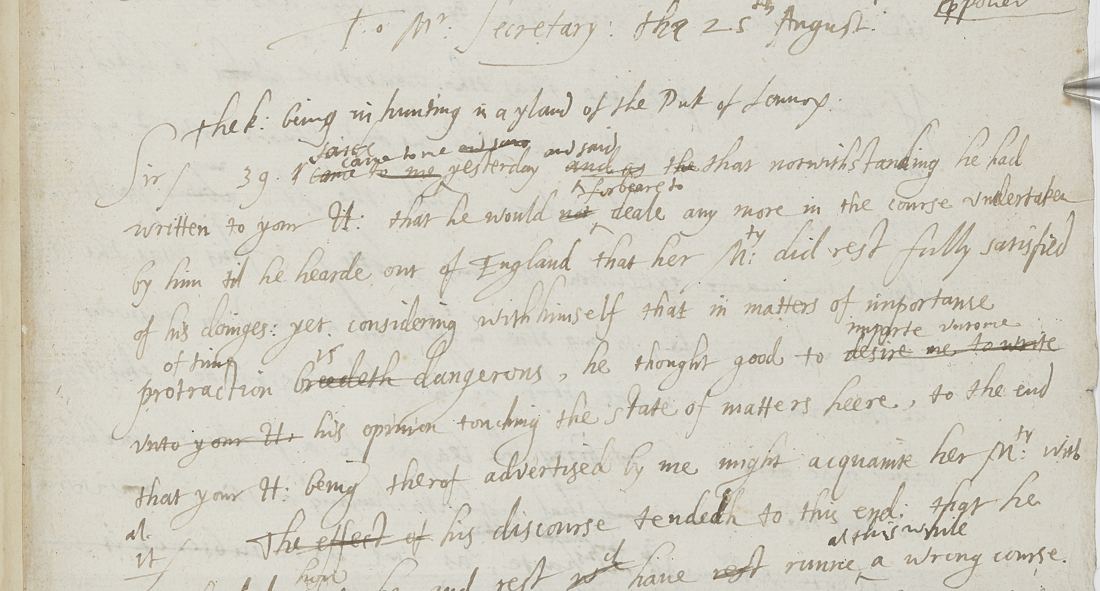
- R4841, ff. 167–168: “To Mr Secretary the 25th August”. The top of f. 167 carries the end of an earlier draft and jotted notes (“Maxwel”, “1000”, “Sterling”).
- R4842, ff. 173–174: “To Mr Secretary the 30th of August 1585”.
- R4843, ff. 175–176: “To Mr Secretary the first of September”.
All three are working drafts in Wotton’s hand, with deletions and interlinear additions. The code numbers are written inline, usually followed by a point, where a name would stand. The drafts also write “the K.” and “her Mtie” in clear in places, so the code was applied unevenly.
02 The code numbers
| No. | Reading | Grade | Evidence in the drafts |
|---|---|---|---|
| 19 | James Stewart, Earl of Arran | H | “for the enlargement of 19” (Arran was warded after Lord Russell’s killing on the Border, 27 July 1585); “19 yet remayneth at Kinneil”, Arran’s house; “the Arranistes”. |
| 39 | Patrick, Master of Gray | H | Wotton’s informant, pushing for Arran’s fall; complained of “the alteration of my countenance towarde him”; charged by the King to take the Jesuits Hay and Dury. |
| 10 | King James VI | H | “possesse themselves of 10 and 19”; “within 10 house”; “to hinder his reconciliation with 10”. |
| 9 | England | C | “he seemeth stil as desirous of the 9 frendshippe as ever he was”. |
| 20 | John, Lord Maxwell | C | A disaffected lord seeking terms with the King through Arran; “20 make some incursion upon the Laird of Joh[nstone], with whome he hath a quarrel” (the Maxwell–Johnstone feud). “Maxwel” is also jotted on f. 167. |
| 24 | Sir Thomas Kerr of Ferniehirst (CSP Scotland viii glosses “Farnyhurst”; first identified here as Huntly) | H | A Catholic lord suspected of a secret agreement with Arran and of a plan to carry the King to France, paying his men in French crowns (the Jesuits’ 6,000 crowns). |
| 3 | the Queen of England (first read as France) | C | “diverte 10 from 3”; if the King stays constant in his affection “towarde 3”, Arran “wil not fail to convey him into France”; and “it can no way stand with 3 honor that I should be at that time in this contrey”. Read on the full transcription (22 October 2026); every occurrence fits, but on sense only. |
| 27 | unidentified | I | One of Gray’s associates at court (39, 40 and 27 cannot “live safely” at court); “[27] was greatly hers, and is a great favorer of the Hameltons” (Mary’s). Candidates: Secretary Maitland, Justice Clerk Bellenden. |
| 40 | Sir Lewis Bellenden, the Justice Clerk (CSP Scotland viii) | H | Another of Gray’s associates at court. |
| 32 | unidentified | I | A place, probably a castle, into which Arran might “convey himself”. |
| 36 | unidentified | I | The source of money for 39’s hundred men (“money out of [36]”); perhaps the Queen’s treasure. |
03 What the despatches say
25 August 1585 (R4841)
The King is hunting in a land of the Duke of Lennox. Gray (39) came to Wotton “yesterday”: although he had written that he would forbear to deal further until he heard that the Queen was satisfied with his doings, he judged delay dangerous. His discourse: he and the rest have run a wrong course “in seeking to disgrace 19 with 10”, whose love toward Arran is so extreme that he will not suffer a hair of his head to fall; as long as Arran continues in favour it is impossible to bring home the banished lords, and the league “cannot be sure”. Arran will be able to divert the King from England and toward France (3). To obviate this, the Queen should furnish the lords to take Arran and seize the King’s person. There are rumours that Arran and 24 are agreed, and that 24 may carry the King to France.
30 August 1585 (R4842)
Wotton answers Walsingham’s letter of the 21st about Gray’s complaint to “his friend in England”. Gray, 40 and 27 cannot live safely at court while Arran may return; 27 “was greatly hers, and is a great favorer of the Hameltons”. Arran still remains at Kinneil under guard. Bothwell has come to court, “to the great grief of the Arranistes”. The Jesuits Hay and Dury are in the country, and the King has charged Gray to take them.
1 September 1585 (R4843)
The device of Gray and the Prior of Blantyre: the lords are to join with 20 under colour of his feud with Johnstone, and send 500 men to seize the King and Arran. Gray asks for money to keep a hundred men and hold the King’s house; the commissioners are to meet on the Borders. This is the plan that became the return of the banished lords and the fall of Arran at Stirling in November 1585.
04 Method
The twelve images were fetched from DECODE with a logged-in session and transcribed directly; there was no cipher to break, only a hand to read. Each code number was identified by collecting every sentence it occurs in across the three drafts and matching it to the persons and events of August 1585 (Arran’s warding after the Russell affair, Gray’s intrigue with England, the Maxwell–Johnstone feud, the Jesuit mission). A number counts as certain (H) where two or more independent contexts fit only one person; probable (C) where one context points to one person or to a small set.
05 What remains open
- 27, 40: two of Gray’s associates at court. The calendar gives 40 as Bellenden (below); 27 is untested, with Maitland a candidate.
- 32: a place of refuge for Arran. 36: a source of money.
- 9, 20, 3: probable only (grade C); for 20 and 24 see the calendar below. 3 was first read as France; on the full transcription it is the Queen of England, on sense only.
- 11: open; and a few interlineations and struck-over phrases in the drafts of 30 August (p. 2 ll. 5–9, on embarking the Scots) and 1 September (p. 2 ll. 10–17, the commissioners), read only in their legible last state.
- Prior identification, checked later the same day. CSP Scotland vol. 8 (1914) was consulted afterwards through the HathiTrust text view for the companion page on Walsingham’s side of this correspondence. The calendar glosses the numbers in Wotton’s sent despatches: Arran [“19”], the Master of Gray [“39”], the Justice Clerk [“40”] and Farnyhurst [“24”]. So 40 is Sir Lewis Bellenden, and 24 is Sir Thomas Kerr of Ferniehirst, not Huntly. Its no. 106 calendars the despatch of 1 September with “Morton” for 20 (Lord Maxwell, styled Earl of Morton).
Full texts
The transcription and the decryption of every document on this page, so that the reading can be used and checked. Short files are shown here; all are in the repository.
R4841, Add MS 32657 ff. 167-168, Wotton to Walsingham, 25 Aug 1585 (draft)
Gray [39] urges that while Arran [19] is in favour with the King [10] the banished lords can never be restored nor a league with England made safe, and proposes that Elizabeth fund the lords to take Arran and seize the King's person; rumours that Arran and Ferniehirst [24] are agreed and that 24 may carry the King to France.
Transcription
# R4841 - BL Add MS 32657 ff. 167-168: Edward Wotton to Walsingham, Edinburgh?, 25 Aug 1585. Wotton's own draft.
# Diplomatic transcription from the DECODE images R4841_p1-p4 (main checkout targets/wotton1585/decode/, 4774x6837),
# read in strips and zooms at native resolution, 22 Oct 2026 (Claude Opus 5.5, REREAD_BRIEF batch b16).
# Conventions: ~~word~~ struck through in the draft; ^{word} interlined insertion (placed where the caret puts it);
# [?word] doubtful reading; [..] illegible; abbreviations kept (H. = Honour, M.ty = Majesty, LL. = Lords, K. = King).
# Bare numbers are Wotton's name code (texts/key.md).

## p1 (f. 167r), top: Wotton's notes/heads for the letter, written before it (partly struck)
p1.01 notwithstanding he wrote in his last letters.  Finding that protraction would be dangerous he
p1.02 thought to let me understand to the end I might write, ~~seing he~~  ~~the~~ He findeth they have runne
p1.03 a wrong course.  unpossible ^{to bring home the LL: and} to mak a sound league with 10. as long ^{as} he shal have 19. aboute him.
p1.04 &/no way to disgrace him ~~alone~~ there remaineth only the way of force. which is a sure way to
p1.05 restore them, unles it be taken, they shal never be restored.  thees men cannot stand
p1.06 the league ~~the~~ 10. cannot be ~~sta~~ safe.      3000 [?ᵃ]        undertake within
p1.07 one yere.  Some frend of his into England.  teaching particularities / Sterling  Cavalcata.
p1.08 He and his frends.   Party of the ligue.   Maxwel.                                    [folio] 167

## p1 (f. 167r), the draft
p1.09 To Mr Secretary: the 25th August.                       [right] post. Article ~~opposed~~ [?apposed]
p1.10 [interlined above the opening] the K: being in hunting in a yland of the Duk of Lennox.
p1.11 Sir/  39. ~~came to me and said~~ ^{sayed to me} ~~came to me~~ yesterday ^{and said} ~~and as the~~ that notwithstanding he had
p1.12 written to your H: that he would ~~not~~ ^{forbeare to} deale any more in the course undertaken
p1.13 by him til he hearde out of England that her M.ty did rest fully satisfied
p1.14 of his doinges: yet considering with himself that in matters of importance
p1.15 protraction ^{of tyme} ~~breedeth~~ ^{is} dangerous, he thought good to ~~desire me to write~~ ^{imparte unto me}
p1.16 ~~unto your H:~~ his opinion touching the state of matters heere, to the end
p1.17 that your H: being therof advertised by me might acquainte her M.ty with
p1.18 ^{it.} ~~The effect of~~ his discourse tendeth to this end: that he
p1.19 now findeth ~~that~~ ^{how} he and rest ~~do~~ ^{of his parte?} have ~~rest~~ runne ^{al this while} a wrong course
p1.20 in seeking ~~some occas~~ to disgrace 19 with 10, whose love towarde him
p1.21 is so extreeme that ~~he thincketh~~ ~~as match~~ ^{as} wil not suffer one heare of his head to fall to the ground if he
p1.22 ~~he wil make himself hatefull to all men~~
p1.23 may helpe it: that as long as 19 shal continew ^{in favour with 10.} ~~about~~ ~~19~~ it wilbe a thing
p1.24 impossible to bring home the LL: ~~by composition~~ that unles they ~~be~~ may be restored
p1.25 ~~neither~~ the league ^{cannot} ~~cannot~~ ~~neither~~ be sure, nor ^{39 and the rest ~~of his parte~~ in} ~~continew long~~ ^{safety} For ~~it~~ ~~it~~ 19 ^{receaving the K: presently} ~~[..] with [..]~~
p1.26 ^{then wil he with his} credit ~~with 10~~ wilbe hable ^{with his credit} ~~at al tymes~~ ^{to ruine them and} ~~to~~ diverte ~~him~~ ^{10} from 3. ~~to~~
p1.27 ~~and make him wronge with France: beside that his power in this to r~~ or if ^{that finding} ~~he~~ ~~[..]~~ ~~the~~ K. constantly ^{affection} ~~affection~~
p1.28 towarde 3. ~~suche as wil not be remooved~~ ^{premoveable?}, ~~he~~ ^{stick}, he wil not fail to convey him
p1.29 into Fr. / To obviate ^{therfore} al thees inconveniences, his advise is that
p1.30 her M. having so good occasion ~~upon~~ ministred unto her by the death of my L.

## p2 (f. 167v)
p2.01 Russel. ~~shal~~ take the matter very highly and ^{hould it from concluding} ~~put of~~ the league
p2.02 for this time, that she lette slippe the LL: ~~and supporte~~ who
p2.03 if they may have from her some supporte of money wil by their
p2.04 frendes heere and suche as ~~she~~ they may levy for money be hable
p2.05 to take 19. and ~~ce~~ ^{possesse} ceaze 10. persone. wherunto they shal have
p2.06 the best helpe he can give them by himself and his faction,
p2.07 If ~~that~~ he may perceive that this overture ~~of his~~ be liked of,
p2.08 he wil direct a spetial frend of his and theirs into England
p2.09 very shortly, who shal conferre with the LL: ~~about~~ particularly
p2.10 about the ~~maner~~ execution of this plotte / This was the effect
p2.11 of his whole speeche, saving that in the end he saied in answeare of
p2.12 an objection w.ch I made, that he would undertake (this thing
p2.13 being onse done) to ~~so~~ bring the league to a perfect conclusion
p2.14 and that the K: ~~that mind~~ shal notwithstanding al this be ~~bro~~ wrought
p2.15 to assente unto ^{it} with ~~his~~ ^{a [..] his} ~~not willing~~ harte, as wel as to ~~subscribe it with~~
p2.16 ~~his hand and~~ confirme it ^{with his hand and} ~~with his~~ othe/
p2.17 It is ~~g~~suspected ~~by some heere~~ that 19 and 24. be ^{secretly} agreed, and
p2.18 some heere feare, lest 24. by consent of the other take the
p2.19 K: and convey ^{him} into Fr:   It is now very constantly reported
p2.20 that 24. payeth his ~~fo~~ men with crownes of the sonne, and
p2.21 that the greatest parte of the 6000ᵃ w.ch ~~was~~ the Jesuites brought
p2.22 fell to his share. w.ch if it be trew is a shrewd token ~~[..]~~
p2.23 post. Art: if her M. shal like of the Mr ^{of [..]?} overture, I could wishe the matter
p2.24 so handled that 10. might first waxe ^{refuse the league} colde in the matter of the

## p3 (f. 168r)
p3.01 league, w.ch I suppose might easely be compassed, if her
p3.02 M. do meet with that Article w.ch ~~thees men~~ ~~10~~ is ~~[..]~~ proposed
p3.03 touching the K: title, she would ~~for give me direction~~ inserte
p3.04 another for the home comming of the LL:                      [folio] 168

## p4 (f. 168v), endorsement
p4.01 Copie / To Mr Secretarye / 25. Auguste          [centre, other hand?] [..]
Decryption
# R4841 reading: Edward Wotton to Walsingham, 25 August 1585 (BL Add MS 32657 ff. 167-168, Wotton's draft)
# Rests on: texts/R4841_transcription.txt, Wotton's own clear draft transcribed from the DECODE images (22 Oct 2026,
# Claude Opus 5.5, batch b16). The last state of the draft is read: struck words dropped, interlined words taken in.
# Spelling: Wotton's, as R4841_transcription.txt gives it (v6, 23 Oct 2026: the modernised spelling of 22 Oct restored
# word by word from the transcription with research/reading_audit/v6_align.py; his abbreviations H:, M.ty, LL:, K: are
# written out, and a word the alignment did not reach keeps its earlier form). No word was changed; modern spelling is
# only in R4841_en.md. {n = gloss}: Wotton's name code, glossed from CSP Scotland viii (19, 39, 24) or from the drafts
# themselves (10, 3; see NOTES); [word] a word supplied that the draft does not carry; [?word] doubtful; [..] illegible.
# Wotton's working notes at the head of f. 167r are in the transcription only (p1.01-p1.08).

To Mr Secretary, the 25th of August. The King being at hunting in an yland of the Duk of Lennox.

Sir, {39 = the Master of Gray} sayed to me yesterday that, notwithstanding he had written to your Honour that he would forbeare to deale any more in the course undertaken by him til he hearde out of England that her Majesty did rest fully satisfied of his doinges, yet considering with himself that in matters of importance protraction of tyme is dangerous, he thought good to imparte unto me his opinion touching the state of matters heere, to the end that your Honour, being therof advertised by me, might acquainte her Majesty with it.

His discourse tendeth to this end: that he now findeth how he and [the] rest of his party have runne al this while a wrong course in seeking to disgrace {19 = Arran} with {10 = the King}, whose love towarde him is so extreeme as [he] wil not suffer one hair of his head to fall to the ground if he may helpe it; that as long as {19 = Arran} shal continew in favour with {10 = the King}, it will be a thing impossible to bring home the Lords; that unles they may be restored the league cannot be sure, nor {39 = the Master of Gray} and the rest in safety. For {19 = Arran}, receaving the King presently, then wil he with his credit be able to ruine them and diverte {10 = the King} from {3 = the Queen of England}; or if, that finding the King constantly [in] affection towarde {3 = the Queen of England} [?immoveable], [?stick], he wil not fail to convey him into France.

To obviate therfore al thees inconveniences, his advise is that her Majesty, having so good occasion ministred unto her by the death of my Lord Russel, [should] take the matter very highly and hold [the King] from concluding the league for this time; that she lette slippe the Lords, who, if they may have from her some supporte of money, wil by their frendes heere and suche as they may levy for money be able to take {19 = Arran} and possesse [and] seize {10 = the King's} persone; wherunto they shal have the best helpe he can give them by himself and his faction.

If he may perceive that this overture be liked of, he wil direct a spetial frend of his and theirs into England very shortly, who shal conferre with the Lords particularly about the execution of this plotte.

This was the effect of his whole speeche, saving that in the end he saied, in answeare of an objection which I made, that he would undertake (this thing being once done) to bring the league to a perfect conclusion, and that the King shal notwithstanding al this be wrought to assente unto it with a [..] heart, as wel as to confirme it with his hand and oath.

It is suspected that {19 = Arran} and {24 = Ferniehirst} be secretly agreed, and some heere feare lest {24 = Ferniehirst} by consent of the other take the King and convey him into France. It is now very constantly reported that {24 = Ferniehirst} payeth his men with crownes of the sun, and that the greatest parte of the six thousand [crowns] which the Jesuites brought fell to his share; which, if it be true, is a shrewd token.

Postscript. Article: if her Majesty shal like of the Master's overture, I could wishe the matter so handled that {10 = the King} might first waxe colde in the matter of the league [and] refuse the league, which I suppose might easely be compassed if her Majesty do meet with that article which is proposed touching the King's title; she would inserte another for the home comming of the Lords.

[Endorsed:] Copie. To Mr Secretarye, 25 Auguste.
Reading
# R4841 reading: Edward Wotton to Walsingham, 25 August 1585 (BL Add MS 32657 ff. 167-168, Wotton's draft)
# Rests on: texts/R4841_transcription.txt, Wotton's own clear draft transcribed from the DECODE images (22 Oct 2026,
# Claude Opus 5.5, batch b16). The last state of the draft is read: struck words dropped, interlined words taken in.
# Spelling: Wotton's, as R4841_transcription.txt gives it (v6, 23 Oct 2026: the modernised spelling of 22 Oct restored
# word by word from the transcription with research/reading_audit/v6_align.py; his abbreviations H:, M.ty, LL:, K: are
# written out, and a word the alignment did not reach keeps its earlier form). No word was changed; modern spelling is
# only in R4841_en.md. {n = gloss}: Wotton's name code, glossed from CSP Scotland viii (19, 39, 24) or from the drafts
# themselves (10, 3; see NOTES); [word] a word supplied that the draft does not carry; [?word] doubtful; [..] illegible.
# Wotton's working notes at the head of f. 167r are in the transcription only (p1.01-p1.08).

To Mr Secretary, the 25th of August. The King being at hunting in an yland of the Duk of Lennox.

Sir, {39 = the Master of Gray} sayed to me yesterday that, notwithstanding he had written to your Honour that he would forbeare to deale any more in the course undertaken by him til he hearde out of England that her Majesty did rest fully satisfied of his doinges, yet considering with himself that in matters of importance protraction of tyme is dangerous, he thought good to imparte unto me his opinion touching the state of matters heere, to the end that your Honour, being therof advertised by me, might acquainte her Majesty with it.

His discourse tendeth to this end: that he now findeth how he and [the] rest of his party have runne al this while a wrong course in seeking to disgrace {19 = Arran} with {10 = the King}, whose love towarde him is so extreeme as [he] wil not suffer one hair of his head to fall to the ground if he may helpe it; that as long as {19 = Arran} shal continew in favour with {10 = the King}, it will be a thing impossible to bring home the Lords; that unles they may be restored the league cannot be sure, nor {39 = the Master of Gray} and the rest in safety. For {19 = Arran}, receaving the King presently, then wil he with his credit be able to ruine them and diverte {10 = the King} from {3 = the Queen of England}; or if, that finding the King constantly [in] affection towarde {3 = the Queen of England} [?immoveable], [?stick], he wil not fail to convey him into France.

To obviate therfore al thees inconveniences, his advise is that her Majesty, having so good occasion ministred unto her by the death of my Lord Russel, [should] take the matter very highly and hold [the King] from concluding the league for this time; that she lette slippe the Lords, who, if they may have from her some supporte of money, wil by their frendes heere and suche as they may levy for money be able to take {19 = Arran} and possesse [and] seize {10 = the King's} persone; wherunto they shal have the best helpe he can give them by himself and his faction.

If he may perceive that this overture be liked of, he wil direct a spetial frend of his and theirs into England very shortly, who shal conferre with the Lords particularly about the execution of this plotte.

This was the effect of his whole speeche, saving that in the end he saied, in answeare of an objection which I made, that he would undertake (this thing being once done) to bring the league to a perfect conclusion, and that the King shal notwithstanding al this be wrought to assente unto it with a [..] heart, as wel as to confirme it with his hand and oath.

It is suspected that {19 = Arran} and {24 = Ferniehirst} be secretly agreed, and some heere feare lest {24 = Ferniehirst} by consent of the other take the King and convey him into France. It is now very constantly reported that {24 = Ferniehirst} payeth his men with crownes of the sun, and that the greatest parte of the six thousand [crowns] which the Jesuites brought fell to his share; which, if it be true, is a shrewd token.

Postscript. Article: if her Majesty shal like of the Master's overture, I could wishe the matter so handled that {10 = the King} might first waxe colde in the matter of the league [and] refuse the league, which I suppose might easely be compassed if her Majesty do meet with that article which is proposed touching the King's title; she would inserte another for the home comming of the Lords.

[Endorsed:] Copie. To Mr Secretarye, 25 Auguste.
Translation
# R4841 in modern English: Wotton to Walsingham, 25 August 1585. Rendered from texts/R4841_reading.md (same holes).
# {n = gloss} code numbers as in the reading; [..] unread; [?word] doubtful.

To the Secretary, 25 August. The King is out hunting on an island belonging to the Duke of Lennox.

Sir, {39 = the Master of Gray} told me yesterday that, although he had written to you that he would stop dealing in the course he had taken up until he heard from England that the Queen was fully satisfied with what he had done, he had concluded that in important matters delay is dangerous, and so decided to give me his view of affairs here, so that you, informed by me, could pass it on to the Queen.

The gist of what he said is this. He now sees that he and the rest of his party have all along been going the wrong way about it in trying to bring {19 = Arran} into disgrace with {10 = the King}, whose love for him is so extreme that he will not let a hair of his head fall to the ground if he can help it. As long as {19 = Arran} stays in favour with {10 = the King} it will be impossible to bring the Lords home; unless they are restored the league cannot be relied on, and {39 = the Master of Gray} and the rest will not be safe. For {19 = Arran}, once he has the King again, will use his credit to ruin them and to turn {10 = the King} away from {3 = the Queen of England}; or, if he finds the King's affection for {3 = the Queen of England} [?unshakeable], he will not fail to carry him off to France.

To head off all these dangers, his advice is that the Queen, given so good an occasion by the death of Lord Russell, should take the matter very seriously and hold the King back from concluding the league for now, and let the Lords loose. If they can have some money from her, they will be able, with their friends here and the men they can hire, to take {19 = Arran} and seize the person of {10 = the King}; and he will give them all the help he can, himself and his faction.

If he sees that this proposal is liked, he will very shortly send a special friend of his and of theirs to England to confer with the Lords in detail about carrying out the plan.

That was the substance of his whole speech, except that at the end, answering an objection of mine, he said he would undertake, once this was done, to bring the league to a full conclusion, and that the King would nonetheless be brought to agree to it with a [..] heart, and to confirm it with his signature and his oath.

It is suspected that {19 = Arran} and {24 = Ferniehirst} have come to a secret understanding, and some here fear that {24 = Ferniehirst}, with the other's consent, may seize the King and carry him to France. It is now firmly reported that {24 = Ferniehirst} is paying his men in French gold crowns, and that most of the six thousand crowns the Jesuits brought went to him, which, if true, is a telling sign.

Postscript. If the Queen likes the Master's proposal, I would wish it handled so that {10 = the King} first cools towards the league and refuses it. I think that could easily be managed if the Queen answers the article proposed about the King's title by inserting another one for the return of the Lords.

[Endorsed:] Copy. To the Secretary, 25 August.
R4842, Add MS 32657 ff. 173-174, 30 Aug 1585 (draft)
Answers Walsingham's letter of the 21st about Gray's complaint; 27 and 40; Arran still at Kinneil under guard; Bothwell come to court 'to the great grief of the Arranistes'; the Jesuits Hay and Dury in the country.
Transcription
# R4842 - BL Add MS 32657 ff. 173-174: Edward Wotton to Walsingham, 30 Aug 1585. Wotton's own draft.
# Diplomatic transcription from the DECODE images R4842_p1-p4 (main checkout targets/wotton1585/decode/, 4805x6837),
# read in bands and zooms at native resolution, 22 Oct 2026 (Claude Opus 5.5, REREAD_BRIEF batch b16).
# Conventions: ~~word~~ struck through; ^{word} interlined insertion; [?word] doubtful; [..] illegible.
# Bare numbers are Wotton's name code (texts/key.md).

## p1 (f. 173r)
p1.01 To Mr Secretary: the 30th of August. 1585.                               [folio] 173
p1.02 your H: of the 21th: came to my handes the 26th of the
p1.03 same. by w.ch I perceive ~~the alteratio~~ that 39. hath complayned
p1.04 ~~to his frend in England~~ of the alteration of my countenance
p1.05 towarde him.  My answeare thereunto is, that I never ^{what cause soever he gave me to the contrary}
p1.06 altered my countenance ~~towarde 39.~~ but used him ^{alwaies} with as great
p1.07 familiaritie and curtesy as I did ~~use either 27. or 40.~~ ^{kyndly doone}.
p1.08 Mary the trouth is that ~~he~~ after he had spoken to 10. ~~in the~~
p1.09 for the enlargement of 19. without the knowlege of 40. 27.
p1.10 or me self, he then for 3 or 4 dayes ~~abstained~~ ~~refrained~~ ^{so that the alteration of countenance was on his parte and not on myne.}
p1.11 ~~my company~~ abstained from ^{his wonted maner of} ~~usual~~ visiting me. ~~at~~ ^{this} ~~[..]~~
p1.12 proceeding in that matter, I wil now interprete in the best
p1.13 parte, seeing ^{he} hath so wel taken ^{up} himself: ~~if~~ ~~and~~ ~~finding~~ ^{and}
p1.14 ~~runneth no more counter~~ ~~forsaking the counter course~~ ~~do~~ ^{but [..] again} hime ~~[..]~~ ~~on the right sente~~.
p1.15 For 27 and 40. I ~~could~~ never ~~perceive~~ ^{sawe/founde} cause to
p1.16 ~~thinke~~ ^{suspect} them ^{to} ~~runne~~ ^{be} in the 11. course, neither doo I ~~thinke~~ ^{suppose} that
p1.17 39. in his conscience is so perswaded of them. yet can it not
p1.18 be denied ^{as your H: wryteth} ~~but~~ 27. was greatly hers, and is a great favorer
p1.19 of the Hameltons, and as yet no ernest frend ~~of~~ ^{to} the LL:
p1.20 Gur ^{[?Cur]} in ~~what~~ all matters ^{concerning my negotiation} wherein I have had to deale with him I
p1.21 have found him ^{fully} as forwarde ~~as~~ as any of the other two.
p1.22 Neverthelesse as ~~I condemne him not, so wil I not purge~~
p1.23 ~~him, as~~ but meane to folow your H: ^{grave} wise advice in dealing
p1.24 warely with him and all others. For by that litle experience
p1.25 ~~that~~ I have of this contry men, I thinke ^{it} ~~I may safely~~

## p2 (f. 173v)
p2.01 ~~pronounce this sentence, of whom that there is~~ ~~none~~ ^{dangerous to trust any} of all ^{their [..]} ~~to~~
p2.02 be ~~trusted~~ further then ^{it} shal stande with his owne particulars
p2.03 as they terme it heer.  So that in my simple ingement if her
p2.04 M.ty wil have ~~fast frende~~ procure her self ^{fast} frendes ~~here~~ ^{in this contrey}
p2.05 she must ^{both} have a consideration ~~of~~ ^{to} their particulers ^{and} ~~to~~ ^{bendes [?them so]} ~~embarke~~
p2.06 ~~suche sale~~ ~~embarke~~ them in her ~~with~~ course ~~that they may~~ ^{unles they be [..] embarked} ^{may} ~~[..]~~ ~~bridle~~ ^{to continew [..]} ~~[..]~~ them ~~to her course~~
p2.07 ~~use the matter~~ that ~~they may~~ necessity ^{&} ~~where this~~ ^{which by [..]} necessity
p2.08 ~~unles they wil be wrate utterly wrecked~~
p2.09 [..] are bounde, wil quickly for greater gain free themselfes
p2.10 To fe ^{[?feede] them} with money ^{is good, but} ~~only~~ ~~yet~~ to no great purpose unles you do so embarke
p2.11 them, as ~~they~~ may not hope to leape ashore without drawing ~~embarking them so as~~
p2.12 ~~if~~ 19. yet ~~contin~~ remayneth at Kenel, where I heare
p2.13 ~~he standeth greatly on his garde~~ ~~is very wel accompanied~~,
p2.14 under a ^{colour} pretense of feare to be sodainly assaulted by his
p2.15 ~~enemies~~. he is as I heare very wel accompanied.  To kepe
p2.16 him from the Courte longer then the meeting of the
p2.17 commissioners unles ~~the matter fall out flatte~~ ^{he bee found by them gilty} of the ^{fase} breache
p2.18 on the Borders, wilbe as I suppose very harde. ^{as the other parte} if he
p2.19 recover the K: presence, I cannot see how 39. 40. 27.
p2.20 can live safely in the courte, ~~so that~~ ^{and} ~~the~~ if 19. ^{being} ~~be~~ there
p2.21 alone D. fac totum, we may easely coniecture what
p2.22 ^{successe} event matters ~~with~~ are like to have.  For my owne part,
p2.23 I ~~confesse~~ I am to yong to find out ^{a} ~~the~~ remedy for this mischeef
p2.24 ~~but hartie~~ ^{expect dayly her M. resolution touching the overture made by 39.}
p2.25 and therfore leave it to the consideration of her M. ^{[..]} ~~[..]~~
p2.26 whether she wil harken to the ^{39} ~~offe~~ ^{offer} overture or no. This morning I saw
p2.27 ~~[..] 20. sendeth his forces togither~~
[right margin of p2, beside ll. 1-11: Wotton's working notes, partly cut off by the binding, not read]

## p3 (f. 174r)
p3.01 a letter written to the Prior of Blantire from ~~a deer frende~~ ^{from the La: of Jamington.}    [folio] 174
p3.02 ~~of Max~~ ^{brother} ~~of~~ by w.ch it seemeth that ^{he} ~~20~~. ~~24~~ ^{20.} very desirous
p3.03 to make his peace with the K: ^{by the meanes of 19} ~~and that he wil not use the~~
p3.04 [margin: with whome] I suspect he ~~wilbe~~ ^{is} secretly ^{alreadye} contracted ~~with him~~ ~~19~~. and therfore I wil doo what I can
p3.05 ~~mediation of any other then of 19.~~
p3.06 to hinder ~~it~~ ~~his~~ ^{his} ~~the~~ reconciliation with 10.
p3.07 Erle Bothwel is by the Mr meanes newly come to the
p3.08 Courte to the great greef of the Arranistes.
p3.09 ~~I am~~ It is very certain that Hay and Dury are in this
p3.10 contrey, The K: seemeth very desirous of their apprehension
p3.11 and hath laied that charge on the 39. who hath promised to
p3.12 performe it.  ^{I cannot perceive any change but that as he seemeth stil very} ~~never more~~ desirous
p3.13 [margin: In] the K: ~~if credit may be geven to wordes was~~ ~~[..]~~ ~~he seemeth to be at this tyme~~ .
p3.14 of the 9: frendshippe ^{as ever he was} ~~they~~ ~~Ticket~~.
p3.15 Ticket to my L: of L:
p3.16 ~~Cutberd of this morning~~ Sir William Steward tould his M.ty ^{by}
p3.17 ~~my L. of [..] had advertised the this~~ ^{brother} ~~and hath advertised his~~
p3.18 [margin: his brother was advertised by] that Cutberd Armorer ^{is now} ~~is at was at Kenell~~
p3.19 ~~brother from my L. of [..]~~: that her M. is resolved to ~~send~~ ~~sene~~ ^{banishe}
p3.20 the distressed LL: out of England, ^{for a few dayes} ~~and~~ ~~to the end~~ that ~~they may~~ ^{her} meaning is to send them ^{shortly} in to this contrey to shuffle the cardes
p3.21                                                 ^{pour brouiller les cartes} [glossed ^{NH:}?]
p3.22 whether there be any suche meaning or no, your H. best knoweth.
p3.23 But in the meane season this companion plaieth his parte
p3.24 very kindly.  I wishe therfore ~~your H. would~~ ^{some} ~~take~~ order ^{without}
p3.25 ~~that~~ might be taken, to ~~prohibite~~ that no english man ~~saving~~ ~~suche~~
p3.26 espetial licence ~~do~~ passe in to this contrey.
p3.27 I wishe some order might be taken to stay his repaire into this contrey.

## p4 (f. 174v), endorsement
p4.01 Copie / To Mr Secretarye / 30. Auguste          [centre] [..]
Decryption
# R4842 reading: Edward Wotton to Walsingham, 30 August 1585 (BL Add MS 32657 ff. 173-174, Wotton's draft)
# Rests on: texts/R4842_transcription.txt, Wotton's own clear draft transcribed from the DECODE images (22 Oct 2026,
# Claude Opus 5.5, batch b16). The last state of the draft is read: struck words dropped, interlined words taken in.
# Spelling: Wotton's, as R4842_transcription.txt gives it (v6, 23 Oct 2026: the modernised spelling of 22 Oct restored
# word by word from the transcription with research/reading_audit/v6_align.py; his abbreviations H:, M.ty, LL:, K: are
# written out, and a word the alignment did not reach keeps its earlier form). No word was changed; modern spelling is
# only in R4842_en.md. {n = gloss}: Wotton's name code, glossed from CSP Scotland viii (19, 39, 40) or from the drafts
# (10, 20, 9; see NOTES); [27], [11] open code numbers; [word] supplied; [?word] doubtful; [..] illegible.
# The heavily revised passage p2.05-p2.09 (how to "embark" the Scots) is read only where its last state is legible.

To Mr Secretary, the 30th of August 1585.

Your Honour's of the 21st came to my handes the 26th of the same, by which I perceive that {39 = the Master of Gray} hath complayned of the alteration of my countenance towarde him. My answeare thereunto is that I never, what cause soever he gave me to the contrary, altered my countenance, but used him alwaies with as great familiaritie and curtesy as I did [..]. Mary, the trouth is that after he had spoken to {10 = the King} for the enlargement of {19 = Arran} without the knowlege of {40 = the Justice Clerk}, [27] or myself, he then for three or four dayes abstained from his wonted manner of visiting me, so that the alteration of countenance was on his parte and not on myne. This proceeding in that matter I wil now interprete in the best parte, seeing he hath so wel taken up himself, and [..] again.

For [27] and {40 = the Justice Clerk}, I never sawe cause to suspect them to be in the [11] course, neither doo I suppose that {39 = the Master of Gray} in his conscience is so perswaded of them. Yet can it not be denied, as your Honour wryteth, [but] [27] was greatly hers, and is a great favorer of the Hameltons, and as yet no ernest frend to the Lords; [?howbeit] in all matters concerning my negotiation wherein I have had to deale with him I have found him fully as forwarde as any of the other two. Neverthelesse I meane to folow your Honour's grave advice in dealing warely with him and all others. For by that litle experience I have of this contry men, I thinke it dangerous to trust any of all their [..] further than it shal stande with his owne particulars, as they terme it heer.

So that in my simple judgement, if her Majesty wil procure herself fast frendes in this contrey, she must both have a consideration to their particulers and so embark them in her course [..] that necessity [..] [..]. [Men that] are bounde wil quickly for greater gain free themselfes. To feed them with money is good, but to no great purpose unles you do so embarke them as [they] may not hope to leape ashore without [?drowning].

{19 = Arran} yet remayneth at Kinneil, where, under a colour [or] pretense of feare to be suddenly assaulted by his [enemies], he is, as I heare, very wel accompanied. To kepe him from the courte longer than the meeting of the commissioners, unles he bee found by them gilty of the [?late] breache on the Borders, will be, as I suppose, very harde. If he recover the King's presence, I cannot see how {39 = the Master of Gray}, {40 = the Justice Clerk} [and] [27] can live safely in the courte; and if {19 = Arran}, being there alone do fac totum, we may easely coniecture what successe matters are like to have. For my owne part, I am to yong to find out a remedy for this mischeef, and therfore leave it to the consideration of her Majesty whether she wil harken to the {39 = the Master of Gray's} offer or no. [I] expect daily her Majesty's resolution touching the overture made by {39 = the Master of Gray}.

This morning I saw a letter written to the Prior of Blantire from the Laird of [?Jamington's] brother, by which it seemeth that {20 = Lord Maxwell} [is] very desirous to make his peace with the King by the means of {19 = Arran}, with whom I suspect he is secretly alreadye contracted; and therfore I wil doo what I can to hinder his reconciliation with {10 = the King}.

Erle Bothwel is by the Master's means newly come to the courte, to the great grief of the Arranistes. It is very certain that Hay and Dury are in this contrey. The King seemeth very desirous of their apprehension, and hath laied that charge on {39 = the Master of Gray}, who hath promised to performe it. I cannot perceive any change in the King, but that he seemeth stil as desirous of the {9 = English} frendshippe as ever he was.

Ticket to my Lord of L[eicester]. This morning Sir William Steward told his Majesty that Cutberd Armorer is now [..], [and] his brother was advertised that her Majesty is resolved to banishe the distressed Lords out of England for a few dayes, [and] that her meaning is to send them shortly into this contrey to shuffle the cardes. Whether there be any suche meaning or no, your Honour best knoweth. But in the meane season this companion plaieth his parte very kindly. I wishe therfore some order might be taken that no Englishman without espetial licence passe into this contrey. I wishe some order might be taken to stay his repaire into this contrey.

[Endorsed:] Copie. To Mr Secretarye, 30 Auguste.
Reading
# R4842 reading: Edward Wotton to Walsingham, 30 August 1585 (BL Add MS 32657 ff. 173-174, Wotton's draft)
# Rests on: texts/R4842_transcription.txt, Wotton's own clear draft transcribed from the DECODE images (22 Oct 2026,
# Claude Opus 5.5, batch b16). The last state of the draft is read: struck words dropped, interlined words taken in.
# Spelling: Wotton's, as R4842_transcription.txt gives it (v6, 23 Oct 2026: the modernised spelling of 22 Oct restored
# word by word from the transcription with research/reading_audit/v6_align.py; his abbreviations H:, M.ty, LL:, K: are
# written out, and a word the alignment did not reach keeps its earlier form). No word was changed; modern spelling is
# only in R4842_en.md. {n = gloss}: Wotton's name code, glossed from CSP Scotland viii (19, 39, 40) or from the drafts
# (10, 20, 9; see NOTES); [27], [11] open code numbers; [word] supplied; [?word] doubtful; [..] illegible.
# The heavily revised passage p2.05-p2.09 (how to "embark" the Scots) is read only where its last state is legible.

To Mr Secretary, the 30th of August 1585.

Your Honour's of the 21st came to my handes the 26th of the same, by which I perceive that {39 = the Master of Gray} hath complayned of the alteration of my countenance towarde him. My answeare thereunto is that I never, what cause soever he gave me to the contrary, altered my countenance, but used him alwaies with as great familiaritie and curtesy as I did [..]. Mary, the trouth is that after he had spoken to {10 = the King} for the enlargement of {19 = Arran} without the knowlege of {40 = the Justice Clerk}, [27] or myself, he then for three or four dayes abstained from his wonted manner of visiting me, so that the alteration of countenance was on his parte and not on myne. This proceeding in that matter I wil now interprete in the best parte, seeing he hath so wel taken up himself, and [..] again.

For [27] and {40 = the Justice Clerk}, I never sawe cause to suspect them to be in the [11] course, neither doo I suppose that {39 = the Master of Gray} in his conscience is so perswaded of them. Yet can it not be denied, as your Honour wryteth, [but] [27] was greatly hers, and is a great favorer of the Hameltons, and as yet no ernest frend to the Lords; [?howbeit] in all matters concerning my negotiation wherein I have had to deale with him I have found him fully as forwarde as any of the other two. Neverthelesse I meane to folow your Honour's grave advice in dealing warely with him and all others. For by that litle experience I have of this contry men, I thinke it dangerous to trust any of all their [..] further than it shal stande with his owne particulars, as they terme it heer.

So that in my simple judgement, if her Majesty wil procure herself fast frendes in this contrey, she must both have a consideration to their particulers and so embark them in her course [..] that necessity [..] [..]. [Men that] are bounde wil quickly for greater gain free themselfes. To feed them with money is good, but to no great purpose unles you do so embarke them as [they] may not hope to leape ashore without [?drowning].

{19 = Arran} yet remayneth at Kinneil, where, under a colour [or] pretense of feare to be suddenly assaulted by his [enemies], he is, as I heare, very wel accompanied. To kepe him from the courte longer than the meeting of the commissioners, unles he bee found by them gilty of the [?late] breache on the Borders, will be, as I suppose, very harde. If he recover the King's presence, I cannot see how {39 = the Master of Gray}, {40 = the Justice Clerk} [and] [27] can live safely in the courte; and if {19 = Arran}, being there alone do fac totum, we may easely coniecture what successe matters are like to have. For my owne part, I am to yong to find out a remedy for this mischeef, and therfore leave it to the consideration of her Majesty whether she wil harken to the {39 = the Master of Gray's} offer or no. [I] expect daily her Majesty's resolution touching the overture made by {39 = the Master of Gray}.

This morning I saw a letter written to the Prior of Blantire from the Laird of [?Jamington's] brother, by which it seemeth that {20 = Lord Maxwell} [is] very desirous to make his peace with the King by the means of {19 = Arran}, with whom I suspect he is secretly alreadye contracted; and therfore I wil doo what I can to hinder his reconciliation with {10 = the King}.

Erle Bothwel is by the Master's means newly come to the courte, to the great grief of the Arranistes. It is very certain that Hay and Dury are in this contrey. The King seemeth very desirous of their apprehension, and hath laied that charge on {39 = the Master of Gray}, who hath promised to performe it. I cannot perceive any change in the King, but that he seemeth stil as desirous of the {9 = English} frendshippe as ever he was.

Ticket to my Lord of L[eicester]. This morning Sir William Steward told his Majesty that Cutberd Armorer is now [..], [and] his brother was advertised that her Majesty is resolved to banishe the distressed Lords out of England for a few dayes, [and] that her meaning is to send them shortly into this contrey to shuffle the cardes. Whether there be any suche meaning or no, your Honour best knoweth. But in the meane season this companion plaieth his parte very kindly. I wishe therfore some order might be taken that no Englishman without espetial licence passe into this contrey. I wishe some order might be taken to stay his repaire into this contrey.

[Endorsed:] Copie. To Mr Secretarye, 30 Auguste.
Translation
# R4842 in modern English: Wotton to Walsingham, 30 August 1585. Rendered from texts/R4842_reading.md (same holes).
# {n = gloss} code numbers as in the reading; [27], [11] open codes; [..] unread; [?word] doubtful.

To the Secretary, 30 August 1585.

Your letter of the 21st reached me on the 26th. From it I see that {39 = the Master of Gray} has complained that my manner towards him has changed. My answer is that, whatever cause he gave me, I never changed my manner, but always treated him with as much familiarity and courtesy as I did [..]. The truth is that after he had spoken to {10 = the King} for the release of {19 = Arran} without the knowledge of {40 = the Justice Clerk}, [27] or myself, he stopped his usual visits to me for three or four days, so that the change of manner was on his side, not mine. I will now take that proceeding in the best sense, seeing he has corrected himself so well, and [..] again.

As for [27] and {40 = the Justice Clerk}, I have never seen cause to suspect them of being in the [11] course, nor do I think {39 = the Master of Gray} really believes it of them. Still, it cannot be denied, as you write, that [27] was much hers, is a great supporter of the Hamiltons, and is so far no earnest friend of the Lords; [?yet] in every matter of my negotiation I have had to handle with him I have found him fully as forward as either of the other two. Even so, I mean to follow your wise advice and deal warily with him and with everyone. From the little experience I have of the people of this country, I think it dangerous to trust any of them further than suits his own interests, as they call it here.

So in my simple judgement, if the Queen wants to win reliable friends in this country, she must both take account of their interests and so commit them to her course [..] that necessity [..] [..]. Men who are only bound will quickly free themselves for a greater gain. Feeding them with money is good, but serves little purpose unless you commit them so far that they cannot hope to jump ashore without [?drowning].

{19 = Arran} is still at Kinneil, where, under colour of fearing a sudden attack by his [enemies], he is said to be very well guarded. Keeping him from the court beyond the meeting of the commissioners will, I think, be very hard, unless they find him guilty of the [?recent] breach on the Borders. If he regains access to the King, I cannot see how {39 = the Master of Gray}, {40 = the Justice Clerk} and [27] can live safely at court; and if {19 = Arran} is there alone as the man who does everything, we can easily guess how things will go. For my part I am too inexperienced to find a remedy for this mischief, and so leave it to the Queen to consider whether she will listen to {39 = the Master of Gray}'s offer or not. I expect her decision on the proposal made by {39 = the Master of Gray} any day.

This morning I saw a letter written to the Prior of Blantyre by the brother of the Laird of [?Jamington], from which it appears that {20 = Lord Maxwell} is very eager to make his peace with the King through {19 = Arran}, with whom I suspect he already has a secret agreement; so I will do what I can to block his reconciliation with {10 = the King}.

The Earl of Bothwell has, through the Master's efforts, just come to court, to the great dismay of Arran's party. It is quite certain that Hay and Dury are in the country. The King seems very keen to have them caught and has given the task to {39 = the Master of Gray}, who has promised to do it. I can see no change in the King, except that he seems as eager as ever for {9 = English} friendship.

Note for the Earl of L[eicester]. This morning Sir William Stewart told the King that Cuthbert Armorer is now [..], and that his brother had been told that the Queen has decided to expel the distressed Lords from England for a few days, and that her real intention is to send them shortly into this country to shuffle the cards. Whether that is really her intention you know best. Meanwhile this fellow is playing his part very nicely. I would therefore wish some order to be made that no Englishman may come into this country without a special licence. I would wish some order to be made to stop his coming into this country.

[Endorsed:] Copy. To the Secretary, 30 August.
R4843, Add MS 32657 ff. 175-176, 1 Sep 1585 (draft)
The device of Gray and the Prior of Blantyre: the lords to join with Maxwell [20] under colour of his feud and send 500 men to seize the King and Arran, the plan that became the lords' return and Arran's fall at Stirling in November 1585.
Transcription
# R4843 - BL Add MS 32657 ff. 175-176: Edward Wotton to Walsingham, 1 Sep 1585. Wotton's own draft.
# Diplomatic transcription from the DECODE images R4843_p1-p4 (main checkout targets/wotton1585/decode/, 4805x6837),
# read in bands and zooms at native resolution, 22 Oct 2026 (Claude Opus 5.5, REREAD_BRIEF batch b16).
# Conventions: ~~word~~ struck through; ^{word} interlined insertion; [?word] doubtful; [..] illegible.
# Bare numbers are Wotton's name code (texts/key.md).

## p1 (f. 175r)
p1.01 to Mr Secretary. the first of September.                                  [folio] 175
p1.02 Sir/ ~~If your H: can bring the LL: to like~~
p1.03 for the better ~~bringing to~~ effectuating of the ~~devise of~~ ^{overture made by} 39. wherof
p1.04 I have already advertised your H:, it is thought meet by himself
p1.05 and the Pre: of B: that ~~first~~ the LL: in any case ^{doo agree} ~~ioyne them~~
p1.06 ^{and speedely} ~~and sometly~~ secretly with 20. and that then 20. make some incursion
p1.07 upon the L. of Joh: ~~against~~ ^{with} whome he hath a quarrel,
p1.08 to the end that under ~~the~~ ^{a} colour of aiding the said Larde
p1.09 of ~~Joh~~: ^{against 20.} the L. B: the L. H: S. J. H. and S. may
p1.10 gather ^{their} forces and ioyne with 20. ~~and~~ the LL: sending
p1.11 500. of their best men with greatest expedition possible ~~[..]~~:
p1.12 ~~to apprehende~~ ~~to 19~~ ^{to} possesse them selves of 10. and 19. ~~who by~~
p1.13 thees 500. to be ~~capitayned~~ ^{conducted} by L. of Arb: the Erle Mo: Master G.
p1.14 ~~that [..] is like to be with him~~
p1.15 39 sayeth that if he may have with speed so muche
p1.16 money out of 36. as may ~~serve~~ ^{suffise} ~~his turne of for the~~ to maine-
p1.17 tame 100 men ^{a convenient} some shorte time, he wil assure the
p1.18 LL: to be so strong within the 10. hou: as that if ~~he~~ 10.
p1.19 would upon ~~any~~ ^{the} bruite of the LL: comming into thy contrey,
p1.20 ~~starte~~ ^{passe} over the water into the Fife or ~~be willing~~ ^{seeke to}
p1.21 convey himself into ~~[..]~~ 32. he wil by force stay him,
p1.22 and deliver him into their handes.  How necessary a thing
p1.23 it is to have a frend within the Cou: who may be hable (in
p1.24 case the ^{sodain} enterprise of the 500 shoulde faile) to hould the
p1.25 10. firme from starting till suche time as the whole forces
p1.26 of ~~the~~ LL: shall be at the place, your H: can wel
p1.27 consider; and therfore in my iugement it were not amisse
p1.28 ~~in this pointe~~ to ~~graunt~~ ^{satisfye} 39. his request: who is now so
p1.29 farre embarqued, as unles this matter have good successe
p1.30 I esteeme him utterly ruined ~~and therfore in this~~ ~~[..]~~ ^{he may be} the better
p1.31                                                  ^{trusted}.

## p2 (f. 175v)
p2.01 ~~He~~ 39. hath had great conference with the Pre:
p2.02 of B: about this matter, and ~~hath~~ ^{he} ~~desireth~~ ^{prayeth} ~~me~~ your H: to adver-
p2.03 tise the LL: ^{from him} ~~your H:~~ ~~that what to the end the LL: may under-~~
p2.04 ~~stande it~~ that whatsoever the said P: shal say unto them
p2.05 ~~[..] in his behalf~~ when they ^{shal} come to the borders, he desireth
p2.06 them to beleeve it, for he wil undoutedly performe
p2.07 it/
p2.08 ~~The secretary came this day unto me and~~
p2.09 I have forborne to acquaint the King with that parte
p2.10 of your lettre w.ch concerned the ^{adiourning} ~~putting~~ of the meeting
p2.11 of the commissioners ~~for the~~ ^{to a further day} ~~on the examination of the for~~ ^{[..] matt[ers]}
p2.12 that ~~thees men of them~~ ^{27 [..] the King hims[elf] [..]} ~~have~~ desireth ^{a delay in that} ~~[..]~~ that ~~it~~ may be ~~put~~
p2.13 ~~put of to another day, bicause they say that my L.~~ ^{[..] that}
p2.14 ~~Herris cannot matter~~ for a time, under pretense that
p2.15 ~~their~~ ^{his} commissioners ~~cannot be so soone~~ ^{ready}, they desire
p2.16 ~~my L. Herris cannot be spared~~ ^{the rest}
p2.17 ^{one of the commissioners may be an Erle,} that ^{one of the} men of greatest ranke ~~might be apposed~~
p2.18 ~~who~~ I seemed to mislike ~~their~~ ^{his} motion, but yet tould
p2.19 ~~them~~ ^{him} that I woulde advertise it, and desired that
p2.20 ~~their~~ ^{his} commissioners might have ~~very~~ sufficient
p2.21 power and autoritie ^{to doo and} ~~to~~ conclude whatsoever the cause
p2.22 and purpose of their meeting shal requyre. w.ch he sayeth
p2.23 they shal have.
p2.24 if the viol: course be resolved on, it can no way stand
p2.25 with ~~the~~ 3. honor that I should be at that time in this
p2.26 contrey/ I beseeche you therfore to be a meane to
p2.27 her M: for my ^{speedy} revocation, for ~~[..]~~ ^{that} I am in great danger
p2.28 ~~[..]~~ Ambassadours yet may I ~~be hable to serve with~~ ^{live} though I am unfitte to be
p2.29 her ~~my sworde~~ doo her service some other way. My sworde cant
p2.30          cutte as wel as an other mans, and some frendes
p2.31          I have in the contrey where I dwell.
[right margin, beside p2.10-p2.12, continued on to f. 176r] till suche a day | [..]ratime | ~~as~~ being informed by the Secretary that his commissioners cannot be ready | so soone

## p3 (f. 176r)
p3.01 [continuation of the margin note of f. 175v; see above]                       [folio] 176
p3.02 [heading] Ticket
p3.03 The matter proposed by 39. is concealed from 40 and
p3.04 27. Bicause wee here think that 40. would reveale it
p3.05 to 27. whome wee esteeme no very ~~[..]~~ great favorer
p3.06 of the LL.
p3.07 I beseeche that ~~the~~ ^{this} matter may be so handled as ~~that~~
p3.08 39. may assure himself ~~you~~ ^{her M.} reposeth great trust in him
p3.09 otherwise in a despite he may reveale the whole matter
p3.10 and overthrow it/
p3.11 So long as I shal continew in this contrey, ~~the LL:~~ ^{~~free~~} [?it] is [?wil]
p3.12 be imagined that her M. ~~is~~ desireth the going forward of the league,
p3.13 and that she meaneth not to favour the LL: w.ch opinion may doo
p3.14 muche harme, and make their frendes heer irresolute.

## p4 (f. 176v), endorsement
p4.01 Copie / To Mr Secretarye / the first of September          [centre] [..]
Decryption
# R4843 reading: Edward Wotton to Walsingham, 1 September 1585 (BL Add MS 32657 ff. 175-176, Wotton's draft)
# Rests on: texts/R4843_transcription.txt, Wotton's own clear draft transcribed from the DECODE images (22 Oct 2026,
# Claude Opus 5.5, batch b16). The last state of the draft is read: struck words dropped, interlined words taken in.
# Spelling: Wotton's, as R4843_transcription.txt gives it (v6, 23 Oct 2026: the modernised spelling of 22 Oct restored
# word by word from the transcription with research/reading_audit/v6_align.py; his abbreviations H:, M.ty, LL:, K: are
# written out, and a word the alignment did not reach keeps its earlier form). No word was changed; modern spelling is
# only in R4843_en.md.
# Numbers written out. {n = gloss}: Wotton's name code, glossed from CSP Scotland viii (39, 40,
# 19; no. 106 calendars this draft with "Morton" for 20) or from the drafts (10, 3; see NOTES); [27], [32], [36] open
# code numbers; [word] supplied; [?word] doubtful; [..] illegible. The commissioners passage (p2.10-p2.17) is heavily
# revised; only its last legible state is read.

To Mr Secretary, the first of September.

Sir, for the better effectuating of the overture made by {39 = the Master of Gray}, wherof I have already advertised your Honour, it is thought meet by himself and the Prior of B[lantyre] that the Lords in any case doo agree, and speedely, secretly, with {20 = Lord Maxwell}, and that then {20 = Lord Maxwell} make some incursion upon the Laird of Joh[nstone], with whome he hath a quarrel; to the end that, under a colour of aiding the said Larde against {20 = Lord Maxwell}, the L. B., the L. H., S. J. H. and S. may gather their forces and ioyne with {20 = Lord Maxwell}, the Lords sending five hundred of their best men with greatest expedition possible to possesse themselves of {10 = the King} and {19 = Arran}; thees five hundred to be conducted by [the] Lord of Arbroath, the Erle [?of Mar], [the] Master [of] G[lamis].

{39 = the Master of Gray} sayeth that if he may have with speed so muche money out of [36] as may suffise to maintain a hundred men a convenient shorte time, he wil assure the Lords to be so strong within {10 = the King's} house as that if {10 = the King} would, upon the bruite of the Lords' comming into this contrey, passe over the water into Fife or seeke to convey himself into [32], he wil by force stay him and deliver him into their handes.

How necessary a thing it is to have a frend within the court who may be able (in case the sudden enterprise of the five hundred shoulde faile) to hold {10 = the King} firme from starting till suche time as the whole forces of the Lords shall be at the place, your Honour can wel consider; and therfore in my iugement it were not amisse to satisfye {39 = the Master of Gray} his request, who is now so farre embarqued as, unles this matter have good successe, I esteeme him utterly ruined; [and] he may be the better trusted.

{39 = the Master of Gray} hath had great conference with the Prior of B[lantyre] about this matter, and he prayeth your Honour to advertise the Lords from him that whatsoever the said Prior shal say unto them when they shal come to the borders, he desireth them to beleeve it, for he wil undoutedly performe it.

I have forborne to acquaint the King with that parte of your lettre which concerned the adiourning of the meeting of the commissioners to a further day, [..] [..] till such a day, being informed by the Secretary that his commissioners cannot be ready so soon. [They] desire that one of the commissioners may be an erle, one of the men of greatest ranke. I seemed to mislike his motion, but yet told him that I woulde advertise it, and desired that his commissioners might have sufficient power and autoritie to doo and conclude whatsoever the cause and purpose of their meeting shal requyre, which he sayeth they shal have.

If the violent course be resolved on, it can no way stand with {3 = the Queen's} honor that I should be at that time in this contrey. I beseeche you therfore to be a meane to her Majesty for my speedy revocation, for that I am in great danger; though I am unfitte to be [her] ambassador, yet may I live [to] doo her service some other way. My sworde can cutte as wel as another man's, and some frendes I have in the contrey where I dwell.

Ticket. The matter proposed by {39 = the Master of Gray} is concealed from {40 = the Justice Clerk} and [27], bicause wee here think that {40 = the Justice Clerk} would reveale it to [27], whome wee esteeme no very great favorer of the Lords. I beseeche that this matter may be so handled as {39 = the Master of Gray} may assure himself her Majesty reposeth great trust in him; otherwise in a despite he may reveale the whole matter and overthrow it.

So long as I shal continew in this contrey, it [?will] be imagined that her Majesty desireth the going forward of the league, and that she meaneth not to favour the Lords; which opinion may doo muche harme, and make their frendes heer irresolute.

[Endorsed:] Copie. To Mr Secretarye, the first of September.
Reading
# R4843 reading: Edward Wotton to Walsingham, 1 September 1585 (BL Add MS 32657 ff. 175-176, Wotton's draft)
# Rests on: texts/R4843_transcription.txt, Wotton's own clear draft transcribed from the DECODE images (22 Oct 2026,
# Claude Opus 5.5, batch b16). The last state of the draft is read: struck words dropped, interlined words taken in.
# Spelling: Wotton's, as R4843_transcription.txt gives it (v6, 23 Oct 2026: the modernised spelling of 22 Oct restored
# word by word from the transcription with research/reading_audit/v6_align.py; his abbreviations H:, M.ty, LL:, K: are
# written out, and a word the alignment did not reach keeps its earlier form). No word was changed; modern spelling is
# only in R4843_en.md.
# Numbers written out. {n = gloss}: Wotton's name code, glossed from CSP Scotland viii (39, 40,
# 19; no. 106 calendars this draft with "Morton" for 20) or from the drafts (10, 3; see NOTES); [27], [32], [36] open
# code numbers; [word] supplied; [?word] doubtful; [..] illegible. The commissioners passage (p2.10-p2.17) is heavily
# revised; only its last legible state is read.

To Mr Secretary, the first of September.

Sir, for the better effectuating of the overture made by {39 = the Master of Gray}, wherof I have already advertised your Honour, it is thought meet by himself and the Prior of B[lantyre] that the Lords in any case doo agree, and speedely, secretly, with {20 = Lord Maxwell}, and that then {20 = Lord Maxwell} make some incursion upon the Laird of Joh[nstone], with whome he hath a quarrel; to the end that, under a colour of aiding the said Larde against {20 = Lord Maxwell}, the L. B., the L. H., S. J. H. and S. may gather their forces and ioyne with {20 = Lord Maxwell}, the Lords sending five hundred of their best men with greatest expedition possible to possesse themselves of {10 = the King} and {19 = Arran}; thees five hundred to be conducted by [the] Lord of Arbroath, the Erle [?of Mar], [the] Master [of] G[lamis].

{39 = the Master of Gray} sayeth that if he may have with speed so muche money out of [36] as may suffise to maintain a hundred men a convenient shorte time, he wil assure the Lords to be so strong within {10 = the King's} house as that if {10 = the King} would, upon the bruite of the Lords' comming into this contrey, passe over the water into Fife or seeke to convey himself into [32], he wil by force stay him and deliver him into their handes.

How necessary a thing it is to have a frend within the court who may be able (in case the sudden enterprise of the five hundred shoulde faile) to hold {10 = the King} firme from starting till suche time as the whole forces of the Lords shall be at the place, your Honour can wel consider; and therfore in my iugement it were not amisse to satisfye {39 = the Master of Gray} his request, who is now so farre embarqued as, unles this matter have good successe, I esteeme him utterly ruined; [and] he may be the better trusted.

{39 = the Master of Gray} hath had great conference with the Prior of B[lantyre] about this matter, and he prayeth your Honour to advertise the Lords from him that whatsoever the said Prior shal say unto them when they shal come to the borders, he desireth them to beleeve it, for he wil undoutedly performe it.

I have forborne to acquaint the King with that parte of your lettre which concerned the adiourning of the meeting of the commissioners to a further day, [..] [..] till such a day, being informed by the Secretary that his commissioners cannot be ready so soon. [They] desire that one of the commissioners may be an erle, one of the men of greatest ranke. I seemed to mislike his motion, but yet told him that I woulde advertise it, and desired that his commissioners might have sufficient power and autoritie to doo and conclude whatsoever the cause and purpose of their meeting shal requyre, which he sayeth they shal have.

If the violent course be resolved on, it can no way stand with {3 = the Queen's} honor that I should be at that time in this contrey. I beseeche you therfore to be a meane to her Majesty for my speedy revocation, for that I am in great danger; though I am unfitte to be [her] ambassador, yet may I live [to] doo her service some other way. My sworde can cutte as wel as another man's, and some frendes I have in the contrey where I dwell.

Ticket. The matter proposed by {39 = the Master of Gray} is concealed from {40 = the Justice Clerk} and [27], bicause wee here think that {40 = the Justice Clerk} would reveale it to [27], whome wee esteeme no very great favorer of the Lords. I beseeche that this matter may be so handled as {39 = the Master of Gray} may assure himself her Majesty reposeth great trust in him; otherwise in a despite he may reveale the whole matter and overthrow it.

So long as I shal continew in this contrey, it [?will] be imagined that her Majesty desireth the going forward of the league, and that she meaneth not to favour the Lords; which opinion may doo muche harme, and make their frendes heer irresolute.

[Endorsed:] Copie. To Mr Secretarye, the first of September.
Translation
# R4843 in modern English: Wotton to Walsingham, 1 September 1585. Rendered from texts/R4843_reading.md (same holes).
# {n = gloss} code numbers as in the reading; [27], [32], [36] open codes; [..] unread; [?word] doubtful.

To the Secretary, 1 September.

Sir, to carry out the proposal of {39 = the Master of Gray}, of which I have already told you, he and the Prior of Blantyre think it right that the Lords should by all means come to an agreement, quickly and secretly, with {20 = Lord Maxwell}; that {20 = Lord Maxwell} should then make a raid on the Laird of Johnstone, with whom he has a feud; so that, under colour of helping the Laird against {20 = Lord Maxwell}, the L. B., the L. H., S. J. H. and S. can gather their forces and join {20 = Lord Maxwell}, while the Lords send five hundred of their best men as fast as possible to seize {10 = the King} and {19 = Arran}. These five hundred are to be led by the Lord of Arbroath, the Earl [?of Mar] and the Master of G[lamis].

{39 = the Master of Gray} says that if he can quickly have enough money out of [36] to keep a hundred men for a short while, he will guarantee that the Lords are so strong inside {10 = the King}'s house that if {10 = the King}, on hearing that the Lords are coming into the country, tries to cross the water into Fife or to take refuge in [32], he will stop him by force and hand him over to them.

You can well judge how necessary it is to have a friend inside the court who can (should the surprise attack of the five hundred fail) keep {10 = the King} from slipping away until the Lords' whole force arrives. So in my judgement it would be no bad thing to grant {39 = the Master of Gray}'s request. He is now so far committed that, unless this succeeds, I consider him utterly ruined; and so he can be trusted all the more.

{39 = the Master of Gray} has had long talks with the Prior of Blantyre about this, and asks you to tell the Lords from him that whatever the Prior says to them when they come to the Borders, they should believe it, for he will certainly carry it out.

I have held back from telling the King the part of your letter about postponing the commissioners' meeting to a later day, [..] [..] until such a day, having been told by the Secretary that his commissioners cannot be ready so soon. They want one of the commissioners to be an earl, one of the men of highest rank. I made a show of disliking his proposal, but told him I would report it, and asked that his commissioners should have full power and authority to do and conclude whatever the purpose of the meeting requires, which he says they will have.

If the violent course is decided on, it cannot be consistent with {3 = the Queen's} honour for me to be in this country at that time. I beg you therefore to ask the Queen to recall me quickly, for I am in great danger; though I am unfit to be her ambassador, I may still live to serve her some other way. My sword cuts as well as any man's, and I have some friends in the part of the country where I live.

Note. The matter proposed by {39 = the Master of Gray} is being kept from {40 = the Justice Clerk} and [27], because we here think {40 = the Justice Clerk} would reveal it to [27], whom we do not take for any great friend of the Lords. I beg that the matter be handled so that {39 = the Master of Gray} can be sure the Queen places great trust in him; otherwise he may out of spite reveal the whole thing and wreck it.

As long as I stay in this country, people [?will] imagine that the Queen wants the league to go ahead and does not mean to support the Lords; that belief may do much harm and make their friends here hesitate.

[Endorsed:] Copy. To the Secretary, 1 September.
Key: key.md
06 Sources
- British Library, Add MS 32657, ff. 167–168, 173–174, 175–176. DECODE records R4841, R4842, R4843 (images behind login).
- Calendar of State Papers, Scotland, vol. 8 (1585–1586), ed. W. K. Boyd (Edinburgh, 1914): consulted after the identifications were made (see What remains open).
Notes and profile in the repository folder targets/wotton1585/. The page images are British Library copyright and are not in the repository.