

George Lasry’s decipherment
George Lasry’s report on this item, as he sent it on 24 October 2026 (PDF), in its own order and wording. The decipherment, the translation and the reconstruction of the key are his, made with ChatGPT Astra 6 and Anthropic Opus 5.5. This project’s own checks follow under Verification.
Français 4696 / 4698 — graphical cipher, ff5r/62r–v, ff30r–
Contents: Confidential warnings and cavalry arrangements: horses, payments, dispatches and service in war. The Français 4698 fragment contains a request for an appeal or intercession; most of that letter remains unread. The Paris letter of16 February1590 discusses friendship, the King of Spain and a request; its substantial gaps remain unread.
2/7 pages transcribed; 5 more in part; 7/7 pages deciphered in part
- Ciphertext-only:
- No
- Sender:
- Scipion de Gonzague (Français 4696); not established for Français 4698
- Recipient:
- Duke of Nevers (Français 4696); not established for Français 4698
- Year:
- 1585–1589 (Français 4696); 1590 (Français 4698)
- Key:
- 66 symbols/codes: 41 letter signs, 1 digraph, 24 in nomenclature
- Ciphertext:
- 3,078 recorded groups, 1,147 identified; 8 further groups with unresolved boundaries
- Interlinear plaintext:
- Français 4696, f5r: interlinear plaintext for this cipher.
- Interlinear plaintext:
- Français 4698: corresponding historical enciphering/plaintext worksheets on f26r/f93r and the f17v/f105 comparison support the checked f104r marked codes.
31r and f104r
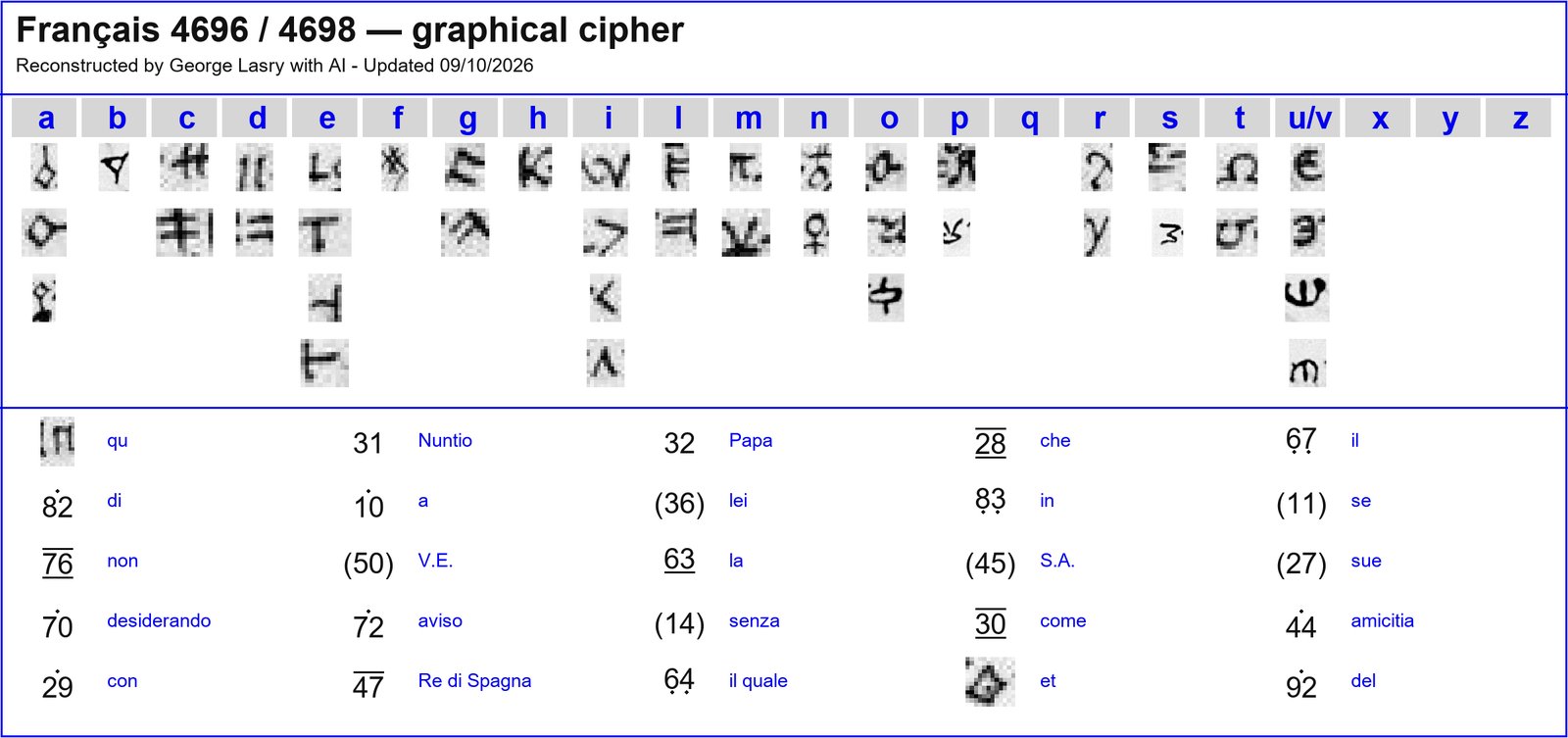
Excerpt and Translation
f62v, three complete body lines5–7

Excerpt
giudico ? il aiutarle. Quanto poi a la persona sva egli si ?ferisce prontisimo a servirla et particolar[men]te in caso di difesa o vero di esaltatione di lei, fuor di questi ? solo de sua salute, ri[gu]ardo al interesse
Translation
…helping you. As for his own person, he [offers?] himself very ready to serve you, especially in defending or advancing your position. Apart from these matters, ? only his welfare, with regard to the interest…
Readable text
The full text, folio by folio, as in the report. Bold marks the passages deciphered from the cipher; the rest is the clear text of the letter. Question marks are the report’s: [?] or a bare ? for a sign or group left unread, a ? after a word for a doubtful reading.
Français 4696 / 4698
Français 4696 f5r
Hebbi con questo ultimo ordinario la lettera di V. Ecc. li 23 di Novembre, et insieme quella ch’ella mi mandò per il ?; al quale subito la consegnai in mano propria. Parlai al proprio Amb.re di Spagna, il quale ringratia infinitamente V. Ecc. del primo avvertimento del quale non pur ? ma fa grandissimo conto.
Havendo la perfetta cognitione che V. Ecc. ha dele cose, cosi di stato come di ? credo non debba darne aviso al Re di Spagna, o quando non si accetti il consiglio, essendo che manifesta mente buono non gli debba credere, che ragione molto importante habbia persvaso il contrario. Il secondo avvertimento ancora piace, ma ? non si possa attendersi al ? et all’altra cosa insieme.
Mons.r ? il quale assicura che né dal Papa né dal Nuntio può esser venuto altro aviso contra il ?, essendo vero che ? facesse mai tale ufficio. Gli haverà caro l’avvertimento del Rucelai et stimato lo d’importantia et ? di farne parola col Papa dell’impresa di Ginevra ? ha passata leggermente, non havendo ? di trovar buona la proposta per la ragione dell’impedimento delle ?.
Dall’ultima volta credo che V. Ecc. haverà inteso la ragione che adusse Mons.r ? del non esser venuto ? la quale verità a me fa dubitar un poco. Pur desidero di chiarirmene meglio prima ch’io mi risolua, fin che questi li ? per la promotione, et poi per le feste di Natale è stato impossibile di trovarci quasi mai insieme.
Da le incluse vedrà V. Ecc. ciò che ha risposto il ? mio ? alla domanda ch’io gli feci ?; né di qua ho potuto sapere quanto sia.
?
Full manuscript page
Français 4696 f62r
Non hò visto per questo l’ultimo ordinario ch’io mi trovai col Padre Toledo, et entrando seco nel proposito che V. Ecc. si mosse da lui, che di ragion comune la cosa non può pervenire oltre il decimo grado, al che dice l’autorità di lui allegata è ben vero che ? consuetudine. Io sono del tutto ? dove tal cosa si ? in pratica possono pregiudicare a ? fratelli ?; et a questo potrà ? esser meglio et più ? di noi altri di qua. Il S.r Giulio Cesare mio figlio giunto qui a Roma la settimana passata per le cagioni che più ho scritto a V. Ecc., a che spero che si darà effetto tanto dopo l’ottava di Pasqua, essendo qui prima et sottoscritti i capitoli. Gli ho ricordato il negotio di cavalli, et egli mi dice che quanto alla prestan[z]a non crede che potria esser minore di cinquanta scudi per cavallo, ma ben potrebbe esser magiore, caso che in un medesimo temp[o] si facessero altre speditioni, per la carestia de [c]avalli.
Aggiunge esser necessario haver consideratione al camino che dovrano car?, queste ? per darlo libero et ? la quali parti l’hanno, si havrebbe da guardar di ? per causa di gli i[n]teressi de ?.
Full manuscript page
Français 4696 f62v
Considera ancora alcune altre cose, come intorno al nvmero de cavalli per ciascuna compagnia, per sapere contingentando il numero de 49, come intorno a leivide ? compagnia pratica appresso i furieri; ma forse questi et altri cose simili sono assai ben note a chi è versato nel mestiero de la gverra, perciò io non giudico necessario il aiutarle.
Quanto poi a la persona sva egli si ?ferisce prontisimo a servirla, et particolarmente in caso di difesa o vero di esaltatione di lei, fuor di questi ? solo de sua salute, ri[gu]ardo al interesse che tiene e a casa con ?.
Questo è in sostanza quel ch’io n’ho ritratto, ma per la ? l’ho sentito assai ?; di che spero che il tempo li farà scusare, stando non hora nella sua sanità, et io con questa occasione ? di tener compagnia a mio figlio in ? nostri ?.
? le sarà ?, ma fin hora non se n’è trovata ? V. Ecc. ?; et per non occuparami altro bacio con ogni ? a V. Ecc. ? le mani, et me le ?.
Di Roma a 24 di Marzo 1587.
Di V. Ecc.
Humile et oblig.mo Ser.
Scip.no ?
Full manuscript page
Français 4698 f30r
Ill.mo et R.mo S. mio ?
Ho scritto molte volte a V. Ecc. ? e dopo la ? del proprio ? non di nuovo ? fatto sapere il ?; onde sono ? a dubitare, anzi a temere ? che le non ? alcuno. La maggior parte d’esse ? in sicuro; et il ? è necessario che ? delle lettere di V. Ecc., poiché io ? la ? non l’habbia scritto questa et ? la quale ? a que ? ricevuta per ? li 8 di Ottobre ?. ? di ? ci ? all’hora che ? le scrissi la ?; e quelli ? per credere che le sarà pervenuta ? alle mani. Di altra ? non le ho scritto più in ? da nuovo ? che ? fu ? de consueto ? il ? a ? sotto ? beneplacito ? e ? se sia ? se le ? mi ? qualche ?.
Di qua ? la lettera di li 18 di Novembre ? a V. Ecc. ?
? che ? che ?
? che ? andava smar?end? ?
?
?
?
?
Full manuscript page
Français 4698 f30v
? richiedermi ? che ? prieghi ?
Et con questo fine
Full manuscript page
Français 4698 f31r
? a V. Ecc. ? qua quattro o cinque ? loro, et ? la sua ? con questo, et le bacio senza fine le mani.
Di ? a ? di Gen.o 1590.
Di V. Ecc.
? manda ?
Full manuscript page
Français 4698 f104r
Con la lettera di 16 febraro 1590. R. 9 aprille 1590. Da Parigi.
[?] di [?] con [?] di [?] et [?] di [?] di [?] dico che il [?] di [?] che [?] le feci in [?] di [?]
[?] che [?] ha [?] di [?] la [?] di lei [?] a [?] S.A. [?] di lei
[?] che [?] a [?] di [?] di [?] potendo [?] sue [?] di [?] di [?]
desiderando [?] il [?] in [?] et in [?] sue [?] di amicitia [?] che di [?] di Re di Spagna il quale [?] in [?] che [?] [?] di [?] et di [?] desiderando et [?] collocar [?] lei [?] di [?] et di [?] et
[?] lei [?] di [?] se non [?] sara [?] di [?] et di amicitia [?] [?] non [?]
non il [?] del Re di Spagna il [?] di V.E. [?] di [?] il valersi di [?] il [?] di [?]
in [?] di non [?] che [?] non [?] in [?] et in [?] non [?] aviso amicitia a [?] di V.E. [?] di [?] cederle
del [?] che a lei diano [?] che [?] a [?] di a [?] a V.E. [?] di [?]
[?] di [?] di [?] di a [?] che [?] [?] [?] a [?] se [?] il del [?] di [?]
[?] a [?] di [?] dice [?] sue [?] se [?] dati a [?] in a di [?] non [?] sue [?] a [?]
[?] del [?] aviso [?] la di [?] non [?] in [?] in [?]
[?] di [?] a [?] sue di non [?] et [?] a non a [?] intendendo [?] senza [?] come di [?] di
[?] et [?] che la [?] di [?] [?]eranno [?] che a [?] che [?]eranno amicitia [?] a [?] di [?]
[?] che [?] a [?] che [?] andranno [?] non Re di Spagna [?] idara [?] come [?] che [?] non [?] a
V.E. [?] che [?] lei [?] in [?] di lei [?] di [?] sue [?] a [?] di Re di Spagna
[?] et [?] non [?] sue [?] di [?] V.E. con [?] et che [?] ha [?] di sue [?] di [?] di [?] non [?] et [?]
sue [?] di [?] et [?] di [?] non [?] di che [?] non senza [?] et [?] se non in [?] non di [?]
[?] non il quando [?] et [?] non [?]ranno [?]
[?] di [?] non [?] che [?] et [?] non [?] amicitia [?] a [?] che non il [?] et [?] non [?]ranno [?]
[?] [?]ano [?] che quando [?] con a di [?] amicitia [?] di [?] et [?]
Full page
At a glanceKey from adjacent plaintext · partial (69% of the cipher)
- The letters
- Italian letters in a graphical cipher: from Scipion de Gonzague to the Duke of Nevers (Français 4696, 1585–1589), and a second letter in Français 4698 (1590) with sender and recipient not established.
- Where
- BnF Français 4696 / 4698 (ff. 5r, 62r–v, 30r…), via Gallica.
- The cipher
- A key of 66 symbols and codes: 41 letter signs, 1 digraph and 24 nomenclature items.
- How it was read
- George Lasry recovered the key from adjacent plaintext: the interlinear plaintext on Français 4696 f. 5r and worksheets in 4698. This project checked one sample against Gallica and partly confirmed it.
- What it says
- The excerpt on f. 62v has the writer offering to serve the recipient, especially in defending or advancing his position.
- Credit
- The result is George Lasry’s, from his BnF cipher research report of 10 October 2026 (p. 51).
- Still open
- Of 3,078 recorded groups, 1,147 are identified; the report has 2 of 7 pages transcribed and the 4698 letter is mostly unread.
01 Verification
Spot-check against the manuscript
This result is George Lasry’s. This project did not re-solve the cipher: it checked one sample against the Gallica image and recorded what it found.
- Batch A. Image checked: https://gallica.bnf.fr/ark:/12148/btv1b9059540q/f127.item
- Folio matches the report: yes; cipher present: yes
- What we checked: Fr. 4696 f62r: Italian letter "Ill.mo et Ecc.mo S. mio" with clear text (Padre Toledo, Giulio Cesare, Pasqua) and Greek-like graphic cipher runs; excerpt is from f62v, not imaged here; sign-level decode with his table not completed (glyph forms at this scan only loosely match his crops)
- Verdict: partly confirmed (method key recovered based on adjacent plaintext, extent partial). The check is a sample, not a re-solution.
- Notes: Only 1147/3078 groups identified (37%); 4698 letter mostly unread. Interlinear on f5r gave the key. Two volumes/senders bundled in one entry.
- Measured 24 October 2026 on George Lasry’s full Readable text (report PDF): 0.849 of the whole text and 0.689 of the deciphered passages read, under the 95% a complete reading needs, so its extent is partial.
02 Other contributions
Where a decipherment or clear copy already existed, as George Lasry gives it:
- Interlinear plaintext
- Français 4696, f5r: interlinear plaintext for this cipher. Français 4698: corresponding historical enciphering/plaintext worksheets on f26r/f93r and the f17v/f105 comparison support the checked f104r marked codes.
Full texts
The transcription and the decryption of every document on this page, so that the reading can be used and checked. Short files are shown here; all are in the repository.
George Lasry's decipherment (report PDF, 24 Oct 2026) read in part
Scipion de Gonzague to the Duke of Nevers, 1585-1589 (BnF fr. 4696), and a letter of 1590 by an unestablished writer (fr. 4698). Confidential warnings and cavalry arrangements: horses, payments, dispatches and service in war. The fr. 4698 fragment contains a request for an appeal or intercession, and the Paris letter of 16 February 1590 discusses friendship, the King of Spain and a request; most of both remains unread.
Builds coherent sentences, but under the read bar of 95% of words read as sense (85% here); the holes are marked in the reading.
Decryption: in full above, in George Lasry’s decipherment (readable.md)
Reading: in full above, in George Lasry’s decipherment (readable.md)
Translation: in full above, in George Lasry’s decipherment (translation_excerpt.md)
03 Sources
- George Lasry, with ChatGPT Astra 6 and Anthropic Opus 5.5, BnF cipher research, 10 October 2026 (sent to Daniel Bourdeau on 13 October 2026 for publication here), p. 51; his other items are listed on his contributor card.
- The working folder:
targets/scipion1585/(his entry as extracted from the report, our spot-check,profile.json).