At a glanceKey from adjacent plaintext · partial (50% of the cipher)
- The letters
- Despatches of Nicolò Sadoleto, Este envoy to Matthias Corvinus, from Buda and Pozsony in 1482, written when Venice attacked Ferrara; never printed.
- Where
- Archivio di Stato di Modena, Ambasciatori, Ungheria b. 1/9; DECODE R1101–R1106, four listed as partly decrypted; images also on Vestigia.
- The cipher
- Graphic signs with word divisions kept and clear words mixed in: about twenty-five signs, with homophones for the vowels and n, r.
- How it was read
- The alphabet came from aligning two letters (15 July, 31 August) sign by sign with the chancery’s clear copies. It then read the seven cipher lines of 16 July, which have no copy.
- What it says
- On 16 July Sadoleto learnt in secret that Venice had offered the King Veglia, a fleet command for his natural son and a hundred thousand ducats a year; he urges the League to match that sum.
- Still open
- The faded block of 17 August gives fragments only; a few words of 16 July lie under stains or the binding fold; the 27 November decipherment sheets are not aligned with the cipher. The twelve 1483 letters were all deciphered at the time.
01 The documents
The file holds forty-seven reports of Sadoleto, June 1482 to November 1483, most in his own hand, with a handful of ducal minutes in reply (Mátyus 2020). Vestigia catalogues all of them with images; DECODE has eighteen of those with cipher. The ones that matter here:
| Item | Date, place | Form | Status found |
|---|---|---|---|
| DECODE R1101 · b. 1/9 no. 7 (Vestigia 1284) | 15 July 1482, Pozsony | four pages, long cipher passages | no. 7a (Vestigia 1283) is the full contemporary clear copy: read at the time; used as a crib |
| DECODE R1102 · no. 8 (Vestigia 1286) | 16 July 1482, Pozsony | clear letter; seven cipher lines at the foot of p. 2, more on pp. 3–4 | no clear copy: deciphered here in gist |
| DECODE R1103 · no. 11 (Vestigia 1294) | 17 August 1482, Pozsony | copy for Ercole of Sadoleto’s letter to King Ferrante; four faint cipher lines on p. 2 | no clear copy: fragments only |
| DECODE R1104 · no. 13 (Vestigia 1298) | 31 August 1482, Pozsony | one page, mostly cipher | “Decrypted”: clear copies 13a and 13b (Vestigia 1295, 1297); used as a crib |
| DECODE R1106 · no. 26 (Vestigia 1318) | 27 November 1482, Pozsony | four pages, partly cipher | two sheets of decipherment, 26a and 26b (Vestigia 1319, 4004): read at the time; here decoded, not read (26b faded on the photographs) |
DECODE’s “partially decrypted” on R1101 and R1106 reflects that the decipherments are filed as separate items and were not attached to the records; the chancery deciphered both letters at the time. For R1106 the decipherment slips survive only in photographs whose right halves are faded. On 23 October 2026 slips 26a and 26b were transcribed as far as the photographs allow and a partial reading was built on them, following the cipher where its read spans differ (R1106_reading.md, English R1106_en.md): the two paragraphs of p. 2 that 26a covers (the Queen, the King of Hungary’s moves, the League’s spending, Venice) build sentences, but the p. 3 cipher that 26b covers keeps holes in most sentences, so R1106 stays decoded, not read. The faded right halves of 26b and of p. 3 are the blocker.
02 The key, from two cribs
No Este key for this embassy is known. The archive’s Cifrario series holds a key “per corrispondere con Nicolò Sadoletti a Napoli tra 1479 e 1480”, rebuilt by nineteenth-century archivists (Cremonini 2017, n. 39), but it is not digitised. The key was therefore rebuilt from the letters.
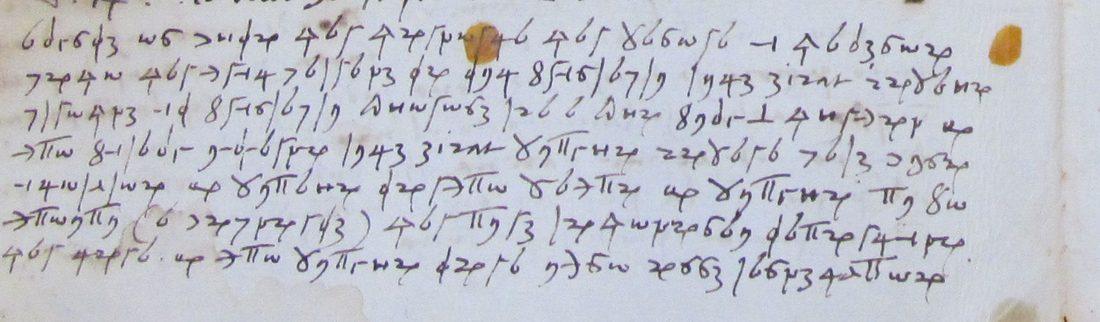
The cipher keeps word divisions, which makes alignment straightforward. The clear copy 7a of 15 July runs “… volesse unirse e pigliare questa impresa, e non lassasse pretermittere questa opportunità laquale mai più fo, né forse sera, e che lo facesse per lo amore …”, and the first lines of the cipher on the original’s second page match it word for word. The one-page letter of 31 August and its clear 13a confirm it: “epsa me dice che è certa che la liga non … perchè Millano et Fiorenza non voriano …”. One habit shows up at once: where 13a has perchè the original writes quid in ordinary letters, which works as a code word.
| Sign | Value | Sign | Value | Sign | Value |
|---|---|---|---|---|---|
| ʒρ, –1 | a | →, ) | g | 3, η, round 6 | o |
| > | b | 2 | h | Δ (stem through apex) | p |
| | (plain stroke) | c | ω | i | Δ with looped apex | q |
| φ | d | π | l | ſ, Γ | r |
| ь (6 with a stem), small Γ | e | 4 | m | 7 | s |
| 8 | f | б (flat-topped 6) | n | μ, ρ | t |
| u, и | u | Ɨ (v with a loop) | v | ʉρ | et |
The table is in targets/sadoleto1482/key_working.md with the aligned words for each sign. It is a plain alphabet with a few alternative signs for common letters; no syllable signs were needed. The nomenclator is small or rarely used: one group in the letter of 16 July does not spell out and is almost certainly a code word (below).
03 Pozsony, 16 July 1482: what Venice offered the King
The letter’s clear part is routine news of the court. The last seven lines of p. 2 are in cipher, and the cipher runs on into p. 3. From the reading (R1102_reading.md, English R1102_en.md; [U..] an unresolved sign label):
Essendo in Buda per partire per venire a Posonia, sapi per gran secreto da dom Francesco como [Signoria di Venetia] haveva scripto ad Francesco Quirino, che e qua, fosse a [Re di Hungaria], gli facesse offerta como [Signoria di Venetia] voleva havere seco bona amicitia, et voleva dargli Vegla, et voleva lo figliolo (e bastardo) per loro capitaneo de l’armata per mare, et gli voleva dare ogni anno cento milia ducati; ma voleva potere soldare et [U20] cauare gente de questo regno. Et questo l’aveva saputo sua [U03] per subtile via, et non volse per cosa del mondo che io monstrasse saperne cosa alcuna.
“Being in Buda about to leave to come to Pozsony, I learnt in great secret from dom Francesco that [the Signoria of Venice] had written to Francesco Quirino, who is here, to go to [the King of Hungary] and make him the offer that [the Signoria] wanted to have good friendship with him, and wanted to give him Veglia, and wanted his son (the bastard) as captain-general of the fleet at sea, and would give him a hundred thousand ducats every year; but it wanted to be able to hire soldiers and draw men from this kingdom.” The reading of 19 September had [X] and gaps where the text above now stands; the second pass below supplied them.
The words that fix the decipherment could be nothing else: Buda, Posonia, Francesco twice, Quirino, Vegla, capitaneo, per mare, ogni anno, cento milia. The sense fits the moment. Veglia (Krk) had been taken by Venice from Count Giovanni Frankopan in 1480, and the count was at Matthias’s court that summer (13a: “le qui lo Conte Zohane da Vegla”). The “son, the bastard” can only be János Corvin, Matthias’s natural son and intended heir. The sum links this letter to a later one. Six weeks later, in the letter of 31 August, Sadoleto told Ercole that Matthias “per cento milia ducati ogni anno pigliaria la impresa”, that is, would enter the war for the League for a hundred thousand ducats a year. The cipher of 16 July shows where that price came from: it was the figure the other side had already put on the table.
[X] is a five-sign group that occurs twice, after como both times, as the subject of haveva scripto and of voleva havere seco bona amicitia. It does not spell a word in the letter key, so it is a nomenclator entry, and the context makes it the Venetian side, most likely “la Signoria”. The informant’s title before Francesco is another three-sign group (see the second pass below).
Second pass, 20–21 September 2026
A second pass corrected the text above and found more cipher. The informant’s title spells out in the ordinary alphabet as dom, so the name is “dom Francesco”. Group [X] turns up again in the letter of 27 November, where the contemporary decipherment 26b renders it as the Signoria of Venice. A six-sign group K is aligned with the King of Hungary’s title in the 15 July clear copy. The doubtful end of line 3 and start of line 4 give fosse a [K] / gli facesse offerta. The sign for ss is checked against facesse and imparasse in the 15 July letter, and the sign for ff against affinita. Those corrections are in the reading quoted above.
The cipher does not stop there. The sentence continues on p. 3 (quoted above): Venice also wanted the right to recruit soldiers in Hungary, and the informant made Sadoleto promise to show no knowledge of it. Further down p. 3 comes a mixed passage of clear and cipher in which Sadoleto argues his own case to Ercole:
… ⟨per ogni modo disponerse⟩ ad dare a questo [Re di Hungaria] cento milia ducati ogni anno sino a sei o septe anni, che seri[a] questa suma che li domanda; et non seria gran suma alla liga, considerata la [?indubitata] victoria che sua m[aesta] … [?prome…] ⟨est lo modo che mai fo la migliore opportunita⟩ … Non scio percio se sua maesta [?atentasse] … monstra desiderare et haver piu bisogno in questo principio. Ma [U15] alla liga [U16] tractare, et non e da perder tempo; et se [?volen]o [?spen]dere dinari a questo tempo et fare la bona spesa …
“… to make up [the League’s] mind at all costs to give this King a hundred thousand ducats a year for six or seven years, which would be the sum he asks, and it would not be a great sum for the League, considering the certain victory that His Majesty … he shows he wants it and needs it more at this beginning … there is no time to lose, and if they mean to spend money, now is the time to spend it well …” So the letter sets the Venetian counter-offer beside Sadoleto’s advice to match it: a hundred thousand ducats a year from the League. Page 4 carries one more cipher line, “se bene non la mandato a questo [U11]”. Sections A–C of the letter build sentences; the monetary passage keeps unresolved labels in its last lines.
04 Pozsony, 17 August 1482: a faded block
R1103 is the copy, sent to Ercole, of Sadoleto’s letter to King Ferrante of Naples. Four lines of cipher in the middle of p. 2 have faded almost to the colour of the paper. Contrast stretching on the blue channel brings out perhaps half the signs, and they give fragments only: “… se tener che … et … lo credo …”, “… suoi …”, “… vostro … meco … che …”. The clear text around the block concerns the King’s price for joining the League and the hundred thousand ducats, so the block probably says something about that, but no reading is offered: R1103 is decoded, not read. Re-cropped line by line on 23 October 2026, the block gave no word beyond vostro that could be accepted, and DECODE R1103 carries only the page images. It needs better imaging (ultraviolet or multispectral) of the original in Modena.
05 The 1483 letters: all deciphered at the time
DECODE lists twelve more Sadoleto letters of 1483 from Buda and Zagreb (b. 1/10, R1107–R1118), several as partly decrypted. None is open. Four have clear copies filed beside them (nos. 4a/4b, 20a, 21a, 24a on Vestigia); two of the DECODE records are those copies themselves (R1108 = 9a, R1113 = 20a, R1115 = 24a); and the three letters with no filed copy carry the chancery’s decipherment on slips pasted to the leaf: R1109 (4 April, to King Ferrante) over both cipher pages, R1116 (Zagreb, 3 October) and R1118 (30 November) at the foot, keyed to the cipher by a caret. The slips show on DECODE’s photographs; on Vestigia’s later ones they have been lifted, which is why the pages appear to have no decipherment. The 1482 key decrypts the cipher of R1118 in agreement with its slip (“ma come scripsi a V.S. non gli [s]panza questo accordo col turcho”).
06 Method
All images are 4320 × 3240 two-page spreads, fetched from DECODE with a logged-in session and from Vestigia, which needs no login. The cipher lines were cut into strips, glyphs segmented by connected components and numbered on the strip (the segmentation script is the one written for the Milanese letters of 1489, see Buda 1489), and transcribed by eye against the clear copies. The pairs of signs most easily confused were settled on high-magnification crops: the two Δ forms (p and q, which differ only in the loop at the apex), the stemmed and flat-topped sixes (e and n), and the long ſ against Γ.
07 What remains uncertain
- 16 July, line 1 and lines 5–7 (Buda, Posonia, Veglia, the son, the fleet, the hundred thousand): H.
- 16 July, lines 2–4 as corrected (dom, fosse a, facesse offerta): C. [X] = the Signoria of Venice, from 26b: C for the referent; the exact wording of the code group is not known. K = the King of Hungary, from 7a: C for the referent.
- Page 3: subtile via, soldare et cauare gente, victoria, in questo principio, dinari a questo tempo, spesa: C. seri[a], indubitata, atentasse, vol[e]no spen[dere]: M.
- Still without a reading in the 16 July letter: the word after epsa non scia che; a clear word and a cipher word (piacede?) after ma; a form of promettere(?) with an unassigned K-shaped sign; the last word of the page-4 line (effecto? M); a small cross mark after et. Each lies under a stain, in the binding fold, or turns on a sign with no value yet. Blue-channel enhancement was tried on all of them.
- 17 August: fragments only. I
- 27 November: the decipherment sheets 26a and 26b were located but not aligned sign by sign with the cipher.
Full texts
The transcription and the decryption of every document on this page, so that the reading can be used and checked. Short files are shown here; all are in the repository.
R1101, Pozsony, 15 Jul 1482 (Vestigia 1284; clear copy 7a)
Nicolò Sadoleto, Ferrarese envoy to Matthias Corvinus, to Ercole I d'Este: urging the King to join the league and take up 'questa impresa', for love of the league and to humble [the Venetians] once for all. Read at the time: the contemporary clear copy 7a; the files are partial parallel readings of the cipher against it.
Decryption
# R1101: final-page opening, partial parallel transcription

Status: in progress. Source identification and coordinates are in
`alignment_r1101.md`. This covers seven manuscript lines above the ordinary
`Bene e vero` transition, not all cipher on the final page or in the letter.

The reading below separates locally checked alphabetic words from proposals
still dependent on the clear copy. C means reconstructed-key reading supported
by the contemporary witness; it is not a blind decipherment. `[...: M]` is a
proposed restoration requiring further sign-level checking. `[unread]` leaves
the sequence open. Word divisions are editorial. These are reading units,
not an exact glyph inventory; doubled-letter spellings are not sign counts.

```text
01 unirse [ordinary] et pigliare questa impresa et non [lassasse: M]
02 [pretermittere: M] questa [opportunita: M] laquale mai piu
03 fo ne forse sera et che lo facesse per lo amore
04 et benivolentia et per la [affinita strectissima: M]
05 che l'ha [cum: M] tuta la liga et per honore et gloria
06 de sua maesta et per abassare vna volta [W01] per
07 modo che l'imparasse de stare fra li suoi fine
```

Words outside brackets are local C readings. Apostrophes in `l'ha` and
`l'imparasse` are editorial. In line 06, `vna volta` and the final `per`
are now checked locally; `vna` retains the v-shaped first sign rather than
silently normalizing it to u. W01 is the intervening unresolved group,
corresponding in position to clear-witness `Venetiani`. Its internal signs
and whether it represents a nomenclator entry remain unverified. The witness
alignment must not be presented as a recovered alphabetic spelling.
The original `per` before `abassare` is retained even
though the previously transcribed witness phrase omits it.

Witness 7a, page 3, corresponding passage (readable transcription, not a
diplomatic letter-by-letter edition):

> ... unirse et pigliare questa impresa, et non lassasse pretermittere
> questa opportunita laquale mai piu fo, ne forse sera, et che lo facesse
> per lo amore et benivolentia, et per la affinita strectissima che l'ha
> cum tuta la liga, et per honore et gloria de sua Maesta, et abassare
> una volta Venetiani per modo che l'imparasse de stare fra li suoi fine.

The expanded original views are `img/r1101_final_lines12.png`, rectangle
`(1080,210,3290,395)`, and `img/r1101_final_lines47.png`, rectangle
`(1080,415,3290,660)`, from DECODE I5655. Use
`img/r1101_final_open_full.png` for the unclipped intervening third line
and full vertical context. `img/r1101_clear_control.png` shows the witness.

The closer view `img/r1101_line6_end.png`, source rectangle
`(2130,485,3230,630)` enlarged twofold, establishes the `vna volta [W01] per`
sequence. W01 begins with a stemless triangle-like shape and an omega-like
shape; these observations alone do not establish their values. Do not equate
W01 with R1102/R1106's X without an actual graphic match.

This adds an explicit seven-line coverage record to the earlier selection
of control words. It does not establish an end-to-end reading or complete
coverage by 7a; the unresolved units and other pages remain outstanding.
Decryption
# R1101: queen passage, partial parallel collation

20 September 2026. Status: in progress. Original manuscript page 2,
DECODE I5654 (left page); witness 7a, first page, lower portion. This
extends the local controls in `z_control.md`; it is not the whole letter.

C means a reading with the reconstructed alphabet, checked against 7a.
M marks a word still requiring closer sign-level checking. Punctuation and
word divisions are editorial. The following line units follow the original
cipher rows, but omit any preceding ordinary introduction.

```text
Q01 che epsa regina sta [cruzata: M] de altro in modo che non cura tropo
Q02 del facto nostro benche anchora che la [facesse: M] piu che fosse [possibile: M]
Q03 non poteria al presente disponere le cosse [altramente: M] che le [stanno: M]
Q04 et maxime senza quelli dinari anzi dice lei che se bene
Q05 la fosse stata presente et havesse facto ogni opera a questo [continued]
```

Words outside brackets are local C readings. The M label on cruzata concerns
the exact original spelling/opening; its internal z control is independently
established against the clear witness. The M words must not be quoted as
fully deciphered. Q05's following royal-title context continues outside this
five-line extract; no expansion has been supplied here.

The corresponding witness passage, in a readable transcription with gaps:

> Regina sta cruzata d'altro in modo che non cura tropo del facto nostro,
> benche anchora che la facesse piu che fosse possibile, non poteria al
> presente disponere le cosse altramente che le stanno, et maxime senza
> quelli dinari, anzi dice lei che se bene la fosse stata presente et
> havesse facto ogni opera cum questo Signor Re ...

The witness supplies **cum questo** where the original Q05 has **a questo**.
Keep the original wording rather than silently adopting the clear copy.
The source context is required when interpreting the pronouns or identifying
the money: this excerpt alone does not connect the passage to R1102's sums.

## Sources and controls

Original I5654 rectangles:

- `(420,740,2080,965)`: `img/r1101_regina_cipher.png`, opening context.
- `(420,810,2070,1005)`: `img/r1101_regina_lines23.png`, overlapping rows.
- `(420,910,2070,1140)`: `img/r1101_regina_lines45.png`, continuation.
- `(600,905,970,1000)`: `img/r1101_senza_control.png`, enlarged threefold.

Clear 7a / Vestigia 1283 photograph `(101)`, `(1260,2200,3090,2720)`:
`img/r1101_regina_clear.png`. The larger first-page review confirms the
position within the letter: `img/clear7a_first_review.jpg`.

The original **senza** has s/e/n/stemless-triangle/a, with the same word in
the clear witness. This is a second direct z control, supporting the earlier
cruzata alignment and R1106 anzi. The adjacent **dinari** supplies a locally
checked d/i/n/a/r/i sequence, but a match of its uncertain ending in R1102
has not yet been established. No new R1102 word is accepted from this alone.

## Continuation: response and peace

The next three original rows have the following partial collation. These
continue Q05; each bracket preserves untranscribed text, not an editorial
omission of known wording.

```text
Q06 [unread] de risposta
Q07 che questa che havemo havuta per la [unread]
Q08 se la pace segue [unread] como la spera vedera de fare et
```

Unbracketed spans are C. In Q07, h/a/v/e/m/o is retained as **havemo**;
the following h/a/v/u/t/a gives **havuta**. Q08's last et is visible at the
line end; its syntactic continuation is not reconstructed here.

The witness has the corresponding discussion of the answer already received,
the present circumstances, and peace with the emperor. In particular, it
places `cum lo Imperatore` after the peace clause. The corresponding original
expression mixes signs/ordinary writing and is not verified here. Do not
insert the witness's wording into Q08 or claim it establishes the internal
encoding of that expression. Q06's greater unread extent also remains open.

Original I5654 source rectangles:

- `(360,1000,2150,1300)`, `img/r1101_queen_continuation.png`.
- `(420,1035,1250,1145)`, `img/r1101_answer_words.png`, twofold.
- `(420,1085,2010,1210)`, `img/r1101_pace_words.png`, 1.2-fold.

Witness Vestigia 1283 photograph `(101)`, `(1270,2520,3110,2850)`,
`img/r1101_queen_clear_continuation.png`. The overlap with the previous
five-line context anchors the alignment. This is additional partial coverage,
not a complete collation of original page 2.
Decryption
# R1101 / 7a: source map and control passage

20 September 2026. Status: in progress. The contemporary clear witness is
established; a complete word-level collation has not been made.

Additional local collation is in `r1101_queen_parallel.md`: five cipher rows
on original page 2, aligned to the lower first page of 7a, with unresolved
words retained and the original/witness a/cum difference recorded.

## Page identities

The original letter, Vestigia 1284, occupies **four written page surfaces**
in three photographs:

| Original surface | Photograph | Visible character |
|---|---|---|
| First page | `(103).JPG`, `v1284_1_...` | Predominantly cipher, with some ordinary words and a clear closing transition |
| Second page | Left of `(104).JPG`, `v1284_2_...` | Clear opening, then extensive mixed cipher/clear text |
| Third page | Right of `(104).JPG` | Cipher at top; two clear paragraphs; a further cipher paragraph at bottom |
| Final page | `(105).JPG`, `v1284_3_...` | Cipher and mixed passages above; ordinary closing paragraph, date and signature below |

The clear copy 7a, Vestigia 1283, has **three written page surfaces** in two
photographs: `(101).JPG` is the first page, while `(102).JPG` contains pages
labelled 2 and 3. All three were visually inspected. It is a continuous copy
of the letter, unlike R1106's short separate decipherment slips.

DECODE image `IMG_R1101_I5655_P2.png` shows the **final original page** and
matches Vestigia `(105).JPG`. Thus the earlier phrase `R1101 p. 2 ll. 1–3`
identifies the second cached DECODE image, not manuscript page 2. Use the
image ID or the final-page description when citing the key-building control.

## Direct control

The original final-page opening corresponds to the upper part of **clear
copy page 3**, not clear-copy page 2. The following readable passage is from
the clear witness, with abbreviation expansion and punctuation editorial:

> ... volesse unirse et pigliare questa impresa, et non lassasse pretermittere
> questa opportunita laquale mai piu fo, ne forse sera, et che lo facesse per
> lo amore et benivolentia, et per la affinita strectissima che l'ha cum tuta
> la liga, et per honore et gloria de sua Maesta, et abassare una volta
> Venetiani per modo che l'imparasse de stare fra li suoi fine.

This is **a transcription of the clear witness**, not a claim that every
word has independently been read from the cipher. The original visibly
retains `unirse` in ordinary writing at its first line, then enciphers the
following appeal. Several direct alphabetic matches support the existing key:
`pigliare questa impresa`, `non`, `ne forse sera`, `amore`, `benivolentia`,
`tuta la liga`, and `de stare fra li suoi fine`. The transition back to clear
writing, `Bene e vero che poi neli parlamenti...`, matches the next sentence
of 7a. These boundaries make the identification independent of a single word.

Source rectangles, in original 4320 × 3240 coordinates:

- Original `(105)`: `(1080,195,3290,710)`, displayed in
  `img/r1101_final_open_full.png` (90% scale).
- Clear `(102)`, right-hand page: `(2380,430,4070,920)`, displayed in
  `img/r1101_clear_control.png`.

The earlier crop `img/r1101_final_open.png` clips the beginnings of lines;
use the `..._full.png` crop for the control.

## Coverage conclusion

The first clear page begins with the letter's opening about the recipient's
letters and the Hungarian king. The last clear page includes the appeal above,
the ensuing negotiations and the closing discussion of letters/news from the
king and queen, followed by date and signature. The original final page has
the same sequence through its closing. These observations support the
identification of 7a as a whole-letter witness.

However, the presence of a beginning and ending cannot rule out internal
omissions. The original's long interior cipher passages still require detailed
collation. Accordingly, the profile now records the completeness of the
plaintext witness as **unknown**, replacing the earlier unverified `false`
value for `plaintext.partial`. This does not retract the firmly established
fact that a contemporary decipherment exists, or the local key control.
Reading
<!-- Reading of R1101 (Claude Opus 5.5, 23 Oct 2026): the two cipher passages collated so far, put into sentences: the queen passage of page 2 (r1101_queen_parallel.md, Q01-Q08) and the final-page opening (r1101_final_parallel.md, lines 01-07). Words as the collations give them, read with the alphabet rebuilt from the contemporary clear copy 7a and checked against it (where the original differs from 7a, the original is kept: "a questo", "per abassare"). Their M words (sign-level check still open) are carried by the contemporary clear copy 7a, which has each of them at the same place, and are written plain; [unread] spans are […]; W01 is the group standing where 7a has "Venetiani" ([W01]). An excerpt: the other cipher of the letter and its clear prose are not edited in the repository. Cipher throughout. -->

# R1101, Nicolò Sadoleto to Ercole I d'Este, Pozsony, 15 July 1482: reading of the collated cipher passages

## Reading

### Page 2, the queen passage

… che epsa regina sta cruzata de altro, in modo che non cura tropo del facto nostro; benche, anchora che la facesse piu che fosse possibile, non poteria al presente disponere le cosse altramente che le stanno, et maxime senza quelli dinari; anzi dice lei che, se bene la fosse stata presente et havesse facto ogni opera a questo … […] de risposta, che questa che havemo havuta per la […] se la pace segue […] como la spera vedera de fare et …

### Final page, opening

… unirse et pigliare questa impresa, et non lassasse pretermittere questa opportunita, laquale mai piu fo ne forse sera; et che lo facesse per lo amore et benivolentia, et per la affinita strectissima che l'ha cum tuta la liga, et per honore et gloria de sua maesta, et per abassare vna volta [W01] per modo che l'imparasse de stare fra li suoi fine.
Translation
<!-- English translation of R1101_reading.md (Claude Opus 5.5, 23 Oct 2026): the two collated cipher passages of R1101 (the queen passage of page 2 and the final-page opening), checked against the contemporary clear copy 7a. Same holes: […] unread; [W01] the group where 7a has "Venetiani" (the Venetians). An excerpt. -->

# R1101, Nicolò Sadoleto to Ercole I d'Este, Pozsony, 15 July 1482: English translation of the collated cipher passages

### Page 2, the queen passage

… that the Queen herself is cross about something else, so that she does not care much about our business; although,
even if she did as much as was possible, she could not at present arrange things otherwise than as they stand, and
above all without that money; indeed she says that, even if she had been present and had done every effort for this …
[…] of an answer, that this one we have had through the […] if peace follows […] as she hopes, she will see to do and …

### Final page, opening

… to join and take up this enterprise, and not let this opportunity pass, which never was, nor perhaps will be, again;
and that he should do it for the love and goodwill, and for the very close affinity that he has with the whole League,
and for the honour and glory of His Majesty, and to humble [W01] once and for all, so that they would learn to stay
within their own bounds.
R1102, 16 Jul 1482 (Vestigia 1286)
Sadoleto learnt in great secrecy from dom Francesco that the Signoria of Venice had written to Francesco Quirino to offer the King of Hungary friendship, Veglia, and the captaincy of its fleet for his (bastard) son, with a yearly payment in ducats. Deciphered in part with the alphabet rebuilt from contemporary clear copies; r1102_working_edition.md is the current edition (unread material marked [Uxx]).
Decryption: r1102_working_edition.md
Decryption
# R1102 (Sadoleto to Ercole, Pozsony 16 Jul 1482), p. 2 cipher block (7 lines): reading by glyph

**Coverage correction, 20 Sep 2026:** this file records only the bottom-left block,
not all the letter's cipher. The facing page continues with `ducati` and contains
further cipher passages. See `review_20260920.md` for the additional readings,
the provisional `dom Francesco` title, source coordinates, and remaining gaps.

**Subsequent verification:** `verified_groups.md` resolves the title to literal
`dom` and verifies X's referent as the Signoria of Venice from R1106/26b.
It also corrects `figlio` to `figliolo` and `loco` to `loro`, and supports
`de l'armata`. The transcription below is the preserved 19 September reading;
use these corrections when citing it.

Strips: `seg/s/r1102_L0n_k.png` (numbered boxes). Glyph values in `key_working.md`. [..] = uncertain.

L1: essendo in Buda per partire per venire a Posonia
L2: sapi per gran secreto da [494] Francesco como [X = 3ί2ии] haveva
L3: scripto ad Francesco Quirino che è qua, fo[sse?] a … [Δuſ)ʒρμ иρ = ?] …
L4: gli fa[cesse?] … como [3ί2ии] voleva havere seco bona
    (…│ |943 · 3ί2ии · ƔηπΓиʒρ · 2ʒρƔьΓь · 7ь|3 · >ηбʒρ)
L5: a[mic]i[t]ia(?) et voleva da[r]gli Vegla, et voleva lo fi-
L6: -gli[o] (e bastardo) per loco capitaneo de la [ar]ma(?)
L7: per mare, et gli voleva dare ogni anno cento milia.

Gist: Sadoleto learnt in great secret (from one Francesco), while leaving Buda for Pozsony, what was written to
Francesco Quirino, who is at court: [the Venetians?] offered King Matthias Veglia (Krk, taken from Count Giovanni
Frankopan by Venice in 1480), to make his natural son ("e bastardo" = János Corvin) captain of the fleet, and to
pay him 100,000 [ducats] a year. Syntax: "como [X] haveva scripto ad Francesco Quirino … come [X] voleva havere seco
bona amicitia et voleva dargli Vegla …": X is the Venetian side (the Signoria?), a nomenclator group, since it
does not spell out in the letter key. The group 3ί2ии (subject of "voleva havere seco bona amicitia") after "como" twice is probably a nomenclator word (Venetiani?).

Anchors: Buda, Posonia, Francesco (8Γ┤б|ь7|η), Quirino (Δuωſωб3), Vegla (Ɣь→πʒρ), capitaneo (|ʒρΔωμʒρбьη),
mare, ogni anno, cento milia (13a has the same sum: "per cento milia ducati ogni anno pigliaria la impresa").
Decryption
# R1102: additional cipher passages

Working record, 20 September 2026. Status: in progress. This supplements the
older seven-line transcription; it is not a continuous edition. Square-bracket
ellipses are unread ciphertext, not omitted clear prose. C means a reading with
the alphabet reconstructed from contemporary clear witnesses; M means uncertain.

**Current-edition notice:** `r1102_working_edition.md` supersedes the partial
quotations below. In particular, the short passage now reads locally
`grande partito che epsa non scia che [U06]`, and the page-4 opening is
`se bene`. The historical excerpts here preserve the earlier reading stage.

## Manuscript page 3, short middle passage

Source: Vestigia 1286, photograph `ASMO Ambasciatori Busta 1 (110).JPG`,
4320 × 3240 pixels. Crop (2300,995,4200,1225) is `img/cont2.png`;
`img/short_left.png` and `img/short_right.png` split that enlarged crop.
`img/short_context.png` includes the preceding clear prose.

The cipher begins within an otherwise clear line and continues on the next:

> gli poteriano fare [...]
> grande partito che [...] non [...]

These isolated words are C readings, not a reconstruction of the sentence.
For example, `poteriano` comprises the p-shaped triangular sign, comma/o,
t, flat-topped e, long r, w-shaped i, looped a, round n, and final o.
The next line's opening `grande partito che` is substantially darker than
its ending. The remaining signs need comparison with other occurrences.
Do not silently complete the passage from the political context.

This passage occurs after the opening four-line cipher continuation and before
the later annual-payment passage. It is a separate span in the coverage
inventory, not an extension of page 2's line 7.

## Manuscript page 4, final cipher line

Source: Vestigia 1286, photograph `(111).JPG`. `img/p4_wide.png` reproduces
the source rectangle (950,350,3350,1400), including the date, signature,
surrounding clear prose and cipher line. `img/r1102_p4_context.png` is the
closer view identified in `cipher_inventory.md`.

The currently recognizable sequence remains:

> [...] non la mandato a questo [...]

Word division and punctuation here are provisional. In particular, `la` could
require editorial separation/expansion in a normalized reading; it should not
be used to infer a grammatical construction while both end groups are unread.

Faint ordinary handwriting occurs in the space immediately above several
cipher words, below the preceding running clear line. The positional alignment
is real; possible glosses include `mandato` and `a questo`. The opening gloss
and final cipher group remain unresolved. Record this as an apparent partial
interlinear decipherment, not as a complete clear copy or a verified full line.
Reading
<!-- Reading of R1102 (Claude Opus 5.5, 23 Oct 2026): the cipher extracts of r1102_working_edition.md (sections A-E, with the 21 September re-reading of section D applied), put into sentences. Words as the edition gives them (read with the alphabet rebuilt from contemporary clear copies); its M words are [?word]; its U labels are kept ([U20], [U03] ...) or, where it says the material is unedited, […]; [Signoria di Venetia] and [Re di Hungaria] are the edition's expansions of two code groups by their verified referents. The extracts are separated by clear prose that is not edited in the repository, so they are given as separate paragraphs and are not to be joined. Clear words inside an extract are in ⟨ ⟩. -->

# R1102, Nicolò Sadoleto to Ercole I d'Este, [Pozsony], 16 July 1482: reading of the cipher extracts

## Reading

### A-B. Page 2 foot and page 3 top

Essendo in Buda per partire per venire a Posonia, sapi per gran secreto da dom Francesco como [Signoria di Venetia] haveva scripto ad Francesco Quirino, che e qua, fosse a [Re di Hungaria], gli facesse offerta como [Signoria di Venetia] voleva havere seco bona amicitia, et voleva dargli Vegla, et voleva lo figliolo (e bastardo) per loro capitaneo de l'armata per mare, et gli voleva dare ogni anno cento milia ducati; ma voleva potere soldare et [U20] cauare gente de questo regno. Et questo l'aveva saputo sua [U03] per subtile via, et non volse per cosa del mondo che io monstrasse saperne cosa alcuna.

### C. Page 3, middle

… gli poteriano fare tale grande partito che epsa non scia che [U06] …

### D. Page 3, the monetary passage

… ⟨per ogni modo disponerse⟩ ad dare a questo [Re di Hungaria] cento milia ducati ogni anno sino a sei o septe anni, che seri[a] questa suma che li domanda; et non seria gran suma alla liga, considerata la [?indubitata] victoria che sua m[aesta] … [?prome…] ⟨est lo modo che mai fo la migliore opportunita⟩ … Non scio percio se sua maesta [?atentasse] … monstra desiderare et haver piu bisogno in questo principio. Ma [U15] alla liga [U16] tractare, et non e da perder tempo; et se [?volen]o [?spen]dere dinari a questo tempo et fare la bona spesa …

### E. Page 4, last cipher line

… se bene non la mandato a questo [U11] …
Translation
<!-- English translation of R1102_reading.md (Claude Opus 5.5, 23 Oct 2026): the cipher extracts of R1102 (sections A-E of r1102_working_edition.md), separate passages, not one speech. Same holes and labels: [U..] unread, […] unedited, [?word] uncertain; [Signoria di Venetia] = the Signoria of Venice, [Re di Hungaria] = the King of Hungary (code groups expanded by referent). ⟨ ⟩ = clear words. -->

# R1102, Nicolò Sadoleto to Ercole I d'Este, [Pozsony], 16 July 1482: English translation of the cipher extracts

### A-B. Page 2 foot and page 3 top

Being in Buda, about to leave to come to Pozsony, I learned in great secrecy from dom Francesco how [the Signoria of
Venice] had written to Francesco Quirino, who is here, to go to [the King of Hungary] and make him the offer that [the
Signoria of Venice] wished to have good friendship with him, and wished to give him Veglia, and wanted his son (he is a
bastard) as their captain of the fleet at sea, and wished to give him a hundred thousand ducats every year; but it
wished to be able to hire soldiers and [U20] draw men from this kingdom. And His [U03] had learned this by a subtle
way, and would not for anything in the world have me show that I knew anything of it.

### C. Page 3, middle

… they could make him such a great offer that she does not know what [U06] …

### D. Page 3, the monetary passage

… ⟨in any case to dispose themselves⟩ to give this [King of Hungary] a hundred thousand ducats every year for six or
seven years, which would be this sum that he asks of them; and it would not be a great sum for the League, considering
the [?undoubted] victory that His M[ajesty] … [?prom…] ⟨is the way that there was never a better opportunity⟩ … I do not
know, however, whether His Majesty [?would attempt] … shows that he desires and has more need at this beginning. But
[U15] to the League [U16] to negotiate, and there is no time to be lost; and if they [?will] [?spend] money at this time
and make the good expense …

### E. Page 4, last cipher line

… although he has not sent it to this [U11] …
R1103, 17 Aug 1482 (Vestigia 1294) decoded, not read
A faded four-line cipher block; no continuous reading is established, only the isolated word 'vostro'. The file is the image audit, not a decipherment.
A mechanical decode with holes in most sentences: shown so that the transcription and the key can be checked and improved, not as a reading.
Decryption
# R1103: image evidence and limits of the reading

**Current update:** `vostro` is now accepted as an isolated C word after
direct comparison with R1101's controlled `nostro` and the established v
form. No continuous sentence is established. Earlier non-promotion reports
below describe previous checks and are superseded only for this one word.

20 September 2026. Status: in progress. No continuous decipherment has been
established from the four-line block. This report records a source comparison,
not a claim that the cipher is intrinsically unsolvable.

## Which images contain the block?

Vestigia 1294 has five cached image files, all 4320 × 3240:

| File prefix | Photograph/content |
|---|---|
| `v1294_1_` | `(115).JPG`, first written page |
| `v1294_2_` | `(116).JPG`, spread containing manuscript pages 2 and 3 |
| `v1294_3_` | `(117).JPG`, final written page |
| `v1294_4_` | `1387570335.jpg`, duplicate view of first page |
| `v1294_5_` | `1387570335-2.jpg`, duplicate view of the middle spread |

The cipher is on the **left page of the middle spread**, in the gap between
ordinary-text paragraphs. Contact sheet: `img/r1103_sources.jpg`.

The spread pair was compared at identical coordinates. At 540 × 405 pixels,
using Pillow's default RGB resize, the mean absolute channel difference is
**0.4407 on the 0–255 scale**, with flattened RGB correlation **0.99980537**.
Their page geometry, stains and shadows match visually. This supports treating
them as versions of the same exposure, not independent photographs that might
restore different faded strokes. The metric alone is not proof of identical
provenance; the visual comparison is part of the conclusion.

## Reproducible viewing region

The source rectangle `(200,1170,2180,1930)` includes ordinary writing above
and below all four cipher lines. Views made during this audit:

- `img/r1103_block_raw.png`: colour crop from `(116).JPG`.
- `img/r1103_block_alternate.png`: same crop from the duplicate spread.
- `img/r1103_block_blue.png`: blue-channel local-background contrast view of
  the first crop, using a Gaussian background radius of 22 and a darkness
  multiplier of 6, clipped to 0–255. No strokes were generated or filled in.

The cipher occupies approximately y=1550–1820 in the original. Use the wider
context crop when separating cipher strokes from the neighbouring prose.
Some marks remain visible in colour and contrast, but weak/missing strokes
make segmentation and letter identification unstable. Increasing contrast
also amplifies paper texture and cannot be counted as new textual evidence.

## Reading decision

The earlier notes proposed isolated fragments such as `se tener che`,
`vostro`, and `meco`. Those fragments are **tentative**, not a decoded sentence.
The present comparison did not establish a new continuous phrase and did not
justify filling the gaps from the surrounding political discussion. In
particular, the clearly written `Io credo...` **below** the cipher block is
ordinary prose and cannot be counted as cipher successfully deciphered.

No independent clear witness for the block has been located. An actually
different photograph, a better source scan, or a contemporary decipherment
could change this result; the cached duplicate spread does not supply such
evidence. Further work on the other Sadoleto letters remains useful, but
repeatedly enhancing this same exposure should not be reported as successive
decipherment progress without newly verifiable signs.

## Follow-up fragment check

A later 20 September inspection compared the existing raw colour and
blue-channel views directly, then enlarged the left portion of the final
cipher line. `img/r1103_lastline_left.png` derives from the raw context crop
rectangle `(0,530,1050,680)`, doubled in size; in the original photograph
this is `(200,1700,1250,1850)`.

The repeated n/o/n-shaped group is visible, but the adjoining signs did not
support a securely transcribed clause. A possible word concerning reasons
was considered and rejected as an accepted reading because its internal
letters could not be resolved independently. The older `vostro` and `meco`
proposals were likewise not promoted. No new accepted plaintext resulted
from this check. This is a negative verification result, not a new source or
an advance in deciphered coverage.

## Recheck after the ff control

The new ff mapping from R1101 was tested against the existing four-line
view. Two additional colour crops preserve the inspected left portions:
`img/r1103_line1_left_control.png`, original `(240,1535,1250,1680)`, and
`img/r1103_lines34_left_control.png`, original `(240,1650,1320,1835)`.
Neither establishes a secure new ff occurrence or continuous phrase. The
previous fragment proposals remain tentative. This is a negative control,
not new recovered coverage; subsequent work returned to R1106's clearer
known-plaintext passages instead of repeatedly amplifying the same pixels.

## Direct nostro/vostro control

The six-sign R1103 word in the third cipher line is now read **vostro, C**,
using the reconstructed alphabet. Original photograph `(116)` rectangle
`(385,1660,770,1785)` is enlarged threefold in `img/r1103_vostro_test.png`.
The first sign has the established v form; the remaining signs are comma/o,
angular 7/s, upright-with-right-loop t, long r, and final 3-like o.

Control: R1101 I5654 rectangle `(550,790,890,890)`, enlarged threefold in
`img/r1101_nostro_test.png`, contains `nostro` in the passage `del facto
nostro`, independently aligned with clear witness 7a. See
`r1101_queen_parallel.md` and `img/r1101_regina_clear.png`. Its o/s/t/r/o
sequence directly matches the R1103 word, while its initial round n differs
from R1103's looped v. The established v value, rather than the surrounding
political context, supplies the initial letter.

This is an alphabet-based reading of one word, not discovery of a clear
witness for R1103. No adjoining word is accepted, and no pronoun referent,
sentence, or decoded percentage is inferred. Other earlier fragments remain
tentative. The colour image supplies the evidence; no generated or filled
strokes were used.

## Following word and alternate-scan search

The word after `vostro` was tested against R1102's `mandato`. The crop
`img/r1103_after_vostro_test.png`, original rectangle `(680,1645,1090,1780)`,
does not securely show the expected a and d forms. `Mandato` is therefore
not accepted and the adjoining text remains unread.

Vestigia 1294 supplies the archival reference `DF 294375-1`. On 20 September
2026 a browser search for `294375` in the official MNL Collectio Diplomatica
Hungarica catalogue (https://adatbazisokonline.mnl.gov.hu/adatbazis/dldf)
returned `Nincs találat` (no results). No alternate scan was recovered.
This is a search result, not proof that MNL holds no corresponding image.
R1106, 27 Nov 1482 (Vestigia 1318; clear copies 26a/26b) decoded, not read
The King 'ha firmo proposito de non se scoprire' and to avoid 'involverse in guera' with the Signoria of Venice. Read at the time on the contemporary slips 26a/26b; the files collate the cipher against them unit by unit.
A mechanical decode with holes in most sentences: shown so that the transcription and the key can be checked and improved, not as a reading.
Decryption: r1106_parallel_reading.md
Decryption
# R1106 and the contemporary decipherment slips

20 September 2026. Status: in progress. This is a paragraph-level witness map,
not a complete glyph-by-glyph collation. It distinguishes the existence and
scope of prior reading from the completeness of the present transcription.

## Sources and photograph selection

- Original letter: Vestigia 1318, photographs `(152)`–`(155)`, cached in
  `img/v/v1318_1_...` through `v1318_4_...`.
- Clear witness 26a: Vestigia 1319; crop `img/clear26a.png`.
- Clear witness 26b: Vestigia 4004; crop `img/clear26b.png`.

Photograph `(153)` shows manuscript page 2 unobstructed, but a loose slip
covers the upper part of page 3. Photograph `(154)` exposes page 3 while the
lifted slip obscures the upper part of page 2. Use **both photographs** for a
coverage audit. Neither photograph alone exposes the whole spread.

Review images are `img/r1106_p2_review.jpg` from `(153)` and
`img/r1106_right_review.jpg` from `(154)`. The outer pages are reproduced in
`img/r1106_outer1.jpg` and `img/r1106_outer4.jpg`. No sign-cipher passage was
identified on either outer page in this survey; page 4 contains the closing
text, date, signature and address.

## Alignment map

Coordinates below refer to the original 4320 × 3240 photographs and enclose
regions, not tight word boxes. Spelling in the anchor column is a readable
transcription; it is not a claim of letter-for-letter agreement between witnesses.

| Original location | Corresponding witness | Anchors and boundary evidence | Verification limit |
|---|---|---|---|
| Page 2, first bottom paragraph, approximately `(200,1800,2250,2330)` in `(153)` | 26a, first paragraph | Clear opening `Quanto sia...`; cipher includes `disegno`, `non gli`, and later `paese`, `modi`, `animi`; the paragraph ends with the judgment about understanding and abhorring the country/people | Paragraph identified; mixed clear/cipher wording is not yet fully collated |
| Page 2, final paragraph, approximately `(200,2330,2250,2820)` in `(153)` | 26a, second paragraph | Opening `Non dico a questa Regina`; later movement of the Hungarian king, Italy and opposition to his coming occur in the same sequence; the next page begins the king's resolution | Paragraph identified; faint words and connective differences still need collation |
| Page 3, opening, approximately `(2360,475,4140,765)` in `(154)` | 26b, opening two lines | Cipher begins `ha firmo proposito de non se...`; later `involverse in guera a X` aligns with the clear witness's war with the Signoria of Venice | Direct cipher/clear anchor; X's referent verified separately in `verified_groups.md` |
| Page 3, middle, approximately `(2360,750,4150,1400)` | 26b, middle lines | Discussion of speaking to the king, `de la regina`, and the visible clear anchor `ma gia vi ho ditto...` followed by `... fingere...` recur in sequence | Several local anchors; faint right-hand text is not fully transcribed |
| Page 3, last mixed passage, approximately `(2360,1370,4170,1770)` | 26b, closing lines | Last cipher-bearing lines include `potro stare nel...`; following clear lines end the paragraph with `lo officio mio...`, also present at the end of 26b | Matching ending region; the subsequent original paragraph beginning `Cossi...` is ordinary clear prose |

The two slips thus track **all three principal cipher-bearing paragraph
regions identified in the original**, including the continuation across the
page break. No separate unmatched cipher region was found in this survey.
That is stronger evidence than merely finding a single matching code group,
but it does not establish that the slips preserve every cipher word. The
profile's `plaintext.partial` remains `unknown` until the internal spans have
been collated. It would also be misleading to say that 26a alone is a complete
clear copy of R1106: it ends before page 3's cipher.

## Reading method and remaining uncertainty

The primary colour images were inspected. A blue-channel local-background
contrast view, `img/clear26b_full_contrast.png`, makes the faded right side of
26b easier to examine. It subtracts a Gaussian-blurred background (radius 18)
and amplifies local darkness fivefold; no strokes were generated or filled in.
This is a viewing aid, not an independent witness.

The first clear witness and the cipher can differ in wording or order. The
already verified `in guera a X` / `in guerra cum la Signoria di Venetia`
correspondence demonstrates why literal reconstruction should not simply copy
the slip. A full edition still needs parallel transcription of each encrypted
span and its clear counterpart, with variants retained. This map makes that
work finite and identifies the appropriate photograph for each region.
Key: key_working.md
08 Sources
- DECODE database, records R1101–R1106 (ASMo, Ambasciatori, Ungheria b. 1/9 nos. 7, 8, 11, 13, 16, 26): R1102 ↗, R1103 ↗.
- Vestigia database (Pázmány Péter Catholic University): 1283 (7a), 1284, 1286, 1294, 1295 (13a), 1297 (13b), 1298, 1318, 1319 (26a), 4004 (26b): vestigia.hu ↗.
- Norbert Mátyus, “Nicolò Sadoleto követjárása Magyarországon (1482–1483)”, Vestigia 3 (2020), 150–163, on the embassy and on why the letters were never printed: real.mtak.hu ↗.
- Judit W. Somogyi, in the same volume, 216–230, n. 25: the letter of 24 June 1482 carries a marginal decipherment.
- Cremonini, “Note sulle testimonianze dell’Archivio di Stato di Modena…”, Rivista di Studi Ungheresi 16 (2017), 105–154, n. 39: the 1479–80 Sadoleto key in ASMo, Cifrario b. 4 fasc. 1.
- Iván Nagy and Albert B. Nyáry, Magyar diplomácziai emlékek Mátyás király korából, vol. 3 (1877), which prints the Este correspondence of 1482 but none of Sadoleto’s letters.
The key with the aligned words, the transcription of 13a, the glyph-by-glyph reading of 16 July, the DECODE and Vestigia record data, and the segmentation scripts are in targets/sadoleto1482/ in the repository. The archive images are not redistributed; the one crop on this page is shown for identification.