At a glanceKnown key applied · partial (78% of the cipher)
- The cipher text
- The cipher printed by Thomas Urquhart as an octastich of 285 numbers under a verse in The Jewel (1652), and a second cipher, the distich, after the Proquiritations of Logopandecteision (1653).
- Where
- The octastich leaf is missing from every digitised copy; the 1983 Jack and Lyall edition on the HCPortal record gives all 285 numbers, where the public transcription (Schmeh, 2015) is short by thirteen.
- The cipher
- A book cipher on initials: the k-th number is a word index into page k of the 1652 Jewel, taking the first word on the page that begins with the wanted letter.
- How it was read
- The habit makes the rule testable without plaintext: 238 of 284 numbers are first-occurrence hits, against 0.43 for the same numbers shuffled and 0.44 for random pages. The poem then decrypts as a prayer for Charles II and his reign.
- Credit
- Vals AI published this rule and plaintext on 31 August 2026, with nine letters of line 5 unresolved. Here line 5 is decrypted except one letter.
- Still open
- 274 of the octastich’s 285 numbers give the letter the verse requires; one letter of line 5 is open, and one falls on a page the digitised text lacks. The distich is not deciphered: 34 of 64 hits is chance, and no English.
01 The two poems
The distich stands under the heading “THE CYPHRAL DISTICH” after the thirty-two Proquiritations that close Logopandecteision, followed by six lines promising that “an honest skilful man” will find in it “his own heart’s wishes, and the Author’s minde”. It is printed on the last leaf of the 1653 Logopandecteision in some copies only: Reticuli Labs found it missing from the British Library’s copy (1 September 2026), but David Scheers photographed it in the National Library of Scotland copy H.32.a.39 (2021), and it is reprinted in the 1834 Works (p. 417). Both printings read 38 at the distich’s 56th number, where Schmeh’s transcription has 33. The octastich stands on the last leaf of The Jewel (1652), a leaf missing from every digitised copy; its public transcription is Klaus Schmeh’s, from a scan sent him in 2014, and the HCPortal record holds a scan with the verse beneath it, which a reader quoted in 2019:
To this Octastick if you will subjoyn / A Decagram of this same stuff of mine, / All gather’d out of my Exskybalorum, / You’ll find a Rule by which, with great decorum, / You may most comfortably regulate / Your actions, thoughts and speeches; and know that / I love an aphaeresified treason / Better then any prosthesized reason.
Aphaeresis is the loss of a word’s first letter. Urquhart says, in his way, that the cipher is made of initials taken out of his own book.
02 The 285 numbers
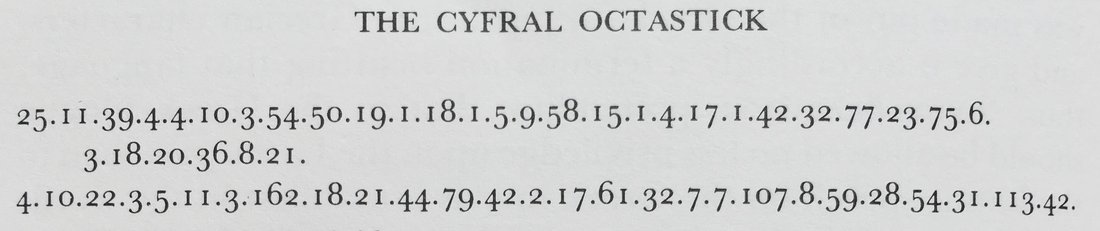
Transcribed from the photographs of the 1983 edition on the HCPortal record, laid out as printed: each stanza-line runs over onto an indented second line, and the
Decagram follows. The counts and sums are there so that another transcription can be checked line by line, and the range in brackets is the position of each line in the
count that the rule uses (number 146, the first of line 5, goes to page 146). Schmeh’s transcription (2015), the one in circulation, has 272: it lacks the run-overs
of lines 2 and 6 (31.5.19.32.3.115.3.22 and 16.69.1.44), drops the 2 before the last 10 of line 6, and has
6 for 16 as the second number of line 3. The list is OCTASTICH_1983 in targets/urquhart/ct.py.
Line 1    33 numbers, sum  710   (numbers 1–33)
25.11.39.4.4.10.3.54.50.19.1.18.1.5.9.58.15.1.4.17.1.42.32.77.23.75.6.
    3.18.20.36.8.21.
Line 2    35 numbers, sum 1222   (numbers 34–68)
4.10.22.3.5.11.3.162.18.21.44.79.42.2.17.61.32.7.7.107.8.59.28.54.31.113.42.
    31.5.19.32.3.115.3.22.
Line 3    38 numbers, sum 1298   (numbers 69–106)
1.16.96.31.87.5.88.1.4.30.10.15.8.47.28.17.139.17.69.5.29.9.9.1.51.6.114.8.
    34.30.2.18.24.41.33.74.93.8.
Line 4    39 numbers, sum 1470   (numbers 107–145)
5.12.58.162.12.44.1.66.9.15.100.42.2.28.16.6.27.4.196.70.53.7.1.69.2.15.89.
    34.11.13.12.29.15.76.40.22.8.24.75.
Line 5    32 numbers, sum  668   (numbers 146–177)
3.58.15.2.1.4.5.56.5.5.2.4.12.20.19.14.80.37.45.34.3.95.6.38.1.18.11.27.4.13.
    7.24.
Line 6    33 numbers, sum  867   (numbers 178–210)
5.20.5.87.40.25.9.56.21.29.2.81.50.147.2.6.16.15.14.9.13.27.3.16.14.7.6.2.10.
    16.69.1.44.
Line 7    31 numbers, sum  631   (numbers 211–241)
38.3.3.2.10.34.8.18.9.28.2.4.6.2.201.10.13.6.1.36.1.31.4.17.54.16.5.22.11.5.
    31.
Line 8    34 numbers, sum  975   (numbers 242–275)
71.96.15.45.19.6.64.10.42.7.83.37.6.3.7.74.4.14.8.91.27.12.11.2.28.50.68.3.2.
    12.1.5.49.3.
Decagram  10 numbers, sum  327   (numbers 276–285)
7.7.95.66.1.11.33.51.50.6.
03 A test that never sees the plaintext
A book cipher of this kind is normally judged by whether the letters it yields make sense, which invites the objection that a determined reader can make sense of anything. Urquhart’s habit removes that objection. If he scanned each page from the top and stopped at the first word beginning with the letter he needed, then for the right page the number he wrote is the index of the first word of its own initial. That is a property of the number and the page alone. For a wrong page, or a wrong rule, it holds at the base rate, which in this book is about 43 % for a random page and index because small indices are common and the first few words of any page are first occurrences by construction.
The EEBO-TCP transcription of The Jewel was parsed into word lists per page. The 1652 printer numbered pages 34–35, 38–39, 42–43 and 46–47 twice and skipped 60 and 110, so pages are counted physically from p. 1, and three duplicated page breaks that the TCP carries for re-shot images are removed. On Schmeh’s 272 numbers (section 02) a dynamic-programme alignment that may skip pages still placed 231 first-occurrence hits in 267 and decrypted five lines. The full 285 decode straight, one number per page.
| Run | First-occurrence rate |
|---|---|
| The 285 numbers, one per physical page | 0.838 (238/284) |
| Same numbers shuffled, 200 trials | mean 0.434, max 0.491 |
| Numbers in order, pages randomly permuted, 200 trials | mean 0.436, max 0.509 |
| Schmeh’s 272 numbers, aligned with page skips | 0.865 (231/267), vs 0.686 shuffled and re-aligned |
| Distich, i-th number into i-th Proquiritation | 0.53 (34/64), no English |
| Distich, shuffled, against pages of The Jewel, 100 trials | mean 0.50, max 0.62 |
Line 1 alone makes the case: 28 of its 33 numbers are exactly the first word of the needed initial on physical page k, and the other five are one word off (25 for 26, 18 for 17, 23 for 22, 75 for 74) or a TCP variant, which is the size of difference one expects between a modern tokenisation and a 1652 page.
04 The decryption
One number gives one letter. The k-th number, counting straight through the poem and not restarting at each line, goes to page k of the 1652 Jewel; count the words from the top of that page, and the first letter of the n-th word is the letter of the plaintext. Pages are counted as they are turned from p. 1, not by their printed numbers, and running heads, marginal notes and catchwords are not counted as words of the page. The first five numbers:
| Number | Page | The page, from the top | Letter |
|---|---|---|---|
| 25 | 1 | He should obtain all his desires, / Who offers more then he requires. NO sooner had the total Rout of the Regal party at Worcester, given … | G |
| 11 | 2 | exquisite snaps, and clean shavers (if ever there were any) rushing … | R |
| 39 | 3 | whom they had loaded with spoil, … and bore it straight away: which done, to every … | E |
| 4 | 4 | lying upon one another … | A |
| 4 | 5 | more carefully endeavoured to … | T |
Each of these words is also the first on its page with that initial: no earlier word on p. 1 begins with G, none on p. 2 with R, none on p. 3 with E. That is the
habit the test in section 03 measures. The first row also shows a typical difference between the TCP and the 1652 page: the TCP text sets the drop-capital N of
“NO” apart, so its word list counts “N” and “O” as two words and puts “given” at 26, and the block gives w
(“Worcester”) for the first number; on the 1652 page “given” is word 25.
Each row of the block has one letter per number, so line 5 has 32: _ marks number 158, which the TCP cannot decode because its filming has a
duplicate image there; the 1652 page gives W (section 04). Capitals are first-occurrence hits; a lower-case letter is the initial of a TCP word that is not the first of its letter on the page, usually a word or
two from it. The right-hand column is the plaintext.
wREATLORDMApTAInETHATREGtaFAMILIE          Great Lord, mantaine that regal familie
WtEREOFKINGCHARLStHaStCONtISTaEHiAD        Whereof King Charls the second is the head
ANDGRAnTTHatHEDAYBEARETHEFUPaEMESgEIGS     And grant that he may beare the supreme sweigh
WHERDENGLIsHSCoTSANDIOSoAREBORNEANDBRED    Where English, Scots and Irsh are borne and bred
AaDCOnERTHTO_aIttSUaPDApTHORIEIE           And [?] overthrow his usurp’d authoritie
REIGtEINMISnOtALPREDECESSORSSifAt          Reigne in his royal predecessors stead
SETHpLBEOURSOLtCESAtAmtaRHECBOR            Let him be our sole Cesar, Artur, Hector
OeREMPoRPUwJINGMONARCHANDPROTECTOR         Our Emperour, King, Monarch and Protector
AMsNSOwLtt                                 Amen, so be it
Sweigh is Scots swey, “sway”; mantaine, Charls, Cesar and Artur are period spellings. The text is a royalist prayer for Charles II, written in London in March 1652 by a prisoner of Worcester, hidden in a book dedicated to the vindication of Scotland.
The decryption agrees with Vals’ published plaintext in every line but the fifth. There they printed AND [·········] THIS USURP’D AUTHORITIE, as did the first version of this page: positions 149–157 come out C-O-N-E-R-T-H-T-O and make no word. Their “one page used twice from position 159” is right, and David Scheers’s photographs of the 1652 pp. 156–159 (20 October 2026) show which page: [157] runs straight on to [158] (catchword know), so no leaf is missing, and numbers 158 and 159 both fall on printed [158]. There when is word 11 and hand word 19; Urquhart’s numbers are 12 and 20, the same +1 on both. From number 160 his page k is printed page k−1. Re-read on 5 October 2026, the line divides one place later. Usurp’d authoritie fills 162–177. His fills 159–161 once the TCP’s split of “Leopoldo’s” into “Leopoldo s” on p. 161 is undone. That leaves 150–158 for overthrow, six of whose nine letters are exact, and 149 for a word of one letter:
| Word | Number | n | Word n on the page (TCP) | Letter | Fit |
|---|---|---|---|---|---|
| And | 146 | 3 | and | A | exact |
| 147 | 58 | and | N | near: first N is word 56, “neat” | |
| 148 | 15 | ducats | D | exact | |
| ? | 149 | 2 | Colonel | ? | open |
| overthrow | 150 | 1 | of | O | exact |
| 151 | 4 | nor | V | gap: first V is word 87 | |
| 152 | 5 | elected | E | exact | |
| 153 | 56 | Russia | R | exact | |
| 154 | 5 | the | T | exact | |
| 155 | 5 | his | H | exact | |
| 156 | 2 | to | R | near: first R is word 1, “repaired” | |
| 157 | 4 | of | O | exact | |
| 158 | 12 | when (printed [158], word 11 + 1) | W | page used twice; not the first W (“ward”) | |
| his | 159 | 20 | hand (printed [158], word 19 + 1) | H | page used twice; first H, same +1 |
| 160 | 19 | included | I | exact | |
| 161 | 14 | said | S | exact | |
| usurp’d | 162 | 80 | the | U | near: first U is word 79, “undergoe” |
| 163 | 37 | service | S | exact | |
| 164 | 45 | upbraid | U | exact | |
| 165 | 34 | and | R | near: first R is word 33, “Rape-seed” | |
| 166 | 3 | plowed | P | exact | |
| 167 | 95 | did | D | exact | |
| authoritie | 168 | 6 | an | A | exact |
| 169 | 38 | pain | U | near: first U is word 37, “under” | |
| 170 | 1 | they | T | exact | |
| 171 | 18 | have | H | exact | |
| 172 | 11 | other | O | exact | |
| 173 | 27 | rebus | R | exact | |
| 174 | 4 | I | I | exact | |
| 175 | 13 | endowments | T | near: first T is word 12, “Theological” | |
| 176 | 7 | improvement | I | exact | |
| 177 | 24 | excellenti | E | exact |
“Near” is a letter whose first word on the page lies within two of n, the size of a tokenisation difference between the TCP and the 1652 page. Number 149 gives “Colonel” where the line needs a one-letter word; O would suit a prayer, but the first O on that page is word 35, so the letter is left open. The V of overthrow (151, “nor”) is a slip. Its W (158) and the H of his (159) both come from printed page [158], counted one word higher than the TCP counts it: Urquhart used that page twice.
05 The distich does not follow
The distich is a separate cryptogram in another book, and the octastich’s rule does not open it, so it has its own result: not solved.
The same test applied to the distich under Vals’ Proquiritation rule, using Reticuli’s tokenised Proquiritations, yields 34 first-occurrence hits in 64 and the string
NTMAMNDN_OHTISEABRPTTSGSNTAATVTD, not O God uphold King Charls the second. Texts of thirty to a hundred words give high base rates, so 34 of 64 is
chance. Page-index variants on either book, with either numbering, with the second line restarting at page 1, all sit inside the shuffled control. Reticuli’s ten
infeasible positions stand. Scheers’s further suggestions (20 October 2026) were tested too: the last letter of the k-th word, the n-th letter
of the page, the sums and differences of the two lines, each line alone and the lines interleaved, on both books at every starting page. The best decode
scores −2.94 per letter against −2.72 to −2.97 for shuffled numbers: chance. The distich is a different construction, or the same construction on a text not yet tried; no decipherment of it is established.
One more construction was tried on 23 October 2026: the k-th number as the n-th letter of the k-th Proquiritation, with and without signatures, offsets 0 and 1, line 2 forwards and reversed. The best scores −6.99 per letter against shuffled controls up to −6.22: no English. No decipherment of the distich exists on the 1653 leaf or in the 1834 Works, so it stays decoded, not read, and the key text is still to be found.
06 What remains
- Measured against the verse (
measure_sense.py, 5 October 2026), 274 of the octastich’s 285 numbers give the required letter (96.1%): 233 exactly and 41 within two words of the first occurrence. The distich is another construction and is counted on its own: none of its 64 numbers is deciphered. (Pooled, the two would make 274 of 349, 78.5%, which is neither cryptogram’s result.) - Number 149, line 5: word 2 of p. 149 is “Colonel”, where the line wants a one-letter word. The 1652 page would show whether Urquhart’s copy differs there.
- Number 158, line 5: resolved on 20 October 2026 from David Scheers’s photographs of the 1652 pp. 156–159. No leaf is missing; Urquhart used printed page [158] for numbers 158 (when, W) and 159 (hand, H). Counting it, the octastich stands at 275 of 285 (96.5%).
- Nine numbers (55, 66, 106, 151, 207, 232, 239, 250, 283) point at a word that does not give the letter, and no word within two places does. Each was re-checked on the 1983 photographs and stands as printed, so these are slips by Urquhart or the compositor, or differences between the 1652 page and the TCP; the context fixes the letter.
- The distich.
07 Method and reproduction
In targets/urquhart/: ct.py holds both transcriptions of the octastich; pages.py parses the TCP XML of A95749 into pages under both
numberings; decode_1983_full.tsv gives every position with page, word, letter and first-occurrence flag; measure_sense.py scores every position against the
plaintext (measure_sense.txt); align.py is the alignment used on the defective transcription; the controls are in the notes. The TCP text comes from the Text Creation Partnership’s GitHub mirror; the 1983 page photographs from the
HCPortal record, whose API answers at api.hcportal.eu.
Full texts
The transcription and the decryption of every document on this page, so that the reading can be used and checked. Short files are shown here; all are in the repository.
The Cyphral Octastich, The Jewel (London, 1652), last leaf
A royalist prayer for Charles II in ottava rima ('Great Lord, mantaine that regal familie / Whereof King Charls the second is the head'), written in London in March 1652 by Urquhart, a prisoner of Worcester, and hidden as a book cipher on The Jewel itself.
Transcription
# Urquhart, the Cyphral Octastich (1652): the 285 numbers, written out from ct.py OCTASTICH_1983 on 22 Oct 2026.
# Transcribed 16 Sept 2026 from the HCPortal photographs of the 1983 Jack & Lyall edition, p. 212 and facing
# (src/octastich_part1.jpg, src/octastich_part2.jpg). One line per stanza-line (with its run-over); last line = the Decagram.
L1: 25 11 39 4 4 10 3 54 50 19 1 18 1 5 9 58 15 1 4 17 1 42 32 77 23 75 6 3 18 20 36 8 21
L2: 4 10 22 3 5 11 3 162 18 21 44 79 42 2 17 61 32 7 7 107 8 59 28 54 31 113 42 31 5 19 32 3 115 3 22
L3: 1 16 96 31 87 5 88 1 4 30 10 15 8 47 28 17 139 17 69 5 29 9 9 1 51 6 114 8 34 30 2 18 24 41 33 74 93 8
L4: 5 12 58 162 12 44 1 66 9 15 100 42 2 28 16 6 27 4 196 70 53 7 1 69 2 15 89 34 11 13 12 29 15 76 40 22 8 24 75
L5: 3 58 15 2 1 4 5 56 5 5 2 4 12 20 19 14 80 37 45 34 3 95 6 38 1 18 11 27 4 13 7 24
L6: 5 20 5 87 40 25 9 56 21 29 2 81 50 147 2 6 16 15 14 9 13 27 3 16 14 7 6 2 10 16 69 1 44
L7: 38 3 3 2 10 34 8 18 9 28 2 4 6 2 201 10 13 6 1 36 1 31 4 17 54 16 5 22 11 5 31
L8: 71 96 15 45 19 6 64 10 42 7 83 37 6 3 7 74 4 14 8 91 27 12 11 2 28 50 68 3 2 12 1 5 49 3
Decagram: 7 7 95 66 1 11 33 51 50 6
Decryption
# Urquhart, the Cyphral Octastich: the reading (copied verbatim from NOTES.md, 22 Oct 2026)

Rule: the k-th number, counting straight through the poem, is a word index into physical page k of *The Jewel*
(1652); the letter is that word's initial. The number-by-number decode (page, word, letter, first-occurrence flag) is
`decode_1983_full.tsv`; the raw letter string is `reading_octastich.txt`. Line 5 re-read 5 Oct 2026 (NOTES §5); one
letter (position 149) stays open.

```
Great Lord, mantaine that regal familie
Whereof King Charls the second is the head,
And grant that he may beare the supreme sweigh
Where English, Scots and Irsh are borne and bred;
And [?] overthrow his usurp'd authoritie
Reigne in his royal predecessors stead:
Let him be our sole Cesar, Artur, Hector,
Our Emperour, King, Monarch and Protector.
                              Amen, so be it.
```
Decryption
k	n	word	letter	first	first_index_of_letter
1	25	Worcester	W	False	7
2	11	rushing	R	True	11
3	39	every	E	True	39
4	4	another	A	True	4
5	4	to	T	True	4
6	10	Language	L	True	10
7	3	of	O	True	3
8	54	real	R	True	54
9	50	divided	D	True	50
10	19	matter	M	True	19
11	1	as	A	True	1
12	18	produce	P	False	9
13	1	the	T	True	1
14	5	and	A	True	5
15	9	is	I	True	9
16	58	never	N	False	31
17	15	extent	E	True	15
18	1	their	T	True	1
19	4	have	H	True	4
20	17	a	A	True	17
21	1	tenet	T	True	1
22	42	runs	R	True	42
23	32	even	E	True	32
24	77	Grammatical	G	True	77
25	23	teeth	T	False	1
26	75	As	A	False	11
27	6	for	F	True	6
28	3	after	A	True	3
29	18	my	M	True	18
30	20	in	I	True	20
31	36	Languages	L	True	36
32	8	it	I	True	8
33	21	every	E	True	21
34	4	with	W	True	4
35	10	the	T	False	4
36	22	express	E	True	22
37	3	Rules	R	True	3
38	5	every	E	True	5
39	11	out	O	True	11
40	3	fiftiethly	F	True	3
41	162	knowledge	K	True	162
42	18	in	I	True	18
43	21	new	N	True	21
44	44	great	G	True	44
45	79	concealed	C	True	79
46	42	have	H	True	42
47	2	and	A	True	2
48	17	respect	R	True	17
49	61	limits	L	True	61
50	32	strongest	S	True	32
51	7	their	T	False	6
52	7	he	H	True	7
53	107	a	A	False	10
54	8	shall	S	True	8
55	59	their	T	False	1
56	28	Cretians	C	True	28
57	54	of	O	True	54
58	31	notorious	N	True	31
59	113	this	T	False	12
60	42	in	I	True	42
61	31	say	S	True	31
62	5	themselves	T	True	5
63	19	any	A	False	5
64	32	esse	E	True	32
65	3	High-Germans	H	True	3
66	115	in	I	False	4
67	3	and	A	True	3
68	22	discretion	D	True	22
69	1	And	A	True	1
70	16	no	N	True	16
71	96	Denmark	D	True	96
72	31	Gordon	G	True	31
73	87	Rodomontads	R	True	87
74	5	a	A	True	5
75	88	Naples	N	False	53
76	1	those	T	True	1
77	4	that	T	True	4
78	30	Henry	H	True	30
79	10	any	A	False	7
80	15	therefore	T	False	8
81	8	half	H	True	8
82	47	eternal	E	True	47
83	28	duellists	D	True	28
84	17	after	A	True	17
85	139	yet	Y	True	139
86	17	being	B	True	17
87	69	encouragement	E	True	69
88	5	adversary	A	True	5
89	29	respective	R	True	29
90	9	executed	E	True	9
91	9	this	T	True	9
92	1	hand	H	True	1
93	51	external	E	True	51
94	6	faculty	F	True	6
95	114	unprepared	U	True	114
96	8	playing	P	True	8
97	34	a	A	False	15
98	30	eloquent	E	True	30
99	2	matter	M	True	2
100	18	extractions	E	True	18
101	24	subtleties	S	True	24
102	41	God	G	False	39
103	33	end	E	True	33
104	74	in	I	True	74
105	93	gestures	G	True	93
106	8	servant	S	True	8
107	5	which	W	True	5
108	12	he	H	True	12
109	58	end	E	True	58
110	162	ready	R	True	162
111	12	Drammatical	D	True	12
112	44	excessive	E	True	44
113	1	note	N	True	1
114	66	Gentlemen	G	True	66
115	9	liberty	L	True	9
116	15	if	I	True	15
117	100	several	S	False	98
118	42	he	H	True	42
119	2	seemed	S	True	2
120	28	Coach-man	C	True	28
121	16	or	O	False	2
122	6	to	T	True	6
123	27	strained	S	True	27
124	4	as	A	True	4
125	196	not	N	True	196
126	70	discourse	D	True	70
127	53	is	I	True	53
128	7	orders	O	True	7
129	1	she	S	True	1
130	69	of	O	False	2
131	2	and	A	True	2
132	15	rich	R	True	15
133	89	expectation	E	True	89
134	34	before	B	True	34
135	11	of	O	True	11
136	13	resorts	R	True	13
137	12	no	N	True	12
138	29	exterior	E	True	29
139	15	a	A	True	15
140	76	not	N	True	76
141	40	did	D	True	40
142	22	be	B	True	22
143	8	rows	R	True	8
144	24	elevate	E	True	24
145	75	dead	D	True	75
146	3	and	A	True	3
147	58	and	A	False	3
148	15	ducats	D	True	15
149	2	Colonel	C	True	2
150	1	of	O	True	1
151	4	nor	N	False	2
152	5	elected	E	True	5
153	56	Russia	R	True	56
154	5	the	T	True	5
155	5	his	H	True	5
156	2	to	T	True	2
157	4	of	O	True	4
158	12	-	_	None	None
159	20	and	A	False	6
160	19	included	I	True	19
161	14	the	T	False	7
162	80	the	T	False	4
163	37	service	S	True	37
164	45	upbraid	U	True	45
165	34	and	A	False	3
166	3	plowed	P	True	3
167	95	did	D	True	95
168	6	an	A	True	6
169	38	pain	P	False	4
170	1	they	T	True	1
171	18	have	H	True	18
172	11	other	O	True	11
173	27	rebus	R	True	27
174	4	I	I	True	4
175	13	endowments	E	True	13
176	7	improvement	I	True	7
177	24	excellenti	E	True	24
178	5	regular	R	True	5
179	20	ever	E	True	20
180	5	in	I	True	5
181	87	great	G	True	87
182	40	that	T	False	1
183	25	excelling	E	True	25
184	9	Icon	I	True	9
185	56	not	N	True	56
186	21	many	M	True	21
187	29	in	I	True	29
188	2	Scotish	S	True	2
189	81	nor	N	False	3
190	50	of	O	True	50
191	147	the	T	False	9
192	2	according	A	True	2
193	6	laws	L	True	6
194	16	people	P	True	16
195	15	Religion	R	True	15
196	14	eminent	E	True	14
197	9	Doctor	D	True	9
198	13	excuse	E	True	13
199	27	committed	C	True	27
200	3	ever	E	True	3
201	16	Several	S	True	16
202	14	Straloch	S	True	14
203	7	open	O	True	7
204	6	reason	R	True	6
205	2	should	S	True	2
206	10	since	S	True	10
207	16	is	I	False	8
208	69	for	F	False	14
209	1	Alexander	A	True	1
210	44	to	T	False	6
211	38	Sterlin	S	True	38
212	3	esteemed	E	True	3
213	3	that	T	True	3
214	2	had	H	True	2
215	10	Physician	P	False	8
216	34	left	L	True	34
217	8	but	B	True	8
218	18	excellent	E	True	18
219	9	or	O	True	9
220	28	under	U	True	28
221	2	received	R	True	2
222	4	set	S	True	4
223	6	of	O	True	6
224	2	literate	L	True	2
225	201	the	T	False	2
226	10	constrained	C	True	10
227	13	experience	E	True	13
228	6	Sinclair	S	True	6
229	1	as	A	True	1
230	36	the	T	False	6
231	1	and	A	True	1
232	31	men	M	False	13
233	4	to	T	False	3
234	17	and	A	False	4
235	54	relation	R	True	54
236	16	he	H	True	16
237	5	emnia	E	True	5
238	22	coming	C	True	22
239	11	be	B	True	11
240	5	of	O	True	5
241	31	Rexdolars	R	True	31
242	71	of	O	True	71
243	96	Eternity	E	False	3
244	15	Romania	R	True	15
245	45	excusable	E	True	45
246	19	most	M	True	19
247	6	prefers	P	True	6
248	64	of	O	False	11
249	10	remain	R	True	10
250	42	parent	P	True	42
251	7	upon	U	True	7
252	83	when	W	False	1
253	37	James	J	True	37
254	6	I	I	True	6
255	3	not	N	True	3
256	7	gaine	G	True	7
257	74	memorable	M	True	74
258	4	of	O	True	4
259	14	nevertheless	N	True	14
260	8	again	A	True	8
261	91	Realms	R	True	91
262	27	comfort	C	True	27
263	12	hath	H	True	12
264	11	and	A	True	11
265	2	name	N	True	2
266	28	dream	D	True	28
267	50	pari	P	True	50
268	68	renewed	R	True	68
269	3	of	O	True	3
270	2	that	T	True	2
271	12	England	E	True	12
272	1	circumobresistence	C	True	1
273	5	the	T	True	5
274	49	of	O	True	49
275	3	Romans	R	True	3
276	7	a	A	True	7
277	7	man	M	True	7
278	95	some	S	False	18
279	66	no	N	True	66
280	1	Subjection	S	True	1
281	11	of	O	True	11
282	33	with	W	False	5
283	51	Logical	L	True	51
284	50	Therefore	T	False	6
285	6	those	T	False	3
Decryption
wREATLORDMApTAInETHATREGtaFAMILIE
WtEREOFKINGCHARLStHaStCONtISTaEHiAD
ANDGRAnTTHatHEDAYBEARETHEFUPaEMESgEIGS
WHERDENGLIsHSCoTSANDIOSoAREBORNEANDBRED
AaDCOnERTHTO_aIttSUaPDApTHORIEIE
REIGtEINMISnOtALPREDECESSORSSifAt
SETHpLBEOURSOLtCESAtAmtaRHECBOR
OeREMPoRPUwJINGMONARCHANDPROTECTOR
AMsNSOwLtt
The Cyphral Distich, Logopandecteision (1653), last leaf decoded, not read
64 numbers in two lines; not deciphered. The published Proquiritation reading does not reproduce here.
A mechanical decode with holes in most sentences: shown so that the transcription and the key can be checked and improved, not as a reading.
Transcription
# Urquhart, the Cyphral Distich: the 64 numbers, written out from ct.py DISTICH on 22 Oct 2026.
# Two lines of 32 as printed (Maitland Club Works 1834 p. 417; 1653 Logopandecteision, NLS H.32.a.39 per Scheers).
# Position 56 is 38 in the 1653 print and the 1834 Works (Schmeh has 33).
5 3 27 38 32 14 21 8 66 8 70 39 5 9 12 18 2 3 56 5 1 7 3 2 13 19 3 25 9 3 16 6
25 15 13 6 11 20 5 1 2 12 1 20 20 49 20 20 35 33 4 6 8 35 5 38 5 5 18 10 3 11 32 42
Decryption
# Urquhart, the Cyphral Distich: no decipherment

The distich is not deciphered (outcome.parts: not solved, 0/64). The August 2026 claim (the i-th number indexes a
word of the i-th Proquiritation, first letters taken; claimed text `OGODUPHOLDKINGCHARLSTHESECONDANDMAKEHIMTHESUPREMERULEROFTHISLAND`, ct.py `CLAIM`)
does not reproduce here. From NOTES.md §6 (copied verbatim, 22 Oct 2026): "The first-occurrence test on Reticuli's
tokenised Proquiritations gives 34 of 64 hits and the string
`NTMAMNDN_OHTISEABRPTTSGSNTAATVTD / ASOTHDOSTTTBHPBTHBIPFSWTLVWTABV_`, not the claimed prayer." Page-index variants
and David Scheers's suggested variants (20 Oct 2026, `distich_scheers_variants.py`) score at chance.
Key: decode_1983_full.tsv
08 Sources
- Sir Thomas Urquhart, Ekskybalauron: or, The discovery of a most exquisite jewel (London, 1652), EEBO-TCP A95749; Logopandecteision (London, 1653), EEBO-TCP A64608.
- The Works of Sir Thomas Urquhart of Cromarty, Knight (Maitland Club, Edinburgh, 1834), p. 417, “The Cyphral Distich” — Internet Archive worksofsirthomas00mait.
- Klaus Schmeh, Cipherbrain, 29 April 2015; 30 June 2017 (Top 50 no. 28); 28 July 2019 with the readers’ comments quoting the HCPortal verse.
- Vals AI, “Claude Fable 5.1 Solves the Cyphral Distich”, 31 August 2026.
- David Scheers, Zealous with Language and Ciphers: Shorthand, ciphers and universal language around the 17th century (2021), appendix “The Urquhart ciphers Distich and Octastick”: the surviving copies of both leaves, with the 1653 distich photographed in NLS H.32.a.39; and correspondence, October 2026.
- Reticuli Labs, “distich-refutation-2026-09-01”, GitHub, 1 September 2026, with the tokenised Proquiritations used here.
- HCPortal, cryptogram record 7 (Urquhart), Eugen Antal, with photographs of Jack and Lyall (eds), The Jewel (Scottish Academic Press, 1983), p. 212 and facing.